Đề thi giữa học kì 2 môn Tiếng Anh lớp 12 có đáp án - Đề số 49
20 câu hỏi
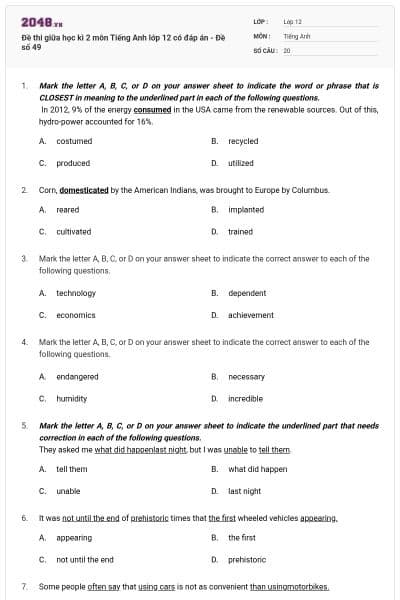
Mark the letter A, B, C, or D on your answer sheet to indicate the word or phrase that is CLOSEST in meaning to the underlined part in each of the following questions.
In 2012, 9% of the energy consumed in the USA came from the renewable sources. Out of this, hydro-power accounted for 16%.
costumed
recycled
produced
utilized
Đáp án: D
Giải thích:
Kiến thức: Từ vựng – Từ đồng nghĩa
consume (v): tiêu thụ
Xét các đáp án:
A. costumed (adj): mang trang phục
B. recycle (v): tái chế
C. produce (v): sản xuất
D. utilize (v): sử dụng
→ consumed = utilized
Dịch: Năm 2012, 9% năng lượng tiêu thụ ở Hoa Kỳ đến từ các nguồn năng lượng tái tạo. Trong đó, thủy điện chiếm 16%.
Corn, domesticated by the American Indians, was brought to Europe by Columbus.
reared
implanted
cultivated
trained
Đáp án đúng: C
Giải thích: domesticated: được trồng = cultivated: cày cấy, trồng trọt
Dịch: Ngô, thuần hóa bởi người da đỏ Mỹ, được Columbus mang đến châu Âu.
technology
dependent
economics
achievement
Đáp án đúng: C
Giải thích: Đáp án C có trọng âm rơi vào âm tiết thứ ba, các từ còn lại trọng âm rơi vào âm tiết thứ hai.
endangered
necessary
humidity
incredible
Đáp án đúng: B
Giải thích: Đáp án B có trọng âm rơi vào âm tiết thứ nhất, các từ còn lại trọng âm rơi vào âm tiết thứ hai.Mark the letter A, B, C, or D on your answer sheet to indicate the underlined part that needs correction in each of the following questions.
They asked me what did happenlast night, but I was unable to tell them.
tell them
what did happen
unable
last night
Đáp án đúng: B
Giải thích: Khi câu hỏi được chuyển về mệnh đề trần thuật, ta không dùng trợ động từ nữa mà chia động từ như thường.
what did happen => happened
Dịch: Họ hỏi tôi về chuyện gì đã xảy ra đêm qua, nhưng tôi không thể nói cho họ được.
It was not until the end of prehistoric times that the first wheeled vehicles appearing.
appearing
the first
not until the end
prehistoric
Đáp án đúng: A
Giải thích: Động từ chính của mệnh đề được chia ở thì Quá khứ đơn
Appearing => appeared
Dịch: Mãi cho đến khi kết thúc thời tiền sử các loại phương tiện lăn bánh đầu tiên mới xuất hiện.
Some people often say that using cars is not as convenient than usingmotorbikes.
using cars
than using
often say
motorbikes
Đáp án đúng: B
Giải thích: Cấu trúc so sánh bằng S1 + be + as + adj + as + S2 + (V)
than => as
Dịch: Một số người nói rằng việc sử dụng xe ô tô không thuận tiện như sử dụng xe máy.
Read the following passage and mark the letter A, B, C, or D on your answer sheet to indicate the correct answer to each of the question.
One of the factors contributing to the intense nature of twenty-first-century stress is our continual exposure to media - particularly to an overabundance of news. If you feel stressed out by the news, you are far from alone. Yet somehow many of us seem unable to prevent ourselves from tuning in to an extreme degree. The further back we go in human history, the longer news took to travel from place to place, and the less news we had of distant people and lands altogether. The printing press obviously changed all that, as did every subsequent development in transportation and telecommunication.
When television came along, it proliferated like a population of rabbits. In 1950, there were 100,000 television sets in North American homes; one year later there were more than a million. Today, it’s not unusual for a home to have three or more television sets, each with cable access to perhaps over a hundred channels. News is the subject of many of those channels, and on several of them it runs 24 hours a day. What’s more, after the traumatic events of September 11, 2001, live new-casts were paired with perennial text crawls across the bottom of the screen - so that viewers could stay abreast of every story all the time. Needless to say, the news that is reported to us is not good news, but rather disturbing images and sound bytes alluding to disaster (natural and man-made), upheaval, crime, scandal, war, and the like.
Compounding the problem is that when actual breaking news is scarce, most broadcasts fill in with waistline, hairline, or very existence in the future. This variety of story tends to treat with equal alarm a potentially lethal flu outbreak and the bogus claims of a wrinkle cream that overpromises smooth skin. Are humans meant to be able to process so much trauma - not to mention so much overblown anticipation of potential trauma - at once? The human brain, remember, is programmed to slip into alarm mode when danger looms. Danger looms for someone, somewhere at every moment. Exposing ourselves to such input without respite and without perspective cannot be anything other than a source of chronic stress.
Our inability to control ourselves
An overabundance of special news
The degree to which stress affects our life
Our continual exposure to the media
Đáp án đúng: D
Giải thích: Dựa vào thông tin câu 1 đoạn 1: “one of the factories contributing to the intense nature of twenty-first-particularly to an overabundance of news"
Dịch: Một trong những điều góp phần vào bản chất căng thẳng của những áp lực trong thế kỉ 21 là việc đối mặt thường xuyên với các phương tiện truyền thông đại chúng.
In the past, we had less news of distant people and lands because________.
printing, transportation, and telecommunications were not developed
means of communication and transportation were not yet invented
the printing press changed the situation too slowly
most people lived in distant towns and villages
Đáp án đúng: A
Giải thích: Dựa vào thông tin đoạn 2: "the further back we go in human history, the longer news took to travel from place to place, and the less news we had of distant people and lands altogether. The printing press obviously changed all that, as did every subsequent development in transportation and telecommunication."
Dịch: Chúng ta càng đi xa hơn trong lịch sử loài người, thời gian truyền đi từ nơi này đến nơi khác càng lâu, và chúng ta càng có ít tin tức về những con người và vùng đất xa xôi. Báo chí in rõ ràng đã thay đổi tất cả những điều đó, cũng như mọi sự phát triển tiếp theo của ngành giao thông vận tải và viễn thông.
a source of defects in human brain
the result of human brain’s switch to alarm mode
a source of chronic stress
the result of an overabundance of good news
Đáp án đúng: C
Giải thích: Dựa vào thông tin câu 4 đoạn 6: “Exposing ourslves to such input without respite and without perspective cannot be anything other than a source of chronic stress.”
Dịch: Việc tiếp xúc liên tục với tin tức xấu mà thiếu cân nhắc rõ ràng là cội nguồn của chứng căng thẳng kinh niên.
According to the passage, when there is not enough actual breaking news, broadcasts________.
are full of dangerous diseases such as flu
are forced to publicise an alarming increase in crime
send out frightening stories about potential dangers
send out live newscasts paired with text across the screen
Đáp án đúng: C
Giải thích: Dựa vào thông tin đoạn 5: “…when actual breaking news is scarce, most broadcasts fill in with scare stories about things that possibly might threaten our health, safety, finances, relationships, waistline, hairline, or very existence in the future”.
Dịch: Những khi không có đủ những tin sốt dẻo, giới truyền thông thường đưa ra những câu chuyện ghê rợn và những mối nguy hiểm tiềm ẩn.
Which of the following is NOT true, according to the passage?
Many people are under stress caused by the media.
The only source of stress in our modern life is the media.
The news that is reported to us is not good news.
Many TV channels supply the public with breaking news.
Đáp án đúng: B
Giải thích: Dựa vào thông tin: “One of the factors contributing to the intense nature of twenty-first-century stress…”
Dịch: Nguồn căng thẳng duy nhất trong cuộc sống hiện đại của chúng ta là phương tiện truyền thông.
The word “slip” in paragraph 3 is closest in meaning to________.
release
fail
fall
bring
Đáp án đúng: C
Giải thích: slip = fall: rơi vào
Dịch: Hãy nhớ rằng bộ óc của con người được lập trình để rơi vào trạng thái báo động mỗi khi nguy hiểm xuất hiện.
The word “traumatic” in paragraph 1 is closest in meaning to________.
upsetting
boring
exciting
fascinating
Đáp án đúng: A
Giải thích: traumatic = upsetting: đau buồn
Dịch: Hơn thế nữa, sau những sự kiện đau buồn vào ngày 11 tháng 9 năm 2001, dàn diễn viên mới trực tiếp được ghép nối với việc thu thập văn bản lâu năm ở cuối màn hình - để người xem có thể theo dõi mọi câu chuyện mọi lúc.
The Media - A Major Cause of Stress
More Modern Life - More Stress
Developments in Telecommunications
Effective Ways to Beat Stress
Đáp án đúng: A
Giải thích: Đáp án phù hợp.
Dịch: Các phương tiện truyền thông – Nguyên nhân chính của tình trạng căng thẳng thần kinh.
Mark the letter A, B, C, or D on your answer sheet to indicate the most suitable response to complete each of the following exchanges.
- Michel: "I failed my driving test again!" - Nick: “___________”
Congratulations!
It's my pleasure.
I'm sorry to hear that.
Don't mention it.
Đáp án đúng: C
Giải thích: Đáp án phù hợp.
Dịch: - Michel: "Tôi lại trượt bài kiểm tra lái xe!"
Nick: Tôi rất tiếc khi hay tin
- Anna: “Would you like a glass of beer, Emma?” - Emma: “_________”
No, I don’t like.
Yes, here you are.
I wouldn’t say no.
Yes, not too bad.
Đáp án đúng: C
Giải thích: Đáp án phù hợp.
Dịch: - Anna: "Em có muốn uống một ly bia không, Emma?"
- Emma: Em sẽ không từ chối
Mark the letter A, B, C or D on your answer sheet to indicate the word(s) OPPOSITE in meaning to the underlined word(s) in each of the following questions.
In some countries, the disease burden could be prevented through environmental improvements.
something sad
something to entertain
something enjoyable
something to suffer
Đáp án đúng: C
Giải thích: burden: gánh nặng >< something enjoyable: cái gì đó để hưởng thụ
Dịch: Ở một vài nước, gánh nặng bệnh tật có thể được ngăn chặn nhờ cải thiện môi trường.Population growth rates vary among regions and even among countries within the same region.
fluctuate
stay unchanged
remain unstable
restrain
Đáp án đúng: B
Giải thích: vary: thay đổi >< stay unchanged: không thay đổi
Dịch: Tỉ lệ tăng dân số khác nhau giữa các vùng và thậm chí là giữa các quốc gia trong cùng một vùng.
Mark the letter A, B, C, or D on your answer sheet to indicate the correct answer to each of the following questions.
a nice leather brown belt
a nice brown leather belt
a leather brown nice belt
a brown nice leather belt
Đáp án đúng: B
Giải thích: Quy tắc sắp xếp các tính từ: OPSACOM: Opinion (nice) – Price – Shape/size – Age – Color (brown) – Original – Material (leather)
=> nice leather brown
Dịch: Bạn tôi đã mua một chiếc thắt lưng da màu nâu rất đẹp ở một cửa hàng trên đường Trần Phú.
Bạn có thích hoạt động này không?