Chuyên đề ôn thi Kĩ năng đọc Tiếng Anh 12 - Đọc - Hiểu có đáp án
66 câu hỏi
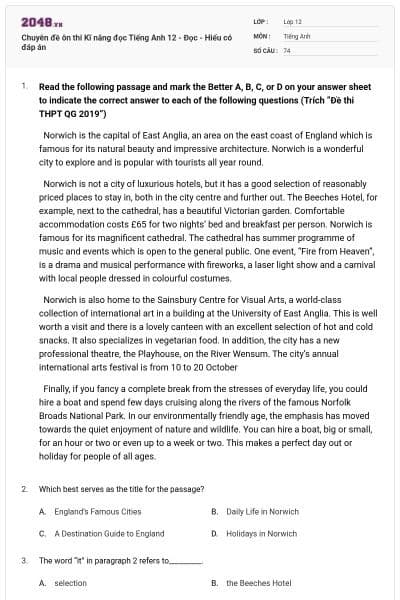
Read the following passage and mark the Better A, B, C, or D on your answer sheet to indicate the correct answer to each of the following questions (Trích “Đề thi THPT QG 2019”)
Norwich is the capital of East Anglia, an area on the east coast of England which is famous for its natural beauty and impressive architecture. Norwich is a wonderful city to explore and is popular with tourists all year round.
Norwich is not a city of luxurious hotels, but it has a good selection of reasonably priced places to stay in, both in the city centre and further out. The Beeches Hotel, for example, next to the cathedral, has a beautiful Victorian garden. Comfortable accommodation costs £65 for two nights’ bed and breakfast per person. Norwich is famous for its magnificent cathedral. The cathedral has summer programme of music and events which is open to the general public. One event, “Fire from Heaven”, is a drama and musical performance with fireworks, a laser light show and a carnival with local people dressed in colourful costumes.
Norwich is also home to the Sainsbury Centre for Visual Arts, a world-class collection of international art in a building at the University of East Anglia. This is well worth a visit and there is a lovely canteen with an excellent selection of hot and cold snacks. It also specializes in vegetarian food. In addition, the city has a new professional theatre, the Playhouse, on the River Wensum. The city’s annual international arts festival is from 10 to 20 October
Finally, if you fancy a complete break from the stresses of everyday life, you could hire a boat and spend few days cruising along the rivers of the famous Norfolk Broads National Park. In our environmentally friendly age, the emphasis has moved towards the quiet enjoyment of nature and wildlife. You can hire a boat, big or small, for an hour or two or even up to a week or two. This makes a perfect day out or holiday for people of all ages.
Which best serves as the title for the passage?
England’s Famous Cities
Daily Life in Norwich
A Destination Guide to England
Holidays in Norwich
Đáp án: D.
Holidays in Norwich
Hướng dẫn:
- Dạng câu hỏi: Câu hỏi tìm ý chính (main idea question)
- Dịch nghĩa 4 phương án:
A. Những thành phố nổi tiếng của nước Anh
B. Cuộc sống thường ngày ở Norwich
C. Hướng dẫn điểm đến ở nước Anh
D. Kì nghỉ ở Norwich
-Xác định ý chính của bài văn qua ý chính của các đoạn nhỏ:
*Norwich is the capital of East Anglia, an area on the east coast of England which is famous for its natural beauty and impressive architecture. (Norwich là thủ đô của Đông Anglia, một khu vực trên bờ biển phía đông nước Anh nổi tiếng với vẻ đẹp tự nhiên và kiến trúc ấn tượng.)
* Norwich is not a city of luxurious hotels, but it has a good selection of reasonably priced places to stay in, both in the city centre and further out. (Norwich không phải là một thành phố của những khách sạn sang trọng, nhưng nó có một lựa chọn tốt về những nơi có giá hợp lý để lưu trú, cả ở trung tâm thành phố và ngoại ô.)
* Norwich is also home to the Sainsbury Centre for visual Arts, a worldclass collection off international art Bn a building at the University of East Anglia. (Norwich cũng là nơi có Trung tâm nghệ thuật trực quan Sainsbury, một bộ sưu tập nghệ thuật quốc tế đẳng cấp thế giới trong một tòa nhà tại Đại học Đông Anglia.)
•Finally, If you fancy a complete break from the stresses of everyday life, you could hire a boat and spend few days cruising along the rivers of the famous Norfolk Broads National Park. (Cuối cùng, nếu bạn thích nghỉ ngơi hoàn toàn khỏi những căng thẳng của cuộc sống hàng ngày, bạn có thể thuê một chiếc thuyền và dành vài ngày để đi dọc theo các con sông của Công viên Quốc gia nổi tiếng Norfolk Broads.)
Các đoạn văn nhỏ nói tới vị trí, cảnh quan, khách sạn, địa điểm tham quan, chuyến du thuyền để giải tỏa căng thẳng. Từ đó, ta tổng hợp được ý chính của cả đoạn văn là kì nghỉ ở Norwich.
→ Chọn D.
The word “it” in paragraph 2 refers to_________.
selection
the Beeches Hotel
Norwich
the city centre
Đáp án: C. Norwich
Hướng dẫn:
-Dạng câu hỏi: Câu hỏi quy chiếu (Reference question)
-Từ it đóng vai trò chủ ngữ, hướng tới đối tượng là vật hoặc địa điểm ở dạng số ít.
- Từ này nằm trong vế thứ hai của câu “Norwich is not a city of luxurious hotels, but it has a good selection of reasonably priced places to stay in, both in the city centre and farther out.” (Norwich không phải là một thành phố của những khách sạn sang trọng, nhưng nó có một lựa chọn tốt về những nơi có giá hợp lý để lưu trú, cả ở trung tâm thành phố và ngoại ô.)
-Ta tìm được từ có thể thay thế cho it trong vế thứ nhất là Norwich.
→ Chọn C.
According to paragraph 2, which is NOT part of “Fire from Heaven”?
A fireworks display
A carnival
A campfire
A laser light show
Đáp án: C. A campfire
Hướng dẫn:
- Dạng câu hỏi: Câu hỏi phủ định (Negative factual question)
- Từ khóa trong câu hỏi: paragraph 2 (đoạn 2), NOT (không phải), part (phần), “Fire from Heaven” (“Ngọn lửa từ Thiên đường”)
-Dịch nghĩa 4 phương án:
A. Màn biểu diễn pháo hoa
B. Lễ hội
C. Lửa trại
D. Màn trình diễn ánh sáng la-de
-Dựa vào từ khóa “Fire from Heaven”, khoanh vùng được thông tin liên quan đến câu hỏi nằm ở câu cuối của đoạn 2 “One event, “Fire from Heaven”, is a drama and musical performance with fireworks, a laser light show and a carnival with local people dressed on colourful costumes.” (Một sự kiện, “Ngọn lửa từ thiên đường”, là một màn trình diễn kịch và âm nhạc với pháo hoa, trình diễn ánh sáng laser và lễ hội với người dân địa phương mặc trang phục đầy màu sắc.)
-Dựa vào thông tin trên, loại các phương án A, B và D.
→ Chọn C.
The word “cruising” in paragraph 4 mostly means_________.
swimming
travelling by boat
moving on land
surfing
Đáp án: B. travelling by boat
Hướng dẫn:
- Dạng câu hỏi: Câu hỏi từ vựng (Vocabulary question)
- Ta có câu chứa từ cruising: “Finally, if you fancy a complete break from the stresses of everyday life, you could hire a boat and spend few days cruising along the rivers of the famous Norfolk Broads National Park.”
Trong câu có thông tin hire a boat (thuê một chiếc thuyền) cho thấy cruising nói về hành động đi trên sông bằng thuyền.
-Dịch nghĩa 4 phương án:
A. bơi B. đi du lịch trên thuyền
C. di chuyển trên đất liền D. lướt sóng
→ Chọn B
According to the passage, where is the Sainsbury Centre for Visual Arts located?
In a building at the University of East Anglia
In an international art museum
In a new professional theatre on the River Wensum
In the Norfolk Broads National Park
Đáp án: A. In a building at the University of East Anglia
Hướng dẫn:
- Dạng câu hỏi: Câu hỏi tìm thông tin chi tiết (Detail factual question)
- Từ khóa trong câu hỏi: where (ở đâu), Sainsbury Centre for Visual Arts
(Trung tâm nghệ thuật thị giác Sainsbury)
-Dịch nghĩa 4 phương án:
A. Trong một tòa nhà tại Đại học Đông Anglia
B. Trong một bảo tàng nghệ thuật quốc tế
C. Trong một rạp chiếu phim chuyên nghiệp trên sông Wensum
D. Trong Công viên Quốc gia Norfolk Broads
-Dựa vào từ khóa Sainsbury Centre for Visual Arts, ta xác định được thông tin liên quan đến câu hỏi nằm ở câu đầu tiên của đoạn 3 “Norwich is also hometo the Sainsbury Centre for Visual Arts, a world-class collection of International art in a building at the University of East Anglia” (Norwich cũng là nơi có Trung tâm nghệ thuật thị giác Sainsbury, một bộ sưu tập nghệ thuật quốc tế đẳng cấp thế giới trong một tòa nhà tại Đại học East Anglia.)
→ Chọn A.Read the following passage and mark the letter A, B, C, or D on your answer sheet to indicate the correct answer to each of the following questions.
* Passage 1
INTERNET JOBS
Contrary to popular belief, one does not have to be a trained programmer to work online. Of course, there are plenty of jobs available for people with high-tech computer skills, but the growth of new media has opened up a wide range of Internet career opportunities requiring only a minimal level of technical expertise. Probably one of the most well-known online job opportunities is the job of webmaster. However, it is hard to define one basic job description for this position. The qualifications and responsibilities depend on what tasks a particular organization needs a webmaster to perform.
To specify the job description of a webmaster, one needs to identify the hardware and software that the website the webmaster will manage is running on. Different types of hardware and software require different skill sets to manage them. Another key factor is whether the website will be running internally (at the firm itself) or externally (renting shared space on the company servers). Finally, the responsibilities of a webmaster also depend on whether he or she will be working independently, or whether the firm will provide people to help. All of these factors need to be considered before one can create an accurate webmaster job description.
Webmaster is one type of Internet career requiring in-depth knowledge of the latest computer applications. However, there are also online jobs available for which traditional skills remain in high demand. Content jobs require excellent writing skills and a good sense of the web as a “new media”.
The term “new media” is difficult to define because it encompasses a constantly growing set of new technologies and skills. Specifically, it includes websites, email, Internet technology, CD-ROM, DVD, streaming audio and video, interactive multimedia presentations, e-books, digital music, computer illustration, video games, virtually reality, and computer artistry.
Additionally, many of today’s Internet careers are becoming paid-by-the-job professions. With many companies having to downsize in tough economic items, the outsourcing and contracting of freelance workers online has become common business practice. The Internet provides an infinite pool of buyers from around the world with whom freelancers are able to work on projects with companies outside their own country of residence.
How much can a person make in these kinds of career? As with many questions related to today’s evolving technology, there is no simple answer. There are many companies willing to pay people with technical Internet skills salaries well above $70,000 a year. Generally, webmasters start at about $30,000 per year, but salaries can vary greatly. Freelance writers working online have been known to make between $40,000 and $70,000 per year.
The word “identify” in paragraph 2 is closest in meaning to_________.
name
estimate
discount
encounter
Đáp án. A
Giải thích:
identify có nghĩa là xác định. Dịch nghĩa 4 phương án:
A. nếu tên, chỉ ra
B. ước lượng
C. giảm giá
D. gặp phải
Vì vậy, phương án A phù hợp nhất.
The word “them” in paragraph 2 refers to_________.
companies
new job opportunities
hardware and software
webmasters
Đáp án C
Giải thích:
Ta có câu chứa từ in đậm Different types of hardware and software require different skill sets to manage them (Các loại phần cứng và phần mềm khác nhau đòi hỏi các bộ kỹ năng khác nhau để quản lý chúng). Cụm từ có thể thay thế cho them (chúng) trong câu là hardware and softwware(phần cứng và phần mềm). Vì vậy, phương án C phù hợp nhất.
What does “it” in paragraph 4 refer to?
modern technology
new media
the Internet
a webmaster’s career
Đáp án. B
Giải thích:
Ta có câu chứa từ in đậm The term “new media” is difficult to define because it encompasses a constantly growing set of new technologies and skills. (Thuật ngữ “truyền thông mới”, khó có thể định nghĩa bởi vì nó bao gồm một tập hợp ngày càng phát triển của các công nghệ và kỹ năng mới). Từ có thể thay thế cho it (nó) trong câu là the term “new media” (thuật ngữ “truyền thông mới”). Vì vậy, phương án B phù hợp nhất.
According to the passage, which of the following is true of webmasters?
They never work independently.
They require a minimal level of expertise.
The duties they perform depend on the organization they work for.
They do not support software products.
Đáp án. C
Giải thích:
Dịch nghĩa 4 phương án:
A.Họ không bao giờ làm việc độc lập.
B.Họ đòi hỏi trình độ chuyên môn tối thiểu.
C. Nhiệm vụ mà họ thực hiện phụ thuộc vào tổ chức mà họ làm việc cho.
D. Họ không hỗ trợ các sản phẩm phần mềm.
Ta xác định được từ khóa trong câu hỏi là webmasters (những người quản trị trang web) và tìm được thông tin liên quan tới các phương án như sau:
-Finally, the responsibilities of a webmaster also depend on whether he or she will be working independently, or whether the firm will provide people to help.(Cuối cùng, trách nhiệm của một quản trị trang web cũng phụ thuộc vào việc người đó sẽ làm việc độc lập hay liệu công ty sẽ cung cấp nhân lực đề giúp đỡ.) → Phương án A không chính xác
- Webmaster is one type of Internet career requiring in-depth knowledge of the latest computer applications. (Quản trị trang web là một loại nghề nghiệp Internet đòi hỏi kiến thức chuyên sâu về các ứng dụng máy tính mới nhất.) → Phương án B không chính xác.
-The qualifications and responsibilities depend on what tasks a particular organization needs a webmaster to perform. (Bằng cấp và trách nhiệm phụ thuộc vào nhiệm vụ mà một tổ chức cụ thể cần một quản trị trang web để thực hiện.) → Phương án C phù hợp nhất.
-To specify the job description of a webmaster, one needs to identify the hardware and software that the website the webmaster will manage is running on. (Để làm chi tiết mô tả công việc của quản trị trang web, người ta cần xác định phần cứng và phần mềm mà trang web mà quản trị viên web sẽ quản lý đang chạy.) → Phương án D không chính xác.
There are online job opportunities available for workers with minimal computer skills.
Webmasters must have knowledge of the latest computer applications.
Online workers cannot free themselves from the office.
“New media” is not easy to define
Đáp án. C
Giải thích:
Dịch nghĩa 4 phương án:
A. Có những cơ hội nghề nghiệp cho những người làm việc với kĩ năng máy tính tối thiểu.
B. Những người quản trị trang qqen phải có kiến thức về những ứng dụng máy tính mới nhất.
C. Những người làm việc trực tuyến không thể giải phóng bản thân họ khỏi văn phòng.
D. “Truyền thông mới” không dễ định nghĩa.
Ta xác định được các câu chứa thông tin liên quan đến 4 phương án như sau:
-Of course, there are plenty of jobs available for people with high-tech computer skills, but the growth of new media has opened up a wide range of Internet career opportunities requiring only a minimal level of technical expertise. (Tất nhiên, có rất nhiều công việc dành cho những người có kỹ năng máy tính công nghệ cao, nhưng sự phát triển của phương tiện truyền thông mới đã mở ra một loạt các cơ hội nghề nghiệp Internet mà chỉ cần một trình độ chuyên môn kỹ thuật tối thiểu.)
→ Loại phương án A.
- Webmaster is one type of Internet career requiring in-depth knowledge of the latest computer applications. (Quản trị trang web là một loại nghề nghiệp Internet đòi hỏi kiến thức chuyên sâu) về các ứng dụng máy tính mới nhất.) → Loại phương án B.
-The Internet provides an infinite pool of buyers from around the world with whom freelancersare able to work on projects with companies outside their own country of residence. (Internet cung cấp một nhóm người mua vô hạn từ khắp nơi trên thế giới mà những người làm việc tự do có thể làm việc trong các dự án với các công ty bên ngoài quốc gia của họ.) → Phương án C phù hợp nhất.
-The term “new media” is difficult to define because it encompasses a constantly growing set of new technologies and skills. (Thuật ngữ “truyền thông mới”, khó có thể định nghĩa bởi vì nó bao gồm một tập hợp ngày càng phát triển của các công nghệ và kỹ năng mới.) → Loại phương án D.
Which of the following is NOT MENTIONED as part of “new media”?
websites
Internet technology
writing skills
video games
Đáp án C
Giải thích:
Dịch nghĩa 4 phương án:
A.các trang web
B.công nghệ Internet
C. kĩ năng viết
D. các trò chơi video
Dựa vào từ khóa new media ta xác định được thông tin có ở câu Specifically, it includes websites, email, Internet technology, CD-ROM, DVD, streaming audio and video, interactive multimedia presentations, e-books, digital music, computer illustration, video games, virtually reality, and computer artistry. (Cụ thể, nó bao gồm các trang web, email, công nghệ Internet, CD-ROM, DVD, truyền phát âm thanh và video, thuyết trình đa phương tiện tương tác, sách điện tử, nhạc số, minh họa máy tính, trò chơi video, hầu như thực tế và nghệ thuật máy tính.)
Vì vậy, phương án C phù hợp nhất.
It can be inferred from the passage that_________.
online workers can work full-time online
only skilled workers make good money
it is easy to become a webmaster
workers with limited computer skills cannot work online
Đáp án. B
Giải thích:
Dịch nghĩa 4 phương án:
A.những người làm việc trực tuyến có thể làm việc trực tuyến toàn thời gian
B.chỉ những người làm việc có kĩ năng mới kiếm được nhiều tiền
C. không dễ để trở thành một quản trị trang web
D. những người làm việc với kĩ năng máy tính hạn chế không thế làm việc trực tuyến
Thông tin nằm ở đoạn cuối, vì có sự khác biệt lớn về lương, từ $40,000 đến $70,000 nên có thể suy ra ai giỏi thì lương cao chứ không phải lương đều đều như nhau.
Vì vây, phương án B phù hợp nhất.
The word “vary” in paragraph 6 could best be replaced by which of the following?
change
decrease
increase
differ
Đáp án. D
Giải thích:
Từ vary dùng trong đoạn văn có nghĩa là khác nhau. Dịch nghĩa 4 phương án:
A.thay đổi
B.giảm
C. tăng
D. khác biệt
Vì vậy, phương án A phù hợp nhất.
Dịch nghĩa toàn bài:
Trái với quan điểm phổ biến, người ta không cần phải là một lập trình viên được đào tạo để làm việc trực tuyến. Tất nhiên, có rất nhiều công việc dành cho những người có kỹ năng máy tính công nghệ cao, nhưng sự phát triển của phương tiện truyền thông mới đã mở ra một loạt các cơ hội nghề nghiệp Internet mà chỉ cần một trình độ chuyên môn kỹ thuật (1) tối thiểu. Có lẽ một trong những cơ hội việc làm trực tuyến nổi tiếng nhất là công việc của quản trị trang web. Tuy nhiên, thật khó để xác định một mô tả công việc cơ bản cho vị trí này. Bằng cấp (2) và trách nhiệm phụ thuộc vào nhiệm vụ mà một tổ chức cụ thể cần một quản trị trang web để thực hiện.
Để làm chi tiết mô tả công việc của quản trị trang web, người ta cần xác định phần cứng và phần mềm mà trang web mà quản trị viên web sẽ quản lý đang chạy. Các loại phần cứng và phần mềm khác nhau đòi hỏi các bộ kỹ năng khác nhau để quản lý chúng. Một yếu tố quan trọng khác là liệu trang web sẽ được chạy nội bộ (tại chính công ty) hay bên ngoài (thuê không gian chia sẻ trên các máy chủ của công ty). Cuối cùng, trách nhiệm của một quản trị trang web cũng phụ thuộc vào việc người đó sẽ làm việc độc lập hay liệu công ty sẽ cung cấp cho mọi người để giúp đỡ. Tất cả các yếu tố này cần được xem xét trước khi có thể tạo một mô tả công việc quản trị trang web chính xác.
Quản trị trang web là một loại nghề nghiệp Internet đòi hỏi kiến thức chuyên sâu (3) về các ứng dụng máy tính mới nhất. Tuy nhiên, cũng có những công việc trực tuyến có sẵn mà các kỹ năng truyền thống vẫn có nhu cầu cao. Các công việc nội dung đòi hỏi kỹ năng viết tuyệt vời và ý thức tốt về web như một phương tiện truyền thông mới.
Thuật ngữ “truyền thông mới”, khó có thể định nghĩa bởi vì nó bao gồm một tập hợp ngày càng phát triển của các công nghệ và kỹ năng mới. Cụ thể, nó bao gồm các trang web, email, công nghệ Internet, CD-ROM, DVD, truyền phát âm thanh và video, thuyết trình đa phương tiện tương tác, sách điện tử, nhạc số, minh họa máy tính, trò chơi video, hầu như thực tế và nghệ thuật máy tính.
Ngoài ra, nhiều nghề nghiệp trên Internet ngày nay đang trở thành nghề nghiệp được trả lương(4). Với nhiều công ty phải thu hẹp quy mô đối vớỉ những mặt hàng kinh tế khó bán, việc thuê ngoài và ký hợp đồng lao động tự do trực tuyến đã trở thành thông lệ kinh doanh phổ biến. Internet cung cấp một nhóm người mua vô hạn từ khắp nơi trên thế giới mà những người làm việc tự do(5) có thể làm việc trong các dự án với các công ty bên ngoài quốc gia của họ.
Một người có thể kiếm được bao nhiêu trong những loại nghề nghiệp này? Cũng như nhiều câu hỏi liên quan đến công nghệ phát triển ngày nay, không có câu trả lời đơn giản nào. Có nhiều công ty sẵn sàng trả cho những người có kỹ năng Internet kỹ thuật mức lương cao trên 70.000 đô la một năm. Thông thường, các quản trị web bắt đầu với khoảng 30.000 đô la mỗi năm, nhưng mức lương có thể thay đổi rất nhiều. Các nhà văn tự do làm việc trực tuyến đã được biết là kiếm được từ 40.000 đến 70.000 đô la mỗi năm.
Vocabulary
1.technical expertise (N. phrase)
2.Qualifications (N.)
3.in-depth knowledge (N. phrase)
4.paid-by-the job professions (N. phrase)
5.freetenceir (N.)
Most people can remember a phone number for up to thirty seconds. When this short amount of time elapses, however, the numbers are erased from the memory. How did the information get there in the first place? Information that makes its way to the short term memory (STM) does so via the sensory storage area. The brain has a filter which only allows stimuli that is of immediate interest to pass on to the STM, also known as the working memory.
There is much debate about the capacity and duration of the short term memory. The most accepted theory comes from George A. Miller, a cognitive psychologist who suggested that humans can remember approximately seven chunks of information. A chunk is defined as a meaningful unit of information, such as a word or name rather than just a letter or number. Modern theorists suggest that one can increase the capacity of the short term memory by chunking, or classifying similar information together. By organizing information, one can optimize the STM, and improve the chances of a memory being passed on to long term storage.
When making a conscious effort to memorize something, such as information for an exam, many people engage in “rote rehearsal”. By repeating something over and over again, one is able to keep a memory alive. Unfortunately, this type of memory maintenance only succeeds if there are no interruptions. As soon as a person stops rehearsing the information, it has the tendency to disappear. When a pen and paper are not handy, people often attempt to remember a phone number by repeating it aloud. If the doorbell rings or the dog barks to come in before a person has the opportunity to make a phone call, he will likely forget the number instantly. Therefore, rote rehearsal is not an efficient way to pass information from the short term to long term memory. A better way is to practice “elaborate rehearsal”. This involves assigning semantic meaning to a piece of information so that it can be filed along with other pre-existing long term memories.
Encoding information semantically also makes it more retrievable. Retrieving information can be done by recognition or recall. Humans can easily recall memories that are stored in the long term memory and used often; however, if a memory seems to be forgotten, it may eventually be retrieved by prompting. The more cues a person is given (such as pictures), the more likely a memory can be retrieved. This is why multiple choice tests are often used for subjects that require a lot of memorization.
According to the passage, how do memories get transferred to the STM?
They revert from the long term memory.
They are filtered from the sensory storage area.
They get chunked when they enter the brain.
They enter via the nervous system.
Đáp án. B
Giải thích:
Dịch nghĩa 4 phương án:
A. Chúng khôi phục lại từ bộ nhớ dài hạn.
B. Chúng được lọc từ khu vực lưu trữ cảm giác.
C. Chúng được gộp lại khi chúng vào não.
D. Chúng đi vào qua hệ thần kinh.
Ta xác định được thông tin liên quan đến câu hỏi có ở đoạn Information that makes its way to the short term memory (STM) does so via the sensory storage area. The brain has a filter which only allows stimuli that is of immediate interest to pass on to the STM, also known as the working memory. (Thông tin đi đến bộ nhớ ngắn hạn (STM) thông qua vùng lưu trữ cảm giác. Bộ não có một bộ lọc chỉ cho phép các kích thích được quan tâm ngay lập tức truyền đến STM, còn được gọi là bộ nhớ làm việc.)
Vì vậy, phương án B phù hợp nhất.
The word “elapses” in paragraph 1 is closest in meaning to_________.
passes
adds up
appears
continues
Đáp án. A
Giải thích:
Từ elapse trong đoạn văn có nghĩa là trôi qua nhanh. Dịch nghĩa 4 phương án:
A. đi quaB. tăng dần lênC. xuất hiệnD. tiếp tục
Vì vậy, phương án A phù hợp nhất.
All of the following are mentioned as places in which memories are stored EXCEPT the_________.
STM
long term memory
sensory storage area
maintenance area
Đáp án. D
Giải thích:
Ta xác định được thông tin liên quan đến câu hỏi có ở câu Information that makes its way to the short term memory (STM) does so via the sensory storage area (Thông tin đi đến bộ nhớ ngắn hạn (STM) thông qua vùng lưu trữ cảm giác.) và By organizing information, one can optimize the STM, and improve the chances of a memory being passed on to long term storage (Bằng cách tổ chức thông tin, người ta có thể tối ưu hóa STM và cải thiện cơ hội dữ liệu nhớ được chuyển sang lưu trữ dài hạn). Các phương án A, B, C đều được nhắc đến. Vì vậy, phương án D phù hợp nhất.
To give an example of a type of memory
To provide a type of interruption
To prove that dogs have better memories than humans
To compare another sound that is loud like a doorbell
Đáp án. B
Giải thích:
Dịch nghĩa 4 phương án:
A.Để đưa ra một ví dụ về một loại trí nhớ
B.Để cung cấp một loại gián đoạn
C. Để chứng minh rằng chó có tí nhớ tốt hơn loài người
D. Để so sánh các âm thanh khác to như chuông cửa
Dựa vào từ khóa a dog’s bark (tiếng chó sủa) ta xác định được thông tin liên quan đến câu hỏi nằm ở đoạn 3. Xem xét nghĩa của các câu phía trước, ta thấy các câu đó đang nói về interuptions (sự gián đoạn). Vì vậy, phương án B phù hợp nhất.
How do theorists believe a person can remember more information in a short time?
By organizing it
By repeating it
By giving it a name
By drawing it
Đáp án. A
Giải thích:
Dịch nghĩa 4 phương án:
A. Bằng cách tổ chức nóB. Bằng cách lặp lại nó
C. Bằng cách đặt tên cho nóD. Bằng cách vẽ nó
Thông tin có ở câu By organizing Information, one can optimize the STM, and improve the chances of a memory being passed on to long term storage (Bằng cách tổ chức thông tin, người ta có thể tối ưu hóa STM và cải thiện cơ hội dữ liệu nhớ được chuyển sang lưu trữ dài hạn)
Vì vậy, phương án A phù hợp nhất.
The author believes that rote rehearsal is_________.
the best way to remember something
more efficient than chunking
ineffective in the long run
an unnecessary interruption
Đáp án C
Giải thích:
Dịch nghĩa 4 phương án:
A.cách tốt nhất để nhớ thứ gì đó
B.hiệu quả hơn gộp
C. không hiệu quả trong dài hạn
D. một sự gián đoạn không cần thiết
Dựa vào từ khóa rote rehearsal ta xác định được thông tin có ở câu Therefore, rote rehearsal is not an efficient way to pass information from the short term to long term memory (Do đó, học vẹt không phải là một cách hiệu quả để truyền thông tin từ bộ nhớ ngắn hạn sang bộ nhớ dài hạn).
Vì vậy, phương án C phù hợp nhất.
encoding
STM
semantics
information
Đáp án. D
Giải thích:
Dựa vào câu chứa từ in đậm Encoding information semantically also makes st more retrievable. (Mã hóa thông tin theo ngữ nghĩa cũng làm cho nó dễ truy xuất hơn) ta thấy từ có thể thay thế được cho it trong câu là information. Vì vậy, phương án D phù hợp nhất.
The word “elaborate” in paragraph 3 is closest in meaning to_________.
complex
efficient
pretty
regular
Đáp án A
Từ elaborate trong đoạn văn có nghĩa là kĩ lưỡng. Dịch nghĩa 4 phương án:
A. phức tạpB. hiệu quảC. xinh đẹpD. thường xuyên
Vì vậy, phương án A phù hợp nhất.
Hầu hết mọi người có thể nhớ một số điện thoại trong tối đa ba mươi giây. Tuy nhiên, khi khoảng thời gian ngắn này trôi qua, các con số sẽ bị xóa khỏi bộ nhớ. Làm thế nào mà thông tin được nhớ từ đầu? Thông tin đi đến bộ nhớ ngắn hạn (1) (STM) thông qua vùng lưu trữ cảm giác. Bộ não có một bộ lọc chỉ cho phép các kích thích được quan tâm ngay lập tức truyền đến STM, còn được gọi là bộ nhớ làm việc.
Có nhiều tranh luận về dung lượng và thời lượng của bộ nhớ ngắn hạn. Giả thuyết được chấp nhận nhiều nhất đến từ George A. Miller, một nhà tâm lý học nhận thức(2), người cho rằng con người có thể nhớ khoảng bảy khối thông tin
Một khối được định nghĩa là một đơn vị thông tin có ý nghĩa, chẳng hạn như một từ hoặc tên chứ không chỉ là một chữ cái hoặc số. Các nhà lý thuyết (3) hiện đại cho rằng người ta có thể tăng dung lượng của bộ nhớ ngắn hạn bằng cách gộp hoặc phân loại thông tin tương tự với nhau. Bằng cách tổ chức thông tin, người ta có thể tối ưu hóa STM và cải thiện cơ hội dữ liệu nhớ được chuyển sang lưu trữ dài hạn (4).
Khi thực hiện một nỗ lực có ý thức để ghi nhớ một cái gì đó, chẳng hạn như thông tin cho một kỳ thi, nhiều người luyện tập “học vẹt”. Bằng cách lặp đi lặp lại một cái gì đó nhiều lần, người ta có thể giữ một bộ nhớ sống. Thật không may, loại bảo trì bộ nhớ này chỉ thành công nếu không có sự gián đoạn. Ngay khi một người ngừng kiểm tra thông tin, nó có xu hướng biến mất. Khi bút và giấy không tiện dụng (5) , mọi người thường cố nhớ (6) số điện thoại bằng cách lặp lại to. Nếu chuông cửa reo hoặc chó sủa trước khi một người có cơ hội gọi điện thoại, anh ta có thể sẽ quên số ngay lập tức. Do đó, học vẹt không phải là một cách hiệu quả (7) để truyền thông tin từ bộ nhớ ngắn hạn sang bộ nhớ dài hạn. Cách tốt hơn là “luyện tập kỹ lưỡng”. Điều này liên quan đến việc gán ý nghĩa ngữ nghĩa cho một phần thông tin để nó có thể được giữ cùng với các ký ức dài hạn có sẵn (8) khác.
Mã hóa thông tin theo ngữ nghĩa cũng làm cho nó dễ truy xuất (9) hơn. Lấy thông tin có thể được thực hiện bằng cách công nhận hoặc thu hồi. Con người có thể dễ dàng nhớ lại những ký ức được lưu trữ trong bộ nhớ dài hạn và được sử dụng thường xuyên; tuy nhiên, nếu một bộ nhớ dường như bị lãng quên, cuối cùng nó có thể được lấy ra bằng cách nhắc nhở. Một người càng có nhiều tín hiệu (như hình ảnh), bộ nhớ có thể được lấy lại càng nhiều. Đây là lý do tại sao các bài kiểm tra trắc nghiệm thường được sử dụng cho các môn học đòi hỏi nhiều sự ghi nhớ.
Vocabulary
1. short term (Adj)
2. cognitive (Adj.)
3.theorists (N.)
4.long term (Adj)
5.handy (Adj)
6.attempt to remember
(V + to infinitive)
7.efficient (Adj.)
8.pre-existing (Adj.)
9.retrievable (Adj.)
As the twentieth century began, the importance of formal education in the United States increased. The frontier had mostly disappeared and by 1910 most Americans lived in towns and cities. Industrialization and the bureaucratization of economic life combine with a new emphasis upon credentials and expertise to make schooling increasingly important for economic and social mobility.
Increasingly, too, schools were viewed as the most important means of integrating immigrants into American society. The arrival of a great wave of southern and eastern European immigrants at the turn of the century coincided with and contributed to an enormous expansion of formal schooling. By 1920 schooling to age fourteen or beyond was compulsory in most states, and the school year was greatly lengthened. Kindergartens, vacation schools, extracurricular activities, and vocational education and counseling extended the influence of public schools over the lives of students, many of whom in the larger industrial cities were the children of immigrants. Classes for adult immigrants were sponsored by public schools, corporations, unions, churches, settlement houses, and other agencies.
Reformers early in the twentieth century suggested that education programs should suit the needs of specific populations. Immigrant women were one such population. Schools tried to educate young women so they could occupy productive places in the urban industrial economy, and one place many educators considered appropriate for women was the home. Although looking after the house and family was familiar to immigrant women, homemaking a new definition. In preindustrial economies, homemaking had meant the production as well as the consumption of goods, and it commonly included income-producing activities both inside and outside the home. In the highly industrialized early-twentieth-century United States, however, overproduction rather than scarcity was becoming a problem. Thus, the ideal American homemaker was viewed as a consumer rather than a producer. Schools trained women to be consumer homemakers-cooking, shopping, decorating, and caring for children “efficiently” in their own homes, or if economic necessity demanded, as employees in the homes of others. Subsequent reforms have made these notions seem quite out-of-date.
It can be inferred from paragraph 1 that one important factor in the increasing importance of education in the United States was_________.
the growing number of schools in frontier communities
an increase in the number of trained teachers
the expanding economic problems of schools
the increased urbanization of the entire country
Đáp án. D
Giải thích:
Dịch nghĩa 4 phương án:
A.số lượng ngày càng tăng của các lớp học trong cộng đồng biên giới
B.sự gia tăng số lượng giáo viên được đào tạo
C. các vấn đề kinh tế mở rộng của các trường học
D. đô thị hóa ngày càng tăng của cả nước
Thông tin có ở câu Industrialization and the bureaucratization of economic life combine with a new emphasis upon credentials and expertise to make schooling increasingly important for economic and social mobility(Công nghiệp hóa và quan liêu hóa đời sống kinh tế kết hợp với sự nhấn mạnh vào tầm quan trọng của khả năng và chuyên môn làm cho việc học ngày càng trở nên quan trọng đối với sự di chuyển kinh tế và xã hội).
Vì vậy, phương án D phù hợp nhất.
The word “means” in paragraph 2 is closest in meaning to__________.
advantages
probability
method
qualifications
Đáp án. C
Giải thích:
Từ means trong đoạn văn có nghĩa là phương tiện, cách thức. Dịch nghĩa 4 phương án:
A. lợi íchB. khả năng có thể xảy ra
C. phương phápD. bằng cấp
Vì vậy, phương án C phù hợp nhất.
The phrase “coincided with” in paragraph 2 is closest in meaning to__________.
was influenced by
happened at the same time as
began to grow rapidly
ensure the success of
Đáp án. B
Giải thích:
Cụm coincided with trong đoạn văn có nghĩa là xảy ra cùng lúc. Dịch nghĩa 4 phương án:
A. bị ảnh hưởng bởi B. xảy ra cùng lúc
C. bắt đầu tăng trưởng nhanh chóng D. đảm bảo thành công
Vì vậy, phương án B phù hợp nhất.
According to the passage, what is one important change in United States education by the 1920’s?
Most places required children to attend school.
The amount of time spent on formal education was limited.
New regulations were imposed on nontraditional education
Adults and children studied in the same classes.
Đáp án. A
Giải thích:
Dịch nghĩa 4 phương án:
A.Hầu hết các nơi yêu cầu trẻ em đi học.
B.Lượng thời gian dành cho giáo dục chính quy bị hạn chế.
C. Quy định mới được áp đặt cho giáo dục phi truyền thống.
D. Người lớn và trẻ em học cùng lớp.
Thông tin có ở câu By 1920 schooling to age fourteen or beyond was compulsory in most states, and the school year was greatly lengthened (Đến năm 1920 đi học đến mười bốn tuổi trở lên là bắt buộc ở hầu hết các tiểu bang, và năm học được kéo dài rất nhiều).
Vì vậy, phương án A phù hợp nhất.
alternatives to formal education provided by public schools
the importance of educational changes
activities that competed to attract new immigrants to their programs
the increased impact of public schools on students
Đáp án. D
Giải thích:
Dịch nghĩa 4 phương án:
A.lựa chọn thay thế cho giáo dục chính quy được cung cấp bởi các trường công lập
B.tầm quan trọng của những thay đổi trong giáo dục
C. các hoạt động cạnh tranh để thu hút người nhập cư mới vào chương trình của họ
D. tác động gia tăng của các trường công lập đối với học sinh
Thông tin có ở câu Kindergartens, vacation schools, extracurricular activities, and vocational education and counseling extended the influence off public schools over the lives of students, many of whom in the larger Industrial cities were the children of immigrants (Trường mẫu giáo, trường học hè, hoạt động ngoại khóa, giáo dục và tư vấn dạy nghề đã mở rộng ảnh hưởng của các trường công lập đối với cuộc sống của học sinh, nhiều người trong số họ ở các thành phố công nghiệp lớn là con của người nhập cư)
Vì vậy, phương án D phù hợp nhất.
different groups needed different kinds of education
special programs should be set up in frontier communities to modernize them
corporations and other organizations damaged educational progress
more women should be involved in education and industry
Đáp án. A
Giải thích:
Dịch nghĩa 4 phương án:
A.các nhóm khác nhau cần các loại hình giáo dục khác nhau
B.các chương trình đặc biệt nên được thiết lập trong các cộng đồng biên giới để hiện đại hóa chung
C. các tập đoàn và các tổ chức khác làm hỏng tiến trình giáo dục
D. nhiều phụ nữ nên tham gia và giáo dục và công nghiệp
Thông tin có ở câu Reformers early in the twentieth century suggested that education programs should suit the needs off specific populations (Các nhà cải cách đầu thế kỷ XX cho rằng các chương trình giáo dục phải phù hợp với nhu cầu cụ thể của người dân).
Vì vậy, phương án A phù hợp nhất.
What does the word “it” in the third paragraph refer to?
consumption
production
homemaking
education
Đáp án. C
Giải thích:
Ta có câu chứa từ in đậm In preindustrial economies, homemaking had meant the production as well as the consumption of goods, and it commonly included income-producing activities both inside and outside the home (Trong các nền kinh tế tiền chế, nội trợ có nghĩa là sản xuất cũng như tiêu thụ hàng hóa, và nó thường bao gồm các hoạt động tạo thu nhập cả trong và ngoài nhà). Từ có thể thay thế cho it (nó) trong câu là homemaking(nội trợ).
Vì vậy, phương án C phù hợp nhất.
Dịch nghĩa toàn bài:
Khi thế kỷ XX bắt đầu, tầm quan trọng của giáo dục chính quy (1) ở Hoa Kỳ được đề cao hơn. Ranh giới hầu như đã biến mất và đến năm 1910, hầu hết người Mỹ sống ở các thị trấn và thành phố. Công nghiêp hóa (2) và quan liêu hóa đời sống kinh tế kết hợp với sự nhấn mạnh vào tầm quan trọng của khả năng và chuyên môn làm cho việc học ngày càng trở nên quan trọng đối với sự dịch chuyển kinh tế và xã hội (3).
Càng ngày, các trường học càng được coi là phương thức quan trọng nhất để hợp nhất người nhập cư(4) vào xã hội Mỹ. Sự xuất hiện của một làn sóng lớn những người nhập cư ở phía nam và phía đông châu Âu vào đầu thế kỷ diễn ra cùng thời điểm và góp phần vào sự mở rộng to lớn của giáo dục chính quy. Đến năm 1920, việc đi học từ mười bốn tuổi trở lên là bắt buộc(5) ở hầu hết các tiểu bang, và năm học được kéo dài nhiều. Trường mẫu giáo, trường học hè, hoạt động ngoại khóa(6). giáo dục và tư vấn dạy nghề đã mở rộng ảnh hưởng của các trường công lập đối với cuộc sống của học sinh, nhiều người trong số họ ở các thành phố công nghiệp lớn là con của người nhập cư. Các lớp học cho người nhập cư trưởng thành được tài trợ bởi các trường công, tập đoàn, đoàn thể, nhà thờ, nhà định cư và các cơ quan khác.
Các nhà cải cách đầu thế kỷ XX cho rằng các chương trình giáo dục phải phù hợp với nhu cầu cụ thể của người dân. Phụ nữ nhập cư là một trong số đó. Các trường học đã cố gắng giáo dục phụ nữ trẻ để họ có thể có được những vị trí tốt trong nền kinh tế công nghiệp đô thị, và một nơi mà nhiều nhà giáo dục cho là phù hợp với phụ nữ là nhà. Mặc dù chăm sóc ngôi nhà và gia đình đã quen thuộc với phụ nữ nhập cư, nhưng việc nội trợ(7) lại là một định nghĩa mới. Trong các nền kinh tế tiền chế, nội trợ có nghĩa là sản xuất cũng như tiêu thụ hàng hóa, và nó thường bao gồm các hoạt động tạo thu nhập cả trong và ngoài nhà. Tuy nhiên, ở Hoa Kỳ đầu thế kỷ XX, không phải sự khan hiếm mà là sự sản xuất quá mức đang trở thành một vấn đề. Do đó, người nội trợ lý tưởng của Mỹ được xem như một người tiêu dùng hơn là một nhà sản xuất. Các trường đào tạo phụ nữ trở thành người nội trợ tiêu dùng - nấu ăn, mua sắm, trang trí và chăm sóc trẻ em “một cách hiệu quả” tại nhà riêng của họ, hoặc nếu có nhu cầu kinh tế cần thiết, họ sẽ làm việc với tư cách là nhân viên trong nhà của người khác. Những cải cách sau đó đã khiến những quan niệm này có vẻ khá lỗi thời.
Vocabulary
1.formal education
(N. phrase)
2.Industrialization (N.)
3.economic and social mobility (N. phrase)
4. immigrants (N.)
5.compulsory (Adj.)
6.extracurricular activities (N.)
7. homemaking (N.)
By the mid-nineteenth century, the term “icebox” had entered the American language, but ice was still only beginning to affect the diet of ordinary citizens in the United States. The ice trade grew with the growth of cities. Ice was used in hotels, Line taverns, and hospitals, and by some forward-looking city dealers in fresh meat, fresh fish, and butter. After the Civil War(1861 -1865), as ice was used to refrigerate freight cars, st also came into household use. Even before 1880, half the ice sold in New York, Philadelphia, and Baltimore, and one-third of that sold in Boston and Chicago, went to families for their own use. This had become possible because a new household convenience, the icebox, a precursor of the modern refrigerator, had been invented.
Making an efficient ice box was not as easy as we might now suppose. In the early nineteenth century, the knowledge of the physics of heat, which was essential to a science of refrigeration, was rudimentary. The commonsense notion that the best icebox was one that prevented the ice from melting was of course mistaken, for it was the melting of the ice that performed the cooling. Nevertheless, early efforts to economize ice included wrapping the ice in blankets, which kept the ice from doing its job. Not until near the end of the nineteenth century did inventors achieve the delicate balance of insulation and circulation needed for an efficient icebox.
But as early as 1803, an ingenious Maryland farmer, Thomas Moore, had been on the right track. He owned a farm about twenty miles outside the city of Washington, for which the village of Georgetown was the market center. When he used an icebox of his own design to transport his butter to market, he found that customers would pass up the rapidly melting stuff in the tubs of his competitors to pay a premium price for his butter, still fresh and hard in neat, one-pound bricks. One advantage of his icebox, Moore explained, was that farmers would no longer have to travel to market at night in order to keep their produce cool.
The influence of ice on the diet
The development of refrigeration
The transportation of goods to market
Sources of ice in the nineteenth century
Đáp án. B
Giải thích:
Dịch nghĩa 4 phương án:
A.Ảnh hưởng của nước đá đến chế độ ăn
B.Sự phát triển của tủ lạnh
C. Sự vận chuyển hàng hóa đến chợ
D. Các nguồn nước đá trong thế kỉ 19
Xác định ý chính của đoạn qua ý chính của từng đoạn nhỏ:
By the mid-nineteenth century, the term “icebox” had entered the American language, but ice was still only beginning to affect the diet of ordinary citizens in the United States. (Vào giữa thế kỷ XIX, thuật ngữ “hộp đựng nước đá” đã đi vào ngôn ngữ Mỹ, nhưng nước đá vẫn chỉ bắt đầu ảnh hưởng đến chế độ ăn uống của người dân thường ở Hoa Kỳ.)
Making an efficient ice box was not as easy as we might now suppose. (Làm một hộp đá hiệu quả không dễ như chúng ta tưởng bây giờ.)
Early as 1803, an ingenious Maryland farmer, Thomas Moore, had been on the right track.(Nhưng ngay từ năm 1803, một nông dân khéo léo ở Maryland, Thomas Moore, đã đi đúng hướng.)
Ta thấy các đoạn văn hướng đến giới thiệu, giải thích cách làm ice box (hộp nước đá) và sự cải tiến của nó. Vì vậy, phương án B phù hợp nhất.
According to the passage, when did the word “icebox” become part of the language of the United States?
In 1803
Sometime before 1850
During the Civil War
Near the end of nineteenth century
Đáp án. B
Giải thích:
Dịch nghĩa 4 phương án:
A.Năm 1983
B.Một thời điểm nào đó trước năm 1850
C. Trong Nội chiến
D. Gần cuối thế kĩ 19
Thông tin có ở câu By the mid-nineteenth century, the term “icebox” had entered the American language, but ice was still only beginning to affect the diet of ordinary citizens in the United States. (Đến giữa thế kỷ 19, thuật ngữ “hộp đựng nước đá” đã đi vào ngôn ngữ Mỹ, nhưng nước đá vẫn chỉ bắt đầu ảnh hưởng đến chế độ ăn uống của người dân thường ở Hoa Kỳ.)
Nửa thế kỉ 19 là năm 1850, vì vậy phương án B phù hợp nhất.
The phrase “forward looking” in paragraph 1 is closest in meaning to_________.
progressive
popular
thrifty
well-established
Đáp án. A
Giải thích:
Từ forward-looking trong đoạn văn mang nghĩa là hướng tới. Dịch nghĩa của 4 phương án:
A. tiến triển B. phổ biến C. tằn tiệnD. đứng vững
Vì vậy, phương án A phù hợp nhất.
The author mentions fish in line 5 because_________.
many fish dealers also sold ice
fish was shipped in refrigerated freight cars
fish dealers were among the early commercial users of ice
fish was not part of the ordinary person’s diet before the invention of the icebox
Đáp án. C
Giải thích:
Dịch nghĩa 4 phương án:
A.những người bán cá cũng bán cả nước đá
B.cá được vận chuyển trong xe chở hàng lạnh
C. những người bán cá là những người sử dụng nước đá cho thương mại sớm
D. cá không phải là một phần trong chế độ ăn kiêng của một người bình thường trước sự phát minh ra hộp nước đá
Dựa vào thông tin The ice trade grew with the growth of cities. Ice was used in hotels, Line taverns, and hospitals, and by some forward-looking city dealers in fresh meat, fresh fish, and butter (Buôn bán nước đá phát triển cùng với sự tăng trưởng của các thành phố. Nước đá được sử dụng trong các khách sạn, quán rượu, bệnh viện, và bởi một số thương lái trong thành phố có tầm nhìn xa trông rộng buôn bán các mặt hàng thịt tươi, cá tươi và bơ), ta thấy cá được đề cập tới như một lĩnh vực kinh doanh của một số thương lái thời kỳ này.
Vì vậy, phương án C phù hợp nhất.
fresh meat
the Civil War
ice
a refrigerator
Đáp án. C
Giải thích:
Ta có câu chứa từ in đậm After the civil war (1861-1865), as ice was used to refrigerate freight cars, it also came into household use. (Sau Nội chiến (1861-1865), do đá được sử dụng để làm lạnh xe ô tô chở hàng, nó cũng được sử dụng trong gia đình.) Từ thay thế được cho it (nó) trong câu là ice (đá). Vì vậy, phương án C phù hợp nhất.
According to the passage, which of the following was an obstacle to the development of the icebox?
Competitions among the owners of refrigerated freight cars
The lack of a network for the distribution of ice
The use of insufficient insulation
Inadequate understanding of physics
Đáp án.D
Giải thích:
Dịch nghĩa 4 phương án:
A.Sự cạnh tranh giữa những người sở hữu xe chở hàng lạnh
B.Sự thiếu một mạng lưới phân phối nước đá
C. Việc sử dụng vật liệu cách nhiệt không đủ
D. Hiểu biết không đầy đủ về vật lý
Thông tin có ở câu In the early nineteenth century, the knowledge of the physics of heat, which was essential to a science of refrigeration, was rudimentary. (Vào đầu thế kỷ XIX, kiến thức về vật lý nhiệt, vốn rất cần thiết cho một ngành khoa học điện lạnh, còn sơ sài.)
Vì vậy, phương án D phù hợp nhất.
The phrase “radimentary” in paragraph 2 is closest in meaning to_________.
growing
undeveloped
necessary
uninteresting
Đáp án. B
Giải thích:
Từ rudimentary trong đoạn văn có nghĩa là sơ sài. Dịch nghĩa 4 phương án:
A. đang phát triển B. không phát triển C. cần thiếtD. không có hứng thú
Vì vậy, phương án B phù hợp nhất.
According to the information in the second paragraph, an ideal icebox would_________.
completely prevent ice from melting
stop air from circulating
allow ice to melt slowly
use blankets to conserve ice
Đáp án. C
Giải thích:
Dịch nghĩa 4 phương án:
A.hoàn toàn ngăn chặn băng tan chảy
B.ngăn không khí lưu thông
C. cho phép băng tan chậm
D. sử dụng chăn để bảo quản nước đá
Thông tin có ở đoạn The commonsense notion that the best icebox was one that prevented the ice from melting was of course mistaken, for it was the melting of the ice that performed the cooling. Nevertheless, early efforts to economize ice included wrapping the ice in blankets, which kept the ice from doing its job. Not until near the end of the nineteenth century did inventors achieve the delicate balance of insulation and circulation needed for an efficient icebox. (Ý kiến cho rằng hộp đựng nước đá tốt nhất là thứ ngăn không cho đá tan chảy, dĩ nhiên là nhầm lẫn, vì nó là sự tan chảy của băng thực hiện việc làm mát. Tuy nhiên, những nỗ lực ban đầu để tiết kiệm đá bao gồm bọc băng trong chăn, khiến đá không thể thực hiện được công việc của mình. Mãi đến gần cuối thế kỷ XIX, các nhà phát minh mới đạt được sự cân bằng tinh tế của cách nhiệt và lưu thông cần thiết cho một thùng đá hiệu quả.) Từ đó suy ra các phương án A, B và D không chính xác. Phương án C phù hợp nhất.
The author describes Thomas Moore as having been “on the right track” to indicate that_________.
the road to the market passed close to Moore’s farm
Moore was an honest merchant
Moore was a prosperous farmer
Moore’s design was fairly successful.
Đáp án. D
Giải thích:
Dịch nghĩa 4 phương án:
A. đường đến chợ đi qua gần trang trại của Moore
B. Moore là một thương gia trung thực
C. Moore là một nông dân khá giả
D. Thiết kế của Moore khá thành công
Dựa vào nội dung của đoạn cuối, ta thấy on the right track ám chỉ việc Thomas Moore đã thu được lợi nhuận từ chiếc hộp đá do anh ta thiết kế. Vì vậy, phương án D phù hợp nhất.
According to the passage, Moore’s icebox allowed him to_________.
charge more for his butter
travel to market at night
manufacture butter more quickly
produce ice all year round
Đáp án A
Giải thích:
Dịch nghĩa 4 phương án:
A.tính thêm tiền cho bơ của mình
B.đến chợ vào ban đêm
C. sản xuất bơ nhanh hơn
D. sản xuất nước đá quanh năm
Thông tin có ở câu When he used an Icebox of his own design to transport his butter to market, he found that customers would pass up the rapidly melting stuff in the tubs of his competitors to pay a premium price for his butter, still fresh and hard in neat, one-pound bricks (Khi anh ta sử dụng một hộp nước đá do chính mình thiết kế để vận chuyển bơ ra chợ, anh ta thấy rằng khách hàng sẽ bỏ qua những thứ tan chảy nhanh chóng trong thùng đựng bơ của đối thủ để trả giá cao cho bơ vẫn còn tươi và cứng của anh ta, những khối bơ chắc nịch nặng một pound.) Vì vậy, phương án A phù hợp nhất
Dịch nghĩa toàn bài:
Đến giữa thế kỷ XIX, thuật ngữ “hộp đựng nước đá” đã đi vào ngôn ngữ Mỹ, nhưng nước đá vẫn chỉ bắt đầu ảnh hưởng đến (1) chế độ ăn uống của người dân thường ở Hoa Kỳ. Buôn bán nước đá phát triển cùng với sự tăng trưởng của các thành phố. Nước đá được sử dụng trong các khách sạn, quán rượu, bệnh viện, và bởi một số thương lái trong thành phố có tầm nhìn xa trông rộng buôn bán các mặt hàng thịt tươi, cá tươi và bơ. Sau Nội chiến (1861-1865), do đá được sử dụng để làm lạnh (2) xe ô tô chở hàng, nó cũng được sử dụng trong gia đình. Thậm chí trước năm 1880, một nửa số đá được bán ở New York, Philadelphia và Baltimore, và một phần ba trong số đó được bán ở Boston và Chicago, đã được các gia đình sử dụng. Điều này đã trở nên khả thi vì một tiện ích mới của gia đình, hộp đựng nước đá, tiền thân (3) của tủ lạnh hiện đại, đã được phát minh.
Làm một hộp đá hiệu quả không dễ như chúng ta tưởng bây giờ. Vào đầu thế kỷ XIX, kiến thức về vật lý nhiệt, vốn rất cần thiết cho một ngành khoa học điện lạnh, còn sơ sài (4). Ý kiến cho rằng hộp đựng nước đá tốt nhất là thứ ngăn không cho đá tan chảy, dĩ nhiên là nhầm lẫn, vì nó là sự tan chảy của băng thực hiện việc làm mát. Tuy nhiên, những nỗ lực ban đầu để tiết kiệm (5) đá bao gồm bọc băng trong chăn, khiến đá không thể thực hiện được công việc của mình. Mãi đến gần cuối thế kỷ XIX, các nhà phát minh mới đạt được sự cân bằng tinh tế của cách nhiệt và lưu thông cần thiết cho một thùng đá hiệu quả.
Nhưng ngay từ năm 1803, một nông dân khéo léo ở Maryland, Thomas Moore, đã đi đúng hướng (6). ông sở hữu một trang trại khoảng hai mươi dặm bên ngoài thành phố Washington, nơi mà làng Georgetown là chợ trung tâm. Khi anh ta sử dụng một hộp nước đá do chính mình thiết kế để vận chuyển bơ ra chợ, anh ta thấy rằng khách hàng(7) sẽ bỏ qua những thứ tan chảy nhanh chóng trong thùng đựng bơ của đối thủ để trả giá cao cho bơ vẫn còn tươi và cứng của anh ta, những khối bơ chắc nịch nặng một pound. Moore giải thích một lợi thế của hộp đá của mình là nông dân sẽ không còn phải đi chợ vào ban đêm để giữ cho sản phẩm của họ còn mát.
Vocabulary
1.affect (V.)
2.refrigerate (V.)
3.precursor (N.)
4.rudimetary (Adj.)
5.conomize (V.)
6. on the right track
(Phrase.)
7. customer (N.)
Naturalists and casual observers alike have been struck by the special relationship between squirrels and acorns (the seeds of oak trees). Ecologists, though, cannot observe these energetic mammals scurrying up and down oak trees and eating and burying acorns without wondering about their complex relationship with trees. Are squirrels dispersers and planters of oak forests or pesky seed predators? The answer is not simple. Squirrels may devour many acorns, but by storing and failing to recover up to 74 percent of them (as they do when seeds are abundant), these arboreal can also aid regeneration and dispersal of the oaks.
Their destructive powers are well documented. According to one report, squirrels destroyed tens of thousands of fallen acorns from an oak stand on the University of Indiana campus. A professor there estimated that each of the large while oaks had produced between two and eight thousand acorns, but within weeks of seed maturity, Hardly an intact acorn could be found among the fallen leaves.
Deer, turkey, wild pigs, and bears also feed heavily on acorns, but do not store them, and are therefore of no benefit to the trees. Flying squirrels, chipmunks, and mice are also unlikely to promote tree dispersa - whose behavior of caching (hiding) acorns below the leaf litter often promotes successful germination of acorns - and perhaps bluejays, important long-distance dispersers, seem to help oaks spread and reproduce.
Among squirrels, though, there is a particularly puzzling behavior pattern. Squirrels pry off the caps of acorns, bite through the shells to get at the nutritious inner kernels, and then discard them half-eaten. The
ground under towing oaks is often littered with thousands of half-eaten acorns, each one only bitten from the top. Why would any animal waste so much time and energy and risk exposure to such predators as redrtail hawks only to leave a large part of each acorn uneaten? While research is not conclusive at this point, one thing that is certain is that squirrels do hide some of the uneaten portions, and these acorn halves, many of which contain the seeds, may later germinate.
What is the passage mainly about?
The ecology of oak tree
Factors that determine the feeding habits of Squirrels
Various species of animals that promote the dispersal of tree seeds
The relationship between squirrels and oak trees
Đáp án. D
Giải thích:
Dịch nghĩa 4 phương án:
A. Hệ sinh thái của cây sồi
B. Các yếu tố quyết địng thói quen ăn của sóc
C. Nhiều loài động vật thúc đẩy sự phát tán của hạt cây
D. Mối quan hệ giữa sóc và cây sồi
Xác định ý chính của đoạn qua ý chính của từng đoạn nhỏ:
Naturalists and casual observers alike have been struck by the special relationship between squirrels and acorns (the seeds of oak trees).(Những người theo chủ nghĩa tự nhiên và những người quan sát bình thường đã bị ấn tượng bởi mối quan hệ đặc biệt giữa sóc và hạt của cây sồi.)
Their destructive powers are well documented. (Sức mạnh hủy diệt của chúng được ghi chép lại.)
Deer, turkey, wild pigs, and bears also feed heavily on acorns, but do not store them, and are therefore of no benefit to the trees. (Hươu, gà tây, lợn rừng và gấu cũng ăn rất nhiều hạt sồi, nhưng không dự trữ chúng, và do đó không có lợi cho cây.)
Among squirrels, though, there is a particularly puzzling behavior pattern.(Mặc dù vậy, trong số các loài sóc có một mô hình hành vi đặc biệt khó hiểu.)
Dựa vào ý chính của các đoạn nhỏ ta thấy đoạn văn đầu tiên nêu ra mối quan hệ giữa sóc với cây sồi và các đoạn văn còn lại triển khai các ý nhằm làm rõ mối quan hệ đó. Vì vậy, phương án D phù hợp nhất.
What does the word “they” in paragraph 1 refers to?
oak forests
acorns
squirrels
predators
Đáp án. C
Giải thích:
Ta có câu chứa từ in đậm Squirrels may devour many acorns, but by storing and failing to recover up to 74 percent of them (as they do when seeds are abundant), these arboreal o\rodents can also aid regeneration and dispersal of the oaks. (Loài sóc có thể nuốt chửng nhiều quả sồi, nhưng bằng cách dự trữ và không phục hồi tới 74% trong số chúng (giống như chúng làm khi có nhiều hạt), những loài gặm nhấm này cũng có thể hỗ trợ tái sinh và phát tán cây sồi.)
Trong câu, từ có thể thay thế cho they (chúng) là squirrels (loài sóc). Vì vây, phương án C phù hợp nhất.
According to the passage, what do squirrels do when large quantities of acorns are available?
They do not store acorns.
They eat more than 74 percent of available acorns.
They do not retrieve all the acorns that they have stored.
They hide acorns in tree cavities.
Đáp án. C
Giải thích:
Dịch nghĩa 4 phương án:
A.Chúng không tích trữ quả sồi.
B.Chúng ăn hơn 74% quả sồi có sẵn.
C. Chúng không lấy lại tất cả những quả sồi mà chúng tích trữ
D. Chúng giấu quả sồi trong hốc cây.
Thông tin có ở câu Squirrels may devour many acorns, but by storing and failing to recover up to 74 percent of them (as they do when seeds are abundant), these arboreal can also aid regeneration and dispersal of the oaks. (Loài sóc có thể nuốt chửng nhiều quả sồi, nhưng bằng cách dự trữ và không lấy lại tới 74°/o trong số chúng (giống như chúng làm khi có nhiều hạt), những loài gặm nhấm này cũng có thể hỗ trợ tái sinh và phát tán cây sồi.)
Vì vậy, phương án C phù hợp nhất.
The word “estimated” in paragraph 2 is closest in meaning to_________.
commented
judged
observed
discovered
Đáp án. B
Giải thích:
Từ estimated trong đoạn văn có nghĩa là đánh giá. Dịch nghĩa 4 phương án:
A. bình luận B. đánh giá C. quan sát D. khám phá
Vì vậy, phương án B phù hợp nhất.
Why does the author mention “the University of Indiana campus” in paragraph 2?
To provide evidence that intact acorns are hard to find under oak trees
To indicate a place where squirrels can aid seed dispersal of oaks
To argue in favor of additional studies concerning the destructive force of squirrels
To support the claim that squirrels can do great damage to oak stands
Đáp án. C
Giải thích:
Dịch nghĩa 4 phương án:
A.Để cung cấp bằng chứng rằng khó tìm thấy những quả sồi còn nguyên vẹn dưới những cây sồi
B.Để chỉ ra những nơi mà sóc có thể hỗ trợ phát tán hạt sồi
C. Để tranh luận ủng hộ các nghiên cứu bổ sung về sức phá hoại của loài sóc
D. Để ủng hộ phát ngôn rằng sóc có thể gây thiệt hại lớn cho vị trí cây sồi
Ý chính của đoạn thứ hai đang nói về sức mạnh hủy diệt của loài sóc, các ý được đưa ra để ủng hộ cho luận điểm này. Vì vậy, phương án C phù hợp nhất.
It can be inferred from paragraph 3 that chipmunks do not aid in the dispersal of oak trees because_________.
they store their acorns where they cannot germinate
they consume most of their stored acorns
their stored acorns are located and consumed by other species
they cannot travel the long distance required for dispersal
Đáp án. D
Giải thích:
Dịch nghĩa 4 phương án:
A.chúng tích trữ quả sồi ở những nơi không thể nảy mầm
B.chúng tiêu thụ hầu hết những quả sồi được tích trữ
C. quả sồi tích trữ của chúng được định vị và tiêu thụ bởi các loài khác
D. chúng không thể di chuyển quãng đường dài cần thiết cho việc phân tán
Thông tin có ở câu Flying squirrels, chipmunks, and mice are also unlikely to promote tree dlspersa - whose behavior of caching (hiding) acorns below the leaf litter often promotes successful germination of acorns - and perhaps blue jays, important long-distance dispersers, seem to help oaks spread and reproduce.(Sóc bay, sóc chuột và chuột cũng không có khả năng thúc đầy sự phát tán của cây - hành vi giấu những hạt sồi bên dưới đống lá của chúng thưòng thúc đẩy sự nảy mầm thành công của hạt sồi - và có lẽ chim giẻ cùi lam, tác nhân phân tán đường dài quan trọng, dường như giúp cây sồi lan rộng và sinh sản.)
Từ thông tin này, ta có thể suy luận rằng sóc chuột không có khả năng phân tán đường dài như chim giẻ cùi lam nên nó không góp phần vào sự phân tán của cây sồi.
Vì vậy, phương án D phù hợp nhất.
According to the passage, which of the following do squirrels and blue jays have in common?
They travel long distances to obtain acorns.
They promote the reproduction of oak trees.
They bury acorns under fallen leaves.
They store large quantities of acorns.
Đáp án. B
Giải thích:
Dịch nghĩa 4 phương án:
A.Chúng đi xa để lấy quả sồi.
B.Chúng thúc đẩy sự tái tạo của cây sồi.
C. Chúng chôn những quả sồi dưới đám lá rụng.
D. Chúng tích trữ số lượng lớn quả sồi.
Thông tin có ở câu Flying squirrels, chipmunks, and mice are also unlikely to promote tree dispersa - whose behavior of caching (hiding) acorns below the leaf litter often promotes successful germination of acorns and perhaps blue jays, important long-distance dispersers, seem to help oaks spread and reproduce. (sóc bay, sóc chuột và chuột cũng không có khả năng thúc đẩy sự phát tán của cây - hành vi giấu những hạt sồi bên dưới rác lá của chúng thường thúc đẩy sự nảy mầm thành công của hạt sồi - và có lẽ chim giẻ cùi lam, tác nhân phân tán đường dài quan trọng, dường như giúp cây sồi lan rộng và sinh sản).
Dựa vào thông tin này, ta thấy sóc chuột và chim giẻ cùi lam đều thúc đẩy sự tái tạo của cây sồi tuy bằng những cách khác nhau. Sóc chuột thúc đẩy sự nảy mầm của hạt sồi còn chim giẻ cùi phân tán hạt đến những nới xa.
Vì vậy, phương án B phù hợp nhất.
The phrase “pry off” in paragraph 4 is closest in meaning to_________.
swallow
remove
squeeze
locate
Đáp án. B
Giải thích:
Cụm spry off trong đoạn văn có nghĩa là cạy ra. Dịch nghĩa 4 phương án:
A. nuốtB. bỏ raC. siếtD. đặt
Vì vậy, phương án B phù hợp nhất.
covered
displayed
fertilized
planted
Đáp án.A
Giải thích:
Từ littered trong đoạn văn được dùng với nghĩa là rải. Dịch nghĩa 4 phương án:
A. phủB. bón phânC. trưng bàyD. trồng
Vì vậy, phương án A phù hợp nhất
According to the passage, scientists cannot explain which of the following aspects of squirrel behavior?
Where squirrels store their acorn caches
Why squirrels prefer acorns over other seeds
Why squirrels eat only a portion of each acorn they retrieve
Why squirrels prefer acorns from a particular species of oak trees
Đáp án. C
Giải thích:
Dịch nghĩa 4 phương án:
A.Nơi sóc lưu trữ những quả sồi chúng giấu đi
B.Tại sao sóc thích quả sồi hơn những hạt khác
C. Tại sao sóc chỉ ăn một phần từ mỗi quả sồi mà chúng lấy
D. Tại sao sóc thích tích trữ quả sồi từ loại cây sồi đặc biệt
Thông tin có ở câu Among squirrels, though, there is a particularly puzzling behavior pattern. Squirrels pry off the caps of acorns, bite through the shells to get at the nutritious inner kernels, and then discard them half-eaten(Mặc dù vậy, trong số các loài sóc có một đặc điểm hành vi đặc biệt khó hiểu. Những con sóc cạy vỏ hạt sồi, cắn xuyên qua vỏ để lấy hạt nhân bổ dưỡng bên trong, sau đó vứt chúng đi khi mới ăn một nửa).
Vì vậy, phương án C phù hợp nhất.
Dịch nghĩa toàn bài:
Những người theo chủ nghĩa tự nhiên và những quan sát viên thông thường đã bị ấn tượng bởi mối quan hệ (1)đăc biệt giữa sóc và quả sồi (hạt sồi). Mặc dù vậy, các nhà sinh thái học không thể quan sát những động vật có vú tràn đầy năng lượng này đang nhốn nháo lên xuống cây sồi và án rồi chôn những quả sồi mà không thắc mắc về mối quan hệ phức tạp của chúng với cây. Sóc là tác nhân phân tán và trồng rừng sồi hay những kẻ săn hạt giống? Câu trả lời không đơn giản. Loài sóc có thể nuốt chửng(2) nhiều quả sồi, nhưng bằng cách dự trữ và không phục hồi tới 74 phần trăm trong số chúng (giống như khi hạt có nhiều), những loài gặm nhấm này cũng có thể hỗ trợ tái sinh(3)và phát tán cây sồi.
Sức mạnh hủy diệt của chúng đã được ghi chép lại kĩ lưỡng. Theo như (4) một báo cáo, những con sóc đã phá hủy hàng chục ngàn quả sồi rơi từ một cây sồi trong khuôn viên trường Đại học Indiana. Một giáo sư ở đó ước tính rằng mỗi cây sồi lớn đã sản xuất từ hai đến tám ngàn quả, nhưng trong vài tuần hạt chín, khó có thể tìm thấy một quả sồi còn nguyên vẹn giữa những chiếc lá rơi.
Hươu, gà tây, lợn rừng và gấu cũng sống chủ yếu nhờ quả sồi(5). nhưng không dự trữ chúng, và do đó không có lợi cho cây. Sóc bay, sóc chuột và chuột cũng không có khả năng thúc đẩy sự phát tán của cây(6) - hành vi giấu những hạt sồi bên dưới đống lá của chúng thường thúc đẩy sự nảy mầm thành công của hạt sồi - và có lẽ là giẻ cùi xanh, tác nhân phân tán đường dài quan trọng, dường như mới giúp cây sồi lan rộng và sinh sản.
Mặc dù vậy, trong số các loài sóc có một đặc điểm hành vi đặc biệt khó hiểu. Những con sóc cạy vỏ hạt sồi, cắn xuyên qua vỏ để lấy hạt nhân bổ dưỡng bên trong, sau đó vứt chúng đi khi mời ăn một nửa(7). Mặt đất dưới những cây sồi kéo thường bị che phủ với hàng ngàn quả sồi bị ăn một nửa, mỗi quả chỉ bị cắn từ trên xuống. Tại sao loài động vật này lãng phí quá nhiều thời gian và năng lượng và cả nguy cơ tiếp xúc với(8) những kẻ săn mồi như diều hâu đuôi đỏ chỉ để bỏ đi một phần lớn của mỗi quả sồi không được ăn? Mặc dù nghiên cứu chưa được kết luận vào thời điểm này, nhưng có một điều chắc chắn là loài sóc này che giấu một số phần chưa ăn, và những phần chưa bị này, phần nhiều trong số đó có chứa hạt có thể nảy mầm(9) sau đó.
Vocabulary
1. relationship (N.)
2.devour (V.)
3.regeneration (N.)
4.According to (Preposition)
5.feed on (Phrasal verb)
6.tree dispersa (N. phrase)
7. half-eaten (Adj.)
8.exposure to (N + preposition)
9.germinate (V.)
During the seventeenth and eighteenth centuries, almost nothing was written about the contribution of women during the colonial period and the early history of the newly formed United States. Lacking the right to vote and absent from the seats of power, women were not considered an important force in history. Anne Bradstreet wrote some significant poetry in the seventeenth century, Mercy Otis Warren produced the best contemporary history of the American Revolution, and Abigail Adams penned important letters showing she exercised great political influence over her husband, John, the second President of the United States. But little or no notice was taken of these contributions. During these centuries, women remained invisible in history books.
Throughout the nineteenth century, this lack of visibility continued, despite the efforts of female authors writing about women. These writers, like most of their male counterparts, were amateur historians. Their writings were celebratory in nature, and they were uncritical in their selection and use of sources.
During the nineteenth century, however, certain feminists showed a keen sense of history by keeping records of activities in which women were engaged. National, regional, and local women’s organizations compiled accounts of their doings. Personal correspondence, newspaper clippings, and souvenirs were saved and stored. These sources form the core of the two greatest collections of women’s history in the United States - one at the Elizabeth and Arthur Schlesinger Library at Radeliffe College, and the other the Sophia Smith Collection at Smith College. Such sources have provided valuable materials for later generations of historians.
Despite the gathering of more information about ordinary women during the nineteenth century, most of the writing about women conformed to the “great women” theory of history, just as much of mainstream American history concentrated on “great men”. To demonstrate that women were making significant contributions to American life, female authors singled out women leaders and wrote biographies, or else important women produced their autobiographies. Most of these leaders were involved in public life as reformers, activists working for women’s right to vote, or authors, and were not representative at all of the great mass of ordinary women. The lives of ordinary people continued, generally, to be untold in the American histories being published.
What does the passage mainly discuss?
The role of literature in early American histories
The place of American women in written histories
The keen sense of history shown by American women
The “great women” approach to History used by American historians
Đáp án. B
Giải thích:
Dịch nghĩa 4 phương án:
A.Vai trò của văn học trong lịch sử Hoa Kì thời kì đầu
B.Vị trí của phụ nữ Mĩ trong lịch sử
C. Ý thức sâu sắc của lịch sử được thể hiện bởi phụ nữ Mĩ
D. Cách tiếp cận “phụ nữ hiện đại” với lịch sử được sử dụng bởi các nhà sử học Mĩ
Xác định ý chính của đoạn qua ý chính của các đoạn nhỏ:
During the seventeenth and eighteenth centuries, almost nothing was written about the contribution of women during the colonial period and the early history of the newly formed United States. (Trong thế kỷ thứ mười bảy và mười tám, hầu như không có gì được viết về sự đóng góp của phụ nữ trong thời kỳ thuộc địa và lịch sử ban đầu của Hoa Kỳ mới được thành lập.)
Throughout the nineteenth century, this lack of visibility continued, despite the efforts of female authors writing about women. (Trong suốt thế kỷ XIX, sự thiếu tầm nhìn này vẫn tiếp tục, bất chấp những nỗ lực của các tác giả nữ viết về phụ nữ.)
During the nineteenth century, however, certain feminists showed a keen sense of history by keeping records of activities in which women were engaged.(Tuy nhiên, trong thế kỷ XIX, một số nhà nữ quyền đã thể hiện ý thức lịch sử bằng cách lưu giữ các ghi chép về các hoạt động mà phụ nữ đã tham gia.)
Despite the gathering of more Information about ordinary women during the nineteenth century, most of the writing about women conformed to the “great women” theory of history, just as much of mainstream American history concentrated on “great men”. (Mặc dù việc thu thập nhiều thông tin về phụ nữ bình thường trong thế kỷ XIX, hầu hết các bài viết về phụ nữ tuân theo lý thuyết “phụ nữ vĩ đại” của lịch sử, cũng giống như phần lớn lịch sử Mỹ chính thống tập trung vào “những người đàn ông vĩ đại”.)
Dựa vào ý chính của các đoạn nhỏ ta thấy đoạn văn các đoạn văn tập trung nói về vị trí của phụ nữ được ghi lại trong lịch sử. Vì vậy, phương án B phù hợp nhất.
The word “contemporary” in paragraph 1 means that the history was_________.
informative
written at that time
thoughtful
faultfinding
Đáp án. B
Giải thích:
Từ contemporary trong đoạn văn có nghĩa là đương đại. Dịch nghĩa 4 phương án:
A. nhiều thông tin
B. viết tại thời điểm đó
C. chu đáo
D. tìm lỗi
Vì vậy, phương án B phù hợp nhất.
even the contributions of outstanding women were ignored
a woman’s status was changed by marriage
only three women were able to get their writing published
poetry produced by women was more readily accepted than other writing by women
Đáp án. A
Giải thích:
Dịch nghĩa 4 phương án:
A.ngay cả đóng góp của những phụ nữ xuất sắc cũng bị bỏ qua
B.địa vị của một người phụ nữ được thay đổi bởi hôn nhân
C. chỉ có 3 phụ nữ có thể xuất bản bài viết của họ
D. thơ do phụ nữ sáng tác dễ được chấp nhận hơn các tác phẩm khác của phụ nữ
Dựa vào nội dung của đoạn 1, ta thấy Bradstreet, Warren và Adams được đề cập như dẫn chứng cho ý But little or no notice was taken of these contributions. (Nhưng ít hoặc không có sự chú ý nào được dành cho những đóng góp này.)
Vì vậy, phương án A phù hợp nhất.
The word “they” in paragraph 2 refers to_________.
efforts
authors
counterparts
sources
Đáp án. B
Giải thích:
Thông tin có ở đoạn These writers, like most of their male counterparts, were amateur historians. Their writings were celebratory in nature, and they were uncritical in their selection and use of sources. (Những nhà văn này, giống như hầu hết các đồng nghiệp nam của họ, là những nhà sử học nghiệp dư. Các tác phẩm của họ thiên về tự nhiên, và họ thiếu tư duy phê phán trong việc lựa chọn và sử dụng các nguồn.)
Trong đoạn trên, từ có thể thay thế cho they (họ) là these writers (các tác giả này).
Vì vậy, phương án B phù hợp nhất.
In the second paragraph, what weakness in nineteenth-century histories does the author point out?
They put too much emphasis on daily activities.
They left out discussion of the influence on money on politics.
The sources of the information they were based on were not necessarily accurate.
They were printed on poor quality paper.
Đáp án. C
Giải thích:
Dịch nghĩa 4 phương án:
A. Chúng nhấn mạnh quá nhiều vào các hoạt động thường ngày.
B. Chúng đã bỏ qua cuộc thảo luận về ảnh hưởng của tiền đối với chính trị
C. Các nguồn thông tin họ dựa vào không nhất thiết phải chính xác.
D. Chúng được in trên giấy kém chất lượng.
Thông tin có ở câu Their writings were celebratory an nature, and they were uncritical in their selection and use of sources. (Các tác phẩm của họ thiên về tự nhiên, và họ thiếu tư duy phê phán trong việc lựa chọn và sử dụng các nguồn.) Các phương án A, B và D không được nhắc tới. Phương án C nói về điểm yếu trong việc sử dụng nguồn.
Vì vậy, phương án C phù hợp nhất.
On the basis of information in the third paragraph, which of the following, would most likely have been collected by nineteenth-century feminist organizations?
Newspaper accounts of presidential election results.
Biographies of John Adams.
Letters from a mother to a daughter advising her how to handle a family problem.
Books about famous graduates of the country’s first college.
Đáp án. C
Giải thích:
Dịch nghĩa 4 phương án:
A.Thống kê báo chí về kết quả bầu cử
B.Tiểu sử của John Adams
C. Thư của mẹ gửi cho con gái khuyên cô cách xử lí các vấn đề gia đình
D. Sách về sinh viên tốt nghiệp nổi tiếng của trường đại học đầu tiên của đất nước
Thông tin có ở câu Personal correspondence, newspaper clippings, and souvenirs were saved and stored (Thư từ cá nhân, mẩu báo và quà lưu niệm đã được lưu trữ).
Vì vậy, phương án C phù hợp nhất.
What use was made of the nineteenth-century women’s history materials in the Schlesinger Library and the Sophia Smith Collection?
They were combined and published in a multivolume encyclopedia about women.
They formed the basis of college courses in the nineteenth-century.
They provided valuable information for twentieth-century historical researchers.
They were shared among women’s colleges throughout the United States.
Đáp án. C
Giải thích:
Dịch nghĩa 4 phương án:
A.Chúng được kết hợp và xuất bản trong một bách khoa toàn thư nhiều tập về phụ nữ.
B.Chúng đã hình thành cơ sở của các khóa học đại học trong thế kỉ 19.
C. Chúng đã cung cấp thông tin có giá trị cho các nhà nghiên cứu lịch sử thế kỉ 20.
D. Chúng được chia sẻ giữa các trường đại học nữ trên khắp Hoa Kì.
Thông tin có ở câu These sources form the core of the two greatest collections of women’s history In the United States - one at the Elizabeth and Arthur Schlesinger Library at Radeliffe College, and the other the Sophia Smith Collection at Smith College. Such sources have provided valuable materials for later generations of historians.(Những nguồn này tạo thành cốt lõi của hai bộ sưu tập lịch sử phụ nữ vĩ đại nhất ở Hoa Kỳ - một tại Thư viện Elizabeth và Arthur Schlesinger tại Cao đẳng Radeliffe, và Bộ sưu tập Sophia Smith khác tại Đại học Smith. Những nguồn như vậy đã cung cấp các tài liệu có giá trị cho các thế hệ sử gia sau này.)
Vì vậy, phương án C phù hợp nhất.
authors
reformers
activists for women’s rights
politicians
Đáp án. D
Giải thích:
Thông tin có ở câu Most of these leaders were involved in public life as reformers, activists working for women’s right to vote, or authors, and were not representative at all of the great mass of ordinary women.(Hầu hết các nhà lãnh đạo này đã tham gia vào cuộc sống công cộng với tư cách là nhà cải cách, nhà hoạt động vì quyền bầu cử của phụ nữ, hoặc tác giả, và không phải là đại diện cho tất cả những người phụ nữ bình thường.)
Các phương án A, B và C đều xuất hiện trong thông tin trên. Vì vậy, phương án D phù hợp nhất.
The word “representative” in paragraph 4 is closest in meaning to_________.
typical
satisfied
supportive
distinctive
Đáp án. A
Giải thích:
Từ representative trong đoạn văn có nghĩa là đại diện. Dịch nghĩa 4 phương án:
A. tiêu biểu B. thỏa mãn C. hỗ trợ D. đặc biệt
Vì vậy, phương án A phù hợp nhất.
Dịch nghĩa toàn bài:
Trong thế kỷ thứ mười bảy và mười tám, hầu như không có gì được viết về sư đóng góp(1)của phụ nữ trong thời kỳ thuộc địa(2) và lịch sử ban đầu của Hoa Kỳ khi mới được thành lập. Không có quyền bỏ phiếu và vắng mặt trong các ghế quyền lực, phụ nữ không được coi là một lực lượng quan trọng trong lịch sử. Anne Bradstreet đã viết một số bài thơ nổi bật trong thế kỷ XVII, Mercy Otis Warren đã tạo ra lịch sử đương đại(3) tốt nhất của Cách mạng Mỹ, và Abigail Adams đã viết những lá thư quan trọng cho thấy bà gây ảnh hưởng chính trị lớn đối với(4) chồng mình, John, Tổng thống thứ hai của Hoa Kỳ. Nhưng rất ít hoặc không có sự chú ý nào dành cho những đóng góp này. Trong những thế kỷ này, phụ nữ vẫn vô hình trong những cuốn sách lịch sử.
Trong suốt thế kỷ XIX, sự thiếu tầm nhìn này vẫn tiếp tục, bất chấp những nỗ lực của các tác giả nữ viết về phụ nữ. Những nhà văn này, giống như hầu hết các đồng nghiệp nam của họ, là những nhà sử học nghiệp dư. Các tác phẩm của họ thiên về bản chất ngợi ca, và họ thiếu tư duy phê phán trong việc lựa chọn và sử dụng các nguồn họ có.
Tuy nhiên, trong thế kỷ XIX, một số nhà nữ quyền(5) đã thể hiện ý thức lịch sử bằng cách lưu giữ các ghi chép về các hoạt động mà phụ nữ đã tham gia. Các tổ chức phụ nữ trên phạm vị quốc gia, khu vực và địa phương biên soạn lưu giữ các hoạt động này. Thư từ cá nhân, mẩu báo và quà lưu niệm đã được lưu trữ. Những nguồn này tạo thành cốt lõi của hai bộ sưu tập lịch sử phụ nữ vĩ đại nhất ở Hoa Kỳ - một tại Thư viện Elizabeth và Arthur Schlesinger tại Cao đẳng Radeliffe, và Bộ sưu tập Sophia Smith khác tại Đại học Smith. Những nguồn như vậy đã cung cấp các tài liệu có giá trị cho các thế hệ sử gia(6) sau này.
Mặc dù việc thu thập nhiều thông tin về những phụ nữ bình thường trong thế kỷ XIX, hầu hết các bài viết về phụ nữ tuân theo(7) lý thuyết “phụ nữ vĩ đại” của lịch sử, cũng giống như phần lớn lịch sử Mỹ chính thống tập trung vào “những người đàn ông vĩ đại”. Để chứng minh(8) rằng phụ nữ đã có những đóng góp đáng kể cho cuộc sống ở Mỹ, các tác giả nữ đã chọn ra các nhà lãnh đạo phụ nữ và viết tiểu sử, hoặc những người phụ nữ quan trọng đã tạo ra cuốn tự truyện của họ. Hầu hết các nhà lãnh đạo này đã tham gia vào cuộc sống cộng đồng với tư cách là nhà cải cách(9). nhà hoạt động vì quyền bầu cử của phụ nữ, hoặc tác giả, và không phải là đại diện cho tất cả những người phụ nữ bình thường. Nói chung, cuộc sống của những người bình thường vẫn tiếp tục không được kể trong lịch sử Hoa Kỳ được công bố.
Vocabulary
1.contribution (N.)
2.colonial period
(N. phrase) contemporary history
(N. phrase)
3.influence (Preposition)
4.great political
influence over (phrase)
5.feminists (N.)
6.historians (N.)
7.conform to
(V + preposition)
8.demonstrate (V.)
9. reformers (N.)
In the last third of the nineteenth century a new housing form was quietly being developed. In 1869 the Stuyvesant, considered New York’s first apartment house, was built on East Eighteenth street. The building was financed by the developed Rutherfurd Stuyvesant and designed by Richard Morris Hunt, the first American architect to graduate from the Ecole des Beaux Arts in Paris. Each man had lived in Paris, and each understood the economic and social potential of this Parisian housing form. But the Stuyvesant was at best a limited success. In spite of Hunt’s inviting facade, the living space was awkwardly arranged. Those who could afford them were quite content to reunion in the more sumptuous, single-family homes, leaving the Stuyvesant to young married couples and bachelors.
The fundamental problem with the Stuyvesant and the other early apartment buildings that quickly followed, in the late 1870’s and early 1880’s, was that they were confined to the typical New York building lot. That lot was a rectangular area 25 feet wide by 100 feet deep-a shape perfectly suited for a row house. The lot could also accommodate a rectangular tenement, though it could not vield the square, well-lighted, and logically arranged rooms that great apartment buildings require. But even with the awkward interior configurations of the early apartment buildings, the idea caught on. It met the needs of a large and growing population that wanted something better than tenements but could not afford or did not want row houses.
So while the city’s newly emerging social leadership commissioned their mansions, apartment houses and hotels began to sprout on multiple lots, thus breaking the initial space constraints. In the closing decades of the nineteenth century, large apartment houses began dotting the developed portions of New York City, and by the opening decades of the twentieth century, spacious buildings, such as the Dakota and the Ansonia, finally transcended the light confinement of row house building lots. From there it was only a small step to building luxury apartment houses on the newly created Park Avenue, right next to the fashionable Fifth avenue shopping area.
single-family homes
apartment buildings
row houses
hotels
Đáp án. B
Giải thích:
Thông tin có ở đoạn In the last third of the nineteenth century a new housing form was quietly being developed. In 11869 the Stuyvesant, considered New York’s first apartment house, was built on East Eighteenth street. (Vào phần ba cuối cùng của thế kỷ XIX, một hình thức nhà ở mới đang lặng lẽ được phát triển. Năm 1869, Stuyvesant, được coi là ngôi nhà chung cư đầu tiên của New York, được xây dựng trên đường East Eighteenth.)
Ta thấy a new housing form (một hình thức nhà mới) ở câu trước đã được làm rõ là aparment house (ngôi nhà chung cư) ở câu sau. Vì vậy, phương án B phù hợp nhất.
The word “inviting” in paragraph 1 is closest in meaning to_________.
open
encouraging
attractive
asking
Đáp án C.
Giải thích:
Từ inviting trong đoạn văn có nghĩa là chào đón, mời gọi. Dịch nghĩa 4 phương án:
A.cởi mởB. khuyến khích C. hấp dẫn D. đòi hỏi
Vì vậy, phương án C phù hợp nhất.
The arrangement of the rooms was not convenient.
Most people could not afford to live there.
There were no shopping areas nearby.
It was in a crowded neighborhood.
Đáp án. A
Giải thích:
Dịch nghĩa 4 phương án:
A. Sự sắp xếp các phòng không thuận tiện
B.Hầu hết mọi người không đủ khả năng để sống ở đó
C. Không có khu vực mua sắm gần đó
D. Nó ở trong một khu phố đông đúc
Thông tin có ở câu In spite of Hunt’s inviting facade, the living space was awkwardly arranged. (Mặc dù mặt tiền mời gọi của Hunt, không gian sống được sắp xếp một cách vụng về.)
Vì vậy, phương án A phù hợp nhất.
The word “sumptuous” in paragraph 1 is closest in meaning to_________.
luxurious
unique
modern
distant
Đáp án. A
Giải thích:
Từ sumptuous trong đoạn văn có nghĩa là xa hoa. Dịch nghĩa 4 phương án
A. xa xỉ B. độc đáo C. hiện đạiD. xa xôi
Vì vậy, phương án A phù hợp nhất.
It can be inferred that the majority of people who live in New York’s first apartments were_________.
highly educated
unemployed
wealthy
young
Đáp án. D
Giải thích:
Dịch nghĩa 4 phương án:
A. có học thức cao B. thất nghiệp C. giàu có D. trẻ
Thông tin có ở câu Those who could afford them were quite content to reunion in the more sumptuous, singlefamily homes, leaving the Stuyvesant to young married couples and bachelors. (Những người có thể chi trả cho chúng khá hài lòng khi đoàn tụ trong những ngôi nhà cho hộ gia đình lẻ xa hoa hơn, còn Stuyvesant dành cho những cặp vợ chồng trẻ và những người độc thân.)
Từ thông tin này, ta có thể suy luận ra những người sống trong những căn hộ đầu tiên ở New York hầu hết là người trẻ. Vì vậy, phương án D phù hợp nhất.
It can be inferred that a New York apartment building in the 1870’s and 1880’s had all of the following characteristics EXCEPT:
Its room arrangement was not logical.
It was rectangular
It was spacious inside.
It had limited light.
Đáp án. C
Giải thích:
Dịch nghĩa 4 phương án:
A.Sự sắp xếp phòng của nó không lô-gic.
B.Nó có hình chữ nhật.
C. Bên trong nó rộng rãi.
D. Nó có ánh sáng hạn chế.
Thông tin có ở câu The lot could also accommodate a rectangular tenement, though it could not yield the square, well-lighted, and logically arranged rooms that great apartment buildings require.(Các lô cũng có thể chứa một căn nhà hình chữ nhật, mặc dù nó không thể cung cấp các phòng vuông, được chiếu sáng tốt và được sắp xếp hợp lý mà các tòa nhà chung cư lớn yêu cầu.)
Vì vậy, phương án C phù hợp nhất.
The word “yield” in paragraph 2 is closest in meaning to_________.
harvest
surrender
amount
provide
Đáp án. D
Giải thích:
Từ yield trong đoạn văn có nghĩa là cung cấp. Dịch nghĩa 4 phương án:
A. gặt háiB. đầu hàng C. lên tớiD. cung cấp
Vì vậy, phương án D phù hợp nhất.
Why did the idea of living in an apartment become popular in the late 1800’s?
Large families needed housing with sufficient space.
Apartments were preferable to tenements and cheaper than row houses.
The city official of New York wanted housing that was centrally located.
The shape of early apartments could accommodate a variety of interior designs.
Đáp án. B
Giải thích:
Dịch nghĩa 4 phương án:
A.Các gia đình lớn cần nhà ở có đủ không gian.
B.Các căn hộ được yêu thích hơn so với nhà trọ và rẻ hơn so với nhà liền kề.
C. Các quan chức thành phố New York muốn có nhà ở nằm ở trung tâm.
D. Hình dạng của những căn hộ ban đầu có thể đáp ứng nhiều kiểu dáng nội thất.
Thông tin có ở câu . It met the needs of a large and growing population that wanted something better than tenements but could not afford or did not want row houses. (Nó đáp ứng nhu cầu của một dân số lớn và đang phát triển muốn có thứ gì đó tốt hơn nhà chung cư nhưng không đủ khả năng hoặc không muốn nhà dãy.)
Vì vây, phương án B phù hợp nhất
The author mentions the Dakota and the Ansonia in the last paragraph because_________.
they are examples of large, well-designed apartment buildings
their design is similar to that of row houses
they were built on a single building lot
they are famous hotels
Đáp án. A
Giải thích:
Dịch nghĩa 4 phương án:
A.chúng là ví dụ của những tòa nhà chung cư lớn, được thiết kế tốt
B.thiết kế của chúng tương tự với những ngôi nhà liền kề
C. chúng được xây dựng trên các lô đất riêng biệt
D. chúng là các khách sạn nổi tiếng
Dựa vào thông tin ở câu In the closing decades of the nineteenth century, large apartment houses began dotting the developed portions of New York City, and by the opening decades of the twentieth century, spacious buildings, such as the Dakota and the Ansonia, finally transcended the light confinement of row house building lots(Trong những thập kỷ cuối của thế kỷ XIX, những ngôi nhà chung cư lớn bắt đầu rải rác những khu vực phát triển của thành phố New York, và đến những thập kỷ mở đầu của thế kỷ XX, những tòa nhà khang trang, như Dakota và Ansonia, cuối cùng đã vượt qua sự hạn chế ánh sáng của những ngôi nhà liền kề), ta thấy Dakota và Ansonia được đề cập đến như những ví dụ của những tòa chung cư lớn.
Vì vậy, phương án A phù hợp nhất.
Dịch nghĩa toàn bài:
Vào khoảng ba mươi cuối của thế kỷ XIX, một hình thức nhà ở(1) mới âm thầm phát triển. Năm 1869, Stuyvesant, được coi là tòa chung cư(2)đầu tiên của New York, được xây dựng trên đường East Eighteenth. Tòa nhà được cấp vốn bởi công ty phát triển Rutherfurd Stuyvesant và được thiết kế bởi Richard Morris Hunt, kiến trúc sư người Mỹ đầu tiên tốt nghiệp Nghệ thuật Ecole des Beaux ở Paris. Ai đã từng sống ở Paris đều hiểu tiềm năng kinh tế và xã hội của hình thức nhà ở Paris này. Nhưng Stuyvesant cùng lắm chỉ là một thành công hạn chế. Mặc dù mặt tiền nhà hấp dẫn nhưng không gian sống(3) được sắp xếp một cách vụng về. Những người có thể chi trả cho chúng hài lòng khi vào ở trong những ngôi nhà dành cho một hộ gia đình(4) xa hoa hơn, còn Stuyvesant chỉ dành cho những cặp vợ chồng trẻ và những người độc thân.
Vấn đề cơ bản với Stuyvesant và các tòa nhà chung cư ban đầu khác được nhanh chóng xây dựng theo là vào cuối những năm 1870 và đầu những năm 1880 chúng bị giới hạn(5) trong lô tòa nhà điển hình của New York. Đó là một khu vực hình chữ nhật rộng 25 feet sâu 100 feet - một hình dạng hoàn toàn phù hợp cho một ngôi nhà liền kề(6). Các lô cũng có thể chứa một căn hình chữ nhật, mặc dù nó không thể cung cấp các phòng vuông, được chiếu sáng tốt và được sắp xếp hợp lý mà các tòa nhà chung cư lớn yêu cầu. Nhưng ngay cả với việc trang trí nội thất vụng về của các tòa nhà chung cư ban đầu, ý tưởng đã trở thành xu hướng phổ biến. Nó đáp ứng nhu cầu của phần lớn dân cư và đang phát triển muốn có thứ gì đó tốt hơn nhà trọ nhưng không đủ khả nàng hoặc không muốn ở trong các ngôi nhà liền kề.
Vì vậy, trong khi lãnh đạo xã hội mới của thành phố đặt xây biệt thự(7). nhà chung cư và khách sạn bắt đầu mọc lên(8) trên nhiều lô, do đó phá vỡ các giới hạn(9) về không gian ban đầu. Trong những thập kỷ cuối của thế kỷ XIX, những tòa nhà chung cư lớn bắt đầu lác đác mọc lên ở những khu vực phát triển của thành phố New York, và đến những thập kỷ mở đầu của thế kỷ XX, những tòa nhà khang trang, như Dakota và Ansonia, cuối cùng đã khắc phục được việc hạn chế về ánh sáng của những ngôi nhà liền kề. Từ đó chỉ cần một bước nhỏ để xây dựng những căn hộ chung cư cao cấp trên Đại lộ Park mới được xây dựng, ngay bên cạnh khu mua sắm đại lộ Fifth thời thượng
Vocabulary
1. housing form (N. phrase)
2. apartment house (N.)
3. living space (N. phrase)
4. single-family homes (N. phrase)
5. be confined to (Phrase.)
6. row house (N. phrase)
7. mansions (N.- plural)
8. sprout on (V + preposition)
9. constraints (N.- plural)
Bạn có thích hoạt động này không?