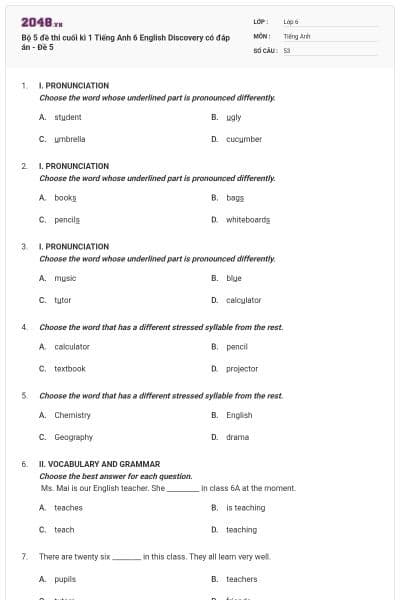
50 câu hỏi
student
ugly
umbrella
cucumber
A. student /ˈstjuːdnt/
B. ugly /ˈʌɡli/
C. umbrella /ʌmˈbrelə/
D. cucumber /ˈkjuːkʌmbə(r)/
Phần được gạch chân ở phương án A được phát âm /juː/, các phương án còn lại phát âm /ʌ/.
Chọn A
books
bags
pencils
whiteboards
A. books /bʊks/
B. bags /bæɡz/
C. pencils /ˈpenslz/
D. whiteboards /ˈwaɪtbɔːdz/
Phần được gạch chân ở phương án A được phát âm /s/, các phương án còn lại phát âm /z/.
Chọn A
music
blue
tutor
calculator
A. music /ˈmjuːzɪk/
B. blue /bluː/
C. tutor /ˈtjuːtə(r)/
D. calculator /ˈkælkjuleɪtə(r)/
Phần được gạch chân ở phương án B được phát âm /uː/, các phương án còn lại phát âm /juː/.
Chọn B
calculator
pencil
textbook
projector
A. calculator /ˈkælkjuleɪtə(r)/
B. pencil /ˈpensl/
C. textbook /ˈtekstbʊk/
D. projector /prəˈdʒektə(r)/
Phương án D trọng âm 2, các phương án còn lại trọng âm 1.
Chọn D
Chemistry
English
Geography
drama
A. chemistry /ˈkemɪstri/
B. English /ˈɪŋɡlɪʃ/
C. geography /dʒiˈɒɡrəfi/
D. drama /ˈdrɑːmə/
Phương án C trọng âm 2, các phương án còn lại trọng âm 1.
Chọn C
teaches
is teaching
teach
teaching
Dấu hiệu nhận biết: at the moment (ngay lúc này) => Thì hiện tại tiếp diễn dạng khẳng định: She is + V-ing
Ms. Mai is our English teacher. She is teaching in class 6A at the moment.
(Cô Mai là giáo viên tiếng Anh của chúng tôi. Hiện tại cô ấy đang dạy lớp 6A.)
Chọn B
pupils
teachers
tutors
friends
A. pupils (n): học sinh
B. teachers (n): giáo viên
C. tutors (n): gia sư
D. friends (n): bạn bè
There are twenty-six pupils in this class. They all learn very well.
(Có 26 học sinh trong lớp này. Họ đều học rất giỏi.)
Chọn A.

Học thông minh hơn mỗi ngày
Xem toàn bộ 50 câu hỏi và nhiều hơn nữa với tài khoản miễn phí
Yes, I am.
Yes, you are.
Yes, you aren’t.
No, I am.
Câu hỏi Yes/No với động từ “be”:
Câu hỏi Are you => Trả lời: Yes, I am./ No, I’m not.
“Are you feeling tired?” - “ Yes, I am.”
(Bạn đang thấy mệt à? – Vâng, đúng vậy.)
Chọn A
make
do
go
meet
A. make (v): tạo ra => Cụm từ: make friends (kết bạn)
B. do (v): làm
C. go (v): đi
D. meet (v): gặp gỡ
I find it difficult to make friends with new classmates.
(Tôi thấy khó để kết bạn với những người bạn cùng lớp mới.)
Chọn A
calculators.
rulers
projectors
sports bag
A. calculators (n): máy tính
B. rulers (n): thước
C. projectors (n): máy chiếu
D. sports bag (n): túi thể thao
Beside posters, teachers in this school use projectors to show pictures in many lessons.
(Ngoài các tờ áp phích, giáo viên trường này còn sử dụng máy chiếu để trình chiếu hình ảnh trong nhiều tiết dạy.)
Chọn C
is
am
are
aren’t
Thì hiện tại tiếp diễn dạng khẳng định với chủ ngữ số ít: S (số ít) + is V-ing
Every pupil in the classroom is looking at the whiteboard.
(Mỗi học sinh trong lớp học đang nhìn lên bảng.)
Chọn A
pencil cases
calculators
textbooks
rulers
A. pencil cases: hộp bút
B. calculators: máy tính
C. textbooks: sách giáo khoa
D. rulers: thước kẻ
Teachers do not allow 6th grade pupils to use calculators to do Maths.
(Giáo viên không cho phép học sinh lớp 6 sử dụng máy tính để làm Toán.)
Chọn B
under
on
next to
between
A. under: phía dưới
B. on: phía trên
C. next to: bên cạnh
D. between: giữa
There’s a shop on both sides of the library. The library between two shops.
(Có một cửa hang ở cả hai bên của thư viện. Thư viện ở giữa hai cửa hàng.)
Chọn D
behind
in front
next to
under
A. behind: bên dưới
B. in front of: phía trước
C. next to: bên cạnh
D. under: phía dưới
The lemon tree is in front of the house.
(Cây chanh ở trước nhà.)
Chọn B
don’t speak
doesn’t speak
not speak
speaks
Thì hiện tại đơn dạng phủ định: S (số nhiều) + don’t V(nguyên thể)
The students don’t speak Vietnamese in English classes.
(Học sinh không nói tiếng Việt trong lớp học tiếng Anh.)
Chọn A
drive
drives
am driving
is driving
Dấu hiệu nhận biết: now (bây giờ) => Thì hiện tại tiếp diễn dạng khẳng định: I am + V-ing
I can't talk on the phone now. I am driving home.
(Bây giờ tôi không thể nói chuyện qua điện thoại. Tôi đang lái xe về nhà.)
Chọn C
Do … going
Does … go
Are … going
Do … go
Dấu hiệu nhận biết: every day => thì hiện tại đơn dạng câu hỏi Yes/No: Do you + V(nguyên thể)?
Do you go to school by bike every day?
(Bạn có đi học bằng xe đạp mỗi ngày không?)
Chọn D
History
Geography
PE
French
A. History: lịch sử
B. Geography: địa lí
C. PE: thể dục
D. French: tiếng Pháp
At school, we learn two foreign languages including English and French.
(Ở trường, chúng tôi học hai ngoại ngữ bao gồm tiếng Anh và tiếng Pháp.)
Chọn D
to
for
in
at
Cụm từ: revise for exams (ôn tập cho các kì thi)
We are all busy at the moment. We are revising for exams.
(Hiện tại chúng tôi đều bận rộn. Chúng tôi đang ôn tập cho kì thi.)
Chọn B
Chemistry
Geography
Maths
Biology
A. Chemistry: hóa học
B. Geography: địa lí
C. Maths: toán
D. Biology: sinh học
In Maths lessons, students learn about numbers.
(Trong giờ Toán, học sinh học về những con số.)
Chọn C
Trước liên từ “or” là danh từ chỉ tên 1 loại ngoại ngữ => chỗ trống cũng phải là danh từ chỉ tên một ngoại ngữ
England (n): nước Anh
English (n): tiếng Anh
Which foreign language do you learn at school, French or English?
(Ngoại ngữ nào bạn học ở trường, tiếng Pháp hay tiếng Anh?)
Đáp án: English
Sau động từ “use” cần danh từ.
calculate (v): tính toán
calculators (n): máy tính
In Maths lessons, pupils sometimes need to use calculators.
(Trong giờ Toán, thỉnh thoảng học sinh cần sử dụng máy tính.)
Đáp án: calculators
Trước danh từ “skills” cần một danh từ hoặc tính từ để tạo thành cụm danh từ
present (v): trình bày
presentation (n): bài thuyết trình => presentation skills: kỹ năng thuyết trình
One of presentation skills we learn at school is using body language.
(Một trong những kĩ năng thuyết trình chúng tôi học ở trường là sử dụng ngôn ngữ cơ thể.)
Đáp án: presentation
sport (n): thể thao => Cụm từ: sports bag (túi thể thao)
Don’t forget to bring your sports bags.
(Đừng quên mang theo túi thể thao của bạn.)
Đáp án: sports
Sau động từ “use” cần danh từ.
project (n): dự án
projectors (n): máy chiếu
Teachers in this school can use projectors to show pictures.
(Những giáo viên trong trường này có thể sử dụng máy chiếu để trình chiếu những bức tranh.)
Đáp án: projectors
Sau động từ “carry” cần danh từ.
textboook (n): sách giáo khoa
Pupils here don't need to carry (26) textbooks to all of their classes.
(Học sinh ở đây không cần mang sách giáo khoa đến tất cả các lớp học.)
Đáp án: textbooks
Sau mạo từ “a” và trước danh từ “lessons” cần tính từ hoặc danh từ để tạo thành cụm danh từ.
maths (n): môn toán
Today, from 9:15 to 10:00, pupils here have a (27) maths lesson.
(Hôm nay từ 9:15 đến 10:00 học sinh ở đây có giờ học toán.)
Đáp án: maths
Sau động từ “use” cần danh từ.
rulers (n): thước kẻ
In this lesson, pupils are not using (28) rulers to learn about measurement.
(Trong giờ học này, học sinh không sử dụng thước để học về đo đạc.)
Đáp án: rulers
Cấu trúc: ask someone something (hỏi ai cái gì)
question (n): câu hỏi
The teacher walks around the room, helps students and asks them (29) question.
(Giáo viên đi quanh lớp học, giúp học sinh và hỏi các em những câu hỏi.)
Đáp án: questions
Sau động từ “use” và tính từ “computerised” cần danh từ.
whiteboards (n): bảng trắng
Teachers use computerised (30) whiteboards instead of traditional ones.
(Giáo viên sử dụng bảng trắng điện tử thay vì bảng bảng truyền thống.)
Đáp án: whiteboards
Bài nghe:
The Philadelphia School of the Future is not like other schools. Pupils here don't need to carry heavy textbooks to all of their classes, they don't actually use them. Well, from 9:15 to 10:00, we're here in a maths class. Today, pupils are spending 45 minutes learning about measurement, but they aren't using rulers. The pupils work quietly on their laptops. The teacher isn't talking much. She's walking around the room, helping students and asking them a few questions. There are teachers here, like in other schools, but they don't call them teachers. They are educators. They use computerised whiteboards instead of traditional whiteboards. This is very different to a normal maths lesson.
Tạm dịch:
Trường Tương lai Philadelphia không giống như các trường khác. Học sinh ở đây không cần phải mang sách giáo khoa nặng đến tất cả các lớp học của họ, họ không thực sự sử dụng chúng. Chà, từ 9:15 đến 10:00, chúng ta ở đây trong một lớp toán. Hôm nay, học sinh dành 45 phút để học về phép đo, nhưng chúng không sử dụng thước kẻ. Học sinh lặng lẽ làm việc trên máy tính xách tay của họ. Giáo viên không nói nhiều. Cô ấy đi quanh phòng, giúp đỡ học sinh và hỏi các trò một số câu hỏi. Ở đây cũng có giáo viên, giống như ở các trường khác, nhưng các em không gọi họ là giáo viên. Họ là những nhà giáo dục. Họ sử dụng bảng trắng được vi tính hóa thay vì bảng trắng truyền thống. Điều này rất khác với một bài học toán bình thường.
My First PE Class: Playing Football
A. I’m Danny, a pupil at Garfield Grammar School. At school, we have two PE lessons every week. At the moment, I’m in my first PE class at my new school. I’m standing with all of my classmates in the centre of the school yard.
B. Our teacher is telling us how to play football. It’s my first time playing football with my classmates. There are two teams in this game. You have to kick the ball to the goal of the other team. If you are the goalkeeper, you need to try your best to catch the ball from the other team.
C. Now we start the game. One of my classmates is having the ball now and is running very fast to the goal. The players on the other team are trying to catch her. However, we need to stop now as the bell is ringing. Everyone in my class loves this game.
Tạm dịch:
Lớp thể dục đầu tiên của tôi: Chơi bóng đá
A. Tôi là Danny, học sinh trường Garfield Grammar. Ở trường, chúng tôi có hai tiết Thể dục mỗi tuần. Hiện tại, tôi đang học lớp Thể dục đầu tiên ở trường mới. Tôi đang đứng với tất cả các bạn cùng lớp ở giữa sân trường.
B. Giáo viên của chúng tôi đang nói với chúng tôi cách chơi bóng đá. Đây là lần đầu tiên tôi chơi bóng đá với các bạn cùng lớp. Có hai đội trong trò chơi này. Bạn phải đá bóng vào khung thành của đội khác. Nếu bạn là thủ môn, bạn cần cố gắng hết sức để bắt bóng từ đội kia.
C. Bây giờ chúng ta bắt đầu trò chơi. Một trong những bạn cùng lớp của tôi đang có bóng và đang chạy rất nhanh về phía khung thành. Các cầu thủ của đội khác đang cố bắt cô ấy. Tuy nhiên, chúng ta cần dừng lại ngay bây giờ khi chuông đang reo. Mọi người trong lớp tôi đều thích trò chơi này.
31.
Phần nào nói các bạn cùng lớp của Danny nghĩ gì về trò chơi đá bóng?
Thông tin: Everyone in my class loves this game.
(Mọi người trong lớp tôi đều thích trò chơi này.)
Chọn C
Phần nào nói Danny chơi đá bóng với ai?
Thông tin: It’s my first time playing football with my classmates.
(Đây là lần đầu tiên tôi chơi đá bóng với các bạn cùng lớp.)
Chọn B
Phần nào giải thích luật chơi bóng đá?
Thông tin: There are two teams in this game. You have to kick the ball to the goal of the other team. If you are the goalkeeper, you need to try your best to catch the ball from the other team.
(Có hai đội trong trò chơi này. Bạn phải đá bóng vào khung thành của đội khác. Nếu bạn là thủ môn, bạn cần cố gắng hết sức để bắt bóng từ đội kia.)
Chọn B
Phần nào nói Danny và các bạn cùng lớp đang chơi đá bóng ở đâu?
Thông tin: I’m standing with all of my classmates in the centre of the school yard.
(Tôi đang đứng với tất cả các bạn cùng lớp ở giữa sân trường.)
Chọn A
Phần nào nói số tiết học Thể dục mà Danny có mỗi tuần?
Thông tin: At school, we have two PE lessons every week.
(Ở trường, tôi có hai tiết Thể dục mỗi tuần.)
Chọn A
My name is Anna. Today is my first day at school. I am a new student. My father drives me to school. I have a blue school bag. There is a book, a pencil, a ruler and some crayons in my school bag.
My school is really big. It has many different rooms. There are fifteen classrooms, a library, a computer room, and a music room. There is also a small playground where students can play together during break time.
I am in classroom number Two. It is big and has a whiteboard. There are twenty students in my class. Each student has a desk and a chair. My teacher is very nice. I need to listen to the teacher and I am quiet when she speaks. My teacher tells me to sit next to a girl. Her name is Joan. I really like my new school.
Tạm dịch:
Tên tôi là Anna. Hôm nay là ngày đầu tiên của tôi ở trường. Tôi là học sinh mới. Bố tôi chở tôi đến trường. Tôi có một chiếc cặp đi học màu xanh. Trong cặp sách của tôi có một cuốn sách, một cây bút chì, một cây thước kẻ và một số bút màu.
Trường học của tôi là thực sự lớn. Nó có nhiều phòng khác nhau. Có mười lăm phòng học, thư viện, phòng máy tính và phòng âm nhạc. Ngoài ra còn có một sân chơi nhỏ nơi học sinh có thể chơi cùng nhau trong giờ giải lao.
Tôi học lớp số Hai. Nó lớn và có một bảng trắng. Có hai mươi học sinh trong lớp học của tôi. Mỗi học sinh có một cái bàn và một cái ghế. Giáo viên của tôi rất tốt bụng. Tôi cần lắng nghe giáo viên và tôi im lặng khi cô ấy nói. Giáo viên bảo tôi ngồi cạnh một cô gái. Tên bạn ấy là Joan. Tôi thực sự thích trường học mới của tôi.
There is only a pencil and a ruler in Anna’s school bag.
(Chỉ có một cây bút chì và một thước kẻ trong cặp sách của Anna.)
Thông tin: There is a book, a pencil, a ruler and some crayons in my school bag.
(Trong cặp sách của tôi có một cuốn sách, một cây bút chì, một cây thước kẻ và một số bút màu.)
Chọn F
Anna’s school bag is green.
(Cặp sách của Anna màu xanh lá.)
Thông tin: I have a blue school bag.
(Tôi có chiếc cặp sách màu xanh lam.)
Chọn F
Anna’s school has eighteen classrooms.
(Trường học của Anna có 18 phòng học.)
Thông tin: There are fifteen classrooms, a library, a computer room, and a music room.
(Có mười lăm phòng học, thư viện, phòng máy tính và phòng âm nhạc.)
Chọn F
In her classroom, Anna has her own desk and chair.
(Trong lớp học, Anna có bàn học và ghế riêng.)
Thông tin: Each student has a desk and a chair.
(Mỗi học sinh có một chiếc bàn học và một chiếc ghế.)
Chọn T
Students are quiet when the teacher speaks.
(Học sinh trật tự khi cô giáo nói.)
Thông tin: I need to listen to the teacher and I am quiet when she speaks.
(Tôi cần lắng nghe giáo viên và tôi im lặng khi cô ấy nói.)
Chọn T
Cấu trúc thì hiện tại đơn dạng khẳng định: We + V (nguyên thể) + O + trạng từ thời gian
Đáp án: We catch the bus every morning.
(Chúng tôi bắt xe buýt mỗi sáng.)
Cấu trúc thì hiện tại đơn dạng khẳng định với động từ “be”: S (số ít) + is + adj
Đáp án: Each lesson is forty-five minutes long.
(Mỗi tiết học dài 45 phút.)
Cấu trúc thì hiện tại tiếp diễn dạng khẳng định: S (số ít) + is + V-ing + trạng từ thời gian
Đáp án: Linda is riding a bike at the moment.
(Ngay lúc này Linda đang đi xe đạp.)
Cấu trúc thì hiện tại đơn dạng khẳng định với động từ “be”: S (số ít) + is + cụm danh từ
Đáp án: English is one of the foreign languages at school.
(Tiếng Anh là một trong ngữ ngoại ngữ ở trường tôi.)
Cấu trúc thì hiện tại tiếp diễn dạng khẳng định: Are you + V-ing + trạng từ thời gian?
Đáp án: Are you studying Maths at school now?
(Bây giờ bạn đang học Toán à?)
Cấu trúc thì hiện tại đơn dạng khẳng định: We + V (nguyên thể) + O + trạng từ thời gian
Đáp án: We usually go to school at 7:00 AM.
(Chúng tôi thường đi học lúc 7 giờ sáng.)
Cấu trúc: S + find + adj + to V
Đáp án: I find it difficult to make friends.
(Tôi thấy khó khi kết bạn.)
Dấu hiệu nhận biết: at the moment (ngay lúc này) => thì hiện tại tiếp diễn dạng khẳng định: S (số ít) + is V-ing + trạng từ thời gian
Đáp án: My brother is studying Maths in the classroom at the moment.
(Anh trai tôi đang học Toán trong lớp học ngay lúc này.)
Cấu trúc thì hiện tại đơn dạng khẳng định: He + trạng từ tần suất + V-s/es + trạng từ thời gian
Đáp án: He often has four lessons in the morning.
(Anh ấy thường có bốn tiết học vào buổi sáng.)
Cấu trúc: S + be + between + N1 and N2
Đáp án: The car is between the red house and the blue house.
(Ô tô ở giữa ngôi nhà màu đỏ và ngôi nhà xanh lam.)
Bạn có thích hoạt động này không?
Ý kiến của bạn sẽ giúp chúng tôi đề xuất nội dung phù hợp hơn.
![[Năm 2022] Đề thi thử môn Vật lí THPT Quốc gia có lời giải - Đề số 21](/_next/image?url=https%3A%2F%2Fvideo.vietjack.com%2Fupload%2Fimages%2Fvj-image%2Fimage-3izficdefgfoel0s9j8s-1786772791.jpg&w=3840&q=75)
![[Năm 2022] Đề thi thử môn Vật lí THPT Quốc gia có lời giải - Đề số 20](/_next/image?url=https%3A%2F%2Fvideo.vietjack.com%2Fupload%2Fimages%2Fvj-image%2Fimage-emy0gtcksawvorajezvv-1786772460.jpg&w=3840&q=75)