BỘ 30 ĐỀ THI VÀO LỚP 10 MÔN TIẾNG ANH CÓ ĐÁP ÁN - ĐỀ 25
50 câu hỏi
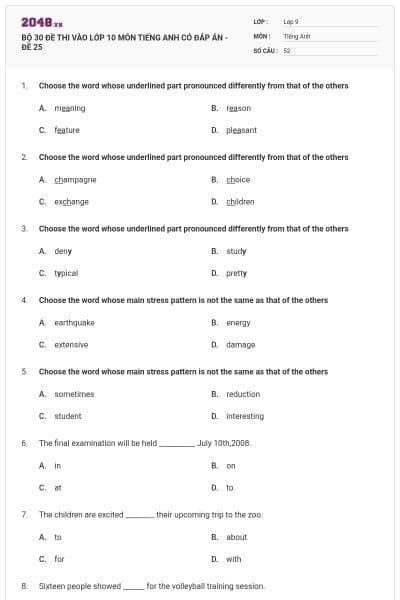
meaning
reason
feature
pleasant
ĐÁP ÁN D
champagne
choice
exchange
children
ĐÁP ÁN A
deny
study
typical
pretty
ĐÁP ÁN A
earthquake
energy
extensive
damage
ĐÁP ÁN C
sometimes
reduction
student
interesting
ĐÁP ÁN B
in
on
at
to
ĐÁP ÁN B
to
about
for
with
ĐÁP ÁN B
on
up
over
through
ĐÁP ÁN B
In spite of
Even though
However
Because
ĐÁP ÁN B
yet developed
developed yet
developed already
already developed
ĐÁP ÁN A
to keep
keeping
kept
in keeping
ĐÁP ÁN A
co-operator
cousin
close friend
penpal
ĐÁP ÁN D
as if
if only
even if
although
ĐÁP ÁN A
time-release
time-wasting
time-saving
time-consuming
ĐÁP ÁN D
to say
saying
said
to saying
ĐÁP ÁN A
do you
won‘t you
will you
shouldn‘t you
ĐÁP ÁN C
had done
will do
would do
would have done
ĐÁP ÁN C
bring
will bring
brought
would bring
Đáp án: c
Giải thích:
Would you mind if + S +V(quá khứ đơn)?: Bạn có phiền nếu…
Dịch: Bạn có phiền không nếu tôi dẫn theo một người bạn đến bữa tiệc?
smoke
to smoke
smoking
smoked
Đáp án: C
Giải thích:
stop doing something: ngừng làm gì
stop to do something: dừng lại để làm gì
Dựa vào nghĩa, chọn C.
Dịch: Bố tôi đã bỏ thuốc lá cách đây hai năm.
You‘re welcome
Never mind
It‘s my pleasure
Thanks a lot
ĐÁP ÁN D
A
B
C
D
ĐÁP ÁN D (COMES)
A
B
C
D
ĐÁP ÁN B (MAKING)
A
B
C
D
Đáp án: A
Giải thích:
Kiến thức: Thì của động từ
Câu có trạng từ chỉ thời gian "Last summer" (mùa hè năm ngoái), là một mốc thời gian trong quá khứ.
Khi nói về hành động đã xảy ra và kết thúc trong quá khứ, ta dùng quá khứ đơn (past simple) thay vì hiện tại hoàn thành (present perfect).
Sửa: have stayed → stayed
Dịch: Mùa hè năm ngoái, tôi đã ở trang trại của cậu tôi trong hai tuần.
A
B
C
D
ĐÁP ÁN A (HOW)
A
B
C
D
ĐÁP ÁN C (FAST)
Đáp án: helpful
Giải thích:
Kiến thức: Cấu tạo từ
Vị trí cần điền là một tính từ đứng sau “to be”, được bổ nghĩa bởi phó từ
“very” (rất).
help (v/n): giúp đỡ/sự giúp đỡ
helpful (adj): có thể giúp đỡ, sẵn lòng giúp đỡ
helpless (adj): vô ích, không thể giúp gì
Dựa vào nghĩa, chọn tính từ “helpful”.
Dịch: Nếu bạn cần bất kỳ sự giúp đỡ nào, bạn có thể hỏi Tom. Anh ấy rất sẵn lòng giúp đỡ.
Đáp án: effective
Giải thích:
Kiến thức: Từ loại
Ta có cấu trúc:
find something + adj: thấy cái gì như thế nào
Vị trí cần điền là một tính từ.
effect (n): ảnh hưởng, hiệu ứng
effective (adj): hiệu quả
Dịch: Chúng tôi thấy quảng cáo trên truyền hình rất hiệu quả.
makes
creates
comes
begins
ĐÁP ÁN C
soil
atmosphere
water
resources
ĐÁP ÁN B
look after
look into
look at
look for
ĐÁP ÁN D
sn‘s
moon‘s
star‘s
earth‘s
ĐÁP ÁN A
windbreaks
windmills
wind tunnels
wind chimes
ĐÁP ÁN B
use
using
be used
to use
ĐÁP ÁN C
in
for
by
from
ĐÁP ÁN D
crests
ways
waves
tides
ĐÁP ÁN D
Read the passage below and then decide whether the statements that follow are True or False.
Many people now think that teachers give students too much homework. They say that it is unnecessary for children to work at home in their free time. Moreover, they argue that most teachers do not properly plan the homework tasks they give to students. The result is that students have to repeat tasks which they have already done at school. Most people agree that homework is unfair. A student who can do his homework in a quiet and comfortable room is in a much better position than a student who does his homework in a small, noisy room with the television on. Some parents help their children with their homework. Other parents take no interest at all in their children‘s homework. It is important, however, that teachers talk to parents about homework. A teacher should suggest suitable tasks for parents to do with their children. Parents are often better at teaching their own children!
Many parents would like their children to have less homework (T/F)
TRUE
FALSE
TRUE
TRUE
FALSE
Hoa said that she is leaving there for Hue the day after.
Hoa said that she was leaving there for Hue the day after.
Hoa said that she would leave there for Hue the day aftey.
Hoa said that she would leave here for Hue the day after.
ĐÁP ÁN B
You should read that book.
That book has not been used.
You shouldn‘t use that book for reading.
That book is not worth reading.
ĐÁP ÁN D
I would rather not spend my vacations in France.
I would like to spend my vacations in France.
I don‘t often spend my vacations in France.
I prefer spending my vacations in France.
ĐÁP ÁN A
He will only phone if he changes his mind.
He won‘t ____________________________________________________
The last time _________________________________________________
"Please sit down", the teacher said to his students.
The teacher _________________________________________________
Đáp án: The teacher asked/ told his students to sit down.
Giải thích:
Kiến thức: Câu gián tiếp
ask/tell somebody (not) to do something: bảo ai (không) làm gì
Dịch: “Các em hãy ngồi xuống,” giáo viên nói với học sinh của mình.
→ Giáo viên yêu cầu/bảo học sinh ngồi xuống.
He‘s so _____________________________________________________