Bộ 20 đề luyện thi Chuyên Anh năm 2023 có đáp án (Đề 88)
75 câu hỏi
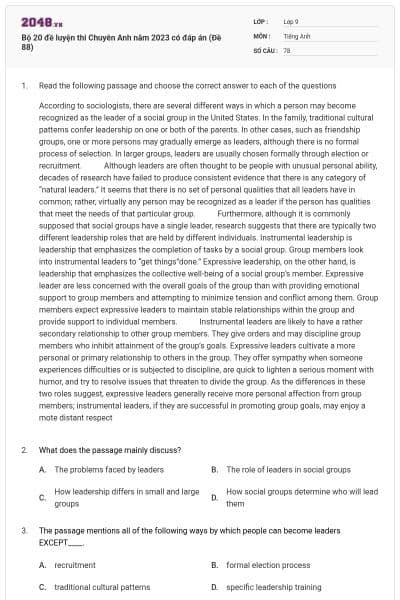
Read the following passage and choose the correct answer to each of the questions
According to sociologists, there are several different ways in which a person may become recognized as the leader of a social group in the United States. In the family, traditional cultural patterns confer leadership on one or both of the parents. In other cases, such as friendship groups, one or more persons may gradually emerge as leaders, although there is no formal process of selection. In larger groups, leaders are usually chosen formally through election or recruitment. Although leaders are often thought to be people with unusual personal ability, decades of research have failed to produce consistent evidence that there is any category of “natural leaders.” It seems that there is no set of personal qualities that all leaders have in common; rather, virtually any person may be recognized as a leader if the person has qualities that meet the needs of that particular group. Furthermore, although it is commonly supposed that social groups have a single leader, research suggests that there are typically two different leadership roles that are held by different individuals. Instrumental leadership is leadership that emphasizes the completion of tasks by a social group. Group members look into instrumental leaders to “get things”done.” Expressive leadership, on the other hand, is leadership that emphasizes the collective well-being of a social group’s member. Expressive leader are less concerned with the overall goals of the group than with providing emotional support to group members and attempting to minimize tension and conflict among them. Group members expect expressive leaders to maintain stable relationships within the group and provide support to individual members. Instrumental leaders are likely to have a rather secondary relationship to other group members. They give orders and may discipline group members who inhibit attainment of the group’s goals. Expressive leaders cultivate a more personal or primary relationship to others in the group. They offer sympathy when someone experiences difficulties or is subjected to discipline, are quick to lighten a serious moment with humor, and try to resolve issues that threaten to divide the group. As the differences in these two roles suggest, expressive leaders generally receive more personal affection from group members; instrumental leaders, if they are successful in promoting group goals, may enjoy a mote distant respect
What does the passage mainly discuss?
The problems faced by leaders
The role of leaders in social groups
How leadership differs in small and large groups
How social groups determine who will lead them
Đáp án: B
Giải thích:
Dịch: Đoạn văn chủ yếu thảo luận về điều gì?
A. Các vấn đề mà các nhà lãnh đạo phải đối mặt
B. Vai trò của các nhà lãnh đạo trong các nhóm xã hội
C. Sự khác biệt giữa lãnh đạo trong các nhóm nhỏ và lớn
D. Các nhóm xã hội xác định ai sẽ lãnh đạo họ như thế nào
Bài đọc tập trung vào vai trò của các nhà lãnh đạo trong nhóm xã hội, bao gồm cách một người trở thành lãnh đạo, sự khác biệt giữa lãnh đạo công cụ (instrumental leaders) và lãnh đạo biểu cảm (expressive leaders), cũng như ảnh hưởng của họ đến nhóm.
Xét các đáp án khác:
A. The problems faced by leaders – Sai, vì bài đọc không đề cập đến những khó khăn mà các nhà lãnh đạo gặp phải.
C. How leadership differs in small and large groups – Sai, vì bài chỉ đề cập ngắn gọn đến sự khác biệt trong việc chọn lãnh đạo giữa các nhóm lớn và nhỏ, nhưng không phải nội dung chính.
D. How social groups determine who will lead them – Sai, vì bài không chỉ tập trung vào cách nhóm xã hội chọn lãnh đạo mà còn phân tích các vai trò lãnh đạo.
Chọn B.
Dịch: Vai trò của các nhà lãnh đạo trong nhóm xã hội.
recruitment
formal election process
traditional cultural patterns
specific leadership training
Đáp án: D
Giải thích:
Dịch: Đoạn văn đề cập đến tất cả các cách sau đây mà mọi người có thể trở thành nhà lãnh đạo TRỪ ____.
A. tuyển dụng
B. quy trình bầu cử chính thức
C. mô hình văn hóa truyền thống
D. đào tạo lãnh đạo cụ thể
Thông tin:
“In larger groups, leaders are usually chosen formally through election or recruitment.”
(Trong các nhóm lớn hơn, các nhà lãnh đạo thường được lựa chọn chính thức thông qua bầu cử hoặc tuyển dụng.)
→ A và B đúng
“In the family, traditional cultural patterns confer leadership on one or both of the parents.”
(Trong gia đình, các mô hình văn hóa truyền thống trao quyền lãnh đạo cho một hoặc cả hai cha mẹ.)
→ C đúng
D không được đề cập.
there is no proof that “natural leaders” existB. few people qualify as “natural leaders”
“natural leaders’ are easily accepted by the members of a social group
“natural leaders” share a similar set of characteristics
Đáp án: A
Giải thích:
Dịch: Khi đề cập đến “những nhà lãnh đạo bẩm sinh” ở dòng 7-8, tác giả đang nêu quan điểm rằng _______.
A. không có bằng chứng nào cho thấy “những nhà lãnh đạo bẩm sinh” tồn tại
B. ít người đủ tiêu chuẩn là “những nhà lãnh đạo bẩm sinh”
C. “những nhà lãnh đạo bẩm sinh” dễ dàng được các thành viên của một nhóm xã hội chấp nhận
D. “những nhà lãnh đạo bẩm sinh” có chung một tập hợp các đặc điểm
Thông tin: “Although leaders are often thought to be people with unusual personal ability, decades of research have failed to produce consistent evidence that there is any category of natural leaders.”
(Mặc dù các nhà lãnh đạo thường được cho là những người có năng lực cá nhân khác thường, nhưng nhiều thập kỷ nghiên cứu vẫn không đưa ra được bằng chứng nhất quán rằng có bất kỳ loại "nhà lãnh đạo bẩm sinh" nào.)
Few people succeed in sharing a leadership role with another person.
A person can best learn how to be an effective leader by studying research on leadership.
Most people desire to be leaders but can produce little evidence of their qualifications.
A person who is an effective leader of a particular group may not be an effective leader in another group.
Đáp án: D
Giải thích:
Dịch: Câu nào sau đây về lãnh đạo có thể suy ra từ đoạn 2?
A. Rất ít người thành công khi chia sẻ vai trò lãnh đạo với người khác.
B. Một người có thể học cách trở thành nhà lãnh đạo hiệu quả nhất bằng cách nghiên cứu về lãnh đạo.
C. Hầu hết mọi người đều mong muốn trở thành nhà lãnh đạo nhưng có thể đưa ra ít bằng chứng về trình độ của mình.
D. Một người là nhà lãnh đạo hiệu quả của một nhóm cụ thể có thể không phải là nhà lãnh đạo hiệu quả trong một nhóm khác.
Trong đoạn 2, tác giả đề cập:
“It seems that there is no set of personal qualities that all leaders have in common; rather, virtually any person may be recognized as a leader if the person has qualities that meet the needs of that particular group.”
(Có vẻ như không có một tập hợp các phẩm chất cá nhân nào mà tất cả các nhà lãnh đạo đều có chung; thay vào đó, hầu như bất kỳ người nào cũng có thể được công nhận là nhà lãnh đạo nếu người đó có những phẩm chất đáp ứng được nhu cầu của nhóm cụ thể đó.)
→ Điều này có nghĩa là không có một nhóm đặc điểm chung nào giúp một người trở thành lãnh đạo trong mọi trường hợp. Một người có thể phù hợp làm lãnh đạo trong nhóm này nhưng không chắc sẽ thành công trong nhóm khác vì mỗi nhóm có nhu cầu khác nhau.
ensuring harmonious relationships
achieving a goal
sharing responsibility with group members
identifying new leaders
Đáp án: B
Giải thích:
Dịch: Đoạn văn chỉ ra rằng các nhà lãnh đạo công cụ thường tập trung vào _______.
A. đảm bảo các mối quan hệ hài hòa
B. đạt được mục tiêu
C. chia sẻ trách nhiệm với các thành viên trong nhóm
D. xác định các nhà lãnh đạo mới
Trong đoạn văn, tác giả định nghĩa instrumental leadership như sau:
“Instrumental leadership is leadership that emphasizes the completion of tasks by a social group. Group members look to instrumental leaders to ‘get things done.”
(Lãnh đạo công cụ là lãnh đạo nhấn mạnh vào việc hoàn thành nhiệm vụ của một nhóm xã hội. Các thành viên trong nhóm trông cậy vào các nhà lãnh đạo công cụ để 'hoàn thành công việc'.)
→ Instrumental leaders tập trung vào hoàn thành nhiệm vụ và đạt được mục tiêu của nhóm.
necessary
typical
particular
group
Đáp án: D
Giải thích:
Dịch: Từ “collective – mang tính tập thể, chung” ở dòng 15 có nghĩa gần nhất với _______.
A. cần thiết
B. điển hình
C. cụ thể
D. nhóm
Chọn D.
expressive leaders
group members
goals of the group
tension and conflict
Đáp án: B
Giải thích:
Dịch: Từ “them” ở dòng 18 ám chỉ _______.
A. những nhà lãnh đạo biểu cảm
B. các thành viên nhóm
C. mục tiêu của nhóm
D. căng thẳng và xung đột
Kiến thức: Đại từ thay thế
Câu gốc: “Expressive leaders cultivate a more personal or primary relationship to others in the group. They offer sympathy when someone experiences difficulties or is subjected to discipline, are quick to lighten a serious moment with humor, and try to resolve issues that threaten to divide the group.”
Trong câu này, “them” xuất hiện trong ngữ cảnh diễn tả mối quan hệ giữa expressive leaders và group members. Các expressive leaders thể hiện sự đồng cảm khi ai đó gặp khó khăn, làm giảm căng thẳng bằng sự hài hước và cố gắng giải quyết các vấn đề có thể gây chia rẽ nhóm. Vì vậy, “them” ở đây đề cập đến group members.
Chọn B.
enthusiastic
distant
unreliable
personal
Đáp án: B
Giải thích:
Dịch: “Mối quan hệ thứ cấp” được đề cập ở dòng 20 giữa người lãnh đạo và các thành viên của một nhóm có thể được mô tả tốt nhất là _______.
A. nhiệt tình
B. xa cách
C. không đáng tin cậy
D. cá nhân
Câu gốc: “Instrumental leaders are likely to have a rather secondary relationship to other group members. They give orders and may discipline group members who inhibit attainment of the group’s goals.”
Cụm từ “secondary relationship” mô tả mối quan hệ không thân thiết, mang tính chức năng nhiều hơn là cá nhân. Instrumental leaders tập trung vào nhiệm vụ, đưa ra mệnh lệnh và có thể kỷ luật thành viên, nên mối quan hệ của họ với nhóm thường xa cách (distant).
Chọn B.
find a solution for
talk about
avoid thinking about
avoid repeating
Đáp án: A
Giải thích:
Dịch: Từ “resolve - giải quyết” ở dòng 24 có nghĩa gần nhất với _______.
A. tìm giải pháp cho
B. nói về
C. tránh suy nghĩ về
D. tránh lặp lại
Chọn A.
examples that illustrate a problem
comparison and contrast
narration of events
cause and effect analysis
Đáp án: B
Giải thích:
Kiến thức: Phương pháp tổ chức đoạn văn
Dịch: Đoạn 3 và 4 sắp xếp thảo luận về lãnh đạo chủ yếu theo thuật ngữ _______.
A. ví dụ minh họa cho một vấn đề
B. so sánh và đối chiếu
C. tường thuật các sự kiện
D. phân tích nguyên nhân và kết quả
Đoạn 3 và 4 mô tả hai kiểu lãnh đạo khác nhau: instrumental leadership (lãnh đạo hướng đến nhiệm vụ) và expressive leadership (lãnh đạo hướng đến sự gắn kết tập thể).
Đoạn 3 giới thiệu sự khác biệt giữa hai kiểu lãnh đạo này về mục tiêu và vai trò trong nhóm.
Đoạn 4 tiếp tục so sánh cách họ tương tác với thành viên nhóm: instrumental leaders có mối quan hệ xa cách, còn expressive leaders có mối quan hệ gần gũi hơn.
Cách tổ chức này dựa trên so sánh và đối lập (comparison and contrast).
Dịch bài đọc
Theo các nhà xã hội học, có một số cách khác nhau để một người có thể được công nhận là người lãnh đạo của một nhóm xã hội ở Hoa Kỳ. Trong gia đình, các mô hình văn hóa truyền thống trao quyền lãnh đạo cho một hoặc cả hai cha mẹ. Trong các trường hợp khác, chẳng hạn như nhóm bạn bè, một hoặc nhiều người có thể dần dần nổi lên làm người lãnh đạo, mặc dù không có quy trình lựa chọn chính thức nào. Trong các nhóm lớn hơn, người lãnh đạo thường được chọn chính thức thông qua bầu cử hoặc tuyển dụng.
Mặc dù người ta thường cho rằng người lãnh đạo là những người có năng lực cá nhân khác thường, nhưng nhiều thập kỷ nghiên cứu đã không đưa ra được bằng chứng nhất quán rằng có bất kỳ loại "người lãnh đạo bẩm sinh" nào. Có vẻ như không có một tập hợp các phẩm chất cá nhân nào mà tất cả các nhà lãnh đạo đều có chung; thay vào đó, hầu như bất kỳ người nào cũng có thể được công nhận là người lãnh đạo nếu người đó có những phẩm chất đáp ứng nhu cầu của nhóm cụ thể đó.
Hơn nữa, mặc dù người ta thường cho rằng các nhóm xã hội chỉ có một người lãnh đạo duy nhất, nhưng nghiên cứu cho thấy thường có hai vai trò lãnh đạo khác nhau do các cá nhân khác nhau nắm giữ. Lãnh đạo công cụ là kiểu lãnh đạo nhấn mạnh vào việc hoàn thành nhiệm vụ của một nhóm xã hội. Các thành viên trong nhóm tìm đến những người lãnh đạo công cụ để "hoàn thành mọi việc". Mặt khác, lãnh đạo biểu cảm là lãnh đạo nhấn mạnh đến phúc lợi tập thể của thành viên trong nhóm xã hội. Lãnh đạo biểu cảm ít quan tâm đến mục tiêu chung của nhóm hơn là cung cấp hỗ trợ về mặt tình cảm cho các thành viên trong nhóm và cố gắng giảm thiểu căng thẳng và xung đột giữa họ. Các thành viên trong nhóm mong đợi các nhà lãnh đạo biểu cảm duy trì các mối quan hệ ổn định trong nhóm và hỗ trợ từng thành viên.
Các nhà lãnh đạo công cụ có thể có mối quan hệ thứ yếu với các thành viên khác trong nhóm. Họ ra lệnh và có thể kỷ luật các thành viên trong nhóm cản trở việc đạt được mục tiêu của nhóm. Các nhà lãnh đạo biểu cảm vun đắp mối quan hệ cá nhân hoặc chính yếu hơn với những người khác trong nhóm. Họ thể hiện sự cảm thông khi ai đó gặp khó khăn hoặc phải chịu kỷ luật, nhanh chóng làm dịu đi khoảnh khắc nghiêm trọng bằng sự hài hước và cố gắng giải quyết các vấn đề đe dọa chia rẽ nhóm. Như sự khác biệt trong hai vai trò này cho thấy, các nhà lãnh đạo biểu cảm thường nhận được nhiều tình cảm cá nhân hơn từ các thành viên trong nhóm; các nhà lãnh đạo công cụ, nếu họ thành công trong việc thúc đẩy các mục tiêu của nhóm, có thể được tôn trọng hơn.
Read the following passage and choose the correct answer to each of the questions
PAPER
Paper is everywhere. We use it for homework, money, checks, books, letters, wallpaper, and greeting cards. We have paper towels, napkins plates, cups, and tissues. We print the news every day on newspaper. Our history and knowledge is written on paper. Without paper, our lives would be completely different. From the very beginning of time, people have tried to record their thoughts and lives. The earliest humans drew pictures on cave walls. Later, people used large pieces of clay to write on. Almost 5,000 years ago, the Egyptians wrote on pieces of plants called papyrus. Papyrus was used throughout the ancient world of the Mediterranean for thousands of years. Eventually it was replaced by parchment. Parchment was made from animal skins. It was stronger and lasted longer than any other material. The Chinese made the first real paper in the year A.D. 105. They mixed tree bark and small pieces of old cloth with water. They used a screen to remove the thin, wet piece of paper. Then they let the paper dry in the sun. The Chinese kept papermaking a secret until after 751, in that year there was a war between the Chinese and the Muslims. Many Chinese papermakers were taken away from China to live in Muslim countries. The art of papermaking soon spread throughout the Muslim world. Finally, by the end of the twelfth century, papermaking reached Europe. The first paper made in Europe was in Spain in 1151. The first important improvement on the Chinese method of papermaking was in France in 1798. A man named Nicholas Louis Robert invented a machine for making paper. His machine could make paper much faster than one person could by hand. However, his machine was not very successful. About ten years later an Englishman improved on Robert’s machine and began producing paper. The most important improvement in papermaking also happened in France. A scientist observed a wasp making its nest. The wasp chewed up pieces of wood, mixed it with the chemicals in its mouth, and made a paper nest. The scientist realized that people could make paper from wood, too. Finally, a machine was invented for grinding wood into pulp to use for making paper. Today, the principal ingredient in paper is wood pulp. It is made by machine. There are also other kinds of paper made from rice, wheat, cotton, corn, and other plants. Paper from wood pulp is the most common. Canada and the United States are the world leaders in paper production, due in part to the quantity, of wood that is available in the forests of these two countries. Because paper is made of wood, many people are becoming concerned that too many trees are being chopped down every year in order to produce paper. Trees are an important part of the environment. As a result, many companies that produce paper are using old paper instead of new wood pulp to make paper. This method of using old products again instead of simply throwing them away is called recycling. Recycling paper helps reduce the number of trees that are used every year. Many people also try to use less paper in their daily lives. They use both sides of a sheet of paper instead of just one. They use cloth handkerchiefs instead of paper tissues. There are also special containers in many schools and public places where people can put used paper instead of throwing it into the garbage can. Then this paper is collected to be recycled. Whether we use a little or a lot, paper has an important place in our lives. The books we read and write are made of paper. Our history and scientific inventions have all been recorded on paper. This, however, is changing. Other methods of storing information are becoming common. Computers can store an enormous amount of information in a much smaller space. Computer faxes, electronic mail, and the Internet are only three examples of technology that have replaced paper,
Papyrus was _______.
a kind of paper made from a plant.
made by ancient Egyptians.
a kind of plant that ancient Egyptians wrote on.
a special kind of clay.
because they were afraid of the Muslims
so that they could keep exporting paper to the Muslim world
until the Muslims found out about the special tree bark
for more than 6 centuries
a papermaking machine
an Englishman
Nicholas Louis Robert
employing people with faster hands
import most of the paper they need
have the largest forests in the world
consume most of the paper they produce
are the biggest producers of paper
Paper and computers play the same role in our lives.
New technology that helps recycling paper.
Paper is an important part of our life, but technology is changing this fast.
Those who know how to use a computer don’t need paper at all.
drew pictures on cave walls.
wrote on cave walls.
invented a system of writing.
found a way to make paper.
it was stronger and lasted longer than papyrus.
the plant it was made from died out.
it could be made into slabs of clay.
there were a lot of animals.
by some Muslims who went to live among the Chinese
as a result of a war between the Chinese and the Muslims
by the Spanish in the 12th century
because the Chinese let the paper dry in the Sun
in France
by a wasp
by a machine
by a scientist
papermaking factories are polluting the environment
a lot of trees have to be chopped down for wood pulp
recycling old paper is expensive
there is not enough land to plant trees for wood pulp
Choose the underlined part that needs correction.
The rings of Saturn are so distant to be seen from Earth without a telescope.
A B C D
Đáp án: B
The major goals of primary education is to achieve basic literacy and numeracy among all students.
A B C D
I passed my exam last summer, but my friend has just failed her.
A B C D
It is primary education that establishes foundations in science geography, history, as well other social sciences for
A B C D
young students.
This recipe, is an old family secret, is an especially important part of our holiday celebrations.
A B C D
Read the following passage and choose the correct word for each of the blanks
A DAY IN YOUR LIFE – IN THE YEAR 2020
What are two ways that technology will probably change your life in the next 20-25 years? People used to know more or less how their children would live. Now things are changing so quickly that we don't even know what our own lives will be (31) ___ in a few years. What allows is not science fiction. It's how experts see the future. You're daydreaming behind the wheel of your car, but that's OK. You have it on automatic pilot, and with its high-tech computers and cameras, your car "knows" (32) ___ you home safely. You're hungry, so you head for the kitchen as soon as you get home. You ordered groceries by computer an hour ago, and you know that by now they (33) __. Your kitchen has a two-door refrigerator, (34)_ opens to the outside to accept deliveries. You've already paid for the food by having the money (35)__ from your bank account. Nobody uses cash any more. What's for lunch? In the old days, you used to stop off to buy a hamburger or pizza. Now you use your diagnostic machine to find out which foods your body (36) _______. You find out you need more vegetables and less fat. Your food-preparation machine (37)______ you a salad. After lunch, you go down the hall to your home office. Here you have everything you need for doing your work. Thanks to your information screen and your new computer, you (38) _______ never go into the office any more. The information screen shows an urgent message from a co-worker in Brazil. You set the screen to translate Portuguese (39) __________ English. As you wait, you think about later, then you'll have a movie (40) ________ what a movie should you order tonight?
Now things are changing so quickly that we don't even know what our own lives will be (31) ___ in a few years.
like
as
alike
about
to get
get
how to get
what to get
are arriving
arrive
will arrive
have arrived
onto
in
into
from
transmitted
order
broadcast
transmit
which
that
what
and
added
counted
subtracted
reduced
eats
prefers
needs
finds
does
makes
works
feed
almost
hardly
most
mostly
Choose the correct answer to each of the following questions.
The shop assistant was totally bewildered by the customer’s behavior. The word bewildered is closest in meaning to
upset
puzzled
disgusted
angry
dangerous
likely to cause harm
likely to be extinct
predators
We offer a speedy and secure service of transferring money in less than 24 hours.
Which of the following word has the opposite meaning to the word secure?
unsure
uninterested
slow
open
happiness
pain and sorrow
loss
worry and sadness
Đáp án: A
Giải thích:
Kiến thức: Từ vựng – Từ trái nghĩa
sufferings (n): đau khổ
Xét các đáp án:
A. happiness (n): niềm hạnh phúc
B. pain and sorrow (n. phr): nỗi đau và nỗi buồn
C. loss (n): sự mất mát
D. worry and sadness (n. phr): lo lắng và buồn bã
→ sufferings >< happiness
Dịch: Hội Chữ thập đỏ là một cơ quan nhân đạo quốc tế chuyên giảm bớt đau khổ cho những người lính bị thương, thường dân và tù nhân chiến tranh.
What’s up
Have you got something
Nothing new
Not much
can’t hear
couldn’t have heard
haven’t heard
had not heard
I couldn’t help it
Happy birthday
Don’t mention it
I haven’t a clue
perfect
perfection
perfectionism
perfectionist
went the balloon
does the balloon go
did the balloon go
goes the balloon
upkeep
keep-up
keep-on
keep-out
get down to it
get off it
get on it
get down with it
That’s all right
Excuse me
You’re welcome
Don’t mention it
Difficult as the homework was
Despite the homework was difficult
Thanks to the difficult homework
As though the homework was difficult
at once time
from time to time
at the same time
at times
Hardly …than
No sooner…when
No sooner … than
Hardly …. that
purpose
idea
intention
design
knew
had known
would know
will know
insubstantial
interior
ineffective
insufficient
new small nice car
nice small new car
new nice car, that is small
car new nice and small
drove
urged
made
suggested
finishes writing
should finish the writing
finish writing
finished writing
those
those who
people
who
so as to
in order that
as that
in order to
have finished
will finish
will have finished
finished
sustainable
natural
damaging
non-renewable
promote
employ
retain
consider
scarcity
availability
variety
abundance
shouldn't
mightn't
mustn't
needn't
disposed
devoted
dedicated
discouraged
do an attempt
make great efforts
try a great effort
put great efforts
two-hundred-word
two-pages
double pages
two hundred words
mystery
miracle
secret
strange
over
from
during
since
You’re welcome
Good idea, thanks
Thanks, I will
It’s my pleasure
Đáp án: C
Giải thích:
Kiến thức: Tình huống giao tiếp
Dịch:
“Đừng quên gửi lời hỏi thăm của tôi đến bố mẹ bạn nhé.”
– “______.”
A. Không có gì
B. Ý tưởng hay, cảm ơn
C. Cảm ơn, tôi sẽ gửi lời
D. Rất vui được gặp bạn
Dựa vào nghĩa, chọn C.
There’s no doubt about it.
Well, that’s very surprising.
Of course not. You bet!
Yes, it’s an absurd idea.
Choose the sentence that is closest in meaning to each of the following question
She said, “John, I’ll show you round my city when you’re here.”
She made a trip round her city with John.
She promised to show John round her city.
She planned to show John round her city.
She organized a trip round her city for John.
No one wants Jane to change her mind because it’s pointless.
It’s possible for us to persuade Jane to change her mind.
Jane will change her mind though she doesn’t want to.
It’s useless to persuade Jane to change her mind
Mary suggested that her husband should reply to the President’s offer without delay.
Mary told her husband why he didn’t reply to the President’s offer then.
Mary ordered her husband to reply to the President’s offer right now.
Mary wondered why her husband didn’t reply to the President’s offer then.
Because I had to do so much work, I couldn’t go to the movies.
I would go to the movies when I had done so much work.
A lot of work couldn’t prevent me from going to the movies.
I never go to the movies if I have work to do.
Jane doesn't like her friends because she prefers an independent life.
Her friends live in an independent life and Jane doesn't like it.
Jane doesn't like her friends to live in a dependent life.
Jane prefers an independent life but her friends do not.