Bài tập Tìm giá trị x để biểu thức đạt giá trị là số nguyên lớp 9 (có lời giải)
20 câu hỏi
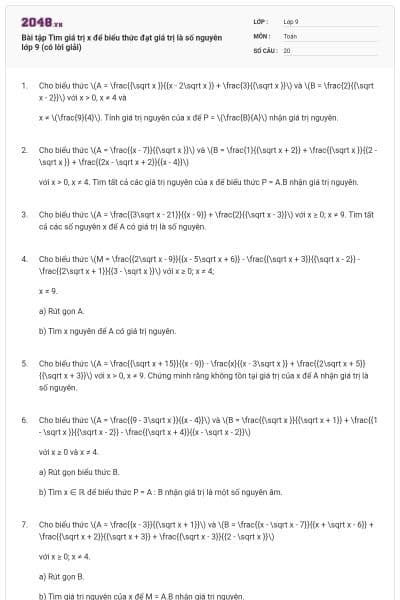
Cho biểu thức \(A = \frac{{\sqrt x }}{{x - 2\sqrt x }} + \frac{3}{{\sqrt x }}\) và \(B = \frac{2}{{\sqrt x - 2}}\) với x > 0, x ≠ 4 và
x ≠ \(\frac{9}{4}\). Tính giá trị nguyên của x để P = \(\frac{B}{A}\) nhận giá trị nguyên.
Hướng dẫn giải
Với x > 0, x ≠ 4, x ≠ \(\frac{9}{4}\), ta có:
\(A = \frac{{\sqrt x }}{{x - 2\sqrt x }} + \frac{3}{{\sqrt x }} = \frac{{\sqrt x }}{{\left( {\sqrt x - 2} \right)\sqrt x }} + \frac{{3\left( {\sqrt x - 2} \right)}}{{\sqrt x \left( {\sqrt x - 2} \right)}} = \frac{{4\sqrt x - 6}}{{\sqrt x \left( {\sqrt x - 2} \right)}}\).
Có P = \(\frac{B}{A}\) = \(\frac{2}{{\sqrt x - 2}}:\frac{{4\sqrt x - 6}}{{\sqrt x \left( {\sqrt x - 2} \right)}} = \frac{2}{{\sqrt x - 2}}.\frac{{\sqrt x \left( {\sqrt x - 2} \right)}}{{4\sqrt x - 6}} = \frac{{\sqrt x }}{{2\sqrt x - 3}}\).
Ta có: \(P = \frac{{\sqrt x }}{{2\sqrt x - 3}} = \frac{1}{{2 - \frac{3}{{\sqrt x }}}}\) (vì x > 0 nên \(\sqrt x > 0\)).
P nhận giá trị nguyên khi và chỉ khi \(\frac{1}{{2 - \frac{3}{{\sqrt x }}}}\) nguyên
hay \(2 - \frac{3}{{\sqrt x }}\) ∈ Ư(1) = {1; −1}.
Khi đó P = 1 hoặc P = −1.
Với P = 1 hay \(2 - \frac{3}{{\sqrt x }}\) = 1 khi \(\sqrt x \) = 3 suy ra x = 9 (thỏa mãn).
Với P = −1 hay \(2 - \frac{3}{{\sqrt x }} = - 1\) khi \(\sqrt x = 1\) suy ra x = 1 (thỏa mãn).
Vậy x ∈ {1; 9} thì P nhận giá trị nguyên.
Cho biểu thức \(A = \frac{{x - 7}}{{\sqrt x }}\) và \(B = \frac{1}{{\sqrt x + 2}} + \frac{{\sqrt x }}{{2 - \sqrt x }} + \frac{{2x - \sqrt x + 2}}{{x - 4}}\)
với x > 0, x ≠ 4. Tìm tất cả các giá trị nguyên của x để biểu thức P = A.B nhận giá trị nguyên.
Hướng dẫn giải
Với x > 0, x ≠ 4, ta có:
\(B = \frac{1}{{\sqrt x + 2}} + \frac{{\sqrt x }}{{2 - \sqrt x }} + \frac{{2x - \sqrt x + 2}}{{x - 4}}\)
\(B = \frac{{\sqrt x - 2}}{{\left( {\sqrt x + 2} \right)\left( {\sqrt x - 2} \right)}} - \frac{{\sqrt x \left( {\sqrt x + 2} \right)}}{{\left( {\sqrt x + 2} \right)\left( {\sqrt x - 2} \right)}} + \frac{{2x - \sqrt x + 2}}{{\left( {\sqrt x + 2} \right)\left( {\sqrt x - 2} \right)}}\)
\(B = \frac{{\sqrt x - 2 - x - 2\sqrt x + 2x - \sqrt x + 2}}{{\left( {\sqrt x + 2} \right)\left( {\sqrt x - 2} \right)}}\)
\(B = \frac{{x - 2\sqrt x }}{{\left( {\sqrt x + 2} \right)\left( {\sqrt x - 2} \right)}} = \frac{{\sqrt x \left( {\sqrt x - 2} \right)}}{{\left( {\sqrt x + 2} \right)\left( {\sqrt x - 2} \right)}} = \frac{{\sqrt x }}{{\sqrt x + 2}}\).
Vậy B = \(\frac{{\sqrt x }}{{\sqrt x + 2}}\) với x > 0, x ≠ 4.
Ta có: P = A.B = \(\frac{{x - 7}}{{\sqrt x }}.\frac{{\sqrt x }}{{\sqrt x + 2}} = \frac{{x - 7}}{{\sqrt x + 2}}\).
Xét P = 0 khi \(\frac{{x - 7}}{{\sqrt x + 2}} = 0\) suy ra x – 7 = 0 (thỏa mãn điều kiện).
Xét P ≠ 0.
TH1: x ∈ ℤ; x ≠ 7; \(\sqrt x \) là số vô tỉ thì P ∉ ℤ (loại).
TH2: x ∈ ℤ; \(\sqrt x \)∈ ℤ.
Ta có: \(P = \frac{{x - 4 - 3}}{{\sqrt x + 2}} = \frac{{x - 4}}{{\sqrt x + 2}} - \frac{3}{{\sqrt x + 2}} = \sqrt x - 2 - \frac{3}{{\sqrt x + 2}}\).
Để P ∈ ℤ thì \(\sqrt x - 2 - \frac{3}{{\sqrt x + 2}}\) ∈ ℤ suy ra \(\frac{3}{{\sqrt x + 2}}\) ∈ ℤ.
Do đó, \(\left( {\sqrt x + 2} \right) \in \)Ư(3).
Mà Ư(3) = {1; 3; −1; −3}.
Do \(\sqrt x + 2\) ≥ 2 nên \(\sqrt x + 2\) = 3 suy ra \(\sqrt x = 1\) suy ra x = 1 (thỏa mãn).
Vậy x ∈ {1; 7} thì P có giá trị nguyên.
Cho biểu thức \(A = \frac{{3\sqrt x - 21}}{{x - 9}} + \frac{2}{{\sqrt x - 3}}\) với x ≥ 0; x ≠ 9. Tìm tất cả các số nguyên x để A có giá trị là số nguyên.
Hướng dẫn giải
Với x ≥ 0; x ≠ 9, ta có:
\(A = \frac{{3\sqrt x - 21}}{{x - 9}} + \frac{2}{{\sqrt x - 3}}\)
\(A = \frac{{3\sqrt x - 21}}{{\left( {\sqrt x - 3} \right)\left( {\sqrt x + 3} \right)}} + \frac{{2\left( {\sqrt x + 3} \right)}}{{\left( {\sqrt x - 3} \right)\left( {\sqrt x + 3} \right)}}\)
\(A = \frac{{3\sqrt x - 21 + 2\sqrt x + 6}}{{\left( {\sqrt x - 3} \right)\left( {\sqrt x + 3} \right)}}\)
\(A = \frac{{5\sqrt x - 15}}{{\left( {\sqrt x - 3} \right)\left( {\sqrt x + 3} \right)}} = \frac{{5\left( {\sqrt x - 3} \right)}}{{\left( {\sqrt x - 3} \right)\left( {\sqrt x + 3} \right)}} = \frac{5}{{\sqrt x + 3}}\).
Để A nhận giá trị nguyên thì \(\frac{5}{{\sqrt x + 3}}\) nguyên.
Suy ra \(\sqrt x + 3\) là Ư(5).
Mà Ư(5) = {1; 5; −1; −5}.
Nhận thấy \(\sqrt x + 3\) ≥ 3 với vọi x ≥ 0; x ≠ 9.
Do đó, \(\sqrt x + 3\) = 5, suy ra \(\sqrt x \) = 2 do đó, x = 4 (thỏa mãn).
Vậy x = 4 thì A nhận giá trị nguyên.
Cho biểu thức \(M = \frac{{2\sqrt x - 9}}{{x - 5\sqrt x + 6}} - \frac{{\sqrt x + 3}}{{\sqrt x - 2}} - \frac{{2\sqrt x + 1}}{{3 - \sqrt x }}\) với x ≥ 0; x ≠ 4;
x ≠ 9.
a) Rút gọn A.
b) Tìm x nguyên để A có giá trị nguyên.
Hướng dẫn giải
a) Với x ≥ 0; x ≠ 4; x ≠ 9, ta có:
\(M = \frac{{2\sqrt x - 9}}{{x - 5\sqrt x + 6}} - \frac{{\sqrt x + 3}}{{\sqrt x - 2}} - \frac{{2\sqrt x + 1}}{{3 - \sqrt x }}\)
\(M = \frac{{2\sqrt x - 9}}{{\left( {\sqrt x - 2} \right)\left( {\sqrt x - 3} \right)}} - \frac{{\left( {\sqrt x + 3} \right)\left( {\sqrt x - 3} \right)}}{{\left( {\sqrt x - 2} \right)\left( {\sqrt x - 3} \right)}} + \frac{{\left( {2\sqrt x + 1} \right)\left( {\sqrt x - 2} \right)}}{{\left( {\sqrt x - 2} \right)\left( {\sqrt x - 3} \right)}}\)
\(M = \frac{{2\sqrt x - 9}}{{\left( {\sqrt x - 2} \right)\left( {\sqrt x - 3} \right)}} - \frac{{x - 9}}{{\left( {\sqrt x - 2} \right)\left( {\sqrt x - 3} \right)}} + \frac{{2x - 3\sqrt x - 2}}{{\left( {\sqrt x - 2} \right)\left( {\sqrt x - 3} \right)}}\)
\(M = \frac{{2\sqrt x - 9 - x + 9 + 2x - 3\sqrt x - 2}}{{\left( {\sqrt x - 2} \right)\left( {\sqrt x - 3} \right)}}\)
\(M = \frac{{x - \sqrt x - 2}}{{\left( {\sqrt x - 2} \right)\left( {\sqrt x - 3} \right)}}\)
\(M = \frac{{\left( {\sqrt x - 2} \right)\left( {\sqrt x + 1} \right)}}{{\left( {\sqrt x - 2} \right)\left( {\sqrt x - 3} \right)}} = \frac{{\sqrt x + 1}}{{\sqrt x - 3}}\).
Với x ≥ 0; x ≠ 4; x ≠ 9, M = \(\frac{{\sqrt x + 1}}{{\sqrt x - 3}} = 1 + \frac{4}{{\sqrt x - 3}}\).
Để M nguyên thì \(\frac{4}{{\sqrt x - 3}}\) nguyên hay \(\sqrt x - 3\) là Ư(4).
Mà Ư(4) = {1; 4; −1; −4; 2; −2}.
• Với \(\sqrt x - 3\) = 1 suy ra x = 16 (thỏa mãn).
• Với \(\sqrt x - 3\) = −1 suy ra x = 4 (loại).
• Với \(\sqrt x - 3\) = 2 suy ra x = 25 (thỏa mãn).
• Với \(\sqrt x - 3\) = −2 suy ra x = 1 (thỏa mãn).
• Với \(\sqrt x - 3\) = 4 suy ra x = 49 (thỏa mãn).
• Với \(\sqrt x - 3\) = −4 suy ra \(\sqrt x \) = −1 (loại).
Vậy để A nhận giá trị nguyên thì x ∈ {1; 25; 16; 49}.
Cho biểu thức \(A = \frac{{\sqrt x + 15}}{{x - 9}} - \frac{x}{{x - 3\sqrt x }} + \frac{{2\sqrt x + 5}}{{\sqrt x + 3}}\) với x > 0, x ≠ 9. Chứng minh rằng không tồn tại giá trị của x để A nhận giá trị là số nguyên.
Hướng dẫn giải
Với x > 0, x ≠ 9, ta có:
\(A = \frac{{\sqrt x + 15}}{{x - 9}} - \frac{x}{{x - 3\sqrt x }} + \frac{{2\sqrt x + 5}}{{\sqrt x + 3}}\)
\(A = \frac{{\left( {\sqrt x + 15} \right)\sqrt x }}{{\sqrt x \left( {\sqrt x + 3} \right)\left( {\sqrt x - 3} \right)}} - \frac{{x\left( {\sqrt x + 3} \right)}}{{\sqrt x \left( {\sqrt x - 3} \right)\left( {\sqrt x + 3} \right)}} + \frac{{\left( {2\sqrt x + 5} \right)\sqrt x \left( {\sqrt x - 3} \right)}}{{\sqrt x \left( {\sqrt x - 3} \right)\left( {\sqrt x + 3} \right)}}\)
\(A = \frac{{x + 15\sqrt x - x\sqrt x - 3x + 2x\sqrt x + 5x - 6x - 15\sqrt x }}{{\sqrt x \left( {\sqrt x + 3} \right)\left( {\sqrt x - 3} \right)}}\)
\(A = \frac{{x\sqrt x - 3x}}{{\sqrt x \left( {\sqrt x - 3} \right)\left( {\sqrt x + 3} \right)}} = \frac{{x\left( {\sqrt x - 3} \right)}}{{\sqrt x \left( {\sqrt x - 3} \right)\left( {\sqrt x + 3} \right)}} = \frac{{\sqrt x }}{{\sqrt x + 3}}\).
Với x > 0, x ≠ 9 có \(A = \frac{{\sqrt x }}{{\sqrt x + 3}}\) > 0.
Lại có: A = \(1 - \frac{3}{{\sqrt {x + 3} }} < 1\).
Do đó 0 < A < 1.
Vậy không tồn tại giá trị của x để A nhận giá trị là số nguyên.
>>
Cho biểu thức \(A = \frac{{9 - 3\sqrt x }}{{x - 4}}\) và \(B = \frac{{\sqrt x }}{{\sqrt x + 1}} + \frac{{1 - \sqrt x }}{{\sqrt x - 2}} - \frac{{\sqrt x + 4}}{{x - \sqrt x - 2}}\)
với x ≥ 0 và x ≠ 4.
a) Rút gọn biểu thức B.
b) Tìm x ∈ ℝ để biểu thức P = A : B nhận giá trị là một số nguyên âm.
Hướng dẫn giải
a) Với x ≥ 0 và x ≠ 4, ta có:
\(B = \frac{{\sqrt x }}{{\sqrt x + 1}} + \frac{{1 - \sqrt x }}{{\sqrt x - 2}} - \frac{{\sqrt x + 4}}{{x - \sqrt x - 2}}\)
\(B = \frac{{\sqrt x \left( {\sqrt x - 2} \right)}}{{\left( {\sqrt x + 1} \right)\left( {\sqrt x - 2} \right)}} + \frac{{\left( {\sqrt x + 1} \right)\left( {1 - \sqrt x } \right)}}{{\left( {\sqrt x + 1} \right)\left( {\sqrt x - 2} \right)}} - \frac{{\sqrt x + 4}}{{\left( {\sqrt x + 1} \right)\left( {\sqrt x - 2} \right)}}\)
\(B = \frac{{x - 2\sqrt x + 1 - x - \sqrt x - 4}}{{\left( {\sqrt x + 1} \right)\left( {\sqrt x - 2} \right)}}\)
\(B = \frac{{ - 3\sqrt x - 3}}{{\left( {\sqrt x + 1} \right)\left( {\sqrt x - 2} \right)}} = \frac{{ - 3\left( {\sqrt x + 1} \right)}}{{\left( {\sqrt x + 1} \right)\left( {\sqrt x - 2} \right)}} = \frac{{ - 3}}{{\sqrt x - 2}}\).
Ta có: P = A : B = \(\frac{{9 - 3\sqrt x }}{{x - 4}}:\frac{{\left( { - 3} \right)}}{{\sqrt x - 2}} = \frac{{3\left( {3 - \sqrt x } \right)}}{{\left( {\sqrt x - 2} \right)\left( {\sqrt x + 2} \right)}}.\frac{{\sqrt x - 2}}{{\left( { - 3} \right)}} = \frac{{\sqrt x - 3}}{{\sqrt x + 2}}\).
Có \(P = \frac{{\sqrt x - 3}}{{\sqrt x + 2}} = 1 - \frac{5}{{\sqrt x + 2}}\).
Do x ≥ 0 suy ra 0 < \(\frac{5}{{\sqrt x + 2}}\) ≤ \(\frac{5}{2}\).
Đêt P nguyên thì \(\frac{5}{{\sqrt x + 2}}\) nhận giá trị nguyên.
Do đó P = 1 hoặc P = 2.
Với P = 1 thì \(\frac{5}{{\sqrt x + 2}} = 1\) hay \(\sqrt x + 2\) = 5 suy ra x = 9 .
Với P = 2 thì \(\frac{5}{{\sqrt x + 2}} = 2\) hay \(\sqrt x + 2 = \frac{5}{2}\) suy ra x = \(\frac{1}{4}\).
Thử lại:
Khi x = 9 thì P = 0 (loại).
Khi x = \(\frac{1}{4}\) thì P = −1 (thỏa mãn).
Vậy x = \(\frac{1}{4}\).
>
Cho biểu thức \(A = \frac{{x - 3}}{{\sqrt x + 1}}\) và \(B = \frac{{x - \sqrt x - 7}}{{x + \sqrt x - 6}} + \frac{{\sqrt x + 2}}{{\sqrt x + 3}} + \frac{{\sqrt x - 3}}{{2 - \sqrt x }}\)
với x ≥ 0; x ≠ 4.
a) Rút gọn B.
b) Tìm giá trị nguyên của x để M = A.B nhận giá trị nguyên.
Hướng dẫn giải
a) Với x ≥ 0; x ≠ 4, ta có:
\(B = \frac{{x - \sqrt x - 7}}{{x + \sqrt x - 6}} + \frac{{\sqrt x + 2}}{{\sqrt x + 3}} + \frac{{\sqrt x - 3}}{{2 - \sqrt x }}\)
\(B = \frac{{x - \sqrt x - 7}}{{\left( {\sqrt x - 2} \right)\left( {\sqrt x + 3} \right)}} + \frac{{\left( {\sqrt x + 2} \right)\left( {\sqrt x - 2} \right)}}{{\left( {\sqrt x - 2} \right)\left( {\sqrt x + 3} \right)}} - \frac{{\left( {\sqrt x - 3} \right)\left( {\sqrt x + 3} \right)}}{{\left( {\sqrt x - 2} \right)\left( {\sqrt x + 3} \right)}}\)
\(B = \frac{{x - \sqrt x - 7 + x - 4 - x + 9}}{{\left( {\sqrt x - 2} \right)\left( {\sqrt x + 3} \right)}}\)
\(B = \frac{{x - \sqrt x - 2}}{{\left( {\sqrt x - 2} \right)\left( {\sqrt x + 3} \right)}} = \frac{{\left( {\sqrt x - 2} \right)\left( {\sqrt x + 1} \right)}}{{\left( {\sqrt x - 2} \right)\left( {\sqrt x + 3} \right)}} = \frac{{\sqrt x + 1}}{{\sqrt x + 3}}\).
b) Với x ≥ 0; x ≠ 4, ta có:
M = A.B = \(\frac{{x - 3}}{{\sqrt x + 1}}\). \(\frac{{\sqrt x + 1}}{{\sqrt x + 3}} = \frac{{x - 3}}{{\sqrt x + 3}}\).
Hay \(M = \frac{{x - 3}}{{\sqrt x + 3}} = \frac{{x - 9 + 6}}{{\sqrt x + 3}} = \frac{{\left( {\sqrt x + 3} \right)\left( {\sqrt x - 3} \right) + 6}}{{\sqrt x + 3}} = \sqrt x - 3 + \frac{6}{{\sqrt x + 3}}\).
Xét x = 3 thì M = 0 (thỏa mãn). Vậy x = 3 thỏa mãn.
Xét x ≠ 3, x ∈ ℤ nhưng \(\sqrt x \notin \mathbb{Z}\). Do đó M \( \notin \mathbb{Z}\).
Xét x ∈ ℤ, \(\sqrt x \in \mathbb{Z}\) suy ra M ∈ ℤ:
Suy ra \(\frac{6}{{\sqrt x + 3}}\) là số nguyên hay \(\sqrt x + 3\) là Ư(6).
Mà Ư(6) = {1; 2; 3; 6; −1; −2; −3; −6}.
Nhận thấy \(\sqrt x + 3 \ge 3\) với mọi x ≥ 0; x ≠ 4.
Suy ra \(\sqrt x + 3 = 3\) hoặc \(\sqrt x + 3 = 6\).
Do đó, x = 0 (thỏa mãn) hoặc x = 9 (thỏa mãn).
Vậy x ∈ {0; 3; 9} thì M nhận giá trị nguyên.
Cho biểu thức \(A = \frac{{15\sqrt x - 19}}{{x + 2\sqrt x - 3}} - \frac{{3\sqrt x - 2}}{{1 - \sqrt x }} - \frac{{2\sqrt x + 3}}{{\sqrt x + 3}}\) với x ≥ 0; x ≠ 1.
a) Rút gọn A.
b) Tìm x nguyên để A có giá trị nguyên.
Hướng dẫn giải
a) Với x ≥ 0; x ≠ 1, ta có:
\(A = \frac{{15\sqrt x - 19}}{{x + 2\sqrt x - 3}} - \frac{{3\sqrt x - 2}}{{1 - \sqrt x }} - \frac{{2\sqrt x + 3}}{{\sqrt x + 3}}\)
\(A = \frac{{15\sqrt x - 19}}{{\left( {\sqrt x + 3} \right)\left( {\sqrt x - 1} \right)}} + \frac{{\left( {3\sqrt x - 2} \right)\left( {\sqrt x + 3} \right)}}{{\left( {\sqrt x + 3} \right)\left( {\sqrt x - 1} \right)}} - \frac{{\left( {2\sqrt x + 3} \right)\left( {\sqrt x - 1} \right)}}{{\left( {\sqrt x + 3} \right)\left( {\sqrt x - 1} \right)}}\)
\(A = \frac{{15\sqrt x - 19 + 3x + 7\sqrt x - 6 - 2x - \sqrt x + 3}}{{\left( {\sqrt x + 3} \right)\left( {\sqrt x - 1} \right)}}\)
\(A = \frac{{x + 21\sqrt x - 22}}{{\left( {\sqrt x + 3} \right)\left( {\sqrt x - 1} \right)}} = \frac{{\left( {\sqrt x - 1} \right)\left( {\sqrt x + 22} \right)}}{{\left( {\sqrt x + 3} \right)\left( {\sqrt x - 1} \right)}} = \frac{{\sqrt x + 22}}{{\sqrt x + 3}}\).
b) Ta có: \(A = \frac{{\sqrt x + 22}}{{\sqrt x + 3}} = 1 + \frac{{19}}{{\sqrt x + 3}}\) với x ≥ 0; x ≠ 1.
Để A nhận giá trị nguyên thì \(\frac{{19}}{{\sqrt x + 3}}\) nguyên.
Suy ra \(\sqrt x + 3\) là Ư(19).
Mà Ư(19) = {1; 19; −1; −19}.
Nhận thấy \(\sqrt x + 3 \ge 3\) với x ≥ 0; x ≠ 1.
Suy ra \(\sqrt x + 3\) = 19 hay x = 256 (thỏa mãn).
Vậy x = 256 thì A nhận giá trị nguyên.
Cho hai biểu thức \(A = \frac{{\sqrt x + 1}}{{\sqrt x + 2}}\) và \(B = \frac{{\sqrt x - 11}}{{x - \sqrt x - 2}} - \frac{{\sqrt x }}{{\sqrt x + 1}} + \frac{{2\sqrt x - 1}}{{\sqrt x - 2}}\) với x ≥ 0; x ≠ 4. Tìm x nguyên để A.B có giá trị nguyên.
Hướng dẫn giải
Với x ≥ 0; x ≠ 4, ta có:
\(B = \frac{{\sqrt x - 11}}{{x - \sqrt x - 2}} - \frac{{\sqrt x }}{{\sqrt x + 1}} + \frac{{2\sqrt x - 1}}{{\sqrt x - 2}}\)
\(B = \frac{{\sqrt x - 11}}{{\left( {\sqrt x - 2} \right)\left( {\sqrt x + 1} \right)}} - \frac{{\sqrt x \left( {\sqrt x - 2} \right)}}{{\left( {\sqrt x - 2} \right)\left( {\sqrt x + 1} \right)}} + \frac{{\left( {2\sqrt x - 1} \right)\left( {\sqrt x + 1} \right)}}{{\left( {\sqrt x - 2} \right)\left( {\sqrt x + 1} \right)}}\)
\(B = \frac{{\sqrt x - 11 - x + 2\sqrt x + 2x + \sqrt x - 1}}{{\left( {\sqrt x - 2} \right)\left( {\sqrt x + 1} \right)}}\)
\(B = \frac{{x + 4\sqrt x - 12}}{{\left( {\sqrt x - 2} \right)\left( {\sqrt x + 1} \right)}} = \frac{{\left( {\sqrt x - 2} \right)\left( {\sqrt x + 6} \right)}}{{\left( {\sqrt x - 2} \right)\left( {\sqrt x + 1} \right)}} = \frac{{\sqrt x + 6}}{{\sqrt x + 1}}\).
Ta có: P = A.B = \(\frac{{\sqrt x + 1}}{{\sqrt x + 2}}.\frac{{\sqrt x + 6}}{{\sqrt x + 1}} = \frac{{\sqrt x + 6}}{{\sqrt x + 2}} = 1 + \frac{4}{{\sqrt x + 2}}\).
Để P nhận giá trị nguyên thì \(\frac{4}{{\sqrt x + 2}}\) nguyên.
Suy ra \(\sqrt x + 2\) là ước của 4.
Nhận thấy \(\sqrt x + 2 \ge 2\) với x ≥ 0; x ≠ 4 nên \(\sqrt x + 2\) = 2 hoặc \(\sqrt x + 2\) = 4.
Suy ra x = 0 (thỏa mãn) hoặc x = 4 (loại).
Vậy x = 0 thì P = A.B nhận giá trị nguyên.
Cho các biểu thức \(A = \frac{{\sqrt x + 5}}{{\sqrt x - 3}}\) và \(B = \frac{4}{{\sqrt x + 3}} + \frac{{2x - \sqrt x - 13}}{{x - 9}} - \frac{{\sqrt x }}{{\sqrt x - 3}}\) với x ≥ 0; x ≠ 9. Tính giá trị của x nguyên nhỏ nhất để P = \(\frac{B}{A}\) có giá trị nguyên.
Hướng dẫn giải
Với x ≥ 0; x ≠ 9, ta có:
\(B = \frac{4}{{\sqrt x + 3}} + \frac{{2x - \sqrt x - 13}}{{x - 9}} - \frac{{\sqrt x }}{{\sqrt x - 3}}\)
\(B = \frac{{4\left( {\sqrt x - 3} \right)}}{{\left( {\sqrt x + 3} \right)\left( {\sqrt x - 3} \right)}} + \frac{{2x - \sqrt x - 13}}{{\left( {\sqrt x + 3} \right)\left( {\sqrt x - 3} \right)}} - \frac{{\sqrt x \left( {\sqrt x + 3} \right)}}{{\left( {\sqrt x + 3} \right)\left( {\sqrt x - 3} \right)}}\)
\(B = \frac{{4\sqrt x - 12 + 2x - \sqrt x - 13 - x - 3\sqrt x }}{{\left( {\sqrt x + 3} \right)\left( {\sqrt x - 3} \right)}}\)
\(B = \frac{{x - 25}}{{\left( {\sqrt x + 3} \right)\left( {\sqrt x - 3} \right)}} = \frac{{\left( {\sqrt x + 5} \right)\left( {\sqrt x - 5} \right)}}{{\left( {\sqrt x + 3} \right)\left( {\sqrt x - 3} \right)}}\).
Ta có: P = \(\frac{B}{A}\) = \(\frac{{\left( {\sqrt x + 5} \right)\left( {\sqrt x - 5} \right)}}{{\left( {\sqrt x + 3} \right)\left( {\sqrt x - 3} \right)}}\): \(\frac{{\sqrt x + 5}}{{\sqrt x - 3}}\)
= \(\frac{{\left( {\sqrt x + 5} \right)\left( {\sqrt x - 5} \right)}}{{\left( {\sqrt x + 3} \right)\left( {\sqrt x - 3} \right)}}\). \(\frac{{\sqrt x - 3}}{{\sqrt x + 5}} = \frac{{\sqrt x - 5}}{{\sqrt x + 3}}\).
Ta có: P = \(\frac{{\sqrt x - 5}}{{\sqrt x + 3}} = 1 - \frac{8}{{\sqrt x + 3}}\).
Để P đạt giá trị nguyên thì \(\frac{8}{{\sqrt x + 3}}\) nhận giá trị nguyên.
Suy ra \(\sqrt x + 3\) là Ư(8).
Nhận thấy \(\sqrt x + 3 \ge 3\)với x ≥ 0; x ≠ 9.
Do đó, \(\sqrt x + 3 \in {\rm{\{ }}4;8\} \)
Với \(\sqrt x + 3\) = 4 thì x = 1 (thỏa mãn).
Với \(\sqrt x + 3\) = 8 thì x = 25 (thỏa mãn).
Vậy giá trị x nguyên nhỏ nhất để P nhận giá trị nguyên là x = 1.
Cho biểu thức \(A = \frac{{15\sqrt x - 19}}{{x + 2\sqrt x - 3}} - \frac{{3\sqrt x - 2}}{{1 - \sqrt x }} - \frac{{2\sqrt x + 3}}{{\sqrt x + 3}}\) với x ≥ 0, x ≠ 1.
Khi đó:
Điều kiện xác định của A là x ≥ 0, x ≠ 1, x ≠ 9.
Rút gọn A = \(\frac{{\sqrt x + 22}}{{\sqrt x + 3}}\).
Để A nhận giá trị nguyên thì \(\sqrt x + 3 \in \)Ư(19).
Không có giá trị nào của x thỏa mãn để A nguyên.
Hướng dẫn giải
Đáp án: a) Sai. b) Đúng. c) Đúng. d) Sai.
a) Sai.
Với mọi x ≥ 0, ta có điều kiện xác định của biểu thức A là:
• \(x + 2\sqrt x - 3 \ne 0\) hay \(\left( {\sqrt x + 3} \right)\left( {\sqrt x - 1} \right) \ne 0\) suy ra \(\sqrt x + 3 \ne 0\) (luôn đúng) và \(\sqrt x - 1 \ne 0\).
Do đó x ≠ 1.
• \(\sqrt x - 1 \ne 0\) suy ra x ≠ 1.
• \(\sqrt x + 3 \ne 0\) (luôn đúng với x ≥ 0).
Vậy điều kiện xác định của A là x ≥ 0, x ≠ 1.
b) Đúng.
Với x ≥ 0, x ≠ 1, ta có:
\(A = \frac{{15\sqrt x - 19}}{{x + 2\sqrt x - 3}} - \frac{{3\sqrt x - 2}}{{1 - \sqrt x }} - \frac{{2\sqrt x + 3}}{{\sqrt x + 3}}\)
\( = \frac{{15\sqrt x - 19}}{{\left( {\sqrt x + 3} \right)\left( {\sqrt x - 1} \right)}} + \frac{{\left( {3\sqrt x - 2} \right)\left( {\sqrt x + 3} \right)}}{{\left( {\sqrt x + 3} \right)\left( {\sqrt x - 1} \right)}} - \frac{{\left( {2\sqrt x + 3} \right)\left( {\sqrt x - 1} \right)}}{{\left( {\sqrt x + 3} \right)\left( {\sqrt x - 1} \right)}}\)
\( = \frac{{15\sqrt x - 19 + 3x + 7\sqrt x - 6 - 2x - \sqrt x + 3}}{{\left( {\sqrt x + 3} \right)\left( {\sqrt x - 1} \right)}}\)
\( = \frac{{x + 21\sqrt x - 22}}{{\left( {\sqrt x + 3} \right)\left( {\sqrt x - 1} \right)}}\)
\( = \frac{{\left( {\sqrt x - 1} \right)\left( {\sqrt x + 22} \right)}}{{\left( {\sqrt x + 3} \right)\left( {\sqrt x - 1} \right)}}\)
\( = \frac{{\sqrt x + 22}}{{\sqrt x + 3}}\)
Vậy \(A = \frac{{\sqrt x + 22}}{{\sqrt x + 3}}\) với x ≥ 0, x ≠ 1
c) Đúng.
Ta có: \(A = \frac{{\sqrt x + 22}}{{\sqrt x + 3}} = 1 + \frac{{19}}{{\sqrt x + 3}}\) với x ≥ 0, x ≠ 1.
Để A nhận giá trị nguyên thì \(\frac{{19}}{{\sqrt x + 3}}\) nguyên.
Suy ra \(\sqrt x + 3\) là Ư(19).
d) Sai.
Mà Ư(19) = {1; 19; −1; −19}.
Nhận thấy \(\sqrt x + 3 \ge 3\) với x ≥ 0, x ≠ 1.
Suy ra \(\sqrt x + 3\) = 19 hay x = 256 (thỏa mãn).
Vậy x = 256 thì A nhận giá trị nguyên.
Rút gọn \(B = \frac{{x - 25}}{{x - 9}}\).
Biểu thức P = \(\frac{{\sqrt x - 5}}{{\sqrt x + 3}}.\)
Có duy nhất một giá trị nguyên của x = 25 thỏa mãn P nguyên.
Giá trị của P = 0 khi x = 25.
Hướng dẫn giải
Đáp án: a) Đúng. b) Đúng. c) Sai. d) Đúng.
a) Đúng.
Với x ≥ 0; x ≠ 9, ta có:
\(B = \frac{4}{{\sqrt x + 3}} + \frac{{2x - \sqrt x - 13}}{{x - 9}} - \frac{{\sqrt x }}{{\sqrt x - 3}}\)
\( = \frac{{4\left( {\sqrt x - 3} \right)}}{{\left( {\sqrt x + 3} \right)\left( {\sqrt x - 3} \right)}} + \frac{{2x - \sqrt x - 13}}{{\left( {\sqrt x + 3} \right)\left( {\sqrt x - 3} \right)}} - \frac{{\sqrt x \left( {\sqrt x + 3} \right)}}{{\left( {\sqrt x + 3} \right)\left( {\sqrt x - 3} \right)}}\)
\( = \frac{{4\sqrt x - 12 + 2x - \sqrt x - 13 - x - 3\sqrt x }}{{\left( {\sqrt x + 3} \right)\left( {\sqrt x - 3} \right)}}\)
\( = \frac{{x - 25}}{{\left( {\sqrt x + 3} \right)\left( {\sqrt x - 3} \right)}} = \frac{{x - 25}}{{x - 9}} = \frac{{\left( {\sqrt x + 5} \right)\left( {\sqrt x - 5} \right)}}{{\left( {\sqrt x + 3} \right)\left( {\sqrt x - 3} \right)}}\).
b) Đúng.
Ta có: P = \(\frac{B}{A}\) = \(\frac{{\left( {\sqrt x + 5} \right)\left( {\sqrt x - 5} \right)}}{{\left( {\sqrt x + 3} \right)\left( {\sqrt x - 3} \right)}}\): \(\frac{{\sqrt x + 5}}{{\sqrt x - 3}}\)
= \(\frac{{\left( {\sqrt x + 5} \right)\left( {\sqrt x - 5} \right)}}{{\left( {\sqrt x + 3} \right)\left( {\sqrt x - 3} \right)}}\). \(\frac{{\sqrt x - 3}}{{\sqrt x + 5}} = \frac{{\sqrt x - 5}}{{\sqrt x + 3}}\).
c) Sai.
Ta có: P = \(\frac{{\sqrt x - 5}}{{\sqrt x + 3}} = 1 - \frac{8}{{\sqrt x + 3}}\).
Để P đạt giá trị nguyên thì \(\frac{8}{{\sqrt x + 3}}\) nhận giá trị nguyên.
Suy ra \(\sqrt x + 3\) là Ư(8).
Nhận thấy \(\sqrt x + 3 \ge 3\) với x ≥ 0, x ≠ 9.
Do đó, \(\sqrt x + 3 \in {\rm{\{ }}4;\,\,8\} \)
Với \(\sqrt x + 3\) = 4 thì x = 1 (thỏa mãn).
Với \(\sqrt x + 3\) = 8 thì x = 25 (thỏa mãn).
Do đó, có hai giá trị nguyên của x để P nguyên.
d) Đúng.
Thay x = 25 (thỏa mãn) vào P được P = \(\frac{{\sqrt {25} - 5}}{{\sqrt {25} + 3}} = \frac{{5 - 5}}{{5 + 3}} = \frac{0}{8} = 0\).
Điểu kiện xác định của hai biểu thức A và B đều là x ≥ 0, x ≠ 16.
Giá trị của biểu thức A khi \(x = 4 - 2\sqrt 3 \) là một số âm.
Rút gọn được \[B = \frac{{\sqrt x }}{{\sqrt x - 4}}\].
Có bốn giá trị nguyên của x để \[\frac{A}{B}\] nhận giá trị nguyên.
Hướng dẫn giải
Đáp án đúng là: a) Đúng. b) Đúng. c) Đúng. d) Sai.
a) Đúng.
– Xét biểu thức \(A = \frac{{\sqrt x + 2}}{{\sqrt x - 4}}\).
Điều kiện xác định của biểu thức \(A\) và \(x \ge 0\) và \(\sqrt x - 4 \ne 0\) hay \(x \ge 0,\,\,x \ne 16.\)
– Xét biểu thức \[B = \frac{{\sqrt x - 2}}{{\sqrt x + 4}} - \frac{{10\sqrt x - 8}}{{16 - x}}\].
Với \(x \ge 0\), ta có:
⦁\[16 - x = \left( {4 + \sqrt x } \right)\left( {4 - \sqrt x } \right) = - \left( {\sqrt x + 4} \right)\left( {\sqrt x - 4} \right)\].
⦁\(x \ge 0\) nên \(\sqrt x \ge 0,\) suy ra \(\sqrt x + 4 > 0.\)
Điều kiện xác định của biểu thức \(B\) là \(x \ge 0\) và \(\sqrt x - 4 \ne 0\) hay \(x \ge 0,\,\,x \ne 16.\)
Vậy điều kiện xác định của biểu thức \(A\) và biểu thức \(B\) đều là \(x \ge 0,\,\,x \ne 16.\)
b) Đúng.
Tính giá trị của biểu thức \(A\) khi \(x = 4 - 2\sqrt 3 .\)
Vì \(x = 4 - 2\sqrt 3 = 3 - 2\sqrt 3 + 1\) nên \(x = {\left( {\sqrt 3 - 1} \right)^2}\)và \(\sqrt x = \sqrt 3 - 1\).
Thay vào \(A\) ta được
\(A = \frac{{\sqrt 3 - 1 + 2}}{{\sqrt 3 - 1 - 4}} = \frac{{\sqrt 3 + 1}}{{\sqrt 3 - 5}}\)\( = \frac{{\left( {\sqrt 3 + 1} \right)\left( {\sqrt 3 + 5} \right)}}{{\left( {\sqrt 3 - 5} \right)\left( {\sqrt 3 + 5} \right)}} = \frac{{8 + 6\sqrt 3 }}{{ - 22}} = \frac{{ - 4 - 3\sqrt 3 }}{{11}}\).
Vậy khi \(x = 4 - 2\sqrt 3 \) thì \[A = \frac{{ - 4 - 3\sqrt 3 }}{{11}}\].
c) Đúng.
Với \(x \ge 0\,,\,\,x \ne 16\,,\) ta có:
\[B = \frac{{\sqrt x - 2}}{{\sqrt x + 4}} - \frac{{10\sqrt x - 8}}{{16 - x}}\]
\[ = \frac{{\left( {\sqrt x - 2} \right)\left( {\sqrt x - 4} \right)}}{{\left( {\sqrt x + 4} \right)\left( {\sqrt x - 4} \right)}} + \frac{{10\sqrt x - 8}}{{\left( {\sqrt x + 4} \right)\left( {\sqrt x - 4} \right)}}\]
\[ = \frac{{x - 6\sqrt x + 8 + 10\sqrt x - 8}}{{\left( {\sqrt x + 4} \right)\left( {\sqrt x - 4} \right)}}\]
\[ = \frac{{x + 4\sqrt x }}{{\left( {\sqrt x + 4} \right)\left( {\sqrt x - 4} \right)}}\]\[ = \frac{{\sqrt x }}{{\sqrt x - 4}}\].
d) Sai.
Ta có \(\frac{A}{B} = \frac{{\sqrt x + 2}}{{\sqrt x - 4}}:\frac{{\sqrt x }}{{\sqrt x - 4}}\)\( = \frac{{\sqrt x + 2}}{{\sqrt x - 4}}.\frac{{\sqrt x - 4}}{{\sqrt x }}\)\( = \frac{{\sqrt x + 2}}{{\sqrt x }} = 1 + \frac{2}{{\sqrt x }}\).
Để \[\frac{A}{B}\] nhận giá trị nguyên thì \(\frac{2}{{\sqrt x }}\) nhận giá trị nguyên hay \(\sqrt x \) là ước của 2.
Do đó, \[\sqrt x = 2\] suy ra x = 4 (thỏa mãn) hoặc \[\sqrt x = 1\], suy ra x = 1 (thỏa mãn).
Vậy có 2 giá trị nguyên của của x để \[\frac{A}{B}\] nhận giá trị nguyên.
Giá trị của biểu thức A tại x = 16 bằng \(\frac{{19}}{2}\).
Tại x = 16, giá trị của biểu thức B lớn hơn giá trị của biểu thức A.
\(B = \frac{{\sqrt x }}{{\sqrt x + 2}}\).
Có ba giá trị nguyên của x để \(P = \frac{A}{B}\) đạt giá trị nguyên.
Hướng dẫn giải
Đáp án đúng là: a) Đúng. b) Sai. c) Sai. d) Sai.
a) Đúng.
Với \(x = 16\) (thỏa mãn điều kiện), ta có
\(A = \frac{{16 + 3}}{{\sqrt {16} - 2}} = \frac{{19}}{{4 - 2}} = \frac{{19}}{2}\).
Vậy khi \(x = 16\) thì giá trị của biểu thức \(A\)bằng \(\frac{{19}}{2}\).
b) Sai.
Thay x = 16 (thỏa mãn ĐKXĐ) vào \(B = \frac{{\sqrt x - 1}}{{\sqrt x + 2}} + \frac{{5\sqrt x - 2}}{{x - 4}}\) được:
\(B = \frac{{\sqrt {16} - 1}}{{\sqrt {16} + 2}} + \frac{{5\sqrt {16} - 2}}{{16 - 4}} = \frac{{4 - 1}}{{4 + 2}} + \frac{{5.4 - 2}}{{12}} = \frac{3}{6} + \frac{{18}}{{12}} = 2 < \frac{{19}}{2}\).
Do đó, tại x = 16 thì giá trị của biểu thức A lớn hơn giá trị của biểu thức B.
c) Sai.
Với \(x > 0,\,\,x \ne 4\), ta có
\(B = \frac{{\sqrt x - 1}}{{\sqrt x + 2}} + \frac{{5\sqrt x - 2}}{{x - 4}} = \frac{{\left( {\sqrt x - 1} \right)\left( {\sqrt x - 2} \right)}}{{\left( {\sqrt x + 2} \right)\left( {\sqrt x - 2} \right)}} + \frac{{5\sqrt x - 2}}{{\left( {\sqrt x + 2} \right)\left( {\sqrt x - 2} \right)}}\)
\( = \frac{{x - 3\sqrt x + 2 + 5\sqrt x - 2}}{{\left( {\sqrt x + 2} \right)\left( {\sqrt x - 2} \right)}} = \frac{{x + 2\sqrt x }}{{\left( {\sqrt x + 2} \right)\left( {\sqrt x - 2} \right)}}\)
\( = \frac{{\sqrt x \left( {\sqrt x + 2} \right)}}{{\left( {\sqrt x + 2} \right)\left( {\sqrt x - 2} \right)}} = \frac{{\sqrt x }}{{\sqrt x - 2}}\).
d) Sai.
Ta có \(P = \frac{A}{B} = \frac{{x + 3}}{{\sqrt x - 2}}:\frac{{\sqrt x }}{{\sqrt x - 2}} = \frac{{x + 3}}{{\sqrt x }} = \sqrt x + \frac{3}{{\sqrt x }}\).
Để P nguyên với x ∈ ℤ thì \(\sqrt x + \frac{3}{{\sqrt x }}\) nguyên.
Do đó \(\sqrt x \) là ước của 3 nên \(\sqrt x \in \left\{ {1;\,\,3} \right\}\).
Với \(\sqrt x = 1\) thì x = 1 (thỏa mãn).
Với \(\sqrt x = 3\) thì x = 9 (thỏa mãn).
Do đó, có hai giá trị nguyên của x để P nguyên.
Hai biểu thức A và B có cùng điều kiện xác định.
Giá trị của biểu thức A tại x = 16 là \(\frac{6}{7}.\)
Rút gọn B được \(B = \frac{{\sqrt x + 2}}{{\sqrt x - 1}}\).
Có một giá trị nguyên thỏa mãn để \(P = \frac{A}{B}\) đạt giá trị nguyên.
Hướng dẫn giải
Đáp án đúng là: a) Sai. b) Đúng. c) Đúng. d) Sai.
a) Sai.
⦁ Xét biểu thức \(A = \frac{{\sqrt x + 2}}{{\sqrt x + 3}}\).
Ta có \(\sqrt x + 3 > 0\) với mọi \(x \ge 0\) nên điều kiện xác định của biểu thức \(A\) là \(x \ge 0.\)
⦁ Xét biểu thức \(B = \frac{{\sqrt x + 5}}{{\sqrt x + 1}} + \frac{{7 - \sqrt x }}{{x - 1}}\).
Ta có \(\sqrt x + 1 > 0\) với mọi \(x \ge 0\) nên điều kiện xác định của biểu thức \(B\) là \(x \ge 0,\,\,x \ne 1.\)
b) Đúng.
Thay \(x = 16\) (thỏa mãn điều kiện) vào biểu thức \(A\), ta được:
\(A = \frac{{\sqrt {16} + 2}}{{\sqrt {16} + 3}} = \frac{{4 + 2}}{{4 + 3}} = \frac{6}{7}\).
Vậy \(A = \frac{6}{7}\) khi \(x = 16\).
c) Đúng.
Với \(x \ge 0;\,\,x \ne 1\), ta có:
\(B = \frac{{\sqrt x + 5}}{{\sqrt x + 1}} + \frac{{7 - \sqrt x }}{{x - 1}} = \frac{{\left( {\sqrt x + 5} \right)\left( {\sqrt x - 1} \right)}}{{\left( {\sqrt x - 1} \right)\left( {\sqrt x + 1} \right)}} + \frac{{7 - \sqrt x }}{{\left( {\sqrt x - 1} \right)\left( {\sqrt x + 1} \right)}}\)
\( = \frac{{x + 4\sqrt x - 5 + 7 - \sqrt x }}{{\left( {\sqrt x - 1} \right)\left( {\sqrt x + 1} \right)}} = \frac{{x + 3\sqrt x + 2}}{{\left( {\sqrt x - 1} \right)\left( {\sqrt x + 1} \right)}}\)
\( = \frac{{x + \sqrt x + 2\sqrt x + 2}}{{\left( {\sqrt x - 1} \right)\left( {\sqrt x + 1} \right)}} = \frac{{\left( {\sqrt x + 1} \right)\left( {\sqrt x + 2} \right)}}{{\left( {\sqrt x - 1} \right)\left( {\sqrt x + 1} \right)}} = \frac{{\sqrt x + 2}}{{\sqrt x - 1}}.\)
Vậy với \(x \ge 0;x \ne 1\) thì \(B = \frac{{\sqrt x + 2}}{{\sqrt x - 1}}\).
d) Sai.
Với \(x \ge 0;\,\,x \ne 1\), ta có:
\(P = \frac{A}{B} = \frac{{\sqrt x + 2}}{{\sqrt x + 3}}:\frac{{\sqrt x + 2}}{{\sqrt x - 1}} = \frac{{\sqrt x + 2}}{{\sqrt x + 3}}.\frac{{\sqrt x - 1}}{{\sqrt x + 2}} = \frac{{\sqrt x - 1}}{{\sqrt x + 3}} = \frac{{\sqrt x + 3 - 4}}{{\sqrt x + 3}} = 1 - \frac{4}{{\sqrt x + 3}}\).
Ta lại có: \(\sqrt x \ge 0\) nên \(\sqrt x + 3 \ge 3,\) suy ra \(\frac{4}{{\sqrt x + 3}} \le \frac{4}{3}\), do đó \(1 - \frac{4}{{\sqrt x + 3}} \ge - \frac{1}{3}\).
\(\sqrt x \ge 0\) nên \(\sqrt x + 3 \ge 3 > 0,\) suy ra \(\frac{4}{{\sqrt x + 3}} > 0\), do đó \(1 - \frac{4}{{\sqrt x + 3}} < 1\).
Như vậy, \( - \frac{1}{3} \le P < 1\).
Mà \(P\) nhận giá trị nguyên nên \(P = 0.\)
Với \(P = 0,\) ta có: \(1 - \frac{4}{{\sqrt x + 3}} = 0,\) suy ra \(\frac{4}{{\sqrt x + 3}} = 1,\) do đó \(\sqrt x + 3 = 4\) nên \(\sqrt x = 1,\) hay \(x = 1\) (không thỏa mãn điều kiện).
Vậy không có giá trị \(x\) để biểu thức \(P = \frac{A}{B}\) nhận giá trị nguyên.
Cho biểu thức \(A = \frac{{\sqrt x + 15}}{{x - 9}} - \frac{x}{{x - 3\sqrt x }} + \frac{{2\sqrt x + 5}}{{\sqrt x + 3}}\) với x > 0, x ≠ 9. Hỏi có bao nhiêu giá trị của x để A nhận giá trị là số nguyên?
Hướng dẫn giải
Đáp án: 0
Với x > 0, x ≠ 9, ta có:
\(A = \frac{{\sqrt x + 15}}{{x - 9}} - \frac{x}{{x - 3\sqrt x }} + \frac{{2\sqrt x + 5}}{{\sqrt x + 3}}\)
\(A = \frac{{\left( {\sqrt x + 15} \right)\sqrt x }}{{\sqrt x \left( {\sqrt x + 3} \right)\left( {\sqrt x - 3} \right)}} - \frac{{x\left( {\sqrt x + 3} \right)}}{{\sqrt x \left( {\sqrt x - 3} \right)\left( {\sqrt x + 3} \right)}} + \frac{{\left( {2\sqrt x + 5} \right)\sqrt x \left( {\sqrt x - 3} \right)}}{{\sqrt x \left( {\sqrt x - 3} \right)\left( {\sqrt x + 3} \right)}}\)
\(A = \frac{{x + 15\sqrt x - x\sqrt x - 3x + 2x\sqrt x + 5x - 6x - 15\sqrt x }}{{\sqrt x \left( {\sqrt x + 3} \right)\left( {\sqrt x - 3} \right)}}\)
\(A = \frac{{x\sqrt x - 3x}}{{\sqrt x \left( {\sqrt x - 3} \right)\left( {\sqrt x + 3} \right)}} = \frac{{x\left( {\sqrt x - 3} \right)}}{{\sqrt x \left( {\sqrt x - 3} \right)\left( {\sqrt x + 3} \right)}} = \frac{{\sqrt x }}{{\sqrt x + 3}}\).
Với \(A = \frac{{\sqrt x }}{{\sqrt x + 3}}\) > 0.
Lại có: A = \(1 - \frac{3}{{\sqrt {x + 3} }} < 1\).
Do đó 0 < A < 1.
Vậy x > 0, x ≠ 9 không tồn tại giá trị của x để A nhận giá trị là số nguyên.
Cho hai biểu thức \(A = \frac{{\sqrt x + 1}}{{\sqrt x + 2}}\) và \(B = \frac{{\sqrt x - 11}}{{x - \sqrt x - 2}} - \frac{{\sqrt x }}{{\sqrt x + 1}} + \frac{{2\sqrt x - 1}}{{\sqrt x - 2}}\) với x ≥ 0; x ≠ 4. Hỏi có bao nhiêu giá trị x nguyên để A.B có giá trị nguyên?
Hướng dẫn giải
Đáp án: 1
Với x ≥ 0; x ≠ 4, ta có:
\(B = \frac{{\sqrt x - 11}}{{x - \sqrt x - 2}} - \frac{{\sqrt x }}{{\sqrt x + 1}} + \frac{{2\sqrt x - 1}}{{\sqrt x - 2}}\)
\(B = \frac{{\sqrt x - 11}}{{\left( {\sqrt x - 2} \right)\left( {\sqrt x + 1} \right)}} - \frac{{\sqrt x \left( {\sqrt x - 2} \right)}}{{\left( {\sqrt x - 2} \right)\left( {\sqrt x + 1} \right)}} + \frac{{\left( {2\sqrt x - 1} \right)\left( {\sqrt x + 1} \right)}}{{\left( {\sqrt x - 2} \right)\left( {\sqrt x + 1} \right)}}\)
\(B = \frac{{\sqrt x - 11 - x + 2\sqrt x + 2x + \sqrt x - 1}}{{\left( {\sqrt x - 2} \right)\left( {\sqrt x + 1} \right)}}\)
\(B = \frac{{x + 4\sqrt x - 12}}{{\left( {\sqrt x - 2} \right)\left( {\sqrt x + 1} \right)}} = \frac{{\left( {\sqrt x - 2} \right)\left( {\sqrt x + 6} \right)}}{{\left( {\sqrt x - 2} \right)\left( {\sqrt x + 1} \right)}} = \frac{{\sqrt x + 6}}{{\sqrt x + 1}}\).
Ta có: P = A.B = \(\frac{{\sqrt x + 1}}{{\sqrt x + 2}}.\frac{{\sqrt x + 6}}{{\sqrt x + 1}} = \frac{{\sqrt x + 6}}{{\sqrt x + 2}} = 1 + \frac{4}{{\sqrt x + 2}}\).
Để P nhận giá trị nguyên thì \(\frac{4}{{\sqrt x + 2}}\) nguyên.
Suy ra \(\sqrt x + 2\) là ước của 4.
Nhận thấy \(\sqrt x + 2 \ge 2\) với x ≥ 0, x ≠ 4 thì \(\sqrt x + 2\) = 2 hoặc \(\sqrt x + 2\) = 4.
Suy ra x = 0 (thỏa mãn) hoặc x = 4 (loại).
Vậy x = 0 thì P = A.B nhận giá trị nguyên.
Cho biểu thức \(A = \frac{{x - 7}}{{\sqrt x }}\) và \(B = \frac{1}{{\sqrt x + 2}} + \frac{{\sqrt x }}{{2 - \sqrt x }} + \frac{{2x - \sqrt x + 2}}{{x - 4}}\)
với x > 0, x ≠ 4. Tính tổng tất cả các giá trị nguyên của x để biểu thức P = A.B nhận giá trị nguyên.
Hướng dẫn giải
Đáp án: 8
Với x > 0, x ≠ 4, ta có:
\(B = \frac{1}{{\sqrt x + 2}} + \frac{{\sqrt x }}{{2 - \sqrt x }} + \frac{{2x - \sqrt x + 2}}{{x - 4}}\)
\(B = \frac{{\sqrt x - 2}}{{\left( {\sqrt x + 2} \right)\left( {\sqrt x - 2} \right)}} - \frac{{\sqrt x \left( {\sqrt x + 2} \right)}}{{\left( {\sqrt x + 2} \right)\left( {\sqrt x - 2} \right)}} + \frac{{2x - \sqrt x + 2}}{{\left( {\sqrt x + 2} \right)\left( {\sqrt x - 2} \right)}}\)
\(B = \frac{{\sqrt x - 2 - x - 2\sqrt x + 2x - \sqrt x + 2}}{{\left( {\sqrt x + 2} \right)\left( {\sqrt x - 2} \right)}}\)
\(B = \frac{{x - 2\sqrt x }}{{\left( {\sqrt x + 2} \right)\left( {\sqrt x - 2} \right)}} = \frac{{\sqrt x \left( {\sqrt x - 2} \right)}}{{\left( {\sqrt x + 2} \right)\left( {\sqrt x - 2} \right)}} = \frac{{\sqrt x }}{{\sqrt x + 2}}\).
Vậy B = \(\frac{{\sqrt x }}{{\sqrt x + 2}}\) với x > 0, x ≠ 4.
Ta có: P = A.B = \(\frac{{x - 7}}{{\sqrt x }}.\frac{{\sqrt x }}{{\sqrt x + 2}} = \frac{{x - 7}}{{\sqrt x + 2}}\).
Xét P = 0 khi \(\frac{{x - 7}}{{\sqrt x + 2}} = 0\) suy ra x – 7 = 0 nên x = 7 (thỏa mãn điều kiện).
Xét P ≠ 0:
TH1: x ∈ ℤ, x ≠ 7 thì \(\sqrt x \) là số vô tỉ thì P ∉ ℤ (loại).
TH2: x ∈ ℤ; \(\sqrt x \)∈ ℤ.
Ta có: \(P = \frac{{x - 4 - 3}}{{\sqrt x + 2}} = \frac{{x - 4}}{{\sqrt x + 2}} - \frac{3}{{\sqrt x + 2}} = \sqrt x - 2 - \frac{3}{{\sqrt x + 2}}\).
Để P ∈ ℤ thì \(\sqrt x - 2 - \frac{3}{{\sqrt x + 2}}\)∈ ℤ suy ra \(\frac{3}{{\sqrt x + 2}}\)∈ ℤ.
Do đó, \(\left( {\sqrt x + 2} \right) \in \)Ư(3).
Mà Ư(3) = {1; 3; −1; −3}.
Do \(\sqrt x + 2\)≥ 2 nên \(\sqrt x + 2\) = 3 suy ra \(\sqrt x = 1\) suy ra x = 1 (thỏa mãn).
Vậy x ∈ {1; 7} thì P có giá trị nguyên.
Do đó, tổng các giá trị nguyên của x thỏa mãn P nguyên là: 1 + 7 = 8.
Cho biểu thức: \(B = \frac{{2\left( {x + 4} \right)}}{{x - 3\sqrt x - 4}} + \frac{{\sqrt x }}{{\sqrt x + 1}} - \frac{8}{{\sqrt x - 4}}\) với x ≥ 0, x ≠ 16. Hỏi có bao nhiêu giá trị của x thỏa mãn để B là số nguyên?
Hướng dẫn giải
Đáp án: 3
Với x ≥ 0, x ≠ 16, ta có:
\(B = \frac{{2\left( {x + 4} \right)}}{{x - 3\sqrt x - 4}} + \frac{{\sqrt x }}{{\sqrt x + 1}} - \frac{8}{{\sqrt x - 4}}\)
\( = \frac{{2\left( {x + 4} \right)}}{{\left( {\sqrt x + 1} \right)\left( {\sqrt x - 4} \right)}} + \frac{{\sqrt x \left( {\sqrt x - 4} \right)}}{{\left( {\sqrt x + 1} \right)\left( {\sqrt x - 4} \right)}} - \frac{{8\left( {\sqrt x + 1} \right)}}{{\left( {\sqrt x + 1} \right)\left( {\sqrt x - 4} \right)}}\)
\( = \frac{{2\left( {x + 4} \right) + \sqrt x \left( {\sqrt x - 4} \right) - 8\left( {\sqrt x + 1} \right)}}{{\left( {\sqrt x + 1} \right)\left( {\sqrt x - 4} \right)}}\)
\( = \frac{{2x + 8 + x - 4\sqrt x - 8\sqrt x - 8}}{{\left( {\sqrt x + 1} \right)\left( {\sqrt x - 4} \right)}}\)
\( = \frac{{3x - 12\sqrt x }}{{\left( {\sqrt x + 1} \right)\left( {\sqrt x - 4} \right)}}\)
\( = \frac{{3\sqrt x \left( {\sqrt x - 4} \right)}}{{\left( {\sqrt x + 1} \right)\left( {\sqrt x - 4} \right)}}\)
\( = \frac{{3\sqrt x }}{{\sqrt x + 1}}\).
Ta có: \(B = \frac{{3\sqrt x }}{{\sqrt x + 1}} = \frac{{3\sqrt x + 3 - 3}}{{\sqrt x + 1}} = \frac{{3\left( {\sqrt x + 1} \right) - 3}}{{\sqrt x + 1}} = 3 - \frac{3}{{\sqrt x + 1}}\)
Vì \(\frac{3}{{\sqrt x + 1}} \le 3\) nên \(3 - \frac{3}{{\sqrt x + 1}} \ge 0\).
Suy ra 0 ≤ B < 3.
Để B ∈ ℤ suy ra B ∈ {0; 1; 2}.
Với B = 0 thì \(\frac{{3\sqrt x }}{{\sqrt x + 1}} = 0\) suy ra x = 0 (thỏa mãn).
Với B = 1 thì \(\frac{{3\sqrt x }}{{\sqrt x + 1}} = 1\) nên \(3\sqrt x = \sqrt x + 1\) suy ra \(x = \frac{1}{4}\) (thỏa mãn)
Với B = 2 thì \(\frac{{3\sqrt x }}{{\sqrt x + 1}} = 2\) nên \(3\sqrt x = 2\sqrt x + 2\) suy ra x = 4 (thỏa mãn)
Vậy \(x \in \left\{ {0;\,\,\frac{1}{4};\,\,4} \right\}\) thì biểu thức B có giá trị nguyên.
Cho hai biểu thức \(A = \frac{{\sqrt x + 4}}{{\sqrt x + 2}}\) và \(B = \frac{{\sqrt x + 2}}{{x - 16}}\) (x ≥ 0, x ≠ 16). Hỏi có bao nhiêu giá trị nguyên của x để biểu thức B(A – 1) nguyên?
Hướng dẫn giải
Đáp án: 0
Ta có: B(A – 1) = \(\frac{{\sqrt x + 2}}{{x - 16}}.\left( {\frac{{\sqrt x + 4}}{{\sqrt x + 2}} - 1} \right) = \frac{{\sqrt x + 2}}{{x - 16}}.\frac{2}{{\sqrt x + 2}} = \frac{2}{{\sqrt x + 16}}\).
Để B(A – 1) nguyên thì \(\frac{2}{{\sqrt x + 16}}\) nguyên.
Nhận thấy \(\frac{2}{{\sqrt x + 16}} > 0\) với mọi x ≥ 0, x ≠ 16 và \(\sqrt x + 16 > 16\).
Do đó, không có giá trị nguyên nào của x để B(A – 1) đạt giá trị nguyên.