Bài tập Tìm giá trị lớn nhất, giá trị nhỏ nhất của biểu thức chứa căn bậc hai lớp 9 (có lời giải)
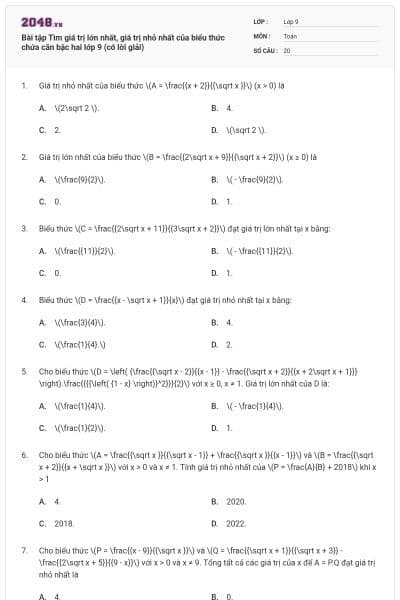
20 câu hỏi
Giá trị nhỏ nhất của biểu thức \(A = \frac{{x + 2}}{{\sqrt x }}\) (x > 0) là
\(2\sqrt 2 \).
4.
2.
\(\sqrt 2 \).
Đáp án đúng là: A
Ta có: \(A = \frac{{x + 2}}{{\sqrt x }} = \sqrt x + \frac{2}{{\sqrt x }}\).
Với x > 0, áp dụng bất đẳng thức Cauchy, ta có:
\(\sqrt x + \frac{2}{{\sqrt x }} \ge 2\sqrt {\sqrt x \frac{2}{{\sqrt x }}} = 2\sqrt 2 \).
Dấu “=” xảy ra khi \(\sqrt x = \frac{2}{{\sqrt x }}\) hay x = 2.
Vậy GTNN của A = \(2\sqrt 2 \) khi x = 2.
Giá trị lớn nhất của biểu thức \(B = \frac{{2\sqrt x + 9}}{{\sqrt x + 2}}\) (x ≥ 0) là
\(\frac{9}{2}\).
\( - \frac{9}{2}\).
0.
1.
Đáp án đúng là: A
Ta có: \(B = \frac{{2\sqrt x + 9}}{{\sqrt x + 2}} = 2 + \frac{5}{{\sqrt x + 2}}\).
Với x ≥ 0, ta có: \(\sqrt x + 2 \ge 2\) suy ra \(\frac{5}{{\sqrt x + 2}} \le \frac{5}{2}\).
Do đó, 2 + \(\frac{5}{{\sqrt x + 2}} \le \frac{5}{2} + 2\) hay B ≤ \(\frac{9}{2}\).
Dấu “=” xảy ra khi x = 0.
Vật GTLN của B = \(\frac{9}{2}\) khi x = 0.
Biểu thức \(C = \frac{{2\sqrt x + 11}}{{3\sqrt x + 2}}\) đạt giá trị lớn nhất tại x bằng:
\(\frac{{11}}{2}\).
\( - \frac{{11}}{2}\).
0.
1.
Đáp án đúng là: C
Điều kiện: x ≥ 0.
Ta có: \(C = \frac{{2\sqrt x + 11}}{{3\sqrt x + 2}} = \frac{{2\left( {\sqrt x + \frac{2}{3}} \right) + \frac{{29}}{3}}}{{3\left( {\sqrt x + \frac{2}{3}} \right)}} = \frac{2}{3} + \frac{{29}}{{3\left( {3\sqrt x + 2} \right)}}\).
Với x ≥ 0, ta có: \(3\sqrt x + 2 \ge 2\) suy ra \(3\left( {3\sqrt x + 2} \right) \ge 6\).
Do đó, \(\frac{{29}}{{3\left( {3\sqrt x + 2} \right)}} \le \frac{{29}}{6}\) .
Suy ra \(\frac{2}{3} + \frac{{29}}{{3\left( {3\sqrt x + 2} \right)}} \le \frac{{11}}{2}\) hay C ≤ \(\frac{{11}}{2}\).
Dấu “=” xảy ra khi x = 0.
Vậy GTLN của C = \(\frac{{11}}{2}\) khi x = 0.
Biểu thức \(D = \frac{{x - \sqrt x + 1}}{x}\) đạt giá trị nhỏ nhất tại x bằng:
\(\frac{3}{4}\).
4.
\(\frac{1}{4}.\)
2.
Đáp án đúng là: A
Điều kiện xác định: x > 0.
Ta có: \(D = \frac{{x - \sqrt x + 1}}{x} = 1 - \frac{1}{{\sqrt x }} + \frac{1}{x} = \frac{3}{4} + \frac{1}{4} - 2.\frac{1}{2}\frac{1}{{\sqrt x }} + \frac{1}{x} = \frac{3}{4} + {\left( {\frac{1}{2} - \frac{1}{{\sqrt x }}} \right)^2}\).
Nhận thấy \({\left( {\frac{1}{2} - \frac{1}{{\sqrt x }}} \right)^2} \ge 0\) nên \(\frac{3}{4} + {\left( {\frac{1}{2} - \frac{1}{{\sqrt x }}} \right)^2} \ge \frac{3}{4}\) hay D \( \ge \frac{3}{4}\).
Dấu “=” xảy ra khi \(\frac{1}{2} - \frac{1}{{\sqrt x }} = 0\) suy ra \(\sqrt x = 2\) khi x = 4.
Vậy GTNN của của D = \(\frac{3}{4}\) khi x = 4.
Cho biểu thức \(D = \left( {\frac{{\sqrt x - 2}}{{x - 1}} - \frac{{\sqrt x + 2}}{{x + 2\sqrt x + 1}}} \right).\frac{{{{\left( {1 - x} \right)}^2}}}{2}\) với x ≥ 0, x ≠ 1. Giá trị lớn nhất của D là:
\(\frac{1}{4}\).
\( - \frac{1}{4}\).
\(\frac{1}{2}\).
1.
Đáp án đúng là: A
Với x ≥ 0, x ≠ 1, ta có:
\(D = \left( {\frac{{\sqrt x - 2}}{{x - 1}} - \frac{{\sqrt x + 2}}{{x + 2\sqrt x + 1}}} \right).\frac{{{{\left( {1 - x} \right)}^2}}}{2}\)
\(D = \left[ {\frac{{\left( {\sqrt x - 2} \right){{\left( {\sqrt x + 1} \right)}^2}}}{{\left( {x - 1} \right){{\left( {\sqrt x + 1} \right)}^2}}} - \frac{{\left( {\sqrt x + 2} \right)\left( {x - 1} \right)}}{{\left( {x - 1} \right){{\left( {\sqrt x + 1} \right)}^2}}}} \right].\frac{{{{\left( {1 - x} \right)}^2}}}{2}\)
\(D = \left[ {\frac{{\left( {\sqrt x - 2} \right){{\left( {\sqrt x + 1} \right)}^2} - \left( {\sqrt x + 2} \right)\left( {x - 1} \right)}}{{\left( {x - 1} \right){{\left( {\sqrt x + 1} \right)}^2}}}} \right].\frac{{{{\left( {1 - x} \right)}^2}}}{2}\)
\(D = \frac{{\left[ {x\sqrt x + 2x + \sqrt x - 2x - 4\sqrt x - 2 - x\sqrt x + \sqrt x - 2x + 2} \right]}}{{{{\left( {\sqrt x + 1} \right)}^2}}}.\frac{{\left( {x - 1} \right)}}{2}\)
\(D = \frac{{\left( { - 2x - 2\sqrt x } \right)}}{{{{\left( {\sqrt x + 1} \right)}^2}}}.\frac{{\left( {x - 1} \right)}}{2} = \frac{{ - 2\sqrt x \left( {\sqrt x + 1} \right)}}{{{{\left( {\sqrt x + 1} \right)}^2}}}.\frac{{\left( {\sqrt x - 1} \right)\left( {\sqrt x + 1} \right)}}{2} = - \sqrt x \left( {\sqrt x - 1} \right)\).
Ta có: \(D = - \sqrt x \left( {\sqrt x - 1} \right) = - x + \sqrt x = - x + 2.\frac{1}{2}\sqrt x - \frac{1}{4} + \frac{1}{4} = - {\left( {\sqrt x - \frac{1}{2}} \right)^2} + \frac{1}{4}\).
Nhận thấy \( - {\left( {\sqrt x - \frac{1}{2}} \right)^2} \le 0\) nên \( - {\left( {\sqrt x - \frac{1}{2}} \right)^2} + \frac{1}{4} \le \frac{1}{4}\).
Dấu “=” xảy ra khi x = \(\frac{1}{4}\).
Vậy GTLN của D = \(\frac{1}{4}\) khi x = \(\frac{1}{4}\).
Cho biểu thức \(A = \frac{{\sqrt x }}{{\sqrt x - 1}} + \frac{{\sqrt x }}{{x - 1}}\) và \(B = \frac{{\sqrt x + 2}}{{x + \sqrt x }}\) với x > 0 và x ≠ 1. Tính giá trị nhỏ nhất của \(P = \frac{A}{B} + 2018\) khi x > 1
4.
2020.
2018.
2022.
Đáp án đúng là: D
Với x > 0 và x ≠ 1, ta có:
\(A = \frac{{\sqrt x }}{{\sqrt x - 1}} + \frac{{\sqrt x }}{{x - 1}} = \frac{{\sqrt x \left( {\sqrt x + 1} \right)}}{{\left( {\sqrt x - 1} \right)\left( {\sqrt x + 1} \right)}} + \frac{{\sqrt x }}{{\left( {\sqrt x - 1} \right)\left( {\sqrt x + 1} \right)}} = \frac{{x + 2\sqrt x }}{{\left( {\sqrt x - 1} \right)\left( {\sqrt x + 1} \right)}}\).
Có: \(P = \frac{A}{B} + 2018\) với x > 1.
\( = \frac{{x + 2\sqrt x }}{{\left( {\sqrt x - 1} \right)\left( {\sqrt x + 1} \right)}}:\frac{{\sqrt x + 2}}{{x + \sqrt x }} + 2018\)
\( = \frac{{\sqrt x \left( {\sqrt x + 2} \right)}}{{\left( {\sqrt x - 1} \right)\left( {\sqrt x + 1} \right)}}.\frac{{\sqrt x \left( {\sqrt x + 1} \right)}}{{\sqrt x + 2}} + 2018\)
\( = \frac{x}{{\sqrt x - 1}} + 2018\)
\( = \frac{{x - 1}}{{\sqrt x - 1}} + \frac{1}{{\sqrt x - 1}} + 2018\)
\( = \sqrt x + 1 + \frac{1}{{\sqrt x - 1}} + 2018\)
\( = \sqrt x - 1 + \frac{1}{{\sqrt x - 1}} + 2020\)
Với x > 1, áp dụng bất đẳng thức Cauchy, ta có:
\(\sqrt x - 1 + \frac{1}{{\sqrt x - 1}} \ge 2\sqrt {\left( {\sqrt x - 1} \right).\frac{1}{{\sqrt x - 1}}} = 2\)
Suy ra \(\sqrt x - 1 + \frac{1}{{\sqrt x - 1}} + 2020 \ge 2022\).
Dấu “=” xảy ra khi \(\sqrt x - 1 = \frac{1}{{\sqrt x - 1}}\) hay x = 4 (do x > 1).
Vậy GTNN của P = 2022 khi x = 4.
Cho biểu thức \(P = \frac{{x - 9}}{{\sqrt x }}\) và \(Q = \frac{{\sqrt x + 1}}{{\sqrt x + 3}} - \frac{{2\sqrt x + 5}}{{9 - x}}\) với x > 0 và x ≠ 9. Tổng tất cả các giá trị của x để A = P.Q đạt giá trị nhỏ nhất là
4.
0.
2.
\(2\sqrt 2 \).
Đáp án đúng là: D
Với x > 0, ta có:
\(Q = \frac{{\sqrt x + 1}}{{\sqrt x + 3}} - \frac{{2\sqrt x + 5}}{{9 - x}}\)
\(Q = \frac{{\left( {\sqrt x + 1} \right)\left( {\sqrt x - 3} \right)}}{{\left( {\sqrt x + 3} \right)\left( {\sqrt x - 3} \right)}} + \frac{{2\sqrt x + 5}}{{\left( {\sqrt x + 3} \right)\left( {\sqrt x - 3} \right)}}\)
\(Q = \frac{{x - 2\sqrt x - 3 + 2\sqrt x + 5}}{{\left( {\sqrt x + 3} \right)\left( {\sqrt x - 3} \right)}} = \frac{{x + 2}}{{\left( {\sqrt x + 3} \right)\left( {\sqrt x - 3} \right)}}\).
Có A = P.Q = \(\frac{{x - 9}}{{\sqrt x }}.\frac{{x + 2}}{{\left( {\sqrt x + 3} \right)\left( {\sqrt x - 3} \right)}} = \frac{{x + 2}}{{\sqrt x }} = \sqrt x + \frac{2}{{\sqrt x }}\)
Với x > 0, áp dụng bất đẳng thức Cauchy, ta có:
\(\sqrt x + \frac{2}{{\sqrt x }} \ge 2\sqrt {\sqrt x .\frac{2}{{\sqrt x }}} = 2\sqrt 2 \).
Dấu “=” xảy ra khi \(\sqrt x = \frac{2}{{\sqrt x }}\) hay x = 2 (thỏa mãn).
Vậy GTNN của A = \(2\sqrt 2 \) khi x = 2.
Cho biểu thức \(A = \frac{{\sqrt x + 5}}{{2\sqrt x - 1}}\) và \(B = \frac{{\sqrt x + 1}}{{\sqrt x - 1}} + \frac{{\sqrt x - 1}}{{\sqrt x + 1}} - \frac{{3\sqrt x + 1}}{{x - 1}}\) với x ≥ 0, x ≠ 1, x ≠ \(\frac{1}{4}\). Giá trị của x để M = A.B đạt giá trị lớn nhất là:
4.
5.
0.
1.
Đáp án đúng là: B
Với x ≥ 0, x ≠ 1, x ≠ \(\frac{1}{4}\), ta có:
\(B = \frac{{\sqrt x + 1}}{{\sqrt x - 1}} + \frac{{\sqrt x - 1}}{{\sqrt x + 1}} - \frac{{3\sqrt x + 1}}{{x - 1}}\)
\(B = \frac{{{{\left( {\sqrt x + 1} \right)}^2}}}{{\left( {\sqrt x - 1} \right)\left( {\sqrt x + 1} \right)}} + \frac{{{{\left( {\sqrt x - 1} \right)}^2}}}{{\left( {\sqrt x - 1} \right)\left( {\sqrt x + 1} \right)}} - \frac{{3\sqrt x + 1}}{{\left( {\sqrt x - 1} \right)\left( {\sqrt x + 1} \right)}}\)
\(B = \frac{{x + 2\sqrt x + 1 + x - 2\sqrt x + 1 - 3\sqrt x - 1}}{{\left( {\sqrt x - 1} \right)\left( {\sqrt x + 1} \right)}}\)
\(B = \frac{{2x - 3\sqrt x + 1}}{{\left( {\sqrt x - 1} \right)\left( {\sqrt x + 1} \right)}} = \frac{{\left( {\sqrt x - 1} \right)\left( {2\sqrt x - 1} \right)}}{{\left( {\sqrt x - 1} \right)\left( {\sqrt x + 1} \right)}} = \frac{{2\sqrt x - 1}}{{\sqrt x + 1}}\).
Ta có: M = A.B = \(\frac{{\sqrt x + 5}}{{2\sqrt x - 1}}.\frac{{2\sqrt x - 1}}{{\sqrt x + 1}} = \frac{{\sqrt x + 5}}{{\sqrt x + 1}}\).
Ta có: \(M = \frac{{\sqrt x + 5}}{{\sqrt x + 1}} = 1 + \frac{4}{{\sqrt x + 3}}\).
Nhận thấy với x ≥ 0 thì \(\sqrt x + 1 \ge 1\) suy ra \(\frac{4}{{\sqrt x + 1}} \le 4\).
Do đó, \(1 + \frac{4}{{\sqrt x + 1}} \le 1 + 4\) hay M ≤ \(5\).
Dấu “=” xảy ra khi x = 0 (thỏa mãn).
Vậy GTLN của M = 5 khi x = 0.
Cho biểu thức \(A = \frac{{\sqrt x - 2}}{{\sqrt x + 3}}\) và \(B = \left( {\frac{{3\sqrt x + 6}}{{x - 4}} + \frac{{\sqrt x }}{{\sqrt x - 2}}} \right):\frac{{x - 9}}{{\sqrt x - 3}}\) với x ≥ 0, x ≠ 4, x ≠ 9. Giá trị lớn nhất của biểu thức M = A.B là:
\(\frac{1}{3}\).
0.
\( - \frac{1}{3}\).
1.
Đáp án đúng là: A
Với x ≥ 0, x ≠ 4, x ≠ 9, ta có:
\(B = \left( {\frac{{3\sqrt x + 6}}{{x - 4}} + \frac{{\sqrt x }}{{\sqrt x - 2}}} \right):\frac{{x - 9}}{{\sqrt x - 3}}\)
\(B = \left[ {\frac{{\left( {3\sqrt x + 6} \right)}}{{\left( {\sqrt x - 2} \right)\left( {\sqrt x + 2} \right)}} + \frac{{\sqrt x \left( {\sqrt x + 2} \right)}}{{\left( {\sqrt x - 2} \right)\left( {\sqrt x + 2} \right)}}} \right].\frac{1}{{\sqrt x + 3}}\)
\(B = \frac{{3\sqrt x + 6 + x + 2\sqrt x }}{{\left( {\sqrt x - 2} \right)\left( {\sqrt x + 2} \right)}}.\frac{1}{{\sqrt x + 3}}\)
\(B = \frac{{x + 5\sqrt x + 6}}{{\left( {\sqrt x - 2} \right)\left( {\sqrt x + 2} \right)}}.\frac{1}{{\sqrt x + 3}}\)
\(B = \frac{{\left( {\sqrt x + 3} \right)\left( {\sqrt x + 2} \right)}}{{\left( {\sqrt x - 2} \right)\left( {\sqrt x + 2} \right)}}.\frac{1}{{\sqrt x + 3}}\)
\(B = \frac{1}{{\sqrt x - 2}}\).
Ta có: M = A.B = \(\frac{{\sqrt x - 2}}{{\sqrt x + 3}}.\frac{1}{{\sqrt x - 2}} = \frac{1}{{\sqrt x + 3}}\).
Vì x ≥ 0 nên \(\sqrt x \ge 0\) suy ra \(\sqrt x + 3 \ge 3\). Do đó \(\frac{1}{{\sqrt x + 3}} \le \frac{1}{3}\).
Dấu “=” xảy ra khi x = 0 (thỏa mãn).
Vậy GTLN của M = \(\frac{1}{3}\) khi x = 0.
Cho hai biểu thức \(P = \frac{{x + 3}}{{\sqrt x - 2}}\) và \(Q = \frac{{\sqrt x - 1}}{{\sqrt x + 2}} - \frac{{5\sqrt x - 2}}{{4 - x}}\) với x > 0 và x ≠ 4. Giá trị của x để biểu thức \(\frac{P}{Q}\) đạt giá trị nhỏ nhất là
\(3\sqrt 2 \).
\(2\sqrt 3 \).
0.
3.
Đáp án đúng là: B
Với x > 0 và x ≠ 4, ta có:
\(Q = \frac{{\sqrt x - 1}}{{\sqrt x + 2}} - \frac{{5\sqrt x - 2}}{{4 - x}}\)
\(Q = \frac{{\left( {\sqrt x - 1} \right)\left( {\sqrt x - 2} \right)}}{{\left( {\sqrt x + 2} \right)\left( {\sqrt x - 2} \right)}} + \frac{{5\sqrt x - 2}}{{\left( {\sqrt x + 2} \right)\left( {\sqrt x - 2} \right)}}\)
\(Q = \frac{{x - 3\sqrt x + 2 + 5\sqrt x - 2}}{{\left( {\sqrt x + 2} \right)\left( {\sqrt x - 2} \right)}}\)
\(Q = \frac{{x + 2\sqrt x }}{{\left( {\sqrt x + 2} \right)\left( {\sqrt x - 2} \right)}} = \frac{{\sqrt x \left( {\sqrt x + 2} \right)}}{{\left( {\sqrt x + 2} \right)\left( {\sqrt x - 2} \right)}} = \frac{{\sqrt x }}{{\sqrt x - 2}}\).
Ta có: \(\frac{P}{Q} = \frac{{x + 3}}{{\sqrt x - 2}}:\frac{{\sqrt x }}{{\sqrt x - 2}} = \frac{{x + 3}}{{\sqrt x - 2}}.\frac{{\sqrt x - 2}}{{\sqrt x }} = \frac{{x + 3}}{{\sqrt x }} = \sqrt x + \frac{3}{{\sqrt x }}\).
Do x > 0 nên áp dụng bất đẳng thức Cauchy, ta có:
\(\sqrt x + \frac{3}{{\sqrt x }} \ge 2\sqrt {\sqrt x \frac{3}{{\sqrt x }}} = 2\sqrt 3 \).
Dấu “=” xảy ra khi \(\sqrt x = \frac{3}{{\sqrt x }}\) suy ra x = 3 (thỏa mãn).
Vậy GTNN của \(\frac{P}{Q}\) bằng \(2\sqrt 3 \) khi x = 3.
Rút gọn được \(P = \frac{{\sqrt x - 1}}{{\sqrt x + 1}}\).
P > 1.
GTNN của P = −1.
Biểu thức P đạt GTNN tại x = 1.
Hướng dẫn giải
Đáp án: a) Đúng. b) Sai. c) Đúng. d) Sai.
a) Đúng.
Với \[{\rm{x}} \ge {\rm{0}}{\rm{, }}\,\,{\rm{x}} \ne {\rm{1}}\], ta có:
\(P = \frac{{\sqrt x }}{{\sqrt x - 1}} + \frac{3}{{\sqrt x + 1}} - \frac{{6\sqrt x - 4}}{{x - 1}}\)
\( = \frac{{\sqrt x \left( {\sqrt x + 1} \right)}}{{\left( {\sqrt x - 1} \right)\left( {\sqrt x + 1} \right)}} + \frac{{3\left( {\sqrt x - 1} \right)}}{{\left( {\sqrt x + 1} \right)\left( {\sqrt x - 1} \right)}} - \frac{{6\sqrt x - 4}}{{\left( {\sqrt x + 1} \right)\left( {\sqrt x - 1} \right)}}\)
\( = \frac{{\sqrt x \left( {\sqrt x + 1} \right) + 3\left( {\sqrt x - 1} \right) - 6\sqrt x + 4}}{{\left( {\sqrt x - 1} \right)\left( {\sqrt x + 1} \right)}}\)
\( = \frac{{x + \sqrt x + 3\sqrt x - 3 - 6\sqrt x + 4}}{{\left( {\sqrt x - 1} \right)\left( {\sqrt x + 1} \right)}}\)
\( = \frac{{x - 2\sqrt x + 1}}{{\left( {\sqrt x - 1} \right)\left( {\sqrt x + 1} \right)}}\)
\( = \frac{{{{\left( {\sqrt x - 1} \right)}^2}}}{{\left( {\sqrt x - 1} \right)\left( {\sqrt x + 1} \right)}}\)
\( = \frac{{\sqrt x - 1}}{{\sqrt x + 1}}\).
Vậy với \[{\rm{x}} \ge {\rm{0}}{\rm{, }}\,\,{\rm{x}} \ne {\rm{1}}\] thì \(P = \frac{{\sqrt x - 1}}{{\sqrt x + 1}}\).
b) Sai.
Với \[{\rm{x}} \ge {\rm{0}}{\rm{, }}\,\,{\rm{x}} \ne {\rm{1}}\], ta có: \(P = \frac{{\sqrt x - 1}}{{\sqrt x + 1}} = \frac{{\sqrt x + 1 - 2}}{{\sqrt x + 1}} = 1 - \frac{2}{{\sqrt x + 1}} < 1\).
Vậy P < 1.
c) Đúng.
Với \[{\rm{x}} \ge {\rm{0}}{\rm{, }}\,\,{\rm{x}} \ne {\rm{1}}\], ta có: \(P = \frac{{\sqrt x - 1}}{{\sqrt x + 1}} \ge \frac{{\sqrt 0 - 1}}{{\sqrt 0 + 1}}\) hay P ≥ −1.
Vậy GTNN của P = −1.
d) Sai.
Biểu thức P đạt GTNN khi \[\sqrt x = 0\] hay x = 0.
Rút gọn được \[P = 1 - \sqrt x \].
Giá trị của P tại x = \(7 - 4\sqrt 3 \) bằng \[\sqrt 3 - 1\].
GTLN của P = 1.
Biểu thức P đạt GTLN khi x = 1.
Hướng dẫn giải
Đáp án: a) Đúng. b) Đúng. c) Đúng. d) Sai.
a) Đúng.
Với x ≥ 0, x ≠ 1, ta có:
\(P = \left( {\frac{{\sqrt x - 2}}{{x - 1}} - \frac{{\sqrt x + 2}}{{x + 2\sqrt x + 1}}} \right).\frac{{{{\left( {1 - x} \right)}^2}}}{2}\)
\( = \left[ {\frac{{\sqrt x - 2}}{{\left( {\sqrt x + 1} \right)\left( {\sqrt x - 1} \right)}} - \frac{{\sqrt x + 2}}{{{{\left( {\sqrt x + 1} \right)}^2}}}} \right].\frac{{{{\left( {1 - x} \right)}^2}}}{2}\)
\[ = \left[ {\frac{{\left( {\sqrt x - 2} \right)\left( {\sqrt x + 1} \right)}}{{{{\left( {\sqrt x + 1} \right)}^2}\left( {\sqrt x - 1} \right)}} - \frac{{\left( {\sqrt x + 2} \right)\left( {\sqrt x - 1} \right)}}{{{{\left( {\sqrt x + 1} \right)}^2}\left( {\sqrt x - 1} \right)}}} \right].\frac{{{{\left( {1 - x} \right)}^2}}}{2}\]
\[ = \left[ {\frac{{\left( {\sqrt x - 2} \right)\left( {\sqrt x + 1} \right) - \left( {\sqrt x + 2} \right)\left( {\sqrt x - 1} \right)}}{{{{\left( {\sqrt x + 1} \right)}^2}\left( {\sqrt x - 1} \right)}}} \right].\frac{{{{\left( {1 - x} \right)}^2}}}{2}\]
\[ = \left[ {\frac{{x - \sqrt x - 2 - x - \sqrt x + 2}}{{{{\left( {\sqrt x + 1} \right)}^2}\left( {\sqrt x - 1} \right)}}} \right].\frac{{{{\left( {1 - x} \right)}^2}}}{2}\]
\[ = \frac{{ - 2\sqrt x }}{{{{\left( {\sqrt x + 1} \right)}^2}\left( {\sqrt x - 1} \right)}}.\frac{{{{\left( {1 - x} \right)}^2}}}{2}\]
\[ = \frac{{1 - x}}{{\sqrt x + 1}}\]
\[ = \frac{{\left( {1 - \sqrt x } \right)\left( {1 + \sqrt x } \right)}}{{\sqrt x + 1}}\]
\[ = 1 - \sqrt x \].
Vậy với x ≥ 0, x ≠ 1 thì \[P = 1 - \sqrt x \].
b) Đúng.
Ta có: \(x = 7 - 4\sqrt 3 = 4 - 2.2\sqrt 3 + 3 = {\left( {2 - \sqrt 3 } \right)^2}\) (thỏa mãn điều kiện).
Thay vào P \[ = 1 - \sqrt x \], ta được: \[P = 1 - \sqrt {{{\left( {2 - \sqrt 3 } \right)}^2}} = 1 - 2 + \sqrt 3 = \sqrt 3 - 1\].
c) Đúng.
Với x ≥ 0, x ≠ 1, ta có: \[\sqrt x \ge 0\] nên \[1 - \sqrt x \le 1\].
Vậy GTLN của P = 1.
d) Sai.
GTLN của P = 1 khi x = 0.
Giá trị của biểu thức A tại x = 4 là −13.
Thu gọn được \[B = \frac{{x + 1}}{{\sqrt x - 3}}\].
Biểu thức \[\frac{A}{B} = \frac{{x + 2\sqrt x + 5}}{{\sqrt x + 1}}\].
Giá trị nhỏ nhất của \[\frac{A}{B}\] bằng 4.
Hướng dẫn giải
Đáp án đúng là: a) Đúng. b) Sai. c) Đúng. d) Đúng.
a) Đúng.
Với x = 4 (thỏa mãn ĐKXĐ), thay vào \(A = \frac{{x + 2\sqrt x + 5}}{{\sqrt x - 3}}\), ta được:
\(A = \frac{{4 + 2\sqrt 4 + 5}}{{\sqrt 4 - 3}} = \frac{{13}}{{ - 1}} = - 13\).
b) Sai.
Với x ≥ 0, x ≠ 4, x ≠ 9, ta có:
\(B = \frac{{2\sqrt x - 9}}{{x - 5\sqrt x + 6}} - \frac{{\sqrt x + 3}}{{\sqrt x - 2}} - \frac{{2\sqrt x + 1}}{{3 - \sqrt x }}\)
\( = \frac{{2\sqrt x - 9}}{{\left( {\sqrt x - 2} \right)\left( {\sqrt x - 3} \right)}} - \frac{{\left( {\sqrt x + 3} \right)\left( {\sqrt x - 3} \right)}}{{\left( {\sqrt x - 2} \right)\left( {\sqrt x - 3} \right)}} + \frac{{\left( {2\sqrt x + 1} \right)\left( {\sqrt x - 2} \right)}}{{\left( {\sqrt x - 2} \right)\left( {\sqrt x - 3} \right)}}\)
\( = \frac{{2\sqrt x - 9 - x + 9 + 2x - 3\sqrt x - 2}}{{\left( {\sqrt x - 2} \right)\left( {\sqrt x - 3} \right)}}\)
\( = \frac{{x - \sqrt x - 2}}{{\left( {\sqrt x - 2} \right)\left( {\sqrt x - 3} \right)}}\)
\( = \frac{{\left( {\sqrt x - 2} \right)\left( {\sqrt x + 1} \right)}}{{\left( {\sqrt x - 2} \right)\left( {\sqrt x - 3} \right)}}\)
\( = \frac{{\sqrt x + 1}}{{\sqrt x - 3}}\).
c) Đúng.
Ta có: \[\frac{A}{B} = \frac{{x + 2\sqrt x + 5}}{{\sqrt x - 3}}:\frac{{\sqrt x + 1}}{{\sqrt x - 3}} = \frac{{x + 2\sqrt x + 5}}{{\sqrt x + 1}}\].
d) Đúng.
Ta có: \[\frac{A}{B} = \frac{{x + 2\sqrt x + 5}}{{\sqrt x + 1}} = \frac{{{{\left( {\sqrt x + 1} \right)}^2} + 4}}{{\sqrt x + 1}} = \left( {\sqrt x + 1} \right) + \frac{4}{{\sqrt x + 1}}\]
Với mọi x ≥ 0, x ≠ 4, x ≠ 9, áp dụng bất đẳng thức Cauchy, ta có:
\[\left( {\sqrt x + 1} \right) + \frac{4}{{\sqrt x + 1}} \ge 2\sqrt {\left( {\sqrt x + 1} \right).\frac{4}{{\sqrt x + 1}}} = 4\].
Vậy giá trị nhỏ nhất của \[\frac{A}{B}\] khi x = 1.
Giá trị của P tại x = 16 là \(\frac{3}{7}.\)
Thu gọn được \(P = \frac{3}{{\sqrt x + 3}}\)
Giá trị lớn nhất của P bằng 1.
Biểu thức P đạt giá trị lớn nhất khi x = 3.
Hướng dẫn giải
Đáp án đúng là: a) Đúng. b) Đúng. c) Đúng. d) Sai.
a) Đúng.
Với x = 16 (thỏa mãn ĐKXĐ), thay vào P ta được:
\(P = \frac{{\sqrt {16} }}{{\sqrt {16} + 3}} + \frac{{2\sqrt {16} }}{{\sqrt {16} - 3}} - \frac{{3.16 + 9}}{{16 - 9}} = \frac{3}{7}\).
b) Đúng.
\( = \frac{{\sqrt x \left( {\sqrt x - 3} \right)}}{{\left( {\sqrt x + 3} \right)\left( {\sqrt x - 3} \right)}} + \frac{{2\sqrt x \left( {\sqrt x + 3} \right)}}{{\left( {\sqrt x - 3} \right)\left( {\sqrt x + 3} \right)}} - \frac{{3x + 9}}{{\left( {\sqrt x - 3} \right)\left( {\sqrt x + 3} \right)}}\)
\( = \frac{{x - 3\sqrt x + 2x + 6\sqrt x - 3x - 9}}{{\left( {\sqrt x + 3} \right)\left( {\sqrt x - 3} \right)}}\)
\( = \frac{{3\sqrt x - 9}}{{\left( {\sqrt x + 3} \right)\left( {\sqrt x - 3} \right)}}\)
\( = \frac{{3\left( {\sqrt x - 3} \right)}}{{\left( {\sqrt x + 3} \right)\left( {\sqrt x - 3} \right)}}\)
\( = \frac{3}{{\sqrt x + 3}}\).
c) Đúng.
Ta có: \(P = \frac{3}{{\sqrt x + 3}}\) với x ≥ 0, x ≠ 9.
Nhận thấy \(\sqrt x + 3 \ge 3\) với mọi x ≥ 0, x ≠ 9
Do đó, \[\frac{3}{{\sqrt x + 3}} \le 1\].
Do đó, giá trị lớn nhất của P = 1.
d) Sai.
Giá trị lớn nhất của P = 1 khi \[\frac{3}{{\sqrt x + 3}} = 1\], suy ra x = 0.
Giá trị của biểu thức B tại x = 9 là \(\frac{1}{8}\).
\(C = \frac{{x + 2}}{{\sqrt x }}\).
\(C < \frac{1}{4}\).
Biểu thức C đạt giá trị nhỏ nhất khi x = 2.
Hướng dẫn giải
Đáp án đúng là: a) Sai. b) Đúng. c) Sai. d) Đúng.
a) Sai.
Thay x = 9 (thỏa mãn ĐKXĐ) vào B, được: \(B = \frac{1}{{\sqrt 9 - 1}} = \frac{1}{{3 - 1}} = \frac{1}{2}.\)
b) Đúng.
Ta có: \(C = \frac{A}{B} = \left( {\frac{{\sqrt x }}{{\sqrt x - 1}} + \frac{2}{{x - \sqrt x }}} \right):\frac{1}{{\sqrt x - 1}}\)
\( = \frac{{x + 2}}{{\left( {\sqrt x - 1} \right)\sqrt x }}.\left( {\sqrt x - 1} \right)\)
\( = \frac{{x + 2}}{{\sqrt x }}\).
c) Sai.
Ta có: \(C = \frac{{x + 2}}{{\sqrt x }} = \sqrt x + \frac{2}{{\sqrt x }} \ge 2\sqrt {\sqrt x .\frac{2}{{\sqrt x }}} = 2\sqrt 2 \).
Do đó, \(C \ge 2\sqrt 2 \).
d) Đúng.
Có \(C \ge 2\sqrt 2 \), dấu “=” xảy ra khi \(\sqrt x = \frac{2}{{\sqrt x }}\) hay x = 2 (thỏa mãn).
Cho biểu thức \(P = \frac{{x - 9}}{{\sqrt x }}\) và \(Q = \frac{{\sqrt x + 1}}{{\sqrt x + 3}} - \frac{{2\sqrt x + 5}}{{9 - x}}\) với x > 0 và x ≠ 9. Biết A = P.Q đạt giá trị nhỏ nhất bằng \(\sqrt a \) (a ∈ ℕ). Hỏi giá trị của a bằng bao nhiêu?
Hướng dẫn giải
Đáp án: 8
Với x > 0, ta có:
\(Q = \frac{{\sqrt x + 1}}{{\sqrt x + 3}} - \frac{{2\sqrt x + 5}}{{9 - x}}\)
\( = \frac{{\left( {\sqrt x + 1} \right)\left( {\sqrt x - 3} \right)}}{{\left( {\sqrt x + 3} \right)\left( {\sqrt x - 3} \right)}} + \frac{{2\sqrt x + 5}}{{\left( {\sqrt x + 3} \right)\left( {\sqrt x - 3} \right)}}\)
\( = \frac{{x - 2\sqrt x - 3 + 2\sqrt x + 5}}{{\left( {\sqrt x + 3} \right)\left( {\sqrt x - 3} \right)}}\)
\( = \frac{{x + 2}}{{\left( {\sqrt x + 3} \right)\left( {\sqrt x - 3} \right)}}\)
Có A = P.Q = \(\frac{{x - 9}}{{\sqrt x }}.\frac{{x + 2}}{{\left( {\sqrt x + 3} \right)\left( {\sqrt x - 3} \right)}} = \frac{{x + 2}}{{\sqrt x }} = \sqrt x + \frac{2}{{\sqrt x }}\)
Với x > 0, áp dụng bất đẳng thức Cauchy, ta có:
\(\sqrt x + \frac{2}{{\sqrt x }} \ge 2\sqrt {\sqrt x .\frac{2}{{\sqrt x }}} = 2\sqrt 2 \).
Dấu “=” xảy ra khi \(\sqrt x = \frac{2}{{\sqrt x }}\) hay x = 2 (thỏa mãn).
Vậy GTNN của A = \(2\sqrt 2 = \sqrt 8 \) khi x = 2.
Cho biểu thức \(A = \frac{{\sqrt x + 5}}{{2\sqrt x - 1}}\) và \(B = \frac{{\sqrt x + 1}}{{\sqrt x - 1}} + \frac{{\sqrt x - 1}}{{\sqrt x + 1}} - \frac{{3\sqrt x + 1}}{{x - 1}}\) với x ≥ 0, x ≠ 1, x ≠ \(\frac{1}{4}\). Giá trị của x bằng bao nhiêu để M = A.B đạt giá trị lớn nhất?
Hướng dẫn giải
Đáp án: 0
Với x ≥ 0, x ≠ 1, x ≠ \(\frac{1}{4}\), ta có:
\(B = \frac{{\sqrt x + 1}}{{\sqrt x - 1}} + \frac{{\sqrt x - 1}}{{\sqrt x + 1}} - \frac{{3\sqrt x + 1}}{{x - 1}}\)
\( = \frac{{{{\left( {\sqrt x + 1} \right)}^2}}}{{\left( {\sqrt x - 1} \right)\left( {\sqrt x + 1} \right)}} + \frac{{{{\left( {\sqrt x - 1} \right)}^2}}}{{\left( {\sqrt x - 1} \right)\left( {\sqrt x + 1} \right)}} - \frac{{3\sqrt x + 1}}{{\left( {\sqrt x - 1} \right)\left( {\sqrt x + 1} \right)}}\)
\( = \frac{{x + 2\sqrt x + 1 + x - 2\sqrt x + 1 - 3\sqrt x - 1}}{{\left( {\sqrt x - 1} \right)\left( {\sqrt x + 1} \right)}}\)
\( = \frac{{2x - 3\sqrt x + 1}}{{\left( {\sqrt x - 1} \right)\left( {\sqrt x + 1} \right)}} = \frac{{\left( {\sqrt x - 1} \right)\left( {2\sqrt x - 1} \right)}}{{\left( {\sqrt x - 1} \right)\left( {\sqrt x + 1} \right)}} = \frac{{2\sqrt x - 1}}{{\sqrt x + 1}}\).
Ta có: M = A.B = \(\frac{{\sqrt x + 5}}{{2\sqrt x - 1}}.\frac{{2\sqrt x - 1}}{{\sqrt x + 1}} = \frac{{\sqrt x + 5}}{{\sqrt x + 1}}\).
Ta có: \(M = \frac{{\sqrt x + 5}}{{\sqrt x + 1}} = 1 + \frac{4}{{\sqrt x + 3}}\).
Nhận thấy với x ≥ 0 thì \(\sqrt x + 1 \ge 1\) suy ra \(\frac{4}{{\sqrt x + 1}} \le 4\).
Do đó, \(1 + \frac{4}{{\sqrt x + 1}} \le 1 + 4\) hay M ≤ \(5\).
Dấu “=” xảy ra khi x = 0 (thỏa mãn).
Vậy GTLN của M = 5 khi x = 0.
Cho biểu thức A = \(\left( {\frac{1}{{\sqrt x }} + \frac{{\sqrt x }}{{\sqrt x + 1}}} \right):\frac{{\sqrt x }}{{x + \sqrt x }}\) với x > 0. Tính giá trị nhỏ nhất của A.
Hướng dẫn giải
Đáp án: 3
Với x > 0, ta có:
\(A = \left( {\frac{1}{{\sqrt x }} + \frac{{\sqrt x }}{{\sqrt x + 1}}} \right):\frac{{\sqrt x }}{{x + \sqrt x }}\)
\( = \left[ {\frac{{\sqrt x + 1}}{{\sqrt x \left( {\sqrt x + 1} \right)}} + \frac{{\sqrt x .\sqrt x }}{{\sqrt x \left( {\sqrt x + 1} \right)}}} \right]:\frac{{\sqrt x }}{{x + \sqrt x }}\)
\( = \frac{{\sqrt x + 1 + x}}{{\sqrt x \left( {\sqrt x + 1} \right)}}.\frac{{\sqrt x \left( {\sqrt x + 1} \right)}}{{\sqrt x }}\) \[\]
\( = \frac{{\sqrt x + 1 + x}}{{\sqrt x }}\).
Với x > 0, \(P = \frac{{\sqrt x + 1 + x}}{{\sqrt x }} = \frac{{\sqrt x }}{{\sqrt x }} + \frac{1}{{\sqrt x }} + \frac{x}{{\sqrt x }} = 1 + \frac{1}{{\sqrt x }} + \sqrt x \)
Vì x > 0, áp đụng BĐT Cauchy, ta có:
\(\frac{1}{{\sqrt x }} + \sqrt x \ge 2\sqrt {\frac{1}{{\sqrt x }}.\sqrt x } \) hay \(1 + \frac{1}{{\sqrt x }} + \sqrt x \ge 1 + 2\) hay A ≥ 3.
Vậy GTNN của A = 3 khi \(\frac{1}{{\sqrt x }} = \sqrt x \) hay x = 1.
Cho biểu thức \(A = \frac{{\sqrt x + 1}}{{\sqrt x - 1}} + \frac{{\sqrt x - 1}}{{\sqrt x + 1}} - \frac{{3\sqrt x + 1}}{{x - 1}}\) với x ≥ 0; x ≠ 1. Hỏi giá trị nhỏ nhất của biểu thức A bằng bao nhiêu?
Hướng dẫn giải
Đáp án: −1
Với x ≥ 0; x ≠ 1, ta có:
\(A = \frac{{\sqrt x + 1}}{{\sqrt x - 1}} + \frac{{\sqrt x - 1}}{{\sqrt x + 1}} - \frac{{3\sqrt x + 1}}{{x - 1}}\)
\( = \frac{{\left( {\sqrt x + 1} \right)\left( {\sqrt x + 1} \right)}}{{\left( {\sqrt x - 1} \right)\left( {\sqrt x + 1} \right)}} + \frac{{\left( {\sqrt x - 1} \right)\left( {\sqrt x - 1} \right)}}{{\left( {\sqrt x - 1} \right)\left( {\sqrt x + 1} \right)}} - \frac{{3\sqrt x + 1}}{{\left( {\sqrt x - 1} \right)\left( {\sqrt x + 1} \right)}}\)
\( = \frac{{{{\left( {\sqrt x + 1} \right)}^2} + {{\left( {\sqrt x - 1} \right)}^2} - 3\sqrt x - 1}}{{\left( {\sqrt x - 1} \right)\left( {\sqrt x + 1} \right)}}\)
\( = \frac{{x + 2\sqrt x + 1 + x - 2\sqrt x + 1 - 3\sqrt x - 1}}{{\left( {\sqrt x - 1} \right)\left( {\sqrt x + 1} \right)}}\)
\( = \frac{{2x - 3\sqrt x + 1}}{{\left( {\sqrt x - 1} \right)\left( {\sqrt x + 1} \right)}}\)
\( = \frac{{\left( {\sqrt x - 1} \right)\left( {2\sqrt x - 1} \right)}}{{\left( {\sqrt x - 1} \right)\left( {\sqrt x + 1} \right)}} = \frac{{2\sqrt x - 1}}{{\sqrt x + 1}}\)
Ta có: \(A = \frac{{2\sqrt x - 1}}{{\sqrt x + 1}} = \frac{{2\left( {\sqrt x + 1} \right) - 3}}{{\sqrt x + 1}} = 2 - \frac{3}{{\sqrt x + 1}}\)
Vì \(\sqrt x + 1 \ge 1\) với mọi x ≥ 0; x ≠ 1.
Do đó, \(\frac{3}{{\sqrt x + 1}} \le 3\) suy ra \( - \frac{3}{{\sqrt x + 1}} \ge - 3\).
Từ đó, \(A \ge - 1\).
Vậy giá trị nhỏ nhất của A = −1 khi x = 0.
Cho \(A = \left( {\sqrt x - \frac{{x + 2}}{{\sqrt x + 1}}} \right):\left( {\frac{{\sqrt x }}{{\sqrt x + 1}} - \frac{{\sqrt x - 4}}{{1 - x}}} \right)\) với x ≥ 0; x ≠ 1; x ≠ 4. Tính giá trị nhỏ nhất của biểu thức A.
Hướng dẫn giải
Đáp án: −0,5
Với x ≥ 0; x ≠ 1; x ≠ 4, ta có:
\(A = \left( {\sqrt x - \frac{{x + 2}}{{\sqrt x + 1}}} \right):\left( {\frac{{\sqrt x }}{{\sqrt x + 1}} - \frac{{\sqrt x - 4}}{{1 - x}}} \right)\)
\( = \frac{{x + \sqrt x - x - 2}}{{\sqrt x + 1}}:\frac{{\sqrt x \left( {\sqrt x - 1} \right) + \sqrt x - 4}}{{\left( {\sqrt x + 1} \right)\left( {\sqrt x - 1} \right)}}\)
\( = \frac{{\sqrt x - 2}}{{\sqrt x + 1}}:\frac{{x - \sqrt x + \sqrt x - 4}}{{\left( {\sqrt x + 1} \right)\left( {\sqrt x - 1} \right)}}\)
\( = \frac{{\sqrt x - 2}}{{\sqrt x + 1}}.\frac{{\left( {\sqrt x + 1} \right)\left( {\sqrt x - 1} \right)}}{{\left( {\sqrt x + 2} \right)\left( {\sqrt x - 2} \right)}}\)
\( = \frac{{\sqrt x - 1}}{{\sqrt x + 2}}\).
Ta có: \(A = \frac{{\sqrt x - 1}}{{\sqrt x + 2}} = 1 - \frac{3}{{\sqrt x + 2}}\).
Nhận thấy \(\sqrt x + 2 \ge 2\) với mọi x ≥ 0; x ≠ 1; x ≠ 4.
Do đó, \(\frac{3}{{\sqrt x + 2}} \le \frac{3}{2}\), suy ra \( - \frac{3}{{\sqrt x + 2}} \ge - \frac{3}{2}\)
Từ đó, \(1 - \frac{3}{{\sqrt x + 2}} \ge - \frac{1}{2}\) hay A ≥ \( - \frac{1}{2}\).
Vậy giá trị nhỏ nhất của A = \( - \frac{1}{2}\) khi x = 0.