300+ câu trắc nghiệm Tiếng Anh Logistics có đáp án - Phần 9

25 câu hỏi
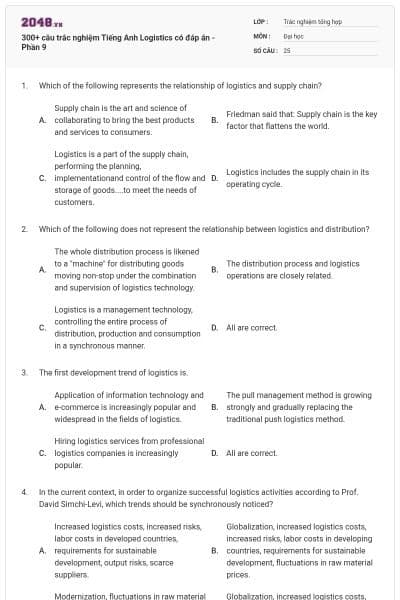
Which of the following represents the relationship of logistics and supply chain?
Supply chain is the art and science of collaborating to bring the best products and services to consumers.
Friedman said that: Supply chain is the key factor that flattens the world.
Logistics is a part of the supply chain, performing the planning, implementationand control of the flow and storage of goods....to meet the needs of customers.
Logistics includes the supply chain in its operating cycle.
Which of the following does not represent the relationship between logistics and distribution?
The whole distribution process is likened to a "machine" for distributing goods moving non-stop under the combination and supervision of logistics technology.
The distribution process and logistics operations are closely related.
Logistics is a management technology, controlling the entire process of distribution, production and consumption in a synchronous manner.
All are correct.
The first development trend of logistics is.
Application of information technology and e-commerce is increasingly popular and widespread in the fields of logistics.
The pull management method is growing strongly and gradually replacing the traditional push logistics method.
Hiring logistics services from professional logistics companies is increasingly popular.
All are correct.
In the current context, in order to organize successful logistics activities according to Prof. David Simchi-Levi, which trends should be synchronously noticed?
Increased logistics costs, increased risks, labor costs in developed countries, requirements for sustainable development, output risks, scarce suppliers.
Globalization, increased logistics costs, increased risks, labor costs in developing countries, requirements for sustainable development, fluctuations in raw material prices.
Modernization, fluctuations in raw material prices, increased logistics costs, increased risks, labor costs in developing countries, requirements for sustainable development.
Globalization, increased logistics costs, increased risks, labor costs in developed countries, requirements for sustainable development, fluctuations in raw material prices.
What is Lean?
Logistics solutions.
Logistics tools.
Sharp tools for building logistics solutions.
Can be applied in many fields: production, service provision, healthcare...
At what level does Lean develop?
2.
3.
4.
All wrong.
The levels of Lean include:
Lean manufacturing, Lean thinking.
Lean manufacturing, Lean consuming, lean thinking.
Lean manufacturing, Lean enterprise, lean thinking.
All are correct.
What kind of loss and waste disrupt production and supply processes?
Waste due to inventory
Waste due to repair and rejection of damaged products
Wasting due to waiting
Waste due to shipping
Which of the following is not a goal of Lean manufacturing?
Increase labor productivity
Increase business performance
Timely application of solutions
Minimize inventory at all stages: raw materials, semi-finished products, finishedproducts
What are the names of the 5 steps in the 5s system?
Series-seiton-seiso-seiketsu-shitsuke
Seiri-seiton-seiso-seiketsu-shitsuke
Series-seiton-shitsuke-seiso-seiketsu
All wrong
What is Shitsuke?
Availability: Apply routine work on a continuous basis, by specifying procedures for performing screening, sorting, and cleaning tasks
Care: Maintain the results obtained from the 3 steps above and continuously develop the 3s: screening, arranging, and cleaning at all times, everywhere
Organize: arrange the essentials in an easy-to-access order
Sort: Sort out what is necessary and what is not necessary for the job
Which of the following is not a principle of Lean manufacturing?
Standardize the process
Production of "Pull"
Creative School when investing capital
Perception of waste
Logistics has developed up to now through several stages:
2
3
4
5
What stage is the world logistics currently in?
Stage 1 – Distribution
Stage 2 - Logistics system
Stage 3 - Supply Chain Management (SCM)
Stage 4 - Advanced SCM
What stage is the logistics system?
Stage 1
Stage 2
Stage 3
Stage 4
Logistics services relating to transportation do not include any of the following:
Maritime transport services
Inland waterway transport service
Pipeline transportation service
General transportation services
Which of the following is true for supply chain management?
The physical material moves in the direction of the end of chain
Flow of cash backwards through the chain
Exchange of information moves in both the direction
All of the above
The sequence of a typical manufacturing supply chain is:
Storage – supplier – manufacturing – storage – distributor – retailor – customer
Supplier – storage – manufacturing – storage – distributor – retailor – customer
Supplier – storage – manufacturing – distributor – storage – retailor – customer
Supplier – storage – manufacturing – storage – retailor – distributor – customer
The purpose of supply chain management is:
Provide customer satisfaction
Improve quality of product
Increase production
Integrating supply and demand management
Logistics is the part of a supply chain involved with the forward and reverse flow of:
Goods
Services
Cash
All of the above
Due to small change in customer demand, inventory oscillations become progressively larger looking through the supply chain. This is known as:
Bullwhip effect
Netchain analytics
Reverse logistics
Reverse supply chain
Reverse logistics is required because:
Goods are defective
Goods are unsold
The customer simply changes their minds
All of the above
3-PL stands for:
Three point logistics
Third party logistics
Three points location
None of the above
If customer perceive that price of product is greater than the value it provides to customer then the customer:
Would get free products
Would get discount
Would buy product
Would not buy product
If the company provides products or services less than its cost then the company will:
Get more loss
Get more profits
Get more discounts
Both A and B