1300+ câu trắc nghiệm Từ vựng học có đáp án - Phần 45

25 câu hỏi
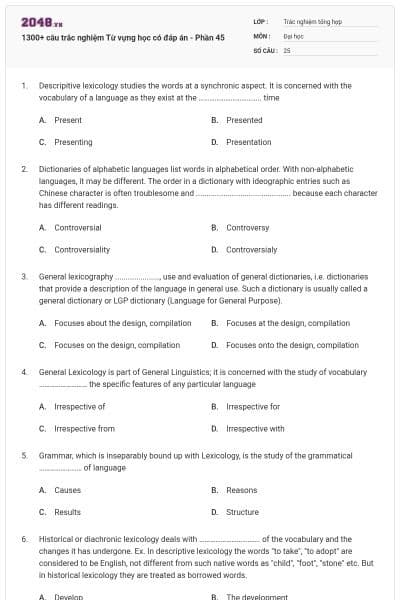
Descripitive lexicology studies the words at a synchronic aspect. It is concerned with the vocabulary of a language as they exist at the …………………………….. time
Present
Presented
Presenting
Presentation
Dictionaries of alphabetic languages list words in alphabetical order. With non-alphabetic languages, it may be different. The order in a dictionary with ideographic entries such as Chinese character is often troublesome and ............................................. because each character has different readings.
Controversial
Controversy
Controversiality
Controversialy
General lexicography ....................., use and evaluation of general dictionaries, i.e. dictionaries that provide a description of the language in general use. Such a dictionary is usually called a general dictionary or LGP dictionary (Language for General Purpose).
Focuses about the design, compilation
Focuses at the design, compilation
Focuses on the design, compilation
Focuses onto the design, compilation
General Lexicology is part of General Linguistics; it is concerned with the study of vocabulary ……………………… the specific features of any particular language
Irrespective of
Irrespective for
Irrespective from
Irrespective with
Grammar, which is inseparably bound up with Lexicology, is the study of the grammatical …………………… of language
Causes
Reasons
Results
Structure
Historical or diachronic lexicology deals with ……………………………. of the vocabulary and the changes it has undergone. Ex. In descriptive lexicology the words "to take", "to adopt" are considered to be English, not different from such native words as "child", "foot", "stone" etc. But in historical lexicology they are treated as borrowed words.
Develop
The development
Developing
The developed
If we realize that suffixes render the most general semantic component of the word's lexical meaning...................................................................................., the reason why suffixes are as a rule semantically fused with the stem stands explained
By mark the general class of phenomena to which the referent of the word belongs
By marked the general class of phenomena to which the referent of the word belongs
By marking the general class of phenomena to which the referent of the word belongs
By marker the general class of phenomena to which the referent of the word belongs
In an encyclopaedia the entry "influenza" discloses the causes, symptoms, characteristics and varieties of this disease, various treatments of and remedies for it, ways of infection, etc. Though, ....................................., it is with linguistic dictionaries that lexicology is closely connected and in our further consideration
Strict speak
Strictly speak
Strictly speaking
Strict speaking
It may be easily .............................................that the lexical meaning of the word "boy" and the lexical meaning of the root-morpheme "boy" in such words as "boyhood", "boyish" and others are very much the same
Observe
Observing
Observed
Observation
It will at once be noticed that the root in English is very often homonymous with the word. This fact is of fundamental importance as .................................................................................... arising from its general grammatical system on the one hand, and from its phonemic system on the other
It is one of the most specification features of the English language
It is one of the most specific features of the English language
It is one of the most specifiable features of the English language
It is one of the most specified features of the English language
Lexicography, the science of dictionary-compiling, is closely connected with lexicology, both dealing with the same problems — the form, meaning, usage and origin of vocabulary units — and making ...................... of each other’s achievements.
Use
Useless
Useful
Usefulness
Lexicology also ……………………….. all kinds of semantic relations (synonyms, antonyms etc) and semantic grouping (semantic fields)
Deal
Does
Studies
Learns
Lexicology is .................................................... derivational affixes, the other group being the domain of grammarians. The derivational affixes in fact, as well as the whole problem of word-formation, form a boundary area between lexicology and grammar and are therefore studied in both
Primarily concerned by
Primarily concerned of
Primarily concerned with
Primarily concerned to
Lexicology is a branch of linguistics which studies the …………………………… of a language
Grammar
Parts of speech
Vocabulary
Semantics
Lexicology is a branch of linguistics, the …………………… of language.
Calculation
Technology
Research
Science
Many English words consist of a single root-morpheme, so when we say that most morphemes possess ................................................... we imply mainly the root-morphemes in such words
Lexical meaning
Lexical meaningful
Lexical meanness
Lexical means
Metaphor: a figure of speech based on similarity (hidden comparison between the object/notion ............................................. denoted by the word and the object/notion in question). Metaphor gives freshness and vivacity to speech.
Generalized
General
Generally
Generalizing
Motivation denotes the relationship between ...................................................... and structural pattern of the word on the one hand, and its meaning on the other. Motivation can be of three types: morphological, phonetical and semantic.
The phonemic or morphemic composition
The phoneme or morphemic composition
The phonetic or morphemic composition
The phonemic or morpheme composition
Phraseological fusions are word-groups with a completely changed meaning but, in contrast to the unities, they are demotivated, that is, their meaning cannot be ........................................ the meanings of the constituent parts; the metaphor, on which the shift of meaning was based, has lost its clarity and is obscure.
Deduced away
Deduced by
Deduced from
Deduced with
Phraseological unities are word-groups with a completely changed meaning, that is, the meaning of the unit does not correspond to the meanings of its constituent parts. They are ...................................... or, putting it another way, the meaning of the whole unit can be deduced from the meanings of the constituent parts.
Motivated units
Motivating units
Motivative units
Motivation units
Phraseology is the study of set expressions called phraseological units. These "set expressions" are ..........................................................idiomatic and reproduced in speech as ready-made units.
Completely or partial
Complete or partially
Completeness or partially
Completely or partially
Rhyme-motivated compounds are usually composed of two elements. The major motivating factor is the rhyme, e.g. flower-power; or brain-drain. Formation of .................... ..................compounds is a very productive process excessively used in advertising or journalese style and, consequently in everyday speech.
Rhyme-motivate
Rhyme-motivation
Rhyme-motivating
Rhyme-motivated
Roots are main morphemic vehicles of a given idea in a given language at a given stage of its development. A root may be also regarded as the ultimate constituent element which remains ......................................... all functional and derivational affixes and does not admit any further analysis.
After the move of
After the removal of
After the removing of
After the removal for
Some English words can change their word class ........................................................ their form. Thus, they can function as nouns (e.g. a mother) or as verbs (to mother somebody) without any affixes or inflections. Such change of a word class without any derivative means is called conversion.
Without any change their form.
Without being changed their form.
Without changing their form.
Without being changing their form.
The .................................. .................go, goes, went, going, gone possess different grammatical meanings of tense, person, number, but in each form they have one and the same semantic component denoting 'the process of movement'.
Word-formating
Word-forms
Word-formations
Word-formings