1300+ câu trắc nghiệm Từ vựng học có đáp án - Phần 44

25 câu hỏi
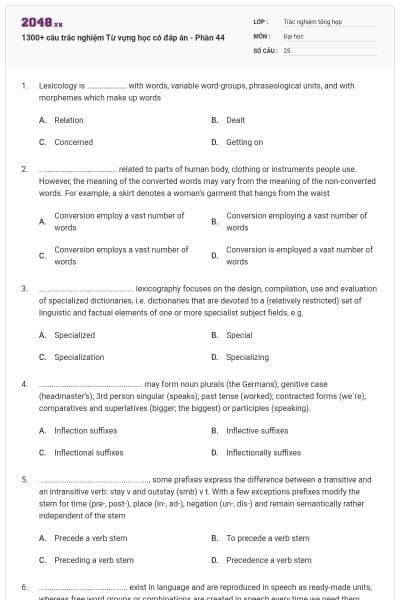
Lexicology is …………………. with words, variable word-groups, phraseological units, and with morphemes which make up words
Relation
Dealt
Concerned
Getting on
..................................... related to parts of human body, clothing or instruments people use. However, the meaning of the converted words may vary from the meaning of the non-converted words. For example, a skirt denotes a woman’s garment that hangs from the waist
Conversion employ a vast number of words
Conversion employing a vast number of words
Conversion employs a vast number of words
Conversion is employed a vast number of words
............................................. lexicography focuses on the design, compilation, use and evaluation of specialized dictionaries, i.e. dictionaries that are devoted to a (relatively restricted) set of linguistic and factual elements of one or more specialist subject fields, e.g.
Specialized
Special
Specialization
Specializing
................................................. may form noun plurals (the Germans); genitive case (headmaster’s); 3rd person singular (speaks); past tense (worked); contracted forms (we´re); comparatives and superlatives (bigger; the biggest) or participles (speaking).
Inflection suffixes
Inflective suffixes
Inflectional suffixes
Inflectionally suffixes
...................................................., some prefixes express the difference between a transitive and an intransitive verb: stay v and outstay (smb) v t. With a few exceptions prefixes modify the stem for time (pre-, post-), place (in-, ad-), negation (un-, dis-) and remain semantically rather independent of the stem
Precede a verb stem
To precede a verb stem
Preceding a verb stem
Precedence a verb stem
.......................................... exist in language and are reproduced in speech as ready-made units, whereas free word groups or combinations are created in speech every time we need them.
Set expressions
Set terms
Set sayings
Set phrases
................................ distinguishes between the three closely connected components with meaning, that is 1) the sound-form of the linguistic sign, 2) the concept underlying this sound form and 3) the referent, i.e. the part or aspect of reality to which the linguistic sign refers
Referential Approach
Referent Approach
Referred Approach
Referring Approach
A compound is a unit of vocabulary which ........................................ more than one lexical stem. The resulting compound functions as a single item with specific meaning and grammar
Consists by
Consists in
Consists with
Consists of
A form is said to be free if it may stand alone without changing its meaning; if not, it is a bound form, so called because ..............................
It is always bound by something else.
It is always bound for something else.
It is always bound with something else.
It is always bound to something else.
A metaphor is a figure of speech that refers to something as being the same as another thing for rhetorical effect. It may provide ................................... hidden similarities between two ideas. Where a simile compares two items, a metaphor directly equates them, and does not use "like" or "as" as does a simile.
Clarity or identification
Clarifying or identify
Clarity or identify
Clarity or identifying
A morpheme is also an association of a given meaning with.................. But unlike a word it is not autonomous. Morphemes occur in speech only as constituent parts of words, not independently, although a word may consist of a single morpheme
A given sound pattern
A giving sound pattern
A given sound track
A given sound model
A prefix is a derivational morpheme standing before the root and ............................................., cf. to hearten – to dishearten. It is only with verbs and statives that a prefix may serve to distinguish one part of speech from another, like in earth n–unearth v, sleep n – asleep
Modification meaning
Modificative meaning
Modifying meaning
Modifier meaning
A specific group of rhyme-motivated compounds are ablaut motivated compounds. Ablaut is a term defining .............................. of two elements, e.g. zigzag; or tick-tock. Ablaut-motivated compounds are used to imitate child-like speech or to stress interjections
Vowel change or alternation
Vowel changing or alternation
Vowel changed or alternation
Vowel change or alternating
A suffix is a .......................... following the stem and forming a new derivative in a different part of speech or a different word class, cf. –en, –y, –less in hearten, hearty, heartless
Derivation morpheme
Derivative morpheme
Derivational morpheme
Derived morpheme
A word is a minimum free form. A morpheme is said to be either bound or free. This statement should be taken with caution. It means that ..................................................................................... forming words without adding other morphemes: that is, they are homonymous to free forms
Some morphemes are capable about
Some morphemes are capable for
Some morphemes are capable for
Some morphemes are capable of
According to the role they play in constructing words, morphemes are subdivided into roots and affixes. .................................................................................................................... into prefixes, suffixes and infixes
The last are further subdivided, according to their position
The later are further subdivided, according to their position
The latter are further subdivided, according to their position
The latest are further subdivided, according to their position
All major works on semantic theory have so far been based on referential concepts of meaning. The best known referential model of meaning is .................................
The first-called "basic triangle"
The then-called "basic triangle"
The so-called "basic triangle"
The too-called "basic triangle"
An English word does not necessarily contain formatives indicating to what part of speech it belongs. This holds true ...............................................................i.e. nouns, verbs, adjectives. Not all roots are free forms, but productive roots, i.e. roots capable of producing new words, usually are
Even with respect about inflexible parts of speech,
Even with respect of inflexible parts of speech,
Even with respect for inflexible parts of speech,
Even with respect to inflexible parts of speech,
An infix is .....................................................placed with in the word, like –n– in stand. The type is not productive
A affix
An affix
An affixation
An affixational
Antonyms are words of the same part of speech, but opposite in meaning. Many words, especially those denoting concrete objects (chair, tree, tiger) have no antonyms. Usually adjectives denoting qualities, verbs ............................. actions or state and abstract nouns have antonyms
Denoting
Denotative
Denotational
Denotation
Blending is also a new, trendy and ................................................which “blends”, i.e. joins fragments of two or more words to create a new form. The meaning is being retained. Enough of the lexeme is usually retained so that the elements are recognisable.
Eye-catched process
Eye-catch process
Eye-caught process
Eye-catching process
Clipping is .....................................in English language which “economises” words. Clipping “clips”, i.e. shortens lexemes whilst preserves the original meaning. Basically, any part of the word may be clipped:
A related new trend
A relatively new trend
A relation new trend
A relative new trend
Clippings, blendings and acronyms are subclasses of so called “portmanteau words” ..................... fragments of two or more words
Which consist of
Which consist on
Which consist in
Which consist with
Criteria of synonymity is interchangeability. .......................... that neither the traditional definition of synonyms nor the new version provide for any objective criterion of similarity of meaning.
It should be pointed about
It should be pointed at
It should be pointed with
It should be pointed out
Derivational suffixes ................... of the original word: they may change the word class, specify the word or generalise it. Most scholars recognise suffixes forming nouns, verbs, adjectives and adverbs
Effection modify the meaning
Effectiveness modify the meaning
Effectively modify the meaning
Effective modify the meaning