20+ câu trắc nghiệm Thiết kế hệ thống số dùng HDL có đáp án

21 câu hỏi
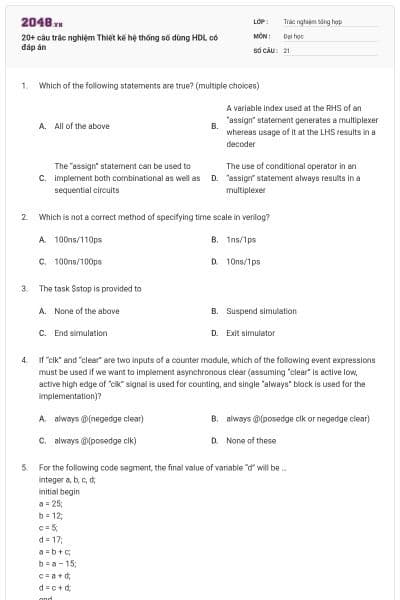
Which of the following statements are true? (multiple choices)
All of the above
A variable index used at the RHS of an “assign” statement generates a multiplexer whereas usage of it at the LHS results in a decoder
The “assign” statement can be used to implement both combinational as well as sequential circuits
The use of conditional operator in an “assign” statement always results in a multiplexer
Which is not a correct method of specifying time scale in verilog?
100ns/110ps
1ns/1ps
100ns/100ps
10ns/1ps
The task $stop is provided to
None of the above
Suspend simulation
End simulation
Exit simulator
If “clk” and “clear” are two inputs of a counter module, which of the following event expressions must be used if we want to implement asynchronous clear (assuming “clear” is active low, active high edge of “clk” signal is used for counting, and single “always” block is used for the implementation)?
always @(negedge clear)
always @(posedge clk or negedge clear)
always @(posedge clk)
None of these
For the following code segment, the final value of variable “d” will be …
integer a, b, c, d;
initial begin
a = 25;
b = 12;
c = 5;
d = 17;
a = b + c;
b = a – 15;
c = a + d;
d = c + d;
end
58
51
40
53
Which of the following is true for the following module?
module mydesign (a,b);
input [1:0] b;
output reg a;
always @(b)
begin
if (b==2'b00) a = 1'b0;
else if (b==2'b11) a = 1'b0;
else a = 1'b1;
end
end module
A latch will be generated for the output "a"
The synthesis tool will give an error
A combinational circuit implementing an AND function will be generated
A combinational circuit implementing a XOR function will be generated
Which of the following statements is/are true? (multiple choices)
The “assign” statement implements continuous assignment between the expression specified on the right-hand side and a “net” type variable specified on the left-hand side
The “assign” statement implements continuous assignment between the expression specified on the right-hand side and a “reg” type variable specified on the left-hand side
None of these
The “assign” statement can be used to model a latch, which is a sequential circuit
If A = 4b011 and B = 4b0011, then the result of A ** B will be
9
Invalid expression
6
27
The following code segment generates a periodic clock signal “clk” with time period:
initial clk = 1’b1;
always #10 clk = ~clk;
None of these
10
20
30
What does the following code segment indicate?
initial clk = 1’b0;
always #5 clk = ~clk;
Raising edges of the clock will appear at times 5, 15, 25, 35, …
Raising edges of the clock will appear at times 5, 10, 15, 20, …
None of the above
Raising edges of the clock will appear at times 10, 20, 30, 40, …
Which of the following is true for the module given below?
module mydesign (a,b,c);
input c;
output reg a, b;
always @(c)
begin
if (c == 1’b0)
begin
b <= ~a;
a <= ~(c | b);
end
else if (c == 1’b1)
a <= ~(b ^ c);
end
endmodule
(multiple choices)
The synthesis tool will give an error
A pure combinational circuit using NOT, NOR, and XNOR logic gates will be implemented
A latch with enable signal c will be generated for the output
A 2-to-1 multiplexer will be generated
Which of the following is true about the following code segment?
integer x, y;
initial
begin
x = 15;
y = 10;
end
initial
repeat (x) $display (“x=%d”, x);
initial
while (y < 12)
begin
y = y + 1;
x = x - 1;
end
It cannot be determined exactly how many times the value of ‘x’ will be printed
The simulation will print the current value of ‘x’ 15-times
The simulation will print the current value of ‘x’ 13-times
The simulation will always display 15 as the value of ‘x’
Consider the following Verilog module.
module guess (data, cond, result);
input [7:0] data;
input [1:0] cond;
output reg result;
always @(data)
begin
if (cond == 2’b00)
result = |data;
else
result = ~^data;
end
endmodule
Which of the following are true when the module is synthesized? (multiple choices)
The synthesize system will generate a wire for result
A combinational circuit will be generated
None of the above
A sequential circuit with a storage element for result will be generated
What will the following code segment generate on synthesis, assuming that the four variables data0, data1, data2 and data3 map into four latches/flip-flops?
always @(posedge clock)
begin
data3 = din;
data2 = data3;
data1 = data2;
data0 = data1;
end
None of these
A 4-bit parallel-in parallel-out register
A 4-bit shift register
Four D flip-flops all fed with the data “din”
What will the following code segment generate on synthesis, assuming that the four variables data0, data1, data2 and data3 map into four latches/flip-flops?
always @(posedge clock)
begin
data3 = din;
data2 = data3;
data1 = data2;
data0 = data1;
end
If A = 4b001x and B = 4b1011, then result of A + B will be
110x
1100
xxxx
None of the above
What will the following code segment do?
always @(posedge clock)
begin
y = x;
z = y;
x = z;
end
All the variables will get the value previously stored in “z”
Shift the values stored in the three variables
All the variables will get the value previously stored in “y”
All the variables will get the value previously stored in “x”
What does the construct “#5” indicate in simulation?
It specifies that the unit of delay is 5 nanoseconds
It pauses execution of the statements that follow after time 5
It schedules the execution of the next statement at time 5
It specifies a delay of 5 time units before executing the next statement
Which of the following is true for the “repeat” loop?
None of these
It can be used to iterate a block indefinitely
It can be used to repeat execution of the block exactly two times
It can be used to iterate a block until a specified condition is true
For the following Verilog code segment:
wire [7:0] A;
wire B;
assign B = ~|A;
If the value of A is 8’b00111001, what will be the value of {A[5:3], 3{B}}?
6’b111000
6’b011000
None of the above
6’b111111
If A, B, C and D are reg, reg, integer and wire variables respectively, each of size [7:0], which of the following is/are allowed inside a procedural block? (Multiple choice)
D = C + 1;
B[3:0] = D[4:1] + 1;
D = A + B;
C = A + D;
Consider the following Verilog code segment:
wire [5:0] A, B;
wire C;
assign C=^A;
If the values of A and B are 5’b10011 and 5’b01110 respectively, what will be the value of {A[3:1], 2{C}, B[2:0]}?
00100110
00111110
01111110
None of these