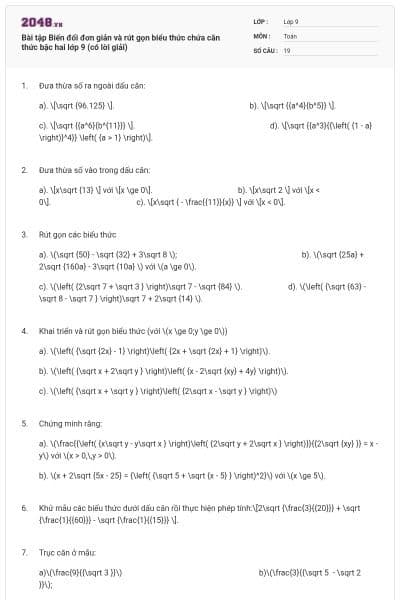
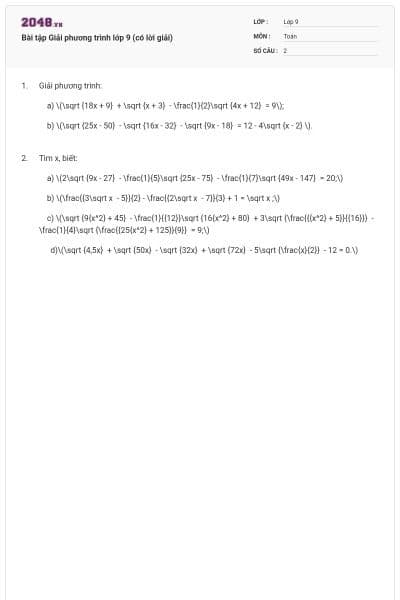
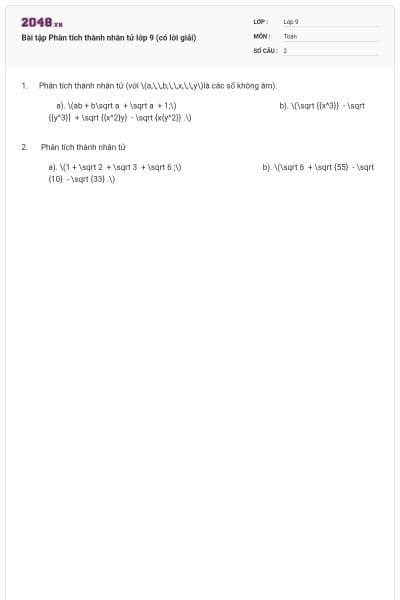
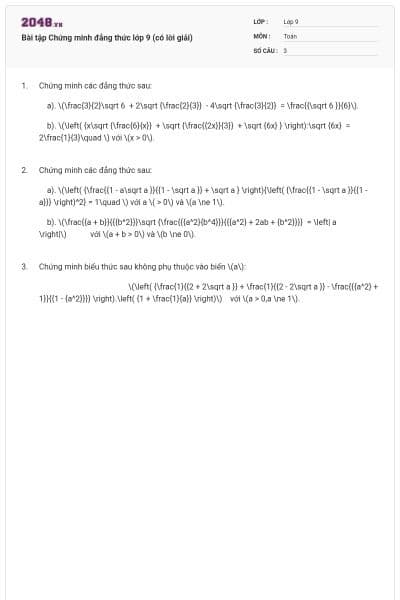
12 bài tập Tìm giá trị x để biểu thức đạt giá trị là số nguyên có lời giải
12 câu hỏi
Cho biểu thức \(A = \frac{{\sqrt x }}{{x - 2\sqrt x }} + \frac{3}{{\sqrt x }}\) và \(B = \frac{2}{{\sqrt x - 2}}\) với x > 0, x ≠ 4 và
x ≠ \(\frac{9}{4}\). Tính giá trị nguyên của x để P = \(\frac{B}{A}\) nhận giá trị nguyên.
Hướng dẫn giải
Với x > 0, x ≠ 4, x ≠ \(\frac{9}{4}\), ta có:
\(A = \frac{{\sqrt x }}{{x - 2\sqrt x }} + \frac{3}{{\sqrt x }} = \frac{{\sqrt x }}{{\left( {\sqrt x - 2} \right)\sqrt x }} + \frac{{3\left( {\sqrt x - 2} \right)}}{{\sqrt x \left( {\sqrt x - 2} \right)}} = \frac{{4\sqrt x - 6}}{{\sqrt x \left( {\sqrt x - 2} \right)}}\).
Có P = \(\frac{B}{A}\) = \(\frac{2}{{\sqrt x - 2}}:\frac{{4\sqrt x - 6}}{{\sqrt x \left( {\sqrt x - 2} \right)}} = \frac{2}{{\sqrt x - 2}}.\frac{{\sqrt x \left( {\sqrt x - 2} \right)}}{{4\sqrt x - 6}} = \frac{{\sqrt x }}{{2\sqrt x - 3}}\).
Ta có: \(P = \frac{{\sqrt x }}{{2\sqrt x - 3}} = \frac{1}{{2 - \frac{3}{{\sqrt x }}}}\) (vì x > 0 nên \(\sqrt x > 0\)).
P nhận giá trị nguyên khi và chỉ khi \(\frac{1}{{2 - \frac{3}{{\sqrt x }}}}\) nguyên
hay \(2 - \frac{3}{{\sqrt x }}\) ∈ Ư(1) = {1; −1}.
Khi đó P = 1 hoặc P = −1.
Với P = 1 hay \(2 - \frac{3}{{\sqrt x }}\) = 1 khi \(\sqrt x \) = 3 suy ra x = 9 (thỏa mãn).
Với P = −1 hay \(2 - \frac{3}{{\sqrt x }} = - 1\) khi \(\sqrt x = 1\) suy ra x = 1 (thỏa mãn).
Vậy x ∈ {1; 9} thì P nhận giá trị nguyên.
Cho biểu thức \(A = \frac{{x - 7}}{{\sqrt x }}\) và \(B = \frac{1}{{\sqrt x + 2}} + \frac{{\sqrt x }}{{2 - \sqrt x }} + \frac{{2x - \sqrt x + 2}}{{x - 4}}\)
với x > 0, x ≠ 4. Tìm tất cả các giá trị nguyên của x để biểu thức P = A.B nhận giá trị nguyên.
Hướng dẫn giải
Với x > 0, x ≠ 4, ta có:
\(B = \frac{1}{{\sqrt x + 2}} + \frac{{\sqrt x }}{{2 - \sqrt x }} + \frac{{2x - \sqrt x + 2}}{{x - 4}}\)
\(B = \frac{{\sqrt x - 2}}{{\left( {\sqrt x + 2} \right)\left( {\sqrt x - 2} \right)}} - \frac{{\sqrt x \left( {\sqrt x + 2} \right)}}{{\left( {\sqrt x + 2} \right)\left( {\sqrt x - 2} \right)}} + \frac{{2x - \sqrt x + 2}}{{\left( {\sqrt x + 2} \right)\left( {\sqrt x - 2} \right)}}\)
\(B = \frac{{\sqrt x - 2 - x - 2\sqrt x + 2x - \sqrt x + 2}}{{\left( {\sqrt x + 2} \right)\left( {\sqrt x - 2} \right)}}\)
\(B = \frac{{x - 2\sqrt x }}{{\left( {\sqrt x + 2} \right)\left( {\sqrt x - 2} \right)}} = \frac{{\sqrt x \left( {\sqrt x - 2} \right)}}{{\left( {\sqrt x + 2} \right)\left( {\sqrt x - 2} \right)}} = \frac{{\sqrt x }}{{\sqrt x + 2}}\).
Vậy B = \(\frac{{\sqrt x }}{{\sqrt x + 2}}\) với x > 0, x ≠ 4.
Ta có: P = A.B = \(\frac{{x - 7}}{{\sqrt x }}.\frac{{\sqrt x }}{{\sqrt x + 2}} = \frac{{x - 7}}{{\sqrt x + 2}}\).
Xét P = 0 khi \(\frac{{x - 7}}{{\sqrt x + 2}} = 0\) suy ra x – 7 = 0 (thỏa mãn điều kiện).
Xét P ≠ 0.
TH1: x ∈ ℤ; x ≠ 7; \(\sqrt x \) là số vô tỉ thì P ∉ ℤ (loại).
TH2: x ∈ ℤ; \(\sqrt x \)∈ ℤ.
Ta có: \(P = \frac{{x - 4 - 3}}{{\sqrt x + 2}} = \frac{{x - 4}}{{\sqrt x + 2}} - \frac{3}{{\sqrt x + 2}} = \sqrt x - 2 - \frac{3}{{\sqrt x + 2}}\).
Để P ∈ ℤ thì \(\sqrt x - 2 - \frac{3}{{\sqrt x + 2}}\) ∈ ℤ suy ra \(\frac{3}{{\sqrt x + 2}}\) ∈ ℤ.
Do đó, \(\left( {\sqrt x + 2} \right) \in \)Ư(3).
Mà Ư(3) = {1; 3; −1; −3}.
Do \(\sqrt x + 2\) ≥ 2 nên \(\sqrt x + 2\) = 3 suy ra \(\sqrt x = 1\) suy ra x = 1 (thỏa mãn).
Vậy x ∈ {1; 7} thì P có giá trị nguyên.
Cho biểu thức \(A = \frac{{3\sqrt x - 21}}{{x - 9}} + \frac{2}{{\sqrt x - 3}}\) với x ≥ 0; x ≠ 9. Tìm tất cả các số nguyên x để A có giá trị là số nguyên.
Hướng dẫn giải
Với x ≥ 0; x ≠ 9, ta có:
\(A = \frac{{3\sqrt x - 21}}{{x - 9}} + \frac{2}{{\sqrt x - 3}}\)
\(A = \frac{{3\sqrt x - 21}}{{\left( {\sqrt x - 3} \right)\left( {\sqrt x + 3} \right)}} + \frac{{2\left( {\sqrt x + 3} \right)}}{{\left( {\sqrt x - 3} \right)\left( {\sqrt x + 3} \right)}}\)
\(A = \frac{{3\sqrt x - 21 + 2\sqrt x + 6}}{{\left( {\sqrt x - 3} \right)\left( {\sqrt x + 3} \right)}}\)
\(A = \frac{{5\sqrt x - 15}}{{\left( {\sqrt x - 3} \right)\left( {\sqrt x + 3} \right)}} = \frac{{5\left( {\sqrt x - 3} \right)}}{{\left( {\sqrt x - 3} \right)\left( {\sqrt x + 3} \right)}} = \frac{5}{{\sqrt x + 3}}\).
Để A nhận giá trị nguyên thì \(\frac{5}{{\sqrt x + 3}}\) nguyên.
Suy ra \(\sqrt x + 3\) là Ư(5).
Mà Ư(5) = {1; 5; −1; −5}.
Nhận thấy \(\sqrt x + 3\) ≥ 3 với vọi x ≥ 0; x ≠ 9.
Do đó, \(\sqrt x + 3\) = 5, suy ra \(\sqrt x \) = 2 do đó, x = 4 (thỏa mãn).
Vậy x = 4 thì A nhận giá trị nguyên.
Cho biểu thức \(M = \frac{{2\sqrt x - 9}}{{x - 5\sqrt x + 6}} - \frac{{\sqrt x + 3}}{{\sqrt x - 2}} - \frac{{2\sqrt x + 1}}{{3 - \sqrt x }}\) với x ≥ 0; x ≠ 4;
x ≠ 9.
a) Rút gọn A.
b) Tìm x nguyên để A có giá trị nguyên.
Hướng dẫn giải
a) Với x ≥ 0; x ≠ 4; x ≠ 9, ta có:
\(M = \frac{{2\sqrt x - 9}}{{x - 5\sqrt x + 6}} - \frac{{\sqrt x + 3}}{{\sqrt x - 2}} - \frac{{2\sqrt x + 1}}{{3 - \sqrt x }}\)
\(M = \frac{{2\sqrt x - 9}}{{\left( {\sqrt x - 2} \right)\left( {\sqrt x - 3} \right)}} - \frac{{\left( {\sqrt x + 3} \right)\left( {\sqrt x - 3} \right)}}{{\left( {\sqrt x - 2} \right)\left( {\sqrt x - 3} \right)}} + \frac{{\left( {2\sqrt x + 1} \right)\left( {\sqrt x - 2} \right)}}{{\left( {\sqrt x - 2} \right)\left( {\sqrt x - 3} \right)}}\)
\(M = \frac{{2\sqrt x - 9}}{{\left( {\sqrt x - 2} \right)\left( {\sqrt x - 3} \right)}} - \frac{{x - 9}}{{\left( {\sqrt x - 2} \right)\left( {\sqrt x - 3} \right)}} + \frac{{2x - 3\sqrt x - 2}}{{\left( {\sqrt x - 2} \right)\left( {\sqrt x - 3} \right)}}\)
\(M = \frac{{2\sqrt x - 9 - x + 9 + 2x - 3\sqrt x - 2}}{{\left( {\sqrt x - 2} \right)\left( {\sqrt x - 3} \right)}}\)
\(M = \frac{{x - \sqrt x - 2}}{{\left( {\sqrt x - 2} \right)\left( {\sqrt x - 3} \right)}}\)
\(M = \frac{{\left( {\sqrt x - 2} \right)\left( {\sqrt x + 1} \right)}}{{\left( {\sqrt x - 2} \right)\left( {\sqrt x - 3} \right)}} = \frac{{\sqrt x + 1}}{{\sqrt x - 3}}\).
Với x ≥ 0; x ≠ 4; x ≠ 9, M = \(\frac{{\sqrt x + 1}}{{\sqrt x - 3}} = 1 + \frac{4}{{\sqrt x - 3}}\).
Để M nguyên thì \(\frac{4}{{\sqrt x - 3}}\) nguyên hay \(\sqrt x - 3\) là Ư(4).
Mà Ư(4) = {1; 4; −1; −4; 2; −2}.
• Với \(\sqrt x - 3\) = 1 suy ra x = 16 (thỏa mãn).
• Với \(\sqrt x - 3\) = −1 suy ra x = 4 (loại).
• Với \(\sqrt x - 3\) = 2 suy ra x = 25 (thỏa mãn).
• Với \(\sqrt x - 3\) = −2 suy ra x = 1 (thỏa mãn).
• Với \(\sqrt x - 3\) = 4 suy ra x = 49 (thỏa mãn).
• Với \(\sqrt x - 3\) = −4 suy ra \(\sqrt x \) = −1 (loại).
Vậy để A nhận giá trị nguyên thì x ∈ {1; 25; 16; 49}.
Cho biểu thức \(A = \frac{{\sqrt x + 15}}{{x - 9}} - \frac{x}{{x - 3\sqrt x }} + \frac{{2\sqrt x + 5}}{{\sqrt x + 3}}\) với x > 0, x ≠ 9. Chứng minh rằng không tồn tại giá trị của x để A nhận giá trị là số nguyên.
Hướng dẫn giải
Với x > 0, x ≠ 9, ta có:
\(A = \frac{{\sqrt x + 15}}{{x - 9}} - \frac{x}{{x - 3\sqrt x }} + \frac{{2\sqrt x + 5}}{{\sqrt x + 3}}\)
\(A = \frac{{\left( {\sqrt x + 15} \right)\sqrt x }}{{\sqrt x \left( {\sqrt x + 3} \right)\left( {\sqrt x - 3} \right)}} - \frac{{x\left( {\sqrt x + 3} \right)}}{{\sqrt x \left( {\sqrt x - 3} \right)\left( {\sqrt x + 3} \right)}} + \frac{{\left( {2\sqrt x + 5} \right)\sqrt x \left( {\sqrt x - 3} \right)}}{{\sqrt x \left( {\sqrt x - 3} \right)\left( {\sqrt x + 3} \right)}}\)
\(A = \frac{{x + 15\sqrt x - x\sqrt x - 3x + 2x\sqrt x + 5x - 6x - 15\sqrt x }}{{\sqrt x \left( {\sqrt x + 3} \right)\left( {\sqrt x - 3} \right)}}\)
\(A = \frac{{x\sqrt x - 3x}}{{\sqrt x \left( {\sqrt x - 3} \right)\left( {\sqrt x + 3} \right)}} = \frac{{x\left( {\sqrt x - 3} \right)}}{{\sqrt x \left( {\sqrt x - 3} \right)\left( {\sqrt x + 3} \right)}} = \frac{{\sqrt x }}{{\sqrt x + 3}}\).
Với x > 0, x ≠ 9 có \(A = \frac{{\sqrt x }}{{\sqrt x + 3}}\) > 0.
Lại có: A = \(1 - \frac{3}{{\sqrt {x + 3} }} < 1\).
Do đó 0 < A < 1.
Vậy không tồn tại giá trị của x để A nhận giá trị là số nguyên.
>>
Cho biểu thức \(A = \frac{{9 - 3\sqrt x }}{{x - 4}}\) và \(B = \frac{{\sqrt x }}{{\sqrt x + 1}} + \frac{{1 - \sqrt x }}{{\sqrt x - 2}} - \frac{{\sqrt x + 4}}{{x - \sqrt x - 2}}\)
với x ≥ 0 và x ≠ 4.
a) Rút gọn biểu thức B.
b) Tìm x ∈ ℝ để biểu thức P = A : B nhận giá trị là một số nguyên âm.
Hướng dẫn giải
a) Với x ≥ 0 và x ≠ 4, ta có:
\(B = \frac{{\sqrt x }}{{\sqrt x + 1}} + \frac{{1 - \sqrt x }}{{\sqrt x - 2}} - \frac{{\sqrt x + 4}}{{x - \sqrt x - 2}}\)
\(B = \frac{{\sqrt x \left( {\sqrt x - 2} \right)}}{{\left( {\sqrt x + 1} \right)\left( {\sqrt x - 2} \right)}} + \frac{{\left( {\sqrt x + 1} \right)\left( {1 - \sqrt x } \right)}}{{\left( {\sqrt x + 1} \right)\left( {\sqrt x - 2} \right)}} - \frac{{\sqrt x + 4}}{{\left( {\sqrt x + 1} \right)\left( {\sqrt x - 2} \right)}}\)
\(B = \frac{{x - 2\sqrt x + 1 - x - \sqrt x - 4}}{{\left( {\sqrt x + 1} \right)\left( {\sqrt x - 2} \right)}}\)
\(B = \frac{{ - 3\sqrt x - 3}}{{\left( {\sqrt x + 1} \right)\left( {\sqrt x - 2} \right)}} = \frac{{ - 3\left( {\sqrt x + 1} \right)}}{{\left( {\sqrt x + 1} \right)\left( {\sqrt x - 2} \right)}} = \frac{{ - 3}}{{\sqrt x - 2}}\).
Ta có: P = A : B = \(\frac{{9 - 3\sqrt x }}{{x - 4}}:\frac{{\left( { - 3} \right)}}{{\sqrt x - 2}} = \frac{{3\left( {3 - \sqrt x } \right)}}{{\left( {\sqrt x - 2} \right)\left( {\sqrt x + 2} \right)}}.\frac{{\sqrt x - 2}}{{\left( { - 3} \right)}} = \frac{{\sqrt x - 3}}{{\sqrt x + 2}}\).
Có \(P = \frac{{\sqrt x - 3}}{{\sqrt x + 2}} = 1 - \frac{5}{{\sqrt x + 2}}\).
Do x ≥ 0 suy ra 0 < \(\frac{5}{{\sqrt x + 2}}\) ≤ \(\frac{5}{2}\).
Đêt P nguyên thì \(\frac{5}{{\sqrt x + 2}}\) nhận giá trị nguyên.
Do đó P = 1 hoặc P = 2.
Với P = 1 thì \(\frac{5}{{\sqrt x + 2}} = 1\) hay \(\sqrt x + 2\) = 5 suy ra x = 9 .
Với P = 2 thì \(\frac{5}{{\sqrt x + 2}} = 2\) hay \(\sqrt x + 2 = \frac{5}{2}\) suy ra x = \(\frac{1}{4}\).
Thử lại:
Khi x = 9 thì P = 0 (loại).
Khi x = \(\frac{1}{4}\) thì P = −1 (thỏa mãn).
Vậy x = \(\frac{1}{4}\).
>
Cho biểu thức \(A = \frac{{x - 3}}{{\sqrt x + 1}}\) và \(B = \frac{{x - \sqrt x - 7}}{{x + \sqrt x - 6}} + \frac{{\sqrt x + 2}}{{\sqrt x + 3}} + \frac{{\sqrt x - 3}}{{2 - \sqrt x }}\)
với x ≥ 0; x ≠ 4.
a) Rút gọn B.
b) Tìm giá trị nguyên của x để M = A.B nhận giá trị nguyên.
Hướng dẫn giải
a) Với x ≥ 0; x ≠ 4, ta có:
\(B = \frac{{x - \sqrt x - 7}}{{x + \sqrt x - 6}} + \frac{{\sqrt x + 2}}{{\sqrt x + 3}} + \frac{{\sqrt x - 3}}{{2 - \sqrt x }}\)
\(B = \frac{{x - \sqrt x - 7}}{{\left( {\sqrt x - 2} \right)\left( {\sqrt x + 3} \right)}} + \frac{{\left( {\sqrt x + 2} \right)\left( {\sqrt x - 2} \right)}}{{\left( {\sqrt x - 2} \right)\left( {\sqrt x + 3} \right)}} - \frac{{\left( {\sqrt x - 3} \right)\left( {\sqrt x + 3} \right)}}{{\left( {\sqrt x - 2} \right)\left( {\sqrt x + 3} \right)}}\)
\(B = \frac{{x - \sqrt x - 7 + x - 4 - x + 9}}{{\left( {\sqrt x - 2} \right)\left( {\sqrt x + 3} \right)}}\)
\(B = \frac{{x - \sqrt x - 2}}{{\left( {\sqrt x - 2} \right)\left( {\sqrt x + 3} \right)}} = \frac{{\left( {\sqrt x - 2} \right)\left( {\sqrt x + 1} \right)}}{{\left( {\sqrt x - 2} \right)\left( {\sqrt x + 3} \right)}} = \frac{{\sqrt x + 1}}{{\sqrt x + 3}}\).
b) Với x ≥ 0; x ≠ 4, ta có:
M = A.B = \(\frac{{x - 3}}{{\sqrt x + 1}}\). \(\frac{{\sqrt x + 1}}{{\sqrt x + 3}} = \frac{{x - 3}}{{\sqrt x + 3}}\).
Hay \(M = \frac{{x - 3}}{{\sqrt x + 3}} = \frac{{x - 9 + 6}}{{\sqrt x + 3}} = \frac{{\left( {\sqrt x + 3} \right)\left( {\sqrt x - 3} \right) + 6}}{{\sqrt x + 3}} = \sqrt x - 3 + \frac{6}{{\sqrt x + 3}}\).
Xét x = 3 thì M = 0 (thỏa mãn). Vậy x = 3 thỏa mãn.
Xét x ≠ 3, x ∈ ℤ nhưng \(\sqrt x \notin \mathbb{Z}\). Do đó M \( \notin \mathbb{Z}\).
Xét x ∈ ℤ, \(\sqrt x \in \mathbb{Z}\) suy ra M ∈ ℤ:
Suy ra \(\frac{6}{{\sqrt x + 3}}\) là số nguyên hay \(\sqrt x + 3\) là Ư(6).
Mà Ư(6) = {1; 2; 3; 6; −1; −2; −3; −6}.
Nhận thấy \(\sqrt x + 3 \ge 3\) với mọi x ≥ 0; x ≠ 4.
Suy ra \(\sqrt x + 3 = 3\) hoặc \(\sqrt x + 3 = 6\).
Do đó, x = 0 (thỏa mãn) hoặc x = 9 (thỏa mãn).
Vậy x ∈ {0; 3; 9} thì M nhận giá trị nguyên.
Cho biểu thức \(A = \frac{{15\sqrt x - 19}}{{x + 2\sqrt x - 3}} - \frac{{3\sqrt x - 2}}{{1 - \sqrt x }} - \frac{{2\sqrt x + 3}}{{\sqrt x + 3}}\) với x ≥ 0; x ≠ 1.
a) Rút gọn A.
b) Tìm x nguyên để A có giá trị nguyên.
Hướng dẫn giải
a) Với x ≥ 0; x ≠ 1, ta có:
\(A = \frac{{15\sqrt x - 19}}{{x + 2\sqrt x - 3}} - \frac{{3\sqrt x - 2}}{{1 - \sqrt x }} - \frac{{2\sqrt x + 3}}{{\sqrt x + 3}}\)
\(A = \frac{{15\sqrt x - 19}}{{\left( {\sqrt x + 3} \right)\left( {\sqrt x - 1} \right)}} + \frac{{\left( {3\sqrt x - 2} \right)\left( {\sqrt x + 3} \right)}}{{\left( {\sqrt x + 3} \right)\left( {\sqrt x - 1} \right)}} - \frac{{\left( {2\sqrt x + 3} \right)\left( {\sqrt x - 1} \right)}}{{\left( {\sqrt x + 3} \right)\left( {\sqrt x - 1} \right)}}\)
\(A = \frac{{15\sqrt x - 19 + 3x + 7\sqrt x - 6 - 2x - \sqrt x + 3}}{{\left( {\sqrt x + 3} \right)\left( {\sqrt x - 1} \right)}}\)
\(A = \frac{{x + 21\sqrt x - 22}}{{\left( {\sqrt x + 3} \right)\left( {\sqrt x - 1} \right)}} = \frac{{\left( {\sqrt x - 1} \right)\left( {\sqrt x + 22} \right)}}{{\left( {\sqrt x + 3} \right)\left( {\sqrt x - 1} \right)}} = \frac{{\sqrt x + 22}}{{\sqrt x + 3}}\).
b) Ta có: \(A = \frac{{\sqrt x + 22}}{{\sqrt x + 3}} = 1 + \frac{{19}}{{\sqrt x + 3}}\) với x ≥ 0; x ≠ 1.
Để A nhận giá trị nguyên thì \(\frac{{19}}{{\sqrt x + 3}}\) nguyên.
Suy ra \(\sqrt x + 3\) là Ư(19).
Mà Ư(19) = {1; 19; −1; −19}.
Nhận thấy \(\sqrt x + 3 \ge 3\) với x ≥ 0; x ≠ 1.
Suy ra \(\sqrt x + 3\) = 19 hay x = 256 (thỏa mãn).
Vậy x = 256 thì A nhận giá trị nguyên.
Cho hai biểu thức \(A = \frac{{\sqrt x + 1}}{{\sqrt x + 2}}\) và \(B = \frac{{\sqrt x - 11}}{{x - \sqrt x - 2}} - \frac{{\sqrt x }}{{\sqrt x + 1}} + \frac{{2\sqrt x - 1}}{{\sqrt x - 2}}\) với x ≥ 0; x ≠ 4. Tìm x nguyên để A.B có giá trị nguyên.
Hướng dẫn giải
Với x ≥ 0; x ≠ 4, ta có:
\(B = \frac{{\sqrt x - 11}}{{x - \sqrt x - 2}} - \frac{{\sqrt x }}{{\sqrt x + 1}} + \frac{{2\sqrt x - 1}}{{\sqrt x - 2}}\)
\(B = \frac{{\sqrt x - 11}}{{\left( {\sqrt x - 2} \right)\left( {\sqrt x + 1} \right)}} - \frac{{\sqrt x \left( {\sqrt x - 2} \right)}}{{\left( {\sqrt x - 2} \right)\left( {\sqrt x + 1} \right)}} + \frac{{\left( {2\sqrt x - 1} \right)\left( {\sqrt x + 1} \right)}}{{\left( {\sqrt x - 2} \right)\left( {\sqrt x + 1} \right)}}\)
\(B = \frac{{\sqrt x - 11 - x + 2\sqrt x + 2x + \sqrt x - 1}}{{\left( {\sqrt x - 2} \right)\left( {\sqrt x + 1} \right)}}\)
\(B = \frac{{x + 4\sqrt x - 12}}{{\left( {\sqrt x - 2} \right)\left( {\sqrt x + 1} \right)}} = \frac{{\left( {\sqrt x - 2} \right)\left( {\sqrt x + 6} \right)}}{{\left( {\sqrt x - 2} \right)\left( {\sqrt x + 1} \right)}} = \frac{{\sqrt x + 6}}{{\sqrt x + 1}}\).
Ta có: P = A.B = \(\frac{{\sqrt x + 1}}{{\sqrt x + 2}}.\frac{{\sqrt x + 6}}{{\sqrt x + 1}} = \frac{{\sqrt x + 6}}{{\sqrt x + 2}} = 1 + \frac{4}{{\sqrt x + 2}}\).
Để P nhận giá trị nguyên thì \(\frac{4}{{\sqrt x + 2}}\) nguyên.
Suy ra \(\sqrt x + 2\) là ước của 4.
Nhận thấy \(\sqrt x + 2 \ge 2\) với x ≥ 0; x ≠ 4 nên \(\sqrt x + 2\) = 2 hoặc \(\sqrt x + 2\) = 4.
Suy ra x = 0 (thỏa mãn) hoặc x = 4 (loại).
Vậy x = 0 thì P = A.B nhận giá trị nguyên.
Cho các biểu thức \(A = \frac{{\sqrt x + 5}}{{\sqrt x - 3}}\) và \(B = \frac{4}{{\sqrt x + 3}} + \frac{{2x - \sqrt x - 13}}{{x - 9}} - \frac{{\sqrt x }}{{\sqrt x - 3}}\) với x ≥ 0; x ≠ 9. Tính giá trị của x nguyên nhỏ nhất để P = \(\frac{B}{A}\) có giá trị nguyên.
Hướng dẫn giải
Với x ≥ 0; x ≠ 9, ta có:
\(B = \frac{4}{{\sqrt x + 3}} + \frac{{2x - \sqrt x - 13}}{{x - 9}} - \frac{{\sqrt x }}{{\sqrt x - 3}}\)
\(B = \frac{{4\left( {\sqrt x - 3} \right)}}{{\left( {\sqrt x + 3} \right)\left( {\sqrt x - 3} \right)}} + \frac{{2x - \sqrt x - 13}}{{\left( {\sqrt x + 3} \right)\left( {\sqrt x - 3} \right)}} - \frac{{\sqrt x \left( {\sqrt x + 3} \right)}}{{\left( {\sqrt x + 3} \right)\left( {\sqrt x - 3} \right)}}\)
\(B = \frac{{4\sqrt x - 12 + 2x - \sqrt x - 13 - x - 3\sqrt x }}{{\left( {\sqrt x + 3} \right)\left( {\sqrt x - 3} \right)}}\)
\(B = \frac{{x - 25}}{{\left( {\sqrt x + 3} \right)\left( {\sqrt x - 3} \right)}} = \frac{{\left( {\sqrt x + 5} \right)\left( {\sqrt x - 5} \right)}}{{\left( {\sqrt x + 3} \right)\left( {\sqrt x - 3} \right)}}\).
Ta có: P = \(\frac{B}{A}\) = \(\frac{{\left( {\sqrt x + 5} \right)\left( {\sqrt x - 5} \right)}}{{\left( {\sqrt x + 3} \right)\left( {\sqrt x - 3} \right)}}\): \(\frac{{\sqrt x + 5}}{{\sqrt x - 3}}\)
= \(\frac{{\left( {\sqrt x + 5} \right)\left( {\sqrt x - 5} \right)}}{{\left( {\sqrt x + 3} \right)\left( {\sqrt x - 3} \right)}}\). \(\frac{{\sqrt x - 3}}{{\sqrt x + 5}} = \frac{{\sqrt x - 5}}{{\sqrt x + 3}}\).
Ta có: P = \(\frac{{\sqrt x - 5}}{{\sqrt x + 3}} = 1 - \frac{8}{{\sqrt x + 3}}\).
Để P đạt giá trị nguyên thì \(\frac{8}{{\sqrt x + 3}}\) nhận giá trị nguyên.
Suy ra \(\sqrt x + 3\) là Ư(8).
Nhận thấy \(\sqrt x + 3 \ge 3\)với x ≥ 0; x ≠ 9.
Do đó, \(\sqrt x + 3 \in {\rm{\{ }}4;8\} \)
Với \(\sqrt x + 3\) = 4 thì x = 1 (thỏa mãn).
Với \(\sqrt x + 3\) = 8 thì x = 25 (thỏa mãn).
Vậy giá trị x nguyên nhỏ nhất để P nhận giá trị nguyên là x = 1.
Cho biểu thức \(A = \left( {\frac{2}{{\sqrt x - 2}} + \frac{3}{{2\sqrt x + 1}} - \frac{{5\sqrt x - 7}}{{2x - 3\sqrt x - 2}}} \right):\frac{{2\sqrt x + 3}}{{5x - 10\sqrt x }}\) (x > 0, x ≠ 4).
a) Rút gọn biểu thức.
b) Tìm x sao cho A nhận giá trị là một số nguyên.
a) Với x > 0, x ≠ 4, ta có:
\(A = \left( {\frac{2}{{\sqrt x - 2}} + \frac{3}{{2\sqrt x + 1}} - \frac{{5\sqrt x - 7}}{{2x - 3\sqrt x - 2}}} \right):\frac{{2\sqrt x + 3}}{{5x - 10\sqrt x }}\)
\(A = \left[ {\frac{{2\left( {2\sqrt x + 1} \right)}}{{\left( {\sqrt x - 2} \right)\left( {2\sqrt x + 1} \right)}} + \frac{{3\left( {\sqrt x - 2} \right)}}{{\left( {\sqrt x - 2} \right)\left( {2\sqrt x + 1} \right)}} - \frac{{5\sqrt x - 7}}{{\left( {\sqrt x - 2} \right)\left( {2\sqrt x + 1} \right)}}} \right].\frac{{5x - 10\sqrt x }}{{2\sqrt x + 3}}\)
\(A = \left[ {\frac{{4\sqrt x + 2 + 3\sqrt x - 6 - 5\sqrt x + 7}}{{\left( {\sqrt x - 2} \right)\left( {2\sqrt x + 1} \right)}}} \right].\frac{{5\sqrt x \left( {\sqrt x - 2} \right)}}{{2\sqrt x + 3}}\)
\(A = \left[ {\frac{{2\sqrt x + 3}}{{\left( {\sqrt x - 2} \right)\left( {2\sqrt x + 1} \right)}}} \right].\frac{{5\sqrt x \left( {\sqrt x - 2} \right)}}{{2\sqrt x + 3}}\)
\(A = \frac{{5\sqrt x }}{{2\sqrt x + 1}}\).
b) Ta có: \(\sqrt x \) > 0 với mọi x > 0, x ≠ 4 nên \(A = \frac{{5\sqrt x }}{{2\sqrt x + 1}}\) > 0 với x > 0, x ≠ 4.
Ta có: \(A = \frac{{5\sqrt x }}{{2\sqrt x + 1}} = \frac{5}{2} - \frac{5}{{2\left( {2\sqrt x + 1} \right)}} < \frac{5}{2}\) với x > 0, x ≠ 4.
Do đó, 0 < A < \(\frac{5}{2}\).
Để A nhận giá trị nguyên thì A = 1 hoặc A = 2.
Với A = 1, suy ra \(\frac{{5\sqrt x }}{{2\sqrt x + 1}} = 1\) hay \(5\sqrt x = 2\sqrt x + 1\) suy ra \(\sqrt x = \frac{1}{3}\) khi x = \(\frac{1}{9}\) (thỏa mãn).
Với A = 2, suy ra \(\frac{{5\sqrt x }}{{2\sqrt x + 1}} = 2\) hay \(5\sqrt x = 4\sqrt x + 2\) suy ra \(\sqrt x = 2\) khi x = 4 (loại).
Vậy với x = \(\frac{1}{9}\) thì A nhận giá trị nguyên.
Cho biểu thức \(A = \frac{{\sqrt x + 4}}{{\sqrt x + 2}}\) và \(B = \left( {\frac{{\sqrt x }}{{\sqrt x + 4}} + \frac{4}{{\sqrt x - 4}}} \right):\frac{{x + 16}}{{\sqrt x + 2}}\)
(x ≥ 0, x ≠ 16). Hãy tìm các giá trị nguyên của x để biểu thức M = B(A – 1) là số nguyên.
Với x ≥ 0, x ≠ 16, ta có:
\(B = \left( {\frac{{\sqrt x }}{{\sqrt x + 4}} + \frac{4}{{\sqrt x - 4}}} \right):\frac{{x + 16}}{{\sqrt x + 2}}\)
\(B = \left[ {\frac{{\sqrt x \left( {\sqrt x - 4} \right)}}{{\left( {\sqrt x + 4} \right)\left( {\sqrt x - 4} \right)}} + \frac{{4\left( {\sqrt x + 4} \right)}}{{\left( {\sqrt x + 4} \right)\left( {\sqrt x - 4} \right)}}} \right].\frac{{\sqrt x + 2}}{{x + 16}}\)
\(B = \frac{{x - 4\sqrt x + 4\sqrt x + 16}}{{\left( {\sqrt x + 4} \right)\left( {\sqrt x - 4} \right)}}.\frac{{\left( {\sqrt x + 2} \right)}}{{\left( {x + 16} \right)}}\)
\(B = \frac{{x + 16}}{{\left( {\sqrt x + 4} \right)\left( {\sqrt x - 4} \right)}}.\frac{{\left( {\sqrt x + 2} \right)}}{{\left( {x + 16} \right)}} = \frac{{\sqrt x + 2}}{{x - 16}}\).
Ta có: M = B(A – 1)
= \(\frac{{\sqrt x + 2}}{{x - 16}}.\left[ {\frac{{\sqrt x + 4}}{{\sqrt x + 2}} - 1} \right]\)
= \(\frac{{\sqrt x + 2}}{{x - 16}}.\frac{{\sqrt x + 4 - \sqrt x - 2}}{{\sqrt x + 2}}\)
= \(\frac{{\sqrt x + 2}}{{x - 16}}.\frac{2}{{\sqrt x + 2}} = \frac{2}{{x - 16}}\).
Để M = B(A – 1) nguyên, x nguyên thì x – 16 là ước của 2.
Mà Ư(2) = {−1; 1; 2; −2}.
• Với x – 16 = −1 thì x = 15 (thỏa mãn).
• Với x – 16 = 1 thì x = 17 (thỏa mãn).
• Với x – 16 = −2 thì x = 14 (thỏa mãn).
• Với x – 16 = 2 thì x = 18 (thỏa mãn).
Kết hợp điều kiện để B(A – 1) nguyên thì x ∈ {14; 15; 17; 18}.