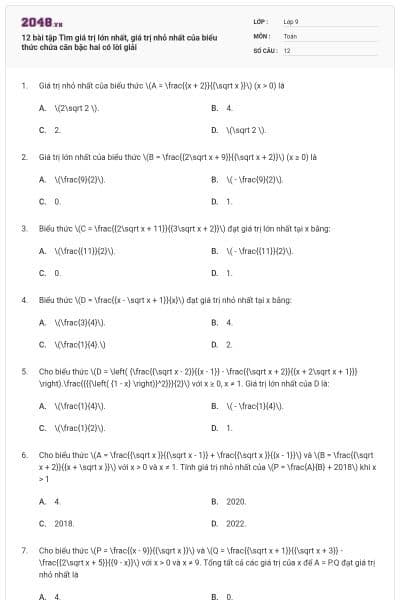
12 bài tập Tìm giá trị lớn nhất, giá trị nhỏ nhất của biểu thức chứa căn bậc hai có lời giải
12 câu hỏi
Giá trị nhỏ nhất của biểu thức \(A = \frac{{x + 2}}{{\sqrt x }}\) (x > 0) là
\(2\sqrt 2 \).
4.
2.
\(\sqrt 2 \).
Đáp án đúng là: A
Ta có: \(A = \frac{{x + 2}}{{\sqrt x }} = \sqrt x + \frac{2}{{\sqrt x }}\).
Với x > 0, áp dụng bất đẳng thức Cauchy, ta có:
\(\sqrt x + \frac{2}{{\sqrt x }} \ge 2\sqrt {\sqrt x \frac{2}{{\sqrt x }}} = 2\sqrt 2 \).
Dấu “=” xảy ra khi \(\sqrt x = \frac{2}{{\sqrt x }}\) hay x = 2.
Vậy GTNN của A = \(2\sqrt 2 \) khi x = 2.
Giá trị lớn nhất của biểu thức \(B = \frac{{2\sqrt x + 9}}{{\sqrt x + 2}}\) (x ≥ 0) là
\(\frac{9}{2}\).
\( - \frac{9}{2}\).
0.
1.
Đáp án đúng là: A
Ta có: \(B = \frac{{2\sqrt x + 9}}{{\sqrt x + 2}} = 2 + \frac{5}{{\sqrt x + 2}}\).
Với x ≥ 0, ta có: \(\sqrt x + 2 \ge 2\) suy ra \(\frac{5}{{\sqrt x + 2}} \le \frac{5}{2}\).
Do đó, 2 + \(\frac{5}{{\sqrt x + 2}} \le \frac{5}{2} + 2\) hay B ≤ \(\frac{9}{2}\).
Dấu “=” xảy ra khi x = 0.
Vật GTLN của B = \(\frac{9}{2}\) khi x = 0.
Biểu thức \(C = \frac{{2\sqrt x + 11}}{{3\sqrt x + 2}}\) đạt giá trị lớn nhất tại x bằng:
\(\frac{{11}}{2}\).
\( - \frac{{11}}{2}\).
0.
1.
Đáp án đúng là: C
Điều kiện: x ≥ 0.
Ta có: \(C = \frac{{2\sqrt x + 11}}{{3\sqrt x + 2}} = \frac{{2\left( {\sqrt x + \frac{2}{3}} \right) + \frac{{29}}{3}}}{{3\left( {\sqrt x + \frac{2}{3}} \right)}} = \frac{2}{3} + \frac{{29}}{{3\left( {3\sqrt x + 2} \right)}}\).
Với x ≥ 0, ta có: \(3\sqrt x + 2 \ge 2\) suy ra \(3\left( {3\sqrt x + 2} \right) \ge 6\).
Do đó, \(\frac{{29}}{{3\left( {3\sqrt x + 2} \right)}} \le \frac{{29}}{6}\) .
Suy ra \(\frac{2}{3} + \frac{{29}}{{3\left( {3\sqrt x + 2} \right)}} \le \frac{{11}}{2}\) hay C ≤ \(\frac{{11}}{2}\).
Dấu “=” xảy ra khi x = 0.
Vậy GTLN của C = \(\frac{{11}}{2}\) khi x = 0.
Biểu thức \(D = \frac{{x - \sqrt x + 1}}{x}\) đạt giá trị nhỏ nhất tại x bằng:
\(\frac{3}{4}\).
4.
\(\frac{1}{4}.\)
2.
Đáp án đúng là: A
Điều kiện xác định: x > 0.
Ta có: \(D = \frac{{x - \sqrt x + 1}}{x} = 1 - \frac{1}{{\sqrt x }} + \frac{1}{x} = \frac{3}{4} + \frac{1}{4} - 2.\frac{1}{2}\frac{1}{{\sqrt x }} + \frac{1}{x} = \frac{3}{4} + {\left( {\frac{1}{2} - \frac{1}{{\sqrt x }}} \right)^2}\).
Nhận thấy \({\left( {\frac{1}{2} - \frac{1}{{\sqrt x }}} \right)^2} \ge 0\) nên \(\frac{3}{4} + {\left( {\frac{1}{2} - \frac{1}{{\sqrt x }}} \right)^2} \ge \frac{3}{4}\) hay D \( \ge \frac{3}{4}\).
Dấu “=” xảy ra khi \(\frac{1}{2} - \frac{1}{{\sqrt x }} = 0\) suy ra \(\sqrt x = 2\) khi x = 4.
Vậy GTNN của của D = \(\frac{3}{4}\) khi x = 4.
Cho biểu thức \(D = \left( {\frac{{\sqrt x - 2}}{{x - 1}} - \frac{{\sqrt x + 2}}{{x + 2\sqrt x + 1}}} \right).\frac{{{{\left( {1 - x} \right)}^2}}}{2}\) với x ≥ 0, x ≠ 1. Giá trị lớn nhất của D là:
\(\frac{1}{4}\).
\( - \frac{1}{4}\).
\(\frac{1}{2}\).
1.
Đáp án đúng là: A
Với x ≥ 0, x ≠ 1, ta có:
\(D = \left( {\frac{{\sqrt x - 2}}{{x - 1}} - \frac{{\sqrt x + 2}}{{x + 2\sqrt x + 1}}} \right).\frac{{{{\left( {1 - x} \right)}^2}}}{2}\)
\(D = \left[ {\frac{{\left( {\sqrt x - 2} \right){{\left( {\sqrt x + 1} \right)}^2}}}{{\left( {x - 1} \right){{\left( {\sqrt x + 1} \right)}^2}}} - \frac{{\left( {\sqrt x + 2} \right)\left( {x - 1} \right)}}{{\left( {x - 1} \right){{\left( {\sqrt x + 1} \right)}^2}}}} \right].\frac{{{{\left( {1 - x} \right)}^2}}}{2}\)
\(D = \left[ {\frac{{\left( {\sqrt x - 2} \right){{\left( {\sqrt x + 1} \right)}^2} - \left( {\sqrt x + 2} \right)\left( {x - 1} \right)}}{{\left( {x - 1} \right){{\left( {\sqrt x + 1} \right)}^2}}}} \right].\frac{{{{\left( {1 - x} \right)}^2}}}{2}\)
\(D = \frac{{\left[ {x\sqrt x + 2x + \sqrt x - 2x - 4\sqrt x - 2 - x\sqrt x + \sqrt x - 2x + 2} \right]}}{{{{\left( {\sqrt x + 1} \right)}^2}}}.\frac{{\left( {x - 1} \right)}}{2}\)
\(D = \frac{{\left( { - 2x - 2\sqrt x } \right)}}{{{{\left( {\sqrt x + 1} \right)}^2}}}.\frac{{\left( {x - 1} \right)}}{2} = \frac{{ - 2\sqrt x \left( {\sqrt x + 1} \right)}}{{{{\left( {\sqrt x + 1} \right)}^2}}}.\frac{{\left( {\sqrt x - 1} \right)\left( {\sqrt x + 1} \right)}}{2} = - \sqrt x \left( {\sqrt x - 1} \right)\).
Ta có: \(D = - \sqrt x \left( {\sqrt x - 1} \right) = - x + \sqrt x = - x + 2.\frac{1}{2}\sqrt x - \frac{1}{4} + \frac{1}{4} = - {\left( {\sqrt x - \frac{1}{2}} \right)^2} + \frac{1}{4}\).
Nhận thấy \( - {\left( {\sqrt x - \frac{1}{2}} \right)^2} \le 0\) nên \( - {\left( {\sqrt x - \frac{1}{2}} \right)^2} + \frac{1}{4} \le \frac{1}{4}\).
Dấu “=” xảy ra khi x = \(\frac{1}{4}\).
Vậy GTLN của D = \(\frac{1}{4}\) khi x = \(\frac{1}{4}\).
Cho biểu thức \(A = \frac{{\sqrt x }}{{\sqrt x - 1}} + \frac{{\sqrt x }}{{x - 1}}\) và \(B = \frac{{\sqrt x + 2}}{{x + \sqrt x }}\) với x > 0 và x ≠ 1. Tính giá trị nhỏ nhất của \(P = \frac{A}{B} + 2018\) khi x > 1
4.
2020.
2018.
2022.
Đáp án đúng là: D
Với x > 0 và x ≠ 1, ta có:
\(A = \frac{{\sqrt x }}{{\sqrt x - 1}} + \frac{{\sqrt x }}{{x - 1}} = \frac{{\sqrt x \left( {\sqrt x + 1} \right)}}{{\left( {\sqrt x - 1} \right)\left( {\sqrt x + 1} \right)}} + \frac{{\sqrt x }}{{\left( {\sqrt x - 1} \right)\left( {\sqrt x + 1} \right)}} = \frac{{x + 2\sqrt x }}{{\left( {\sqrt x - 1} \right)\left( {\sqrt x + 1} \right)}}\).
Có: \(P = \frac{A}{B} + 2018\) với x > 1.
\( = \frac{{x + 2\sqrt x }}{{\left( {\sqrt x - 1} \right)\left( {\sqrt x + 1} \right)}}:\frac{{\sqrt x + 2}}{{x + \sqrt x }} + 2018\)
\( = \frac{{\sqrt x \left( {\sqrt x + 2} \right)}}{{\left( {\sqrt x - 1} \right)\left( {\sqrt x + 1} \right)}}.\frac{{\sqrt x \left( {\sqrt x + 1} \right)}}{{\sqrt x + 2}} + 2018\)
\( = \frac{x}{{\sqrt x - 1}} + 2018\)
\( = \frac{{x - 1}}{{\sqrt x - 1}} + \frac{1}{{\sqrt x - 1}} + 2018\)
\( = \sqrt x + 1 + \frac{1}{{\sqrt x - 1}} + 2018\)
\( = \sqrt x - 1 + \frac{1}{{\sqrt x - 1}} + 2020\)
Với x > 1, áp dụng bất đẳng thức Cauchy, ta có:
\(\sqrt x - 1 + \frac{1}{{\sqrt x - 1}} \ge 2\sqrt {\left( {\sqrt x - 1} \right).\frac{1}{{\sqrt x - 1}}} = 2\)
Suy ra \(\sqrt x - 1 + \frac{1}{{\sqrt x - 1}} + 2020 \ge 2022\).
Dấu “=” xảy ra khi \(\sqrt x - 1 = \frac{1}{{\sqrt x - 1}}\) hay x = 4 (do x > 1).
Vậy GTNN của P = 2022 khi x = 4.
Cho biểu thức \(P = \frac{{x - 9}}{{\sqrt x }}\) và \(Q = \frac{{\sqrt x + 1}}{{\sqrt x + 3}} - \frac{{2\sqrt x + 5}}{{9 - x}}\) với x > 0 và x ≠ 9. Tổng tất cả các giá trị của x để A = P.Q đạt giá trị nhỏ nhất là
4.
0.
2.
\(2\sqrt 2 \).
Đáp án đúng là: D
Với x > 0, ta có:
\(Q = \frac{{\sqrt x + 1}}{{\sqrt x + 3}} - \frac{{2\sqrt x + 5}}{{9 - x}}\)
\(Q = \frac{{\left( {\sqrt x + 1} \right)\left( {\sqrt x - 3} \right)}}{{\left( {\sqrt x + 3} \right)\left( {\sqrt x - 3} \right)}} + \frac{{2\sqrt x + 5}}{{\left( {\sqrt x + 3} \right)\left( {\sqrt x - 3} \right)}}\)
\(Q = \frac{{x - 2\sqrt x - 3 + 2\sqrt x + 5}}{{\left( {\sqrt x + 3} \right)\left( {\sqrt x - 3} \right)}} = \frac{{x + 2}}{{\left( {\sqrt x + 3} \right)\left( {\sqrt x - 3} \right)}}\).
Có A = P.Q = \(\frac{{x - 9}}{{\sqrt x }}.\frac{{x + 2}}{{\left( {\sqrt x + 3} \right)\left( {\sqrt x - 3} \right)}} = \frac{{x + 2}}{{\sqrt x }} = \sqrt x + \frac{2}{{\sqrt x }}\)
Với x > 0, áp dụng bất đẳng thức Cauchy, ta có:
\(\sqrt x + \frac{2}{{\sqrt x }} \ge 2\sqrt {\sqrt x .\frac{2}{{\sqrt x }}} = 2\sqrt 2 \).
Dấu “=” xảy ra khi \(\sqrt x = \frac{2}{{\sqrt x }}\) hay x = 2 (thỏa mãn).
Vậy GTNN của A = \(2\sqrt 2 \) khi x = 2.
Cho biểu thức \(A = \frac{{\sqrt x + 5}}{{2\sqrt x - 1}}\) và \(B = \frac{{\sqrt x + 1}}{{\sqrt x - 1}} + \frac{{\sqrt x - 1}}{{\sqrt x + 1}} - \frac{{3\sqrt x + 1}}{{x - 1}}\) với x ≥ 0, x ≠ 1, x ≠ \(\frac{1}{4}\). Giá trị của x để M = A.B đạt giá trị lớn nhất là:
4.
5.
0.
1.
Đáp án đúng là: B
Với x ≥ 0, x ≠ 1, x ≠ \(\frac{1}{4}\), ta có:
\(B = \frac{{\sqrt x + 1}}{{\sqrt x - 1}} + \frac{{\sqrt x - 1}}{{\sqrt x + 1}} - \frac{{3\sqrt x + 1}}{{x - 1}}\)
\(B = \frac{{{{\left( {\sqrt x + 1} \right)}^2}}}{{\left( {\sqrt x - 1} \right)\left( {\sqrt x + 1} \right)}} + \frac{{{{\left( {\sqrt x - 1} \right)}^2}}}{{\left( {\sqrt x - 1} \right)\left( {\sqrt x + 1} \right)}} - \frac{{3\sqrt x + 1}}{{\left( {\sqrt x - 1} \right)\left( {\sqrt x + 1} \right)}}\)
\(B = \frac{{x + 2\sqrt x + 1 + x - 2\sqrt x + 1 - 3\sqrt x - 1}}{{\left( {\sqrt x - 1} \right)\left( {\sqrt x + 1} \right)}}\)
\(B = \frac{{2x - 3\sqrt x + 1}}{{\left( {\sqrt x - 1} \right)\left( {\sqrt x + 1} \right)}} = \frac{{\left( {\sqrt x - 1} \right)\left( {2\sqrt x - 1} \right)}}{{\left( {\sqrt x - 1} \right)\left( {\sqrt x + 1} \right)}} = \frac{{2\sqrt x - 1}}{{\sqrt x + 1}}\).
Ta có: M = A.B = \(\frac{{\sqrt x + 5}}{{2\sqrt x - 1}}.\frac{{2\sqrt x - 1}}{{\sqrt x + 1}} = \frac{{\sqrt x + 5}}{{\sqrt x + 1}}\).
Ta có: \(M = \frac{{\sqrt x + 5}}{{\sqrt x + 1}} = 1 + \frac{4}{{\sqrt x + 3}}\).
Nhận thấy với x ≥ 0 thì \(\sqrt x + 1 \ge 1\) suy ra \(\frac{4}{{\sqrt x + 1}} \le 4\).
Do đó, \(1 + \frac{4}{{\sqrt x + 1}} \le 1 + 4\) hay M ≤ \(5\).
Dấu “=” xảy ra khi x = 0 (thỏa mãn).
Vậy GTLN của M = 5 khi x = 0.
Cho biểu thức \(A = \frac{{\sqrt x - 2}}{{\sqrt x + 3}}\) và \(B = \left( {\frac{{3\sqrt x + 6}}{{x - 4}} + \frac{{\sqrt x }}{{\sqrt x - 2}}} \right):\frac{{x - 9}}{{\sqrt x - 3}}\) với x ≥ 0, x ≠ 4, x ≠ 9. Giá trị lớn nhất của biểu thức M = A.B là:
\(\frac{1}{3}\).
0.
\( - \frac{1}{3}\).
1.
Đáp án đúng là: A
Với x ≥ 0, x ≠ 4, x ≠ 9, ta có:
\(B = \left( {\frac{{3\sqrt x + 6}}{{x - 4}} + \frac{{\sqrt x }}{{\sqrt x - 2}}} \right):\frac{{x - 9}}{{\sqrt x - 3}}\)
\(B = \left[ {\frac{{\left( {3\sqrt x + 6} \right)}}{{\left( {\sqrt x - 2} \right)\left( {\sqrt x + 2} \right)}} + \frac{{\sqrt x \left( {\sqrt x + 2} \right)}}{{\left( {\sqrt x - 2} \right)\left( {\sqrt x + 2} \right)}}} \right].\frac{1}{{\sqrt x + 3}}\)
\(B = \frac{{3\sqrt x + 6 + x + 2\sqrt x }}{{\left( {\sqrt x - 2} \right)\left( {\sqrt x + 2} \right)}}.\frac{1}{{\sqrt x + 3}}\)
\(B = \frac{{x + 5\sqrt x + 6}}{{\left( {\sqrt x - 2} \right)\left( {\sqrt x + 2} \right)}}.\frac{1}{{\sqrt x + 3}}\)
\(B = \frac{{\left( {\sqrt x + 3} \right)\left( {\sqrt x + 2} \right)}}{{\left( {\sqrt x - 2} \right)\left( {\sqrt x + 2} \right)}}.\frac{1}{{\sqrt x + 3}}\)
\(B = \frac{1}{{\sqrt x - 2}}\).
Ta có: M = A.B = \(\frac{{\sqrt x - 2}}{{\sqrt x + 3}}.\frac{1}{{\sqrt x - 2}} = \frac{1}{{\sqrt x + 3}}\).
Vì x ≥ 0 nên \(\sqrt x \ge 0\) suy ra \(\sqrt x + 3 \ge 3\). Do đó \(\frac{1}{{\sqrt x + 3}} \le \frac{1}{3}\).
Dấu “=” xảy ra khi x = 0 (thỏa mãn).
Vậy GTLN của M = \(\frac{1}{3}\) khi x = 0.
Cho hai biểu thức \(P = \frac{{x + 3}}{{\sqrt x - 2}}\) và \(Q = \frac{{\sqrt x - 1}}{{\sqrt x + 2}} - \frac{{5\sqrt x - 2}}{{4 - x}}\) với x > 0 và x ≠ 4. Giá trị của x để biểu thức \(\frac{P}{Q}\) đạt giá trị nhỏ nhất là
\(3\sqrt 2 \).
\(2\sqrt 3 \).
0.
3.
Đáp án đúng là: B
Với x > 0 và x ≠ 4, ta có:
\(Q = \frac{{\sqrt x - 1}}{{\sqrt x + 2}} - \frac{{5\sqrt x - 2}}{{4 - x}}\)
\(Q = \frac{{\left( {\sqrt x - 1} \right)\left( {\sqrt x - 2} \right)}}{{\left( {\sqrt x + 2} \right)\left( {\sqrt x - 2} \right)}} + \frac{{5\sqrt x - 2}}{{\left( {\sqrt x + 2} \right)\left( {\sqrt x - 2} \right)}}\)
\(Q = \frac{{x - 3\sqrt x + 2 + 5\sqrt x - 2}}{{\left( {\sqrt x + 2} \right)\left( {\sqrt x - 2} \right)}}\)
\(Q = \frac{{x + 2\sqrt x }}{{\left( {\sqrt x + 2} \right)\left( {\sqrt x - 2} \right)}} = \frac{{\sqrt x \left( {\sqrt x + 2} \right)}}{{\left( {\sqrt x + 2} \right)\left( {\sqrt x - 2} \right)}} = \frac{{\sqrt x }}{{\sqrt x - 2}}\).
Ta có: \(\frac{P}{Q} = \frac{{x + 3}}{{\sqrt x - 2}}:\frac{{\sqrt x }}{{\sqrt x - 2}} = \frac{{x + 3}}{{\sqrt x - 2}}.\frac{{\sqrt x - 2}}{{\sqrt x }} = \frac{{x + 3}}{{\sqrt x }} = \sqrt x + \frac{3}{{\sqrt x }}\).
Do x > 0 nên áp dụng bất đẳng thức Cauchy, ta có:
\(\sqrt x + \frac{3}{{\sqrt x }} \ge 2\sqrt {\sqrt x \frac{3}{{\sqrt x }}} = 2\sqrt 3 \).
Dấu “=” xảy ra khi \(\sqrt x = \frac{3}{{\sqrt x }}\) suy ra x = 3 (thỏa mãn).
Vậy GTNN của \(\frac{P}{Q}\) bằng \(2\sqrt 3 \) khi x = 3.
Tìm giá trị nhỏ nhất của các biểu thức sau:
a) A = x – 2\(\sqrt x \);
b) C = \(\frac{{2\sqrt x - 9}}{{\sqrt x + 1}}\);
c) \(D = \frac{{x + 4\sqrt x + 12}}{{\sqrt x + 3}}\).
a) A = x – 2\(\sqrt x \) = x – 2\(\sqrt x \) + 1 – 1 = (\(\sqrt x \) − 1)2 – 1.
Nhận thấy (\(\sqrt x \) − 1)2 ≥ 0 với x ≥ 0.
Suy ra (\(\sqrt x \) − 1)2 – 1 ≥ −1 với x ≥ 0 hay A ≥ −1 với x ≥ 0.
Vậy GTNN của A = −1 khi x = 1.
b) C = \(\frac{{2\sqrt x - 9}}{{\sqrt x + 1}}\)
Điều kiện: x ≥ 0.
Với x ≥ 0, ta có: \(\frac{{2\sqrt x - 9}}{{\sqrt x + 1}} \ge \frac{{2\sqrt 0 - 9}}{{\sqrt 0 + 1}} = - 9\).
Vậy GTNN của C = −9 khi x = 0.
c) \(D = \frac{{x + 4\sqrt x + 12}}{{\sqrt x + 3}}\)
Điều kiện: x ≥ 0.
Với x ≥ 0, ta có: \(\frac{{x + 4\sqrt x + 12}}{{\sqrt x + 3}} \ge \frac{{0 + 4.0 + 12}}{{0 + 3}} = 4\).
Dấu “=” xảy ra khi x = 0.
Vậy GTNN của D = 4 khi x = 0.Tìm giá trị lớn nhất của biểu thức sau:
a) \(A = \frac{3}{{2\sqrt x + 5}}\);
b) \(B = \frac{{\sqrt x + 5}}{{\sqrt x + 3}}\);
c) \(D = \frac{1}{{x - \sqrt x + 1}}\).
a) \(A = \frac{3}{{2\sqrt x + 5}}\).
Điều kiện: x ≥ 0.
Với x ≥ 0 thì \(\sqrt x \) ≥ 0 suy ra \(2\sqrt x \ge 0\).
Do đó \(2\sqrt x + 5 \ge 5\), suy ra \(\frac{3}{{2\sqrt x + 5}} \le \frac{3}{5}\) hay A ≤ \(\frac{3}{5}\).
Vậy GTLN của A = \(\frac{3}{5}\) khi x = 0.
b) \(B = \frac{{\sqrt x + 5}}{{\sqrt x + 3}}\)
Điều kiện: x ≥ 0.
Ta có: \(B = \frac{{\sqrt x + 5}}{{\sqrt x + 3}} = 1 + \frac{2}{{\sqrt x + 3}}\).
Nhận thấy với x ≥ 0 thì \(\sqrt x + 3 \ge 3\) suy ra \(\frac{2}{{\sqrt x + 3}} \le \frac{2}{3}\).
Do đó, \(1 + \frac{2}{{\sqrt x + 3}} \le 1 + \frac{2}{3}\) hay B ≤ \(\frac{5}{3}\).
Dấu “=” xảy ra khi x = 0.
Vậy GTLN của B = \(\frac{5}{3}\) khi x = 0.
c) \(D = \frac{1}{{x - \sqrt x + 1}}\).
Điều kiện: x ≥ 0.
Ta có: \(x - \sqrt x + 1 = x - 2.\frac{1}{2}\sqrt x + \frac{1}{4} + \frac{3}{4} = {\left( {\sqrt x - \frac{1}{2}} \right)^2} + \frac{3}{4} \ge \frac{3}{4}\) với x ≥ 0.
Suy ra \(\frac{1}{{x - \sqrt x + 1}} \le \frac{1}{{\frac{3}{4}}} = \frac{4}{3}\).
Dấu “=” xảy ra khi \(\sqrt x - \frac{1}{2} = 0\) hay x = \(\frac{1}{4}\).
Vậy GTLN của D = \(\frac{4}{3}\) khi x = \(\frac{1}{4}\).