(Viên chức Mầm non) 650 câu trắc nghiệm Đọc hiểu tiếng Anh có đáp án - Phần 20
Đề thi

(Viên chức Mầm non) 650 câu trắc nghiệm Đọc hiểu tiếng Anh có đáp án - Phần 20

A
Admin
Viên chứcTrắc nghiệm tổng hợp87 lượt thi
30 câu hỏi
Đoạn văn

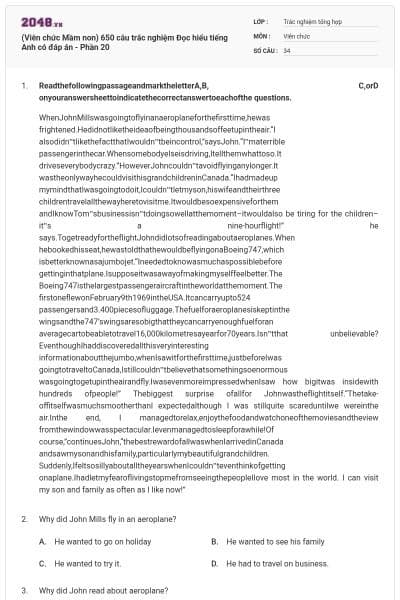
Read the following passage and mark the letter A, B, C, or D on your answer sheet to indicate the correct answer to each of the questions.

When John Mills was going to fly in an aeroplane for the first time, he was frightened. He did not like the idea of being thousands of feet up in the air. “ I also didn‟t like the fact that I wouldn‟t be in control,” says John. “I‟m a terrible passenger in the car. When somebody else is driving, I tell them what to so. It drives everybody crazy.” However John couldn‟t avoid flying any longer. It was the only way he could visit his grandchildren in Canada. “I had made up my mind that I was going to do it, I couldn‟t let my son, his wife and their three children travel all the way here to visit me. It would be so expensive for them and I know Tom‟s business isn‟t doing so well at the moment – it would also be tiring for the children – it‟s a nine-hour flight!” he says.To get ready for the flight John did lots of reading about aeroplanes. When he booked his seat, he was told that he would be flying on a Boeing 747, which is better known as a jumbo jet. “I needed to know as much as possible before getting in that plane. I suppose it was a way of making myself feel better. The Boeing 747 is the largest passenger aircraft in the world at the moment. The first one flew on February 9th 1969 in the USA. It can carry up to 524 passengers and 3.400 pieces of luggage. The fuel for aeroplanes is kept in the wings and the 747’s wings are so big that they can carry enough fuel for an average car to be able to travel 16,000 kilometres a year for 70 years. Isn‟t that unbelievable? Even though I had discovered all this very interesting information about the jumbo, when I saw it for the first time, just before I was going to travel to Canada, I still couldn‟t believe that something so enormous was going to get up in the air and fly. I was even more impressed when I saw how big it was inside with hundreds of people!” The biggest surprise of all for John was the flight itself. “The take-off itself was much smoother than I expected although I was still quite scared until we were in the air. In the end, I managed to relax, enjoy the food and watch one of the movies and the view from the window was spectacular. I even managed to sleep for a while! Of course,” continues John, “the best reward of all was when I arrived in Canada and saw my son and his family, particularly my beautiful grandchildren. Suddenly, I felt so silly about all the years when I couldn‟t even think of getting on a plane. I had let my fear of living stop me from seeing the people I love most in the world. I can visit my son and family as often as I like now!”

1.Trắc nghiệm
• 1 điểm

Why did John Mills fly in an aeroplane?

He wanted to go on holiday

He wanted to see his family

He wanted to try it.

He had to travel on business.

Xem đáp án

Chọn đáp án C

Dẫn chứng: It was the only way he could visit his grandchildren in Canada. “I had made up my mind that I was going to do it, I couldn‟t let my son, his wife and their three children travel all the way here to visit me. It would be so expensive for them and I know Tom‟s business isn‟t doing so well at the moment – it would also be tiring for the children – it‟s a nine-hour flight!” he says.

2.Trắc nghiệm
• 1 điểm

Why did John read about aeroplane?

He wanted to know how they work.

It was his hobby.

It made him feel safer.

He had found a book on them.

Xem đáp án

Chọn đáp án A

Dẫn chứng: To get ready for the flight John did lots of reading about aeroplanes. When he booked his seat, he was told that he would be flying on a Boeing 747, which is better known as a jumbo jet. “I needed to know as much as possible before getting in that plane.

3.Trắc nghiệm
• 1 điểm

What happened when he saw the jumbo jet for the first time?

He felt much safer.

He liked the shape of it.

He couldn‟t believe how big it was.

He thought the wings were very

Xem đáp án

Chọn đáp án C

Dẫn chứng: Even though I had discovered all this very interesting information about the jumbo, when I saw it for the first time, just before I was going to travel to Canada, I still couldn‟t believe that something so enormous was going to get up in the air and fly. I was even more impressed when I saw how big it was inside with hundreds of people!”

4.Trắc nghiệm
• 1 điểm

How did John feel when the aeroplane was taking off?

excited

happy

sad

frightened

Xem đáp án

Chọn đáp án D

Dẫn chứng: “The take-off itself was much smoother than I expected although I was still quite scared until we were in the air.”

5.Trắc nghiệm
• 1 điểm

What surprised John most about the flight?

that he liked the food.

that he was able to sleep

that there was a movie being shown

that the view was good

Xem đáp án

Chọn đáp án B

Dẫn chứng: In the end, I managed to relax, enjoy the food and watch one of the movies and the view from the window was spectacular. I even managed to sleep for a while! Of course,”

6.Trắc nghiệm
• 1 điểm

How did John feel about his fears in the end?

He thought he had wasted time being afraid.

He realized it was okay to be afraid.

He hoped his grandchildren weren‟t afraid of flying.

He realized that being afraid kept him safe.

Xem đáp án

Chọn đáp án A

Dẫn chứng: Suddenly, I felt so silly about all the years when I couldn‟t even think of getting on a plane. I had let my fear of living stop me from seeing the people I love most in the world. I can visit my son and family as often as I like now!”

Đoạn văn

Read the following passage and mark the letter A, B, C, or D on your answer sheet to indicate the correct answer to each of the questions.

Although noise, commonly defined as unwanted sound, is a widely recognized form of pollution, it is very difficult to measure because the discomfort experienced by different individuals is highly subjective and, therefore, variable. Exposure to lower levels of noise may be slightly irritating, whereas exposure to higher levels may actually cause hearing loss. Particularly in congested urban areas, the noise produced as a byproduct of our advancing technology causes physical and psychological harm, and detracts from the quality of life for those who are exposed to it.

Unlike the eyes, which can be covered by the eyelids against strong light, the ear has no lid, and is, therefore, always open and vulnerable; noise penetrates without protection. Noise causes effects that the hearer cannot control and to which the body never becomes accustomed. Loud noises instinctively signal danger to any organism with a hearing mechanism, including human beings. In response, heartbeat and respiration accelerate, blood vessels constrict, the skin pales, and muscles tense. In fact, there is a general increase in functioning brought about by the flow of adrenaline released in response to fear, and some of these responses persist even longer than the noise, occasionally as long as thirty minutes after the sound has ceased.

Because noise is unavoidable in a complex, industrial society, we are constantly responding in the same way that we would respond to danger. Recently, researchers have concluded that noise and our response may be much more than an annoyance. It may be a serious threat to physical and psychological health and well-being, causing damage not only to the ear and brain but also to the heart and stomach. We have long known that hearing loss is America‟s number one nonfatal health problem, but now we are learning that some of us with heart disease and ulcers may be victims of noise as well. Fetuses exposed to noise tend to be overactive, they cry easily, and they are more sensitive to gastrointestinal problems after birth. In addition, the psychic effect of noise is very important. Nervousness, irritability, tension, and anxiety increase affectingthe qualityof rest during sleep, and the efficiency ofactivities during waking hours, as well as the way that we interact with each other.

7.Trắc nghiệm
• 1 điểm

Which of the following is the author‟s main point?

Hearing loss is America‟s number one nonfatal health problem.

Loud noises signal danger.

Noise may pose a serious threat to our physical and psychological health.

The ear is not like the eye.

Xem đáp án

Chọn đáp án C

Giải thích: Câu nào sau đây là ý chính tác giải muốn gửi gắm?

A. Mất thính giác là vấn đề sức khỏe nhỏ ở Mỹ.

B. Tiếng ồn lớn báo hiệu sự nguy hiểm.

C. Tiếng ồn có thể gây ra một mối đe dọa nghiêm trọng đối với sức khoẻ thể chất và tâm lý của chúng ta.

D. Tai không giống như mắt.

8.Trắc nghiệm
• 1 điểm

According to the passage, what is noise?

A byproduct of technology.

Physical and psychological harm

Congestion..

Unwanted sound.

Xem đáp án

Chọn đáp án D

Dẫn chứng: Although noise, commonly defined as unwanted sound, is a widely recognized form of pollution.

9.Trắc nghiệm
• 1 điểm

Why is noise difficult to measure?

All people do not respond to it in the same way

It causes hearing loss.

It is unwanted.

People become accustomed to it.

Xem đáp án

Chọn đáp án A

Dẫn chứng: it is very difficult to measure because the discomfort experienced by different individuals is highly subjective and, therefore, variable.

2048.vn

Học thông minh hơn mỗi ngày

Xem toàn bộ 30 câu hỏi và nhiều hơn nữa với tài khoản miễn phí

Tạo đề thi
Tổ chức kiểm tra
Báo cáo chấm điểm tự động
Bạn đã có tài khoản?
10.Trắc nghiệm
• 1 điểm

The word ‘congested’ in paragraph 1 could best be replaced by ___.

hazardous

crowded

polluted

rushed

Xem đáp án

Chọn đáp án B

Giải thích: Từ “congested” ở đoạn 1 gần nghĩa với?

A. khó khăn  B. đông đúc  C. ô nhiễm    D. vội vàng. congested = crowded (a): đông đúc

11.Trắc nghiệm
• 1 điểm

The word it in the first paragraph refers to ___.

the quality of life

advancing technology

the noise

physical and psychological harm

Xem đáp án

Chọn đáp án C

Dẫn chứng: Particularly in congested urban areas, the noise produced as a by- product of our advancing technology causes physical and psychological harm, and detracts from the quality of life for those who are exposed to it.

12.Trắc nghiệm
• 1 điểm

According to the passage, people respond to loud noises in the same way that they respond to ___.

annoyance

danger

damage

disease

Xem đáp án

Chọn đáp án B

Dẫn chứng: Because noise is unavoidable in a complex, industrial society, we are constantly responding in the same way that we would respond to danger.

13.Trắc nghiệm
• 1 điểm

Look at the verb accelerate in paragraph 3. Which of the following is the closest in meaning to _____.

decrease

alter

increase

release

Xem đáp án

Chọn đáp án C

Giải thích: Từ “ accelerate” ở đoạn 3 gần nghĩa với?

A. sự kết thúc          B. mọc, nhô lên       C. chỗ sưng lên        D. tăng

14.Trắc nghiệm
• 1 điểm

The phrase ‘as well as’ in paragraph 4 is closest in meaning to ___.

after all

instead

also

regardless

Xem đáp án

Chọn đáp án C

Giải thích:

Từ “as well as” ở đoạn 4 gần nghĩa với?

A. sau tất cả  B. thay vì      C. cũng, và    D. bất chấp as well as = also = and

15.Trắc nghiệm
• 1 điểm

It can be inferred from the passage that the eye ___.

responds to fear

enjoys greater protection than the ear

increases functions

is damaged by noise

Xem đáp án

Chọn đáp án B

Dẫn chứng: Unlike the eyes, which can be covered by the eyelids against strong light, the ear has no lid, and is, therefore, always open and vulnerable; noise penetrates without protection.

Đoạn văn

Read the following passage and mark the letter A, B, C, or D on your answer sheet to indicate the correct answer to each of the questions.

Herman Melville, an American author best known today for his novel Moby Dick, was actually more popular during his lifetime for some ofhis other works. He traveled extensively and used the knowledge gained during his travels as the basis for his early novels. In 1837, at the age of eighteen, Melville signed as a cabin boy on a merchant ship that was to sail from his Massachusetts home to Liverpool, England. His experiences on this trip served as a basis for the novel Redburn (1849). In 1841 Melville set out on a whaling ship headed for the South Seas. After jumping ship in Tahiti, he wandered around the islands of Tahiti and Moorea. This South Sea island sojourn was a backdrop to the novel Omoo(1847). After three years away fromhome,Melville joined up with a U.S. naval frigate that was returning to the eastern United States around Cape

Horn. The novel White-Jacket (1850) describes this lengthy voyage as a navy seaman. With the publication of these early adventure novels, Melville developed a strong and loyal following among readers eager for his tales of exotic places and situations. However, in 1851, with the publication of Moby Dick, Melville's popularity started to diminish. Moby Dick, on one level the saga of the hunt for the great white whale, was also a heavily symbolic allegory of the heroic struggle of man against the universe. The public was not ready for Melville's literary metamorphosis from romantic adventure to philosophical symbolism. It is ironic that the novel that served to diminish Melville's popularity during his lifetime is the one for which he is best known today.

16.Trắc nghiệm
• 1 điểm

The main subject of the passage is_________.

Melville’s travels

Moby Dick

Melville’s personal background

the popularity of Melville’s novels.

Xem đáp án

Chọn đáp án D

Dẫn chứng dựa và ý đầu tiên của bài: “Herman Melville, an American author best known today for his novel Moby Dick, was actually more popular during his lifetime for some of his other works” – (Herman Melville- nhà văn người Mĩ nổi tiếng nhất hiện nay với tiểu thuyết Moby Dick, ông càng được biết tới rộng rãi hơn qua một vài tác phẩm khác trong suốt cuộc đời của mình).

17.Trắc nghiệm
• 1 điểm

The word “basis” in paragraph 1 is closest in meaning to_________.

background

message

bottom

dissertation

Xem đáp án

Chọn đáp án A 

basic = background (n): nền tảng.

Dịch: Những trải nghiệm trong chuyến đi chính là nền tảng cho sự ra đời của cuốn Redburn (1849).

18.Trắc nghiệm
• 1 điểm

According       to    the                passage,   Melville’s early                        novels were__________.

published while he was traveling

completely fictional

all about his work on whaling ships

based on his travel experience

Xem đáp án

Chọn đáp án D

Dẫn chứng ở câu thứ 2 đoạn 1: “He traveled extensively and used the knowledge gained during his travels as the basis for his early novels” – (Ông đã đi chu du nhiều nơi và sử dụng những kiến thức có được từ những cuộc hành trình để làm cơ sở cho những cuốn tiểu thuyết đầu tiên).

19.Trắc nghiệm
• 1 điểm

The passage implies that Melville stayed in Tahiti because____________.

he had unofficially left his ship

he was on leave while his ship was in port

he had finished his term of duty

he had received permission to take a vacation in Tahiti

Xem đáp án

Chọn đáp án A

Dẫn chứng ở câu thứ 4+5 đoạn 1: “In 1841 Melville set out on a whaling ship headed for the South Seas. After jumping ship in Tahiti, he wandered around the islands of Tahiti and Moorea” – ( Vào năm 1841, Melville bắt đầu chuyến hành trình trên 1 con tàu săn cái voi tiến về vùng biển phía Nam. Sau khi xuống tàu ở Tahiti, ông đã đi lang thang khắp các đảo ở Tahiti và Moorea ) ⇒ Ông không chính thức rời con tàu.

20.Trắc nghiệm
• 1 điểm

How did the publication of Moby Dick affect Melville’s popularity?

His popularity remained as strong as ever.

It caused his popularity to decrease.

His popularity increased immediately.

It had no effect on his popularity.

Xem đáp án

Chọn đáp án B

Dẫn chứng ở câu thứ 2 đoạn 2: “However, in 1851, with the publication of Moby Dick, Melville's popularity started to diminish” – ( Dù vậy, vào năm 1851, cùng với sự xuất bản của Moby Dick thì danh tiếng của Melville đã bắt đầu sụt giảm).

21.Trắc nghiệm
• 1 điểm

According to the passage, Moby Dick is__________.

symbolic of humanity fighting the universe

a single-faceted work

a short story about a whale

a 47 adventure

Xem đáp án

Chọn đáp án A

Dẫn chứng ở câu thứ 3 đoạn 2: “Moby Dick, on one level the saga of the hunt for the great white whale, was also a heavily symbolic allegory of the heroic struggle of man against the universe” – (Moby Dick- cuốn tiểu thuyến trường thiên kể về các cuộc săn cá voi trắng khổng lồ, đồng thời cũng là một câu chuyện ngụ ngôn mang tính biểu tượng về cuộc đấu tranh anh dũng của loài người chống lại vũ trụ).

22.Trắc nghiệm
• 1 điểm

In what year did Melville’s book about his experiences as a cabin boy appear?

1849

1837

1847

1841

Xem đáp án

Chọn đáp án A

Dẫn chứng ở câu thứ 3+4 đoạn 1: “In 1837, at the age of eighteen, Melville signed as a cabin boy on a merchant ship that was to sail from his Massachusetts home to Liverpool, England. His experiences on this trip served as a basis for the novel Redburn (1849)” – (Năm 1837, khi mười tám tuổi, Melville đã đăng kí vào vị trí bồi bàn trên một con tàu thương gia đi từ nhà ông ở Massachusetts tới Liverpool, Anh Quốc. Những trải nghiệm của ông trong chuyến đi này chính là cơ sở cho cuốn tiểu thuyết Redburn (1849)

23.Trắc nghiệm
• 1 điểm

The word “metamorphosis” in paragraph 2 is closest in meaning to_________.

descent

circle

mysticism

change

Xem đáp án

Chọn đáp án D

Giải thích: metamorphosis (n) sự biến đổi = change: thay đổi.

Đoạn văn

Read the following passage and mark the letter A, B, C, or D on your answer sheet to indicate the correct answer to each of the questions.

The handling and delivery of mail has always been a serious business, underpinned by the trust of the public in requiring timeliness, safety, and confidentiality. After early beginnings using horseback and stagecoach, and although cars and trucks later replaced stagecoaches and wagons, the Railway Mail Service still stands as one of America’s most resourceful and exciting postal innovations. This service began in 1832, but grew slowly until the Civil War. Then from 1862, by sorting the mail on board moving trains, the Post Office Department was able to decentralize its operations as railroads began to crisscross the nation on a regular basis, and speed up mail delivery. This service lasted until 1974. During peak decades of service, railway mail clerks handled 93% of all non-local mail and by 1905 the service had over 12,000 employees.

Railway Post Office trains used a system of mail cranes to exchange mail at stations without stopping. As a train approached the crane, a clerk prepared the catcher arm which would then snatch the incoming mailbag in the blink of an

eye. The clerk then booted out the outgoing mailbag. Experienced clerks were considered the elite of the Postal Service’s employees, and spoke with pride of making the switch at night with nothing but the curves and feel of the track to warn them of an upcoming catch. They also worked under the greatest pressure and their jobs were considered to be exhausting and dangerous. In addition to regular demands of their jobs they could find themselves the victims of train wrecks and robberies.

As successful as it was, “mail-on-the-fly” still had its share of glitches. If they hoisted the train’s catcher arm too soon, they risked hitting switch targets, telegraph poles or semaphores, which would rip the catcher arm off the train. Too late, and they would miss an exchange.

24.Trắc nghiệm
• 1 điểm

Which of the following can be inferred from the first paragraph?

There was a high turnover of railway mail clerks.

The development of the mail roads during the second half of the 19th century enabled Post Office Department to focus on timeliness.

The Post Office Department was more concerned about speeding up mail delivery than the safety of its clerks.

Mail was often lost or damaged as it was exchanged on the mail crane.

Xem đáp án

Chọn đáp án B

Dẫn chứng ở câu thứ 4 đoạn 1: “Then from 1862, by sorting the mail on board moving trains, the Post Office Department was able to decentralize its operations as railroads began to crisscross the nation on a regular basis, and speed up mail delivery” – ( Sau đó từ năm 1862, bằng việc phân loại thư trên tàu đang di chuyển, Cục Bưu chính đã có thể phân nhánh quá trình hoạt động ngay khi đường xe lửa bắt đầu rẽ nhánh tới nhiều quốc gia theo thông lệ đều đặn, và làm tăng tốc độ chuyển phát thư).

25.Trắc nghiệm
• 1 điểm

The word “elite” in the second paragraph is closest in meaning to___________.

majority

superior

more capable

leader

Xem đáp án

Chọn đáp án B

elite (adj): ưu tú = superior (adj): nổi trội, giỏi hơn

26.Trắc nghiệm
• 1 điểm

What does the passage mainly discuss?

How the mail cranes exchanged the mail.

Improvements in mail handling and delivery.

How Post Office Trains handled the mail without stopping.

The skills of experienced clerks.

Xem đáp án

Chọn đáp án B

+ Đoạn 1: Sự phát triển của đường xe lửa làm cho việc chuyển phát thư được diễn ra nhanh hơn.

+ Đoạn 2: Việc trao đổi thư để chuyển phát được diễn ra nhanh chóng.

⇒ Cải tiến trong việc xử lí và chuyển phát thư.

27.Trắc nghiệm
• 1 điểm

According to the passage, the Railway Mail Service commenced in_________.

1874

1842

1832

1905

Xem đáp án

Chọn đáp án C

Dẫn chứng ở câu thứ 3 đoạn 1: “…, the Railway Mail Service still stands as one of America’s most resourceful and exciting postal innovations. This service began in 1832”- ( Dịch vụ thư tín đường sắt vẫn đứng vững như 1 trong những

cách tân sáng tạo và gây hứng thú nhất nước Mĩ. Dịch vụ này được bắt đầu vào năm 1832).

28.Trắc nghiệm
• 1 điểm

The word “glitches” in the third paragraph can be replaced by________.

accidents

blames

advantages

problems

Xem đáp án

Chọn đáp án D

glitches (n): sự cố, trục trặc = problems: có vấn đề.

29.Trắc nghiệm
• 1 điểm

Which of the following is TRUE according to the passage?

The clerk booted out the outgoing mailbag before snatching the incoming bag.

Clerks couldn’t often see what they were doing.

The Railway Mail clerk’s job was considered elite because it was safe and exciting.

Despite their success, railway mail clerks only handled a small proportion of all non-local mail.

Xem đáp án

Chọn đáp án C

Dẫn chứng ở câu thứ 4 đoạn 2: “Experienced clerks were considered the elite of the Postal Service’s employees, and spoke with pride of making the switch at night with nothing but the curves and feel of the track to warn them of an upcoming catch” – (Các nhân viên giàu kinh nghiệm được xem là tầng lớp ưu tú của Dịch vụ Bưu điện, và được nhắc tới với niềm tự hào trong việc trao đổi thư vào ban đêm không có gì ngoài những khúc quanh và cảm giác cảnh giác cao độ chờ đợi đợt bắt thư sắp tới)

30.Trắc nghiệm
• 1 điểm

The public expects the following three services in handling and delivery of mail except ______.

safety

accuracy

confidentiality

timeliness

Xem đáp án

Chọn đáp án B

Dẫn chứng ngay câu đầu tiên: “The handling and delivery of mail has always been a serious business, underpinned by the trust of the public in requiring timeliness, safety, and confidentiality” – (Việc xử lí và chuyển phát thư luôn là một công việc đòi hỏi tính nghiêm túc, được củng cố bởi lòng tin của công chúng trên yêu cầu về tính đúng hạn, tính an toàn và tính bảo mật)

⇒ Từ đó loại ra đáp án B không được đề cập tới.

Bạn có thích hoạt động này không?

Hãy lưu hoặc chia sẻ nội dung này đến mọi người.

Khám phá các nguồn tài nguyên miễn phí, phù hợp với tiêu chuẩn trong vài giây

Gợi ý cho bạn

Xem tất cả
2048.vn

Ý tưởng của bạn, bài học của bạn

Tự thiết kế đề thi, bài giảng hoặc flashcard theo cách riêng.
Tạo mới

Học liệu phổ biến Trắc nghiệm tổng hợp

Xem tất cả

Học liệu phổ biến Viên chức

Xem tất cả
2048.vn

Viên chức

Thêm cảm hứng cho môn học

Biến kiến thức quen thuộc thành hoạt động học tập thú vị.

Tạo mới