(Viên chức Mầm non) 650 câu trắc nghiệm Đọc hiểu tiếng Anh có đáp án - Phần 19
Đề thi

(Viên chức Mầm non) 650 câu trắc nghiệm Đọc hiểu tiếng Anh có đáp án - Phần 19

A
Admin
Viên chứcTrắc nghiệm tổng hợp85 lượt thi
26 câu hỏi
Đoạn văn

Read the following passage and mark the letter A, B, C, or D on your answer sheet to indicate the correct answer to each of the questions.

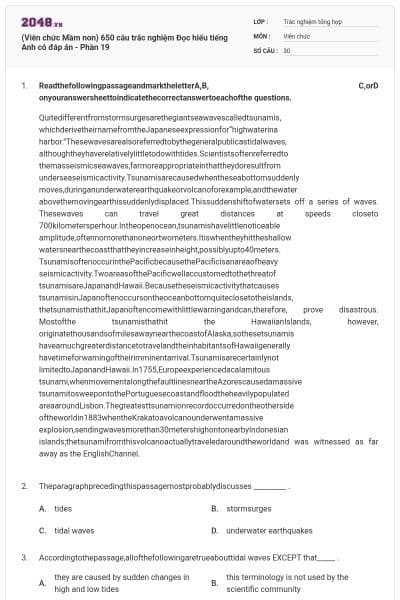
Quite different from storm surges are the giant sea waves called tsunamis, which derive their name from the Japanese expression for “high water in a harbor.” These waves are also referred to by the general public as tidal waves, although they have relatively little to do with tides. Scientists often referred to them as seismic sea waves, far more appropriate in that they do result from undersea seismic activity. Tsunamis are caused when the sea bottom suddenly moves, during an underwater earthquake or volcano for example, and the water above the moving earth is suddenly displaced. This sudden shift of water sets off a series of waves. These waves can travel great distances at speeds close to 700 kilometers per hour. In the open ocean, tsunamis have little noticeable amplitude, often no more than one or two meters. It is when they hit the shallow waters near the coast that they increase in height, possibly up to 40 meters. Tsunamis often occur in the Pacific because the Pacific is an area of heavy seismic activity. Two areas of the Pacific well accustomed to the threat of tsunamis are Japan and Hawaii. Because the seismic activity that causes tsunamis in Japan often occurs on the ocean bottom quite close to the islands, the tsunamis that hit Japan often come with little warning and can, therefore, prove disastrous. Most of the tsunamis that hit the Hawaiian Islands, however, originate thousands of miles away near the coast of Alaska, so these tsunamis have a much greater distance to travel and the inhabitants of Hawaii generally have time for warning of their imminent arrival. Tsunamis are certainly not limited to Japan and Hawaii. In 1755, Europe experienced a calamitous tsunami, when movement along the faultlines near the Azores caused a massive tsunami to sweep onto the Portuguese coast and flood the heavily populated area around Lisbon. The greatest tsunami on record occurred on the other side of the world in 1883 when the Krakatoa volcano underwent a massive explosion, sending waves more than 30 meters high onto nearby Indonesian islands; the tsunami from this volcano actually traveled around the world and was witnessed as far away as the English Channel.

1.Trắc nghiệm
• 1 điểm

The paragraph preceding this passage most probably discusses _________ .

tides

storm surges

tidal waves

underwater earthquakes

Xem đáp án

Chọn đáp án B

Dẫn chứng: Quite different from storm surges are the giant sea waves called tsunamis, which derive their name from the Japanese expression for “high water in a harbor.”

2.Trắc nghiệm
• 1 điểm

According to the passage, all of the following are true about tidal waves EXCEPT that _____ .

they are caused by sudden changes in high and low tides

this terminology is not used by the scientific community

they are the same as tsunamis

they refer to the same phenomenon as seismic sea waves

Xem đáp án

Chọn đáp án A

Dẫn chứng: Tsunamis are caused when the sea bottom suddenly moves, during an underwater earthquake or volcano for example, and the water above the moving earth is suddenly displaced.

3.Trắc nghiệm
• 1 điểm

The word “displaced” in line 6 is closest in meaning to _________ .

not pleased

located

moved

filtered

Xem đáp án

Chọn đáp án C

displaced = moved (di dời, chuyển chỗ)

4.Trắc nghiệm
• 1 điểm

It can be inferred from the passage that tsunamis ________ .

are often identified by ships on the ocean

generally reach heights greater than 40 meters

are far more dangerous on the coast than in the open ocean

cause severe damage in the middle of the ocean

Xem đáp án

Chọn đáp án C

Dẫn chứng: In the open ocean, tsunamis have little noticeable amplitude, often no more than one or two meters. It is when they hit the shallow waters near the coast that they increase in height, possibly up to 40 meters.

5.Trắc nghiệm
• 1 điểm

A main difference between tsunamis in Japan and in Hawaii is that tsunamis in Japan are more likely to _________ .

come from greater distances

originate in Alaska

arrive without warning

be less of a problem

Xem đáp án

Chọn đáp án C

Dẫn chứng: Because the seismic activity that causes tsunamis in Japan often occurs on the ocean bottom quite close to the islands, the tsunamis that hit Japan often come with little warning and can, therefore, prove disastrous.

6.Trắc nghiệm
• 1 điểm

A “calamitous” tsunami, in line 17, is one that is _________ .

disastrous

expected

extremely calm

at fault

Xem đáp án

Chọn đáp án A

calamitous = disastous (thảm họa)

7.Trắc nghiệm
• 1 điểm

From the expression “on record” in line 19, it can be inferred that the tsunami that accompanied the Krakatoa volcano ___________ .

was filmed as it was happening

occurred before efficient records were kept

was not as strong as the tsunami in Lisbon

might not be the greatest tsunami ever

Xem đáp án

Chọn đáp án D

Dẫn chứng: . In 1755, Europe experienced a calamitous tsunami, when movement along the fault lines near the Azores caused a massive tsunami to sweep onto the Portuguese coast and flood the heavily populated area around Lisbon. The greatest tsunami on record occurred on the other side of the world in 1883 when the Krakatoa volcano underwent a massive explosion, sending waves more than 30 meters high onto nearby Indonesian islands; the tsunami from this volcano actually traveled around the world and was witnessed as far away as the English Channel.

8.Trắc nghiệm
• 1 điểm

The passage suggests that the tsunami resulting from the Krakatoa volcano

was unobserved outside of the Indonesian islands

resulted in little damage

was far more destructive close to the source than far away

caused volcanic explosions in the English Channel

Xem đáp án

Chọn đáp án C

Dẫn chứng: The greatest tsunami on record occurred on the other side of the world in 1883 when the Krakatoa volcano underwent a massive explosion, sending waves more than 30 meters high onto nearby Indonesian islands; the tsunami from this volcano actually traveled around the world and was witnessed as far away as the English Channel.

Đoạn văn

Read the following passage and mark the letter A, B, C, or D on your answer sheet to indicate the correct answer to each of the questions.

A lot of advice is available for college leavers heading for their first job. In this article we consider the move to a second job. We are not concerned with those looking for a second temporary position while hunting for a permanent job. Nor are we concerned with those leaving an unsatisfactory job within the first few weeks. Instead, we will be dealing with those of you taking a real step on the career ladder, choosing a job to fit in with your ambitions now that you have learnt your way around, acquired some skills and have some idea of where you want to go. What sort of job should you look for? Much depends on your long-term aim. You need to ask yourself whether you want to specialize in a particular field, work your way up to higher levels of responsibility or out of your current employment into a broader field. Whatever you decide, you should choose your second job very carefully. You should be aiming to stay in it for two or three years. This job will be studied very carefully when you send your letter of application for your next job. It should show evidence of serious career planning. Most important, it should extend you, develop you and give you increasing responsibility. Incidentally, if you are interested in traveling, now is the time to pack up and go. You can do temporary work for a while when you return, pick up where you left off and get the second job then. Future potential employers will be relieved to see that you have got it out of your system, and are not likely to go off again. Juliette Davidson spend her first year after leaving St. Aldate’s College working for three lawyers. It was the perfect first job in that “ OK ... they were very supportive people. I was gently introduced to thework, learnt my way around an office and improve my word processing skills. However, there was no scope for advancement. One day, I gave my notice, bought an air ticket and traveled for a year. Juliette now works as a Personal Assistant to Brenda Cleverdon, the Chief Executive of business in the Community. “In two and a half years I have become more able and my job has really grown, “ she says. “ Right from the beginning my boss was very keen to develop me. My job title is the same as it was when I started but the duties have changed. From mainly typing and telephone work, I have progressed to doing most of the correspondence and budgets. I also have to deal with a variety of queries, coming from chairmen of large companies to people wanting to know how to start their own business. Brenda involves me in all her work but also gives me specific projects to do and events to organize.”

9.Trắc nghiệm
• 1 điểm

Who is intended to benefit from the advice given in the article?

students who have just finished their studies

people who are unhappy with their current job

those who are interested in establishing a career

people who change jobs regularly

Xem đáp án

Chọn đáp án C

Dẫn chứng: Instead, we will be dealing with those of you taking a real step on the career ladder, choosing a job to fit in with your ambitions now that you have learnt your way around, acquired some skills and have some idea of where you want to go.

2048.vn

Học thông minh hơn mỗi ngày

Xem toàn bộ 26 câu hỏi và nhiều hơn nữa với tài khoản miễn phí

Tạo đề thi
Tổ chức kiểm tra
Báo cáo chấm điểm tự động
Bạn đã có tài khoản?
10.Trắc nghiệm
• 1 điểm

Who is intended to benefit from the advice given in the article?

students who have just finished their studies

people who are unhappy with their current job

those who are interested in establishing a career

people who change jobs regularly

Xem đáp án

Chọn đáp án C

Dẫn chứng: Instead, we will be dealing with those of you taking a real step on the career ladder, choosing a job to fit in with your ambitions now that you have learnt your way around, acquired some skills and have some idea of where you want to go.

11.Trắc nghiệm
• 1 điểm

According to the writer, why is the choice of your second job important?

It will affect your future job prospects.

It will last longer than your first job.

It will be difficult to change if you don’t like it.

It should give you the opportunity to study.

Xem đáp án

Chọn đáp án A

Dẫn chứng: Whatever you decide, you should choose your second job very carefully. You should be aiming to stay in it for two or three years. This job will be studied very carefully when you send your letter of application for your next job. It should show evidence of serious career planning. Most important, it should extend you, develop you and give you increasing responsibility.

12.Trắc nghiệm
• 1 điểm

“It” in the passage refers to_______.

first job

second job

application

career

Xem đáp án

Chọn đáp án B

Dẫn chứng: Whatever you decide, you should choose your second job very carefully. You should be aiming to stay in it for two or three years.

13.Trắc nghiệm
• 1 điểm

If you have a desire to travel, when does the writer suggest that you do it?

straight after you have left college

when you are unable to find a permanent job

after you have done some temporary work

between the first and second job

Xem đáp án

Chọn đáp án D

Dẫn chứng: Incidentally, if you are interested in traveling, now is the time to pack up and go. You can do temporary work for a while when you return, pick up where you left off and get the second job then.

14.Trắc nghiệm
• 1 điểm

What does the phrase “you have got it out of your system” in passage mean?

You have planned your career sensibly.

You are an experienced traveler.

You have satisfied your wish to travel.

You have learned to look after yourself.

Xem đáp án

Chọn đáp án C

Dẫn chứng: Future potential employers will be relieved to see that you have got it out of your system, and are not likely to go off again.

15.Trắc nghiệm
• 1 điểm

How did Juliette Davidson benefit from the experience of her first job?

It was good introduction to working in an office.

She met a variety of interesting people.

It enabled her to earn enough money to travel.

She learnt how to use a word processor.

Xem đáp án

Chọn đáp án A

Dẫn chứng: I was gently introduced to the work, learnt my way around an office and improve my word processing skills.

16.Trắc nghiệm
• 1 điểm

In what way is Juliette’s current job better her first job?

She has a more impressive job title.

She now know how to start her own business.

She has been able to extend her skills.

She is more involve in the community.

Xem đáp án

Chọn đáp án C

Dẫn chứng: “ Right from the beginning my boss was very keen to develop me. My job title is the same as it was when I started but the duties have changed. From mainly typing and telephone work, I have progressed to doing most of the correspondence and budgets. I also have to deal with a variety of queries, coming from chairmen of large companies to people wanting to know how to start their own business. Brenda involves me in all her work but also gives me specific projects to do and events to organize.”

Đoạn văn

Read the following passage and mark the letter A, B, C, or D on your answer sheet to indicate the correct answer to each of the questions.Body postures and movements are frequently indicators of self-confidence, energy, fatigue, or status. Cognitively, gestures operate to clarify, contradict, or replace verbal messages. Gestures also serve an important function with regard to regulating the flow of conversation. For example, if a student is talking about something in front of the class, single nods of the head from the teacher will likely cause that student to continue and perhaps more elaborate. Postures as well as gestures are used to indicate attitudes, status, affective moods, approval, deception, warmth, arid other variables related to conversation interaction.

The saying “A picture is worth a thousand words” well describes the meaning of facial expressions. Facial appearance – including wrinkles, muscle tone, skin coloration, and eye color-offers enduring cues that reveal information about age, sex, race, ethnic origin, and status.

A less permanent second set of facial cues-including length of hair, hairstyle, cleanliness, and facialhair-relate toan individual’s idea of beauty. A thirdgroup of facial markers are momentary expressions that signal that cause changes in the forehead, eyebrows, eyelids, cheeks, nose, lips, and chin, such as raising the eyebrows, wrinkling the brow, curling the lip. Some facial expressions are readily visible, while others are fleeting. Bothtypes can positively or negatively reinforcethe spoken words and convey cues concerning emotions and attitudes.

17.Trắc nghiệm
• 1 điểm

Facial expressions __________.

cannot convey emotions

cannot reinforce spoken words

can only express negative attitudes

can be either visible or fleeting

Xem đáp án

Chọn đáp án D

Câu đầu tiên của đoạn 4: “Some facial expressions are readily visible, while others are fleeting.” (Một số biểu hiện trên khuôn mặt có thể nhìn thấy dễ dàng, trong khi những biểu hiện khác lướt qua nhanh)

18.Trắc nghiệm
• 1 điểm

Gestures __________.

can do nothing with a conversation

can clarify the meaning of verbal messages

may interrupt the flow of a conversation usual

can end a conversation more quickly than

Xem đáp án

Chọn đáp án B

Câu thứ 2 của đoạn đầu: Cognitively, gestures operate to clarify, contradict, or replace verbal messages. (Dựa trên kinh nghiệm, những cử chỉ hành động để làm rõ, làm mâu thuẫn, hoặc thay thế những thông điệp bằng lời nói).

19.Trắc nghiệm
• 1 điểm

According to the writer, “A picture is worth a thousand words” means __________.

a picture of a face is more valuable than a thousand words

a picture is more important than a thousand words

facial gestures can convey a lot of meanings

he has just bought a picture with a thousand words on it

Xem đáp án

Chọn đáp án C

Giải thích: A picture is worth a thousand words: diễn tả sự sinh động bằng hình ảnh thì truyền đạt tốt hơn với việc chỉ sử dụng lời nói.

20.Trắc nghiệm
• 1 điểm

How many categories of facial expressions are mentioned?

2

3

4

5

Xem đáp án

Chọn đáp án B

Câu thứ 2 đoạn 3: “A third group of facial markers are momentary expressions…” (Một nhóm ba của các dấu hiệu trên khuôn mặt là những tín hiệu tạm thời…)

21.Trắc nghiệm
• 1 điểm

A nod of the head from the teacher will likely ask his student to __________ what he is saying.

go on

give up

put off

throwaway

Xem đáp án

Chọn đáp án A

Câu thứ 4 của đoạn đầu: “… if a student is talking about something in front of the class, single nods of the head from the teacher will likely cause that student to continue and perhaps more elaborate” (nếu một học sinh đang nói gì đó trước lớp học, những cái gật đầu của giáo viên sẽ có thể làm học sinh tiếp tục và có lẽ sẽ nói thêm nhiều hơn)

Đoạn văn

Read the following passage and mark the letter A, B, C, or D on your answer sheet to indicate the correct answer to each of the questions.

“Where is the university?” is a question many visitors to Cambridge ask, but no one can give them a clear answer, for there is no wall to be found around the university. The university is the city. You can find the classroom buildings, libraries, museums and offices of the university all over the city. And most of its members are the students and teachers or professors of the thirty-one colleges. Cambridge is already a developing town long before the first students and teachers arrived 800 years ago. It grew up by the river Granta, as the Cam was once called. A bridge was built over the river as early as 875.

In the fourteenth and fifteenth centuries, more and more land was used for college buildings. The town grew faster in the nineteenth century after the opening of the railway in 1845. Cambridge became a city in 1951 and now it has the population of over 100000. Many young students want to study at Cambridge. Thousands of people from all over the world come to visit the university town. It has become a famous place all around the world.

22.Trắc nghiệm
• 1 điểm

Why did people name Cambridge the “city of Cambridge”?

Because the river was very well-known.

Because there is a bridge over the Cam.

Because it was a developing town.

Because there is a river named Granta.

Xem đáp án

Chọn đáp án B

Câu 2, câu 3 đoạn thứ 2: It grew up by the river Granta, as the Cam was once called. A bridge was built over the river as early as 875. (Nó phát triển bên dòng sông Granta, hay Cam như đã từng được gọi. Một cây cầu đã được xây dựng trên sông từ năm 875.)

23.Trắc nghiệm
• 1 điểm

From what we read we know that now Cambridge is _______.

visited by international tourists

a city without wall

a city of growing population

a city that may have a wall around

Xem đáp án

Chọn đáp án A

Câu thứ 5 đoạn 3: Thousands of people from all over the world come to visit the university town. (Hàng ngàn người từ khắp thế giới đến tham quan thị trấn

trường đại học này) from all over the world: khắp nơi trên thế giới ≈ international

24.Trắc nghiệm
• 1 điểm

Around what time did the university begin to appear?

In the 8th century

In the 9th century

In the 13th century

In the 15th century

Xem đáp án

Chọn đáp án B

Câu đầu tiên của đoạn 2: “Cambridge is already a developing town long before the first students and teachers arrived 800 years ago.” (Cambridge đã là một thị trấn phát triển rất lâu trước khi các sinh viên và giáo viên đầu tiên đến đây vào 800 năm trước.)

Trường đại học xuất hiện khi giáo viên và sinh viên đầu tiên đến vào 800 trước

⇒ Khoảng thế kỉ thứ 13

25.Trắc nghiệm
• 1 điểm

Why do most visitors come to Cambridge?

To see the university

To study in the colleges in Cambridge

To find the classroom buildings

To use the libraries of the university

Xem đáp án

Chọn đáp án A

Câu thứ 5 đoạn 3: Thousands of people from all over the world come to visit the university town. (Hàng ngàn người tứ khắp thế giới đến thăm quan thị trấn trường đại học này)

26.Trắc nghiệm
• 1 điểm

After which year did the town really begin developing?

800

875

1845

1951

Xem đáp án

Chọn đáp án C

Câu thứ 2 đoạn 3: The town grew faster in the nineteenth century after the opening of the railway in 1845. (Thị trấn phát triển nhanh hơn vào thế kỉ 19 sau khi mở đường sắt vào năm 1945)

Bạn có thích hoạt động này không?

Hãy lưu hoặc chia sẻ nội dung này đến mọi người.

Khám phá các nguồn tài nguyên miễn phí, phù hợp với tiêu chuẩn trong vài giây

Gợi ý cho bạn

Xem tất cả
2048.vn

Ý tưởng của bạn, bài học của bạn

Tự thiết kế đề thi, bài giảng hoặc flashcard theo cách riêng.
Tạo mới

Học liệu phổ biến Trắc nghiệm tổng hợp

Xem tất cả

Học liệu phổ biến Viên chức

Xem tất cả
2048.vn

Viên chức

Thêm cảm hứng cho môn học

Biến kiến thức quen thuộc thành hoạt động học tập thú vị.

Tạo mới