Trắc nghiệm Vectơ trong không gian lớp 12 (có đáp án - phần 1)
20 câu hỏi
I. Nhận biết
Cho hình hộp chữ nhật \(ABCD.A'B'C'D'\).
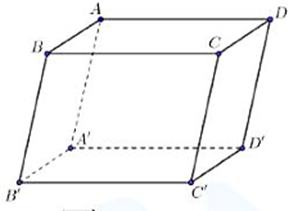
Vectơ nào sau đây cùng phương với \(\overrightarrow {BC} \) ?
\(\overrightarrow {DC} .\)
\(\overrightarrow {DA} .\)
\(\overrightarrow {BB'} .\)
\(\overrightarrow {C'C} .\)
Đáp án đúng là: B
Vectơ cùng phương với \(\overrightarrow {BC} \) là \(\overrightarrow {DA} .\)
Cho hình chóp \(S.ABC\). Tổng của hai vectơ \(\overrightarrow {SA} \) và \(\overrightarrow {AB} \) là
\(\overrightarrow {BS} .\)
\(\overrightarrow {BA} .\)
\(\overrightarrow {SB} .\)
\(\overrightarrow {SC} .\)
Đáp án đúng là: C
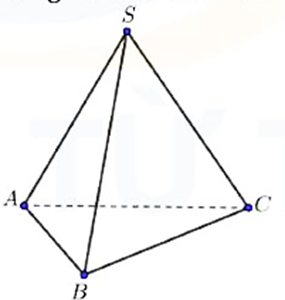
Ta có: \(\overrightarrow {SA} + \overrightarrow {AB} = \overrightarrow {SB} \).
Cho khối lập phương \(ABCD.A'B'C'D'\). Khi đó, góc giữa vectơ \(\overrightarrow {AB} \) và vectơ \(\overrightarrow {AD} \) là
\(90^\circ.\)
\(60^\circ.\)
\(45^\circ.\)
\(30^\circ.\)
Đáp án đúng là: A
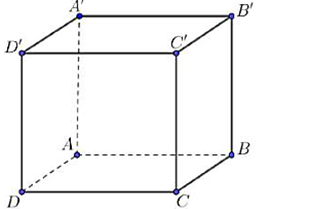
Ta có: \(\left( {\overrightarrow {AB} ,\overrightarrow {AD} } \right) = \widehat {BAD} = 90^\circ .\)
Cho hình lập phương \(ABCD.A'B'C'D'\). Khẳng định nào sau đây là sai?
\(\left( {\overrightarrow {AB} ,\overrightarrow {A'D'} } \right) = 90^\circ.\)
\(\left( {\overrightarrow {AB} ,\overrightarrow {A'C'} } \right) = 45^\circ.\)
\(\left( {\overrightarrow {AC} ,\overrightarrow {B'D'} } \right) = 90^\circ.\)
\(\left( {\overrightarrow {A'A} ,\overrightarrow {CB'} } \right) = 45^\circ.\)
Đáp án đúng là: D
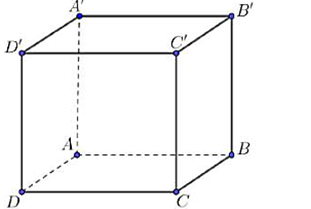
Ta có:
\(ABCD.A'B'C'D'\) là hình lập phương.
Do đó, \(\left( {\overrightarrow {AB} ,\overrightarrow {A'D'} } \right) = \left( {\overrightarrow {AB} ,\overrightarrow {AD} } \right) = \widehat {DAB} = 90^\circ ;\)
\(\left( {\overrightarrow {AB} ,\overrightarrow {A'C'} } \right) = \left( {\overrightarrow {AB} ,\overrightarrow {AC} } \right) = \widehat {BAC} = 45^\circ \);
\(\left( {\overrightarrow {AC} ,\overrightarrow {B'D'} } \right) = \left( {\overrightarrow {AC} ,\overrightarrow {BD} } \right) = 90^\circ ;\)
\(\left( {\overrightarrow {A'A} ,\overrightarrow {CB'} } \right) = \left( {\overrightarrow {C'C} ,\overrightarrow {CB'} } \right) = 180^\circ - \widehat {C'CB'} = 135^\circ .\)
Cho \(\overrightarrow a \) và \(\overrightarrow b \) là hai vectơ khác vectơ \(\overrightarrow 0 \). Mệnh đề nào sau đây đúng?
\(\overrightarrow a.\overrightarrow b = \left| {\overrightarrow a } \right|.\left| {\overrightarrow b } \right|.\cos \left( {\overrightarrow a ,\overrightarrow b } \right).\)
\(\overrightarrow a.\overrightarrow b = \left| {\overrightarrow a } \right|.\left| {\overrightarrow b } \right|.\sin \left( {\overrightarrow a ,\overrightarrow b } \right).\)
\(\overrightarrow a.\overrightarrow b = - \left| {\overrightarrow a } \right|.\left| {\overrightarrow b } \right|.\cos \left( {\overrightarrow a ,\overrightarrow b } \right).\)
\(\overrightarrow a.\overrightarrow b = 0.\)
Đáp án đúng là: A
Ta có công thức tích vô hướng của hai vectơ \(\overrightarrow a \) và \(\overrightarrow b \) khác vectơ \(\overrightarrow 0 \) là:
\(\overrightarrow a .\overrightarrow b = \left| {\overrightarrow a } \right|.\left| {\overrightarrow b } \right|.\cos \left( {\overrightarrow a ,\overrightarrow b } \right).\)
II. Thông hiểu
Cho hình lăng trụ \(ABC.A'B'C'\). Gọi \(M\) là trung điểm của cạnh \(BB'\). Đặt \(\overrightarrow {CA} = \overrightarrow a \), \(\overrightarrow {CB} = \overrightarrow b \), \(\overrightarrow {AA'} = \overrightarrow c \). Khẳng định nào sau đây đúng?
\(\overrightarrow {AM} = \overrightarrow a + \overrightarrow c - \frac{1}{2}\overrightarrow b.\)
\(\overrightarrow {AM} = \overrightarrow b + \overrightarrow c - \frac{1}{2}\overrightarrow a.\)
\(\overrightarrow {AM} = \overrightarrow b - \overrightarrow a + \frac{1}{2}\overrightarrow c.\)
\(\overrightarrow {AM} = \overrightarrow a - \overrightarrow c + \frac{1}{2}\overrightarrow b.\)
Đáp án đúng là: C
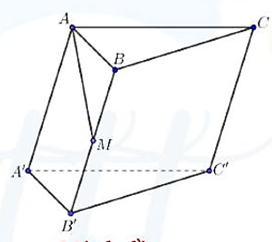
Ta có: \(\overrightarrow {AM} = \overrightarrow {AB} + \overrightarrow {BM} = \overrightarrow {AB} + \frac{1}{2}\overrightarrow {BB'} = \overrightarrow {AC} + \overrightarrow {CB} + \frac{1}{2}\overrightarrow {AA'} = - \overrightarrow a + \overrightarrow b + \frac{1}{2}\overrightarrow c .\)
Cho tứ diện \(ABCD\). Lấy \(G\) là trọng tâm tam giác \(BCD\). Phát biểu nào sau đây là sai?
\(\overrightarrow {GB} + \overrightarrow {GC} + \overrightarrow {GD} = \overrightarrow 0 .\)
\(\overrightarrow {GA} + \overrightarrow {GB} + \overrightarrow {GC} + \overrightarrow {GD} = \overrightarrow 0 .\)
\(\overrightarrow {CB} + \overrightarrow {CD} = 3\overrightarrow {CG} .\)
\(\overrightarrow {AB} + \overrightarrow {AC} + \overrightarrow {AD} = 3\overrightarrow {AG} .\)
Đáp án đúng là: B
Ta có: \(G\) là trọng tâm tam giác \(BCD\) nên \(\overrightarrow {GB} + \overrightarrow {GC} + \overrightarrow {GD} = \overrightarrow 0 \), suy ra đáp án A đúng.
\(\overrightarrow {GA} + \overrightarrow {GB} + \overrightarrow {GC} + \overrightarrow {GD} = \overrightarrow {GA} + \overrightarrow 0 = \overrightarrow {GA} \), suy ra đáp án B sai.
\(\overrightarrow {GB} + \overrightarrow {GC} + \overrightarrow {GD} = \overrightarrow 0 \Leftrightarrow \overrightarrow {GB} + \overrightarrow {GD} = \overrightarrow {CG} \Leftrightarrow \overrightarrow {GC} + \overrightarrow {CB} + \overrightarrow {GC} + \overrightarrow {CD} = \overrightarrow {CG} \Leftrightarrow \overrightarrow {CB} + \overrightarrow {CD} = 3\overrightarrow {CG} .\)
Suy ra đáp án C đúng.
\(\overrightarrow {AB} + \overrightarrow {AC} + \overrightarrow {AD} = \overrightarrow {AG} + \overrightarrow {GB} + \overrightarrow {AG} + \overrightarrow {GC} + \overrightarrow {AG} + \overrightarrow {GD} = 3\overrightarrow {AG} + \overrightarrow 0 = 3\overrightarrow {AG.} \)
Do đó, đáp án D đúng.
Vậy chọn B.
Cho hình lăng trụ \(ABC.A'B'C'\). Chọn khẳng định đúng trong các khẳng định dưới đây:
\(\overrightarrow {B'C} = \overrightarrow {AA'} + \overrightarrow {AB} - \overrightarrow {AC} .\)
\(\overrightarrow {B'C} = - \overrightarrow {AA'} + \overrightarrow {AB} - \overrightarrow {AC} .\)
\(\overrightarrow {B'C} = \overrightarrow {AA'} + \overrightarrow {AB} + \overrightarrow {AC} .\)
\(\overrightarrow {B'C} = - \overrightarrow {AA'} - \overrightarrow {AB} + \overrightarrow {AC} .\)
Đáp án đúng là: D
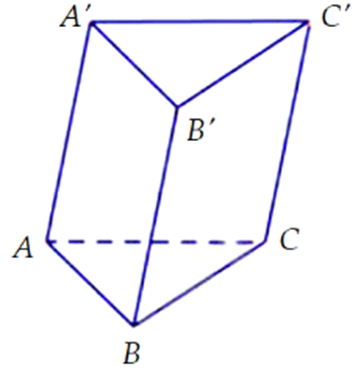
Ta có:
\(\overrightarrow {B'C} = \overrightarrow {B'B} + \overrightarrow {BC} = \overrightarrow {A'A} + \overrightarrow {BA} + \overrightarrow {AC} = - \overrightarrow {AA'} - \overrightarrow {AB} + \overrightarrow {AC} .\)
Cho \(\overrightarrow a \) và \(\overrightarrow b \) là hai vectơ cùng hướng và đều khác vectơ \(\overrightarrow 0 \). Mệnh đề nào sau đây đúng?
\(\overrightarrow a.\overrightarrow b = \left| {\overrightarrow a } \right|.\left| {\overrightarrow b } \right|.\)
\(\overrightarrow a.\overrightarrow b = 0.\)
\(\overrightarrow a.\overrightarrow b = - 1.\)
\(\overrightarrow a.\overrightarrow b = - \left| {\overrightarrow a } \right|.\left| {\overrightarrow b } \right|.\)
Đáp án đúng là: A
Do \(\overrightarrow a \) và \(\overrightarrow b \) là hai vectơ cùng hướng và đều khác vectơ \(\overrightarrow 0 \) nên \(\left( {\overrightarrow a ,\overrightarrow b } \right) = 0^\circ \).
Suy ra \(\overrightarrow a .\overrightarrow b = \left| {\overrightarrow a } \right|.\left| {\overrightarrow b } \right|\cos \left( {\overrightarrow a ,\overrightarrow b } \right) = \left| {\overrightarrow a } \right|.\left| {\overrightarrow b } \right|\cos 0^\circ = \left| {\overrightarrow a } \right|.\left| {\overrightarrow b } \right|.\)
Cho hai vectơ \(\overrightarrow a ,\overrightarrow b \) thỏa mãn: \(\left| {\overrightarrow a } \right| = 4\); \(\left| {\overrightarrow b } \right| = 3\); \(\left| {\overrightarrow a - \overrightarrow b } \right| = 4\). Gọi \(\alpha \) là góc giữa hai vectơ \(\overrightarrow a ,\overrightarrow b \). Chọn khẳng định đúng ?
\(\cos \alpha = \frac{3}{8}.\)
\(\alpha = 30^\circ.\)
\(\cos \alpha = \frac{1}{3}.\)
\(\alpha = 60^\circ.\)
Đáp án đúng là: A
Ta có: \(\left| {\overrightarrow a - \overrightarrow b } \right| = 4\) ⇒ \({\left( {\overrightarrow a - \overrightarrow b } \right)^2} = 16\) ⇔ \({\overrightarrow a ^2} - 2\overrightarrow a .\overrightarrow b + {\overrightarrow b ^2} = 16\)
⇔ \(\overrightarrow a .\overrightarrow b \) = \(\frac{9}{2}\) ⇔ \(\left| {\overrightarrow a } \right|.\left| {\overrightarrow b } \right|.\cos \left( {\overrightarrow a ,\overrightarrow b } \right) = \frac{9}{2}\) ⇔ \(\cos \left( {\overrightarrow a ,\overrightarrow b } \right) = \frac{3}{8}.\)
Cho hình lập phương \(ABCD.EFGH\) có cạnh bằng \(a\). Ta có: \(\overrightarrow {AB} .\overrightarrow {EG} \) bằng:
\({a^2}\sqrt 2 .\)
\({a^2}.\)
\({a^2}\sqrt 3 .\)
\(\frac{{{a^2}\sqrt 2 }}{2}.\)
Đáp án đúng là: B
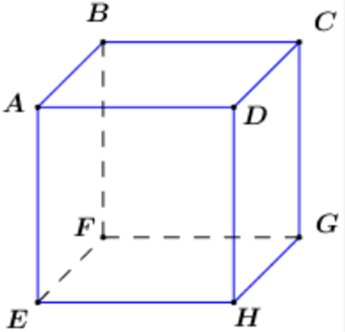
Ta có: \(\overrightarrow {AB} .\overrightarrow {EG} = \overrightarrow {EF} .\overrightarrow {EG} = EF.EG.\cos \left( {\overrightarrow {EF} ,\overrightarrow {EG} } \right) = a.a\sqrt 2 .\cos 45^\circ = {a^2}.\)
Cho hình lăng trụ \(ABC.A'B'C'\) đặt \(\overrightarrow {AA'} = \overrightarrow a ,\overrightarrow {AB} = \overrightarrow b ,\overrightarrow {AC} = \overrightarrow c .\) Gọi \(G'\) là trọng tâm của tam giác \(A'B'C'\). Vectơ \(\overrightarrow {AG'} \) bằng
\(\overrightarrow {AG'} = \frac{1}{3}\left( {\overrightarrow a + 3\overrightarrow b + \overrightarrow c } \right).\)
\(\overrightarrow {AG'} = \frac{1}{3}\left( {3\overrightarrow a + \overrightarrow b + \overrightarrow c } \right).\)
\(\overrightarrow {AG'} = \frac{1}{3}\left( {\overrightarrow a + \overrightarrow b + 3\overrightarrow c } \right).\)
\(\overrightarrow {AG'} = \frac{1}{3}\left( {\overrightarrow a + \overrightarrow b + \overrightarrow c } \right).\)
Đáp án đúng là: B
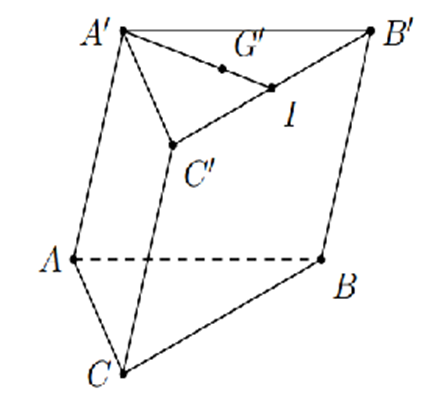
Gọi
\(I\) là trung điểm \(B'C'\). Vì \(G'\) là trọng tâm tam giác \(A'B'C'\) \( \Rightarrow \overrightarrow {A'G'} = \frac{2}{3}\overrightarrow {A'I} .\)
Mặt khác \(\overrightarrow {AG'} = \overrightarrow {AA'} + \overrightarrow {A'G'} = \overrightarrow {AA'} + \frac{2}{3}\overrightarrow {A'I} = \overrightarrow {AA'} + \frac{1}{3}\left( {\overrightarrow {A'B'} + \overrightarrow {A'C'} } \right)\)
\( = \overrightarrow {AA'} + \frac{1}{3}\left( {\overrightarrow {AB} + \overrightarrow {AC} } \right) = \frac{1}{3}\left( {3\overrightarrow {AA'} + \overrightarrow {AB} + \overrightarrow {AC} } \right) = \frac{1}{3}\left( {3\overrightarrow a + \overrightarrow b + \overrightarrow c } \right)\).
Cho hình chóp đều \(S.ABCD\) có tất cả các cạnh bằng \(2\sqrt 3 \). Tính độ dài vectơ \(\overrightarrow u = \overrightarrow {SA} - \overrightarrow {SC} .\)
\(\sqrt 3 .\)
\(\sqrt 2 .\)
\(2\sqrt 6 .\)
\(2\sqrt 2 .\)
Đáp án đúng là: C
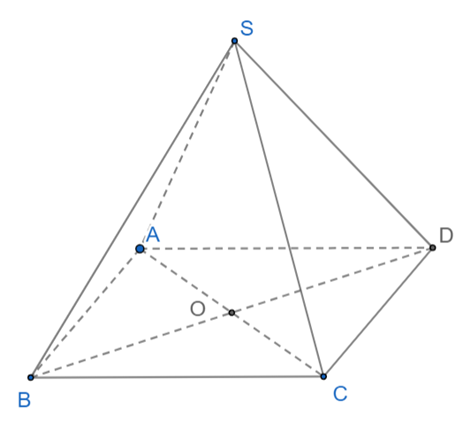
Ta có:
\(\overrightarrow u = \overrightarrow {SA} - \overrightarrow {SC} = \overrightarrow {SA} + \overrightarrow {CS} = \overrightarrow {CA} \).
Suy ra \(\left| {\overrightarrow u } \right| = \left| {\overrightarrow {SA} - \overrightarrow {SC} } \right| = \left| {\overrightarrow {CA} } \right| = \sqrt {{{\left( {2\sqrt 3 } \right)}^2} + {{\left( {2\sqrt 3 } \right)}^2}} = 2\sqrt 6 .\)
Cho hình chóp \(S.ABC\) có \(AB = 4\), \(\widehat {BAC} = 60^\circ \), \(\overrightarrow {AB} .\overrightarrow {AC} = 6\). Khi đó độ dài \(\overrightarrow {AC} \) là
\(3.\)
\(6.\)
\(4.\)
\(12.\)
Đáp án đúng là: A
Ta có: \(\overrightarrow {AB} .\overrightarrow {AC} = 6\)
⇔ \(AB.AC.\cos \left( {\overrightarrow {AB} ,\overrightarrow {AC} } \right) = 6\)
⇔ \(4.AC.\cos 60^\circ = 6\)
⇔ \(AC = 3\).
Vậy độ dài của \(\overrightarrow {AC} \) là 3.
Trong không gian, cho hình lập phương \(ABCD.A'B'C'D'\) có cạnh bằng \(a\). Trong các mệnh đề dưới đây, có bao nhiêu mệnh đề sai?
a) \(\overrightarrow {B'B} - \overrightarrow {DB} = \overrightarrow {B'D} .\)
b) \(\overrightarrow {BA} + \overrightarrow {BC} + \overrightarrow {BB'} = \overrightarrow {BD} .\)
c) \(\left| {\overrightarrow {BA} + \overrightarrow {BC} + \overrightarrow {BB'} } \right| = a\sqrt 2 .\)
d) \(\left| {\overrightarrow {BC} - \overrightarrow {BA} + \overrightarrow {C'A} } \right| = a.\)
\(2.\)
\(3.\)
\(1.\)
\(4.\)
Đáp án đúng là: A
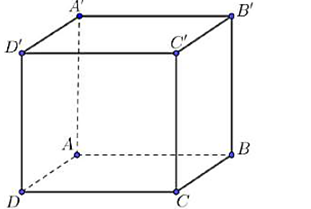
a) \(\overrightarrow {B'B} - \overrightarrow {DB} = \overrightarrow {BB'} + \overrightarrow {BD} = \overrightarrow {B'D} \) ⇒ a) đúng.
b) \(\overrightarrow {BA} + \overrightarrow {BC} + \overrightarrow {BB'} = \overrightarrow {BD} + \overrightarrow {BB'} = \overrightarrow {BD'} \) ⇒ b) sai.
c) Ta có: \(\left| {\overrightarrow {BA} + \overrightarrow {BC} + \overrightarrow {BB'} } \right| = \left| {\overrightarrow {BD'} } \right| = \sqrt {A{B^2} + B{C^2} + B{{B'}^2}} = a\sqrt 3 \) ⇒ c) sai.
d) Ta có: \(\left| {\overrightarrow {BC} - \overrightarrow {BA} + \overrightarrow {C'A} } \right| = \left| {\overrightarrow {AC} + \overrightarrow {C'A} } \right| = \left| {\overrightarrow {C'C} } \right| = a\) ⇒ d) đúng.
III. Vận dụng
Một chiếc đèn chùm treo có khối lượng \(m = 5\) kg được thiết kế với đĩa đèn được giữ bởi bốn đoạn xích \(SA,SB,SC,SD\) sao cho \(S.ABCD\) là hình chóp tứ giác đều có \(\widehat {ASC} = 60^\circ \). Biết \(\overrightarrow P = m.\overrightarrow g \) trong đó \(\overrightarrow g \) là vectơ gia tốc rơi tự do có độ lớn \(10\)m/s2, \(\overrightarrow P \) là trọng lượng của vật có đơn vị kg.
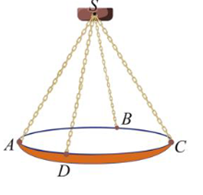
Khi đó:
a) \(\overrightarrow {SA} ,\overrightarrow {SB} ,\overrightarrow {SC} ,\overrightarrow {SD} \) là 4 vectơ đồng phẳng.
b) \(\left| {\overrightarrow {SA} } \right| = \left| {\overrightarrow {SB} } \right| = \left| {\overrightarrow {SC} } \right| = \left| {\overrightarrow {SD} } \right|.\)
c) Độ lớn của trọng lực \(\overrightarrow P \) tác động lên chiếc đèn chùm bằng \(50N\).
d) Độ lớn của lực căng cho mỗi sợi xích bằng \(\frac{{25\sqrt 3 }}{2}N\).
Số mệnh đề đúng trong các mệnh đề trên là:
\(1.\)
\(2.\)
\(3.\)
\(4.\)
Đáp án đúng là: C
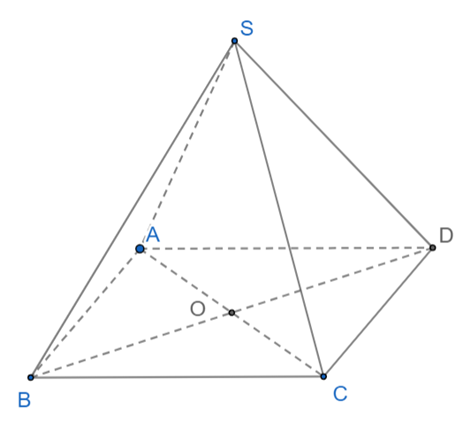
a) Đúng.
b) Đúng. Do \(S.ABCD\) là chóp tứ giác đều nên \(\left| {\overrightarrow {SA} } \right| = \left| {\overrightarrow {SB} } \right| = \left| {\overrightarrow {SC} } \right| = \left| {\overrightarrow {SD} } \right|.\)
c) Đúng. Độ lớn của trọng lực \(\overrightarrow P \) tác động lên chiếc đèn chùm là: \(P = mg = 5.10 = 50N.\)
d) Sai. Ta có là hình chóp tứ giác đều ⇒ \(SA = SB = SC = SD\) và \(\widehat {ASC} = 60^\circ \) nên tam giác \(SAC\) đều.
Gọi \(O\) là trung điểm \(AC\).
Để đèn chùm đứng yên thì hợp lực của các sợi xích phải cân bằng với mọi lực hay \(4\overrightarrow {SO} = \overrightarrow P \) hay \(4SO = P\) ⇔ \(SO = 12,5\).
Xét tam giác đều \(SAC\) có \(SA = \frac{{\sqrt 3 }}{2}SO = \frac{{25\sqrt 3 }}{4}.\)
Vậy độ lớn của lực căng cho mỗi sợi xích là \(\frac{{25\sqrt 3 }}{4}N\)
Cho tứ diện \(ABCD\) có \(AB = AC = AD\) và \(\widehat {BAC} = \widehat {BAD} = 60^\circ \), \(\widehat {CAD} = 90^\circ \). Gọi \(I\) và \(J\) lần lượt là trung điểm của \(AB\) và \(CD\). Hãy xác định góc giữa cặp vectơ \(\overrightarrow {AB} \) và \(\overrightarrow {IJ} \) ?
\(120^\circ.\)
\(90^\circ.\)
\(60^\circ.\)
\(30^\circ.\)
Đáp án đúng là: B
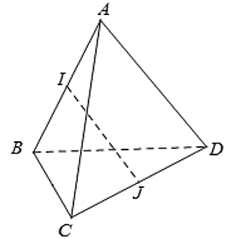
Ta có:
\(\overrightarrow {IJ} = \frac{1}{2}\left( {\overrightarrow {IC} + \overrightarrow {ID} } \right)\).
Vì tam giác \(ABC\) có \(AB = AC\) và \(\widehat {BAC} = 60^\circ \) nên tam giác \(ABC\) đều.
Suy ra \(CI \bot AB\).
Tương tự ta có tam giác \(ABD\) đều nên \(DI \bot AB\).
Xét: \(\overrightarrow {IJ} .\overrightarrow {AB} = \frac{1}{2}\left( {\overrightarrow {IC} + \overrightarrow {ID} } \right).\overrightarrow {AB} = \frac{1}{2}\overrightarrow {IC} .\overrightarrow {AB} + \frac{1}{2}\overrightarrow {ID} .\overrightarrow {AB} \) \( = \overrightarrow 0 \).
Suy ra \(\left( {\overrightarrow {IJ} ,\overrightarrow {AB} } \right) = 90^\circ \).
Cho tứ diện đều \(ABCD\) cạnh \(a\). Gọi \(M\) là trung điểm của \(BC\).
Tính \(\cos \left( {\overrightarrow {AB} ,\overrightarrow {DM} } \right)\).
\(\frac{{\sqrt 3 }}{6}.\)
\(\frac{{\sqrt 6 }}{3}.\)
\(\frac{{\sqrt 3 }}{2}.\)
\(\frac{{\sqrt 3 }}{2}.\)
Đáp án đúng là: A
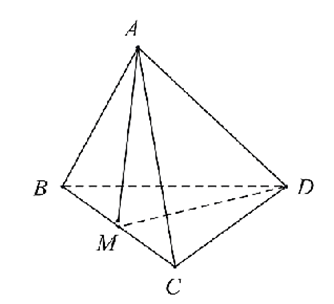
Xét tứ diện
\(ABCD\) cạnh \(a\) ta có: \(\overrightarrow {DM} = \frac{{a\sqrt 3 }}{2};AM = \frac{{a\sqrt 3 }}{2}\).
Ta có: \(\overrightarrow {AB} .\overrightarrow {DM} = \overrightarrow {AB} .\left( {\overrightarrow {AM} - \overrightarrow {AD} } \right) = \overrightarrow {AB} .\overrightarrow {AM} - \overrightarrow {AB} .\overrightarrow {AD} \)
\( = \left| {\overrightarrow {AB} } \right|.\left| {\overrightarrow {AM} } \right|.\cos \left( {\overrightarrow {AB} ,\overrightarrow {AM} } \right) - \left| {\overrightarrow {AB} } \right|.\left| {\overrightarrow {AD} } \right|.\cos \left( {\overrightarrow {AB} ,\overrightarrow {AD} } \right)\)
= \(a.\frac{{a\sqrt 3 }}{2}.\frac{{\sqrt 3 }}{2} - a.a.\frac{1}{2} = \frac{{{a^2}}}{4}\).
Ta có: \(\cos \left( {\overrightarrow {AB} ,\overrightarrow {DM} } \right)\) = \(\frac{{\overrightarrow {AB} .\overrightarrow {DM} }}{{\left| {\overrightarrow {AB} } \right|.\left| {\overrightarrow {DM} } \right|}} = \frac{{\frac{{{a^2}}}{4}}}{{a.\frac{{a\sqrt 3 }}{2}}} = \frac{{\sqrt 3 }}{6}\).
Cho hình chóp \(S.ABC\) có \(SA = SB = SC\) và \(\widehat {ASB} = \widehat {BSC} = \widehat {CSA}\). Hãy xác định góc giữa cặp vectơ \(\overrightarrow {SA} \) và \(\overrightarrow {BC} \) ?
\(120^\circ.\)
\(90^\circ.\)
\(60^\circ.\)
\(45^\circ.\)
Đáp án đúng là: B
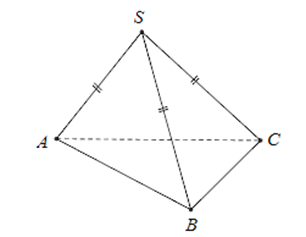
Ta có: \(\overrightarrow {SA} .\overrightarrow {BC} = \overrightarrow {SA} \left( {\overrightarrow {SC} - \overrightarrow {SB} } \right) = \overrightarrow {SA} .\overrightarrow {SC} - \overrightarrow {SA} .\overrightarrow {SB} = SA.SC.\cos \widehat {ASC} - SA.SB.\cos \widehat {ASB}\) = 0.
⇒ \(\left( {\overrightarrow {SA} ,\overrightarrow {BC} } \right) = 90^\circ .\)
Cho tứ diện \(ABCD\). Gọi \(E,F\) là các điểm lần lượt thuộc các cạnh \(AB,CD\) sao cho \(AE = \frac{1}{3}AB,CF = \frac{1}{3}CD\). Tìm giá trị \(k\) với \(k \in \mathbb{R}\) thỏa mãn đẳng thức:
\(\overrightarrow {EF} = \frac{1}{3}\overrightarrow {AD} + k.\overrightarrow {BC} + \frac{1}{3}.\overrightarrow {AB} \).
\(k = \frac{2}{3}.\)
\(k = \frac{1}{3}.\)
\(k = \frac{3}{4}.\)
\(k = \frac{4}{3}.\)
Đáp án đúng là: A
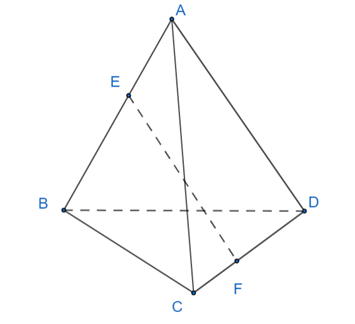
Ta có: \(\overrightarrow {EF} = \overrightarrow {EA} + \overrightarrow {AD} + \overrightarrow {DF} \)
= −\(\overrightarrow {AE} \) + \(\overrightarrow {AD} \) − \(\overrightarrow {FD} \)
= \(\overrightarrow {AD} \)− \(\frac{1}{3}\overrightarrow {AB} \) − \(\frac{2}{3}\overrightarrow {CD} \). (1)
Vậy \(\overrightarrow {EF} = \overrightarrow {AD} - \frac{1}{3}\overrightarrow {AB} - \frac{2}{3}\overrightarrow {CD} \).
Ta có: \(\overrightarrow {EF} = \overrightarrow {EB} + \overrightarrow {BC} + \overrightarrow {CF} \)
= \(\frac{2}{3}\overrightarrow {AB} + \overrightarrow {CB} + \frac{1}{3}\overrightarrow {CD} \).
Vậy \(\overrightarrow {EF} = \overrightarrow {BC} + \frac{2}{3}\overrightarrow {AB} + \frac{1}{3}\overrightarrow {CD} \). (2)
\(3\overrightarrow {EF} = \left( {\overrightarrow {AD} - \frac{1}{3}\overrightarrow {AB} - \frac{2}{3}\overrightarrow {CD} } \right) + 2\left( {\frac{2}{3}\overrightarrow {AB} + \overrightarrow {CB} + \frac{1}{3}\overrightarrow {CD} } \right)\)
= \(\overrightarrow {AD} - \frac{1}{3}\overrightarrow {AB} - \frac{2}{3}\overrightarrow {CD} \) + \(\frac{4}{3}\overrightarrow {AB} + 2\overrightarrow {CB} + \frac{2}{3}\overrightarrow {CD} \)
= \(\overrightarrow {AD} \) + \(\left( { - \frac{1}{3}\overrightarrow {AB} + \frac{4}{3}\overrightarrow {AB} } \right)\) + \(\left( { - \frac{2}{3}\overrightarrow {CD} + \frac{2}{3}\overrightarrow {CD} } \right)\) + \(2\overrightarrow {CB} \)
= \(\overrightarrow {AD} \) + \(2\overrightarrow {CB} \) + \(\overrightarrow {AB} \)
⇒ \(\overrightarrow {EF} = \frac{1}{3}\overrightarrow {AD} + \frac{2}{3}\overrightarrow {BC} + \frac{1}{3}\overrightarrow {AB} \).
Vậy \(k = \frac{2}{3}.\)