Trắc nghiệm tổng hợp Tiếng anh có đáp án 2023 (Phần 41)
90 câu hỏi
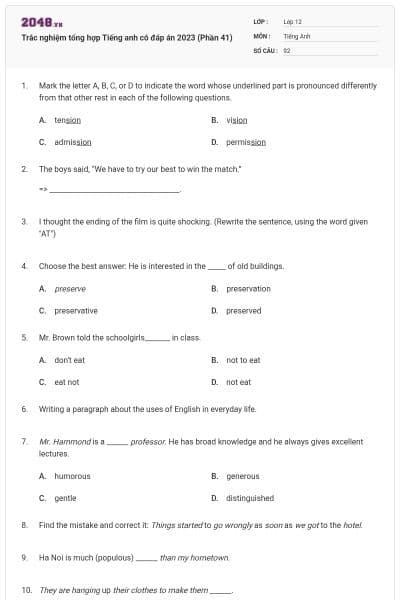
Mark the letter A, B, C, or D to indicate the word whose underlined part is pronounced differently from that other rest in each of the following questions.
tension
vision
admission
permission
Đáp án: B
Giải thích: Đáp án B phát âm là /ʒ/ còn lại là /ʃ/.
Dịch:
A. sự căng thẳng
B. tầm nhìn
C. nhập học
D. sự cho phép
The boys said, “We have to try our best to win the match.”
=> ____________________________________.
Đáp án: The boys said they had to try their best to win the match.
Giải thích: Chuyển từ câu trực tiếp sang gián tiếp phải lùi 1 thì: have to => had to
Dịch: Các chàng trai nói rằng họ phải cố gắng hết sức để giành chiến thắng trong trận đấu.
I thought the ending of the film is quite shocking. (Rewrite the sentence, using the word given "AT")
Đáp án: I was quite shocked at the ending of the film.
Giải thích: be shocked at: cảm thấy sốc về điều gì
Dịch: Tôi khá là sốc về cái kết của bộ phim.
Choose the best answer: He is interested in the _____ of old buildings.
preserve
preservation
preservative
preserved
Đáp án: B
Giải thích: Sau “the” cần một danh từ.
Dịch: Anh ấy có hứng thú trong việc bảo tồn những tòa nhà cũ.
don't eat
not to eat
eat not
not eat
Đáp án: B
Giải thích: told sb (not) to V: bảo ai (không) làm gì
Dịch: Thầy Brown nhắc nhở các bạn học sinh nữ không được ăn trong lớp.
Writing a paragraph about the uses of English in everyday life.
Gợi ý: English is an indispensable language that finds extensive use in everyday life across the globe. This versatile language serves as a means of communication in various aspects of our daily routines. From informal conversations with family and friends to professional interactions in the workplace, English facilitates effective communication, breaking down barriers between people of diverse backgrounds. It is the language of international travel, enabling individuals to navigate foreign lands and connect with locals. Moreover, English is crucial in accessing and understanding a wealth of information online, from news articles to academic resources. Whether in entertainment, education, business, or social settings, English plays a vital role, making it an invaluable tool for global communication and personal growth.
Dịch: Tiếng Anh là một ngôn ngữ không thể thiếu được sử dụng rộng rãi trong cuộc sống hàng ngày trên toàn cầu. Ngôn ngữ linh hoạt này phục vụ như một phương tiện giao tiếp trong các khía cạnh khác nhau của thói quen hàng ngày của chúng tôi. Từ những cuộc trò chuyện thân mật với gia đình và bạn bè đến những tương tác chuyên nghiệp tại nơi làm việc, tiếng Anh tạo điều kiện giao tiếp hiệu quả, phá bỏ rào cản giữa những người có nguồn gốc khác nhau. Đó là ngôn ngữ của du lịch quốc tế, cho phép các cá nhân điều hướng các vùng đất xa lạ và kết nối với người dân địa phương. Hơn nữa, tiếng Anh rất quan trọng trong việc truy cập và hiểu vô số thông tin trực tuyến, từ các bài báo đến các nguồn học thuật. Cho dù trong môi trường giải trí, giáo dục, kinh doanh hay xã hội, tiếng Anh đều đóng một vai trò quan trọng, khiến nó trở thành một công cụ vô giá để giao tiếp toàn cầu và phát triển cá nhân.
Mr. Hammond is a ______ professor. He has broad knowledge and he always gives excellent lectures.
humorous
generous
gentle
distinguished
Đáp án: D
Giải thích:
A. hài hước
B. hào phóng
C. nhẹ nhàng
D. ưu tú
Dịch: Ông Hammond là một giáo sư ưu tú. Anh ấy có kiến thức rộng và anh ấy luôn đưa ra những bài giảng xuất sắc.
Find the mistake and correct it: Things started to go wrongly as soon as we got to the hotel.
Đáp án: wrongly
Giải thích: go + adj: trở nên như thế nào => wrong
Dịch: Mọi thứ bắt đầu trở nên tồi tệ ngay khi chúng tôi đến khách sạn.
Ha Noi is much (populous) ______ than my hometown.
Đáp án: more populous
Giải thích: So sánh hơn với tính từ dài: more + adj
Dịch: Hà Nội đông dân hơn nhiều so với quê tôi.
They are hanging up their clothes to make them ______.
dry
being dry
drying
dried
Đáp án: A
Giải thích: make st adj: làm cái gì như thế nào
Dịch: Họ treo quần áo lên để làm chúng khô.
This is my first visit to Scotland.
=> I have ______________________.
Đáp án: I have never visited Scotland before.
Giải thích: have/has + never + Vp2: chưa từng làm gì
Dịch: Tôi chưa từng tới Scotland trước đó.
Đáp án: watched
Giải thích: last night => thì quá khứ đơn: S + Vqk
Dịch: Chúng tôi đã xem một chương trình TV thú vị vào tối qua.
Mark the letter A, B, C, or D to indicate the word whose underlined part is pronounced differently from that other rest in each of the following questions.
comb
climb
dumb
blond
Đáp án: D
Giải thích: Đáp án D phát âm là /b/ còn lại là âm câm.
Dịch:
A. cái lược
B. leo, trèo
C. điếc
D. vàng hoe
Mark the letter A, B, C, or D to indicate the word whose underlined part is pronounced differently from that other rest in each of the following questions.
enough
laugh
cough
plough
Đáp án: D
Giải thích: Đáp án D là âm câm, còn lại là âm /f/.
Dịch:
A. đủ
B. cười lớn
C. ho
D. cày bừa
Mark the letter A, B, C, or D to indicate the word whose underlined part is pronounced differently from that other rest in each of the following questions.
listened
stayed
opened
wanted
Đáp án: D
Giải thích: Đáp án D phát âm là /id/ còn lại là /d/.
Dịch:
A. nghe
B. ở lại
C. mở ra
D. muốn
is protected
are protected
protect
protects
Đáp án: B
Giải thích:
- Câu bị động thì hiện tại đơn: S + is/am/are + Vp2
- Chủ ngữ “women” là số nhiều => đi với tobe “are”
Dịch: Hiện tại, phụ nữ được bảo vệ bởi pháp luật.
Complete the second sentence so that it has a similar meaning to the first:
Reading is more boring than watching TV.
Đáp án: Watching TV is more interesting than reading.
Giải thích: boring (chán ngắt) >< interesting (thú vị)
Dịch: Xem TV thì thú vị hơn nhiều so với đọc sách.
- “Do you mind if I use your phone?” – “________________”
Sorry. I have no idea
Not at all. Help yourself
Yes, certainly
You can say that again
Đáp án: B
Giải thích:
“Bạn có phiền nếu tôi sử dụng điện thoại của bạn không?”
A. Xin lỗi. Tôi không có ý kiến
B. Không vấn đề gì. Cứ tự nhiên
C. Vâng, chắc chắn rồi
D. Bạn có thể nói lại lần nữa
Hoàn thành câu:take part/ party/ enjoyable/ is/ in/ to/ how/ it / this
Đáp án: How enjoyable it is to take part in this party!
Giải thích: Câu cảm thán: How + adj/adv + S + V!
Dịch: Thật thú vị biết bao khi được tham gia vào bữa tiệc này!
If you own a small car, it uses more gas.
The smaller the car, the more gas it uses.
The larger the car,the more gas it uses.
Large cars don’t use as much gas as smaller ones.
Đáp án: C
Giải thích:
Những chiếc xe lớn sử dụng nhiều xăng hơn những chiếc xe nhỏ hơn.
A. Nếu bạn sở hữu một chiếc ô tô nhỏ, nó sẽ tốn nhiều xăng hơn.
B. Xe càng nhỏ thì càng tốn xăng.
C. Xe càng lớn thì càng tốn xăng.
D. Xe ô tô lớn không sử dụng nhiều xăng như ô tô nhỏ hơn.
John's reaction at the party surprised me.
=> I was _____________________.
Đáp án: I was surprised at John’s reaction at the party.
Giải thích: be surprised at: ngạc nhiên về...
Dịch: Tôi ngạc nhiên trước phản ứng của John tại bữa tiệc.
Tìm và sửa lỗi sai: Lan,together with her students are going to the party tonight.
Đáp án: are
Giải thích: A together with B chia động từ theo A, Lan là ngôi ba số ít => đi với tobe “is”
Dịch: Lan, cùng với học sinh của cô ấy sẽ đến bữa tiệc tối nay.
Find the mistake and correct it: My brother is not too bad with repairing things in the house.
Đáp án: with
Giải thích: be bad at: tệ, không giỏi làm gì
Dịch: Anh trai tôi sửa chữa đồ đạc trong nhà không tệ lắm.
My joke made the whole class ______.
laugh
laughing
smile
cry
Đáp án: A
Giải thích: make sb V: làm ai như thế nào
Dịch: Trò đùa của tôi làm cả lớp cười phá lên.
Find the mistake and correct it: She used to walking to school when he was a child.
Đáp án: walking
Giải thích: used to V: từng hay làm gì trong quá khứ và bây giờ không còn nữa => walk
Dịch: Cô thường đi bộ đến trường khi anh còn nhỏ.
I was too (shame) _____ to tell the teacher about my stupid mistakes.
shameful
ashamed
shameless
shamefully
Đáp án: B
Giải thích:
- Sau to be very cần một tính từ => loại D
- Các đáp án còn lại:
+ A. shameful: đáng xấu hổ
+ B. ashamed: hổ thẹn, xấu hổ
+ C. shamless: không biết xấu hổ
Dịch: Tôi quá xấu hổ để kể cho giáo viên về những lỗi lầm ngu ngốc của tôi.
popular
essential
incredible
unbelievable
Đáp án: B
Giải thích: necessary = essential: cần thiết
Dịch: Thời tiết lạnh khiến việc bảo vệ mùa màng trở nên cần thiết.
Read and answer the questions.
The elephant is the largest animal to walk on Earth. An elephant can carry a load of 1,200 pounds. They eat 300 pounds of food a day. An elephant baby can weigh 200 pounds at birth. Elephants can live up to 70 years. Elephants can be trained to carry logs with their trunks. They also use their trunks for drinking water, bathing, eating and communicating. There are two kinds of elephants: the African elephant and the Indian elephant. African elephant can be characterized as larger ears. The African elephant grows up to 10 feet and weighs as much as 12,000 pounds. The Indian elephant grows up to 9 feet tall, and weighs up to 800 pounds. This elephant is characterized as smaller ears. Another name for the Indian elephant is the Asian elephant.
Which kind of elephant is the largest?
The African elephant is the largest kind of elephant, characterized by larger ears.
his
your
hers
her
Đáp án: D
Giải thích:
- Trước danh từ cần tính từ sở hữu => loại C
- mother cat (mèo mẹ) => dùng với “her” (của cô ấy)
Dịch: Mèo mẹ và những chú mèo con của cô ấy nằm tắng nắng.
It is a two-hours train journey from London to Bristol.
It is a two-hour train journey from London to Bristol.
It is a two-hour train of journey from London to Bristol.
It is the two-hour train journey from London to Bristol.
Đáp án: B
Giải thích:
- tính từ ghép: số lượng-danh từ số ít => loại A
- danh từ ghép: train journey: chuyến đi bằng tàu => loại C
- chuyến đi chưa được nhắc đến lần nào => không dùng mạo từ “the” => loại D
Dịch: Đó là một chuyến tàu kéo dài hai giờ từ London đến Bristol.
There are only two things that one should do ______ a healthy and fit body: eating sensibly and exercising well.
keeping
to keep
for keeping
keep
Đáp án: B
Giải thích: to V: để làm gì
Dịch: Chỉ có hai điều mà một người nên làm để giữ một cơ thể khỏe mạnh và cân đối: ăn uống hợp lý và tập thể dục đều đặn.
Tom learned to drive when he was nineteen.
=> Tome has _________________________.
Đáp án: Tom has been able to drive since he was nineteen.
Giải thích:
- be able to V: có thể làm gì
- mệnh đề trước “since” chia thì hiện tại hoàn thành
Dịch: Tom có thể lãi xe kể từ khi anh ấy 19 tuổi.
We got lost because we didn't have a map.
=> If ______________________________.
Đáp án: If we had hada map, we wouldn't have got lost.
Giải thích: Câu điều kiện 3 giả định không có thật ở quá khứ: If + S + had Vp2, S + would + have Vp2
Dịch: Nếu chúng tôi có bản đồ, chúng tôi sẽ không bị lạc.
When did you start to listen to classical music?
=> How long _____________________________.
Đáp án: How long have you listened to classical music?
Giải thích: How long + have/has + S + Vp2?: hỏi bao lâu
Dịch: Bạn đã nghe nhạc cổ điển được bao lâu rồi?
go
going
went
gone
Đáp án: A
Giải thích: used to V: thường hay làm gì trong quá khứ và bây giờ không còn nữa.
Dịch: Khi tôi còn nhỏ, tôi thường đến thăm bà ngoại.
Reorder the words to make a complete sentence: yesterday/ who/ play/ football/ you/ did/ with?
Đáp án: Who did you play football yesterday with?
Giải thích: Cấu trúc thì quá khứ đơn dạng Wh-qs: Wh-word + did + S + V?
Dịch: Bạn chơi đóng đá với ai vào ngày hôm qua?
you / better / not eat / too / candies / because / they / not good
Đáp án: You had better not eat too much candy because they are not good for your teeth.
Giải thích: had better V: tốt hơn hết nên làm gì
Dịch: Bạn tốt hơn hết không nên ăn quá nhiều kẹo bởi vì chúng không tốt cho răng của bạn.
lately
early
later
late
Đáp án: D
Giải thích:
- Bổ nghĩa cho động từ “work” cần một trạng từ.
- “late” là trạng từ mang nghĩa là muộn
- “lately” cũng là trạng từ nhưng mang nghĩa là gần đây
Dịch: Tôi có trách nhiệm nấu bữa tối bởi vì mẹ tôi thường làm về muộn.
made
gone
used to
found
Đáp án: A
Giải thích: make up one’s mind = make a decision: đưa ra quyết định
Dịch: Bob vẫn chưa đưa ra quyết định.
What ______ you (do) _____ tomorrow morning? - I (play) _______video games.
Đáp án: will/ do/ will play
Giải thích: tomorrow => thì tương lai đơn
- Cấu trúc dạng Wh-qs: Wh-word + will + S + V?
- Cấu trúc dạng Khẳng định: S + will + V
Dịch: Bạn sẽ làm gì vào sáng mai? Tôi sẽ chơi điện tử.
We've finished decorating upstairs but the downstairs still needs some ______.
profession
job
work
occupation
Đáp án: C
Giải thích:
- profession, occupation, job đều chỉ những công việc mang tính sự nghiệp, lâu dài
- work có thể dùng để chỉ những công việc mang tính công trình, dự án
Dịch: Chúng tôi đã trang trí xong tầng trên nhưng tầng dưới vẫn cần làm thêm.
He is a considerate and generous man wholoved not only by his family but also by all his friends.
all his friends
loved
is a
but also
Đáp án: B
Giải thích: Chuyển sang câu bị động: be Vp2 => is loved
Dịch: Anh ấy là một người đàn ông ân cần và hào phóng, được yêu mến không chỉ bởi gia đình mà còn bởi tất cả bạn bè của anh ấy.
I am short, so i can't play volleyball.
=> If ____________________________.
Đáp án: If I were tall, I could play volleyball.
Giải thích: Câu điều kiện 2 giả định không có thật ở hiện tại: If + S + Vqk, S + would + V
Dịch: Nếu tôi cao thì tôi có thể chơi bóng chuyền.
You can't go into the bar because you are not old enough.
=> If _____________________.
Đáp án: If I were old enough, I could go into the bar.
Giải thích: Câu điều kiện giả định không có thật ở hiện tại: If + S + Vqk, S + would + V
Dịch: Nếu tôi đủ tuổi, tôi có thể vào quán bar.
The school is now very _______________. That’s why the quality of teaching and learning is much better. (equip)
Đáp án: well-equipped
Giải thích: Sau to be very cần một tính từ.
Dịch: Trường học bây giờ được trang bị rất tốt. Nhờ vậy chất lượng dạy và học tốt hơn rất nhiều.
After hiring the ______, they paddled out.
can
canyon
canoe
ship
Đáp án: C
Giải thích:
A. cái can, lon
B. hẻm núi
C. ca-nô
D. tàu
Dịch: Sau khi thuê ca-nô, họ chèo ra ngoài.
capital
citadel
landscape
variety
Đáp án: A
Giải thích:
A. thủ đô
B. kinh thành
C. phong cảnh
D. đa dạng
Dịch: Cardiff là thành phố lớn nhất và cũng là thủ đô của xứ Wales.
change
children
machine
church
Đáp án: C
Giải thích: Đáp án C phát âm là /ʃ/ còn lại là /tʃ/.
Dịch:
A. thay đổi
B. trẻ em
C. máy móc
D. nhà thờ
Turn the following sentences into the active voice: Don't let the dog be teased by the children.
Đáp án: Don’t let the children tease the dog.
Giải thích: Let sb V: cho phép ai làm gì
Dịch: Đừng để lũ trẻ trêu con chó đó.
People know that cars pollute the environment.
=> It __________________________________________.
Đáp án: It is known that cars pollute the environment.
Giải thích: Câu bị động kép: It + be + Vp2 + that + S + V
Dịch: Người ta biết rằng ô tô làm ô nhiễm môi trường.
He came into the room, _____ the light and _____ the door behind him.
turned on/ closing
turning on/ closing
turned on/ closed
turning on/ closed
Đáp án: C
Giải thích: Kể lại một chuỗi sự việc trong quá khứ => các động từ phải để cùng thì
Dịch: Anh ấy đi vào phòng, bật đèn và đóng cửa đằng sau anh ấy.
He performed better than he was expected.
=> He was ____________________________.
Đáp án: He was expected to perform worse than he did.
Giải thích: be expected to V: được kì vọng, được cho là
Dịch: Anh ấy được cho là thể hiện tệ hơn thực tế anh ấy đã làm.
Đáp án: to watch
Giải thích: spend + time + Ving: dành thời gian làm gì => watching
Dịch: Anh ấy dành thời gian rảnh để xem một trận bóng đá trên TV.
and
but
or
so
Đáp án: D
Giải thích:
A. và
B. nhưng
C. hoặc
D. vì vậy
Dịch: Anh ấy còn rất trẻ và không có kinh nghiệm về loại công việc đó, vì vậy anh ấy đã không được giao cho vị trí này.
I / study /, / harder / I / pass / will / the / written examination / If.
Đáp án: If I study harder, I will pass written examination.
Giải thích: Câu điều kiện 1 giả định có thể xảy ra ở hiện tại hoặc tương lai: If + S + V(s/es), S + will + V
Dịch: Nếu tôi học chăm chỉ hơn, tôi sẽ vượt qua bài kiểm tra viết.
I didn't go to school because I was sick.
=> I was sick, so _______________________.
I / study /, / harder / I / pass / will / the / written examination / If.
I shareda flat with him when we were students. He always (complain) ______ about my untidiness.
Đáp án: complained
Giải thích: always + ngữ cảnh trong quá khứ => quá khứ đơn
Dịch: Tôi ở chung căn hộ với anh ấy khi chúng tôi còn là sinh viên. Anh ấy luôn phàn nàn về sự bừa bộn của tôi.
I started working for the company a year ago.
=> I have _______________________.Đáp án: I have worked for the company for a year.
Giải thích: started + to V/Ving...ago = have/has + Vp2 (+for/since...)
Dịch: Tôi đã làm cho công ty này được một năm.
Tìm và sửa lỗi sai: I still have to finish my project, what keeps me very busy.
Giải thích: Thay thế cho mệnh đề phía trước trong mệnh đề quan hệ cần dùng đại từ quan hệ “which”.
Dịch: Tôi vẫn phải hoàn thành dự án của mình, điều khiến tôi rất bận rộn.
Read the passage below and choose the best answer for each question.
If you were to stop people in the street and ask them to name a ship that had been sunk, it is likely that nearly all of them would say the Titanic. For the sinking of the Titanic was, if not the most tragic, certainly the most famous sea disaster in the history of ocean travel.
The Titanic was built as a luxury liner, intended to be the fastest in the world, and a great deal of publicity had surrounded it. The last point probably explains why so many important people from all walks of life were on the boat when it went down.
The Titanic was on its maiden voyage to America in 1912 when it struck an iceberg and sank. Of its 2,300 passengers, more than two-thirds were drowned. Because the Titanic was thought to be virtually unsinkable, no one was prepared for the tragedy. There was total panic as very few of the passengers had bothered to learn the necessary drill in the event of trouble. There was severe shortage of lifeboats and those that were launched were still half-empty. The one point of calm was to be found in the ballroom where the band carried on playing right to the very end.
What makes the sinking of the Titanic even more tragic is the fact that warnings of icebergs had been sent, yet the liner was still continuing at full speed. In addition, one ship was only ten miles away but did not receive the distress signal.
One good thing did, however, result from the disaster. The whole question of safety at sea was looked into, resulting in much better safety measures, including stricter lifeboat regulations and the establishment of an iceberg patrol.
the most tragic sea disaster
the most historic sea disaster.
the most famous sea disaster
the first great sea disaster.
Dẫn chứng "for the sinking of the titanic was, if not the most tragic, certainly the most famous sea disaster in the history of ocean travel."
first
historical
important
last
Chọn A
maiden = first: đầu tiên
too short
launched too soon
half finished
poorly equipped
Chọn D
Dẫn chứng "there was severe shortage of lifeboats and those that were launched were still half-empty."
The word “those” refers to______.
passengers
icebergs
people
lifeboats
Chọn D
Dẫn chứng “There was severe shortage of lifeboats and those that were launched were still half-empty.
a full inquiry was made
sea travel was made safer
lifeboats were made larger
a program of iceberg destructionwas started
Chọn C
Dẫn chứng "one good thing did, however, result from the disaster. the whole question of safety at sea was looked into, resulting in much better safety measures, including stricter lifeboat regulations and the establishment of an iceberg patrol."
It took Mr. Hoang half an hour to walk to work yesterday.
=> Mr. Hoang spent ___________________.Đáp án: Mr. Hoang spent half an hour walking to work yesterday.
Giải thích: take sb time to V = spend time Ving: mất bao lâu để làm gì
Dịch: Ông Hoàng dành nửa tiếng đồng hồ để đi bộ đi làm vào hôm qua.
so do I
neither don't I
I don't,either
I do, too
Đáp án: C
Giải thích:
- Trong câu có từ phủ định “never” => dùng mệnh đề đồng tình phủ định: S + trợ động từ/tobe/động từ khuyết thiếu + not, either
Dịch: Anh tôi không bao giờ đi học muộn và tôi cũng thế.
Choose one word whose underlined part is pronounced differently from the others.
sure
saw
send
sit
Đáp án: A
Giải thích: Đáp án A phát âm là /ʃ/ còn lại là /s/.
Dịch:
A. chắc chắn
B. nhìn
C. gửi
D. ngồi
being
to be
be
to being
Đáp án: B
Giải thích: told sb to V: bảo ai làm gì
Dịch: Nha sĩ bảo tôi phải cẩn thận hơn khi đánh răng.
many furniture
some furnitures
some furniture
many furnitures
Đáp án: C
Giải thích:
- furniture không đếm được => không để dạng số nhiều => loại B, D
=> many + N(s/es) => loại A
Dịch: Giá bán căn nhà đó và một số đồ nội thất là $24,000.
destroy
destroyed
destructive
destruction
Đáp án: D
Giải thích: Sau “the” cần một danh từ.
Dịch: Có rất nhiều điều đơn giản chúng ta có thể làm để ngăn chặn sự tàn phá môi trường.
Tìm và sửa lỗi sai: There is a ten-floors building in front of my house.
Đáp án: ten-floors
Giải thích: tính từ ghép: số lượng-danh từ số ít => ten-floor
Dịch: Có một tòa nhà 10 tầng trước nhà tôi.
Every time we rang there weren’t any answers.
Every time we rang there wereany answers.
Every time we rang there weresome answers.
Every time we rang there weren’t some answers.
Đáp án: A
Giải thích:
- any dùng trong câu phủ định, some dùng trong câu khẳng định => loại B, D
- Các đáp án còn lại:
A. Lần nào chúng tôi gọi cũng không có câu trả lời.
C. Mỗi khi chúng tôi gọi có một số câu trả lời.
Dịch: Không bao giờ có bất kỳ câu trả lời nào khi chúng tôi gọi.
Đáp án: with
Giải thích: cover st with: bao phủ, băng bó cái gì với...
Dịch: Chúng ta nên băng vùng bị bỏng bằng băng vô trùng dày.
Đáp án: mine
Giải thích: Chỗ trống ở đây cần một đại từ sở hữu: mine = my car
Dịch: Đây là xe ô tô của cô ấy. Chiếc ô tô kia là của tôi.
Tourists coming to Sapa usually visit ___________where the ethnic minorities live.
tribes
districts
villages
hamlets
Đáp án: A
Giải thích:
A. bộ lạc
B. huyện
C. làng
D. ấp
Dịch: Khách du lịch đến Sapa thường đến thăm các bộ tộc nơi các dân tộc thiểu số sinh sống.
“We are having a workshop on information technology this Friday,” said Mark.
=> Mark said that _____________________________.
Đáp án: Mark said that they were having a workshop on information technology thatFriday.
Giải thích: Chuyển sang câu gián tiếp cần lùi 1 thì.
Dịch: Mark nói rằng họ đang có một hội thảo về công nghệ thông tin vào thứ sáu.
We have learnt English for 4 years.
=> We started _______________________.
Đáp án: We started learning English 4 years ago.
Giải thích: started Ving...ago = have/has + Vp2 (for/since...)
Dịch: Chúng tôi bắt đầu học tiếng Anh vào 4 năm trước.
We must learn how to keep our environment _______________. (pollute)
Đáp án: unpolluted
Giải thích: keep st adj: giữ cho cái gì như thế nào
Dịch: Chúng ta phải học cách giữ cho môi trường không bị ô nhiễm.
Đáp án: in
Giải thích: Có ngày/thứ sẽ đi với “on”.
Dịch: Chúng tôi thường xuyên đi tới rạp phim vào chiều chủ nhật.
Điền giới từ thích hợp: Who will take ______ your position when you are on parental leave?
Đáp án: over
Giải thích: take over: đảm nhiệm, tiếp quản công việc của ai đó
Dịch: Ai sẽ đảm nhiệm vị trí của bạn khi bạn nghỉ sinh?
Write a short text about the advantages of using electronic devices in learning.
Gợi ý: Using electronic devices in learning comes with numerous advantages. First and foremost, they provide access to a vast amount of information and resources, allowing learners to explore various subjects beyond the limits of traditional textbooks. Additionally, electronic devices enable interactive and engaging learning experiences through educational apps, videos, and simulations. They also facilitate communication and collaboration among students and teachers, promoting a sense of connectivity and enhancing the learning process. Moreover, electronic devices promote digital literacy and technological skills necessary for the modern era. By integrating technology into education, learners can build critical thinking, problem-solving, and research abilities that are vital for their future success.
Dịch: Sử dụng các thiết bị điện tử trong học tập có rất nhiều lợi thế. Trước hết, chúng cung cấp quyền truy cập vào một lượng lớn thông tin và tài nguyên, cho phép người học khám phá các chủ đề khác nhau ngoài giới hạn của sách giáo khoa truyền thống. Ngoài ra, các thiết bị điện tử cho phép trải nghiệm học tập tương tác và hấp dẫn thông qua các ứng dụng giáo dục, video và mô phỏng. Chúng cũng tạo điều kiện giao tiếp và hợp tác giữa học sinh và giáo viên, thúc đẩy cảm giác kết nối và nâng cao quá trình học tập. Hơn nữa, các thiết bị điện tử thúc đẩy kiến thức kỹ thuật số và kỹ năng công nghệ cần thiết cho thời kỳ hiện đại. Bằng cách tích hợp công nghệ vào giáo dục, người học có thể xây dựng khả năng tư duy phản biện, giải quyết vấn đề và nghiên cứu, những điều thiết yếu cho sự thành công trong tương lai của họ.
Come soon or you may not meet us.
=> If ______________________.
Đáp án: If you don’t come soon, you may not meet us.
Giải thích: Câu điều kiện 1 giả định có thể có thật ở hiện tại hoặc tương lai: If + S + V(s/es), S + will/can/may... + V
Dịch: Nếu bạn không đến sớm thì bạn có lẽ sẽ không gặp được chúng tôi.
The last time I went to Ho Chi Minh City was ten years ago.
=> It __________________________________.
Đáp án: It is/has been ten years since I last went to Ho Chi Minh city.
Giải thích:
- Mệnh đề sau “since” chia quá khứ đơn
- Mệnh đề còn lại chia hiện tại hoàn thành
Dịch: Nó đã được 10 năm kể từ lần cuối tôi tới thành phố Hồ Chí Minh.
The father said to his daughter: “When you’ve finished lunch, I’ll _________ you back to school in the car. When school’s finished, I’ll come to the school and _________ you back home.”
take - bring
bring - bring
bring - take
take -take
Đáp án: A
Giải thích:
- “take”: mang một người, vật từ khoảng cách gần ra xa người nói
- “bring”: mang một người, vật từ khoảng cách xa tới gần người nói
Dịch: Người cha nói với con gái: “Khi nào con ăn trưa xong, cha sẽ đưa con trở lại trường bằng ô tô. Tan học, cha sẽ đến trường đón con về.”
He started English when he was 18.
=> He ______________________________.
Đáp án: He has learnt English since he was 18.
Giải thích: Sự phối thì với “since”:
- Mệnh đề sau “since” chia quá khứ đơn
- Mệnh đề còn lại chia hiện tại hoàn thành
Dịch: Anh ấy học tiếng Anh kể từ khi anh ấy 18 tuổi.
Chuyển sang câu bị động: How many games has the team played?
Đáp án: How many games have been played by the team?
Giải thích: Câu bị động thì hiện tại hoàn thành: have/has been Vp2 (by sb)
Dịch: Có bao nhiêu trò chơi được chơi bởi đội đó?
Bạn có thích hoạt động này không?