
Trắc nghiệm Tiếng Anh lớp 5 Global Success Unit 16 Reading & Writing (có đáp án)
20 câu hỏi
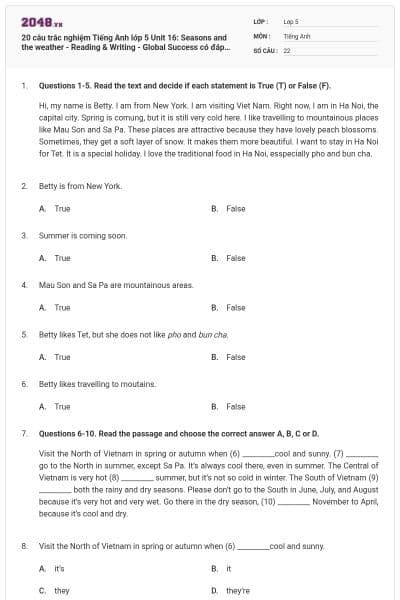
Questions 1-5. Read the text and decide if each statement is True (T) or False (F).
Hi, my name is Betty. I am from New York. I am visiting Viet Nam. Right now, I am in Ha Noi, the capital city. Spring is comung, but it is still very cold here. I like travelling to mountainous places like Mau Son and Sa Pa. These places are attractive because they have lovely peach blossoms. Sometimes, they get a soft layer of snow. It makes them more beautiful. I want to stay in Ha Noi for Tet. It is a special holiday. I love the traditional food in Ha Noi, esspecially pho and bun cha.
Betty is from New York.
True
False
Đáp án đúng: A
Giải thích:
Dựa vào câu: "Hi, my name is Betty. I am from New York." (Chào, tôi tên là Betty. Tôi đến từ New York.)
Summer is coming soon.
True
False
Đáp án đúng: B
Giải thích:
Dựa vào câu: "Spring is coming, but it is still very cold here." (Mùa xuân đang đến, nhưng vẫn rất lạnh ở đây.)
Mau Son and Sa Pa are mountainous areas.
True
False
Đáp án đúng: A
Giải thích:
Dựa vào câu: "I like travelling to mountainous places like Mau Son and Sa Pa." (Tôi thích du lịch đến những nơi núi như Mẫu Sơn và Sa Pa.)
Betty likes Tet, but she does not like pho and bun cha.
True
False
Đáp án đúng: B
Giải thích:
Dựa vào câu: "I love the traditional food in Ha Noi, especially pho and bun cha." (Tôi yêu thích các món ăn truyền thống ở Hà Nội, đặc biệt là phở và bún chả.)
Betty likes travelling to moutains.
True
False
Đáp án đúng: A
Giải thích:
Dựa vào câu: I like travelling to mountainous places like Mau Son and Sa Pa." (Tôi thích du lịch đến những nơi núi như Mẫu Sơn và Sa Pa.)
Dịch bài đọc:
Xin chào, tên tôi là Betty. Tôi đến từ New York. Tôi đang thăm Việt Nam. Hiện tại, tôi đang ở Hà Nội, thủ đô. Mùa xuân đang đến, nhưng ở đây vẫn còn rất lạnh. Tôi thích đi du lịch đến những nơi miền núi như Mẫu Sơn và Sa Pa. Những nơi này hấp dẫn vì chúng có hoa đào đẹp. Đôi khi, chúng có một lớp tuyết mềm. Điều đó làm cho chúng đẹp hơn. Tôi muốn ở lại Hà Nội vào dịp Tết. Đó là một ngày lễ đặc biệt. Tôi thích các món ăn truyền thống ở Hà Nội, đặc biệt là phở và bún chả.
Questions 6-10. Read the passage and choose the correct answer A, B, C or D.
Visit the North of Vietnam in spring or autumn when (6) _________cool and sunny. (7) _________ go to the North in summer, except Sa Pa. It’s always cool there, even in summer. The Central of Vietnam is very hot (8) _________ summer, but it’s not so cold in winter. The South of Vietnam (9) _________ both the rainy and dry seasons. Please don’t go to the South in June, July, and August because it’s very hot and very wet. Go there in the dry season, (10) _________ November to April, because it’s cool and dry.
it’s
it
they
they’re
Đáp án đúng: A
Giải thích: Dùng "it’s" vì trong câu này nói về thời tiết chung của miền Bắc Việt Nam
Dịch nghĩa: Miền Bắc Việt Nam vào mùa xuân hoặc mùa thu khi nó (thời tiết) mát mẻ và nắng đẹp.
Doesn’t
Don’t
Do
Did
Đáp án đúng: B
Giải thích: Dùng "it’s" vì trong câu này nói về thời tiết chung của miền Bắc Việt Nam
Dịch nghĩa: "Don’t" là dạng phủ định của "do". Câu đưa ra một lời khuyên hoặc mệnh lệnh cho đối tượng chung, vì vậy phải dùng "don’t".
Dịch nghĩa: Đừng đến miền Bắc vào mùa hè, ngoại trừ Sa Pa.
at
on
in
of
Đáp án đúng: C
Giải thích: "in" là giới từ thường dùng để chỉ thời gian nói về mùa trong năm
Dịch nghĩa: Miền Trung Việt Nam rất nóng vào mùa hè.
have
having
has
had
Đáp án đúng: C
Giải thích: "The South of Vietnam" là chủ ngữ, nên ta dùng "has".
Dịch nghĩa: Miền Nam Việt Nam có cả mùa mưa và mùa khô.
to
too
and
from
Đáp án đúng: D
Giải thích: "From" dùng để chỉ thời gian bắt đầu trong câu này.
Dịch nghĩa: Hãy đến đó vào mùa khô, từ tháng 11 đến tháng 4.
Dịch bài đọc:
Hãy đến thăm miền Bắc Việt Nam vào mùa xuân hoặc mùa thu khi thời tiết mát mẻ và nắng đẹp. Đừng đến miền Bắc vào mùa hè, ngoại trừ Sa Pa. Ở đó luôn mát mẻ, ngay cả vào mùa hè. Miền Trung Việt Nam rất nóng vào mùa hè, nhưng không quá lạnh vào mùa đông. Miền Nam Việt Nam có cả mùa mưa và mùa khô. Xin đừng đến miền Nam vào tháng 6, tháng 7 và tháng 8 vì thời tiết rất nóng và ẩm ướt. Hãy đến đó vào mùa khô, từ tháng 11 đến tháng 4, vì thời tiết ở đó mát mẻ và khô ráo.
Make sentences from the given words. Choose the correct sentence.
Autumn / cozy / Peter / long-sleeve shirts.
Autumn is cozy. Peter wear long-sleeve shirts.
Autumn is rainy. Peter usually wears long-sleeve shirts.
Autumn is cozy. Peter usually wears long-sleeve shirts.
Autumn is hot. Peter wears long-sleeve shirts.
Đáp án đúng: C
Dịch nghĩa: Mùa thu dễ chịu. Peter thường mặc áo sơ mi dài tay.
Make sentences from the given words. Choose the correct sentence.
Winter / chilly. My sister / wool trousers.
Winter is chilly. My sister usually wears wool trousers.
Winter is warm. My sister wears wool trousers.
Winter is cold. My sister weares wool trousers.
Winter is chilly. My sister wears jeans.
Đáp án đúng: A
Dịch nghĩa: Mùa đông lạnh. Chị gái tôi thường mặc quần len.
Make sentences from the given words. Choose the correct sentence.
Spring / rainy. Giang / a floral dress.
Spring is warm. Giang wears a floral dress.
Spring is rainy. Giang usually wears a floral dress.
Spring is sunny. Giang usually wears a floral dress.
Spring is cold. Giang wears a floral dress.
Đáp án đúng: B
Dịch nghĩa: Mùa xuân mưa. Giang thường mặc váy hoa.
Make sentences from the given words. Choose the correct sentence.
Winter / dry. My brother / a cozy sweater.
Winter is dry. My brother usually wears a cozy sweater.
Winter is dry. My brother wears a T-shirt.
Winter is cold. My brother wears a cozy sweater.
Winter is rainy. My brother usually wears a cozy sweater.
Đáp án đúng: A
Dịch nghĩa: Mùa đông khô hanh. Anh trai tôi thường mặc áo len ấm áp.
Make sentences from the given words. Choose the correct sentence.
Autumn / cloudy. I / a light jacket.
Autumn is hot. I wear a light jacket.
Autumn is cool. I wear a light jacket.
Autumn is cloudy. I usually wear a light jacket.
Autumn is rainy. I wear a sweater.
Đáp án đúng: C
Dịch nghĩa: Mùa thu có mây. Tôi thường mặc áo khoác nhẹ.
Make sentences from the given words. Choose the correct sentence.
Summer / sunny. He / a T-shirt.
Summer is rainy. He usually wears a T-shirt.
Summer is cold. He wears a sweater.
Summer is cool. He wears a jacket.
Summer is sunny. He usually wears a T-shirt.
Đáp án đúng:D
Dịch nghĩa: Mùa hè nắng. Anh ấy thường mặc áo phông.
Make sentences from the given words. Choose the correct sentence.
Spring / warm. Ly / a light jacket.
Spring is cool. Ly wears a heavy jacket.
Spring is warm. Ly usually wears a light jacket.
Spring is rainy. Ly usually wears a heavy jacket.
Spring is hot. Ly wears a light jacket.
Đáp án đúng:B
Dịch nghĩa: Mùa xuân ấm áp. Ly thường mặc áo khoác nhẹ.
Make sentences from the given words. Choose the correct sentence.
Winter / cold. Minh / a heavy coat.
Winter is cold. Minh usually wears a light jacket.
Winter is cold. Minh usually wears a heavy coat.
Winter is warm. Minh wears a light coat.
Winter is warm. Minh wears a heavy coat.
Đáp án đúng:B
Dịch nghĩa: Mùa đông lạnh. Minh thường mặc áo khoác dày.
Make sentences from the given words. Choose the correct sentence.
Summer / hot. She / shorts.
Summer is hot. She usually wears shorts.
Summer is hot. She wear shorts.
Summer is cold. She wears shorts.
Summer is cool. She usually wears a sweater.
Đáp án đúng:A
Dịch nghĩa: Mùa hè nóng. Cô ấy thường mặc quần short.
Make sentences from the given words. Choose the correct sentence.
Autumn / cool. They / a sweater.
Autumn is hot. They usually wear a sweater.
Autumn is sunny. They usually wear shorts.
Autumn is cool. They usually wear a sweater.
Autumn is rainy. They wear a sweater.
Đáp án đúng:C
Dịch nghĩa: Mùa thu mát mẻ. Họ thường mặc áo len.