Topic 9: Generation gaps
70 câu hỏi
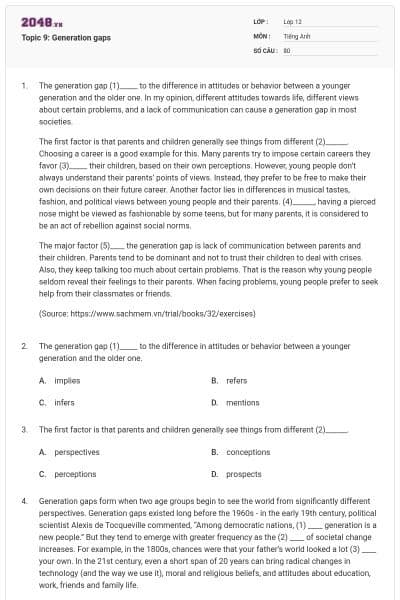
The generation gap (1)_____ to the difference in attitudes or behavior between a younger generation and the older one. In my opinion, different attitudes towards life, different views about certain problems, and a lack of communication can cause a generation gap in most societies.
The first factor is that parents and children generally see things from different (2)______. Choosing a career is a good example for this. Many parents try to impose certain careers they favor (3)_____ their children, based on their own perceptions. However, young people don’t always understand their parents’ points of views. Instead, they prefer to be free to make their own decisions on their future career. Another factor lies in differences in musical tastes, fashion, and political views between young people and their parents. (4)______, having a pierced nose might be viewed as fashionable by some teens, but for many parents, it is considered to be an act of rebellion against social norms.
The major factor (5)____ the generation gap is lack of communication between parents and their children. Parents tend to be dominant and not to trust their children to deal with crises. Also, they keep talking too much about certain problems. That is the reason why young people seldom reveal their feelings to their parents. When facing problems, young people prefer to seek help from their classmates or friends.
(Source: https://www.sachmem.vn/trial/books/32/exercises)
implies
refers
infers
mentions
Khoảng cách thế hệ đề cập đến sự khác biệt về thái độ hoặc hành vi giữa thế hệ trẻ hơn và thế hệ lớn tuổi hơn. Theo tôi, thái độ khác nhau đối với cuộc sống, quan điểm khác nhau về các vấn đề nhất định, và thiếu giao tiếp có thể gây ra khoảng cách thế hệ trong hầu hết các xã hội.
Yếu tố đầu tiên là cha mẹ và con trẻ thường nhìn thấy mọi thứ từ những quan điểm khác nhau. Lựa chọn nghề nghiệp là một ví dụ tốt cho việc này. Nhiều bậc cha mẹ cố gắng áp đặt một số nghề nghiệp mà họ ưa thích cho con cái của họ, dựa trên nhận thức của họ. Tuy nhiên, những người trẻ tuổi không phải lúc nào cũng hiểu quan điểm của cha mẹ họ. Thay vào đó, họ thích được tự do đưa ra quyết định của mình về sự nghiệp tương lai của mình. Một yếu tố khác nằm ở sự khác biệt về thị hiếu âm nhạc, thời trang và quan điểm chính trị giữa những người trẻ tuổi và cha mẹ của họ. Ví dụ, khuyên mũi có thể được coi là thời trang của một số thiếu niên, nhưng đối với nhiều bậc cha mẹ, nó được coi là một hành động nổi loạn trái với các chuẩn mực xã hội.
Yếu tố chính gây ra khoảng cách thế hệ là thiếu sự giao tiếp giữa cha mẹ và con cái của họ. Cha mẹ có khuynh hướng áp đặt và không tin tưởng con cái mình có thể giải quyết khủng hoảng. Ngoài ra, họ tiếp tục nói quá nhiều về một số vấn đề. Đó là lý do tại sao những người trẻ hiếm khi tiết lộ cảm xúc của họ với cha mẹ mình. Khi đối mặt với vấn đề, thanh niên thích tìm sự giúp đỡ từ bạn học hoặc bạn bè của họ.
Đáp án B
Kiến thức về từ vựng
A. imply /im’plai/ (v): ý nói; ngụ ý; bao hàm ý
B. refer /rɪˈfɝː/ (v): ám chỉ, nói đến, kể đến, nhắc đến
C. infer /inˈfʒ:/ (v): suy ra, luận ra; kết luận, đưa đến kết luận
D. mention /’menʃn/ (v): kể ra, nói đến, đề cập
Căn cứ vào giới từ “to” chọn phương án B (refer to st: ám chỉ, nói đến cái gì)
perspectives
conceptions
perceptions
prospects
Đáp án A
Kiến thức về từ vựng
A. perspective /pə’spektiv/ (n): góc nhìn, quan điểm
B. conception /kən´sepʃən/ (n): quan niệm, nhận thức, khái niệm
C. perception /pə’sepʃn/ (n): sự nhận thức, cảm nhận
D. prospect /´prɔspekt/ (n): viễn cảnh
Căn cứ vào nghĩa của câu sau: “The first factor is that parents and children generally see things from different (2)_______.”
(Yếu tố đầu tiên là cha mẹ và trẻ em thường nhìn nhận mọi thứ từ những góc nhìn khác nhau.)
in
at
on
about
Đáp án C
Kiến thức về giới từ
Impose st on sb: áp đặt cái gì cho ai
(4)______, having a pierced nose might be viewed as fashionable by some teens, but for many parents, it is considered to be an act of rebellion against social norms.
For example
Moreover
However
Instead
Đáp án A
Kiến thức về trạng từ
A. For example: ví dụ
B. Moreover: ngoài ra
C. However: tuy nhiên
D. Instead: thay vào đó
Căn cứ vào nghĩa của câu sau: “Another factor lies in differences in musical tastes, fashion, and political views between young people and their parents. (4)_______, having a pierced nose might be viewed as fashionable by some teens, but for many parents, it is considered to be an act of rebellion against social norms.”
(Một yếu tố khác nằm ở sự khác biệt về thị hiếu âm nhạc, thời trang và quan điểm chính trị giữa những người trẻ tuổi và cha mẹ của họ. Ví dụ, khuyên mũi có thể được coi là thời trang của một số thiếu niên, nhưng đối với nhiều bậc cha mẹ, nó được coi là một hành động nổi loạn trái với các chuẩn mực xã hội.)
causes
causing
caused
to cause
Đáp án B
Kiến thức về rút gọn mệnh đề quan hệ
Có 3 cách để rút gọn mệnh đề quan hệ:
+ Ving (với câu chủ động)
+ Vp2 (với câu bị động)
+ To V (số thứ tự/ only/so sánh hơn nhất…)
Căn cứ vào nghĩa của câu: “The major factor (5)_______ the generation gap is lack of communication between parents and their children.”
(Yếu tố chính gây ra khoảng cách thế hệ là thiếu sự giao tiếp giữa cha mẹ và con cái của họ.)
=> Động từ “gây ra” mang nghĩa chủ động nên ta chọn rút gọn bằng cách dùng Ving.
Generation gaps form when two age groups begin to see the world from significantly different perspectives. Generation gaps existed long before the 1960s - in the early 19th century, political scientist Alexis de Tocqueville commented, “Among democratic nations, (1) ____ generation is a new people.” But they tend to emerge with greater frequency as the (2) ____ of societal change increases. For example, in the 1800s, chances were that your father’s world looked a lot (3) ____ your own. In the 21st century, even a short span of 20 years can bring radical changes in technology (and the way we use it), moral and religious beliefs, and attitudes about education, work, friends and family life.
Longer life spans also increase the prevalence of generation gaps. For babies born in 1920, life (4) ____ in the United States was 56.4 years. For babies born in 2009, it’s 78.7 years. Longer life spans mean that more generations are living and working simultaneously. That means (5) ____ for the first time in history, there are four distinct generations (and four generation gaps) in the workplace.
some
few
each
variety
Khoảng cách thế hệ hình thành khi hai thế hệ bắt đầu nhìn nhận thế giới từ những góc nhìn khác nhau một cách đáng kể. Khoảng cách thế hệ tồn tại từ rất lâu trước thập niên 1960 - đầu thế kỷ 19, nhà khoa học và chính trị Alexis de Tocqueville nhận xét: “Trong số các quốc gia dân chủ, mỗi một thế hệ là một dân tộc mới”. Nhưng chúng có xu hướng xuất hiện với tần suất lớn hơn khi tốc độ thay đổi của xã hội tăng lên. Ví dụ, vào những năm 1800, rất có thể cuộc sống xã hội của cha bạn trông giống rất nhiều so với cuộc sống xã hội của riêng bạn. Trong thế kỷ 21, thậm chí một khoảng thời gian ngắn 20 năm cũng có thể mang lại những thay đổi căn bản về công nghệ (và cách chúng ta sử dụng nó), niềm tin đạo đức và tôn giáo, và thái độ về giáo dục, công việc, bạn bè và cuộc sống gia đình.
Tuổi thọ dài hơn cũng làm tăng sự phổ biến của khoảng cách thế hệ. Đối với những đứa trẻ sinh năm 1920, tuổi thọ trung bình ở Hoa Kỳ là 56,4 tuổi. Đối với những trẻ sinh năm 2009, đó là 78,7 tuổi. Tuổi thọ cao hơn cũng đồng nghĩa với việc nhiều thế hệ đang sống và làm việc cùng một lúc. Điều đó có nghĩa rằng lần đầu tiên trong lịch sử, có bốn thế hệ khác biệt (và bốn khoảng cách thế hệ) tại nơi làm việc.
Đáp án C
Kiến thức về lượng từ
A. some + N: một vài, một ít (diễn đạt số lượng không xác định)
B. few + N(s/es): rất ít, gần như không có
C. each + N: mỗi, mọi, từng (chỉ các vật, sự việc như phần tử riêng biệt)
D. variety + of + N: sự đa dạng của cái gì
Tạm dịch: Generation gaps form when two age groups begin to see the world from significantly different perspectives. Generation gaps existed long before the 1960s - in the early 19th century, political scientist Alexis de Tocqueville commented, “Among democratic nations, (25) ____ generation is a new people.”
(Khoảng cách thế hệ hình thành khi hai nhóm tuổi bắt đầu nhìn thế giới từ những quan điểm khác nhau đáng kể. Khoảng cách thế hệ tồn tại từ rất lâu trước thập niên 1960 - đầu thế kỷ 19, nhà khoa học chính trị Alexis de Tocqueville nhận xét: “Trong số các quốc gia dân chủ, mỗi thế hệ là một gia đình mới”.)
part
portion
ratio
rate
Đáp án D
Kiến thức về từ vựng
A. part /pɑːt/ (n): phần, bộ phận
B. portion /ˈpɔːʃn/ (n): phần chia
C. ratio /ˈreɪʃiəʊ/ (n): tỷ số, tỷ lệ
D. rate /reɪt/ (n): tỷ lệ, tốc độ
Tạm dịch:
But they tend to emerge with greater frequency as the (26) ____ of societal change increases.
(Nhưng chúng có xu hướng xuất hiện với tần suất lớn hơn khi tốc độ của sự thay đổi mang tính xã hội tăng lên.)
as
like
similar
same
Đáp án B
Kiến thức về tính từ
A. as /əz/ (prep): bằng, như là
B. like /laɪk/ (adj): giống nhau, như nhau
C. similar /ˈsɪmələ(r)/ (adj): như nhau, tương tự, cùng loại
D. same /seɪm/ (adj): cũng vậy, giống với
Ta có: to look like sb/ sth: giống với ai/ cái gì
Tạm dịch: For example, in the 1800s, chances were that your father’s world looked a lot (27) ____ your own. In the 21st century, even a short span of 20 years can bring radical changes in technology (and the way we use it), moral and religious beliefs, and attitudes about education, work, friends and family life.
(Ví dụ, vào những năm 1800, rất có thể thế giới của cha bạn trông rất giống thế giới của bạn. Trong thế kỷ 21, thậm chí một khoảng thời gian ngắn khoảng 20 năm có thể mang lại những thay đổi căn bản về công nghệ (và cách chúng ta sử dụng nó), tín ngưỡng đạo đức và tôn giáo, và những thái độ về nền giáo dục, công việc, bạn bè và cuộc sống gia đình.)
expectancy
time
length
span
Đáp án A
Kiến thức về từ vựng
A. expectancy /ɪkˈspektənsi/ (n): sự mong chờ
=> life expectancy: tuổi thọ trung bình (chỉ độ dài thời gian trung bình của một nhóm người, nhóm động vật nói chung)
B. time /taɪm/ (n): thời gian, thời đại
C. length /leŋθ/ (n): chiều dài, độ dài
D. span /spæn/ (n): khoảng thời gian
=> life span: tuổi thọ, số năm tối đa mà ai đó có thể sống (của một cá nhân cụ thể)
Tạm dịch: Longer life spans also increase the prevalence of generation gaps. For babies born in 1920, life (28) ____ in the United States was 56.4 years. For babies born in 2009, it’s 78.7 years.
(Tuổi thọ cao hơn cũng làm tăng sự phổ biến của khoảng cách thế hệ. Đối với những em bé sinh năm 1920, tuổi thọ trung bình ở Hoa Kỳ là 56,4 tuổi. Đối với em bé sinh năm 2009, tuổi thọ trung bình là 78,7 tuổi.)
That means (5) ____ for the first time in history, there are four distinct generations (and four generation gaps) in the workplace.
that
this
it
what
Đáp án A
Kiến thức về đại từ
A. that: rằng, là
B. this: điều này, cái này
C. it: nó, điều đó
D. what: cái mà
Tạm dịch: Longer life spans mean that more generations are living and working simultaneously. That means (29) ____ for the first time in history, there are four distinct generations (and four generation gaps) in the workplace.
(Tuổi thọ cao hơn có nghĩa là nhiều thế hệ đang sống và làm việc cùng một lúc. Điều đó có nghĩa rằng lần đầu tiên trong lịch sử, có bốn thế hệ riêng biệt (và bốn khoảng cách thế hệ) tại nơi làm việc.)
Generation gap refers to a vast difference in cultural norms between a younger generation and their elders. It’s a distressing thing for the phenomenon (1) ____ occurs around the world. The (2) ____ of communication, different views on certain problems and different attitudes towards life may cause the generation gap or even widen it. First, one of the major factors for this misunderstanding between two generations is that parents and children lack communication. Young people (3) ____ reveal their feelings to their parents, and often complain that their parents are out of (4) ____ with modern days, that they are dominant, that they do not trust their children to deal with crises, and that they talk too much about certain problems. So when young people meet some problems, they would rather (5) ____ to their classmates or their friends for help. The lack of communication widens the generation gap.
Another factor is that parents and their children see almost everything from different (6) ____. Take choosing career as an example. Parents generally believe it is their responsibility to plan the career for their children. Some hope their children will (7) ____ professions that will bring them greatest prestige and economic benefits. Some hope children will have a stable job with a regular income. But the youth may think they should be free to (8) ____ their own decisions as to their future career. Young people explain that true success is not a matter of money or position, instead, it is a matter of self-fulfillment.
Finally, with the change of the world over decades, the attitude of the young has altered too. There are differences in (9) ____ matters as musical tastes, fashions, drug use, sex and politics between the young people and their elders. Nowadays long hair on young males is viewed as fashion by the young, but it is frequently considered a shocking act of rebellion against (10) ____ norms by parents.
which
who
whom
what
Khoảng cách thế hệ ám chỉ một sự khác biệt lớn trong các tiêu chuẩn văn hóa giữa một thế hệ trẻ và các bậc trưởng bối của họ. Đó là điều gây phiền muộn khi hiện tượng này xảy ra trên toàn thế giới. Sự hạn chế về giao tiếp, quan điểm khác nhau về những vấn đề nhất định và thái độ khác nhau với cuộc sống có thể gây ra khoảng cách thế hệ hoặc thậm chí là làm mở rộng nó. Đầu tiên, một trong những nhân tố chủ yếu gây sự hiểu lầm giữa hai thế hệ là bố mẹ và con cái thiếu sự giao tiếp. Người trẻ ít khi bày tỏ cảm xúc của mình với bố mẹ, hoặc thường phàn nàn rằng bố mẹ chúng không bắt kịp với thời đại tiên tiến, rằng họ có ưu thế hơn, rằng họ không tin tưởng con của họ để giải quyết những khủng hoảng, và họ nói quá nhiều về những vấn đề nhất định. Vì vậy khi người trẻ gặp một số vấn đề, chúng lại quay sang bạn cùng lớp hoặc bạn bè chúng nhờ giúp đỡ. Sự thiếu giao tiếp đã nới rộng thêm khoảng cách thế hệ.
Một nhân tố khác là việc mà bố mẹ và con cái họ nhìn nhận mọi thứ từ các góc nhìn khác nhau. Lấy việc chọn nghề nghiệp là một ví dụ. Bố mẹ thường tin rằng họ có trách nhiệm lên kế hoạch cho nghề nghiệp tương lai của con mình. Một số bố mẹ tin rằng con của họ sẽ thích những nghề nghiệp đem lại cho họ danh tiếng và lợi ích kinh tế tốt nhất. Một số khác hi vọng rằng con của họ sẽ có một công việc ổn định với thu nhập đều đặn. Nhưng người trẻ có thể nghĩ họ nên được tự do đưa ra quyết định của riêng mình về công việc tương lai. Họ giải thích rằng thành công thực sự không phải là vấn đề về tiền bạc hay địa vị, thay vào đó là vấn đề về việc họ có thể cảm thấy hạnh phúc và hài lòng khi có được những gì mình khao khát.
Cuối cùng, với sự thay đổi của thế giới qua hàng thập kỉ, thái độ của người trẻ cũng đã thay đổi. Có những sự khác biệt về những vấn đề như phong vị âm nhạc, thời trang, việc sử dụng ma túy, tình dục và những vấn đề chính trị giữa người trẻ và các bậc trưởng bối của chúng. Ngày nay, mái tóc dài của những chàng trai trẻ được coi là thời thượng đối với giới trẻ, nhưng đó thường được coi là một hành động nổi loạn gây sốc đi ngược lại với chuẩn mực xã hội đối với các bố mẹ.
Đáp án A
Kiến thức về mệnh đề quan hệ
A. cái mà
B. người mà
C. ai, người mà
D. gì, cái mà
Đại từ quan hệ “which” thay thế cho “the phenomenon”
Tạm dịch: It’s a distressing thing for the phenomenon (1) ____ occurs around the world.
(Đó là một điều đau khổ cho hiện tượng xảy ra trên khắp thế giới.)
deficiency
shortage
lack
inadequacy
Đáp án C
Kiến thức về từ vựng
A. sự thiếu, điểm thiết soát
B. sự thiếu, lượng thiếu
C. thiếu
D. sự thiết sót, sự không thoả đáng
=> Cần phân biệt 2 cụm từ sau:
+ Lack of sth: diễn đạt sự không có hoặc có nhưng không đạt tới một mức độ yêu cầu nào đó)
+ Shortage of sth: thiếu cái gì đó ai/cái gì cần thiết (như nhu cầu cuộc sống về nước, thức ăn; thiếu nhân công,…)
=> Theo ngữ cảnh như vậy, trong câu này rõ ràng ta cần dùng “lack” vì nó diễn đạt sự không có hoặc có nhưng không đạt tới một mức độ yêu cầu nào đó.Tạm dịch: The (2) ____ of communication, different views on certain problems and different attitudes towards life may cause the generation gap or even widen it.
(Việc thiếu giao tiếp, quan điểm khác nhau về một số vấn đề nhất định và thái độ khác nhau đối với cuộc sống có thể gây ra khoảng cách thế hệ hoặc thậm chí mở rộng nó.)
sometimes
always
often
seldom
Đáp án D
Kiến thức về từ vựng
A. thỉnh thoảng
B. luôn luôn
C. thường
D. hiếm khi
Căn cứ vào ngữ cảnh của câu:
Young people (3) ____ reveal their feelings to their parents, and often complain that their parents are out of (4) ____ with modern days, that they are dominant, that they do not trust their children to deal with crises, and that they talk too much about certain problems.
(Những người trẻ tuổi hiếm khi tiết lộ cảm xúc của họ với cha mẹ và thường phàn nàn rằng cha mẹ của họ không liên lạc với thời hiện đại, rằng họ luôn cố chiếm ưu thế, rằng họ không tin tưởng con cái mình để đối phó với khủng hoảng, và họ nói quá nhiều về một số vấn đề nhất định.)
mind
reach
depth
touch
Đáp án D
Kiến thức về từ vựng
A. out of one’s mind: mất trí, điên
B. out of reach: ngoài tầm tay
C. out of one’s depth: không hiểu gì cả
D. out of touch: mất liên lạc, bặt vô âm tín
Căn cứ vào ngữ cảnh của câu:
Young people (3) ____ reveal their feelings to their parents, and often complain that their parents are out of (4) ____ with modern days, that they are dominant, that they do not trust their children to deal with crises, and that they talk too much about certain problems.
(Những người trẻ tuổi hiếm khi tiết lộ cảm xúc của họ với cha mẹ và thường phàn nàn rằng cha mẹ của họ không liên lạc với thời hiện đại, rằng họ luôn cố chiếm ưu thế, rằng họ không tin tưởng con cái mình để đối phó với khủng hoảng, và họ nói quá nhiều về một số vấn đề nhất định.)
turn
turning
to turn
to have turned
Đáp án A
Kiến thức về cấu trúc ngữ pháp
Ta có cấu trúc S + would rather + V: thà, thích hơn, mong muốn
Tạm dịch: So when young people meet some problems, they would rather (5) ____ to their classmates or their friends for help.
(Vì vậy, khi những người trẻ tuổi gặp một số vấn đề, họ muốn tìm kiếm sự động viên, giúp đỡ từ các bạn cùng lớp hoặc bạn bè.)
opinions
perspectives
scopes
visions
Đáp án B
Kiến thức về từ vựng
A. ý kiến (thể hiện quan điểm, suy nghĩ cá nhân về một vấn đề cụ thể; có tính giới hạn hẹp hơn)
B. tầm nhìn, góc nhìn (thể hiện thái độ, cách nhìn nhận hoặc khả năng đưa ra quyết định, đánh giá hợp lý
=> mang tính tổng quan, phạm vi rộng hơn bởi nó bao gồm cả “opinion” trong đó); quan điểm
C. cơ hội, dịp làm gì
D. sự nhìn
Tạm dịch: Another factor is that parents and their children see almost everything from different (6)____.
(Một yếu tố khác là cha mẹ và con cái họ nhìn thấy hầu hết mọi thứ từ những góc nhìn khác nhau)
come in for
go in for
go down with
come up with
Đáp án B
Kiến thức về ngữ động từ
A. nhận (phê bình, chỉ trích, khen ngợi)
B. thích, có hứng thú, lựa chọn công việc
C. suy nhược
D. nảy ra ý tưởng
Tạm dịch: Some hope their children will (7) ____
professions that will bring them greatest prestige and economic benefits.
(Một số người hy vọng con cái của họ sẽ lựa chọn các ngành nghề sẽ mang lại cho họ lợi ích kinh tế và uy tín lớn nhất.)
make
do
build
create
Đáp án A
Kiến thức về cấu trúc
A. làm, chế tạo
B. làm
C. xây dựng
D. sáng tạo, tạo ra
Ta có cấu trúc “make a decision: quyết định”
Tạm dịch: But the youth may think they should
be free to (8) ____ their own decisions as to their future career.
(Nhưng giới trẻ có thể nghĩ rằng họ nên được tự do đưa ra quyết định cho sự nghiệp tương lai của họ.)
the
so
such
those
Đáp án C
Kiến thức về từ vựng
Ta có cụm such N as: những thứ như thế, như vậy
Tạm dịch: There are differences in (9) ____ matters as musical tastes, fashions, drug use, sex and politics between the young people and their elders.
(Có sự khác biệt trong các vấn đề như thị hiếu âm nhạc, thời trang, sử dụng ma túy, tình dục và chính trị giữa những người trẻ tuổi và người lớn tuổi của họ.)
Nowadays long hair on young males is viewed as fashion by the young, but it is frequently considered a shocking act of rebellion against (10) ____ norms by parents.
society
sociable
social
socializing
Đáp án C
Kiến thức về từ loại
A. society /sə’saiəti/ (n): xã hội
B. sociable /’səʊ∫əbl/ (a): thích giao tiếp
C. social /’səʊ∫l/ (a): thuộc xã hội, sống thành xã hội
D. socialize /’səʊ∫əlaiz/ (v): xã hội hoá, hoà nhập về mặt xã hội
Ta có cụm social norms: chuẩn mực xã hội, quy tắc xã hội
Tạm dịch: Nowadays long hair on young males is viewed as fashion by the young, but it is frequently considered a shocking act of rebellion against (10) ____ norms by parents.
(Ngày nay, tóc dài trên nam thanh niên được giới trẻ xem là thời trang, nhưng nó thường được coi là một hành động gây sốc nổi loạn chống lại các quy tắc xã hội của cha mẹ.)
Seniors in China are still highly likely to believe rumors and pseudoscience, according to reports. In recent years, China has seen more scientists and science communicators using digital platforms to combat pseudoscience, which is classified as rumors, statements, beliefs, ideas or practices that are stated as fact, but are often fabricated and scientifically untested. Despite that, many young Chinese have experienced difficulties when trying to pass on that message to older people.
For example, last year, Dingxiang Doctor, a digital platform that debunks medical rumors online, released 101 articles that disproved common, inaccurate claims. However, many netizens said that when they forwarded the articles to family chat groups, they were questioned, scolded and even removed from the group by older family members. An online survey last year by Tencent, one of China’s biggest online businesses, indicated that nearly 40 percent of middle-aged and senior people had experienced online fraud, mostly related to healthcare products.
Yun Wuxin, a food engineering expert who has popularized food science for more than 10 years, believes that, in general, members of the older generation lacked training in logical or critical thinking when they were young, so they have an exaggerated belief in personal experience, tradition or superstition. He said young people, especially today’s younger generation, have received better training and tend to hold skeptical or critical attitudes toward convention. He added that new media that popularize science in fresh, innovative ways - such as short videos, video blogs and animations - are very effective with young people. However, traditional methods, including television, community visits by scientists, neighborhood exhibitions and science columns in newspapers, are very important for middle-aged and elderly people who really need to understand science.
(Source: https://www.chinadaily.com.cn/)
Which best serves as the title for the passage?
Generation gap promotes belief in rumor.
Senility dulls alertness and causes distraction.
The youth abandons the elder in the tech era.
Scientific researches fail the old community.
Theo những báo cáo, nhiều người lớn tuổi ở Trung Quốc vẫn rất tin vào những tin đồn và những thông tin ngụy danh khoa học. Trong những năm gần đây, Trung Quốc đã chứng kiến nhiều nhà khoa học và những nhà phát ngôn khoa học sử dụng nền tảng kĩ thuật số để chống lại hiện tượng ngụy danh khoa học này, được phân loại ra như những tin đồn, những phát ngôn, các tín ngưỡng, những ý niệm hoặc những thực tiễn mà được tuyên bố như là sự thật, nhưng thường được bịa đặt ra và chưa được kiểm chứng một cách khoa học. Mặc dù vậy, nhiều bạn trẻ Trung Quốc đã trải qua những khó khăn khi cố gắng truyền đạt lại thông điệp đó cho người lớn tuổi.
Ví dụ, vào năm ngoái, Dingxiang Doctor, một nền tảng kĩ thuật số đã lật tẩy những tin đồn trực tuyến về y học, phát hành 101 bài báo bác bỏ các phát ngôn tầm thường, sai sự thật. Tuy nhiên, nhiều cư dân mạng nói rằng khi họ chuyển tiếp những bài báo đó đến các nhóm chat của gia đình, họ đã bị chất vấn, bị quở trách và thậm chí bị loại bỏ khỏi nhóm bởi các thành viên lớn tuổi hơn trong gia đình. Một cuộc khảo sát trực tuyến vào năm ngoái của Tencen, một trong những doanh nghiệp trực tuyến lớn nhất của Trung Quốc, đã chỉ ra rằng gần 40% người trung niên và lớn tuổi đều đã từng trải qua việc bị lừa gạt trên mạng trực tuyến, chủ yếu có liên quan đến các sản phẩm chăm sóc sức khỏe.
Yun Wuxin, một chuyên gia kĩ thuật thực phẩm, người mà đã phổ cập ngành khoa học thực phẩm đã hơn 10 năm nay, tin rằng, nhìn chung, các thành viên của thế hệ trước thiếu sự đào tạo về cách suy nghĩ logic và tư duy phản biện khi họ còn trẻ, vì vậy họ có một sự tin tưởng thái quá vào kinh nghiệm cá nhân, tín ngưỡng và mê tín. Ông nói rằng những người trẻ tuổi, đặc biệt là thế hệ trẻ ngày nay, đã được đào tạo tốt hơn và có xu hướng giữ thái độ hoài nghi hoặc phê phán đối với các tục lệ thông thường. Ông còn nói thêm rằng các phương tiện truyền thông mới mang tính chất phổ cập khoa học một cách mới mẻ, sáng tạo – như những video ngắn, video dưới dạng blog và những hình ảnh động - cực kì hiệu quả với những người trẻ tuổi. Tuy nhiên, các phương pháp truyền thống, bao gồm vô tuyến (tivi), các chuyến thăm hỏi cộng đồng bởi các nhà khoa học, các cuộc triển lãm ở những vùng lân cận và các mục về khoa học trên những tờ báo, đều rất quan trọng đối với những người trung niên và người cao tuổi, những người mà thực sự cần nhận thức được về khoa học.
Đáp án A
Câu nào sau đây là thích hợp nhất làm tiêu đề cho đoạn văn?
A. Khoảng cách thế hệ thúc đẩy niềm tin về tin đồn
B. Tình trạng lão suy làm giảm sự tỉnh táo và gây ra sự sao nhãng
C. Người trẻ bỏ rơi người lớn tuổi trong thời đại công nghệ
D. Nghiên cứu khoa học thất bại những công đồng cũ
Căn cứ vào thông tin đoạn đầu:
Seniors in China are still highly likely to believe rumors and pseudoscience, according to reports. In recent years, China has seen more scientists and science communicators using digital platforms to combat pseudoscience, which is classified as rumors, statements, beliefs, ideas or practices that are stated as fact, but are often fabricated and scientifically untested. Despite that, many young Chinese have experienced difficulties when trying to pass on that message to older people.
(Người lớn tuổi ở Trung Quốc vẫn rất tin vào tin đồn và giả khoa học, theo một báo cáo. Trong những năm gần đây, Trung Quốc đã chứng kiến nhiều nhà khoa học và nhà truyền thông khoa học sử dụng các nền tảng kỹ thuật số để chống lại giả khoa học, được xem là tin đồn, tuyên bố, niềm tin, ý tưởng hoặc thực tiễn, cái mà được tuyên bố như một sự thật, nhưng thường được bịa đặt và chưa được kiểm chứng về mặt khoa học. Mặc dù vậy, nhiều người trẻ Trung Quốc đã gặp khó khăn khi cố gắng truyền thông điệp này đến với người lớn tuổi.)
Như vậy, có thể suy ra khoảng cách giữa cách thế hệ dẫn đến một mức độ tin tưởng khác nhau vào các tin đồn, và giả khoa học.
According to paragraph 1, what is the mentioned problem of China?
New technological devices are not designed for the elderly.
The younger generation spares no effort in modernizing the older.
The job of improving seniors’ scientific literacy is arduous.
The tech-savvy minority of the old generation is depleting.
Đáp án C
Theo đoạn 1, điều nào sau đây được đề cập như là một vấn đề của Trung Quốc?
A. Thiết bị công nghệ mới không được thiết kế dành cho người lớn tuổi
B. Thế hệ trẻ không nỗ lực trong viện hiện đại hóa người lớn tuổi
C. Việc nâng cao trình độ hiểu biết khoa học cho người lớn tuổi là rất khó khăn
D. Thiểu số hiểu biết nhiều về công nghệ thuộc thế hệ trước đang cạn kiệt
Căn cứ vào thông tin đoạn đầu:
Seniors in China are still highly likely to believe rumors and pseudoscience, according to reports. In recent years, China has seen more scientists and science communicators using digital platforms to combat pseudoscience, which is classified as rumors, statements, beliefs, ideas or practices that are stated as fact, but are often fabricated and scientifically untested. Despite that, many young Chinese have experienced difficulties when trying to pass on that message to older people.
(Người lớn tuổi ở Trung Quốc vẫn rất tin vào tin đồn và giả khoa học, theo một báo cáo. Trong những năm gần đây, Trung Quốc đã chứng kiến nhiều nhà khoa học và nhà truyền thông khoa học sử dụng các nền tảng kỹ thuật số để chống lại giả khoa học, được xem là tin đồn, tuyên bố, niềm tin, ý tưởng hoặc thực tiễn, cái mà được tuyên bố như một sự thật, nhưng thường được bịa đặt và chưa được kiểm chứng về mặt khoa học. Mặc dù vậy, nhiều người trẻ Trung Quốc đã gặp khó khăn khi cố gắng truyền thông điệp này đến với người lớn tuổi.)
The word “they” in paragraph 2 refers to _______.
claims
netizens
articles
rumors
Đáp án B
Từ “they” trong đoạn 2 đề cập đến .
A. tuyên bố
B. cư dân mạng
C. bài báo
D. tin đồn
Từ “they” ở đây dùng để thay thế cho danh từ cư dân mạng được nhắc tới trước đó.
However, many netizens said that when they forwarded the articles to family chat groups, they were questioned, scolded and even removed from the group by older family members.
(Tuy nhiên, nhiều cư dân mạng nói rằng họ chuyển tiếp những bài báo đến các nhóm trò chuyện gia đình, họ bị nghi ngờ, la mắng và thậm chí bị đuổi khỏi nhóm bởi những thành viên lớn tuổi hơn.)
The word “fraud” in paragraph 2 is closest in meaning to ______.
cheat
infidelity
forgery
swindle
Đáp án D
Từ “fraud” trong đoạn 2 có nghĩa gần nhất với___ .
A. sự lừa đảo, gian lận (trong thi cử, trò chơi,…)
B. sự không chung thủy, không trung thành (trong mối quan hệ vợ chồng, tình dục)
C. sự giả mạo (làm tiền bạc giả, giấy tờ giả,…)
D. sự lừa đảo, lừa gạt (để chiếm đoạt tài sản, tiền bạc, hàng hóa,…bất hợp pháp)
=> Dựa vào ngữ nghĩa trong câu:
An online survey last year by Tencent, one of China’s biggest online businesses, indicated that nearly 40 percent of middle-aged and senior people had experienced online fraud, mostly related to healthcare products.
(Một khảo sát trực tuyến vào năm ngoái bởi Tencent, một trong những doanh nghiệp mạng lớn nhất Trung Quốc, đã chỉ ra gần 40% người trung niên và người lớn tuổi bị lừa gạt trực tuyến, phần lớn liên quan đến các sản phẩm chăm sóc sức khỏe.)
=> Trong câu này, nó mang hàm ý là lừa gạt liên quan đến như sản phẩm, hàng hóa,…để lấy tiền, trục lợi, do đó: Fraud ~ swindle
According to paragraph 3, what does the disparity between the younger and older generation’s attitude show?
It illustrates the demands for technological knowledge in modern age.
It reflects the educational difference between generations.
It depicts the future where the youth and the elderly clashes in belief.
It demonstrates the heavy gullibility of the older generations.
Đáp án B
Theo đoạn 3, sự khác biệt giữa thái độ của thế hệ trẻ và thế hệ lớn tuổi chỉ ra điều gì?
A. Nó mô tả nhu cầu về kiến thức công nghệ ở thế hệ hiện đại
B. Nó phản ánh sự khác biệt về giáo dục giữa hai thế hệ
C. Nó mô tả tương lai khi mà người trẻ và người lớn tuổi mâu thuẫn về niềm tin
D. Nó mô tả tính cả tin của thế hệ lớn tuổi
Căn cứ vào thông tin đoạn ba:
Yun Wuxin, a food engineering expert who has popularized food science for more than 10 years, believes that, in general, members of the older generation lacked training in logical or critical thinking when they were young, so they have an exaggerated belief in personal experience, tradition or superstition.
(Yun Wuxin, một chuyên gia kỹ thuật thực phẩm, người đã phổ biến khoa học thực phẩm trong hơn 10 năm, tin rằng nói chung là các thành viên của thế hệ trước thiếu sự đào tạo về tư duy logic hoặc phản biện khi còn trẻ, vì vậy họ tin tưởng quá nhiều vào kinh nghiệm cá nhân, truyền thống hay mê tín.)
He said young people, especially today’s younger generation, have received better training and tend to hold skeptical or critical attitudes toward convention.
(Ông ấy nói rằng những người trẻ tuổi, đặc biệt là thế hệ trẻ ngày nay, đã được nhận được sự đào tạo tốt hơn và có xu hướng giữ thái độ hoài nghi hoặc phê phán đối với các tục lệ.)
Catering for the diverse digital habits and capabilities of each generation is key for managing the generation gap in modern work life and attracting multigenerational talent.
To working Millennials, technology means flexibility. From cloud-based platforms to video conferencing, they’ve embraced the freedom of remote working and the change in work culture that technology affords them. How a company embraces technology is so important to this tech generation that 71% say it influences whether or not they take a job at the business in question.
Gen Z, who are currently entering the workforce, are even hungrier for sophisticated enterprise tech. According to a Dell report, 80% want to work with cutting-edge technology to satisfy their tech-literacy skills - rated by 73% as good or excellent. Arming your team with the latest tech solutions to appeal to younger generations does however yield tricky generation gap problems, especially when older employees are expected to keep up with the pace that comes naturally to their younger colleagues.
CompTIA revealed half of Millennials felt older workers are too rigid and set in their ways. Echoing concerns around a workplace divide, nearly half of Gen X workers said their older employees were not as technologically skilled. Boomer’s views on younger generations are equally damning; two-thirds consider Millennials as disloyal, and six in ten felt younger employees seemed entitled. It’s easy to see how generation gap issues in work life can result in workplace tensions and hinder vital processes of team collaboration. Add to this the issue of different levels of tech adoption, and you’ve got potentially worrying effects of the generation gap on productivity, culture, and output.
(Source: https://info.templafy.com/)
Which best serves as the title for the passage?
Generational differences can pose problems.
The technological generation gap in working life.
Parents, children and technological gap.
Millennials stand out for their technology use.
Phục vụ cho những thói quen kĩ thuật số đa dạng và những khả năng của mỗi thế hệ là chìa khóa cho việc điều khiển khoảng cách thế hệ trong cuộc sống làm việc hiện đại và thu hút tài năng của nhiều thế hệ.
Đối với thời đại làm việc của những người sinh vào những năm 80, 90 và đầu 2000, công nghệ đồng nghĩa với sự linh hoạt. Từ những hệ thống dựa trên điện toán đám mây đến hội nghị qua video, họ tận dụng sự tự do của làm việc từ xa và sự thay đổi trong văn hóa làm việc mà công nghệ cung cấp cho họ. Cách mà một công ty tận dụng công nghệ nó quá quan trọng với thế hệ công nghệ đến nỗi mà có 71% người nói rằng nó ảnh hưởng đến việc liệu họ có cân nhắc đến việc có một công việc kinh doanh hay không.
Thế hệ Z, những người đang gia nhập lực lượng lao động, càng khao khát công nghệ doanh nghiệp tinh vi. Theo một báo cáo của Dell, 80% muốn làm việc với công nghệ tiên tiến nhất để thỏa mãn kĩ năng ngôn ngữ công nghệ của họ - được đánh giá bới 73% là tốt hoặc xuất sắc. Trang bị cho team của bạn với giải pháp công nghệ mới nhất để thu hút những thế hệ trẻ hơn vào làm việc, tuy nhiên lại nảy sinh ra những vấn đề phức tạp về khoảng cách thế hệ, đặc biệt khi những nhân viên già dặn hơn được mong đợi sẽ đuổi kịp nhịp điệu để tiến gần những đồng nghiệp trẻ hơn một cách tự nhiên.
CompTIA tiết lộ một nửa các nhân viên ở lứa tuổi sinh vào những năm 80, 90 và đầu 2000 (Millennials) cảm thấy những nhân viên lớn tuổi hơn quá cứng nhắc và luôn làm theo cách của họ. Những mối quan ngại lặp đi lặp lại xung quanh sự chia rẽ nơi làm việc, gần một nửa nhân viên thế hệ X nói rằng những nhân viên lớn tuổi hơn không có kĩ năng công nghệ. Quan điểm của các Boomer về những thế hệ trẻ hơn cũng thường là chê bai một cách tương tự vậy; 2/3 coi các thế hệ Millennials là không trung thành, và 6 trên 10 cảm thấy những nhân viên trẻ hơn có vẻ lạm quyền. Đó là dễ dàng để nhìn nhận làm thế nào những vấn đề về khoảng cách thế hệ trong đời sống công việc có thể dẫn đến sự căng thẳng nơi làm việc và cản trở những quá trình quan trọng của sự hợp tác nhóm. Thêm vào đó là vấn đề những mức độ tiếp nhận công nghệ khác nhau, và bạn có thể nhận lấy những hậu quả có thể gây lo lắng của khoảng cách thế hệ về năng suất, văn hóa và đầu ra.
Đáp án B
Câu nào sau đây thích hợp nhất làm tiêu đề cho đoạn văn?
A. Sự khác biệt thế hệ có thể đặt ra vấn đề
B. Khoảng cách thế hệ công nghệ trong cuộc sống làm việc
C. Cha mẹ, con cái và khoảng cách công nghệ
D. Thế hệ Y nổi bật với việc sử dụng công nghệ của họ
Căn cứ vào thông tin đoạn đầu:
Catering for the diverse digital habits and capabilities of each generation is key for managing the generation gap in modern work life and attracting multigenerational talent.
(Phục vụ cho các thói quen và khả năng kỹ thuật số đa dạng của mỗi thế hệ là chìa khóa cho việc quản lý khoảng cách thế hệ trong cuộc sống công việc hiện đại và thu hút nhân tài đa thế hệ.)
Như vậy đoạn văn đang nói về khoảng cách thế hệ trong cuộc sống công việc hiện đại.
The word “Catering” in paragraph 1 is closest in meaning to ______.
Entertaining
Pampering
Appeasing
Accommodating
Đáp án D
Từ “catering” trong đoạn 1 có nghĩa gần nhất với .
A. giải trí
B. nuông chiều
C. an ủi, dỗ dành; làm cho nguôi giận
D. cung cấp, phục vụ
=> Từ đồng nghĩa: Cater (phục vụ) = accommodate
Tạm dịch: Catering for the diverse digital habits and capabilities of each generation is key for managing the generation gap in modern work life and attracting multigenerational talent.
(Phục vụ cho các thói quen và khả năng kỹ thuật số đa dạng của mỗi thế hệ là chìa khóa cho việc quản lý khoảng cách thế hệ trong cuộc sống công việc hiện đại và thu hút nhân tài đa thế hệ.)
The word “they” in paragraph 2 refers to _______.
platforms
Millennials
capabilities
abilities
Đáp án B
Từ “they” trong đoạn 2 đề cập đến____ .
A. nền tảng
B. Thế hệ Y
C. khả năng
D. khả năng
Từ “they” ở đây dùng để thay thế cho danh từ thế hệ Y được nhắc tới trước đó.
To working Millennials, technology means flexibility. From cloud-based platforms to video conferencing, they’ve embraced the freedom of remote working and the change in work culture that technology affords them.
(Làm việc với thệ hệ Y, công nghệ có nghĩa là sự linh hoạt. Từ nền tảng dựa trên đám mây đến hội nghị truyền hình, họ đã nắm bắt được sự tự do của làm việc từ xa và sự thay đổi trong văn hóa công việc mà công nghệ có thể đáp ứng cho họ.)
According to paragraph 3, what is the attitude of young employees towards technology?
They expect the same level of technological usage as their daily life.
They are indifferent to the availability of state-of-the-art technology.
They want to display their capabilities of working with high-tech devices.
They think that the older workers are a burden in modern workplace.
Đáp án C
Theo đoạn 3, thái độ của nhân viên trẻ đối với công nghệ?
A. Họ mong đợi mức độ sử dụng công nghệ tương tự như cuộc sống hàng ngày của họ
B. Họ thờ ơ với sự sẵn có của công nghệ tiên tiến
C. Họ muốn thể hiện khả năng làm việc với các thiết bị công nghệ cao
D. Họ nghĩ rằng những người lao động lớn tuổi là một gánh nặng ở nơi làm việc hiện đại
Căn cứ vào thông tin đoạn ba:
Gen z, who are currently entering the workforce, are even hungrier for sophisticated enterprise tech. According to a Dell report, 80% want to work with cutting-edge technology to satisfy their tech-literacy skills - rated by 73% as good or excellent.
(Thế hệ Z, người hiện đang tham gia vào lực lượng lao động, thậm chí còn khao khát công nghệ cao tinh vi. Theo báo cáo của Dell, 80% muốn làm việc với công nghệ tiên tiến để đáp ứng các kỹ năng hiểu biết về công nghệ của họ - 73% được đánh giá là giỏi hoặc xuất sắc.)
According to paragraph 4, what can be concluded about the views of two generations for each other?
They are sharing similar and positive regard for one another.
They are respecting each other’s expertise and field of responsibilities.
They are holding the same but negative discontentment for each other.
They are blinded and led to misunderstand each other by supervisors.
Đáp án C
Theo đoạn 4, có thể kết luận gì về quan điểm của hai thế hệ dành cho nhau?
A. Họ đang cóchung quan điểm tương tự và tích cực với nhau
B. Họ đang tôn trọng chuyên môn và lĩnh vực trách nhiệm của nhau
C. Họ đang có sự bất mãn tương tự và tiêu cực với nhau
D. Họ không biết và dẫn đến hiểu lầm lẫn nhau bởi các giám sát viên
Căn cứ vào thông tin đoạn bốn:
CompTIA revealed half of Millennials felt older workers are too rigid and set in their ways. Echoing concerns around a workplace divide, nearly half of Gen X workers said their older employees were not as technologically skilled. Boomer’s views on younger generations are equally damning; two-thirds consider Millennials as disloyal, and six in ten felt younger employees seemed entitled.
GENERATION GAP
The term “generation gap” may have been coined not long ago but the problem itself is as old as the hills. All sorts of conflicts and misunderstanding between younger and older generations occur in probably every family. Adults complain about arrogance and insensitivity of young people whereas the latter claim that their parents have no idea about what they are going through. There seems to be no perfect solution to this problem as the young and the old find it difficult, if not impossible, to communicate and accept opposite views. The fact that teenagers develop different values from those held by their parents leads to numerous conflicts.
There are many reasons why the problem of generation gap arises. First of all, the period of adolescence is difficult. Teenagers are not children any longer, but they are no adults yet. They search for a sense of identity and crave independence. On the other hand, they depend on their parents financially and still need their parent consent when they want to go out, go for holidays, buy something expensive, invite friends home, etc. Very often teenagers treat their parents like enemies especially when they are not permitted to do one thing or another.
Obviously, it is understandable when parents insist a teenager returns home before midnight. They have a wide knowledge of the world and all kinds of risks involved – reckless youngsters see no danger in walking alone in the middle of the night or getting a lift from a stranger who might be a serial killer. When children grow up and start their own families they are able to admit that their parents were usually right, although a bit overprotective at times.
However, we must remember that adolescence is the period of making important decisions. Sixteen or seventeen-year-olds want to choose their career path or at least develop their talents, which in turn will enable them to decide upon a job later on. Secondly, it is in their late teens when they form their lifelong friendships, go for their first dates, analyze what qualities they will look for in their future partners. Unfortunately, a lot of parents do not want to accept the fact that their child is growing up and has the sole right to choose who she or he wants to become in the future. Such mothers and fathers often have their own idea what their child’s life should be. To my mind, this kind of behavior is really harmful and it can result in a very serious family conflict. Every now and then we meet forty-year-old people who accuse their parents of making them study the subject they hated or marrying the person they never loved. The generation gap problem, which usually disappears a few years later, in such families turns into an emotional wound which might never heal and the feeling of a wasted life on both parts.
To sum up, although conflicts between teenagers and their parents are unavoidable, they definitely do not have to lead to an open war. My advice to parents is to try and treat teenagers as their equal partners and to accept their ideas. Teenagers should respect their mothers and fathers more, and be always ready to discuss serious problems with them. All in all, who else loves them more than their parents do?
(Source: http://aleklasa.pl/)
Which of the following best serves as the title for the passage?
How to understand generation gap in a correct way?
When should teenagers go out for the first dates?
Why is generation gap a problem of the modern family?
What prevents parents and teenagers from understand each other?
Thuật ngữ “khoảng cách thế hệ” có lẽ mới được đặt ra cách đây không lâu nhưng chính vấn đề này lại xưa như trái đất. Tất cả các loại xung đột và hiểu lầm giữa các thế hệ trẻ và già hơn xuất hiện trong mọi gia đình. Người lớn phàn nàn về sự ngạo mạn và vô cảm của những người trẻ tuổi, trong khi những người trẻ cho rằng cha mẹ họ không biết họ đang trải qua những gì. Dường như không có giải pháp hoàn hảo cho vấn đề này khi người trẻ và người già thấy khó khăn, nếu không phải là không thể, để giao tiếp và chấp nhận quan điểm đối lập. Thực tế là thanh thiếu niên phát triển các giá trị khác nhau từ những thứ được tổ chức bởi cha mẹ dẫn đến nhiều xung đột.
Có nhiều lý do tại sao vấn đề về khoảng cách thế hệ nảy sinh. Trước hết, thời kỳ thanh niên rất khó khăn. Thanh thiếu niên không còn là trẻ em nữa, nhưng chúng vẫn chưa trưởng thành. Chúng tìm kiếm một cảm giác cá tính và khao khát độc lập. Mặt khác, chúng phụ thuộc vào cha mẹ về tài chính và vẫn cần cha mẹ đồng ý khi chúng muốn đi ra ngoài, đi nghỉ, mua thứ đắt tiền, mời bạn bè về nhà, v.v. Thanh thiếu niên rất thường đối xử với cha mẹ của họ như kẻ thù đặc biệt là khi họ không được phép làm việc này hay việc khác.
Rõ ràng là dễ hiểu khi cha mẹ nhấn mạnh việc một thiếu niên phải trở về nhà trước nửa đêm. Họ có kiến thức sâu rộng về thế giới và tất cả các loại rủi ro liên quan - những đứa trẻ thiếu thận trọng không nhận thấy nguy hiểm khi đi một mình vào giữa đêm hoặc đi nhờ xe một người lạ có thể là một kẻ giết người hàng loạt. Khi trẻ lớn lên và bắt đầu cuộc sống gia đình của riêng chúng, chúng có thể sẽ thừa nhận rằng cha mẹ chúng đúng, mặc dù đôi lúc hơi quá mức.
Tuy nhiên, chúng ta phải nhớ rằng thời niên thiếu là giai đoạn đưa ra quyết định quan trọng. Trẻ mười sáu hoặc mười bảy tuổi muốn chọn con đường sự nghiệp của chúng hoặc ít nhất là phát triển tài năng của họ, do đó sẽ cho phép chúng quyết định công việc sau này. Thứ hai là chính trong giai đoạn tuổi thiếu niên, trẻ hình thành tình bạn lâu dài của chúng, hẹn hò lần đầu, phân tích những phẩm chất chúng sẽ tìm kiếm trong người bạn đời trong tương lai. Thật không may, rất nhiều phụ huynh không muốn chấp nhận thực tế là con của họ đang lớn lên và có quyền lựa chọn người mà chúng muốn trở thành trong tương lai. Những bà mẹ và người cha như vậy thường có ý tưởng riêng về cuộc sống của con họ. Theo tôi, loại hành vi này thực sự có hại và nó có thể dẫn đến một cuộc xung đột gia đình rất nghiêm trọng. Đôi khi chúng tôi gặp những người bốn mươi tuổi cáo buộc cha mẹ họ bắt họ nghiên cứu chủ đề họ ghét hoặc kết hôn với người mà họ không bao giờ yêu. Vấn đề khoảng cách thế hệ thường biến mất một vài năm sau đó trong các gia đình như vậy biến thành một vết thương tình cảm không bao giờ có thể chữa lành và cảm giác về một cuộc sống lãng phí ở cả hai phía.
Tóm lại, mặc dù xung đột giữa thanh thiếu niên và bố mẹ là không thể tránh khỏi nhưng điều đó chắc chắn không dẫn đến một cuộc chiến tranh mở. Lời khuyên của tôi dành cho phụ huynh là cố gắng và đối xử với thanh thiếu niên như những đối tác bình đẳng của chúng và chấp nhận ý kiến của chúng. Thanh thiếu niên nên tôn trọng mẹ và cha của chúng nhiều hơn và luôn sẵn sàng thảo luận các vấn đề nghiêm trọng với họ. Nói tóm lại, ai có thể yêu thương trẻ nhiều hơn cha mẹ của chúng?
Đáp án C
Lựa chọn nào sau đây là tiêu đề hay nhất cho đoạn văn?
A. Làm thế nào để hiểu khoảng cách thế hệ một cách chính xác?
B. Khi nào thanh thiếu niên ra ngoài vào những ngày đầu tiên?
C. Tại sao khoảng cách thế hệ lại là vấn đề của gia đình hiện đại?
D. Điều gì ngăn cản cha mẹ và thanh thiếu niên hiểu nhau?
Căn cứ nội dung đoạn mở đầu:
The term “generation gap” may have been coined not long ago but the problem itself is as old as the hills. All sorts of conflicts and misunderstanding between younger and older generations occur in probably every family. Adults complain about arrogance and insensitivity of young people whereas the latter claim that their parents have no idea about what they are going through. There seems to be no perfect solution to this problem as the young and the old find it difficult, if not impossible, to communicate and accept opposite views. The fact that teenagers develop different values from those held by their parents leads to numerous conflicts.
(Thuật ngữ “khoảng cách thế hệ” có lẽ mới được đặt ra cách đây không lâu nhưng chính vấn đề này lại xưa như trái đất. Tất cả các loại xung đột và hiểu lầm giữa các thế hệ trẻ và già hơn xuất hiện trong mọi gia đình. Người lớn phàn nàn về sự ngạo mạn và vô cảm của những người trẻ tuổi, trong khi những người trẻ cho rằng cha mẹ họ không biết họ đang trải qua những gì. Dường như không có giải pháp hoàn hảo cho vấn đề này khi người trẻ và người già thấy khó khăn, nếu không phải là không thể, để giao tiếp và chấp nhận quan điểm đối lập. Thực tế là thanh thiếu niên phát triển các giá trị khác nhau từ những thứ được tổ chức bởi cha mẹ dẫn đến nhiều xung đột.)
=> Qua thông tin đầu đoạn, cùng các thông tin ở các đoạn sau, ta thấy rằng bài đang nói đến vấn đề về khoảng cách thế hệ. Một vấn đề thực ra đã tồn tại từ rất xa xưa, nhưng đến ngày nay nó vẫn đang là một vấn đề không thể tránh khỏi đối với mọi gia đình. Và trong bài này, tác giả đang giải thích theo xu hướng là vấn đề khoảng cách thế hệ trong thời hiện đại - ngày nay (có thể căn cứ vào động từ toàn bài đều đang chia hiện tại) và giải thích lý do tại sao lại như thế:
+ Đoạn 2, 3, 4 lần lượt nêu lý do của vấn đề này là do bố mẹ và do thanh thiếu niên ra làm sao
+ Đoạn cuối là lời khuyên của tác giả để giúp cải thiện vấn đề này
=> Có thể xem câu hỏi đặt ra ở đây là: Tại sao khoảng cách thế hệ lại là vấn đề của gia đình hiện đại?
*Note: Đáp án D không thể làm tiêu đề đoạn văn. Vì nếu câu D là tiêu đề - bài văn sẽ đi theo hướng tập trung vào đưa ra câu trả lời cho việc: " Điều gì ngăn cản cha mẹ và thanh thiếu niên hiểu nhau?" đó chính là “khoảng cách thế hệ”. Chứ không phải đi giải thích lý do tại sao “khoảng cách thế hệ trở thành vấn đề cho các gia đình ngày nay.”
Which of the following best serves as the title for the passage?
How to understand generation gap in a correct way?
When should teenagers go out for the first dates?
Why is generation gap a problem of the modern family?
What prevents parents and teenagers from understand each other?
Đáp án C
Lựa chọn nào sau đây là tiêu đề hay nhất cho đoạn văn?
A. Làm thế nào để hiểu khoảng cách thế hệ một cách chính xác?
B. Khi nào thanh thiếu niên ra ngoài vào những ngày đầu tiên?
C. Tại sao khoảng cách thế hệ lại là vấn đề của gia đình hiện đại?
D. Điều gì ngăn cản cha mẹ và thanh thiếu niên hiểu nhau?
Căn cứ nội dung đoạn mở đầu:
The term “generation gap” may have been coined not long ago but the problem itself is as old as the hills. All sorts of conflicts and misunderstanding between younger and older generations occur in probably every family. Adults complain about arrogance and insensitivity of young people whereas the latter claim that their parents have no idea about what they are going through. There seems to be no perfect solution to this problem as the young and the old find it difficult, if not impossible, to communicate and accept opposite views. The fact that teenagers develop different values from those held by their parents leads to numerous conflicts.
The word “coined” in paragraph 1 is closest in meaning to ______.
invented
considered
remembered
raised
Đáp án A
Từ “coined” trong đoạn 1 gần nhất nghĩa nhất với từ ______.
A. phát minh, tạo ra cái gì chưa từng có từ trước
B. coi là, xem là
C. nhớ đến
D. gây ra, tạo ra cảm xúc, phản ứng nào đó; hay làm cho cái gì xuất hiện, xảy ra
Kiến thức từ vựng: coin (v) = phát minh, tạo ra một cụm từ, từ để lần đầu được mọi người sử dụng
The term “generation gap” may have been coined not long ago but the problem itself is as old as the hills. (Thuật ngữ “khoảng cách thế hệ” có lẽ mới được tạo ra cách đây không lâu nhưng chính vấn đề này lại xưa như trái đất.)
According to paragraph 1, why does it seem to have no good solution to the problem of misunderstanding between younger and older generation?
Adults complain about arrogance and insensitivity of young people.
Teenagers claim that their parents have no idea about what they are going through.
Teenagers want to develop their own values.
The young and the old find it difficult to discuss and agree with opposite views.
Đáp án D
Theo đoạn 1, tại sao dường như không có giải pháp tốt cho vấn đề hiểu lầm giữa thế hệ trẻ và thế hệ già?
A. Người lớn phàn nàn về sự kiêu ngạo và vô cảm của những người trẻ tuổi.
B. Thanh thiếu niên cho rằng cha mẹ của họ không hiểu gì về những gì họ đang trải qua.
C. Thanh thiếu niên muốn phát triển các giá trị của riêng mình.
D. Người trẻ và người già cảm thấy việc thảo luận và đồng ý với quan điểm trái ngược là điều khó khăn.
Căn cứ thông tin đoạn 1:
Adults complain about arrogance and insensitivity of young people whereas the latter claim that their parents have no idea about what they are going through. There seems to be no perfect solution to this problem as the young and the old find it difficult, if not impossible, to communicate and accept opposite views.
(Người lớn phàn nàn về sự ngạo mạn và vô cảm của những người trẻ tuổi, trong khi những người trẻ cho rằng cha mẹ họ không biết họ đang trải qua những gì. Dường như không có giải pháp hoàn hảo cho vấn đề này khi người trẻ và người già thấy khó khăn, nếu không phải là không thể, để giao tiếp và chấp nhận quan điểm đối lập.)
The word “crave” in paragraph 2 can best be replaced by _____.
gain
desire
get
make
Đáp án B
Từ “crave” trong đoạn 2 có thể được thay thế bằng _____.
A. đạt được
B. mong muốn
C. nhận được
D. làm cho
Kiến thức từ vựng và từ đồng nghĩa: to crave (khao khát) = to desire
Teenagers are not children any longer, but they are no adults yet. They search for a sense of identity and crave independence.
(Thanh thiếu niên không còn là trẻ em nữa, nhưng chúng vẫn chưa trưởng thành. Chúng tìm kiếm một cảm giác cá tính và khao khát độc lập.)
According to paragraph 3, why do teenagers often walk alone at midnight and ignore their parents’ insistence?
They have a wide knowledge of the world.
They see no danger in walking alone in the middle of the night.
They want to get a lift from a stranger.
They want to prove that they are right.
Đáp án B
Theo đoạn 3, tại sao thanh thiếu niên thường đi một mình vào nửa đêm và phớt lờ lời can ngăn của cha mẹ?
A. Họ có kiến thức rộng rãi về thế giới.
B. Họ không thấy nguy hiểm khi đi một mình vào giữa đêm.
C. Họ muốn đi nhờ xe một người lạ.
D. Họ muốn chứng minh rằng họ đúng.
Căn cứ thông tin đoạn 3:
Reckless youngsters see no danger in walking alone in the middle of the night or getting a lift from a stranger who might be a serial killer.
(Những đứa trẻ thiếu thận trọng không nhận thấy nguy hiểm khi đi một mình vào giữa đêm hoặc đi nhờ xe một người lạ có thể là một kẻ giết người hàng loạt.)
According to paragraph 4, which of the following is NOT mentioned as the thing teenagers do during their adolescence?
Choosing career
Forming lifelong friendships
Going for the first dates
Earning the first month salary
Theo đoạn 4, điều nào sau đây KHÔNG được nhắc đến như là những điều thiếu niên làm trong thời niên thiếu?
A. Chọn nghề nghiệp
B. Hình thành tình bạn lâu dài
C. Hẹn hò lần đầu tiên
D. Kiếm tháng lương đầu tiên
Căn cứ thông tin đoạn 4:
However, we must remember that adolescence is the period of making important decisions. Sixteen or seventeen-year-olds want to choose their career path or at least develop their talents, which in turn will enable them to decide upon a job later on. Secondly, it is in their late teens when they form their lifelong friendships, go for their first dates, analyse what qualities they will look for in their future partners.
(Tuy nhiên, chúng ta phải nhớ rằng thời niên thiếu là giai đoạn đưa ra quyết định quan trọng. Trẻ mười sáu hoặc mười bảy tuổi muốn chọn con đường sự nghiệp của chúng hoặc ít nhất là phát triển tài năng của họ, do đó sẽ cho phép chúng quyết định công việc sau này. Thứ hai là chính trong giai đoạn tuổi thiếu niên, trẻ hình thành tình bạn lâu dài của chúng, hẹn hò lần đầu, phân tích những phẩm chất chúng sẽ tìm kiếm trong người bạn đời trong tương lai.)
The word “they” in paragraph 4 refers to _______.
Conflicts
Teenagers
Parents
Open wars
Đáp án A
Từ “they” trong đoạn 4 đề cập đến _______.
A. Xung đột
B. Thanh thiếu niên
C. Cha mẹ
D. Chiến tranh mở
=> Theo ngữ cảnh của đoạn văn:
To sum up, although conflicts between teenagers and their parents are unavoidable, they definitely do not have to lead to an open war.
(Tóm lại, mặc dù những trận xung đột giữa thanh thiếu niên và bố mẹ là không thể tránh khỏi nhưng chúng chắc chắn không dẫn đến một cuộc chiến tranh mở.)
=> “they” ở đây ám chỉ “conflicts”.
When it comes to cooking, boomers cook one, Generation X cooks another way and the beat generation does things that must be recorded now, because once they have passed out of fashion, they will never be discovered again.
They have weird skills, derived from scarcity in their early years. They keep their spices in brown glass because they last longer. For practical purposes, this means everything is in an old Calpol bottle with “sumac” scrawled over it. Some of them are, and will fish an empty packet of sugar out of the bin, shake a quarter-teaspoon of sugar from it and put it back. They can often make a cake by eye, without weighing anything, which I find incredible, and they know what to do with leaf gelatine, which is great until it isn’t. My mother once made avocado in jelly and then said: “I don’t know, the proportions may have been slightly off.” I said, recklessly: “Don’t worry – I’m sure I’ll choke it down,” but when it came to it, my cutlery bounced off it, like a prank played on a very hungry person in a cartoon.
The beat generation canon is Meat at Any Price and Fish at Any and anything to do with mince. The descent of mince from a sacred food to a bolognese-only staple is one of the great mysteries of progress, because it is delicious even when you don’t shove a load of tomato in it. But you can’t just shove cheap meat in a pan and watch while it sweats out watery grey juice. This seems to be something that only wartime generations understand.
Hip parents in the 70s, or regular parents in the 80s, or quite trad parents in the 90s had a horror of overcooked carrots and waterlogged cabbage. The very smell of cooked vegetables evoked for them every bad memory of British cuisine, before anchovies and Italians and radicchio arrived, when all dinner was a school dinner. So they would all just tease their vegetables with a hint of boiling water, before turning them out, still basically a salad, only a bit warmer. Then you, their offspring, would leave home, and accidentally encounter a vegetable that had been cooked, and realise how delicious it was and now you probably overcook your vegetables a bit, and your children will go the other way.
(Source: https://www.theguardian.com/)
Which best serves as the title for the passage?
The conflict about food widen the generation gap.
Different food choices among generations.
Everyone has their own unique way of cooking.
Food is where the generation gap is widest.
Khi nói về cách nấu ăn, dù là những người thuộc thế hệ boomers (1) hay generation X (2) đều có những công thức của riêng mình, và hiện tại những người beat generation (3) cần phải ghi lại tất cả bởi vì một khi những công thức ấy biến mất, chúng sẽ chẳng thể được tìm lại nữa.
Bởi vì sự thiếu thốn trong những năm đầu đời, những người ấy sử dụng những cách thức kỳ lạ. Họ cho gia vị vào trong những chiếc lọ thủy tinh màu nâu để bảo quản chúng lâu hơn. Nhằm đáp ứng cho các mục đích thực tế, những lọ Capol cũ luôn được ghi tên của các loại gia vị “sumac”. Ngoài ra, một vài người trong số đó sẽ lấy túi đường rỗng từ thùng rác, rồi lắc chúng để lấy hết ít đường còn sót lại và vứt túi trở lại. Điều làm tôi ngạc nhiên là họ có thể thường xuyên làm những chiếc bánh ngọt mà không cần bất cứ sự đong đếm nào, họ biết cần phải làm gì với những lá gelatin mỏng và điều đó thật tuyệt cho đến khi có sự cố. Trong một lần mẹ tôi làm món thạch bơ, và nói rằng “mẹ không biết nữa, lượng tỉ lệ có thể hơi ít một chút”. Tôi vội vàng nói: “đừng lo lắng – con chắc rằng minh sẽ ăn dù nó có tệ thế nào”. Tuy nhiên, đến lúc ăn thì bộ dao nĩa của tôi cứ nảy lên xuống liên tục, giống như là một trò chơi khăm thực hiện trên một người rất đói bụng trong phim hoạt hình.
Tiêu chuẩn trong bữa ăn của thế hệ beat generation (3) là phải có thịt và cá và họ chế biến bất cứ món gì với thịt băm. Cách họ điều chỉnh số lượng thịt băm trong các món ăn phục vụ thờ cúng hay món sốt thịt là một trong những bí ẩn thú vị nhất, bởi hương vị của nó rất ngon kể cả khi bạn không thêm vài lát cà chua vào. Nhưng không vì thế mà bạn có thể nấu qua loa bằng cách cho một miếng thịt rẻ tiền đang tiết ra chất lỏng màu xám vào chảo rồi rồi nhìn nó chín từ từ. Những điều này dường như chỉ những người sống trong chiến tranh mới có thể hiểu được.
Những bậc cha mẹ lớn lên trong những năm của thập niên 70, 80 hay thậm chí là 90 luôn có một nỗi sợ hãi kinh hoàng đối với món cà rốt nấu nhừ và bắp cải úng nước. Mùi vị của rau củ nấu quá chín gợi về những kí ức tồi tệ về ẩm thực nước Anh thời điểm trước khi cá hồi và bắp cải đỏ Ý chưa du nhập vào, về khoảng thời gian họ dành toàn bộ bữa tối ở trường học. Vì vậy nên họ chỉ nhúng rau củ quả vào nước sôi, đơn thuần chế biến chúng như salad, chỉ khác là ấm hơn salad một chút. Chỉ sau khi bạn – thế hệ con cháu sau này, rời xa ngôi nhà của mình và tình cờ ăn rau củ quả nấu chín, bạn mới nhận ra rằng chúng ngon như thế nào. Bây giờ đây, chắc hẳn bạn sẽ nấu rau củ chín hơn một chút. Và con cái của bạn cũng sẽ thay đổi theo hướng khác như vậy.
• Note
- Boomers: những người được sinh ra trong thời kì bùng nổ dân số, đặc biệt là ở Mỹ và Anh sau thế chiến 2
- Generation X: những người được sinh ra trong những năm của thập niên 60 và 70
- The beat generration: những thanh niên không tuân theo quy tắc và truyền thống xã hội mà cho rằng suy nghĩ và kinh nghiệm cá nhân quan trọng hơn (đặc biệt xuất hiện ở Mỹ những năm 1950s).
- Sumac: một loại gia vị màu đỏ làm từ quả của cây Sumac, thường được sử dụng ở khu vực Địa Trung Hải và Trung Đông.
Đáp án D
Câu nào sau đây là thích hợp nhất làm tiêu đề cho đoạn văn?
A. Xung đột về cách ăn uống làm gia tăng khoảng cách thế hệ
B. Những sự lựa chọn thức ăn khác nhau giữa các thế hệ
C. Mọi người đều có cách nấu ăn độc đáo của riêng mình
D. Thức ăn là nơi mà thể hiện khoảng cách thế hệ rộng nhất
Căn cứ vào thông tin đoạn đầu:
When it comes to cooking, boomers cook one, Generation X cooks another way and the beat generation does things that must be recorded now, because once they have passed out of fashion, they will never be discovered again.
(Khi nói đến việc nấu ăn, những boomer (người được sinh ra trong thời kỳ có sự bùng nổ tỷ lệ sinh khoảng sau Chiến tranh Thế giới thứ 2) nấu một cách, những người sinh trong giai đoạn từ 1950 – 1969 nấu một cách khác, thế hệ X nấu theo cách khác và thế hệ beat làm những điều phải được ghi lại ngay bây giờ, bởi vì một khi chúng đã lỗi thời, chúng sẽ không bao giờ được khám phá lại nữa.)
Thế hệ beat: (đặc biệt là ở Mỹ vào những năm 1950) những người trẻ tuổi không tuân theo các nguyên tắc và phong tục được chấp nhận nhưng họ cho rằng kinh nghiệm cá nhân là quan trọng hơn.
=> Như vậy, ta có thể thấy trong cách nấu ăn thì mỗi thế hệ sẽ có một cách khác nhau và không thế hệ nào giống thế hệ nào. Nói cách khác, khoảng cách thế hệ thấy rõ nhất, hay trở nên rộng nhất là thể hiện qua vấn đề ăn uống.
The word “they” in paragraph 1 refers to _____.
boomers
purposes
generations
things
Đáp án D
Từ “they” trong đoạn 1 đề cập đến .
A. những người sinh trong giai đoạn từ 1950 – 1969
B. mục đích
C. các thế hệ
D. những điều
Từ “they” ở đây dùng để thay thế cho danh từ những điều được nhắc tới trước đó.
When it comes to cooking, boomers cook one, Generation X cooks another way and the beat generation does things that must be recorded now, because once they have passed out of fashion, they will never be discovered again.
(Khi nói đến cách nấu ăn, những người sinh trong giai đoạn từ 1950 – 1969 nấu một cách, Thế hệ X nấu theo cách khác và thế hệ beat làm những điều này , cái mà phải được ghi lại ngay bây giờ, bởi vì một khi chúng đã lỗi thời, chúng sẽ không bao giờ được khám phá nữa.)
According to paragraph 2, what is the discussed characteristic of the mentioned generation?
Boomers’ old way of cooking holds lasting value.
The beat generation are extremely miserly.
The baby boomers are generally thrifty.
The Millennials are extravagant cooks.
Đáp án C
Theo đoạn 2, đặc điểm được thảo luận của thế hệ được đề cập là gì?
A. Cách nấu ăn của những người sinh trong giai đoạn từ 1950 – 1969 giữ giá trị lâu dài
B. Thế hệ beat vô cùng khốn khổ
C. Những người sinh trong giai đoạn từ 1950 – 1969 nói chung là tiết kiệm
D. những người sinh ra trong giai đoạn từ đầu thập niên 1980 đến đầu thập niên 2000 là những đầu bếp xa hoa
Căn cứ vào thông tin đoạn hai:
They have weird skills, derived from scarcity in their early years. They keep their spices in brown glass because they last longer.
(Họ có những kỹ năng kỳ lạ, xuất phát từ sự thiếu thốn trong tuổi thơ của họ. Họ giữ gia vị trong những lọ thủy tinh màu nâu bởi vì chúng sẽ được giữ lâu hơn.)
The word “descent” in paragraph 3 is closest in meaning to _______.
fall
gradient
pedigree
assault
Từ “descent” trong đoạn 3 có nghĩa gần nhất với .
A. sự giảm xuống
B. độ dốc
C. phả hệ
D. sự tấn công
Từ đồng nghĩa descent (sự giảm xuống) = fall
The descent of mince from a sacred food to a bolognese-only staple is one of the great mysteries of progress, because it is delicious even when you don’t shove a load of tomato in it.
(Sự giảm xuống của thịt băm từ một loại thực phẩm linh thiêng đến một loại thực phẩm chỉ có một loại nước sốt làm từ thịt băm là một trong những bí ẩn lớn của quá trình, vì nó ngon ngay cả khi bạn không cho một quả cà chua vào đó.)
According to paragraph 4, what can be generalised about the progress of vegetables cooking?
The demands of each era force the people living in it to change.
How people treat a vegetable works in a generational pendulum.
The younger the generation, the fancier their vegetables preparation methods.
Britain and Italia’s cuisine development influences people’s culinary technique.
Đáp án B
Theo đoạn 4, những gì có thể được khái quát về quá trình nấu nướng rau?
A. Yêu cầu của mỗi thời đại buộc người dân sống trong đó phải thay đổi
B. Cách mọi người chế biến với một loại rau trong một con lắc thế hệ
C. Thế hệ càng trẻ, họ càng quan tâm đến phương pháp chuẩn bị rau
D. Sự phát triển ẩm thực của Anh và Italia ảnh hưởng đến kỹ thuật ẩm thực của con người
Căn cứ vào thông tin đoạn bốn:
So they would all just tease their vegetables with a hint of boiling water, before turning them out, still basically a salad, only a bit warmer. Then you, their offspring, would leave home, and accidentally encounter a vegetable that had been cooked, and realise how delicious it was and now you probably overcook your vegetables a bit, and your children will go the other way.
(Nên tất cả họ sẽ nấu rau với một ít nước sôi trước khi ăn chúng, chỉ đơn giản là món salad hơi ấm. Rồi đến bạn, con của họ sẽ rời nhà, và vô tình gặp một loại rau mà đã được nấu trước đó, và nhận ra nó ngon như thế nào, bây giờ bạn có thể nấu rau quá chín một chút, và con của bạn sẽ lại nấu theo một cách khác.)
The word “hint” in paragraph 4 is closest in meaning to _______.
whisper
pointer
clue
touch
Đáp án D
Từ “hint” trong đoạn 4 có nghĩa gần nhất với .
A. sự thì thầm, âm thanh trầm nhẹ
B. con trỏ
C. đầu mối
D. một chút, một lượng ít thứ gì
=> Từ đồng nghĩa: Hint (of) = touch (of sth): một chút, một lượng ít (cái gì)
So they would all just tease their vegetables with a hint of boiling water, before turning them out, still basically a salad, only a bit warmer.
Which of the following statements is TRUE, according to the passage?
Baby boomers in wartime unleashed all the violence upon the vegetables.
The beat generation knows more about mincemeat than anyone else on the planet.
The generation X can make very few decent dishes from one type of food.
Baby boomers continue to hold an outsized influence over the broader population.
Đáp án B
Theo bài văn, câu nào dưới đây là đúng?
A. Baby boomers in wartime unleashed all the violence upon the vegetables.
B. Thế hệ Beat rành về món thịt băm hơn bất cứ ai.
C. Thế hệ X có thể tạo ra rất ít món ăn ngon từ cùng một loại thực phẩm.
D. Thế hệ bùng nổ dân số vẫn tiếp tục có những ảnh hưởng lớn đến những thành phần khác trong dân số.
Căn cứ thông tin đoạn 3:
The beat generation canon is “Meat at Any Price” and “Fish at Any” and anything to do with mince. The descent of mince from a sacred food to a bolognese-only staple is one of the great mysteries of progress, because it is delicious even when you don’t shove a load of tomato in it. But you can’t just shove cheap meat in a pan and watch while it sweats out watery grey juice. This seems to be something that only wartime generations understand.
(Thứ tối thượng ở thế hệ Beat là“Meat at Any Price” và “Fish at Any”, và bất cứ điều gì liên quan đến thịt băm. Việc thịt băm đi từ vị trí một loại thực phẩm linh thiêng đến một loại lương thực chỉ có ở bolognese là một trong những bí ẩn lớn, bởi vì nó rất ngon ngay cả khi bạn không bỏ một đống cà chua vào đó. Nhưng bạn lại không thể ném thịt rẻ tiền vào chảo và quan sát nó chảy ra thứ nước màu xám. Đây dường như là điều mà chỉ thế hệ thời chiến mới hiểu.)
Which of the following can be inferred from the passage?
Generations are distinguished by differences in various aspects of cooking.
The divide in flavor preferences between millennials and boomers is growing.
There’s a clear difference between the food each generation likes and dislikes.
Food and family dining time is widely depicted as the glue that binds a family together.
Đáp án A
Điều nào sau đây có thể được suy ra từ đoạn văn?
A. Các thế hệ được phân biệt bởi sự khác biệt trong các khía cạnh khác nhau của cách nấu ăn
B. Sự phân chia sở thích hương vị giữa những người sinh ra trong giai đoạn từ đầu thập niên 1980 đến đầu thập niên 2000 và những người sinh trong giai đoạn từ 1950 – 1969 đang gia tăng
C. Có một sự khác biệt rõ ràng giữa những loại thức ăn mà mỗi thế hệ thích và không thích
D. Thời gian ăn uống và thức ăn của gia đình được miêu tả rộng rãi như chất keo gắn kết gia đình lại với nhau
Căn cứ vào thông tin đoạn bốn:
So they would all just tease their vegetables with a hint of boiling water, before turning them out, still basically a salad, only a bit warmer. Then you, their offspring, would leave home, and accidentally encounter a vegetable that had been cooked, and realise how delicious it was and now you probably overcook your vegetables a bit, and your children will go the other way.
(Nên tất cả họ sẽ nấu rau với một ít nước sôi, trước khi chúng, chỉ đơn giản là chỉ là món salad hơi ấm. Rồi đến bạn, con của họ sẽ rời nhà, và vô tình gặp một loại rau mà đã được nấu trước đó, và nhận ra nó ngon như thế nào, bây giờ bạn có thể nấu rau quá chín một chút, và con của bạn sẽ lại nấu theo một cách khác.)
A generation gap in the workplace can make workers both young and old feel inferior, as well as hamper productivity and teamwork. Differences between generations can be seen in work ethics, habits and communication styles. Younger workers might fear not being taken seriously by their older colleagues, while older workers might fear that their experience is not valued but replaced by workers with knowledge of more current technology. However, members of each generation can close the gap between them if they’re willing to meet one another halfway.
Older workers can show respect to the younger set by asking for their opinions and recognizing their contributions to the workplace as valid, or complimenting them on a job well done. Younger workers can show their elders respect by asking for advice on how to manage a situation with work, based on the older worker’s many years of experience. It’s important for both entry- and senior-level workers to see each other as equals, regardless of the type of position in which they work. No one wants to feel inferior or irrelevant just because of their age. Rather, a generation gap at work can be a learning opportunity.
Workers can also put themselves in their colleagues’ shoes to determine what might be bothering them about their generational age difference. If a person is much older than another, perhaps it is bitterness about fewer job opportunities, or fear that a younger worker might seem more relevant and edge him out of his job. If workers open their minds to understand where co-workers are coming from, it can help ease any tension between them and appreciate each other’s work contributions.
If age seems to be a problem for someone at the workplace, it can be helpful to do the very opposite of what a co-worker might expect from someone of a different age set due to stereotypes. For example, if a worker is considerably younger such as right out of college, she can share researched information to indicate that she knows what she’s doing, or show curiosity instead of upset to indicate emotional maturity if the person makes a disparaging remark about her youth. Older workers can maintain an enthusiastic attitude about work instead of showing boredom or bitterness from past experiences.
Workers can, moreover, directly address the concern of age differences at work with the colleague at odds with them by asking the person for constructive advice on how to handle the issue. For example, older workers who are unfamiliar with new software that younger colleagues understand might acknowledge to them that they did the same tasks differently in years past but show interest in learning the program to keep up with modern technology. Learning to speak their technological language can make them feel more connected. Likewise, a younger worker can admit to being green on the work scene, but eager to gain experience by learning from senior colleagues.
(Source: http://work.chron.com/ )
What is the purpose of writer in the passage?
To describe the status of generation gap in the workplace.
To suggest the solutions to bridge the generation gap between the older and younger workers.
To determine which generation will have more influence on the workforce.
To show the differences between the older and younger at their work.
Một khoảng cách thế hệ tại nơi làm việc có thể làm cho cả công nhân trẻ và công nhân lớn tuổi cảm thấy thua kém, cũng như cản trở năng suất và làm việc theo nhóm. Sự khác biệt giữa các thế hệ có thể được nhìn thấy trong nguyên tắc công việc, thói quen và phong cách giao tiếp. Các công nhân trẻ tuổi hơn có thể lo sợ không được các đồng nghiệp lớn tuổi của họ coi trọng, trong khi các công nhân lớn tuổi có thể lại lo sợ rằng kinh nghiệm của họ không có giá trị mà bị thay thế bởi công nhân có kiến thức về công nghệ hiện tại hơn. Tuy nhiên, các thành viên của mỗi thế hệ có thể thu hẹp khoảng cách giữa họ nếu họ sẵn sàng sẵn sàng thỏa hiệp với nhau.
Các công nhân lớn tuổi có thể thể hiện sự kính trọng với người trẻ bằng cách hỏi ý kiến họ và công nhận những đóng góp hợp lý ở nơi làm việc hay khen ngợi họ về 1 công việc được thực hiện tốt. Những công nhân trẻ hơn có thể tôn trọng người lớn hơn bằng cách hỏi sự tư vấn cách xử lý 1 tình huống ở công việc dựa trên kinh nghiệm nhiều năm của những người công nhân lớn tuổi. Điều quan trọng là cả công nhân mới vào nghề hay người có số năm lao động lâu hơn đều được đối xử công bằng, bất kể vị trí làm việc của họ là gì. Không ai muốn cảm thấy thua kém hay không phù hợp với công việc chỉ vì tuổi tác của họ. Thay vào đó, một khoảng cách thế hệ tại nơi làm việc có thể là một cơ hội học tập.
Người lao động cũng có thể tự đặt mình vào vị trí của đồng nghiệp để xác định điều gì có thể làm phiền họ về sự khác biệt tuổi tác thế hệ của họ. Nếu một người già hơn người khác nhiều, có lẽ đó là sự cay đắng về ít cơ hội việc làm hơn, hoặc lo sợ rằng một người lao động trẻ tuổi dường như phù hợp hơn và khiến anh ta mất việc. Nếu người lao động mở tâm trí của họ để hiểu vị trí đồng nghiệp đang đứng, nó có thể giúp giảm bớt căng thẳng giữa họ và đánh giá cao những đóng góp công việc của nhau.
Nếu tuổi tác có vẻ là một vấn đề đối với một ai đó tại nơi làm việc, có thể hữu ích khi làm điều ngược lại với những gì một đồng nghiệp có thể mong đợi từ một người ở độ tuổi khác do các định kiến. Ví dụ, nếu một người lao động khá trẻ, chẳng hạn như vừa tốt nghiệp đại học, thì cô có thể chia sẻ thông tin nghiên cứu để cho biết rằng cô ấy biết những gì cô ấy đang làm, hoặc thể hiện sự tò mò thay vì buồn bã để bộc lộ sự trưởng thành về mặt tình cảm nếu 1 ai đó buông lời gièm pha về tuổi tác của mình. Công nhân lớn tuổi có thể duy trì một thái độ nhiệt tình về công việc thay vì thể hiện sự nhàm chán hoặc cay đắng từ những kinh nghiệm trong quá khứ.
Những công nhân có thể, hơn nữa, trực tiếp giải quyết mối quan tâm của sự khác biệt tuổi tác tại nơi làm việc với các đồng nghiệp bất hoà bằng cách yêu cầu người đó cho lời khuyên xây dựng về cách giải quyết vấn đề. Ví dụ, những công nhân lớn tuổi không quen thuộc với các phần mềm mới mà các đồng nghiệp trẻ hiểu thì có thể thừa nhận với họ rằng trong quá khứ họ đã làm những công việc này theo 1 cách khác, nhưng thể hiện sự quan tâm đến việc học các chương trình này để theo kịp công nghệ hiện đại. Học cách sử dụng ngôn ngữ công nghệ có thể làm cho họ cảm thấy kết nối hơn. Tương tự như vậy, một công nhân trẻ tuổi có thể thừa nhận là còn non trong môi trường làm việc, nhưng mong muốn có được kinh nghiệm bằng cách học hỏi từ các đồng nghiệp đi trước.
Each generation should respect the other generation at work to _____________.
affirm their ability or personal experience they contribute to work.
express the recognition to the other’s position in the workplace.
make the other feel that they are necessary or useful in the workplace.
treat the other equally at work.
Đáp án C
Mỗi thế hệ nên kính trọng thế hệ còn lại trong công việc để ___________.
A. khẳng định khả năng hoặc kinh nghiệm cá nhân mà họ đóng góp vào công việc.
B. thể hiện sự công nhận vị trí của thế hệ còn lại trong nơi làm việc.
C. khiến người khác cảm thấy rằng họ còn cần thiết hay có ích ở nơi làm việc.
D. đối xử bình đẳng với thế hệ kia trong công việc.
Căn cứ thông tin đoạn 2:
Older workers can show respect to the younger set by asking for their opinions and recognizing their contributions to the workplace as valid, or complimenting them on a job well done. Younger workers can show their elders respect by asking for advice on how to manage a situation with work, based on the older worker’s many years of experience. It’s important for both entry- and senior-level workers to see each other as equals, regardless of the type of position in which they work. No one wants to feel inferior or irrelevant just because of their age.
(Các công nhân lớn tuổi có thể thể hiện sự kính trọng với người trẻ bằng cách hỏi ý kiến họ và công nhận những đóng góp hợp lý ở nơi làm việc hay khen ngợi họ về 1 công việc được thực hiện tốt. Những công nhân trẻ hơn có thể tôn trọng người lớn hơn bằng cách hỏi sự tư vấn cách xử lý 1 tình huống ở công việc dựa trên kinh nghiệm nhiều năm của những người công nhân lớn tuổi. Điều quan trọng là cả công nhân mới vào nghề hay người có số năm lao động lâu hơn đều được đối xử công bằng, bất kể vị trí làm việc của họ là gì. Không ai muốn cảm thấy thua kém hay không phù hợp với công việc chỉ vì tuổi tác của họ.)
What does the writer mean by stating “put themselves in their colleagues’ shoes” in paragraph 3?
Workers should try on their colleagues’ shoes to master the difference of their generation.
Workers should buy their colleagues’ shoes not to bother them about generational age difference.
Workers should determine the differences between their generational ages so that they can understand their colleagues’ situation.
Workers should imagine that they are in their colleagues’ situation to understand and sympathy the difficulties they meet.
Đáp án D
Tác giả có ý gì khi nói “put themselves in their colleagues’ shoes” trong đoạn 3?
A. Các công nhân nên thử đi giày của đồng nghiệp để hiểu sự khác biệt của thế hệ họ.
B. Các công nhân nên mua giày của đồng nghiệp để không làm phiền họ về sự khác biệt về tuổi tác thế hệ.
C. Các công nhân nên xác định những sự khác nhau giữa tuổi tác thế hệ để mà họ có thể hiểu hoàn cảnh của đồng nghiệp.
D. Các công nhân nên đặt mình vào hoàn cảnh của đồng nghiệp để hiểu và thông cảm cho những khó khăn mà họ gặp phải.
Thành ngữ put themselves in their colleagues’ shoes được hiểu là “đặt mình vào vị trí của người khác” thông thường là khi những người đó đang gặp những tình huống khó khăn để hiểu họ hơn.
The word “him” in paragraph 3 refers to ____________.
an older worker
a younger worker
a colleague
a person
Đáp án A
Từ “him” trong đoạn 3 đề cập đến ______________.
A. 1 người công nhân lớn tuổi
B. 1 người công nhân trẻ tuổi
C. 1 đồng nghiệp
D. 1 người nào đó
Từ “him” thay thế cho danh từ an older worker trong câu trước.
If a person is much older than another, perhaps it is bitterness about fewer job opportunities, or fear that a younger worker might seem more relevant and edge him out of his job.
(Nếu 1 người lớn tuổi hơn 1 người khác, có lẽ đó là sự cay đắng về ít cơ hội làm việc hơn, hay lo sợ rằng 1 người công nhân trẻ tuổi dường như phù hợp hơn trong công việc và khiến anh ta bị mất việc).
What is the synonym of the word “stereotypes” in paragraph 4?
achievements
failures
prejudices
jealousness
Đáp án C
Từ nào là từ đồng nghĩa của từ “stereotypes” trong đoạn 4?
A. thành tựu
B. thất bại
C. thành kiến
D. sự ghen tị
Từ đồng nghĩa: stereotypes (thành kiến) = prejudices
If age seems to be a problem for someone at the workplace, it can be helpful to do the very opposite of what a co-worker might expect from someone of a different age set due to stereotypes.
(Nếu tuổi tác có vẻ là 1 vấn đề với ai đó ở nơi làm việc, thì việc làm ngược lại với những gì mà đồng nghiệp có thể mong đợi từ 1 người ở độ tuổi khác do các định kiến có thể sẽ có ích).
According to the passage, the following are measures to overcome the generation gap, EXCEPT ________.
Keeping an open mind
Doing the opposite
Requesting feedback
Appreciating the opportunity
Đáp án D
Theo đoạn văn, những điều sau đây là giải pháp để vượt qua khoảng cách thế hệ, ngoại trừ __________.
A. Giữ 1 tâm trí cởi mở
B. Làm điều trái ngược lại
C. Yêu cầu phản hồi
D. Đánh giá cao cơ hội
Căn cứ vào thông tin đoạn 3, 4 và 5: (ý chính của mỗi đoạn)
Đoạn 3: Giữ 1 tâm trí cởi mở để hiểu cho hoàn cảnh của đồng nghiệp.
Đoạn 4: Làm điều trái ngược với những gì mà người ta thường định kiến sẵn về người kia.
Đoạn 5: Yêu cầu phản hồi về công việc bằng cách trao đổi hay hỏi về lời khuyên về công việc.
The word “acknowledge” is closest in meaning to ___________.
recognize
enhance
acquire
distinguish
Đáp án A
Từ “acknowledge” gần nghĩa nhất với từ _________.
A. công nhận, thừa nhận
B. nâng cao
C. nhận thức
D. phân biệt
Từ đồng nghĩa: acknowledge (công nhận, thừa nhận) = recognise
For example, older workers who are unfamiliar with new software that younger colleagues understand might acknowledge to them that they did the same tasks differently in years past but show interest in learning the program to keep up with modern technology.
(Ví dụ, những công nhân lớn tuổi không quen thuộc với các phần mềm mới mà các đồng nghiệp trẻ hiểu thì có thể thừa nhận với họ rằng trong quá khứ họ đã làm những công việc này theo 1 cách khác, nhưng thể hiện sự quan tâm đến việc học các chương trình này để theo kịp công nghệ hiện đại).
It can be inferred from the passage that _______________.
The younger and older workers should meet one another on the way to reduce generation gap in the workplace.
The main principle to bridge the generation gap is to balance the experience and technology.
Positive attitude will help to decrease the conflicts between the older and younger.
The competitive environment in the workplace might make the generation gap wider.
Đáp án B
Có thể suy ra từ đoạn văn là ________________.
A. Những công nhân trẻ và công nhân lớn tuổi nên gặp nhau trên đường để làm giảm khoảng cách thế hệ ở nơi làm việc.
B. Nguyên tắc chính để vượt qua khoảng cách thế hệ là cân bằng giữa kinh nghiệm và công nghệ.
C. Thái độ tích cực sẽ giúp giảm mâu thuẫn giữa người lớn tuổi và người trẻ tuổi.
D. Môi trường cạnh tranh ở nơi làm việc có thể khiến khoảng cách thế hệ rộng hơn.
Căn cứ vào nội dung trong bài:
Trong các giải pháp tác giả đưa ra để vượt qua khoảng cách thế hệ thì nguyên tắc xuyên suốt trong đó là dung hoà giữa kinh nghiệm của những người lớn tuổi với công nghệ mà giới trẻ lĩnh hội được để đem vào công việc.
The elusive “generation gap” is construed as being widest when one of the two generations is the adolescent. While the gap exists in almost all facets of social and personal domains, never is it more evident than in the field of technology, where one of the generations is a digital native and the other, an immigrant or even an alien, depending upon the stage of the continuum of adulthood. The use of gadgets itself is markedly influenced by age, as shown in Pew Research Center’s Internet & American Life Project that studied how different generations use technology.
Although cell phones are now the predominant form of interpersonal communication, the way they are used significantly varies between generations. Youngsters use their phones for a variety of activities such as taking photos, texting, going online, instant messaging, emailing, playing games, listening to music, and even recording and watching videos while adults progressively according to their age progression, restrict the use of these devices to fewer and fewer activities. Interestingly, Pew Research found that the one cell phone activity that transcends age is taking photos, with adults just as likely to click photos on the cell phone cameras as the young. However, the type of photos taken differs, with adolescents clicking more selfies that adults.
The Internet seems to be a good leveler of digital use, at least within the US. While fewer than 60% of senior citizens (ages >65) are conversant with and use the Internet in 2014, the percentages are comparable for all other age groups; 92% for teens, 97% for young adults (18-29 years), 94% for the mid-lifers (30-49%) and 88% for older adults (50-64%). How the internet is used also varies among age groups. While teenagers and young adults under age 30 use the Internet to find information, socialize, play, shop and perhaps conduct business, older users visit government websites or seek financial information online. However, this gap is narrowing, according to Pew Research, and activities such as emails and search engines being increasingly used by all age groups that are online.
Social media is another area where there is an age difference. While the percentage of adults who use social media (72%) is not that different from the youngsters in it (81%), there is a difference in the type of social media applications that is favored. Youngsters (teens and young adults) seem more prevalent in social media applications such as Facebook and Twitter while adults dominate tumblr, Instagram and Pinterest. Adults are largely passive or semi-active users of social media as seen in that adults typically add contacts only on request while adolescents actively seek new friendships. Adolescents use the social media platform as a conversation space and an outlet for self-expression, aimed largely at building new relationships while adults use social media to maintaining existing relationships. Adults have fewer contacts with a third of the adults in social media admitting to having family as their main contact group. Contrast this with the fact that only 10 and 15 percent of adolescents reported to have family in their social media contact list.
(Source: https://www.huffingtonpost.com/)
What does the passage mainly discuss?
The dominant of the young generation over the older in technology.
The differences in the way each generation uses technology.
How Internet and cell phones affect each generation.
The different activities when the young and the old use technology.
“Khoảng cách thế hệ” khó nắm bắt được xem là rộng nhất khi một trong hai thế hệ là thanh thiếu niên. Trong khi khoảng cách tồn tại ở tất cả các khía cạnh của các lĩnh vực đời sống và cá nhân, thì chưa bao giờ nó được biểu hiện rõ hơn như trong lĩnh vực công nghệ, nơi mà một thế hệ được coi là dân bản địa về kĩ thuật số thì thế hệ khác được ví như những người nhập cư hay người ngoài hành tinh, điều đó phụ thuộc vào chuỗi liên tục của sự trưởng thành. Việc sử dụng tiện ích cũng bị ảnh hưởng đáng kể bởi tuổi tác, cái được chỉ ra trong dự án Internet và đời sống người Mỹ của trung tâm nghiên cứu Pew cái mà nghiên cứu sự khác nhau giữa các thế hệ trong việc sử dụng kĩ thuật.
Mặc dù hiện nay điện thoại di động là phương tiện kết nối chủ yếu giữa các cá nhân với nhau nhưng cách mà chúng được sử dụng thì khác biệt đáng kể giữa các thế hệ. Những người trẻ sử dụng điện thoại của họ trong nhiều các hoạt động như chụp ảnh, gửi tin nhắn, gọi trực tiếp, gửi mail, chơi game, nghe nhạc, thậm chí là ghi âm hay xem phim trong khi người trưởng thành sử dụng tùy theo độ tuổi của họ, hạn chế việc sử dụng các thiết bị ngày các ít hoạt động hơn. Thật bất ngờ, Pew Research chỉ ra rằng một trong các hoạt động sử dụng điện thoại mà không phân biệt tuổi tác đó là chụp ảnh, đối với những người trưởng thành cũng thích chụp ảnh bằng điện thoại như những người trẻ, tuy nhiên kiểu chụp là khác nhau, thanh thiếu niên sử dụng chức năng selfies nhiều hơn người trưởng thành.
Internet dường như là mức độ cao hơn của sử dụng công nghệ số, chí ít là đối với Mĩ. Trong khi ít hơn 60% người cao tuổi(>65 tuổi) thông thạo với việc sử dụng internet vào năm 2014 thì tỉ lệ tương đương ở tất cả các nhóm tuổi là: 92% đối với tuổi vị thành niên,97% với thanh niên(18-29 tuổi),94% đối với người trung niên(30-49 tuổi) và 88% đối với những người trưởng thành(50-64tuổi). Cách sử dụng internet cũng khác nhau giữa các nhóm tuổi. Trẻ vị thành niên và thanh niên dưới 30 tuổi sử dụng internet để tìm kiếm thông tin, kết nối xã hội, chơi game, mua sắm, thậm chí là kinh doanh, những người sử dụng lớn tuổi hơn thì ghé thăm các trang web của chính phủ hoặc tìm kiếm các thông tin về tài chính. Tuy nhiên,theo như Pew Research, khoảng cách này là nhỏ, các hoạt động như gửi mail, tìm kiếm được gia tăng bởi tất cả các nhóm tuổi.
Phương tiện truyền thông dường như là một lĩnh vực khác nơi mà có sự khác nhau về mặt tuổi tác. Trong khi tỷ lệ những người trưởng thành sử dụng phương tiện truyền thông(72%) không khác so với những người trẻ hơn sử dụng nó(81%) thì có sự khác nhau ở chỗ là việc ưu tiên sử dụng các ứng dụng phương tiện truyền thông. Người trẻ hơn (vị thành niên và thanh niên) dường như ưu tiên các ứng dụng truyền thông như Facebook,Twitter nhưng người trưởng thành lại thích Tumblr, Instagram và Pinterest. Người trưởng thành là những người bị động trong việc sử dụng các phương tiện truyền thông vì người trưởng thành chỉ thêm bạn bè khi họ có yêu cầu nhưng thanh thiếu niên lại chủ động tìm kiếm các mối quan hệ mới. Thanh thiếu niên sử dụng các phương tiện truyền thông như một không gian để trò chuyện và để bày tỏ cảm xúc của chính bản thân, mục đích chủ yếu là xây dựng các mối quan hệ mới còn người trưởng thành sử dụng các phương tiện truyền thông để duy trì các mối quan hệ đã có. Người trưởng thành có ít liên lạc hơn, với 1/3 số người trưởng thành trong mạng xã hội thừa nhận rằng gia đình là nhóm liên lạc chính của họ. Trái với thực tế này thì chỉ có 10% đến 15% thanh thiếu niên nói rằng có gia đình trong danh sách bạn bè của họ.
Đáp án B
Đoạn văn chủ yếu thảo luận là gì?
A. Sự áp đảo của thế hệ trẻ so với người già trong công nghệ.
B. Sự khác biệt trong cách mỗi thế hệ sử dụng công nghệ.
C. Internet và điện thoại di động ảnh hưởng đến từng thế hệ như thế nào.
D. Các hoạt động khác nhau khi người trẻ và người già sử dụng công nghệ.
Căn cứ vào thông tin đoạn đầu:
The use of gadgets itself is markedly influenced by age, as shown in Pew Research Center’s Internet & American Life Project that studied how different generations use technology.
(Việc sử dụng các tiện ích bị ảnh hưởng rõ rệt bởi tuổi tác, như được chỉ ra trong Dự án Cuộc sống ở Mỹ và internet, cái mà đã nghiên cứu cách các thế hệ khác nhau sử dụng công nghệ.)
Như vậy, đoạn văn đang nói về sự khác biệt trong cách mỗi thế hệ sử dụng công nghệ.
What does the word “they” in the second paragraph refer to?
cell phones
generations
gadgets
youngsters
Đáp án A
Từ “they” trong đoạn thứ hai nói về điều gì?
A. điện thoại di động
B. thế hệ
C. tiện ích
D. người trẻ
Từ “they” ở đây dùng để thay thế cho danh từ điện thoại di động ở trước đó.
Although cell phones are now the predominant form of interpersonal communication, the way they are used significantly varies between generations.
(Mặc dù điện thoại di động hiện là hình thức chủ yếu của giao tiếp giữa các cá nhân, nhưng cách chúng được sử dụng khác nhau đáng kể giữa các thế hệ.)
According to the passage, which sentence is TRUE about how adults use cell phones?
They are interested in various applications in the cell phones.
They only use cell phones to watch films or record voice.
Camera is the favorite application of both youngsters and adults.
Adults often mail or send messages to keep in touch with others.
Đáp án C
Theo đoạn văn, câu nào là đúng về cách người lớn sử dụng điện thoại di động?
A. Họ quan tâm đến các ứng dụng khác nhau trong điện thoại di động.
B. Họ chỉ sử dụng điện thoại di động để xem phim hoặc ghi âm giọng nói.
C. Camera là ứng dụng yêu thích của cả thanh niên và người lớn.
D. Người lớn thường gửi thư hoặc gửi tin nhắn để giữ liên lạc với người khác.
Căn cứ vào thông tin đoạn hai:
Interestingly, Pew Research found that the one cell phone activity that transcends age is taking photos, with adults just as likely to click photos on the cell phone cameras as the young.
(Thật thú vị, Pew Research phát hiện ra rằng một hoạt động điện thoại di động, cái mà không phân biệt tuổi tác là chụp ảnh, với người lớn có khả năng nhấp vào ảnh trên máy ảnh điện thoại di động như người trẻ.)
The word “conversant” in paragraph 3 is closest in meaning to ____________.
acquainted
unfamiliar
strange
surprised
Đáp án A
Từ “conversant” trong đoạn 3 có nghĩa gần nhất với .
A. quen
B. không quen
C. lạ
D. ngạc nhiên.
Từ đồng nghĩa conversant (thông thạo) = acquainted
While fewer than 60% of senior citizens (ages >65) are conversant with and use the Internet in 2014, the percentages are comparable for all other age groups; 92% for teens, 97% for young adults (18-29 years), 94% for the mid-lifers (30-49%) and 88% for older adults (50-64%).
(Trong khi ít hơn hơn 60% người cao tuổi (độ tuổi> 65) thông thạo và sử dụng Internet vào năm 2014, tỷ lệ tương đương với tất cả các nhóm tuổi khác là 92% cho thanh thiếu niên, 97% cho thanh niên (18-29 năm), 94% cho người trung niên (30-49%) và 88% cho người cao tuổi (50-64%).)
According to paragraph 3, what age group uses the Internet in their daily life most often?
the middle- aged
adolescents
older adults
children
Đáp án B
Theo đoạn 3, nhóm tuổi nào sử dụng Internet trong cuộc sống hàng ngày thường xuyên nhất?
A. những người ở tuổi trung niên (khoảng 45-60 tuổi)
B. thanh thiếu niên
C. người lớn tuổi
D. trẻ em
Căn cứ vào thông tin đoạn ba:
While fewer than 60% of senior citizens (ages >65) are conversant with and use the Internet in 2014, the percentages are comparable for all other age groups; 92% for teens, 97% for young adults (18-29 years), 94% for the mid-lifers (30-49%) and 88% for older adults (50-64%).
(Trong khi ít hơn hơn 60% người cao tuổi (độ tuổi> 65) thông thạo và sử dụng Internet vào năm 2014, tỷ lệ tương đương với tất cả các nhóm tuổi khác là 92% cho thanh thiếu niên, 97% cho thanh thiếu niên (18-29 tuổi), 94% cho người trung niên (30-49%) và 88% cho người cao tuổi (50-64%).)
=> Như vậy, ta thấy thanh thiếu niên chiếm tỷ lệ phần trăm nhiều nhất với 97%.
The word “prevalent” in paragraph 4 could best be replaced by __________.
limited
widespread
localized
comprehensive
Đáp án B
Từ “prevalent” trong đoạn 4 có thể được thay thế thích hợp nhất bằng .
A. hạn chế
B. phổ biến rộng rãi
C. nội địa hóa
D. toàn diện
Từ đồng nghĩa prevalent (phổ biến) = widespread
Youngsters (teens and young adults) seem more prevalent in social media applications such as Facebook and Twitter while adults dominate Tumblr, Instagram and Pinterest.
(Thanh niên (thanh thiếu niên và người lớn trẻ tuổi) dường như phổ biến hơn trong các ứng dụng mạng xã hội như Facebook và Twitter trong khi người lớn thống trị Tumblr, Instagram và Pinterest.)
The following are true about social media, EXCEPT ___________.
The number of adults using social media is nearly the same as that of adolescents.
Each generation is attracted to different sorts of social media websites.
The youngsters usually find new relationship online while the adults only do that when necessary.
Teenagers and young adults contact their family members via social networks more often than adults.
Đáp án D
Những câu sau đây là đúng về phương tiện truyền thông xã hội, ngoại trừ .
A. Số lượng người trưởng thành sử dụng phương tiện truyền thông xã hội gần như tương đương với thanh thiếu niên.
B. Mỗi thế hệ bị thu hút bởi các loại trang web truyền thông xã hội khác nhau.
C. Các bạn trẻ thường tìm mối quan hệ mới trên mạng trong khi người lớn chỉ làm vậy khi cần thiết.
D. Thanh thiếu niên và thanh niên liên lạc với các thành viên gia đình của họ thông qua mạng xã hội thường xuyên hơn hơn người lớn
Căn cứ vào thông tin đoạn cuối:
Social media is another area where there is an age difference. While the percentage of adults who use social media (72%) is not that different from the youngsters in it (81%), there is a difference in the type of social media applications that is favored.
(Phương tiện truyền thông xã hội là một lĩnh vực khác, nơi có sự khác biệt về tuổi tác. Trong khi tỷ lệ phần trăm của người lớn, những người sử dụng phương tiện truyền thông xã hội (72%) không khác biệt với những người trẻ tuổi trong đó (81%), có một sự khác biệt trong các loại ứng dụng truyền thông xã hội được ưa chuộng.)
Adolescents use the social media platform as a conversation space and an outlet for self-expression, aimed largely at building new relationships while adults use social media to maintaining existing relationships.
(Thanh thiếu niên sử dụng nền tảng truyền thông xã hội như một không gian hội thoại và đầu ra để thể hiện bản thân, chủ yếu nhằm xây dựng các mối quan hệ mới trong khi người lớn sử dụng phương tiện truyền thông xã hội để duy trì các mối quan hệ hiện có.)
Which of the following can be inferred from the passage?
Adolescents are more accustomed to technology devices than adults.
Using applications of technology takes most of the time of teenagers.
Youngsters prefer making new friendship to keeping the existing one.
Internet seems to have the most influence on all generations than other applications of technology.
Đáp án A
Điều nào sau đây có thể được suy ra từ đoạn văn?
A. Thanh thiếu niên quen thuộc với các thiết bị công nghệ hơn người lớn.
B. Sử dụng các ứng dụng công nghệ chiếm phần lớn thời gian của thanh thiếu niên.
C. Giới trẻ thích kết bạn mới hơn là giữ tình bạn hiện có.
D. Internet dường như có ảnh hưởng lớn nhất đến tất cả các thế hệ so với các ứng dụng khác của công nghệ.
Căn cứ vào thông tin đoạn hai:
Youngsters use their phones for a variety of activities such as taking photos, texting, going online, instant messaging, emailing, playing games, listening to music, and even recording and watching videos while adults progressively according to their age progression, restrict the use of these devices to fewer and fewer activities.
(Các bạn trẻ sử dụng điện thoại của họ cho một nhiều hoạt động như chụp ảnh, nhắn tin, lên mạng, nhắn tin tức thì, gửi email, chơi trò chơi, nghe nhạc và thậm chí ghi âm và xem video trong khi người lớn dần dần theo sự tiến triển tuổi tác của họ, hạn chế sử dụng các thiết bị này ngày càng ít hoạt động hơn.)
There are many types of family systems around the world. In North America and northern Europe, the nuclear family (with two generations - a father, a mother and one or more children) is often seen as the most typical. In contrast, in most other parts of the world, extended families, which include other family members such as grandparents, aunts, uncles and cousins, are seen as the norm.
The common view is that the nuclear family has become the norm in many Western societies as a result of industrialization and urbanization. This trend began in the late eighteenth and nineteenth centuries, when people were forced to move to cities to find work in the factories that sprang up during the Industrial Revolution. In the twentieth century, greater industrialization resulted in even more people leaving their large extended families. Urbanization also meant that people lived in much smaller houses, which were not big enough for an extended family.
The trend towards nuclear families meant that many of the duties and responsibilities of a family, such as providing food and shelter, cleaning the home, preparing the food, caring for children and their education, and caring for the sick and elderly are no longer shared among the members of the extended family. The parents (or parent) now have to do this, with some help from the state. However, this is the price that people pay for the higher standard of living that may come from living in a city.
We may think we know what we mean by a ‘nuclear’ family and an extended family, but reality is more complicated than most people believe. Most nuclear families are part of extended families: children have grandparents and, in many cases, aunts, uncles and cousins as well. Part of what makes them ‘nuclear’ is that they live in their own separate household, but it is not the whole story. In Greece or Italy, for example, a nuclear family may live in its own flat, but the extended family may live in the same apartment block or in the same street and family members see each other and even eat together every day.
There is at least one more factor to consider. Family members may be separated from each other by geographical distance, but they may have close emotional ties. Even in North America and northern Europe, grandparents usually have close bonds with their grandchildren, and families often travel long distances so that they can see each other. Grandparents often help their adult children, for example, by cooking and looking after their children in emergencies. In the same way, when their parents become too old to live on their own, adult children may take them into their own homes. As a result, they turn their nuclear family into an extended family.
The structure of families changes over time. The effects of urbanization and industrialization are enormous, but they are not the only reasons for the changes. People marry, have children, become widowed, divorce and die. Children grow up and adults grow old. Nuclear families become extended families and extended families become nuclear families. Family ties stay strong or become weak. One thing is certain: in a changing world, the family will continue to change, but ultimately, it is likely to continue to be the basic unit of society.
According to paragraph 1, the nuclear family is seen as the most common in ____.
all parts of the world
most places except North America
most places except northern Europe
north America and northern Europe
Có nhiều loại hệ thống gia đình trên khắp thế giới. Ở Bắc Mỹ và Bắc Âu, gia đình hạt nhân (có hai thế hệ - cha, mẹ và một hoặc nhiều con) thường được xem là điển hình nhất. Ngược lại, ở hầu hết các nơi khác trên thế giới, các đại gia đình, bao gồm các thành viên khác trong gia đình như ông bà, cô dì, chú bác và anh em họ, được coi là chuẩn mực.
Quan điểm chung là gia đình hạt nhân đã trở thành chuẩn mực trong nhiều xã hội phương Tây do kết quả của công nghiệp hóa và đô thị hóa. Xu hướng này bắt đầu vào cuối thế kỷ thứ mười tám và mười chín, khi mọi người buộc phải di chuyển đến các thành phố để tìm việc làm trong các nhà máy mọc lên trong suốt cuộc cách mạng Công nghiệp. Trong thế kỷ XX, công nghiệp hóa lớn hơn dẫn đến nhiều người rời bỏ đại gia đình của họ hơn. Đô thị hóa cũng có nghĩa là mọi người sống trong những ngôi nhà nhỏ hơn nhiều, không đủ lớn cho một đại gia đình.
Xu hướng đối với các gia đình hạt nhân có nghĩa là nhiều nhiệm vụ và trách nhiệm của một gia đình, như cung cấp thức ăn và chỗ ở, dọn dẹp nhà cửa, chuẩn bị thức ăn, chăm sóc trẻ em và giáo dục chúng, chăm sóc người bệnh và người già không còn được chia sẻ giữa các thành viên của đại gia đình. Cha mẹ (hoặc cha, mẹ) bây giờ phải làm điều này, với một số trợ giúp từ nhà nước. Tuy nhiên, đây là cái giá mà mọi người phải trả cho mức sống cao hơn có thể đến từ việc sống trong một thành phố.
Chúng ta có thể nghĩ rằng chúng ta biết ý nghĩa của một gia đình ‘hạt nhân ’và một đại gia đình, nhưng thực tế thì nó phức tạp hơn nhiều. Hầu hết các gia đình hạt nhân là một phần của các gia đình mở rộng: trẻ em có ông bà và, trong nhiều trường hợp, cô, chú và anh em họ cũng vậy. Một phần của những gì làm cho chúng là ’hạt nhân’ là họ sống trong gia đình riêng của họ, nhưng đó không phải là toàn bộ. Ví dụ, ở Hy Lạp hoặc Ý, một gia đình hạt nhân có thể sống trong căn hộ của riêng mình, nhưng đại gia đình có thể sống trong cùng một khu chung cư hoặc trong cùng một con phố và các thành viên trong gia đình nhìn thấy nhau và thậm chí ăn cùng nhau mỗi ngày.
Có ít nhất một yếu tố nữa để xem xét. Các thành viên trong gia đình có thể ở cách xa nhau theo khoảng cách địa lý, nhưng họ có thể có mối quan hệ tình cảm gần gũi. Ngay cả ở Bắc Mỹ và Bắc Âu, ông bà thường có mối liên kết chặt chẽ với cháu của họ và các gia đình thường đi du lịch xa để họ có thể gặp nhau. Ví dụ ông bà thường giúp đỡ con cái trưởng thành của họ, bằng cách nấu ăn và chăm sóc con cái của họ trong trường hợp khẩn cấp. Theo cách giống như thế, khi cha mẹ của họ trở nên quá già để sống một mình, những đứa con trưởng thành có thể đưa họ vào sống trong nhà riêng của họ. Kết quả là, họ biến gia đình hạt nhân của mình thành một đại gia đình.
Cấu trúc của các gia đình thay đổi theo thời gian. Tác động của đô thị hóa và công nghiệp hóa là rất lớn, nhưng chúng không phải là lý do duy nhất cho những thay đổi. Người ta kết hôn, sinh con, trở nên góa, ly dị và chết. Trẻ em lớn lên và người lớn già đi. Gia đình hạt nhân trở thành đại gia đình và đại gia đình trở thành gia đình hạt nhân. Mối quan hệ gia đình chặt chẽ hoặc mỏng manh. Một điều chắc chắn: trong một thế giới đang thay đổi, gia đình sẽ tiếp tục thay đổi, nhưng cuối cùng, nó có thể vẫn tiếp tục là đơn vị cơ bản của xã hội.
Đáp án D
Theo đoạn 1, gia đình hạt nhân được xem là phổ biến nhất ở ____.
A. tất cả các nơi trên thế giới
B. tất cả mọi nơi trừ Bắc Mĩ
C. hầu hết các nơi trừ Bắc Âu
D. Bắc Mỹ và Bắc Âu
Căn cứ vào thông tin đoạn 1:
In North America and northern Europe, the nuclear family (with two generations - a father, a mother and one or more children) is often seen as the most typical.
(Ở Bắc Mỹ và Bắc Âu, gia đình hạt nhân (có hai thế hệ - cha, mẹ và một hoặc nhiều con) thường được xem là điển hình nhất.)
What made the nuclear family become the norm?
Higher living standard
Reduction of land
Higher prices of food and shelter
Industrialization and urbanization
Đáp án D
Điều gì đã khiến gia đình hạt nhân trở thành chuẩn mực?
A. Mức sống cao hơn
B. Sự giảm thiểu đất
C. Giá thức ăn và nơi ở cao hơn
D. Công nghiệp hóa và đô thị hóa
Căn cứ vào thông tin đoạn 2:
The common view is that the nuclear family has become the norm in many Western societies as a result of industrialization and urbanization.
(Quan điểm chung là gia đình hạt nhân đã trở thành chuẩn mực trong nhiều xã hội phương Tây do kết quả của công nghiệp hóa và đô thị hóa.)
The word "sprang up" in the passage is closest in meaning to ____.
declined
widened
expanded
prolonged
Đáp án C
Từ “sprang up” trong đoạn văn gần nghĩa nhất với từ nào?
A. giảm
B. mở rộng
C. trải rộng, mở rộng, mọc lên
D. kéo dài
Căn cứ vào ngữ cảnh của câu:
This trend began in the late
eighteenth and nineteenth centuries, when people were forced to move to cities to find work in the factories that sprang up during the Industrial Revolution.
(Xu hướng này bắt đầu vào cuối thế kỷ thứ mười tám và mười chín, khi mọi người buộc phải di chuyển đến các thành phố để tìm việc làm trong các nhà máy mọc lên trong Cách mạng Công nghiệp.)
According to the passage, which of the following is NOT true about nuclear families?
They are isolated from their extended families.
They often live in their separate household.
They often live in smaller houses.
They have fewer members to share family duties.
Đáp án A
Theo đoạn văn, điều nào sau đây KHÔNG đúng với gia đình hạt nhân?
A. Họ bị cô lập khỏi gia đình mở rộng.
B. Họ thường sống trong gia đình riêng của họ.
C. Họ thường sống trong những ngôi nhà nhỏ hơn.
D. Họ có ít thành viên hơn để chia sẻ nhiệm vụ gia đình.
Căn cứ vào thông tin ở đoạn 4:
Most nuclear families are part of extended families: children have grandparents and, in many cases, aunts, uncles and cousins as well.
(Hầu hết các gia đình hạt nhân là một phần của các gia đình mở rộng: trẻ em có ông bà và, trong nhiều trường hợp, cô, chú và anh em họ cũng vậy.)
The word "ties" in the passage is closest in meaning to ____.
expressions
connections
selections
similarities
Đáp án B
Từ “ties” trong đoạn văn gần nghĩa với
A. sự bày tỏ, sự biểu lộ
B. sự kết nối
C. sự lựa chọn
D. sự giống nhau
Căn cứ vào ngữ cảnh của câu:
Family members may be separated from each other by geographical distance, but they may have close emotional ties.
(Các thành viên trong gia đình có thể cách xa nhau theo khoảng cách địa lý, nhưng họ có thể có mối quan hệ tình cảm gần gũi.)
The word "their" in the passage refers to ____.
grandparents’
adult children’s
emergencies’
distances’
Đáp án B
Từ “their” trong đoạn văn ám chỉ_____
A. của ông bà
B. của con cái trưởng thành
C. trường hợp khẩn cấp
D. khoảng cách
Căn cứ vào thông tin đoạn 5:
Grandparents often help their adult children, for example, by cooking and looking after their children in emergencies.
(Ông bà thường giúp đỡ con cái trưởng thành của họ, ví dụ, bằng cách nấu ăn và chăm sóc con cái của họ trong trường hợp khẩn cấp.)
In what way can a nuclear family be turned into an extended household?
Children can help their parents prepare meals.
Adult children take care of their parents in emergencies.
Grandparents come to live with their adult children when becoming too old.
Grandparents help adult children with the housework and in emergencies
Đáp án C
Bằng cách nào một gia đình hạt nhân có thể được biến thành một gia đình mở rộng?
A. Trẻ em có thể giúp cha mẹ chuẩn bị bữa ăn.
B. Những đứa con trưởng thành chăm sóc cha mẹ trong trường hợp khẩn cấp.
C. Ông bà đến sống với con trưởng thành khi quá già.
D. Ông bà giúp con cái trưởng thành với việc nhà và trong trường hợp khẩn cấp.
Căn cứ vào thông tin đoạn 5:
In the same way, when their parents become too old to live on their own, adult children may take them into their own homes. As a result, they turn their nuclear family into an extended family.
(Theo cùng một cách, khi cha mẹ của họ trở nên quá già để sống một mình, những đứa con trưởng thành có thể đưa cha mẹ của họ vào nhà riêng của chúng. Kết quả là, họ biến gia đình hạt nhân của mình thành một đại gia đình.)
Which of the following best serves as the title for the passage?
Types of family system in the world
The popularity of extended families
Changes in family structure
Similarities of nuclear and extended families
Đáp án C
Đâu là tiêu đề phù hợp nhất với đoạn văn?
A. Các loại hệ thống gia đình trên thế giới
B. Sự phổ biến của các gia đình mở rộng
C. Thay đổi cấu trúc gia đình
D. Sự tương đồng của gia đình hạt nhân và gia đình mở rộng
Căn cứ vào thông tin đoạn cuối:
Family ties stay strong or become weak. One thing is certain: in a changing world, the family will continue to change, but ultimately, it is likely to continue to be the basic unit of society.
(Mối quan hệ gia đình mạnh mẽ hoặc trở nên yếu đuối. Một điều chắc chắn: trong một thế giới đang thay đổi, gia đình sẽ tiếp tục thay đổi, nhưng cuối cùng, nó có khả năng tiếp tục là đơn vị cơ bản của xã hội.)
=> cấu trúc gia đình luôn luôn thay đổi
Bạn có thích hoạt động này không?