Topic 14: Celebration
64 câu hỏi
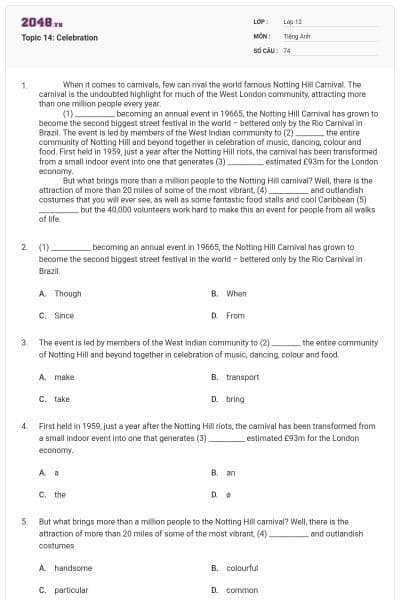
When it comes to carnivals, few can rival the world famous Notting Hill Carnival. The carnival is the undoubted highlight for much of the West London community, attracting more than one million people every year.
(1) ___________ becoming an annual event in 19665, the Notting Hill Carnival has grown to become the second biggest street festival in the world – bettered only by the Rio Carnival in Brazil. The event is led by members of the West Indian community to (2) ________ the entire community of Notting Hill and beyond together in celebration of music, dancing, colour and food. First held in 1959, just a year after the Notting Hill riots, the carnival has been transformed from a small indoor event into one that generates (3) __________ estimated £93m for the London economy.
But what brings more than a million people to the Notting Hill carnival? Well, there is the attraction of more than 20 miles of some of the most vibrant, (4) ___________ and outlandish costumes that you will ever see, as well as some fantastic food stalls and cool Caribbean (5) ___________ but the 40,000 volunteers work hard to make this an event for people from all walks of life.
Though
When
Since
From
Đáp án C
Kiến thức về liên từ
A. Though: mặc dù
B. When: khi
C. Since: từ khi
D. From: từ
Tạm dịch: (1) ___________ becoming an annual event in 19665, the Notting Hill Carnival has grown to become the second biggest street festival in the world – bettered only by the Rio Carnival in Brazil.
(Từ khi trở thành một sự kiện thường niên vào năm 19665, Notting Hill Carnival đã phát triển để trở thành lễ hội đường phố lớn thứ hai trên thế giới - chỉ được tổ chức bởi Rio Carnival ở Brazil.)
make
transport
take
bring
Đáp án D
Kiến thức về từ vựng
A. make /meik/ (v): làm, chế tạo
B. transport /’trænspɔ:t/ (v): chuyên chở, vận tải
C. take /teɪk/ (v): đưa
D. bring /briɳ/ (v): mang
Tạm dịch: The event is led by members of the West Indian community to (2) ________ the entire community of Notting Hill and beyond together in celebration of music, dancing, colour and food.
(Sự kiện này được dẫn dắt bởi các thành viên của cộng đồng Tây Ấn để đưa toàn bộ cộng đồng Notting Hill và hơn thế nữa cùng nhau trong lễ kỷ niệm âm nhạc, khiêu vũ, màu sắc và thực phẩm.)
a
an
the
ø
Đáp án B
Kiến thức về mạo từ
Căn cứ vào “estimated” ta phải dùng mạo từ “an”.
=> Ta dùng cấu trúc: An + estimated + [giá trị tiền cụ thể]: khoảng một lượng bao nhiêu tiền đó
Tạm dịch: First held in 1959, just a year after the Notting Hill riots, the carnival has been transformed from a small indoor event into one that generates (3)__________ estimated £93m for the London economy.
(Được tổ chức lần đầu tiên vào năm 1959, chỉ một năm sau cuộc bạo loạn Notting Hill, lễ hội đã được chuyển đổi từ một sự kiện nhỏ thành một sự kiện tạo ra khoảng 93 triệu bảng cho nền kinh tế London.)
handsome
colourful
particular
common
Đáp án B
Kiến thức về từ vựng
A. handsome /’hænsəm/ (a): đẹp, tốt bụng, rộng rãi
B. colourful /’kʌləful/ (a): nhiều màu sắc
C. particular /pə’tikjulə/ (a): đặc biệt
D. common /’kɔmən/ (a): chung, công cộng
Tạm dịch: But what brings more than a million people to the Notting Hill carnival? Well, there is the attraction of more than 20 miles of some of the most vibrant, (4) ___________ and outlandish costumes.
(Nhưng điều gì mang lại hơn một triệu người cho lễ hội Notting Hill? Vâng, đó là sự hấp dẫn của hơn 20 dặm của một số các sôi động nhất, trang phục đầy màu sắc và lạ lùng)
that you will ever see, as well as some fantastic food stalls and cool Caribbean (5) ___________ but the 40,000 volunteers work hard to make this an event for people from all walks of life.
flavor
season
experience
favour
Đáp án A
Kiến thức về tự vựng
A. flavor /’fleivə/ (n): vị ngon, mùi vị
B. season /’si:zn/ (n): mùa
C. experience /iks’piəriəns/ (n): kinh nghiệm
D. favour /’feivə/ (n): thiện ý, sự quý mến, ưu ái, ủng hộ
Tạm dịch: But what brings more than a million people to the Notting Hill carnival? Well, there is the attraction of more than 20 miles of some of the most vibrant, colourful and outlandish costumes that you will ever see, as well as some fantastic food stalls and cool Caribbean (5) ___________ but the 40,000 volunteers work hard to make this an event for people from all walks of life.
(Nhưng điều gì mang lại hơn một triệu người cho lễ hội Notting Hill? Vâng, đó là sự hấp dẫn của hơn 20 dặm của một số các sôi động nhất, trang phục đầy màu sắc và lạ lùng mà bạn sẽ không bao giờ nhìn thấy, cũng như một số quán ăn tuyệt vời và đậm hương vị biển Caribbean nhưng 40.000 tình nguyện viên làm việc chăm chỉ để làm cho một sự kiện Cho mọi người từ mọi tầng lớp xã hội)
If you want to improve group productivity, it is advisable that you organize competitions that build morale and teamwork skills for all participants, (1) _______ than just a few star performers. For example, if you (2) _______ a competition between sales teams, you can reward all members of the (3) _______ group with a lunch out at a nice restaurant or a group trip. This way, even the lower-performing members of the team have a reason to try as hard as they can to help the team win. In an individual sales contest, a few top salespeople compete with one another for the top prize, (4) _______ everyone else gives up because they know they can’t win. The productivity of (5) _______ top people increases, but the productivity of the rest of the group does not. In a team competition, even the lowest-performing member of the group can help earn the prize, so all team members put in their best effort and the productivity of the entire group goes up.
other
rather
better
sooner
Đáp án B
Chủ đề về TEAM COMPETITION
A. other + N: những cái khác
B. rather + than: hơn là, thay vì
C. better + than: tốt hơn cái gì ( cấu trúc so sánh hơn kém)
D. sooner than: sớm hơn cái gì ( cấu trúc so sánh hơn kém)
Ta có: rather than + N/ do sth: thay vì cái gì/ làm chuyện gì
Tạm dịch: If you want to improve group productivity, it is advisable that you organize competitions that build morale and teamwork skills for all participants, (1) _______ than just a few star performers.
(Nếu bạn muốn cải thiện hiệu quả làm việc của nhóm, bạn nên tổ chức các cuộc thi nâng cao kỹ năng làm việc và tinh thần đồng đội cho tất cả những người tham gia, thay vì chỉ một vài người thực hiện tốt.)
take
place
put
hold
Đáp án D
Kiến thức về từ vựng
A. take /teɪk/ (v): cầm, nắm, giữ, lấy
B. place /pleɪs/ (v): để, đặt
C. put /pʊt/ (v): để, đặt vào, sắp đặt
D. hold /həʊld/ (v): tổ chức, tiến hành
=> hold a meeting/ a competition/ a party….: tổ chức cái gì
Tạm dịch: For example, if you (2) _______ a competition between sales teams, you can reward all members…
(Ví dụ, nếu bạn tổ chức một cuộc thi giữa các nhóm bán hàng, bạn có thể thưởng cho tất cả các thành viên…)
win
winner
winning
won
Đáp án C
Kiến thức về dạng của từ
A. win /wɪn/ (v): thắng cuộc; thắng
B. winner /ˈwɪnə(r)/ (n): người thắng cuộc
C. winning /ˈwɪnɪŋ/ (adj): giành thắng lợi
D. won /woun/ (Ved): chiến thắng
Vì đằng sau chỗ trống cần điền là một danh từ nên ta sẽ chọn một tính từ để bổ sung nghĩa cho danh từ đó => chọn đáp án C.
Tạm dịch: For example, if you hold a competition between sales teams, you can reward all members of the (3) _______ group with a lunch out at a nice restaurant or a group trip.
(Ví dụ, nếu bạn tổ chức một cuộc thi giữa các nhóm bán hàng, bạn có thể thưởng cho tất cả các thành viên của nhóm giành thắng lợi bằng một bữa ăn trưa tại một nhà hàng đẹp hoặc một chuyến đi theo nhóm.)
while
if
when
why
Đáp án A
Kiến thức về liên từ
A. While + clause/ Ving: trong khi (diễn tả 2 sự việc xảy ra song song)
B. If + clause 1, clause 2: nếu như ( để đưa ra câu điều kiện)
C. When + clause/ Ving: khi ( thường diễn tả 2 sự việc xảy ra trước-sau)
D. Why + clause: tại sao ( dùng để đưa ra lí do, nguyên nhân)
Tạm dịch: In an individual sales contest, a few top salespeople compete with one another for the top prize, (4) _______ everyone else gives up because they know they can’t win.
(Trong một cuộc thi bán hàng mamg tính cá nhân, một vài người bán hàng giỏi nhất thường cạnh tranh với nhau để giành giải cao nhất, trong khi những người khác bỏ cuộc vì họ biết họ không thể thắng.)
=> Hai sự việc này diễn ra song song trong cuộc thi bán hàng nên chọn đáp án A.
this
that
the
each
Đáp án C
Kiến thức về mạo từ
A. this + N: cái này, điều này => dùng để chỉ người/ vật ở khoảng cách gần
B. that + N: cái kia, người kia => dùng để chỉ người/ vật ở khoảng cách xa
C. the + N => được dùng khi danh từ là vật duy nhất/ danh từ đã được nhắc đến trước đó/ khi có so sánh nhất….
D. each + N: mỗi => chỉ từng cá nhân riêng biệt trong một nhóm
Ta thấy danh từ “top people” đã được nhắc đến trước đó “In an individual sales contest, a few top salespeople compete…” => điền mạo từ “the”.
Tạm dịch: The productivity of (5) _______ top people increases,
but the productivity of the rest of the group does not. In a team competition, even the lowest-performing member of the group can help earn the prize, so all team members put in their best effort and the productivity of the entire group goes up.
( Năng suất của những người nhóm đầu tăng lên, nhưng năng suất của phần còn lại của nhóm thì không. Trong một cuộc thi nhóm, ngay cả thành viên có thành tích thấp nhất trong nhóm cũng có thể giúp kiếm được giải thưởng, vì vậy tất cả các thành viên trong nhóm nên nỗ lực hết mình và năng suất của toàn nhóm sẽ tăng lên.)
Is cake a socially awkward person’s reward for having made it through the birthday celebration ritual? Well, not exactly. And actually celebrating the anniversary of one’s birth has not always been the done thing either.
What if I told you that having your birthday celebrated is the closest you are getting to be a god(dess)? The first “birthday” celebration goes back to the Egyptians who, each year, would rejoice on the anniversary of the pharaoh’s coronation day. The reason being that you were not really born until you were made into a pharaoh, i.e., after you were transformed into a God. From there, the Greeks contributed to bringing a moon-shaped cake and candles to celebrate the lunar goddess, Artemis, to represent the radiance of the moon and her beauty. But still, what about the cake?
We have to thank the Germans for introducing the contemporary birthday celebrations, which included a cake. They started the ‘kinderfeste’, where children were honoured with a celebration on their birthday, especially when it came to the first birthday. Kids also had candles on their cake; one for each year they had been alive, plus one, symbolising the chance of making it through the coming year.
Fortunately, we now live at a time where birthday cakes come in various shapes, colours and flavours to please different preferences and dietary requirements, as it is very difficult to imagine a birthday party without a sweet and yummy, treat. Conversely, cake eating is less and less reserved to birthdays only, and personally I really like being able to enjoy a piece of cake whenever I feel like it outside birthday parties. Still, there is something even more special about a birthday cake; it is also about sharing special moments with loved ones.
Which best serves as the title for the passage?
Why do we celebrate birthdays anyway?
How should we celebrate our birthday?
Modern people just skip the birthday parties.
The best way to hold a birthday party.
Đáp án A
Chủ đề về BIRTHDAY CAKES
Cái nào sau đây là tiêu đề hay nhất cho đoạn văn?
A. Tại sao chúng ta phải tổ chức sinh nhật dù thế nào đi chăng nữa?
B. Chúng ta nên tổ chức sinh nhật như thế nào?
C. Người hiện đại chỉ bỏ qua các bữa tiệc sinh nhật
D. Cách tốt nhất để tổ chức một bữa tiệc sinh nhật
Căn cứ vào thông tin trong bài:
“Is cake a socially awkward person’s reward for having made it through the birthday celebration ritual? Well, not exactly. And actually celebrating the anniversary of one’s birth has not always been the done thing either.”
(Có phải bánh kem là một phần thưởng vụng về cho việc đã trải qua lễ nghi trong việc tổ chức sinh nhật? Vâng, cũng không đúng như vậy. Và thật sự tổ chức lễ kỷ niệm của sinh nhật ai đó cũng không phải lúc nào cũng là thứ như trên.)
“What if I told you that having your birthday celebrated is the closest you are getting to be a god(dess)? The first “birthday” celebration goes back to the Egyptians who, each year, would rejoice on the anniversary of the pharaoh’s coronation day.”
(Giả sử tôi nói với bạn rằng việc tổ chức bữa tiệc sinh nhật của bạn là bạn rất gần với việc trở thành một nữ thần? Bữa tiệc sinh nhật “đầu tiên” là ở người Ai Cập, người mà, hằng năm, hân hoan vui mừng ngày lễ kỷ niệm ngày đăng quang của vị vua Ai Cập cổ đại.)
The word “radiance” in paragraph 2 is closest in meaning to ______.
gloom
elation
light
glare
Đáp án C
Từ “radiance” trong đoạn văn thứ 2 gần nghĩa với _______ .
A. Cảm giác buồn đau
B. Sự hân hoan
C. Ánh sáng
D. Ánh sáng chói chang, khó chịu
Từ đồng nghĩa: Radiance (ánh sáng) = Light
According to paragraph 2, on what occasion did the Egyptian residents honour a birthday?
The date that the goddess of Nile river reincarnated.
The date that their king was appointed by the former pharaoh.
The date that the citizens of Egypt paid tribute to the moon.
The date that the current pharaoh got enthroned.
Đáp án D
Theo như đoạn 2, dịp nào thì người Ai Cập tổ chức tiệc sinh nhật?
A. Ngày mà nữ thần sông Nile tái sinh
B. Ngày mà vị vua của họ được chỉ định kế vị bởi vị vua trước
C. Ngày mà cư dân Ai Cập bày tỏ lòng biết ơn đối với mặt trăng
D. Ngày mà vị vua Ai Cập cổ đại được phong lên làm vua
Căn cứ vào thông tin trong đoạn 2:
“The first “birthday” celebration goes back to the Egyptians who, each year, would rejoice on the anniversary of the pharaoh’s coronation day. The reason being that you were not really born until you were made into a pharaoh,…”
(Bữa tiệc sinh nhật “đầu tiên” là ở người Ai Cập người mà, hằng năm, hân hoan vui mừng vào ngày lễ kỷ niệm ngày lên ngôi của vị vua Ai cập cổ đại. Nguyên nhân đó là bạn không thật sự được sinh ra mãi cho đến khi bạn được phong thành một vị vua Ai Cập cổ đại….)
=> Như vậy ta thấy ngày sinh nhật là ngày mà vị vua Ai cập cổ đại được phong lên làm vua:
The word “they” in paragraph 3 refers to _______.
German
children
cakes
celebrations
Đáp án B
Từ “they” ở đoạn thứ 3 đề cập tới _________ .
A. Người Đức
B. Những đứa trẻ
C. Những cái bánh kem
D. Những lễ kỷ niệm
Căn cứ vào thông tin trong đoạn 3:
“They started the ‘kinderfest’, where children were honoured with a celebration on their birthday, especially when it came to the first birthday. Kids also had candles on their cake; one for each year they had been alive, plus one, symbolising the chance of making it through the coming year.”
(Chúng bắt nguồn từ “kinderfest”, nơi mà những đứa trẻ được tổ chức sinh nhật vào ngày sinh của chúng, đặc biệt là ngày sinh nhật đầu tiên. Những đứa trẻ cũng có những cây nến trên chiếc bánh của chúng; mỗi một cái tượng trưng cho số năm những đứa trẻ ấy sống trên đời, cộng thêm một cái nữa, tượng trưng cho cơ hội vượt qua trong năm tiếp theo.)
According to paragraph 4, what is INCORRECT about the present-day birthday cakes?
There is a deeper meaning to a birthday cake, that is flaunting one’s status.
There are many options concerning the appearances and tastes of the cakes.
Cake’s roles are not limited to the commemoration of one’s date of birth.
Birthday celebrations and cakes are no longer intertwined and inseparable terms.
Đáp án A
Theo như đoạn 4, cái nào sau đây không đúng về bánh sinh nhật hiện nay?
A. Có một ý nghĩa sâu sắc hơn trong mỗi chiếc bánh sinh nhật, đó là khoe khoang địa vị của ai đó
B. Có rất nhiều lựa chọn liên quan đến vẻ ngoài và mùi vị của chiếc bánh kem
C. Vai trò của chiếc bánh kem không chỉ giới hạn trong việc để tưởng nhớ ngày sinh của ai đó
D. Ngày lễ sinh nhật và bánh kem không còn là những thuật ngữ đan xen vào nhau và không thể tách rời nữa.
Căn cứ vào thông tin trong đoạn 4:
“Conversely, cake eating is less and less reserved to birthdays only, and personally I really like being able to enjoy a piece of cake whenever I feel like it outside birthday parties. Still, there is something even more special about a birthday cake; it is also about sharing special moments with loved ones.”
(Ngược lại, việc ăn bánh kem ngày càng ít dành riêng cho bữa tiệc sinh nhật, và tôi thật sự thích việc có thể thưởng thức một miếng bánh kem bất cứ khi nào tôi muốn dù cho không có bữa tiệc sinh nhật nào cả. Tuy nhiên, có một vài thứ còn đặc biệt hơn về chiếc bánh sinh nhật, đó là chia sẻ những giây phút đặc biệt cùng với những người thân yêu.)
=> Như vậy ta thấy ý nghĩa đặc biệt của chiếc bánh sinh nhật là chia sẻ những giây phút đặc biệt bên người thân yêu.
In Viet Nam festivals often take place during the three months in spring and in autumn when people have a lot of leisure time. In addition, the climate in spring and autumn is especially suitable for holding festivals and for festivals goers to enjoy.
Traditional festivals constitute a form of cultural activities, a spiritual product which the people have created and developed during the course of history. From generation to generation, the Vietnamese people preserve the fine tradition of “remembering the source while drinking water.” Festivals are events which represent this tradition of the community as well as honor the holy figures named as “gods” – the real persons in national history or legendary persons. The images of gods converge the noble characteristics of mankind. They are national heroes who fought against foreign invaders, reclaimed new lands, treated people, fought against natural calamities, or those legendary characters who affect the earthly life.
Accordingly, first and foremost, festivals are events when people pay tribute to divinities that rendered merits to the community and the nation. These are occasions when people come back to either their natural or national roots, which form a sacred part in their mind. Furthermore, festivals represent the strength of the commune or village, the local region or even the whole nation. Worshipping the same god, the people unite in solidarity to overcome difficulties, striving for a happy and wealthy life.
Moreover, festivals display the demand for creativity and enjoyment of spiritual and material cultural values of all social strata. Festivals become a form of education under which fine traditional moral values can be handed from one generation to the next in a unique way of combining spiritual characters with competition and entertainment games. Festivals are also the time people can express their sadness and worries in a wish that gods might bestow favor on them to help them strive for a better life.
What affects the time to hold festivals in Viet Nam?
Festival holders’ timetable and festival goers’ preference
The abundance of fruits and flowers and people’s health
Weather conditions and people’s working pattern
People’s preference of leisure time and climate
Đáp án C
Chủ đề FESTIVALS
Yếu tố nào ảnh hưởng đến thời gian tổ chức các lễ hội ở Việt Nam?
A. Lịch trình của những người tổ chức lễ hội và sở thích của những người tham gia lễ hội.
B. Sự phong phú của hoa quả và sức khỏe mọi người
C. Điều kiện thời tiết và kiểu làm việc của mọi người
D. Sự ưa thích của mọi người về thời gian rảnh rỗi và khí hậu
Căn cứ vào các thông tin trong đoạn 1:
- “In Vietnam festivals often take place during the three months in spring and in autumn when people have a lot of leisure time.”
(Ở Việt Nam các lễ hội thường diễn ra trong suốt 3 tháng mùa xuân và mùa thu khi mà mọi người có nhiều thời gian rảnh rỗi.)
- “In addition, the climate in spring and autumn is especially suitable for holding festivals and for festivals goers to enjoy.”
(Thêm vào đó, khí hậu mùa xuân và mùa thu đặc biệt phù hợp để tổ chức lễ hội và cho những người đi lễ hội thưởng thức.)
Dịch bài đọc
Ở Việt Nam, lễ hội thường diễn ra vào ba tháng mùa xuân và mùa thu khi mọi người có nhiều thời gian rảnh rỗi. Ngoài ra, khí hậu mùa xuân và mùa thu đặc biệt thích hợp để tổ chức lễ hội và để người tham dự lễ hội thưởng thức.
Lễ hội truyền thống là một hình thức hoạt động văn hóa, một sản phẩm tinh thần mà con người đã sáng tạo và phát triển trong suốt chiều dài lịch sử. Từ thế hệ này sang thế hệ khác, người Việt Nam vẫn giữ gìn truyền thống tốt đẹp “uống nước nhớ nguồn”. Lễ hội là những sự kiện đại diện cho truyền thống này của cộng đồng cũng như tôn vinh những nhân vật thiêng liêng được gọi là “thần” – những người có thật trong lịch sử dân tộc hoặc những người huyền thoại. Hình ảnh các vị thần hội tụ những phẩm chất cao quý của con người. Họ là những anh hùng dân tộc đã chiến đấu chống lại quân xâm lược, khai hoang đất đai, chữa bệnh cho người dân, chống lại thiên tai hoặc những nhân vật huyền thoại ảnh hưởng đến cuộc sống trần thế.
Theo đó, trước hết, lễ hội là những sự kiện mà mọi người tỏ lòng tôn kính các vị thần đã ban công đức cho cộng đồng và quốc gia. Đây là những dịp để mọi người trở về với cội nguồn tự nhiên hoặc dân tộc, tạo thành một phần thiêng liêng trong tâm trí họ. Hơn nữa, lễ hội tượng trưng cho sức mạnh của xã, làng, vùng, thậm chí là cả quốc gia. Thờ cùng một vị thần, mọi người đoàn kết đoàn kết vượt qua khó khăn, phấn đấu cho cuộc sống hạnh phúc, sung túc.
Hơn nữa, lễ hội thể hiện nhu cầu sáng tạo và hưởng thụ các giá trị văn hóa vật chất và tinh thần của mọi tầng lớp xã hội. Lễ hội trở thành hình thức giáo dục, qua đó các giá trị đạo đức truyền thống tốt đẹp có thể được truyền từ thế hệ này sang thế hệ khác theo cách độc đáo kết hợp các tính chất tâm linh với các trò chơi thi đấu và giải trí. Lễ hội cũng là thời điểm mọi người có thể bày tỏ nỗi buồn và nỗi lo lắng của mình với mong muốn các vị thần ban ơn giúp họ phấn đấu cho một cuộc sống tốt đẹp hơn.
Which of the followings best replace the word "course” in the second paragraph?
Lesson
Road
Creation
Development
Đáp án D
Điều nào sau đây có thể thay thế tốt nhất cho từ “course” trong đoạn văn thứ 2?
A. Bài học
B. Con đường
C. Tác phẩm
D. Sự phát triển
Từ đồng nghĩa: course (quá trình phát triển) = development
Căn cứ vào các thông tin trong đoạn 2:
- “Traditional festivals constitute /ˈkɒn.stɪ.tʃuːt/ a form of cultural activities, a spiritual product which the people have created and developed during the course of history.”
(Các lễ hội truyền thống tạo nên một thể loại các hoạt động văn hóa, một sản phẩm tinh thần mà mọi người tạo ra và phát triển suốt quá trình lịch sử.)
What does the word “they” in the second paragraph refer to______?
Images
Gods
Characteristics
Invaders
Đáp án B
Từ “they” trong đoạn văn thứ 2 đề cập đến cái gì?
A. Các hình ảnh
B. Các Thần
C. Các đặc trưng
D. quân xâm lược
Căn cứ vào các thông tin trong đoạn 2:
- “The images of gods converge /kənˈvɜːdʒ/ the noble characteristics of mankind. They are national heroes who fought against foreign invaders, reclaimed new lands, treated people, fought against natural calamities, or those legendary characters who affect the earthly life.”
(Các hình ảnh về các Thần hội tụ các đặc trưng cao quý của nhân loại. Họ là những anh hùng dân tộc, người mà đấu tranh chống giặc ngoại xâm, đòi lại những vùng đất mới, đối đãi con người, đấu tranh với thiên tai, hoặc họ là những nhân vật huyền thoại có ảnh hưởng tới cuộc sống trần tục.)
Which of the following is NOT mentioned as a value of festivals?
Remembering national heroes
Educating young generations
Showing community’s union
Questioning personal bad lucks
Đáp án D
Điều nào dưới đây KHÔNG được đề cập đến là một giá trị của các lễ hội?
A. Tưởng nhớ các anh hùng dân tộc
B. Giáo dục cho các thế hệ trẻ
C. Thể hiện sự đoàn kết của cộng đồng
D. Nghi ngờ những xui xẻo cá nhân
Căn cứ vào các thông tin trong đoạn 2, 3, 4:
- “Festivals are events which represent this tradition of the community as well as honour the holy figures named as ”gods" – the real persons in national history or legendary persons.”
(Các lễ hội là những sự kiện mà thể hiện truyền thống của cộng đồng cũng như bày tỏ lòng tôn kính với những thần linh hay còn gọi là “các Thần” – những con người có thật trong lịch sử dân tộc hay các nhân vật huyền thoại.)
Vậy đáp án A đã được đề cập đến trong bài là một giá trị của các lễ hội.
- “ Festivals become a form of education under which fine traditional moral values can be handed from one generation to the next in a unique way of combining spiritual characters with competition and entertainment games.”
(Lễ hội trở thành một dạng giáo dục, cái mà những giá trị đạo đức truyền thống tốt đẹp được truyền từ đời này sang đời khác một cách độc nhất bằng việc kết hợp những nhân vật tâm linh với sự ganh đua và các trò chơi giải trí.)
Vậy đáp án B đã được đề cập đến trong bài là một giá trị của các lễ hội.
- “Worshipping the same god, the people unite in solidarity to overcome difficulties, striving for a happy and wealthy life.”
(Thờ cúng cùng vị Thần, mọi người đoàn kết lại để vượt qua những khó khăn, cố gắng vì một cuộc sống hạnh phúc và sung túc.)
Vậy đáp án C đã được đề cập đến trong bài là một giá trị của các lễ hội.
⟹ Đáp án là D.
What is the best title of the passage?
Time, formation and meaning of traditional Vietnamese festivals
Social, educational and historical values of Vietnamese festivals
Similarities, differences and changes in Vietnamese festivals
When, how and why festivals in Vietnam keep their traditions
Đáp án A
Đâu là tiêu đề phù hợp nhất cho đoạn văn?
A. Thời gian, sự hình thành và ý nghĩa của các lễ hội truyền thống của Việt Nam.
B. Các giá trị xã hội, giáo dục và lịch sử của các lễ hội truyền thống của Việt Nam.
C. Các điểm tương đồng, khác biệt và nét thay đổi trong các lễ hội truyền thống của Việt Nam.
D. Khi nào, bằng cách nào và vì sao các lễ hội ở Việt Nam giữ được truyền thống của họ/.
Căn cứ vào các thông tin trong cả bài:
- Đoạn 1 đề cập đến thời gian của các lễ hội truyền thống của Việt Nam.
- Đoạn 2 đề cập đến sự hình thành của các lễ hội truyền thống của Việt Nam.
- Đoạn 3, 4 đề cập đến ý nghĩa của các lễ hội truyền thống của Việt Nam.
⟹ Đáp án là A.
Kissing under sprigs of mistletoe is a well-known holiday tradition, but this little plant’s history as a symbolic herb dates back thousands of years. Many ancient cultures prized mistletoe for its healing properties. The plant’s romantic overtones most likely started with the Celtic Druids of the 1st century A.D. Because mistletoe could blossom even during the frozen winter, the Druids came to view it as a sacred symbol of vivacity, and they administered it to humans and animals alike in the hope of restoring fertility.
Another famous chapter in mistletoe folklore comes from Norse mythology. As the story goes, when the god Odin’s son Baldur was prophesied to die, his mother Frigg, the goddess of love, went to all the animals and plants of the natural world to secure an oath that they would not harm him. But Frigg neglected to consult with the unassuming mistletoe, so the scheming god Loki made an arrow from the plant and saw that it was used to kill the otherwise invincible Baldur. According to one sunnier version of the myth, the gods were able to resurrect Baldur from the dead. Delighted, Frigg then declared mistletoe a symbol of love and vowed to plant a kiss on all those who passed beneath it.
Mistletoe’s associations with fertility and vitality continued through the Middle Ages, and by the 18th century it had become widely incorporated into Christmas celebrations. Just how it made the jump from sacred herb to holiday decoration remains up for debate, but the kissing tradition appears to have first caught on among servants in England before spreading to the middle classes. As part of the early custom, men were allowed to steal a kiss from any woman caught standing under the mistletoe, and refusing was viewed as bad luck.
Which best serves as the title for the passage?
How mistletoe became the icon of Christmas.
Why do people kiss under the mistletoe?
Christmas customs and traditions.
Mistletoe as an invitation to sexual harassment.
Đáp án B
Tiêu đề phù hợp nhất cho đoạn văn là gì?
A. Cách mà cây tầm gửi trở thành biểu tượng của Giáng sinh.
B. Tại sao mọi người hôn nhau dưới cây tầm gửi
C. Phong tục và truyền thống của Giáng sinh.
D. Cây tầm gửi như một lời mời quấy rối tình dục.
Căn cứ thông tin đoạn 1 và đoạn 2:
Kissing under sprigs of mistletoe is a well-known holiday tradition, but this little plant’s history as a symbolic herb dates back thousands of years.
(Hôn dưới nhánh cây tầm gửi là một truyền thống kỳ nghỉ nổi tiếng, nhưng lịch sử của loài cây nhỏ bé này như một loại thảo mộc mang tính biểu tượng có từ hàng ngàn năm.)
Delighted, Frigg then declared mistletoe a symbol of love and vowed to plant a kiss on all those who passed beneath it.
(Vui mừng, Frigg sau đó tuyên bố cây tầm gửi là biểu tượng của tình yêu và thề sẽ đặt một nụ hôn lên tất cả những người đi qua bên dưới nó.)
The word “prized” in paragraph 1 is closest in meaning to ______.
gifted
rewarded
traced
valued
Đáp án D
Từ “prized” trong đoạn 1 gần nghĩa nhất với…
A. có tài
B. được thưởng
C. phát hiện ra
D. ước tính, đánh giá
Từ đồng nghĩa: prized : đánh giá cao, quý trọng = valued
Many ancient cultures prized mistletoe for its healing properties.
(Nhiều nền văn hóa cổ xưa đánh giá cao cây tầm gửi vì đặc tính chữa bệnh của nó.)
According to paragraph 2, what was the Achilles heel of the mighty Baldur?
The backfired oath with the animals and plants.
The modest little plant of mistletoe.
The overwhelming love from Odin.
Loki’s infallible marksmanship.
Đáp án B
Theo đoạn 2, điểm yếu của Baldur hùng mạnh là gì?
A. Lời thề ngược lại với động vật và thực vật
B. Cây tầm gửi bé nhỏ khiêm tốn.
C. Tình yêu ngập tràn từ Odin
D. Tài thiện xạ không thể sai lầm của Loki.
Căn cứ thông tin đoạn 2:
Another famous chapter in mistletoe folklore comes from Norse mythology. As the story goes, when the god Odin’s son Baldur was prophesied to die, his mother Frigg, the goddess of love, went to all the animals and plants of the natural world to secure an oath that they would not harm him. But Frigg neglected to consult with the unassuming mistletoe, so the scheming god Loki made an arrow from the plant and saw that it was used to kill the otherwise invincible Baldur.
(Một chương nổi tiếng khác trong văn hóa dân gian cây tầm gửi đến từ thần thoại Bắc Âu. Câu chuyện kể lại, khi con trai của thần Odin, Baldur được tiên tri là đã chết, mẹ của anh ta là Frigg, nữ thần tình yêu, đã đến tất cả các loài động vật và thực vật trong thế giới tự nhiên để đảm bảo lời thề rằng họ sẽ không làm hại anh ta. Nhưng Frigg đã bỏ qua việc tham khảo ý kiến của cây tầm gửi không đáng tin cậy, vì vậy, vị thần mưu mô Loki đã tạo ra một mũi tên từ cây và thấy rằng nó được sử dụng để giết chết Baldur bất khả chiến bại.)
The word “it” in paragraph 2 refers to _______.
oath
love
arrow
kiss
Đáp án C
Từ “it” trong đoạn 2 đề cập đến:
A. lời thề
B. tình yêu
C. mũi tên
D. nụ hôn
=> Từ “it” được dung để chỉ mũi tên mà thần Loki đã làm ra.
But Frigg neglected to consult with the unassuming mistletoe, so the scheming god Loki made an arrow from the plant and saw that it was used to kill the otherwise invincible Baldur.
(Nhưng Frigg đã bỏ qua việc tham khảo ý kiến của cây tầm gửi không đáng tin cậy, vì vậy, vị thần mưu mô Loki đã tạo ra một mũi tên từ cây và thấy rằng nó được sử dụng để giết chết Baldur bất khả chiến bại.)
According to paragraph 3, which statement is correct about the mistletoe tradition?
Declining to perform a kiss under the presence of a mistletoe implies misfortune.
The practice persisted through the Middle Ages just to perish in the early 18th century.
The English middle classes were the first to discover and follow the kissing tradition.
The meaning of mistletoe still remains on the table, just like the evolution of its roles.
Đáp án A
Theo đoạn 3, câu nào đúng về truyền thống cây tầm gửi?
A. Từ chối một nụ hôn dưới sự hiện diện của cây tầm gửi ngụ ý là điều không may.
B. Thói quen bền bỉ qua thời Trung cổ chỉ lụi tàn vào đầu thế kỷ 18.
C. Tầng lớp trung lưu ở Anh là người đầu tiên phát hiện và làm theo truyền thống hôn.
D. Ý nghĩa của cây tầm gửi vẫn còn nguyên trên bàn, giống như sự phát triển vai trò của nó.
Căn cứ thông tin đoạn 3:
Mistletoe’s associations with fertility and vitality continued through the Middle Ages, and by the 18th century it had become widely incorporated into Christmas celebrations. Just how it made the jump from sacred herb to holiday decoration remains up for debate, but the kissing tradition appears to have first caught on among servants in England before spreading to the middle classes. As part of the early custom, men were allowed to steal a kiss from any woman caught standing under the mistletoe, and refusing was viewed as bad luck.
(Quần hợp của cây tầm gửi với khả năng sinh sản và sức sống tiếp tục trong suốt thời Trung cổ, và đến thế kỷ 18, nó đã được kết hợp rộng rãi vào các lễ Giáng sinh. Làm thế nào nó tạo ra bước nhảy từ thảo mộc linh thiêng sang trang trí ngày lễ vẫn còn để tranh luận, nhưng truyền thống hôn dường như lần đầu tiên bắt gặp trong số những người hầu ở Anh trước khi lan sang tầng lớp trung lưu. Là một phần của phong tục ban đầu, đàn ông được phép đánh cắp một nụ hôn từ bất kỳ người phụ nữ nào bị bắt đứng dưới cây tầm gửi, và từ chối được coi là điều xui xẻo.)
In Africa, people celebrate with joy the birth of a new baby. The Pygmies would sing a birth-song to the child. In Kenya, the mother takes the baby strapped to her back into the thorn enclosure where the cattle is kept. There, her husband and the village elders wait to give the child his or her name.
In West Africa, after the baby is eight days old, the mother takes the baby for it’s first walk in the big, wide world, and friends and family are invited to meet the new baby. In various African nations, they hold initiation ceremonies for groups of children instead of birthdays. When children reach a certain designated age, they learn the laws, beliefs, customs, songs and dances of their tribes.
Some African tribes consider that children from nine to twelve are ready to be initiated into the grown up world. They may have to carry out several tests.
Masai boys around thirteen years old to seventeen undergo a two stage initiation. The first stage lasts about three months. The boys leave their parents’ homes, paint their bodies white, and are taught how to become young warriors. At the end of this stage, they have their heads shaved and they are also circumcised. The second stage, the young warriors grow their hair long and live in a camp called a manyatta where they practice hunting the wild animals that might attack the Masai herds. This stage may last a few years.
When they are ready, they will marry and become owners of large cattle herds like their fathers.
The girls are initiated when they are fourteen or fifteen. They are taught by the older women about the duties of marriage and how to care for babies. Soon after that they are married and lead a life similar to that of their mothers.
(Source: http://www.birthdaycelebrations.net/ )
What does the passage mainly discuss?
Celebrations for a new child in Africa.
Birthday ceremonies for children in Africa.
Traditions of Masai people when having a new baby.
Activities in a birth celebration.
Đáp án A
Đoạn văn này chủ yếu thảo luận về điều gì?
A. Những hoạt động kỉ niệm dành cho 1 đứa trẻ mới ở Châu Phi.
B. Nghi lễ sinh nhật cho trẻ em ở Châu Phi.
C. Truyền thống của người Masai khi sinh con.
D. Các hoạt động trong lễ kỉ niệm 1 đứa trẻ chào đời.
Căn cứ vào thông tin toàn bài:
Đoạn văn đang nhắc đến các hoạt động kỉ niệm được tổ chức cho 1 đứa trẻ ở Châu Phi từ khi mới sinh ra cho đến khi sẵn sàng lập gia đình mới.
Where do the father and older villagers in Kenya give the name to the child?
in the village
at the place to keep the cattle
at their house
at the fence of the cattle’s cages
Đáp án B
Người cha và những người lớn tuổi trong làng ở Kenya thường đặt tên cho đứa trẻ ở đâu?
A. ở trong làng
B. tại nơi chăn nuôi gia súc
C. ở nhà họ
D. tại hàng rào của chuồng gia súc
Căn cứ thông tin đoạn 1:
In Kenya, the mother takes the baby strapped to her back into the thorn enclosure where the cattle is kept. There, her husband and the village elders wait to give the child his or her name.
(Ở Kenya, người mẹ đưa em bé được địu vào lưng mình vào trong vùng đất có rào gai vây quanh, nơi gia súc được nuôi. Ở đó, chồng bà và những người lớn tuổi trong làng chờ đợi để đặt tên cho đứa trẻ.)
Which of the following is NOT mentioned in paragraph 2?
An eight-day-old child will be taken for the first walk by his or her mother.
Children have to learn their tribes’ cultures and traditions when they are old enough.
Children are prepared for a mature life when being met by friends and family.
Children are likely to overcome some tests to enter the grown-up world.
Đáp án C
Câu nào không được đề cập đến trong đoạn 2?
A. 1 đứa trẻ 8 ngày tuổi sẽ được đỡ bước đi bộ đầu tiên bởi mẹ của nó.
B. Trẻ em phải học về văn hoá và truyền thống của bộ tộc mình khi chúng đủ lớn.
C. Trẻ em được chuẩn bị cho cuộc sống trưởng thành khi được viếng thăm bởi bạn bè và người thân.
D. Trẻ em có thể phải vượt qua các cuộc kiểm tra để bước vào thế giới trưởng thành.
Căn cứ thông tin đoạn 2:
In West Africa, after the baby is eight days old, the mother takes the baby for it’s first walk in the big, wide world, and friends and family are invited to meet the new baby. In various African nations, they hold initiation ceremonies for groups of children instead of birthdays. When children reach a certain designated age, they learn the laws, beliefs, customs, songs and dances of their tribes.
Some African tribes consider that children from nine to twelve are ready to be initiated into the grown up world. They may have to carry out several tests.
(Ở Tây Phi, sau khi em bé được tám ngày tuổi, người mẹ đưa em bé đi bộ lần đầu tiên trong một thế giới rộng lớn, và bạn bè và gia đình được mời đến gặp em bé mới. Ở các quốc gia châu Phi khác nhau, họ tổ chức các buổi lễ vỡ lòng cho các nhóm trẻ em thay vì sinh nhật. Khi trẻ em đạt đến một độ tuổi nhất định, chúng học các luật, tín ngưỡng, phong tục, bài hát và điệu múa của các bộ lạc của chúng. Một số bộ lạc châu Phi cho rằng trẻ em từ 9 đến 12 tuổi đã sẵn sàng để được bắt đầu vào thế giới trưởng thành. Họ có thể phải thực hiện một số bài kiểm tra.)
The word “undergo” in the third paragraph is closest in meaning to _________.
commence
experience
participate in
explore
Đáp án B
Từ “undergo” trong đoạn 3 gần nghĩa nhất với từ _________.
A. bắt đầu
B. trải qua
C. tham gia
D. khám phá
Từ đồng nghĩa: undergo (trải qua) = experience.
Masai boys around thirteen years old to seventeen undergo a two stage initiation.
(Bé trai Masai khoảng mười ba tuổi đến mười bảy trải qua thời kì vỡ lòng gồm 2 giai đoạn).
The word “shaved” in paragraph 3 mostly means ___________.
cut the hair off with a razor
tie the hair with a hairpin
dye the hair with another color
cover the hair with a hat
Đáp án A
Từ “shaved” trong đoạn 3 gần có thể có nghĩa là ___________.
A. cắt tóc bằng dao cạo
B. buộc tóc với 1 cái kẹp
C. nhuộm tóc với 1 màu khác
D. che tóc bằng 1 cái mũ
Định nghĩa: Shaved (cạo đầu) = cut the hair off with a razor
At the end of this stage, they have their heads shaved and they are also circumcised.
(Vào cuối giai đoạn này, họ cạo đầu và họ cũng cắt bao quy đầu.)
What does the word “they” in paragraph 3 refer to?
the Masai herds
the wild animals
the young warriors
their heads
Đáp án C
Từ “they” trong đoạn 3 đề cập đến từ nào?
A. đàn gia súc của Masai
B. động vật hoang dã
C. những chiến binh trẻ
D. những cái đầu của họ
Căn cứ thông tin đoạn 3:
Từ “they” đề cập đến các chiến binh trẻ.
The second stage, the young warriors grow their hair long and live in a camp called a manyatta where they practice hunting the wild animals that might attack the Masia herds. This stage may last a few years. When they are ready, they will marry and become owners of large cattle herds like their fathers.
(Giai đoạn thứ hai, các chiến binh trẻ để tóc dài và sống trong một trại gọi là một cộng đồng người Masai nơi họ thực hành săn bắn những con vật hoang dã có thể tấn công đàn vật nuôi của Masai. Giai đoạn này có thể kéo dài vài năm. Khi họ đã sẵn sàng, họ sẽ kết hôn và trở thành chủ sở hữu của đàn gia súc lớn như cha của họ.)
What do the girls have to learn in their initiation?
How to take care of her husband and family in the future.
The responsibilities of marriage and the way to look after their children.
Homemaking and childbearing.
How to lead a life after marriage and giving birth to a child.
Đáp án B
Các cô gái học điều gì trong sự khởi đầu của họ?
A. Cách chăm sóc chồng và gia đình trong tương lai.
B. Trách nhiệm trong hôn nhân và cách chăm sóc con cái.
C. Chăm sóc gia đình và sinh con.
D. Cách sống sau hôn nhân và sinh con.
Căn cứ vào thông tin đoạn cuối:
The girls are initiated when they are fourteen or fifteen. They are taught by the older women about the duties of marriage and how to care for babies. Soon after that they are married and lead a life similar to that of their mothers.
(Các cô gái được vỡ lòng khi họ mười bốn hoặc mười lăm tuổi. Họ được dạy bởi những phụ nữ lớn tuổi về nhiệm vụ hôn nhân và cách chăm sóc cho trẻ sơ sinh. Ngay sau đó họ kết hôn và sống một cuộc sống tương tự như của các bà mẹ của họ.)
It’s probably the most painstaking, heart wrenching, and stress inducing test of dedication a marriage can face. But the reward at the end is pretty sweet. At the annual Wife Carrying World Championships in Sonkajärvi, Finland, male competitors race around a track hauling their female partners on their backs. Winner takes home his wife’s weight in beer.
It’s no ordinary racetrack, either. Competitors must wade through a neck-deep pool of water, climb over hurdles, and run through pits of sand before crossing the finish line. While some participants don crazy costumes for the pre-race, the actual event is pretty straight-laced. Wives must weigh at least 49 kilograms (108 pounds). Any woman lighter than that is required to carry a heavy rucksack until she reaches this minimum. A participant who drops his wife will be penalized 15 seconds. But there is one catch: contestants don’t have to carry their own wives. A friend’s wife, stranger’s wife, or even a random grandmother will do – as long as she’s over 17.
Contestants flock from 47 countries across the globe to show their stuff in this epic display of brute strength. This year, Finnish couple Taisto Miettinen and Kristiina Haapanen captured the title for the fourth consecutive year. The 46-year-old lawyer and his wife completed the 235-meter course in one minute and four seconds. Like any dedicated athlete, Miettinen reported that he’d been training for a while. “In last autumn, I started running in the track, one hundred, two hundred and four hundred meters,” Miettinen said in a post-race interview. He also practiced the course in ski boots to build leg strength.
The competition, which began in 1992, is supposedly rooted in the legend of Ronkainen the Robber — a hardnosed gang leader who hazed potential members by making them lug sacks of grain or live pigs over a similar course. He and his comrades also made a habit of stealing women from neighboring villages as a nod to this practice, many men “steal” friends’ wives for the competition.
If you want to compete but can’t make it to Finland, there’s a North American version of the contest held in October at Sunday River Resort in Maine. With 100-plus pounds of brewski on the line, you might want to tell your significant other to start shaping up.
Which of the following best serves as the title of the passage?
Wife Carrying World Championships in Sonkajärvi, Finland
Rules of Wife Carrying World Championships
North American version of Wife Carrying World Championships
A Brief History of the Wife Carrying World Championships
Đáp án D
Phương án nào sau đây là tiêu đề thích hợp nhất của đoạn văn?
A. Giải vô địch thế giới vác vợ tại Sonkajärvi, Phần Lan
B. Quy tắc của Giải vô địch thế giới vác vợ
C. Phiên bản Bắc Mỹ của Giải vô địch thế giới vác vợ
D. Lịch sử ngắn gọn của Giải vô địch thế giới vác vợ
=> Căn cứ nội dung toàn bài và khái quát ý chính để chọn tiêu đề cho đoạn văn:
It’s probably the most painstaking, heart wrenching, and stress inducing test of dedication a marriage can face. But the reward at the end is pretty sweet. At the annual Wife Carrying World Championships in Sonkajärvi, Finland, male competitors race around a track hauling their female partners on their backs. Winner takes home his wife’s weight in beer.
(Đó có lẽ là cuộc thi về sự cống hiến yêu cầu sự siêng năng, cố gắng, căng thẳng và thử thách nhất mà một cuộc hôn nhân có thể đối mặt. Nhưng phần thưởng lại khá ngọt ngào. Tại Cuộc thi Vô địch Thế giới Vác vợ hàng năm tại Sonkajärvi, Phần Lan, người chơi là nam giới chạy đua quanh một đường đua trong khi vác người chơi nữ của họ trên lưng. Người chiến thắng mang về nhà lượng bia tương đương cân nặng của vợ mình.)
The word “hauling” in paragraph 1 is closest in meaning to ______.
carrying
loading
dragging
pushing
Đáp án A
Từ “hauling” trong đoạn 1 gần nghĩa nhất với từ ______.
A. mang, vác, xách theo
B. tải
C. kéo
D. đẩy
=> Kiến thức từ đồng nghĩa: to haul (vác, mang) = to carry
At the annual Wife Carrying World Championships in Sonkajärvi, Finland, male competitors race around a track hauling their female partners on their backs.
(Tại Cuộc thi Vô địch Thế giới Vác vợ hàng năm tại Sonkajärvi, Phần Lan, người chơi là nam giới chạy đua quanh một đường đua trong khi vác người chơi nữ của họ trên lưng.)
The phrase “straight-laced” in paragraph 2 probably means ______.
Not modern; no longer fashionable
Having strict or old-fashioned ideas about people’s moral beh
Willing to listen to, think about or accept different ideas
Easy to do or to understand; not complicated
Đáp án B
Cụm từ “straight-laced” trong đoạn 2 có thể có nghĩa là ______.
A. Không hiện đại; không còn hợp thời trang nữa
B. Có ý kiến nghiêm khắc hoặc lỗi thời về hành vi đạo đức của con người
C. Sẵn sàng lắng nghe, suy nghĩ hoặc chấp nhận các ý tưởng khác nhau
D. Dễ làm hoặc dễ hiểu; không phức tạp
Kiến thức từ vựng:
While some participants don crazy costumes for the pre-race, the actual event is pretty straight-laced. (Trong khi một số người chơi mặc trang phục độc đáo trước cuộc đua, sự kiện thực tế là khá nghiêm khắc.)
According to paragraph 2, Which of the following is NOT mentioned as a task for competitors to cross on the racetrack?
Bushes
Pool of water
Hurdles
Pits of sand
Đáp án A
Theo đoạn 2, Điều nào sau đây KHÔNG được nói đến như một nhiệm vụ cho những người chơi vượt qua trên đường đua?
A. Bụi cây
B. Bể nước
C. Rào cản
D. Hố cát
Căn cứ thông tin đoạn 2:
It’s no ordinary racetrack, either. Competitors must wade through a neck-deep pool of water, climb over hurdles, and run through pits of sand before crossing the finish line.
(Đó cũng không phải là đường đua bình thường. Người chơi phải lội qua một hồ nước sâu đến cổ, trèo qua các rào cản và chạy qua các hố cát trước khi băng qua vạch đích.)
According to paragraph 3, which of the following is mentioned as a reason for the winning of Taisto Miettinen and his wife?
He was from Finland.
The competition was held in autumn.
He practiced the course in ski boots
He was a lawyer.
Đáp án C
Theo đoạn 3, điều nào sau đây được nhắc đến như một nguyên nhân cho chiến thắng của Taisto Miettinen và vợ của ông?
A. Ông ấy đến từ Phần Lan.
B. Cuộc thi được tổ chức vào mùa thu.
C. Ông tập luyện trên đường chạy với giày trượt tuyết.
D. Ông ta là một luật sư.
Căn cứ thông tin đoạn 3:
“In last autumn, I started running in the track, one hundred, two hundred and four hundred meters,” Miettinen said in a post-race interview. He also practiced the course in ski boots to build leg strength. (“Vào mùa thu năm ngoái, tôi bắt đầu chạy trên đường đua, một trăm, hai trăm, bốn trăm mét,” Miettinen nói trong một cuộc phỏng vấn sau cuộc đua. Ông cũng thực hành khóa học với giày trượt tuyết để rèn luyện sức mạnh của đôi chân.)
The word “who” in paragraph 4 refers to ______.
competition
legend of Ronkainen the Robber
potential members
a hardnosed gang leader
Đáp án D
Từ “who” trong đoạn 4 ám chỉ ______.
A. một cuộc thi
B. huyền thoại về Ronkainen the Robber
C. thành viên tiềm năng
D. một tên cầm đầu băng đảng cứng đầu
Kiến thức ngữ pháp, cấu trúc câu:
The competition, which began in 1992, is supposedly rooted in the legend of Ronkainen the Robber — a hardnosed gang leader who hazed potential members by making them lug sacks of grain or live pigs over a similar course.
(Cuộc thi bắt đầu vào năm 1992, được cho là bắt nguồn từ huyền thoại của Ronkainen the Robber – người cầm đầu băng nhóm máu mặt - người đã bắt các thành viên tiềm năng lao động quần quật bằng cách khiến họ kéo bao chứa lúa hoặc lợn sống qua một đường chạy tương tự.)
Which of the following is NOT true according to the passage?
Winner of the competition got a lot of beer.
The woman carried by the male partner must be at least 49 kilograms
The female partner participating the race must be younger than 46 years old.
Contestants from 47 countries all over the world competed in the course.
Đáp án C
Thông tin nào sau đây KHÔNG đúng theo đoạn văn?
A. Người chiến thắng cuộc thi giành được rất nhiều bia.
B. Người phụ nữ được mang theo bởi người chơi nam thì phải nặng ít nhất 49 kg.
C. Người chơi nữ tham gia cuộc đua phải dưới 46 tuổi.
D. Các thí sinh đến từ 47 quốc gia trên toàn thế giới đã tham gia thi đấu.
Căn cứ thông tin các đoạn:
Đoạn 1: Winner takes home his wife’s weight in beer.
(Người chiến thắng mang về nhà lượng bia tương đương cân nặng của vợ mình.)
Đoạn 2: Wives must weigh at least 49 kilograms (108 pounds). Any woman lighter than that is required to carry a heavy rucksack until she reaches this minimum.
(Vợ phải nặng ít nhất 49 kg (108 pounds). Bất kỳ người phụ nữ nào nhẹ hơn mức đó phải mang theo một ba lô nặng cho đến khi cô ấy đạt đến mức tối thiểu này.)
Đoạn 2: But there is one catch: contestants don’t have to carry their own wives. A friend’s wife, stranger’s wife, or even a random grandmother will do – as long as she’s over 17.
(Nhưng có một sự linh hoạt: thí sinh không nhất định phải mang theo vợ của mình. Vợ của một người bạn, vợ của người xa lạ, hoặc thậm chí một bà ngoại ngẫu nhiên cũng hợp lệ - miễn là cô ấy trên 17 tuổi.)
Đoạn 3: Contestants flock from 47 countries across the globe to show their stuff in this epic display of brute strength.
What does the author imply in the last paragraph?
North American version of the contest is less interesting than that in Finland.
If Finland is too far, people can participate North American version of the contest.
The contest in Finland gives contestants a chance to win 100-plus pounds of brewski on the line.
Female contestant will inform her partner when the contest is held.
Đáp án B
Tác giả ngụ ý điều gì trong đoạn cuối?
A. Phiên bản Bắc Mỹ của cuộc thi ít hấp dẫn hơn ở Phần Lan.
B. Nếu Phần Lan quá xa, mọi người có thể tham gia phiên bản Bắc Mỹ của cuộc thi.
C. Cuộc thi ở Phần Lan cho các thí sinh một cơ hội để giành chiến thắng hơn 100 pound bia trên đường chạy.
D. Người chơi nữ sẽ thông báo cho bạn chơi của mình khi nào cuộc thi được tổ chức.
Căn cứ thông tin đoạn cuối:
If you want to compete but can’t make it to Finland, there’s a North American version of the contest held in October at Sunday River Resort in Maine. With 100-plus pounds of brewski on the line, you might want to tell your significant other to start shaping up.
(Nếu bạn muốn thi đấu nhưng không thể đến Phần Lan, có một phiên bản Bắc Mỹ của cuộc thi được tổ chức vào tháng 10 tại Sunday River Resort ở Maine. Với hơn 100 pound bia trên đường đua, có thể bạn sẽ muốn nói với đối tác quan trọng của mình để bắt đầu định hình về cuộc đua.)
The year was 1810, the place was southern Germany, Bavaria, and life was hard. It was the month of October and all of the countryside had been working day and night to finish their fall harvest and prepare for the onset of winter. While the plow horses were working and the farmers’ days were filled from sun up to sun down, there were some other preparations being made as well. Prince Ludwig I and his entire court were preparing for his upcoming marriage to Princess Therese of Sachsen-Hildurghausen. The grand wedding was to take place on the 12th, right in the middle of the harvest. As you know any wedding can be difficult to plan, but when you’re a prince it can be even more stressful.
The invitations had gone out, the garments had been made and the location had been selected. The big event was to be held in a magnificent “Weise” (meadow) just outside the gates of Munich. As the big day approached, the countryside and town, in fact all of Bavaria was a buzz with talk of the big day. Everyone was planning on attending as they were all exhausted from the harvest and it was really the last chance before the long, cold days of winter to get out and blow off some steam.
On the 12th, the ceremony went off without a hitch. The weather was perfect, the bride looked beautiful and about 40,000 guests were in attendance. The reception, as you can imagine, was one of the biggest parties history had ever seen with copious amounts of beer and massive quantities of food being devoured. It was a reception fit for a prince. And this prince was absolutely ecstatic. Ludwig I was so taken with all of his guests that he planned a special treat for them. The prince knew that all of his subjects were huge fans of horseracing so he planned to conclude the event with a somewhat impromptu horse race across the great meadow.
When the townspeople heard of this they erupted in a jubilant cry Zicke Zacka, Zicke Zacka, Hoy, Hoy, Hoy. This is still chanted in the beer tents of today’s Oktoberfest celebrations. It was then and there that they decided unanimously to rename the wiese Theresiewiese (Therese Meadow) in honor of the Prince’s new bride. This was their humble way of welcoming her to town. To this day that very meadow still bears her name. After a spectacular day and night — and probably more than a couple of hangovers — the great event came to an end.
It was the following fall as the townspeople began to reminisce about the great time they had had the previous year (as do many of our Oktoberfest guests tend to do around the fall) that they decided to honor their prince and celebrate his wedding anniversary in much the same way. King Maximillian agreed, but this party was to be even bigger, better and longer than the first. The event became an annual celebration. And that my friends is how the Oktoberfest tradition began and continues today.
As a side note, the beer that was poured all those years ago and that has been continually served at every Oktoberfest in Munich since will now be served at the Big Bear Lake Oktoberfest. The very same beer flowing from the taps in Munich, Germany will be the beer flowing from our taps in humble Big Bear Lake. And like the beer, our Burgermeister just happens to be a true German original as well.
(Source: https://bigbearevents.com/oktoberfest/history/)
What does the passage mainly discuss?
History of Okoberfest
Wedding of Prince Ludwig I
The countryside and town in Bavaria
Prince’s new bride
Đáp án A
Đoạn văn chủ yếu thảo luận vấn đề gì?
A. Lịch sử của Okoberfest
B. Đám cưới của Hoàng tử Ludwig I
C. Các vùng nông thôn và thị trấn ở Bavaria
D. Cô dâu mới của Hoàng tử
Căn cứ thông tin toàn bài:
Đoạn 1: The year was 1810, the place was southern Germany, Bavaria, and life was hard. It was the month of October and all of the countryside had been working day and night to finish their fall harvest and prepare for the onset of winter.
(Năm 1810, nơi này là miền nam nước Đức, Bavaria và cuộc sống rất khó khăn. Đó là tháng 10 và tất cả các vùng nông thôn đã làm việc cả ngày lẫn đêm để kết thúc mùa thu hoạch của họ và chuẩn bị cho sự khởi đầu của mùa đông.)
Đoạn 3: On the 12th, the ceremony went off without a hitch. The weather was perfect, the bride looked beautiful and about 40,000 guests were in attendance. The reception, as you can imagine, was one of the biggest parties history had ever seen with copious amounts of beer and massive quantities of food being devoured.
(Vào ngày 12, buổi lễ đã diễn ra mà không có sự cản trở nào. Thời tiết thật hoàn hảo, cô dâu trông xinh đẹp và khoảng 40.000 khách tham dự. Việc tiếp nhận, như bạn có thể tưởng tượng, là một trong những lịch sử bên lớn nhất từng thấy với một lượng bia phong phú và một lượng lớn thức ăn được ăn ngon lành.)
Đoạn 5: It was the following fall as the townspeople began to reminisce about the great time they had had the previous year (as do many of our Oktoberfest guests tend to do around the fall) that they decided to honor their prince and celebrate his wedding anniversary in much the same way.
The word “entire” in paragraph 1 is closest in meaning to ______.
sound
whole
thorough
continuous
Đáp án B
Từ “entire” trong đoạn 1 gần nghĩa nhất với từ ______.
A. mạnh mẽ
B. toàn bộ
C. kỹ lưỡng
D. liên tục
Kiến thức từ đồng nghĩa: entire (toàn bộ) = whole
Prince Ludwig I and his entire court were preparing for his upcoming marriage to Princess Therese of Sachsen-Hildurghausen.
(Hoàng tử Ludwig I và toàn bộ quần thần của ông đang chuẩn bị cho cuộc hôn nhân sắp tới của ông với Công chúa Therese của Sachsen-Hildurghausen.)
According to paragraph 1, when did the grand wedding take place?
Onset of winter
Sun up and sun down
Days when farmers’ life was hard
In harvest time
Đáp án D
Theo đoạn 1, đám cưới lớn diễn ra khi nào?
A. Khởi đầu của mùa đông
B. Lúc mặt trời mọc và mặt trời lặn
C. Những ngày khi cuộc sống của nông dân khó khăn
D. Trong thời gian thu hoạch
Căn cứ thông tin đoạn 1:
The grand wedding was to take place on the 12th, right in the middle of the harvest. As you know any wedding can be difficult to plan, but when you’re a prince it can be even more stressful.
(Đám cưới lớn được tổ chức vào ngày 12, ngay giữa vụ thu hoạch. Như bạn biết bất kỳ đám cưới nào có thể khó lập kế hoạch, nhưng khi bạn là hoàng tử, nó có thể còn căng thẳng hơn nữa.)
The word “exhausted” in paragraph 2 mostly mean_________.
Extremely happy
Totally unexpected
Very tired
Completely strong
Đáp án C
Từ “exhausted” trong đoạn 2 mang nghĩa là _____.
A. Vô cùng hạnh phúc
B. Hoàn toàn bất ngờ
C. Rất mệt mỏi
D. Hoàn toàn mạnh mẽ
Kiến thức từ vựng: exhausted (a) = kiệt sức
Everyone was planning on attending as they were all exhausted from the harvest and it was really the last chance before the long, cold days of winter to get out and blow off some steam.
(Mọi người đều dự định tham dự vì tất cả họ đều kiệt sức từ vụ thu hoạch và đó thực sự là cơ hội cuối cùng trước những ngày mùa đông dài và lạnh lẽo để thoát ra và thư giãn.)
According to paragraph 3, what is the reason for an impromptu horse race across the great meadow?
The weather was perfect.
The prince’s subjects are fans of horseracing.
It was the biggest party then.
There were too many guested at the wedding.
Đáp án B
Theo đoạn 3, lý do cho một cuộc đua ngựa ngẫu hứng trên đồng cỏ lớn là gì?
A. Thời tiết thật hoàn hảo.
B. Các thần dân của hoàng tử là người hâm mộ đua ngựa.
C. Đó là bữa tiệc lớn nhất khi đó.
D. Có quá nhiều khách mời tại đám cưới.
Căn cứ thông tin đoạn 3:
Ludwig I was so taken with all of his guests that he planned a special treat for them. The prince knew that all of his subjects were huge fans of horseracing so he planned to conclude the event with a somewhat impromptu horse race across the great meadow.
(Ludwig I vui vẻ với tất cả các khách hàng của mình tới mức ông đã lên kế hoạch một các tiếp đãi đặc biệt cho họ. Hoàng tử biết rằng tất cả các thần dân của ông đều là những người hâm mộ cuồng nhiệt vì vậy ông đã lên kế hoạch kết thúc sự kiện này với một cuộc đua ngựa hơi ngẫu hứng trên đồng cỏ tuyệt vời.)
What does the word “This” in paragraph 4 refer to?
Beer tent
Oktoberfest celebration
The Prince’s new bride
Renaming the wiese Theresiewiese
Đáp án D
Từ “This” trong đoạn 4 đề cập đến điều gì?
A. Lều bia
B. Lễ hội Oktoberfest
C. Cô dâu mới của Hoàng tử
D. Đổi tên wiese Theresiewiese
Kiến thức ngữ pháp và cấu trúc câu:
It was then and there that they decided unanimously to rename the wiese Theresiewiese (Therese Meadow) in honor of the Prince’s new bride. This was their humble way of welcoming her to town. (Chính lúc đó họ đã quyết định nhất trí đổi tên cho Theresiewiese (Therese Meadow) để vinh danh cô dâu mới của Hoàng tử. Đây là cách khiêm tốn của họ chào đón cô đến thị trấn.)
What is implied in paragraph 5?
Oktoberfest was held in the following falls to honor their prince.
Townspeople were impressed too much by the festival in the past.
People wanted to drink beer in much the same way.
The Prince’s friends began the Oktoberfest tradition annually.
Đáp án A
Điều gì được chỉ ra trong đoạn 5?
A. Oktoberfest được tổ chức vào những mùa thu sau để tôn vinh hoàng tử của họ.
B. Người dân thị trấn đã bị ấn tượng quá nhiều bởi lễ hội trong quá khứ.
C. Mọi người muốn uống bia theo cùng một cách.
D. Những người bạn của Hoàng tử bắt đầu truyền thống Oktoberfest hàng năm.
Căn cứ thông tin đoạn 5:
It was the following fall as the townspeople began to reminisce about the great time they had had the previous year (as do many of our Oktoberfest guests tend to do around the fall) that they decided to honor their prince and celebrate his wedding anniversary in much the same way.
Which of the following is TRUE according to the passage?rent.
The grand wedding of Prince Ludwig I and Princess Therese of Sachsen-Hildurghausen was to take place at the end of the harvest.
Oktoberfest took place during the long, cold days of winter.
The grand wedding of Prince Ludwig I and Princess Therese of Sachsen-Hildurghausen took place on a beautiful day with nice weather.
Beer served at Oktoberfest in Munich and Big Bear Lake Oktoberfest tasted a bit different.
Đáp án C
Thông tin nào sau đây là ĐÚNG theo đoạn văn?
A. Đám cưới lớn của Hoàng tử Ludwig I và Công chúa Therese của Sachsen-Hildurghausen sẽ diễn ra vào cuối vụ thu hoạch.
B. Lễ hội Oktoberfest diễn ra trong những ngày dài, lạnh của mùa đông.
C. Đám cưới lớn của Hoàng tử Ludwig I và Công chúa Therese của Sachsen-Hildurghausen đã diễn ra vào một ngày đẹp trời với thời tiết đẹp.
D. Bia được phục vụ tại Oktoberfest ở Munich và Big Bear Lake Oktoberfest có vị hơi khác một chút.
Căn cứ thông tin các đoạn:
Đoạn 1: The grand wedding was to take place on the 12th, right in the middle of the harvest. As you know any wedding can be difficult to plan, but when you’re a prince it can be even more stressful.
(Đám cưới lớn được tổ chức vào ngày 12, ngay giữa vụ thu hoạch. Như bạn biết bất kỳ đám cưới nào có thể khó lập kế hoạch, nhưng khi bạn là hoàng tử, nó có thể còn căng thẳng hơn nữa.)
Đoạn 2: Everyone was planning on attending as they were all exhausted from the harvest and it was really the last chance before the long, cold days of winter to get out and blow off some steam.
(Mọi người đều dự định tham dự vì tất cả họ đều kiệt sức từ vụ thu hoạch và đó thực sự là cơ hội cuối cùng trước những ngày mùa đông dài và lạnh lẽo để thoát ra và thư giãn.)
Đoạn 3: On the 12th, the ceremony went off without a hitch. The weather was perfect, the bride looked beautiful and about 40,000 guests were in attendance.
(Vào ngày 12, buổi lễ đã diễn ra mà không có sự cản trở nào. Thời tiết thật hoàn hảo, cô dâu trông xinh đẹp và khoảng 40.000 khách tham dự.
Đoạn cuối: The very same beer flowing from the taps in Munich, Germany will be the beer flowing from our taps in humble Big Bear Lake. And like the beer, our Burgermeister just happens to be a true German original as well.
(Các loại bia rất giống nhau chảy từ vòi ở Munich, Đức cũng sẽ là bia chảy từ vòi của chúng tôi tại Big Bear Lake khiêm tốn. Và giống như bia, Burgermeister của chúng tôi cũng chính là một bản gốc Đức thực sự.)
Herb Hamrol, 103, is among a handful of survivors of the 1906 San Francisco earthquake. Today marks the 100th anniversary of San Francisco’s great earthquake and fire. As the local newspaper Contra Costa Times observes, San Francisco has been “struggling with the difference between commemoration and celebration” leading up to the centennial. The city’s mayor, Gavin Newsom, has acknowledged that the 1906 earthquake was an “awkward” event to mark.
Perhaps curiously, along with various exhibitions and lectures, more than one attempt has been made to capture the spirit of the anniversary in dance. The Walnut Creek Diablo Ballet company has produced “Earthquake”, which its creators stress is not just about death and falling buildings, but also the rebuilding of the city. Earlier this month, the San Francisco Ballet held a one-off solo dance performance to the beat of seismic data broadcast live from the Hayward fault. The information triggered sounds such as thunder claps and crashing waves while principal dancer Muriel Maffre improvised. It was “well conceived and beautiful”, the San Francisco Chronicle reported, although not quite as “leading edge” as claimed. At one stage there was a “haunted-house cacophony of screams and clinking chains and running water”, the paper’s critic said.
There is a small, dwindling group of survivors from the quake, many of whom were just babies when it struck. A group of five of them - the oldest is 108 - recently met in San Francisco and happily gave interviews to journalists. They will attend a special commemoration breakfast today. One survivor, Della Bacchini, 101, who was one year old in 1906, told the San Francisco Examiner that it was important for the city’s residents to keep the history of the quake alive. "San Franciscans have a lot of guts," she said. “We’ve gone through earthquakes and fires, and the people have stuck together.”
Certainly, the city’s regeneration after 1906 was remarkable, with three-quarters of the lost buildings replaced within three years. A reinvented San Francisco was unveiled in 1915 with its Panama-Pacific International Exposition. In a commemorative lecture, Kenneth Starr, professor of history at the University of California, compared the compulsion to rebuild in 1906 with the plans to rebuild New Orleans after last year’s disaster: “Once they’re dreamed, once they’ve been there … they never disappear.”
(Source: https://www.theguardian.com/)
Which best serves as the title for the passage?
In tradition and for tradition.
Why commemoration, and not celebration?
The difference between commemoration and celebration.
Commemoration or celebration?
Đáp án D
Câu nào sau đây thích hợp nhất làm tiêu đề cho đoạn văn?
A. Trong truyền thống và cho truyền thống
B. Tại sao phải tưởng niệm, và không kỷ niệm?
C. Sự khác biệt giữa lễ tưởng niệm và lễ kỷ niệm
D. Lễ tưởng niệm hay lễ kỷ niệm?
Căn cứ vào thông tin đoạn đầu:
Today marks the 100th anniversary of San Francisco’s great earthquake and fire. As the local newspaper Contra Costa Times observes, San Francisco has been “struggling with the difference between commemoration and celebration” leading up to the centennial.
(Hôm nay đánh dấu kỷ niệm 100 năm trận động đất và hỏa hoạn lớn ở San Francisco. Như báo địa phương Contra Costa Times quan sát, San Francisco đã “vật lộn với sự khác biệt giữa tưởng niệm và kỷ niệm” dẫn đến lễ kỷ niệm một trăm năm.)
Như vậy, có thể suy ra đoạn văn đang đặt ra một câu hỏi giữa lễ tưởng niệm hay lễ kỷ niệm?
The word “handful” in paragraph 1 is closest in meaning to _______.
part
few
lot
majority
Đáp án B
Từ “handful” trong đoạn 1 có nghĩa gần nhất với ________.
A. Riêng biệt
B. ít
C. nhiều
D. đa số
Từ đồng nghĩa handful (số ít) = few
Herb Hamrol, 103, is among a handful of survivors of the 1906 San Francisco earthquake.
(Herb Hamrol, 103 tuổi, là một trong số ít người sống sót sau trận động đất năm 1906 ở San Francisco.)
According to paragraph 2, what is mentioned about the ballet production “Earthquake”?
The dancing show is the brainchild of the San Francisco Ballet corporation.
The focus of the stage play is not only on destruction but also the revival of the town.
The drama included a scene of people flooding out from a haunted house and shrieking loudly.
Muriel Maffre performed her solo performance on the background of earth tremor sounds.
Đáp án B
Theo đoạn 2, những gì được đề cập về sản xuất vở múa ba lê “Earthquake”?
A. Buổi biểu diễn khiêu vũ là sản phẩm trí tuệ của tập đoàn múa ba lê San Francisco
B. Trọng tâm của vở kịch sân khấu không chỉ là sự hủy diệt mà còn là sự hồi sinh của thị trấn
C. Bộ phim bao gồm một cảnh người dân tràn ra từ một ngôi nhà bị ma ám và la hét ầm ĩ
D. Muriel Maffre đã biểu diễn màn trình diễn solo trên nền âm thanh rung chuyển của trái đất
Căn cứ vào thông tin đoạn hai:
The Walnut Creek Diablo Ballet company has produced “Earthquake”, which its creators stress is not just about death and falling buildings, but also the rebuilding of the city.
(Công ty múa ba lê Walnut Creek Diablo đã sản xuất ra vở ba lê “Earthquake”, cái mà những người tạo ra nó nhấn mạnh không chỉ là về cái chết và những tòa nhà sụp đổ, mà còn là việc xây dựng lại thành phố.)
What is the tone of the paragraph 4?
Laudatory
Pedestrian
Speculative
Belligerent
Đáp án A
Giọng điệu của đoạn 4 là gì?
A. tán dương, khen ngợi
B. tẻ nhạt
C. Có tính chất suy đoán, tự biện
D. hiếu chiến
Căn cứ vào thông tin đoạn bốn:
Certainly, the city’s regeneration after 1906 was remarkable,
(Chắc chắn, sự hồi sinh của thành phố sau năm 1906 là rất đáng chú ý,)
Ta căn cứ vào từ “remarkable” nên có thể suy ra đoạn văn đang bày tỏ sự khen ngợi.
The word “whom” in paragraph 3 refers to _____.
chains
babies
survivors
screams
Đáp án C
Từ “whom” trong đoạn 3 nói đến _________.
A. chuỗi
B. em bé
C. những người sống sót
D. tiếng la hét
Từ “whom” ở đây dùng để chỉ những người còn sống sót.
There is a small, dwindling group of survivors from the quake, many of whom were just babies when it struck.
(Có một nhóm nhỏ những người sống sót sau trận động đất, nhiều người trong số họ chỉ là những đứa trẻ khi nó xảy ra)
The word “guts” in paragraph 3 is closest in meaning to _______.
friends
courage
love
help
Đáp án B
Từ “gut” trong đoạn 3 có nghĩa gần nhất với ______.
A. bạn bè
B. can đảm
C. tình yêu
D. giúp đỡ
Từ đồng nghĩa gut (sự can đảm) =courage
"San Franciscans have a lot of guts," she said. “We’ve gone through earthquakes and fires, and the people have stuck together.”
(“Người dân San Francisco rất can đảm,” bà ấy nói.“Chúng tôi đã trải qua các trận động đất và hỏa hoạn, và người dân đã gắn bó với nhau.”
The following statements are true, EXCEPT ________.
The earthquake that struck San Francisco in 1900 left only under 100 people alive.
The oldest in the aforementioned small group have passed his or her centennial.
Muriel Maffre held the position of the head danseuse of San Francisco Ballet.
More than five people made it through the natural seismic disaster in 1906.
Đáp án A
Các phát biểu sau là đúng, ngoại trừ ___________.
A. Trận động đất xảy ra ở San Francisco năm 1900 chỉ còn lại chưa đến 100 người
B. Người lớn tuổi nhất trong nhóm nhỏ nói trên đã hơn 100 tuổi
C. Muriel Maffre giữ vị trí thủ lĩnh trong các vũ công của ba lê ở San Francisco
D. Hơn năm người đã vượt qua thảm họa địa chấn tự nhiên vào năm 1906
Căn cứ vào thông tin các đoạn:
A group of five of them - the oldest is 108 - recently met in San Francisco and happily gave interviews to journalists.
(Một nhóm năm người trong số họ - người già nhất là 108 tuổi - gần đây đã gặp ở San Francisco và vui vẻ được phỏng vấn bởi các nhà báo.)
The information triggered sounds such as thunder claps and crashing waves while principal dancer Muriel Maffre improvised.
(Thông tin kích hoạt các âm thanh như tiếng sấm sét và sóng vỗ trong khi vũ công chính Muriel Maffre biểu diễn.)
Which of the following can be inferred from the passage?
The level of artistic sensitivity of San Francisco citizens experienced an unimaginable leap.
The memorable earthquake of San Francisco really put the city on the map.
The local residents feel the reluctance to celebrate such a dreadful incidents.
San Francisco is torn between considering the disaster as a remembrance and a laudable event.
Đáp án D
Điều nào sau đây có thể được suy ra từ đoạn văn?
A. Mức độ nhạy cảm về nghệ thuật của công dân San Francisco đã trải qua một bước nhảy vọt không thể tưởng tượng được
B. Trận động đất đáng nhớ ở San Francisco thực sự đã đưa thành phố lên bản đồ
C. Người dân địa phương cảm thấy miễn cưỡng khi ăn mừng một sự cố khủng khiếp như vậy
D. San Francisco bị giằng xé giữa việc coi thảm họa là một sự tưởng nhớ hay là một sự kiện đáng khen ngợi
Căn cứ vào thông tin đoạn đầu:
Today marks the 100th anniversary of San Francisco’s great earthquake and fire. As the local newspaper Contra Costa Times observes, San Francisco has been “struggling with the difference between commemoration and celebration” leading up to the centennial.
(Hôm nay đánh dấu kỷ niệm 100 năm trận động đất và hỏa hoạn lớn ở San Francisco. Như báo địa phương Contra Costa Times quan sát, San Francisco đã “vật lộn với sự khác biệt giữa tưởng niệm và kỷ niệm” dẫn đến lễ kỷ niệm một trăm năm.)
In 2018 the Tchaikovsky Competition celebrated its 60th anniversary. While many things have changed in the country, in the world and in the people, the art of music has been showing its amazing vital power helping the performing art go through difficult times and contributing to its amazing ability to revive. It appears that the history of the Tchaikovsky Competition can be divided into three periods which in the terms of a well-known critic can be defined as the rise, the soaring and the descent.
The rise refers to the first three Competitions (1958, 1962 and 1966) when the structure of the Competition was formed (the First Competition comprised two categories, the Second – three and the Third – four categories). The competition jury was a pool of renowned cultural figures. Under the special focus were the amazingly talented competitors and they exceeded all expectations.
The winner of the piano contest of the I Competition became Van Cliburn, a US piano player who just after finishing his first program items became the object of admiration and a legend that was passed down in Russia and America for generations. His impressive performance was something that couldn’t be judged only from the professional point of view; our listener’s perception was almost irrational. Also, for long we remembered by names the other piano players taking part in the I Competition. Truly, Toyoaki Matsuura and Daniel Pollack were brilliant virtuosos, if not genius. Besides, both Daniel Pollack and Van Cliburn studied under Rosina Levina, a famous Russian educator, i.e. they were kindred spirits for Russians. What was happening gave an impression of something truly exceptional and unmatched, and this was proved to be true during the many years of the Tchaikovsky Competition in the future.
The II Competition was also truly amazing. In the piano category won Vladimir Ashkenazi, the Soviet virtuoso piano player, and an eccentric Englishman John Ogdon. In the violin contest the winner was Leningrad native Boris Gutnikov who had won all the competitions in which he had participated. At the III Competition there was a sensation: a Leningrad native 16-year-old Grigory Sokolov while not being considered by the critics as the most likely winner won the first prize in the piano contest; his charmingly fresh musicality and magical pianism turned the jury’s opinion in his favor despite the dissatisfaction of the Moscow audience over the jury’s choice.
(Source: https://tchaikovskycompetition.com/en/history/)
Which best serves as the title for the passage?
The first period of the competition history.
Tchaikovsky competition is the musical world’s legacy.
How the amazing Tchaikovsky competition began.
International ground for geniuses to face off.
Đáp án A
Câu nào thích hợp nhất làm tiêu đề cho đoạn văn?
A. Thời kỳ đầu tiên của lịch sử cuộc thi
B. Cuộc thi Tchaikovsky là di sản của thế giới âm nhạc
C. Cuộc thi Tchaikovsky bắt đầu tuyệt vời như thế nào
D. Đấu trường quốc tế để các thiên tài tranh tài
Căn cứ vào thông tin các đoạn:
It appears that the history of the Tchaikovsky Competition can be divided into three periods which in the terms of a well-known critic can be defined as the rise, the soaring and the descent.
(Dường như lịch sử của cuộc thi Tchaikovsky có thể là được chia thành ba giai đoạn, mà theo thuật ngữ của một nhà phê bình nổi tiếng có thể được định nghĩa là sự tăng trưởng, sự bay cao và sự xuống dốc.)
The rise refers to the first three Competitions (1958, 1962 and 1966) when the structure of the Competition was formed (the First Competition comprised two categories, the Second - three and the Third - four categories).
(Sự tăng trưởng đề cập đến ba cuộc thi đầu tiên (1958, 1962 và 1966) khi cấu trúc của cuộc thi đã được hình thành (cuộc thi thứ I bao gồm hai loại, Thứ II – 3 loại và Thứ III - bốn loại).)
Như vậy, đoạn văn đang nói về thời kỳ đầu tiên của lịch sử cuộc thi.
The word “its” in paragraph 1 refers to _____.
country’s
music’s
power’s
history’s
Đáp án B
Từ “its” trong đoạn 1 đề cập đến __________.
A. đất nước
B. âm nhạc
C. sức mạnh
D. lịch sử
Từ “its” ở đây dùng để thay thế cho danh từ âm nhạc được nhắc tới trước đó.
While many things have changed in the country, in the world and in the people, the art of music has been showing its amazing vital power helping the performing art go through difficult times and contributing to its amazing ability to revive.
(Trong khi nhiều thứ đã thay đổi trong nước, trên thế giới và trong con người, nghệ thuật âm nhạc đã được thể hiện sức mạnh sống còn đáng kinh ngạc của nó giúp nghệ thuật biểu diễn vượt qua thời kỳ khó khăn và mang lại cho nó khả năng hồi sinh tuyệt vời.)
The word “critic” in paragraph 1 is closest in meaning to _______.
reviewer
detractor
authority
observer
Đáp án A
Từ “critic” trong đoạn 1 có nghĩa gần nhất với __________.
A. nhà phê bình
B. người gièm pha
C. nhà thẩm quyền, chuyên gia
D. người quan sát
Từ đồng nghĩa critic (nhà phê bình văn học/ văn nghệ) = reviewer
It appears that the history of the Tchaikovsky Competition can be divided into three periods which in the terms of a well-known critic can be defined as the rise, the soaring and the descent.
(Dường như lịch sử của cuộc thi Tchaikovsky có thể là được chia thành ba giai đoạn, mà theo thuật ngữ của một nhà phê bình nổi tiếng có thể được định nghĩa là sự tăng trưởng, sự tăng vọt và sự xuống dốc.)
The word “jury” in paragraph 2 is closest in meaning to _______.
judge
court
forum
tribunal
Đáp án A
Từ “jury” trong đoạn 2 có nghĩa gần nhất với ______.
A. trọng tài
B. tòa án
C. diễn đàn
D. tòa án
Từ đồng nghĩa jury (ban giám khảo) = judge
The competition jury was a pool of renowned cultural figures.
(Ban giám khảo cuộc thi là một nhóm các nhân vật văn hóa nổi tiếng.)
According to paragraph 3, which statement is NOT correct about the people’s relationship?
Daniel Pollack and Van Cliburn showed similar interests and attitudes towards Russians.
Daniel Pollack and Van Cliburn were fellow-students under the guidance of Rosina Levina.
Van Cliburn prevailed over Toyoaki Matsuura and Daniel Pollack to achieve the first place.
Rosina Levina was a staff at the competition, responsible for Van Cliburn’s stay at the contest.
Đáp án D
Theo đoạn 3, phát biểu nào không đúng về mối quan hệ của mọi người?
A. Daniel Pollack và Van Cliburn thế hiện mối quan tâm và thái độ tương tự đối với người Nga
B. Daniel Pollack và Van Cliburn là những người đồng môn dưới sự hướng dẫn của Rosina Levina
C. Van Cliburn đã thắng thế Toyoaki Matsuura và Daniel Pollack để đạt được vị trí đầu tiên
D. Rosina Levina là một nhân viên tại cuộc thi, chịu trách nhiệm cho Van Cliburn ở tại cuộc thi
Căn cứ vào thông tin đoạn ba:
The winner of the piano contest of the I Competition became Van Cliburn, a US piano player who just after finishing his first program items became the object of admiration and a legend that was passed down in Russia and America for generations. … Also, for long we remembered by names the other piano players taking part in the I Competition. Truly, Toyoaki Matsuura and Daniel Pollack were brilliant virtuosos, if not genius. Besides, both Daniel Pollack and Van Cliburn studied under Rosina Levina, a famous Russian educator, they were kindred spirits for Russians.
(Người chiến thắng trong cuộc thi piano của cuộc thi lần thứ I là Van Cliburn, một người chơi đàn piano ở Mỹ, người ngay sau khi hoàn thành các mục chương trình đầu tiên của mình đã trở thành đối tượng của sự ngưỡng mộ và là một huyền thoại được truyền lại ở Nga và Mỹ qua nhiều thế hệ. … Ngoài ra, từ lâu chúng tôi đã nhớ tên những người chơi piano khác tham gia cuộc thi lần thứ I. Quả thật, Toyoaki Matsuura và Daniel Pollack là những người tài giỏi, nếu không phải là thiên tài. Bên cạnh đó, cả Daniel Pollack và Van Cliburn đều học theo Rosina Levina, một người nổi tiếng Nhà giáo dục người Nga, họ có thái độ tương tự đối với người Nga)
According to paragraph 4, what is NOT mentioned about the II and III Competition?
Vladimir Ashkenazi and John Ogdon were awarded the Gold medal in the II Competition
The III International Tchaikovsky Competition included two disciplines – piano and violin.
Boris Gutnikov and Grigory Sokolov are compatriots whose hometown is Leningrad.
Grigory Sokolov was only 16 when he won the first prize in the piano category at the III Competition
Đáp án B
Theo đoạn 4, điều gì không được đề cập về cuộc thi thứ II và III?
A. Vladimir Ashkenazi và John Ogdon đã được trao huy chương vàng trong Cuộc thi lần thứ II
B. Cuộc thi Tchaikovsky quốc tế lần thứ III bao gồm hai môn - piano và violin
C. Boris Gutnikov và Grigory Sokolov là những người đồng hương có quê hương là Leningrad
D. Grigory Sokolov chỉ mới 16 tuổi khi anh giành giải nhất ở hạng mục piano tại cuộc thi lần thứ III
Căn cứ vào thông tin đoạn bốn:
The II Competition was also truly amazing. In the piano category won Vladimir Ashkenazi, the Soviet virtuoso piano player, and an eccentric Englishman John Ogdon.
(Cuộc thi II cũng thực sự tuyệt vời. Trong hạng mục piano, Vladimir Ashkenazi đã chiến thắng, người chơi piano điêu luyện của Liên Xô, và một người Anh lập dị John Ogdon.)
In the violin contest the winner was Leningrad native Boris Gutnikov,
(Trong cuộc thi violin người chiến thắng là người bản địa của Leningrad, ông Vladimir Gutnikov,)
At the III Competition there was a sensation: a Leningrad native 16-year-old Grigory Sokolov while not being considered by the critics as the most likely winner won the first prize in the piano contest; his charmingly fresh musicality and magical pianism turned the jury’s opinion in his favor despite the dissatisfaction of the Moscow audience over the jury’s choice.
(Tại cuộc thi lần thứ III, có một cảm giác: một người bản địa Leningrad 16 tuổi là Sokolov trong khi không được các nhà phê bình đánh giá là người có khả năng chiến thắng giải nhất trong cuộc thi piano; âm nhạc tươi mới quyến rũ và nghệ thuật piano điêu luyện của ông đã làm thay đổi quan điểm của ban giám khảo ủng hộ ông bất chấp sự bất mãn của khán giả Moscow về sự lựa chọn của ban giám khảo.)
Which of the following statements is TRUE, according to the passage?
The Tchaikovsky Competition was the first international competition held in the Soviet Union.
Grand cash prizes are distributed among the top-five laureates in each discipline.
The vocal division was introduced during the third season of the competition in 1966.
The International Tchaikovsky Competition is a classical music competition held every four years.
Đáp án D
Phát biểu nào sau đây là đúng, theo đoạn văn?
A. Cuộc thi Tchaikovsky là cuộc thi quốc tế đầu tiên được tổ chức tại Liên Xô
B. Giải thưởng tiền mặt lớn được phân phối trong số năm người đoạt giải cao nhất trong mỗi ngành
C. Bộ phận phát âm đã được giới thiệu trong mùa thứ ba của cuộc thi vào năm 1966
D. Cuộc thi Tchaikovsky quốc tế là cuộc thi âm nhạc cổ điển được tổ chức bốn năm một lần
Căn cứ vào thông tin đoạn hai:
The rise refers to the first three Competitions (1958, 1962 and 1966) when the structure of the Competition was formed (the First Competition comprised two categories, the Second - three and the Third - four categories).
(Sự tăng trưởng đề cập đến ba cuộc thi đầu tiên (1958, 1962 và 1966) khi cấu trúc của cuộc thi đã được hình thành (cuộc thi thứ I bao gồm hai loại, Thứ II – 3 loại và Thứ III - bốn loại).)
What will the next paragraph possibly discuss?
The underestimation of neoclassical performers for the Tchaikovsky contest.
Further information on the musical background of each year’s winners.
The soaring era of one of the classical world’s most prestigious competitions.
The regulation on types of musical instruments and scores eligible for usage.
Đáp án C
Đoạn tiếp theo có thể thảo luận về điều gì?
A. Sự đánh giá thấp của những người biểu diễn tân cổ điển với cuộc thi Tchaikovsky
B. Thông tin thêm về nền tảng âm nhạc của người chiến thắng mỗi năm
C. Thời đại tăng vọt của một trong những cuộc thi danh tiếng nhất của thế giới cổ điển
D. Quy định về các loại nhạc cụ và điểm số đủ điều kiện sử dụng
Căn cứ vào thông tin đoạn hai:
It appears that the history of the Tchaikovsky Competition can be divided into three periods which in the terms of a well-known critic can be defined as the rise, the soaring and the descent.
(Dường như lịch sử của cuộc thi Tchaikovsky có thể là được chia thành ba giai đoạn, mà theo thuật ngữ của một nhà phê bình nổi tiếng có thể được định nghĩa là sự tăng trưởng, sự tăng vọt và sự xuống dốc.)
Ta thấy lịch sử của cuộc thi Tchaikovsky gồm ba giai đoạn, trong đoạn văn thì đã nói về gia đoạn đầu tiên nên suy ra đoạn tiếp theo có thể nói về giai đoạn thứ hai là sự tăng vọt.
Bạn có thích hoạt động này không?