Giải SGK Tiếng anh 10 English Discovery (Cánh buồm) Unit 7 Writing trang 75 có đáp án
23 câu hỏi
Work in pairs. Guess if the following statements are true (T) or false (F) about the Japanese diet. (Làm việc theo cặp. Đoán xem các câu sau đây là đúng (T) hay sai (F) về chế độ ăn kiêng của người Nhật.)
1. The Japanese don't skip breakfast.
They frequently eat desserts.
The Japanese eat a lot in a meal.
Người Nhật ăn nhiều trong một bữa ăn.
Read the following text about Japanese eating habits. Check your guesses in Exercise 1. (Đọc văn bản sau đây về thói quen ăn uống của người Nhật. Kiểm tra các dự đoán của bạn trong Bài tập 1.)
Người Nhật có một trong những chế độ ăn uống lành mạnh nhất trên thế giới. Họ ăn ba bữa một ngày, nhưng bữa sáng là bữa ăn lớn nhất trong ngày của họ. Họ ăn một chế độ ăn uống cân bằng với cá, rau, trái cây, đậu nành và gạo. Họ không thích thực phẩm đóng gói và đóng hộp cũng như thực phẩm chế biến sẵn và thực phẩm ăn liền vì chúng không tốt cho sức khỏe của họ. Bên cạnh việc ăn thức ăn tươi, họ cũng không sử dụng nhiều dầu trong việc nấu nướng. Họ thường hầm, hấp và nướng thực phẩm hơn là chiên ngập dầu. Nước luộc rau được biết đến là nước cốt của nhiều món ăn. Người Nhật rất ít ăn các món tráng miệng. Nếu có, họ thích có các thành phần tốt cho sức khỏe như đậu đỏ. Cuối cùng, họ không ăn quá nhiều. Họ thích ăn các phần nhỏ và có nhiều khả năng ăn các phần nhỏ một cách từ từ. Ăn uống giống như một nghi lễ hơn là một bữa tiệc.
Read the text again. Choose the correct option. (Đọc văn bản một lần nữa. Chọn phương án đúng.)
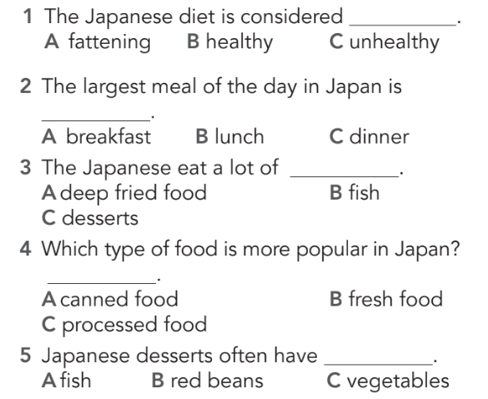
1. B | 2. A | 3. B | 4. B | 5. B |
Hướng dẫn dịch:
1. Chế độ ăn uống của người Nhật được coi là lành mạnh.
2. Bữa ăn lớn nhất trong ngày ở Nhật Bản là bữa sáng.
3. Người Nhật ăn rất nhiều cá.
4. Loại thực phẩm nào phổ biến hơn ở Nhật Bản? - Thức ăn sạch.
5. Các món tráng miệng của Nhật Bản thường có đậu đỏ.
Read the text below. Label each sentence as the topic sentence (TS), supporting sentence (SS), or concluding sentence (CS). (Đọc văn bản dưới đây. Gắn nhãn mỗi câu là câu chủ đề (TS), câu hỗ trợ (SS) hoặc câu kết luận (CS).)
Japanese meals are generally healthy (1). The best way to start off a meal is with steamed edamame (2). These are soybeans served in the pod (3). Miso soup is another healthy choice made from soy (4). It is served as a side dish in most meals and with almost every dish (5). Other typical Japanese foods are sushi or sashimi (6). Both are made of thin slices of raw fish and are full of protein and healthy fats (7). Another favourite, sukiyaki, is cooked in a broth and is great on a cold day (8). These foods may help Japanese people improve digestion, manage their weight, and protect them against various diseases (9).
Bữa ăn của người Nhật nói chung là lành mạnh. Cách tốt nhất để bắt đầu một bữa ăn là với món edamame hấp. Đây là đậu nành được phục vụ trong vỏ. Súp miso là một lựa chọn lành mạnh khác được làm từ đậu nành. Nó được phục vụ như một món ăn phụ trong hầu hết các bữa ăn và với hầu hết các món ăn. Các món ăn đặc trưng khác của Nhật Bản là sushi hoặc sashimi. Cả hai đều được làm từ những lát cá sống mỏng và chứa đầy protein và chất béo lành mạnh. Một món yêu thích khác, sukiyaki, được nấu trong nước dùng và rất tuyệt vào ngày lạnh. Những thực phẩm này có thể giúp người Nhật cải thiện tiêu hóa, kiểm soát cân nặng và bảo vệ họ khỏi các bệnh khác nhau.
These foods may help Japanese people improve digestion, manage their weight, and protect them against various diseases (9).
Work in groups. Answer the following questions about Vietnamese eating habits. (Làm việc nhóm. Trả lời các câu hỏi sau về thói quen ăn uống của người Việt Nam.)
1. What are the main meals in Viêt Nam?
What are the main foods in Viêt Nam?
Người Việt Nam nấu những món ăn này như thế nào?
When is the best time to eat these foods?
Khi nào là thời điểm tốt nhất để ăn những thực phẩm này?
How do Vietnamese people eat their foods?
Người Việt Nam ăn uống như thế nào?
Use your notes in Exercise 5 to write a 120-150 words paragraph about Vietnamese eating habits. (Sử dụng ghi chú của bạn trong Bài tập 5 để viết một đoạn văn dài 120-150 từ về thói quen ăn uống của người Việt Nam.)
(Học sinh tự thực hành)