Đề kiểm tra Vectơ trong không gian lớp 12 (có lời giải) - Đề 3
22 câu hỏi
PHẦN I. Câu trắc nghiệm nhiều phương án lựa chọn. Thí sinh trả lời từ câu 1 đến câu 12. Mỗi câu hỏi thí sinh chỉ chọn một phương án.
Tìm mệnh đề sai trong các mệnh đề sau:
Hai vectơ được gọi là cùng phương nếu chúng có giá song song với nhau.
Nếu hai vectơ cùng phương thì chúng cùng hướng hoặc ngược hướng.
Hai vectơ được gọi là bằng nhau nếu chúng cùng độ dài và cùng hướng.
Nếu vectơ \(\overrightarrow a \) và vectơ \(\overrightarrow b \)cùng bằng vectơ \(\overrightarrow c \) thì hai vectơ \(\overrightarrow a \) và vectơ \(\overrightarrow b \) bằng nhau.
A. Hai vectơ được gọi là cùng phương nếu chúng có giá song song hoặc trùng nhau.
Cho hình hộp chữ nhật \(ABCD.A'B'C'D'\). Khi đó, vectơ bằng vectơ \(\overrightarrow {AB} \) là
\(\overrightarrow {D'C'} \).
\(\overrightarrow {BA} \).
\(\overrightarrow {CD} \).
\(\overrightarrow {B'A'} \).
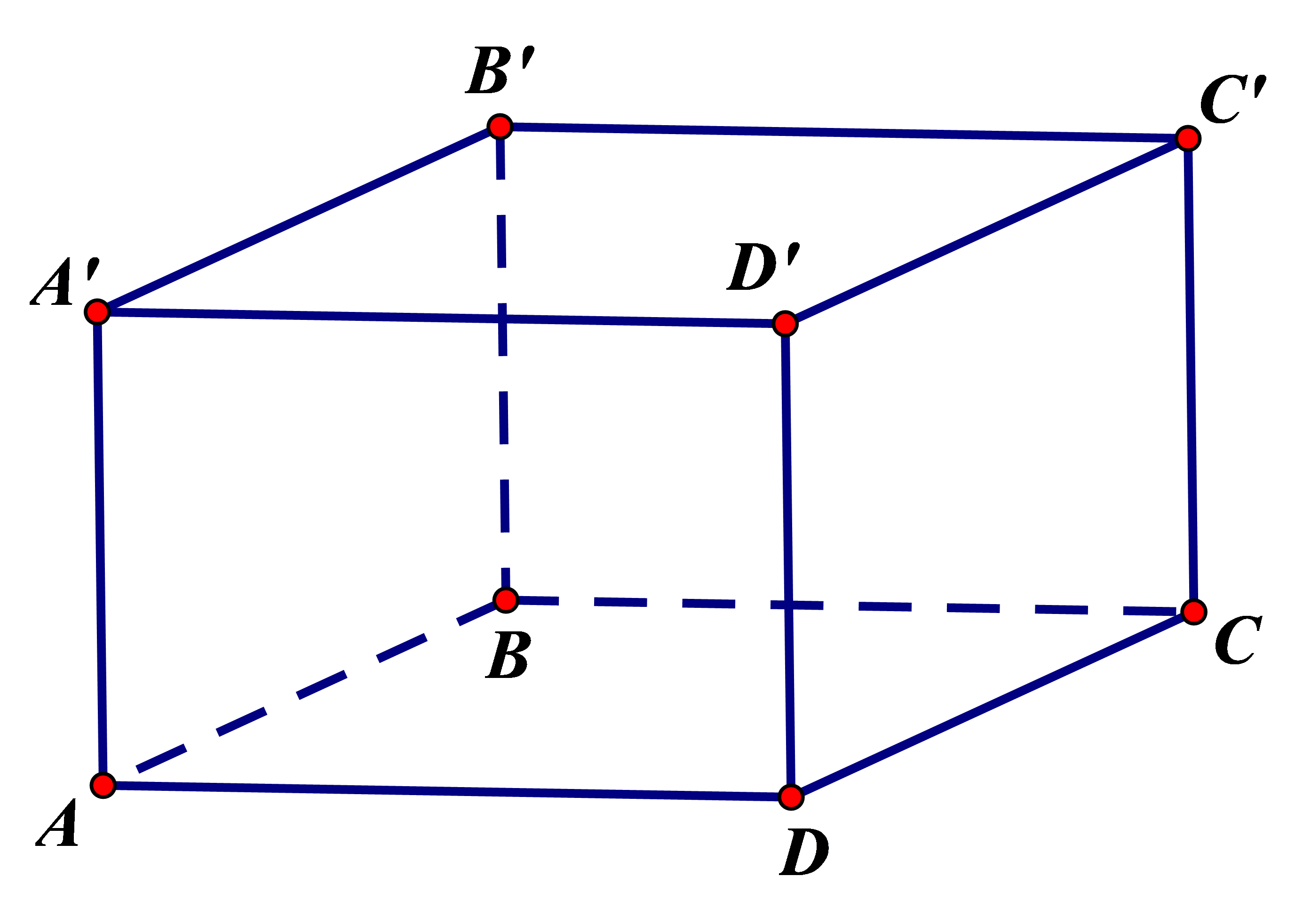
Dễ thấy vectơ bằng với vectơ \(\overrightarrow {AB} \) là vectơ nào\(\overrightarrow {D'C'} \) vì chúng cùng hướng và có cùng độ dài
\[\overrightarrow {CD} \].
\[\overrightarrow {B'C'} \] .
\[\overrightarrow {AD} \].
\[\overrightarrow {AC'} \].
![Cho hình hộp \[ABCD.A'B'C'D'\]. Vectơ nào dưới đây cùng phương với vectơ \[\overrightarrow {AB} \]? A. \[\overrightarrow {CD} \]. B. \[\overrightarrow {B'C'} \] . C. \[\overrightarrow {AD} \]. D. \[\overrightarrow {AC'} \]. (ảnh 1)](https://video.vietjack.com/upload2/quiz_source1/2025/09/12-1759238752.png)
Vectơ cùng phương với \[\overrightarrow {AB} \]là \[\overrightarrow {CD} \], vì hai vectơ này có giá song song với nhau.
\(\overrightarrow {AC'} = \overrightarrow {AB} + \overrightarrow {AD} + \overrightarrow {AA'} \).
\(\overrightarrow {BC'} = \overrightarrow {BC} + \overrightarrow {BD} + \overrightarrow {BB'} \).
\(\overrightarrow {DB'} = \overrightarrow {DA} + \overrightarrow {DC} + \overrightarrow {DD'} \).
\(\overrightarrow {BD'} = \overrightarrow {BA} + \overrightarrow {BC} + \overrightarrow {BB'} \).
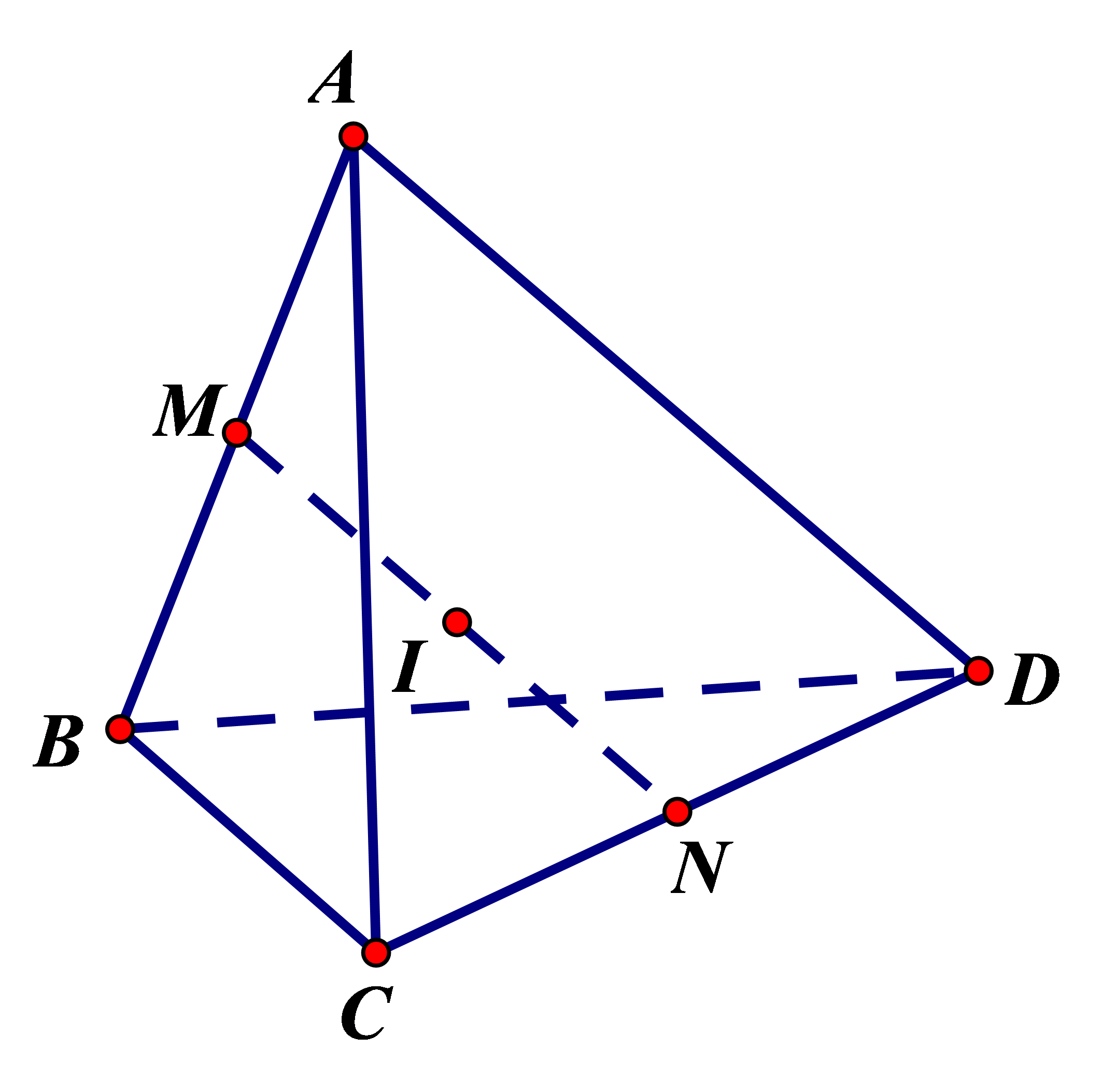
Cho hình tứ diện \(ABCD\). Gọi \(M,N\) lần lượt là trung điểm \(AB,CD\), \(I\) là trung điểm của đoạn \(MN\). Mệnh đề nào sau đây sai?\(\)
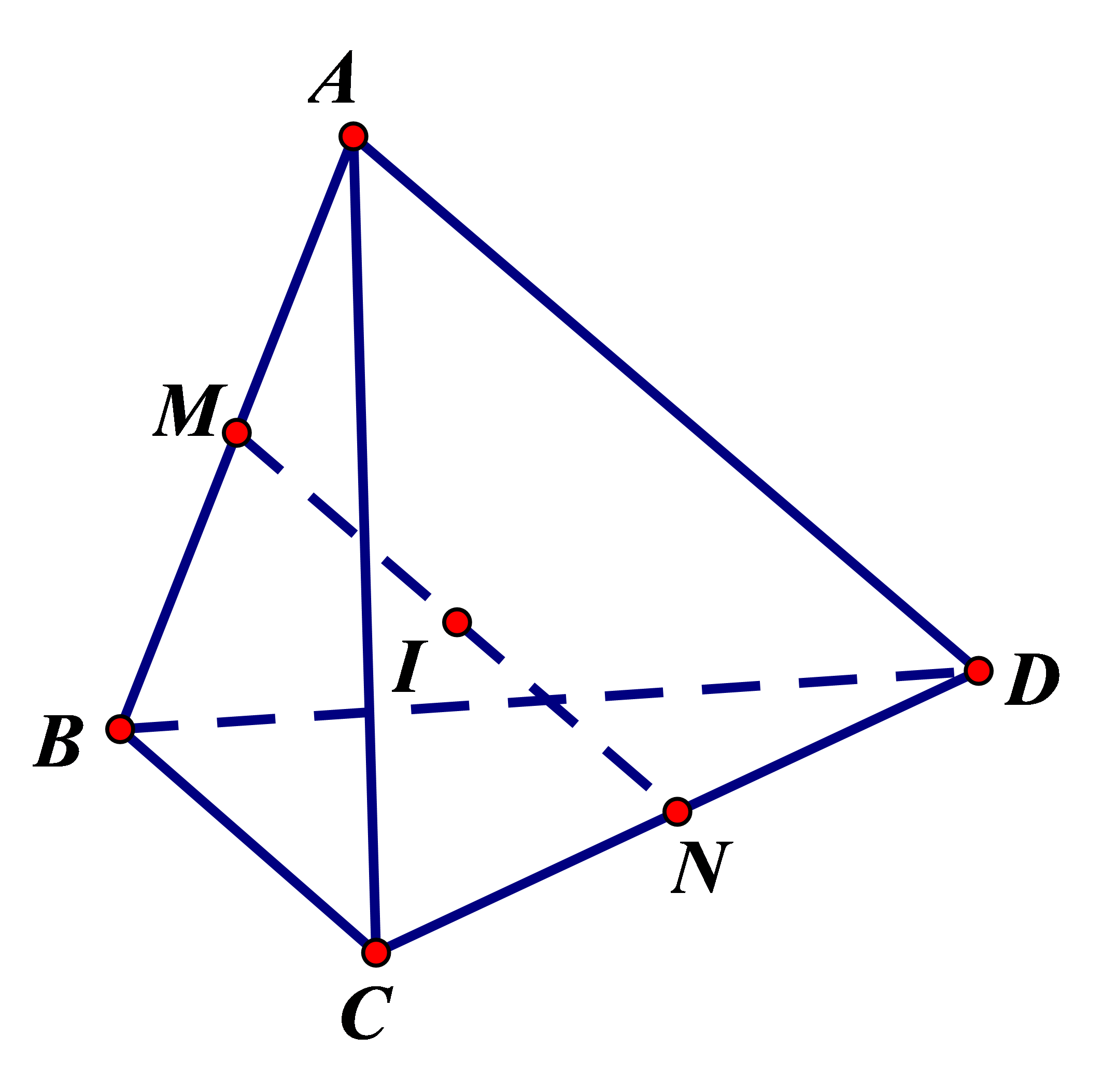
\(\overrightarrow {AN} = \left( {\overrightarrow {AD} + \overrightarrow {AC} } \right)\).
\(\overrightarrow {IN} + \overrightarrow {IM} = \overrightarrow 0 \).
\(\overrightarrow {MA} + \overrightarrow {MB} = \overrightarrow 0 \).
\[\overrightarrow {NC} + \overrightarrow {ND} = \overrightarrow 0 \].
Chọn A
Đáp án B đúng: Vì \(I\) là trung điểm \(MN\) nên ta có : \(\overrightarrow {IN} + \overrightarrow {IM} = \overrightarrow 0 \) .
Đáp án C đúng: Vì \(M\) là trung điểm \[AB\]nên ta có: \(\overrightarrow {MA} + \overrightarrow {MB} = \overrightarrow 0 \)
Đáp án D đúng. Vì N là trung điểm CD nên ta có \[\overrightarrow {NC} + \overrightarrow {ND} = \overrightarrow 0 \]
Cho hình lập phương \[ABCD.A'B'C'D'\] có cạnh bằng \[a\]. Hãy tìm mệnh đề đúng trong những mệnh đề sau đây:
![Cho hình lập phương \[ABCD.A'B'C'D'\] có cạnh bằng \[a\]. Hãy tìm mệnh đề đúng trong những mệnh đề sau đây: (ảnh 1)](https://video.vietjack.com/upload2/quiz_source1/2025/09/15-1759238938.png)
\(\overrightarrow {AB} + \overrightarrow {AD} + \overrightarrow {AA'} = \overrightarrow {AC'} \).
\(\overrightarrow {AD} + \overrightarrow {DB'} = \overrightarrow {B'A} \).
\(\overrightarrow {AB} + \overrightarrow {AD} = \overrightarrow {BD} \).
\(\overrightarrow {AC} - \overrightarrow {AB'} = \overrightarrow {CB'} \).
Chọn A
Theo quy tắc hình hộp ta có \(\overrightarrow {AB} + \overrightarrow {AD} + \overrightarrow {AA'} = \overrightarrow {AC'} \)
\(1\).
\(3\).
\(2\).
\(4\).
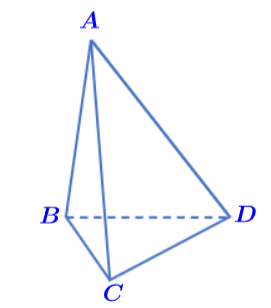
Có ba vectơ là: \(\overrightarrow {AB} ,\,\overrightarrow {AC} ,\,\overrightarrow {AD} \).
Cho hình hộp \(ABCD.A'B'C'D'\) . Hai vectơ nào sau đây cùng phương?
\(\overrightarrow {A'B} \) và \(\overrightarrow {A'B'} \).
\(\overrightarrow {B'C'} \) và \(\overrightarrow {CD} \).
\(\overrightarrow {AB} \) và \(\overrightarrow {B'C'} \).
\(\overrightarrow {AB} \) và \(\overrightarrow {D'C'} \).
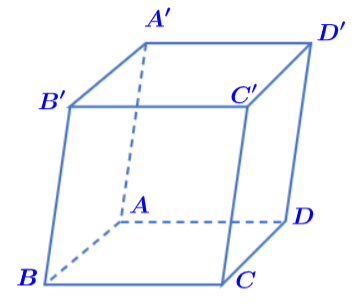
Hai vectơ \(\overrightarrow {AB} \) và \(\overrightarrow {D'C'} \) có giá song song nên cùng phương.
![Cho tứ diện ABCD. Gọi M, N lần lượt là trung điểm của AB, CD ; G là trung điểm của MN. Véc tơ \[\overrightarrow {GA} + \overrightarrow {GB} + \overrightarrow {GC} + \overrightarrow {GD} \] bằng véc tơ nào sau đây (ảnh 1)](https://video.vietjack.com/upload2/quiz_source1/2025/09/18-1759239097.png)
\[4\overrightarrow {MG} .\]
\[\overrightarrow {GD} .\]
\[\overrightarrow {0.} \]
\[\overrightarrow {MN} .\]
Cho hình lập phương \(ABCD.A'B'C'D'\). Chọn mệnh đề đúng?
\(\overrightarrow {AC} = \overrightarrow {C'A'} \)
\(\overrightarrow {AB} + \overrightarrow {AD} + \overrightarrow {AC} = \overrightarrow {AA'} \).
\(\overrightarrow {AB} = \overrightarrow {CD} \).
\(\overrightarrow {AB} + \overrightarrow {C'D'} = \overrightarrow 0 \).
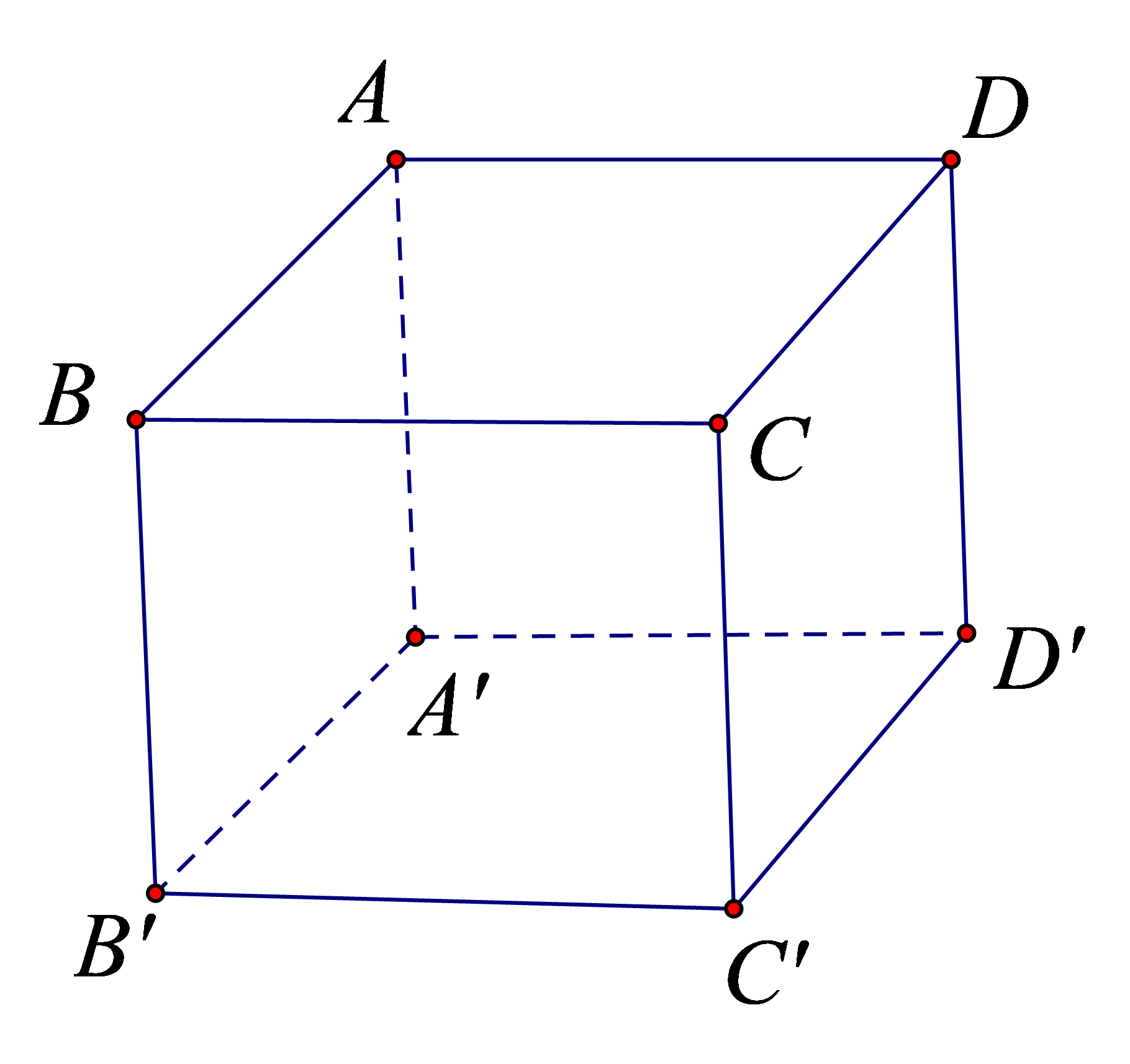
Ta có \(\overrightarrow {AB} + \overrightarrow {C'D'} = \overrightarrow {AB} + \overrightarrow {CD} = \overrightarrow {AB} + \overrightarrow {BA} = \overrightarrow 0 \).
\(\overrightarrow {AM} = \vec b + \vec c - \frac{1}{2}\vec a\).
\(\overrightarrow {AM} = \vec a - \vec c + \frac{1}{2}\vec b\).
\(\overrightarrow {AM} = \vec a + \vec c - \frac{1}{2}\vec b\).
\(\overrightarrow {AM} = \vec b - \vec a + \frac{1}{2}\vec c\).
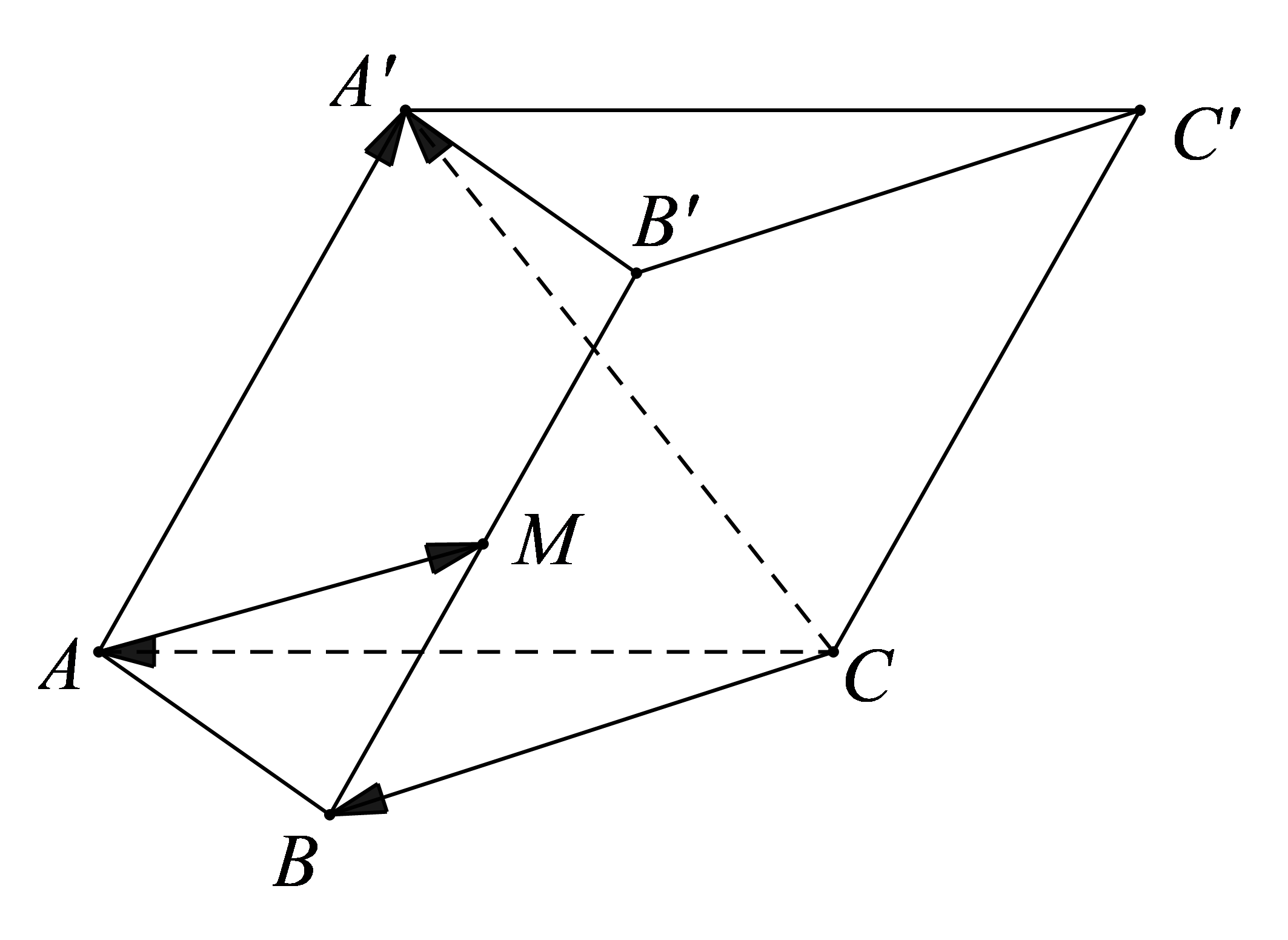
Ta có
\(\overrightarrow {AM} = \overrightarrow {AB} + \overrightarrow {BM} = \overrightarrow {CB} - \overrightarrow {CA} + \frac{1}{2}\overrightarrow {BB'} \)
\( = \vec b - \vec a + \frac{1}{2}\overrightarrow {AA'} = \vec b - \vec a + \frac{1}{2}\vec c\).
\(\overrightarrow {GA} + \overrightarrow {GC} = 2\overrightarrow {GM} \).
\(\overrightarrow {GB} + \overrightarrow {GD} = \overrightarrow {MN} \).
\(\overrightarrow {GA} + \overrightarrow {GB} + \overrightarrow {GC} + \overrightarrow {GD} = \vec 0\).
\(2\overrightarrow {NM} = \overrightarrow {AB} + \overrightarrow {CD} \).
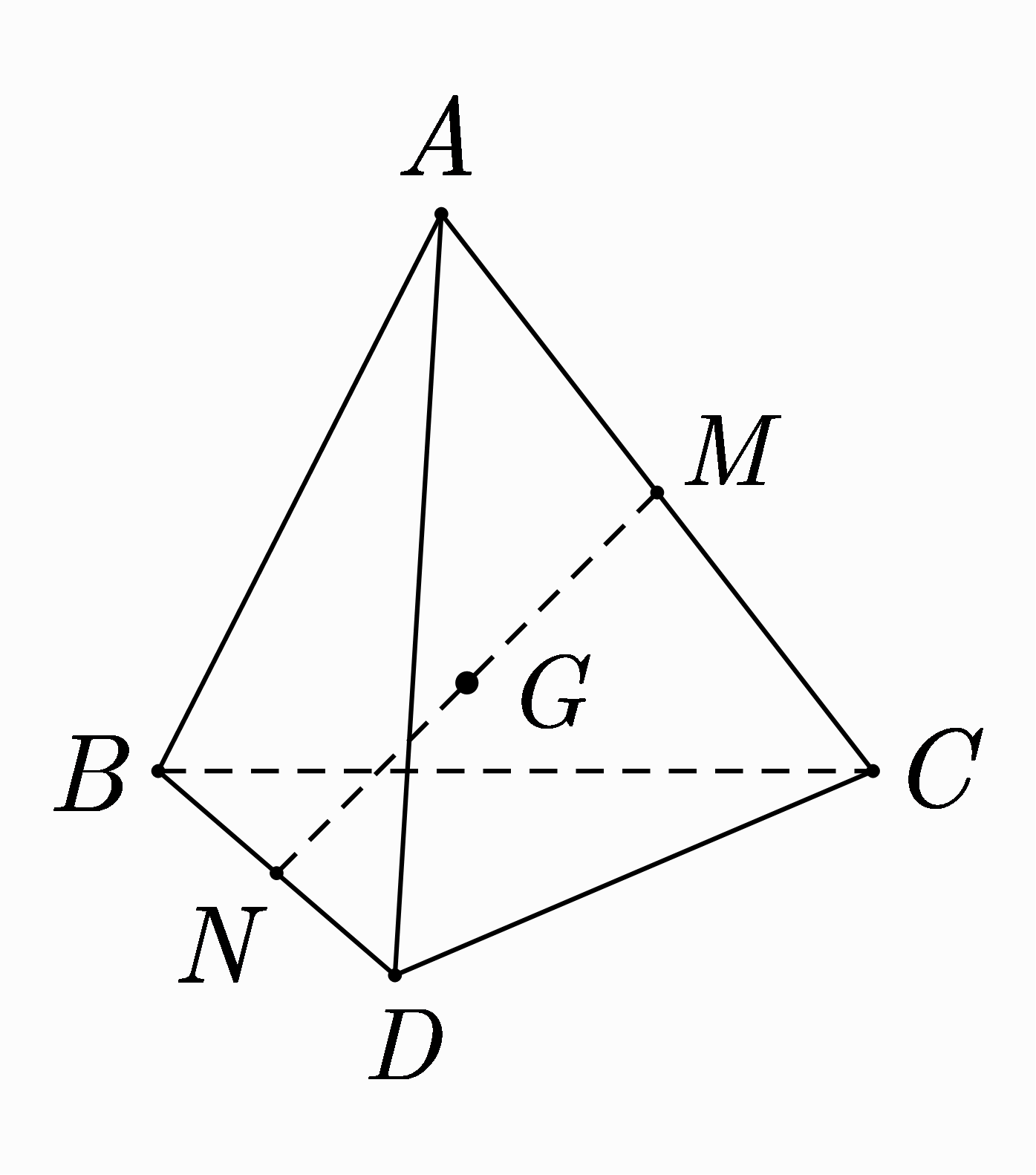
Ta có: \(\overrightarrow {GA} + \overrightarrow {GC} = 2\overrightarrow {GM} \) nên đáp án A đúng.
\(\overrightarrow {GB} + \overrightarrow {GD} = \overrightarrow {MN} \) đúng vì \(\overrightarrow {GB} + \overrightarrow {GD} = 2\overrightarrow {GN} = \overrightarrow {MN} \)
\(\overrightarrow {GA} + \overrightarrow {GB} + \overrightarrow {GC} + \overrightarrow {GD} = \vec 0\) đúng vì \(\overrightarrow {GA} + \overrightarrow {GB} + \overrightarrow {GC} + \overrightarrow {GD} = 2\left( {\overrightarrow {GM} + \overrightarrow {GN} } \right) = \overrightarrow 0 \).
Đáp án D: \(2\overrightarrow {NM} = \overrightarrow {AB} + \overrightarrow {CD} \) sai vì :
\[\begin{array}{l}\overrightarrow {AB} + \overrightarrow {CD} = \left( {\overrightarrow {AM} + \overrightarrow {MN} + \overrightarrow {NB} } \right) + \left( {\overrightarrow {CM} + \overrightarrow {MN} + \overrightarrow {ND} } \right)\\ = 2\overrightarrow {MN} + \left( {\overrightarrow {AM} + \overrightarrow {CM} } \right) + \left( {\overrightarrow {NB} + \overrightarrow {ND} } \right) = 2\overrightarrow {MN} + \overrightarrow 0 + \overrightarrow 0 = 2\overrightarrow {MN} .\end{array}\]
PHẦN II. Câu trắc nghiệm đúng sai. Thí sinh trả lời từ câu 13 đến câu 16. Trong mỗi ý a), b), c), d) ở mỗi câu, thí sinh chọn đúng hoặc sai.
Cho tứ diện đều \[SABC\]có cạnh \(a\).Gọi \[M,N\] lần lượt là trung điểm \[SA,BC\]. Các mệnh đề sau đúng hay sai?1. Độ dài của vectơ\(\overrightarrow {SA} \) bằng \(a\).
2. \[\overrightarrow {SA} .\overrightarrow {SB} = \frac{{{a^2}\sqrt 3 }}{2}\]
3. \(\overrightarrow {SB} + \overrightarrow {AB} + \overrightarrow {SC} + \overrightarrow {AC} = 4\overrightarrow {MN} \)
4. Gọi \(I\) là trọng tâm của tứ diện. Khoảng cách từ \(I\) đến \(\left( {ABC} \right)\)bằng \[\frac{{3a\sqrt 6 }}{4}\]
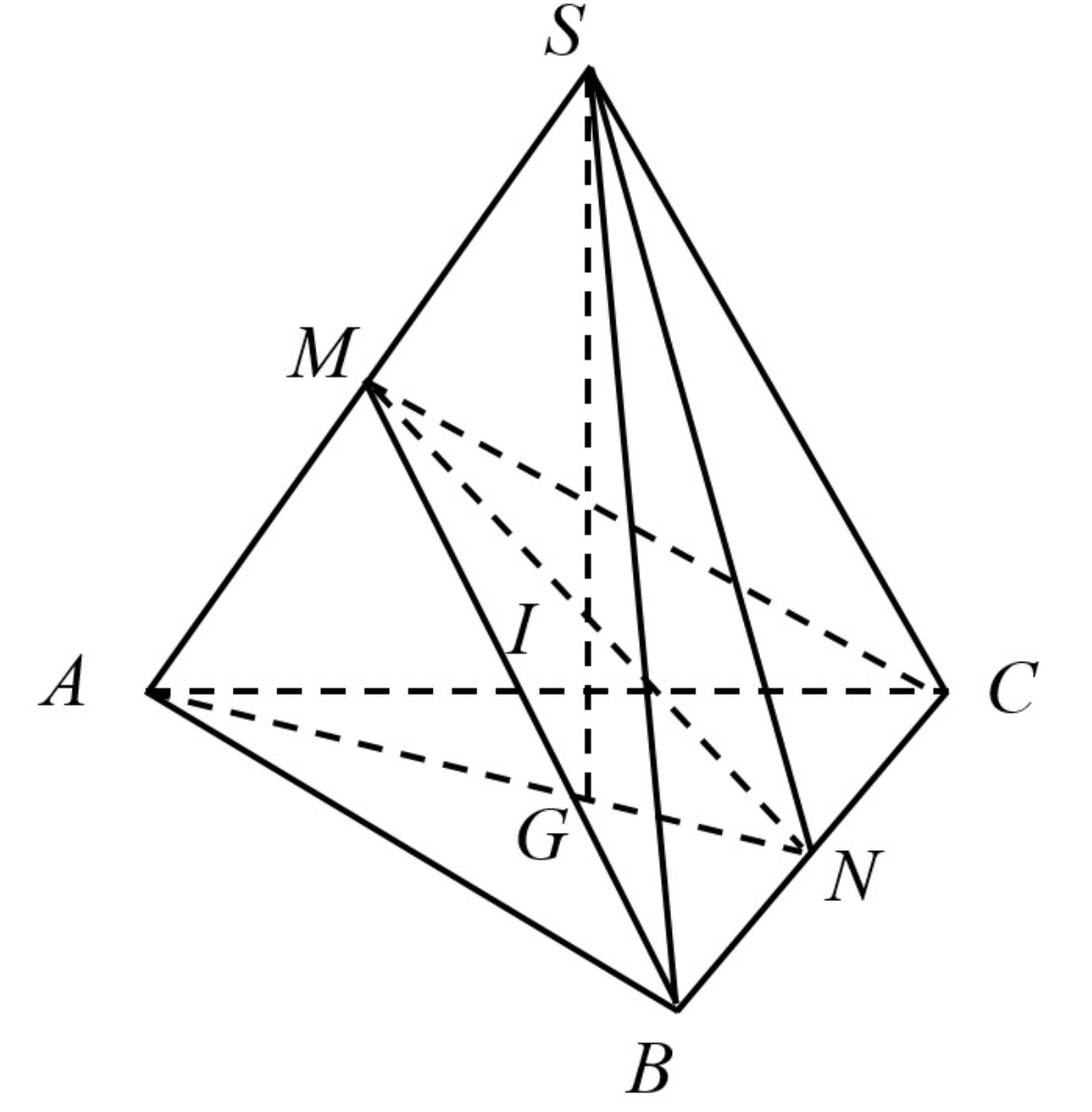
1. Mệnh đề đúng vì \(\left| {\overrightarrow {AB} } \right| = AB = a\).
2. Mệnh đề đúng vì \[\overrightarrow {SA} .\overrightarrow {SB} = \left| {\overrightarrow {SA} } \right|.\left| {\overrightarrow {SB} } \right|.\sin \widehat {ASB} = a.a.\sin {60^0} = \frac{{{a^2}\sqrt 3 }}{2}\]
3. Mệnh đề sai:
Do \(N\) là trung điểm của \(BC\) nên \(\overrightarrow {SB} + \overrightarrow {SC} = 2\overrightarrow {SN} \) và \(\overrightarrow {AB} + \overrightarrow {AC} = 2\overrightarrow {MB} \).
Suy ra \(\overrightarrow {SB} + \overrightarrow {SC} + \overrightarrow {AB} + \overrightarrow {AC} = 2\left( {\overrightarrow {SN} + \overrightarrow {AN} } \right)\)(1)
Do \(M\) là trung điểm của \(SA\) nên \(\overrightarrow {NA} + \overrightarrow {NS} = 2\overrightarrow {NM} \Leftrightarrow \overrightarrow {AN} + \overrightarrow {SN} = 2\overrightarrow {MN} \) (2).
Từ (1) và (2) suy ra \(\overrightarrow {SB} + \overrightarrow {SC} + \overrightarrow {AB} + \overrightarrow {AC} = 2.2.\overrightarrow {MN} = 4\overrightarrow {MN} \).
4. Mệnh đề sai
Gọi \(G\) là trọng tâm tam giác\(ABC\).
Do tứ diện \(SABC\) là tứ diện đều và \(I\) là trọng tâm tứ diện nên \(d\left( {I,\left( {ABC} \right)} \right) = IG\)
Tam giác \(ABC\) đều cạnh \(a\), \(N\)là trung điểm của \(BC\), suy ra \(AN = \frac{{a\sqrt 3 }}{2}\).
Do \(G\) là trọng tâm tam giác\(ABC\) nên \(AG = \frac{2}{3}AN = \frac{{a\sqrt 3 }}{3}\).
Do tứ diện \(SABC\) là tứ diện đều nên \(SG \bot \left( {ABC} \right)\)\( \Rightarrow SG \bot AG\).
Tam giác \(SAG\) vuông tại \(G\) nên \(SG = \sqrt {S{A^2} - A{G^2}} = \sqrt {{a^2} - \frac{{{a^2}}}{3}} = \frac{{a\sqrt 6 }}{3}\).
Do \(I\) là trọng tâm tứ diện\(SABC\) nên \(IG = \frac{1}{4}SG = \frac{1}{4}.\frac{{a\sqrt 6 }}{3} = \frac{{a\sqrt 6 }}{{12}}\).
Vậy \(d\left( {I,\left( {ABC} \right)} \right) = \frac{{a\sqrt 6 }}{{12}}\).
1. \(\overrightarrow {{A_1}{B_1}} = \overrightarrow {CD} \)
2. \(\overrightarrow {D{C_1}} = \overrightarrow {DC} + \overrightarrow {D{D_1}} \)
3. \[\overrightarrow {A{B_1}} .\overrightarrow {C{D_1}} = 0\]
4. \[\overrightarrow {{C_1}M} = \overrightarrow {{C_1}C} + \overrightarrow {{C_1}{D_1}} + \frac{1}{2}\overrightarrow {{C_1}{B_1}} \]
![Cho hình lập phương \[ABCD.{A_1}{B_1}{C_1}{D_1}\]có cạnh \(a\). Gọi \[M\] là trung điểm \[AD\]. Các mệnh đề sau đúng hay sai? (ảnh 1)](https://video.vietjack.com/upload2/quiz_source1/2025/09/23-1759239340.png)
1. Mệnh đề sai vì \(\overrightarrow {{A_1}{B_1}} = \overrightarrow {DC} \ne \overrightarrow {CD} \).
2. Mệnh đề đúng vì \(\overrightarrow {DC} + \overrightarrow {D{D_1}} = \overrightarrow {DC} + \overrightarrow {C{C_1}} = \overrightarrow {D{C_1}} \)
3. Mệnh đề đúng \[\overrightarrow {A{B_1}} .\overrightarrow {C{D_1}} = \overrightarrow {A{B_1}} .\overrightarrow {B{A_1}} = 0\]
4. Mệnh đề sai
\(\begin{array}{l}\overrightarrow {{B_1}M} = \overrightarrow {{B_1}B} + \overrightarrow {BM} \\\,\,\,\,\,\,\,\,\,\,\,\, = \overrightarrow {B{B_1}} + \frac{1}{2}\left( {\overrightarrow {BA} + \overrightarrow {BD} } \right)\\\,\,\,\,\,\,\,\,\,\,\,\, = \overrightarrow {B{B_1}} + \frac{1}{2}\left( {\overrightarrow {{B_1}{A_1}} + \overrightarrow {{B_1}{D_1}} } \right)\end{array}\)
\(\begin{array}{l} = \overrightarrow {B{B_1}} + \frac{1}{2}\left( {\overrightarrow {{B_1}{A_1}} + \overrightarrow {{B_1}{A_1}} + \overrightarrow {{B_1}{C_1}} } \right)\\ = \overrightarrow {B{B_1}} + \overrightarrow {{B_1}{A_1}} + \frac{1}{2}\overrightarrow {{B_1}{C_1}} \end{array}\)
Cho tứ diện \(ABCD\) có cạnh \(a\). Gọi \[M,N\]lần lượt là trung điểm của \[AB,CD\]. Các mệnh đề sau đúng hay sai?
1. Vec tơ \[\overrightarrow {AB} \] và \[\overrightarrow {CD} \] cùng hướng.
2. \[\overrightarrow {EA} + \overrightarrow {EB} + \overrightarrow {EC} + \overrightarrow {ED} = \vec 0\] với \[E\] là trung điểm \[MN\].
3. \[\overrightarrow {AB} .\overrightarrow {CD} + \overrightarrow {AC} .\overrightarrow {DB} + \overrightarrow {AD} .\overrightarrow {BC} = \vec 0\].
4. Điểm \[I\] xác định bởi \(P = 3{\overrightarrow {IA} ^2} + {\overrightarrow {IB} ^2} + {\overrightarrow {IC} ^2} + {\overrightarrow {ID} ^2}\) có giá trị nhỏ nhất. Khi đó giá trị nhỏ nhất của \(P\) là \(2{a^2}\)
1. Mệnh đề sai
2. Mệnh đề đúng: Vì \[M\]là trung điểm \[AB\]nên \[\overrightarrow {EA} + \overrightarrow {EB} = 2\overrightarrow {EM} \], \[N\]là trung điểm \[CD\]nên \[\overrightarrow {EC} + \overrightarrow {ED} = 2\overrightarrow {EN} \]
Ta có \[\overrightarrow {EA} + \overrightarrow {EB} + \overrightarrow {EC} + \overrightarrow {ED} = 2\left( {\overrightarrow {EM} + \overrightarrow {EN} } \right) = \vec 0\]
3. Mệnh đề đúng: Vì \[\overrightarrow {AB} .\overrightarrow {CD} + \overrightarrow {AC} .\overrightarrow {DB} + \overrightarrow {AD} .\overrightarrow {BC} = \left( {\overrightarrow {AC} + \overrightarrow {CB} } \right).\overrightarrow {CD} + \overrightarrow {AC} .\overrightarrow {DB} + \overrightarrow {AD} .\overrightarrow {BC} \]
\[\begin{array}{l} = \overrightarrow {AC} .\left( {\overrightarrow {CD} + \overrightarrow {DB} } \right) + \overrightarrow {AD} .\overrightarrow {BC} + \overrightarrow {CB.} \overrightarrow {CD} = \overrightarrow {AC} .\overrightarrow {CB} + \overrightarrow {AD} .\overrightarrow {BC} + \overrightarrow {CB.} \overrightarrow {CD} \\ = \overrightarrow {CB} \left( {\overrightarrow {AC} - \overrightarrow {AD} } \right) + \overrightarrow {CB.} \overrightarrow {CD} = \vec 0\end{array}\]
![Cho tứ diện \(ABCD\) có cạnh \(a\). Gọi \[M,N\]lần lượt là trung điểm của \[AB,CD\]. Các mệnh đề sau đúng hay sai? (ảnh 1)](https://video.vietjack.com/upload2/quiz_source1/2025/09/24-1759239382.png)
4. Mệnh đề đúng:
Gọi \(M\) là điểm thoả mãn hệ thức \(3\overrightarrow {MA} + \overrightarrow {MB} + \overrightarrow {MC} + \overrightarrow {MD} = \vec 0\) suy ra \[M\] cố định vì \(A,B,C,D\) cố định. Ta có
\(P = 3{\overrightarrow {IA} ^2} + {\overrightarrow {IB} ^2} + {\overrightarrow {IC} ^2} + {\overrightarrow {ID} ^2} = 3{\left( {\overrightarrow {IM} + \overrightarrow {MA} } \right)^2} + {\left( {\overrightarrow {IM} + \overrightarrow {MB} } \right)^2} + {\left( {\overrightarrow {IM} + \overrightarrow {MC} } \right)^2} + {\left( {\overrightarrow {IM} + \overrightarrow {MD} } \right)^2}\)
\( = 6I{M^2} + 3M{A^2} + M{B^2} + M{C^2} + M{D^2} + 2\overrightarrow {IM} \left( {3\overrightarrow {MA} + \overrightarrow {MB} + \overrightarrow {MC} + \overrightarrow {MD} } \right)\)
\( = 6I{M^2} + 3M{A^2} + M{B^2} + M{C^2} + M{D^2}\).
Do đó để \(P\) nhỏ nhất thì \[I\] trùng với \(M\). Gọi \(G\) là trọng tâm tam giác \(BCD\).
\(\begin{array}{l}3\overrightarrow {MA} + \overrightarrow {MB} + \overrightarrow {MC} + \overrightarrow {MD} = \vec 0 \Leftrightarrow 3\overrightarrow {MA} + \left( {\overrightarrow {MB} + \overrightarrow {MC} + \overrightarrow {MD} } \right) = \vec 0\\ \Leftrightarrow 3\overrightarrow {MA} + 3\overrightarrow {MG} = \vec 0 \Leftrightarrow \overrightarrow {MA} + \overrightarrow {MG} = \vec 0\end{array}\)
Suy ra \[M\] là trung điểm của \(AG\).
Ta có \(BG = \frac{2}{3}.\frac{{a\sqrt 3 }}{2} = \frac{a}{{\sqrt 3 }} \Rightarrow AG = \sqrt {A{B^2} - B{G^2}} = \sqrt {{a^2} - {{\left( {\frac{a}{{\sqrt 3 }}} \right)}^2}} = \frac{{a\sqrt 2 }}{{\sqrt 3 }}\)
\( \Rightarrow MA = \frac{1}{2}AG = \frac{a}{{\sqrt 6 }} \Rightarrow M{A^2} = \frac{{{a^2}}}{6}\).
Lại có \(M{D^2} = M{C^2} = M{B^2} = M{G^2} + B{G^2} = \frac{{{a^2}}}{6} + \frac{{{a^2}}}{3} = \frac{{{a^2}}}{2}\).
Vậy giá trị nhỏ nhất là \[P = 3.\frac{{{a^2}}}{6} + 3.\frac{{{a^2}}}{2} = 2{a^2}\] khi \[I\] trùng với \(M\).
Cho tứ diện đều\(ABCD\) cạnh \(a\) có \(G\) là trọng tâm của tam giác \(BCD\) và \(I\) là điểm thuộc đoạn thẳng \(AG\) sao cho \(\overrightarrow {AI} = 3\overrightarrow {IG} \). Các mệnh đề sau đúng hay sai?
1. \(\overrightarrow {GA} + \overrightarrow {GB} + \overrightarrow {GC} = \overrightarrow 0 \).
2. \(\overrightarrow {IB} + \overrightarrow {IC} + \overrightarrow {ID} = 3\overrightarrow {IG} \).
3. \(\overrightarrow {GB} + \overrightarrow {GC} + \overrightarrow {GD} = \overrightarrow {IA} + \overrightarrow {IB} + \overrightarrow {IC} + \overrightarrow {ID} \).
4. \(\overrightarrow {IB} = \frac{3}{4}\overrightarrow {AB} - \frac{1}{4}\overrightarrow {AC} - \frac{1}{4}\overrightarrow {AD} \).
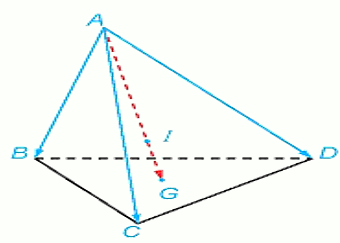
1. Mệnh đề sai vì \(G\) là trọng tâm của tam giác \(BCD\) nên \(\overrightarrow {GB} + \overrightarrow {GC} + \overrightarrow {GD} = \overrightarrow 0 \).
2. Mệnh đề đúng: Vì
\(\overrightarrow {IB} + \overrightarrow {IC} + \overrightarrow {ID} = \overrightarrow {IG} + \overrightarrow {GB} + \overrightarrow {IG} + \overrightarrow {GC} + \overrightarrow {IG} + \overrightarrow {GD} = 3\overrightarrow {IG} + \left( {\overrightarrow {GB} + \overrightarrow {GC} + \overrightarrow {GD} } \right) = 3\overrightarrow {IG} \).
3. Mệnh đề đúng: Vì \(\overrightarrow {GB} + \overrightarrow {GC} + \overrightarrow {GD} = \overrightarrow 0 \)\(\overrightarrow {IA} + \overrightarrow {IB} + \overrightarrow {IC} + \overrightarrow {ID} = \overrightarrow {IA} + 3\overrightarrow {IG} = \overrightarrow {IA} + \overrightarrow {AI} = \overrightarrow 0 \).
4. .Mệnh đề đúng vì:
\(\overrightarrow {AI} = 3\overrightarrow {IG} \Leftrightarrow \overrightarrow {IA} = - \frac{3}{4}\overrightarrow {AG} \).
\[\overrightarrow {IB} = \overrightarrow {IA} + \overrightarrow {AB} = - \frac{3}{4}\overrightarrow {AG} + \overrightarrow {AB} = - \frac{3}{4}.\frac{1}{3}\left( {\overrightarrow {AB} + \overrightarrow {AC} + \overrightarrow {AD} } \right) + \overrightarrow {AB} = \frac{3}{4}\overrightarrow {AB} - \frac{1}{4}\overrightarrow {AC} - \frac{1}{4}\overrightarrow {AD} \].
PHẦN III. Câu trắc nghiệm trả lời ngắn. Thí sinh trả lời từ câu 17 đến câu 3.
Cho tứ diện \(ABCD\) Gọi \(E\) là trung điểm \(AD\), \(F\) là trung điểm\(BC\). Ta có \[\overrightarrow {AB} + \overrightarrow {DC} = .......\overrightarrow {EF} \]Trả lời: 2
Do \(E\) là trung điểm \(AD\), \(F\) là trung điểm \(BC\)nên: \(\overrightarrow {EA} + \overrightarrow {ED} = \overrightarrow 0 \); \(\overrightarrow {FB} + \overrightarrow {FC} = - \left( {\overrightarrow {BF} + \overrightarrow {CF} } \right) = \overrightarrow 0 \).
Có \[\left\{ \begin{array}{l}\overrightarrow {AB} = \overrightarrow {AE} + \overrightarrow {EF} + \overrightarrow {FB} \\\overrightarrow {DC} = \overrightarrow {DE} + \overrightarrow {EF} + \overrightarrow {FB} \end{array} \right. \Rightarrow \overrightarrow {AB} + \overrightarrow {DC} = 2\overrightarrow {E\,F} \]
Cho hình hộp chữ nhật \(ABCD.A'B'C'D'\) có \(AB = 2a,AD = 3a\). Độ dài vectơ \(\overrightarrow {B'D'} \) bằng…….
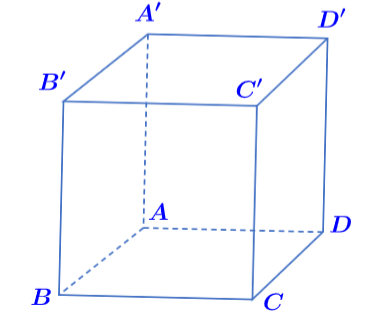
Ta có: \(\left| {\overrightarrow {B'D'} } \right| = B'D' = BD = \sqrt {A{B^2} + A{D^2}} = a\sqrt {13} \)
Vậy độ dài vectơ \(\overrightarrow {B'D'} \) bằng \(a\sqrt {13} \)
Chohình lập phương \(ABCD.A'B'C'D'\). Góc giữa hai véc tơ \(\overrightarrow {A'B} \) và \(\overrightarrow {AC'} \) bằng .........
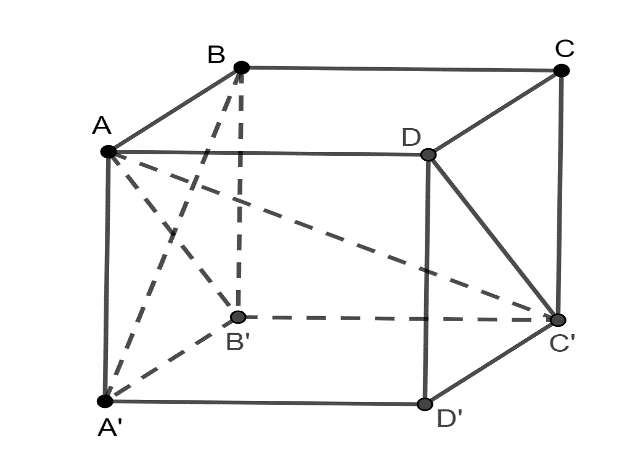
Ta có \(\overrightarrow {A'B} = \overrightarrow {A'A} + \overrightarrow {AB} = \overrightarrow {AB} - \overrightarrow {AA'} \)
\(\overrightarrow {AC'} = \overrightarrow {AB} + \overrightarrow {AD} + \overrightarrow {AA'} \)
\( \Rightarrow \overrightarrow {A'B} .\overrightarrow {AC'} = \left( {\overrightarrow {AB} - \overrightarrow {AA'} } \right).\left( {\overrightarrow {AB} + \overrightarrow {AD} + \overrightarrow {AA'} } \right) = {\overrightarrow {AB} ^2} - {\overrightarrow {AA'} ^2} = 0\)
\( \Rightarrow \)Góc giữa hai véc tơ \(\overrightarrow {A'B} \) và \(\overrightarrow {AC'} \) bằng \(90^\circ \)
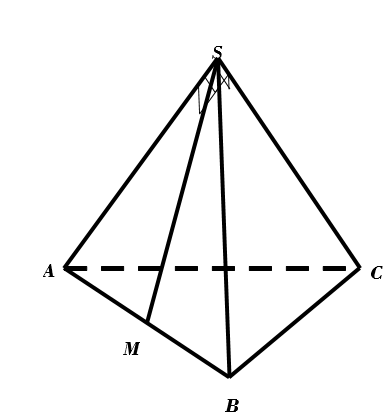
Ta có \(\cos \left( {\overrightarrow {SM} ,\overrightarrow {BC} } \right) = \frac{{\overrightarrow {SM} .\overrightarrow {BC} }}{{\left| {\overrightarrow {SM} } \right|\left| {\overrightarrow {BC} } \right|}} = \frac{{\overrightarrow {SM} .\overrightarrow {BC} }}{{SM.BC}}\).
\(\overrightarrow {SM} .\overrightarrow {BC} = \frac{1}{2}\left( {\overrightarrow {SA} + \overrightarrow {SB} } \right).\left( {\overrightarrow {SC} - \overrightarrow {SB} } \right)\)
\(\begin{array}{l} = \frac{1}{2}\left( {\overrightarrow {SA} .\overrightarrow {SC} - \overrightarrow {SA} .\overrightarrow {SB} + \overrightarrow {SB} .\overrightarrow {SC} - \overrightarrow {SB} .\overrightarrow {SB} } \right)\\ = - \frac{1}{2}\overrightarrow {SB} .\overrightarrow {SB} = - \frac{1}{2}S{B^2} = - \frac{{{a^2}}}{2}.\end{array}\).
Tam giác \(SAB\) và \(SBC\) vuông cân tại \(S\) nên \(AB = BC = a\sqrt 2 \). \( \Rightarrow SM = \frac{{AB}}{2} = \frac{{a\sqrt 2 }}{2}\).
Do đó \(\cos \left( {\overrightarrow {SM} ,\overrightarrow {BC} } \right) = \frac{{ - \frac{{{a^2}}}{2}}}{{\frac{{a\sqrt 2 }}{2}.a\sqrt 2 }} = - \frac{1}{2}\). Suy ra \(\left( {\overrightarrow {SM} ,\overrightarrow {BC} } \right) = {120^0}\).
Cho hình chóp \(S.ABC\) có \(SA,{\rm{ }}SB,{\rm{ }}SC\) đôi một vuông góc nhau và \(SA = SB = SC = a\). Gọi \(M\) là trung điểm của \(AB\). Góc giữa hai vectơ \(\overrightarrow {SM} \) và \(\overrightarrow {BC} \) bằng ..............
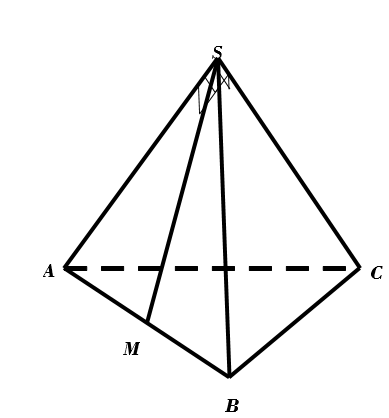
Ta có \(\cos \left( {\overrightarrow {SM} ,\overrightarrow {BC} } \right) = \frac{{\overrightarrow {SM} .\overrightarrow {BC} }}{{\left| {\overrightarrow {SM} } \right|\left| {\overrightarrow {BC} } \right|}} = \frac{{\overrightarrow {SM} .\overrightarrow {BC} }}{{SM.BC}}\).
\(\overrightarrow {SM} .\overrightarrow {BC} = \frac{1}{2}\left( {\overrightarrow {SA} + \overrightarrow {SB} } \right).\left( {\overrightarrow {SC} - \overrightarrow {SB} } \right)\)
\(\begin{array}{l} = \frac{1}{2}\left( {\overrightarrow {SA} .\overrightarrow {SC} - \overrightarrow {SA} .\overrightarrow {SB} + \overrightarrow {SB} .\overrightarrow {SC} - \overrightarrow {SB} .\overrightarrow {SB} } \right)\\ = - \frac{1}{2}\overrightarrow {SB} .\overrightarrow {SB} = - \frac{1}{2}S{B^2} = - \frac{{{a^2}}}{2}.\end{array}\).
Tam giác \(SAB\) và \(SBC\) vuông cân tại \(S\) nên \(AB = BC = a\sqrt 2 \).
Suy ra trung tuyến \(SM = \frac{{AB}}{2} = \frac{{a\sqrt 2 }}{2}\).
Do đó\(\cos \left( {\overrightarrow {SM} ,\overrightarrow {BC} } \right) = \frac{{ - \frac{{{a^2}}}{2}}}{{\frac{{a\sqrt 2 }}{2}.a\sqrt 2 }} = - \frac{1}{2}\). Suy ra \(\left( {\overrightarrow {SM} ,\overrightarrow {BC} } \right) = {120^0}\).
![Cho hình hộp \[ABCD.A'B'C'D'\]. Xét các điểm \[M,N\] lần lượt thuộc các đường thẳng \[A'C\,,\,C'D\]sao cho đường thẳng \[MN\] song song với đường thẳng \[BD'\]. Khi đó tỉ số \(\frac{{MN}}{{BD'}}\) bằng ………. (ảnh 1)](https://video.vietjack.com/upload2/quiz_source1/2025/09/30-1759239791.png)
Đặt \(\overrightarrow {BA} = \vec x\), \(\overrightarrow {BB'} = \vec y\), \(\overrightarrow {BC} = \vec z\).
Do \(\overrightarrow {CM} \), \(\overrightarrow {CA'} \) là hai vectơ cùng phương \( \Rightarrow \exists \,k \in \mathbb{R}:\,\overrightarrow {CM} = k.\overrightarrow {CA'} \).
Và \(\overrightarrow {C'N} \), \(\overrightarrow {C'D} \) là hai vectơ cùng phương \( \Rightarrow \exists \,h \in \mathbb{R}:\,\overrightarrow {C'N} = h.\overrightarrow {C'D} \).
Ta có: \[\overrightarrow {BD'} = \overrightarrow {BA} + \overrightarrow {BC} + \overrightarrow {BB'} = \overrightarrow x + \overrightarrow y + \overrightarrow z \], (1)
Ta lại có: \(\overrightarrow {MN} = \overrightarrow {CN} - \overrightarrow {CM} = \overrightarrow {CC'} + \overrightarrow {C'N} - \overrightarrow {CM} = \overrightarrow {CC'} + h.\overrightarrow {C'D} - k.\overrightarrow {CA'} \)
\( = \overrightarrow y + h.( - \overrightarrow y + \overrightarrow x ) - k.\left( {\overrightarrow y - \overrightarrow z + \overrightarrow x } \right) = \left( {h - k} \right).\overrightarrow x + \left( {1 - h - k} \right).\overrightarrow y + k.\overrightarrow z \), (2)
Do \(MN\parallel B'D\) nên tồn tại . Từ (1) và (2) ta có\(\left\{ \begin{array}{l}h - k = t\\1 - h - k = t\\k = t\end{array} \right. \Leftrightarrow \left\{ \begin{array}{l}k = t\\h = 2t\\1 - 3t = t\end{array} \right. \Rightarrow t = \frac{1}{4} \Rightarrow \overrightarrow {MN} = \frac{1}{4}\overrightarrow {BD'} \).
Vậy \(\frac{{MN}}{{BD'}} = \frac{1}{4}\).
Bạn có thích hoạt động này không?