Đề kiểm tra Vectơ trong không gian lớp 12 (có lời giải) - Đề 2
22 câu hỏi
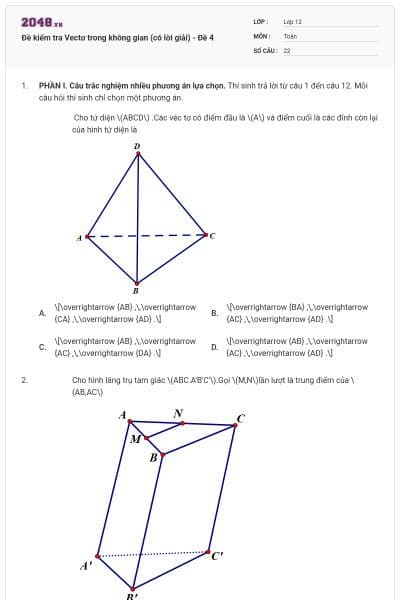
\[\overrightarrow {A'C'} \] .
\[\overrightarrow {BA'} \].
\[\overrightarrow {BB'} \].
\[\overrightarrow {C'C} \].
Đáp án D đúng.
\[\overrightarrow {AD} \, + \,\overrightarrow {BC} \].
\[\overrightarrow {DA} \, + \,\overrightarrow {CB} \] .
\[\overrightarrow {DA} \, + \,\overrightarrow {BC} \].
\[\overrightarrow {AD} \, + \,\overrightarrow {CB} \].
Theo quy tắc ba điểm, ta có:
\[\overrightarrow {AB\,} \, = \overrightarrow {AD} \, + \,\overrightarrow {DB} \]
Do đó:
\[\overrightarrow {AB} \, + \,\overrightarrow {CD} \, = \,\overrightarrow {AD} \, + \,\overrightarrow {DB} \, + \,\overrightarrow {CD} \]
\( = \,\,\,\,\overrightarrow {AD} \, + \left( {\,\overrightarrow {DB} \, + \,\overrightarrow {CD} } \right)\) \( = \,\,\,\,\overrightarrow {AD} \, + \left( {\,\,\overrightarrow {CD} \, + \,\overrightarrow {DB} } \right)\)\( = \,\,\,\,\overrightarrow {AD} \, + \,\overrightarrow {CB} \)
\(30^\circ \).
\(45^\circ \).
\(60^\circ \).
\(90^\circ \).
Ta có: \(\overrightarrow {BD} \, = \,\,\overrightarrow {B'D'} \). Do đó,
\(\left( {\overrightarrow {BD} \,,\,\overrightarrow {B'C} } \right)\, = \,\left( {\overrightarrow {B'D'} \,,\,\overrightarrow {B'C} } \right)\, = \widehat {\,D'B'C'}\)
Vì \(B'C'\, = \,CD'\, = \,D'B'\)nên tam giác \(B'CD'\)là tam giác đều.
Suy ra \(\widehat {\,D'B'C'}\, = \,60^\circ \)
Vậy \(\left( {\overrightarrow {BD} \,,\,\overrightarrow {B'C} } \right)\, = \,60^\circ \)
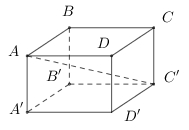
\(\overrightarrow {AC'} = \overrightarrow {BD'} \).
\(\overrightarrow {AD} \)cùng hướng với \(\overrightarrow {B'C'} \).
\(\overrightarrow {CD} \)cùng hướng với \(\overrightarrow {D'C'} \).
\(\overrightarrow {AC'} \)cùng phương với \(\overrightarrow {A'C'} \).
Chọn B
\(\overrightarrow a .\overrightarrow b = 12\).
\[\overrightarrow a .\overrightarrow b = 40\].
\[\overrightarrow a .\overrightarrow b = - 6\].
\[\overrightarrow a .\overrightarrow b = 6\sqrt 3 \].
Chọn C
\[\overrightarrow a .\overrightarrow b = \left| {\overrightarrow a } \right|.\left| {\overrightarrow b } \right|.\cos \left( {\overrightarrow a ,\overrightarrow b } \right) = 2.6.\cos {120^0} = 2.6.\left( { - \frac{1}{2}} \right) = - 6\]
\[\overrightarrow {OA} + \overrightarrow {OA'} = \overrightarrow 0 \]
\[\overrightarrow {OA} + \overrightarrow {OC'} = \overrightarrow 0 \]
\[\overrightarrow {OA} + \overrightarrow {OB} = \overrightarrow 0 \]
\[\overrightarrow {OA} + \overrightarrow {OD} = \overrightarrow 0 \]
Chọn B
Vì \[O\] là trung điểm của \(AC'\) nên \[\overrightarrow {OA} + \overrightarrow {OC'} = \overrightarrow 0 \]
\(\overrightarrow {BC'} = - \overrightarrow a + \overrightarrow b + \overrightarrow c \).
\(\overrightarrow {BC'} = \overrightarrow a - \overrightarrow b + \overrightarrow c \).
\(\overrightarrow {BC'} = \overrightarrow a + \overrightarrow b + \overrightarrow c \).
\(\overrightarrow {BC'} = \overrightarrow a + \overrightarrow b - \overrightarrow c \).
Chọn B

Do \(ABC.A'B'C'\) là hình lăng trụ nên \(\overrightarrow {A'C'} = \overrightarrow {AC} \) nên ta có
\(\overrightarrow {BC'} = \overrightarrow {AC'} - \overrightarrow {AB} = \overrightarrow {AA'} + \overrightarrow {A'C'} - \overrightarrow {AB} = \overrightarrow a - \overrightarrow b + \overrightarrow c \)
\(10a\).
\(\frac{{5a\sqrt 3 }}{2}\).
\(5a\).
\(5a\sqrt 3 \).
Chọn C
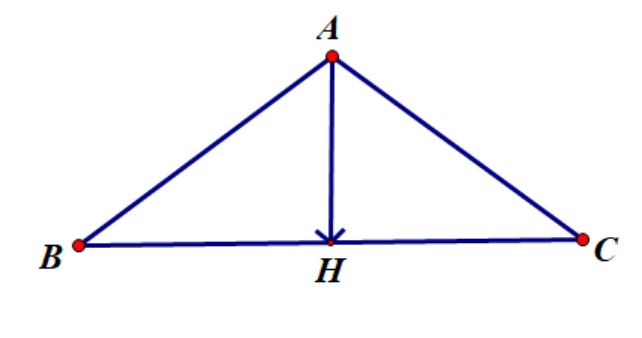
Gọi H là trung điểm của \(BC\), suy ra\(\overrightarrow {AB} + \overrightarrow {AC} = 2\overrightarrow {AH} \Rightarrow \left| {\overrightarrow {AB} + \overrightarrow {AC} } \right| = 2\left| {\overrightarrow {AH} } \right| = 2AH\).
Trong \(\Delta ABC\) có \(\widehat B = \widehat C = 30^\circ \Rightarrow AH = AC.\sin 30^\circ = \frac{{5a}}{2}\).
Vậy \(\left| {\overrightarrow {AB} + \overrightarrow {AC} } \right| = 5a\).
\(\overrightarrow {MG} = \frac{1}{4}\left( {\overrightarrow {MA} + \overrightarrow {MD} } \right)\).
\(\overrightarrow {MG} = \frac{1}{4}\left( {\overrightarrow {MC} + \overrightarrow {MB} } \right)\).
\(\overrightarrow {MG} = \frac{1}{4}\left( {\overrightarrow {MC} + \overrightarrow {MD} } \right)\).
\(\overrightarrow {MG} = \frac{1}{4}\left( {\overrightarrow {MC} - \overrightarrow {MD} } \right)\).
Chọn B
Gọi \(N\) là trung điểm \(BC\) thì \(G\) chính là trung điểm của \(MN\) do đó ta có:
\(\overrightarrow {MG} = \frac{1}{2}\overrightarrow {MN} = \frac{1}{4}\left( {\overrightarrow {MB} + \overrightarrow {MC} } \right)\).

Học thông minh hơn mỗi ngày
Xem toàn bộ 22 câu hỏi và nhiều hơn nữa với tài khoản miễn phí
\(\overrightarrow {BC} + \overrightarrow {BA} = \overrightarrow {{B_1}{C_1}} + \overrightarrow {{B_1}{A_1}} \).
\(\overrightarrow {AD} + \overrightarrow {{D_1}{C_1}} + \overrightarrow {{D_1}{A_1}} = \overrightarrow {DC} \).
\(\overrightarrow {BC} + \overrightarrow {BA} + \overrightarrow {B{B_1}} = \overrightarrow {B{D_1}} \).
\(\overrightarrow {BA} + \overrightarrow {D{D_1}} + \overrightarrow {B{D_1}} = \overrightarrow {BC} \).

Ta có : \(\overrightarrow {BA} + \overrightarrow {D{D_1}} + \overrightarrow {B{D_1}} = \overrightarrow {BA} + \overrightarrow {B{B_1}} + \overrightarrow {B{D_1}} = \overrightarrow {B{A_1}} + \overrightarrow {B{D_1}} \ne \overrightarrow {BC} \) nên D sai.
Do \(\overrightarrow {BC} = \overrightarrow {{B_1}{C_1}} \)và \(\overrightarrow {BA} = \overrightarrow {{B_1}{A_1}} \) nên \(\overrightarrow {BC} + \overrightarrow {BA} = \overrightarrow {{B_1}{C_1}} + \overrightarrow {{B_1}{A_1}} \), nên A đúng
Do \(\overrightarrow {AD} + \overrightarrow {{D_1}{C_1}} + \overrightarrow {{D_1}{A_1}} = \overrightarrow {AD} + \overrightarrow {{D_1}{B_1}} = \overrightarrow {{A_1}{D_1}} + \overrightarrow {{D_1}{B_1}} = \overrightarrow {{A_1}{B_1}} = \overrightarrow {DC} \) nên
\(\overrightarrow {AD} + \overrightarrow {{D_1}{C_1}} + \overrightarrow {{D_1}{A_1}} = \overrightarrow {DC} \) nên B đúng.
Do \[\overrightarrow {BC} + \overrightarrow {BA} + \overrightarrow {B{B_1}} = \overrightarrow {BD} + \overrightarrow {D{D_1}} = \overrightarrow {B{D_1}} \] nên C đúng.
\(k = \frac{1}{3}\).
\[k = 2.\]
\[k = 3.\]
\(k = \frac{1}{2}\).
Ta có
\[\overrightarrow {GA} + \overrightarrow {GB} + \overrightarrow {GC} = \overrightarrow 0 \Leftrightarrow \left( {\overrightarrow {DA} - \overrightarrow {DG} } \right) + \left( {\overrightarrow {DB} - \overrightarrow {DG} } \right) + \left( {\overrightarrow {DC} - \overrightarrow {DG} } \right) = \overrightarrow 0 \]
\[ \Leftrightarrow {\rm{ }}\overrightarrow {DA} + \overrightarrow {DB} + \overrightarrow {DC} = 3\overrightarrow {DG} \].
\(k = 0\).
\[k = 1.\]
\[k = 4\].
\(k = 2\).
Với \(k = 1\) ta có: \[\overrightarrow {AC} + \overrightarrow {BA'} + 1.\left( {\overrightarrow {DB} + \overrightarrow {C'D} } \right) = \overrightarrow {AC} + \overrightarrow {BA'} + \overrightarrow {C'B} = \overrightarrow {AC} + \overrightarrow {C'A'} = \overrightarrow {AC} + \overrightarrow {CA} = \overrightarrow 0 \].
PHẦN 2: CÂU TRẮC NGHIỆM ĐÚNG SAI
Cho hình chóp \[S.ABCD\] có đáy \[ABCD\] là hình vuông,\(SA\)vuông góc với mặt phẳng \((ABCD)\).Gọi \[I,J\] lần lượt là trung điểm của \[SA,SC\]. \[G\]là trọng tâm tam giác \[SBD\]
a) \(\overrightarrow {AC} - \overrightarrow {AB} = \overrightarrow {AD} \).
b) \(\overrightarrow {AS} + \overrightarrow {AB} + \overrightarrow {AD} = \overrightarrow {AG} \).
c) \[\overrightarrow {{\rm{IJ}}} .\overrightarrow {BD} = \overrightarrow 0 \]
d) \({\overrightarrow {AG} ^2} = {\overrightarrow {AS} ^2} + {\overrightarrow {AB} ^2} + {\overrightarrow {AD} ^2}\).
Ý a) đúng: Ta có \[ABCD\] là hình vuông nên \(\overrightarrow {AC} = \overrightarrow {AB} + \overrightarrow {AD} \) ( qui tắc hình bình hành) suy ra\(\overrightarrow {AC} - \overrightarrow {AB} = \overrightarrow {AD} \).
Ý b) sai: Do \[G\]là trọng tâm tam giác \[SBD\] nên
\(\overrightarrow {GS} + \overrightarrow {GB} + \overrightarrow {GD} = \overrightarrow 0 \Rightarrow \left( {\overrightarrow {GA} + \overrightarrow {AS} } \right) + \left( {\overrightarrow {GA} + \overrightarrow {AB} } \right) + \left( {\overrightarrow {GA} + \overrightarrow {AD} } \right) = \overrightarrow 0 \)
\( \Rightarrow \overrightarrow {AS} + \overrightarrow {AB} + \overrightarrow {AD} = 3\overrightarrow {AG} .\)
Ý c) sai: Ta có \[ABCD\] là hình vuông nên nên
\(AC \bot BD \Rightarrow \overrightarrow {AC} .\overrightarrow {BD} = 0 \Rightarrow 2\overrightarrow {{\rm{IJ}}} .\overrightarrow {BD} = 0 \Rightarrow \overrightarrow {{\rm{IJ}}} .\overrightarrow {BD} = 0\)
Mà \[\overrightarrow 0 \ne 0\] nên mệnh đề sai.
Ý d) sai: Do \[G\]là trọng tâm tam giác \[SBD\] nên \(\overrightarrow {AS} + \overrightarrow {AB} + \overrightarrow {AD} = 3\overrightarrow {AG} \)
\({\left( {3\overrightarrow {AG} } \right)^2} = {\left( {\overrightarrow {AS} + \overrightarrow {AB} + \overrightarrow {AD} } \right)^2} \Rightarrow 9A{G^2} = A{S^2} + A{B^2} + A{D^2} + 2\overrightarrow {AS} \overrightarrow {AB} + 2\overrightarrow {AS} \overrightarrow {AD} + 2\overrightarrow {AD} \overrightarrow {AB} \;\left( 1 \right)\)
Vì \(SA\)vuông góc với mặt phẳng \((ABCD)\) nên\(\left\{ \begin{array}{l}SA \bot AB\\SA \bot AD\end{array} \right. \Rightarrow \left\{ \begin{array}{l}\overrightarrow {SA} .\overrightarrow {AD} = 0\\\overrightarrow {SA} .\overrightarrow {AB} = 0\end{array} \right.\;\left( 2 \right)\)
\[ABCD\] là hình vuông nên \(\overrightarrow {AB} .\overrightarrow {AD} = 0\left( 3 \right)\) .Từ \[\left( 1 \right);\left( 2 \right);\left( 3 \right)\] ta được \(9A{G^2} = A{S^2} + A{B^2} + A{D^2}.\)
Cho hình lập phương \(ABCD.A'B'C'D'\). Gọi \(G\) là trọng tâm tam giác \(B'C'D'\), \(I\) là trung điểm của \(AB'\) .
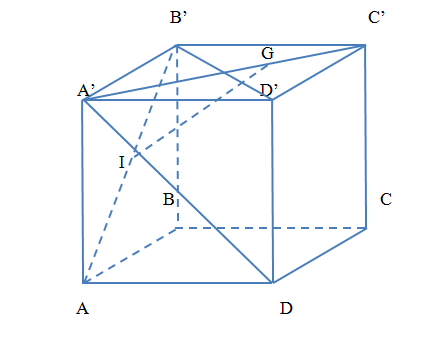
a) \(\overrightarrow {A'D} = \overrightarrow {AA'} - \overrightarrow {AD} \).
b) \(\overrightarrow {GB'} + \overrightarrow {GA} = \overrightarrow {GB} + \overrightarrow {GA'} \).
c) \[6\overrightarrow {IG} = 3\overrightarrow {AA'} + \overrightarrow {AB} + 4\overrightarrow {AD} \;.\]
d) \[cos\left( {\overrightarrow {A'D} \,,\,\overrightarrow {IG} } \right) = \frac{{\sqrt {13} }}{{26}}.\].
Ý a) sai: Theo qui tắc hiệu ta có \(\overrightarrow {DA'} = \overrightarrow {AA'} - \overrightarrow {AD} \) mà \(\overrightarrow {A'D} \ne \overrightarrow {DA'} \)
Ý b) đúng: ) Tứ giác\(ABB'A'\) là hình bình hành nên \(\overrightarrow {AA'} = \overrightarrow {BB'} \)
Theo qui tắc hiệu ta có \(\overrightarrow {AA'} = \overrightarrow {GA'} - \overrightarrow {GA} \,;\overrightarrow {BB'} = \overrightarrow {GB'} - \overrightarrow {GB} \) vậy \(\overrightarrow {GA'} - \overrightarrow {GA} = \overrightarrow {GB'} - \overrightarrow {GB} \)
\( \Rightarrow \overrightarrow {GA'} + \overrightarrow {GB} = \overrightarrow {GB'} + \overrightarrow {GA} .\)
Ý c) đúng: Đặt cạnh hình lập phương là \(a\) .
Ta có: \(A'D\, = \,a\sqrt 2 .\)
\[\begin{array}{l}\overrightarrow {IG} = \overrightarrow {IB'} + \overrightarrow {B'G} \, = \frac{1}{2}\left( {\overrightarrow {AA'} + \overrightarrow {AB} } \right) + \frac{1}{3}\left( {\overrightarrow {B'D'} + \overrightarrow {B'C'} } \right) = \frac{1}{2}\left( {\overrightarrow {AA'} + \overrightarrow {AB} } \right) + \frac{1}{3}\left( {\overrightarrow {BD} + \overrightarrow {AD} } \right)\\\,\,\,\,\,\,\,\,\,\,\,\,\,\,\,\,\,\,\,\,\,\,\,\,\,\,\,\,\,\,\,\,\, = \frac{1}{2}\left( {\overrightarrow {AA'} + \overrightarrow {AB} } \right) + \frac{1}{3}\left( {2\overrightarrow {AD} - \overrightarrow {AB} } \right) = \frac{1}{2}\overrightarrow {AA'} + \frac{1}{6}\overrightarrow {AB} + \frac{2}{3}\overrightarrow {AD} \end{array}\]
Suy ra \[6\overrightarrow {IG} = 3\overrightarrow {AA'} + \overrightarrow {AB} + 4\overrightarrow {AD} {\kern 1pt} \,.\]
Ý d) đúng: \[\overrightarrow {IG} = \,\,\,\frac{1}{2}\overrightarrow {AA'} + \frac{1}{6}\overrightarrow {AB} + \frac{2}{3}\overrightarrow {AD} \] suy ra \[{\overrightarrow {IG} ^2} = {\left( {\frac{1}{2}\overrightarrow {AA'} + \frac{1}{6}\overrightarrow {AB} + \frac{2}{3}\overrightarrow {AD} } \right)^2} = \frac{{13{a^2}}}{{18}} \Rightarrow IG = \frac{{a\sqrt {26} }}{6}.\]
\(\overrightarrow {A'D} = \overrightarrow {AD} - \overrightarrow {AA'} \) và \(A'D = a\sqrt 2 \) .
\[\begin{array}{l}\overrightarrow {A'D} .\overrightarrow {IG} = \left( {\frac{1}{2}\overrightarrow {AA'} + \frac{1}{6}\overrightarrow {AB} + \frac{2}{3}\overrightarrow {AD} } \right).\left( {\overrightarrow {AD} - \overrightarrow {AA'} } \right) = \frac{{{a^2}}}{6}.\\cos\left( {\overrightarrow {A'D} \,,\,\overrightarrow {IG} } \right) = \frac{{\overrightarrow {A'D} .\overrightarrow {IG} }}{{A'D.IG}} = \frac{{\frac{{{a^2}}}{6}}}{{\frac{{a\sqrt {26} }}{6}.a\sqrt 2 }} = \frac{{\sqrt {13} }}{{26}}.\end{array}\]

a) Sai: \[\overrightarrow {MC} + \overrightarrow {MD} = 2\overrightarrow {MN} \].
Vì \(N\) là trung điểm của \(CD\) nên \[\overrightarrow {MC} + \overrightarrow {MD} = 2\overrightarrow {MN} \].
b) Đúng: \[\overrightarrow {AD} + \overrightarrow {BC} = 2\overrightarrow {MN} \].
Ta có : \[\overrightarrow {AD} + \overrightarrow {BC} = \overrightarrow {AM} + \overrightarrow {MD} + \overrightarrow {BM} + \overrightarrow {MC} = (\overrightarrow {MD} + \overrightarrow {MC} ) + (\overrightarrow {AM} + \overrightarrow {BM} ) = 2\overrightarrow {MN} + \overrightarrow 0 = 2\overrightarrow {MN} \].
c) Đúng: \[\overrightarrow {IB} + \overrightarrow {IC} + \overrightarrow {ID} = 3\overrightarrow {IG} \].
Vì \(G\) là trọng tâm tam giác \(BCD\) nên \[\overrightarrow {IB} + \overrightarrow {IC} + \overrightarrow {ID} = 3\overrightarrow {IG} \].
d) Sai: \(2\overrightarrow {IG} + \overrightarrow {IA} = - \overrightarrow {IG} \ne \overrightarrow 0 \).
Vì \(I\) là trung điểm của \(MN\) nên
\(2\overrightarrow {AI} = \overrightarrow {AM} + \overrightarrow {AN} = \frac{1}{2}\overrightarrow {AB} + \frac{1}{2}(\overrightarrow {AC} + \overrightarrow {AD} ) = \frac{1}{2}(\overrightarrow {AB} + \overrightarrow {AC} + \overrightarrow {AD} ) = \frac{3}{2}\overrightarrow {AG} \).
Suy ra \(\overrightarrow {AI} = \frac{3}{4}\overrightarrow {AG} \). Suy ra\(\overrightarrow {IG} = \frac{1}{4}\overrightarrow {AG} \Rightarrow \overrightarrow {IA} = - 3\overrightarrow {IG} \Rightarrow 2\overrightarrow {IG} + \overrightarrow {IA} = - \overrightarrow {IG} \ne \overrightarrow 0 \).
Cho tam giác \(ABC\) với \(M,{\rm{ }}N,{\rm{ }}P\) lần lượt là trung điểm các cạnh \(AB,{\rm{ }}BC,{\rm{ }}CA\). Xét tính đúng sai các mệnh đề sau
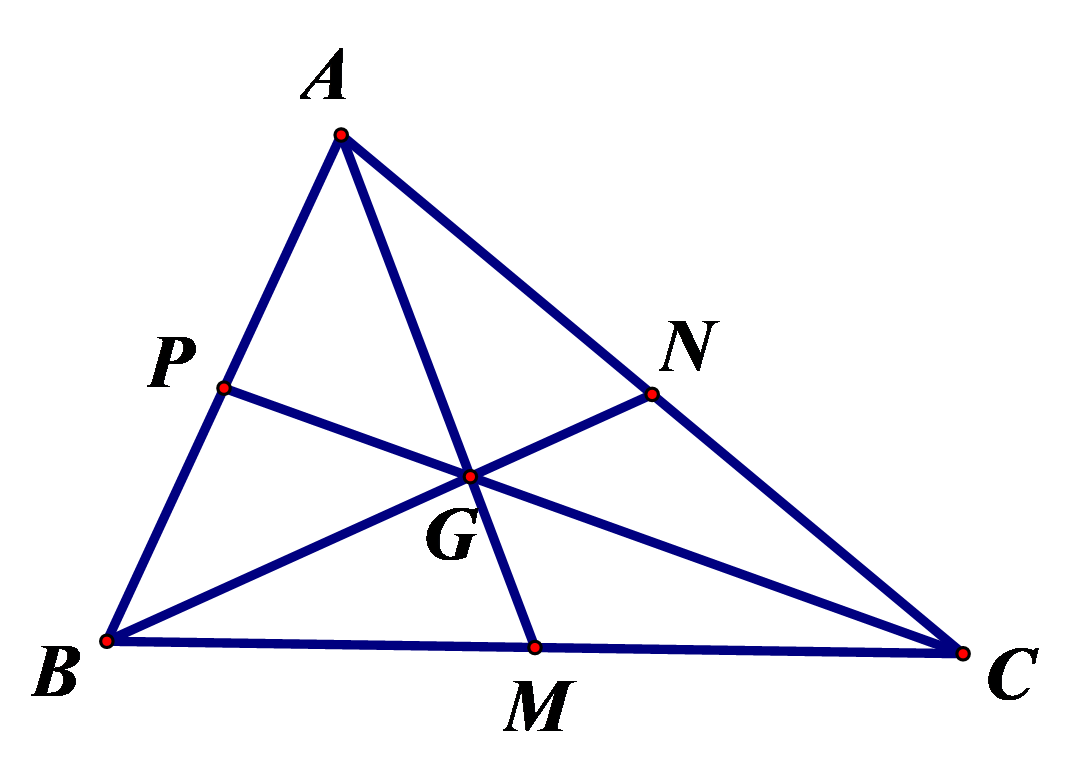
a) \(\overrightarrow {BM} + \overrightarrow {CN} = \overrightarrow {MN} \).
b) \(\overrightarrow {PA} + \overrightarrow {BM} + \overrightarrow {CN} = \vec 0\).
c) \(\overrightarrow {AN} = \overrightarrow {AM} + \overrightarrow {AP} \).
d) \(\overrightarrow {AM} + \overrightarrow {BN} + \overrightarrow {CP} = \overrightarrow 0 \).
Ý a) Đúng: Theo quy tắc ba điểm ta có: \(\overrightarrow {BM} + \overrightarrow {CN} = \overrightarrow {MC} + \overrightarrow {CN} = \overrightarrow {MN} \).
Ý b) Sai: Theo ý a) ta có: \(\overrightarrow {PA} + \overrightarrow {BM} + \overrightarrow {CN} = \overrightarrow {PA} + \left( {\overrightarrow {BM} + \overrightarrow {CN} } \right) = \overrightarrow {PA} + \overrightarrow {MN} = 2\overrightarrow {PA} \ne \overrightarrow 0 \).
Ý c) Sai: Ta có: \[\overrightarrow {AN} = \overrightarrow {AM} + \overrightarrow {AP} \Leftrightarrow \overrightarrow {AN} - \overrightarrow {AM} = \overrightarrow {AP} \Leftrightarrow \overrightarrow {MN} = \overrightarrow {AP} \] (sai vì \[\overrightarrow {MN} = \overrightarrow {PA} \]).
Ý d) Đúng: Gọi \(G\) là trọng tâm tam giác \(ABC\). Ta có: \(\overrightarrow {AM} + \overrightarrow {BN} + \overrightarrow {CP} = - \frac{3}{2}\overrightarrow {GA} - \frac{3}{2}\overrightarrow {GB} - \frac{3}{2}\overrightarrow {GC} = - \frac{3}{2}\left( {\overrightarrow {GA} + \overrightarrow {GB} + \overrightarrow {GC} } \right) = \overrightarrow 0 \).
\(\overrightarrow a ,\overrightarrow b \) vuông góc nên \(\overrightarrow a .\overrightarrow b = 0\)
Ta có \(\left( {\overrightarrow a - \overrightarrow b } \right)\left( {2\overrightarrow a + \overrightarrow b } \right) = 2{\overrightarrow a ^2} - {\overrightarrow b ^2} - \overrightarrow a .\overrightarrow b = {2.6^2} - {4^2} - 0 = 56\)

Ta có \(\overrightarrow {AC'} = \overrightarrow {AA'} + \overrightarrow {AC} = \overrightarrow {AA'} + \overrightarrow {AB} + \overrightarrow {AD} \)
Xét \(AC{'^2} = {\overrightarrow {AC'} ^2} = {\left( {\overrightarrow {AA'} + \overrightarrow {AB} + \overrightarrow {AD} } \right)^2}\)
=\[AA{'^2} + A{B^2} + A{D^2}\]+\(2AA'.AB.\cos \widehat {BAA'}\)+\(2AA'.AD.\cos \widehat {A'AD} + 2AB.AD.\cos \widehat {BAD}\)
\( = 3{\left( {\sqrt 6 } \right)^2} + 3.2\sqrt 6 .\sqrt 6 .\cos {60^0} = 6\)

Có \(M\)là trung điểm \(AB\)\( \Rightarrow \overrightarrow {OM} = \frac{1}{2}\left( {\overrightarrow {OA} + \overrightarrow {OB} } \right)\)
Xét \(\overrightarrow {OM} .\overrightarrow {AC} = \frac{1}{2}\left( {\overrightarrow {OA} + \overrightarrow {OB} } \right)\overrightarrow {AC} = \frac{1}{2}\overrightarrow {OA} .\overrightarrow {AC} + \frac{1}{2}\overrightarrow {OB} .\overrightarrow {AC} \)=\(\frac{1}{2}a.a\sqrt 2 .\cos {135^0} + 0\)\( = \frac{{ - 1}}{2}{a^2}\)
Với \(AB = AC = a\sqrt 2 \),\(OM = \frac{{a\sqrt 2 }}{2}\)
Suy ra \(\cos \left( {\overrightarrow {OM} ;\overrightarrow {AC} } \right) = \frac{{\overrightarrow {OM} .\overrightarrow {AC} }}{{\left| {\overrightarrow {OM} } \right|.\left| {\overrightarrow {AC} } \right|}} = \frac{{\frac{{ - {a^2}}}{2}}}{{a\sqrt 2 .\frac{{a\sqrt 2 }}{2}}} = \frac{{ - 1}}{2} \Rightarrow \left( {\overrightarrow {OM} ;\overrightarrow {AC} } \right) = {120^0}\)
Theo định luật II Newton (Vật lí 10 - Chân trời sáng tạo, Nhà xuất bản Giáo dục Việt Nam, 2023, trang 60): Gia tốc của một vật có cùng hướng với lực tác dụng lên vật. Độ lớn của gia tốc tỉ lệ thuận với độ lớn của lực và tỉ lệ nghịch với khối lượng của vật:
\(\vec F = m\vec a\)
trong đó \(\vec a\) là vectơ gia tốc \(\left( {{\rm{m}}/{{\rm{s}}^2}} \right),\vec F\) là vectơ lực (N)
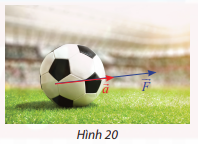
Hình 20 tác dụng lên vật, \(m\left( {{\rm{\;kg}}} \right)\) là khối lượng của vật.
Muốn truyền cho quả bóng có khối lượng \(0,5{\rm{\;kg}}\) một gia tốc \(50{\rm{\;m}}/{{\rm{s}}^2}\) thì cần một lực đá có độ lớn là bao nhiêu?
Ta có \(\vec F = m\vec a\), suy ra \(\left| {\vec F\left| { = m} \right|\vec a} \right| = 0,5.50 = 25\left( {{\rm{\;N}}} \right)\).
Vậy muốn truyền cho quả bóng khối lượng \(0,5{\rm{\;kg}}\) một gia tốc \(50{\rm{\;m}}/{{\rm{s}}^2}\) thì cần một lực đá có độ lớn là \(25{\rm{\;N}}\).
Môt chiếc khinh khí cầu bay lên từ địa điểm cho trước. Sau khoảng thời gian bay, chiếc khinh khí cầu cách địa điểm xuất phát \(2,5km\) về hướng nam và \(1,7km\) về hướng đông, đồng thời cách mặt đất là \(0,6km\). Chọn hệ trục toạ độ \(Oxyz\) với gốc \(O\) đặt tại điểm xuất phát của chiếc khinh khí cầu, mặt phẳng \(\left( {Oxy} \right)\) trùng với mặt đất, trục \(Ox\) hướng về nam, trục \(Oy\) hướng về phía đông và trục \(Oz\) hướng thẳng đứng lên trời, đơn vị đo lấy theo kilomet.
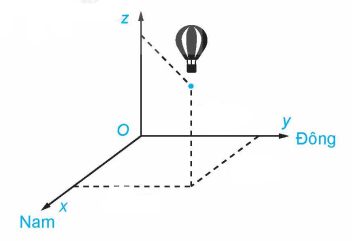
Tính khoảng cách từ địa điểm xuất phát đến địa điểm hiện tại của khinh khí cầu (đơn vị lấy theo kilomet và làm tròn đến \(2\) chữ số sau phần thập phân)
Đáp số: \(3,08\)
Với hệ trục toạ độ đã chọn thì vị trí hiện tại của khinh khí cầu là \(A\left( {2,5;1,7;0,6} \right)\).
Khi đó khoảng cách từ địa điểm xuất phát đến địa điểm hiện tại của khinh khí cầu là: \(OA = \sqrt {2,{5^2} + 1,{7^2} + 0,{6^2}} \approx 3,08\left( {km} \right)\)
Một chiếc đèn tròn được treo song song với mặt phẳng nằm ngang bởi ba sợi dây không dãn xuất phát từ điểm \[O\] trên trần nhà lần lượt buộc vào ba điểm \[A,B,C\] trên đèn tròn sao cho tam giác \[ABC\] đều. Độ dài của ba đoạn dây \[OA,OB,OC\] đều bằng \[L\]. Trọng lượng của chiếc đèn là \[27N\] và bán kính của chiếc đèn là \(0,5m\).
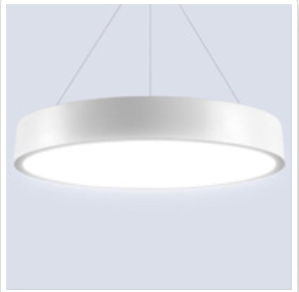
Tìm chiều dài tối thiểu của mỗi sợi dây, biết rằng mỗi sợi dây đó được thiết kế để chịu được lực căng tối đa là \(12N\). (Chiều dài tính theo đơn vị cm và làm tròn đến 1 số sau phần thập phân)
Đáp số: \(75,6\)
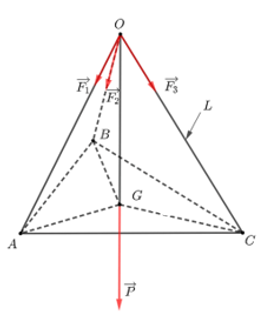
Gọi \[G\] là trọng tâm tam giác \[ABC\].
Vì tam giác \[ABC\] đều nên \[G\] là tâm đường tròn ngoại tiếp tam giác \[ABC\].
Do đó, \[GA = GB = GC = \]\(0,5m\).
Gọi \[F\] là độ lớn của các lực căng \(\overrightarrow {{F_1}} ,\overrightarrow {{F_2}} ,\overrightarrow {{F_3}} \) trên mỗi sợi dây. Khi đó, \(F = F\left( L \right)\) là một hàm số với biến số là \(L\).
Theo bài ra ta có \[OA = OB = OC = L\] nên \[OG \bot \left( {ABC} \right)\] và \[\left| {\overrightarrow {OA} } \right| = \left| {\overrightarrow {OB} } \right| = \left| {\overrightarrow {OC} } \right| = L\]
Do đó, \[\left| {\overrightarrow {{F_1}} } \right| = \left| {\overrightarrow {{F_2}} } \right| = \left| {\overrightarrow {{F_3}} } \right|\]
Vì vậy, tồn tại hằng số \[c \ne 0\] sao cho: \(\overrightarrow {{F_1}} = c\overrightarrow {OA} \), \(\overrightarrow {{F_2}} = c\overrightarrow {OB} ,\,\,\,\overrightarrow {{F_3}} = c\overrightarrow {OC} \). Suy ra \(\overrightarrow {{F_1}} + \overrightarrow {{F_2}} + \overrightarrow {{F_3}} = c\left( {\overrightarrow {OA} + \overrightarrow {OB} + \overrightarrow {OC} } \right)\).
Theo quy tắc ba điểm ta có: \(\overrightarrow {OA} + \overrightarrow {OB} + \overrightarrow {OC} = 3\overrightarrow {OG} \).
Do đó: \[\overrightarrow {{F_1}} + \overrightarrow {{F_2}} + \overrightarrow {{F_3}} = 3c\overrightarrow {OG} \].
Mặt khác ta lại có \(\overrightarrow {{F_1}} + \overrightarrow {{F_2}} + \overrightarrow {{F_3}} = \overrightarrow P \), với \(\overrightarrow P \) là trọng lực tác dụng lên chiếc đèn.
Mà trọng lượng tác dụng lên chiếc đèn là 20N nên \(\left| {\overrightarrow P } \right| = 27\)\( \Leftrightarrow 3c\left| {\overrightarrow {OG} } \right| = 27N \Leftrightarrow c = \frac{9}{{OG}}\) .
Tam giác \[OAG\] vuông tại \[G\](do \[OG \bot \left( {ABC} \right)\]) nên ta suy ra \(OG = \sqrt {O{A^2} - G{A^2}} = \sqrt {{L^2} - 0,{5^2}} \left( m \right)\) với \(L > 0,5\).
Do đó \(\left| {\overrightarrow {OG} } \right| = \sqrt {{L^2} - 0,{5^2}} \Rightarrow c = \frac{9}{{\sqrt {{L^2} - 0,{5^2}} }}\).
Khi đó \(\left| {\overrightarrow F } \right| = \left| {\overrightarrow {{F_1}} } \right| = c\left| {\overrightarrow {OA} } \right| = \frac{{9L}}{{\sqrt {{L^2} - 0,{5^2}} }}\) (với \(L > 0,5\))
Ta có lực căng tối đa của mỗi sợi dây là 12 N \( \Rightarrow F\left( L \right) \le 12 \Leftrightarrow \frac{{9L}}{{\sqrt {{L^2} - 0,{5^2}} }} \le 12 \Leftrightarrow 3L \le 4\sqrt {{L^2} - 0,{5^2}} \)\( \Leftrightarrow 9{L^2} \le 16{L^2} - 4 \Leftrightarrow 7{L^2} \ge 4 \Rightarrow L \ge \frac{2}{{\sqrt 7 }} \approx 0,756\) (m).
Vậy chiều dài tối thiểu của mỗi sợi dây là \(L = 0,756m = 75,6cm\).
Bạn có thích hoạt động này không?
Hãy lưu hoặc chia sẻ nội dung này đến mọi người.
Gợi ý cho bạn

Ý tưởng của bạn, bài học của bạn
Tự thiết kế đề thi, bài giảng hoặc flashcard theo cách riêng.