Đề kiểm tra Vectơ trong không gian lớp 12 (có lời giải) - Đề 1
22 câu hỏi
PHẦN 1: CÂU HỎI TRẮC NGHIỆM
\[\overrightarrow {NM} \].
\[\overrightarrow {MN} \].
\[\overrightarrow {NP} \].
\[\overrightarrow {PN} \].
Theo quy tắc ba điểm ta có \(\overrightarrow {PM} + \overrightarrow {MN} = \overrightarrow {PN} \).
Cho hình lập phương \[ABCD.A'B'C'D'\]. Vectơ có điểm đầu và điểm cuối là các đỉnh của hình lập phương \[ABCD.A'B'C'D'\] và bằng vectơ \(\overrightarrow {AD} \) là
![Cho hình lập phương \[ABCD.A'B'C'D'\]. Vectơ có điểm đầu và điểm cuối là các đỉnh của hình lập phương \[ABCD.A'B'C'D'\] và bằng vectơ \(\overrightarrow {AD} \) là (ảnh 1)](https://video.vietjack.com/upload2/quiz_source1/2025/09/1-1759236578.png)
\[\overrightarrow {B'C'} \].
\[\overrightarrow {DA} \].
\[\overrightarrow {CB} \].
\[\overrightarrow {AB} \].
Do \[ABCD.A'B'C'D'\] là hình lập phương nên ta có \(AD = B'C'\)
Ta thấy \(\overrightarrow {AD} \) và \[\overrightarrow {B'C'} \] cùng hướng .
Do đó \(\overrightarrow {AD} = \overrightarrow {B'C'} \).
Gọi \(I\)là trung điểm của\(AB\). Khẳng định nào sau đây sai?
\(\overrightarrow {IA} + \overrightarrow {IB} = \overrightarrow 0 \).
\[IA = IB\].
\(\overrightarrow {IA} = \overrightarrow {IB} \).
\(\overrightarrow {MA} + \overrightarrow {MB} = 2\overrightarrow {MI} \).

\(I\) là trung điểm của \(AB\) nên ta có \[IA = IB\] và hai vecto ngược hướng . Do đó \(\overrightarrow {IA} = - \overrightarrow {IB} \).
Vậy khẳng định sai là \(\overrightarrow {IA} = \overrightarrow {IB} \) nên ta chọn C.
Cho hình hộp \[ABCD.EFGH\]. Kết quả quả phép toán \[\overrightarrow {AB} - \overrightarrow {EH} \]là
![Cho hình hộp \[ABCD.EFGH\]. Kết quả quả phép toán \[\overrightarrow {AB} - \overrightarrow {EH} \] là (ảnh 1)](https://video.vietjack.com/upload2/quiz_source1/2025/09/3-1759236661.png)
\[\overrightarrow {BD} \].
\[\overrightarrow {AE} \].
\[\overrightarrow {DB} \].
\[\overrightarrow {BH} \].
Do \[ABCD.EFGH\] là hình hộp nên \[EH = AD\] và hai vecto \[\overrightarrow {EH} ,\overrightarrow {AD} \] cùng hướng nên \[\overrightarrow {EH} = \overrightarrow {AD} \]
Ta có \[\overrightarrow {AB} - \overrightarrow {EH} = \overrightarrow {AB} - \overrightarrow {AD} = \overrightarrow {DB} \].
Cho hai vectơ \[\overrightarrow u ,\overrightarrow v \] có \[\left| {\overrightarrow u } \right| = 3,\left| {\overrightarrow v } \right| = 4\] và góc giữa hai vectơ \[\overrightarrow u ,\overrightarrow v \] bằng \[{60^o}\]. Tích vô hướng \[\overrightarrow u .\overrightarrow v \] bằng
\[12\].
\[6\].
\[ - 12\].
\[ - 6\].
Ta có \[\overrightarrow u .\overrightarrow v = \left| {\overrightarrow u } \right|.\left| {\overrightarrow v } \right|.\cos \left( {\overrightarrow u ,\overrightarrow v } \right) = 3.4.\cos {60^o} = 6\].
Trong không gian, cho 3 điểm \[A,\;B,\;C\] phân biệt. Hiệu hai véc tơ \(\overrightarrow {AB} - \overrightarrow {AC} \) bằng
\[\overrightarrow {CB} .\]
\[\overrightarrow {BC} \].
\[\overrightarrow {BA} \].
\[\overrightarrow {CA} \].
Theo quy tắc hiệu hai véctơ chung gốc, ta có \(\overrightarrow {AB} - \overrightarrow {AC} = \overrightarrow {CB} \).
\[\overrightarrow {AC} \].
\[\overrightarrow {AD} \].
\[\overrightarrow {A'C} \].
\[\overrightarrow {AB} \].
Trong hình hình hộp\[ABCD.A'B'C'D'\], ta có \(\overrightarrow {AC} \) và \[\overrightarrow {AO} \] cùng hướng và\(AC = 2AO\)
Do đó \(\overrightarrow {AC} = 2\overrightarrow {AO} .\)
\[GA = GB = GC = GD\].
\[\overrightarrow {GA} + \overrightarrow {GB} + \overrightarrow {GC} + \overrightarrow {GD} = \overrightarrow 0 \]
\[\overrightarrow {GA} - \overrightarrow {GB} = \overrightarrow {GC} - \overrightarrow {GD} \]
\[GA + GB + GC + GD = 0\]
\(G\) là trọng tâm tứ diện \(ABCD\) khi và chỉ khi \[\overrightarrow {GA} + \overrightarrow {GB} + \overrightarrow {GC} + \overrightarrow {GD} = \overrightarrow 0 \].
\[{a^2}\].
\(0.\)
\[a\].
\[\frac{{{a^2}}}{2}\].
\[\overrightarrow {AC'} = \overrightarrow {AB} + \overrightarrow {AD} + \overrightarrow {AA'} \].
\[\overrightarrow {AB} = \overrightarrow {D'C'} \].
\[\overrightarrow {AB} + \overrightarrow {AA'} = \overrightarrow {AD} + \overrightarrow {DD'} .\]
\[\overrightarrow {AD} + \overrightarrow {DC} + \overrightarrow {CC'} = \overrightarrow {AD'} + \overrightarrow {D'C'} \].
Ta có:\[\overrightarrow {AB} + \overrightarrow {AA'} = \overrightarrow {AD} + \overrightarrow {DD'} \] mà \(\overrightarrow {AA'} = \overrightarrow {DD'} \) suy ra \[\overrightarrow {AB} = \overrightarrow {AD} \] nên đẳng thức C sai.
Cho hình tứ diện \[ABCD\] có trọng tâm \[G\]. Mệnh đề nào sau đây sai?
\[\overrightarrow {AG} = \frac{2}{3}\left( {\overrightarrow {AB} + \overrightarrow {AC} + \overrightarrow {AD} } \right)\].
\[\overrightarrow {AG} = \frac{1}{4}\left( {\overrightarrow {AB} + \overrightarrow {AC} + \overrightarrow {AD} } \right)\].
\[\overrightarrow {OG} = \frac{1}{4}\left( {\overrightarrow {OA} + \overrightarrow {OB} + \overrightarrow {OC} + \overrightarrow {OD} } \right)\].
\[\overrightarrow {GA} + \overrightarrow {GB} + \overrightarrow {GC} + \overrightarrow {GD} = \overrightarrow 0 \].
Theo giả thiết trên thì với \(O\) là một điểm bất kỳ ta luôn có: \[\overrightarrow {OG} = \frac{1}{4}\left( {\overrightarrow {OA} + \overrightarrow {OB} + \overrightarrow {OC} + \overrightarrow {OD} } \right)\].
Ta thay điểm \(O\) bởi điểm \(A\) thì ta có:
\[\overrightarrow {AG} = \frac{1}{4}\left( {\overrightarrow {AA} + \overrightarrow {AB} + \overrightarrow {AC} + \overrightarrow {AD} } \right) \Leftrightarrow \overrightarrow {AG} = \frac{1}{4}\left( {\overrightarrow {AB} + \overrightarrow {AC} + \overrightarrow {AD} } \right)\]
Do vậy \[\overrightarrow {AG} = \frac{2}{3}\left( {\overrightarrow {AB} + \overrightarrow {AC} + \overrightarrow {AD} } \right)\] là sai.
\[\overrightarrow {OA} + \frac{1}{2}\overrightarrow {OB} = \overrightarrow {OC} + \frac{1}{2}\overrightarrow {OD} \].
\[\overrightarrow {OA} + \frac{1}{2}\overrightarrow {OC} = \overrightarrow {OB} + \frac{1}{2}\overrightarrow {OD} \].
\[\overrightarrow {OA} + \overrightarrow {OC} = \overrightarrow {OB} + \overrightarrow {OD} \].
\[\overrightarrow {OA} + \overrightarrow {OB} + \overrightarrow {OC} + \overrightarrow {OD} = \overrightarrow 0 \].
![Trong không gian cho điểm \[O\] và bốn điểm\[A,B,C,D\] không thẳng hàng. Điều kiện cần và đủ để \[A,B,C,D\] tạo thành hình bình hành là (ảnh 1)](https://video.vietjack.com/upload2/quiz_source1/2025/09/4-1759237018.png)
\[\overrightarrow {OA} + \overrightarrow {OC} = \overrightarrow {OB} + \overrightarrow {OD} {\rm{ }} \Leftrightarrow {\rm{ }}\overrightarrow {OA} - \overrightarrow {OB} {\rm{ = }}\overrightarrow {OD} - \overrightarrow {OC} {\rm{ }} \Leftrightarrow {\rm{ }}\overrightarrow {BA} = \overrightarrow {CD} \].
Mà bốn điểm\[A,B,C,D\] không thẳng hàng nên \[A,B,C,D\] tạo thành hình bình hành.
PHẦN 2: CÂU TRẮC NGHIỆM ĐÚNG SAI
Trong không gian cho hình lập phương \(ABCD.A'B'C'D'\) có độ dài cạnh là \(a\). Gọi \(O\)là giao điểm của \(BD\) và \(AC\).
a) Vectơ \[\overrightarrow {A'C} - \overrightarrow {A'A} = \overrightarrow {AB} + \overrightarrow {AD} \]
b) Vectơ \[\overrightarrow {BC'} = \overrightarrow {A'A} + \overrightarrow {B'C'} \].
c) Vectơ \[\overrightarrow {C'O} = \overrightarrow {C'A'} - \overrightarrow {OA'} \]
d) \(\overrightarrow {A'D} .\overrightarrow {A'B} = 0\)
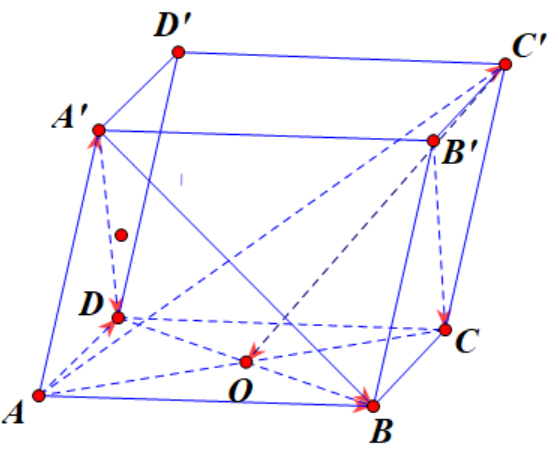
Ý a) Đúng: Vì \[\left\{ \begin{array}{l}\overrightarrow {A'C} - \overrightarrow {A'A} = \overrightarrow {AC} \\\overrightarrow {AB} + \overrightarrow {AD} = \overrightarrow {AC} \end{array} \right. \Rightarrow \overrightarrow {A'C} - \overrightarrow {AA'} = \overrightarrow {AB} + \overrightarrow {AD} \]
Ý b) Sai: Vì \[\overrightarrow {BC'} = \overrightarrow {BB'} + \overrightarrow {B'C'} = \overrightarrow {AA'} + \overrightarrow {B'C'} \].
Ý c) Đúng: Vì \[\overrightarrow {C'O} = \overrightarrow {C'A'} + \overrightarrow {A'O} = \overrightarrow {C'A'} - \overrightarrow {OA'} \].
Ý d) Sai: Ta có: \(\overrightarrow {A'D} .\overrightarrow {A'B} = \left| {\overrightarrow {A'D} } \right|.\left| {\overrightarrow {A'B} } \right|.\cos \left( {\overrightarrow {A'D} ,\overrightarrow {A'B} } \right) = a\sqrt 2 .a\sqrt 2 .c{\rm{os}}60^\circ = {a^2}\)
Trong các khẳng định dưới đây khẳng định nào đúng ?
a) Trong không gian lấy ba điểm \(A,B,C\)tùy ý ta luôn có \(\overrightarrow {AB} - \overrightarrow {AC} = \overrightarrow {BC} \).
b) Trong không gian cho hình bình hành \(ABCD\) thì \[\overrightarrow {BA} + \overrightarrow {BC} = \overrightarrow {BD} \] .
c) Với vectơ \(\overrightarrow a \ne \overrightarrow 0 \) và \(k \in \mathbb{R}\) ta luôn có \(\left| {k.\overrightarrow a } \right| = \left| k \right|.\left| {\overrightarrow a } \right|\).
d) Với vectơ \(\overrightarrow a ,\overrightarrow b \) là hai vectơ tùy ý khác vectơ \(\overrightarrow 0 \)ta luôn có \[\cos \left( {\overrightarrow a ,\overrightarrow b } \right) = \frac{{\overrightarrow a .\overrightarrow b }}{{\left| {\overrightarrow a } \right|.\left| {\overrightarrow b } \right|}}\].
Ý a) Sai: Vì \(\overrightarrow {AB} - \overrightarrow {AC} = \overrightarrow {CB} \).
Ý b) Đúng: Vì \(ABCD\) là hình bình hành nên \[\overrightarrow {BA} + \overrightarrow {BC} = \overrightarrow {BD} \].
Ý c) Đúng: Với vectơ \(\overrightarrow a \ne \overrightarrow 0 \) và \(k \in \mathbb{R}\) ta luôn có \(\left| {k.\overrightarrow a } \right| = \left| k \right|.\left| {\overrightarrow a } \right|\).
Ý d) Đúng: Với vectơ \(\overrightarrow a ,\overrightarrow b \)là hai vectơ tùy ý khác vectơ \(\overrightarrow 0 \)ta luôn có \[\cos \left( {\overrightarrow a ,\overrightarrow b } \right) = \frac{{\overrightarrow a .\overrightarrow b }}{{\left| {\overrightarrow a } \right|.\left| {\overrightarrow b } \right|}}\].
Cho hình lập phương \(ABCD.A'B'C'D'\) có cạnh bằng \(a\). Đặt \(\overrightarrow {AB} = \overrightarrow x ;\,\overrightarrow {AD} = \overrightarrow y ;\,\overrightarrow {AA'} = \overrightarrow z \). Xét tính đúng sai của các mệnh đề sau đây:
a) \(\overrightarrow {AC'} = \overrightarrow x + \overrightarrow y + \overrightarrow z \).
b) \(\overrightarrow {A'B} = \overrightarrow x + \overrightarrow z \)
c)Góc giữa véc tơ \(\overrightarrow {BA'} \) và véc tơ \(\overrightarrow {A'C'} \) bằng \({60^\bigcirc }\).
d) Gọi \(M\) là trung điểm của \(BC\). Độ dài véc tơ \(\overrightarrow {A'M} \) bằng \(\frac{{3a}}{2}\).
a)Đ b) S c) S d Đ
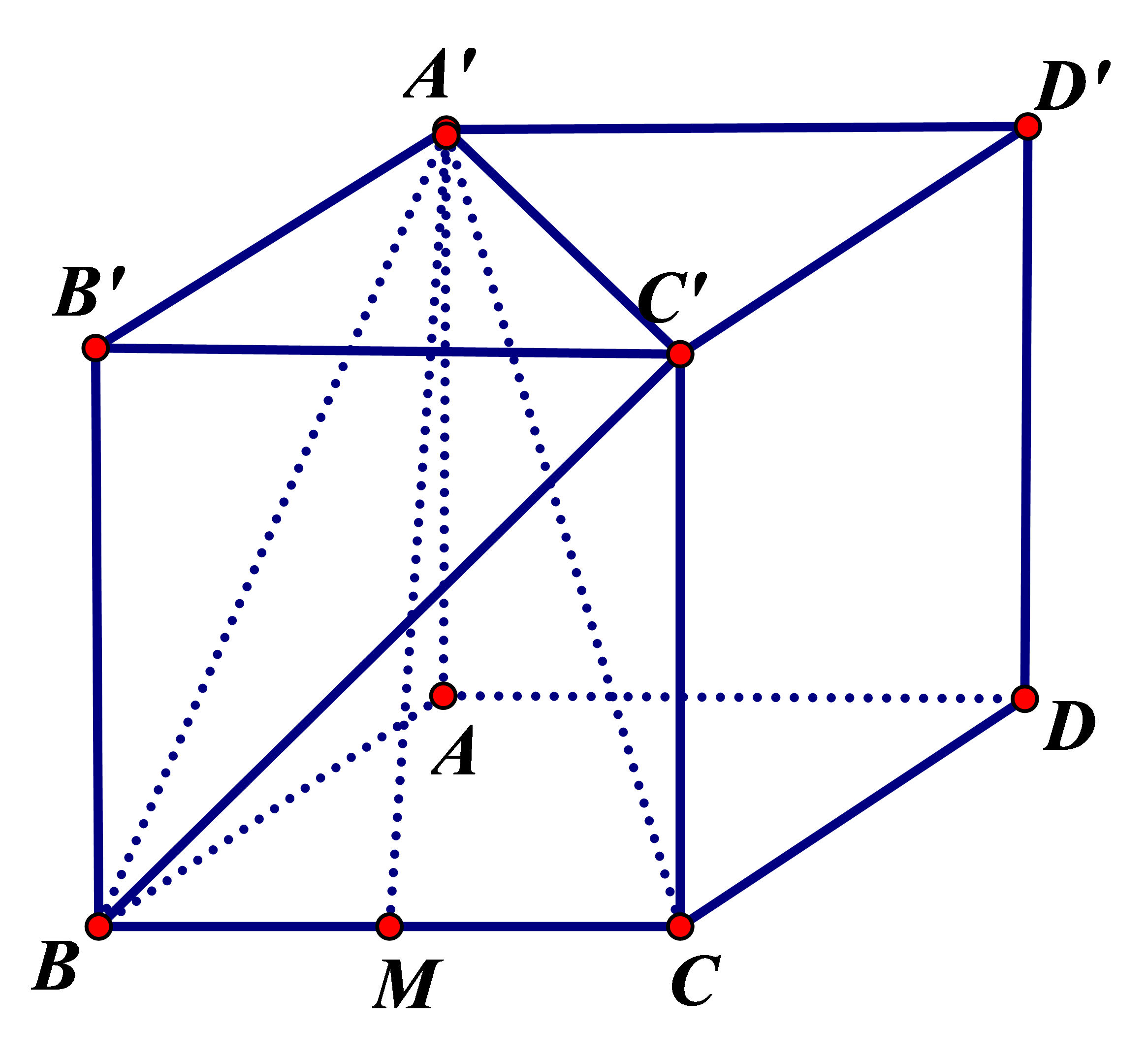
Theo quy tắc hình hộp ta có \(\overrightarrow {AC'} = \overrightarrow {AB} + \overrightarrow {AD} + \overrightarrow {AA'} = \overrightarrow x + \overrightarrow y + \overrightarrow z \).
b) Sai.
Theo quy tắc 3 điểm ta có \(\overrightarrow {A'B} = \overrightarrow {AB} - \overrightarrow {AA'} = \overrightarrow x - \overrightarrow z \).
c) Sai.
Vì hình lập phương có cạnh bằng \(a\) nên \(A'B = A'C' = C'B = a\sqrt 2 \), do đó tam giác \(A'BC'\) đều, nên \(\angle BA'C' = {60^\bigcirc } \Rightarrow \left( {\overrightarrow {BA'} ,\,\overrightarrow {A'C'} } \right) = {180^\bigcirc } - {60^\bigcirc } = {120^\bigcirc }\).
d) Đúng.
Dễ thấy \(ABCD.A'B'C'D'\) nên \(AA' \bot \left( {ABCD} \right) \Rightarrow AA' \bot AM \Rightarrow \)tam giác \(AA'M\) vuông tại \(A\).
Có \(\left| {\overrightarrow {A'M} } \right| = A'M = \sqrt {A{{A'}^2} + A{M^2}} = \sqrt {A{{A'}^2} + A{B^2} + B{M^2}} \)\( = \sqrt {{a^2} + {a^2} + \frac{{{a^2}}}{4}} = \frac{{3a}}{2}\).
Cho tứ diện đều\(ABCD\). Gọi \(G\) là trọng tâm của tam giác \(BCD\). Xét tính đúng, sai của các mệnh đề sau đây:
a) \(\overrightarrow {GB} + \overrightarrow {GC} + \overrightarrow {GD} = \overrightarrow 0 \).
b) \(\overrightarrow {AG} = \frac{1}{3}\overrightarrow {AB} + \frac{2}{3}\overrightarrow {AC} + \frac{2}{3}\overrightarrow {AD} \).
c)\(\overrightarrow {CG} = \frac{1}{3}\overrightarrow {AB} - \frac{2}{3}\overrightarrow {AC} + \frac{1}{3}\overrightarrow {AD} \).
d) Gọi \(I\) là điểm thuộc đoạn \(AG\) và thỏa mãn \(AI = 3IG\). Khi đó \(\overrightarrow {IA} + \overrightarrow {IB} + \overrightarrow {IC} + \overrightarrow {ID} = \overrightarrow 0 \).
a)Đ b) S c) Đ d Đ
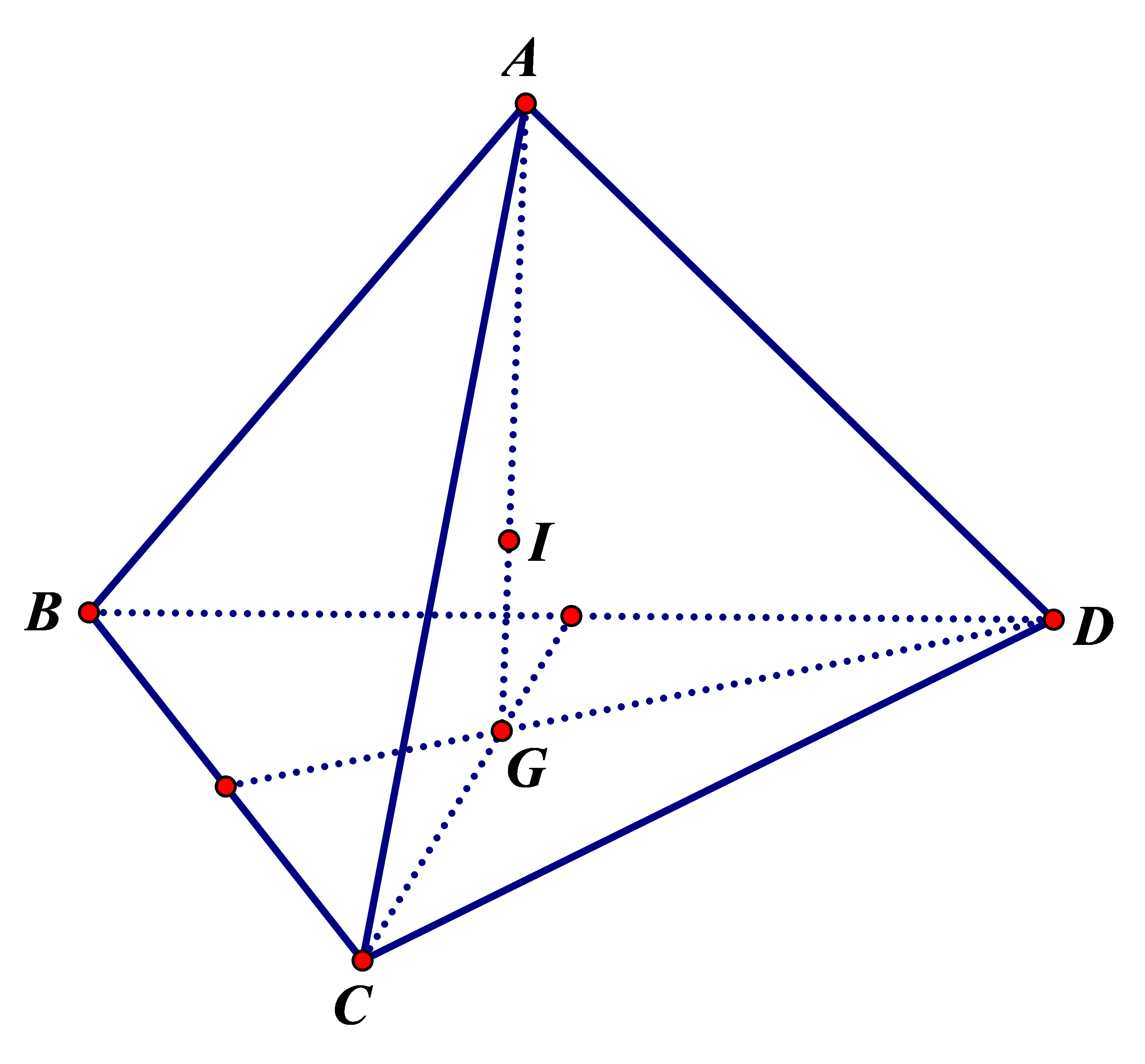
a) Đúng, theo tính chất trọng tâm.
b) Sai.
Theo quy tắc trọng tâm, ta có \(\overrightarrow {AB} + \overrightarrow {AC} + \overrightarrow {AD} = 3\overrightarrow {AG} \Leftrightarrow \overrightarrow {AG} = \frac{1}{3}\overrightarrow {AB} + \frac{1}{3}\overrightarrow {AC} + \frac{1}{3}\overrightarrow {AD} \).
c) Đúng.
\(\overrightarrow {CG} = \overrightarrow {AG} - \overrightarrow {AC} = \frac{1}{3}\overrightarrow {AB} + \frac{1}{3}\overrightarrow {AC} + \frac{1}{3}\overrightarrow {AD} - \overrightarrow {AC} = \frac{1}{3}\overrightarrow {AB} - \frac{2}{3}\overrightarrow {AC} + \frac{1}{3}\overrightarrow {AD} \).
d) Đúng.
Vì \(I\) là điểm thuộc đoạn \(AG\) và \(AI = 3IG \Rightarrow \overrightarrow {AI} = 3\overrightarrow {IG} \), mà \(G\)là trọng tâm tam giác \(BCD\) nên
\(\overrightarrow {IB} + \overrightarrow {IC} + \overrightarrow {ID} = 3\overrightarrow {IG} \Leftrightarrow \overrightarrow {IB} + \overrightarrow {IC} + \overrightarrow {ID} = \overrightarrow {AI} \)\( \Leftrightarrow \overrightarrow {IB} + \overrightarrow {IC} + \overrightarrow {ID} = - \overrightarrow {IA} \)\( \Leftrightarrow \overrightarrow {IA} + \overrightarrow {IB} + \overrightarrow {IC} + \overrightarrow {ID} = \overrightarrow 0 \).
PHẦN 3: CÂU TRẮC NGHIỆM TRẢ LỜI NGẮN
Cho hình hộp \[ABCD.A'B'C'D'\]. Gọi \(M\), \(N\) lần lượt là các điểm trên đoạn \(AC\)và \(C'D\) sao cho, \(DN = \frac{1}{3}DC'\), \(AM = \frac{2}{3}AC\). Khi phân tích \(\overrightarrow {BN} = x.\overrightarrow {BA} + y.\overrightarrow {BC} + z.\overrightarrow {BB'} \) thì giá trị \(x + y + z\) bằng![Cho hình hộp \[ABCD.A'B'C'D'\]. Gọi \(M\), \(N\) lần lượt là các điểm trên đoạn \(AC\)và \(C'D\) sao cho, \(DN = \frac{1}{3}DC'\), \(AM = \frac{2}{3}A (ảnh 1)](https://video.vietjack.com/upload2/quiz_source1/2025/09/8-1759237215.png)
Ta có: \(DN = \frac{1}{3}DC' \Leftrightarrow NC' = 2ND \Rightarrow \overrightarrow {NC'} = - 2\overrightarrow {ND} \).
Suy ra điểm N chia đoạn thẳng \[{\rm{D}}C'\] theo tỉ số \(k = - 2\). Do đó \(\overrightarrow {BN} = \frac{{\overrightarrow {BC'} + 2\overrightarrow {BD} }}{3}\)
hay \(\overrightarrow {BN} = \frac{1}{3}\overrightarrow {BC'} + \frac{2}{3}\overrightarrow {BD} \Leftrightarrow \overrightarrow {BN} = \frac{1}{3}\left( {\overrightarrow {BB'} + \overrightarrow {BC} } \right) + \frac{2}{3}\left( {\overrightarrow {BA} + \overrightarrow {BC} } \right) \Leftrightarrow \overrightarrow {BN} = \frac{2}{3}\overrightarrow {BA} + \overrightarrow {BC} + \frac{1}{3}\overrightarrow {BB'} \).
Vậy \(x + y + z = 2\).
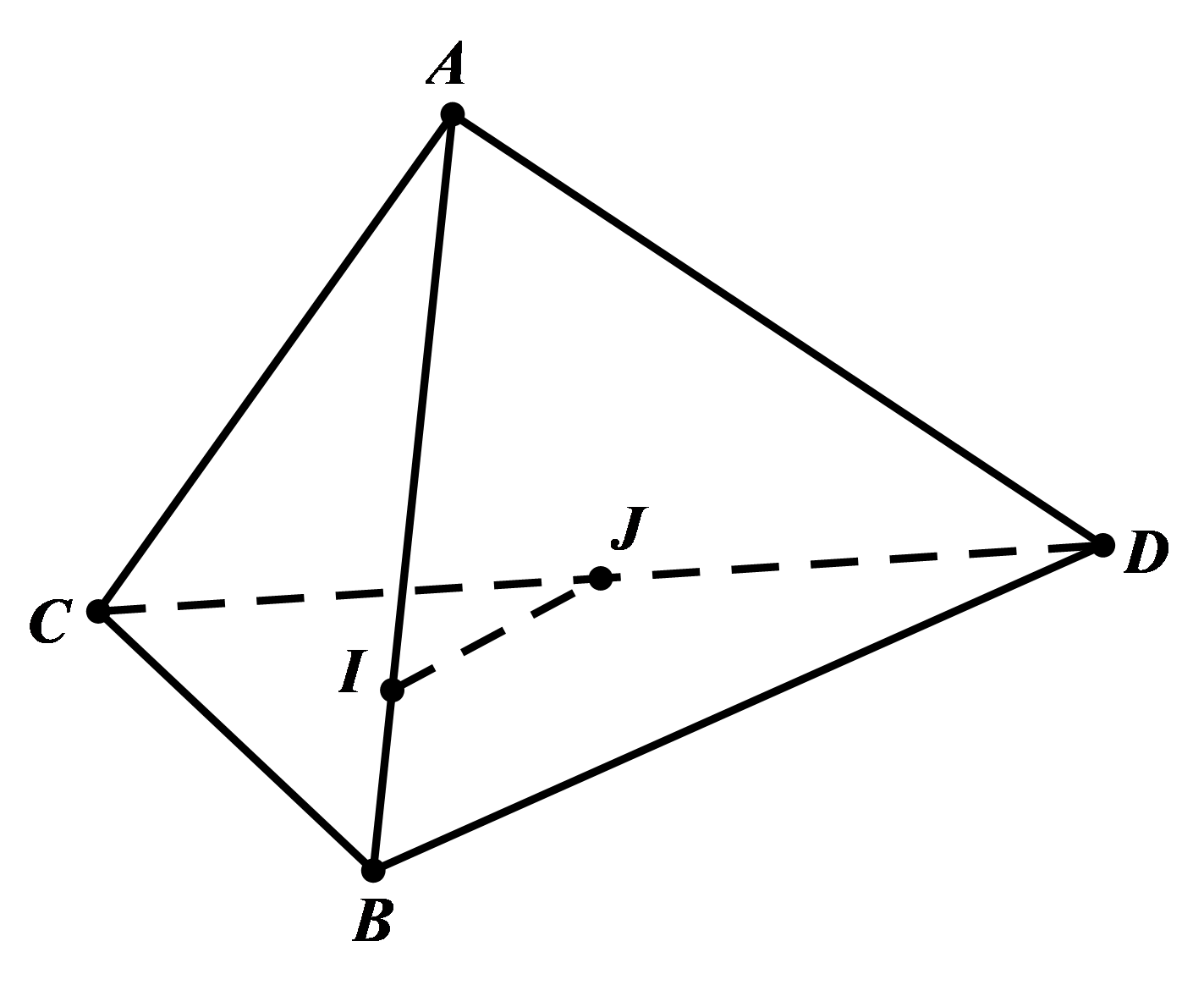
Ta có: \(\overrightarrow {AC} .\overrightarrow {AD} = 0\); \[\overrightarrow {AB} .\overrightarrow {AD} = AB.AD.cos60^\circ = \frac{1}{2}\]; \[\overrightarrow {AC} .\overrightarrow {AB} = \frac{1}{2}\].
\(\overrightarrow {IJ} \, = \,\overrightarrow {IA} + \overrightarrow {AJ} = - \frac{3}{4}\overrightarrow {AB} + \frac{1}{2}\left( {\overrightarrow {AC} + \overrightarrow {AD} } \right) = \frac{1}{2}\left( {\overrightarrow {AC} + \overrightarrow {AD} - \frac{3}{2}\overrightarrow {AB} } \right)\)
\( \Rightarrow I{J^2} = {\overrightarrow {IJ} ^2}\, = \frac{1}{4}{\left( {\overrightarrow {AC} + \overrightarrow {AD} - \frac{3}{2}\overrightarrow {AB} } \right)^2} = \frac{1}{4}\left( {\frac{{17}}{4} + 2\overrightarrow {AC} .\overrightarrow {AD} - 3\overrightarrow {AC} .\overrightarrow {AB} - 3\overrightarrow {AB} .\overrightarrow {AD} } \right) = \frac{5}{{16}}\).
\( \Rightarrow IJ = \frac{{\sqrt 5 }}{4} \approx 0,56.\)
Cho hình hộp \[ABCD.A'B'C'D'.\] Gọi \[M\] là điểm trên cạnh \[AC\] sao cho \[AC = 3MC.\] Lấy \[N\] trên đoạn \[C'D\] sao cho \[C'N = x\,C'D.\] Khi \[MN\parallel BD'\] thì giá trị \[x\] (làm tròn kết quả đến hàng phần trăm)
![Cho hình hộp \[ABCD.A'B'C'D'.\] Gọi \[M\] là điểm trên cạnh \[AC\] sao cho \[AC = 3MC.\] Lấy \[N\] trên đoạn \[C'D\] sao cho \[C'N = x\,C'D.\] Khi \[MN\parallel BD'\] thì giá trị \[x\] (làm tròn kết quả đến hàng phần trăm) là (ảnh 1)](https://video.vietjack.com/upload2/quiz_source1/2025/09/10-1759237304.png)
Gọi \[O\] là tâm của hình hình hành \[ABCD\] và \[I\] là trung điểm của \[DD'.\]
Nối \[C'D\] cắt \[CI\] tại \[N' \Rightarrow N'\] là trọng tâm của tam giác \[CDD'.\]
Ta có \[OI\] là đường trung bình của tam giác \[BDD'\] suy ra \[OI\]//\[BD'.\]
Mặt khác \[\frac{{CN'}}{{CI}} = \frac{{CM}}{{CO}}\] nên \[MN'\]//\[OI\] suy ra \[MN'\]//\[BD'.\]
Theo bài ra, ta có \[MN\]//\[BD'\]\[ \Rightarrow \,\,C'N = \frac{2}{3}C'D\,\,\, \Rightarrow \,\,x = \frac{2}{3} \approx 0,67\].
Cho tứ diện đều \(S.ABC\) cạnh \(a\),\(M\) là trung điểm của cạnh \(BC\). Tính \(\cos \left( {\overrightarrow {AM} ,\overrightarrow {SB} } \right)\) (Làm tròn kết quả đến hàng phần trăm).
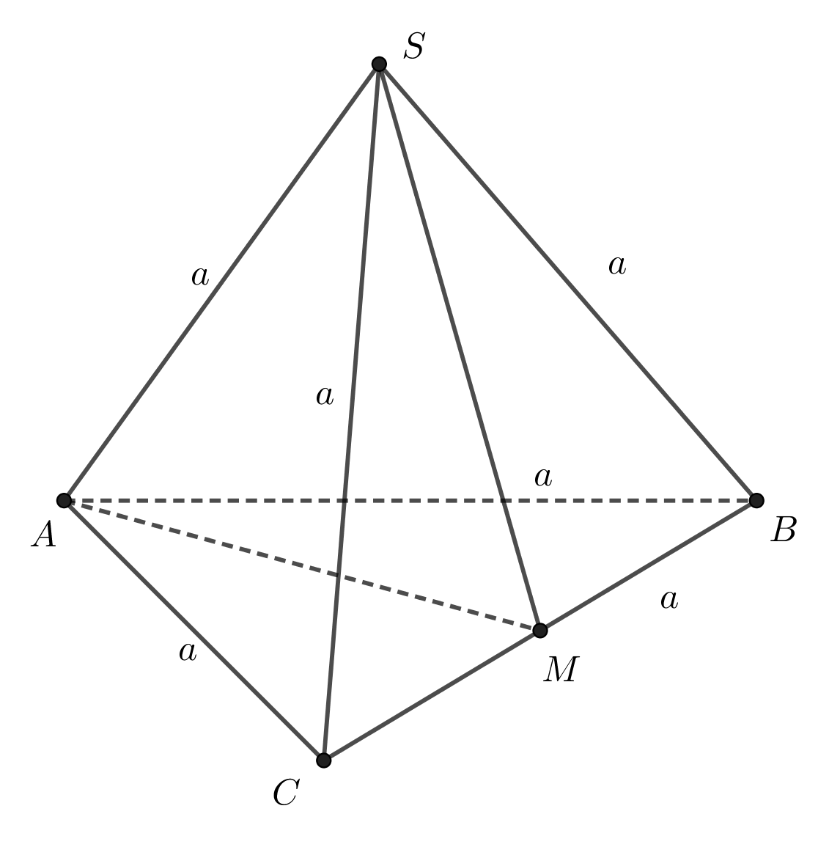
Ta có:
Suy ra:
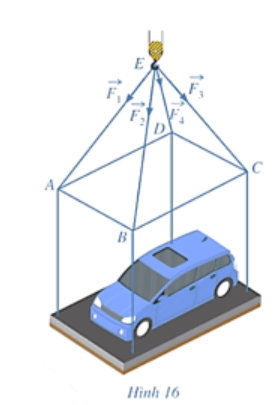
Một chiếc ô tô được đặt trên mặt đáy dưới của một khung sắt dạng hình hộp chữ nhật với đáy trên là hình chữ nhật \(ABCD\), mặt phẳng \(\left( {ABCD} \right)\)song song với mặt phẳng nằm ngang. Khung sắt đó được đặt vào móc \(E\) của chiếc cần cẩu sao cho các đoạn dây cáp \(EA;\,EB;\,EC;\,ED\) bằng nhau và cùng tạo với mặt phẳng \(\left( {ABCD} \right)\)một góc \(\alpha \). Chiếc cần cẩu kéo khung sắt lên theo phương thẳng đứng. Biết các lực căng \(\overrightarrow {{F_1}} ;\,\overrightarrow {{F_2}} ;\,\overrightarrow {{F_3}} ;\,\overrightarrow {{F_4}} \) đều có cường độ là \(4800\,N\), trọng lượng của cả khung sắt chứa xe ô tô là \(7200\sqrt 6 \,N\). Tính \(\sin \alpha \) (làm tròn kết quả đến hàng phần trăm).
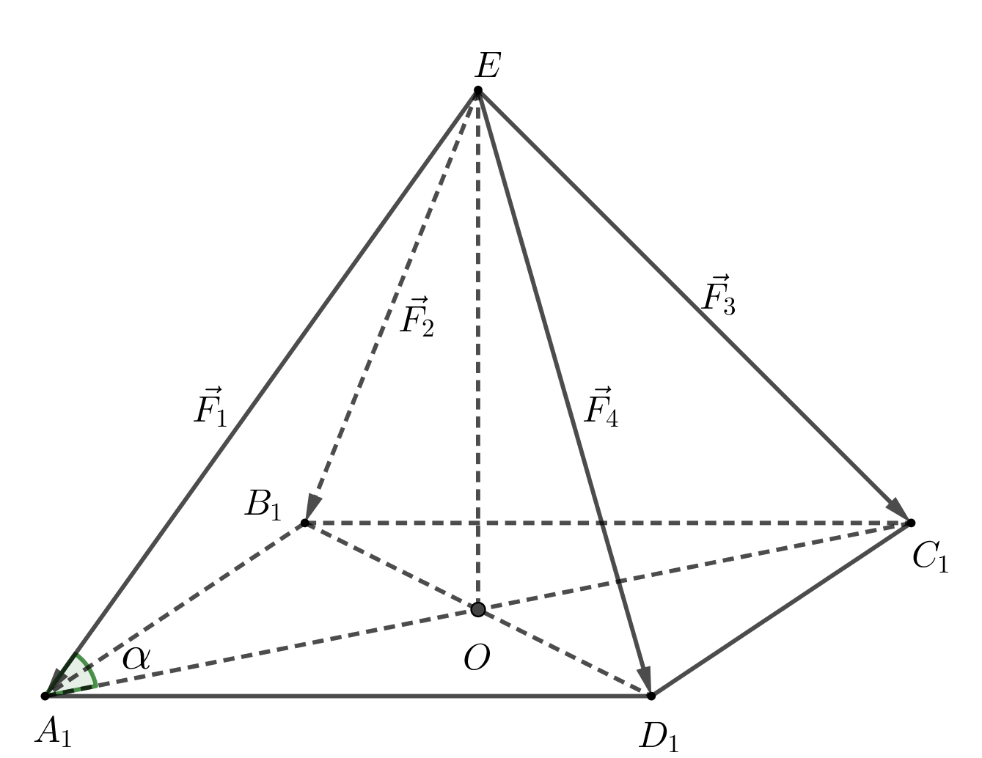
Gọi \({A_1};\,{B_1};\,{C_1};\,{D_1}\) là các điểm thỏa mãn : \(\overrightarrow {E{A_1}} = \overrightarrow {{F_1}} ;\,\,\overrightarrow {E{B_1}} = \overrightarrow {{F_2}} ;\,\,\overrightarrow {E{C_1}} = \overrightarrow {{F_3}} ;\,\,\overrightarrow {E{D_1}} = \overrightarrow {{F_4}} \).
Vì \(EA;\,EB;\,EC;\,ED\) bằng nhau và cùng tạo với mặt phẳng \(\left( {ABCD} \right)\)một góc \(\alpha \) nên \(E{A_1};\,E{B_1};\,E{C_1};\,E{D_1}\) cũng bằng nhau và cùng tạo với mặt phẳng \(\left( {{A_1}{B_1}{C_1}{D_1}} \right)\)một góc \(\alpha \).
Mặt khác \(ABCD\) là hình chữ nhật nên \({A_1}{B_1}{C_1}{D_1}\) cũng là hình chữ nhật có tâm O.
Từ các điều kiện trên ta suy ra \(EO \bot \left( {{A_1}{B_1}{C_1}{D_1}} \right)\). Khi đó \(\alpha = \left( {E{A_1};\,\left( {{A_1}{B_1}{C_1}{D_1}} \right)} \right) = \widehat {E{A_1}O}\).
Ta có: \[\left| {\overrightarrow {{F_1}} } \right| = \,\left| {\overrightarrow {{F_2}} } \right| = \,\left| {\overrightarrow {{F_3}} } \right| = \left| {\,\overrightarrow {{F_4}} } \right| = 4800N\] nên \(E{A_1} = E{B_1} = E{C_1} = E{D_1} = 4800\)
Xét tam giác \(E{A_1}O\) vuông tại O nên \(EO = E{A_1}.\sin \alpha = 4800.\sin \alpha \).
Ta có: \[\overrightarrow {{F_1}} + \,\overrightarrow {{F_2}} + \,\overrightarrow {{F_3}} + \,\overrightarrow {{F_4}} = \overrightarrow {E{A_1}} + \overrightarrow {E{B_1}} + \overrightarrow {E{C_1}} + \overrightarrow {E{D_1}} = 4\overrightarrow {EO} \].
Mặt khác : \[\overrightarrow {{F_1}} + \,\overrightarrow {{F_2}} + \,\overrightarrow {{F_3}} + \,\overrightarrow {{F_4}} = \overrightarrow P \] với \[\overrightarrow P \] là trọng lực tác động lên khung chứa xe ô tô.
Suy ra: \[\overrightarrow P = 4\overrightarrow {EO} \].
Trọng lượng của cả khung sắt chứa xe ô tô là \[|\overrightarrow P | = 4EO = 19200.\sin \alpha \,\,\,\,\,\,\,\,\left( N \right)\].
Theo bài ra ta có: \[19200.\sin \alpha = 7200\sqrt 6 \, \Leftrightarrow \sin \alpha = \frac{{3\sqrt 6 }}{8} \approx 0,92\].
Cho hình chóp \(S.ABCD\) có đáy \(ABCD\) là hình chữ nhật với \(SA = 4,AB = 1,AD = 2\) và \(SA \bot \left( {ABCD} \right)\). Gọi \(M\) là trung điểm của \(AB\). Tính góc giữa hai vectơ \(\overrightarrow {SC} \) và \(\overrightarrow {DM} \).
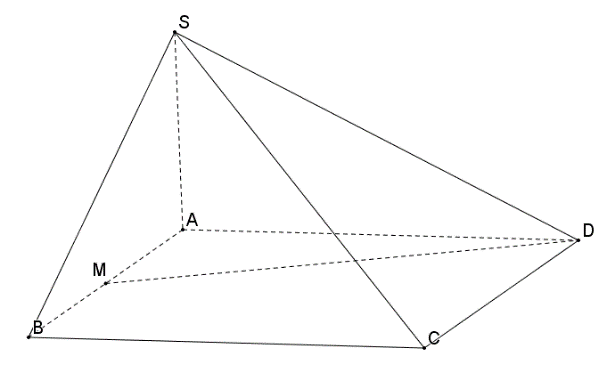
Do \(SA \bot \left( {ABCD} \right)\) nên \(SA \bot AB,SA \bot AD\). Do \(ABCD\) là hình chữ nhật nên \(AB \bot AD\).
Do đó, đặt \(\overrightarrow {AS} = \overrightarrow a ,\overrightarrow {AB} = \overrightarrow b ,\overrightarrow {AD} = \overrightarrow c \) thì \(\left| {\overrightarrow a } \right| = 4,\left| {\overrightarrow b } \right| = 1,\left| {\overrightarrow c } \right| = 2\) và \(\overrightarrow a .\overrightarrow b = \overrightarrow b .\overrightarrow c = \overrightarrow c .\overrightarrow a = 0\)
Ta có: \(\cos \left( {\overrightarrow {SC} ,\overrightarrow {DM} } \right) = \frac{{\overrightarrow {SC} .\overrightarrow {DM} }}{{\left| {\overrightarrow {SC} } \right|.\left| {\overrightarrow {DM} } \right|}}\).
Do \(\overrightarrow {SC} = \overrightarrow {AC} - \overrightarrow {AS} = \left( {\overrightarrow {AB} + \overrightarrow {AD} } \right) - \overrightarrow {AS} = - \overrightarrow a + \overrightarrow b + \overrightarrow c \) và \(\overrightarrow {DM} = \overrightarrow {AM} - \overrightarrow {AD} = \frac{1}{2}\overrightarrow {AB} - \overrightarrow {AD} = \frac{1}{2}\overrightarrow b - \overrightarrow c \) nên:
\[\overrightarrow {SC} .\overrightarrow {DM} = \left( { - \overrightarrow a + \overrightarrow b + \overrightarrow c } \right)\left( {\frac{1}{2}\overrightarrow b - \overrightarrow c } \right) = - \frac{1}{2}\overrightarrow a .\overrightarrow b + \overrightarrow a .\overrightarrow c + \frac{1}{2}{\overrightarrow b ^2} - \overrightarrow b .\overrightarrow c + \frac{1}{2}.\overrightarrow c .\overrightarrow b - {\overrightarrow c ^2} = \frac{1}{2}{\overrightarrow b ^2} - {\overrightarrow c ^2} = \frac{1}{2}{\left| {\overrightarrow b } \right|^2} - {\left| {\overrightarrow c } \right|^2}\]
\[ = \frac{1}{2}{.1^2} - {2^2} = - \frac{7}{2}\];
\({\left| {\overrightarrow {SC} } \right|^2} = {\left( { - \overrightarrow a + \overrightarrow b + \overrightarrow c } \right)^2} = {\overrightarrow a ^2} + {\overrightarrow b ^2} + {\overrightarrow c ^2} - 2\overrightarrow a \overrightarrow b - 2\overrightarrow a \overrightarrow c + 2\overrightarrow b \overrightarrow c = {\left| {\overrightarrow a } \right|^2} + {\left| {\overrightarrow b } \right|^2} + {\left| {\overrightarrow c } \right|^2} = {4^2} + {1^2} + {2^2} + = 21\)
\({\left| {\overrightarrow {DM} } \right|^2} = {\overrightarrow {DM} ^2} = {\left( {\frac{1}{2}\overrightarrow b - \overrightarrow c } \right)^2} = \frac{1}{4}{\overrightarrow b ^2} - \overrightarrow b \overrightarrow c + {\overrightarrow c ^2} = \frac{1}{4}{\left| {\overrightarrow b } \right|^2} + {\left| {\overrightarrow c } \right|^2} = \frac{1}{4}.1 + {2^2} = \frac{{17}}{4}\).
Suy ra:
\(\cos \left( {\overrightarrow {SC} ,\overrightarrow {DM} } \right) = \frac{{ - \frac{7}{2}}}{{\sqrt {21} .\sqrt {\frac{{17}}{4}} }} = - \frac{{\sqrt {357} }}{{51}} \Rightarrow \left( {\overrightarrow {SC} ,\overrightarrow {DM} } \right) \approx 111,75^\circ \).
Vậy góc giữa hai vectơ \(\overrightarrow {SC} \) và \(\overrightarrow {DM} \) là khoảng \(111,75^\circ \).
Bạn có thích hoạt động này không?