
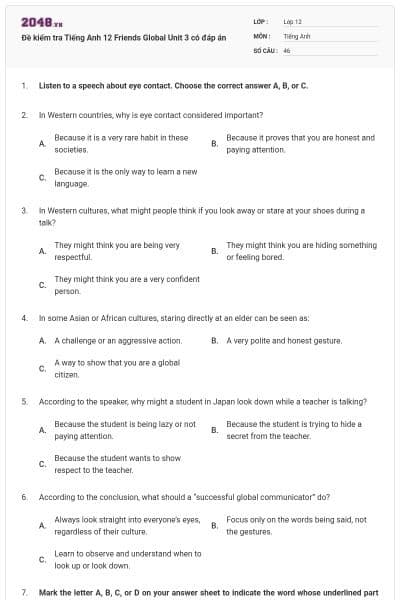
Đề kiểm tra Tiếng Anh 12 Friends Global Unit 3 có đáp án
40 câu hỏi
Listen to a speech about eye contact. Choose the correct answer A, B, or C.
Because it is a very rare habit in these societies.
Because it proves that you are honest and paying attention.
Because it is the only way to learn a new language.
Ở các quốc gia phương Tây, tại sao giao tiếp bằng ánh mắt lại được coi là quan trọng?
A. Vì đây là một thói quen rất hiếm gặp trong các xã hội này.
B. Vì nó chứng tỏ bạn trung thực và đang chú ý lắng nghe.
C. Vì đó là cách duy nhất để học một ngôn ngữ mới.
Thông tin: “When you’re talking to someone, you’re expected to look them straight in the eye. Why? Well, it shows that you’re honest, confident, and, most importantly - that you’re actually listening.” (Khi bạn nói chuyện với ai đó, bạn được mong đợi là sẽ nhìn thẳng vào mắt họ. Tại sao ư? Vì điều đó cho thấy bạn trung thực, tự tin và quan trọng nhất là bạn đang lắng nghe.)
Chọn B
They might think you are being very respectful.
They might think you are hiding something or feeling bored.
They might think you are a very confident person.
Trong các nền văn hóa phương Tây, mọi người có thể nghĩ gì nếu bạn nhìn đi chỗ khác hoặc cúi xuống nhìn giày trong khi nói chuyện?
A. Họ có thể nghĩ rằng bạn đang rất tôn trọng.
B. Họ có thể nghĩ rằng bạn đang che giấu điều gì đó hoặc cảm thấy chán.
C. Họ có thể nghĩ rằng bạn là một người rất tự tin.
Thông tin: “If you look away or stare at your shoes, people might think you’re hiding something or that you’re just plain bored.” (Nếu bạn nhìn đi chỗ khác hoặc cúi xuống nhìn giày, người khác có thể nghĩ rằng bạn đang che giấu điều gì đó hoặc đơn giản là bạn đang chán.)
Chọn B
A challenge or an aggressive action.
A very polite and honest gesture.
A way to show that you are a global citizen.
Trong một số nền văn hóa châu Á hoặc châu Phi, việc nhìn thẳng vào người lớn tuổi có thể được xem là:
A. Một hành động thách thức hoặc mang tính gây hấn.
B. Một cử chỉ rất lịch sự và trung thực.
C. Một cách để thể hiện rằng bạn là công dân toàn cầu.
Thông tin: “In these cultures, staring directly at someone, especially someone older or in a higher position than you, can be seen as quite aggressive or even rude. It’s like a challenge.” (Trong những nền văn hóa này, việc nhìn chằm chằm trực tiếp vào người khác, đặc biệt là người lớn tuổi hơn hoặc có vị trí cao hơn, có thể bị xem là khá hung hăng hoặc thậm chí là bất lịch sự. Nó giống như một sự thách thức vậy.)
Chọn A
Because the student is being lazy or not paying attention.
Because the student is trying to hide a secret from the teacher.
Because the student wants to show respect to the teacher.
Theo người nói, tại sao một học sinh ở Nhật Bản có thể cúi đầu khi giáo viên đang nói?
A. Vì học sinh đó lười biếng hoặc không chú ý.
B. Vì học sinh đó đang cố che giấu một bí mật với giáo viên.
C. Vì học sinh đó muốn thể hiện sự tôn trọng đối với giáo viên.
Thông tin: “Instead of constant eye contact, people might look at your neck or just look down occasionally to show respect. So, if a student looks down while a teacher is speaking, they aren’t being lazy; they’re actually being polite.” (Thay vì duy trì ánh mắt liên tục, người ta có thể nhìn xuống cổ đối phương hoặc thỉnh thoảng nhìn xuống để thể hiện sự tôn trọng. Vì thế, nếu một học sinh cúi đầu khi giáo viên đang nói, không phải là em ấy lười biếng đâu - mà thực ra là đang lịch sự.)
Chọn C
Always look straight into everyone’s eyes, regardless of their culture.
Focus only on the words being said, not the gestures.
Learn to observe and understand when to look up or look down.
Theo phần kết luận, một “người giao tiếp toàn cầu thành công” nên làm gì?
A. Luôn luôn nhìn thẳng vào mắt mọi người, bất kể văn hóa của họ.
B. Chỉ tập trung vào lời nói, không chú ý đến cử chỉ.
C. Học cách quan sát và hiểu khi nào nên nhìn lên hoặc nhìn xuống.
Thông tin: “To be a successful global communicator, you’ve got to learn when to look up and when to look down.” (Để trở thành một người giao tiếp toàn cầu thành công, bạn cần học cách biết khi nào nên nhìn lên và khi nào nên nhìn xuống.)
Chọn C
Nội dung bài nghe:
Hi everyone! Well, today I want to talk about something we do every single day, often without even thinking about it. It’s not what we say, but where we look. Yes, I’m talking about eye contact. You know, they say “the eyes are the window to the soul,” but in reality, those windows have very different curtains depending on where you are in the world.
Now, let’s look at Western cultures first, like in the U.S. or the UK. Actually, in these places, eye contact is a big deal. When you’re talking to someone, you’re expected to look them straight in the eye. Why? Well, it shows that you’re honest, confident, and, most importantly - that you’re actually listening. If you look away or stare at your shoes, people might think you’re hiding something or that you’re just plain bored. Right?
But here’s where it gets interesting. If you travel to many Asian countries, such as Japan or South Korea, or even some parts of Africa, the “rules” change completely. In these cultures, staring directly at someone, especially someone older or in a higher position than you, can be seen as quite aggressive or even rude. It’s like a challenge. Instead of constant eye contact, people might look at your neck or just look down occasionally to show respect. So, if a student looks down while a teacher is speaking, they aren’t being lazy; they’re actually being polite.
Believe it or not, even the length of the gaze matters. You don’t want to stare too long because that becomes creepy, but you don’t want to look away too fast either. It’s a delicate balance!
So, the next time you meet someone from a different culture, just remember: your eyes might be telling a different story than your mouth. To be a successful global communicator, you’ve got to learn when to look up and when to look down.
Anyway, that’s a quick look at eye contact. Does anyone have any questions, or perhaps a story about a time you felt awkward because of this? Let’s discuss!
Dịch bài nghe:
Chào mọi người! Hôm nay, mình muốn nói về một điều mà chúng ta làm mỗi ngày, thường là không hề suy nghĩ về nó. Đó không phải là những gì chúng ta nói, mà là chúng ta nhìn vào đâu. Đúng vậy, mình đang nói về giao tiếp bằng ánh mắt. Người ta vẫn hay nói “đôi mắt là cửa sổ tâm hồn”, nhưng thực tế thì những “cửa sổ” này lại có những tấm rèm rất khác nhau tùy theo nơi bạn đang sống trên thế giới.
Trước hết, hãy nhìn vào các nền văn hóa phương Tây, như ở Mỹ hay Anh. Thực ra, ở những nơi này, giao tiếp bằng ánh mắt là một vấn đề rất quan trọng. Khi bạn nói chuyện với ai đó, bạn được mong đợi là sẽ nhìn thẳng vào mắt họ. Tại sao ư? Vì điều đó cho thấy bạn trung thực, tự tin và quan trọng nhất là bạn đang lắng nghe. Nếu bạn nhìn đi chỗ khác hoặc cúi xuống nhìn giày, người khác có thể nghĩ rằng bạn đang che giấu điều gì đó hoặc đơn giản là bạn đang chán. Đúng không?
Nhưng đây mới là điểm thú vị. Nếu bạn đi đến nhiều quốc gia châu Á như Nhật Bản hay Hàn Quốc, hoặc thậm chí một số khu vực ở châu Phi, thì “luật lệ” lại thay đổi hoàn toàn. Trong những nền văn hóa này, việc nhìn chằm chằm trực tiếp vào người khác, đặc biệt là người lớn tuổi hơn hoặc có vị trí cao hơn, có thể bị xem là khá hung hăng hoặc thậm chí là bất lịch sự. Nó giống như một sự thách thức vậy. Thay vì duy trì ánh mắt liên tục, người ta có thể nhìn xuống cổ đối phương hoặc thỉnh thoảng nhìn xuống để thể hiện sự tôn trọng. Vì thế, nếu một học sinh cúi đầu khi giáo viên đang nói, không phải là em ấy lười biếng đâu - mà thực ra là đang lịch sự.
Tin hay không thì thời gian nhìn cũng rất quan trọng. Bạn không nên nhìn chằm chằm quá lâu vì sẽ trở nên đáng sợ, nhưng cũng không nên quay đi quá nhanh. Đó là một sự cân bằng rất tinh tế!
Vì vậy, lần tới khi bạn gặp một người đến từ nền văn hóa khác, hãy nhớ rằng: đôi mắt của bạn có thể đang kể một câu chuyện khác với lời nói của bạn. Để trở thành một người giao tiếp toàn cầu thành công, bạn cần học cách biết khi nào nên nhìn lên và khi nào nên nhìn xuống.
Dù sao thì đó là một cái nhìn nhanh về giao tiếp bằng ánh mắt. Có ai có câu hỏi nào không, hoặc có câu chuyện nào về một lần bạn cảm thấy ngượng ngùng vì chuyện này không? Cùng thảo luận nhé!
Mark the letter А, B, C, or D on your answer sheet to indicate the word whose underlined part differs from the other three in pronunciation in each of the following questions.
fidget
grimace
disgust
sigh
A. fidget /ˈfɪdʒɪt/
B. grimace /ˈɡrɪmɪs/
C. disgust /dɪsˈɡʌst/
D. sigh /saɪ/
Đáp án D có phần gạch chân phát âm là /aɪ/, các đáp án còn lại là /ɪ/
Chọn D
Mark the letter А, B, C, or D on your answer sheet to indicate the word whose underlined part differs from the other three in pronunciation in each of the following questions.
anger
shame
anxiety
happiness
A. anger /ˈæŋɡə(r)/
B. shame /ʃeɪm/
C. anxiety /æŋˈzaɪəti/
D. happiness /ˈhæpinəs/
Đáp án B có phần gạch chân phát âm là /eɪ/, các đáp án còn lại là /æ/
Chọn B
Mark the letter А, B, C, or D on your answer sheet to indicate the word that differs from the other three in the position of primary stress in each of the following questions.
gesture
eyebrow
disgust
fingernail
A. gesture /ˈdʒestʃə(r)/ - trọng âm 1
B. eyebrow /ˈaɪbraʊ/ - trọng âm 1
C, disgust /dɪsˈɡʌst/ - trọng âm 2
D. fingernail /ˈfɪŋɡəneɪl/ - trọng âm 1
Chọn C
Mark the letter А, B, C, or D on your answer sheet to indicate the word that differs from the other three in the position of primary stress in each of the following questions.
expression
confusion
disapproval
indifference
A. expression /ɪkˈspreʃən/ - trọng âm 2
B. confusion /kənˈfjuːʒən/ - trọng âm 2
C. disapproval /ˌdɪsəˈpruːvəl/ - trọng âm 3
D. indifference /ɪnˈdɪfərəns/ - trọng âm 2
Chọn C
Mark the letter А, B, C, or D on your answer sheet to indicate the correct answer to each of the following questions.
needn’t
must
might
shouldn’t have
“In many Asian cultures, you ______ take off your shoes before entering someone’s house. It’s a strict rule.”
A. needn’t
B. must
C. might
D. shouldn’t have
- Câu này đề cập đến một “strict rule” (quy tắc nghiêm ngặt) và một nghĩa vụ trong văn hóa.
- “must” được dùng để chỉ obligation (nghĩa vụ) hoặc strong advice (lời khuyên mạnh mẽ). “Needn’t” (không cần), “might” (có lẽ), và “shouldn’t have” (lẽ ra không nên làm trong quá khứ) đều không phù hợp về ý nghĩa “bắt buộc” ở hiện tại.
Dịch:Trong nhiều nền văn hóa châu Á, bạn phải cởi giày trước khi vào nhà của ai đó. Đây là một quy tắc nghiêm ngặt.
Chọn B
didn’t need to bring
mustn’t have brought
needn’t have brought
wasn’t supposed to bring
“I brought my umbrella, but it didn’t rain at all. I ______ it with me.”
A. didn’t need to bring
B. mustn’t have brought
C. needn’t have brought
D. wasn’t supposed to bring
- Ngữ cảnh: Hành động mang ô đã xảy ra rồi (I brought), nhưng thực tế sau đó cho thấy việc này là không cần thiết (it didn’t rain).
- Cấu trúc needn’t have + quá khứ phân từ dùng để nói về một hành động đã làm nhưng thực chất là không cần thiết. “Didn’t need to bring” thường dùng để chỉ việc không cần làm (và thường là chưa làm), còn ở đây người nói đã mang đi rồi nên dùng “needn’t have brought” là chính xác nhất để diễn tả sự lãng phí công sức.
Dịch:Tôi đã mang theo ô, nhưng trời hoàn toàn không mưa. Lẽ ra tôi không cần mang nó theo.
Chọn C
might
must
can’t
should have
“Look at those dark clouds! It ______ rain later this afternoon, so we should stay indoors.”
A. might
B. must
C. can’t
D. should have
- Câu này nói về một khả năng có thể xảy ra trong tương lai dựa trên dấu hiệu hiện tại (dark clouds).
- Cấu trúc may / might / could + infinitive dùng để nói về possibility (khả năng xảy ra). Must (chắc chắn) thường dùng cho suy luận logic hiện tại, can’t (không thể) chỉ sự vô lý, và should have dùng cho quá khứ. Do đó, might là lựa chọn hợp lý nhất cho một dự đoán có căn cứ nhưng không chắc chắn 100%.
Dịch:Nhìn những đám mây đen kia kìa! Chiều nay có thể sẽ mưa, vì vậy chúng ta nên ở trong nhà.
Chọn A
may have
might have
must have
should have
“You ______ at least phoned me to say you’d be late! I was waiting for you for two hours.”
A. may have
B. might have
C. must have
D. needn’t have
- Trong câu này, người nói đang thể hiện sự bực bội vì đối phương đã không gọi điện báo trước.
- Ta có cấu trúc câu cảm thán với might have + quá khứ phân từ được dùng để trách móc/nhắc nhở ai đó về việc lẽ ra họ nên làm nhưng đã không làm.
Dịch:Ít nhất thì bạn cũng nên gọi điện cho tôi để nói rằng bạn sẽ đến muộn chứ! Tôi đã đợi bạn suốt hai tiếng đồng hồ.
Chọn B
can’t have known
shouldn’t have known
was supposed to know
must have known
“She’s a very experienced traveler, so she ______ the local customs before she arrived.”
A. can’t have known
B. shouldn’t have known
C. was supposed to know
D. must have known
- Đây là một suy luận logic về một sự việc trong quá khứ dựa trên bằng chứng hiện tại: Vì cô ấy là “experienced traveler” (người du lịch dày dạn kinh nghiệm) nên việc cô ấy biết phong tục địa phương là điều gần như chắc chắn.
- Cấu trúc must have + quá khứ phân từ dùng để đưa ra một logical deduction (suy luận logic) chắc chắn về quá khứ. Can’t have known (chắc chắn đã không biết) và shouldn’t have known (không nên biết) ngược nghĩa; was supposed to know (lẽ ra phải biết - nhưng có thể đã không biết) không mạnh bằng sự khẳng định của must have known trong ngữ cảnh này.
Dịch:Cô ấy là một du khách rất giàu kinh nghiệm, vì vậy hẳn là cô ấy đã biết các phong tục địa phương trước khi đến nơi.
Chọn D
Read the following advertisement/ announcement and mark the letter A, B, C or D on your answer sheet to indicate the correct option that best fits each of the numbered blanks from 15 to 20.
Attention all students! Next week, we are hosting a workshop on international etiquette. In some countries, the way you use your body can cause (15) ___________ or even offense. For example, in certain cultures, you mustn’t point at people with your finger as it is considered very rude. If you attended our last seminar, you (16) ___________ the basic rules of bowing. However, don’t worry if you missed it. You (17) ___________ prepare anything in advance for this session; just bring your curiosity! This workshop is a great chance to learn why a simple gesture can be interpreted differently across borders. |
Navigating Social Situations When traveling to a new country, observing “Human sounds” is just as important as learning the language. For instance, if you are at a formal dinner and you need to (18) ___________, it is polite to turn your head away or cover your mouth. Last year, a friend of mine accidentally offended his hosts by slurping his noodles too loudly. He (19) ___________ more careful about the local dining customs. He later realized that he (20) ___________ research the culture before his flight, but he forgot. Remember, being aware of these small details will make your trip much smoother and more enjoyable. |
interest
happiness
friendliness
confusion
“In some countries, the way you use your body can cause (15) ______ or even offense.”
A. interest /ˈɪntrəst/: sự quan tâm, mối hứng thú
B. happiness /ˈhæpinəs/: hạnh phúc
C. friendliness /ˈfrendlɪnəs/: sự thân thiện
D. confusion /kənˈfjuːʒən/: sự bối rối, sự nhầm lẫn
Liên từ “or even” (hoặc thậm chí là) cho thấy từ cần điền phải mang nghĩa tiêu cực nhưng mức độ nhẹ hơn “offense” (xúc phạm).
Dịch:Ở một số quốc gia, cách bạn sử dụng ngôn ngữ cơ thể có thể gây ra sự bối rối hoặc thậm chí là sự xúc phạm.
Chọn D
should have known
must have known
might have known
couldn’t have known
“If you attended our last seminar, you (16) ______ the basic rules of bowing.”
A. should have known
B. must have known
C. might have known
D. couldn’t have known
- Thông tin “If you attended our last seminar” (Nếu bạn đã tham dự buổi hội thảo trước) là một sự thật/giả định về sự hiện diện của học sinh. Vì buổi hội thảo đó dạy về cách cúi chào, nên việc bạn “biết các quy tắc” là một kết quả hiển nhiên và chắc chắn.
- Cấu trúc must have + quá khứ phân từ để khẳng định chắc hẳn bạn đã biết (vì bạn đã có mặt ở đó).
Dịch:Nếu bạn đã tham dự buổi hội thảo trước của chúng tôi, chắc hẳn bạn đã biết những quy tắc cơ bản về việc cúi chào.
Chọn B
mustn’t
don’t have to
can’t
are supposed to
“You (17) ______ prepare anything in advance for this session; just bring your curiosity!”
A. mustn’t
B. don’t have to
C. can’t
D. are supposed to
- Vế sau “just bring your curiosity” cho thấy việc chuẩn bị là không bắt buộc/không cần thiết. Các đáp án mustn’t (cấm đoán), can’t (không thể), are supposed to (được mong đợi là phải làm) đều ngược nghĩa. Cấu trúc don’t have to diễn tả sự không bắt buộc hoặc không cần thiết phải làm gì đó.
Dịch:Bạn không cần phải chuẩn bị trước bất cứ thứ gì cho buổi học này; chỉ cần mang theo sự tò mò thôi!)
Chọn B
Bài hoàn chỉnh | Dịch bài đọc |
Attention all students! Next week, we are hosting a workshop on international etiquette. In some countries, the way you use your body can cause (15) confusion or even offense. For example, in certain cultures, you mustn’t point at people with your finger as it is considered very rude. If you attended our last seminar, you (16) must have known the basic rules of bowing. However, don’t worry if you missed it. You (17) don’t have to prepare anything in advance for this session; just bring your curiosity! This workshop is a great chance to learn why a simple gesture can be interpreted differently across borders.
| Chào tất cả các em học sinh! Tuần tới, chúng ta sẽ tổ chức một buổi hội thảo về nghi thức quốc tế. Ở một số quốc gia, cách các em sử dụng ngôn ngữ cơ thể có thể gây ra sự bối rối hoặc thậm chí là sự xúc phạm. Ví dụ, ở một số nền văn hóa nhất định, các em không được phép chỉ tay vào người khác vì điều đó bị coi là rất thô lỗ. Nếu các em đã tham dự buổi hội thảo trước của chúng tôi, các em chắc hẳn đã biết những quy tắc cơ bản của việc cúi chào. Tuy nhiên, đừng lo lắng nếu các em đã bỏ lỡ nó. Các em không cần phải chuẩn bị bất cứ điều gì trước cho buổi học này; chỉ cần mang theo sự tò mò của mình thôi! Buổi hội thảo này là một cơ hội tuyệt vời để tìm hiểu lý do tại sao một cử chỉ đơn giản lại có thể được hiểu theo những cách khác nhau ở các quốc gia khác nhau.
|
sigh
sneeze
snore
gasp
“For instance, if you are at a formal dinner and you need to (18) ______, it is polite to turn your head away or cover your mouth.”
A. sigh /saɪ/: thở dài
B. sneeze /sniːz/: hắt hơi
C. snore /snɔː(r)/: ngáy
D. gasp /ɡɑːsp/: há hốc miệng vì ngạc nhiên; hít mạnh vì sốc hoặc khó thở
- Hành động che miệng hoặc quay đầu thường gắn liền với những phản ứng tự nhiên của cơ thể có thể gây mất vệ sinh hoặc tiếng ồn tại bàn ăn.
Dịch:Nếu bạn đang ở một bữa tối trang trọng và bạn cần hắt hơi, lịch sự nhất là hãy quay đầu đi hoặc che miệng lại.
Chọn B
must have been
needn’t have been
might have been
should have been
“He accidentally offended his hosts by slurping his noodles too loudly. He (19) ___________ more careful about the local dining customs.”
A. must have been
B. needn’t have been
C. might have been
D. should have been
- Câu này là lời nhận xét về một cách cư xử đúng đắn lẽ ra nên làm trong quá khứ nhưng nhân vật đã không làm.
- Cấu trúc should / shouldn’t have + quá khứ phân từ để nói về cách cư xử đúng hoặc sai. Các đáp án khác đề sai nghĩa hoặc sai logic.
Dịch:Anh ấy đã vô tình xúc phạm chủ nhà khi húp mì quá to tiếng. Lẽ ra anh ấy nên cẩn thận hơn với các phong tục ăn uống địa phương.
Chọn D
must
was supposed to
is able to
shouldn’t have
“He later realized that he (20) ___________ research the culture before his flight, but he forgot.
A. must (sai thì)
B. was supposed to
C. is able to (sai thì)
D. shouldn’t have (sai nghĩa)
- Câu này nói về một việc mà theo kế hoạch, quy tắc hoặc mong đợi là phải làm (tìm hiểu về văn hóa trước chuyến bay), nhưng thực tế đã không xảy ra (anh ấy quên mất).
- Cấu trúc was supposed to + V nguyên thể để nói về hành động được mong đợi là phải làm.
Dịch:Sau đó anh ấy mới nhận ra rằng lẽ ra mình đã phải tìm hiểu về văn hóa trước chuyến bay, nhưng anh ấy đã quên.
Chọn B
Bài hoàn chỉnh | Dịch bài đọc |
Navigating Social Situations When traveling to a new country, observing “Human sounds” is just as important as learning the language. For instance, if you are at a formal dinner and you need to (18) sneeze, it is polite to turn your head away or cover your mouth. Last year, a friend of mine accidentally offended his hosts by slurping his noodles too loudly. He (19) should have been more careful about the local dining customs. He later realized that he (20) was supposed to research the culture before his flight, but he forgot. Remember, being aware of these small details will make your trip much smoother and more enjoyable.
| Cách ứng xử trong các tình huống xã hội Khi đi du lịch đến một quốc gia mới, việc quan sát các “âm thanh của con người” cũng quan trọng không kém gì việc học ngôn ngữ. Ví dụ, nếu bạn đang ở trong một bữa tối trang trọng và bạn cần hắt hơi, lịch sự nhất là hãy quay đầu đi nơi khác hoặc che miệng lại. Năm ngoái, một người bạn của tôi đã vô tình làm phật lòng chủ nhà vì húp mì quá to. Anh ấy lẽ ra nên cẩn thận hơn về các phong tục ăn uống địa phương. Sau đó anh ấy nhận ra rằng mình đáng lẽ phải tìm hiểu về văn hóa trước chuyến bay, nhưng anh ấy đã quên. Hãy nhớ rằng, việc để ý đến những chi tiết nhỏ này sẽ giúp chuyến đi của bạn suôn sẻ và thú vị hơn nhiều.
|
Read the text carefully then answer the following questions from 21 to 27.
Communication is much more than just the words we speak. In fact, a large part of how we express our feelings and intentions is through body language. However, what is considered friendly in one country might be seen as rude or confusing in another. This is why understanding local customs is essential when traveling abroad.
Take the simple act of nodding your head, for example. In most parts of the world, this is a clear sign of agreement or “yes.” But if you visit Bulgaria or parts of Greece, you might get confused. In these cultures, nodding actually means “no,” while shaking your head from side-to-side means “yes.” Imagine the misunderstanding that could happen at a dinner table!
Another common gesture is the thumbs up. In many Western societies, it is a positive sign meaning “great” or “good job.” However, in some Middle Eastern and South American cultures, it is an offensive gesture, similar to an insult. Similarly, while pointing with your index finger is common in Europe, it is considered very impolite in many Asian countries. Instead, people there often use their whole hand or their thumb to indicate a direction.
Even eye contact varies significantly. In many Western cultures, looking someone in the eye shows honesty and interest. In contrast, in some Asian and African societies, looking down or bowing your head slightly is a way to show respect, especially when speaking to elders.
In conclusion, gestures are a “silent language” that reflects the deep history and values of a culture. By being aware of these small differences, we can avoid disapproval and build better relationships with people from all over the world.
The history of sign language in Europe.
How to avoid traveling to foreign countries.
The importance of understanding cultural body language.
The reasons why eye contact is rude in Western cultures.
Đoạn văn chủ yếu nói về điều gì?
A. Lịch sử của ngôn ngữ ký hiệu ở châu Âu
B. Cách tránh việc đi du lịch đến các quốc gia nước ngoài.
C. Tầm quan trọng của việc hiểu ngôn ngữ cơ thể trong các nền văn hóa khác nhau.
D. Lý do vì sao giao tiếp bằng mắt là bất lịch sự trong các nền văn hóa phương Tây.
- Ngay từ đoạn 1, tác giả khẳng định: “understanding local customs is essential when traveling abroad” và các đoạn sau đều liệt kê các ví dụ về sự khác biệt trong ngôn ngữ cơ thể (gật đầu, ngón tay cái, chỉ tay, ánh mắt).
Chọn C
To learn how to speak a new language fluently
To avoid being seen as rude or confused while abroad
To show that you are a rich traveler
To change the way local people communicate
Theo đoạn văn, tại sao việc hiểu các phong tục địa phương lại rất cần thiết?
A. Để học cách nói trôi chảy một ngôn ngữ mới
B. Để tránh bị xem là thô lỗ hoặc bối rối khi ở nước ngoài
C. Để thể hiện rằng bạn là một du khách giàu có
D. Để thay đổi cách giao tiếp của người dân địa phương
Thông tin: Dựa vào câu cuối đoạn 1: “what is considered friendly in one country might be seen as rude or confusing in another. This is why understanding local customs is essential...” (điều được coi là thân thiện ở nước này có thể bị coi là thô lỗ hoặc gây bối rối ở nước khác. Đó là lý do tại sao việc hiểu phong tục là thiết yếu...).
Chọn B
Nodding the head always means agreement in every country.
Shaking the head means “yes” in Bulgaria.
The “thumbs up” gesture can be offensive in the Middle East.
Pointing with the index finger is considered impolite in many Asian countries.
Phát biểu nào sau đây là KHÔNG đúng?
A. Gật đầu luôn luôn có nghĩa là đồng ý ở mọi quốc gia.
B. Lắc đầu có nghĩa là “đồng ý” ở Bulgaria.
C. Cử chỉ “giơ ngón tay cái” có thể bị coi là xúc phạm ở Trung Đông.
D. Chỉ trỏ bằng ngón trỏ được xem là bất lịch sự ở nhiều quốc gia châu Á.
Thông tin: Đoạn 2 ghi rõ: “In these cultures [Bulgaria or parts of Greece], nodding actually means ‘no’...” (Trong những nền văn hóa này, gật đầu thực chất có nghĩa là “không”). Vì vậy, từ “always” (luôn luôn) trong đáp án A làm cho câu này sai. Các đáp án B, C, D đều có thông tin xác nhận trực tiếp trong bài.
Chọn A
a positive sign
the Western society
the “thumbs up” gesture
an insult
Từ “it” ở đoạn 3 dùng để chỉ điều gì?
A. Một dấu hiệu tích cực
B. Xã hội phương Tây
C. Cử chỉ “giơ ngón tay cái”
D. Một sự xúc phạm
Thông tin: “Another common gesture is the thumbs up. ... However, in some... cultures, it is an offensive gesture...” → “it” thay thế cho danh từ gần nhất được nhắc đến là cử chỉ giơ ngón cái.
Chọn C
stays the same everywhere
changes or becomes different
disappear over time
becomes more difficult
Từ “varies” ở đoạn 4 chủ yếu có nghĩa là gì?
A. Giữ nguyên, không thay đổi ở mọi nơi
B. Thay đổi hoặc trở nên khác nhau
C. Biến mất theo thời gian
D. Trở nên khó khăn hơn
Thông tin: “Even eye contact varies significantly. In many Western cultures... [honesty]. In contrast, in some Asian... [respect].” (Ngay cả việc giao tiếp bằng mắt cũng thay đổi đáng kể. Ở phương Tây là trung thực, ngược lại ở châu Á là sự tôn trọng). Sự tương phản này cho thấy “varies” nghĩa là đa dạng/thay đổi tùy nơi.
Chọn B
Using your index finger
Bowing your head slightly
Shaking your head from side-to-side
Using your whole hand or your thumb
Ở nhiều quốc gia châu Á, bạn nên chỉ đường một cách lịch sự như thế nào?
A. Dùng ngón trỏ
B. Cúi đầu nhẹ
C. Lắc đầu qua lại
D. Dùng cả bàn tay hoặc ngón cái
Thông tin: Đoạn 3: “Instead, people there [Asian countries] often use their whole hand or their thumb to indicate a direction.” (Thay vào đó, người dân ở đó thường dùng cả bàn tay hoặc ngón cái để chỉ hướng.)
Chọn D
Westerners think eye contact is a sign of dishonesty.
Everyone in the world must look each other in the eye.
In some cultures, looking down is a way to show respect to elders.
Bowing your head is only used in Greece and Bulgaria.
Đoạn 4 gợi ý điều gì về giao tiếp bằng mắt và việc cúi đầu?
A. Người phương Tây cho rằng giao tiếp bằng mắt là dấu hiệu của sự không trung thực.
B. Mọi người trên thế giới đều phải nhìn thẳng vào mắt nhau.
C. Trong một số nền văn hóa, việc nhìn xuống là một cách thể hiện sự tôn trọng đối với người lớn tuổi.
D. Việc cúi đầu chỉ được sử dụng ở Hy Lạp và Bulgaria.
Thông tin: “In contrast, in some Asian and African societies, looking down or bowing your head slightly is a way to show respect, especially when speaking to elders.” (Ngược lại, trong một số xã hội châu Á và châu Phi, việc nhìn xuống hoặc cúi đầu nhẹ là một cách thể hiện sự tôn trọng, đặc biệt khi nói chuyện với người lớn tuổi.)
Chọn C
Dịch bài đọc:
Giao tiếp không chỉ đơn thuần là những lời chúng ta nói ra. Trên thực tế, một phần lớn cách chúng ta thể hiện cảm xúc và ý định của mình đến từ ngôn ngữ cơ thể. Tuy nhiên, điều được xem là thân thiện ở quốc gia này lại có thể bị coi là thô lỗ hoặc gây bối rối ở quốc gia khác. Chính vì vậy, việc hiểu các phong tục địa phương là vô cùng cần thiết khi đi du lịch nước ngoài.
Hãy lấy hành động đơn giản như gật đầu làm ví dụ. Ở hầu hết các nơi trên thế giới, đây là dấu hiệu rõ ràng của sự đồng ý hay “có”. Nhưng nếu bạn đến Bulgaria hoặc một số vùng của Hy Lạp, bạn có thể sẽ bối rối. Trong những nền văn hóa này, gật đầu thực chất lại có nghĩa là “không”, còn lắc đầu qua lại mới có nghĩa là “có”. Hãy tưởng tượng những hiểu lầm có thể xảy ra trên bàn ăn!
Một cử chỉ phổ biến khác là giơ ngón tay cái. Ở nhiều xã hội phương Tây, đây là dấu hiệu tích cực, mang ý nghĩa “tuyệt vời” hoặc “làm tốt lắm”. Tuy nhiên, ở một số nền văn hóa Trung Đông và Nam Mỹ, đó lại là một cử chỉ xúc phạm, tương tự như một lời sỉ nhục. Tương tự, trong khi việc chỉ bằng ngón trỏ khá phổ biến ở châu Âu, thì ở nhiều quốc gia châu Á, hành động này bị coi là rất bất lịch sự. Thay vào đó, người ta thường dùng cả bàn tay hoặc ngón cái để chỉ hướng.
Ngay cả giao tiếp bằng ánh mắt cũng có sự khác biệt đáng kể. Trong nhiều nền văn hóa phương Tây, nhìn thẳng vào mắt người khác thể hiện sự trung thực và quan tâm. Ngược lại, ở một số xã hội châu Á và châu Phi, việc nhìn xuống hoặc cúi đầu nhẹ lại là cách thể hiện sự tôn trọng, đặc biệt khi nói chuyện với người lớn tuổi.
Tóm lại, các cử chỉ là một “ngôn ngữ thầm lặng” phản ánh chiều sâu lịch sử và giá trị của một nền văn hóa. Bằng cách nhận thức được những khác biệt nhỏ này, chúng ta có thể tránh gây khó chịu và xây dựng những mối quan hệ tốt đẹp hơn với mọi người trên khắp thế giới.
Read the text carefully then choose True or False for questions 28 to 33.
A recent study from the Japan Private Railway Association (JPRA) reveals that coughing and sneezing were the biggest annoyances on trains. A total of 5,314 train passengers responded a JPRA survey on behavior and manners on trains and at stations. “Coughing and sneezing without consideration for others” topped the list of passenger gripes. An association spokesperson attributed this to remaining effects of Covid-19. He said: “The coronavirus pandemic may have ingrained the importance of consideration for others as a norm.” He added: “More people likely feel greater anxiety than before the pandemic when someone nearby coughs or sneezes without wearing a mask.”
The JPRA has been conducting its polls since 1999 to gauge how people feel about their fellow passengers. It hopes to promote better behavior in the future. It said 50.5 per cent of survey respondents cited coughing and sneezing as their top annoyance. Other sources of irritation on trains included people stretching their legs, people not moving over to make space for others wanting to sit down, and noisy conversation. The JPRA added that “strong scents from perfume or fabric softeners” and “poor manners during boarding and alighting such as blocking doors” were fourth and fifth on the list. The number of riders has increased on Japan’s trains due to a rise in tourists visiting Japan.
True
False
Hơn 5.000 người đã tham gia một cuộc khảo sát về phép lịch sự trên tàu hỏa.
Thông tin: “A total of 5,314 train passengers responded a JPRA survey on behavior and manners on trains and at stations.” (Tổng cộng có 5.314 hành khách đi tàu đã tham gia trả lời một cuộc khảo sát của JPRA về hành vi và phép lịch sự trên tàu hỏa và tại các nhà ga.)
Chọn A
True
False
Người đi tàu ở Nhật Bản vẫn còn lo ngại về Covid-19.
Thông tin: “More people likely feel greater anxiety than before the pandemic when someone nearby coughs or sneezes...” (Nhiều người cảm thấy lo lắng hơn trước đại dịch khi ai đó ho hoặc hắt hơi). Ngoài ra, người phát ngôn còn nói về “remaining effects of Covid-19”. Điều này chứng tỏ sự lo ngại vẫn còn đó.
Chọn A
True
False
Một hiệp hội đường sắt cho biết mọi người trên tàu nên đeo khẩu trang.
Bài đọc chỉ nói rằng mọi người cảm thấy lo lắng khi ai đó ho mà “without wearing a mask”(không đeo khẩu trang). Văn bản không hề trích dẫn lời khẳng định trực tiếp từ hiệp hội đường sắt (JPRA) rằng tất cả mọi người phải/nên đeo khẩu trang.
Chọn B
True
False
Hơn một nửa số người tham gia khảo sát không thích việc ho và hắt hơi.
Thông tin: “It said 50.5 per cent of survey respondents cited coughing and sneezing as their top annoyance.” (Báo cáo cho biết 50,5% người tham gia khảo sát cho rằng ho và hắt hơi là điều gây khó chịu nhất đối với họ.). → 50,5% đồng nghĩa với hơn một nửa.
Chọn A
True
False
Hành khách đi tàu cảm thấy hài lòng khi mọi người lên và xuống tàu một cách không lịch sự.
Thông tin: “The JPRA added that … and ‘poor manners during boarding and alighting such as blocking doors’ were fourth and fifth on the list (of irritations on train).” (JPRA cho biết thêm rằng … và “cách cư xử kém khi lên xuống tàu, chẳng hạn như chắn cửa” lần lượt đứng ở vị trí thứ tư và thứ năm trong danh sách những điều gây khó chịu trên tàu).
Chọn B
True
False
Bài báo cho biết những hành vi tệ hơn trên tàu là do khách du lịch gây ra.
Thông tin: Câu cuối cùng của bài chỉ nói: “The number of riders has increased... due to a rise in tourists...” (Số lượng hành khách tăng lên do lượng khách du lịch tăng). Bài báo không hề đổ lỗi hay nói rằng khách du lịch có hành vi tệ hơn (worse behavior) người bản địa.
Chọn B
Dịch bài đọc:
Một nghiên cứu gần đây của Hiệp hội Đường sắt Tư nhân Nhật Bản (JPRA) cho thấy việc ho và hắt hơi là điều gây khó chịu lớn nhất trên các chuyến tàu. Tổng cộng có 5.314 hành khách đi tàu đã tham gia trả lời một cuộc khảo sát của JPRA về hành vi và phép lịch sự trên tàu hỏa và tại các nhà ga. “Ho và hắt hơi mà không quan tâm đến người khác” đứng đầu danh sách những điều khiến hành khách phàn nàn. Một người phát ngôn của hiệp hội cho rằng điều này xuất phát từ những ảnh hưởng còn sót lại của Covid-19. Ông nói: “Đại dịch coronavirus có thể đã khiến việc quan tâm đến người khác trở thành một chuẩn mực.” Ông cũng cho biết thêm: “Nhiều người có lẽ cảm thấy lo lắng hơn so với trước đại dịch khi có ai đó ở gần ho hoặc hắt hơi mà không đeo khẩu trang.”
JPRA đã tiến hành các cuộc thăm dò này từ năm 1999 nhằm đánh giá cảm nhận của mọi người về những hành khách xung quanh mình. Hiệp hội hy vọng sẽ thúc đẩy những hành vi tốt hơn trong tương lai. Kết quả cho thấy 50,5% người tham gia khảo sát cho rằng ho và hắt hơi là điều gây khó chịu nhất. Những nguyên nhân khó chịu khác trên tàu bao gồm việc người khác duỗi chân choán chỗ, không dịch sang để nhường chỗ cho người muốn ngồi, và nói chuyện ồn ào. JPRA cũng cho biết “mùi nồng từ nước hoa hoặc nước xả vải” và “cách cư xử kém khi lên xuống tàu, chẳng hạn như chắn cửa” lần lượt đứng ở vị trí thứ tư và thứ năm trong danh sách. Số lượng hành khách đi tàu ở Nhật Bản đã tăng lên do sự gia tăng của khách du lịch đến thăm nước này.
Mark the letter A, B, C or D on your answer sheet to indicate the correct arrangement of the sentences to make a meaningful paragraph/ letter in each of the following questions.
a. An: Yeah, I feel the same. I also like the moment when the whole family gathers for meals. We don’t get that often during the year.
b. Binh: Tet is coming soon. Have you made any plans for the holiday yet?
c. An: Definitely. It’s not just about receiving money. It’s about the wishes and the feeling of starting a new year together.
d. An: Not much, honestly. I’ll mostly stay home, visit relatives, and help my parents prepare for Tet.
e. Binh: Same here. My family spends days cleaning the house and decorating it. It’s tiring, but it really feels like Tet.
f. Binh: True. And of course, there’s lucky money. Even though we’re older now, it’s still something to look forward to.
b-c-d-a-e-f
b-d-e-a-f-c
b-c-a-e-d-f
c-b-a-e-d-f
Thứ tự sắp xếp đúng:
b. Binh: Tet is coming soon. Have you made any plans for the holiday yet?
d. An: Not much, honestly. I’ll mostly stay home, visit relatives, and help my parents prepare for Tet.
e. Binh: Same here. My family spends days cleaning the house and decorating it. It’s tiring, but it really feels like Tet.
a. An: Yeah, I feel the same. I also like the moment when the whole family gathers for meals. We don’t get that often during the year.
f. Binh: True. And of course, there’s lucky money. Even though we’re older now, it’s still something to look forward to.
c. An: Definitely. It’s not just about receiving money. It’s about the wishes and the feeling of starting a new year together.
Dịch:
b. Bình: Tết sắp đến rồi. Bạn đã có kế hoạch gì cho kỳ nghỉ chưa?
d. An: Thật ra thì chưa nhiều. Mình chủ yếu ở nhà, đi thăm họ hàng và giúp bố mẹ chuẩn bị cho Tết.
e. Bình: Mình cũng vậy. Gia đình mình dành mấy ngày để dọn dẹp và trang trí nhà cửa. Khá mệt nhưng cảm giác rất đúng không khí Tết.
a. An: Ừ, mình cũng thấy thế. Mình còn thích những lúc cả gia đình quây quần ăn cơm cùng nhau. Trong năm không có nhiều dịp như vậy.
f. Bình: Đúng rồi. Và tất nhiên là còn có lì xì nữa. Dù bây giờ chúng ta đã lớn hơn, nhưng đó vẫn là điều đáng mong đợi.
c. An: Chính xác. Không chỉ là nhận tiền, mà là những lời chúc tốt đẹp và cảm giác bắt đầu một năm mới cùng nhau.
Chọn B
a. This is why a simple nod might be misinterpreted as “no” in parts of Greece or Bulgaria, despite meaning “yes” in most other places.
b. Cultural differences in non-verbal communication can often lead to unexpected confusion during international travels.
c. These subtle variations prove that what we consider “universal” signs are actually deeply rooted in specific local traditions.
d. For example, the way people move their heads to express agreement varies significantly across borders.
e. Understanding these nuances helps travelers avoid awkward social blunders and build better connections with locals.
b-d-a-c-e
b-a-d-c-e
d-a-b-c-e
b-d-a-e-c
Thứ tự sắp xếp đúng:
b. Cultural differences in non-verbal communication can often lead to unexpected confusion during international travels.
d. For example, the way people move their heads to express agreement varies significantly across borders.
a. This is why a simple nod might be misinterpreted as “no” in parts of Greece or Bulgaria, despite meaning “yes” in most other places.
c. These subtle variations prove that what we consider “universal” signs are actually deeply rooted in specific local traditions.
e. Understanding these nuances helps travelers avoid awkward social blunders and build better connections with locals.
Dịch:
b. Sự khác biệt về văn hóa trong giao tiếp phi ngôn ngữ thường có thể dẫn đến sự bối rối không ngờ tới trong những chuyến du lịch quốc tế.
d. Ví dụ, cách mọi người cử động đầu để thể hiện sự đồng ý có sự thay đổi đáng kể giữa các quốc gia.
a. Đây là lý do tại sao một cái gật đầu đơn giản có thể bị hiểu nhầm là “không” ở các vùng của Hy Lạp hoặc Bulgaria, mặc dù nó có nghĩa là “có” ở hầu hết những nơi khác.
c. Những biến thể tinh tế này chứng minh rằng những gì chúng ta coi là dấu hiệu “phổ quát” thực chất lại bắt nguồn sâu xa từ những truyền thống cụ thể của địa phương.
e. Hiểu được những sắc thái này giúp khách du lịch tránh được những sai lầm ngớ ngẩn trong giao tiếp xã hội và xây dựng mối quan hệ tốt hơn với người dân địa phương.
Chọn A
Read the following passage and mark the letter A, B, C or D on your answer sheet to indicate the correct option that best fits each of the numbered blanks from 36 to 40.
The University of Manchester has recently encouraged students to use “jazz hands” instead of clapping to show (36) __________. This British Sign Language gesture, which involves waving hands in the air, helps people with sensory issues avoid the (37) __________ caused by loud noise. According to the union, students (38) __________ use this silent gesture during democratic events to be more inclusive. Some critics argue that the university (39) __________ have made such a controversial rule. However, officials clarified that students (40) __________ stop clapping entirely; they are simply encouraged to consider others’ comfort.
ignorance
friendliness
disapproval
boredom
“The University of Manchester has recently encouraged students to use “jazz hands” instead of clapping to show (36) __________.”
A. ignorance /ˈɪɡnərəns/: sự thiếu hiểu biết; sự ngu dốt
B. friendliness /ˈfrendlɪnəs/: sự thân thiện
C. disapproval /ˌdɪsəˈpruːvəl/: sự không đồng tình; sự phản đối
D. boredom /ˈbɔːdəm/: sự chán nản; cảm giác buồn chán
- Vỗ tay là hành động để thể hiện sự ủng hộ, khen ngợi hoặc thân thiện. Jazz hands là cử chỉ thay thế nên nó phải mang nghĩa tích cực.
Dịch: Gần đây, Đại học Manchester đã khuyến khích sinh viên sử dụng “jazz hands” thay cho việc vỗ tay để thể hiện sự thân thiện.
Chọn B
pride
anxiety
interest
happiness
“This British Sign Language gesture, which involves waving hands in the air, helps people with sensory issues avoid the (37) __________ caused by loud noise.”
A. pride /praɪd/: niềm tự hào
B. anxiety /æŋˈzaɪəti/: sự lo lắng, nỗi bồn chồn
C. interest /ˈɪntrəst/: sự quan tâm, hứng thú
D. happiness /ˈhæpinəs/: hạnh phúc
- Đối với những người gặp vấn đề về giác quan, tiếng ồn lớn thường gây ra sự khó chịu, lo âu.
Dịch:Cử chỉ trong Ngôn ngữ Ký hiệu Anh này, bao gồm việc vẫy tay trên không trung, giúp những người gặp vấn đề về cảm giác tránh được sự lo lắng do tiếng ồn lớn gây ra.
Chọn B
ought to
must to
couldn’t
needn’t
“According to the union, students (38) __________ use this silent gesture during democratic events to be more inclusive.”
A. ought to
B. must to
C. couldn’t
D. needn’t
- Ngữ cảnh: đây là một lời khuyên/khuyến nghị từ phía công đoàn sinh viên.
- Cấu trúc ought to + V dùng để đưa ra lời khuyên
- Loại B vì sai ngữ pháp (sau must là động từ nguyên thể không có to), loại C, D vì sai nghĩa.
Dịch: Theo hiệp hội, sinh viên nên sử dụng cử chỉ im lặng này trong các sự kiện dân chủ để trở nên bao hàm hơn.
Chọn A
must
shouldn’t
might
can’t
“Some critics argue that the university (39) __________ have made such a controversial rule.”
A. must
B. shouldn’t
C. might
D. can’t
- Ngữ cảnh: các nhà phê bình đang chỉ trích một hành động đã xảy ra trong quá khứ.
- Cấu trúc shouldn’t have + quá khứ phân từ mang nghĩa lẽ ra không nên làm gì để thể hiện sự chỉ trích.
Dịch:Một số nhà phê bình cho rằng đại học không nên ban hành một quy định gây tranh cãi như vậy.
Chọn B
must
shouldn’t have
don’t have to
weren’t able to
“However, officials clarified that students (40) __________ stop clapping entirely; they are simply encouraged to consider others’ comfort.”
A. mustn’t
B. shouldn’t have
C. don’t have to
D. weren’t able to
- “They are simply encouraged...” (Họ chỉ đơn giản là được khuyến khích...) → Câu này làm rõ rằng đây không phải là một lệnh cấm, mà là không bắt buộc phải làm.
- Cấu trúc don’t have to để chỉ sự không cần thiết, không bắt buộc là phù hợp trong ngữ cảnh này.
Dịch:Tuy nhiên, các cán bộ đã làm rõ rằng sinh viên không nhất thiết phải ngừng vỗ tay hoàn toàn; họ chỉ được khuyến khích quan tâm đến sự thoải mái của người khác.
Chọn C
Bài hoàn chỉnh | Dịch bài đọc |
The University of Manchester has recently encouraged students to use “jazz hands” instead of clapping to show (36) friendliness. This British Sign Language gesture, which involves waving hands in the air, helps people with sensory issues avoid the (37) anxiety caused by loud noise. According to the union, students (38) ought to use this silent gesture during democratic events to be more inclusive. Some critics argue that the university (39) shouldn’t have made such a controversial rule. However, officials clarified that students (40) don’t have to stop clapping entirely; they are simply encouraged to consider others’ comfort. | Đại học Manchester gần đây đã khuyến khích sinh viên sử dụng cử chỉ “jazz hands” (vẫy tay) thay vì vỗ tay để thể hiện sự thân thiện. Cử chỉ trong Ngôn ngữ ký hiệu của Anh này, bao gồm việc vẫy tay trong không trung, giúp những người có vấn đề về giác quan tránh được sự lo âu do tiếng ồn lớn gây ra. Theo công đoàn sinh viên, sinh viên nên sử dụng cử chỉ im lặng này trong các sự kiện dân chủ để tăng tính hòa nhập. Một số nhà phê bình cho rằng trường đại học lẽ ra không nên đưa ra một quy tắc gây tranh cãi như vậy. Tuy nhiên, các quan chức đã làm rõ rằng sinh viên không bắt buộc phải dừng vỗ tay hoàn toàn; họ chỉ đơn giản được khuyến khích cân nhắc đến sự thoải mái của người khác. |