Đề kiểm tra cuối học kì 2 Tiếng anh 12 có đáp án (Mới nhất) (Đề 18)
32 câu hỏi
Mark the letter A, B, C, or D on your answer sheet to indicate the word whose underlined part differs from the other three in pronunciation in each of the following questions.
visits
allows
interferes
plays
Đáp án đúng: A
Giải thích: Đáp án A có phần gạch chân phát âm /s/; còn lại phát âm /z/.
Mark the letter A, B, C, or D on your answer sheet to indicate the word whose underlined part differs from the other three in pronunciation in each of the following questions.
deal
spread
instead
head
Đáp án đúng: A
Giải thích: Đáp án A có phần gạch chân phát âm /i:/; còn lại phát âm /e/.
Mark the letter A, B, C, or D on your answer sheet to indicate the word that differs from the other three in the position of primary stress in each of the following questions.
reserve
schedule
wildlife
beauty
Đáp án đúng: A
Giải thích: Đáp án A có trọng âm rơi vào âm tiết thứ hai, còn lại trọng âm rơi vào âm tiết thứ nhất.
Mark the letter A, B, C, or D on your answer sheet to indicate the word that differs from the other three in the position of primary stress in each of the following questions.
epidemic
dedicate
advocate
currency
Đáp án đúng: A
Giải thích: Đáp án A có trọng âm rơi vào âm tiết thứ ba, còn lại trọng âm rơi vào âm tiết thứ nhất.
Mark the letter A, B, C, or D on your answer sheet to indicate the correct answer to each of the following questions.
The raw sewage needs to be ________ treated.
chemically
chemical
chemist
chemistry
Đáp án đúng: A
Giải thích: Giữa động từ tobe và động từ thường cần dùng một trạng từ
A. chemically (adv): hóa học
B. chemical (adj): thuộc về hóa học
C. chemist (n): nhà hóa học
D. chemistry (n): hóa chất, hóa học
Dịch: Nước thải thô cần được xử lý hóa học.
I’ll lend you the money and you ________ pay me back till next month.
needn’t
mustn’t
need
must
Đáp án đúng: A
Giải thích:
A. needn’t: không cần
B. mustn’t: không được phép
C. need: cần
D. must: phải
Dịch: Tôi sẽ cho cậu mượn tiền và cậu không cần trả lại cho tôi cho đến tháng sau.
I don’t think he will ever get ______ the shock of his father’s death.
over
through
off
by
Đáp án đúng: A
Giải thích:
A. get over: vượt qua
B. get through: liên lạc được, gọi điện thoại cho ai
C. get off: xuống xe
D.get by: xoay xở
Dịch: Tôi không nghĩ anh ấy có thể vượt qua được cú sốc về cái chết của bố anh ấy.
Never ________ I experienced such a storm since I was a child.
had
have
did
was
Đáp án đúng: B
Giải thích: Cấu trúc đảo ngữ với never: never + aux + S + V
since I was a child -> thì HTHT -> dùng have
Dịch: Tôi chưa từng trải qua trận bão nào như vậy từ khi còn là một đứa trẻ.
According to FAO, Vietnam is ________ second largest coffee producer in the world after Brazil.
the
a
an
Ø
Đáp án: A
Giải thích:
Kiến thức: Mạo từ
Khi có số thứ tự và dạng so sánh nhất, ta dùng mạo từ “the”.
the second largest: lớn thứ hai
Chọn A.
Dịch: Theo FAO, Việt Nam là nước sản xuất cà phê lớn thứ 2 thế giới sau Brazil.
Their plans were canceled _______ of a bad storm.
because
in spite
instead
in place
Đáp án đúng: A
Giải thích: because of + N: bởi vì
Dịch: Kế hoạch của họ đã bị hủy bởi vì một cơn bão tồi tệ.
Mark the letter A, B, C, or D on your answer sheet to indicate the option that best completes each of the following exchanges.
Hellen: “ Do you enjoy reading novels or comics?”
Jane: “_______________________.”
What a pity
I enjoy comics a lot more
Yes, I do.
No, I don’t have any
Đáp án đúng: B
Giải thích: Phương án thích hợp nhất
Dịch: Hellen: "Bạn có thích đọc tiểu thuyết hay truyện tranh không?"
Jane: “Tôi thích truyện tranh hơn rất nhiều”.
Tom: “What a lovely house that you have!’’-
Marry : “_______________________ ”
I have no idea.
Thanks. It is a nice compliment.
Nothing special.
Yes, of course
Đáp án đúng: B
Giải thích: Phương án thích hợp nhất
Dịch: Tom: "Bạn có một ngôi nhà thật đáng yêu! '' -
Marry: “Cảm ơn. Đó là một lời khen tốt đẹp”.
Mark the letter A, B, C, or D on your answer sheet to indicate the underlined part that needs correction in each of the following questions.
Today the number (A)of people whom (B)enjoy winter sports is (C)almost double that (D) of twenty years ago.
the number
whom
is
that
Đáp án đúng: B
Giải thích: Dùng đại từ quan hệ “who” thay cho danh từ chỉ người làm chủ ngữ trong câu
Dùng đại từ quan hệ “whom” thay cho danh từ chỉ người làm tân ngữ trong câu
Sửa: whom -> who
Dịch: Ngày nay số lượng người thích các môn thể thao mùa đông gần gấp đôi so với 20 năm trước.
My brother usually ask (A) me for help when (B) he has(C) difficulty with his homework (D).
ask
when
has
homework
Đáp án đúng: A
Giải thích: Chủ ngữ là “My brother” -> danh từ số ít -> chia động từ ở số ít
Sửa: ask -> asks
Dịch: Em trai tôi thường nhờ tôi giúp khi cậu ấy gặp khó khăn với bài tập về nhà.
Mark the letter A, B, C, or D on your answer sheet to indicate the word(s) CLOSEST meaning to the underlined word(s) in each of the following questions.
feeling embarrassed
talking too much
very happy and satisfied
easily annoyed or irritated
Đáp án đúng: D
Giải thích:
bad-tempered = D. easily annoyed or irritated: dễ nóng nảy, cáu gắt
Các đáp án còn lại:
A.feeling embarrassed: cảm thấy bối rối
B. talking too much: nói quá nhiều
C. very happy and satisfied: rất vui vẻ hài lòng
Dịch: Mẹ tôi luôn cáu gắt khi tôi để phòng mình lộn xộn.
If you want an apartment in the center of the city, you have to pay through the nose for it.
pay a very high price
pay a reasonable price
pay a low price
pay a fair price
Đáp án đúng: A
Giải thích:
pay through the nose = A. pay a very high price: trả giá đắt
Các đáp án còn lại:
B. pay a reasonable price: trả giá phù hợp
C. pay a low price: trả giá thấp
D. pay a fair price: trả giá công bằng
Dịch: Nếu bạn muốn một căn hộ ở trung tâm thành phố, bạn phải trả giá đắt cho nó.
Mark the letter A, B, C, or D on your answer sheet to indicate the word(s) OPPOSITE meaning to the underlined word(s) in each of the following questions.
disagree
agree
regret
deny
Đáp án đúng: A
Giải thích:
see eye to eye: đồng ý >< A. disagree: không đồng ý
Các đáp án còn lại:
B. agree: đồng ý
C. regret: hối hận
D. deny: phủ định
Dịch: Tôi rất vui rằng họ đồng ý với vấn đề về địa điểm cuộc hội nghị
out of date
trendy
changeable
up to date
Đáp án đúng: A
Giải thích:
fashionable: thời thượng >< A. out of date: lỗi thời
Các đáp án còn lại:
B. trendy: hợp xu hướng
C. changeable: có thể thay đổi
D. up to date: được cập nhật, mới mẻ
Dịch: Ngôn ngữ thay đổi từ thập kỷ này sang thập kỷ khác. Nhiều cách thể hiện hợp thời trong những năm 1950 đã lỗi thời vào những năm 1960.
Mark the letter A, B, C, or D on your answer sheet to indicate the sentence that best combines each pair of sentences in the following questions.
She heard the news of the death of her mother. She fainted.
On hearing the news of her dead mother, she fainted.
On hearing the news of her mother’s death, she fainted.
She fainted so she heard the news of the death of her mother.
She fainted and then she heard the news of the death of her mother.
Đáp án: B
Giải thích:
Dịch: Cô ấy nghe tin mẹ mất. Cô ấy ngất xỉu.
A. Khi nghe tin về người mẹ đã chết, cô ấy ngất xỉu. (sai nghĩa, ở đây nói về nghe tin tức về cái chết của mẹ)
B. Khi nghe tin mẹ mất, cô ấy ngất xỉu. (đúng nghĩa)
C. Cô ấy ngất xỉu nên nghe tin mẹ mất. (sai nghĩa)
D. Cô ấy ngất xỉu và sau đó nghe tin mẹ mất. (sai nghĩa)
Chọn B.
Rather than disturbing the meeting, I left without saying goodbye.
I would rather disturb the meeting than leave without saying goodbye.
I left without saying goodbye as I didn’t want to disturb the meeting.
I disturb the meeting because I said goodbye.
The meeting was disturbed as I left saying goodbye.
Đáp án đúng: B
Giải thích: Phương án đúng nghĩa nhất
Dịch: Tôi rời đi mà không nói lời tạm biệt vì tôi không muốn quấy rầy cuộc họp.
“I’m awfully sorry, Carol, but I’ve broken your watch”, said Jim.
Jim apologized to Carol to breaking her watch.
Jim apologized to Carol to break her watch.
Jim apologized to Carol for breaking her watch.
Jim apologized for Carol to break her watch.
Đáp án đúng: C
Giải thích: Cấu trúc: apologize to sb for doing sth: xin lỗi ai vì đã làm gì
Dịch: Jim xin lỗi Carol vì đã làm hỏng đồng hồ của cô ấy.
I haven’t met old English teacher since I left school.
I didn’t have a chance to meet my old English teacher because I left school.
this is the last time I met my old English teacher at shool.
I last met my old English teacher when I left school.
My old English teacher hasn’t met me since I have left school.
Đáp án đúng: C
Giải thích: I haven’t met…= I last met…
Dịch: Lần cuối tôi gặp giáo viên tiếng anh trước đây của mình là khi tôi tốt nghiệp.
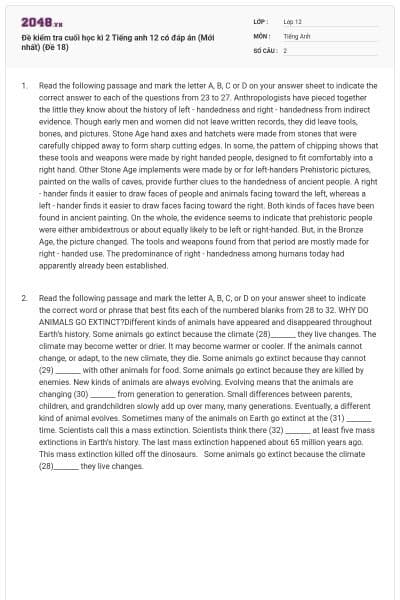
What is the main topic of the passage?
The purpose of ancient implements
The significance of prehistoric cave paintings
The development of right - handedness and left - handedness
The similarities between the Stone Age and Bronze Age
Đáp án đúng: C
Giải thích: Dẫn chứng: Anthropologists have pieced together the little they know about the history of left - handedness and right - handedness from indirect evidence
Dịch: Các nhà khảo cổ cho thấy họ có biết rất ít về lịch sử của thuận tay trái và tay phải qua những bằng chứng trực quan
Petrified forms of vegetation
Patterns of stone chipping
Fossilized waste material
Fossilized footprints
Đáp án đúng: B
Giải thích: Dẫn chứng: Stone Age hand axes and hatchets were made from stones that were carefully chipped away to form sharp cutting edges. In some, the pattern of chipping shows that these tools and weapons were made by right handed people, designed to fit comfortably into a right hand.
Dịch: Rìu và rìu cầm tay thời kỳ đồ đá được làm từ đá đã được đẽo gọt cẩn thận để tạo thành các cạnh cắt sắc bén. Trong một số trường hợp, mô hình sứt mẻ cho thấy những công cụ và vũ khí này được tạo ra bởi những người thuận tay phải, được thiết kế để vừa vặn với tay phải.
In line 6, the word “further” is closest in meaning to which of the following?
advanced
additional
artistic
factual
Đáp án đúng: B
Giải thích: Further (adj) ~ additional (adj): thêm nữa, hơn nữa
According to the passage, a person who is right-handed is more likely to draw people and animals that are facing
upward
downward
toward the right
toward the left
Đáp án đúng: D
Giải thích: Dẫn chứng: A right - hander finds it easier to draw faces of people and animals facing toward the left, whereas a left - hander finds it easier to draw faces facing toward the right.
Dịch: Người thuận tay phải thấy dễ dàng hơn khi vẽ mặt người và động vật quay về phía bên trái, trong khi người thuận tay trái thấy dễ dàng hơn khi vẽ mặt quay về phía bên phải.
Faces of animals and people
People’s view from inside a cave
People’s tendency to work with either hand
The kinds of paint used on cave walls
Đáp án đúng: C
Giải thích: Dẫn chứng: On the whole, the evidence seems to indicate that prehistoric people were either ambidextrous or about equally likely to be left or right-handed.
Dịch: Nhìn chung, các bằng chứng dường như chỉ ra rằng người tiền sử thuận cả hai tay hoặc có khả năng thuận tay trái hoặc phải như nhau.
Some animals go extinct because the climate (28)_______ they live changes.
where
which
when
what
Đáp án: A
Giải thích:
A. where: nơi mà
B. which: cái mà
C. when: khi mà
D. what: cái gì
Dựa vào nghĩa, chọn A.
Dịch: Một số loài động vật bị tuyệt chủng do khí hậu ở nơi chúng sống thay đổi.
complete
find
compete
exist
Đáp án đúng: C
Giải thích:
A. complete (v): hoàn thành
B. find (v): tìm kiếm
C. compete (v): cạnh tranh
D. exist (v): tồn tại
Dịch: Một số loài động vật bị tuyệt chủng vì chúng không thể cạnh tranh với các loài động vật khác về nguồn thức ăn
accidentally
suddenly
quickly
slowly
Đáp án đúng: D
Giải thích:
A. accidentally (adv): tình cờ
B. suddenly (adv): đột ngột
C. quickly (adv): nhanh chóng
D. slowly (adv): chậm rãi
Dịch: Tiến hóa có nghĩa là động vật thay đổi ngẫu nhiên từ thế hệ này sang thế hệ khác.
same
similar
different
various
Đáp án đúng: A
Giải thích: Cụm từ: at the same (đồng thời/ cùng lúc)
Dịch: Đôi khi nhiều loài động vật trên trái đất bị tuyệt chủng cùng một lúc.
has been
have been
will be
are
Đáp án đúng: B
Giải thích: trong câu có cụm từ “in Earth's history” (trong lịch sử của Trái Đất) => thì hiện tại hoàn thành
Dịch: Các nhà khoa học cho rằng đã có ít nhất 5 lần tuyệt chủng hàng loạt trong lịch sử Trái đất.
Bạn có thích hoạt động này không?