Bộ câu hỏi: Đọc hiểu (Có đáp án)
12 câu hỏi
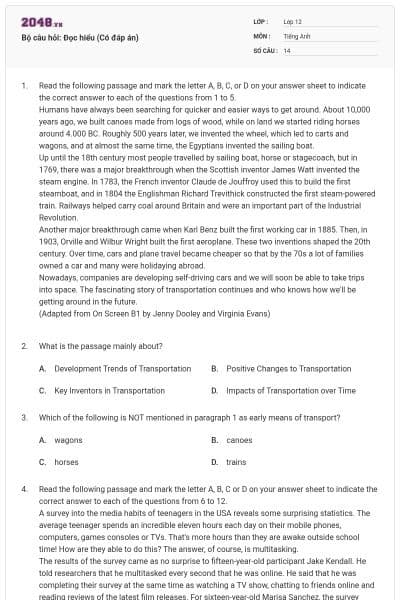
Humans have always been searching for quicker and easier ways to get around. About 10,000 years ago, we built canoes made from logs of wood, while on land we started riding horses around 4.000 BC. Roughly 500 years later, we invented the wheel, which led to carts and wagons, and at almost the same time, the Egyptians invented the sailing boat.
Up until the 18th century most people travelled by sailing boat, horse or stagecoach, but in 1769, there was a major breakthrough when the Scottish inventor James Watt invented the steam engine. In 1783, the French inventor Claude de Jouffroy used this to build the first steamboat, and in 1804 the Englishman Richard Trevithick constructed the first steam-powered train. Railways helped carry coal around Britain and were an important part of the Industrial Revolution.
Another major breakthrough came when Karl Benz built the first working car in 1885. Then, in 1903, Orville and Wilbur Wright built the first aeroplane. These two inventions shaped the 20th century. Over time, cars and plane travel became cheaper so that by the 70s a lot of families owned a car and many were holidaying abroad.
Nowadays, companies are developing self-driving cars and we will soon be able to take trips into space. The fascinating story of transportation continues and who knows how we'll be getting around in the future.
(Adapted from On Screen B1 by Jenny Dooley and Virginia Evans)
Development Trends of Transportation
Positive Changes to Transportation
Key Inventors in Transportation
Impacts of Transportation over Time
DỊCH BÀI:
Con người luôn tìm kiếm những cách nhanh và dễ hơn để di chuyển. Khoảng 10,000 năm trước, chúng ta đã chế tạo ca nô từ các khúc gỗ, trong khi trên đất liền thì chúng ta lại bắt đầu cưỡi ngựa khoảng từ năm 4000 trước Công Nguyên. Khoảng 500 năm sau, chúng ta đã phát minh ra bánh xe, dẫn đến xe đẩy và xe goòng, và cũng cùng lúc đó, thì người Ai Cập đã phát minh ra thuyền buồm.
Mãi đến thế kỷ 18 thì đa số mọi người mới di chuyển bằng thuyền buồm, ngựa hoặc xe ngựa kéo, nhưng vào năm 1769, có một cú đột phá lớn khi nhà phát minh người Scotland chế tạo ra động cơ hơi nước. Năm 1783, nhà phát minh người Pháp Claude de Jouffroy đã sử dụng nó để chế tạo ra con tàu hơi nước đầu tiên, và vào năm 1804 một người Anh tên Richard Trevithick đã chế tạo ra tàu lửa chạy bằng động cơ hơi nước đầu tiên. Đường sắt đã giúp vận chuyển than khắp nước Anh và là một phần quan trọng của cuộc Cách mạng Công nghiệp.
Một bước đột phá lớn khác đã xuất hiện khi Karl Benz chế tạo ra xe ô tô đầu tiên vào năm 1885. Sau đó, năm 1903, Orville và Wilbur Wright đã chế tạo ra chiếc máy bay đầu tiên. Hai phát minh này đã định hình thế kỷ 20. Qua thời gian, việc di chuyển bằng ô tô và máy bay đã trở nên rẻ hơn nên đến những năm 70 thì có rất nhiều gia đình đã sở hữu ô tô và nhiều người đi du lịch nước ngoài.
Ngày nay, các công ty đang phát triển xe ô tô tự lái và chúng ta sẽ sớm có thể thực hiện các chuyến đi vào không gian. Câu chuyện thú vị về giao thông vẫn tiếp diễn và ai biết được chúng ta sẽ di chuyển ra sao trong tương lai.
Giải thích:
Đoạn văn chủ yếu viết về gì?
A. Xu hướng phát triển của giao thông
B. Những thay đổi tích cực về giao thông
C. Những nhà phát minh chủ chốt trong giao thông
D. Tác động của giao thông theo thời gian
Tóm tắt:
Đoạn văn nói về quá trình phát triển của phương thức giao thông từ xưa đến nay.
==> Đoạn văn viết về xu hướng phát triển của giao thông
→ Chọn đáp án A
wagons
canoes
horses
trains
Cái nào sau đây không được nhắc đến trong đoạn 1 như là phương tiện giao thông đầu tiên?
A. xe ngựa kéo
B. ca nô
C. ngựa
D. tàu lửa
Thông tin:
About 10,000 years ago, we built canoes made from logs of wood, while on land we started riding horses around 4.000 BC. Roughly 500 years later, we invented the wheel, which led to carts and wagons, and at almost the same time, the Egyptians invented the sailing boat. (Khoảng 10,000 năm trước, chúng ta đã chế tạo ca nô từ các khúc gỗ, trong khi trên đất liền thì chúng ta lại bắt đầu cưỡi ngựa khoảng từ năm 4000 trước Công Nguyên. Khoảng 500 năm sau, chúng ta đã phát minh ra bánh xe, dẫn đến xe đẩy và xe goòng, và cũng cùng lúc đó, thì người Ai Cập đã phát minh ra thuyền buồm.)
→ Chọn đáp án D
steamboat
steam engine
breakthrough
inventor
travelling
studying
working
exercising
after the 20th century
more than 10,000 years ago
before the 19th century
from the 18th century onwards
A survey into the media habits of teenagers in the USA reveals some surprising statistics. The average teenager spends an incredible eleven hours each day on their mobile phones, computers, games consoles or TVs. That's more hours than they are awake outside school time! How are they able to do this? The answer, of course, is multitasking.
The results of the survey came as no surprise to fifteen-year-old participant Jake Kendall. He told researchers that he multitasked every second that he was online. He said that he was completing their survey at the same time as watching a TV show, chatting to friends online and reading reviews of the latest film releases. For sixteen-year-old Marisa Sanchez, the survey simply confirmed the facts. She said that she had watched two hours of TV in the three hours since the end of school, and also researched her homework about volcanoes, played an online game for two hours, and arranged her weekend plans by texting friends.
Some experts are worried about the survey results. Sylvia de Lupis of the Family Action Institute told our reporter that teenagers would have difficulties because of their multitasking habits. She added that, as adults, they would struggle to focus their attention. However, Dr. Michael Rich from the Center on Media and Child Health said that worries about multitasking had become pointless a long time ago, and that high levels of media use were now a part of young people's environment, 'like the air that they breathe, the water that they drink and the food that they eat'.
(Adapted from T)
Teens: More Media Use Than Hours in The Day
The Art of Multitasking: A to Z for Teens
Teens: Learning through Media
Multitasking - Part of Teens' Everyday Life
DỊCH BÀI:
Một cuộc khảo sát về thói quen truyền thông của thanh thiếu niên ở Mỹ tiết lộ một số dữ liệu thống kê đáng ngạc nhiên. Trung bình thanh thiếu niên dành đến 11 giờ mỗi ngày cho điện thoại di động, máy tính, máy chơi game hoặc TV. Đó còn hơn thời gian mà chúng thức ngoài giờ học! Chúng có thể làm điều này như thế nào? Dĩ nhiên, câu trả lời chính là đa nhiệm.
Kết quả của cuộc khảo sát không có gì đáng ngạc nhiên đối với người tham gia 15 tuổi Jake Kendall. Cậu ấy đã nói với các nhà nghiên cứu rằng cậu đa nhiệm mỗi giây mà mình trực tuyến. Cậu chia sẻ, mình hoàn thành bài khảo sát trong lúc xem một chương trình TV, tán gẫu trực tuyến với bạn bè và đọc bài đánh giá bộ phim ra mắt mới nhất. Đối với Marisa Sanchez 16 tuổi, thì cuộc khảo sát đơn giản chỉ xác nhận thực tế. Cô nói rằng cô đã xem TV 2 giờ trong 3 giờ kể từ khi kết thúc giờ học, và cũng nghiên cứu bài tập về nhà về núi lửa, chơi game trực tuyến trong hai giờ, và sắp xếp kế hoạch cuối cùng bằng việc nhắn tin cho bạn bè.
Một số chuyên gia lo ngại về kết quả khảo sát. Sylvia de Lupis từ Family Action Institute đã nói với các báo cáo viên rằng các thanh thiếu niên sẽ gặp khó khăn vì thói quen đa nhiệm của chúng. Cô ấy nói thêm rằng, khi trưởng thành, chúng sẽ phải vật lộn để có thể tập trung. Tuy nhiên, giáo sư Michael Rich từ Trung tâm Truyền thông và Sức khỏe Trẻ em nói rằng những lo ngại về đa nhiệm đã trở nên vô ích từ lâu, và rằng mức độ sử dụng phương tiện truyền thông cao hiện nay là một phần của môi trường người trẻ, “như bầu không khí mà chúng thở, nước mà chúng uống và thức ăn mà chúng ăn.”
Giải thích:
Đâu là tiêu đề phù hợp nhất cho đoạn văn?
A. Thanh thiếu niên: sử dụng nhiều phương tiện truyền thông hơn nhiều giờ trong ngày
B. Nghệ thuật đa nhiệm: TừA đến Z cho thanh thiếu niên
C. Thanh thiếu niên: Học tập qua phương tiện truyền thông
D. Đa nhiệm - một phần trong cuộc sống hàng ngày của thanh thiếu niên
Tóm tắt:
Đoạn văn nói về thói quen đa nhiệm của thanh thiếu niên ngày nay.
==> Đa nhiệm - một phần trong cuộc sống hàng ngày của thanh thiếu niên
→ Chọn đáp án D
game consoles
televisions
e-book readers
phones
comments
plots
discussions
complaints
habits
adults
difficulties
teenagers
useful
invaluable
worthless
ineffective
An average teen in America spends nearly half a day using media.
Marisa Sanchez could complete her school assignment and relax at a time.
Dr. Michael Rich expected teenagers to get distracted due to multitasking
Frequent media use is possibly a matter of course to young people.
Điều nào sau đây không đúng theo đoạn văn?
A. Trung bình một thanh thiếu niên ở Mỹ dành gần nửa ngày để sử dụng phương tiện truyền thông.
B. Marisa Sanchez có thể hoàn thành bài tập về nhà ở trường và thư giãn cùng lúc.
C. Giáo sư Michael Rich nghĩ thanh thiếu niên bị phân tâm vì đa nhiệm.
D. Việc sử dụng phương tiện truyền thông thường xuyên có thể là một vấn đề đối với những người trẻ.
Thông tin:
+ The average teenager spends an incredible eleven hours each day on their mobile phones, computers, games consoles or TVs. (Trung bình thanh thiếu niên dành đến 11 giờ mỗi ngày cho điện thoại di động, máy tính, máy chơi game hoặc TV.)
→ A đúng
+ For sixteen-year-old Marisa Sanchez, the survey simply confirmed the facts. She said that she had watched two hours of TV in the three hours since the end of school, and also researched her homework about volcanoes, played an online game for two hours, and arranged her weekend plans by texting friends. (Đối với Marisa Sanchez 16 tuổi, thì cuộc khảo sát đơn giản chỉ xác nhận thực tế. Cô nói rằng cô đã xem TV 2 giờ trong 3 giờ kể từ khi kết thúc giờ học, và cũng nghiên cứu bài tập về nhà về núi lửa, chơi game trực tuyến trong hai giờ, và sắp xếp kế hoạch cuối cùng bằng việc nhắn tin cho bạn bè.)
→ B đúng
+ Sylvia de Lupis of the Family Action Institute told our reporter that teenagers would have difficulties because of their multitasking habits. (Sylvia de Lupis từ Family Action Institute đã nói với các báo cáo viên rằng các thanh thiếu niên sẽ gặp khó khăn vì thói quen đa nhiệm của họ.)
→ D đúng
+ However, Dr. Michael Rich from the Center on Media and Child Healthsaid that worries about multitasking had become pointless a long time ago, and that high levels of media use were now a part of young people's environment, 'like the air that they breathe, the water that they drink and the food that they eat'. (Tuy nhiên, giáo sư Michael Rich từ Trung tâm Truyền thông và Sức khỏe Trẻ em nói rằng những lo ngại về đa nhiệm đã trở nên vô ích từ lâu, và cho rằng mức độ sử dụng phương tiện truyền thông cao hiện nay là một phần của môi trường người trẻ, “như bầu không khí mà chúng thở, nước chúng uống và thức ăn mà chúng ăn.”)
→ C sai
→ Chọn đáp án C
Family Action Institute must work to stop multitasking.
Young people should concentrate on only one medium at a time.
Jake Kendall and Marisa Sanchez got good academic results.
Youngsters' multitasking habits in media use meet with mixed reactions from the public.
Điều nào sau đây có thể được suy ra từ đoạn văn?
A. Family Action Institute phải làm việc để dừng việc đa nhiệm.
B. Những người trẻ chỉ nên tập trung vào một phương tiện cùng một lúc.
C. Jake Kendall và Marisa Sanchez có kết quả học tập tốt.
D. Thói quen đa nhiệm của những người trẻ trong việc sử dụng phương tiện truyền thông nhận được nhiều phản ứng hỗn hợp từ công chúng.
Thông tin:
Sylvia de Lupis of the Family Action Institute told our reporter that teenagers would have difficulties because of their multitasking habits. She added that, as adults, they would struggle to focus their attention. However, Dr. Michael Rich from the Center on Media and Child Health said that worries about multitasking had become pointless a long time ago, and that high levels of media use were now a part of young people's environment, 'like the air that they breathe, the water that they drink and the food that they eat'. ( Sylvia de Lupis từ Family Action Institute đã nói với các báo cáo viên rằng các thanh thiếu niên sẽ gặp khó khăn vì thói quen đa nhiệm của chúng. Cô ấy nói thêm rằng, khi trưởng thành, chúng sẽ phải vật lộn để có thể tập trung. Tuy nhiên, giáo sư Michael Rich từ Trung tâm Truyền thông và Sức khỏe Trẻ em nói rằng những lo ngại về đa nhiệm đã trở nên vô ích từ lâu, và rằng mức độ sử dụng phương tiện truyền thông cao hiện nay là một phần của môi trường người trẻ, “như bầu không khí mà chúng thở, nước mà chúng uống và thức ăn mà chúng ăn.”)
→ Chọn đáp án D
Bạn có thích hoạt động này không?