Bộ 20 đề luyện thi Chuyên Anh năm 2023 có đáp án (Đề 81)
80 câu hỏi
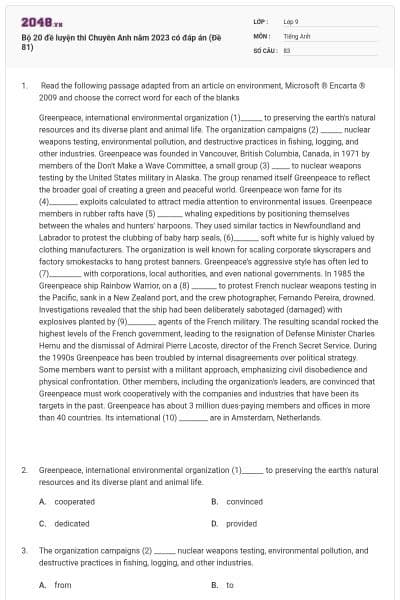
Read the following passage adapted from an article on environment, Microsoft ® Encarta ® 2009 and choose the correct word for each of the blanks
Greenpeace, international environmental organization (1)______ to preserving the earth's natural resources and its diverse plant and animal life. The organization campaigns (2) ______ nuclear weapons testing, environmental pollution, and destructive practices in fishing, logging, and other industries. Greenpeace was founded in Vancouver, British Columbia, Canada, in 1971 by members of the Don't Make a Wave Committee, a small group (3) _____ to nuclear weapons testing by the United States military in Alaska. The group renamed itself Greenpeace to reflect the broader goal of creating a green and peaceful world. Greenpeace won fame for its (4)________ exploits calculated to attract media attention to environmental issues. Greenpeace members in rubber rafts have (5) _______ whaling expeditions by positioning themselves between the whales and hunters' harpoons. They used similar tactics in Newfoundland and Labrador to protest the clubbing of baby harp seals, (6)_______ soft white fur is highly valued by clothing manufacturers. The organization is well known for scaling corporate skyscrapers and factory smokestacks to hang protest banners. Greenpeace's aggressive style has often led to (7)_________ with corporations, local authorities, and even national governments. In 1985 the Greenpeace ship Rainbow Warrior, on a (8) _______ to protest French nuclear weapons testing in the Pacific, sank in a New Zealand port, and the crew photographer, Fernando Pereira, drowned. Investigations revealed that the ship had been deliberately sabotaged (damaged) with explosives planted by (9)________ agents of the French military. The resulting scandal rocked the highest levels of the French government, leading to the resignation of Defense Minister Charles Hernu and the dismissal of Admiral Pierre Lacoste, director of the French Secret Service. During the 1990s Greenpeace has been troubled by internal disagreements over political strategy. Some members want to persist with a militant approach, emphasizing civil disobedience and physical confrontation. Other members, including the organization's leaders, are convinced that Greenpeace must work cooperatively with the companies and industries that have been its targets in the past. Greenpeace has about 3 million dues-paying members and offices in more than 40 countries. Its international (10) ________ are in Amsterdam, Netherlands.
Greenpeace, international environmental organization (1)______ to preserving the earth's natural resources and its diverse plant and animal life.
cooperated
convinced
dedicated
provided
Đáp án: C
from
to
over
against
persist
opposed
disagreed
disobeyed
daring
discouraging
frightening
deliberate
Đáp án: A
rocked
reflected
disrupted (interrupt)
revealed
Đáp án: C
whose
whom
that
who
confrontation (disagreement)
conflicts
investigations
resignation
voyage
trip
flight
expedition
underclassman(a student in the first or second year of high school or college)
legal
undercover(secret)
official
skyscrapers
offices
centers
headquarters
Đáp án: D
Choose the word/phrase that is closest in meaning to the underlined part.
The cotton gin was commonplace on many nineteenth century farms.
often required
sorely needed
frequently seen
visibly absent
Đáp án: C
exhibit
classify
depend on
conform to
had a temperature
kept her temper
became very angry
felt worried
Đáp án: C
Choose the word or phrase that is OPPOSITE in meaning to the underlined part in each of the following questions.
Doctors have been criticized for their indiscriminate use of antibiotics.
disciplined
selective
wholesale
unconscious
instituted
eradicated
eliminated
required
Choose the sentence that is closest in meaning to each of the following questions.
When he called to tell me that he was studying, I didn't believe him because I could hear the noise of a party in the background.
I didn't believe that he could study properly with the noise of a party in the background and I told him that when he telephoned.
Although he rang me to tell me that he was studying, I couldn't hear what he was saying properly because of my unbelievably noisy party.
Because of the sounds of a party I heard in the background when he phoned, I didn't believe his claim that he was studying.
Though he was studying when he called, I thought he was lying because in the background there were party-like sounds.
Đáp án: C
It is completely exhausting after half-an-hour I listening to Marion.
Half-an-hour listening to Marion leaves me feeling completely exhausted.
Feeling completely exhausted, I spent half-an-hour listening to Marion.
When I've listened to Marion for half-an-hour, she feels exhausting completely.
Đáp án: B
On the way home, I suddenly realized that I had forgotten to turn on the burglar alarm in the office.
Fortunately, I realized that I hadn't set the burglar alarm just before I left for home; otherwise, I would have had to travel all the way back to the office.
I didn't turn the burglar alarm on before I left the office, but I only became aware of this after I'd arrived home.
I wish I had realized before I arrived home that I hadn't turned on the burglar alarm in the office; then it would have been easier to go and set it.
My father found Tom’s behavior intolerant
My father found Tom’s behavior intolerable
My father was tolerant towards Tom’s behavior
Tom’s behavior was not tolerable
Đáp án: B
Giải thích:
Cấu trúc: can’t stand = không thể chịu được
intolerant (adj): không khoan dung, không tha thứ
intolerable (adj): không thể chịu đựng nổi
Dịch đề: Bố của tôi khôgn thể chịu đựng được hành vi của Tom
A. Bố tôi cảm thấy hành vi của Tom không tha thứ được. => sai nghĩa
B. Bố tôi cảm thấy hành vi của Tom không thể chịu đựng nổi.
C. Bố tôi chịu đựng hành vi của Tom. => sai nghĩa
D. Hành vi của Tom không thể chịu đựng được. => thiếu nghĩa “my father”.
→ Đáp án B gần nghĩa nhất với câu đã cho.
Dịch: Bố tôi cảm thấy hành vi của Tom không thể chịu đựng nổi.
become much interested in
give up oneself totally
abandon oneself
get heavily involved in
There was almost nobody at the meeting
Not many people came to the meeting
Not a single person came to the meeting
Only a few people came to the meeting
Although he retired early, but he found no peace in life.
His early retirement has brought him peace in life.
He found no peace in life because he retired early.
Early as he retired, he found no peace in life.
Đáp án: D
The last question is not difficult
This question is the most difficult one
The last question is difficult but this one is more difficult
This question is hard but the last one is not.
It's a shame that we must have apologised to Mary for all that mess.
We might have apologised to Mary for all that mess, it’s shameful.
We were ashamed not to apologise Mary for all that mess.
We should have apologised to Mary for all that mess.
Đáp án: D
A shop assistant threatened the little girl and she told that she would help her to findher mummy
A shop assistant ordered the little girl to stop crying and she helped her to find her mummy
A shop assistant scolded the little girl and she said that her mummy would find her.
A shop assistant told the little girl not to cry and she promised that she would help her to find her mummy
Choose the underlined part that needs correction
In (A) just three months H.G. Wells (B) wrote the famous classic The Time Machine for (C) what he won (D) a Newberry Caldecot award.
Đáp án: C
Đáp án: D
Đáp án: C
Read the following extract from Jess McElhinney's article on health issues and choose the correct answer to each of the questions.
In a study of aspirin's effect on blood clotting in which abstinence from chocolate was required, a large proportion of participants broke the rules. Their "offence" led to what is believed to be the first biochemical evidence that a few squares of chocolate a day can almost halve the risk of heart attack death by decreasing the tendency of tiny particles (or platelets) to clot in narrow blood vessels. "What these chocolate offenders taught us is that the chemical in cocoa beans has a biochemical effect similar to aspirin in reducing platelet clumping, which can be fatal if a clot forms and blocks a blood vessel, causing a heart attack," said Diane Becker from Johns Hopkins University in Maryland, USA, who led the study. Becker cautions that this discovery should not become an excuse to indulge in large amounts of chocolate frequently, since chocolate also contains high amounts of sugar, butter and cream. However just a few squares of dark chocolate the purest form may be just what the doctor ordered. For almost 20 years researchers have known that chemicals, called flavonoids, most common in dark chocolate, help blood flow and lower blood pressure. This new finding, presented at the American Heart Association's annual scientific sessions in Chicago this week, identifies the effect of everyday doses of chocolate found in regular foods such as hot chocolate or chocolate bars. This differs from previous studies which have examined the effects of eating unrealistic doses of flavonoids, equivalent to several pounds of chocolate a day. "Eating a little bit of chocolate or having a drink of hot cocoa as part of a regular diet is probably good for personal health, so long as people don't eat too much of it, and too much of the kind with lots of butter and sugar," said Becker. In the study, 139 chocolate offenders were disqualified from a larger experiment which aimed to examine the effects of aspirin on blood clotting. Before the study began, all participants were instructed to follow a strict exercise and diet regimen and to refrain from smoking or using foods and drinks known to affect blood-clotting activity, like caffeinated drinks, wine, grapefruit juice and, of course, chocolate. Platelet samples from both groups (offenders and non-offenders) were run through a mechanical blood vessel system designed to time how long it takes for platelets to clump together. Chocolate lovers' samples were found to clot more slowly, on average taking 130 seconds to block the system. Platelets from those who stayed away from chocolate clotted faster, taking an average of 123 seconds.
According to the findings, what helps lower blood pressure?
The most important ingredient in chocolate.
The most common chemicals in dark chocolate.
The chemical reaction in dark chocolate.
The tiny particles in white chocolate.
Đáp án: B
people who violate laws
trouble makers
people who produce chocolate
people who ate chocolate
Đáp án: D
Similarity
Difference
Irrelevance
Interdependence
mixed
dark
white
hot
Đáp án: B
It widens the blood vessels.
It helps the heart pumps better.
It helps blood flow more easily.
It prevents harmful bacteria.
Đáp án: C
with a lot of butter and sugar
containing a lot of milk
with lots of sugar and cocoa
made with artificial sugar
eating some chocolate
not eating chocolate
not smoking
doing exercise
Đáp án: B
stopped
moderate
faster
slower
Đáp án: D
Cultures are different in different countries.
There are different cultures in one country
Culture differences are based on countries
Cultures move from one country to another.
ads of medicine
a science journal
a doctor's prescription
a book of instructions
Đáp án: B
mathematics
academic
politics
continental
beautifully
differently
dedicated
acceptable
Đáp án: D
biologist
eliminate
archaeology
stability
Đáp án: C
enthusiast
statistics
philosophy
sociology
Đáp án: D
misunderstand
misbehaviour
responsibility
characteristic
Đáp án: B
Choose the correct answer to each of the following questions.
Only in the Civil War____________ killed or wounded.
soldiers in America were
so many American soldiers were
many in America were
were so many American soldiers
Đáp án: D
don't do
hadn't done
didn't do
haven't done
Đáp án: C
have been arguing
had been arguing
argued
would argue
Đáp án: B
Giải thích:
Kiến thức: Thì của động từ
Dựa vào “was” và “saw” ở thì quá khứ đơn, ta xác định được hành động xảy ra trong quá khứ.
Ta dùng thì quá khứ hoàn thành tiếp diễn để diễn tả một sự việc xảy ra và kéo dài liên tục trước một hành động khác trong quá khứ, để lại kết quả là “I was angry”.
Dịch: Tôi đang tức giận cái lúc mà bạn nhìn thấy tôi bởi vì tôi vừa mới cãi nhau với chị gái.The book would have been perfect ________ the ending.
had it not been for
it had not been for
it hadn't been for
hadn't it been for.
Đáp án: A
Giải thích:
Kiến thức: Câu điều kiện loại 3 – đảo ngữ với cụm “Had it not been for...”
Cụm “Had it not been for...” tương đương với “If it hadn’t been for...”, nghĩa là nếu không vì...
Cấu trúc hoàn chỉnh của câu điều kiện loại 3 ở dạng đảo ngữ là:
Had + S + (not) + V3/PII, S + would/could/should + have + V3/PII
→ Áp dụng vào câu:
The book would have been perfect if it hadn't been for the ending.
→ Dạng đảo: Had it not been for the ending, the book would have been perfect.
Chọn A. had it not been for
Dịch: Cuốn sách đã có thể hoàn hảo nếu không vì cái kết.
nowhere like so ambitious
nothing near as ambitious as
nothing as ambitious than
nowhere near as ambitious as
Đáp án: D
Giải thích:
Cấu trúc:
to be nowhere near as + adj + as = thật sự không… như…
Dịch: Tôi thật sự không có nhiều tham vọng như anh trai tôi.
Even
Despite
Much as
Try as
Đáp án: C
none
few
some
any
playing down
turning around
keeping down
pushing back
Đáp án: A
my duty
it my duty
this my duty
that my duty
Đáp án: B
Giải thích:
Cấu trúc: to feel it + N = cảm thấy đó là gì
Dịch: Tôi cảm thấy đó là nhiệm vụ của tôi để thông báo cho ủy ban rằng nhiều thành viên không hài lòng với cái quyết định.
broken into
taken out
touched up
tampered with (làm giả)
Đáp án: D
considered
thought
taken
added
Đáp án: A
Yes. Congratulations!
There’s no doubt about it.
What an opinion!
You shouldn’t have said that.
Take care of yourself
Congratulations
You are always lucky
Lucky as you are
Never mind
Yes, with pleasure
Yes, that's right
Not at all
Đáp án: B
hadn't come back
haven't come back
don't come back
didn't come back
Đáp án: D
took
have taken
had taken
take
Đáp án: A
has caught
catches
had caught
caught
Đáp án: D
couldn’t make
shouldn’t have made
mightn’t make
can't have made
was awarded
would be awarded
be awarded
must be awarded
Đáp án: C
is known to have been painted
known to have been painted
is knowing to be painted
is known to be painted
Đáp án: A
stand up
stand in for(replace sb temporarily)
stand for
set off
old leather lovely
old lovely leather
lovely old leather
leather old lovely
into
out
across
after
Đáp án: C
put an end to
put something by for
put the blame on
put off
Đáp án: B
Noticed the door was open
Open the door
The open door was noticed
Noticing the door was open
Đáp án: D
Read the following passage adapted from MS Encarta 2008 and choose the correct answer to each of the questions that follow.
The work of women has been economically vital since prehistory, although their contributions have varied according to the structure, needs, customs, and attitudes of society. In prehistoric times, women and men participated almost equally in hunting and gathering activities to obtain food. With the development of agricultural communities, women's work revolved more around the home. As urban centres developed, women sold or traded goods in the marketplace. From ancient to modern times, four generalizations can be made about women's paid work. (1) Women have worked because of economic necessity; poor women in particular worked outside the home whether they were unmarried or married, and especially if their husbands were unable to sustain the family solely through their own work. (2) Women's indentured work has often been similar to their work at home. (3) Women have maintained the primary responsibility for raising children, regardless of their paid work. (4) Women have historically been paid less than men and have been allocated lower-status work. Some major changes are now occurring in industrial nations, including the steadily increasing proportion of women in the labour force; decreasing family responsibilities (due to both smaller family size and technological innovation in the home); higher levels of education for women; and more middle and upper-income women working for pay or for job satisfaction. Statistically, they have not yet achieved parity of pay or senior appointments in the workplace in any nation Artisans working in their own homes not infrequently used the labour of their families. This custom was so prevalent during the Middle Ages, craft guilds of the period, including some that otherwise excluded women, often admitted to membership the widows of guild members, providing they met professional requirements. Dressmaking and lacemaking guilds were composed exclusively of women. Gradually, the guilds were replaced by the putting-out system, whereby tools and materials were distributed to workers by merchants; the workers then produced articles on a piecework basis in their homes. During the 18th and early 19th centuries, as the Industrial Revolution developed, the putting-out system slowly declined. Goods that had been produced by hand in the home were manufactured by machine under the factory system. Women competed more with men for some jobs, but were concentrated primarily in textile mills and clothing factories. Manufacturers often favoured women employees because of relevant skills and lower wages, and also because early trade union organization tended to occur first among men. Employees in sweatshops were also preponderantly women. The result was to institutionalize systems of low pay, poor working conditions, long hours, and other abuses, which along with child labour presented some of the worst examples of worker exploitation in early industrial capitalism. Minimum wage legislation and other protective laws, when introduced, concentrated particularly on the alleviation of these abuses of working women. Women workers in business and the professions, the so-called white-collar occupations, suffered less from poor conditions of work and exploitative labour, but were denied equality of pay and opportunity. The growing use of the typewriter and the telephone after the 1870s created two new employment niches for women, as typists and telephonists, but in both fields the result was again to institutionalize a permanent category of low-paid, low-status women's work.
When the farming communities developed, women worked __
less at home
more at home
more outside
in groups
traded cattle in the marketplace
stayed at home to take care of their children
worked more in the marketplace
sold cloth in the marketplace
outside the home
in the kitchen
outside the kitchen
inside the home
Đáp án: A
have been respected at home and in the workplace
have enjoyed equal status in the workplace
have not yet achieved high status in the workplace
have become more influential in their companies
they have to work to feed their men
they have to amuse their men
are the mainstay of their families
they can be breadwinners as men
workshop
factory work
hard work
harmful work
Đáp án: C
are provided with tools to produce goods at home
bought materials to manufacture goods
provide their factories with raw materials
turn their homes into factories
women demanded less than men
they did not have to pay for high insurance
they could cheat them more easily
they did not have to pay high wages
entertainment industry
Broidery
textile industry
bakery
their role in the home
their marital status and their husbands
the different factors of the society
the Industrial Revolution