Bài tập Sử dụng phép toán tổng, hiệu hai vectơ và tích của một vectơ với một số để chứng minh, phân tích các vectơ lớp 12 (có lời giải)
25 câu hỏi
Cho hình tứ diện ABCD có trọng tâm G. Mệnh đề nào sau đây sai?
\[\overrightarrow {GA} + \overrightarrow {GB} + \overrightarrow {GC} + \overrightarrow {GD} = \overrightarrow 0 \];
\[\overrightarrow {OG} = \frac{1}{4}\left( {\overrightarrow {OA} + \overrightarrow {OB} + \overrightarrow {OC} + \overrightarrow {OD} } \right)\];
\[\overrightarrow {AG} = \frac{2}{3}\left( {\overrightarrow {AB} + \overrightarrow {AC} + \overrightarrow {AD} } \right)\];
\[\overrightarrow {AG} = \frac{1}{4}\left( {\overrightarrow {AB} + \overrightarrow {AC} + \overrightarrow {AD} } \right)\].
Đáp án đúng là: C
Có G là trọng tâm của tứ diện ABCD nên:
\[\overrightarrow {GA} + \overrightarrow {GB} + \overrightarrow {GC} + \overrightarrow {GD} = \overrightarrow 0 \] \[ \Leftrightarrow 4\overrightarrow {GA} + \overrightarrow {AB} + \overrightarrow {AC} + \overrightarrow {AD} = \overrightarrow 0 \]\[ \Leftrightarrow \overrightarrow {AG} = \frac{1}{4}\left( {\overrightarrow {AB} + \overrightarrow {AC} + \overrightarrow {AD} } \right)\].
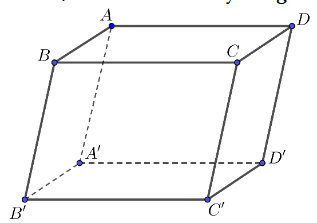
Cho hình hộp ABCD.A'B'C'D'. Mệnh đề nào sau đây đúng?
\[\overrightarrow {AB} + \overrightarrow {A'D'} = \overrightarrow {AC} \];
\[\overrightarrow {AB} + \overrightarrow {A'D'} = \overrightarrow {BD} \];
\[\overrightarrow {AB} + \overrightarrow {A'D'} = \overrightarrow {AC'} \];
\[\overrightarrow {AB} + \overrightarrow {A'D'} = \overrightarrow {CA} \].
Đáp án đúng là: A
Ta có \(\overrightarrow {AB} + \overrightarrow {A'D'} = \overrightarrow {AB} + \overrightarrow {AD} = \overrightarrow {AC} \) (quy tắc hình bình hành).
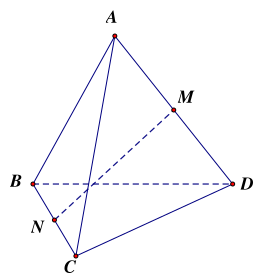
Cho tứ diện ABCD. Gọi M, N lần lượt là trung điểm của AD và BC. Tổng \(\overrightarrow {AB} + \overrightarrow {DC} \) bằng
\[\overrightarrow 0 \];
\[2\overrightarrow {AD} \];
\[2\overrightarrow {MN} \];
\[2\overrightarrow {NM} \].
Đáp án đúng là: C
Ta có :
\(\overrightarrow {AB} + \overrightarrow {DC} = \overrightarrow {AM} + \overrightarrow {MN} + \overrightarrow {NB} + \overrightarrow {DM} + \overrightarrow {MN} + \overrightarrow {NC} \)
\( = \left( {\overrightarrow {AM} + \overrightarrow {DM} } \right) + 2\overrightarrow {MN} + \left( {\overrightarrow {NB} + \overrightarrow {NC} } \right) = 2\overrightarrow {MN} \).
(vì M, N lần lượt là trung điểm của AD, BC nên \(\overrightarrow {AM} + \overrightarrow {DM} = \overrightarrow 0 ;\overrightarrow {NB} + \overrightarrow {NC} = \overrightarrow 0 \)).
Cho hình lăng trụ tam giác ABC.A'B'C'. Đặt \(\overrightarrow {AA'} = \overrightarrow a ;\overrightarrow {AB} = \overrightarrow b ;\overrightarrow {AC} = \overrightarrow c ;\overrightarrow {BC} = \overrightarrow d \). Trong các biểu thức vectơ sau đây, biểu thức nào đúng?
\[\overrightarrow a + \overrightarrow b + \overrightarrow c = \overrightarrow d \];
\[\overrightarrow a = \overrightarrow b + \overrightarrow c \];
\[\overrightarrow a + \overrightarrow b + \overrightarrow c + \overrightarrow d = \overrightarrow 0 \];
\[\overrightarrow b - \overrightarrow c + \overrightarrow d = \overrightarrow 0 \].
Đáp án đúng là: D
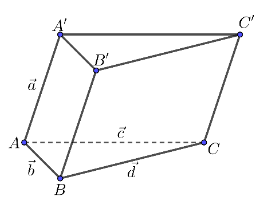
Ta thấy \(\overrightarrow b - \overrightarrow c + \overrightarrow d = \overrightarrow {AB} - \overrightarrow {AC} + \overrightarrow {BC} = \overrightarrow {CB} + \overrightarrow {BC} = \overrightarrow 0 \).
Cho tứ diện ABCD có trọng tâm G, gọi M là trung điểm AD. Khi đó:
\[\overrightarrow {MG} = \frac{1}{4}\left( {\overrightarrow {MA} + \overrightarrow {MD} } \right)\];
\[\overrightarrow {MG} = \frac{1}{4}\left( {\overrightarrow {MC} + \overrightarrow {MB} } \right)\];
\[\overrightarrow {MG} = \frac{1}{4}\left( {\overrightarrow {MC} + \overrightarrow {MD} } \right)\];
\[\overrightarrow {MG} = \frac{1}{4}\left( {\overrightarrow {MC} - \overrightarrow {MD} } \right)\].
Đáp án đúng là: B
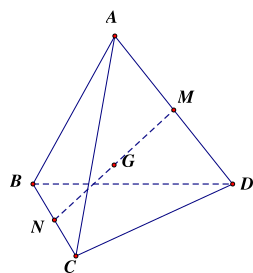
Gọi \(N\) là trung điểm BC thì G chính là trung điểm của MN. Do đó ta có:
\(\overrightarrow {MG} = \frac{1}{2}\overrightarrow {MN} = \frac{1}{4}\left( {\overrightarrow {MB} + \overrightarrow {MC} } \right)\).
Cho tứ diện ABCD. Gọi M và P lần lượt là trung điểm của các cạnh AB và CD. Đặt \(\overrightarrow {AB} = \overrightarrow b ;\overrightarrow {AC} = \overrightarrow c ;\overrightarrow {AD} = \overrightarrow d \). Khẳng định nào sau đây đúng?
\[\overrightarrow {MP} = \frac{1}{2}\left( {\overrightarrow c + \overrightarrow d + \overrightarrow b } \right)\];
\[\overrightarrow {MP} = \frac{1}{2}\left( {\overrightarrow d + \overrightarrow b - \overrightarrow c } \right)\];
\[\overrightarrow {MP} = \frac{1}{2}\left( {\overrightarrow c + \overrightarrow b - \overrightarrow d } \right)\];
\[\overrightarrow {MP} = \frac{1}{2}\left( {\overrightarrow c + \overrightarrow d - \overrightarrow b } \right)\].
Đáp án đúng là: D
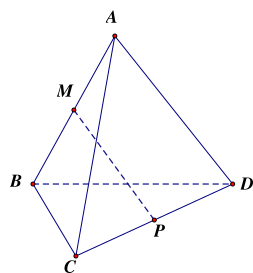
Vì M, P lần lượt là trung điểm AB, CD \( \Rightarrow \left\{ \begin{array}{l}2\overrightarrow {AM} = \overrightarrow {AB} \\\overrightarrow {AC} + \overrightarrow {AD} = 2\overrightarrow {AP} \end{array} \right.\).
Ta có \(\overrightarrow {MP} = \overrightarrow {MA} + \overrightarrow {AP} = - \overrightarrow {AM} + \overrightarrow {AP} = - \frac{1}{2}\overrightarrow {AB} + \frac{1}{2}\left( {\overrightarrow {AC} + \overrightarrow {AD} } \right)\)
\( = - \frac{1}{2}\overrightarrow b + \frac{1}{2}\overrightarrow c + \frac{1}{2}\overrightarrow d = \frac{1}{2}\left( {\overrightarrow c + \overrightarrow d - \overrightarrow b } \right)\).
Cho hình lăng trụ ABC.A'B'C'. Đặt \(\overrightarrow {AA'} = \overrightarrow a ;\overrightarrow {AB} = \overrightarrow b ;\overrightarrow {AC} = \overrightarrow c \). Gọi G' là trọng tâm của tam giác A'B'C'. Vectơ \(\overrightarrow {AG'} \) bằng?
\[\frac{1}{3}\left( {\overrightarrow a + 3\overrightarrow b + \overrightarrow c } \right)\];
\[\frac{1}{3}\left( {3\overrightarrow a + \overrightarrow b + \overrightarrow c } \right)\];
\[\frac{1}{3}\left( {\overrightarrow a + \overrightarrow b + 3\overrightarrow c } \right)\];
\[\frac{1}{3}\left( {\overrightarrow a + \overrightarrow b + \overrightarrow c } \right)\].
Đáp án đúng là: B
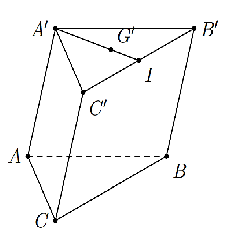
Gọi I là trung điểm B'C'. Vì G' là trọng tâm tam giác A'B'C' \( \Rightarrow \overrightarrow {A'G'} = \frac{2}{3}\overrightarrow {A'I} \).
Mặt khác \(\overrightarrow {AG'} = \overrightarrow {AA'} + \overrightarrow {A'G'} = \overrightarrow {AA'} + \frac{2}{3}\overrightarrow {A'I} = \overrightarrow {AA'} + \frac{1}{3}\left( {\overrightarrow {A'B'} + \overrightarrow {A'C'} } \right)\)
\( = \overrightarrow {AA'} + \frac{1}{3}\left( {\overrightarrow {AB} + \overrightarrow {AC} } \right) = \frac{1}{3}\left( {3\overrightarrow {AA'} + \overrightarrow {AB} + \overrightarrow {AC} } \right) = \frac{1}{3}\left( {3\overrightarrow a + \overrightarrow b + \overrightarrow c } \right)\).
Cho hình lập phương ABCD.A'B'C'D'. Gọi O là tâm của hình lập phương. Khẳng định nào sau đây là đúng?
\[\overrightarrow {AO} = \frac{1}{3}\left( {\overrightarrow {AB} + \overrightarrow {AD} + \overrightarrow {AA'} } \right)\];
\[\overrightarrow {AO} = \frac{1}{2}\left( {\overrightarrow {AB} + \overrightarrow {AD} + \overrightarrow {AA'} } \right)\];
\[\overrightarrow {AO} = \frac{1}{4}\left( {\overrightarrow {AB} + \overrightarrow {AD} + \overrightarrow {AA'} } \right)\];
\[\overrightarrow {AO} = \frac{2}{3}\left( {\overrightarrow {AB} + \overrightarrow {AD} + \overrightarrow {AA'} } \right)\].
Đáp án đúng là: B
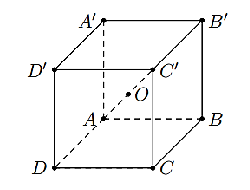
Ta có \(\overrightarrow {AC'} = \overrightarrow {AB} + \overrightarrow {AD} + \overrightarrow {AA'} \).
Mặt khác O là trung điểm AC' \( \Rightarrow \overrightarrow {AO} = \frac{1}{2}\overrightarrow {AC'} = \frac{1}{2}\left( {\overrightarrow {AB} + \overrightarrow {AD} + \overrightarrow {AA'} } \right)\).
Cho tứ diện ABCD. Điểm N xác định bởi đẳng thức sau \(\overrightarrow {AN} = \overrightarrow {AB} + \overrightarrow {AC} - \overrightarrow {AD} \). Mệnh đề nào đúng?
N là trung điểm BD;
N là đỉnh hình bình hành BCDN;
N là đỉnh hình bình hành CDBN;
N ≡ A.
Đáp án đúng là: C
Ta có \(\overrightarrow {AN} = \overrightarrow {AB} + \overrightarrow {AC} - \overrightarrow {AD} \)\( \Leftrightarrow \overrightarrow {AN} - \overrightarrow {AB} = \overrightarrow {AC} - \overrightarrow {AD} \)\( \Leftrightarrow \overrightarrow {BN} = \overrightarrow {DC} \).
Suy ra N là đỉnh thứ tư của hình bình hành CDBN.
Cho tứ diện S.ABC có M, N, P là trung điểm của SA, SB, SC. Tìm khẳng định đúng?
\[\overrightarrow {AB} = \frac{1}{2}\left( {\overrightarrow {PN} - \overrightarrow {PM} } \right)\];
\[\overrightarrow {AB} = \overrightarrow {PN} - \overrightarrow {PM} \];
\[\overrightarrow {AB} = 2\left( {\overrightarrow {PM} - \overrightarrow {PN} } \right)\];
\[\overrightarrow {AB} = 2\left( {\overrightarrow {PN} - \overrightarrow {PM} } \right)\].
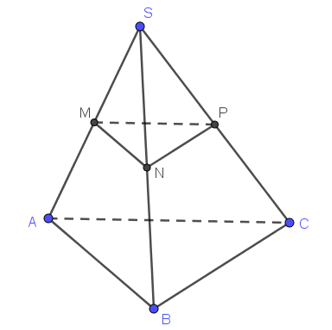
\[\overrightarrow {AB} + \overrightarrow {CD} = \overrightarrow {AB} + \overrightarrow {BC} \].
\[\overrightarrow {AB} + \overrightarrow {CD} = \overrightarrow {DA} + \overrightarrow {CB} \].
\[\overrightarrow {AB} + \overrightarrow {CD} = \overrightarrow {DA} + \overrightarrow {BC} \].
\[\overrightarrow {AB} + \overrightarrow {CD} = \overrightarrow {AD} + \overrightarrow {CB} \].
Hướng dẫn giải:
Đáp án đúng là: D
Ta có \(\overrightarrow {AB} + \overrightarrow {CD} = \overrightarrow {AD} + \overrightarrow {DB} + \overrightarrow {CD} \)\( = \overrightarrow {AD} + \left( {\overrightarrow {CD} + \overrightarrow {DB} } \right)\)\( = \overrightarrow {AD} + \overrightarrow {CB} \).
Cho hình chóp S.ABCD có đáy ABCD là hình bình hành tâm O. Chọn mệnh đề đúng.
\[\overrightarrow {SA} + \overrightarrow {SB} + \overrightarrow {SC} + \overrightarrow {SD} = 4\overrightarrow {SO} \].
\[\overrightarrow {SA} + \overrightarrow {SB} + \overrightarrow {SC} + \overrightarrow {SD} = 8\overrightarrow {SO} \].
\[\overrightarrow {SA} + \overrightarrow {SB} + \overrightarrow {SC} + \overrightarrow {SD} = 2\overrightarrow {SO} \].
\[\overrightarrow {SA} + \overrightarrow {SB} + \overrightarrow {SC} + \overrightarrow {SD} = 4\overrightarrow {OS} \].
Hướng dẫn giải:
Đáp án đúng là: A
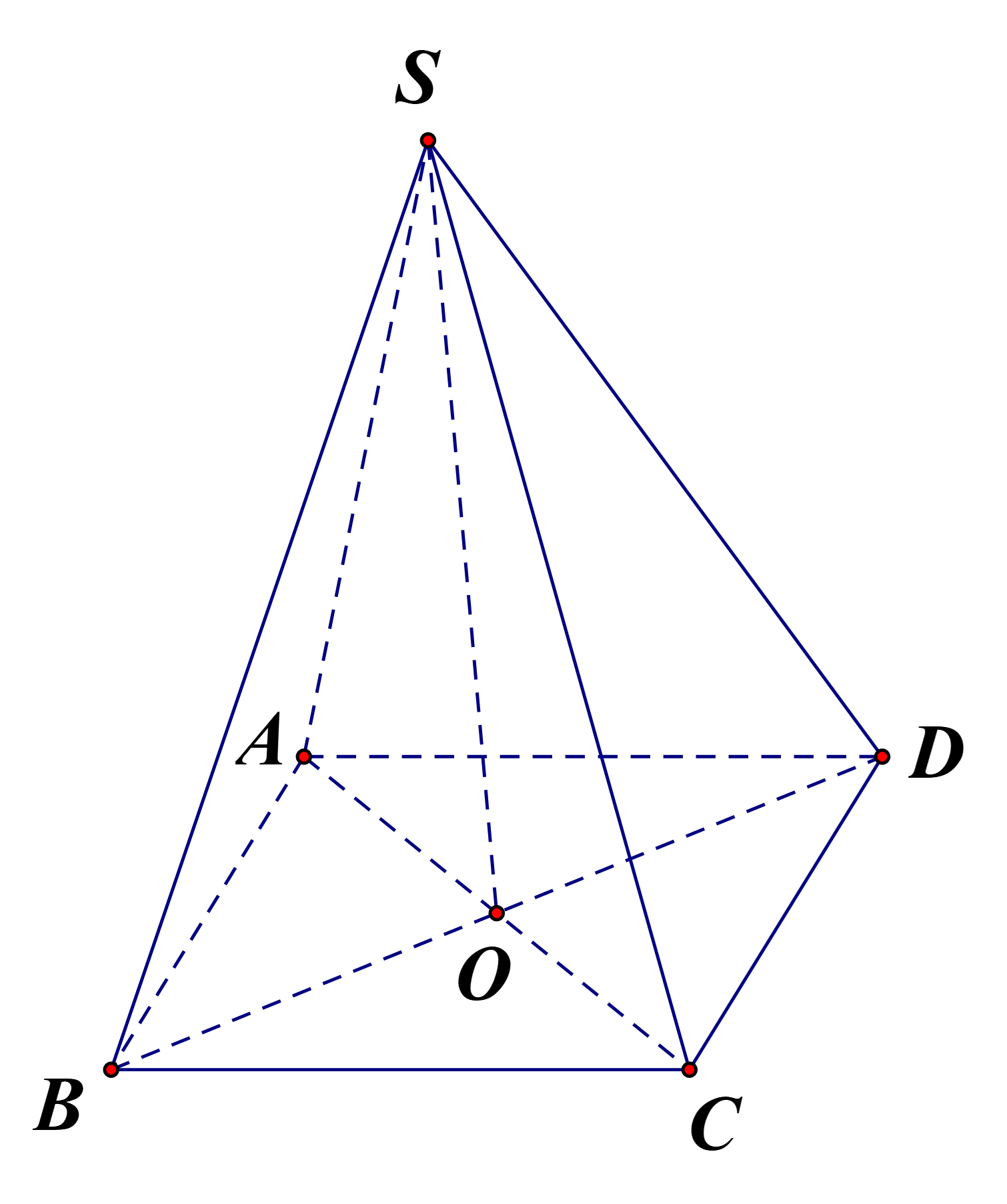
Vì ABCD là hình bình hành nên O là trung điểm của AC, BD.
Khi đó \(\overrightarrow {SA} + \overrightarrow {SC} = 2\overrightarrow {SO} ;\overrightarrow {SB} + \overrightarrow {SD} = 2\overrightarrow {SO} \).
Khi đó \[\overrightarrow {SA} + \overrightarrow {SB} + \overrightarrow {SC} + \overrightarrow {SD} = 4\overrightarrow {SO} \].
Cho hình hộp ABCD.A'B'C'D'. Trong các khẳng định sau khẳng định nào sai?
\(\overrightarrow {AC'} + \overrightarrow {A'C} = 2\overrightarrow {AC} \).
\(\overrightarrow {AC'} + \overrightarrow {CA'} + 2\overrightarrow {C'C} = \overrightarrow 0 \).
\(\overrightarrow {AC'} + \overrightarrow {A'C} = \overrightarrow {AA'} \).
\(\overrightarrow {CA'} + \overrightarrow {AC} = \overrightarrow {CC'} \).
Hướng dẫn giải:
Đáp án đúng là: C
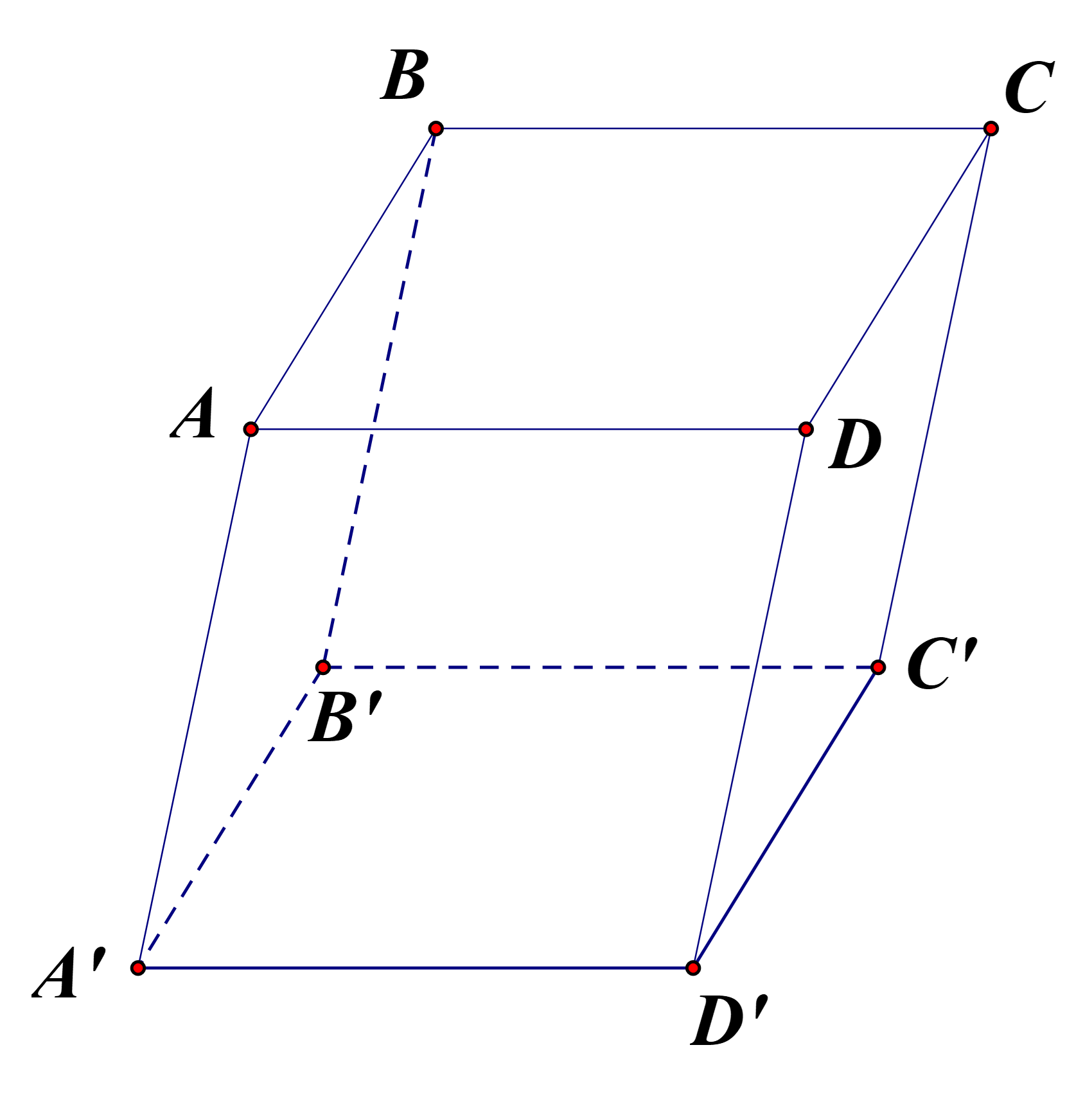
Ta có \(\overrightarrow {AC'} + \overrightarrow {A'C} = \overrightarrow {AC'} + \overrightarrow {A'A} + \overrightarrow {AC} \)\( = \overrightarrow {AC'} + \overrightarrow {C'C} + \overrightarrow {AC} \)\( = \overrightarrow {AC} + \overrightarrow {AC} = 2\overrightarrow {AC} \).
\(\overrightarrow {B'C} = \overrightarrow a + \overrightarrow b - \overrightarrow c \).
\(\overrightarrow {B'C} = - \overrightarrow a + \overrightarrow b - \overrightarrow c \).
\(\overrightarrow {B'C} = \overrightarrow a + \overrightarrow b + \overrightarrow c \).
\(\overrightarrow {B'C} = - \overrightarrow a - \overrightarrow b + \overrightarrow c \).
Hướng dẫn giải:
Đáp án đúng là: D
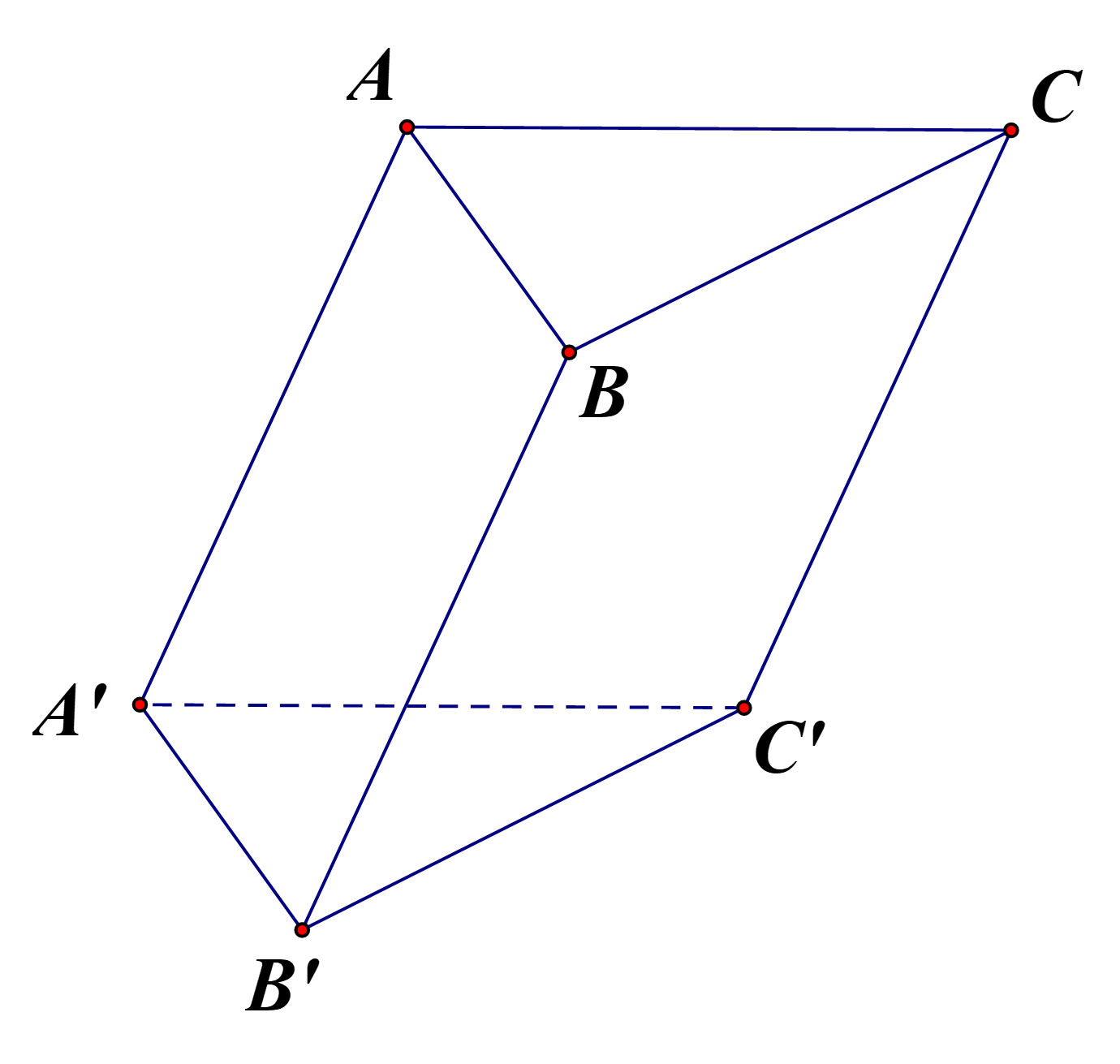
Vì BB'C'C là hình bình hành nên \(\overrightarrow {B'C} = \overrightarrow {B'C'} + \overrightarrow {B'B} = \overrightarrow {BC} - \overrightarrow {AA'} \)\( = - \overrightarrow {AA'} + \overrightarrow {BA} + \overrightarrow {AC} \)\( = - \overrightarrow {AA'} - \overrightarrow {AB} + \overrightarrow {AC} = - \overrightarrow a - \overrightarrow b + \overrightarrow c \).
\(\overrightarrow {AM} = - \overrightarrow a + \overrightarrow b + \frac{1}{2}\overrightarrow c \).
\(\overrightarrow {AM} = - \overrightarrow a - \frac{1}{2}\overrightarrow b + \overrightarrow c \).
\(\overrightarrow {AM} = - \frac{1}{2}\overrightarrow a + \overrightarrow b + \overrightarrow c \).
\[\overrightarrow {AM} = \overrightarrow a + \frac{1}{2}\overrightarrow b - \overrightarrow c \].
Hướng dẫn giải:
Đáp án đúng là: A
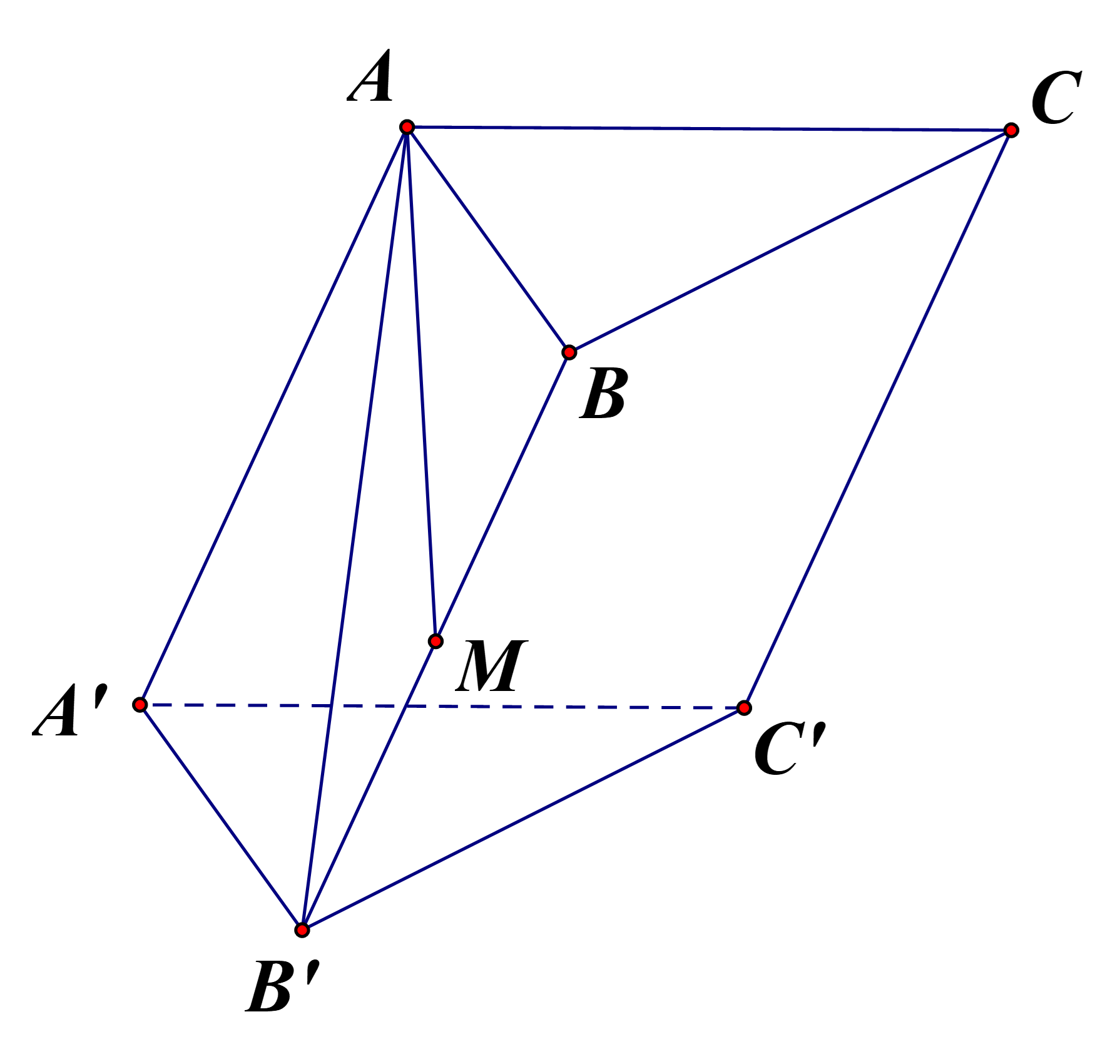
Có \[\overrightarrow {AM} = \frac{1}{2}\left( {\overrightarrow {AB} + \overrightarrow {AB'} } \right) = \frac{1}{2}\left( {\overrightarrow {AB} + \overrightarrow {AA'} + \overrightarrow {AB} } \right)\]\[ = \overrightarrow {AB} + \frac{1}{2}\overrightarrow {AA'} \]\[ = \overrightarrow {CB} - \overrightarrow {CA} + \frac{1}{2}\overrightarrow {CC'} \]
\[ = \overrightarrow b - \overrightarrow a + \frac{1}{2}\overrightarrow c \].
Cho tứ diện ABCD. Gọi M, N lần lượt là trung điểm của AB, CD và I là trung điểm của MN. Gọi G là trọng tâm của tam giác BCD.
\(\overrightarrow {MA} + \overrightarrow {MB} = \overrightarrow 0 \).
\(\overrightarrow {AC} + \overrightarrow {BD} = 2\overrightarrow {MN} \).
\(\overrightarrow {IA} + \overrightarrow {IB} + \overrightarrow {IC} + \overrightarrow {ID} = \overrightarrow 0 \).
\(3\overrightarrow {AI} - 2\overrightarrow {AG} = \overrightarrow 0 \).
Hướng dẫn giải:
Đáp án: a) Đúng. b) Đúng. c) Đúng. d) Sai.
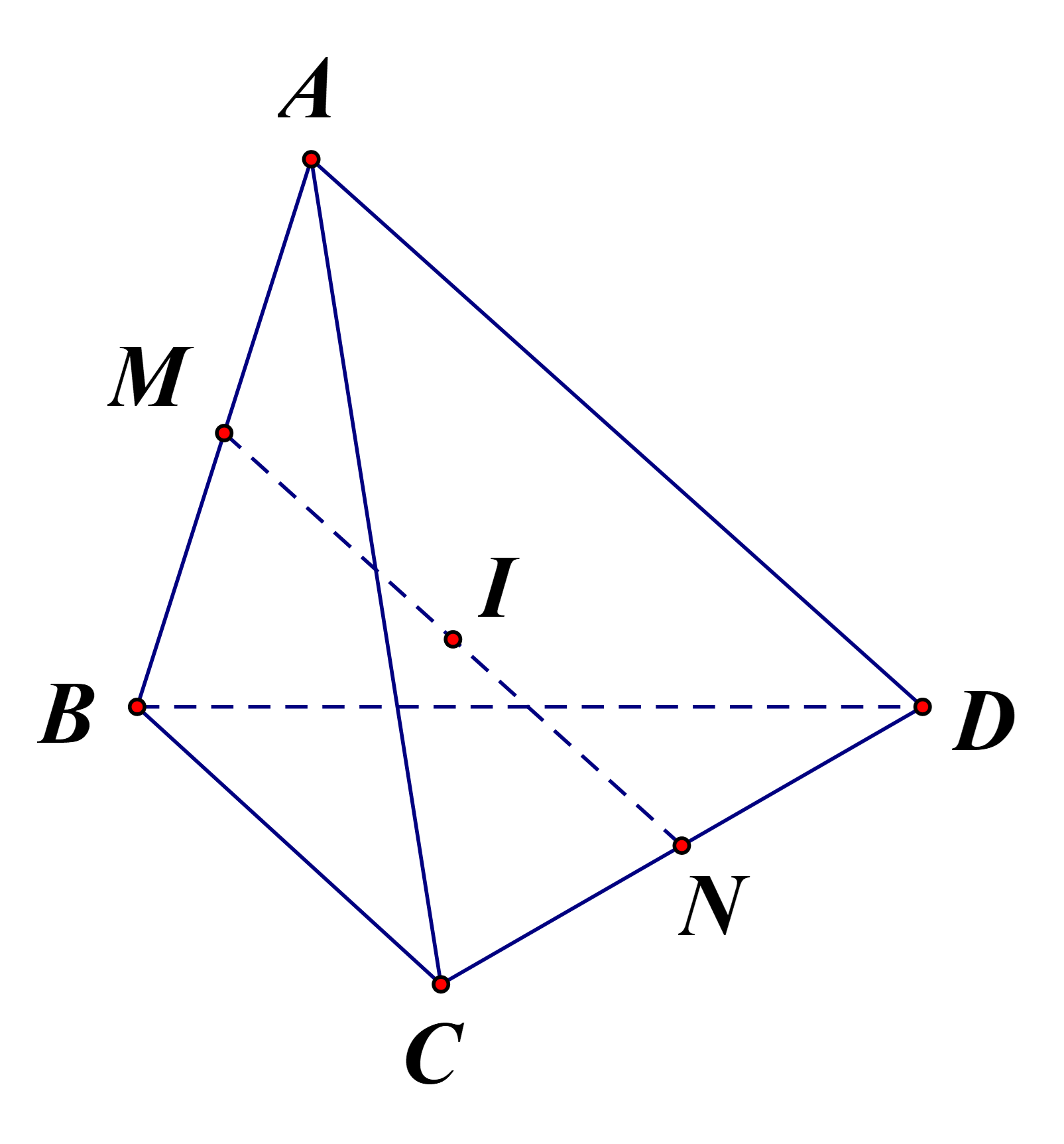
a) Đúng.Vì M là trung điểm của AB nên \(\overrightarrow {MA} + \overrightarrow {MB} = \overrightarrow 0 \).
b) Đúng. Ta có \(\overrightarrow {AC} + \overrightarrow {BD} = \overrightarrow {AM} + \overrightarrow {MN} + \overrightarrow {NC} + \overrightarrow {BM} + \overrightarrow {MN} + \overrightarrow {ND} \)
\( = \overrightarrow {AM} + \overrightarrow {BM} + 2\overrightarrow {MN} + \overrightarrow {NC} + \overrightarrow {ND} \)\( = 2\overrightarrow {MN} \).
c) Đúng. Vì M là trung điểm của AB nên \(\overrightarrow {IA} + \overrightarrow {IB} = 2\overrightarrow {IM} \).
Vì N là trung điểm của CD nên \(\overrightarrow {IC} + \overrightarrow {ID} = 2\overrightarrow {IN} \).
Mà I là trung điểm của MN nên \(\overrightarrow {IM} + \overrightarrow {IN} = \overrightarrow 0 \).
Khi đó \(\overrightarrow {IA} + \overrightarrow {IB} + \overrightarrow {IC} + \overrightarrow {ID} = 2\overrightarrow {IM} + 2\overrightarrow {IN} = 2\left( {\overrightarrow {IM} + \overrightarrow {IN} } \right) = \overrightarrow 0 \).
d) Sai. Vì \(\overrightarrow {IA} + \overrightarrow {IB} + \overrightarrow {IC} + \overrightarrow {ID} = \overrightarrow 0 \) nên \(4\overrightarrow {AI} + \overrightarrow {AB} + \overrightarrow {AC} + \overrightarrow {AD} = \overrightarrow 0 \).
Mà G là trọng tâm của tam giác BCD nên \(\overrightarrow {AB} + \overrightarrow {AC} + \overrightarrow {AD} = 3\overrightarrow {AG} \).
Do đó \(4\overrightarrow {AI} + 3\overrightarrow {AG} = \overrightarrow 0 \).
Trong không gian, cho hình lập phương ABCD.A'B'C'D'. Gọi I là tâm hình vuông ABCD. Gọi G là trọng tâm tam giác AB'C.
\(\overrightarrow {AB} + \overrightarrow {AD} + \overrightarrow {AA'} = \overrightarrow {AC'} \).
\(\overrightarrow {GA} + \overrightarrow {GB'} + \overrightarrow {GC} = 2\overrightarrow {GI} \).
\(\overrightarrow {AB} + \overrightarrow {AD} = \overrightarrow {A'C'} \).
\(\overrightarrow {BD'} = 2\overrightarrow {BG} \).
Hướng dẫn giải:
Đáp án: a) Đúng. b) Sai. c) Đúng. d) Sai.
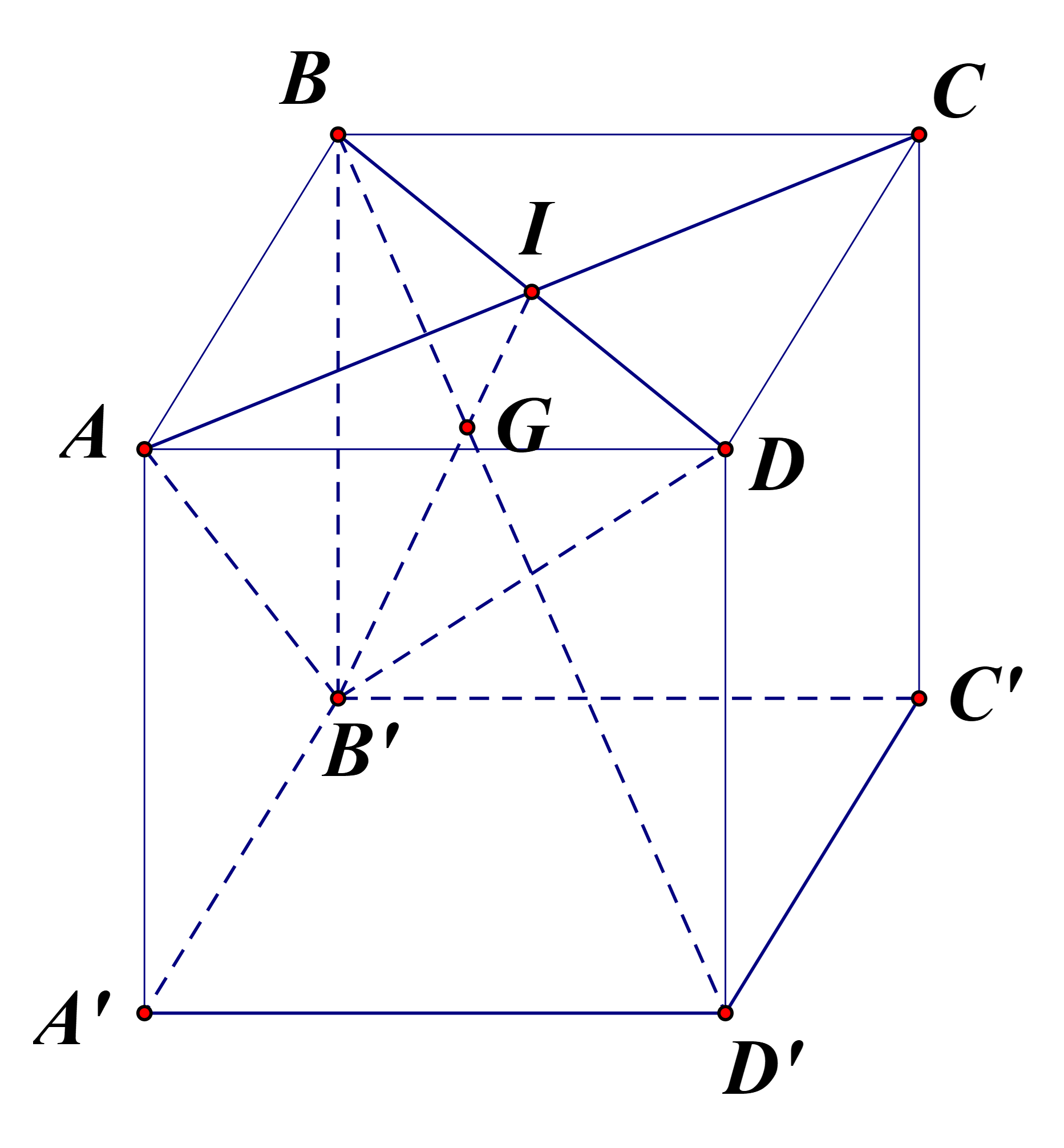
a) Đúng. Theo quy tắc hình hộp thì \(\overrightarrow {AB} + \overrightarrow {AD} + \overrightarrow {AA'} = \overrightarrow {AC'} \).
b) Sai. G là trọng tâm của tam giác AB'C nên \(\overrightarrow {GA} + \overrightarrow {GB'} + \overrightarrow {GC} = \overrightarrow 0 \).
c) Đúng. Ta có \(\overrightarrow {AB} + \overrightarrow {AD} = \overrightarrow {AC} = \overrightarrow {A'C'} \).
d) Sai. Ta có DBIG đồng dạng với DD'B'G nên
\(\frac{{BG}}{{D'G}} = \frac{{BI}}{{D'B'}} = \frac{1}{2} \Rightarrow \frac{{BG}}{{BD'}} = \frac{1}{3} \Rightarrow \overrightarrow {BD'} = 3\overrightarrow {BG} .\)
\(\overrightarrow {AG} = \frac{1}{3}\left( {\overrightarrow {AA'} + \overrightarrow {AB'} + \overrightarrow {AC'} } \right)\).
\(\overrightarrow {AG} = \overrightarrow a + \frac{1}{3}\left( {\overrightarrow b - \overrightarrow c } \right)\).
\(\overrightarrow {CG} = \overrightarrow a - \frac{1}{3}\overrightarrow b + \frac{2}{3}\overrightarrow c \).
\(\overrightarrow {BG} = \overrightarrow a + \frac{2}{3}\overrightarrow b + \frac{1}{3}\overrightarrow c \).
Hướng dẫn giải:
Đáp án: a) Đúng. b) Sai. c) Sai. d) Sai.
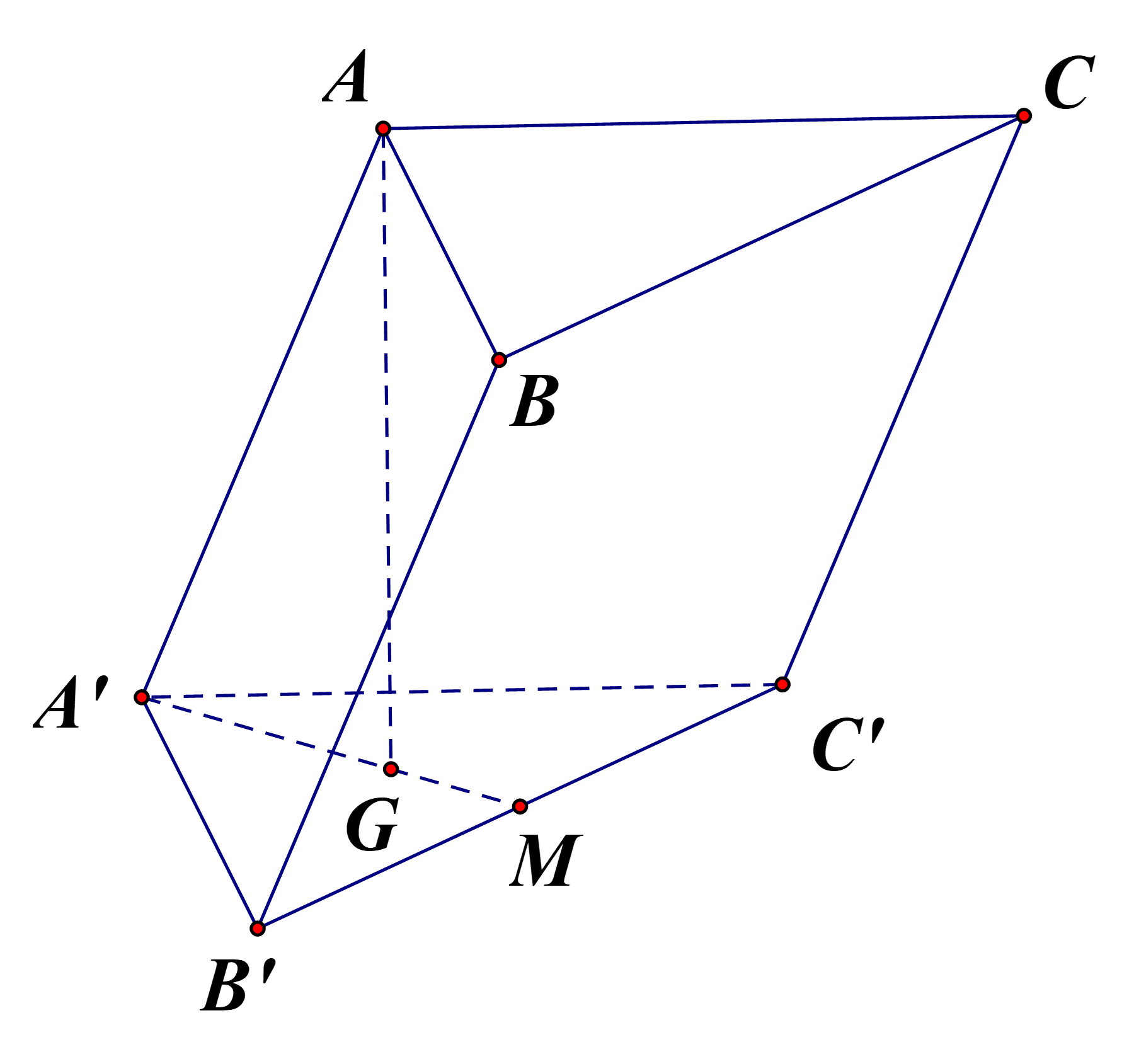
a) Đúng.Gọi M là trung điểm của B'C'.
Ta có \(\overrightarrow {AG} = \overrightarrow {AA'} + \overrightarrow {A'G} \)\( = \overrightarrow {AA'} + \frac{2}{3}\overrightarrow {A'M} \)\( = \overrightarrow {AA'} + \frac{1}{3}\left( {\overrightarrow {A'B'} + \overrightarrow {A'C'} } \right)\)
\( = \overrightarrow {AA'} + \frac{1}{3}\left( {\overrightarrow {AB'} - \overrightarrow {AA'} + \overrightarrow {AC'} - \overrightarrow {AA'} } \right)\)\( = \frac{1}{3}\left( {\overrightarrow {AA'} + \overrightarrow {AB'} + \overrightarrow {AC'} } \right)\).
b) Sai. \(\overrightarrow {AG} = \frac{1}{3}\left( {\overrightarrow {AA'} + \overrightarrow {AB'} + \overrightarrow {AC'} } \right)\)\( = \frac{1}{3}\left( {\overrightarrow {AA'} + \overrightarrow {AB} + \overrightarrow {BB'} + \overrightarrow {AC} + \overrightarrow {CC'} } \right)\)
\[ = \overrightarrow {AA'} + \frac{1}{3}\left( {\overrightarrow {AB} + \overrightarrow {AC} } \right)\]\[ = \overrightarrow a + \frac{1}{3}\left( {\overrightarrow b + \overrightarrow c } \right)\].
c) Sai. Tương tự: \(\overrightarrow {CG} = \overrightarrow {CC'} + \overrightarrow {C'G} \)\( = \overrightarrow {CC'} + \frac{1}{3}\left( {\overrightarrow {C'A'} + \overrightarrow {C'B'} } \right)\)\( = \overrightarrow {CC'} + \frac{1}{3}\left( { - \overrightarrow {AC} + \overrightarrow {CB} } \right)\)
\( = \overrightarrow {AA'} + \frac{1}{3}\left( { - \overrightarrow {AC} + \overrightarrow {AB} - \overrightarrow {AC} } \right)\)\( = \overrightarrow a + \frac{1}{3}\left( {\overrightarrow b - 2\overrightarrow c } \right)\).
d) Sai. \[\overrightarrow {BG} = \overrightarrow {AG} - \overrightarrow {AB} \]\( = \overrightarrow a + \frac{1}{3}\left( {\overrightarrow b + \overrightarrow c } \right) - \overrightarrow b = \overrightarrow a - \frac{2}{3}\overrightarrow b + \frac{1}{3}\overrightarrow c \).
Cho tứ diện ABCD. Gọi I là trung điểm CD.
\[\overrightarrow {AI} = \frac{1}{2}\overrightarrow {AC} + \frac{1}{2}\overrightarrow {AB} + \frac{1}{2}\overrightarrow {BD} \].
\(\overrightarrow {BI} = \overrightarrow {BC} + \overrightarrow {BD} \).
\(\overrightarrow {BI} = \overrightarrow {BA} - \frac{1}{2}\overrightarrow {CA} - \frac{1}{2}\overrightarrow {DA} \).
\(\overrightarrow {AI} = \overrightarrow {AC} + \overrightarrow {AD} + \overrightarrow {BD} \).
Hướng dẫn giải:
Đáp án: a) Đúng. b) Sai. c) Đúng. d) Sai.
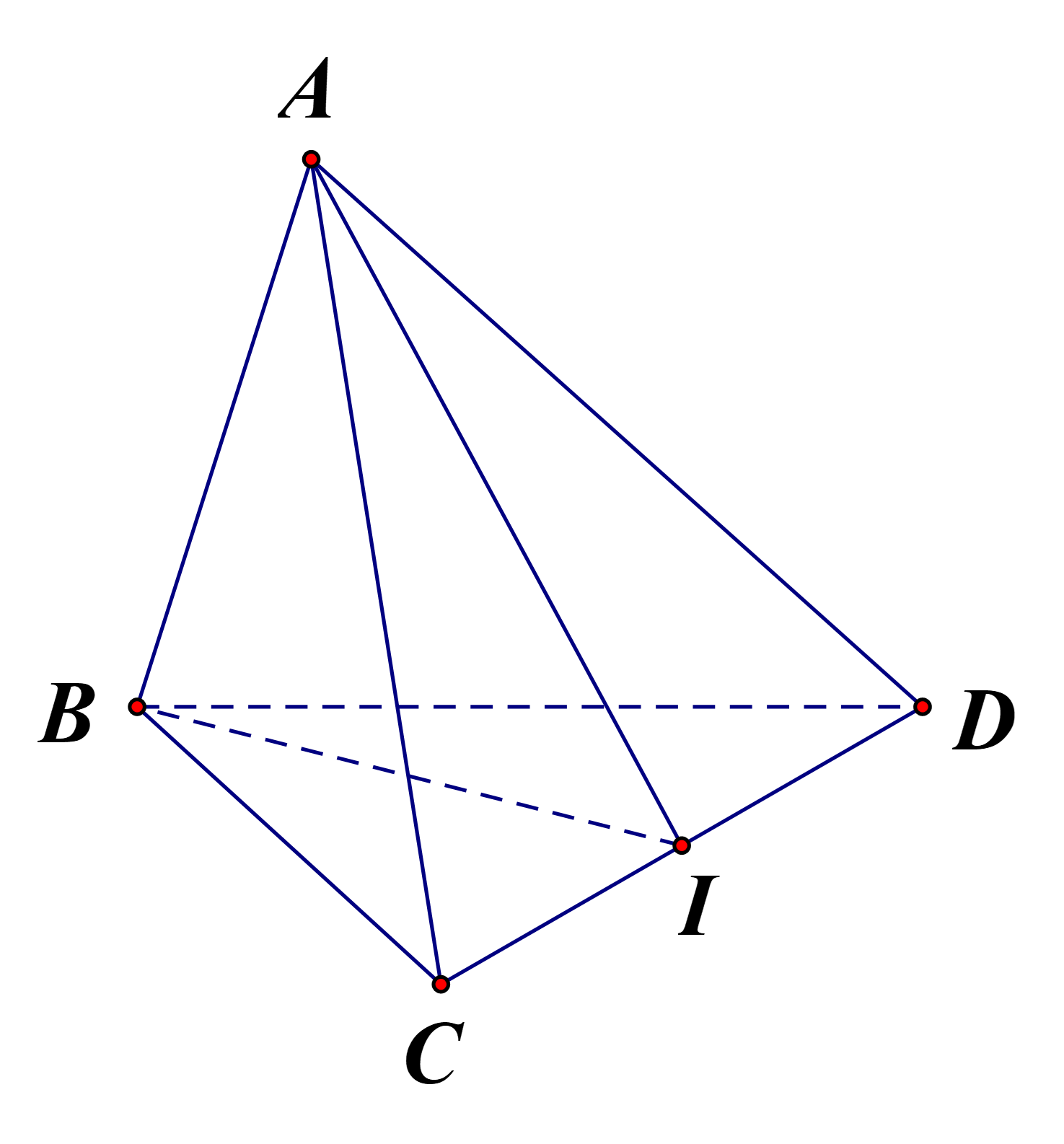
a) Đúng. \[\overrightarrow {AI} = \frac{1}{2}\overrightarrow {AC} + \frac{1}{2}\overrightarrow {AD} \]\[ = \frac{1}{2}\overrightarrow {AC} + \frac{1}{2}\overrightarrow {AB} + \frac{1}{2}\overrightarrow {BD} \].
b) Sai. \(\overrightarrow {BI} = \frac{1}{2}\overrightarrow {BC} + \frac{1}{2}\overrightarrow {BD} \).
c) Đúng. \(\overrightarrow {BI} = \frac{1}{2}\overrightarrow {BC} + \frac{1}{2}\overrightarrow {BD} = \frac{1}{2}\left( {\overrightarrow {BA} + \overrightarrow {AC} } \right) + \frac{1}{2}\left( {\overrightarrow {BA} + \overrightarrow {AD} } \right)\)\[ = \overrightarrow {BA} - \frac{1}{2}\overrightarrow {CA} - \frac{1}{2}\overrightarrow {DA} \].
d) Sai. Theo câu a, \[AI = \frac{1}{2}\overrightarrow {AC} + \frac{1}{2}\overrightarrow {AB} + \frac{1}{2}\overrightarrow {BD} \]\[ = \frac{1}{2}\overrightarrow {AC} + \frac{1}{2}\overrightarrow {AD} + \frac{1}{2}\overrightarrow {DB} + \frac{1}{2}\overrightarrow {BD} \]
\[ = \frac{1}{2}\overrightarrow {AC} + \frac{1}{2}\overrightarrow {AD} \].
Cho lăng trụ tam giác đều ABC.A'B'C' có tất cả các cạnh bằng a, G là trọng tâm tam giác ABC.
\(\overrightarrow {AB} = \overrightarrow {AC} \).
\(\left| {\overrightarrow {CC'} + \overrightarrow {AB} } \right| = a\sqrt 2 \).
\(\overrightarrow {A'G} = \overrightarrow {A'A} + \overrightarrow {A'B} + \overrightarrow {A'C} \).
\(\left| {\overrightarrow {A'A} + \overrightarrow {A'B} + \overrightarrow {A'C} } \right| = \frac{{2a\sqrt 3 }}{3}\).
Hướng dẫn giải:
Đáp án: a) Sai. b) Đúng. c) Sai. d) Sai.
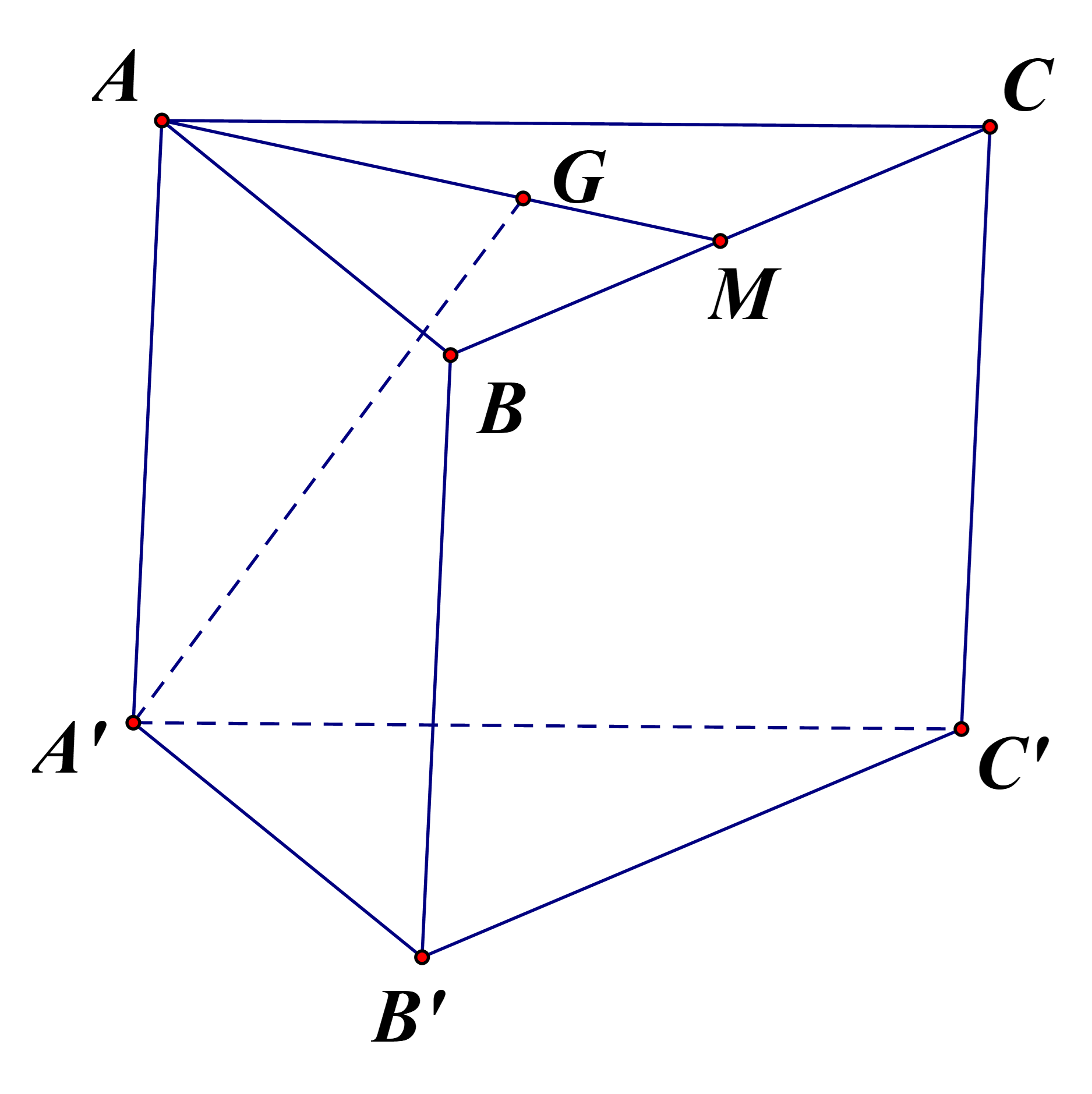
a) Sai. Ta có \(\overrightarrow {AB} ,\overrightarrow {AC} \) không cùng hướng nên chúng không bằng nhau.
b) Đúng. \(\overrightarrow {CC'} + \overrightarrow {AB} = \overrightarrow {AA'} + \overrightarrow {AB} = \overrightarrow {AB'} \).
Khi đó \(\left| {\overrightarrow {CC'} + \overrightarrow {AB} } \right| = \left| {\overrightarrow {AB'} } \right| = a\sqrt 2 \).
c) Sai. Do G là trọng tâm tam giác ABC nên \(\overrightarrow {GA} + \overrightarrow {GB} + \overrightarrow {GC} = \overrightarrow 0 \).
Khi đó \(\overrightarrow {A'A} + \overrightarrow {A'B} + \overrightarrow {A'C} \)\( = \overrightarrow {A'G} + \overrightarrow {GA} + \overrightarrow {A'G} + \overrightarrow {GB} + \overrightarrow {A'G} + \overrightarrow {GC} \)\( = 3\overrightarrow {A'G} \).
d) Sai. \(\left| {\overrightarrow {A'A} + \overrightarrow {A'B} + \overrightarrow {A'C} } \right| = 3\left| {\overrightarrow {A'G} } \right|\).
Gọi M là trung điểm của BC.
Ta có \(AG = \frac{2}{3}AM = \frac{2}{3} \cdot \frac{{a\sqrt 3 }}{2} = \frac{{a\sqrt 3 }}{3}\).
Xét tam giác AA'G, ta có \(A'G = \sqrt {A{{A'}^2} + A{G^2}} = \sqrt {{a^2} + {{\left( {\frac{{a\sqrt 3 }}{3}} \right)}^2}} = \frac{{2a\sqrt 3 }}{3}\).
Vậy \(\left| {\overrightarrow {A'A} + \overrightarrow {A'B} + \overrightarrow {A'C} } \right| = 3\left| {\overrightarrow {A'G} } \right| = 2a\sqrt 3 \).
Cho hình hộp ABCD.A'B'C'D'. Biết \(\overrightarrow {BD} - \overrightarrow {D'D} - \overrightarrow {B'D'} = k\overrightarrow {BB'} \). Tìm k.
Hướng dẫn giải:
Đáp án: 1
Có \(\overrightarrow {BD} - \overrightarrow {D'D} - \overrightarrow {B'D'} \)\( = \overrightarrow {BD} + \overrightarrow {DD'} + \overrightarrow {D'B'} = \overrightarrow {BB'} \).
Suy ra k = 1.
Cho hình hộp ABCD.A'B'C'D'. Gọi G là trọng tâm tam giác AB'D'. Biết \(\overrightarrow {A'C} = k\overrightarrow {A'G} \). Tìm k.
Hướng dẫn giải:
Đáp án: 3
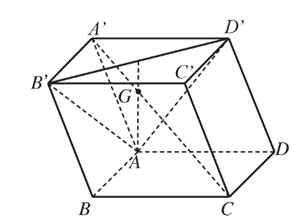
Theo quy tắc hình hộp, ta có \(\overrightarrow {A'A} + \overrightarrow {A'B'} + \overrightarrow {A'D'} = \overrightarrow {A'C} \).
Mặt khác, G là trọng tâm tam giác AB'D' nên \(\overrightarrow {A'A} + \overrightarrow {A'B'} + \overrightarrow {A'D'} = 3\overrightarrow {A'G} \).
Do đó \(\overrightarrow {A'C} = 3\overrightarrow {A'G} \). Suy ra k = 3.
Cho hình hộp ABCD.EFGH. Gọi O là trung điểm CH. Biết \(\overrightarrow {BO} = m\overrightarrow {BA} + n\overrightarrow {BC} + p\overrightarrow {BF} \). Tính m + n + p.
Hướng dẫn giải:
Đáp án: 2
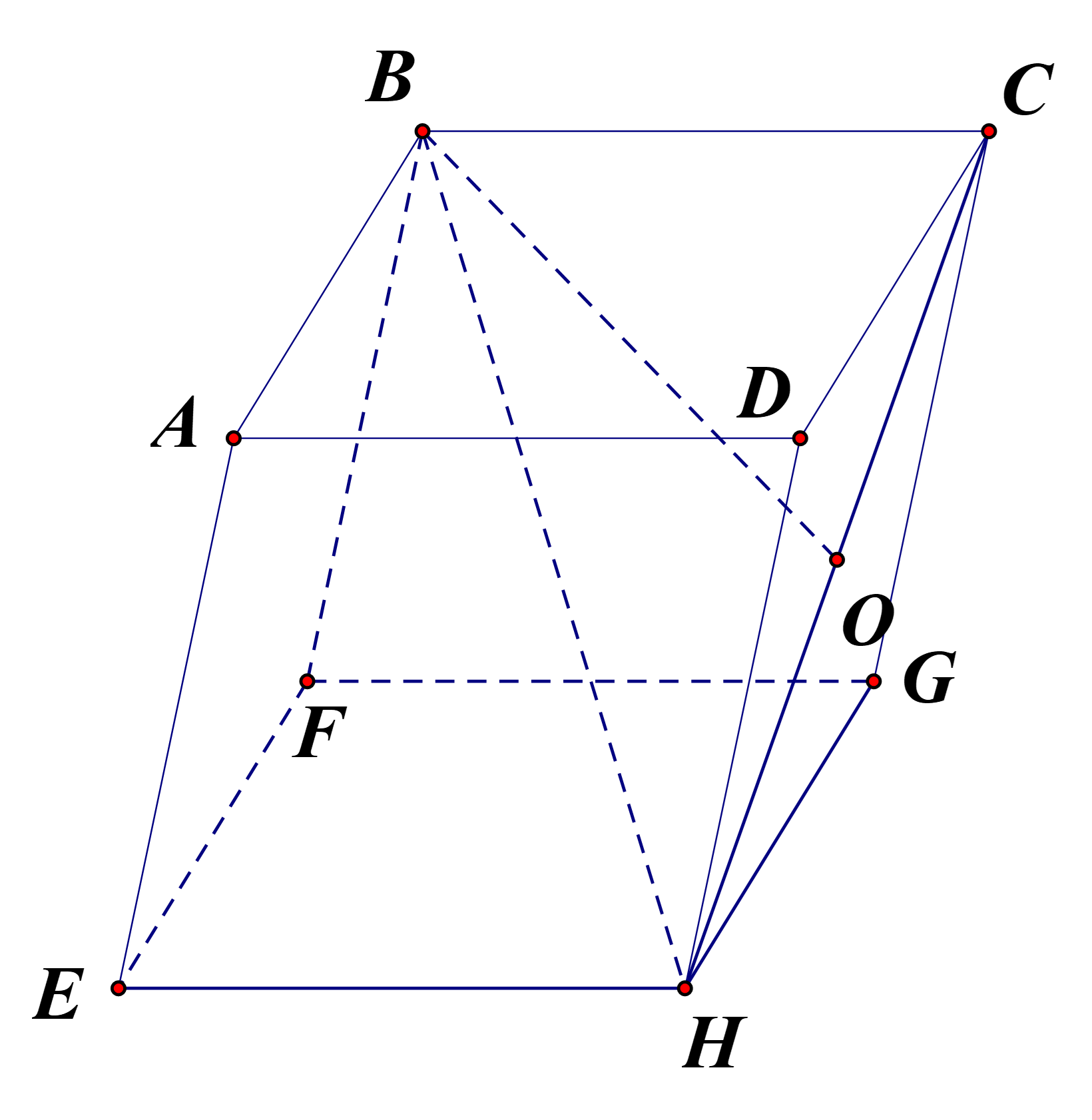
Có \(\overrightarrow {BO} = \frac{1}{2}\left( {\overrightarrow {BC} + \overrightarrow {BH} } \right)\)\( = \frac{1}{2}\left( {\overrightarrow {BC} + \overrightarrow {BC} + \overrightarrow {BA} + \overrightarrow {BF} } \right)\)\( = \overrightarrow {BC} + \frac{1}{2}\overrightarrow {BA} + \frac{1}{2}\overrightarrow {BF} \).
Suy ra \(m = \frac{1}{2};n = 1;p = \frac{1}{2}\). Do đó m + n + p = 2.
Cho hình chóp S.ABC. Trên đoạn SA lấy M sao cho \(\overrightarrow {MS} = - 2\overrightarrow {MA} \) và trên đoạn BC lấy điểm N sao cho \(\overrightarrow {NB} = - \frac{1}{2}\overrightarrow {NC} \). Biết \[\overrightarrow {MN} = \frac{2}{a}\overrightarrow {AB} + \frac{1}{a}\overrightarrow {SC} \]. Tìm a.
Hướng dẫn giải:
Đáp án: 3
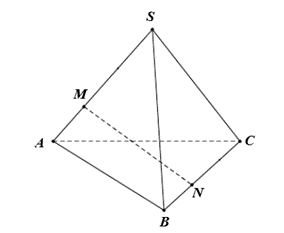
Ta có \(\overrightarrow {MN} = \overrightarrow {MA} + \overrightarrow {AB} + \overrightarrow {BN} \) (1); \(\overrightarrow {MN} = \overrightarrow {MS} + \overrightarrow {SC} + \overrightarrow {CN} \) (2).
Nhân cả hai vế của (1) với 2 rồi cộng với (2), ta được
\(3\overrightarrow {MN} = \left( {2\overrightarrow {MA} + \overrightarrow {MS} } \right) + \left( {2\overrightarrow {AB} + \overrightarrow {SC} } \right) + \left( {2\overrightarrow {BN} + \overrightarrow {CN} } \right)\).
Do \(\overrightarrow {MS} = - 2\overrightarrow {MA} \) và \(\overrightarrow {NB} = - \frac{1}{2}\overrightarrow {NC} \) nên \[\left\{ \begin{array}{l}2\overrightarrow {MA} + \overrightarrow {MS} = \overrightarrow 0 \\2\overrightarrow {BN} + \overrightarrow {CN} = \overrightarrow 0 \end{array} \right.\].
Suy ra \(3\overrightarrow {MN} = 2\overrightarrow {AB} + \overrightarrow {SC} \). Do đó \[\overrightarrow {MN} = \frac{2}{3}\overrightarrow {AB} + \frac{1}{3}\overrightarrow {SC} \]. Vậy a = 3.
Cho hình lăng trụ tam giác ABC.A'B'C' có \(\overrightarrow {AA'} = \overrightarrow a ,\overrightarrow {AB} = \overrightarrow b ,\overrightarrow {AC} = \overrightarrow c \). Gọi D là điểm đối xứng B qua C. Biết \[\overrightarrow {A'D} = m\overrightarrow a + n\overrightarrow b + p\overrightarrow c \]. Tính giá trị biểu thức T = 100p + 10m + n.
Hướng dẫn giải:
Đáp án: −108
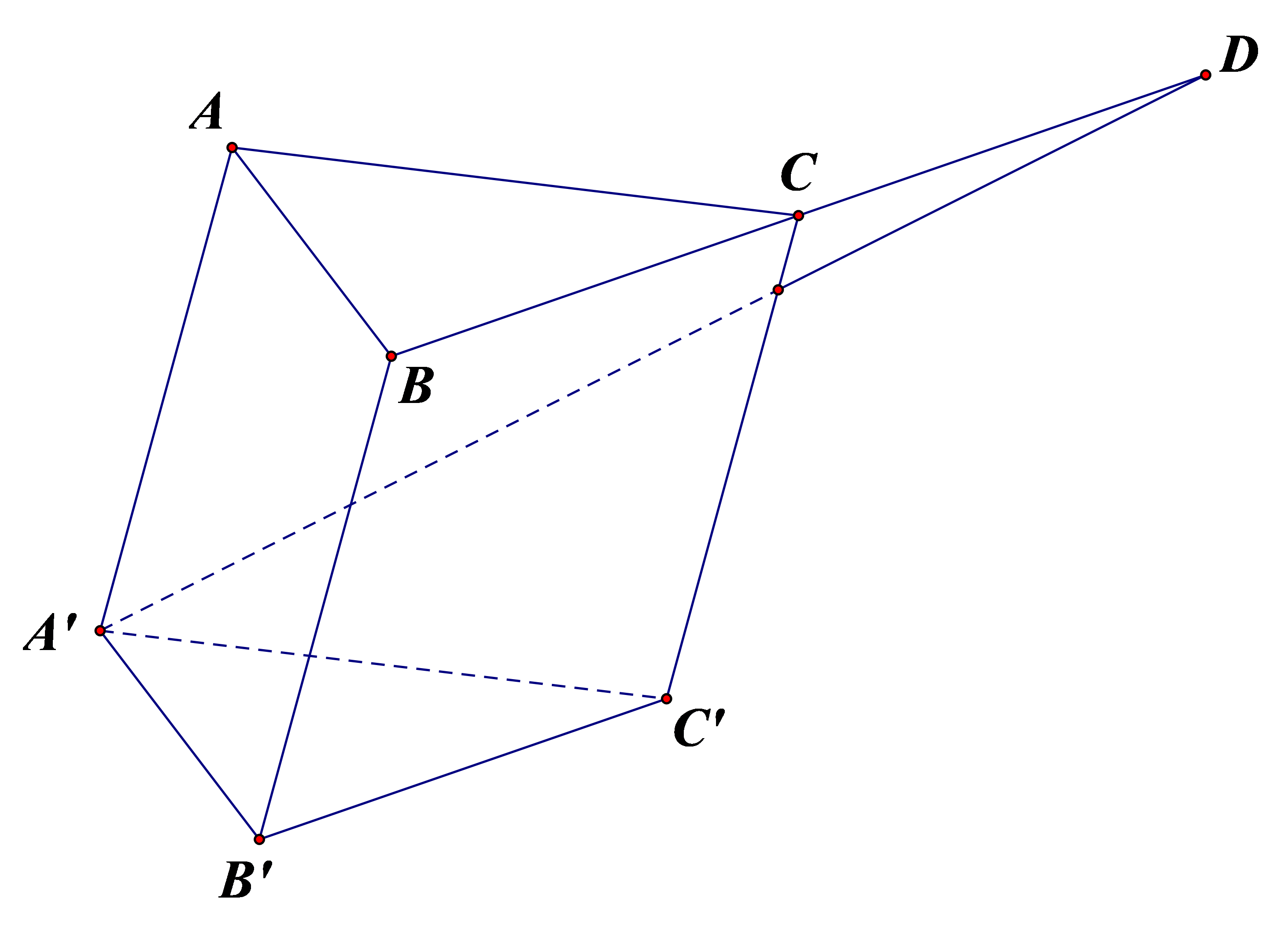
Có \(\overrightarrow {BC} = \overrightarrow {CD} \). Suy ra \(\overrightarrow {BD} = 2\overrightarrow {BC} \).
Có \(\overrightarrow {A'D} = \overrightarrow {A'B} + \overrightarrow {BD} \)\( = \overrightarrow {AB} - \overrightarrow {AA'} + 2\overrightarrow {BC} \)\( = \overrightarrow {AB} - \overrightarrow {AA'} + 2\left( {\overrightarrow {AC} - \overrightarrow {AB} } \right)\)
\( = - \overrightarrow {AB} - \overrightarrow {AA'} + 2\overrightarrow {AC} \)\( = - \overrightarrow a - \overrightarrow b + 2\overrightarrow c \).
Suy ra m = −1; n = −1; p = 2.
Vậy T = 100p + 10m + n = −108.
Bạn có thích hoạt động này không?