Bài tập đọc điền vào chỗ trống (Có đáp án) (Đề 8)
50 câu hỏi
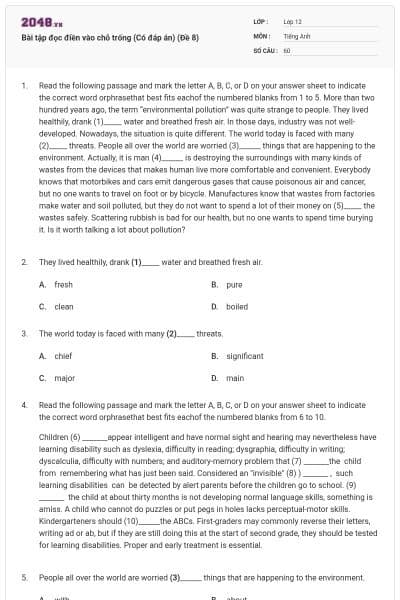
Read the following passage and mark the letter A, B, C, or D on your answer sheet to indicate the correct word orphrasethat best fits eachof the numbered blanks from 1 to 5. More than two hundred years ago, the term “environmental pollution” was quite strange to people. They lived healthily, drank (1)_____ water and breathed fresh air. In those days, industry was not well-developed. Nowadays, the situation is quite different. The world today is faced with many (2)_____ threats. People all over the world are worried (3)______ things that are happening to the environment. Actually, it is man (4)______ is destroying the surroundings with many kinds of wastes from the devices that makes human live more comfortable and convenient. Everybody knows that motorbikes and cars emit dangerous gases that cause poisonous air and cancer, but no one wants to travel on foot or by bicycle. Manufactures know that wastes from factories make water and soil polluted, but they do not want to spend a lot of their money on (5)_____ the wastes safely. Scattering rubbish is bad for our health, but no one wants to spend time burying it. Is it worth talking a lot about pollution?
fresh
pure
clean
boiled
Kiến thức: Từ vựng
Giải thích:
fresh (adj): tươi, sạch pure (adj): tinh khiết
clean (adj): sạch sẽ boiled (adj): đun sôi
pure water: nước sạch
They lived healthily, drank (1) pure water and breathed fresh air.
Tạm dịch: Họ sống lành mạnh, uống nước tinh khiết và hít thở không khí trong lành.
Chọn B
chief
significant
major
main
Kiến thức: Từ vựng
Giải thích:
significant (adj): có ý nghĩa, quan trọngmajor (adj): lớn, nghiêm trọng
main =chief (adj): chủ yếu, chính
major threats: những mối đe dọa nghiêm trọng
The world today is faced with many (2) major threats.
Tạm dịch: Thế giới ngày nay đang phải đối mặt với nhiều mối đe dọa nghiêm trọng
Chọn C
with
about
of
by
Kiến thức: Giới từ
Giải thích: be worried about: lo lắng về
People all over the world are worried (3) about things that are happening to the environment.
Tạm dịch: Mọi người trên toàn thế giới lo lắng về những điều đang xảy ra với môi trường.
Chọn B
that
which
whom
where
Kiến thức: Câu chẻ
Giải thích: It is/was + cụm từ được nhấn mạnh + that/whom/who +…
Actually, it is man (4) that is destroying the surroundings with many kinds of wastes
Tạm dịch: Trên thực tế, chính con người đang phá hủy môi trường xung quanh với nhiều loại chất thải
Chọn A
solving
dealing
processing
treating
Kiến thức: Từ vựng
Giải thích:
solve (v): giải quyết deal (v): thỏa thuận
process (v): chế biến treat (v): xử lý (rác thải)
but they do not want to spend a lot of their money on (5) treating the wastes safely.
Tạm dịch: nhưng họ không muốn tốn nhiều tiền để xử lý chất thải an toàn
Chọn D
Dịch bài đọc:
Cách đây hơn hai trăm năm, thuật ngữ "ô nhiễm môi trường" khá lạ đối với người dân. Họ sống lành mạnh, uống nước tinh khiết và hít thở không khí trong lành. Ở thời đó, công nghiệp không phát triển. Ngày nay, tình hình khá khác biệt. Thế giới ngày nay đang phải đối mặt với nhiều mối đe dọa nghiêm trọng. Mọi người trên toàn thế giới lo lắng về những điều đang xảy ra với môi trường. Trên thực tế, chính con người đang phá hủy môi trường xung quanh với nhiều loại chất thải từ các thiết bị làm cho con người sống thoải mái hơn và thuận tiện hơn. Mọi người đều biết rằng xe máy và ô tô phát ra các khí độc hại gây ra không khí và ung thư độc hại, nhưng không ai muốn đi bộ bằng xe đạp hay đi bộ. Các nhà sản xuất biết rằng chất thải từ các nhà máy làm cho nước và đất bị ô nhiễm, nhưng họ không muốn tốn nhiều tiền để xử lý chất thải an toàn. Vứt rác bừa bãi không tốt cho sức khoẻ của chúng ta, nhưng không ai muốn dành thời gian chôn nó. Có đáng để nói nhiều về ô nhiễm không?
Read the following passage and mark the letter A, B, C, or D on your answer sheet to indicate the correct word orphrasethat best fits eachof the numbered blanks from 6 to 10.
Children (6) _______appear intelligent and have normal sight and hearing may nevertheless have learning disability such as dyslexia, difficulty in reading; dysgraphia, difficulty in writing; dyscalculia, difficulty with numbers; and auditory-memory problem that (7) _______the child from remembering what has just been said. Considered an "invisible" (8) ) _______ , such learning disabilities can be detected by alert parents before the children go to school. (9) _______ the child at about thirty months is not developing normal language skills, something is amiss. A child who cannot do puzzles or put pegs in holes lacks perceptual-motor skills. Kindergarteners should (10)______the ABCs. First-graders may commonly reverse their letters, writing ad or ab, but if they are still doing this at the start of second grade, they should be tested for learning disabilities. Proper and early treatment is essential.
whom
who
whose
they
Kiến thức: Mệnh đề quan hệ
Giải thích:
- whose + danh từ: dùng để thay cho tính từ sở hữu.
- who: được dùng thay cho các danh từ chỉ người, đóng vai trò chủ ngữ và tân ngữ
- whom: được dùng thay cho các danh từ người, đóng vai trò tân ngữ
Children (6) who appear intelligent and have normal sight and hearing may nevertheless have learning disability such as dyslexia, difficulty in reading; dysgraphia, difficulty in writing; dyscalculia,difficultywith numbers;
Tạm dịch: Trẻ em mà xuất hiệntrí thông minh và có thị lực và nghe bình thườngtuy nhiên có thểkhông có khả năng học tập như tình trạng không hiểu được chữ viết, khó khăn trong đọc; chứng không biết viết, khó khăn trong việc viết; hội chứng khó khăn trong việc làm các phép toán, gặp khó khăn với chữ số;
Chọn B
avoid
help
encourage
prevent
Kiến thức: Cụm động từ
Giải thích: prevent someone from doing something: cản ai làm gì.
and auditory-memory problem that (7) prevent the child from remembering what has just been said.
Tạm dịch: và vấn đề bộ nhớ thính giác mà ngăn cản trẻ em nhớ những gì mới được nói.
Đáp án D
barrier
retard
disabled
handicap
Kiến thức: Từ vựng
Giải thích:
A. barrier (n): rào cản B. retard (n): chậm
C. disabled (adj): không thể D. handicap (n): khuyết tật
Considered an "invisible"(8) barrier, such learning disabilities can be detected byalert parents before the children go toschool
Tạm dịch: Được xem như một rào cản “ vô hình”, như không có khả năng học tập có thể được phát hiện bởi những bậc cha mẹ tỉnh táo trước khi trẻ đi học.
Đáp án A
If
When
Although
Because
Kiến thức: Từ nối
Giải thích:
A. If : nếu B. When : khi
C. Although : mặc dù D. Because : bởi vì
Dùng “if” khi hành động mang ý nghĩa không chắc chắn sẽ xảy ra, dùng “when” khi hành động chắc chắn sẽ xảy ra.
(9) When the child at about thirty months isnot developing normal language skills, something is amiss.
Tạm dịch: Khi trẻ khoảng 30 tháng tuổi mà không phát triển kỹ năng ngồn ngữ bình thường, thì đã có thứ gì đó sai.
Chọn B
read
remember
recognize
pronounce
Kiến thức: Từ vựng
Giải thích:
A. read (v): đọc B. remember (v): nhớ
C. recognize (v): nhận ra D. pronounce (v): phát âm
Kindergarteners should (10) recognize the ABCs.
Tạm dịch: Mẫu giáo nên nhận ra được bảng chữ cái ABC.
Chọn C
Dịch đoạn văn:
Trẻ em mà xuất hiệntrí thông minh và có thị lực và nghe bình thườngtuy nhiên có thểkhông có khả năng học tập như tình trạng không hiểu được chữ viết, khó khăn trong đọc; chứng không biết viết, khó khăn trong việc viết; hội chứng khó khăn trong việc làm các phép toán, gặp khó khăn với chữ số; vấn đề bộ nhớ thính giác mà ngăn cản trẻ em nhớ những gì mới được nói. Được xem như một tật nguyền “ vô hình” như không có khả năng học tập có thể được phát hiện bởi những bậc cha mẹ tỉnh táo trước khi trẻ đi học. Khi trẻ khoảng 30 tháng tuổi mà không phát triển kỹ năng ngồn ngữ bình thường, thì đã có thứ gì đó sai. Một đứa trẻ mà không thể trả lời câu đố hay bị thiếu kỹ năng tri giác. Mẫu giáo nên nhận ra được bảng chữ cái ABC. Lớp 1 có thể đảo ngược bảng chữ cái, viết chữ a d hay a b, nhưng nếu chúng vẫn làm điều này ở lớp 2, chúng nên được kiểm tra về việc không có khả năng học tập. Điều trị sớm và phù hợp là rất cần thiết.
Read the following passage and mark the letter A, B, C, or D on your answer sheet to indicate the correct word orphrasethat best fits eachof the numbered blanks from 11 to 15.
Any change in one part of an ecosystem can cause changes in other parts. Droughts, storms and fires can change ecosystems. Some changes ____(11)___ ecosystems. If there is too little rainfall, plants will not have enough water to live. If a kind of plant dies off, the animals____(12)___feed on it may also die or move away. Some changes are good for ecosystems. Some pine forests need fires for the pine trees to reproduce. The seeds are sealed inside pinecones. Heat from a forest fire melts the seal and lets the seeds ____(13)___. Polluting the air, soil, and water can harm ecosystems. Building dams on rivers for electric power and irrigation can harm ecosystems ____(14)___ the rivers. Bulldozing wetlands and cutting down forests destroy ecosystems. Ecologists are working with companies and governments to find better ways of___(15)____ fish, cutting down trees, and building dams. They are looking for ways to get food, lumber, and other products for people without causing harm to ecosystems.
harms
harmful
harmless
harm
Kiến thức: Từ loại
Giải thích:
Sau chủ ngữ số nhiều “changes” cần động từ nguyên thể.
harm (n,v): gây hại
harmful (a): có hại
harmless (a): vô hại
Some changes (11) harm ecosystems.
Tạm dịch: Một số thay đổi có hại với hệ sinh thái.
Chọn D
who
where
that
when
Kiến thức: Đại từ quan hệ
Giải thích:
who: thay thế cho danh từ chỉ người trước nó; đóng vai trò chủ ngữ và tân ngữ
where: nơi mà; thay thế cho danh từ chỉ nơi chốn
that: thay thế cho “who, whom, which”
when: khi mà; thay thế cho danh từ chỉ thời gian
If a kind of plant dies off, the animals (12)that feed on it may also die or move away.
Tạm dịch: Nếu một loại cây bị chết, các động vật ăn nó cũng có thể chết hoặc chuyển đi.
Chọn C
out
in
go
fly
Kiến thức: Từ vựng
Giải thích:
out (prep): ngoài, ra ngoài in (prep): bên trong, trong
go (v): đi fly (v): bay
Heat from a forest fire melts the seal and lets the seeds (13) out.
Tạm dịch: Nhiệt từ ngọn lửa làm tan chảy vỏ và cho hạt ra ngoài.
Chọn A
on
around
over
under
Kiến thức: Giới từ
Giải thích:
on: trên around: xung quanh
over: bên trên under: bên dưới
Building dams on rivers for electric power and irrigation can harm ecosystems (14) around the rivers.
Tạm dịch: Xây dựng đập trên sông tạo điện và thủy lợi có thể gây hại cho các hệ sinh thái quanh sông.
Chọn B
catching
holding
carrying
taking
Kiến thức: Từ vựng
Giải thích:
catch (v): bắt hold (v): giữ
carry (v): mang take (v): lấy
catch fish: bắt cá
Ecologists are working with companies and governments to find better ways of (15) catching fish, cutting down trees, and building dams.
Tạm dịch: Các nhà sinh thái học đang làm việc với các công ty và chính phủ để tìm ra cách đánh bắt cá tốt hơn, chặt cây và xây đập.
Chọn A
Dịch bài đọc:
Bất kỳ thay đổi nào trong một phần của hệ sinh thái có thể gây ra những thay đổi trong các phần khác. Hạn hán, bão và hỏa hoạn có thể thay đổi hệ sinh thái. Một số thay đổi làm hại hệ sinh thái. Nếu có quá ít mưa, cây sẽ không có đủ nước để sống. Nếu một loại cây bị chết, các động vật ăn nó cũng có thể chết hoặc chuyển đi. Một số thay đổi là tốt cho hệ sinh thái. Một số rừng thông cần lửa để cây thông tái sản xuất. Các hạt giống được gắn bên trong nón thông. Nhiệt từ ngọn lửa làm tan chảy vỏ và cho hạt ra ngoài. Ô nhiễm không khí, đất, và nước có thể gây hại cho các hệ sinh thái. Xây dựng đập trên sông tạo điện và thủy lợi có thể gây hại cho các hệ sinh thái quanh sông. Đẩy mạnh các vùng đất ngập nước và chặt phá rừng phá hủy các hệ sinh thái. Các nhà sinh thái học đang làm việc với các công ty và chính phủ để tìm ra cách đánh bắt cá tốt hơn, chặt cây và xây đập. Họ đang tìm cách để có được thực phẩm, gỗ và các sản phẩm khác cho người dân mà không gây hại cho hệ sinh thái.
Read the following passage and mark the letter A, B, C, or D on your answer sheet to indicate the correct word orphrasethat best fits eachof the numbered blanks from 16 to 20.
We can communicate not only through words (16) _______through body language. Body language includes our posture, facial expressions, and gestures. Because body language is so important, you’ll want (17)_______what yours is saying and how to interpret other people’s, too. Here are some examples of body language and its meaning. If your posture is slumped and your head is down, this could mean that you are sad or youlack (18) _______. If your posture is straight but relaxed, you are expressing confidence and friendliness. A smile is a sign of friendliness and interest. But people sometimes smile just to bepolite. Friendliness and interest are expressed when a person’s eyes meet yours and then look away and meet yours again. A person (19) _______ doesn’t look away is expressing a challenge. Hand gestures can mean a person is (20) _______ in theconversation.
but also
and also
but so
and so
Kiến thức: Cặp liên từ
Giải thích: not only A but also B: không những A mà còn B
We can communicate not only through words (16) but also through body language.
Tạm dịch: Chúng ta có thể giao tiếp không chỉ bằng lời nói mà còn qua ngôn ngữ cơ thể nữa.
Chọn A
know
knowing
to knowing
to know
Kiến thức: Dạng của động
Giải thích: want + to V: muốn làm gì
Because body language is so important, you’ll want (17) to know what yours is saying and how to interpret other people’s, too.
Tạm dịch: Vì ngôn ngữ cơ thể rất quan trọng, bạn cần biết cơ thể mình đang bày tỏ điều gig và làm cách nào để hiểu ngôn ngữ cơ thể của người khác.
Chọn D
confidence
confide
confiding
confident
Kiến thức: Từ loại
Giải thích:
confidence (n): sự tự tin confide (v): tin cậy
confiding (adj): cả tin confident (adj): tự tin
lack + N: thiếu cái gì => confidence
If your posture is slumped and your head is down, this could mean that you are sad or you lack (18) confidence.
Tạm dịch: Nếu bạn đứng với tư thế thấp xuống và cúi đầu, điều đó có nghĩa là bạn đang buồn hay thiếu tự tin.
Chọn A
whom
who
whose
which
Kiến thức: Mệnh đề quan hệ
Giải thích:
whom: thay thế danh từ chỉ người, chức năng tân ngữ trong câu
who: thay thế danh từ chỉ người, chức năng chủ ngữ và tân ngữ trong câu
whose + danh từ: thay thế cho danh từ mang nghĩa sở hữu
which: thay thế danh từ chỉ vật, chức năng chủ ngữ, tân ngữ trong câu
Thay thế cho danh từ chỉ người “person” và đóng vai trò chủ ngữ đứng trước “ doesn’t look” => who
A person (19) who doesn’t look away is expressing a challenge.
Tạm dịch: Một người nhìn vào mắt bạn và không nhìn ra chỗ khác là họ đang bày tỏ sự thách thức.
Chọn B
interest
interested
interestingly
interesting
Kiến thức: Từ loại
Giải thích:
interest (n,v): thú vị interested (adj): hấp dẫn
interestingly (adv): một cách thú vị interesting (adj): hấp dẫn
be interested in sth: thích thú, quan tâm
Hand gestures can mean a person is (20) interested in the conversation.
Tạm dịch: Điệu bộ, cử chỉ cùa bàn tay có thể cho biết một người đang quan tâm tới cuộc nói chuyện.
Chọn B
Dịch bài đọc:
Chúng ta có thể giao tiếp không chỉ bằng lời nói mà còn qua ngôn ngữ cơ thể nữa. Ngôn ngữ thân thể bao gồm tư thế, nét mặt và cử chỉ điệu bộ. Vì ngôn ngữ cơ thể rất quan trọng, bạn cần biết cơ thể mình đang bày tỏ điều gig và làm cách nào để hiểu ngôn ngữ cơ thể của người khác. Đây là vài ví dụ về ngôn ngữ cơ thể và ý nghĩa của chúng. Nếu bạn đứng với tư thế thấp xuống và cúi đầu, điều đó có nghĩa là bạn đang buồn hay thiếu tự tin. Nếu bạn có tư thế đứng thẳng và thoải mái, bạn đang bày tỏ sự tự tin và thân thiện. Nụ cười là dấu hiệu của sự thân thiện và quan tâm. Nhưng đôi khi người ta cười chỉ vì lịch sự.
Sự thân thiện và quan tâm được thể hiện là khi ánh mắt của một người gặp ánh mắt của bạn, ánh mắt ấy nhìn sang chổ khác rồi quay lại nhìn vào mắt bạn. Một người nhìn vào mắt bạn và không nhìn ra chỗ khác là họ đang bày tỏ sự thách thức. Điệu bộ, cử chỉ cùa bàn tay có thể cho biết một người đang quan tâm tới cuộc nói chuyện.
Read the following passage and mark the letter A, B, C, or D on your answer sheet to indicate the correct word orphrasethat best fits eachof the numbered blanks from 21 to 25.
Located in central Africa, Lake Victoria is a very unusual lake. __(21)__ of the largest lakes in the world; it is also one of the youngest. Estimated to be about 15,000 years old, it is a relative baby compared with Earth’s other very large lakes, __(22)__ more than two million years old. Yet judging by the variety of life in it, Lake Victoria __(23)__ a much older body of water. Usually, lakes need a much longer time __(24)__ by a diverse array of life-forms. It is common for new lakes to contain only a small number of species. Lake Victoria, however, is packed with colorful fish, most notably, cichlids. There are __(25)__ 500 different species of just this one type of fish.
(From:https://www.ets.org/toefl_junior/prepare/standard_sample_questions/language_form_and_meaning)
Not only is it one
One is it only not
Is it one not only
It not only one is
Kiến thức: Đảo ngữ
Giải thích:
Cấu trúc đảo ngữ với “ not only”
=> Not only + trợ động từ + S + V, S + V + also…
(21) Not only is it one of the largest lakes in the world; it is also one of the youngest.
Tạm dịch: Nó không chỉ là một trong những hồ lớn nhất thế giới mà còn là hồ trẻ nhất.
Chọn A
are
which can be
they are
which being
Kiến thức: Đại từ quan hệ
Giải thích:
Sử dụng đại từ quan hệ “ which” để thay thế cho chủ ngữ chỉ vật “lake”
Estimated to be about 15,000 years old, it is a relative baby compared with Earth’s other very large lakes,
(27) which can be more than two million years old.
Tạm dịch: Ước tính khoảng 15.000 năm tuổi, nó là một hồ tương đối trẻ so với các hồ lớn khác của Trái đất, có thể lên đến hơn hai triệu năm tuổi.
Chọn B
views
likes
portrays
resembles
Kiến thức: Từ vựng
Giải thích:
view (v): trông thấy like (v): thích
portray (v): làm cho giống resemble (v): trông giống như
Yet judging by the variety of life in it, Lake Victoria (23) resembles a much older body of water.
Tạm dịch: Tuy nhiên, xét theo sự đa dạng của nó, hồ Victoria giống như một thực thể chứa đầy nước.
Chọn D
they are populated
is populated
to become populated
becoming populated
Kiến thức: Cấu trúc với “need”
Giải thích: need st to V: cần cái gì để làm gì
Usually, lakes need a much longer time (24) to become populated by a diverse array of life-forms. It is common for new lakes to contain only a small number of species.
Tạm dịch: Thông thường, các hồ nước cần thời gian lâu hơn để trở thành nơi cư trú của nhiều dạng sinh vật sống khác nhau. Các hồ mới thường chỉ chứa một số ít loài.
Chọn C
as many as
as many
many
too many
Kiến thức: Từ vựng
Giải thích:
as many as: khoảng
many: nhiều
too many: quá nhiều
There are (25) as many as 500 different species of just this one type of fish.
Tạm dịch: Có khoảng 500 loài cá sống ở đây.
Chọn A
Dịch bài đọc:
Được đặt ở trung tâm châu Phi, hồ Victorria là 1 con hồ rất lạ. Nó không chỉ là một trong những hồ lớn nhất thế giới mà còn là hồ trẻ nhất. Ước tính khoảng 15.000 năm tuổi, nó là một hồ tương đối trẻ so với các hồ lớn khác của Trái đất, có thể lên đến hơn hai triệu năm tuổi. Tuy nhiên, xét theo sự đa dạng của nó, hồ Victoria giống như một thực thể chứa đầy nước. Thông thường, các hồ nước cần thời gian lâu hơn để trở
thành nơi cư trú của nhiều dạng sinh vật sống khác nhau. Các hồ mới thường chỉ chứa một số ít loài. Tuy nhiên, hồ Victoria lại có đa dạng các loại cá, đặc biệt là cá vây. Có khoảng 500 loài cá sống ở đây.
Read the following passage and mark the letter A, B, C, or D on your answer sheet to indicate the correct word orphrasethat best fits eachof the numbered blanks from 26 to 30.
LETTER TO THE EDITOR
The Prime Minister's comments yesterday on education spending miss the point, as the secondary education system also needs a major overhaul. Firstly, the system only views the weakest learners as having special needs. The brightest and most conscientious students are not encouraged to develop to their full (26)_____. Secondly, there's too much testing and not enough learning. My fifteen-year-old daughter, for example, has just spent the last month or so (27)_____ for exams. These aren't even real, important exams, as her GCSEs will be next year. They're just mock exams. Is the work she's been doing really going to make her more knowledgeable about her subjects, or will she forget it all tomorrow? I suspect the (28)_____.
Thirdly, the standard (29)_____ doesn't give students any tuition in developing practical work-related, living and social skills, or in skills necessary for higher education. How many students entering university have the first idea what the difference is between plagiarising someone else's work and (30)_____ good use of someone else's ideas? Shouldn't they have been taught this at school? How many of them are really able to go about self-study skill that's essential at university because there are no teachers to tell you what to do - in an efficient way? Indeed, hoe many students graduate from university totally unable to spell even simple English words correctly? The system is letting our children down.
plan
fame
potential
achievement
Kiến thức: Từ vựng
Giải thích:
plan (n): kế hoạch fame (n): danh tiếng, tiếng tăm
potential (n, a): tiềm lực; tiềm năng achievement (n): sự đạt được, thành tựu
The brightest and most conscientious students are not encouraged to develop to their full (26) potential.
Tạm dịch: Các học sinh thông minh và chu đáo nhất không được khuyến khích phát triển hết tiềm năng.
Chọn C
reading
lecturing
cheating
cramming
Kiến thức: Từ vựng
Giải thích:
read (v): đọc lecture (v): giảng dạy
cheat (v): lừa, gian lận cram (v): nhồi, nhét
My fifteen-year-old daughter, for example, has just spent the last month or so (27) cramming for exams.
Tạm dịch: Chẳng hạn, con gái mười lăm tuổi của tôi vừa mới trải qua tháng cuối cùng nhồi nhét các kỳ thi.
Chọn D
latter
frontier
later
latest
Kiến thức: Từ vựng
Giải thích:
the latter: cái sau frontier (n): biên giới
later (so sánh hơn): muộn hơn latest: gần đây
Is the work she's been doing really going to make her more knowledgeable about her subjects, or will she forget it all tomorrow? I suspect the (28) latter.
Tạm dịch: Việc mà bé đang làm thực sự làm cho bé hiểu biết hơn về các môn học, hay bé sẽ quên tất cả vào ngày mai? Tôi nghi ngờ vế sau.
Chọn A
timetable
curriculum
lecture
seminar
Kiến thức: Từ vựng
Giải thích:
timetable (n): thời khoá biểu curriculum (n): chương trình giảng dạy
lecture (n): bài thuyết trình; bài lên lớp seminar (n): cuộc thảo luận chuyên đề
Thirdly, the standard (29) curriculum doesn't give students any tuition in developing practical work-related, living and social skills, or in skills necessary for higher education.
Tạm dịch: Thứ ba, chương trình học tiêu chuẩn không cung cấp cho học sinh bất kỳ giảng dạy gì trong việc phát triển các kỹ năng thực hành, sống và xã hội thực tế, hoặc các kỹ năng cần thiết cho giáo dục đại học.
Chọn B
having
taking
making
creating
Kiến thức: Cụm động từ
Giải thích: make use of sth: tận dụng, sử dụng cái gì
How many students entering university have the first idea what the difference is between plagiarising someone else's work and (30) making good use of someone else's ideas?
Tạm dịch: Có bao nhiêu sinh viên nhập học đại học có ý tưởng về sự khác biệt giữa việc đạo văn và tận dụng ý tưởng của người khác?
Chọn C
Dịch bài đọc:
Ý kiến của Thủ tướng Chính phủ ngày hôm qua về chi tiêu giáo dục không xác đáng, vì hệ thống giáo dục trung học cũng cần một cuộc cải tổ lớn. Thứ nhất, hệ thống chỉ xem những người học kém nhất có nhu cầu
đặc biệt. Các học sinh thông minh và chu đáo nhất không được khuyến khích phát triển hết tiềm năng. Thứ hai, có quá nhiều kiểm tra và không đủ học tập. Chẳng hạn, con gái mười lăm tuổi của tôi vừa mới trải qua tháng cuối cùng nhồi nhét các kỳ thi. Đây không phải là những bài thi thực sự quan trọng, bởi vì các kỳ thi GCSEs của bé sẽ vào năm sau. Chúng chỉ là kỳ thi giả. Việc mà bé đang làm thực sự làm cho bé hiểu biết hơn về các môn học, hay bé sẽ quên tất cả vào ngày mai? Tôi nghi ngờ vế sau.
Thứ ba, chương trình học tiêu chuẩn không cung cấp cho học sinh bất kỳ giảng dạy gì trong việc phát triển các kỹ năng thực hành, sống và xã hội thực tế, hoặc các kỹ năng cần thiết cho giáo dục đại học. Có bao nhiêu sinh viên nhập học đại học có ý tưởng về sự khác biệt giữa việc đạo văn và tận dụng ý tưởng của người khác? Chúng không nên phải được dạy ở trường sao? Bao nhiêu người trong số họ thực sự có thể tự học - điều cần thiết tại trường đại học vì không có giáo viên cho bạn biết phải làm gì - một cách hiệu quả? Thật vậy, bao nhiêu sinh viên tốt nghiệp đại học hoàn toàn không thể đánh vần các từ tiếng Anh đơn giản một cách chính xác? Hệ thống đang làm con cái chúng ta thất vọng.
Read the following passage and mark the letter A, B, C, or D on your answer sheet to indicate the correct word orphrasethat best fits eachof the numbered blanks from 31 to 35.
Singapore has a highly developed market-based economy, (31) ___ historically revolves around extended trade. Along with Hong Kong, South Korea and Taiwan, Singapore is one (32) ___ The Four Asian Tigers. The economy depends heavily on exports , refining, imported goods, especially in manufacturing.
Manufacturing constituted 26 (33)____ of Singapore’s GDP in 2005. The manufacturing industry is well-diversified into electronics, petroleum refining, chemicals, (34)___ engineering and biomedical sciences manufacturing. In 2006, Singapore produced about 10 percent of the world’s foundry water output. Singapore is the busiest port in the world in terms of tonnage shipped. Singapore is the world’s fourth largest foreign exchange trading centre after London, New York City (35)_____ Tokyo.
who
whom
why
which
Kiến thức: Mệnh đề quan hệ
Giải thích:
who: thay thế cho danh từ chỉ người, đóng vai trò chủ ngữ và tân ngữ trong mệnh đề quan hệ
whom: thay thế cho danh từ chỉ người, đóng vai trò tân ngữ trong mệnh đề quan hệ
the reason why: lý do tại vì
which: thay thế cho danh từ chỉ vật
“economy” (nền kinh tế) => dùng “which”
Singapore has a highly developed market-based economy, (31) which historically revolves around extended trade.
Tạm dịch: Singapore có một nền kinh tế dựa vào thị trường phát triển cao, nước mà trong lịch sử xoay quanh thương mại mở rộng
Chọn D
of
in
for
at
Kiến thức: Giới từ
Giải thích: be one of sth: là một phần trong cái cái gì
Along with Hong Kong, South Korea and Taiwan, Singapore is one (32) of The Four Asian Tigers.
Tạm dịch: Cùng với Hồng Kong, Nam Hàn và Đài Loan, Singapore là một trong Bốn Con Hổ Châu Á.
Chọn A
percentage
persuasion
perception
percent
Kiến thức: Từ vựng
Giải thích:
A. percentage (n): tỉ lệ phần trăm B. persuasion (n): sự thuyết phục
C. perception (n): sự nhận thức D. percent (n): phần trăm
Manufacturing constituted 26 (33) percent of Singapore’s GDP in 2005.
Tạm dịch: Sản xuất chiếm 26% GDP của Singapore trong năm 2005.
Chọn D
machine
mechanical
mechanically
mechanic
Kiến thức: Từ loại
Giải thích:
A. machine (n): máy móc
B. mechanical (adj): thuộc cơ khí
C. mechanically (adv): bằng máy móc
D. mechanic (n): thợ máy, công nhân cơ khí
Trước danh từ “engineering” cần tính từ để bổ trợ nghĩa.
The manufacturing industry is well-diversified into electronics, petroleum refining, chemicals, (34) mechanical engineering and biomedical sciences manufacturing.
Tạm dịch: Ngành công nghiệp chế tạo được đa dạng hóa tốt với các thiết bị điện tử quan trọng, lọc dầu, hóa chất, ngành cơ khí và khoa học sinh học.
Chọn B
and
but
or
so
Kiến thức: Liên từ
Giải thích:
A. and: và B. but: nhưng
C. or: hoặc D. so: vậy nên
Singapore is the world’s fourth largest foreign exchange trading centre after London, New York City (35) and Tokyo.
Tạm dịch: Singapore là trung tâm giao dịch ngoại thương lớn thứ tư thế giới sau thành phố London, New York và Tokyo.
Chọn A
Dịch bài đọc:
Singapore có nền kinh tế thị trường phát triển cao, nước mà có lịch sử xoay quanh thương mại mở rộng. Cùng với Hồng Kông, Hàn Quốc và Đài Loan, Singapore là một trong bốn con hổ châu Á. Nền kinh tế phụ thuộc nhiều vào xuất khẩu, tinh chế, hàng nhập khẩu, đặc biệt là trong sản xuất. Ngành sản xuất chiếm 26% GDP của Singapore trong năm 2005. Ngành công nghiệp chế tạo được đa dạng hóa tốt thành ngành điện tử, lọc dầu, hóa chất, chế tạo máy và khoa học sinh học. Năm 2006, Singapore đã sản xuất khoảng 10% sản lượng nước của các nhà máy sản xuất nước. Singapore là cảng bận rộn nhất trên thế giới về trọng tải được vận chuyển. Singapore là trung tâm giao dịch ngoại thương lớn thứ tư thế giới sau thành phố London, New York và Tokyo.
Read the following passage and mark the letter A, B, C, or D on your answer sheet to indicate the correct word orphrasethat best fits eachof the numbered blanks from 36 to 40.
My first home
When my parents married, they rented a small house and they didn’t have a lot of money for
furniture. The kitchen had a sink for washing up and a cooker, but that was all. They (36) ____ a old table and a chair from the market. They borrowed a sofa (37) ____ was also old but they covered it with modern materials so it was bright and cheerful.
Outside, there was a small garden behind the house, but in front of it there was only the road. (38)____, the road wasn’t busy, so I could cross it to reach the park on the opposite side. We lived there (39) ____I was ten and we were very happy. We had to move house because it was too small when my twin sisters were born. We all (40) ____sad when we left.
bought
sold
became
brought
Kiến thức: Từ vựng
Giải thích:
bought (v): mua sold (v): bán
became (v): trở nên, trở thành brought (v): mang, mang đến
They (36) bought a old table and a chair from the market.
Tạm dịch: Họ mua một chiếc bàn cũ và một chiếc ghế từ chợ.
Chọn A
whom
which
who
where
Kiến thức: Mệnh đề quan hệ
Giải thích:
whom: ai, người nào (thay thế cho tân ngữ chỉ người)
which: thay thế cho danh từ chỉ vật
who: ai, người nào (thay thế cho chủ ngữ và tân ngữ chỉ người)
where: ở đâu
Trong câu này ta dùng đại từ quan hệ “which” thay thế cho “a sofa” ở phía trước.
They borrowed a sofa (37) which was also old but they covered it with modern materials so it was bright and cheerful.
Tạm dịch: Họ mượn một chiếc ghế sofa cũ nhưng họ đã trang trí nó những vật liệu hiện đại nên nó tươi sáng và vui vẻ.
Chọn B
Luckily
Lucky
Unluckily
Unlucky
Kiến thức: Từ loại
Giải thích:
Luckily (adv): may mắn Lucky (a): may mắn
Unluckily (adv): không may mắn Unlucky (a): không may mắn
Ở đây ta cần một trạng từ đứng đầu câu.
(38) Luckily, the road wasn’t busy, so I could cross it to reach the park on the opposite side.
Tạm dịch: May mắn thay, con đường không đông, vì vậy tôi có thể băng qua nó để đến công viên ở phía đối diện.
Chọn B
when
after
until
to
Kiến thức: Liên từ
Giải thích:
when: khi, khi nào after: sau khi
until: cho đến khi to: đến, để
We lived there (39) until I was ten and we were very happy.
Tạm dịch: Chúng tôi đã sống ở đó cho đến khi tôi mười tuổi và chúng tôi rất hạnh phúc.
Chọn C
spent
thought
had
felt
Kiến thức: Từ vựng
Giải thích:
spent (v): dành, dành ra thought (v): suy nghĩ
had (v): có felt (v): cảm thấy
We all (40) felt sad when we left.
Tạm dịch: Tất cả chúng tôi đều cảm thấy buồn khi rời đi.
Chọn D
Dịch bài đọc:
Khi cha mẹ tôi kết hôn, họ thuê một căn nhà nhỏ và họ không có nhiều tiền mua đồ đạc. Nhà bếp có bồn rửa và một nồi cơm, nhưng đó là tất cả. Họ mua một chiếc bàn cũ và một chiếc ghế từ chợ. Họ mượn một chiếc ghế sofa cũ nhưng họ đã trang trí nó những vật liệu hiện đại nên nó tươi sáng và vui vẻ.
Bên ngoài, có một khu vườn nhỏ phía sau nhà, nhưng trước mặt nó chỉ có đường. May mắn thay, con đường không đông, vì vậy tôi có thể băng qua nó để đến công viên ở phía đối diện. Chúng tôi đã sống ở đó cho đến khi tôi mười tuổi và chúng tôi rất hạnh phúc. Chúng tôi phải chuyển nhà vì nó quá nhỏ khi hai đứa em sinh đôi của tôi ra đời. Tất cả chúng tôi đều cảm thấy buồn khi rời đi.
Read the following passage and mark the letter A, B, C, or D on your answer sheet to indicate the correct word orphrasethat best fits eachof the numbered blanks from 41 to 45.
The Internet has truly transformed how students do theirhomework. (41) ____homework today still means spending time in the library, it’s for a different reason. Rather than using books for research, students today are (42) ____ to the Internet to download enormous amounts of data available online. In the past, students were limited to their school’s (43) ____ of books. In many cases, they got to theschool library and found out that someone had already taken the books they needed. Nowadays, such inconvenience can be avoided since the Internet never runs out of information. Students, however, do have to (44) ____ sure that the information they find online is true. Teachers have also benefited from the homework which is done on the Internet. They do not need to carry students’ papers around with them any more. This is because online (45) ____ allow students to electronically upload their homework for their teachers to read and mark. Of course, this also means that students can no longer use the excuse that the dog ate their homework!
For
But
While
Because
Kiến thức: Liên từ
Giải thích:
But: nhưng
For = Because: bởi vì
While: trong khi (thể hiện sự tương phản giữa hai mệnh đề)
Chọn C
connecting
looking
searching
linking
Kiến thức: Từ vựng
Giải thích:
connect to the Internet: kết nối với mạng Internet
link between A and B: link được dùng với nghĩa kết nối giữa A và B
search for (v): tìm kiếm
look (v): nhìn
Rather than using books for research, students today are (42) connecting to the Internet to download enormous amounts of data available online.
Tạm dịch: Thay vì dùng sách để nghiên cứu, ngày nay học sinh kết nối Internet để tải về một khối lượng dữ liệu khổng lồ có sẵn trên mạng.
Chọn A
select
selection
selective
selectively
Kiến thức: Từ loại
Giải thích:
select (v): lựa chọn selective (adj): đã được lựa chọn
selectively (adv): đã được lựa chọn selection (n): sự lựa chọn
Sở hữu cách + danh từ
In the past, students were limited to their school’s (43) selection of books.
Tạm dịch: Ngày xưa học sinh bị giới hạn với tuyển tập sách của trường.
Chọn B
do
make
get
come
Kiến thức: Sự kết hợp từ
Giải thích: make sure: đảm bảo
Students, however, do have to (44) make sure that the information they find online is true.
Tạm dịch: Tuy nhiên, học sinh phải chắc chắn rằng thông tin chúng tìm được trên mạng là đúng.
Chọn B
systems
materials
sources
structures
Kiến thức: Từ vựng
Giải thích:
materials (n): chất liệu/ tài liệu systems (n): hệ thống
structures (n): cấu trúc sources (n): nguồn
This is because online (45) materials allow students to electronically upload their homework for their teachers to read and mark.
Tạm dịch: Bởi vì hệ thống trực tuyến cho phép học sinh tải bài tập về nhà lên để giáo viên đọc và chấm điểm.
Chọn A
Dịch bài đọc:
Interner đã thay đổi đúng đắn cách thức học sinh làm bài tập về nhà. Trong khi việc làm bài tập ngày nay vẫn có nghĩa là dành thời gian ở thư viện, nhưng là vì một lý do khác hẳn. Thay vì dùng sách để nghiên cứu, ngày nay học sinh kết nối Internet để tải về một khối lượng dữ liệu khổng lồ có sẵn trên mạng.
Ngày xưa học sinh bị giới hạn với tuyển tập sách của trường. Nhiều trường hợp các em đến thư viện trường và phát hiện ra rằng ai đó đã lấy đi quyến sách mà các em cần. Ngày nay, sự bất tiện có thể tránh được bởi khi Internet không bao giờ cạn thông tin. Tuy nhiên, học sinh phải chắc chắn rằng thông tin chúng tìm được trên mạng là đúng. Giáo viên cũng có được lợi ích từ bài tập được làm trực tuyến. Họ không cần mang theo bài làm của học sinh nữa. Bởi vì hệ thống trực tuyến cho phép học sinh tải bài tập về nhà lên để giáo viên đọc và chấm điểm. Dĩ nhiên, điều này cũng có nghĩa là học sinh không thể dùng lý do xin lỗi là con chó đã xé bài tập của em được nữa.
Read the following passage and mark the letter A, B, C, or D on your answer sheet to indicate the correct word orphrasethat best fits eachof the numbered blanks from 46 to 50.
Most people will come across money problems at some time in their lives. It often happens when they are students and they have to do a part-time job in order to make (46) ___ meet. This can be (47) _____, but sometimes it is the only way to survive. However, living on a (48) _____ budget is good training for the future. Everyone should learn to live within their (49)_____. Unfortunately, some people have totally unrealistic goals and think that one day they will have lots of money to pay off their debts. Then they can become very depressed when they fail to achieve those goals.
So, if you want to (50) ____ it in this world, you need to work hard and to have some good luck, too.
bits
lines
pieces
ends
Kiến thức: Thành ngữ
Giải thích: make ends meet: kiếm vừa đủ tiền để sống
It often happens when they are students and they have to do a part-time job in order to make(46) ends meet.
Tạm dịch: Nó thường xảy ra khi họ là học sinh sinh viên và họ phải làm việc bán thời gian để kiếm tiền đủ nuôi sống bản thân.
Chọn D
conventional
exhausting
exhaustive
meaningful
Kiến thức: Từ vựng
Giải thích:
conventional (adj): theo thông lệ, theo lối cổ truyền exhausting (adj): làm kiệt sức, làm mệt nhừ
exhaustive (adj): mọi khía cạnh, toàn diện meaningful (adj): có ý nghĩa
This can be (47) exhausting, but sometimes it is the only way to survive.
Tạm dịch: Việc này có thể làm bạn kiệt sức nhưng thỉnh thoảng nó là cách duy nhất để sinh tồn.
Chọn B
tight
short
standard
firm
Kiến thức: Từ vựng
Giải thích: on a tight budget: ngân sách eo hẹp
However, living on a (48) tight budget is good training for the future.
Tạm dịch: Tuy nhiên, sống với ngân sách eo hẹp là sự rèn luyện tốt cho tương lai.
Đáp án: A
salaries
money
means
values
Kiến thức: Từ vựng
Giải thích:
salaries (n): tiền lương money (n) tiền
means (n): phương tiện values (n): các giá trị
Everyone should learn to live within their (49) money.
Tạm dịch:Mọi người nên học cách sống trong khoản tiền họ có.
Chọn B
do
make
get
Have
Kiến thức: Từ vựng
Giải thích: make it: thành công trong sự nghiệp
So, if you want to (50) make it in this world, you need to work hard and to have some good luck, too.
Tạm dịch: Vì vậy nếu bạn muốn thành công trong sự nghiệp trong thế giới này, bạn cần làm việc và cũng cần có chút vận may nữa.
Chọn B
Dịch bài đọc:
Hầu hết mọi người thỉnh thoảng sẽ gặp phải vấn đề tiền bạc trong cuộc sống. Nó thường xảy ra khi họ là học sinh sinh viên và họ phải làm việc bán thời gian để kiếm tiền đủ nuôi sống bản thân. Việc này có thể làm bạn kiệt sức nhưng thỉnh thoảng nó là cách duy nhất để sinh tồn. Tuy nhiên, sống với ngân sách eo hẹp là sự rèn luyện tốt cho tương lai. Mọi người nên học cách sống trong khoản tiền họ có. Thật không may, một vài người hoàn toàn có những mục tiêu không thiết thực và nghĩ rằng một ngày nào đó họ sẽ có rất nhiều tiền và trả hết nợ nần. Sau đó họ có thể trở nên chán nản khi họ không đạt được những mục tiêu này.
Vì vậy nếu bạn muốn thành công trong sự nghiệp trong thế giới này, bạn cần làm việc và cũng cần có chút vận may nữa.Bạn có thích hoạt động này không?