500 bài Đọc hiểu ôn thi Tiếng anh lớp 12 có đáp án (Đề 16)
8 câu hỏi
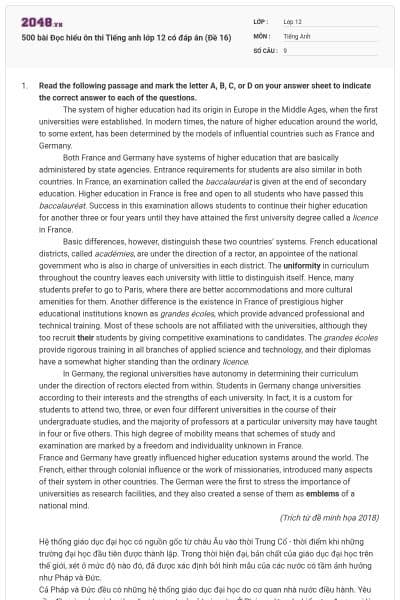
Read the following passage and mark the letter A, B, C, or D on your answer sheet to indicate the correct answer to each of the questions.
The system of higher education had its origin in Europe in the Middle Ages, when the first universities were established. In modern times, the nature of higher education around the world, to some extent, has been determined by the models of influential countries such as France and Germany.
Both France and Germany have systems of higher education that are basically administered by state agencies. Entrance requirements for students are also similar in both countries. In France, an examination called the baccalauréat is given at the end of secondary education. Higher education in France is free and open to all students who have passed this baccalauréat. Success in this examination allows students to continue their higher education for another three or four years until they have attained the first university degree called a licence in France.
Basic differences, however, distinguish these two countries’ systems. French educational districts, called académies, are under the direction of a rector, an appointee of the national government who is also in charge of universities in each district. The uniformity in curriculum throughout the country leaves each university with little to distinguish itself. Hence, many students prefer to go to Paris, where there are better accommodations and more cultural amenities for them. Another difference is the existence in France of prestigious higher educational institutions known as grandes écoles, which provide advanced professional and technical training. Most of these schools are not affiliated with the universities, although they too recruit their students by giving competitive examinations to candidates. The grandes écoles provide rigorous training in all branches of applied science and technology, and their diplomas have a somewhat higher standing than the ordinary licence.
In Germany, the regional universities have autonomy in determining their curriculum under the direction of rectors elected from within. Students in Germany change universities according to their interests and the strengths of each university. In fact, it is a custom for students to attend two, three, or even four different universities in the course of their undergraduate studies, and the majority of professors at a particular university may have taught in four or five others. This high degree of mobility means that schemes of study and examination are marked by a freedom and individuality unknown in France.
France and Germany have greatly influenced higher education systems around the world. The French, either through colonial influence or the work of missionaries, introduced many aspects of their system in other countries. The German were the first to stress the importance of universities as research facilities, and they also created a sense of them as emblems of a national mind.
(Trích từ đề minh họa 2018)
Hệ thống giáo dục đại học có nguồn gốc từ châu Âu vào thời Trung Cổ - thời điểm khi những trường đại học đầu tiên được thành lập. Trong thời hiện đại, bản chất của giáo dục đại học trên thế giới, xét ở mức độ nào đó, đã được xác định bởi hình mẫu của các nước có tầm ảnh hưởng như Pháp và Đức.
Cả Pháp và Đức đều có những hệ thống giáo dục đại học do cơ quan nhà nước điều hành. Yêu cầu đầu vào cho sinh viên cũng tương tự ở cả hai nước. Ở Pháp, một cuộc kiểm tra được gọi là học vị tú tài được đưa ra khi kết thúc chương trình trung học. Giáo dục đại học ở Pháp miễn phí và mở cửa cho tất cả sinh viên đã vượt qua học vị tú tài này. Vượt qua kỳ thi này cho phép học sinh tiếp tục học cao hơn trong ba hoặc bốn năm nữa cho đến khi đạt được bằng đại học đầu tiên được gọi là chứng chỉ ở Pháp.
Mặc dù vậy, giữa nền giáo dục của cả hai quốc gia cũng có những sự khác biệt cơ bản. Các khu học chính của Pháp được gọi là học viện, nó nằm dưới quyền điều hành của hiệu trưởng - người được bổ nhiệm bởi chính phủ quốc gia và chịu trách nhiệm về các trường đại học ở mỗi quận/ huyện. Giáo trình ở các trường đại học trong nước có tính đồng bộ nên giữa các trường có rất ít điểm khác biệt. Do đó, nhiều học sinh thích đến Paris, nơi mà chỗ ở và những tiện nghi về văn hóa trong cuộc sống tốt hơn. Một điểm khác biệt là ở Pháp, sự tồn tại của các cơ sở giáo dục đại học có uy tín được biết đến như các trường đại học danh giá, cung cấp đào tạo chuyên nghiệp và kỹ thuật tiên tiến. Mặc dù họ cũng tuyển sinh bằng cách cho thi cử cạnh tranh giữa các ứng cử viên, hầu hết những trường này không liên kết với các trường đại học. Họ đào tạo chặt chẽ trong tất cả các ngành khoa học ứng dụng và công nghệ, và bằng cấp của họ có một chỗ đứng cao hơn so với chứng chỉ thông thường.
Ở Đức, các trường đại học trong khu vực có quyền tự chủ trong việc quyết định giáo trình giảng dạy của mình dưới sự chỉ đạo của hiệu trưởng được bầu trong khu vực. Sinh viên ở Đức thay đổi trường đại học tùy theo sở thích của họ và điểm mạnh của mỗi trường. Trên thực tế, đó là lẽ tất yếu khi sinh viên tham dự 2, 3, hoặc thậm chí 4 trường đại học khác nhau trong quá trình học đại học của họ. Phần lớn các giáo sư tại một trường đại học có thể dạy ở 4 hay 5 trường khác nhau. Tính linh hoạt cao của cách dạy học này đồng nghĩa với việc các đề án nghiên cứu và kiểm tra được đánh dấu bởi sự tự do và riêng tư về mặt cá nhân, điều mà không hề xuất hiện ở Pháp.
Pháp và Đức có tầm ảnh hưởng to lớn đối với hệ thống giáo dục trên toàn thế giới. Thông qua các ảnh hưởng đối với thuộc địa hay hoạt động của những nhà truyền giáo, người Pháp đã truyền bá nhiều lĩnh vực trong hệ thống giáo dục của họ đến nhiều quốc gia khác. Người Đức là những người tiên phong trong việc nhấn mạnh tầm quan trọng của trường đại học như là cơ sở nghiên cứu cũng như khiến mọi người cảm thấy nó là một biểu tượng của trí tuệ quốc gia.
What does the passage mainly discuss?
The nature of education around the world in modern times
Systems of higher education in France and Germany
The origin of higher education system in Europe
The influence of France and Germany on educational systems of other countries
Đáp án B
Đoạn văn chủ yếu thảo luận về điều gì?
A. Bản chất của giáo dục trên toàn thế giới thời hiện đại
B. Hệ thống giáo dục đại học ở Pháp và Đức
C. Nguồn gốc của hệ thống giáo dục đại học ở Châu Âu
D. Ảnh hưởng của Pháp và Đức đối với hệ thống giáo dục của các nước khác
=> Đọc đoạn đầu, ta có:
“The system of higher education had its origin in Europe in the Middle Ages, when the first universities were established. In modern times, the nature of higher education around the world, to some extent, has been determined by the models of influential countries such as France and Germany.”
(Hệ thống giáo dục đại học có nguồn gốc từ châu Âu vào thời Trung Cổ - thời điểm khi những trường đại học đầu tiên được thành lập. Trong thời hiện đại, bản chất của giáo dục đại học trên thế giới, xét ở mức độ nào đó, đã được xác định bởi hình mẫu của các nước có tầm ảnh hưởng như Pháp và Đức.)
=> Các đoạn sau đó tác giả tập trung đi làm rõ đặc điểm, cụ thể hóa nền giáo dục mỗi nước và đưa ra sự so sánh đối chiếu giữa chúng để thấy rõ những nền giáo dục có tầm ảnh hưởng lớn như vậy. Và những nền giáo dục này đã đại diện cho mô hình giáo dục thế giới.
=> Do đó, có thể xem tiêu đề đoạn văn là: Systems of higher education in France and Germany
The word “uniformity” in paragraph 3 is closest in meaning to ______.
proximity
discrepancy
similarity
uniqueness
Đáp án C
Từ “uniformity” ở đoạn 3 gần nghĩa với _____ .
uniformity (n): sự thống nhất
A. proximity (n): trạng thái gần
B. discrepancy (n): sự khác biệt
C. similarity (n): sự tương đồng
D. uniqueness (n): sự độc đáo
=> uniformity= similarity
Dẫn chứng: The uniformity in curriculum throughout the country leaves each university with little to distinguish itself. Hence, many students prefer to go to Paris, where there are better accommodations and more cultural amenities for them.
(Sự thống nhất trong chương trình giảng dạy trên cả nước sẽ khiến cho mỗi trường đại học hầu như không có điểm khác biệt. Do đó, nhiều sinh viên thích đi đến Paris, nơi có chỗ ở tốt hơn và tiện nghi văn hóa hơn cho họ.)
The word “their” in paragraph 3 refers to ______.
schools
universities
examinations
branches
Đáp án A
Từ “their” trong đoạn 3 đề cập đến_______ .
A. trường học
B. trường đại học
C. kiểm tra
D. chi nhánh
Dẫn chứng: Most of these schools are not affiliated with the universities, although they too recruit their students by giving competitive examinations to candidates.
(Hầu hết các trường này không liên kết với các trường đại học, mặc dù họ cũng tuyển sinh viên của họ bằng cách cho thi cử cạnh tranh giữa các ứng cử viên.)
According to the passage, a regional university rector in Germany is elected by ______.
the staff of the university
the national government officials
the regional government officials
the staff of other universities
Đáp án A
Theo đoạn văn, một hiệu trưởng trường đại học khu vực ở Đức được bầu bởi______
A. các nhân viên của trường đại học
B. các quan chức chính phủ quốc gia
C. các quan chức chính phủ khu vực
D. nhân viên của các trường đại học khác
Dẫn chứng: In Germany, the regional universities have autonomy in determining their curriculum under the direction of rectors elected from within.
According to paragraph 4, what makes it possible for students in Germany to attend different universities during their undergraduate studies?
The university staff have become far more mobile and occupied.
The university’s training programs offer greater flexibility and freedom of choice.
University tuition fees are kept at an affordable level for all students
Entry requirements to universities in Germany are made less demanding.
Đáp án B
Theo đoạn 4, điều gì làm cho sinh viên Đức có thể theo học các trường đại học khác nhau trong thời gian học đại học?
A. Đội ngũ trong trường đại học đã trở nên linh động và bận rộn hơn.
B. Các chương trình đào tạo của trường đại học mang lại tính linh hoạt và tự do lựa chọn cao hơn.
C. Học phí học đại học được giữ ở mức hợp lý cho tất cả học sinh.
D. Yêu cầu nhập học đối với các trường đại học ở Đức không đòi hỏi nhiều.
Dẫn chứng: His high degree of mobility means that schemes of study and examination are marked by a freedom and individuality unknown in France.
(Mức độ linh động cao này có nghĩa là các đề án nghiên cứu và kiểm tra được đánh dấu bởi một sự tự do và cá nhân, điều mà không hề xuất hiện Pháp.)
The word “emblems” in the final paragraph is closest in meaning to ______.
representatives
directions
structures
delegates
Đáp án A
Từ “emblem” trong đoạn cuối cùng có nghĩa gần nhất với _____
emblem (n): biểu tượng, tượng trưng
A. Các đại diện
B. Các hướng
C. Cấu trúc
D. Các đại biểu
=> emblem = representative
Dẫn chứng: The German were the first to stress the importance of universities as research facilities, and they also created a sense of them as emblems of a national mind.
Which of the following can be inferred from the passage?
Studying in France and Germany is a good choice for people of all ages and nationalities.
It normally takes longer to complete a university course in France than in Germany.
Universities in Germany can govern themselves more effectively than those in France.
The level of decentralization of higher education is greater in Germany than in France.
Đáp án D
Câu nào sau đây có thể suy ra từ đoạn văn?
A. Học ở Pháp và Đức là sự lựa chọn tốt cho mọi người ở mọi lứa tuổi và quốc tịch.
B. Thông thường phải mất nhiều thời gian để hoàn thành một khóa học đại học ở Pháp hơn là ở Đức.
C. Các trường đại học ở Đức có thể quản lý hiệu quả hơn các trường đại học ở Pháp.
D. Mức độ phân cấp giáo dục đại học ở Đức lớn hơn so với ở Pháp.
=> Theo các thông tin sau:
+ "French educational districts, called académies, are under the direction of a rector, an appointee of the national government who is also in charge of universities in each district. The uniformity in curriculum throughout the country leaves each university with little to distinguish itself."
(Các khu học chính của Pháp được gọi là học viện, nó nằm dưới quyền điều hành của hiệu trưởng - người được bổ nhiệm bởi chính phủ quốc gia và chịu trách nhiệm về các trường đại học ở mỗi quận/ huyện. Giáo trình ở các trường đại học trong nước có tính đồng bộ nên giữa các trường có rất ít điểm khác biệt.)
+ “In Germany, the regional universities have autonomy in determining their curriculum under the direction of rectors elected from within. Students in Germany change universities according to their interests and the strengths of each university. In fact, it is a custom for students to attend two, three, or even four different universities in the course of their undergraduate studies, and the majority of professors at a particular university may have taught in four or five others. This high degree of mobility means that schemes of study and examination are marked by a freedom and individuality unknown in France.”
(Ở Đức, các trường đại học trong khu vực có quyền tự chủ trong việc quyết định giáo trình giảng dạy của mình dưới sự chỉ đạo của hiệu trưởng được bầu trong khu vực. Sinh viên ở Đức thay đổi trường đại học tùy theo sở thích của họ và điểm mạnh của mỗi trường. Trên thực tế, đó là lẽ tất yếu khi sinh viên tham dự 2, 3, hoặc thậm chí 4 trường đại học khác nhau trong quá trình học đại học của họ. Phần lớn các giáo sư tại một trường đại học có thể dạy ở 4 hay 5 trường khác nhau. Tính linh hoạt cao của cách dạy học này đồng nghĩa với việc các đề án nghiên cứu và kiểm tra được đánh dấu bởi sự tự do và riêng tư về mặt cá nhân, điều mà không hề xuất hiện ở Pháp.)
=> Do đó, dễ thấy rằng nền giáo dục ở Đức linh động hơn, có tính phân cấp, phân bổ rộng hơn khi học sinh có thể học ở nhiều trường khác nhau do tính đa dạng từng trường; trong khi đó ở Pháp gần như trường nào cũng tương tự nhau do có cùng một giáo trình dạy họcWhich of the following about grandes écoles in France is NOT stated in paragraph 3?
Most of them have no connection with universities.
They have a reputation for advanced professional and technical training.
Their degrees are better recognized than those provided by universities.
They offer better accommodations and facilities than universities.
Đáp án D
Câu nào sau đây về học vị tú tài ở Pháp KHÔNG được nêu trong đoạn 3?
A. Hầu hết trong số họ không có liên kết với các trường đại học.
B. Họ có tiếng về đào tạo chuyên nghiệp và kỹ thuật tiên tiến.
C. Bằng cấp của họ được công nhận tốt hơn các bằng cấp của các trường đại học.
D. Họ cung cấp chỗ ở tốt hơn và tiện nghi hơn so với các trường đại học.
Dẫn chứng: Another difference is the existence in France of prestigious higher educational institutions known as grandes écoles, which provide advanced professional and technical training. Most of these schools are not affiliated with the universities, although they too recruit their students by giving competitive examinations to candidates. The grandes écoles provide rigorous training in all branches of applied science and technology, and their diplomas have a somewhat higher standing than the ordinary licence.
Bạn có thích hoạt động này không?