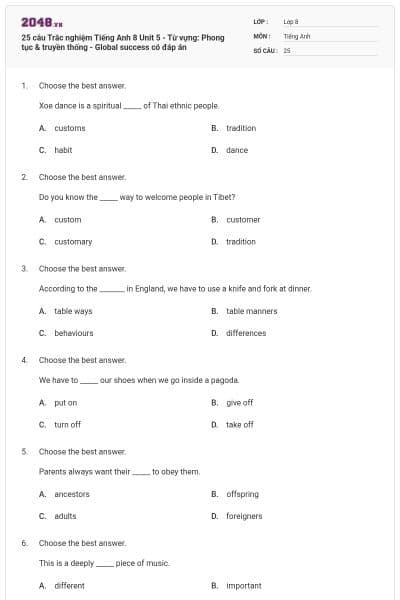
25 câu Trắc nghiệm Tiếng Anh 8 Unit 5 - Từ vựng: Phong tục & truyền thống - Global success có đáp án
25 câu hỏi
Choose the best answer.
Xoe dance is a spiritual _____ of Thai ethnic people.
customs
tradition
habit
dance
Customs: Phong tục (n)
Tradition: Truyền thống (n)
Habit: Thói quen (n)
Dance: Điệu nhảy (n)
=> Xoe dance is a spiritual tradition of Thai ethnic people.
Tạm dịch: Điệu múa Xòe là một truyền thống tâm linh của người dân tộc Thái.
Đáp án cần chọn là: b
Choose the best answer.
Do you know the _____ way to welcome people in Tibet?
custom
customer
customary
tradition
Custom: Phong tục (n)
Customer: khách hàng (n)
Customary: Phong tục (adj)
Tradition: Truyền thống (n)
- Vị trí cần điền từ đứng sau mạo từ “the” và trước danh từ “way” nên cần điền 1 tính từ.
=> Do you know the customary way to welcome people in Tibet?
Tạm dịch: Bạn có biết cách thông thường để chào đón mọi người ở Tây Tạng?
Đáp án cần chọn là: c
Choose the best answer.
According to the _______ in England, we have to use a knife and fork at dinner.
table ways
table manners
behaviours
differences
Table ways: cách tổ chức bàn ăn (n)
Table manners: cách cư xử trong bàn ăn (n)
Behaviours: Hành vi cư xử (n)
Differences: Sự khác biệt (n)
=> According to the table manners in England, we have to use a knife and fork at dinner.
Tạm dịch: Theo cách cư xử trong bàn ăn ở Anh, chúng ta phải dùng dao và nĩa trong bữa tối.
Đáp án cần chọn là: b
Choose the best answer.
We have to _____ our shoes when we go inside a pagoda.
put on
give off
turn off
take off
Put on: Đặt lên (v)
Give off: Bỏ xuống (v)
Turn off: Tắt (v)
Take off: Bỏ đi, cởi (quần áo, giày dép,...) (v)
=> We have to take off our shoes when we go inside a pagoda.
Tạm dịch: Chúng tôi phải cởi giày khi đi vào trong chùa.
Đáp án cần chọn là: d
Choose the best answer.
Parents always want their _____ to obey them.
ancestors
offspring
adults
foreigners
Ancestors: Tổ tiên (n)
Offspring: Con cháu (n)
Adults: Người lớn (n)
Foreigners: Người nước ngoài (n)
=> Parents always want their offspring to obey them.
Tạm dịch: Cha mẹ luôn muốn con cái vâng lời họ.
Đáp án cần chọn là: b
Choose the best answer.
This is a deeply _____ piece of music.
different
important
spiritual
disrespectful
Different: Khác biệt (adj)
Important: Quan trọng (adj)
Spiritual: Tâm hồn (adj)
Disrespectful: Vô lễ (adj)
=> This is a deeply spiritual piece of music
Tạm dịch: Đây là một bản nhạc cho tâm hồn một cách sâu lắng.
Đáp án cần chọn là: c
Choose the best answer.
We are going to prepare ____ sticky rice served with grilled chicken for the celebration.
five-coloured
five-colours
five colours
five-colour
Chỗ cần điền là tính từ để bổ sung ý nghĩa cho cụm danh từ (gạo nếp_sticky rice)
=> sử dụng five-coloured (có 5 màu)
- five-coloured sticky rice: xôi 5 màu.
=> We are going to prepare five-coloured sticky rice served with grilled chicken for the celebration.
Tạm dịch: Chúng tôi sẽ chuẩn bị gạo nếp năm màu ăn kèm với gà nướng cho lễ kỷ niệm.
Đáp án cần chọn là: a
Choose the best answer.
A tradition is something special that is _____ through the generations.
passing
passed
passed down
passed out
Pass: Vượt qua (v)
Pass down: Đi xuống (v)
Pass out: Đi ra ngoài (v)
Trong câu cần sử dụng thể bị động vì truyền thống "được" truyền lại cho thế hệ sau. do con người tác động vào nên loại A.
=> A tradition is something special that is passed down through the generations.
Tạm dịch:
Truyền thống là một điều gì đó đặc biệt được lưu truyền qua các thế hệ.
Đáp án cần chọn là: c
Choose the best answer.
In Australia, you shouldn’t ____ on a person’s accent.
dislike
criticize
hate
comment
Dislike: Không thích (v)
Criticize: Chỉ trích (v)
Hate: Ghét
Comment: Bình luận
- comment on sth: bình luận về cái gì.
=> In Australia, you shouldn’t comment on a person’s accent.
Tạm dịch: Ở Úc, bạn không nên bình luận về giọng của một người.
Đáp án cần chọn là: d
Choose the best answer.
The education gave him a lasting respect for _____.
tradition
custom
information
difference
Tradition: Truyền thống (n)
Custom: Phong tục (n)
Information: Thông tin (n)
Difference: Sự khác biệt (n)
=> The education gave him a lasting respect for tradition.
Tạm dịch:
Giáo dục đã cho ông một sự tôn trọng lâu dài đối với truyền thống
Đáp án cần chọn là: a
Choose the best answer.
He broke _____ the family tradition and did not go to the pagoda.
by
in
to
with
Cụm từ: break with tradition (phá vỡ truyền thống)
=> He broke with the family tradition and did not go to the pagoda.
Tạm dịch: Ông đã phá vỡ truyền thống gia đình và không đi chùa.
Đáp án cần chọn là: d
Choose the best answer.
I think custom is a/an _____ way of doing something.
accepting
unacceptable
accept
accepted
Unacceptable: Không thể chấp nhận (adj)
Accept: Chấp nhận (v)
Accepted: Đã được chấp nhận (adj)
- Vị trí cần điền là 1 tính từ vì đứng giữa mạo từ “a/an” và danh từ “way”
=> I think custom is a/an accepted way of doing something.
Tạm dịch: Tôi nghĩ rằng phong tục là một điều được chấp nhận khi làm một cái gì đó.
Đáp án cần chọn là: d
Choose the best answer.
It is a bad _______ to talk with your mouth full.
manner
manners
tradition
traditions
Manner: Cách thức (n)
Tradition: Truyền thống (n)
Có mạo từ “a” => chỗ cần điền là một danh từ số ít, đây chỉ một cách cư xử chứ không phải một truyền thống
=> It is a bad manner to talk with your mouth full.
Tạm dịch: Đó là cách cư xử tệ để nói chuyện với miệng của bạn ngậm đầy thức ăn.
Đáp án cần chọn là: a
Choose the best answer.
The world has been ______ with thousands of different cultures since the dawn of civilization.
rich
richen
enrich
enriched
Rich: Giàu (adj)
Enrich: Làm giàu (v)
=> The world has been enriched with thousands of different cultures since the dawn of civilization.
Cấu trúc bị động với chủ ngữ số ít ở thì hiện tại hoàn thành: has been + V_PII
Tạm dịch: Thế giới đã được làm giàu với hàng ngàn nền văn hóa khác nhau kể từ buổi bình minh của nền văn minh.
Đáp án cần chọn là: d
Choose the best answer.
- I’ve hugged a bear.
- What? You _____!
be kidding
are kid
must be kidding
must kidding
Cách nói dự đoán, thể hiện quan điểm của mình (you must+V_infi)
- be kidding: đùa
=> - I’ve hugged a bear.
- What? You must be kidding!
Tạm dịch:
- Tôi đã ôm một con gấu.
- Cái gì? Bạn đang đùa chắc!
Đáp án cần chọn là: c
Choose the best answer.
I had no ______ for her strange behaviour.
difference
tradition
explanation
custom
Difference: Sự khác biệt (n)
Tradition: Truyền thống (n)
Explanation: Giải trình (n)
Custom: Phong tục (n)
=> I had no explanation for her strange behaviour.
Tạm dịch: Tôi không có lời giải thích nào cho hành vi kỳ lạ của cô ấy.
Đáp án cần chọn là: c
Choose the best answer.
For members of the Yoruba people, an ethnic group in Nigeria, greeting rituals are _____ quite seriously.
taken
given
brought
treated
Take: Đối với
Give: Đưa
Bring: Mang
Treat: Đối đãi
=> For members of the Yoruba people, an ethnic group in Nigeria, greeting rituals are taken quite seriously.
Tạm dịch: Đối với các thành viên của người Yoruba, một nhóm dân tộc ở Nigeria, các nghi thức chào hỏi được thực hiện khá nghiêm túc.
Đáp án cần chọn là: a
Choose the best answer.
In some Vietnamese primary schools, pupils are _____ to write with their left hands. In that case, teachers will ask them to change the hand.
not agreed
not permitted
not allowed
both B&C
Agree: Đồng ý (v)
Permit = allow: Cho phép (v)
=> In some Vietnamese primary schools, pupils are not permitted/ allowed to write with their left hands. In that case, teachers will ask them to change the hand.
Tạm dịch:
Ở một số trường tiểu học Việt Nam, học sinh không được phép viết bằng tay trái. Trong trường hợp đó, giáo viên sẽ yêu cầu họ đổi tay.
Đáp án cần chọn là: d
Choose the best answer.
It’s a _____ of my family that children mustn’t go out after 9 p.m.
rule
law
regulation
tradition
Rule: quy tắc (n)
Law: Luật lệ (n)
Regulation: Quy định (n) (trong tổ chức, cơ quan nào đó)
Tradition: Truyền thống (n)
=> It’s a rule of my family that children mustn’t go out after 9 p.m.
Tạm dịch: Một quy tắc của gia đình tôi là trẻ em không được đi ra ngoài sau 9 giờ tối.
Đáp án cần chọn là: a
Choose the best answer.
According to the regulations, people who throw litter at the station will be _____ $100.
fired
stolen
charged
fined
Fired: Bị sa thải (dạng quá khứ phân từ của fire)
Stolen: Ăn cắp (dạng quá khứ phân từ của steal)
Charged: Tính, tính phí (dạng quá khứ phân từ của charge)
Fined: Bị phạt tiền (dạng quá khứ phân từ của fine)
=> According to the regulations, people who throw litter at the station will be fined $100.
Tạm dịch: Theo quy định, những người ném rác tại nhà ga sẽ bị phạt 100 đô la.
Đáp án cần chọn là: d
Fill in the blank with the correct form of the given word.
It is very interesting to read about the  traditions and customs of different countries. (usual)
Lời giải
Chỗ cần điền là một tính từ để bổ sung ý nghĩa cho danh từ traditions (những truyền thống)
Theo ngữ nghĩa của câu, sẽ thật thú vị khi đọc về những truyền thống và phong tục không phổ biến, độc đáo, khác thường (unusual)
Cấu trúc: It is+adj+to+V_nt (như thế nào khi làm gì)
=> It is very interesting to read about the unusual traditions and customs of different countries.
Tạm dịch: Thật thú vị khi đọc về các truyền thống và phong tục khác thường của các quốc gia khác nhau.
Đáp án: unusual
Fill in the blank with the correct form of the given word.
Many people complain with the boy’s parents about his bad  . (behave)
Lời giải
Sau tính từ sở hữu (his, của anh ấy) ta cần điền một danh từ để hoàn thiện cụm danh từ
Behave (hành xử, v) => behavior (cách hành xử)
=> Many people complain with the boy’s parents about his bad behavior
Tạm dịch: Nhiều người phàn nàn với bố mẹ cậu bé về hành vi xấu của cậu
Đáp án: behavior/behaviour
Fill in the blank with the correct form of the given word.
In Vietnam, it is a to call the first name of someone older than you without a title. (rude)
Lời giải
Sau mạo từ “a” ta cần điền một danh từ
Do đó, rude (adj, thô lỗ) => rudeness (sự khiếm nhã, sự thô lỗ)
=> In Vietnam, it is a rudeness to call the first name of someone older than you without a title.
Tạm dịch: Ở Việt Nam, thật thô lỗ khi gọi tên của một người lớn tuổi hơn bạn mà không có đại từ đằng trước.
Đáp án: rudeness
Fill in the blank with the correct form of the given word.
You may believe it or not, but in Denmark, cemeteries are common places for people to . (social)
Lời giải
Place for people to do st (nơi để mọi người làm gì)
=> Chỗ cần điền là một động từ. Do đó, social (adj, hòa đồng) => socialise (hòa nhập)
=> You may believe it or not, but in Denmark, cemeteries are common places for people to socialise
Tạm dịch: Bạn có thể không toin, nhưng ở Đan Mạch, nghĩa trang là nơi phổ biến để mọi người giao lưu
Đáp án: socialise
Fill in the blank with ONE suitable word.
In most Asian countries, it is a common tradition that youngsters must show  to the old people.
Lời giải
Theo ngữ nghĩa của câu, người trẻ cần thể hiện sự kính trọng của mình cho những người lớn tuổi => chỗ cần điền là :
- respect (n): sự kính trọng
=> In most Asian countries, it is a common tradition that youngsters must show respect to the old people.
Tạm dịch: Ở hầu hết các nước châu Á, có một truyền thống phổ biến là những người trẻ tuổi phải thể hiện sự kính trọng của mình với người già.
Đáp án: respect