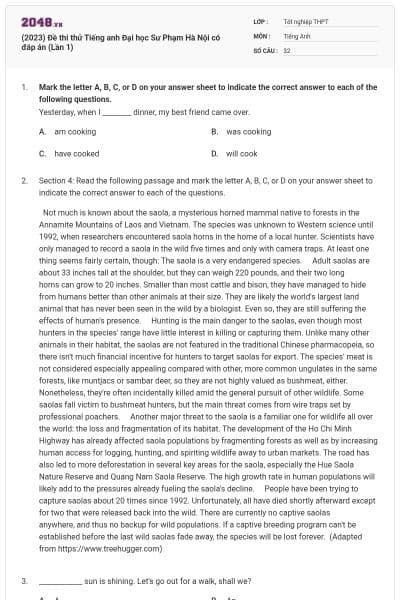
(2023) Đề thi thử Tiếng anh Đại học Sư Phạm Hà Nội có đáp án (Lần 1)
29 câu hỏi
Mark the letter A, B, C, or D on your answer sheet to indicate the correct answer to each of the following questions.
Yesterday, when I ________ dinner, my best friend came over.
am cooking
was cooking
have cooked
will cook
Kiến thức: Thì của động từ
Giải thích:
Cấu trúc: When + S + V (past continuous), S + V (past simple)
=> diễn tả hành động đang xảy ra thì hành động khác xen vào
Tạm dịch: Hôm qua khi tôi đang nấu bữa tối thì bạn thân tôi ghé qua
Chọn C.____________ sun is shining. Let's go out for a walk, shall we?
A
An
The
Ø (no article)
Kiến thức: Mạo từ
Giải thích:
Dùng mạo từ “the” với các danh từ chỉ sự duy nhất
VD: The world: Thế giới; The earth: Trái đất; The ocean: Đại dương; The sun: Mặt trời; The moon: Mặt trăng; The sky: Bầu trời; The equator: Đường xích đạo; The stars: Những vì sao…
Tạm dịch: Trời đang nắng. Ra ngoài đi bộ xíu không?
Chọn C.
The Secret Island is ___________than the other books you mentioned.
as popular
more popular
popular
the most popular
Kiến thức: Cấu trúc so sánh
Giải thích:
“than” => dấu hiệu nhận biết so sánh hơn. Popular là tính từ dài
Cấu trúc: S + be + more + adj-dài + than + S + be
Tạm dịch: Cuốn sách “The Secret Island” thì phổ biến hơn những loại mà bạn đề cập
Chọn B.
Hanoi National University of Education, ____________ is one of the leading universities in Vietnam, attracts thousands of students each year.
whose
where
which
that
Kiến thức: Đại từ quan hệ
Giải thích:
Dùng “which” để thay thế cho một danh từ tên riêng chỉ một tổ chức, cơ quan, nhà trường…
Dựa theo cấu trúc
- which + V
- where + S + V
Tạm dịch: Đại học Sư phạm Hà Nội là một trong những trường đại học hàng đầu tại Việt Nam, thu hút hàng ngàn sinh viên mỗi năm
Chọn C.
We _____ for over ten hours without a break. Let's call it a day!
will work
have been working
worked
are working
Kiến thức: Thì của động từ
Giải thích:
For over ten hours without a break=> nhấn mạnh tính liên tục của hành động xảy ra trong một khoảng thời gian ở quá khứ và còn có thể xảy ra ở tương lai
Tạm dịch: Chúng ta đã làm việc suốt 10 tiếng đồng hồ mà không nghỉ ngơi gì cả. Thế là quá đủ cho một ngày!
Chọn B.
How do you manage __________ in this heat without air conditioning?
to live
living
live
lived
Kiến thức: Dạng của động từ
Giải thích:
Manage to do sth: xoay xở làm gì
Tạm dịch: Làm sao bạn có thể sống ở nơi nóng như này mà không có điều hòa?
Chọn A.
Taxi drivers are advised to get their car engines _____________ on a monthly basis to ensure they work properly.
check
checked
to check
checking
Kiến thức: Dạng của động từ
Giải thích:
Get/have sth done: nhờ/thuê ai đó làm gì cho mình (chủ ngữ của câu không phải là người thực hiện hành động)
Tạm dịch: Người lái xe taxi được khuyên là nên cho động cơ ô tô của họ hàng tháng được kiểm tra để đảm bảo chúng vẫn hoạt động
Chọn B.
If it had not been for his approval of those residential projects, the mayor __________ in prison now.
isn't
won't be
wouldn't be
wouldn't have been
Kiến thức: Câu điều kiện hỗn hợp
Giải thích:
If it had not been for + N, S + would/could/might + (not) + V(bare) now
=> đưa ra giả thiết trái ngược quá khứ và kết quả không như mong đợi/như mong đợi ở hiện tại
Tạm dịch: Nếu như thị trưởng không đồng ý đối với các dự án khu dân cư đó thì ông ta sẽ không phải ngồi tù bây giờ.
Chọn C.
The lives of thousands of fish are ___________ jeopardy as a result of the recent oil spill.
under
on
at
in
Kiến thức: Thành ngữ
Giải thích:
Be in jeopardy = be in danger: gặp nguy hiểm/trong trạng thái/tình huống báo động
Tạm dịch: Hàng ngàn con cá đang có gặp nguy hiểm vì sự cố tràn dầu gần đây
Chọn B.
Mark the letter A, B, C, or D on your answer sheet to indicate the correct answer to each of the following questions.
My sister is good at preparing _______ like chicken soup or fish.
parties
dishes
events
desserts
Đáp án: B
Giải thích:
Kiến thức: Từ vựng
A. party (n): bữa tiệc
B. dish (n): món ăn
C. event (n): sự kiện
D. dessert (n): món tráng miệng
Dựa vào nghĩa câu, chọn B.
Dịch: Chị gái tôi giỏi trong việc nấu các món như là súp gà và cá.
You cannot find these animals anywhere else. They are very _____________
dangerous
wild
popular
rare
Kiến thức: Từ vựng
Giải thích:
A. dangerous: nguy hiểm
B. wild: hoang dã, hoang dại
C. popular: phổ biến
D. rare: hiếm
Tạm dịch: Bạn không thể tìm những con vật này ở bất cứ nơi nào khác. Nó rất hiếm
Chọn D.
The main goal of the ASEAN is to ______________ peace in the area.
promote
admit
remove
join
Kiến thức: Sự kết hơp từ
Giải thích:
to bring/promote/achieve/ensure peace: đem đến/thúc đẩy/ đạt thỏa thuân/ đảm bảo hòa bình
Tạm dịch: Mục tiêu chính của ASEAN là thúc đẩy hòa bình trong khu vực
Chọn A.
The economic downturn since the onset of the Covid pandemic has caused millions of ______ with the bankruptcy of businesses.
abundance
redundancies
reductions
unemployment
Kiến thức: Từ vựng
Giải thích:
Millions of + N số nhiều => hàng triệu…: dùng để nhấn mạnh con số vô cùng nhiều => loại A, D
A. abundance: sự đủ đầy, thịnh vượng
B. redundancies: người mất việc làm (buộc phải rời khỏi công ty/tổ chức vì không còn việc để làm)
C. reductions: sự suy giảm, giảm sút
D. unemployment: sự thất nghiệp
Tạm dịch: Suy thoái kinh tế kể từ khi bắt đầu đại dịch Covid đã gây ra hàng triệu người mất việc làm do sự phá sản của các doanh nghiệp.
Chọn B.
Most future houses will be designed to consume energy ________, saving money in the end.
efficiently
traditionally
heavily
wastefully
Kiến thức: Từ vựng
Giải thích:
A. efficiently: một cách hiệu quả
B. traditionally: một cách truyền thống
C. heavily: một cáh nặng nề
D. wastefully: một cách lãng phí
Tạm dịch: Hầu hết các ngôi nhà trong tương lai sẽ được thiết kế để tiêu thụ năng lượng hiệu quả, tiết kiệm tiền cuối cùng.
Chọn A.
This famous author has a _____________ personality. He really cares for others.
separate
private
warm
strong
Kiến thức: Từ vựng
Giải thích:
Warm personality: tính cách ấm áp, ân cần
Tạm dịch: Tác giả nổi tiếng này có tính cách ấm áp, ân cần. Anh ấy thực sự quan tâm đến người khác.
Chọn C.
The boy's favourite activity after school is _____________ a walk in the park near his home.
picking up
going for
looking for
taking up
Kiến thức: Cụm động từ
Giải thích:
Go for a walk: đi bộ
Tạm dịch: Hoạt động yêu thích của cậu bé sau giờ học là đi dạo trong công viên gần nhà.
Chọn B.I don't know much about the history of the desert; I just know that it was _____ after Simpson in 1929.
looked
chased
taken
named
Kiến thức: Sự kết hợp từ
Giải thích:
Be named after sb: được đặt tên theo ai
Tạm dịch: Tôi không biết nhiều về lịch sử của sa mạc; Tôi chỉ biết rằng nó được đặt theo tên của Simpson vào năm 1929.
Chọn D.
The organization ___________ a choice to donate books to the charity last Christmas.
made
did
took
had
Kiến thức: Sự kết hợp từ
Giải thích:
Make a choice: đưa ra quyết định/lựa chọn
Tạm dịch: Tổ chức đã lựa chọn quyên góp sách cho tổ chức từ thiện vào Giáng sinh năm ngoái.
Chọn A.
She is said to be a woman of her ________ If she says something, she'll do it.
letter
promise
word
speech
Kiến thức: Thành ngữ
Giải thích:
a man/woman of his/her word: người giữ lời hứa, đáng tin cậy
Tạm dịch: Mọi người đều tin tưởng cô ấy. Nếu cô ấy nói gì, cô ấy sẽ làm
Chọn C.
Section 4: Read the following passage and mark the letter A, B, C, or D on your answer sheet to indicate the correct answer to each of the questions.
Not much is known about the saola, a mysterious horned mammal native to forests in the Annamite Mountains of Laos and Vietnam. The species was unknown to Western science until 1992, when researchers encountered saola horns in the home of a local hunter. Scientists have only managed to record a saola in the wild five times and only with camera traps. At least one thing seems fairly certain, though: The saola is a very endangered species. Adult saolas are about 33 inches tall at the shoulder, but they can weigh 220 pounds, and their two long horns can grow to 20 inches. Smaller than most cattle and bison, they have managed to hide from humans better than other animals at their size. They are likely the world's largest land animal that has never been seen in the wild by a biologist. Even so, they are still suffering the effects of human's presence. Hunting is the main danger to the saolas, even though most hunters in the species' range have little interest in killing or capturing them. Unlike many other animals in their habitat, the saolas are not featured in the traditional Chinese pharmacopeia, so there isn't much financial incentive for hunters to target saolas for export. The species' meat is not considered especially appealing compared with other, more common ungulates in the same forests, like muntjacs or sambar deer, so they are not highly valued as bushmeat, either. Nonetheless, they're often incidentally killed amid the general pursuit of other wildlife. Some saolas fall victim to bushmeat hunters, but the main threat comes from wire traps set by professional poachers. Another major threat to the saola is a familiar one for wildlife all over the world: the loss and fragmentation of its habitat. The development of the Ho Chi Minh Highway has already affected saola populations by fragmenting forests as well as by increasing human access for logging, hunting, and spiriting wildlife away to urban markets. The road has also led to more deforestation in several key areas for the saola, especially the Hue Saola Nature Reserve and Quang Nam Saola Reserve. The high growth rate in human populations will likely add to the pressures already fueling the saola's decline. People have been trying to capture saolas about 20 times since 1992. Unfortunately, all have died shortly afterward except for two that were released back into the wild. There are currently no captive saolas anywhere, and thus no backup for wild populations. If a captive breeding program can't be established before the last wild saolas fade away, the species will be lost forever. (Adapted from https://www.treehugger.com)
What does the word 'it' in paragraph 2 refer to?
Christmas
Diwali
A family meal
An Indian sweet
Kiến thức: Đại từ
Giải thích:
Tù “it” trong đoạn 2 thay thế cho từ nào?
A. Christmas B. Diwali C. A family meal D. An Indian sweet
Thông tin: They also celebrated Deepavali or Diwali, as it is sometimes called, with a family meal and a prayer. They had sparklers too because it is the Festival of Light.
Tạm dịch: Họ cũng tổ chức lễ Deepavali hoặc Diwali, như đôi khi nó được gọi, với một bữa ăn gia đình và một lời cầu nguyện. Họ cũng có pháo hoa vì đó là Lễ hội ánh sáng.
Chọn B.
How did Chloe adapt the tea ceremony to make both families happy?
They had it at Chloe's mum's.
They had it with their family members.
They had it on the morning of the wedding.
They had it at the wedding reception
Kiến thức: Đọc hiểu chi tiết
Giải thích:
Chloe đã làm thế nào để điều chỉnh nghi lễ trà đạo để cả hai gia đình đều hạnh phúc?
A. Họ đã uống trà tại nhà của mẹ Chloe.
B. Họ đã uống trà với các thành viên trong gia đình của họ.
C. Họ đã uống trà vào buổi sáng của đám cưới.
D. Họ đã uống trà vào tiệc cưới.
Thông tin: Usually it takes place on the morning of the wedding with family members, but the couple decided to do it at the wedding reception instead
Tạm dịch:
Thông thường sẽ diễn ra vào buổi sáng Lễ thành hôn với các thành viên trong gia đình, nhưng thay vào đó cặp đôi quyết định thực hiện tại tiệc cưới
Chọn D.
At Christmas, what did Eliza and her family have for breakfast?
Roast ham
Spicy food
Grilled tomatoes
Christmas puddings
Kiến thức: Đọc hiểu chi tiết
Thông tin: At Christmas, instead of roast ham for lunch, they would have it for breakfast.
Tạm dịch: Vào Giáng sinh, thay vì nướng giăm bông vào bữa trưa, họ sẽ ăn nó vào bữa sáng.
Chọn A.
Which of the following is closest in meaning to the phrase 'we're like' in paragraph 4?
We like each other.
We look similar.
We reply to mum.
We have the same opinion.
Kiến thức: Đọc hiểu chi tiết
Giải thích:
Từ nào sau đây gần nghĩa nhất với cụm từ “chúng tôi giống như” trong đoạn 4?
A. Chúng tôi thích nhau.
B. Chúng tôi trông giống nhau.
C. Chúng tôi trả lời mẹ.
D. Chúng tôi có cùng quan điểm.
Thông tin: She puts it on her food and she asks us if we want some too. We're like, ‘no no no no!' So she'd say to us, “you're not proper black children.' She’s like, “it's your white side coming out,” Eliza laughs.
Tạm dịch: Cô ấy đặt nó vào thức ăn của mình và cô ấy hỏi chúng tôi nếu chúng tôi cũng muốn một ít. Chúng tôi kiểu như, "không không không không!" Vì vậy, mẹ sẽ nói với chúng tôi, "con không phải là trẻ em da đen đúng nghĩa." Mẹ tôi lại nói, “máu da trắng của con đang lộ ra,” Eliza cười.
Chọn C.
Dịch bài đọc:
Nội dung dịch:
Nhiều gia đình liên văn hóa liên quan đến việc thương lượng các truyền thống văn hóa khác nhau. Họ phải tiếp nhận, hoặc thích nghi với các yếu tố của một nền văn hóa khác. Quá trình này đôi khi có thể gặp khó khăn. Nền tảng văn hóa của chúng tôi cung cấp cho chúng tôi một loạt các kỳ vọng về cách mọi thứ hoạt động trên thế giới. Việc thương lượng các yếu tố khác nhau của thế giới quan này đòi hỏi sự hiểu biết và chấp nhận, và thường là sự thỏa hiệp.
Dom và người chị song sinh Gen lớn lên với sự pha trộn giữa truyền thống văn hóa của cha và mẹ của họ. Mẹ của họ là người gốc châu Âu và bố là người Ấn Độ, nhưng bà lớn lên ở Singapore. Là một gia đình, họ đã tổ chức lễ Giáng sinh và lễ Deepavali. Vào lễ Giáng sinh, họ đã có một bữa trưa nướng và những món quà. Họ cũng tổ chức lễ Deepavali hoặc Diwali, như nó đôi khi được gọi, với một bữa ăn gia đình và một lời cầu nguyện. Họ cũng có pháo hoa vì đó là Lễ hội ánh sáng. Vào ngày sinh nhật, họ đã ăn Prasad, một món ngọt của Ấn Độ. Nhưng cô ấy không nhớ bố mẹ cô ấy đang vật lộn với sự khác biệt văn hóa. Cha mẹ của họ muốn họ chọn và chọn những gì họ muốn từ mỗi nền văn hóa.
Chloe và Matt phải tìm hiểu những di sản văn hóa khác nhau của họ trong quá trình lên kế hoạch cho đám cưới của họ. Họ phải kết hợp nguồn gốc Trung Quốc của Chloe và Ý của Matt lại với nhau để họ và cả hai gia đình đều hài lòng. Cặp đôi muốn có một dịch vụ 'phong cách phương Tây' trong một nhà thờ. Tuy nhiên, mẹ của Chloe không thoải mái với điều đó và đề nghị gia đình "phía Đông". Vì vậy, họ đã đưa trà đạo truyền thống của Trung Quốc vào tiệc chiêu đãi. Thông thường nó diễn ra vào sáng ngày cưới với các thành viên trong gia đình, nhưng cặp đôi quyết định thực hiện tại tiệc cưới thay thế. Chloe nói khi cô ấy nói chuyện với khách, họ đã yêu thích nó. Trong nhiều gia đình kết hôn, việc hòa nhập các truyền thống văn hóa diễn ra nhiều nhất xung quanh bàn ăn tối. Eliza nhớ rất nhiều câu chuyện về nấu ăn khi cô lớn lên. Mẹ của cô, đến từ Trinidad và Tobago, vẫn làm món ăn truyền thống cho gia đình họ. Vào Giáng sinh, thay vì nướng giăm bông vào bữa trưa, họ sẽ ăn nó vào bữa sáng. Cô ấy sẽ cắt nó với cà chua và nhiều loại gia vị truyền thống. Eliza thừa nhận rằng mẹ sẽ luôn cố gắng để chúng ăn nhiều gia vị hơn. “Mẹ có lọ nước sốt cay này và nó quá cay đối với chúng tôi. Mẹ đặt nó vào thức ăn của mình và mẹ hỏi chúng tôi nếu chúng tôi cũng muốn một ít. Chúng tôi giống như, "không không không không!" Vì vậy, mẹ sẽ nói với chúng tôi, "con không phải là trẻ em da đen đúng nghĩa." Cô ấy giống như, “máu da trắng của con đang xuất hiện,” Eliza cười. Cô ấy nói rằng bố cô ấy là người Anh.
Mặc dù việc tìm hiểu sự khác biệt về văn hóa trong cuộc sống gia đình có thể là một thách thức, nhưng các cuộc hôn nhân giữa các thành viên đều có một số yếu tố chung. Một là các giá trị được chia sẻ; khác là một đức tin chung. Sự cởi mở đối với sự khác biệt và khả năng thỏa hiệp cũng rất quan trọng.
Section 4: Read the following passage and mark the letter A, B, C, or D on your answer sheet to indicate the correct answer to each of the questions.
Not much is known about the saola, a mysterious horned mammal native to forests in the Annamite Mountains of Laos and Vietnam. The species was unknown to Western science until 1992, when researchers encountered saola horns in the home of a local hunter. Scientists have only managed to record a saola in the wild five times and only with camera traps. At least one thing seems fairly certain, though: The saola is a very endangered species. Adult saolas are about 33 inches tall at the shoulder, but they can weigh 220 pounds, and their two long horns can grow to 20 inches. Smaller than most cattle and bison, they have managed to hide from humans better than other animals at their size. They are likely the world's largest land animal that has never been seen in the wild by a biologist. Even so, they are still suffering the effects of human's presence. Hunting is the main danger to the saolas, even though most hunters in the species' range have little interest in killing or capturing them. Unlike many other animals in their habitat, the saolas are not featured in the traditional Chinese pharmacopeia, so there isn't much financial incentive for hunters to target saolas for export. The species' meat is not considered especially appealing compared with other, more common ungulates in the same forests, like muntjacs or sambar deer, so they are not highly valued as bushmeat, either. Nonetheless, they're often incidentally killed amid the general pursuit of other wildlife. Some saolas fall victim to bushmeat hunters, but the main threat comes from wire traps set by professional poachers. Another major threat to the saola is a familiar one for wildlife all over the world: the loss and fragmentation of its habitat. The development of the Ho Chi Minh Highway has already affected saola populations by fragmenting forests as well as by increasing human access for logging, hunting, and spiriting wildlife away to urban markets. The road has also led to more deforestation in several key areas for the saola, especially the Hue Saola Nature Reserve and Quang Nam Saola Reserve. The high growth rate in human populations will likely add to the pressures already fueling the saola's decline. People have been trying to capture saolas about 20 times since 1992. Unfortunately, all have died shortly afterward except for two that were released back into the wild. There are currently no captive saolas anywhere, and thus no backup for wild populations. If a captive breeding program can't be established before the last wild saolas fade away, the species will be lost forever. (Adapted from https://www.treehugger.com)
What is the passage mainly about?
A study on a mysterious animal
An endangered species
Extinction caused by loss of habitat
A captive breeding program
Kiến thức: Đọc hiểu chi tiết
Giải thích:
Ý chính của bài là gì?
A. Một nghiên cứu về một loài động vật bí ẩn
B. Một loài có nguy cơ tuyệt chủng
C. Sự tuyệt chủng do mất môi trường sống
D. Chương trình nhân giống nuôi nhốt
Thông tin:
Scientists have only managed to record a saola in the wild five times - and only with camera traps. At least one thing seems fairly certain, though: The saola is a very endangered species.
Hunting is the main danger to the saolas, even though most hunters in the species’ range have little interest in killing or capturing them.
Another major threat to the saola is a familiar one for wildlife all over the world: the loss and fragmentation of its habitat.
People have been trying to capture saolas about 20 times since 1992. Unfortunately, all have died shortly afterward except for two that were released back into the wild.
Tạm dịch:
Các nhà khoa học mới chỉ ghi lại được một con sao la trong tự nhiên 5 lần - và chỉ với bẫy ảnh. Tuy nhiên, ít nhất một điều có vẻ khá chắc chắn: Sao la là một loài rất nguy cấp.
Săn bắn là mối nguy hiểm chính đối với saolas, mặc dù hầu hết thợ săn trong loài không quan tâm đến việc giết hoặc bắt chúng.
Một mối đe dọa lớn khác đối với sao la là một mối đe dọa quen thuộc đối với động vật hoang dã trên toàn thế giới: sự mất mát và chia cắt môi trường sống của chúng.
Mọi người đã cố gắng bắt saolas khoảng 20 lần kể từ năm 1992. Thật không may, tất cả đều đã chết ngay sau đó ngoại trừ hai con đã được thả trở lại tự nhiên.
Chọn B.
Which of the following is NOT true according to the passage?
It is hard to observe saolas in nature.
Saolas are valuable to poachers.
Many saolas' deaths are caused by the poachers' traps.
The road construction has caused habitat destruction.
Kiến thức: Đọc hiểu chi tiết
Giải thích:
Điều nào sau đây KHÔNG ĐÚNG theo đoạn văn?
A. Thật khó để quan sát saolas trong tự nhiên.
B. Saolas có giá trị đối với những kẻ săn trộm.
C. Nhiều cái chết của saolas là do bẫy của những kẻ săn trộm.
D. Việc xây dựng đường xá đã gây ra sự phá hủy môi trường sống.
Thông tin:
A. Smaller than most cattle and bison, they have managed to hide from humans better than other animals at their size. They are likely the world's largest land animal that has never been seen in the wild by a biologist.
C. Some saolas fall victim to bushmeat hunters, but the main threat comes from wire traps set by professional poachers.
D. The development of the Ho Chi Minh Highway has already affected saola populations by fragmenting forests as well as by increasing human access for logging, hunting, and spiriting wildlife away to urban markets
B. Unlike many other animals in their habitat, the saolas are not featured in the traditional Chinese pharmacopeia, so there isn't much financial incentive for hunters to target saolas for export. The species' meat is not considered especially appealing compared with other, more common ungulates in the same forests, like muntjacs or sambar deer, so they are not highly valued as bushmeat, either.
Tạm dịch:
A. Nhỏ hơn hầu hết các loài gia súc và bò rừng, chúng trốn tránh con người tốt hơn các động vật khác cùng kích thước. Chúng có thể là loài động vật trên cạn lớn nhất thế giới mà một nhà sinh vật học chưa từng thấy trong tự nhiên.
C. Một số loài saolas trở thành nạn nhân của những kẻ săn thịt rừng, nhưng mối đe dọa chính đến từ những chiếc bẫy dây do những kẻ săn trộm chuyên nghiệp đặt.
D. Sự phát triển của đường Hồ Chí Minh đã ảnh hưởng đến quần thể sao la do rừng bị chia cắt cũng như làm tăng khả năng tiếp cận của con người để khai thác, săn bắn và đưa động vật hoang dã đến các thị trường đô thị
B. Không giống như nhiều loài động vật khác trong môi trường sống của chúng, saolas không có trong dược điển truyền thống của Trung Quốc, vì vậy không có nhiều động lực tài chính cho những người thợ săn nhắm mục tiêu saolas để xuất khẩu. Thịt của loài này không được coi là đặc biệt hấp dẫn so với các động vật móng guốc khác, phổ biến hơn trong cùng các khu rừng, như hoẵng hoặc hươu sambar, vì vậy chúng cũng không được đánh giá cao như thịt rừng.
Chọn B.
What does the word "fueling" in paragraph 4 mean?
Using coal or oil
Burning
Stimulating
Hindering
Kiến thức: Từ vựng
Giải thích:
Từ “fueling” trong đoạn 4 có nghĩa là gì?
A. Sử dụng than hoặc dầu B. Đốt
C. Kích thích D. Cản trở
Thông tin: The high growth rate in human populations will likely add to the pressures already fueling the saola's decline.
Tạm dịch: Tốc độ tăng trưởng dân số cao của con người có thể sẽ tạo thêm áp lực thúc đẩy sự suy giảm của sao la.
Chọn C.
What can be inferred about the saola captive breeding program?
It has never been successful.
It was successful only once.
It hasn't been carried out yet.
It has helped increase the saola population.
Kiến thức: Đọc hiểu suy luận
Giải thích:
Có thể suy ra điều gì về chương trình sinh sản nuôi nhốt sao la?
A. Nó chưa bao giờ thành công.
B. Nó chỉ thành công một lần.
C. Nó vẫn chưa được thực hiện.
D. Nó đã giúp tăng dân số sao la.
Thông tin: If a captive breeding program can't be established before the last wild saolas fade away, the species will be lost forever.
Tạm dịch: Nếu một chương trình nhân giống nuôi nhốt không thể được thiết lập trước khi những con saolas hoang dã cuối cùng biến mất, loài này sẽ bị mất vĩnh viễn.
Chọn C.
Dịch bài đọc:
Nội dung dịch:
Không có nhiều thông tin về sao la, một loài động vật có vú có sừng bí ẩn có nguồn gốc từ các khu rừng ở dãy núi Trường Sơn của Lào và Việt Nam. Khoa học phương Tây chưa biết đến loài này cho đến năm 1992, khi các nhà nghiên cứu bắt gặp sừng sao la trong nhà của một thợ săn địa phương. Các nhà khoa học mới chỉ ghi lại được một con sao la trong tự nhiên 5 lần - và chỉ với bẫy ảnh. Tuy nhiên, ít nhất một điều có vẻ khá chắc chắn: Sao la là một loài rất nguy cấp. Saolas trưởng thành cao khoảng 33 inch tính đến vai, nhưng chúng có thể nặng 220 pound và hai chiếc sừng dài của chúng có thể phát triển đến 20 inch. Nhỏ hơn hầu hết các loài gia súc và bò rừng, chúng đã cố gắng trốn tránh con người tốt hơn các động vật khác ở kích thước của chúng. Chúng có thể là loài động vật trên cạn lớn nhất thế giới mà một nhà sinh vật học chưa từng thấy trong tự nhiên. Mặc dù vậy, chúng vẫn đang phải chịu những tác động từ sự hiện diện của con người.
Săn bắn là mối nguy hiểm chính đối với saolas, mặc dù hầu hết thợ săn trong loài không quan tâm đến việc giết hoặc bắt chúng. Không giống như nhiều loài động vật khác trong môi trường sống của chúng, saolas không có trong dược điển truyền thống của Trung Quốc, vì vậy không có nhiều động lực tài chính cho những người thợ săn nhắm mục tiêu saolas để xuất khẩu. Thịt của loài này không được coi là đặc biệt hấp dẫn so với các động vật móng guốc khác, phổ biến hơn trong cùng các khu rừng, như hoẵng hoặc hươu sambar, vì vậy chúng cũng không được đánh giá cao như thịt rừng. Tuy nhiên, chúng thường bị giết một cách ngẫu nhiên giữa sự truy đuổi chung của các loài động vật hoang dã khác. Một số loài saolas trở thành nạn nhân của những kẻ săn thịt rừng, nhưng mối đe dọa chính đến từ những chiếc bẫy dây do những kẻ săn trộm chuyên nghiệp đặt. Một mối đe dọa lớn khác đối với sao la là một mối đe dọa quen thuộc đối với động vật hoang dã trên toàn thế giới: sự mất mát và chia cắt môi trường sống của chúng. Sự phát triển của đường Hồ Chí Minh đã ảnh hưởng đến quần thể sao la do rừng bị chia cắt cũng như tăng khả năng tiếp cận của con người để khai thác, săn bắn và đưa động vật hoang dã đến các thị trường đô thị. Con đường này cũng dẫn đến tình trạng phá rừng nhiều hơn ở một số khu vực trọng điểm của sao la, đặc biệt là Khu bảo tồn Sao la Huế và Khu bảo tồn Sao la Quảng Nam. Tốc độ tăng trưởng dân số cao của con người có thể sẽ tạo thêm áp lực thúc đẩy sự suy giảm của sao la. Mọi người đã cố gắng bắt saolas khoảng 20 lần kể từ năm 1992. Thật không may, tất cả đều đã chết ngay sau đó ngoại trừ hai con đã được thả trở lại tự nhiên. Hiện tại không có saolas nào được nuôi nhốt ở bất cứ đâu, và do đó không có dự phòng cho các quần thể hoang dã. Nếu một chương trình nhân giống nuôi nhốt không thể được thiết lập trước khi những con saolas hoang dã cuối cùng biến mất, loài này sẽ bị mất vĩnh viễn.
28. CELEBRATE
29. RITE
30. DELIGHT
31. QUESTION
32. HISTORY
28 (VD)
Kiến thức: Từ loại
Giải thích:
Cấu trúc: a/an + adj + N => chỗ trống cần điền là danh từ
Celebrate (v) tổ chức, kỉ niệm => celebration (n) lễ kỉ niệm
Thông tin: The Hoi An Lantern Festival is a monthly celebration of the full moon in Vietnam.
Tạm dịch: Lễ hội đèn lồng Hội An là một lễ hội mừng rằm hàng tháng ở Việt Nam.
Chọn celebration.
29 (VD)
Kiến thức: Từ loại
Giải thích:
Rite (n) nghi thức nói chung
Ritual (n) sự hành lễ
Observe ritual: hành lễ, tuân theo nghi lễ
Danh từ sau “and” đang ở dạng số nhiều => ritual => rituals
Thông tin: During this time, people all over Asia observe rituals and worship their ancestors.
Tạm dịch: Trong thời gian này, người dân khắp châu Á tuân theo các nghi lễ và thờ cúng tổ tiên của họ.
Chọn rituals.
30 (VD)
Kiến thức: Từ loại
Giải thích:
Delight sb: làm ai đó thú vị
Chỗ trống cần điền là một tính từ để miêu tả lễ hội đó như thế nào
Delight => delightful (adj) thú vị, lôi cuốn
Thông tin: These traditions have gradually morphed into the delightful Hoi An Lantern Festival.
Tạm dịch: Những truyền thống này đã dần dần biến thành Lễ hội đèn lồng Hội An thú vị.
Chọn delightful.
31 (VD)
Kiến thức: Từ loại
Giải thích:
Chỗ trống cần điền là một trạng từ bổ sung nghĩa cho động từ “tobe’
Question => unquestionably
Thông tin: As the name suggests, lantern lighting is unquestionably a festival highlight.
Tạm dịch: Như tên cho thấy, ánh sáng đèn lồng chắc chắn là một điểm nhấn của lễ hội.
Chọn unquestionably.
32 (VD)
Kiến thức: Từ loại
Giải thích:
Chỗ trống cần điền là một trạng từ bổ sung nghĩa cho động từ “held”
History => historically
Thông tin: The festival is historically held on the exact date of the full moon, but it has been recently organized on the 14th day of the lunar calendar each month
Tạm dịch: Theo truyền thống, lễ hội được tổ chức vào đúng ngày rằm, nhưng gần đây nó đã được tổ chức vào ngày 14 âm lịch hàng tháng.
Chọn historically.
Dịch bài đọc:
Nội dung dịch:
Lễ hội đèn lồng Hội An là một lễ hội mừng rằm hàng tháng ở Việt Nam. Rằm tháng Giêng là một trong những thời điểm thiêng liêng nhất trong lịch Phật giáo. Trong thời gian này, người dân khắp châu Á tuân theo các nghi lễ và thờ cúng tổ tiên của họ. Việc này được thực hiện theo nhiều cách, từ cúng tại đình miếu đến thắp hương, thắp nến. Những truyền thống này đã dần dần biến thành Lễ hội đèn lồng Hội An thú vị. Như tên cho thấy, ánh sáng đèn lồng chắc chắn là một điểm nhấn của lễ hội. Những chiếc đèn lồng nhiều màu được thắp sáng bằng nến và đặt trên sông Thu Bồn với mong ước mọi điều tốt lành. Theo lịch sử, lễ hội được tổ chức vào đúng ngày rằm, nhưng gần đây nó đã được tổ chức vào ngày 14 âm lịch hàng tháng.
Write a paragraph (of approximately 150 words) about the following topic:
Do you prefer to study at a university abroad or in your country? Explain your choice.
Viết một đoạn văn (khoảng 150 từ) về chủ đề sau:
Bạn thích học tại một trường đại học ở nước ngoài hay ở đất nước của bạn? Giải thích sự lựa chọn của bạn.
Hướng giải:
- Về hình thức: đoạn văn khoảng 150 từ
- Về nội dung: Trình bày quan điểm và bảo vệ quan điểm bằng cách đưa ra 2-3 luận điểm về lợi ích của việc học ở đại học ở Việt Nam hoặc 2-3 luận điểm về lợi ích của việc học nước ngoài
- Học sinh đưa ra luận điểm và bảo vệ luận điểm bằng cách đưa ra giải thích, ví dụ hoặc bằng cách thức so sánh