
2000 câu trắc nghiệm tổng hợp Tiếng Anh 2025 có đáp án (Phần 17)
106 câu hỏi
Sample 1:
In recent years, there has been a growing debate about whether movies and TV shows are effective in teaching history despite their occasional lack of historical accuracy. While some people argue that these forms of media are unreliable and do not accurately represent historical events, others believe that they can be valuable tools for learning about the past. In this essay, I will argue that movies and TV shows can indeed be useful for studying history, even if they are not always entirely accurate.
Firstly, movies and TV shows can provide a more engaging and memorable way to learn about history compared to traditional textbooks or lectures. These visual media can transport viewers to another time and place, allowing them to experience historical events and cultures firsthand. Moreover, they can evoke emotions and create a connection with characters, which can make historical events more relatable and easier to remember.
Secondly, while movies and TV shows may not be entirely accurate, they can still offer valuable insights into historical events and perspectives. Even if the specifics of a particular scene or character are not accurate, the overall themes and messages of a film or show can still be relevant and informative. For example, the portrayal of the American Civil War in the movie “Gone with the Wind” may not be entirely accurate, but it still provides a glimpse into the social and political tensions of the time.
However, it is important to note that movies and TV shows should not be the only source of historical information. They should be viewed as supplementary tools to traditional resources, such as textbooks and scholarly articles. It is also crucial to critically evaluate the accuracy of the media being consumed and to seek out additional sources to verify historical information.
In conclusion, while movies and TV shows may not be entirely accurate, they can still be useful tools for studying history. They offer a more engaging and memorable way to learn about the past, and they can provide valuable insights into historical events and perspectives. However, it is important to view them as supplementary sources and to critically evaluate their accuracy.
Sample 2:
Movies and TV shows have become a popular medium for learning about historical events and periods. While it is true that these forms of entertainment often take creative liberties with historical accuracy, I believe that they can still be a valuable tool for studying history to a certain extent.
Firstly, movies and TV shows have the ability to bring history to life in a way that textbooks and lectures cannot. They have the power to engage viewers on an emotional level, allowing them to develop a deeper understanding and connection to the events being portrayed. For example, a well-made historical drama can provide a vivid and immersive experience of a particular time period, making it easier for audiences to grasp the social, political, and cultural dynamics of that era.
Moreover, movies and TV shows can spark an interest in history and encourage further research and learning. While it is important to acknowledge the inaccuracies present in these forms of media, they can serve as a starting point for individuals to explore and investigate the actual historical facts. This can lead to a more comprehensive and nuanced understanding of the subject matter.
However, it is crucial for viewers to approach historical movies and TV shows with a critical mindset. They should be aware of the potential inaccuracies and distortions and seek out additional sources to verify the information presented. Relying solely on entertainment media for historical knowledge can lead to misconceptions and misunderstandings.
In conclusion, while movies and TV shows may not always provide a completely accurate portrayal of history, they can still be a valuable and engaging way to learn about the past. When approached with caution and supplemented with further research, they can contribute to a more enriched understanding of historical events and periods.
Sample 3:
A commonly held belief is that the purpose of films and sitcoms is solely to entertain people. However, I am in complete agreement with the view that despite being inaccurate at times, they can support learning if utilised appropriately by the teachers to impart historical knowledge.
One of the significant benefits of using historical shows and films in the teaching process is that the lessons become engaging for students who get easily bored by traditional history lessons. However, it is for the teacher to identify appropriate movies/series and relate them to the subject matter. For instance, the movie ‘Just Mercy’ which is based on a true story, can definitely be shown to students as it talks about the history of Civil Rights in the United States.
Another significant reason why these media should be a part of the learning process is that in a multi-sensory teaching environment, learning is faster, and retention is stronger. Students can relate better to movies and TV series which bring history to life. For instance, a movie like ‘Hidden Figures’ can showcase to the students the critical role that women of colour played in the growth and success of the U.S. space program at NASA, despite the odds they faced.
In conclusion, history can be quite a boring subject if taught the traditional way. Hence, although the historical events one sees on celluloid and on the TV screen are made larger than life and sometimes exaggerated as well, they can make history much more interesting and fascinating to the students and should therefore definitely be used as tools to enhance learning.
Sample 4:
It is believed by some that films and television programs are a potent method to study events of earlier times even though they may not be precise. I completely agree with the given viewpoint as these sources have the power to create interest in the minds of their audience.
Firstly, making oneself aware of historical events through movies and shows will be an entertaining way to learn, mainly because of the flamboyance in their various aspects, be it the costumes or the sets. Although there may be some over-dramatisation, it is still a better way to learn as opposed to just reading historical books, which is a tedious task. Moreover, there is no assurance that these books have a flawless account of past events. For example, many history students are not interested in reading the gruesome details of events like the partition of India and Pakistan; however, movies showcasing the same information usually become blockbusters, and as a result, people are made aware of such events in an entertaining way.
Moreover, learning something through audio and visual effects lasts longer in one’s memory. One may forget what was read in a textbook, but one usually remembers scenes watched in a movie. Such content also has the power to bring out certain emotions in the spectators. For instance, many have heard of the 1984 riots that occurred in India against Sikhs, but the emotions that the television series Jogi has been able to extract from the audience are almost impossible when reading about the same in a textbook.
To conclude, I believe learning about history by watching films and shows is an effective way, given the enjoyment that they bring and also the deep-rooted impact that they leave.
Sample 5:
In a globalized world, it is natural for history TV shows to be global and to have an influence on the human mind to learn about history. The movies and TV shows aim to inform, educate, and entertain people. In this essay, I will explain that movies and TV shows are good ways to enhance the knowledge of history despite the effect of a lack of historical accuracy. Before concluding this topic, both views will be described.
Why do millions of people wish to study movies and TV shows because of their dynamism? Many people believe that movies and TV shows have more influence on the human mind than reading books, which helps them with Laurent’s results. Moreover, it is medically proven that in a story when we depict on screen, the human mind easily acquires and stores it for a long time in mind. Due to the limited length of the film, makers skip the major parts of history chapters and only display important stories.
On the contrary, movies and TV shows are less accurate than real history. Film directors and editors decide, although many factors influence when they make this crucial decision, what to publish and what to broadcast. Most of the time, movies and TV shows are broadcast for entertainment rather than as an education. Moreover, it is a challenging job to make films on history, and filmmakers tend to withhold or censor the board. On top of that, ancient movies that represent history need a big-picture set and a high budget. For example, The Bollywood historical movie “Mughal–a–Azam” took 10 years to make, and the director of this movie sold all his property to complete it.
In conclusion, it is the right approach to acquire education from movies and TV Shows, but it is only worth it if the knowledge is accurate. In the present scenario, filmmakers broadcast movies for entertainment more than education point of view. In this industry, everyone wants a large slice of the cake in the form of profit, not educating the people.
Sample 6:
Despite the lack of accuracy in historical movies and TV shows, some people prefer to learn from them. This essay discusses the extent of the need for accuracy in historical documents.
Imitating the historical events that happened in the past is challenging. People need help to picture everything that is written in words. It is important to create a picture that everyone will like without making it out of the page. So, when a filmmaker tends to direct historical fiction, it’s nearly impossible and unnecessary to pinpoint every detail that is embedded in scripts.
On the other hand, people like to watch historical movies rather than read them. It’s more time-consuming and boring. This is mainly because scripts contain every detail. When a movie is made, the director likes to add some extra genres like a romantic sequel, action block, and so on. It helps the viewers travel through time without fail.
In conclusion, People prefer to watch historical TV shows and movies, even though they may be inaccurate, because of the engagement that movies and TV shows give to their viewers.
Sample 7:
In today’s advanced technological world, many learning methods are available for people. Some individuals believe that digital platforms, such as movies and TV shows, are the best choice for learning about past moments, despite imperfections. I agree and disagree with this statement and will support my decision in the following paragraphs.
First and foremost, on the agreement side, one reason is that visual pictures create a clear frame in people’s minds. Therefore, we can better understand our history by watching shows and movies. For instance, Ramayana and Mahabharata, Indian spiritual serials, both depict ancient history that is not easily understood by reading but becomes more accessible when people watch it on digital screens with various characters playing different roles.
On the other hand, although it positively impacts people, several negative points cannot be neglected. One of them is that it may be unrealistic. This means that when someone creates a video, they can add their own stories to attract more audiences. For example, one of the most popular Hindi movies, “Jodha Akbar,” is famous because of the songs used in it, while in reality, there was no such music at the time. Thus, we can say creators can share unreal information through movies, which can lead to the spread of incorrect knowledge among people.
In conclusion, despite the drawbacks, such as false information, we can gain a lot of knowledge by watching movies and TV shows that are based on history.
Sample 8:
For a decade, the way sharing information has totally changed, especially in recent years, there are many changes that have taken place in the education system; one group of school believe that the audio-visual way of learning is the best for students to learn history and I firmly agree with the writer notion. This essay shall discuss the reasons for my inclination in forthcoming paragraphs.
The first and foremost reason is that now people are living in the era of advanced technology, each and everything is connected to the internet, and the education system is no exception. Nowadays, individuals are becoming more technophiles and young age folks are more towards technology, and the most common reason is that it is easy to access with less boring. For instance, younger person in the family has more knowledge because they are highly attached to new technology.
Furthermore, no one wants to learn bearing subjects and theories in the academy, such as history but cinemas and tv shows can attract pupils to learn about history because they are more attractive and catchy themes. The Indian tv series, series Jodha Akbar was very popular among adolescents. Due to the audio-visuals, juveniles can easily understand and remember the stages of history. Nonetheless, there are few shows regarding history that are not much appropriate to the real story, but that shown could be neglected.
To reiterate, movies and TV shows result in better education, but few sceptics ruin the real story history by putting their own thoughts. Ergo, audio and visuals are fascinating ways of education.
Sample 9:
It is argued that films and television programs are better for learning about past life, despite inaccuracies in the content of history. I completely agree with this statement, as these mediums save individuals time and money. Additionally, they have persuasive power, which can improve people’s living standards.
To begin with, displaying historical events through documentaries saves people time and money. If individuals want to stay well-informed about past life, they would need to travel and spend a significant amount of money. Multimedia helps people access information about history at no extra cost, allowing them to watch the required information on television at home or elsewhere. Although there may be some distortions in the content, it is better to gain something rather than have an empty mind. For example, to learn about the Indus Civilization’s Mohenjo-Daro, a person spends a lot of money, and sometimes, when they don’t feel satisfied, they consider it a useless effort. Movies and TV programs satisfy their desire to learn more about history in an economical way, even with the addition of some fictional characters or technology.
Moreover, multimedia has persuasive power that can transform the lives of ordinary people. When individuals learn about significant events from historical books, they aren’t as influenced as when they watch those events in a film. Films touch the hearts of the public and make them feel proud of their rich culture. As a result, individuals develop a sense of nationalism, which is beneficial for a nation. Although some discrepancies distinguish films from printed material, moving pictures evoke empathy and love for those who have contributed to history. Examples include movies about the 1857 revolt, 1984, and the latest one on farmers’ protests, which have changed the lives of ordinary people. They feel the victims’ suffering and have raised their voices against injustice.
To conclude, it is clear that movies or other TV programs are better for acquiring information about past life, despite containing some distortions. Films or TV serials save time and money for people and influence their lives by adding fictional characters or episodes, making individuals feel proud of their rich heritage.
Sample 1:
In today's world, there is a debate on whether new advancements in forensic science should be utilized to re-examine old criminal cases. While I agree that there are valid reasons for employing this technology in such situations, I also recognize that there are certain drawbacks that need to be considered.
On one hand, utilizing new scientific forensic techniques in old cases can help protect the privacy and well-being of the victims. Regardless of how much time has passed since the crime was committed, it is evident that unresolved cases leave a lasting impact on the victims, causing emotional trauma. By utilizing advanced technology, investigators can potentially uncover new evidence or re-evaluate existing clues, providing closure and justice to the victims.
Furthermore, in the age of information technology, it is becoming increasingly accessible for everyone to use algorithms and machine learning techniques. This accessibility can greatly aid in the investigation of old cases, as it allows for a more efficient and thorough examination of the available evidence. By utilizing new forensic techniques, law enforcement agencies can improve their chances of identifying the culprits and preventing them from committing further crimes, thus protecting innocent individuals from harm.
However, it is important to acknowledge the drawbacks of employing new forensic science in old cases. Firstly, the cost associated with using the latest technology can be substantial. In cases where the evidence is scarce and difficult to gather, the utilization of information technology can quickly become expensive. Victims and their families may be required to bear the financial burden of employing forensic experts or acquiring specialized equipment to solve the case. For instance, in South Korea, the cost of such services can amount to approximately $1,000 per case, including consultation, data tracking, and recovery.
In conclusion, while I agree that utilizing new forensic technology in old cases can provide numerous benefits, such as protecting victims and preventing further crimes, the cost implications need to be carefully considered. It is essential to ensure that the financial burden does not fall solely on the victims and their families. Further discussions and planning must take place to strike a balance between the need for justice and the practicality of utilizing new forensic science in old cases.
Sample 2:
There are interesting debates surrounding the application of forensic science to reopen old judicial cases. I believe that if there is a good chance of true justice being done, then it is absolutely essential and justified that we consider this option. After all, access to justice is a fundamental right to which every citizen is entitled.
The most significant outcome of taking a second look at old cases based on forensic evidence is the possibility of those wrongly convicted being exonerated for a crime that they were never truly responsible for. One can imagine the joy and happiness this could bring to the families of those wrongly convicted. Moreover, it would also ensure that the actual criminal who is guilty of the crime, is convicted and punished appropriately.
We also have cold cases which have been reopened and solved, thanks to forensic science. For instance, there was the case of the murder of a 22-year-old man in Delhi that remained unsolved for 8 long years. Despite the police suspecting that he was killed by his bride and her lover, they could not do anything, for lack of evidence. Finally, the case was resolved only after it was handed over to forensic experts.
In conclusion, my viewpoint is that the law enforcement authorities should resort to forensics to reopen and solve the erstwhile, unresolved criminal cases and convict the guilty. Forensic expertise should also be used to reopen old cases, convict the guilty and exonerate the innocents that were accused on account of a lack of genuine evidence. In the ultimate analysis, fair justice is what matters.
Sample 3:
There has been an ongoing debate about the current emphasis of criminal forensics, with some maintaining that this advancing science should be used to reopen cold cases. In my opinion, the primary focus of this practice should be on deterring future criminals, though past crimes can be looked at in service of fairness.
Those who argue that advances in forensic sciences should be used to reinvestigate cold cases highlight humanitarian reasons. They emphasize that there are many criminal cases where the perpetrators are still at large or have been wrongly identified due to a lack of evidence, partly the result of less developed forensic techniques in the past. As science in general, and forensic technology specifically, develops, the victims of these cold cases and their families can now seek justice, as offenders can be better identified by modern technologies. This is self-evidently justified as those who have been wronged have been waiting for years, with some spending their entire lives without being granted the opportunity to prove their innocence.
Old cases aside, criminal forensics should be primarily exploited to prevent crimes from happening in the first place. This is because with these advances, individuals may rethink committing crimes for an increased fear of being identified and captured, effectively deterring would-be criminals. These novel technologies include techniques such as blood spatter analysis, dental identification, bone analysis, and advanced crime scene recreation. Though this technology can be used with greater certainty to deliver justice for cold cases for humanitarian purposes, its potential is not yet fully realised. With government grants and funding from the private sector for the research, development, and promotion of these criminal forensic techniques, there is a strong likelihood that crime rates will continue to decline for decades to come. This concomitant declining crime rate is arguably one of the greatest achievements in the history of criminal justice.
In conclusion, while old cases can be reinvestigated to bring justice to those who have been wrongfully convicted, forensic sciences should be prioritised for the prevention of future crimes. The future use and popularity of this technology is contingent upon governments and the private sector working in tandem to fund and promote this approach.
Sample 4:
In recent years, there have been many significant advancements in the field of forensic science. Many people are of the perception that newer sciences could be effective in investigating older cases. Despite some marginal concerns in this view, I contend that such recent developments could deliver remarkable breakthroughs.
People who criticize new forensic sciences being tried in past cases point out the high probability that the investigation will hit a dead end. With the passage of time, not only would the older evidence be degraded but also the chances to retrieve new tinformation are marginal. Moreover, any traces of data from unpreserved evidence may raise questions about their credibility as they could be tampered with. Hence, there is only a negligible chance of finding beneficial information to solve past cases.
Nonetheless, there has been an exponential growth in forensics with the advent of newer sciences and many of them proved imperative in many old cases. Compared to the past where it took months to get results of samples from the crime scenes, modern technologies complete most of the analysis in minutes. With advanced sciences, the data drawn could automatically filter out various databases and even shortlist suspects. For instance, many culprits who escaped to foreign lands were tracked down even when they lived there disguising themselves as another person.
In conclusion, it is believed by many that the modern-day sciences in forensic has a role in uncovering many old crimes although some people contend against this view. Even though there are some minor concerns regarding the success rates of such measures, I argue that the adoption of newer technologies would undoubtedly have a crucial role in uncovering the truth in many past cases.
Sample 5:
Day by day technology takes place in every area, whether art or science fields. Forensics investigation is a tool of the crime control department. It helps through various methods like criminal fingerprints, DNA test and so. In previous cases, inspection by newly developed methods seems to be a waste of money, except in cases that were closed due to insufficient investigation. Further, the essay shall describe in which range I agree with the statement in the following paragraphs.
To begin with, there are several reasons for reopening past cases and investigating them with new methods. The first and foremost reason is that some people are dissatisfied with previous investigations and feel that justice was not served. To provide justice, re-investigation using new technology becomes an essential tool. For example, many cases faced difficulties in gathering evidence, but now, with the help of forensic departments, the pieces of the puzzle are being solved, and the law is catching the real criminals instead of closing cases due to a lack of resources.
However, some cases do not require re-investigation, as they are often reopened for personal or revenge purposes. In such cases, the investigation costs are wasted, and time is squandered. For example, reopening cases can be expensive, and with new cases being registered daily, law firms should prioritize focusing on new cases to control crime, rather than wasting resources on old ones. Additionally, the criminals from old cases may already be dead or have been punished in other cases, so the priority should be addressing new criminal activity.
In conclusion, law firms should use new technology to control crime, and only if certain past cases require it to identify the criminal should the technology be applied. However, before reopening cases, thorough research is needed to ensure the correct use of new technology.
Sample 6:
Owing to the revolutionized era, science has progressed at an exceptional rate. With the advancements of science and technology in the field of criminal forensics, a section of society asserts that this technology will be helpful to re-examine old cases. I extend my support towards the given notion since this practice would be beneficial in a number of ways.
On the one hand, a plethora of aspects promotes my idea. The primary is the usage of high-tech devices in solving unsolved past offences. In brief, these gadgets aid the investigators to probe the hidden side of crime, such as the usage of fingerprint analysis, microphones, and DNA identifiers. The cops can use such devices to reconsider the old reports. For instance, with the assistance of a fingerprint identifier, the authorities can opt for a biometric scan of the accused site to match the impressions to that of a doubtful person. These gadgets have been proven remarkably accurate and reliable in some cases that have been recently re-explored.
Another factor is in some cases, the wrong person has been charged with a criminal infraction, which a person has not even committed, and this is followed by a delay in justice for the innocents and their families; however, the actual one is roaming freely in the outer world instead of being behind the bars. These technological advancements will help to serve legal justice to the demanding person and bring peace and harmony to society.
Yet another rationale is forensic science reduces crime rates as well since earlier, due to a lack of modern technologies, plenty of illegal activities such as the unwanted trade of drugs and arms were carried out without any restriction; nevertheless, with the advent of forensic science, many real-time pieces of evidence can be gathered which can help to carry out investigation more efficiently.
On the other hand, criminal forensics has a few demerits as well because the evidence is prone to manipulation which may end up in an unrighteous verdict. It happens especially in old cases. For instance, a hair sample at the crime scene that resembles a suspect's hair gets dressed up in this scientific certainty that is not justified, and it results in wrongful convictions.
To conclude, after this discussion, this particular branch of science plays a significant role in the field of crime on multiple occasions and serves justice to the guilt-free.
Sample 7:
The use of new science related to criminal forensics in old cases has been a topic of discussion in recent years. Some believe that it can provide new evidence and information that can help to uncover the truth and bring closure to families. However, I strongly disagree with the notion that new science should be used to re-examine old cases.
One of the main reasons for my disagreement is the potential for bias and subjective interpretations of the evidence. New science and technology can provide new information, but it can also lead to subjective interpretations of the evidence. This can result in false conclusions and can lead to further confusion and speculation about the case. Furthermore, the use of new science in old cases can also open up the possibility of wrongful convictions, which can cause harm to individuals and their families.
Another reason for my disagreement is the potential for the revictimization of families and individuals. Reopening old cases and exposing them to new evidence and new interpretations can cause emotional distress for those who have already suffered as a result of the crime. The process of re-examining old cases can also bring new scrutiny and attention to individuals who have moved on from the event and may not be prepared to deal with it again.
In conclusion, I believe that the use of new science in old cases should be approached with caution. While it has the potential to provide new information and evidence, it can also lead to subjective interpretations and false conclusions. The use of new science in old cases can also result in the revictimization of individuals and families who have already suffered. It is important to weigh the potential benefits and drawbacks of using new science in old cases and to ensure that it is used in a manner that is fair and impartial.
Sample 8:
The use of new science in criminal forensics to examine old cases has become a topic of great interest and debate. Those who support this approach believe that it has the potential to provide new evidence and information that can bring closure to families and restore confidence in the justice system. In my view, I wholeheartedly agree that new science should be used to re-examine old cases.
One of the benefits of using new science in old cases is that it can provide a second chance for justice. Advances in DNA analysis, for example, have led to the exoneration of individuals who were wrongly convicted. This can bring closure to families who have suffered for years without knowing the truth and restore public confidence in the justice system. Furthermore, new science can also help to identify the real culprits, increasing the likelihood of justice being served.
Another advantage of using new science in old cases is that it can bring new light to cases that have already been closed. The implementation of new technology in investigating old crimes can provide new information and evidence that was previously missed. This can help to provide answers for families and bring closure to long-standing cases. Moreover, it can bring new insights into crime and the motive behind it, leading to a better understanding of the case.
In conclusion, I firmly believe that the use of new science in old cases can provide a second chance for justice and help to uncover new evidence and information. The implementation of new science in old cases should be done in a responsible manner and with a thorough analysis of the evidence. This will ensure that justice is served and that the use of new science in old cases is done in a manner that is fair and impartial. New science has the potential to bring closure to families, restore public confidence in justice to families, and bring a new understanding to long-standing cases.
Sample 1:
Many young people work on a voluntary basis, and this can only be beneficial for both the individual and society as a whole. However, I do not agree that we should therefore force all teenagers to do unpaid work.
Most young people are already under enough pressure with their studies, without being given the added responsibility of working in their spare time. School is just as demanding as a full-time job, and teachers expect their students to do homework and exam revision on top of attending lessons every day. When young people do have some free time, we should encourage them to enjoy it with their friends or to spend it doing sports and other leisure activities. They have many years of work ahead of them when they finish their studies.
At the same time, I do not believe that society has anything to gain from obliging young people to do unpaid work. In fact, I would argue that it goes against the values of a free and fair society to force a group of people to do something against their will. Doing this can only lead to resentment amongst young people, who would feel that they were being used, and parents, who would not want to be told how to raise their children. Currently, nobody is forced to volunteer, and this is surely the best system.
In conclusion, teenagers may choose to work for free and help others, but in my opinion, we should not make this compulsory.
Sample 2:
Some individuals nowadays feel that youngsters should accomplish unpaid volunteer work in their leisure time for the benefit of society. I completely believe that it is critical to involve children in volunteer activity. The primary issues will be discussed with examples in this essay.
To begin with, teenagers who participate in unpaid employment are more responsible for local society. When adolescents interact with other individuals, they become aware of the issues that people face daily, such as poverty, pollution, and others. Furthermore, we have all been affected by the present COVID-19 outbreak, and many people have suffered a loss. According to "The Voice of Vietnam - VOV” a volunteer who is anti-virus and empathizes with the mental pain that the patients are experiencing, he always gives oxygen and food to those who need it the most. As a result, volunteering helps students become the most responsible citizens in the country.
Furthermore, unpaid employment can assist youngsters in broadening their social contacts and developing soft skills. Because when they work in an unpaid job, they will meet a variety of individuals and acquire a range of skills and abilities from others, such as leadership, teamwork, communication, and dealing with challenging situations. For example, a recent study in Japan discovered that students who participate in volunteer work are more sociable, enthusiastic, and tolerant of others. They will grow more extroverted, energetic, and hard-working as compared to youngsters who do not perform unpaid employment.
To conclude, I feel that rather than paying, young people should perform unpaid social work because they can acquire many important skills and are more responsible to society.
Sample 3:
There is a growing debate about whether all adolescents should be asked to perform mandatory volunteer work in their leisure time to help assist the surrounding area. Although there are a variety of benefits associated with this topic, there are also some notable drawbacks, as will now be discussed.
The advantages of teenagers doing voluntary work are self-evident. The first relevant idea is work experience. A valid illustration of this would be to increase their tangible skills. For example, an adolescent who volunteers to help in a customer service department will learn how to communicate effectively with people in different age groups. On a psychological level, the youth’s life skills will also be enhanced by having empathy towards others. This can be demonstrated by volunteering and assisting families living in low socio-economic backgrounds with their day-to-day tasks.
There are, however, also drawbacks that need to be considered. On an intellectual level, the teenager may get distracted from their study. This situation, for instance, can be seen when voluntary work is also being undertaken during school terms. There would be time constraints for both areas. On a physiological level, youth might experience fatigue as they are unaware of the acceptable working or volunteering hours and, as a result, sometimes they can be overworked.
In summary, we can see that this is clearly a complex issue as there are significant advantages and disadvantages. I personally believe that it would be better not to encourage the youths to do compulsory work because their studies might take them to a higher level in society, whereas volunteering could restrict this progress.
Sample 4:
Children are the backbone of every country. So, there are people who tend to believe that youngsters should be encouraged to initiate social work as it will result in flourished society and individualistic growth of youngsters themselves. I, too, believe that this motivation has more benefits than its drawbacks.
To begin with, social work by children can be easily associated with personality development because, during this drive, they tend to communicate with the variety of people, which leads to polished verbal skills. For example, if they start convincing rural people to send their children to school, they have to adopt a convincing attitude along with developed verbal skills to deal with the diverse kinds of people they encounter. This improved skill will help them lifelong in every arena. Apart from this, the true values of life like tolerance, patience, team spirit, and cooperation can be learned. Besides that, young minds serve the country with full enthusiasm that gives the feeling of fulfillment and self-satisfaction. This sense of worthiness boosts their self-confidence and patriotic feelings. Moreover, experiencing multiple cultures and traditions broadens their horizons and adds another feather to their cap.
However, it is truly said, no rose without thrones. Can the drawbacks of this initiation be ignored? Children go to school, participate in different curriculum activities, endure the pressure of peers, parents, and teachers and in the competitive world, they should not be expected to serve society without their self-benefits. This kind of pressure might bring resentment in their mind.
In conclusion, I believe, the notion of a teenager doing unpaid work is indeed good but proper monitoring and care should be given to avoid untoward consequences.
Sample 5:
Youngsters are the building blocks of the nation and they play an important role in serving society because at this age they are full of energy not only mentally but physically also. Some people think that the youth should do some voluntary work for society in their free time, and it would be beneficial for both of them. I agree with the statement. It has numerous benefits which will be discussed in the upcoming paragraphs.
To begin with, they could do a lot of activities and make their spare time fruitful. First of all, they can teach children to live in slum areas because they are unable to afford education in schools or colleges. As a result, they will become civilized individuals and do not indulge in antisocial activities. By doing this they could gain a lot of experience and become responsible towards society. It would be beneficial in their future perspective.
In addition to this, they learn a sense of cooperation and sharing with other people of the society. for instance, they could grow plants and trees at public places, and this would be helpful not only to make the surrounding clean and green but reduce the pollution also to great extent. Moreover, they could arrange awareness programmes in society and set an example among the natives of the state. This will make the social bonding strong between the individuals and this will also enhance their social skills.
In conclusion, they can “kill two birds with one stone” because it has a great advantage both for the society and for the adolescents. Both the parents, as well as teachers, should encourage the teens to take part in the activities of serving the community in their free time.
Sample 1:
These days, our society has benefited significantly from the internet in terms of many aspects. However, whereas some suppose that social isolation may be a problem given by the internet, others believe that people stay closer and closer thanks to the internet. I will analyse both sides before my conclusion is drawn.
To begin with, the internet is obviously beneficial in some ways. Firstly, it is making people more connected in communication. What I mean is that in this modern era, it is convenient to keep in touch with others from other continents thanks to the internet via emails and social networks. Secondly, there is no doubt that the internet is the most effective tool to share valuable and memorable moments, photos and posts together with friends and family. This may enable these members to capture their happy experience and provide them with a strong sense of intimacy.
On the other hand, there are a variety of reasons why people tend to object to the internet. First and foremost, many think that the internet allows people to connect from a distance, which will deteriorate social bonds. Specifically, when people just need their mobile phones or computers to make a call, they no longer have to maintain face-to-face meetings, so they are gradually becoming less sociable. Furthermore, this virtual world may not guarantee a good social life for many people. It means a person can easily feel isolated if he only uses the internet to keep entertained without any real conversation.
In conclusion, no one can deny the advantages of the internet. From my perspective, I believe that the internet will nourish solid relationships because it will keep many people connected regardless of far distance.
Sample 2:
The internet has radically changed the way we communicate. Many believe it has enabled people to achieve closure on their relationship, while others refute claiming that people and communities have become more alienated with the advent of the internet. This essay will expound on both notions. In my opinion, due to our over-reliance on internet technology, our relationship has deteriorated.
The internet brings people closer, especially through the exponential increase in the use of social media platforms. People are able to communicate from miles apart, anywhere on the globe through the internet. They can share ideas, experiences and cultures, and even make online friends through social networking sites like Facebook. Even people can be more cognizant of others’ crises and can respond almost immediately. A case in point is the Egyptian revolution of 2011. The social media sites contributed substantially by uniting citizens to succeed in the uprising. Thus, the internet brings us together in an unprecedented way.
However, many put forward the view that people live in almost complete seclusion these days with the emergence of the internet. With the burgeoning popularity of the internet, people spend hours in the virtual world. In fact, they withdraw themselves from physical dealings with each other and thus get socially isolated. Besides, many social pieces of research show that people tend to maintain their online network of like-minded friends only. This means that if someone expresses a different opinion, one may strike him out from his network. Consequently, it does not develop camaraderie. Moreover, social media awareness does not translate into real change. People press a like button only rather than actively engage with campaigns in real life.
To reiterate, although the internet offers amazing opportunities than any time in history to expand our network and reach out to people we may otherwise never meet, it seems to me that the internet leads to seclusion. Therefore, we should emphasize the real-world relationship rather than the friends we make in a virtual world.
Sample 3:
The impact of the internet on social connections is a topic of contention. While some argue that it has brought people closer together, others assert that the internet has led to increased isolation among individuals and communities. I strongly believe that the internet has contributed to a sense of isolation rather than fostering closer relationships. In this essay, I will discuss both perspectives and give arguments for my opinion.
Proponents of the idea that the internet brings people closer together emphasize its role in connecting individuals across geographical boundaries. Social media platforms, for instance, enable people to interact with friends, family, and even strangers from different parts of the world. Virtual communities and online forums allow individuals to engage in discussions, share experiences, and develop friendships beyond physical limitations. For instance, platforms like Facebook or Twitter connect individuals separated by continents, allowing long-lost friends to rekindle relationships and enabling families residing in different countries to regularly communicate and share life updates.
However, detractors argue that while the internet offers connectivity, it often leads to superficial relationships and a sense of isolation. As people spend more time engrossed in online interactions, face-to-face communication diminishes. Real-life social interactions dwindle, leading to a decline in genuine connections. Moreover, excessive screen time can result in social withdrawal, affecting mental health and reducing community engagement. For example, excessive use of screens, especially among teenagers, might lead to reduced face-to-face interactions, causing a decline in participation in community events or local gatherings, potentially impacting their sense of belonging and social connection.
From my perspective, the internet has inadvertently contributed to isolation by creating a facade of connectivity that lacks depth. While it offers virtual connections, these often lack the richness and depth of real-life interactions.
In conclusion, despite the internet's ability to facilitate connections, I think that it has primarily contributed to people and communities becoming more isolated. The allure of online connectivity often comes at the cost of genuine, meaningful relationships and reduced community engagement.
Sample 4:
The impact of the internet on social connectivity is a subject of fierce debate. While some argue that it has fostered closer relationships, others claim that it has caused increased isolation. This essay will explore both perspectives and lean towards the view that the internet has brought people closer together.
Critics argue that the internet has led to increased social isolation. They point to instances where individuals, particularly younger generations, spend excessive time online, withdrawing from real-world interactions. For instance, studies show a rise in social anxiety among adolescents, largely attributed to prolonged internet usage.
On the contrary, proponents of the idea that the internet brings people closer together emphasize its role in connecting individuals across geographical boundaries. Social media platforms, for instance, enable people to interact with friends, family, and even strangers from different parts of the world. Virtual communities and online forums allow individuals to engage in discussions, share experiences, and develop friendships beyond physical limitations.
The internet, through its vast array of communication tools and platforms, has undoubtedly enriched social connections. Video calls, social media interactions, and shared interest forums have diminished the barriers of distance and fostered a sense of community among diverse individuals. The ability to instantly connect with people globally has redefined relationships and opened doors to cross-cultural understanding and cooperation.
In conclusion, while concerns about internet-induced isolation are valid, the overwhelming evidence suggests that the internet has predominantly enhanced social connectivity. Its role in bringing people together, transcending geographical limitations, and enabling diverse interactions signifies its pivotal role in fostering a more interconnected global community.
Sample 5:
In the age of the internet, an increasing number of individuals are turning to online platforms to meet new people and socialize. While some argue that this digital era has brought people closer together, others contend that it has led to heightened isolation. This essay will explore both perspectives and offer insights into the complex relationship between online interactions and social connectivity.
The internet has undeniably expanded our social horizons by enabling us to connect with individuals worldwide. Social media platforms, online communities, and dating apps have facilitated the discovery of like-minded people, fostering valuable relationships. Moreover, the internet’s ability to transcend geographical boundaries has allowed families and friends separated by distance to maintain close ties through video calls and instant messaging.
On the flip side, excessive reliance on online interactions can result in digital isolation. Some individuals become so engrossed in virtual relationships that they struggle with face-to-face social skills, leading to a sense of disconnection from the real world. Additionally, the internet’s tendency to customize content to user preferences can create filter bubbles, limiting exposure to diverse perspectives and reinforcing existing biases.
In conclusion, the impact of using the internet to meet new people and socialize is a multifaceted issue. While it undoubtedly increases connectivity and broadens horizons, it can also lead to digital isolation and filter bubbles if not used judiciously. The key lies in finding a balance between online and offline interactions, leveraging the internet’s potential to enhance our lives while ensuring it doesn’t replace the richness of face-to-face human connections.
Sample 1:
People hold widely differing views on whether following domestic news or world news is more important. Although it is true that concentrating on news from all over the world is beneficial to some extent, I would argue that keeping abreast of national news is a wiser choice.
On the one hand, it is undeniable that being aware of international news has certain benefits. To begin with, following international news can keep people up-to-date with information about global environmental issues. For example, this type of news often provides people with up-to-the-minute reports about the harmful effects of climate change. Therefore, they would realize the urgency of the current environmental situation, thereby taking actions to improve it. Furthermore, if people prefer world news, they can be well-informed about global pandemics. As a result, preventive measures could be promptly taken to prevent deadly diseases from spreading further.
On the other hand, I believe that national news is of greater importance for a number of reasons. The first one is that since this kind of news can keep people informed about any changes in the job market in their country, they would be able to make timely corresponding adjustments to their skills and knowledge. Thus, it would be easier for them to find a suitable and promising career path, which could lead to a happier life in general. Additionally, focusing on domestic news would help people to be more aware of events relating to national politics that may have a direct impact on their lives. To illustrate, when people have sufficient information about presidential candidates in the upcoming election, they would know who they should cast their vote for, which is an important decision as the future of their country depends on it.
In conclusion, while I acknowledge the importance of keeping up with what is happening around the world, I am still of the opinion that domestic news should be paid more attention to.
Sample 2:
People have different views on the importance of national and international news. Personally, I believe both types of news are equally essential.
As regards news in the country, it enables residents to get updated on current issues which may have a direct effect on them. In particular, those who spend their time reading local newspapers on a daily basis will be able to inform themselves of what is happening around their neighborhood such as crime and other social evils. For example, “Tuoi Tre” newspaper, a famous publisher in my country recently published a lot of articles about the hidden dangers of making friends online. There have been many cases of murder and fraud committed by anonymous users, and those stories will help people become more cautious when talking to strangers. National news, therefore, is useful for our everyday life.
However, the role of worldwide news is just as important because it provides people with more well-rounded perspectives. When people read news from other countries, they can also develop an understanding of foreign cultures and locals’ lifestyle which may be completely different from theirs. Take the COVID 19 pandemic as an example, thanks to the availability of news reports and online articles, we can see attitudes vary significantly from country to country. Such differences can be a result of governmental policies, education and ways of life of a region. By making comparison and careful consideration, we can learn from each other’s mistakes as well as achievements. Thus, international news at the same time, allows us to be more well-equipped for a globalized world.
In conclusion, national news allows readers to catch up with the latest information that can directly affect them. However, international news is also advantageous to individuals’ development in today’s world.
Sample 3:
It is essential to consider the impacts of international news on schoolchildren. Although some claim that schools should make international news an element of the curriculum, I agree with those who believe that forcing students to acquire international news is unnecessary.
Firstly, it is claimed that the study of international news is of great significance for children. This is because, in an increasingly interconnected world, today's young generation needs to learn to be able to engage in communication with people from different cultures. Therefore, staying updated with international affairs, especially regarding economic and political news, enables them to develop as global citizens, and better prepare for the world of work when it finally comes around. The argument goes that if students were not taught anything about international news, they could risk being left behind in a world of constant changes.
However, I believe that requiring students to learn global news may breed resentment towards the subject. The reason for this is that teenagers are naturally averse to learning anything which seems imposed upon them, given that they are already overloaded with many other required courses and homework. This resentment may then lead to poor performance at school, negatively affecting their mental health. In contrast, if they are encouraged to read international affairs as a leisure activity rather than as a school subject, this should promote reading for pleasure.
In conclusion, while others think that global news should be a part of school programs to improve students' awareness of current affairs, I feel that they should be encouraged to read the news just as a hobby to avoid resentment towards the news.
Sample 4:
Many readers now feel it is more important to stay informed concerning international news items, rather than local ones. In my opinion, though international news can be interesting, local stories contain greater relevance and are therefore more important.
Consumers of international news point out its entertainment value. The majority of people reading news from other countries recognize it has essentially no impact on their own life. However, many articles from abroad also tend to hold greater appeal. An individual in the United Kingdom, for example, might become bored of local politics and repetitive, provincial stories. There is likely to be more excitement gained in reading about global conflicts, trade disputes, foreign elections, political unrest and environmental catastrophes in distant nations. The reader may not be aware of their own intentions, but these stories are primarily a way to pass the time and be entertained.
However, the entertainment value of international news is less important than relevant local reporting. For example, local news has become essential reading during the recent Covid-19 pandemic. Individuals have little choice but to read articles about the particular strain in their nation, the number of active cases, and the restrictions being urged or mandated by public authorities. If an individual is unaware of such news, they may violate a rule and put themselves and others at risk. The value of local news applies to less pressing emergency situations as well and may include stories about local elections, corruption in politics, crime rates, and various other stories of interest.
In conclusion, despite the value of international news as a source of entertainment, local news should be prioritized given its actual significance. Individuals should strive to ignore as much news as possible and only stay informed about pertinent issues.
Sample 5:
It is a commonly debated topic whether people should be more focused on news in their own country or on international news. Some argue that staying informed about domestic affairs is crucial as it directly impacts their daily lives and reflects their national identity. Meanwhile, others contend that being aware of international news is equally, if not more, essential, as it widens their perspective and helps them understand the interconnectedness of the world better. Both viewpoints hold merit, and in my opinion, striking a balance between the two is crucial.
Those who advocate for focusing on news within their country argue that it is vital to stay informed about events that directly affect their lives. Domestic news encompasses a range of topics, including politics, economy, environment, and social issues. By keeping up-to-date with these matters, individuals can actively participate in discussions and decisions that shape their communities. For instance, knowledge about local politics empowers citizens to vote wisely and contribute to the development and progress of their country. Moreover, being aware of domestic news allows people to remain cognizant of social challenges and engage in efforts to address them, ultimately fostering positive change in their immediate surroundings.
On the other hand, there are valid reasons why some individuals believe it is more important to be aware of international news. In today's increasingly globalized world, events occurring in one country often have far-reaching consequences that can impact the lives of people elsewhere. For instance, economic crises, political conflicts, and natural disasters in one nation can have ripple effects on the global economy, politics, and environment. Understanding and monitoring such international developments fosters a deeper understanding of the interconnectedness of countries and how they are all impacted by shared challenges. Furthermore, being aware of international news allows one to develop a global perspective and empathy towards different cultures and societies. It broadens one's knowledge and helps in appreciating the diversity and richness of our world.
While the argument for focusing on domestic news is rooted in the belief that individuals have a responsibility towards their country, and the argument for international news emphasizes an understanding of global interconnectedness, it is ideal to strike a balance between the two. It should not be an either/or situation. Staying informed about domestic news is indeed essential, as it keeps citizens engaged and active participants in their nation's progress. However, this should not come at the cost of neglecting international news. Understanding global events and trends helps people make informed decisions and promotes a sense of global citizenship.
In conclusion, the debate over whether one should focus more on news in their country or international news is consequential and complex. Both viewpoints have their merits, as domestic news directly impacts individual lives, whereas international news fosters a global perspective and understanding. Striking a balance between the two is crucial to be an informed and engaged citizen of the world. By staying knowledgeable about both domestic and international affairs, individuals can actively contribute to the betterment of their country while appreciating the interconnected nature of our global community.
Sample 6:
Most would argue a basic understanding of events at both a national and international level is important. Whether one is more important than the other, however, is difficult to say. Both opinions will be analysed in this essay before a reasoned conclusion is drawn.
On one hand, many people believe their nation’s interior issues should take reporting precedence over exterior ones. For example, elderly people in Canada, who tend to travel less than their younger counterparts, often focus on local news issues. The reason for this is that these domestic stories apply more directly to day-to-day life in Canada, and this is an area of news Canada’s elderly people are interested in. As this example shows, it is understandable why some people focus their attention more on national news reports than international ones.
However, on the other hand, others feel thoroughly understanding international events is more important than focusing on local news. People who typically share this point of view usually defend it by arguing that as cultures, economies and borders blur, a proper understanding of the world is necessary to retain competitiveness. Young people, such as university students, act as good examples here as their lifestyles employ more foreign travel and thus require a working knowledge of developments on the global stage. Thus, it is understandable why this point of view has garnered support.
After analysing all sides of the above debate, I agree that being equally versed in both national and international news is important. Thus, it is clearly impossible to state that one of these reporting types is better than the other.
Sample 1:
Making activities fun for kids can improve their skills and imagination, but reading is often viewed as a preferred activity. I believe that children’s ability to be creative and proficient can develop through activities that they enjoy.
Sometimes, while reading, children cannot comprehend proper vocabulary and phrases. The better option for them is to engage them in activities they enjoy instead of trying to teach them. Each child has their style of creativity, and fostering those skills with the correct supervision will strengthen them. Children need different activities at different stages of development. For example, painting may be the favourite activity of some children, but puzzles may be the favourite activity of others. When elders fail to be cognizant of these interests properly, their talents might become ineffectual after a point in time.
Sport is an enjoyable and healthy way for young people to develop their emotional maturity and gain self-esteem. Science does not support the notion that reading is important for a child’s development at a young age. On the contrary, evidence strongly suggests the opposite. For instance, some research found that students with poor comprehension of mathematics and physics made substantial progress when the subjects were explained through creative activities and in an open environment outside the classroom, using real-life examples.
Nonetheless, some may argue that an open environment is both inefficient and wasteful. Having a textbook close at hand is better for developing children’s reading and writing skills. But this tends to be an incorrect assumption since children will articulate better when they understand well.
In conclusion, I believe that children should be involved in activities they are interested in because it helps improve their skills and develop their ingenuity.
Sample 2:
In the contemporary era, society is evolving at the same rate as technological and other scientific advancements. Therefore, parents should make activities enjoyable for their children in order to develop their talents and imagination. Nonetheless, reading is frequently seen as the ideal activity. I believe that children's creative and skilled abilities can grow through participation in enjoyable activities.
To begin with, parents frequently overlook the importance of a child's physical growth in enhancing their cognitive ability. Facilitating a child's engagement with his classmates is vital for promoting his physical health. In addition, it is an irrefutable fact that creativity peaks throughout childhood. By allowing a child to be more active, parents may ensure that he or she explores their environment more thoroughly.
In addition, youngsters cannot comprehend suitable words and phrases while reading. Instead of attempting to instruct them, it is preferable to involve children in activities they like. Each child has his or her own style of creativity, which can be strengthened with the right guidance. At different stages of growth, children require different types of activities. When elders fail to recognise these interests accurately, their abilities may become ineffective over time.
However, reading is also helpful and may be pleasant if parents assist their children to select the correct books. Reading is superior to dance and football for fostering creativity in children, in my opinion. Reading does not develop social skills, obviously. Therefore, I believe that youngsters must engage in a variety of activities.
In conclusion, I completely believe that there are many perks of including the significance of storytelling and reading in a child's daily routine. However, there are various additional methods for enhancing children's talents.
Sample 3:
There has been a strong emphasis on reading in child education, while some feel that children develop their creativity and other talents through engaging in enjoyable activities with their parents rather than by reading books. I totally agree with this viewpoint, as children develop their motor and cognitive skills solely through playing enjoyable sports, particularly during the preschool years.
Firstly, while children in elementary school may be inclined to read, pre-schoolers cannot concentrate for long periods of time since their attention span is much shorter than that of adults. Therefore, it would be quite difficult for parents to instil the habit of reading. For instance, many pre-school-aged youngsters are more interested in playing with colourful toys and shapes than in gazing at the illustrations in books. In addition, this explains why children are more engaged in pretending and playing and less interested in reading books.
Second, play encourages children to emotionally mature and gain self-confidence. In addition, there is no scientific proof that reading at a young age is crucial for a child's development; in fact, the opposite appears to be true. In many countries, the early years of education emphasise play. Children are only encouraged to read if they demonstrate an interest in developing this skill.
In conclusion, there are different perspectives on which strategy is more advantageous for the development of children's talents and inventiveness. In my opinion engaging in activities that a child enjoys, particularly toddlers, helps them to develop their talents and creativity more than reading also they remain physically fit and remain more conscious in their academics.
Sample 4:
In order to prepare their children for a school where literacy skills are developed, parents around the world spend time with their children reading and playing sports. However, in recent years, it has been observed that playing with children in the form of fun activities has aided their personal development far more than studying books. Although reading is essential to their scholastic success, activities such as chess, crossword puzzles, and creative arts develop their brains considerably more rapidly. I wholeheartedly concur with this statement.
To begin with, this is because there is no precise age for reading, and forcing youngsters to acquire this skill before they are ready could have negative consequences. For instance, many guys are reluctant readers, perhaps because they were forced to read, which turned them off to the activity. By focusing on other activities and developing other skills, such as creativity and imagination, children typically acquire reading quickly when they are ready. In addition, the significance of fostering a child's creativity and imagination must be highlighted. Children acquire social and cognitive skills through play.
Additionally, practising pleasant sports encourages children to emotionally mature and gain self-confidence. Reading from a young age is not necessary for a child's growth, contrary to the findings of scientific studies. Children are only encouraged to read if they demonstrate an interest in developing this skill.
In conclusion, I feel that reading and engaging in enjoyable activities are vital for a child's general development, but engaging them in creative arts and enjoyable games swiftly increase their skill development.
Sample 5:
Many opine that engaging in enjoyable pursuits with young children is more effective in developing their skills and creativity compared to reading books to them. I firmly disagree with the notion. In this essay, I will present arguments to explain that reading books plays a crucial role in shaping a child's intellect and nurturing their creative potential that enjoyable activities alone cannot ensure.
While pleasant activities have their advantages in creating a bond between parents and their children, reading plays a unique and indispensable role in shaping a child's intellect and fostering creativity. This is because books open doors to worlds beyond a child's immediate environment, exposing them to diverse ideas, cultures, and perspectives. Research indicates that reading to children enhances their language skills, vocabulary, and comprehension, all of which are critical components of effective communication and cognitive development.
Moreover, reading books to children introduces them to complex characters and situations, stimulating their critical thinking and empathy. For example, reading fairy tales allows children to explore ethical dilemmas and moral dilemmas, fostering their ability to discern between right and wrong. Therefore, reading books is an indispensable part of a child's educational journey. Books also serve as a source of inspiration for young minds, allowing them to dream big and envision a brighter future. The imaginative world created through reading fuels their creative thinking and problem-solving abilities, equipping them to face challenges with innovative solutions.
In conclusion, doing enjoyable activities with offspring may have some benefits, but when it comes to fostering their creativity and developing important soft skills, reading books to them has no alternatives. Therefore, parents should always make time to read to their children to nurture their creative development.
Sample 6:
Parents throughout the world spend time reading with their offspring to prepare them for school where their literacy skills are further developed; however, recent research suggests that focusing on reading at an early age can be detrimental, and participating in fun activities would be far more beneficial. I am a strong advocate of this approach, and the benefits of it will be covered in this essay.
A fundamental reason for this is that there is no biological age for reading, and pushing infants to acquire this skill before they are ready could have repercussions. For example, in the UK, many boys are reluctant readers, possibly because of being forced to read, and this turned them off reading. By focusing on other activities and developing other skills such as creativity and imagination, when they are ready to read, they usually acquire this skill rapidly.
In addition, the importance of encouraging creativity and developing a child’s imagination must be acknowledged. Through play, youngsters develop social and cognitive skills, for example, they are more likely to learn vocabulary through context rather than learning it from a book. Furthermore, play allows youngsters to mature emotionally, and gain self-confidence.
There is no scientific research which suggests reading at a young age is essential for a child’s development, moreover, evidence suggests the reverse is true. In Finland, early years’ education focuses on playing. Reading is only encouraged if a child shows an interest in developing this skill.
This self-directed approach certainly does not result in Finnish school leavers falling behind their foreign counterparts. In fact, Finland was ranked the sixth best in the world in terms of reading.
Despite being a supporter of this non-reading approach, I am not vehemently opposed to it and I strongly recommend incorporating bedtime stories into a child’s daily routine. However, reading as a regular daytime activity should be swapped for something which allows a child to develop other skills.
Sample 7:
Some today have argued that in order to best facilitate a child’s skills and imagination they should participate in engaging activities instead of spending time reading. In my opinion, though reading is beneficial to imagination to an extent, it is better to take part in a more active pastime.
Those who argue in favor of reading maintain that it stimulates creativity. For generations, parents have read stories to children not only to impart moral lessons but also inspire. One of the most famous children’s authors, Dr. Seuss, is well-known for his imaginative drawings, creative rhymes, and socially conscious plotlines. Children who read his stories are then likely to imitate this example in their own writing and artwork. As kids grow older, they can discover other creative writers and use reading as a way to imagine diverse worlds and characters. By doing so, they will implicitly have more examples to creatively rely on in their studies and future work.
However, a fun activity requires greater levels of engagement. This is broadly true for a number of pastimes ranging from playing sports and making art to socializing and going on holiday. For instance, if a parent decides to teach painting, then their children will have to learn how to employ different kinds of paints and papers, choose subjects to portray, and learn the techniques to achieve any given effect. They will also have to develop resilience and dedication as their first paintings are unlikely to be successes. If this activity is done in a group, then they can develop social skills at the same time. Depending on the activity, a child will have to push themselves outside their comfort zone far beyond what is required when passively reading a book alone.
In conclusion, despite the legitimate benefits of reading for imagination, I would argue that a more active undertaking has more concrete and memorable advantages. Parents should encourage balance but prioritize active engagement over passivity.
Sample 1:
Getting a good job in this competitive world is extremely difficult. Some people believe that getting a degree from university is the best way to get a good job. However, some people believe that it would be better to go straight into work and get an experience instead. Let us expand on these details. I believe that a degree as well as work experience are both mandatory to secure a job nowadays. Getting a degree is the basic qualification that is required by any company or firm to hire a candidate. Some companies have a policy of not hiring candidates if they do not hold the requisite qualifications. For example, companies hire software engineers if they have a degree in IT, Computer Science or any other relevant field. The relevant experience in the field can be an additional benefit in this case. However, there are also cases wherein no degree is required. For example, people that work in businesses, entrepreneurship or opening a restaurant. There are many small-scale businesses in India including handicrafts, carpet making, etc. These businesses do not require a particular degree. Moreover, these are only based on the hands-on experience of the employees. Such businesses, however, do not have a fixed timeline. They may gain profit at some point while at other times the profits might dip. Therefore, it can be somewhat said that experience and education vary as per the nature of the job. I, however, believe that a degree and relevant work experience is paramount for a good job in this competitive world.
Sample 2:
Education is fundamental in today's world and is therefore an apex for getting a good job. Some people however believe that only work experience is sufficient to get a good job. I believe that only work experience can get people good jobs, but the chance of it is minimal. People with experience and no degree can also sometimes start with menial jobs and then further move on to good jobs. People are also of the opinion that the time they might spend pursuing a degree can be utilized by getting hands-on experience.
In fact, several people overseas are known to get good jobs not because of their educational background but due to their hands-on experience. In India however this has still not gained momentum, as here people stress more on the importance of degree. Big MNCs never hire candidates unless they have the required educational background. Having a good degree can get candidates a job anywhere. Holding a degree is the minimum requirement of every company, especially in India. To get a good job in the field of engineering, medicine, science, etc, all require a degree to get a good job in the industry. I strongly believe that a degree and work experience are both essential to survive nowadays. A degree can open the doors for some amazing opportunities and work experience can further create a plethora of opportunities. Thus, both are equally important.
Sample 3:
A good degree can create manifold opportunities for candidates looking to secure a good job in the industry. It is often debated whether candidates should pursue a good degree or directly get hands-on experience. People believe that the time they spend on getting a degree can be effectively spent to get the required work experience. I, however, disagree with this as I strongly believe that candidates must get a good degree. After getting a basic degree candidates can also go for higher studies. After pursuing higher studies, candidates can get a job in any of the fields they desire, provided it is relatable to their degree. Also, in India, getting a good job without a degree is nearly impossible. Such candidates can only get jobs in a field which has a learning curve. For example, a sales representative in a store can be hired with minimal experience and an educational background. The job requires strong communication skills, and the rest can be learned at the job. There are other such jobs as a hairdresser, electrician, etc., all require minimal education experience and have more to do with their hands-on experience. Even though it is a popular belief that candidates must get a degree to get a good job, it entirely depends on the nature of the job that people are seeking. People working as hairdressers and electricians consider their jobs to be good. In such cases, work experience is prioritized over educational qualifications. Thus, it entirely depends on and varies from one person to another and is decided accordingly.
Sample 4:
In the contemporary job market, a dichotomy exists between the valuation of academic degrees and hands-on experience. Some argue that a university degree is paramount for securing prestigious employment, while others advocate for immediate immersion in the workplace to gain practical experience. This essay contends that both pathways have merit, depending on individual career objectives, with a slight inclination towards the value of experience.
University education provides a comprehensive foundation, equipping students with theoretical knowledge and critical thinking skills. For instance, careers in medicine and engineering unequivocally require a degree for foundational knowledge and safety reasons. However, the academic path is not solely about acquiring knowledge; it also fosters a sense of discipline, time management, and the ability to research and analyze complex issues. These transferable skills are highly valued in any professional setting, illustrating that university education is not merely a means to an end but a significant contributor to personal and professional development.
Conversely, diving directly into the workforce offers immediate practical experience and the opportunity to develop soft skills such as communication, teamwork, and problem-solving in real-world contexts. Many successful entrepreneurs and tech innovators, for example, have eschewed formal education in favor of practical experience, which propelled them to the forefront of their industries. This route can also lead to earlier financial independence and the possibility of climbing the career ladder through merit and experience rather than academic qualifications. Therefore, while the path might be unconventional, it can lead to substantial professional success and fulfillment.
In summary, the value of university education and direct work experience varies based on personal goals and industry demands. A degree can unlock specific career paths and expand intellectual horizons, whereas practical experience offers swift skill application and problem-solving. A tailored combination of both may serve as the ideal strategy for achieving professional excellence.
Sample 5:
The debate between the benefits of academic qualifications and the advantages of entering the workforce directly is perennial. This essay posits that while formal education furnishes individuals with critical foundational knowledge, hands-on experience offers invaluable practical insights, suggesting a harmonious blend of both approaches may be most beneficial.
Educational institutions are not merely factories of information; they are crucibles where critical thinking and analytical skills are honed. For example, the rigors of a law degree are indispensable for anyone aiming to practice in legal fields, demonstrating how certain professions necessitate academic credentials. Beyond vocational training, university life instills resilience and adaptability, skills imperative in navigating the complexities of modern workplaces. Furthermore, the collaborative projects and internships offer real-world insights within a controlled environment. However, this traditional pathway is not without its drawbacks, including the significant financial burden and the time invested, which could delay entry into the workforce, potentially making it less appealing to those wary of accruing debt.
On the other hand, diving into work immediately after secondary education can offer a head start in career progression and financial independence. This route enables individuals to cultivate soft skills such as leadership, teamwork, and time management in real-time, skills that are often underdeveloped in academic settings. Engaging in the workforce early also allows for the exploration of various career paths without the commitment of a degree. The story of tech moguls who forewent formal education in favor of entrepreneurial pursuits illustrates that success is not solely the province of the degree-holders, championing the value of innovation and practical experience. Nonetheless, this approach may limit opportunities in fields where professional qualifications are mandatory, potentially hindering long-term career advancement in certain sectors.
In summary, both academic qualifications and direct work experience offer unique advantages towards career development. Ideally, a tailored blend of the two aligns best with achieving professional success, enhancing employability, and ensuring comprehensive personal growth for today's dynamic job landscape.
Sample 6:
The question of whether getting a degree from university is the best way to guarantee a good job or whether it is more advantageous to go straight into work and get experience instead has been a subject of considerable debate. The crux of the discussion lies in the merits of theoretical knowledge acquired through a university education versus the practical skills and insights obtained from direct work experience. This essay will critically explore these contrasting perspectives, while also acknowledging the benefits of early workforce entry, such as hands-on learning and early professional networking.
Proponents of higher education purport that a university degree is a gatekeeper to a prosperous career. They argue that academic qualifications equip students with a comprehensive understanding of their chosen field, building a solid foundation of theoretical knowledge. For example, professionals in fields such as medicine, law, or engineering are requisite to have a thorough academic grounding to ensure competence in their practice. Moreover, a university degree often serves as a prerequisite for numerous high-paying jobs. Consequently, it's contended that attaining a degree can propel one’s career trajectory and increase their earning potential.
Conversely, advocates for immediate entry into the workforce posit that real-world experience is indispensable. They believe that hands-on experience garnered from an early start in the workforce can bestow practical skills and knowledge that academia often falls short of delivering. For instance, a budding entrepreneur may gain more valuable insights from directly diving into the business world than spending years studying business theories. Additionally, this route enables individuals to establish professional networks, gain early financial independence, and avoid substantial student debt. However, it is essential to understand that different career paths necessitate different types of preparation. Therefore, while some professions indeed demand formal education, others are more suited to learning 'on the job'.
In summary, the argument between the value of university degrees and the importance of hands-on experience is complex and multifaceted. Each pathway offers its unique benefits and setbacks. Thus, it is critical to assess individual needs and career goals before making such a consequential decision. Therefore, there isn't a 'one-size-fits-all' answer, but rather a broad spectrum of paths leading to fulfilling careers.
Sample 7:
It is a widely held view that a formal university degree is the key to securing a promising career. Conversely, some argue that gaining immediate work experience outweighs the benefits of tertiary education. I am of the conviction that the relevance of a degree or practical experience largely depends on the specific profession in question.
Primarily, numerous professional roles necessitate specialized knowledge that can only be acquired through academic study. Occupations such as physicians, engineers, legal practitioners, or educators require a comprehensive understanding of theoretical principles in their respective fields. For example, aspiring surgeons must grasp intricate concepts of anatomy, physiology, and biochemistry before they can confidently and safely perform operations. Likewise, engineers must delve deep into abstract principles of physics and mathematics to design structures or systems. Thus, in such research-intensive fields, the role of formal education is indisputable.
Contrastingly, vocational professions tend to value hands-on experience and training over academic credentials. Professions like electricians, carpenters, or plumbers demand a significant amount of practical skill, honed over time in real-world environments. Similarly, in the dynamic landscape of digital marketing or entrepreneurship, direct industry exposure and acquired skills often trump a formal degree. To illustrate, many hospitality establishments, not only in Australia but also globally, prioritize candidates with substantial experience over those with hospitality degrees. Here, skills acquired in the trenches of work are deemed more valuable than academic qualifications.
However, a growing number of professions today, such as architecture or industrial design, necessitate a balance of both formal education and hands-on experience. Additionally, in the era of remote and digital work, it is conceivable that the lines between academic and practical knowledge will continue to blur, making an integrated approach even more pertinent.
In conclusion, while certain careers demand the rigorous academic training provided by universities, others place a higher premium on practical skills and industry experience. Ultimately, the debate between formal education and practical experience is not a matter of superiority, but one of suitability to a given professional context.
Sample 1:
It is widely discussed that all well-known television shows should attempt to raise public awareness about social concerns. In my opinion, such initiatives by well-known entertainment shows are necessary. The main reason for my viewpoint is that the general public extensively watches all popular entertainment programmes. Therefore, by communicating a social message, they may educate people about it. In the forthcoming paragraphs, I shall explain my point of view.
These days, entertainment shows are popular among all ages and genders. Suppose TV shows focus on teaching people about social concerns in their communities. Then it’s without a doubt that it will reach the masses and subliminally inform and help people become more conscious of the country’s problems. Moreover, these messages raise awareness of social concerns such as rising crime, environmental difficulties, and many others that occur on a daily basis and pose possible hazards and threats to people’s lives. Hence it allows people to defend themselves and enhance their quality of life.
Another aspect to consider is that there aren’t enough mediums for individuals to learn about their concerns. Because the publications that usually cover these topics, such as newspapers and magazines, are not regularly read by the general public, especially young people. The best method to reach out to them and pass on information, whether directly or indirectly, is through entertainment programmes. Even if a portion of the show’s time is devoted to educational programming, this would have a ripple effect on society at large.
In a way, it might also be true that such inclusion would jeopardize the essence of the programs. However, program directors’ creativity can assist in delivering social message while still protecting the program’s core in a unique way.
To conclude, popular entertainment programmes are the most successful means of reaching and influencing the public. Hence the inclusion of social awareness segments is a laudable initiative from the program owner.
Sample 2:
It is often said that all influential TV entertainment programs should be geared towards raising people's awareness about social issues that matter. While some TV programs could be suitable for this purpose, I disagree with the view that it should be mandatory for all of them, as the decision whether to do so must take into account the nature of the TV content and the channel's audience.
There is a large group of professionals who would benefit from deepening their understanding of what is happening in the world. Stock traders and bankers, for example, must always keep track of numerous business trends on a global scale, and they would appreciate this type of information on their favourite TV shows. Young people are another suitable audience due to the fact that they enjoy learning about popular topics from TV programmes. For instance, SDGs or the Sustainable Development Goals have now become an important topic to learn for children at school. Educational TV would provide a welcome alternative to textbooks, making learning more fun.
Despite the potential advantages of incorporating educational content in TV programs, it is important to remember that the purpose of entertainment TV is for people to escape reality, to take a break from their hectic lives. Being reminded about some troubling social issues would not be appreciated by those who just want to unwind after a long day at work. Another consideration is how the content is perceived by the audience, because broadcasting serious topics as part of a comedy show might lead some viewers to believe they are of lesser significance. This would make TV shows of light-hearted nature a poor choice for inclusion of content on pressing social issues.
In conclusion, entertainment TV programs can be an effective form of education for some people and a great tool to spread information. However, not all of them should be used for this purpose as there are various ways people appreciate them.
Sample 3:
Critics of the quality of televisions shows these days argue that more educational programming related to key social issues is needed. In my opinion, though there are legitimate reasons to support such reforms, I believe television should be mainly for entertainment.
Those in favour of raising awareness of social problems claim that television is not currently serving a socially viable purpose. The most popular shows are dramas, comedies, and reality TV, all of which are purely for entertainment. If the time wasted on such shows was diverted towards educational programs, this would have a ripple effect on society at large. For example, more informed news shows about underprivileged segments of society could lead to outpourings of empathy and encourage a nuanced understanding of the causes of poverty. This greater awareness would translate to real action in many cases. Powerful figures and small activists alike could contribute to socially beneficial causes.
Nonetheless, the actual impact of the proposed changes is questionable, and most people do not watch TV out of altruism. Raising awareness of social issues, depending on how it is handled and the self-righteousness of the programs, is just as likely to provoke a negative backlash and hinder progress. Moreover, people watch TV in order to relax and let their minds rest or to experience a feeling of excitement. Forcing viewers to think about complex societal problems would simply discourage them and they would instead watch videos on YouTube or Netflix. It would be impossible to regulate all media and there would be public uproar at the attempt.
In conclusion, though it would be ideal for television to inform citizens of social problems, this solution is not practical. Individuals will always seek out the pastimes that entertain, not educate, them the most.
Sample 4:
A small number of people argue that TV shows should all be required to present their viewers with educational material or material that otherwise discusses social issues. This essay will strongly disagree with that notion.
Although it may seem reasonable to suggest that TV shows be required to provide some redeeming social value through deliberately educational content, it is a naïve proposal. Humans have always enjoyed entertainment of different sorts, and whilst much of this imparts implicit messages, its primary function has been for the enjoyment of the viewer, listener, or reader. Life can be difficult or exhausting and people need entertainment as a form of release. To suggest that this is taken away from them through the deliberate insertion of educational material is misguided.
Additionally, one might well ask who or what is to decide the definition of “important social issue” and what sort of message should be taught. In authoritarian states like China, this would surely be values related to keeping the peace at all costs and obeying the government, which is of course problematic under brutal regimes like theirs. In Western nations, there is presently a “culture war” on-going that bitterly divides the population, with hysterical attitudes displayed on both the right and left of the political spectrum. Which side would have their views forcefully inserted into TV programmes, and who would force writers, producers, and directors to incorporate views that may be anathema to their personal perspectives into their artistic works? These are difficult questions and ones with no good answers, suggesting that it would be nearly impossible to achieve this in some countries.
In conclusion, it is a terrible idea to force educational material about social issues into TV shows for several reasons, including the difficulty of choosing what to include and the fact that people would more than likely cease enjoying the programmes they used to watch.
Sample 5:
I disagree with the statement that all popular TV entertainment programs should aim to educate viewers about important social issues. While it is beneficial for some shows to address social issues, people switch to entertainment programs to relax and enjoy their lives. Forcing every show to have an educational component can reduce the diversity and creativity of television content. For example, many shows like comedies and reality TV are popular as they offer an escape from daily stress. So, requiring these shows to tackle serious issues will diminish their entertainment value. Furthermore, every viewer has different preferences and needs; some do not even want educational content in their entertainment.
In addition to this, many platforms showcase various documentaries and news programs that are specifically dedicated to educating the public about social issues. These platforms can effectively inform viewers without compromising the purpose of entertainment shows. Moreover, incorporating educational content into all entertainment programs could lead to viewer fatigue and decreased engagement. Audiences might feel overwhelmed if every show they watch is laden with serious messages.
In conclusion, while it is valuable for some TV programs to educate, it should not be a requirement for all entertainment programs. Maintaining a balance allows for a variety of content that caters to diverse audience preferences, ensuring that TV remains a source of enjoyment and relaxation.
Sample 6:
In the modern era, television is considered a must-have device in every household. Some people argue that popular TV programs broadcasting to audiences should raise awareness of urgent social problems. I totally agree with this opinion.
First of all, nationwide programmes are the best method to communicate with the viewers. In other words, citizens should know about important information, which is included in news and daily reports when they are watching. As a result, everyone can update current situations and find solutions to address them appropriately. For instance, when big storm hit Vietnam in 2008, some warnings about floods were be transferred to people thanks to weather forecasting, so they could be ready and prepared and reduced the damage of this upcoming events. Therefore, television makes it easy for audiences to gather emergency news with the up-to-date content.
Secondly, entertainment game shows seem to be appealing to all ages and genders. If the broadcasters focus on teaching people about social concerns in the community, they will help people become more conscious of global problems such as rising crime rates and poaching endangered species. Discovery channel, for example, announces that there are thousands of rhinos and elephants killed by illegal hunters each year with the aim of trading purposes, leading to the extinction of many animals on earth. Hence, this news then will be delivered to all viewers and encourage them to protect our world.
To conclude, it is necessary to make well-known television shows because they can be used as effective tools for alerting people to happening situations. The more people continue watching TV, the more social problems can be addressed.
Some people think that it is better for children to have many short holidays during the academic year. Others believe that it would be beneficial to have fewer and longer vacations for children. Discuss both views and give your own opinion.
Sample 1:
The structure of school holidays is a topic of debate, with some advocating for multiple short breaks throughout the academic year while others argue in favour of fewer but longer vacations for children. This essay aims to discuss both perspectives and support a balanced approach when it comes to school holidays.
Supporters of the idea that children should have many short holidays argue that frequent breaks can help prevent burnout and maintain students' focus and motivation. Shorter breaks allow students to recharge their energy, reducing stress and preventing academic fatigue. Additionally, these regular intervals provide opportunities for families to spend quality time together and engage in extracurricular activities, which can contribute to a child's holistic development.
On the other hand, proponents of fewer but longer vacations contend that extended breaks offer more significant benefits for children. Longer vacations provide ample time for students to engage in diverse activities beyond their academic commitments. They can explore hobbies, pursue personal interests, engage in community service, and participate in internships or summer programmes. Such experiences can enhance their social and life skills, broaden their horizons, and foster independence and self-discovery.
In my opinion, a balance between short holidays and longer vacations would be ideal for children. Incorporating both approaches can provide a well-rounded educational experience. Short breaks during the academic year can help maintain students' focus and prevent burnout, while longer vacations allow for more comprehensive personal growth and exploration.
In conclusion, the debate surrounding the duration and frequency of school holidays for children is multifaceted. While some argue in favour of many short holidays to prevent academic fatigue, others advocate for fewer, longer vacations to promote personal growth and exploration. Striking a balance between the two approaches would offer the best of both worlds, allowing students to maintain focus and motivation throughout the year while also providing them with opportunities for diverse experiences and holistic development.
Sample 2:
The length and use of school holidays are often debated - some support frequent but short holidays while others advocate for fewer but longer vacations for children. This essay aims to explore both perspectives arguing in favour of longer but fewer vacations as being more favourable for children's overall development and well-being.
On the one hand, frequent breaks throughout the calendar year can help prevent burnout and maintain students' focus in school and study. They believe that shorter breaks provide opportunities for relaxation, family bonding, and engagement in extracurricular activities. For example, during a week-long break, children can participate in sports camps, creative workshops, or educational programmes, which can enhance their skills and knowledge. Additionally, these regular intervals enable students to recharge their energy levels and alleviate the stress associated with continuous academic work.
On the other hand, extended breaks offer more significant benefits for children's development. Longer vacations allow for deeper engagement in activities beyond academic commitments, promoting personal growth and exploration. For instance, during a three-month summer break, children have the opportunity to travel, pursue internships, engage in volunteer work, or explore their passions. These experiences broaden their horizons, foster independence, and develop crucial life skills such as problem-solving, adaptability, and cultural understanding.
In my opinion, longer but fewer vacations are more favourable for children's overall development. While many short holidays provide immediate relief from academic pressures, longer vacations offer a broader range of experiences and opportunities for personal growth. A longer break allows children to delve deeper into activities, invest time in meaningful projects, and develop a sense of independence and responsibility.
In conclusion, I believe that longer but fewer vacations offer more substantial benefits for children's overall development. Extended breaks allow for deeper engagement in activities, exploration of personal interests, and the acquisition of essential life skills.
Sample 3:
It is irrefutable that, due to the modern lifestyle, holidays have become part and parcel of daily life. Children need to have a holiday to relax and restore their mental abilities. Some people believe school children should be given multiple short vacations. However, there is a counterargument that holidays should have for a long time. Both arguments need proper scrutiny before forming an opinion.
Going with the first school of thought, multiple holidays help to overcome the mental stress among children. According to them, some schools give multiple short vacations, which brings numerous benefits for students and their families. Even with multiple short rests, children are able to develop crucial potential and easily get familiar with the outer world. For instance, all teenagers need family attention, those who study far away from home, and that time to interact with their near ones after a specific time period. As a result, they feel overwhelmed and easily remember moral values, thus leading to always staying on the right track instead of the wrong society. To add it, when schools give appropriate small trips to children, they easily engage with study and perform well in academic seasons.
The opposite school of thought, however, deems that schools and individuals will not serve any purpose because long holidays also have ample advantages in learner life. After a hectic day of work and pressure of study, no one likes small holidays. Therefore, they expect extended breaks during which they can recharge, restore their memories, and regain interest in real life. For example, some families often organise productive trips for several days in which children easily interact and acquire some crucial information from their surroundings and also take a life experience which contemplates as long-lasting for them, whereas spending time in outer destination without reviewing their lesson in class. Moreover, a long break makes children idle and tired and also forget their daily routine, which causes health issues and makes them less efficient in studies.
In the end, after analysing both sides of the argument, I believe that a short vacation must be favourable in the children’s life without taking a break from studies and making their lifestyle punctual. Therefore, long holidays are useful for students studying outside of the country and require a time at least several weeks with their families when they get a sort of break.
Sample 4:
Some people argue that children benefit more from having several short holidays throughout the academic year, while others believe fewer, longer vacations are more advantageous. In my opinion, a balanced approach with shorter, frequent breaks would be more beneficial. This essay will discuss how short holidays help maintain students’ focus and momentum, while longer breaks risk disengaging them from academics.
On the one hand, multiple short holidays offer children regular intervals to rest and recharge. The academic calendar can be rigorous, and frequent short breaks allow students to avoid burnout while keeping their minds refreshed and mentally agile. For instance, a brief one-week break every few months helps students recuperate without losing their rhythm in learning or falling behind on assignments. Additionally, short vacations prevent the overwhelming backlog of studies that typically build up over longer breaks, enabling children to stay consistently engaged with their schoolwork and avoid the stress of catching up. By promoting steady learning patterns, such holidays enhance academic productivity and mental well-being.
On the other hand, those who advocate for fewer but longer holidays argue that extended vacations provide children with ample time to relax, travel, or develop extracurricular skills at a deeper level. A long summer vacation, for instance, offers children a chance to explore hobbies or participate in camps, which can foster personal growth, creativity, and social development through meaningful experiences. However, while longer holidays do allow for significant downtime and relaxation, they may also lead to a loss of focus and academic momentum. After several weeks away from school, students often struggle to readjust to the structured academic environment, resulting in a slow return to full learning capacity and lower initial productivity.
In conclusion, while both short and long vacations offer distinct benefits, frequent short breaks throughout the academic year appear to be the more effective option. They strike a healthy balance by providing regular opportunities for rest without disrupting the flow of academic learning. Maintaining this continuity can help students stay focused and productive, enhancing their overall performance.
Sample 5:
Some argue that children should have numerous short holidays throughout the academic year, while others believe that fewer, longer vacations are more beneficial. I agree with the latter view, as extended breaks provide children with the opportunity to unwind fully and explore non-academic interests. This essay will discuss both perspectives, focusing on why longer holidays are ultimately more beneficial for children’s overall development.
Advocates for shorter holidays argue that frequent breaks prevent students from feeling overwhelmed and help maintain a consistent learning pace. A week-long holiday every few months, for instance, allows students to refresh without losing focus on their studies or accumulating excessive stress. Additionally, short breaks reduce the risk of academic disengagement, as children do not have to readjust to the school environment after a long absence. This approach keeps students’ minds active and better prepared for continuous learning, thereby preventing the learning gaps and motivational loss that can arise during longer vacations.
However, supporters of longer holidays emphasize the importance of extended time for children to fully relax, pursue hobbies, and explore personal interests without feeling rushed. Lengthy breaks allow for deeper engagement in extracurricular activities such as sports, arts, or traveling, which are essential for fostering creativity, independence, and critical life skills. A two-month summer vacation, for example, enables children to step away from academic pressure and return to school with renewed energy and enthusiasm, leading to improved focus. While there may be a risk of academic loss during longer holidays, structured activities and enrichment programs can mitigate this, ensuring that children continue learning in more diverse, informal ways that complement traditional schooling.
In conclusion, while both short and long vacations have their merits, I believe longer holidays are more advantageous. They offer children ample time to relax, develop non-academic skills, and come back to school refreshed and ready to learn. These extended breaks provide a holistic balance between rest and growth, benefiting children’s overall well-being.
Sample 1:
Some people like to live in the same house, have the same job and habit all their lives. However, others aspire to changes and new experiences. Personally, for the several reasons which I will explain bellow, I prefer the first approach to life.
First of all, changes in one's life bring many benefits. One tries new things, gains new knowledge and experience. I think it is great because without changes life becomes boring. I always try to make changes in my life. Moreover, when I feel that my life is boring, I do not feel well about it. I feel like I spent those days for nothing. I did not do anything exciting; I learnt nothing interesting, and I just wasted my time.
Second of all, people need changes. Furthermore, we need obstacles to overcome and reach our goals. I believe that changes make us stronger, more persistent, more self-confident, and more patient. Also, I feel that all people who succeeded in life like changes and new experience because it is impossible to be the best in some field without perfecting the present knowledge and gain new experience. People catch every opportunity to learn more and change their life for the best.
On the other hand, people who like their lives to stay the same are very permanent. They have the same job all their life, the same habits, the same weekends and even the same years in years out. I think it is boring. What will they tell their children about their lives? What kind of contribution will they make to society? I think such people are just afraid of changes.
I think curiosity and aspiration for the new experience are two of the main reasons of human evolution. People always wanted to break limits and gain more knowledge and experience. So, people who enjoy change are the engine of human development.
Sample 2:
Some people love change and trying new things, whereas others prefer a steady life and dislike adopting new habits. As for me, I enjoy exploring new things, as I am an open-minded and social person by nature.
Many people resist change because they are often closed-minded and antisocial. Keeping up with modern life, such as advancements in technology or trying new experiences, can be challenging for them. For instance, one of my friends, Mehmet, is quite resistant to change. He used to play a game called FM but insisted on playing the oldest version. When I asked, "Are you still enjoying this version? I think you should update it," he replied, "I like doing the same thing. I hate changing anything in my life, even if it’s just a game." However, I was determined to convince him to try the latest version. Eventually, I succeeded, and after trying it, he admitted, "You’re right, it’s more enjoyable than the older one."
On the other hand, some people are brave enough to embrace change in their lives. They are unafraid of trying new experiences. For example, during my university years, I was into bodybuilding. Over time, I grew bored of it, so I decided to change my fitness routine and took up swimming instead. After a while, I realized it was the right decision and beneficial for me. If I hadn’t changed my sports habit, I might have stopped exercising altogether.
In conclusion, life is constantly changing in today’s modern world. To succeed, you must adapt to these changes. Moreover, trying new things can often be beneficial and enjoyable, so it’s worth giving them a chance.
Sample 3:
Different people have different lifestyles according to their own preferences and values. Some prefer to have similar life patterns to feel stability and comfort, whereas others look for changes to entertain and enhance their lives. Personally, I enjoy changes and always look forward to new experiences. This is because people learn new things by experiencing changes, and it helps people to adjust to the changing society.
To begin with, by experiencing changes, people can learn new knowledge and information. Changes in life can be starting a new job, learning a new skill or transferring to different schools. Even though these changes will be unfamiliar and difficult at first, during the process of adjusting to the change, individuals will be able to upgrade their abilities, pick up a new skill and widen their horizons. For example, last year, I decided to go to the U.S. to study abroad. In the beginning, it was difficult to adjust to my new school and study different subjects because the academic curriculum was so different from Korea’s system, my home country. However, as time went by, I improved my English-speaking skills and learned more about American culture and history. Studying abroad has undoubtedly helped me broaden my perspectives and explore a different country. Therefore, changes can play a crucial role in helping individuals expand their horizons.
Furthermore, people must change in order to fit in with today’s society which is changing and developing every day. Nowadays, due to scientific development and discoveries, new technologies and mechanical devices are changing the style of how people live their lives. So, people need to change and adapt themselves to the new technologies so that they do not get left behind. To be specific, nobody writes their paper or report by hand these days, they use the computer and type in words instead so that they can finish their work faster and make it more qualified. If people do not change and use the original method of completing their work by hand, they will not be able to catch up with the quality and speed of people who utilise new methods. Thus, people must change so that they can adapt to the changing society.
In conclusion, through changes, people can learn new things and fit in with the developing society. In this regard, people should enjoy having changes in their lives.
Sample 1:
In today’s era, when the world has morphed into an utterly engaging competitive foreground where everybody is busy and entangled in their stifle, dedicating proper time to our loved ones has become really difficult. Some people contend that family is more important than friends, while some propound that it is not the case. However, I find myself agreeing with the former statement and shall be putting forth my views in the subsequent paragraphs.
The family has always been a first and the prime countenance of any individual. If we extend the ambit of our immediate relations, family is the first staunch port that we come across. Time and again, it has been proven how a faltering individual has been buttressed by their family. Ultimately, they are the ones who turn out to be the only abode while we are made to face the hardships of life. Therefore, it makes sense to rely upon and dedicate one’s time to cultivating and strengthening the roots of the family terms.
Moreover, if one draws a comparison between their family and friends, the former knows the nuances of the individual’s personality and the know-how of their situations at all times, not necessarily corresponding to a single tonality of life, while one tends to show the superficial sides or the people they choose to be with the friends. Upon some unforeseen and unfortunate circumstances, it has been commonly seen how family members perceive the emotions of what an individual was or had been going through while friends generally miss taking notes of an intrinsic persona of the individual. In such a scenario, one should most certainly keep up with one’s kins and family relations.
Though, some would say, friends can better understand what one is going through as they are presumably closer, yet, as one sees around, people sketch their personalities in front of their friends and artificially present themselves before them.
In conclusion, it can be said that one should dedicate their time towards one’s family to have a better hold on themselves and to mutually own up to their needs as they are the true essence of love, emotions, sympathy, and happiness in the long run.
Sample 2:
Many believe that family obligations outweigh those towards friends. In my opinion, though this varies by individual to some extent, family holds the stronger claim.
Those who feel friends are more important argue that as an adult, friends are more influential. While still living at home, there is little doubt that one’s family has more sway; this reverses after university when a person lives on their own. They will probably end up spending more time with friends from work or school, especially if they are living far from home. Additionally, friends are chosen, and family is not. This autonomy in selecting a circle of friends means that they are more likely to, relative to one’s family, share similar beliefs and personal qualities.
Nonetheless, friends pass in and out of life and family lasts forever. Family has, naturally, the greatest influence in the developmental years of life when researchers believe the majority of identity formation takes place. Coupled with genetic factors, this is why family members have similar attitudes and beliefs, in general. Unlike friends, a person’s relationship with their family, assuming they are not estranged, will span their entire life. At various points throughout adulthood, most people will turn to their immediate or extended family for critical advice or support, strengthening familial bonds. This enduring link makes family a more powerful force than friends.
In conclusion, though friends can take on increasing value, family has the greatest importance taken as a whole. It is therefore key that families stay in touch and maintain friendly relations.
Sample 3:
The debate over whether family ties hold greater significance than friendships is a multifaceted one. I firmly believe that while family provides foundational support, the value of friendships cannot be understated, as both play crucial roles in personal development and emotional wellbeing.
Firstly, the inherent bond shared with family members is unparalleled. From the moment of birth, families play a pivotal role in shaping our values, beliefs, and behaviors. This unique relationship, often characterized by unconditional love and support, is foundational to our sense of security and identity. For instance, in times of crisis, families often become the primary source of comfort and assistance, exemplifying the irreplaceable nature of these bonds. Furthermore, familial connections are not just about emotional support; they also include the transmission of cultural heritage and traditions, which are vital for personal identity and continuity.
On the other hand, friendships offer a different spectrum of emotional and social support that complements familial relationships. Friends, chosen based on mutual interests, values, and understanding, provide a sense of belonging outside the family unit. They introduce new perspectives, challenge our thoughts, and encourage personal growth in ways that family members might not. For example, while family provides a safety net, friends often propel us out of our comfort zones, facilitating personal development and self-discovery. This dynamic interaction with friends plays a pivotal role in shaping our adaptability, empathy, and social skills.
In conclusion, while the importance of family is undeniable, friendships hold an equally significant place in our lives. Both family and friends contribute uniquely to our emotional resilience and social development, making it impossible to deem one more important than the other. Therefore, the essence of this discussion lies not in prioritizing one over the other but in recognizing the invaluable contributions each brings to our lives.
Sample 4:
The significance of family compared to friendships sparks considerable debate. This essay posits that while familial bonds are inherently valuable for foundational support, the enriching experiences friendships provide are equally indispensable. The ensuing discussion will explore the unique benefits of both relationships.
Familial ties, inherently imbued with deep-rooted emotional connections, offer unparalleled support and a sense of belonging that is difficult to replicate. The role of family in nurturing, guiding, and shaping individuals from infancy through adulthood is critical, laying the groundwork for personal values and ethics. For example, the family unit is often the first social structure a person encounters, teaching fundamental social skills and providing a framework for understanding the world. This intrinsic support system not only offers comfort in times of distress but also plays a pivotal role in the development of an individual’s character and worldview.
Contrastingly, friendships introduce a dynamic aspect of social support, characterized by mutual interests, voluntary connections, and personal growth. These relationships, often formed on the basis of shared experiences and ideologies, provide a platform for exploring diverse perspectives and developing social skills beyond the familial context. An illustrative example is the way friends can influence one’s choices, aspirations, and resilience. The voluntary nature of friendship allows for a selection process based on compatibility and shared values, fostering environments where individuals can express themselves freely and evolve.
In summary, while the foundational support of family is indispensable, the unique contributions of friendships are equally vital to an individual’s social and emotional development. Both familial bonds and friendships offer distinct and complementary benefits that collectively enrich a person’s life. Acknowledging the value of each, without diminishing the importance of the other, is key to understanding their integral roles in human development.
Sample 5:
It is considered by some that family members account for more parts than close friends. Since families offer immediate support and lifetime impact, I strongly agree with this viewpoint.
To begin with, it has been repeatedly demonstrated how shaky people are buttressed by their family. They provide the crucial assistance in times of adversities regardless of circumstances, including financial difficulty, mental sickness, or physical incapacity. Parents, for instance, can assist children in any circumstance even when their offspring are unable to provide any monetary incentives in exchange, whereas close friends are unlikely to provide this free support. In the worst case, parents are likely to use most of their retirement savings to help their loved ones to get through significant financial hardships. Family is therefore the final resort for receiving most assistance.
Another aspect is that people often act and think like their family members. To put it another way, because individuals spend the majority of their time with their family, it seems sense that they would think and act similarly to them. For instance, because I was raised in a conservative home and was taught that there should be no sexual activity before marriage, I ended my relationship with my former lover in accordance with this deeply ingrained belief. Families therefore exert a variety of influences and are crucial in shaping people's attitudes and behaviours.
In conclusion, I still firmly believe that family should be prioritized over friends because in the end, while we are forced to deal with life's difficulties, family members are the only ones who provide us unwavering assistance with sustainable influence.
Sample 6:
Making comparisons between friends and family members, considering family members more important than friends and vice versa, has been a common practice since long. The pitch of these comparisons, and prioritizing both over each other, becomes sharper and shriller, when a family or an individual is passing through a turbulent phase.
Family members are an important part of the life of any individual, as a person, born and brought up in an environment of family is trained to behave and face life in all its diverse dimensions. A child, from its birth, always looks up to its elders for love and affection, which ultimately develops into strong lifelong bonding. The parents, and brothers and sisters, fulfill the emotional and psychological needs of an individual and always stand by him or her whenever there is a need.
Apart from that, even if relations between family members are strained, they do not turn their backs at each other when the situation arises, and always come to the rescue of each other. People have experienced that they can share even their ill feelings more openly with their family members and still keep their relations sweet and on friendly terms. For instance, people in need of morals or any kind of support, including financial, can easily bank upon their parents and siblings.
However, friends are considered to be close to heart, with whom an individual can easily share even the darkest of secrets, without fear of secret being let out to others. Pals, or buddies, as they may be called, are always there when an individual needs them, especially when a person is in pain and needs a shoulder to cry on.
To conclude, I personally feel, even though friends and family both have their distinct importance and role for an individual, parents and siblings hold more relevance for an individual.
Sample 1:
While some believe that schools should give students multiple short breaks, others believe that one extended break would be more beneficial for pupils. Both points of view are covered in this essay. Multiple brief vacations, however, in my opinion, are more preferable. Because they prevent the loss of previously acquired academic skills and keep students and teachers rested on a regular basis.
Numerous scholars contend that students should be granted one extended vacation every year. They believe that a lengthy gap enables pupils to work and save money. These students can gain a great deal of experience from the chance, which in turn teaches them important life skills and gives them a sense of independence. For instance, a student learns the value of money through part-time employment. A lengthy vacation is also an excellent opportunity for younger children to explore and try new things. Camp in the summer is one example. They engage in a variety of group activities during summer camp, learning lifelong skills in the process.
For instance, a student can gain these skills by participating in team sports like football or basketball. They can also improve their communication and problem-solving skills. Others, on the other hand, agree with the idea that kids should have several short vacations throughout the year. The main benefit is that it aids in preventing the loss of understanding from previously learned academic courses. So frequent short trips can improve retention rates. Numerous research supports this idea since students' language and maths skills deteriorate during the extended break. Additionally, a few brief breaks give both educators and pupils a chance to rest and reorganise.
It gives them a break when they really need one. According to many teachers who work in year-round institutions of higher learning. Studies back up this assertion because staff turnover is minimal at schools with numerous short breaks.
In conclusion, I believe numerous short holidays are better for kids even though one extended vacation gives students the chance to work a part-time job. In addition, learn various soft skills. Schools are encouraged to use their breaks wisely for the benefit of both students and teachers.
Sample 2:
In junior and senior high school, vacation time is seen from two different critical perspectives. Many people frequently hold the opinion that giving the pupils multiple periodic breaks could be more useful. However, others think that one seasonal break may be sufficient. This essay will analyse these two viewpoints and explain why I truly believe that students only need one extended break.
First of all, education has always played a big role in people's lives. Numerous examples show why it has almost always been required, as shown by this. Additionally, during the academic year, this required responsibility causes the instructors to feel completely worn out. Numerous brief holidays could be seen as leisure time. Moreover, students have the option of allocating their time to a variety of recreational pursuits like sports and the arts. In turn, this might improve their motivation and mental capacity. As a result, students usually come to class following a holiday with much greater enthusiasm.
On the other hand, the educational system and pedagogy policy favour more rigorous training for both junior and elderly people. To clarify, this trend holds that investing a lot of time in education could result in producing a younger generation that is more sociable and knowledgeable. Because students who are actively involved in school spend more time interacting with one another. Moreover, they also stress on developing their social skills while also learning the curriculum more effectively. For instance, students engage in class discussions and learn how to get along with their peers. This leads to the adoption of better strategies for overcoming their challenges in the future.
I definitely think that the current strategy of taking one-season holidays might have cumulative effects. Notwithstanding the possibility that taking too many short vacations could have significant advantages. First off, 90 days could be enough time for the pupils to master their new skills, including swimming, painting, and musical instrument playing. Second, a lengthy break offers educators the chance to obtain temporary work and support their families as the breadwinners. Teachers and tutors can also improve their teaching abilities by taking advantage of downtime. As a result, not only the students but also the teaching academy are pleased with this development.
In conclusion, there is without a shadow of a doubt that both of these viewpoints have a number of benefits. Although having multiple short breaks throughout the school year allows children to have more free time. I firmly believe that having one extended break benefits both students and instructors, as well as the lives of the entire community.
Sample 3:
While some contend that students should receive breaks throughout the year. However, others assert that a single extended break from their studies would be preferable. The main benefit of taking a long vacation is that they can spend time with their families, but short trips can keep them focused on their schoolwork.
A lengthy vacation's key benefit is that teenagers will have ample time to enjoy time with their relatives. This is so that kids can experience a different culture and get away from the pressure of studying by travelling with their parents to a foreign nation. Children can genuinely benefit from this and enjoy life more. For instance, recent research by Cambridge University found that students who were granted extended breaks from their studies went out with their families. In addition, they were happier and better able to focus on their studies when they returned.
In my opinion, a year should include several brief study breaks. Children will be able to follow the research thanks to this. This is due to the fact that it would be very challenging for kids to focus on their schoolwork again if they lost interest in what they were learning. These brief breaks will encourage students to read throughout the whole school year. To offer an example, I attended a school where students were encouraged to engage with their schoolwork by taking brief pauses from their studies.
In conclusion, teenagers can go out with their parents during a long holiday. I believe that small vacations spread throughout the year will allow kids to stay on top of their schoolwork.
Sample 4:
Some people opine that schools should give students several short vacations, while others feel that one long vacation would reap more benefits to students. This essay discusses both viewpoints. In my opinion, however, multiple short vacations are much better because they avoid the loss of previously learned academic skills and keep students and teachers refreshed on a regular basis.
Many academics argue that students ought to get one long vacation each year. This is because they feel that a long break allows students to work and save some money. These students can derive enormous experience from the opportunity which, in turn, offers them some vital life lessons as well as a taste of independence. A part-time job, for example, teaches pupils the value of money. Apart from that, one long vacation is good for younger students to explore and try new things. A case in point is summer camp. During summer camp, they take part in a pool of group activities, thus developing lifelong skills. For instance, while playing sports like football or basketball, a student can learn how to work as a team member, communicate with others, and solve problems on their own.
Others, on the contrary, think that children should get multiple short vacations round the year, and I concur with this notion. The primary reason is that it helps to avoid the loss of knowledge from previously learnt academic subjects. In other words, frequent short vacations can augment retention rates. Several studies confirm this notion, as pupils show losses in language and math skills over the long vacation. Moreover, several short vacations offer both teachers and students time to recharge and regroup. Many teachers who teach in year-round schools report that it gives them a break when they need it desperately. Studies support this claim since schools with multiple short holidays have a low turnover of staff.
To conclude, although one long vacation provides students with the opportunity to engage in a part-time job and develop many soft skills, I find that frequent short vacations are better for children. It is expected that schools would use their vacations prudently to benefit both pupils and educators.
Sample 1:
It is undoubtedly true that all parents want their children to become good citizens and there’s a wide belief that parents should teach and instill good behavior in their children. On the contrary, some people opine that school is the perfect place to learn good manners. In my perception, I firmly believe that parents are more responsible.
On the one hand, the bond between parents and their children is unique and nurtures holistic growth and development. Parents are primary teachers, and home is the first school for the children where they learn to develop their personality. Since children are impressionable and under the care of their parents, they tend to imitate their parents’ behavior and absorb their qualities in nearly all aspects of early life. Hence, parents have an undeniable role in teaching concepts of good and evil and moral values to their children.
On the other hand, a group of people vehemently argue that schools should take responsibility for teaching and inculcating good qualities like obedience, honesty, resilience, hard work, consistency, etc as the Children spend most of their time in school. In addition, teachers have a significant influence on children. They play an equally essential role in molding the character of a child. Besides teaching academic lessons, teachers can instill moral and ethical values in children that would help the children in their future lives.
To sum up, I’d conclude that both entities have their unique impact on children. But schools cannot replace the role and responsibility of parents in making a child become a responsible person as schools deal with a vast number of children and the mindset of every child varies. Also, children are more attached to their parents, so their behavior reflects their parents.
Sample 2:
It is quite true that we continue developing our personalities throughout our lives. However, young age is rather a crucial time that moulds our characteristics. Some people believe that families define who we are going to become, while others favour the notion that schools are liable to teach us morality and guide us toward a better future. As far as my perception is concerned, I agree with the former thought. I will be explaining both points of view in the upcoming paragraphs.
Our family is the first environment where we immerse ourselves ever since we were born. The values that our parents deliver and the behaviour they convey surely leave a colossal impact on our personalities. It is also an important process for a parent to nurture a righteous perspective in their child at the beginning. It is nothing less than creating a masterpiece on a blank canvas before it gets contaminated.
Those who believe that school should be the adequate place to educate children so that they can acquire the right attitude in their lives and have decent morality to be good members of the overall society have put their belief in teachers. In a way, teachers offer standard expectations that our society has for people, providing ideas and knowledge with less deviation and less bias from students. It is also necessary for young children to meet other people from varying backgrounds. This helps cultivate diversity and respect for other races.
Concluding this essay, I would say that although there are disputes with views, for me, trying to develop the characteristics of a child until they are ready enough to tackle the world as they go is mainly done by parents. Hence, I believe that our families play an important role and the schools come second.
Sample 3:
The duty of raising virtuous children is a tough ordeal. If there is any deficiency in the moral education of a child, they are bound to face social obstacles when they grow up. The consensus on who is responsible for schooling juveniles on the value of being ethical and right-minded is divided. Some believe that the onus falls upon the guardians of a child, whereas others believe that school teachers are more responsible in this context. I am a firm believer in the idea that the mantle of teaching positive life skills to an infant is that of the parents. In the forthcoming paragraphs, I will elaborate on both sides of this discussion.
It is a commonly known fact that our parents are the first individuals to interact and associate with us. Subsequently, they become the most consequential influence in our lives to a point where we adopt their mannerisms and behaviour into our personalities. Thus, the burden of being as cautious as a person can be, and to be veracious at all times has to be borne by the parents since such characteristics are inherently taken on by youngsters.
Nevertheless, we must address the impact of the time spent at school on a child’s life and how it can transform an individual for the better or the worse. During adolescence, school is considered to be a second home for children and teachers are liable for their students nearly as much as their parents. Therefore, keeping in mind the amount of time spent under the guidance of schoolteachers, the charge of educating young children on vital life skills should innately fall upon educators.
Finally, I would like to conclude by saying that the youth are the future of our society. That being said, the efforts invested towards nurturing the younger generation should be shared by everyone, although, in my opinion, this duty is heavier on immediate family members.
Sample 4:
It is a widely held belief that parents should teach the children how to be good members of society, but there is a strong counter-argument amongst sections of people that school is the right place to teach children. However, I think that schools should consider this as their responsibility instead of relying on parents to do this job.
On the one hand, there are many reasons why assigning parents to teach their children to be good members of society is supported by some people. Firstly, most of the children mimic their parents’ activities and thus parents have a greater role in setting good examples for their kids. For example, parents who regularly argue with others may find that their child both imitates them and considers this bad practice as an ideal life tactic to solve a disagreement. Secondly, parents are closer to children, and they can teach their kids the important aspects of being a good member of society. For instance, parents may teach their children and guide them to assist poor people by providing the food prepared by their parents.
On the other hand, other people, myself included, totally agree that school is the right place to learn how to be good members of society. One of the reasons why this view is held is that nowadays children do not have sufficient time to spend with their parents because both of the parents might be employed, or they may keep their child in a hostel. Actually, in school children will learn education - hence the school must also include these qualities as a part of the course structure so that the child may follow them. Besides, the school also allows children to communicate with people from all walks of life, ranging from their peers to dustmen or healthcare workers, from which there is a fair chance that children will learn to behave with different types of people in an appropriate way.
All things considered, while parents are important to the character formation of their offspring, in my mind, the school’s roles are much more significant.
Sample 5:
The question of who should impart the values and skills necessary for children to become responsible members of society remains contentious. This essay will explore the contrasting perspectives on whether parents or schools hold the primary responsibility for instilling these qualities. I firmly advocate that while schools play a role, parents should predominantly undertake the task of teaching children how to be exemplary members of society.
Proponents of the idea that schools should bear this responsibility highlight the structured educational environment as an ideal setting for cultivating social values. Schools provide a formal curriculum that includes moral education programmes and extracurricular activities promoting teamwork and social harmony. For example, through civic education courses or community service initiatives, schools aim to instil values of citizenship and responsibility.
On the contrary, advocates of the viewpoint that parents should impart societal values argue that familial influences are crucial in shaping a child's character. Parents serve as the primary role models, imparting moral values, empathy, and social etiquette through everyday interactions. For instance, children observe and imitate the behaviour of their parents, learning essential traits like respect, kindness, and responsibility.
I believe that, while schools undeniably contribute to a child's social development, parents should play a central role in teaching children how to be good members of society. The familial environment offers continuous and personalized guidance crucial for character development. Parents serve as constant influencers, shaping a child's worldview and moral compass from an early age providing a strong foundation for their role in society.
In conclusion, the debate surrounding the role of parents versus schools in shaping good citizens highlights the significance of both influences. Nevertheless, the enduring and personalized guidance provided by parents creates a substantial impact on a child's development into a responsible and contributing member of society.
Sample 6:
The question of where children learn to become responsible members of society - at home or school, has sparked heated debate for generations. Some argue that parents, as the primary caregivers, hold the ultimate responsibility for shaping their children's moral compass. Others believe that schools provide the ideal platform for fostering social responsibility. I believe that schools play a more crucial role in instilling a sense of civic duty and social awareness in children.
Proponents of parental influence point to the undeniable impact of early childhood experiences. Parents set the first examples of behaviour and interaction, and their values and actions are readily absorbed by their children. For instance, parents who actively participate in community service projects are more likely to raise children who are empathetic and engaged in social causes. Additionally, parents can tailor their teachings to each child's individual needs and personality, leading to a more personalized and effective approach.
On the contrary, proponents of teachers guiding young children to become responsible citizens argue that schools offer several unique advantages that are difficult to replicate within the home environment. Firstly, schools provide a diverse social setting where children interact with individuals from various backgrounds and perspectives. This fosters tolerance, understanding, and the ability to navigate diverse social situations, which are crucial for responsible citizenship in a multicultural world. Secondly, schools employ trained professionals who possess expertise in child development and social-emotional learning. These educators can implement structured programmes and activities designed to explicitly teach social responsibility, including conflict resolution, empathy building, and ethical decision-making.
In conclusion, while parents undoubtedly play an important role in shaping their children's values, schools offer a unique and crucial environment for instilling a sense of social responsibility. Through their diverse student body, skilled educators, and structured programmes, schools can create a foundation for responsible citizenship, preparing children to become active and contributing members of society.
Sample 7:
It is a widely held belief that parents should teach children how to be good members of society but there is a strong counter-argument amongst sections of people that school is the right place to teach children. However, I am of the opinion that this is a matter to be debated in light of several factors before any conclusion can be drawn.
It is generally believed that parents should guide the children on how to deal with society. This is mainly because children will obey the words of parents rather than the teachers. In many books, we can see that parents are the first teachers. Parents should teach basic qualities like respect, obedience, and honesty. Parents should teach those qualities at an early age so that their children can imbibe these qualities into them. For instance, my uncle’s daughter is just studying 5th class, but she respects elderly people. Since their parents taught her the qualities which she must inculcate in her.
Education starts at home and the things learned from early childhood become part of someone's personality and characteristics. Hence, the things kids learn from their parents have a lasting impression on people. So, parents should be careful about teaching their kids the moral values and responsibilities to society. Children by nature mimic their family members and thus parents can teach their kids how to be good members of society by performing their duties correctly. Most children obey their parents more than anyone else and the instructions the parents give thus have better chances to be obeyed by children. Not all parents can spend sufficient time with their children because of their ever-increasing business outside of homes and for those students, teachers play an important role. Some students listen to the teachers they like and follow their instructions like written laws. Thus, teachers can contribute towards teaching morality and responsibilities to the children.
On the other hand, there are certain groups of people who vehemently contend that school is the right place to learn how to be good members of society. One of the reasons why this view is held is that nowadays children do not have sufficient time to spend with their parents because both of the parents might be employed, or they may keep their child in a hostel. In school children will learn the education. The school must also include these qualities as a part of the course structure so that the child may follow them.
Thus, it is evident from all discussion that both the arguments carry equal strength and significance, and neither can be refuted outright. I personally subscribe to the proposition that school is the right place to learn how to be good members of society.
Sample 8:
As society has developed, different people have different opinions about how children should be taught ways of living so that they can contribute their part and become good members of society. Some people think that parents should be leading from the front and some think that schools are the best place to teach these rules to the children. However, I think that parents should consider this as their responsibility instead of relying on the school to do this job.
Now let us discuss whether parents do this job and become successful in carrying out this task. This will not only help their children to live a good life but also teach them the rules and provide them with guidelines on how to behave with juniors, respect elders, deal with day-to-day matters, and respond to difficult situations etc., which you cannot expect from the school to teach as school is basically associated with academics. While schools aim to teach children how to be responsible members of society, the level of time, attention, sincerity, and dedication required for this can only come from parents.
Schools mostly teach academic lessons and punctuality to the students. They do not fully focus on moral values a child should learn and practice and in fact, they do not have sufficient scope to do so. Parents, on the other hand, have a good chance to do it. In many cases, the kids mimic the parents and thus the parents can make some examples to teach their kids. The kids mostly look at the teacher as some outsiders who would teach them the academic lesson, not personal values. Parents spend much more time with children than the teachers do. Teachers sometimes do not know the personal choices of students and thus can’t evaluate them perfectly. Not all teachers would take the responsibility to teach the students the responsibilities of a good member of society.
Schools cannot replace the role and responsibility of parents because it deals with a large number of children and each and every child has his/ her own state of mind, understanding level, thinking level and it is not possible for teachers to understand each and every child and teach him/her accordingly but the parents know their children by birth know his likes, dislikes, how he can understand etc. I would like to give an example that my parents always considered first their own role to teach me only academics lessons but also how to live life successfully as they have spent their lives and the mistakes that they have made should not be repeated by me.
In the end, I would like to conclude that parents should be the leading this part of this job and should not expect this role from the school and time will tell that their efforts will not go in vain and will not only help their children but also coming generations.
Sample 9:
In today’s world, socialism and being a member of society are crucial values in our life. Contributing positively to society is a target for everyone. Some people see that directing children to participate and being a member of society is something that should be ensured by the parents’ duty, while another camp believes that it is a school’s task. Both sides of this debate will be analysed before drawing a conclusion.
On the one hand, assigning parents to teach their children to be good members of society is supported by some people. For example, parents may teach their children and guide them to assist poor people by providing the food prepared by their parents. This example shows how parents may take the lead to guide their children to be positive and valued in society. Therefore, this idea is supported by many. The parents are closer to the children, and they can teach their kids the important aspects of being a good member of society. Most children mimic their parents’ activities and thus the parents have a greater role in setting good examples for their kids.
On the other hand, many believe that school plays a golden role in children’s lives. For instance, a school may prepare a campaign for their students to clean certain areas in their city. Such an attitude gives children practical experience in contributing to society. Thus, many argue that it would be better to leave this to the school. The teachers on behalf of the school have a big role in teaching the students those responsibilities. Since students listen to their teachers’ suggestion and command, they are more likely to obey the things their teachers would teach. Finally, the curriculum and textbooks can include such topics to increase awareness among the students.
In conclusion, the debate will always remain between both camps for assigning this responsibility. In my opinion, schools should take this task on their shoulders as the children spend most of their daytime there.
Sample 10:
It is considered by some that parents should teach their children about the ways to be good and civilised members of society while others hold the opinion that these values should be taught by the school. However, in my opinion, I believe that parents and school are both equally important to instil moral values, among children, to be a good citizen.
On one hand, parents are the first teachers, and home is the first school where children learn about life lessons. Educating children about love, empathy, kindness, and socially acceptable behaviour is a must at home. In addition, children should be taught to help the needy members of the community because parents know their children well. Hence, they can teach their kids about social responsibilities effectively, which should not be ignored.
On the other hand, school is the place where children are taught skills on various subjects that help to be self-reliant. When children gain education and various skills in school, it will help them in future to become self-dependent. This will also empower them to contribute towards society using their skills. For example, educated children may help to teach the alphabet and help to read and write, to illiterate members of society. Thus, in my opinion, children should be taught to be socially responsible by parents as well as at school. When children get such an education of skills, love, and kindness they can grow to become helpful members of society.
In conclusion, the most effective method to help children to become a morally and socially responsible part of society is to teach them at home and also at school.
Sample 11:
We have been developing our personality throughout our entire life, yet the crucial time to mould our characteristic could happen at a rather young age. Some believe it is our families that define who we will become while others argue that it is the school’s utmost responsibility to teach us morality and to give us guidance. In my own perception, I am more positive with the former.
Family is the first environment that we immersed ourselves in ever since we were born. The behaviour our parents deliver and the value they convey certainly have a colossal impact on our personality. It is also a vital process for a parent to teach their child the righteous perspective toward society at the very beginning. It is like creating a masterpiece on a pure canvas before it is contaminated.
For people who believe that school should be the right place to educate students into obtaining the correct attitude of their lives and having the decent morality to become a good member of our society, they put their faith in the teachers. Teachers provide standard expectations that our society has for its members, offering knowledge and ideas with less bias and less possibility of deviation from the student. It is also essential for young children to meet other people, their classmates that are from various backgrounds, in order to help cultivate their ability to cherish and respect diversity.
In conclusion, both points of view have their own dispute, yet for me, trying to build a child’s characteristic until they are already studying in schools seems to be a little too slow. Many values could have been buried deep in our mind. Thus, I believe it’s our family that should play the important role for this rather than the school afterwards.
Sample 12:
It is important to encourage children to become good members of society. This means things like being a law-abiding citizen, contributing to your community and being prepared to work and study hard. But who is best placed to do this?
One argument is that parents should teach children these things. They are, after all, with their children for long periods of time and they generally know their children inside-out. This makes them ideally placed to discuss behaviour with their children and also their reaction to events they might see in the media. For example, if a child is unkind to another person, or if they see a news story about a political leader clearly lying on television, parents can explain why this is unacceptable behaviour. In so doing children will learn the difference between right and wrong and so they will be less likely to do the same thing themselves. Furthermore, parents can lead by example, showing their children how to be a good citizen through their actions. They could, for instance, get involved in voluntary work at a local food bank, and by doing this, their children will actually see why it is important to give back to their community.
However, an alternative view is that schools should take responsibility for this crucial part of a child’s education. Teachers, unlike parents, are usually well trained to deliver important life lessons and, armed with good resources, they can quickly and effectively ensure that children learn what it is to be a good citizen. Indeed, many schools already do this; in the United Kingdom, for example, many schools now teach personal and social education as part of the school curriculum, and, at high school level, this subject includes the obligations of citizenship, and the importance of contributing towards one’s own community through voluntary work.
Personally, I feel that schools and parents should be jointly responsible for teaching children to become good citizens. Parents are well-placed to lead by example and through discussion, while teachers are able to do the same thing in a more explicit way as part of the school curriculum. In other words, it should be a team effort.
Sample 13:
A child’s education has never been about learning information and basic skills only. It has always included teaching the next generation how to be good members of society. Therefore, this cannot be the responsibility of the parents alone.
In order to be a good member of any society the individual must respect and obey the rules of their community and share their values. Educating children to understand the need to obey rules and respect others always begins in the home and is widely thought to be the responsibility of parents. They will certainly be the first to help children learn what is important in life, how they are expected to behave and what role they will play in their world.
However, learning to understand and share the value system of a whole society cannot be achieved just in the home. Once a child goes to school, they are entering a wider community where teachers and peers will have just as much influence as their parents do at home. At school, children will experience working and living with people from a whole variety of backgrounds from the wider society. This experience should teach them how to co-operate with each other and how to contribute to the life of their community.
But to be a valuable member of any community is not like learning a simple skill. It is something that an individual goes on learning throughout life, and it is the responsibility of every member of society to take responsibility for helping the younger generation to become active and able members of that society.
Sample 14:
The question of who should primarily teach children how to be good members of society elicits divergent opinions. While some argue that schools should take the lead, others contend that parents bear this responsibility. I believe that both parents and schools have roles to play in shaping children into responsible citizens, but parental influence should be prioritised.
Advocates of the school-centric approach point to the structured environment of education as conducive to nurturing social values. Schools offer formal curricula, including moral education programs and extracurricular activities promoting teamwork and social unity. For example, through civic education courses or community service initiatives, schools aim to instill values of citizenship and responsibility.
However, proponents of parental influence argue that familial interactions are fundamental in shaping a child's character. Parents serve as primary role models, imparting moral values, empathy, and social manners through daily interactions. Children observe and emulate their parents' behaviour, learning crucial traits like respect, kindness, and responsibility.
In my opinion, while schools play a role in social development, parents should assume the central responsibility for teaching children how to be good members of society. The familial environment provides continuous and personalised guidance crucial for character formation. Parents serve as consistent influencers, shaping a child's worldview and moral compass, thus laying a strong foundation for their societal role.
In conclusion, both parents and schools contribute to the development of responsible citizens, but parental influence should be prioritised. The combination of formal education provided by schools and the enduring guidance offered by parents ensures that children grow into individuals who contribute positively to society.
Sample 15:
The debate over where the primary responsibility lies for teaching social competencies to the next generation is multifaceted. While some contend that this duty solely rests with parents, others, myself included, argue that educational institutions play a crucial role in shaping individuals into good members of society. In this essay, I will explore both perspectives in detail.
It is undeniable that family environments offer unique advantages for the development of children. Within the familial setting, children are often more receptive to the influence of their parents due to the intimate and nurturing atmosphere. Additionally, parents possess valuable insights into their children's personalities, allowing them to adapt their guidance to suit individual needs effectively. Moreover, instilling fundamental moral values such as courage, integrity, and empathy is widely regarded as a parental responsibility, as it forms the cornerstone of a child's ethical framework.
However, the notion that social competencies can be exclusively cultivated within the confines of the home overlooks the pivotal role of educational institutions. Schools serve as microcosms of society, exposing children to diverse perspectives and fostering interaction with peers and teachers from varied backgrounds. Through collaborative projects and social activities, students learn essential skills such as teamwork, communication, and conflict resolution, which are indispensable for navigating the complexities of adult life.
In conclusion, while parents undoubtedly utilise significant influence over their children's moral and social development, the role of educational institutions should not be underestimated. Both entities share a collective responsibility in preparing the next generation to become productive members of society. By working collaboratively, parents and educators can create an environment favourable to the holistic growth of children, equipping them with the necessary tools to succeed in an ever-evolving world.
Sample 16:
The debate about who should teach kids to be good members of society is common. Some say parents should, while others argue schools are better. I think we need to think about both sides before deciding. Many believe parents should guide kids because children usually listen to them more than anyone else. Parents are often seen as the first teachers and should teach important values like respect, honesty, and obedience early on. For example, my sister's son is only in the fifth grade, yet he shows respect to older people. This is because his parents taught him the important qualities he should adopt.
What kids learn at home sticks with them for life, shaping who they become. Parents play a big role in showing kids how to behave in society. However, not all parents can spend a lot of time with their kids due to work or other reasons. In those cases, teachers become important. Some kids listen to teachers they like and follow their advice closely.
On the other side, some strongly believe schools are the best place to teach kids how to be good members of society. They argue that since parents are often busy with work, children spend more time at school. Schools should include moral values in their curriculum so kids can learn them alongside regular subjects.
In conclusion, both parents and schools have important roles in teaching kids about society. Neither side should be ignored. Personally, I think schools are crucial for this because they have more time with kids during the day.
Sample 17:
A child is the future of any nation. To shape a better future of any society, it is essential that they must be taught good values. Everyone agrees with this view but there is a debate on who should be solely responsible for teaching them these values - parents or schools. As far as my opinion is concerned, I believe the responsibility should be equally divided between the two. I will be explaining both viewpoints in the upcoming paragraphs.
Parents or family are the first type of socialisation for the children. It is through them that they learn how to talk, behave and express their thoughts. They leave a lasting impression on the minds of young ones. They have the opportunity and responsibility to teach the children virtues that can be further groomed or added up by the second type of socialisation agent, which is teachers or schools. For example, when a child learns that outsiders must be greeted when they visit home, teachers refine that behaviour by making children learn how to be hospitable to guests.
Those who believe that the responsibility must lie solely with the school put too much faith in teachers. The way children behave is certainly impacted by their interaction with parents as it is them who stay around children continuously in their first few years. Teachers offer the knowledge and necessary skills to the children. They broaden children’s views and make them learn to respect diversity. However, if the responsibility solely lies on their shoulders, a child might not completely flourish. Any child learns by practice and the seed of good behaviour that is planted by the teachers must be germinated by the family.
To conclude, while family plays a vital role in the beginning years of the child, schools play a vital role in later stages. However, both need to work in tandem to make a child grow into a well-balanced individual.
Sample 18:
Raising a child is not a child’s play. Even a bit of neglect can impact the growth of the child in the most unexpected ways. In such a scenario, there seems to be no consensus as to who should be responsible for teaching good behaviour to the children. While some believe that the onus falls upon parents, others think school should be taking care of that. I think that the mantle of raising the child into well-behaved beings lies on the shoulders of parents. In the forthcoming paragraphs, I will discuss both opinions.
It is a commonly known fact that parents are a child’s first teachers. A child is not born with a set of traits, it is parents who fill in such characteristics at the early stages of a child’s development. Whatever parents do, children imitate that and learn it. Often funny videos of children talking over the phone can be seen over social media, or them doing their makeup- all of which they pick up by observing their parents. It can be said that they inculcate the mannerism which their parents show. Therefore, it is upon parents to only exhibit the behaviours which they want their child to learn and ensure that they learn the positive traits as they learn too quickly in the first few years only from their parents.
However, some are in the opinion that the place where children spend their maximum time after home is school. Therefore, teachers become innately responsible for looking after the growth and development of the child. There is so much information that parents are oblivious about their children due to their work schedule, but teachers know. It is because of the rapport they build with the students. Therefore, it is necessary that teachers look after the welfare of children and imbibe good qualities in them.
No matter which side we dwell upon, a child should be seen as the collective responsibility of the society he or she grows up in. However, the onus lies more on the parents as they are the ones who bring them into life and spend the maximum time with them in the initial years.
Sample 19:
The child is the father of the man. What it means is that the behaviour of a child goes a long way to build his or her personality. For this, so many agents of socialisation play an important role. The perspective seems contested as to whether parents should be responsible for inculcating values in children or schools. In this essay, I will explore both aspects and give my opinion on the same.
Whatever values we inherit in the early stages, we get them from our parents. As a child, we often look up to our parents and put them on the pedestal of righteousness. They teach us how to behave, act and have the right perspectives. They are the first teachers and home thus become the first school for us. Hence, under their umbrella, we evolve into our best selves.
However, some people argue that schools should be the place where children learn good values. It is true to some extent as it is not necessary that in this fast-paced world, where every parent is thriving to give the best life to their children, have time for them. Most of the parents are working as professionals, which leaves them with little time with their young ones. Children spend most of their time in school and remain with their friends. Hence, schools should ensure that they are inculcating the right values in each and every child as when they learn from each other, they learn the right things.
To conclude, it is true that parents play an important role in shaping the lives of individuals but schools have an upper hand as every child goes through years of learning at school. Thus, it becomes pivotal that schools ensure that the child grows holistically as the onus of responsibility lies more on them than parents.
Sample 20:
The debate on whether parents should teach children how to be good members of society encompasses diverse viewpoints, revealing its advantages and drawbacks. This essay critically assesses these perspectives.
There are myriad arguments in favour of my stance. Recent research not only outlines the significance of studies as well as people, but also points out the importance of education and coping with vicissitudes. Besides, it provides a brief overview of expanding cultural understanding, followed by enhancing global perspectives. Examples of this can be seen all over the world, especially in affluent nations. Further, the implications of technological advancements on these views are significant, justifying widespread support for the idea that parents should teach children how to be good members of society.
However, there are some arguments against the aforementioned view. Besides, its impact is far-reaching indeed as its influence extends to various facets of society, shaping not only individual experiences but also impacting on the academic research landscape. Therefore, it is apparent why many are against the notion that parents should teach children how to be good members of society.
In conclusion, while the viewpoint that parents should teach children how to be good members of society presents a complex array of advantages and disadvantages, my analysis leads me to firmly support the notion that its benefits substantially outweigh the drawbacks.
Sample 21:
Parents play a crucial role in shaping the values, beliefs, and behavior of their children. Many people believe that parents are primarily responsible for teaching their children how to be good members of society. On the other hand, some argue that schools are better equipped to instill the necessary social skills and values in children. In this essay, both views will be discussed, followed by my own opinion on the matter.
Those who believe that parents should be the primary teachers of social behavior argue that children learn most of their values and attitudes from their parents. Parents are the first and most influential role models for children, and they have the greatest impact on their development. Through their interactions with their children, parents can teach them important values such as respect, kindness, honesty, and responsibility. By providing a loving and nurturing environment, parents can help their children develop into empathetic and well-adjusted individuals who contribute positively to society.
On the other hand, proponents of the view that schools are the best place to learn social skills argue that schools are an integral part of a child's socialization process. In school, children interact with a diverse group of peers and teachers, which helps them develop social skills such as cooperation, communication, and conflict resolution. Schools also provide opportunities for children to learn about diversity, tolerance, and acceptance, which are essential for fostering a harmonious and inclusive society. Moreover, schools can educate children about social issues and promote civic engagement, encouraging them to become responsible and active members of their communities.
In my opinion, both parents and schools play important roles in teaching children how to be good members of society. Parents provide the foundation for children's moral development and instill core values that guide their behavior. However, schools complement the efforts of parents by providing children with opportunities to practice and refine their social skills in a structured and diverse environment. By working together, parents and schools can create a supportive and nurturing environment that fosters the social, emotional, and moral development of children.
In conclusion, both parents and schools have a significant impact on teaching children how to be good members of society. While parents are the primary educators of social behavior, schools play a vital role in enhancing children's social skills and values. By working together, parents and schools can ensure that children develop into responsible, compassionate, and ethical individuals who contribute positively to society.
Sample 22:
Who should be teaching children to be ideal members of society has sparked off a heated debate of late. Some believe that such responsibility is placed on parents’ shoulders, yet others contend that this should be taught by schools. However, I am inclined to the opinion that parents ought to bear the responsibility.
People who find schools very significant believe that children, in schools, are members of a small community that exerts enormous influence on their moral development. Children get in touch with other peers and get a fair chance to practice the values that teachers instil into them. And teachers also have the opportunity to guide them if something goes wrong. For example, if a boy does something offensive to another child, then teachers can help him to focus on his victim’s feelings. They can even use mild punishments, for example, not allowing the child to have playtime if the same thing occurs again and again. Parents would often be partial to their own children in such cases. Thus, teachers are in a better position to teach children important life lessons.
On the contrary, parents play as powerful and important role models for children. To put it another way, children’s behaviour is considerably affected by their parents. They follow everything their parents do or incorporate the values that are practised by parents since children are just like sponges. According to recent research conducted by the University of California, children can learn standards of behaviour from their parents’ examples. Thus, parents can instil social values by setting the right example for their children. Moreover, parents have a tremendous emotional bond with their children. This relationship lays a firm foundation for their children’s personalities. Apart from it, parents are with their children during the most crucial time when character development is at a vital stage. At an early age, children are like wet clay. Therefore, parents can mould them to be good social members, I believe.
In fine, it seems reasonable to assume that it is the prime responsibility of parents to imbibe certain social values in their children. Therefore, parents ought to practice those values in their lives as they are role models for their children.
Sample 23:
It is commonly argued that young individuals should be taught how to become good contributors to society. While some people believe that parents are the primary source of such education, others contend that schools are responsible for this task. In this essay, I will discuss both views. However, as far as my opinion goes, it is a shared responsibility.
On the one hand, parents are the primary source of learning and guidance for children. They are the first and foremost teachers for youngsters, and their responsibilities go beyond providing basic necessities. Parents can impart good values, morals, and principles to their children, which will shape their personalities and character. Children learn from their parents’ behaviour and actions, which can teach them how to interact with others and how to make ethical decisions. For instance, children who see their parents volunteering in their communities are more likely to develop an altruistic mindset and give it back to society.
On the other hand, schools play a significant role in shaping young individuals’ perspectives and personalities. Academies are an essential socialization tool for children, where they learn how to collaborate, communicate, and make decisions collectively. Schools can promote social responsibility by incorporating values such as kindness, respect, and empathy into the curriculum. Moreover, academies can also provide practical experiences and hands-on learning opportunities, such as community service projects, which can help children develop a sense of responsibility towards their communities.
In my view, both parents and schools play crucial roles in teaching children how to become good members of society. However, the level of responsibility each should take varies depending on the child’s age and developmental stage. Parents should focus on instilling good values and morals from an early age, while schools can complement this by reinforcing such values and providing practical experiences to apply them.
In conclusion, children need guidance and education on how to become good members of society. While parents and schools both have a role to play, it is essential to recognize the unique contribution of each. Ultimately, it is a collective responsibility that requires collaboration between parents and schools to ensure the next generation becomes responsible and compassionate citizens.
Sample 24:
Some people believe that it is the responsibility of parents to teach their children how to become ideal members of society, while others think that schools should be the primary place for learning such values. In my opinion, parents should take on this responsibility as they are the ones who are primarily accountable for the upbringing and development of their children.
Parents are the first teachers of their children and have a significant impact on their lives. They have the opportunity to instil the right values and beliefs in their children from a very young age. For instance, teaching youngsters the importance of honesty, kindness, respect, and responsibility can help them develop a strong sense of morality and ethics. Parents can also teach children to appreciate diversity and be empathetic towards others, which are important traits for living in a harmonious society.
Moreover, parents have a unique relationship with their children and can use this to their advantage in teaching them about social values. Juveniles are more likely to listen to and follow the advice of their parents than teachers or other authority figures. This means that parents have the potential to make a more significant impact on their children’s behaviour and beliefs.
On the other hand, schools also have a role in shaping the values and attitudes of children. Teachers can reinforce the values taught at home and help children learn how to interact respectfully with their peers. Schools can also provide a platform for children to learn about different cultures and beliefs, which can broaden their perspective and foster tolerance and understanding.
In conclusion, while schools can play a role in teaching children about social values, it is primarily the responsibility of parents to do so. Parents have a unique relationship with their children, and the values they ingrain at home can have a profound impact on their children’s conduct and attitudes.
Sample 25:
The topic of who is responsible for teaching children how to be good members of society has been a subject of debate for many years. Some people believe that parents should be the ones to teach their children about being good members of society, while others believe that it is the role of schools to do so. Both sides have valid arguments, and I believe that both parents and schools have important roles to play in shaping children's behavior and values.
On the one hand, parents are the first teachers of their children, and they have a profound impact on their children's development. They are the ones who provide children with a stable home environment, shape their attitudes and beliefs, and instill moral and ethical values. Family traditions and cultural values also play a key role in shaping children's behavior, and parents can pass these traditions and values down to their children, helping them to understand their place in the world and how they should behave.
On the other hand, schools are also crucial in shaping children's behavior and values. Teachers and the school environment play a major role in helping children develop social and emotional skills, and in providing them with a well-rounded education. By learning from their teachers and from each other, children can develop a sense of community and learn about the importance of cooperation, empathy, and respect for others.
In my opinion, both parents and schools have important roles to play in teaching children how to be good members of society. While parents are responsible for instilling the basic values and beliefs in children, schools can help to broaden their knowledge and understanding of the world. A collaborative effort between parents and schools can provide children with the support they need to develop into well-rounded, responsible adults.
In conclusion, the question of who is responsible for teaching children how to be good members of society is a complex one, with valid arguments on both sides. However, I believe that a collaborative effort between parents and schools is the best way to provide children with the guidance and support they need to become responsible, compassionate members of society. By working together, parents and schools can help to shape the next generation of leaders and citizens.
Sample 26:
Some people argue that parents should be responsible for teaching children to become good members of society, while others claim that school is where they should learn this. I agree with the former point of view because children's behavior mirrors that of their parents.
On the one hand, it can be argued that school provides an ideal environment in which to foster good behavior. There, children learn that good acts get rewarded, whereas bad ones get punished. For example, if a child is always helpful to others, they in turn would reciprocate when the child needs a favor. By contrast, bullies would be criticized by their teachers and avoided by their peers. However, I do not think this is a good way for children to learn the difference between right and wrong because, at their age, they may feel overwhelmed by the bad consequences their misbehavior brings.
On the other hand, children tend to imitate their parents' behavior. Thus, if parents set good examples, moral values and good behavior would come naturally to children. For instance, when a child sees their parents always give a hand to the elderly couple next door, they would pick up on this and help them as well. I think this method is preferable because it creates a loving and caring environment for children to learn to become good community members.
In conclusion, parents should take responsibility for teaching their children to become good members of society, because their behavior is always a reflection of their upbringing.
Sample 1:
Parenting and guiding children for their better future are quite complex tasks and people have different opinions on parenting styles. Some opine that children should always obey the rules imposed by the parents and should follow teachers’ instructions. On the contrary, another group of thoughts says that children should be given some freedom and too much stringency from parents and teachers could actually ruin their life. This essay delves with both viewpoints and finally expresses my own opinion.
On the one hand, parents and teachers usually set some rules for the children and they expect the children to follow these rules. In most of the cases, parents and teachers set rules that are helpful and beneficial for the children. For instance, I can recall that my mother always expected us to wash our hands before eating any food. Sometimes we felt quite bored following this instruction. However, we now know that it was quite a good habit that our mother instilled in us. Similarly, there are many other rules that our parents wanted us to obey only because they were good rules and we, as children, had little idea about the negative consequences of disobeying them. Another example is the time when I wanted to watch cartoons on TV in the evening, but my parents wanted me to go out and play some sorts of sports with other kids. At that time, it was quite an abhorrent activity for me but now I can realise how this rule has actually helped me to have sound health. Thus, not all rules set by parents and teachers are meant to dominate the children but to actually help them grow properly.
On the contrary, it is quite hard to believe but actually true that many parents ruin their children’s lives by being overprotective and being abusive. If a father beats a child for silly reasons and a mother constantly follows and investigates what her teenage child is doing, that will surely have a negative consequence. Children who are always pressurised by rules and regulations from their family members often end up being timid and hesitant. They lack many important characteristics in their adult life and psychologists often attribute criminal activities due to abusing parents and teachers in childhood. Furthermore, if some sorts of freedom are not given to the children, they often cannot expose their true potential in life. Again, severe punishment from parents and teachers can harm children’s ingenuity and can turn them into immoral people.
Considering both of the views I personally think that parenting is a complex task, and it determines the future of a child. Thus, parents and teachers should not be too rigid about rules and regulations as it would diminish children’s creativity, respect and potential. On the other hand, some beneficial rules should be there as children often fail to understand the importance of discipline, value of time and hygiene. Wise parents and teachers know the type of rules they should impose on the children and what they should be flexible about. Teachers and parents should be friendly to a child most of the time and in some cases should be strict for the betterment of the child.
Sample 1:
It is argued that providing more sports centres or health clubs would be the most effective method for improving public health. From my point of view, however, proper health education would be a better measure.
On the one hand, people’s health has been greatly enhanced thanks to participation in sports facilities. It is an undeniable fact that fitness levels are increased by taking part in physical activities such as doing daily exercise or playing sports. Therefore, the increasing popularity of gym classes or sports clubs gives people more chances to improve their health. After a hard day at work, many residents in my neighbourhood attend evening yoga classes in order to keep fit and stay healthy.
On the other hand, I would argue that increasing the provision of sports amenities would have little impact on public health. This can be explained by the fact that many people who paid for an annual gym membership failed to go entirely after just one month. Therefore, I think that it is more important to educate citizens about basic health awareness. A person would easily avoid some potential health problems if he is equipped with sufficient basic knowledge about medicine and health care. For example, when a child knows more about the adverse effects of smoking, he might be less likely to take up this bad habit in his adulthood. Public campaigns and health protection programmes, thus, should be promoted so that people know how to protect their health effectively.
In conclusion, the growing prevalence of sports facilities has brought a wide range of health benefits for people; yet I personally believe that raising public awareness through health campaigns would have a more positive impact on improving people’s health.
Sample 2:
To improve public health, some people suggest that sports can play a vital role. It is said that “Healthy mind is in a Healthy body”. By increasing the number of sports facilities, we can create an environment of courage, sportsmanship, and tolerance. The minds of youth can also be directed towards healthy activities through sports promotion.
However, some people believe that sports facilities alone are not sufficient to improve public health. There are many socio-economic factors that gravely affect public health, such as water & sanitation, rampant population & pollution, lack of hygienic manners and social unrest. These factors need to be addressed to improve overall public health.
In my opinion, in a country like Pakistan, where people are living under the “shadow of fear” due to prevailing terrorism in the country we need a diverse approach. Speaking of flourishing poverty, inflation, and unemployment – availing sports facilities could be a luxury. And then there is a vast majority of areas deprived of basic health facilities, where one doctor is available for thousands of people. Sports can play a role but only if people are content with their lives.
There is a dire need for government to take solid actions to improve the general well-being of the people. Firstly, it must improve the security situation in the country to give peace of mind to the public. Secondly, it must improve the water & sanitation system and must put a serious check on pollution increase and should take steps to reduce poverty, illiteracy and unemployment. Thirdly, the society must improve general hygiene level to have a positive impact on overall public health.
Sample 3:
Public health has been always one of the sophisticated issues in each society and over the last several years, there have been lots of efforts made by governments to improve public health in some countries. However, some believe that extending sports facilities in each corner of the country can have a deep effect on this matter; some others opine that other ways would be more appreciated to have a healthy society. So, this essay has tried to cover both of mentioned views and then will suggest one of the best strategies to increase health indicators.
Availability of the sports facilities can make a situation where anyone in any place can do exercise and undeniably it affects some parameters of public health in a society. Put another way, these days people can easily find gems near their houses, and they don’t need to waste time and cost of going to some specific areas to do exercise. By contrast, over the last few years, people should spend time for the mentioned purpose and most of the times they don’t attend to do exercise as they find it difficult because of the shortage of sports facilities.
However, making sports facilities in each street or residential areas can have a bit effect on public health, this cannot encourage people to do exercise lonely. Hence, public awareness about the role of exercising in health would be considered besides extending gems. For example, the media should be more concerned about public health and broadcast some suitable programs to show the importance of exercising on physical and mind health. Also, there should be held several meetings in schools and universities to invite people to go to gyms by describing its benefits.
I think, therefore, if people know that exercising is such a long-term investment as they don’t need to pay for serious diseases in older age, they would be interested in using sports facilities; however, enough sports facilities should be constructed in each part of cities and villages.
Sample 4:
A group of people believe that by adding more sports facilities in the community, it will increase the public awareness about a healthy lifestyle. On the contrary, others think that the idea is ineffective, and they believe that there are other ways which are more effective and efficient. The following essay will discuss in detail the two statements.
On the one hand, some people think that the best solution for improving public health is by providing a lot of sports facilities in the society. The existence of jogging tracks facilities, athletic fields, basketball halls or football grounds in residential areas would trigger the residents into doing some exercises. With the increasing number of people who do physical exercises, it is expected that the rate of several diseases which are caused by unhealthy lifestyles, such as diabetics, heart attack or obesity would be reduced. Consequently, public health expenditures would be declined and could be allocated for other important aspects such as education or public transportation.
On the other hand, another group of people believe that building some sports facilities in the community would not be effective without health education campaigns. It is undeniable that health campaign is an essential matter since it is important to open the mind of the public about having a healthy lifestyle. The campaign should be well prepared, socialised properly and implemented thoroughly, therefore, the public will get the awareness about healthy lifestyles. Once people have realised about the lifestyles, then they would utilise the sports facilities that have been built by the government.
In conclusion, several people think that adding more sports facilities in the neighbourhood would improve the public health, but others believe that it would only have a small effect. There are other things that should also be prepared besides building the facilities. In my opinion, I do believe that building some sports facilities in residential areas should be aligned with health education campaigns, therefore, the facilities would be utilised by the public.
Sample 5:
The government has a vested interest in the mental and physical well-being of its citizens. In recent years, there has been an increased spending by government to improve the sports infrastructure to encourage people to stay healthy. But it can be argued that providing sports facilities alone will not be enough to motivate the people to stay fitter but other incentives are required to make the people stay fit. This essay analyses the benefits of government actions to promote public health and suggests other methods that can be employed to improve them.
Firstly, physical and psychological benefits created by sports activities contribute to a better healthy body. Regular practice of games like badminton and basketball increases the heart rate and burns the deposited fat from the body that in turn can help improve the health of the individuals. Furthermore, engaging in games can improve concentration and relieve stress accumulated at the workplace. Thus, sports-related activities help the people in leading a healthy lifestyle.
However, the bigger challenge for the government is to create awareness about health and instil interest in their mind to engage in sports-related activities. Creating sports facilities in several places of cities may not generate a lot of interest among the public to use them. They have to create awareness campaigns and incentivise the sports facilities so that the general public can appreciate the benefits of using them. It can be achieved through advertisement campaigns and special prizes for good attendance.
In conclusion, the government should aim at creating a healthy society by not only creating sports facilities but also encouraging the public to use the facilities. I strongly believe that governments following the above-mentioned actions will lead to a healthy society.
Sample 6:
There are those who claim that the best way to uplift public health is through adding more sports facilities. However, others say that this would produce few effects on public health and that other alternatives are needed. These views will now be discussed, and I will give my opinion at the end of the essay.
Some people believe that having a lot of sports facilities is the best way to improve public health. They think that with the availability of these recreational facilities will shift the attention of people from doing drugs and/or other detrimental vices to sports, which is also a form of exercise. In our community, for instance, members of the local council in cooperation with the youth sector proposed the constitution of a gymnasium was finished early last year. It became the venue for different events not only within our community but also the neighbouring community. Since the construction of the sports facility, the local health station has reported a significant decrease in clinical visits of the locals.
On the other hand, other people think sports facilities will have little effect on public health and that other measures are needed. They believe that there are activities that are more effective and more important, health programs for example. For them, having an activity that everyone can participate in is more effective than building more sports facilities. Perhaps activities, like conducting a daily exercise or helping the local health department in locating ill people within the community, would be a greater help. As for my experience, I was once a volunteer in our health station wherein we do look for people in the community needing health attention and we refer them to the municipal health office for evaluation and treatment.
In conclusion, I think both views are of great help in improving public health. We, the residents, to the best of our ability should cooperate and help our community leaders in improving public health.
Sample 7:
Many people believe that sports facilities are essential for improving public health as sporting activity helps to maintain a body diet. But sports facilities are not the only solution to improve public health. While a healthy place lets us live a healthy life, living in a dirty place and bad foods lead to numbers of health problems. In my opinion, other measures are required to improve public health along with the increase of sports facilities.
Sports facilities are very important for public health either directly or indirectly. If you exercise regularly, you will have less disease than others who do not exercise at all. Besides this, doctors always prescribe walking in the morning for controlling various diseases like diabetes. Moreover, sports facilities let the children grow up healthy and tall. Furthermore, to the fact, sporting activity keeps you away from getting addicted to alcohol or drugs. So, the importance of sports facilities cannot be ignored in any way.
On the other hand, other measures like reducing water contamination, environmental pollution, air and sound pollution etc. are important to improve public health. Doctors often emphasize the need for fresh air, which is essential for maintaining good health. Moreover, there are a number of deadly viruses transmitted via air and water. So, if we can reduce air and water pollution, it will help to improve public health certainly.
Finally, everybody needs to understand the reasons behind health deterioration. All specialist doctor related to public health emphasises the importance of pollution free environment, balanced diet as well as an increase of sports facilities. In my opinion, various measures need to be taken to improve public health by the appropriate authorities rather than concentrating on a particular issue like increasing sports facilities only.
Sample 8:
Certain people believe that to improve people's physical condition more gyms and similar infrastructural objects have to be built. Opponents state that these actions will not be productive, and other actions have to be made. In my opinion, although sports facilities are increasingly gaining popularity, they cannot noticeably affect the population's health.
Initially, it is obvious that gyms have always been a decent alternative to nightclubs or bars, considering that youngsters are often visitors there. The British Association of Doctors stated that 80% of jobs involve sitting in the office. As we know, our ancestors did a lot of physical works during their lives. Therefore, we ought to visit fitness centres to load ourselves with exercise; otherwise, you will be weak and maybe even ill. The main problem is the growing number of these facilities does not mean that more visitors will come.
Moreover, there are other important aspects of well-being. For example, a proper diet without red meat and sugar might be healthier than a morning jog. The government should pay more attention to advertising healthful organic groceries thereby reducing a consumption of food full of chemicals and pesticides. Secondly, the concept of fit lifestyle has to be introduced and become a compulsory part of school education. Lastly, to prevent addictions and improve public health prices on alcohol and tobacco products may be increased.
In conclusion, to improve public health objects such as swimming pools, stadiums and gyms are required. However other measures focused on healthy diet, advertising organic food or proper education will be more beneficial.
Sample 9:
Health is wealth. Without health, no one can lead a good life because good health is essential for people to work, to think, and even to lead a basic life. However, whether ‘physical activity is enough or not to lead a better social life’ is a debatable one. There are strong reasons behind both the views. However, I opt to the fact that sports activity is not enough for good health because a perfect man needs both physical and mental activity and other factors like proper diet, awareness among people, health care facilities and a healthy lifestyle also contribute towards a healthy life.
Firstly, from childhood, a person starts to do physical activity such as walking, running, playing but he does not know the importance of such actions or exercises. When he grows up, he knows the needs of exercise. This is his mental awareness. So, health will not be fulfilling with sports only as it needs mental power also. In current society, parents are least bothered by the physical health of their children and for themselves as well. Both parents in many cases are working and to make their life easier they rely on fast food and unhealthy foods. Not only that, most of the people are living in flats or apartments, so children are not getting enough space to play. Due to this, children are becoming more prone to obesity, and it leads to an unhealthy life and can make juvenile diabetics and other obesity-related illnesses. Nowadays there are varieties of sports or indoor activities like yoga, karate, or dance. These activities provide wellness to the mind and body. For example, in my place, we have camps or part-time classes for children and adults for yoga, swimming, karate and dance. These facilities should be made available for our convenience and less price.
If a person is physically fit with sports and not knowing about the importance of how to be healthy it will be worthless. For example, there are many sportspersons using alcohol or cigarettes. They are not thinking about their health because smoking and alcoholism can lead to an unhealthy lifestyle in future. Health awareness should be emphasised from childhood. So, at first, parents should be educated about this matter because nowadays parents want to make their children more intelligent in academic level. Community leaders such as teachers, doctors, and nurses should teach the public about the importance of physical and mental wellness. Public health means not only physical or mental well-being but rather it includes environmental wellbeing also. Proper disposal of waste, maintaining green life and deforestation are the main factors which help to maintain our environment safe.
To sum up, not only sports activities but also mental awareness is important to maintain good health because prevention is better than cure.
Sample 10:
Health is considered as the uttermost crucial element in people's lives and no country can ever dream to prosper if its citizens have a poor health condition. Every year the government spends billions of dollars to recuperate public health of the country. Some people think that government can actually save moolah by investing in building sports centres rather than squandering annually on medical supplies while others argue that it would make little difference.
Prevention is better than cure and it is indisputable that many diseases that people are suffering from these days are due to an unhygienic lifestyle that people are embracing these days. Lack of physical activity added to extreme work stress and junk foods are making people more and more vulnerable to diseases like blood pressure, diabetes and depression and its medications aren’t cheap either. It is evident that huge sums are reimbursed for treatment of these diseases. If the government opens sports centres and people take up a healthy habit of doing physical work out there, not only will it make them immune to these diseases, but they will also thrive both professionally and personally as a healthy body is superior to unhealthy one any day.
However, the mere concentration on sports centres to improve health conditions is not far from its fair share of controversy and critics either. Many disputes that it is only one aspect of possible many to the uplift health status of the country and snuggling it while completely overlooking others won't be of any use. For instance, people living in rural parts of our country do physical work all day and yet they do have poor health conditions. Lack of proper medical facilities, health awareness and malnutrition are leading to the untimely death of many by a simple disease like diarrhoea in places like Jajarkot and Ropla every year. Now the policy of setting up sports centres there while ignoring the real issues would not be anything more than a parody.
Sample 11:
People believe there exisits several ways to improve public health and well-being. They are grouped according to these measures that they support. Some of the people say that the increasing number of sports facilities results in more public health. Also, they assert that this way is the best. However, others claim that an increase in the number of sports facilities slightly affects the public health than other measures which are more important. In my opinion, not the latter but the former group's point of view is more realistic and worth believing.
To begin with the former, they choose the best way to increase healthiness level by increasing the number of sports facilities. Although sport is a good way to stay healthy, making a bulk of sports facility is not enough to encourage people to do sport. For example, there are lots of sports centres around the city charging on an annual basis and open until midnight, but there are not enough regular members. Most of the members started with full excitement to join each activity but could not afford to do what they promised. Actually, why this situation arises usually has many reasons, but the point is that only sports facilities are not enough to encourage people to participate in sports and maintain good health.
The latter opinion, which is more realistic, claims that more important other measures are required to improve public health rather than the sports facility. During our lifetime we changed our lifestyles a lot. Especially, people give different priorities to the ways which affect their health than before. These ways can be categorised mainly into three groups, such as eating habits, working styles and living area. First, people eat much more junk food than before, affecting their health in the worst way. Then, working conditions become harder than before which also change healthiness level to the negative sides. Finally, living areas are not clean enough to be healthy now. Thus, priority has to be given to those three ways to make them good for human health, but not to sports facilities.
To conclude, people may have different thoughts about how to increase public health. Some of them insist on increasing the number of sports facilities is the best way but others do not agree with them. Although sports is an important task for human health, solely it is not enough for improvement.
Sample 12:
A problem of modern societies is the declining level of health in the general population with conflicting views on how to tackle this worrying trend. One possible solution is to provide more sports facilities to encourage a more active lifestyle.
Advocates of this believe that today’s sedentary lifestyle and stressful working conditions mean that physical activity is no longer part of either our work or our leisure time. If there were easy to-reach local sports centers, we would be more likely to make exercise a regular part of our lives, rather than just collapsing in front of a screen every evening. The variety of sports that could be offered would cater for all ages, levels of fitness and interests: those with painful memories of PE at school might be happier in the swimming pool than on the football pitch.
However, there may be better ways of tackling this problem. Interest in sport is not universal and additional facilities might simply attract the already fit, not those who most need them. Physical activity could be encouraged relatively cheaply. For example, by installing exercise equipment in parks as my local council has done. This has the added benefit that parents and children often use them together just for fun, which develops a positive attitude to exercise at an early age.
As well as physical activity, high tax penalties could be imposed on high-fat food products, tobacco, and alcohol, as excessive consumption of any of these contributes to poor health. Even improving public transport would help: it takes longer to walk to the bus stop than to the car.
In my opinion, focusing on sports facilities is too narrow an approach and would not have the desired results. People should be encouraged not only to be more physically active but also to adopt a healthier lifestyle in general.
Sample 13:
Public health issues have always been a long-term problem for many governments, and this has caused even more concerns these days with the ever- growing number of people suffering from modern diseases such as obesity or stress. While some people believe that the key to solving such a problem lies in the number of sports amenities at the public's disposal, I would side with those who are of the opinion that more measures are needed.
Investing in more sports facilities seems to be a feasible solution for some. This might be because the more equipment there are, the more convenient it is more for people to practice sports. As a result, the increasing amount of equipment can act as an incentive for people to exercise more regularly. However, the problem of public health is a complicated one that stems from a variety of factors such as poor diet and work-life imbalance, and the lack of exercise is just one of them. Therefore, buying more sports equipment alone might be too simplistic a solution.
Clearly, if the problem of public health is resolved, more measures will be required. First, the rapid development of the fast-food industry is to blame for the increasing number of people opting for this kind of food on a regular basis as an alternative to nutritious home-cooked meals, and thus, imposing a higher tax on such unhealthy food can curb the number of consumers and encourage people to switch to healthier options instead. Second, if people suffer from stress or other health conditions as a result of a lack of work-life balance, they should learn to prioritize their time more effectively. This means that they should seriously reflect on the way their time is spent and make a list of their top priorities at work and home, thereby optimizing their time to achieve their goals while still being able to balance their life. Seemingly, a change in lifestyle is essential in solving the problem.
In conclusion, addressing the issues of public health via increasing access to sports amenities alone is not enough. I believe that other methods should be introduced, and both the governments and individuals should join hands to make it happen.
Sample 14:
The improvement of public health is a crucial objective for societies worldwide, and various perspectives exist regarding the most effective approach. Some individuals argue that increasing the number of sports facilities is the optimal solution, while others contend that alternative measures would yield better results. This essay will discuss both viewpoints and present my opinion.
Proponents of expanding sports facilities assert that such an increase would directly contribute to enhanced public health. Access to a greater number of sports facilities would encourage participation in physical activities, thus combating sedentary lifestyles and reducing the prevalence of obesity and associated health issues. Moreover, these facilities often act as social centers, fostering community interaction and bolstering mental well-being.
Conversely, critics argue that merely augmenting the number of sports facilities is insufficient for improving public health on a larger scale. They maintain that a more comprehensive approach, encompassing public health campaigns and educational initiatives, is necessary to raise awareness and promote healthier habits. For instance, initiatives highlighting the significance of a balanced diet, regular exercise, and the detrimental effects of smoking can profoundly impact public health.
In my view, both approaches offer valuable contributions, and a combination thereof would yield the most favorable results in enhancing public health. While sports facilities can promote physical activity and social interaction, educational campaigns and public health initiatives are instrumental in raising awareness and fostering a society-wide understanding of the importance of healthy lifestyles.
In conclusion, although the expansion of sports facilities can be a positive factor in promoting better public health, it should not be regarded as the sole solution. A comprehensive strategy, incorporating both the development of sports facilities and the implementation of public health campaigns and educational programs, is more likely to achieve a substantial and lasting impact on public health. By adopting such a multifaceted approach, societies can work together to create a healthier and more active population, benefiting individuals and communities alike.
Sample 15:
The complex nature of public health has spurred ongoing debates on the most effective strategies for improvement. While some advocate for expanding sports facilities, others argue that such measures may offer limited impact. This essay explores both perspectives and delves into additional measures contributing to enhanced public health, followed by my own viewpoint.
Proponents assert that elevating public health hinges on promoting physical activity through sports. Accessible and well-maintained sports facilities inspire communities to embrace regular exercise, fostering a healthier lifestyle. Physical activity correlates with numerous health benefits, including weight management, cardiovascular health, and mental well-being. Additionally, these facilities serve as communal spaces that encourage social interaction, positively impacting mental health.
Conversely, skeptics argue that merely expanding sports facilities may not comprehensively address public health challenges. They highlight the pivotal roles played by factors such as lifestyle choices, dietary habits, and socio-economic conditions. Relying solely on sports-centric approaches may overlook individuals disinclined to participate in such activities, necessitating alternative strategies for health improvement.
Creating a holistic public health strategy involves considering factors beyond sports facilities. Crucial components include public health campaigns, education on healthy living, affordable healthcare access, and policies promoting nutritious diets. Addressing social determinants of health, such as income inequality and environmental factors, is equally vital for comprehensive health outcomes.
While expanding sports facilities shows promise in promoting physical activity and community well-being, it may not serve as a panacea for all public health challenges. A multifaceted approach, incorporating public health campaigns, education, and policies addressing various determinants, is imperative. Personally, I believe that integrating diverse, community-tailored strategies is key to fostering a healthier society, striving for sustained improvements in public health.
Sample 16:
It is often argued that the best way to improve public health is by increasing the number of sports facilities whilst others feel that this would have little impact on public health and other measures are required. Increasing the number of sports facilities might be beneficial but in addition to that awareness about health and physical activity should be created amongst people through various campaigns.
The improvisation in sports facilities would affect public health in a good way. People would have easy access to better equipment, playing areas which is like to encourage them to indulge in sports regularly or whenever they have free time. It would burn off their calories, making them less prone to chronic diseases like hypertension or diabetes. For example, if good equipment and playing areas are made available in a residential complex, more people would come and play.
However, other measures like awareness campaigns must be organized to motivate people to indulge in sports activities. These campaigns would give people a better understanding of the importance of physical activity and how greatly it affects the human body. It would encourage them to either go for a walk or play their favorite sport whenever they have time. For example, In Singapore, such campaigns are run often which has motivated people to include any form of sports in their daily routine.
In conclusion, public health would not be improved by increasing the number of sports facilities alone but other method such as encouraging people and keeping them motivated to practice the same on a daily basis is also required.
Sample 17:
Over the last half-century, the pace of change in the life of human beings has increased beyond our wildest expectation. This rapid change has made our life more stressful and increasingly complex. Consequently, it has had a negative impact on the public health with the appearance of many diseases among people. Although, there are some commentators who believe that the major portion of the health budget should be diverted into the treatment of these diseases. I`m strongly inclined to the view that prevention is more important through the construction of more sports facilities as well as encouraging people to practice sports.
Firstly, it's very understandable that sports play a fundamental role not only in preventing diseases such as diabetes, obesity and high blood pressure but also in the treatment of them. For example, a recent study conducted in London has shown that an increased number of people practicing sports regularly significantly decreased the incidence of obesity by about 25%. In addition, sports facilities are places of social activities which in turn improve the psychological condition of people thus protecting them from diseases related to stress such as depression and anxiety disorders. Lastly, improving the fitness of the individuals, particularly youngsters, will increase the productivity of society in addition to improving the public health. Undoubtedly, increasing numbers of leisure centers will positively influence the public health.
On the other hand, a strong argument can be made on the opposite side. Opponents state that building new hospitals is more important for the public health since it will reduce the long waiting lists of hospitals. For instance, recent statistics in Canada have demonstrated that the waiting lists of hospitals rose by about 50% during the last two years. Furthermore, a wide sector of the population does not have access to medications because they are not covered by insurance. Therefore, a major part of the health budget should be allocated to provide all people with medicine. Moreover, many people in our society are homeless, thus the government should provide them with suitable housing and so that this will prevent the spread of contagious diseases among them.
To sum up, certainly, it goes without saying that prevention is better than cure. Therefore, the pros of the increasing numbers of sports centres outweigh the cons. This can be achieved by longer-term health education and specific nationwide publicity campaigns.
Sample 18:
Public health, which often determines how happy and productive citizens in a country are, is a concern for people and administrations alike around the world. However, when it comes to measures of its improvements, opinions vary. I believe improved sports facilities have a correlation with better health for the general public, but other measures should be fed into the system.
To begin with, sports facilities and amusement amenities naturally encourage people to use those facilities and thus increase the hours they spend doing exercise or physical exertion. A park or a gymnasium full of people talks in favour of this argument. If the authority builds more health clubs, sports fields and parks, thousands more would start using those. Moreover, sports reduce the risk of obesity and heart diseases and increasing the number of sports centres in local communities can help community members lead an active life and thus prevent deadly diseases.
Nevertheless, sports centres alone cannot guarantee the sound health of the citizens. Public awareness about the dangers of a sedentary lifestyle is required. On top of that, including health-related subjects in schools and participation of private organisations are required. Lessons students learn from schools have a great impact on the life they choose to lead. Besides, private organisations should arrange amenities for their employees to take part in sports activities within the office premises. Organisations like Google and Facebook, for instance, have already welcomed this practice and raised health awareness among their employees.
To conclude, I wholeheartedly welcome the idea of establishing more sports facilities for community members as these amenities are very useful for a healthy society. I also believe that other measures along with this initiative are required to build a healthy nation.
Sample 19:
The topic of improving public health often leads to discussions about the role of sports facilities. While some argue that increasing the number of sports facilities is the key to enhancing public health, others maintain that it may have limited impact and advocate for alternative measures. In this essay, I will explore both perspectives. Personally, I believe that other measures are also required.
Proponents of the first view believe that increasing sports facilities can significantly contribute to better public health. They argue that providing accessible and well-equipped facilities encourages physical activity and promotes a more active lifestyle. For instance, it is undeniable that regular exercise has numerous health benefits, including improved cardiovascular health, weight management, and reduced risk of chronic diseases such as diabetes and hypertension. By creating more sports facilities, individuals are more likely to engage in physical activity, leading to enhanced overall health and well-being.
On the other hand, critics of this view contend that solely increasing sports facilities may not yield substantial improvements in public health. They argue that factors such as personal motivation, education, and access to healthcare services are equally crucial. Merely having sports facilities does not guarantee their utilisation by the population, as individuals may face barriers such as lack of time, financial constraints, or limited awareness of the benefits of exercise. Moreover, public health concerns extend beyond physical activity and require comprehensive measures that address nutrition, mental health, and environmental factors.
In my opinion, while the availability of sports facilities is undoubtedly important, it is not the sole solution to improving public health. A multifaceted approach is required, encompassing various strategies. This includes promoting physical activity through sports facilities but also focusing on education, awareness campaigns, and policies that support healthy lifestyles. Additionally, ensuring access to affordable healthcare services, addressing social determinants of health, and implementing measures to improve nutrition and mental well-being are crucial components of a comprehensive public health strategy.
In conclusion, it is expected that by adopting a comprehensive strategy that includes adequate sports facilities in the community, affordable healthcare service, improved nutrition and food safety, and finally access to psychological support, societies can make significant strides in improving public health and well-being.
Sample 20:
Participating in sports regularly is beneficial for our health but whether more sports centres mean a healthier nation is controversial. I believe a few more measures along with increasing public sports facilities are required to ensure good health for general people.
Not everyone can afford gymnasium fees, nor have the time to travel to a park located in a distant part of the city. A busy and competitive lifestyle is the primary reason many people do not adopt exercise into their daily routine. However, a great percentage of them feel the need to exercise and have a desire to get involved in outdoor activities. If the government establishes more sports and recreational centres, their participation would be ensured. Sports are always engaging and probably easier to get involved in than doing exercises in a gymnasium. This initiative would encourage more youths to take up sports rather than playing video games at home.
However, establishing more sports centres and maintaining all of them are expensive and it does not guarantee the participation of all community members. A government can rather educate people through campaigns which would include the necessity of an active lifestyle and the importance of a balanced diet – another important factor for a healthy life. Besides, poverty in many Third World countries is deep and parents would not take their children to sports centres when they are starving. These parents need a way to feed their children, and the government should first ensure proper nutrition for all citizens and then invest in recreational activities.
To conclude, more sports centres are beneficial for people looking for a way to lead an active life, but this alone cannot enhance public health. Proper food supply for the poor and a balanced diet for all should be maintained before taking expensive initiatives.
Sample 21:
In any society, public health has always been one of the most complex challenges. And over the past few years, governments in various nations have made a lot of efforts to promote public health. However, some think that expanding sports facilities around the nation could have a significant impact on this issue. Others believe that there are other approaches that would be more valued in achieving a healthy society. Thus, this essay has attempted to address both of the above points of view before giving one of the most effective ways to raise health indices.
Sports facilities can make it possible for anyone to exercise anywhere, which unquestionably affects various aspects of a society's public health. To put it another way, folks may now readily discover gyms close to their homes. Additionally, people are not required to spend money or time travelling to particular locations to exercise. As opposed to previous years, folks should make time for the aforementioned purpose. Moreover, individuals frequently avoid exercising because they find it challenging due to the lack of sporting facilities.
However, adding sports facilities to every neighbourhood or street may have a small impact on public health. People cannot be encouraged to workout alone by this. Therefore, in addition to extending resources, public knowledge of the benefits of exercise might be taken into consideration. For instance, media outlets need to care more about public health. And air some appropriate programmes to demonstrate the value of exercise for both physical and mental wellbeing. Additionally, a number of events at colleges and universities have to be held to encourage people to see gyms by outlining their advantages.
To summarise, I believe that if people exercise regularly, they won't have to worry about suffering major illnesses as they age. They'd be enthusiastic about using athletic facilities. However, sufficient sports facilities should be built in all areas of towns and cities.
Sample 22:
The government has a stake in the psychological and physical health of its people. Government spending on enhancing sports facilities has expanded recently in an effort to motivate citizens to maintain their health. However, it can be claimed that simply having sporting facilities won't be enough to inspire individuals to maintain their fitness. Additional incentives are needed. This essay examines the advantages of government initiatives to advance public health. And it will also offer suggestions for additional approaches that could be used to enhance them.
First, participating in sports has positive effects on the physical and mental health of the body. Regular practice of sports like badminton and basketball raises heart rate and burns fat that has been stored in the body. It can improve people's health. Additionally, playing games can help with concentration and reduce stress in the office. Sports-related activities assist individuals in living healthy lifestyles.
The government's main task is to raise people's consciousness of their health and pique their enthusiasm for participating in sports-related activities. The public may not be very interested in using sports facilities that have been built in various locations around cities. To encourage the use of the sporting facilities and raise public awareness of their advantages, awareness programmes must be developed. Campaigns to raise awareness of it and special incentives for good attendance are two ways to do it.
In summary, the government should work to create a healthy society by building sports facilities and encouraging people to use them. I firmly believe that if governments take the above-mentioned necessary steps, a healthy society will be formed. However, it is important that as residents, we work together and support the efforts of our local authorities to improve public health.
Sample 23:
People think there are numerous ways to enhance overall public health and wellbeing. They are organised into groups based on the policies they support. Some claim that an increase in sports facilities leads to better public health. Additionally, they claim that this method is the greatest. Others contend, however, that the expansion of sports facilities has a less significant impact on public health than other, more crucial factors. My viewpoint is that the former group's point of view is more reasonable and deserving of belief, not the latter.
Starting with the former, they decided that expanding the number of sports facilities is the greatest way to raise the level of health. Making a lot of sports facilities is not enough to inspire people to participate in sport, even though it is an excellent way to keep fit. For instance, there are many sporting facilities throughout the city that charge an annual fee and are available until midnight. But not enough regular members. Most of the members began each activity with great excitement, but they were unable to follow through on their promises because of financial constraints. Actually, there are a variety of reasons why this situation occurs. But the key one is that having just sports facilities is insufficient to inspire people to exercise and keep up their health.
The latter, more pragmatic viewpoint maintains that other, more crucial measures, not just the sports facility, are needed to improve public health. In our lifetimes, we have made significant lifestyle changes. In particular, people now prioritise their health differently than they did in the past. These practices can primarily be divided into three categories, including dietary routines, work preferences, and living arrangements. First, people consume considerably more junk food than they did in the past, which is detrimental to their health. Then, working circumstances deteriorate further, affecting healthiness levels negatively. Last but not least, living conditions nowadays are not clean enough to be safe. As a result, sports facilities must come last when it comes to prioritising those three measures that will improve human health.
In conclusion, various individuals may have diverse ideas on how to improve public health. Some of them insist that building more sports facilities is the greatest solution, but others disagree. Even if engaging in sports is good for your health, it won't help much on its own.
Sample 24:
There is ongoing debate about whether increasing the number of sports facilities is the most effective way to improve public health. While some argue that more sports facilities would lead to a healthier population, others contend that this approach alone would have limited impact and call for alternative measures. In my view, while increasing access to sports facilities can contribute to public health, it should be accompanied by other initiatives to maximize its effectiveness.
Proponents of enhancing public health through the expansion of sports facilities argue that they provide opportunities for physical activities and encourage people to engage in regular exercise. These advocates believe that by creating more venues for sports and recreational activities, individuals of all ages will be motivated to lead active lifestyles. Sports facilities, such as gyms, swimming pools, parks, and stadiums, can offer a wide range of options for people to choose from, catering to various fitness preferences, abilities, and interests. Giving people access to such facilities could potentially combat sedentary behaviors and reduce the prevalence of lifestyle-related diseases like obesity, cardiovascular issues, and diabetes.
On the other hand, opponents argue that merely increasing sports facilities will not significantly improve public health outcomes. They contend that several factors contribute to poor public health, including socioeconomic status, education, and access to healthcare, which cannot be addressed solely through sports facilities. It is crucial to acknowledge that barriers like affordability, location, and time constraints prevent a significant portion of the population from utilizing these facilities. For individuals who cannot afford memberships or live in areas lacking accessible facilities, increasing the number of such venues may have limited impact.
To achieve a comprehensive improvement in public health, I believe that increasing sports facilities should be combined with a holistic approach encompassing education, awareness campaigns, and community engagement. Educational programs promoting the importance of physical activity, healthy eating habits, and disease prevention can empower individuals to make informed choices about their well-being. Additionally, awareness campaigns could be targeted towards disadvantaged communities, addressing both financial and geographical barriers to accessing sports facilities. Collaborations with local organizations and schools can further encourage participation through community events and sports programs, thereby fostering a sense of inclusivity and providing alternatives for those unable or unwilling to visit formal sports facilities.
In conclusion, while increasing the number of sports facilities can contribute to improving public health by encouraging physical activity, it is not a standalone solution. Combining this approach with education, awareness campaigns, and community engagement is essential for maximizing its impact. By embracing a multidimensional strategy, societies can work towards creating a healthier and more active population.
Sample 25:
There is much debate over the issue of how to help improve public health, and some people have suggested that there should be more sports facilities available. Others, however, say that this would have a minimal impact on the situation. This essay will look at both views and argue that it would indeed only have a small positive impact.
Those who support building more public sports facilities believe that they will encourage more people to participate in regular exercise. This is logical, but there are already many public sports facilities available, and it has had little impact. The only people who would likely benefit are children, and while this is important, children already have plenty of places to get exercise. Whilst millions of pounds could be spent on building new facilities, it seems that there is little that would really be contributed to helping solve this crisis.
Even if there was an uptick in the number of people doing exercise, it would not eliminate the public health crisis as exercise is only one small part of it. While it is true that exercise is good for the human body, it is nearly impossible to burn off the number of calories that the average person is now consuming. Even if a person were to run a marathon, it would not negate the damaging effects of going to McDonald’s for lunch. That person would still end the day in a calorie surplus and therefore continue to gain weight. When you consider that few people can run marathons, it becomes obvious that the culprit for poor public health is not exercise but rather diet.
In conclusion, it would be good to have more public sports facilities and there may be some small benefit to this, but unfortunately it would not be a significant benefit, and other measures would need to be taken too.
Sample 26:
At present, public health is declining as an increasing number of people in countries around the world are suffering from diseases such as diabetes, liver disease, cardiovascular problems, and cancer. While taking exercise goes some way to dealing with these issues, it is not the only, nor even the most important method for solving such problems, and the facilities provided for exercise do little to tackle poor public health.
With a view to tackling obesity-related illness, many governments have spent vast sums of money on sports facilities and China highlights this point. Residential districts are full of exercise equipment, there are a large number of gymnasiums available and many new public swimming pools have been constructed. In theory, these measures would encourage people to exercise more and thus improve overall public health. However, in practice, people do not use these facilities due to a range of alternative, low energy entertainment options such as playing video games or watching television and, as a result, the majority of people do very little exercise which means such investment wastes public funds.
In light of these arguments, alternatives are required to deal with public health, and education is the most important solution. Many people lead unhealthy lifestyles because they are not well-informed about the health risks that they are taking, such as consuming high levels of cholesterol from food. If more time is spent teaching people from an early age about the importance of a healthy diet, they will grow up to be careful about the sorts of food that they consume. High energy diets are a major factor in obesity and solving the issue of food intake is half the battle. Furthermore, education could change social values about sports and teach people that regular physical exercise is essential, thus improving the effectiveness of existing public sports facilities.
In conclusion, building more sports facilities would do little to alleviate current problems with people’s health because social values are not focused on the links between exercise and health, and it does nothing to solve dietary imbalance. By changing the education system, it would be possible to change eating and exercise habits amongst the younger generations, thus this is the best way to improve public health.
Sample 27:
Public health has become a major concern for various groups, governments and related organizations. While some people favor projects such as increasing opportunities for people to exercise through providing public facilities such as sports centers, other people and interested parties believe that there are alternative and more effective measures that could be taken to increase the general health level of the public.
It is one thing to build a sports center; it is quite another thing to get people to use it. At the heart of the argument lies motivation. Based on human behavior, we can see that health is very much a personal choice. People choose to lead a healthy lifestyle or not. Many people do regular exercise, with or without public facilities being available, simply walking every day or jogging in the local park. It is simply their personal choice to do these activities. Other people choose to do little or no exercise, even though their village, town or city may have many superb facilities available to them. That is also their personal choice.
Many organizations have suggested that education is the key to improving health, as education seems to be the answer for everything. However, we have already seen this fail in several high-profile areas such as drinking, smoking and fast food.
Many research groups and others who support a healthy lifestyle have spent years trying to educate the public through various campaigns, pointing out the negative side effects of these bad habits and showing the way to healthier options. The results have been far less than impressive.
In the UK alone, there are more young people smoking now than in the past, in spite of all the health campaigns warning of the risks. Excessive alcohol consumption is still a social problem, and governments are now complaining that obesity related health conditions are putting a strain on public health services, which can be traced back to the rise in popularity of fast food and convenience food in popular culture.
From this we can see that simply providing facilities or trying to inform people through campaigns and advertising is not the most effective way to change public behavior, if that is the desired result.
Sample 28:
In many countries, public health is declining. While adding more sports facilities might improve sports participation, I believe that this alone would not make much difference to people's health and that it is also necessary to make fast food more expensive.
Some think that building more sports facilities can lead to an increase in sports participation. Many people do not exercise regularly because there is nowhere in their neighborhood where they can participate in activities they enjoy. If, for example, more basketball courts were built in a neighborhood, basketball lovers who live there would play the sport more often. However, I and others think this would have little impact on people's health if they don't change their unhealthy diet.
We think it is also important to increase the price of fast food. Many people over-consume it because it is cheap. For example, in the United States, a twenty-piece box of Chicken McNuggets costs only 5 dollars. If a 20 percent tax was implemented on fast food, many consumers probably wouldn't order some at all, let alone overeat. Since over-consumption of fast food is a major culprit in causing obesity, a regulation like this could be extremely effective in terms of preventing health problems associated with being overweight, such as heart disease and diabetes.
In conclusion, even though increasing the number of sports facilities might encourage people to exercise more often, I think this alone does little to improve health. To achieve a better result, fast food should also be sold at a higher price.
Sample 29:
Some people propose that the ultimate method of making the general public healthier is to build more places where they play sports, while others believe this initiative is futile and other policies are warranted. In this answer, I will discuss the rationales behind these two views before showing why I favor the latter.
On the one hand, increasing the availability of sports amenities could somewhat help improve public health. A crucial part of staying healthy is staying physically active and making it easier for people to play sports is a good measure to this end. Furthermore, the greater presence of basketball courts, callisthenics parks or other such amenities and, more importantly, the sight of people using them could inspire sedentary onlookers to exercise more.
However, I side with those who say that the aforementioned approach would bring. about little results if any. This is because increasing the number of sports facilities does not automatically translate to greater participation. In most cities today, despite the ubiquity of places where people can play sports for free, the majority of the population remains sorely inactive, and health problems related to lack of exercise are on the rise.
To meaningfully improve the health of the public, it must be acknowledged that fitness is only part of the equation. A whole host of factors, including affordable access to healthcare, advancement of medical treatment, enforcement of food safety and so on, all influence how healthy the population is and must be acted on. The recent outbreak of the novel Coronavirus is a powerful testament to this and how immaterial fitness is in the grand scheme of things.
In conclusion, having more places where people can participate in sporting activities is always welcome, but it is not by any stretch the optimal way to improve public health. Instead, a combination of steps is needed to holistically enhance people's health and prevent diseases.
Sample 30:
The construction of new sports facilities is definitely needed in an environment where people’s health is in a declining state. However, there are those who believe that the way to improving people’s health should lie in other measures that governments have to come up with to get people to live more healthily. This essay shall discuss both views followed by my opinion.
In many countries around the world, sports facilities are being neglected, with existing ones under threat of closure and being replaced by housing and commercial developments. The lack of sports facilities has directly led to a sharp decline in the general public’s involvement in sports activities. This is the major reason for ill health and excessive weight nowadays. If a wider range of sports and fitness facilities (swimming pools, basketball courts and gymnasiums etc.) were available, then people would be more willing to spend time in these facilities to train their bodies and to improve their fitness, instead of living a sedentary life at home watching television, playing video games or using computers.
However, the building of such facilities may become a waste of time and taxpayers’ money if they are built far away from where people live or if they are too expensive to use. There are scenes of empty sports grounds in many cities because it takes too much trouble to get there, and many sports clubs are receiving fewer guests because they charge unreasonably high membership fees. In these cases, the government should be spending more on advertising a healthier lifestyle instead of just wasting money on facilities that are not going to be actively used by the people. For example, people need to know that little things like jogging or taking the stairs provide as many benefits as using exercising equipment in a sports club.
As good health is a basic human need and healthy individuals lead to a healthy nation, I believe that government should do both – increase the number of sports facilities as well as take other measures to improve people’s health such as awareness campaigns through various media. The sports facilities should be easily affordable and accessible by the people.
All in all, the government should be spending more money on the campaigns of getting the people to be more involved in a healthier lifestyle and also spending some money on sports facilities that are affordable and within reach of the general public.
Sample 31:
Reformation in public healthcare facilities has been a contentious issue for quite a long time. While some people propose that incorporating several sports facilities can work like a charm for the public health sector, others opine that health concerns many other factors that need equal precedence. In my opinion, the latter perception is more viable, and I shall elaborate on the same in the following paragraphs.
It is a well-known fact that regular exercise and active involvement in sports keep an individual healthy in mind and body. As a result, many initiatives have been taken to augment the construction of yoga centers, gyms, public swimming pools, etc. Furthermore, they have been established for the public so that they can afford to engage themselves in such invigorating activities, which in turn will create a robust population.
However, like a section of people, I believe that a sole focus on sports facilities will not have a consequential impact on public health. It is because a substantial number of the global population does not have access to food, safe drinking water and sanitation, which constitute the necessities of every human. As there is a shortage of the bare minimum requirements, health is adversely affected by malnutrition and ailments like marasmus, scurvy, xerophthalmia, to name a few. Moreover, there is a dearth of public awareness of a number of diseases or health conditions, some of which are fatal to life. Consequently, many people fall prey to them. For example, it took more than three decades to eradicate polio in most countries due to a lack of awareness and healthcare benefits. Likewise, in recent years, socio-economic issues like unemployment, inflation, etc., have created psychological pressure on every individual, resulting in mental disorders.
In conclusion, I would like to say that even though the government is taking steps to encourage people to improve public health, it is of utmost importance that instead of just investing in building sports facilities, we should be involved in bringing in a wholesome change in the public health sector by creating consciousness, increasing the availability of fundamental needs and supporting each other.
Sample 32:
There is debate about whether building more sports facilities is the most effective strategy to enhance public health. This article will look at both points of view and offer my personal viewpoint.
Supporters contend that expanding the availability of sports facilities can improve the general public's health. They think that making sports facilities easily accessible and well-equipped promotes physical activity and aids in the fight against sedentary lifestyles, which are major causes of numerous health problems including obesity and cardiovascular illnesses. Sports facilities also enhance community involvement and social contact, which promotes overall wellbeing.
However, some contend that concentrating only on sports facilities might not be enough to boost public health. They stress the significance of using a complete approach that addresses socioeconomic variables that affect health outcomes, promotes health education, and ensures access to affordable healthcare. They contend that spending money on preventative measures might have a bigger influence on public health than reactive ones, such as campaigns for health promotion and better healthcare.
In my view, expanding sports facilities should be a part of a larger public health initiative even though it can contribute to encouraging physical activity and community well-being. Numerous variables, such as socioeconomic status, educational attainment, and access to healthcare, are important health determinants that must be addressed. A more thorough and long-lasting effect on public health may be achieved by adopting a holistic strategy that integrates the provision of sports facilities with health education campaigns, preventative healthcare services, and programmes to address health inequities.
In addition, it is critical to guarantee that all facets of society, regardless of age, gender, ability, or socioeconomic level, have access to sporting facilities. The removal of participation obstacles and the creation of inclusive settings that accommodate various needs and preferences should be prioritised.
Increasing the number of sports facilities can help the people's health, but this can only be done as a part of a larger public health plan that tackles all of the factors that affect health. We can build healthier communities by integrating investments in sports facilities with initiatives to minimise health inequities, health education, and preventative healthcare.
Sample 1:
There have been recent calls for schools to phase out printed materials and take better advantage of online resources. Although printed materials enable important cognitive returns, schools should adopt online materials almost exclusively to protect the environment.
Printed materials encourage children to develop good thinking habits. Children and teenagers will of course spend an outsized amount of time on the internet, through smartphones and computers, as they grow up. This not only impacts their attention span and brain chemistry but also makes them susceptible to worryingly unreliable online information. Printed materials, on the other hand, are written by well-regarded authors, thoroughly researched, and students cannot get distracted by the lures of the internet while reading a physical book.
Nonetheless, online materials present an opportunity to protect the world’s trees at a time when they are under great threat. Take the typical lifecyle of a school’s coursebooks for example. Hundreds of students in a single grade are given a dozen books for various subjects every year. The books tend to be reused for several years but they later must be replaced with newer editions, necessitating more trees to be cut down. Using online materials does not entail the same level of environmental costs. Textbooks can be easily updated, and no trees have to be chopped down to create the devices in the first place. Over time, this will have a dramatic impact on tree populations around the globe and help mitigate the looming damage of climate change.
In conclusion, administrators should make every effort to replace the outdated medium of paper with their electronic equivalent. This is merely one step, but a still crucial one, in saving the earth from imminent catastrophe.
Sample 2:
With the advancement of technology, many people think online materials are sufficient for teaching, and printed materials have no place in schools today. I believe this matter depends on both the subject taught and the level of education of students.
Online materials are the solution to protect the environment while still providing convenience for both students and teachers. This type of learning material usually appears in higher education because there are lots of students in courses that require a heavy load of materials. If they are all printed, it would be a considerable amount of paper waste, so online materials are the solution. Another benefit is that online materials come in many forms, such as audio, interactive diagrams, or graphs. It will be more helpful than printed ones for engineering courses and graphic design ones. Also, it is easier to store and share online materials with your peers because it can be done on a laptop and takes up no physical space.
However, that is not to say that printed material has no place in modern education. This type of material is especially suitable for classes that require memorization and annotation. Many subjects, like maths or physics, are hard for note-taking on laptops because they involve various scientific notations, which is why maths is taught by strictly printed materials. Studies also show that memorization is more efficient when students read from printed materials rather than digital ones. Another reason is that printed materials are more user-friendly. This advantage is significant because many teachers and students are not tech-savvy enough to work with digital materials. For example, many underprivileged students in middle and high schools still struggle with using computers due to not having prior exposure.
In conclusion, I think that online materials are suitable for higher education, or for courses that require perusing lots of materials. On the other hand, printed materials are user-friendly and suitable for classes with lots of memorization and annotation.
Sample 3:
The debate over whether students should primarily learn from online materials or printed materials is ongoing, with valid arguments on both sides.
Proponents of online materials argue several points. Firstly, digital resources offer unparalleled accessibility and convenience. Students can access a vast array of information from anywhere with an internet connection, which can enhance their learning flexibility. Moreover, online materials often include multimedia elements such as videos, simulations, and interactive quizzes, which can make learning more engaging and effective. Lastly, digital platforms allow for immediate updates and revisions, ensuring that students have access to the latest information.
On the other hand, advocates for printed materials highlight their unique advantages. Printed materials are perceived to be less distracting than online content, as they do not feature pop-up ads, notifications, or other digital distractions that can divert attention. Many students also find it easier to concentrate when reading from physical books or printed texts, as the tactile experience of turning pages can enhance focus and retention. Furthermore, printed materials do not require electricity or internet access, making them reliable in situations where digital resources may be inaccessible.
In considering my own opinion, I believe that a balanced approach is ideal. Both online and printed materials have their strengths, and the choice between them should depend on various factors such as the subject matter, individual learning preferences, and the specific educational goals of the student. For example, subjects that benefit from frequent updates and multimedia content might be better suited to online resources, while subjects requiring deep focus and uninterrupted reading could favor printed materials.
In considering my own opinion, I believe that a balanced approach is ideal. Both online and printed materials have their strengths, and the choice between them should depend on various factors such as the subject matter, individual learning preferences, and the specific educational goals of the student. For example, subjects that benefit from frequent updates and multimedia content might be better suited to online resources, while subjects requiring deep focus and uninterrupted reading could favor printed materials.
Sample 4:
Because of the Covid-19 pandemic, we must reevaluate what is normal and what is not. We saw a need for resources that can be easily accessible for them to obtain, given that students cannot receive instruction from teachers in person, as most educational institutions throughout the world had to transition teaching in the year 2020 to the online form. This has undoubtedly raised concerns about the types of learning that we should prioritise. Some people support using printed hardcopies while others are in favour of learning with internet resources. Both obviously offer advantages and disadvantages, so a decision must be taken after careful analysis.
Reducing our consumption of paper and printed materials seems like a reasonable choice since we're becoming more aware of our impact on the environment as a result of the escalating effects of climate change. Reducing our consumption of paper is one approach to lessen our negative environmental effect because trees are felled to create paper. It is more practical to use internet resources instead of printed ones. On the whole, it is pretty cost-effective. Given that the majority of pupils or their parents would have technology like mobile phones, tablets, or computers in this age of rapid technological innovation, resources made available online can be quickly accessed. The resources available through the online method can be found in a variety of media types, including videos and audios, rather than being restricted to reading materials like articles and ebooks.
It is true that audio-visual media is thought to be highly beneficial for understanding, and knowledge remembered in this way is preserved fairly well. Additionally, there are advantages to employing services like translation of articles that are not initially available in the language that the student is familiar with while accessing online resources. Online platforms provide a number of benefits that we have come to rely on for our convenience and that have made information readily available to all of us. It would be unintelligent to not make the best use of these resources.
Sample 5:
With the onset and drastic impact of the COVID-19 pandemic, online materials have become a common source for studying and preparation for students. This essay will present several argumentative points associated with the concerned topic.
Students are required to read quite a lot. Studying from online sources for a prolonged period can have adverse effects such as deterioration of eyesight, headaches, problems in posture etc. In the long run their attention span is affected, and they tend to find it hard to concentrate while studying from online materials. Reading books in the physical form is far less distracting. Online platforms can often lead to misinformation, if not checked for credibility. There are risks of getting reeled into conspiracy theories and fake news.
One needs to be absolutely cautious of the information that they access through the internet. Books or other reference material prescribed by the institutions tend to have more authority. Even with new introductions of technology, books cannot suddenly disappear because they hold significance to us. They are not a waste because they can be reused, and they are treasures of knowledge that can be held in physical form. While the spread of technology and the internet has been substantial, there are still areas in many countries that tend to remain remote. Unless the internet is readily usable everywhere, students that belong to those places would undoubtedly have to rely on the physical forms of information that they can access like journals, books and newspapers.
In conclusion, both of these approaches do not need to be exclusive of each other. A blend of online resources as well as the printed materials can be the way to go for students to get the best of both. Imposing either of the two ways without consideration to the factors that affect students would not be fruitful.
Gaining knowledge is the actual goal and no number of resources can be too much for that, and certainly should not be less. So, it seems sensible to figure out a middle ground or incorporate both kinds of sources for students to study.
Sample 1:
Teaching history to children has always been a topic of discussion among educators and parents. Some believe that museums offer a hands-on approach to learning about history, while others argue that there are other effective methods available. From my perspective, however, museums are a more impactful resource to teach history.
Supporters of museum visits believe that they provide a unique learning experience for the students. Museums house valuable artifacts, paintings, and documents with historical significance. These tangible pieces of history can bring the past to life for children in ways that textbooks cannot. For instance, the sight of a dinosaur skeleton or a mummy can ignite a child’s curiosity about prehistoric times or ancient civilizations. Additionally, museums often arrange interactive exhibits and educational programs specifically tailored for children, making the process of learning history enjoyable and captivating.
They assert that not all museums are easily accessible to everyone, especially those living in rural areas or developing countries. Moreover, some children may find museum visits uninteresting or overwhelming. These critics suggest alternatives such as novels, documentaries, and digital resources. For instance, historical novels can intertwine facts into captivating narratives that make history more relatable and memorable for readers. Documentaries also play a role in bringing history alive through reenactments and interviews with experts. Digital tools, like websites and applications, also have the potential to offer engaging learning experiences.
However, in my opinion, while these alternatives have their merits, they cannot replace the unique experience that museums offer. Museums provide a tangible connection to the past that other resources cannot. They allow children to see, touch, and sometimes even smell historical artifacts, making history more real and memorable. Furthermore, museums often offer guided tours and workshops that can provide a deeper understanding of historical events and periods.
In conclusion, while other resources can supplement history education, museums play an irreplaceable role in bringing history to life for children. Therefore, despite criticisms, I firmly believe that museum visits are essential for history education. They offer a unique, engaging, and effective way to learn about our past and should be encouraged.
Sample 2:
Our next generation is the pillar of our nation, and they will play an important part in the country’s development. There has been debate about how kids can learn about our history; some opine that children can learn history from historical places and museums, while others postulate that there are other learning modes. Both have their own pros and cons. Therefore, both views must be discussed before I comment on my opinion.
On the one hand, as per the opinion of formers, they believe that children can learn history by visiting places like museums where they can physically see objects or other historical monuments because, at the age of a child, they can remember more by seeing and hearing something. In addition, kids and their parents should visit places like that because they have a responsibility to take care of their children. For example, research shows that children with better listening and seeing skills can learn more than others.
On the other hand, considering the latter point of view, they have the mindset that many better options are available to children to understand our history. The main reason behind this is that nowadays, with the help of technology, they can learn faster than before. For instance, in previous years, because of COVID-19, many children learned and studied at home. This was possible because of the internet and technology like smartphones and laptops.
In conclusion, I personally believe that kids should visit museums because seeing is believing. However, people who can’t afford museum tickets can watch videos from home.
Sample 3:
Some believe that visiting museums is the best method for learning about the past. I am in agreement with this sentiment, although such trips cannot become the most common approach.
The long-term study of history must remain in the classroom. This is due to logistical concerns and the efficiency of textbooks and lectures. The average student at high school, for example, might be assigned several pages of reading which are then reviewed in class. The teacher can move on to covering topics in greater depth or proceed with the curriculum to other historical periods. This regular pattern ensures steady progress. Traveling to and learning in a museum is more interactive but there are tradeoffs related to the amount of material that can be learned. A museum visit, in contrast to the classroom, involves travel time and its focus is limited to the specific items on display.
However, museum learning promises greater depth of learning. A good example of this would be the many museums in urban areas such as New York City. Students who visit and view real artifacts from the past at The American Museum of Natural History are likely to remember not only the objects, but also their significance to history. Researchers have demonstrated that the human brain learns retains more information visually and the combination of reading before and after a trip, conversations with other students, and commentary from teachers contributes to a formidable and memorable lesson. There is thereby a greater chance that students who spend time learning at museums will internalize facts and dates for both standardized tests and later in life.
In conclusion, museum visits are a memorable and ideal approach to the instruction of history, though the classroom must remain standard practice. Whenever possible, school systems should fund field trips to museums.
Sample 1:
Teaching history to children has always been a topic of discussion among educators and parents. Some believe that museums offer a hands-on approach to learning about history, while others argue that there are other effective methods available. From my perspective, however, museums are a more impactful resource to teach history.
Supporters of museum visits believe that they provide a unique learning experience for the students. Museums house valuable artifacts, paintings, and documents with historical significance. These tangible pieces of history can bring the past to life for children in ways that textbooks cannot. For instance, the sight of a dinosaur skeleton or a mummy can ignite a child’s curiosity about prehistoric times or ancient civilizations. Additionally, museums often arrange interactive exhibits and educational programs specifically tailored for children, making the process of learning history enjoyable and captivating.
They assert that not all museums are easily accessible to everyone, especially those living in rural areas or developing countries. Moreover, some children may find museum visits uninteresting or overwhelming. These critics suggest alternatives such as novels, documentaries, and digital resources. For instance, historical novels can intertwine facts into captivating narratives that make history more relatable and memorable for readers. Documentaries also play a role in bringing history alive through reenactments and interviews with experts. Digital tools, like websites and applications, also have the potential to offer engaging learning experiences.
However, in my opinion, while these alternatives have their merits, they cannot replace the unique experience that museums offer. Museums provide a tangible connection to the past that other resources cannot. They allow children to see, touch, and sometimes even smell historical artifacts, making history more real and memorable. Furthermore, museums often offer guided tours and workshops that can provide a deeper understanding of historical events and periods.
In conclusion, while other resources can supplement history education, museums play an irreplaceable role in bringing history to life for children. Therefore, despite criticisms, I firmly believe that museum visits are essential for history education. They offer a unique, engaging, and effective way to learn about our past and should be encouraged.
Sample 2:
Our next generation is the pillar of our nation, and they will play an important part in the country’s development. There has been debate about how kids can learn about our history; some opine that children can learn history from historical places and museums, while others postulate that there are other learning modes. Both have their own pros and cons. Therefore, both views must be discussed before I comment on my opinion.
On the one hand, as per the opinion of formers, they believe that children can learn history by visiting places like museums where they can physically see objects or other historical monuments because, at the age of a child, they can remember more by seeing and hearing something. In addition, kids and their parents should visit places like that because they have a responsibility to take care of their children. For example, research shows that children with better listening and seeing skills can learn more than others.
On the other hand, considering the latter point of view, they have the mindset that many better options are available to children to understand our history. The main reason behind this is that nowadays, with the help of technology, they can learn faster than before. For instance, in previous years, because of COVID-19, many children learned and studied at home. This was possible because of the internet and technology like smartphones and laptops.
In conclusion, I personally believe that kids should visit museums because seeing is believing. However, people who can’t afford museum tickets can watch videos from home.
Sample 3:
Some believe that visiting museums is the best method for learning about the past. I am in agreement with this sentiment, although such trips cannot become the most common approach.
The long-term study of history must remain in the classroom. This is due to logistical concerns and the efficiency of textbooks and lectures. The average student at high school, for example, might be assigned several pages of reading which are then reviewed in class. The teacher can move on to covering topics in greater depth or proceed with the curriculum to other historical periods. This regular pattern ensures steady progress. Traveling to and learning in a museum is more interactive but there are tradeoffs related to the amount of material that can be learned. A museum visit, in contrast to the classroom, involves travel time and its focus is limited to the specific items on display.
However, museum learning promises greater depth of learning. A good example of this would be the many museums in urban areas such as New York City. Students who visit and view real artifacts from the past at The American Museum of Natural History are likely to remember not only the objects, but also their significance to history. Researchers have demonstrated that the human brain learns retains more information visually and the combination of reading before and after a trip, conversations with other students, and commentary from teachers contributes to a formidable and memorable lesson. There is thereby a greater chance that students who spend time learning at museums will internalize facts and dates for both standardized tests and later in life.
In conclusion, museum visits are a memorable and ideal approach to the instruction of history, though the classroom must remain standard practice. Whenever possible, school systems should fund field trips to museums.
Some people say that bicycles are a good, modern means of transportation. Others say riding a bicycle has clear disadvantages. Discuss both viewpoints and give your own opinion.
Sample 1:
Many people today are taking advantage of the environmental and health benefits of using bicycles as a primary means of transportation. I am largely in agreement with this practice, despite potential safety concerns.
Critics often point out that cycling can be dangerous. This conclusion is based on numerous studies showing the fatality and serious injury rates for accidents involving bicycles are considerably higher than for most other vehicles. Even if a cyclist is wearing a helmet, the rest of their body is completely unprotected, and bikes themselves do not stand up well to collisions. Added to this are the driving conditions in most major cities, where there might not be bike lanes or cars and motorbikes may not respect cyclists' right of way. The cyclists themselves contribute to the danger if they are overconfident and try to keep up with or pass motorised vehicles.
Nonetheless, the marginally increased risks involved in cycling do not outweigh its environmental and health benefit. Bikes are a modern, clean form of transportation because they do not burn any fossil fuels or require intensive industrial production methods for their manufacturing. This is the main reason many forward-looking, environmentally-conscious cities now encourage biking to work with bike lanes and bike-sharing schemes.
The second advantage is health. Cycling is great cardiovascular exercise at a time when lifestyles are becoming increasingly sedentary due to advances in consumer technology. Riding a bicycle allows the average person to get in their daily exercise efficiently on their way to work.
In conclusion, bikes may increase the odds of serious injury, but these exceptions are dwarfed by health and environmental prerogatives. Cities should therefore enact laws to help cycling flourish.
Sample 1:
Education and health facilities are crucial to the development of society in the modern period. Educative and specialised hospitals are unquestionably positioned in urban regions. To equalise these amenities in urban and rural areas, some individuals propose that the government enact regulations requiring doctors and teachers to begin their careers in rural areas. Others, however, reject this proposal by emphasising the freedom to select one's location of employment. In the forthcoming essay, both perspectives will be explored.
To begin with the former argument, the fundamental rationale is that if the new teachers and medics work in rural regions for a little while, it would be a proactive effort to improve the health and educational level of the people in such areas, which are now substandard. Moreover, in rural locations there would be a less stressful work environment, making this a great platform for these experts to extend their careers. Additionally, they would be able to gain unique and significant experience that would be extremely beneficial to their future job development.
On the other hand, some individuals argue that this idea restricts the personal freedom of these experts to choose where and how they operate. To be accurate, any new professional, whether a doctor or a teacher, would want to begin their career in a challenging position, which is difficult to find in rural areas. In a rural environment, these experts must also sacrifice a substantial salary scale.
In conclusion, I believe that the rural populace requires the skills of professionals rather than untrained individuals. This may be accomplished by offering such specialists nice compensation, and it is not a significant barrier for any government because their needs are relatively less than in urban areas.
Sample 2:
In contemporary decades, living conditions, such as medical and educational facilities, have improved. Due to the shortage of specialised hospitals and educational institutions in rural areas, it is proposed that recent graduates in these sectors should be moved there for a few years. Others disagree with this view and believe that individuals should be free to choose their own occupations. Both perspectives are discussed here, although I stand with the former view.
To commence with, there are numerous advantages for professionals working in rural locations. First, there are fewer medical and educational facilities in rural areas, and with the support of well-trained physicians and teachers, the quality of these services would increase significantly. This would eventually improve these individuals' standard of living. Second, this development would probably prevent rural inhabitants from migrating to urban areas. Due to this, urban cities can prevent overpopulation. In addition, it would be a great opportunity for teachers and medics to expand their practical expertise, so boosting their self-confidence when interacting with people, as there would be a huge workforce in rural areas.
On the other hand, some people believe that recent graduates have the right to pick a comfortable workplace. Initially, such a mandatory regulation may have negative impacts. Some teachers and doctors, for instance, may not want to be assigned to these remote areas because they cannot be separated from their families or because they consider the living possibilities there unpleasant.
In conclusion, deploying the top physicians and educators to rural areas would undoubtedly contribute to the nation's growth. However, I believe that the government should offer financial and non-financial incentives to these people in order to increase their motivation to live in these locations and contribute to improving their quality.
Sample 3:
In every nation, there are always certain regions that remain relatively poor, while others are advancing at an excellent rate. This difference between the wealthy and the poor is one of the most prevalent global challenges. To improve the quality of life for its citizens, governments implement specific policies. Therefore, it is suggested that newly graduated medics and teachers relocate to rural areas in order to improve the level of living. Others oppose this viewpoint. In my opinion, the former should be implemented. Hence, both sides are discussed in the next section.
Evidently, the presence of these new specialists in many professions would have a significant impact on the state of rural societies. Without teachers and doctors, the situation in these regions could worsen as there would be no access to medical care and the next generations would stay illiterate owing to a lack of educational resources. Furthermore, there would be no luxury comforts available to new individuals in any area, making it difficult to survive under such circumstances. Therefore, no one would want to live in an impoverished area for years. Consequently, some measures or restrictions are required to encourage them.
However, there are some cons to this policy. Specifically, if a person is forced to work against their will, this would have a negative consequence. In addition, as an independent individual, no one could be forced to work in any location they like. For instance, if doctors and teachers are forced to relocate from large cities to impoverished towns, some of them will likely be resistant. And this condition might easily change a teacher into their pupils' worst fear and a doctor into a murderer.
In conclusion, I concur with the idea that in order to better the situation in rural areas, new doctors and educators should voluntarily accept the challenge of working in rural areas, as it is mutually beneficial. However, some steps must be taken to secure its continuation by the government.
Sample 4:
Due to a lack of good educational institutions and health care facilities in the countryside, it is suggested that newly graduated teachers and doctors should be sent to these areas for several years. While some people disagree with this idea, I believe it is reasonable to require fresh graduates to spend a period of time working in rural areas.
On the one hand, some people say that new teachers and doctors should be able to decide where they work. The first reason is that everyone has the right to choose a workplace that they feel comfortable in. For example, many graduates want to live and work in a place that is close to their family. Therefore, we cannot force new teachers and doctors to move to the countryside against their will. Another reason is that if all new teachers and doctors are forced to work in rural areas, these occupations would become less attractive. As a result, fewer students would choose to become teachers and doctors in the future.
On the other hand, I believe it is a great idea to send these new graduates to the countryside for a few years. Firstly, as rural areas are having a serious lack of facilities, the arrival of well-trained teachers and doctors would provide better education and health care services. This would significantly enhance local people’s living standard. Secondly, this policy is also likely to play an important role in preventing rural inhabitants from moving to big cities in search of schools and medical facilities. As a result, we can avoid overpopulation in large urban areas. Finally, since there is a lack of workforce in the countryside, it is also a great opportunity for newly graduated teachers and doctors to practise and gain more practical experience.
In conclusion, while many people believe new teachers and doctors should be given the right to choose their workplace, I would argue that they should be required to work in the countryside for a period of time.
Sample 5:
As a big gap is there between the urban and rural areas, some people opine that teachers and doctors who are fresh out of college should work in villages for a few years. However, others believe that the choice of where to work should be left on the teachers and doctors. In this essay I shall discuss the merits and demerits of both approaches and finally give my opinion.
There are many advantages of having teachers and doctors working in rural areas. Firstly, the people in the villages will have access to medical care and education which they are deprived of normally. Secondly, it would be good for the teachers and doctors who are fresh from university to translate their theoretical knowledge into practice. In urban areas there are already so many experienced teachers and doctors. Therefore, people would naturally not opt for fresh ones. In a rural setting, they would gain a lot of confidence very early on in their career. Finally, a few of these doctors and teachers may choose to live permanently in those villages to serve humanity.
On the other hand, this compulsory policy may have some negative effects. To begin with, we belong to a democratic country, and everyone has a right to work where one pleases. Such enforcement may result in working passively and there will be no motivation. So, the rural residents may not get appropriate treatment and service. Secondly, fewer and fewer students would choose such majors and careers and so in the long run there would be shortage of such professionals.
In my opinion, it would be better to have such a rule. It would be a win-win situation for both rural people and the professionals. It would also help to bridge the gap between the cities and the countryside. The government can, however, make fresh teachers and doctors want to work in the rural areas by offering higher salaries and other incentives.
To put it in a nutshell, I pen down saying that, sending doctors and teachers to rural areas would be an ideal situation but the government should offer some financial and non-financial schemes.
Sample 6:
Undeniably, educational institutions and specialised hospitals are located in urban areas in almost all countries around the globe. To equalise these facilities among the citizens of a country, most of the people have the opinion that the government should make regulations for compulsory rural service after graduation by the professionals. Whereas others believe that it is an unethical interference with someone’s freedom. This essay delves both these views before arriving at a logical conclusion.
On one hand, mandatory service after graduation by health professionals and educational faculty are astonishingly beneficial to the rural people. For instance, compulsory, one-three years rural service for new teachers, doctors, dentists etc. will alleviate the scarcity of trained professionals in the village area. In addition, those who have qualified from government institutions receiving a grant from the government have their responsibility to serve the government and the people. Moreover, because of the brain drain system community is getting very less service from the talented professionals and compulsory work in rural areas by new doctors and teachers will ensure that they concentrate more on serving people rather than planning to migrate to a rich country. Rural people have to move to city areas for better treatment and for their children’s education and this has negative consequences like overpopulation, increased crime rate and pollution in city areas. Adopting this strategy by the government will ensure a better distribution of the population in both rural and city areas. Finally, professionals like doctors and teachers should focus primarily on serving people, not to amass fortunes. Unfortunately, teachers and doctors in many cases are far more concerned about money than helping people and a few years’ compulsory work in rural areas at the beginning of someone’s career would be a great leap toward appositive mind-setup by these professionals.
On the other hand, some others believe that in an independent country everybody should have the freedom to decide where to work and where to live. Any restriction and mandatory rules would violate their rights and would cause them to become frustrated. These professionals would then dislike to work or stay in their homeland and will try to migrate to a foreign country. Furthermore, this should be a spontaneous decision made by a newly became doctor and teacher and should not be a forced decision. Hence the supporters of this view argue that compulsory work in rural areas is both unfair and harmful.
Put everything into consideration, I personally feel that for a rapid and complete development of a nation both rural and city areas should get focus for facilities and development. The government should ensure the equal distribution of services and place new doctors and teachers in rural areas for a few years would be a great idea to help rural people and also build a service-oriented mentality among these young professionals.
Sample 7:
Although the living conditions, such as medical and school facilities have been enhanced in the past few decades, rural areas still experience the scarcity of such infrastructures. Therefore, some people are of the opinion that teachers as well as doctors should be assigned to these remote places helping the local communities, while others are opposed to this opinion, arguing that it is against the free will of those teachers and doctors. Personally, I support the latter.
Admittedly, allocating medical and educational professionals can help to alleviate the current situations in remote areas to some extent. To be specific, under the guidance of new doctors, not only can local people receive more advanced medical attention, but also establish community medical centers, which will benefit them even in the long run. Moreover, it is teachers who can foster the next generation. Thus, more and more specialized and knowledgeable youngsters can be cultivated, which in turn will dedicate all their techniques and knowledge to the development of their hometown.
Nevertheless, reaching the conclusion that newly arrived teachers and doctors can help to develop rural places does not necessarily indicate that this is the best solution. In fact, such compulsory policy may trigger negative effects. For instance, some of the teachers and doctors may not want to be allocated to these remote places due to the fact that they cannot be separated from their families, or they consider the living conditions there are very harsh. Under these circumstances, it would be wrong and inhuman to implement this policy. Furthermore, if these professionals were assigned against their will, they would be reluctant to perform their jobs and would even hold resentment towards their jobs.
In addition, instead of sending new teachers and doctors, the government should improve the local infrastructure. This is the fundamental solution to tackle this problem. That is to say, without the construction of local facilities, the allocation of teachers and doctors would be neither productive nor attractive. Only after local hospitals and schools are developed can this problem be effectively addressed.
In conclusion, as far as I am concerned, sending professionals to rural places cannot combat the problem completely. Instead, the government should give priority to the construction of schools and hospitals, which is the essential solution.
Sample 1:
People have argued about the entrance fee to museums and art galleries. Some people believe that it should be free of charge for the public, while others think that there should be an entrance fee. The following essay will explain these contradictory opinions in detail, but in my point of view, I do believe that there should be levied for admittance.
For a number of reasons, many people believe that the public should not be charged with any kind of fee when they enter museums or art galleries. Firstly, these sites have been funded by the government through taxes that were paid by residents. When museums and art galleries charge entrance fees, it means that people are paying double charges. Secondly, although these places contain historical and artistic artefacts, these places are not popular and attractive places. When these museums and galleries charge some fees, it is predicted that there will be fewer people who will visit these places.
On the other hand, another group of people think that the public should be charged with either voluntary or admittance fees when they visit a museum or an art gallery. These people believe that by charging visitors with a certain amount of fees, it educates them to appreciate the value of history and arts. Besides that, these fees can be used to reduce subsidies that have been given by the government. The fund could be relocated by the government for other important matters such as education, public health or transportation.
In conclusion, people often debate about the entrance fee of museums or art galleries. Several people think that there should not be any charges for visitors, while others disagree. I personally believe that there should be proportionate charges for people when they enter the museum or an art gallery, as the fund could be used to cover the operational expense of these places and reduce the subsidy from the government.
Sample 2:
One very complex issue in today’s world is the funding of museums and art galleries. There is an argument that they should be free to the general public and funded by governments, but there is also a case for saying that they should charge an entrance fee like other attractions. In this essay, I am going to examine both sides of this issue.
Those who argue that museums should be free typically make one of two arguments. The first argument is that institutions like museums are a public service and therefore there should be free access to the man in the street. If for example there was a charge, only the wealthy could afford to enjoy works of art. The second argument is that if they did levy a charge, fewer people would go to museums. This would be serious as they are educational institutions and standards would fall.
In contrast, there is only one major argument on the other side of the debate. This is that both museums and art galleries need to charge an entrance fee if they are to survive in the modern world. Governments do not have sufficient funds to subsidise all such institutions and there are other priorities for public money. Therefore, these galleries and museums need to charge their customers not only to survive but to update their exhibitions and make new purchases. By way of illustration, the Tate Modern in London could not have been founded without revenue from admissions.
My personal position is that there is no clear answer to this question as there are such strong arguments on both sides. Perhaps it is possible for some museums and galleries to charge fees and for others not to.
Sample 3:
Museums and art galleries are vital cultural institutions that provide education and inspiration to the public. The debate over whether these institutions should be free of charge or levy an admission fee is ongoing. While some argue that free access is essential for inclusivity and education, others contend that charging admission is necessary for the maintenance and development of these institutions. This essay will discuss both viewpoints and provide my opinion on the matter.
Firstly, making museums and art galleries free of charge ensures that everyone, regardless of financial status, has access to cultural and educational resources. This inclusivity can foster a more educated and culturally aware society. For example, the British Museum in London offers free admission and attracts millions of visitors each year, including students and low-income families who might otherwise be unable to afford the experience. Free access removes financial barriers and encourages a diverse audience to engage in art and history, which can lead to a more enlightened and cohesive society.
On the other hand, charging admission fees can provide essential funding for the upkeep and enhancement of museums and art galleries. These institutions often rely on ticket sales to finance exhibitions, maintain facilities, and support educational programs. For instance, the Louvre in Paris charges an entrance fee, which helps fund the preservation of its extensive collection and the organisation of world-class exhibitions. Without this revenue, many museums might struggle to maintain high standards or even keep their doors open. Additionally, a voluntary charge system, where visitors can donate according to their means, could balance the need for funding with the goal of accessibility.
In conclusion, while both approaches have their merits, I believe that museums and art galleries should be free to ensure universal access to cultural and educational resources. To address funding needs, these institutions could implement a voluntary donation system or seek alternative funding sources, such as government grants or corporate sponsorships.
Sample 4:
There is a strong argument to be made for charging an entry fee to public venues dedicated to the arts, but there is also a case in favour of making them free, as will now be discussed.
Primarily, the decision to charge for certain forms of entertainment yet offer others without cost to the visitor requires a degree of subjective judgement about their worth. For some, a museum is far more important than a trip to the cinema, yet it could be argued that they are equally deserving forms of artistic entertainment.
In addition, there are far more deserving areas that are in desperate need of funding, such as healthcare. The cultural importance of looking at art simply does not equate with the importance of ensuring that citizens are healthy. In many countries, a visit to a museum is free, yet the cost of a university education is prohibitive.
Yet these points must be balanced with the understanding that unlike other forms of entertainment, the number of people visiting museums who would be willing to pay a significant entry fee is low. Given the choice of a museum trip or surfing the internet, the majority of people in recent generations would likely opt for the latter, meaning that the galleries would be forced to close if they were not funded.
To conclude, although there would be clear benefits to charging a fee for entry to such artistic venues, it is unlikely that one would be levied as this would almost certainly result in their closure. The best course of action at this point would be entry by donation, rather than a fixed fee.
Sample 5:
With this, I am totally in favor that there should be a charge levied for the entry to such places and can justify the same with numerous reasons.
To begin with, I would like to say that anything which comes for free does not have much value. If the entry is made free no one would understand the importance of such places. Moreover, people would then visit such places just for pastime and the core reason of opening such places will not be met. I remember in 2009, entry to Kolkata Museum was made free for a month and the museum almost turned into a park because people started visiting the museum and made it a place to loiter around. Consequently, the government had to start charging the entry fees again.
Not only that, but entry to such places also brings a lot of revenue to government which is used for their maintenance. If this revenue is stopped, the government will have to start financing for the same which otherwise could have been used elsewhere. According to a report published by the finance ministry in India in 2010, an amount of 20 million was spent on the repair of Nehru Museum where entry was free.
To sum up, I would say that these places should be given special care, and their importance needs to be intact. With this, putting an end to entry fees to such places is not a good idea. No one would value diamonds if they were as easily available as stones. These places are no less than diamonds for the country.
Sample 6:
Museums and art galleries all around the world provide people with the opportunity to view and experience historical information. Even though these places hold priceless artefacts, an important issue resides around the accessibility and whether or not they should be free. In my opinion, museums and art galleries should reserve the right to charge a fee upon entry just like many other attractions.
To begin with, there are many people who hold the view that museums should be free for key reasons. Firstly, museums are public services and therefore should be available to anyone without the restriction of monetary funds. Also, they argue that fewer people would visit if a fee was required at entry. For example, only the wealthy or people with more disposable income could af ord the enjoyment of visiting museums. Consequently, this group see the negative af ects clearly of charging a fee for museums.
In contrast, many people see that charging a fee is important for any museum or art gallery. They see that the value of the artefacts held in these places deserve to be valued by the general public. In addition, governments generally do not have sufficient money to fund such institutions, and as a result, other priorities are made rather than art galleries and museums. For instance, by charging a fee, these places could also purchase more artefacts and maintain the services much better. For this reason, they see charging a fee as necessary.
In my opinion, it is clear that the benefits of charging a fee greatly outweigh the benefits of providing free access. Usually, the entry fees are not high, or not too high for most people, which means that as long as the fees are reasonably low a high percentage of the population could still visit these institutions.
To summarize, the topic of providing access to museums and art galleries free of charge will always be a topic for intense discussion, it is important to recognise the larger and longer-term benefits that these institutions bring to the world.
Sample 1:
The debate on whether parents should encourage children to engage in organized group activities or foster independence through solitary pursuits is pivotal. This essay contends that a balanced approach is vital, discussing first the benefits of group activities in developing social and physical skills, and then the advantages of solitary activities in nurturing creativity and self-reliance. Both aspects are argued to be crucial for a child's holistic development.
On the one hand, organised group activities offer invaluable opportunities for children to develop essential social and interpersonal skills. Participation in such activities, whether they be team sports, music ensembles, or academic clubs, enables children to cultivate teamwork, leadership, and empathetic skills. For example, being a part of a football team not only hones a child's physical abilities but also teaches them about cooperation, resilience, and strategic thinking. Moreover, these settings often provide a platform for children to forge lasting friendships and understand diverse perspectives. Therefore, it is clear that parents should encourage their children to take part in organised group activities, as these experiences are instrumental in shaping well-rounded individuals.
Conversely, the importance of solitary activities cannot be overlooked. Independent pursuits like reading, creative writing, or exploring nature foster self-reliance, introspection, and imagination. A child engrossed in a book, for instance, not only improves their literacy but also embarks on a journey of imaginative exploration, often leading to heightened creativity and critical thinking. Such activities empower children to be comfortable with their own company, encouraging a sense of self-sufficiency and inner strength. In a world that is increasingly interconnected, the ability to be independent and self-motivated is a valuable asset.
In conclusion, while organised group activities undeniably contribute to social and emotional learning, the benefits of solitary pursuits in fostering independence and creativity are equally significant. A balance between the two, tailored to each child’s unique disposition and interests, is key.
Sample 2:
The debate over whether parents should encourage their children to engage in organised group activities or allow them to develop autonomy through solitary pursuits is multifaceted. In my opinion, parents should motivate children to work on their own because though spending spare time in group activities can teach children some practical social skills, being their own can help them follow their instinct freely and pursue their interest.
In their free time, children should engage in group projects since it helps them integrate into society and acquire various life skills. This involvement might take the shape of team sports, group projects, or artistic endeavours. For instance, during athletics, students are split up into several groups that compete against and support one another at the same time. These group inclusions cultivate in young brains a feeling of social connection and communication. In reality, youngsters may only benefit from friendship and communication abilities when they are exposed to various cooperative activities. According to several studies, working as a team teaches kids important practical skills like discipline and communication, which eventually enable them to succeed in both their personal and professional lives.
However, individual activities have a profound impact on personal development because staying alone would give children an edge in terms of their freedom of thought and work. For instance, they can get involved in the solo cocurricular activities like creative computer games that assist the children with some effective brain culture and concentration practice. Furthermore, getting along with a team demands a specific timing with the other team members, which is not the case when they pass their time alone because different children have different spare time schedule. In addition, children’s productivity and health issues are directly related to the way they spend their leisure, and they enjoy this time most if they can pass it exactly the way they want. In other words, being solo in the spare time leads a child to gain distinct aptitude since their individual hobbies lack any adult authority that may suppress their innate abilities.
In conclusion, even though working in groups can teach children valuable lessons about teamwork and communication, I still believe that letting kids work alone on their hobbies allows them to do the things they enjoy doing the most, and this freedom of thought and activities helps them maintain top health and exceptional talent.
Sample 3:
The debate over whether parents should encourage their children to engage in organised group activities or allow them to develop autonomy through solitary pursuits is a topic of considerable discussion. I contend that an integrated approach, fostering both communal engagement and individual creativity, is most beneficial. This essay will delve into the merits of group involvement, extoll the virtues of independent play, and ultimately argue for a balanced blend of both methodologies to enrich the tapestry of childhood development.
Proponents of the notion that "parents should encourage their children" to "take part in organised group activities in their spare time" assert that such interactions are pivotal for holistic development. In the crucible of group dynamics, children learn the art of cooperation, appreciate the value of teamwork, and hone their social skills - capabilities that are indispensable in the scaffolding of a well-rounded character. For instance, a child partaking in a community sports league not only engages in physical exercise but also learns the importance of strategic thinking and camaraderie. Furthermore, structured group activities often offer a scaffolded environment where children can develop resilience and a competitive spirit within a safe framework, preparing them for the inevitable challenges of adult life.
Conversely, there are strong advocates for the importance of solitary pursuits, where children learn to be self-sufficient and imaginative. When children are left to their own devices, they often engage in creative play that fosters independent thinking and problem-solving skills. For example, a child building a castle from blocks or engrossing in a book navigates a personal journey of discovery and learning, mastering the ability to entertain and educate themselves without external stimuli. This self-reliance is an essential life skill, cultivating a sense of inner resourcefulness that can be a wellspring of innovation and introspection in later life.
In my view, while both approaches yield significant advantages, balanced amalgamation is ideal. Encouraging children to diversify their activities to include both group interactions and individual pursuits seems most conducive to fostering a comprehensive skill set. The synthesis of social collaboration and personal ingenuity equips children with versatile arsenal to navigate the complex tapestry of life.
In conclusion, a harmonious approach that incorporates both supervised group activities and individual self-directed play seems to best serve a child's development. Encouraging a balance between social collaboration and independent discovery equips young individuals with a broad spectrum of skills, preparing them adeptly for the complexities of life.
Sample 4:
While some claim that kids should be encouraged to participate in group activities, others believe they should be allowed to busy themselves on their own. Although there are many things that contribute to kids having a good education, in my opinion, intellect and social skills are the two most important criteria. I will explain the concept in more depth.
On the one hand, allowing children to fill their own time helps them grow intellectually and develop their thought processes. Since children can concentrate better in a quieter setting, they can broaden their knowledge and more accurately recall what they have learnt. Investing time in learning is essential since information is the main factor that enables kids to live better lives. Furthermore, it is generally accepted that students who study in this manner perform better academically than those who do not.
However, since individuals cannot survive in the real world alone, it is more crucial that they are social individuals rather than intellectual individuals without sociability. Group activity is the most effective strategy to increase a child's harmony. The ability of kids to function as a team is a crucial component of their evaluation, and this quality may be enhanced through team building exercises. Kids cannot play soccer alone, for instance, and must cooperate as a team to succeed. Participating in group activities teaches them important life skills like giving and setting shared goals that are crucial as they become older. So, it is far more beneficial to teach them how to collaborate when they are still young.
There are both benefits and drawbacks to both points of view, but since the world is not a place where a person can live alone, the social component should be prioritized. Children should thus acquire this skill when they are still young and engage in a variety of social activities rather than pass the leisure on their own.
Sample 5:
Children need to spend their time productively. Many parents believe that their children should participate in activities which are organised in groups while many others give importance to the ability of children to keep themselves occupied when they are not with friends. In my opinion, children need to socialise with their peers as well as learn to be productive when they are alone.
Children must be a part of the activities that are organised with their friends. They attain numerous skills such as teamwork, leadership roles, social and communication skills. In other words, they learn how to interact with other people, which is a skill crucial for achieving success in life. By participating in group activities, children can make friends who have similar interests, which ultimately leads to happiness in the future. Children also get a chance to meet people from different cultural backgrounds that can help them to learn about several places and cultures. Humans are social beings and hence interacting with other children is vital for their mental well-being.
However, children also need to spend some time alone to develop certain qualities which are difficult to achieve when being occupied with others. They should have time to reflect on themselves and identify their interests when alone and bored. They also need to focus on academics so that they get good scores in exams which are required to achieve their dreams and aspirations. Children can also spend time developing in their leisure like painting, poetry, reading, writing stories, learning a new craft and many more. It is particularly useful when they want to relax and have a break from stressful schoolwork or job demands in the future when they grow up.
I believe that parents should give equal importance to their children to participate in group activities as well as encourage them to be productive when they are alone. For instance, there should be activities like sports, dance, scouting and theatres, which can help children not only in attaining the skill but also learn social and communication skills. In addition to this, children need to spend some quality time alone to discover themselves and be productive. Being alone helps children to be creative as boredom leads to creativity. If they learn to enjoy on their own, children will remain occupied, which keep them away from depression due to loneliness.
To conclude, parents must encourage and guide their children to be active in group activities as well as learn to enjoy time alone by doing productive work. By doing so, children will get a chance to develop themselves, and they get equipped to face challenges life throws on them.
Sample 6:
In modern society, many people maintain that parents ought to persuade their children to engage in group activities in their spare time while others assert that they should be allowed to freely enjoy their leisure pursuits. Concerning this, I would concur with the former opinion and will discuss both viewpoints in the following essay.
Granted, children can hugely benefit from keeping themselves occupied with their own leisure activities. Firstly, they will have total freedom in exploring and submerging themselves in their own interests or hobbies under no constraint from their parents, which can help bolster their confidence and promote their mental well-being. Secondly, independent engagement in desired activities could greatly promote some important problem-solving skills among children. To illustrate, young puzzle enthusiasts, who are interested in mathematical riddles and complex logic puzzles such as sudoku and Rubik’s cube, often demonstrate a highly creative mind and intellectual capacity.
Nevertheless, I believe that children should be spurred by their parents to partake in structured group activities for numerous benefits. One of them is that children will have an opportunity to accumulate numerous interpersonal skills while collaborating with their partners to successfully perform a collective task. Undoubtedly, this set of skills is highly valuable in social and work settings where efficient teamwork and rational communication are greatly appreciated. Furthermore, coordinated activities can also help children develop their mental and physical capacity. To illustrate, popular team sports, such as football and basketball, mainly aim to shape young children into resilient and determined individuals through regular training and competition.
In conclusion, although some might argue that it is essential for children to experience various leisure activities by themselves, it is my firm belief that they ought to receive encouragement from parents to join organized group activities for the accumulation of soft skills and improvements in mental and physical health.
Sample 7:
In the modern, fast-paced world, the question of how children spend their free time sparks debate. Advocates for organized group activities contend that they impart valuable social skills and teamwork, crucial for personal and professional growth. Engaging in team sports or group projects teaches collaboration, effective communication, and interpersonal navigation, broadening horizons by exposing children to diverse perspectives.
Conversely, proponents of independent play emphasize the benefits of unstructured free time in fostering creativity, problem-solving, and self-discovery. Activities chosen independently, be it reading, drawing, or exploring nature, cultivate autonomy and decision-making abilities, contributing to a child’s emotional well-being. The independence gained nurtures a strong sense of identity and self-esteem.
The key lies in finding a harmonious blend between these approaches. Encouraging a mix of both organized group activities and independent play allows children to benefit from social interaction while honing their ability to entertain themselves. Striking this balance ensures the development of a well-rounded skill set, including social competence, creativity, and the capacity for independent thought.
In conclusion, the debate over encouraging organized group activities versus fostering independent play is not binary. A balanced approach that incorporates both aspects is essential for nurturing a child’s overall development, preparing them to face the challenges of the future with a well-rounded skill set.
Sample 8:
There has been an increasing debate as to whether children should be encouraged to participate in organised group activities, or they should be free to choose their activities on their own in their free time. In this essay, I will shed some light on both the views and give my opinion.
To begin with, organised group activities allow children to socialize with people in their immediate vicinity. Children learn to interact with the people in their society. To illustrate this, one can organise picnics among families which will provide enough room for children to socialize. Additionally, children learn various team building activities like working in a group competing with their peers, coping up with pressure etc. Furthermore, children learn the right attitude from being in a group.
On the other hand, children should be independent in choosing their activities in their free time. This gives the freedom of thought and children learn to take up challenges and responsibilities. However, there is a possibility that certain children will take wrong routes. Due to technological advancements, children are more prone to playing video games, socializing themselves on the internet. This will detach them from their immediate social circle. Children can be given freedom of thought, but adult supervision is necessary to ensure that they do not take the wrong path.
In conclusion, having considered both the views, I think an organised group activity is more beneficial for children. Children are the future of society, and their nurturing cannot be ignored.
Sample 9:
Whether children ought to be motivated to engage in group sports or do activities on their own in their spare time is a matter of great concern for many parents. Group activities, without any doubt, teach some important skills but letting children play or do things they like independently also nurture their creativity. Personally, I think that doing their favourite activities independently has more benefits.
Taking part in organized group programmes has many advantages for children. One of the major benefits is the development of social skills. That is to say that children can learn how to live in harmony, share joy and sorrow with others and compromise in a certain situation. With group activities, children will eventually understand that not everything will happen in their own way, and they will naturally learn how to back down or choose a different path. Moreover, teamwork teaches how to play someone’s role in order to achieve a common goal.
Conversely, children thrive positively when parents give them unscheduled leisure time. It also nurtures their creativity. Thus, when children devote their spare time to making role-play discoveries, take part in self-directed play, and heal their own bouts of restiveness, they can light their inner sparks. If play is child-driven, according to many studies, they can discover areas of interest on their own, develop creativity, and eventually involve completely in the passions they wish to engage, which in turn nurture cognitive development. Moreover, undirected and unstructured play helps offspring learn self-advocacy skills, how to live harmoniously, to negotiate, to share, and how to resolve conflicts. American Academy of Pediatrics suggests that unstructured play is essential to the cognitive, emotional, and social well-being of children. Lastly and most importantly, independent, creative, and child-driven play protects children against the effect of stress and pressure.
In conclusion, while organized sports are helpful for children, I believe unstructured free play is of paramount importance for a child’s all-round development. Therefore, parents should allow their children to engage in active child-driven play in their free time most of the time while also sometimes letting them play with a group of other children.
Sample 10:
In today's world, parents often have a dilemma about how their children should spend their free time. While some people believe that engaging in organised group activities is the key to a child's development, others argue that it is crucial for children to learn how to occupy themselves. This essay will explore both these views. As far as my opinion goes, parents should maintain a balance when it comes to their children's free time activity by motivating them to participate in group activities while also permitting them to sometimes choose their own leisure activities.
On the one hand, proponents of encouraging children to participate in organised group activities say that it helps children learn social skills such as cooperation, teamwork, and leadership. For example, when children participate in team sports like soccer or basketball, they learn the importance of working together towards a common goal and develop cooperation and teamwork. On top of that, they develop physical skills, including coordination and agility which help them stay healthy. For instance, engaging in regular physical activities through these group activities promotes overall fitness and well-being, reducing the risk of lifestyle-related health issues in the long run.
On the other hand, many people express that children should be encouraged to learn how to occupy themselves. When children are given free time, they use their imagination and creativity to keep themselves engaged. They learn to think independently, make decisions, and solve problems on their own. Furthermore, when children are not occupied with structured activities, they can experience a sense of relaxation and freedom, which can improve their mental well-being. Research works show that unstructured free time allows young children to follow their interests and pursue hobbies, like painting or building, enhancing their self-expression and nurturing their passions.
In my opinion, both approaches have their merits, and parents should find a balance between the two. Children should be encouraged to participate in group activities, but they should also be given free time to pursue their interests and hobbies.
In conclusion, parents should find a balance between structured and unstructured time to ensure their children's overall development. Children need opportunities to learn social and physical skills, but they also require free time to explore their interests and develop their creativity.
Sample 11:
In today's fast-paced world, parents are often faced with the plight of how to occupy their children's free time. Some people suggest that children should be encouraged to participate in group activities, while others believe that it is crucial for children to learn to occupy themselves independently. In this essay, I will discuss both views and explain why I support the idea that parents should encourage their children to partake in organised group activities.
On the one hand, those who believe that children should learn to occupy themselves independently argue that it is an essential life skill that fosters creativity and imagination. Children who have the ability to entertain themselves are less likely to become bored or reliant on external stimuli and are better equipped to handle unstructured time. They can also develop a stronger sense of self and a more active imagination. For instance, studies have shown that children who spend their free time reading and engaging in imaginative play have better cognitive development and are more successful in academic pursuits.
On the other hand, those who believe that children should participate in group activities argue that it provides numerous benefits. Group activities can help children build important social skills, such as cooperation and teamwork. Children can also learn valuable life skills, such as leadership and communication, which can be beneficial later in life. Additionally, group activities can expose children to new interests and hobbies, which can broaden their horizons and provide them with a sense of purpose. For example, participating in a team sport can help children develop physical fitness, teamwork, and social skills.
In my opinion, parents need to encourage their children to participate in organised group activities because they provide numerous outstanding benefits that can help children develop important skills and interests. Encouraging children to participate in team activities can also promote socialisation and help children build positive relationships with their peers.
In conclusion, while it may be beneficial for children to sometime occupy themselves independently, I believe that parents should encourage their children to participate in organised group activities. These activities can provide children with valuable life skills, promote socialisation, and broaden their horizons.
Sample 12:
There have been conflicting views on how children should spend their free time. While planned group activities build obedience and cooperation in children, I believe it is more important for them to practice entertaining themselves on their own because it helps them develop problem-solving skills.
On the one hand, organized group activities foster obedience and cooperation because they assign children a common goal, whether it is the harmony that a choir strives to achieve or the scores that a football team aims for. To accomplish their goal, children must work with each other and follow the instructions provided by a group leader. However, I think programming each minute of an activity doesn't give children enough room to use their imagination and, therefore, stifles their creativity.
On the other side of the argument, some argue that by finding activities on their own, children can improve their ability to tackle problems. During boring times throughout the day, they learn to be creative and resourceful to discover methods to entertain themselves only when there isn't any aid or interference from adults. For example, when feeling bored, a shy girl may become more sociable and go ahead and invite the neighbor kids over. I agree with this argument because problem-solving is a crucial life skill. As children grow up, they will encounter obstacles and have nobody but themselves to count on to get through such tough situations.
In conclusion, even though organized group activities help children become more obedient and cooperative, I believe self-directed activities bring the greater benefit of fostering problem-solving skills and should therefore be prioritized.
Sample 1:
There are arguments that individuals should be refrained from doing new things and must stick to traditional methods. However, some people are convinced that individuals need to venture into some noble experiences in life. In my opinion, I would argue that alterations in some activities and practices are essential to achieving progress and success.
Primarily, it can never be denied that some people may become comfortable with the routine practices in life, in which they are more accustomed. Clearly, people will not need to learn new things as they are already more cognizant about the activities that they habitually perform. For instance, in this modern era, the seniority group will find it confusing to read newspapers on an electronic tablet due to the fact that they are not aware of its new features and the proper operation of the gadget. For these reasons, geriatric individuals do not need to learn the settings and the high technology applications as it will take them a long period of time to adapt this product of technology.
However, it can be argued that people’s lives will become more adventurous if they opt to new trends and experiences. As can be expected, progress and success in life are often achieved when a person tries to explore new ideas and practices, which might be beneficial for the improvement of his or her life. To illustrate, a businessman, who have experienced failures in his or her business, will resort to new strategies in order to make the business more firms and highly profitable. This can be done by abandoning the old-fashioned styles and techniques while accepting the modern ways, which could make the people’s lives more favourable. The new idea, a new way of life and changes to the old way of life often bring new opportunities to people and getting adapted to the changes is the primary means of survival and advancement.
In conclusion, there is a heated argument about whether people must remain to the conservative ways of life or resort to modern trends. However, I personally believe that the ideology of success can be reached if people embrace the new-fangled ways of living in the society.
Sample 2:
People's attitudes toward change are evolving in response to the needs of modern life. In the past, most people preferred to live their lives in the same way, while only a handful embraced change. However, nowadays, the number of people in the former category has decreased, especially among the younger generation, who actively seek change and expect it to bring enjoyment and improvement.
Firstly, the younger generation today often prioritizes change in various aspects of life. They embrace it, believing it will make their lives more meaningful. Secondly, change creates new opportunities that allow individuals to grow and move forward. For instance, a new job might present challenges that push someone to adapt, acquire new knowledge, or enhance their skills. Thirdly, change can break the monotony of a routine that has become boring and predictable. Finally, as well as making life more enjoyable and interesting, new experiences can positively impact physical and mental health, helping individuals become more experienced and valuable.
On the other hand, older generations often avoid change in many cases because they do not want to adopt a materialistic lifestyle. They believe in dedicating full attention to one thing and following traditional ways of living. By avoiding major changes, they stay within their comfort zones, missing many opportunities that change could bring. They prefer maintaining their daily habits and feel satisfied with their current circumstances. For some, routines provide structure and a sense of security, while others may lack the confidence to face new challenges. They believe that staying secure and preserving the status quo is the safest way to live.
In conclusion, both perspectives have their merits. However, I am convinced that change is unavoidable and essential for those who want to keep pace with the fast-moving modern world. Even if some people maintain stability by following routines, the world continues to evolve, making adaptation necessary.
Sample 3:
Many people prefer their daily routine while others always look for change as they believe the change would bring more benefits. In my opinion, I would agree with the latter point of view.
On the one hand, there are several reasons why some people want to stick to their routine. Firstly, they are passionate about what they do every day. For example, street artists in Vietnam love creating colourful artworks in public without any desire for change despite little earnings. Secondly, some people have merely adopted a fear of uncertainty that prevents them from changing their ways of life. If they changed their current jobs, there would be no guarantee that other jobs would bring the same level of satisfaction as the previous one, which explains why they embrace the routine over change.
On the other hand, I would side with those who think that change is better. People would have new exciting experiences. For example, instead of staying at home and watching TV, some people would go on a motorbike trip or do mountain climbing to enjoy the open air. Furthermore, making changes in one’s life is believed to enhance his/her talents. When a person focuses only on what he is doing daily, he would never know his true potential. A song composer would never discover his aptitude for singing if he did not dare to get on stage.
In conclusion, I believe changing one’s lifestyle continuously has a positive impact on his/her life.
Sample 4:
There is a certain section of the human diaspora who prefer sticking to one chore or the way of life they are accustomed to, however, another school of thought thinks about transformation and changes to the mode and way of life they are living as. I am inclined towards the latter standpoint.
Changes sometimes could feel slightly overwhelming and an onerous deal to think of for some people. They might consider stabilizing themselves to the boundaries of their comfort zone and might not want to drift to another spectrum or an entirely distinct array. There could be several causes to take into consideration their opinion about this. Conventionally shelled strata might not find it appealing to leave the nest they have fabricated for such a long time and could find it enchanting to stick to their caricatured dynamics. A threat or uncertainty to the economic influx might be another reason to think of. Hopping from one professional domain to another one might not sound safe to some people though they might have a flair for the other domains as well. The threshold of daily survival could be a restrictive chord for them, which prevents them from daring to change, the good or bad decision comes later, but it could be apprehensive to them to go for a new lease.
Coming to the facet of believers of dynamism, there are a noteworthy number of mindsets that think that change is inextricably linked with the reality of the world as nothing is for permanence, to which I correspond too, as well. In a multi-dynamic world that is so volatile and transformational, sticking to one string of routines might not be lucrative in the longer run. From a work-front perspective, it could be very fruitful if one skims through various options culminating in the realization of their knack for an ordeal they would spot in the journey, which they might not even have thought of had they not looked around for their proficiency in the journey of analyzing various spectra of job roles. From the viewpoint of children too, for that matter, it has been reconnoitred that a group of kids who are involved more in recreational activities, prove to be more concentrated, focused and sharper in their life ahead.
All in all, it could be therefore argued that change is not a matter of option, it indeed is a requirement, and if we see it in the vision of introspection, change and modification is an inevitable part of life, and so is the case in every nook of it.
Sample 5:
Masses are evolving as per the need of the hour. In the past, a majority of people seemed contented with their ordinary, mundane lives. They didn’t have any issue doing the same task again and again. On the contrary, there were only a few who wanted consistent change. However, in the present era, the tables have turned, and the former category’s proportion has declined substantially. Regardless of age, it has become quite arduous for people to sit at a place to relive the same day again and again. In my opinion, I believe alterations are essential.
Primarily, it cannot be overlooked that some people create their own comfort zones with routine practices, which they get accustomed to. Clearly, people don’t find the need to learn new things as they are fine by being cognizant with the activities they perform habitually. For example, in this digital age, senior citizens will find it difficult to read the latest affairs on an electronic device as they are not familiar with features and how to operate such gadgets seamlessly.
However, it can be argued that people can integrate more adventure into their lives by opting for new experiences and trends. And it is obvious that success and progress can be accomplished when somebody tries exploring newer ideas that could be advantageous for the improvement of life. For instance, suppose there is a businessman who suffered major losses in his professional life. Now, he can resort to new technologies and strategies to build the business from the ground and earn more profit. This can be achieved by abandoning obsolete styles while being keen on accepting modern ways.
In conclusion, there is always a heated argument in regard to whether people should stay conservative in the methods of living a life or resort to modernized ways. However, I believe that the idea of success can be achieved by embracing new techniques and living standards.
Sample 6:
The act of pursuing a singular way of life for the better part of one’s life is an endeavour undertaken by many. Such practices were more widespread among our previous generations when the collective knowledge and experience of the human race were marginal. Presently, owing to the availability of countless alternatives, people tend to reform nearly every aspect of their lives regularly. Personally, I prefer the idea of committing to a particular manner of living with adjustments as and when it is needed. In the forthcoming paragraphs, I will delve deeper into the topic and elaborate on both sides of the discussion.
It is a well-known fact that devoting oneself to a particular lifestyle requires the utmost level of discipline. Only a handful of people can remain faithful to a certain direction in life before their minds seek change. However, once individuals have mastered the ability to exercise self-control and follow a set path, they are bound to be rewarded in certain ways. Such a person can sustain themselves with minimal resources and are considered free from the vicious cycle of consumerism.
On the contrary, it is also true that change is the hallmark of progress, and people who avoid it are bound to be left behind. As we move further into the 21st century, humanity is blessed with technological advancements that once belonged in the realms of science fiction. The degree of convenience that human innovation has facilitated is commendable. Today, the number of choices available to consumers is baffling, to say the least. Thus, it is natural for people to take advantage of such facilities and enhance their standards of living to the best of their abilities.
Finally, I would like to conclude by saying that everyone is entitled to their personal preferences, and the selection of a particular way of living is an outcome of individual bias. Nevertheless, it is better to commit to certain habits as the desire for change is never-ending.
Sample 7:
In today’s world, change is ubiquitous. While some individuals prefer to stick to their daily routines and avoid change, others embrace it with open arms, seeing it as an opportunity to grow and develop. This essay will discuss both these views and provide my opinion.
On the one hand, some people prefer to spend their lives doing the same things and avoid change. They find comfort in familiarity and believe that change can lead to uncertainty and instability. These individuals often have a routine and are content with the predictability of their lives. Moreover, they may fear the unknown and be reluctant to take risks or try new things. In some cases, people may be satisfied with their current situation and see no need for change.
On the other hand, others believe that change is always a good thing. They see it as an opportunity for growth and development. These individuals understand that life is unpredictable, and change is inevitable. Moreover, they recognize that change can provide new experiences, perspectives, and opportunities. People who embrace change are often willing to take risks and try new things. They may be curious and open-minded, willing to explore new ideas and opportunities.
In my opinion, change can be both positive and negative, depending on the circumstances. While it is true that change can bring about new experiences and opportunities, it can also be overwhelming and unsettling. I believe that it is essential to find a balance between stability and change. Having a routine and sticking to it can provide a sense of security and stability, but being open to change can lead to growth and development.
In conclusion, whether to embrace change or stick to a routine is a personal choice. While some people prefer to avoid change and stick to what they know, others see it as an opportunity for growth and development. I believe that it is essential to find a balance between the two, as both stability and change have their advantages and disadvantages. Ultimately, it is up to the individual to decide what works best for them.
Sample 8:
Change has played a significant role in every person's life. While some choose not to welcome such changes, others choose to accept them and move forward. But I believe that changes are inevitable aspects of life, so it's necessary to accept them and move on.
While discussing the positive aspects of change, one needs to mention the instant simplification of life experienced by individuals in the current day and age. Due to the advancement of technology, cashless transactions have been normalized, accessibility to maps has made traveling much easier and faster, and electric vehicles have suppressed the elevation of pollution. Today, people are experiencing a much evolved and hasslefree life due to a series of prominent reforms. Not to mention, there has been a significant upliftment in our social life due to such evolutions in society.
Regardless of the benefits, some people focus on the drawbacks of such social and technical refactorings and cling to their old beliefs and patterns. Sure, some challenges accompany changes and hamper our natural flow of life. To illustrate, if a person who is used to working at night is suddenly asked to work early in the morning, and someone who is a morning person is urged to work late at night, their productivity and zest will be completely hampered. Some could also argue that the cons of technical innovations are higher than the pros. For example, technological evolution has given rise to advanced hacking systems, internet fraud, digital security breaches, and privacy threats. Social advancement is slowly eroding our cultural heritage along with it.
To conclude, in my opinion, change has its fair share of benefits and shortcomings, where its positives outweigh its negatives. People should embrace them gradually while proceeding with innovation and mindfully avoiding its harm.
Sample 9:
Over the past few decades, change, be it social, scientific, or technological, has been a key factor in the lives of every individual. Some people refrain from revamping their lives and try to anchor their old patterns and beliefs, whereas others decide to embrace them. Nevertheless, I feel like alterations are inescapable facts of life, thus it is imperative to adapt to them and proceed forward.
Speaking of the welcoming social reforms that most individuals have well accepted, one cannot simply ignore that today's society imparts equal rights to everyone irrespective of their caste, creed, or gender. Not to mention lifestyle modifications through technological advancements have made our lives easy, seamless, and accessible. A few instances of such technical evolution are online banking which has unloaded the burden of physical financing, advanced GPS tracking systems like maps that have made traveling effortlessly easy, and electronic vehicles along with solar power, which have helped our earth to get healthier. Even in disastrous situations like the COVID-19 pandemic, people went through a lot of refreshing transitions in their life schema like remote working culture, hygienic habits, and digitized education, to name a few.
On the other hand, realignment, in any form, requires a lot of adjustments and acclimatizations. Hence, certain folks refrain from such progress and prefer to follow their old patterns of life since they disfavor such mutations due to their negative impacts. Without a doubt, innovations have their fair share of alarming drawbacks. For instance, online bank transactions have increased the level of fraud and hacking, data security is at high risk, and electronic devices are the primary cause of digital eye strain and addiction syndrome. Moreover, our cultural heritage and legacy are on the brink of extinction due to several social reforms.
To summarise, it is evident that the benefits of change are greater than its harms and the problems can be overcome by the use of these changes in moderation and proper balance. Hence, my opinion is to accept the change with open arms while being aware of its shortcomings to avoid them.
Sample 10:
Change is the law of nature, and adaptation to those changes is necessary. Few people tend to follow their routine life avoiding any change; however, others prefer to live a versatile life. I prefer to have a life with variations. This essay shall delve into both prospects of people’s lives.
People prefer a comfortable life and do not want to have changes, which may disturb their routine life. In other words, they do not want to take the risk and keep their life going as it is. This, however, impacts people’s growth potential and will limit their learning. Also, this approach will make people less adaptable to any unforeseen situation in life. This, in general, makes sluggish people impact on their health as well and makes them weak comparatively.
On the other hand, some people prefer to have a variety in life. These types of people are energetic and cannot follow the same routine of their life always. This is the inherent behaviour that enables them to take more risks. These people have a higher probability of growth and learning because of their risk-taking capability. Their adaptability to any type of natural change is also excellent. These types of people are always on edge, which makes them healthy and strong.
To conclude, today’s era is very dynamic, where situations are changing more rapidly, and one shall be ready to accept those changes. I am a person who loves to have changes in life at a regular interval. This keeps me in attention at all times.
Sample 11:
The needs of the environment are influencing mass changes. Back then, the majority of people chose to live their entire lives doing the same things, with very few people choosing otherwise. Currently, there are fewer members of the former group. Everyone wants to see change, but especially young people, who anticipate positive and enjoyable changes.
First of all, only the younger generation now fully embraces change in the majority of situations. They welcome change and believe it will add significance to their lives. Second, when things change, we are presented with fresh chances to advance. For example, starting a new work may provide obstacles that force an individual to change, learn new things, or broaden their skill set. Thirdly, a shift may signify a break from the past and an outdated schedule that has grown monotonous and cliche. Lastly, having new experiences can improve our physical and emotional well-being in addition to adding excitement and interest to our lives. We discover that experiences can make us more valuable and experienced.
Conversely, individuals of the older generation frequently resist change out of a desire to avoid becoming materialistic. They contend that we ought to focus exclusively on one issue and the traditional way of life. They mostly stay away from significant changes and stay safe, missing out on a lot of opportunities that the changes could have presented. They would rather stick to their routine and avoid stepping outside of their comfort zone. Their situation seems satisfactory to them. They might not enjoy surprises or lack the confidence to take on new challenges, or they might believe that structure comes from routine. They thought that the best course of action was to remain safe and to remain in the current situation.
Briefly stated, each side appears to have advantages of its own. I did, however, also convince them that in order to keep up with the fast-paced nature of modern life, change is both inevitable and essential. The world continues to spin and change, even though some people manage to maintain a semblance of stability through routine.
Sample 12:
The debate on whether people prefer to spend their lives doing the same things and avoiding change encompasses diverse viewpoints, revealing its advantages and drawbacks. This essay critically assesses these perspectives.
There are myriad arguments in favour of my stance. Recent research not only outlines the significance of studies as well as people, but also points out the importance of education and coping with vicissitudes. Besides, it provides a brief overview of expanding cultural understanding, followed by enhancing global perspectives. Examples of this can be seen all over the world, especially in affluent nations. Further, the implications of technological advancements on these views are significant, justifying widespread support for the idea that people prefer to spend their lives doing the same things and avoiding change.
However, there are some arguments against the aforementioned view. Besides, its impact is far-reaching indeed as its influence extends to various facets of society, shaping not only individual experiences but also impacting on the academic research landscape. Therefore, it is apparent why many are against the notion that people prefer to spend their lives doing the same things and avoiding change.
In conclusion, while the viewpoint that people prefer to spend their lives doing the same things and avoiding change presents a complex array of advantages and disadvantages, my analysis leads me to firmly support the notion that its benefits substantially outweigh the drawbacks.
Sample 13:
The perspective on embracing change varies among individuals, with some preferring a steady life, whereas others advocate for the benefits of change. Both views have compelling arguments, yet I firmly believe that a balanced approach, incorporating elements of both views, can lead to a fulfilling and enriched life.
On one hand, supporters of maintaining a consistent lifestyle, free of change, often cite security and stability as their primary reasons. To brief, a stable life can provide a sense of predictability, reducing anxiety and stress levels, further establishing deep-rooted relationships, a secure financial foundation, and cultivating a sense of belonging within their community. Individuals who choose to stay in their hometowns and continue their family traditions, for instance, develop close ties with their neighbors and experience a strong sense of belonging.
On the other hand, proponents of change argue that it stimulates personal growth and fosters adaptability. Accepting change allows individuals to step out of their comfort zones and explore new experiences, leading to personal development and broadening horizons. For example, recent technological advancements have revolutionized industries, improving efficiency, productivity, and creating new sectors and job opportunities. Embracing change is essential for unlocking these benefits.
In my opinion, it is crucial to strike a balance between embracing change and maintaining certain aspects of consistency. Individuals can reap the benefits of growth and progress without sacrificing stability provided that they incorporate new experiences and perspectives into established routines. Illustrating this, businesses that welcome innovation while maintaining core principles and values can adapt to evolving market demands, stay ahead of the competition, and achieve long-term success.
In conclusion, despite the advantages claimed by not welcoming change, opponents emphasize personal growth and progress; nevertheless, by adopting a rich blend of both these approaches, one can accept change without compromising stability and security while sustaining principles and values.
Sample 14:
The topic of change and its acceptance in life sparks great interest, with two contrasting viewpoints. Some prefer a stable, routine life, avoiding change, while others see change as beneficial. I firmly believe that embracing continuous evolution in response to circumstances is positive.
On the one hand, there are those who prefer stability and routine in their lives. They argue that consistency provides security and predictability, leading to peace of mind and contentment. This group believes that adhering to the same tasks and avoiding significant changes can facilitate the mastery of skills and expertise in a particular field. For instance, consider a person who has followed a fixed daily schedule for years, waking up at the same time, following a set routine, and going to bed at a specific hour. This individual may contend that such a lifestyle has allowed them to excel in their profession by dedicating focused, uninterrupted time to their work. The stability in their routine provides a sense of control and mastery over their daily tasks, contributing to a profound sense of accomplishment and fulfillment.
On the other hand, proponents of the belief that change is an essential and inevitable part of life argue that it is a catalyst for personal growth. They assert that embracing change opens doors to new opportunities, diverse experiences, and continuous learning, all of which contribute to both personal and professional development. Advocates of this perspective emphasize that change stimulates creativity, adaptability, and resilience. For example, an individual who transitions from a long-standing career to entrepreneurship, initially confronts challenges in the unfamiliar territory. However, by fully embracing this change, he gains new perspectives, develops essential entrepreneurial skills, and cultivates resilience, ultimately fostering substantial personal and professional growth.
In conclusion, I firmly believe that change is inherently beneficial as it promotes growth, learning, and progress for individuals and society. Embracing change challenges people to adapt, fostering continuous learning and preventing stagnation.
Sample 15:
Change is inevitable. Anything happening around us and someone doing the same thing with a different method or medium is called change. We all observe that with respect to time, everything changes; in fact, nature itself changes with time. In this essay, I will explain why most people want to run on the same track and why some people prefer novelty. Before concluding this topic, I will describe my view.
Millions of people avoid adopting change because of fear. It is a nasty truth that everyone wants smooth operations in life, doing the same things that they did in the past, but that is not possible. Researchers and scientists aim for a more comfortable and easier life for human beings, and that is only possible if human beings adopt new technology, which means accepting the change and acquiring knowledge; for example, In the banking system, if the government had not spent money on digital technology, which is working around the clock, still the bankers should have been using notebooks and pens.
On the contrary, many people argue that change brings problems and disturbs the system. It generally seems that older adults don’t want to let go of old habits. They fear stepping out of the window and adopting novelty, which might lead them to embrace new opportunities. Moreover, they believe that Routine provides a sense of control and reduces the anxiety that can accompany change.
Change is inevitable and adds spice to life; if there is no change, life becomes monotonous. Change is generally for the betterment and leads to development.
In conclusion, people should understand the situation to adapt to change; at the beginning, it seems difficult, but at a later stage, it is fruitful.
Sample 16:
Changes in our lives are inevitable. Some people believe change is a good start, while others prefer things to remain the same. This essay discusses the positive outcomes of changes and the drawbacks of avoiding them in favor of staying the same.
Continuance of change is the fate of every life in the universe. A person who is exposed to change learns a wide range of knowledge. It helps them survive any hardship. The ability to adapt to myriad situations and social development were the fruit of changes. Taking the risk of changing makes us more independent and introduces us to the thrill of life. Changing opens up new opportunities in our lives.
However, it’s vain to keep things from changing. The beauty of life is in its changes. People hate changes when they come out of their safe zone. They want to keep things the same because of the comforts that they had earlier. The fear of change starts from losing the things that they love most, like friends and family. So, the outcomings of a change make people reluctant.
In conclusion, Changes won’t follow a paradigm. One who adapts themselves to not worry about the outcomings would learn and explore the beauty of life. Those who fear taking the risk of losing will be prone to changes.
Sample 17:
While many people are justifiably resistant to the idea of change, others embrace it as a driving force for growth. In my opinion, change is not inherently progress and should not be pursued in all situations.
Those who argue in favor of change point out that when a person changes, they are likely to grow in a positive direction. This is evident as a person grows through stages of childhood and adolescence and becomes more mature and intelligent. The same fact applies when a person is an adult as reconsidering one’s biases, opinions, and habits can lead to healthy, upward personal development. One further instance of this relates to relationships. A person who has experience with multiple relationships will likely have developed their emotional intelligence and ability to be a healthy partner to someone else.
However, change is not necessarily related to personal growth. This fact is best illustrated through the everyday examples. A person who changes jobs is not guaranteed to learn more in a new position or company and may even come to regret moving on. It is more likely that someone who remains at a single job will be able to progress at that company into a variety or roles and grow. This is also the case when it comes to travel or moving to a new home. Individuals who travel learn more about the world but may neglect their own personal growth as a consequence. By staying in one city or country, a person can better understand themselves and their neighbors and make deeper and longer-lasting personal progress.
In conclusion, despite the fact that change can be a catalyst for healthy personal growth, it should not be regarded as intrinsically positive. Individuals should seek to grow as people but not always alter the material circumstances around them.
Sample 18:
Some individuals favour a stable and predictable lifestyle, whereas others believe that change is inherently beneficial. Both viewpoints have their merits, but I believe that a balanced approach that embraces change while valuing stability is essential for personal development and societal advancement.
Those who favour maintaining the status quo and avoiding change argue that stability provides security and comfort. They believe that routine allows for improved planning and reduces the risks and uncertainties associated with change. By adhering to routines and routine activities, individuals can establish a sense of control and comfort in their lives. Additionally, avoiding change can be viewed as a method to maintain continuity and preserve traditions.
On the other hand, proponents of change argue that it is a necessary catalyst for individual development, innovation, and societal advancement. They believe that change introduces new opportunities, challenges, and perspectives, which fosters adaptability and resiliency. Individuals can investigate their potential, learn from new experiences, and escape the monotony of routine by embracing change. Moreover, change is frequently required to address societal issues, drive technological and scientific advancements, and meet changing needs and aspirations.
I believe it is essential to strike a balance between stability and change. While familiarity and routine can provide a sense of security, completely avoiding change can result in stagnation and missed opportunities for development. Embracing change, on the other hand, enables personal growth, innovation, and assimilation to a world that is constantly evolving. Individuals can discover new passions, challenge themselves, and contribute to the advancement of society by embracing change.
A balanced approach involves being receptive to change and cognizant of the lessons and values garnered from stability. It is essential to evaluate the potential benefits and hazards of change and to make well-informed decisions based on one's personal situation and goals. In addition to embracing change, one should be willing to learn, adapt, and take calculated risks.
In conclusion, while some individuals prefer stability and routine and others appreciate change, it is essential to adopt a balanced approach that values both. Stability provides a sense of stability, whereas change fosters personal development and social advancement. Individuals can navigate life's transitions, adapt to new circumstances, and contribute to a dynamic and evolving society by embracing change while appreciating stability.
Sample 19:
Without a doubt, the last 15 years have witnessed more changes in people's behaviour than in the preceding 30 years. A significant number of people opine that it is good to live life by following the same pattern and avoiding change. However, others believe that change is a part of life and also a positive aspect that enriches the horizons of individuals. The essay will discuss both the strong arguments in the upcoming paragraphs, along with my opinion.
Indeed, avoiding changes in life has numerous upsides. One of the most significant positives is that people follow their own passions and desires which they are interested in. To put it another way, they might become successful and well-being individuals if they do not take others' pieces of advice and keep to themselves. For instance, famous scientists and researchers, such as Isaac Newton and Albert Einstein, discovered various laws and theories by avoiding unnecessary modifications not only in their projects and research but also in themselves. Thus, change is a negative aspect of life.
On the other hand, some people strongly believe that change is always good because it is directly related to improvement. In other words, most people learn from their experience, but intelligent ones learn from others' experience, which helps them improve in every aspect of life, such as behaviour, communication, and education. According to a survey conducted by the Times of India, 70% of people learn and grow up after experiencing a bad phase in their lives, and they also modify and prepare themselves to deal with every worst situation.
To conclude, it seems to me that changes in life are crucial for becoming a better version of themselves.
Sample 20:
It is true that people perceive change in different ways. Some members of the community believe that change is always for the better, while others think otherwise.
Those who are in favor of change may argue that it poses a possibility for a particular person to improve him- or herself, both mentally and socially. From the mental perspective, changes relating to traveling and receiving education help one broaden one's mind and learn something new. As for the social perspective - it is empathy for others that he or she may acquire after suffering changes in his or her private life, because it is known that those who experienced various changes in relationships with their family or acquaintances may then better understand other people's feelings. This way, change improves not only a person’s mental, but also social and private aspects.
In contrast, those who avoid changes point out the difficulties to readapt to them that many people experience. For instance, some large companies, Finnair for example, practice giving professional psychological and medicine support to those employees who were sacked due to the companies' structural changes. Apparently, such policies infer that a spate of people may suffer from the difficulty of getting accustomed to the changes and find their new way in life. In addition, it can be pointed out that changes regarding private affairs do not always make a person better. For many people such changes simply cause a nervous breakdown, and, again, may jeopardize their health, since the psychological aspect of a person is tightly connected to his or her general well-being.
In conclusion, my view of the problem is that change is an indispensable part of our lives, so people should accept this fact and try to learn how to tackle it rather than avoid it, which is impossible.
Sample 21:
Some people prefer to live within the status quo, while others believe that it is always good to make changes. I agree with the latter viewpoint because, in the long run, people will certainly gain more from the changes they made than they lose.
People who resist change may be too afraid of the risks involved. Take, for example, those who choose to stay in a low-paying job they hate. They may fear that if they resign, they may be unable to find a new one. However, I do not think maintaining the status quo can help them avoid risks. Sooner or later, they will lose their low-level jobs to automation. In fact, as the billionaire entrepreneur Peter Thiel said, "in a world that's changing so quickly, the biggest risk you can take is not taking any risk."
Others, on the other hand, argue that change is always a good thing because it is the only way to succeed in the long run. If super successful people and organizations are examined, it will be found that they all have one thing in common: They keep trying new things. They are willing to experiment and fail a lot in order to innovate. This may have downsides in the short term but allows them to remain relevant and competitive over longer periods of time. I agree with this argument because if a person is stagnant for the sake of short-term comfort, they will be guaranteed to fail in the longer term.
In conclusion, although a shift in direction comes with risks, in the long run people will benefit from the shift they made. Therefore, change is always a good thing when thinking long term.
Sample 22:
Over the last half century, the pace of change in the life of human beings has increased beyond our wildest expectations. This has been driven by technological and scientific breakthroughs that are changing the whole way we view the world on an almost daily basis. This means that change is not always a personal option, but an inescapable fact of life, and we need to constantly adapt to keep pace with it.
Those people who believe they have achieved some security by doing the same, familiar things are living in denial. Even when people believe they are resisting change themselves, they cannot stop the world around them from changing. Sooner or later, they will find that the familiar jobs no longer exist, or that the 'safe' patterns of behaviour are no longer appropriate.
However, reaching the conclusion that change is inevitable is not the same as assuming that 'change is always for the better'. Unfortunately, it is not always the case that new things are promoted because they have good impacts for the majority of people. A lot of innovations are made with the aim of making money for a few. This is because it is the rich and powerful people in our society who are able to impose changes (such as in working conditions or property developments) that are in their own interests.
In conclusion, I would say that change can be stimulating and energising for individuals when they pursue it themselves, but that all change, including that which is imposed on people, does not necessarily have good outcomes.
Sample 23:
Change has always been a matter profoundly debated; many are quite open and liberal about accepting and integrating it into their lives, while some are averse and, in fact, hostile to even the slightest of hints about altering anything in their routines. I feel that both have their views well-supported with plausible reasons.
Change has been the fundamental law of nature, as many suggest. The ability to adapt successfully to the fast-transforming surroundings and environments guarantees survival. The ones who can adapt to shifts do not only weather the harshest of times but also get to enjoy the exploits of success attained thereafter. This can be easily exemplified from historical events, where civilizations that failed to respond appropriately to the fast-altering world order ceased to exist, while those who adapted themselves ruled supreme.
Moreover, doing things differently is considered to be a way to innovate: it has an element of adventure that allows encountering and overcoming uncertainties. For this school of thought, humans are subject to change in the same way as the days and nights, and seasons. Altering methods of working and leading life can afford freshness, excitement and consequently, improvements, and evade boredom.
Having said that, the other lobby is more comfortable with working in the same settings. They dread even the slightest deviations in their methods, for that might force them to expend efforts once again to attain similar success, and also expose them to failure. This attitude is more visible among the ageing population who are reluctant to even engaging with the new technology.
To recap, it can be said that both views are justified. Change despite being an essential element that has brought around numerous improvements, staying put in similar settings is sometimes important.
Sample 24:
Many individuals like to solely devote their lives doing similar activities and shunning variations so that they can minimize risks and master particular skills. Yet, others prefer to take on new challenges in life. In this case, however, I argue in favour of the latter view for some specific reasons.
It is believed that remaining the same helps people in some respects concerning effort loss. The proponents of this view argue that they do not want to embark on a new adventure at the cost of stability. In simple words, new situations can pose risks to them, and they are reluctant to adapt to such obstacles in their lives. Moreover, repeatedly doing the same tasks helps them master their skills. However, this prevents them from exploring their hidden talents or developing new competencies.
I, however, readily concur that the benefits of taking chances and accepting new challenges can beat its trivial disadvantages. First and foremost, stepping out of their comfort zone facilitates people through direct and demonstrative skills to break boundaries, on a personal and professional front. In other words, change helps people attain mastery in managing emotions, mind and challenges of life. For example, executives with complete confidence and willingness to take on new challenges are quite likely to move swiftly up the corporate ladder. Secondly, people who embrace diversity will most likely be filled with more happiness than their counterparts.
To conclude, although avoiding changes seems to be a secure and stable preference, I sincerely believe that not only does this phenomenon greatly hinder progress towards success but also dampens people’s enthusiasm. Embracing novelties has always been rewarding despite some hurdles and uncertainties.
Sample 25:
There are two schools of thought when it comes to the subject of change and taking challenges in life. Some people advocate for a life of stability and predictability, while others view change as an essential element of personal growth and development. In this essay, I will examine both perspectives and argue that a balance in stability and acceptance of change is the best way of leading a fulfilling life while also reaching one’s potential.
On the one hand, those who prefer to spend their lives doing the same things and avoiding change argue that it leads to a stable and risk-free existence. This can be particularly appealing for individuals who value a certain level of predictability and order in their lives. By avoiding change, they can maintain a sense of control and security, which can contribute to their overall well-being. Additionally, they may be able to establish a routine that works for them and provides a sense of comfort and familiarity.
On the other hand, proponents of change argue that it is a necessary aspect of personal growth and development. Without change, individuals may become stagnant and complacent, preventing them from reaching their full potential. Change can bring new experiences, challenges, and opportunities that can expand one’s worldview and broaden their horizons. Moreover, it can lead to personal and professional development, as individuals learn to adapt to new situations and develop new skills.
In my opinion, both perspectives have their merits. While it is important to establish stability and predictability in one’s life, avoiding change altogether may lead to missed opportunities and hinder personal growth. However, change for the sake of change may not always be beneficial either. Therefore, I believe that a balance must be struck between the two. Individuals should be open to new experiences and opportunities, while also recognizing the value of stability and routine in their lives.
In conclusion, while some people prefer a life of stability and predictability, others view change as an essential aspect of personal growth and development. Both perspectives have their merits, and I believe that a balance must be achieved to ensure a fulfilling and satisfying life.
Sample 26:
People differ in their attitude towards taking risks, with some people seemingly born to be risky and others rather risk averse. This essay will look into the advantages and disadvantages of an adventurous attitude and conclude that taking some risks is a positive thing.
First of all, it should be noted that taking risks is necessary for success. History is full of such examples in all fields, from science to war and from sport to literature. Those who simply continue tradition and never try anything new are doomed to repeat the past and typically content themselves with mediocrity. However, when people try new things, they may risk failure, but they also bring about the possibility of tremendous success. Looking at literature, for example, we can see great writers like James Joyce and William Burroughs, who completely redefined what a novel could be by breaking all the rules. They could easily have wasted their time and become mired in failure, but their risks paid off and they are today considered giants in their field.
Of course, that is not to suggest that taking a risk always results in success. Naturally, for every great success there are countless failures. To continue the idea of literature, one can only begin to imagine the number of writers who attempted to do something entirely new but failed because they were misunderstood. Taking risks in everyday life can be an even bigger problem because the consequences can be more severe. Young men often hurt themselves in foolish stunts because they took a risk to impress their peers. In such cases, it would clearly have been better not to take that risk at all.
In conclusion, whether it is better to take risks or not depends entirely upon the risk. In some scenarios, it is best to take a chance and see what happens because the potential outcome could be immensely rewarding, but in many cases, it is rather pointless. Still, overall, it is better to take some risks than avoid them altogether.
Sample 1:
The advancements in technology and automation have revolutionised industries across the globe, resulting in a significant reduction in the need for manual labour. In light of this, I strongly agree that working hours in offices and factories should be reduced. This essay will outline the reasons supporting this viewpoint.
One compelling reason to reduce working hours is to enhance the work-life balance and promote the well-being of employees. Longer working hours can lead to physical and mental exhaustion, negatively impacting the overall quality of life. By reducing working hours, individuals would have more time to engage in activities outside of work, such as spending time with family, pursuing hobbies, and engaging in self-care practices. For example, in Sweden, several companies have implemented shorter working hours with positive outcomes. The experiment conducted by the Toyota service centre in Gothenburg demonstrated that a six-hour workday not only led to improved employee well-being but also resulted in increased productivity and customer satisfaction.
Another reason to support the reduction of working hours is the potential for increased productivity and efficiency in the workplace. While it may seem counterintuitive to suggest that shorter working hours can lead to higher output, research and examples have shown otherwise. For instance, in 2019, Microsoft Japan conducted an experiment known as the "Work-Life Choice Challenge," where they implemented a four-day workweek. The results were remarkable, with productivity increasing by 40%.
In conclusion, the advancements in technology and automation have significantly reduced the demand for manual labour. As a result, it is crucial to adapt the working hours in offices and factories to align with the changing landscape. Reducing working hours not only promotes a healthier work-life balance but also enhances employee well-being, job satisfaction, and productivity.
Sample 2:
A group of people assert that offices should decrease the working hours for employees since automation and technological advancement enable employees to do more work in less time. I agree with this view and will support it in the following paragraphs.
To begin with, technological advances and computerisation in an office greatly enhance the productivity of employees. As a result, the staff can produce more output and can perform more efficiently without working for long hours. For example, in the pre-computer era, a bank cashier had to work manually, check different ledger books, verify a person’s identity and then pay a customer. Moreover, at the end of the day, the cashier had to calculate all the transactions before he could leave the office alone with other cashiers. However, this is no longer the case with automation in the banking industry. A cashier can now serve a few customers in 15 minutes and at the end of the day, the banking software does the calculation. Hence, reducing the working hours seems quite logical to me.
Furthermore, motivating employees and retaining key employees are two challenges every organisation faces in this competitive age. Reducing the working hours could be an effective solution in achieving better success in the long run. Since most employees, these days, perform more tasks due to technological help, they should be given more time to spend with their families to establish a healthy work-life balance.
Finally, organisations that need to remain open 24/7, like hospitals, fire services, hotels and so on should implement a rostering system and take advantage of modern technology as much as possible to reduce the manual work done by people. This way they can ask their employees to work fewer hours per day and enhance their overall productivity along with establishing a healthy and productive work environment.
To conclude, considering everything, I firmly believe that the working hours of office employees should be reduced as it would both motivate staff and help organisations retain their better-performing employees and generate more output.
Sample 3:
The constant revolution of machine advances, technology and automation has never been as outrageous as it is now. As an inevitable result, the demand for manual labor is decreasing, leading to the cutback of working hours to save manpower and wages, whereas increasing productivity. Although I accept that there are some obvious drawbacks to employment, I strongly advocate a cutback in working hours.
Undeniably, working less hours generally also means less income for the household for the most part. This loss of income is more likely to cause frustration or financial stress on the laborers, leading to more severe health problems, both mentally and physically. This in return will ultimately wreak havoc on the state health insurance budgets. Worse than that, if low skilled workers are replaced totally by automation technology causing a rise in unemployment rates, GDP drops, and the economic health of the countries involved will suffer a tremendous loss.
However, I am totally convinced that the above downsides are easily compensated for by the economic gains that technological advances and computerization bring. For example, AI (chat GPT or CoPilot) has empowered modern workers to increase their productivity tremendously during the same amount of time compared to their counterparts in the past. More revenues are being created whereas less waste or human mistakes happen. Therefore, laborers can spend more time with their families, further their education to upgrade their skills, and ultimately lead to a more wealthy and healthy life balance.
In conclusion, the economic and health related problems caused by a cutback on labor hours can easily be overshadowed by tremendous economic gains induced by technological advances and automations. The world spins nonstop, so new trends should be harnessed and welcomed.
Sample 4:
In many production-oriented factories, machinery has evolved to such a degree that the demand for physical labour has considerably reduced, leading to the suggestion of a reduced working week. However, there are several factors that need to be considered.
Primarily, the long-term impact of shorter working weeks needs to be considered. Although less time at work may sound appealing, the reality is that people may find that they have too much free time. Fewer working hours would presumably mean less income, so a situation arises where employees have more leisure time than their income can support. This has the potential to result in feelings of boredom, frustration or anxiety, all of which have possible side-effects for society as a whole.
Connected with this comes the social factor of self-esteem. Being made redundant can have a negative impact on many people, especially if the position is replaced with a robot. To illustrate, a staff member employed for cleaning purposes who is then replaced by an automatic cleaning system is unlikely to feel positive about their own sense of worth.
A solution that would benefit all those concerned would be to utilize the time no longer required for manual labour for something more productive. Instead of simply reducing the working week, a combination of industry and government support could allow employees to receive further education and training, such as management skills or personal development courses. Even automated factories still require technicians, mechanics and designers to maintain and improve production.
To summarise, until such time as automation has reduced the working week for all types of employees, it would perhaps be counter-productive to reduce the working week of those involved in manual labour without providing an alternative simply because they are replaceable.
Sample 5:
Technology and its innovations have become deeply enmeshed in the lives of people today. A commonly held notion is that advancements in technology can diminish workloads and lessen the need for manual labour, which calls for a reduction in working hours. I agree with this statement and in the following essay, I will explain why working hours should be curtailed.
To begin with, scaling down working hours can lead to a better work-life balance for employees. Spending less time working will enable people to focus on their avocations outside work and also spend time with family and fulfil familial commitments. Research regarding the introduction of the four-day work week, for example, has shown promising outcomes for employee contentment and well-being.
Moreover, the reduction of working hours helps cut down costs and boost productivity. Employees are more engaged with their work and are less likely to make aberrations. The production of work has become economical in terms of time and money, with more industries than ever being mechanised. With more spare time on their hands, employees are more fulfilled and happier, which indicates propitious outcomes for their productivity.
However, the cutback in manual labour due to technological advancements also has certain drawbacks. Firstly, the mechanisation of jobs eradicates certain job roles rather than creating them, which leads to unemployment and other adverse implications. Secondly, the automation of jobs does not apply to all industries, such as handicrafts and cottage industries which hinges on the manual labour of proficient craftsmen.
In conclusion, I believe that while the advent of the automation of jobs fomented by technological progress and the subsequent lessening of working hours is largely beneficial, it is not without its problems. Introducing automation should be done bearing in mind the needs of the specific industry and the workers involved.
Sample 6:
The new technological developments and implementation of automation in various processes have decreased the need for human intervention. In fact, as machines are taking over various repetitive tasks, they have helped in reducing the working hours. Hence, I completely agree with the statement that working hours should be decreased.
Firstly, reducing the working hours will be profitable for the employees as they will get a chance to create a balance between their professional and personal life. For instance, if an individual spends quality time with their family their stress level will go down. Moreover, it will also help in the overall development of the employee. This change in environment will encourage the individual to spend more time learning new things, following their passion, and investing in their well-being.
Secondly, fewer working hours will result in more productivity. For example, if a person knows that a task has to be completed at a particular time they tend to focus better and deliver it efficiently. Not only, this motivates the person to work but also makes the work environment better. Also, shorter working hours make the employee more comfortable resulting in less iteration rate for the firm.
To conclude, the computer era and automation have made everyone's life easier and better in different ways. Not only, it has helped people with work-life balance but also it makes the employee more satisfied and comfortable. Henceforth, I completely adhere to the fact that working hours should be decreased for the betterment of the firm and its people.
Sample 7:
A lot of people are lobbying for a reduction in work hours due to the introduction of new technology and automation. I am of the opinion that work hours should not be cut down just because there are new strides in technology. The time that is saved due to the adoption of the latest technologies and automations should be invested in new research and development projects so that organizations can cater to the growing demands of the market.
Organisations which have adopted new technologies and have seen a reduction in manual labour can utilise all the additional time their workforce has into testing other latest technologies that are out there to make the processes even better. Improving processes helps these organisations explore a plethora of other opportunities they can invest in to benefit their employees. For example, the pharmaceutical giant Dr. Reddy's labs invested a lot of money into automating their raw material packaging which resulted in saving around 4000 man-hours per month.
Instead of reducing the working hours or letting go of their employees, they in turn invested this additional time they had into testing and implementing other technologies that were used for manufacturing capsules and this saved them millions of dollars which was later invested in research and development of new cancer medicines.
Furthermore, with growing population, there is always growth in demand and reduction in manual labour provides one with the flexibility to work on the growing demands of people. For example, several banks have adopted new software systems to automate some of their end of the day activities and thus saved a lot of time of their employees. The time thus saved was then invested in bringing in more customers, catering to the ever-growing market needs and growing their own businesses.
In conclusion, the main advantage of moving to newer technology and automation is reduction in manual effort, but this advantage can be leveraged further by utilizing the saved time to validate and implement many other technologies out there in the market and expanding the business to meet the exploding market requirements.
Improvements in health, education and trade are essential for the development of poorer nations. However, the governments of richer nations should take more responsibility for helping the poorer nations in such areas. To what extent do you agree or disagree with this opinion?
Sample 1:
People have different views about how to ameliorate health, education, and trade for the poorer nations. Many argue that the governments of richer nations should take more responsibility for helping the poorer nations in such areas. I somewhat agree that action is necessary to help these poorer countries in such areas; however, I think that the main role in improving these areas still belongs to these poorer countries.
The first reason why I think the governments of wealthier countries should help the needier countries is for humanity. First, nowadays the world is increasingly reaching progress and civilization, so humanity is no longer confined within a country or territory but in the world. Therefore, helping poorer countries to get improvements in health, education, and trade is one of the great humanitarian actions. Moreover, this helps to shorten the gap between rich and poor as well as increase solidarity among countries, contributing to maintaining international peace and security.
Another reason is aiding the more indigent nations to improve health, education and trade will help developed countries define their positions and power of voice internationally. The USA, for example, has supported African countries in resisting Ebola or Zika epidemic, which helps this country define its big role all over the world. Moreover, supporting other poorer countries to develop such areas helps wealthier nations take advantage of advertising their achievements in health, education, and trade, which helps them get many economic benefits from investment in such areas.
However, I also think that poorer nations should find solutions to achieve ameliorations in health, education, and trade. Firstly, finding ways to get improvements in such areas will help these countries give away the dependence on the economy and politics of wealthy countries. Secondly, finding the solution to improvements in health, education, and trade will not only encourage citizens’ creation in utilizing domestic resources to develop their countries but also help these countries define their ability and reaffirm their positions in comparison with other countries.
In conclusion, I somewhat agree that the governments of richer nations should take more responsibility for assisting the poorer nations out of their difficult conditions in such areas for humanity, their positions, and the power of voice worldwide. However, I also believe that these poorer countries should find solutions to achieve improvements in health, education, and trade.
Sample 2:
The advancement of third-world countries is feasible by appropriate underpinning. The first and foremost way is to procure aid from the administration of first-world countries. However, this will swiftly settle several proceedings, eventually, I am in complete unison with such a viewpoint. My preference is justified further in the ensuing paragraphs with logical examples.
To begin with, wealthy countries have a moral obligation to help underprivileged people, which is one of the reasons. Developed countries help people only when neighboring countries are suffering from health, education, and trade issues. For example, you can contribute by building a school in a non-developed nation. One can also have the opportunity to send doctors and nurses to support their health standards. This allows administrations to secure stricter trade agreements to support the economies of developing countries. The world will become a better place when wealthy nations fulfill their promises and make fair contributions.
Moreover, the vast majority of third-world countries in this day and age have historically prepared at the expense of developing countries. This is another reason why developed nations need to support developing nations. For instance, popular European countries once illegally searched for gold and diamond deposits in Africa. As a result of this, it would only be correct to support the educational needs of these countries by awarding scholarships to the right students. In addition to this, funding may be provided to help improve healthcare systems and seminars are held to educate business owners in developing nations.
In conclusion, developing medical, educational, and business infrastructure is the only way to help poorer countries improve. Additionally, the guiding hand of wealthy nations can assist them in achieving their objective. It will not only speed up the process of progress but also it will help them to discover their route to survive.
Sample 3:
In today’s society, certain underdeveloped nations are struggling to promote the fundamental rights of residents, such as access to health care and education. Supporting the improvements in living standards in developed countries benefits society in many ways. My preference is explained in the following paragraph with appropriate examples.
To begin with, in the age of globalization, a country’s happiness can offer the global economy. Therefore, rich countries should help developing countries benefit. Firstly, rich countries should try to improve conditions in the world's public schools and hospitals. The construction of schools and hospitals will ensure the provision of essential needs for all. For example, schools and hospitals are in bad shape in all the third-world areas. Secondly, governments of rich countries can help improve education systems in developing countries. Developed nations often have well–equipped health care and education facilities employing highly qualified specialists. They can send teachers and doctors for training.
As an alternative, every government must look out for its citizens. However, it might be exceedingly challenging for governments to quickly improve living circumstances without any outside help. For instance, nations can obtain loans. In addition, the administration should also use more funds on the development of the infrastructure rather than spending it more on the equipment for army offers, museums, and other sources and should focus more on uplifting the nation.
In conclusion, I think that everyone should support one another. Additionally, allocating money to help may not have a substantial negative impact on the economy of a developed country while significantly enhancing lives in a different nation.
Sample 4:
Some experts suggest that the wealthy nations of the world help the impoverished countries in trade and commerce, health as well as in education. I am in complete unison with the viewpoint. My preference is justified further with reasons and examples.
The foremost argument to explain my opinion is, that the underdeveloped nations can be uplifted if the rich countries do some amount of business with them. The poor countries can improve their economies by selling raw materials to rich countries and by buying industrialized goods in return. india ‘s economy was in the bracket of underdeveloped nations, it progressed by conducting expensive trade of wheat, potato, tea, spices, and other goods which has eventually made her one of the most promising developing nations. Additionally, the affluent countries can support the needed nations with education. They can donate computers, and books, help in building schools, train teachers and thus support for a long-term cause.
On the flip side, some others counterclaim that the poor countries are themselves responsible for their progress and issues. They must manage the economy and make appropriate efforts to improve the health and education sectors by taking loans from the world bank or the rich countries.
To culminate the discussion, it is commented that indeed the wealthy nations must help the poorer ones. The leaders of the industrialized nations play a decisive role in essential areas and help to make the world a better place. Where all have food, good health, and some income to remain happy.
Sample 5:
Undoubtedly governments of developed nations should share the responsibility of helping less fortunate nations. Different measures exist, ranging from market access to direct financial payments or even medical assistance. This essay will explain why certain measures are inherently better than other methods.
Firstly, the most adequate way to assist the lesser developed countries is not through health or education ‘hand-outs’. This method is flawed and only offers temporary relief from long-term challenges; also, this assistance can be cut at any moment, leaving the country stranded.
For example, economic help from the UK to disadvantaged regions in Africa has gradually been reduced since the onset of the financial crisis. Although some parts of the continent may be better educated or in better health, the benefit was short lived, thus leaving the countries of Africa to look for other donors.
Commerce is without doubt the most essential type of assistance that can be given. If the less developed country has the opportunity to develop trade, then it will build strong capabilities to serve it for the long term. These strengths can develop the local economy and are more reliable than education or health.
For example, while trading with the richer country, the government can search for other foreign markets to trade with. This would offer more stability and diversification for the nation.
To conclude, assistance is definitely necessary for the poorer regions; however, ‘hand-outs’ are short-term solutions. The optimum solution is to offer market access so the region can produce products and generate the regular income.
Sample 6:
Health, education and trade are the keys to the sustainable development of the developing countries. However, there has been heated debate about whether the governments of developed nations ought to place responsibility for aiding the poorer countries in these sectors. I firmly believe rich nations should step forward to help underdeveloped nations to be lifted out of the poverty trap.
To commence with, healthcare is without a doubt something we are entitled to; it is our basic right to have access to healthcare. For hundreds of thousands of people, however, it is simply not a right, but a luxury. Societies devastated by civil wars and grinding poverty do not have access to healthcare; even the most primary medical supplies are out of reach for those vulnerable people. In countries like Yemen, health aid can go a long way towards ameliorating poverty and helping underprivileged people in their time of need.
Similarly, education is an essential right that we all believe we are also entitled to. Education can play a paramount role in an individual’s personal development and society as a whole. It paves the way for job prospects and can help those disadvantaged people in severe poverty. Not only does education alleviate an individual’s condition, but also improve their community. Therefore, rich nations should launch programmes that teach specific skills set that poor people can use to find work. Likewise, aid for trade creates a window of opportunity for developing countries, particularly for the least developed countries. Many poorer nations encounter trade-related infrastructural obstacles which constrain their potentiality to engage in global trade. However, trade and commerce is likely to stimulate economic growth and can eradicate poverty eventually.
In fine, the best way to help poorer countries is to improve the holy trinity of health, education and trade. Therefore, richer countries should embark on aid projects in these areas so as to ward off poverty.
Sample 7:
It goes without saying that health, education and commerce take the centre stage in the sustainable development of the Third World countries. People, however, are deeply divided on the issue of whether developed countries ought to shoulder more responsibility for aiding the developing countries in those sectors. In this case, I firmly disagree with the opinion expressed, and I will explain why.
First and foremost, recipient countries do not have the primary institutional capacity to carry out aid projects supported by rich nations. Therefore, they cannot manage the development programmes because of the lack of robust institutions and for corruptions. A case in point is Nigeria. The country still cannot ward poverty off despite receiving a substantial amount of foreign aid for the last three decades. So offering aids is not a viable solution.
Secondly, overseas assistance, in most cases, fuels corruption and entrenches authoritarian regimes consequently. The development aids are channelled into politicizing economies rather than aid projects, like a hospital, school and economic zone for example. Ultimately, the money spent to suppress political opponents, like sub-Saharan Africa for instance. In addition to this, trade proposals face vehement opposition from the powerful vested interests.
Last but not least, foreign aid promotes a culture of dependency. Donor countries try to play an unwanted role in shaping the politics and economy of the host country. Consequently, it reduces the quality of governance. A good example here is ‘Zimbabwe’. The country has a long history of aid dependency. The major risk here is that the rich country has the political leverage, which in turn shapes the policy of the recipient country that serves the donor country ultimately.
To draw conclusion, foreign assistance often puts a curse on the recipient countries. Therefore, aids in selective sectors by the rich countries are not going to change the future of poorer nations unless those poor nations themselves try to improve their fate.
Sample 8:
Enhancing healthcare, education, and trade is indispensable for the progress of developing nations; nevertheless, it is the duty of political leaders in developed countries to assume responsibility for supporting impoverished nations in these domains. Despite international cooperation is crucial, I completely disagree with the notion because the primary obligation rests with the governments of economically disadvantaged countries.
Firstly, it is the duty of national governments to prioritize the well-being and progress of their citizens. To brief, they possess the authority to enact policies, allocate resources, and establish frameworks that promote economic growth, education, and healthcare, empowering central administration to take ownership of their development agenda and tailor strategies to their unique needs and priorities. Additionally, fostering good governance, transparency, and accountability within poorer nations is crucial for effective development. By building strong institutions and addressing corruption and mismanagement, governments can create an environment conducive to sustainable development and attract both domestic and foreign investment.
Furthermore, affluent nations can fulfill a supportive role by extending financial assistance, sharing technical expertise, and implementing capacity-building programs, thereby bolstering the capabilities of economically disadvantaged nations to tackle challenges within these sectors. Moreover, international cooperation can promote fair trade practices and create an enabling environment for economic growth in deprived countries. The elimination of trade barriers, the provision of preferential market entry, and the facilitation of skill development and technology transfer can play a pivotal role in promoting economic progress in underprivileged nations. By fostering mutually advantageous alliances, affluent and reliant nations can cultivate collaborative endeavors that facilitate sustainable development and the alleviation of poverty.
In conclusion, I firmly concur that local governments should assume the primary responsibility for promoting sustainable progress in impoverished countries, with wealthier nations providing crucial financial support and trade opportunities to foster growth.
Sample 9:
Many underdeveloped countries nowadays face serious problems trying to provide their citizens with decent education and health facilities, as well as in other areas like trade. However, I disagree that developed nations ought to support these countries and think they should try to stand on their own feet instead.
It is usually possible for poor countries to raise enough money to overcome their predicaments since the source of their shortcomings is usually deep corruption and domestic mismanagement, which have resulted in their funds being embezzled by dishonest officials and their affairs in areas like education, health and trade run by unqualified authorities. If they are in need of support in such areas, they should first make an effort to eradicate the abovementioned issues before asking for aid from the outside world.
Furthermore, the money that the governments of developed countries have belongs to their citizens because it originates from their taxes, customs duties, and national resources. It should therefore be spent on providing better facilities like health centres and universities, and improving business environments for their own citizens, not for people living elsewhere in the world.
Some may argue that the decline in living conditions in developing countries could result in the migration of their citizens to developed countries in search of a better life, which involves serious financial and cultural concerns for rich nations. However, public investment in improving border control and defense structures can render these concerns insignificant.
In conclusion, I think developed countries should not aid poor countries, as their funds should be invested in the betterment of life for their own citizens. Undeveloped nations can often overcome their shortcomings in commerce, health and education on their own through eliminating corrupt officials and improving their management practices.
Sample 10:
Today's world has been divided into developing and industrialised countries, the main difference between them is the amount of money that governments apply in important sectors such as education, health and commerce. Most of the poorer nations are buried in debts as a result of their unbalanced finances which are reflected in a failed health care, an unstructured education system and a weak international trade. This vicious cycle will continue indefinitely unless wealthier nations show interest in minimizing the worldwide economic differences, as well as taking more responsibility for assisting less fortunate countries.
Most of the African countries live in sub-human conditions because of the extreme poverty, upheaval, hunger, disease, unemployment, lack of education and both inexperienced and corrupt administrations. The devastating consequences of the AIDS epidemic in those countries could improve if the infected population were to receive free drugs to control the disease, have access to health professionals and get information on how to prevent its spread. But this can only be achieved through international help programs in which leaders of the world's richest countries donate medicine and also send doctors and nurses to treat and educate those in need.
Moreover, most of the poor countries rely on selling agricultural products and raw materials to rich nations and buying industrialized products from them, resulting in a huge financial deficit. Consequently, they borrow a significant amount of money from the World Bank to try to improve their broken economies, but sometimes the money disappears with no significant changes, and they cannot even pay the bank interest. Regarding this issue, last year, G8, which is comprised of leaders of the eight richest nations, decided to forgive billions of dollars worth of debt owed by the world's poorest nations. In addition, they developed adequate loan programs to financially assist those countries.
In conclusion, leaders of the industrialised countries play an indispensable role in assisting developing nations in dealing with essential areas such as health, education and trade. Also, their aid is the key to breaking the vicious cycle, which results in poverty and death.
Some people believe that unpaid community service should be a compulsory part of high school programs (for example working for a charity, improving the neighbourhood or teaching sports to younger children). To what extent do you agree or disagree?
Sample 1:
Some argue that compulsory volunteer work is beneficial for both students and society and therefore should be a mandatory part of high-school curriculum. I agree with this opinion, and in this essay, I will explain why unpaid community service should be a compulsory component of high school programmes.
To commence with, community service offers valuable opportunities for personal development and instils a sense of civic responsibility in young individuals. Engaging in community service exposes students to real-world issues and challenges, helping them develop empathy and compassion for others. Research indicates that, by actively participating in initiatives aimed at improving the well-being of their communities, high-school students can develop essential life skills such as leadership, teamwork, and problem-solving. If this is made mandatory, all students would participate in such activities and reap the benefit they offer.
Another compelling argument for mandatory community service in high school programmes is the positive impact it can have on bridging social divides and building stronger community bonds. Compulsory community service projects often bring together students from diverse backgrounds and cultures, encouraging interaction and understanding among peers who may not otherwise have the opportunity to collaborate. This can help break down stereotypes and promote social cohesion within the school and the wider community. For instance, when students work together towards a common goal, they can develop a shared sense of purpose and belonging, which can contribute to a more harmonious and inclusive society.
In conclusion, making unpaid community service a required part of high school programmes offers numerous benefits in terms of personal development, fostering civic responsibility, and building stronger communities. By providing opportunities for students to actively engage with their communities and contribute to meaningful causes, compulsory community service can play a pivotal role in shaping well-rounded and socially conscious individuals.
Sample 2:
Some people suggest making unpaid community service mandatory in high school programmes. But there are valid reasons to oppose this idea. This essay will argue against the notion that unpaid community service should be a mandatory part of high school programmes because when it is made mandatory, it deters learners from concentrating on their education and does not make them genuinely passionate about such work.
One compelling reason to oppose mandatory community service in high school is the need to prioritize academic curriculum and ensure that students have sufficient time to excel in their studies. High school is a critical period for academic preparation, and students must focus on acquiring essential knowledge and skills that will prepare them for higher education or future careers. It is evident from numerous studies that when learners have the opportunity to do community work, they focus less on developing skills and a deeper understanding of academic subjects.
Another crucial consideration is the importance of voluntary and meaningful engagement in community service. Forcing students to participate in unpaid community service may lead to resentment and superficial contributions. True community service should arise from genuine interest and passion for a cause, which is more likely to occur when students have the freedom to choose projects aligned with their interests and values. For instance, a recent study proves that voluntary involvement allows students to explore their passions and develop a deeper understanding of community issues, while compulsory involvement makes them apathetic to such work.
In conclusion, while community service is undoubtedly a valuable and enriching experience, making it mandatory in high school programmes is not the most effective approach. Instead, schools should focus on providing voluntary and meaningful opportunities for students to engage with their communities.
Sample 3:
In the last few decades, many new ideas and beliefs emerged aiming to improve society and reinforce the relationship between members of society. One of the proposed ideas, yet under observation, is to make it compulsory for high school students to do some community service to assist their community. I agree that it should be made mandatory, and this essay will explain why.
Firstly, involving all learners in voluntary and charitable works helps them become responsible and helpful individuals. One of the main objectives of education is to create an enlighted generation who would help others and become responsible. In this regard, making community service a mandatory part of the high-school curriculum is an excellent idea. Research indicates that empathy, responsibility, and sensibility are qualities that take shape in our teenage time. Therefore, it is a great idea to nurture those qualities of our young learners when they are in high school.
Moreover, mandatory community service for young learners provides an invaluable opportunity for personal growth and skill development. Engaging in various community service activities allows them to develop essential soft skills such as communication, teamwork, leadership, and problem-solving. For instance, working as a volunteer tutor for younger children can enhance students' communication skills and patience, as they learn to explain complex concepts in a way that is easily understandable to others. These skills are transferable to their academic pursuits, future careers, and personal relationships, making them more well-rounded individuals.
In conclusion, community service is essential for nurturing good quality among young learners and developing important soft skills while also serving the community members. Considering all the benefits it can bring; it is suggested that community service should be a compulsory part of the high-school curriculum.
Sample 4:
"What would be the likely outcome if unpaid community services are made a mandatory part of high school programmes and whether it should be implemented for a greater good" is a question that needs to be answered. In the following paragraphs, I will try to explain why I do not support the idea of making unpaid community service a mandatory part of high school education.
To begin with, there should be no compulsory social unpaid work because such activities will hinder students' studies and academic performance. Many students will have to take time out of their studies, cutting study time to complete mandatory social work. Many parents feel that young learners can be distracted from their studies when they would use community service as an excuse to spend time outdoors with friends. This will have a serious negative impact on their academic progress. For instance, more than 40% of high school learners spend time with their friends during their crucial study time which already worries their parents. If they can use mandatory unpaid community service as an excuse, the percentage would increase significantly.
Moreover, making unpaid community service a compulsory part of high school programmes may hinder students from pursuing their personal interests and passions. High school is a critical time for students to explore their talents and discover their potential career paths. Forcing them to engage in community service that may not align with their interests or goals could result in disengagement and a lack of enthusiasm. For example, a student who aspires to become a computer programmer may feel demotivated if they are required to spend their time volunteering at a local animal shelter, which might not contribute to their career aspirations.
In conclusion, while community service is a noble endeavour, making it a mandatory part of high school programmes can have severe drawbacks that need careful consideration.
Sample 5:
It has been suggested that high school students should be involved in unpaid community services as a compulsory part of high school programmes. Most of the colleges are already providing opportunities to gain work experience, however these are not compulsory. In my opinion, sending students to work in community services is a good idea as it can provide them with many valuable skills.
Life skills are very important and by doing voluntary work, students can learn how to communicate with others and work in a team but also how to manage their time and improve their organizational skills. Nowadays, unfortunately, teenagers do not have many after-school activities. After-school clubs are no longer that popular and students mostly go home and sit in front of the TV, browse internet or play video games.
By giving them compulsory work activities with charitable or community organizations, they will be encouraged to do something more creative. Skills gained through compulsory work will not only be an asset on their CV but also increase their future employability. Students will also gain more respect towards work and money as they will realize that it is not that easy to earn them and hopefully will learn to spend them in a more practical way.
Healthy life balance and exercise are strongly promoted by the NHS, and therefore any kind of spare time charity work will prevent from sitting and doing nothing. It could also possibly reduce the crime level in the high school age group. If students have activities to do, they will not be bored and come up with silly ideas which can be dangerous for them or their surroundings.
In conclusion, I think this is a very good idea, and I hope this programme will be put into action for high schools/colleges shortly.
Sample 6:
Children’s education has always been a highly debated issue, not only by the parents but also as a society in general. Every few years new ideas emerge, and people want them to be included in the curriculum. One of these recent suggestions is to oblige young adolescents to perform voluntary community work such as working on social projects in their city. Personally, I think that forcing teenagers to commit to extra tasks would be counterproductive for the following reasons.
Firstly, children are already overloaded with too much work. Currently, children spend a lot of time at school, on top of that they have a lot of homework. Additionally, schools are becoming more and more demanding, and children have less and less time to play and be children. For example, there are children that I know who wake up before 6 to go to school and come back after 5 in the evening. Then their parents send them to other classes, such as dance, music, or even extra Math or English classes. Only to come home around 8, after which they still need to finish their homework, eat, and go to bed. Therefore, adding another few extra hours of voluntary work will not help them, it will only make them feel worse.
Second, volunteering should be done of one’s own free will and making it mandatory defeats its purpose. Moreover, this is especially true when dealing with teenagers, which are notorious for hating anything that has to be done. For instance, when telling a teen that he or she will have to go clean up the neighbourhood because it will make the place better as well as make him or her feel better, the resentment will only grow. Therefore, it is paramount that volunteering should not be forced upon them, but rather give them some sort of choice. Providing options has more chances of fostering some responsibility, rather than being counterproductive.
In conclusion, obliging children to volunteer outside school as part of their curriculum is an unhealthy idea. However, I personally believe that volunteering could be part of a schooling program if it were offered on a free basis. Additionally, it should replace certain classes, instead of added to the already overtaxed time of the children.
Sample 7:
Some people argue that community service should be required coursework. In light of the positive outcomes for students, I fully support this recommendation. The essay will begin by discussing the importance of extracurricular activities and how volunteer work can help students build soft skills.
Community service is one of the most effective ways to hone skills like leadership, empathy, and self-discipline. Education should not be limited to merely academic endeavours, and those who are pursuing education should also develop life skills such as working together, showing compassion for others, and maintaining self-discipline. Serving those who are less fortunate than ourselves teaches us many things, including how to collaborate with individuals who come from a variety of different backgrounds and the importance of putting in a lot of effort.
This kind of experience is also becoming highly demanded by a wide variety of colleges and companies. The majority of high school graduates have grades that are comparable, so doing volunteer work is one way to differentiate yourself from the crowd. For instance, each year the universities of Cambridge and Oxford receive thousands of applications from students with perfect grade point averages, but they can only accept a small percentage of the applicants. The things that you have accomplished outside of the classroom are frequently the factor that sets you apart from everyone else and earns you that highly desirable spot.
Teenagers should be required to participate in unpaid work as part of their regular schooling because it will help them learn things that they normally wouldn't learn from their teachers, and it will also increase their chances of getting into higher levels of education. In conclusion, teenagers should be made to participate in unpaid work as part of their regular schooling.
Sample 8:
It is certain that high schools must provide education that goes beyond academic knowledge and encourages the development of students' soft skills in order to prepare pupils for the high demands. There are many who believe that mandatory student volunteer hours in high schools might help solve this problem. I agree that this practice aids youth in building psychological and emotional fortitude and increases their potential for success in the workplace.
First, it is well known that high school students who volunteer acquire communication and interpersonal skills. Such engagement has several advantages. Adolescents' emotions of acute loneliness and uselessness are real and must be addressed. Volunteering together boosts self-esteem, gives them a sense of purpose and introduces them to like-minded others. Young individuals can meet others who share these ideals.
Helping out at a high school as a volunteer is important for a number of reasons, one of which is that it encourages the development of skills that are applicable in the workplace and may come in handy in the future. This is due to the fact that volunteering is often seen as an excellent way for students to acquire the necessary knowledge in a variety of fields and select a path for their professional development in the future. Individuals are able to hone skills such as networking, teamwork, and problem-solving as a direct result of the extensive training that is made available to them through volunteer work.
In conclusion, I am adamant that including voluntary work in a course of study should not be disregarded. This is because young people have the opportunity to maintain their psychological and emotional health as well as to develop important professional skills.
Sample 9:
The value of education cannot be overstated in relation to the lives of individuals. There are those who believe that students should be required to perform unpaid community service as part of their academic requirements. Because of the many advantages it offers to students, I believe that high schools should make it mandatory for students to participate in the activities that are offered. In the following paragraphs, I will explain my viewpoint using examples that are pertinent to the topic at hand.
To begin, it is self-evident that students can create a perfect setting for developing their social skills by taking part in unpaid public activities. To begin, students should gain practical knowledge and experience alongside their theoretical education. Charity-work students, for example, have excellent teamwork skills because they know what they need to do to work with others. Second, it's a fantastic chance to work on their physical and mental well-being and expand their linguistic repertoire. Examples include college students who work with younger kids as coaches or mentors. Additionally, they discuss the sports knowledge they have gained. Finally, people engage in these pursuits in their spare time.
A student's future career prospects greatly improve as a result of the diploma they receive in exchange for their unpaid association services. There are, in fact, thousands of certificate-required jobs that include some element of unpaid social service. Finding satisfying work is an added bonus.
To sum up, I agree that people who do community service for free can learn valuable life skills and advance their careers by taking advantage of the many opportunities that present themselves to them.
Sample 10:
It is often argued that school curricula should include community work, and pupils ought to do it free of charge. This essay will show that such experience at school can be beneficial for children as they learn to be better people and more responsible citizens of their country.
Undoubtedly, volunteering teaches people to empathise with others, not to be indifferent to others' needs and lend a hand to strangers when it is needed. It is crucial that children acquire these qualities from a very early age, and schools can provide a great opportunity to do that. Looking from my vantage point, I can say that the school where I used to study made me a kinder, more considerate person when my fellow pupils and I participated in a special programme that was aimed at helping older people do housework.
Many educators around the world claim that it is important to make even young children aware of the fact that they are citizens of their country, and that they have their rights and responsibilities. Community service can certainly raise this awareness by showing that even very young people can improve the world around them. For example, in my hometown in Russia, schoolchildren are encouraged to collect recyclable materials such as plastic, paper and glass, and everything that is collected by them accounts for three- quarters of all recyclables in the region.
In conclusion, unpaid labour for the sake of a better neighbourhood has many advantages such as learning to be caring for others and to be in charge of what happens in one's community. While some countries such as Russia has partly adopted community service for their curricula, more countries can incorporate this element in theirs in the future.
Sample 11:
Some people argue that unpaid community service should be made mandatory in high schools. I completely agree with this point of view because doing this service helps children become more confident and also creates opportunities for them to discover goals in life.
Volunteering helps children build self-confidence. Some children are not good at academic subjects, and thus may feel inferior to their peers. Teaching singing or painting to younger children, for example, offers them chances to use their unique talents. When they see these children improving under their coaching, they would feel that they are also worthy individuals. Even those with the best academic abilities would become more self-assured because volunteering would give them a sense of pride in their other talents.
In addition, serving their communities helps children find aims in life. Many of them do not know why they have to go to school every day to learn subjects they do not even like. Volunteering, however, gives them opportunities to discover meaningful things that cannot be found in academic classes. For example, by helping a local nonprofit distribute food to the poor, some children may become very compassionate toward them and want to grow up to become people who can solve the world's hunger problem. Once they have this goal in mind, they would even become passionate about the school subjects that can help them achieve it.
In conclusion, by taking part in unpaid community service, children can increase self-confidence and also find things they want to strive for. Thus, this service should be compulsory for them.
Sample 12:
Nowadays, engaging in volunteering activities has brought an immense impact towards society as it is vital especially in the academic field. Many have suggested it is a productive way to aid students in developing and determining their field of interests. This essay will argue why including community services to the school curriculum is beneficial for adolescents and society, and why others think it is not.
Some people are inclined to believe that volunteering is unnecessary and insignificant for learning. Education is not solely limited to the theoretical foundations that are typically learnt from educational institutions, but practical experiences are also learnt out through serving community hospitals or teaching for the physically challenged in public libraries. In this way, they are able to acquire knowledge and professional experiences that schools do not usually offer, which maximizes their involvement in learning new skills and expands their career opportunities.
Many organizations offer volunteer opportunities including courses and training which may improve the presentation of their job applications. Employers often value not only academic qualifications, but also acquire experiences such as communication and management skills. Overall, it would be advantageous for students to allocate community services since exposure to affairs outside school may potentially set applicants apart and stand out amongst other job aspirants.
In conclusion, I completely agree that adding unpaid community services to the secondary curriculum should be mandated since it provides supplementary skills, and it is essential for future job applications.
Sample 13:
It is argued that voluntary services like charity, cleaning the neighborhood, imparting knowledge to the underprivileged, etc. should be made mandatory in the high school curriculum. I strongly agree to this as it not only helps in students becoming socially responsible adults but also in shaping their character.
Firstly, community service inculcates a sense of responsibility towards society, something that is needed to shape a good society. For instance, the introduction of the Swatch Bharath scheme in my school, The Hyderabad Public School, ten years ago taught me not only to keep the surroundings of the school clean but also to never litter wherever I go. Hence, now I feel responsible for maintaining cleanliness everywhere. Such services are needed to develop a better society in the future.
Secondly, voluntary services cater to the overall character development of an individual. It inculcates a feeling of empathy in children which is needed to build a better character. For example, an alumnus of Montessori High School, who indulged in petty law-breaking activities during school confessed that it was the charity service that he did in high school; which engraved deep ideas and thoughts in his mind; helped him in becoming a better person for his family and refrained him from committing socially irresponsible acts. Thus, such voluntary activities teach us to value what we have and in turn contributes to our personality development.
That being said, we cannot deny the fact that many students misuse the time allocated for these services by considering it as an excursion to enjoy with friends rather than a learning experience.
In conclusion, although compulsory voluntary community service has its drawbacks, it is still useful in shaping a child as a socially responsible citizen and also in their overall personality development. Therefore, pupils should be encouraged to involve themselves in such activities.
Sample 14:
Today it is a popular belief that students attending high school should volunteer in the community as part of their schooling. I strongly agree with this notion. Volunteer work can provide young people with the experiences they need for paying jobs and it can also help them see themselves as valuable contributors to society.
When completing compulsory work activities with charitable organizations or community organizations, students gain skills that they can add to their resumes and use in future jobs. Working out in the real world quickly teaches young people the importance of time management, clear communication and teamwork. Employers like McDonald’s restaurants, who provide many young people with their first paying jobs, look for volunteer work on resumes as evidence of having developed some relevant work skills. So, although students are not paid for their time, they are building valuable abilities for future employment.
Perhaps even more importantly, when students volunteer, they are more likely to realize that their actions have a positive impact on the world around them. Often the problems of our world can seem overwhelming but if students are given the opportunity to help others, even in a small way, they will see that they can make a difference. In schools that have been running these programs, there has been an incredible boost in student morale and the community has benefitted from the talent and time that young people have contributed to the many programs that need support. It’s true that studying for academics is time-consuming and students already have a lot to do in a day but if we teach them how to step up and help others, we create a better future for us all.
In conclusion, it is a great idea to have unpaid community service as part of a high school program because it will help the next generation prepare for employment and it will build a caring community that is willing and able to make our world a better place. It’s my hope to see this in every school.
Sample 15:
Community service has become one of the world’s most important activities. Some people think unpaid volunteering should be compulsory in high school programs. On the other hand, others think that high school students shouldn’t be forced into community service. In my personal view, I think that including non-profit activities must be applied to all high school students.
First of all, such unpaid volunteering may improve the educational system. To illustrate this point, community service will develop a large number of skills in students. For example, leading a team of volunteers will develop leadership skills in the students. Also, communicating with the team members will increase their communication ability. Leadership and communication skills will greatly help students in their academic future.
Second, students must serve their country from an early age. To explain, that will grow humanity within the youth of this country. For instance, improving the neighbourhood will make the students increase the love of their own countries. In addition, working for a charity will build inside love for people around high school students. Also, reaching sports for younger children will encourage students to lead under pressure.
To sum up, I agree that community service should be a compulsory part of high school programming because that will make the youth stronger in leadership and communication. On top of this, that will increase the sense of humanity and love for the people around high school students.
Sample 16:
It cannot be doubted that societies must do all they can to support future generations and, in particular, adolescents. While many may think that making teenagers do community work without payment as part of the secondary school curriculum would be beneficial, I strongly oppose this position for a couple of reasons.
The most significant reason why adolescents ought not to be forced into doing free services in the community is that it would likely breed resentment. The reason for this is people are naturally averse to doing anything that seems forced upon them. In other words, if teenagers are pushed into doing work for free, they may perceive it as slavery and resent not only the work itself, but the school and community as well. As a result, they will not take to the experience and thus not learn or grow as much as they could. If, by contrast, they had a choice about doing charitable work, then those who were interested could apply for it and benefit a lot more.
Furthermore, inserting community work into teenagers‟ schedules would cause them additional undue stress. This is because they are already obligated to study a lot of subjects and they have other commitments as well, which are arguably more important. For instance, it is during one’s teenage years when he not only is required to prepare for university entrance exams but is also under pressure to decide on his own career. Having adolescents serve their community at this busy time of their lives, therefore, will only jeopardise their examination results and futures.
In conclusion, I do not support community service programmes being incorporated into high school curriculums. In addition, it leads to the potential risk of holding the students back in their studies, it would also be highly likely that they would carry out the work begrudgingly in any case.
Sample 17:
A collective of people holds the view that high schools should require students to participate in community service without receiving any payment. I completely concur with the aforementioned proposition, as engaging in these services can yield advantages in fostering a sense of civic duty and facilitating individual development.
Firstly, community services in high school cultivate a sense of civic responsibility among learners. To brief, active involvement in activities such as charitable work or community improvement, which encourages young individuals to recognize the importance of giving back to their communities, nurtures empathy, a sense of social justice, and a profound understanding of social issues, ultimately inspiring them to make positive contributions towards addressing those issues. Additionally, involvement in these events hones students' interpersonal and leadership skills through teaching sports and organizing activities, fostering effective communication, teamwork, and problem-solving abilities.
Furthermore, these support services help learners explore their own interests, passions, and potential career paths, thereby aiding in their personal and professional self-discovery. Engaging in community service by serving as a sports instructor for younger individuals, for instance, can ignite a strong interest in coaching and mentoring, further presenting potential career opportunities in the future. Moreover, obligatory community service provides students with a wider array of encounters and outlooks, engaging them with individuals from diverse backgrounds and societal matters, such as poverty and inequality, fostering cultural proficiency, and promoting inclusivity.
In conclusion, I utterly accord that mandatory community service in high schools, without monetary compensation, fosters civic responsibility, empathy, and a deeper understanding of social issues, encouraging positive contributions to communities. Also, it reinforces students' interpersonal and leadership skills, provides opportunities for personal and professional self-discovery, and exposes them to diverse perspectives, fostering cultural competence and contributing to a more inclusive society.
Sample 18:
In recent years, the debate around whether unpaid community service should be a mandatory component of high school curricula has gained momentum. Proponents argue that such initiatives foster societal awareness and personal growth, while opponents cite logistical and ethical concerns. This essay will discuss both viewpoints, ultimately asserting that the benefits of required community service far outweigh the drawbacks.
To begin with, incorporating unpaid community service into high school programs cultivates a sense of social responsibility among students. Engaging in activities like working for charities or neighborhood improvement projects allows young individuals to contribute positively to their communities and become more empathetic citizens. Developing empathy and altruism can lead to a more harmonious and cooperative society. Furthermore, these experiences provide practical life skills and real-world understanding, which are often lacking in traditional educational settings.
Additionally, compulsory community service can enhance students’ future prospects. Many universities and employers value applicants who have demonstrated a commitment to volunteering and societal contribution. Students who have engaged in community service are perceived as well-rounded and compassionate, making them more competitive in both academic and professional arenas. Thus, integrating such programs could give students a distinctive advantage.
On the other hand, critics argue that mandating unpaid community service could impose undue burdens on students. Many adolescents have already demanding schedules, balancing academics, extracurricular activities, and part-time jobs. Adding compulsory service may lead to increased stress and reduced time for other important pursuits. Moreover, enforcing such programs raises ethical questions about voluntary service losing its intrinsic value when it is required rather than chosen.
In conclusion, while there are valid concerns regarding the imposition of mandatory community service in high schools, the overall positive impact on student development and societal cohesion is undeniable. By fostering empathy, enhancing future opportunities, and contributing to the common good, unpaid community service as a compulsory component of high school education is a proposition worth considering.
Sample 19:
The notion of integrating compulsory unpaid community service into high school curricula is gaining traction. This essay staunchly supports this initiative, emphasizing its pivotal role in fostering social responsibility and skill development among students.
Firstly, mandatory community service acts as a crucible for nurturing social responsibility. Adolescence is a critical period for character building; thus, engaging in activities such as volunteering for charities, environmental clean-ups, or neighborhood beautification projects instills a profound sense of civic duty and empathy towards others. For instance, a comprehensive study by the Department of Education found that students who actively participated in community service exhibited a 30% higher rate of civic engagement in later life compared to their peers. This significant correlation underscores the invaluable value of early exposure to altruistic endeavors, cementing the foundation for a conscientious, community-minded citizenry that values contribution over personal gain.
Moreover, community service offers unparalleled life lessons and skill acquisition opportunities. Tasks like teaching sports to younger children or assisting in local community centers not only cultivate leadership and patience but also significantly enhance communication skills and emotional intelligence. These experiences, often unfolding outside the conventional classroom setting, provide a practical and immersive framework for applying theoretical knowledge in real-world scenarios. Consequently, students emerge as well-rounded individuals, equipped with a diverse skill set that transcends mere academic achievements. The versatility and resilience gained through such exposure are indispensable in today's rapidly evolving job market, where adaptability, teamwork, and soft skills are increasingly recognized as critical components of professional success.
In conclusion, the incorporation of compulsory unpaid community service into high school programs is a commendable strategy that yields multifaceted benefits. It not only fosters a sense of social responsibility among the youth but also equips them with essential life skills. Therefore, this initiative merits widespread adoption, promising to sculpt well-rounded individuals poised to contribute significantly to society.
Sample 20:
The proposition that unpaid community service should form an integral part of high school education sparks a compelling debate. I assert that this inclusion not only enriches student experience but is imperative for holistic development. The ensuing discourse will explore the enhancement of social awareness and personal growth facilitated by such programs.
Compulsory community service initiates a journey towards heightened social consciousness. Engaging with diverse communities and confronting real-world issues head-on, students develop a profound understanding of societal dynamics and the challenges faced by various groups. A notable example is the "Books for All" initiative, where students not only collected books for underprivileged communities but also interacted with recipients, gaining insights into the transformative power of literacy. This direct involvement fosters a deep-rooted empathy and a global perspective, attributes that are indispensable in nurturing responsible global citizens.
Furthermore, the skills and competencies developed through community service are unparalleled. Beyond the apparent benefits of teamwork and communication, students learn to navigate complex situations, solve problems creatively, and lead initiatives. These are not merely academic exercises but life skills that prepare them for future challenges and opportunities. The success story of a student-led environmental conservation project, which not only revitalized a local park but also secured governmental funding for further community projects, exemplifies the practical application and value of these experiences. Such achievements underscore the potential of community service to act as a catalyst for personal and communal growth.
In sum, the integration of mandatory unpaid community service within high school curricula stands as a vital component of education that extends beyond traditional learning. It is a vehicle for instilling a sense of civic duty, empathy, and a suite of practical skills in the youth. By fostering socially conscious and capable individuals, we lay the groundwork for a more compassionate and proactive society.
Sample 21:
Some people think that social services which are not remunerated, such as being involved in activities of a charity, developing the neighbourhood, or teaching children how to play sports, should be mandatory in high school syllabi. However, I strongly disagree with this statement because students cannot afford to spend their scarce time in cocurricular activities, which could turn them into unfair means in exams.
Normally at high school, students are engaged in studying so many subjects that their time cannot be used to carry out social services. In fact, if they want to achieve good grades in an academy, which can be very useful to enrol in prestigious universities afterwards, they need to spend many hours attending diverse lectures, consulting with teachers regarding complex issues, reading out the related texts to decipher the deep ideas, doing the regular group and individual project work. Furthermore, students have to get involved in outdoor physical activities with their peers in order to maintain good physical condition and develop an appropriate team attitude. As they go through all these issues simultaneously, it is too difficult for them to take part in obligatory social work.
In addition, it is well known that each student has a unique approach to community engagement. Especially during teenage and early youth, when a student’s personality is forming, his or her quest for freedom does not permit them to get involved in social service by force. Furthermore, if social services were included as obligatory in high school activities, they would become more attached to people and work rather than their study, which could lead them towards finishing the school with less subject knowledge and poor grades. As the students know that a smart academic record is important for their further study or job security, they might resort to different unfair means in exams to avail their desired score.
In conclusion, if welfare activities were enforced in high school programmes, the students’ academic performance would be damaged, because it would consume a major share of their study time, which results in the lack of exam preparation. Thus, these knock-on effects connect and could convert into the possibility of students’ use of unfair means in the exams.
Sample 22:
There is debate as to whether unpaid community service should be a required component of high school programmes. This essay will examine both perspectives and offer my own opinion on the subject.
Supporters of mandatory community service assert that it encourages civic engagement, social responsibility, and personal growth. They believe that community service exposes students to real-world issues, fosters empathy, and promotes a sense of belonging and active participation in society. In addition, community service affords students the chance to acquire important life skills such as collaboration, leadership, and problem-solving.
Opponents, however, argue that community service should be voluntary and based on individual choice as opposed to a mandatory requirement. They argue that requiring students to perform community service could result in a dearth of genuine commitment and undermine the spirit of volunteering. They argue that students should be allowed to pursue activities that are in line with their own interests and passions, since this would result in more meaningful and significant contributions to the community.
Offering both required and voluntary community service options in high school programmes, in my opinion, can strike a balance. Community service requirements can provide all students with a foundational understanding of the significance of civic engagement and community involvement. Nonetheless, it is essential to ensure that the service activities are diverse, inclusive, and meaningful and that students have the opportunity to select projects that correspond to their interests and abilities.
In addition, high schools should provide support structures, such as guidance counsellors and opportunities for reflection, to help students comprehend the significance of their service and foster personal development and learning.
In conclusion, while both mandatory and voluntary community service in high schools have their merits, a balanced approach that combines mandatory participation with personal choice can cultivate civic responsibility and personal development among students.
Sample 23:
Adolescent community service is unquestionably important, and there can be no doubt about it. I think that high school students should be required to participate in community service activities.
Volunteering in the community is self-evidently beneficial in many ways. Participation in social organisations is one of the most important activities that students may undertake to improve their communication skills. Another source of worry is the transmission of good knowledge or attitudes to youngsters. If they volunteer for a worthy cause or work to improve their community, they will develop a positive attitude toward everyone they come into contact with. Additionally, students may serve as role models for younger children in areas such as sports or academics, thus assisting them in their future endeavours.
Although some children struggle to reconcile academics and extracurricular activities, their test scores demonstrate that this is not the case for all of them. Because of this, individuals may have difficulty working for nonprofit organisations, even if the organisations' efforts are making a difference in their community. Examples include students organising after-school sports events for senior adults and children to assist them in preserving and improving their physical health.
This implies that children should participate in extracurricular activities that will aid in the development of their communication skills as early as possible. However, we should not assume that these extracurricular activities should be made mandatory for students in order to fulfil their academic requirements. Following school, young people have an excellent opportunity to join in and lend a hand where they can.
Sample 24:
Without a doubt, the need for unpaid community service as a compulsory part of high school is paramount. Community services indeed play an important role in society. Having a sense of community work in a student’s life is contentious, since there are compelling reasons both for and against.
Certainly, working for non-profit organisations has numerous upsides. One of them is that it boosts confidence, meaning that students nowadays more indulge in their studies, and they do not have quality time to participate in extra-curricular activities. So, indulging in community services helps students enhance their confidence and gives them a sense of satisfaction. The second positive is that participation in such activities provides students with a platform to be civilised members of society, which is unquestionably beneficial for their inner development. Studies have proven that students who prefer to participate in an extra activity are more intelligent than those who do not follow the same methodology.
Despite the advantages, unpaid community service as a part of high school programmes has numerous downsides. The first is employment opportunities, which means that a great many students prefer to utilize their quality time on other activities, which directly affect their performance. It is one of the major causes of getting lower grades. Focusing on their subjects is more crucial to getting better employment opportunities, which are unarguably beneficial in forming a civilised society.
To conclude, it seems to me that the growth and the progress of a nation depend upon the youth generation. Participation in community services plays a crucial role with the advantages of getting better experiences.
Sample 25:
Some people believe that unpaid community service should be a compulsory part of high school programs. I strongly agree with this idea for several reasons.
Firstly, engaging in community service helps students develop essential skills. Participating in activities such as working for a charity or improving the neighbourhood enhances their communication, teamwork, and leadership abilities. These skills are crucial for their personal and professional growth, preparing them for future challenges in both academic and career settings.
Secondly, unpaid community service fosters a sense of responsibility among students. When students contribute to their communities, they learn about accountability and the importance of helping others. This sense of responsibility is vital in shaping socially aware and proactive individuals who understand the significance of their actions on society.
Finally, community service allows students to make a positive impact on society. Activities like improving neighbourhoods or teaching sports to younger children create a better environment for everyone involved. These efforts not only benefit the community but also provide students with a sense of accomplishment and purpose. By engaging in community service, students help build a stronger, more cohesive community.
In conclusion, making unpaid community service a compulsory part of high school programs is highly beneficial. It helps students develop essential skills, fosters responsibility, and allows them to positively impact society. Therefore, integrating community service into high school curricula is a step towards nurturing more skilled, responsible, and community-oriented individuals. This initiative can lead to a more engaged and compassionate society where students understand the value of contributing to their communities.
Sample 26:
Some people believe that unpaid community service should be a compulsory part of high school programs. I firmly agree with this proposal for several reasons.
Firstly, mandatory community service allows students to develop important life skills. By participating in activities like working for a charity or helping to improve the neighbourhood, students can enhance their communication, teamwork, and leadership skills. These skills are not only beneficial for their personal growth but also essential for their future professional endeavours.
Secondly, unpaid community service helps instil a sense of responsibility in students. When students are involved in helping their communities, they learn the importance of accountability and the value of assisting others. This sense of responsibility can lead to more socially conscious individuals who are aware of their potential to make a positive impact in society.
Thirdly, engaging in community service enables students to contribute meaningfully to society. Activities such as teaching sports to younger children or organising neighbourhood clean-ups can significantly improve the community's quality of life. These contributions not only benefit the community but also give students a sense of pride and accomplishment, reinforcing the idea that their actions can make a difference.
In conclusion, making unpaid community service a compulsory part of high school programs offers numerous benefits. It helps students develop crucial life skills, fosters a sense of responsibility, and allows them to make positive contributions to society. By incorporating community service into high school curricula, we can cultivate a generation of skilled, responsible, and community-oriented individuals who are well-prepared to contribute positively to their communities.
Sample 27:
Some people believe that unpaid community service should be a compulsory part of high school programs. I completely agree with this viewpoint for several reasons.
Firstly, incorporating community service into the high school curriculum helps students acquire vital skills. By engaging in activities such as assisting charities or organising community clean-ups, students can develop their communication, teamwork, and problem-solving abilities. These skills are indispensable for their future academic and professional success.
Secondly, mandatory community service fosters a sense of civic responsibility among students. When students are required to participate in community service, they gain a deeper understanding of the importance of contributing to society. This experience teaches them about empathy, social responsibility, and the impact of their actions on their community, shaping them into more conscientious citizens.
Thirdly, compulsory community service benefits society as a whole. When students engage in community service projects, such as tutoring younger children or participating in environmental conservation efforts, they help address local needs and challenges. These contributions improve the community's well-being and instil a sense of pride and accomplishment in the students, encouraging them to continue their involvement in community service beyond their school years.
In conclusion, making unpaid community service a compulsory part of high school programs is highly advantageous. It equips students with essential life skills, fosters a sense of civic duty, and allows them to make meaningful contributions to society. Therefore, integrating community service into the high school curriculum is a valuable step towards developing well-rounded, responsible, and community-oriented individuals prepared to positively impact their communities.
Sample 28:
It has been argued that including charity work in schools’ curriculums as one of the mandatory parts of education brings about positive outcomes. I whole-heartedly support this notion and believe that such programs would have a significant impact on the younger generations’ future.
Firstly, inasmuch as high school students, these days, spend their time only on the activities that serve their personal interests, it is necessary to encourage them to take on responsibilities that impact other people as well. This way, they not only learn how to be responsible for other beings but also become familiar with the challenges that society faces. For instance, if they were in charge of the sanitation of a small neighborhood for a week, they would understand how hard it is to keep a public place clean. As a result, they would consider it a civic duty to help keep the environment clean. Therefore, I believe that such services will make society a much better place.
Secondly, such educational programs, if done right, would create a feeling of satisfaction among students. In other words, having done a task successfully boosts self-esteem and improves people’s outlook on life. Many people who have done voluntary work assert that the feeling one gets after helping someone in need or doing a good deed is second to none. Hence, I believe that introducing students to charity work could help them feel fulfilled and consequently encourage them to make such activities a part of their habit.
In conclusion, making community service a requirement in high school education ensures that future generations will understand the true meaning of responsibility and contribution.
Sample 29:
It has been proposed that community service projects should be required of high school students as a means of providing unpaid labor. Although they are not required, the majority of universities currently offer chances for students to obtain job experience. I think it’s a wonderful idea to send kids to work in community services since it may teach them many useful skills. I wholeheartedly concur with this viewpoint for the reasons listed below.
First and foremost, volunteering and developing life skills are crucial. Along with learning how to collaborate and interact with others, students may also gain time management and organizing skills. Teenagers regrettably don’t have a lot of after-school activities these days. Currently, most students go home and spend their time watching TV, surfing the Internet, or playing video games instead of participating in after-school organizations.
Second, they will be inspired to undertake more creative work and foster innovation if they are required to work with nonprofit or community groups. Compulsory job experience not only enhances a person’s resume but also makes them more employable. Because they will understand that money is not something that is easily earned and will hopefully learn to use it more wisely, they will also develop a greater appreciation for labor and money. These kids have a significant edge over other kids who don’t get the opportunity to volunteer.
Lastly, it is believed that engaging in volunteer activity during downtime helps kids lead healthy lives and stay out of trouble. Participating in volunteer and social work is an exercise that is said to improve one’s physical and emotional well-being. It could also lessen problems for those in the high school age bracket. When pupils have something to occupy their free time, they won’t be bored and won’t come up with absurd notions that might endanger themselves or those around them.
In conclusion, I believe this is a great concept and I hope that high schools will soon implement this curriculum. But it’s ideal for schools to plan age-appropriate activities for the kids so that too much unpaid volunteer labor doesn’t interfere with their education and health.
Sample 30:
In order for children to grasp the intricacies of their society and learn the value of altruism, unpaid community service should be a mandatory part of the high school curriculum. I agree with this notion, as providing monetary compensation would not enable them to truly appreciate the worth of their services.
Community service has been a practice for decades, offering youth the opportunity to engage firsthand with the issues facing their community and the chance to help without expecting anything in return. By affording teenagers this opportunity, they can develop an understanding of the responsibilities that come with adulthood, such as aiding the community and participating in various charitable acts. This exposure helps teenagers recognize that not everyone possesses the same financial capacity, and there are people in need of their assistance. Through such experiences, as they transition into adulthood and the workforce, they are likely to continue practicing these charitable actions and pass on the tradition to future generations. Hence, it is crucial to make unpaid community service a mandatory part of the high school curriculum for this reason.
Another benefit of providing children with exposure to societal issues, such as cleanliness and the maintenance of their community, is that it fosters an awareness of their actions. For example, when high school students engage in activities like neighborhood cleanups, they become aware of individuals who do not adhere to cleanliness rules. This self-awareness instills a sense of responsibility in them, and as they mature, they understand the importance of not being a source of the problem, as they recognize that future generations will follow their example. Consequently, it is imperative for high schoolers to engage in these activities as part of their school curriculum.
In conclusion, the concept of unpaid community service allows teens to gain a deep understanding of societal issues and experience them firsthand. Through such exposure, they become better individuals, comprehending the significance of charitable service and the importance of maintaining cleanliness in their community.
Sample 31:
Every nation needs citizens who show social commitment. Since children are the future of a nation, some people believe that they should be required to engage in unpaid community work while they are at school. I strongly agree with this argument. In my opinion, every student should be required to do something for society. Since many of them are unlikely to have the inclination to do so on their own, making it compulsory is the only way out.
When school students engage in community service, they get to learn a lot of life skills. They learn to be empathetic. When they help poor or disabled people, they learn to appreciate their own life. They realize that they have got many things that other people don’t have. Working with or working for less fortunate people is a great way to understand the meaning of one’s own life.
There is yet another reason for making social work compulsory. Nowadays children are becoming too full of themselves. They have little time for others. They are constantly glued to their smart phones or gaming consoles. In most cases, making community service an integral part of the school curriculum is the only way to get them engaged in social work. The best part is that once they become involved in social causes, they will begin to enjoy helping others. When they realize that their work makes a difference to another person’s life, they will begin to like it.
Another important benefit of engaging in community service is that it provides children an opportunity to improve their communication skills. When they interact with people from all walks of life, they learn a lot of coping skills as well.
To conclude, students who engage in unpaid community service reap a lot of benefits. Since few students have the natural drive for social work, making it compulsory is the only way to get them engaged in social work. Therefore, I agree with the argument that community service should be a compulsory part of school curriculum.
Sample 1:
Medical studies have shown that smoking not only leads to health problems for the smoker, but also for people close by. As a result of this, many believe that smoking should not be allowed in public places. Although there are arguments on both sides, I strongly agree that a ban is the most appropriate course of action.
Opponents of such a ban argue against it for several reasons. Firstly, they say that passive smokers make the choice to breathe in other people’s smoke by going to places where it is allowed. If they would prefer not to smoke passively, then they do not need to visit places where smoking is permitted. In addition, they believe a ban would possibly drive many bars and pubs out of business as smokers would not go there anymore. They also argue it is a matter of freedom of choice. Smoking is not against the law, so individuals should have the freedom to smoke wherever they wish.
However, there are more convincing arguments in favour of a ban. First and foremost, it has been proven that tobacco consists of carcinogenic compounds which cause serious harm to a person’s health, not only the smoker. Anyone around them can develop cancers of the lungs, mouth and throat, and other sides in the body. It is simply not fair to impose this upon another person. It is also the case that people’s health is more important than businesses. In any case, pubs and restaurants could adapt to a ban by, for example, allowing smoking areas.
In conclusion, it is clear that it should be made illegal to smoke in public places. This would improve the health of thousands of people, and that is most definitely a positive development.
Sample 2:
The earlier we can ban smoking in public places, the better it would be for humankind. Having foreseen the same, many offices and governing bodies imposed a strict ban on public smoking. This measure is generally applauded by the majority of mass. However, the opposing minority interrupts this ban as an act of arrest on one's free will. Let us discuss this moot issue below.
It is generally agreed and even proven with scientific studies, that smoking is injurious to health. The health problems that smoking can induce are numerous. Cancer is among the major detrimental effects of smoking on one’s health. As clearly shown on cigarette packages, smoking is a primary cause of cancer. Furthermore, the effects of smoking on the systemic and peripheral circulation in the human body are appalling, as put forward by medical experts. The havoc of this insane habit is so horrifying that research points towards its possible harmful effects on unborn children, even. Smoking is considered as a culprit among the many, behind congenital birth defects and anomalies.
Another factor significant to this context would be the financial constraints imposed by smoking. In many developing countries, where people work on daily wages, the habit of smoking has an atrocious impact on their quality of life. In the majority of the mediocre families, around the world, smoking drains the significant part of their family budgets. For example, I witnessed many problems with reference to my father being a chronic smoker and the financial crisis it caused.
The amount of carbon and other toxic elements exhaled into the atmosphere by active smokers has reached such dizzy heights that its effect on passive smokers is more or less a reality now. In fact, the effect of first-hand smoke is seen permeable to even the second and third-hand smokers in the spectrum. The significance of the public ban on smoking is not just justifying but a necessity as it calls for. As a result, it is widely banned in some offices and institutions. Awareness programmes are being conducted all around the world against this habit.
Though the public ban on smoking is an individual constraint to one's freedom, considering the passive effects of smoking I would strongly agree with the ban. In my view, this would be a punitive measure to safeguard the health and wealth of the public or the society.
Sample 3:
Smoking has inevitably been a concern of governments around the globe considering how to manage and educate smoking people. This is due largely to the danger of the substance contained in cigarettes, nicotine. As its drawback may also occur for the people near the smokers, policies related to this, particularly in public places, should be taken into account; whether it should be banned or not.
I personally think that forbidding such a dangerous activity will be much more beneficial, as it can prevent others from developing a vulnerable respiratory system. Moreover, this can keep the places so clean that people could always find them fascinating with less air pollution. However, governments should consciously provide some special places which, in this case, can be used for smoking.
On the other hand, people who have currently become addicted to smoke would find it hard to avoid smoking in such places. As a result, they may smoke, breaking the rule and not even feeling guilty. For this reason, there are two steps then to encounter this probable emerging problem. First, some strict laws and appropriate punishments, such as to pay more tax or to give any charity orphans or others needing. Second, education is one of the most prominent and essential ways to change people’s belief in terms of having their cigarette burnt.
However, banning such activity in public places is not merely a way to prevent others from harming smoke, but it will, to a larger extent, possibly be able to elevate people’s awareness of how dangerous smoking is.
To sum up, despite it being difficult for smokers to quit, the policy which bans smoking in public places should be applied in order to save others. Nonetheless, people’s education in terms of the drawbacks of smoking is a part of this aim.
Sample 4:
Smoking has been a major public health issue for decades, and despite numerous efforts to discourage the habit, it continues to be a prevalent problem in society. Not only does smoking harm the individual who partakes in the habit, but it also poses a significant risk to those who are in close proximity to the smoker. For this reason, many argue that smoking should be banned in public places in order to protect the health and well-being of the general population.
First and foremost, it is widely known that smoking causes a myriad of health issues for the individual who smokes. From lung cancer to heart disease, the negative impact of smoking on one's health is undeniable. However, what is often overlooked is the fact that secondhand smoke can also have serious consequences for non-smokers. According to the Centers for Disease Control and Prevention (CDC), secondhand smoke contains over 7,000 chemicals, hundreds of which are toxic and about 70 that can cause cancer. When non-smokers are exposed to these harmful chemicals, they are at an increased risk for developing the same health issues as smokers, including lung cancer, heart disease, and respiratory problems. This means that not only are smokers jeopardizing their own health, but they are also putting those around them in harm's way.
Furthermore, smoking in public places can have a negative impact on the overall environment. Cigarette butts, which are the most common form of litter, contain toxic chemicals that can leach into the soil and water, posing a threat to wildlife and polluting the ecosystem. In addition, the smoke itself contributes to air pollution, which can have detrimental effects on the environment and public health. By implementing a ban on smoking in public places, we can reduce the amount of secondhand smoke that non-smokers are exposed to and mitigate the environmental impact of smoking.
While some may argue that a ban on smoking in public places infringes upon an individual's right to smoke, it is important to consider the greater good of the population. The potential health risks and environmental impact of smoking far outweigh the desire of an individual to smoke in public spaces. By implementing a ban on smoking in public places, we can protect the health and well-being of both smokers and non-smokers, as well as the environment.
In conclusion, smoking not only harms the smoker, but also poses a significant risk to those who are nearby. With the potential health risks and environmental impact in mind, it is clear that smoking should be banned in public places. By doing so, we can create a healthier and safer environment for all members of society.
Sample 5:
In the present era, there is a rising trend of smoking, especially among the younger generation. Smoking has evident detrimental effects on both the smoker and the people in his surroundings. It is claimed that smoking should be prohibited in public areas. I strongly agree that smoking should be banned publicly to prevent its negative aspects on people.
To begin, there are many drawbacks of smoking which have progressive impacts on both individual and environmental level. First and foremost, it increases the risk of many health related issues in human beings, due to presence of disease producing chemicals in tobacco . For instance, a rising trend of lung related diseases, like tuberculosis and lung cancer, has been reported in smokers. Furthermore, smoke not only damages the body of the smoker, but also results in many unfavourable outcomes in the surrounding people. Moreover, it is very distressful and challenging for non-smokers to work in smoking places. So, there is urgent need to halt smoking in populated areas.
There is, however, a faction that claims that there are some challenges in preventing public smoking. Firstly, many resources will be consumed to construct specified smoking areas to restrict smoking at workplace and other public places. Simultaneously, there might be no checks and balances on people who are constrained to stay in specific smoking places.
To recapitulate, although there are few disadvantages of stopping people from smoking publicly, it has many beneficial impacts. I strongly agree to halt smoking in populated areas because it will remarkably decline the percentage of health related problems. Moreover, in the same way, it can aid in developing a comfortable environment at the workplace, as well as at other public places like shopping malls, restaurants and public transport.
Sample 6:
In the contemporary era, it is a moot point that smoking has detrimental effects on the smoker as well as the people living around him. A significant chunk of the community welcomes the conception, whereas the remaining members oppose the same. In this essay, I will explain this point of view in detail with the relevant examples to support my argument.
I am in agreement to a large extent with the aforementioned notion. Multifarious reasons can be discussed to justify my stance. The most conspicuous one is the smoker himself welcomes deadly diseases like cancer (mouth and lungs), kidney failure to his body. For instance, a cigarette contains killing components like tobacco, nicotine, and carbon monoxide these destroy the airbus of the lungs. As a consequence, a person’s digestive system starts to stop working. Its impacts do not appear overnight but if its consumption lasts for years a brutal death can knock at your door. Additionally, it is more harmful to passive smokers. To illustrate this, I would quote an instance of my friend who is suffering from lung cancer. However, he had never smoked in his life. He got infected just because his father is an active smoker. Having lived in the same house inhaling cigarette smoke he got affected.
On the other hand, I do have some grounds against the central idea. First and foremost, rationale is it may bring some of the businesses to an end. For instance, pubs and discos are usually visited by a proportion of 80% of smokers. If it is banned completely, it will wash off the above-mentioned businesses.
To put it in a nutshell, I personally believe that it is difficult to persuade people to quit but it must be prohibited in public places. Moreover, in clubs, there should be a separate area for smoking so passive smokers would not suffer.
Sample 1:
Some people believe that it's essential for parents to read or tell stories to their children, while others argue that it's not necessary as children can read books or watch TV and movies on their own. In my opinion, although it is true that children can read books or watch TV and movies on their own, parents still have an essential role to play in promoting literacy and instilling valuable lessons.
On the one hand, those who believe that parents need not read or tell stories to their children argue that children can read books or watch TV and movies on their own. They argue that in today's digital age, children have access to a wide range of media that can be both educational and entertaining. For instance, nowadays, there are numerous channels dedicated to teaching children about science, history, and other topics in fun and engaging ways. Moreover, this can also promote independence and self-reliance in children. To illustrate, a child who is allowed to choose what TV shows or movies they want to watch will learn to make decisions for themselves and develop their own interests
On the other hand, reading and telling stories to children is an important way for parents to bond with their children. Storytelling helps to create a special bond between parents and children and can be an effective way of teaching values, morals, and life lessons. A child who grows up hearing bedtime stories from their parents may look back on those memories with fondness and appreciation. Additionally, children can benefit from the improved language and listening skills that come with being read to or told stories. By being read regularly, a child will be exposed to a wider range of vocabulary and sentence structures that they have not had yet.
In conclusion, my opinion is that parents should read or tell stories to their children because the importance of literacy and growing awareness of moral lessons is crucial for a child’s developmental progress.
Sample 2:
Parents take care of their children at every step. While some people believe that parents should teach children different stories, others believe that parents should not be involved in that as children have the ability to understand and analyse those stories and lessons by themselves.
There are many benefits of teaching children by parents on stories. Children can understand stories by reading themselves, but not up to the level as older people can. As they grow up their analysing ability also will increase. Hence if parents make them understand stories by reading and translating, they can understand much better. Not only that, if children start reading and watching stories by themselves, there is a possibility of misunderstanding the concept of stories (If Moral stories), and also possibility of choosing the bad programs and stories by themselves. For instance, old people always advise parents to teach children good moral stories, which are used for them to improve and understand the values of a human being.
However, some people believe that parents should not always hold children for each and every step, as they read books, watch TV, so have the ability to understand the stories by reading themselves. People say that there are a lot of differences in today’s children compared to older days. It is proved that these days children have the ability to understand the situations and act according to that, they not only read stories but also can teach others. For example, in today’s schools, children who have just started schooling can learn and be involved in multiple tasks much faster than their parents.
To sum up, though today’s children have the ability to analyse situations and stories much better, it is always the responsibility of parents to look after on how well they understand it. It depends on each child; how good they analyse.
Sample 3:
A group of people believe that it is the responsibility of parents to read or share some stories with their children. On the contrary, another group of people disagree with it as they believe that every child could read their own books or find other kind entertainments by themselves. The following essay will discuss both views, but in my personal opinion, I do believe that children should be read or told some books by their parents.
For a number of reasons, many people think that it is mandatory for parents to tell stories or to read some books to their children. Firstly, based on some scientific research, it is found that children usually start reading from the age of five. And before they have the capability to read, it is recommended that children should be told and read some stories by their parents. Secondly, reading some books to children could increase the imaginative thinking of children. As parents read some stories to them, they will start in imaging the stories in their mind, which would positively impact on their brain's development. Lastly, by reading and telling stories to children, it could strengthen the relationship between both sides.
On the other hand, other people think that children should be taught to read books or find other kinds of entertainment by themselves. These people believe that as parents, they are busy with their business, work or household activities; therefore, they would not have time for reading books or accompanying the children. Besides that, they also believe that children should learn to be independent at the earliest age.
In conclusion, people have different views about spending time telling or reading stories to children. I personally believe that as a parent, people should provide time for reading some books to their children, since it brings a lot of benefits for both parents and children.
Sample 4:
It has been rightly said that ‘There have been great societies that did not use the wheel, but there have been no societies that did not tell stories.’ The question of debate is whether parents should read or tell stories to children or whether children should come to know about stories themselves by reading books or by watching TV or movies. In this essay, I intend to discuss both views followed by my opinion.
There are many benefits of reading bedtime stories to children. First of all, it encourages family bonding. In this day and age of hectic lives and busy schedules, reading together is a simple and enjoyable way for parents to take time out and focus on the family. Children also feel wanted and loved. What is more, it moulds children into becoming readers, and this significantly increases the child’s potential for academic success as well as lifelong success in general. It also helps children master language development as by listening to stories, children learn pronunciation and vocabulary. It also builds listening skills, increases a child’s attention span, and develops the ability to concentrate. It develops children’s ability to express themselves more confidently, easily, and clearly in spoken and written terms. It develops and fosters a child’s natural curiosity.
Furthermore, it develops creativity and a child’s ability to use his imagination. It expands children’s horizons by exposing them to new situations and teaches them appropriate behaviour. Reading children’s stories to children provides the best opportunities for true teaching moments as most of these stories have morals. Reading picture books develops a young child’s appreciation for the arts through exposure to many different styles of art and illustrations.
On the other hand, some opine that children should themselves read stories from books or watch them on TV and in movies. This would be much easier for the parents who are too busy nowadays, but then all the above benefits would not ensue. What is more, parents can start telling stories to children much before children can themselves read. Watching TV does not help the child to develop imagination, and this may be detrimental in the long run. Moreover, it would be difficult to monitor what children are learning.
To sum up, I pen down saying that it is always better for the parents as well as the children, if parents read aloud to their children. This would give them quality time together and loads of other benefits which I have discussed above. I pen off with a famous quote of Robert Mackee “Stories are the creative conversion of life itself into a more powerful, clearer, more meaningful experience. They are the currency of human contact.”
Sample 5:
Some people believe that it is the parents' responsibility to read or share stories with their children. On the other hand, another set of people disagrees, believing that every youngster can read their own books or find other forms of pleasure on their own. The following essay will examine both points of view, however in my opinion, children should be read or told stories by their parents.
Many individuals believe that it is mandatory for parents to tell stories or read books to their children for a variety of reasons. To begin with, according to scientific study, children typically begin reading at the age of five. It is also advised that youngsters be told and read stories by their parents before they are able to read. Second, reading books to children can help them develop their inventive thinking. As their parents tell them stories, they will begin to imagine the story in their minds, which will benefit their brain development. Finally, reading and sharing stories with youngsters has the potential to develop both sides' relationships.
Others believe that youngsters should be taught to read books or find other forms of pleasure on their own. These people assume that because they are parents, they are too busy with their businesses, jobs, or domestic chores to read books or accompany their children. They also believe that children should learn to be autonomous from an early age.
Finally, various people have varied perspectives on spending time telling or reading stories to children. Personally, I believe that as parents, we should make time to read books to our children because it has numerous benefits for both parents and children.
Sample 6:
Parents have been reading storybooks to their children since the beginning of time. Throughout history, mothers, in particular, have read stories with lessons to be learned. Some believe that parents should read to their children and teach them nice stories, while others argue that they can do it all on their own. These perspectives will be presented in this sequence.
Some people feel that parents should read to their children and tell them stories. Erik Erikson's psycho-social development theory. It states that children should be able to effortlessly acquire knowledge from early childhood to school-age, is one viewpoint that supports this. It may be claimed that parents, particularly women, should be the ones to provide this. As a result, it's easy to see why some people lean towards this viewpoint.
Many argue, however, that parents are not required to do so because their children are capable of doing so on their own. My father and mother, for example, are both intellectual people who think that genes are passed down through families. As a result, they knew that from the time I was a toddler until I graduated from primary school, I could read books that they had purchased for me on my own. After examining these data, it is evident why so many people believe this assertion.
In conclusion, many people agree and disagree over whether or not parents should read and tell stories to their children. For reasons relating to Erikson's psychosocial development theory and the heritability of parents' intellectual qualities. However, after considering these two points of view, it is apparent that children must be accompanied by their parents when acquiring lessons through story-reading. As a result, the case for fathers and mothers reading and telling stories to their children may be made. As a result, doing this with your children before night is highly advised.
Sample 7:
Some people believe that parents should read or tell stories to children, while others believe that children can come to know about stories themselves by reading books or by watching TV or movies. In this essay, I shall discuss both views. I believe that self-reading and watching TV and movies themselves can never be compared with a parent reading stories to children.
There are many reasons why some people believe that parents should read bedtime stories to children. To begin with, it encourages family bonding. In this day and age of hectic lives and busy schedules, reading together is a simple and enjoyable way for parents to take time out and focus on the family. Children also feel wanted and loved when parents spend time with them. In addition, it builds listening skills, increases a child's attention span, and develops the ability to concentrate.
On the other hand, those who opine that children should themselves read stories from books or watch them on TV and in movies, give their reasons as follows. Firstly, they say that the parent's role should be limited to surrounding their children with books worth reading. When children read books on their own, they become much more independent with their studies, and this helps them academically as well later on. Secondly, TV programs and movies specially cater to children's stories in audio-visual format, which has a more lasting impact on children.
I believe that parents should read out stories to children. The main reason is that this can be started much before children can read themselves. When parents read out stories, children automatically start picking up books and read them. Otherwise, it is very difficult to motivate the children of today to read. Moreover, I consider letting children watch TV all the time as passive parenting, as parents lose control over what their children are picking up from the TV shows.
To sum up, it is always better for parents as well as children, if parents read aloud to their children. This would give them quality time together and loads of other benefits, which I have discussed above. Someone has rightly said that "Stories are the currency of human contact."
Sample 8:
For many people, listening to their parents reading or telling stories before bedtime has become part of their childhood memory. Yet others argue that it is quite unnecessary for parents to do so because their children can learn about these stories by reading or watching TV themselves.
Admittedly, reading or telling stories to children costs a lot of time on the part of the parents. Quite often, this means that parents have to spend one or two hours, or even longer than that, trying to put their curious children to dreams by reading or telling stories. Meanwhile, if children are left reading or watching TV by themselves, their general ability of comprehension may be better developed because they have to rely on themselves figuring out the meaning of the stories they are reading or watching on TV.
Nevertheless, a great majority of parents still choose to read or tell stories to their children. They regard it necessary not just when their kids are too young to read, but when they grow old enough to read themselves. Reading or telling stories, besides providing an opportunity for parents to stay together with their children, is also often considered as a wonderful occasion for parents to share their life's lesson or wisdom with their children. So, the fairy tale about a fox is often not just an interesting story, but one that tells the kids about the risks of greed, and similarly, the story of George Washington cutting a cherry tree makes the kids realize the importance of honesty.
So, far from a waste of time, sharing stories with kids can be an occasion with both emotional and instructional value. Parents should not stop reading and telling stories to their kids until they become old enough to read independently.
Sample 9:
In modern society, the debate on whether parents should read or tell stories to their offspring has garnered significant attention. Some believe that it’s pivotal for parents to engage in such activities, whereas others argue that children can independently access information from books or visual mediums like TV and movies. In this essay, I will discuss both perspectives and offer my viewpoint.
On the one hand, reading or narrating tales to children by parents has myriad benefits. Firstly, it cultivates a profound emotional bond between the child and the parent, nurturing a sense of security and love. This interaction is often cherished and becomes an indispensable memory of childhood. Secondly, when parents read out loud, it exponentially augments a child’s vocabulary and linguistic prowess. The nuances of intonation, pronunciation, and the rhythm of language are best captured when heard from a loved one.
Conversely, allowing children to explore books or visual content on their own carries its own merits. By doing so, children nurture a sense of independence and self-learning. They not only learn to interpret information on their own but also foster critical thinking. Furthermore, the diverse content available on TV and in movies exposes children to a plethora of knowledge, cultures, and ideas, broadening their horizons.
In my perspective, a balanced approach is paramount. While it’s invaluable for parents to share stories and spend quality time with their children, it’s equally crucial to let them navigate and interpret the world on their own.
In conclusion, both strategies have their unique benefits in aiding a child’s growth. It’s imperative for parents to strike a balance, ensuring they remain involved yet also allowing their child the freedom to explore.
Sample 10:
Some people believe that in today’s modern times, with increased access to various forms of entertainment, it is no longer necessary for parents to spend time reading to children or telling them stories. While it may be true that children today have access to more stimulation than ever before, I fear this argument overlooks the many other benefits of story time to both the children and parents.
The increased availability of a variety of stories through varied platforms gives children of all ages greater access to new and exciting worlds. Where parents would traditionally be able to share one or two stories in a day, a child today can engage with a different story every hour or two. This helps build creativity and grows a child’s sense of the world around them. Because of the range of mediums, children learn to interpret and engage with a story through other senses beyond just listening. The improved graphics in TV and movies have opened up whole worlds of characters that come to life in a new and exciting way that was not previously possible.
However, an in-person story allows children to interact with it - asking questions, adding their own creative input and immersing themselves in this new world, with their parents along for the adventure. The interpersonal nature of reading to a child allows them to use their own imagination to create a visual world for the story, an important form of creative expression for growing minds. The aspect of time spent together is also important to a child’s development. In a world where children spend time alone with screens for stimulation from a very young age, it’s important that they also receive one-on-one time with parents to develop interpersonal skills and meaningful relationships.
There is no denying that access to a wide range of stimulation for children can provide many of the benefits of traditional storytelling such as stimulating concentration, imagination and curiosity., but in my opinion, it is not a replacement for the tradition of telling stories. One-on-one time, interaction and different forms of creative expression are only some of these benefits that would be lost if we left all forms of entertainment up to books, TV or movies.
Sample 1:
Uniform is a mandatory constituent of schools in most of the countries and children are obligated to wear uniforms during school hours. Some people argue that children should have freedom to dress up according to their own preference. However, others claim that uniform at schools is a symbol of unity among students and a way to disregard discrimination as well. I strongly believe that uniform has social and ethical significance on children and should be a mandatory part of their education.
There is no doubt that uniform has substantial impacts on children. It gives them a feeling that they belong to the same group of people, thus help in creating stronger bonding with each other. Furthermore, uniform eliminates the element of discrimination among students, as both rich and poor students are obligated to dress in the same way. People in the public places can easily distinguish the school children and this offers some benefits
However, allowing clothes other than uniforms could deteriorate the situation. This would lead to severe problems, such as inferiority complex, shattering confidence and other social issues that have detrimental effects on children's minds. In addition to this, buying new clothes would be an additional expense that could be very difficult for poor people to fulfil.
To draw the conclusion, I would like to say that uniform is an essential part of schooling and should not be neglected at any cost. It gives them the impression that they belong to the same family, and this makes them thrive in their studies and sports. Banning uniform is not a healthy activity and could leave bad effects on children’s attitudes.
Sample 2:
To create harmony, punctuality, and discipline among school children, the uniform is mandatory, and it is argued that it is essential and should be banned. I’m afraid I have to disagree with the statement, and I will elaborate on my point of view in the subsequent paragraphs.
At the outset, school dress is indispensable for the pupils because it creates discipline and punctuality among students. Moreover, students agree to abide by the rules of a school organization. Thus, they will have more regularity in their life, and this thing will not only be helpful in maintaining their good habits but also assist them in their later periods of life. In addition, there would be no discrimination among students, and an inferiority complex will not develop among students. For instance, when there is no dress code for pupils, they will wear colorful clothes and branded clothes that others can’t afford; consequently, economically weaker section students will feel a bit low. So, having a dress code for pupils is essential.
Moreover, school uniforms will help students develop professionalism. This attitude will help them in their later periods when they will be employed in any firm or organization. Besides, uniform helps recognize the students by their dress that they wear, and pupils are identified which school they belong to. Thus, identification of students fines to tackle truancy as pupils sometimes do not attend their school and watch movies in a theatre and now and then, they visit at some places and skip their sessions. Here, the dress code will help in maintaining their attendance in schools as people can easily recognize and report it to the school authorities.
In conclusion, school dress is necessary for the overall development of students. Apart from it, it develops equality and maintains discipline and pupils, which will be helpful for them in their profession, and it will bring them rewards as well.
Sample 3:
Uniform is a compulsory constituent of colleges in most nations, and kids are obligated to wear pyjamas during school hours. Some people today argue that children need to have the liberty to dress up according to their preference. However, others claim that uniform at colleges is a sign of unity among students and a means to disregard discrimination. I firmly believe that uniform has societal and ethical significance on kids and should be a compulsory part of the schooling.
There is no doubt that the uniform has substantial impacts on children. It gives them a sense that they belong to the same group of individuals, thus generating stronger bonding with one another. What is more, the uniform eliminates discrimination among students, as both rich and poor students are obligated to dress in the same way. People in public places may easily differentiate the school kids, and this offers some benefits.
However, allowing other dresses than uniform can deteriorate the circumstance. This would lead to severe problems like inferiority complex, shattering confidence, and other social issues that have harmful effects on children’s head. In addition to this, buying new clothes is an extra expense that could be very hard for poor people to match.
To conclude, I would love to say that uniform is an essential part of schooling and should not be neglected at any cost. It gives them the impression that they belong to the same family, which also makes them thrive in their studies and sports. Banning uniform is not a healthy activity and could have harmful effects on kids’ attitudes.
Sample 1:
It is a well-known fact that the idea of sports can be a magnificent approach to address and ameliorate sensitive issues. In the past, republics have been known to settle controversial situations through the medium of sports. Thus, it is widely believed that global sports events are a remarkable avenue to maintain world peace and harmony. I am a strong supporter of this notion. In the following paragraphs, I will delve deeper into the topic and justify my views with relevant instances.
First of all, we must acknowledge the ability of sports in bringing people together. Regardless of caste, creed, race or gender, sports enthusiasts recognize each other’s passion and love for their favourite game and the players. The realm of sports is a model for being tolerant of the differences between people and showcasing positive values and sportsmanship. One of the prime examples of this is the Olympic Games which are held every four years. It is an international multi-sport event where nations from all over the globe take part in and display the prowess of their nationals in various sporting contests. These competitions are an outstanding platform for athletes to exhibit their talents and also for the entire world to appreciate these individuals and their nations.
Furthermore, international sports have a positive impact on the citizens of nations as well. There is no doubt that every democracy has numerous difficulties that they suffer from, and sports serve as a healthy distraction for the people of a country. When the national team of any sport performs well in international competitions and tournaments, the spirit of the entire nation is elevated. Additionally, such inter-nation sports tournaments also attract a lot of foreign investment, thereby bringing in economic as well as an amalgamation of cultures.
Although, sometimes, the emotions of sports fans get the better of them and unfavourable outcomes even spark controversy. Nevertheless, the overall impact of sports is far more optimistic to consider little bickering, which the management can regulate.
Finally, I would like to add that international sports are essential for maintaining cordial relations between nations, as well as keeping the general populace of a country’s content.
Sample 2:
Sports used to be considered a youthful practice in ancient times that was limited only to parks and indoors. While sports today pushed the boundaries and attracted competitors and national and international audiences. Therefore, there is no doubt that sport can unite the world and preserve global peace.
There is no question that sport plays a sterling role in diplomatic relations between different nations at an international level. Not all nations are at peace with each other for historical or political reasons. Sport, of course, evokes the same pleasure and satisfaction as a triumph in battle, but it brings together nations. Also, major sporting events can be more icebreaker as national participants create a common forum for global leaders, organizations, and athletes to connect more easily and sophisticatedly. The Olympic Games, in which the entire world can be put together, are a good illustration, and this has a positive impact on ensuring global peace.
Sport also evokes strong nationalistic sentiments for the country and provides a platform for the release of patriotic emotions. To show one’s patriotic feelings is a constructive way. Also, international game activities like games from the Commonwealth offer attention to small countries. For example, it is hard to locate the West Indies and Bermuda on the world map, but they are well-known countries just because of their cricket teams that always take part in the World Cup Cricket. Finally, sport is the only practice that sends a strong message of peace and paves the way for world harmony to be established.
Sport activity, to reiterate, is positive energy: Flannel that kills negativity and brings peace Ind joy to the world.
Sample 3:
International sporting events are often viewed as platforms that foster global harmony, with some arguing they contribute significantly to peace and stability. While I agree that such events promote international cooperation, I believe their influence is limited in addressing deeper global conflicts. This essay will discuss how sporting events enhance cultural exchange and diplomacy but will also highlight their limitations in solving political and social issues.
Firstly, international sporting events serve as an excellent means of promoting cultural exchange and understanding among nations. Competitions like the Olympics or the FIFA World Cup bring together athletes and fans from different cultures, fostering a sense of unity and mutual respect. This interaction promotes tolerance, as people get exposed to diverse ways of life, reducing stereotypes and prejudices. For example, during the 2018 FIFA World Cup, fans from around the world gathered in Russia, sharing their cultures, languages, and traditions in a peaceful environment. Such events create an atmosphere where countries interact not only as competitors but also as collaborators, which contributes to building peaceful relationships at a grassroots level.
However, while these events can bridge cultural divides, they are not equipped to resolve deep-seated political or social conflicts. Major international sporting events often take place against the backdrop of ongoing geopolitical tensions or human rights issues, but the temporary peace they bring rarely translates into long-term stability. For instance, the 2008 Beijing Olympics were held during a period of tension between China and several Western nations over human rights issues. Although the event showcased China's openness, it did little to resolve the underlying political disputes. This highlights the limitations of sports diplomacy, which is often symbolic rather than substantive in addressing real-world conflicts.
In conclusion, while international sporting events can foster cultural understanding and provide a platform for diplomacy, their impact on global peace and stability is limited. They create temporary goodwill but are not effective in addressing the root causes of global conflicts, which often require sustained political and diplomatic efforts.
Sample 4:
It is often argued that international sporting events play a crucial role in promoting global peace and stability. However, I strongly disagree with this notion. While these events may momentarily unite nations through competition, their effects are fleeting, and they fail to address the underlying causes of global instability. This essay will argue that such events often exacerbate political tensions and are frequently overshadowed by commercial interests, making them ineffective in fostering long-term peace.
One significant reason why international sporting events do not contribute to global peace is that they can intensify political tensions rather than alleviate them. Many sporting events are marred by boycotts, protests, and diplomatic disputes, revealing the fragility of international relations. For instance, the 1980 Moscow Olympics were boycotted by numerous countries, including the United States, due to the Soviet invasion of Afghanistan. This boycott did nothing to resolve the conflict and, in fact, deepened the political divide between nations. Such instances demonstrate that sporting events, far from promoting peace, often become platforms for countries to showcase their disagreements and rivalries on a global stage.
Moreover, the commercialisation of international sports further detracts from any potential peace-building effects. Major events like the Olympics or the World Cup are driven by profit, with hosting countries investing billions in infrastructure and marketing rather than addressing pressing domestic or global issues. The focus on financial gain and international prestige often leads to corruption, exploitation, and neglect of social concerns. For example, Brazil’s 2014 World Cup saw significant public protests over government spending, as citizens felt the money could have been better utilised to tackle poverty and inequality. In such cases, the event not only fails to promote peace but also fuels domestic unrest, highlighting its inability to contribute to global stability.
In conclusion, while international sporting events may offer a brief respite from global tensions, they do not contribute meaningfully to peace and stability. Instead, they often highlight political conflicts and prioritise commercial interests over genuine diplomatic efforts, rendering them ineffective in fostering long-term global harmony.
Sample 5:
It is widely believed that international sporting events significantly contribute to fostering peace and global stability. I fully agree with this view, as such events create opportunities for diplomatic engagement and build bridges between diverse cultures. This essay will discuss how international sports enhance diplomatic relations and serve as a powerful tool for promoting cultural exchange and unity.
Firstly, international sporting events serve as a platform for diplomacy, encouraging nations to engage in peaceful dialogue even when formal channels remain closed. These events often compel countries with strained relations to cooperate, fostering positive diplomatic exchanges both on and off the field. For instance, the 2018 Winter Olympics in South Korea facilitated a rare diplomatic meeting between North and South Korea, allowing the two countries to set aside their long-standing political differences, albeit temporarily. The athletes marched under a unified flag, a symbolic gesture of reconciliation that eased tensions between the two nations. Such interactions provide a unique setting for countries to collaborate in a non-political atmosphere, reducing tensions and building goodwill in ways that traditional diplomacy often struggles to achieve. The shared enthusiasm for sport can transcend political rivalries, creating an environment where peaceful discussions can occur more naturally, offering the possibility of lasting diplomatic breakthroughs.
Secondly, these events promote cultural understanding and global unity by facilitating meaningful connections between people of diverse backgrounds. Sporting competitions such as the Olympics or the World Cup bring together individuals from different nations, promoting mutual respect and deepening appreciation for various cultural practices and values. Athletes and fans from all corners of the globe interact, exchange traditions, and celebrate diversity, effectively breaking down barriers of prejudice and misunderstanding that often fuel conflict. For example, during the 2012 London Olympics, the cultural showcase of each participating country allowed millions of viewers worldwide to experience and learn about other nations’ unique customs, values, and traditions. This celebration of global diversity fosters a sense of international camaraderie, helping to reshape public perceptions and strengthen bonds between countries and their citizens. Such deepened connections contribute to a more enduring and meaningful global peace, beyond the event’s immediate impact.
In conclusion, international sporting events play a crucial role in promoting global peace and stability by facilitating diplomatic engagement and fostering cultural exchange. By bringing people together in the spirit of friendly competition, these events encourage mutual respect and cooperation among nations, ultimately contributing to a more peaceful and interconnected world.
Sample 6:
Some people express their view that international sporting events play pivotal roles in promoting peace and stability across the globe. I wholeheartedly agree that these events contribute greatly to fostering harmony and stability on a global scale as they provide a unique platform for countries to come together, transcend political differences, and embrace the spirit of healthy competition.
One compelling reason why international sporting events enhance peace and stability is their capacity to foster diplomacy and cultural exchange. When nations participate in these events, they build connections and engage in dialogue beyond geopolitical disputes. The Olympics, for instance, have historically seen instances of athletes from rival nations coming together, exchanging handshakes and expressing mutual respect, promoting a sense of unity that transcends borders. Such moments of camaraderie help build bridges and promote understanding, potentially easing tensions that may exist between nations.
Furthermore, international sporting events promote economic interdependence among nations, which can lead to enhanced cooperation and reduced conflicts. Hosting such events demands extensive collaboration between countries in various sectors, including infrastructure development, hospitality, and logistics. Through these cooperative efforts, nations become mutually reliant, realizing the benefits of peaceful collaboration. For example, the FIFA World Cup hosted by various countries encourages trade and investment, promoting long-term partnerships that extend beyond the event. Such economic interdependence can serve as a strong deterrent against conflicts, as nations have a vested interest in maintaining peaceful relations for continued prosperity.
In conclusion, international sporting events undoubtedly play a crucial role in fostering peace and stability worldwide. By providing a platform for nations to engage in diplomacy, cultural exchange, and economic cooperation, these events contribute to a sense of global unity and mutual understanding.
Sample 7:
The impact of international sporting events on peace and stability in the world is a subject of ongoing debate. While some argue that these events contribute significantly to promoting harmony and stability, I hold a different view. In my opinion, while international sporting events can foster temporary goodwill and camaraderie, they do not address the underlying root causes of conflicts and tensions among nations, and thus their impact on global peace and stability is limited.
One reason why international sporting events may not be effective in promoting peace and stability is that they often serve as temporary distractions from deeper political and economic issues. While athletes from different nations come together to compete in a spirit of sportsmanship, the underlying political tensions and conflicts between their countries remain unresolved. For example, the Olympic Games have witnessed instances where athletes from nations with historical disputes compete, yet the root causes of those conflicts persist beyond the sporting event. The peace achieved during such events tends to be short-lived and does not address the complex issues at the heart of international disputes.
Moreover, international sporting events can sometimes exacerbate existing tensions between nations, especially when they are hosted in politically sensitive regions. The bidding process for hosting such events can become highly competitive and politically charged, leading to controversies and disputes. For instance, the selection of Qatar as the host for the FIFA World Cup sparked debates over human rights concerns and allegations of corruption. Such issues not only overshadow the spirit of the event but can also strain relations between participating nations.
In conclusion, while international sporting events may foster fleeting cordiality and harmony among nations, their impact on promoting lasting peace and stability in the world is limited. Therefore, instead of diverting resources to host large-scale sporting events with the hope to get a positive result to maintain global peace, it is essential for nations to address the root causes of conflicts and work towards meaningful solutions that can lead to lasting peace and stability.
Sample 8:
Today's world is wobbling under conflicts, terrorism and wars that make global peace a distant reality. Even in this gloomy moment, many people think that international sporting events can play an essential role in restoring global peace and harmony. I agree with this viewpoint primarily because I believe that global sporting events have the power to bring people and nations closer and promote the message of peace.
One major reason why I believe that international sporting events are effective in maintaining global peace is that such events bring people closer and let them all appreciate sportsmanship and share compassion. Regardless of race, religion, nationality and gender, sportsmen and fans share the same passion and enthusiasm. And when they gather in a venue, they tend to learn from each other and see the human side of people. It gives them an extraordinary opportunity to share their compassion for others. For instance, the Olympic Games event gives a perfect opportunity for athletes and fans from all around the world to gather and display their athletic prowess and support to a global audience where people appreciate their performance and talents and forget their dissimilarities.
Moreover, such global events promote the message of peace as the spirit of games overcomes the barriers and conflicts nations have. This is why millions of people become one when their national team performs to bring glory to the nation. They forget the differences in their ethnicity, background and class, and it helps positively promote nationality; thus, paving the way for peace and unity. For instance, when players of two rival nations like India and Pakistan, or Iran and the USA, show amicable behaviours on and off the field, millions of audiences learn to appreciate their relationship with the people of the rival nation. This is immensely helpful in paving the way to maintaining global peace.
To conclude, major global sporting events not only bring people from different parts of the world together but also ease tensions and promote the message of peace. Thus, they are immensely effective in restoring and maintaining global peace and stability.
Sample 9:
Major international sporting events are often considered by many as platforms for athletes and sportspersons to perform and bring glory to their nations while positively promoting global harmony. However, it is a cruel reality that such international events fail to promote global peace and accord and are often subject to controversy and conflicts. This is why I disagree with the opinion that such international sporting competitions contribute positively towards global stability, peace and unity.
To begin with, when players display excellent sportsmanship in a major sporting event, the global audience tent to enjoy the performance. But, it has almost no impact on the politics of the two rival nations and lasting peace between them. For instance, millions of people enjoy when players of India and Pakistan perform in cricket stadiums. It often brings citizens of these two countries together, but it fails to make any positive impact on the political relationships between these two nations.
Moreover, major sporting events are the stages for competitions, and there is always a winning and a losing team. The same decision made by a match referee is welcomed by the fans of a nation while vehemently opposed by the supporter of another team. It is not a conducive approach to supporting peace, unity and brotherhood among people from different nations. Rather, it sparks argument and controversy. For instance, after most World Cup competitions, people have diving opinions about the decisions made by referees, and they never tend to agree with the opposing supporters. It has even sparked fights and conflicts in and out of stadiums.
To conclude, international sporting events may be effective in bringing people of different nations to the same playground, but due to their competitive natures and controversies, and no lasting impacts on the politics and policies of rival nations, they fail to help promote peace and harmony among nations.
Sample 10:
Sports, in the past, used to be considered a juvenile activity confined to parks and indoors only. But, these days, they have pushed the boundaries and attracted national and international players and audiences by bringing people closer. So, there is no denying that sports have the power to unite the world and maintain global peace, and I completely agree with this viewpoint.
Undoubtedly, sports at the international level play a sterling role in diplomatic relations among different nations. Owing to historical or political reasons, not all countries are at peace with each other. Admittedly, sports evoke similar pleasure and satisfaction as a victory in a war does, but it brings nations together. Moreover, global sports events can be icebreakers as competitors from nations create a common platform for global leaders, organizations, and athletes to interact in a more convenient and sophisticated way. A good illustration is the Olympic games in which the whole world can be brought together, and this has a positive impact on maintaining global harmony.
Furthermore, sports evoke high nationalistic passions towards the country along with providing a platform for patriotic emotions to be released. It is a constructive way to exhibit one's patriotic emotions. Even international sporting events such as the Commonwealth Games bring recognition to small countries. For instance, it is difficult to know about the West Indies and Nepal, however, they are well-known countries just because of their cricket teams. By and large, sport is the only activity that delivers a clear message of peace and paves the road to building world harmony.
To reiterate, sports involve positive activity that kills negativity and brings peace and joy to the world by bringing people and global leaders together. Thus, international sporting affairs have the power to maintain and mend global stability, conformity and peace.
Sample 11:
International sporting events, such as the Olympics and the World Cup, have become an integral part of the global community of sports and fans. Many people argue that these events not only promote friendly competition and national pride but also contribute greatly to peace and stability in the world. I strongly agree with this view, and in this essay, I will elaborate on the reasons why.
Firstly, international sporting events provide a platform for nations to come together and showcase their talents and achievements. This can help to foster positive relationships between countries, promoting a sense of unity and cooperation. For example, the 2018 Winter Olympics held in Pyeongchang, South Korea, helped to ease tensions between North and South Korea, leading to a historic meeting between the two country's leaders.
Secondly, these events have the power to inspire and unite people, transcending language, culture, and political differences. The shared experience of watching and supporting one's team or country can create a sense of common purpose and identity, helping to overcome conflicts and misunderstandings. This was evident during the 2010 World Cup held in South Africa, where the tournament brought together a divided nation and helped to heal the wounds of apartheid.
Finally, international sporting events can also serve as a platform for promoting peace and social justice. For example, the Olympics and the Paralympics have a tradition of promoting human rights and equality, while the FIFA World Cup has been used as a platform to raise awareness about social issues such as racism and poverty.
In conclusion, international sporting events are an important tool for promoting peace and stability in the world. They provide a platform for nations to come together, inspire and unite people, and promote peace and social justice. Therefore, it is important to continue to support and encourage these events, as they have the potential to bring about positive change in the world.
Sample 12:
International sporting events are often touted as a way to bring about peace and stability in the world, but I disagree with this view. While sports may provide temporary distraction from conflicts or tensions, I do not believe they have a significant impact on global peace and stability.
Firstly, it is important to acknowledge that sporting events are inherently competitive, and competition can lead to tensions and even violence. For example, there have been instances where sporting events have actually escalated conflicts between countries, rather than diffusing them. In the 1969 Football War between Honduras and El Salvador, a series of football matches between the two countries acted as a trigger for a full-blown military conflict.
Secondly, it is important to consider the limited reach of sporting events. While they may attract international attention and media coverage, they only impact a small portion of the world's population, mainly those who are interested in sports. Many people, particularly those living in poverty or war-torn regions, may not have access to sports or may not view them as a priority. Moreover, sporting events are often marred by issues such as corruption, doping, and discrimination, which can overshadow any positive impact they may have on peace and stability. For example, the Russian doping scandal at the 2014 Sochi Winter Olympics raised questions about the fairness and integrity of international sports.
In conclusion, while international sporting events may provide a temporary respite from conflicts or tensions, I do not believe they are a significant factor in promoting global peace and stability. Other measures, such as diplomacy, conflict resolution, and humanitarian aid, are likely to have a much greater impact.
Sample 1:
Restaurants serve ready-to-eat meals for a price. They are a boon for busy professionals who do not have enough time to cook a proper meal. It is true that restaurant food makes modern living easier, still it cannot be considered better than home-made food because of health concerns.
People who eat at restaurants on a regular basis develop many health problems.
Restaurants might claim that they take all measures to ensure that food is cooked and served in a hygienic environment. However, this is not always true. Routines inspections by food inspectors often reveal an ugly picture. In the recent past, food authorities shut down many restaurants in Kerala, India because they did not score well in the cleanliness department.
Another questionable and equally harmful practice is the use of preservatives and other chemicals. In a bid to enhance the texture and flavour of food items restaurants often use chemicals that are harmful for health. Preservatives are used in large quantities to prolong the shelf life of food items. When consumed on a regular basis, these chemicals will ruin a person’s health.
Home-made food, on the other hand, is healthier. Of course, cooking food at home is not always easy and may consume a lot of time. Still, it is better. Home-made food is unlikely to contain preservatives and harmful chemicals. What’s more, food cooked at home is cheaper. A restaurant meal usually costs much more than a typical meal cooked at home. People who do not have the time to cook their own food can employ a cook. And the money they save on their restaurant bills can be used to pay their cook.
In conclusion, cooking food at home is not a waste of time. In fact, it is absolutely essential for good health. Restaurants are good for eating out once in a while, but they can’t replace traditional home cooking.
Sample 1:
Every day, people are dying from various health-related complexities and diseases due to the lack of proper health education and preventive actions. In many cases, those are preventable diseases. This is why the government should allocate a sum of money from the health budget for health education and preventive measures. I believe that it would offer a substantial number of benefits, and this essay will prove it by analysing the economic point of view of a country and the health aspects of its people.
To commence with, many nations spend an enormous amount of money to treat their citizens who are already sick. This staggering cost would reduce if the state commences effective healthcare education by spending money on the health teaching system. As an example, if the administration explains to their citizens that smoking and drinking are so bad for humans through this educational programme, many people will end up quitting bad habits. As can be clearly seen from this illustration, the idea may bring colossal economic benefit to the government.
Secondly, many governments treat patients with several serious diseases like diabetes and heart diseases, and it takes up a large portion of the healthcare budget. However, before these health problems assault citizens, some preventive measures can prevent them. For example, exercise, sports, and proper diet plans can decrease the chances of such diseases to a great extent. Building parks and playgrounds can influence people to do exercise more often which can protect people from developing these diseases. This can be achieved by investing in preventive measures.
In conclusion, the government should spend money on health education and preventive measures from the health budget because it helps prevent such diseases from becoming widespread while also reducing the cost of treating sick people.
Sample 2:
It goes without saying that prevention is better than cure. That is why, in recent years, there has been a growing body of opinion in favour of putting more resources into health education and preventive measures. The argument is that ignorance of, for example, basic hygiene or the dangers of an unhealthy diet or lifestyle needs to be combated by special nationwide publicity campaigns, as well as longer-term health education.
Obviously, there is a strong human argument for catching any medical condition as early as possible. There is also an economic argument for doing so. Statistics demonstrate the cost-effectiveness of treating a condition in the early stages, rather than delaying until more expensive and prolonged treatment is necessary. Then there are social or economic costs, perhaps in terms of loss of earnings for the family concerned or unemployed benefit paid by the state.
So far so good, but the difficulties start when we try to define what the 'proportion' of the budget "should be, particularly if the funds are 'diverted from treatment'. Decisions on exactly how much of the total health budget should be spent in this way are not a matter for the non-specialists but should be made on the basis of an accepted health service model.
This is the point at which real problems occur - the formulation of the model. How do we accurately measure which health education campaigns are effective in both medical and financial terms? How do we agree about the medical efficacy of various screening programmes, for example, when the medical establishment itself does not agree? A very rigorous process of evaluation is called for so that we can make an informed decision.
Sample 3:
A government has various responsibilities to its citizens, and perhaps the most important of them all is ensuring proper "health care". There are different approaches to this, namely "prevention" versus "cure". This essay will explain why the treatment of patients is superior, using the case of tobacco as a clear example.
Firstly, health education has its limit and is not always effective. Over the last four decades, various Western governments have attempted to discourage smokers by placing surgeon’s warnings and revolting pictures and through different awareness campaigns. Yet smokers want to light up. Therefore, it seriously questions the government's endeavours of prevention rather than cure. Nevertheless, through the same period cancer treatment has improved considerably, producing beneficial spin-off discoveries for asthma patients. So, treatment is not only more effective but also has other benefits for the people in a society.
Secondly, even if prevention has solid evidence of being effective, there are common cases of patients suffering by pure chance. For example, some people who have never been a smoker can suffer from lung cancer whereas people smoking a pack a day can escape such illness. Therefore, even having followed the government's guidance, there would still be a need for treatment. In addition, if the fund is diverted from research for cures to education, there would be little to help those ‘chance victims’.
To conclude, the prevention of diseases has failed considerably in many cases whereas proper treatment can help many patients to recover. This is why diverting budgets for health education or preventive measures is not a prudent idea.
Sample 4:
With the COVID crisis putting stress on health and wellbeing, the adage, “Prevention is better than cure”, is often highlighted. Many have argued whether governments across the world are doing enough to facilitate optimal healthcare and health education for the people, while some are asking for these efforts to be stepped up further. I agree with the latter.
First and foremost, “prevention” is easier and more affordable than “cure.” Surgeries and therapies are indeed very costly but preventable. If prevented, the money saved for these procedures can be utilised to promote safer living practices and similar issues. For instance, if a campaign on healthy living is planned to generate consciousness among youth, funds should be used for spreading awareness on the problem related to obesity, heart diseases and other issues rather than waiting for it to strike and then expend on the treatment. Furthermore, the additional cost can be utilised for other developments and critical services, like transportation, development of healthcare infrastructure, etc.
Further, promoting healthy living benefits people as well as a nation in the long run. For instance, promoting outdoor sports and exercise from a young age ensures that children imbibe the criticality of a healthy physique. Similarly, an anti-smoking campaign would enlighten teenagers, who are considered the most vulnerable to smoking, and potentially save a huge sum of money that can be used elsewhere.
It is true that such arguments are often done from an emotional perspective rather than being based on facts and a thorough blueprint, as people tend to talk about health predominantly when they suffer from illness and fail to follow the steps formulated by the government or concerned health ministry. But one cannot deny that being proactive is indeed more effective and beneficial for everyone involved in questioning.
Hence, there should be a greater emphasis on prevention than it is on the cure as it is not only cost-effective but also is a path towards a better lifestyle.
Sample 5:
There is an ongoing debate regarding the allocation of a country’s health budget, with some arguing that a significant portion should be redirected from treatment towards health education and preventative measures. While I agree that investment in health education and preventative measures is crucial, I believe that a balance between treatment and prevention is necessary for a comprehensive healthcare system.
Firstly, it is undeniable that prevention is better than cure. By investing in health education and preventative measures, such as vaccinations, regular health check-ups, and awareness campaigns, the government can reduce the incidence of diseases and promote overall well-being in the population. This proactive approach not only saves lives but also alleviates the burden on the healthcare system, as fewer people will require expensive medical treatments for preventable illnesses.
However, it is essential to recognize the importance of treatment in healthcare. There are certain medical conditions and emergencies that cannot be prevented through education and lifestyle changes. Therefore, a portion of the health budget must be allocated to ensuring that quality treatment and care are accessible to all citizens. Neglecting treatment in favor of prevention could lead to neglecting the needs of those who are already suffering from illnesses.
In conclusion, while I acknowledge the significance of health education and preventative measures, I believe that a balanced approach is necessary. A large proportion of the health budget should indeed be directed towards prevention, but treatment should not be overlooked. By striking a balance between the two, a country can achieve a more sustainable and effective healthcare system.
Sample 6:
Judicious utilization of the health budget has often been a debatable issue in most countries. Although the patients suffering from health issues need timely treatment, I agree that the lion’s share of health budget should be allocated to preventative measures.
One of the most obvious benefits of spending more on prevention is huge economic savings for the state. The cost of public awareness drives in the form of telecasting health-related programs on television, organizing health camps, spreading environment cleanliness awareness and so on are relatively less expensive than setting up multi-speciality hospitals or spending huge sums on sophisticated surgical paraphernalia for the treatment of an ever-increasing ill population. In addition, diverting funds in the direction of preventative measures will eventually lead to high-quality lifestyles of citizens. For example, by incorporating health education in the school curriculum, the current young generation will cultivate healthy eating habits and physical regimes besides taking maximum possible measures to prevent diseases and avoid accidents.
However, it does not mean that governments should turn a blind eye to the plight of the already-existing patients. They need to be taken care of, treated and cured. As a matter of fact, a good number of them, if not all, are ill predominantly owing to lack of knowledge as to how to take care of their health or avoid physical injuries.
In conclusion, while admitting that funding for treatment of diseases is essential, I would argue that the primary focus of a nation should be a healthy populace: a long-term goal that can be achieved only by diverting a substantial part of its health budget into effective preventive measures.
Sample 7:
Many healthcare specialists advise people to exercise and be more aware of their health aspects. It is also suggested that a major share of the health budget should be diverted towards health education and preventative steps. I completely agree with this viewpoint.
Firstly, I feel that channelling the healthcare budget extensively towards pre-emptive health measures will reduce overall medical costs. It will also indirectly contribute to the country’s economic growth. The spending on medicines, lab tests, doctor’s fees, and surgeries is huge. In fact, it surges exponentially if the disease goes undetected and worsens at a later stage. Much of the clinical expenditure can be easily obviated if more money is spent on preventative steps. This can enable every individual to be educated about health. More health campaigns can encourage people to take simple steps of hygiene, such as avoiding contaminated needles and refraining from unwanted physical contacts. Due to this, many dreadful diseases such as AIDS, Hepatitis, and Tuberculosis can be prevented. This, in turn, can save exorbitant expenses at a later stage.
Secondly, incentivizing health programs can motivate people to support the government in eradicating preventable diseases. For example, a street play or a free seminar can be arranged to enlighten the public about the ill effects of smoking, chewing tobacco, alcoholism, and ignoring health check-ups. Lastly, the precautionary approach towards health will ultimately lead to a better quality of life. Healthy citizens will engender more happiness and wealth in the nation. In a developing country, many patients will be relieved of the extravagant medical costs and their productivity will increase.
In conclusion, I feel both the individual and the country can save huge amounts of money by diverting a major chunk of the health budget towards measures to prevent diseases. It can also provide additional perks for health professionals.
Sample 8:
The adage "prevention is better than cure" emphasizes the significance of prioritizing health education and preventative measures over treatment. I completely agree with this statement because prioritizing prevention enables societies to decrease disease burden, enhance public health outcomes, and optimize resource allocation.
Firstly, investing in health education enables individuals to make informed decisions about their health. To brief, by offering accurate and up-to-date information on healthy living, individuals are empowered to proactively safeguard their health. Campaigns promoting the benefits of exercise, healthy eating, and regular health check-ups, for instance, can lead to behavior changes that reduce the risk of chronic diseases. Additionally, awareness should be raised by promoting preventive measures such as vaccinations, regular screenings, and safe practices while encouraging individuals to seek appropriate healthcare services and adhere to preventive behaviors.
Furthermore, investing in preventive measures can lead to substantial cost savings in the long run. Elaborating on this, by preventing diseases or detecting them at an early stage, the need for costly treatments and hospitalizations can be minimized, alleviating the strain on healthcare systems and improving overall resource allocation. Moreover, initiatives like improving access to clean water, promoting sanitation, and implementing policies to reduce exposure to environmental toxins should be taken by governments that can effectively address the social determinants of health, eventually tackling health inequalities, and improving the overall health status of the population.
In conclusion, I firmly concur that through investments in health education and proactive measures, individuals can make wiser choices regarding their well-being, embrace preventive practices, and identify health conditions at an early stage, thereby contributing to improved health outcomes, reduced healthcare expenses, and ultimately fostering a healthier population.
Sample 9:
Modern medicine has evolved along two lines: prevention and cure. In this world, many people are dying from various types of health-related problems due to the lack of appropriate health education and preventive actions. That is why, according to my perception, government should spend a huge amount of money from the health budget for preventive measures.
To begin with, it is evident that, in most of the country's health, education is hardly imparted among the people. When people are made aware of health-related issues it naturally implies the prevention of umpteen diseases which can be avoided with basic alterations in lifestyles. For example, in most developing countries, people are suffering from so many communicable diseases because they do not know about the disadvantages of having unhygienic food and water. Moreover, if the government can provide information about basic preventive steps which can be inculcated at basic grassroot level then the chances of spread of various diseases are alleviated and hence this would improve the overall health of people. Also, another major reason is that creating awareness would definitely consume less funds of the government and would have more positive impacts.
On the other hand, it should also be remembered that not all examples of modern disease are preventable or predictable, and it is critical to maintain research into cures for all diseases. Hence, a certain amount of health budget should be diverted in curing diseases as well. For example, life-taking diseases such as cancer cannot be prevented with basic measures and hence there should be funds allocated to the cure and research of such gruesome diseases.
To conclude, it can be said that the government should spend sufficient amount of money on treatment too, but a high proportion of the amount should be spent on health education and preventive measures so that the population of the country can live in a healthy environment with less price.
Sample 10:
Nowadays, more and more people are getting sick or dying due to some critical illness; there could be different scenarios either for no one have enough awareness about these diseases with prevention methods. In this essay, the author argues that from most counties’ health budgets, a large percentage of the amount is spent on health education and preventative methods. I agree with this point of view, and I will discuss this in the following paragraphs.
First of all, “prevention is better than cure”. This is only possible when everyone has enough knowledge about all types of illness and safety precautions. For illustration, a few decades ago, malaria was introduced into the world. At that time, more than 80% of Italy people got infected because they didn’t have enough education about these diseases, and even they didn’t know how to protect themself from malaria. While within a short duration of time, other countries got infected too, but not Italy. Due to this reason, a number of people got died at that time.
On the other hand, the government must invest as much as possible in health education and preventive methods rather than treatment or treatment equipment because if people are aware of what is good or bad for their health, they always try to protect themself from it. For example, In Japan, most people live a long life because their government is spending plenty of money on health education. Moreover, from elementary school, they are teaching their pupils about health education and how to use precautions to stay safe with others.
To conclude, I believe that “health is wealth” If the government invests more money in health education, there is a good chance of reducing the hospital-patient ratio. And they can utilize that amount in the future work of their people.
Sample 11:
Providing appropriate healthcare services to the inhabitants of a country has always remained an important social initiative, but consistently rising per capita health expenditure has invited a debate on finding ways of cutting down public expenditure in this domain. Some have even suggested channelizing funds to programs aimed at encouraging the prevention of ailments rather than combating them.
Diverting public money to initiatives aimed at teaching inhabitants about healthy practices can be more productive and fruitful as it would help in ensuring keeping various fatal and crippling diseases at bay, thereby reducing the need to manufacture and procure expensive medicines and equipment. This would enable the government to channelize much precious funds to ensure better life and facilities for the inhabitants of a country.
Furthermore, prioritizing creating awareness among masses about benefits of adopting and leading a healthy lifestyle over treating would result in improving the health index of society, especially in terms of fatal and crippling diseases. This in turn would enhance the productivity of society by shifting its focus to more vital areas rather than exploring ways to treat ailments.
However, reducing financial outlay and changing preferences from providing treatment to educating about healthy lifestyle and prevention of ailments could prove to be a disaster as life is becoming complex and many people may not be receptive to the idea of leading a disciplined life. Moreover, certain illnesses and disorders occur due to unavoidable reasons especially those linked to the aging, complex lifestyle and pollution, for instances, some illnesses like arthritis start occurring naturally and cannot be prevented even by following a healthy lifestyle.
To sum up, I feel that the government should keep both prevention and cure on priority and not focus only on one area - both of these enjoy equal relevance for effective healthcare interventions.
Sample 12:
Preventive healthcare is slowly gaining importance. The average life expectancy rate has come down, which has initiated a probe into this domain. Also, people from all over the world are urging their governments to allocate a considerable amount towards health education and preventive mechanisms. I welcome this outlook whole-heartedly. In the forthcoming paragraphs, I shall elaborate on the importance of creating awareness of health.
Recent surveys have confirmed that many deaths due to smoking could have been prevented by proper health education. Many teenagers get addicted to drugs, which leads to many terminal diseases and finally, death. This could be prevented by organising campaigns on health and making them aware of the ill-effects of drugs. Another leading causative factor in death is diabetes. The numbers furnished by the International Diabetes Federation (IDF) are scary. Untreated diabetes leads to kidney failure. So, the government has to protect people by educating them on lifestyle and conduct periodic health checks for free.
The governments have to do a comparative study on the money spent on buying expensive pieces of machinery for treatment to the money spent on preventive healthcare. The latter is more economical. The amount of money spent by an individual for treatment after the onset of the disease is very high. So, the budget for preventive healthcare helps to improve the economy at the individual level. Healthy citizens will be more productive and contribute to the nation’s development. A classic example is the introduction of pediatric vaccines which have increased the mortality rates of children. Considering the success rates, it is worth investing in preventive operations.
Although some people argue that it is an overload on the budget, it has to be implemented considering the long-term benefits.
In summary, governments should invest in preventive health care with a vision of creating a healthy world. Though we may not see immediate results, it would benefit future generations.
Sample 13:
There is no denying the fact that an ounce of prevention is better than a pound of cure. This is why it is being argued these days that governments should invest a majority of their health budgets in creating awareness about preventative measures rather than providing a cure for diseases. Since health education and awareness about preventative measures offer more benefits than providing treatment, this essay agrees that nations must concentrate on preventative instead of curative measures.
There are several arguments to substantiate this viewpoint. First and foremost, investments made in the prevention of diseases will save people’s money. Treating any sickness is becoming increasingly expensive these days. For instance, the prices of several life-saving drugs are rocketing sky-high. Similarly, treatment of any illness requires diagnosis but, in many countries, doctors show reluctance to use their knowledge and expertise to diagnose even minor ailments and instead prescribe patients many unnecessary and costly tests. This has made the incredibly expensive health care beyond the reach of many ordinary people. Therefore, if the government channels most of its health funds for the prevention of diseases, people can be saved from enormous health bills. Likewise, spending money on creating awareness about health will also reduce the financial/ monetary burden on the government’s shoulders. As government has to spend its limited resources on various crucial aspects such as providing education, developing infrastructure and conducting social welfare schemes, providing treatment to a large number of people at affordable prices in state-funded hospitals will result in a severe shortage of funds. To generate more funds, the government will have to either levy heavier taxes or reduce its spending on other areas. In both scenarios, the one who will be at a disadvantage is the common man. For instance, a rise in taxes will give birth to inflation which will make it extremely difficult for people to afford even the basic necessities of life. Similarly, if spending on other crucial areas is curtailed, many people, who rely on governmental help, will suffer a lot.
In addition, despite the existence of a cure, the treatment for a malady can make life inconvenient in several ways as it can cause needless pain and suffering. In exemplification, treating cancer using chemotherapy results in many side-effects such as loss of hair, nausea, vomiting, skin infection, fatigue and so on. On top of that, some diseases are incurable and most often result in a person’s demise. A perfect example of this would be HIV, which has no viable cure as of yet. Sometimes, therapeutic and surgical intervention fails to produce the desired results. Such failures make people lifelong dependent on costly and unnecessary drugs and also exert an enormous emotional toll on the patient and his/her family. Absenteeism from school and work due to various ailments is another good example to justify the argument that prevention is much better than cure.
Although it cannot be guaranteed that the funds directed towards prevention will yield fruitful results, it is undeniable that we need to try to implement such measures.
To conclude, a healthy citizenry is the real wealth of a nation. By preventing diseases, people can enjoy a happy and peaceful life. In a world of scarce resources, spending money on developing costly diagnostic and therapeutic techniques is a waste as long as prevention of diseases is an achievable goal. Thus, it is far more judicious to spend money on prevention rather than cure.
Sample 14:
It is ever said that prevention is better than cure. Therefore, a large share out of the total health budget must be utilized from curement to educate people on keeping good health and what to do to get a healthy body. I thoroughly agree with the statement and will express my perspective in the upcoming paragraph.
To commence with, if a big amount of money is spent on creating awareness among people regarding their food habits, that can create a danger for them and make them a victim of many diseases, it is a noble cause. For instance, people become addicted to using alcoholic products. So, if the masses are advised through dramatisation about the adverse outcomes of consuming toxic products, they will abstain from taking these drugs. Thus, the money that a government spends on the curement of individuals from various diseases could be used for other purposes.
Moreover, if people are healthy and fall less sick, it will not only be beneficial for the masses but also for the regime that throws money for the well-being of its individuals. To exemplify, people who work in any firm will not take leave more, and they will do a lot for the betterment of their company, and in this way, medical facilities will be less used by the individual. It will be possible only through instructions that folk get when they see any campaigning or rallies and to name but a few. Thus, educating people about health hazards is more powerful than spending money on the treatment.
To conclude, Therefore, it is clear from the above-mentioned viewpoints that abstain from consuming unhealthy food is better than admitting to a hospital. Besides, the money spent on treatment could be used to guide people about potential health issues. These issues like obesity the cardiovascular disease could never have happened if people got information about the repercussion of an unhealthy diet beforehand.
Sample 15:
The proverbial saying “Prevention is better than cure” emphasizes the significance of proactive measures in maintaining good health. I agree that a substantial portion of a country’s health budget should be allocated to health education and preventative measures rather than solely focusing on treatment. This approach can lead to numerous benefits for individuals and society as a whole.
Health education plays a pivotal role in equipping individuals with the knowledge and skills necessary to make informed decisions about their well-being. By allocating a significant proportion of the health budget to health education programmes, countries can empower their citizens to adopt healthy lifestyles, understand potential health risks, and take preventive measures accordingly. For example, investing in educational campaigns that promote healthy eating habits and regular exercise can help prevent conditions such as obesity and diabetes, reducing the burden on healthcare systems and improving overall public health.
Preventative measures, such as immunizations, screenings, and early detection programmes, are instrumental in identifying health risks at an early stage and preventing the development of severe illnesses. Allocating resources to these initiatives can save lives and reduce healthcare costs in the long run. For instance, implementing widespread vaccination programs can effectively eradicate infectious diseases, preventing outbreaks and the need for extensive treatment.
In conclusion, I strongly support the idea of diverting a substantial portion of a country’s health budget towards health education and preventative measures. By prioritizing these proactive approaches, individuals can be empowered to make informed decisions about their health, leading to healthier lifestyles and reduced healthcare burdens. Furthermore, preventative measures can significantly reduce the incidence and severity of diseases, resulting in improved overall public health outcomes.
Sample 16:
Countries around the world, except for a few first-world countries, are struggling to cope with the soaring costs of medicines and treatments. But I think that things would have been different if they had emphasized more on health education and preventive measures instead of actually spending so much on “medicines and treatment”. So, I wholeheartedly agree with the statement that a big proportion of the national budget should be diverted from medical treatment to health education and preventative actions.
First, a couple of centuries ago, Cholera was thought to be caused by breathing “miasmas”, and treatment was given to dilute the odours associated with the disease. But, once it was found that some microscopic creatures were actually the main “culprits” which had caused this, along with the other diseases, treatments changed, and sanitation became the chief means of disease prevention. In fact, some health experts today even go on to suggest that our health owes more to “the idea of proper sanitation” than to all the cures developed before or since!
Secondly, and very interestingly, for most diseases, and for all non-infectious diseases, the word “cured” is simply not defined. Besides, there is no scientific or medical test or cure for any non-infectious disease. There is also no test or cure for any so-called “self-resolving” diseases like the common cold, influenza, or measles. Many medical dictionaries do not even contain a definition for the word “cure”! And, I won’t even go to dig into the “fallacy” of the anti-biotic cure because anti-biotics do basically nothing but allow the living microbes to develop a “resistance” to one antibiotic after another. So, our lifestyle and knowledge related to health do more prominent work and that’s where our national budget should be spent to get actual results.
To conclude, it is fair to suggest that prevention is far better than cure if we want to use our health budget wisely and have a healthy nation.
Sample 17:
Inadequate health education and lack of preventive measures cause unexpected deaths each day across the world while a large percentage of the world population does not get proper treatment. So, I do not think that the government should reduce the current treatment budget for prevention measures. That money ought to be diverted from sectors like weaponry and defence.
Many people are bereft of basic knowledge about many fairly common health issues, like cardiovascular diseases, for instance. Most of these diseases can be dramatically decreased if more people are made reasonably knowledgeable about them through disseminating information and public health education programmes. Many countries have already got tangible results from this approach. Besides, many countries have dramatically harnessed the transmission of COVID-19 because they livestreamed campaigns to provide information on how to contain the transmission of the virus and prompt citizens to maintain social distancing, wash hands frequently with soap and avoid large crowds to reduce chances of catching the virus.
However, although I am steadfast in favour of allocating the budget to preventive measures, I do not think that the current treatment should be suffered severe budget cuts. The usual treatment that patients are currently having is of profound importance. The government ought to slash money from elsewhere. At these unpredictable times, the government still spends a huge amount of money on fatal weapons. If they reduce the minute amount of budget from this sector and divert it into the health budget – both for preventative measures and to treat ill people, it can bring favourable results. In consequence, this would reduce the number of patients substantially, which in turn, along with preventive measures, ameliorate the health of our nation as a whole.
To recapitulate, millions of people die every year around the world due to ignorance of preventable illnesses. The government ought to allow a considerable amount of budget for this, but the budget should be allocated from other sectors like weapon production and national defence.
Sample 18:
Many avian flu viruses cause outbreaks worldwide causing havoc at least once in a few decades. This is why many people opine that the health budget should be restructured by diverting a considerable amount of money from treatment to health education and preventive actions, which I also accord with because precautionary measures and proper education could have been sufficient to restrict or even prevent many such diseases.
Hundreds of thousands of people are on the grip of the deadly diseases, like COVID-19, for example, which condemn its victims to a terrible condition. With the spreading of the outbreak, the death toll soars dramatically mile after mile. Terror, isolation, and claustrophobia haunt as people are forced into quarantine. If countries had more health budgets for educating people and taking careful measures, the pandemic could have been restrained in its origin. On top of that, more healthcare research budget could have been a good way to come out with a proper vaccine sooner. Therefore, there is sufficient justification for channelling more funds into public healthcare education and research programmes.
Besides, the uncertain prognosis and treatment demonstrate that the necessity of preventive measures and health education is decisive. In simple words, the clinical spectrum, new diagnostic approach, the necessary information on the transmission mechanism, and the prevention and the therapeutic blueprint are yet to develop. But interestingly enough, evidence points to the fact that a healthy lifestyle such as washing hands frequently with soap, having healthy food, social behaviours, regular exercise, and so on, can limit the transmission of the viruses. So, these findings should be disseminated across the world. Thus, health education and preventive measures deserve more money than treatment.
In fine, communicable diseases are spreading like wildfire throughout the earth. So, it is sensible enough to conclude that world governments ought to spend more money on preventive measures and public health awareness compared to the treatment budget.
Sample 19:
A huge amount of money is spent curing preventable illnesses and obviously it would make far more sense for more of this money to be spent educating the public about the long-term benefits of a healthy diet and lifestyle. However, in countries such as the UK where the national health system is already under severe pressure, there is barely enough money to cope with the current surge in demand for its services. Therefore, it seems hard to imagine the consequences of diverting a large chunk of its funding to preventative strategies.
Recent research has shown that many of today's illnesses are related to lifestyle. Many people work long hours, do not have time to cook healthy meals and drink too much in order to cope with the stress of modern life. If the government spent more money on alleviating such problems, for example, by subsidising gyms, taxing unhealthy food, reducing the number of hours in a working week and introducing more annual leave, there could be a massive knock-on effect on people's general well-being, and this would be a very cost-effective solution in the long term.
Unfortunately, such a positive outcome cannot be guaranteed, and the government would have to take a huge risk of cutting health budgets at a time when the money is so desperately needed. It would be extremely difficult to convince tax-payers of the benefits of investing in public health facilities and awareness campaigns when all they see are long queues at A&E, lengthy waiting lists for routine operations and extreme difficulty getting an appointment to see their local GP.
So, although I completely support the idea of diverting money to preventing rather than curing illness, the reality is more complicated and requires careful research, thought and planning.
Sample 20:
A sizeable proportion of the country’s health budget should be spent on health education and preventive measures. Rather than treatment, I am in full solidarity with the above statement because, firstly, it saves money, and secondly, it reduces the burden of doctors.
To embark on providing health education is a prudent approach to conserving plenty of money because it aids individuals in knowing plenty of techniques to prevent diseases, which saves government funds.
There is no denying this conviction that this perspective enlightens them to handle minor health conflicts at their disposal, which assists higher authorities in saving their health budget. Moreover, it encourages individuals to conserve their hard-earned money because health education teaches them many preventative measures that help them prevent diseases before they originate. For example, in the COVID-19 pandemic, the unabated support provided by New Zealand’s government in educating people to mitigate the virus saved millions of dollars compared to other countries.
Furthermore, it is a sane approach to the declining number of hospital patients, which would minimize the pressure on medical staff. This step would bring a paradigm shift in people’s health-related awareness, decreasing their over-reliance on doctors. For example, the awareness campaigns originated by the “Red Cross Club” have assisted millions of people in giving first aid, which has helped reduce the worth of medical employees to a great extent.
To summarize, health education and preventive measures save money for the government and people, but they also help reduce the workload of doctors. Therefore, spreading awareness via health education should be the top priority of higher authorities.
Sample 1:
Some people suggest that sports involving violence, such as boxing and martial arts, should be banned from television broadcasts and international sporting competitions. I agree with the notion that such sports should be prohibited from these platforms due to the potential harm they can inflict on athletes and the promotion of aggressive behaviour as a form of entertainment.
One captivating reason for banning violent sports from TV and international competitions is the significant physical and psychological risks involved. Sports like boxing, wrestling and mixed martial arts are inherently dangerous, as they involve deliberate and forceful strikes to opponents' bodies. Such physical confrontations can lead to severe injuries, including concussions, fractures, and long-term brain damage. According to a comprehensive survey conducted by the American Journal of Sports Medicine, the injury rate in sports like boxing, wrestling, and mixed martial arts is remarkably high, with an average of 52.8 injuries reported per 1,000 athlete exposures.
Moreover, repeated exposure to violent sports may desensitize viewers to acts of aggression and violence, normalizing behaviors that can be harmful to society. According to a study conducted by the American Psychological Association, individuals who frequently watch violent sports on television or attend such events may experience a desensitization to acts of aggression and violence. Children and adolescents are particularly vulnerable to the impact of violent sports on their psychological development. Studies have shown that exposure to violence in sports at a young age can lead to an increase in aggressive behaviours.
In conclusion, the debate over whether violent sports should be banned from TV and international sporting events is a contentious one. However, I firmly believe that taking such measures is necessary to protect the physical and psychological well-being of athletes and to uphold ethical standards in society.
Sample 2:
Some believe that fierce sports like mixed martial arts, fencing, and boxing promote aggression and desensitize viewers to violence, and therefore should be banned from media and international competitions. I tend to disagree as I understand that these sports have cultural and historical significance, their portrayal can be seen as a form of artistic expression, and they are conducted in a controlled environment with safety protocols in place.
One crucial reason for the acceptance of such sports in media and international competitions is their cultural and historical significance. These sports often have deep-rooted traditions and rituals that hold great importance for specific communities and societies. For instance, traditional martial arts like judo and kung fu are not only competitive sports but also essential elements of cultural heritage in their respective countries. Banning such sports could result in the loss of valuable cultural practices that have been passed down through generations.
Furthermore, the representation of fierce sports in media and competitions can serve as a platform for promoting understanding and appreciation of different cultures. Consider the Olympic Games, where combat sports like boxing and taekwondo are celebrated as part of the global event. The inclusion of such sports allows athletes from diverse backgrounds to showcase their skills and foster mutual respect among nations. The controlled and regulated environment in which these events take place makes sure that they are not violent and harmful. Organizations governing such sports have implemented strict rules and safety measures to ensure the well-being of athletes. For example, in professional boxing matches, referees closely monitor the bout, and medical teams are present to provide immediate assistance in case of injuries.
In conclusion, while there are concerns about the potential negative effects of violent sports in media and international competitions, their cultural and historical significance, as well as the controlled environment in which they take place, provide valid justifications for their acceptance.
Sample 3:
The debate over whether sports involving violence, such as boxing and martial arts, should be banned from television broadcasts and international sporting competitions has stirred considerable discussion. In this essay, we firmly contend against a complete ban on these sports. While acknowledging the concerns surrounding violence, we advocate for responsible regulation rather than outright prohibition. We will emphasize the importance of personal freedom, safety through regulation, cultural significance, and the positive aspects of these sports. Additionally, we will address concerns related to media sensationalism and children’s influence.
Opponents of a complete ban on violent sports emphasize the value of personal freedom and choice. Individuals should have the liberty to decide whether to watch or participate in these sports. A ban would infringe upon these personal freedoms, limiting the choices available to individuals. Instead of an outright ban, a more effective approach involves regulating these sports to ensure the safety of athletes and participants. Proper safety measures, equipment, and medical supervision can significantly reduce the risks associated with violent sports, making them safer for all involved.
In addition to personal freedom and safety through regulation, we must consider the historical and cultural significance of these sports. Many sports involving violence, such as martial arts, have deep roots in various cultures around the world. A complete ban would disregard the historical and cultural importance of these practices to certain communities. Moreover, when practiced responsibly, these sports offer numerous benefits, including discipline, physical fitness, and mental strength. Banning them entirely would deprive individuals of the opportunity to gain these advantages.
In conclusion, advocating for the complete ban of sports involving violence from television broadcasts and international sporting competitions may be an extreme solution to a complex issue. Instead, responsible regulation can strike a balance between personal freedom and safety, respecting the historical and cultural significance of these sports, and recognizing the positive aspects they offer. Concerns related to media sensationalism and children’s influence can be addressed through responsible broadcasting and parental guidance. In a society that values personal choice and cultural diversity, regulating rather than banning these sports is a more balanced approach.
Sample 4:
Sports involving violence, such as boxing and martial arts, have always been a topic of debate when it comes to their portrayal on TV and participation in international sporting competitions. While some argue that these sports should be banned due to their violent nature, I believe that they should not be prohibited entirely.
On the one hand, it can be argued that the violent nature of these sports can have a negative impact on viewers, especially children. The sight of two individuals engaging in physical combat can be distressing for some, and there is a concern that it may promote aggression and violence among the audience. Furthermore, the risk of serious injury or even death in these sports cannot be overlooked, and broadcasting such events on TV may desensitize people to the potential dangers involved.
On the other hand, it is important to acknowledge that these sports have a long-standing cultural and historical significance in many societies. Boxing and martial arts, for example, have been practiced for centuries and hold a special place in the hearts of millions of people around the world. Banning these sports would not only infringe on the freedom of individuals to participate in activities of their choice, but it would also disregard the rich traditions and values associated with these sports.
Instead of banning these sports, measures should be put in place to ensure that they are conducted in a safe and responsible manner. This includes implementing strict regulations to minimize the risk of injury, providing proper training and protective gear for athletes, and enforcing age restrictions for viewers. Additionally, TV networks can consider airing these sports during appropriate times and with appropriate warnings to ensure that they do not have a negative influence on vulnerable audiences.
In conclusion, while there are valid concerns about the violent nature of sports like boxing and martial arts, I believe that an outright ban is not the solution. By implementing appropriate safety measures and regulations, these sports can continue to thrive without posing a significant risk to society.
Sample 5:
For at least a few millennia, and perhaps longer, humans have enjoyed sports that could be considered violent. From the Roman gladiators to modern heavyweight boxing championships, it is evident that people like to watch men fighting one another. However, in the twenty-first century, some people believe there is no place for such barbaric activities.
The leading argument in favor of banning violent sports from TV is that it leads to the protection of children, who might otherwise see these events and attempt to copy them. Campaigners against violence on TV cite evidence that suggests children are highly impressionable and would idolize sportsmen who use violence. This could lead to an increase in violent activity among children in the wider society, with other children getting hurt.
On the other hand, it should be noted that actual violence and so-called violent sports are quite different. In sport, there are very definite rules to be followed. If someone breaks these rules, he or she is punished by a referee. While boxing or martial arts may seem violent to an uninformed spectator, they are events featuring highly skilled athletes who have agreed to participate, and are watched by medical professionals at all times. This seems rather different to other forms of violence.
In conclusion, it is possible that banning certain sports from TV or halting their inclusion in international sporting competitions may be beneficial to society, but the argument is not wholly convincing. These sports are not violent in the traditional sense, and they probably don’t send a bad message to children.
Sample 6:
The debate surrounding the broadcasting of violent sports such as boxing and martial arts is multifaceted, with proponents arguing for freedom and tradition, and detractors concerned about societal impact. I contend that while these sports should not be completely banned, stricter regulations on broadcasting are necessary. The key issues revolve around the potential glorification of violence and its impact on young viewers.
Critics of violent sports often highlight the inherent risk of glamorizing aggressive behaviour. Boxing, martial arts, and similar activities showcase physical confrontations as a form of entertainment, which can desensitize viewers, particularly impressionable children, to the seriousness of violence. Studies suggest that repeated exposure to simulated violence in media can increase aggression in young people, potentially leading to increased bullying in schools and aggressive behaviour in other social settings. This is not to undermine the skill and discipline involved in these sports, but to emphasize the need for responsible broadcasting that does not obscure the dangerous and painful realities of such violent encounters. Properly contextualizing these sports within broadcasts can help maintain a responsible narrative.
On the other hand, supporters argue that sports like boxing and martial arts are steeped in tradition and discipline, often embodying cultural histories and personal achievement. Banning these sports would not only infringe on personal freedoms but also neglect the potential for positive influence. These disciplines teach values such as respect, perseverance, and self-control, virtues that extend beyond the sports themselves into personal and professional realms. They are often highlighted in detailed athlete profiles and thoughtful commentary, which can serve as powerful narratives of overcoming adversity. Thus, the focus should be on promoting these aspects rather than the purely combative elements, ensuring broadcasts provide a balanced view that can inspire rather than incite. By emphasizing the holistic development of athletes, media can showcase the true spirit of these disciplines.
In conclusion, the broadcasting of sports involving violence should be carefully regulated rather than completely banned. By focusing on educational and respectful presentations, broadcasters can mitigate the adverse effects of exposure to violence while still celebrating the rich traditions and personal disciplines these sports offer.
Sample 7:
The question of whether sports involving violence such as boxing and martial arts should be restricted on television and international sporting competitions raises significant concerns. I firmly believe these sports should indeed be banned due to their promotion of violence and their potentially harmful influence on viewers, particularly young audiences. The following discussion will explore the detrimental societal impact and the normalization of aggression these sports can perpetuate.
Firstly, violent sports contribute to the normalization of aggression. Activities like boxing and martial arts, when broadcast widely, send a clear message that violence is not only acceptable but also a celebrated means to achieve victory and fame. This message can be particularly influential on the youth, who are in their formative years and susceptible to imitating such behaviours. The glamorization of physical assault in these sports can diminish the seriousness of violence in the eyes of young viewers, potentially leading to increased aggression in schools and social interactions. The implication here is profound: what is intended as sport could be misconstrued as a legitimate way to resolve conflicts in everyday life.
Moreover, the international broadcasting of these sports often sidelines the serious long-term physical and psychological effects experienced by the athletes involved. The focus on victory and strength overshadows the numerous cases of brain injuries, trauma, and long-term health issues that athletes suffer. By banning these sports from TV and international arenas, the media would cease to endorse an activity that risks the health and wellbeing of its participants. Additionally, this would promote sports that emphasize health, teamwork, and personal development without resorting to violence, thereby fostering a healthier view of sportsmanship globally.
In conclusion, the prohibition of violent sports from television and international competitions is a necessary step toward cultivating a more peaceful and respectful society. By eliminating these sports from mainstream media, we help prevent the glorification of violence and protect the physical and mental health of athletes, setting a more positive example for our youth.
Sample 8:
The proposal to ban violent sports such as boxing and martial arts from television and international sporting competitions sparks a contentious debate. I staunchly oppose such a ban, arguing that these sports are not only an essential part of cultural heritage but also play a significant role in promoting discipline, resilience, and fitness. This essay will elaborate on the merits of these sports and the implications of preserving their presence in the media.
Firstly, sports like boxing and martial arts are much more than mere displays of violence; they are disciplines steeped in rich tradition and rigorous training that instill values such as respect, self-control, and perseverance. Removing these sports from public view underestimates the capacity of audiences to discern the context of controlled sporting environments from real-world violence, thereby simplifying complex cultural practices into negative stereotypes. Furthermore, these sports offer a platform for individuals from diverse backgrounds to achieve personal growth and international recognition, often providing life-changing opportunities for the underprivileged. These opportunities can propel individuals towards economic stability and social mobility, significantly impacting their communities.
Secondly, banning these sports on television and in competitions would not effectively address the root causes of societal violence and could even be counterproductive by driving fans to seek unregulated, potentially more hazardous viewing. Such a shift could lead to underground events lacking proper oversight and safety measures, increasing risks for participants and spectators. The regulated environment of professional sports ensures safety standards and ethical guidelines are upheld, which educates viewers about the importance of rules and fair play. Moreover, the presence of martial arts and boxing in mainstream media encourages healthy physical activity and provides a constructive outlet for aggression under professional supervision, serving as a model for handling conflicts and challenges in a disciplined way.
In conclusion, the outright ban of violent sports from television and international arenas is an excessive measure that overlooks the positive impacts of these activities. Preserving their visibility promotes not only cultural enrichment but also educational and physical benefits that contribute to societal well-being.
Sample 1:
As the world advances, invents and creates, establishes and inaugurates, and just generally progresses, the school system stays unchanged, outdated and sadly irrelevant as well as oblivious to the changes happening outside of it.
Students can always be found complaining about the education system. They not only find it dull but also uninspiring and outdated. And I believe the students do have a point. Looking at the education system as a ladder into the corporate world, most people including me would feel that the education system has failed its basic aim- to prepare children for adulthood and its challenges.
By teaching academics, and putting pressure on tests, the child is ill prepared for the physical tasks awaiting them. Most tasks in the world require action. Only theoretical knowledge is not sufficient, one should know how to apply it practically. Unfortunately, schools put a lot of emphasis on bookish knowledge.
Traditional Subjects like History or Geography are taught in a set pattern with innumerable dates, locations and patterns, instead of teaching lessons it becomes memorization, simple mug up. Rather than teaching the value of land, children are taught as to who owned the land and when. I do understand the need to pass on our story from generation to generation but there is no point in forcing the information to become plain statistics and data. That is what computers are for.
My belief is that the dire need for morals, soft skills, handling of stress and challenges should not be ignored by schools. Leaving these most essential traits for students to learn themselves makes the education system highly ineffective. Children should get a feel of the challenges of the contemporary world in their formative years.
To sum up, students should get a wide array of choices ranging from handicrafts to computer engineering. There should be no limit on how many things a student can attempt in their own time. Getting qualifications in all the subjects should also not be mandatory. Let us give ourselves some freedom, in this world we came to live life not to stress over it.
Sample 1:
Some people believe that due to the rapid changes occurring in modern workplaces, it is better to employ younger people than older ones. I do not believe that this is the case.
One argument in support of younger employees is that older employees could be more set in their ways and potentially against any change. To an extent this may be true, but there are many flexible and intelligent workers over 50, while there are inflexible and narrow-minded younger ones. Attitude towards change is a result not of age but of personality type.
That said, physical changes occurring with age could mean certain jobs are more suited to a younger person. For instance, psychologists seem to be in agreement that memory declines with age for people not remaining mentally active. In high-tech industries such as computer programming, where it is so important to be able to work with so much information, numbers and calculations, being younger may be an advantage.
However, older workers have a wide range of other positive attributes that they can bring to their working environment. Generally, they have more work experience than those who are younger. In addition, as can be seen with the trend of many department stores in the UK to take on older people, they are seen to be more reliable and respectful. These are important in any kind of working environment.
In conclusion, therefore, there is no evidence to support employing young people as opposed to those over 50. It would seem that a mixture of the best qualities of old and young is preferential in order to ensure the most productive environment evolves.
Sample 2:
In today's fast-paced world, the workplace continually evolves with technological advancements and dynamic ideas. While some argue that workers over 50 are less adaptable to these changes, and younger employees are therefore preferable, this view oversimplifies a complex issue. I strongly disagree with the claim, as it underestimates the value of older workers' experience and their potential for adaptation.
First, older workers bring a wealth of knowledge and experience accumulated over decades. This expertise often allows them to navigate challenges more effectively than younger counterparts who may lack practical exposure. For example, seasoned professionals can offer insights into long-term strategies, risk management, and interpersonal workplace dynamics, which are invaluable in industries like healthcare, education, or consultancy.
Moreover, the stereotype that workers over 50 resist change is increasingly outdated. Many older employees embrace lifelong learning and actively update their skills through training programs or self-initiated learning. For instance, online platforms like Coursera or LinkedIn Learning enable professionals of all ages to stay current with the latest trends and technologies.
Additionally, workplaces benefit from intergenerational collaboration. Younger workers might excel in adopting emerging technologies, but older workers often bring emotional intelligence and stability, fostering balanced decision-making. Combining these strengths creates a synergistic environment that drives innovation and productivity.
In conclusion, while younger workers may adapt quickly to new technologies, dismissing older workers as less responsive is unjustified. Their extensive experience, ability to learn, and contributions to team dynamics make them invaluable assets to the modern workplace. Therefore, age should not determine an employee’s worth; rather, a merit-based approach should guide hiring decisions.
It is better for college students to live in schools than live at home with their parents. Do you agree or disagree?
Sample 1:
Many students are faced with the dilemma of whether to live in a university dormitory or at home with their parents. From my perspective, a dormitory is evidently the better option for most students.
Firstly, there is a common belief that living with their parents is better for students’ personal development. Many people argue that students living at home may fully concentrate on their academic studies because their parents are likely to support them in various ways, such as by doing household tasks. However, I believe some students may become over-reliant on their parents as a result, and thus do not develop the ability to live independently in the future. By contrast, students who live in dormitories must assume responsibility in all aspects of life. Therefore, they may acquire the skills necessary for self-reliance, ranging from financial management and problem-solving to meal planning and home management, all of which are essential to foster the all-round personal development of this group of students.
In addition, there are several distinct advantages of choosing on-campus residences. The most evident advantage is that students who choose this type of accommodation would have easy access to libraries and various learning resources that are readily available at university. Another clear benefit is that those living in student accommodation are exposed to a diverse environment with people from various social and cultural backgrounds. As a result, students are better prepared to live in today’s multi-cultural world.
From the issues outlined above, one can conclude that living on a university campus is a better choice for students than living at home with their parents. I predict that the number of students choosing to live in university accommodation will remain high in the future.
Sample 2:
There has been a question whether students should start an independent life in a dormitory on campus. Some people say it is better that way; however, my firm conviction is that it depends on the culture of the region where certain groups of students are living.
This practice is popular in Western-based societies, like the US or the UK. Independence from parents at a young age is largely accepted and encouraged, especially when students reach 18 and are able to make a living on their own. The majority of them seek a temporary job near school to gain work experience, and others might spend time participating in youth clubs and activities on campus. This element, I think, is closely linked to their development and future success.
However, in many Asian countries, Vietnam for example, where traditional values of family bond have a significant role to play in youths’ lives and national ethos, I suspect that it would bring more harm than good. It is, however, common for family members to live separately when they are pursuing tertiary education because most universities in Vietnam are located in major or municipal cities. Students from other provinces have to stay at the dormitory or rent a room off campus in order not to disrupt their study. I would see this as a detrimental sign to family relationships because it would possibly lead to the sad disappearance of the country’s long-standing culture.
Due to my aforementioned argument, I do not suppose living at schools away from family is always a better decision for a college student is a valid point.
Sample 3:
As young adults enter college, they are presented with the choice of boarding at school or living with their parents. This essay is going to argue that student accommodation is the optimal choice for undergraduates. This point will be illustrated by looking at how living at home is simply unfeasible for most students, and the benefits accrued from staying in a dormitory.
Today, very few students attend a local college or university, thus the idea of them staying at home during school term is implausible. This is particularly valid in developing nations, where most colleges are concentrated in urban centers. Daily commute would be difficult for those who live in rural areas or even suburban residents. To these students, on- campus housing is obviously the more sensible option. For example, in Vietnam, rural citizens tend to move to the city for college and share a dorm room instead of commuting from their residences.
The choice of living at school is reinforced by the fact that it fosters personal growth in ways that are not otherwise possible with living at home. For instance, when boarding at a dormitory, students with discrepant preferences would learn to make compromises. This is not necessary if they live with their parents who are generally more accommodating. In addition, living away from home also teaches students to be more independent, because they must manage their personal finances as well as taking care of their own nutritional needs. In fact, Americans who lived in fraternity houses during college have reported that they became more self-reliant as a result of having to budget and cook for themselves.
In conclusion, I strongly believe that it makes more sense for college students to live on campus, for the reasons provided above.
Sample 4:
The debate over whether students should embrace independent living in campus dormitories has been ongoing. While some advocate for this approach, my belief is steadfast that its suitability hinges on the cultural context of the student population.
This practice is popular in Western-based societies, like the US or the UK. Independence from parents at a young age is largely accepted and encouraged, especially when students reach 18 and are able to make a living on their own. The majority of them seek a temporary job near school to gain work experience, and others might spend time participating in youth clubs and activities on campus. This element, I think, is closely linked to their development and future success.
Nevertheless, in various Asian nations, such as Vietnam, where traditional familial values hold considerable sway over the youth and national identity, I am inclined to believe that the consequences may outweigh the benefits. However, it is a common practice for family members to reside separately during their pursuit of higher education due to the concentration of universities in major cities. Students from other provinces often have to reside in dormitories or rent off-campus accommodations to avoid disrupting their studies. I perceive this trend as potentially harmful to family ties, as it may contribute to the erosion of the country's longstanding cultural heritage.
Considering my earlier argument, I do not find the assertion that living away from family at educational institutions is always the best choice for college students to be entirely valid.
Sample 5:
The decision of whether college students should live on campus or at home with their parents significantly impacts their academic and personal growth. I strongly believe that living in schools offers greater benefits for college students than staying at home.
First and foremost, living on campus fosters independence and responsibility. Students learn to manage their time, finances, and daily activities without constant parental supervision. These skills are crucial for transitioning into adulthood. For instance, students who live in dormitories must handle tasks such as budgeting for meals, doing laundry, and balancing academic commitments, which prepare them for life after graduation.
Additionally, residing in schools promotes social interaction and networking opportunities. College campuses often host a variety of events, clubs, and activities that encourage students to connect with peers from diverse backgrounds. This not only helps build lifelong friendships but also enhances communication and teamwork skills. Furthermore, proximity to academic resources like libraries, study groups, and faculty offices makes it easier for students to stay engaged with their studies.
On the other hand, living at home might provide financial savings and emotional support. However, it can also limit students' exposure to new experiences and their ability to develop autonomy. The comfort of home may lead to dependence on parents and a lack of motivation to explore challenges independently.
In conclusion, while living at home has its advantages, the opportunities for personal growth, academic engagement, and social development make living in schools a better choice for college students. It equips them with essential life skills and experiences that shape their future success.
It is better for college students to live far away from home than to live at home with their parents. Do you agree or disagree?
Sample 1:
There has been a topic of debate as to whether it is better for students to live independently away from their parents whilst studying at university. Although some people agree with this, my firm conviction is that it depends on the culture of the region where the students are from.
This practice is popular in Western-based societies, like the US or the UK. Independence from parents at a young age is largely accepted and encouraged, especially when students reach the age of eighteen and are able to earn a living on their own. A large majority of students seek temporary employment near their school to earn money or gain valuable work experience, while others will spend time participating in university clubs and activities on campus. This element, I believe, is closely linked to their further development and future success.
However, in many Asian countries such as Vietnam, where traditional values of strong family bonds play a significant role in the lives of the youth and the national ethos, I suspect that it could bring more harm than good. It is, however, common for family members to live separately when they are pursuing tertiary education because most universities in Vietnam are located in major or municipal cities. Students from other provinces have to stay in dormitory accommodation or rent a room off campus in order to complete their study. I consider this to have a detrimental impact on family relationships because it can possibly lead to the unfortunate disappearance of the country’s long-standing culture.
In conclusion, I do consider that living close to schools and universities, away from family, is beneficial for a student’s studies, though it can have a significant negative impact on family relationships depending on the student’s cultural background.
Sample 2:
Student accommodation wields direct influences in their life and academic performance. I uphold the conviction that it is more necessary for student life to be spent a long distance from their parents.
Life on campus may be more advantageous for university students. It is undeniable that with the absence of parental care, students seem to have a chance to shoulder almost all the blame for their private life, ranging from doing household chores to managing personal finance, meticulously preparing certain life skills for their later life. Additionally, thanks to their shared accommodation, students might learn how to live and work in harmony with others, giving rise to improvements in social skills. Finally, students can accomplish higher academic outcomes by dint of mutual aid and support from friends by sharing learning materials or developing proper study strategies for each other, facilitating their study when sharing the room.
However, although living with parents during student life may bring several benefits ranging from parental care to feeling of safety, this lifestyle can be more detrimental. In fact, commuting to universities from home daily may deprive various students of a remarkable time which should have been allocated for for participating in recreational and extracurricular activities or sports events with a view to enhancing their physical health and developing their teamwork skills or communication competences. This physical stamina and these soft skills are prerequisites for paving the way for academic as well as professional success. In other words, were it not for these soft skills which appear easier to be developed in a self-reliant life, students would be at a disadvantage in the process of accumulating academic knowledge and professional qualifications for future employment.
In conclusion, based on the aforementioned explanations, it seems to me that enjoying campus life far from their parents is a more sensible decision than living under the same roof with their parents.
Sample 3:
While some people think that students ought to live alone whilst studying at university, it is believed by others that it is better for them to remain living at home. In my opinion, I think students benefit from living alone unless their finances prevent it.
Firstly, one of the main reasons why it is advantageous for students to live alone is that they become totally independent of their parents and able to think for themselves. University is a time for students to spread their wings and try new ideas or ways of thinking and learn to cope with making life changing decisions. By living alone, without the influence of their parents, they develop rounder, decisive characters able to function well in the world.
Another advantage to students fleeing the parental nest is that they learn to manage money. Most students see university as a steppingstone to adulthood and so by learning to live on a budget, they develop the skills needed once they are earning a salary and balancing their finances. Renting property also comes with responsibilities to both landlords and housemates, and this is a further lesion to learn in useful life skills.
Finally, however, regardless of how beneficial living alone might be for university students, it might be financially impractical for some. For a small proportion of university students, their finances might require them to stay at home for as long as possible until they are finally able to support themselves through paid work.
In conclusion, while it might not be feasible for all students, living away from parents helps university students develop strength of character and useful life skills needed for when they enter working life.
Sample 4:
College is considered a big change in a student’s life. It is one of the first major decisions a person has to make, and it can be life-changing. For many, it’s the first time they move out of their hometown. College can be an overwhelming experience for most, as it is the first time a person truly feels responsible for oneself. Most people think it is better for college students to live far away from home than to live at home with their parents. In this essay, we will first look at both sides of this argument and then arrive at a conclusion.
One of the main reasons why people think it’s better for college students to move out of their hometown is because, when one lives with their parents, they are in their comfort zone. But to move out to a different city for college would compel a student to move out of his/her comfort zone and learn to survive in the real world. Of course, there will be challenges but these challenges will mould the students to become more responsible individuals. Studying in a different city also opens up many new opportunities for the students to explore. This helps the students to grow and have a better perspective of themselves. Staying alone teaches them to be more independent and in due course they learn the value of money, as they get fixed allowances.
There are many students who prefer to stay with their parents and not go to a college which is far away from home. There are various reasons why people stay back. One of the main reasons is the inability to afford college in a different city. Living far away from home can be very expensive and for many it’s not worth the expense, as they can get the same quality of education by staying back.
In my opinion, the deciding factor when it comes to choosing a college should be the quality of education. Because at the end of the day, college is a place where one wants to excel academically. Living away from home should be secondary and should follow the above decision. It is true that living away from home inculcates essential life skills, but they can also be acquired in some other ways, but the quality of education cannot be compromised for that.
Sample 5:
Most people believe that it is better for college students to stay far away from home than to live at home with their parents. Living away from college does have its own benefits but there are also a lot of disadvantages which are often overlooked. I disagree with this popular belief, as I think no matter where the students live, they will eventually inculcate the essential life skills and become independent while studying.
College environment is very individualistic where each one has to make their own independent decisions to achieve excellence. Unlike school, college doesn’t force any students to compulsorily participate in activities. College is a steppingstone to individual freedom, and it doesn’t matter if the college is far away from home or near it. The most popular argument for people to believe that college students should live far away from home is that it makes them independent and self-sufficient. But I think independence is something innate about college life and every student has to be equally enterprising to excel in college both academically and on the extracurricular front as well.
In my opinion, staying at home and pursuing college is a better option as the student doesn’t need to take up extra jobs to pay for his living as staying away from home has many added expenses. They can use that time wisely and excel in academics and engage in extracurricular activities to sharpen their skills. College is a huge transition for most students which leads to emotional turmoil but staying at home makes them feel secure as they know it’s a safe place for them, this isn’t usually an option when someone is far away from home.
In my opinion, college makes every individual independent and for that staying away from home isn’t always necessary.
Sample 6:
College is the transition period for most students, as after college they have to face the real world and enter into the professional realm. College is what prepares everyone for these challenges. Therefore, many believe that it’s better for college students to stay far away from home than living with their parents, as it moulds them to take on their own responsibilities. I completely agree with this view, as staying away from home teaches a student many little things which add up to make them a complete individual full of awareness and strength.
Staying away from home in a different city for college directly inculcates habits which become beneficial to students once they become working professionals after graduating. It teaches them to be self-sufficient and not rely on anyone to get things done for them. This essentially cultivates them to take initiative, which is a very important trait in any profession. Staying far away from parents also enables them to take small financial decisions independently which eventually make them better at financial planning.
College students are exposed to a wide range of opportunities. At times, staying at home restricts them to their comfort zone and they fear stepping out of it. But once away from home, it gives them the courage to explore all the available opportunities and make the best out of their situation. Indian parents are usually restricting in nature which often discourages students to try new things but staying away from home gives them the liberty to follow their passion and work towards it.
Most people have various family issues which at times impact their education. Staying away from home helps students to concentrate more on their education and excel academically. Unknowingly, staying all by oneself while studying helps students to gain more clarity on what they want in life and how to attain it, as there isn’t anyone around overpowering their decisions, which often happens a lot in the Indian setting. So, in my opinion, staying away from home broadens a college student's horizon and helps them grow as an individual.
Sample 7:
It is a highly debated issue whether it is better for university students to live far away from home than to live at home with their parents. There are pros and cons of both approaches. It is necessary to look at both sides of the argument before forming an opinion.
There are definite benefits of staying at home. To begin with it is much more economical to stay at home than to stay near the university. If you choose to stay at the university then you either stay at the university dormitory or rent your own apartment. Both university options are more expensive compared to home. Then you have to do your own cooking and cleaning, which is not the case if you stay at home where your mother looks after all these things. You do spend some time commuting to and from the university but then you save your time on cooking and cleaning. The disadvantage of staying at home is that you may be disturbed by siblings, and you have to help with household chores.
There are many advantages of staying near the university. University education is a time for you to mix with people of different backgrounds and cultures. This cultural exchange usually occurs after class hours. If you have to return home, then you miss out on this golden opportunity. Secondly, there are good study facilities such as the library, the computer lab etc. if you are on or near the campus. You also get to experience some independence. The downside is that it is expensive and to cut the cost you may have to share your apartment with someone you don’t like.
In my opinion, it is definitely worthwhile living at the university than with your parents even if you have to shell out some extra money for that because it is a golden opportunity to interact with people from different parts of the world and you get to enjoy the benefits of facilities like the library and sports stadiums and gyms.
To put it in a nutshell, I am pending down saying that there are benefits and drawbacks of both approaches and the decision is purely subjective. However, in my opinion staying near the university is better.
Sample 8:
These days, moving out to another place for pursuing higher education has become a common trend. It poses a dilemma before the majority of us. In my opinion the latter is far more favorable as it opens one up to a wide range of prospects. This essay will talk about the reasons to support my agreement.
There are innumerable cases wherein people from rural areas with simple personalities have been molded into dynamic thinkers and problem solvers. There have been many people including various famous personalities who gained sophistication and were transformed after living away from their homes, on their own. This genuinely proves how a student living away from home can or has to transform himself. Keeping in mind situations when no one else is around to offer direct unconditional help as parents do.
In addition to this, when students need to spread their wings to soar in the sky of successes and failures, they need to go out and get their own experiences. They need to understand the world for themselves while managing their limited finances. This first-hand experience teaches them about tackling different situations and grappling with all sorts of challenges with dexterity. This falsifies the apprehensions and hypothetical worries of their parents about them. As a matter of fact, this is possible only if they get an opportunity to live on their own away from the patronizing home atmosphere.
Finally, students living with parents owing to lack of finances maybe, or any other reason whatsoever, might not get such an opportunity. But in such cases, they always have other ways to achieve a wholesome personality development. To sum it up, it is highly necessary to stay away from one’s home during the course of higher education, as of course, it is the foundation to their future, especially, professional life.
Sample 9:
It is a highly debated issue whether to stay home with parents or live far away from their family while students study in universities. Some people are strongly convinced that the best choice for them is living close to their family. Others are in favour of living in a different place for getting higher education.
In my opinion, living-away students have a variety of benefits which the family-oriented students hardly gain. Firstly, students have the opportunity to lead a more independent life regarding both academic performance and personal affairs. Secondly, living in a different place offers young people a chance to learn about new people and cultures apart from those of their own when they live at home. Finally, students develop their personality when they have to learn to live in harmony with their roommates.
However, some young people prefer living at home, because they can enjoy better living conditions than ones living far from home. To begin with, it is much more economical to stay at home, because living together can reduce the burden on family budget. Additionally, the presence of the family members and old friends allow young people to get healthy food and emotional support, to save their time on cooking and cleaning.
I disagree with the opponent's point of view. Personally, I believe that students living with parents do not gain any understanding about the realities of earning, saving money and managing it wisely. Also, thanks to independent life, young people can flexibly spend time on learning, surfing websites and doing daily chores.
All in all, there are two different points of view on the problem. Though some young people prefer sharing places with their parents, I believe that students should take priority to living away from home to improve problem-solving skills and develop strength of character needed for their working life.
Sample 1:
In the face of an escalating overweight population, the question of whether universities should make sports a compulsory module on all degree courses has come to the forefront. This essay ardently advocates for the inclusion of sport as a mandatory component of higher education. We will elucidate how this practice promotes health, strikes a balance between academic life and physical well-being, provides vital lifestyle education, and fosters essential social skills. We will also address common concerns, demonstrating that the benefits far outweigh any drawbacks.
Supporters of making sport compulsory on degree courses assert that it plays a pivotal role in promoting health. With the alarming rise in obesity rates, incorporating regular physical activity into the curriculum is imperative. These mandatory sports modules instill healthy habits, making it more likely for students to maintain an active lifestyle throughout their lives. Moreover, amidst rigorous academic pursuits, sport offers a reprieve, refreshing mind and enhancing academic performance. It serves as a vital counterbalance to the sedentary nature of scholarly pursuits.
In addition to health benefits, sport as a compulsory module provides comprehensive lifestyle education. Students gain valuable knowledge about fitness, nutrition, and overall well-being, equipping them to lead healthier lives beyond graduation. Furthermore, sport fosters social engagement, teamwork, and communication skills, qualities that are highly transferable to academic and professional settings. Critics may express concerns about time constraints and varied interests among students. However, meticulous curriculum planning can ensure that sport is seamlessly integrated without burdening students with excessive workload. Additionally, offering a diverse range of sporting activities can cater to the varied interests and preferences of students.
In conclusion, the incorporation of sport as a compulsory module on all degree courses in universities is not just a commendable idea; it is an imperative one. It serves as a powerful tool in promoting health, maintaining a balance between academic and physical well-being, imparting vital lifestyle education, and fostering social skills. Concerns related to time constraints and varied interests can be effectively addressed through thoughtful planning. In light of the escalating overweight population, this practice aligns with the imperative of fostering healthier, more balanced lifestyles among students.
Sample 2:
With obesity levels all over the world rising, clearly physical education is important for children. This essay will argue against the proposal that these subjects should be obligatory in tertiary education also.
As previously mentioned, sporting activities are important for primary school students. However, the main difference between children and adults is that adults have more self-control. They are able to prioritize activities while considering future benefits. They must be allowed to do this, especially when there is such academic pressure on students nowadays. Simply put: If a mature person spends long periods of time sitting and studying, they have made their own decision, which should be respected.
Furthermore, it must not be forgotten that universities are, first and foremost, for learning. Most universities already have sports facilities available for anyone interested. This will help people keep an active lifestyle. If football and other sports were very important, there might be less of a learning atmosphere. These buildings, like libraries, should inspire visitors to expand their knowledge of the world.
In summary, although sport is important to stay healthy, it is fair to say that there are more important things at university. The purpose of this place is to educate one’s mind. Keeping fit is less important than this goal.
Sample 3:
In today’s society, the issue of obesity is becoming increasingly prevalent, and it is often argued that universities should play sports a compulsory module on all degree courses to combat this problem. While I agree that physical activity is important for overall health, I believe that making it mandatory for all students may not be the most effective solution.
Firstly, it is undeniable that regular exercise is essential for maintaining a healthy lifestyle. By incorporating sports into their daily routine, individuals can reduce the risk of developing various health issues, such as heart disease and diabetes. Moreover, engaging in physical activities can also have a positive impact on mental well-being, as it helps to alleviate stress and improve mood. Therefore, it is crucial for universities to promote the importance of sports and encourage students to participate in such activities.
However, making sport a compulsory module on all degree courses may not be the most suitable approach. Many students may already have their own preferred forms of physical activity, such as yoga or swimming, and forcing them to participate in traditional sports may lead to a lack of interest and motivation. Instead, universities should offer a variety of physical education options that cater to the diverse needs and preferences of their students. This could include dance classes, martial arts, or even outdoor recreational activities, allowing individuals to find an activity that they truly enjoy and are motivated to participate in.
In conclusion, while I agree that universities should promote the importance of physical activity, I believe that making sport a compulsory module on all degree courses may not be the most effective solution. By offering a diverse range of physical education options, universities can better cater to the individual needs and preferences of their students, ultimately encouraging them to lead a more active and healthier lifestyle.
Sample 1:
Many feel that national sovereignty is inviolable and therefore interference should become a less common practice. In my opinion, although intervention can engender a peaceful world order to a certain extent, this exercise should still be relevant due to moral necessity.
Proponents of non-interventionism can point to its critical role in safeguarding peace worldwide. Most countries interfere only when they can gain benefits from their supportive operations, which is often disguised as in the interest of humanitarian reasons. This action generally runs the risk of undermining international security, escalating from endemic skirmishes to full-scale military conflicts when diplomatic and peaceful means of negotiation are inadequate. This can be perfectly exemplified through the American arms industry’s promotion of the war in Ukraine, generating massive profits at the cost of many innocent civilians’ lives. Therefore, external interference is inherently illegitimate, and countries globally should have the right to govern their own domestic affairs.
However, external intervention still plays an indispensable role in preventing crimes against humanity. Other countries should be morally obligated to intervene in the affairs of others to avert humanitarian crises, especially in cases of mass atrocity crimes being perpetrated. These can range from genocide to ethnic cleansing, which should not be disregarded as they not only undermine regional stability but also endanger peace all over the world. As a result, a nation’s formal consent can be overridden under these circumstances and other countries’ forceful intervention is justifiable, even with the use of military means. A pertinent example of this is in the second world war, when the allied forces intervene in the anti-Semitic policies of the Nazis to partly remedy the irreparable damage caused by the Holocaust.
In conclusion, despite the importance of non-interventionism in keeping peace, interference should still remain an acceptable practice to prevent systematic violations of human rights. Countries globally should consider peaceful means of diplomatic negotiation before resorting to violence.
Sample 2:
The role of nations in interfering in the affairs of other countries has long been a contentious issue. Some argue that such interventions often cause more harm than good and advocate for minimal interference. While there are valid points on both sides, I largely agree that countries should reduce their involvement in the internal matters of other nations, except in specific situations where intervention is morally or strategically necessary.
One of the primary reasons to avoid interference is respect for sovereignty. Every nation has the right to self-determination, and outside interference can undermine this principle. For example, external involvement in political disputes often exacerbates tensions, leading to prolonged instability and resentment among the local population. Historical events, such as conflicts fueled by foreign interventions, have shown that such actions often fail to achieve their intended outcomes.
Moreover, interference can have unintended consequences for the intervening country. Financial costs, loss of human lives, and damage to international relations are common repercussions. For instance, military interventions in the Middle East have not only strained the resources of the countries involved but also fostered anti-interventionist sentiments worldwide.
However, there are exceptions where interference may be justified. In cases of severe humanitarian crises, such as genocide or widespread violations of human rights, international intervention may be necessary to protect vulnerable populations. Similarly, collaborative efforts to address global issues like climate change or terrorism often require coordinated involvement across nations.
In conclusion, while non-interference should be the default approach to uphold sovereignty and avoid negative consequences, exceptions can be made in dire situations where the global community has a moral obligation to act. A balanced, case-by-case approach is essential for fostering international peace and cooperation.
Sample 1:
Some argue that the original meaning of festivals is no longer remembered, and for most of us they are just opportunities to have fun. While enjoyment seems to be the priority during festival times, it might not be because people have forgotten what these festivals mean.
Festivals have certainly become times for celebration. Christmas is a good example of a festival where people are most concerned with shopping, giving and receiving presents, decorating their homes and enjoying traditional meals with their families. Most people look forward to Christmas as a holiday period, rather than a time to practice religion. Similar behaviour can be seen during many other festivals. The Indian festival of lights, Deepawali, is associated with firework displays. In other words, enjoyment is people’s primary goal.
However, the idea that the underlying meaning of such festivals has been forgotten might not always be true. In schools, children learn in detail about the religious reasons for celebrating a variety of festivals. Most schools have plays which allow children to understand the religious and cultural significance of festivals. Families also pass on the knowledge of festivals’ deeper significance on to children.
Though people want to enjoy themselves during festivals, there is no reason to believe the religious, cultural, or other significance is lost. In a world that is increasingly becoming borderless, the shift towards enjoying a festival irrespective of the religion it belongs to might be a welcome sign.
Sample 2:
Some people argue that we no longer remember the original meaning of festivals, and that most of us treat them as opportunities to have fun. While I agree that enjoyment seems to be the priority during festival times, I do not agree that people have forgotten what these festivals mean.
On the one hand, religious and traditional festivals have certainly become times for celebration. In the UK, Christmas is a good example of a festival period when people are most concerned with shopping, giving and receiving presents, decorating their homes and enjoying traditional meals with their families. Most people look forward to Christmas as a holiday period, rather than a time to practise religion. Similar behaviour can be seen during non-religious festivals, such as Bonfire Night. People associate this occasion with making fires, watching firework displays, and perhaps going to large events in local parks, in other words, enjoyment is people's primary goal.
However, I disagree with the idea that the underlying meaning of such festivals has been forgotten. In UK primary schools, children learn in detail about the religious reasons for celebrating Christmas, Easter and a variety of festivals on other religions. For example, in late December, children sing Christmas songs which have a religious content, and they may even perform nativity plays telling the story of Jesus' birth. Families also play a role in passing knowledge of religious festivals' deeper significance on to the next generation. The same is true for festivals that have a historical background, such as Bonfire Night or Halloween, in the sense that people generally learn the stories behind these occasions at an early age.
In conclusion, although people mainly want to enjoy themselves during festivals, I believe that they are still aware of the reasons for these celebrations.
Sample 3:
In recent years, the fast pace of modern life and the convenience brought by technology have made people less engaged in activities around them. Many people now don't value traditional and religious festivals as important as people did in the past, viewing that it's not necessary to participate in those events. I strongly disagree with this outlook.
First, traditional and religious festivals help build up cohesion in our society. In today's fast-paced world, where connections between people loosen day by day, a cultural event in the region might bring its citizens closer to each other. Taking part in scheduling, preparing and then celebrating a festival might be the chance for strengthening old bonds and creating new relationships.
Second, participating in traditional and religious regions can be deemed as a revision and reflection on traditional values and heritages. Many cultural practices are held to show honor to holy figures named as "gods" the real persons in national history or legendary persons, who contributed a lot for the country. Spending time in traditional festivals reminds people of their nation's values and history, hence developing a sense of gratitude and appreciation in the soul of their participants. These constant messages about values and lessons in the past can direct people to good thoughts and behavior in the present and future.
Third, participation in cultural and religious celebrations plays a crucial role in the protection and preservation of national traditions and customs. These celebrations represent national identity and spirit, which are people's interpretation of the world, their habits that have become customs and their beliefs that have been formed after generations. Therefore, cultural and religious activities connect people and communities to their roots of heritage, hence strengthening a sense of cultural identity.
In conclusion, traditional and religious festivals are a valuable resource to every country and its people. Considering the benefits it offers to each person and the community as a whole, which are strengthening bonds between individuals in society, providing better understanding about the past and acting as a straightforward method for cultural preservation, it's clear that more effort should be made to protect these precious traditions and customs of a country from degradation and erosion.
Sample 4:
The view that most people have forgotten the meaning behind traditional or religious festivals in favor of mere enjoyment is a nuanced topic that invites a range of perspectives. While it’s true that contemporary celebrations often emphasize entertainment and leisure, it is essential to consider several factors that contribute to this shift in focus.
First and foremost, the commercialization of festivals has played a significant role in transforming the nature of traditional and religious observances. In many societies, festivals that were once profound expressions of cultural or spiritual significance have been somewhat commodified. For instance, what was once a solemn holiday dedicated to reflection or reverence may now include parades, concerts, and extensive marketing, all aimed at attracting consumers. This shift towards commercialization can lead to a superficial understanding of the original significance of these festivals, as the emphasis is placed on consumerism rather than on cultural or spiritual values.
Moreover, the rapid pace of modernization and urbanization has contributed to a disconnection from traditional practices. Many people living in urban environments are far removed from the cultural practices and communal activities that characterized these festivals in their origins. As individuals are increasingly absorbed in their fast-paced lives, the focus tends to shift toward convenience and immediate gratification. This is particularly evident in the trend of celebrating festivals with parties and entertaining events, which can overshadow the traditional rituals intended to foster community and connection.
On the other hand, it should be acknowledged that the shift towards a more entertainment-centric view of festivals does not necessarily equate to a complete disregard for their meanings. For many, festivals remain an opportunity for family and friends to gather, celebrate shared values, and create meaningful memories. While the rituals may have evolved, personal and communal connections still play a significant role in these gatherings. Additionally, younger generations often reinterpret the meanings of these festivals, integrating them into their lifestyles in ways that resonate with their own beliefs and experiences.
Furthermore, many individuals and communities are actively working to revive and preserve the deeper meanings of festivals. This can be seen in initiatives that promote awareness of cultural heritage, intergenerational dialogue, and educational programs that highlight the historical and spiritual contexts of these celebrations. Social media and digital platforms also play a crucial role in this education by allowing information about traditional customs and practices to spread, encouraging a renewed interest in the meanings behind festivals.
In conclusion, while there is a valid concern that many people may prioritize enjoyment over the traditional or religious significance of festivals, it is essential to recognize that this trend is not universally applicable. The evolution of these celebrations reflects broader societal changes, and many individuals and communities continue to engage with the historical and spiritual aspects of festivals in their own meaningful ways. Balancing enjoyment with a deeper understanding of cultural heritage may indeed be the key to preserving the essence of these important celebrations in modern society.
Sample 5:
It is undeniable that many traditions and religious activities, which were once widely practiced and celebrated, are being replaced by fun-inducing activities, begging the question of negligence and ignorance to the present generations. However, I believe that the symbolic values behind festivals still persist despite a popularization of self-indulgent activities.
First of all, it should be noted that the choice of having fun over following the long-standing traditions should not be condemned as a selfish act but rather a transformation of celebratory methods. Zooming in on the customs of Tet Holiday in Vietnam, a general trend can be observed that while older generations honour the holiday by visiting relatives’ houses and organizing social gatherings, the younger generations spend quality time with their family by travelling together. Even though the latter cohort minimizes some traditional customs such as exchanging lucky money or hitting places for luck, they still find a way to strengthen their bonds with family. In essence, the purpose of their action is not different to that of the older generations and in line with the spirit of Tet Holiday, which is to build stronger connections with loved ones.
With the development and diversification of festive activities, it would be injudicious to attribute entertainment with the dismissal of traditional and religious values without considering the environmental factors. Through time, many age-old rituals and customs have become obsolete, hence, inapplicable in the modern era. A few decades ago, when the majority of the world were suffering from hunger and poverty, an abundance in food served during festive periods was emphasized and regarded as a symbol of a productive harvest and prosperity. Fast forward to the present time, the lack of food is no longer a concern thanks to world peace and advanced technology; therefore, people no longer focus on preparing overflowing feasts but rather place more resources on other essential aspects of human needs, such as enjoyment and relaxation.
A prominent shift in terms of how people celebrate traditional festivals can be derived from the examples and reasonings given above. I believe that such change should not equate to the loss of the festive significance, but it should be understood as an adaptation of an archaic custom to a more contemporary and relevant one.
Sample 6:
Due to their propensity to have fun while festivals are in season, many people disregard the true meaning of traditional or religious festivals. I wholeheartedly concur with the point of view presented, as the customs of the elder generations are vanishing.
Families often gather together for festivals. As a result, individuals in society feel happier, more appreciative, and cosier. At this time of year, people are out and about interacting with one another and mingling. There are customs to uphold for every holiday, including Christmas, New Year's, Diwali, and Ramadan. Hindus would take a bath in the morning before going to the temple to wish their fellow men a happy Diwali, for instance.
A kid is raised with certain ideals since traditions are an essential component of existence. Today's laws, however, are no longer the same. No one likes to wait for things to happen since people live fast-paced lives. For instance, families where mothers and daughters would connect would first make the sweets prepared for Christmas. Despite this, individuals do not want to spend hours cooking a dish that they can have in a matter of minutes when ready-made sweets are readily available. In addition, Cadbury, a chocolate company, dominated the market with its advertising campaigns to switch out sweets for candies.
In the beginning, people are more interested in having fun, buying presents for their loved ones, and enjoying rich, tasty foods during festival seasons than in practising their faith. They believe it is merely a time for fun. For illustration purposes, Christmas Day might serve as a suitable case study. People in the UK eagerly anticipate the Christmas festivity. This is due to the fact that they usually enjoy time with their personal relatives around those significant holidays.
Young people take advantage of festivals by filling their phone libraries with photos in order to capture the event and live in the here and now. The same trend that thrills youngsters also fascinates adults, so there is no difference between the two. Traditions used to be dictated by elderly parents, but nowadays the laws are flexible.
In conclusion, change is important, but not to the point where it replaces how people interact with one another in society.
Sample 7:
Religious celebrations, in the opinion of some, have lost their significance since most people just want to have fun. This viewpoint is not mine. I think it's important to enjoy festivals. I don't believe that anyone has lost sight of what they imply either.
Each and every one of the customary holidays instructs and honours moral and ethical principles. For instance, people in my nation celebrate Diwali in a great way by donning new attire. Further, exchanging gifts, setting off fireworks, and cooking traditional meals that increase their happiness. Additionally, by using clay lights to decorate their houses, they are conveying the idea that we should banish the darkness from our surroundings.
During non-religious holidays like Bogi, similar behaviour might be observed. People congregate for cultural activities conducted in nearby parks as well as to build bonfires. Moreover, to watch fireworks, and participate in displays of fireworks.
Despite the lack of degrees from prestigious colleges in their families, the knowledge and ideals of these traditional celebrations are passed down through the years. The explanation is that they continue to rely on agriculture as their primary means of subsistence. Even the men and women of their most recent generations are aware of their celebrations. For instance, they are aware of the customs surrounding the greeting of the spring season. Also, with the giving of thanks to the ground before planting paddy for a larger yield.
I think it is nonsensical to claim that people no longer understand the significance of holidays. The rationale behind festivals like Diwali, Navratri, Pongal, Easter, Id, and Holi is something that students in schools learn from their textbooks. To further entice the pupils to learn more about the holy festivals, devotional singing and writing contests are also offered. To keep their kids entrenched in their culture, parents also share amusing experiences about other holidays with them.
In summary, people continue to celebrate their religious holidays with a lot of excitement and joy even in today's fast-paced modern society. Just because people are having a good time doesn't imply that they have forgotten the principles and lessons of these holidays.
Sample 8:
I agree that many people, particularly in urban settings, seem to have shifted their focus from the traditional meanings of festivals to a more secular celebration of enjoyment. A prime example of this is Diwali, the Hindu festival of lights, which is celebrated with great enthusiasm across India and in various parts of the world. Traditionally, Diwali symbolizes the victory of light over darkness and good over evil, marked by rituals such as the lighting of oil lamps, prayers to deities, and family gatherings.
However, in modern times, many people engage in the festival primarily as a time for parties, fireworks, and extravagant spending rather than reflecting on its spiritual significance. The focus often shifts to the commercial aspects, such as buying new clothes, sweets, and gifts, rather than the deeper themes of community and personal growth that Diwali represents.
This trend reflects a broader phenomenon where the essence of festivals can be overshadowed by consumerism and a desire for entertainment. While there's nothing wrong with celebrating and enjoying oneself, it is essential to preserve the cultural and spiritual teachings that these festivals embody. By re-emphasizing the traditional aspects, communities can foster a deeper understanding and connection to their heritage, ensuring that future generations appreciate the rich meanings behind these celebrations.
Sample 1:
There has been a rising trend in the tendency of families to opt for private schooling with regard to their children as opposed to education supported by the government. This has led some to suggest that families opting for privately-funded education should be absolved of their duty to pay tax for state education. However, I disagree with this statement and will be explaining my reasons as to why I think so.
Firstly, it must be mentioned that the policy of state-funded education was introduced with the notion of making education accessible to all. However, families who decide on privately educating their children do not avail themselves of state-sponsored educational facilities of their own accord and willingly shoulder the high costs of private schooling. From a financial perspective, such people are reasonably affluent and would rank among the upper echelons of taxpayers. Further, without their significant contributions, the government would struggle to manage public education and as a result, the state-sponsored schools would suffer.
Paying taxes is the collective responsibility of every citizen, and making exceptions would have an adverse impact on the numerous public services provided by the government. Moreover, maintaining different taxes based on whether people send their children to private or public schools would create confusion and cause outrage among the general public. Lastly, paying taxes and investing in education ensures a bright future for the country and contributes to long-term economic prosperity, which would be favourable for the population as a whole.
However, the opposing argument to the points mentioned earlier would be that some families opting for private education might view paying taxes for a service they do not utilise to be a financial encumbrance. Secondly, the abject conditions of many government schools and other state-funded facilities have convinced some people that their taxes would be misused in the hands of the authorities.
To sum up, I would strongly recommend that all families should pay taxes regardless of whether they send their children to a private school or a state-funded one. Education is a universal right, and everyone should do their bit to make it accessible and affordable, which would allow the country to continue prospering.
Sample 2:
Some people believe that parents of children who attend private schools should not need to contribute to state schools through taxes. Personally, I completely disagree with this view.
For a variety of reasons, it would be wrong to reduce taxes for families who pay for private education. Firstly, it would be difficult to calculate the correct amount of tax reduction for these families, and staff would be required to manage this complex process. Secondly, we all pay a certain amount of tax for public services that we may not use. For example, most people are fortunate enough not to have to call the police or fire brigade at any time in their lives, but they would not expect a tax reduction for this. Finally, if wealthy families were given a tax discount for sending their children to private schools, we might have a situation where poorer people pay higher taxes than the rich.
In my opinion, we should all be happy to pay our share of the money that supports public schools. It is beneficial for all members of society to have a high-quality education system with equal opportunities for all young people. This will result in a well-educated workforce, and in turn a more productive and prosperous nation. Parents of children in private schools may also see the advantages of this in their own lives. For example, a company owner will need well qualified and competent staff, and a well-funded education system can provide such employees.
In conclusion, I do not believe that any financial concessions should be made for people who choose private education.
Sample 3:
In the contemporary epoch, education is mandatory for each and every person. It is typically fostered that parents who send their kids to schools which are funded independently are not liable to pay additional taxes. From my perspective, I vehemently accord with the given assertion, and I will elucidate my viewpoints with credible illustrations in the forthcoming paragraphs.
Scrutinizing the given notion and elaborating further, families who are persistent in sending their children to privately funded schools must not pay extra taxes. Generally, in independent educational institutes, people are required to provide substantial monetary incentives since they provide alluring amenities. To exemplify, a plethora of laboratories accommodate exported equipment and apparatus that are reliable and secure to handle. The infrastructure is appealing, and each and every classroom has a unique projector which is reliable for pupils to understand their curriculum in a simplified manner. Thus, they make sure that kids have a convenient life during their duration in school.
In the modern lifestyle, it is challenging for parents to prepare food for their children as they are swamped with workloads in their workplaces. In such circumstances, the private school management solely provides culinary benefits to all pupils. They employ prominent chefs to prepare food, and the supper that is served is delicious with a twist of international recipes for breakfast and lunch. Moreover, they ensure that the food which is served is healthy and students have a balanced diet with essential fruits and vegetables. During special occasions, they prepare exotic cuisines such as pastries, chocolates and native desserts. Hence, the school management takes additional responsibility to fulfil the daily needs of pupils.
Taking everything into consideration, private institutes are providing a myriad of commodities like remarkable infrastructure and noteworthy suppers, which eventually incur additional costs. Therefore, it is not advisable for the government to again demand extra taxes from these kids and their respective parents.
Sample 4:
It is ostensible that in the era of globalisation, taxes are the most prominent part of running the nation conveniently. Education plays a significant role in managing the infrastructure of the country in a better way. However, it is highly debatable whether the family cannot pay some taxes for the private schools and promote the state education system set up free for all. I deem that children, considered the basic root of the nation, should be supported. Also, the taxes should be removed. I would like to extricate its length in the paragraphs to come.
Free taxes bring a lot of advantages. To begin, they provide ample support to poor families, which helps them enrol their children in the foremost education. This leads children to interact with top-quality education and enhance their skills to bring numerous opportunities in future. Apart from that, private schools impose massive tuition fees with separate levies. If this barrier of toll should be removed, the picture of a country will change in a few years because the youngsters will engage them-self in sophisticated Technology needs, which in the long run brings benefits to the host country.
For instance, a survey conducted in India found that most families already pay plenty of taxes in their day-to-day life, so they are not even financially strong enough to pay more taxes to the education system for their children. Moreover, few private organisations negatively spend money and charge additional taxes from parents, which leads them to misuse money, such as constructing more departments which are not useful in the life of a pupil.
Moreover, families already have immense burdens and responsibilities that they cannot tackle with single earnings and suffer from drastic difficulties in managing their expenditures. To be clear, the amount of taxes on private schools is comparatively high as their expectations, so people cannot pay handsome taxes and tuition fees for school. As a result, children would be deprived of amenities that impact their prospects. For example, in the USA, there should be no extra charges to pay the families once they get into the government’s tax scheme. However, reducing the taxes also has a downside; private schools require additional funding to improve the quality of education and enhance the children’s living standard while interacting with themselves for a better future.
To put it in a nutshell, I pen down saying that education would be free for all ages. The government needs to take the initiative to provide better education for the needed people and sports the poor families and compensate for their taxes to some extent.
Sample 5:
The question of whether families enrolling their children in private schools should be exempted from taxes supporting the state education system is a subject of ongoing debate. While some argue that it is unfair for them to contribute to a system they do not use, I firmly believe that public education benefits society as a whole, and families with children in private schools should not be exempted from state education taxes.
To commence, public education provides substantial societal benefits, demanding contributions from all, irrespective of their utilization of the system. Public education is perceived as a societal equalizer, offering a level playing field for students, regardless of their socioeconomic backgrounds. Thus, affluent families choosing private education should bear the responsibility of supporting state-run education, ensuring accessibility and affordability for those less privileged. The notion that every eligible taxpayer should contribute to the maintenance of public education stems from the belief that education is a cornerstone of societal development, and its benefits extend beyond individual use.
Furthermore, private schools inherently rely on public services provided by the state. They leverage national curriculum standards, and support from the education ministry, and use essential utilities, infrastructure, and amenities funded by taxpayers. Consequently, parents opting for private institutions should not be exempted from their duty to contribute to state education taxes, as they indirectly benefit from the publicly funded resources and services that facilitate the functioning of private schools.
In conclusion, while some advocate for tax exemptions for families with children in private schools, I contend that public education is a collective societal benefit, necessitating contributions from all members. The sustainability and inclusivity of public education depend on a shared commitment to its funding, ensuring equitable access for students from diverse socio-economic backgrounds.
Sample 6:
Whether families sending their children to private schools should be exempt from taxes supporting the state education system is a topic that invites careful consideration. While some argue for this exemption, asserting that private school families essentially opt out of public education, others contend that contributing to the broader education system is a civic responsibility. In my view, families choosing private education should indeed be exempt from taxes supporting state schools.
One compelling reason to support this exemption is the voluntary nature of private school enrollment. Families opting for private education actively choose an alternative to the state system, often due to specific educational needs, philosophies or considerations. In this context, it seems inequitable to compel these families to financially support a public education system they have consciously decided not to participate in. Thus, a family that chooses a private school with a specialized curriculum tailored to their child's needs should not be forced to pay taxes supporting the state system. If they are forced, it appears counterproductive and lacks fairness.
Moreover, private schools often alleviate the burden on state resources by independently financing their facilities, staff, and curriculum. This lessens the strain on the state education system, allowing public schools to direct their resources more efficiently to students who remain within their purview. For instance, public schools often have limited capacity to enrol students. So, when rich parents opt for private schools for their children, they are in a way helping public schools so that they can reserve seats for children from needy families.
In conclusion, advocating for tax exemptions for families sending their children to private schools is rooted in the principles of choice and fairness. It acknowledges the voluntary nature of private education and recognizes the financial independence of private institutions. This approach fosters a more equitable educational landscape, allowing families to invest in education that aligns with their values and preferences.
Sample 7:
The education system, in most countries, is primarily supported by the government while private schools are expensive as private organisations maintain them. Some people opine that people who send their offspring to private schools should be exempted from paying taxes for state education. I, however, disagree with this proposal.
First of all, public schools are open to everyone. When people decide to send their children to private schools, they accept higher fees willingly. From a practical point of view, affluent citizens send their children to private schools, and they are higher taxpayers. If they do not support state education, managing the state-supported education system would become difficult. Thus, a double standard in tax would create an outcry among the populace. Secondly, all citizens should spontaneously pay the education tax to fulfil their duty to the country. The money collected through tax is used to run the education system of the country, and that is why taxpayers have a natural obligation to contribute to the state-run education system.
Finally, not all citizens utilise the services provided to the public by the taxpayers' money. For instance, many city-dwellers always turn to private healthcare services despite paying taxes for state-owned medical facilities. This is why a dual tax policy for individuals who send their offspring to a private school would disintegrate the whole tax collecting system.
In conclusion, I strongly support that every eligible citizen, no matter whether they send their children to public or private schools, should pay the state education tax. This is the best way to keep education free for poor parents and affordable for middle-class people.
Sample 8:
Families who choose to send their children to private schools often argue that they should not be required to pay taxes that support the state education system. Their reasoning is that since they are not utilizing the public education system, they should not be financially responsible for its upkeep. While this argument may seem logical on the surface, it ultimately undermines the value of the communal education system and fails to acknowledge the benefits that all members of society receive from a well-funded public education system.
One of the primary reasons for funding public education through taxation is to ensure that all children have access to a quality education, regardless of their socioeconomic status. By requiring all members of society to contribute to the education system, we are collectively investing in the future of our society. Education is a public good, and it benefits everyone when our society is well-educated and informed. Private school families may choose to opt out of the public system, but they still benefit from living in a society with an educated populace.
Furthermore, the argument that private school families should not have to pay taxes to support the public education system fails to acknowledge the role of public education in promoting social cohesion and equality. By funding public education through taxation, we are collectively investing in the future of our society. Education is a public good, and it benefits everyone when our society is well-educated and informed. Private school families may choose to opt out of the public system, but they still benefit from living in a society with an educated populace. By ensuring that all children have access to a quality education, we are working to level the playing field and promote equality of opportunity.
Additionally, public education funding benefits not only the students attending public schools but also the wider community. A well-educated population is essential for a thriving economy, a robust democracy, and a healthy society. All members of society benefit from living in a community with high levels of education and opportunities for personal and professional growth. By contributing to the funding of public education, private school families are investing in the shared prosperity and well-being of their communities.
In conclusion, while private school families may argue that they should not be required to pay taxes that support the state education system, this argument ultimately undermines the value of a communal education system and fails to acknowledge the broader social and economic benefits of public education. By funding public education through taxation, we are collectively investing in the future of our society, promoting social cohesion and equality, and ensuring the well-being of our communities. Therefore, I strongly disagree with the statement that families who send their children to private schools should not be required to pay taxes that support the state education system.
Sample 9:
In today’s age of intense educational competition, a growing number of students are attending private institutions, which has led to an ongoing debate about whether families who choose private schooling should still be obligated to pay taxes that support the state education system. While it may initially seem unfair for these families to contribute to a system from which their children do not directly benefit, it is vital to recognize the broader implications and responsibilities involved.
Firstly, for families who send their children to private schools, the idea of exempting them from public school taxes might appear justified given the substantial financial investment they are already making in their children's education. With the added burden of paying both private school fees and public education taxes, these parents could feel they are being unfairly penalized. This financial strain could limit their capacity to explore diverse educational opportunities for their children, potentially stifling students' educational experiences.
However, the need to support the state's education system through taxes extends beyond individual benefits and encompasses a collective responsibility. Public schools play an essential role in the growth of society by providing equal opportunities for all students, regardless of their background. If families with children in private schools were exempt from these taxes, it would undermine the funding necessary for public schools, leading to deteriorated resources and facilities. Such a scenario could exacerbate educational inequalities, widen the social divide, and hinder countless children from realizing their full potential.
In conclusion, while it is understandable that families paying for private education might feel burdened by the additional taxation, the importance of maintaining a robust public education system cannot be overstated. It is crucial that both private and public school families contribute to the public education system, ensuring that it remains a pillar of equal opportunity for every child.
Sample 10:
The schooling system, in the majority of the nations, is primarily supported by the authorities while private colleges are costly as private organisations assert them. Some people today opine that parents who send their kids into private schools ought to be exempted from paying tax for schooling as they cover the entire amount of instruction to a private college. I disagree with this proposed coverage.
To start with, the government does not force everyone to instruct his kids in a private college. If a person chooses to send his kid to a private college, he takes the higher fee voluntarily. From a practical perspective, wealthy citizens send their kids to private colleges, and they are high taxpayers. If they are excused from taxation, the authorities would have difficulty handling the state-supported schooling system.
Second, all taxpayers should spontaneously cover the instruction tax to satisfy their obligation to the nation.
Ultimately, not all taxpayers use the services which are supplied to the general public from the taxpayer’s money. For example, many city-dwellers regularly turn into personal healthcare services even though they pay taxes to the state-owned medical centres. That is the reason why double tax coverage for people who send their offspring into a private college would deteriorate the entire tax gathering system.
In summary, I strongly encourage that each citizen, regardless of if they send their kids to private or public colleges, should cover the tax to contribute to improving the education system of the nation.
Sample 1:
The issue of waste management and recycling has become increasingly significant in today's world, with concerns about environmental sustainability and resource conservation. Therefore, some argue that making recycling a legal requirement is necessary to increase the recycling rate, and I tend to agree with this opinion.
To commence with, enacting laws to mandate recycling can be an effective way to create a sense of responsibility among individuals and businesses. When recycling becomes a legal requirement, people are more likely to perceive it as a civic duty and comply with recycling guidelines. Similarly, companies would be more responsible in their waste management and recycling endeavour. Countries that have implemented recycling laws have witnessed a significant increase in recycling rates. For example, in countries like Germany and South Korea, recycling is legally enforced, resulting in higher recycling rates and reduced strain on landfills.
Moreover, recycling laws can provide a framework for waste management and ensure that recycling facilities are adequately funded and accessible to the public. When governments establish comprehensive recycling policies, they invest in infrastructure and systems that facilitate the collection, sorting, and processing of recyclable materials. This creates a more organised and efficient recycling process, increasing the likelihood that people will participate in recycling initiatives. For instance, countries like Sweden have implemented extensive recycling programmes, where households are provided with recycling bins and efficient waste management systems to encourage recycling at the source.
In conclusion, laws can be a powerful tool in driving behavioural change and promoting recycling. So, it is essential to impose new laws and revise existing ones to make sure businesses and individuals are essentially participating in the recycling process. This would help create a greener and more environmentally conscious society that understands that recycling is required for a better environment.
Sample 2:
Proper waste management and recycling have become critical concerns in today's world, with increasing awareness about environmental sustainability and the need to reduce waste. While some advocate for making recycling a legal requirement to boost recycling rates, I believe that a sole legal approach may not be the most effective solution. Instead, a combination of voluntary initiatives, public education, and incentives can be more successful in encouraging people to recycle more of their waste.
Imposing recycling as a legal requirement might lead to superficial compliance without genuine commitment from individuals. In contrast, encouraging voluntary participation fosters a sense of ownership and responsibility among people towards environmental conservation. When individuals choose to recycle voluntarily, they are more likely to be motivated by intrinsic factors, such as environmental consciousness and a desire to contribute positively to society. In the absence of legal obligations, such voluntary actions can be more authentic and sustainable. For example, in Japan, there are numerous community-based recycling programmes where citizens actively participate and take pride in their recycling efforts. This approach has resulted in high recycling rates without the need for strict legal enforcement.
Moreover, raising public awareness about the importance of recycling and its positive impact on the environment can lead to a more profound and lasting change in people's behaviour. Educational campaigns can highlight the consequences of excessive waste generation and the benefits of recycling, motivating individuals to take proactive steps towards responsible waste management. Governments can collaborate with educational institutions, media, and community organizations to spread awareness about recycling and sustainable waste practices.
Incentive-based programs can also play a significant role in encouraging recycling. By offering rewards, discounts, or recognition to individuals and businesses that actively participate in recycling, governments can create a sense of achievement and motivation for recycling. For instance, some cities have implemented recycling reward programmes, where households receive points or benefits for their recycling efforts, which can be redeemed at local businesses.
In conclusion, while the idea of making recycling a legal requirement is well-intentioned, I believe that a voluntary and incentive-based approach can be more effective in promoting recycling behaviours. Encouraging individuals to recycle of their own volition, backed by public education and incentives, can lead to a genuine and sustainable commitment to waste reduction and environmental conservation.
Sample 3:
People’s participation in waste recycling and legal requirements regarding this is a moot issue. Whether people should spontaneously take part in the recycling process or whether governments should make it a legal obligation needs a thorough discussion. I personally believe that governments should impose laws and severely fine violators to ensure proper waste recycling.
To commence with, waste recycling is done by the state and citizens are expected to properly separate the recyclable and non-recyclable garbage and pack them accordingly while dumping them in recycle bins. They are expected to cooperate greatly in the recycling process. However, it is a strange fact that many people do not partake in it spontaneously either from their negligence or from their lack of time to do so. Therefore, making it a law and imposing fines for violating it can greatly improve people's participation in recycling.
Moreover, it is a harsh truth that many people abide by rules only from the concern of punishment or fine, not from their conscience. For instance, when the penalty for traffic rule violations went up last year, people started following them in my city. Similarly, if laws are introduced and the authority starts penalising, more people would recycle more of their household waste.
Finally, waste recycling is essential to protect our environment, and we already have many rules to protect our environment. While deforestation is a severe crime in my country, there is no visible law for not recycling waste. This is why people are very careless about their waste management in our country. Therefore, proper laws related to waste recycling are required.
In conclusion, most of the citizens in our country already know about the importance of saving the environment and how individual efforts of recycling can improve environmental conditions. Since many of them still do not take part in waste recycling, there is no alternative than to impose laws to have this done.
Sample 4:
Some people opine that waste from houses is usually not recycled. So, they propose that the government can bring about a change in the society by imposing strict laws on recycling, which can be an effective way to increase the recycling rate among the public. I strongly agree with this statement to an extent. I think the government should initiate environmental protection laws so that people are educated about it and implement it in their lives. In the forthcoming paragraphs, I will be explaining my views on the same.
Over the years, we have been taught that the wastes/disposals can be pulled off in an efficient manner by simply focusing on the 3 R’s, which stand for Reduce, Reuse, and Recycle. Although the 3 Rs are very effective, they’re pretty hard to implement. Thus, the government should implement laws and regulations that solely focus on helping people to reduce wastes/ disposals and reuse products. Further, the government should start campaigns on the importance of recycling wastes and teach everyone to practise the recycling process and reuse those products. Moreover, the schools can also educate the students about the environmental impact and significance of the recycling and reusing process so that they can divide and pack the recyclable and non-recyclable wastes and later dump them into the recycling bins.
Furthermore, the government should initiate legal regulations and laws related to recycling management, so that the public may adopt and follow these environmental practices as there are some people who abide only by the government rules. Moreover, the government can facilitate the recycling facilities in each city by distributing compost bins. This way, the environment will be much cleaner and greener. The environment will be significantly affected and polluted if people do not follow the recycling process or throw away the disposals properly.
Some people think it is individual responsibility, and this does not need to be made a law. But if not for laws, no one cares to be responsible.
To sum up, I strongly believe that people should be encouraged to recycle the waste products and if the governments and citizens keep up their efforts, then we can definitely preserve and protect our environmental resources for future generations to come.
Sample 5:
Waste recycling and the participation of people in it is questionable. It is easier to come across a lot of arguments among people and in the media pertaining to this subject. Whether people should participate in the recycling process spontaneously or should government take stringent steps towards it requires a thorough discussion. I believe that the government must impose severe fines and punishment for the violators to make sure waste is recycled properly.
To begin with, waste recycling is the general responsibility of the state. As far as the role of citizens is concerned, they must divide non-recyclable and recyclable waste and pack them accordingly when dumping in the bins. Strict cooperation of people in the recycling process is anticipated. However, despite the requirement, not many people are willing to take part in the process. This could be because of lack of time or negligence.
In addition to this, it is a jarring reality that not every other person abides by rules because of their conscience but merely because of a fine or punishment. For instance, people will obviously follow traffic rules when the penalty for violation is raised. Similar to this, if laws were introduced regarding waste material, people would recycle more from their houses. Lastly, waste recycling is quite a handy process that can save our environment. Since there are no visible laws for recycling, people are careless about waste management in this nation. Hence, the need for proper laws is always there.
While stringent laws can do more harm than good, it is always better to experiment and find out how religiously people will follow the rules.
Concluding this essay, a lot of citizens in the country are already familiar with the importance of saving the environment and how efforts from every individual can enhance our environmental conditions. Still, a lot of them don’t take part in this activity; thus, there seem to be no alternatives other than imposing laws.
Sample 6:
All around the globe, people raise their living standards, as well as the level of trash. Potential environmental disaster, although recycling and other measures can help lessen the impact. Some people think that recycling should be made mandatory, which is a great idea in my opinion. I wholeheartedly support the latter viewpoint. My justifications are below.
The government should enact laws and regulations whose sole purpose is to encourage people to recycle more and reuse more. To begin with, the "3 R's," which stand for "Reduce," "Reuse," and "Recycle," wastes and disposals can be handled effectively. However, the 3 Rs are not easy to implement despite their effectiveness. The government should also launch educational campaigns to raise awareness about the value of recycling and to instruct the public on how to properly recycle and reuse materials. To further reduce their negative effects on the environment, students can be taught to sort their trash into recyclable and non-recyclable materials before placing them in separate bins.
Moreover, as there are those who will only follow official government policy, it is also important for the government to establish legal regulations and laws concerning recycling management. The government can also distribute compost bins to each municipality to aid in the operation of recycling centres. There will be a significant improvement in the quality of the environment as a result of this. If people don't recycle properly or correctly dispose of their garbage, it will have a major impact on the environment and contribute to pollution.
In a nutshell, I think it's crucial that communities be encouraged to recycle their trash, and I'm confident that if both governments and individuals keep up their efforts, we'll be able to safeguard our planet's natural resources for the benefit of future generations.
Sample 7:
When the topic of recycling waste is discussed, there are opposing opinions. Some are of the notion that a sufficient amount of waste is not recycled in the houses. Whereas a few others claim that the law must require a statement authorising waste recycling. I firmly agree with the latter viewpoint. My preference is justified in the following paragraphs.
The first and foremost reason for my preference is that even though many are aware of the positive effects recycling may have, they still choose to throw their garbage out on the curb or in a landfill. Worldwide, trash piles up in a lot of different cities. Fleas and mosquitoes, which can carry disease, flourish there. Our communities and streets would be cleaner and healthier if more people began recycling even just their damp trash.
In addition, the destiny of our planet should not be left up to the decisions of the average person since its importance is simply too great. Because the average person has so many things to worry about in their day-to-day lives, it is unreasonable to anticipate that they will willingly commit their time and energy to recycling. Making it a necessity under the law might seem like an extreme measure, but doing so protects everyone's future. In the end, it is preferable for a small number of people to be penalised as opposed to having everyone endure the tragedies that are linked with environmental deterioration.
To recapitulate, despite the fact that laws requiring recycling by all citizens may appear to be draconian measures, I believe that they are justified.
Sample 8:
It has been argued that there is not enough recyclable household waste, and that the onus should instead fall squarely on governments to institute mandatory recycling programmes. Although I do believe that governments should enforce recycling laws on households, I think that education about recycling is more important.
To start, it is generally agreed that the best way to handle environmental problems is to pass laws to address them. The recycling legislation would make people pause for a moment of reflection before tossing something in the trash. People who break the law should also face stiff penalties. Everyone would do their part to recycle properly if they were aware of the costs associated with not doing so. For instance, Singapore has implemented legislation mandating the recycling of all household waste or facing severe penalties. Unpredictably, the laws have led to a 60% annual waste reduction. There is no doubt that stricter enforcement of recycling laws would lead to more people recycling.
The counterargument is that if laws are enforced, people may resent them and become even more set in their ways of garbage disposal. In reality, though, it appears that most people won't take action unless they absolutely have to. Therefore, governments need to enact laws if they want the recycling of household waste to become widespread.
To sum up, in order to get people to recycle at home, we need to combine legal mandates with educational campaigns. While the role of the law is to ensure compliance, the role of education is to create a willing citizenry. If governments could effectively utilise laws and education, I believe that household waste recycling rates would steadily rise.
Sample 9:
Household litter is believed not to be recycled sufficiently. This leads to the belief that state machinery should codify recycling into legislation. Even though such avenue seems to provide desired results by dint of the power of laws, there exist other methods which may be as or more efficient. They comprise rewarding citizens who follow the rules well and heighten people’s awareness of the importance of recycling.
To begin with, it is beyond dispute that including recycling in laws can work in ensuring adequate recycling amongst citizens in that people have a tendency to do what they are impelled to. Indeed, imposing punishments, a part of law enforcement, on wrongdoers is seemingly effective since people fear losing certain advantages such as properties and reputation. Take fining as an instance, for those with low income, it is impossible or regretful if they have to pay a large quantity of money for their offence. Besides, for people of prestigious origins, especially those in Asia, being punished as a result of breaking laws can be deemed to be a taboo. For those reasons, people will definitely endeavour not to break the rules in order to save the content of their budgets for the benefit of their families’ and their livelihood as well as their honour.
Be that as it may, the aforementioned method is not the sole way to increase the amount of citizens’ recycling. Rewarding people and raising their consciousness of the role of recycling has proved equally or even more efficient. When a person does not do something much enough, there is a great chance of them not knowing its benefits as well as the harm that they may inadvertently do to other people and themselves. In that regard, informing people, especially students, of the advantages of recycling and the drawbacks of not recycling sufficiently through educational programmes at institutions, on broadcasts and social network sites will probably be a viable solution. In addition, giving rewards such as money and acclaim to those who recycle enough can also encourage them and others to champion and involve in such good deeds as people are likely to have a motivation to do something that can bring benefits for themselves - profits and fame in this case.
In conclusion, along with legally requiring recycling, rewarding and educating people can also be efficient approaches to enhance the amount of recycling. With the application of suitable methods, the odds are that the authority will manage to guarantee the adequate quantity of recycling, which will certainly contribute significantly to the improvement of the environment.
Sample 10:
Waste management and recycling issues have become increasingly important in recent years. Some individuals suggest that governments should make recycling a legal requirement to increase the amount of waste recycled. I agree with this view. In this essay, I will argue that when recycling is made mandatory, more people and businesses will participate in it.
To commence, so far voluntary efforts to increase household recycling rates have been inadequate. The lack of public initiatives seems like the main reason for this insufficient recycling endeavour. So legal initiatives are required. A legal mandate would encourage more people to recycle and would result in a significant increase in the amount of waste recycled. It is proven that the general public often follows a rule but when it is voluntary, they seldom adhere to it. Moreover, it would provide a level playing field for businesses, as all would be required to follow the same recycling requirements, and the cost of recycling could be spread across a larger number of households.
Another reason why making recycling a legal requirement would bring results is that it would create a sense of accountability among the public. When something becomes law, people tend to take it more seriously and feel obligated to comply. Moreover, non-compliance would lead to legal repercussions, such as fines or even jail terms. This could motivate people to take recycling more seriously and make a conscious effort to recycle their waste.
In conclusion, it is undeniable that legal requirements are necessary to increase the rate of recycling. Therefore, governments must take action to implement these laws and promote the importance of recycling to protect our planet for future generations.
Sample 11:
Many people argue that governments should make laws to increase the recycling of household waste. However, I believe that laws are not needed to make people recycle more of their waste. In this essay, I will discuss why laws are not the best way to increase recycling.
Firstly, people are more likely to recycle if they understand the benefits of recycling. Many individuals do not recycle because they do not know what happens to the waste they generate or why it is important to recycle. For example, in my neighbourhood, some people do not recycle because they do not know the recycling process. If governments provide more education and awareness programs, people will understand the benefits of recycling, and it will become a habit for them.
Secondly, the lack of access to recycling facilities is another reason why people in many areas do not recycle. In many places, recycling bins are not readily available, and people have to go out of their way to recycle their waste. For example, in some rural areas, there are no recycling facilities, which makes it difficult for people to recycle. If governments make recycling bins more accessible and convenient, people will be more likely to recycle.
Thirdly, financial incentives can be used to encourage recycling. In some places, people are paid for the waste they recycle, which motivates them to recycle more. For example, in Japan, the government pays people for the plastic bottles they recycle. This financial incentive motivates people to recycle more and reduces the amount of waste that goes to landfills.
In conclusion, I believe that laws are not needed to make people recycle more of their garbage. Instead, governments should focus on education and awareness programmes, provide more access to recycling facilities, and offer financial incentives to encourage people to recycle. If these measures are taken, people will be more likely to recycle their waste, which will benefit the environment and society as a whole.
Sample 12:
Waste recycling is a widely discussed issue, but even after numerous initiatives and ongoing announcements, people seem to react whimsically to this. Many opine that people tend to abide by something only when there are rules and legal obligations. I agree with the opinion expressed as I think that waste recycling should be made into a law and mandatory to adhere to.
To begin with, if every homeowner takes the responsibility to participate in waste recycling, waste management as well as preserving a green environment would become easier. However, this is not the case since people tend to ignore many voluntary tasks. So, when legal obligations and punishment for an act are in place, the number of participants will increase dramatically. For instance, when crossing busy streets instead of using the underpass in some cities has been made a legal offence, the number of road accidents decreased significantly over time. Similarly, when the government makes recycling mandatory by imposing laws, people would participate more in this.
Moreover, the main objective of the law is to deter people from doing something bad and punish offenders. Since waste recycling is directly related to our environment and the well-being of ours, and future generations, we should make it a legal responsibility so that people do not ignore this important task. If littering in a public place is a criminal offence, not participating in recycling initiatives should also be so.
In conclusion, laws and rules exist to encourage and sometimes force people to adhere to good tendencies and avoid bad practices. Since people are not spontaneously participating in waste recycling, the amount of garbage they produce is increasing. So, the government must have defined rules and legislation to control it for the benefit of all.
Sample 13:
It is difficult to conceive sustainable economic growth without clean and healthy living conditions for people. For this reason, many suggest new legislation on household waste recycling as the only way to protect the living environment. I partly agree with this statement.
On the one hand, I concur with the fact that a law on waste recycling is a promising approach to the problems of waste from households. It is true that when a bill is adopted and made into a law, people undoubtedly pay more attention to it and take it into more serious consideration. If they know that they can be fined, punished, or even imprisoned for not obeying recycling laws, they will certainly abide by the laws and take more responsibility for classifying the waste from their homes. This will gradually form a good habit of protecting the surrounding environment among the population. For this reason, more waste from home can be recycled, contributing to a cleaner environment.
On the other hand, I do not agree that this is the only measure to increase recycling because education can be equally or even more effective in solving the problem of household waste. For example, governments should have well-trained teachers impart the knowledge of how to properly recycle household waste to students. Children who receive this knowledge can recycle with a higher level of effectiveness and success than those who do not. Another reason why I do not agree with this new law is that this policy is impractical to low-income families who are already struggling with many problems in their life. A law on treating waste from their homes just places a heavier burden and greater anxiety on them.
In conclusion, the introduction of a new law on treating waste from homes can be an effective measure to some extent, but this would certainly not be the only way and not a feasible measure to unstable income families.
Sample 14:
All around the world, people are producing more and more waste because of increasing standards of living. This is a potential environmental catastrophe, but it can be mitigated by a number of steps, including recycling. In some countries, governments have made recycling a legal requirement, and I wholeheartedly endorse this position.
While it is important that a government gives its citizens freedom, it is clear that people are simply not taking responsibility for their actions in regard waste. Efforts to gently encourage people to recycle have failed for various reasons. There are numerous incentives that can be put in place, but these don’t guarantee people’s co-operation and can be costly for governments. However, a stiff punishment acts as a suitable deterrent and will see many people, who otherwise would ignore incentives and suggestions, fall in line with the government’s position.
Furthermore, the importance of our earth’s future is simply too great to be placed in the hands of average people. The common citizen has too many worries in their daily life and cannot reasonably be expected to willingly devote their time and energy to recycling. Although it may seem harsh to make it a legal requirement, this ensures everyone’s future. In the end, it is preferable for a few people to be punished than for everyone to suffer the disasters associated with environmental degradation.
In conclusion, I believe that it is justifiable for governments to implement laws mandating recycling by all citizens, even though on the surface it may appear like a draconic measure.
Sample 15:
In the contemporary world, waste management is a significant concern. Some argue that the current rate of recycling household waste is inadequate, and the government must enact laws to enhance recycling efforts. This essay will discuss the extent to which laws are necessary to increase recycling.
To commence, it is unequivocal that laws wield a pivotal influence in shaping societal behavior. The implementation of strict penalties for littering has proven to be an effective strategy in reducing waste in public areas across numerous countries. Extending this success, making recycling mandatory emerges as a compelling proposition. Legislation provides a robust framework, offering individuals clear directives and establishing a deterrent through the imposition of penalties for non-compliance. The imposition of recycling laws not only sets clear expectations but also serves as a proactive measure to enhance recycling rates.
Furthermore, in the long run, the implementation of education and awareness campaigns stands as a complementary and potent approach to bolstering recycling initiatives. These campaigns have the potential to instill a profound sense of responsibility among citizens, fostering a genuine commitment to sustainable practices. By disseminating information about the environmental impact of waste and the benefits of recycling, such campaigns can empower individuals to make informed choices. Notably, the city of San Francisco in the United States serves as an exemplary case, achieving a commendable recycling rate through a multifaceted strategy that includes not only stringent regulations but also extensive public education programs. Residents are not merely complying with recycling laws due to fear of penalties; rather, they are actively participating in recycling efforts out of a genuine understanding of the positive impact on the environment.
In conclusion, while laws can be an effective tool to increase the recycling rate, they should not be seen as the only solution. A comprehensive approach that combines legal measures with education and infrastructure development is likely to yield the best results. Striking this balance is paramount to promoting sustainable waste management practices and achieving lasting progress.
Sample 16:
Recycling household waste is expected in society. People need to reuse, reduce and recycle their domestic rubbish not only to protect the environment but also to ensure the future prosperity of humankind. I strongly believe that government regulations are required to force people to increase their domestic recycling habits because of irresponsibility and time.
Since many individuals neglect their duty to recycle a lot of rubbish, government laws are needed to force them to act in the interest of themselves, the public and the planet. Frequently, people around the world throw plastic bottles, tin cans, and glass containers into their general rubbish which should otherwise be separated into recycling bins, and authorities can make this an obligation by imposing strict, 1000-dollar fines, for those who do not separate their recyclables appropriately. In my neighborhood, I have seen recycling increase threefold since the Canadian government established strict laws for residents that do not recycle their waste. This is one of two reasons that governments must regulate domestic recycling.
Our planet cannot cope with the rate of pollution generated by humanity and societies are running out of time to save the environment, so government intervention is needed to speed up the process. The rate of land, water and air pollution is extensive and is causing global warming and land, air and water pollution is rapidly increasing leading to global warming and the death of flora and fauna. Without putting a quick stop to this process, the planet, and humanity along with it, suffers and dies in a matter of decades, and it is up to the elected authorities to curtail this phenomenon with heavy fines and consequences for those households which contribute to this problem. Due to the contribution of the increased consumption and waste of domestic waste, global temperature has risen by over 1 degree average in the last year; at this rate, humanity cannot survive another half century. When governments regulate this behavior with 1000-dollar fines they force people to change their habits within a matter of weeks rather than years.
In conclusion, many people do not care enough about recycling and the planet is simply running out of time for humans to recycle sufficiently. Therefore, I strongly support the idea of government regulation to increase domestic recycling practices. In the end, it is better to force people to pay a fine now than to pay with their lives later in a world which can no longer sustain life.
Sample 17:
Recycling household waste remains a significant environmental challenge, with many arguing that current efforts are insufficient. Some claim that government-imposed legal requirements are the only way to ensure more effective recycling. While I agree that laws are essential to enhance recycling rates, these should be part of a broader strategy that includes education and incentives to be truly effective.
Legal mandates play a crucial role in standardising recycling efforts. The primary reason is that laws can create a uniform framework that obliges all households to participate in recycling programs. For example, in Germany, strict regulations require citizens to sort their waste meticulously, resulting in one of the highest recycling rates in the world.
However, relying solely on legal requirements may not be sufficient. Imposing fines or penalties can lead to resistance, especially if the public is not adequately informed or motivated. Therefore, it is crucial to focus on campaigns that inform citizens about the benefits of recycling and provide guidelines on how to do it effectively.
Education and incentives can complement legal measures by fostering a culture of recycling. For instance, community programs that reward households for recycling have successfully increased participation rates. Furthermore, educating people about the long-term benefits of recycling can instil a sense of responsibility and commitment. When individuals understand the positive impact of their actions, they are more likely to adhere to recycling practices, even without legal compulsion.
In conclusion, while legal requirements are necessary to improve recycling rates, they should be part of a comprehensive approach that includes education and incentives. By combining these strategies, governments can create a widely accepted recycling culture, ultimately leading to a more significant environmental impact.
Sample 18:
The inadequate recycling of household waste remains a critical environmental issue, prompting calls for government intervention in the form of legal mandates. While I agree that laws can play a pivotal role in boosting recycling rates, a comprehensive strategy that includes education and incentives is essential for sustainable results.
Legal requirements serve as a cornerstone for effective recycling initiatives. Governments can establish a unified approach across communities by enacting laws mandating recycling participation. Countries like Japan have successfully implemented strict recycling laws, significantly reducing waste sent to landfills. Such measures ensure compliance and set clear expectations for environmental responsibility.
However, the success of recycling laws relies heavily on public awareness and cooperation. Mere enforcement through penalties risks fostering resistance if citizens do not understand the benefits or methods of recycling. Therefore, robust educational campaigns are crucial. These campaigns can educate the public on the environmental impacts of recycling and provide practical guidance on sorting and disposal techniques. For instance, community workshops and school programs can empower individuals with the knowledge and motivation to participate actively in recycling efforts.
Moreover, incentives can enhance the effectiveness of recycling initiatives. Programs that offer rewards for recycling or tax incentives for eco-friendly behaviour can encourage widespread participation beyond legal obligations. Incentives complement legal mandates and foster a positive recycling culture that endures beyond legislative requirements.
In conclusion, while legal mandates are indispensable for establishing a foundation for recycling practices, they must be reinforced by educational efforts and incentives to maximise their impact. By implementing a holistic approach, governments can cultivate a sustainable recycling culture that benefits both the environment and society at large.
Sample 19:
In the ongoing global effort to manage waste sustainably, household material recycling stands out as a critical area for improvement. Many argue that legal mandates are necessary to compel individuals to recycle more effectively. While legislative measures can indeed provide a framework for action, a balanced approach incorporating education and incentives is essential for maximising recycling efforts.
Legal requirements play a crucial role in shaping recycling behaviour. Governments can ensure widespread compliance and standardise practices across communities by making recycling mandatory through legislation. For example, in cities like San Francisco, where stringent recycling laws are enforced, significant reductions in landfill waste have been achieved.
However, the effectiveness of recycling laws depends on public understanding and support. Simply imposing fines without proper education can lead to resistance and non-compliance. Therefore, alongside legal mandates, educational campaigns are essential. These campaigns can raise awareness about the environmental benefits of recycling and provide practical guidance on how to sort and dispose of waste correctly.
Furthermore, incentives can complement legal requirements by motivating individuals to recycle voluntarily. Programs that offer rewards for recycling or tax incentives for eco-friendly practices can encourage active participation beyond legal obligations. By incentivising positive behaviour, governments can reinforce the importance of recycling as a collective responsibility.
In conclusion, while legal mandates provide a necessary foundation for improving recycling rates, they must be supported by comprehensive education and incentivisation strategies to achieve lasting impact. By adopting a multifaceted approach, governments can foster a culture of sustainability and significantly enhance recycling efforts, contributing to a cleaner and healthier environment for future generations.
Sample 20:
Undoubtedly, recycling waste can bring a drastic change in a positive way for a longer period of time. However, the strata of society believe that government have more potential to make recycling mandatory by imposing strict laws as people are less likely to do so. I am in accord with this notion vehemently.
Taking recycling into consideration, individuals should be more responsible for it; otherwise, the regime had better make efficient efforts to support it. In other words, if they were afraid of breaking any regulations regarding recycling, they would not dare to break the laws. To explain it in detail, human beings usually prefer to make efforts only if they benefit in some way. The legislation, therefore, ought to provide opportunities in their favour; likewise, in some countries, individuals can earn money for taking recycled material to a particular place. Henceforth, such steps taken by the government could motivate members of society to appreciate recycling.
Probing ahead, another way to encourage the populace about reusing waste material could be done by promoting a few non-profit organizations that mainly focus on turning trash into treasure. In this case, legacy should provide assistance to them in the form of donations because reprocessing is a time-taking procedure after all. Moreover, the regime could take the help of pervasive media such as TV, radio and the internet in order to make people aware of the benefits of recycling home wastage especially. Hence, authorities can make it happen in an effective way.
To conclude, since legislation has full control over different media types and imposes new stringent rules, it can spread awareness among the community to pursue recycling for a better and safer environment.
Sample 21:
It is argued that people recycle, but there is insufficient waste from homes that are reused. Therefore, a stringent law should be enforced to make it necessary for the masses. I thoroughly agree with it as individuals will not be living in use and throw society. Besides, they will contribute to escalating carbon emissions.
First, if individuals make it indispensable to reuse the rubbish from their homes, the public will take it seriously. They will not use and throw things. To elaborate, people generally get influenced by others’ lifestyles. They buy unnecessary items, even at the cost of being heavy. However, after using it for a while, they get fed up and discard the things. Thus, they do a lot of waste of natural resources. For instance, furniture and TV screens. To make chairs and tables, a lot of wood is used, and many trees have been cut down. Consequently, human behaviour of purchasing stylish furniture and discarding old ones damage the environment.
Apart from it, carbon emissions also escalate when people recycle recyclable items but not all. The material which they do not reuse is plastic bottles, polythene, and, to name but a few. They burn or dispose of these things at landfill sites, where they do not decay. Thus, these non-biodegradable substances release toxic gases, which have carcinogenic effects on our biodiversity. An imbalance in nature can be seen, which makes this planet inhospitable for humanity. If it is a must for human beings to recycle all rubbish in their homes, people will use eco-friendly products and avoid using renewable resources.
To conclude, it is clear that encouraging individuals to recycle waste from home is a proactive approach by the government. Masses will not live in a society which misuses natural resources under the influence of glamour, and a toxic environment, which people create by burning plastics, can be controlled.
Sample 22:
According to some, the amount of rubbish recycled in people's houses isn't enough to curb the effects of waste on the earth. Therefore, some have argued that new laws are the only way to ensure that people can be motivated to recycle more. I believe that while laws can be helpful, I also think that the government needs to provide ample and convenient recycling facilities if they realistically expect people to follow any rules designed to make them recycle more. a
First of all, I do agree that laws have been and can be helpful in encouraging recycling. In the UK, for example, the government has introduced fines for citizens who refuse to separate their recycling or dispose of recyclable materials in the wrong receptacle. Although these fines are rarely handed out and the exact number of households recycling is difficult to pinpoint, it seems as though most British citizens, whether they are environmentally conscious or not, respect recycling guidelines and use the correct bins.
However, I believe the main reason why these tighter laws concerning recycling actually worked is because the British government made it as easy as possible for citizens to recycle. Designated recycling bins for plastic, metal, glass and so on were given to each household, as well as clear instructions about which materials are and aren't suitable for recycling. Therefore, just as in the UK, if these kinds of facilities are provided or made easily accessible, I believe it is a more agreeable way for people to accommodate recycling in their daily lives and with the least negative perception towards recycling, or indeed the government.
To sum up, in my view, making recycling a legal requirement is only feasible if citizens are equipped with the correct facilities to easily integrate recycling into their daily lives, as well as a proven alternative to fines and penalties.
Sample 23:
It is true that we do not recycle enough of our household waste. Although I accept that new legislation to force people to recycle could help this situation, I do not agree that a recycling law is the only measure that governments should take.
In my view, a new recycling law would be just one possible way to tackle the waste problem. Governments could make it a legal obligation for householders to separate all waste into different bins. There could be punishments for people who fail to adhere to this law, ranging from a small fine to community service, or even perhaps prison sentences for repeat offenders. These measures would act as a deterrent and encourage people to obey the recycling law. As a result, the improved behaviour of homeowners could lead to a clean, waste-free environment for everyone.
However, I believe that governments should do more than simply introduce a recycling law. It might be more effective if politicians put education, rather than punishment, at the centre of a recycling campaign. For example, children could be taught about recycling in schools, and homeowners could be informed about the environmental impact of household waste. Another tactic that governments could use would be to create stricter regulations for the companies that produce the packaging for household products. Finally, money could also be spent to improve recycling facilities and systems, so that waste is processed more effectively, regardless of whether or not people separate it correctly in the home.
In conclusion, perhaps we do need to make recycling a legal requirement, but this would certainly not be the only way to encourage people to dispose of their waste more responsibly.
Sample 24:
Nowadays, a lot of rubbish is produced throughout the world and many think that people are to blame as they fail to recycle in their homes. Others, however, stress the government's importance in this equation and state that laws are the only ones that can increase recycling.
Many think that people are to blame for not sorting their waste. The biggest problem with recycling is categorizing rubbish in different classes because each type of used material can be reverted to its original form through various techniques. Thus, as long as people understand the importance of sorting their waste before dumping it, recycling would be an easy task. Therefore, people are not blamed for not recycling until they are educated about the detrimental effect of not putting their waste in the corresponding bin.
On the other hand, governments play a key role in determining people to recycle more. Stricter laws will discourage them from exacerbating this problem, but in my opinion, this may not be enough. Governments should also improve the infrastructure to support greener cities. For example, more bins are needed which will mean more garbage collected and thus recycled, as it will become more convenient for people to dispose of their trash. Moreover, governments should promote the development of recycling technologies as well. For example, robotic machines that sort different materials from a mixture of waste can prove vital in the fight against pollution.
In conclusion, I believe laws are an essential part of the waste problem many cities face these days, but these cannot be successful without the proper infrastructure to cope with this and more importantly, education.
Sample 25:
Many today would claim that the optimal method to encourage individuals to recycle more often is for governments to legally enforce it. In my opinion, there are subtler approaches governments could take though this reform would undoubtedly be effective.
The principle rationale in favor of this argument is that only governments can force the average person to act when there are pressing social concerns. The world is facing an uncertain future because of increasingly severe environmental problems largely related to overpopulation and human activity. Therefore, governments can justifiably compel their citizens to contribute to the solution by recycling. At the moment, only a small proportion of households recycle consistently but a law that required all families to separate and categorize their garbage would undeniably help combat climate change. This is best evidenced in nations where residents do recycle frequently and the environment is not as direly threatened, such as in Japan.
However, the public backlash to this reform could be avoided with more nuanced reforms. Instead of forcing all households to recycle the government could institute a variety of reforms such as offering incentives to companies that recycle, educating young people about the benefits of recycling, and making recycling in schools a point of emphasis. These minor alterations to existing policy would allow the general public to slowly transition to a more sustainable lifestyle and avoid any potential controversy. If, on the other hand, the reforms were strictly mandated, there is a strong chance that in nations like the United States where individuals are protective of their civil liberties, the government might do more harm than good in the short-term.
In conclusion, though compulsory recycling is a well-intentioned aim, it should not be prioritized over less invasive regulations. In this way, governments will be able to achieve long-term success without alienating the public.
Sample 26:
Some people feel that there is not enough residential waste recycled. They argue that recycling can only be increased if people are legally required to participate. However, I do not think legislation is needed at all. For one thing, low participation in recycling is mainly the result of its inconvenience. For another, awareness campaigns can achieve the same result as legislation does.
It is inconvenient for many people to recycle their household waste. Many people do not actively engage in recycling, not because it is not a mandate but because they do not have access to curbside recycling. If they want to participate, they have to travel long distances to find a recycling center, which discourages them from being active recyclers. Thus, if governments make recycling facilities more accessible, participation will improve greatly even without any legal requirements.
In addition, awareness campaigns can be as effective as laws. It is true that If laws mandate recycling, people will be more aware of its importance. However, this can also be accomplished through awareness campaigns. For example, governments can campaign on social media platforms against the damage that residential waste has caused to this planet. In this way, more people will become alert to the waste crisis this planet is facing and start participating in recycling as a result.
In conclusion, I believe it is completely unnecessary to use laws to increase household recycling since recycling is unpopular mainly because it is inconvenient. Besides, awareness campaigns can have the same effectiveness as laws.
Sample 27:
Concerns have been expressed about the insufficient recycling of residential waste, with some suggesting that governments should make recycling mandatory. This essay will examine the extent to which recycling laws are necessary.
Legislation, according to proponents of legal requirements, can effectively compel individuals and households to prioritise recycling. Governments can assure widespread participation and foster a culture of responsible waste management by mandating recycling. In addition to incentivizing the development of recycling infrastructure and facilitating the establishment of recycling programmes in communities, legal requirements can also serve as an incentive for the development of recycling infrastructure.
Others believe that laws alone may not be sufficient to significantly increase recycling rates. They argue that a comprehensive approach, including public awareness campaigns, education, and easy access to recycling facilities, is required to bring about a significant change in the recycling behaviour of individuals. Without addressing the root causes of low recycling rates, the imposition of laws may result in minimal compliance or even public opposition.
Laws can play an important role in promoting recycling, but they should be part of a larger strategy. Legislation should be accompanied by educational initiatives to increase public awareness of the environmental benefits of recycling and the negative effects of improper refuse disposal. The provision of accessible recycling facilities and the implementation of practical collection systems can also encourage participation.
Furthermore, governments and businesses should collaborate to promote sustainable practises and packaging designs that facilitate recycling. Providing incentives, such as tax breaks or grants, can encourage industries to implement environmentally friendly practises and promote the utilisation of recyclable materials.
In conclusion, although laws can serve as a catalyst for increasing recycling rates, they should be implemented as part of an all-encompassing strategy. Equally essential to nurturing a culture of recycling and sustainable waste management are education, awareness campaigns, a convenient infrastructure, and industry cooperation.
Sample 28:
As if large-scale recycling was not enough of a problem on its own, it turns out that now governments have to deal with it at household level. In this essay, implementing laws to augment recycling is advocated despite a tiny flaw.
Putting these laws into action would be a tough push. People just throw away all of their recyclable materials since it is easier for them to do so. Survey of 1000 households in England shows that a considerable number of people (about 60% of the participants) still vacillate or find it laborious to recycle despite environmental benefits.
However, mandatory recycling protects the environment in a fantastically balanced approach. As trees are relentlessly cut down and destroyed, the recycled paper produced from trees is being utilized continuously, minimizing deforestation and felling. With recycled paper being a good example, other natural resources are also reusable in this very way.
Furthermore, more recyclable materials are produced as a result of these laws, thus workers are required to collect and process them. This means that job opportunities are created within a community or those having part-time jobs get expanded to full-time positions. In return, the entire economy benefits from this. For example, in Iran there are many scavengers who make a living by searching through refuse and garbage bins to find recyclable objects such as bottles and cans.
On the whole, I believe that laws are required to add to the extent at which waste from our houses is recycled. After all, encouraging and developing the act of recycling is just like protecting ourselves and our beloved planet.
Sample 29:
In this drastically changing world, our resources are depleting at an alarming rate. The need for the hour is to recycle, so all the individuals and the government should take responsibility and come up with an initiative to recycle more of the waste. Studies have shown that most of the waste from homes is not recycled, either due to the unawareness of the homeowner or lack of services from the government or local council. I strongly believe that strict laws should be in place for recycling and in this essay, I would like to discuss my views about the same.
Firstly, the ever-growing need of humans has already left a huge void in our natural resources and official data from the governments across the world have shown that on a global average less than 20 percent of all the household waste generated worldwide is recycled. Countries where strict laws are in place for recycling are able to manage their resources better. A clear example of this is Japan, where the local councils give out recyclable bags that are segregated according to their colours. Any waste that cannot be recycled is charged separately and this encourages all the residents to recycle effectively and produce as little waste as possible. Another example is Sweden, where various schemes have been launched by the Swedish government, in these schemes the more you recycle, the more you get subsidy towards your council and electricity bills.
In conclusion, I would like to conclude by saying that countries across the globe need to form an international governing body that mainly focuses on recycling. Strict rules and regulations should be made and countries that do not recycle their household waste should be dealt with stern actions and imposed heavy fines.
Sample 30:
In my opinion, it’s a good way to increase recycling through the laws. The laws are the weapons that regulate good behaviors of the public. We can achieve better effects with the help of the government.
First of all, in the age of high-tech, we produce much waste, such as outdated electronic appliances, disposable chopsticks and plates, plastic bags and bottles. As the saying goes, “waste is the misplaced treasures”. From this point, recycling can be extremely important in our daily life, we are always accustomed to throwing the litter into the dustbin without considering recycling. Moreover, most aged people were not well educated in their childhood, they don’t have any concepts of recycling in their mind, but if the laws come into effect, they may pay more attention to their bad behavior with the rigid control of policeman. Even a slight change they make in their life, and the society will be better and better.
What’s more, the governments should take measures to educate the public, because as I mentioned above, not all people have the awareness of recycling, and not all people are lucky to get high level of education in their lifetime, only when they realize the importance of recycling can they begin to try to regulate their behavior. In addition, the governments should put a lot of effort into constructing basic facilities related to recycling, such as more recycled dustbins, more convenient vehicles, more recycled electronic appliances and more preferential policies, etc. I think the city will become better if these proposals come into practice.
As for individuals, especially for people with high level of education, we should carry out loads of charity projects to assist the government to educate the public, people also recycle more if condition permits. The whole society will be better if all individuals take part in these groups.
The governments are essentially advantageous; as long as the governments become the launcher of the program, there will be a better society in the near future, people will be grateful for what the governments have done for civilizations of society.
Sample 31:
It is true that one of the main human activities posing a serious threat to the environment is the lack of recycling. While some individuals believe that recycling should be made compulsory by governments, I would argue that citizens should have the right to choose whether they want to recycle or not.
On the one hand, it is understandable why some people clamor the government to impose a law on making recycling mandatory. Firstly, it is effective to deter people from discarding their waste without recycling as they are afraid of being fined for such an action. This policy has been adopted successfully by a few countries such as New Zealand and Singapore, and, as a result, their strict recycling codes have made them become some of the cleanest countries in the world. Another point to make is by adopting this policy, governments are likely to raise people’s awareness of environmental problems such as global warming and climate change, gradually forming the habit of recycling for inhabitants.
When we turn to the other side of the argument, there are two major points why I believe recycling should be voluntary rather than obligatory. The most fundamental reason is that using laws to compel people to recycle infringes on individual rights. As long as we do not litter or discharge toxic waste into inappropriate places, recycling should be a matter of personal preference. Another consequence to mention is that this policy may result in public outrage. When citizens feel resentful about its governments, they might pretend to comply with the law only when there are officials watching them. This will make the policy counter-productive.
In conclusion, while making recycling mandatory can have some advantages, its drawbacks are more significant, so it should be done voluntarily.
Sample 32:
Recycling is often promoted as a way to reduce the amount of waste that ends up in landfill sites. This is why governments are considering making domestic recycling complusory under law. I feel, however, that this would be a waste of time, as recycling is not the solution to many of our environmental problems.
The goal of universal recycling is misguided for a number of reasons. Firstly, material produced by recycling cannot be used in the same way as the original product. For example, recycled paper can only be used in packaging rather than in the production of new books. Recycling is also a very inefficient process; a few items of misplaced waste can ruin a much larger quantity of recycled material. Given these limitations, I believe forcing people to recycle would be a mistake.
A more environmentally friendly solution would be to prevent waste from being produced in the first place. Rather than forcing billions of individuals to recycle, the government should target the way large companies package their products. Many products that are sold today in plastic containers can easily be sold loose. Adapting to this change would be less work for consumers than recycling all their waste. It would also be more effective at reducing the overall amount of waste.
In conclusion, I feel that passing draconian laws making recycling compulsory would be a waste of time, as there are far more impactful steps that can be taken. Our efforts should be focused on preventing waste from being produced at all rather than dealing with it after the fact.
Sample 33:
The issue of insufficient household waste recycling has sparked debates, with some asserting that the only effective solution is for governments to enforce recycling through legal requirements. This essay will explain that though voluntary efforts and education can play a role in promoting recycling, the implementation of legislation can provide the necessary framework, motivation, and accountability to ensure widespread participation.
While voluntary efforts to promote recycling have been made, they often fall short in achieving substantial results. Relying solely on individuals’ willingness to recycle without legal obligations can lead to inconsistent practices and a lack of widespread compliance. For instance, many people prioritise convenience and immediate personal benefits over long-term environmental concerns. Therefore, without enforceable laws, it is challenging to achieve the necessary behavioural change and achieve significant increases in recycling rates.
Enacting laws that make recycling a legal requirement can have several positive impacts. Firstly, it establishes a clear framework and standard for waste management, providing consistency and guidance to individuals and businesses. Legal requirements can outline specific recycling practices, define responsibilities, and set penalties for non-compliance. Such measures create a sense of accountability and encourage individuals to actively participate in recycling efforts.
Secondly, laws can incentivise recycling by introducing rewards and benefits for compliance. Governments can implement systems such as recycling rebates, reduced waste management fees, or tax incentives for households that meet or exceed recycling targets. These initiatives not only encourage recycling but also provide tangible benefits to individuals, making recycling a more attractive option.
To conclude, while voluntary efforts and educational campaigns are valuable in promoting recycling, laws play a crucial role in ensuring widespread compliance and achieving significant increases in recycling rates. Legal requirements provide a necessary framework, accountability, and incentives that can effectively motivate individuals to recycle their waste.
Sample 34:
We live in a throwaway society and with the ever-increasing waste production every day, authorities in many countries are already finding it difficult to recycle the litter. Some opine that people do not recycle household trash in proper manners and strict laws are the only way to force citizens to do so. While I wholeheartedly welcome such laws, I do not agree that having laws in place is the only and best solution to curb the issue.
To begin with, complying with garbage management and waste recycling is a choice for many citizens. Even after laws are in place, many citizens already violate them. Tracking those citizens and punishing them is not the main objective, rather educating and encouraging them is a better solution. To do so, the authorities can use mass media to educate people. Ordinary people have to realise the catastrophic consequences of their negligence and encouragement can play a better role than the fear of penalty. For instance, Japan, once daunted by the sheer amount of household rubbish, have successfully achieved their goal through public awareness and it can be a model for others.
Furthermore, only punishment cannot motivate people to abide by the rules. Rather a reward system can do magic. If the counsellors declare that families who properly do waste recycling would get tax rebates and other social benefits, many more people would be inspired. A latest social experiment report, published in a Canadian magazine, outlines how a community was enviably successful to encourage its people to keep their backyard clean with a simple reward policy.
To conclude, we need to keep our environment clean and properly recycle household debris to save our planet. While proper laws may be a solution to curb it, it is not the best solution. Motivation can better encourage people to do the same thing that fear cannot.
Sample 35:
With the rapid population explosion and the emergence of the through-away society, waste management has become a major concern for many. Sadly, people do not spontaneously participate in garbage recycling and I believe that stringent laws are required to force them to recycle the debris they produce.
To begin with, it is common knowledge that everybody should take part in the waste recycling process to save the environment and keep the surroundings clean. However, the civic sense, advertisements and the government’s initiatives to educate people have failed to encourage citizens, in most cases, to take part in the litter recycling process. People do not need to invest money, work in the recycling process or do anything rather than categorising their own-produced garbage and placing them at a predefined location every day. If they are reluctant to do so, there must be a law to force them.
Moreover, when a law imposes a monetary fine and other types of penalty, ordinary people have a tendency to follow them. For instance, a recent report from the UN shows that more people recycle waste in cities where not doing so imposes fines. There is no denying that inherent nature drives humans to ignore things that are optional and abide by rules that are strict and unavoidable. Waste recycling not only saves the planet from being harmed but also opens the doors to the possibility of producing many new products that are environmentally friendly. Stern laws are, therefore, required to achieve good results.
To conclude, for the sake of our own good, we should take waste recycling seriously and introduce laws and legislation that would require people to do so. We should not compromise on acts that would challenge our very existence on Earth.
Nowadays more people are choosing to live with friends or alone rather than with their families. This trend is likely to have a negative impact on communities. To what extent do you agree or disagree with this opinion?
Sample 1:
In the world where work and study opportunities are growing faster than ever before and travelling to other places is much cheaper and quicker, many people shift away from their roots. Sometimes their movement may be a preference rather than a necessity, especially when living alone or staying with friends is considered better. There are varied views about how such preferences affect communities.
On the one hand, it is believed that voluntarily shifting away from families is a sign of growing up and taking responsibilities. Especially because the decision to relocate needs a tremendous amount of sense of self-reliance. Some opine that when someone shifts away from the comfort of one’s home, they tend to become much more independent. Further, they tend to develop more freedom of speech and are less likely to be a subject of others’ opinions. It is believed that nurturing of such virtues eventually adds to the overall health of the community and finally everyone benefits from such practice.
On the other hand, although the qualities of independence and self-reliance are more often present in individuals who stay away from their families, it does not mean that they cannot be imbibed in the people living with their loved ones. Furthermore, there are numerous interpersonal skills which can be effortlessly inculcated in a family setup. Take mutual respect for example, for a cohesive society it is an essential virtue. Tolerance of others’ opinions and actions are often tested with parents, spouses, siblings and other members of the family.
In addition, contributing to the responsibilities of home and loved ones fosters a sense of belonging. When we live independently, we tend to think for ourselves and do things which benefit us. But it is not the case in a family setup. We live, dance, eat, cry, take care, forgive, forget and celebrate together in a family. Any community will undoubtedly prosper with such values.
To conclude, I strongly believe that even if there are benefits of staying alone, any society is much more positively affected by more people choosing to live with their families.
Sample 2:
In the majority of countries, several people from adolescents to adults are choosing to stay alone or with their friends or cousins. This is definitely causing a huge effect on the society we are living in.
In today's world, a lot of people live apart from their families, either for educational reasons or because of a change in their circumstances, like a divorce. In addition, people frequently have to relocate for work, which necessitates living alone or in a shared residence with friends if they are not married. As a result, entire villages and cities are shifting. First and foremost, this has a detrimental impact on the environment since more homes and apartments must be created, depleting resources. A social repercussion of this is that people are living alone or may find themselves in a challenging situation. It can appear if they have a disagreement with their flatmates. Nonetheless, this manner of life also has advantages.
Communities with a high concentration of singles or shared housing frequently have young populations. Many of these young people are more active outside the home. It encourages the growth of businesses and leisure options in the community and allows for a more active social life. This can result in a community that is incredibly innovative and active. The way people are living is changing, and in my opinion, the advantages outweigh the drawbacks. But we will need to take care to avoid creating communities with social issues brought on by people feeling alone.
Sample 3:
Nowadays, an increasing number of people prefer to live alone or with intimates rather than with their parents and relatives. This growing trend, in my opinion, might lead to serious issues such as conflict between parents and children. It as well as an increase in drug use among teenagers. This essay will demonstrate some of the negative repercussions that this shift could have on society.
To begin with, by spending time with their parents and elders, youngsters learn to respect them. In other words, children build a sense of admiration for their elders by praising their sensible decisions. This thing is impossible if they do not observe them in their daily lives. For example, most psychological studies have found that children primarily resemble their parents' values, which they typically learn through observation. As a result, children must live with their parents in order to learn and absorb societal conventions and values.
Furthermore, living with friends or alone can lead to kids using more narcotics because there is no regulatory agency to prohibit them. Most youngsters are unaware of the hazardous effects of drugs and, naively, require someone to warn them about such things. For example, statistical data collected from all over the globe has shown a fact. It is that 60 percent of drug addicts are those who are living alone or have lost their parents at a very young age.
To summarize, while people can have independence in their activities by living alone or with friends, this independence comes at a cost. It is far higher than anyone can imagine. As a result, staying with families is often recommended in order to acquire social standards and avoid dangerous temptations.
Sample 4:
People are increasingly choosing to live with friends or on their own rather than with family members. Some say that this way of living has a negative impact on society, and I absolutely agree.
To begin with, while staying with friends or alone can help you become more independent and mature, it can also have a negative impact on society. This is because kids are easily affected by their peers, and in the absence of elders, they fall into major pitfalls. For example, the study found that people who choose to live away from their parents are more vulnerable to hazards such as drug and alcohol abuse. This is because they have the freedom to come and go as they choose without fear of being questioned by their parents.
Second, when they choose to leave, they are destroying the link that they formerly shared. They sometimes relocate to different regions and barely see one another, which causes them to grow apart, destroying their love. Traditions and civilizations are being lost as a result of this trend. To illustrate, during festive occasions, when the extended family is reunited, they rekindle their customs, thereby forming strong relationships.
In conclusion, I think that even if living alone might help someone mature, those benefits do not outweigh the negative effects it has on our society. The consequences might endure a lifetime, and families can become dispersed.
Sample 1:
Families who do not send their children to government-financed schools should not be required to pay taxes that support universal education.
When families send their children to non-public (that is, parochial and private) schools, they must pay tuition and other school expenses. Spending additional money on paying taxes creates an even greater financial hardship for these families. They must make sacrifices, trying to have enough money to pay for school in addition to other bills. For example, my friend Amalia is a single mother with an eight-year-old son, Andrew. Because they survive solely on her income, money is tight. Amalia works at least 10 hours of overtime each week to cover Andrew's school expenses. This gives Amalia and Andrew less time to spend together, and she is always so tired that she is impatient with him when they do have family time. Clearly, this extra expense is an unfair burden for hard-working parents like Amalia.
While some people may consider parochial or private school to be a luxury, for many families it is essential because their community's public schools fail to meet their children's needs. Unfortunately, due to shrinking budgets, many schools lack well-qualified, experienced educators. Children may be taught by someone who is not a certified teacher or who knows little about the subject matter. Some problems are even more serious. For example, the public high school in my old neighborhood/neighbourhood had serious safety problems, due to students bringing guns, drugs, and alcohol to school. After a gang-related shooting occurred at the high school, my parents felt that they had no choice but to enroll me in a parochial school that was known for being very safe.
Unfortunately, even when families prefer public schools, sometimes they can't send their children to one. These families are burdened not only for paying expenses at another school, but also by being forced to pay taxes to support a public school that they do not use.
Sample 2:
Families who do not send their children to public school should be required to pay taxes that support public education.
Every child in my country is required to attend school and every child is welcome to enroll at his/her local public school. Some families choose to send their children to other schools, and it is their prerogative to do so. However, the public schools are used by the majority of our children and must remain open to everyone. For example, my uncle sent his two children to a private academy for primary school. Then he lost a huge amount of money through some poor investments, and he could no longer afford the private school’s tuition. The children easily transferred to their local public school and liked it even more than their academy. The public schools supported their families when they had no money to educate their children.
Because the public schools educate so many citizens, everyone in my country-whether a parent or not-should pay taxes to support our educational system. We all benefit from the education that students receive in public school. Our future doctors, fire fighters, and teacherspeople whom we rely on every day - are educated in local public schools. When a person is in trouble, it’s reassuring to know that those who will help you-such as fire fighters-know what they’re doing because they received good training in school and later. Providing an excellent education in the public school system is vital to the strength of our community and our country.
Our government must offer the best education available, but it can only do so with the financial assistance of all its citizens. Therefore, everyone-including families who do not send their children to public school-should support public education by paying taxes.
Sample 3:
Undoubtedly, mass government-funded schooling is a ubiquitous feature of modern society. To finance such a system, governments have levied taxes, namely property taxes, in order to pay for the associated costs. However, taxes should not be paid by parents or guardians who choose alternative schooling arrangements for their children because doing otherwise is undemocratic and financially burdensome.
Forcing parents to pay for public schools, which their children do not attend, is undemocratic. Just as parents have a choice in which school to send their children, they should also have a choice in which school to fund. Doing otherwise would make it difficult to operate and maintain private schools, which are the ideal choice for many families. For example, a number of faith-based schools that were once operating in Toronto, my hometown, had to close their doors recently because parents could no longer afford rising tuition costs. Such school closures force some parents to relocate to other parts of the city and others to send their children to public schools.
Related to this reason is the fact that forcing families to pay for schools that their children do not attend may cause an undue financial hardship for them. This is because they would have to pay for monthly tuition costs, in addition to taxes that finance public schools. For example, my uncle had to recently remove his two sons from their private school because he could no longer afford the costs. He was paying about $4,000 yearly in property tax and another $10,000 or so in tuition. If he were not obliged to support public schools, his children would still be in the school of their choice today.
All in all, forcing families whose children attend private schools to pay the bill for public schooling is fundamentally undemocratic and financially onerous. Governments should support private schools, as well as the families whose children attend them, by giving parents the freedom to support whichever school they see fit.
Sample 1:
Some people point out that employers ought to put emphasis on the personal attributes of prospective job candidates rather than their academic credentials and experience. I strongly disagree with this view and believe that academic qualifications and experience suggest that the candidates have job-specific skills and knowledge.
Academic qualifications refer to the evidence that a candidate has knowledge and competence in a particular field of study. This means that the job seeker has attained a foundational comprehension of the subject matter, and has acquired necessary skills through assignments, coursework and exams. This suggests that the individual possesses the knowledge and skills to perform well in the role. A software development firm seeking to appoint a programmer, for instance, may put more focus on a job applicant with a computer science degree. The degree demonstrates the fact that the candidate has acquired a certain level of programming languages, algorithms and competencies required for the job.
Likewise, individuals gain experience through internships, and part-time or full-time jobs, allowing them to apply their academic knowledge in real-world settings. People, in fact, develop practical competencies, problem-solving skills and a comprehension of workplace dynamics through experience. Therefore, an experienced candidate has more practical ability, knowledge and skills than his counterparts. For example, in the field of software development, a company recruiting developers may prioritize job applicants who possess relevant coding experience. The experience indicates their practical knowledge of how to carry out coding projects.
In conclusion, I believe that academic credentials and practical experience are important when it comes to hiring a candidate for a job because academic qualifications prove that the candidates have a certain level of knowledge and skills pertinent to the job, while experience showcases their ability to apply theoretical knowledge in real-world settings.
Sample 2:
Some suggest that employers should prioritise personal qualities over academic qualifications and experience when hiring someone. Personally, I do not agree with hiring someone solely based on personal quality and soft skills as it can negatively impact job performance and workplace dynamics.
To begin with, academic qualifications and experience provide a foundation of knowledge and technical skills that are indispensable for many positions. Formal education ensures that candidates possess the theoretical understanding necessary for their roles, while experience demonstrates their ability to apply this knowledge in practical settings. For example, in fields such as engineering, medicine, and law, specialised training and a track record of relevant experience are crucial for ensuring competence and adherence to professional standards. Without these qualifications, the risk of errors and inefficiency increases, potentially leading to serious consequences.
Moreover, hiring someone solely based on personal qualities may decrease output and negatively affect workplace dynamics because it can lead to a mismatch between the individual's capabilities and the technical demands of the job. Personal attributes like charisma and communication skills are important, but without the requisite knowledge and technical proficiency, an employee may struggle to perform essential tasks efficiently. For example, in a software development company, hiring a candidate solely for their teamwork and problem-solving abilities without considering their coding skills could result in subpar project outcomes and increased workload for other team members who must compensate for the skill gap.
In conclusion, while personal qualities are important, they should not overshadow the value of academic qualifications and experience when hiring someone. Therefore, I disagree with the idea that hiring someone should be based on personal qualities.
Sample 3:
Some believe that employers should prioritize personal qualities over academic qualifications and experience when evaluating job seekers. I completely agree with this perspective, as personal attributes such as adaptability and interpersonal skills can significantly enhance job performance and are often more indicative of a candidate's potential than their academic background or experience. This essay will explore the importance of these qualities in the workplace.
Firstly, personal qualities like adaptability and resilience are essential in today’s rapidly changing work environments. In many industries, the ability to learn quickly, embrace new technologies, and respond to unforeseen challenges is more valuable than the specific knowledge acquired through formal education or past experience. For instance, a candidate who demonstrates adaptability is more likely to thrive in a startup environment, where roles and responsibilities often evolve rapidly. This flexibility allows employees to handle various tasks effectively, contributing to the overall success of the organization.
Secondly, strong interpersonal skills, such as communication and empathy, are crucial for fostering a positive work culture and improving team dynamics. Employees who can communicate clearly and work well with others are often better at resolving conflicts, collaborating on projects, and building strong relationships with clients and colleagues. For example, a salesperson with excellent interpersonal skills can more effectively understand customer needs and build trust, leading to increased sales and customer loyalty. These qualities are not typically measured by academic qualifications or experience, yet they play a critical role in achieving organizational goals.
In conclusion, focusing on personal qualities rather than academic qualifications and experience can provide significant benefits for employers. Adaptability and strong interpersonal skills are key attributes that enhance an employee’s ability to perform effectively in diverse situations. By prioritizing these traits, employers can cultivate a more dynamic, resilient, and collaborative workforce that is better equipped to navigate the complexities of the modern workplace.
Sample 4:
Some suggest that employers should prioritize personal qualities over academic qualifications and experience when hiring candidates. I strongly disagree with this view, as formal education and professional experience provide the necessary foundation of knowledge and skills required for most jobs. This essay will argue that qualifications and experience are essential for job performance and career development.
Firstly, academic qualifications are crucial as they provide individuals with the fundamental knowledge required for specific professions. For example, fields such as engineering, medicine, and law demand extensive technical expertise that can only be acquired through formal education. Without the necessary academic background, an individual may lack the critical thinking skills and technical knowledge required to perform their job duties effectively. Thus, academic qualifications are indispensable in ensuring that employees are well-prepared for the demands of their roles, which directly impacts an organization's efficiency and success.
Secondly, professional experience is equally important as it enables individuals to develop practical skills and gain exposure to real-world scenarios. Experience helps employees to hone their problem-solving abilities, understand industry-specific challenges, and build a deeper comprehension of their field. For instance, an experienced project manager is more likely to anticipate potential obstacles and make informed decisions that minimize risks, thereby contributing to the smooth execution of projects. Therefore, valuing experience ensures that employers hire candidates who are not only knowledgeable but also capable of applying their skills effectively in various situations.
In conclusion, I believe that academic qualifications and professional experience are more valuable than personal qualities in the hiring process. Formal education provides the foundational knowledge essential for job competence, while experience equips employees with practical skills and insights necessary for success.
Sample 5:
Some argue that employers should emphasize personal qualities over academic qualifications and experience when hiring. While I agree that personal traits are crucial for a harmonious workplace, I believe that academic credentials and experience should not be disregarded. This essay will discuss how personal qualities can enhance team dynamics and why academic qualifications and experience remain essential for ensuring job competence.
On the one hand, prioritizing personal qualities such as empathy, adaptability, and communication skills can greatly benefit the workplace environment. For example, an employee who is empathetic and possesses strong interpersonal skills can foster positive relationships, leading to improved team collaboration and morale. Additionally, adaptable employees are better equipped to handle unexpected challenges, making them invaluable assets in a dynamic workplace. Such personal attributes often contribute to a more cohesive and supportive work culture, which can, in turn, enhance overall productivity and job satisfaction among employees.
On the other hand, academic qualifications and professional experience play a vital role in ensuring that employees have the necessary technical knowledge and expertise required for their roles. For instance, in professions such as engineering, medicine, or law, a strong foundation of specialized knowledge and practical experience is indispensable. Without these qualifications, employees may lack the fundamental skills needed to perform their duties effectively, potentially compromising the quality of work and posing risks to organizational success. Moreover, experienced professionals are often better equipped to make informed decisions and navigate complex situations, adding significant value to their employers.
In conclusion, while personal qualities like empathy and adaptability are essential for creating a positive work environment, academic qualifications and experience should not be overlooked. A balanced approach that considers both personal traits and professional qualifications is likely to yield the best outcomes, ensuring that employees are not only competent in their roles but also contribute positively to the workplace culture.
Sample 6:
Recent decades have witnessed a burgeoning growth of numerous industries; therefore, recruiting the right person for the position is crucial to the development of enterprises. But how do we determine if a person is the best fit? Advocates of conventional recruitment methods opine that this candidate must have sufficient experience and qualifications needed for that job. Nevertheless, some people argue that candidates' personal qualities cannot be ignored. In my view, both components are of equal importance.
To begin with, the conventional approach of checking potential workers' qualifications via their resumes, LinkedIn profiles, issued qualifications and certifications from authorised organisations is vital. Apparently, whenever we submit a job application, we are always required to attach a CV while a cover letter is optional. Without a decent qualification, even if that candidate's personal characteristics are suitable, the enterprise will need to carry out lots of skill training eventually.
On the other hand, occasionally during an interview some HR officers ignore the significance of assessing how candidates' individual qualities can fit in with the company. Employers should assess not only candidates' qualifications but also their enabling skills, ethics and value propositions. The more an employee's personal qualities fit in with a company's culture and values, the more he or she is motivated to contribute to that company's vision. KPMG is a great example of evaluating candidates' personal qualifications and skills by utilising a game-based assessment process, followed by a video interview. This methodology enables comprehensive assessment and is embraced by many companies nowadays.
To summarise, employers should assess both personal characteristics and formal qualifications when recruiting people as each of these elements has its own vital contribution to make in talent-seeking enterprises.
Sample 1:
It has been suggested that teachers provide students with more knowledge than other tools like the Internet, libraries, or TV. I firmly disagree with such statements and this essay will elaborate upon and support my view.
There is a saying that goes “Better learn your friend than your teacher” which proves the general approval that one can learn much more from outside of school because school is basically the most common form of education. Education, however, is expressed through various things. The Internet, for instance, is only the most powerful tool for information exchange, in which one can find almost any study materials in writings, images, or videos that are simplified so that most people could comprehend. This tool alone threatens the purpose of a teacher, whose main task is breaking down information for his/her pupils.
There are more aspects to teaching that involve a person’s emotions and methods of imparting knowledge that will make a good student a genius. However, teachers are often known to be harsh on students that are not well-behaved, sometimes even punishing them severely. Such a way of treating students may make them lose interest in studying in the future. There are now programs, shows that are equally as educational as school programs, that children and teens can participate in, where they will be free to grow as a person and not afraid of making mistakes, such programs can be found on the Internet and the TV.
To sum up, there are many means of education such as the Internet, the TV, or libraries that contain knowledge, if not much wider, the equivalent of what can be taught in school. Additionally, some students might not prefer interacting with a teacher, who can mock and yell at them. Therefore, I believe that students learn far more on these channels than from their teachers.
Sample 2:
There are many who prefer supplementary methods such as the TV, internet and books for enhancing their learning. However, teachers have, and always will be an inseparable part of the classroom. This essay shall advocate how the teachers provide more than just academic learning.
Graphical representation of the academic content always helps the students to grasp better. For example, learning about Geography and History from the Discovery channel, or reading articles about tricks to solve math problems on the internet, makes students more interested in studying. There are also many students who prefer a background or in-depth knowledge of certain concepts, so they prefer to read books on that particular subject outside of their academic curriculum. We can say all these things assist students to self-learn, but somewhere without a teacher, this method may go haphazard.
There is a flood of information on the internet and thousands of books published on a single subject. What content is authentic on the internet or what books are relevant for reading, is supposed to be guided by the teachers. Teachers know the content and know how to explain it. They motivate the students for high levels of performance. Good teachers are great performers and storytellers that rivet their students' attention. Apart from academic learning, teachers teach the students about the techniques of amplifying information, and when to execute the knowledge they have. These are life lessons that the students won’t know about unless taught to them by an experienced professional.
Therefore, in closing I’d say that more than the books, TV and internet, teachers are more of our mentors. Teachers don’t teach school or university subjects; they teach how to learn them on their own. Teachers engineer learning experiences that manoeuvre the students into the driver's seat and then step aside.
Sample 1:
Some people think that plastic shopping bags should be prohibited because they are one of the major pollutants of both land and water around the world. I completely agree, but I think there are other measures that can be taken before putting a complete ban in place.
The reason that plastic bags should be banned in the near future is because they do not biodegrade and continue to pollute the environment for hundreds of years after being discarded. Plastic bags are often used only once and end up clogging the land and polluting the water, causing about 100,000 marine animal deaths each year. Even when plastic does start to break down, it fragments into micro plastic which causes even more damage to all life on Earth. The only way to prevent throw-away plastic, such as plastic shopping bags, from seriously and irreversibly damaging our planet is to prohibit it.
However, it is best to try to change consumer behaviour before completely banning plastic bags. Plastic bags are not a vitally necessary plastic product, only a convenience and customers should learn to replace them by using bags from home. Another step to deterring people from using so many plastic bags is by putting a high price on them which will encourage people to reuse them. Finally, having recycle bins by which customers can get cash back for depositing used plastic bags will also help. By altering consumer behaviour, it is a good way of raising awareness of plastic pollution as a whole and this can lead to more action on other unnecessary plastic products in the future.
In conclusion, an eventual total ban on plastic bags is crucial to preserve life on this planet and protect it from the effects of throwing away non-biodegradable products.
Sample 2:
Plastic shopping bags have become a ubiquitous source of environmental pollution in many nations, significantly contributing to water and land contamination. To save our environment, many suggest a complete ban on plastic shopping bags. It is also my firm belief that detrimental effects warrant a ban on plastic bags all around the world.
The environmental impact of plastic bags is substantial, particularly in terms of water and land pollution. These non-biodegradable bags often find their way into water bodies, posing a severe threat to aquatic life. For instance, marine animals mistake these bags for food, and ingest them, leading to fatal consequences such as choking or digestive issues. Additionally, when not disposed of properly, plastic bags end up cluttering landfills, where they can take hundreds of years to decompose fully. This accumulation of plastic waste not only contaminates soil but also seeps harmful chemicals, polluting the surrounding environment.
Moreover, the ban on plastic bags would not only mitigate environmental pollution but also encourage the adoption of eco-friendly alternatives. Several countries that have enforced strict regulations or imposed bans on plastic bags have witnessed a surge in the use of reusable bags made from biodegradable materials such as cotton or jute. For example, in countries where plastic bag bans have been implemented, citizens have transitioned to using reusable bags, significantly reducing the volume of plastic waste generated.
In conclusion, given the detrimental consequences of plastic shopping bags on the environment, their prohibition seems imperative. Not only would a ban mitigate the severe pollution caused by these bags, but it would also foster the adoption of more sustainable and environmentally friendly alternatives.
Sample 3:
In many nations, plastic bags have become synonymous with pollution, cluttering landscapes and waterways, thus posing a significant environmental threat. Advocating for their prohibition, I strongly concur that eliminating these pollutants is a crucial step towards environmental sustainability. This essay will explore the detrimental effects of plastic bags on ecosystems and the benefits of alternative solutions.
Firstly, plastic bags significantly contribute to water and land pollution due to their non-biodegradable nature, enduring in the environment for centuries and posing severe risks to wildlife. Marine animals, such as turtles, frequently mistake these floating bags for food, such as jellyfish, leading to lethal outcomes upon ingestion. Similarly, birds can become entangled in these materials, restricting their movement and ability to feed. On terrestrial grounds, plastic bags obstruct drainage systems, leading to increased flooding risks and transforming urban areas into breeding zones for harmful disease vectors like mosquitoes. This exacerbates public health issues and damages ecosystems. The unsightly accumulation of plastic bags in natural and urban landscapes serves as a stark reminder of our consumption patterns, emphasizing the urgent need for regulatory intervention to mitigate their usage.
Secondly, imposing bans on plastic bags propels the shift towards sustainable and eco-friendly alternatives, nurturing a societal commitment to environmental preservation. The enactment of such bans or levies across various nations has catalyzed a significant increase in the utilization of reusable fabric totes, paper bags, and biodegradable alternatives, substantially curtailing waste generation. This transformation is not only pivotal in waste reduction but also in elevating consumer awareness and participation in environmental conservation efforts. It symbolizes a broader societal shift towards sustainable living, encouraging individuals to reconsider their daily choices and their impacts on the environment. Moreover, the transition underscores a global commitment to safeguarding natural resources and minimizing carbon emissions, aligning with international objectives to address climate change and promote a more sustainable future for all.
In conclusion, the ban on plastic shopping bags is not only imperative for mitigating pollution but also for steering societies towards sustainable practices. By acknowledging the environmental havoc wrought by these bags and embracing eco-friendly substitutes, we can significantly lessen our ecological impact.
Sample 4:
The ubiquity of plastic shopping bags as a predominant form of waste has escalated environmental concerns, polluting water bodies and land. This essay staunchly advocates for their prohibition, focusing on environmental preservation and the promotion of sustainable alternatives.
Firstly, the environmental degradation caused by plastic bags is a pressing global issue. These non-biodegradable materials not only linger in ecosystems for centuries but also wreak havoc on wildlife habitats and the broader ecological balance. When marine creatures ingest plastic bags, mistaking them for food, the results are often fatal, leading to a significant decrease in biodiversity. The production process of these bags further compounds the problem by consuming vast amounts of fossil fuels, thereby accelerating the pace of climate change. A shift towards eco-friendly alternatives, such as cloth or paper bags, presents a viable solution. Research indicates that adopting a single reusable bag can eliminate the need for hundreds of plastic ones, thus substantially curbing pollution and fostering a healthier planet.
Secondly, beyond the environmental toll, the widespread use of plastic bags has significant economic repercussions. The costs associated with cleaning up plastic bag waste place a substantial financial burden on local governments and communities, diverting resources from other critical public services. This economic strain underscores the need for a systemic shift towards sustainable bag production. Such a move not only promises to reduce the environmental footprint but also stimulates job creation within the burgeoning green sector, driving economic growth and innovation. The success story of Rwanda, which has witnessed remarkable improvements in urban cleanliness and environmental integrity following a plastic bag ban, serves as a compelling example of the positive outcomes that can be achieved. This transition not only fosters a cleaner environment but also propels nations towards a more sustainable and economically viable future.
In conclusion, the ban on plastic shopping bags is not only a critical step towards environmental sustainability but also a catalyst for economic benefits. By embracing alternatives, we can protect our planet for future generations while promoting sustainable development.
Sample 5:
Inset of countries, plastic grocery bags in the rubbish has become an immense influence on natural resources. Such water and land pollution have occurred to another level to ban the usage of plastics. Completely agree with the given statement, and the following paragraphs will demonstrate the relevant points.
Prohibition of the non-disposal of garbage is a great decision that a government can take for the safety of the country. This means that when the water and land get polluted, there will be a plethora of incidents to overcome as a nation, like diseases and the loss of crops. When water gets polluted where a human cannot consume it, or people consume polluted water due to the absence of pure water leads to many diseases among them, especially kidney failures. Because of that, most citizens have to pay a higher cost for a kidney transplant. For example, rural villagers are at risk of kidney difficulties due to the unavailability of clean water.
Moreover, damage to fertile land puts farmers into poverty, and the needy people who used to harvest on their own to consume their own food are in danger situation. This means that when farmers cannot farm the vegetables and fruits in the soil, it leads to insufficient food for the demand. For instance, people will not have enough vegetables to buy from the market due to fewer crops. Therefore, this has to be discussed and come to a favourable solution.
To conclude, plastic destroys the valuable resources of the earth, and the issue should be addressed and sorted out for better surroundings for human well-being to be healthy and survive. Banning plastic materials and giving guidelines for a protective environment to the government would be ideal.
Sample 6:
The polluting effects of plastic are often featured in the news these days. We have realised how damaging plastic can be and there is a strong public reaction in favour of reducing plastic waste. Banning plastic bags would be one way of dealing with the problem. However, in my opinion there are other, more effective, strategies that could be implemented, targeting not only consumers but also the manufacturers and retailers of plastic products.
The main problem with plastic bags is that they take many years to decompose and are often only used only once for convenience and then discarded, ending up in rivers and seas where they cause particular harm to marine creatures such as whales and turtles. The obvious response might be to ban plastic bags. If shops stopped supplying them, customers would be forced to re-use existing bags or find other ways of carrying their shopping. This has had a great deal of success in many countries. But this ban should extend to all plastic which is used in packaging, much of which is unnecessary. Fruits and vegetables, for example, have their own natural covering and do not need a further layer of plastic.
While banning plastic bags would be beneficial, this measure would not be enough to solve the problem. People also need educating about littering and recycling in general. Many people still do not dispose of plastic properly and as a result, even if less plastic is produced, much of what is in existence finds its way into the natural environment. Heavy fines should be introduced for those who do not respect the laws regarding the protection of the environment.
In conclusion, the required approach should be to both limit the production and use of plastic and also to ensure that people understand the impact that it can have on the environment if plastic is not correctly managed.
Sample 7:
Opinions are divided on whether the authorities should impose a ban on plastic grocery bags due to their adverse environmental impacts. I believe they should not, because although these bags may lead to various environmental issues, their economic benefits far outweigh the potential consequences.
Admittedly, it is known that plastic bags can cause harm to the environment in several ways. It is unfortunately common these days to see popular recreational areas littered with plastic bags and bottles, discarded by consumers lacking environmental awareness. Besides polluting the surroundings, these non-degradable packages can also block drainage pipe systems, thus contributing to floods in many city centers around the world. Additionally, plastic waste in the ocean poses a risk to numerous marine life forms, as they can mistakenly consume bags while searching for food, thereby ingesting microplastic particles, which, in turn, could impact human health when we consume these animals as seafood.
However, despite the aforementioned environmental concerns, plastic bags offer significant benefits in economic terms. In terms of employment, the bag manufacturing industry creates millions of jobs worldwide, ranging from purifying crude oil used in plastics to distributing these bags to shopping centers. A total ban on them would likely deal a huge blow to the livelihoods of the related workforce, driving them to the verge of unemployment and inability to make ends meet. Furthermore, plastic shopping bags have long been preferred by consumers due to their convenience and durability, especially during inclement weather. As a result, the disappearance of these bags would force shoppers to opt for less favorable alternatives, such as paper or other types of bags, which are usually more expensive and not as convenient or versatile.
In conclusion, plastic bags may indeed cause some harm to the environment; however, they provide far more advantages to consumers and society as a whole. Therefore, they should not be banned from use by the public.
Although there is a lot of translation software available, learning a language still could be advantageous. To what extent do you agree or disagree?
Sample 1:
Advancement in technology has fostered the availability of operating systems that can translate text automatically. Despite this development, I hold the belief that the process of obtaining lingual knowledge is still beneficial in terms of career prospects and cultural experience.
It goes without saying that machine translation can bring greater benefits in terms of speed and a variety of languages. Regarding the former, it is undeniable that computer programs can translate texts much faster than human translators, making the former a much better option when the time given is limited or when only an approximate or summary translation is needed. Concerning the second advantage, artificial intelligence software is capable of translating multiple languages. A prime example of this is Google Translate, as it can instantly recognise and translate up to one hundred languages, thereby being used basically throughout the entire world.
Nevertheless, I think that having a clear comprehension of languages is more advantageous in working and experiencing the culture. Some may say that the more languages individuals can master, the more chances of job promotion they may be offered. Since the world has virtually been a global village in which international trade has enhanced cross-border communication and cooperation. The proficiency in languages, thus, provides people with many employment opportunities and eventual success in life. Another benefit that is worth considering is the cultural exposure that one may have when discovering any language. Undoubtedly, language is one of the authentic reflections of its culture; thus, linguistic learning would play a pivotal role in the provision of cultural experience that electronic translators fail to deliver.
In conclusion, although machine translation software can produce less accurate texts, faster translation and the range of language options it can offer are undeniably convenient. As such, I am of the opinion that studying languages still holds an irreplaceable role.
Sample 2:
It is beneficial for people to learn a language rather than rely heavily on translation programs. I totally agree with this notion as it engenders a deeper understanding of cultures and enhances conversations.
The first reason why people should learn a language is that they will gain a more profound insight into foreign cultures. As they acquire a language, they can truly understand local customs and traditions by reading original literary works or watching documentaries. For example, a Vietnamese student who is proficient in Hindi, one of the official languages in India, would know that head shaking in India does not mean no and the gesture for yes looks like a no in other cultures. As a result, mutual misunderstandings and cultural shock are more likely to be avoided, allowing them to better adapt to a new environment.
The second reason for my agreement is that language acquisition enables people to have more effective communication. They can feel more confident when entering a conversation in a foreign language, facilitating their understanding of how a sentence is structured or how a new word is applied in the right context. To illustrate, a tourist proficient in French tends to more actively interact with local people during his vacation in France, forging a stronger bond among them. As a result, this will bring an enlivening and memorable traveling experience. These benefits cannot be provided by using translation software as it will be a cold personal interaction.
In conclusion, I strongly believe language translation platforms cannot replace the need to learn a new language as it fosters a process of cultural exchange and improves speakers’ communication in certain situations. Therefore, people should consider learning a language and not just rely on translation software.
Sample 3:
In an era where digital tools offer instantaneous translations, the merit of mastering a language cannot be understated. This essay argues that despite the ubiquity of translation software, learning a language enriches one’s cognitive abilities and fosters deeper cultural connections, aspects where technology falls short.
The cognitive benefits of learning a new language extend beyond mere communication. Research consistently shows that bilingual individuals enjoy improved memory, problem-solving skills, and a greater capacity for multitasking. This cognitive flexibility is something that translation software, no matter how advanced, cannot replicate. For instance, navigating a conversation in a second language requires on-the-spot thinking and adaptation, processes that enhance brain plasticity. These mental exercises contribute to a sharper mind, capable of more nuanced thought processes compared to relying solely on translation software.
Moreover, the cultural immersion facilitated by learning a language is unparalleled. Language is a vessel for a culture’s nuances, idioms, and expressions that software can translate but not truly convey. Engaging with a culture through its language opens up a spectrum of subtleties and insights that are otherwise inaccessible. For example, understanding Japanese through study not only allows for basic communication but also unveils the layers of politeness and respect deeply embedded in the language, offering a richer, more authentic experience of the culture. Such depth of understanding fosters genuine connections and mutual respect, bridging gaps that technology alone cannot.
In conclusion, while translation software serves as a convenient tool for bridging linguistic gaps quickly, it falls short of offering the deep cognitive and cultural benefits that come with learning a language. The practice of language learning not only sharpens the mind but also connects hearts across cultural divides, underscoring its irreplaceable value in our globalized world. Hence, the pursuit of language mastery remains not just beneficial but essential, enriching both the individual and society at large.
Sample 4:
In the contemporary digital age, the prevalence of translation software has sparked debate on the necessity of language learning. This essay posits that, despite technological advancements, language acquisition remains crucial for enhancing cognitive dexterity and cultivating profound intercultural understanding.
Firstly, the cognitive advantages of language learning far surpass the capabilities of any translation tool. Engaging in language acquisition stimulates neurological pathways, enhancing cognitive functions such as memory, attention, and the ability to switch tasks efficiently. For instance, studies have demonstrated that individuals proficient in multiple languages exhibit a delay in the onset of age-related cognitive decline compared to monolinguals. This evidence suggests that the mental exercise involved in language learning fosters a resilience in the brain against degenerative conditions, a benefit translation software cannot offer.
Secondly, the depth of cultural insight gained through language learning cannot be replicated by translation software. Language is the soul of a culture, carrying its history, values, and worldview. By learning a language, one gains access to the subtle cultural nuances and untranslatable concepts that software overlooks. A poignant example is the word "saudade" in Portuguese, which encapsulates a deep emotional state of nostalgic longing for something or someone that is absent. Such rich, culturally specific concepts can only be fully appreciated through a deep engagement with the language and its cultural context, facilitating a more meaningful global connection.
In conclusion, while translation software serves as a useful aid in overcoming language barriers, it cannot replace the cognitive and cultural enrichment derived from language learning. The pursuit of learning languages enriches the mind, deepens cultural empathy, and bridges human connections across diverse societies. Therefore, in the quest for global understanding and personal growth, the value of learning languages remains unparalleled.
Sample 5:
Learning a foreign language is always beneficial even though there are a number of translation applications in the market. This essay completely agrees with this statement because, in case of interacting with other people, it is never comfortable to depend on software, rather knowing the language gives an incredible edge when it comes to engage with the people of that language.
Translation programs cannot be used in all situations in one's day-to-day life. When we communicate with a foreigner in real time, it might be less practical to use these translators. For interaction, resorting to a device is a cumbersome idea because it takes time for a translator to process the language which might irritate people when they do not get the response immediately. Moreover, it really looks awkward to hold a device in front of people’s face to translate. Also, this software might take time to translate a language. For instance, if a person speaks in a foreign language for 5 minutes, the other person will need a few more minutes to understand what was said, this waiting period could be really disturbing for both parties, that is why it is never a viable option in real life.
Another reason to support this view is that, learning a language will give the opportunity for foreigners to enjoy the local culture in its original form. This is because, when people can comfortably understand each other, they start to interact and explore things more easily and enjoy themselves. Knowing a foreign language gives an incredible advantage in terms of immersion into another tradition, history and culture. To demonstrate, the state of Qatar started a program to educate its tourists on the use of Arabic language to enable them better to understand the local culture of the country.
To conclude, learning a language is obviously good as it helps people to engage in other communities comfortably and enjoy their culture and tradition more easily. Whereas translation software cannot be comfortably used in all real-life circumstances because using a device for translation might cause irritation to the interacting people.
Sample 6:
In today's modern world, technology has made great progress, resulting in numerous translation tools; however, several individuals still believe that studying a new language still appears to be of great importance. From my perspective, I absolutely agree with this viewpoint.
On the one hand, learning a foreign language could support the development of inner brain functions. When switching between different languages, more neurons are put to work as the brain needs to detect new phrasing then convert it back to one's mother tongue. Such complicated lexical analysis being operated regularly can aid neurological development, especially in children. In fact, recent studies have shown that multilingual people appear to have higher intellectual capacity than the monolingual ones. Additionally, mastering a new language requires a great amount of time and effort, which assists the advancement of cognitive skills, promotes memory capacity and enhances perseverance. This can be seen as a long-term benefit owing to the necessity of these traits in different aspects of life.
On the other hand, acquiring a language could also bring about practical advantages in both private and professional life. Firstly, due to the inconsistent accuracy of common translation programs, along with costly premium softwares, mastering a language via self-study perhaps is the most viable option for individuals with limited budgets. In urgent situations without access to the Internet and portable devices, travelers having a grasp of the foreign tongue can converse with the locals, and therefore receive support on time. Besides, assimilating a new language demands considerable practice, hence verbal communication skills and self-assurance. As these are conducive key attributes of a competent employee, career prospects of the multilingual could be promoted.
In conclusion, despite the expansion of translation applications, studying new languages still holds a significant role because this supports brain development and leads to numerous benefits in real-life situations.
Sample 7:
While translation software has become increasingly sophisticated, learning a language remains a valuable endeavor. While translation software can provide a basic understanding of text, it cannot fully capture the nuances and complexities of human communication
Firstly, translation software often struggles with idiomatic expressions, cultural references, and subtle shades of meaning. These elements are crucial for effective communication, and they are often lost in translation. For example, the phrase "kick the bucket" translates literally as "to kick the bucket" in many languages, but it actually means "to die." This demonstrates how translation software can fail to convey the intended meaning, leading to misunderstandings
Secondly, learning a language fosters a deeper understanding of the culture and history of the people who speak it. By immersing oneself in a new language, one gains insights into the values, beliefs, and perspectives of a different society. This cultural understanding is invaluable for building meaningful relationships, fostering empathy, and appreciating the diversity of human experience
Furthermore, learning a language enhances cognitive abilities. Studies have shown that bilingualism improves memory, attention, and problem-solving skills. The act of learning a new language challenges the brain, forcing it to adapt and develop new neural pathways. This cognitive stimulation can have a positive impact on brain health and function overall.
In conclusion, while translation software can be a useful tool, it cannot replace the benefits of learning a language. Learning a language provides a deeper understanding of culture, enhances cognitive abilities, and fosters meaningful connections with others. Therefore, despite the availability of translation software, learning a language remains a valuable and enriching experience.
Sample 8:
Language translation software programs have gained popularity in recent times due to developments in the science and technology sector. Due to this development, web-based language translation applications have grown in the past few years. But learning a language from a human instructor can be far more beneficial. I agree with the statement that there are manifold benefits in learning a language. In the subsequent paragraphs, I shall explain why learning a language from a human instructor is beneficial.
Language translation apps are becoming increasingly famous nowadays because they are free and easily accessible. But there are a variety of reasons why learning a language is essential. Primarily, learning a language has innumerous benefits. People who speak more than one language have improved memory, problem-solving and critical thinking skills and acquire the ability to multitask. Also, there are still certain parts of the world where internet facilities are not available. Softwares for translation are not available in such places. Learning a new language becomes necessary in these scenarios.
Secondly, the translations provided by these web-based translators are word to word translations. It merely gives the meaning of the word and fails to provide the true essence of the sentence. Translations apps are built in such a way that they cannot understand the slang and idioms used by people in everyday life. In contrast, an instructor can help you understand the true significance of a sentence. Sometimes there are multiple meanings to one word, and translation apps fail to convey its exact meaning. As a result, it can cause a lot of confusion and misunderstanding.
Even though web-based translation softwares are readily available and pocket friendly, they fail to provide the true meaning of the sentences.
To sum up, translation tools are not reliable. It fails to provide the sentences' accurate meaning, and one should not rely on language translation apps just because they are readily available.
Sample 9:
People live in a linguistically varied world, and the necessity to study a foreign language has grown over time. Even though many individuals nowadays rely on numerous translation tools for improved communication, I personally feel that learning a new language is a superior alternative, which would be discussed during the course of this essay.
Although using translation software is simple and inexpensive, the information may not always be correct. Many of these applications have demonstrated a low degree of accuracy across multiple languages due to their inability to translate contexts. Also, a majority of translation apps can only function decently amongst major languages, ignoring the minor ones. As a response, learning a new language can help to overcome this problem.
There are several more advantages to learning a new language. One of them is that it aids in the development of one’s brain power. Because a language is a complicated system with many rules and structures, attempting to understand it increases cognitive thinking and problem-solving abilities. This is beneficial to both professional and personal development. Furthermore, learning a new language boosts the networking abilities. It allows people to engage with speakers from other cultural backgrounds, allowing everyone to broaden their social circle. It also aids in obtaining better professional opportunities. Large firms want people who speak numerous languages because they are deemed versatile and adaptive.
In conclusion, while learning a new language may be difficult, it is far superior to utilizing a translation software in my opinion since it helps build strong cognitive abilities, improves social interaction, and encourages connection with peers.
Sample 10:
Despite the ubiquity of translation applications, many believe learning languages can still be beneficial. I side with those who hold this view as language learning helps students broaden their knowledge of different cultures and communicate more effectively.
Admittedly, translation software allows individuals of various linguistic backgrounds to understand each other more easily. Most contemporary software such as Google Translate is able to generate high-quality translations due to advances in sophisticated linguistic translation algorithms. Therefore, those who travel to a new country can more easily communicate with locals by installing translation applications on their phones. Before these applications were prevalent, individuals would need to take language courses prior to visiting a new nation. It might have taken months or years to possess a solid command of a single given language. Certain languages such as Arabic, Chinese and Japanese are challenging to many learners even today, especially those from western countries. Thus, the emergence of translation software is naturally of great help.
Nevertheless, language learning is still necessary because it allows learners to gain a deeper insight into new cultures and become more effective language users. A language is meaningfully more than simply a means of communication as it establishes a vital connection with the cultural identity of the people who speak it. For example, in the process of learning Chinese, individuals can gradually understand more about Chinese culture via their lessons. Learners will then be more likely to know which manners are considered appropriate by the Chinese as well as which ones should be avoided, thereby avoiding offense when communicating with native language speakers. Additionally, it is inconvenient when individuals must consistently stop during conversations to seek help from translation software. By becoming proficient in a language, individuals can respond instantly and chat more comfortably with foreigners.
In conclusion, although translation applications are indeed helpful today, learning languages retains its relevance as it aids fluent communication and cultural awareness. Individuals can also reap other cognitive and intellectual benefits when mastering a language.
Sample 11:
Despite the availability of a great deal of language translation software, foreign language learning is still necessary. I completely agree with this statement because people tend not to interact with each other further when using a translation tool. Besides, they can have higher chances to succeed in life if they speak another language.
Translation software discourages further interaction. For example, if a tourist asks a local for directions by using a translation tool, the local would probably say nothing more than the directions since most people do not like communicating with a machine. By contrast, tourists who are able to speak the local language show that they respect and love local culture. Locals in turn would extend their hospitality, asking about where they are from or even showing them around.
In addition, speaking a second language increases a person’s chances of success in life. The Internet has made the world unbounded. This allows a person to easily make their voices heard by people in another country as long as they share a common language. Take for example the famous Norwegian YouTuber Nora Alex. His Channel wouldn’t have reached more than one million subscribers if he weren’t able to speak English well and just used translation software to add English captions to his videos.
In conclusion, even though there are many translation tools available, learning another language is still necessary. For one thing, these tools tend to put people off further interaction, and for another those who speak a second language can gain the advantage of reaching more people and thus raise the odds of success in life.
Sample 1:
It is certainly true that environmental problems should be taken seriously in order to prevent disasters in the future. Unfortunately, however, most people do not take this threat seriously enough and this is for a number of reasons. The following essay will outline why the majority of people do not care enough about the environment. Perhaps the main reason people do not give the environment much thought is because at the moment it does not affect their daily life. This is because, generally, they cannot see how global warming or pollution is destroying the environment. It is only when a crisis occurs, such as flooding, that people start to consider the reasons behind it. However, these are soon forgotten, and the situation is once again ignored.
Another reason environmental issues are ignored is that people do not know enough about them. Although it is generally understood that recycling helps to save resources, this is perhaps the only step people take to help the situation. Most people have heard of global warming and pollution, but do not fully understand the implications of them. If they did, I am sure they would use their car less and try at all costs to save resources more.
Many people also believe that these environmental problems will not impact society for another 50 to 100 years. Consequently, people feel these problems can be dealt with then by future generations. Overall, therefore, whilst there may be some people who are fully aware of the environmental problems facing the planet, the majority of the population still do not give them the attention they deserve.
Sample 1:
Some feel nurses need to learn more than just the basic requirements of their jobs in order to be effective. In my opinion, nursing indeed requires a wide range of skills.
Detractors point out the essential role of a nurse can be streamlined. There are many countries where nurses undergo some fairly simple vocational training and are then considered qualified professionals. Most only need to perform limited basic tasks such as taking blood, checking vitals, monitoring patients, and referring urgent matters to doctors. For a hospital purely concerned with optimising profits, it makes sense that they would train nurses to a minimum standard and pay lower salaries, with the expectation of high turnover. As long as nurses can perform certain discrete skills, there is no incentive to invest more in their training.
In practice, however, nurses occupy roles outside than their literal job description. In most hospitals, nurses spend a lot of time double checking the medicines doctors are administering, learning new procedures, and counseling patients. The patients are likely to communicate more with nurses than busy doctors and therefore rely on them not only for medical advice but also psychological support. These emotional tasks, in my opinion, justify increased training. Even though this will not have a clearly measurable outcome, it will result in nurses who are better equipped to deal with a variety of situations and patients who do not feel like customers buying their health from a corporation.
In conclusion, despite legitimate concerns related to its value, it is crucial nurses be capable of taking on a number of roles. This will have benefits not only for the nurses themselves but also their patients and society at large.
Sample 2:
In recent years, the role of nurses has evolved far beyond performing basic medical tasks. While foundational training remains essential, I strongly believe that nurses must possess additional qualities to excel in their profession and provide the highest level of care.
First, nurses must demonstrate excellent communication skills. They are often the first point of contact for patients and their families, making clear and compassionate communication vital. Nurses must explain complex medical information in a way that patients can understand and offer emotional support to ease their concerns. Good communication also helps nurses work effectively with doctors, other medical staff, and support teams, ensuring a cohesive and efficient care process.
Second, critical thinking and problem-solving abilities are crucial for nurses. Although they receive training on medical procedures, nurses often encounter unpredictable situations that require quick decision-making. A nurse with strong critical thinking skills can assess patient conditions, identify potential complications, and act accordingly to prevent further issues. This quality is particularly important in high-pressure environments like emergency rooms or intensive care units.
Moreover, empathy and emotional intelligence play a significant role in nursing. Patients are not just dealing with physical ailments, but also emotional and psychological stress. A nurse who can understand and respond to these emotional needs fosters trust and improves the overall patient experience.
In conclusion, while basic medical training is essential, nurses must also possess qualities like communication skills, critical thinking, and empathy to succeed in their roles. These qualities ensure that they provide not only competent medical care but also the compassion and support needed to enhance patient outcomes.
Sample 1:
Air travel has become highly popular, and this can easily be understood by looking at the number of incoming and outgoing flights at a busy airport. Since air travel saves a great deal of time, most business people today choose it over other modes of transportation. Travelling by air has many advantages, as well as disadvantages. In my opinion, essential air travel should not be restricted, but when air travel becomes a means of luxury, it should be limited.
Firstly, no other mode of transport can take a business person as quickly as air travel can. People, especially affluent business executives, use this mode of travel to reach their destinations quickly. Additionally, for long-distance travel, such as traveling to a distant country, air transportation is a necessity. For instance, traveling from India to the USA is quite impossible by road, sea, or any other vehicle, and in these cases, people have no alternative but to use air travel.
However, nowadays it has become fashionable for people to use air travel even for very short distances. Air transportation systems consume a large portion of the world's fuel reserves and contribute to environmental pollution. Therefore, restrictions should be applied in such cases. For example, if a destination is only 2-4 hours away by road, the idea of traveling by air is pointless and highly extravagant. Governments should impose strict regulations so that aviation companies can differentiate between a genuine business executive and a tourist, allowing business people to use air travel while encouraging tourists to take alternative routes.
Sample 2:
The impact of air travel on the environment has been a topic of continuous debate in recent years, following the concern that more and more people refer to it as a convenient means of travel. I feel that restrictions should be imposed on air travel.
The first undeniable factor is that aircraft accounts for a large proportion of air pollution. Planes, either idling or taxiing, contribute a large part to local emissions annually. There are some suggestions that air travel is one of the most suitable modes of transport for long-distance trips. This idea is, however, fallacious. Trains, for instance, can also serve as an optimal alternative, consuming less energy and causing less contamination. So, it is highly recommended that the government imposes restrictions on intra-country travel.
Along with air pollution, aircraft can cause noise pollution. Although it is impossible to precisely measure the actual impact of noise on people’s everyday lives, its ability to increase anxiety and disturbance levels has been confirmed. Especially for those living in the neighbourhood of an airport and around the flight paths, noise problems created by aircraft are a headache.
However, the air is indeed the only fastest means of transport to fly across countries. So, it should be operated in such a way that its strengths can be taken maximum advantage of. For instance, by replacing old engines with cleaner ones, people can mitigate the negative effects caused by flying.
In light of the facts discussed above, substantial consideration should be given to the pollution caused by aircraft. Air travel should be preferred only when there are no other means of transport available.
Sample 3:
With the growth in aviation, the majority of people are more likely to travel abroad to spend their leisure time on special occasions. One of the most tangible influences of this phenomenon is the exponential increase of thousands of airlines which provide low-cost carriers, and it is argued as the trigger of environmental catastrophes on a global scale such as air pollution and lack of fossil fuel. As a result, critics claim that air travel should be controlled to preserve the natural ecology. While it is believed that air travel provides more benefits in terms of time consuming and reasonable prices, people also have to consider the negative side of this transportation.
Supporters of the aircraft deliberate that airplanes are by far the fastest mode of transport which connects all parts of the world by hours. Before the invention of aviation, people used ships to travel for trading and travelling in other countries, but it took more than a month to reach a destination. In the 20th century, when airplanes have been invented, many counties choose this means of transport to export food such as vegetables and fruits to places where they are not in season or cannot be grown. For pragmatic instance, New Zealand exports fresh milk and apples to developing countries, Africa and India, using airplanes only around 12 hours. Consequently, some food could be exported faster and would not deteriorate in the worldwide distribution.
In addition, the availability of cheap air travel allows many holidaymakers to visit abroad for vacations over the last decades. According to a survey published in the Times magazine the proportion of travellers who prefer travelling other countries increases to around 70% in 2014, and it goes hand in hand with an increase of annual income of low-cost airlines which is more than 35% compared to previous year. Air travel leads people to get novelty of other challenged vacations.
On the other hand, the detrimental effects of this development are the impact on the environment. Firstly, a study records that there are more than hundreds of international and domestic flights which require more than a thousand liters of fuel every day. As time passes by, the natural environment is absorbed to produce more fuel while there is prevention to limit this activity. In the linear relationship of this condition, burning fossil fuel in terms of oil will add significantly to this problem as just one flight releases large amounts of carbon dioxide and other gases into the environment and damages the ozone layers. It can be concluded that the development of aviation contributes to climate change as the global problem.
In conclusion, the development of air travel in recent years has its own merits and demerits for the environment. In the glance, air travel benefits people to commute between different regions sooner whereas people are blame for environmental influences which are more important issues so that the restriction should be implemented to reduce damages. From my perspective, using air travel for travelling should be controlled, and green taxes should be increased to control low-cost airline companies as a novel solution.
Sample 4:
It is irrefutable that air travel causes pollution and uses a lot of fuel, but I disagree that air travel should be restricted. I believe that restricting air travel would solve some problems but would lead to many other problems.
At a time when people all over the world worry about the decreasing level of fossil fuels and global warming, it is right to take action to save the planet Earth. However, to simply discourage flights is not the answer. International tourism has become the backbone of many economies of the world. Many countries are earning from tourism. Many people are employed in this industry. Many businesses, like hotels and leisure centres, are dependent on tourists. So, if we discourage international tourism, it would create new and even worse problems. Many businesses would go broke, and many people would be without jobs.
Air flight also enables intercultural exchanges between countries. The advent of cheap air fares makes it possible for people the world over to travel regularly, regardless of the purpose of the trip. Therefore, people have the opportunities to learn from different cultures and have a better understanding of countries they used to be unfamiliar with. This, in turn, enhances cultural communications between countries.
It is true that air travel consumes oil, but other modes of transportation are also causing pollution and using fuel. Discouraging private cars and encouraging people to use public transport could help save the environmental resources in a big way. Therefore, it would be a very unpractical decision to restrict air travel at the cost of people's mobility, or worse, at the cost of the development of the economy. Technology could also be used to produce more environmentally friendly and fuel-efficient engines.
Summing up, instead of restricting air travel, we should develop a more efficient engine that produces more energy output with less fuel and fewer major air pollutants. We should also focus on limiting private vehicles and encouraging public transport.
Sample 5:
As a major contributor to carbon emissions, the aviation industry is an appropriate target for environmental legislation. Restricting the number of flights taken each year would reduce not only pollution but the demand for carbon-based fuels. We must be careful though to ensure that any restrictions do not make air travel unaffordable.
A common proposal to restrict air travel is to impose a levy on ticket prices. Higher prices would discourage people from flying; individuals would look for alternative forms of transport or cancel their trips. The money raised could then be used to fund environmental projects. The drawback to this proposal is that it might prevent poorer people from travelling.
Research has shown that most air travel is the result of a small number of travellers making very frequent journeys. Any restrictions that are imposed should take this into account. A flat levy on ticket prices would disproportionately penalise relatively infrequent travellers, so a fairer solution would be to allow travellers to make two tax-free trips a year. Any subsequent flights could be subject to taxes aimed at discouraging air travel.
Advances in technology may make restrictions on air travel unnecessary. In the past ten years the aviation industry has made progress in making planes more fuel efficient. Government subsidies could help continue this trend until aircraft are hybrid vehicles, similar to many of today's road vehicles.
In conclusion, restrictions on air travel are part of the solution to the problem of limited resources and carbon emissions. However, any changes that are made should be fair and accompanied by increased investment in energy technology.
Sample 6:
There is a growing belief that restricting air travel is the best solution to preventing the air pollution it contributes to. To begin with, airplanes produce an enormous amount of carbon dioxide, which, according to Greenpeace, is about 13,000 tonnes every year. This leads to even more increases in the temperatures leading to increased global warming.
Air transportation uses a huge amount of the world’s fuel reserve. Air travel should be reduced if it becomes a luxury more than a necessity. If there is an alternative to travelling by road, then there is no need to travel by air, it becomes unnecessary and extravagant.
Planes, either idling or taxiing, contribute annually to the local emission rates. Some people might argue that planes are the only mode of transport for long distances. This is not true as trains are an equally good alternative and consume less energy. They are also much more reasonably priced. Some trains have been said to be even more luxurious than the first-class airplane seats.
Along with the obvious air pollution, airplanes also contribute to noise pollution. Several studies have proven that noise has the ability to increase anxiety levels. People living around the neighborhood of an airport have complained about noise problems as well as headaches caused due to airplanes.
The government should look into this and make sure air travel doesn’t become an unnecessary luxury. Before aviation existed, people used ships to travel long distances. If it isn’t necessary to travel fast like maybe in the case of a businessman, people should consider options. Tourists should be encouraged to look into alternatives to travel instead.
Sample 7:
With the growing aviation sector, the majority of the people today prefer to travel abroad through this means. Today air travel has many more uses than just transporting people from point A to B. Many countries. Use this means of transport to export foods like vegetables and fruits to other countries where these might not be grown or aren’t in season.
If there is a delay in transporting food items, they might deteriorate and not taste as they are supposed to. Thus, air travel is considered to be the most efficient.
The availability of cheap flights has encouraged more people to travel abroad to new countries and locations to experience culture and traditions firsthand, in less time than if traveling by train or road. Air travel is the most comfortable and fastest means of transport. They have many facilities which ensure comfort among the passengers when they travel long distances.
Moreover, in modern times and advancements in technology, proper training is conducted. And preventive measures are taken to minimize the damage done to the environment. Fuel consumption reduction and safety of the airplane and passengers are taught. The newer mechanisms in airplanes are invented keeping the state of the environment in mind.
Airplanes offer many discounts on tickets at various times of the year. This means, along with saving time, it has also become a good money saver for long distances.
Sample 8:
It is irrefutable that the aviation industry has posed a direct threat to our environment, as it consumes too much fuel and emits an insurmountable amount of air pollutants. However, I disagree that air travel should be restricted, because this would solve some problems yet lead to even more serious ones.
International tourism has become the backbone of many countries in the world. Many countries are earning substantially from this smoke-free industry and the local people are highly dependent on hospitality services like hotels, restaurants and recreational centers. Discouraging air travel may lead to the breakdown of tourism, thus leaving an unbearable loss in a nation’s economy. In addition, air travel acts as a catalyst for intercultural exchanges between countries. The advent of cheap airfare makes it possible for people to travel the world and broaden their minds about the countries that used to be unknown. This, if restricted, could be compared to closing borders and blocking cultural communication.
Air travel is indeed using up oil and causing serious environmental problems, but so are other modes of transport. Therefore, I strongly believe that simply discouraging flights is not the solution to the problem. It is a better idea to narrow down private transport and encourage people to switch over to public ones, including airplanes, to protect Mother nature in the long run.
In conclusion, I reaffirm my conviction that setting limits on air travel is not a judicious decision as its potential merits are likely to be overshadowed by the downsides. Reducing the use of private vehicles, however, is of greater significance.
Sample 9:
A few individuals opine that to curb increased air pollution and excessive fuel usage air travel should be limited. I completely disagree with this statement because firstly, it is a more comfortable and fast means of transport and secondly, strict guidelines are followed.
There is no denying this conviction that air travel is the most comfortable and fast means of transport. Air travel offers a wide range of facilities, which are comfortable for people when they need to travel large distances. Moreover, this helps people to reach their destinations at a fast pace, due to which a lot of time is saved. Limited connectivity of airplanes will increase problems for passengers and will add a burden on them. Air travel has helped the world to connect in the best possible way. A recent survey in France depicted that the people prefer air travel as major means of transport in comparison to other means of transport because of comfort and less travel time.
Moreover, in this modern era, due to the advancements in technology, a lot of preventive measures and strict guidelines are followed to minimize the damage done to the environment. Proper training is conducted for pilots to enable them to not only reduce fuel consumption but also maintain the safety of the aircraft. Furthermore, new technologies that are used in aircraft are invented keeping the environment in mind. As a result, a lot of these technologies have contributed to reducing pollution levels. For example, the recent invention of a new type of emitter has drastically reduced pollution done by aircraft.
To summarize, air travel should not be restricted as it is a convenient mode of transport, and the aircraft industry is continuously taking preventive measures to reduce environmental damage.
Sample 10:
With the accelerating pace of lifestyle, traveling by air has become a favorable option for people to move from one place to another. However, some people blame the exhaustion of some natural resources and air pollution on this kind of transportation. This essay aims to outline evidence that supports the opposing position.
Apparently, there is little doubt about the constructive benefits that humankind derives from air travel. Firstly, traveling by plane would be more affordable and time-saving, when it comes to long-haul distance trips. It means that in some cases, traveling by other transportation may cost people a higher expenditure of time as well as money. From another perspective, the possibility remains that other means would consume a greater number of natural resources and release more pollutants into the environment. Therefore, it probably merits one’s attention that whenever humanity still relies on natural resources, the emergence of environmental degradation is inevitable regardless of any transportation that is in vogue.
Moreover, the advent of modern technology has promised a distant future that could make air travel more environmentally friendly. For instance, alternative resources may release air travel from the reliance on natural reserves, which is a contributing factor to the imminent demise of some resources. Besides, technological advances in the aircraft industry have brought profound impacts that lead to savings in fuel. It is, therefore, reasonable to look forward to more contemporary inventions that would allow people to make optimal use of air travel as well as prevent destructive outcomes of this means.
By way of conclusion, I would reaffirm the position that air travel contributes an integral role in modern lifestyles. Therefore, there are compelling reasons to direct spending toward making air travel more eco-friendly rather than imposing constraints on this mode of transportation.
Living in a country where you have to speak a foreign language can cause serious social problems, as well as practical problems. To what extent do you agree or disagree with this statement?
Sample 1:
Those who have to speak another language in a foreign country may face some social and day-to-day challenges. However, I believe that most of these issues are not so thorny and can be overcome fairly quickly.
On the one hand, I concede that the language barrier may provoke some problems for immigrants, especially in the first few weeks. Not being able to speak the native language can affect their ability to socialize properly or to perform everyday activities, such as giving and taking instructions at work or going shopping. As a result of this hampered communication, they can feel quite stressed or isolated.
However, I contend that most of these problems are not so serious and can be resolved after a short time along with a concerted effort. One of the most significant obstacles for individuals moving to a new country is the language barrier, which, fortunately, can be overcome. While some people might claim that learning a new language is a time-consuming process, I would argue that immersing in the environment of that language is considered the best way to learn that language. The most salient example of this is that students who study abroad can master the native language much faster than those who learn that language in their motherland. Consequently, the better their language skills get, the fewer difficulties they have.
Another factor that can help immigrants keep the problems minimal is technology. Although I acknowledge that there are cultural differences between countries, information about them can be easily found in books and on the Internet. For example, nowadays, advice for avoiding or solving cultural conflicts can be quickly accessed via a laptop or a smartphone. Besides, translation applications also can be utilized to help those who lack the language proficiency to convey a message to others slowly, but effectively.
In conclusion, I would say that the difficulties that immigrants may encounter in a new country are not as severe as they think and can be handled, mainly because immigrants can learn to speak a new language faster when immersed in a native environment along with the help of technological devices.
Sample 2:
It is definitely a problem to live in a country where you have to speak a foreign language. Language barriers can cause serious social as well as practical problems. According to me, this statement is true due to several factors that are discussed in the essay.
Staying in a foreign country where one cannot speak their native language will make it difficult to communicate with the locals. At public gatherings, they will often feel isolated since they may not understand each other’s language. Furthermore, normalizing themselves in a completely different culture from the one they grew up in and not having fluency in the language will be fairly difficult. As a result, they usually do not develop good relationships with local citizens and prefer to stay within the confines of their own community. This is a major social problem.
Apart from that, the inability to speak the local language may negatively affect one’s everyday activities in a foreign country. For example, some people may find it difficult to go grocery shopping at the local market or access local transportation. Moreover, at their workplaces, they may have to face a lot of problems. Certainly, it is important for an individual to be able to communicate effectively within an organization. If they struggle with the common language, they may be unable to freely express their ideas, which will hinder their ability to progress in the organization despite their talents. Having trouble establishing good relationships at work can also affect the probability of a promotion, regardless of how hard they work. As a result, these individuals often doubt themselves and feel under-confident.
However, many people say that linguistic barriers are not a major problem as they get easier over time, but one may feel alienated in the beginning and trying to rectify the situation may not be easy.
To sum up, I agree that living in a country with poor access to the local language is challenging both socially and practically.
Sample 3:
Moving to a foreign country with a different native language can be quite challenging. However, I don't believe it will lead to social alienation and practical complications. The following paragraphs will explore several positive aspects, including personal growth and social integration.
To begin with, learning an international language can aid in improving a person's cognitive and adaptive capacities. It takes commitment and mental work to learn a new language, yet doing so enhances creativity, memory, and problem-solving abilities. These cognitive advantages can lessen the likelihood of practical issues by assisting people in navigating several facets of their everyday life more skillfully. In multilingual places like Singapore, for instance, immigrants find out that learning local tongues, like Mandarin or Malay, leads to a more immersive and richer cultural experience.
Furthermore, the ability to communicate in another language helps foster stronger ties with others and a stronger sense of identity. It can be worthwhile as it can help you become understood and accepted by native speakers. For example, a lot of immigrants in Canada and Germany take language classes to get better at the language. This improves their everyday interactions as well as their ability to engage more completely in social events and community activities, which builds a sense of belonging and lessens feelings of loneliness.
To conclude, while living in a country where a foreign language is spoken can pose initial challenges like difficulty in communication, it does not necessarily lead to serious social and practical problems. Conversely, it presents chances for personal growth, cognitive advancement, and social inclusion.
Sample 4:
Migrating to foreign countries has become a common phenomenon, irrespective of the age and qualification of a person. But many people back off on their desire to migrate as they feel that being unable to speak the foreign language may cause social and practical problems. Fortunately, recent developments in technology and globalization have aided in solving such communication gaps. In this essay, the latter view will be discussed to show that living in a foreign country has become a piece of cake regarding language issues.
To begin with, settling in a country with a different linguistic system and moving to a part of the country with a different language setup has the same issue - lack of common language. As aforementioned, this drift has become quite prevalent nowadays. Due to this, local people welcome international visitors or immigrants with open arms and try to help them as much as possible. In a social setting, the neighbours invite the newcomer to gatherings or parties, if they are interested and accept them as a part of the community. Furthermore, when one moves to countries like the U.K., U.S, Australia and others, they have to prove their language skills in a global language like English. So, even before moving to the country, people are already fluent in the common language that will enable them to communicate.
Apart from that, applications like Google Translate and Maps have become the ultimate solution to these correspondence problems. While travelling, one may not need to ask for directions anymore as they have maps and similar apps to guide them. In case one needs to translate certain words on documents or while interacting, they can definitely benefit from language apps like Triplingo, Microsoft Translate and Baidu, among others.
However, technology does not help when one moves to remote parts of the world without a network for smartphones or apps to work. Sometimes, locals may not even welcome the outsider naturally. But, with globalization, these cases have become very rare as technology has reached greater lengths of the earth, and people have opened up to different cultures and people from various locales.
Therefore, to conclude, it can be said that although few people may face the communion issue socially, if they try to adapt themselves and search for like-minded people, they will definitely enjoy their new lease of life in the new country.
Sample 5:
Many people migrate to foreign countries in search of better work and living environments. Living in such countries where you have to use an entirely unknown language leads to difficulty in social and practical scenarios. This essay will argue that although there are many issues arising from the language barriers, these are not so serious that they cannot be resolved.
In my opinion, although language barriers may create many issues, these are not so serious that they cannot be resolved. The practice of shifting base to a new country is common amongst all classes of people. It is obvious that they will encounter problems when it comes to conversing with the local people and may also face similar issues at work. As they do not know how to speak the local dialect, their ability to socialise and perform various day-to-day activities will be hampered.
For example, shopping in the vegetable market may seem a huge task. Thus, living in such countries where one ought to speak the country’s native language is certainly going to be challenging at least in the first few months. There are multiple factors that one must consider prior to moving to a new land. These factors will help to cope with the language barrier. Prior to moving to a foreign land, one must prepare oneself for what lies ahead.
For example, before migrating to Germany where the majority speaks German, one must get acquainted with the basics of the language. In this age of the internet and online forums, learning a new language is easier than ever before. Taking help from one’s own compatriots living abroad is another way to overcome this problem.
In conclusion, I absolutely concur with the notion that living in another country where conversing in the local language is a must is troublesome, but this trouble is often short lived and brief and can be taken care of by making prior preparations and seeking help from the natives.
Sample 6:
One of the biggest social and practical challenges that people living abroad face is the language barrier. I believe that this can lead to very serious social problems in many countries, but technology has made practical issues less relevant over the last several decades.
The main reason that having to speak a foreign language can cause social problems is through the breakdown in understanding between people of different cultures. The most salient example of this is in the United States where there has been an influx of Hispanic immigrants, especially along the Southern border. These immigrants are typically able to integrate well if they learn English but those that have not learned have provoked social problems and even violent reactions. Many English-speaking residents resent the immigrants failure to integrate and this has resulted in discriminatory practices and widespread racism towards Hispanics. This in turn has caused many Hispanics to develop an antipathy towards other residents and segregate themselves in homogeneous neighborhoods.
There are comparatively fewer practical problems caused by not knowing the language of the country where you live because of the development of technology in general and smartphones in particular. Computers have made it much easier to look up directions, find important information and get quick translations. Smartphones have made this even easier. If someone doesn’t know the language of the country where they live, they can still find restaurants to their liking on Facebook and get simple directions through Google Maps. They can even order food online without having to use another language at all. If they need to communicate with someone who does not speak their language, they can simply take out their phone and use Google translate to slowly, but effectively, convey a message. The problems that not knowing the language of the country where you live causes are therefore minimal and easily overcome.
In conclusion, I only partly agree with the statement in question. Not knowing a language when living abroad can cause social unrest but pragmatic concerns have been mitigated by recent technology. In the future, it will become even less important to know the language of the country where you live although there is great potential for increased social unrest and heightened tensions in many parts of the world.
Sample 7:
Navigating life in a country where the primary language is not one's own presents undeniable challenges, both socially and in practical matters. I firmly believe these challenges, while significant, can be surmounted, affecting both integration into society and daily logistics. This essay will explore the impact of language barriers on social interaction and everyday tasks, alongside potential solutions.
Socially, the language barrier can profoundly isolate individuals from community engagement and meaningful interactions, creating a sense of solitude and disconnection. An inability to converse fluently can lead to frequent misunderstandings, fostering feelings of alienation and loneliness. Simple social rituals, such as sharing a joke or expressing sympathy, become daunting, impeding the development of personal bonds. Moreover, this linguistic divide often exacerbates cultural misunderstandings, with subtle nuances and traditions lost in translation, potentially leading to inadvertent offenses or social faux pas. The resulting cultural isolation not only affects individual well-being but also hinders the broader process of social integration.
Practically, the challenges are equally formidable. Navigating the complexities of legal, healthcare, and financial systems without a solid command of the language poses significant hurdles. Essential information may be misinterpreted or overlooked, leading to severe consequences. A misunderstanding regarding medication instructions due to language barriers, for instance, could result in critical health issues, while misinterpretation of legal documents might have dire financial or legal ramifications. Additionally, everyday tasks, such as public transportation navigation or grocery shopping, become unnecessarily complex, emphasizing the need for comprehensive language support services. These include translation and educational programs specifically designed to aid migrants in surmounting these barriers.
In conclusion, the hurdles of living in a foreign language environment, though substantial, are not insuperable. With a blend of personal determination and adequate support systems, individuals can overcome these challenges, significantly reducing their impact on both social and practical life aspects. Acknowledging and addressing these obstacles is crucial for fostering inclusive societies that bridge linguistic gaps and enhance mutual understanding.
Sample 8:
Residing in a nation where the native tongue is foreign can undeniably lead to significant social and practical dilemmas. This essay concurs that such challenges are substantial, impacting interpersonal relationships and day-to-day efficiency. It will explore the depth of these social isolations and practical obstacles, alongside strategies for overcoming them.
The social ramifications of language barriers extend beyond mere communication hurdles; they seep into the essence of human connection. Inability to engage in effortless banter or comprehend subtle cultural cues can marginalize individuals, casting them into the peripheries of society. For example, a person's inability to participate in communal laughter over a local joke not only isolates them but also diminishes their social presence. This linguistic chasm deepens cultural gaps, turning potential bridges of friendship into walls of separation. It's not just about the unspoken words but about the shared human experiences that remain inaccessible.
On a practical level, the obstacles are equally pressing. The daily mechanics of living - be it seeking medical advice, understanding a legal notice, or simply navigating public transport - become labyrinths of confusion. Consider the plight of a non-native speaker misunderstanding a critical medical prescription, risking adverse health outcomes. Similarly, misinterpretations of legal stipulations could lead to unwarranted legal entanglements or financial losses. These examples underscore the imperative for integrated language assistance services, aiming to dismantle these barriers and facilitate smoother societal assimilation.
In summary, although language barriers in a foreign setting are significant, they can be overcome. By fostering empathy and providing support, we can transform language from a barrier into a conduit for inclusion and understanding. Embracing diversity and mutual respect is key to making language a unifying force.
Sample 9:
Residing in a foreign nation and navigating its linguistic landscape can undoubtedly present both social and practical challenges. However, I believe that the severity of these problems has diminished in recent times, primarily due to technological advancements and the increasing globalization of English. This essay will elaborate on these views using pertinent examples.
In today's digital age, the challenges presented by linguistic differences are rapidly diminishing. Numerous translation applications, like "LingoBridge," provide real-time translations, enabling individuals to bridge communication gaps efficiently. Consider a traveler in Tokyo with no knowledge of Japanese. When inquiring about vegetarian dishes in a local eatery, such apps become invaluable, allowing the traveler to express their dietary choices without any language barriers. This surge in technological innovation has transformed potential linguistic hurdles into mere trifles, making global interactions smoother.
The universality of non-verbal communication further assists in these interactions. Gestures, whether pointing to a location on a map or nodding in agreement, carry universal meanings. These innate human expressions allow individuals to successfully navigate numerous situations without uttering words in the local tongue. In addition to this, the ascendancy of English as a global lingua franca has significantly reduced the linguistic pressure on expatriates and travelers. From bustling cities like Bangkok to Buenos Aires, English proficiency is common, attributed to its extensive incorporation in educational curricula and its dominance in business and entertainment sectors.
While the above factors have eased linguistic tensions, immersing oneself entirely in a foreign culture often demands an in-depth understanding of its language, especially when partaking in intricate societal customs or relishing native arts. Recognizing this, many countries have introduced subsidized language courses for newcomers, ensuring they're not left linguistically adrift, thus promoting a more inclusive environment.
In conclusion, while there are undeniable challenges associated with living in a foreign language environment, modern tools and the globalization of English have rendered these issues far less daunting than in the past. We live in an interconnected world, where language, instead of being a barrier, is becoming a bridge to diverse experiences.
Sample 10:
Residing in a country where people speak a different language from ours, we might encounter severe adversities in every sphere of life, let alone social interaction. I strongly agree with this statement, because it can deprive us of community benefits and make us unable to land a job where language barrier conveys a negative impression.
If we have to speak a language that we do not know, we might be excluded from society and end up losing the essential benefits that come along social engagement. We know that language is the first tool that we use to communicate. Without smooth interaction, it is challenging to establish and maintain a functional relationship among the community members. To be more specific, language barrier would make it difficult for us to obtain a membership in social clubs or associations which results in deprivation in various forms. For example, just because of not speaking the local language, some people might be ostracized and get excluded from basic community engagement such as group campaigning, sports, art, and cultural events to be mentioned a few.
On the other hand, there are also some practical problems such as the difficulty of having good job opportunities, obtaining a visa for long periods, and dealing with medical problems. This happens because technical skills and good language proficiency are strictly required to be hired for the positions that involve verbal communication. In fact, when it is about the health of other life-threatening emergencies, the incredible drawback of not knowing the local language comes to the fore. For instance, it can be very hard to explain urgent medical issues or other emergencies to the concerned authorities only because of language barriers. In other words, if the local authorities speak a language that we do not speak, we might fail to get assistance from them.
In conclusion, if we live in a nation where we are obliged to speak their language which we cannot speak, it will pose some serious challenges in daily life like exclusion from community activities, difficulty in availing social services, and hurdles in professional development.
Sample 11:
People from different countries have been flocking across geographical boundaries for a better lifestyle and culture for many decades, however, migrating to countries with foreign languages often creates a barrier in both social and practical aspects. I partially agree with the given statement and would shed light on both sides.
Although migration seems to be highly substantial in turning the lives of people, however, it also poses some drawbacks when it comes to meeting and communicating with new populace of different languages. Firstly, interacting with native speakers might be challenging at first for the one having little or no grasp of the language of the migrated nation which would definitely lead to negative consequences for the immigrant. To exemplify, a Spanish person having no command of French if moved to France might face unforeseen circumstances in connecting with French speakers. Secondly, students moving abroad for higher education might struggle in learning topics covered by their professors, because of less understanding of international language.
In contrast, technology has played a key role in removing these communication barriers with internationals. On the one hand, people adapt to changing lifestyles quickly nowadays, which probably aids them in fostering bonds with native speakers of foreign languages. Additionally, highly advanced artificial intelligence softwares are helping people in understanding the words of international speakers with the help of translators. Moreover, big multinational companies segregate people of different languages into groups, which often support people in collaborating with the ones with the same spoken language.
Consequently, although foreign languages sometimes lead to problems for people from different countries either with making connections or building bonds, it totally depends on the person, how quickly they can adapt to a new lifestyle, and technology definitely helps them in learning things quickly at a much faster pace.
Sample 12:
Unmistakably, living in a remote nation has its own advantages and disadvantages to consider. I concur with this announcement, anyway I feel that anyone coming to another nation should regard national culture. In this article, I might want to diagram the social and viable issues.
The social issues would be language obstruction, which implies that an individual originating from another nation probably won’t have the option to communicate in and comprehend the language which may be an issue similarly as individual who is living in a nation, and an individual who came in the nation. Another issue is connected to the language hindrance, yet it may impact the conduct of others. A person who comes into the nation may affront others with their conduct or language. For instance, a few societies like English individuals want to be amenable and make statements uniquely in contrast to other cultures. Therefore, an individual who doesn’t have the foggiest idea how to carry on in a specific culture may outrage others around him.
The down to earth issues would misconstrue of culture. That implies that an individual who visits different nations doesn’t comprehend other cultures, and he carries on as he needs to.
The second reasonable issue is getting a new line of work. A person who works in an outside nation probably won’t be fitting for individuals who he serves. For instance, if an individual works in an eatery, the individuals who live in a nation and were conceived in that nation probably won’t regard dislike the conduct of an individual who works in a café, it may be on the grounds that the way of life is unique.
To sum up, it tends to be said that there is a great deal of misinterpretations which individuals have when they arrive in a remote nation, and as I would see it and from my own experience individuals ought to instruct themselves so as to realize how to carry on in various circumstances with various societies.
Sample 13:
The language barrier is one of the biggest social, professional and practical challenges for people who live in a foreign country, and this is sometimes so severe that many people find it hard to fit in and manage a job. This can lead to frustrations and sometimes affect the well-being of such people. So, there is no denying that people living abroad without knowing the language are the worst sufferers.
To begin with, migrants who do not speak or understand the native language, fail to understand the local custom and culture, and this leads to many social problems. They hardly talk to local people and have little idea about the cultural diversity of the country. As a result, they even fail to realise the rules and regulations and how people feel in certain circumstances. The influx of immigrants in many European countries, for example, cause social problems because the newly arrived immigrants do not speak the language. In many cases, the language barrier provokes misconceptions, social crises, discriminatory practices and many times violent reactions and racism. In turn, the migrants develop an antipathy towards other residents and local people and segregate themselves from others.
Moreover, not knowing the local language makes it harder for immigrants to find a direction, read important notices, order food from a menu, talk to a local citizen for help and most importantly manage a job. It is quite natural that an employer would prefer someone who can communicate with people of the country and the language barrier, according to many immigrants, is the leading cause they remain unemployed. Not knowing the language, therefore, causes many practical problems which are unavoidable.
To conclude, before migrating to a country, people should make every effort to learn the language spoken by most people in that country to avoid social unrest and practical problems.
Sample 14:
We use a language to communicate with others and express ourselves no matter what language we use and thus after migrating to a foreign country people often find the language barrier a challenge. However, with the help of technology and a little effort from migrants and locals, the language barrier is no longer a serious problem in this modern era.
To begin with, the practice of shifting to a different country for a job, education, business or living is a century-old trend and common among all classes of people throughout the world. Thus, the citizens of the host country are already aware that many migrants would be unable to communicate effectively, and they cordially welcome the language and cultural differences. As a prevalent example, my uncle lived in Thailand for more than 20 years and had a poor command of the local language. He once mentioned that not knowing the language had not created any social or cultural problems for him and most locals were very positive about foreigners’ efforts to speak “Thai” and in dealing with non-native speakers’ efforts. Thus, the small effort by the locals and the migrants have created a much more positive environment in many countries.
Moreover, technology has alleviated the practical problems of the language barrier to a great extent. People use “Goole Maps”, for example, to find a location rather than asking locals about the direction and the “Translator” applications can very effectively translate between languages. Doing grocery or ordering food from a menu written in a foreign language is no longer an issue and thanks to technological advancement. I believe that not knowing the local language has some practical challenges but none of them is so serious.
In conclusion, I approve of the notion that living in another country and not knowing the local language is sometimes troublesome, but they are often scanty and can be taken care of by the efforts of the locals and migrants and the use of technology.
Sample 15:
Living in a country where one must speak a foreign language can indeed lead to significant social and practical challenges. This essay will argue that the requirement to speak a foreign language in a host country can create various difficulties, impacting both social interactions and daily life.
One of the primary issues faced by individuals in a foreign language environment is the difficulty in effectively communicating and forming connections with others. Language is a fundamental aspect of human interaction, and lacking proficiency in the local language can hinder meaningful social relationships. For instance, individuals may struggle to engage in conversations, express their thoughts, or understand cultural nuances, which can result in social isolation and feelings of exclusion.
In addition to social difficulties, practical problems can arise when living in a country where a foreign language is spoken. Basic tasks, such as navigating public transportation, seeking medical assistance, or even grocery shopping, can become daunting and stressful without adequate language skills. The inability to comprehend signs, instructions, or important documents can lead to misunderstandings, delays, and potential errors that may impact on an individual’s daily life and overall well-being. For example, imagine a scenario where an individual who does not speak the local language is trying to navigate public transportation in a foreign country. They may find it challenging to understand the route maps, decipher ticket machines, or communicate with bus or train operators. As a result, they may struggle to reach their desired destination efficiently, experience delays, or even end up getting lost.
In short, living in a country where one must speak a foreign language presents significant challenges, both socially and practically. Difficulties in communication can hinder social integration and create a sense of isolation, while the inability to understand and interact with the local environment can lead to practical obstacles.
Sample 16:
I agree that living in a country where one has to speak a foreign language can present both social and practical difficulties.
On the social side, being unable to communicate effectively with others in the local language can lead to feelings of isolation and disconnection from the community. This can make it a Herculean task to form friendships and build relationships with others, giving rise to a sense of loneliness and alienation. Additionally, language barriers can also prevent individuals from fully participating in and contributing to society, as they may not have access to the same opportunities and resources as those who speak the local language fluently.
On the practical side, difficulties with language can also present challenges in terms of finding and maintaining employment, navigating daily tasks such as shopping or using public transportation, and accessing healthcare and other essential services. These difficulties can make it harder for individuals to integrate into the local community and achieve financial stability to make ends meet.
However, I also believe that the negative effects of living in a foreign country can be mitigated by a willingness to learn and adapt. With effort and determination, individuals can learn the local language and culture to ultimately overcome the social and practical barriers they may face. Besides, support and resources such as language classes and cultural exchange programs can also help to ease the transition.
In conclusion, even though living in a country where one has to speak a foreign language can present significant challenges, it is not impossible to overcome these difficulties by hanging in there and learning things gradually.
Sample 17:
Immigration is one of the top ten reasons for anxiety. Immigrating to a country where one’s mother tongue is spoken is by far easier than immigrating to where people speak a different language. I believe that a number of social and professional hindrances can make life impossible at times. Thus, in the following lines, those obstacles will be tackled.
First and foremost, the main social trouble one could face when they travel is cultural shock. It is clear that the people of the world have distinct traditions which could be daunting, especially when an outsider cannot understand the language. Those traditions range from basic communication habits and how open-minded a nation is for foreigners to simple eating habits. For example, during the day-to-day communication differences in Japan, the Japanese use both hands to hand each other banknotes and other items. A foreigner who does not realize this habit can be unintentionally offending. It can be worse, though, when a traveler does not know the language as they may misinterpret the basic expressions and gestures. Therefore, social communication can be challenging at the beginning.
Additionally, there are professional and practical situations that can go wrong. Working and studying in a place where a person cannot communicate in his language can be impossible sometimes. It definitely gets better and easier with time, but the first few months are disappointing for many people until they get used to the language or take courses that can help ease the situation.
To conclude, life in a different country can be challenging and it may seem sour with the occurrence of certain situations, but it always gets better. A foreigner needs to acquire the basic language expressions and learn the traditions, so they could avoid and eliminate the negative effects of immigration.
Sample 18:
Language barriers arguably form the backbone of the biggest social and practical problems that people living in a foreign land have to face and overcome often. In my personal opinion, it can also spark serious problems in various countries, however, the widespread use of technology has been curbing these issues to a certain extent for the past few decades.
People belonging to different cultures can have issues in understanding each other because of speaking different languages and sometimes even because of different ways of pronunciation of the same words. Migration is not the rise in the twenty-first century and people often move to distant lands in hopes of jobs, travel, and sometimes for studying. In such a scenario not speaking the land’s language can become a basis for social problems like discrimination, racism, etc.
Interestingly enough, technology has played a pivotal role in curbing the extent of practical problems faced by people when moving to a new land without being savvy with the foreign language. For instance, there are many web-based applications that handle translation for people, saving them from the trouble of having to explain their point to natives using only vague hand gestures.
By way of conclusion, I stand firm on the point that social problems can far exceed practical problems when migrating to a foreign land without being fluent in the foreign language and perhaps, some language learning could really help in becoming a part of the foreign culture quicker and better. Although, as far as practical problems are concerned, technology is a boon that is eliminating most of them.
Sample 19:
Lack of proficiency in the language of a foreign country can pose significant challenges for immigrants, both culturally and practically. I agree with this statement as humans are social creatures, and effective communication through a shared language is an essential aspect of our lives.
One significant challenge that people face when they move to a foreign country is the language barrier. The inability to communicate effectively with others can lead to various social problems. Without a common language, it is difficult to establish meaningful relationships with people from different cultures. When people are unable to articulate their thoughts and feelings, they may feel isolated and misunderstood. This can negatively impact their mental health and well-being, leading to feelings of depression and anxiety. Studies have shown that social interaction is essential for one's self-worth and happiness. Without it, people can struggle to adapt to a new environment, which can make survival in a foreign country almost impossible. Therefore, having a shared language is crucial for building connections and thriving in a new cultural setting.
Fluency in a foreign language becomes equally important in situations where one needs to respond confidently in front of native speakers, such as during a job application, while convincing a customer or superiors, or when meeting native people in public places. In such scenarios, fear of being misunderstood or judged by others can arise, leading to decreased interaction due to a lack of confidence in communicating effectively using a non-native language. This can ultimately cause a desire to return home. Unfortunately, if returning home is not possible, it can lead to depression.
To summarize, it is indispensable to have a good knowledge of the language of the land where people want to move to avoid it becoming a disastrous step in their lives.
Sample 20:
Language serves as a fundamental tool for social interaction, and its proficiency is crucial for effective communication and integration into a new society. I wholeheartedly agree that residing in a country where one must communicate in a foreign language can indeed lead to significant social and practical challenges.
First and foremost, the language barrier can create substantial social difficulties for individuals living in a foreign country. Effective communication is essential for building relationships, understanding cultural nuances, and participating in social activities. When individuals struggle to express themselves or comprehend others due to language differences, they may feel isolated, excluded, or misunderstood. This can hinder their ability to form meaningful connections, establish friendships, and fully engage in the social fabric of their new environment. Consequently, feelings of loneliness, alienation, and social anxiety may arise, exacerbating the challenges of adapting to a foreign culture.
Moreover, practical problems stemming from language barriers further compound the challenges faced by expatriates. In many aspects of daily life, including accessing essential services, navigating transportation systems, and conducting financial transactions, proficiency in the local language is indispensable. Without adequate language skills, individuals may encounter obstacles in obtaining healthcare, seeking employment, or even carrying out routine tasks like grocery shopping or using public utilities. This not only impedes their ability to meet their basic needs but also adds layers of stress and frustration to their daily lives.
In conclusion, living in a country where one must navigate a foreign language can indeed pose serious social and practical challenges. From hindering social interactions and impeding daily tasks to exacerbating feelings of isolation, the language barrier can have far-reaching consequences for individuals and communities alike.
Sample 21:
Language forms an important part of our everyday life. It serves as the means of communicating our desires, moods and feelings; therefore, living in a country where we have to speak a foreign language can often pose not only social but also pragmatic problems.
The primary reason that one might face social issues while residing in a nation where they have to speak a non-native language is that they can feel conscious or insecure about their language proficiency, leading to excess stress and anxiety; therefore, some trouble in making friends can be experienced. Uncertainties about their communication skills might hold them back from expressing themselves honestly and making valuable connections. Additionally, when one learns a second language, it tends to lie more on the formal side of the spectrum whereas in everyday life people use informal language, in such a scenario, individuals might face some adversity in comprehending other people’s statements. Culture differences can also be linked to language barriers, as one might be unaware about the suitable public behaviour; they can unknowingly offend the people around them.
Language barriers can also hinder one’s professional life. For instance, while trying to communicate with the authorities, one might misunderstand what is expected out of them and act inappropriately or fail to positively communicate about the troubles they are facing, this affects their rapport in the cooperative world and can stagnate their work life. Moreover, finding a job can be difficult, as during interviews they might come across as hesitant, lacking confidence, and uncomfortable in their surroundings.
In my opinion, living in a country where one has to adapt to a second language does pose innumerable threats and can prove quite troublesome, but if people try and educate themselves about the culture they are surrounded by, then these issues are bound to be resolved. Furthermore, native speakers can also be kinder and more accepting towards non-native speakers.
Sample 22:
Many people struggle to live in a foreign country where they cannot communicate in their own language. They face many practical and social issues. I strongly agree with this statement. This essay will explain the practical and social problems related to living in a new country and I will provide examples from my own experience living in Australia.
To begin with, there are many social problems when people move to a new country and cannot speak the language. They usually feel isolated and lonely because they cannot socialize. In addition, immigrants feel frustrated because they cannot speak and make new friends. For example, I have been living in Australia for one year and I speak Portuguese every day because all my friends are also Brazilian. As a result, I feel that I cannot improve my English, and I will only speak my own language forever which will add to my frustration in the future.
Furthermore, there are also many practical problems related to life in a foreign country. Firstly, it is difficult to do simple things such as going to the bank or pharmacy or visiting a doctor when you don’t speak English. Moreover, some people will find it difficult to get the same job in the new country as they did at home. For instance, I am a systems analyst in my country but here, in Australia, it has been difficult for me to get the same job. Consequently, I am staying at home with my son instead of working and earning money.
In conclusion, I completely agree that living in a different country with a different language is socially and practically challenging, even the simplest tasks are difficult in English and getting a professional job is impossible.
Sample 23:
Living in a foreign country where one must communicate in a non-native language indeed poses certain practical challenges and social difficulties. However, I assert that while these issues exist, they can be overcome and may even contribute positively to the individual and society.
Primarily, practical problems are often encountered due to language barriers. For instance, everyday activities such as using public services, shopping, and accessing healthcare can become daunting tasks. Additionally, in the workplace, misunderstandings may arise due to a lack of familiarity with specific terminology, leading to potential miscommunications. Nevertheless, these issues are often minor and can be mitigated over time as individuals improve their language skills and adapt to the new culture.
On the other hand, social problems such as initial isolation and cultural clashes can occur. Newcomers might find it challenging to form social networks and face misunderstandings due to cultural differences. However, the presence of diverse languages and cultures can actually enrich a society, fostering greater cultural understanding and cohesion. This diversity can lead to a more vibrant, inclusive community where different perspectives are respected and valued.
In conclusion, while living in a foreign country and using a non-native language can pose some practical challenges, these do not generally translate into major social problems. In fact, such experiences can cultivate greater cultural empathy and integration, enhancing societal harmony in the long run.
Sample 24:
In today's globalised world, it is increasingly common for people to live in countries where they have to speak a foreign language. Some argue that this can cause severe social and practical issues. I completely agree with this statement, and in this essay, I will discuss the reasons for this and provide examples to support my viewpoint.
Firstly, language is a crucial part of communication and living in a country where someone does not speak the local language may face significant practical problems. For instance, it may be challenging to communicate with locals, especially when it comes to issues such as healthcare or legal matters. This can lead to misunderstandings, misinterpretations, and even serious consequences. In addition, it can be difficult to access certain services, such as public transportation, if someone does not understand the language. For example, if someone is unable to read signs or understand announcements, it can be challenging to navigate the public transport system.
Secondly, social problems can arise when people are unable to communicate effectively due to language barriers. In such situations, people may feel isolated and excluded from the community. This can lead to a lack of social interaction and can even contribute to mental health issues such as depression and anxiety. For example, immigrants who are unable to speak the language of their new country may struggle to make friends, find employment, and feel a sense of belonging in their new community.
In conclusion, I agree that living in a country where someone has to speak a foreign language can cause intense social and practical problems. Therefore, it is essential for governments to provide adequate language support to immigrants and for individuals to make an effort to learn the local language to facilitate communication and integration into the new community.
Sample 25:
Living in a country where a foreign language is spoken can certainly present some challenges, both practical and social. However, I do not entirely agree with the statement that it causes serious problems. In fact, there are many advantages to living in a multilingual society, and individuals can take steps to overcome language barriers and integrate successfully into their new communities.
On the practical side, it is true that not being able to speak the local language can make everyday tasks a bit difficult, such as grocery shopping, navigating public transportation, or seeking medical attention. However, with the increasing prevalence of translation apps and services, these challenges can be mitigated to some extent. Moreover, learning the local language is a valuable skill that can enhance one's employability and personal development.
In terms of social problems, language barriers may make it harder to form connections with local people and feel like part of the community. However, this does not have to be an insurmountable obstacle. Immigrants can seek out language classes, community events, or other opportunities to meet locals and practice their language skills. They can also make an effort to learn about local customs and values, which can help bridge cultural divides and build understanding.
Furthermore, living in a multilingual society can be a tremendous asset in today's interconnected world. Exposure to different languages and cultures can broaden one's perspective, enrich one's experiences, and foster cross-cultural understanding. In fact, many countries actively promote language learning and multiculturalism as a way to enhance their economic and social competitiveness on the global stage.
In conclusion, while it is true that living in a country where a foreign language is spoken can present some practical and social challenges, I do not believe that it necessarily causes severe problems. With effort and resources, language barriers can be overcome, and the benefits of living in a multilingual society can be enjoyed by all.
Sample 26:
Living in a country where someone has to speak a foreign language may pose some challenges, but it does not necessarily lead to serious social and practical problems. In fact, it can offer numerous benefits and opportunities for personal growth and cultural exchange. This essay will argue against the statement that living in a country where a foreign language is spoken causes serious social and practical problems.
One of the main advantages of living in a country where a foreign language is spoken is the opportunity for language immersion. When individuals are immersed in an environment where the target language is used in daily life, they have a greater chance to improve their language skills rapidly. For instance, consider a person who moves to France and is required to speak French in their daily interactions. Through constant exposure and practice, they gradually become more proficient in the language. This not only facilitates effective communication but also allows them to integrate more seamlessly into the local community.
Living in a foreign-language country also presents opportunities for building cross-cultural relationships. When individuals are compelled to learn and use a new language, they are often exposed to diverse perspectives and customs, fostering a greater understanding and appreciation of other cultures. This, in turn, promotes social cohesion and harmony. For example, imagine someone relocating to Japan and making an effort to learn Japanese. As they interact with locals and participate in community activities, they gain insights into Japanese traditions, values, and ways of life. This cultural exchange allows for the development of meaningful friendships and mutual respect, breaking down potential social barriers that may arise due to language differences.
While living in a country where a foreign language is spoken may present initial challenges, such as language barriers and cultural differences, it does not necessarily result in serious social and practical problems. On the contrary, language immersion offers opportunities for rapid language acquisition, facilitating effective communication and integration into the local community.
Sample 27:
Today many people are living abroad in countries where they have to speak another language. I completely agree that this can bring serious social and practical challenges.
To begin with, establishing friendships with local people requires more than just a basic grasp of their language. When living in a foreign country, it might not be difficult for you to hold simple conversations about everyday things like weather and food in your native language. However, if you want to become good friends with the locals, you need to be able to discuss topics that are of more interest and are more meaningful to them. You also need to speak in a way that is not critical of the local culture. Otherwise, you may discourage them from interacting with you further. Unfortunately, many foreigners' language skills are not good enough to handle complex conversations like that.
In addition, when living in another country, there are many occasions in your everyday life when using the local language is unavoidable. For example, in most cities in China, bus stop signs are all in Chinese. Therefore, if you are a foreigner in China who can't speak Chinese, it would be difficult for you to figure out where to get off the bus. The same can be true when bargaining with street vendors or negotiating the rent with your landlord.
In conclusion, I totally agree that language barriers can cause serious social and practical issues. For one thing, you can't build friendships with the locals with only the rudiments of their language. For another, it is impossible to completely avoid using the local language in your daily life when you live in another country.
Sample 28:
Many people around the world are making the most of opportunities to live and work in foreign countries. However, this often requires the ability to speak the local language, and I do feel it’s true that failure to do this to a competent level can lead to a number of difficulties, although these are not as serious as they once were.
One of the most serious social problems is that an inability to speak the local language can lead to social isolation. If someone has not yet developed communicative competence in the language of the country in which they live, they may simply avoid any kind of social contact. Such self-imposed isolation can lead to depression. A related problem is that someone living in a foreign country with little social contact is less likely to understand the local culture and may find themselves inadvertently causing offence. For example, in Russia, giving an even number of flowers to a woman is considered bad luck, but this might not be understood by someone who rarely comes into contact with local people due to a lack of competence in the local language.
There are also a couple of practical problems too. First of all, getting a job in a foreign country will almost certainly require some level of fluency in the local language, even in work as low paid and mundane as cleaning or cooking. So, inability to speak the language can lead to financial difficulties. A second practical problem relates to grocery shopping. If you have little or no knowledge of the local language, it may be difficult to understand the contents of packaged goods, such as tins or cartons of food, or their cooking instructions, causing people to follow a limited diet.
That said, these problems can nowadays be eased using such tools as Google Translate, and as English continues to grow as a common language, people in foreign countries can often use this to help them overcome these more serious problems.
Nevertheless, lack of competence in that country’s language will still cause some difficulty socialising, understanding the local culture and navigating the practicalities of everyday life.
Sample 29:
It is clear that living in a country where a foreign language is spoken can be hard, because speaking a foreign language makes it harder to make social interactions and this can also cause practical problems. It is important to consider possible problems that can be caused.
Firstly, it is obvious that speaking a foreign language is hard and the lack of language skills can make social interactions harder. It takes about a year to speak a foreign language fluently for an average person, which means that for a year, one would have a hard time getting along with local people. This can make a person feel isolated and when it gets worse, it can lead to depression. For this reason, living in a foreign country, while speaking an unfamiliar language can cause social problems.
Moreover, speaking a foreign language can cause practical problems because it increases the chance of making mistakes when doing everyday things. For example, when starting to live in a new country, one has to fill out several forms for electricity, phone services, and to buy a house all in a foreign language, and if there are any mistakes, the person has to make it up with time or money. Also, there can be a problem when buying products because one has to read names and explanations of products to find the right item one needs and when a person is not used to the language, he or she could misread it and purchase wrong products. This shows that living in a foreign country can lead to unnecessary cost and practical problems.
In conclusion, it is true that living in a country where a person does not speak the local language can cause both social and practical problems. When the language spoken in the country is unfamiliar and the person is not fluent, it becomes difficult to interact with natives, and the person may make mistakes, leading to practical issues.
Sample 30:
Living in a country where one is a foreigner and must speak the native language can undoubtedly pose serious social and practical problems. Communication barriers, cultural misunderstandings, and difficulties integrating into society are just a few of the challenges faced by expatriates. However, it is important to recognize that such problems should not overshadow the unique cultural experiences and personal growth opportunities that living abroad can offer.
First and foremost, the language barrier can be a daunting obstacle for foreigners residing in a new country. Unable to effectively communicate with locals, simple tasks such as grocery shopping, using public transportation, or seeking medical assistance can become incredibly challenging. This practical problem not only hinders daily life but also affects one's ability to fully engage and participate in the local community.
Moreover, the language barrier often leads to social problems that can strain personal relationships and hinder integration. Miscommunication, misunderstandings, and confusion can easily arise, leading to stereotypes, bias, and even discrimination. Being unable to fluently speak the local language might isolate individuals, making it difficult to form meaningful connections and cultivate strong friendships. Feelings of frustration, embarrassment, and alienation can become prevalent, further heightening the social problems already encountered.
In addition to the difficulties caused by language barriers, cultural differences can pose another set of challenges for foreigners. Adjusting to different societal norms, traditions, and customs can be bewildering and disorienting. Cultural misunderstandings can inadvertently occur, leading to unintentional offense or a lack of acceptance from locals. Without proper cultural awareness and understanding, foreign individuals may find themselves feeling disconnected from their host country and struggling to find their place within it.
Nonetheless, it is crucial to acknowledge that living in a foreign country can also bring tremendous personal growth and rich cultural experiences. Immersion in a different language and culture can provide invaluable opportunities for self-discovery and broadening one's worldview. Being forced to adapt and navigate unfamiliar surroundings fosters resilience, flexibility, and an appreciation for diversity. Moreover, the challenges faced can lead to an enhanced understanding and appreciation of one's own culture and heritage.
Despite the social and practical problems encountered by foreigners, many host countries offer language programs and support systems designed to assist expatriates in overcoming these obstacles. These resources can help individuals improve their language skills, better navigate their new environment, and build connections with both fellow expatriates and locals. Engaging in language exchange programs, participating in cultural events, and seeking support from expat communities can also contribute to a smoother integration process.
In conclusion, living in a foreign country where one must learn and speak the language can present significant social and practical challenges. Communication barriers, cultural differences, and difficulties integrating into the local society can lead to frustration, isolation, and misunderstandings. However, it is important to view these problems as opportunities for growth and self-discovery. By embracing the unique cultural experiences and seeking support, individuals can navigate these challenges, learn from them, and ultimately thrive in their new environment.
Sample 31:
A chance to reside in another country, although an exciting opportunity, can result in a fiasco, creating social and practical issues, if one moves to a location where the natives speak an unfamiliar language, as many suggest. However, to others, such a scenario seems like a remote possibility.
Those who fear that alien surroundings where languages endemic to those surroundings are used can precipitate into unwarranted circumstances for migrants: they will find it hard to adapt to the local host surroundings. Furthermore, one may have to struggle to find employment in alien locations if they are unfamiliar with the native dialects: the local employers and businesses always prefer those who can interact with their surroundings and customers without any barriers including linguistic.
Having said that, others challenge the former opinion vehemently, they feel that such assumption holds true for those who lack knowledge of the language spoken locally in the destination society, whereas, if one has even a fair level of understanding of the host tongue can conveniently make inroads into the native society. They can easily forge friendships and establish amicable relationships with the locals. This can pave way for their successful integration with the natives.
On top of that, such apprehensions seem to be lacking substance in an era when one has virtual interpretation and translation facilities available at their disposal, making communication effortless between cultures and helping eliminate misunderstandings. What one needs a positive attitude towards facing and surmounting challenges surfacing while immigrating to a foreign location.
Overall, I fail to completely subscribe to this notion and feel that only those who are forced to grapple with the difficulties, who lack knowledge of the host language, whereas once having proficiency and language competence can surmount every imaginable challenge.
Sample 32:
Living in a country where a foreign language is required can present both practical and social challenges. This essay explores the extent to which I concur or disagree with the aforementioned statement, taking into account the impact of language barriers on social interactions and daily life.
Living in a country with a foreign language presents practical challenges. Communication becomes a barrier, making it difficult to perform daily activities such as purchasing, using public transportation, and obtaining medical care. It becomes difficult to comprehend road signs, public announcements, and official documents. Furthermore, without fluency in the local language, locating employment opportunities and integrating into the workforce can be challenging. These practical issues can lead to frustration and hinder an individual's ability to effectively navigate and acclimatise to the new environment.
In a country where the dominant language is not English, the language barrier can also cause significant social issues. Language is an indispensable instrument for establishing connections and forging bonds. Ineffective communication can lead to feelings of isolation and exclusion. It becomes difficult to establish friends, engage in community activities, and participate in cultural events. Moreover, misunderstanding cultural norms and traditions due to language barriers can result in inadvertent social gaffes. These social issues can have a negative effect on an individual's well-being and sense of belonging.
In conclusion, I agree that living in a country where speaking a foreign language is required can cause significant social and practical issues. Language barriers can impede daily activities, limit employment opportunities, and impede community integration. Ineffective communication can also result in social isolation and difficulty developing meaningful relationships. Individuals in foreign-language countries should prioritise language learning and pursue opportunities to practise and immerse themselves in the local culture in order to mitigate these challenges. Language proficiency not only facilitates practical aspects but also improves social interactions, resulting in a more enriching and harmonious experience in a country that speaks a different language.
Sample 33:
Individuals are increasingly migrating to other nations for several reasons, including advancing their education, doing business, or just enjoying a holiday. This, others argue, might result in a slew of social and practical challenges, which I agree with.
There can be no doubt that choosing to live in a country other than your own has many advantages and disadvantages. It is essential to bear in mind that you can only profit if you are proficient in the local language. Otherwise, your social life and overall well-being may be severely harmed. The first of the several issues is dealing with the indigenous people. When you are unable to communicate successfully with your peers, you run into difficulties not just at work but also in daily life. Consider the basic process of grocery shopping; many non-native speakers struggle simply because they lack the vocabulary necessary to define what they are searching for. Second, without skill in the local language, obtaining and then maintaining employment becomes very difficult.
When it comes to the social element, if one lacks the ability to communicate in the local language, he or she may face social rejection from local populations. Thus, the inability to communicate successfully may deter people from connecting with others, resulting in social estrangement and alienation. Additionally, there are situations when individuals insult innocent individuals simply because they lack the ability to articulate themselves appropriately in a certain scenario.
To summarise, language is not just a method of communication; it also affects the quality of one's public and private life.
Sample 34:
A great many people are migrating nowadays leaving their native country to settle abroad. The most common problem people face after migrating is the language barrier. I firmly believe that if you are living in a country where you have to speak their native language, and you are not fluent enough, then you might have to face some serious social and practical implications.
Communication is the key for all kinds of things to settle in a different place and language is the basis of that communication. For example, if you want to rent an apartment or find a job then you need to convey your message properly and clearly to the people dealing with these things. A person should be able to talk fluently otherwise it might be difficult for him/her to make any friends or connections, thus impacting their social life. It is difficult to socialize with folks around you who do not speak your language at all. Surviving at a place where you need to convey your message in a different language can lead to miscommunication causing trouble. For example, your needs for an apartment were not fully understood by your agent because of the language barrier, leading to practical problems.
Besides all the above-mentioned problems people can try to reduce the barrier by learning and training themselves beforehand. This would make living in a foreign country much more comfortable and easier.
In conclusion, I agree to a large extent that living in a nation where a foreign language is required may be difficult at times. It may be challenging due to the potential of miscommunication and the inability to mix up with other individuals.
Sample 35:
People are increasingly relocating to foreign countries for a variety of reasons, including furthering their education, conducting business, or taking a vacation. There is an opinion that this could result in several social and practical difficulties, and I concur.
Indeed, there can be no denying that choosing to live in a country other than yours offers numerous benefits as well as challenges. It is crucial to keep in mind that you can reap the benefits only if you are fluent in the language of the land. Otherwise, your social and public life might be utterly disadvantaged. The first of several difficulties in dealing with the indigenous people is when you are unable to interact effectively with your peers, which creates problems not only at work but also in everyday life. Consider the simple act of purchasing groceries; many non-native speakers find it difficult simply because they do not know how to describe what they are looking for. Second, finding and then keeping a job becomes very difficult in the absence of local language proficiency.
When it comes to the social aspect, one may be denied social acceptance from local communities if one lacks local language abilities. Thus, not being able to communicate effectively might also discourage individuals from interacting with others around them, resulting in their social estrangement and alienation. There are also times when people offend innocent people because they do not know how to express themselves in a given situation.
To conclude, a language not only serves as a means of communication, but also determines the quality of one's public and private life.
Sample 36:
Residing overseas and having to converse in a different language than one’s native tongue can lead to severe social issues as well as everyday challenges. I totally agree with this because it can lead to social isolation and day-to-day difficulties.
The main reason I agree is because of the serious issues with social isolation. If a person is unable to effectively interact with local people in the surrounding area that they reside in they are likely to feel isolated. This is because intimate relationships require effective communication, and this is extremely challenging when one doesn’t have full command over the language being spoken. This situation can lead to people feeling disconnected from one’s community. In some instances, this may even lead to depression and other mental illnesses that can be destructive to the fabric of society.
In addition, not having full command of the language spoken in the country you are living in can lead to practical issues. Many everyday tasks assume that you have a command of the language. More specifically, instructions for public transportation and other social services are often only provided in the native language of an area. This can lead to challenges in using and accessing services. For example, when I was on holiday in Thailand, I found it extremely difficult to understand where ferries were going because the detailed instructions were only available in Thai.
In conclusion, I totally agree that having to speak a foreign language leads to issues at the societal and day-to-day level. This is because it’s difficult to connect to people in meaningful ways and because many day-to-day services are not easily understood without full command of the language used to describe those services. Therefore, it is strongly recommended to be aware of these issues in advance and build strategies to deal with them.
Sample 1:
Modern society is characterised by an abundance of choices, whether in the marketplace, the media or even in personal lives. While some people embrace this diversity, others feel overwhelmed by these choices. From my perspective, I believe that in modern days, we have too many options to choose from, and that can often lead to confusion, anxiety, and indecisiveness.
To begin with, the rise of online retailers has drastically increased the number of options available to consumers. With the development of e-commerce websites like Amazon, people are now presented with a seemingly infinite range of products. As a result, many individuals find it difficult to make purchasing decisions, as they are inundated with a vast number of options. Furthermore, this problem is exacerbated by the fact that online retailers use various marketing techniques, such as special offers and personalised recommendations, to encourage consumers to buy more, which only adds to the already overwhelming selection.
In addition, the proliferation of social media platforms and search engines has made it easier for people to access an immense amount of information. However, this also means that individuals are exposed to countless opinions, ideas, and news, leading to information overload. For example, when searching for a particular topic on Google or YouTube, users often receive a large number of search results. The volume of information can be overwhelming, and many people find it challenging to evaluate and make sense of what they have found.
In conclusion, the modern world has given us the option to have a wide range of choices, but it is never easy to make the right decision when we are presented with too many options. The overwhelming number of choices available to us can lead to confusion, anxiety, and decision paralysis. Therefore, it is crucial that we learn to filter and prioritise our needs to make informed choices and avoid the negative effects of having too many choices.
Sample 2:
In the modern world, it may appear that we are inundated with an overwhelming number of choices. However, upon closer examination, it becomes evident that the reality is quite the opposite. Despite the illusion of an abundance of options, we are, in fact, more restricted than ever before. The constraints imposed by limited resources, societal norms, and technological advancements curtail our freedom of choice and limit the opportunities available to us.
One of the primary factors that restricts our choices is the limitation of resources. While we may be presented with a multitude of products and services, our actual options are constrained by financial limitations. Economic constraints often dictate our choices, forcing us to settle for more affordable alternatives rather than selecting what truly aligns with our preferences. For example, a person with limited financial resources may have to forgo their dream vacation destination and opt for a more budget-friendly option. The illusion of choice is shattered by the reality of financial restrictions that narrow down the possibilities available to us.
Societal norms and expectations also play a significant role in limiting our choices. The pressures to conform to social standards and expectations can restrict our freedom to make choices that deviate from the norm. For instance, societal norms often dictate acceptable career paths, lifestyles, and even personal relationships, leaving individuals with limited options that align with societal expectations. This restriction of choices based on societal norms impedes personal growth and stifles individuality, creating a narrow range of acceptable choices.
Furthermore, technological advancements, while seemingly expanding our options, paradoxically limit our choices as well. With the rise of social media and online platforms, our decisions are increasingly influenced by algorithms and targeted advertisements that manipulate our choices. These algorithms create filter bubbles, presenting us with a limited range of options that align with our existing preferences and beliefs. As a result, our exposure to diverse perspectives and alternative choices diminishes, further restricting our ability to make informed decisions.
In conclusion, while the modern world may initially appear to offer an abundance of choices, the reality is that we find ourselves constrained by limited resources, societal expectations, and the influence of technology. These restrictions curtail our freedom to explore a wide range of options and limit the opportunities available to us.
Sample 3:
In today's modern era, with the advancement of technology and globalisation, people are offered a multitude of options and choices in almost every aspect of life, from the food we eat to the career we pursue. I strongly agree with this statement, and I believe that having too many choices can have negative outcomes as this abundance of choices leads to confusion, indecision, and a sense of being overwhelmed.
Firstly, when individuals are presented with too many options, it can lead to confusion and indecision. For example, when shopping online, there are often hundreds of options to choose from for a single product, such as a phone or a pair of shoes. This can lead to customers feeling overwhelmed and confused about which option to choose, which can result in them giving up and not making a purchase at all. This can also lead to buyers’ remorse, where individuals regret their choice and feel like they may have made the wrong decision.
Secondly, having too many options can result in a paradox of choice, where individuals may feel like they have missed out on better alternatives, leading to dissatisfaction and regret. For instance, when choosing a career, young adults often have a plethora of options, making it challenging to select the best fit. It can lead to individuals feeling as though they missed out on other careers that might have been a better choice. Consequently, this can create dissatisfaction with their current choice.
Lastly, having too many options can result in a waste of time and resources. For example, when a person is planning a trip, they may spend countless hours researching and trying to pick the perfect destination, accommodation, and activities. This can lead to frustration and the wasting of precious time, which could have been spent more productively.
In conclusion, while choices and options are vital in modern society, I believe that we have too many choices and this can lead to negative consequences such as confusion, indecision, and regret. It is important for individuals and businesses to recognise the value of simplicity and streamlined options to avoid a paradox of choice.
Sample 4:
Our world has become profoundly affected by unprecedented technological and globalization advancements, which have transformed the way we live and make decisions, both little and large. We have an enormous variety of options to choose from. However, some people argue that we don’t have the liberty of making multiple choices. In my opinion, with developing technology and resources, our freedom of choice has greatly enhanced. In the following paragraphs, I shall elaborate on my viewpoint.
Primarily, people can now access reliable information on the internet at any moment, due to technological advancements. Due to this, anyone can have quick access to an incredible number of materials online, and this freedom allows people to make educated decisions at every stage of their lives. When purchasing online, people are now confronted with a large array of options. Unlike conventional storefronts, e-commerce platforms like Amazon and eBay do not have space limits. As a result, when a customer searches for a product on these sites, hundreds or thousands of similar goods emerge.
Additionally, other technical improvements have made it easier to grow more foods, prepare new cuisines, preserve them, and alleviate the world’s hunger problem. Take the example of toothpaste where in the past, one just chose their favorite toothpaste brand and size. However, now, each brand offers a huge number of flavors and a variety of benefits. People can decide whether they want their toothpaste to whiten their teeth, strengthen them, make their gums healthier or freshen their breath.
Nevertheless, this multitude of options creates a lot of confusion when it comes to deciding which brand to buy their clothing and fashion items from or restaurant delicacies to try. Similarly, people have a variety of employment alternatives to choose from, but their options are limited when they choose to work in their respective hometown or establish a business.
To sum up, there are so many choices in today's contemporary period. Though there might not be as many choices at present, technological advancement is always expanding the list and presenting us with an abundance of choices.
Sample 5:
In this day and age, our lives and the choices we make, both major and small, have been significantly impacted by the enormous technical and globalisation breakthroughs that have occurred on our globe. The range of possibilities at our disposal is truly staggering. I firmly believe we have innumerable choices. I'll explain my points below.
The first and foremost reason is that technological progress has allowed us to constantly and easily access credible information online. Because of the ease of access to a vast trove of information online, we may now make well-informed choices at any point in our life. Now, consumers have a plethora of options to choose from when making purchases online. For instance, electronic marketplaces, such as Amazon and eBay, do not have the same physical constraints that brick-and-mortar stores do. Therefore, hundreds of comparable products will show up when a customer conducts a search on one of these sites.
In addition to this, more food can now be grown, processed, and preserved than ever before, and the world's hunger crisis has been greatly reduced as a result. Take toothpaste as an example. Once upon a time, buying toothpaste was as simple as picking out your preferred brand and size. This has changed, though, and now every label provides a plethora of options in both taste and utility. Choose a toothpaste based on whether you need it to whiten, strengthen, improve the health of your gums, or improve the smell of your breath.
In nutshell, the abundance of options available to us in the modern day is unquestionably a blessing. In spite of the fact that there aren't as many options available to us right now, that number is steadily growing as new technologies emerge.
Sample 6:
In this modernising era, the revolutionary development of contemporary technology has provided individuals with ample means for their survival. People are now able to pick and choose amongst irrevocably favourable prospects because of the wide range of options now available to them. I completely bolster this stance. My preference is justified below.
In recent times, due to a variety of factors, modern humans enjoy an unprecedented variety of choices in areas such as cuisine, mode of transportation, and commercial enterprise. First, the inventive ways in which food can be produced and preserved have benefited the human population by ensuring that important varieties of foodstuffs are available all year round. For instance, because of advances in food preservation techniques, non-seasonal items are available year-round at the grocery store.
The advancement of technology gives us an advantage to get accurate information from the internet anytime we want. Today, we have access to an unprecedented wealth of information at our fingertips, empowering us to make well-informed choices at every stage of our lives. There is virtually no end to the ways in which our lives may be improved with the use of technology. With its help, we can choose where to go on vacation, where to buy our favourite products at the best prices, and even where to get the online education we require.
To sum up and offer my position, it's clear that while many people enjoy a wide variety of lifestyle options, these perks are not distributed equally. All people should have the same access to the benefits of contemporary technology, and basic human rights must be guaranteed at the very least.
Sample 7:
In this day and age experts are of the notion that we have a lot of opportunities to pick from. I truly believe that such a situation is advantageous. I am in complete unison with this stance. My preference is justified further.
One of the main reasons for my stance is that we have a few choices and the development of technology. Thanks to technological progress, we now have numerous options from which to choose. Higher education applicants, for instance, can now do their school research online and make their final decision from among a variety of schools without leaving the comfort of their own homes. Social media platforms like Facebook and WhatsApp have also increased the pool of available partners for single adults. Moreover, job-seekers can send their applications to numerous businesses around the world with the click of a button.
Moreover, more freedom of choice may also contribute to the proliferation of options in the modern era. There used to be a lot of rules about who could be president and what students might study in school. In today's democratic democracies, citizens have a choice between various potential leaders. Kids today also have greater leeway in deciding what kind of adults they want to be in the future.
To recapitulate, the modern world certainly does provide a wide variety of options, that much is undeniable. Indeed, I agree that we have the chance to do this because of the availability of modern tools and the independence we enjoy.
Sample 8:
In today's era, the notion that we are inundated with an excessive array of choices is a topic of considerable debate. I concur with this perspective to a great extent and posit that this abundance can lead to decision fatigue and a paradox of choice, thereby diminishing overall satisfaction.
Firstly, the phenomenon of decision fatigue emerges as a direct consequence of the plethora of choices available in every facet of life, from simple daily decisions like choosing what to eat, to more complex ones like selecting a career path. This incessant barrage of options can be overwhelming, leading individuals to experience mental exhaustion more rapidly. For instance, a study by the American Psychological Association highlighted that individuals making numerous choices throughout the day exhibited a significant decline in their ability to make well-considered decisions by the day's end. This suggests that the cognitive load imposed by excessive choices can impair decision-making quality, thereby fostering a counterproductive environment.
Furthermore, the paradox of choice posits that beyond a certain threshold, an increase in the number of choices can lead to decreased satisfaction. When faced with numerous options, individuals often harbor heightened expectations and are prone to regret over the choices not taken, even if the decision made was entirely satisfactory. This is exemplified in the consumer behavior observed in markets with vast product varieties, where customers often report feeling less satisfied with their purchases due to the nagging feeling that a better option might have been missed. This phenomenon underlines the psychological discomfort and dissatisfaction stemming from having too many choices.
In conclusion, while options are beneficial to a degree, their excess can cause decision fatigue and a paradox of choice, harming well-being. Achieving a balance to satisfy diverse needs without overwhelming us is key to a happier, less stressed society.
Sample 9:
There is a prevalent contention that a plethora of choices can induce a sense of being swamped and overloaded, while there are others who contend that having numerous options is a prerequisite for individual autonomy and contentment. In my view, while excessive number of choices can lead to decision fatigue, it is still beneficial to have a wide range of choices, given that we can circumvent the drawbacks by honing our decision-making abilities and prioritizing the most significant factors while making a choice.
The availability of numerous options is an essential aspect of modern life as it provides individuals with the freedom to choose and tailor their preferences to their liking. However, excessive options can lead to decision fatigue, where people are overwhelmed and unable to make a choice. While decision fatigue can lead to a negative impact on productivity and well-being, it is important to note that the issue can be remedied by honing our decision-making abilities.
Developing better decision-making skills is a crucial strategy in managing an abundance of choices. One of the most effective ways to do this is by prioritizing the most significant factors that influence our decisions. By doing so, we can reduce the number of options that we need to evaluate and focus on the aspects that matter the most. Another strategy is to adopt a systematic approach when making choices, such as by setting clear criteria or establishing a decision-making process. With these techniques, we can alleviate the burden of decision fatigue and make informed choices that align with our preferences and goals.
To summarize, by refining our ability to make decisions and concentrating on the most critical factors when making a selection, we can reduce the drawbacks of having too many choices. Therefore, even though an excessive number of choices can cause decision fatigue, having a diverse range of options is still advantageous as it allows us to exercise our freedom to choose and personalize our preferences according to our liking.
Sample 10:
It is commonly believed that today we always have options to pick from a variety of choices. Regardless of the personal or professional implications, I firmly believe that we have a wide range of options in this rapidly evolving world.
Many choices make our life more satisfying because we can have access to more products due to lower prices, and to some opportunities, such as particular travels and cultural events, which were not available to many people just twenty or thirty years ago. In fact, it is undeniable that some products, which were more expensive in the past, are cheaper due to fierce market competition among identical products, and this is the ultimate result of the availability of choices. Furthermore, harnessing the benefits of multiple routes and destination options, nowadays we can travel to foreign countries more easily and satisfy the desire for exploring diverse art and culture.
Additionally, having a wide range of options allows us to have a greater feeling of freedom since we have access to knowledge through a large number of books that have been produced as well as several websites that cover both domestic and worldwide news. Today, we can easily find books online and offline on a variety of scientific and humanistic topics, as well as on reality and history. By reading these, we can understand the causes of current and past events. In addition, due to the widespread usage of computers and smartphones connected to internet, we can also know about all the information in which we are interested. As a result, we can feel freer because our freedom increases with knowledge.
In conclusion, the availability of many choices must be considered a great opportunity we have, because with this we can acquire more freedom and a more fulfilling life.
Sample 11:
In today’s society, we are faced with an abundance of choices. From the food we eat, to the clothes we wear, and even the way we spend our free time, the options available to us are seemingly endless. Some argue that this abundance of choice is a positive thing as it allows for greater freedom and personalization. However, others believe that having too many choices can be detrimental to our well-being and decision-making abilities.
On the one hand, having a wide range of options can be beneficial. It allows individuals to tailor their choices to their specific needs and preferences. For example, the rise of online shopping has made it possible for people to purchase products from all over the world. Additionally, the ability to make choices based on our own values and beliefs can be empowering and lead to greater satisfaction with our lives.
On the other hand, having too many choices can be overwhelming and can lead to feelings of anxiety and indecision. Studies have shown that when faced with too many options, people tend to procrastinate, make poor decisions, or simply avoid making a decision altogether. Furthermore, the constant comparison and evaluation of options can lead to feelings of dissatisfaction and even regret, regardless of the choice made.
In conclusion, while having a wide range of choices can be beneficial, it is important to recognize that too much choice can also have negative consequences. It is essential to find a balance between having enough options to make informed decisions while not being overwhelmed by the constant comparison and evaluation of options.
Sample 12:
We live in a world which has been tremendously shaped by the unparalleled advancements of technology and globalisation which in turn have revolutionised the way we live and make our choices- both little and big. Without any doubt, we have an incredible number of alternatives to pick from and this freedom of choice has enriched our lifestyle in the best possible way, and it has also increased global resources.
The advancement of technology has enabled us to get accurate information from the Internet anytime we want. We have an unimaginable number of resources online that we can access instantly, and this freedom enables us to make informed decisions in every step of our life. We can decide what our next holiday destination should be, which store offers our favourite merchandise at a cheaper price, and which university offers an online degree that we need; thus, the potential to enrich our lives with the help of technology is virtually limitless. Other technological advancements have enabled us to grow more crops, cook new dishes, preserve them and reduce the world’s hunger issue more conveniently.
In the present era, technology and globalisation and their benefits have exponentially expanded the number of options we can avail in different fields like education, food, transport, treatment, entertainment, jobs and business. For example, the number of majors a university offers and the related jobs and business opportunities in the future are incredible. We can take jobs that were never offered in the past and not to mention the impact of business opportunities due to globalisation and widespread acceptance of it. Moreover, we can produce crops and vegetables around the year and effective preservation methods have benefited the human population with the provision of significant types of edibles during the entire year. A faster transportation system leads to a revolution in transport hubs around the world and we can visit our friends and family more frequently than ever before and talk to them anytime we want no matter the distance.
In conclusion, we are blessed with so many options to pick from in this modern era and the innovation of technology is increasing the list day by day. We should just be careful and prudent enough to choose the best for us in our personal life and for the entire human race for our overall progress.
Sample 13:
People in the modern world, without any doubt, are blessed with technology and an incredible range of consumer products which they use in their daily life. From this perspective, it seems like we have so many choices in our life while the truth is hidden underneath and quite the contrary. I believe that sometimes we are overwhelmed with our options to buy trivial things while we are restricted in making important life choices.
To begin with, we have the internet to look for information and get our questions answered. In the past, we were required to go to a library or talk to our teachers to get an answer. From this perspective, it seems quite obvious that we now have better freedom to get information from the internet and it is not an exaggeration to say that our choices are far vaster now than in the past. However, the World Wide Web is still not accessible by a vast majority of the world population and not all the online information publicly available is authentic and genuine. Fabricated and fake news and information that we see or read online trigger social chaos and remind us how a plethora of information can sometimes be more misleading than helpful.
No doubt we have many satellite channels to enjoy, different brands to buy our dresses and fashion items from, different dishes in restaurants and many choices to take a job but the options of choices are restrained to trivial issues. For example, we have a lot of dishes for our dinner at a restaurant but when it comes to eating organic and farm-fresh fruits and vegetables, the options are limited. Similarly, we have different career options to pick from but when we want to do a job in our hometown or start a business, the options are restricted.
In conclusion, freedom of important choices like career, healthy food, living place and access to genuine information is far more important than our choices of plenty of consumer goods. Wistfully, we have many options for such trivial choices these days while not so much in making vital decisions.
Sample 14:
The increasing array of choices available in today’s society has sparked a debate among individuals. While some argue that we are overwhelmed with options, I firmly agree with this perspective. The vast array of choices offers numerous benefits, including personal empowerment and the fostering of innovation and competition.
One compelling reason why I agree that we have an abundance of choices is the freedom it provides for self-expression and individuality. In the past, people were often limited to a narrow range of options dictated by societal norms and constraints. However, in contemporary times, individuals have the liberty to choose from a plethora of career paths, hobbies, lifestyle choices, and even relationships. For instance, the advent of online platforms and social media has opened up new avenues for self-expression, enabling people to showcase their talents, connect with like-minded individuals, and explore their passions. The multitude of choices available ensure that everyone can find a path that aligns with their unique interests and aspirations.
Furthermore, the abundance of choices stimulates healthy competition and drives innovation. With numerous options available, companies and organizations are compelled to continually improve their products and services to attract customers. This competition results in higher quality, more affordable products, and enhanced customer experience. Moreover, the variety of choices fosters creativity and encourages individuals and businesses to think outside the box, leading to breakthroughs and advancements in various fields. For example, in the technology sector, the abundance of choices has led to rapid advancements, with each new iteration offering improved features and functionalities.
In conclusion, the freedom to choose empowers individuals, allowing them to express themselves, pursue their passions, and shape their lives according to their preferences. Moreover, the competition and innovation that arise from having numerous options benefit society as a whole, driving progress and enhancing the quality of products and services. Rather than being overwhelmed, we should embrace the opportunities presented by the abundance of choices and utilize them to lead fulfilling and enriched lives.
Sample 15:
In modern life, many people believe that over choice is becoming a phenomenon. I totally agree with this opinion, and this essay will attempt to find the reason for this.
Many people blame the increase of options to select on our modern life and modern technology that we use to find our options for each decision we make. Examples of having too many choices include university options or travel options if ones use search engines as advisors to find the best decision. Then, they have to make selection for one option from thousands of equivalent availabilities of choices. Not only that, but the decision-making process also tends to be overwhelming with the overloaded information about the outcomes and the risks of our selection.
On the other hand, many people would suggest many cases in which we do not have that many options. For example, if students are given an opportunity of lifetime to study at their desired university, they would not have a second thought to pick up this choice. However, I think that they are misjudged as there will always be possibilities that things could be done. Of course, some might have arrived at that decision immediately, but I think they have carefully considered the suggestions and advice on possible outcomes from other people like family. Alternatively, some students might select or at least consider other better options if they are offered full grant from other universities, for instance.
In conclusion, I agree with the idea that we have too many choices. While many people find modern life to be the main cause, I think that the decision making is complicated itself and choice overload is natural.
Sample 16:
It is argued that people today are confronted with an overload of options. I completely agree with this point of view because of the endless stream of information offered by online retailers and search engines.
People nowadays are bombarded with a vast selection of merchandise when shopping online. Unlike physical stores, e-commerce sites, such as Amazon and eBay, do not have space constraints. Thus, when a consumer searches for something on these sites, hundreds if not thousands of related products often appear. To compare them, they have to spend much time reading their descriptions and reviews. As a result, they may experience decision fatigue, which in turn paralyzes them.
In addition, search engines are making people suffer from information overload. In other words, people may feel overwhelmed by the number of search results they receive and end up learning nothing. Take for example those who are searching YouTube for how to get a band 7 on the IELTS writing test. In a second, they would get so many recommendations from the platform's algorithm. They may feel they need to watch all these videos so that they do not miss out on any valuable content. But in the end, they may get confused by the different advice given by those video creators, and still do not know the key to scoring high on the writing test.
In conclusion, I believe that people nowadays are faced with an excess of choices because of the number of suggestions they get from online retailers and search engines.
Sample 17:
It is often that modern life presents us with an overwhelming number of choices. I completely agree with this, and I believe that the Internet and globalisation are the two major factors involved.
It is undeniable that the Internet has led to a dramatic expansion in the number of choices that are available to us. The number of online media options, for instance, is now almost endless. There are countless websites offering entertainment, news, videos, on-demand TV and music streaming, many of which are free. I would argue that this abundance of media leads to confusion about the content that we consume. A personal example of this trend would be the fact that I had a choice of just four TV channels when I was a child, whereas I now have access to thousands of films and series through services like Netflix.
Alongside the influence of the Internet, globalisation is making the world smaller and compounding this problem of too much choice. Cheap international flights have made overseas travel possible for millions of people, but this also means that we are faced with a world of options when deciding where to go on holiday or even where to live. We no longer have the limited but simple travel choices of our grandparents' generation. The same is true if we look at the increasing tendency for young people to study abroad. While the opportunity for oversea study seems appealing, many students are confused about where to go and which path to take.
In conclusion, we are faced with a huge number of options in most areas of life nowadays, and this is often more bewildering than beneficial.
Sample 18:
It is common nowadays to hear people decrying the number of choices people have relative to the past and proclaiming the drawbacks of so many easily available options in a variety of areas of life. While I think that there is some truth in this, increased choice is ultimately a positive trend because it opens up options outside the mainstream.
The main reason why increased choice is considered a negative development is it makes life more complicated. Take for example the number of products people can choose from today. Supermarkets are filled with different brands with hardly any meaningful differences. This can cause people to waste time and energy making choices with little actual impact. This is also the case when it comes to online streaming services like Netflix, Hulu and HBO. Not only do people have to spend time researching these sites but once they make a choice, they are limiting what they will be able to watch in the future. If they decide to subscribe to all of them, suddenly they will be paying upwards of $40 a month for basic viewing content. These are a couple of ways in which choice can take up time and make life more complex.
Although choice introduces a level of complexity to life, the main benefit is that it opens up options for people outside dominant cultural trends. The best example of this is the changes that have taken place in the music industry over the last 20 years with the advent of iTunes and streaming services. In the past, the big pop acts dominated the radio and album sales. Now the music scene is much more fractured. This makes it more difficult for some artists but also opens up the possibility that you can find a niche of music that you and some other people love. This has been replicated in other areas like podcasting, painting, and film as well. People can find what interests them outside of what major companies are trying to push. That is why increased choice is positive taken as a whole.
In conclusion, the drawbacks of increased choice do not outweigh the advantages gained by allowing people to explore what interests them the most. In the future, this will continue and present challenges but also allow for a more diverse cultural experience for rich and poor alike, all over the world.
Sample 19:
In the present era, it’s a growing belief that people are kindled with numerous options in any situation they are pushed into. I tend to concur with this view and personally feel variety has made us indecisive about buying groceries, fashion and electronics and even to choose a life partner, options are myriad.
A finite number of options are healthy but too many of them paralyze us. In any circumstance where an individual has to choose and make a decision, a plethora of options places him/her in a paradox of choice. For instance: Visit any fashion street where niche brand stores are located. People get into a choice dilemma like which brand or clothing style will look good on them or are they not thrown into a situation of opportunity lost where they might end up buying something which they later regret.
Another situation has been cited from psychological realm. Satisfaction of mind is often observed to be lost by those who are encountered in such situations as a choice dilemma. Anxiety and hysteria are also the by product of unsatisfied mind. For example: People are in too much anxiety and stress when looking for a life partner. Earlier the spouse was selected from within the extended family or from within the same region, but today due to globalization people tend to move all over the world to choose a good life partner.
Finally, to conclude, no doubt the present time has provided was with innumerable options, but it is for us to align ourselves within limited options as more of it can destroy our discretion of selection.
Sample 1:
We have achieved significant advancements in agriculture and food production, yet a large proportion of the global population suffers from food insecurity. The causes of this pervasive issue are multifaceted and complex, with a range of social, economic, and political factors contributing to the problem. In this essay, I will shed some light on the causes of this issue while also suggesting some effective solutions.
One key factor to this problem is the growing global population, which is expected to exceed 10 billion by 2056. This growth puts significant pressure on agricultural production to meet the growing demand for food. However, the increase in population also results in a strain on natural resources, such as water and arable land, which are essential for food production. For instance, the growing global population on food production can be observed in regions experiencing rapid urbanization. As more people move to urban areas, the demand for food increases, necessitating large-scale agricultural operations to meet the needs of densely populated cities.
Furthermore, climate change exacerbates the issue of food insecurity. Extreme weather conditions such as droughts, floods, and heat waves can adversely affect crop yields, leading to food shortages and price spikes. The effects of climate change on food production and distribution are predicted to worsen in the coming years, particularly in vulnerable regions such as sub-Saharan Africa and South Asia.
To address this complex issue, it is essential to take a comprehensive approach that addresses both the immediate and long-term causes of food insecurity. This may include policies and programs that support sustainable agriculture practices, increased access to education and healthcare, and the promotion of economic growth and development. Governments and international organizations must also work to address the root causes of conflict and political instability, which often exacerbate food insecurity.
In conclusion, the issue of global hunger is a complex and multifaceted problem that requires a comprehensive and sustained effort to address. While significant progress has been made in recent years, much work remains to be done to ensure that every person has access to the basic human right of food security.
Sample 2:
Despite the progress made in agriculture, there are still millions of people worldwide who suffer from hunger. This is a complex issue that this essay will deal with. In it, I will suggest multiple causes of this problem and suggest possible solutions.
One reason for this problem is the unequal distribution of food. While some countries produce more than enough food to feed their population, others face difficulties in meeting the basic needs of their people. Additionally, food waste is a major issue in developed countries, with large amounts of food discarded each year, while many people in developing countries struggle to find enough food to survive.
Another factor is poverty. Many people cannot afford to buy enough food to meet their needs, and this is often compounded by political instability and conflict, which disrupt food production and distribution. Conflict and political instability further worsen this situation in many parts of the world. For example, in countries like Yemen and South Sudan, ongoing conflicts have devastated agriculture and food systems, leaving millions of people without access to basic necessities.
To address this issue, several actions can be taken. First, we should prioritize policies and programmes that aim to reduce corruption and poverty, as well as increase access to food, especially in vulnerable populations. For example, enacting laws that hold public officials accountable for misusing funds and enforcing fair distribution of resources can help combat corruption and hunger effectively.
Second, initiatives aimed at reducing food waste and redistributing surplus food to vulnerable communities should be prioritized. For instance, local grocery stores and restaurants can collaborate with food banks to donate unsold but edible food items. By taking this step, we can ensure that excess food is channelled towards addressing hunger and food insecurity.
In conclusion, despite the advancements in agriculture, hunger remains a pressing global issue. Addressing this problem requires a concerted effort from governments, organizations, and individuals to ensure that everyone has access to sufficient and nutritious food.
Sample 3:
Despite the fact that agricultural science has made great strides in the past few decades, people all over the world continue to go hungry every day. In my perception, this is due to the fact that breakthroughs rarely have an effect on the developing world, and the best way to address this is to allocate humanitarian financing towards these advancements. The problems and solutions are discussed in the ensuing paragraphs.
Scrutinising the problems, the primary reason for such an event is the inability of the developing world to effectively apply more modern agricultural technologies. Reasons for this vary from country to country but typically include a lack of resources, outdated infrastructure, and political instability. For instance, in many African countries, where the prevalence of undernourishment is among the highest in the world. Countries like the Congo have been destabilised over the course of several decades due to a series of revolutions. As a result of years of economic negligence, the government can only afford to subsidise agriculture to a little extent. These issues, which are present in many nations but to varied degrees, may help explain why hunger persists in so many areas.
Examining the solutions, the first and foremost remedial step is to stop spending humanitarian aid money on food, as I think it would be better spent on agricultural infrastructure and education. Long term benefits would be greater if the funds were instead invested on farm infrastructure improvement, the distribution of new agricultural tools, and the dispatch of trained professionals to teach those in need.
In nutshell, there are a lot of obstacles that emerging companies must overcome before they can benefit from modern agricultural models, and more resources should be allocated to teaching these countries how to use these models and no individual will be left hungry.
Sample 4:
Many people still live in poverty, it is reported, despite the recent favourable advances in the agricultural sector. There are two primary contributors to this, and the situation can be remedied efficiently if action is taken quickly.
The first and foremost for such an occurrence is, the decrease in available farmland is primarily to blame for this issue. Rapid urbanisation in this modernising era is requiring the destruction of forests and farmland in many regions of the globe. However, as less land is available for farming as a result, food supplies become more precarious. The global food supply is also a major contributor, as we will see in the second point. Food grains are commercial supplies, therefore a disproportionate amount of this would go to the wealthy countries that can afford it. Many developing nations risk having insufficient food supplies because of wealthy countries' surpluses.
First, among the potential alternatives, is the prohibition of all non-agricultural uses of the land. It is recommended that at least one-third of a nation's land be used for agricultural purposes. If this comes to fruition, then a nation can achieve food self-sufficiency and achieve independence if it adopts modern agricultural practices. The next issue, an imbalance in the food supply, can be efficiently addressed by organisations like FAO enacting regulations to meet the minimum food requirement worldwide (Food and Agricultural Organization). Charity groups' efforts to feed the hungry are also worthy of praise when they succeed in doing so.
To recapitulate, food scarcity persists despite advances in agriculture, due to factors such as the decline of farmland and inefficient distribution of food. The problems that result from this, however, can be lessened if the right measures are taken by the relevant authorities.
Sample 5:
Despite agricultural breakthroughs, many people are still hungry. Without food, it becomes difficult for the individuals to survive. The problems and the solutions are discussed in the ensuing paragraphs.
The world produces enough food to feed everyone, but 690 million people still go to bed hungry. After a decade-long decline, 8.9% of people worldwide are starving. First, food production can't keep up with the population. Despite advances to increase agricultural output, global warming caused climatic changes like non-seasonal heavy rainfall or droughts, as well as natural disasters, tend to devastate tonnes of crops, leading to a stock deficit. Globalisation has increased demand for grains and cereals to make exotic dishes, so more people eat them. The wealthy benefit while the poor struggle to eat two meals a day. Inflation has caused fertiliser and food production costs to rise, making food unaffordable for the average person. Recession and overpopulation have increased unemployment and poverty, and worsening world hunger.
This situation can be overcome with effective steps. Climate-smart agriculture helps farmers adapt to a less-predictable climate. These include crop diversification and conservation farming. Forced migration is another cause of hunger. In addition to this, reducing one's own food waste can be part of a radical shift to reducing food waste. Invest in disaster risk reduction to protect crops from natural or manmade disasters. Crops are threatened by drought, flood, pests, and fungi. Protecting them with aerial sprays is necessary. Food storage must be improved by using sun drying, bio fortified grains with essential nutrients, or using hybrid seeds to increase farm output.
World hunger affects millions of people worldwide, but some precautions such as preventing by reducing food waste and by adding additional nutrients and many more for preservation and most importantly awareness can help mitigate the problem.
Sample 6:
Despite significant advancements in agricultural technology and methods, the grim reality is that hunger remains a global dilemma. This paradox arises from unequal distribution and financial barriers rather than scarcity. The discourse will explore the disparity in food accessibility and the pivotal role of education and policy reform in mitigating this crisis.
Central to the issue of hunger is the inequitable distribution of resources. While some regions boast surplus produce, others grapple with famine. This discrepancy is not a matter of production but of distribution logistics and political will. For instance, food wastage in developed nations could feed millions in underdeveloped areas, yet logistical challenges and lack of infrastructure impede the redistribution of food. Additionally, economic constraints render the impoverished unable to afford even basic sustenance, further exacerbating the hunger crisis. The solution lies not only in enhancing agricultural efficiency but also in reforming distribution mechanisms to ensure food reaches those in dire need.
Moreover, education and policy reform emerge as formidable tools in addressing hunger. Educating farmers about sustainable practices can significantly increase yield without necessitating extensive land use or additional resources. Government policies can incentivize this education and support the infrastructure needed for effective distribution. Furthermore, international cooperation is paramount in crafting policies that facilitate food sharing across borders, ensuring that surplus food benefits those in hunger hotspots. By fostering a global community committed to eradicating hunger, we can leverage advancements in agriculture for the greater good.
In conclusion, the persistence of hunger amid agricultural progress underscores the complexities of global food distribution and economic disparity. Addressing this requires a multifaceted approach involving improved distribution networks, policy reforms, and international collaboration. By targeting these key areas, we can move closer to a world where advances in agriculture directly translate into the eradication of hunger.
Sample 7:
Global hunger continues to be a longstanding challenge that affects individuals from a broad range of backgrounds and regions worldwide. This essay explores the persistence of global hunger despite progress in agriculture and outlines solutions to combat it, including reducing food waste, alleviating poverty, and mitigating the impact of natural disasters through policies and programs that empower individuals and provide basic necessities.
There are several reasons why many individuals globally go hungry. Firstly, food wastage is a major contributor to the issue. In developed countries, many individuals discard food items that are still edible, leading to increased food waste. Secondly, poverty is another key factor that leads to hunger. Poor individuals cannot afford to purchase adequate food, leading to malnutrition and starvation. Thirdly, natural disasters such as droughts and floods, often experienced in many developing countries, disrupt food production, leading to food shortages and hunger.
To address this issue, several measures can be taken. Firstly, governments should prioritize the implementation of policies that aim to reduce food waste. This can be achieved through campaigns that encourage people to be mindful of their food consumption habits. Additionally, charities and other organizations should focus on collecting and distributing excess food to those who need it the most. Secondly, poverty alleviation should be a top priority. This can be achieved through the provision of basic necessities such as food, shelter, and healthcare to low-income earners. Furthermore, governments should establish programs that aim to empower individuals and provide them with sustainable income-generating activities. Lastly, governments should take proactive measures to mitigate the impact of natural disasters. This can be achieved through investing in irrigation systems, early warning systems, and disaster preparedness programs.
In conclusion, hunger remains a significant challenge that affects many individuals worldwide. The issue is caused by several factors, including food wastage, poverty, and natural disasters. Addressing this issue requires a multi-faceted approach, including reducing food waste, alleviating poverty, and mitigating the impact of natural disasters. If these measures are implemented effectively, the world can move closer towards eradicating hunger and achieving food security for all.
Sample 8:
Nowadays, even though many progresses have been made in agriculture, there are still many individuals who cannot get enough food. The main reason for this is the increase of population density, and of social inequalities in developing countries. However, economic and technical support by western countries, and the development of local democratic governments can be viable successful solutions.
Nowadays, although modern techniques are applied in agriculture to increase production of vegetables and fruits, many people are still hungry, especially in developing countries, due to the enormous growth of population and to social instability, which can also cause regional wars. In fact, it is well known that the birth rate is very high in less developed nations in geographical areas such as Africa, South-East Asia, Central and South America. This causes a huge increase of inhabitants in these regions, and consequently a continuous high demand of food, which cannot be satisfied. Moreover, these developing countries have social instability, which in some cases can cause riots, damaging the possibility to develop agricultural productivity. In addition, local fights are frequent due to rivalry for the control of mining resources, and this can destroy farms and plantations, worsening an agricultural industry that is already in crisis.
On the other hand, it is possible to adopt some solutions to ameliorate agriculture, such as financial aid and technical support, and by fostering the development of democratic governments. It is well known that to increase the agricultural production of a country, it is necessary to allocate enormous economic resources by the rich nations, and they should channel them into developing countries. In addition, technical support with skilled technicians and new agricultural vehicles are essential to increase the production of vegetables, fruits, and in many cases of livestock too. This is because technicians can build new wells and new irrigation systems, which are indispensable to improve agricultural productivity. Furthermore, it is necessary to favour the development of democratic governments, which can carry out reforms to modernize agriculture in rural areas and redistribute the economic resources. This would noticeably improve food availability, and people’s quality of life.
In conclusion, even though many technological advancements have been made in agriculture, many people cannot get enough food, due to the demographic growth in developing countries, and to social support by western countries, which should also foster the development of democratic regimes.
Sample 9:
In an era witnessing significant strides in agricultural technology, the paradox of persistent global hunger amidst agricultural progress remains a stark reality. Despite advancements like increased yields, innovative farming techniques, and improved resource access, millions worldwide continue to suffer from hunger. This essay explores the intricate factors contributing to this issue and considers potential solutions.
A major factor sustaining global hunger is the unequal distribution of resources. Regions with surplus food production coexist with others facing limitations due to inadequate infrastructure, technology, and education. The widening gap between developed and developing nations hampers effective food distribution, leaving vulnerable populations struggling for an adequate supply despite agricultural advancements.
Moreover, challenges from climate change, natural disasters, and conflicts exacerbate issues for agriculture-dependent communities. Unpredictable weather and environmental degradation disrupt crop cycles, resulting in food shortages. Conflict-ridden areas face perilous farming conditions, frequently disrupting food supply chains and amplifying the hunger crisis. Addressing global hunger requires a multifaceted approach considering not only agricultural advancements but also the environmental and socio-political contexts in which these advancements operate.
Efforts to combat hunger must extend beyond boosting agricultural productivity to include education and sustainable development. Empowering communities with knowledge about modern farming techniques, crop diversification, and resource management can significantly enhance their capacity to produce food. Simultaneously, investing in sustainable practices for environmental protection and long-term agricultural viability is crucial in mitigating the impact of climate change and ecological challenges.
In conclusion, the coexistence of agricultural progress and global hunger necessitates a comprehensive approach. Reducing resource distribution inequality, addressing environmental challenges, and promoting education and sustainable development are vital components of a strategy aimed at eradicating hunger globally. Only through collaborative and sustained efforts can we bridge the gap between agricultural progress and the unfortunate prevalence of hunger worldwide.
Sample 10:
Recent years have witnessed tremendous developments in agricultural science yet every day people all over the world continue to suffer and even die from hunger. In my opinion, this is because innovations rarely impact the developing world and the best solution for it is to direct humanitarian funding towards these advances.
The main cause of more advanced agricultural methods not reaching the people who need it the most is that the developing world has trouble implementing these methods. There are a number of reasons for this, ranging from limited financial resources to poor existing infrastructure to political instability, depending on the country in question. One example of this would be in many African nations, where malnourishment has historically been highest. Countries like the Congo have seen revolution after revolution over the last several decades, which has effectively destabilised the entire country. The universities where students would learn about changes in agriculture are frequently shut down or destroyed. The young people who would become agricultural scientists end up drawn into conflict as soldiers or victims. Long-term economic neglect means that the government has very limited ability to subsidise farming. These problems are present to varying degrees in countries around the world and offer one possible explanation for the continued prevalence of hunger.
The solution that I believe would be most effective is directing humanitarian funds previously focused on food aid towards education and agricultural infrastructure. Food aid is a notoriously poor solution because it only offers an immediate solution, and warlords often exploit it to support their continued mistreatment of their people. It hurts more than it helps. However, there would be better long-term effects if international organisations and governments redirected that money into helping build better farms, provide more modern equipment, and sending qualified professionals to train people in need. There is a TedTalk by a young man in Kenya who built his own windmill out of old bicycle parts and by reading a book in the local library. It is large enough to power his own house and he was seeking financing for a larger one that would power irrigation channels for the entire village. If more people like him can be found or trained, then this will have an impact that lasts for decades and is relatively impervious to the factors preventing agricultural advances from taking root in developing countries.
In conclusion, developing companies face myriad problems that hinder their ability to take advantage of newer agricultural models, and we should direct more funding to helping these countries learn more about new farming methods. This is likely to be an important issue in the world as the gap between rich and poor, developed and undeveloped widens while technological progress continues its indifferent march forward.
Sample 11:
Global hunger has been a persistent problem in recent years, even though we have witnessed significant breakthroughs in the agricultural sector. This critical issue of hunger is caused by several reasons which can be effectively solved if small-scale farmers are aided by policymakers.
Firstly, one of the primary reasons why many people suffer from hunger is poverty. For poverty-stricken individuals, it is a luxury to buy the food they need to survive, and they are often trapped in the vicious cycle of poverty that makes it challenging to break free from starvation. Additionally, food waste is observed more often than not in wealthy countries where a large amount of food is squandered per day which could otherwise be utilized to feed the hungry. Finally, food prices in these countries are usually higher than those the average citizen can afford.
Fortunately, one of the ways in which this predicament could be alleviated is when governments and international organizations provide subsidies, loans, and aid to farmers to boost crop yield. Moreover, investment should be made in agricultural research with the motto of fostering new and improved crop varieties that can withstand unpredictable weather conditions and diseases. Lastly, poverty should be targeted by providing employment opportunities and social welfare programs which can help people break free from the chains of destitution and enhance their food purchasing power.
In conclusion, extreme poverty, food wastage, and high food prices are the main factors contributing to famine; however, addressing this issue requires the implementation of policies by national authorities that should support farmers, and research departments, and enhance job opportunities for curbing poverty.
Sample 12:
Despite the developments and breakthroughs in the agricultural sector, millions of people still suffer from hunger and malnutrition. This essay will highlight some primary causes of this and suggest possible measures that governments and anti-hunger organisations could take to combat this problem.
One of the major reasons for the rise in world hunger is climate change. Although various advances have been made in agriculture during the past few decades, food production is still seriously affected by extreme weather events, such as prolonged droughts or violent storms. People living in regions affected by these natural disasters often suffer from food shortages and famine. Another cause is wars and conflicts, which are taking place in many parts of the world. People living in conflict or war zones are often forced to leave their land and move to a new terrain where they might have difficulty making ends meet.
Governments and large organisations should work together in order to effectively fight world hunger. First, early warning systems for extreme events should be improved so that farmers have enough time to prepare for those events and take necessary actions to save their crops. Second, it is necessary to send more experienced scientists and experts in the field of agriculture to regions frequently suffering from climate change so that they can do more research and find the most effective methods to improve food production in these areas. Another solution would be for international governments to introduce new laws and stricter regulations in order to deal with violent attacks, social riots, conflicts and wars, which are threatening the lives of millions worldwide.
In conclusion, various approaches could be implemented to help fight world hunger driven by climate change as well as by wars and conflicts, which are taking place in many regions around the globe.
Sample 13:
Despite significant advancements in agriculture, hunger remains a pervasive issue affecting millions of people worldwide. This answer will elucidate several factors which contribute to this persistent problem and recommend several feasible solutions.
One primary cause of hunger is poverty. In many regions, people lack the financial resources to access nutritious food regularly. For example, in rural areas of developing countries, impoverished farmers may struggle to afford seeds, fertilizers, and equipment needed for productive farming. As a result, they are unable to grow enough food to feed themselves and their families, leading to chronic hunger. Additionally, issues such as conflict and political instability exacerbate food insecurity. In conflict-ridden areas, farming activities are disrupted, infrastructure is destroyed, and food distribution channels are disrupted, making it challenging for people to access food. For instance, in war-torn regions like Syria and Yemen, ongoing conflicts have led to widespread hunger and malnutrition among civilians.
To address the issue of hunger, concerted efforts are needed on multiple fronts. One solution is to invest in sustainable agricultural practices and infrastructure development. By providing farmers with access to modern farming techniques, high-quality seeds, and irrigation systems, they can increase crop yields and improve food security. For instance, initiatives like microfinance programs and agricultural training workshops have proven effective in empowering smallholder farmers in developing countries to improve their livelihoods and food production. Furthermore, addressing underlying causes of poverty, such as lack of education and employment opportunities, can help alleviate hunger in the long term. By investing in education and vocational training programs, individuals can acquire the skills needed to secure stable jobs and increase their income levels, enabling them to afford nutritious food for themselves and their families.
In conclusion, while advancements in agriculture have made significant strides in addressing hunger, numerous challenges persist. By addressing root causes such as poverty, conflict, and lack of infrastructure, and implementing sustainable solutions, we can work towards a future where everyone has access to an adequate and nutritious diet.
Sample 14:
Food is the basic necessity of life and without it the survival of all living beings is impossible. Although many advancements have been made in agriculture, a number of people all over the world are still starving with hunger. The reasons behind this problem will be discussed in the upcoming paragraphs along with some effective solutions for the same.
To begin with, around the globe, more than enough food is produced to feed the global population but around 690 million people still go to sleep with empty stomachs. After firmly declining for about a decade, world starvation is again on the rise, impacting 8.9 percent of people worldwide. First of all, production of food is not being able to keep pace with the sprawling population. Although advances have been made to increase agricultural output, climatic changes such as non-seasonal unprecedented heavy rainfall or droughts as well as natural disasters tend to devastate tonnes of crops leading to a deficit in stock. People nowadays eat a variety of exotic food items which is due to the impact of globalisation, due to which demand for grains and cereals to make those dishes has increased. As a result, privileged people are getting the most of it whereas the poor are struggling to arrange two meals a day. Inflation has caused an incline in prices of fertilizers and other food production costs making food expensive that can’t be afforded by a common man. Economic recession and overpopulation have increased the proportion of people who are jobless and below poverty, which has worsened the problem of world hunger.
As every lock has a key, this situation is also conquerable by taking some effective steps. Firstly, practices like climate smart agriculture allow farmers to adapt and become more resilient to a less-predictable climate. These practices include diversifying crop varieties and conservation agriculture practices. Secondly, forced migration due to several reasons is a key cause of hunger. Refugees are some of the most vulnerable groups when it comes to hunger thus, they can learn how to make staples like cheese and yogurt and sell them in the market to earn profit. Thirdly, dealing with food waste can be a radical shift and anyone can be a part of it by simply reducing one’s own food waste. Moreover, investment should be made to improve the disaster risk reduction so that people can protect their crops or harvest from natural or manmade disasters. Also, crops aren’t only threatened by drought and flood, but they may also be decimated by pest or fungus invasions. Thus, they should be protected by taking various steps such as aerial sprays. Lastly, food storage also has to be improved by applying methods like sun drying as well as methods like biofortification of grains by enriching them with essential nutrients or use of hybrid seeds to increase farm output can also work wonders.
To sum up, world hunger is indeed a serious jeopardy affecting millions of people worldwide, however, some prudent measures and awareness can help turn the tables and mitigate this problem to a great extent.
Sample 15:
With the advancement of technology in the agriculture sector, it is becoming quite easy to grow crops and to achieve maximum yield. The advancement in genetically engineered seeds is out in the market to achieve more yield per acre as compared to the past. In this essay, we will discuss why poor people are still hungry and what measures can be taken to resolve this global problem.
First of all, the advancement in different vehicles / machinery pertaining to agriculture sector has facilitated a lot in different phases of crop production. Now, a farmer can get benefits from tractors to fertile the land for sowing seeds. When the crop is growing, a tractor is equipped with various spraying elements to spray the fertilizers and other sprays to prevent crops from insects. Finally, a harvester is used to harvest the crop on a large scale to save time. There is also a lot of advancement in the field of fertilizers and genetically developed seeds. Seeds are genetically engineered to produce more yield per acre than normal. Moreover, the availability of major resources, i.e. water, is becoming quite common these days and farmers are taking full advantage of the water supply all the time.
But, despite all these advancements in the agriculture sector there are some other factors which make it difficult for the poor people in society to buy fruits, vegetables or wheat grains etc. In Pakistan, one of the major factors is the price which is increasing day by day regardless of the ease in crop production. Another reason for this price escalation is the export of the best fruits, vegetables and grains to other countries leaving behind the low-quality commodities in the market. Even though Pakistan is an agricultural country but the export of these fruits, vegetables and grains increases the demand in the local market which in turn increases the prices and make it difficult for the poor people to buy mangoes, apples, dry fruits, vegetables and grains. Apart from this, artificial price hike is also created by storing a large proportion of fruits and vegetables in cold stores in order to increase demand in the market.
Now, in order to resolve this problem in a country like Pakistan, the best way is to control the export by first getting statistics about the demand in our country. The controlled export of these products will maintain a balance between demand and supply in the country and poor people will be able to purchase these products. Secondly, the government should take notice of those merchants who store fruits and vegetables in cold stores to create artificial price hike. Finally, the government in Pakistan should give special incentives to the farmers as a token of encouragement. In this way, we can better control the prices and such basic food items will be in the reach of poor people in society.
Sample 16:
Many technological breakthroughs have already been made in the field of agriculture, but there are still many people in urgent need of food. In this essay, I will explain some reasons for this issue and suggest possible solutions.
One of the reasons for famine is that crops are unlikely to grow in harsh natural conditions, such as deserts. However, with the integration of innovative agricultural technologies, it is possible for people to grow food and feed themselves. The challenge, however, is that these technologies are often inaccessible or unaffordable to those in need, as they are developed and owned by wealthier countries. While these technologies could be transferred as international aid, they are often used as political tools, sometimes for the benefit of donor countries. Many starving nations, particularly in Africa, may refuse aid or see it as ineffective, allowing their populations to suffer. Therefore, the solution may not solely lie in the hands of developed countries.
There are also other reasons for food emergencies around the world. First, natural causes, such as droughts and floods, destroy crops, leading to food shortages. In such cases, urgent food aid is essential. Second, crop production in once-stable, fertile regions has been severely disrupted by conflict. In these areas, people have lost their livestock, fled their homes, and are left starving. The only way to resolve this would be through diplomatic efforts to end the conflicts.
In conclusion, many people believe that agricultural technology could eliminate starvation in the future. However, I believe that technology is a long-term solution, while the more immediate need is for international cooperation to provide aid and end conflicts.
Sample 17:
Despite the fact that the emergence of numerous technological advancements has aided farming methods, it is true that there are an increasing number of people suffering from hunger. This essay will go into the root of the problem as well as practical suggestions for overcoming it.
The increase in hunger throughout the world may be attributed to two major sources. Firstly, in many nations, particularly in underdeveloped ones, farmers are unable to afford advanced machinery. Because of limited financial resources, they continue to utilize old-fashioned methods with poor agricultural infrastructure and fail to implement innovations in their crops, resulting in food scarcity. Secondly, the frequent occurrence of natural disasters leads to the hunger problem. Many East-South Asian and African countries, which cope with floods and droughts annually, have fewer opportunities to enhance agricultural activity than others. While these disasters cause huge crop losses, farmers have little choice but to face the fact and prepare for the next one. As a result, many citizens of these countries do not have enough food to survive.
However, some effective approaches could help to alleviate global hunger. Governments may assist farmers by lending them money to purchase automated and labor-saving machinery, as well as high-quality plant seeds. This approach saves farmers time while increasing crop production. Furthermore, in some vulnerable areas, early warning systems for natural catastrophes and climate change should be installed. As a result, farmers can successfully adapt to harsh weather conditions in order to protect their crops.
In conclusion, the lack of modern farming technology in some developing nations and the damage caused by natural disasters might be attributed to rising world hunger. National governments and farmers might work together to solve this problem.
Sample 18:
Even though progress has been made in agriculture, a large number of people around the globe still face hunger. I think poverty is the main culprit in this problem, and developing the economy is how we could solve it.
There are still many people living in poverty. Even though advances in agriculture have greatly improved food output, many people are too poor to afford any. Take India for example. it certainly has some advanced agricultural technologies; otherwise, it wouldn't have been able to become one of the biggest food producers in the world. However, millions of Indians either have no income or earn less than one dollar a week. Having no money to buy food, these people have to suffer starvation.
To resolve the hunger problem caused by poverty, governments need to focus on growing their economies. Poor people are often unskilled; building a strong economy means even the unskilled can find a job. To achieve this goal, governments can open up their countries to foreign investment. For example, since Amazon entered the Indian market, it has created hundreds of thousands of warehouse jobs for unskilled, local workers. A stable job like this allows the poor to have a steady income to feed themselves and their families.
In conclusion, although technology has increased food production, many people are still starving because they do not have enough money to buy food. To improve this situation, governments need to develop their economies so that even the poorest can find work to feed themselves.
Sample 19:
A large portion of people globally still experience hunger despite great improvements in agriculture. In order to understand why this problem persists, this essay will emphasise the aspects that contribute to food insecurity. Additionally, it offers viable answers to reduce world hunger and guarantee everyone has access to food.
Despite advancements in agriculture, there are still many variables that lead to hunger. The first factor that makes food insecurity worse is the unequal distribution of wealth and resources. The productivity and income of small-scale farmers are hampered by poverty, poor access to land, and inadequate agricultural infrastructure. Second, armed war and political unrest impair food delivery and production, resulting in food shortages and famine. Furthermore, the availability of food and the productivity of agriculture are seriously hampered by climate change-related catastrophes like droughts and floods.
A multifaceted strategy is required to fight hunger on a worldwide scale. To begin with, advancing agricultural techniques and technology can increase output and lower waste. Small-scale farmers can be empowered to raise their output and revenue by being given access to resources, knowledge, and loans. Second, addressing poverty and inequality through the implementation of social safety nets, financial assistance, and land reform can lessen the likelihood of hunger. The effectiveness of food delivery can also be increased by making investments in storage and infrastructure. The negative effects on agricultural productivity and food security can also be lessened by encouraging sustainable farming methods and combating climate change.
As a result of unequal resource distribution, conflict, political unrest, and climate change, hunger still exists throughout the world despite agricultural achievements. Comprehensive solutions are required to address this problem. Important measures towards ensuring food security include empowering small-scale farmers, alleviating poverty and inequality, enhancing infrastructure, and supporting sustainable practises. To further ensure that no one goes hungry, regulatory changes, additional financing for humanitarian help, and international cooperation are all necessary. We can create a world where access to enough wholesome food is a reality for everyone by tackling the underlying causes of global hunger and putting in place targeted remedies.
Sample 20:
Despite significant advances in agriculture, many people continue to suffer from hunger around the globe. This essay will investigate the causes of this persistent problem and suggest potential solutions.
Poverty is a primary cause of global starvation. Many people are trapped in a cycle of poverty due to inadequate access to education, healthcare, and employment opportunities, making it difficult for them to afford or obtain nutritious sustenance. In addition, political instability, armed conflict, and natural disasters destabilise agricultural systems, thereby aggravating food insecurity in affected regions.
To address this issue, a multifaceted strategy is required. Governments and international organisations should prioritise efforts to alleviate poverty by focusing on enhancing education, healthcare, and income distribution. Through economic empowerment, individuals can break the cycle of hunger and destitution. Investing in sustainable agriculture practises, such as promoting small-scale farming, providing access to modern farming technologies, and supporting agricultural research, can boost food production and reduce levels of starvation.
In addition, it is essential to enhance food distribution systems so that surplus food reaches those in need. Governments, NGOs, and the private sector can establish efficient supply chains and reduce food waste through collaborative efforts.
In conclusion, despite agricultural advancements, starvation continues to exist due to poverty, political instability, and inadequate distribution systems. To effectively combat this issue, a comprehensive strategy involving poverty reduction, sustainable agricultural practises, and enhanced food distribution is required. By collectively addressing these factors, we can move closer to a world without starvation.
Sample 21:
There is no doubt that, despite many agricultural advances, a sizable percentage of the contemporary world's population suffers from hunger. The issue is exacerbated by political instability, natural catastrophes, and a variety of other factors, but it can be addressed by increasing employment opportunities and teaching people about the environment.
Political instability, brought about by diseases, global wars, and natural disasters, is perhaps the most frequent cause of hunger, resulting in a decline in economic growth. For example, the Bengal famine of 1943 was precipitated by an erroneous distribution of rice supplies. As a result, thousands of people died as a result of hunger. Another factor is an ecological imbalance in the ecosystem caused by deforestation, cloud bursts, soil erosion, long-term climate change, and industrialization. These problems interrupt the food chain, resulting in poverty and unemployment, as well as an unfavourable environment in terms of soil quality and weather volatility.
With regards to potential remedies, the first step would be to increase employment, which would enable employers to break their typical cycle of starvation. This may be accomplished via the development of new companies and infrastructure. Among the possible remedies to the issue of interrupting food supply is a public awareness campaign about the risks of climate change. For instance, if you speak out against these risks, the message may reach the whole country.
To conclude, it seems to me that a significant proportion of the world's population suffers from hunger, despite the fact that many agricultural advances are now in use. This may be addressed by providing education and financial support to the most vulnerable members of society.
Sample 22:
There is little room for doubt that in everyone's life, the need for food to survive is paramount. Despite many agricultural advances, a large proportion of the population suffers from the problem of starvation. This problem is caused by political instability, natural calamities, and a variety of other reasons, but can be dealt with by promoting suitable measures such as increasing employment opportunities and teaching people about the environment.
The major problem of political instability is caused by diseases, global wars, and natural disasters. Perhaps, it is the most frequent cause of hunger; hence, it leads to a decline in economic growth, which, in turn, results in unemployment. For example, in the 1942 Bengal famine, a cyclone and flooding hit the state and triggered the famine. Moreover, the lack of supply of food was caused by the incorrect allocation of rice stocks; as a result, thousands of people died due to starvation. Another factor is the ecological imbalance in the ecosystem caused by deforestation, soil erosion and industrialization. These problems not only affect the food chain but also result in poverty and unemployment.
Turning to the possible solutions, perhaps the immediate step would be to provide employment, which would enable employers to break their typical cycle of starvation. This may be accomplished through the development of new companies. It is advised that more funds should be allocated for infrastructural development by the government. Among the possible outcomes to the issue interrupting food supply is public awareness campaigns about the risks of climate change. For instance, if you speak out against these hazards, the message may reach the whole country. To sum up, it seems to me that a considerable number of people suffer from hunger even though many farming advances are currently in use. This can be overcome by providing knowledge and financial aid to the most affected people in society who need it.
Sample 23:
These days, many people are still starving around the globe despite the diverse developments in agriculture. It is clear that this is because there is a wide gap between the advanced countries and the developing countries to the extent of such an advance. Thus, resolving this issue through various efforts of the developed countries is the main priority.
To explain more detailedly, the main cause of a severe famine issue in the world is that “the outstanding advances made in agriculture” is a phrase that is relevant to only a few developed countries in the First World. Also, it is quite evident that even most presses are only focused on magnificent developments of agricultural technologies for wealthy nations, while ignoring a lot of people suffering from devastating hunger that might lead to death. Even though the advances in agriculture are clear, the developing countries in the Third World cannot afford such a large amount of expense to apply the state-of-the-art technologies for farming.
There are several actions that should be taken for people who are still suffering. For one, the most urgent step is attention from the advanced countries and direct aid from them. Most nations in the First World are generally indifferent to the serious hunger issues occurring in the other poor countries, while pretending to be attentive. This attitude should be changed first, and they should offer financial help to make those developing countries affordable in order to keep up with the advance and feed their citizens. Financial aids for such as developing the agricultural fields or purchasing modern technologies applicable in farming would be the best way to solve this problem.
To conclude, the global starvation issue is really about agricultural advances focused only on developed countries, which has led to ignorance to the part of the world where cannot benefit from those developments. Therefore, global attention and economic aid from worldwide, specifically from the advanced nations, should be made to resolve this problem.
Sample 25:
It is true that a large number of people throughout the world suffer from hunger even though the agricultural sector has seen many technological developments. There are several reasons for this, and the lack of resources and adverse weather conditions are the most important among them. However, there are some measures that can be implemented to tackle this problem.
One of the significant reasons why people do not have enough food supplies is unevenly distributed resources. In other words, it is known that most people who suffer from hunger are from underdeveloped countries where they have no financial support to conduct research in farming. Moreover, climate change and geographical differences aggravate this problem. For instance, adequate rain, sunshine and nourished soil are the main requirements for growing crops but they barely exist in some countries. On the other hand, even though some regions have a rich harvest of crops, it is likely to be destroyed by flooding or other natural disasters which might be caused by climate change.
There are many solutions that can be implemented to overcome this trend. To begin with, developed countries can aid poor countries by sharing their technology and financial resources so that those countries can conduct research to find solutions to tackle the famine. Consequently, hybrid seeds and plants can be synthesized which could withstand undesirable conditions even if the places where they are not grown are not blessed with suitable climate. It is essential to tackle climate change with immediate effect. Otherwise, it will impact the whole world in a negative way.
In conclusion, it is true that a significant number of people in the world suffer from famine even though many farming advancements are currently in use. This can be overcome by providing knowledge and financial aid to nations that need it the most.
Sample 26:
Nowadays, with the aid of advanced technology, exponential growth in the agricultural industry has been seen around the world. Despite the agricultural revolution, many people are still facing the scarcity of food. This essay will present the possible causes of food shortages and also the feasible solutions to resolve this issue.
To begin with, among all the probable reasons of food deprivation to some individuals, the first and most important contributing factor is the economic inequality. Inequality gap between countries has increased significantly in the past few decades, and those that experiencing food scarcity are individuals from poor nations. Due to poverty, expensive technology and costly pest resistant crops are far beyond their reach. In addition to that, some poor countries are again being imposed economic sanctions from rich powerful nations which in turn pull down the poor countries’ economy.
To tackle this world hunger issue, global cooperation plays a vital role, where wealthy nations offer aid to poor counterparts by providing advanced technology, machines & necessary training. They could even donate food to people in poverty as an immediate resolution. A good example of this is that South Korea donates fifty thousand tonnes of rice to North Korea where residents are facing a devastating famine from drought. Last but not least, it’s crucial to lift up all the economic sanctions imposed by powerful rich nations as the civilians from poor countries are the only victims to suffer its impact.
To sum up, in spite of the technological development in the agricultural industry, the economic inequality has given rise to unequal distribution of foods among human beings, and many are going hungry. It is crucial for all the countries to work together to eliminate this starvation issue and give a helping hand to poor countries in all possible ways.
Sample 27:
Despite the fact that farming methods and yield improved dramatically over the last century, millions of people still do not have enough food to eat. There are social, economical and climatic reasons behind this disturbing phenomenon.
Famine or food scarcity only affects the poor. Whether they grow their food or not, the rich will ensure that they have enough on their platter. The poor, unfortunately, lack this purchasing power. If food is not made available at concessional rates, they cannot have access to it. Most of the time poor people do not own any land. Consequently, they cannot grow their own food. They have to buy their food and when food prices increase, they cannot have their fill.
The change in climate also causes famine. Extreme drought conditions persist in some countries. For example, in some parts of Africa it has not rained in years. Consequently, people living in those regions cannot grow their crops. They are dependent on food grown in other areas and if that is not available, then these people will have to go hungry. Political reasons also contribute to this problem. Many countries refuse to share their water resources with other countries. Often times this is caused by the enmity between these nations. Unfortunately, this practice affects food security in those countries that do not have adequate water resources of their own.
In order to solve this problem, the governments need to ensure that food is available for the poor for free or at concessional rates. Rich countries which grow surplus food should show the magnanimity to share their excess with poor countries that do not have enough food to feed their people. International organizations can play an important role in ensuring that nations share their wealth and resources with those that need it.
To conclude, hunger continues to haunt millions of people even in the 21st century. Often times this is caused by the inequitable distribution of wealth and resources. Rich countries and rich people can do a lot to ensure that the poor also have access to a basic necessity like food.
Sample 28:
Despite significant advancements in agriculture, hunger remains a pressing issue affecting numerous individuals worldwide. This essay will explore the reasons behind this persistent problem and propose potential solutions to alleviate global hunger.
One primary reason for the prevalence of hunger is poverty. Many individuals lack the financial means to afford sufficient food, leading to malnutrition and hunger. Poverty is often intertwined with other factors such as unemployment, limited access to education, and inadequate healthcare, exacerbating the problem further. Another contributing factor is the inefficient distribution of food resources. In some regions, food production may be abundant, but due to poor infrastructure and inadequate transportation networks, these resources fail to reach those in need. Additionally, political instability and conflicts can disrupt food supply chains, leaving vulnerable populations without access to essential nutrition.
To combat this issue, governments and international organizations must prioritize poverty reduction efforts. This can be achieved through implementing comprehensive social welfare programs, creating job opportunities, and ensuring access to quality education and healthcare. By empowering individuals economically, they can afford nutritious food and break the cycle of hunger.
Improving agricultural practices is crucial to increasing food production sustainably. Governments should invest in modern farming techniques, provide farmers with access to advanced technology and training, and promote environmentally friendly practices. Encouraging small-scale farming and supporting local food markets can also help communities become self-sufficient in food production.
Efforts should be made to enhance infrastructure and transportation networks, particularly in rural areas. Governments can invest in building roads, storage facilities, and refrigeration systems to ensure efficient distribution of food resources. Collaborations between governments, NGOs, and private sectors can also help establish effective emergency response systems during times of crisis.
In conclusion, global hunger persists due to a combination of factors such as poverty, inefficient food distribution systems, and political instability. To address this issue, it is crucial to prioritize poverty reduction efforts, enhance agricultural practices, and strengthen food distribution systems. By implementing these solutions, we can work towards a world where no individual goes hungry, ensuring a brighter and more sustainable future for all.
Sample 1:
The invention of television is undoubtedly one of humankind's greatest inventions. It is a way of communication among people of one country and different countries and nations. People watch TV to find out about the latest news, weather, sports, etc. It is a great way to learn new and extend one's range of interests. Scientists say that children spend the same number of hours in front of TV as they do in school. I think that this can be said about many grown people too. Also, television is a great means of eliminating stress and tension. One can relax and leave one's troubles behind lying on one's favorite sofa and watching a comedy. However, some people believe that television has destroyed communication among friends and family.
Personally, I do not agree with this statement. A couple of centuries ago people spent their time gambling, reading, gossiping or playing chess. I do not think that television is a cause of destroyed communication among family members and friends. First of all, if members of a family have common interests and they want to make each other happy they will always find many ways to spend their time together and be close. Otherwise, if people avoid each other and they do not have anything to share with each other they will find television a great way to escape from this miserable existence. I believe that many people choose family and their friends over some soap operas or a movie.
Second of all, I think that television can be a great resource of subjects to discuss. Many people watch different educational programs to find out more about their environment, nature, wildlife animals, economic situations, etc. So, when they gather with their friends, they discuss important issues and arque with each other in search of the truth.
My husband and I often watch the news channel to keep abreast of the latest news. After that, we always discuss some issues we are concerned about. Also, we like to watch a TV show called "The funniest animals". We like this program because it makes us laugh. I cannot imagine how these programs can prevent our communication and be harmful to our relations.
To summarize, I would like to add that if people want to communicate with each other, they will find a way to do it. Otherwise, if television were not existent, people would find other escapes and reasons not to be with each other such as drugs, gambling, etc.
Sample 2:
TV plays a very important part in our life. In some places it is the main source of information. It’s the window on the world which gives us an opportunity to “travel” all over the world. It helps to relax and escape from reality.
I agree with the statement that television has destroyed communication among friends and family. After gadgets appear, people become lazier and read less. That’s why they think less and even talk less. Some people become addicted to television and watch everything broadcast on TV from those silly commercials up to different kinds of shows. Such people are called couch potatoes. They watch TV for the whole day and don’t communicate with their relatives and friends. One more negative aspect is that they may become aggressive after watching so much violence on the screen.
In my opinion, it would be great if people spend more of their free time reading books. By reading books, people become more intelligent and comprehensively developed. Reading to the mind is like exercise for the body.
In conclusion, I’d like to say that we should spend our free time wisely. Television isn’t bad at all but now it is one of the reasons why people stop developing mentally and spiritually.
Sample 3:
When asked about what television has brought, different people have different answers. Some people, who do not like TV, argue that it has destroyed communication among friends and family. However, others take a more positive view of this issue. In my opinion, I disagree with the above statement. The reasons are explained below.
Television is just one tool for relaxation. There are many forms of entertainment for people to choose from after working hours. You can choose to meet your friends, spend time with your parents, or engage in sports activities. Watching TV at home is simply one way to live. It is too narrow to regard TV as the main cause of damaging relationships among friends and family just because some people have spent a lot of time on it.
Another reason I disagree with the above statement is that TV can provide additional topics for communication among friends and family. Talking about the news, a soap opera, or a soccer game watched on TV the previous night can also be good ways to enhance your relationships with your friends and family. Also, sometimes skipping a TV program could make you lose out on conversations with your friends.
Last but not least, watching TV is a good way to cure loneliness when your friends and family cannot be with you. I will never forget the warmth that TV brought me when I was far from home.
I can’t deny that some people ignore their friends and family when they become addicted to watching TV. However, everything has two sides. All the factors mentioned above lead me to conclude that it is unreasonable to say that television has destroyed communication among friends and family.
Sample 4:
The notion that television has annihilated communication among friends and relatives - I must confess, I find myself in disagreement with this perspective. Today's television no longer actively contributes to the degradation of relationships between friends and family, primarily for two reasons: it has ceased playing a major role in this deterioration; furthermore, people now view television not as their primary news source but merely as an accompanying companion.Primarily, I opine that television holds limited significance for the majority.Even in the absence of a television, people possess the ability to engage with entertainment: smartphones, sports and myriad other tools serve as accessible mediums.For instance: the burgeoning interest in mobile news consumption - a preference for watching and searching updates on smartphones, rather than traditional television viewing - is evident.Secondly, television: instead of isolating individuals from their friends and family - as some may argue; it serves as a conduit that links people to locations fostering harmonious connections.
For instance, it proves beneficial in consolidating geographically dispersed friends for a party or collective viewing. Thus, individuals aspiring to cultivate robust bonds with friends and family find it an ideal option. In summary, saying that people are turning away because television contradicts the premise.
Sample 5:
It is often discussed that television influences relationships and communication between family and friends. I concur that television undeniably exerts a detrimental influence on interpersonal communication; however, we must also acknowledge its facilitative aspects. Meanwhile, people – particularly children – allocate an increasing amount of their time to watching TV shows; correspondingly decreasing the time they spend with family and friends.
This phenomenon implies a substantial portion of individuals allocate extensive amounts of their leisure hours towards television consumption; as a result, they often find themselves lacking sufficient time for social interactions: an unfortunate circumstance which primarily affects familial and friendly relationships. This can even lead to depression. As an illustration, a friend of mine latched onto a TV addiction so fervently that he could not fathom existence without it.
His excessive television consumption eroded the majority of his friendships and precipitated a state of depression. Watching TV can also impair communication and lead to depression.Conversely, TV shows furnish a plethora of topics: these can act as conversational catalysts; they allow for the discussion - the exploration even - of diverse subjects with your peers and colleagues.The TV show abundantly offers information on various subjects such as animals, politics, and agriculture and can help you start discussions with your friends, family, and even Star Rangers.Suppose you find yourself in a group characterized by apprehension towards interpersonal communication; here, the knowledge gleaned from television can serve as your conversational catalyst – an effective tool to initiate discourse, attentively consider others' viewpoints and elicit their engagement on the subject at hand. Therefore, television can be beneficial for people's communication in this way.
To summarize, television detrimental impacts interpersonal relationships and communication by inducing depression. However, viewers can still foster connections through discussions about television programs; furthermore, I believe that finding friends is a potential benefit we derive from these interactions with media content.
Sample 6:
Some people believe that the existence of television brings many negative effects in our communities. It is reported that television is one of the main reasons for the miscommunication problem between families, relatives, and friends. I personally disagree with the statement, since it is not the television’s fault, but mainly due to the irresponsible acts of the individuals themselves, and the following paragraphs will explain it in more detail.
For a number of reasons, television brings a lot of benefits to many individuals and societies. Firstly, television provides lots of crucial information which is certainly useful for many communities. For example, it is common that news on television informs about the economic and political conditions of a particular country. This crucial information is definitely important for investors, financial analysts, or bankers in making short- and long-term investments. Secondly, television also provides educational shows which are truly beneficial for the communities, specifically for students and scholars. Some of the shows are National Geographic Channel, Discovery, or Animal Planet, which educate the public regarding wildlife and natural sciences.
On the other hand, some people are addicted to television and spend a large portion of their personal time in front of the television and ignore their main duties as a member of a family or part of certain communities. I personally think that these kinds of problems are not due to the existence of the television, but due to the individuals themselves who are not capable and responsible in managing their time. It is also noticed that some people are not being wise in utilizing their smartphones, which certainly exaggerates the issues.
In conclusion, I strongly disagree that televisions have caused some serious problems for individuals in terms of communication among families and friends, as it is the mistake of the individuals themselves who are not being responsible for organizing their time.
Sample 7:
In today's world, television is ever increasing. It is one of the most important things in human life. Almost everybody is using the benefits of television. Some people believe that television has demolished communication among friends and family. In my opinion, however, the opposite is true. Television can increase communication. We see news and other information on TV which gives us things to discuss with our friends and family. Moreover, it also helps us to understand each other.
Television programs give us things to think and talk about. These days it is possible to hear the news every time we turn on the television. We hear about things happening all around the world. Everybody has opinions about these things, and everybody wants to discuss their opinions with other people. So, TV news and information programs encourage us to discuss our ideas with our friends and family.
Now people in every part of the world have access to the same TV programs. When you go to a new city to work, study, or take a vacation, you will already have something in common with the people there. When you meet new people, you will be familiar with at least some of the same TV programs. This gives you something to talk about.
Most people use TV as a form of entertainment. People who play sports usually like to watch sports on TV. People who like to cook watch cooking shows. If your friends and family watch some of the same programs as you watch, they can learn more about things that interest you. This is a form of communication that helps people to create mutual understanding among them.
In conclusion, these types of communication technology have brought people from all over the world closer together.
Sample 1:
The environmental impact of long-distance flights has ignited a debate on whether non-essential air travel, such as tourist trips, should be curtailed in favor of reducing automobile use. This essay will examine the validity of prioritizing the limitation of flights over cars.
Those in favor of restricting non-essential flights argue that the sheer volume of fuel consumed by a single long-haul flight equates to the fuel a car would use over several years, thus, by reducing flights, a significant decrease in carbon emissions could be achieved quickly. For example, in Vietnam, where tourism is a major economic contributor, flights to popular destinations like Da Nang and Phu Quoc are frequent. If these flights were limited, proponents argue, the reduction in greenhouse gases could be substantial. However, this stance fails to consider that the alternatives, such as car travel to these locations, could actually increase overall emissions due to the extended travel times and the inefficiencies of road transport over long distances.
However, I believe that focusing solely on limiting flights is a reductive approach and overlooks the broader benefits of global connectivity. Restricting tourist travel specifically could have deleterious effects on economies like Vietnam's, where tourism supports millions of livelihoods. Instead, enhancing fuel efficiency standards for both planes and cars and investing in sustainable aviation technologies might yield better long-term results. Moreover, if non-essential travel were discouraged, it would be imperative to ensure that alternative modes of transportation are made more environmentally friendly and accessible. Otherwise, the intended environmental benefits might be offset by increased reliance on less efficient travel options.
In conclusion, while the argument to limit non-essential flights to reduce environmental impact holds merit, a more holistic approach that includes improving transportation technology and infrastructure across the board would likely be more effective. Encouraging responsible travel and advancing green technologies should go hand in hand to address the pressing challenge of climate change.
Sample 2:
The environmental impact of long-distance flights, which consume as much fuel as cars over several years and produce equivalent pollution, has led some to advocate for abandoning non-essential flights, such as those for tourism. I completely agree with this viewpoint, as reducing air travel can significantly benefit the planet and alleviate noise pollution.
Firstly, flying is detrimental to the environment because it significantly contributes to global warming, pollution, and a large carbon footprint. The high rate of fuel combustion in aircraft increases carbon emissions, which directly affects the ozone layer's erosion and subsequently leads to global warming. A study published in Nature Communications found that the total climate impact of aviation, including non-CO2 effects, is around 4% of human-induced global warming, making it a significant contributor. By reducing non-essential flights, we can lower these harmful emissions and mitigate their effects on climate change.
Secondly, aircraft can cause substantial noise pollution, especially for those living near airports. Residents in these areas face numerous adverse effects, including sleep disturbances, impaired performance, and communication interference, as well as cardiovascular and psychological issues. The noise problems created by aircraft are a significant nuisance and health concern for these communities. By abandoning non-essential flights, the frequency of flights and consequently the level of noise pollution would decrease, improving the quality of life for people living near airports.
In conclusion, abandoning non-essential flights is a more efficient and effective approach than restricting car usage, as it would significantly reduce both environmental and noise pollution.
Sample 3:
The environmental impacts of long-distance flights and cars have become a topic of intense debate, as commercial flying is known to release gigantic amounts of emission into the environment. In this, I partly disagree with the assertion that discouraging non-essential flights should take precedence over limiting car use to mitigate pollution.
On the one hand, there are reasons to prioritize reducing flights. Supporters of this policy, firstly, argue that airplanes consume significantly more fuel and emit higher levels of pollutants per journey compared to cars. As a matter of fact, a single transoceanic flight can produce as much carbon dioxide as an entire year’s worth of car travel for an individual does. Additionally, emissions from aircraft, which are released at high altitudes, can have a more immediate and detrimental impact. This is because these gases would reach the top layers of the atmosphere more quickly, thus hastening the occurrence of the greenhouse effect. The issue of climate change, as a result, may become exacerbated faster than conventional projections.
The argument for limiting car use holds stronger merit when considering overall environmental impact, however. Notably, cars are operated daily by billions of people worldwide, resulting in a massive cumulative contribution to greenhouse gas emissions. This daily usage far exceeds the occasional nature of long-distance flights. Environmentally-friendly advancements in automotive technology, furthermore, are not progressing sufficiently quickly, with many old and inefficient vehicles still in use, especially in regions with lagging transportation infrastructure. This stands in stark contrast to the aviation sector, where fuel-efficient technologies and alternative fuels are increasingly adopted by industry leaders, which has the effect of driving down the number of emissions per flight over time. It could, therefore, be seen why reducing car use remains a top priority with respect to mitigating pollution.
In conclusion, I disagree that non-essential flights are a more pressing concern to the environment than automobile usage is. While the environmental toll of aviation is significant, the pervasive impact of cars demands a greater focus on limiting car emissions.
Sample 4:
It is irrefutable that the fuel consumed by one long-distance flight is consumed by a car in several years, and the amount of pollution it produces is also more. Therefore, some people suggest that non-essential flights, including international travel, should be discouraged. I disagree with this statement. I feel that even though cars produce less pollution and use less fuel, still we should focus on limiting the number of cars. Discouraging flights would lead to many other problems.
At a time when people all over the world worry about the decreasing level of fossil fuels and global warming, it is right to take action to save the planet Earth. However, simply discouraging flights is not the answer. International tourism has become the backbone of many economies of the world. Many countries are earning from tourism. Many people are employed in this industry. Many businesses, like hotels and leisure centres, are dependent on tourists. So, if we discourage international tourism, it would create new and even worse problems. Many businesses would go broke, and many people would be without jobs.
Air flight also enables intercultural exchanges between countries. The advent of cheap airfare makes it possible for people the world over to travel regularly, regardless of the purpose of the trip. Therefore, people have the opportunity to learn from different cultures and have a better understanding of countries they used to be unfamiliar with. This, in turn, enhances cultural communications between countries.
What we should do is to limit the use of cars. The number of cars is increasing at a very fast pace. This is creating too many problems. Cars are using too much fossil fuels; they are creating a lot of pollution; they are leading to traffic congestion on the roads, and they are also causing accidents.
To put it in a nutshell, I pen down saying that, travelling by air should not be discouraged. Instead, the use of cars should be limited.
Sample 5:
Although long-distance flights exhaust a much greater amount of fuel as compared to cars, banning non-essential flights is no better way to control pollution than limiting the number of cars.
In the first place, although an individual flight may cause much more damage to the environment as compared to a car that travels the same distance, the total pollution caused by the increasing number of cars is much greater. For example, millions of new cars are crowding the streets every day and their numbers seem to be soaring, even in developing countries like India. The amount of pollution that they cause can, in no way, be compared to much fewer non-essential flights used for tourism, business and private use. Hence, abandoning such flights cannot be effective in minimising the impacts of pollution. Whereas, considering the enormous damage caused to the environment by millions of new cars, their usage should be limited.
Moreover, many people make use of private chartered flights because of the non-availability of seats on regular flights, especially when large groups of people travel together for the purpose of tourism or business. For example, during peak tourist seasons regular flights are often heavily booked and charted aircrafts are the only way to tide over the crisis. So is the case with businessmen, who travel on short notice. This would mean that banning the so-called nonessential flights would hamper the development of business and tourism, apart from not being an effective way to control pollution. On the other hand, if government can limit the use of private cars, many people can depend on the public transport system, which would substantially reduce environmental damage.
However, in certain instances, rich businessmen, politicians and celebrities use private aircrafts for their regular travel. Although there is an argument that privacy and safety are of prime importance to such people, many believe that their usage is nonessential in nature. But the effects of restricting such flights would be minimal, since their numbers are very few.
In conclusion, controlling the use of cars is a much better way to fight pollution than restricting a few non-essential flights.
Sample 6:
It is argued that unimportant flights, like those for tourism, should be minimised because they significantly contribute to pollution, equating to the emissions produced by cars over several years. I mostly disagree with this opinion.
I concede that reducing the frequency of non-vital air trips can decrease carbon emissions substantially, which is a significant contributor to global warming. By discouraging leisure travel, this can lead to cleaner air and a healthier environment due to less fuel consumption. For instance, reducing the number of tourist flights to popular destinations can significantly lower the annual greenhouse gas emissions of the aviation sector, thereby mitigating the adverse effects of climate change and improving air quality in regions heavily affected by air traffic.
However, I believe this discouragement may be questionable because it can violate personal freedom in choosing one's mode of transportation. Limiting the ability to fly can be seen as an infringement on individual rights, restricting people's freedom to explore new places and experience different cultures. If such a restriction were enforced, it could lead to social unrest and protests in many countries, significantly polarising nations.
Additionally, this suggestion overlooks the substantial number of cars on the streets, which collectively contribute significantly to pollution. Even though a single flight has a larger carbon footprint than a single car, the cumulative effect of millions of cars running daily is also a major environmental concern. To illustrate, in urban areas, the emissions from thousands of cars can create significant air quality issues
In conclusion, while reducing non-critical flights can have notable environmental benefits, it is vital to consider the implications on personal freedom and the large count of vehicles on the streets. Therefore, I somewhat believe that this reformation should not be encouraged, and a balanced approach should be implemented.
Sample 1:
Most believe that parents educate their children better than teachers, but many also think that teachers have higher training qualifications. Parents, in my opinion, are the best teachers in the world because they instill in their children a strong sense of morality from an early age.
First of all, parents are the most important people in everyone’s life. When children are six years old, they already know their social background’s knowledge as the pillar of the community. For example, a baby's brain is like an empty canvas and parents draw skills like eating, walking, and speaking on it. And also, in a book by Sadhguru, it’s mentioned that “family is the university and parents are the teachers”.
Many people feel that instructors and educational institutions are unable to impart moral principles and life lessons to pupils, or in other words, they are unable to deliver education. true, unadulterated goodwill. Learning programmes such as mathematics, physics, geography, and science allow students to gain knowledge and skills. In contrast to family and college texts, professors do not teach us how to have a happy life. As a result, parents know their child's positives and weaknesses, so they help them overcome such shortcomings to live with prosperity.
Recent research has shown that children's confidence comes with the kind of relationship they have with their families, and with confidence, they can acquire new qualities. So, I agree that parents are the first and best teachers because they provide us with the most valuable early lessons that we cannot get in school or in books.
Sample 2:
Most children in the age of globalization face many obstacles and need help to overcome them. However, many people believe that teachers and society are the most effective educators. I think that parents have a significant impact on the development and education of their children. I feel this for the following reasons, which I will discuss in the following essay.
When a child comes into the world, it's only his or her parents who are known to him or her. When they begin to grow, they try to replicate the attitudes and behaviours of their parents. According to most scientists, by the age of five, a child's personality is largely developed. At this age, their only source of information will be their parents. Due to these reasons, children often wish to follow in their parents’ footsteps.
In addition, generally, all children have developed both abilities and problems, that’s why teachers should work with them to fix these problems. Due to time constraints, teachers can only teach once or twice. Furthermore, parents who have more time with their children, and especially mothers, will not be tired of repeating the same lessons to their infants.
Finally, parents recognize the strengths and weaknesses of their children. Thus, individuals are better equipped to retain talent and improve their weaknesses. For example, if you are low on confidence, your parents will help you overcome your inadequacies.
I agree that parents are the most effective role models for their children. Since parents care for their children more than anyone else, it is possible that their children will mimic them.
Sample 3:
It is a controversial issue that parents are our best teachers. Numerous people these days admit that teachers and society are the best teachers, but I firmly believe that parents play a vital role in encouraging their children. And I hold up this perspective in the discussion further in the essay.
Before all else, since their birth, parents have always been there as their children's first tutors. They will induce them with important skills that they would need to face the "real world," such as speaking, walking, and social interaction. Growing up, how to speak and make their decisions right from wrong, etiquette, ethics, and so on.
Furthermore, more than anyone, parents are the closest and involved in all activities of their infants. As a result, they know their child's positives and weaknesses, so they help them overcome such shortcomings. Parents always want them to be successful, so they are unable to instil negative values in them. In the end, parents are more dedicated than teachers. Parent involvement in their children's education is essential even if they do not have formal educational training, but they make sure that their children are aware of the importance of knowledge from schooling. Parents should not teach their children chemistry or biology; instead, they should teach them independence and confidence, which are essential in life.
In conclusion, it is undeniable that parents are the best teachers. That's because they are like the first idol to children whom they idolize. They care about their children more than anyone else and they know each and every trait of their children.
Sample 4:
Obviously, the first teachers we have in our lives in most cases are our parents. They teach us to speak, walk, ride a bike, behave ourselves etc. From my everyday experience and observation, I can totally agree with the statement that parents are the best teachers. In the following paragraphs I will try to support my answer with some reasons and examples.
First of all, I would say that parents are our very first teachers. They with great patience pass down the essential knowledge that we need in order to join "the real world". Children often copy their parents' habits and traits because children are sure that parents do only right things. Often children's first wish is to be like their mother or father. Parents are the best teachers because they wish their children a success and they do not teach them bad things.
However, in order to succeed in today’s world, children need more than just to know good manners and be able to read and write. They need real teachers who would teach them logic, mathematics, literature, foreign language, management etc. Moreover, they need to communicate with children of the same age. Adolescence is a period when children learn more from their friends than from their parents. At this age many young people reject their parents' advice and warnings. They begin to learn from their own experience, make conclusions and analyze their first mistakes. It is very important for parents in this period to be supportive and patient. Children may slam the door and refuse to do some things because they want to feel independence.
Another important aspect of this is that parents are the first people who must worn their children about the danger of drugs and cigarettes and how to avoid and say "No" when they need to. In the modern world parents must talk with their children about everything because it can save their life and make them happier. So, the role of parents is really important because it gives the strength and understanding of the real world.
In conclusion, I think that parents are the best teachers because they give their knowledge that cannot be taken from books when it needs to be known by children.
Sample 5:
Obviously, the first teachers we have in our lives in most cases are our parents. They teach us to walk, to speak, and to have good manners before we reach “the real world”. More than even the professional teachers that we have at school, parents are generally the most involved in the development and education of children.
Almost for sure our parents are the best teachers at the beginning of our lives, which actually corresponds to the parents’ role in nature. Parents are most committed and involved in teaching their children; they have a kind of instinct to sacrifice a part of themselves for the betterment of their children. They love us and have great patience while passing down their knowledge to us. They wish us success and thus will not teach us bad things. And of course, implicit learning occurs when children unconsciously copy some of their parents’ habits and styles of behavior.
During the second stage of child development, adolescence, parents can still be in the best position to offer advice even though the children might not accept it. In this case, perhaps the child’s friends would be the best teachers. Adolescents are notoriously rebellious in many cultures and may automatically reject any advice from their parents. My first marriage, for instance, was solely a matter of doing the opposite when my parents tried to intrude in offering their advice. So, in such matters, parents should be much more flexible and be rather the partners with their children. So, we can see that being a teacher of a growing child becomes more and more complicated as the time passes and many parents are simply not able to meet the increased demands.
On the other hand, I would say that parents are not professional teachers, and they tend to be very biased by their love for their children. So, wishing good things and an easy life may prevent children from maturing. In any case, parents usually can present only one viewpoint of the world, while good teaching should be based on different attitudes. Thus, when children go to school and have a great diversity of teachers, they learn much more than their parents could probably give them. Furthermore, once our parents get older, they become more conservative and cannot always be objective in regard to modern trends and fashions. Thus, we need to take their advice with caution during that period. However, some kind of intuition that I believe shared between relatives about what everybody needs and great love that exists in families still makes our parents very good teachers and advisers at any time.
In conclusion, while parents are not the ideal teachers, and well-rounded children will generally need a great diversity of teachers in their lives in order to have a more accurate view of the world, parents are generally the most committed of all teachers and have the greatest emotional investment in their children and their future.
Sample 6:
Our entire education system is based on what we accumulate each day of our life. In spite of the fact that schoolteachers are those who give us lots of information in a variety of fields, our parents are still the best teachers; they start their educational process as soon as we are born and never stop teaching us.
In the initial years of our life, our parents are involved in guiding us, in modulating our personality and making us understand the differences between right and wrong. When I was five, my parents bought me a dog; they taught me how to take care of him, feed him, play with him and bathe him. Thus, I learned that we all have responsibilities.
Even if parents are not specialized in education, their role in teaching the children to be aware of the need to improve their knowledge at school is tremendous. Our parents are not supposed to teach us Math, Chemistry or Biology, but they are very much involved in giving us lessons about being independent, strong and confident in ourselves. As my mother said to me, “fight your own battles because I will not be always able to protect you.”
Teenagers have to be informed about all the negative effects that can occur if using drugs, drinking alcohol, or smoking. Regarding this issue, parents have to cooperate with schoolteachers to make children aware of those possible risks.
I believe that parents are the best teachers because their lessons last forever. My parents are old now. Even when I am a grown-up person, I consider that they can still give me very good advice when I need it, based on their life experience. My parents have the most important role in my education during my life and I will always be grateful for everything they have taught me.
Sample 7:
Throughout all the years in my life, I was influenced by my parents in many fashions, from the way of thinking to the trifle everyday habits. No doubt, we inherit the gene from our parents and get basic knowledge and norms from them. What we learned from our parents in the early years will be encoded in our mind and be reflected in nearly every aspect of our behaviors. But in terms of teaching, I do not think it’s our parents who are the best teachers.
As is known to all, a child will be better trained with a systematic education. However, except those parents who are schoolteachers themselves, few parents grasp the systematic way of teaching. On the one hand, children can only learn a large scope of knowledge step by step from formal education at schools. On the other hand, parents can only teach their children sporadic knowledge. It is obvious that the young will be better equipped through formal education in classroom.
From an emotional perspective, the bond between a child and their parents is so strong that parents may struggle to provide more objective guidance than a schoolteacher can. Some parents tend to shield their children from hard work and, in extreme cases, even spoil them by allowing them to do whatever they want. All of this stems from the parents' love for their children. However, from an objective standpoint, hard work is sometimes a necessary step toward success. While parents should not be blamed for loving their children, such love can become an obstacle to providing objective guidance.
With the coming of the knowledge economic, we may find that our parents’ knowledge is becoming obsolete. In a changing world, the young are always the first to fashion the news ideas and technology. The elderly, however, are always not used to such rapid changes. Thus, conflicts are inevitable between parents and their children. Accordingly, the young are no longer willing to commit to their parents’ ideas. To catch the tide of such changes, it is of the best interest for the young to learn from the open world instead of from the obsolete knowledge of their parents.
All this is not to say that learning from parents is useless. In fact, even in the rapidly changing world, the scope of parents’ knowledge still has great influence on their children, especially on young children. But for the young to get the most needed knowledge, they should not solely rely on what they learned from their parents.
Sample 8:
Nowadays, some may hold the opinion that parents are the best teachers. But others have a negative attitude. As far as I am concerned, I agree with this statement because, obviously, the first teachers we have in our lives in most cases are our parents. They teach us how to walk, how to speak, and what good manners and bad manners are before we reach the real world. Therefore, parents are the people who influence their children most, and children will carry on the qualities of their parents. More than even the professional teachers that we have at school, parents are generally the most involved in the development and education of children. The reasons are presented below.
One of the primary reasons is that our parents are the teachers at the beginning of our lives, which actually corresponds to the parents’ role in nature. First, parents are most committed and involved in teaching their children and have a kind of instinct to sacrifice a part of themselves for the betterment of their children. Second, they love their children and have great patience while passing down their knowledge to us. They wish us to become successful and thus will not teach us bad things. Surely, children will unconsciously copy some of their parents’ habits and styles of behavior. Besides, parents will become their first role models.
There is also a more subtle point we must consider. During the second stage of child development, adolescence, parents can still be in the best position to offer advice even though the children might not accept it. In this case, perhaps the child’s friends would be the best teachers. Adolescents are notoriously rebellious in many cultures and may automatically reject advice from their parents. In such matters, parents should be much more flexible and rather be friends with their children. However, many parents simply are not able to meet the increased demands, being teachers of their growing children.
What is more, I would say that parents are not professional teachers, and they tend to be very biased by their love of their children. As a result, wishing for good things and an easy life may prevent children from maturing. Frequently, parents usually present only one viewpoint of the world, while good teaching should be based on different attitudes. For this reason, children may learn probably more if they have a great diversity of teachers other than the parents. Furthermore, technology develops very quickly; and parents may not always be objective in regard to modern trends and give children proper advice. However, I believe that the care and love among family members still makes our parents very good teachers and advisers at any time.
Taking into account of all these factors, we may reach the conclusion that parents are obviously the most committed of all teachers. Although well-rounded children will generally need a great diversity of teachers, parents can provide them with the greatest emotional support in their lives without a substitute.
Sample 9:
Parents are the most committed, the most influential, and almost the best teachers any child can have. The amount of time a child spends interacting with parents makes them the most influential force in a child’s life. The child gets to learn the most basics of things like walking, speaking and interacting with others. It is under the protection of parents that a child learns to behave in society and to comfort him or herself.
Although parents are the most influential teachers in their children’s lives, they may not be regarded as the best teachers. Parents generally provide a biased view of the world; they always favor their child, and thus they cannot provide a complete panoramic view of society. Also, parents may set a bad example for their child by abusing and fighting amongst themselves. Psychologists and recent crime charts have proved that young outlaws generally come from disrespectful families and have grown up in extreme environments.
A child interacts with many kinds of teachers at schools and colleges. Although these teachers, being professionals, have limited time to devote to a child, they provide a complete and diverse view to their students. They provide unbiased guidance to a child.
During the years of adolescence, children tend to be aggressive and non-conforming to others’ views. So, parents need to act like friends rather than teachers to get their experiences through to their children. Eventually, it is the parents who provide an environment for a child to develop and mature, and thus have the capacity to be the best teachers to their child. What is important is to provide an unbiased view to their child, to motivate independent thinking and actuate timely maturation.
Sample 10:
Parents play a crucial role in the development of their children, and it is often argued that they are the best teachers. While I agree that parents have a significant influence on their children’s lives, I believe that they may not always be the best teachers in every aspect.
Firstly, parents are undoubtedly the first teachers in a child’s life. They teach basic skills such as walking, talking, and social interaction. Moreover, they instill values and beliefs that shape a child’s personality and behavior. However, when it comes to academic education, parents may not always have the expertise or knowledge to provide the best guidance. In today’s complex and rapidly changing world, children need to acquire a wide range of skills and knowledge that may go beyond their parents’ expertise.
Furthermore, parents may also have biases and limitations that could hinder their ability to be effective teachers. They may impose their own beliefs and opinions on their children, which can limit their exposure to diverse perspectives. Additionally, some parents may lack the patience and understanding required to teach certain subjects or skills, leading to frustration and conflicts in the learning process.
On the other hand, professional teachers are trained to deliver comprehensive and unbiased education to students. They have the expertise to teach various subjects and skills to cater to different learning styles. Moreover, teachers provide a structured learning environment that encourages critical thinking, creativity, and social interaction, which may not always be present in a home setting.
In conclusion, while parents undoubtedly have a significant influence on their children’s lives and play an essential role as their first teachers, I believe that they may not always be the best teachers in every aspect. Professional educators have the expertise and skills to provide a well-rounded education that goes beyond the scope of parental guidance.
Sample 11:
As a parent myself, I have mixed feelings about the statement "Parents are the best teachers." While I believe that parents hold a significant role in teaching their children essential life values and skills, I also recognize that teachers and other individuals play crucial roles in shaping a child's education and overall development. Thus, I disagree with the statement, as I believe there are various individuals who contribute to a child's learning and growth.
While parents are the first teachers in a child's life and play a crucial role in instilling fundamental values and morals, they may not always have the necessary expertise in specific academic subjects or professional skills. Teachers, on the other hand, are trained professionals who have the expertise and educational background to teach children a wide range of subjects and skills. They often possess techniques and strategies for effectively conveying information in a way that suits the diverse learning styles of students, something that parents may not always possess.
Moreover, teachers provide a social environment that is different from the one at home. They offer opportunities for children to interact and collaborate with peers, building essential social and communication skills that cannot be learned solely from parents at home. In addition, teachers can expose children to diverse perspectives and experiences, broadening their understanding of the world and fostering a more inclusive mindset.
Furthermore, there are numerous individuals outside of the family and traditional educational institutions who can also play a significant role in teaching children. Coaches, mentors, community leaders, and other role models can offer unique lessons and guidance that contribute to a child's growth and development.
That being said, it is undeniable that parents are crucial educators in a child's life. They have the most significant influence on a child's early years, shaping their character, behavior, and attitudes towards learning. Parents instill values, manners, and work ethics, all of which are essential for a child's personal and academic success. They provide emotional support and guidance, nurturing their children through challenges and setbacks. Additionally, parents often serve as the primary source of encouragement and motivation for their children.
In conclusion, while parents are undeniably influential in their children's lives and provide vital teaching and guidance, they are not the only or necessarily the best teachers. Instead, a collaborative effort among parents, teachers, and other individuals is essential for a well-rounded and comprehensive education and development of a child. Each plays a distinct role in shaping a child's values, skills, and understanding of the world, and it is crucial to recognize and appreciate the contributions of all individuals involved in a child's growth and learning.
Sample 12:
It is often pointed out by many that parents are the best teachers one can have. I agree with this opinion because while it is true that teachers, friends, and personal experiences can provide some valuable lessons, parents hold a unique position in shaping an individual’s character and guiding them throughout their lives.
To begin with, parents have a unique position in shaping an individual’s life. Firstly, parents are the first teachers that a child ever has. They play a critical role in instilling values, beliefs, and moral principles in their children. For instance, parents can teach children the value of honesty, hard work, and perseverance, which can serve them well throughout their lives. Since most children mimic their parents and learn from their behaviours, parents have the most significant role in shaping a child’s character and values.
Secondly, parents have an intimate knowledge of their children’s strengths and weaknesses, aspirations, and desires. This knowledge enables them to tailor their guidance to meet the unique needs of their children. For example, when I was struggling with anxiety during my school years, my parents were able to provide me with the emotional support and guidance that I needed to overcome my fears and achieve my goals. I took professional counselling and talked to many friends about this issue. Ultimately, my parents were my best source of hope and help.
In conclusion, the unique position that parents hold in shaping their children’s character, guiding them through their lives, and providing emotional support and guidance makes them invaluable mentors and the best teachers that no other source can match.
Sample 13:
Many argue that parents are the best teachers for their children. While parents play an important role in shaping the lives of their children, I disagree with the statement that parents are the best teachers. In this essay, I will explain why I believe that parents are not always the best educators and that other sources such as teachers, books, good friends, and personal experience can sometimes provide better guidance.
To begin with, parents might not always have the necessary knowledge and expertise to provide the best guidance to their children. For instance, parents may not be able to teach their children technical or specialized skills that are required for certain professions. In such instances, a professional mentor or teacher may be better equipped to deliver the required training and expertise. Moreover, parents may have biases and prejudices that might influence their guidance, which can hinder the development of their children. For instance, study after study has shown that most parents do not believe that their dear children can get involved in delinquency and immoral acts, and thus ignore early signs of such deeds.
Furthermore, parents might not always be the best teachers because of the emotional bond they share with their children. Parents might find it difficult to provide unbiased advice and criticism to their children, which can hinder their children’s growth and development. For instance, parents may be reluctant to criticize their children for fear of hurting their feelings, which can prevent their children from learning from their mistakes and improving themselves.
Finally, personal experiences, learning from books, and interactions with friends and peers can also provide valuable lessons and insights that parents may not be able to provide. Personal experiences can be valuable because they provide individuals with a hands-on experience of the real world, allowing them to learn from their mistakes and gain practical knowledge. Likewise, books open up new windows of knowledge for us. Friends and peers can also offer a different perspective and challenge our beliefs, which can broaden our horizons and promote personal growth.
In conclusion, while parents are undoubtedly important figures in our lives, I believe that they are not always the best teachers. Teachers, mentors, books, personal experiences, and friends can also provide valuable guidance and insights that are essential for personal growth and development.
Sample 14:
Parents can be the best teachers for every child coming on this earth. I agree with this statement as no learning institution can be compared with the parents as they are role models for their children since they open their eyes in this world till they are fully grown up and matured.
To start with, when the child is born, he sees his parents as his guide, mentor and teacher who will teach him how to speak, eat, drink, live, wear, interact etc. No one will be with him when he is crying for anything, it will be the parents who will be with him for every problem and his / her every need. Even during his education days he will observe and learn that the school although is the learning institution but the moral and ethical values learned from parents are far greater than any learning center and parents will be the one who wants the children to be the best in this world and they want their children not to repeat the mistakes that they have done in their lives which any learning institution won’t care for as they can’t give individual attention to every student.
On the other hand, we see that generally the children who are orphans or could not get the attention from their parents don’t have that foundation of ethical, moral and social values as compared to the ones who have been trained by their parents despite all of them having gone to schools, colleges etc. The only difference between them is parents.
If the parents are not well educated, they could still prove to be good teachers for their children but that will be of less fruitful from the highly educated parents as educated and learned parents will have more vision and more horizon as compared to the unlearned.
I would like to conclude by stating that parents can be a turning point for their children if they strive to teach them every step of living life.
Sample 15:
It is an arguable question nowadays about whether parents are the best teachers or not. I totally agree with this statement.
In the first place, parents spend much more time with their children than anyone in the child’s life, even though they are schooling, but they spend a little time out of the whole day in school with their teachers, and all the rest is spent with their parents. This gives the parents much room to show their children the right way and how to live their lives on the right path. Also, children copy the lifestyle of their parents usually, and this is also a source of learning. For instance, parents who frequently quarrel and fight in front of their children train the child’s mind to dislike relationships in the future due to what he or she has witnessed earlier.
Furthermore, one would say teachers are the best source of whatever the child learns, but it is obvious how the teachers are much more concentrated on their courses rather than shaping the character of the child. And also, since there are many children at an instance for a single teacher at the moment, it is difficult for them to focus on a single child at a time. But parents do know their children very well, and even when something is going wrong with the child, it is the parent who will be able to identify it earlier so as to correct it for the child.
In summary, parents are the best teachers since they spend much of the child’s them with them together and also as their lifestyle is copied by their children at home.
Sample 16:
Parents shape their children from the beginning of their children’s lives. They teach their children values. They share their interests with them. They develop close emotional ties with them. Parents can be very important teachers in their children’s lives; however, they are not always the best teachers.
Parents may be too close to their children emotionally. For example, they may limit a child’s freedom in the name of safety. A teacher may organize an educational trip to a big city, but a parent may think this trip is too dangerous. A school may want to take the children camping, but a parent may be afraid of the child getting hurt.
Another problem is that parents sometimes expect their children’s interests to be similar to their own. If the parents love science, they may try to force their child to love science too. But what if the child prefers art? If parents enjoy sports, they may expect their child to participate in different teams. But what if the child prefers to read?
Parents want to pass on their values to their children. However, things have changed. The children of today are growing up in a world different from their parents’ world. Sometimes parents, especially older ones, can’t keep up with rapid social or technological changes. A student who has friends of different races at school may find that his parents have narrower views. A student who loves computers may find that her parents don’t understand or value the digital revolution.
Parents are important teachers in our lives, but they aren’t always the best teachers. Fortunately, we have many teachers in our lives. Our parents teach us, our teachers teach us, and we learn from our peers. Books and newspapers also teach us. All of them are valuable.
Sample 17:
The claim that parents are the best educators is one that is frequently debated among sections of society. Birth givers apparently play a significant role in their children’s education, however in order to determine whether or not they are the ultimate educators, it is crucial to carefully weigh the benefits and limitations of their instructional role. The forthcoming paragraphs will mention factors supporting the crucial contributions of parents in education, while also addressing any potential shortcomings.
Primarily, parents serve as the primary educators of their offspring, assuming the fundamental responsibility of imparting knowledge and life skills from infancy. To substantiate, they play a pivotal role in facilitating the acquisition of language and the development of motor abilities, thereby building the foundation essential for continuous learning throughout one’s life.
Secondarily, parents provide their children with practical life skills that go beyond academic subjects by setting up brilliant real-life examples for them to learn from. To explain, these skills encompass essential abilities such as cooking, financial budgeting, problem-solving, and interpersonal communication, all of which hold immense value for achieving success in the real world.
Although parents demonstrate proficiency in various domains, they may not possess expertise in all academic subjects. In specialized fields, professional educators may be more proficient at delivering comprehensive instructions for achieving learning objectives. Educational institutions provide avenues for children to engage with their peers, thereby promoting essential social competencies, and collaborative abilities, and cultivating an acceptance of diversity. Depending solely on parental guidance may result in a dearth of such social abilities essential for interaction with the real world.
To recapitulate from the above discourse of discussion, it can be deduced that undoubtedly parents are crucial educators in their children’s lives for imparting early education and inculcating moral values along with practical life skills, a well-rounded approach that combines parental guidance with formal education is often the most effective for the holistic development to young individuals.
Sample 18:
It is often suggested that fathers and mothers are the most important factors when it comes to teaching a child. I completely agree with this opinion as parents are more engaged in their child’s personal life and more devoted than the teachers.
First and foremost, parents are more involved in their child's activities since they share a home. There is no question that parents are a child's first and best teachers. In the majority of childhood development, parents spend the most time with their children and thus have the biggest influence on them. Because of this, our fathers and mothers can instill values in us that will last a lifetime. Furthermore, just by living in the home, children can learn tremendously from observing their parents and their behavior. Honest, hardworking, and kind parents, for instance, innately show characteristics themselves, and so their children gradually learn these qualities in the most natural and effective way.
In addition to being physically intimate with their children, parents’ devotion to their offspring is absolutely immense. This unending love from parents is the strongest motivation a teacher could ever have; they truly would do anything to see their children succeed. Parents are also familiar with their children’s strengths and weaknesses and can tailor their instruction accordingly. Furthermore, parents usually have more patience than school teachers and are more willing to listen to their children’s concerns. Specifically, a recent study has delved into this matter and researched the flexibility of home-schooling. In the study, because the children could choose to study either through contextual learning or by pursuing passions, it was discovered that interest-led learning develops skills and knowledge across all academic areas.
In conclusion, I fully support the opinion of parents being the most effective teachers because they are more involved and dedicated to their children's personal lives than teachers.
Sample 19:
When it comes to educating a child, it is frequently believed that parents are the most crucial factor. This viewpoint is one that I fully concur with as parents can continuously teach their children without interruption and basic life values like morality or honesty must be first taught by the parents.
First of all, children constantly learn things subconsciously from their surroundings, especially their parents. This is because children’s mind at an early age is like a sponge, soaking up huge amounts of information from their environment. They are absorbing everything around her, effortlessly, continuously, and indiscriminately. Specifically, the growth that occurs throughout a child's first six years is extremely significant. By the age of five, children have developed 85% of their essential brain structure. Thus, parents always teach their children unintentionally just by being their role models. Evidently, they are the most suitable teachers for a child, particularly in early childhood development.
Furthermore, children should be taught morals, integrity, and principles at an early age by their own parents. These life values are too crucial to be learned later in school. Not being able to make a choice between right and wrong can often greatly confuse young individuals. From the earliest time when children start interacting with others, they are acquiring these new values, thus the sooner they can sort it out, the better. This is where parents can assist and guide. Perhaps the best example of this would be the result from a recent study from Oxford University. Toddlers who have close relationships with their parents are four times more likely to fully grasp morals before adulthood. As morals are not innate and do not come as pre-built knowledge, it is the parents’ responsibility to teach these concepts as early as possible.
In conclusion, I completely believe that parents are unique in their capacity to create an early learning environment for their children, and they are also the most suitable teachers to give moral lessons.
Sample 20:
When it comes to teaching a child, many people believe that the most key component is the parents. I strongly disagree with this viewpoint as parents are usually less professional in terms of academic knowledge and time constraints in adult life can also affect the quality of homeschooling.
School teachers are certainly more knowledgeable regarding the general education curriculum. The reason is that educating children has been their main profession for potentially for many decades. Even though teachers’ presence is usually temporary and limited compared to parents, their significance and academic knowledge are absolutely immense as they were trained specifically for teaching children. Moreover, because there are stringent admission requirements for the profession, candidates often have considerable professional experience and must undergo a challenging teaching performance evaluation that is moderated across schools and universities. Today, in Vietnam for instance, more than half of all teaching graduates have another degree in addition to an education major. As it is shown, teachers are experts in their particular field.
Furthermore, some parents are not quite suitable to teach either academically or emotionally. Many mothers and fathers are often too exhausted after a working day to start their second job of teaching their children maths and science. Additionally, the majority of parents only want to experience positive emotions whenever their children crave attention. To demonstrate, a survey from Singapore reveals homeschooling by parents mostly only leads to stress and frustration, these are the types of emotions parents tend to escape. Having this mood of weariness certainly is detrimental when it comes to effective teaching. Therefore, the reality is that school teachers are more instrumental in education as they already dedicate most of their time to their students.
In conclusion, from my perspective, teachers truly are the backbone of youth education as they possess invaluable academic skills and knowledge, the factors that most parents do not have the time nor the skill to master.
Sample 21:
Parents are frequently cited as being the most important factor in educating a child. I reject this perspective as parents often make one-sided judgments and can hardly notice their child’s weaknesses. Moreover, conflicts between parents and children in schooling may also negatively affect their emotional relationships.
Experienced educators are concerned about the trendy “my-child-is-special” mentality among parents. This one particular statement is quite emblematic even though they are often well-intentioned to keep children in high spirits. The reality is that this thinking is becoming an epidemic threatening children’s education as a whole. With clouded judgments, parents simply cannot be competent teachers as they generally view their child as a perfect being. Moreover, these parents are also the ones limiting their children's progress toward high-level ambitious learning because they overlook and ignore their child’s weaknesses. Chinese parents, for instance, are infamous because they push their children over their limits to be future doctors, lawyers, or engineers. This one-dimensional mentality is unhealthy and if these parents are directly in charge of their child’s education, the results would be even more detrimental.
Furthermore, fathers and mothers are too emotionally invested in their children to be able to teach them effectively. In early education, conflicts when teaching a child are inevitable. Children are both inquisitive and rebellious, so they often attempt to ask questions repeatedly while also not following given instructions. These scenarios would lead to frequent conflicts that usually spill into normal daily life and ultimately damage the parent-child relationship. Specifically, in the recent pandemic, Covid 19, most children required assistance from their parents with schoolwork. However, due to extra demands from homeschooling on parents, they perceived more stress and household chaos, thus levels of parent-child conflicts rose triple. Consequently, during this period, the children reportedly performed worse academically.
In conclusion, personally, parents are unsuitable to be instructors of their children since their judgment is sometimes skewed, and homeschooling would cause undesired commotions that would harm the parent-child connection.
Sample 22:
In the words of Matthew L. Jacobson, “Behind every child who believes in himself is a parent who believed first.” This statement throws light on a popular belief that parents are the best teachers a child can have. Out of twenty-four hours in a day, a child stays in close touch with the parents longer than his/her teacher or peers. In my opinion, the notion in the essay holds true.
When a child is born, his/her first nurturing contact is from the mother. As one grows up, parents and very close relationships like siblings and grandparents are the ones who take part in their all-round development. It is the parents who teach them their first words, how to sit, walk, basic etiquette and, in this way, they lay the foundation to education. Parents prepare their wards to face the “real world” as they cross the threshold from an infant to a young boy with patience and love that no one in the whole world can offer.
Adolescence is a very difficult time in the life of an individual. Most people tend to get deflected from their course of action as they are confused and easily influenced. During this time, parents play a very substantial role in their lives. They not only mentor their child but also act as role models for them. It is their responsibility to assist the youngsters if they go astray and bring them back on the right track without punishing and demotivating them. Apart from this, a child imitates their parents from a very young age. This makes them the true reflection of their parents and their characters are shaped by the personality and behaviour of their parents. For example, if the parents are sober, educated people, the child will mostly become steady and informed. On the other hand, children of criminals bear the burden of their parents as society considers them corrupt even if they are well-behaved. As a result, they tend to become disillusioned and cynical.
However, when it comes to specialized education, teachers are more imperative than parents. Although parents can guide them, they need their teacher to explain concepts. Moreover, some parents tend to become biased towards their children and provide them with unnecessary advantages. Fortunately, this number is few.
In the end, although teachers play an essential role in the life of a child, parents are the first and best teachers for their child as they are present by their side and observe as an individual evolves from an infant to a mature adult.
Sample 23:
With the worsening academic performance of students and the rising victims of drugs and other social vices among youngsters, it is arguable whether schools, the environment where they spend the majority of their time, are best placed to educate children. Some argue that parents will fare better at the task.
On one side, parents know their offspring best, accompanying them during a significant segment of their childhood and adolescence. As such, being more aware of the weaknesses and personality traits of their children, parents can tailor their teaching methods accordingly. Statistics further back the fact that those students who are regularly assisted in completing their school homework by their parents perform better than those who are not.
Nevertheless, while some parents act excellent role models, others fail to follow suit. Nowadays, with the demanding responsibilities at work, parents can spare little quality time with their offspring. With time, both groups grow into perfect strangers to each other, impeding the critical teaching and learning process. On the other hand, alcohol or drugs have ruined the life of other adults, leaving a bleak future for their children. In turn, these children tend to replicate their parents’ mistakes, trapping future generations in a vicious cycle. It can further be argued that most parents are ill-prepared for the academic education of their children as they do not possess a formal qualification and undergo stringent teaching training as teachers do.
To conclude, both teachers and parents are equally responsible to breed our future generation of responsible adults. While teachers seem to be best suited for the intellectual development of children, parents can focus more on inculcating them with the appropriate cultural and social values. Though both are likely to err at times, children can, nevertheless, rely on the support of the other party.
Sample 24:
Nowadays modern society requires people to be educated. And in order to get educated people have to learn new things every day. People study when they are children, when they are young, when they are adults. The process of education is constant. But the most crucial part of education is going on in childhood. Kids need good teachers. And I believe the best ones for them are their parents. Namely parents spend much time together with children, they perfectly know the needs of their sons and daughters, nothing saying about they normally concern about them.
Actually, parents and children are together a lot of the time. If the parents are good of course. Parents do not have to put new knowledge into kids at specified hours like at school. Appropriate moments for teaching appear in natural way when for example some things happen.
It is known, parents know what children need for fair. And parents teach exactly those things children want to know.
Finally, parents are such people who do care indeed. It is a notorious fact, several teachers at school and at university do not like their job. They consider education as just a way to earn some money. On the contrary, normal parents want the best destiny for their little kids.
So, parents have all the features to be the splendid teachers for their children. And when kids grow up, they do not forget about that significant role their parents played in their lives. Parents deserve respect and care.
Sample 25:
It is a well-known fact by everybody that education has an important place in our life. Nowadays, some may hold the opinion that parents are qualified enough to give education to their children. But others have a negative attitude that professional teachers' experiences and positive effects on a child are undeniable facts about his or her education base. As far as I am concerned, I hold the idea that parents are not the best teachers in that parents are not as well-informed as teachers, the class atmosphere is required in education and children may feel alone because their friends are going to school.
To begin with, I agree with the statement that teachers have a better educational background than parents without reservation since teachers may also be parents, but they study especially for being a teacher. Besides the professional information they have, they have got experience in this area for years. To be more precise, everybody has an area that they are good at, so parents should not be teachers for their children.
Another reason why I agree with the above statement is that I strongly believe that children should be familiar with the atmosphere of a class as much as they can experience competition, know how to share their ideas without hesitation and gain self-confidence. In other words, children cannot improve their social skills while they have education at home.
Last but not least, although some people may disagree, I personally think that it is not fair to keep your child at home while his or her friends are going to school and making new friends. For instance, when a child becomes a teenager, he or she wants to spend time with his or her friends, share feelings etc. If the child is not going to school, he or she will not have so many friends, so it is hard to do things like that I mentioned. This puts a lot of pressure on the child and causes him or her to feel alone.
Sample 26:
It is a well-known fact by everybody that parents have an important impact on their children's teaching. Nowadays, some may hold the opinion that parents are the best teachers, but others have a negative attitude. As far as I am concerned, I hold the idea that parents are the best teachers for their own children in that teaching can be started at a very early age by parents, the parents can direct their children in line with their abilities, and children can be more succesful when they are educated by their parents.
To begin with, I agree with the statement that education should start at an early age, because children can learn easily while growing up. Professional education starts at six or seven years old, until these ages children live with their parents and learn many things from them. What I am trying to say is that parents are the first teachers of their children, and they work hard to teach them in the most correct way.
Another reason why I agree with the above statement is that I strongly believe parents know their children better than anyone else, as they have observed them since birth. In other words, children grow up with their family and show their abilities and strengths to their parents. So, their parents can decide on the correct teaching methods and areas for their children.
Last but not least, although some people may disagree, I personally think that people can be more successful if they do not feel stressed. To illustrate, a professional teacher can be more authoritative than the parents of his or her students, then they learn some things as a responsibility from their teachers and forget these things after a while, but their parents do not create stress on children, and they can learn things intentionally. So, they can be more prospering in this way.
All in all, teaching can be done by parents at little ages correctly, the education which is compatible with the children's abilities can be provided by the parents, and the children can be more successful with the education given by their parents. Taking into account of all these factors, we may reach the conclusion that parents can be the best teachers for children.
Sample 27:
Parents are undoubtedly one of the most influential and important figures in a child's life. From the moment a child is born, parents are the primary source of love, care, and guidance. As a result, many people believe that parents are the best teachers for their children. However, this statement is not universally true, as there are several factors to consider.
On one hand, parents play a crucial role in shaping a child's values, beliefs, and behaviors. They are the first teachers a child encounters, and they have a significant impact on their early development. Parents are usually the ones who introduce their children to language, social skills, and basic life skills. Furthermore, they serve as role models, and children often learn by observing their parents' actions and behaviors. This is why many people assert that parents are the best teachers for their children, as they have an intimate understanding of their child's needs and can provide individualized attention and guidance.
On the other hand, it is important to acknowledge that parents may not always be the best teachers for their children in every aspect of life. For instance, parents may not possess the necessary expertise or knowledge to teach their children certain subjects, such as advanced mathematics or science. In addition, there are instances where parents may have outdated or biased views on certain topics, which could hinder a child's education and growth. Moreover, there are situations where the relationship between a parent and child may not be conducive to effective teaching and learning, as conflicts of interest or lack of communication may arise.
In light of these considerations, it is evident that while parents are undeniably influential and important teachers in a child's life, they may not always be the best teachers for every aspect of a child's education and development. Therefore, it is essential to recognize the importance of other educational resources and figures, such as teachers, mentors, and other family members, in a child's life. These individuals can provide different perspectives, expertise, and support, which can supplement and enrich a child's learning experience.
In conclusion, while parents play a crucial role in teaching and shaping their children, they may not always be the best teachers for every aspect of a child's education and development. It is essential to acknowledge the importance of other educational resources and figures in a child's life to ensure a well-rounded and comprehensive learning experience.
Sample 28:
According to the Cambridge advanced learner's dictionary, the word teacher is the one whose job is to teach in a school or college. But in my opinion, the teacher can be anyone who gives us knowledge, experience and good advice. Therefore, if I were asked who my best teachers are, I would have no hesitation in saying those are my parents who taught me the first lessons and many things in my life in the best way.
Obviously, I received many first lessons from my parents when I was a child, which is very important in my life. Those are lessons on how to crawl, how to stand, how to speak, how to walk, how to ride a bike, especially, how to behave in a proper manner. All of these things are very important in my whole life. Therefore, I believe that no one in the world can be the best teacher but our parents.
Furthermore, my parents are also the best teachers to teach me many things in my life in the most efficient way. At school or colleges, I was given a lot of knowledge in many subjects, such as mathematics, literature, geology or even ethics lessons which taught me what I should do and what I mustn't do. But all of these were only what I studied in theories. As a research pointed out, people remember 90% of what they do, 75% of what they see and 20% of what they hear. Therefore, I refer to the actions of my parents in reality than the lectures. Also, a moral lesson at school can't teach me about kindness better than my own parents who always helped others when they were in trouble. Day by day and in an automatic way, the parents become the teachers who we can learn about many things in life with the best reality, their actions become the model for all of us to follow.
Another important factor is related to moral sense, which include societal rules and norms that vary from culture to culture. However, it is shaped in our homes by our parents, so we accept them and agree with the reality of them. For instance, American people and Vietnamese people are different with each other because they grow in different societies and different families. Generally, most people accept the rules of own family, so parents are the best teachers, too.
In conclusion, I believe that parents are the best teachers because we have learned a lot of knowledge which is not taken from books. So, we cannot deny that parents are the most influential people in our lives. All in all, most people learn most of things from their parents and this fact makes them the best teachers except for some situations.
It has been said that "Not everything that is learned is contained in books". Compare and contrast knowledge gained from experience with knowledge gained from books. In your opinion, which source is more important? Why?
Sample 1:
We gain knowledge about the world and our life from two sources: from experience and from books. These two resources are both important, but which of them is more important?
Knowledge from books forms a very important part of our knowledge structure. In schools and colleges, we learn knowledge which is fundamental to our future career. We learn knowledge from books in order to make our contributions to this society in the future. A student learns mathematical equations and other scientific knowledge and becomes a scientist or an engineer. We will be illiterate and ignorant without learning knowledge from books. Moreover, we acquire knowledge about life and the world by reading books, magazines and newspapers. This is also very important as we cannot experience everything all by ourselves. Therefore, books are a very important source of knowledge.
On the other hand, we can't learn everything from a book. "Experience is the best teacher" is an old cliché, but I agree with it. The most important, and sometimes the hardest, lessons we learn in life come from our participation in situations. We learn how to get along with others or how to have self-respect from our experience, not from books. We cannot learn emotional feelings, such as love and care, through books; they come from our real-life experience. Knowledge from experience is also a very important supplement to knowledge from books.
Needless to say, both learning sources, books and experience, are very important to us. But in my opinion knowledge from experience is more important, because without knowledge from experience, it is impossible to get a real understanding of knowledge from books, and how to apply this knowledge to real world situations.
Sample 2:
Books are our best companions and sources of knowledge from our infancy to the end of life. Our learning begins by reading books. Books open new horizons in front of us. But sometimes the hardest and most important lessons we learn in life come from our participation in different situations. The things we learn in real-life can never be learned through anything else. We can’t learn everything from books and in my opinion, the knowledge we gather from our experience is far more important than anything else. Of course, learning from books in a formal educational institution and learning from books for someone’s own interest are highly important. Books are like open doors. Whenever someone reads books, it helps the readers to broaden their power of imagination, to introduce them to new ideas. In fact, books are a fine collection of ideas, experiences, imaginations and innovations of writers for the readers. But everyone’s life is quite different than others. So, we sometimes face a whole new situation. I believe most important lessons cannot be taught. It must be faced and learned all by ourselves. The experiences we gather from our daily life help us to rectify our future act. We learn from watching a situation even if we are not part of it. We even learn from the stories we hear from our friends or family members about some strange situations that have occurred.
No one can teach us how to live alone, how to share our feelings, how to create self-respect. All those must be learned from our experiences. Experiencing our own triumphs and disasters is really the only way to learn how to deal with life. Books, teachers, parents give us guidelines and our experiences give perfection to it.
Sample 3:
People are learning and practising throughout their entire life. I believe that life experience and practice are the basic reasons for humankind’s evolution. However, in my opinion, knowledge gained from books plays a very important role in modern life.
The most obviously important advantage of books is that they hold all knowledge gained by previous generations. People write books about their discoveries and inventions, which are gained through practice and experience. This knowledge is accumulated in books that are passed from generation to generation. So, basically, people get all knowledge about the previous achievements from books, analyse them and then, according to their experience and new data, write new books. In this case, books are the holders of humankind’s experience.
For example, in old times people thought that the Earth was flat. It was concluded from observations and studying. However, the next generations, using the experience of their ancestors, proved that the Earth was round. Personally, I think that books are very important because they are able to give people basic and fundamental knowledge. Books store history, the important events and discoveries. Without them, it is difficult and sometimes impossible to move forward, make new discoveries and inventions.
To summarise, I think a person should take basic knowledge from books because it will help him to make his own inventions, conclusions and discoveries. Only by using both books and experience can one move forward.
Sample 4:
It is said that “knowledge is knowing that tomato is a fruit, wisdom is not putting it in a fruit salad”. It contrasts the difference between knowledge and wisdom. Knowledge refers to the awareness of the facts surrounding an object or an activity, while wisdom refers to the judgment as to how and when to use that knowledge. While knowledge can be gained from conventional sources of information such as books, wisdom can only be acquired through experience.
We refer to sources of information such as books for knowledge in our daily lives, yet the only way to master those skills is by practice. It is only through doing that one realises the subtle intricacies of the actions being performed. This can be seen in our daily lives. At college, students are given a coursework in programming that lasts about a semester. However, it is not the coursework that makes them a good programmer in their profession. Rather it is the constant experience they gain while they are programming that makes them a better programmer. After spending a certain time in the profession, they may not remember what they learnt in books, but they can still be a good programmer.
History is filled with numerous examples that only underscore the above-mentioned facts. Michael Jordan learned to play basketball during his high school days. That is when he learnt the rules of the game. However, it was ‘practice’ that gave him the required experience to hone his skills. The rules of the game did not change throughout his gaming career; rather he became more and more adept every time he played the game to become a legendary basketball player.
Thus, while books may teach a person how to do a particular task, they cannot sharpen his skills at that task. It can only be done through experience.
Sample 5:
Books have been the great source of information since the dawn of time. Throughout history, books passed the information from generation to generation. What we study in our educational life helps us in our professional life. In the following paragraphs, I will explain my point of view.
Firstly, information gained from books is as important as gained from experience, books help us to learn basic knowledge we can call it a guide for professional life. For instance, my friend Asif recently started working as an accountant and he told me that what I studied in university through books is very helpful in practical life. This makes it clear that learning books helps us in our future.
In addition to this, knowledge gained through experience helps us to understand more clearly what we read in the book. For example, my friend Junaid told me that when he wants to go somewhere for dinner, outing or a strange place he also uses his street directory for directions rather than GPS because next time it will be easy to go to the same place without a street directory. This makes it clear that learning from books and using that in practical life increase our knowledge.
To sum up, whatever we study in a book is as important as learning through experience. It has been proven that both are very important for learning. Thus, it is recommended that knowledge gained from books or experience is never useless. It will help us somewhere in our future life so keep learning.
Sample 6:
"Experience is the best teacher" is an old cliché, but I agree with it. We can learn a lot of important things from books, but the most important lessons in life come from our own experiences. Throughout the different stages of life, from primary school to university to adulthood, experience teaches us many skills we need for life.
As children in primary school, we learn facts and information from books, but that is not all we learn in school. On the playground we learn how to make friends. In our class work, we learn how it feels to succeed and what we do when we fail. We start to learn about the things we like to do and the things we don't. We don't learn these things from books, but from our experiences with our friends and classmates.
In our university classes, we learn a lot of information and skills we will need for our future careers, but we also learn a lot that is not in our textbooks. In our daily lives both in class and out of class, we learn to make decisions for ourselves. We learn to take on responsibilities. We learn to get along with our classmates, our roommates, and our workmates. Our successes and failures help us develop skills we will need in our adult lives. They are skills that no book can teach us.
Throughout our adulthood, experience remains a constant teacher. We may continue to read or take classes for professional development. However, our experiences at work, at home, and with our friends teach us more. The triumphs and disasters of our lives teach us how to improve our careers and also how to improve our relationships and how to be the person each one of us wants to be.
Books teach us a lot, but there is a limit to what they teach. They can give us information or show us another person's experiences. These are valuable things, but the lessons we learn from our own experiences, from childhood through adulthood, are the most important ones we learn.
Sample 7:
The debate on whether knowledge gained from experience is more important than from books encompasses diverse viewpoints, revealing its advantages and drawbacks. This essay critically assesses these perspectives.
There are myriad arguments in favour of my stance. Recent research not only outlines the significance of studies as well as people, but also points out the importance of education and coping with vicissitudes. Besides, it provides a brief overview of expanding cultural understanding, followed by enhancing global perspectives. Examples of this can be seen all over the world, especially in affluent nations. Further, the implications of technological advancements on these views are significant, justifying widespread support for the idea that knowledge gained from experience is more important than from books.
However, there are some arguments against the aforementioned view. Besides, its impact is far-reaching indeed as its influence extends to various facets of society, shaping not only individual experiences but also impacting on the academic research landscape. Therefore, it is apparent why many are against the notion that knowledge gained from experience is more important than from books.
In conclusion, while the viewpoint that knowledge gained from experience is more important than from books presents a complex array of advantages and disadvantages, my analysis leads me to firmly support the notion that its benefits substantially outweigh the drawbacks.
Sample 8:
People are learning and practising throughout their entire lives. I believe that life experience and practice are the basic reasons for humankind’s evolution. However, in my opinion, knowledge gained from books plays a very important role in modern life.
The most obviously important advantage of books is that they hold all knowledge gained by previous generations. People write books about their discoveries and inventions, which are gained through practice and experience. This knowledge is accumulated in books that are passed from generation to generation. So, basically, people get all their knowledge about previous achievements from books, analyze them and then, according to their experience and new data, write new books. In this case, books are the holders of humankind’s experience.
For example, in old times, people thought that the Earth was flat. It was concluded from observations and studies. However, the next generations, using the experience of their ancestors, proved that the Earth was round.
Personally, I think that books are very important because they are able to give people basic and fundamental knowledge. Books store history, important events and discoveries. Without them, it is difficult and sometimes impossible to move forward and make new discoveries and inventions.
To summarize, I think a person should take basic knowledge from books because it will help him to make his own inventions, conclusions and discoveries. Only by using both books and one’s experience can one move forward.
Sample 9:
There are two main channels through which people acquire knowledge: books and experience. Generally, knowledge gained from books is theoretical, while that obtained through experience is practical. It is difficult to determine which is more important for people, as this depends on the stages and circumstances of our learning journey.
Knowledge acquired from books is often instructive, providing insights that may not be directly attainable through experience. For instance, we often hear thunder and see lightning in the sky. We notice that lightning appears before the sound of thunder. Based on experience alone, we cannot explain why this happens. However, when we study physics in textbooks, we learn that this phenomenon occurs because light travels faster than sound. Thus, books can offer us valuable theories that help us understand natural phenomena more comprehensively.
On the other hand, practical knowledge tests and validates theories learned from books. There is an old Chinese saying: "Practice is the only criterion for testing truth." Not all book knowledge is accurate; some may even be false. For example, Aristotle once theorized that the Earth is the center of the universe, and this belief went unquestioned for centuries. However, Galileo, through observations and experiments, discovered that this theory was incorrect, leading to the heliocentric theory where the Sun is the center of the solar system.
In our daily lives, practical knowledge is indispensable. For example, to learn how to swim, reading about swimming techniques in books is insufficient. Only by practicing in a pool can one truly master swimming. Similarly, skills like driving a car, riding a bicycle, or operating machinery must be acquired through direct experience. Moreover, practical knowledge is often easier to grasp because it is more relatable and hands-on. Primitive humans, for instance, passed down skills from generation to generation through practice rather than writing.
Even in modern times, practical learning remains vital. In workshops, experienced workers guide apprentices; in hobby clubs, instructors teach members through hands-on activities. Clearly, practical knowledge is more accessible and directly applicable than theoretical knowledge in many aspects of life.
Both book knowledge and practical knowledge are important. For researchers, theoretical knowledge gained from books is often more critical. In contrast, for the average person, practical knowledge holds greater importance. As students, we must first focus on mastering knowledge from books while developing the ability to discern what is right and wrong.
Sample 10:
Knowledge is the foundation upon which our progress in life and career is built. The way we acquire knowledge varies, with some relying more on books while others learn from experience. It has been said that not everything learned is contained in books, and this assertion is true. Both experience and books are important sources of knowledge, but they differ in the way they are obtained and the depth of understanding they provide.
Experience involves active engagement and personal discovery. It is a contextual approach, which allows individuals to learn from an event, an environment, or a situation directly. By participating in something hands-on, the learner can create their own connections and understanding of the topic. Experience often prompts critical thinking, as the learner is trying to make sense of the situation and develop their own knowledge. Experience can be emotional, too, which helps learners remember their lessons well. For example, a person who learns to ride a bike through experience remembers it better than one who only reads about how to do it in a book.
Books, on the other hand, provide second-hand information that is often disjointed from the immediate context. The reader depends on the author's interpretation, which can be limiting, especially when dealing with diverse perspectives. The author's emotions are not involved in the transmission of information to the reader. Thus, the reader does not develop an emotional connection to the information, which often results in a lack of interest. However, books have the advantage of being authoritative and objective. The information contained in a book has passed the scrutiny of knowledgeable individuals. The reader can rely on the information contained therein for accuracy.
Despite the limitations of books, they still provide broad and diverse perspectives. Different authors provide different interpretations and approaches to issues, which can help a reader create their own understanding of the topic. Books also create a shared knowledge base that a large number of learners can draw upon in their search for information. They are a reliable source of information, and their content can be accessed at any time and by multiple people. This broadens the scope of learning, and also means that knowledge is not limited to a select few.
In conclusion, while both experience and books are important sources of knowledge, experience is a more valuable source because it allows us to learn through engagement and personal discovery. Despite its limitations, experience provides us with insight and understanding that cannot be matched by any book. It helps us develop critical thinking, build skills, and provides valuable life lessons. However, books are still important because they offer a broad range of perspectives and are a reliable source of information. A balance between these two sources of knowledge is therefore necessary.
Sample 11:
Knowledge is the amalgamation of both whatever we learn through books and what we gain from our experiences. Both of the sources have their unique importance and cannot be compared in absolute terms.
Books are the archives of human knowledge. They contain knowledge of ages and civilizations. They provide us with a theoretical understanding of various subjects. For example, students studying physics learn about the laws of motion from textbooks. All of the theories, principles and laws we learn from books form the foundation of our knowledge. On the other hand, the knowledge they gain from experience is both practical and personal. It is often stated that “Experience is the best teacher” because it teaches us life skills that books can not. No amount of reading about swimming can teach a person until and unless they get into the water and try things themselves.
In my opinion, while both of the sources are important, the knowledge gained from experience holds more value. This is because experiential learning is more engaging and memorable. It also equips skills that are directly applicable in real-life situations. For instance, a manager who has experienced leading a team during a crisis is likely to handle such situations better in the future than someone who has only read about crisis management.
In conclusion, while books provide us with a wealth of theoretical knowledge, it is through our experiences that we truly learn and grow. Therefore, it is essential to strike a balance between these two sources of knowledge in our quest for learning.
A company has announced that it wishes to build a large factory near your locality. Discuss the advantages and disadvantages of this new influence on your community. Do you support or oppose the factory establishment? Explain your position.
Sample 1:
To meet the demand of the increasing population large companies, factories, etc are growing faster than any other past time. A new factory means new job opportunities. Again, a new factory means more pollution and a new threat to the environment. In the whole, new factories bring good opportunities to a community but the risk it creates by increasing the environment pollution is too much. In my opinion, the benefits of having a factory near my community are outweighted by the risks. That is why I strongly oppose the establishment of a new factory near my community.
It is true that a new factory offers many positive things to the people. For example, a new factory creates lots of job vacancies as well as many potential employment opportunities. It also creates small business opportunities surrounding the factory. The authority of the factory improves the transportation and communication systems of the area. It is often observed that a locality having a large factory or industry offers better economic freedom than an ordinary urban area.
But I believe people of my locality are happy with their current economic condition. My community is a beautiful and calm area with almost ignorable pollution. My community would be harmed by a large factory. In particular, the factory will destroy the calm and neat environment as well as will increase the air, water and sound pollution. In the long run, the environment will be seriously hurt, and people's health will be affected. Again, the newly created factory will make the community crowded. To accommodate more workers more homes will be needed. I don't want to see too many cheaply constructed townhomes in my locality.
I heartily believe this growth will change my community too much. I was born here and most of my memories regarded of the area. I love my community very much. I feel that the dangers of the factory are greater than the benefits. So, I would strongly oppose the idea of establishing a factory near my community.
Sample 2:
People have argued about the plan of building a factory near the residential area. Some people think that it will bring many benefits for the local society, while others believe that it will have a negative effect on the environment. The following essay will discuss in detail the advantages and disadvantages of it.
On the one hand, it is true that building a new factory near the local residential area will bring a lot of benefits for many parties. Firstly, it will generate a lot of job opportunities for the local people. It is common that a factory will absorb many employments, and for efficiency, it will give priority in hiring the local people. Secondly, the plan will boost the economic development of its' surrounding area. Many investors will build mini markets, gas stations or restaurants as many of the factory's workers will seek these commercial places. As a result, it will positively affect the real estate business of the surrounding area as well.
On the other hand, it is undeniable that the plan could also bring negative effects to society and to the environment. It is a fact that many factories are generating waste, and they could create harmful effects on the local environment. For example, the wastewater from the factory might be directly flown into the local river and contaminated the surrounding environment. And then, the factory might also generate some smoke which might be a treat for the local people. These people might have some serious respiration problems due to inhaling the polluted air. Therefore, there should be clear regulations and strict monitorings over it in the future.
In conclusion, it is a fact that the plan of building a factory near a residential area will create some pros and cons. In my opinion, I do believe that the positive sides of the plan outweigh the negatives, as long as the plan follows the government regulation, and it is clearly monitored by the authority.
Sample 3:
From the very beginning of the modern society concept, humans have structured the community in such a way where the commercial and industrial areas are separated from the residential area. Even after so many new concepts around residential buildings and modern cities, the basic concept of separating the industrial area from the residential area has remained strong among the city architects and its adoption has been worldwide. So, I would absolutely refute the idea of having a large factory near my community as it would have lots of negative effects. To support my opinion, I would consider reasons like pollution and disturbance to the calm ambience of the entire surrounding.
Factories manufacture and process different types of goods including electronics and chemical goods. While it generates employment and revenue, it also pollutes the environment. A large factory can be responsible for high noise pollution, water pollution and air pollution. Water pollution can contaminate the hydra resulting in health problems to the people of the society. Air pollution can annoy the residents who look forward to a serene society at the end of a tiring day. It will also adversely affect the children by exposing them to the polluted air thrown out by the factory. As a result, children will have to stop playing at the playgrounds in society and their mental and physical growth would be hampered. Thus, pollution is the last thing the people of society would prefer to deal with in their day-to-day life.
My society is located at a very neat and calm location. Having a large factory near the society would result in disturbing the peaceful environment near our locality. The society offers a nice park alongside a small lake which is used by the elderly, exercise enthusiasts and animals daily to freshen up and enjoy the natural bliss. With the advent of a factory in the area, the ambience of the park and the locality could be spoiled. To add to the suffering, factories would also increase the traffic in the locality. An increase in traffic means more time on commute resulting in more stress for an individual.
To conclude, I would say that large factories do have advantages like more employment and more revenue, but it should not impact the residential areas. The factories should be built outside the residential zone, thus not disturbing the people living nearby. Thus, I would recommend having the factories out of the city in the factory zone to realise its real unadulterated benefits.
Sample 4:
Since the inception of civilisation, industrialisation has been a paramount requirement of growth around the world. In fact, every government has ratified certain sets of rules for establishing industries along with relevant departments to look after the policies' compliance. Like any other process industrialisation too has pros and cons, and subsequently, people have been debating over the appropriateness and formulating ways to curb its repercussions over denizens.
Firstly, institutionalising factories brings a lot of benefits for local communities. First of all, most industries require a huge skilled workforce and thus, these crop up a lot of exciting and rewarding employment opportunities. This has profound positive effects on the upliftment of life standards of citizens as it accelerates the per capita income and the GDP. Apparently, successful industrialisation also spurs foreign investment. For example, the establishment of Tata Group in Jamshedpur, Jharkhand in 1909 helped the region to stride and today the region is one of the most developed regions in the country. Secondly, there are many other indirect benefits too. No industry just does not create direct job opportunities for the people who work inside the company's premises; it also presents some jobs to people who are not qualified to work inside the company. For example, in any enterprise, we find many indirect housekeeping and canteen workers.
On the other hand, industrialisation has some minor and few potential issues too. First of all, many industries require a large piece of land and generally, it is acquired by deforestation or seizing fertile farmland. Also, companies' waste materials are generally hazardous and pollute the neighbouring environment. This leads to diseases, allergies and sometimes even epidemics. In most of the cases, the direct employees are under the highest threat. Also, the awry effects of local ecosystems cannot be ignored. Moreover, the life risk of industrial accidents over local lives cannot be disregarded. For example, today, every country is reeling under the side effects of global warming, a phenomenon whose onset is contributed to the discharge of industrialisation waste into natural resources like water, air etc., which defines the rising temperature around the world and causing climate changes. Apparently, the proper treatment of industrial waste is a worldwide challenge.
In my opinion, industrialisation is necessary for growth, but it must be regulated. The proper measures must be taken to reduce the negative impacts of byproducts on the environment. This can be ensured by enacting strict laws to mandate the proper treatment of hazardous waste before their discharge. On the other hand, to tackle problems like deforestation, companies must plant a certain number of trees depending upon the intensity of deforestation.
Sample 5:
The proposal to construct a factory near a residential area has sparked debates, with proponents emphasizing its potential benefits for the local community and disadvantages expressing concerns about adverse effects. In this essay, I will be talking both about the advantages and disadvantages of building a factory in the locality.
On the positive side, establishing a new factory in close proximity to residential zones holds several merits. First off, among them is the creation of numerous job opportunities for local residents, with factories typically favouring local hires for efficiency. Additionally, this development is poised to stimulate economic growth in the vicinity, attracting investments in amenities such as mini markets, gas stations, and restaurants to cater to the needs of cooperative workers. Consequently, this economic boost is likely to have a positive impact on the real estate business in the surrounding area.
On the other hand, it is indisputable that such a plan could have some disadvantages on society and the environment. Many factories generate waste that may harm the local environment, as exemplified by the direct discharge of wastewater into local rivers. Furthermore, the emission of smoke poses a health threat to residents, potentially leading to serious respiratory problems. To address these concerns, there is a pressing need for clear regulations and rigorous monitoring in the future.
In conclusion, while the proposal to establish a commercial enterprise near a residential area presents both advantages and disadvantages, I am inclined to believe that the positive aspects outweigh the negatives, provided the plan adheres to government regulations and undergoes close monitoring by the authorities.
Sample 6:
The proposed establishment of a large factory near the local community raises significant considerations. This essay will talk about both the advantages and disadvantages associated with this establishment of a new factory.
Regarding the advantages, the introduction of a large factory can stimulate economic growth within the local community since the opening of news jobs will abolish unemployment, fostering financial stability for residents. Moreover, increased economic activity often leads to enhanced infrastructural development, benefiting the overall standard of living. For example, the factory’s operations can contribute to the local tax base, facilitating the funding of public services such as education and healthcare as well.
While considering the drawbacks, the main primary one is the environmental impact, with factories contributing to air and noise pollution. The growth of trucks and vehicles poses risks to children playing in yards and jeopardizes the overall well-being of nearby residents. Furthermore, the increased migration of workers may escalate crime rates and elevate living costs, adversely affecting the local populace.
In conclusion, while there are economic advantages associated with having factories in the vicinity, the accompanying drawbacks, including pollution and societal upheaval, cannot be overlooked. Hence, I firmly oppose the establishment of an industrial facility near my residence.
Sample 7:
The proposed establishment of a large factory near the local community raises significant considerations. This essay will talk about both the advantages and disadvantages associated with the establishment of a new factory.
Regarding the advantages, the introduction of a large factory can stimulate economic growth within the local community since the opening of new jobs will abolish unemployment, fostering financial stability for residents. Moreover, increased economic activity often leads to enhanced infrastructural development, benefiting the overall standard of living. For example, the factory’s operations can contribute to the local tax base, facilitating the funding of public services such as education and healthcare as well.
However, the potential drawbacks are equally noteworthy. The construction and subsequent operation of a large factory may bring about environmental concerns. Increased pollution, noise, and traffic congestion can adversely impact the overall quality of life for local inhabitants. The rapid urbanization associated with such developments might lead to the displacement of existing communities, potentially causing social disintegration and loss of cultural identity, for instance. From an economic standpoint, if the company were to face financial challenges or relocate, it could lead to an economic downturn, leaving the community with rising unemployment and economic decline.
To conclude, the establishment of a large factory near a community brings both benefits and drawbacks. While it has the potential to increase economic growth and improve living standards, careful consideration must be given to mitigate environmental and social ramifications. Striking a balance between economic progress and community well-being is paramount in navigating the challenges posed by such developments.
Sample 8:
The debate on whether building a large factory near the community has many advantages encompasses diverse viewpoints, revealing its advantages and drawbacks. This essay critically assesses these perspectives.
There are myriad arguments in favour of my stance. Recent research not only outlines the significance of studies as well as people, but also points out the importance of education and coping with vicissitudes. Besides, it provides a brief overview of expanding cultural understanding, followed by enhancing global perspectives. Examples of this can be seen all over the world, especially in affluent nations. Further, the implications of technological advancements on these views are significant, justifying widespread support for the idea that building a large factory near the community has many advantages.
However, there are some arguments against the aforementioned view. Besides, its impact is far-reaching indeed as its influence extends to various facets of society, shaping not only individual experiences but also impacting on the academic research landscape. Therefore, it is apparent why many are against the notion that building a large factory near the community has many advantages.
In conclusion, while the viewpoint that building a large factory near the community has many advantages presents a complex array of advantages and disadvantages, my analysis leads me to firmly support the notion that its benefits substantially outweigh the drawbacks.
Sample 9:
The proposed construction of a large factory near my community presents both advantages and disadvantages. However, I oppose its development due to the potential impact on the health and tranquillity of our residents, which cannot be overlooked.
On the positive side, the establishment of a large factory can significantly boost the local economy. It can create numerous job opportunities for people, reduce unemployment rates and help in improving the standard of living for many families. For instance, the arrival of a major manufacturing plant in a small town can transform its economy, providing opportunities and jobs for various other businesses such as transportation and local retail.
However, there are also drawbacks to this. Factories often contribute to pollution both in terms of air quality and noise levels. This could negatively impact on the health and quality of life of residents. For example, residents living near industrial areas often report higher rates of respiratory problems due to poor air quality. Furthermore, the construction of a large factory could lead to increased traffic and congestion, disrupting the tranquillity of the community. It could also lead to a rise in property prices, making it difficult for some residents to afford their homes.
Personally, I oppose this until and unless strong rules and regulations are put in place to mitigate the potential environmental and social impacts. This could include strict pollution controls, soundproofing, and investment in local infrastructure to manage increased traffic. Furthermore, it is crucial to ensure adequate compensation and support for any community or environment affected by the factory’s operations. This approach is essential not only for maintaining social harmony but also for upholding environmental stewardship.
In conclusion, the economic benefits of new factories are considerable, and the potential negative impacts on the community’s health and tranquillity cannot be ignored. Achieving a balance between economic growth and the well-being of residents requires careful assessment and thoughtful decision-making regarding industrial development in residential areas.
Sample 10:
New factories often bring many good things to a community, such as jobs and increased prosperity. However, in my opinion, the benefits of having a factory are outweighed by the risks. That is why I oppose the plan to build a factory near my community.
I believe that this city would be harmed by a large factory. In particular, a factory would destroy the quality of the air and water in town. Factories bring smog and pollution. In the long run, the environment will be hurt, and people’s health will be affected. Having a factory is not worth that rise.
Of course, more jobs will be created by the factory. Our population will grow. To accommodate more workers, more homes and stores will be needed. Do we really want this much growth, so fast? If our town is going in growth, I would prefer slow growth with good planning. I don’t want to see rows of cheaply constructed townhouses. Our quality of life must be considered.
I believe that this growth will change our city too much. I love my hometown because it is a safe, small town. It is also easy to travel here. If we must expand to hold new citizens, the small-town feel will be gone. I would miss that greatly.
A factory would be helpful in some ways. However, I feel that the dangers are greater than the benefits. I cannot support a plan to build a factory here, and hope that others feel the same way.
Sample 11:
It has been increasingly common to see industrialization take place in every corner of the world, including my surroundings. Some people think that the emergence of a big factory may be conducive to community as a whole while others claim that there are more pains than gains. In this essay, I shall shed light on both sides of this controversial issue.
First, there are those who argue that by dint of this new factory, people have more chances to get a settled job, which means that the unemployment rate is reduced. Thus, the government can stop worrying about a burden while they are already exhausted with so many responsibilities. However, it is highly likely that there are so many people lured into industries that agriculture, in some rural areas, is adversely affected. This may absolutely trigger lack of food and have greatly negative impacts on other key fields. In addition, health-related problems can be well seen in local people who suffer from waste and polluted air.
Second, it is believed that the expansion of industry may help to promote the economic situation of both individuals and societies as a whole. While it may be true to some extent, the fact is that there are lots of trees diminished to give way to the appearance of a new factory which, of course, badly influences the local environment. With nature being destroyed, the number of tourists will witness a significant decline. Facts have shown that a majority of visitors are so afraid of pollution that they hardly select these places for sightseeing. This, in general, leads to governmental loss of money.
To conclude, industrial facilities have both advantages and disadvantages, in terms of environment and economy. I strongly disargee with the construction of a factory near my community due to its potential and immediate risks.
Sample 12:
In our country, in the present reality, the constructions of such objects as factories, waste processing plants, treatment plants and so on is often connected with people’s disapproval and distrust. Of course, factories and plants may emit dangerous compounds, soot and dust, pollute the air, water and soil, cause vibrations and noises, produce unpleasant odours. The other reason that could make people object to those and protest against the construction of the latter is a possible unattractive view of the future factory, that may disfigure a landscape and this, in turn, may hinder the development of tourism and recreation.
But on the other hand, the construction of a large factory would create additional employment for local people, and this could be a good solution to the problem of unemployment in depressed towns and villages. There would also be a great income to the community’s budget from factory's taxes and this money can be used on the development of the community, for example, on the road renovation, street lighting installation, reconstruction and new building of the public centre, laying the pipes for water supply and sewerage.
In general, I think that in this case there are more advantages than disadvantages or some of the flaws can be eliminated or reduced. For instance, in order to decrease the pollution of the environment and protect the nature, it is necessary to install purifying equipment and use modern technologies in production operations, and protective green planting could serve to reduce noise. Further, to improve the appearance of industrial buildings modern materials and design can be used – they will make the view of a factory more attractive. And the main thing is the creation of the area development plan of a factory, in which all the nature and health protection requirements, design norms and rules will be observed. This plan with the intentions of plant construction should be submitted for consideration and approval by the community. The company which wishes to build a factory should explain what this plant will bring to the community and what impact it will have on people’s lives and the conditions of the environment.
To summarize, to my mind, the construction of the factory is a good opportunity to improve the living conditions of the community inhabitants provided that while being designed all the building rules have been abided and nature and health protection requirements have been fulfilled.
Sample 13:
Building factories could help us by providing products and contributing to the development of our communities. Obviously, if we build factories, it will decrease the rate of unemployment. This highlights how important factories are. However, there are many disadvantages to constructing factories as well, which are outlined below.
First, as we can all agree, factories disrupt our lives in many ways. For example, they create excessive noise. A factory is a place where machines operate to produce goods, and during the production process, these machines can generate significant noise. I live near a factory that manufactures iron and metal products, and the noise from it is so loud that I often cannot sleep at night. In such cases, I strongly oppose the construction of factories near residential communities.
Another issue is that building factories, as well as their operation afterward, causes serious traffic problems. Let’s consider the scenario where we all agree to the construction of a factory. During the building phase, a large workforce is required, making the surrounding areas overcrowded. This leads to heavy traffic congestion. How can students get to school on time in the morning? Similarly, how can employees reach their workplaces punctually amidst such traffic? Realistically, commuting will take much longer than before.
The most concerning issue with constructing factories is ‘pollution,’ which is my final point. As you all know, factories cause various types of pollution, such as water and air pollution. Moreover, pollution can lead to serious health issues, including atopic dermatitis, skin diseases, and even cancer. As a result, pollution caused by factories has a detrimental impact on our communities.
In conclusion, while there are undeniable advantages to building factories, I believe the disadvantages, such as noise, traffic, and pollution, are far more serious. Therefore, I strongly oppose the plan to construct factories near our communities.
Sample 14:
A company has announced that it wishes to build another large factory near our community. On the one hand, some people believe that building a factory has some advantages, such as employee opportunities, economic growth; on the other hand, others may think that the factory has many disadvantages, for instance, pollution problems. Different people hold different views on it not only because of their respective background but also due to their alien understanding. However, from my personal point of view, I oppose the factory.
There are numerous reasons why the disadvantages carry more weight than the advantages of a factory, and I shall here explore only a few of the most important ones. First, we need more trees and plants in our community; second, a large factory will bring us a lot of pollution. In the following discussion, I would like to render my evidence to bolster my viewpoint.
The most and first prominent reason for my idea is that we need more plants for our community. Plants contribute much to lessening pollution and making our community a good place to live. We have already many factories, but we don't have a single park where we can spend our weekend? We don't want to take our kids to visit rows of apartment buildings and industrial parks. If we have a park instead of a factory, we can have another reason for entertainment. We will feel more like a human not a machine. Hence, building another factory in our community is not a good idea.
The above is only part of the important aspects, and the second argument supporting my opinion is that we cannot afford the pollution a factory brings. As a proverb says, “Health is more important than wealth". Although I admit that a factory will bring us many economic benefits, a good environment is also crucial. We already have many problems with dirty water and air. There is no denying that the qualities of our living have gone from bad to worse. As far as I am concerned, a factory is not a wise choice.
To sum up, based on what we discussed above. I believe that we cannot have another factory, not only because we have to protect our environment, but also because a factory will give us too much pollution. Consequently, I strongly oppose building a factory.
Sample 15:
In my opinion building a large factory near my community will bring positive consequences such as creating new places of work and developing the town. However, I think that the negative results will be more. Building a large factory will cause pollution of the air and water, wronging people's health and destroying the small-town feel.
On one hand, the idea for a factory near my community is good because many people will be able to find a decent job for themselves. In my town the economics and infrastructure are still in transition and the standard of living is not as high as it is in the towns of Western Europe and North America. So, a large number of young people with high qualifications are unable to find a job because the labor market does not provide enough opportunities. So, I think that building a large factory in my town will have a wonderful affection on all these young men and women who are looking for a prosperous place of work.
In my opinion this idea will also be beneficial for the population because the town itself will develop greatly. Many famous and huge companies would choose to invest in a place where they see that the progress, such as building a large factory, is on. The changes will be obvious for everybody, and every aspect of the economics will prosper.
On the other hand, I think that building a large factory near my community will cause many after-effects. One of the most dangerous is the pollution of air and water. It is well known that all kinds of factories release some harmful industrial waste. And everybody can assess the situation when speaking of a large factory. The waste will be extremely much. And although presidents of such factories try to persuade the population that the environment will not be affected people can feel the results. In my view the water resources near the facilities for manufacturing will be polluted. Harmful gases such as carbon dioxide, sulfur dioxide, and sulfur trioxide will be released, affecting the atmosphere and contributing to the intensification of the greenhouse effect.
It is my strong conviction that another negative consequence from building a large factory in my town will be wronging people's health. The pollution of air and water will bring many healthy problems for every man, and I think the ones that will be hit most are elderly people and small children because they have non-persistent immunity.
Another important disadvantage of a factory near my community is pulling down the atmosphere of my small hometown. A large project like that will pay the attention of many other companies and enterprises. They would probably make significant investments in my town because they would view it as a promising center of progress in that part of the country. So, the population would increase greatly, the borders of the town would broaden out. In my opinion, such kind of fast growth will change the atmosphere in the place where I live. And I would like to say that it would be shameful for all citizens because I am sure that we all adore our small and safe town.
In conclusion I want to say that building a factory in my town will have advantages and disadvantages for the place where we live and for all citizens. In my opinion the benefits are outweighed by the risks. That is why I oppose the plan to build a factory near my community.
Sample 16:
I have been living in a peaceful and quiet town for about 10 years. All the people around here are so kind, and the landscape is so beautiful that I love this town very much. Recently I heard news that a company will set up a new factory near my community. I was shocked and I hold a negative opinion about this decision.
The main reason why I oppose this plan is that establishing a new factory will cause air pollution. As we know, a factory will give off a lot of waste air which is harmful to people’s health. Even though the factory will take measures to purify the air, it cannot make the air as clean as before. It is no doubt that people’s health will be affected by the air emitted from the factory. Another reason is that a factory makes too much noise.
My community is always a quiet place, and this is just what I like the most. A factory will cause the town to become too noisy. For example, every morning, we can be awake from our dreams by the noise of buses which take workers to the factory. The noise of engines will also influence our temper, and may cause us to be susceptible to anger, and easily lose temper. Furthermore, a strong reason to oppose this idea is that building a factory will destroy the landscape of this town. Most people living in this town make their living by cultivating and harvesting crops. The factory is inappropriate with the landscape of the town, and it will occupy the land that is used for farming.
Of course, building a factory also has advantages to some extent. For example, it will bring more work opportunities for local people, and also it will help develop the local economics. But comparing with the disadvantages, I strongly oppose the idea to build a factory near my community.
Sample 17:
I support the idea that a factory to be built near our community. I list my reasons as follows.
Firstly, a new factory near our community helps to improve the living standard of people in our community. The factory will employ a lot of workers. As a consequence, the unemployment rate will drop significantly. Many people in our community will find a job in the factory. As people’s income increases, they will be able to spend more money on their food, clothing and leisure time, and the quality of life will be increased.
Secondly, a new factory will bring prosperity to our community. The tax collected from a factory is an important source of revenue for our town. As people have higher income, the income tax collected will also be increased. The town will be able to spend more money on infrastructure and other development. Moreover, in order to accommodate more workers, more homes and stores will be needed. This will boost real estate development in our community. Some people say that a factory would bring smog and pollution and destroy the quality of the air and water in town. This is not the truth. Modern technologies have made today’s factories’ technology intensive and brought pollution to the minimum. There are also worries that the social structure of this community will be changed, and the traditional life will be affected. We should understand that society needs to evolve, and we cannot always stay in the old times.
Of course, there will be some drawbacks of building a new factory here. But in my opinion, the benefits outweigh the dangers. I strongly support building a factory here, and hope that others feel the same way.
Sample 1:
If I could change one thing about my hometown, I think it would be the fact that there’s no sense of community here. People don’t feel connected, they don’t look out for each other, and they don’t get to know their neighbors.
People come and go a lot here. They change jobs frequently and move on. This means that they don’t put down roots in the community. They don’t join community organizations and they’re not willing to get involved in trying to improve the quality of life. If someone has a petition to put in a new streetlight, she has a very hard time getting a lot of people to sign. They don’t feel it has anything to do with them. They don’t get involved in improving the schools because they don’t think the quality of education is important to their lives. They don’t see the connection between themselves and the rest of their community.
People don’t try to support others around them. They don’t keep a friendly eye on their children or check in on older folks if they don’t see them for a few days. They’re not aware of when people around them may be going through a hard time. For example, they may not know if a neighbor loses a loved one. There’s not a lot of community support for individuals.
Neighbors don’t get to know each other. Again, this is because people come and go within a few years. So, when neighbors go on vacation, no one is keeping an eye on their house. No one is making sure nothing suspicious is going on there, like lights in the middle of the night. When neighbors’ children are cutting across someone’s lawn on their bikes, there’s no friendly way of casually mentioning the problem. People immediately act as if it’s a major property disagreement.
My hometown is a nice place to live in many ways, but it would be much nice if we had that sense of community.
Sample 2:
The absence of a strong sense of community in my hometown is something I would alter if I could. People lack a sense of community, care for one another, and get to know their neighbors. A lot of people come and go here.
They regularly switch occupations and relocate. This indicates that they don't become established in the neighborhood. They don't participate in community activities and are unwilling to participate in efforts to raise their standard of living. It is exceedingly difficult for someone to get many signatures on a petition to install new streetlights. They do not believe that it is a concern of theirs. They don't participate in school improvement efforts because they don't value education in their daily life. They fail to recognize how they are related to the rest of their neighborhood.
Individuals don't make an effort to help those around them. They don't kindly keep a watch on their kids or call the elderly if they haven't seen them in a few days. As a result, when neighbors take a vacation, their home is not being watched. Nobody is keeping an eye out for anything strange, such as lights turning on in the middle of the night.
There is no polite way to casually raise the issue when a neighbor's youngster is riding over someone's lawn on a bike. They react as though there was a significant property dispute right away. In many ways, my hometown is a lovely place to live, but it would be even better if we had that sense of belonging.
Sample 3:
Without a question, hard work has become a very significant aspect of the daily lives of ordinary people in modern society, especially in large cities. It appears that many people believe their work is growing more vital and important, hence they are giving up more and more free time.
First off, due to the rapid advancement of science and technology, the job is more demanding than it ever was. For instance, today's college grads must be proficient in English, computer science, and driving before they can find respectable professions. Individuals now have to invest more time in learning new methods and abilities. And they frequently spend their free time working rather than engaging in recreational activities.
Second, there is a growing level of competitiveness. Many people worry that if they can't work as hard as others, they would be "laid off." Also, they feel inferior to recent graduates. People would continue to put in extremely hard effort in order to hold onto their professions.
The fact that people's mental health would inevitably be impacted by intense job pressure is, in my opinion, the worst component of this situation. Those who work excessively hard never fully recover from their exhaustion, even during downtime. They are therefore unable to live a typical life. In a nutshell, in today's world, workaholism is robbing us of our free time. Nonetheless, I think that, as science and technology advance, this issue will finally be solved.
Sample 4:
My wish for my town to grow into a magnificent city is the first and most important justification. My hometown, an old industrial city, has made a substantial contribution to the country's economic development. As a result, the city's natural ecosystem has been severely harmed. The forest is gone, the mountains have become desolate, and the worst thing is that the air quality is deteriorating rapidly. Blue skies have been elusive for almost 30 years.
My hometown needs to be clean and tidy in order to attract investors for the city's development. This is another reason I want to enhance the air quality there. People increasingly recognize that the city's environment, also referred to as its "software facility," is essential to the city's growth. For instance, many local students who pursue their education outside of the city would choose to find employment in other locations. They would not choose to return to their hometown after graduation due to the extremely low quality of the city's surroundings.
Aside from that, people's attention to their health has been steadily increasing in recent years. The needs of individuals for a healthy body can never be met if the air pollution issue cannot be resolved as soon as possible. If I could improve one important aspect of my hometown, I would probably start by reducing air pollution. Fortunately, residents of my hometown are becoming more and more aware of the serious issue.
Sample 5:
Growing up in my hometown, I have always struggled with the lack of public transportation. If I could change one important thing about my hometown, it would be this issue, as I believe it limits mobility, increases traffic, and harms the environment.
One of the most significant issues with the lack of public transportation is its effect on mobility. Living in a suburban area, it can be challenging to get around without a car. Without public transportation, certain parts of the city become inaccessible to those who cannot afford a car or choose not to own one. For example, elderly people or those with disabilities may have trouble accessing healthcare or shopping centers. Even for those who do have cars, excessive reliance on private transportation can lead to isolation and a lack of community engagement. Personally, I have experienced the inconvenience of not having public transportation, particularly when I need to travel to areas outside my neighborhood.
Another negative consequence of the lack of public transportation is increased traffic. Without alternative travel options, the number of cars on the road increases, leading to congestion and longer commute times. During peak hours, traffic in my hometown can be unbearable, and many people are forced to rely on cars for even the shortest of journeys. This only exacerbates emissions and pollution, leading to further negative consequences.
The lack of public transportation also has a detrimental effect on the environment. The increase in the number of cars on the road leads to higher levels of air pollution and carbon emissions, harming both human health and the environment. Sustainable travel options, such as public transportation, are essential for combatting the negative effects of pollution and climate change. As a citizen concerned about the environment, the lack of options for sustainable transportation is a major source of concern.
In addressing the above issues, investing in public transportation would be a viable solution for my hometown. A well-designed public transportation system would allow more people to move around the city freely, without the need for a personal car. This would lead to a reduction in the number of cars on the road and better traffic flow, indicating that investment in public transportation is not only good for sustainability but can also improve the city's economy. Other cities with well-established public transportation systems offer proof of this and suggest that my hometown has a definite possibility for enhancing mobility and encouraging sustainable living.
In conclusion, my hometown suffers from a lack of public transportation, leading to a host of negative consequences. If we invest in public transportation, we could reduce mobility problems, minimize traffic flow, and contribute towards a better environment. The public transportation system is critical for the economic and environmental future of my hometown and can lead to enhanced mobility, improved quality of life, and a sustainable future.
Sample 6:
Everything in the universe is in constant change, and continual improvement is essential to meet the ever-changing and increasing demands of humankind. If I were ever given the chance to change one important thing about my hometown, it would be the internet service.
Needless to say, nothing has revolutionized the way we live in the past decade as much as the internet. An improvement in this vital service would bring unprecedented benefits to the people in my hometown. It is often said that information is power—a statement that holds true. I can envision how life in my hometown could improve dramatically if the internet service were made free, fast, and as accessible as electricity, telephone, or water.
One major way a fast, free, and reliable internet service could benefit my hometown is by transforming how people work. With such a service, residents would no longer need to commute long distances to their workplaces. This, in turn, would reduce traffic congestion, provide more spacious workplaces, and give people more time to spend with their families or engage in recreational activities.
Another significant area of improvement would be education. A fast and reliable internet service would give people access to an abundance of diverse information resources in a short amount of time. Moreover, it would make sharing knowledge quicker and easier, contributing to a more enriched and fulfilled life for the residents of my hometown.
Since its advent, the internet has touched every aspect of our lives. It has dramatically enhanced the way we do business, learn, and communicate. Improving the internet service would undoubtedly lead to a better quality of life for everyone in my hometown.
Sample 7:
If I could change one important thing about my hometown, it would be the air pollution problem, and I will give the following reasons to explain why I want to solve the problem.
The first and most important reason is that I hope that my hometown can become a beautiful city. As an old industrial city, my hometown has made a great contribution to the country’s economic development. As a result, the natural environment of the city has been badly damaged. The forest has disappeared; the mountains have become bald, and the most awful thing is that the air quality becomes worse and worse.
People seldom see the blue sky for most of 30 years. Another reason why I want to change my hometown’s air pollution situation is that the city’s development needs a clean and tidy environment to attract investors. Nowadays people have come to know that the city’s environment, which is so called “software facility of the city”, plays an important role in the city’s future. For example, due to the fact that the environment of the city is very poor, many local students who pursue their study out of the city would rather find themselves a job in other cities than coming back to their hometown after they graduate.
In addition, nowadays people have paid more and more attention to their health. If the air pollution problem cannot be solved as quickly as possible, people’s requirement for a healthy body will never be realized. In my mind, changing air pollution will apparently be my first choice if I can change one important thing about my hometown. Fortunately, people in my hometown are gradually aware of the serious problem.
Sample 8:
With the development of my hometown in recent years, the population has been expanding rapidly. The city is experiencing not only a higher birth rate than ever before but also waves of immigration. As a result, the streets are often crowded or even jammed during rush hours. If I could change one thing about my hometown, I would develop an advanced public transportation system.
To accommodate such an exploding population, the city has expanded mile by mile without much planning. It is common for people to travel from the southernmost part to the northernmost part of the city to get to work each day. They often spend three hours or more commuting to and from work. With eight hours of work already being a heavy burden, the additional time spent on commuting is exhausting. A subway system running through or around the city could solve this problem. People would be able to live further from downtown without worrying about spending excessive time commuting.
Currently, some people buy their own cars or take taxis to work every day, but this is very expensive for most residents. Many cannot afford to spend so much on transportation costs. Civil engineering experts suggest that sharing a public transportation system is the most efficient solution. By using public transportation, people could significantly reduce their commuting expenses and use the saved money for other purposes.
Even as more people can afford private cars or taxis, it is still advisable to use public transportation. Road development can never keep pace with the increasing number of cars, leading to severe traffic jams during rush hours. At such times, the speed of cars is often no faster than that of a bicycle! Moreover, pollution is another critical concern. The large number of private cars in the city contributes significantly to environmental problems.
In contrast, pollution from a public transportation system is much lower. Overall, an advanced public transportation system is time-efficient, cost-effective, and environmentally friendly. This is the trend for modern, advanced cities.
Sample 9:
If I can change one thing about my hometown, I would like to improve the public transportation system. This change would significantly enhance the quality of life for residents and promote environmental sustainability.
I believe that an efficient public transportation system can help in alleviating traffic congestion. As of today, many streets are frequently clogged with cars, extending the commute hours and frustration among people. Introducing more buses and trains would ensure that they are running on time, and people would be more likely to use public transport rather than personal vehicles. This shift would reduce the number of cars on the road, resulting in faster and more pleasant commutes for everyone.
In addition to this, improvement in the public transportation system can have more positive environmental impacts. Our place is heavily reliant on cars that contribute to air pollution and high carbon emissions. So, by encouraging the use of buses and trains, we can reduce our carbon footprints. Clean air would benefit everyone’s health, particularly those who have respiratory conditions like asthma.
Moreover, a robust transportation system can be more accessible for all residents. Not everyone owns a car and taxis can be expensive. A reliable and affordable public transport would ensure that everyone from students to the elderly and low-income families can travel conveniently around town. For instance, students would find it easier to commute to school or for any extracurricular activities, and seniors could attend medical appointments without the need for assistance.
In conclusion, improving the public transportation system in my hometown would not only address the traffic congestion, and reduce environmental impact, but will also enhance accessibility for all residents. Therefore, it is essential to invest in and improve the public transportation infrastructure.
Sample 10:
A small positive change in my chaotic city could bring significant benefits. One of the biggest problems my fellow citizens have to tolerate is the poor public transportation system. We have only a few outdated buses and limited subway lines. If I had the chance to change one important thing in my hometown, I would improve the public transportation system.
The first and foremost reason is to reduce pollution. My city suffers from severe air pollution caused by traffic fumes. I believe that improving the public transportation system would encourage my fellow citizens to use public vehicles rather than their own cars. Consequently, there would be less noise and cleaner, fresher air.
Second, it would help solve the traffic problem. Traffic congestion is one of the biggest challenges in my city. Unfortunately, most cars stuck in traffic jams carry only one passenger. If we had an efficient public transportation system, many people would no longer rely on their own cars. Additionally, these traffic jams often increase people's frustration. As a result, when they arrive at their offices or return home, they are usually angry and exhausted.
Last but not least, an improved public transportation system would save my fellow citizens’ time. We currently waste hours stuck in traffic jams or searching for parking spaces because our city cannot handle the sheer volume of cars. Using public transportation would give people more time to spend with their families or engage in other productive activities.
To sum up, improving our existing public transportation system would bring numerous advantages to my city. If I had the chance to make a change, I would undoubtedly focus on adding new buses and expanding our subway lines.
Sample 11:
The most needed change in my hometown is a sports center for young people. Most of the high school students in my town don't have a specific pastime activity. They get bored and waste their time by wandering around the town aimlessly, especially in summer. If we had a sports center, I'm sure that they would do sports all the time because they would have fun.
Apart from having fun, doing sports would also benefit them in their growth. Through sportive activities, they would learn teamwork, dedication, responsibility and respect. They would be better individuals when they grow up. It would be more beneficial to them than most of the lessons they take in high school. I think having a strong, mature character is more important than knowing math or physics.
I should also mention the wasted skills. There are very talented youngsters in our town, but they continue to live their lives unnoticed. Most of these talented teenagers could be discovered if we had a sports center. With the right training and motivation, they could be very successful. Who knows, maybe the next Olympic champions of Turkey would be from our town.
As I mentioned above, without some leisure activities, most of the students get bored and spend their valuable time with useless things. These teenagers’ energy is like the fire, and their free time is like the gunpowder. When these two elements are very close to each other, it's just a matter of time before something bad happens. When these students meet up, they may start to form a gang-like entity. As they grow up and get stronger, they may commit some petty crimes, especially if they can't get the required family education and support.
For these reasons, I hope that we can persuade the local authorities to construct a sports center in our town.
Sample 12:
The debate on whether improving the roads is the most important change for my hometown encompasses diverse viewpoints, revealing its advantages and drawbacks. This essay critically assesses these perspectives.
There are myriad arguments in favour of my stance. Recent research not only outlines the significance of studies as well as people, but also points out the importance of education and coping with vicissitudes. Besides, it provides a brief overview of expanding cultural understanding, followed by enhancing global perspectives. Examples of this can be seen all over the world, especially in affluent nations. Further, the implications of technological advancements on these views are significant, justifying widespread support for the idea that improving the roads is the most important change for my hometown.
However, there are some arguments against the aforementioned view. Besides, its impact is far-reaching indeed as its influence extends to various facets of society, shaping not only individual experiences but also impacting on the academic research landscape. Therefore, it is apparent why many are against the notion that improving the roads is the most important change for my hometown.
In conclusion, while the viewpoint that improving the roads is the most important change for my hometown presents a complex array of advantages and disadvantages, my analysis leads me to firmly support the notion that its benefits substantially outweigh the drawbacks.
Sample 13:
If people are asked to change one thing about their hometown, they would have many different answers. Some people might say that they would build up useful facilities for people. Also, some people would fix the traffic problems in their hometown. Like this, many people have different responses to it. But as for me, I would plant more trees in my hometown. There are two as follows:
First, I have been thinking that there are a small number of trees in my hometown. This motivated me to plant more trees. Every time I see my hometown, my first impulse is planning to plant trees in my hometown. To be honest, since there are almost no trees in my hometown, it looks a little bit dirty. If there are many trees near my hometown, it makes me feel quite good. It will also get cleaner if I plant trees. Hence, one thing that I want to change about my hometown is to plant trees.
Another reason is that trees could provide us with many places where we can have a rest. What I mean is that if it is really hot in summer, and if there are many trees, it can protect us from the sunlight and it can also offer us places where we can escape from the hot weather. It is very conducive to especially children and older people. Trees are very valuable things for us, and we can’t live without them. Therefore, I would plant more trees in my hometown if I could change one thing about my hometown.
Now to conclude, many people have different things that they would want to change about their hometown, as mentioned. Nonetheless, I would plant more trees if I could change one thing about my hometown for the previous two reasons: they will get cleaner and it makes me feel good if there are many trees, they could give us lots of places where we could have a rest, for example, when it is really hot in summer.
Sample 14:
My hometown is a large city with a dense population. Because it is crowded with people and their vehicles, the environment is not as clean as I would like it to be. Too many cars and buses pollute the air and people also create a lot of garbage that is not always disposed of properly. If I could change just one thing about my hometown, it would be the environment. I would make it a cleaner and less polluted place to live.
I believe that such a change is important because a person's living environment can greatly affect both his physical and mental health. Bad air quality can contribute to many health problems such as asthma, and improperly discarded garbage can spread bacteria that are dangerous to health. In addition, the environment can greatly affect the way a person feels. When in clean, attractive surroundings we always feel more optimistic. For these reasons, I think the people of my hometown should work together to make it a cleaner place to live.
Insgroups to accomplish this goal we have to not only enact laws to limit pollution, but also take personal responsibility for our own actions. Only when people realize the effect that the environment has on their well-being will they take such proposals seriously. Therefore, we must first inform people of the dangers of a poor environment. Then I believe we can all live happier, healthier lives.
Sample 15:
I was born in a small town named Hailin, located in the Northeast of China. The most serious problems in my hometown are the backward ideas about a woman's place in the family, school, workplace, and society. These negative stereotypes hurt not only women, but all of society as well. If possible, I would change the attitudes of the people in my hometown so they would view men and women equally. Discrimination against women in my hometown begins before they are even born. Because people here believe that only a man can carry on the family line, every family wants to have at least one son. Each family is only supposed to have one child because of the overpopulation problem. This means that if a family can find out a fetus is female before it is born, they might abort it. Or in other cases, people will have many female babies before they have a son, which only makes the population problem worse. If female babies were considered as important as male babies, then these two problems probably would not exist. Discrimination against girls continues as they go to school and work. The prevalent stereotype is that women are not as smart as men, and we shouldn't waste time and money educating them. Families often insist that their daughters stay at home and help with housework while sending their sons to school. Girls are born every bit as smart as boys and equally deserve to reap the benefits of education. Many of the world's famous scientists and leaders are women, from Marie Curie to Margaret Thatcher. We need to eliminate the stereotype that women are less intelligent than men so that our community can benefit from the achievements that women are capable of making when armed with education. In fact, women need to be respected enough to hold professional and leadership jobs in our community. This would mean that in the classified section of newspapers, there would no longer be jobs for "men only." We will never know how many women could have done those jobs better than a man could have until the parents of every baby girl decide that their daughter is worth as much as their son. This is probably the most important thing that I want to change about my hometown.
Sample 1:
Nowadays, there are more and more students choosing to study overseas due to a variety of benefits for their own future life and career. From my perspective, I believe that this trend can also be beneficial to the foreign student’s home country and will continue developing in the next few years because of these benefits.
I think it is beneficial to the foreign student’s home country because after they finish studying, they may choose to come back and contribute to their homeland. For example, Vietnamese Professor, Ngo Bao Chau was announced by the 2010 International Congress of Mathematics as one of four mathematicians to win the Fields Medal, which is the world’s most prestigious mathematics award. After returning to Vietnam, he started to help and encourage aspiring Vietnamese from universities to study mathematics further. He not only contributed directly to the burgeoning field of Vietnamese mathematics but also continues to serve as aspirational example to students of the rewards of studying abroad and then returning home.
In the future, I believe that this trend will continue as both foreign and domestic countries will support students through scholarships. For example, in Vietnam it is common for students to apply for scholarships to study in countries like the USA, the UK, Australia, France, and so on. These countries have the means and are willing to support students from foreign countries because it enhances the diversity of their campuses. Additionally, the government in Vietnam encourages studying abroad through scholarships for underprivileged students. They do this because students who study abroad typically return to Vietnam and help push forward economic development, as in the case of Ngo Bao Chau.
In conclusion, I feel that there are clear advantages for the foreign student’s home country because of their potential academic and economic contributions after coming back home. Developing nations in particular should invest heavily in programs to send students abroad, besides funding their own educational infrastructure, if they want to have the kind of secure foundation that will allow the country to flourish for many years.
Sample 1:
Everyone has different dreams when it comes to where they wish to live. Personally, I think it is very desirable to live in a large city. I feel this way for two reasons, which I will explore in the following essay.
To begin with, cities offer a great environment for raising children, and I am a person who values family above all else. Urban areas have numerous parks and recreation centers which encourage children to lead vital and healthy lives, and they also have well-funded community centers which contribute to the intellectual development of young people. My own experience demonstrates the value of such facilities. Both my husband and I work full time jobs and are not home when our two sons finish school. This is not a problem, though, as both of them go directly to a local community center when their classes are over. Our eldest son participates in a computer club there, while our youngest son practices photography. Their participation in these programs sets my mind at ease, as without access to the community center they would just sit at home all alone. This situation compares favorably to a friend of mine who lives in a small town and recently had to hire an expensive babysitter to watch her children when they get home from school, as she was not able to locate any meaningful activities for them to take part in.
Secondly, large cities offer cultural experiences that adults can enjoy and appreciate. Most major cities have a plethora of museums, ethnic restaurants, libraries, theater groups and other stimulating and cosmopolitan facilities. My city is no exception. For instance, my colleagues and I spend every Friday evening visiting a new ethnic restaurant for dinner. Over the past three months we have enjoyed food from more than a dozen different national cuisines. Meanwhile, my sons and I go to a different museum once a month and I have found that I enjoy our visits almost as much as they do. These are the sort of outings that are only possible in a heavily populated urban area. Small towns offer easy access to beautiful natural scenery, but I prefer the intellectual and cultural stimulation that my city offers.
In conclusion, I am of the opinion that living in a large city is preferable to living in a small town. This is because cities are better places to raise children, and because they offer stimulating intellectual and cultural experience that grown-ups can enjoy.
Sample 2:
I grew up in a small town and then moved to a big city, so I have experienced the good and bad
sides of both. I never thought that I would like to live in a big city, but I was wrong. After ten years of living in one, I can't imagine ever living in a small town again.
Small towns and big cities both have some problems in terms of transportation. In a small town, you have to own a car to ensure comfortable living. You can't get around without one because
there isn't any kind of public transportation. Big cities generally have heavy traffic and expensive
parking, but there you have a choice of taking public transportation. It's not free, but it's often cheaper than driving when you consider gas and time. Especially if you don't have a car, you're
better off in the city.
I love the excitement of big cities. Small towns have a slow pace. Large cities mean you have to
adapt to a variety of situations, like finding a new route to work or trying a new restaurant. I enjoy that challenge very much. Another source of the excitement of city living is the variety of cultural activities available. There is a wide assortment of theatre, music and dance performances
available in big cities. These things are rare in small ones.
The final thing I like about large cities is the diversity of the people. The United States is made up of people of different races, religions, abilities, and interests. However, you seldom find such a variety of people in a smaller town. I think that living in an area where everyone was just like me would quickly become boring.
Of course, security is a concern, and that's one area where small towns are superior to big cities.
Still, I would rather be a bit more cautious and live in a large city than feel secure but bored.
Sample 3:
Where should we live? Some may choose to live in big cities, while others like the natural and quiet surroundings in the countryside. As far as I am concerned, I would like to live in a big city because living in a big city has more advantages than living in the countryside.
To begin with, the city is the symbol of human civilization and there are many facilities for living, recreation and health care. Therefore, living there is more convenient than living in countryside. For example, we can find plenty of malls around our neighborhood, where we can buy everyday necessities at a low price. Furthermore, people are more concerned about their health and safety than other things in their lives. In big cities, medical facilities and emergency services are more easily accessible than in the countryside. Big cities also have convenient transportation and utility systems. They also offer faster Internet connections. These all make our life easier in big cities.
In addition, we can take part in a variety of events in big cities. Human beings like to live together and need to interact with each other. In a big city, the population density is high therefore there are always plenty of social activities, sports events and concerts. There are more recreational places in big cities, such as opera houses, movie theatres, clubs, and swimming pools. You will have many kinds of entertainment in big cities and meet many people. In the countryside, however, life may be dull and quiet, and you may only have a few neighbors. Living alone with few activities can easily cause mental diseases.
Some may argue that the pollution in cities makes people sick. However, with automobiles and modern highways we can easily take a break to expose ourselves to fresh air in the countryside and sunshine on the beach.
In conclusion, I strongly believe that living in big cities is much better than living in countryside because of the advanced facilities and social activities in cities. Moreover, the autos and highways
enable us to enjoy the natural and quiet surroundings in the countryside.
Sample 4:
In our modern world, people have different opinions on where the best place would be to live, and many argue that living in a small town is the ideal location, while others argue that living in a big city is preferred. Both places have their benefits and drawbacks, but I would prefer to live in a big city. This is because big cities offer diverse job opportunities, cultural experiences, and convenient amenities.
Big cities have a broader range of job opportunities than small towns. In a big city, one will have a chance to secure a job in various sectors and pursue a career. Many big companies and industries are typically located in larger cities, which means that job seekers have plenty of options. Moreover, a big city offers numerous opportunities for growth, as one can change jobs and pursue their passion. The job market in big cities also offers higher salaries and better benefits. Hence, for those who want to make a radicle career change and those who want to earn a decent living, a big city is the ideal place to live.
Cultural experiences are another reason why I prefer to live in a big city. Big cities offer diverse and unique cultural experiences that small towns
cannot, such as trying new foods and attending cultural festivals. In big cities, there is always a movie or a theatre show to attend, a concert or sporting event to watch, a museum or an art gallery to visit. The diversity of cultural experiences in big cities provides people with various opportunities to learn and broaden their horizons, which is an enriching experience.
Convenient amenities are also reasons why I prefer to live in big cities. Cities are often equipped with modern infrastructure. Cities have better medical facilities, public transportation systems, and essential services like banks and grocery stores. Big cities have a good public transportation system that is well-planned and suitable for people who do not own private cars. People in big cities have access to modern medical facilities with well-trained medical specialists.
Despite the benefits, big cities have some drawbacks. One of the most significant drawbacks is the high cost of living. Housing and rent are expensive in larger cities compared to small towns. Moreover, noise pollution and air pollution are common in big cities. Residents must always be aware of their surrounding environments to protect themselves from the effects of pollution. Additionally, congestion and crowding are other issues that plague many big city neighborhoods.
In conclusion, while big cities have their issues, I believe that the benefits outweigh the drawbacks. Big cities offer more job opportunities, an array of cultural experiences, and convenient amenities. Therefore, for me, getting the chance to live and experience all of this makes living in a big city very appealing.
Sample 5:
People seldom agree with one another, even on such trivial issues as the preference between living in a big city and a small town. It’s a bit hasty to claim that it is better to live in a big city than in a small town, or vice versa.
Living in a big city has several benefits. First, there are more job opportunities readily available in big cities compared to small towns. Furthermore, not only are there more job positions in big cities, but the quality of these positions is much higher as well. In addition, the pay is often more competitive.
Second, children are likely to receive a higher-quality education compared to their counterparts in small towns. For families, children’s education is always a top priority.
Finally, big cities generally offer a superior overall standard of living compared to small towns. There are more commodities and services available in city markets, more public utilities, and even a greater variety of television channels.
However, living in a small town also has its advantages. People in small towns often enjoy a more comfortable lifestyle. Most are free from the high work-related stress common in big cities. Although the average pay is lower, the cost of daily necessities, such as vegetables and meat, is usually more affordable.
Instead of experiencing the loneliness often prevalent in big cities, children in small towns may grow up more healthily due to harmonious relationships among residents. People in small towns don’t have to wake up as early in the morning, as there are no traffic jams, and drivers tend to be more cautious, reducing the likelihood of accidents. While they may have fewer television channels, they have more friends readily available for socializing and entertainment.
As for my current situation, although I long for the cozy atmosphere and close relationships among neighbors and friends, which are often unique to small towns, I have chosen to live in one of the biggest cities in my country - Beijing. This is because I have found a good job here with a decent salary. I think I would prefer living in a small town when I retire one day.
Sample 6:
In English, there is a well-known fairy tale about a poor country boy, Dick Whittington, who goes to London believing that the streets of the city are “paved with gold.” The story is a classic “rags to riches” tale. Dick eventually becomes the Lord Mayor of London. Like the hero of that story, I always find wonder and adventure in cities.
Cities contain a fascinating assortment of people. Whenever I walk around a shopping precinct at midday on a weekend, I am captivated by the variety of individuals hurrying through the shops. Sometimes, I simply sit on a public bench and observe the diverse streams of shoppers passing by.
Today, in the age of globe-trotting transport and advanced communication, city life is more diverse than ever. Capital cities are now highly cosmopolitan and eager to attract foreign trade and currency. There is a contemporary English joke that says, “You can never find an Englishman in London.”
Whether rightly or wrongly, governments and local authorities tend to prioritize building public amenities in big cities. Money is invested in transportation, libraries, parks, and museums. Often, countries compete to construct the most impressive “showcase” buildings. For example, Malaysia has built a skyscraper taller than anything in New York. Similarly, within large countries, regions compete with each other: New York against Chicago, Shanghai against Hong Kong, or Beijing.
All of this benefits city dwellers. The magic of the Dick Whittington story is rekindled in me whenever I enter a library housed in a magnificent building. For university students studying art or music, large cities often offer galleries and public performances. Even as a teenager, I appreciated living in a city because it gave me the opportunity to attend rock concerts by my favorite bands several times a year.
Architecture shapes the urban landscape. For those who appreciate it, a city can be as visually exciting as the Himalayas. A modern metropolis resembles a mountain range with its height, light, and solidness. At the same time, old buildings add to its charm - quaint, unspoiled side streets, or shops and homes from distant ages. Even someone who spends their entire life in one large city could continue discovering its architectural secrets well into old age.
Humans are “social animals.” They talk, interact, and create. Cities provide libraries, universities, and café bars where people can meet and share ideas with others of their kind.
Sample 7:
Some people would like to live in a small town because the surroundings could be more picturesque, and people are friendlier compared to people in a big city. However, in my opinion, living in a big city is more effective and beneficial based on the following reasons.
First, living in a big city is convenient. Thanks to public transportation, any place in a big city is usually accessible. Without driving, you have many options among buses, trains and subway. Taxis are also available on almost every corner of the city. Besides, it is easy to find a restaurant or food stands in your neighborhood within walking distance whenever you are hungry. There are also convenience stores all over, so city residents can buy any stuff easily at any time without bothering to drive to a certain place to get what they need. Convenience is the best what a city can offer while a small town is less likely to.
In addition, a big city provides more education opportunities. The residents have easier access to schools and education resources, so do they to faculty and advanced facilities. Take teachers for example, they are willing to teach in a big city because of the better salary and there are more resources they need available in libraries and related institutes when they want to go further to sharpen their teaching skills. Similarly, when children plan to take some talented courses such as piano, art, and the like, a city with more options and business activities is where parents want their children to live and grow.
Here is another perfect example to illustrate my preference of a city. I used to be a volunteer in an elementary school in a small town. Although the town was lovely and clean, there was some inconvenience caused in daily life. First, less bus service was provided, so people usually had no choice but to wait a long time to take the bus. Second, restaurants and food stands were all closed after nine o’clock, so it’s hard to find something to eat if you are hungry late in the evening. Lastly, teachers in the elementary school might need to teach many courses with different subjects, when necessary, because of a lack of faculty, that is, an English teacher could be asked to teach math or science as well. Also, the facilities in the classroom and the science lab were old- fashioned. From my observation, people can live peacefully in a small town but actually there are more opportunities and availability a big city can offer.
Last but not least, infrastructure and public services are usually prominently featured in a big city. When I want to exercise on a rainy day, I can go to the sport center without worrying about places to go. In contrast, I might be trapped at home in a small town in the same situation. Besides, public services like medical care and care centers are fully developed for people with a pressing need. Libraries also provide better book circulation and activities to cater for their readers, which is not very likely to take place in a town with the number of people which is small. For people who like tranquility and secure, small towns are the best choice. However, for those who prefer economic prosperity, a variety of things to do, places to go and activities to join, the better choice is in a big city. I happen to be the one who prefers the latter and enjoys the lives in it.
Sample 8:
It is crucial to choose a place which suits you to live because where you live has influence over the quality of your life and happiness. Compared to those who prefer to live in a small town with a quiet environment, living in a big city to take advantage of the modern conveniences that it can offer is my choice.
First of all, the public transportation system is one of amenities people can benefit from. Big cities usually provide a well-developed transportation network, such as bus, train, subway and airport, so people in the city have very easy access to the vehicles that can help them reach any destination they want to. In contrast, the convenience of public transportation is usually not found in a small town, where people might tend to drive or use other means of transport to get about.
Besides, there are more opportunities for either finding a job or taking education. With a larger population, more jobs are available for everyone to find than those in the countryside. Take where I live for example, although the job market is very competitive, university graduates often move to Taipei, which is the major city in Taiwan. If you need to develop a skill, it is also likely that you will achieve it and then get a job successfully. More importantly, there are also more educational opportunities and a lot of different courses and institutions available. There is always availability of learning something new or developing practical skills in a big city.
Furthermore, cities can provide a variety of entertainment options every day. There is always something fun to do in a big city to keep people of all different interests from getting bored. Cities provide a lively nightlife, all types of shows, museums and sports facilities. Additionally, you will be able to connect with other people who share the same hobbies at different events.
While the lifestyle in a small town is less stressful, the city lifestyle has a lot of opportunities for people. Personally, I prefer to live in a big city which offers a variety of many options. In the meanwhile, I like the energy and the convenience in a big city. City life can have many positive impacts compared to rural life.
Sample 9:
There are many differences between living in a big city and a small town. Therefore, we must choose based on our personal preferences and needs. If you prefer a calm and peaceful environment, small towns are suitable for you. However, if you want to develop yourself, big cities are the best places to learn and acquire skills essential for your future.
In life, the most important thing for everyone is, of course, health. If someone’s health deteriorates, they might lose everything they have. Small towns often provide a healthier environment. You can enjoy peaceful rivers, mountains, abundant greenery, and a clear night sky filled with stars. Life there is calm and free from the excessive noise of big cities, as the population and number of cars are much smaller. However, living in a small town can mean missing out on global news, fashion trends, and other advancements.
On the other hand, living in a big city provides more opportunities for personal growth and the chance to enhance your competitive skills. Over time, this can help you establish your own identity and attitude in society. People in big cities are often motivated to work hard to support their families. However, city life comes with challenges, such as air pollution and waste management issues. If we do not address these problems, they could have serious consequences for our future.
In conclusion, small towns offer comfort and tranquility, while big cities are dynamic and full of opportunities. Personally, I would choose to live in a big city first to improve myself. Later, when I want to rest and prioritize my health, I would move to the countryside or a small town.
I hope you can choose the place that best suits your needs and appeals to you.
Sample 10:
I grew up in a small town and then moved to a big city. I didn't think I would like to live here, but I was wrong. I think life is much better in a big city. Transportation is much more convenient, everything is more exciting, and there is a greater variety of people. I can't imagine ever living in a small town again.
Transportation is easier in a city. In a small town, you have to have a car to get around because there isn't any kind of public transportation. In a city, on the other hand, there are usually buses and taxis, and some cities have subways. Cities often have heavy traffic, and expensive parking, but it doesn't matter because you can always take the bus. Using public transportation is usually cheaper and more convenient than driving a car, but you don't have this choice in a small town.
City life is more exciting than small town life. In small towns usually nothing changes. You see the same people every day, you go to the same two or three restaurants, everything is the same. In a city things change all the time. You see new people every day. There are many restaurants, with new ones to choose from all the time. New plays come to the theaters and new musicians come to the concert halls.
Cities have a diversity of people that you don't find in a small town. There are much fewer people in a small town and usually they are all alike. In a city you can find people from different countries, of different religions, of different races - you can find all kinds of people. This variety of people is what makes city life interesting.
Life in a city is convenient, exciting, and interesting. After experiencing city life, I could never live in a small town again.
Sample 11:
If you were asked to choose between living in a big city or a small town, where would you prefer to live? Some people might choose to live in a small town because the environment is cleaner, and it fosters closer relationships with others. This suggests that living in a small town has its benefits. However, I believe there are three key reasons why living in a big city is more advantageous.
First, living in a big city provides greater opportunities to gain advanced knowledge and develop oneself. In contrast, the range of educational options in a small town is often limited. Furthermore, the presence of many students in a city creates a competitive environment that encourages us to work harder. While education may not be the only important aspect of life, it remains essential because we rely on knowledge throughout our lifetime.
Second, living in a city allows us to meet more people and adapt to society more easily. For example, interacting with diverse individuals helps us learn about their personalities and characteristics. Building relationships and making friends in a city can greatly benefit us as we grow older. By communicating with people in a big city, we gain a better understanding of how society functions and what we need to do to thrive. Therefore, city life prepares us to navigate societal challenges more effectively.
Lastly, living in a big city offers more job opportunities. Securing employment is a crucial aspect of life, and cities typically provide a wider variety of workplaces, such as companies, factories, and universities. For instance, becoming a professor is more achievable in a city where universities are abundant. In contrast, small towns cannot guarantee the same level of employment opportunities.
In conclusion, while small towns have advantages like friendlier communities and a cleaner environment, I believe living in a big city is more beneficial. Cities offer better educational opportunities, greater chances to meet people and adapt to society, and more job prospects. For these reasons, I would prefer living in a big city over a small town.
"When people succeed, it is because of hard work. Luck has nothing to do with success." Do you agree or disagree with this statement?
Sample 1:
Many people are successful in life, which can be explained not only by their hard work. In this essay, I am going to consider that luck is as important as the ability to dedicate our time and energy to work.
We must acknowledge that without a deep understanding of what we do and how we do we can hardly achieve positive outcomes. There are millions of employees who do not go beyond their duties, not moving deeper to comprehend that the process is about. Consequently, they see only a visible side of the iceberg. They are quite satisfied being paid a decent salary and having some bonuses. Such people do not look for challenges; they treasure stability and are not ready for changes. They can spend a whole life doing one and the same work, even if it is extremely boring and irritating,
On the other hand, there are absolutely different people who do not only dedicate all their time to work but comprehend all the stages, distinguish the bonds and even make efforts to improve these processes. Needless to say, it takes a lot of time and inner strength. These people are said to be "burning at work", as they cannot imagine their existence without it. The job for them is not only a source of wealth but something they are fond and proud of.
Undoubtedly luck plays an invaluable part in climbing a professional ladder. For example, I worked as a teacher of English in Ukraine. 5 years ago, it was my first attempt to take part in the programme "Excellence in Teaching" held by the American Department of Education. Despite all my efforts, I was not able to go further than the semifinal. There were two opposite feelings struggling within- the desire to give up and the enormous intention to win. The most unbearable thing was that I could not figure out where I had made a mistake. The next year I filled in the same application forms and wrote exactly the same essay. To my amazement, I became a winner and was granted a scholarship at George Mason University, Virginia. I doubt it can be explained by other factors than luck.
Overall, hard work cannot be underestimated. But only with luck can a person achieve recognisable success. We all should dedicate ourselves to our jobs and climb new summits.
Sample 2:
At the present time, people believe that only hardworking people will succeed and there's no place for luck. I totally disagree with the rubric above due to the fact that people cannot earn money without luck, and with no luck, people won't be able to get a job. This will be proven in the following essay.
Firstly, since the dawn of time, people have believed in luck. For example, people always carry some kind of talisman or choker. In Ireland, people believe that a green clover will bring them money and luck. The situation has not changed in the present day either. You can hold a questionnaire and ask strangers, "Do you believe in luck?" I'm sure that nearly 100% of people will say 'yes' because luck is an inalienable part of the life of human beings.
Secondly, without luck, people won't be able to get even a job. For instance, when people are looking for a job, they search for positions in newspapers and magazines, and they don't know what awaits them there; they only rely on luck to find a suitable job for themselves. Furthermore, even at school, sometimes kids receive their grades by luck, which means that teachers sometimes mix up assignments and grade the wrong student. It's also a clear example of luck.
On the other hand, if people rely solely on luck, they will not get anything. Although luck is important, it helps only when we work hard. For example, in difficult situations, when people cannot make a choice between two options, they often rely on their instincts. If they work hard and learn a lot, they develop the ability to make better decisions. This all comes from experience.
After analyzing both sides of this issue, I have concluded that despite the importance of hard work, people always need a small amount of luck for a successful life.
Sample 3:
Every person wants to be successful in life. They try their best, studying or working hard to achieve what they wish for. Some people believe that success is solely about hard work. They argue that luck does not play a part in this. People succeed depending on how much effort they put into achieving their goals, not on fortune. However, I disagree with this opinion because I think success involves effort, prayer, and luck.
There are many things that people do to be successful in life, especially in their careers. They spend time working as hard and as much as they can. Success becomes their goal, so they push themselves to achieve it. Successful people in this world are those who are responsible, honest, hardworking, and lucky.
Sometimes people feel very confident and focus only on their effort. They are too busy trying their best to achieve something that they forget there is another important factor besides effort: luck. I am not saying that hard work is not important, but I believe that luck influences the outcome of our efforts. For instance, some people try their best to achieve something, but in the end, they do not get what they want.
Many people forget that the greatest power in this universe is God, not themselves. Furthermore, thinking that hard work is the only path to success is unwise. There are cases where people fail to achieve their dreams despite working hard for them. They have spent much of their time and tried their best. But who knows? They might end up with unexpected results. Is this because of luck? Maybe yes, because effort alone is not always enough to achieve success. We need luck, and more importantly, we need God.
In conclusion, I believe that success is not only about how hard we try but also about our luck. Every person has their own luck and fate, but they must still make an effort. People should respect the process, not just the result. What happens in the future will depend on our efforts and the blessings of the Almighty.
Sample 4:
"Success is always a journey but not a destination". I feel that success cannot be a place, but it is a part and journey of one's own life. The author of this topic says that people succeed in their lives only because of the hard work but not the luck. According to me, both will play vital roles in every individual person's life. In the paragraphs below, I will justify how both are important to succeed.
Firstly, I would like to say that without hard work even God will not help you out in coming over the things in life. So, one should work hard to earn anything. I say this because there are many people around the world who tasted success because of their immense hard work. It is a sheer illusion that one comes up in life without hard work. For instance, everyone knows about the president of America. He was born in a poor family in Kansas, his father somehow managed to send him to the school for education. Then he really worked hard and secured seats in Columbia University and then to his dedication, he completed his law from Harvard Law University with scholarships and stipends.
Now I would like to put emphasis on luck which is also a required one in success. One may be really hard working but if the place where he or she is residing is underdeveloped then it will be very difficult to achieve the feat. Not only that when we read the stories of great people, we can observe that they had a coordinating family through which they succeeded, they are not lucky here. One such example is the legendary cricketer, Sachin Tendulkar. He is a well-known cricketer in the world. He was such a lucky person that he not only had a very good coach and his parents' support but also got a chance to play international cricket at the age of 16, which I feel is terrific. He used to be busy with the cricket schedule and his wife used to take care of their children, so he is lucky enough to have all this.
In the end, I would like to conclude by saying that it is a combination of both hard work and luck that makes a man successful in life in all respects. Having one without another is like a car without any fuel.
Sample 5:
Many people think that to be successful, one should rely solely on hard work, and luck has no role in success. I completely disagree with this notion, as I believe success does not depend only on hard work. In my view, the importance of luck should not be ignored when striving for success.
Firstly, lucky people have more advantages than unlucky people. For example, in the IELTS exam, being lucky can be very important to achieve a high score because the exam presents a wide range of topics. If you are lucky, the topics might align well with your knowledge, making them easier for you. In the speaking test, you must handle a cue card, which is a vital part of your score. If you are unfamiliar with the topic on the cue card you select, you might not achieve a high score, even if you study hard and learn a lot of vocabulary. On the other hand, if you know a variety of vocabulary related to the topic you select, you can perform well, possibly earning the best score you’ve ever achieved. Therefore, being lucky can sometimes be as important as being hard-working.
Secondly, luck is essential for success in professional life. For instance, one of my friends, Mehmet, is a kind, smart, and hard-working person. However, he is still in the same position he started in when he began working. In contrast, our mutual friend, Ali, is also hard-working but is also incredibly lucky. Ali started in the same position at the same company as Mehmet. However, because Ali had one additional certificate, he was promoted to a director position. As a result, Ali now earns a higher salary than Mehmet. This example highlights how luck can complement hard work and lead to professional success.
In conclusion, I believe that success relies not only on hard work but also on luck. Lucky people often have an edge in achieving their goals compared to unlucky individuals.
Sample 6:
Success is the ultimate goal of everyone. All of us are doing our best to achieve success in different fields of life, such as work and study.
People try to achieve success in many ways. Some of them are hard workers who depend on their efforts to gain success. Others rely on their relations with important or authorized persons to reach their goals. In addition to these, there is a category of lucky people for whom luck plays an important role in their lives and helps them significantly.
Luck, in my opinion, has great effects on people's lives, as it can shift their paths in different directions that may change their lives completely for the better. For example, Lionel Messi, the most famous football player in the world, was the son of a very poor family in Argentina and suffered from a medical problem related to his growth and bone formation when he was a child. Luck led a scout from one of the biggest football clubs in Spain to see his skills while he was playing in the streets of his area in Argentina and present him to the club. There, he obtained the proper care, and now Lionel Messi is perhaps the most famous person in the world. Besides that, luck and coincidence can serve humanity in a positive way. No one can deny the role of luck in the story of Newton and the apple, which later led to the discovery of the laws of gravity.
I tend to see that hard work is the first step toward success, and it is a mandatory factor. However, luck is also very important. From my point of view, they complement each other.
Last but not least, it should not be left unmentioned that success is the natural result of working hard. One should not rely only on luck for a long time to achieve success because it may not work in many instances.
Sample 7:
There has been a debate whether or not luck plays a part in success. Some people argue that hard work is the only thing that helps people to succeed, whereas others think that luck also contributes to success. Personally, I agree with the latter.
Hard work is definitely crucial when it comes to success. Without any hard work, it is highly unlikely that someone would succeed. For instance, there might be a good opportunity for someone to establish a cyber-security company given the current demand on that field, but if he is unwilling to work hard on developing the firm, it might not flourish.
In my opinion, success occurs when one is willing to commit to one thing, prepare for the right opportunity to come and snatch it when it arises. Steve Jobs would be a good example of this when he developed iPhones despite the popularity of other non-touch screen phones at the time. Thus, when touchscreen phones were finally in a boom, he was well-prepared and made good use of the opportunity.
Nevertheless, I believe that luck is also needed to be accomplished. This is because one has to be in the right place at the right time. An example of this would be a person who has the ability and perseverance to develop a website similar to Google. While he might work really hard on it, if the person does not have any connection to the technology world, it is unlikely that his website would gain much attention.
In conclusion, I think being hardworking is really important to be successful. Still, luck plays a role where having the right opportunity to the right person is also required for success. I do believe, however, that it is more important to keep working hard rather than simply waiting for luck to approach us.
Sample 8:
It is believed that people will achieve their goals and have a successful career if they work hard, and luck has no effect on it. To a certain point, I would agree that some people are succeeded due to their diligent and hard-working cultures, but I do believe that luck also plays an important part in people's lives.
On the one hand, it is true people could get their highest achievement if they work hard and diligently. People who have great determination, integrity and positive thinking attitudes would have a different point of view from the ordinary workers. And with their outstanding performances, it is obvious that they will generate more productive work and extraordinary results. These successful people believe that there are not other factors that affected their success except for the hard-working culture.
On the other hand, although some people might not believe in luck, others feel that luck has affected their performance and achievements. There are people who have standard working performances and could not make significant contributions to their companies, but they are promoted by their superior. In another case, there are several salesmen who do not approach their potential customer aggressively, but their sales performances are beyond the target. And for these groups of people, they are convinced that luck has truly affected their careers.
In conclusion, some people believe that the only way to success is through hard work and luck has nothing to do with it. To a certain extent, I would agree with the statement, but some people also succeeded to the factor of luck, therefore I think each people have their own way of life and we should not compare each individual.
Sample 9:
It has been said that when people succeed, it is because of hard work and that luck has nothing to do with success. Although I believe that hard work is very important and is the surest way to success for most people, I must disagree with this statement. It cannot be denied that luck often plays an important role in success. For example, many important discoveries have been made by accident. There have been many cases of researchers and inventors making major breakthroughs while they were actually trying to solve another problem or create a different device.
Furthermore, there is something to be said for simply being in the right place at the right time-perhaps meeting someone by chance who can offer a good job or rare opportunity. And of course, there are the rare examples of gamblers and lottery winners who beat the odds and achieve sudden and unexpected success.
While the influence of luck cannot be ignored, this is not to say that one should depend on it and ignore the value of hard work. If one is willing to work hard, I believe that success will eventually be achieved, with or without the added benefit of luck. Moreover, hard work is often an essential ingredient of luck because it enables one to take advantage of a lucky encounter. If the scientist has not worked hard to develop his knowledge and skills, he may not recognize that lucky breakthrough when it comes along. Therefore, my suggestion is not to count on luck to bring you success. Instead, work hard and keep your eyes open for that lucky opportunity.
Sample 10:
The debate on whether people succeed because of more hard work than luck encompasses diverse viewpoints, revealing its advantages and drawbacks. This essay critically assesses these perspectives.
There are myriad arguments in favour of my stance. Recent research not only outlines the significance of studies as well as people, but also points out the importance of education and coping with vicissitudes. Besides, it provides a brief overview of expanding cultural understanding, followed by enhancing global perspectives. Examples of this can be seen all over the world, especially in affluent nations. Further, the implications of technological advancements on these views are significant, justifying widespread support for the idea that people succeed because of hard work than luck.
However, there are some arguments against the aforementioned view. Besides, its impact is far-reaching indeed as its influence extends to various facets of society, shaping not only individual experiences but also impacting on the academic research landscape. Therefore, it is apparent why many are against the notion that people succeed because of more hard work than luck.
In conclusion, while the viewpoint that people succeed because of more hard work than luck presents a complex array of advantages and disadvantages, my analysis leads me to firmly support the notion that its benefits substantially outweigh the drawbacks.
Sample 11:
We have all heard stories about people who have achieved success in their life, and we often wonder how they did it. Personally, I believe that success is only the result of hard work and perseverance. I feel this way for two main reasons, which I will explore in the following essay.
To begin with, success is always the result of hard work over a long period of time. Success happens gradually, and only after a series of correct decisions and small victories. A stroke of luck, in contrast, is generally perceived to be a one-time event. The experience of my uncle, a successful entrepreneur, is a compelling example of what I mean. Since 2005, he has run a very profitable technology firm which manufactures and sells a wide range of products. His business started very small when he invested his savings to develop and market a single product and hire his first employee. When that product became popular, my uncle compounded his success by introducing new products and gradually increasing the size of his company. His company later grew from a single employee to include a staff of dozens. While my uncle might have been lucky at one stage of his company’s growth, the long-term success of his firm cannot simply be the result of good fortune.
Secondly, success is usually the result of careful planning, research and education, all of which require a lot of work to achieve. For instance, some people said that my uncle was lucky when his initial product offering was successful. However, he was confident that his product would be a hit even before he started manufacturing it. This is because he spent thousands of dollars on market research and focus groups. It was this investment of time and money, not luck, which assured the early success of his business. Likewise, when his small firm merged with another firm just before that company rose to prominence some called him lucky. However, my uncle had spent weeks interviewing the research and development team at that company and predicted their success based on what they told him. Had he not been confident of their potential, he would not have completed the merger. Again, this victory was the result of diligence rather than luck, despite what some observers say about it.
In conclusion, I firmly believe that success comes as a result of hard work. This is because success takes a lot of time to achieve, and it also requires very careful planning.
Sample 12:
Success is undoubtedly one of the most sought-after achievements in contemporary society, with individuals from all walks of life aspiring to be successful in their respective fields. However, the debate persists on the role of hard work versus luck in achieving success. While hard work remains an essential ingredient for realizing one's potential, it is my belief that luck also plays a significant role in determining one's level of accomplishment.
Undeniably, individuals who have achieved great things in various domains - whether in sports, entertainment, or business - have always been recognized for their hard work and determination. The likes of Michael Jordan, Oprah Winfrey, and Elon Musk are exemplary examples of individuals who have dedicated countless hours in pursuit of their goals. These individuals had a vision, broke it down into smaller, achievable targets, and worked tirelessly to achieve them. Their success is a testament to the sheer willpower, sacrifice, and discipline that is required to achieve greatness.
It is important to note, however, that hard work alone cannot guarantee success. There are several externalities, such as opportunities, resources, and circumstances, that can either facilitate or constrain the realization of one's goals. For instance, a person's socioeconomic status, race, or gender can significantly impact their access to education, employment opportunities, and social capital. Moreover, external factors such as natural disasters, economic recessions, and pandemics can throw unexpected obstacles in one's path, rendering their hard work and determination ineffective.
To illustrate, consider the case of Kristina Vogel, a former Olympic cycling champion. In 2018, while training on an indoor track, Kristina collided with another rider and crashed into the trackside barrier, resulting in life-changing injuries that paralyzed her from the waist down. Despite her indomitable spirit and unwavering work ethic, there was little she could have done to avoid this tragedy that derailed her athletic career. In such instances, the role of luck cannot be denied.
In conclusion, while hard work is a fundamental driver of success, luck too plays an intricate role in determining one's level of accomplishment. We must recognize that the role of chance is not always negative, as favorable circumstances and fortuitous encounters can equally facilitate success. By fostering a growth mindset that values both hard work and luck, we can maximize opportunities, minimize the impact of bad luck, and create a balanced approach to achieving success.
Sample 13:
Success is a complex and multifaceted concept that can be attributed to various factors such as hard work, talent, perseverance, and luck. The quote "When people succeed, it is because of hard work. Luck has nothing to do with success" takes a firm stance on the role of luck in achieving success. While hard work undoubtedly plays a significant role in achieving success, it is difficult to discount the influence of luck in the equation.
First and foremost, it is important to acknowledge the undeniable impact of hard work in achieving success. Hard work is often characterized by dedication, discipline, and consistent effort towards a specific goal or objective. Those who have achieved success in their respective fields often attribute their accomplishments to the long hours, sacrifices, and determination they have put into their work. Whether it is in the realms of academics, sports, business, or the arts, hard work is a fundamental component of achieving success.
However, it would be remiss to overlook the role of luck in the equation of success. Luck can manifest in various forms, such as being in the right place at the right time, encountering a serendipitous opportunity, or receiving a fortuitous turn of events. While hard work is essential in laying the groundwork for success, luck can often provide the necessary break or advantage that propels individuals towards their goals. Consider, for example, the countless stories of individuals who have stumbled upon opportunities that have accelerated their careers or received a stroke of luck that has changed the trajectory of their lives.
Moreover, luck can also play a role in the circumstances into which individuals are born. Privilege, access to resources, and social capital can significantly influence an individual's path to success. Those who are born into favorable circumstances may have a head start in their journey towards success, while others may face systemic barriers and challenges that can impede their progress. In this context, luck becomes a significant factor that can shape an individual's likelihood of achieving success.
In conclusion, the quote "When people succeed, it is because of hard work. Luck has nothing to do with success" presents a one-sided view of success. While hard work is undeniably a crucial component of achieving success, it is important to recognize the role of luck in the equation. Luck can provide fortuitous breaks, opportunities, and advantages that can often be instrumental in an individual's journey towards success. Therefore, while hard work is essential, luck cannot be discounted as a factor in the attainment of success.
Sample 14:
There is a humorous saying in English – “The grass is always greener on the other side of the valley”. The saying is used ironically to point out that there is a temptation in us all to insist that
others are more fortunate than we are. This is nowhere truer than on the question of luck and hard work. When faced with the “bad times”, we often find comfort in the idea that we are special in our degree of misfortune. I feel that such an attitude is negative, and that it can bring only further misfortune.
Many famously successful people have begun from small origins. Mao was the son of a (modestly prosperous) peasant; the explorer Captain Cook was so poor that, as a child, he had to work by day and study by night; many of the affluent Americans of today are the children of the poor immigrants of yesterday. Beethoven, it should be remembered, became deaf before the end of his career. There are many, many more people who have also made genuine, though Jess spectacular, successes against the odds.
Within his own terms, a person who is born into poverty in India is a great success if he manages
to own a house in the later life. Poverty cannot be reduced by merely complaining and blaming others: no matter how guilty other people are, each individual must reach out to success for himself. Indeed, some economists believe that the world operates by what they call “the rule of the jungle”. They believe that in economics a person a1ways attempts to gain profit from his neighbor: that given the chance the poor man would quickly make himself rich by trading to his
own advantage.
Also, it is presumptuous to judge another according to his or her apparent fortune. No man can ever truly understand the sufferings of his neighbor. A man who appears comfortably rich may have suffered elsewhere in his life - through the death of a loved one, for example. Retired businessmen have often worked long hours in their youth. Surely, it must be wiser to respect achievement than to deny that anyone has achieved good in the world.
To rely on notions of luck - to believe that life is a kind of lottery - is an attempt to escape reality.
Paradoxically, the only time a person can claim that luck is more important than work is when he reflects on his own success. Because of that modesty, the great man then becomes even greater.
Sample 15:
I disagree with the quotation that success is solely a result of hard work, and that luck has nothing to do with it. While hard work is undoubtedly important in achieving success, luck also plays a significant role in the outcomes we experience. There are many factors that contribute to success, and it is often a combination of hard work, determination, and fortunate circumstances that lead to achieving one's goals.
When I was making the lantern, I experienced firsthand how luck can influence the outcome of a project. I spent hours researching and designing the lantern, carefully selecting the materials and putting in the effort to create a beautiful and functional piece. However, despite my hard work, there were aspects of the process that were out of my control. For example, I needed a specific type of paper for the lantern that was not readily available in stores. It was only through luck that I stumbled upon a small shop that happened to have exactly what I needed.
Additionally, during the construction of the lantern, I encountered unforeseen challenges that required quick thinking and creative problem-solving. While my hard work and preparation certainly played a role in overcoming these obstacles, luck also played a part in how things ultimately turned out. For instance, there were moments when I made mistakes or faced setbacks, but lucky breaks helped me to recover and ultimately achieve success.
Furthermore, in the process of making the lanterns, I came across opportunities that were the result of being in the right place at the right time. For example, I was able to connect with a skilled craftsman who offered valuable advice and assistance, which significantly impacted the quality of the finished product. This chance encounter was a stroke of luck that contributed to the overall success of my project.
In conclusion, while hard work is an essential component of achieving success, it is not the only factor at play. Luck also plays a significant role in the outcomes we experience. The making of the lantern provided me with a clear example of how luck can influence the success of a project. It is important to recognize the role that luck plays in our lives and not discount its impact on our achievements. Success is the result of a combination of hard work, determination, and fortunate circumstances.
Sample 16:
There are many things that exist in the world that will decide our success or failure. Obviously, hard work is very important to be successful. Without hard work, we can’t accomplish our goals. There is a proverb that “no one could overcome the one who tries hard.” This tells us how important hard work is to get success. However, I don’t think just hard work decides our success. Rather, I think luck should be supporting after us to be successful. There are two reasons as follows:
First, when we have a very important test that can decide our success, luck should also be after it. For example, we sometimes guess some of the questions that we are not sure, and if there’s no luck after it, we can’t have a good score on the test. I mean we can get a good score if we study very hard and have no confusion in any of the questions. Nevertheless, if we studied very hard and have some uncertainties about the questions, then luck is what decides our test score. Therefore, we can’t say that only hard work decides our success and luck has nothing to do with success.
Another reason is that we can also meet friends at the company that we want to join. Then, they could help us to get selected in a particular company. As you all know, this can certainly happen in our life. Furthermore, this is not because of hard work but because of sheer luck. In addition, friends are also important and if we say that someone has just studied and hasn’t made any true friends who can help us in the society, it is very hard to be successful. Hence, I think hard work is not just the one that decides our very success.
Admittedly, hard work is the most important thing that decides our success, as mentioned. The above two reasons don’t mean that you don’t have to study and just wait for luck. It tells us that luck can also be the one that decides our success or failure. Anyways, we should, of course, study hard to be successful but let’s consider luck as one of the important materials that would provide success.
Now to conclude, luck is also important in our life because of the previous two reasons. Many people think that success only depends on hard work. Despite that, not only hard work but also luck are definitely significant things which determine our success.
The chart below shows the number of films produced by five countries in three years. Summarise the information by selecting and reporting the main features, and make comparisons where relevant. Write at least 150 words.
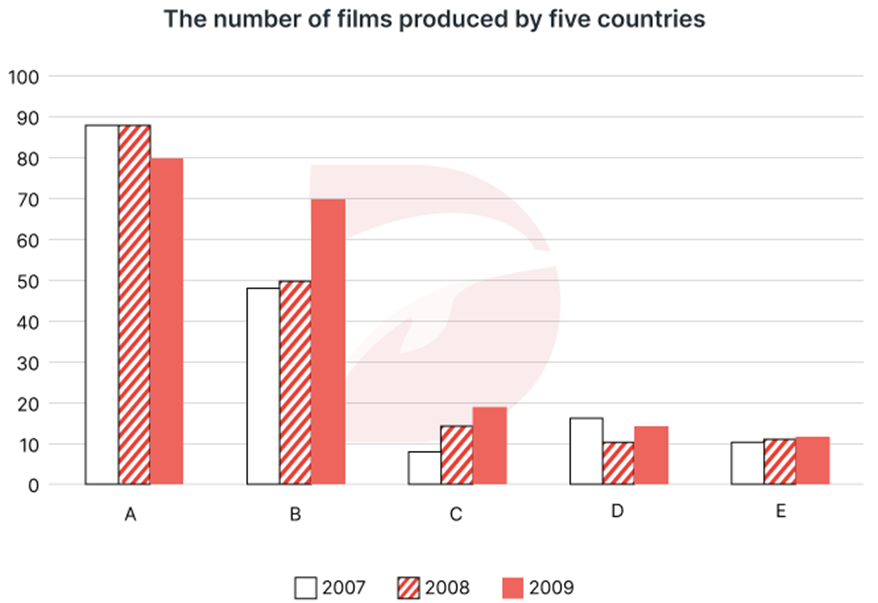
Sample 1:
The given bar chart compares five different countries in terms of their film production from 2007 to 2009.
Overall, the number of films produced in countries B, C, and E increased, whereas a decline was observed in the remaining countries. Notably, country A remained the most prolific producer despite a slight drop, followed by country B.
At the start of the period, with 90 films released, country A was by far the largest film producer. Meanwhile, B made 50 films, more than triple the figure for D, at just around 15 units. The movie production in countries C and E was relatively modest, with each releasing only 10 movies in 2007.
Thereafter, the number of films that country A distributed modestly declined to 80 units in 2009, still ranking first. In contrast, country B saw a significant rise, increasing by 20 films, to end the period at 70 films. C and E also experienced moderate increases, with figures rising to around 20 and 11 films, respectively. D experienced a slight drop in its film production in 2008, after which it recovered to around 15 films in the following year.
Sample 2:
The bar chart delineates film production across five countries from 2007 to 2009.
It is perceptible that country A led in film production, followed by country B, while countries C, D, and E exhibited significantly lower outputs. Notably, country B experienced the most substantial increase, whereas country A saw a slight decline, and the other nations demonstrated minimal changes.
In 2007, country A produced approximately 87 films, a figure that remained unchanged in 2008 before decreasing to 80 in 2009. Conversely, country B’s film production increased from 50 in 2007 to 53 in 2008, and subsequently surged to 67 in 2009, representing the most significant rise among all countries surveyed.
Countries C, D, and E each produced fewer than 20 films annually. Country C’s output rose from 8 in 2007 to 18 films in 2009. Similarly, country E’s production increased from 9 to 12 films over the same period. In contrast, country D’s number declined from 13 in 2007 to 8 films in 2008, before recovering to 12 films in 2009.
Sample 3:
The depicted bar chart elucidates the volume of films produced annually between 2007 and 2009 by five designated nations, labelled A through E.
A synopsis of the data reveals that Country A maintained the preeminent position in film production throughout the period, albeit with a minor decrement in its output by the end of the timeframe. Concurrently, Countries B, C, and E exhibited ascending trajectories in their film production capabilities, with Country B notably amplifying its output. In contrast, Country D’s production figures oscillated over the years, displaying no consistent trend.
Further elaborating, Country A initiated the period with a robust count of approximately 88 films in 2007, retained a similar tally the following year, but slightly regressed to around 80 films by 2009. Contrastingly, Country B, starting from a baseline of about 50 films in 2007, experienced substantial growth, escalating to roughly 70 films by the conclusion of 2009, signalling significant industry expansion.
For Countries C and E, the increments were less pronounced but still indicative of growth. Country C nearly doubled its production from an initial count of about 8 films to approximately 19 by 2009, whereas Country E saw a moderate rise from 9 to 11 films. In divergence, Country D’s production was erratic, commencing at 15 films, dipping to 9, and rising again to around 13 by the end of the period, underscoring an unstable production pattern compared to its counterparts.
Sample 4:
The chart presents the annual film production totals from 2007 to 2009 for five distinct countries labelled A, B, C, D, and E.
A broad overview reveals that Country A consistently led in film production over the observed period, although it experienced a slight decline in output by 2009. Meanwhile, Countries B, C, and E showed trends of increasing film production, with Country B notably ramping up its output significantly. Country D, however, displayed fluctuating production levels with no clear trend.
In detail, Country A's film production started at its peak in 2007 with approximately 88 films, maintained a similar level in 2008, but slightly reduced to around 80 films by 2009. On the other hand, Country B showed a remarkable growth from producing about 50 films in 2007 to approximately 70 films by 2009. This upward trajectory indicates a robust expansion in Country B's film industry over these years.
Country C and Country E also demonstrated growth, albeit less dramatically. Country C's output nearly doubled from about 8 films in 2007 to around 19 films in 2009, while Country E modestly increased its production from 9 to 11 films over the same period. Conversely, Country D's film industry showed instability, starting at 15 films in 2007, dropping to 9 in 2008, and partially recovering to 13 films in 2009. This indicates a less predictable pattern compared to the other countries.
Sample 5:
The bar chart illustrates how many movies were produced in five nations, namely A, B, C, D and E from 2007 to 2009.
Overall, country A registered the highest numbers of films in 3 years compared to that of other remaining countries. Another noteworthy feature is that while there was an upward tendency of film numbers in country B, C and E, a downward trend was seen in case of country A and D, between 2007 and 2009.
In 2007, about 50, 8 and 9 films were produced in country B, C and E, respectively. When it comes to country B, this figure rose to 70. Moreover, we can also notice that there was a slight increase in country C and E with 19 and 11 films, respectively, in the year 2009.
A contrast trend was seen in country A. In 2007, country A produced approximately 88 movies. This figure remained stable in 2008 before dropping slightly to 80 films in the year 2009. The number of films produced in country D fluctuated. There were about 15 films produced in 2007. After that, this number decreased to about 9 films before rising again to reach about 13 movies by the year 2009.
Sample 6:
The line graph illustrates how many films were made by five different nations between 2007 and 2009.
Overall, there were decreases in the number of films produced in countries A and D, whereas the opposite was true in the cases of the remaining nations. Additionally, countries A and B remained by far the largest film producers.
From 2007 to 2008, country A produced nearly 90 films each year, but by 2009 the figure had declined slightly to 80. Despite this drop, country A still made more films than the other countries in question. Country D followed a similar trend, albeit at a much lower rate, beginning at around 15 films, hitting a low of just under 10 a year later, before rising back to about 14 in the final year.
Meanwhile, roughly 50 films were shot by country B from 2007 to 2008, after which the production saw a significant increase to 70 films in 2009. Much smaller, yet more consistent rises were observed in the numbers of films made in countries C and E, growing from nearly 10 to almost 20 and from 10 to 11 films over the period, respectively.
Sample 7:
The bar chart provides information about movie production in five different countries (labelled A-E) from 2007 to 2009.
Overall, country A had the highest number of films produced. It is also notable that while there was a decline in the figures for country A and D, the opposite was true for those of country B, C and E.
In 2007, around 86 films were made by country A. The figure remained unchanged one year later before slightly decreasing to exactly 80 films in 2009. Starting at about 15 movies in 2007, the number of films released by country D fell to just under 10 in 2008 and rose again to 12 in 2009.
However, the opposite trend could be seen in the figures for the other countries. Between 2007 and 2009, the number of movies made by country B witnessed a rise of 20 movies from 50 films to 70 films. Similarly, despite standing at only under 10 films in 2007, the number of movies made by country C underwent a gradual increase to 18 movies by 2009. As for country E, the figure only experienced a minimal rise from around 9 movies in 2007 to 11 in 2009.
Sample 8:
The bar chart compares film production in five different countries in the years 2007, 2008 and 2009. Overall, country A produced the most films during the given three-year period followed by country B, while the film industry was not as strong in countries C, D, and E. The largest increase was in country B while country A experienced a small decrease and there were minimal rises in the other nations.
Leading the chart in 2007, country A produced approximately 87 movies, and this figure remained unchanged the next year before decreasing to 80 in 2009. On the contrary, a reverse trend was witnessed in B’s film production. Only manufacturing 50 movies in 2007, country B produced 3 more films the next year and about 17 films in 2009, which was the most significant rise among all the countries surveyed.
With substantially lower output, countries C, D, and E were responsible for fewer than 20 movies each year. Specifically, about 8 films were manufactured in C in the first year, before this figure increased twofold in 2008 and finally reached 18 movies in 2009. Country E also experienced an upward trend, increasing from approximately 9 films to around 12 films by the end of the period. In contrast, country D decreased sharply from around 13 films in 2007 to 8 in 2008 (the lowest number among all countries that year) before recovering to 12 films produced in 2009.
Sample 9:
The bar chart illustrates the number of films produced by five countries, labeled A to E, over a three-year period from 2007 to 2009.
Overall, country A consistently produced the highest number of films each year. While countries B, C, and E experienced an upward trend in movie production, countries A and D saw a decline over the same period.
Country A produced 87 films in both 2007 and 2008, before experiencing a slight decline to 80 films in 2009. In contrast, country D’s film production started at 15 films in 2007, dropped significantly to 9 films in 2008, and then rose slightly to 12 films in 2009.
Conversely, countries B, C, and E exhibited a positive trend. Country B saw a notable increase in film production, rising from 50 films in 2007 to 70 films in 2009. Similarly, country C’s film output increased from 8 films in 2007 to 13 films in 2008 and continued to grow to 17 films in 2009. Country E also showed a gradual increase in production, with the number of films rising from 9 in 2007 to 11 in 2009.
Sample 10:
The provided bar chart highlights how many films were produced by five nations over the course of three years, starting from 2007.
From an overall perspective, the numbers of films made in countries C, D and E fell far behind compared to those in countries A and B. In addition, while film production in countries B, C and E witnessed an upward trend, the opposite was true for the remaining nations.
Country A registered the same figures in the first 2 years, at approximately 87, and the same pattern could be observed in country B, with exactly 50 films made in 2007, which was slightly smaller than the figure for the next year. However, in 2009, the number of films produced in country A saw a slight drop to 80 while that in country B soared to 70, securing second place when it comes to film making.
Both countries C and E produced fewer than 10 films in the first year. However, the film-making industry in the former then saw a more rapid increase to about 17 in the last year while the latter managed to introduce just over 10. Meanwhile, in 2007, country D headed the list among the bottom three, with the number nearly the same as country C's peak, but it then plummeted to under 10 in the next year, followed by a moderate recovery of around 5.
Sample 11:
The bar graph depicts the quantity of motion pictures produced by five different nations, over a triennium starting 2007. Overall, countries A and D created less movies over the given years, while a reverse trend was witnessed in the other nations. Additionally, the number of films developed by country A and B were much higher than the remaining three countries.
Regarding the major film creators, country A produced a significant number of films in each of the first two years at nearly 90, which then fell to precisely 80 films in 2009. Moreover, ranking second throughout the period, country B produced around 50 movies each year from 2007 to 2008, before surging to 70 in 2009.
Concerning the minor movie producers, country C started at approximately 8 films and exhibited continuous increases to roughly 20 films by 2009, becoming the largest producer in this group. Country E's production witnessed a similar rise, however, with a lesser extent, which ascended constantly from around 9 to about 11 films over the surveyed period. Conversely, after a plunge from roughly 15 to just below 10 movies from 2007 to 2008, country D recovered to nearly its initial number in the end.
Sample 12:
The bar chart delineates the trend of cinematic production across five distinctive nations (referred to as A-E) from 2007 to 2009.
Overall, the data reveals that Nation A led in terms of film production volume during the period under consideration. It is also worth noting that the cinematic output of Nations A and D witnessed a contraction, in stark contrast to Nations B, C, and E, which saw their movie production figures escalating.
In 2007, Nation A was responsible for the creation of approximately 86 films. This number held steady for the following year, only to undergo a slight contraction, falling to a precise count of 80 movies in 2009. Nation D’s film production trajectory was less stable, with an initial output of nearly 15 movies in 2007, dropping to just below 10 in 2008, before rebounding modestly to 12 by the end of 2009.
Conversely, Nations B, C, and E demonstrated growth in their cinematic output over this timeframe. Nation B saw a surge of 20 movies in its production, climbing from 50 in 2007 to 70 by 2009. Nation C, despite its relatively low base of fewer than 10 films in 2007, realized a steady ascension to reach a total of 18 movies by 2009. Similarly, Nation E experienced a marginal uptick in its production numbers, inching up from roughly 9 movies in 2007 to 11 in 2009.
The tables below provide information about the consumption and production of potatoes in five parts of the world in 2006.
Summarize the information by selecting and reporting the main features, and make comparisons where relevant. Write at least 150 words.

Sample 1:
The given charts compare five different regions in terms of their production and consumption of potatoes in 2006.
Overall, Asian countries were by far the largest potato producers, while the lowest production was observed in South America and Africa. Regarding average potato consumption, Europe recorded the highest figures, in contrast to Africa, where consumption was the lowest.
Asia led potato production with slightly over 131 million tonnes, closely followed by Europe with 126.3 million tonnes. North America produced significantly less, at approximately 25 million tonnes. South America, Central America, and Africa had similar production capacities, ranging from 15.6 to 16.4 million tonnes.
In terms of consumption, the average European consumed slightly over 96 kg of potatoes, the highest among the five regions. North Americans consumed roughly 58 kg per person, more than double the consumption in Asia, South America, and Central America, where figures ranged from 23.6 to 26 kg. Finally, African consumption was the lowest, with an average of just 14.1 kg per person.
Sample 2:
The tables show how much potato was consumed and produced across various parts of the world in 2006.
Overall, Europe had the highest potato consumption per capita, though its production was slightly lower than that of Asia and Oceania, who were the largest producers. In contrast, South and Central America, and Africa produced and consumed the least potatoes.
Regarding potato consumption, Europe was the biggest consumer in 2006, with an intake of 96.1 kilograms per person (kg/capita), followed by North America, averaging 57.9 kg/capita. This was approximately double the consumption in Asia and Oceania, and South and Central America, both standing at around 25 kg/capita, while the lowest consumption was recorded in Africa, at only 14.1 kg/capita.
Turning to potato production, Asia and Oceania were the leading producers, with a total output of 131.2 million tonnes (Mt). Although European people ate more potatoes than those in any other regions listed, their production was the second highest, at 126.3 Mt. Meanwhile, North America, Africa, and South and Central America registered the smallest production figures, ranging from 15 to 25 Mt.
Sample 3:
The tables illustrate the quantity of potatoes produced in five different regions and correspondingly how much per person consumed in 2006.
Overall, Europe and North America were the two largest consumers, whereas Asia and Europe were considered two principal potato producing regions.
Regarding the consumption, Europe led the position with 96.1 kg potatoes eaten on average, followed by North America where the personal consumption of potatoes was relatively less, only 57.8 kg. In comparison, Asia and South and Central America had similar eating preferences with 25.8 and 23.6 kg. It is worth noticing that Africans consumed potatoes at a small quantity (14.1 kg) per person, ranking the smallest consumer of the five regions.
As to potato production, Asia and Europe were the two largest potato suppliers in 2006, amounting to approximately 131 million and 126 million tonnes. The output figure for North America was far behind that for Europe and Asia, only contributing 24.7 million tonnes to the potato market. The other two regions, South and Central America and Africa, produced around 16 million tonnes, nearly one-eighth of the European proportion.
Sample 4:
The tables give data regarding the quantity of potatoes consumed per person (in kg) and grown (in million tonnes) in five regions in 2006.
Looking at the regional consumption, Europe was the biggest consumer with 96.1 kg potatoes eaten per person. It was followed by North America where per capita potato usage was comparatively less, only 57.8 kg. At the next levels, i.e. the third and fourth, were Asia and South and Central America. These areas had similar levels of consumption, 25.8 and 23.6 kg respectively. In comparison, an average person in Africa ate less than half this amount (14.1 kg) annually, making it the smallest consumer.
As regards the production, Asia and Europe were the two largest potato producers in 2006. Their production amounted to approximately 131 and 126 million tonnes respectively. North America stood at the third position. But its contribution was only 24.7 million tonnes which is about one fifth of the European share. The other regions, South and Central America and Africa, were far behind Europe. Each of them produced around 16 million tonnes of potatoes, nearly one eighth the European proportion.
Overall, Asia and Europe were two primary potato producing regions whereas Europe and North America were the two largest consumers.
Sample 5:
The provided information illuminates the consumption and production of potatoes in five different global regions during the year 2006, presenting a clear picture of regional dietary patterns and agricultural outputs.
In a sweeping overview, Europe emerges as the region with the most voracious appetite for potatoes, with consumption figures topping the charts, and it stands as a close contender to Asia in terms of production. Both continents demonstrate a remarkable capacity for potato production, jointly accounting for the lion's share of the world's supply in 2006.
Digging into specifics, Europe's potato consumption soared to an impressive 96.1 kilograms per individual, dwarfing the global average. North America's consumption was also noteworthy, with an average of 57.9 kilograms per person, situating it comfortably in second place. On the contrary, the figures from Asia, despite its dominance in production, suggest a moderate consumption level of 25.8 kilograms per person. South and Central America's consumption stood at a respectable 23.6 kilograms per person, while Africa lagged behind, with a modest average of 14.1 kilograms per person.
Turning to production, Asia's fertile lands yielded a prodigious 131.2 million tonnes of potatoes, surpassing all other regions. Europe, with its substantial 126.3 million tonnes, was Asia's closest competitor. Meanwhile, North America, Africa, and South and Central America trailed with 24.7, 16.4, and 15.6 million tonnes respectively, illustrating a significant disparity in production scales across the continents. These figures reflect a world where potato farming flourishes most in Asia and Europe, aligning with their historical and climatic predispositions for this crop.
Sample 6:
The tabular data delineates the patterns in both consumption and production of potatoes across five regions globally in the annum 2006, charting a comparative analysis of these agrarian statistics.
A cursory evaluation of the data reveals a dichotomy where Europe's populace stands as the premier consumer of potatoes, with Asia and Europe jointly dominating the sphere of production. This overview paints a picture of a continent deeply rooted in potato consumption, contrasted by an Asian market that, while prolific in production, showcases a comparatively restrained individual consumption rate.
Europeans on average ingested a prodigious 96.1 kilograms of potatoes each, a testament to the tuber's culinary prominence in their diet. North America's proclivity for potatoes was also significant, with an average intake of 57.9 kilograms per person. In stark contrast, Asia, despite being a titan in terms of production with an immense yield of 131.2 million tonnes, recorded a per capita consumption of a mere 25.8 kilograms. The figures carve out a narrative of diverse regional consumption habits, with South and Central America's average standing at 23.6 kilograms per person, and Africa's consumption being the most modest at 14.1 kilograms per individual.
Production metrics reinforce the narrative of regional agricultural strength, with Europe's impressive harvest of 126.3 million tonnes narrowly trailing Asia's production figures. North America, Africa, and South and Central America's outputs, though significant, pale in comparison, illustrating a global pattern where the epicentres of potato production are clearly demarcated, with Europe and Asia leading the charge. These statistics not only provide a lens into the consumption habits of various cultures but also reflect the agronomic capacities of the regions delineated.
Sample 7:
The data sets provided offer a thorough comparison of the consumption and production of potatoes in five parts of the world in 2006, affording a granular view into regional agricultural practices and dietary preferences.
At the macro level, Europe distinguishes itself with the highest per capita potato consumption, while Asia and Europe together outpace other regions in production by a considerable margin. These overarching trends indicate a stark variance in potato-related dietary staples and agricultural yield across the continents.
Drilling down, we see Europeans leading the consumption stakes with an average individual devouring 96.1 kilograms of potatoes in the aforementioned year. North America follows suit with a substantial but lesser figure of 57.9 kilograms, signalling a sizeable gap between the first and second rankings. Conversely, Asia, despite its heavyweight title in potato production at 131.2 million tonnes, sees a relatively modest per capita consumption of 25.8 kilograms. The data further delineates a descending scale of consumption, with South and Central America and Africa at 23.6 and 14.1 kilograms per person, respectively.
On the production front, Europe's bountiful harvest of 126.3 million tonnes closely tails Asia's, suggesting a competitive agrarian output. Meanwhile, North America, Africa, and South and Central America present lower production figures, reflecting a global agricultural landscape where Europe and Asia are the predominant potato producers. The statistics not only shed light on regional consumption patterns but also underscore the disparities in agricultural efficiency and focus across the continents.
Sample 8:
The tables illustrate the consumption and production of potatoes in five regions of the world in 2006.
Overall, Asia and Europe were the primary potato producers, while Europe and North America had the highest consumption rates.
In terms of consumption, Europe led with 96.1 kg of potatoes consumed per person, followed by North America at 57.9 kg. Asia and South and Central America showed similar consumption levels, with 25.8 kg and 23.6 kg respectively. Africa had the lowest consumption, with an average of 14.1 kg per person annually.
Regarding production, Asia and Europe dominated, producing approximately 131 and 126 million tonnes respectively. North America, though third in rank, produced only 24.7 million tonnes, about one-fifth of Europe's output. South and Central America, along with Africa, were significantly lower, each producing around 16 million tonnes, nearly one-eighth of Europe's production.
Sample 9:
The table illustrates the quantity of potatoes consumed and produced in five world regions in 2006. Overall, European residents consumed the highest level of this produce, while Asia was the primary producer of potatoes among the surveyed areas.
Regarding consumption per individual, the level of potatoes incorporated into each European resident's diet was 96.1 kg, followed by North America at nearly 58 kg. Furthermore, the figures for South and Central America combined and Asia were fairly comparable at around 24 kg, whereas Africa was the lowest at 14.1 kg.
Turning to production level, despite exhibiting a modest consumption number, Asia cultivated a remarkably large quantity of potatoes at 131.2 million tonnes. Moreover, Europe ranked second at 126.3 million tonnes. The remaining regions produced significantly lower levels of potatoes, with the highest among those being North America at just 24.7 million tonnes. Finally, the outputs of South and Central America combined and Africa were relatively similar at approximately 16 million tonnes.
Sample 10:
The tables present data on potato consumption and production in five regions globally in 2006, covering both average consumption per person and the total production for each area.
Overall, Europe displayed the highest consumption per individual, whereas Asia led in total amount of potato produced. On the other hand, Africa recorded the lowest figures in both categories, underlining distinct regional differences.
Regarding individual consumption, Europe outpaced all other regions, with 96.1 kg per person, nearly double that of North America, which came in second at 57.9 kg. Asia followed with a moderate figure of 25.8 kg per person, slightly ahead of South and Central America at 23.6 kg. Africa had the smallest figure, with only 14.1 kg per person.
Turning to total production, Asia ranked first with 131.2 million tonnes, narrowly surpassing Europe’s 126.3 million tonnes. North America consumed a significantly smaller amount, at 24.7 million tonnes, followed by South and Central America with 15.6 million tonnes. Africa had the lowest overall production statistics, at just 16.4 million tonnes.
Sample 11:
The tables provide information about the consumption of potatoes per person (in kilograms) and the production of potatoes (in million tonnes) across five regions of the world in 2006.
Overall, Europe had the highest consumption of potatoes per person, while Asia and Europe were the leading producers. In contrast, Africa had the lowest consumption per capita and also produced relatively low quantities compared to other regions.
In terms of consumption, Europe was the largest consumer, with each person eating an average of 96.1 kg of potatoes in 2006. North America followed, with 57.9 kg per person. The consumption figures for South & Central America and Asia were similar, at 23.6 kg and 25.8 kg per person, respectively. Africa, however, had the lowest consumption, with only 14.1 kg per person.
When it comes to production, Asia was the largest producer, generating 131.2 million tonnes of potatoes. Europe was the second-largest producer with 126.3 million tonnes. North America produced significantly less, with 24.7 million tonnes, while Africa and South & Central America produced relatively small amounts, at 16.4 million tonnes and 15.6 million tonnes, respectively.
Sample 12:
The provided tables present an overview of potato consumption and production across five global regions in the year 2006.
Overall, Europe led in potato consumption, whereas Africa had the lowest consumption figures. In contrast, Asia was the largest producer of potatoes, while South and Central America recorded the smallest production volumes.
In terms of potato consumption, Europe stood out with the highest per capita intake at 96.1 kilograms, far surpassing other regions. North America followed as the second highest, with an average consumption of 57.9 kilograms per person. In contrast, Africa exhibited the lowest consumption rates, at just 14.1 kilograms per capita. South and Central America and Asia had comparable consumption figures at 23.6 kilograms and 25.8 kilograms, respectively, highlighting a moderate dietary reliance on potatoes in these regions.
Regarding potato production, Asia emerged as the predominant producer, cultivating an impressive 131.2 million tonnes of potatoes in 2006. Europe closely followed, with a substantial production of 126.3 million tonnes, which emphasized its role as a significant contributor in this sector. South and Central America produced 15.6 million tonnes, slightly less than Africa with 16.4 million tonnes. North America, while having a relatively high consumption rate, reflected a lesser production figure of 24.7 million tonnes, indicating a reliance on imports or other sources for its high potato consumption.
Sample 13:
The tables present data on potato consumption and production across various regions of the world in 2006.
Overall, Europe had the highest per capita consumption of potatoes, although its production was slightly lower than that of Asia and Oceania, which emerged as the top producers. In contrast, South and Central America, along with Africa, recorded the lowest levels of both consumption and production.
In terms of potato consumption, Europe led in 2006, with an average consumption of 96.1 kilograms per capita (kg/capita). North America followed, with a figure of 57.9 kg/capita, which was almost twice the consumption level of both the Asia/Oceania region and South and Central America, each of which consumed around 25 kg/capita. Africa had the lowest consumption rate, with only 14.1 kg/capita.
Regarding production, Asia/Oceania was the largest producer, with a total output of 131.2 million tonnes (Mt). Although Europe consumed the most potatoes, it ranked second in production, generating 126.3 Mt. In contrast, North America, Africa, and South and Central America had the lowest production levels, with figures ranging between 15 and 25 Mt each.
In summary, while Europe stood out as the highest consumer of potatoes, Asia and Oceania surpassed other regions in production. Africa and South and Central America exhibited the lowest figures in both categories.
Sample 14:
The tables given above describe the information about the consumption and production of potatoes in five different locations of the world in the year 2006.
Based on the two tables, it is clearly understood that the largest producer of potatoes is Asia and the European population is at the top position in consuming potatoes.
From the first table, data shows that North America is the second largest consumer where people intake nearly 58 kilograms of potatoes. As already mentioned, European people consume 96. 1 kilogram of potatoes which is the highest compared to the other four countries in 2006.
According to the second table chart, South and Central America are the lowest potato producers while people there consume 23. 6 kilograms of potatoes. Europe is the second largest producer while Asia remains the first place in potato production. Furthermore, Asia and Europe are the major potato producers in the year 2006.
Sample 15:
The tables provided illustrate a comparative overview of potato consumption and production across five global regions in 2006. A notable contrast emerges, with Europe and North America leading in consumption, while Asia and Europe are at the forefront of production.
In terms of consumption, Europe is the highest consumer, with an average per capita intake of 96.1 kilograms. Following closely, North America registers a per person consumption of 57.9 kilograms. Asia and South and Central America display similar consumption figures, averaging 25.8 and 23.6 kilograms per capita, respectively. Africa, on the other hand, has the lowest consumption rate at just 14.1 kilograms, which is significantly less than that of the other regions.
Regarding production, Asia and Europe emerge as the leading producers, generating approximately 131 million and 126 million tonnes, respectively. In contrast, North America's production is considerably lower, amounting to 24.7 million tonnes. South and Central America and Africa together contribute around 16 million tonnes, which is roughly one-eighth of Europe's output.
Sample 16:
The tables illustrate the consumption and production of potatoes in five different regions of the world in 2006. The first table shows the average consumption per person in kilograms, while the second table provides the total potato consumption in million tonnes.
Overall, Europe had the highest average potato consumption per person, while Asia consumed the largest quantity in total. Africa, on the other hand, showed the lowest figures in both categories.
In terms of per capita consumption, Europe led significantly with 96.1 kg per person, almost double that of North America, which had the second-highest consumption at 57.9 kg. Asia, despite having a large population, had a relatively low average consumption of 25.8 kg per person, followed by South and Central America at 23.6 kg. Africa had the lowest individual potato consumption at 14.1 kg per person.
When it comes to total potato consumption, Asia topped the list with 131.2 million tonnes, which was marginally higher than Europe's total of 126.3 million tonnes. North America consumed much less in total at 24.7 million tonnes, and South and Central America followed closely behind with 15.6 million tonnes. Africa consumed the least amount overall, at just 16.4 million tonnes.
Sample 17:
The two tables delineate the average consumption of potatoes per person and total production volumes across five continents in the globe, measured in 2006.
It is discernible that potato was a staple in Europe, which led in the per capita potato consumption, while the highest production of this food was recorded in Asia.
In terms of consumption, European nationals were the largest potato consumers, with 96.1 kilograms per head, a pronounced margin ahead of the second largest figure belonging to North America, averaging 57.8 kilograms per person. In this year, Asia and South and Central America presented a relatively identical potato consumption, at 25.8 and 23.6 kilograms per capita respectively. The lowest intake was in Africa, where each national consumed a mere 14.1 kilograms of potatoes on average.
Shifting focus on potato production, the lion’s share was shown in Asia, at 131.2 million tonnes of potatoes in 2006, closely followed by Europe’s output at 126.3 million tonnes. In stark contrast, North America produced 24.7 million tonnes, and Africa and South and Central America yielded low outputs of 16.4 and 15.6 million tonnes, respectively.
Sample 18:
The table information gives data on potato utilization and generation in completely different parts of the world in 2006. By and large, normal potato admissions in Europe were the most noteworthy whereas Asia and Europe were the major potato makers in 2006.
As the information recommends, a normal European ate marginally over 96 kilograms of potato in 2006 which was higher than the potato utilization in other parts of the world. With a general 58 kg potato utilization per individual in 2006, North America stood at the moment-beat position. Asia, in spite of its most noteworthy potato aggregation, accounted for generally 26 kg per individual potato admissions. South and Central American citizens ate more than 23 kg per person whereas the slightest potato utilization might be observed in Africa, at over 14 kg per African.
Asian nations delivered over 131 million tons of potatoes in 2006 which was altogether higher than the potato development in Africa and America. Europe's potato collection was the moment biggest, roughly 5 million tons less than that of Asia. It is worth taking note that Asia and Europe were the foremost potato cultivators in 2006.
Sample 19:
The table information outlines per individual potato utilization and adds up to the generation of this edit in five distinctive locales within the world- South and Central America, Africa, North America, Europe, and Asia, in 2016. Agreeing to the data given, Europeans ate more potatoes than the citizens of other locales on a normal basis and Asia collected the biggest number of potatoes in 2016.
In points of interest, Europeans were the chief buyers of potatoes in 2006 as each European ate 96.1 kilograms of potatoes. At that point, North America and Asia taken after the moment and the third most noteworthy customer list of this trim, 57.9 and 25.8 kg per individual admission individually. It is curious to note that a normal European devoured nearly the same number of potatoes as a North American and nearly four times higher than that of an Asian citizen. The utilization in Africa was the slightest, about 14 kg per individual whereas it was 23.6 kg in South and Central America.
Moreover, Asia delivered the most elevated number of potatoes, 131.2 million tons in spite of their lower utilization rate. Europe developed over 126 million tons of potato and these two districts were the most potato makers in 2006.
Sample 20:
The tables outline the sum of potatoes which have been devoured and created by five diverse landmasses in 2006. Units are measured in kg per individual for utilization and million tons for generation.
In general, with respect to the utilization, it can be seen that Europe had the most noteworthy information among the other places, whereas the most reduced admissions had been experienced by Africa. In terms of generation, the major potato makers were Europe and Asia.
In 2006, 14.1 kg per individual of potatoes were eaten in Africa, followed by South and Central America and Asia which accounted for 23.6kg and 25.8 kg separately. At that point, North America has come to 57.9 kg, succeeded by Europe which has detailed the foremost pertinent esteem of 96.1kg.
With respect to the makers, South and Central America with Africa have displayed comparable information (15.6 and 16.4 million tons separately), as well as North America has contributed 24.7 million tons. Europe has delivered 126.3 million tons of potatoes, compared to Asia, which has collected 131.2million tons.
Sample 21:
The tables provide data on potato consumption (in kilograms per person) and production (in tonnes) across five world regions in 2006.
Overall, Europe had the highest per capita potato consumption, while Asia/Oceania led in production. Africa showed the lowest figures for both consumption and production.
In terms of consumption, Europeans consumed significantly more potatoes per person (96.1 kg) than any other region, followed by North America with 57.9 kg per person. Asia/Oceania and South and Central America had similar consumption levels, at 25.8 kg and 23.6 kg, respectively. Africa had the lowest consumption, at just 14.1 kg per person.
For production, Asia/Oceania was the leading producer, generating 131.2 million tonnes, slightly surpassing Europe, which produced 126.3 million tonnes. North America followed at a distant third with 24.7 million tonnes. South and Central America and Africa had the smallest production levels, at 15.6 million and 16.4 million tonnes, respectively.
It is notable that Europe, despite its high consumption, produced slightly less than Asia/Oceania. Similarly, Africa had the lowest potato consumption and one of the lowest production figures, reflecting a minimal reliance on potatoes in the region. In contrast, Asia/Oceania, with moderate consumption, dominated production. This disparity indicates variations in regional reliance on potatoes as a staple food.
Sample 22:
The table chart illustrates information about the potato consumption and production in different parts of the world in 2006.
On analyzing the data, it is clear that an average European ate a little over 96 kg of potatoes in 2006, which was higher than potato consumption in other parts of the world. North America ranked second, with a per capita consumption of about 58 kg of potatoes in 2006. Asia, despite its highest potato accumulation, consumes about 26 kg of potatoes per person. South and Central American citizens ate more than 23 kg per person, while the lowest potato consumption can be seen in Africa, only 14 kg per African.
Asian countries produced over 131 million tonnes potato in 2006 which was significantly higher than the potato growth in Africa and the America. Europe’s potato harvesting was the second largest, approximately 5 million tonnes less than that of Asia. It is worth noticing that Asia and Europe were the principal potato producers in 2006.
Overall, it is crystal clear that the average potato consumption in Europe was the highest, while Asia and Europe were the major potato producers in 2006.
Sample 23:
The given tables compare the yield of potatoes in million tonnes with the consumption in kg per person in 2006 in five regions of the world, which are South and Central America, Africa, North America, Europe and Asia, in 2006. It is clear that expect for the Americas, the production of potatoes outstripped the consumption in all other areas.
The production of potatoes was the highest in Europe and Asia at around 130 million tonnes each. The production in all other regions was between 15 and 25 million tonnes. However, as far as the consumption is concerned, the Europeans seemed to be the fondest of potatoes, eating about 96 kg per person. North America took the second place in the consumption at just below 60 kg per person. People of South and Central America and Asia ate around 25 kg per person, but the Africans were the least fond of potatoes, consuming approximately 14 kg per person in 2006.
Overall, in North America, the production was less than half the consumption whereas in Asia the production was six times more than the consumption.
The pie charts show the results of a survey in which undergraduates and postgraduates were asked about the range of books and non-printed materials in their school library.
Summarize the information by selecting and reporting the main features, and make comparisons where relevant. Write at least 150 words.
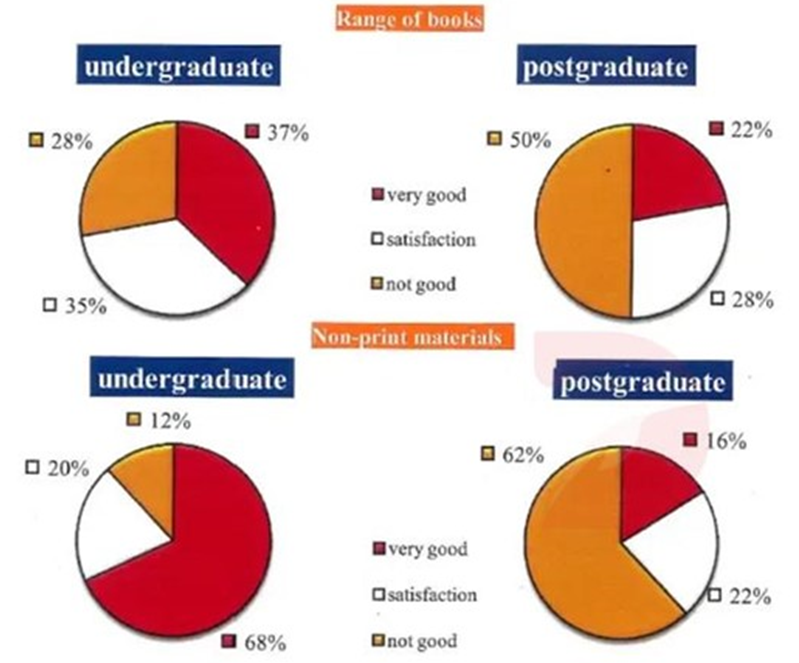
Sample 1:
The pie charts illustrate the percentages of undergraduates and postgraduates’ opinions regarding the non-printed materials and range of books in a school library
Overall, the majority of postgraduates are dissatisfied with the school library’s digital products while most undergraduates enjoy them. Additionally, although the variety of materials received unfavorable notions from the postgraduates, over one-third of the undergraduates rate it as high-quality.
Regarding students’ perspectives on how diverse the choices of books are, half of the students pursuing advanced degrees do not find it good. Furthermore, only over one quarter are satisfied and 22% of them are impressed. The figures for undergraduate students are more balanced, with 37% and 35% of this category compliment it and are satisfied, respectively, while the lowest proportion of this group are disappointed.
Also, the feedback of undergraduates and postgraduates on digital materials largely differs. While the majority of those still studying (68%) are highly content with the material, most of those already receiving a degree (62%) think otherwise. Only one-fifth of these two groups were satisfied with digital books, and this leads to the rest of the two groups again having opposite ideas about the books.
Sample 2:
The pie charts give information on the satisfaction levels of undergraduate and postgraduate students with the range of books and non-printed materials available at a university library. Overall, a comparison of the charts reveals a notable difference in satisfaction levels between undergraduate and postgraduate students regarding both printed books and non-printed materials. Although undergraduates generally express higher levels of satisfaction, postgraduates exhibit lower satisfaction across both categories.
When examining the range of books, a distinct contrast emerges between undergraduates and postgraduates. Notably. 37% of undergraduates report being very satisfied with the range of books, whereas only 22% of postgraduates express the same level of satisfaction. Additionally, around one fourth of undergraduates (28%) are not satisfied, compared to a considerable half of postgraduates who express dissatisfaction with the available book range.
In terms of non-printed materials, undergraduates show higher satisfaction levels compared to postgraduates. Specifically, 68% of undergraduates report high levels of satisfaction, contrasting sharply with the 16% of postgraduates. Moreover, while only 12% of undergraduates are not satisfied with non-printed materials, a significant 62% of postgraduates indicate dissatisfaction with these resources.
Sample 3:
The pie charts reveal the outcomes of a survey report. In the report, undergraduates and postgraduates were asked about the number of books and non-printed materials available in their school library. Overall, in both sectors, the undergraduates voted for a very good mechanism; however, postgraduates were unsatisfied.
According to the former part, 28% of undergraduates said that the range of books was not good, and 37% and 35% voted for very good and satisfaction, respectively. In non-print materials, 12% of undergraduates had shown their not good behaviour. 20% were satisfied, and 68% said the material was very good.
Exactly half proportion postgraduates voted for an unsatisfactory scenario in the range of books category. 22% and 28% had shown very good and satisfactory behaviour, respectively. Moreover, in the non-printed materials category, nearly six in ten proportion of postgraduates said that the material was not good. 16% had shown very good behaviour and just over one-fifth were satisfied.
The graphs below show the total percentage of films released and the total percentage of ticket sales in 1996 and 2006 in a country.
Summarize the information by selecting and reporting the main features, and make comparisons where relevant. Write at least 150 words.
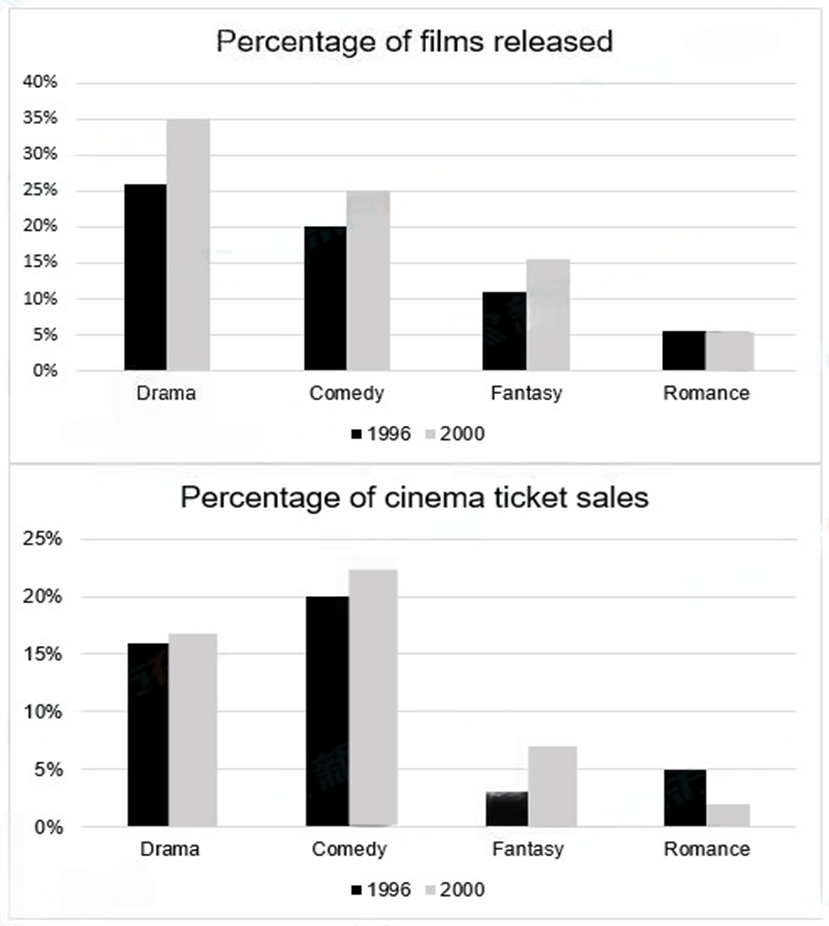
Sample 1:
The given bar charts detail the summarized proportions of four different genres of movies released and their ticket sales in 1996 and 2000 in a particular country.
As can be seen from the charts, drama and comedy were the most popular among both producers and movie-goers. While the creation and consumption of fantasy, comedy and drama increased significantly, the pattern of romantic movies was different in the given time.
Regarding the propotions of movies released, drama climbed noticeably, from 25% to 35% in 4 years, which continued to be the most produced type in 2000. Meanwhile, the proportion of romance remained unchanged, at 5% in the given period. This figure was a quarter of the percentage of comedy released in 1996, which grew to 25% after 4 years. At the same time, fantasy films slightly increased by approximately 5%.
In 1996, most consumers opted for comedy and dramatic movies, with their sales being 20% and 16% respectively. Then, these proportions marginally rose to 23% and 17%. An increase was also witnessed in the fantasy genre, from around 3% to over 5%. On the contrary, romance experienced a downward trend, from 5% of ticket sales to 2%.
Sample 2:
The bar charts illustrate the release of four types of movies and their tickets sold in the cinema in a nation in two years: 1996 and 2000.
Overall, more drama films were shown than any other type, but comedies were the audiences’ favourite; meanwhile, romance movies were the least popular.
Regarding the movies released, the percentage of dramas was by far the highest, at slightly over 25% in 1996, followed by comedies, at 20%. Fantasy films accounted for just over 10%, twice as high as the figure for romance films, at around 5%. By 2000, drama movies saw a significant rise, reaching 35% of all films. Comedy and fantasy films experienced moderate growth, reaching 25% and 15% respectively. Interestingly, the proportion of romance movies stabilised.
Turning to ticket sales in cinemas, comedies enjoyed the most popularity. In 1996 and 2000, slightly more than 20% of viewers opted for comedies. While the rise in the sales of drama films was not obvious from about 16% to some 17%, fantasy films saw a twofold increase from approximately 3% to around 7%. There was a sharp decrease in the sales figure for romance films from 5% in 1996 to only around 2% in 2000.
Sample 3:
The bar charts compare the proportions of various film genres released and the corresponding cinema ticket sales in one country, over a period of ten years, specifically in 1996 and 2006.
Looking at the first chart, it is apparent that drama was the most released film genre in both years, though its percentage significantly dropped from approximately 35% in 1996 to around 30% in 2006. Comedy films, which stood at roughly 30% of the total in 1996, experienced a slight increase by 2006, making up nearly a third of the movies released. Conversely, the fantasy genre showed a marked increase from about 7% to 10%, while romance films saw a marginal decline in their release percentages during the same period.
The second chart provides information on ticket sales, where once again, drama leads in both years. However, its dominance declined from around 22% to just over 15%. Comedy's share of cinema tickets sold mirrored its release percentage, increasing from close to 20% to about 23%. Ticket sales for fantasy movies also grew, doubling from around 5% to 10%. Romance films, while constituting a smaller fraction of ticket sales than releases, followed a downward trend, slipping from about 10% to a minor 5%.
Sample 4:
The bar charts provide information about the proportion of films launched across four different genres and their corresponding ticket revenue in two distinct years, 1996 and 2006, in a particular country.
Overall, while drama, comedy, and fantasy films exhibited positive growth in their movie releases, romantic films saw their proportions stagnating throughout the years. It is also worth noting that despite ranking second in film output, comedy stood out as the highest-grossing genre in both provided years.
Looking first at the breakdown of film releases, drama films led the way, accounting for around 27% of releases in 1996. Comedy films closely trailed behind at nearly 20%, with fantasy and romance films making up 11% and 5%, respectively, of the films launched that year. 4 years later, the consistent increases in the film releases of drama, comedy, and fantasy coupled with the stable pattern of romance films made the pecking order remain unchanged.
In terms of ticket sales, in 1996, comedy films were the most favored, commanding 20% of ticket sales. Drama films followed suit with approximately 16% of tickets sold, while romantic and fantasy only appealed to a small audience with rather negligible percentages of ticket revenue (5% and 3% in the order given). In 2000, comedy and drama films experienced upticks in popularity, with the former seeing its ticket sales rising to 23% and the latter 17%. Having a similar trend, albeit more pronounced, fantasy film ticket revenue almost doubled compared to 4 years ago, accounting for 6% of the ticket sales and surpassing romance to claim the third spot. The significant growth in the aforementioned film genres sales was counterbalanced by the considerable decline in romance film performance, with its sales plummeting to a mere 2% in the final year, making it the least chosen genre.
Sample 5:
The diagrams illustrate a country’s distribution of the four most popular film genres and their box office revenue between 1996 and 2000. Overall, drama dominated the release scene, while comedy reigned supreme in terms of ticket sales in the given period. Despite the general surge in production and audience demand across all film genres from 1966 to 2000, romance remained the least popular and profitable genre.
In terms of the publishing of films, the drama genre constantly led the chart from 1996 to 2000, with the most noticeable growth of around 10%, accounting for more than one-third (35%) of national films released by 2000. Similar growths were recorded for Both comedy and fantasy films in the given period, with the percentage of released comedy movies rising from 20% to 25%, while the figure for released fantasy movies climbed from 12% to 16% by 2000. By contrast, the romance genre defied the pattern by remaining stagnant at roughly over 5%, making this type of film to be released the least by 2000.
Regarding the sales of cinema tickets, comedy films were the best-sellers, with 20% of ticket sales in 1966, followed by a rise to nearly 23% in 2000, retaining the top position. The drama genre, which consistently held second place throughout the given period, witnessed a slight increase from 16% to 17% of tickets sold by 2000. While fantasy film ticket sales tripled to about 6% in 2000, the figure for romance movies halved to merely 2% in 2000 from its roughly 5% share in 1996, making it the least profitable genre.
Sample 6:
The given column graphs compare the percentage of four genres of films released with their respective sales in 1996 and 2000. It is interesting to note that even though more drama than comedy films were released, the sales of comedy films was the maximum in both the given years.
Out of the four genres of films, drama films took the lead as approximately 27% were released in 1996. This was followed by comedy at nearly 20%, fantasy at 11% and romance at 5% being released in that year. In 2000, the proportion of drama, comedy and fantasy films increased, but the release of romantic films showed stability.
As far as the sales are concerned, comedy films were the most popular with 20% tickets being sold in 1996. Drama films followed with approximately 16% tickets sold. Romantic films saw sales of 5%, whereas fantasy films were the least popular with about 3% of tickets being sold. In 2000, drama, comedy and fantasy grew in popularity, with ticket sales picking up in all three genres, but the genre of romance saw a sharp drop to about 2%.
Sample 7:
The bar chart illustrates the proportions of movies released and their box office records of a country in two different years.
Overall, there was an increase in the share of drama, comedy and fantasy films, with that of drama consistently being highest, while the figure for romance was always lowest and remained unchanged. Furthermore, an increasing percentage of revenue from selling tickets was seen in dramatic, comedic and fantasy, and comedy films dominated the cinema market in the period examined.
In 1996, drama was the most dominant film genre regarding percentage of releases with slightly over 25%, closely followed by comedy at 20% while fantasy and romance were roughly 10% and 5% respectively. Four years later, the figure for drama took a jump to 35% and remained the most prominent out of all categories. The rest of the genres except romance experienced a similar upward trend.
On the other hand, comedic motion pictures were the most watched type, with 20% of total tickets being purchased in 1996 and almost 25% in 2000. Drama ranked second, in which its figures were approximately 15% in both years. Fantasy and romantic films were consistently unpopular throughout the years, with their percentages revolving around the 5% range.
Sample 8:
The following bar charts illustrate the overall proportions of films released, categorized by four distinct genres, and their respective ticket sales in a particular nation in 1996 and 2000.
By and large, the percentage of drama, comedy, and fantasy films increased, while the release of romantic films remained stable. Notably, despite a higher number of drama films released, comedy films consistently had the highest sales in both provided years.
To specify, regarding the release rate of the four different genres, initially, the data for drama films led the chart at over 25%, followed by that of comedy at exactly 20%. Meanwhile, the figure for romance was bottom charted at slightly over 5%, being half compared to fantasy. It is also noteworthy that in 2000, the statistics for drama movies witnessed the biggest increase to a record-high of 35%. At the same time, that for comedy and fantasy shared the same 5% rise while the rate of romance titles remained unchanged.
Turning to the proportion of cinema ticket sales, in 1996, the data for drama and comedy constituted around 15% and 20% respectively, by far higher than the other genres with no more than 5%. In the following four years, that of drama and comedy increased while the former was more marginal.
Strikingly, ticket sales for fantasy well-doubled to approximately 7%, overtaking the data for romance whose figure saw an opposite trend in comparison.
Sample 9:
The charts illustrate the percentage of film releases by genre and their corresponding proportion of ticket sales in a specific country in 1996 and 2000.
Overall, there was an increase in the total number of films and ticket sales in all genres, with the exception of romance, whose share of film production witnessed no change, but ticket sales declined. In addition, both drama and comedy were dominant in terms of film releases and popularity.
Taking a closer look at film releases, in 1996, 26% of all films made were dramas, higher than the figure for comedies, at 20%. In 2000, the former genre held its position as the most produced genre, with its figure increasing to 35%, while comedy followed closely with 25% of releases. Regarding the two remaining genres, the proportion of fantasies was initially double that of romances, at 12% and 6% respectively. In 2000, while the former experienced a moderate rise to 16% of all releases, that of the latter remained unchanged.
In terms of box office performance, in 1996, audiences went to see comedies and dramas the most, with these genres accounting for 20% and 16% of ticket sales respectively. As for the two less popular genres, only 5% of total ticket sales were for romance films, slightly higher than fantasy's 3%. Four years later, comedy and drama still maintained their positions as the two most viewed genres, with their ticket sales increasing to 23% and 17% respectively. Meanwhile, a significant growth to 7% was witnessed in fantasy's ticket sales, eventually outpacing romances, whose sales saw a decline to 2%.
Sample 10:
The bar graphs delineate the proportion of film manufactured and the percentages of ticket sales in one country in two years, from 1996 to 2000.
Overall, the most significant film released could be seen in drama films, while romantic films bucked the trend throughout the period. It is also noticeable that the highest percentage of ticket sales was related to comedy films over the years.
More specifically, the data for drama films ranked first at over 25%, followed by comedy and fantasy with 20% and nearly 13%, respectively. In general, over the next 4 years, the percentages for these types of films witnessed an increase at 35%, 25%, and 17%, respectively, whereas the romance films stayed relatively stable throughout the period.
Regarding the remaining features, while the proportion of drama films accounted for the most types of film released, the total ticket sales of comedy films stood out at the top at 20% in 1996. In addition, while the types of drama, comedy and fantasy films rose significantly over the next period, the opposite was true for that of romantic films at lower than 3% in 2000.
The plans below show a student room for two people and a student room for one person at an Australian university.
Summarize the information by selecting and reporting the main features, and make comparisons where relevant. Write at least 150 words.

Sample 1:
The presented diagrams provide an insightful look into the layouts of student rooms in an Australian university. One is tailored for a singular occupant, while the other is designed to accommodate a pair.
Overall, both rooms, despite having similar dimensions, are uniquely designed to suit the requirements of their occupants. Whether a student values privacy or cherishes shared experiences, the Australian university in question seems to have options to fit all preferences.
Diving deeper into the room meant for a solo student, set at a rate of $200 per week, it appears to offer a haven of privacy and simplicity. Central to the room is a solitary bed, flanked by a singular study desk on one side. Adjacent to this academic space is a compact bathroom, ensuring all essential facilities are within arm's reach. A notable feature is the window, which is situated close to the desk, perhaps offering natural lighting ideal for study sessions.
Contrastingly, at $350 weekly, the room intended for two students exudes a vibe of shared camaraderie. It is intriguing to note that both rooms span an identical area of 6 metres in length. The shared bathroom and the side window are also reminiscent of the single rooms, but what sets this room apart is the positioning of the furniture, ensuring that despite the shared space, each student has their own distinct area. This room comprises twin beds, each accompanied by its own individual study desk and there exists more shared furniture, namely the bookshelf, cupboard, table and chairs.
Sample 2:
The provided pictures compare the layouts of student rooms for one individual and two individuals at an Australian university.
It is noticeable that the room for two people is more expensive and larger in size than the one-person room. Also, there are more amenities in the room for two occupants compared to the single-person room.
It costs $350 per week to rent the student room for two people while the rate for single-person room is much lower, at $200 weekly. Although both rooms share the same length of 6 meters, the one for two people has a width of 4 meters, which is 1.5 meters wider than the other.
Both of the rooms offer basic facilities, such as study desk, television, bed and kitchen appliances. However, with more space, the room for two occupants includes additional pieces of furniture, namely, two bookshelves, two cupboards, table and chairs. One extra bed and study desk are provided to better accommodate the students in the larger room.
Sample 3:
The floor plans illustrate the differences between two student rooms, designed for one and two occupants, at an Australian university.
Overall, the dual occupancy room is more spacious, with additional furnishings, and its rental cost is correspondingly higher compared to the single one.
In terms of size, both units share the same length of 6 meters. However, the two-person room has been designed with a greater width (4 meters) compared to the one-person room (2.5 meters), resulting in a higher weekly rental cost ($350 vs $200).
As the visitor enters the room, the two rooms display similar features on the left, namely a bathroom and a bookshelf. Beyond that, both have a study desk facing the wall and a bed by the back wall. However, the larger room is furnished with a circular table with two chairs outside the bathroom.
Moving to the right-hand side of the entrance, both feature a kitchen that comes with a sink, a stove, and a microwave. However, the kitchen in the two-occupant room is in the corner opposite the bathroom, providing more space for cooking, while the single room's kitchen is located by the right-hand wall, offering a more confined cooking space when the door is open. Moreover, the space on the right-hand side of the twin room contains an additional study desk beside the TV, and a second bed, separated from the first one by two cupboards, while the single room is furnished with only a TV on this side, offering more usable space.
Sample 4:
The diagrams illustrate the layout and amenities of two student accommodations in Australia, one designed for dual occupancy and the other for a single resident.
Overall, the room for two people commands a higher price, offers greater dimensions, and is equipped with more amenities than the room designed for single occupancy. While the room for two facilitates a more communal living experience with additional features, the room for one focuses on essential functionality within a compact space.
The most striking difference lies in the spatial distribution and furnishings; the room for two is 4 meters wide, allowing for two study desks, two beds, and an additional bookshelf. Conversely, the single room, being only 2.5 meters wide, contains just one bed and one desk. Both rooms include a television, but its placement varies, being next to a desk in the larger room and opposite the desk in the smaller room.
Moreover, the dual-occupancy room boasts two cupboards, which not only provide substantial storage but also delineate the shared space into more private areas, a feature completely absents in the accommodation for one. The single room's lack of a dining set starkly contrasts with the two-person room, which includes a table and chairs. Despite these differences, it is noteworthy that both rooms share several facilities, such as a bathroom, microwave, sink, and stove, ensuring that basic living needs are met regardless of the room type.
Sample 5:
The provided maps demonstrate two distinct types of dormitories for students, one for two people and one for one individual, at an Australian university.
Overall, the higher-priced room is larger in width and is more costly, with a comparatively more complex layout. Moreover, there is less furniture in the one-person room compared to its bigger counterpart.
As for the room that costs 350$ a week, it is 6 meters long by 4 meters wide. Upon the entrance, there is a bathroom on the left of the room, and if going along that, there is a bookshelf, a study desk and a bed by the window. This arrangement is also presented in the room that has a weekly price of 200$ with the exception of a bookshelf and shorter width (only 2.5 meters).
To the left of the smaller room, the layout is simpler with some kitchen equipment such as a microwave, a stove, a sink and a TV for entertainment means. The shared room has more complex decoration with not only these appliances but also a table and chairs, a second desk for studying, an additional bed and two cupboards that separate the space between the two beds.
Sample 6:
The diagrams compare single and twin rooms at an Australian university. Overall, the latter room type is better equipped and has larger areas compared to the former; however, this comes at the expense of higher rent.
Differences can be seen in the expenses and measurements of the two room types. Students in twin rooms pay $350 per week, $150 more than those in single rooms. Although rooms designed for one and two students share the same 6m length, their widths differ, with single rooms at 2.5m and twin rooms at 4m.
On the left side of both room types, there is one bathroom and various amenities, including a sink, stove, and microwave. Only two-person rooms feature a dining set opposite a television, catering for entertainment during meals. Adjacent to this set are two cupboards that divide twin rooms into two sections, each with a bed and a study desk. In contrast, on the right side of the one-person room, there is only a study desk and a bed, accompanied by a TV.
Sample 7:
The diagram depicts two different student dorm room design layouts. Because one room is designed for two people while the other is planned for a single occupant, there are major differences between their dimensions and features.
To begin, both rooms have a length of 6 meters; however, they differ in width. The living space in the single room is 2.5 meters wide which allows sufficient space to place a single bed with one study desk beside it, across from which is a TV. At the upper left corner is the bathroom, and adjacent to that is the cooking area comprising a stove, a microwave, and a sink.
A closer look into the double room reveals that it has a width of 4 meters which permits plenty of space for two beds. At the top right corner is Bed 1, and at the bottom right corner is Bed 2. Beside each bed is a study desk and both are divided by a cupboard. Unlike the other room, the larger option has a small social/dining area with a circular table and two chairs facing the television. The larger room also features a bookshelf. Apparently, the bathrooms are exactly the same size for both room options.
Sample 8:
The plans show the layout of 2 types of room for students at an Australian university. Overall, the student room for two people is larger and more expensive than the room for one person. These two rooms can be also compared in terms of their features.
The double room costs $350 per week while students who choose a single room have to pay $200 per week. The room for two students, at 6m x 4m, is nearly twice as large as the room for one which is 6m x 2.5.
When it comes to furniture, both rooms have a bathroom, a television and a similar kitchen with a sink, a stove and a microwave. The number of beds and study desks furnished in each room is equivalent to the number of students living. The double room features two cupboards, a bookshelf and a table and chairs; by comparison, there are none of these items in the single room.
Sample 9:
The maps illustrate the layout plans of 2 different rooms specifically designed to accommodate a single and two occupants in an Australian university.
Overall, it is noticeable from the 2 maps that there are several major differences between 2 rooms, in terms of widths, prices and the number of in-room facilities along with their placement. Apparently, the room for 2 students has a higher price, larger space and more room equipment.
Regarding the prices, it costs $350 per week to live in the double room while a student has to pay more than a half of it, $200 per week, to be exact, to rent the single room. Furthermore, as regards the dimension, both 2 rooms have the equal length of 6 metres but the room for 2 students is slightly wider in size with 4 metres compared with 2.5 metres, which allows more space for additional room facilities. In terms of the interior equipment arrangement, the TV in the room for 2 occupants is put next to study desk 2, facing the extra dining table and chairs. Moreover, the room designed for 2 occupants also features 2 cupboards for storage purposes and a bookshelf adjacent to study desk 1.
There are similarities in the positions of the bathrooms, bed 1 and study desk 1 in the single room and those in the double dorm room. Specifically, they are situated at the top left corner, the top right corner and between bed 1 and the bathroom respectively. Additionally, in both 2 rooms, the cooking areas, each consisting of a microwave, a stove and a sink, are placed in the bottom left corner.
Sample 10:
The plans demonstrate two distinct types of dormitories for students, one for two people and one for one person, at an Australian university. It is evident that the room for two students is larger and is more expensive. Furthermore, there can also be seen to be more furniture in the two-person room than the room for one person.
Costing 350 dollars a week, a student can share a room that is 6 metres by 4 metres wide with another student. The bathroom is located in the left corner of the room. In the bottom left corner of the room are the kitchen appliances, which include a sink, stove and microwave. Located next to the microwave is a television which sits opposite the table and chairs. There are two beds, which are arranged next to a study desk each: the first bed is located in the top right corner of the room, while the 2nd bed is in the bottom right corner. Furthermore, there is a bookshelf situated between the bathroom and one of the study desks.
The single room, on the other hand, costs 200 dollars a week, with a comparatively simpler layout. The room measures 6 by 2.5 metres. There is also a bathroom in the top left corner of the room, opposite the kitchen appliances. There is also a television placed adjacent to the study desk. Finally, a bed is placed in the right corner of the room next to the windows.
Sample 11:
The given diagrams illustrate the layout of two different student rooms at an Australian university. Overall, the main differences between the two rooms
are the price, the size, the features of each room, and how many people each room can accommodate. As can be seen, the first room is the larger, more expensive one, and has more features as well as can accommodate a greater number of people.
The first room is suitable for two people and costs $350 per week, while the second room is only suitable for one person and costs $200 per week. The first room is also significantly larger, at 6m x 4m, compared with the second room, which is only 6m x 2.5m.
The first room contains two beds, two study desks, two televisions, two cupboards, a bookshelf, and a table and chairs. Meanwhile, the second room only features one bed, one study desk, and one television, but it has no cupboards, bookshelf, or table and chairs. Both rooms have similar kitchen and bathroom facilities.
The diagram below shows a small local museum and its surroundings in 1957 and 2007.
Summarize the information by selecting and reporting the main features, and make comparisons where relevant. Write at least 150 words.
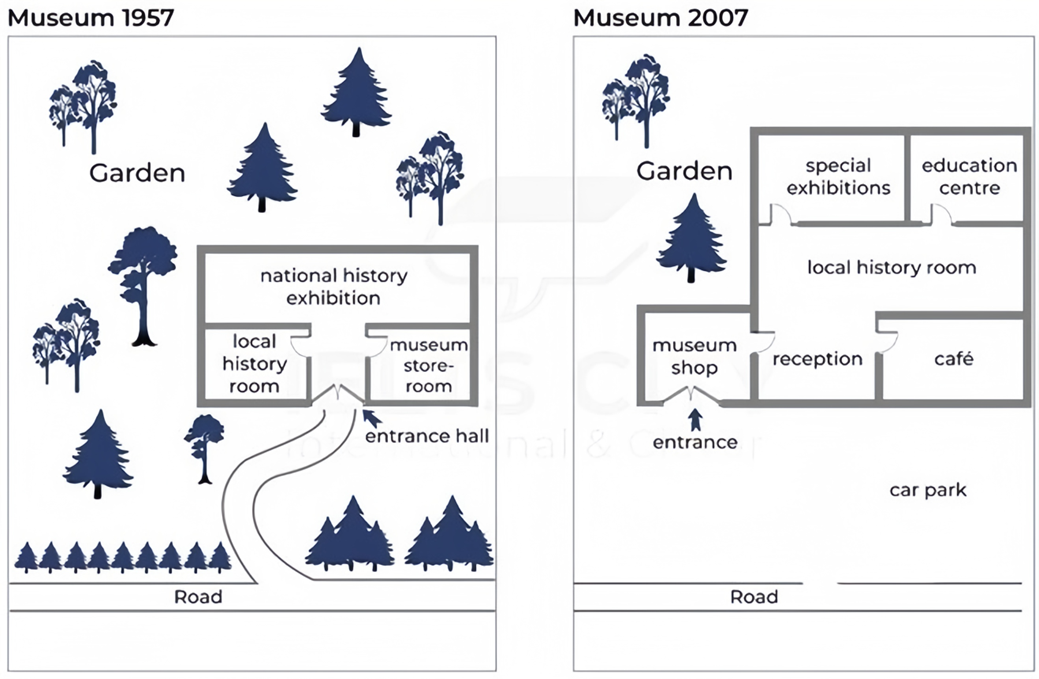
Sample 1:
The maps illustrate the layout of a museum and its grounds in 1957 and the changes that had occurred by 2007.
Overall, the museum building was extended, serving more purposes with additional rooms for exhibitions and education, and a parking area replaced part of the garden. This extension, however, resulted in a reduction of the green space in the museum’s grounds.
Looking first at the interior of the building in 1957, upon entering the entrance hall, visitors would have seen a local history room on their left and a museum storeroom on the right, while beyond the entrance hall was a space for the largest room, the national history exhibition. Fifty years later, the entrance had been relocated to a new extension left of the original, where visitors first encountered a shop. To its right were the reception area and an adjacent coffee shop. The local history room was moved to the center of the building, and beyond it were two brand new sections for special exhibitions and an education center.
Outside the grounds of the museum, a road ran along the southern side of the map, which remained unchanged in 2007. However, the road that branched off from it, leading to the entrance hall had been removed by 2007, and a new car park was developed southeast of the museum. Finally, there used to be many green spaces in the layout, most of which had disappeared by the latter year, except for the garden in the northwest corner.
Sample 2:
The illustrations depict changes to a museum building and grounds in 1957 and 2007. Overall, the building has become much larger, and the number of trees has been greatly reduced.
Looking first at the grounds of the museum, the picture in 2007 shows that all the trees have been removed from the roadside, and also most of them to the left and to the rear of the museum. The driveway leading up to the museum has also been removed and a car park has been built by the roadside.
In terms of the building itself, the entrance has been moved from the middle of the building to the left-hand side of the building, where a new museum shop has been built. From there, visitors can go into a new reception room. A cafe has been built on the right-hand side of the building replacing the museum storage room. The National History exhibition room has been turned into a local history room. A special exhibitions room and an education centre have also been added.
Sample 3:
The illustrations depict changes to a museum building and grounds in 1957 and 2007.
Overall, the building has become much bigger with the appearance of new facilities while the number of trees has been greatly reduced.
Regarding the surroundings, in 2007 all the trees along the roadside were all removed, the same case happened to most of the ones to the west and north of the building. Moreover, a parking lot was built in front of the museum, where there used to be a driveway.
In terms of the establishment, the entry was moved from the middle of the building to the west, where a new museum shop was constructed. From there, visitors can enter a reception room. A cafe was built on the bottom - right corner of the museum, replacing the storage room. The National History exhibition room was converted to the local history room. There were also the additions of an education centre and a special exhibitions space to the far side of the building.
Sample 4:
The illustrations depict the significant changes that have occurred to a museum building and its surrounding grounds between 1957 and 2007. The building has undergone a significant expansion, while the number of trees on the property has been greatly reduced.
The first noticeable change in the grounds is the complete removal of trees from the roadside, as well as the majority of trees to the left and rear of the museum. Additionally, the driveway leading up to the museum has been removed and replaced with a car park built by the roadside.
The building itself has also undergone significant changes. The entrance has been moved from the middle of the building to the left-hand side, where a new museum shop has been built. Visitors can enter the building through this new entrance and find themselves in a new reception room. A cafe has also been built on the right-hand side of the building, replacing the museum's storage room. The National History exhibition room has been converted into a local history room, while a special exhibitions room and an education center have been added.
In summary, the museum building has undergone significant expansion and modernization. There has been the addition of new facilities such as a museum shop, reception room, cafe, special exhibitions room, and education center. The surrounding grounds have also undergone significant changes, with the removal of the majority of trees and the replacement of the driveway with a car park. This reflects the evolution of the museum's role in the community and its efforts to better serve its visitors.
Sample 5:
The diagrams depict alterations occurring in a nearby museum and its vicinity from 1957 to 2007. In general, the museum's premises were expanded, accompanied by the addition of various amenities. However, the green space surrounding the primary structure diminished in size over five decades.
In 1957, the museum was established at the heart of an extensive garden. A road ran in front of the building, positioned westward on the map. Visitors accessed the museum by traversing a small path from the main road leading to the entrance hall. Comprising three main rooms, the museum primarily served exhibition purposes. The largest room housed the national history exhibition on the northern side. Adjacent to the national history exhibition on the eastern side, a museum storeroom was situated opposite a local history room.
The year 2007 witnessed numerous enhancements in the museum, including an expansion in size and the incorporation of various sections. The original path was eliminated, and the entrance was relocated westward, leading to a museum shop. Adjacent to the shop, on the right side, was the reception area, accompanied by a coffee shop. Doubling in size, the local history room was located next to the reception and cafe, expanded eastward. Another significant change was the establishment of a special exhibitions area and education center on the eastern flank. To accommodate a new car park, a section of the garden south of the museum was cleared.
Sample 6:
The first map shows what a local museum and its surroundings looked like in 1957. The second map shows how they changed after 50 years.
In general, it is clear that there used to be more green space in 1957. Also, the museum became bigger over time.
In 1957, there were a lot of green trees in front of the museum, behind it, and on the left side of it, too. To go inside the museum, there was a path that led to an entrance hall. The museum had three parts, namely a local history room, a museum storeroom, and a national history exhibition.
In 2007, the garden was only on the side of the museum, not all around it like before, because there was already a car park in front of the museum. The entrance was moved to the left of the museum, right behind the car park, and led to a museum shop. The museum no longer contained the storeroom and the national history exhibition. However, the local history room became larger and stood at the center. Before it, people built a reception and a cafe. After it, people made an education center and special exhibitions.
Sample 7:
The maps illustrate the changes happening in a local museum and its surrounding area between 1957 and 2007. Overall, the area of the museum building was enlarged with various facilities added; however, the green area around the main building was reduced in size after 50 years.
In 1957, the museum was constructed at the center of a large garden. There was a road in front of the building, on the west of the map. To reach the museum, visitors needed to take a small pathway from the main road leading to the entrance hall of the building. The whole museum consisted of three main rooms mainly used to serve the exhibition purposes. The largest room was the national history exhibition in the north of the building. Next to the national history exhibition in the east, there was a museum storeroom, which was opposite a local history room.
The year 2007 experienced many developments in the museum including the size expansion and the addition of various sections. The old pathway was removed, and the entrance was moved to the west, leading to a museum shop. On the right of the museum shop was the reception with a coffee shop on the right. The local history room situated next to the reception and cafe to the east was doubled in size. Another noticeable change was the introduction of a special exhibitions area and education center on the eastern side. To the south of the museum, part of the garden was cleared to make room for a new car park.
Sample 8:
The two maps illustrate the transformation that took place in a local history museum and its environs between 1957 and 2007.
Overall, the museum and its grounds witnessed a number of dramatic changes, the most significant of which are the expansion of the museum and the disappearance of most trees in the garden.
In the green area surrounding the building, the number of trees located in the north dropped tremendously in the 50-year period; as a result, there were only a small number of trees left in the northwest. The main building in the center of the map had only three exhibition rooms in 1957, with a national history exhibition on the top, a local history room on the left, and a museum storeroom on the right. Then in 2007, it was expanded northwards with new special exhibitions and an education center, and westwards with a souvenir shop. The national history exhibition was converted into a local history room in the heart of the museum. Another change is that the former local history room, the main entrance hall, and the storeroom were replaced with the reception and a coffee shop.
The main entrance in the middle of the map allowing access to the building from the main road was relocated to the front of the museum shop. However, the pathway connecting the main road to the gallery has been eliminated. All of the trees in the south were also cleared to make way for the construction of a car park to serve visitors.
The table below shows the number of temporary migrant workers in four countries in 2003 and 2006 and the number of these workers per 1,000 people in these countries in 2006.
Summarise the information by selecting and reporting the main features, and make comparisons where relevant. Write at least 150 words.
Temporary migrant workers (2003 and 2006) | |||
Country | 2003 | 2006 | Per 1,000 people in 2006 |
New Zealand | 65,000 | 87,000 | 21.1 |
United Kingdom | 137,000 | 266,000 | 4.4 |
Australia | 152,000 | 219,000 | 10.7 |
United States | 577,000 | 678,000 | 2.3 |
Sample 1:
The table illustrates how many temporary foreign workers there were in four particular nations during 2003 and 2006, and the number of such workers for everyone thousand people in these countries as of 2006.
Overall, all countries saw an increase in the number of temporary migrant workers, with the United States having the largest counts in both years by far. However, it had the lowest number of migrant workers relative to the population, whereas the opposite was true in New Zealand.
In 2003, 577,000 migrants worked in the United States temporarily, compared to 152,000 in Australia and 137,000 in the United Kingdom. Meanwhile, there were only 65,000 temporary migrant workers in New Zealand, the lowest among all nations listed. By 2006, the number of these workers in the United States had climbed to 678,000 while similar rises could also be seen in the figures for Australia, the United Kingdom and New Zealand, reaching 219,000, 266,000 and 86,000 in 2006, respectively.
Despite the smallest absolute numbers, New Zealand showed a significant proportional dependence on temporary migrant labor, with the highest ratio of 21.1 per 1,000 people. This was nearly double that of Australia, which stood at 10.7. Finally, a close similarity was observed in the figures for the United States and the United Kingdom, at 2.3 and 4.4, in that order.
Sample 2:
The table illustrates the total foreign nonpermanent laborers for four different nations in 2003 and 2006, along with the density of such workers in the latter year. Overall, the number of workers in all given countries increased over the surveyed period, with that of the US being constantly the highest. Additionally, New Zealand recorded the highest concentration of laborers per 1,000 inhabitants in 2006.
Regarding the given Oceanian countries, the migrant workforce in Australia comprised 152,000 individuals in 2003, before ascending significantly to 219,000 by 2006, when the density was slightly over 10 workers out of every 1,000 residents. Moreover, the figure for New Zealand was the lowest among the given nations for both years, which started at 65,000 and finished at 87,000, however it experienced the highest concentration in 2006 at 21.1 workers per 1,000 people.
Concerning the remaining countries, the highest number of migrant workers was documented in the US at 577,000 in 2003, which rose moderately to 678,000 by 2006, accounting to 2.3 laborers for every 1,000 people. Finally, the figure for the UK was remarkably lower at 137,000 in 2003, but almost doubled by 2006, which resulted in 4.4 workers for every 1,000 inhabitants.
Sample 3:
The table illustrates the number of short-term foreign workers in four nations in 2003 and 2006 and their ratio to 1000 people in the latter year.
Overall, the quantity of migrant workers in these four countries all witnessed an upward trend in the given period. While the number of United States foreign workers topped the list, New Zealand, with its lowest figure among four nations, had the highest ratio of its immigrants to 1,000 people in 2006 and showed this country was increasingly reliant on foreign workforce.
In 2003, 577,000 people moved to the US to work, followed distantly by 152,000 and 137,000 foreign workers in Australia and the United Kingdom, respectively. While these figures continued to grow at least by 70,000 to 130,000 migrant workers in the next three years, New Zealand solely welcomed around 22,000 newcomers.
Despite employing a relatively high number of migrant workers, the figures in these four countries seemed to differ when it comes to their ratio of the local to foreign workers population. Whilst New Zealand welcomed the lowest new workers worldwide, its proportion was by far the most significant, at 21.1, with other ratios from the other nations being far lower. The immigrant workers population of the US made up slightly 2.3 percent of the total work population of the country in 2006, showing how minimal the foreign workforce was compared to the Americans.
Sample 4:
The table provides insights into the quantities of short-term foreign workers in four specific nations in 2003 and 2006, along with the corresponding figures per one thousand people in 2006.
In general, all countries experienced a surge in the number of impermanent overseas laborers, with the United States taking precedence in both years. Among these countries, the United States displayed the lowest proportion of migrant workers relative to its population, contrasting with New Zealand, which exhibited the highest ratio.
In 2003, the United States welcomed 577,000 temporary migrant workers, witnessing an increase to 678,000 in the subsequent three years. Despite having the highest figures, this country displayed the lowest ratio, with only 2.3 seasonal migrant laborers per 1,000 people. In contrast, New Zealand started with the lowest count at 65,000 temporarily migrating workers, which then rose to 87,000 in 2006; however, this nation achieved the highest ratio of 21.1 per 1,000 people that year.
Australia hosted 152,000 temporary migrant workers, slightly surpassing the UK’s count of 137,000 in 2003. Both nations experienced an increase in 2006, with the former seeing a less pronounced increment than the latter, reaching 219,000 and 266,000 by the end of the period, which translated to ratios of 10.7 and 4.4 per 1,000 people, respectively.
Sample 5:
The given table illustrates the data about the demographic composition of four countries regarding their workforce in 2003 and 2006.
Overall, there was an increase in the number of migrant workers in all countries throughout the period. However, the proportion of migrant workers in the New Zealand population was the highest among the four countries.
In 2003, there were 65,000 migrants in New Zealand's labor force. This number increased by 23,000 migrants in the next three years, which made up 2.11% of the country's population. Similarly, this figure in Australia went up by around 44% in 2006 and accounted for over one-tenth of its population.
The United Kingdom was the country witnessing the most dramatic change in its labor force, whose number of migrant workers almost doubled in 2006, to around 219,000. In addition, this figure in the US was always the highest of all time, which was eight times higher than that in New Zealand in both years. However, on a relative scale, the proportion of these figures in the UK and the US population was much lower than those in the other countries, accounting for only 0.44% and 0.23% respectively.
Sample 6:
The table gives information about how many migrants worked temporarily in four countries in two years (2003 and 2006), along with the number of such workers out of 1000 people in the year 2006.
Overall, there was a rising trend in the number of short-term migrant laborers in all of the four countries examined, with that of the United Kingdom seeing the most significant growth. It is also noticeable that despite having the majority of temporary migrant workers in both years, out of 1000 these individuals in 2006, the United States had the lowest recorded figure.
In 2003, the number of people migrating to work temporarily in the United States took the lead, at 577,000, which far outnumbered that of Australia and the United Kingdom, with respective figures being 152,000 and 137,000. By contrast, very few migrants chose to have a short-term job in New Zealand (65,000). Over the following three years, the United Kingdom nearly experienced a twofold growth, rising to 266,000 and overtaking Australia, which saw a slight rise to 219,000. Meanwhile, marginal increases were observed in the United States and New Zealand, whose numbers of temporary migrant workers grew just to 678,000 and 87,000 respectively. Notably, their positions in the table still remained unchanged in comparison to the year 2003.
21.1 out of 1000 migrants worked for a short time in New Zealand in 2006, which was almost twice as high as Australia, at 10.7 per 1000 people. These figures contrast starkly with those for the remaining countries, which accounted for just 4.4 and 2.3 out of 1000 people in the United Kingdom and United States in that order.
Sample 7:
The table illustrates how many migrants temporarily worked in four nations in 2003 and 2006, and the number of such workers per 1000 people in these countries specifically for the year 2006.
Overall, there was an upward trend in the number of temporary migrant laborers across all territories, with the United States registering the highest count in both years. It is also notable that New Zealand claimed the top position in terms of the proportion of these workers relative to the population in 2006.
Looking first at the United States and New Zealand, the temporary migrant workforce in the former increased moderately, reaching 678,000 by 2006. However, this figure only represented 2.3 laborers for every 1,000 people, marking the lowest ratio in the whole chart. In contrast, New Zealand exhibited an opposite pattern. Despite consistently recording the smallest number of temporary migrant workers in both years, it recorded the highest density in 2006 at 21.1 workers per 1,000 people.
Turning to the remaining countries, the number of migrant workers in Australia went up significantly from 152,000 to 219,000 over the period. Moreover, the ratio was slightly over 10 workers out of every 1,000 residents, which nearly doubled that of the UK. Nevertheless, the temporary migrant workforce in the UK underwent a roughly twofold increase by 2006, representing the most pronounced change in the chart.
Sample 8:
The table delineates the influx of temporary migrant workers in four nations during 2003 and 2006, along with the corresponding worker-to-population ratio in 2006.
Overall, although all countries witnessed an upward trend in the number of temporary migrant workers, the US remained as the country with the highest figure. However, in terms of the ratio of these workers compared to the population in 2006, it ranked the lowest while the leading position belonged to New Zealand.
Regarding changes, the number of those who migrated to work temporarily in the US increased moderately, reaching an all-time high of 678.000 workers in 2006. However, the most significant growth was recorded in the UK, as its number doubled to 266.000 workers in 2006. Australia and New Zealand exhibited similar, albeit less pronounced, trends, with respective figures of 219,000 and 87,000 in 2006.
Concerning the comparison between migrant workers and the total population, in first place was New Zealand, with 21.1 workers per 1000 people, approximately double the figure for Australia. Considerably lower were the ratios for the UK and the US, both standing below 5.
Sample 9:
The chart illustrates how many migratory people worked temporarily in four different nations in 2003 and 2006 and the proportion of them to the citizens of these countries in 2006. Overall, the number of these workers increased in each country over the period. It is also noticeable that New Zealand had the highest rateof temporary migrant workers in 2006.
Turning our attention to the details, the number of transient migrant laborers in the United States was head and shoulder above that of the others with 577,000 in 2003 and 678,000 in 2006. On the other hand, the proportion of those workers in this country in 2006 was the lowest among four nations, only 2.3 per 1000 people. By contrast, that rate of New Zealand was the highest with 21.1 per 1000 people, but the total number of those workers in 2003 and 2006 was just 65,000 and 87,000 respectively.
Regarding the two remaining nations, they shared the same pattern as their figure of temporary migrant laborers increased moderately over the three-year period. But it is not the case for the proportion of those workers when there were 10.7 migratory employees per 1000 people in Australia, but that rate of the United Kingdom was just 4.4.
The table below shows the proportion of the workforce who are women and the proportion of managers who are women in five different countries.
Summarise the information by selecting and reporting the main features, and make comparisons where relevant. Write at least 150 words.
Country | Women as % of workforce | Women as % of managers |
Australia | 42 | 43 |
Egypt | 20 | 12 |
Sri Lanka | 41 | 9 |
Japan | 48 | 17 |
United States | 46 | 43 |
Sample 1:
The provided table illustrates the gender distribution within the workforce and managerial roles across five distinct nations.
Looking from an overall perspective, it is readily apparent that there is a notable discrepancy between the representation of female and male employees. The English-speaking countries show better gender equality, especially in managerial roles.
The United States and Australia stand out with the highest proportion of women in professional roles. In the former, 46% of the workforce and 43% of managers are female, while in the latter, these figures are 42% and 43%, respectively.
Conversely, in the two Asian countries, namely Sri Lanka and Japan, although there is a significant presence of women in the workforce, managerial roles are predominantly held by men, surpassing 80%. For example, Japan has a 48% female workforce, but there's a significant gender gap in managerial roles. Finally, the gender gap is even more pronounced in Egypt, where women occupy a minority of professional roles, accounting for no more than 20% across all levels.
Sample 2:
The table provides information about how many women participate in the labour force according to their professional rank and country.
In general, female workers account for a smaller proportion than their male counterparts do, despite relatively higher levels of equality in the English-speaking countries surveyed, especially in management positions.
The US and Australia are where the most women engage in professional work. The former, in particular, features the highest level combined, as 46% of employees and 43% of managers in this country are female. Closely following this are Australian women, who represent 42% and 43%, respectively.
The gender balance reported above is missing in other parts of the world. While the two Asian countries are home to large women workforces, especially 48% in Japan, managerial positions here are dominated by men (over 80%). An even wider gender gap is recorded in Egypt, where no more than 20% of any professional rank is held by women.
Sample 3:
In five distinct countries, the data in the table shows the percentage of women in the workforce and those who work as managers.
In comparison to Egypt, where men outweigh working women, the United States, Australia, Japan, and Sri Lanka have a relatively gender-balanced labour force. However, in terms of management-level jobs, all three countries, with the exception of the United States and Australia, show severe gender discrimination.
To begin with, women account for over half of the workforce in Japan (48 percent). This is closely followed by the United States, where women hold 46 percent of all jobs. Women make up 42 percent and 41 percent of the workforce in Australia and Sri Lanka, respectively, while the number of female employees in Egypt is the lowest (20 percent).
When it comes to women in management positions, Australia and the United States have the greatest percentages (43 percent). On the other hand, only 17 percent of managers in Japan are female, while only 12 percent of managers in Egypt are female. The most notable country is Sri Lanka, where only 9% of managers are women, with only 9 women for every 91 males.
Only Australia has a larger ratio of female managers than its female workforce, out of the five countries.
Sample 4:
The percentage of women in the workforce and those who work as managers is shown in the table for five different countries.
In comparison to Egypt, where working men outnumber working women, the US, Australia, Japan, and Sri Lanka have a more gender-balanced workforce. However, with the exception of the United States and Australia, all three countries exhibit considerable gender discrimination in management-level positions.
For starters, women make up more than half of Japan's employment (48 percent). The United States follows closely behind, with 46 percent of all jobs held by women. Women make up 42% and 41% of the workforce in Australia and Sri Lanka, respectively, whereas Egypt has the lowest percentage of female employment (20 percent).
Australia and the United States have the highest percentages of women in management positions (43 percent). In Japan, however, only 17% of managers are female, and only 12% of managers in Egypt are female. Sri Lanka is the most prominent country, with only 9% of managers being women, and only 9 women for every 91 men.
Out of the five countries, only Australia has a higher proportion of female managers than its female workforce.
Sample 5:
The table shows the percentage of women in the workforce and those who work as managers in five different countries.
The US, Australia, Japan, and Sri Lanka have a more gender-balanced workforce than Egypt, where working men outweigh working women. With the exception of the United States and Australia, all three countries, with the exception of the United States and Australia, have significant gender discrimination in managerial roles.
For instance, women account for more than half of all jobs in Japan (48 percent). Women hold 46 percent of all employment in the United States, which is close behind. In Australia and Sri Lanka, women make up 42% and 41% of the workforce, respectively, whilst Egypt has the lowest percentage of female workers (20 percent).
The largest proportion of women in managerial roles are seen in Australia and the United States (43 percent). In Japan, however, only 17% of managers are female, whereas in Egypt, only 12% of managers are female. Sri Lanka is the most notable country, with only 9% of managers being female, and only 9 women for every 91 males.
Only Australia has a larger proportion of female managers than its female workforce among the five countries.
The graph below shows the average time spent by four car manufacturers to produce vehicles at their US factories from 1998 to 2005.
Summarise the information by selecting and reporting the main features, and make comparisons where relevant. Write at least 150 words.
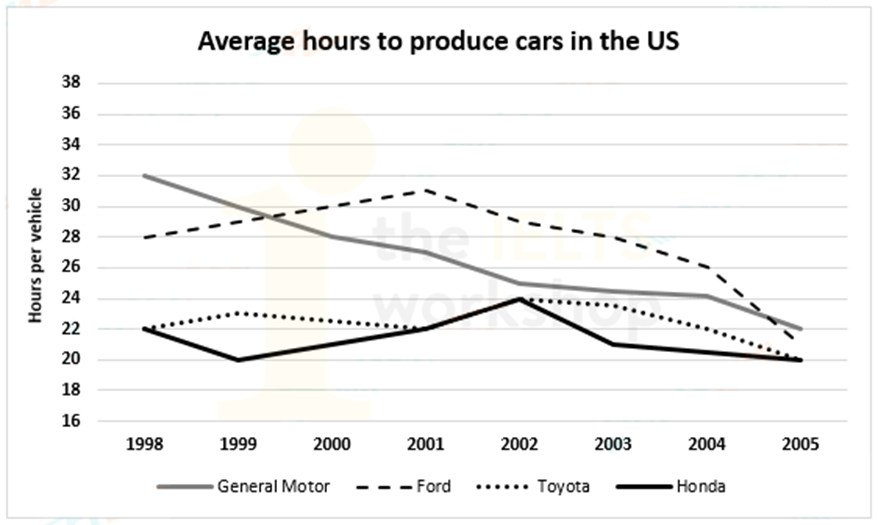
Sample 1:
The provided line graph illustrates how much time on average 4 different automobile manufacturers spent producing vehicles at their US factories over a 7-year period, starting from 1998.
Overall, it is evident that all brands experienced downward trends in production time. Notably, it took Honda less time than other manufacturing companies to produce vehicles during the entire period.
In terms of General Motor, the average production time started at 32 hours in the first year, followed by a constant drop to finish at 22 hours after 7 years. Likewise, it took Ford 28 hours to produce vehicles in 1998, after which the hours rose gradually till the early 2000s, when it outstriped General Motor's average time to become the slowest automobile producer during the next 4 years. However, in 2005, the figure went down to below 22 hours, giving back the lead to General Motor.
Both Toyota and Honda initially spent 22 hours on average on car production. However, while the figure for Toyota slightly increased in the next year, that of Honda experienced an opposite trend, with approximately 23 and precisely 20 hours, respectively. Toyota's average hours went on to fluctuate before finishing at 20 in 2005. Meanwhile, the time Honda spent on car manufacturing saw a sharp increase reaching its peak at 24 hours in 2002, coinciding with Toyota's highest point. The figure then declined to 20 hours in the last year, paralleling Toyota's hours in the same period.
Sample 2:
The line graph illustrates the average amount of time to produce new cars of 4 companies, namely General Motor, Ford, Toyota, and Honda at their factories in the US between 1998 and 2005. Overall, it can be seen that it became faster for these companies to produce new cars over the given period.
In 1998, General Motor spent about 32 hours on average manufacturing a new car, which was also the longest of all this year. In the next 7 years, there was a continuous downward trend in this number, reaching at roughly 22 hours. During this time, the figure for Ford surpassed General Motor in 1999, rising from nearly 28 hours to barely 31 hours in 2001. After that, it went down remarkably by almost 10 hours in the end.
On the other hand, the figures for Toyota and Honda were quite similar at 22 hours in the beginning. Both of them also witnessed a significant fluctuation in the following years. However, in the end, they both dropped to merely 20 hours for their car production.
Sample 3:
The line graph illustrates the average number of hours required by four automobile manufacturers- General Motors, Ford, Toyota, and Honda-to produce vehicles at their factories in the United States from 1998 to 2005.
Overall, there was a noticeable decline in production time across all four manufacturers over the period. Honda consistently had the shortest production time, while Ford showed significant fluctuations, particularly in the early 2000s. By 2005, the production times of all manufacturers had converged to around 20-22 hours per vehicle.
General Motors began the period with the highest production time, taking approximately 32 hours to manufacture a vehicle in 1998. This time decreased steadily, ending at around 22 hours in 2005, showing consistent improvement. In contrast, Ford initially took 28 hours per vehicle in 1998. However, instead of improving, Ford's production time increased, peaking at 34 hours in 2001, making it the least efficient manufacturer during this period. After this peak, Ford made significant strides in reducing its production time, bringing it down to just under 22 hours by 2005, closely aligning with General Motors.
Toyota and Honda both started with a similar production time of around 22 hours per vehicle in 1998. Honda's production time dropped slightly to 20 hours by 1999, making it the most efficient manufacturer at that point. However, Honda's efficiency fluctuated, with production time rising sharply to 24 hours in 2002 before decreasing back to 20 hours by 2005. Toyota, on the other hand, saw a slight increase in production time to 23 hours in 1999 but maintained a relatively stable production time, fluctuating only slightly before finally reducing to 20 hours by 2005. Both companies demonstrated a trend towards greater efficiency, with their production times converging by the end of the period.
Sample 4:
The graph provides information about the average time taken by four major car corporations to manufacture vehicles at their American factories over the course of seven years.
Overall, the average amount of time spent by the four different brands experienced fluctuating decreases during the course of the period. Additionally, General Motors went through the best improvement regarding production time.
The American automakers, General Motors and Ford, began the period with longer manufacturing schedules - 32 and 28 hours per vehicle, respectively. Both demonstrated a declining tendency in the amount of time needed to produce an automobile, with a more noticeable decrease at General Motors. Ford reduced its production time to slightly above 20 hours per vehicle by 2005, while General Motors had almost halved its time to about 22 hours.
Japanese producers Toyota and Honda started with considerably lower manufacturing times. Toyota began at slightly below 22 hours per vehicle in 1998, and by 2005, it diminished the time to approximately 20 hours. Honda started and ended similarly to Toyota, beginning at above 22 hours and further increasing its effectiveness to 20 hours by 2005.
Sample 5:
The line graph compares the changes in the average hours needed to manufacture a vehicle by four companies – General Motor, Ford, Toyota and Honda – at their producing sites in the US between 1998 and 2005.
Overall, while the two Japanese car companies produced vehicles more quickly in general, the two US manufacturers had narrowed the gap remarkably.
It is clear that GM had successfully improved their productivity, with the average time reducing from 32 hours per vehicle to 22 hours during the given period, although the figure remained the highest among the four producers in the first two years. In Ford’s factories, there was an initial increase in the figure from 28 hours to over 30 until 2001, after which the factories started to achieve higher efficiency. By 2005, the time needed to produce a car had descended to just 21 hours.
In terms of Toyota and Honda, both manufacturers kept their average production time at a low level between 20 and 24 hours per car, maintaining higher productivity than the other two competitors. Despite wild fluctuations throughout the whole period, factories of both Toyota and Honda managed to slightly reduce the average time.
Sample 6:
The line graph illustrates the average time spent by four car manufacturers - General Motors, Ford, Toyota, and Honda - in producing vehicles at their factories in the United States from 1998 to 2005.
Overall, the time required for car production at all four companies showed a downward trend, with Toyota and Honda achieving the lowest production hours by the end of the period. Meanwhile, American manufacturers General Motors and Ford started with higher production times but managed to reduce them significantly.
In 1998, General Motors had the longest production time at approximately 32 hours, followed closely by Ford with around 30 hours. However, both companies saw a steady decline over the period, with Ford experiencing a particularly sharp reduction from 2002 onwards, reaching about 22 hours by 2005. General Motors, while maintaining a consistent drop, ended at slightly above 20 hours.
Toyota and Honda, on the other hand, maintained lower production times throughout. Starting at around 22 hours in 1998, Toyota gradually decreased its hours and eventually reached roughly 19 hours in 2005, the lowest among the four. Honda displayed a similar pattern, reducing its production time from about 21 hours in 1998 to just under 20 hours in 2005.
The diagram below describes the structure of a home smokery and how it works.
Summarise the information by selecting and reporting the main features, and make comparisons where relevant. Write at least 150 words.
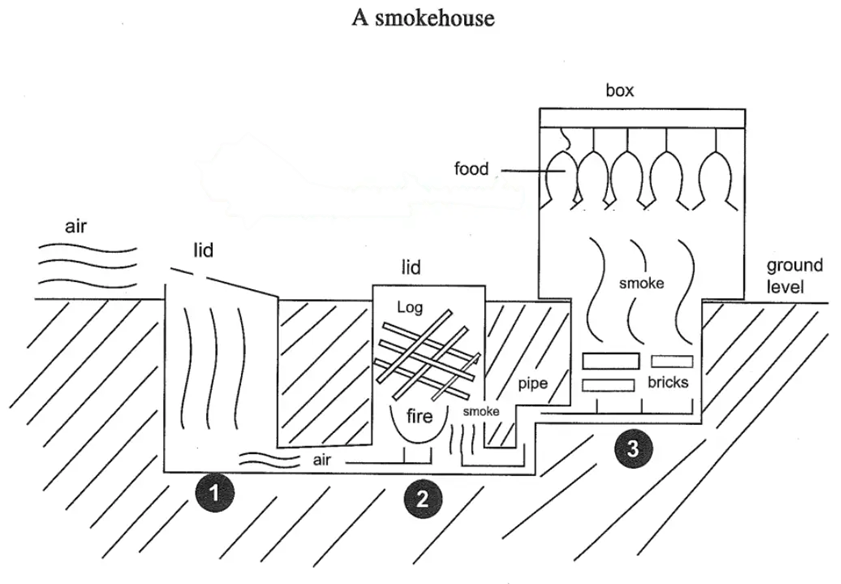
Sample 1:
The diagram illustrates the design and operation of a home smokery in detailed steps.
Overall, this structure is a two-part construction that comprises two wells installed underground, and a box built on the ground level. These two parts are connected using a pipe system and tunnel that allow fresh air and smoke to pass through to smoke food.
The whole process respectively takes place at 3 parts of the construction, commencing with fresh air passing through the lid and entering the first well. After that, the flow of air is then driven to the second well where it meets the burning logs and sparks the fire. During this stage, new logs are provided to feed the fire through a lid installed above.
In the last stage, smoke emitted from the fire ascends across a bent pipe to a box built on the ground level. In this box, food is hung above and smoked.
Sample 2:
The diagram demonstrates how a home smokery works. It can be seen that there are mainly three steps involved in the process.
The home smokery machine has three parts. The first part is an empty underground section with a lid on top at ground level. Fresh air is allowed to flow into the machine by opening the lid. The fresh air then goes into the second part of the machine which is very similar to the first part. In this part, a fire is started by adding logs through the lid on top. Once the fire is burning, the heat from it is coursed through a narrow pipe that leads to a box. This box is the third part of the machine and is located at ground level. In the box the food items that need to be cooked are placed. The heat coming from the second part of the machine cooks the food items.
Overall, the diagram depicts that there are three steps in the process of cooking food in a Home Smokery.
Sample 3:
The illustration highlights the various components of a home smokery in cross section and its mechanics.
Overall, it can be seen that while the first and second stages of the process take place underground, the third and last stage occurs above ground level.
As shown in the picture, the first section of a domestic smokery is an empty chamber under the ground with a lid at ground level that can be opened to allow fresh air in. After entering the chamber, air continues to pass along a pipe leading to a second underground chamber. This chamber has a lid at ground level that can be opened to load logs in. These logs, with the help of air from the first chamber, are burned to produce smoke.
The process of smoking food happens in the last stage, where heat and smoke from the second chamber go upward through a pipe into the third and final box, which is above ground level. At the top of this box is suspended meat or fish, which is ready to be cooked or preserved by the method of smoking.
Sample 4:
According to the diagram, the smokery has three chambers linked with each other by air passages at their bottoms. Two chambers are underground while the smoking box at the end of the process is above the ground.
As regards the working mechanism of the system, first, the lid of the first underground chamber is opened to feed the smokery with fresh air. Then the air travels to the second underground chamber to burn logs of firewood to create smoke. After that, the smoke finds no way to escape through the top of this chamber because of its closure by a lid, but it is forced by the air supply to continue to move to the third and final section of the system. In particular, smoke is channeled through a pipe up to the smoking box on the ground where fish and meat are hung for being smoked.
In general, the diagram details how smoke can be created and how food curing takes place in a homemade smokery.
Sample 5:
An outline of the structure of a home smokery and the way it works are portrayed clearly in the given diagram.
Overall, it is clear that of the three steps, two steps happen under the ground, while the remaining happens above the ground level.
As shown in the diagram, the first part of the structure is an empty underground section with its lid opening at an elevated space above the ground level. This lid, when opened, allows air inside the structure to assist the smoking process.
In the second part, a similar structure is there with a lid at the ground level. This lid can be opened, and wooden logs can be placed inside the chamber. Smoking food can be initiated when these logs are burned.
In the third part, a bended long funnel is directed upwards in a fixed structure, which has a wide opening at the bottom that connects the fireplace and a narrow opening at the top. When logs burn, smoke passes through this opening to the chamber above the ground level, inside which fish and meat are hung from the top for cooking.
Sample 6:
The diagram demonstrates how a home smokery works.
The home smokery machine has three major parts. The first part is an empty underground section with a lid on top at ground level. Fresh air then goes into the second part of the machine, which is very similar to the first part, where a fire is started by adding logs through the lid on top. Once the fire is burning, the heat from it is coursed through narrow pipes that lead to a box, which is the third part of the machine and is located at ground level. The box is where the food items that need to be cooked are placed. The heat coming from the second part of the machine cooks the food items.
The diagram shows that a home smokery requires three steps of a process to cook food.
Sample 7:
The diagram illustrates how a home smokery works. It can be seen that the process consists mainly of three stages.
The home smokery machine consists of three parts. The first part is an empty underground compartment with a lid on top at ground level. Fresh air can be drawn into the machine by opening the cover. Then fresh air enters the second part of the machine, which is very similar to the first part. In this part, the fire is kindled by adding logs through the lid on top.
When the fire is started, the heat from it passes through a narrow tube that leads to the box. This box is placed as the third part of the machine and is located at ground level. The box contains the food to be cooked. The heat from the second part of the machine is used for cooking.
Overall, the process demonstrates that there are three steps to cooking in a home smokery.
Sample 8:
The render diagram enumerates how home smoker works. Overall, it can be clearly seen that it has three parts.
To begin with, in the first one, there is one underground dig which is covered by a lid on the top, it’s use for getting fresh air. In the second part, it is constructed the same as the first one, and both are connected, but this one lid is used for putting logs. When the lid is open, fresh air passes through one to two where a spark is one, as well as logs space, is also.
The hit of lights passes through the tiny pipe that’s another side open at ground level. There is one box that contains a hook. Food baked by smoke or heat of ignite.
The graphs below show the percentage of men and women aged 60-64 who were employed in four countries in 1970 and 2000.
Summarise the information by selecting and reporting the main features, and make comparisons where relevant. Write at least 150 words.
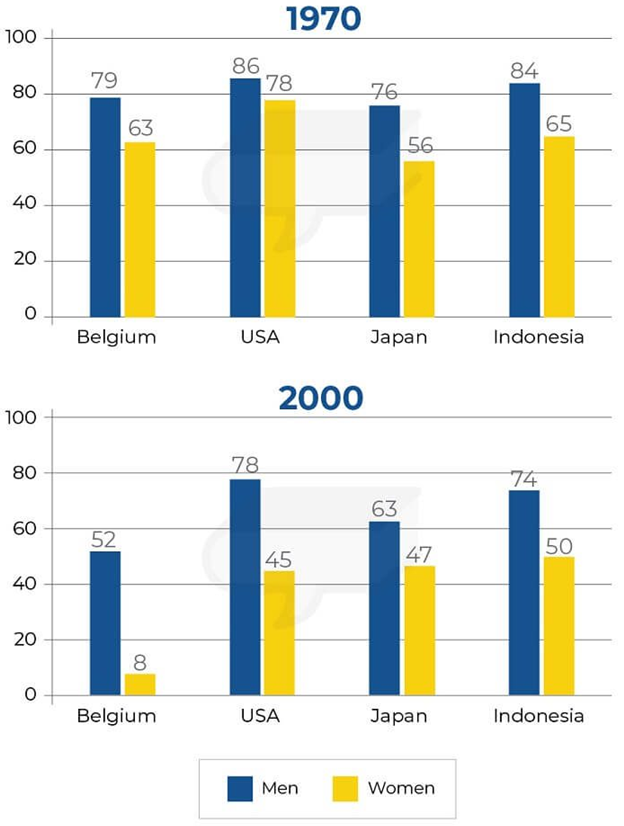
Sample 1:
The bar charts illustrate the percentage of senior demographics from 60-64 who were still members of the labour force, classified by genders, in 1970 and 2000.
Looking at the graph from a general perspective, it is readily apparent that regardless of countries, there were fewer and fewer senior employees over the time with women witnessing a more drastic downturn than men. Also, Belgium recorded the most rapid decline in the percentage of working old people regarding both genders.
In 1970, 79% and 76% of men aged 60-64 were employed in Belgium and Japan in turn, a bit lower than those of the USA (86%) and Indonesia (84%). 30 years later, these figures declined by 8 to 13% in three countries namely the USA, Japan and Indonesia whilst a substantial drop of 27% was seen in the proportion of working males in Belgium.
Meanwhile, there was a wider discrepancy among employed women aged 60-64 in four nations compared to men. In 1970, the USA headed the list with 78% working females. Next came Indonesia (65%), Belgium (63%), and last position was Japan with only 56%. In 2000, there were remarkable falls to around 45 to 50% in the figures for USA, Japan and Indonesia, approximately six times higher than that of Belgium, representing a negligible 8%.
Sample 2:
Illustrated in the bar chart is the proportion of men and women aged between 60 and 64 who were employed in four countries.
Overall, the employment rate for both males and females in all four listed countries saw a substantial decline after 30 years. Moreover, the proportion of employed males aged 60-64 was invariably higher than that of their counterpart in the two given years, regardless of the country.
In 1970, roughly 83% of Indonesian men aged 60-64 were employed, which was second only to the USA’s 86%. Employed women of the same age bracket in Indonesia and USA represented 50% and 76% respectively. In 2000, while employment rates for males in both mentioned countries declined by roughly 10%, the percentage of employed females in Indonesia rose to surpass that of the USA (50% compared to 45%).
Initially, Japan was the country where the statistical difference between employed males and females was the largest, with 75% for the former compared to 56% for the latter. However, after the next 30 years, the largest gap was to be seen in Belgium where 51% of males were employed – approximately 40% higher than the figure for their counterpart.
Sample 3:
The bar chart depicts the employment rates of individuals aged 60 to 64, categorized by gender, in four different countries.
In general, there was a significant decrease in employment rates for both men and women across all four countries over a span of 30 years. Additionally, regardless of the country, the percentage of employed males in the 60-64 age group consistently exceeded that of females in both years.
In 1970, 86% of men aged 60-64 in the USA were employed, which was the highest among the four countries and was a slight margin ahead of Indonesia’s male employment rate by a mere 2%. Similarly, the employment rate for women in the same age group was much higher in the former than in the latter, at 78% and 65% respectively. By 2000, there was a decline of 8% and 10% in employment rates for males in the USA and Indonesia respectively. Mirroring the same trend, albeit much more pronounced, female employment rates fell to 45% and 50% respectively.
Initially, Japan ranked fourth in employment of this age cohort, with 76% for males compared to 56% for females, but both figures went down to 63% and 47%, concluding at the third position. Belgium had 79% of males and 63% of females aged 60-64 employed in 1970, higher than Japan’s; however, thereafter, 52% of males at that age still worked while a minority of senior women in this nation were employed (8%), both of which were lowest among these nations.
Sample 4:
The bar chart depicts the employment rates of individuals aged 60 to 64, categorized by gender, in four different countries.
In general, there was a significant decrease in employment rates for both men and women across all four countries over a span of 30 years. Additionally, regardless of the country, the percentage of employed males in the 60-64 age group consistently exceeded that of females in both years.
In 1970, the male employment rates did not present significant discrepancies, with 86% of men in the United States aged 60-64 being employed, closely followed by 84% in Indonesia, 78% in Belgium and 76% of Japanese males. Female job participation repeated the same pattern. To specify, 78% of American women in this cohort still secured employment, which was highest, while the lowest female employment rate was recorded in Japan (56%). Belgium and Indonesia had relatively similar proportions for 60-64-year-old employed females, at 63% and 65%.
After three decades, employment rates of 60- to 64-year-old people in all nations experienced a decline. While three out of the four countries, namely the USA, Japan, and Indonesia, recorded similar decreases of around 10% for males, to 78%, 63% and 74% respectively, the figures for their female counterparts fell by 33%, 9%, and 15%, respectively. Employees in Belgium aged 60-64 presented the most noticeable change, with proportions decreasing by 27% for males and 55% for females.
Sample 5:
The bar chart provided compares the proportions of male and female employees whose ages ranged from 60 to 64 in four different countries over 30 years.
Overall, more males were employed than females in the given age range. The year 2010 witnessed declines in the number of both men and women employed in all four countries, with Belgian and American females being the worst hit.
In 1970, America was the country that had the highest employment rate of citizens aged 60-64, approximately 86% for males and 78% for females. Following this, Indonesia had nearly the same percentage of employed men at roughly 84% but a much lower proportion of women at 65%. Although Belgium and Japan had similar proportions for males at just over three quarters, fewer Japanese women were able to find employment at the age of over 60.
In 2000, the 60-64-year-olds in all nations suffered from a drop in job opportunities. While three out of four countries namely the USA, Japan, Indonesia recorded similar decreases of around 10% for males, the figures for their counterparts fell by 33%, 9% and 15% respectively. Employees who were 60-64 in Belgium were the worst affected, with the proportions decreasing by 27% for males and 55% for females.
Sample 6:
The given bar charts delineate the employment proportion of senior citizens in four countries namely Belgium, the USA, Japan, and Indonesia in 1970 and 2000
Overall, there was a downward trend in the employment rate in the examined period. In addition, a pronounced gender disparity was displayed as that of men surpassing that of women in each country.
Looking at the chart in more detail, Belgium experienced a plummet in the percentage of senior women employed, from 63% in 1997 to approximately 8 times smaller, at 8%. In the US, that of women was deducted from 78% and to 45%.
Meanwhile, a milder decrease occurred in the two Asian countries. Japan had over half of the senior women citizens joining the labour workforce in 1970 then this figure declined to 47%; the percentage of elderly working women in Indonesia, similarly, decreased to a half from 65% in 1970.
The proportion of males saw a minimal downward trend. The rate of employment for senior men in Japan and Indonesia witnessed a decrease to 63% and 74% respectively, while that of the USA only dropped by 8% to 78% – the most insignificant rate among all. Belgium had the most dramatic decrease as only roughly half of senior men in this country in 2000 were employed.
Sample 7:
The given bar graphs depict the information about the number of old age males and females who got jobs during the year 1970 and 2000 in four different nations are Belgium, USA, Japan and Indonesia. The data is calibrated in percentage.
Looking from an overall perspective, it is readily apparent that more men were engaged in the jobs than women during the given years, and with passing years the number has decreased to some extent.
It can be seen that in 1970, 79 % of men who were above the age of 60 in Belgian got jobs with the difference of ten per cent with the fairer sex of same age. The gradual decline was noticed in the year 2000 when 51 % of men in the same age group got employment while women did not even touch the one-tenth part. In USA and Japan during the year 1970, there were 85 % and 75 % men and 79 %and 55 % women of senior age were working respectively. After three decades, the percentage declined in regard with the women in USA more men in Japan more, whereas much decline was not observed among the men in USA and women in Japan.
Moving ahead, observing the employment trend in Indonesia for senior citizens, over four-fifths of the men had got the jobs while 64 % of women had acquired these opportunities. After thirty years, the percentage decreased by 10-12 % in both the genders in the same age group in the same country.
Sample 8:
The given column graphs compare the percentages of employed males and females in four countries namely – Belgium, the USA, Japan and Indonesia in 1970 and 2000. It is manifest from the graph that in both the given years more males were employed than females.
In 1970, the USA had the highest employment rate with 86% males and 78% females doing jobs. Indonesia came in second with 84 and 65% employed men and women respectively. 79% Belgian males and 64% females were working in 1970. The lowest employment rate was in Japan, where 76% males and only 56% females were employed.
In 2000, the percentage of men and women employed was far lesser than that in 1970 in all the four given countries. In USA, the percentage of employed males and females fell by 8% and 33% respectively from the figures of 1970. Indonesia also witnessed a decrease in employment among men and women by 10 and 15% respectively. In Japan the percentage of employed men and women dropped by 13% and 9% respectively. 27% lesser Belgian men were employed in 2000. The biggest brunt of recession was faced by the Belgian women, with the figures falling from 63% in 1970 to 8% in 2000.
Overall, the year 2000 witnessed a period of recession in all the four given countries, but the Belgian and the American women were the worst hit.
Sample 9:
The bar graphs compare the percentage of men and women aged 60-64 who were employed in four countries - Belgium, the USA, Japan, and Indonesia - in the years 1970 and 2000.
Overall, the employment rates for men in this age group decreased in all four countries over the 30-year period. Women also experienced a significant decline in employment in Belgium and the USA, while the rates in Japan and Indonesia were relatively stable.
In 1970, a significant proportion of men aged 60-64 were employed in all four countries, with the highest employment rate observed in the USA at 86%, followed by Indonesia at 84%. In Japan and Belgium, the rates were slightly lower, at 76% and 79%, respectively. However, by 2000, the percentage of employed men had dropped significantly in Belgium and Japan, to 52% and 63%, respectively. In contrast, the decline was less pronounced in the USA and Indonesia, where the figures fell to 78% and 74%.
The employment rates for women were considerably lower than those for men in both years. In 1970, the USA had the highest proportion of employed women at 78%, but by 2000, this number had dropped to 45%. Belgium saw the most dramatic decrease, from 63% in 1970 to just 8% in 2000. In contrast, the employment rates for women in Japan and Indonesia showed relatively little change, with Japan’s rate decreasing from 56% in 1970 to 47% in 2000, while Indonesia saw a more modest drop from 65% to 50%.
Sample 10:
The bar charts compare the employment rate of four countries' men and women aged 60-64 in 1970 and 2000. Overall, while the levels in all nations had declined by 2000, the employment of American men was highest in both years. In addition, the percentage of working elderly women in the US ranked first in 1970, but in 2010, this figure for Indonesia was the largest.
In 1970, all countries recorded more than 75% of employed men between 60 and 64 years old. The US stood on top with 86%, while Indonesia, Belgium and Japan showed slightly lower figures of 84%, 79% and 76%, respectively. America also displayed the highest employment level for elderly women, with 78%, whereas that for Japan was the lowest, with 56%. The gap between men and women's data was least significant in the
US.
By 2000, employment in this age group had decreased across the board. Despite this decline, the US continued to show the largest percentage of working men, with 78%. This was followed by 74% in Indonesia and 63% in Japan, whereas Belgium reported the lowest level, with 52%, two-thirds that of America. Regarding women, the 50% employment rate in Indonesia outstripped any other data of this type. Meanwhile, with 8%, the figure for Belgian women stood at the bottom, and it also amounted to under one-sixth of that for elderly men in this country.
Sample 11:
The graphs illustrate the employment rates among men and women aged 60 to 64 in four countries - Belgium, the USA, Japan, and Indonesia in the years 1970 and 2000.
Overall, it is evident that the proportion of seniors in the workforce declined over the 30-year period in all countries, with a more pronounced drop among women. Notably, Belgium experienced the most significant decrease in employment levels for both genders.
In 1970, the USA showcased the highest male employment level in this age group at 86%, slightly ahead of Indonesia at 84%. In Belgium, 79% of men aged 60 to 64 were employed, while Japan recorded a similar rate of 76%. By 2000, the proportions of male employees aged from 60 to 64 dropped across the board, with the USA and Indonesia falling to 78% and 74%, respectively. Meanwhile, the figure for Belgium decreased to 52%, and Japan saw a slight decline to 63%.
As for women, the USA led in 1970 with 78% of women in this age group, followed by Indonesia (65%), Belgium (63%), and Japan, which exhibited the lowest rate at 56%. By 2000, female employment rates underwent notable declines, particularly in Belgium, where the rate plummeted to just 8%. In contrast, the USA, Japan, and Indonesia recorded figures ranging between 45% and 50%.
Sample 12:
Given are two graphs comparing the employment rate between males and females, in four different nations between 1970 and 2000. Overall, the proportion of employed men was more prevalent than that of women in all four countries for both periods. Additionally, the rate of employment for both genders in all countries decreased.
Concerning males, in 1970, the rate of working American men was the highest, at 86%. Despite a significant drop by 2000, this figure still remained the highest, at 78%. While the male employment percentage of Indonesia decreased from 84% to 74% during the recorded period, that of Belgium fell more rapidly from 79% to 52%. Meanwhile, a considerable fall was also seen in the rate of Japan, from 76% to 63%.
Regarding females, starting at the highest result of 78%, the figure for America fell enormously to 45%. Although the rate of employed Indonesian women fell from 65% in 1970 to 50% in 2000, this surpassed America in the final year. There were 56% of Japanese women and 63% of Belgian ones working in 1970, after which the former dropped to 47% and the latter saw the most significant fall, plummeting to 8% in the final year.
Sample 13:
The bar chart illustrates 4 different countries in terms of the porportion of employed males and females at the age group from 60-64 over the period of 30 years, starting from 1970. Generally, it is evident that the percentages of both genders who were still working at the age of 60-64 of all countries dramatically declined throughout the given period, with Belgium witnessing a more significant rate of decrease. Additionally, the figures for males of all countries were noticeably higher than those for females over the two given years.
In 1970, it is evident that the proportions of employed men aged 60-64 outnumbered those of women, ranging from 8% to 16%. Of all countries, the USA topped the list for both genders, with 86% for men and 78% for women. Following this, Idonesia and Belgium respectively took the second and third position, accounting for 84% and 79% for men, and 65% and 63% for women. However, the proportions of both employed genders at this age group were the lowest, representing 76% of men and 56% of women.
By 2000, both genders experienced a downward trend, especially in women, making the gap between men and women wider. Looking more closely, the figures for the USA and Indonesia had slightly fell down by 8% and 10%, respectively, but they still maintained their positions as the first and the second. However, with a more dramatic fall of 27%, the figure for Belgium was overtaken by that of Japan, accounting for 63%. As for females, there was a plummet in the figures for the USA and Belgium, hitting the lowest points of 45% and 8%, respectively.
Summarise the information by selecting and reporting the main features of the graph and make comparisons where relevant. Write at least 150 words.
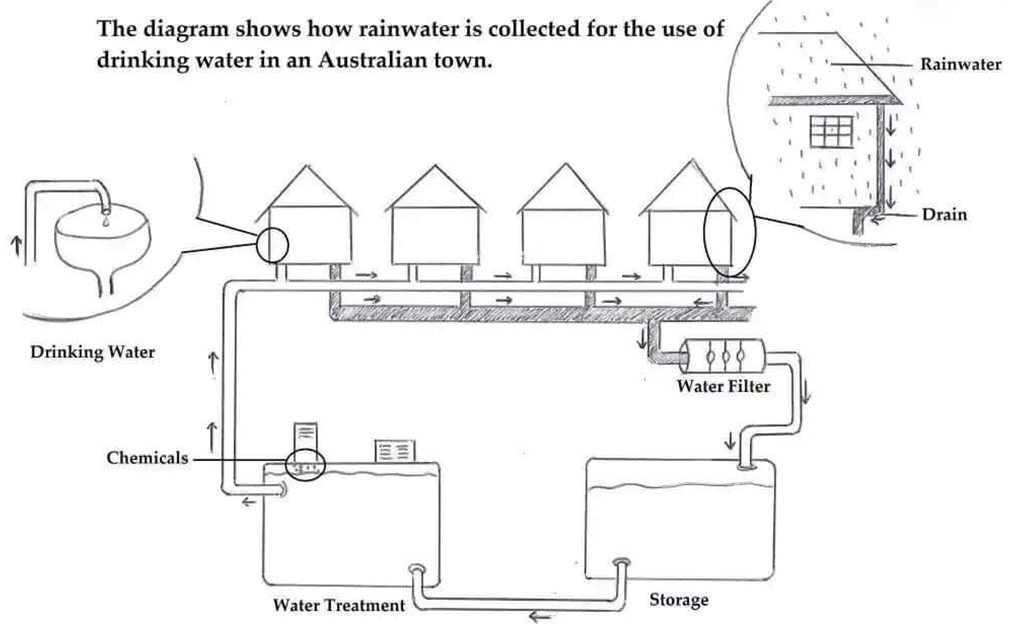
Sample 1:
The diagram depicts how rainwater is harvested, treated, and stored for the purpose of drinking water.
Overall, there are five key stages in the process of harvesting rainwater for drinking, beginning with the capture of water when it rains, and ending with clean drinking water available inside people’s homes.
Firstly, when it rains, water is captured on the roofs of people’s homes. The water runs down the roof and into the gutters, where it then flows into drainage pipes attached to the side of the houses. All drainage pipes from the houses flow into one larger system, from where the water is then run through a water filter. Once the water is filtered, it then flows into large storage tanks where it is held until a later time.
From the storage tanks, the water is transferred to a treatment tank where chemicals are added to it. The water is then ready to be delivered via pipes that flow from the treatment tanks to the taps inside people’s homes.
Sample 2:
The diagram demonstrates the rainwater collection process in an Australian town used for drinking.
Overall, there are around four steps that are needed in order for the water to be ready for consumption, starting with filtration and ending with chemical treatment.
Initially, rainwater that slides off the rooftops runs down a pipe in the side of the building, which in turn is funneled into a drain. This stream of water is then run through underground pipes, leading to a water filter in order to remove any sediments or impurities. This filtered water is stored within a large tank, subsequently being transferred to a water treatment processor via pipes. Chemicals are used to ensure that the water is safe from bacteria or germs and is suitable for consumption. Finally, when the water is ready to be used, it runs from underneath the ground to people’s houses, ready to be drunk from the tap.
Sample 3:
The diagram illustrates how an Australian town processes rainwater to use as drinking water.
Overall, rainwater is collected from houses and then passes through a filter into storage where it is then treated with chemicals to make it fit for human consumption.
Initially, the rain which falls on the rooftop is collected by the gutter and then runs down the pipe at the side of the house into the drain at the bottom. Each house collects rainwater in this way and the rainwater is then passed along underground drains to the water filter.
The rainwater passes through the water filter to remove any impurities. Once it has been filtered, it continues along the pipes to a storage tank. From this point, the water goes from storage to the water treatment. At this stage of the process, the water is treated with chemicals in order to make it fit for consumption. When the water is ready for drinking, it travels along pipes that lead back into the houses in the town where people can use the water for daily consumption.
Sample 4:
The provided diagram depicts the process of harvesting and treating rainwater into clean water in an Australian town.
Overall, the procedure involves five key stages, starting with the collection of rainwater and culminating in the conversion into drinking water, with various purification steps in between.
The system commences as rainwater is collected from the rooftops of houses, funneled down through a drainage system. This water is then propelled into a filtration system, where larger particles and impurities are removed, preparing the water for the subsequent stages of purification. Post-filtration, the water is channeled into a larger storage tank, signifying the intermediary phase of storage. Within this phase, a crucial treatment process happens as targeted chemicals are introduced to the water safeguarding the water's purity and making it suitable for drinking. Upon the completion of the treatment, the now potable water is directed into the municipal distribution system. This final stage marks the transition of the water from treated storage to a state where it is accessible to the residents, ensuring the availability of safe drinking water throughout the town.
Sample 5:
The provided diagram illustrates the process of producing potable water from rainwater in an Australian town. Overall, the production of drinking water involves five main steps, beginning with the collection of rainwater and ending with the distribution of purified water to families.
At the beginning of the process, rainwater is channeled to the pipe system built under the roofs through the drains. In the subsequent step, a water filter is used to get rid of the dirt and filth. Once the unwanted pollutants are eliminated, the water is moved into a huge container for the purpose of storing.
The process continues with the stored water being channeled to another rectangular container where it is treated with chemicals. During the process, the rainwater is transformed into drinkable water. Finally, the clean water produced from the previous stage is pumped into the water system of residents’ houses to be used.
Sample 6:
The above diagram details the process by which precipitation is stored and sent for household use in a given town in Australia. Overall, there are 3 main stages that involve the collection of water through drains, its repeated transportation and treatment underground and finally reuse as drinking water in homes.
Rainwater distribution begins with collection through gutters and drains attached to houses. The water seeping into the ground is not collected according to the diagram. The drain water is carried through a system of pipes into a water filter and then a storage tank.
From the storage tank, it next flows by more piping to a water treatment tank where a chemical process makes the water clean enough for residents to drink. After the water has been processed, it is sent through pipes, different from the drain water pipes that originally collected the water, back into homes to be used for drinking water.
Sample 7:
The provided diagram highlights the process by which rainwater is collected and treated for drinking purposes in a town in Australia.
Overall, the process involves 5 steps, starting from collecting rainwater and culminating in treating the water with chemicals.
The first step is that rainwater is collected by the gutter beneath the edge of the rooftop before it runs down into the pipe on the side of the house and then into the drain system underground. The rainwater from each household then flows down through a water filter to remove impurities. After passing through the filtration process, it goes on to run along the pipe to be stored in a tank which is connected to the treatment system.
At this point, chemicals are involved in treating the water to make it drinkable. Once the water has been made fit for consumption, it then travels along the pipes that lead back to the houses.
Sample 8:
The diagram depicts the rainwater collection and processing system employed by an Australian town to provide potable drinking water.
Initially, rainwater is collected from rooftops via gutters, flowing down pipes along the sides of houses into drainage systems. This rainwater is then channeled through underground drains to a central water filtration unit. Within the filter, the rainwater undergoes a thorough purification process to eliminate any impurities present. Once filtered, the water proceeds through a network of pipes to a storage tank, ready for the subsequent treatment phase.
Upon reaching the treatment stage, the water is subjected to chemical processes aimed at ensuring its suitability for human consumption. These treatments are crucial for disinfection and the removal of harmful contaminants, guaranteeing the safety of the water supply. After treatment, the water is conveyed back to residential areas through a series of pipelines, reconnecting with households in the town. This processed rainwater is then readily available for daily use, meeting the drinking water needs of the community.
Sample 9:
The given diagram illustrates the process of obtaining clean drinking water from rainwater.
Overall, the process of obtaining clean drinking water from rainwater entails five main stages, starting with the collection of impure water from homes and concluding with the distribution of purified water back to the same homes, ensuring that water originally collected from rooftops is transformed into safe and drinkable water for household consumption through collection, filtration, storage, treatment, and distribution.
The first stage involves the collection of rainwater from rooftops through drains. Subsequently, this water undergoes filtration to remove most impurities before being stored in a tank.
Following this, the water is transferred to a treatment tank where it is treated with chemicals to render it suitable for drinking. Once processed, the potable water is then conveyed through separate pipelines, distinct from those used for drain water, back into households for domestic use.
Sample 10:
The diagram outlines the process of collecting rainwater in an Australian town for drinking purposes.
It is evident that the process of converting rainwater into drinkable water comprises four essential stages to render the water suitable for consumption, commencing with rainwater collection, then filtration and storage, and culminating in chemical treatment.
Initially, rainwater cascading off rooftops flows through a pipe which is located on the building’s right side, channeling into a drain. Subsequently, this water stream is directed via subterranean pipes to a filtration system designed laid underground to eliminate sediments or impurities.
The purified water is then stored in a sizable tank before being conveyed through pipelines to a water treatment facility. Here, specific chemicals are added to ensure the eradication of bacteria or germs, rendering the water safe for consumption. Finally, the treated water is distributed underground and directed to households, readily available for consumption from the taps.
Sample 11:
The given illustration outlines the distinct stages involved in the process of turning rainwater into drinking water in a town in Australia.
Overall, there are 3 main stages involved in the process, starting with the collection of rainwater, followed by filtration and chemical treatment and concluding with the delivery of water to households for consumption.
At the beginning of the process, rainwater runoff from roofs flows into a series of gutters installed on the walls of houses and buildings, into a network of interconnected drainpipes attached to the gutters. The collected water then passes altogether through a large pipe into a water filter where impurities and debris are removed, before flowing into a large storage tank where the volume of water for further treatment is regulated.
Out of the storage tank, the water is then subjected to chemical treatment in another tank, during which it is exposed to specific chemicals to eliminate bacteria, pathogens and unpleasant odors. The treated water, which is now potable, will be piped to households for consumption.
Sample 12:
The diagram shows rainwater is collected for drinking water in an Australian town.
The diagram illustrates the purification process of precipitation harvested from the rooftops. Overall, it is a simple and linear process with 2 main stages: rainwater accumulation followed by physical and chemical treatment processes. Moreover, it can be seen that the production of drinking water consists of 5 steps, commencing with rainwater collection and filtration and culminating with disinfection.
To begin with, the precipitation slides off the gutters and then funnels into the drainpipes, which are attached beside every individual house to accumulate. Having run through underground pipes, the rainwater is filtered through a water filter, which is equipped with membrane filters to remove sediments or impurities. Next, the filtered water is injected into a larger storage for subsequent treatment.
Afterward, the filtration process gets rid of the physical contaminants, whereas the chemical treatment disinfects by eliminating bacteria and germs. In the second treatment, once the water goes into the chemical treatment tank, it is supplemented with chemicals to ensure its safety for consumption. Finally, the ready-to-use water is distributed by pumping through the networks of pipes inside the houses.
Sample 13:
The flow chart illustrates the procedures for collecting and handling rainwater, which are mainly to generate drinking water for the public in an Australian town.
The diagram shows that the roof’s shape guarantees rainwater drips from the eaves and reaches the drain system. In the following stage, rainwater flows through underground sewage lines and then a filter cleanses it of impurities.
After preliminary treatment, we then convey rainwater through pipelines before storing it in the container. The next step is employing chemicals to dispose of the delivered rainwater in the process of water treatment. In the final procedure, it is the converted drinking water that runs into pipelines and therefore caters for daily household demand.
Overall, several treatments transform the collected rainwater into drinking water through the simple process outlined above.
Sample 14:
The provided diagram illustrates the collection and treatment of water in an Australia neighborhood. Overall, the process consists of several major steps, starting with draining rainwater and culminating with water being supplied to urban households.
Regarding water collection, water originated from rain is collected on houses’ roofs and delivered to the drain at the initial step of the process, scarcely before flowing through the underground fluid pipe system to a buried water filter. Following this, the liquid is eventually transferred to another underground tank for storage after undergoing the filtration at the water filter in the previous step.
In terms of the remaining stages, once stored, a pipe then allows water to be filled into the water treatment unit, where it is later treated with chemical substances stored within the machine. Ultimately, water completed its filtration and chemical treatment then runs through another pipe system designated to drinkable water to urban houses, ready to be consumed directly by dwellers.
Sample 15:
The given diagram illustrates how rainwater is harvested to use as drinking water in an Australian town. A quick glance at the diagram makes it clear that rainwater is filtered and also treated chemically before sending it back to the houses for use by the people.
Initially, every house collects rainwater and sends it through drains to a water filter, where the water is first filtered to remove the impurities. After that the water is sent to a storage tank. From this point onwards, the water is sent to a treatment plant, in which chemicals are added to treat the water. After the chemical treatment the water becomes germ free. This potable water is then sent to the houses for consumption by people.
Overall, it can be seen that rainwater is not wasted and successfully made fit for drinking in a very simple yet effective way by the residents of the Australian town.
Sample 16:
The diagram illustrates how an Australian town collects the rainwaters to process with a view to using drinking water. The entire process describes five main stages from water collecting to purifying for use.
To begin with, the rainwater from the rooftop is collected by the gutter and runs down the pipe fitted by the house. This pipe is connected to the underground drains at the bottom of the house. Each house collects rainwater which subsequently is passed along the underground drains to the water filter.
Then after, the rainwater passes through the water filter that removes most impurities found in water. Once it is processed, it goes through the pipes to a storage tank. The water collected in the storage tank passes through to the water treatment. At this stage, the water is treated with chemicals to make it suitable for consumption. Finally, water is ready for drinking, leading back into houses for people in the town.
Sample 17:
The diagram aims at illustrating the process of collecting rainwater and use it for consumption in an Australian town. Overall, the process involves several steps, for example, collection of rainwater, filtering, storage, chemical treatment and supply.
First of all, the rainwater that pours on the roof tops is drained using pipelines installed with side walls of each house in the town. The water then runs through the already fitted main underground pipe which is connected with the small side drainpipes of every house. The rainwater then reaches the filter where water goes through the first phase of purification. All the impurities get filtered at the filter section.
After the filtration process, the filtered water is stored in a water storage tank, from which it flows to the water treatment unit through pipes. In water treatment section, the filtered rainwater is further processed using chemicals to kill the harmful bacteria and germs and to make it consumable. The purified water is then supplied to the locals for consumption.
Sample 18:
The diagram outlines the stages involved in the collection and purification of rainwater for drinking purposes in an Australian town. The process comprises several phases, from collection to filtration, followed by chemical treatment and storage.
Initially, rainwater is gathered from house rooftops during rainfall, channeled through drainage pipes. This water is then directed to filtration system, where initial purfication occurs, removing particulate matter. Post-filtration, the water is stored temporarily in a large tank.
Subsequently, the water undergoes a critical treatment process involving the addition of chemicals, which is essential to ensure its safety for consumption. This chemical treatment effectively eliminates microorganisms and other contaminants.
Finally (Initially - Subsequently - Finally), the treated water is routed to the town's homes, becoming available as potable water. The process is cyclic, with the treated water being used, released as waste, and then recycled as rain, thus conserving the town's water resources.
This meticulous system underscores (= underlines) the importance of both physical and chemical treatments in rendering rainwater safe for drinking, reflecting the town's commitment to sustainable water management.
Sample 19:
The given diagram depicts the various processes involved in obtaining clean drinking water from rainwater. Overall, it can be seen that the process has five main stages which starts with the collection of impure water from homes and ends with the distribution of purified water to the same homes.
The process starts with the collecting of rainwater from rooftops using drains. All households in the locality are fitted with such drains. The water thus collected from all homes is then made to pass through the water filter. The filter removes most of the impurities. The filtered water is then collected in a large storage tank.
The water in the storage tank is then directed to the water treatment tank via a pipe. In the water treatment tank, the filtered water is treated with chemicals to make it fit for drinking. The potable water is then sent to households via pipelines and is made available for domestic use.
Summarise the information by selecting and reporting the main features, and make comparisons where relevant. Write at least 150 words.
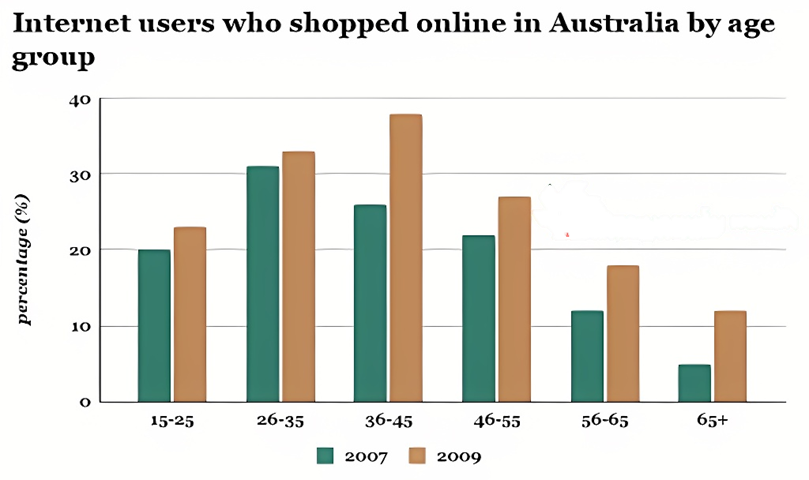
Sample 1:
The bar chart compares online shopping trends among different age groups in Australia for the years 2007 and 2009.
Overall, the data underscore the evolving landscape of online shopping in Australia, with increasing adoption across all age demographics, albeit at varying rates. It is also clear that those aged from 26 to 45 years old did the most shopping on the Internet.
In 2007, online shopping participation varied across age groups. The 26-35 age group exhibited the highest participation rate at 31%, followed closely by the 36-45 cohort at 25%. Meanwhile, one in five young adults aged 15-25 did their shopping on the Internet, with interest declining steadily among older age brackets, reaching as low as 5% among those aged 65 and above.
By 2009, e-commerce had become more popular across all age ranges. The 36-45 age group demonstrated the most substantial increase of 13%, with approximately two-fifths reporting online shopping activities in 2009. The older the age groups, the more growth is recorded, with participation rates among individuals aged 46-55 and 56-65 reaching 27% and 18%, respectively. Noticeably, the figure for the oldest age group more than doubled to around 12%.
The chart shows the proportion of people in a UK survey carried out in three different years who said they were interested in certain sports.
Summarise the information by selecting and reporting the main features, and make comparisons where relevant. Write at least 150 words.
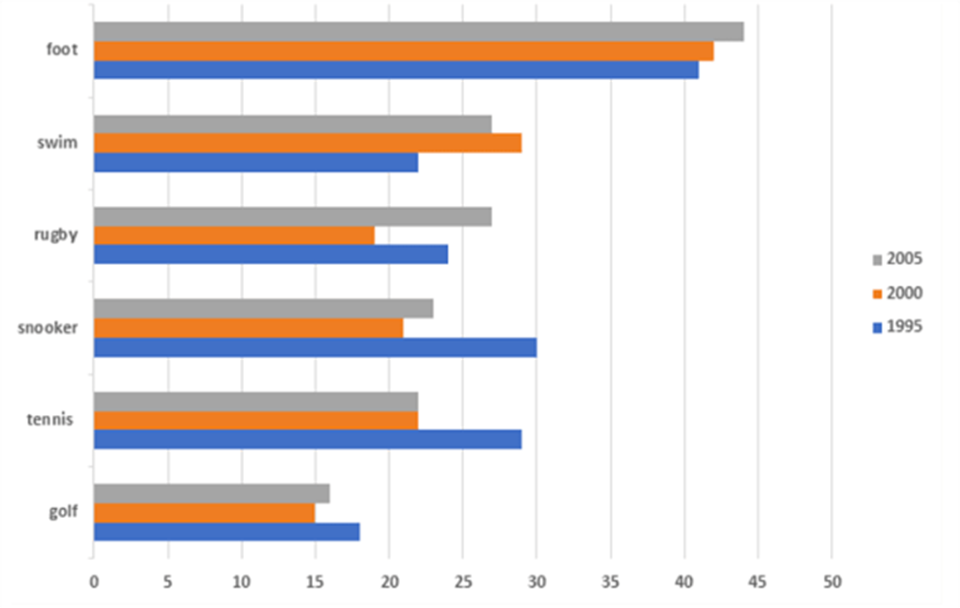
Sample 1:
The bar chart shows the percentage of UK residents interested in six different sports, in three years (1995, 2000 and 2005).
It is clear that walking was by far the most popular physical activity in all the surveyed years, while golf was the least popular activity. Additionally, the percentages of people who enjoyed walking, swimming and rugby increased, whereas the figures for those who enjoyed other sports decreased over the measured years.
In 1995, walking was the most popular activity, chosen by 40% of the survey participants, while playing snooker and tennis accounted for around 30%. In contrast, about 23% of people chose swimming, while only 18% said they were interested in golf. Meanwhile, approximately 25% of survey respondents chose rugby as their preferred sport.
In 2005, slightly more people preferred walking, with the figure rising to just under 45%, but there was a significant decline in the figures for tennis and snooker, to about 22% each. The figures for golf remained the same, at around 15%, as opposed to the figures for swimming and rugby, which experienced considerable gains in popularity to over 25% each.
Sample 2:
The bar chart compares the percentage of British being found of different kinds of sport in three separate years (1995, 2000 and 2005).
Overall, it is clear that walking was the most favorite sport in UK over the period shown. In addition, the interest of Uk people in walking, swimming and rugby increased over that time, but opposite was true for snooker, tennis and golf.
Regarding the chart, in 1995, over 40% of survey participants said they liked walking, compared to around 30% choosing snooker and tennis. On the other hand, golf was the least common choice at that time, which was selected by only about 17%.
After 10 years, the proportion of British people who were interested in walking gradually increased to around 45% and was still highest. Despite some fluctuations in 2000, the firgure for swimming and rugby climb to an equal proportion, at around 27% in 2005. In contrast, snooker and tennis were chosen by a lower percentage, at nearly 23%, and playing golf still attracted the lowest percentage of UK people, at 16% in 2005.
Sample 3:
The bar chart illustrates the proportion of people in the UK who were interested in various sports in 1995, 2000, and 2005.
Overall, walking was the most popular activity in all the surveyed years, while golf was the least popular. The percentages of people who enjoyed walking, swimming, and rugby increased, whereas the figures for other sports decreased over the measured years.
In 1995, walking was the most popular activity, with 40% of participants showing interest. By 2005, this figure had risen to just under 45%. Conversely, golf attracted only 18% of participants in 1995, and this interest remained nearly consistent at around 15% in 2005.
Between 1995 and 2005, the popularity of snooker and tennis declined significantly, from around 30% to about 22%. In contrast, the interest in swimming and rugby increased considerably, from approximately 23% and 25% in 1995 to over 25% each in 2005.
Sample 4:
The provided bar graph reveals the variation in the interest of British towards different sports activities as per the three surveys conducted in the year, 1995, 2000 and 2005.
Overall, though there was not any significant change in the participation in most sports activities, yet the ranking certainly changed.
Moving in detail, it is apparent from the bar graph that most people in the UK were interested in playing Footy and the proportion was around 40% initially, which marginally grew by 3% in 2005. Similarly, the predilection towards Rugby and Swimming also increased during the 10-year period though the percentage of participants was almost half in these as compared to Footy. A lump of around 5% is evident as per the survey of 2005 in these two games.
In contrast, a decline was observed in the interest of UK dwellers toward certain sports. Where in 1995 almost 1/3 of the participants gave priority to playing Snooker and Tennis in the next two surveys the ratio Sharply dropped to 22%. Interestingly, Golf remained the least popular activity throughout the green tome period and the percentage of participants accounted for around 15% in most surveys.
Sample 5:
The bar chart compares the percentage of respondents, according to a survey conducted in the UK, expressing their interest in six different sports in 1995, 2000 and 2005. Overall, football was by far the most popular in all three years, as opposed to golf which experienced far less popularity. While the percentages of those keen on football, swimming and rugby increased slightly over the given ten years, the figures for snooker, tennis and golf saw drops of varying degrees.
In terms of sports which became more common, as opposed to all of the other sports, football was the only one that failed to decline in popularity at any point, rising steadily from 41% to 45% over the ten-year period. The proportion of swimmers experienced a seven-percent rise to around 28% in 2000, followed by a negligible drop to about 26% in 2005 when the same percentage of those playing rugby was recorded, despite a previous drop to around 18% in 2000.
Regarding sports whose popularity declined, snooker ranked second in 2000, at 30%, but latter came fourth in the chart, due to a significant decline to about 23% in 2005. Similarly, nearly 30% of respondents said they played tennis in the first surveyed year; however, their participation rate dropped to 22% in both 2000 and 2005. Golf || remained the least played in the given years, with the figure hovering around 15% and 16%.
Sample 6:
The bar graph compares the percentage of UK residents who took interest in six different types of sports in 1995, 2000, and 2005.
Overall, walking was the most popular activity throughout the three years, whereas golf was the least chosen one. Besides, while the proportion of people who loved walking, swimming and rugby witnessed an upward pattern, the popularity of the other sports underwent an opposite trend.
In 1995, over 40% of surveyed people claimed their interest in walking, making it the most favoured sport. In contrast, the percentage of respondents selecting golf as their favourite activity was merely 18%, which was the lowest figure in that year. In the meantime, the proportions of people who enjoyed swimming, rugby, snooker, and tennis were between 20 and 30%.
Ten years later, despite some slight changes, walking and golf respectively maintained their highest and lowest ranks in terms of popularity. Meanwhile, the percentage of swimmers and rugby players rose and reached 27% in 2005, with some fluctuations in 2000. On the contrary, the proportion of people engrossed in snooker and tennis fell by approximately 7%, ending as the second lowest figure.
Sample 7:
The bar chart compares the proportion of people in a UK survey carried out in three different years who said they were interested in certain sports.
The chart shows that in the UK, people tend to participate in footsports the most. Over the years, participation in subjects such as Swim, Rugby, Snooker, Tennis has remained at an average level. The least attended sport in the UK is golf.
In 1995, the tendency to participate in playing foot sports was about 41%. The number of participants increased gradually over the years and reached the highest level in 2005 at about 45%. The number of people participating in golf every year is relatively low at only 14-15%.
In 2000, swimming participation peaked at about 28%. The trend of participating in rugby was highest in 2005 at around 28%. The chart shows that tennis and snooker playing trends are relatively similar over time most in 1995, with an average of about 21% in 2000 and 2005.
Summarize the information by selecting and reporting the main features, and make comparisons where relevant. Write at least 150 words.
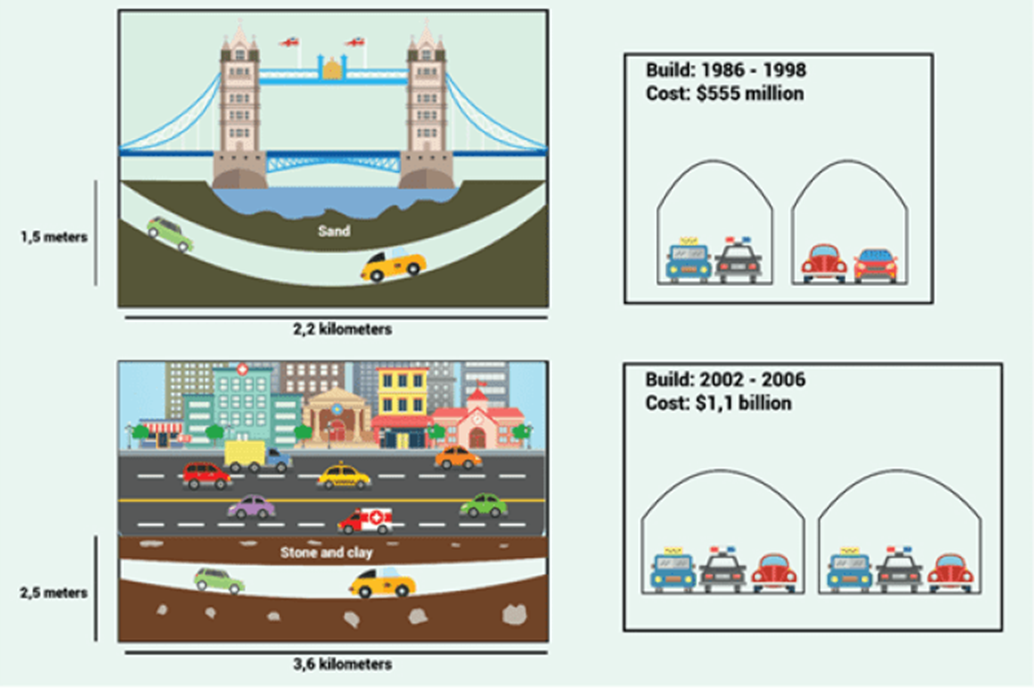
Sample 1:
The given maps illustrate two different underground tunnel systems for cars in two Australian cities.
Overall, there are a number of differences between the two tunnel systems, in terms of the cost, size, length, time of construction, and the surrounding environment. The first tunnel cost approximately half as much as the second tunnel to construct, however, the first tunnel was significantly smaller in terms of length and vehicle capacity. The first tunnel also took much longer to construct.
The first tunnel, which took twelve years to construct between 1986 and 1998, cost $555 million, and was built underneath a body of water and sand. Meanwhile, the second tunnel only took four years for completion but cost twice as much, at $1.1 billion, and was constructed beneath a layer of stone and clay.
The size of the tunnels was also substantially different, with the first tunnel being 1.5 meters high and 2.2km long, and the second tunnel being 2.5m high and 3.6 km long. The first tunnel system is four lanes wide, while the second tunnel system is six lanes wide.
Sample 2:
The diagrams compare the design of two underground tunnels in Australia. Overall, it can be seen that the more recently built tunnel, which facilitates urban traffic, displays more advanced features at twice the cost of the older, river-spanning one.
The first tunnel was constructed from 1986 to 1988, costing 555 million dollars. It stretches from one end to the other of a bridge over a river, covering a distance of 2.2 kilometers. In addition, this tunnel, which could accommodate four lanes of vehicle traffic, went 1.5 meters underneath a surface of sand.
Meanwhile, construction of the second tunnel began in 2002, and it was not until 2006 that the route was opened for traffic. With a price tag of 1.1 billion dollars, this tunnel has a span of 3.6 kilometers and lies beneath an overground motorway. Besides being longer than the former tunnel, it provides more space for vehicles as well, at 6 lanes. The more modern building technology is further reflected in the fact that this route went 2.5 meters deep in terrain composed of clay and stone.
Sample 3:
The diagrams illustrate information regarding the structural and financial specifics of two road tunnels situated beneath Australian cities.
Overall, it is apparent that both tunnels were constructed to facilitate vehicular movement, with the latter surpassing the former in terms of length, depth, and financial investment. Moreover, the foundational composition of each differs markedly.
The tunnel completed in the time frame from 1986 to 1998 measures a length of 2.2 kilometers and is embedded 1.5 meters under a layer of sand. The cost incurred for its construction stood at $555 million which accommodates a bi-directional flow of traffic across two lanes on each side of the tunnels. In comparison, the second tunnel, which was built between 2002 and 2006, extends for 3.6 kilometers and delves to a depth of 2.5 meters into a substructure of stone and clay. This larger scale of construction was reflected in its cost, which reached a substantial $1.1 billion. The design, similar to the first, provides two tunnels but has one more lane compared to the one built earlier.
Sample 4:
The diagrams show the distinctions between two tunnels in two cities in Australia. Overall, the newer tunnel is superior to its older counterpart regarding its length, height, and traffic capacity. Additionally, although the older tunnel took much longer to construct, it is about half the cost of the newer one.
Regarding the construction duration, traffic volume, and price of the two tunnels, the first tunnel, initiated in 1986 and completed in 1998 (twelve years of construction), can accommodate two vehicles simultaneously in each lane. However, the second one's construction necessitates significantly less time, taking place between 2002 and 2006, but it allows for the movement of three vehicles at a time. Furthermore, $1.1 million was allocated for the construction of the new tunnel, compared to only $555 million for the old one.
Concerning the height, length, and location of the two tunnels, the first one is 1.5 meters high and 2.2 kilometers long; at the same time, it is positioned under a bridge spanning a water body as well as separated from the water and bridge by a layer of sand. The second one, longer and taller at 3.6 kilometers and 2.5 meters, respectively, is built under a highway, with a layer of stone and clay separating the tunnel and the highway.
The charts below give information about the world's top three producers for four dairy products (milk, cheese, butter, milk powder) in the year of 2012.
Summarise the information by selecting and reporting the main features, and make comparisons where relevant. Write at least 150 words.

Sample 1:
The bar graphs detail the output of leading three manufacturers globally for four various dairy items in 2012. Overall, the total production of milk from the three key contributors was significantly higher than the other consumables, followed by cheese, butter and milk powder. Moreover, while the European Union dominated in the quantity of milk and cheese produced, it ranked last in the manufacturing of powdered milk.
Concerning the categories in which the European Union produced the highest amount, it made nearly 143,000 metric tonnes of milk and about 7,100 metric tonnes of cheese. Furthermore, the amount of milk manufactured by India was 127,000 compared to roughly 90,000 metric tonnes made in America. Meanwhile, America and Brazil yielded 4,925 and 700 metric tonnes of cheese, respectively.
Regarding the other dairy staples, the most productive area for butter was India, at 4,500 metric tonnes, followed by the European Union and the United States, at approximately 2,000 and 810 metric tonnes, respectively. Finally, in terms of milk formula, China and New Zealand had a relatively identical amount of nearly 1,200 metric tonnes each, which was around 400 metric tonnes higher than the European Union.
Sample 2:
The bar charts compare the production quantities of various dairy products by the world's top producers in 2012.
The European Union consistently emerged as a leading producer across all categories, except for milk powder.
The production of milk was highest in the European Union, at 142,970 metric tons, followed by India and the United States, with 127,000 and 90,038 metric tons respectively. In cheese production, while the European Union again led with 7,120 metric tons, the United States followed with a significant amount of 4,925 metric tons, overshadowing Brazil's production of 700 metric tons.
Regarding butter, a reversal in the leading position was observed with India surpassing the European Union, producing 4,500 metric tons compared to the latter's 2,040 metric tons. The United States trailed behind with 810 metric tons. In the milk powder sector, China outstripped other producers with 1,200 metric tons, closely followed by New Zealand and the European Union, which produced 1,110 and 770 metric tons respectively.
Sample 3:
The bar chart presents data on the dairy production of milk, cheese, butter, and milk powder by the top three producers in 2012, with quantities measured in metric tonnes.
Overall, the European Union emerged as the predominant producer in the realms of milk and cheese, whereas India and China respectively secured the top spots in the production of butter and milk powder.
In milk production, the EU’s output reached 142,970 metric tonnes, constituting a notable 40% of the total production by the three leaders, surpassing India by approximately 15,000 metric tonnes and the United States by over 50,000 metric tonnes. Cheese production mirrored this trend, with the EU producing 7,120 metric tonnes, more than half the combined output of the next two largest producers.
Conversely, India dominated butter production, yielding 4,500 metric tonnes, a figure more than double that of the EU’s and substantially higher than the United States’ production of 810 metric tonnes. The production of milk powder showcased a different leader, with China at the forefront with 1,200 metric tonnes, marginally exceeding New Zealand’s production and significantly outstripping the EU’s output of 770 metric tonnes.
Sample 4:
The bar chart in question delineates the production quotas of the foremost global dairy suppliers, categorising their outputs into four dairy segments: milk, cheese, butter, and milk powder for the year 2012. An analytical scrutiny of the data indicates a marked dominance by the European Union (EU), India, and the United States in the dairy production hierarchy.
In the realm of milk and cheese, the EU's production was unparalleled, with their dairy farms yielding 142,970 MT of milk and 7,120 MT of cheese, positioning them at the zenith of European dairy commerce. India was a formidable contender, securing the second rank in milk production at 127,000 MT, surpassing the United States by a significant margin of approximately 36,000 MT. The United States, however, manifested its dairy prowess in cheese production, generating 4,925 MT, a figure seven times higher than Brazil's contribution.
Transitioning to the realm of butter and milk powder, India's butter production reigned supreme, boasting a production volume of 4,500 MT, which more than doubled the EU's 2,040 MT and significantly overshadowed the United States' 810 MT. As for milk powder, China commanded the lead with a production of 1,200 MT, narrowly edging out New Zealand's commendable 1,110 MT and markedly outproducing the EU's 770 MT.
Sample 5:
The bar chart provides a detailed illustration of information about the world’s top three producers of four different dairy products in 2012, encompassing milk, cheese, butter, and milk powder. This data highlights the production capacity of the European Union (EU), India, and the United States in these categories.
Overall, the EU was the market leader in milk and cheese production while India and China we the largest manufacturers of butter and milk powder, respectively.
In the arena of milk and cheese, the EU's prodigious output was unmatched. It produced 142,970 metric tons (MT) of milk and 7,120 MT of cheese, positions that underscored its supremacy in these segments. India emerged as the second most prolific milk producer, with its production totaling 127,000 MT, which was substantially more than the United States by 36,000 MT. In the cheese category, the United States demonstrated its strength by producing 4,925 MT, a volume significantly higher than Brazil's, being almost seven times greater.
In the sphere of butter and milk powder, leadership roles shifted. India's butter production took center stage with a remarkable 4,500 MT, surpassing both the EU's 2,040 MT and the United States' 810 MT. Conversely, China dominated in milk powder production with a yield of 1,200 MT, marginally outperforming New Zealand's 1,110 MT and considerably exceeding the EU's production of 770 MT.
Sample 6:
The provided bar chart meticulously details the output of the world's top three producers of four different dairy products in 2012, measured in metric tonnes. A discernible pattern emerges, with the European Union (EU) taking the forefront in milk and cheese sectors, while India and China command the lead in butter and milk powder production, respectively.
For milk, the EU's production was unparalleled, registering at 142,970 metric tonnes, which underscores its role as a dairy powerhouse, outstripping India's robust yield by 15,000 metric tonnes and the US contribution by a considerable margin. Cheese production tells a similar story, with the EU producing a substantial 7,120 metric tonnes, dwarfing its competitors and accounting for over half of the total output among the top producers.
India’s predominance in butter production was marked, delivering an impressive 4,500 metric tonnes, more than quintupling the EU’s output, and eclipsing the United States' figure significantly. In the realm of milk powder, China edged into the lead with 1,200 metric tonnes, closely followed by New Zealand, leaving the EU trailing with 770 metric tonnes.
Sample 7:
The bar charts delineate the top three countries by dairy production in the year 2012. Overall, it can be seen that the European Union was the only region featured in all categories, and milk output far outweighed that of other products.
In the chart for milk production, the European Union exhibited an aggregate of nearly 143,000 metric tons in 2012, surpassing India's production by approximately 16,000 metric tons. Ranked third was the United States with a milk yield of just 90,038 metric tons. Although cheese’s output was nowhere near as prolific as milk’s, it was the second most produced dairy. The European Union retained its role as the leader in this category, boasting an outcome of 7,120 metric tons. The United States followed suit with approximately 5,000 metric tons, seven times the figure for Brazil.
With an output of 4,500 metric tons, India was the foremost contributor to the world’s butter production, which was more than double the European Union’s output. The United States claimed the third position with 810 metric tons. In comparison, milk powder production in the surveyed countries hovered around 1,000 metric tons, with China and New Zealand occupying the first and second place, respectively. Meanwhile, the third place belonged to the European Union, with 770 metric tons.
Sample 8:
The bar chart illustrates the four dairy production outputs of the top three producers in 2012.
Overall, milk stood out as the most significant, whereas milk powder occupied the position of the least produced in the market. Moreover, the European Union emerged as the global leader in producing milk-based products.
Regarding the global dairy industry, the European Union (EU) dominated milk products, recording a remarkable 142,970 MT. Subsequently, India secured the second-highest rank, contributing significantly with 127,000 MT, while the United States trailed with just over 90,000 MT. In the milk powder section, the EU yielded a quantity of 770 MT, yet the primary contributors in this category are China and New Zealand, with a substantial 1,200 MT and 1,100 MT, respectively.
When it comes to cheese, the European Union (EU) surpassed competitors, providing 7,120 MT, outclassing both the United States, which provided 4,925 MT, and Brazil, contributing 700 MT. Conversely, the amount of butter made by the EU was approximately 2,000 MT. India distinguished itself by supplying 4,500 MT, showcasing its more significant role in dairy goods.
Sample 9:
The charts demonstrate the three leading producers for four types of dairy products worldwide in 2012. Overall, a larger amount of milk was produced compared to other products. Additionally, while the European Union made the most milk and cheese, India was the top manufacturer of butter and China dominated milk powder production.
With regard to milk and cheese production, in the European Union the former stood at 142,970 metric tons, compared to 127,000 metric tons in India and 90,038 metric tons in the United States. In the same year, the European Union produced 7,120 metric tons of cheese, followed by 4,925 metric tons in the United States, and Brazil was far behind with only 700 metric tons.
Concerning the remaining products, butter production in India was recorded at 4,500 metric tons, more than double the figure for the European Union with 2,040 metric tons. However, just 810 metric tons of butter was made in the United States. Such a discrepancy was not seen in milk powder as the data for China and New Zealand were relatively comparable at 1,200 and 1,110 metric tons respectively, whilst the European Union manufactured 770 metric tons of milk powder.
Sample 10:
The bar chart compares the dairy production among the world's top three producers for the year 2012.
It is clear that in all the three regions, more milk was produced than other types of products. European Union was the primary producer of milk and cheese, while India and China took precedence in butter and milk powder production respectively.
In terms of milk output, EU took the lead with a substantial production of 142,970 metric tons, significantly surpassing the production in India by roughly 16,000 metric tons and that in US by around 50,000 metric tonnes. Likewise, EU still maintained its leading position in cheese production (7,120 metric tons), while Brazil only produced 700 metric tons of cheese.
However, with an output of 4,500 metric tons, India dominated butter production, a figure more than twice of the combined production in EU and US. A different pattern could be found in the production of milk powder. China ranked the top in this item (1,200 metric tons), closely followed by the figure in New Zealand (1,110 metric tons). The third largest producer was the EU, with 770 metric tons of milk powder produced in this area.
Sample 11:
The bar chart compares three leading countries on a worldwide scale in terms of their production of four types of dairy products, namely milk, cheese, butter and milk powder in the year 2012. The unit of measurement is metric tons (MT).
Overall, a similar pattern could be seen in all of the three major world producers, with the EU consistently being the primary manufacturer of four kinds of dairy products, followed by India and the United States (US). In addition, among the four categories, milk was by far the most commonly produced one, significantly surpassing the figures for milk powder.
The EU was the dominant producer of milk, manufacturing slightly under 150000 MT, and this was followed closely by India, whose production of the same product was approximately 130000 MT. By contrast, the US lags behind, having the least amount of milk produced (around 90000 MT). Milk powder almost exactly followed a similar pattern to that of milk, albeit at a far lower rate. The majority of this type of product was made in the EU (marginally below 1250 MT), whereas India and the US produced lower quantities, with respective figures being roughly 1100 MT and just over 750 MT.
Regarding butter, a considerable difference of about 2500 MT was witnessed in butter production, with the EU far outnumbering its Indian counterparts. While the former produced nearly 4500 MT, the figure for the latter was only 2000 MT. India produced nearly twice as much butter as the US, with the data for the US standing at a mere 800 MT. Finally, about 7000 MT of cheese was produced in the EU, as opposed to India, which accounted for close to two-thirds of the EU’s amount, at 5000MT. Notably, the lowest recorded figure occurred in cheese production in the US, where as low as 500 MT of this product was manufactured.
Sample 12:
The charts provide data about the production of milk, cheese, butter and milk powder by the highest world producers in 2012.
Overall, the European Union (EU) led the way in milk and cheese production. In terms of metric tons, the production of milk far exceeded that of the other dairy products.
The EU produced almost 143,000 metric tons of milk, compared with 127,000 metric tons in India and around 90,000 metric tons in the USA. The production of cheese in the EU was just over 7,000 metric tons, while the USA produced almost 5,000 metric tons and Brazil produced 700 metric tons.
India led world production of butter with 4,500 metric tons, more than double the figure for the EU, with production in the USA totalling just over 800 metric tons. Finally, China produced 1,200 metric tons of milk powder, a slightly higher figure than in New Zealand and the EU, with 1,110 and 770 metric tons, respectively.
The graph below shows the percentages of tourists who used different types of transport to travel within a particular nation between 1989 and 2009. Each tourist may have used more than one type of transport.
Summarise the information by selecting and reporting the main features, and make comparisons where relevant. Write at least 150 words.
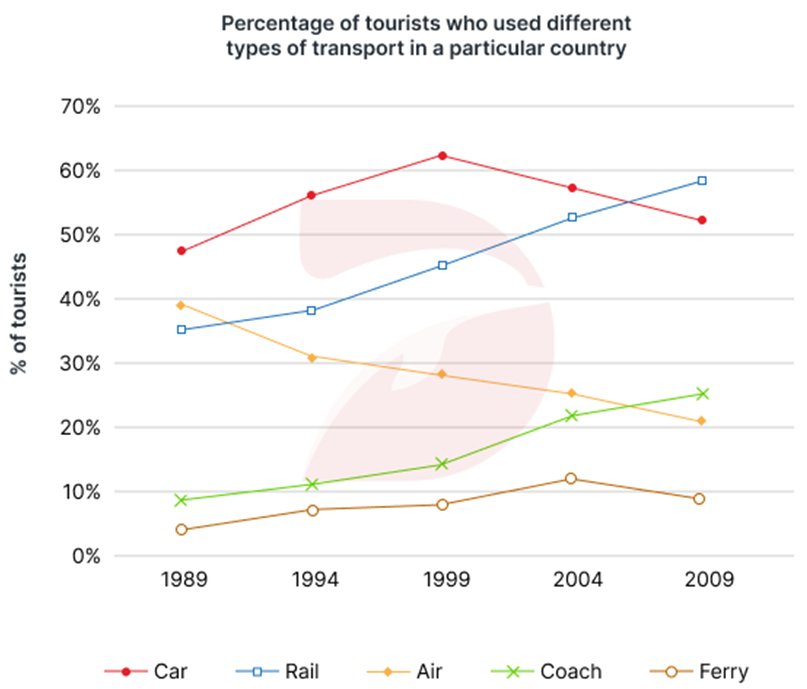
Sample 1:
The given line graph illustrates how travelers commuted in a country over a 20-year period, starting from 1989. Five modes of transportation including car, rail, airplane, coach and ferry were surveyed with percent as the unit of measurement.
Overall, among all the methods of transportation, cars were the most popular during almost the entire surveyed period except the year 2009 when railway took the leading position. What is also notable from the chart is that all of the vehicles witnessed an upward trend with the exception of airway.
At the start of the period, nearly half of tourists traveled around the country by car, establishing it as the most prevalent vehicle. This was followed by airway and rail lines, with their respective figures standing at 40% and 35%. Meanwhile, there were around 10% of tourists choosing coaches, double the figure for ferries.
Thereafter, the percentage of those traveling by car surged to over 60% in 1999, after which it dropped considerably to just over 50% over the next 10 years. Railways registered a notable ascending trend, with their figure rising sharply to nearly 60% and surpassing cars to become the most commonplace means of transport at the end of the period. Opposite changes can be seen in the proportion of those traveling by airplane, which fell remarkably to just 20% in 2009. Finally, coach and ferry all recorded growth in their popularity, but the figure for the former grew significantly to roughly 25% while the latter experienced a more modest rise to just 10% at the end of the given time span.
Sample 2:
The line chart illustrates the proportion of travelers who utilized five transportation modes to commute within a specific country, from 1989 to 2009. Overall, all types of vehicles witnessed an upward trend, except for aircraft. Additionally, the rate of ferry tourists was constantly the lowest.
In terms of the two categories that started at the highest, nearly half of vacationers traveled in this nation by car in 1989. This rate reached a peak of slightly over 60% a decade later, before decreasing moderately to approximately 52% by the end. In contrast, the share of visitors who traveled by air began at roughly 40% and declined continuously throughout the period and finished at around one-fifth in 2009.
Concerning the remaining types, the figure for railroad commuters ranked third at about 35% in 1989 and witnessed significant increases over the years, overtaking cars and airplanes to be the most common vehicle by 2009, at approximately 60% of tourists. After a constant rise from nearly 10% in 1989 to about 15% in 1999, the proportion of travelers using coaches surged to above 25% by 2009. Finally, ferry was the least popular choice for vacationers over the period, with less than 5% and 10% users in 1989 and 2009, respectively, despite a peak of just over 10% in 2004.
Sample 3:
The line graph illustrates the percentage of tourists who used five different types of transport - car, rail, air, coach, and ferry - to travel within a particular country over a 20-year period from 1989 to 2009. Each tourist could have used more than one form of transport during their trip.
Overall, the most significant change was in air travel, which saw a dramatic increase in usage, while the percentage of tourists using rail transport remained relatively stable over the period. Meanwhile, car usage declined, and ferry usage experienced a slight downward trend.
Car travel was initially the most popular mode of transport in 1989, with over 50% of tourists choosing this option. It continued to rise, peaking at around 60% in 1999, before gradually declining to 40% in 2009. In contrast, the percentage of tourists using rail remained fairly steady, fluctuating between 35% and 40% throughout the 20-year period, eventually matching car usage by the end of 2009.
Air travel, which started at about 30% in 1989, showed the most notable growth over the period, overtaking car usage in 2009 at approximately 55%. The percentage of tourists opting for coach transport was the lowest overall, starting at 10% in 1989 and increasing slightly to 15% in 2009. Ferry travel, although not widely used, followed a downward trend from around 12% in 1989 to 5% in 2009.
Sample 4:
The line graph illustrates the modes of transport tourists opted for when travelling within a certain nation from 1989 to 2009. Note that tourists may have used more than one kind of transport.
Overall, the usage of all forms of transportation increased, except for air travel. Additionally, ferry was the type of transport used the least by tourists, whereas rail travel became the most common towards the end of the timeframe.
In 1989, nearly half of all tourists used a car when travelling within this particular country. This figure continued to rise over the following 10 years, reaching a peak of 60% in 1999, before steadily declining to just over 50% in the final year. Similar changes can be seen in the percentage of tourists that travelled by rail within the country, starting at around 35%, and climbing to almost 60% twenty years later. This is in stark contrast to the proportion of visitors who used air travel, as it experienced a constant decline from just below 40% to slightly over 20% at the end of the period.
Meanwhile, the use of coach and ferry followed very similar trends. While the former increased significantly from nearly 10% in 1989 to approximately 25% in 2009, the latter went up from roughly 5% to hit a high of around 12% in 2004, and by the end of the period it had fallen slightly to just under 10%.
Sample 5:
The given line graph illustrates changes in the proportions of commuters utilizing various modes of transportation in a specific country over a 20-year period. Each visitor could have employed multiple vehicles.
Overall, there was a downward trend in the number of tourists opting for air travel, whereas the opposite trend was observed for all other modes of transportation.
Only in the percentage of tourists travelling by plane was there a noticeable decline from 40% in 1989 to 30% in 1994. Subsequently, this figure continued declining steadily, reaching approximately 20% by 2009.
On the contrary, the remaining categories shared the same pattern. Commencing with 1989, the proportion of tourists using cars was by far the highest, at just under 50%, followed by those commuting by rail, coach and ferry, at about a third, 10% and 5%, in order. Subsequently, over the following decade, all of them observed noteworthy increases. More specifically, the proportion of car travelers surged to a pinnacle of over 60%, while the figures for rail, coach, and ferry escalated to 45%, 15%, and nearly 10%, respectively. Strikingly, this country witnessed a remarkable growth in the percentage of tourists opting for rail and coach travel, a rise of over 10% in 2009. Conversely, there was a decline in the data pertaining to car travel, settling at around 50%. Notably, ferry usage experienced a downturn, initially rising modestly to over 10% before undergoing a subsequent decrease at the end of the given time frame.
Sample 6:
The line graph gives information about the proportion of domestic visitors who travelled in one unspecified nation using five various means of transport from 1989 to 2009.
Overall, there was an increasing number of tourists who used all modes of transport to travel within the nation, with the exception of air usage which saw a decline throughout. Additionally, train users underwent the most noticeable growth to overtake car ones and dominate the graph at the end of the period, while ferries still remained the lowest.
The percentage of travellers opting for railway transportation increased the most significantly, growing from the third highest initially (around 35%) and eventually surpassing cars to become the most commonly used means of transport in 2009, when just under 60% of them travelled by this type.
Coach almost exactly mirrored rail’s growing pattern, albeit at a far lower rate, going up from slightly under 10% to approximately 25% over the period. These rising trends are in contrast to tourists travelling by plane, whose proportion nearly halved, declining from a significant 40% to only 20% in the final year.
The figure for those driving cars, despite increasing to reach a peak of marginally above 60% in 1999, saw a steady drop to roughly 50% in 2009. Although there was such a fall, for the majority of the period, cars still generally remained the most prevalent type of vehicle used to travel around the country by tourists, except for the final three years.
Conversely, ferry was consistently used the least, with its percentage rising gradually to its high of just above 10% in 2004 before experiencing a minimal drop to around 9% at the end of the time frame.
The chart below shows the annual pay (thousands of US dollars) for doctors and other workers in seven countries in 2004.
Summarise the information by selecting and reporting the main features, and make comparisons where relevant. Write at least 150 words.
Sample 1:
The bar chart gives information about the yearly salaries of doctors compared to other professions across various countries in 2004.
Overall, the US was the top payer for both doctors and other workers, while salaries in Italy, the Czech Republic, and Germany were relatively similar. Additionally, doctors received significantly higher annual pay than people doing other jobs in all given countries.
In terms of the annual salary of doctors, the United States topped the list with a substantial $120,000 per year, followed distantly by France and Switzerland, where these health professionals made the same amount of $70,000 annually. Meanwhile, those working in Italy, the Czech Republic, and Germany had annual earnings of approximately $60,000, about $10,000 higher than that of Finnish doctors.
Although the US saw the largest pay gap between their doctors and other workers, the latter were still the biggest earners among those in other countries, earning just above $40,000. Swiss workers of other professions were remunerated slightly lower, as they made exactly $40,000. Notably, there was no pay difference between Italian, Czech, and German workers, all of whom earned $20,000. Finally, a close similarity can be seen in the remuneration for non-doctor professionals in France and Finland, with respective figures of roughly $30,000 and $25,000.
Sample 2:
The chart demonstrates the yearly pay for doctors and other workers in seven different nations in 2004 in thousands of USD.
Overall, it is immediately obvious that doctors make more than any other profession in these countries. Furthermore, the average salary for American workers, both for doctors and other professions, outstrips every other country.
With regards to doctors’ pay, the US ranks first at an average of 120 000 USD, being significantly higher than the countries in joint second place of Switzerland and France, where doctors earn around 70 000 USD. Conversely, doctors in Finland earn the least at only 50 000 USD annually, 10 000 lower than the second lowest pay for doctors, that of Italy, at 60 000 USD.
As for the salary for other professions, it is again highest in the US, where average pay is around 45 000 USD. Meanwhile, Switzerland ranks second at 40 000 USD, while France is third at 30 000 USD. Germany, the Czech Republic and Italy all share the bottom position, paying their non-doctors a measly 20 000 USD on average.
Sample 3:
The bar chart gives information about the salary of doctors and other workers in seven countries in 2004.
Overall, it can be seen that the US paid the highest salary for both doctors and other workers. In addition, doctors received higher pay than people doing other jobs in all 7 countries.
In 2004, France and Switzerland paid an equal amount of money for their doctors, at 70,000 dollars, while the salaries of other workers were only about 30,000 dollars in France and 40,000 in Switzerland. In a similar fashion, doctors in Italy, Czech, Germany received around 60,000 dollars for their work, three times as much as the salary of other workers.
120,000 dollars was the salary of doctors in the US in 2004, nearly triple the payment of doctors in Finland. People doing other occupations in the US were also paid higher than their Finnish counterparts – 40,000 dollars compared to just less than 30,000 dollars.
Sample 4:
The bar chart compares seven countries regarding the yearly payment for doctors and other jobs in the year 2004.
It is clear that doctors generally made more money than other types of work in each country during the research period. Also, the average incomes of American doctors and other workers were the highest among the seven nations.
The US doctors earned the largest amount of money compared to those in the other six countries, receiving nearly $120,000, while the figures for Switzerland and France were significantly lower, at close to 70,000 each. In contrast, there was only about $50,000 earned by doctors in Finland, as opposed to doctors in the other countries, who received around $61,000 each.
Regarding the average salaries of other workers, the amount of money earned by other workers in the US, at approximately $45,000 and in Switzerland, at exactly $40,000 was higher than in any of the other nations. Roughly $30,000 was given to French other workers, about $5,000 higher than that of Finnish counterparts. By contrast, the figures for the remaining countries were lowest, at exactly $20,000 each.
Sample 5:
The bar chart compares the yearly salary of doctors and other workers in several countries in the year 2004.
Overall, it is clear that the pay of US doctors was much higher than that of doctors in other countries. In each country, the annual salary of doctors was far higher than that of other workers.
The annual pay of doctors in the US was $120,000, whereas in Finland doctors received a comparatively low yearly salary of $50,000. In France, and Switzerland doctors earned $70,000 per year, compared with around $60,000 annually in Italy, Germany and the Czech Republic.
In contrast, the annual wages of other workers were much lower, at about $45,000 and $40,000 in the US and Switzerland, respectively. Other workers in France earned $30,000, a little more than other workers in Finland, who had an annual salary of $25,000. The lowest annual earnings were for other workers in Italy, Germany and the Czech Republic, at exactly $20,000.
Sample 6:
In 2004, the bar graph compares the annual earnings of doctors and employees in other professions in seven different countries. Overall, doctors earned significantly more than employees in other fields, with disparities varying greatly across countries. Doctors and other workers were paid the most in the United States.
It is noticeable that the average salary of an Italian, Czech, and German doctor was three times that of a worker in other fields, with figures ranging between 60 and 20 thousand US dollars. In Finland, the pattern was slightly different, with doctors earning around $55,000, which was more than double the figure for other workers, who earned $25,000.
Doctors in France and Switzerland earned roughly the same amount of money that year, while workers in other fields earned significantly less.
In terms of the US labor force, an average American doctor and worker were paid the most per year, receiving 120 thousand US dollars and just over a third of this, respectively.
Sample 7:
The provided bar chart presents a comparison of the annual salaries of doctors and other workers in multiple countries for the year 2004.
In general, it’s evident that doctors in the United States received significantly higher salaries compared to their counterparts in other nations. Furthermore, doctors in all the featured countries earned considerably more than other workers.
Specifically, doctors in the United States enjoyed an annual income of $120,000, while their counterparts in Finland received a notably lower yearly wage of $50,000. Meanwhile, doctors in France and Switzerland earned $70,000 annually, in contrast to approximately $60,000 per year in Italy, Germany, and the Czech Republic.
On the flip side, the yearly wages of other workers were notably lower, standing at approximately $45,000 and $40,000 in the United States and Switzerland, respectively. In France, other workers earned around $30,000, slightly more than their Finnish counterparts, who had an annual salary of $25,000. The lowest annual earnings were observed among other workers in Italy, Germany, and the Czech Republic, all of whom earned exactly $20,000 annually.
Sample 8:
The bar chart provides a comparative analysis of seven countries with respect to the annual income of doctors and other occupations in the year 2004.
It is evident that, in each of the countries examined, doctors generally commanded higher incomes than individuals in other professions during the study period. Furthermore, the United States emerged as the country with the highest average earnings for both doctors and other workers among the seven nations.
In the case of doctors, the United States took the lead with doctors earning the most substantial income, nearly reaching $120,000, whereas Switzerland and France reported considerably lower figures, at approximately $70,000 each. Conversely, doctors in Finland earned approximately $50,000, notably lower than their counterparts in the other countries, who averaged around $61,000 each.
Sample 9:
The provided bar chart illustrates the annual salaries for doctors and other types of workers in seven nations in the year 2004, with the figures presented in thousands of US dollars.
In summary, doctors across all seven countries earned higher salaries compared to other types of employees, and the United States boasted the highest incomes for both professions when compared to the other nations.
Specifically, doctors in France and Switzerland received an identical annual salary of $70,000. There were slight variations in the earnings of doctors in Italy, the Czech Republic, and Germany, with variances of approximately 2 to 3 thousand dollars. American doctors, in contrast, earned a substantial $120,000, which was nearly three times the salary of Finnish doctors.
For other members of the workforce, Italians, Czechs, and Germans all earned a uniform wage of $20,000. The annual income for workers in France and Finland stood at $30,000 and $25,000, respectively. In Switzerland, employees received $40,000 per year, while workers in the United States earned $5,000 more than their Swiss counterparts.
Sample 10:
The bar chart provides a visual representation of the annual salaries for doctors and other workers in seven countries in the year 2004.
Overall, it is evident that in 2004, the salaries of doctors in these seven countries were substantially higher than the earnings of individuals in other professions. Notably, the United States stood out as the nation with the highest income for employees when compared to the other countries.
Specifically, in 2004, the average income for medical professionals in almost all the featured countries exceeded 60,000 US dollars. The United States led the pack, with doctors earning an impressive 120,000 US dollars annually, while Finland reported the lowest income for doctors, at only 45,000 dollars in the same year. Switzerland and France followed closely with an annual salary of 65,000 dollars for medical professionals.
On the contrary, the earnings of other workers in these countries were considerably lower. The United States continued to lead in this category, with an approximate 42,000 US dollars paid to professionals in fields other than medicine in 2004. In contrast, companies in the Czech Republic, Germany, and Italy paid less than half of this amount, with average annual incomes of 20,000 US dollars, in stark contrast to the American figures.
Sample 11:
The bar chart provides a visual representation of the annual salaries of doctors and other workers in seven countries in the year 2004.
In general, it is evident that in 2004, doctors in these seven different countries earned significantly higher salaries compared to those in other professions. Notably, the United States emerged as the country with the highest income for employees when compared to the rest of the nations.
During 2004, the average income for medical professionals in nearly all the countries featured exceeded 60,000 US dollars. The United States led the pack, with doctors earning a substantial estimated amount of 120,000 US dollars annually. In contrast, the average income for doctors in Finland was the lowest among the countries, standing at only 45,000 dollars for the year in question. Switzerland and France came in second, with doctors in these countries earning an annual salary of 65,000 dollars.
Sample 12:
The provided bar graph offers data on the salaries of doctors and other laborers in seven different countries: France, Italy, Czech Republic, Germany, Finland, Switzerland, and the United States in the year 2004. Upon initial examination, it is apparent that doctors in all seven countries earned significantly higher incomes than other workers. Furthermore, the United States emerged as the country with the highest earnings in both the medical profession and other occupations.
Upon closer examination, it becomes evident that doctors in most of the countries received salaries that were more than twice the earnings of other laborers, with the exception of Switzerland, where doctors earned around $70,000 while other workers received $40,000. In Italy, the Czech Republic, and Germany, the income of other laborers was only about one-third of what their counterparts in the medical profession earned. On average, non-medical workers earned approximately $20,000, while doctors earned over $60,000 each.
Turning to American doctors, they garnered the highest incomes among the seven countries, with an annual income of $120,000. In parallel, other workers in the United States also had the highest income among all seven countries, with slightly over $40,000, signifying that doctors earned three times the income of other laborers.
Sample 13:
The provided bar chart offers a comparison of seven countries concerning the annual earnings of doctors and other job categories in the year 2004.
It is evident that doctors generally command higher salaries than those in other professions in each country during the study period. Additionally, both American doctors and other workers held the highest average incomes among the seven nations.
In the United States, doctors earned the highest income compared to their counterparts in the other six countries, with an annual income of nearly $120,000, while Switzerland and France reported notably lower figures, at approximately $70,000 each. In contrast, doctors in Finland earned around $50,000, as opposed to doctors in the other featured countries, who received an average of approximately $61,000 each.
Shifting the focus to the average salaries of other workers, the earnings of these workers in the United States, at roughly $45,000, and in Switzerland, at exactly $40,000, exceeded those of the other nations. French other workers earned approximately $30,000, which was about $5,000 higher than the earnings of their Finnish counterparts. In contrast, the figures for the remaining countries were the lowest, at exactly $20,000 each.
Sample 14:
The bar chart provides information about doctors’ and other workers’ salaries per year in seven distinct countries in 2004. Overall, the annual salary of doctors is always bigger compared to other professions.
In the US, a doctor’s income per year is 125 thousand dollars which is more than two times other workers’ annual pay that is just under 50 thousand dollars. Other countries also show a similar pattern between doctors’ and other occupations’ annual pay. Italy, the Czech Republic, and Germany have nearly identical conditions which is a doctor’s yearly salary is twice of other jobs’ income in one year.
Finlandia is the country that has the lowest doctor’s income compared to another occupation salary yearly among the seven countries, but doctors’ annual earnings are still twice of other jobs’ annual wages. There is only one exception which is in Switzerland that doctor’s annual take-home pay did not reach two times of other kinds of job annual earnings.
Sample 15:
The provided bar chart compares seven nations based on the annual salaries of doctors and other workers in the year 2004.
Clearly, doctors in each of the seven countries earned significantly more than other types of work during that particular year. Additionally, the United States stood out as the nation with the highest average incomes for both doctors and other workers among these countries.
In the United States, doctors earned the highest income, approximately $120,000, significantly surpassing the earnings of doctors in the other six nations. In contrast, doctors in Switzerland and France received substantially lower salaries, at around $70,000 each. Conversely, doctors in Finland earned a modest $50,000, contrasting with their counterparts in other countries who earned approximately $61,000 each.
When considering the average salaries of other workers, the income for other workers in the United States was approximately $45,000. In Switzerland, it reached exactly $40,000, which was higher than in the remaining nations. French other workers received around $30,000, which was about $5,000 more than their Finnish counterparts. On the contrary, the figures for other countries were consistently lower, remaining at exactly $20,000 each.
Sample 16:
The provided bar graph displays the annual compensation for doctors and other occupations in seven countries in the year 2004. In a broader context, the United States, France, and Switzerland had the highest salaries for doctors, while Finland had the lowest. Similarly, in the United States, Switzerland, and France, other jobs had the highest pay, while Germany, the Czech Republic, and Italy had the lowest salaries.
The United States led the way with a doctor’s salary of $120,000, followed by France in the second position with nearly $70,000, and Switzerland in the third position. Finland had the lowest doctor’s compensation among the countries.
For other job categories, the United States, Switzerland, and France had the highest salaries in proportion, while Germany, the Czech Republic, and Italy had similar and the lowest compensation among all the countries.
Sample 17:
The bar chart compares the payment each year for doctors and other workers in different nations in 2004.
Overall, the US paid the largest annual salary for both positions and also recorded the widest gap between these two figures. It also can be seen that doctors’ salaries were higher than other workers’ in both seven countries.
Regarding the chart, in 2004, annual payment for doctors in the US was 120 thousand US dollars, which nearly tripled the amount of money that other workers received. The figure for doctors in France and Switzerland were equal, at about 70 thousand US dollars, but other workers in former were paid lower than in the latter, at nearly 30 and 40 thousand US dollars respectively.
In Germany and Czech, doctors were offered roughly 65 thousand US dollars each year, compared to 60 in Italy. The lowest salary for this job was found in Finland, with only 50 thousand US dollars. Meanwhile, this nation offered a higher annual payment for other workers, at bout 25 thousand US dollars, than in Italy, Czech and Germany where they were offered equally, at 20 thousand US dollar.
Sample 18:
The bar chart illustrates how much money doctors and other workers were paid annually in seven different nations in 2004.
It was evident that doctors consistently earned more than their counterparts in other professions across all seven surveyed countries. Additionally, both American doctors and other workers received higher salaries than those in the remaining regions.
Firstly, the salaries of doctors in France and Switzerland were identical, reaching 70,000 US dollars per year, while the salary for other professions in Switzerland was only 40,000 and in France was just under 30,000. Secondly, there was also a similar pattern in doctors' salaries in Italy, Czech Republic, and Germany, where doctors earned approximately 60,000 US dollars per year. That amount was three times higher than the salary for other workers, set at 20,000 US dollars.
Additionally, the salary gap between doctors and other workers was notably wide in the United States. Among seven countries, the States led with the highest average doctor salary of 120,000 US dollars per year, nearly three times higher than other workers. In contrast, doctors in Finland reported the lowest payment, averaging just over 50,000 US dollars per year, less than nearly threefold the money offered in the United States.
The graph below shows the average retirement age of males and females in six countries in 2003.
Summarise the information by selecting and reporting the main features, and make comparisons where relevant. Write at least 150 words.
Retirement age of males and females in six countries, 2003 | ||||
Cities | Men | Women | ||
Years | Months | Years | Months | |
Australia | 64 | 1 | 63 | 5 |
United States | 65 | 6 | 64 | 2 |
Japan | 67 | 4 | 66 | 9 |
Italy | 58 | 2 | 57 | 3 |
France | 57 | 4 | 56 | 9 |
Korea | 68 | 8 | 67 | 2 |
Sample 1:
The given table elucidates information about the average age of retirement of men and women in 2003, in six countries, namely Australia, the US, Japan, Italy, France and Korea. It can be observed that Italy and France have lower retirement ages, as compared to those in the other given countries.
In Australia, men retired at the age of 64 years 1 month and the women at the age of 63 years 5 months. The average retirement age of American males was 65 and a half years, and that of females was 64 years and two months.
Japan and Korea had a higher average retirement age, both for men and women. Japanese and Korean men retired at the ages of 67 years 4 months and 68 years 8 months, respectively. The women in Japan and Korea retired at the ages of 66 years 9 months and 67 years 2 months, respectively. The retirement age in Korea was the highest among all the given countries.
Italy and France had lower retirement ages, as compared to the other given countries. Italian males and females retired at the ages of 58 years 2 months and 57 years 3 months, respectively. French men’s average retirement age was 57 years 4 months, and the French women retired at the age of 57 years 9 months.
Overall, it can be said that the Korea had the maximum retirement age for both men and women and France had the minimum, among the given six countries.
Sample 2:
The table gives information about the age at which men and women of six countries retired in the year 2003.
Overall, across all given countries, the retirement age of men was marginally higher than that of women, and both male and female Koreans retired at a later age compared to people from other countries.
It is noticeable that the longest duration of employment for both genders can be observed in Korea. The average retirement age for Korean males was 68 years and 8 months, while their female counterparts retired, on average, 18 months earlier. Following closely in terms of the ages of leaving a job and stopping working were Australia, the USA, and Japan, whose figures were not significantly different.
As for men, their retirement age ranged from 64 years and a month to 67 years and four months, while for women, it fluctuated mildly between 63 years and 5 months and 66 years and 9 months. Notably, among these countries, Australia had the lowest recorded data, while the greatest number of retirement ages were seen in Japan.
Conversely, Italy and France exhibit comparatively lower retirement ages. The average retirement ages of Italian males and females were 58 years and 57 years respectively. . In France, the retirement age was the lowest, with men retiring at 57 years and 4 months as opposed to women at 56 years and 9 months.
Sample 3:
The data table provides information on the retirement ages of men and women from six countries in 2003.
In general, in all given countries, the retirement age for men is slightly higher than that of women, and both Korean men and women retire later than people from other countries.
It is evident that Korea has the longest duration of employment for both genders. Korean men retired at an average age of 68 years and 8 months, while women retired approximately 18 months earlier. Australia, the USA, and Japan followed closely in retirement ages, with negligible differences among them.
Regarding men, retirement ages ranged from 64 years and 1 month to 67 years and 4 months, while for women, it varied between 63 years and 5 months to 66 years and 9 months. Australia had the lowest recorded retirement ages among these countries, whereas Japan had the highest.
In contrast, Italy and France exhibit comparatively lower retirement ages. Italian men retired at an average age of 58 years, and women at 57 years. In France, the retirement age was lowest, with men retiring at 57 years and 4 months, and women at 56 years and 9 months.
The graph below gives information about computer possession by households in one European country between 1997 and 2011.
Summarise the information by selecting and reporting the main features, and make comparisons where relevant. Write at least 150 words.
Sample 1:
The line graph shows computer ownership statistics per household in a particular European country from 1997 to 2011. Overall, single-computer households were most common for the majority of the period. Meanwhile, there was a distinct downward trend in the percentage of households without any computers, contrasted by corresponding rises in households possessing two or more computers.
During the period shown, the rate of families owning only one computer hovered around the 45% mark, remaining the highest from 1999 onwards.
Meanwhile, households without a computer showed a marked decrease. In 1997, they constituted around 60% of the population, but by 2011, their figure had more than halved.
In contrast, around 7% of households possessed two computers at the beginning of the timeframe, after which the figure grew considerably, overtaking that of those without a computer in 2010 and ending at nearly 30%. While starting from nearly zero in the first few years, households with three or more computers saw a similar, albeit slower increase, reaching roughly 8% in the final year.
Sample 2:
The given graph illustrates the percentage of families with computers in Europe from 1997 to 2011.
From a glance, it can be seen that it was less likely for a household not to have a computer than it was at the beginning of the period. Moreover, it had been highly common for each of them to have a computing device.
In 1997, about half of the European population did not have a computer at home. This figure steadily fell to just under a third in 2006 (30%) before experiencing a minimal recovery to 35% in the next year. It continued to gradually decline and hit its lowest point of 20% in 2011. Meanwhile, the percentage of households with only one computer remained relatively unchanged at 45% throughout the period.
In contrast, the portion of European families with two or three computers underwent an upward trend. At the beginning. 5% of them had two devices. The data doubled the next year, followed by a period of stability which lasted till 2000. It surged to 25% within five years and after that, soared to 30% in 2011. Similarly, the percentage of households with three computers, which was not presented in the 1990s, slowly rose to 5% in 2005. There was a moderate growth of another 5% in this figure during the final years.
Sample 3:
The line chart illustrates computer possession per household in a European nation from 1997 to 2011.
It is evident that computer ownership notably ascended during this period. The majority of households had only one computer, while a modest percentage possessed three or more.
In 1997, the highest proportion of households, approximately 47%, did not own a computer, but this sharply declined to around 20% by the end of the period. Conversely, households with just one computer commenced at approximately 43% in 1997, remained relatively stable throughout the years, and concluded at 45% by 2011. This category consistently represented the largest share of computer ownership over the 1999-2011 time frame.
Regarding two-computer ownership, the figure was significantly lower, amounting to 7% in 1997, and gradually progressed, overtaking the percentage of households with no computers around 2010, to culminate in approximately 30% in 2011. Concurrently, ownership of three or more computers began at a mere 1% in 1997 and also saw a modest rise, reaching around 8% by the conclusion of the period. Despite the increase, the possession of three or more computers remained relatively rare in this nation.
Sample 4:
The line chart provides statistics regarding computer ownership from families in a nation in Europe, from 1997 to 2011. Overall, the proportion of households who possessed at least one computer increased, whereas that of families that did not own a computer showed a reverse trend. Additionally, the rate of three or more computer owners was constantly the lowest.
Regarding the categories that started with the highest, the share of households that did not have a computer in 1997 was approximately half then dropped significantly to 30% in 2007, before it finished at roughly 20%. The proportion of families that owned only one computer started at approximately 43% and witnessed minimal fluctuations over the period, before finishing at 45% in the end.
Concerning the remaining categories, around 7% of households possessed two computers in 1997. The figure then ascended gradually and ended at nearly 30%, after overtaking that of no computer owners sometime around 2010. Finally, in 1997, it was rare for a family in this nation to possess three computers; nevertheless, by 2011, this proportion had moderately risen to approximately 8%.
Sample 5:
The provided illustration depicts how the ownership of computers per family in a European country changed from 1997 to 2011.
Overall, despite experiencing fluctuations at different levels, there were upward trends in the percentages of households owning a single computer, two computers, and three or more computers, but a downward trend in the proportion of households without this electronic device.
Commencing with computer ownership per household in 1997, one striking feature is that almost no families had three or more devices. The highest percentage was among households without any, at over 46%, followed by households with a computer and those with two, at just under 45% and approximately 5%, respectively.
A following observation reveals that the percentage of families with a solitary computer exhibited subtle fluctuations, concluding the period at precisely 45%, emerging as the predominant category among the four. In contrast, households with two computers and three or more, following a consistent pattern throughout the given timeframe, gradually rose to around 25% and 5%, respectively. Notably, only in two years between 2009 and 2011, did the former surpass the number of families without computers, becoming the second most prevalent group in the survey. Conversely, the figures for households without any computers saw a significant decline of about a third over the 14-year span, claiming its position as the third most ubiquitous category.
Sample 6:
The line graph shows changing trends in computer ownership in an unspecified country in Europe from 1997 to 2011. Overall, computer ownership increased significantly during this period and there was an increasing trend for households to have more than one computer. In addition, one-computer possession was generally the dominant category throughout.
At the beginning of this period, in 1991, computer ownership was uncommon in this country in Europe, with slightly under 45% of the population having one computer only and just over 5% of households owning two computers. However, the situation changed quite rapidly over the next 6 years and by 2003, the percentage of households without computers had dropped significantly, falling from around 50% to 35%, while roughly 15% had two computers.
Over the next 8 years, from 2003 to 2011, single-computer families remained relatively stable at around 45%. In contrast, the percentage of households who did not possess a computer continued to fall, albeit slightly more sharply.
This continued decline corresponded with increases in the ownership of multiple computers, with owning two computers rising to marginally below 30% in 2011, while three or more computers accounted for close to 10%. Notably, households having two computers increased to a greater degree than three or more computers during this period, and the trend for three or more did not begin until the early 2000s.
Sample 7:
The given chart illustrates the changes in computer ownership among households in a European country from 1997 to 2011.
Overall, a shift from a significant lack of ownership in 1997 to a landscape in 2011 where a substantial portion of households owned not just one, but multiple computers. Also evident is that households with a single computer retained the majority share despite the growing prevalence of dual or more devices.
At the start of the period in 1997, nearly half of families did not own any computer. Meanwhile, approximately 45% of households had one computer, a figure nearly quadrupling the percentage of those with two computers. There was a mere 2% of families having three or more computers.
Thereafter, computer-less households exhibited a consistent downward trajectory, ending at approximately 20% in 2011. In stark contrast, the ownership of two computers and three or more computers followed an ascending trend. Notably, the former witnessed a dramatic upswing, peaking at almost 30% in 2011, while the latter experienced a more modest growth, reaching around 10% in the same year. Finally, a relatively stable pattern can be seen in the figure for households with just one computer, hovering around 45% throughout the entire period.
The graph below shows the percentage of people by age group visiting the cinema at least once per month in one particular country between 1978 and 2008.
Summarise the information by selecting and reporting the main features, and make comparisons where relevant. Write at least 150 words.
Sample 1:
The line graph illustrates the proportion of people in four age cohorts who went to the movies at least once a month from 1984 to 2003. Overall, all age cohorts followed a similar trend throughout the period, beginning with an initial drop over the first 10 years, followed by a 10-year increase, after which most groups slightly declined again over the following 10-year period. Additionally, the 14-24 group consistently went to the movies the most, whereas the opposite was true in the case of 50-and-more-year-olds.
In the first year, the youngest group (14-24) had the highest rate of attendance, at 92%, which then steadily declined to 88% over the following ten years. The next ten years saw the figure rise again to reach 90% in 1998, from where it slowly began to taper off. The 25-34 age bracket mirrored this trend, starting at 80% in 1978 before declining to hit its lowest point of 60% ten years later, and subsequently recovering to just under 80% by the end of the period.
Conversely, 60% of those aged 35-49 visited the cinema at least once a month in 1978. This figure then dropped to almost 50% in 1988, prior to climbing again to hit 70% in 1998. A similar upward trend was seen in the over-50s, with the figure beginning at 40% and falling to a low of 30% a decade later, followed by a substantial rise to end at 50%.
Sample 2:
The provided graph depicts the percentage of individuals belonging to four distinct age groups who frequented the cinema at least once a month in a specific country from 1978 to 2008.
Overall, this behavior was particularly widespread among individuals aged 14 to 24. Among the four age categories, the figures for the older groups experienced fluctuating upward trends, whereas the opposite was observed for young people aged 14 to 34.
In 1978, more than 90% of individuals aged 14 to 24 watched at least one movie at the cinema on a monthly basis, closely followed by those in the 25 to 34 age brackets, with 80% exhibiting the same frequency of cinema-going. Individuals aged 35 to 49 accounted for 60% of the cinema goers, while those over 50 years old constituted the only group that fell below the 50% threshold, with the figure for this age range standing at just above 40%.
Over the subsequent 30 years, the percentage of 14-to-24-year-olds visiting movie theaters at least once per month fluctuated slightly around 90%, ending the period at approximately 88% in 2008. The age group of 25 to 34 witnessed the most significant decline, dropping from 80% in 1978 to 60% in 1988, but it later rebounded, stabilizing at 80% from 1988 onwards. Similar, albeit less pronounced patterns were observed for the remaining age groups, with the figures for 35-to-49-year-olds and those above 50 gradually increasing to approximately 70% and 50% respectively, despite minor fluctuations throughout the period.
The diagrams below compare the layout of a typical Japanese office and a typical American office.
Summarise the information by selecting and reporting the main features, and make comparisons where relevant. Write at least 150 words.
Sample 1:
The pictures compare the layout of a typical office in Japan and America.
Overall, the office setups in Japan and America are diametrically different, with the former encouraging collaboration at the workplace and the latter reflecting the independent working style.
In Japan, tables of members in the same team are placed together to facilitate group discussions, forming two large areas, each of which is overseen by a section manager. Meanwhile, the space of an American office is divided into separate cubicles with high walls to minimize distractions. The working station of the Japanese department manager directly faces the joint desks of his subordinates, offering him an overall view to monitor all the activities in the office. By contrast, the working spaces of the management team including two section managers and one department manager are located separately with partitions on the East side of the American office.
There is only one window at the back of the department manager's seat in the Japanese layout whereas two windows are set up to stretch across the Western and the Eastern walls in the American office. While the office in America is equipped with a printer copier, a storage and two conference rooms, there are no such facilities in the Japanese office.
Sample 2:
The diagrams provide an insight into the layouts of a typical American and Japanese office, highlighting the main features and the functional areas of each.
The foremost contrast between the two office setups is the arrangement of desks and the presence or absence of certain facilities. While the American office demonstrates individualized workspaces and various amenities, the Japanese model features communal workspace divisions under the direct supervision of management. In terms of workspace arrangement, the Japanese model groups desks into two larger areas, each overseen by a section manager. In contrast, the American office designates individual cubicles for each employee, suggesting a distinct preference for personal workspaces. Interestingly, while the Japanese office has one window situated at the back of the department manager's seat, the American counterpart is equipped with two windows on the left and right walls, possibly indicative of differing considerations for natural lighting.
Regarding the provision of facilities, the Japanese layout is notably minimalistic, featuring no additional amenities beyond a solitary chair placed in the far corner. In stark contrast, the American office houses a printer, copier, and storage space on the left side, with conference rooms also available for use. Additionally, the section managers and the department manager are situated on the right side of the American office.
Sample 3:
The illustrations compare the configurations of a typical office in Japan and America. Generally, Japanese offices are designed to facilitate discussions among employees and supervision of managers, while offices in America emphasize individual privacy and hierarchy.
Regarding the arrangement of seating, in Japan, personnel are organized by sections. The employees are positioned parallel to each other around a rectangular table, which allows effective communication and exchange of ideas. The section manager is seated between the two lines so that he or she can supervise the work of their team members, while the department manager occupies the central seat to oversee the entire office’s operations. In comparison, offices in America are compartmentalized into distinct functional areas. In the middle are several separated L-shaped tables, each of which serves as the working space for an employee. Managers are arranged in adjoining rooms on one side of the office, highlighting the hierarchical framework of the institution.
Turning to other features, Japanese offices are equipped with a single large window and two doors, all situated behind the department manager’s workspace. Conversely, American offices leverage natural light with windows on two sides, whereas the doors are placed in each corner of the room. There is also a designated section for photocopiers, storage, and conference rooms in American offices, which are the features absent from the more spacious Japanese offices.
Sample 4:
The floor plans illustrate two distinct office layouts, one typical of Japanese design and the other representative of American style.
Overall, the office layout in Japan tends to be designed to facilitate a hierarchical yet communal working environment, with the provision of only tables and chairs. In contrast, the American office provides individual workspaces and incorporates additional rooms for specific functions.
In a typical Japanese office, the department manager’s desk is located at the head of the office where they can overlook the employees in the room. In front of the department manager’s desk are two section manager desks, one on either side of the room. Likewise, the section managers are able to monitor their subordinates sitting at a block of six desks in front of them.
On the other hand, the department manager’s working space in an average American office is situated in one corner of the room, adjacent to which are two section manager offices. Meanwhile, the staff desks are individually organized in rows in the middle of the office space. Unlike the Japanese office, that of the American includes a printer room, storage space, and two conference rooms on the opposite side of the room. Finally, the latter typically has more windows than the former, with large windows installed on two sides of the room.
Sample 5:
The maps present the differences between typical offices in America and Japan. Overall, Japanese companies prefer an open working space, and it also has a more hierarchical structure with managers presented with clear views of employees, whereas an American office is divided into designated sections and rooms for managers and work-related facilities.
Looking at the entrance and windows, an office in the United States generally has twice as many doors and windows as one in Japan. Specifically, the diagram presents four doors at each corner of the rectangular floor plan and two long sets of windows on either wall of an American office area, whereas a Japanese working space is presented with just two doors and one window installed along a wall at the top.
Regarding the interior layout, there are two rooms for section managers and a larger one for a department manager on the right side of an American office. Desks for employees are arranged in two rows in the center, with a printer room, storage area and two conference rooms located to the left of the office. In comparison, the seating arrangement of a Japanese office reflects a clearer management hierarchy with a wide department manager desk and two smaller section manager desks at the top of the single room. Their subordinates face each other and share large rectangular tables in the lower section of the layout.
Sample 6:
The diagrams vividly juxtapose Japanese and American office designs, illustrating the cultural dichotomy in workplace ethos.
Overall, the Japanese layout, with its open-plan structure, fosters collective engagement and managerial transparency. Conversely, the American design, with its emphasis on individual spaces and defined hierarchy, mirrors a preference for privacy and organizational stratification.
Commencing with the Japanese office, it is characterized by a central, prominent desk for the department manager, positioned to oversee the entire workspace. This pivotal location facilitates an efficient supervisory role. Flanking this central command are desks for the section managers, leading to two parallel rows of employee desks. This arrangement promotes an open and collective working environment where interaction and oversight are seamlessly integrated.
Transitioning to the American office, the layout shifts to a more compartmentalized design, indicative of a preference for privacy and individual workspaces. Here, windows punctuate both sides of the office, bathing the space in natural light. The layout is thoughtfully divided into functional zones, with a printer/copier room and storage space anchoring the left corner. This strategic placement underscores the emphasis on operational efficiency. Furthermore, two conference rooms are tactically located to foster collaborative yet private meetings. The section managers' spaces, situated adjacent to the department manager’s room, suggest a clear hierarchical structure, while the employee desks are arranged in isolated clusters, providing each individual with a defined personal area.
Sample 7:
The provided Layouts offer an insightful comparison between a typical American and a Japanese office, each reflecting distinct cultural nuances in workplace design.
Overall, the layouts reveal that the Japanese preference for open, collaborative spaces, against the American emphasis on individualized, hierarchical work environments, each mirroring their respective cultural work values.
The Japanese office layout, characterized by its open-plan structure, places the department manager's desk centrally, serving as a strategic vantage point for overseeing the workspace. This central positioning not only signifies managerial importance but also facilitates an interactive and collective environment, vital in Japanese work culture. Surrounding this are the section manager's desk and parallel rows of employee desks, arranged to promote accessibility and seamless communication.
In contrast, the American office presents a markedly different approach. The layout, favouring compartmentalization, features individualized spaces, reflecting the American emphasis on personal workspace and privacy. Windows flank the sides of the office, ensuring ample natural light, which is a thoughtful touch to enhance work comfort. The office is thoughtfully segmented into distinct zones: a printer/copier room and storage space are located on one side, optimizing operational efficiency, while conference rooms are situated to facilitate private and collaborative meetings. The department and section managers' spaces are strategically positioned to denote a clear hierarchical system, reinforcing the American workplace ethos of structure and individuality.
Sample 8:
The maps compare the typical workspace of Japanese office workers with that of Americans.
The two models display striking differences, including the organization of tables and chairs, along with the arrangement of windows. Another difference involved is the number of facilities available within the office’s capacity.
As for the distribution of tables and chairs, the Japanese use large collaborative group tables, with a row of chairs for staff along each side. At one end of these tables lies a chair for a section manager, adjacent to an individual table and chair for the department manager. In contrast, American staff is assigned independent L-shaped tables together with chairs, all placed in the middle of the room. The working area for managers, located to the right, is separated from that for staff.
Windows in the Japanese office are concentrated behind the department manager, while those in the American workspace are installed on the sides.
Unlike their Japanese counterparts, American office workers are provided with several facilities, such as a printer and copier, a storage zone, and two conference rooms, right inside the office.
Sample 9:
The comparative images delineate the contrasting layouts of a standard office in Japan and America.
Overall, Japan favors a collective working environment, while America emphasizes an individualistic work style.
In the Japanese office, the arrangement is notably centered around promoting collaboration among team members. Tables are clustered together, organized into two expansive areas, each overseen by a section manager. The department manager’s workstation is strategically positioned to overlook the joint desks of subordinates, granting them a comprehensive view to supervise office activities. Conversely, the American office space is compartmentalized into distinct cubicles, demarcated by tall partitions, aimed at minimizing distractions and fostering individual focus. The managerial team’s workstations, including two section managers and one department manager, are situated separately, partitioned off on the east side.
There is a discernible contrast in the presence of natural light sources. The Japanese office layout is characterized by only one window positioned behind the department manager’s seat. In contrast, the American office features two windows stretching across the western and eastern walls, illuminating the workspace. Additionally, while the American office is equipped with amenities such as a printer, copier, storage facilities, and two conference rooms, the Japanese office lacks these provisions.
Sample 10:
The pictures compare the layout between an ordinary American office and a Japanese one. Overall, the American style is more accessible with extra doors and windows, along with separate amenity rooms. Additionally, Japanese offices feature collaborative workspaces, whereas American ones facilitate individual workstations.
Regarding conventional Japanese offices, windows are positioned between the two entrances situated in the upper extremities of the space. A department manager desk is located in the top midsection with its back against the windows. Below this are two workstations housing section managers facing downwards to a collection of staff tables and chairs that are adjacent to one another.
Concerning regular American offices, four doors are situated in the four corners and windows are placed on both sides. Working areas for employees are spatially separated and arranged in the center of the office, from the top to bottom, each consisting of an L- shaped table and a chair. A printer and copier section, storage, and two conference rooms are constructed separately from the top to the lower left, respectively; meanwhile, two individual section manager rooms and a department manager office are located on the right.
Sample 11:
The visual comparison illustrates two distinct office setups: the traditional Japanese office and the contemporary American office.
Overall, Japanese offices typically embrace an open-plan layout, with no private rooms and a preference for communal workspaces. In contrast, American offices tend to follow a more traditional layout, featuring a higher proportion of private offices and cubicles.
Regarding Japanese offices, private rooms are usually absent, and departments are often grouped together. These offices adhere to a hierarchical structure, positioning the department manager centrally, flanked by two section managers within their respective teams. The workspace consists of expansive communal tables with chairs lined up on each side, promoting direct interaction among employees. Windows are only situated behind the department managers, while the rest of the office lacks windows.
Conversely, American-style offices feature an open space at the center, furnished with L-shaped tables and chairs designated for individual employees. On one side, each manager occupies a private room, with the department manager having the largest one. On the opposite side, there are additional facilities such as a copy room, storage space, and two conference rooms, amenities notably absent in Japanese offices. Windows are installed on both sides of these American offices.
Sample 12:
The given diagrams illustrate the structural differences between a standard office in Japan and the United States.
The office configurations in the two countries are markedly distinct, reflecting divergent approaches to workspace organization. While the Japanese office prioritizes collaborative work, the American office embraces an independent working style.
In Japan, employees are strategically positioned in joint desks, fostering group interactions. The workspaces of the section and department manager, which follow a hierarchy design, are placed to overlook the workstations of subordinates, allowing comprehensive monitoring. Conversely, in America, where the size of one’s workspace corresponds directly to their position. Each staff member is allocated in individual cubicles with high walls and high-ranking executive officers have their own private rooms, both of which ensure privacy.
When it comes to utilization, the team-oriented layout of Japan can accommodate a greater number of workers with its minimalism style compared to American space. However, the U.S setting has more windows and specific function facilities like copier, storage and conference rooms.
Sample 13:
The diagrams depict variances in office layouts between the United States and Japan.
In general, a Japanese office has the characteristic of being an open-plan and hierarchical workspace, allowing managerial oversight of subordinates. In contrast, an American office is divided by partition walls and segmented into various designated cubicles for work-related purposes and rooms for management positions.
Starting with entrances and windows, an American office typically features twice as many doors and windows compared to its Japanese counterparts. Specifically, four entry doors for the American office are positioned at each of the four corners of its rectangular office layout, along with two expansive windows that largely span the western and eastern walls.
On the contrary, a Japanese office consists of only two entrance doors located in the front left and right corners, along with windows that cover one third of the northern wall.
Regarding the interior layout, upon entering the American office through the northeast door, managers have access to two areas designated for section managers and one for a department manager. Desks and chairs are arranged in two rows in the central area of the office. On the left side, there is a room for printers and copiers, as well as a storage area. To the south of these areas, there are two conference rooms.
In contrast, the seating arrangement in a Japanese office clearly reflects the management hierarchy, with a long desk for the department manager positioned just behind the windows. Across the two sections reserved for managers, six workers share a common work table within each section, arranged to face each other and supervised by a section manager.
Sample 14:
The two diagrams illustrate the arrangement in a standard American office compared with that in a Japanese office.
Overall, both offices represent significantly different layouts and functional facilities. The Japanese office prefers a communal working area for supervisors and subordinates, whereas Americans prefer simplicity which provides private space for managers and employees.
The whole sitting area in a Japanese office is shaped like a pyramid, with employees sitting around rectangular tables adjacent to the section managers and department managers. In the American office, however, there are eight semi-closed cubicles in the central area where employees can intermingle. The department and section managers are evenly separated in different cabins.
Another main difference is that there are many specific areas in the American office, such as conference room, storage, and copy. Yet, no such office facilities can be seen in the Japanese office. Besides, the Japanese office enjoys a huge window towards the north behind the department manager, while the windows in the American office are sited on either side, nearly stretching across the whole wall.
The charts below give information about the world’s top three producers of four different dairy products in 2012.
Summarise the information by selecting and reporting the main features, and make comparisons where relevant. Write at least 150 words.

Sample 1:
The bar charts illustrate the production volumes of four different dairy products by the world's top three producing countries in 2012.
Overall, the European Union (EU) was the leading producer of milk and cheese, whereas India and China were the biggest producers of butter and milk powder respectively. Additionally, the total production of milk outstripped the other dairy products listed, while the opposite was true in the case of milk powder.
Regarding milk, the EU's production stood at an impressive 142,970 metric tons, exceeding India's production by approximately 16,000 metric tons and that of the United States by over 50,000 metric tons. In cheese production, the EU's total output for 2012 was 7,120 metric tons, significantly higher than the 4,925 metric tons produced by the United States and the mere 700 metric tons by Brazil.
Meanwhile, India was at the forefront of butter production, producing 7,500 metric tons, more than three times that of the US and the EU's production figures. Despite remaining one of the top three manufacturers, the EU fell behind China and New Zealand in milk powder production, producing 770 metric tons, in comparison to China's 1,200 metric tons and New Zealand's 1,110 metric tons.
Sample 2:
The provided chart compares different countries in terms of their dairy production in 2012. Products surveyed include milk, cheese, butter, and milk powder, and the unit of measurement is Metric tons (MT).
Overall, the EU emerged as the leading producer of both milk and cheese, while India and China recorded the highest figures for butter and milk powder, respectively. Among the four products, milk was by far the most popular item as its production far exceeded that of the others by a significant margin.
With nearly 143,000 MT, the EU countries led in milk production. This was closely followed by India and the US, with respective figures standing at 127,000 and 90,000 MT. Regarding cheese production, the EU also dominated, manufacturing approximately 7,120 MT, which surpassed the US's figure by 2,000 MT and was seven times as high as Brazil's production.
Concerning butter, India manufactured approximately 7,500 MT, nearly quadruple that of the EU. Far below was the US, producing just around 800 MT. Notably, milk powder production was considerably lower compared to the other dairy products, with the figures for top producers namely China, New Zealand, and the EU just varying slightly in the range from 770 MT to 1200 MT.
Sample 3:
The provided bar chart illustrates the production volumes of four different dairy products by the top three global producers in the year 2012. The products highlighted are milk, cheese, butter, and milk powder, and the production quantities are presented in metric tons (MT), where 1 MT is equivalent to 1,000 kg. The European Union (EU), India, the United States, China, Brazil, and New Zealand are the nations/entities featured for their production capacities.
Focusing initially on milk, the EU emerges as the leading producer, with an output of approximately 142,970 MT. India follows closely with 127,000 MT, and the United States ranks third, producing around 90,038 MT. When it comes to cheese production, the EU again takes the lead, manufacturing about 7,120 MT. The United States is the second-largest producer at nearly 4,925 MT, while Brazil, significantly trailing, produces only 700 MT.
In the butter segment, India is the preeminent producer, churning out 7,500 MT. The EU is a distant second with 2,040 MT, and the United States is the third-largest producer, contributing 810 MT to the global market. Regarding milk powder, China tops the chart with 1,200 MT, closely followed by New Zealand with 1,110 MT. The EU is the third-largest producer of milk powder, with a production volume of 770 MT.
Overall, from this data, it is evident that the EU consistently appears among the top producers across all four categories, underscoring its significant role in the dairy industry. India’s production is notable in milk and butter, indicating a specialization in these areas. The United States, while not leading in any category, maintains a strong presence in the top three across all products. Conversely, China and New Zealand are only mentioned in the context of milk powder production, suggesting a more focused niche in this area.
Sample 4:
The bar charts depict the production volumes of four distinct dairy products among the world’s top three producing nations in 2012.
Overall, the European Union (EU) emerged as the primary producer of milk and cheese, while India and China took precedence in butter and milk powder production, respectively. Notably, milk production exceeded that of other listed dairy products, contrasting with the scenario for milk powder.
Concerning milk output, the EU led the way with a substantial production of 142,970 metric tons, surpassing India’s yield by around 16,000 metric tons and the United States’ by more than 50,000 metric tons. In cheese production, the EU excelled, yielding 7,120 metric tons, significantly eclipsing the United States’ production of 4,925 metric tons and Brazil’s modest 700 metric tons.
Simultaneously, India emerged as the prominent producer of butter, recording 7,500 metric tons, more than threefold compared to the production figures of both the US and the EU. Conversely, in milk powder manufacturing, the EU ranked below China and New Zealand, producing 770 metric tons compared to China’s 1,200 metric tons and New Zealand’s 1,110 metric tons, although they remained among the top three producers.
Sample 5:
The bar chart details dairy production for the top producers around the world in 2012. Looking from an overall perspective, it is readily apparent that while milk, cheese and butter were produced overwhelmingly in the EU, India, the United States, and Brazil, milk powder came mainly from China, New Zealand and the EU. Total production was highest by far for milk and lowest for milk powder.
In terms of milk production, the EU was responsible for 142,970 metric tonnes (MT), slightly above India (127,000) and the United States (90,038). Regarding the next most-produced dairy product, cheese, the EU also led all producers at 7,120 MT, followed by the US and Brazil at 4,925 and 700 MT, respectively.
For production of butter, India surpassed all other regions by producing 4,500 metric tonnes, double the figure of the EU (2,040) and more than 5 times higher than the United States (810). The EU was also involved in milk powder fabrication, but on a lower scale at 770 MT. Milk powder was mainly sourced in 2012 in China (1,200 MT) and New Zealand (1,110 MT).
The table below shows the population ratio of females per 100 males in six different areas in 1995 and 2005.
Summarise the information by selecting and reporting the main features, and make comparisons where relevant. Write at least 150 words.
| Africa | Asia | Europe | North America | Central America | Oceania |
1995 | 97.8 | 105.3 | 89.4 | 100.1 | 100 | 103.9 |
2005 | 99.2 | 104.9 | 92.8 | 96.9 | 97.5 | 99.8 |
Sample 1:
The provided table delineates the female-to-male population ratios in six distinct regions (Africa, Asia, Europe, North America, Central America, and Oceania) during 1995 and 2005.
Overall, while Africa and Europe witnessed an increase in female representation compared to males, the other regions experienced a decline in this ratio. Notably, Asia maintained the highest female-to-male ratio in both examined years.
Initially, Asia led the ratios with 105.3 females per 100 males, closely followed by Oceania at 103.9, while North America and Central America exhibited relatively balanced gender distributions. However, Africa and Europe had fewer females than males, with ratios of 97.8 and 89.4, respectively.
By 2005, Asia underwent a marginal decline in its gender ratio, settling at 104.9 females for every 100 males, emerging as the sole region where females outnumbered males. Other regions, including North America, Central America, and Oceania, also witnessed a reduction, with ratios declining to 96.9, 97.5, and 99.8, respectively. In contrast, Africa and Europe showed an upward trajectory, as their ratios increased to 99.2 and 91.8, respectively.
Sample 2:
The table gives information on the female-to-male population ratio in six different regions in the years 1995 and 2005.
Overall, there were increases in the ratios of females to males in Africa and Europe, whereas the opposite was true in the case of the remaining areas. It is also noteworthy that Asia and Europe remained the regions with the highest and lowest proportions of females, respectively.
North America’s ratio of females per 100 males dropped from 100.1 to 96.9 over the decade. A similar downward trend was observed in Central America and Oceania, where the ratio decreased from 100 to 97.5 and from 103.9 to 99.8, in that order. Asia experienced the least significant change among these, with a marginal fall from 105.3 to 104.9.
Conversely, Europe’s female population ratio started at 89.4 and, by 2005, had risen to 92.8. Africa also followed a similar pattern, growing from 97.8 to 99.2 during the same time frame.
Sample 3:
The table illustrates how the male-to-female population ratios in six distinct regions changed between the years 1995 and 2005.
Overall, there was an upward trend in the proportion of African and European males to females, but a downward trend was seen in that of the four remaining regions, with the ratio of Asia consistently exceeding that of others.
Looking first at countries with increases, in 1995, male-to-female ratio in Africa stood at 97.8%, which was higher than that of Europe (89.4%). Over the following 10 years, Africa witnessed an increase in its female population, with its figure reaching 99.2%. Europe also witnessed a similar change, but increased to a greater degree than Africa, growing to 92.8%. Despite this, this area still remained the lowest among the six areas in terms of female residents.
Turning to countries which showed declining trends, despite recording a fall from 105.3% to 104.9%, Asia continued to dominate the table in both years. This was followed closely by Oceania, whose male-to-female ratio also underwent a decline from 103.9% to 99.8%, and again this region still retained its second position in terms of female population density. Finally, North America nearly equaled the figure for Central Africa in the first year, at around 100%, after which both figures fell to 96.9% and 97.5% respectively.
Sample 4:
The table displays the female-to-male population ratio across six distinct regions (Africa, Asia, Europe, North America, Central America, and Oceania) for the years 1995 and 2005.
Overall, the population ratio of females to males in Africa and Europe increased after 10 years while the remaining regions had the opposite pattern. Among the six regions, Asia maintained the highest ratio in both years surveyed.
Initially, Asia led with a ratio of 105.3 females per 100 males, closely followed by Oceania at 103.9 whereas North America and Central America exhibited a relatively balanced gender distribution. In contrast, Africa and Europe had fewer females than males, with respective ratios of 97.8 and 89.4.
In 2005, Asia experienced a marginal decrease in its gender ratio, settling at 104.9 females for every 100 males, making it the sole region where females outnumbered males. North America, Central America, and Oceania followed a similar pattern, decreasing to 96.9, 97.5 and 99.8 respectively. Conversely, an upward trend was observed in Africa and Europe, as their figures rose to 99,2 and 91.8 in turn.
Sample 5:
The given table illustrates the ratio of women per 100 men from six different regions in two separate years, 1995 and 2005. It can be seen from the table that in four out of the six given countries, the number of females per 100 males experienced a downward trend. However, in Africa and Europe, the number of females per 100 males increased over the period.
The proportion of women in North America decreased from 100.1 in 1995 to 96.9 in 2005. Central America and Oceania had similar trends. In both these areas, the number of women per 100 men fell from 100 to 97.5 and from 103.9 to 99.8 respectively. In Asia the figure went down by 0.4, which is nearly 10 times less than that in North America.
In contrast, the population of women witnessed an increase in Europe from 89.4 in 1995 to 92.8 in 2005 and the proportion in Africa also went up by 1.4 in the same period.
Overall, the ratio of men and women changed in all areas. The number of females per 100 males went up in some regions, whereas it came down in others.
Sample 6:
The table illustrates how the male-female ratio in six different regions has changed from 1995 to 2005.
Overall, there is an increasing trend in the male-female ratio in Africa and Europe, but a decreasing trend is observed in the remaining four regions, with the ratio in Asia consistently outperforming the other regions.
Looking at countries with increases, in 1995, the male-to-female ratio in Africa was 97.8%, higher than that of Europe (89.4%). Over the next decade, Africa saw an increase in its female population, reaching 99.2%. Europe also experienced a similar change but to a greater extent than Africa, rising to 92.8%. However, it still remained the lowest among the six regions in terms of female residents.
Turning to countries showing declining trends, despite a decrease from 105.3% to 104.9%, Asia continued to lead in both years. This was followed closely by Oceania, which also saw a decline in its male-to-female ratio from 103.9% to 99.8%, yet it retained its second position in terms of female population density. Finally, North America almost matched Central Africa in the initial year at around 100%, after which both figures dropped to 96.9% and 97.5%, respectively.
Sample 7:
The table gives information about the ratio of males per 100 females in six regions in 1995 and 2005.
Overall, in Africa and Europe, an upward trend was witnessed in the male population relative to females, while declines were seen in the remaining regions. In addition, the highest figures were consistently recorded in Asia in both years, whereas the opposite was the case in Europe.
Concerning areas with high male-to-female ratios, in 1995, there were 105.3 males per 100 females in Asia, followed by Oceania with the figure of 103.9. Meanwhile, the gender ratios in North America and South and Central America were nearly identical, at a virtually 1-to-1 ratio of males to females. In the latter year, Asia's ratio experienced a marginal decline, dropping by 0.4. However, Oceania's sex distribution became more balanced, with a ratio of 99.8. Similarly, in North America as well as South and Central America, the male-to-female ratio decreased by the end of the 10-year period, to 96.9 and 97.5, respectively.
Regarding the two remaining regions, in 1995, in both Europe and Africa, males were outnumbered by females, with 89.4 males per 100 females in the former region, compared to the latter's 97.8 males. By 2005, there were still significantly fewer males than females in European countries, whereas Africa ended up third highest in terms of male-to-female gender balance, with their ratios rising to 92.8 and 99.2, in that order.
The maps below give information about a plan to redevelop an industrial site.
Summarise the information by selecting and reporting the main features, and make comparisons where relevant. Write at least 150 words.
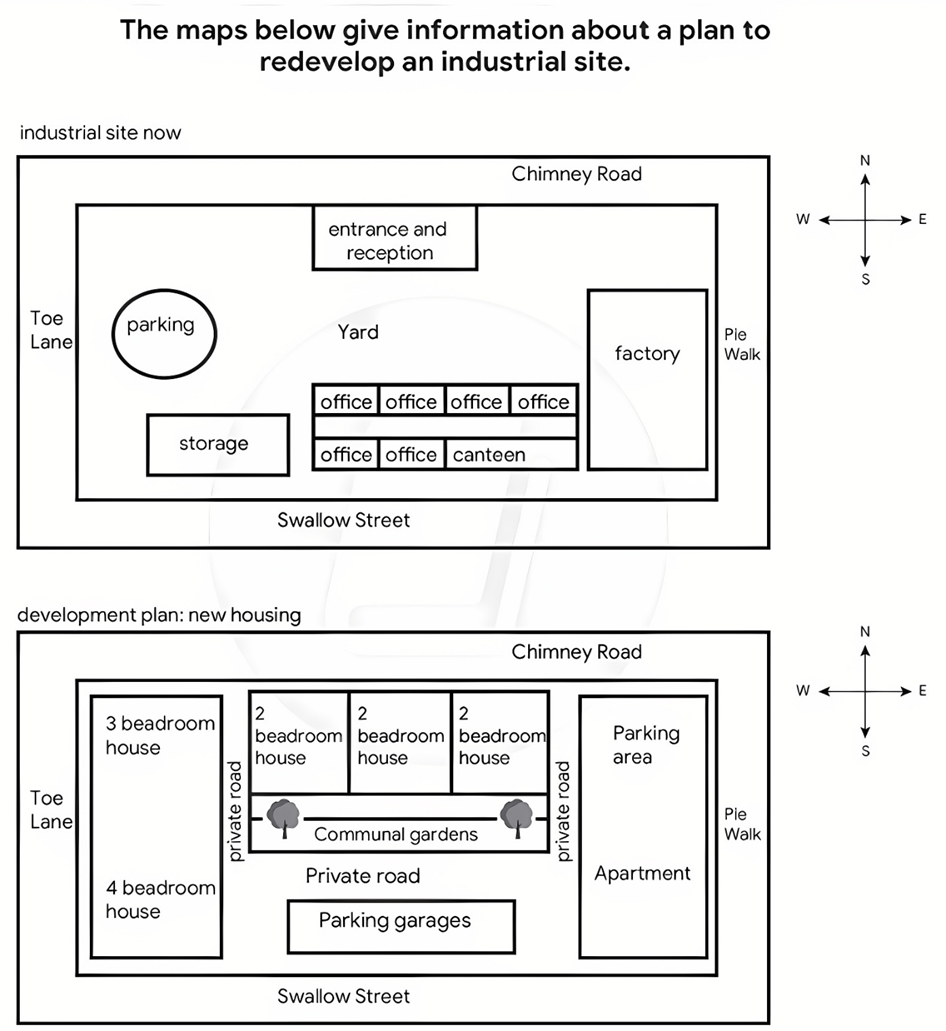
Sample 1:
The two plans show an industrial area as it is now and its redevelopment plan for the future.
Overall, the site is expected to experience a host of significant alterations, with the most prominent being the development of accommodation, greenery and transportation amenities at the expense of workplaces. This, as a result, will completely transform this industrial place into a residential area.
At present, the industrial complex is surrounded by Toe Lane, Chimney Road, Pie Walk, and Swallow Street, but workers can only access the place via the entrance and reception located on Chimney Road in the north. Once inside, they can park their vehicles in the parking lot situated in the west of the site, just below which is a storage facility. In the south of the map is an office building that also houses a canteen, while in the east lies a factory. Finally, there is a yard in the middle of the site.
Following redevelopment, only the surrounding roads will remain unchanged. However, the parking and storage spaces will be removed, making way for 3-bedroom and 4-bedroom houses. The entrance, reception and yard will be replaced by three 2-bedroom houses and communal gardens, bordered by three private roads. Lastly, the office building and factory will be turned into parking garages and an apartment with its own parking area, respectively.
Sample 2:
The two maps illustrate the current layout of an industrial site and a proposed plan to transform it into a residential area in 2023. Overall, the site is expected to undergo significant changes, with most of the industrial and office buildings being replaced by houses and gardens, among other new facilities.
At present, the site is occupied by a yard in the center, to the north of which lies the entrance and reception area, which is accessible from Chimney Road. On the southern side of the yard, there are two rows of offices, one of which has four offices while the other only has two to save space for a cafeteria. Further east, there is a large factory plant, lying adjacent to Pie Walk. The western part of the map shows a parking lot located near the halfway point of Toe Lane. Below this parking space is a storage facility lying in the vicinity of where Toe Lane and Swallow Street intersect.
According to the redevelopment plan, the former facilities, buildings, and yard will all be demolished to make way for a new housing development. The new residential area will include three 2-bedroom houses and communal gardens in the center, surrounded by three newly constructed private roads To the left, two larger houses are earmarked for construction, one with three bedrooms and the other with four. New parking facilities are also planned, including parking garages near Swallow Street and a large parking lot on the easternmost part of the map. The latter will serve the parking needs of residents in a new apartment building which will be built here.
Sample 3:
The maps illustrate the proposed changes to an industrial zone. As can be seen in the plan, the site will be completely transformed to become residential with the factory, offices and other structures expected to be removed to allow for the construction of housing and various facilities for residents. The surrounding road system, by contrast, will remain unchanged.
Regarding the new residences, three 2-bedroom houses have been proposed along Chimney Road where the current entrance and reception area are, while an apartment building with designated parking will replace the factory at the corner of Pie Walk and Swallow Street. On the other side of the site, there will exist 3 and 4-bedroom homes situated in the place of existing storage and parking areas.
Concerning the other facilities, communal gardens will be added to the south of the newly built double-bedroomed houses, and a few parking garages will be constructed at the expense of the offices and canteen near Swallow Street. Finally, a system of private roads will be added to connect the housing areas.
Sample 4:
The provided maps illustrate the proposed transformation of an industrial zone.
The most significant change entails the conversion of the industrial zone into a new residential space. This results in the removal of office spaces and a factory to make way for the construction of housing units and various amenities for the future residents.
Currently, the industrial area is bounded by Chimney Road to the north, Swallow Street to the south, Pie Walk to the right, and Toe Lane to the left. The entrance and reception area are currently situated in the northern section. In the southeastern corner, there is an existing factory, while the parking and storage facilities are located in the west. Additionally, six offices and a canteen are positioned in the southern part.
As per the proposed plan, the entrance and reception area will be replaced with residential spaces, which will include three double-bedroom houses accessible through communal gardens. On the eastern side of the site, it is anticipated that the factory will be substituted with apartment buildings, strategically positioned adjacent to the newly constructed parking area. In the western section, three-bedroom and four-bedroom houses are slated to replace the existing structures, while the plan suggests transforming the current offices and canteen into parking garages.
Sample 5:
The provided diagrams illustrate the current and proposed redevelopment plans for an industrial site into a residential complex.
In essence, the overhaul reflects a repurposing of industrial elements to accommodate residential structures and communal amenities. These changes suggest a transition towards a more diversified residential area, highlighting the array of housing options available within the community and catering to different household sizes and preferences
Focusing on the western development, the pre-existing parking and storage facilities, bordering Toe Lane, are set to be repurposed for residential use with the construction of a three-bedroom house and an adjacent four-bedroom house. On the opposite easter alteration, where the current factory stands, a series of apartments with dedicated parking areas will emerge.
To the northern area of the layout, along the Chimney Road, the entrance and reception area are to give way to a series of three two-bedroom houses, expanding the range of available housing options. In the southern section, the existing office block near Swallow Street is earmarked for demolition, with the released space allocated for new parking garages, optimizing the area's use by consuming less space than the former office structure. Central to the site, communal gardens are planned to replace the old yard, resulting in the formation of private roads on the west, east, and south peripheries, ensuring dedicated access to the future bordering residential infrastructure.
Sample 6:
The provided illustrations depict the proposed transformation of an industrial site into a residential area, with the addition of various new facilities.
To commence, the industrial site is currently encompassed by a network of roads, namely Chimney Road, Pie Walk, Swallow Street, and Toe Lane, arranged in a clockwise order. It is planned that these roads will remain unaltered. A vast yard area, which is situated in the center, will be eliminated for future use. The entrance and reception, positioned to the North of the site, will be demolished and replaced with three 2-bedroom houses. Adjacent to these houses, to the South, communal gardens will be established. All of which will be encircled by private roads.
Moving further South, there is a storage facility positioned to the West of two rows of offices, with a canteen located at the furthest East. The plan entails deconstructing the former, while the latter will be removed to make room for parking garages. Additionally, the parking lot will be relocated to the North-East corner, situated North of the newly constructed apartment, which will be built on the original site of the factory.
Overall, the proposed developments for the industrial site involve a complete change with the construction of new houses, communal gardens, parking garages, and an apartment.
Sample 7:
The given plans compare the layout of an industrial area between now and after its redevelopment in the future.
Expectedly, the site will undergo considerable changes, marked by additional green space, accommodation and transportation amenities. As a result, the whole site will turn into a residential area.
At present, the industrial complex is surrounded by Toe Lane, Chimney Road, Pie Walk, and Swallow Street. Among them, workers can only enter the area from the north side via the entrance and reception on Chimney Road. In the west, there is a parking lot close to a storage. An office block housing a canteen is located in the south, while in the east lies a factory. These facilities together surround a yard in the centre of the site.
After redevelopment, while the roads will remain unchanged, other features will witness several alterations. Firstly, the parking and storage removal will make space for 3-bedroom and 4-bedroom houses. Similarly, the entrance and reception will be replaced by three 2-bedroom houses and communal gardens, bordered by three private roads. Southward, the office building will be converted into parking garages. Lastly, the factory in the east will turn into an apartment accompanied by a parking area.
Sample 8:
The image provided depicts two site plans, comparing the current industrial site with a proposed development plan for new housing.
Overall, the transformation seems substantial, both in purpose and layout, indicating a complete functional shift from industrial operations to residential living, with a focus on community and private dwellings, significantly altering the site’s layout and use.
The current industrial site is accessible via Swallow Street and is bordered by Chimney Road to the north and Pie Walk to the east. It contains a sizable parking area at the western end and a factory on the eastern side. Between these two are a series of offices with a canteen, and a separate storage space situated in the southwestern corner. The entrance and reception area is located centrally on the north side, adjacent to Chimney Road.
In contrast, the development plan for new housing shows a more residential and community-focused layout. The parking area has been replaced by a 3-bedroom house to the west and a 4-bedroom house to the south, with two 2-bedroom houses in between, all accessible by private roads. A communal garden is centrally located, fostering a sense of community. The eastern part, where the factory currently stands, is slated for an apartment complex with a dedicated parking area. This suggests a significant increase in residential capacity and amenities.
Sample 9:
The maps illustrate an industrial site as it is now and how it will look following developments. Overall, while the road infrastructure surrounding the site will remain the same, the area inside will witness significant modifications, chief among which are the transformation of an industrial location into a residential one, through the considerable expansion of a housing area, and the construction of inner private roads linking newly built facilities.
Regarding changes in the central area of the site, there is a yard located right in the center, to the north of which is an entrance and a reception area. Following renovations, a row of houses consisting of two bedrooms will be constructed, replacing the area for entering the site, while the yard will be turned into communal gardens. The area to the south of the present yard will also be proposed to redevelop, with garages for parking vehicles being put up where an office complex and a canteen are now situated.
On the left-hand side of the newly erected communal gardens, a parking space and a storage room are planned to be knocked down, making way for a large area for 3-bedroom and 4-bedroom houses which occupy the whole western side. The eastern part of the area will experience the demolition of the factory in the south-east corner, and on arrival, residents will benefit from another apartment with a parking space. Finally, access around the new housing area will be made easier with the addition of three private roads, which will be located to the west, south and east of the gardens shared by inhabitants of the site.
Sample 10:
The diagram illustrates the proposed renovations to an industrial site to convert it into a residential area. Overall, the existing industrial buildings and infrastructure will be replaced with residential blocks and community facilities.
Currently, the site is solely for industrial use, with an entrance and reception area in the north opening onto Chimney Road. This will be transformed into a block of 2-bedroom mews houses. Adjacent on the left by Toe Lane, the former parking and storage space will make way for semi-detached 3 and 4-bedroom residences.
The most striking change is the demolition of the offices and canteen facing Swallow Street at the south end, to be supplanted by a multi-storey underground parking garage for future inhabitants. Additionally, the factory by Pie Walk Road to the east will be removed and replaced by an apartment complex enclosing a landscaped parking zone. At the heart of the development, the concrete yard will give way to a communal garden for recreation.
In summary, the renovation clearly signals a shift from industrial to residential use, with the outdated buildings replaced by modern houses and parking facilities centered around a communal green space. This redevelopment will entirely transform the purpose and appearance of the site.
Sample 11:
The two plans depict the current state and future redevelopment of an industrial area.
Overall, the site is expected to experience major changes with the most noticeable being the development of accommodation, green space, and transportation amenities. This thereby will completely transform the industrial zone into a residential area.
Presently, the industrial complex is surrounded by Toe Lane, Chimney Road, Pie Walk, and Swallow Street. However, the complex can be accessed solely via the entrance and reception situated on Chimney Road to the north. Once inside, a parking lot lies in the west of the site, accompanied by a storage facility directly below it. Towards the south stands an office building with a canteen inside, while the eastern area hosts a factory. Additionally, a central yard is situated in the center of the site.
After redevelopment, while the surrounding roads will remain unaltered, the parking and storage areas will be removed to include 3-bedroom and 4-bedroom houses. The entrance, reception, and yard will be replaced with three 2-bedroom houses and communal gardens, surrounded by private roads. Furthermore, the office building and factory will be repurposed into parking garages and an apartment complex, respectively, each equipped with its own parking facilities.
Summarise the information by selecting and reporting the main features, and make comparisons where relevant. Write at least 150 words.
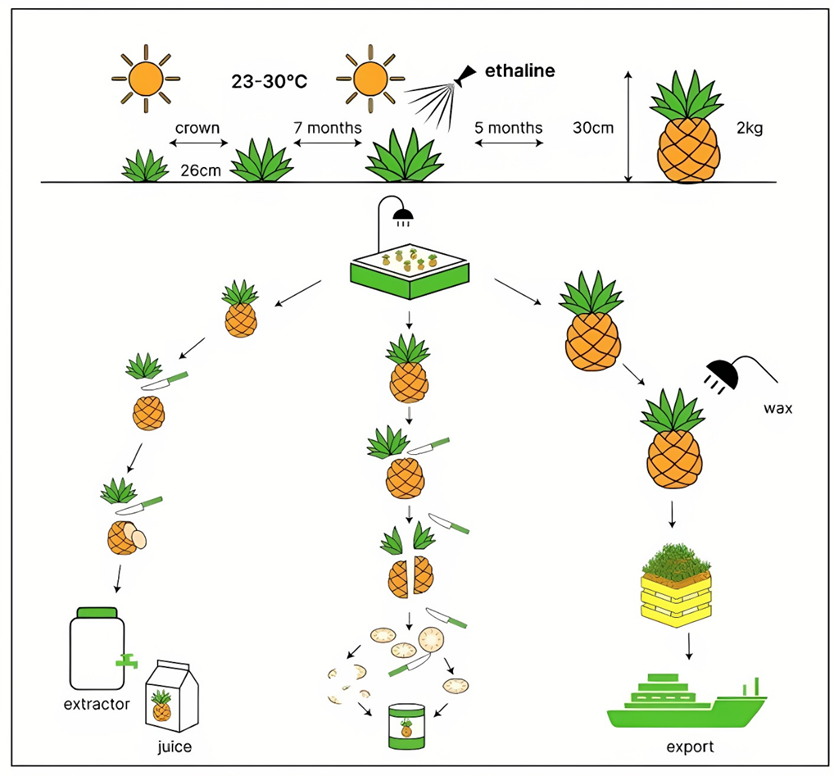
Sample 1:
The provided diagram details the stages involved in the cultivation and subsequent processing of pineapples for various products, ultimately leading to their export.
Overall, there are three main stages in the process, starting with the growth of pineapples, and ending with the export of final products in three different forms.
Initially, the pineapple cultivation begins with the planting of the crown in soil, within a temperature range conducive to growth, 23-30°C. It takes approximately 7 months for the plant to reach 26 centimeters. Following this, ethylene is applied to foster maturation, which takes an additional 5 months, resulting in a pineapple that measures 30 centimeters in height and weighs 2 kilograms.
Upon harvesting, the pineapples are directed through different processing methods. Some pineapples are waxed, which likely serves to preserve the fruit for a longer shelf life, while others are cut into either slices or chunks. A separate batch is processed to extract juice. This suggests a deliberate diversification strategy in the production line to create a range of consumable goods from the same raw fruit.
The end products, including the canned pineapple pieces and the packaged juice, are then prepared for export. The presence of a factory and a cargo ship in the diagram indicates the industrial scale of this operation, hinting at a significant commercial distribution process beyond the domestic market.
Sample 2:
The diagram illustrates the process involved in the growth and processing of pineapples and their subsequent transformation into various products.
Overall, the cultivation process of pineapple spans over a year under specific climatic conditions, resulting in a fully grown fruit. It is evident that the matured pineapple undergoes several steps, leading to multiple products being ready for consumption, distribution, or shipment.
In the cultivation process, pineapples thrive in an environment with adequate sunlight and temperatures ranging from 23°C to 30°C. As they grow, reaching 26 to roughly 28 cm in 7 months, these pineapples, aided by certain agricultural chemicals, further mature over the next 5 months to a stature of 30 cm and a weight of 2kg. Once reaching full maturation, they undergo a thorough cleaning process, after which the processing diverges according to the respective sizes of the pineapple.
Speaking of the products, small pineapples are de-crowned, peeled, and extracted into the resulting products, which is pineapple juice. In contrast, medium-sized pineapples, after similar preliminary treatments, are sliced either into rings or quarters before being canned. The most sizable variants are specially treated, washed to remove wax, and then stored in wooden crates, ready for overseas shipment.
Sample 3:
The diagram shows the process by which pineapples are grown and processed into different products.
Overall, this process involves both natural and man-made elements and can be divided into two main stages: the farming of pineapples and the processing of the crop, which eventually turns into a beverage, a canned food, or an export.
First, pineapples are grown in the field with their crowns spaced 26 centimeters apart, and in a climate where the temperature ranges from 23 to 30 degrees Celsius. After seven months, ethylene is sprayed on the plants, after which they continue to grow for an additional five months until they are ready for harvesting. At this stage, the pineapples should be 30 centimeters high and 2 kilograms in weight.
The process continues with the harvested pineapples being washed prior to being graded according to their sizes. Once sorted, the smallest and medium-sized pineapples have their tops removed and their rinds peeled. While the former pineapples are then put into an extractor to produce juice, the latter are cut into slices or smaller chunks, both of which are subsequently canned. In contrast, the largest pineapples are simply coated in wax and placed in crates before being shipped abroad.
Sample 4:
The given diagram illustrates the growing process of pineapples and the preparation of pineapple products. Over the 8 steps of this linear process, two main stages can be seen: the natural growing process and the processing of the pineapples, turning them into different products, including juice, canned pineapple and an export.
Optimal conditions for cultivating pineapples necessitate a temperature range of 23-30 degrees Celsius, with each crown ideally positioned at a distance of 26 centimeters from one another. Following a seven-month growth period, pineapples are sprayed with ethylene. After this, they continue to grow for five months until they reach the standard size of 30 centimeters in height and 2 kilograms in weight. At this point, the pineapples are ready for the following stage.
Pineapples are first washed thoroughly then categorized based on their sizes before being prepared accordingly. Smaller pineapples undergo a procedure involving crown removal, peel extraction, subsequent slicing into smaller pieces, and passage through an extractor to extract pineapple juice. Bigger pineapples go through a similar process, but their slices are canned instead of being extracted. Finally, the pineapples biggest in size are coated with wax, put into cargo and exported to their designated destination.
Sample 5:
The diagram highlights the process through which different pineapple goods are produced.
Overall, the process can be divided into two stages: the growing of the pineapples, and the processing of the product into different products, namely a form of beverage, canned goods, or an export.
The process commences with the planting of pineapples, with each plant placed 26 centimeters apart from each other, and are grown in a tropical climate where the temperature ranges from 23 to 30 degrees Celsius. After 7 months, the plants are sprayed with a chemical, after which they are left to grow for another 5 months, or once they reach 30 centimeters in height and 2 kilograms in weight.
Once the pineapples are harvested, they are doused in water to remove any excess chemicals. At this stage, three alternative processes are introduced to produce different pineapple products.
The smallest pineapples are sorted from the bigger ones and have their crowns removed. These are then peeled and are either fed through an extractor to make pineapple juice or are cut into small slices to be canned. The larger pineapples, on the other hand, are coated in a layer of wax and are placed in crates to be exported.
Sample 6:
The image demonstrates the stages of producing pineapples and alternative products. Overall, pineapple production involves both natural and chemical processes, beginning with the ripening of the fruit, followed by the addition of substances and ending with rinsing. Additionally, three types of final products are produced based on their mature sizes: pineapple juice, canned pineapple or whole fruit
The processing of the raw fruit begins with pineapples planted 20 cm apart being exposed to temperatures of around 23-30 degree Celsius. After 7 months, the fruit grows in size and has chemicals added then they are left for another 5 months until they reach 2 kg and 30 cm in total height. Subsequently, the pineapples are washed with water and sorted into three different sizes, ready to be manufactured into various products for consumption.
Three kinds of final products from the fruit are produced. As for the largest-sized batch of pineapples, they are coated with wax before being stocked into crates and shipped by freighter overseas. Regarding the medium-sized and smallest-sized pineapples, they both have their tops cut off and their rinds peeled with knives. After this, the smaller ones are sent through extractors to produce pineapple juice, while the larger ones are sliced and canned.
Sample 7:
The diagram gives a detailed description of the cultivation and manufacturing process of pineapple goods. The process can be broadly bifurcated into 2 stages: the growing of the initial ingredients pineapples, and the manufacturing of some pineapple products in the subsequent stages.
The most ideal condition for pineapple cultivation is in a tropical climate, ranging from 23 to 30 degree celsius, with proper sunlight exposure. Pineapples are generally grown in a period of 7-12 months. Growth stimulants are also adopted in order to increase pineapple's mass.
When the pineapples reach a certain size, they are harvested and washed. After that, they are processed into various products according to their sizes. Pineapples of a smaller size have their crowns removed before being peeled. To extract the juice from these pineapples, the fruit is run through an extractor. Average-sized pineapples, on the other hand, are simply sliced and peeled before being canned and distributed. Meanwhile, the largest batch of pineapples, weighing approximately two kilograms and measuring 30 centimeters in height overall, will be wax-coated, packaged, and exported via sea freight. Unlike pineapples of smaller sizes, fruits in these exported batches still have their crown and outer layer intact.
Sample 8:
The process details the steps by which pineapple is produced and shipped for later retail. Looking from an overall perspective, it is readily apparent that pineapple production involves both man-made and natural processes beginning with the ripening of the fruit, its preparation and division into different sizes before final processing. Smaller pineapples are used for juice, medium sized ones are canned, and the largest ones are sold whole.
The processing of all pineapple products begins in a tropical climate (23°C to 30°C) during which pineapples are harvested at various sizes including 26cm, 28cm and 30cm (2kg) in total height. The pineapples are then cleaned and divided into three groups with the smallest and medium sized ones both having their tops sliced off and the rinds peeled. The smaller ones are then sent through a juice extractor, while the larger ones are sliced and canned.
In contrast, the 30cm pineapples are simply washed, coated in wax, placed in crates and then shipped on freight overseas.
Sample 9:
The chart shows the method by which pineapples are developed and prepared into distinctive items. Generally, this handle includes both normal and man-made components and can be partitioned into two primary stages:
The cultivation of pineapples and the preparation of the edit, which in the long run turns into a refreshment, a canned nourishment, or a send-out. First, pineapples are developed within the field with their crowns dispersed 26 centimeters separated, and in a climate where the temperature ranges from 23 to 30 degrees Celsius. After seven months, ethylene is splashed on the plants, after which they proceed to develop for an extra five months until they are prepared for collecting. At this arrangement, the pineapples ought to be 30 centimeters high and 2 kilograms in weight. The method proceeds with the gathered pineapples being washed earlier to be reviewed agreeing to their sizes. Once sorted, the littlest and medium-sized pineapples have their tops expelled and their skins peeled. Whereas the previous pineapples are at that point put into an extractor to deliver juice, the last mentioned are cut into cuts or smaller chunks, both of which are along these lines. To differentiate, the biggest pineapples are essentially coated in wax and put in cartons sometimes recently being dispatched overseas.
Sample 10:
The method points out the steps by which pineapple is created and transported for afterward retail. Looking from a general point of view, it is promptly clear that pineapple generation includes both man-made and normal forms starting with the maturing of the natural product, its arrangement and division into diverse sizes sometime recently. Little pineapples are utilized for juice, medium measured ones are canned, and the biggest ones are sold entirely.
The handling of all pineapple items starts in tropical climates (23°C to 30°C) amid which pineapples are gathered at different sizes counting 26cm, 28cm, and 30cm (2kg) in addition to stature. The pineapples are at that point cleaned and isolated into three bunches with the littlest and medium measured ones both having their tops cut off and the skins peeled. The latter ones are at that point sent through a juice extractor, whereas the bigger ones are cut and canned.
To differentiate, the 30cm pineapples are essentially washed, coated in wax, placed in cartons, and after that dispatched on cargo abroad.
Sample 11:
The graph shows the method by which pineapples are developed and handled into distinctive items. In general, this preparation includes both normal and man-made components and can be separated into two primary stages: the cultivation of pineapples and the handling of the trim, which in the long run turns into a refreshment, canned nourishment, or a trade.
First, pineapples are developed within the field with their crowns dispersed 26 centimeters separated, and in a climate where the temperature ranges from 23 to 30 degrees Celsius. After seven months, ethylene is splashed on the plants, after which they proceed to develop for an extra five months until they are prepared for collecting. At this time, the pineapples ought to be 30 centimeters high and 2 kilograms in weight.
The method proceeds with the collected pineapples being washed earlier to being reviewed concurring to their sizes. Once sorted, the littlest and medium-sized pineapples have their tops expelled and their skins peeled. Whereas the previous pineapples are at that point put into an extractor to deliver juice, the last mentioned are cut into cuts or littler chunks, both of which are along these lines canned. To differentiate, the biggest pineapples are essentially coated in wax and set in cartons sometime recently being transported overseas.
Sample 12:
The given process outlines the intricate steps involved in cultivating, processing, and shipping pineapples for eventual retail.
At a glance, the cultivation of pineapples is a year-long endeavor, characterized by strict temperature controls and precise chemical requirements. Simultaneously, there are three distinct methods for processing fully-grown pineapples: for fresh juice, canning, or exportation.
Delving deeper into the growth cycle of pineapples, the process commences by planting crowns under controlled temperature conditions, typically at 23-30°C. Over the initial seven months, they undergo an ethylene spray treatment to stimulate growth. In the ensuing five months, the mature pineapples attain a height of 30 cm and weigh approximately 2 kg each.
Turning to the processing of harvested pineapples, the pineapples undergo cleaning and are segregated into three groups. The smaller and medium-sized ones have their tops removed and their rinds peeled. Subsequently, the former group proceeds through an extraction process, culminating in juice packaging in carton boxes, while the latter is sliced and canned. Conversely, the largest pineapples undergo a simpler process involving washing, wax coating, and placement in crates, after which they are shipped via freight to international markets.
Sample 13:
The given process illustrates the cultivation of pineapples and how they are processed into various types of products.
Overall, the production of pineapple products involves multiple steps, with the cultivation phase typically requiring around a year, after which the fruit can be made into juice, canned, or exported as whole fruit, depending on its size.
Regarding cultivation, pineapples begin their life cycle from leftover crowns, which are planted around 26 centimeters apart from one another. Sunny weather is crucial, and the ideal temperature for growth is between 23 and 30 degrees Celsius. After a period of 7 months, the plants are ready to be sprayed with ethylene, after which it needs an additional 5 months to reach maturity, ending up at a height of 30 centimeters and a weight of 2 kilograms.
The harvested fruit is then washed with clean water before undergoing one of three distinct processing methods, depending on its size. In the first one, for small fruit, initially the crown and skin are removed manually by using knives, and subsequently an extractor is used to turn the pineapple flesh into juice. In the case of medium-sized fruit, after following the same preparatory stage, the pineapples are either sliced or diced, followed by canning. Finally, the largest fresh fruit is coated with wax and packed into crates, ready for distribution to international markets via cargo ships.
Sample 14:
The diagram details steps by which pineapples are cultivated and processed for different purposes.
Overall, the harvesting of such fruits takes roughly one year. Ultimately, the fully-grown pineapples are made into 3 different products: fresh juice, canned fruit and exportable fruits.
In terms of the growing procedure, we can see that pineapple plants are grown with sufficient sunlight and warm temperature (23-30°C), and they are spaced 26 centimeters apart from each other. When they pineapples are roughly seven months old, ethaline is added to the crop. After another 5 months, they are deemed ripe for harvest, at which point they should be 30 centimeters in height and 2 kilograms in weight.
Regarding the production process, harvested pineapples are washed before being sorted. Subsequently, they are divided into three groups with the smallest and medium-sized ones both having their tops sliced off and the rinds peeled. The former are then processed into juice in an extractor, while the latter are cut into smaller bits and canned. However, the largest pineapples are treated differently. After being cleaned with eater, they are coated in wax to preserve their freshness. Finally, they are packed in crates and are loaded with freights for exportation.
Sample 15:
The visual illustrates the process of planting and manufacturing products from pineapples.
Overall, the process comprises three major stages, commencing at pineapples being grown on fields and ending at pineapples of different size being converted into three different products including pineapple juice, canned pineapples and fresh pineapples.
As can be seen from the diagram, pineapples are planted in rows. The suggested Summarize the information by selecting and reporting the main features and make comparisons where releva. Between pineapples is 26 cm, and the optimal temperatures for pineapple growth range between 23°C and 30°C.
After 7 months, chemicals are sprayed into the fields as a means of protection against bugs. 5 months from then, when the pineapples reach maturation, weighing 2kg at 30 cm long, they are harvested and delivered to the factory for processing.
Here, they are cleaned and washed to remove chemical residues, dirt or any insects. Depending on the size, they are processed into various products. As for the small and medium-sized ones, the crown is chopped off and the skin is peeled.
Next, an extractor collects juice from the small-sized pineapples whereas the medium-sized ones are cut into slices and packaged into cans. As for the fresh, big-sized pineapples, they are waxed and packed into crates before shipment.
Sample 16:
Depicted by the given diagram is detailed information about the planting process and production line of pineapples.
Upon initial observation, it can be apparently seen that there are two major stages in this procedure, commencing with growing pineapples from crowns and culminating with packaging and delivering diverse pineapple products to customers.
In the initial stage of the process comes the cultivation of pineapple from crowns with premium quality basal stems. Each crown is replanted within a 26-centimeter distance from each other with the assistance of asphalt impregnated mulch papers. Under direct sunlight at the temperature of 23-30 Celsius degrees and after around 7 months, pineapples are completely supplemented with a special plant growth hormone called ethaline. Once pineapples are 12 months old, they are usually 2 kilograms in weight and 30 centimeters in height and are ready to be harvested for further processing.
Selected pineapples are transferred to the processing plant and carefully rinsed with fresh water. Clean pineapples are subsequently sorted into three different categories, viz. small-sized, medium-sized, and big-sized pineapples. Once their crowns are completely removed, small-sized and medium-sized pineapples are cut with different angles. The former is diagonally sliced and crushed into pineapple juice, while the latter is vertically chopped and left fermented into canned pineapples. Big-sized pineapples are coated with wax before being packed into huge containers for cross-border delivery.
The first graph shows the number of train passengers from 2000 to 2009; the second compares the percentage of trains running on time and target in the period.
Summarise the information by selecting and reporting the main features, and make comparisons where relevant. Write at least 150 words.
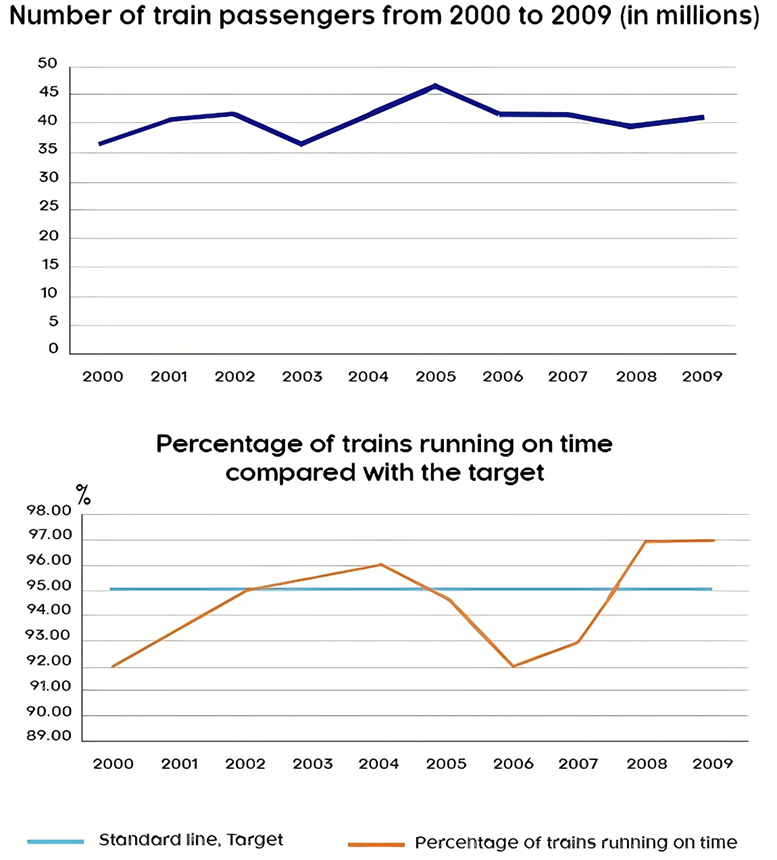
Sample 1:
The upper line graph details how many passengers commuted by train whilst the lower one compares the proportion of trains operating on time with a fixed target of 95%. The statistics were recorded in an unspecified location over a 9-year period starting from 2000 to 2009.
The initial impression from the graph is that despite following an erratic trend over the years, the figure for train passengers saw an overall increase. In addition, acknowledging the presence of a baseline at 95%, the percentage of train running punctually achieved and exceeded the target from 2002 to 2004 and again from 2008 to 2009.
With respect to the first graph, starting off at around 36 million in 2000, the number of passengers experienced a short-term increase of 5 million in 2002 prior to a pullback to its original value in 2003. This figure was then fluctuating in an upward trajectory with a peak of 47 million in 2007 before declining and finishing at around 42 million at the end of the time frame.
A glance at the second graph shows that only 92% of trains ran on time back in 2000, and the situation was improved in 2002 onwards when the figure for actual on-time trains matched the expected 95% standard line and even exceeded it at 96% in 2004. However, this did not last long as this proportion dramatically fell short of target to a trough of 92% in 2006 before gathering pace to recover and reach the highest point of 97% in 2008 and 2009.
Sample 2:
The line charts illustrate the number of railway commuters, and the actual rate of punctual trains compared to the set goal, between 2000 and 2009. Overall, more people used trains over the given period. Additionally, the proportion of trains arriving on time increased, despite only fluctuating for the first six years.
Regarding passenger traffic, approximately 36 million individuals opted to use trains in 2000. After this, the figure rose moderately to over just 40 million in the following two years, before dropping back to about 36 million in 2003. Subsequently, it surged to a peak of roughly 46 million by 2005, followed by a significant decrease to less than 40 million in 2008. A minimal recovery in the end saw the number of commuters reach around 41 million.
Concerning the punctuality rate, 92% of trains were on time in 2000 and this figure rose considerably to 95% by 2002, which was the target for the whole period. After ascending continuously to 96% by 2004, it plunged back to 92% in 2006. Finally, the proportion of trains arriving on schedule rocketed to 97% in 2008 and remained stable for the last year of the period.
Sample 3:
The first line graph illustrates the figures for rail users between 2000 and 2009. The second graph shows the percentage of trains being punctual in comparison with the target over the same period.
It is clear that the figures in both graphs fluctuated over the nine-year period. Ridership peaked at the mid-period (2004 2005), while the percentage of punctual trains reached its peak towards the end of the period measured.
The number of people riding the train started at 36 million in 2000. Over the next five-year period, there was an overall increase in the figures for train passengers, despite a dip between 2002 and 2003. The ridership peaked at around 47 million in 2005, then declined gradually until 2008. From 2008 to the end of the period shown, the figure rose by roughly 1 million.
The target for the percentage of train punctuality was a constant 95% throughout the period. In the year 2000, the actual figure was 3% short. It picked up to meet the target in 2002, before taking a steady and gradual rise to 96% in the next 2 years. However, the figure took a sharp dive of 4% from 2004 to 2006 to be the same as the original 2000 figure. From 2006 to 2008, there was a surge in the proportion of punctual trains to reach its peak of 97%, before levelling off in the last year of the period.
Sample 4:
The given graphs provide data for train passengers between 2000 and 2009 as well as comparing the actual percentage of punctual trains with an established target.
Overall, the number of passengers travelling by train fluctuated during this period. Also, although there were variations in the percentage of on-time trains, figures largely stood below the expected level.
Starting at 35 million in 2000, the number of rail passengers witnessed a small rise to 40 million in 2002, followed by a slide back to the starting point a year later. Another increase took place until 2005, peaking at 45 million, then a continuous decline until 2008, before a minimal rise to 40 million terminated the period.
The standardised proportion of punctual trains was 95%, which was met for the first time in 2002. Good performance extended for a few more years before the figure plunged to as low as 92.2% in 2006. However, immediately in the next year, performance started to recover, exceeding the target by 5 percentage points in 2008 and remaining there until 2009.
Sample 5:
The charts show how many passengers traveled by train between 2000 and 2009, along with the punctuality rate of trains.
Overall, there was an upward fluctuation in the number of rail passengers during the given period. Additionally, except for the period between 2004 and 2006, more trains ran punctually. Although the punctuality target remained unchanged, it was either achieved or exceeded only from 2002 to 2005 and again during the last two years of the period in question.
At the beginning of the period, 40 billion people traveled by train, after which it had risen steadily, reaching a peak of roughly 49 billion by 2005, despite a slight drop in 2003. Between 2005 and 2008, a gradual decline of about 9 billion passengers was witnessed, with a subsequent recovery to approximately 45 billion in the final year.
During the whole period, the punctuality goal was consistently set at 95%. The percentage of trains being punctual, meanwhile, increased considerably from 92% initially to 96% 4 years later, followed by a substantial fall to the former level in 2005. Thereafter, the figure soared to a high of 97% in 2008 before leveling off toward the end of the time frame.
Sample 6:
The given image presents two-line graphs related to train transportation over a decade, from 2000 to 2009. The first graph depicts the number of train passengers per year, measured in billions, while the second graph illustrates the percentage of trains that operated on schedule, alongside a target performance line for comparison.
Overall, while the number of passengers using trains did not change dramatically from 2000 to 2009, the on-time performance of trains exhibited significant fluctuations, with periods of both underperformance and overachievement in relation to the set target.
From the first graph, it is evident that the number of train passengers fluctuated throughout the period but did not exhibit a clear trend of increase or decrease over the years. Passenger numbers started at around 40 billion in 2000, experienced minor fluctuations, reaching a peak slightly above 40 billion around 2004, and ended the period with a similar value to when it started.
The second graph, which measures punctuality, shows more variability. In 2000, about 93% of trains ran on time. This figure dropped to approximately 91% in the following year and then followed a downward trend, reaching the lowest point at just above 90% in 2002. A significant recovery occurred in 2003, with on-time performance soaring to around 96%, well above the standard target line set at 95%. After 2003, there was a marked decrease, hitting the lowest punctuality rate of the decade in 2007, with less than 92% of trains on time. However, there was a remarkable improvement in the following two years, with the percentage of trains running on time surpassing the target in 2009.
Sample 7:
The initial line graph provides an overview of the changes in the number of train commuters, with the second graph showing the punctuality of this means of transportation compared to a fixed target from 2000 to 2009.
Overall, there were upward fluctuations in the volume of passengers, but this was predominantly due to inconsistencies in train punctuality.
It was expected that a target of 95% punctuality was set for all trains. However, in the first year, only 92% of trains were on time, which later steadily increased to a satisfactory 95.5% in 2003. Over the specified time period, there was a gradual rise in the figure for travelers to approximately 5 million in 2002, before dropping slightly below the initial data in 2003.
During the subsequent two years, there was a remarkable surge in the quantity of passengers, reaching a peak of around 47 million in 2005, followed by a significant decline of about four million. In terms of punctuality, the rate was 96% in 2004 but experienced a minor decrease in 2006. In the last three years, the passenger number stabilized at around 43 million, with a progressive improvement in the proportion of on-time trains, ultimately reaching an impressive 97%.
Sample 8:
The upper graph illustrates the changes in the number of passengers travelling by train in an unspecified geographical location, and the lower graph shows the proportion of trains running on time in a 10-year period from 2000 to 2009 compared to the fixed target of 95%.
Overall, the number of travellers using trains showed an unsteady upward trend. The rate of trains running on time was also erratic, meeting or exceeding the target from 2002 to 2005, and again from 2008 to 2009.
In the first four years, the number of train travellers rose from around 37 million to its first peak of about 37 million in 2002, before dropping to just below its starting number in 2003. Also in that period, the rate of on-time trains went from an inadequate 92% to a sufficient 95.5%. During the next three years, train passengers rose sharply and hit the most significant peak of around 47 million in 2005; thereafter the figure started declining by approximately four million. In terms of running time efficiency, the rate was 96% in 2004, but later fell drastically to 92% in 2006.
In the last three years, the number of passengers stabilized at around 43 million while the proportion of on-time trains improved gradually and eventually plateaued at 97%.
Sample 9:
The line charts illustrate train passenger numbers and the figure for train punctuality between 2000 and 2009.
Overall, the number of passengers opting for trains fluctuated mildly over time. It can also be seen that the proportion of trains adhering to the schedule oscillated considerably, with half of the time punctuality goal not being met.
The number of train commuters fluctuated around 40 million people over the period. In 2000, 38
million travelers chose this vehicle as their means of transportation. This figure rose slightly, but
fell back again to 38 million in 2003. An increasing use of railways was reported in the following 2 years with trains attracting the highest number of customers in 2005, at 46 million. After a period of 3-year decline and 1-year growth in its users, trains received 41 million people in 2009.
Looking at the second paragraph, the punctuality target of trains was invariably 95%. In 2000, only 92% of total trains ran on time. Over the next 4 years, the proportion of punctual trains rose substantially, meeting the goal of 95% in 2002 before exceeding the target by 1% in 2004. The percentage then declined considerably to 92% in 2006, and train punctuality didn't meet the target again until late 2007. By 2009, the punctuality figure had increased to 97%, 2% higher than the goal.
Sample 10:
The provided graphs depict the trends in the number of train passengers and the percentage of trains running on time compared to the target from 2000 to 2009.
Overall, the number of travellers using trains showed an unsteady upward trend, with minor fluctuations throughout the period. Similarly, the rate of trains running on time exhibited erratic behavior, meeting or surpassing the target intermittently.
In 2000, approximately 38 million people travelled by rail. This number fluctuated until it peaked at nearly 50 million passengers in 2005. Subsequently, there was a decrease to 40 million passengers in 2008, followed by a slight rise to around 42 million in 2009.
Regarding the punctuality of trains, in 2000, the rate of trains running on time stood at 92%, slightly below the target of 95%. This rate gradually increased to 96% in 2004 before dropping to 92% in 2006. However, there was a significant rise to 97% by 2008, maintaining this level until 2009.
Sample 11:
The provided charts offer insights into the passenger volumes on trains from 2000 to 2009 and their punctuality compared to the set targets.
Overall, it is evident that there were fluctuations in passenger numbers and punctuality rates over the specified period.
In 2000, approximately 38 million passengers opted for rail travel. This figure experienced an upward trend, reaching its zenith at nearly 50 million in 2005, before a subsequent decline to 40 million in 2008. The year 2009 saw a moderate resurgence, with approximately 42 million passengers.
In terms of punctuality, trains achieved a 92% on-time rate in 2000, falling short of the 95% target. The subsequent years witnessed a progressive increase, peaking at 96% in 2004. However, there was a dip in punctuality to 92% in 2006, lower than the standard target of 95%. The subsequent years saw a commendable recovery to surpass the 95% target, with rates reaching 97% in 2008 and maintaining this level thereafter.
Sample 12:
The line graphs illustrate how many people traveled by train between 2000 and 2009 and how punctual trains were during this period.
Overall, it can be seen that both the number of passengers and the punctuality of the railway system fluctuated over the period shown.
Regarding train usage, the number of travelers varied in the first half of the period, after which it grew noticeably and reached its peak of over 47 million in 2005. However, the following three consecutive years witnessed a slow decline of about 7 million in the number of train commuters before the figure rose to roughly 42 million in 2009.
In terms of punctuality, despite the expectation that 95% of trains would run on time, the rate was 92% at the beginning of the period. The figure then increased, met its objective in 2002, and continued to rise to 96% in 2004. However, the railway system failed short of its target again between 2005 and 2007. Afterward, punctuality significantly improved and exceeded the aim in the last two years of the period (at 97%).
The chart below shows the results of three surveys on absenteeism in a particular European country in the years 2000, 2005 and 2010. The results show the reasons people gave for not going to work.
Summarise the information by selecting and reporting the main features, and make comparisons where relevant. Write at least 150 words.
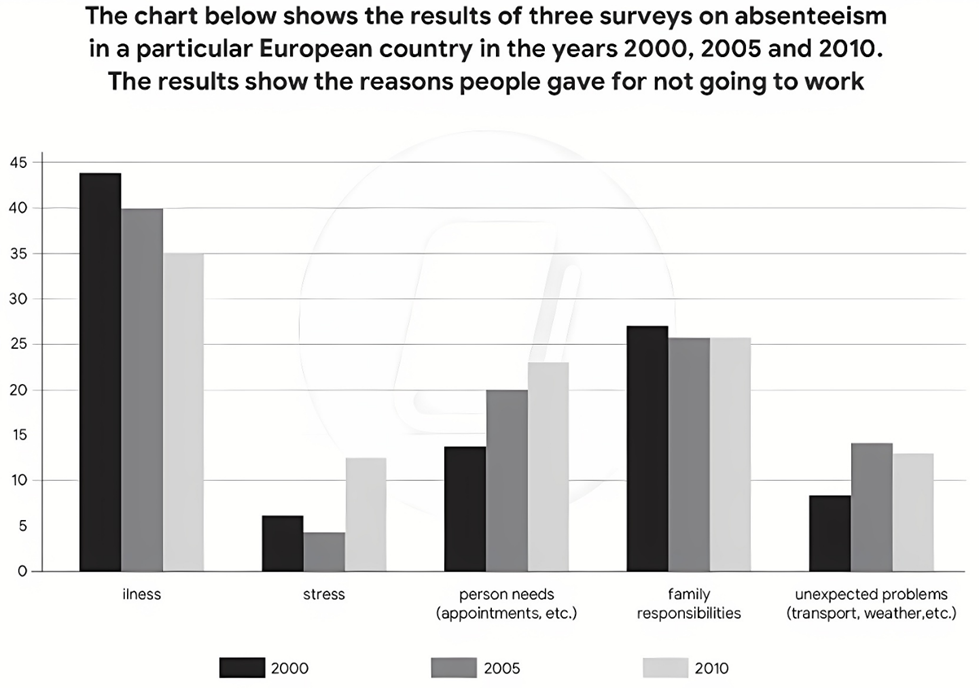
Sample 1:
The bar chart illustrates absenteeism trends in a European nation from 2000 to 2010.
In general, illness was consistently the primary reason for work absence, while stress was the least cited factor. Absenteeism due to stress, personal needs, and unforeseen issues increased, whereas cases related to illnesses and family responsibilities declined.
In 2000, a massive 45% attributed their absence to illness, which decreased steadily to 35% by 2010. Similarly, family responsibilities showed a slight dip from 27% in 2000 to just below 25% in 2005 and remained stable thereafter.
Absenteeism due to personal needs, in contrast, saw a steady rise, from roughly 13% to 23%, always ranking third. Unexpected problems causing absence exhibited a rise from 8% in 2000 to just below 15% in the commencing five years, followed by a minor drop in the five ensuing years. Conversely, stress-related absenteeism began at slightly above 5% and after a trivial drop of 3% in 2005, rebounded to around 12% by 2010.
Sample 2:
The bar chart illustrates how absenteeism rates, categorized into five different reasons, changed in a country in Europe in three separate years, namely 2000, 2005 and 2010.
Overall, while the percentages of respondents citing illness and family duties as reasons for being absent from work decreased, those citing stress, personal needs, and unexpected problems showed upward trends. Additionally, illness was consistently the major reason why people did not go to work, whereas the opposite was true in the case of stress.
In the first year, the proportion of individuals ascribing their work absence to sickness stood at nearly 45%. Despite seeing a steady decline to 35% a decade later, this reason remained the most prevalent throughout. Family obligations followed a similar trend, starting at approximately 27% before leveling off at just above 25% from 2005 to 2010.
When asked why they were not at work, initially, around 14% of people surveyed attributed it to personal needs such as appointments and so on, after which it had risen by about one-tenth by 2010. Stress, meanwhile, saw a lower growth rate, beginning at roughly 6% and ending at around 12% in the final year. An increase was also witnessed in the figure for unexpected issues (transport, weather and suchlike), growing from around 8% to peak at close to 15% after 5 years before falling minimally in 2010.
Sample 3:
The bar chart illustrates how absenteeism rates, categorized into five different reasons, changed in a European country in three distinct years: 2000, 2005, and 2010.
Overall, while the percentage of workers being absent due to illness and family obligations was on a downward trend, reasons like stress, personal needs, and unexpected problems witnessed an opposite trend. Notably, illness remains the primary reason behind work absences whereas the opposite was true in the case of stress.
In the year 2000, nearly 45% of respondents attributed their absence to sickness. Although experiencing a steady decline, reaching 35% ten years later, this reason retained its dominance. Family obligations followed a similar pattern, commencing at roughly 27% before stabilizing just above 25% between 2005 and 2010.
Approximately 14% of surveyed individuals cited personal needs, such as appointments, as the reason for missing work. This figure escalated by roughly 10% by 2010. Stress, on the other hand, displayed a more moderate growth rate, starting at around 6% and ending at nearly 12% in the final year. Unexpected issues, encompassing transportation, weather, and similar occurrences, also witnessed a rise, increasing from approximately 8% to a peak of close to 15% after five years before experiencing a slight drop in 2010.
Sample 4:
The bar chart gives information about the percentage of people who were absent from work because of five reasons in an unspecified nation in Europe over the course of 10 years from 2000 to 2010.
Overall, while there were increases in absenteeism rate due to stress, personal needs and unexpected problems, downward trends can be seen in issues related to illnesses and family responsibilities. Despite that, illness was consistently the leading factor responsible for absence from work, whereas stress remained the least stated reason, according to survey respondents.
In 2000, slightly less than 45% of surveyed individuals attributed their absence from work to illness-related issues, and despite recording a progressive drop from this point on, its figure still retained the top position, ending the period at 35%. Similar changes, but to a lesser degree, were observed in workers having to fulfill family responsibilities, whose proportion declined from approximately 27% in 2000 to almost 25% five years later, followed by another five-year period of stability until 2010.
Personal needs, such as appointments, was the only category which saw a steady growth in almost every 5-year-period, rising by nearly 10%, from roughly 13% to 23%. Meanwhile, the percentage of respondents whose unanticipated problems prevented them from going to work, which started at roughly 8% in 2000, experienced a rise to marginally under 15%, and then generally stayed at this level until the final year.
Finally, being absent from work because of suffering from stress was constantly mentioned in relatively small numbers, beginning at slightly above 5%. Although its data declined slightly, hitting a low of around 4% in 2005, it subsequently rose sharply and by 2010, had reached around 12%.
Sample 5:
The chart illustrates why workers in a European country took several days off from work in three particular years, namely 2000, 2005 and 2010.
Generally, /In general, /Overall, there was an increase in the percentages of employees being out of the office due to mental issues, personal problems and unforeseeable incidents, while the figures for physical unwellness and family duties witnessed an opposite trend. In addition, physical condition was the most common excuse for not being present at work among the reasons stated whereas mental health was the least.
About 44% of the workers surveyed being off work because of sickness in 2000, with/followed by a gradual decline to 35% in 2010. An opposite trend can be seen in the figure for those who were absent from work owing to personal requirements, which was about 14% in 2000 and grew consistently to 23% at the end of the period.
The proportion of individuals reporting family-related duties as a reason for their absence started at around 27% then dropped to 25% 5 years later and remained unchanged in the last year. Conversely, the figures for feeling stressed and unexpected adversities such as transport or weather experienced an overall growth over the period but with several fluctuations, which were approximately 6%, 4% and 13% for the former and 8%, 4% and 13% for the latter in the respective years studied.
The chart below shows the numbers of three types of visitors to a museum between 1997 and 2012.
Summarise the information by selecting and reporting the main features, and make comparisons where relevant. Write at least 150 words.
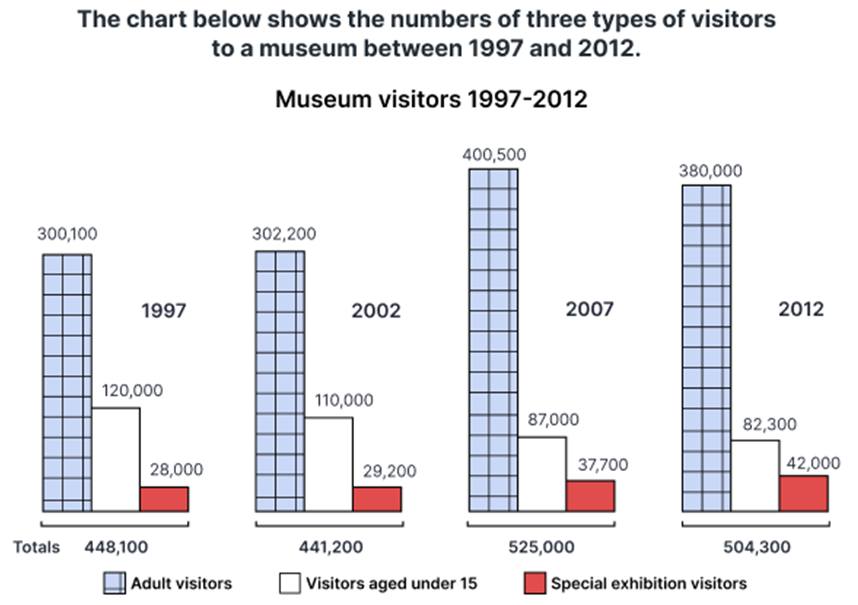
Sample 1:
The given bar chart illustrates the attendance figures for three distinct categories of visitors to a museum over a 15-year span, from 1997 to 2012.
Overall, it is clear that the museum enjoyed a rise in the total number of visitors in the four years examined, although it was always the most popular among adult visitors. Throughout the given period, adult museum-goers and special exhibition visitors witnessed an upward trend, whereas visitors below 15 were the only group with a drop in attendance.
In 1997, the museum welcomed 300,100 adult visitors, making them the largest visitor group. Visitors aged under 15 numbered 120,000, still a substantial figure, while special exhibitions attracted a noticeably smaller audience of only 28,000 visitors.
Thereafter, the number of adult visitors peaked at 400,500 in 2007 before falling to 380,000 in 2012. Attendance among those under 15 years old, however, fell consistently, ending at 82,300 in 2012. This was not the case for special exhibition visitors, as footfall among this group saw a slight increase to 42,000 in the last year.
Sample 2:
The bar chart provides a detailed overview of visitor attendance at a specific museum over a 15-year period, from 1997 to 2012.
Overall, the museum witnessed a noteworthy increase in overall attendance over the 15-year period, with adult visitors constituting the majority. Notably, the under-15 age group exhibited a consistent decrease, while special exhibition attendees followed a contrasting growth pattern.
In 1997, the museum welcomed a total of 448,100 visitors, with a substantial majority, over three-quarters, being adults. Conversely, the number of visitors under 15 years old stood at 120,000, while special exhibition attendees were notably lower at 28,000.
Subsequently, the overall attendance figures remained relatively stable until 2002, after which there was a notable surge, peaking at 525,000 in 2007. This was followed by a slight dip to 504,300 over the next five years. Adult visitors mirrored this trend, showing steady growth until a zenith of 405,000 in 2007, before tapering to 380,000 by 2012. In contrast, the number of visitors below 15 experienced a consistent decline, reaching a low of 82,300 in 2012. Special exhibition visitors, on the other hand, demonstrated an upward trajectory, albeit at a more modest rate, progressing from an initial 28,000 to a closing figure of 42,000.
Sample 3:
The bar chart provides a visual representation of the visitor demographics at a specific museum from 1997 to 2012. In general, the overall visitor count increased over these years, except for a decline in attendees below 15 years old. Notably, adult visitors constituted the majority of attendees throughout the period, while special exhibition visitors showed a steady but modest growth.
In 1997, the museum welcomed 300,100 adult visitors, a number that surged to a peak of 400,500 in 2007 before slightly dropping to 380,000 in 2012. Special exhibition attendees started at 28,000 and experienced gradual growth, reaching 42,000 by 2012.
Conversely, the number of visitors below 15 years old saw a gradual decrease, starting at 120,000 in 1997 and declining to 82,300 in 2012.
Regarding the total attendance, it began at 448,100 visitors, peaked at 525,200 in 2007, and then slightly reduced to 504,300 in 2012. Throughout these years, the museum saw fluctuations in its visitor demographics, with adult attendees consistently forming the largest group.
Sample 4:
The bar chart provides data on the visitor demographics of a museum over four select years: 1997, 2002, 2007, and 2012. The visitors are categorized into three groups: adult visitors, visitors aged under 15, and special exhibition visitors. Total visitor numbers for each year are also provided.
Overall, the museum’s attendance saw two distinct trends in two grouped periods. The first period showed stability in total numbers with slight variations in each visitor category. In contrast, the second period demonstrated an overall increase in visitor numbers with a particular rise in adult attendance, a steady increase in young visitors, and a continued decline in special exhibition visitors.
For the first period (1997 and 2002), the numbers remained relatively stable. Taking 2002 as a representative example, the museum attracted 441,200 visitors in total. Of these, a substantial majority were adult visitors, accounting for 302,200 attendees. Visitors aged under 15 were a small fraction, numbering 29,200, indicating a slight increase from the 1997 figure. Special exhibition visitors, however, decreased to 110,000 in 2002 from 120,000 in 1997.
In the second period (2007 and 2012), there was an increase in total visitor numbers compared to the first period. Using 2012 as a representative example, the total number of visitors was recorded at 504,300. Adult visitors made up the majority, with 380,000 individuals, which, while a decrease from 2007’s peak of 400,500, was still significantly higher than in the earlier period. The number of visitors aged under 15 continued its upward trajectory, reaching 42,000, up from 37,700 in 2007. Special exhibition visitors, although declining to 82,300 in 2012 from 87,000 in 2007, were still less than the earlier period’s 1997 figure.
Sample 5:
The provided bar chart illustrates variations in the composition of museum visitors from 1997 to 2012.
Overall, the total number of visitors experienced fluctuations, with adults and those attending special exhibitions seeing upward trends, but the reverse was true for the under 15 age group. Notably, the number of adult visitors consistently exceeded that of the other two categories.
Between 1997 and 2002, the adult visitor count remained relatively stable, hovering around 300,000. During this period, the number of visitors under 15 witnessed a slight decline, decreasing from 120,000 to 110,000. Meanwhile, a marginal increase was recorded in the number of visitors attending special exhibitions, rising to 29,200 by 2002.
Over the subsequent decade, there was a consistent decline in the number of visitors under 15, ultimately reaching 82,300 in 2012. In stark contrast, the museum experienced a steady growth in the attendance of special exhibitions, peaking at 42,000. An intriguing observation from the chart is the distinct pattern evident in adult visitor statistics. Following a sudden surge to 400,500 in 2007, there was a gradual decline, stabilizing at 380,000 by the end of the given timeframe.
Sample 6:
The bar chart illustrates how many visitors of three types visited a particular museum from 1997 to 2012. Overall, although there were some minor fluctuations, the total number of visitors to this museum increased, with those under 15 years old being the only category with a downward trend. It is also noteworthy that adult visitors were the overwhelming majority throughout the years, whereas the opposite was true in the case of their special exhibition counterparts.
Regarding those of adult age visiting the museum, there were 300,100 in the first year. Over the following decade, their attendance experienced a significant rise to reach a peak of 400,500, but by 2012 had declined minimally to 380,000. Special exhibition visitors followed a similar upward trend, albeit at a much lower rate, growing gradually from 28,000 initially to end the period at 42,000.
In contrast, 120,000 under-15-year-old visitors went to the museum at the beginning of the timeframe, followed by a steady drop to 82,300 in the final year.
Turning to the total attendance at the museum, it started at 448,100 visitors before climbing to a high of 525,200 in 2007. By the end of the period, the figure had fallen, reaching 504,300 visitors.
Sample 7:
The bar chart illustrates changes in the sizes of three visitor groups at a particular museum from 1997 to 2012. Overall, all categories of visitors saw an increase, except for those under 15 years old, whose numbers decreased. Furthermore, adult visitors consistently made up the largest proportion throughout this period.
In 1997, 300,100 adults visited the museum, accounting for over two-thirds of the total number of visitors. There were 120,000 visitors under 15, which was four times more than the number of Special Exhibition visitors. After a slight increase to 320,200 in 2002, the number of adults visiting rose to 400,500 in 2007. The number of Special Exhibition visitors also increased to nearly 38,000 in 2007, while by the same year, the number of visitors under 15 had dropped to 87,000. In 2007, there were over 520,000 visitors in total, the highest number during this period.
In 2012, the museum welcomed about 504,000 visitors, experiencing a 4% decrease from 2007. Both adult and young visitor numbers decreased, with adults dropping to 380,000 and visitors under 15 to 82,300. In contrast, the number of Special Exhibition visitors reached an all-time high of 42,000. Adults continued to be the largest visitor group, accounting for over 75% of the total.
Sample 8:
The provided bar chart delineates the visitor counts across three distinct categories to a museum spanning the years from 1997 to 2012.
In general, 2007 stood out as the year with the highest attendance, surpassing all other years. Furthermore, adult visitors consistently comprised the predominant demographic throughout the surveyed duration, whereas special exhibition attendees displayed an inverse trend.
Regarding the delineation between two age brackets, the tally of adult museum-goers initiated at 300,100 in 1997, peaking at 400,500, before subsiding to 380,000 by the conclusion of the period. Conversely, the count of minor visitors commenced at 120,000 in 1997, constituting half the number of adult visitors. Notably, a consistent downward trajectory was observed in this age cohort, concluding at 82,300 by 2012.
Regarding exclusive exhibition attendees, their number was initially 28,000 in 1997. Despite the initial modest figure, a steady upward trend was witnessed over the entire timeframe, culminating at 42,000 by the end.
Sample 9:
The bar chart outlines the number of exhibitors by type - adult guests, under-15 guests, and extraordinary show visitors - from 1997 to 2012.
Generally, it is clear that the foremost critical participation at the historical center was by developing guests. Besides, the number of them and extraordinary exhibition guests experienced an increment, whereas this figure for the adolescents watched a continuous decay.
Looking into more detail, the number of the grown-up guests was approximately 300,000 in 1997, making it the most elevated support at the gallery as compared to other sorts of the exhibitors. In expansion, this design expanded by 302,200 in 2002, taken after by a dramatic increment to nearly 400,000. By differentiation, the amount of them saw a slight decrease by 380,000 in 2012.
With respect to the other categories, the number of youngsters was 120,000 in 1997, in spite of the fact that this figure for extraordinary exhibition guests was generally 28,000. Furthermore, the cooperation of uncommon presentation guests rose to 42,000 by 2012. In any case, the attendance of the youth experienced a minor drop by 82,300.
Sample 10:
The given bar chart compares information about how numerous individuals who were from 3 different bunches to be specific, grown-ups, children, and extraordinary guests went by an exhibition hall from 1997 to 2012. By and large, it was critical that the slant of all components other than youthful eras expanded over the period of 15 a long time.
Concurring to the graph, within the starting, the entire number of guests hit 448,100; at that point they hopped to some degree and topped at 525,000 in 2007; by the by, they declined to 504,300. the grown-up guests, the most population who went to the historical center at all times, had the same design as the full guests owing to the truth that at the begin, they hit 300,100; at that point they climbed modestly and come to the vertex at 400,500 in 2007; in any case, it diminished somewhat to 380,000 in 2012.
The chart illustrates that the moment bunch was the community whose ages were beneath 15; additionally, it touched 120,000 in 1997; from there on, it went down marginally to 82,300 in 2012. Uncommon show guests scored 28,000 in 1997 after that, it rose possibly to 42,000 in 2012.
Sample 11:
The bar chart compares the number of grown-up guests, under-15 age group, and uncommon presentation guests to a gallery from 1997 to 2012.
In general, it is evident that the lion's share of the gallery visitors were grown-ups amid the given period. It can be seen that the exhibition hall in 2007 had the most elevated figure of guests.
Looking into more detail, in 1997 the grown-up participants were 300,100, the figure had expanded decently in 2002, coming to around 302,200. The number of grown-up visitors in 2007 crested at 400,500, taken after by a continuous decrease in 2012 with 380,000. Going by the gallery was more common among individuals beneath the age of fifteen in 1997, with 120,000 in that year. The number dropped each year and comprised 82,300 by 2012. Whereas the figures for uncommon show guests were unward amid the period, beginning around 28,000 to 42,000.
The pie charts show the size of classes in primary schools in four states in Australia in 2010.
Summarise the information by selecting and reporting the main features, and make comparisons where relevant. Write at least 150 words.
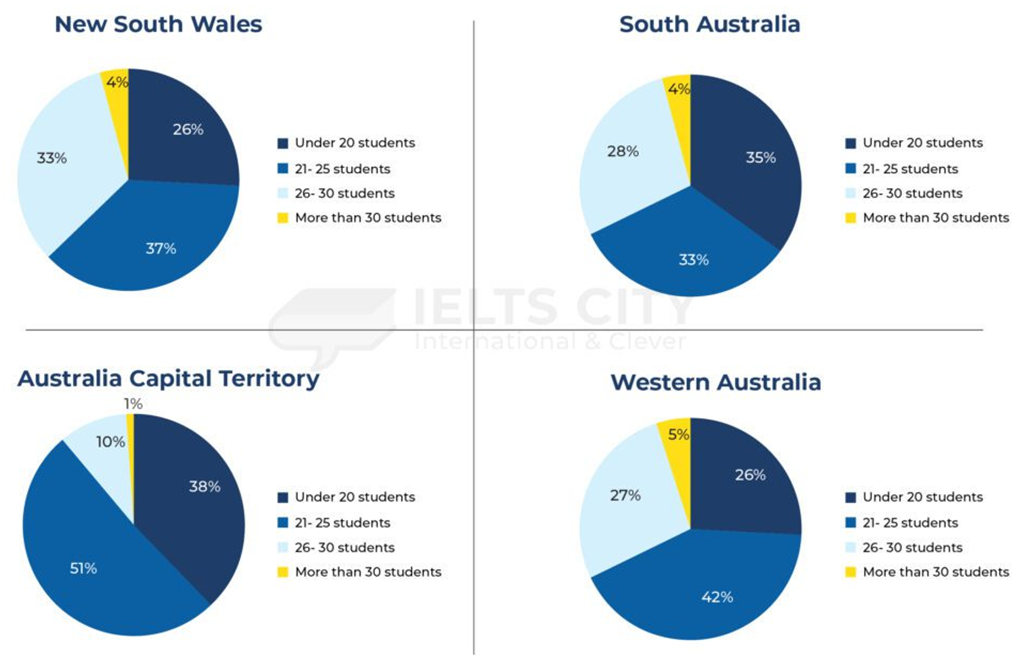
Sample 1:
These four provided pie charts illustrate the distribution of several primary school class sizes across four Australian states in 2010: New South Wales, South Australia, the Australian Capital Territory, and Western Australia.
Overall, it can be seen that while medium-sized classes are a common feature in these states, the prevalence of smaller and larger classes varies, likely reflecting diverse educational policies or regional challenges.
A common trend is the preference for class sizes of 21-25 students across all states. This range is most prominent in the Australian Capital Territory, representing nearly half the classes (51%), suggesting a regional preference for medium-sized classes. In New South Wales and Western Australia, these classes form nearly two-fifths, with 37% and 42%, respectively.
Classes with 20 students or fewer vary notably among the states, being most common in the Australian Capital Territory (38%) and South Australia (35%), and less so in New South Wales and Western Australia (both 26%). This variation may reflect different educational strategies or demographics.
Larger classes with 26-30 students are somewhat evenly distributed, with New South Wales and South Australia having around a third and a quarter of their classes in this range, respectively. In contrast, the Australian Capital Territory has only 10% of its classes in this size, indicating a distinct approach to class sizes.
Classes exceeding 30 students are rare across the board, ranging from 1% in the Australian Capital Territory to 5% in Western Australia, pointing to a general policy against very large class sizes.
Sample 2:
The presented pie charts offer an elaborate breakdown of class capacities in primary schools in four different areas in Australia in the year 2010.
In an overarching context, it can be explicitly observed that the most notable paradigm was the classes exclusively ranging from 21 to 25 students, except for South Australia. Additionally, the classes surpassing 30 students occupied the most trifling segments among the four analyzed regions.
Looking first at New South Wales, 37% of primary-level classes were made up of from 21 to 25 students, closely followed by classes accommodating between 26 to 30 pupils and restricted to a maximum of 20 students (33% and 26% in that order). A different scenario is demonstrated graphically in South Australia where the allocations of class capacities below 31 pupils were from 28% to 35%, with classes with no more than 20 students being the most substantial ones. Strikingly, both regions jointly represented the most insignificant percentage at 4% for classes above 30 students.
Turning to Australia Capital Territory and Western Australia, the prevalent class size was 21-25 students, accounting for slightly over half and 42%, respectively. In the former, the statistics for the smallest class capacity achieved 38%, which outnumbered the 26-30 class size by 28%. However, the opposite trend was true for the latter where the proportions of classes under 20 and 21-25 students depicted some marked dissimilarities, representing 26% and 27% for each. Concurrently, classes exceeding 30 students amounted to the least significant sector, at 1% and 5%.
Sample 3:
The charts give a breakdown of class sizes in primary schools across four Australian regions in 2010.
Overall, classes having 21-25 students held the largest share in all four states surveyed, except for South Australia, where classes with under 20 students were most common. In contrast, classes containing over 29 students were a rarity in these areas.
Looking first at New South Wales, 37% of the primary-level classes in this state had 21-25 students, followed closely by those with 26-30 and fewer than 20 students (33% and 26% respectively). In South Australia, meanwhile, the percentages of classes comprising under 31 students ranged from 28% to 35%, with classes having a maximum of 20 students being the most popular. Notably, the figures for the biggest class size in both states were the same, each standing at only 4%.
Turning to Australia Capital Territory, classes consisting of 21-25 students constituted the majority, at just over half of all class sizes listed, compared to 38% of classes having no more than 20 students. This was in stark contrast to classes with 26-30 students, making up one-tenth of the total, ten times higher than the smallest class size. In Western Australia, the predominant class size was, again, 21-25 students, occupying 42%, while a negligible difference was observed in the proportions of classes with under 20 and 26-30 students, with figures of 26% and 27%, in that order. In the last position was the largest class size, as its share was only 5%.
Sample 4:
The pie charts compare class size distributions in four Australian states: New South Wales, South Australia, the Australian Capital Territory, and Western Australia in 2010.
Overall, each state exhibited variations in class size ratios, but classes with over 30 students accounted for the smallest proportion of all classes in each state.
Specifically, class size distributions in New South Wales and South Australia showed several similarities and differences. Both states had 4% of classes with more than 30 students, indicating a small proportion of larger classes. Additionally, each of the three remaining class groups, which are fewer than 20 students, 21-25 students and 26-30 students, represented approximately a third of the total number of classes.
Concerning the Australian Capital Territory, classes with 26-30 students constituted 51%, and a significant share of smaller classes with fewer than 20 students at 38%. In contrast, Western Australia favored classes with 21-25 students at 42% and had a more balanced distribution. Furthermore, the Australian Capital Territory had the lowest percentage of classes with over 30 students (1%), while Western Australia had a slightly higher proportion (5%). These variations highlight different class size preferences, with the Australian Capital Territory emphasizing smaller classes and Western Australia leaning toward mid-sized classes of 21-25 students.
Sample 5:
The charts categorize classes in four Australian states based on the number of students attending.
Overall, classes consisting of over 30 students occupy the most modest proportions, while it is more common for classes in the mentioned states to have between 21 and 25 students than larger or smaller sizes.
The Australian Capital Territory is a representative of the two states with the most common class size (21–25 students), while the other is Western Australia, at figures of 51% and 43%, respectively. Classes with 20 students and below, as well as those with 26–30 students, display minor differences between these two states, at 20–25% for the former and 27–29% for the latter.
However, the majority of classes in New South Wales comprise fewer students, with up to 40% consisting of only 20 students and lower, although those with more students are not uncommon, at around 30% individually. Meanwhile, in South Australia, larger classes (26–30 students) account for up to 44%, compared to 23% of those with 21–25 students.
Finally, one salient feature that all four states share is that only a slight number of classes contain more than 30 students, at only 2–3%.
Sample 6:
The pie charts provide information about the average numbers of students per class in different Australian states.
Overall, in all the examined areas, the majority of classes are comprised of fewer than 30 students each, with the class size of 21 to 25 students being the most common, except in South Australia. Meanwhile, the Australia Capital Territory has the smallest average class size compared to the other regions.
Starting with smaller class sizes, Australia Capital Territory takes the lead for classes with 20 students or fewer, at 38%, followed by South Australia, which is 3% lower. The corresponding percentages for New South Wales and Western Australia are smaller, both at 26%. Classes of 21-25 students constitute more than half (51%) of the total in the Australia Capital Territory, which is nearly 10% higher than in Western Australia, where it stands at 42%. This category makes up around one-third of all classes in the other two regions.
In contrast, the larger class size of 26 to 30 students is less prevalent, with the highest percentage observed in New South Wales at 33%, 5-6% higher than in both South Australia and Western Australia. The Australia Capital Territory only has 10% of its classes in this size bracket, and only 1% of their classes exceed 30 students, while the figures for the remaining three states vary from 4% to 5%.
The table shows the cost of water in five cities in Australia.
Summarise the information by selecting and reporting the main features, and make comparisons where relevant. Write at least 150 words.
The table below shows the cost of water in five cities in Australia | |||
City | Usage charge per kilolitre (up to 125KL) | Usage charge per kilolitre (over 125KL) | Average bill per household |
Adelaide | $ 0.42 | $ 1.00 | $ 312 |
Brisbane | $ 0.81 | $ 0.84 | $ 310 |
Melbourne | $ 0.78 | $ 0.78 | $ 253 |
Perth | $ 0.42 | $ 1.50 | $ 332 |
Sydney | $ 0.98 | $ 0.98 | $ 319 |
Sample 1:
The table details how much residents in five Australian cities are required to pay for water consumption.
A glance at the table reveals that people living in Adelaide and Perth pay the least if they use less than 125KL, or else they pay the most. Another highlight is that households in Perth have the highest average bill for water usage among the five surveyed cities.
Locals in Adelaide and Perth only have to pay $0.42 per kiloliter if they use less than 125KL, roughly half of the price for those of other cities. However, if water use in two aforementioned cities surpasses 125KL, the cost nearly doubles ($1.00) in Adelaide or almost triples ($1.50) in Perth. Residents in Melbourne and Sydney pay the same amount of money, $0.78 and $0.98 respectively, regardless of how much water they use. Brisbane’s people only pay an extra $0.03 if they use more than 125KL.
In general, people residing in Perth have the highest cost of water use, at $332, far exceeding the figures for Sydney ($319), Adelaide ($312) and Brisbane ($310). Households’ spending on water consumption in Melbourne is only $253, the smallest amount recorded among five cities.
Sample 2:
The table illustrates how much water costs across five major urban areas in Australia. Overall, there are increases in usage charges once people in Adelaide, Brisbane, and Perth use more than 125 kiloliters (KL) of water, whereas the other two cities in question maintain consistent water pricing. Additionally, while the highest average water bill per household is recorded in Perth, the opposite is true in the case of Melbourne.
Regarding usage charges for the initial 125 KL, Adelaide and Perth have the cheapest rates, both standing at $0.42. This is in stark contrast to Sydney, as it imposes the highest cost at $0.98 in this category. Meanwhile, a close similarity can be seen in the charges levied by Brisbane and Melbourne, with respective figures of $0.81 and $0.78.
When water usage exceeds 125 KL, water prices in Adelaide and Perth climb approximately twofold and threefold, respectively, making them the most expensive out of the five cities listed. A slight rise of $0.03 is also witnessed in Brisbane, but residents in Sydney and Melbourne still pay the same rates.
Turning to the average water bill, an Australian household living in Perth pays $332, followed by those in Sydney, Adelaide, and Brisbane, with their expenses being around $310. In the last place is Melbourne, where a family spends only $253.
Sample 3:
The table compares unit water prices per kilolitre and average water bills in various Australian cities.
Overall, Perth has the highest water bill, followed closely by Sydney. It is noteworthy that when water consumption exceeds 125KL, Melbourne and Sydney maintain a consistent rate, while other cities apply higher charges.
In terms of unit prices for water usage under 125KL, Sydney has the highest rate at $0.98 per kilolitre. Brisbane and Melbourne follow closely behind at $0.81 and $0.78, respectively. These rates are approximately double those of Adelaide and Perth, which charge only $0.42 per kilolitre.
Regarding charges for consumption exceeding 125KL, Perth imposes the highest rate at $1.50 per kilolitre, which is $0.50 more than Adelaide's rate. Meanwhile, other cities charge approximately $0.78 to $0.98 per kilolitre.
As for the average water bill, Perth residents face the highest expenses, with an average of $332. In contrast, Adelaide, Brisbane, and Sydney residents experience slightly varying bills ranging from $310 to just under $320. Finally, those living in Melbourne have the lowest average bill at $253.
Sample 4:
The table provides a breakdown of the cost of water in various Australian cities. Overall, inhabitants in all cities except Melbourne and Sydney are charged more per kilolitre if their usage exceeds 125 KL. In addition, Perth households record the highest water bill on average.
Under 125 KL of consumption, water is the most expensive in Sydney, where each kilolitre costs 0.98 dollars. This is followed by the prices in Brisbane and Melbourne, at $0.81 and $0.78 per kilolitre, respectively. Adelaide and Perth, meanwhile, report the same rate of $0.42, which is less than half the cost in Sydney.
Once water consumption surpasses the aforementioned threshold, the per kilolitre cost in Perth outstrips that in any other city, with $1.50. Additionally, it is over three times the price for Perth households that use under 125 KL. Adelaide residents pay $1 for every kilolitre of water according to this scheme, which is the second highest rate. The water cost in Brisbane increases slightly to $0.84, whereas Melbourne and Sydney households incur no surcharge. This makes Melbourne’s water the cheapest beyond 125 KL of usage. Furthermore, the water bill tends to be the most expensive in Perth, with $332 on average. The data of Adelaide, Brisbane and Sydney range from $310 to $320, while Melbourne reports the lowest water bill of $250.
Sample 5:
The table gives information about how much water costs in five different cities in Australia.
Overall, the highest average cost of water use is seen in Perth with over 125 KL while the reverse is true for Melbourne. Notably, citizens in Sydney pay more money when using under 125KL in comparison with the other places.
Looking at Melbourne and Sydney, they both have the same prices for each kilometer no matter how much water is used, at $0.78 and $0.98 respectively. However, there is a significant discrepancy in the bill that each household has to pay, with the average amount of money for water in Sydney being the most expensive although people in Melbourne spend least. A similar pattern is witnessed in Brisbane, with its figures for both types of water capacity being roughly the same, at $0.81 per kiloliter for up to 125KL and $0.84 per kiloliter for more than 125KL. Although paying the second most expensive price per kiloliter of water, people in Brisbane still pay less in water bills, at $310, only higher than Melbourne.
Turning to Perth and Adelaide, both cities charge the same price for each kiloliter, at $0.42, when using less than 125KL. Nevertheless, when the water usage exceeds 125 KL, the former pays $0.5 higher for each kiloliter than the latter, at $1.5 and $1.0 in return. Likewise, most money in the average bill is paid in Perth, at $332, which is slightly higher than Adelaide, at $312.
Sample 6:
The table illustrates the price of water, and the average household water bill, in five Australian cities.
Overall, it can be seen that Melbourne residents have the lowest water bill per household on average, while Perth households have the largest water bills. Additionally, there is little to no difference in the cost of water for residents exceeding 125 kilolitres in Brisbane, Sydney and Melbourne, whereas Perth and Adelaide residents pay significantly higher rates.
The cost of water in Adelaide and Perth is $0.42 per kilolitre for use of up to 125 kilolitres. However, this cost increases to $1.00 in Adelaide and $1.50 in Perth for water use exceeding 125 kilolitres. Residents in Melbourne and Sydney, on the other hand, pay a set rate of $0.78 and $0.98 respectively per kilolitre of water, regardless of the total amount used, while those in Brisbane pay $0.81 per kilolitre and $0.84 for water use surpassing 125 kilolitres.
Regarding household water bills, Perth residents have the highest on average, at $332, while the average in Melbourne is $253. Residents in other cities pay an average of between $310 to $320 per household.
Sample 7:
The table provides information on average bills and rates paid by households in five Australian cities for water usage, categorized into two thresholds, under and over 125 kiloliters (KL).
Overall, Sydney charges the highest price for the under 125 KL threshold. Although Perth and Adelaide have the lowest starting rates, they pay the most for water over 125 KL. Moreover, residents of Perth have the highest bills among the given cities.
Beginning with the charge for bills below the threshold, Sydney residents pay $0.98 per KL, followed by their counterparts in Brisbane and Melbourne, at around $0.80 per KL, which was nearly double the figures in Adelaide and Perth, coming in at $0.42. For consumption exceeding 125 KL, Sydney’s and Melbourne’s rates are fixed, while Brisbane sees a slight increase of $0.03 per KL. In contrast, there are significant price hikes in Adelaide and Perth, with rates approximately doubling to $1.00 in Adelaide and quadrupling to $1.50 in Perth.
Regarding the average water bill per household, Perth and Sydney have the highest bills at $332 and $319, respectively. They are closely followed by Adelaide and Brisbane, both around $310, whereas the bill is lowest in Melbourne, at only $253.
Sample 8:
The table illustrates the cost of water usage per kilolitre and the average household water bill in five Australian cities in 2004.
Overall, there was little change between the cost of water use under and over 125 kilolitres in Brisbane, Melbourne and Sydney, while the difference in Perth and Adelaide was significant. It was also apparent that households in Perth paid the largest water bill while those in Melbourne paid the lowest.
Adelaide and Perth paid much lower for water use under 125 kilolitres than the other cities, at $0.42 per kilolitre. However, the cost would rise to $1 and $1.50 respectively if the water consumption exceeded 125 kilolitres. Regarding residents in Melbourne and Sydney, they paid $0.78 and $0.98 regardless of how much water was used. It took Brisbane residents $0.03 more per kilolitre when the total water use surpassed 125 kilolitres.
In terms of the average water bill per household, residents in Perth had the highest rate of $332, whereas the average water bill in Melbourne was the lowest, at $253. Residents in other cities paid from $310 to $319 per household on average.
Sample 9:
The table illustrates the varying costs of water consumption for residents in five major Australian cities.
Overall, the inverse relationship between usage and cost in Adelaide and Perth is clear, where lower consumption leads to lower expenses, while the rest show almost no change regardless of water consumption level. Perth stands out with the highest average bill for water usage.
Adelaide and Perth distinguish themselves by offering a substantially lower rate of $0.42 per kiloliter for those using less than 125KL, a rate nearly half that of other cities. However, when consumption exceeds this threshold, the cost rises dramatically, reaching $1.00 in Adelaide and $1.50 in Perth. In contrast, Melbourne and Sydney maintain consistent charges of $0.78 and $0.98 per kiloliter respectively, regardless of consumption levels. Brisbane, similarly, experiences a minor increase of only $0.03, from $0.81 to $0.84, for usage beyond 125KL.
Residents in Perth face the highest expenses for water usage, totaling $332 which notably surpasses those of Sydney ($319), Adelaide ($312), and Brisbane ($310). Conversely, households in Melbourne bear the lowest financial burden, with a modest expenditure of $253.
Sample 10:
The table compares the price and average water expense per family in different Australian metropolises. Overall, within the regulated quota, Sydney records the most expensive water price, whereas citizens in Perth pay the highest when their usage exceeds the quota and also the highest average bill per household. Additionally, the cost of water remains unchanged regardless of volume used in Melbourne and Sydney.
Regarding water cost up to 125 kilolitres, residents in Sydney experience the highest price of $0.98 per kilolitre, followed by Brisbane and Melbourne at $0.81 and $0.78 per kilolitre, respectively. The figures for Adelaide and Perth are identical at $0.42 per kilolitre.
Exceeding 125 kilolitres, the water price in Perth more than triples to $1.50 per kilolitre, which is the highest in this category. Citizens in Brisbane are charged slightly higher at $0.84 per kilolitre, while the price in Adelaide rises significantly to $1 per kilolitre. However, Melbourne and Sydney witness no increments.
Turning to average water cost per family, Perth dwellers exhibit the highest price of $332 per household, whilst the lowest is witnessed among Melbourne families at $253 each. Sydney households spend an average of $312, which is minimally higher than those in Adelaide and Brisbane with comparable bills of approximately $310.
Sample 11:
The given table details the price of water according to different kiloliter units and average household water bill in five Australian cities (Adelaide, Brisbane, Melbourne, Perth and Sydney).
Overall, Perth residents have the highest bills for water consumption, whereas those in Melbourne pay less than other cities. In addition, the water prices remain stable regardless of the volume used in Sydney and Melbourne while other cities impose higher prices for water volume exceeding 125 KL.
In terms of the cost of water consumption, Adelaide and Perth apply the same prices for water usage under 125KL, at 0.42$ each. However, these figures rise significantly to 1.00$ in Adelaide and 1.50$ for consumption exceeding 125KL. Meanwhile, Brisbane residents only pay an extra 0.03$ (at 0.84$) if water use surpasses 125KL. In contrast, Melbourne and Sydney charge the same price regardless of the total amount used, at 0.78$ and 0.98$ respectively.
Relating to the average water bill, households in Perth have to pay the highest bill at 332$, which is 13$ more than Sydney. This is closely followed by Adelaide and Brisbane, with 312$ and 310$ respectively. Finally, Melbourne’s families have the lowest average bills, at just 253$.
Sample 12:
This table shows the water rates and average household water bills in five Australian cities. It is clear that Melbourne residents have the lowest water bills per household on average, while Perth households have the highest.
Furthermore, while there is little difference in water bills for residents who use more than 125 kilolitres of water in Brisbane, Sydney, and Melbourne, residents in Perth and Adelaide pay significantly higher rates. In Adelaide and Perth, the cost of water is $0.
42 per kilolitre, up to a maximum usage of 125 kilolitres. However, if you use more than 125 kilolitres of water, this cost rises to $1.00 in Adelaide and $1.50 in Perth.
Meanwhile, Melbourne and Sydney residents pay fixed rates of $0.78 and $0.98 per kilolitre of water respectively, regardless of the total amount of water consumed, while Brisbane residents pay $0. 81 or $0. 84 per kilolitre for the total amount of water used. When it comes to residential water bills, Perth residents have the highest average water bill at $332, while Melbourne's average is $253. Residents of other cities pay an average of $310 to $320 per household.
Sample 13:
There is a table that shows the costs of domestic water for five cities in Australia, as well as their average billing amount.
Overall, it is clear that the cost of using each kilolitre changes according to how much is used, and Perth has the highest average household bill. According to the table, in Sydney, water usage charge per kilolitre when used up to 125KL is highest with slightly less than one Australian dollar. Closely behind Sydney comes Brisbane where the cost for the same category is $0.81. The charges per kilolitre in other cities range from $0.42 to $0.78.
When looking at the cost per kilolitre, if a household uses more than 125KL, Perth is highest at $1.50. This price is $0.50 higher compared to Adelaide's rate. In the remaining three cities - Brisbane, Melbourne, and Sydney - the amount stays below one Australian dollar.
About the average bill per home, except in Melbourne ($253), water costs are between $310 and $332. Perth is the city where people pay the most for water.
Sample 14:
The table gives details about the costs that Australian citizens in five particular cities - Adelaide, Perth, Brisbane, Sydney, and Melbourne - have to bear for using water. Generally, in Perth, the average water bill for each household is quite higher compared to other cities. On the other hand, in Melbourne, it is the cheapest among five cities. In Particular, people who live in Perth need to pay an average bill up to 332 dollars. But in Adelaide, Brisbane, and Sydney, each household only pays from 310 to 319 dollars for the average bill.
To explain more in detail, the cost of water is split into two groups: one for using up to 125 kiloliters and another for using more than 125 kiloliters. If living in Sydney or Melbourne, people pay the same price for water use - 0.98 dollars per kiloliter in Sydney and 0.78 dollars per kiloliter in Melbourne - regardless of how much water they actually use. Australians who live in Brisbane pay 0.81 dollars for using water if they use less than 125 kiloliters and 0.84 dollars if the amount of water used is more than that. But different rates are applied in Adelaide and Perth. If using under 125 kiloliters, then pay $0.42. If you use over 125 kiloliters, the cost is $1.00 per extra kiloliter and $1.50 for more after that limit of usage.
Sample 15:
Given is a table depicting the water cost in five Australian metropolises in 2004.
Overall, Australians did not always have to pay more per kilolitre when their water usage surpassed 125KL. Furthermore, the difference was minor in the household bills across the five surveyed cities.
Urban dwellers paid less than $2 for water per unit. The rates in Melbourne ($0.78) and Sydney ($0.98) did not vary whether the total water utilisation was under or above 125 kilolitres. Meanwhile, Brisbane residents were required to pay a little more, $0.81 if the sum of usage was up to 125 kilolitres and $0.84 if exceeded. Likewise, even though people living in Adelaide and Perth were charged the lowest regarding the former scenario ($0.42 per unit), they had to pay twofold and threefold, respectively, in the latter case.
In household terms, the average amount Australians were supposed to pay for water was a touch higher than $300, ranging from $310 to $332. Those in Melbourne who had to pay $253 stood out as the only exception.
The bar chart shows the expectation to change of European young people in the next 20 years in 5 different areas.
Summarise the information by selecting and reporting the main features, and make comparisons where relevant. Write at least 150 words.
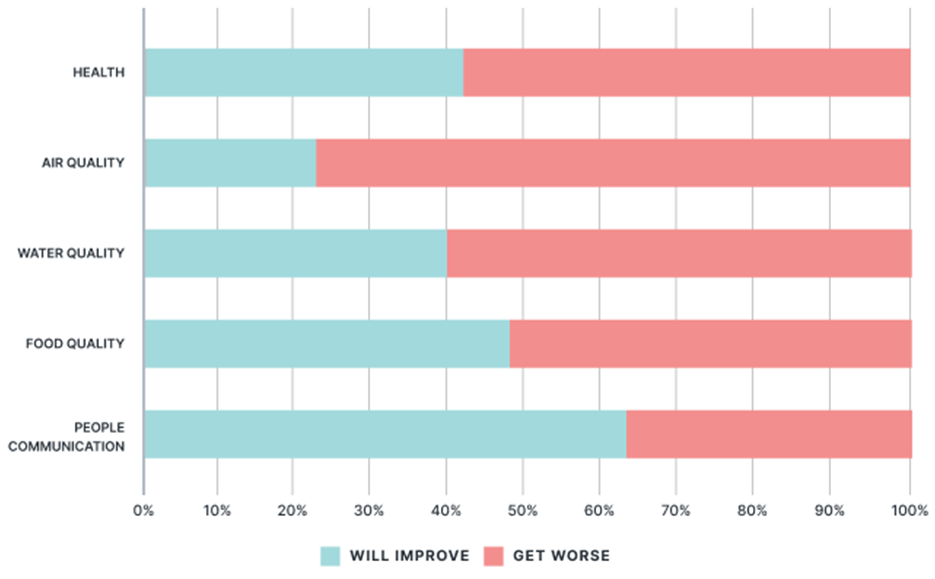
Sample 1:
The bar graph illustrates how the young in Europe expect five different life aspects to change over the following two decades.
Overall, the majority of young individuals polled anticipated that communication between people would become better after 20 years, whereas the opposite was true in the cases of the other surveyed areas. It is also noteworthy that the difference between youngsters’ expectations about health and water quality was negligible.
Regarding people’s health and communication, slightly above 40% and 60% of young people in the survey predicted that these aspects would see improvement, respectively. This means that more young respondents forecast that the former is going to worsen in comparison with the latter.
Turning to the other categories, there is a small gap between young people’s responses regarding the quality of water and food, with 60% and roughly 52% of them claiming that these areas will degenerate, in that order. Air quality, meanwhile, received the worst outlook, as nearly four-fifths of the young believed that it would deteriorate.
Sample 2:
The graph delineates the anticipations of young Europeans regarding shifts in five key facets of life in Europe over the ensuing two decades.
At a glance, it is evident that a majority of respondents foresee a deterioration in all surveyed aspects, barring interpersonal communication, which is expected to be better.
Delving deeper into the data, a significant 77% of those surveyed anticipate a decline in air quality, compared to merely a quarter of respondents who believed otherwise. Similarly, more than half of the surveyed demographic opine that both health standards and water quality will witness a downturn, registering at 58% and 60% respectively.
Conversely, a dominant 64% of respondents envisage an enhancement in interpersonal communication, whereas a minority of 36% hold a contrary view. Meanwhile, perceptions on food quality are almost evenly split, with slightly over half of respondents optimistic about improvements, while 49% harbor fewer positive expectations about this aspect.
Sample 3:
The chart shows how changes in 5 different social aspects in the next 20 years are expected by young people in the EU. Overall, European young people have negative expectations about the changes in these areas, with the exception of communication between people.
According to the survey, around 65% of young people answered that they believe that interpersonal communications will be improved. And this number is by far higher than the percentage of people who believe in an improvement in other areas of life in the EU. In contrast, the expectation that the air quality will get worse was the most common among young people with just under 80% of them choosing that answer.
Half of young people expect to see enhancements in the food quality while half disagree with this idea while 60% of young people hold negative expectations about the problem of the quality of water and the level of public health in the EU.
Sample 4:
The bar chart gives information about how young people in Europe will expect the situation of five various areas, namely health, air quality, water quality, food quality and people communication to change over a 20-year period.
Overall, it is clear that although the majority of these aforementioned aspects are forecast to show signs of worsening in the upcoming 20 years, people communication is the only prospective area in which participants have fairly high expectations for becoming better. In contrast, projections show that air quality is likely to receive the worst outlook.
Regarding aspects with predicted positive trends from Europe’s young generations, it is anticipated that interpersonal communication will witness a significant improvement in the next two decades, garnering support from more than 60% of the respondents. In addition, food quality stands out as the only area with an even split, receiving a 50% approval rate from both those who anticipate development and those who foresee deterioration.
As for the remaining categories which exhibit less optimistic expectations, young people in Europe harbour relatively similar hopes for improvement in the realms of health and water quality, where roughly 40% express favorable views for their prospects of enhancement. This is in contrast to air quality, which ranks as the least promising aspect, with approximately three quarters of the surveyed young individuals foreseeing its future declines.
Sample 5:
The graph illustrates young people’s expectations for change in five different aspects of European life over the next 20 years.
Overall, the majority of the surveyed youth expect that, besides the communication between people, all other surveyed aspects of life will get worse.
Looking at the graph in more detail, it can be seen that 77% of people surveyed expected to see a decline in air quality, which was over three times more than the number of people who believed otherwise. Similarly, over half of the surveyed youth believed that the quality of health, as well as water, would decline over the next 20 years, with the figures being 58% and 60% respectively.
In contrast, the majority of people participating in the survey expected to see improvements in communication between people, at 64%, while only 36% of them thought the opposite. Meanwhile, opinions on food quality were divided almost equally with just over half the survey participants believing that things would improve, and 49% thinking the opposite.
Sample 6:
The bar chart demonstrates the young European generation’s views towards changes in the coming 20 years across 5 different areas, namely health, air quality, water quality, food quality and people communication.
Overall, it is apparent that the majority of the participants do not have high expectations of the improvement of most mentioned aspects. Among which, air quality is the main concern with the lowest score and people communication is the sole prospective developed area.
To start with, people communication is predicted to improve in the next 20 years with a support rate of over 60%, which is almost 3 times higher than that of air quality at only about 23%. Moreover, food quality is the only area that has a balanced rate at 50% for both supporters of development and of deterioration.
While the two aforementioned aspects have a positive trend, all other areas have a lower-than-average expectation from the young generation in Europe. These youngsters share relatively similar expectations for health and water quality, with approximately 40% of them being in favor of improvement. Meanwhile, air quality is the least prospective aspect, at merely 23% of the surveyed young people holding positive opinions on its future improvement.
Sample 7:
The bar chart in question provides insightful data on a survey that explores the expectations of young individuals from various European regions regarding prospective changes in key areas of life, such as health, environmental quality, and communication, over the next two decades.
Overall, the survey findings depict a diverse spectrum of expectations among the youth of Europe concerning the future evolution of these significant areas. A general trend towards negative expectations is evident in sectors like health, air quality, and water quality. Contrastingly, opinions regarding food quality appear to be almost evenly split, while the perspective on people’s communication methods is predominantly optimistic.
The first group, encompassing Health, Air Quality, and Water Quality, shows a marked tendency towards pessimism. For instance, in the health sector, a notable 59% of respondents anticipate a decline, compared to 41% who hold a hopeful view. This trend of negative expectations is similarly reflected in the perceptions about Air and Water Quality, albeit with varying degrees of concern among the European youth.
The second group, Food Quality, is characterized by a balanced division of opinions. A slight majority, 52%, predict a deterioration in food quality, closely followed by 48% who maintain a positive outlook on future improvements.
The final group, represented solely by People Communication, demonstrates a significantly more positive stance. Here, 64% of the participants foresee enhancements in communication methods, substantially outweighing the 36% who expect a decline. This contrast with the other areas suggests a unique optimism about the evolution of communication technologies and interpersonal interactions.
Sample 8:
The stacked graph illustrates predictions of European youths for five aspects in the following twenty years. Overall, over half of young residents on this continent expect that most given areas will deteriorate, except for interaction between people. Additionally, air quality is anticipated to be degraded by the largest proportion of respondents.
Regarding the quality of body intakes, young Europeans do not have a positive attitude towards the air quality in the next two decades, with nearly 80% of them believing it will become worse, which is the highest figure. Declining water quality is forecasted by precisely three-fifths of young citizens. However, higher quality of future sustenance receives fairly comparable percentages between supporters and pessimists, at approximately 49% and about 51%, respectively.
Turning to the remaining categories, high expectations from the young are present for people's communication in the next twenty years, as roughly 64% of them predict that it will improve. In terms of average well-being, only slightly over 40% of the surveyed youngsters hold optimistic opinions for its future enhancement.
Sample 9:
The given horizontal bar graph illustrates young people’s expectations for change in five different aspects of European life over the next 20 years.
On analyzing the data, it can be seen that 77% of those surveyed expected to see deterioration in air quality, which was more than three times the number of people who thought otherwise. Similarly, more than half of the surveyed youngsters believed that the quality of health as well as the quality of water will decline over the next 20 years, with the figures being 58% and 60% respectively.
On the contrary, the majority of people who participated in the survey expected to see improvements in communication between people at 64%, and only 36% of them thought otherwise. Meanwhile, opinions about the quality of food were divided almost evenly: slightly more than half of the survey participants believe that the situation will improve, and 49% think the opposite.
Overall, the majority of the young people surveyed expect that, in addition to communication between people, all other aspects of life surveyed will deteriorate.
Summarise the information by selecting and reporting the main features, and make comparisons where relevant. Write at least 150 words.

Sample 1:
The diagrams illustrate a pair of stone cutting implements, namely tool A and tool B, which find their origins in two differing periods of human history. They were crafted through the technique of chipping away small fragments of stone.
Overall, there were noticeable differences between the two tools, with the one from 0.8 million years ago having greater dimensions, less rugged surfaces, and more uniform edges in comparison with its earlier counterpart.
Looking first at tool A, which dates back to 1.4 million years ago, it appears to be highly primitive. This artifact measures approximately 7 centimeters in height and 3 centimeters in width, and its thickness falls within the range of 2 to 3 centimeters. Similar to the later version, tool A features a rounded base, tapering toward the top. The latter, however, has much rougher surfaces when viewed from the front and the back, thus contributing to its more jagged edges and a less defined pointed end.
Tool B, on the other hand, shows a more refined appearance, resembling a teardrop, as its tip is notably sharper while the sides are also smoother. In contrast to tool A, the front and back of tool B look somewhat similar, with less surface roughness. Furthermore, Tool B is about 5 centimeters longer and 2 centimeters wider than its predecessor, although the thickness is almost exactly the same.
Sample 2:
The diagrams chart the evolution of a cutting tool from its rudimentary form 1.4 million years ago to a more refined version 0.8 million years ago during the Stone Age.
Initially resembling a natural stone, the tool underwent significant enhancements, culminating in a more efficient and effective cutting instrument.
Approximately 1.4 million years ago, the tool took on a basic form, closely looking like a natural stone, indicating minimal crafting. Tool A displayed an oval shape from both the front and side views, with a coarse texture and blunt edges, suggesting it was not refined.
Over the subsequent 0.8 million years, significant improvements were made. The tool evolved into a spear-shaped implement with a much sharper tip and edges. Although Tool A maintained the same length at 10 centimeters, it featured a smoother surface and increased overall width. These enhancements markedly increased its cutting efficiency, making this version far superior.
Sample 3:
The diagram presents a comparison of prehistoric tools dating back 1.4 and 0.8 million years ago. Overall, the older tool is less refined with rougher edges, while the newer one appears smoother and better preserved.
Comparing the two tools from the frontal view, the one from 1.4 million years ago is slightly narrower, displaying a less defined shape. The more recent one comes to a sharper point with clearly rounded sides.
The side view reveals that the older tool is also bulkier with more jagged indents than the much smoother one from 800,000 years ago. Finally, in terms of the back view there is a distinctive contrast as the newer has fewer major cracks and closely mirrors its front side. The older tool, on the other hand, is approximately half the size overall and is chipped down greatly in the back.
Sample 4:
The presented illustration demonstrates some of the first cutting stone tools ever invented and how they transformed and improved over the course of human civilization – from 1.4 million years ago to 800 thousand years ago. It is clear that the same tool underwent radical changes and became sharper, better and more effective through the ages.
The stone tool made 1.4 million years ago was more rounded at the top and bottom edges. From the front and back view of the tool, it is clear that the diameter in the middle was almost 5 cm, and towards the top and bottom, it was around 3 cm wide. The side view shows that the tool was wider in the middle, with a diameter of approximately 3 cm, and it tapered towards the top, and the bottom ends. The back of the stone had fewer cuts than the front, and they were also particularly sharp or fine, decreasing their overall capabilities.
800 thousand years ago, this tool developed into a sharper, more refined one. The front and the back view show that the maximum diameter of the tool was the same as in the older tool, but it was more towards the lower side. The bottom tapered into a 1 cm point, but the top tapered more sharply into a 1 cm point. The side view clarifies that it was much less in width (1.5 cm) than the older tool. The stone was more chiseled than the previous one.
Sample 5:
The illustration details the evolution of stone cutting tools used by prehistoric men in the Stone Age.
As is evident from the diagram, the key difference between the cutting tools in the two periods is the size, with the latter version becoming noticeably larger. Tool B also appears more refined than tool A in terms of shape and sharpness.
1.4 million years ago, the cutting tool was thin, measured 7-8 centimeters in length, and did not display much craftsmanship. They were also rather uneven in appearance: the front and the back were shaped differently, and the surface appears to have been quite rough.
600,000 years later, it is obvious that the cutting tools used by man in the Stone Age had become significantly more advanced. First of all, they were larger, measuring 10-11 centimeters in length, and had a more definite tear-drop shape: fat at the base and tapering aggressively toward a sharp tip whereas the prior versions tended to be obtuse. Second, both front and back sides were ground more evenly and smoothly. It would also seem that man had learnt to sharpen the sides of their cutting tools as well.
Sample 6:
The provided illustrations delineate a comparative analysis of two distinct Stone Age cutting implements, denoted as Tool A and Tool B, with origins dating back to disparate epochs in human evolution, specifically 1.4 million and 0.8 million years ago, respectively. It is imperative to underscore that this temporal span of 0.6 million years had witnessed a discernible evolution in the characteristics of these implements, most notably manifesting in alterations pertaining to their dimensions, forms, and surface attributes.
The initial impression from the first figure is that Tool A appears to exhibit a rudimentary and austere design, reflective of limited craftsmanship. This artifact assumed an undefined shape, possessing a circular base that gradually tapers towards its apex, with the widest section positioned at its center, presumably to facilitate grip and manipulation. Tool A is recorded to possess dimensions, with a height and width encompassing approximately 7 and 3 centimeters, respectively, while its thickness falls within the range of 2 to 3 centimeters. A comprehensive examination of its anterior and posterior aspects revealed rough surfaces and jagged edges, with a rather blunt pointed end.
Subsequent to a temporal elapse of 600,000 years, it is apparent that this cutting tool has undergone a substantial transformation, attaining a refined appearance resembling a teardrop. In comparison with the previous version, Tool B exhibits an elongation of approximately 2 to 3 centimeters in both length and width whereas the thickness remained relatively unchanged. A meticulous inspection from diverse angles reveals that its surfaces have transcended their primitive ruggedness, now presenting smoother and more finely contoured edges, along with a notably pointed tip. This transformation implies an advanced utility in comparison to the antecedent.
It is intriguing to note that Tool A had experienced a remarkable transformation from a rudimentary object into an enhanced knife-like cutting implement over the course of 0.6 million years. This transformation underscores the adaptive capacities of early humans, delineating the trajectory of technological progress in the field of tool manufacture and utilization.
Sample 7:
The diagram depicts ancient cutting tools made from stone by early humans from 1.4 million and 0.8 million years ago, which were viewed from the front, side and back with length measurement in centimeters.
Generally, it can be seen that the tool from 800 thousand years ago was larger, longer and more well made than its earlier counterpart.
Approximately 1.4 million years ago, the cutting tool was relatively small with 7cm in length. From the front and back view, the overall shape was irregular, the stone surface was rugged while the side view showed an uneven edge.
The tool saw notable improvements 600 thousand years later. The stone blade was 1.5 times longer at nearly 10cm in length. The shape was more defined, which closely resembled a water droplet, and the surface was noticeably smoother viewing from the front and back. The side view also showed a sharpened edge for better cutting.
Sample 8:
The given diagram compares stone age cutting tools at 1.4 million and 0.8 million years ago. Overall, the latter one appears to be bigger in size and its shape was also better refined with sharper, more uniform edges and a pointed end.
To begin with, tool A, dated 1.4 million years ago, has a height and width of about 7.5 and 3 centimeters respectively, and is around 1-2cm thick. From the front view, there were large random cuts which created rough edges and a tapered end. From the other sides, similar cuts can be seen, and a sharp end was formed at the top of the tool.
Turning to Tool B, we can see that after 0.6 million years, the cutting tool had doubled in size, with a height of about 10 centimeters and a width of slightly over 6 centimeters, whereas it retained a similar thickness. A look from the front and the back of tool B reveals that its outer shape became significantly finer with a sharp pointy top and a smooth curved bottom. Its side view also witnessed a remarkable transformation which made the tool take the shape of a leaf with a sharp edge running across the tool.
Sample 9:
The presented pictures illustrate how cutting tools in the Stone Age evolved from 1.4 million years ago to 0.8 million years ago.
Overall, it can be concluded that in over 0.6 million years, the tools witnessed a dramatic change both in size and shape. In addition, these developments increased the effectiveness of the cutting instruments.
Regarding the front view, tool A had rough edges and no clear shape, whereas tool B had a symmetrical tear-like shape along with a pointy tip. This feature would give tool B an edge over tool A when it comes to cutting food or penetrating things.
In terms of the side view and back view, tool B proved to be significantly larger as compared to tool A, which would come in handy when cutting large products. With regard to the edges, tool A and tool B showed a manifest difference. While the former’s edges were rugged and blunt, the latter’s were significantly sharper, more refined, and knife-like.
Sample 10:
The two pictures compare 2 Stone Age cutting tools which were probably made and used by ancient people.
In general, while tool A was relatively simple and rudimentary, tool B was more refined.
First, 1.4 million years ago, tool A’s measurements were approximately 9 cm in length and 5 cm in width. From the front view, it had a rough surface. With a tapering shape, its biggest part was the middle, while the two ends were much smaller. The side view shows its thickness at about 2.5 cm. In the back, the large bottom part was perhaps the handle, while the pointy tip served the cutting purpose.
Dating back to 800,000 thousand years ago, tool B was nearly 12 cm long and 8 cm wide, which was significantly larger than tool A. From the front view, tool B closely resembled a water drop with a pointy tip and a round bottom. From the side view, both the edge and the tip seem straight and sharper than tool A. The back view clearly displays the bigger size of tool B compared to tool A.
Sample 11:
The diagram illustrates the evolution of the cutting tool during the period from 1.4 million years ago to 0.8 million years ago in the Stone Age.
It can be seen that a number of upgrades were made in the shape and size of the tool so that it could become a more effective cutting instrument.
1.4 million years ago, the tool was relatively primitive and resembled a natural stone, which suggests that little crafting was done. From the front and side view, Tool A had an oval shape, rough surface and blunt edges, hence presumably the inferior version compared to Tool B.
After 0.6 million years, the tool was upgraded into a spear-shaped instrument with the tip and edges being much sharper. While Tool B was 10 centimeters long – the same length as Tool A, the surface of Tool B was crafted to be smoother and the overall width to be larger. Therefore, these features rendered this version more superior in terms of cutting efficiency.
Sample 12:
The diagram illustrates the development of the cutting tool from two different time periods within the Stone Age.
Although the overall size and shape of the two cutting tools are very similar, the cutting tool from the latter time period shows some distinct improvements.
Tool A is a depiction of a Stone Age cutting tool used approximately 1.4 million years ago, while tool B is from a later part of the Stone Age approximately 0.8 million years ago. Both cutting tools are similar in shape and size, roughly 10cm in length. However, tool A looks to be quite a crude implement, while tool B appears to have been refined into a more effective cutting device.
From the front and rear view, tool B appears to be much wider than tool A and has a rounder body shape. The cutting edges also appear to be more distinct and symmetrical. The side view shows a distinct difference in the thickness of the two tools, with tool B significantly slimmer than tool A.
Sample 13:
The pictures describe the evolution of Stone Age cutting tools between 1.4 million and 0.8 million years ago. It can be seen that the latter design had seen vast improvements in the size, shape and finishing quality.
Tool A, which dated back to 1.4 million years ago, was rather small and rudimentary. At about 7cm in length, the tool was thin and did not display much craftsmanship. The front and back view were plain with only some slight chiselling effort while the side was rough and not very indicative of a cutting utensil.
Tool B showed many updated features compared to the older version. First of all, it was larger and sturdier due to a better water drop design with a broad base and pointy top. Second, both front and back sides were grounded more evenly and smoothly. Finally, although the tool’s thickness stayed relatively the same after 0.6 million years, the side edge was undoubtedly much more finely sharpened.
Sample 14:
The pictures describe the cutting tools created by our ancestors at two different ages.
Tool A was made approximately 1.4 million years ago. It was like an animal tooth about 8 cm long with a rough surface. It may be easy to hold but it was barely sharp enough. As is shown, the front part of the cutting tool was rather broad, and its top area was a little smaller than the bottom. Seen from the side, it was just as narrow as a stick. Moreover, the back part was much flatter than the front part.
Tool B was widely used 0.8 million years ago. Both of the two tools were made of stone. However, Tool B had been better developed than the previous one. It was about 12 cm long. Its front part had been smoother with many little points, which made it similar to the surface of a diamond. Observed from the side, it had got a very acute top, which was very useful for slicing meat. In addition, the back part was even much flatter than that of the older tool.
The diagram below shows a simple system that turns dirty water into clean water.
Summarise the information by selecting and reporting the main features, and make comparisons where relevant. Write at least 150 words.

Sample 1:
The given diagram illustrates how to produce drinking water by using a simple water-filter assembly device. Overall, the system consists of two storage drums arranged to filter and then store the water. There are four main stages in the process, starting with pouring in unclean water, followed by filtering and storage, and culminating with opening of the tap for clean water.
In the first two stages, after the lid has been removed, unpurified water is poured into an initial, elevated plastic drum. The water then penetrates downwards through three filtering layers. Initially, the water undergoes a sand filtration process to eliminate impurities, subsequent to a further filtration step involving a layer of charcoal, and purification through the utilization of gravel. A pipe system with one end at the bottom of this drum then leads the purified water down to the less elevated storage drum.
In the final stages, the filtered water is stored in the lower drum with a closed lid. A tap near the bottom of this drum allows users to utilize the cleaned drinking water.
Sample 2:
The diagram illustrates a simple method of purifying dirty water in order to make it suitable for consumption.
Overall, the system demonstrates how easily accessible natural materials and basic equipment can be used to produce drinkable water in just a few simple steps.
Overall, the system showcases how readily available natural materials and basic equipment can be utilized to produce drinkable water in just a few straightforward steps.
Firstly, a storage drum and a plastic barrel are positioned adjacent to each other, with the top of the latter higher than the former. These two components are connected by a pipe running from the bottom of the barrel into the side of the drum. Subsequently, a filter is constructed within the barrel by adding layers of sand, charcoal, and gravel. Lastly, a tap is installed at the bottom of the drum, and another one is placed at the top of the pipe.
The process commences by lifting the plastic lid of the barrel and pouring impure water into it. The water then passes through the filter and travels up the pipe into the drum, where it is stored. When the tap in the drum is opened, potable water is released for use.
Sample 3:
The provided diagrams illustrate a simple water filtration system designed to purify water.
Overall, the water filter assembly employs a two-tank setup - one for filtration and one for storage - utilizing natural materials in a layered approach to remove impurities.
When it comes to the design, the plastic barrel, capped with a plastic lid to ensure the water remains uncontaminated during the process, is segmented internally into three sections with layers of sand, charcoal, and gravel. Below the filtration barrel is the storage tank, or drum, which functions as a reservoir for the filtered water. This drum is strategically positioned to collect water exiting the filtration tank and is fitted with a tap at its base.
The purification process begins with the pouring of dirty water into the filtration barrel, where it first encounters the sand layer. The water then descends to the charcoal layer, which is instrumental in removing dissolved impurities, due to its adsorption capabilities. The final layer of gravel not only filters out any remaining larger particles but also regulates the flow of water into the storage drum. The filtered water travels from the barrel to the drum through a connecting pipe. Once in the storage drum, the water is ready for consumption and can be dispensed through the tap.
Sample 4:
The diagram illustrates the construction and function of a basic water filtration system, designed to produce clean drinking water.
It is evident that the process involves five main steps, commencing with the intake of impure water and concluding with the availability of portable water from the tap.
The setup comprises two distinct tanks interlinked by a connecting tube. The upper section of the initial tank is shielded by a thin circular cover, while its lower portion is packed with three layers of materials, namely sand, charcoal, and gravel. The second tank functions as a reservoir for filtered water and is equipped with an integrated tap.
To initiate the process, untreated water is introduced into the first tank. Subsequently, the water flows sequentially through the layers of sand, charcoal, and gravel. Within each layer, impurities from the raw water are captured, facilitating the purification process. The clarified water is then directed to the second tank for storage through a conduit. At this stage, the water is ready for use and can be accessed via the tap.
Sample 5:
The provided diagram demonstrates the construction of a simple water filter as well as its function to produce potable water. It is noticeable that water is treated through 5 main steps, starting with impure water and finishing with drinkable water from the tap.
The system consists of 2 separate tanks connected with each other through a tube. The top of the first tank is covered by a thin round lid and its bottom half is filled with 3 layers of substances, namely, sand, charcoal, and gravel. The second tank serves as a storage container of filtered water with a built-in tap.
At the beginning of the process, raw water is poured into the first tank. After that, the water goes down through the sand layer, charcoal layer, and gravel layer in chronological order. The waste from impure water is trapped within the given layers, enabling the process of removing impurities from water. Subsequently, filtered water is transferred to the second tank for storing purpose through a conduit. At this stage, water is ready for use and can be dispensed by using the tap.
Sample 6:
The picture illustrates the system used to transform unpurified water into drinkable water. Overall, the process involves two main stages, which are filtering unclean water through various materials in a plastic barrel and storing purified water in a storage drum.
The water-filter process begins when water is poured into a plastic barrel placed above a storage drum and then covered by a plastic lid. After that, the water is purified by going through three different layers of materials: sand, charcoal and gravel, in that order. While the amount of sand and gravel is rather similar, that of charcoal is half as much.
In the second stage, the purified water is transmitted to the storage drum by a pipe which leads from the bottom of the plastic barrel to the upper part of the storage drum. Throughout this stage, the storage drum remains closed with a plastic lid. Finally, the clean water is taken via a faucet located near the bottom of the storage drum for drinking purposes.
Sample 7:
The provided diagram illustrates the straightforward process by which water is filtered. Overall, the process employs uncomplicated equipment and relies on the natural properties of different materials to remove impurities from water.
Regarding the equipment and ingredients, the key components necessary for this method are a sizable container and three essential ingredients namely sand, charcoal, and gravel. These elements are arranged in layers, designed to progressively remove contaminants. Specifically, the bottom layer is gravel, on top of which is a layer of clean sand and then another layer of crushed charcoal.
The process begins when untreated water is poured into the container and undergoes a filtering phase. During this stage, water passes through the layers, with larger debris being trapped in the gravel, followed by smaller particles being trapped in the sand, and some contaminants being absorbed by the charcoal.
After successfully passing through all three layers, the water emerges filtered and purified, now ready for drinking. Subsequently, a pipe is affixed to the container so as to transfer the filtered water into a separate storage tank, where it remains available for utilization whenever required.
Sample 8:
The diagram below illustrates how a simple water filter is constructed and how it functions to produce clean drinking water. Write a report for a university lecturer describing the diagram below.
A glance at the diagram depicts some striking information about the process in which impure/ polluted/ contaminated/ dirty water is filtered/ purified/ treated.
It is evident from the information supplied that there are several main steps involved in the process. It starts with (N + Vpii) dirty water collected and ends with drinking water produced.
Looking at the components of the system in more detail, people prepare a plastic barrel and a storage drum which are positioned next to each other with the former placed higher than the latter. The barrel is covered with a plastic lid. Moreover, people put 3 layers including sand, charcoal and gravel into the bottom of the barrel. There is a small tube/ pipe which runs from the bottom of the barrel to the side of the drum. On the lower part of the side of the drum, people install a tap.
Regarding the process of filtering water, at the beginning, dirty water is poured into the barrel. Then, it runs through the filtering layers which help keep substances. After that the clean water is sent to the drum via the tube. When people open the tap, the clean water flows out, ready for consumption/ use.
The charts below show the water levels of 6 cities in Australia in October 2009 and 2010.
Summarise the information by selecting and reporting the main features, and make comparisons where relevant. Write at least 150 words.

Sample 1:
The presented bar chart illustrates the variations in water levels across six Australian cities during October 2009 and 2010.
Overall, the majority of the surveyed cities witnessed an upward trend in the water levels in the reservoirs in October 2010 compared to the preceding year. The only two exceptions were Darwin, where the water level decreased, and Brisbane which recorded no change. In addition, Canberra was the city with the highest percentage of water stored in its reservoirs in both years.
In October 2009, Sydney and Canberra had the most abundant water reserves, with approximately 75% water capacity each. Brisbane, Darwin, and Perth followed, registering figures ranging from 40% to approximately 55%. In contrast, Melbourne recorded the lowest water percentage in its reservoirs, hovering around 25%.
One year later, Perth witnessed the largest increase in water levels, hitting a high of just above 70%. Having a similar trend, the figure for Canberra reached a peak of nearly 100%, making it the city with the highest level of water. Although Sydney and Melbourne also experienced upward trends, their growth was less pronounced, with respective figures in 2010 of 80% and 40%. Conversely, Darwin encountered a notable decline in its reservoir water, decreasing to just under 30% of its capacity in October 2010. Finally, the figure for Brisbane remained unchanged compared to the previous year.
Sample 2:
The bar chart illustrates the changes in the levels of water in reservoirs across six Australian urban areas between October 2009 and the same month in 2010.
Overall, the water level in Darwin decreased over the period in question, whereas the opposite was true in the case of the other cities, except for Brisbane, where no changes were recorded. Additionally, Canberra had replaced Sydney to become the city with the highest percentage of water stored in its reservoir by the end of the period.
In October 2009, Sydney and Canberra had more water at their disposal than any other city listed, as around 75% of their reservoir levels were filled. These metropolises were followed by Brisbane, Darwin, and Perth, with their figures ranging from 40% to nearly 60%. In the last position was Melbourne, whose water reservoir was just over a fifth full.
After one year, the capital city took the lead, with its water level increasing to a high of close to 100% of the total storage capacity. Sydney and Melbourne followed similar trends, albeit at lower rates, rising to 80% and 40%, respectively. The largest rise was seen in the proportion of water stored in Perth’s reservoir, reaching approximately 70%. This contrasts starkly with the data for Darwin, where a fall to roughly 25% was reported, and lastly, the figure for Brisbane stayed the same.
Sample 3:
The bar chart delineates the fluctuations in water levels within reservoirs across six urban regions in Australia from October 2009 to the corresponding month in 2010.
Across the period, Darwin experienced a decline in water reserves, while the other cities observed an increase, except Brisbane, where no alterations were evident. Notably, Canberra surpassed Sydney to secure the position of the city with the highest water storage percentage in its reservoirs by the end of the period.
In October 2009, Sydney and Canberra boasted the highest water storage among the listed cities, with both locations holding approximately 75% of their reservoir capacities. Following them were Brisbane, Darwin, and Perth, maintaining levels varying from 40% to nearly 60%. Melbourne recorded the lowest water reserves, barely exceeding a fifth of its storage capacity.
Over the course of the year, Canberra ascended to the forefront, with its reservoirs reaching nearly 100% capacity. Meanwhile, Sydney and Melbourne exhibited growth, albeit at slower rates, achieving 80% and 40%, respectively. Perth demonstrated the most substantial rise, with its water reserves escalating to around 70%. In contrast, Darwin experienced a sharp drop to approximately 25%. Brisbane’s water storage level remained constant throughout the duration.
Sample 4:
The bar graph illustrates the percentage of the water levels of October 2009 to October 2010 compared to the maximum water levels in reservoirs in six Australian cities.
As can be seen from the graph, the proportion of water levels in comparison with the maximum levels at the city's reservoirs after a year from October 2009 rose in four cities. In particular, in Sydney and Canberra, numbers increased from 75%, the highest level of the year in these two cities in 2009 to over 80% and to around 98% respectively in 2010. That proportion in Canberra was also the highest data across the chart. As for Perth, the number lifted from about 40% to over 60% after a year while in Melbourne, water in reservoirs went up from the lowest level of 25% in October 2009 to around 37% in 2010 to escape the trough of the list.
However, water levels dropped in Darwin, falling from 45% in October 2009 to under 30% after a year and pushed this city to the bottom of the league. Meanwhile, Brisbane enjoyed the stability in the water level at 55% of the top level in their reservoirs over the period.
Overall, water level increased in four cities, fell in one, and stabilized in the other. Besides, Canberra and Sydney had the most abundant water source of all in the period.
The charts below show the performance of spending on roads and transport in four countries from 1990 to 2005.
Summarise the information by selecting and reporting the main features, and make comparisons where relevant. Write at least 150 words.
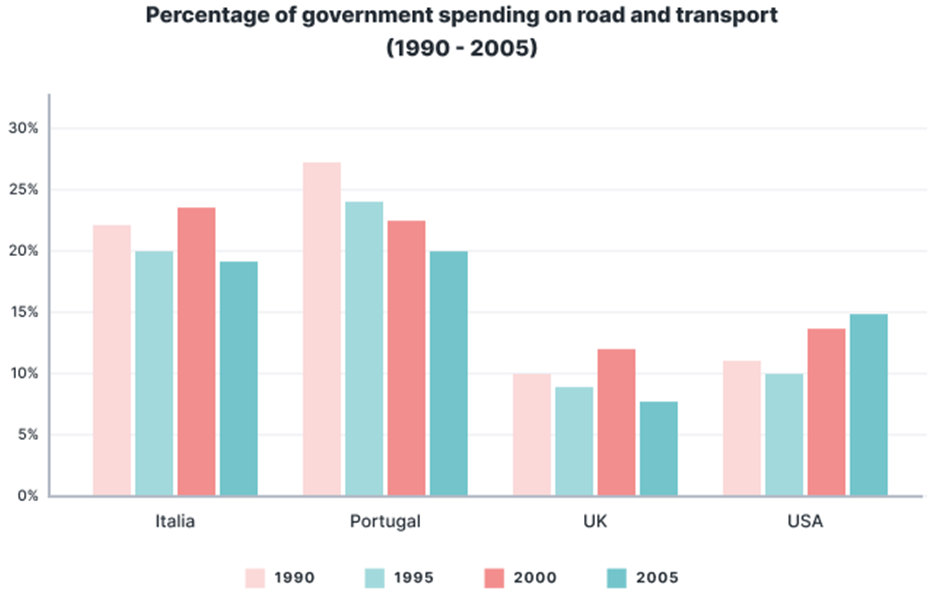
Sample 1:
The bar chart illustrates how much the governments in 4 different countries spent on roads and transport in the years 1990, 1995, 2000 and 2005.
Overall, it is apparent that Portugal has the highest governmental spending on road and transport while the UK possesses the lowest statistics among the 4 countries.
Specifically, Portugal’s government allocated more than a quarter of the total spending on transportation in 1990, which was about 5% percent higher than the second-highest spender - Italy, with 22 percent. Meanwhile the UK and the USA’s expenditures were significantly lower at 10 and 11 percent respectively, which were 2.5 times lower than that of Portugal.
Regarding the changes over the years, the figures of Portugal declined steadily over the 15-year period to exactly 20 percent in 2005. In comparison, the corresponding figures from Italy and the UK also displayed a general downward trend throughout the studied period with the exception of a short increase in 2000. In contrast, the expenditure figures of the USA demonstrated an upward trend, rising to 15 percent in 2005, despite dropping a minimal 1% in 1995.
Sample 2:
The provided bar chart delineates the changes in government expenditure on roads and transport across several nations from 1990 to 2005.
Throughout this period, there was a consistent downward trend in state investment in roads and transport in Portugal, whereas the United States witnessed an increase. The remaining two nations demonstrated varying patterns in government spending within this sector. Portugal consistently upheld its status of the highest spender among the countries scrutinized.
In mainland Europe, Portugal initially allotted approximately 27% of its national budget to roads and transport in 1990, a substantially larger proportion compared to other nations. However, this percentage experienced a gradual decline, reaching 24% by 1995 and further descending to slightly above 20% by the conclusion of the period. Conversely, the USA exhibited a different trajectory, initially undergoing a minor decrease in the first five years, but ultimately directing a higher proportion of public spending towards road and transport, culminating at 15%.
Italy portrayed a more fluctuating pattern in spending, diminishing from 22% to nearly 20% in 1995, rebounding to 23% in 2000, and then regressing to approximately 19% by 2005. The UK mirrored similar trends, initially allocating slightly over 10% of its total expenditure towards roads and transport, witnessing a minor reduction in 1995, an increase to 12% in 2000, but subsequently decreased spending to about 8% by 2005, maintaining the lowest spending among the listed nations.
Sample 3:
The given bar chart shows the proportion of government expenditure on road and transport in four countries (Italy, Portugal, UK, USA) every five years between 1990 and 2005.
Overall, it can be seen that governments in mainland Europe spent far more money on roads and transport than those in the UK and USA. It is also clear that the UK spent the least amount of money on roads and transport in all measured years.
In 1990, Portugal spent the most amount of money on roads and transport at approximately 27%, followed by Italy at about 22%, while the USA and UK both spent only around 10% of their government budget. In 1995, however, all countries reduced their road and transport spending by between 1-3%.
By 2000 while Portugal continued to reduce its road and transport spending down to around 22%, Italy had increased its spending to approximately 23%, overtaking Portugal as the leading spender on transport infrastructure in 2000. The UK and USA both had increased spending in 2000 by about 3%. In 2005, all countries except USA further reduced their spending with Portugal, Italy, UK and the USA at 20%, 19%, 8% and 15% respectively.
Sample 4:
The bar chart illustrates the proportion of expenditure by governments of Italy, Portugal, the UK and the USA on road and transport. The study compared the figures recorded between 1990 and 2005 with 5-year intervals.
On the whole, the proportion of government spending on road and transport generally declined in each country surveyed but the USA. It is also noticeable that the shares of money spent for this purpose by Italy and Portugal were significantly higher throughout the span than those of the other two countries.
The USA, in 1990, spent approximately 12% of its total expense on road and transport, which was 2% higher than the UK figure in the same year. Despite falling slightly by around 2% in 1995, the USA’s spending had risen noticeably to 15% by the final year.
Interestingly, the European countries in the research all followed a downward trend. Portugal, being the biggest spender in 1990 and 1995, decreased the proportion of the funds it channeled from around 27% to a fifth over the period. Similarly, Italy and the UK’s proportional investment in road and transport experienced a drop during the time frame from about 23% to just under a fifth and from a tenth to about 7%, respectively, though each showed a rise in expenditure in 2000.
Sample 5:
The bar graph illustrates the proportion of governmental expenditure on road and transportation infrastructure across four nations - Italy, Portugal, the UK, and the USA - from 1990 to 2005.
Overall, Portugal emerges as a consistent frontrunner in the allocation of budgetary resources to transport infrastructure, leading in all years except 2000. In contrast, Italy and the UK experienced significant volatility in their spending patterns, ultimately trending downwards, while the USA demonstrated a rising commitment to transport infrastructure, particularly in the latter half of the observed period.
In the initial year of 1990, the disparities in spending were stark: Portugal allocated nearly 27%, Italy about 22%, and the UK only 10% of their respective national budgets to this sector. Over the ensuing decade and a half, Portugal’s investment displayed a gradual decline, settling at around 20% by 2005, indicating a notable reduction from its initial high.
During the mid-1990s, investment levels in Italy, the UK, and the USA dipped slightly, only to surge by approximately 30% in the next five years. By the end of the period in 2005, except for the USA, each country recorded a decrease in the percentage of their budget dedicated to road and transportation. The USA’s data distinctly reflects an increasing trajectory, prioritizing transportation infrastructure towards the close of the period reviewed.
Sample 6:
The presented bar chart delineates the percentage of governmental expenditure on road and transport infrastructure across four countries - Italy, Portugal, the United Kingdom, and the United States - from 1990 to 2005.
Observing the data, Portugal consistently allocated the highest percentage of its budget to road and transport, except in 2000. Italy and the UK showed considerable fluctuations in their allocations, with a general downward trend, while the US displayed a progressive increase in spending in this sector towards the latter part of the period.
Initially, in 1990, the allocations were notably diverse with Portugal investing approximately 27%, Italy around 22%, and the UK a mere 10% of their national budgets in this sector. Portugal's investment saw a declining pattern, decreasing to about 20% by 2005, illustrating a significant reduction over the 15 years.
Conversely, after a decline in the mid-1990s, investments in road and transport by Italy, the UK, and the USA saw a rise of approximately 30% in the subsequent five years. By 2005, however, apart from the USA, all countries experienced a reduction in the portion of their budgets dedicated to this sector. The data from the US indicates a clear prioritization of transport infrastructure in the final years of the survey period.
Sample 7:
The bar graph shows the proportion of national funds spent by the four distinct countries - namely, Italy, Portugal, the United Kingdom, and the United States - on roads and transportation between 1990 and 2005.
With the exception of 2000, Portugal registered the highest spending on road and transportation sector throughout the 15-year period. Another interesting point is that, whereas Italy and the UK had significant oscillations and subsequently a decline in their road and transport spending, USA saw an increased spending in this sector during the final five years.
In 1990, Portugal, Italia and the UK, respectively, spent about 27, 22, and 10 percent of their national budget for the sake of road and transportation. Portugal's spending in this area dropped by almost 15 percent per five-years throughout this period and, in 2005, it made up barely 20% of the whole national budget, down from almost 27% in the first year, 1990.
The investment on transportation infrastructure in the other three nations, Italy, the UK, and the USA, decreased somewhat in 1995 before increasing by roughly 30% during the next five years. With the exception of the United States, all three of the other nations had a decline in their national proportion of expenditure on road and transportation in 2005.
Sample 8:
The bar chart tracks the changes in the proportion of government outlay on road and transport in four different nations between 1990 and 2005. Overall, except for the USA, a downward trend was registered in the expenditure on road and transport in almost all surveyed countries. Furthermore, Italy and Portugal distributed the most financial resources in this sector throughout the period shown.
Regarding the two leading nations, about 27% of Portuguese government’s budget was allocated to road and transport in 1990, far surpassing the percentage of the Italian one by approximately 5%. During the next decade, however, a notable increase to nearly 24% was witnessed in the figure for Italy, allowing it to overtake Portugal’s first rank in 2000. By 2005, both countries underwent dramatic declines in their spending on this department, with data recorded only under the 20% threshold each.
Turning to the remaining countries, in 1990, road and transport occupied just around one tenth of government expenditure in the UK and USA, which both experienced substantial growths to above 13% over the following 10 years. Nonetheless, at the end of the time scale, the figure for America continued to surge to 15%, roughly double that for the UK, where merely less than 8% of its budget was allotted to road and transport.
Sample 9:
The bar graph illustrates the distribution of government spending on roadways and transportation infrastructure in four different nations between 1990 and 2005, at five-yearly intervals. Overall, the spending of America increased over the given period, whereas other countries decreased. Additionally, the highest investment was seen in Portugal except for the third year when Italian authorities spent a larger share.
Portugal and Italy were the major investors in the traffic system. Portugal ranked first at nearly 27% at the start, after which their expenditure fell consistently to precisely 20% by 2005. Similarly, the figure for Italy dropped from approximately 22% in 1990 to 20% in 1995. After reaching a peak of roughly 23% in 2000, it plunged to a low of just under one-fifth by the end.
Concerning the other countries which spent significantly less, the British authorities allotted the lowest rate of 10% in 1990 and later it further decreased minimally by about 1% in the following five years. Despite recovering to a high of around 12% after five years, it declined by about 4% in the end. In contrast, the American government allocated approximately 11% of their state budget in 1990, followed by a slight drop to 10% five years later before increasing moderately by 5% in the final year.
Sample 1:
The first chart shows the actual and target percentage of buses, from a particular bus company, that arrived at the destination on time, between 1999 and 2003. Meanwhile, the second chart shows how many complaints were made during the same period.
It is clear that while the expected target of buses arriving on time decreased over the years, there was no clear pattern in the percentage of buses that actually arrived on time. Additionally, the number of complaints from their passengers increased throughout the period.
In 1999, the company’s target of buses arriving on time stood at 86%, which was 1% higher than what was actually achieved. Although the target remained unchanged one year later, the percentage of on-time arrivals dropped by nearly 3%. By 2003, this company had reduced its target of on-time arrivals to just over 84%, while the actual figure had witnessed considerable growth to about 85%.
Starting at approximately 7% of total passengers in 1999, the number of complaints made by passengers rose significantly before experiencing a slight decline to just over 8% in 2001. This figure then grew considerably two years later, with about 12% of passengers complaining in the last year.
Sample 2:
The bar charts compare the punctuality of a bus company's service against its targets and track the frequency of customer complaints over five years, from 1999 to 2003.
Overall, the company's actual punctuality fell short of its goals annually until 2003, when it slightly surpassed its aim. Meanwhile, customer grievances showed an upward trend throughout the period, peaking in 2003 despite the improvement in service punctuality.
Initially, in 1999, the company aspired for an 86% punctuality rate, which marginally declined to 85% in reality. The subsequent year witnessed a more significant drop, with only 82% of buses arriving on time, against the unchanged target. By 2001, the target was adjusted to 85%, yet the actual punctuality remained consistently below by about 1% for both 2001 and 2002. In a positive turn, 2003 saw the actual performance slightly exceed the target by approximately 0.5%, the target having been adjusted to 84.5%.
On the complaints front, figures started at roughly 70 per thousand passenger journeys in 1999 and, despite a slight decrease in 2001, escalated to around 120 by 2003. Notably, the year the company achieved its punctuality target also coincided with the highest frequency of customer complaints registered, indicating that factors other than punctuality influenced passenger satisfaction.
Sample 3:
The provided bar charts offer a detailed overview of the performance of a bus company, specifically comparing its actual punctuality record with set targets over a span of five years, from 1999 to 2003. Additionally, the data outlines the trend in customer complaints within the same timeframe.
Overall, there is a noticeable discrepancy between the company’s punctuality targets and its actual performance, with targets consistently unmet until a turnaround in 2003. Conversely, the customer complaint rate rose steadily over the years, hitting its peak concurrently with the year the punctuality target was finally achieved.
In 1999, the performance of a bus company was expected to reach an 86% on-time arrival rate, yet it achieved only 85%. The following year saw a further decline, with just 82% of buses on time, falling short of the unchanged target. The company lowered its expectations to 85% in 2001, but the actual performance continued to lag by roughly 1% for both 2001 and 2002. 2003 marked a significant milestone as the bus company’s performance slightly outstripped the target, set at 84.5%, with a recorded punctuality of 85%.
Regarding customer feedback, complaints initiated at approximately 70 per thousand passenger journeys in 1999 and, despite a minor dip in 2001, escalated to around 120 by 2003. Intriguingly, the year that saw the company’s performance meet its punctuality aspirations also recorded the apex of customer complaints, suggesting additional factors were at play in user satisfaction.
Sample 4:
The bar charts demonstrate the expectations and reality of a bus company regarding its punctuality, as well as the amount of negative feedback from its commuters from 1999 to 2003.
Overall, this bus company did not achieve its punctuality goals during the period, except for the year 2003. Moreover, there was an increase in the number of complaints throughout the years, despite several fluctuations.
In terms of the punctuality figures, the target was 86% in 1999, which was slightly higher than the actual performance. However, the year 2000 witnessed a significant drop to merely 82% in the realistic figure, while the target figure remained the same at 86%. The following 2 years, 2001 and 2002, shared the same target of 85% and almost similar punctuality rates, at roughly 84%. The pattern was reversed in the last year surveyed, with the percentage of actual punctual arrival time higher than the expected arrival time, almost 85% compared to just over 84%
The number of negative responses on the bus service started at around 70 responses in the first year before rising to 100 responses in the second year (2000). Although this figure decreased slightly to over 80 responses in 2001, it continued to undergo an upward trend in the last 2 years, finishing at the peak of 120 complaints in the last year of the period under study.
Sample 5:
The first bar chart illustrates the data on the performance of a bus company, comparing the percentage of actual punctual buses and their targets from 1999 to 2003. Meanwhile, the second chart depicts the number of complaints made by 1000 passengers per journey in the same period.
Overall, it is readily apparent that most of the time, the company lagged behind the targets with the exception of 2003. Moreover, as the time went by, this bus company received more and more complaints regarding the services provided.
As for the first bar chart, for the first two years of the surveyed period, the target was set to be 86% of buses arriving on time. However, this was never achieved as 85% and 82% of buses arrived punctually in 1999 and 2000 respectively. The same picture can be seen in 2001 and 2002 with only 84.5% and 84% of buses arriving on time, albeit the fact that the target was lowered to only 85%. 2003 was the only year this company did not fall short of its target with nearly 85% of actual on-time buses, compared to 84.5% target.
With respect to the second graph, starting off at 70 per 1000 passengers in 1999, the number of complaints was on the rise over the years with only one pullback to more than 80% in 2001 before continuing the upward trend, reaching 120 negative feedback in 2003.
Sample 6:
The provided bar charts detail the punctuality performance of a bus company in comparison to its set targets over a five-year period, alongside the frequency of passenger complaints between 1999 and 2003.
Overall, the company struggled to meet its punctuality targets, except for a positive deviation in 2003, which coincided with an increased number of passenger complaints.
In 1999 and 2000, the bus company aimed for an 86% punctuality rate, yet fell short, achieving 85% and 82% respectively. Despite a subsequent reduction in the target to 85% in the following two years, the company continued to miss its goals by approximately 1%. By 2003, a slight decrease in the target set to 84.5% was seen alongside a marginal rise in the actual on-time services to 85%, ultimately exceeding the target.
Regarding passenger complaints, figures began at around 70 per thousand passenger trips in 1999 and steadily rose, reaching 120 by the end of the period. This trend showed a minor dip in 2001. It is notable that although the company finally met its target in 2003, this achievement coincided with the highest recorded level of complaints throughout the entire duration.
Sample 7:
The charts present data about a bus company's on-time performance and the quantity of complaints it received from 1999 to 2003.
Overall, the company failed to reach its target for punctuality during the first 4 years but successfully hit the targeted figure in the final year. The volume of passengers' unhappy feedback, however, was on the rise over the same period.
Looking at the on-time performance chart first, the company did not achieve its objective for punctual arrivals in 4 consecutive years (1999 to 2002) despite reducing the target by one percentage point from 86% in 1999 to 85% in 2001. The largest performance gap was in 2000, at roughly 4%, and this was over eight times higher than the lowest in 2001. In the final year, the proportion of actual on-time arrivals eventually surpassed the target by a marginal difference of roughly 0.4%, partly owing to a lowered objective (84.5%).
In terms of customer complaints, the quantity of negative feedback per thousand passenger trips rose from nearly 70 in 1999 to exactly 100 in 2001, the year with the highest performance gap. It then dropped considerably to roughly 83 in 2001 before rising again and peaking at 120 in 2003 even though the company hit its target for punctuality that year.
Sample 8:
The bar charts illustrate how well a bus company performed regarding punctuality, showing both the achieved results and the desired targets set by the company, along with the frequency of passenger complaints between 1999 and 2003.
Overall, although the company lowered its performance targets over the years, it consistently failed to meet such expectations, except for 2003, and a fluctuation was witnessed in the proportion of actual on-time arrivals. Additionally, there was a growing number of complaints from passengers throughout the period.
In the first two years, the bus company aimed for 86% of its buses to be punctual, but this goal was not attained, with just 85% and 82% of buses arriving punctually in 1999 and 2000, respectively. Despite a decrease in the target percentage to 85% in the following two years, the company continued to fall short by approximately 1%. By 2003, however, the company had exceeded its target, as the former figure dropped slightly to 84.5% and the rate of actual on-time services rose minimally to 85%.
Turning to complaint numbers, they started at about 70 per thousand passenger trips in 1999 before gradually climbing to reach 120 at the end of the period, in spite of a small dip in 2001. Interestingly, while the company finally achieved its target in 2003, this year saw the highest level of complaints.
Sample 9:
The first chart illustrates the actual and target of buses from a particular bus company that arrived at the destination on time between 1999 and 2003, while the second one demonstrates how many complaints the passengers made during this period
Overall, it can be seen that this company has failed to achieve their goal during the period except in 2003, leading to the fall of their target. In addition, more customers complained about their service over the years
In 1999, the company set a goal for 86% of buses to arrive on time, but they achieved less than 1% of this target. The aim was remained in 2000, yet the actual was even worse with only more than 82% of buses being punctual, which caused them to reduce their goal to 85% in 2001. However, they still could not achieve their target. Both their actual and target remained in the next year before finally reaching their goal in 2003 with the goal was less than 85%
Moving to the second chart, there were about 70 complaints in 1999, yet this figure has dramatically risen to over 100 in the following year. The company then received less complaints in 2001 than the previous year before starting a continuous growth in the number of passengers' complaints in the next two years, with about 130 customers complaining in 2003, which was surprising since the company has achieved their target in this year.
The graph below shows the proportion of types of magazines sold by the company in 1975, 1995 and 2015.
Summarise the information by selecting and reporting the main features, and make comparisons where relevant. Write at least 150 words.

Sample 1:
The bar chart gives information about the percentage of different kinds of magazines sold by a particular company in three separate years, namely 1975, 1995 and 2015. Overall, there was an increase in the sales of sports magazines, whereas the opposite was true in the cases of fashion and health magazines. Additionally, the sales figures for food and other types of magazines remained unchanged, with their peaks recorded in 1995. It is also noteworthy that sports magazines were consistently the company’s best-selling publications.
Sports magazines were the only category that experienced an upward trend. Specifically, they outsold other types of magazines throughout the period, beginning at about 32% before rising steadily to end the period at just over 40%.
Regarding magazine genres with downward trends, the proportion of fashion magazines sold started at just above 20% in 1995, after which it had slumped dramatically to 5% by the end of the timeframe. At the same time, health magazines also witnessed a drop from approximately 26% initially to exactly 20% two decades later, followed by a leveling off in the final year.
Turning to food and other unspecified types of magazines, they followed the same pattern, with their figures standing at 10% and slightly above 25% in 1975, reaching their highest points of around 23% and 33% after 20 years, then returning to their initial levels at the end of the period, respectively.
Sample 2:
The bar chart depicts variations in the proportions of magazine sales across different categories by a specific company in three distinct years: 1975, 1995, and 2015.
Overall, there was an evident surge in the sales of sports magazines, while a contrasting decline was observed in the sales of fashion and health magazines. Notably, the sales figures for food and other genres of magazines remained stable, with their zeniths registered in 1995. It is pertinent to mention that sports magazines consistently remained the top-selling publications for the company.
Sports magazines demonstrated a continual upward trajectory, surpassing other magazine genres across the entire timeline. Commencing at approximately 32%, their sales progressively ascended to conclude with slightly above 40%. Conversely, fashion magazines experienced a notable decline, commencing at just above 20% in 1995 and sharply plummeting to 5% by the termination of the period. Similarly, health magazines underwent a reduction, starting at around 26% initially, declining to precisely 20% after two decades, and plateauing in the final year.
As for food and other unspecified magazine types, their trends mirrored each other. Both genres began at 10% and slightly over 25% in 1975, peaked at approximately 23% and 33%, respectively, after 20 years, and reverted to their initial proportions by the culmination of the period.
The table below gives information about salaries of secondary/high school teachers in five countries in 2009.
Summarise the information by selecting and reporting the main features, and make comparisons where relevant. Write at least 150 words.
Countries | Starting | After 15 years | Maximum | Years to reach maximum salary |
Australia | 28,000 | 48,000 | 48,000 | 9 |
Denmark | 45,000 | 54,000 | 54,000 | 8 |
Luxembourg | 80,000 | 119,000 | 132,000 | 30 |
Japan | 34,000 | 65,000 | 86,000 | 37 |
Korea | 30,000 | 48,000 | 62,000 | 34 |
Sample 1:
The table compares secondary and high school teachers’ salaries in five countries in 2009.
Overall, while teachers in Luxembourg were the most well-paid, teachers from Australia were the lowest-paid. In addition, the amount of time it took for a teacher in Denmark to earn the maximum salary was much faster than most other countries.
Secondary and high school teachers in Luxembourg were paid a starting salary of $80,000 a year, while the figure for teachers in Denmark was significantly lower, at $45,000. Additionally, the starting salary for an inexperienced teacher in other countries stood at around $30,000.
However, teachers with at least 15 years of experience in Luxembourg earned up to $119,000 a year, while teachers in Denmark and Japan with the same level of experience only made salaries of $54,000 and $65,000 respectively. Meanwhile, Australian and Korean teachers with at least 15 years’ experience were paid the lowest salaries, at $48,000 a year. Also worth noting is that it only took teachers in Australia and Denmark less than 10 years to receive their maximum salary, while teachers in the other countries had to wait for at least 30 years.
Sample 2:
The table compares the salaries of teachers in secondary schools and high schools in five countries in 2009.
Looking at the table from an overall perspective, it is readily apparent that teachers in Luxembourg earned the highest salaries. Interestingly, 8 years was the necessary amount of time for a teacher in Denmark to achieve the maximum salary in 2009.
Teachers in Luxembourg were paid $80,000 when embarking on their teaching career, nearly doubling the figure for Denmark with $45,000. The disparity was even further addressed as the salaries for teachers were only $34,000 in Japan, $30,000 in Korea and $28,000 in Australia.
With 15 years of experience, Luxembourgish teachers could earn up to $119,000 or even a maximum of $132,000 with another 15 years of teaching. In two Asian countries namely Japan and Korea, teachers with 15 years working experience had salaries around $65,000 and $48,000 respectively. These numbers could increase to a maximum of $86,000 and $62,000 only when the teachers had 37 and 34 years of experience. With only 8 and 9 years of teaching, teachers in Australia and Denmark could totally earn the maximum salary of $48,000 and $54,000 in turn.
Sample 3:
The provided table presents the salary structure for teachers in secondary and high schools across various countries in 2019.
Overall, Luxembourg emerged as the country offering the most lucrative teaching salaries, boasting the highest starting and maximum earnings. Notably, while Australian and Danish teachers took nearly a decade to reach their maximum salaries, counterparts in the other three countries experienced continued pay increases for an additional two decades or more.
In Australia and Denmark, secondary school teachers commenced their careers earning $28,000 and $45,000 annually, respectively. Fifteen years later, their earnings rose to peak at $48,000 and $54,000, respectively, a threshold achieved within 8 to 9 years.
In contrast, teachers in Luxembourg initiated their careers with a salary of $80,000, which soared to $119,000 after 15 years before reaching the pinnacle of $132,000 by the 30th year. Conversely, Korean and Japanese teachers began with initial incomes of $30,000 and $34,000, respectively, witnessing subsequent increases of $18,000 and $31,000 over the next 15 years. While educators in Korea reached their maximum pay ($62,000) after 34 years, those in Japan required 37 years, earning $86,000 at the peak of their careers.
Sample 4:
The table illustrates secondary school teachers' salaries during 2009 in five nations. Overall, starting and maximum salaries were the lowest in Australia, whereas Luxembourg indicated the highest figures. Moreover, teachers in Japan took the longest to reach their maximum salary, while teachers in Denmark arrived at maximum salary far quicker.
Starting salaries in Australia showed the lowest income, accounting for 28,000, followed by Korea and Japan at 30,000 and 34,000, respectively. Next was Denmark at 45,0000, while teacher salaries in Luxembourg were the highest, consisting of 80,000. Regarding teachers with 15 years of experience, Luxembourg showed a significant increase in earnings, representing 119,000. Japan comprised 65,000, and Korea and Australia both amounted to 48,000 in this category.
In terms of maximum salaries, Luxembourg again indicated the highest figure, totalling 132,000. Japan and Korea followed at 86,000 and 62,000 respectively. Most notably, Australian and Danish salaries did not change, comprising 48,000.
Regarding reaching maximum salary, Japan took the longest at 37 years. Next came Korea at 34 years and then Luxembourg at 30 years. Interestingly, teachers in Australia and Denmark achieved maximum salary in just 9 years and 8 years respectively.
Sample 5:
The table compares the information about the pay scale of secondary and high school teachers from various countries in 2009.
Overall, teachers from Luxembourg had both the highest starting and maximum salary.
Another interesting feature is that teachers in Luxembourg, Japan and Korea worked for more than 30 years to achieve the top salary whereas their counterparts in Australia, Denmark and only took less than 10 years.
As can be seen from the table, secondary/ high school teachers in Luxembourg were offered 80000 dollars as their starting salary, compared to only 28000 in Australia. Denmark lagged behind Luxembourg with 45000, which was still significantly higher than the statistics of Japan and Korea, with 34000 and 30000 respectively.
After 15 years of career, Luxembourg topped the table with their teachers being paid 119000, and up to 132000 within 30 years. Japan came next, where teachers' salary nearly doubled in 15 years and reached 86000 in 37 years. What stands out from the data is that Korean teachers were not paid as much as the other nations', with 48000 for 15 years. Working for 34 years, they had their pay rate more than doubled with 62000. There was also a significant increase in the figures of Australia and Denmark with 48 and 54 thousand respectively for 15 years. Also, teachers in these two nations needed only around 9 years to reach their highest pay, which is substantially small compared to the other remaining three countries.
Sample 6:
The provided table depicts the incomes of teachers in secondary and high school in the year 2009. Notably, it is noteworthy that educators in Luxembourg earned the highest salaries, while their colleagues in Australia and Denmark achieved their maximum pay in less than a decade.
Examining Australia and Denmark, it can be observed that their teachers’ initial incomes were $34.600 and $47.000 per year respectively. In the following fifteen years, their income peaked at between $48.000 and $54.000; yet it only took them 8 or 9 years to reach this climax.
Regarding the other countries, the highest earnings for teachers came from Luxembourg, which began at $80.000, rose to $115.000 in the next 15 years, and topped at $132.000 after three decades. On the other hand, Japanese and Korean educators started their career with $34.000 and $30.000, with the subsequent growth around $20.000 to $65.000 and $48.000 after 15 years. While the compensation of teachers in Japan required 37 years to attain its pinnacle at $86.000, that of their colleagues in Korea took 34 years to be maxed out at $62.000.
The graph shows the number of people taking part in 4 kinds of sports in a particular region between 1985 and 2005.
Summarise the information by selecting and reporting the main features, and make comparisons where relevant. Write at least 150 words.
Sample 1:
The line chart illustrates how many people participated in 4 distinct types of sports in a particular area from 1985 to 2005.
Overall, rugby was the most popular sport in the first half of the period while tennis took the lead in the second half. In addition, rugby saw a downward trend while tennis took the opposite direction; moreover, the trends for basketball and badminton were relatively stable.
In 1995, the number of people playing rugby stood at just under 250, surpassing the figure for tennis players by around 100. Basketball and badminton had comparatively lower participation rates, with around 80 and 50 participants in turn.
Afterwards, the number of people participating in rugby plunged, hitting a low of 50 in 2005, equal to the figure for badminton in the same year. In contrast, the trend for tennis was upward, with its participation rate increasing to roughly 220 people at the end of the period, establishing it as the leading sport. Finally, the figures for basketball and badminton underwent negligible changes, hovering around 80 and 50 participants respectively.
Sample 2:
The line graph illustrates how many people participated in four types of sports in a specific area from 1985 to 2005. Overall, there was a significant decrease in the number of people playing rugby in this region, whereas tennis showed a gradual upward trend to become the most popular sport in the second half of the period. Additionally, throughout the period, the trends for basketball and badminton were relatively stable and comparable, with the latter sport remaining the least common.
In the first decade, rugby had the highest number of players, despite witnessing a steady fall from nearly 250 to exactly 200 participants. From 1995 onwards, this sport kept losing popularity as its figure plummeted, reaching parity with badminton (at 50 people) in the final year.
In contrast, tennis was gaining popularity and had become the dominant category by the end of the timeframe. Specifically, starting at the second highest (at 150), the number of people engaging in tennis rose continually, overtaking that of rugby in 1995 before ending at approximately 250 players.
Meanwhile, roughly 80 people played basketball initially, after which it stayed virtually unchanged until the end of the period. Badminton almost exactly mirrored this trend, albeit at a lower rate, consistently hovering around the 50 mark.
Sample 3:
The line chart compares the number of participants in basketball, tennis, badminton and rugby over a 20-year period from 1985 in a specific area.
Overall, more people played tennis throughout the period, and it was the most common sport since 1995, while rugby's popularity declined. Notably, basketball and badminton mostly had stable numbers of players.
In terms of tennis and rugby, both sports indicated inverted trends. Although rugby started at the highest point with nearly 250 players, the figure declined continually to about 200 players in 1995, when this sport was no longer the most popular. Since then, the number of people playing rugby dropped more steeply, reaching 50 in 2005. In contrast, from 1985 onwards, the figure for tennis increased steadily from second place with 150 participants. By 2005, it had reached its highest point of roughly 220 players.
In comparison, there were far fewer people who took up basketball and badminton. However, these sports remained relatively stable, with basketball having about 70 participants every year, while badminton was always the least popular with approximately 50 players each year.
Sample 4:
The line graph provides information about the number of individuals engaging in four types of sports in a specific area from 1985 to 2005.
Overall, while tennis underwent a surge in popularity, rugby experienced a decrease in participation within this region over time, with basketball and badminton remaining relatively stable. Moreover, the most drastic shift in popularity was witnessed in rugby.
At the start of the period, in 1985, rugby was the most played sport, with 240 individuals participating, and it significantly outnumbered the next sport, tennis, which had only 150 participants. Thereafter, the number of people playing rugby dropped to 200 in 1995, before plummeting to a 20-year low of 50 in the final year. This stood in stark contrast to the rise in the popularity of tennis, which saw a steady increase in participants to a peak of about 220 in 2005, making it by far the most played sport at the end of the period.
Turning to the remaining sports, in the first year, 80 individuals played basketball, almost 25 more than badminton. Over the following decade, the participant numbers for basketball rose to about 90, while those for badminton dropped to a low of 45 in 1995. In the remaining period, these two sports maintained their popularity, as the numbers participating stayed at roughly the same level until 2005.
Sample 5:
The line chart delineates the participation levels in four distinct sports in a specific area from 1985 to 2005.
Primarily, rugby emerged as the most favored sport in the initial half of the period, while tennis took precedence in the latter half. Moreover, rugby exhibited a declining trend, whereas tennis experienced a converse trajectory. Meanwhile, the engagement rates for basketball and badminton remained relatively consistent.
In 1985, the number of rugby participants stood at just below 250, exceeding the tennis players by approximately 150 individuals. Simultaneously, basketball and badminton showcased lower participation rates, with around 80 and 50 individuals involved in each sport, respectively.
Subsequently, rugby participation plummeted significantly, reaching a nadir of 50 participants in 2005, akin to the number engaged in badminton during the same year. Conversely, tennis experienced an upward trend, escalating to nearly 220 individuals by the conclusion of the period, solidifying its status as the predominant sport. In contrast, the figures for basketball and badminton remained relatively stable, with approximately 80 and 50 participants, respectively, throughout the entire duration.
Sample 6:
The given line graph delineates the participation levels in 4 different sports, namely basketball, tennis, badminton, and rugby within a specific region over a span of 20 years.
Overall, it is evident that the number of individuals participating in tennis witnessed a consistent and notable increase, contrasting sharply with the downward trend observed in rugby participation. Meanwhile, while basketball and badminton recorded lower participation rates compared to other sports, they remained relatively stable throughout the entire period.
Turning to the number of tennis players, the figures began at a relatively moderate level of 150 individuals in 1985. Subsequently, it experienced a gradual and consistent increase in participation, reaching a pinnacle of nearly 230 participants by 2005. In stark contrast, the trend of rugby involvement presented a distinctive pattern. Commencing at a relatively high level of almost 240 people, the numbers steadily declined over time and by the end of the 20-year period, rugby participants had dwindled to 50, matching the level of engagement observed in badminton. Interestingly, a point of convergence occurred in 1995, where both tennis and rugby shared a similar number of participants, with approximately 200 individuals engaging in each sport.
In regard to the remaining sports participants, the numbers for both badminton and basketball remained relatively stable over the given time frame. Beginning with approximately 50 individuals engaging in badminton and around 80 individuals involved in basketball in 1985, these figures persisted with little variation until 2005. Consequently, by the end of the period, both sports witnessed a culmination with nearly the same number of participants as they had at the beginning.
Summarise the information by selecting and reporting the main features, and make comparisons where relevant. Write at least 150 words.
Sample 1:
The pie chart provides information about where visitors of an Australian resort come from whereas the table gives additional details about their stay and their preferences.
Overall, it is clear that the resort was especially popular with European and American tourists. Other noteworthy findings include the fact that tourists tend to stay for at least a week regardless of their origin, with their preferred accommodation being hotels, camping, or caravans.
In terms of the tourists’ origin, Europe takes the first place with 37% of visitors coming from this continent. This is closely followed by the US, as 35% of resort guests are from the country, which is more than triple the figure for Asia. The remaining 18% are people arriving from other regions.
Additional information from the table shows that American and European tourists stay the longest at the resort, averaging 14 to 16 days. For those from Asia and other places, the duration does not typically exceed 10 days. As for accommodation, Asian and American tourists express a preference for 5-star and 4-star hotels, while those in other places, including Europe, mostly opt for camps or caravans. During their trip, the predominant activities are sightseeing for Asian and American visitors, swimming and sunbathing for Europeans, and surfing for those from other areas.
Sample 2:
The pie chart and table show where tourists at a specific Australian holiday resort come from, how long they stay on average, and which types of accommodation and activities they opt for.
Overall, European and Asian visitors constitute the majority of the resort’s customer base, with the former spending the longest time here and having the same choice of accommodation as those from other regions. Additionally, sightseeing is the preferred holiday activity among tourists from Asia and America.
Regarding tourists’ origins, the percentages of travelers of European and Asian nationality at the resort are the highest, at 37% and 35% respectively. This is distantly followed by US visitors, accounting for nearly one-fifth of the total, compared to only one-tenth of those from other parts of the world.
Turning to the average length of stay, European and American tourists spend the most time at the resort, with respective durations of 16 and 14 days, whereas visitors from Asia and other areas have shorter vacations here, typically lasting 7 and 10 days, in that order. In terms of accommodation preferences, whilst camping or caravanning is the top choice amongst Europeans and people from other regions, their Asian and American counterparts decide to stay in 4-5-star hotels. As for recreational activities, sightseeing is the primary choice for Asian and American tourists, while Europeans mainly engage in swimming or sunbathing, and other travelers favor surfing.
Sample 3:
The pie chart and table provide information about the origin of tourists visiting a holiday resort in Australia, as well as details about their average length of stay, preferred accommodation, and main activities.
Overall, tourists from Asia make up the largest proportion, followed closely by those from Europe, while the smallest group comes from other regions. In terms of stay duration, European tourists tend to stay the longest, while Asian tourists have the shortest stays. Sightseeing and swimming/sunbathing are the most common activities.
According to the pie chart, the largest group of tourists at the resort is from Asia, accounting for 37% of all visitors. European tourists are a close second, making up 35%, while tourists from the US represent 18%, and those from other regions make up just 10%. When it comes to the length of stay, European tourists spend the longest time at the resort, with an average of 16 days. American tourists follow with 14 days, while tourists from other regions stay for 10 days on average. Asian tourists have the shortest average stay at just 7 days.
In terms of accommodation, Asian tourists prefer 5-star hotels, while Europeans tend to opt for camping or caravan facilities. American tourists generally stay in 4-star hotels, and tourists from other regions prefer camping or caravans as well. Regarding activities, sightseeing is the most popular among both Asian and American tourists, while European tourists tend to enjoy swimming and sunbathing. Tourists from other regions favor surfing as their main activity.
Sample 4:
The pie chart delineates the geographical distribution of visitors to an Australian resort, while the accompanying table offers detailed insights into their duration of stay, accommodation choices, and preferred activities during their visit.
Overall, the Australian resort is notably favored by European and American tourists. Their choices regarding how long and where to stay, together with what to do during their stays vary by region of origin.
37% of visitors hail from Europe, closely followed by 35% originating from the United States, surpassing the number of tourists arriving from Asia, which accounts for only 10%. The remaining 18% are visitors from other global regions.
Delving deeper into their stay, it is apparent that guests from the United States and Europe have the lengthiest durations at the resort, averaging between 14 to 16 days. Comparatively, visitors from Asia and other regions generally have shorter stays, usually not exceeding 10 days. Accommodation preferences vary, with Asian and American tourists favoring 5-star and 4-star hotels, while those from other regions, encompassing Europe, primarily opt for camping or caravans. Regarding preferred activities during their stay, European tourists predominantly engage in swimming and sunbathing, while Asian and American visitors lean towards sightseeing. Conversely, guests from other areas express a keen interest in surfing.
Sample 5:
The pie chart and table provide detailed insights into the origins of tourists visiting a holiday resort in Australia, along with their average length of stay, preferred types of accommodation, and main activities.
Overall, tourists from Asia constitute the largest share of visitors, closely followed by those from Europe, while the smallest proportion comes from other regions. In terms of duration, European tourists tend to stay the longest, while Asian visitors have the shortest stays. Sightseeing and swimming/sunbathing emerge as the most popular activities across different groups.
According to the pie chart, Asian tourists make up the largest segment, representing 37% of all visitors. Europeans are a close second, comprising 35%, while tourists from the United States account for 18%. Visitors from other regions form the smallest group, at 10%.
In relation to the length of stay, European tourists spend the longest period at the resort, with an average of 16 days. Americans follow with an average stay of 14 days, whereas tourists from other regions stay for approximately 10 days. Asian visitors have the shortest stays, averaging only 7 days.
When it comes to accommodation preferences, there are notable differences among the groups. Asian tourists predominantly choose 5-star hotels, while European visitors prefer camping or caravan facilities. In contrast, American tourists typically opt for 4-star hotels, and tourists from other regions show a preference for camping or caravans as well.
In terms of activities, sightseeing is the most favored pursuit among both Asian and American tourists. European visitors, however, show a clear preference for swimming and sunbathing. Tourists from other regions stand out by favoring surfing as their primary activity.
The table below shows water use for different purposes in four countries. The use of water by four different countries (%)
Summarise the information by selecting and reporting the main features, and make comparisons where relevant. Write at least 150 words.
Country | Domestic use | Industry | Agriculture |
Egypt | 8 | 10 | 82 |
Saudi Arabia | 6 | 30 | 64 |
New Zealand | 10 | 46 | 44 |
Canada | 20 | 70 | 10 |
Sample 1:
The table illustrates how four distinct countries consumed water for three purposes.
Overall, Egypt and Saudi Arabia allocated the majority of water resources to agriculture while New Zealand and Canada did so for industrial purposes. It was also evident that domestic water consumption remained relatively low among all countries.
Regarding Egypt, just over four-fifths of water was utilized agriculturally, while industrial and domestic consumption both stood at below 10%. A relatively similar pattern could be observed in Saudi Arabia, as agricultural usage constituted 64%, double the figure for industry, leaving domestic use with a mere 6%.
In contrast, Canada distributed most of its water consumption, 70%, to industrial activities, which was more than triple the percentage for residential usage and seven times as high as that for agricultural purposes. Concerning New Zealand, industry and agriculture had relatively similar shares, at around 45% each, compared to 10% allotted to the domestic sector.
Sample 2:
The table gives a breakdown of water usage for three sectors in Egypt, Saudi Arabia, New Zealand and Canada. Overall, domestic activities consume the least water in all these nations. Additionally, while the industrial sector is the largest user of water in New Zealand and Canada, the majority of water consumption is attributed to farming activities in Egypt and Saudi Arabia.
Regarding domestic purposes, the percentage of water used in Canada is the highest, at 20%, which is exactly double that of New Zealand. Meanwhile, the figures for Egypt and Saudi Arabia are similar but negligible, at 8% and 6% respectively.
In terms of industrial activities, 70% of the total water consumption is for these purposes in Canada, the highest among all countries listed. This is distantly followed by New Zealand, Saudi Arabia and Egypt, with respective proportions of 46%, 30% and 10%.
Turning to the agricultural sector, Egypt uses a significant 82% of its water for it, compared to 64% in Saudi Arabia. At the same time, this sector accounts for 44% of New Zealand’s water use, and in the last position is Canada, as agriculture in this country constitutes merely one-tenth of the total.
Sample 3:
The table provides a comparison of water consumption across four different countries for agricultural, industrial, and domestic purposes.
Predominantly, Egypt and Saudi Arabia direct the largest portion of their water supply towards agricultural activities while the largest water consumer in Canada is industry.
In Egypt, over 80% of the water is utilized for agricultural purposes, with a minimal allocation to both industrial and domestic sectors, each accounting for 10% or less. Similarly, in Saudi Arabia, agricultural consumption represents 64%, followed by a significantly smaller percentage for industrial use, leaving a mere 6% for domestic purposes.
Conversely, Canada’s water distribution primarily favors industrial activities, with a significant 70% allocation to this sector. This greatly surpasses the water proportion dedicated to residential use (20%) and agricultural usage (10%). In contrast, New Zealand’s water consumption is more evenly distributed between industry and agriculture, each accounting for approximately 45% of the water supply, while domestic use represents a smaller 10% portion.
The graph below gives information about the price of bananas in four countries between 1994 and 2004.
Summarise the information by selecting and reporting the main features, and make comparisons where relevant. Write at least 150 words.
Sample 1:
The line graph shows how much bananas cost in four different nations from 1994 to 2004.
Overall, banana prices in all countries experienced wild fluctuations, except for the USA, whose figure remained relatively stable for the majority of the period. Additionally, bananas were generally the most and least expensive in Japan and the USA, respectively.
Regading Japan, the cost of a kilogram of bananas started at nearly 2 US dollars, after which it had risen sharply to peak at around 2.8 by 1995. Despite an increase between 1997 and 1999, the banana price in Japan dropped to a low of just above 1.5 US dollars per kilogram before rebounding to end at 2.5. Bananas in the USA, meanwhile, were initially priced at about 0.7 US dollars. This was followed by a rise to approximately 1.1 one year later and a leveling off towards the end of the timeframe.
Turning to France, there was a period of stability in the price of bananas, remaining at roughly 1.7 US dollars per kilogram from 1994 to 1997. Thereafter, the figure fluctuated wildly, with it becoming the highest in the chart in 2001 (at $1.7) and the lowest in 2003 (at $1) prior to reaching just over 1.5 in 2004. The banana costs in Germany almost exactly mirrored this fluctuating trend, hovering around the 1.4 US dollar mark in the first seven years and then falling gradually to about 1.2 in 2004.
Sample 2:
The line chart compares the cost of bananas in Japan, France, Germany and the USA from 1994 to 2004.
Overall, bananas were the most expensive in Japan and cheapest in the USA. In addition, the prices in all nations were erratic over the period, with the exception of the USA.
In Japan, the cost of bananas increased dramatically from about $1.80/kg in 1994 to a peak of around $2.80/kg in 1995, but then decreased to approximately $2.00/kg in 1996. After hovering between $1.80/kg and $2.30/kg from 1997 to 2000, the price declined to nearly $1.50/kg in 2001 before rising to about $2.50/kg in 2004. In contrast, after an initial increase, the cost of bananas in the USA stabilized at around $1.20/kg until 2004.
France and Germany witnessed a similar pattern over the entire period, with the prices returning to almost their original values despite fluctuations, at about $1.40/kg and $1.70/kg respectively. While banana prices in Germany declined gradually to around $1.10/kg in 2004, the figures for France fluctuated wildly, overtaking Japan to become the country with highest price (around $1.80/kg) in 200. They then hit a trough of around $1.00/kg, the lowest among 4 countries in 2003 and finally reached just over $1.50/kg in 2004.
Sample 3:
The given line graph compares how much bananas cost in 4 different countries: Japan, France, Germany, and the USA from 1994 to 2004.
Overall, the prices of bananas were the highest in Japan and the lowest in America. Furthermore, except for the USA, bananas’ costs in all the countries fluctuated wildly over the ten-year period, with France and Germany following a relatively similar trend.
Regarding Japan, starting at $1.80/kg in 1994, the price hit a peak of $2.80 in the next year, before dropping to $2.0 in 1996. From this year onwards to 2000, bananas’ cost oscillated between $1.90 and $2.20 and hit a bottom of around $1.50 in 2001. This was followed by a rebound to $2.10 one year later, when the cost rose exponentially to $2.50 at the end of the period. The price of bananas in America remained stable at around $1.10 throughout the ten years after an increase from $0.70 in 1994.
Both France and Germany started at $1.60 and $1.40, respectively, but while France’s price stabilized until 1997, Germany’s cost saw a plunge to $1.20 in 1996. From 1997 to 2004, the two countries’ costs experienced dramatic fluctuations, especially in France, where the price was more expensive than Japan in 2001 at $1.60 and the lowest of all countries in 2003 at $1.00. However, in the end, bananas cost roughly the same as they did 10 years prior in both countries.
Sample 4:
The provided line graph illustrates the price fluctuations of bananas in four distinct countries: Japan, France, Germany, and the USA from 1994 to 2004.
Overall, Japan consistently held the highest banana prices, while the USA maintained the lowest prices. Additionally, barring the USA, all countries witnessed significant price variations over the ten-year period.
In Japan, the banana cost initiated at $1.80/kg in 1994, peaked at $2.80 in the subsequent year, and then declined to $2.00 by 1996. From 1996 to 2000, prices oscillated between $1.90 and $2.20 before dipping to approximately $1.50 in 2001. Thereafter, prices surged to $2.10 in the following year and notably escalated to $2.50 by the end of the period. Conversely, the price of bananas in America remained relatively steady, hovering around $1.10 throughout the entire decade after an increase from $0.70 in 1994.
France and Germany commenced at $1.60 and $1.40, respectively. However, the former remained relatively stable until 1997, whereas the latter varied between $1.20 and $1.50. Subsequently, both countries followed a relatively similar fluctuating trend, but since 2002, while France plunged to a low of $1.00 before a partial recovery to $1.60 by the conclusion of the period, Germany stayed almost unaltered at around $1.25.
Sample 5:
The line chart compares banana prices in four nations from 1994 to 2004. Overall, Japan and the USA saw an increase in their bananas' prices, while the reverse was true for France and Germany. Notably, bananas from Japan remained relatively the most expensive, while those from the USA were almost always the cheapest.
In terms of Japan and the USA, the former had the most volatile trend, starting highest at nearly US$2 per kilogram. Despite peaking at about $2.7 the following year, the figure dropped to $2 in 1996. In 2001, the banana price in Japan fell again, reaching a nadir of just over US$1.5 per kilogram. However, it surged from 2001 onwards, and by 2004, it had risen to $2.5. In comparison, bananas in the USA were much cheaper, only increasing from the start of roughly $0.7 to about $1.3 in 1995. Towards the end of the period, the price stayed almost the same.
With bananas in the other two countries, the price in France was stable at around US$1.6 per kilogram from 1994 to 1999. But from there onwards, the figure dropped to about $1.3 in 2000 and fell again in 2003, reaching the lowest point of $1. However, it recovered immediately to finish at slightly above $1.5. Compared to banana prices in Germany, these were more stable, ranging from approximately $1.2 to $1.5. By the end of the period, the price had decreased by only roughly $0.2 from the starting price of approximately $1.4.
Sample 6:
The provided line graph illustrates how many bananas were in four countries over a period of ten years, starting from 1994.
Overall, it took Japanese people more money to purchase a kilogram of bananas than their counterparts in the other two countries in almost all the years examined. In addition, the prices of this item in all four countries experienced fluctuations, the mildest of which was observed in the figure for the USA.
Regarding the USA and Germany. At the beginning of the period, Bananas in the former cost around $0,8 per kilogram, which was significantly higher than the figure for the latter, at about $1.9. After that, the banana price in Germany fluctuated downward until 2002 and remained the same at $1.3 from then to 2004. Meanwhile, people in the USA had to spend the same amount of money for a kilogram of bananas, at approximately $1.2, in six consecutive years, from 1998 to 2004.
People in France needed to spend around $1,7 for a kilogram of bananas from 1994 to 1997. Subsequently, this figure fluctuated at increasing levels year after year before ending at $1.6. Compared to France, the figure for Japan started at roughly $1.8 and surged notably until peaking at $2.8 one year later. However, the banana price in this country fell sharply soon after that and hit the lowest point of $1.6 in 2001 despite some increases between 1998 to 2000. Finally, this figure recovered back to $2.6 at the end of the period.
Sample 7:
The line graph compares the price of bananas across four different nations in the world, namely Japan, France, Germany, and the USA from 1994 to 2004.
Two contrasting trends in the banana price are revealed, with Japan and America reporting a general upswing, while France and Germany a downswing. Bananas had the highest value on the Japanese market, contrary to German and American markets where this fruit was of a low price.
Initially, a Japanese citizen had to pay the highest amount of money for a kilogram of bananas (around $1.80). This number inflated to a high of $2.80 in 1995, but then decreased and hovered around the 1994 figure till 2000. $1.40 per kilogram was the banana price in France in 1994, which remained unchanged till 1997 before falling to just about $1.30 in 2000.
In 2001, however, France eclipsed Japan as the country with the most expensive bananas, peaking at about $1.70. However, this lead was short-lived, as the banana price in Japan soared again to $2.50 in 2004, while that of France fell to a low of below $1.00 in 2003 and recovered to only over $1.50 one year later.
In Germany, a kilogram of bananas cost less than $1.50 in 1994, which was not as cheap as in the USA at just around $0.80. The figure for the European country fluctuated within the range of $1.25 to $1.50 until 2001 before dropping gradually to a low of about $1.20 in 2004. In America, the price rose to approximately $1.20 in 1995, oscillated slightly till 1999 and then stabilized at just over $1.00 in the end.