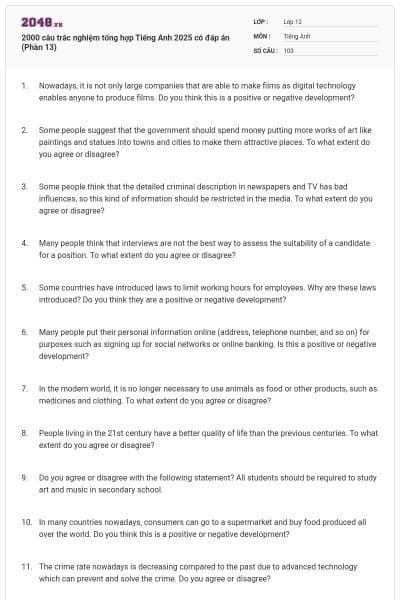
2000 câu trắc nghiệm tổng hợp Tiếng Anh 2025 có đáp án (Phần 13)
103 câu hỏi
Sample 1:
In today's world, the ability to create films is no longer monopolized by large corporations, thanks to the accessibility afforded by digital technology. While some argue that this shift may have adverse effects, I firmly believe it should be viewed as a positive development.
Admittedly, there are significant drawbacks to the democratization of film production, the most prominent being a potential decline in product quality. When anyone can produce films, there is a lack of stringent selection or screening processes seen with professional companies. This can result in the proliferation of low-quality films, lacking in timeliness or professionalism, ultimately disappointing audiences and tarnishing the industry's reputation. Additionally, independent film production can lead to copyright and intellectual property management issues. Without oversight from large production companies, managing these aspects becomes challenging, potentially resulting in copyright infringement, legal disputes, or ethical violations, eroding trust within the industry.
However, despite these drawbacks, the benefits outweigh the concerns. Firstly, it brings diversity and unique creativity to the film industry. With individuals and independent groups contributing, each brings a distinct perspective, fostering a range of works that reflect society's multidimensionality. This diversity enriches audiences' experiences, broadening their understanding of the world. Secondly, the widespread use of digital technology in film production provides equal opportunities and wide access for everyone. Removing financial and technical barriers allows individuals and groups with limited resources to express themselves and share their stories, fostering development and creativity in the industry.
In conclusion, while challenges such as quality concerns and copyright issues exist, the democratization of film production should be celebrated for fostering creativity and providing equal opportunities and access for all.
Sample 2:
Thanks to the advancement of digital technology, it is now possible for almost anyone to make a film. Personally, I think this is a positive development, and will discuss the issue in the following essay.
Firstly, with the advancement of personal electronic devices, such as smartphones, computers, and digital cameras, making films is now reasonably simple for many people. This advancement has therefore allowed film-making to become a hobby and creative outlet for many people around the world. There are even many apps available these days that allow people to shoot and edit short films on their smartphones, and then upload the content to social media and other platforms for people to see. Secondly, producing films is not only a hobby for some people, but also a passion and a career goal. Now, with such technology available, even those who do not have the opportunity to formally study filmography at university, or those with a natural talent for film-making are able to follow their dreams.
Besides being beneficial for those seeking creative expression, this development is also positive in other ways. In the past couple of decades, Hollywood movies have become repetitive and boring for many people, and thanks to the development of technology, many creative directors and film-makers who may not have been able to produce their films or release them to the mainstream public are now able to thanks to the internet and digital technology. This has allowed for a greater diversity of films and videos for people to see. And finally, technology has now allowed people to create documentaries about important issues in society and publish them online to inform people about pressing issues, such as the environment. In the past, what films and documentaries people were able to see was limited to what was produced by large film producing companies, whose main concerns were making profits.
In conclusion, although there may be some minor drawbacks of this development, they are far outweighed by the benefits that it brings.
Sample 3:
Small firms are gradually being recognized for the films they produce as technological advancement becomes more significant. In my opinion, this development could have both positive and negative consequences in equal measure.
On the one hand, the ease with which films can be created these days brings certain benefits to both the film industry and society. First, since an increasing number of filmmakers are able to make movies with the help of digital technology, it brings more diversity and novelty to the movie market. A level playing field, hence, would be created to provide either small filmmakers or movie tycoons with equal opportunities. In fact, more and more Oscars and Cannes have been awarded to a myriad of low-budget producers. Second, the rise in film production creates more jobs, reducing unemployment. For example, the proliferation of film production requires an abundance of actors, actresses and film technicians.
On the other hand, audiences might be burdened with some drawbacks of this digital development, specifically the content and quality of the movies. Unlike cellulose films, films which are recorded on computers and distributed through the Internet seem hard to censor. Viewers, consequently, may be bombarded with a wide range of low-quality movies. Moreover, with the ease of producing films, there is a higher chance of movies containing offensive scenes, thereby accidentally causing certain groups of people to become victims of social criticism. The LGBTQ+ community is transformed into antagonists in some Indian Bollywood productions.
In conclusion, as digital equipment is widely accessible, I believe there will be a variety of equal opportunities for small and big film producers, and the unemployment rate in a country would decrease. However, the ever-rising offensive content and the downturn in movie quality are considered as two main problems arising from the development.
Sample 4:
Due to the progress in digital technology, nearly everyone can now engage in filmmaking. In my opinion, this constitutes a favorable advancement, which I will elaborate on in the subsequent essay.
Firstly, with the advancement of personal electronic devices, such as smartphones, computers, and digital cameras, making films is now reasonably simple for many people. This advancement has therefore allowed film-making to become a hobby and creative outlet for many people around the world. There are even many apps available these days that allow people to shoot and edit short films on their smartphones, and then upload the content to social media and other platforms for people to see. Secondly, producing films is not only a hobby for some people, but also a passion and a career goal. Now, with such technology available, even those who do not have the opportunity to formally study filmography at university, or those with a natural talent for film-making are able to follow their dreams.
Furthermore, apart from benefiting those in search of artistic expression, this progression also yields positive outcomes in various aspects. Over the past few decades, Hollywood productions have grown repetitive and monotonous to many viewers. However, thanks to technological advancements, numerous creative directors and filmmakers who might have previously struggled to produce or distribute their works to a wider audience can now do so through the internet and digital platforms. Consequently, there is now a wider array of films and videos available for consumption. Moreover, technology enables individuals to create documentaries addressing crucial societal issues and share them online, thereby raising awareness on pressing matters such as environmental concerns. Previously, access to films and documentaries was largely restricted to productions by major studios primarily driven by profit motives.
To summarize, while there may exist minor drawbacks associated with this trend, its benefits far outweigh them.
Sample 5:
It is an inevitable and irreversible trend, nowadays, the movie industry has brought large impact on societies across the globe. It is observed that not only giant enterprises are making movies today but also anyone who can access digital technology can make motion pictures. It could be regarded as a progressive approach; the reasons for which are the advent of technology and quality production at an affordable cost.
The foremost aspect to be considered in this context is that a wide range of talented artistes can make spectacular movies. To elaborate, with the advent of modern technologies people can utilize varieties of gadgets and software applications to make movies, even if they are not well- equipped with modern high-cost gadgets. Talented film aspirants have been making short films by the use of simple low-cost gadgets. This is an ideal example in this regard. The contributions, as a consequence, to the film industry around the world are likely to be increased by the use of digital technology by unreputed talented artistes and artists.
Another notable factor is that the quality and standard of films that are made with the help of modern digital technology is unparallel compared to the films which are produced from traditional way and technology. To make it clear, people are adaptive with respect to the changing paradigm shift, and they would always like to watch modern film making rather than the traditional way of making movies. To cite an example, films that are made with the help of digital technology have collected huge amounts of money since such blockbusters are widely accepted by the audience around the world. Films that are made, as such, with the help of digital technology have excellent standards and are widely accepted.
Overall, having analysed the positive aspects of trend, it appears to me, in all likelihood, that not a huge number of talented artists can make films but also the standard of films production can be improved by using digital technology in movie production. Had digital technology become more popular, it would have produced an inexplicable revolution in the entertainment industry.
Sample 6:
The democratisation of film has led to greater opportunity as well as fears as to the future of filmmaking. In my opinion, this is a largely positive development as it opens up the medium for a more diverse range of socieconomic voices.
The main reason that film purists resist the digital revolution is it brings down the quality of films. A good example of this is when digital film first burst onto the scene and started to replace film around the turn of the century. The initial complaints from viewers were that the film looks better and digitally shot movies have a cheap aesthetic akin to a soap opera. As digital film has proliferated beyond studios looking to cut costs, it has exponentially increased the number of films made by amateurs. This naturally leads to movies with bad acting, clumsily written dialogue and poor overall production values.
Despite the admitted cons listed above, digital film has given a voice to less wealthy filmmakers who tend to be of a different class and ethnicity. There are countless examples of students who film digitally, post their video on YouTube and become internet sensations. Many of these new perspectives are outside of the predominantly white, male, heterosexual homogenity of Hollywood. It is increasingly possible for LGBT themes to surface in these shorts and for ethnic minorities around the world to break through. The most striking evidence is simply comparing the major movies made 50 years ago with the diverse range of cinema on offer today.
In conclusion, although there are drawbacks in terms of quality those are mitigated by novel themes from underrepresented demographics. Studios should pay heed and relax their control over an ever-promising industry.
Sample 7:
Unlike many years ago when cinematography was exclusive to large companies, films made by individuals using their own devices have enjoyed increasing popularity in recent years. I am of the opinion that this is more likely to have positive consequences.
The fact that filmmaking is increasingly more accessible has helped add variety to cinematography. Movies made by big companies, on the one hand, are restricted to a handful of themes and backgrounds, several of which are even heavily censored. On the other hand, films made by potential filmmakers, albeit amateur, transcend barriers of ethnicities and backgrounds. Around 400-500 movies are made by Hollywood every year, many of which are Americentric and revolve around superheroes, romance, thrillers and comedies. Meanwhile, with a phone sitting in our pockets and film editing applications at our disposal, that number can add up to millions, with more themes covered and a great array of settings shown.
Additionally, easy access to filming technology helps discover hidden talented people. Thanks to video-sharing platforms such as YouTube or Facebook, several unknown people have attained resounding success just by one or two short films. In Vietnam, for example, a lot of amateur movie-making teams have become overnight sensations by posting short comedies and web dramas onto their sites. Although those films are low-budget, they are well–received by the general public, and many aspiring actors, actresses, and directors are discovered and eventually shot to fame. The Sundance Film Festival, once a low-profile venue for small-budget creators, has become a media extravaganza for new talents now that more and more independent movie creators are able to make films using their own devices.
Inconclusion, my firm conviction is that the widespread popularity of amateur films thanks to the advent of technology is a welcome trend, for it adds spices to the film industry and promotes aspiring individuals wishing to pursue professional film careers.
Sample 8:
The contemporary era is an era of modernization. In the past, due to the lack of technological progress, only large production companies could make films. However, this is no longer the case in the modern world. Small business firms or even individuals can also produce films. In my opinion, this is a positive development both for the country and for the trainees. Therefore, I will explain the positive effects of this modern phenomenon in the following essay.
To commence with, the expansion encourages the creation of new companies. To be more specific, more talented teenagers are willing to start their own field, thus avoiding the elite leaving the countries and hence boosting the national economy as a thriving film industry can boost a country's position in the international market. Moreover, the film is an indicator of public morality. If film production becomes active, the social morale of the nation will improve. For example, the popularity of Hollywood film companies not only better entertains locals in America, but also encourages foreign immigration.
Furthermore, the growth in the number of small film studios is expected to reduce the unemployment rate in the country. For example, unemployed people can start a film directing business if they are interested in acting. In addition, it gives more opportunities for young actors and actresses to express themselves on the screen. On the other hand, cinema is seen as an art form and entertainment. With the positive development of the film industry, the culture and traditions will be strengthened and thus provide the best national rating in the world.
To conclude, the evolution of the film industry could nurture more elites and young talented teenagers to participate in captivating films, which could then reduce unemployment and boost social morality and the nation's economic market. Therefore, this new trend is increasingly recommended as a positive achievement.
Sample 1:
The idea of investing government funds in placing more works of art in towns and cities to enhance their appeal is a topic that prompts varying opinions. While there are merits to this proposal, I still strongly disagree with this suggestion.
Advocates of this notion argue that art installations in public spaces can significantly contribute to the aesthetics and cultural richness of towns and cities. They may well argue that such initiatives can create visually pleasing environments, possibly fostering a sense of community and attracting tourists. Furthermore, public art can serve asc, heritage, and values, promoting a sense of pride among residents. This can be seen in Vietnam where several sculptures of heroes and historical figures are displayed in squares or roundabouts so that their citizens can remember the contributions made by those people.
Nevertheless, I am firmly against this policy for reasons related to the deterioration of artworks and the presence of more pressing issues. Regarding the former, exposure to harsh weather elements like rain, snow, and sunlight can cause fading, corrosion, or other forms of damage to the artworks, thereby reducing its aesthetic appeal. This issue may be exacerbated due to acts of vandalism or graffiti on these installations which can significantly diminish the visual appeal and overall impact of art pieces. Another argument is that there are more pressing issues that demand government attention and financial resources. Focusing on art installations might be seen as a luxury expenditure rather than addressing the immediate needs of the population.
In conclusion, while the idea of enhancing towns and cities with more art installations might seem appealing at first glance, it may not be the most prudent way for governments to allocate limited resources.
Sample 2:
The proposal to utilize government funds for the incorporation of artworks such as paintings and statues in urban areas, with the aim of augmenting their allure, has gained support in recent years. While I recognize the underlying rationale of this perspective, I argue that other facets of urban development should take precedence over enhancing the attractiveness of these areas.
Indeed, there are valid reasons to advocate for government-sponsored art in cities. Artistic installations in public spaces can dramatically transform the aesthetic and cultural landscape of an area. They serve as symbols of cultural identity, reflecting the history and values of the community. Art in public spaces also provides accessibility to cultural experiences for a broader demographic, breaking down the barriers of traditional art galleries and museums. Cities like Barcelona, adorned with Gaudí's architectural masterpieces, exemplify how art can become a cornerstone of urban identity and appeal, drawing tourists and locals alike.
However, the appeal of urban areas relies on more than just aesthetic enhancements. Crucial aspects like infrastructure, green spaces, and public services play a pivotal role in making cities livable and attractive. Efficient public transportation systems, well-maintained parks, and quality public services are fundamental to the daily lives of residents and can significantly impact a city's appeal. For instance, the attractiveness of cities like Vienna and Copenhagen is not just thanks to their artistic heritage but also their emphasis on high-quality public services and sustainable urban planning. Therefore, while art can enrich urban spaces, the allocation of government funds should prioritize these essential elements that directly impact the quality of life and functionality of a city.
To conclude, although the integration of art in urban spaces has its merits, I maintain that government funding should be more strategically directed towards improving fundamental urban infrastructure and services. These elements are crucial in enhancing the overall attractiveness and livability of towns and cities, far beyond the aesthetic contributions of art alone.
Sample 3:
Some people suggest that in order to improve the quality of life in cities, more state budget should be spent erecting monuments and providing paintings. However, in my opinion, this does not seem to be a practical idea.
First and foremost, the construction of monuments and statues occupies not only significant financial resources but also large quantities of land. Paintings, while perhaps not taking up much space, demand frequent preservation from deterioration due to natural damage. Offering more works of art is an interesting idea to help promote the living space inside cities, but not at any cost, especially when urban land funds are becoming increasingly scarce. Meanwhile, to enrich the cultural and spiritual life of a city, there are other feasible and more long-term measures, including developing sport centers, museums, libraries, and bookstores.
Moreover, the government is also presented with other priorities, such as infrastructural, medical, and environmental issues, to name but a few. Building, maintaining, and upgrading traffic infrastructure, for instance, requires substantial allocation. The need for advanced medical centers is also enormous, particularly in the context of post-COVID health decline across the community. Formulating and implementing environmental policies is yet another urgent task, given the accelerating threat of climate change. All of these are among the pressing issues to be addressed if life quality in cities is to be enhanced.
In conclusion, although many people emphasize the need to supplement city life with more pieces of art such as statues and paintings, I rather doubt the practicality of this notion, considering, first, the resources it would require and, second, other priorities.
Sample 4:
In contemporary urban planning discussions, the idea of governments investing in public art to enhance the appeal of towns and cities is a topic of ongoing debate. While some argue that this strategy can contribute to more attractive and culturally rich urban spaces, I disagree with it for several reasons below.
On the one hand, proponents argue that public art installations can transform mundane urban environments into vibrant and aesthetically pleasing spaces, thereby attracting tourists and residents alike. For instance, cities like Barcelona and Paris have successfully integrated public art into their urban landscapes, creating open-air galleries that not only attract tourists but also provide locals with a sense of pride and cultural identity. By showcasing local artists' work or representing the city's history through sculptures, towns and cities can cultivate a unique character that resonates with both residents and visitors.
However, I argue that allocating public funds to art installations might not necessarily address the urgent needs of a community. Specifically, many towns and cities grapple with critical issues such as poor infrastructure, insufficient healthcare facilities, and limited educational resources. This makes prioritizing the creation of public art undesirable since these crucial aspects form the backbone of community development and directly impact residents’ well-being. Additionally, the subjective nature of art could make it challenging to ensure widespread public appreciation and engagement. In other words, different individuals might have diverse tastes and preferences when it comes to artistic expressions, potentially leading to a lack of consensus within the community or even a public backlash.
In conclusion, I firmly believe that governments should not invest substantially in erecting works of art in metropolitan areas as the subjective nature of art might not ensure widespread public appreciation while more pressing social concerns deserve further funding.
Sample 5:
Today, there is an ongoing discussion about whether the government should invest in art and statues supposedly to improve the quality of life in cities. In my opinion, investment in art and culture is essential to a functioning society.
It has been said that a problem with funding art paintings and statues is that it takes away money from more essential infrastructure projects. It might be argued that issues like poverty and pollution are much more urgent and affect the economy in a more profound way. For example, great wealth inequality as well as poor air quality could lead to greater crime and worsening mental health issues for those in the lower social strata. Hence, instead of focusing on art and culture, some may suggest that the money be used for creating more opportunities for disadvantaged people.
On the other hand, I argue that an appreciation for art and culture, reflected in things such as paintings and statues, is essential for a cohesive society. While bread and butter gives individuals a means to survival, art and culture could be said to provide people with meaning that extends beyond mere subsistence. Societies where people only work and are unaware of the history and culture reflected in cultural artefacts, I argue, would have no means of expressing a collective identity. Since humans can only see ourselves within a larger context, be it historically or culturally, investment in these areas is necessarily essential to well-being.
Overall, therefore, I believe that while there are economic arguments against funding art projects and statues, I believe that they give people meaning and as such are essential to a healthy society; it is thus vital that governments continue to protect these artifacts.
Sample 6:
Some feel governments should invest more in public art in cities to boost the quality of life. Personally, I am in disagreement with this idea because it has little actual importance for the average citizen.
On the one hand, public art beautifies a city. A city stripped of all art gives off the dreary appearance of being purely for utilitarian value and the daily rigour of work. In contrast, cities that have invested heavily in public art, such as New York City, offer their residents a beautiful and inspiring home. A child who sees sculptures and murals walking home will feel the city is a nicer place to live and workers passing by works of art will have some emotional relief from the demands of the day. This not only builds up the character of urban areas for local inhabitants and instills a sense of pride, but also attracts tourists and professional artists to the city, both of which contribute to a vibrant city.
Nonetheless, public art has little quantifiable positive value. Most city-dwellers are too engrossed in their hectic schedules to notice public art. This art, therefore, means nothing to most locals, while also diverting an outsized share of a city’s budget. There are other more vital areas requiring development such as high-end infrastructure, well-rounded healthcare systems, and modern recreational facilities. Moreover, the public space used to house these works of art cannot be used for practical purposes including critical public facilities like restrooms, bus stops or parks. Those who rely on these other facilities will have more trouble finding them and their quality of life may be somewhat impacted by a preference for art.
Despite the aesthetic value of public art, government bodies should focus more on urban issues that truly matter to their constituents. There must be a degree of balance, but it should always tip more towards pragmatic concerns.
Sample 7:
It is often argued that government funding should be allocated to artworks in public spaces. While this argument seems relatively reasoned in aesthetic and social terms, I assert that this money would be more beneficially invested elsewhere.
Proponents of the given notion may rationalize that large-scale sculptures or statues can serve as decorations or even landmarks, enhancing the overall appeal of their cities or towns. As a result, they can create hotspots attracting both locals and visitors, fostering social interactions and a sense of community in the whole area. Such art pieces, nonetheless, may not accomplish these intended objectives, possibly attributable to their subjective nature. The public may not express advocacy, but even opposition, towards abstract murals or installations that challenge societal norms, making expenditures in art unnecessary and wasteful.
Under this line of reasoning, I contend that the state budget should be spent on areas more essential than art. Healthcare would be one of them because, despite its pivotal role in citizens' well-being, it may be underfunded. If received more proper funding, hospitals would mitigate overload while constructing more modern facilities and equipping sufficient medical devices, thereby contributing to better public health. Education is another area more worth the investment than public art. A large number of children, especially those in rural or mountainous areas, lack proper schooling, consequently perpetuating poverty and hindering economic growth. Hence, what the authorities should be doing to alleviate such issues is allocating sufficient resources to ensure equitable access to education for all individuals.
In conclusion, while public art potentially brings a few minor virtues to societies, I would argue that the national budget should instead be directed to more vital services including healthcare and education, facilitating a more comprehensive social development.
Sample 8:
Investing public funds in the placement of more works of art, such as paintings and statues, in towns and cities is a topic that sparks debate. While some argue that this enhances the aesthetic appeal and cultural vibrancy of urban areas, I am inclined to disagree with this proposition to a certain extent.
On one hand, supporters of government spending on public art argue that it transforms cities into visually appealing and culturally rich environments. Art has the power to stimulate creativity, spark discussions, and foster a sense of community identity. For instance, cities like Barcelona, known for its public art installations by artists like Antoni Gaudí, have become global tourist attractions. The presence of such artworks can contribute to a city's unique character and attract visitors.
However, it is essential to consider the opportunity cost of allocating public funds to art projects. Towns and cities often face pressing issues such as inadequate infrastructure, education, and healthcare. Channeling funds into art installations might be perceived as a luxury when basic needs are unmet. For example, a city struggling with traffic congestion or a shortage of affordable housing might be better served by prioritizing infrastructure projects over aesthetic enhancements.
In conclusion, while the inclusion of art in urban spaces can undoubtedly contribute to cultural enrichment and tourism, governments must strike a balance. Allocating substantial funds to public art should be approached cautiously, considering the prioritization of pressing needs that directly impact the well-being of the residents. Achieving a harmonious blend of aesthetics and functionality should be the ultimate goal in enhancing the overall appeal of towns and cities.
Sample 9:
The debate on government spending in urban areas often centers around whether to prioritize artistic projects or essential infrastructure. This essay will explore the merits of investing in art to enhance city life against the imperative need for practical urban development, aiming to find a balanced approach to government expenditure.
Proponents of this perspective argue that art infuses cities with cultural vibrancy, thereby elevating the quality of life for residents. For instance, in Hanoi, the installation of murals depicting traditional Vietnamese stories has transformed mundane walls into sources of national pride and tourist attraction. These artistic endeavors not only beautify urban landscapes but also foster a sense of community and historical continuity. However, while the aesthetic and cultural merits of art are undeniable, the question of its prioritization over more pressing urban needs remains contentious.
However, I believe that the government's primary focus should be on addressing more immediate urban issues. Infrastructure improvements, for example, are critical in cities like Ho Chi Minh City, where frequent traffic congestion and inadequate public transportation systems pose daily challenges for millions. Investing in better roads, public transport, and urban planning would not only enhance the functional efficiency of cities but also contribute to the well-being of its inhabitants in a more tangible manner than art installations.
In conclusion, while the incorporation of art in urban spaces can undoubtedly enrich the cultural tapestry of a city, it is imperative that such aesthetic considerations do not overshadow the essential infrastructural developments that directly impact the daily lives of city dwellers. A balanced approach, prioritizing functional necessities while also celebrating artistic expression, would be a more prudent course of action for government spending.
Sample 10:
It is believed by some that governments should allocate funds to install more works of art, such as paintings and statues, in towns and cities to enhance their attractiveness. Although there are certain arguments against this viewpoint, I believe that such an initiative should be put into practice.
On the one hand, opponents argue that more practical and immediate needs, such as infrastructure, education, and healthcare should receive greater allocation of the national budget, which is often limited in most countries around the world.
Obviously, these areas are vital for a country to function well and have a direct impact on the well-being and livelihood of citizens, whereas art may be considered as a kind of luxury that serves the sole purpose of enhancing the aesthetic appeal of a city.
However, the economic benefits that public art brings to a country should not be downplayed. Sculptures or statues can turn towns and cities into vibrant and culturally rich spaces, and such aesthetically pleasing cities are more likely to not only boost tourist activities but also attract businesses and investors, thus contributing to the development of the local economy and generating more employment opportunities.
In this way, the indirect economic advantages of public art can offset its initial costs and contribute to the overall prosperity of citizens’ lives.
Moreover, public art functions as a vehicle for expressing and enriching culture. When governments integrate a variety of artistic expressions into public spaces, they actively contribute to shaping the cultural identity of a community. This exposure to a range of art forms serves as an educational and inspirational experience for residents, nurturing feelings of pride and fostering an appreciation for cultural diversity.
In conclusion, while there are reasonable concerns related to the allocation of limited resources, the benefits of public art in enhancing the cultural and economic fabric of a community are adequate compensation for the initial costs involved in setting up art projects in cities and towns.
Sample 11:
It has long been a debatable issue whether governments should spend on the beautification of towns and cities through works of art, like statues and paintings. I agree with the given statement and in the following essay I will put forth my views in support of my argument.
Art has always been an inseparable part of our lives as it helps us express ourselves and instills happy feelings in us. Putting up statues or sculptures in open areas gives an opportunity to people to enjoy it and acts as a distraction from the monotony of everyday activities. Research has proved that appreciating art helps people relieve stress. In addition, during tough times, people need some form of art to release tension. It could be through music, dance, painting, etc. Having sculptures, statues or murals in public places gives an access to people from all strata of society to enjoy art and refresh their mind.
Moreover, installing statues in public places is not only a way to commemorate a famous historical figure, but also is an interesting way for children to learn about the history or the accomplishments of that person. India has a rich culture and history and in most of the towns and cities there are statues of famous persons or those depicting historical events. For example, in my hometown, there is a statue of Dr. B.R Ambedkar. Everyone who passes by that statue reads about him and the children are fascinated by it and know all about Dr. Ambedkar.
Another added advantage is that statues become a tourist attraction and people like to visit places which have a rich history, art and culture. This helps the local business and thus, helps make the economy of the place better. For example, the Rock Garden in Chandigarh has modern sculptures made of trash, which attracts a lot of tourists from all over the world.
No doubt, the government should focus more on other more important issues, like poverty, unemployment, illiteracy, etc. However, art should also not take a backseat and should be focused on to make the cities and the country more beautiful and attractive, for the residents and for those who visit.
In conclusion, I would reiterate that art cannot be separated from our lives and importance should be given to making a place more appealing, by installing works of art, like sculptures, statues and paintings in public places.
Some people think that the detailed criminal description in newspapers and TV has bad influences, so this kind of information should be restricted in the media. To what extent do you agree or disagree?
Sample 1:
Today, it is often argued that elaborate descriptions of criminal activities on printed newspapers and social media should be limited because of their numerous adverse effects. Personally, I disagree with this notion and will offer my opinion in the following essay.
Granted, there are several drawbacks of displaying detailed criminal information in the media. Firstly, the descriptions of brutal and serious offences could promote a strong sense of insecurity and anxiety among the general public in society. Consequently, many people may feel disinclined to socialize with others around or help strangers in need, especially those they think are potentially suspicious, which may render the community less close-knit and more cold-hearted. Secondly, elaborate criminal descriptions could adversely affect offenders to a great extent even after successful rehabilitation programs. This is because the human mind is capable of remembering detailed information of criminal acts people abhor, which possibly prompts them to still harshly discriminate against ex-offenders.
Nevertheless, I would argue that elaborately provided criminal descriptions are of huge benefit to the tightening of social security. On being publicly shown to the masses, these depictions can inform citizens of meticulous or intricate forms of illegal acts. Therefore, people will be encouraged to take more precautions or equip themselves with necessary tools to avoid such undesirable situations. For instance, thanks to the detailed reports of widespread crimes over the past few years, some Vietnamese households have already begun to install surveillance cameras and alarm bells which can timely alert these families to cases of thefts. Without these careful criminal descriptions, they might have been unable to take such appropriate measures to prevent serious offences.
In conclusion, despite the view that restrictions on showing detailed criminal descriptions in the media should be imposed, it is my firm conviction that this type of information would prove valuable to social security in the long term.
Sample 2:
There is a school of thought that believes the media content involving meticulous description of crime could have negative impacts and so it should be limited. From my point of view. I agree that this type of content has more drawbacks than advantages to general viewers.
There are some valid reasons why some accept the presence of criminal content in the media. One proposition is that this type of information could be educational regarding one's security and safety. News concerning crimes or true crime documentaries could educate everyone about criminals' minds and the typical ways a crime is committed, which could help people to be more alert if they ever encounter such dangerous situations. However. these kinds of information could be delivered via a more standardized and textual way rather than gruesome images which could possibly be traumatizing to some.
I would opine that media censorship on meticulous criminal accounts is necessary for the well-being and security of society. Detailed descriptions of unlawful conduct via mass media could unintentionally encourage law-breaking by giving demonstrations or instructions to potential law offenders on how to commit a crime. In many mass shooting cases in the U.S., it is common that the suspects have high exposure to uncensored violent and criminal content. Another justification is this type of information may be triggering to the public. Fear and anxiety could easily be spread within the society when citizens may consider their community unsafe as too many cruel acts are reported.
All things considered, while some kind of criminal content is essential for educational purposes, a meticulous description of law-breaking acts could pose potential hazards to our safety. Thus, it is reasonable that this type of content should be subject to censorship and be closely regulated.
Sample 3:
The advent of diverse multimedia platforms has facilitated the widespread dissemination of detailed information about crimes, including graphic depictions and images, which are readily available to audiences. However, this trend has ignited debates regarding the potential hazards of such content, leading to calls for restrictions. I firmly concur that the drawbacks of this type of content outweigh the benefits.
Access to comprehensive portrayals of crime can indeed offer valuable insights into criminal behaviour and spur individuals to take preventive measures. For example, revealing a serial killer's modus operandi could assist law enforcement in suspect identification and prevention of further incidents, while also enabling the public to adopt protective measures. However, it's crucial to consider the potential psychological ramifications for the public. Instead of graphic depictions, standardised and written methods may serve as a more effective and less distressing approach for raising awareness.
There are, however, profound drawbacks associated with the dissemination of graphic crime content that cannot be overlooked. One of the primary concerns is the potential to induce unnecessary fear and anxiety among the audience. Graphic details of crimes, when widely circulated, can lead to a sense of panic and apprehension in communities, regardless of the low probability of similar crimes occurring in their vicinity. This can result in increased stress levels, decreased sense of safety, and harmful vigilantism. Furthermore, the sensationalisation or over-representation of certain crimes in media can reinforce negative stereotypes about specific groups of people, such as racial or ethnic minorities. This can lead to serious repercussions for these groups, including increased discrimination, harassment, and even violence. For instance, media coverage that disproportionately emphasises the race or ethnicity of a criminal can fuel prejudice and discrimination against members of that group.
In conclusion, while it is critical for the public to stay informed about crime trends and safety measures, the distribution of detailed crime information should be handled responsibly. It should consider potential psychological impacts on viewers and avoid perpetuating harmful stereotypes. In this way, we can balance the need for public safety information with the need to maintain societal harmony and individual psychological well-being.
Sample 4:
The detailed depiction of criminal activities in newspapers and on television has sparked a debate regarding its potential negative influences. I totally agree that such information should be restricted in the media due to its detrimental effects on viewers, particularly vulnerable youths, and the way it aids potential criminals.
One major reason to support the restriction of detailed criminal descriptions is that they can encourage viewers, especially impressionable youngsters, to violate the law. Teenagers, driven by curiosity and the desire to make an impression, might replicate crimes they see detailed in the media. Their vulnerable mentality and lack of experience make them susceptible to such influences. For example, in 2017, a 13-year-old boy in Ohio was arrested for attempting to create a homemade bomb after following a detailed tutorial he found online. This incident underscores how exposure to explicit crime-related content can lead to juvenile delinquency, which can become rampant if left unchecked.
Another reason is that detailed descriptions of crimes can serve as a manual for would-be criminals, complicating efforts by law enforcement to combat crime efficiently. Although the intention behind crime reporting is often to warn the public and educate them on avoiding similar situations, it can have the opposite effect. For instance, during the late 1970s, the "Son of Sam" murders in New York City received extensive media coverage. The detailed accounts of David Berkowitz's crimes potentially inspired copycat killings and hindered the police's ability to gather information and apprehend him quickly. This example highlights the unintended consequences of detailed crime reporting, which can inadvertently assist criminals in honing their methods.
In conclusion, the restriction of detailed criminal descriptions in the media is necessary to prevent the encouragement of illegal activities among young viewers and to hinder the education of potential criminals.
Sample 5:
The increased degree of freedom in media reports has allowed exposure of crime cases to come forth in a detailed manner, which certainly arouses a great deal of concern. In light of this, some people believe there should be restrictions on such information. From my perspective, I agree that censorship should be imposed on the descriptions of crime.
There are several reasons why the focus of newspapers and television on high-profile crimes should be more carefully regulated. The group most affected by the news media's coverage of violence and victimization is crime victims. This is because media coverage that is sometimes viewed as insensitive, voyeuristic, and uncaring can largely violate victims' privacy and inflict their emotional and psychological suffering. Not only that, but the general public also seldom benefits from this exposure to crime details. In fact, these descriptions can not only cause discomfort but also arouse apprehension about the impacts on young people. Besides, it is likely that potential offenders would be instigated and incited to commit crimes, since they might regard detailed media coverage as a form of guidance.
It is undeniable that the coverage of crime cases can be helpful and, in some cases, even healing.
Some would also suggest that the media have the obligation to keep the public well informed about trends in crime. Indeed, the media play a significant role in public safety by keeping citizens
apprised of essential information on criminal affairs, such as new patterns of fraud, ways to assist
victims and measures to prevent crime. However, the extent to which the media can cover about
these cases should be censored carefully by avoiding excessively detailed descriptions, so that they can accurately cover crime stories with the least amount of trauma to the victim and negative
repercussions on the public.
In conclusion, although newspapers and television need to raise the public awareness of key information on crime cases, I contend that restrictions should be imposed on excessive descriptions of details, in order to mitigate the detrimental consequences.
Sample 6:
It is argued that reporting crimes in detail in printed newspapers and on television is detrimental; therefore, it should be limited. I completely agree with this notion since it gives rise to criminal acts and people’s anxiety.
The first reason for my view that crimes should not be reported meticulously is because it encourages viewers to violate the laws. More specifically, numerous teenagers tend to follow or replicate infractions presented with detailed procedures, methods and tools mainly because they have great curiosity, or they want to make a grand impression by proving that they can be better than the person who committed the original crime. For instance, Shinochiro Azima, a 14-year-old student in Japan killed two students in 1997 by cutting off their heads after watching a documentary about an American criminal, the Zodiac Killer, who performed the same acts. As he was being interrogated, he admitted that he imitated this horrible act since he wanted to impress other people. Consequently, this may pose a threat to social stability due to growing crime rates.
Another justification for why I oppose the detailed presentation of crimes via the mass media is that members of the public’s anxiety can be triggered. This is because they may consider their community unsafe and then hesitate to connect with others as too many cruel acts are reported in the media. They would likely feel afraid of being a victim of a potential crime and constantly experience a sense of insecurity. As a result, it could lead to a loose-knit community where people are not willing to support those in need.
In conclusion, I strongly oppose the idea of presenting detailed crime reports in newspapers and television because it provokes more individuals to be driven to crime and arouses people’s apprehension. It is advisable that the details of the crimes should be completely banned to minimise its adverse impacts on viewers.
Sample 7:
The restriction of legal violation scenes shown via media channels should be introduced by the related authorities due to their detrimental impacts. From my perspective, I would express my strong opposition to that suggestion as broadcasting criminal cases through multimedia sites is beneficial in terms of educating citizens and exercising caution in dealing with serious offenses.
On the one hand, the detailed description of crimes in newspapers and on TV would be disadvantageous due to the possibility that people would commit the same criminal acts and display anxiety toward the unsafe society. Regarding the former drawback, showing the wrongdoings of criminals publicly on media networks provides individuals with a clear understanding of how the infringement was conducted, from which they may learn and follow. As a consequence, there are high chances that those people, especially youngsters, would become potential offenders in the future. Not to mention that by televising a myriad of violation occurrences, mental health problems would experience a drastic increase since citizens are prone to develop anxiety toward an unsecured society.
On the other hand, broadcasting more crime scenes on social media websites can be considered a means of education and caution for people. Chief among these is that broadcasting more violations of crimes in combination with their severe punishment plays a pivotal role in eradicating the intention of future offenders. Therefore, the increasing rate of the number of to-be-culprits would be significantly reduced. In addition, by exemplifying in detail the procedure of a breach, individuals would be more well-aware of the feasibility of a criminal case. Thus, they would have a tendency to prepare for approaches to avoid being victims of wrongdoings.
In conclusion, although the display of criminal scenes should be limited due to their potential impact on increasing lawbreakers' and citizens' concerns, I am of the opinion that cases of violation of law should be shown on different media sites to educate and inform people about the risk of those offenses.
Sample 8:
Some people argue that detailed criminal descriptions in newspapers and on TV have negative impacts and should be restricted. In my opinion, restricting the media from reporting on crime in detail is not the solution, and may actually have negative consequences.
Firstly, the media has a responsibility to report on events accurately and objectively, and this includes crimes. Restricting information on criminal activity may lead to misinformation, censorship, and a lack of transparency in the justice system. The media can also play an important role in holding law enforcement agencies accountable by reporting on cases that may have been mishandled or neglected. For example, some countries have implemented regulations that limit the amount of information surrounding criminal cases, including the names and photographs of suspects and victims. As a result, the public has been left with little information about ongoing criminal cases, leading to confusion and rumors about what is happening.
Secondly, the public has a right to be informed about criminal activity in their community. Access to accurate and detailed information can help citizens take necessary precautions to protect themselves and their property. It can also encourage public awareness and involvement in crime prevention efforts. For instance, in a neighborhood with a high incidence of burglaries, law enforcement may provide residents with information on how to secure their homes and property, as well as signs to look out for that may indicate suspicious activity.
In conclusion, while some may argue that detailed criminal descriptions in the media have negative impacts, I believe that the benefits of accurate and transparent reporting on crime far outweigh any potential negative consequences.
Sample 9:
Whenever we turn on TV or read a newspaper, more often than not we can read a lengthy description of atrocious crime, which has become a so-called feature of modern media. I, as one of the common readers, advocate the proposal that such reports should be strictly controlled, if not abolished.
Alarmingly, those criminal descriptions wield adverse influence on the audience, especially fragile youngsters. Due to vulnerable mentality and lack of ample experience, upon contacting violent programmes, those kids are tempted to follow suit, thus breaking the law and such juvenile delinquencies are too often to be ignored. If this trend is out of control, then more teenagers will fall victim to those evil reports.
Moreover, numerous would-be criminals can learn skills of committing crimes from similar cases, also the police find it more formidable to crack down on crimes efficiently. Although the original purpose of crime description is to warn people against offenses and teach them valuable lessons, the fact is that there, indeed, exists a discrepancy between what is desired and what is achieved. The latest research reveals that some habitual lawbreakers have access to criminal skills and even the police's detective methods from TV programmes and newspaper stories about crimes. By contrast, if we restrict strictly the programmes of tackling criminal cases, the ways employed by the police to combat crimes win be kept as the top secret, and it is out of the question to be disclosed to the public, especially those potential offenders.
Granted, criminal content, which is not a usual experience for common, can enhance. the TV rating substantially. Satisfying people's curiosity and adding varieties to choices, those programmes can always attract a larger audience. As for me, however, the overwhelming detriments have overshadowed whatever benefits.
Overall, no matter what excuse media can find for detailed criminal description, there should be a strict regulation to limit such broadcasting. Government and relevant organisations should co-operate fully, guaranteeing healthier circumstances.
Many people think that interviews are not the best way to assess the suitability of a candidate for a position. To what extent do you agree or disagree?
Sample 1:
As the younger generations struggle to apply for jobs, they begin to wonder if holding interviews is the best way to assess candidates. I moderately agree that in some cases, interviews are not the best method.
There are many reasons why people are skeptical about using interviews to examine candidates’ qualities. Firstly, an interview does not fully reflect candidates’ abilities, especially for candidates applying to technical positions in the IT and engineering industries. For these positions, the best way to assess their abilities is through tests, such as programming tests, case studies, or teamwork sessions with other candidates. Secondly, it is hard to evaluate candidates through interviews because they can lie. Many people admitted to having lied at least once, especially when asked about their past experiences or projects. For example, many told recruiters that they significantly contributed to projects that they hardly participated in.
However, I still think that recruiters should combine interviews with other evaluations because they are still efficient. The first advantage is that the interview gives both employers and applicants a chance to see if applicants are suitable for the company’s culture. For example, employers can observe candidates’ manners, dress codes, or attitudes, whereas candidates can see how other workers are treated. Another advantage of interviews is that they are quick and easy to conduct. Most employers will spend only 30 minutes interviewing candidates before usually giving a tour around the workplace. This is also the most direct way to communicate with applicants because both parties can discuss sensitive topics that otherwise would be inappropriate to touch on, such as salary, benefits, or workplace culture.
In conclusion, I agree that for technology companies, using only interviews as an assessment during their hiring process is not sufficient. However, recruiters should not eliminate or replace interviews.
Some countries have introduced laws to limit working hours for employees. Why are these laws introduced? Do you think they are a positive or negative development?
Sample 1:
Many parts of the world have adopted laws to curb the working hours of workers. This essay will expound on why safeguarding workers’ health is the primary aim of introducing the Working Hours Limit Act, and I contend that this is a negative development because it endangers the economy by challenging small companies operating in a competitive market.
The primary reason for limiting the working hours of employees is that it safeguards the physical and mental health of an employee. Excessive hours of work can cause work pressure, and therefore it can lead to stress as well as physical and mental fatigue, which is likely to develop various health issues. By limiting maximum working hours, nations ensure that workers have adequate time to relax and unwind, thus promoting overall well-being. A case in point is Australia's Fair Work Act 2009. The act has enforced standards by setting provisions for maximum working hours, ensuring that employees are not subjected to long working hours that could drive them to exhaustion.
However, tight restrictions on working hours can pose a real threat to business and the economy. To commence with, businesses that require non-stop operations, for instance, transportation, healthcare, or emergency services, can face enormous challenges in providing emergency services if working hours are severely limited. Besides, industries operating in a fiercely competitive environment, it is inevitable that some companies will go out of business, resulting in an adverse impact on the economy. By way of illustration, consider a small business trying to establish itself in a cut-throat world of business may face challenges if its founders cannot dedicate adequate time to business due to the severe working hour restrictions of employees.
To conclude, although limiting working hours promotes employees’ health, I think this is a negative development because it could adversely affect the business and the economy.
Sample 2:
In response to the evolving dynamics of the modern workforce, several countries have implemented laws aimed at restricting working hours for employees. This essay will explore the reasons behind the introduction of such legislation and opine that it constitutes a positive development.
The primary motivation behind the implementation of laws limiting working hours is to safeguard the well-being and health of employees. Prolonged and excessive working hours can lead to physical and mental exhaustion, increasing the risk of stress-related illnesses, burnout, and decreased productivity. By establishing legal limits on working hours, governments seek to promote a healthier work-life balance and protect workers from exploitation by employers who may demand excessive overtime without adequate compensation. In Japan, the government introduced the "Premium Friday" initiative, encouraging companies to allow employees to leave work early on the last Friday of every month. This aimed to address overwork issues, promoting better work-life balance and reducing stress-related health issues.
I believe it is a positive development as limiting working hours can have broader societal benefits, including reducing unemployment rates and stimulating economic growth. By enforcing regulations that cap working hours, governments create opportunities for more individuals to enter the labour market, thereby spreading employment opportunities across a larger segment of the population. Additionally, shorter working hours can lead to increased spending on leisure activities, contributing to the growth of industries such as tourism, entertainment, and hospitality. As employees have more free time due to shorter working hours, they may choose to spend their leisure time travelling to new destinations, dining out at restaurants, or attending concerts and events, stimulating the tourism, entertainment, and hospitality sectors.
In conclusion, the introduction of laws to limit working hours for employees is a positive development that prioritises the well-being of workers and promotes a healthier work-life balance. By ensuring that individuals have sufficient time for rest, leisure, and personal pursuits, such legislation contributes to overall societal welfare and economic prosperity.
Sample 3:
There has been a drastic increase in working hours in many countries and employees have been pushed to work harder and longer without any additional incentives than their wages. Therefore, many countries have passed new laws to control and legitimate working hours. I believe that it will send a positive message to workers, lifting their morale and dedication towards work and should be considered a positive development.
There are numerous examples, all around the world, where companies are making their employees work longer than normal duty hours. This has led to severe problems including employees feeling immense pressure from their employers to meet targets and deadlines. This is one of the pivotal reasons that employees are more susceptible to illness and stress. Therefore, some legislation is required to curb that, and those new laws that restrict working hours are aimed at achieving exactly that.
Overall, it is a positive development, and those laws have already proved that they are immensely beneficial. Newly introduced rules have substantial impacts on workers' performance and health. These employees have become more responsible and productive. The quality of the work has also increased after applying these rules. In addition to this, people's health conditions have significantly improved. Now they have more time to spend with their family which helped them tremendously mitigate their stress and tensions.
To conclude, I believe that longer working hours have detrimental effects on employees' physical and psychological health and social life. New laws that limit working hours will bring several changes in their lifestyle that would lead them towards a better and more successful professional and social life.
Sample 4:
In response to increasing concerns about worker well-being, several countries have introduced laws to limit working hours for employees. These regulations aim to address a multitude of issues related to health, productivity, and quality of life. In my opinion, these laws are a positive development that significantly benefits both employees and society as a whole.
The primary motivation behind implementing laws to limit working hours is to safeguard employees' health and well-being. Extensive research has shown that prolonged working hours can lead to severe physical and mental health problems, such as chronic stress, burnout, cardiovascular diseases, and depression. For instance, a study conducted by the World Health Organization (WHO) revealed that working more than 55 hours per week is associated with a higher risk of stroke and heart disease. By enforcing legal limits on working hours, governments aim to promote a healthier work-life balance, reducing the incidence of such health issues and improving overall productivity. Furthermore, these laws are designed to protect workers from exploitation. In many industries, particularly those with lower wage levels, employers may demand excessive overtime without fair compensation, leading to worker fatigue and dissatisfaction. By capping working hours, these laws ensure that employees are not overburdened and that they receive adequate rest, thereby fostering a more motivated and efficient workforce.
From an economic perspective, limiting working hours can have positive ripple effects on society. Shorter working hours can lead to increased spending on leisure activities, which stimulates sectors such as tourism, entertainment, and hospitality. Additionally, employees with more free time are likely to engage in further education or skills development, ultimately contributing to a more skilled and versatile workforce. For instance, in countries like Germany, where strict working hour regulations are in place, there is a noticeable correlation between regulated work hours and high productivity levels, as well as economic growth.
In conclusion, the introduction of laws to limit working hours is a positive development that addresses critical issues related to health, worker exploitation, and economic growth. By ensuring that employees have a balanced work-life dynamic, these laws contribute to a healthier, more motivated, and more productive society.
Sample 5:
In many countries, it is common for the state to constrain the number of hours a person can work within any given day. In my opinion, this law is designed to discourage exploitation and is decidedly positive overall.
The main reason the average workday is limited by law is that otherwise companies could take advantage of their employees. The evidence for this comes from past centuries before such laws were passed. Around the beginning of the industrial revolution, it was a common practice in European countries for individuals to work 12 to 16 hours a day. If an employee protested, then they might be fired or even physically harmed. Today, there are very few countries where corporations have the ability to make inhumane physical and mental demands on employees.
Limiting a person’s working laws is beneficial to society as it ensures workers have time for themselves. In countries where these laws do not exist or are poorly defined, there may still be instances of child labor or long working days. For example, in several East Asian countries, factory workers must live and work at their jobs with little opportunity for an outside life. In contrast, in countries with strict labor laws, a person possesses more time for family, hobbies, and friends. Free time is one way of guaranteeing a better quality of life and overall satisfaction, benefits which can have ramifications for society as a whole.
In conclusion, laws related to working conditions protect workers and for that reason are positive. It is also essential that countries enforce the laws they have passed.
Sample 6:
An increasing number of nations have enacted laws to protect average working hours. In my opinion, these laws are meant to limit exploitive practices, and they are advantageous if enforced well.
Lawmakers typically argue these reforms defend employees. Before labor laws existed, it was common for corporations to require long working days under extreme conditions. Modern stipulations that limit working hours are responding to these deeply rooted historic concerns. For example, in many developing nations, the labor laws are often not strict, leading to so-called ‘sweatshops’ where employees work long hours in dangerous environments for little pay. This mistreatment has been exposed in the media and now citizens demand better treatment. The laws therefore establish basic guidelines to prevent employees from working excessive hours.
On the whole, these laws are positive as long as they are nuanced and enforced consistently. There are many countries where such laws have been passed but in practice they are not followed, and workers have little recourse to report infractions. These laws must be strictly monitored, including preventing employers from firing employees who make complaints. Moreover, there are possible exceptions. A factory worker, for example, should never be required to work too many hours as they are likely to earn a low wage and put their health at risk. However, many white-collar workers, such as those at a start-up, may desire to work 90+ hour workweeks due to an overriding passion for a project. The law must discriminate between these dissimilar cases.
In conclusion, labor laws related to maximum working hours are meant to safeguard workers’ rights and are positive generally depending on their execution. It is important that governments propose laws they believe are enforceable and beneficial for the whole of society.
Sample 7:
Legislations restricting working hours for employees have been passed by many governments. The directive is believed to be for the benefits of relevant parties; however, I would argue that the negative effects could certainly overshadow its advantages.
To begin with, the compulsory limit which establishes a ceiling for working time can reduce work pressure on employees and prevent them from being forced to work overtime by businesses. Recent surveys show that the vast majority of respondents prefer to work fewer hours because it means they feel less exhausted, are able to spend more time with family, and focus on themselves. In addition, the possibility of increasing work efficiency also provides a basis for regulating hours of employment. As the regulation was proven to facilitate a relaxed work atmosphere, employees are more motivated and show more enthusiasm at work. This can contribute to the development of the company.
Although the proposed legislation has the potential to achieve the above impacts, the problems encountered may still outweigh them. The first issue is the costs that companies have to bear to ensure business progress in case the daily goals have not been met. The expense includes hiring more part-time employees to make up for non- labor inputs. Secondly, when workers have the same number of working hours, the number of people participating in road traffic during rush hours will increase. For example, since Mexico applied the 48- hour workweek policy, the number of vehicles on the street after work shifts has doubled, and traffic congestion has become worsened tremendously.
In conclusion, while there are some obvious merits to the hour restrictions including lessening stress and boosting productivity, it seems to me that the limitation has caused us more issues due to the national scale of its impact.
Sample 8:
Recently, some countries have brought in laws to limit working hours. I think this decision comes from wanting to protect employees’ health and rights, and it is a beneficial one in many ways.
Firstly, from my understanding, I think this development stems from wanting to improve workers’ health, especially if they’re working in an office environment. Many office workers suffer from health problems such as back and neck pains, migraines, and sleep deprivation. Overworking seems to be the common cause of these problems. By restricting working hours, employees have more time to rest, thus improving their health. Another reason why I think countries introduce this law is to protect employees from being abused by employers. For example, it is common nowadays that marketing agency employees are expected to not leave until meeting their deadlines, which means they work overtime without getting paid.
Regardless of the reason, I think that this is something to be encouraged. Firstly, limiting working hours will help improve employees’ moods as they do not have to overwork anymore. As a result, the relationship between corporations and employees improves, leading to a warmer cooperative attitude. Secondly, although it may come as a surprise, there have been studies showing that productivity is boosted by limiting working hours. These studies point out that working shorter shifts will help employees stay more focused as it does not take as much a toll on workers’ physical and mental health, hence improving productivity for the whole workplace. This is especially true for factory workers, as repetitive motions can cause drowsiness, so limiting working hours keeps their minds sharper.
In conclusion, I understand that countries introduced this law to limit working hours to protect employees’ rights and health. I think this is a beneficial development that needs to be encouraged in many more countries.
Sample 9:
Rules and regulations are made to maintain law and order. Some countries have introduced guidelines to reduce working hours for personnel. I consider reducing their stress and maintaining work life balance.
At the outset, the paradigm shift has made people ambitious and in order to earn a lot, individuals sacrifice their leisure time that they usually like to spend with their family. Thus, they escalate their stress and do overwork and reduce their productivity. Therefore, to relieve their stress, the need of curtailing the working hours is felt. Besides, it becomes a herculean task for them to maintain work life balance. They do not remain cheerful, instead they become accustomed to taking pills in order to have a sound sleep. In this way, their efficiency gets decreased, and this is a great threat to the economy of a company and to make them agile and fertile, setting a limit on working hours is necessary. For instance, it could be seen in developed nations as well as developing ones that individuals do work on vacations and lead a miserable life. They remain perplexed and gradually the knot of relationships gets loose and broken relationships make them depressed and they start to shrink the work and loose their efficiency. So, it is dispensable to let them free early.
Furthermore, it is a negative development because people become money minded, and they do not remain outgoing and valuing relationship is no longer needed for them. So, this kind of trend has adverse effects on the lives of job holders. What’s more, if a company is progressing by leaps and bounds, the whole credit goes to its staff. However, if staff is not optimist and shrinks the work then company is unable to make profit and ultimately, country will not progress owing to incapability of entrepreneurs to pay tax on time.
In conclusion, thus it is mandatory to diminish the working hours for the well-being of its employees as well as for the advancement of a company. Satisfying the needs of personnel is the first goal of a company and if they were showing remarkable performances in a specific period of time, then introduction of rules is commendable task of the governments.
Sample 10:
Nowadays, employees have been pushed to endeavour harder and longer in some developing countries. Hence, several countries have enacted laws to restrict working hours. There are numerous motives why the law is needed, which I will discuss in this essay. I believe that restricting the number of hours worked is a positive development for everyone.
One evident reason to present a law to limit working hours is to reduce the companies which set their labourers to work longer than normal duty hours. For instance, the employees obtain jobs over time to elevate their production by spending the same expenditure. However, workers are feeling immense pressure to meet targets and deadlines. Furthermore, another one of the pivotal reasons that employees are more susceptible to illness is primarily their unhealthy lifestyle. In particular, employees who do not have sufficient time to relax or sleep, which can put them at risk of suffering sanity problems, and it leads to spending more money on medical treatments.
There are also benefits to enforcing rules which have substantial impacts on workers’ performance and health. Employees are able to perform the job carefully, which helps prevent potential hazards affecting their safety and that of their surroundings. An illustration, if the employees are responsible to handle hazardous chemicals, it can be deadly if they cannot dispose of it according to the steps or procedures in the guidelines. In addition, people who cut their performance hours will have significantly improved their health conditions. For example, they have more time to stay with their families which helps them tremendously mitigate their stress.
To sum up, excessive works have detrimental effects on the workers’ physical and psychological health. Limiting work hours will bring several changes in their lifestyle that would lead them towards a better and successful life.
Sample 11:
In many countries, governments have enacted restrictions on working hours for jobholders. This essay will discuss the possible reasons why these acts came into force and suggest that this is a positive development because it reaps various benefits.
To commence with, prolonged working hours have been on the rise for many years, resulting in a growing number of employees developing health issues related to work pressure. It is also associated with the mental and social well-being of employees. Every year, long working hours lead to many early deaths from cardiac arrests and ischemic heart disease. For example, in an international study of the loss of life and health associated with working long hours, ILO and WHO joint estimate reveals that around half a million people, in 2017, died from stroke as a result of having worked at least 52 hours a week. The COVID-19 pandemic had also worsened the situation. A case in point is a study of 4.2 million employees from Latin America, Australia, and Europe in 2019, which shed light on the fact that the average working hours had risen by 52.4 minutes. Therefore, there is a justification for states to introduce laws to prohibit long working hours.
Defined working hours laws are a positive development as they prove advantageous to employees and employers. In simple words, reducing working hours helps employees devote their spare time to their family and friends, thereby establishing a healthy personal and professional life. It also enhances their performance and job loyalty which benefits employers. Apart from that, it reduces unemployment. When employees work for limited hours, the necessity of increasing employees to make up for the fewer working hours emerges, which brings down unemployment. It is, therefore, evident that legal maximum working hours is a positive development.
To recapitulate, severe health, social and psychological issues caused by indecent working hours have provoked the authority to adopt laws to limit working hours. It is a positive development as these laws confer various advantages to workers as well as employers.
Sample 12:
There are countries in the world such as the USA, Canada, Australia and many more where a person cannot work for more than 40 hours a week. In my opinion, it is a positive development. In the following paragraphs, I shall discuss why this law was introduced and my arguments to support my views.
This law was mainly introduced to protect the economic rights of the workers and prevent exploitation. It is seen that in places where there is no such law, employees are exploited and instead of normally working from 9 am to 5 pm, they are made to sit in offices from 9 am to 9 pm at no extra pay. Many other benefits of this law such as improvement in the physical and mental health of the employees and better family relations automatically followed.
This law is beneficial because, in this fast-moving world of today, people have become workaholics. In order to satisfy their material desires, they forget to draw a line between work and family. If working hours are fixed, then they have enough time for their family life and leisure. Secondly, overworking leads to stress and can lead to nervous breakdown in extreme cases. People also find time for their regular exercise if working hours are fixed.
Furthermore, having a limit on working hours also helps solve the problem of unemployment. A larger number of people working for a fixed number of hours is better than a lesser number of people working more hours. What is more, it has been proved by researchers that having a limit on the working hours increases the output and productivity of employees. This could be a win-win situation for both the employer and the employee. Finally, it can be said that the chances of exploitation of employees are much less if there is a limit on the working hours.
Some people oppose this law by saying that it is an infringement of rights. They say that if a person has the ability to work more, he should be allowed to work. Sometimes a person may need more money for his personal needs, so it is unfair not to let him work more. Nonetheless, it has been seen that in countries where such laws are there, people have a better life, better working conditions, lesser degree of unemployment and better productivity of employees.
To put it in a nutshell, I pen down saying that this law was imposed for the benefit of employees and employers, and it has many advantages.
Sample 13:
Free time allows the person to step back from stress not only physically but mentally as well. Nowadays, few nations are inclining towards reducing employees’ job hours. I will discuss why this law has been established alongside the development it has brought in people’s life.
Commencing with the myriad reasons why this law has been launched. First and foremost, it has established work-life balance in people’s lives. In recent times, the majority of individuals juggle for maintaining equilibrium between home and professional life. For instance, In New Zeeland, Guardian company has adopted for four days work week and found that 78% of their employee strength is able to maintain uniformity in their work and personal life. Thus, it helps people to maintain peace between both worlds. Moreover, it boosts mental happiness among personnel as they will be able to spend additional time with their loved ones and nurture family values. Therefore, it ameliorates family bonds and reduces health issues as people will be content and stress-free.
In my opinion, it is a positive development. Primarily, it has proliferated employee’s productivity level as employees are pleased mentally so they are able to finish tasks with a clear mind. Apart from this, this approach is environmentally-friendly. Multitudes who will travel to the office will be less for a day, resulting in decreased carbon dioxide emission. Also, plastic wastage will be little for a day. Therefore, this perspective is eco-friendly.
In conclusion, curbing working hours has ample merits. However, some service base companies cannot proceed with this technique, but they should try to look for alternatives to achieve contentment among workforces.
Sample 1:
With the advancement of technology, more people are opening accounts for social media and online banking purposes. This has led to the question of whether it is beneficial to put personal information online. I think that, despite the convenience it brings, people should not put their personal information online.
On the one hand, I can understand why people would put their personal information online. Firstly, it makes signing up for accounts much more convenient for users. For example, in the past, to open up a stock account, people would have to go to a stock company and complete lots of paperwork. By providing personal information online, people save time doing these registrations. Another benefit is that this makes signing in to these accounts easier for users. Instead of choosing security questions and remembering the answer for them like in the past, nowadays, users only need to provide their phone number or email address to get verified. This feature is useful when someone is trying to sign in to a bank account during an emergency.
On the other hand, there are multiple problems with readily providing one’s personal information online. The first one is that, by doing so, the user will become a target for not just material but also identity thefts. Social media accounts are prone to be hacked. Once the thief acquires the person’s address, they can easily break into that person's house, especially with other information already posted on social media, like vacation plans. Even worse, they can impersonate the user to claim insurance. On a less serious note, when users give out their information to the social media company or the bank, there is still a slight chance that these companies will sell it to telesales people. There have been reports that some social media platforms, such as Tiktok, collect and sell user's personal information.
In conclusion, although providing personal information makes registration convenient for people, it has to be done carefully since currently, it still does more harm than good.
Sample 2:
In today’s digital era, an increasing number of people share their private details online, such as home addresses and contact numbers, for a variety of reasons including registration on social platforms and internet banking. In my opinion, despite presenting certain drawbacks, this trend is predominantly a positive evolution in our increasingly digital society.
The primary concern with this trend is the heightened risk of privacy breaches and identity theft. As personal information becomes increasingly accessible online, it creates opportunities for cybercriminals to exploit such data. A notable example is the 2016 incident in Vietnam, where the personal information of 50 million Vietnamese citizens was allegedly leaked online, including sensitive details like names, addresses, and identity card numbers. This breach not only highlighted the vulnerabilities associated with online data sharing but also emphasized the urgent need for stronger cybersecurity measures and more cautious online behavior, linking directly to the critical importance of protecting personal data in the digital age.
On the flip side, the digitization of personal information offers more considerable benefits. One of these is the enhanced convenience of everyday transactions and communications. For instance, the rise of online banking in Vietnam, with platforms such as Vietcombank and Techcombank, has transformed how Vietnamese individuals manage their finances, enabling instant transfers and bill payments without visiting a bank branch. Additionally, social networking sites, such as Zalo and Facebook, have overcome geographical barriers, allowing people to maintain and develop relationships irrespective of their physical location. These benefits not only simplify logistical aspects of life but also enrich social interactions, illustrating the positive aspects of sharing personal information online.
In conclusion, while sharing personal details online carries certain risks, particularly highlighted by the Vietnamese example of data breaches, I am convinced that the overall impact of this trend is overwhelmingly positive. It represents a significant leap towards making daily routines more efficient and enhancing social connections, encapsulating the essence of this digital evolution as a beneficial step in leveraging technology to improve our lives.
Sample 3:
Nowadays, it is becoming increasingly common for people to provide their personal details online. Although this practice might facilitate a better user experience, I believe the trend is negative as people will likely be vulnerable to cyber-crimes.
On the one hand, updating personal information online facilitates a superior experience for online shoppers. By associating personal details with exclusive accounts, consumers can make more convenient online purchases. This is clearly exemplified when people shop on e-commerce platforms such as Amazon or Facebook. Because their identity information has already been synchronized with their sign-in accounts during an initial by the first registration, customers can skip the time-consuming data entry and transfer immediately to the final step of making a transaction. Thus, the buying process is expedited, fostering an overall convenient customer experience.
On the other hand, posting personal data on the Internet makes users potentially susceptible to criminal activities. The private information shared online including one’s names, addresses or social security numbers can be exploited for illicit purposes such as financial fraud. For instance, a hacker known as “Hieu PC’ in Vietnam ran one of the Internet’s most profitable and popular services for selling stolen identity records. He utilized his social engineering degree to exploit a wealth of vulnerable consumer data, stealing thousands a sheer volume of social security numbers and reselling them on an anonymous broker’s online platform. This led to a large number of retired workers in the United States losing million-dollar pensions to a sophisticated online hacking scheme.
In conclusion, in spite of some relatively minor conveniences, registering personal details online is a negative development considering the risk of online fraud. In my opinion, governments should establish additional privacy regulations for online shopping firms so as to mitigate security risks and better secure personal identity information.
Sample 4:
It has become common for people to put their personal data online for communicational and financial purposes. In my opinion, the benefits offered by this trend could hardly justify the potential drawbacks.
Admittedly, the trend in question presents certain benefits, chiefly in terms of businesses and services. First, from a consumer’s standpoint, having their personal information registered on social networking and digital banking platforms allows an increased exposure to various service offerings. This is because advanced data technologies enable consumers’ needs to be quickly identified based on their personal input. Thus, a list of potentially suitable service providers can be derived therefrom. Second, from a business’ perspective, a database of consumers’ information may help businesses gain insight into the market situation and make better decisions for their operations. For example, banks often analyse trends in consumer shopping behaviour, thereby devising more targeted marketing schemes which can yield higher sales rates.
However, users may very well find themselves in serious predicaments from putting personal information online. The consequences that may arise from a breach of cyber security can be catastrophic. As has often been the case on social networking sites, unaware users can fall prey to hackers by clicking on links that compromise their security settings. As such, users’ personal data may be extracted and used against their will, for blackmail, property fraud or misinformation. Moreover, there are chances that greedy businesses will commoditize users’ data and sell them to other corporations and industries for a profit. With their personal information in the wrong hands, users may have their needs, tastes and thoughts manipulated by dubious organizations.
In conclusion, despite its conveniences, the practice of putting personal information online proves to be more of a negative trend. The problems resulting from this practice can be more complicated and far-reaching than expected, especially in today’s digital age.
Sample 5:
Today, one of the most common occurrences in the digital world is the availability of personal information online, with people providing their details for daily activities such as social networking or banking. Despite some positivity associated with it, I believe this development is largely negative.
The increased presence of personal information online has produced some benefits. Thanks to this development, it has become easier for people to connect with each other, or in some cases, reconnect. An adult, for example, can find somebody he went to high school with by searching for their name on a popular social media platform. Then, they can catch up with one another and stay in touch after a long period of no contact. Meanwhile, in certain services, it is possible to provide higher degrees of convenience by having more personal information available online. When users have verified their own accounts using private details, banks and e-commerce sites can quickly facilitate transactions, enhancing customer satisfaction and generating profit faster. Indeed, the advantages to having personal information present digitally should not be disputed.
However, the negative implications associated with this tendency are potentially severe. For one, it puts people at risk of having their information abused. This can lead to a sense of insecurity, as there have been individual cases of private details being leaked to malicious parties, who proceed to use the victim’s identity for fraudulent schemes. Another privacy-related concern has to do with the vague possibility of withdrawing personal details from online platforms. Once private information is submitted, there is little guarantee aside from the holder’s word that it can be wiped from the digital world should the user request it. As a consequence, people’s digital presence may end up inseparable from their real lives, providing a way to track their activities and erode their privacy.
Given these points, I believe that many people putting up their private details online is detrimental. It is therefore necessary to be cognizant of the risks associated with this decision, and even more so to take steps to protect oneself.
Sample 6:
The advent of the internet has caused a paradigm shift in how people share about themselves. Many voluntarily put online personal details for networking purposes or financial reasons. This essay will explain how the trend can be more harmful than it is helpful.
The personal choice to post about one's information can make it easier for people to connect with one another; however, it can lead to some privacy threats. On social networking sites, it is more than easy for users to update on which school they go to, where they are working at or who they are hanging out with. Such data feeds to the algorithm which can push people who share common interests to interact with each other, thus expanding their social circle and strengthening the community. Nonetheless, if one is not aware of what they are posting online and accidentally reveals sensitive information, they could fall prey to predators. It is, unfortunately, getting increasingly prevalent to find stalkers lurking in the virtual world, collecting data on their susceptible victims. There is also an increase in the number of blackmailing activities due to lack of digital intelligence.
With data exchange, financial activities would be tremendously more convenient but also awfully more high-risk. By using online banking services, an average person could save a significant amount of time waiting in lines and filling out forms. Additionally, storing passwords along with other data on the clouds can be handy to those who have multiple accounts but a limited remembrance. In spite of that, the detrimental effects are worth being taken into consideration. Identity theft thrives on data leak incidents, where cybercriminals have access to people's identification or bank account. Ransomware poses another threat to unsuspecting users who, for example, provide their information to fraudulent websites identical to legit ones.
To sum up, people who overshare on the web run a high chance of getting themselves in trouble. This is why it is imperative to raise the public awareness on data security and enhance protection software as well as intrusion detection.
Sample 7:
Recent years have witnessed substantial advances in technology with the invention of the Internet as an epitome. An increasing number of Internet users have agreed to provide their personal information to online websites for different daily purposes. Despite the potential risks this tendency may pose, I still opine that the positive aspects are more considerable.
Invasion of privacy and cyberbullying, on the one hand, are deemed the two most major concerns when it comes to the digital age. For instance, one can be easily and constantly bothered by unwanted calls offering different goods and services since his telephone number is publicized, which not only disturbs the recipient’s daily activities but also causes unnecessary irritation, affecting work productivity. There are many other situations in which the credit card information of users has been illegally stolen, resulting in a huge amount of money loss. Another case in point is that many people, especially celebrities, can easily be bullied or harassed by hurtful or threatening comments and messages posted by anti-fans. If their home or company addresses can be found online with just a few clicks away, those people will even have to suffer from batteries in real life.
Be that as it may, the fact that the availability of information online helps facilitate various life aspects should not be ignored. First, daily activities can be carried out with more convenience. A typical example worth mentioning is the delivery service. It can be said that never have people been able to do shopping with such ease. Every purchasing activity can take place online, and buyers only have to provide their mobile number as well as address in order to get their items delivered at door. Governments have also been making use of information public on social media sites to spot and track reactionaries or dangerous criminals so that the safety of society can be ensured. Another example is that during the Covid-19 pandemic, those who evaded the quarantine protocol were all caught by authorities because they often updated their activities on Facebook.
In conclusion, although a person may be bothered or bullied by sharing their personal details online, this trend still benefits each individual and the general public to a great extent as long as the Internet and media literacy are popularized.
Sample 8:
In the contemporary digital era, the proliferation of virtual platforms has led to an increasing trend of individuals sharing personal information online for various purposes. While some people raise concerns about its potential privacy and security breaches, I believe that such an inclination substantially heightens user experience and convenience, making it a positive development.
It is undeniable that the widespread dissemination of personal information might pose significant threats to public privacy and security. Examples of data breaches and identity theft have become alarmingly common, with cybercriminals exploiting defects in online systems to gain illegal access to one’s private information such as bank account passwords. Furthermore, some technology giants are known for violating privacy rights through mass collection of user data to their own advantage. Serving as a prime example, Uber was once accused of secretly tracking the movements of its users, even after their rides, to monitor their locations in real-time without prior consent.
Although the privacy and security risks associated with sharing personal information online are apparent, I argue that these are outweighed by its significant advantages. One of them is the use of location-based services, which enhance user experience by offering relevant and timely content, such as nearby restaurants, shops, or events, that meets individual preferences and needs. Another benefit of sharing personal information online relates to personalized experiences and targeted services. Specifically, many E-commerce websites and digital marketing platforms utilize user data to deliver customized suggestions, advertisements, and promotions, all of which help enhance customer satisfaction and engagement.
In conclusion, while the sharing of personal information online carries potential risks to one’s privacy and security, it is my firm conviction that its huge contributions to user experience and satisfaction make it a positive development in current life.
Sample 9:
In the digital age, the increasing popularity of online platforms has facilitated the seamless integration of personal information into daily activities. While some argue that this trend can bring about a sense of convenience, I strongly believe that it poses more significant risks to privacy and security.
On the one hand, the trend towards sharing personal information online offers unparalleled convenience. When submitting addresses, credit card numbers, and other essential information, shoppers can easily purchase goods and services as well as conduct financial transactions at the comfort of their home. By uploading stories and pictures to Facebook or similar social platforms, individuals can interact with friends and family regardless of geographical barriers. This level of accessibility enhances efficiency and productivity, enabling people to manage their lives with unprecedented ease.
Despite this, there are greater concerns about the potential risks associated with online information sharing. The digital landscape is rife with threats such as hacking, identity theft, and data breaches, which can have devastating consequences for individuals and organizations alike. This issue is further exacerbated by the fact that submitting and saving personal data online leaves individuals vulnerable to surveillance and exploitation by both malicious actors and corporate entities. This erosion of privacy undermines trust in online systems, thereby potentially deterring users from fully engaging with digital technologies.
In conclusion, although the trend of sharing personal information online for routine activities can provide users with convenient experiences, it also exposes individuals to major risks to privacy and security. As such, I take the view that this development is more detrimental.
Sample 10:
In today's digital era, the norm of depositing personal and private details online for banking, shopping, and socializing has become ubiquitous. This essay delves into the ramifications of this phenomenon, particularly in Vietnam, and argues for its overall positive impact despite notable concerns.
The convenience of online transactions and social interactions cannot be overstated. In Vietnam, e-commerce giants like Shopee and Lazada have revolutionized consumer behavior, enabling effortless purchasing and financial transactions from anywhere. This digital accessibility is a testament to technological progress, boosting economic efficiency and fostering social connections. It offers unprecedented convenience, allowing for real-time interactions and transactions that were previously unimaginable. The ability to manage finances, shop, and socialize online has become indispensable, especially in the fast-paced, modern world where time is a precious commodity.
However, the advantages of this digital integration are not without their pitfalls. Privacy and data security emerge as significant concerns, with the risk of personal information being compromised. Despite these valid worries, the positive strides towards a more connected and efficient society are tangible. Particularly in Vietnam, the digital economy's rapid expansion is a clear indicator of the benefits. Online platforms provide vital services, reaching even the most remote areas and offering them access to broader markets and opportunities. The key lies in balancing these benefits with rigorous cybersecurity measures to mitigate risks.
In conclusion, while concerns about privacy and data security are legitimate, the advantages of sharing personal information online - enhancing convenience, economic growth, and societal connectivity - significantly outweigh the potential drawbacks. With strict cybersecurity protocols in place, the digital age's promise can be fully realized, marking a positive development in our increasingly online lives.
Sample 11:
In the contemporary digital age, with the Internet becoming an omnipresent element of daily life, a significant portion of people’s private information is shared online. This development, despite bringing about certain benefits, is an undesirable one, given its serious impacts on individuals’ privacy, finance and psychological well-being.
On the one hand, the advantages of the digitization of personal details are evident. Firstly, sharing personal information on social networks enables individuals to socialize and maintain connections with friends, family, and acquaintances. Social media platforms offer a platform for users to post updates, photos, and participate in discussions, nurturing virtual connections that may be challenging to establish through conventional methods. From a financial perspective, online disclosure of personal information enables individuals to effortlessly have access to a range of online services. For instance, online banking has become more convenient, allowing users to handle their finances, carry out transactions, and keep track of accounts from the comfort of their own homes.
On the other hand, these positive aspects pale in comparison with the more significant drawbacks that these online users have to encounter. One of the most pressing concerns is the loss of privacy, as individuals who publicly disclose sensitive details such as addresses and telephone numbers could become vulnerable to cybersecurity issues. There have been numerous reports in which cybercriminals may take advantage of personal information they have stolen for malicious purposes, which potentially leads to tarnished personal reputation and emotional distress for those concerned. Furthermore, the trend of sharing information on online platforms has become the breeding ground for the rise in identity theft. Online criminals, who may use stolen information to impersonate individuals and gain unauthorized access to one’s bank account, have provoked widespread concerns related to huge financial losses.
In conclusion, while sharing of private information could be beneficial to a certain extent, I am of the opinion that these benefits are outstripped by the drawbacks, as the convenience for social and financial activities is not an adequate compensation for the repercussions on privacy and financial security.
Sample 12:
The digitalized era has revolutionized humans' exchange of information. Personal identifying information such as banking information or phone numbers is made available on the Internet to ease the process of daily tasks. This essay will explain why this trend encompasses both positive attributes and inherent drawbacks.
To commence with, it is argued that the integration of personal information into online platforms can lead to greater efficiency and convenience. In the realm of e-commerce, for instance, many businesses take advantage of the Internet to automate their selling process. Customers can follow the shopping procedures provided by retailers on their platforms, from product research to making purchases without the need to communicate directly. This can save sellers a significant amount of time dealing with thousands of repetitive interactions daily, which can affect their productivity and ultimately profit. Similarly, when it comes to making transactions or opening up new accounts, banks can help minimize the number of steps that users have to go through by getting access to the verified information provided by them before that, providing a seamless and satisfactory customer experience.
Despite the benefits, public disclosure of sensitive data carries a high risk of identity theft. There have been numerous cases where cybercriminals utilize such clues to gain non-consensual access to users' bank accounts to commit financial fraud. Evidence for this can be witnessed in the phenomenon of stolen identity records in Vietnam in recent years, where scammers have managed to make unauthorized purchases or engage in illegal gambling under the victims' names. Another danger associated with data breach is the invasion of privacy. In many circumstances, hackers of social media accounts may blackmail their victims by threatening to publish confidential or private facts on public platforms, ultimately leading to defamation of character.
In conclusion, the debate on whether disclosing personal information online offers more opportunities or challenges is multifaceted with valid arguments from both sides. While it engenders efficiency and convenience, it can result in exploitation of users' data and make them become victims to identity theft and invasion of privacy.
Sample 13:
The advent of a digital society has led to greater vulnerability in terms of the personal information stored online. In my opinion, these associated dangers are significant but do not outweigh the benefits of a more convenient user experience.
Concerned policymakers often argue that sensitive information registered online fosters widespread fraud. The majority of individuals store some degree of information online whether it is as simple as their address and phone number or more important data such as social security numbers or banking details. Naturally, this information can be stolen. The variety of methods used to steal information, including phishing emails and actual hacking of websites, pose challenges for law enforcement and can lead to crimes such as identity theft. These novel vulnerabilities that all consumers must become aware of are likely to remain a permanent fixture of online life.
Nonetheless, the above instances are rare and storing information online allows for greater ease of access. The best evidence for this is that the vast majority of individuals have decided to store personal information online despite growing cognizance of the risks. For example, it is an afterthought to log in to a website, accept the cookies and store a username, and password. The next time the user logs in, the process only takes seconds and this small saving in terms of effort and time is justifiably meaningful in the aggregate. Moreover, in the case of online market trading platforms and banking websites, consumers are willing to divulge more confidential information to enjoy the conveniences of conducting transactions faster.
In conclusion, the tradeoffs associated with storing important data online do not make it a negative on the whole. Consumers, corporations, and governments must take steps to ensure safety, while being mindful that saving time and effort are two of the more fundamental human priorities.
Sample 14:
The number of netizens uploading their personal details for various daily activities has been on the rise recently. I believe this trend is largely positive given the convenience and improved service experience it offers despite the risk of scams.
The foremost rationale for why I support people keeping private information online for daily purposes is the enhanced comfort. Many web browsers have enabled auto-fills that can automatically complete forms by using users’ previously loaded details, eliminating the hassle of repeatedly entering meticulous data such as credit card numbers. Furthermore, this also streamlines the process of online transactions encompassing goods purchases and hotel bookings, contributing to a greater sense of satisfaction.
Another reason for my approval of storing personal details online for everyday activities lies in the better quality of services that people receive. In reality, service providers have developed sophisticated tools that capitalise on users’ actions to customise their experience. For instance, Google Maps can produce more personalised suggestions of restaurants and cafes if users are willing to provide their home location and places of interest.
However, I acknowledge the possibility of personal details being taken advantage of by cyber criminals. It has been reported that a number of hackers have manipulated loopholes in websites’ security systems to steal their users’ details, which include banking passwords and social welfare codes. These hackers then utilised the data to steal money from the victims’ bank accounts or blackmail them. If such personal data were kept off the Internet, these instances might have been less likely.
In conclusion, I am of the opinion that keeping personal details online for everyday use is mostly advantageous as individuals can benefit from heightened convenience and service quality even though the data might be vulnerable to cybercrime. That is why governments should take more resolute actions such as providing greater security support for tech companies to create a safer virtual environment.
In the modern world, it is no longer necessary to use animals as food or other products, such as medicines and clothing. To what extent do you agree or disagree?
Sample 1:
It is believed that these days, thanks to various advances and breakthroughs in science and technology, we no longer need to use products from animals, such as food, clothing items or even medicine. I completely agree with this idea.
Many studies show that a plant-based diet not only provides sufficient nutrients for our body to function normally, but also helps us prevent various potential health issues such as diabetes, high blood pressure or heart attacks. My grandfather is a good case in point. He has been a vegetarian for over 60 years, and he is still in good health at the age of 80. In terms of clothing, I strongly believe that it is not necessary to sacrifice an animal’s life for a jacket or a dress. These days, artificial fur and high-quality synthesised fabric are being used to replace animals’ fur or other body parts.
Animal testing has played an essential role in the medical field. In recent years, however, with the development of technology, we can replace animal experimentations with sophisticated computer programs that could provide more accurate results. For instance, computer-based testing has been used to test the safety of new drugs or cancer treatments and has proved effective. It is, therefore, no longer necessary to use animals for new medicine testing or treatments.
In conclusion, for the reasons mentioned above, I believe that products made by killing animals such as food, clothing or medicine are no longer necessities due to the fact that they can be replaced by vegetarian food, artificial clothing materials or computer simulations.
Sample 2:
The argument over the use of animals to provide food, medicine, and clothing has been ongoing for years. Some people consider the killing of animals to produce food and other products to be unnecessary. In my view, I agree with this idea and will discuss several compelling reasons in this essay.
These days, we are faced with many public health challenges regarding poor health conditions, including cancer and heart disease, caused by excessive consumption of meat on a regular and long-term basis. Experts are calling for a change in human diets so that people can enjoy better health. Fortunately, many alternative meat products are available on the market. In fact, vegetarian diets are being favored by a growing number of people and can provide the same amount of nutrients for consumers. In particular, mushrooms and tofu contain high levels of protein, a kind of nutrient presumably only found in meat, and can therefore be used as a substitute.
Furthermore, medical experiments on animals and medicines manufactured from animals’ body parts received little endorsement in the past. Nowadays, herbs and many other types of plant-based medicines, such as ginseng, can cure many diseases, prolong human life expectancy, and aid medical practitioners in the treatment of many illnesses. More seriously, thousands of wild animals, such as tigers and minks, are killed each year, with their fur taken to produce coats and accessories for the fashion industry. There are now similar products made from plants and artificial materials that can fulfill our needs. Animals do not have to suffer for our needs anymore.
In conclusion, I think that our needs and desires do not justify the suffering of animals and animal products are no longer necessary. We can choose a different source of nourishment, medicine and clothing without any toll on wild animals.
Sample 3:
The use of animals for the provision of food, medicine and clothing has been extant for several years. However, the cruel treatment of animals and their slaughter for the purpose of human consumption has evoked the sympathy of numerous people, leading them to declare it an unnecessary practice. I agree with this viewpoint and will elaborate on this in the forthcoming paragraphs.
Firstly, it is needlessly cruel and unjust to the helpless animals to butcher them in order to fulfil our needs. Secondly, excessive consumption of meat on a regular basis can pose risks to our health. As a result, medical professionals are calling for a modification in human diets so that people can experience better health conditions. There has been widespread popularity of plant-based foods and meat substitutes are also widely available. Many people are turning to vegetarianism and veganism to help modify their diets and lifestyles, with them obtaining their protein requirements from a plant-based diet.
Furthermore, research has shown that reducing meat consumption is more conducive to the environment. Additionally, there have been reports of those involved in animal husbandry often using noxious chemical agents and medicines such as antibiotics to boost the growth and meat quality of their animals which further endangers the health of those consuming meat. As for clothing and medicine, ersatz options have been developed thanks to scientific advancement, which renders the extermination of animals futile. Lastly, alternative methods have also been developed for drug and cosmetic testing, which also makes the use of animals in such fields unnecessary.
However, arguments can be made for continuing the use of animal products. It provides a livelihood for several people and stopping animal husbandry would leave such people unemployed. Some people also require animal protein in their diet for health reasons and depriving such people would cause problems.
Thus, in conclusion, it can be said that while there may be a few reasons for utilising animal products, for the most part, their use should be discontinued as it is inhumane, and the gratification of human needs cannot be sufficient for causing such suffering to animals.
Sample 4:
The exploitation of animals has been an unavoidable aspect of human life for most of our history. We have raised and hunted animals for food, used their fur and skin for protection from the elements, and even used their body parts for their supposed medicinal benefits. However, as society advances, we need to consider our effect on other living things, and it seems that we should try to limit or even eliminate our reliance on animal products.
Like all living things, humans need a source of food and protection from the surrounding environment. When we lived as hunter-gatherers and in early agricultural societies, animals were an essential part of our survival, providing us with protein and keeping us warm. Conversely, in a modern context there is minimal need for this. We can get adequate nutrition from vegetarian sources and food scientists are developing lab-grown meat that will soon be indistinguishable from real meat. When we add in the suffering that animals experience in factory farms or in battery cages and the devastating environmental effects of intensive farming, it seems extremely difficult to justify using animals for meat and clothing.
The other major use of animals has been in medicine. Before the advent of modern medical science, people relied on traditional doctors who often used various animal parts to allegedly cure different maladies. Nevertheless, we now live in a brighter world where we not only have better alternatives, but we can demonstrate that these traditional animal-derived treatments are absolutely ineffective. Users and promoters of these types of medicine highlight the worst aspects of human nature as their stubbornness and selfishness leads to the extinction of many of the most majestic animals that have ever walked the earth.
Broadly speaking, in a historical context, the use of animals as food, clothing, and medicine seems understandable. However, in a supposedly enlightened modern society such practices highlight that many of us still think and act like we are nothing more than hairless apes.
Sample 5:
In contemporary society, it is argued that there is no necessity to use animals to make food, clothes and medicines. Personally, I totally disagree with this idea because of people’s eating habits, the assistance to people in cold areas and animals’ contribution to the medicine field.
The main reason why I do not believe that it is not necessary for people to consume animal products is that people have formed the habit of eating meat for a long time, which they find it difficult to get rid of. More specifically, human beings in ancient times started to hunt animals to feed themselves, and in modern society, they still regard meat as the main course on the dinner table. Thus, they are not likely to abandon this habit developed for centuries. Meanwhile, meat food contains some nutrients that fruits and vegetables cannot replace. If people do not absorb such elements, their health may be negatively affected.
Another reason is that clothing made of animal fur is of great importance to people dwelling in severely cold areas to withstand the cold. Although it seems that modern technology can make cold-protective coats without using animals, they may not be comfortable to wear because of the lack of good air-permeability. Fur clothes, however, are not the case.
The third reason is that scientists need to develop new medicines by conducting animal experiments. Compared with the money spent carrying out scientific research on human beings, the cost of utilising animals is much lower. Meanwhile, some animals are the key ingredients for some particular medicines, and no other artificial products can be a substitute.
In conclusion, I completely disapprove of the viewpoint that it is not essential to take advantage of animals to produce food, manufacture clothes and make drugs. This is because if animals were not used, people would not eat and wear comfortably and benefit from new medicines.
Sample 6:
Trying to live without exploiting animals for food, clothing or medicine can certainly be done nowadays, and people in the modern world seem to agree that it is not 100 percent justified to eat meat, clothe in leather, or use animals as medical research subjects. Therefore, I agree with the given statement that we can do without animal products.
To begin with, a vegetarian diet has proven to be a healthy choice. The earlier beliefs that vegetarian diet is deficient in proteins and other micronutrients, such as vitamins and proteins, have been challenged successfully. On top of that, a vegetarian diet, which is rich in fiber, prevents cancer of the colon, which is the most prevalent cancer in the West, where people mostly eat non-vegetarian food. Even the vegans, the very strict vegetarians who don’t even use animal products such as milk and eggs, have not been seen to be suffering from any malnutrition. So, we can safely spare the animals from becoming our source of such nutrition.
Talking about clothes, today pure leather shoes and garments can be easily replaced by faux leather, which is just like pure leather and only a true connoisseur can tell the difference. Such products have the added advantage of being easier on the pocket, as their initial cost is also less
and the maintenance cost is also lesser than that of pure leather products. So, even for clothing, animals can be left alone.
It is true that animals have been used for experimenting new drugs and are also the source of many medicines, but for that too today we have computer-simulated experiments, which give better results than those done on animals. Therefore, animals are not needed anymore in this field also. It is beyond argument that for this Earth to go the distance we must respect nature and its elements. We mustn’t abuse or exploit the animal kingdom because preserving those results in long term and ultimate good for mankind.
To sum up, it can be reiterated that it is definitely possible to lead a good life without depending on animal products, and so we have no right to exploit them.
Sample 7:
Animals play vital roles in the lives of humans. They help fulfill three of the most basic human needs - food, clothing and medicines, but questions about the necessity of animal products arise among several different consumer groups. Personally, I believe in the philosophy in which animals are entitled to the possession of their own existence and that their most basic interests - such as the need to avoid suffering - should be afforded the same consideration as similar interests of human beings.
There are various attractive plant-based options that can substitute for products of animal origin, which could help to encourage more people to reduce consumption of these commodities. People could facilitate a variety of possible routes to developing high-quality alternatives to animal-based foods. For example, we could now produce multiple types of cultured meat, which can replace conventional meat as good sources of nutrients for humans, and we could also invest in synthetic biology for the yeast-based production of ingredients originally from animals, such as egg white and milk. At the same time, with the increased use of synthetic fibers, the use of animal sources of clothing has significantly decreased. Still, medicine is one such area of potential complication for those of us attempting to live as plant-based as possible, because the overwhelming majority of medication contains ingredients or excipients that are not vegan friendly.
In my opinion, we should address the ethical questions about our treatment of animals because they form part of the larger picture of the way society treats all living things. I believe that animals do have feelings, and that unnecessary cruelty toward them is morally wrong. Therefore, animals should no longer be viewed as property or used as food, clothing, research subjects, entertainment, or beasts of burden, for the custom of tormenting and killing of beasts will, by degrees, harden people’s minds even towards men. All in all, consumers’ growing ethical sensitivity about the products that we use could ultimately make our society less impious and more civilized.
In conclusion, I believe that there are various alternatives to animal products, and we should forgo the ruthless exploitation of animals because of ethical reasons. In my opinion, the transition from animal-based to plant-based food, medicines, and clothing production would benefit our civilization.
Sample 8:
With the advance of technology, a colossal number of animal products can be replaced by artificial or synthetic elements in the modern society. As a result, many people claim that there is no longer necessary to consume animals to produce any food, clothing, and medicines. But I personally believe such an opinion is invalid.
Under no circumstance can the animal products be replaced. First of all, the human body cannot depart from meat, since our muscles are built by absorbing the protein coming from meat. And a huge number of necessary nutritions which are crucial to maintain our whole physical system also come animal food products. Thus, without meat, there would be negative effects on our health. In addition, abandoning all the animal products will definitely curb the augment of the economy. More specifically, ifthe market does not consume the animal products anymore, animal husbandry would be totally destroyed, generating the unemployment of hundreds of thousands of farmers, then relatively, social instability would appear, and the economy would collapse. Clearly, it is irrational to forbid animal products.
However, some people argue that human beings have the obligation to stop using any animal products as technology has way developed than before so that the substitution of animal products can be easily found. Unfortunately, such advocates fail to recognize the reality that many animal products, especially some medicines, cannot be replaced. Furthermore, these people do not distinguish the concept between animal preservation and animal products consumption. In other words, abandoning animal products is not the best way to protect the animal.
In conclusion, it is to early to abandon all the animal products, regardless of the valid alternatives resulting from the advance of the technology. And accordingly, the averages should understand that rejecting any animal products does not stand for animal protection.
Sample 1:
Opinions are divided on whether the standard of living has become higher compared to the previous centuries. Despite the higher living costs, I agree that life is now better for people in most parts of the world as they receive better healthcare and education.
The last century is a period of progress regarding improvements in people's health. A century ago, many illnesses such as smallpox, malaria or money pox were deemed life-threatening. This is mostly because of the poor prevention of diseases, the limitations in medical research and treatment at that time. However, this is not the case for most people today, as new vaccines, antibiotics and other effective cures have been developed, which shields humans from many viruses and have greatly enhanced our immune system. Although the cost for these can add up and be higher than in the past, the truth is that the lives of billions of people have been saved.
The general population in this century also reap benefits from a finer education. There are more schools and universities now than a hundred years ago, including online-based ones, meaning that more children can now gain access to education with fewer financial and geographical constraints. The increasing education standards are also what makes life better in the 21st century. as innovative pedagogical methods used in both teaching and learning are being constantly tested and applied. This facilitates the knowledge and skills students possess and results in a more skilled and adaptable workforce that serves as a basis for a nation's economic prosperity. A stronger and more sustainable economy is, finally, one of the key indicators of a superior quality of life compared to the past.
In conclusion, people's wellbeing today has improved significantly due to medical advances in the last century regardless of being more costly. People around the world are also being provided with better education, which yields long-term economic benefits.
Sample 2:
It is sometimes asserted that modern citizens are experiencing elevated living standards compared with those in the past. I largely agree with this assertion considering the improvements in general economic and physical well-being even though mental health remains a concern in today’s society.
The foremost rationale for why I believe the quality of life has been improved lies in people’s enhanced physical health. This can be attributed to an increasing number of medical treatments capable of effectively curing many of the existing health problems which were not curable centuries ago. More importantly, recent research in nutrition and disease prevention has empowered people to proactively design their diets and daily regimen of exercise to ensure a healthier lifestyle.
Another aspect that I consider contributes to an increased quality of life in this century is the increased financial stability. This can be seen in the case of most Vietnamese people who have seen their income increased. Since the 2000s, the proportion of those who have middle to high income has grown remarkably as a result of economic reforms and technical advancements in this country. A growing number of people now are able to afford not only modern home appliances but also luxuries such as spa treatments or overseas travel to enrich their life experiences.
Nevertheless, I concede that a certain number of individuals might be suffering from a heightened level of stress which undermines their quality of life. Recent reports have highlighted the escalating trend of pressure in some countries, notably Japan. Many Japanese have to contend with the soaring cost of living, fierce competitiveness in the job market and other social pressure, which has reportedly led to depression and mental breakdowns being on the rise.
In conclusion, I mostly align with the observation that the overall quality of life has been enhanced in the current century due to the augmentation of people’s physical health and income despite the documented decrease in their mental well-being. That is why governments should invest more in initiatives that fundamentally address mental health problems to leverage their citizens’ level of happiness.
Sample 3:
It is undeniable that people living in the 21st century enjoy a markedly superior quality of life compared to their counterparts in previous centuries. From advancements in healthcare and technology to expanded personal freedoms and economic opportunities, the modern era has ushered in an unprecedented era of human progress and well-being.
One of the most significant factors contributing to the enhanced quality of life in the 21st century is the dramatic improvements in healthcare and life expectancy. Thanks to groundbreaking medical discoveries, widespread access to vaccines, and better sanitation, people today are far less vulnerable to debilitating and often fatal diseases that were commonplace in earlier eras. The average lifespan has increased over the decades in many parts of the world, allowing individuals to live fuller, more productive lives. Additionally, modern medicine has greatly reduced the suffering caused by chronic conditions, physical disabilities, and injuries that would have been a death sentence just a century ago. A prime example of this is that rabies, which used to be considered fatal in the past, can now be cured at an early stage.
Moreover, the modern era has also seen a remarkable expansion of economic opportunities and material comforts. The middle class has grown substantially, providing more people access to education, technology, consumer goods, and leisure activities that were the exclusive domain of the elite in centuries past. This has empowered individuals to enjoy a higher standard of living and cultivate richer, more fulfilling lives. Furthermore, women today have greater access to higher education than ever before, opening up a world of opportunities for them to chart their own course in life. Whether they choose to pursue a fulfilling career or dedicate themselves to the important role of nurturing a family, modern women enjoy the freedom to make that decision for themselves
In conclusion, considering the undeniable progress in healthcare, women freedom and economic prosperity, the overall quality of life in the present far surpasses that of previous eras.
Sample 4:
There are those who hold the opinion that individuals in the 21st century enjoy a superior quality of life compared to those living in earlier centuries. I am in complete agreement with this view, as I believe the unparalleled advancements in technology and social welfare have significantly elevated our way of living.
The first reason for this enhanced quality of life is the unprecedented progress in healthcare. Modern medical innovations have not only increased life expectancy but also improved the quality of life through effective treatments and preventive care. For example, advancements in medical imaging and minimally invasive surgery have made complex procedures safer and more accessible, drastically reducing recovery times and improving outcomes. These medical breakthroughs, unavailable in previous centuries, have provided us with a level of health and well-being that was previously unimaginable.
Moreover, the digital revolution has fundamentally transformed our daily lives, marking a significant improvement over the past centuries. The internet and smartphones have democratized access to information, connecting people across the globe and empowering them with knowledge and resources. This has led to an informed and engaged society of people, capable of making better decisions for their personal and professional lives. The convenience and efficiency brought about by these technological tools, such as online banking, e-commerce, and telecommuting, have significantly improved our standard of living, making everyday tasks more manageable and less time-consuming.
To conclude, the 21st century offers a superior quality of life, primarily thanks to groundbreaking advancements in healthcare and the transformative impact of digital technology. These developments have not only prolonged our life spans but have also enriched our daily experiences, making modern life more convenient, connected, and comfortable than ever before.
Sample 5:
Some people hold the belief that people in present-day society experience enhanced living standards in comparison with those in earlier times. In this essay, however, I will challenge this school of thought.
Granted, modern people are superior to those in the past in terms of financial status. What used to be scarce such as education has become increasingly prevalent, which leads to a myriad of employment prospects and thereby higher incomes as opposed to those living in the past mostly sticking to manual jobs. Nonetheless, such growth in the job market is not permanent given recent financial downturns, particularly the economic recession of 2008. For instance, the IT industry, which used to provide numerous career prospects for people with handsome salaries, now faces a mass layoff due to market volatility, posing a threat to the stability of many people’s lives.
Another argument in favor of modern life is that people nowadays enjoy greater comforts with the development of numerous amenities and facilities for commercial and recreational purposes. The expansion of such facilities, nevertheless, comes at the expense of nature and ultimately human wellness. This can be illustrated by how thriving tourism alters and more worryingly, destroys natural landscapes. In Vietnam, green forests and vast areas along the coast have been cleared so as to build luxury resorts and retreats catering to tourists. These activities are the main culprits in the crisis of climate change, taking a toll on humans themselves
From my perspective, in the modern era, ones would be inferior to those living in previous times regarding the mental sphere. This is because modern people are inclined to dedicate their lives to work, which deprives them of quality time with their loved ones including families and friends, and other essential values in life such as their peace of mind. This devotion is widely regarded as the primary factor of the majority of burnout cases in modern society while people in the past tended to have greater work-life balance. The hectic life coupled with the proliferation of social media tends to place significant pressure on individuals and render modern life more complicated. Indeed, in the past, people mostly cared about how to sustain a living or how to protect their families. Meanwhile, people in the 21st century have to work excessively yet still fall victim to negative peer pressure or low self-esteem as they are exposed to an “amazing” life that other people try to depict on social media.
In conclusion, I disagree with the notion that today’s people have a better quality of life compared to those living in previous decades as people of different times have distinctive challenges that might not be shared by others.
Sample 6:
It is an undeniable fact that the world has been advancing rapidly since the beginning of this century. While some argue that the former times were better, others insist that people enjoy a rather convenient lifestyle today. In my opinion, I believe that due to the evolution of technology, there has been a strong enhancement in the well-being of humans.
Firstly, having access to comprehensive healthcare systems has significantly played a key role in boosting the lifespan of humans. The revolutionary developments in the medical sciences have drastically improved health assistance in the current society. For instance, there have been several epidemics throughout history and the fatality rate for diseases such as cholera, plague, measles, and polio have been quite high. In contrast, due to the advancements in medical sciences, these diseases have been nearly eradicated from the planet. While new diseases such as COVID-19 or Monkeypox emerge occasionally, we are better prepared to tackle them efficiently with suitable scientific cures.
Secondly, the tools, gadgets and engineering available in the present is pushing the boundaries of technological breakthroughs. High-speed transportation, gadgets, devices and machines collectively contribute to the quality and convenience of life. For example, decades ago travelling from Japan to Africa would have been a challenging, weeks-long travel, in comparison to a comfortable flight which covers the same distance in just a few hours. Apart from devices and travel, the invention of the internet has truly changed the world in terms of information sharing, connectivity, communication and data access. Such scientific evolvement has resulted in unimaginable and heightened lifestyle benefits.
To conclude, it is undoubtedly true that the present-day standard of living is substantially better than the olden days. In my opinion, the progression in healthcare, engineering and communication has surpassed the previous days and has enhanced the overall life quality in the 21st century.
Sample 7:
Nowadays, people’s quality of life has tremendously improved compared to the previous centuries. The essential factors for this change are advancements in technology, improved infrastructure and various initiatives taken by the government to bring up citizens’ living standards. In my opinion, I strongly agree with this statement.
Admittedly, the upgraded infrastructure helps people lead a quality living. Better transportation facilities, which were enhanced through technological advancements, have reduced travelling time to a great extent and improved the connectivity between various destinations. Such conveniences were not benefited by the people who lived some decades ago. For example, in the past, people spent months on sea voyages to commute to another country, but now it takes only a few hours to reach any corner of the world thanks to the high frequency of air flights. In addition, the condition of the food is being constantly monitored by the government in order to cater better quality food to every citizen. Still, some argue that the food consumed by our ancestors was more nutritious than now.
Furthermore, the development in medical services aided people to live longer, and various threatening diseases can be easily identified and cured as a consequence of advanced technological methods and innovative devices. For instance, the fatality rate of infectious viral infections such as measles and polio was significantly higher in the previous century, however, nowadays, these are entirely eradicated from the planet. While newer diseases continue to emerge from time to time, modern medicine can cure many of them, improving humankind’s quality of life.
In conclusion, humans in the modern era are experiencing a superior aspect of life to the ones who lived in previous centuries. Undoubtedly, as technology grows, there have been constant developments in every field to make living more manageable and more pleasant for everyone.
Sample 8:
Undoubtedly, the living standard of people changed with the advancement of technology. Although it has some grave repercussions for health; however, in the high-tech era, the community has improved the quality of life than in the ancient world. I agree with this notion, and I will elucidate my views in the forthcoming paragraphs.
To commence with, there are enormous amenities for the masses in the modern world, but the predominant ones are the Internet and education. To elaborate, institutions and businesses are using computers to get daily experience, making work very manageable. Furthermore, society is also informed due to smartphones because the Internet is available. Apart from it, the education sector has improved since students are used to it and do not need to wait for teachers if they confront difficulties. They access knowledge from Google and other apps. For instance, yale university observed that 70% of learners are ahead of primitive time. Hence, it might lead to more independent lifestyles and education in the world.
To strengthen the further views, in the past, people lacked knowledge regarding the Internet, and growth was stagnant. To eclipse it, ancient mortals wrote letters to relatives. They waited a long time for an answer which affected communications as much as possible as there were fewer opportunities to achieve their ambitions at the proper time. To cite an example, research done by Kenyatta university shows that 20% of people in 1000 are not able to use phones and the Internet. Therefore, at that time, limited facilities to get awareness. In addition, a few traditions are still helpful now, which cannot be neglected by technology.
To conclude, although technology is fast growing which leads to a better life and facilitates, people have no option due to the fast pace of life but to agree and learn about it very fast.
Sample 9:
The assertion that the quality of life in the 21st century surpasses that of previous centuries is widely discussed. This essay will analyze both the advancements that contribute to a higher quality of life today and the challenges that might argue against this view.
Advocates of the modern era's superior quality of life point to technological innovations and medical advancements as pivotal factors. In Vietnam, access to modern healthcare and technology has dramatically increased life expectancy and reduced infant mortality rates. A typical example can be observed in the widespread use of telemedicine, which allows rural populations to consult with specialists in urban centers, thereby receiving expert care that was previously inaccessible. If these technologies were not developed, many living in remote areas would suffer from lack of proper medical care. However, this reliance on technology also leads to lifestyle diseases linked to sedentary behavior, suggesting that these advancements are not without their drawbacks.
However, I believe that while technological and medical advancements have undeniably enhanced certain aspects of life, they do not universally translate to a better quality of life for all. The rapid pace of modern life, coupled with the stress of economic and social pressures, can detract significantly from mental and emotional well-being. In Vietnam, the rise in reported cases of anxiety and depression, especially among young professionals, highlights a critical downside of 21st-century lifestyles. This contrasts sharply with past centuries, where although life was harder in material terms, social bonds and community support were stronger and life rhythms were arguably more in harmony with human needs.
In conclusion, while the 21st century has seen remarkable advancements that enhance physical well-being and provide conveniences previously unimaginable, it also presents new challenges that can impede overall quality of life. Thus, it is essential to strike a balance that allows us to benefit from modern innovations while mitigating their less desirable impacts on our lives.
Sample 10:
There is a prevailing notion that contemporary global citizens are enjoying greater living standards than their forebears. Personally, I totally concur with this statement and will offer my opinion in the following essay.
On the one hand, there are several rationales behind a common belief that the modern quality of life has either remained the same or, to some extent, diminished. Firstly, the rapid industrialization and technological progress of the 21st century have given rise to many environmental challenges such as pollution and climate change. The adverse impacts of these on public health are evident in increasing cases of chronic respiratory diseases or extreme weather events like storms and floods. Secondly, the fast-paced and demanding nature of modern life has seemingly made mental health problems more common than ever. Issues like anxiety and depression are becoming alarmingly prevalent, especially among youth, suggesting that the heightened quality of life may not be universally experienced.
On the other hand, I contend that the general population has reaped numerous benefits in terms of improved healthcare and education, leading to an overall enhanced quality of life. Regarding healthcare, previously terminal illnesses, such as tuberculosis or plague, are no longer significant threats to society thanks to extensive research and breakthroughs in medicine. This has largely contributed to longer life expectancy and enhanced overall well-being among the public. Turning to education, the advent of the Internet and other technological advancements has facilitated and diversified the learning experiences of many individuals. This means that apart from formal education at school, learners can access abundant online resources with minimal financial and geographical constraints, which helps further promote their personal development and intellectual growth.
In summary, despite the environmental concerns and mental health issues associated with modern life, it is my firm conviction that significant improvements in medical care and education have contributed to a generally higher standard of living in the 21st century.
Sample 11:
Many believe that modern society offers individuals an improved standard of living than in past centuries. I mostly agree with this opinion as people have witnessed unprecedented advancements in the realms of medicine and education; however, I acknowledge that there remains a concurrent rise in stress levels.
One valid argument for my agreement is the tremendous progress in medical science. Many breakthroughs in healthcare research have enhanced treatment modalities and increased the probability of correct diagnoses, while the invention of vaccinations and other treatments have made previously incurable diseases manageable or preventable. For example, safe techniques for kidney or heart transplantation have helped patients to prolong their lives.
To add further credence to my belief is the educational sector has also undergone remarkable improvements. Governments from around the world strive to provide universal education for their citizens alongside the advent of online platforms that enable learners to access unlimited learning resources. As citizens become more intellectually educated, they will have more chances to seek a decent job which can contribute to increased living quality.
Nonetheless, I concede that people living in today's world also face many forms of stressors. The fast-paced nature of modern life, coupled with heightened societal expectations and family pressures can negatively affect their mental well-being. For instance, stressful economic elements necessitate longer working hours or multiple occupations to cover their expensive living costs, leaving adults less time to relax or spend with loved ones. This results in an increase in cases of mental illness or even suicide in some extreme circumstances.
In conclusion, while I largely contend that the 21st century has allowed people to enjoy improved healthcare and educational opportunities, contributing significantly to the enhancement of quality of life for many, I admit that the rapid societal shift has rendered them a more stressful existence. Where possible, people should balance between caring about their mental health and fulfilling their personal goals to lead a healthier life.
Sample 12:
It is an undeniable fact that the world has been advancing rapidly since the beginning of this century. Therefore, many people opine that today our living standards are much better than those of our ancestors. This essay concurs with this statement as it has manifold reasons to substantiate it.
To embark on, people were more susceptible to different kinds of diseases in those days and casualties were high. The revolutionary development of medical science contributed to averting such threats to a great extent. For example, the fatality rate of infectious viral diseases such as measles and polio were significantly higher in the previous century; however, nowadays these are completely eradicated from the planet. While newer diseases continue to emerge from time to time, modern medicine is able to cure many of them.
In addition, the transportation facilities available these days are more versatile. They have reduced the travelling time to a great extent as well as improved the connectivity between various destinations. Likewise, home appliances have made cooking and cleaning easier. Apart from that, the role of recent communication channels remarkably contributed to making our life more comfortable. The internet, which enables us to send and receive a huge amount of data within seconds, can be considered as the finest example of the power of technology. Thus, obviously, our lives are easier and more comfortable today than in the past.
In short, the people who live in the present century are enjoying the benefits of better services in the health, transport and communication sectors. Therefore, I believe, we enjoy a better quality of life than our ancestors.
Sample 13:
Some people think that people living in the twenty-first century enjoy a better quality of life than people living in earlier centuries. I completely agree with this viewpoint since I believe that scientific and technological developments have a big influence on how people live.
First of all, thanks to advancements in medical facilities and the growing number of highly qualified healthcare experts, healthcare is now more advanced and available to a wider range of people than it was in previous centuries. For instance, people living in Vietnam's mountainous regions no longer have to travel millions of kilometers to large cities in order to receive healthcare treatment because they can now access qualified medical professionals in neighboring hospitals that have readily available medical equipment for checkups. Even highly competent physicians from large hospitals might support the challenging situations by using online calls to consult and advise the less experienced physicians in the area.
Additionally, our ability to network and connect to each other has become richer and more convenient owing to digital technology, which is another reason why residents of the twenty-first century have a higher standard of living. In contrast to earlier eras when communication options were limited to texting and phone conversations, modern people can now connect and contact their family and friends via a variety of platforms, including online social networks and zoom calls, much more easily, quickly, and affordably, all thanks to their smartphones.
In conclusion, I truly believe that because of developments in digital technology and healthcare, the 21st century offers a greater quality of life. Our lives have been extended by these improvements, which also enhanced our everyday experiences and made living in the modern day more comfortable, easy, and connected than ever before.
Sample 14:
People believe that we live a better life than the people who lived in the previous century. I completely agree with the fact that we lead a better life. I will justify my opinion with examples and scenarios in this essay.
The first and the foremost thing that comes to my mind is technology. We are surrounded by technology. Our life revolves around it. We work on laptops, tablets and computers which were not available in the last century. We use mobiles to connect to our friends and family. Earlier there was no such option. People used to travel and write letters. We can connect with anyone worldwide through social media websites. I believe that technology has made our lives easier. We use the washing machine to clean clothes. It does not require physical effort which people did previously. Cooking has become easier, storing food is now just a door away. These facilities were not available to make life easier in the previous century.
Second is the medical advancement that we have gained. The world can cope up with threats and treat patients. Now there are so many treatments for people which were not available earlier. They used to fall sick and left to expire. Every village and city now has hospitals. Right treatment at the right time saves many lives nowadays.
We have also excelled in terms of transportation. Traveling now from one country to another is just a flight away. People in the previous century did not have the facilities. Now we have trains and buses traveling all over the country.
In conclusion, I believe that the 21st century has a better standard of living. We can easily cure people, travel to our dear ones and lead an easier life.
Sample 15:
With the advancement of science and technology, our life has become easier and much more comfortable. These facilities were not available to the people who lived in the previous century. Hence, I do believe that people living in the 21st century generally have a better quality of life than people who lived in the previous century. In this essay, I will discuss a few reasons justifying the statement.
If we take a look around us, we can see a world full of technology and advancement. We can see cars, bikes, TV, laptops, fridge, washing machine, flats, apartments, hospitals, flyovers and what not. All these symbolize a better standard of living. Let us consider the advancement in the field of building. There are thousands of apartments that are growing vertically. This is making more space for people with luxurious views. The roads are better constructed, and flyovers have been built to ease traffic congestion, facilitating quicker commutes home from work. These flats and apartments have facilities like Air conditioner, automated lighting system, cooking oven, fridge, swimming pool, play area etc. One does not even need to travel to avail these facilities. Previously all these were not available. People used to stay without these facilities. Not only that, but we have also had a great advancement in the field of technology. Technical giants like Apple, Microsoft, and Google have affected our lives for the last 30 years. They have everything that we need. We can stay at home and look up places in America or Australia. Technology has developed 3D, 4D and 7D movies. Previously it was played on projectors and was black and white. Now we have Virtual reality which is a miracle of technology.
I believe that technology and advancement in all other fields have made our life easier and better. So, we are definitely leading a better quality of life than the people of the previous century.
Sample 1:
Secondary school curricula often spark debates regarding their composition, with some advocating for mandatory art and music education. I firmly believe that all students should be required to study art and music during their secondary education.
Firstly, exposure to art and music fosters creativity, which is essential for personal development. Engaging in these subjects allows students to explore their creative potential, enhancing problem-solving skills and innovative thinking. For example, students who participate in art and music classes learn to approach problems from different perspectives, which can be valuable in other academic and real-life situations. Additionally, art and music education can serve as a stress relief, providing students with a healthy emotional outlet and improving their overall well-being. Studies have shown that participation in creative activities can reduce anxiety and improve mental health, which is crucial during the often-stressful teenage years.
Moreover, studying art and music can improve academic performance and social skills. Learning to play an instrument or appreciating visual art requires discipline and focus, which are transferable skills that can benefit students in other academic areas. For example, the practice and dedication needed to master an instrument or create a piece of art help students hone their time management and concentration skills, which have been proven essential in studies and exam preparation. Furthermore, art and music classes encourage collaboration and communication among peers, as these subjects often involve group projects and performances, fostering teamwork and social interaction. This collaborative environment helps students develop better interpersonal skills, which are essential for success in both academic and professional settings.
In conclusion, art and music education should be made compulsory in secondary school as it enhances creativity, reduces stress, improves academic performance, and equips students with essential skill sets.
Sample 2:
Educational curricula often prioritize subjects like math and science, but the inclusion of art and music is frequently debated. This essay evaluates whether these creative subjects should be compulsory, considering both their universal benefits and the practical challenges of such a mandate.
Mandatory art and music education in secondary schools offers significant advantages. Firstly, these subjects foster creativity, a crucial skill in today's innovation-driven economy. Studies, such as those conducted by the National Endowment for the Arts, show that students engaged in art perform better in problem-solving tasks. Secondly, arts education supports emotional development, providing a valuable outlet for expression and stress relief. The American Psychological Association highlights that students participating in arts exhibit lower levels of anxiety and depression. Lastly, early exposure to the arts can prepare students for careers in the creative industries, which are becoming an increasingly important part of the global economy.
However, implementing mandatory art and music classes across all secondary schools faces several hurdles. Diverse student interests mean that not everyone may benefit from or enjoy these subjects, potentially leading to disengagement. Moreover, the financial cost of providing universal access to quality arts education can be prohibitive for many schools, especially those already struggling with limited resources.
While the benefits of art and music education are manifold, making them compulsory for all secondary students is impractical due to the diversity of student interests and significant financial constraints. A more feasible approach would be to offer these subjects as electives, ensuring students who are interested can explore these areas without making it an obligatory part of the educational program for everyone. This compromise supports educational diversity and resource allocation, maintaining access to the arts while respecting individual preferences and institutional capabilities.
Sample 3:
The notion that art and music should be mandatory subjects in secondary school is a topic of much debate. While some argue that these creative disciplines are crucial for holistic development, others believe they should be optional to not detract from academic focus. I firmly believe that the incorporation of art and music into the secondary school curriculum is beneficial for students.
Art and music play a pivotal role in the cultivation of creativity and emotional intelligence. These subjects provide a much-needed balance to the predominantly intellectual and logical focus of traditional academic subjects. By engaging in artistic and musical endeavors, students can develop their problem-solving skills, enhance their ability to think outside the box, and foster a sense of aesthetic appreciation. Additionally, art and music can act as an outlet for self-expression and stress relief, promoting mental well-being.
Moreover, studies have shown that students who engage in the arts tend to perform better academically. This is attributed to the fact that creative activities stimulate brain areas related to learning and memory. By learning to play a musical instrument or create art, students can also learn discipline, persistence, and the reward of hard work, traits that are transferable to any field of study or career.
Opponents of mandatory art and music education argue that not all students are inclined towards these subjects and that such a requirement would be an unnecessary burden. However, the purpose of education is to produce well-rounded individuals who are exposed to a wide range of knowledge and experiences. While not all students will become artists or musicians, the skills and cultural literacy gained through the study of these subjects are invaluable.
In conclusion, requiring students to study art and music in secondary school offers a range of intellectual, emotional, and cultural benefits that extend far beyond the classroom. It equips students with essential life skills and enhances their academic and personal development. Therefore, I contend that all students should indeed partake in art and music education during their formative years in secondary school.
Sample 4:
The issue about whether all students should be required to study art and music in secondary school is one that is open for debate. Some people believe that students should take these classes. However, others think that it must be up to the student. In this essay, I will analyze both these positions and present my opinion in favour of the people who think that studying art and music should not be required in secondary school.
On the one side, studying art and music brings many benefits to the students. First of all, it extends their range of interests. Second, studying art and music helps reveal hidden talents and possibilities. In addition to these benefits, it helps a growing child develop his or her perception of the real world.
However, on the other side, studying art and music also has some negative aspects. I think a person interested in mathematics should not spend his or her precious time taking classes in art or music. For example, when I was a student a couple of years ago, I did not like attending some art classes because they were too boring for me. I wasted my time and money because I had to pay for and attend these classes. So, my point is that students should have the right to decide whether they should take classes in art and music or not. For instance, there were a couple of optional classes in music at my university. Many students took those classes, and everyone was satisfied.
To sum up, I think that studying art and music is essential for a person. However, I believe that classes in art and music must be optional because if a student is dreaming about a career as a dentist and spends all his spare time reading about the new technologies and inventions in this field, I think it is not fair to make him attend classes when he does not want to. It is like making a person sing when he is good at swimming.
Sample 5:
School subjects have been an appealing topic and have attracted much social concern in recent decades. Secondary teachers now decide that it is essential that art and music become compulsory subjects. Personally, I agree with this decision.
First and foremost, what I put my priority in is self-perfection. It cannot be denied that the requirement to attend art and music class puts students in an abundance of classes to attend. With such great number of subjects, they have to make a wise, suitable, and well-organized schedule. This leads to the formation of the time-management skill which is of great necessity in the pursuit of success. More interestingly, when being forced to get involved in art and music classes, students are given the opportunities to discover themselves. In other words, when they are exposed to these new subjects, they stand a golden chance not to develop an interest in art and music but also to find their hidden talents. As a result, students have a wider range of pastimes to choose from and possibly a new passion. By and large, participation in art and music classes are sure to create chances for students to improve and better themselves.
In the second place, personal enjoyment holds no less an important role. It is well-noted that when joining in these extra-curriculum classes, secondary students express themselves more than in regular classes. They are likely to understand each other more and more. Apparently, students are very beneficial from these classes as their relationships are tightened and nourished day by day. They are sure to stay happy. More importantly, students attending these classes are assigned many pieces to practice. The nature of art and music is that they are often difficult to master, one may do or play correctly, but not beautifully or mellifluously. Therefore, students gradually form a new characteristic - patience. With this new personality, they are bound to achieve success in their future, which adds joy to their lives. With no doubt, students need to participate in art and music classes, as they bring happiness and joy to them.
Some people might say that with all those art and music classes, there will be less time spent on schoolwork. This will easily lead to their children's study deficiency. However, that is not necessarily the case. Art and music classes often take up an insignificant amount of their time as they are carefully calculated by the schools' staffs and faculties. On top of that, this is the moment when students are allowed to stay away from and keep their mind off the tiring work. They will be then absolutely relaxed and indulged in the magical world of art and music. Now that most of their tension is released, their results won't be worsened, but better than ever.
All in all, self-completion, individual satisfaction and study efficiency are convincing reasons for my agreement. It is crucial that school faculties and teachers take my piece of writing into great consideration to make an appropriate guideline on academic subjects.
Sample 1:
The globalization of the food industry has enabled consumers to access a vast range of products from around the world in their local supermarkets. While this development has its merits with regards to the variety and supply of food products, I believe this trend is largely negative as it poses greater challenges to the environment and the local economy.
On the one hand, the availability of international food products in supermarkets provides consumers with a greater variety of choices. The presence of foreign food items allows people the chance to enjoy exotic foods that were once inaccessible, which can enhance culinary experiences and promote cultural exchange, as people are exposed to different cuisines and dietary habits. Additionally, importing food from other countries can help fill seasonal gaps in local production, ensuring a steady supply of certain food items year-round. For instance, in Vietnam, fruits such as apples and cherries, which are not typically grown locally, can still be enjoyed even when they are out of season thanks to foreign fruit import.
However, I contend that the negative implications of this trend are more substantial. First and foremost, the environmental impact of transporting food across vast distances is considerable. The carbon footprint associated with the shipping, refrigeration, and packaging of these products contributes significantly to global greenhouse gas emissions. This is even more concerning considering the already urgent need to reduce carbon footprints worldwide. Furthermore, the prevalence of imported food can inadvertently undermine local agriculture and economies. Small-scale farmers in developing countries may struggle to compete with the lower prices of imported goods, leading to a decline in local production and economic instability in rural areas. In Vietnam, for example, the influx of cheaper imported rice from Thailand has put great pressure on local farmers, threatening their livelihoods and the sustainability of local agriculture.
In conclusion, while the prevalence of international food products in the local markets offers an increased variety and year-round availability for consumers, I assert that the negative consequences related to the environment and local economies are of greater significance. Thus, moving forward, it is crucial for governments and consumers to support local agriculture and seek more sustainable practices in food production and distribution.
Sample 2:
In recent years, food imported from various parts of the world in supermarkets has become prevalent. While some view this trend as positive, I would argue that the repercussions for local producers are negative overall.
One compelling argument in favor of the availability of globally sourced food in supermarkets is the increased variety it offers consumers. In the distant past, shoppers were limited to consuming locally grown produce, which could result in a monotonous diet lacking diversity. Nowadays, however, supermarkets provide an extensive range of fruits, vegetables, spices, and other food products from different corners of the globe. This enables consumers to explore new flavors and experience diverse culinary traditions, enriching their gastronomic experiences. For instance, in most supermarkets, one can find exotic fruits such as dragon fruit from Vietnam, mangoes from India, and avocados from Mexico. By having access to such diverse options, consumers can broaden their palate and enjoy a more varied and exciting diet.
On the other hand, the easy availability of food produced globally is detrimental for local farmers. When consumers prefer imported goods over locally grown products, it can lead to a decline in demand for local agricultural produce. Local farmers may then face financial difficulties and struggle to sustain their livelihoods. For example, in a study conducted in the United Kingdom, it was found that the demand for imported strawberries during winter had a negative impact on local strawberry farmers. Due to the availability of strawberries from warmer climates, consumers were less inclined to purchase locally grown strawberries, leading to a decline in sales for local producers. This situation not only affected the farmers’ income but also disrupted the local economy in a variety of subtle ways.
In conclusion, although the availability of food produced worldwide in supermarkets offers consumers a wider variety of food choices and experiences, the challenges to local farmers are more significant. Policymakers should promote local farming operations rather than encouraging the imported food industry.
Sample 3:
The global availability of food in supermarkets is a phenomenon that has transformed the way people shop and eat. Consumers can now purchase food produced all over the world, a development that brings both positive and negative aspects. On balance, I believe that this is a positive development due to the benefits it provides in terms of variety, quality, and economic opportunities.
Firstly, the availability of international food products in supermarkets significantly increases variety. Consumers have access to a diverse range of foods that were previously unavailable or hard to find. This enables people to enjoy different cuisines and flavors, enriching their culinary experiences. For instance, individuals in the United States can easily find French cheeses, Japanese sushi ingredients, and tropical fruits from South America. This variety not only satisfies diverse tastes but also encourages cultural exchange and understanding through food.
Secondly, access to global food products can improve the quality of diets. Supermarkets can offer a broader range of fresh produce and healthy options from around the world, providing consumers with better nutritional choices. For example, during off-seasons, importing fruits and vegetables from other countries ensures that consumers can maintain a balanced diet year-round. This constant availability of fresh produce helps combat nutritional deficiencies and promotes healthier eating habits.
However, it is important to acknowledge the negative impacts of this development. The environmental cost of transporting food over long distances is significant. The carbon footprint associated with international food trade contributes to climate change and environmental degradation. Furthermore, the emphasis on imported goods can sometimes undermine local agriculture, as consumers may prefer foreign products over locally grown produce, leading to potential economic difficulties for local farmers.
In conclusion, while the global availability of food in supermarkets presents environmental challenges, the benefits in terms of variety, quality, and economic opportunities make it a positive development overall. By promoting cultural exchange, improving dietary options, and supporting economic growth in developing countries, this trend enhances the global food landscape. However, it is crucial to find a balance by encouraging sustainable practices and supporting local agriculture to mitigate the negative impacts.
Sample 4:
In recent years, supermarkets in many nations have started offering a variety of foods sourced from across the globe. I firmly believe that this trend is a positive development due to the numerous advantages it brings.
Firstly, the availability of international food products allows consumers to access a diverse range of foods that were previously unavailable. For instance, in Northern European countries, exotic fruits such as mangoes and papayas, which are not locally grown, can now be easily purchased in supermarkets. This not only enhances the culinary experience but also promotes healthier eating habits by providing a wider selection of nutritious options.
Secondly, the importation of food products has significant economic benefits for the countries that produce them. Many tropical countries, such as Costa Rica and Vietnam, rely heavily on the export of agricultural products like bananas and coffee. By exporting these goods, these countries can boost their economies, create jobs, and improve the standard of living for their citizens.
Furthermore, the presence of international foods in supermarkets fosters cultural exchange and understanding. As people are exposed to foods from different parts of the world, they become more curious about the cultures and traditions associated with these foods. This can be seen in the growing popularity of cuisines such as Japanese sushi, Mexican tacos, and Italian pasta in various countries. Such culinary exploration promotes cultural appreciation and broadens people’s perspectives.
In conclusion, the ability to buy food produced worldwide in supermarkets is undoubtedly a positive development. It not only provides consumers with a variety of food choices and supports the economies of producing countries but also encourages cultural exchange and understanding. These benefits collectively enhance the global community and contribute to a more interconnected world.
Sample 5:
In many countries nowadays, consumers can go to a supermarket and buy food produced all over the world. I do believe that this development brings about several positive impacts, which will be discussed in this essay.
Firstly, the ability to import food from various countries is beneficial for nations that lack the necessary resources for domestic food production. For example, countries like Singapore, which have limited land due to their small size and dense urban population, face significant challenges in producing all their food domestically. In 2019, Singapore imported approximately 90% of its food, including fruits, vegetables, meat, and seafood, from countries such as Malaysia, Indonesia, and Australia. Relying on imports can be more cost-effective than investing heavily in infrastructure and technology to support local food production.
Secondly, importing food helps countries diversify their food supply and foster good international relations. In our increasingly globalized world, nations depend on each other for trade and the exchange of goods and services. Take Japan as an example; it is an island nation with limited arable land and a population of over 125 million people. Japan relies heavily on food imports from neighboring countries like China, South Korea, and Taiwan. This reliance not only ensures a stable and varied food supply but also strengthens diplomatic and economic ties between these nations.
In conclusion, the practice of importing food from around the world is a positive development as it enables countries to overcome resource limitations and fosters global cooperation.
Sample 6:
In today’s society, the ability of consumers to buy food produced all over the world in supermarkets has sparked a debate among economists and environmentalists on a global scale. While supporters argue that this is beneficial in terms of providing diverse food options and boosting the economy, opponents are concerned about its negative impact on the environment and local agriculture. However, this essay believes that the benefits of globalizing food markets outweigh the drawbacks.
On one hand, some argue that importing food from all over the world has negative environmental impacts. Specifically, according to a study by the Food and Agriculture Organization (FAO), transporting food over thousands of kilometers increases carbon emissions, contributing to climate change. Consequently, many environmental activists have called for reducing unnecessary food imports. Furthermore, this practice affects local agriculture as farmers cannot compete with the prices of imported food. This issue not only occurs locally but also has a global impact.
On the other hand, globalizing food markets brings numerous benefits, especially in terms of economic and cultural aspects. People can easily access a diverse range of foods from around the world, improving their diet and fostering culinary creativity. This is particularly true in large urban areas where the demand for diverse food is high. For instance, in cities like New York and London, consumers can find food from every country, creating a rich and diverse culinary landscape.
Both sides of the issue have their strengths and weaknesses. While the negative aspect of importing food includes environmental impact and challenges to local agriculture, the stronger point is the economic and cultural benefits it brings. Moreover, promoting cultural exchange through food contributes to international understanding and peace.
In conclusion, the issue of importing food from all over the world presents both advantages and disadvantages, but this essay posits that the economic and cultural benefits outweigh the negative impacts on the environment and local agriculture as discussed above. Governments and individuals should prioritize sustainable development and support local agriculture while taking advantage of the benefits from global food markets.
Sample 7:
In many countries today, supermarkets offer a vast array of food products from around the world. This global availability of food items is a positive development, providing numerous benefits such as increased variety, enhanced nutritional options, and economic advantages.
Firstly, the presence of international food products in supermarkets greatly expands the variety available to consumers. People have the opportunity to explore and enjoy cuisines from different cultures without leaving their hometowns. For instance, a supermarket in London might offer Italian pasta, Japanese sushi, and Mexican tortillas all under one roof. This variety not only makes shopping more enjoyable but also allows individuals to experiment with new recipes and broaden their culinary horizons.
Secondly, access to diverse food products can significantly enhance nutritional options. Different regions of the world produce unique fruits, vegetables, grains, and proteins that contribute to a balanced diet. For example, importing quinoa from South America or avocados from Mexico introduces nutritious options that might not be locally available. This access to a wide range of healthy foods can help consumers make better dietary choices, promoting overall health and well-being.
Moreover, the global food trade stimulates economic growth and development. Farmers and producers in developing countries benefit from exporting their goods to international markets, which can lead to increased income and improved living standards. As an illustration, a coffee farmer in Ethiopia might earn a higher income by selling their products in European supermarkets. This economic interaction fosters global trade relationships and contributes to the economic stability of exporting nations.
In conclusion, buying food from around the world in local supermarkets is a positive development. It provides greater variety, better nutrition, and supports economic growth in producing countries, enriching our diets and strengthening international economic ties.
Sample 8:
In recent decades, it has become increasingly easy to buy food grown overseas in local supermarkets. Overall, I think that this has been a positive change.
Being able to buy food produced in other countries means that people can enjoy a more varied diet, and this can have significant health benefits. For example, fruits and vegetables like avocadoes and broccoli, which are known to help people become more resistant to disease and cancer, can only be grown in warm climates, so consumers in cooler ones would not be able to eat them without food imports.
Secondly, the trend towards consuming food grown overseas means that countries will be less reliant on domestic food production to feed their population, thus providing them with greater food security. If a country suffers from a poor harvest, perhaps caused by floods or drought, then it may not be able to produce sufficient food on its own to supply the domestic market. Imports of food from overseas can help counteract this risk.
However, this development is not all positive. Shipping all this food via long-distance routes has a negative environmental impact due to the CO2 emitted by shipping. Nevertheless, new technologies, such as cleaner fuels, can help limit these harmful emissions.
In conclusion, although there are some negative environmental effects to this development, I do feel that overall, the positives far outweigh any downsides since the benefits of improved diet and domestic food security are quite significant.
Sample 9:
In numerous countries today, consumers have the convenience of purchasing food from various parts of the globe in local supermarkets. This trend presents both positive and negative aspects.
On the positive side, the availability of international food products significantly enhances consumer choice and variety. For instance, people can enjoy exotic fruits like kiwis from New Zealand or spices from India, which would otherwise be unavailable locally. This access not only enriches the culinary experience but also allows consumers to maintain a diverse and nutritious diet. Another advantage is the economic benefit derived from global trade. By importing food, countries can support farmers and producers from different regions, boosting the global economy and creating job opportunities in the logistics and retail sectors. Thus, the international food market in supermarkets greatly benefits both consumers and the economy.
Conversely, this development also brings about several drawbacks. One significant concern is the environmental impact of transporting food over long distances. For example, the carbon footprint associated with shipping fruits from one continent to another is substantial, contributing to climate change and environmental degradation. Another issue is the potential threat to local agriculture. Local farmers may find it challenging to compete with cheaper imported goods, leading to a decline in local food production and loss of agricultural heritage. These negative effects highlight the importance of considering environmental sustainability and the well-being of local producers when evaluating this trend.
In conclusion, while the global availability of food in supermarkets offers increased variety and economic benefits, it also poses environmental challenges and risks to local agriculture.
Sample 10:
In today's globalized world, consumers have the opportunity to purchase food products from all corners of the globe in their local supermarkets. While some argue that this development has negative consequences, I strongly believe it is a positive trend due to several compelling reasons.
First and foremost, the availability of international foods allows people to enjoy diverse culinary experiences without the need to travel long distances. In the past, individuals were limited to local ingredients and traditional recipes, which restricted their culinary horizons. For instance, in South Korea, bananas were virtually unknown before they were first imported. Nowadays, however, they are a staple in most supermarkets, offering Koreans a chance to enjoy an exotic fruit without traveling to Africa, where bananas are commonly grown. This easy access to a variety of foods enriches people's diets and broadens their cultural experiences.
Secondly, the development of food transportation can address food scarcity issues in certain regions. While many developed countries enjoy food abundance, several developing nations still struggle with food shortages. Additionally, climate change poses a significant risk to food production in various parts of the world. In such scenarios, the ability to import food becomes crucial. By transporting food to regions facing shortages or affected by adverse climatic conditions, we can mitigate the impact of these challenges and ensure a more equitable distribution of resources.
In conclusion, the importation of food products not only enhances culinary diversity but also plays a vital role in solving food scarcity issues. Therefore, it represents a positive development for consumers and the global community.
Sample 11:
In many nations, consumers have the chance to visit grocery stores and buy food products from across the globe. I view this development somewhat favourably because it broadens the range of grocery choices and promotes globalisation; however, it may have negative impacts on the environment.
I see this advancement positively because it provides consumers with a wide variety of food options. Access to international food products allows people to enjoy diverse cuisines and ingredients that would otherwise be unavailable. For example, in my experience, I have been able to purchase exotic fruits like dragon fruit and kiwis at my local supermarket, which has broadened my culinary horizons.
Furthermore, I consider it favourable because it supports global trade and economies. By importing food from various countries, supermarkets help create economic connections and support farmers and producers worldwide. For instance, the availability of fair-trade coffee and chocolate in my supermarket ensures that I receive high-quality products while guaranteeing that farmers in developing nations are compensated fairly.
However, a significant drawback is the environmental impact of transporting food over long distances. The carbon footprint associated with shipping and airfreighting food from one country to another contributes to global warming and environmental degradation. For instance, I have noticed that some products, such as avocados from Mexico, travel thousands of miles to reach my supermarket, raising concerns about the sustainability of such practices.
In conclusion, I am somewhat positive about the availability of global food products in supermarkets. This is because the variety of food choices and economic benefits of trade outweigh the environmental drawbacks. I also believe that the environmental damage from transportation that it causes will be mitigated by the forthcoming green energy in the near future.
Sample 12:
In recent times, supermarkets have increasingly stocked food imported from various global sources, presenting consumers with an array of options. While some view this as beneficial, I contend that it poses challenges primarily for local producers.
Advocates of globally sourced supermarket foods highlight the expanded choices available to consumers. In the past, reliance on locally grown produce limited dietary diversity, whereas today’s supermarkets offer a vast selection of fruits, vegetables, spices, and culinary products from around the world. This diversity allows consumers to explore new flavors and culinary traditions, enhancing their dining experiences. For instance, supermarkets now feature exotic fruits like Vietnamese dragon fruit, Indian mangoes, and Mexican avocados, enriching the culinary landscape and broadening consumer palates.
Conversely, the widespread availability of globally sourced food undermines local farmers. When consumers favor imported goods over locally cultivated produce, it diminishes demand for local agricultural products. Consequently, local farmers face economic hardships and struggle to sustain their livelihoods. For example, in the UK, the popularity of imported strawberries during winter adversely affected local strawberry growers, reducing sales and jeopardizing their income. This trend not only impacts farmers financially but also disrupts local economies in subtle yet significant ways.
In conclusion, while the accessibility of globally produced food in supermarkets provides consumers with diverse culinary options, it imposes substantial challenges on local agricultural sectors. To mitigate these impacts, policymakers should prioritize supporting local farming initiatives over promoting the imported food industry.
Sample 13:
Much of what we eat has been imported from a foreign country, often travelling thousands of miles to reach the supermarket shelf. Some people argue that it would be better if people bought fresh produce that had been grown locally. Whilst I have some sympathy with this point of view, I feel that it is a complex issue that needs to be looked at on a case-by-case basis.
The main argument against importing food is an environmental one. Transporting food from one country to another requires the burning of fossil fuels and results in the release of harmful carbon dioxide into the atmosphere. Environmentalists are especially concerned about the transportation of fruit and vegetables by aeroplane. They argue that the harm done to the environment is not justified when similar food is available from local farms.
However, food travelling long distances is not necessarily bad for the environment. Transportation is only one factor when calculating a food's carbon footprint. For example, the meat industry in New Zealand can leverage the country's abundance of water, available pasture, and solar energy to limit greenhouse gas emissions. Therefore, despite being transported from the other side of the world, Antipodean lamb sold in the UK is the greener option.
In conclusion, I do not think we can simply say that all food should be produced locally. This does not take into account the complexity of food production in a globalised economy. Nevertheless, consumers should pay attention to where food is produced and make informed decisions where possible.
Sample 1:
Crimes have always been an impediment to the development of society. Over the ages, as the range of violations has increased, the investigators have refined the ways to solve the transgressions. As a result, it is true that the crime rate is decreasing due to progress in technology that is used to resolve criminal activities.
With the onset of forensic science, brutal acts like murder and rape can be accurately solved using blood samples, fingerprints, skin patches, or hair and dental samples. Earlier, it was dicey ground as the results were mistake-prone. But now, courts can rely on the DNA examination due to its high percentage of conclusive nature. It not only allows the judge to sort out the highly complicated cases but also helps to reopen the past cases and pass a legitimate verdict.
Digitalization of criminal records and investigation data will help the detectives and police to track down suspects or criminals. This will also deter crimes at an early stage. The presence of tracking devices, as well as monitoring devices like CCTVs, Electronic Tagging, Tracking devices, have brought the rate of thefts under control. Even accidents due to rash driving have been reduced due to the traffic cameras and speed trackers. Moreover, social media is an important medium to make the public aware of cybercrimes and fraudulent cases. For example, RBI has begun to advertise on different platforms in the various ways cyberbullies steal money from bank accounts. Earlier, some people even used social media like Facebook, Whatsapp to steal identity, trick people to steal money as well as engage in human trafficking. But now, the public has become acquainted with different ways to protect them and is on the alert not to fall prey to hackers and other criminals.
Nonetheless, the advancement of technology has also led to an increase in the variety of crimes. For example, in the past, cases of cybercrimes were nil. But now, they are on the rise. As our investigators are using different high-profile techs to solve crimes, the criminals can also gain access to such technology. Fortunately, every problem has a solution, and our brave warriors are capable of finding them.
Thus, in my opinion, in recent times, police and investigators have been successfully able to avert certain frauds, reduce crime rates and protect people with the help of advanced technology.
Sample 2:
In contemporary society, technological innovations have transformed various aspects of human life, including the field of crime prevention and detection. Some argue that these advancements have led to a decline in crime rates compared to previous decades. In my opinion, while technology undoubtedly plays a significant role, other socio-economic factors also shape crime rates.
On the one hand, it is undeniable that technological progress has bolstered law enforcement capabilities, contributing to the prevention and solving of crimes. One notable example is the surveillance technologies, such as CCTV cameras and facial recognition systems, which have become integral tools in monitoring public spaces and deterring criminal activities. Knowing they are being watched, these individuals are less likely to engage in criminal activities in areas covered by surveillance cameras. In the event of an actual crime, CCTV footage also serves as crucial evidence for law enforcement agencies. This stems from the fact that technology can help in identifying perpetrators, reconstructing events leading up to the crime, and strengthening legal cases against offenders.
On the other hand, socio-economic factors also significantly influence crime rates. This can be clearly seen in the cases of the social group living in poverty. These individuals often face limited access to education, employment, and economic resources. Such lack of viable opportunities for lawful income generation may drive some individuals towards criminal activities as a means of survival. In addition, poverty is often associated with higher rates of substance abuse and addiction. Substance abuse can impair judgment and thus increase the likelihood of individuals engaging in criminal activities to support their addiction, such as theft or drug trafficking. This goes to show that the decline in crime rate in some countries seems to stem from the effort to eradicate poverty. Therefore, attributing the decline in crime solely to technological advancements oversimplifies the complex nature of criminal behavior.
In conclusion, while technological advancements have undoubtedly contributed to the decrease in crime rates, they are not the sole solution. Addressing underlying socio-economic disparities, notably poverty, is equally crucial for effective crime prevention.
Sample 3:
Development of technologies leads to a decline in the crime rate. Technologies such as data gathering, surveillance cameras, GPS tracing, facial recognition, heat sensors etc. played a major role in declining crime rates. Here I am going to share about some incidents and how crime rates are declining due to technology improvement.
The percentage of crime in violation of traffic rules has decreased at present when compared to the past. Due to the improvement of technological innovations. Automatic traffic signal lights, CCTV cameras. We can also say these innovations are one of the reasons to decrease the crime rate in violation of traffic rules. Because in the past if a person violated the traffic rules like going in one way route, driving a motorbike without a helmet, etc. traffic police stop them and collect fines from them for their mistake, but some people leave without stopping. But now through CCTV cameras, traffic police can watch them in the place where they were, and they send a message to their contact number. If a person fails to pay a fine within the due date, traffic police will seize their bike or car and hand it over to court, then the person should pay an extra amount with fine to get back their vehicle.
In conclusion, I would completely agree that advancement of technologies would help to decline the crime rates at present when compared to the past. Not only on roadways but also in many other places, new innovations have helped to control crime rates.
Sample 4:
Advancement in the field of Information Communication Technologies (ICTs), it changes society but also crime. It opens wide opportunities for crime. Unfortunately, technology has also allowed individuals to carry out the act of committing crime from the place where they were. Here I am going to write an essay about why I disagree with the opinion that the crime rate nowadays is decreasing.
Yes, there are so many technologies that have been improved and it helps to decrease the crime rate, but it is also the one reason for the increase in crime. Technology has reduced manual work to a great extent and digitized data, which makes it easiest to access from one place. From my knowledge, I can say that the increase in crime is due to advancement of technologies. A cybercriminal operates by hacking different portals and websites to access sensitive information, implant viruses and commit several other crimes. With the knowledge of hacking, hackers were using their skill of hacking to hack random people's bank accounts. Technology is now being used to contact people through group chats, and also spy on people. But people are not using it for the correct purpose, they use it to show their status, and sharing a lot of personal information, this information helps hackers to do their crime.
A coin has two faces, like that technology helps both the way to increase the crime and to decrease the crime. These are the reasons why I disagree with the statement that the crime rate nowadays is decreasing.
Sample 5:
There is no doubt that technological advancements have a significant role in maintaining law and order in each country, especially in curbing and solving criminal issues. Therefore, there is a dramatic decline in the crime rate in some countries in this contemporary world. In my perspective, I completely agree that technology helps police officers detect illegal activities and raise public awareness about avoiding offenders.
It can easily be seen that each household has cameras and automatic sensors that have functions to detect any break-ins. Accordingly, culprits will be captured with ease regardless of whether hosts are at home or not. On top of that, the appearance of CCTV cameras and footprint machines will help policemen record violent activities and even find out killers. A clear example is that based on cameras, investigators can recognize some features of a killer in a terrible murder. Then, other special characteristics will be seen more clearer by using the footprint machine.
Another advantage of technological innovation in this modern world is dwellers will approach the necessary methods to protect their own information. To be more precise, it is obvious that everyone has at least one online account. It means that everyone’s personal information will be published on the Internet by bad hackers and cybercriminals for illegal goals. Therefore, it’s not formidable for police technicians to provide useful ways of securing personal information.
To sum up, the advantages of technical inventions that have been mentioned above are the persuasive explanation for the reduction of criminals nowadays.
Sample 6:
It is often argued that precipitous global declines in crime are principally down to developments in technology. While advanced technology admittedly plays an integral role in crime reduction, I would argue education hits more directly at the cause of crime.
The biggest argument in favour of technology’s impact is the advent of forensic science. In the past, forensics was an unreliable soft science that included notoriously mistake prone practices such as dental identification and blood splatter analysis. Over the last couple of decades, it has grown into a much more accurate tool. Courts now rely heavily on DNA testing, which is nearly 100% conclusive in most cases. This has had a two-fold effect, allowing prosecutors to reopen and investigate cold cases as well as better prosecute and deter current criminals.
However, education still more powerfully underpins decreases in crime because it does more to eradicate poverty. Poverty is far and away the chief cause of crime. Take for example a country such as China, which has developed rapidly in the last 30 years, elevating millions formerly below the poverty line. Their economic rise has been followed by better educational standards which has trickled down into better employment opportunities for graduates. The crime rate in China has plummeted simply because far fewer people have the basic motivation, poverty, to commit crimes.
In conclusion, the impact of technology is negligible next to educational reform, which undermines the deepest roots of crime. Forward-looking countries that prioritise education will also reap benefits that extend well beyond the crime rate.
Sample 7:
Nowadays technology is advancing faster than ever, and many fields are benefiting from the opportunities this trend presents. Some think that crime prevention can be one possible application of new technologies, by allowing them to deter offenders or solve crimes in a faster and easier way. In my opinion, innovation in crime prevention can be a game-changer that will reduce both the number of crimes committed and the time it takes to catch those responsible for them.
Not everyone is optimistic about the prospects of the use of new technologies in crime prevention, and those who subscribe to the more pessimistic view say that advanced technologies can be accessed by criminals, therefore raising the crime rates. Such tools can, indeed, cause more damage if they fall into the wrong hands; however, it would require the offenders to be highly skilled to be able to use modern technologies. Statistically, many of them tend to have a lower level of education, and for that reason they are likely to stick to the old ways of committing crimes, whereas the minority of highly skilled criminals are unlikely to make a big difference to the crime levels.
The law enforcement workforce, on the other hand, has a much better grip on modern technology. Nowadays police officers and detectives undergo special training, take regular skill update courses, and use high-tech equipment. Facial recognition and thermal imaging are just two examples of the important tools that police are already using to find and catch offenders faster. Ordinary citizens can do their part in preventing burglaries by installing sophisticated systems with sensors, CCTV video feed and various alarms to detect and deter thieves. The combined effort will, no doubt, push the crime curve down.
To sum up, even though the wonders of technology are available to everyone, it seems to me that they will better assist law enforcement in solving crimes, and law-abiding citizens in protecting themselves and their property, rather than felons. This will tip the balance in favour of the reduction in crime rate and make the world a safer place.
Sample 8:
With technological advancements come numerous benefits, one of which being the decrease in crime rate. In my opinion, technology supports law enforcers in restraining and solving criminal activities.
First and foremost, nowadays, high-tech gears and programs have helped solve cases faster and more accurately. In case of milder offenses, such as burglary, CCTV cameras can help the police identify the lawbreaker through his captured images, whereas in the past, law enforcers had to rely on memory portraits from witnesses, which could often be inaccurate. For serious felonies, technological advances play an important role in bringing justice to the victims. To illustrate, in Texas, a 35-year-old cold case has just been solved using DNA technology. The 1986 murder was thought to be hopeless as technology back then did not allow for DNA analysis, yet three decades later, justice was found thanks to innovations in crime science.
Another advantage of technological developments is its ability to prevent crimes. What this means is that through the use of technology, crime attempts can be deterred. For example, released convicts will usually be forced to wear a GPS tracking device and be put on a watchlist. Thanks to this, criminals will have to rethink their plans of recidivism as they could be busted easily and sent to jail. Compared to the old days, those who have done their sentences were free to do whatever they wanted, leading to high recidivism rates.
To conclude, with the power in curbing potential criminal activities and crime-solving, the reduction of crimes can be attributed to technological developments.
Sample 9:
It is believed that the crime rate can be declined thanks to enormous benefits of technological advancements. I agree with this point of view because these technological devices can solve and prevent illegal activities.
To begin with, technological innovation is a wonderful tool that has facilitated the improvement of approaches to crime detection. In the past, the investigative processes on crimes heavily relied on blurred eyewitness memory, making it difficult to catch criminals. However, CCTV cameras now, for example, are employed as a means to identify crimes with clear imagery which supports law enforcement officers with prosecution processes or as evidence in a court. Hence, the swift development in computer vision and recognition-based security systems provides opportunities for investigating CCTV surveillance as a crime identification mechanism.
Furthermore, in the past, the lack of access to timely information made it impossible for agencies to track down criminals, hence, they tended to escape from police arrest. Nevertheless, thanks to advances in updating, and sharing information on high-profile techs, it has led to tighter connections between law enforcement agencies in different regions. For example, serious cases involving international crimes that cross borders can be handled quickly as the advent of technology also allows legal authorities to have near-instant communication via the Internet. This reduces the number of criminals who intend to commit crimes and flee to another country. Therefore, serious crimes can be deterred at an early stage.
In conclusion, with technologies being increasingly innovated in today’s society, the crime rate has been significantly reduced compared to many years ago.
Sample 10:
It is argued that the numbers of criminal incidents are lower than before because of the developing technology which keeps people away from the criminal world. I partly agree with the view that advancements in technology have an impact on the rate of committing crimes, while I believe that also the offenders benefit from the technological developments.
On the one hand, technology always helps officers catch the offenders or stop the people who plan to commit a crime throughout history. Besides that, nowadays, there are lots of breakthroughs regarding preventing most crimes. For example, officers have the fingerprints of ex-offenders which enable police to find out the re-offenders. Furthermore, it can easily be said that computer-based systems or surveillance cameras contribute to agencies when they need to track some murderers or to monitor the money-transfer of some terrorists. Moreover, the advancements in technology also make individuals keep in safe, giving the equipments of home security or some applications on smart phones which are capable of calling the police when the user is in a dangerous situation.
On the other hand, the technological benefits bring their own risks in the modern world. There are various technological advancements which make criminal people's jobs easier than ever since the market is useful for all people. Most of systems which are built up by computers have their own security barriers, which means that they also have some loops in their security systems. For example, even though digital banking is fairly beneficial for customers, there are certain risks like phishing users' ID or cracking all security barriers. Likewise, there are some the cyber-risks for citizens.
In conclusion, there are obviously some pros and cons related to the technology's impact on criminal cases. I partly support the people who claim that nowadays the technological developments contribute to prevent crimes, whilst I think some developments in technology adversely impact the criminal world.
Sample 1:
Many today feel that countries should prioritise vocational training over higher education due to changes in the labour market. In my opinion, though there are strong economic reasons to support this idea, university education holds greater value.
Those in favour of more practical skills training point out the financial benefits. Most university graduates are burdened with student debt and face uncertain job prospects. In contrast, training schools are cheap, fast, and ease students into steady employment immediately. The jobs they train for are also most likely recession-proof and durable, including positions as cooks, hotel managers, and skilled technicians. Someone who is firmly established in such a job in their early 20s does not have to deal with the pressures associated with university life and its incumbent debts. Instead, they can begin to set aside money for a house or start a family.
Nonetheless, lacking a university degree limits one’s options. The jobs available will pay well initially and be secure but offer a narrow scope for advancement and virtually no opportunity to switch career paths. An individual with a university degree, on the other hand, might begin from a lower position but has a higher ceiling on future earnings. It is also possible for them to explore a variety of fields. Most good jobs require at least a bachelor’s degree even for simple internship vacancies. Lacking such a degree means restricting oneself to manual labour or service industry jobs. The actual learning that takes place at university, particularly for those with multi-disciplinary majors or studying at liberal arts schools, also encourages students to consider a wide range of possible career options.
In conclusion, increasing funding for vocational training is an attractive yet short-sighted approach that curbs possibilities. Governments ought to continue to support higher education even in dark economic times in order to reap future rewards.
Sample 2:
The perennial debate on whether nations should predominantly invest in vocational training over tertiary education ignites varied perspectives. This essay contends that while practical skills are imperative, the merits of university education cannot be undermined.
Primarily, proponents advocating spending more money on skills and vocational training underscore the immediate applicability of such skills in the workforce. Practical work tends to offer swift economic benefits, as it equips individuals with the expertise to fill the gaps in the labor market rapidly. For instance, a surge in skilled laborers like electricians or plumbers can bolster a nation’s infrastructure and economy. In the same vein, vocational training can be seen as a catalyst for innovation. When technicians and craftsmen excel in their trades, it paves the way for enhanced productivity and, eventually, technological advancements.
Contrastingly, those who support the motion to spend money on university education argue that higher education cultivates a more profound skill set, including critical thinking, analytical abilities, and versatility, which are indispensable in the dynamic global market. Universities act as incubators for professionals like engineers, doctors, and educators, whose roles cannot be understated. These institutions not only provide theoretical knowledge but also encourage research and development. A quintessential example would be the role university research plays in medical breakthroughs, which are fundamental to societal progression.
However, juxtaposing these two educational pathways presents a false dichotomy. It is crucial to acknowledge that both vocational training and university education serve distinct yet complementary purposes. Investing in both areas can yield a more holistic and robust workforce. A balanced approach would not only harness immediate skill sets but also foster long-term intellectual capital which could adapt to future changes in the job market.
In conclusion, a balanced allocation of funds towards both vocational training and university education is imperative. The former addresses immediate economic demands with practical skills, while the latter ensures long-term societal progress through intellectual development. This dual investment strategy is crucial for a nation's comprehensive growth.
Sample 3:
There is a claim that funding should be decreased for higher education and increased for the purpose of conducting workshops and trainings focused on obtaining jobs. This essay firmly concurs with this assertion since vocational training equips students with greater employability that enables them to land their desired employment without devoting years to obtaining a university degree.
To commence, vocational training facilities have given students hands-on opportunity to plan their professional paths. This practical sector has more overt goals of directing the students toward tangible job paths, in contrast to university education, which places a greater emphasis only on theoretical learning. Vocational programs provide internship opportunities as a component of the curriculum, which provide students with some relevant powerful skills that are crucial for their later entry into the labour market. Furthermore, because job-related training institutions are rapidly receiving accreditation from governments and concerned upper echelons, degrees from this education platform not only satisfy the standards for formal qualifications, but also serve as credentials for practical abilities.
Additionally, vocational training fields have higher cost-effective values in terms of both time and money. While employment-oriented trainings are far less expensive and more accessible, university education is so expensive that some students are unable to pay it and end up taking out loans. Moreover, students in vocational schools typically spend only two years for a degree, which is sufficient time for acquiring their necessary skills, and they find their suitable jobs immediately after the degree, whereas university degrees typically take four years to complete and even after that the graduates struggle to find their desired jobs, resulting in a continuous debt burden. It follows that those who receive vocational training don't need to pursue additional years of education or wait an extended period of time to secure employment.
In conclusion, people with vocational education join the workforce more quickly than university graduates do, with more precise skill sets and less expenditure. Therefore, the onus is on governments to allocate more funds for this efficient skill-based education sector.
Sample 4:
The allocation of a country's resources towards the betterment of its citizens' education has always been a topic of debate. Specifically, some argue that nations should channel more money on skills and vocational training geared towards practical work, as opposed to traditional university education. I vehemently agree with this stance, believing that the emphasis on vocational training offers more tangible benefits in the current global scenario.
One of the primary reasons for my perspective is the evident skills gap in many industries. While university degrees often provide a broad education, they sometimes lack the specialized training required for certain job roles. By investing more money in skills and vocational training, nations can directly address the needs of industries such as plumbing, carpentry, or even advanced roles in technology and healthcare. For instance, in countries like Germany, apprenticeship programs that focus on specific trades have led to lower youth unemployment rates, as young adults are equipped with the exact skills employers are seeking.
Moreover, the nature of work and employment is rapidly evolving with the advent of technology and automation. Practical skills that are honed through vocational training make individuals more adaptable and resilient in the face of such changes. A graduate with a degree in liberal arts might possess critical thinking and analytical skills but may find it challenging to secure a job without the necessary practical skills that many industries now demand. Conversely, an individual trained in, say, digital marketing or coding through a vocational course, would find it considerably easier to enter the job market and even command a higher starting salary.
In conclusion, while university education remains valuable, it's vital for nations to prioritize skills and vocational training in today's dynamic job market. This shift not only assures economic stability but also paves the way for a prosperous future for their citizens.
Sample 5:
The allocation of government funds to either skills and vocational training or university education is a subject of significant debate. While some argue that resources should be primarily directed towards skills and vocational training, I firmly disagree with this viewpoint. This essay will present arguments against this proposition, highlighting the crucial role of university education.
First and foremost, it is essential to recognize that university education is not merely about acquiring specialized knowledge but also about fostering critical thinking, creativity, and innovation. Universities provide a holistic learning environment that encourages students to explore various disciplines, enabling them to develop a wide range of skills beyond practical, job-specific training. For example, a student studying history may develop research, analytical, and communication skills that can be applied to various professions, not just history-related roles.
Furthermore, universities serve as hubs of research and innovation, contributing to advancements in various fields that benefit society as a whole. Many groundbreaking discoveries and technological innovations have originated from university research. For instance, universities have played a pivotal role in the development of life-saving medical treatments, environmentally sustainable technologies, and revolutionary scientific theories.
Finally, technical and specialized universities, often associated with university education, are instrumental in producing highly skilled professionals in various fields. These institutions offer comprehensive programs that nurture engineers, inventors, scientists, artists, and other experts who possess a depth of knowledge and expertise that surpasses what most ordinary vocational training institutes can provide.
In conclusion, while skills and vocational training are undeniably valuable for equipping individuals with practical skills, the assertion that the government should allocate more resources to this area at the expense of university education is flawed. Universities offer a broader spectrum of benefits, including fostering critical thinking and driving innovation, which are vital for societal progress. They also create leaders, inventors, engineers and so on who contribute to the development of the nation.
Sample 6:
While some people believe that the government should allocate more subsidies for vocational education than higher education, personally, I believe these two forms of education should be equally invested.
It is understandable why some people advocate for more funding towards trades training. Firstly, such programs are more cost-effective than university education. Unlike academic studies which normally requires at least 3,5 years to complete, students choosing vocational courses can graduate after 2 years. Secondly, vocational schools can alleviate the nation's labor shortage. Higher education tends to prioritize theoretical knowledge. Some majors even place a heavy emphasis on theories rather than practical skills, which would cost businesses time and money to retrain these graduates. Trades schools, on the other hand, equip students with more specific skills for the in-demand jobs. This helps vacancies to be quickly filled, allowing smooth operations.
Despite the benefits of vocational programs, higher education also has its own merits. Firstly, tertiary education provides high-quality workforce, contributing to a developed economy. Universities produce intellectual graduates from various fields such as science, medicine, technology, and engineering. These professions can foster innovation and encourage new technologies, playing a crucial role in the development of the economy. Furthermore, thanks to high workload and requirements from academic studies, students can be equipped with necessary transferable skills such as time management, problem-solving and presentation skills. Acquiring these skills, students would become more prepared for their future careers, making them more competitive in the labor market.
In conclusion, degree programs and technical training have their own merits, which benefit both learners and the nation's economy. Therefore, I hold a belief that the government should prioritize neither, instead, resources should be equally invested.
Sample 7:
Pragmatism is a dominant tendency in today’s world, exemplified by the emphasis on training for practical work over university education. Although I do not question the importance of vocational training, I object to the notion that it is superior to university education.
Equipping the workforce with relevant skills and knowledge is definitely important and beneficial. Apparently, not everyone is capable of learning in a research-oriented environment, which is typical of university education. In fact, it would be detrimental to assume that all individuals, no matter how competent, should be given an equal opportunity to attend university. This will certainly result in the decline in the quality of higher education, illustrated by the on-going deterioration at many institutions in the US, as depicted by Tom Nichols in ‘The Death of the Expertise’. Meanwhile, a skilled worker can create tangible values for society, which is worth encouraging.
However, this does not mean that the above-mentioned emphasis is appropriate. On the contrary, negligence towards higher education would cause incredible damage to a country’s sustainability and growth. For instance, without continual research into and teaching of the basic sciences, which have recently been under attack and accused of being impractical, no foundation could be laid for further scientific and technological applications. Similarly, studies of history, literature, and philosophy are usually condemned as abstruse and therefore unnecessary, yet without them, human beings would suffer immeasurable mental poverty and are no different from mindless labor-machines.
In conclusion, as I have mentioned, just as researchers play an indispensable role in society, skilled workers are equally essential and respectable. Nevertheless, recognizing the significance of vocational training is completely different from underestimating higher education.
Sample 8:
In response to the prompt, I strongly agree that nations should allocate more funds towards skills and vocational training for practical work. While university education is essential, it is not the only means of acquiring knowledge and skills.
Firstly, practical skills are in high demand in the workforce. Vocational training can equip individuals with the expertise to fill the gaps in the labor market rapidly. For instance, a surge in skilled laborers like electricians or plumbers can bolster a nation’s infrastructure and economy. In the same vein, vocational training can be seen as a catalyst for innovation. When technicians and craftsmen excel in their trades, it paves the way for enhanced productivity and, eventually, technological advancements.
Secondly, vocational training is more cost-effective than university education. University education is expensive, and not everyone can afford it. In contrast, vocational training is more affordable and accessible to a broader range of people. This accessibility can help reduce the skills gap in the workforce and promote social mobility.
In conclusion, nations should spend more money on skills and vocational training for practical work. By investing in vocational training, nations can equip their workforce with practical skills, promote social mobility, and foster innovation.
Sample 1:
It has been observed that many working individuals find themselves without adequate time outside of work to spend with family and friends. This essay will discuss the causes of this phenomenon and its impacts on family ties and society.
The shortage of free time among workers is attributed to several factors. First and foremost, among them is that the increasingly competitive labor market these days requires individuals to work long hours to secure their employment and advance their careers, leaving them with less free time and little energy remaining to enjoy themselves. Over time, this reduces their desire and enthusiasm to engage in family activities or social gatherings. Another contributing factor is that technological advances, including the Internet and smartphones, have blurred the lines between work and personal life. Living in a state of constant connectivity makes it difficult to retreat from work-related communications, even while off the clock, thereby interfering with the quality time and undivided attention people need for interactions with their loved ones.
The adverse consequences of such a work-centric lifestyle are significant in terms of children's development and productivity in society. With regard to the former, the lack of quality time spent with family members can weaken family bonds and impede children's emotional and social development. This could exacerbate misunderstandings between generations and prevent children from developing into well-rounded individuals due to the absence of care and guidance from their parents. On a societal level, not having sufficient time for meaningful relationships can lead to decreased job satisfaction and increased stress levels, which is unsustainable in terms of a society's productivity. For instance, in response to a growing work-life imbalance, there has been an infamous trend known as 'quiet quitting,' where employees only fulfill their basic duties and avoid putting in extra effort, potentially hindering economic growth in the long run.
In conclusion, the fact that many people do not have sufficient free time to spend with family and friends among working individuals is driven by today's intense job demands and modern technology. This trend poses significant challenges for both family connections and a society’s economic health in the long term.
Sample 2:
As modern society progresses, demand for a higher living standard rises accordingly and thus leads to a trend of intensive working hours with little to no time for your loved ones. Several points have been raised to accommodate this phenomenon, and the outcomes can be detrimental to the populace.
A competitive working environment is considered one of the key factors behind why people work for the majority of their time. The concept of a nine-to-five job is getting hazier as employees are now required to work overtime even at home late at night to fulfill the company's quotas, hence the very little time and energy they have left for families. Another point in favor of such a hectic schedule might be due to the rising expenses that cause the most basic needs to be paid with prices that could be a dilemma for most families like rising electric bills and appliance maintenance. However, such occupational compliance might not always be the case as there are workaholics who willingly sacrifice family time in search of validation from society and their superiors, resulting in tireless endeavors for lucrative wages and promotions within the corporate ladder.
The aftermath of this matter is quite paradoxical as when people work harder to meet the family's needs, they also tend to stray away from the ones that they hold most dear. From family members' point of view, they only see the person working as someone who only cares about their career and abandons them. As a result, partners feel neglected, and offspring resent their parents for not being there for them during their childhood. Lacking parental care might create a stark scenario where children succumb to bad habits, namely drinking alcohol and using drugs, at an early age and even suffer from mental illnesses, severely affecting their prospects. For married couples, if the strife between them perpetuates for a long time without amendment, divorce is inevitable, affecting individual households and society as a whole.
In conclusion, it is evident that the trend of spending excessive time and effort on one's profession only carries dire effects that severely compromise family qualities. Unless there are resolutions to this growing concern, families within society for the moment will continue to endure this predicament.
Sample 3:
It is undeniable that many modern laborers struggle with the balance between work and life, creating long-lasting effects upon our personal lives and collective society. This essay will argue that the causes of this phenomenon are largely economical and explore its wide-reaching effects for individuals and society as a whole.
Among the many causes of the imbalance between our social and working lives, the ever-rising cost of living is arguably the largest. Wages all around the world have failed to keep up with inflation, while food, housing, fuel, and other necessities have increased ceaselessly in price. Whereas previous generations could comfortably provide a middle-class lifestyle for themselves and their families on blue-collar or low-level office salaries, many of today’s workers find it increasingly far-fetched to support themselves, much less their families, with such professions. Most egregiously, in many regions of the world, the price of housing has increased at a rate 5 or even 10 times faster than the median salary. As a direct consequence, people have to spend more time working - sometimes even juggling additional jobs - simply to keep afloat, leading to overworking and less leisure time that the average laborer can otherwise spend on themselves or those close to them. This poses significant challenges to both personal mental health and the society we live in.
Another noteworthy cause is each nation’s culture. In many Asian countries, for example, it is expected that the “man of the house” has to provide for his family. Most notably, in China, male citizens are rarely considered “desirable” if they do not own at least one real estate property and a car. This puts additional burden on these individuals and forces them to work harder and earn more in order to be “worthy” of marriage.
Some of the negative impact this has had on society can clearly be seen, while others are only starting to rear their heads. On the individual side, there has been an increase in mental health issues. The significant time spent at work presents considerable obstacles to the creation and maintenance of personal and familial relationships. Therefore, many sociologists argue that there is at least a correlation between personal time and mental health, wherein people who spend less time on their hobbies, passions, as well as friends and families, are substantially more prone to psychological issues such as depression, loneliness, and stress.
These personal struggles reverberate throughout society and carry with them significant blowbacks. For instance, workers who struggle with mental problems are unlikely to be as productive or effective as those who do not, which then manifests as reduced economic output for the national and global economy. Furthermore, the barriers to meeting new people and starting families result in declining birth rates around the world, particularly in countries with “unhealthy” work culture, such as Japan and Korea. While we do not yet fully understand the consequences of low national birth rate, there have already been numerous downsides for these societies. As an example, Japan is suffering from rapid depopulation, with many workers indicating that they have “no intentions” of ever starting a family when interviewed in many studies. At the very least, the social welfare burden on younger generations will undoubtedly be devastating for these countries’ long-term economic prospects.
In conclusion, many factors force workers in the modern economy to dedicate large portions of their time to working, to disastrous effects for both the individual and the collective that may not be easy to recover from. Thus, it is of utmost importance that we as a society start to recognize these problems and work towards mitigating them.
Sample 4:
In the contemporary era, the issue of insufficient leisure time available for most working individuals to spend with their kin and acquaintances has been a matter of concern. This essay aims to explore the underlying reasons for this situation and its implications on familial relationships and society.
Due to work-related pressures and an increasing culture of overtime, people often find themselves devoid of any free time after work. Workers are overburdened with numerous tasks and responsibilities that eventually lead to late working hours. Added to this, many choose to dedicate any remaining time to self-improvement activities or further education to stay competitive. This combination of work, self-development, and study, leaves many workers preferring solitude owing to exhaustion, rather than socializing with their loved ones.
Notably, this scarcity of free time can have detrimental effects on both family life and society. When individuals cannot spend sufficient time with their families due to work commitments, they neglect their familial responsibilities, gradually leading to strained relationships and lack of mutual understanding. On a broader level, society experiences a decline in social interactions which may result in isolation, turning individuals into less sociable beings. This insular behavior instigates loneliness and can ultimately influence the personality traits of an individual.
To conclude, as many employees today are overwhelmed with work and self-improvement, they lack adequate time for family and friends, leading to an adverse effect on relationships and society.
Sample 5:
In modern society, it is increasingly common for many individuals in the workforce to find themselves lacking the necessary free time to allocate to their families and friends. This phenomenon is primarily attributable to several factors.
Firstly, the escalating demands of the workplace contribute significantly to this issue. With the intensification of competition and the pursuit of higher productivity, employees are often required to work longer hours, leaving them with limited leisure time. Additionally, advancements in technology have blurred the boundaries between work and personal life, enabling work to encroach into traditionally non-working hours.
Furthermore, the aspiration for an improved standard of living also plays a role in this predicament. Many individuals engage in extensive work commitments in pursuit of financial stability and material comfort, inadvertently sacrificing precious moments with their loved ones.
The repercussions of this trend on family life are profound. The dearth of quality time spent together diminishes familial bonds and may lead to heightened tension and conflict among family members. Moreover, the inadequate attention devoted to child-rearing and education could impede the holistic development of children, hindering their emotional and cognitive growth.
At the societal level, the scarcity of social interactions outside the workplace fosters feelings of isolation and estrangement. Individuals deprived of sufficient leisure time may experience heightened levels of stress and mental health issues, adversely affecting overall societal well-being.
In conclusion, the diminishing availability of free time for individuals to spend with their families and friends stems from various factors, including workplace demands and societal aspirations. This phenomenon exerts detrimental effects on both family life and society as a whole. Efforts to strike a balance between work and personal life are imperative to mitigate these adverse consequences and foster healthier, more fulfilling lifestyles.
These days, there’s no need to go to watch live performances (e.g. a show or a concert) because what we can see on TV or computer screens is better. To what extent do you agree or disagree?
Sample 1:
The development of technology has fostered various innovations. One of which is being able to enjoy entertainment performances at home from one’s laptop. From my point of view, even though watching concerts online offers viewers flexibility and comfort, attending a live performance has more benefits for the audience and performers.
On the one hand, online performances have their own advantages. To start with, people can save a lot of money and time from opting for shows’ online versions. Due to its minimal requirements - a screen-based device and internet connection, people can entertain themselves anywhere and anytime. Moreover, fees for online performances are significantly lower than for live ones, meaning that more people will get to see shows without having to pay handsomely. Furthermore, online performances allow people who cannot come to the show’s venue to still have fun. For example, during the Covid-19 pandemic, a number of performances from Kpop idols were broadcasted online, satisfying their fans’ need for entertainment.
On the other hand, advocates of live performances have grounds to believe that this will be more beneficial to both the artist and the viewer. First, only by watching live can the audience feel the atmosphere of the show, which is a vital factor in a performance’s appeal. Thanks to the crowd effect, people are more likely to gain more satisfaction and delirium compared to watching shows alone at home. A direct effect of this is that people can relieve stress and mental exhaustion at work, while strengthening bonds with their friends when they attend live shows together. As for artists, since a large portion of live shows’ audiences are people who love the atmosphere, therefore, when switching to performing on online platforms, the number of viewers and amount of profit will drop significantly.
All in all, despite the advantages that watching performances online can bring, admiring them in real life offers the audience irreplaceable experiences and performers can gain more handsome profits.
Sample 2:
Some people question the necessity of experiencing a live performance when watching it at home on television is supposedly superior. While acknowledging why many people prefer the convenience of experiencing plays, concerts, and other events through their TV screens, I ultimately disagree that this is better than being present at a live show.
One can understand the appeal of viewing performances on television. One obvious benefit is that it allows people to avoid traveling, paying high ticket prices, and dealing with large crowds. When watching at home, viewers have the option to pause, rewind, or replay parts of the show as desired from their own living rooms, which would not be possible in a live setting. An additional advantage is that television offers close-up camera angles and editing that may provide a more intimate viewing experience than being seated far away at a live venue. This is especially true with today’s cutting-edge recording technology, which offers exceptionally good audio and video quality for audiences watching at home.
Despite these advantages, I believe there are even more compelling reasons why attending a live performance is superior. A key factor is the energy and atmosphere of being part of a live audience. At a live concert, there is an electric, communal experience of laughter, applause, and spontaneous reactions that simply cannot be replicated when watching through a screen. Live performances are also more authentic as they have an intensity, passion, and risk involving real human performers in the present moment. Even minor issues, whether they arise from technical errors or from the performers’ mistakes, can make each live show feel unique and genuine. Once aired on television, these moments are often refined or removed altogether, which can result in a more polished but significantly less authentic performance.
In conclusion, while the convenience and production quality of television viewings are notable benefits, they ultimately cannot match the unparalleled experience of attending a live performance in person. Specifically, the dynamism of live shows, coupled with their authenticity, make live attendance vastly preferable to merely watching at home.
Sample 3:
It is argued by some that there is no longer any need to attend live performances, because watching them on TV or computer screens is even better. While this opinion is reasonable to an extent, I believe that going to live concerts gives us a much more immersive experience.
On the one hand, people who do not like to be in crowded places, and those who view shows merely as a form of relaxation, would most reasonably choose to watch concerts on TV. Firstly, being in noisy and crowded places causes some individuals to feel uncomfortable, making the option of watching concerts at home more appealing. Watching performances at home can also offer a pleasant experience thanks to the high-quality sounds and visual effects that today’s TVs come equipped with. Moreover, in today’s fast-paced and busy working culture, people are given fewer days off. Therefore, being able to set aside enough time and money to attend concerts has become something of a luxury that not many can afford, while enjoying shows at home is a more time-saving and convenient form of entertainment.
On the other hand, attending a live concert offers fans an unforgettable and collective entertainment experience unmatched by simply enjoying it from home. Elaborate stage setups and stunning lighting effects are crucial elements that enhance artists’ performances. This produces an electrifying atmosphere filled with excitement, passion and energy, creating lasting memories that TV broadcasts cannot fully capture. In addition, a sense of community and fulfillment can be built among those involved, as both fans and artists enjoy live shows together. This is exemplified by the popularity of Taylor Swift's Eras Tour, which has attracted millions of fans worldwide to attend concerts in various countries.
In conclusion, people who are not able to attend concerts can enjoy the shows on high-tech TVs with vibrant colors and high-quality sound systems. However, going to concerts offers fans unique experiences and a feeling of belonging that cannot be replicated at home.
Sample 4:
Many opine that the necessity of attending live performances, such as concerts, has been eradicated since TV or computers have facilitated the ability to watch this type of entertainment from home. Although the convenience that technology has brought is undeniable, I mostly disagree with this opinion since remote watching cannot replicate the experience and opportunities of social engagement of attending live performances.
The foremost justification for my opposition is based on the unparalleled sensory experience provided by attending live performances. Indeed, the energy and atmosphere of a live concert, the acoustics of a theater performance, or the ambiance of a sporting event are all aspects that can only be fully appreciated in person. The immersive nature of being physically present in the audience allows individuals to engage with the performance on a deeper level, fostering a sense of connection and emotional resonance that is often lacking in virtual viewing.
Furthermore, live performances offer opportunities for social interaction and community engagement. Specifically, attending events with friends, family, or fellow enthusiasts not only enhances the enjoyment of the performance but also fosters bonds and creates lasting memories. Additionally, live events often serve as cultural hubs where people from diverse backgrounds come together to celebrate shared interests and passions, contributing to a sense of belonging and unity within society.
Admittedly, I concede that watching live performances from home offers convenience and flexibility. With just a few clicks, individuals can access a wide range of performances from around the world without the hassles such as commuting, queuing for tickets, dealing with crowded venues, or even paying. This convenience is particularly beneficial for those with busy schedules or mobility restrictions, allowing them to enjoy cultural and entertainment experiences that were previously inaccessible.
In conclusion, although technology has made it feasible to appreciate live performances from home, I predominantly disagree that it negates the importance of attending such events. While acknowledging the convenience of remote viewing, the unique experience of being physically present remains irreplaceable, including the sensory immersion and the social interactions that are integral to a human's life.
Sample 5:
In the digital age, the convenience and quality of watching performances on TV or computer screens have improved significantly, leading some to believe that attending live shows is no longer necessary. However, while technology offers high-quality viewing experiences, it cannot fully replicate the unique atmosphere and emotional connection of live performances.
Firstly, live performances offer an irreplaceable atmosphere that screens cannot capture. The energy of a live audience, the immediacy of the performers, and the unrepeatable moments create a shared experience that enhances the enjoyment and emotional impact of the event. This collective participation fosters a sense of community and connection that is absent when watching alone on a screen.
Secondly, attending live performances supports artists and the arts industry directly. Live shows provide performers with essential income and feedback from their audience, which is crucial for their development and sustainability. Additionally, the presence of a live audience can inspire performers to deliver more passionate and engaging performances, enriching the overall experience for both the artists and the viewers.
In conclusion, while watching performances on TV or computer screens offers convenience and high-quality visuals, the unique atmosphere and direct support for artists make live performances irreplaceable. Experiencing live shows fosters a sense of community and ensures the continued vitality of the arts. Therefore, attending live performances remains a valuable and enriching experience that cannot be fully substituted by digital means.
Sample 6:
In today's digital age, the accessibility of music performances has expanded beyond traditional live experiences. While some argue that enjoying a music performance on a screen is superior to watching it in person, I firmly disagree. In this essay, I will present compelling arguments to support my viewpoint.
There are certain reasons why attending a live performance is an unparalleled experience that cannot be replicated by watching a recorded version. Firstly, the combination of the vibrant atmosphere, abundant energy, and direct interactions between performers and the live audience can create a truly immersive experience that transcends everyday life. Performing artists can easily generate an electrifying ambiance filled with palpable excitement and raw emotions that can only be fully experienced in person. This attraction can be demonstrated by the roaring cheers and applause of a crowd at a concert or the gasps and laughter of an audience at a comedy show. Secondly, live events tend to foster deeper connections among people. Whether it is a gathering of like-minded fans, close friends, or even family members, going to an in- person show together enables people to forge stronger bonds through shared interests and collective enjoyment. These occasions not only allow individuals to appreciate art in its most authentic form but also provide an avenue for meaningful connections with others, resulting in indelible memories.
Nevertheless, it is true that enjoying entertainment shows in one's familiar space can bring a level of comfort that is also hard to match. Without the need to line up, fight for a seat, or be at the mercy of the weather, watching a concert in the cozy space of one's own home while dressed in comfortable clothing can be a relaxing and private experience, free from the distractions and discomforts of a public venue.
In conclusion, I believe that despite the convenience of watching from home, the magic of a live show remains unmatched.
The natural resources such as oil, forests and fresh water are being consumed at an alarming rate. What problems does it cause? How can we solve these problems?
Sample 1:
In recent years, the alarming consumption of natural resources such as oil, forests, and fresh water has sparked considerable debate. This essay will explore the ramifications of such practices and propose viable solutions to mitigate these issues, with a focus on the context of Vietnam.
The rapid depletion of these resources leads to a myriad of environmental and economic problems. Primarily, the overuse of oil contributes significantly to air pollution and global warming, a scenario vividly illustrated by the dense smog enveloping Hanoi during peak traffic hours. Moreover, the deforestation in areas like the Central Highlands not only results in loss of biodiversity but also exacerbates climate change through increased carbon emissions. If action is not taken, these conditions could lead to catastrophic environmental degradation. A conditional scenario highlights the severity: If sustainable practices are not adopted, Vietnam might witness unparalleled ecological disasters and economic downturns.
However, I believe that through collective effort and innovative policies, these dire outcomes can be averted. Promoting renewable energy sources, such as solar and wind power, especially in sun-drenched regions like Ninh Thuan or Binh Thuan, could significantly reduce dependence on oil. Additionally, implementing strict forestry management and reforestation projects, akin to the successful endeavours in provinces such as Thanh Hoa, where local communities are actively involved in tree planting, can help restore forest cover and biodiversity. These measures, if adopted, would not only mitigate environmental damage but also pave the way for sustainable economic development.
In conclusion, the unchecked consumption of natural resources poses significant threats to both the environment and the economy. Nevertheless, by embracing renewable energy and enforcing stringent resource management policies, Vietnam can safeguard its natural heritage and ensure a sustainable future for generations to come. This approach underscores the importance of collective responsibility and innovative thinking in addressing environmental challenges.
Sample 2:
The rate at which natural resources are being depleted is causing great concern. This trend brings about harmful effects to the environment such as biodiversity loss and air pollution, which could be tackled by the enactment of stricter laws and the employment of greener energy sources.
There are various issues which are caused by the over-consumption of natural resources. One of the biggest consequences is the decline in the number of living species. Due to long-term human activities such as excessive logging and clearance of forests for farming, wildlife is deprived of their natural habitat. If this situation prolongs, they may even go extinct. In addition, the burning of fossil fuels such as oil and coal leaves detrimental impacts on the air quality. When fossil fuels are burned, they release harmful chemicals and particles into the atmosphere, which heavily contaminates the air.
However, several solutions can be implemented to cope with these problems. First, the government could impose heavy taxes on forest exploitation activities that endanger wildlife. This would discourage people from conducting unsustainable practices of using forest space. Moreover, the fines collected can be invested in biodiversity conservation campaigns. Another solution is to shift to alternative energy. Instead of burning fossil fuels for energy, renewable energy sources such as biomass, wind or solar power can be utilized. These types of energy produce little to no air pollutants; therefore, creating a fresher atmosphere.
In conclusion, the excessive use of natural resources is causing animals to lose their homes and deteriorating the air quality. However, these problems can be mitigated by the government taking strict actions against deforestation and harnessing eco-friendly substitutions for energy.
Sample 3:
The overconsumption of natural resources, including oil, forests, and freshwater, is leading to severe environmental, social, and economic problems. To tackle this issue, it is crucial to adopt sustainable practices that prioritize conservation, preservation, and efficient use of natural resources. This essay will explore the problems caused by the overconsumption of natural resources and suggest viable solutions to address this issue.
To commence, the overexploitation of natural resources has a direct impact on the environment. For instance, deforestation leads to soil erosion, loss of biodiversity, and increased carbon emissions, which contribute to climate change. Similarly, excessive use of freshwater resources leads to water scarcity, affecting the agricultural sector, public health, and biodiversity. Furthermore, the overconsumption of natural resources leads to social and economic issues. For example, oil dependence leads to price fluctuations, geopolitical instability, and national security concerns. Additionally, deforestation can lead to displacement of local communities, loss of traditional livelihoods, and social unrest.
To address these problems, it is crucial to adopt sustainable practices that prioritize conservation, preservation, and efficient use of natural resources. For instance, governments can introduce policies to reduce consumption of fossil fuels by promoting renewable energy sources such as solar, wind, and hydropower. Additionally, we can promote reforestation and afforestation projects to restore degraded ecosystems, protect biodiversity, and mitigate climate change. Moreover, we can use technology to promote efficient water use, such as rainwater harvesting, drip irrigation, and water recycling. At the individual level, we can adopt simple yet effective measures such as reducing water consumption, switching to eco-friendly products, and adopting a plant-based diet.
In conclusion, the overconsumption of natural resources has far-reaching consequences on our environment, economy, and society. To tackle this issue, we need to adopt sustainable practices that prioritize conservation, preservation, and efficient use of natural resources. We can achieve this through a combination of policy interventions, technological innovations, and individual actions. Only by working together can we create a sustainable future for ourselves and future generations.
Sample 4:
The voracious consumption of natural resources, including oil, forests, and freshwater, presents a pressing global dilemma. This unsustainable exploitation heralds dire consequences, notably environmental degradation and resource scarcity, mandating urgent remedial actions. Firstly, the depletion of these resources accelerates climate change and biodiversity loss, warranting strategies for conservation and sustainable use. Secondly, the resultant scarcity underscores the need for alternative energy sources and efficient water management practices. This essay aims to delve into these issues, proposing viable solutions to mitigate their impact.
The rampant deforestation and overuse of fossil fuels contribute significantly to global warming, as these actions release vast amounts of carbon dioxide into the atmosphere. Forests, vital for carbon sequestration, are diminished, exacerbating the greenhouse effect. Additionally, the overexploitation of freshwater resources leads to shortages, affecting millions globally. To combat these issues, it is imperative to adopt sustainable resource management practices. For instance, reforestation initiatives and the promotion of renewable energy sources, such as solar and wind power, could significantly reduce carbon emissions. Moreover, implementing water-saving technologies in agriculture and industry, coupled with promoting conservation among consumers, can alleviate water scarcity.
Furthermore, the transition to a more sustainable consumption pattern is crucial. Governments and corporations should incentivize the adoption of green technologies and sustainable practices through subsidies and tax benefits. Public awareness campaigns can educate individuals on the importance of conserving natural resources and adopting eco-friendly habits. Additionally, international cooperation is essential in enforcing environmental protection laws and sharing sustainable technologies, as environmental issues transcend national borders.
In conclusion, the excessive consumption of natural resources poses severe environmental and societal challenges. Addressing these problems requires a multifaceted approach, encompassing sustainable management, the adoption of renewable energy sources, efficient water use, and a collective move towards sustainable consumption. Through concerted efforts from governments, businesses, and individuals, it is possible to forge a sustainable future, ensuring the preservation of our planet for future generations.
Sample 5:
Nowadays, natural resources have been overused at an increasing speed. The hazardous activities like deforestation, excessive burning of fossil fuels and overuse of freshwater etc. are severely damaging the environment and endangering the human and animal habitats. However, proper governmental actions such as taxation and awareness campaigns can be effective approaches to resolve this problem.
Excessive use of natural resources in the form of burning fossil fuels, wood logging, and overuse of water is damaging the environment which is resulting in increased global warming and drought. These thoughtless activities are causing the severe rise of temperature, abnormal climate cycle, irregular rainfalls, and droughts in various regions, resulting in fast animal extinction and extreme water scarcity. Also, all these factors work in synergy, interfering with the wild and human livelihood. In fact, the extinction of wildlife and the disturbance of the ecological cycle might lead to more devastation and trap all living things in a vicious circle.
However, there are several actions government and individuals may take to safeguard natural resources. The first and most crucial step is educating the public through TV shows and school lessons on the value of natural resources for both people and wild animals. As a result, individuals will begin to understand that wasting too many resources contributes to the destruction of their own homes. Governments can also enact the required laws to restrict and control how businesses and people use their resources. For instance, governments may demand more taxes from businesses that use more resources than is typical.
In summary, overuse of natural resources can upset the delicate balance of the ecosystem, hasten the loss of animal habitats, and result in a severe scarcity of mineral resources. However, this impact may be significantly diminished by increasing public knowledge and engaging in personal environmental responsibility.
Sample 6:
The rapid depletion of natural resources, such as petroleum, forests, and freshwater, is a pressing global issue that demands immediate attention. This unsustainable consumption poses numerous problems for both the environment and human society. In this essay, we will discuss the problems caused by the overexploitation of natural resources and explore potential solutions to address these challenges.
One significant problem caused by the depletion of natural resources is environmental degradation. Extraction activities, such as mining and drilling for oil, often result in habitat destruction, soil erosion, and water pollution. For instance, the deforestation of the Amazon rainforest not only leads to the loss of valuable biodiversity but also contributes to climate change by reducing the Earth's capacity to absorb carbon dioxide. Moreover, overexploitation of freshwater sources leads to water scarcity and can have severe consequences for ecosystems and human populations, as witnessed in regions such as the Middle East and parts of Africa.
The depletion of natural resources also has adverse social and economic impacts. As resources become scarce, conflicts over access and control can arise, leading to geopolitical tensions and even wars. For example, disputes over oil reserves have fueled conflicts in several regions worldwide, resulting in political instability and human suffering.
To tackle the problems caused by the consumption of natural resources, proactive measures need to be taken. One crucial solution is the promotion of sustainable practices and the transition to renewable energy sources. Governments and industries should invest in research and development to advance renewable technologies such as solar and wind power. By shifting away from fossil fuels, we can reduce carbon emissions, mitigate climate change, and alleviate the pressure on depleting resources. Countries like Germany and Denmark have made significant strides in renewable energy adoption and serve as models for sustainable development.
Furthermore, effective resource management and conservation strategies are vital. This includes implementing strict regulations on deforestation, establishing protected areas, and promoting responsible mining practices. Collaboration between governments, industries, and local communities is crucial to ensure the sustainable use of resources and the preservation of ecosystems.
In conclusion, the alarming rate at which natural resources are being consumed poses significant problems for the environment, society, and the economy. Environmental degradation, conflicts, and economic instability are among the consequences of this unsustainable exploitation. However, by promoting sustainable practices, transitioning to renewable energy sources, and implementing effective resource management strategies, we can address these challenges and strive towards a more sustainable future.
Sample 7:
With the ever-increasing population in the world and rapid industrial growth, the consumption of natural resources like oil, trees and freshwater is ever-growing and though those resources are limited and non-renewable in many cases, we have taken very few steps to prevent the overuse of those invaluable resources. As a result, catastrophic outcomes are obvious, and we should take every possible measure to solve these problems.
The reservation of oil and freshwater is limited, and overconsumption of these resources will exhaust their stocks. When the oil reservation goes down, nations will fight over it. Production and mobilisation will be hampered due to the scarcity of fuel. Freshwater is another big area of concern as it is a critical issue for the living organism and less than 3% of water reservation on the earth is fresh water. Freshwater resources are depleting fast, and this will cause our living on the earth to be impossible. As most countries are trying to improve their economic conditions through industrialisation, we are imposing an unbearable burden on the natural ecosystem. This increasing rate of consumption threatens our very existence on Earth.
All nations and every individual should put their best effort to combat this problem. It is a global issue and hence should be addressed globally. Moreover, every government should ensure adequate legislations and strict laws to prevent the over-consumption of important natural resources. Factories, mills and industries should not be allowed to contaminate water and should be severely fined if found guilty. Furthermore, strict monitoring of logging activity should be in place and the plantation of trees should be encouraged. Along with government initiatives, individual efforts to address this problem should also be in place.
In conclusion, I would reiterate that important natural resources like water, oil, and forests should not be exploited, and individual and government initiatives can reduce the problems caused by the overuse of those resources to a great extent. If we fail to do that, the consequence would be too severe to control.
Sample 8:
Humanity’s growing consumption of natural resources has raised an alarm for the whole world, because the consequences will be devastating for the future of human beings. To resolve this issue, both short-term actions and long-term planning will be required.
Obviously, resource depletion makes the Earth environment suffer from a series of damage, such as loss of forest cover, soil erosion, increased flooding, and drought. These problems all contribute to the change in world climate, leading to further concerns like global warming and extreme weather. Due to these changes, the Earth is now at a critical point where the life of all species is in danger, including human beings. Increasing resource extraction does not just lead to environmental problems but is also associated with social issues such as human rights violations and poor working conditions. These negative social impacts are most strongly felt in regions with low environmental and social standards, including Africa, Latin America and Asia.
In order to continue to thrive on this planet, the international community should join hands towards a common international objective of how consumption, as well as exploitation, can be reduced. For now, it might be necessary to set a limit on the number of resources, such as water, that can be used for domestic and industrial purposes. In particular, for the regions with high levels of per-capita resource use, they will need to sharply decrease their resource use in absolute terms. In the long run, renewables, such as solar and wind power, can be explored more and utilized to reduce the dependency on fossil fuels. Companies can, for instance, be trained in lean manufacturing, while consumers are sensitized on how to adopt re-use, reducing wastage, and recycling techniques.
In conclusion, if humans continue to excessively consume natural resources, we will possibly find it too late to make any difference one day. The lifestyle of individuals and the conduct of business will need to become more sustainable, with collaborative efforts of governments and the public.
Sample 9:
It has been argued that certain natural resources are being depleted in an unsustainable manner. This can result in serious issues which require certain solutions to be implemented.
Foremost among these problems is the overreliance on oil resources and subsequent lack of them. This could pose a variety of problems like power shortages and a lack of material for various processes including plastic manufacture. If these issues occur, they could result in deaths when hospitals lose power and suffer from a poor supply of spare components for machinery which could cause accidents. Similarly, an unsustainable loss of timber due to logging or deforestation can cause a shortage of building materials with a corresponding lack of shelter contributing to poverty and homelessness. Lastly, the depletion of freshwater can lead to severe dehydration and potentially starvation since freshwater is used in crop production in addition to other production methods. All of these problems can occur within countries but could also provoke conflicts between nations if they resort to military force in order to secure access to the remaining resources.
Despite the severity of the aforementioned problems, there is a variety of solutions. In terms of addressing the oil issues, it may be possible to use more alternative sources such as solar or wind power and recycle current oil-based products. This could help reduce the dependence on this fossil fuel and extend existing resources. A similar strategy may be used when considering overlogging or deforestation; alternatives to wood-based products could be used and existing goods could be recycled when no longer in use. Unfortunately, these strategies cannot be applied to the water overuse issue. Instead, new sources of water should be found and new methods of freshwater extraction such as desalination need to be implemented on a wider scale.
In conclusion, shortage issues concerning oil, timber, and water seem insurmountable and can have serious consequences. However, there are various ways of resolving them such as utilising renewable sources and building more desalination plants.
Sample 10:
In the contemporary world, the nonstop consumption of natural resources such as oil, water, and forests poses serious issues, prompting immediate attention from both society and government.
One considerable problem that arises from increased usage of these resources is environmental degradation, an egregious example being pollution. As a result of modern consumerism, individuals often disregard their older items, preferring instead to purchase newer goods. This tendency has brought about a significant surge in waste production that, in turn, gravely affects our environment. Moreover, as the demand for certain resources escalates, their prices also skyrocket due to scarcity, which puts them out of reach for consumers of lower economic status, negatively impacting their quality of life.
To mitigate these concerns, both individuals and nations need to develop a more sustainable approach to resource consumption. Exploring alternative energy sources may represent a viable solution, as they not only prevent the depletion of natural resources but also minimize carbon footprints compared to traditional fossil fuel usage. Through implementing appropriate policies, governments can regulate and discourage the overexploitation of resources like coal and natural gas. On the individual level, recycling and reusing products, as well as purchasing secondhand items, should be given more emphasis.
In summary, unsustainable consumption of natural resources leads to numerous problems and it is through collective action that we can address these issues.
Sample 11:
Natural resources like fresh water, oil, and forests are diminishing faster, posing a threat to the future. If we continue to consume these resources simultaneously, we will be deprived quickly. This essay will highlight the multiple issues arising from resource depletion and measures we can take to combat the challenges.
The extensive use of resources impacts the environment in multiple ways. The decline of water resources will pose a threat to all living beings. There will be drought everywhere, and humans won’t be able to do agriculture and maintain necessities. Similarly, the heavy oil consumption will create a significant setback for the future as we rely heavily on it. Cutting down the trees will disturb the natural habitats. The topmost layer of the soil will also get washed away by water easily. Many animal species heavily depend on the forests, and they will all become endangered soon.
The first thing we should do to mitigate this challenge is to use these scarce resources carefully. The Government should also make some laws to use these resources sustainably. They can create plans to encourage citizens to use renewable resources like wind and solar energy. The government can also lay down the laws for factories that should not discharge the chemicals directly into the river. We can also encourage planting more trees to balance our ecosystem.
The rapid usage of resources can bring multitudes of challenges for us. But if we raise awareness, make rules, and encourage the usage of renewable resources, then we can fix it. We need to use them carefully to make them available for future generations.
Sample 12:
The universal phenomenon of excessive consumption of natural resources actually remains a subject of public interest and concern. The objective of this essay is to outline both the potential problems of this negative tendency and appropriate ways of dealing with it.
Consuming considerable resources will cause inevitable environmental pollution. The low efficiency of resources use in factories may aggravate this problem. One of the best solutions may be encouraging companies to adopt more eco-friendly equipment, making optimal use of materials. Meanwhile, local governments can enact stricter environment-protection standards to normalize the enterprise operations.
In addition, since available natural resources are quite limited on the earth, the overuse of these restricted resources will worsen the shortage of natural materials and lower people's standard of living indirectly. It is well-recognized that only a few natural resources can be used directly in our daily life. For example, the drinkable water accounts for just less than 1% of all the world water resources. Also, to meet the basic needs of people, some alternative materials have been invented when some resources are in short supply. For instance, artificial cotton, a material which is made from rice straw, has replaced cotton in the clothing industry in recent years. However, clothes made of artificial cotton are definitely not as comfortable as the natural ones. Wearing these clothes means a lower life quality for some people to some extent. To address this problem, people should develop a more active attitude towards economizing resources, leading a low carbon life.
To summarize, consuming natural resources at an increasing rate may pose a threat to the environment and people's lives. Business, governments and society should work together to solve these problems.
Sample 13:
Human beings have been consuming a large number of natural resources such as oil, forests and fresh water. This essay will analyze the problems brought by this phenomenon, and then give some solutions to these problems.
The huge consumption of natural resources will lead to issues related to sustainability. The first issue is environmental pollution caused by burning fossil fuels. It is acknowledged that fossil fuels play a crucial role in many sectors such as power industries and transportation industries, and such factories will emit a large amount of gas during production. For example, nitrogen oxides will be released into the air, and this will bring about smog and acid rain, which harms the sustainability of the environment. The second issue is natural resource scarcity. The total amount of natural resources on the earth is fixed, and many resources are not renewable, especially if human beings consume some resources excessively. Taking forests as an example, when large forests continue to disappear because of human activities, it is quite difficult for human beings to reverse the deforestation trend then. As a result, the future generations may not have sufficient resources, and their quality of life will be degraded inevitably.
To tackle these problems, it is necessary for countries to utilize alternative energies. When fossil fuels are substituted by new clean energies such as solar, wind, and geothermal power, the amount of toxic gas emitted will significantly reduce. Of course, promoting the use of new clean energies still requires the intervention of governments, because they can encourage enterprises to develop and use alternative energies by providing subsidies. In addition, raising citizens’awareness of sustainability can function effectively. NGOs may improve citizens' understanding for sustainability through holding more activities, and when citizens have a stronger sense of environmental protection, they will try to prevent enterprises from excessively consuming natural resources. There may be more environmental campaigns initiated by responsible individuals or groups worldwide, and these campaigns will urge governments to pose stricter limits on enterprises’resource consumption.
In conclusion, consuming natural resources at an alarming rate will lead to sustainability issues such as environmental contamination and resource scarcity. To deal with these problems, governments should enforce policies to promote the use of alternative energies, and involving more citizens’into the environmental campaigns will also help to restrict enterprises’energy-consuming behavior.
Sample 14:
The world's natural resources are declining at a rapid rate. As the consumption of the world's natural resources such as oil, water and others is increasing at an alarming rate. In this essay, we will discuss why the demand is so high and the solution to this problem.
First, one of the main reasons for the increasing demand for natural resources is overpopulation. Due to population growth, the demand for petroleum, water and other resources has increased sharply in many countries. For example, in India, the demand for oil has been increasing continuously since 1990. It is due to the constantly growing population. Apart from India, China, Bangladesh, Sri Lanka and other South American countries are facing the problem of demand for non-renewable resources. Due to the increasing population, many countries are facing this problem to reduce their dependence on non-renewable energy.
However, to solve this problem, we can increase the use of renewable energy such as solar power plants, wind power, water power, electric vehicles and many others. These natural sources of energy, like the sun or wind, can give you more energy and can get it back again. For example, China has about 150 km of solar power plants covered in the area, helping to power 1000 homes. In addition, India has built the largest windmill by supplying electricity to more than 900 homes. With the help of renewable energy, we can solve the problem of overpopulation.
To conclude, although resource consumption has increased at a high rate just because of a population revolt, by renewable energy we can reduce our dependence on natural resources.
Sample 15:
The rapid consumption of natural resources like oil, forests, and fresh water poses significant dangers to our planet. The depletion of these resources can lead to severe environmental, economic, and social consequences. In this essay, I will discuss the potential dangers of resource overconsumption and suggest measures to mitigate these risks.
Firstly, it is crucial to understand the adverse effects of depleting natural resources. Overconsumption of oil, for instance, not only accelerates climate change due to increased greenhouse gas emissions but also risks economic stability as countries become dependent on finite supplies. Similarly, deforestation leads to habitat destruction, loss of biodiversity, and disruption of the carbon cycle, exacerbating global warming. Freshwater scarcity affects agriculture, human health, and can lead to conflicts over water access. For example, in my hometown, extensive deforestation for agriculture has led to frequent flooding and loss of biodiversity, showcasing the immediate impact of resource mismanagement. Therefore, it is evident that the unchecked consumption of these resources threatens both the environment and human societies.
On the other hand, effective measures can be taken to mitigate these dangers. One key approach is to adopt sustainable practices such as reducing oil consumption by investing in renewable energy sources like solar and wind power. Additionally, reforestation projects and the enforcement of strict logging regulations can help restore forest cover. Water conservation techniques, including efficient irrigation and wastewater recycling, can alleviate freshwater shortages. Personally, I have participated in community-led tree planting initiatives that not only revived local ecosystems but also raised awareness about the importance of environmental stewardship. By implementing these strategies, we can significantly reduce the negative impacts of resource overconsumption.
In conclusion, the excessive consumption of natural resources poses severe threats to the environment and human well-being. However, through the adoption of sustainable practices and concerted efforts to conserve resources, these dangers can be mitigated. It is imperative that we take immediate action to preserve our natural resources for future generations.
Sample 1:
There has been a shifting trend of fathers staying at home to nurture and provide for the kids while the mother earns the bread in recent times. I feel this is a monumental change in a positive direction, given that the 21st century has provided a platform for change, which a lot of people have embraced.
To begin with, the traditional bounds were that the mother would stay at home and nurture the kids while the father would work. This system became redundant and arbitrary as the world progressed. In the erstwhile days, women were barred from work as they were wrongly considered to be inferior to men in certain aspects. But these shackles have since been broken. Now, women have the opportunity to earn more than their male counterparts. As a result, they go out while the father works from home or at home as someone is needed to care for the young ones. This change is quite refreshing as men play their part to nurture the family, no matter what that role might be.
Fathers staying at home doesn’t just allow a mother to fulfil her career-oriented dreams but also takes a lot of loads off her as motherhood is a daunting task. For instance, with the father taking care of the family, the mother can catch up with old friends, go out for a refreshing walk, learn a new hobby or skill, or take a much-warranted nap. This change is possible as a sense of equality is being instilled among the people and they realize that sharing responsibilities develops stronger bonds.
However, there might be a few drawbacks to this. For instance, a father’s nurturance will never triumph over that of a mother’s. Furthermore, climbing up the corporate ladder means making a lot of sacrifices which often include moving around from place to place, working late hours successively and tremendous tension on the employee. It is observed that women tend not to make such choices as they feel the family might be affected. But all in all, this sea change shows the progression of the society which previously deemed women unfit for work and that a man should take equal responsibility in a household. Thus, we can take pride in becoming a unified, welcoming and progressive society in general.
To summarise, this trend is witnessed in a time when the most capable person stakes claim to the job, irrespective of their gender. Also, the concept of online offices has aided greatly. Hence, it should be taken as a positive step and should flourish further.
Sample 2:
In today’s modern era, the conventional gender roles are undergoing a paradigm shift, with mothers becoming the primary breadwinners of the family and fathers staying at home to look after their children. This situation has emerged as a result of a lot of factors, and I feel it is indicative of a positive trend.
To begin with, one of the key reasons could be that, in the twenty-first century, females are equally educated and demanding as their male counterparts due to increased access to educational and professional opportunities. The equal rights movement, often known as gender equality, has had a tremendous impact on women’s empowerment, resulting in mothers working in offices while fathers stay home to look after their children. Several western countries have socially welcomed this trend, but other developing Asian countries have yet to fully embrace it. Apart from that, the modern era’s financial problem has compelled parents to look for employment in order to cover their living expenses. Thus, the parents eventually decide who will make money for the family and who will look after their children regardless of society or traditional ideas.
With the changing environment, the socio-economic aspect of parenting is also changing, with fathers staying at home to care for children. At the same time, mothers go out to work, which is a sign of positive development because, in the past, men were required to be breadwinners while women were denied the opportunity to work outside the kitchen. However, a large number of women today hold prestigious positions in well-known organisations. As a result, women are capable of becoming self-sufficient and working alongside men in any industry. For instance, a large number of industries are driven by women in human resources management, nursing, hospital, banking, teaching etc. Therefore, the increase in the number of employment opportunities in different fields has led women to become the family’s breadwinners.
To sum up, considerable shifts in social beliefs and women’s advancement have altered family roles. As a result, the changing trend has more positive outcomes than negatives, and it should be regarded as a positive step forward because real growth is impossible until men and women cooperate and have equal opportunities.
Sample 3:
The traditional belief that men are breadwinners while women should take care of chores and up bring children is no longer true in the modern era. In many places, this convention has gone to a reverse way and an increasing number of women work outside and men stay at home. There are several reasons for this, and I personally think that it is a positive trend.
With the changes in social belief, more parents send their daughters for higher studies instead of preparing them for getting married and this enhances the capable and educated women workforce. In many fields, for example, telemarketing, teaching, fashion design, and banking, women are doing better than men, and this has created a demand for female employees in the job market. The equal right movement has had a great impact on empowering women, and this has become quite normal for mothers to work at offices while the fathers decide to stay at home to take care of their children. This decision is often based on mutual understanding of the couples and the one who has the higher earning potential decides to work to support the increasing expenses of the family. This has been socially accepted in most of the developed countries though some developing countries in Asia are yet to completely accept this trend.
In my opinion, this trend has more positive outcomes and should be treated as progress. If both genders do not work hand in hand and do not get equal opportunities, real progress would be impossible. This ensures that we live in an era when both men and women have an equal opportunity, and someone is not deprived of a great career or a big opportunity only because of her gender. It is a great chance that allows the parents to decide who to earn money for the family and who to take care of the family, not based on social and traditional belief.
In conclusion, the changing roles in a family have been possible due to the great changes in social belief, advancement of women, especially in education and this is a very positive trend that eliminates the gender discrimination and advocates the equal rights.
Sample 4:
With the socio-economic development, breadwinner fathers and stay-at-home mothers are on a decline. There are many causes behind this trend and in my opinion, this could be considered as a positive change rather than negative.
It is undeniable that the global economy is going down. Many men workers have been sacked, and as a consequence, they stay at home, do household chores and take care of children. At the same time, women are more encouraged to work, by the government policies such as maternity leave, high salaries, and shortened the working hours. Another reason why husband role has been changed in recent years is the acceptance of the society for them to become nannies instead of going to work and support the family.
Personally, I think this change in father’s and mother’s traditional role could have many benefits. Firstly, in many cases mothers have better qualifications and job opportunities than their partners, so it seems more sensible for them to go out to work. Secondly, if fathers stay at home and look after children, it would become an important contribution in their children's upbringing, which could play a vital role in children’s future when they become teenagers and face problems that would be hard for mothers to handle. For example, it is rare to find boys or girls who have a close relationship with their fathers and are making trouble or unsuccessful in their lives.
In conclusion, there are different reasons why fathers are becoming more responsible for taking care of children while mothers are busy with the financial support of the family. And I believe this could be useful for the whole family.
Sample 5:
It has been seen for decades that male has always been a dominating figure in the society. Today's world offers equal opportunities to both men and women. Therefore, it is common to see nowadays that more fathers are staying at home and raising children while mothers have become the bread earners. Whatever may be the reasons, I am completely against this trend and to me, it brings more of negativity than positivity.
To start with, one of the causes could be that females today are equally educated and demanding as males. Females have the potential to be independent and walk along with the men in every field. Companies today, seek to hire more females for jobs that are less physically demanding, thereby leaving fewer options for men. Secondly, in some Middle Eastern countries like UAE and Qatar, females are preferred over males, because these countries look for woman empowerment. Finally, in cases where the wife holds a higher qualification, she, with mutual understanding and discussion with the husband works so that they can earn more and have a better life.
However, according to me, this brings negative development to the society. Children in their growing age need more love and care, which they can get from by mothers. Females have that natural instinct to provide comfort and care. Fathers, how much ever they try, cannot put the values that a mother can incorporate into a child. Hence, this affects the upbringing of children. Furthermore, fathers cannot cope with both household tasks and look after the kids. On the other hand, females are said to be multitaskers.
To summarise, I do not want to say that females should not work at all, but of course, not at the cost of nurturing their children. There are women who do part time jobs and look after the family as well. Nevertheless, in my view, this trend should not be continued as it has more drawbacks and brings negativity.
Sample 6:
In modern times the traditional gender roles are changing rapidly, resulting in more fathers staying at home looking after their offspring and mothers becoming the main breadwinners in the family. There are numerous causes for this, and I think it’s a step in the right direction.
In the past few decades, there have been numerous women’s movements, as a result of which conventional gender roles have gone through a paradigm shift. Although this equality was only acquired after long hard battles fought by women’s right groups against the misogynist practices that existed a few decades ago. Furthermore, in past few decades, we also had a fair share of men’s movements whose main aim was to make men get in touch with their feminine side rather than feel ashamed and disgusted with it.
Nonetheless in many parts of the world and in fact in the minds of many people across the globe, such a family system is considered to be an insult to a man’s masculinity, but I beg to differ with this school of thought. In my view, it is a blessing to be living in a time in history where both males and females can choose to take on whatever role they decree. And since it has been proven beyond a shadow of a doubt that women can do most jobs just as good, if not better than their male counterparts there’s nothing wrong with mothers taking on roles that are traditionally thought to be men-oriented.
All in all, due to successful women’s and men’s movements deep into the last millennia, genders roles are getting swapped, and I am of strong opinion that these changes are a blessing.
Sample 7:
Nowadays it is common in many families where mothers are breadwinners for the family, while the father takes on the role of raising the children. A number of factors have led to this situation, I regard it as a positive trend.
On the one hand, in today's society, parents have had to adapt to several changes. Firstly, owing to the advancement of equal rights movements, 21st century's ladies have greater access to educational and professional opportunities which in turn create a situation where women can lead to gain qualifications and pursue a career. Secondly, on the basis of their personalities, to certain kinds of professions such as human resource management, nursing and teaching which are primarily driven by women. For example, in a hospital, more female nurses are recruited due to the fact women tend to more patience and caring to look after patients. Finally, the rising of living which means both marriage partners need to have a job to support the family, therefore, it may depend on the personal preference of each partner, who will take the role of breadwinner and who will take on the role of upbringing children, or based on which partner earns the most money.
On the other hand, in my opinion, this trend could create a profound influence not only in the societies but among the families as well. Having househusband, men can realise the arduous job of his wife that make him more respectable toward her. In addition, it could make harmony and understanding between spouses which positively affects the children as well. Last but not least, there is always a chance to get back to the traditional professions of men and women if they feel bored as seeking a change.
In conclusion, the changing of gender roles is beneficial to the family as well as society and this trend is greatly acceptable.
Sample 8:
It is clear that the role of mothers to maintain their children has been replaced by fathers in many areas. There are plenty of reasons why this can be, and I am pretty sure that it is a good evolution.
For me, a mother’s choice to leave her baby to her husband can happen due to various reasons. Firstly, the man might have wider knowledge about how to maintain the baby correctly and effectively than his life partner has. Hence, it is likely to be a wise idea if he obtains the full responsibility of taking care of their children. Furthermore, the agreement created before entering marriage life also can be a cause. My sister as an example, before she and her future husband decided to get marriage, they made an appointment that the husband would look after their children as my sister earned much more money than he did. Looking at this example, it seems that the economic factor indirectly is one of the reasons. Traditionally settled marriage is declining while people are choosing their life partners. This leads to a phenomenon that women are no longer bound to take care of their children and do household works. If they have better potential, they do office jobs or run a business and that leaves the father to stay at home.
In my opinion, it is a positive evolution if the female works and the male stay at home to maintain their children. This is mainly because it is likely to be a distinct proof showing that the position of both genders is the same. In addition, it can destroy a traditional assumption revealing that the husband who should earn money for the family and the wife should be a full-time housewife. This issue also reveals that each couple seemly has different rules in order to create their finest family.
In a nutshell, knowledge and arrangement might be the factors why mothers leave their kids to the father, and it seems to me that it is a good trend.
Sample 9:
It is true that men are increasingly likely to take on the role of househusband, while more women than ever are the breadwinners in their families. There could be several reasons for this, and I consider it to be a very positive trend.
In recent years, parents have had to adapt to various changes in our societies. Equal rights movements have made great progress, and it has become normal for women to gain qualifications and pursue a career. It has also become socially acceptable for men to stay at home and look after their children. At the same time, the rising cost of living has meant that both marriage partners usually need to work and save money before starting a family. Therefore, when couples have children, they may decide who works and who stays at home depending on the personal preference of each partner, or based on which partner earns the most money.
In my view, the changes described above should be seen as progress. We should be happy to live in a society in which men and women have equal opportunities, and in which women are not put under pressure to sacrifice their careers. Equally, it seems only fair that men should be free to leave their jobs in order to assume childcare responsibilities if this is what they wish to do. Couples should be left to make their own decisions about which parental role each partner takes, according to their particular circumstances and needs.
In conclusion, the changing roles of men and women in the family are a result of wider changes in society, and I believe that these developments are desirable.
Sample 10:
In the modern era, ancient gender roles are shifting very swiftly. As a result, more fathers are staying at home to care for their children, while more mothers are working. This is happening because women are equally educated and proficient as men. This contributes positively to society.
With the changes in society, parents have now opted to let their daughters pursue the education they desire. This has enabled them to have a higher position in companies. The females are now capable and very proficient. They are the leaders in some of the fields, such as teaching, human resources, banking, and fashion design. These have a higher demand for female employees than for male employees. Another reason may be a mutual decision made by the parents. If the mother has a higher-paid job, it can sustain their standard of living better, so the mother continues her job. For example, my aunt, who was in a management position, kept working while her husband, who had a lower-paying job, sacrificed and took care of their children.
This, in my opinion, has a positive impact on society and represents a step forward for the senior population. The role shifts break the regressive thinking of women staying at home and men working. Both genders collaborate, whether to raise a child, provide for the family, or earn a living. When men stay at home and do everything their spouse does on a daily basis, they realise how tedious and strenuous their job is.
To conclude, the roles being changed between the parents are due to advancements in ideologies and manpower demand. It has a positive effect on society, bringing about a change in traditional and orthodox thinking.
Sample 11:
Nowadays, fathers are increasingly choosing to stay at home and care for their children rather than seek employment, while mothers continue to work and earn. Some men do this for financial reasons, while others do it for personal reasons. This can be considered a very positive trend because of the benefits it brings.
In recent years, there have been a variety of changes occurring that parents have had to adapt to. Women, like men, can obtain education and qualifications and pursue a career. Society has gradually come to accept that men can stay at home to care for their children. Along with changes in society, the standard of living has also risen in regard to how the parents decide on the breadwinner. Therefore, the couple jointly decides who should take care of the children. For instance, my cousin’s wife earned almost double his salary; hence, they decided for her to continue working while he stayed home.
In my opinion, these changes are progressive and beneficial for society. People are quite content to live in a community where men and women have equal rights and opportunities. It also benefits women in particular, as they are able to follow their aspirations and dreams. This is beneficial for children as well; for instance, research has found that children raised by fathers tend to have better emotional stability and social skills.
To conclude, the core idea of family and the role of parents is changing in the contemporary era based on the advancement in society and the abilities possessed by individuals. This has been shown to be positive because there are more benefits for society and its members.
Sample 12:
There is a change in the role of parents. Traditionally, mothers took care of children while fathers worked. However, now the roles are reversed. This occurred due to the movements and agendas carried out for the empowerment of women. I believe this has a negative impact due to the effects it leaves on men’s mental health.
The feminist group has carried out a number of movements and agendas in order to achieve gender equality in the workplace. This has brought about equality between the sexes in all environments. As a result, fathers are now responsible for raising their children, while mothers work. Along with that, companies have now understood the efficiency and progress they can achieve with the help of women. creating a prominent demand for female employees. This has led to mothers being able to work while their partners take care of the children.
Contrary to the reasons for change, its impact is not favourable. A mother's natural instincts are to provide more love, care, and tender handling for her children. When fathers care for their children, they frequently overlook the details and give things a rough once-over with care and tender handling. This is lacking when fathers care for their children; they tend to ignore the details and give things a rough touch. Along with that, society still does not accept this change and often labels men as "useless" and many other things. This leaves a dent in their mental health, which deteriorates gradually.
To conclude, the changes in the roles of parents have occurred due to the change in ideologies brought about by the propaganda of feminists. This has brought about more negatives than benefits.
Sample 13:
Lately, society has witnessed a significant shift in family dynamics, with an increasing number of fathers staying at home as caregivers while mothers act as breadwinners. This trend is driven by a number of influences, and I generally believe it to be positive, despite some misgivings.
There are a few reasons to explain this development. Firstly, in families where the woman earns vastly more than the man does, flexible childcare arrangements would make sense. If a single source of income is enough for the household, the mother can work while her husband stays at home and cares for their young. The child, as a result, can receive a proper upbringing but the family can still sustain itself financially. The aforementioned development, in addition, is supported by a belief that women are entitled to pursuing their careers without the added pressure of being the primary caregiver. A flexible distribution of domestic and professional responsibilities would foster respect towards women's aspirations, while nurturing egalitarian relationships.
Despite some concerns against this trend, I believe that it is ultimately positive. In a way similar to households where men are the sole breadwinners, having women in that role is criticized for underutilizing both parents in the workforce. As a consequence, the family’s income would be burdened if either parent, for some reason, is unable to work at full capacity. There is, however, a benefit in empowering fathers to play an intimate role in their children’s development, which was historically mothers’ responsibility. As fathers’ engagement with their young is different from that of mothers, they can forge crucial bonds with their offspring. One would be greatly advantaged to receive a lot of time together with their fathers during their upbringing.
In conclusion, the increasing number of stay-at-home fathers is a result of shifting family dynamics and social beliefs. While this trend can be seen as detrimental to household finances, the opportunities for balanced parenting let me affirm that it is largely positive.
Sample 14:
In contemporary society, many fathers are choosing to stay home and care for their children while mothers pursue careers outside the home. This shift challenges traditional gender roles and raises questions about its implications for families and society. This essay explores the reasons behind this trend and evaluates whether it represents a positive or negative development.
The primary reason for this evolving family dynamic is the changing landscape of gender roles. As societal norms continue to evolve, there is a growing recognition of the importance of gender equality in both professional and domestic spheres. Fathers taking on caregiving roles challenge stereotypes and contribute to a more equitable distribution of responsibilities within families.
Furthermore, economic factors play a significant role in this trend. With the rising cost of living in many urban areas, dual-income households have become necessary for financial stability. Mothers often may have career aspirations, while fathers may prioritise caregiving over traditional career pursuits.
From a positive perspective, this trend fosters enhanced parental involvement and bonding with children. Research shows that fathers' involvement in child-rearing improves children's cognitive and social skills. Moreover, it allows mothers to pursue career goals without compromising family well-being, promoting overall family resilience and harmony.
In conclusion, more fathers staying home to care for children while mothers work signifies a move towards gender equality and shared parenting. This shift meets economic needs and enhances family bonds, fostering stronger parent-child relationships. Despite these challenges, the overall impact is positive, signalling progress towards valuing caregiving roles regardless of gender. This development marks a significant stride towards a more equitable and inclusive future.
Sample 15:
Recently, there has been a significant transition in family dynamics, with an increasing number of fathers assuming the role of primary caregivers while mothers become the primary providers. This shift is influenced by various factors, and I generally view it positively, despite some reservations.
There are several reasons for this change. First and foremost, in households where the woman earns significantly more than the man, flexible childcare arrangements make sense. If one income is sufficient for the family's needs, the mother can pursue her career while the father stays home to care for their young ones. This arrangement ensures proper child-rearing while maintaining financial stability. Moreover, this shift is supported by the belief that women have the right to pursue their careers without the added burden of being the primary caregiver. A flexible distribution of domestic and professional responsibilities would promote respect for women's career aspirations while fostering egalitarian relationships.
Despite some concerns about this trend, I believe it is ultimately positive. Similar to households where men are the sole breadwinners, the critique of women in that role is seen as underutilizing both parents in the workforce. Consequently, if either parent cannot work at full capacity, the family's income could be affected. However, empowering fathers to play an active role in their children's upbringing, traditionally the mother's responsibility, has its benefits. As fathers engage with their children differently than mothers do, they can foster important bonds with their offspring. Children greatly benefit from spending ample time with their fathers during their formative years.
In conclusion, the increasing number of stay-at-home fathers reflects shifting family dynamics and evolving social norms. While some may view this trend as detrimental to household finances, the opportunity for balanced parenting leads me to assert that it is largely positive.
Sample 16:
It is becoming increasingly common for fathers to be primary caretakers while wives develop their careers. I believe this is because of a societal shift in gender relations and it is a positive development.
The most obvious cause of more women in the workplace is modern gender relations. As recently as the 1950s in the United States, it was the unquestioned role of women to cook, clean, and look after the children. Many progressive women began to feel that they were more than their biological prerogative and feminism movements sprouted up in the 1960s. There have been years of struggle, and the wage gap is still a hotly debated issue, but now most reasonable adults accept that both men and women should have equal opportunity to pursue a career.
On the whole, I believe this is a positive development because women can contribute greatly to society. Since women have come into the workforce en masse there are countless examples of high performing professionals including CEOs like Shery Sandberg, athletes like Serena Williams, and authors like Margaret Atwood. That belies the impact of millions of women performing well in the average job. A company meeting a few decades ago might have been more one-sided in its male dominated viewpoints, but now it is likely to showcase more female viewpoints. This added perspective is one key to creative thinking and greatly enhances decision-making and the resultant products and services of many companies.
In conclusion, the advent of women in the workforce has brought great benefits to the world. The pertinent question is now how quickly all parts of the world will adopt these progressive improvements.
Sample 17:
In contemporary society, a noticeable shift has occurred in family dynamics, with an increasing number of fathers assuming the role of primary caregivers, while mothers pursue professional careers. This essay argues that this trend is driven by evolving gender perceptions and economic necessities, and overall, represents a positive progression in societal norms.
Traditionally, caregiving and homemaking were roles predominantly assigned to women, but the modern era has seen a significant shift towards gender equality. This change has been fueled by a growing recognition of the importance of paternal involvement in child-rearing for the emotional and psychological development of children. Studies have shown that children benefit from the unique perspectives and parenting styles fathers bring to the familial unit, fostering a more rounded and inclusive upbringing. Moreover, the economic landscape has transformed, necessitating dual-income households in many parts of the world. As women have gained greater access to education and career opportunities, families have become more flexible in their approach to work and caregiving, leading to a more equitable distribution of domestic responsibilities.
Furthermore, this emerging trend effectively challenges and begins to dismantle the deeply entrenched stereotypes surrounding traditional gender roles, actively promoting a more egalitarian society. By fully recognizing and valuing the contributions of both parents in every aspect of family life, including the critical role of caregiving, societies are making significant strides towards achieving greater gender parity. This pivotal shift not only empowers women to pursue their careers without the undue guilt traditionally associated with "neglecting" family duties but also enables men to actively engage in and derive profound fulfillment from the nurturing aspects of parenthood, aspects which were historically deemed exclusive to women, thus enriching the family dynamic.
In conclusion, the shift towards fathers as primary caregivers represents positive societal progress, advocating for a more equitable distribution of family roles. This change fosters a supportive and inclusive family environment, contributing significantly to gender equality and enhancing the quality of family life.
Sample 18:
The evolving family structure, marked by an increasing number of fathers taking on the primary caregiving role as mothers venture into the workforce, is a manifestation of shifting societal norms and economic imperatives. This essay posits that such a trend is fueled by the pursuit of gender equality and financial stability and asserts that it represents a positive development in fostering inclusive family dynamics.
The drive towards gender equality has significantly influenced this shift, vigorously challenging traditional norms that once strictly confined women to domestic spaces and men to the role of breadwinners. As societal attitudes progressively evolve, there is a growing appreciation and recognition for the shared responsibilities in both parenting and financial provisioning within families. This meaningful transition not only robustly supports women's career aspirations, liberating them from the guilt historically associated with pursuing professional goals, but also significantly enriches men's involvement in child-rearing. By wholeheartedly embracing these roles, fathers actively contribute to a more holistic and enriched family environment, where children receive diverse forms of love, guidance, and care, fostering a well-rounded upbringing.
Economically, the necessity for dual incomes in many households has catalyzed this transformative change. As living costs continue to escalate, families increasingly rely on both parents contributing financially to meet their needs. This economic reality, coupled with a broader acceptance of diverse family models, has paved the way for more fathers to confidently step into roles traditionally seen as maternal. The positive repercussions of this shift include enhanced financial security for families and a more equitable sharing of domestic duties, leading to stronger familial bonds, mutual respect among family members, and a supportive atmosphere that celebrates shared responsibilities and contributions.
In summary, fathers becoming primary caregivers as mothers work reflects significant strides toward gender equality and economic stability. This shift benefits families by fostering balance and nurturing and supports wider societal progress towards inclusivity and fairness. These positive changes signal a future where family roles are chosen based on ability and preference, moving away from traditional gender norms.
Sample 19:
It has become a standard practice, specially in developed countries, fathers would stay at home and take care of their children. Though the skyrocketing cost of day care centres is forcing fathers to stay home to look after children, it has a far-reaching negative outcome, as it might breed an exhaustive mood that impacts familial affection.
Excessive childcare cost along with subsistence household earning is one of the major root causes behind the new trend of stay-at-home fathers. Most parents struggle to afford a babysitter to look after their children. As a result, they are forced to keep them in home care. Meanwhile, the majority of families live on both parents’ income, which presents them with no choice but to stay home alternatively. That means, to complement mothers’ absence, sometimes fathers are staying home to take care of their children, which is a relatively new development. In addition, some males have exceptional emotional attachment to their families, and that is why they decide to stay at home to look after for their loved ones.
However, this development is not free from some critical drawbacks, as it might cause an insidious damage in the stay-at-home father’s mind because this practice goes against most of the social stereotypes. In fact, fathers’ staying home is considered as a stigma in many societies. To put it specifically, only a handful number of people view that a child is better-off with a stay-at-home father. Which means this kind of fathers would face a high societal pressure which might demotivate them from joining this care giving practice. Even it can build a cumulative frustration in these fathers’ mind, which leads up to a severe detachment in the end.
To conclude, it is obvious from the discussion that the increasing care cost and fathers’ desire create a growing number of stay-at-home dads. At the same time, there is a necessity for us to pay more attention to the potential problems, such as reckless social judgements regarding this development.
Sample 20:
Nowadays, the phenomenon of house husbands is becoming less and less unusual. While some people may see this role reversal as somewhat strange and unnatural, in my view, given that more and more women are attending university and obtaining high paying jobs, it is a positive step forward as it gives them the same rights and opportunities as men.
Although in the past women in many countries were not encouraged to attend university, nowadays it is increasingly happening and means that some are attaining well-paid positions that allow men to carry out the woman’s traditional domestic role, and this is due to the greater recognition of women’s rights and gender equality. For instance, in Vietnam, the numbers of female university graduates are continually rising, enabling some to become CEOs of companies, such as Nguyễn Thị Phương Thảo, the CEO of VietJet and, thus, allowing some husbands to stay at home and look after the children.
In terms of positive social change, this development is a real step forward for women’s rights since it gives them similar freedom and opportunities as men to pursue careers and achieve top level jobs. A good example is the likes of Angle Merkel in Germany and Jacinda Ardern in New Zealand, who have had the chance to become the leaders of their countries.
In conclusion, the changing roles of men and women as more females graduate from university represents real progress in terms of the equitable treatment of the sexes. If more of this continues, hopefully it will engender a greater respect for all minority groups around the world.
Sample 21:
In the contemporary epoch, men are solely responsible for raising their kids and other household chores, whereas women are employed and concentrating on their careers and accomplishments. However, I foster that it is a pessimistic approach, and I will elucidate my viewpoints from a different perspective with credible illustrations in the forthcoming stances.
Scrutinizing the given assertion and elaborating further, most mothers prefer to focus on their professional ambitions in this cutting-edge era. At the same time, men are fond of staying at home and looking after their children. This is due to the substantial recognition of female power and authority in workplaces. Many organizations have adopted the culture of providing managerial roles to women in order to promote women’s empowerment and are striving for them to reach remarkable endeavors in their professions. To exemplify, numerous conglomerate industries are providing massive advantages in terms of monetary incentives and high hikes to female workers. Conversely, men are not given such recognition despite their efforts which gradually leads to multiple psychological challenges and massively impacts their work. Men prefer to handle kids’ upbringing to avoid these mental issues, whereas ladies concentrate on their careers.
Probing ahead, this kind of culture impacts children’s mindset, which leads to a tremendously pessimistic vision of children, especially young boys. They will eventually assume that they don’t have to concentrate on their education since they would only have to focus on household duties in the future, and education is not critical for such chores. Furthermore, females might play a dominant role in the family, and men have to be dependent on them even for fundamental necessities. This gradually creates enormous misunderstandings in their lives, depriving them of happiness. Thus, there are a plethora of challenges when fathers only take care of their families rather than focusing on their careers.
Taking everything into consideration, there is a myriad of problems when only mothers take up influential positions in their occupations and fathers prefer to stay back at home. It has multiple drawbacks, and the following equality must forbid this type of practice at work and in personal lives.
Sample 22:
It is true that nowadays, the father stays at home to take care of the child and be the househusband, while the mother goes out to work to be the family’s breadwinner. I take it as a very positive trend.
With the change in social belief, more parents send their daughters out for higher studies rather than to prepare for marriage. Nowadays, women work in many different streams, and they have become very successful in that like, Telemarketing, Makeup artist, Fashion-designing, and many more they can work better than a man. Equal rights impacted women were empowering the world and creating more job opportunities for women. It is not easy for someone to adopt that woman must work, but some women do not care about this, and they quickly go to work, and this has become quite normal for the mother to go to work, and the father stays at home and takes care of the child. This decision is based on who is the higher earner in the family and who has the higher earning potential and decides to work and support the family’s expenses. Many developed countries have adopted this trend, and Asia is yet to adopt the trend ultimately.
It is a positive outcome and should be treated as progress. Real progress would be impossible if both genders get equal, did not get hand in hand, and were not provided with equal opportunity. It is time that whoever earns more money and has a secure carrier must run the house and other have to take care of the family, not based on social and traditional belief.
In conclusion, the changing roles in the family have been possible due to significant changes in social belief advancement of women, especially in education. This is a very positive trend that eliminates gender discrimination and advocates equal rights.
Sample 23:
In recent times, many fathers are choosing to be stay-at-home-dads while their wives pursue their careers. Some are making this choice for economic reasons and others simply because they want to. This essay will explore why this is happening and I will argue that it is a positive trend.
The most common reasons couples give for fathers choosing to stay at home are economic and personal choice. In many cases, the mothers can earn considerably more than the fathers and as a family they decide to take the higher income rather than think about outdated social norms. For example, my sister earns double her husband’s salary, therefore, she continued climbing the corporate ladder and her husband resigned from his factory job to raise the children. As a result, the family can now afford a beautiful house in Sydney and holidays twice a year.
The benefits of fathers staying at home are many. Obviously, the women benefit because they can follow their dreams and career aspirations. The fathers may be better suited to bringing up children and managing the home than working nine to five. As for the children, many studies show that they also benefit from the experience. For instance, research found that children raised by their fathers are emotionally balanced and tend to have better social skills. As a result, they grow up to have better connections with both mum and dad.
The idea of family is changing in modern times and families are making choices based on their own abilities and needs rather than what society dictates. I think it is a positive development.
Sample 24:
It is true that men are increasingly likely to take on the role of househusband, while more women than ever are the breadwinners in their families. There could be several reasons for this, and I consider it to be a very positive trend.
In recent years, parents have had to adapt to various changes in our societies. Equal rights movements have made great progress, and it has become normal for women to gain qualifications and pursue a career. It has also become socially acceptable for men to stay at home and look after their children. At the same time, the rising cost of living has meant that both marriage partners usually need to work and save money before starting a family. Therefore, when couples have children, they may decide who works and who stays at home depending on the personal preference of each partner, or based on which partner earns the most money.
In my view, the changes described above should be seen as progress. We should be happy to live in a society in which men and women have equal opportunities, and in which women are not put under pressure to sacrifice their careers. Equally, it seems only fair that men should be free to leave their jobs in order to assume childcare responsibilities if this is what they wish to do. Couples should be left to make their own decisions about which parental role each partner takes, according to their particular circumstances and needs.
In conclusion, the changing roles of men and women in the family are a result of wider changes in society, and I believe that these developments are desirable.
Sample 25:
Traditionally, fathers worked while mothers stayed at home to look after children. Gender roles have changed a lot nowadays. Women are no longer confined to cooking and looking after children just as much as men are longer restricted to being the sole breadwinner. Life has become a joint venture for couples where all responsibilities are shared.
Several factors contributed to this change. Increasing number of opportunites for women, lesser gender bias and willingness of men to stay at home have all contributed to this. More women are career oriented and are financially capable of taking care of the family without any contribution from the husband or partner. Fixed gender roles are challenged, and they are not clearly defined anymore. Other reasons for men to stay at home could be varied. Disability, job loss, vacation and fatigue could lead to stay-at-home fathers. This often occurs when the coules have children and one of the parents has to be home. One of them may wish to take a break from their busy careers for the family.
On the other hand, many conservative societies still have fixed gender roles where working women are frowned upon. They argue that women are naturally inclined to take care of children and that is how nature intended it to be while men were made to work and provide for the family. So, this could be a positive development for women but may not be good for the family as father's lack the mother's natural caring instincts. In the long run, it’s a positive development towards gender equality.
Sample 1:
Many today feel that countries should prioritise vocational training over higher education due to changes in the labour market. In my opinion, though there are strong economic reasons to support this idea, university education holds greater value.
Those in favour of more practical skills training point out the financial benefits. Most university graduates are burdened with student debt and face uncertain job prospects. In contrast, training schools are cheap, fast, and ease students into steady employment immediately. The jobs they train for are also most likely recession-proof and durable, including positions as cooks, hotel managers, and skilled technicians. Someone who is firmly established in such a job in their early 20s does not have to deal with the pressures associated with university life and its incumbent debts. Instead, they can begin to set aside money for a house or start a family.
Nonetheless, lacking a university degree limits one’s options. The jobs available will pay well initially and be secure but offer a narrow scope for advancement and virtually no opportunity to switch career paths. An individual with a university degree, on the other hand, might begin from a lower position but has a higher ceiling on future earnings. It is also possible for them to explore a variety of fields. Most good jobs require at least a bachelor’s degree even for simple internship vacancies. Lacking such a degree means restricting oneself to manual labour or service industry jobs. The actual learning that takes place at university, particularly for those with multi-disciplinary majors or studying at liberal arts schools, also encourages students to consider a wide range of possible career options.
In conclusion, increasing funding for vocational training is an attractive yet short-sighted approach that curbs possibilities. Governments ought to continue to support higher education even in dark economic times in order to reap future rewards.
Sample 2:
The perennial debate on whether nations should predominantly invest in vocational training over tertiary education ignites varied perspectives. This essay contends that while practical skills are imperative, the merits of university education cannot be undermined.
Primarily, proponents advocating spending more money on skills and vocational training underscore the immediate applicability of such skills in the workforce. Practical work tends to offer swift economic benefits, as it equips individuals with the expertise to fill the gaps in the labor market rapidly. For instance, a surge in skilled laborers like electricians or plumbers can bolster a nation’s infrastructure and economy. In the same vein, vocational training can be seen as a catalyst for innovation. When technicians and craftsmen excel in their trades, it paves the way for enhanced productivity and, eventually, technological advancements.
Contrastingly, those who support the motion to spend money on university education argue that higher education cultivates a more profound skill set, including critical thinking, analytical abilities, and versatility, which are indispensable in the dynamic global market. Universities act as incubators for professionals like engineers, doctors, and educators, whose roles cannot be understated. These institutions not only provide theoretical knowledge but also encourage research and development. A quintessential example would be the role university research plays in medical breakthroughs, which are fundamental to societal progression.
However, juxtaposing these two educational pathways presents a false dichotomy. It is crucial to acknowledge that both vocational training and university education serve distinct yet complementary purposes. Investing in both areas can yield a more holistic and robust workforce. A balanced approach would not only harness immediate skill sets but also foster long-term intellectual capital which could adapt to future changes in the job market.
In conclusion, a balanced allocation of funds towards both vocational training and university education is imperative. The former addresses immediate economic demands with practical skills, while the latter ensures long-term societal progress through intellectual development. This dual investment strategy is crucial for a nation's comprehensive growth.
Sample 3:
There is a claim that funding should be decreased for higher education and increased for the purpose of conducting workshops and trainings focused on obtaining jobs. This essay firmly concurs with this assertion since vocational training equips students with greater employability that enables them to land their desired employment without devoting years to obtaining a university degree.
To commence, vocational training facilities have given students hands-on opportunity to plan their professional paths. This practical sector has more overt goals of directing the students toward tangible job paths, in contrast to university education, which places a greater emphasis only on theoretical learning. Vocational programs provide internship opportunities as a component of the curriculum, which provide students with some relevant powerful skills that are crucial for their later entry into the labour market. Furthermore, because job-related training institutions are rapidly receiving accreditation from governments and concerned upper echelons, degrees from this education platform not only satisfy the standards for formal qualifications, but also serve as credentials for practical abilities.
Additionally, vocational training fields have higher cost-effective values in terms of both time and money. While employment-oriented trainings are far less expensive and more accessible, university education is so expensive that some students are unable to pay it and end up taking out loans. Moreover, students in vocational schools typically spend only two years for a degree, which is sufficient time for acquiring their necessary skills, and they find their suitable jobs immediately after the degree, whereas university degrees typically take four years to complete and even after that the graduates struggle to find their desired jobs, resulting in a continuous debt burden. It follows that those who receive vocational training don't need to pursue additional years of education or wait an extended period of time to secure employment.
In conclusion, people with vocational education join the workforce more quickly than university graduates do, with more precise skill sets and less expenditure. Therefore, the onus is on governments to allocate more funds for this efficient skill-based education sector.
Sample 4:
The allocation of a country's resources towards the betterment of its citizens' education has always been a topic of debate. Specifically, some argue that nations should channel more money on skills and vocational training geared towards practical work, as opposed to traditional university education. I vehemently agree with this stance, believing that the emphasis on vocational training offers more tangible benefits in the current global scenario.
One of the primary reasons for my perspective is the evident skills gap in many industries. While university degrees often provide a broad education, they sometimes lack the specialized training required for certain job roles. By investing more money in skills and vocational training, nations can directly address the needs of industries such as plumbing, carpentry, or even advanced roles in technology and healthcare. For instance, in countries like Germany, apprenticeship programs that focus on specific trades have led to lower youth unemployment rates, as young adults are equipped with the exact skills employers are seeking.
Moreover, the nature of work and employment is rapidly evolving with the advent of technology and automation. Practical skills that are honed through vocational training make individuals more adaptable and resilient in the face of such changes. A graduate with a degree in liberal arts might possess critical thinking and analytical skills but may find it challenging to secure a job without the necessary practical skills that many industries now demand. Conversely, an individual trained in, say, digital marketing or coding through a vocational course, would find it considerably easier to enter the job market and even command a higher starting salary.
In conclusion, while university education remains valuable, it's vital for nations to prioritize skills and vocational training in today's dynamic job market. This shift not only assures economic stability but also paves the way for a prosperous future for their citizens.
Sample 5:
The allocation of government funds to either skills and vocational training or university education is a subject of significant debate. While some argue that resources should be primarily directed towards skills and vocational training, I firmly disagree with this viewpoint. This essay will present arguments against this proposition, highlighting the crucial role of university education.
First and foremost, it is essential to recognize that university education is not merely about acquiring specialized knowledge but also about fostering critical thinking, creativity, and innovation. Universities provide a holistic learning environment that encourages students to explore various disciplines, enabling them to develop a wide range of skills beyond practical, job-specific training. For example, a student studying history may develop research, analytical, and communication skills that can be applied to various professions, not just history-related roles.
Furthermore, universities serve as hubs of research and innovation, contributing to advancements in various fields that benefit society as a whole. Many groundbreaking discoveries and technological innovations have originated from university research. For instance, universities have played a pivotal role in the development of life-saving medical treatments, environmentally sustainable technologies, and revolutionary scientific theories.
Finally, technical and specialized universities, often associated with university education, are instrumental in producing highly skilled professionals in various fields. These institutions offer comprehensive programs that nurture engineers, inventors, scientists, artists, and other experts who possess a depth of knowledge and expertise that surpasses what most ordinary vocational training institutes can provide.
In conclusion, while skills and vocational training are undeniably valuable for equipping individuals with practical skills, the assertion that the government should allocate more resources to this area at the expense of university education is flawed. Universities offer a broader spectrum of benefits, including fostering critical thinking and driving innovation, which are vital for societal progress. They also create leaders, inventors, engineers and so on who contribute to the development of the nation.
Sample 6:
While some people believe that the government should allocate more subsidies for vocational education than higher education, personally, I believe these two forms of education should be equally invested.
It is understandable why some people advocate for more funding towards trades training. Firstly, such programs are more cost-effective than university education. Unlike academic studies which normally requires at least 3,5 years to complete, students choosing vocational courses can graduate after 2 years. Secondly, vocational schools can alleviate the nation's labor shortage. Higher education tends to prioritize theoretical knowledge. Some majors even place a heavy emphasis on theories rather than practical skills, which would cost businesses time and money to retrain these graduates. Trades schools, on the other hand, equip students with more specific skills for the in-demand jobs. This helps vacancies to be quickly filled, allowing smooth operations.
Despite the benefits of vocational programs, higher education also has its own merits. Firstly, tertiary education provides high-quality workforce, contributing to a developed economy. Universities produce intellectual graduates from various fields such as science, medicine, technology, and engineering. These professions can foster innovation and encourage new technologies, playing a crucial role in the development of the economy. Furthermore, thanks to high workload and requirements from academic studies, students can be equipped with necessary transferable skills such as time management, problem-solving and presentation skills. Acquiring these skills, students would become more prepared for their future careers, making them more competitive in the labor market.
In conclusion, degree programs and technical training have their own merits, which benefit both learners and the nation's economy. Therefore, I hold a belief that the government should prioritize neither, instead, resources should be equally invested.
Sample 7:
Pragmatism is a dominant tendency in today’s world, exemplified by the emphasis on training for practical work over university education. Although I do not question the importance of vocational training, I object to the notion that it is superior to university education.
Equipping the workforce with relevant skills and knowledge is definitely important and beneficial. Apparently, not everyone is capable of learning in a research-oriented environment, which is typical of university education. In fact, it would be detrimental to assume that all individuals, no matter how competent, should be given an equal opportunity to attend university. This will certainly result in the decline in the quality of higher education, illustrated by the on-going deterioration at many institutions in the US, as depicted by Tom Nichols in ‘The Death of the Expertise’. Meanwhile, a skilled worker can create tangible values for society, which is worth encouraging.
However, this does not mean that the above-mentioned emphasis is appropriate. On the contrary, negligence towards higher education would cause incredible damage to a country’s sustainability and growth. For instance, without continual research into and teaching of the basic sciences, which have recently been under attack and accused of being impractical, no foundation could be laid for further scientific and technological applications. Similarly, studies of history, literature, and philosophy are usually condemned as abstruse and therefore unnecessary, yet without them, human beings would suffer immeasurable mental poverty and are no different from mindless labor-machines.
In conclusion, as I have mentioned, just as researchers play an indispensable role in society, skilled workers are equally essential and respectable. Nevertheless, recognizing the significance of vocational training is completely different from underestimating higher education.
Sample 8:
In response to the prompt, I strongly agree that nations should allocate more funds towards skills and vocational training for practical work. While university education is essential, it is not the only means of acquiring knowledge and skills.
Firstly, practical skills are in high demand in the workforce. Vocational training can equip individuals with the expertise to fill the gaps in the labor market rapidly. For instance, a surge in skilled laborers like electricians or plumbers can bolster a nation’s infrastructure and economy. In the same vein, vocational training can be seen as a catalyst for innovation. When technicians and craftsmen excel in their trades, it paves the way for enhanced productivity and, eventually, technological advancements.
Secondly, vocational training is more cost-effective than university education. University education is expensive, and not everyone can afford it. In contrast, vocational training is more affordable and accessible to a broader range of people. This accessibility can help reduce the skills gap in the workforce and promote social mobility.
In conclusion, nations should spend more money on skills and vocational training for practical work. By investing in vocational training, nations can equip their workforce with practical skills, promote social mobility, and foster innovation.
Sample 1:
In an era where global trade has shrunk distances, the ability to consume food from every corner of the globe is a reality for many. This phenomenon, while showcasing the marvels of modern logistics, presents a dichotomy of benefits and drawbacks. The essence of this discussion revolves around the cultural enrichment and economic benefits against the environmental impact and potential harm to local agriculture.
Foremost among the advantages is the cultural exchange that global food trade facilitates. Diverse cuisines introduced to new regions foster a greater understanding and appreciation of different cultures. For example, someone in London can enjoy authentic Thai curry for dinner, thereby enhancing cultural awareness and culinary diversity. Additionally, this exposure encourages culinary innovation and fusion, leading to new gastronomic experiences. Economically, importing food has the potential to stabilize food prices during off-seasons, ensuring a steady supply of fresh produce year-round. This not only benefits consumers by offering variety outside local harvest seasons but also supports global trade networks, creating jobs and promoting economic growth in exporting countries. Such economic interdependence can also foster stronger diplomatic relations between trading nations.
Conversely, the disadvantages of the global food trade are significant and multifaceted. The carbon footprint associated with transporting food across vast distances is a major environmental concern. Airfreight, in particular, emits a substantial amount of greenhouse gases compared to locally sourced produce, contributing significantly to global warming. This environmental cost also includes the depletion of natural resources and increased pollution from transportation. Furthermore, the global food trade can undermine local farmers, who may struggle to compete with the influx of imported goods. This competition can lead to a decline in local agriculture, reducing biodiversity as monoculture farming practices become more prevalent to meet export demands. Such a shift not only affects the environment but also risks erasing local food traditions and knowledge, diminishing cultural heritage.
In conclusion, the global food trade, though enriching culturally and economically, carries environmental and social costs. Balancing the benefits with the drawbacks requires sustainable trade and support for local agriculture to ensure a positive impact on both the planet and its people.
Sample 2:
The modern world enjoys an unprecedented luxury: access to global cuisines, a testament to the interconnectedness of our societies. This essay posits that the advantages of this global food network significantly outweigh its disadvantages, focusing on the enrichment of cultural knowledge and economic benefits, contrasted against environmental concerns and impacts on local agriculture.
The importation of global foods serves as a bridge between cultures, expanding our culinary horizons and fostering a deeper understanding of diverse societies. For instance, the availability of Vietnamese Pho in Canada not only introduces Canadians to Vietnamese culture but also encourages culinary diversity and innovation. This cultural exchange enriches societies, breaking down barriers and promoting global unity. Economically, the global food trade is a cornerstone of the world economy, offering countries the opportunity to specialize in certain crops or products, thereby maximizing efficiency and economic output. This specialization leads to a more diversified global market, where countries benefit from trade relations that bolster their economies and provide consumers with a variety of foods at competitive prices.
However, this global trade does not come without its environmental toll. The transportation of food across continents significantly contributes to carbon emissions, raising serious concerns about sustainability and the urgent need for greener logistics. Moreover, the influx of imported goods can challenge local farmers, potentially leading to a homogenization of global agriculture at the expense of local traditions and biodiversity. This shift risks not only the loss of unique culinary heritages but also the vital ecological balance maintained by diverse agricultural practices.
In conclusion, despite environmental and agricultural challenges, the cultural and economic gains from global food trade are significant. These benefits enhance global understanding and economic growth. The key is adopting sustainable methods to reduce negatives, ensuring this trade remains a positive force for cultural and economic exchange.
Sample 3:
The frequent importation of food items from foreign nations has become a standard practice for several countries worldwide. While some contend that this trend might encourage the development of an unhealthy monopoly, I firmly believe that the freedom to choose efficiently from the global food market confers an enormous advantage that clearly outweighs its drawbacks.
When it comes to the global food market, richer nations typically emerge as victors. This can potentially threaten poorer nations by undercutting their domestic buyers, as consumers now have access to a borderless food market teeming with offerings from more affluent countries. As a consequence, poorer nations may find themselves unable to market their food items competitively in the international arena, while richer nations with a comparative advantage can modify their products and offer them at lower prices, thus ultimately dominating the global food market. This dynamic pushes the sellers of poorer countries away from the global food market and undermines their ability to participate in the global economy.
Conversely, there exists a strong belief that the global food supply chain plays a significant role in enhancing people's standard of living. By virtue of the frequency and convenience of import and export, people can access a wider array of food options, ranging from fruits to various types of meat. This, in turn, can positively impact local communities' dietary habits, leading to a more well-rounded and balanced diet than previously available. Moreover, consuming nutrient-rich foods from other countries can lead to a healthier life overall. Furthermore, as stipulated in international trade theory, specializing in products with absolute or comparative advantages and selling them to other countries can significantly increase export earnings and efficiency, ultimately leading to significant economic growth.
Therefore, despite the potential for financial risks associated with transporting food across borders, the benefits of such practices are profound, as they improve people's standard of living and foster economic growth on a local level. As such, it is essential to continue to facilitate international trade practices that enable individuals to benefit from the global food market while simultaneously empowering poorer nations to participate in the global economy on a more equitable footing.
Sample 4:
In an era where globalization has flourished, the availability of diverse food options from across the globe in many countries has sparked considerable debate. This phenomenon, especially prevalent in Vietnam, poses a complex question: do the advantages of this culinary diversity surpass its potential disadvantages?
One notable benefit of having access to a wide array of international foods is the enhancement of cultural understanding and appreciation. For instance, Vietnamese citizens can explore the richness of Italian cuisine or the intricacies of Japanese gastronomy without leaving their country. This exposure not only broadens culinary horizons but also fosters a deeper global awareness and tolerance. Additionally, this variety caters to the dietary needs and preferences of a multicultural population, promoting inclusivity. However, it's essential to acknowledge the environmental footprint of transporting food globally. The long-distance transportation of food often involves significant carbon emissions, contributing to environmental degradation. Yet, this concern can be mitigated by prioritizing sustainable transportation and sourcing methods.
However, I believe that the benefits of having such culinary diversity are substantial. In Vietnam, the introduction of global cuisines has sparked innovation in the food industry. Local chefs are inspired to fuse traditional Vietnamese flavors with international ones, leading to a renaissance in the culinary landscape. This not only enriches the national cuisine but also boosts the local economy by attracting tourists and creating jobs. While there are concerns about the potential loss of traditional food practices, the reality is that the exposure to global cuisines often leads to a renewed interest and pride in local culinary traditions among the younger generation.
In conclusion, while the drawbacks of global food transportation, notably its environmental impact, are not to be overlooked, the benefits of cultural exchange, economic growth, and culinary innovation in Vietnam significantly tip the scales in favor of this global culinary diversity. It's a vivid example of how globalization, when managed thoughtfully, can enrich a nation's cultural and economic fabric.
Sample 5:
Access to a variety of food from all over the world is a common feature of modern life in many countries. While this may be seen as a positive development, there are both advantages and disadvantages to this phenomenon.
One of the advantages of having a wide variety of food available is that it can increase consumer choice and promote cultural exchange. People can try new foods and experience different cuisines from around the world, which can expand their palates and cultural horizons. This can lead to a greater appreciation for diverse cultures and a more global perspective.
However, there are also disadvantages to the transportation of food from all over the world. One of the main concerns is the environmental impact of transporting food over long distances. This requires significant amounts of energy and results in greenhouse gas emissions, which contribute to climate change. Additionally, the transportation of food can be costly, which can lead to higher prices for consumers.
Another disadvantage is that the transportation of food can lead to a loss of freshness and quality. Food that is transported over long distances may be picked before it is fully ripe, which can affect its taste and nutritional value. It may also be exposed to various chemicals and preservatives to help it stay fresh during transport.
In conclusion, while access to a wide variety of food from all over the world may have some advantages, such as increased consumer choice and cultural exchange, the disadvantages, such as environmental impact and loss of freshness and quality, cannot be ignored. Therefore, it is important to strike a balance between offering a variety of food and minimizing the negative impacts of food transportation. This can be achieved through efforts to promote local and seasonal food, reduce packaging waste, and invest in more sustainable modes of transportation.
Sample 6:
Nowadays, supermarkets are stocked with food products from around the world. Some individuals are of the opinion that this imported food has a detrimental effect on our economy and culture, and it would be better if people ate only the local produce. Certainly, the disadvantages of imported food outweigh the advantages.
Admittedly, transporting food over a long distance gives us a lot of choices. We can taste a variety of fruits and vegetables from all parts of the world. For example, about ten years ago, we hardly saw kiwi fruit, which is from New Zealand. But now it has a place on every fruit stand. Secondly, many people get employment in this field. Small farmers have a chance to expand globally, and it increases the overall economy of the country. Finally, it helps in developing good relations between countries, which helps in international cooperation and peace.
However, importing food can have a negative effect on local culture. This can be seen in countries such as India where imported food has become more popular than traditional, local produce, eroding people's understanding of their own food traditions. Although some would claim that this is a natural part of economic development, in an increasingly global world, I feel strongly that any loss of regional culture would be detrimental.
A second major reason to reduce imports is the environmental cost. Currently, many food imports such as fruit, are transported thousands of miles by road, sea and air, making the produce more expensive to buy and increasing pollution from exhaust fumes. Despite the fact that trade in food exports has existed for many years, I am convinced that a reduction would bring significant financial and environmental gains.
In conclusion, I am certain that if people ate locally produced food, it would have environmental benefits. It would also benefit the local economy because, in time, people would prosper commercially as the demand for local and regional produce would remain high resisting the competition from overseas.
Sample 7:
A broader variety of food goods can be distributed around the globe thanks to modern transportation technologies. I would contend that, despite what some people claim, importing food has more negative consequences on society than positive ones.
Indeed, importing food items might have some advantageous effects. To start, a large number of individuals may enjoy a wide variety of foods thanks to growing international trade. The ecology differs in every nation. As a result, many kinds of fruits and vegetables can be grown on each soil. For instance, without international trade, individuals in Korea cannot obtain tropical fruits. As a result, many people may share traditional cuisine while experiencing new foods without having to travel. Another advantage is that the government can establish trusting ties between nations through trade. As a result, many people may share traditional cuisine while experiencing new foods without having to travel. The government may establish trusting relationships between nations through trade, which is an additional benefit. This is due to the fact that they can exchange necessary food items. As a result, they can engage with one another in a variety of positive ways.
I still think that the disadvantages can exceed these advantages, though. Environmental problems may result from increased trade-related transportation. These modes of transportation, which use a variety of fossil fuels, can emit a variety of emissions. As a result, the exhaust gas has the potential to pollute the environment. Being a small-scale farmer in a nation that imports goods, they struggle to make a living through marketing. This is due to the fact that food imports are frequently economical. As a result, many consumers are more likely to purchase imported goods than native goods. In this regard, the local producers can experience financial challenges.
As stated above, in my opinion, limitations outweigh the benefits as overall it is going to challenge our nation and its economy to a greater extent.
In conclusion, I am aware of the advantages of importing food, such as getting to try new foods and fostering international contacts. Yet, I still think that this should be viewed as a bad development for the reasons indicated above, such as the contaminated environment and the financial struggles of local farmers.
Sample 1:
Many contend that securing financial stability is essential for individuals of all ages. I am generally in agreement with this contention though I would concede that saving money can be taken to illogical excesses.
Undue emphasis on saving prioritizes satisfaction in the future over enjoyment of the present moment. In most countries, individuals begin to save and plan for retirement as young adults. This approach means that by the time they have enough time to enjoy themselves, they are likely older, unhealthy, and less capable of living an active life. A person who saves for a comfortable retirement by abstaining from travel, going out with friends regularly, and spending money on luxuries might discover later in life that a sizeable savings account is no substitute for a full life. However, this assumes an extreme approach to saving that is rare for the vast majority of people who can typically balance basic fiscal responsibility with freer spending habits.
Moreover, saving money allows individuals of all ages to safeguard the flexibility to pursue a variety of passions in life. Those who have not inherited generational wealth and do not commit themselves to saving, will almost undoubtedly have to work long hours for many years. Yet, if a worker slowly accumulates savings, then that allows them to make investments and generate passive income streams. These alternative ways of earning money can give them options in life. They might decide to quit or work fewer hours and pursue a passion project. They might also be more inclined to be entrepreneurial or adventurous in their choice of vocation. All these options lead to a richer and more varied life that contrasts markedly with working diligently towards retirement.
In conclusion, despite the possible risks of fixating on savings to the detriment of quality of life, there is value in saving wisely for all individuals. These savings will likely vary in size depending on the needs and circumstances of each person.
Sample 2:
Many feel that saving money for future plans plays an instrumental role in one’s life. In my opinion, despite the importance of spending money on meaningful experiences, regular saving should be prioritized to ensure long-term financial security.
Detractors of a fixation on saving typically emphasize the significance of enjoying the present moment. Money is a tool that can be allocated towards funding valuable experiences with friends and family members, engendering a sense of belonging and greater overall levels of satisfaction. Most individuals do not regret spending money on family vacations years later and even cite these moments as the highlights of life. The times spent on relaxing holidays also engender legitimate benefits to one’s mental well-being. There is overwhelming evidence showing that those who place excessive emphasis on saving instead of spending on leisure activities generally suffer from some degree of poor mental health.
However, advocates of saving money argue that this act lays the foundation for long-term financial stability. Ease of access to an emergency fund is likely to at least ensure the payment of unexpected expenses without the need for a loan. The positive implications of emergency savings are best illustrated in cases where money is needed to cover hospital fees and living costs during periods of unemployment. These benefits become even more evident for those who manage to save a significant amount of capital as they can more easily achieve more ambitious financial goals. For example, savings accounts can be utilized as down payment for mortgage loans, allowing for the possibility of car and home ownership.
In conclusion, although spending money on real experiences with loved ones is highly rewarding, I would argue the act of saving deserves prioritization because it promotes lasting financial well-being. Individuals, especially younger ones, should, when feasible, allocate a portion of their monthly income towards long-term savings to be strategically prepared for the future.
Sample 3:
In today’s society, the importance of saving money is often emphasized as a critical habit for securing a stable future. This notion is particularly relevant for young people, who are at the beginning of their financial journey. While some may argue that the youth should prioritize living in the present rather than concerning themselves with future financial security, I firmly believe that saving money is indispensable for everyone, including the younger generation.
On one hand, opponents of the idea that young people should save money argue that youth is a time for exploration and enjoyment, not for financial constraints. They believe that young individuals should focus on gaining experiences, traveling, and building social connections rather than worrying about their future finances. For example, some argue that spending money on activities such as traveling or pursuing hobbies enriches life and contributes to personal growth in ways that saving money cannot. Additionally, they point out that young people have their entire lives ahead of them to earn money, so there is no immediate need to start saving.
However, I contend that developing a habit of saving money from a young age is crucial because it fosters financial security. Life is unpredictable, and having a financial cushion can provide security during unexpected events, such as job loss or health emergencies. For instance, young adults with savings are better equipped to handle sudden medical expenses or periods of unemployment, thereby reducing stress and anxiety. Additionally, saving money early allows young people to capitalize on investment opportunities, such as higher education or starting a business, which can lead to greater financial stability in the future. These investments not only contribute to personal development but also pave the way for a more secure and prosperous life.
In my view, while it is important to embrace life and embrace new experiences, the benefits of saving money cannot be overlooked. Cultivating the habit of saving from a young age instills a sense of responsibility and financial discipline that will serve individuals well throughout their lives. It is not about sacrificing present enjoyment for future security, but rather about striking a balance that ensures both financial stability and personal fulfillment.
In conclusion, although there may be arguments against the need for young people to save money, the long-term advantages far outweigh the short-term enjoyment. By saving money, young people can ensure their financial stability, take advantage of future opportunities, and ultimately lead more secure and fulfilling lives.
Sample 4:
Effective personal finance management has garnered significant public attention for decades, with many emphasizing the paramount importance of saving for the future, particularly for young people. While there are valid reasons for justified spending, I firmly agree with the emphasis on saving.
Critics of prioritizing personal finance management often argue in favor of individual rights and personal preferences. They assert that people across all age demographics are entitled to personal freedom and that spending habits fall within this fundamental tenet. Advising or enforcing mandates against one’s spending inclinations may be seen as an infringement on individual freedom. Additionally, money is a prerequisite for varying levels of life enjoyment and happiness. This is especially true for young people, as they are not yet burdened with responsibilities such as marriage, family life, or raising children. Therefore, spending on educational and recreational pursuits, such as traveling to distant places, studying abroad, enrolling in a master’s program, or even engaging in risky investments, can be considered justifiable.
However, I argue that everyone, irrespective of age, should commit to saving to build future wealth. Firstly, unexpected life crises, such as deteriorating health due to illness, can lead to an inability to earn an income. A notable example is chronically ill patients in countries without healthcare coverage, who may spend years repaying medical debts. In such cases, if individuals had set aside an emergency fund or purchased healthcare insurance earlier in life, they might not find themselves in such precarious situations. Moreover, invaluable investment opportunities often arise from saved earnings. Individuals who have prioritized personal finance management from a young age are better positioned to take advantage of compound interest in various markets, such as the stock market, real estate, and cryptocurrency. Cultivating a money-savvy attitude early in life helps individuals amass stable wealth and achieve financial freedom.
In conclusion, while personal freedom and individual inclinations may justify spending for young people, I contend that a savings-oriented mindset is necessary to cover crises and capitalize on investment opportunities. It is important for individuals to balance conflicting interests and determine the best course of action for their financial well-being.
Sample 5:
Saving money is crucial for everyone, including young people, as it ensures financial stability and independence. I strongly agree with the notion that young individuals should prioritize saving for their future.
Firstly, saving money provides a safety net for unexpected expenses, such as medical emergencies, car repairs, or job loss. This financial security is essential for reducing stress and ensuring that one can handle life's uncertainties. Consider the story of my friend Sarah, a single mother who works as a waitress. Her diligent saving for emergencies allowed her to cover a major car repair last year without going into debt, illustrating how building a financial safety net enables individuals to manage unexpected expenses and maintain their well-being without major disruptions.
Secondly, having savings allows individuals to be less dependent on others, whether it's family, friends, or financial institutions. This independence can lead to greater personal freedom and the ability to make choices that align with one's values and goals. Financial independence is crucial as it empowers people to make decisions based on their own aspirations rather than being influenced by external pressures or obligations. For instance, someone with adequate savings can choose a career path that truly interests them, even if it offers a lower salary initially, because they are not constrained by the immediate need for a higher income.
In conclusion, saving money is essential for young people as it provides financial security and independence, enabling them to handle unexpected expenses and make choices that align with their personal goals and values.
Sample 6:
The importance of saving money for the future is a principle that has been widely advocated, encompassing individuals across all age groups, including young people. I fully agree with the statement that it is essential for everyone to save money for their future. This essay will explore the reasons for this stance and provide relevant examples to support the argument.
Firstly, saving money from a young age cultivates financial discipline and responsibility. When young people learn to manage their finances early, they develop habits that can lead to long-term financial stability. By understanding the value of money and the importance of budgeting, they are better prepared to handle financial challenges in adulthood. For instance, young adults who save regularly are more likely to avoid debt and are better positioned to invest in opportunities such as higher education, homeownership, or starting a business.
Secondly, saving money provides a safety net for unforeseen circumstances. Life is unpredictable, and emergencies such as medical issues, job loss, or unexpected expenses can arise at any time. Having savings can alleviate the stress associated with these situations and provide financial security. For example, during the COVID-19 pandemic, many individuals who had savings were able to cope better with the economic uncertainties compared to those without any financial buffer.
Moreover, early savings can lead to greater financial growth over time due to the power of compound interest. The earlier one starts saving, the more time their money has to grow. Investing even small amounts regularly can accumulate substantial wealth over decades.
Additionally, saving money can help young people achieve their life goals and aspirations. Whether it’s traveling, pursuing further education, or starting a family, having financial resources set aside makes it easier to accomplish these dreams. For instance, students who save part of their allowance or earnings can fund their studies abroad or take a gap year to explore different cultures without incurring debt.
In conclusion, saving money is a vital practice for everyone, including young people. It fosters financial discipline, provides a safety net, benefits from compound interest, and helps achieve life goals. While it is essential to save, it is equally important to find a balance that allows young people to enjoy their present while preparing for a secure future.
Sample 7:
The practice of setting aside money for the future is often regarded as essential for everyone, including juveniles. I fully support this viewpoint due to the security it provides and the opportunities it generates.
I believe that accumulating savings is vital because it ensures financial security. Savings can help individuals manage unexpected expenses or emergencies without falling into debt. For example, during my university years, I made it a point to save a portion of my part-time job earnings. This habit proved invaluable when I faced an unforeseen vehicle expense. Instead of resorting to high-interest loans or credit cards, I was able to cover the cost using my savings, thereby avoiding financial stress and ensuring my studies were not disrupted.
Moreover, setting aside money is crucial as it creates future opportunities. Having a financial cushion allows individuals to make significant life decisions, such as pursuing higher education, starting a business, or buying a home, without being constrained by immediate financial limitations. For instance, a close friend of mine saved money throughout his teenage years from mowing lawns. When he graduated from high school, he had sufficient money to launch his own lawn-mowing business, which has since become highly successful. This illustrates how prudent saving can lead to substantial personal and professional growth.
In conclusion, I completely believe in the importance of saving money for the future, especially for juveniles. The financial security and opportunities that savings provide are invaluable. Therefore, cultivating the habit of saving early in life is essential for ensuring a stable and prosperous future.
Sample 1:
There is a common problem among high school graduates these days where students are leaving school without any knowledge or skill in personal money management. This essay will outline a number of reasons for this trend and a number of possible solutions to help tackle the issue.
Firstly, one of the main causes of this problem is that the majority of high school students live with their parents and are completely financially dependent upon them. Most students do not need to work to earn money while at high school, as their parents pay for all their needs, and therefore do not gain any understanding about the realities of earning and saving money. Usually, the only money that students receive is from their parents and this is typically in the form of pocket money, which is given with the intent of it being spent. Therefore, young people only really learn how to spend money, and not how to earn, save or manage it wisely.
However, there are a number of viable solutions to help students deal with this problem. Firstly, basic money management skills could be included as a compulsory subject for students in their high school years, which would help equip them with the knowledge and skills to manage their own personal finances when they leave school, move out of home and enter employment. The second possible step that could be taken to help curb this problem is through education at home. Parents need to take responsibility to make sure that their children are adequately educated in such matters to ensure their children maintain a successful and independent financial situation after graduating and leaving home.
In conclusion, although money management is a problem for a lot of school leavers, there are a number of viable solutions to counteract this problem.
Sample 2:
The financial awareness of high school students has become a cause of concern in recent years, as a significant portion of them graduate without sufficient money management skills. While there are various explanations for this situation, it can be resolved thanks to several solutions.
Such a deficiency among high school students can be traced back to factors from both the school and the household. Notably, one of the reasons is the dearth of financial education in the school curriculum. Many schools, in fact, continue to emphasize traditional subjects such as mathematics, science, and humanities, while knowledge about budgeting, savings, and debt management is considered unimportant. Parents, meanwhile, may aggravate the problem by neglecting to teach their children about money. This likely stems from a lack of financial literacy of those parents themselves, or a reluctance to discuss the topic with their children. Whatever the cause, this absence of both formal and informal guidance leaves students in the dark about matters regarding money.
Nevertheless, there are potential solutions to remedy this situation. Firstly, educators should look to incorporate financial lessons into the curriculum. One possible course of action is to create classes where students learn the value of money, how taxes work, and how to budget properly. At the same time, educators can make lessons relevant with real-life examples to keep learners interested. Outside of school, parents ought to involve their children in family financial decisions, starting with simpler ones. Minor chores, such as grocery shopping, or planning a family outing within a set budget can offer valuable lessons on money management. Financial knowledge, as a result, would be instilled in children by the time they come of age. A comprehensive educational approach which utilizes both solutions is likely to improve students’ savviness with money once they graduate from high school.
In conclusion, high school students may enter adulthood without sufficient money management skills due to the shortcomings of both their school and their parents, but potent remedies for the situation do exist. Young learners will be better prepared to navigate their future if they are well-equipped with financial knowledge.
Sample 3:
It is true that pupils graduate from high school without being equipped with sufficient knowledge and skills regarding personal finance management. This essay will elaborate on the reasons behind this deficiency and propose potential solutions to address it.
There are several reasons why financial literacy is not included as a part of the curriculum, chief of which is the focus on core academic subjects. This can be attributed to the fact that schools often prepared students for standardized tests and exams, leading to heavy emphasis on subjects like maths, literature, and physics. This focus leaves little or no room for essential life skill lessons like personal finance management. The solution is for educational leaders to lighten the academic workload for students and introduce financial literacy as a subject in schools, which would help students be better aware of managing money in the future.
Another compelling reason for the absence of personal finance management is the shortage of adequately trained high school teachers to deliver the lessons effectively. That is to say, teaching financial concepts requires specialized knowledge and experience, which most teachers, trained primarily in traditional core subjects, do not possess. To illustrate, a math teacher can explain complicated equations and arithmetic but is likely to struggle to break down credit score, taxation, or debt. The implication of this is that teachers who are not sufficiently equipped with fundamentals of the field lack confidence to teach financial literacy as a subject. To tackle this, schools can cooperate with higher educational institutions to provide proper financial literacy training for teachers. This would allow them to develop a thorough understanding of the subject and hence the capability to conduct the lessons.
In conclusion, there are several reasons why high school graduates do not have sufficient knowledge and skills regarding personal finance management. My belief is that the responsibility for solving this problem mainly lies with school leaders.
Sample 4:
It is alarming that many students graduate from high school without a basic understanding of how to manage their finances. This essay will explore the reasons behind this issue and propose a solution to ensure that today’s youth is equipped with the necessary financial skills for the future.
One significant cause contributing to the lack of financial literacy among students is the absence of relevant subjects in the school curriculum. Educational institutions tend to prioritize traditional subjects like mathematics, science, and languages, often leaving minimal room for practical life skills such as financial management. This emphasis on conventional academic areas neglects the critical need for students to acquire essential financial knowledge during their formative years. Additionally, another factor exacerbating the issue is the lack of financial literacy among parents, who play a crucial role as the primary educators of students. When parents themselves lack understanding in this area, they are unable to effectively impart financial knowledge to their children, perpetuating a cycle of ignorance.
A comprehensive solution to address the lack of financial literacy involves incorporating financial education into the school curriculum. This can be achieved through the introduction of independent subjects like personal finance or by integrating financial concepts into existing subjects such as mathematics. By providing students with practical applications of financial principles, the educational system can equip them with essential life skills. Additionally, addressing the parental aspect of this issue requires promoting financial education for parents. Community-based workshops, online courses, or informational campaigns can serve as effective tools to equip parents with the necessary knowledge and skills, enabling them to guide their children toward sound financial management practices. Implementing these measures collectively can contribute to building a financially literate and empowered generation.
In conclusion, the deficiency in financial education among high school students originates from the gap between the school curriculum and parental guidance. Nevertheless, through collaborative efforts between schools and the government, parents can be empowered to equip the youth with the essential financial skills needed for the future.
Sample 5:
High school students are studying up on literature, chemistry and world history; however, most aren’t learning fundamental money lessons to help them financially navigate the real world. Parents’ lack of financial knowledge and negligence of the education bureaucracy towards the matter are the biggest culprits; thus, several measures need to be taken to tackle those heightened concerns.
On the one hand, regardless of the fact that an overwhelming majority of teens desire more financial education, neither parents nor educational institutions are paying proper attention to financial literacy. It is said that a number of high schools are doing the bare minimum to equip students with the required skills for money management. In other words, state governments are focused on teaching the core subjects of Maths and English that personal finance often gets overlooked. In addition, parents today are not confident in their abilities to teach their kids about money management. Sadly enough, many parents haven’t learned critical financial values themselves; hence, they may be passing bad financial habits to their kids.
In essence, most teenagers lack personal money management skills as no one around them talks about it. Therefore, it is vital for parents to use financial hardships and strained budgets as an opportunity to talk about finances and teach kids about managing money around the dinner table. Teenage kids should also be included in budget planning through a weekly or monthly allowance. Another feasible approach is the embedding of financial literacy course into the school curriculum. Amongst traditional core subjects, students should be required to complete personal-finance classes to graduate.
In conclusion, lack of financial knowledge could leave serious implications on a kid’s livelihood. This is calling for collective actions of parents and schools to bring money-related education into everyday conversations as well as the official curriculum.
Sample 6:
Money management is the most common issue among people, especially among high school students. Generally, high school students lack the knowledge of personal money management skills due to several reasons that favor such a lack. Some of these manifold reasons include lack of learning from educational institutions about money management, parents’ general notion that their children are immature, and the outcome of their attitude.
The wrong way of handling money comes from the fact that the students are not acknowledged with the right skill of handling money. The school authority engaged the high school curriculum with major subjects of mathematics, science, commerce, and accountancy but left out these basic rules of money handling. This ignorance is reflected in the fact that these students often spent money recklessly without thinking wisely. Money that can be spent in a more useful manner gets spent unproductively. Secondly, the majority of parents have this misconception that their high school children are immature enough to handle the money at such a tender age. Even all the expenditures made by the children are made by the parents from their accounts. Such limitations make the students less knowledgeable about how they must handle their money with care and spend it wisely. Another reason that supports this claim is teenagers are at a very tender age. Students are more influenced by the materialistic way of living than the lessons taught in school. This made them spend money recklessly on more unproductive materialistic things than the productive area. These reasons bring us clearly to the fact that they cumulatively make the high school students weak enough in terms of money management.
Besides these reasons, a positive way forward can be taken in this direction by the high school authority to arrange lessons for the students where they can be practically taught to handle their money diligently. They must be taught about money management and how effective the process can be and also, the art of saving money. Students must learn how the money can be utilized in productive investment rather than an ineffective way of spending. This skill will help the students in their future endeavors and life.
Sample 7:
Money handling is a crucial issue and if not handled diligently, it can even lead to bankruptcy. The money management skill must be taught at the basic level, initially in high schools so that it becomes quite easier for them to handle money in the future. But it is found that the majority of the students lack the skills of money handling and their decisions regarding spending money are invalid. This brings us to some of the reasons that contribute to the mishandling of the money by the students. These reasons have been discussed in detail below.
One of the major reasons why high school students lack the skills of money management even after completing their high school is that the students are not taught the art of money handling in their high school. Usually, the school curriculum is so loaded with heavy learning that they are barely left with any free periods to conduct their lessons for money management. The second reason that leads to such failure is that their parents feel that the high school students are not mature enough to handle money. They most often receive the bare minimum amount of pocket money for their monthly expenses. Most of the major expenses of the children from fess to clothes are done by their parents paid through their payment mediums. High school students are hardly given money to pay their school or tuition fees or buy clothes for themselves or any other major expenses. Besides, at such a tender age, these students are more attracted towards the materialistic way of living and spend recklessly on such things which are of no future importance. And the major reason behind this is they are ignorant about the principles of money management.
However, this problem of poor money management can be solved if the required steps are taken at the initial levels, i.e., the high school level. If the students are taught the art of spending money diligently, the importance of the right investment, and how money spending can turn out to be productive, then these money handling skills will become a breakthrough for them in their future life because they are accustomed to the principles of money.
Sample 8:
Most often parents complain that their children spend money recklessly and don’t handle the money properly. These students mostly belong to the high school grade or above. But the major problem lies at the core. Such students lack money handling skills because they are not taught about how to manage money at the basic level and this ignorance is reflected in their poor handling of money. Now considering the reasons that favor such mishandling are discussed below.
Usually in school, students are taught about the core subjects of science, mathematics, and commerce. They are taught about how money revolves in the economy but are not taught how effectively money can be evolved. The students are not taught any lesson on money management and such students in the future cannot make more money in the future and get indulged in a vicious cycle of poor money handling. This is one of the reasons why only 1% of the world population are counted as billionaires. Apart from school, a home is considered as students’ first school and most of the parents feel that their children are not mature enough to own money by themselves. This contributes to their money mismanagement actions where they spend money recklessly.
However, such actions can be stopped by taking correct measures at the initial stage rather. School curriculum must include money management as the mandatory subject apart from the core subjects of mathematics, science, English, etc. Secondly, students must be taught the art of saving money and the benefits of it in the future. Thirdly, parents must start giving their children money to handle, such starting should be made from a small amount of money and gradually the amount must be increased. Apart from this, students must learn the habit of keeping a track record of all the expenditures they are making, so at the end of the month, they are aware of the fact that how much money they have spent in a month and on what things. Students must learn the importance of productive investment and they must explore the ways of making productive investment rather than reckless spending.
In conclusion, money handling is a crucial subject, and students must be made aware of such subjects at the initial level itself.
Sample 9:
In today's educational landscape, a concerning trend has emerged: students frequently exit high school without mastering the essential skill of money management. This predicament is rooted in a combination of systemic educational shortcomings and societal neglect. This essay aims to dissect the underlying causes of this issue and propose viable solutions, focusing on the integration of financial literacy into the curriculum and fostering a culture of financial awareness from an early age.
The core reasons behind this troubling trend can be attributed to the educational system's prioritization and societal attitudes towards financial education. Predominantly, the curriculum in many high schools is heavily skewed towards traditional academic subjects, with scant emphasis on practical life skills such as financial management. This oversight leaves students ill-prepared for the financial realities of adulthood. Additionally, there is a pervasive societal belief that financial education is a responsibility that rests solely with the family, a notion that disregards the varying levels of financial acumen among households. Consequently, students leave high school without learning the way how to manage their money, a deficiency that can lead to long-term financial instability.
To address these issues, a multifaceted approach is necessary. Primarily, the integration of financial literacy into the high school curriculum stands as a crucial step. This entails not only the teaching of basic budgeting and saving techniques but also more complex financial concepts such as investing and debt management. Such an inclusive approach ensures that students are equipped with a comprehensive understanding of financial management before they transition into adulthood. Furthermore, fostering a culture of financial awareness from a young age is paramount. This can be achieved through initiatives like financial literacy workshops and interactive financial education platforms, which can demystify financial concepts and make the subject more accessible and engaging for young learners.
In conclusion, the issue of students leaving high school without the knowledge of how to manage their finances is a multifaceted problem that requires a comprehensive solution. By revising the educational curriculum to include financial literacy and cultivating a societal culture that values and promotes financial awareness, we can empower future generations with the skills necessary to navigate the complexities of financial management.
Sample 10:
In an era where financial literacy is paramount, it is disconcerting that many students leave high school without mastering the essential skill of money management. This troubling phenomenon stems from both educational gaps and societal norms, necessitating a multifaceted approach to rectify. This essay will explore the underlying causes of this issue and propose viable solutions to ensure future generations are well-equipped to handle their finances.
The roots of this problem lie primarily in the educational system's curriculum, which often lacks a comprehensive focus on personal finance. Schools tend to prioritize traditional academic subjects over practical life skills, leaving a significant gap in students' knowledge about budgeting, saving, and investing. Additionally, there is a societal tendency to shield young people from financial responsibilities, inadvertently stunting their fiscal growth and understanding. As a result, students graduate without the acumen to navigate the complexities of financial planning and decision-making.
To address these shortcomings, a two-pronged approach is essential. Firstly, integrating personal finance education into the high school curriculum is imperative. This would not only cover basic concepts like budgeting and saving but also delve into more complex topics such as taxes, investments, and loans, providing a comprehensive framework for students. Incorporating case studies and real-life scenarios can enhance understanding and retention. Secondly, parents and guardians must play a proactive role by involving children in household financial planning from an early age. Encouraging discussions about money, allowing them to manage a small budget, or even involving them in investment decisions can demystify financial matters and build confidence.
In conclusion, the issue of students leaving high school without the requisite knowledge to manage their finances is multifaceted, rooted in educational and societal practices. By revising educational curriculums to include personal finance and encouraging parental involvement in financial education, we can equip future generations with the skills necessary to navigate their financial journeys successfully.
Sample 11:
Most secondary school graduates lack any useful self-financing expertise. I firmly believe that this is primarily due to their financial dependence on their parents and lack of tax payment experience. However, including financial management basics in core classes can help high school graduates who have just graduated.
The majority of high school pupils lack practical expertise with self-financing. Since most students do not have to pay their tuition or living expenses on their own, it is possible that they are unaware of their financial situation. To be more precise, they squander the pocket money their parents provide them, heedless of the potential repercussions. Only 5% of all students nationally, according to a poll by the education minister of the Japanese government, are having trouble paying their tuition or have debts from attending high schools. Thus, due to their financial comfort, they are oblivious to problems with money management.
Since school-goers do not have any obligations to pay income taxes or fund for a social welfare system, they have limited opportunities to think about their future financial responsibilities. The solution to this problem is pretty straightforward. School or educational institutions can give students some guidelines regarding their tax responsibilities or rational budgetary methods before the students enter the job market or strain their higher educational cost. Besides, the government can join those activities by handing out a leaflet regarding their future tax obligations directly to the students.
All in all, even if students have little opportunities to finance themselves and pay taxes, educational institutions and governments may play important roles by providing them with financial education and factual information to help them become more financially conscious.
Sample 12:
Currently, students are leaving school without even the most fundamental understanding of money management. This is as a result of parents' generous financial contributions to their kids' school life and the absence of any school courses on money management. However, this problem can be resolved by encouraging kids to work during the summer and introducing lessons on financial management in the classroom.
To begin with, parents are providing their children with allowance without establishing any boundaries, which is one of the major factors that contribute to a student's failure to handle money properly. Children typically lack the ability to manage money, as they tend to spend all the money they are given and constantly ask their parents for more. Most parents cannot ignore their children’s demands due to familial bonding and emotional attachment. Additionally, schools prioritize fundamental artistic or scientific classes over the children's inescapable exposure to money management in the real world.
However, to reduce this growing problem, parents must encourage their pupils to get summer jobs. This will help them learn the value of money, thereby managing it in an effective way. Psychologists frequently stress the value of youngsters working to earn money because it helps them become more responsible and better resource managers in the long run. On top of that, schools are advised to introduce money management classes. By emphasizing the importance of managing money, students are guided to make good use of their allowance.
To summarize, the main reasons why students graduate from high school without understanding how to handle money are parents' unrestricted offerings to their kids and the lack of financial education in the classroom. Therefore, to solve this problem, schools must revise their curricula to include courses on money management, and they must also encourage students to work during the summer to get some hands-on learning on their financial literacy.
Sample 13:
There is a common problem amongst high school graduates these days where students are leaving school without any knowledge or skills in personal money management. This essay will outline a number of reasons for this trend and a number of possible solutions to help tackle the issue.
The lack of money management skills among high school graduates stems from various factors. One primary cause is that most high school students live with their parents and rely entirely on them financially. Since students usually do not have to work for money during high school, as their parents cover all their expenses, they lack an understanding of earning and saving money. Moreover, the only money students receive is typically in the form of pocket money, meant to be spent. As a result, young people primarily learn how to spend money but not how to earn, save, or manage it wisely.
Several effective solutions can address this issue. Firstly, basic money management skills should be made a mandatory subject for high school students, equipping them with the necessary knowledge and skills to handle their finances after graduation, when they move out and start working. Additionally, parents should ensure their children receive adequate education in financial matters to help them maintain a successful and independent financial situation after leaving home.
In conclusion, while money management poses a challenge for many school leavers, there are several viable solutions to mitigate this problem.
Sample 14:
It is common that students complete their schooling without learning to manage their finances. Lacking proper awareness of its relevance, both parents and schools fail to provide the required attention on financial literacy. To aid future generations not to struggle with their finances once they leave school, parents and schools must take joint measures.
Parents and schools do not accept money management as a life skill and hence, put no effort to teach the subject to their children. Moreover, parents support their children financially throughout their schooling only to learn conventional subjects ignoring a relevant subject like financial management. Schools also take up no particular interest in teaching students on money and rather choose to stay with learning and retrieving some subjects that may not be significant once they leave school. For instance, in India where many children start to prepare for many competitive examinations when they are at their high school but often ignores many life skills like managing their expenses.
How can our children be made to master this subject along with other topics at school? Rather than managing all the financials of their children, parents can assist children to set up their budget, manage expenses and save money from a young age. Furthermore, fundamentals of financial management can be made part of the syllabus for high school students to help children stay away from habits like compulsive buying and over- consumption that do not serve them. Not only does this help children to cut down their expenses but also make them stay away from any financial scams.
In conclusion, more students leave their schools with no proper education to look after their finances. This is primarily because of the parents and schools who fail to acknowledge the topic’s significance; but joint efforts can ensure concrete results.
Sample 15:
Many students do not know about managing their finances despite completing their school education. There could be several factors creating this issue; however, it can be tackled if this topic is included as a main subject in the school curriculum.
Even though financial literacy is important, it is still not included as a main subject in the school syllabus. This is probably because many think that money management is an art that one learns when one faces the real world, and not by cramming some theoretical concepts. Secondly, in many countries, teenagers are mollycoddled by their parents, and therefore, are not allowed to earn. This results in teenagers being naive about disbursing their funds wisely. For example, in India, it is commonly seen that parents make most of the major financial decisions for their children until the age of 20 or 21.
However, this issue can be resolved if certain measures are implemented. These days, there are courses on financial education that can make a massive difference. Youngsters may be able to make smart financial decisions owing to such courses and save themselves from a lot of trouble. Besides, teenagers should be encouraged to take part-time jobs while studying so that they understand the effort which is put in in order to earn. For instance, it has been usually seen that youngsters, who work hard to earn money, ensure that they utilize and invest it wisely rather than just squandering it away.
To conclude, students leaving high school without gaining knowledge on managing their finances is a common issue that arises because this topic is not given significance in schools and at home, but this situation can be tackled if teenagers are encouraged to take up jobs and manage their own money wisely.
Sample 16:
Many young people do not have basic knowledge of financial management when they leave school. This lack of knowledge is primarily due to upbringing and limited education at school.
One of the main reasons is that young people are dependent on their parents and get everything for free until they complete secondary education. Parents always want their children to be happy and successful, and in order to do this, they hide financial pressure and provide them with enough money. Another reason is the school curriculum. Subjects included in the curriculum, such as science, mathematics, or languages, do not teach real life skills. Consequently, high school students are used to answering theoretical questions, but they find it strange to balance their income and expenses. As a result, both parents and teachers fail to prepare their children for the real world.
This is indeed a cause for concern, but fortunately, there are some solutions. Parents should consider giving their children a certain amount of money each month and insisting that they have enough for a whole month, which will encourage the child to monitor their spending habits. As the child grows, they should teach them how to manage household expenses and also involve him in the decision-making process, or they may make the child responsible for the household for a day or two. Secondly, the school administration should include a life management skills course in the final year. This will help students learn how their finances should be planned and managed.
To conclude, it is essential that young people learn financial management skills beyond the regular course, and both parents and teachers play a vital role in achieving this by equipping them with the necessary knowledge.
Sample 1:
Museums play a significant role in society, sparking debate over whether their primary function is to entertain or to educate. Some argue that museums should be enjoyable spaces that entertain visitors, while others believe their main purpose is to educate. This essay will discuss both perspectives and provide reasons why I support the latter view.
On one hand, many people consider museums as tourist attractions designed to entertain. These institutions aim to showcase a collection of intriguing objects that will draw a large audience. For the average visitor, an emphasis on enjoyment is crucial as extensive educational content can be overwhelming and may lead to boredom. For example, the Louvre Museum in Paris, France, strikes a balance between enjoyment and education. It presents its vast collection through interactive exhibits and thematic displays, ensuring that both casual visitors and art enthusiasts find the experience engaging. This approach contributes to the Louvre's status as a premier global tourist destination, attracting millions of visitors each year.
On the other hand, I do believe that the primary objective of museums should be to educate visitors. Exhibitions are meant to teach something new, enriching visitors' knowledge and understanding. Many museums employ professional guides or provide headsets with detailed commentary to enhance the educational experience. The British Museum in London exemplifies this commitment by using multimedia guides to offer in-depth information about exhibits, helping visitors grasp the historical and cultural significance of the artifacts. Similarly, museums like the War Remnants Museum in Vietnam and the Vietnamese Women's Museum focus on educating the public through their extensive collections, which illustrate the cultural and historical impact of significant events. These museums use interpretive displays and interactive exhibits to provide context, fostering a deeper understanding of their collections.
In conclusion, while museums can serve as enjoyable attractions, I am of the opinion that their fundamental purpose is to educate.
Sample 2:
Museums have long been seen as bastions of knowledge, preserving artifacts and educating the public. However, there is a growing debate about whether museums should primarily entertain visitors or focus on their educational role. This essay will examine both perspectives and provide my own viewpoint.
Advocates for museums as entertainment venues argue that making museums enjoyable attracts a broader audience. When museums incorporate interactive exhibits, multimedia displays, and engaging activities, they become more appealing to visitors of all ages, particularly young people. For example, the Vietnam Museum of Ethnology has integrated interactive displays that allow visitors to experience traditional Vietnamese crafts firsthand, making the visit both enjoyable and informative. If museums were solely focused on education without an element of entertainment, attendance might decrease, limiting their impact. Additionally, a more entertaining approach can spark curiosity and a desire to learn, creating a more profound and lasting educational experience. It can be argued that if museums fail to entertain, they may not fully engage their audience.
However, I believe that the primary function of museums should be to educate. Museums hold a wealth of knowledge and serve as custodians of cultural heritage, which is essential for fostering a well-informed society. In Vietnam, museums such as the War Remnants Museum play a crucial role in educating visitors about the country’s history and the impacts of war. Through meticulously curated exhibits, these museums provide in-depth knowledge that entertainment-focused venues cannot match. If the educational aspect of museums were diminished, society would lose a vital resource for learning about history, science, and art. Furthermore, educational museums contribute to the development of critical thinking and cultural awareness, which are invaluable in today's globalized world.
In conclusion, while making museums enjoyable can attract more visitors and enhance the learning experience, their primary mission should remain educational. By prioritizing education, museums can ensure that they continue to serve as vital institutions for knowledge and cultural preservation. Balancing both elements, however, could be the key to maximizing their potential and broadening their appeal.
Sample 3:
The museum, the house of history and art, has long been a popular destination for people who love to wander back in time. Along with its popularity, there is a controversial argument about whether museums should be entertaining or focus more seriously on delivering educational content. I believe that museums should fulfill both functions, and I shall discuss my opinion in this essay.
The educational value of museums is undeniable. They are now found all around the world and function as places to preserve, study, and display works related to history, arts, culture, science, and so on. When attending exhibitions, visitors have a chance to listen to guidances, commentaries, or even mini lectures about specific topics, delivered by on-site guides or via headsets. This combination of auditory assistance and visual elements greatly improves the learning experience. Museums seem to bring history to life; visitors can feel the stories through artifacts, sense the atmosphere of a thousand years ago, and connect with the emotions and passions that are preserved within these spaces.
However, scientists believe we are entering an era in which humans' attention spans have substantially decreased. This is one reason why museums are adjusting to make their material more appealing to the general audience. For example, the Hoa Lo Prison Relic in Vietnam has effectively utilized social media to gain significant engagement, especially among Gen Z and adults. By creating educational and humorous content that is relevant to current trends and the language of youngsters, and combining this with interactive activities and games, the museum has become as popular as other entertainment destinations. Every month, it welcomes a large number of visitors, both Vietnamese and foreigners. The success of this concept demonstrates that museums can be both educational and entertaining.
Finally, I believe that museums should be more than just locations to display old items and provide unending instructional content. Instead, they should be places where people of all ages can learn and have fun together.
Sample 4:
Opinions are divided on whether museums should be utilized for educational or leisure values. In my view, both can be achieved at the same time given that there will be strategies from the governments.
On the one hand, it is understandable why many think museums should perform the function of teaching. Learners are more willing to absorb knowledge through this approach as it appears to be more engaging and interactive than textbooks and in-class lectures. Therefore, by making museums available to the general public, the government can effectively raise awareness about a nation's history and culture, thus fostering mutual respect among locals and foreigners. For instance, the Vietnam National Museum of Fine Arts can inform tourists about the country's different historical periods through a variety of fine arts that it displays.
On the other hand, it is understandable why museums are considered a kind of leisure facility. This is because for many people, visiting museums is a form of escapism, thus they are more intrigued by their aesthetic values and yearn to be immersed in the experience. Some may find educational information helpful to a certain extent in the sense that it helps to explain the arcane meanings behind, for instance, an abstract painting or the historical context of an exhibit. However, too much of it would bore the visitors and cause the places to lose their artistic appeal. From my perspective, this dilemma can be addressed by striking a balance between entertainment and education. One method to achieve this is for governments to incorporate technological advances to make the learning process more fascinating. For example, visitors to Hoa Lo Prison Relic have the option to rent individual headsets that provide detailed commentary about each artifact, allowing the chance to learn about the place at one's own pace.
In conclusion, it is my opinion that museums play a crucial role in both informing and entertaining people. As a result, efforts should be made to combine these two aspects, offering visitors a fulfilling learning experience.
Sample 5:
Museums serve as repositories of culture, history, and knowledge, prompting a debate over whether their primary function should be entertainment or education. While some argue for museums as enjoyable spaces for entertainment, others emphasize their educational role.
On the one hand, supporters of museums as entertainment venues argue that making exhibits enjoyable and engaging attracts more visitors, increasing the reach of cultural and historical knowledge. Interactive displays, multimedia presentations, and immersive experiences can captivate audiences, making learning more engaging and enjoyable. Furthermore, by adding entertainment value, museums can generate more revenue through ticket sales and donations, ensuring their long-term viability. For example, Chicago’s Museum of Science and Industry attracts large crowds year-round with hands-on exhibits and interactive demonstrations that appeal to visitors of all ages. This approach not only teaches visitors about scientific concepts, but it also generates revenue for the museum, allowing it to constantly update and improve its exhibits.
Advocates for museums as educational institutions argue that their primary function is to preserve, study, and disseminate knowledge. Museums fulfill their responsibility to educate the public about art, history, science, and other subjects by putting educational content and curatorial integrity first. Exhibits that challenge visitors to think critically and engage with complex ideas promote intellectual growth and cultural literacy, resulting in a better understanding of the world. For example, a museum may host a temporary exhibit on the history of colonialism that presents multiple perspectives and encourages visitors to consider the impact of colonization on various cultures. This type of exhibit not only teaches visitors about a complex historical topic, but also encourages them to consider their own beliefs and values.
In conclusion, museums play a multifaceted role in society, balancing the need to entertain with the responsibility to educate. Striking this balance ensures that museums remain relevant and valuable resources for both enjoyment and enlightenment.
Sample 6:
It is an incontestable fact that museums play a crucial role in students’ lives and always generate a debatable discussion in the current aeon. Some individuals believe that a museum can also serve its purpose as a fun and entertainment zone, while others think that it is the place to attain knowledge. In the forthcoming paragraphs, this discourse explains the different perspectives of visiting museums and my certitude to the former stance with numerous illustrations.
To begin with, some parents and educational management feel that museums must provide not only knowledge but also inculcate fun activities. The modern changes in science and technological resources are placed in the exhibits such that children are updated on these latest inventions. For instance, it encourages pupils from nearby areas to conduct science competitions annually with regard to the new discoveries and the best projects are placed on display for the public. Apart from this, they had established the set up of a planetarium within the premises. This eventually creates interest in adolescents visiting museums frequently. Thus, with the implementation of these latest changes, children benefit from knowledge as well as entertainment.
On the flip side, few people in the society believe that museums’ sole notion is to provide education. Firstly, it is mandatory to preserve our ancestor’s lifestyle. They are the only place which contains the history of the origin of mankind. Hence it is our duty to protect the ancient artefacts rather than replacing them with modern equipment. Secondly, it increases the mental ability of children with regular visits. For example, faculty members who teach history must volunteer and organize field trips, though it is seen as studious by some pupils. This gradually increases interest by practically explaining the livelihood of the generations over the centuries throughout the world.
To sum up, this essay has explained the significance of museums as a place to attain wisdom as well as for fun activities. Although, in my personal opinion, it is critical for kids and young adults to have entertainment along with their routine studies.
Sample 7:
Museums serve a dual role in society, with some arguing that they should primarily be entertaining, while others emphasize their educational function. Both perspectives have valid points, but I believe that museums should prioritize education while also providing an enjoyable experience.
On one hand, proponents of the entertainment aspect argue that making museums enjoyable can attract a wider audience. This approach could involve interactive exhibits, immersive technology, and engaging displays. For instance, the Museum of Modern Art (MoMA) in New York has successfully incorporated virtual reality experiences and interactive installations, making art more appealing to younger generations.
However, the educational purpose of museums should not be overlooked. Museums offer a unique opportunity to learn about history, culture, and art. For instance, the British Museum provides an extensive collection of historical artifacts, which helps visitors understand the evolution of human civilization. It's essential to strike a balance between enjoyment and education to create a fulfilling museum experience.
In my opinion, museums should primarily focus on education. They should offer in-depth information, guided tours, and workshops to help visitors gain a deeper understanding of the subject matter. An example is the Smithsonian National Air and Space Museum in Washington, D.C., which combines informative exhibits with interactive displays, creating a well- rounded educational experience.
In conclusion, while providing entertainment in museums is crucial to attract diverse audiences, education should be the primary purpose. By achieving a balance between these aspects, museums can both entertain and educate visitors effectively, offering an enriching experience for all.
Sample 8:
People have different views about the role and function of museums. In my opinion, museums can and should be both entertaining and educational.
On the one hand, it can be argued that the main role of a museum is to entertain. Museums are tourist attractions, and their aim is to exhibit a collection of interesting objects that many people want to see. The average visitor may become bored if he or she has to read or listen to too much educational content, so museums often put more of an emphasis on enjoyment rather than learning. This type of museum is designed to be visually spectacular, and it may have interactive activities or even games as part of its exhibitions.
On the other hand, some people argue that museums should focus on education. The aim of any exhibition should be to teach visitors something that they did not previously know. Usually this means that the history behind the museum’s exhibits needs to be explained, and this can be done in various ways. Some museums employ professional guides to talk to their visitors, while other museums offer headsets so that visitors can listen to detailed commentary about the exhibition. This way, museums can play an important role in teaching people about history, culture, science and many other aspects of life.
In conclusion, it seems to me that a good museum should be able to offer an interesting, enjoyable and educational experience so that people can both have fun and learn something at the same time.
Sample 9:
People hold different views about the role of museums. While some people think that museums should be enjoyable places with entertaining activities, I am more inclined towards the opinion that museums are places for education.
On the one hand, it is understandable why people subscribe to the former idea. The most compelling justification is tourist attractions. This is because tourists might be bored with too much educational content in a quiet environment and there is no interesting object that many people want to see. Consequently, museums will be no longer attractive places for tourists. Having entertaining activities helps people find visiting museums interesting and museums will be enjoyable places to come for tourists. As a result, museums can gain their income so that they can continue their work effectively.
On the other hand, there are several reasons in support of the idea that educating is the purpose of museums. A very important point to consider is that it educates people about their past culture and generations. Lots of people today do not really know about their origins and historical lives because they are often busy with their work and business. Therefore, they do not have time to search for historical things. Museums help people widen their historical knowledge and be aware of the importance of old culture, playing a significant role in historical preservation.
In conclusion, above mentioned facts have created a dilemma, and it is still a controversial issue. While there are some good arguments in favour of entertainment in museums, I am more convinced that museums are places for education.
Sample 10:
Museums have long been seen as institutions of learning and preservation of culture and history. However, there is an ongoing debate on whether museums should primarily be enjoyable places that entertain people or should focus on their educational purpose. Personally, I believe that museums can successfully combine both aspects to create a well-rounded experience for visitors.
On the one hand, the argument that museums should be entertaining has its merits. Museums can become more appealing if they include interactive exhibits and engaging activities. Entertainment can enhance the visitor experience, making the learning process more enjoyable and memorable. Take modern art museums as an example. These places often host live performances and interactive installations, which attract a diverse audience and make the visit more dynamic and engaging. By incorporating elements of entertainment, museums can attract a wider audience, including those who might not typically visit for purely educational reasons.
On the other hand, the educational purpose of museums should not be overlooked. The primary goal of museums is to preserve and convey historical, cultural, and scientific knowledge. Education is essential for maintaining and transmitting valuable knowledge to future generations. For example, natural history museums provide in-depth insights into natural history and evolution, helping both children and adults gain a better understanding of our world. By focusing on education, museums can ensure that they remain relevant and valuable as sources of knowledge and cultural preservation.
To conclude, while the debate on whether museums should entertain or educate continues, it is clear that both elements are essential for a successful museum experience. Museums should strive to strike a balance between being enjoyable and educational to attract a broad audience and provide a meaningful and enriching experience for all visitors.
Sample 11:
Museums have long stood as custodians of culture and history, but modern debates question whether their role should lean more toward education or entertainment. From my perspective, the most effective museums are those that harmoniously blend entertainment with education.
On the one hand, it is undeniable that entertainment in museums should be encouraged. To begin with, as museums are tourist attractions, their visitors are mainly families and younger people who might find traditional museum setups staid and boring. By integrating interactive displays and immersive technologies, museums like the Museum of Marine Life in Vietnam have successfully increased visitor engagement. Furthermore, entertainment acts as an effective medium for education; it introduces complex educational content in a manner that is easy to digest. For example, interactive historical games or scientific simulations can make learning both fun and memorable, ensuring that visitors leave with a lasting impression and a deeper understanding of the exhibits.
Conversely, the educational role of museums is undeniably critical. Indeed, museums are entrusted with the conservation of cultural heritage and the dissemination of knowledge. They offer invaluable learning experiences that are more authoritative and detailed than those found in many other settings. For instance, the detailed curation of artifacts in museums like the British Museum provides profound insights into human history and culture that cannot be replicated by purely entertaining experiences. Moreover, maintaining educational rigor ensures that museums continue to serve as important cultural and historical repositories, fostering a society that values and understands its heritage and the world around it.
In conclusion, while the debate between entertainment and education in museums is complex, the integration of both aspects can lead to more dynamic and impactful institutions.
Sample 12:
A museum is a space that exhibits artifacts from various eras. There are differing opinions on the role of museums like some argue that museums should be enjoyable spaces designed to entertain visitors, while others assert that the primary purpose of museums is to serve as educational institutions. Considering both perspectives will contribute to shaping my own understanding of the role of museums.
To begin with, some people advocate museums to be enjoyable places to enhance accessibility and engagement. By making museums entertaining, a broader audience can be attracted, including individuals who might not traditionally be interested in art, history, or other subjects typically covered by museums. Creating an enjoyable can make cultural and educational experiences more accessible to a diverse range of people.
In addition, enjoyable museums can have a more significant educational impact. When people find a museum visit enjoyable, they are likely to spend more time exploring exhibits, interacting with displays, and absorbing information. A positive and entertaining experience can make learning more memorable. For example, when students visit museums of historical importance, they get a better understanding of past events.
Alternatively, some people emphasize the educational role of museums which often house artifacts, artworks, and historical objects that hold significant cultural and historical value. These institutions serve as custodians of our collective heritage, providing a platform to showcase and preserve important aspects of human history. The primary focus on education ensures that visitors can learn about and appreciate the cultural, artistic, and scientific achievements of different societies.
Last but not least, museums promote critical thinking and understanding. Museums are seen as spaces where visitors can engage with information, ideas, and perspectives that may be unfamiliar to them. Museums aim to stimulate intellectual curiosity and encourage visitors to think critically about the world around them ranging from science and history to art and culture.
To sum up, after scanning both the views, I reach a conclusion that a museum should fulfill a dual role, acting as an inviting space for entertainment to attract a wider audience, while acknowledging its undeniable educational value. The primary mission of a museum is to bridge the gap between the past and the present by introducing historical perspectives.
Sample 13:
People have different views about the purpose of museums in modern society. While it's true that museums - as tourist attractions - should be fascinating, I stand by the idea that the main role of the museum is to give knowledge of cultural, religious and historical importance.
On the one hand, it can be argued that museums should be entertaining and more attractive to the public. Museums are widely considered as important tourist attractions of any city or country. However, there's a common belief that they are too elitist, uninspiring and only encourage educated people to visit. By adding more entertainment values, museums can appeal to a broader audience. Nowadays there is also a wide range of museums which do not have academic purpose; but more light-hearted and humorous theme; for example, chocolate museum in Belgium, kimchi museum in South Korea, museum of Broken Relationships in Croatia or cheese museum in The Netherlands.
On the other hand, I strongly believe that the main purpose of museums is to educate people as they exhibit collections of interesting objects that hold great cultural or historical value. The aim of any exhibition is to teach visitors things that they didn't know before. To achieve that, museums usually offer free guided tours with professional guides or give away brochures, guidebooks, audio tapes that contain detailed information about the exhibitions. By doing that, museums should play an important role in teaching people about history, culture, science and many other aspects of life.
In conclusion, I think museums, as educational institutions, should offer educative, interesting and enjoyable experiences to visitors.
Sample 14:
Normally, museums are considered to have a vital function in serving their public for educational purpose, yet many museum goers also aim to seek an entertainment experience, which, I believe, is nearly impossible to end up with a 'purely entertaining' experience.
There is no doubt that the primary role of museums is to educate the public. They provide tangible objects and collections that can be genuinely seen and touched by students. This provides excellent field trips for extensions of a classroom as well as enhancing their curriculum. If they were changed to be entertaining-oriented to attract more visitors, then the quality of art or history would probably be degraded or distorted, hence weakening the function of educating. Eventually, museums would be nothing less like theme parks, focusing on generating profits rather than benefiting the public.
However, there is also another voice claiming that museums should be interesting and playful, providing a relaxing place for people to have fun in their leisure time. Once they are solely built for learning without even a little of enjoyment, they would lose popularity and even financial support due to failing to attract enough visitors.
My view is that education and entertainment don't necessarily have to be mutually exclusive motivations for coming to the museum, but they can be integrated to achieve both aims. In fact, from our own school experience, we are more likely to be motivated to explore if content is truly entertaining, and meanwhile, if we can gain something meaningful through recreation, then it's a win-win situation.
Nevertheless, at their core, museums are educational institutions, albeit in a unique and interesting way which differs from a traditional one in schools.
Sample 15:
Museums play important roles in today’s society. With regard to this, there is an often-debated topic on what purpose museums should serve. While some believe that they should serve as amusement centers, others hold the view that their primary aim should be to educate. Both sides of the argument will be discussed in this essay before a conclusion is reached.
On the one hand, a growing number of people believe that museums should be strictly for entertainment because the government generates substantial revenue from them. They claim that people get attracted from all over the world just to watch ancient exhibitions and get good value for money. A prime example is Egypt. Her national museum, which houses artifacts and ancient paintings, attracts tourists from different parts of the world. In the same vein, a recent report by Africa Union revealed that a significant twenty percent of their revenue is generated from this. In addition, this fund could be used to establish other amusement centers.
On the other hand, some argue that the best purpose of museums is to educate. This is because they say museums contain relics and kinds of literature from the historical background of a nation and that it is the ideal place to learn and appreciate their heritage. If every student from elementary to the tertiary level of education visited the museum, the knowledge imparted can birth fierce patriotism which is a very relevant attitude for national development. For instance, every Russian is taught to visit the museum from their early cognitive stage of development, and this could explain the strong passion they have for their country. It is thus understandable why many people support this view.
After examining both sides of the argument, it is true that museums are a good platform for entertainment. Nonetheless, I believe that their role in education is more impactful to society.
All large companies should provide sports and social facilities in the local community. To what extent do you agree or disagree?
Sample 1:
There have been calls for large corporations to build sports and social facilities for the local communities where they operate. In my view, I would agree on the grounds that these facilities can strengthen communal bonds and promote a company’s image in a positive light.
Firstly, as most people are increasingly beset with professional and familial duties, they often lack the time to participate in communal activities and forge meaningful connections with one another. By constructing sports and social facilities, these companies can grant these people the appropriate setting for them to participate in common activities. This is evident in cities well-known for quality of life such as Hanoi where most of the parks there have been built by Vinaconex, one of the largest companies in Vietnam. Hence, most of the local denizens are able to engage in conversation with each other and forge new relationships during holiday seasons or through recreational activities held in those parks.
Secondly, the provision of communal facilities can create a positive image of the sponsoring companies. These facilities promulgate a sense that the sponsors are giving back to the community and fulfilling public promises of social responsibility. This can therefore build trust between these large companies and the local people. To cite one instance, Nostrand Ltd., a latex manufacturer based in upstate New York, provided funding for local sports centers in various towns across the state, enabling their citizens to engage in various community-based sports. A by-product of this act is residents there now appreciate the brand and purchase the company’s products at a higher rate.
In conclusion, large companies should be encouraged to provide sports and social facilities for local communities as they can help strengthen communal bonds and promote their brand. Such facilities will continue to flourish in the near future because of these decided benefits.
Sample 2:
It has been suggested that big businesses should support local communities by providing facilities for people to socialise and play sports. In my opinion, I completely disagree with this point of view as supporting local communities should not be the responsibility of businesses.
Firstly, the provision of such facilities should be the duty of the government, not businesses. Governments collect taxes from citizens, and therefore should be responsible for providing facilities that enhance people’s quality of life. In other words, taxpayers’ money should be used to provide them with a decent standard of living. The welfare of people in the community should not be the concern of local businesses. Instead, they should solely focus on their own growth, making profits, maintaining a competitive edge, and ensuring their development. For example, it seems unfair to force multinational companies into solving local problems that should be handled by local governments.
Secondly, it is better for companies to allocate their resources to other aspects of their business. Most businesses do not have the funds available to simultaneously support the local community and promote their own growth. Sports and social facilities might be too expensive, deterring companies from further developing. It would be better if money could be spent on other aspects of work, such as salary increases, bonuses, and extra time off. This certainly benefits employees, increasing the level of job satisfaction among them, thereby encouraging them to work more diligently. As a result, this contributes to the national economy, helping create a motivated and committed workforce.
In conclusion, I believe that promoting social development and sports in local areas should not be the obligation of large companies but rather that of governments, so that companies can fully concentrate on business growth and employee productivity.
Sample 3:
Opinions vary on whether the provision of sports and social facilities to the local community an obligation for all companies should be. Although I may acknowledge the benefits of this suggestion, I still firmly think that this should not be mandatory for all.
Those who are in favor of companies providing sports and social facilities may have several cogent arguments. They may well argue that by doing so, companies can enhance their public image. For instance, Google, Apple, and other technology giants have been known to invest in local community projects, which has boosted their reputation as organizations that fulfill their corporate social responsibility. Furthermore, providing sports and social facilities can have a direct positive impact on employees of the company. Access to these amenities can improve employee well-being, reduce stress, and increase overall job satisfaction, which can make them more likely to be productive and engaged in their work and in turn ultimately benefits the company.
Nevertheless, I am firmly against the notion that all companies should be responsible for providing these facilities. One primary concern is that not all companies have the financial capability to undertake such initiatives. Small and medium-sized enterprises, in particular, may struggle to allocate funds for community projects without compromising their core business operations. Another reason is that the responsibility of providing sports and social facilities traditionally should mainly fall within the realm of government and public institutions as these entities are better positioned to assess community needs and allocate resources accordingly. While corporate involvement is beneficial, it should complement, rather than replace, public efforts.
In conclusion, while it is beneficial for companies to provide sports and social facilities to the local community, this should not be an obligation for all companies. Large corporations with the necessary resources can and should contribute to community development as part of their corporate social responsibility initiatives; however, smaller businesses should not be compelled to undertake such projects if it jeopardizes their financial stability.
Sample 4:
Whether sports and social facilities should be built by large corporations for the local community has become a topic of discussion. From my viewpoint, I strongly believe that this practice is reasonable and beneficial for both the locals and the businesses.
First of all, that large corporations build community facilities would improve the local’s welfare tremendously. Benefits and funds allocated to different areas in a country will vary depending on their economic and political importance. That is why in Vietnam, provinces like Hai Phong are less developed than Ho Chi Minh City or Hanoi, thus locals of Hai Phong do not have the chance to experience top-notch facilities as in big cities. Nevertheless, Hai Phong is home to various factories of well-known brands. If these businesses help pay for the construction of sports and recreational facilities in the province, Hai Phong’s citizens would have equal quality of life as Hanoians. Since the government cannot invest uniformly throughout a country, large enterprises building local facilities would be a great help in improving the country’s social welfare.
Moreover, providing sports and social facilities for the local community is a way for businesses to fulfill their corporate social responsibility. As a matter of fact, all corporations are bound to give back to the community in one way or another. However, in comparison to doing charities or organizing marathons, providing the community with sports and social facilities would leave a more lasting impact and on a much larger scale. Not only that people from different social classes can make use of the given installations, but these facilities would last for many years to come, reminding the locals of the businesses’ good deeds.
In conclusion, it is recommended that large businesses give back to the community by equipping them with sports and social facilities. In this way, the community’s welfare and the companies’ image would simultaneously be promoted positively.
Sample 5:
Whether large corporations should provide sports and social facilities within their local communities has been a cause for debate in recent years. While some claim that corporations should only be driven towards generating profit, I believe otherwise, as there are causes for doing so, and significant benefits that may arise from this.
On the one hand, this might be a frivolous idea because a corporation's usual responsibility is to its shareholders, and not the broader community. It is often believed that large organizations, firstly, should focus on staying profitable to sustain their own health. By emphasizing their core business and maximizing profits, corporations could indirectly contribute to society by creating employment, improving the economy in the locality where they operate as a result. Public welfare, furthermore, is chiefly the government's responsibility, not businesses’. Instead of having companies build sports and community facilities, the state can utilize tax revenue and fund the aforementioned public amenities and services instead.
There might be a case to argue for corporate sponsorship of sports and social facilities, however. Initially, large companies have an ethical obligation to contribute to their local communities. These gargantuan organizations, which may operate globally and generate substantial profits, should devote some of their resources for the public good, because they were able to take advantage of rules and regulations where they operate for business gain. Besides that, an initiative such as this fosters community spirit and a positive environment. A local area would appear livelier and more reputable if recreational and social facilities exist for the community to gather at and participate in various activities. This, in turn, has the added effect of enabling it to attract further investment, sparking economic growth.
In conclusion, despite the claim that large companies ought to be profit-driven, I agree with them contributing to their local communities by establishing sports facilities and the like for public use. However, rather than being mandated, such a contribution should be encouraged and incentivized by the state, so that all parties involved may derive maximum benefit.
Sample 6:
The role of large companies in supporting their local communities has long been debated, particularly regarding whether they should provide sports and social facilities. While some argue that this responsibility falls outside their primary business objectives, others contend that such initiatives can yield numerous benefits. This essay will discuss both perspectives before presenting my opinion.
Those who oppose the idea of large companies funding community sports and social facilities argue that these corporations should focus on their core business activities. They believe that diverting resources to non-essential projects could negatively impact a company's profitability and competitive edge. For instance, the allocation of funds to build a community sports center might limit investment in research and development, potentially stifling innovation. Moreover, the responsibility for public amenities traditionally lies with the government, which is better equipped to manage such projects efficiently. However, it is also argued that companies have a social obligation to give back to the communities where they operate, as this can enhance their reputation and foster goodwill among local residents.
However, I believe that providing sports and social facilities can significantly benefit both the community and the company itself. Firstly, these facilities can promote a healthier lifestyle among residents, reducing the prevalence of chronic diseases such as diabetes and heart conditions. For example, in Vietnam, where urbanization has led to a more sedentary lifestyle, access to community sports centers can encourage regular physical activity. Furthermore, the presence of such amenities can foster a sense of community and improve social cohesion, making the area more attractive to potential employees and investors. If companies invested in these facilities, they would likely see a positive impact on employee morale and productivity, as a healthier and happier workforce is more engaged and efficient.
In conclusion, while there are valid arguments on both sides, I am convinced that large companies should indeed provide sports and social facilities for their local communities. Not only does this fulfill a social responsibility, but it also offers tangible benefits that can enhance both community well-being and corporate success. By investing in such initiatives, companies can create a more supportive environment for their employees and contribute to the overall development of the areas in which they operate.
Sample 7:
Exercise and social interaction are obviously essential for human life in general. As a result, some argue that businesses ought to offer local communities sports and social amenities. Since people can take pleasure in it and share their expertise, in my opinion, it appears to be advantageous to the majority.
In today's world, one way that people can lend a helping hand to their communities is by bringing up a cultural exposition and permitting members of the general public to display their own works of handicraft there. If they charge a fee to get in, not only will they be able to provide entertainment for their guests, but they will also be able to collect cash. In addition, it has the potential to serve as a tourism destination in each region, which has the dual effect of benefiting both society and the economy. In addition to this, the populace might pick up tidbits of information by working together as a team with a large corporation. Despite this, the events could end up costing a significant amount of money.
But there are many businesses on Earth. Several people from different places, families, and communities work for the same business. Putting in place sports and social facilities could be good for both societies and businesses. For a sports facility, a company might hold a sports event or sports day that local people can join. As a result, this may get most people to care more about their health and bodies. Also, it is likely to help people in the community get along well with each other.
In conclusion, even if a substantial budget is necessary, it is well worth it to have the sports and social facilities available because there are many benefits associated with doing so. It has the potential to enhance both the community and the general welfare of the population.
Sample 8:
Organizations are often urged to provide recreational and entertainment facilities such as gyms, cafes, and movie theaters for the local community. For many reasons, this is an assertion with which I agree wholeheartedly.
To begin with, amenities should be offered to the whole society as local communities are the most important group of society. It would be mutually beneficial to both the company’s sector and the communal group. In the first place, a great number of residents invest a significant portion of their free time in order to acquire the advantages of provided facilities; thus, they end up shelling out a significant amount of money. Therefore, businesses have the opportunity to boost their revenues by capitalizing on this repeated pattern.
Building hospitals and shopping centers can make people's lives better. This makes people more likely to try new things and do well in their communities. Second, making games and activities for the public helps people stay healthy. In addition, this trend of increasing numbers of businesses adopted in the modern era has resulted in the creation of a large number of jobs as well as a diverse array of entertainment options for people. This will not only boost the overall income but also enhance the economical condition of the economy in the global platform.
To conclude, I am of the opinion that the preceding remarks lend support to the viewpoint that businesses ought to build social and sports facilities for domestic consumers because, in the long run, there will be benefits for both parties involved.
Sample 9:
Every individual, organization, and government in a community bears a unique obligation toward its members and toward society as a whole. This idea that the party needs to provide social amenities for the general population is one with which I fully disagree. In this essay, I will first provide a discussion of the topic at hand, then move on to offer a conclusion that is supported by logic.
Every nation has private teams that support its economy. They can offer an appropriate environment for the schooling of common people, as well as recruit individuals and pay them regular incomes. As a result, they assist in reducing unemployment. In addition, they may offer their personnel greater amenities including health care, sports facilities, and educational amenities. As a result, their workforce works harder and more enthusiastically, which ultimately produces positive results. More staff are required as a result of increased financial activity and additional benefits. The government can reduce unemployment with the aid of such a function.
However, if the club participates in additional activities, such as promoting social facilities, it is possible that its members will become distracted from the primary objective. In contrast, because members of private groups are responsible for paying their own costs and expenses along with their benefits, these groups are cost conscious. Additionally, they do not enjoy spending money in this sector. If kids are forced to participate in these activities, they probably won't do very well.
To sum up, to the best of my knowledge, it is preferable for the general public, businesses, and the government for this activity to be carried out by an organization that is not-for-profit or charitable, and businesses stand to gain more if they improve working conditions for their employees.
Sample 10:
It is often argued that major corporations are obliged to construct sporting and social facilities for local residents. I largely agree with this view, considering the positive contributions of such initiatives to the local community and companies themselves.
It is understandable why some individuals oppose the idea of placing community obligations on corporations. Specifically, establishing and maintaining such facilities often requires tremendous investment, which could otherwise be allocated towards core business activities. For instance, instead of building a public sports complex, a company could use these funds to develop innovative products or enhance operational efficiency. This redirection of resources is essential for staying competitive and ensuring long-term growth, both of which are aligned with a company’s primary business goals. Additionally, as companies usually prioritize areas where they operate, solely relying on them for such facilities may lead to unequal access across different communities. To address this issue, the government should play a key role in providing sports and social facilities using taxpayer funds.
Despite the opposition to the proposed social responsibilities for large corporations, I believe they should still contribute to the expansion of public infrastructure. Firstly, as regular physical activity is important for preventing chronic diseases and promoting overall well-being, the corporate provision of sporting facilities can foster a healthier community. For example, funded by Google, the recreational centers in Mountain View, California offer residents a space to exercise, socialize, and relax, thereby reducing stress and enhancing their mental health. Secondly, the construction of community facilities can enhance a company’s reputation and strengthen its brand loyalty. When a company invests in the local community, it sends a strong message about its commitment to social obligations, potentially promoting customer loyalty and attracting more talented candidates who strictly value corporate social responsibility.
In summary, although some individuals may argue against placing community obligations on corporations due to potential financial strain and unequal access, I believe that such initiatives should still be highly encouraged as they would contribute to a healthier society and better brand recognition.
Sample 11:
The debate over whether large corporations should offer sports and social facilities in their local communities has been ongoing. While some argue that corporations should focus solely on profit generation, I disagree, as there are compelling reasons and significant benefits associated with such initiatives.
On one hand, it may seem frivolous to expect corporations to prioritize community welfare over profitability. It is commonly held that corporations should first and foremost ensure their profitability and sustainability. By focusing on their core business and maximizing profits, corporations indirectly contribute to society by creating jobs and boosting local economies. Public welfare, moreover, is primarily the responsibility of governments, not businesses. Instead of companies investing in sports and community facilities, governments can utilize tax revenues to fund such public amenities and services.
However, there is a case to be made for corporate sponsorship of sports and social facilities. Large corporations have an ethical obligation to contribute to their local communities. These global entities, which often earn substantial profits, should allocate resources to the public good, considering the benefits they derive from the regulatory environments in which they operate. Such initiatives also promote community spirit and a positive atmosphere. Communities with recreational and social facilities tend to be more vibrant and attractive, thereby fostering economic growth.
In conclusion, while it is argued that corporations should prioritize profit, I support their involvement in providing sports and social facilities for the community. Rather than mandatory, such contributions should be encouraged and incentivized by governments to maximize benefits for all stakeholders.
Sample 12:
There is a lot of debate about who should pay for recreational facilities in communities. Although some people believe the business sector should provide these facilities, it is my opinion that this is the role of government.
Some people think that companies should do more to support local communities. By providing sports and social facilities, it is argued that companies can directly benefit communities. Sports facilities will mean the local people are healthier and social facilities will provide meeting places and cultural attractions which will enrich people’s lives. However, it is likely that companies will see this as a way to advertise and may build facilities simply to improve the image of their brand.
Personally, I believe that the government should be responsible for providing recreational facilities. If they are provided by the government, facilities can be advertising-free, aimed solely at improving life in the community. Taxes on businesses could be used to fund these facilities, but the building and maintenance should be carried out by the government. All local businesses could be taxed, which would be more effective than just a few companies providing facilities. This solution provides facilities that will improve the community and are paid for by the business sector.
In conclusion, it is important that public facilities remain advertising free and so I believe it is better for the government to provide recreational facilities which could be funded by taxes on businesses. Before the government decides what to build in each area, local communities must be consulted to see what they really need and want.
Sample 13:
Major businesses are expected to contribute to society in the form of providing sporting and other communicative benefits. I strongly agree with this statement because it is their obligation to give back to people which can accelerate social prosperity.
Companies’ profit and revenue depends on people’s favour to their products and service; therefore, the businesses owe to the societies to give them back which could be in terms of donating infrastructure and services. This is resemblance to a win for both ends because a society is benefited from the given facilities, and at the same time, the contributing company can project its presence to a wider group of prospective consumers. Furthermore, from the society’s point of view, it might be too difficult to build sporting arenas and other congregational event spaces spending people’s hard-earned money, whereas big farms can easily build structures that facilitate a community’s engagement, healthcare, education, and employment etc.
Not only assisting with economic problems, but also it stimulates the cultural activities. If there are no places to play sports or gather around, people cannot present their work, share their thoughts, and care each other more directly. In fact, getting together somewhere boosts up emotional attachment among the community members. Furthermore, having the facilities, they can invite music concerts or sport competitions when famous athletes or singers can cause an occasion to bring the people under an umbrella of togetherness which flourishes a community to its best.
To conclude, I believe that big businesses are obliged to provide the society such structural facilities that can help its members to thrive. This social contribution is beneficial to both companies and societies as businesses showcase their presence, and the people are assisted with finance and culture.
Sample 14:
In today’s fast-paced and highly competitive world, the role of companies in contributing to the well-being of local communities has become increasingly important. While some argue that companies should focus solely on their core business activities, I firmly believe that they have a responsibility to provide sports and social facilities for local communities.
First and foremost, companies have a moral obligation to give back to the communities in which they operate. By providing sports and social facilities, they can contribute to the physical and mental well-being of local residents. This can have a positive impact on the overall quality of life in the community and foster a sense of belonging and togetherness among its members.
Moreover, offering sports and social facilities can also be beneficial for companies themselves. By promoting a healthy and active lifestyle, they can improve the physical fitness and overall health of their employees. This, in turn, can lead to increased productivity, reduced absenteeism, and lower healthcare costs. Additionally, providing social facilities such as community centers or event spaces can enhance the company’s reputation and create a positive image in the eyes of the public.
Furthermore, investing in sports and social facilities can help companies build stronger relationships with the local community. By organizing events, tournaments, or social gatherings, companies can create opportunities for interaction and collaboration between their employees and local residents. This can lead to a greater sense of unity and cooperation, ultimately benefiting both the company and the community as a whole.
In conclusion, I strongly believe that companies should provide sports and social facilities for local communities. Not only does this fulfill their moral obligation to give back, but it also brings about numerous benefits for both the company and the community. It is imperative for companies to recognize the importance of investing in the well-being of local communities and take proactive steps to contribute to their development.
Sample 15:
A bone of contention here is whether large-scale organizations should support the local community by setting up recreational facilities. While there are obvious financial implications involved in this decision, I stand in firm agreement that the aforesaid approach can be proven as a win-win situation for both companies and the general public.
To commence with, the local inhabitants are likely to benefit immensely from this approach’s implementation. To be precise, the availability of a well-equipped sports club in the neighbourhood with sponsorships could pave the way to success for many young athletics, who often are deprived of such facilities owing to the limited funds. In addition, setting up free local commuting, bus shelters, medical camps in the community is beneficial for many people in need. For instance, the ITC organization sponsors the annual marathon in Chennai and sponsors the winner, consequently supporting local runners.
Probing further, the large-scale companies are expected to be equally in gain. First, sponsoring the social events can be a shortcut to increase brand visibility and build a company’s positive image. To put it simply, the large firms can gain the local population’s trust via these events and get their visible support in the company’s future endeavours. To exemplify, Cognizant, a multinational firm, has a dedicated department called corporate social responsibility to support the local community, which has earned it a good reputation on humanitarian grounds.
To put it in a nutshell, I pen down stating that sponsorship of sports or social events by the gigantic firms can be equally beneficial for them and local people. Hence companies should contribute more which would be ploughed back to them in the form of goodwill and raising its profile.
Sample 16:
It is a saying that exercising and socializing is a necessity of human life. Thus, some experts suggest that companies should provide sports and social facilities intended for local communities. According to me, it is a beneficiary approach for the majority of the people as it allows them to enjoy and exchange their knowledge. As of today's date, there are several organizations functioning globally. A given organization consists of a number of workers that originate from a different place, family and community. Organizing sports and social facilities helps with the provision of a positive impact on both societies and organizations. This will lead to encouraging more awareness based on health and body. Additionally, it helps with building the foundation for a good relationship between people and community. People can also consider supporting localities by organizing cultural exhibitions and allowing the public to cooperate and display their handicrafts or relevant skills. Along with entertaining visitors, it will also help with generating a sufficient amount of revenue in return. Moreover, it will work as a tourist attraction for the concerned area where it is being organized that will help with enhancement and upliftment of the society and economy at the same time. This will also help with development of skills and knowledge. This will also provide individuals with opportunities to work for big giants and build their own reputation. However, these events might cost a lot of investment for an organization, but eventually it is a positive investment. This will help with building the reputation of the organization and ensure a long-term positive relationship. These initiatives will help with improvement of the lives of locals, help with declining rates of poverty and further ensure decreased crime rates. This will help with increased socialization and communication within their own communities and further ensure that there is a positive bond being built and established. To conclude with, there are a number of advantages that sports, and social facilities will help with, such as raising a lot of funds and several others. It can improve and uplift the living standards of communities.
Sample 17:
Needless to mention that companies intend to sustain sports and local facilities in order for local communities. I strongly agree with the statement as there are a number of factors and these have been discussed in the preceding sections below. I believe that efforts provided by organizations towards creating facilities for employees will build a friendly and productive environment. These will help with building an appropriate workplace environment, develop goals and ensure appropriate employee appreciation. To understand, we can quote the example of Jack Ma, who is the creator of Alibaba and is a successful businessman in today’s era. However, before he started his business, he made an attempt towards building lifelong friendships amongst the members of his concerned team. He was able to yield productivity due to the application of concepts of sports and social facilities that ensured improved relationships and increased productivity for his concerned team. These have proved to be beneficial in the long term to ensure appropriate productivity for his concerned workplace and ensure that employees get appropriate breaks and not unnecessary ones that lead to a loss of productivity at the workplace. It is true that companies always intend to develop their business opportunities in order to ensure increased turnover, improve the quality of the product or service and quality of work for the workers associated with the organization. However, there are few bad outcomes of these kinds of sports and social facilities for local communities, such as making workers irresponsible, and further this will also lead to loss of ability of the workers to ensure productivity on a daily basis. This will also lead the individuals to forget their responsibilities associated with modern companies at the global level. In order to conclude with, providing opportunities for workers to solemnly depend upon the managers of concerned organizations for the purpose of management of worker’s condition at a workplace. On the other hand, organizing sports and social events for local communities is a positive approach towards providing excitement and enjoyment.
Sample 18:
These days companies and global organizations are opting for exploration of several avenues towards ensuring promotion of their companies as well as their products and services. It is a compelling measure to ensure provision of these relevant facilities for local communities. The major move that can be considered is to provide immense support to the individuals that think this is a good initiative. People in today’s era are burdened with responsibilities both in the fields of professional and personal life. Thus, it becomes complicated to ensure active aprticfiaption in communal activities. Organizing these social and sports facilities will help these individuals to actively engage themselves and be part of fun activities and engage with communities at the same time. It will help them with provision of a potential break from their daily life that might be a burden or might seem boring to them. These will help with engaging in active communication with individuals with different mindsets. Additionally, organizations considering these kinds of activities will help embrace the young talents present within the companies. Moreover, these kinds of opportunities will help with showcasing talents and become a part of the limelight. This will also help organizations with opting for brand ambassadors for their product or services. This will encourage communities to educate their children and become a part of these kinds of potential organizations. These events in the long run might turn out to be profitable for the companies as well and help with reaching out to more people and uphold their goods. For instance, a football match or series is organized by a sports company to promote their products. This will provide youngsters and players to avail and use the products and provide helpful reviews that will ensure free and appropriate promotion of their products. Moreover, this will help with appreciation of values and stocks owned by the company and will definitely increase the interest and consumer base for the organization. I would like to conclude this essay by highlighting a certain set of rules that can be built by an organization to regulate and ensure the participation of young employee bases and people from local communities.
Sample 19:
Many believe that substantial businesses should construct sports and communal amenities for the local populace. While I admit that this practice can help promote companies' image, I still mostly disagree with this opinion as this may distract them from their main target and governments should undertake responsibilities of looking after their citizens.
The first reason for my belief is that offering leisure structures and public gathering places to the masses can be a distraction for companies' business activities. This is because their primary goal is to survive in a hyper-competitive global market and any extra social obligations can be exorbitantly expensive. Therefore, this action can decrease their competitiveness and impact their financial stability by diverting resources to irrelevant purposes rather than investing in research and development or in-house training, thus driving them away from their core operations.
Moreover, I also consider that these social responsibilities should be associated with governmental initiatives. In fact, the general public pay tax in hopes of the authorities providing them with improved public welfare. By allocating the state budget to develop sports centres and communal venues, policymakers can be seen as more reliable and promote unity amongst the citizenries.
However, I concede that this can help enterprises enhance their brand awareness. If companies showcase their commitment to the physical and mental well-being of the public, they can gain more support. Therefore, this can somehow increase the profit since businesses can attract more loyal customers that align with companies' sets of values, increasing their market share.
In conclusion, I somewhat believe that companies should not bear the role of developing sports and community infrastructure for society because they might deviate from their main objectives and governments are responsible for such construction. However, I acknowledge that this can assist corporations in articulating a positive organisational image to consumers. Where possible, large conglomerates should cooperate with the government to provide beneficial amenities to the population.
Sample 20:
The provision of sports and social amenities by companies for local communities is a topic that sparks debate. I am inclined to support this notion to a certain extent due to various reasons.
On the one hand, offering sports and social facilities can significantly benefit the community. Individuals require venues for physical activities and social interactions. For instance, companies can establish parks or sports centers, which can contribute to the well-being and contentment of the residents. Such initiatives may not only enhance the physical health of the individuals but also foster a sense of community spirit. Furthermore, by demonstrating a commitment to the welfare of the locality, companies can improve their public image, potentially attracting more clientele.
On the contrary, it is essential to acknowledge that not all companies possess the financial capacity to develop such amenities. Smaller enterprises, in particular, may face constraints in terms of financial resources. The construction and upkeep of sports and social facilities entail substantial expenses. Imposing such obligations on small companies could jeopardize their sustainability. Moreover, the responsibility of providing public amenities like parks and sports centers predominantly lies with the government. Governments have access to greater resources and thus are better equipped to ensure the availability of essential facilities for all communities.
In conclusion, although the idea of companies offering sports and social facilities for local communities is appealing, its practicality may be limited. Smaller businesses may lack the financial means to engage in such initiatives, while the primary responsibility for providing these amenities rests with the government. Therefore, while companies contributing to community well-being is beneficial, expecting them to solely shoulder this responsibility may not be feasible in all cases.
Sample 21:
Nowadays, companies are exploring various strategies to promote their brand and products, with one compelling measure being the provision of facilities for local communities. I totally agree with this practice because it not only benefits the residents but also serves the interests of the companies themselves.
Firstly, organizing sports and social events allows community members to engage in enjoyable activities, thereby improving their quality of life. For example, at Google's campus in Mountain View, California, the company hosts diverse sports and social events like the annual Google Soccer Tournament and community fitness classes. These events not only provide fun and engaging activities but also foster a sense of community well-being. As a result, the residents' lives are enhanced, and Google's image as a socially responsible and community-oriented company is strengthened.
Secondly, providing such facilities helps companies reach a broader audience and promote their products. In many countries, companies sponsor public areas such as beaches or parks and, in return, are allowed to advertise in these spaces. For instance, when a sports company organizes a football match and uses its own products, the participants and spectators get to experience these products firsthand. This exposure often leads to increased brand recognition and sales, as players and onlookers are more likely to purchase the products they have tried and enjoyed during the events.
In conclusion, companies should indeed provide sports and social facilities for local communities, as it enhances residents' quality of life and offers significant promotional opportunities for the companies.
Sample 22:
Some individuals argue that large corporations should invest in providing sports and social facilities for the local community. Although there are potential benefits to this approach, I firmly believe that it is not the responsibility of big companies.
There are several positive effects if large corporations provide sports and social amenities. Many local areas suffer from a shortage of such facilities, which can be costly to establish. As a result, if large corporations invest in these areas, local residents can benefit significantly, promoting their mental and physical well-being. Moreover, local governments may experience less financial pressure, which can be directed to other essential services. Additionally, corporations can gain benefits from such investments, including brand advertising, contributing positively to the community, and enhancing their corporate image.
However, I disagree that it is the duty of large corporations to fund sports and social facilities. Primarily, these companies have other core responsibilities such as product development and employee training. Diverting funds to community facilities could impose a significant financial burden and impede their primary operational goals. Furthermore, there are numerous other ways for corporations to contribute to the local community, such as creating employment opportunities for local residents or offering work experience programs.
In conclusion, while there are arguments in favor of large corporations investing in social and sports facilities, I personally believe that this should not be considered their responsibility. Instead, their focus should remain on their primary business activities, and there are alternative ways to support the local community.
Governments should make people responsible for looking after their own local environment. To what extent do you agree or disagree?
Sample 1:
Whether people should be held responsible for their own local environment protection by the government has become a topic of discussion. From my point of view, I firmly support this idea for a number of reasons.
First, because human self-discipline is often unreliable, suitable punishments from the government are necessary. To be more specific, if people are left to protect the environment of their own volition, efforts may vary between different communities since having an equal understanding of our habitat’s importance throughout the community is impossible. For example, all tourist attractions nowadays have to impose a fine on those who litter, because once such a rule is not in effect, all sites will be filled with trash left behind by ignorant tourists. In Ha Long Bay, Vietnam, due to a lack of guards, the world-renowned heritage site is blighted with trash floating on the water surface.
Another point is that, through educational efforts, governments holding people accountable for their actions in the local environment can help raise awareness effectively. Most people nowadays have a fear of missing out so once a green lifestyle is advocated strongly, it will soon spread widely. Take the inox straw trend for example, the movement started by a group of environmentalists was picked up by large beverage companies and has now become one of the most profitable businesses the world over. The same effect may not be achieved if the movement was a policy implemented by the government. Furthermore, initiatives can be taken to prompt individuals to make small changes such as reducing the frequency of their travels, which can help reduce the overall carbon footprint.
To sum up, the government making people responsible towards their own environment is indisputable. By means of educational campaigns and suitable punishments, more meaningful changes can be made from the individual's side.
Sample 2:
In recent years, there has been growing debate about who should be responsible for maintaining local environments. While some argue that this duty should fall solely on the government, I largely agree with the view that individuals should also play a significant role in caring for their immediate surroundings.
There are several compelling reasons why citizens should take responsibility for their local environment. Firstly, individuals have a vested interest in the cleanliness and attractiveness of their neighborhoods. By actively participating in local clean-up efforts or beautification projects, people can create a more pleasant living space for themselves and their community. Secondly, when residents take ownership of their environment, it fosters a sense of pride and community spirit. This can lead to stronger social bonds and a more cohesive society. Finally, individual action can often be more efficient and responsive to local needs than government-led initiatives, which may be hampered by bureaucracy or budget constraints.
However, it would be unrealistic to expect citizens to bear the entire burden of environmental care. The government still has a crucial role to play in this arena. For instance, local authorities should provide the necessary infrastructure, such as waste management systems and recycling facilities, to support individual efforts. Additionally, the government should establish and enforce regulations to prevent environmental degradation and pollution. Furthermore, educational programs and awareness campaigns led by governmental bodies can help inform and motivate citizens to take action.
In conclusion, while the government should certainly provide support and guidance, I believe that individuals should indeed be primarily responsible for maintaining their local environment. This approach not only leads to more immediate and tailored results but also cultivates a sense of civic responsibility that can benefit society as a whole. A balanced partnership between citizens and the government is likely to yield the best outcomes for local environments.
Sample 3:
Some would argue that climate change is such a pressing threat that governments should issue mandates to make individuals responsible for protecting the local environment. In my opinion, this might raise environmental awareness, however it is not advisable as other steps are more likely to produce results.
Those who suggest individuals should be compelled to accept responsibility are hoping for a united effort from the general public. The entire reason the Earth faces potential catastrophe is because of over-population and consumer habits. There would be a noticeable improvement if individuals were forced to recycle, clean up litter in their neighborhoods and reduce their carbon footprint by not using private vehicles, single-use plastics, and airplanes. There is the added argument that it is important to instill public duty in the mind of the average person. The government could fix these problems but that would only enable bad behavior from citizens in the same way that an overly permissive parent engenders a spoiled child.
However, the impact from the steps mentioned above would be marginal compared to the regulations governments can enact on various industries. Individuals might not follow the mandates from governments, and they would be extremely difficult to enforce in populous nations that value individual liberty such as India, the United States, and Brazil. If governments instead passed laws related to both small and large businesses, they could combat global and local issues. Companies that contribute to air and water pollution could be severely fined and the businesses that profit the most from mass consumerism could be forced to institute more environmentally friendly policies. These simple reforms would have tremendous impact.
In conclusion, although this policy would help individuals become more active in their communities, it is more important for governments to enact sweeping regulations on corporations. In this way, the most progress will be made.
Sample 4:
Many people think that governments should make people accountable for environmental protection. I totally agree with this idea for some reasons.
On the one hand, some people who are against this idea believe that our small individual actions often seem insignificant compared to official measures. Therefore, individuals can do nothing to look after the environment. However, individual actions can prove more effective than we think. If each avoid driving their own car for short journeys, and take public transportation, walk or cycle instead, the use of fossil fuels and the level of contaminated air will be reduced. Another example is that many people stop using plastic bags as it is a hazardous pollutant of the soil, and they take eco-friendly substitutes such as paper or cloth bags into consideration. These examples show that individuals can play an important role in environmental protection.
To place each individual responsibility to prevent damage to the environment, governments should take some actions. First, the public awareness on benefits of protecting the environment should be raised through advertisements. Otherwise, schools should teach children about small individual actions to save the environment. Secondly, there should be strict legislations which can impose coercive effect on individuals. For example, Singapore is well-known for the healthiest and cleanest environment. This is because the government imposes a severe penalty to fine anyone who does things harmful to the local environment.
In conclusion, when it comes to environmental problems, individual actions are indispensable in the problem-solving process. The idea of making people responsible for environmental protection should be promoted in every country.
Sample 1:
The concept of keeping all the money one earns without contributing to the state through taxation is appealing to some individuals. However, this essay disagrees and will argue that paying taxes is essential for maintaining a well-functioning society and providing critical services to citizens.
One of the primary purposes of taxation is to generate revenue for the state to fund essential public services, such as education, healthcare, and infrastructure. These services not only improve the quality of life for citizens but also contribute to a more equitable society by ensuring that everyone has access to basic necessities, regardless of their income level. For example, taxes finance public schools, which provide education for all children, including those from low-income families who might not be able to afford private education. Similarly, taxation supports public healthcare systems, enabling access to medical care for all citizens. In the absence of taxation, these services would likely be underfunded or non-existent, leading to a more significant divide between the rich and the poor and exacerbating social inequality.
Another critical function of taxation is to maintain and improve public infrastructure, such as roads, bridges, and public transportation systems. These infrastructure projects not only facilitate the movement of goods and people, promoting economic growth, but also ensure that citizens can access essential services and employment opportunities. Without taxation, the responsibility of maintaining and improving infrastructure would fall on private entities, which may prioritize profit over public welfare. This could lead to the neglect of essential infrastructure projects or the imposition of user fees that would disproportionately affect low-income individuals who rely on public transportation or cannot afford tolls.
In conclusion, while the idea of keeping all the money one earns may be tempting, I completely disagree with this view as it is essential to recognize the crucial role of taxation. Taxes are a necessary part of a functioning society, and their contribution to the state helps to ensure a higher quality of life for all citizens.
Sample 2:
In contemporary society, the notion that individuals should be able to retain all the money they earn and not pay taxes to the state is a subject of considerable debate. While it is understandable that people want to keep their hard-earned income, I would argue that taxes are a necessity in both the smooth functioning of a country and presents significant benefits to the individual citizens.
Firstly, it is important to acknowledge the rationale behind the belief that people should keep their income. Many individuals work tirelessly to earn their wages and naturally feel a sense of entitlement to their earnings. This is the reason why many people are unwilling to contribute a sizable proportion of their monthly income to the government. For instance, a person might prefer to invest in education or property rather than seeing a significant portion of their salary deducted as tax. This perspective is rooted in a desire for financial autonomy and the freedom to make personal financial decisions.
However, despite these valid concerns, paying taxes presents substantial benefits. Primarily, taxes fund essential public infrastructure and services that individuals rely on daily. Public transportation systems, the electrical grid, healthcare, and education are all financed through tax revenues. Without these contributions, maintaining such facilities and ensuring their continuous improvement would be impossible. For example, the salaries of government staff who maintain public infrastructure are paid through taxes, ensuring the smooth functioning of these essential services.
Furthermore, the economy of a country significantly depends on tax revenues. Taxes are the backbone of a stable and functioning economy, providing the government with the necessary funds to manage economic policies, support public welfare programs, and invest in development projects. This economic stability, in turn, benefits all citizens by fostering an environment where businesses can thrive, job opportunities can expand, and public services can improve. When taxpayers contribute, they are not just aiding the government but also ensuring the long-term prosperity and stability of their own country.
In conclusion, while the argument for retaining personal income and avoiding taxes is understandable, the broader benefits of tax contributions cannot be overlooked. Taxes are crucial for funding public infrastructure and services and maintaining a stable economy. Therefore, I would reiterate that taxing a proportion of people's income would introduce more benefits in the long run.
Sample 3:
Many are of the opinion that they should keep all their earnings and not have any obligation to pay taxes to the government. I am in disagreement with this notion.
Opponents of paying taxes point out that they do not have trust in local authorities. Undoubtedly, the funds collected from common citizens should be used for public services. In a large number of countries today where corruption and bribery are rampant, however, the federal budget is misappropriated for the personal gains of those in power. Another reason why people are hesitant to part with their money is the high tax rates combined with an unfair tax structure. For instance, the British public is now furious that while they are working hard and paying their fair share, big corporations are cheating the system to avoid paying theirs. These burdensome factors are likely to propel people toward tax avoidance and non-compliance.
Nonetheless, I am convinced that citizens should make a fair contribution to the common good in order to fund the public goods and services on which they all rely. There is no doubt that taxes are crucial because governments collect this money and use it to finance social projects such as health and education. Some of the money is also channeled to fund projects such as pensions, unemployment benefits, and childcare. Without taxes, it would be impossible for governments to raise money to fund these types of projects and meet the demands of their societies. It is the taxpayers who reap the benefits of this money and thus, citizens should endeavor to make a financial contribution and understand that it is meant to be more than just a "money grab" from the government.
In conclusion, I am of the belief that it is the national duty of every resident to pay a small portion of their income to the government for their own advantage.
Sample 4:
It is sometimes asserted that working people should not be required to pay tax and instead be allowed to use their income as they wish. I largely disagree with this assertion given its impact on social spirit and necessary investment even though the misuse of tax money might be a concern.
The foremost rationale for my disapproval of people being exempted from paying taxes is the rise of selfishness. As this policy allows everyone to keep all of their salaries for themselves without contributing to the national shared budget, it might encourage a selfish attitude which prioritises personal richness over shared responsibilities. If this attitude proliferates, society might suffer from a decreased sense of belonging and connection among its citizens.
Another reason why I am against allowing paid employees to bring home their entire income lies in the necessity of governmental investment. In reality, income tax is one of the most significant financial sources for the national budget, which funds various projects addressing infrastructure, literacy, employment and healthcare. Provided that this source is completely eradicated, these crucial projects might all come to a halt, causing possibly far-reaching repercussions on not only the immediate operation of a country but also its future prosperity.
However, I acknowledge the possibility of taxpayers’ contributions being misused. Those who are in charge of managing national funds might abuse their power for their own benefit. To illustrate, several ministers of the Vietnamese government have been convicted of corruption in recent years with millions of dollars being invested illegally in companies secretly connected to their families. This has undermined the trust of ordinary Vietnamese who regularly contribute to the national budget through the income tax system.
In conclusion, I am mostly against the idea of freeing people from tax responsibilities as it negatively influences social cohesion as well as hinders the execution of social initiatives, despite the risk of corruption. That is why countries should run nation-wide campaigns to educate people on the significance of income tax and implement policies that enhance the transparency and effectiveness of national fund management.
Sample 5:
A group of people think that residents should keep all their earnings and should not have an obligation to pay taxes to the government. I personally disagree with the statement as taxes are useful for the residents and the nation themselves, and the following essay will discuss it in detail.
To begin with, it is a fact that taxes are used by the government for developing its nations. Taxes are allocated for various kinds of essential matters. Firstly, they are used for expanding and maintaining public transportation facilities, such expanding roads and highways, and replacing old public transportation units. Secondly, taxes are utilised for providing decent medical services and basic education for their residents. And last but not least, taxes are also used for funding military services, which is important for maintaining the political stability of a nation.
And then, people should also notice that taxes that they have paid will also be beneficial for themselves sooner or later. Some of the funds that have been collected by tax authorities are used for retirement funds. It means that in the end people will enjoy and benefit some personal facilities from the government, which are funded from taxes. Therefore, people should not keep their earnings to themselves, and they should comply in paying their tax duties and obligations.
In conclusion, I do not agree if we should keep all our income and not pay any taxes to the government, as taxes are beneficial for the development of the people and the nation itself.
Sample 6:
Whether people should pay tax to the government or not is an argument of great debate. Some people think that it is government's responsibility to raise money from other sectors and should not take the portion of a person's hard earning cash while others stand just opposite of this opinion. I believe if the government spend the money for the benefit of the citizen, as it meant to be for every country, and value the mass people's opinions and suggestions how to best use the money, then there is nothing wrong with the tax paying method and rather had many positive reasons to do so.
Those who are against the tax paying system often opine that the government should never take their hard earning money for the sake of country's development scheme. This is especially true for those who earn an amount that barely supports his/her family and who are not satisfied with the public service provided by the government. In many countries, people have to pay a tax of more than a quarter of the total earning of a year and yet do not get basic facilities like treatment, education and they have to spend their own pocket money for those purposes. This is very natural that they become angry about the tax paying.
But tax collected from the people of a country can be a great fund to use for their betterment by the government. There are lots of poor people who can benefit from the tax paid by the others. The government can build more roads, offer public services, and can introduce other useful schemes using the money. Almost in most of the countries, people who earn more than a predefined amount have to pay tax and not for those who earn less than that amount. So, the government is not forcing poor people to pay tax but those who are able to pay tax.
Sample 7:
The idea that individuals should be allowed to keep all the money they earn and not be required to pay taxes to the state has gained traction among some people. While this perspective might seem appealing at first glance, I believe that taxes are essential for the functioning of society and the overall well-being of its citizens. In this essay, I will discuss the reasons why taxes are necessary and why the idea of not paying taxes could be detrimental to both individuals and society as a whole.
On the one hand, some people argue that they should be able to keep all the money they earn because they believe that their hard work should be rewarded without interference from the government. They claim that taxes reduce the incentive to work hard and that individuals should have the freedom to decide how to spend their money. For example, if people were not required to pay taxes, they might be more motivated to work harder, knowing that they could enjoy the full benefits of their labor. Moreover, some people argue that they can manage their finances better than the government and that they would prefer to invest their money in ways that directly benefit themselves and their families rather than contributing to public funds.
However, the idea of abolishing taxes is impractical and could lead to significant problems for society. Taxes are the primary source of revenue for governments, enabling them to provide essential public services such as education, healthcare, infrastructure, and national defense. Without taxes, these services would be severely underfunded, leading to a decline in the quality of life for all citizens. For instance, roads, public schools, and hospitals would not be adequately maintained, and this would negatively impact everyone, including those who argue against paying taxes. Additionally, taxes help to reduce income inequality by redistributing wealth and providing social safety nets for the less fortunate. Without taxes, the gap between the rich and the poor would widen, leading to social unrest and instability.
In conclusion, while the idea of keeping all the money one earns may seem appealing, it is not a viable option for a functioning society. Taxes are essential for funding public services, maintaining infrastructure, and ensuring social stability. Therefore, I believe that paying taxes is a necessary responsibility for all citizens, and the benefits of taxation far outweigh the drawbacks.
Sample 8:
There is an ongoing debate about whether individuals should be allowed to keep all their earnings without paying taxes to the government. While it is understandable why some people may feel entitled to retain their full income, I strongly believe that taxation is crucial for the functioning of a well-balanced society. In this essay, I will explain why paying taxes is not only a civic duty but also essential for societal development.
Those who support the idea of not paying taxes argue that individuals have earned their money through hard work and should have full control over their income. They believe that taxation is an unjust practice that punishes success and discourages productivity. For instance, without taxes, people might be more inclined to pursue entrepreneurship or invest in personal development, knowing they would fully reap the benefits of their labor. This perspective suggests that eliminating taxes could lead to a more dynamic and prosperous economy.
A society without taxes would have negative and far-reaching effects, nevertheless. Taxes fund essential public services such as healthcare, education, and infrastructure, which are the backbone of any civilized society. Without taxes, the government would be unable to maintain these services, leading to a decline in the quality of life for all citizens. For example, without tax revenue, public schools would be underfunded, resulting in lower educational standards and reduced opportunities for the next generation. Furthermore, taxes help to ensure social equity by redistributing wealth and providing safety nets for the vulnerable, which are necessary to prevent social unrest and maintain stability.
In conclusion, while the notion of keeping all earned income may seem appealing, it is impractical and would ultimately harm society. Taxes are indispensable for funding public services, ensuring social equity, and maintaining a stable economy. Therefore, I strongly disagree with the idea that individuals should not pay taxes, as the benefits of a well-functioning tax system far outweigh any perceived disadvantages.
Sample 9:
The debate over whether individuals should retain all their earnings without being taxed has long been a controversial topic. While some argue that taxes infringe upon personal freedoms, I believe that taxation is vital for maintaining societal harmony and supporting the collective good. This essay will explore the reasons why taxes are necessary and why abolishing them would be detrimental to society as a whole.
Proponents of a tax-free society often argue that taxes are a form of government overreach, limiting individual freedom and discouraging personal success. They claim that by keeping all their income, individuals could have greater financial freedom to invest in their own lives, businesses, and communities. For example, with no taxes, people could potentially invest more in their children’s education, their healthcare, or even local charities, leading to a more prosperous and self-sufficient society. This view holds that without the burden of taxes, economic growth and personal well-being could flourish.
Nevertheless, the idea of a society without taxes is both unrealistic and unsustainable. Taxes are essential for funding public goods and services that benefit everyone, including those who might prefer not to pay for them. For instance, taxes are used to build and maintain infrastructure such as roads, bridges, and public transportation, which are crucial for economic activity and daily life. Additionally, taxes support essential services like emergency response, law enforcement, and social welfare programs, which protect and enhance the lives of all citizens. The absence of taxes would lead to the collapse of these critical systems, resulting in a lower quality of life and increased inequality.
In summary, while the concept of retaining all earned income may initially seem appealing, it would ultimately lead to a less equitable and functional society. The infrastructure and services necessary to maintain a stable and flourishing society are mostly financed by taxes. Therefore, I firmly believe that paying taxes is not only a civic responsibility but also a necessary contribution to the well-being of society as a whole.
Sample 10:
Collecting taxes dates back to ancient civilizations, yet some people claim that the money they have earned should be kept to themselves rather than turned to taxes to the nation. From my perspective, this idea fails to recognize the role of taxation, and I disagree with it.
First, taxation is the key to financing public services and infrastructure that constitute the basic needs of individuals, such as healthcare and transport. For instance, public education is a cornerstone of societal development and economic progress, but without sufficient funding, the quality of education would decline, leading to a less competitive workforce. Therefore, if people refuse to pay taxes and shoulder the collective responsibility, a country cannot function properly and support the overall well-being of the populace.
Secondly, taxation serves the purpose of wealth redistribution. The tax-free system could exacerbate income inequality as the wealthy could accumulate more wealth. The absence of tax revenue means governments cannot establish social safety networks or social welfare programs to support and assist the less fortunate groups of people, leading to further income gaps and social inequality in many aspects. In this situation, social instability and turmoil are likely to occur.
I understand the advocates’ argument that individuals have the freedom to keep their wealth in their hands because this represents the fruit of their labor and efforts, while paying tax infringes on their property rights. This is plausible because it neglects the essence of the relationship between citizens and governments. Individuals’ freedom and well-being are reliant on the functioning of society. Without governments and adequate funding, keeping their wealth is like a castle in the air.
In conclusion, while individuals’ rights matter, the idea of not paying tax is ungrounded and unjustifiable when we consider the role of taxation in individual well-being and society’s stability and development.
Sample 11:
Some people argue that they should be entitled to retain all the money they earn without paying taxes to the state. However, I totally disagree with this view.
Firstly, taxes are essential for funding public goods and services that benefit everyone in society. Without taxes, the government would be unable to provide critical services such as healthcare, education, infrastructure, and public safety. For example, public hospitals and schools rely heavily on tax revenue to operate and maintain their services. If individuals kept all their earnings, these vital services would suffer, leading to a decline in the overall quality of life. Therefore, taxes are a necessary contribution to the common good, ensuring that essential services are available to all citizens.
Secondly, taxes play a crucial role in reducing income inequality and promoting social equity. Through a progressive tax system, where higher earners pay a larger percentage of their income, the government can redistribute wealth and provide support to the less fortunate. This helps to create a more balanced and fair society. For instance, social welfare programs and unemployment benefits, funded by taxes, offer a safety net for those in need. By contributing to these programs, individuals help to create a more just and equitable society. Thus, paying taxes is a way to ensure that everyone has access to basic necessities and opportunities for a better life.
In conclusion, I firmly disagree with the notion that people should keep all the money they earn and not pay taxes since taxes are indispensable for funding public services and reducing income inequality. Hence, ensuring a well-functioning society requires that everyone contributes their fair share through taxation.
Sample 12:
It is believed that individuals should have the freedom to retain all of their income instead of allocating it to taxation. This essay will challenge this school of thought.
Granted, those who believe that it is justified to keep their hard-earned money rather than contribute to the tax system have their own standpoint. They may argue that the money is what they deserve after long hours of hard work while the state does not directly assist them with their work. However, this line of reasoning overlooks the benefits, amenities, and conveniences they enjoy daily, which largely come from tax revenues. For instance, the public transport system enables many people to commute to work quickly and conveniently with various choices from buses to subways at an economical toll, funded by the state budget.
From my perspective, contributing to the tax system should be viewed as a way to collectively develop a country and enhance living standards. Indeed, tax money serves the public in various fields, including education, transportation, healthcare, and national defense. For example, in Denmark, one of the countries with the highest tax rate per individual, citizens are still pleased to pay taxes annually because they enjoy free education, advanced hospitals, and swift, clean public transport, all of which contribute to their overall satisfaction and well-being. In extreme cases such as wars and conflicts, a country without a national budget, or tax revenue, would find it virtually impossible to protect itself as there would be no allocation for the army or weapons. This is why I believe that individuals should not be selfish and should contribute part of their income to paying taxes.
In conclusion, I totally disagree with those who believe they should keep all of their earnings rather than paying taxes, given all the benefits they enjoy that are funded by the tax budget.
Sample 13:
People work hard and earn money which ideally they would like to retain for themselves. However, a significant portion of this usually has to be given to the state. In my view, it is right that people pay their fair share of taxes.
Money is everything in today’s world. This is because money is used to buy all the necessities such as food, water, and shelter. Money is also used to help a family’s children in the form of school fees and other activities. In addition to this, people do not only need money to cater for their necessities, but also for future investments. The more that people have to invest, the more they believe they can accumulate in the long term. As a result, many are reluctant to lose some of their income through the deduction of tax.
Nevertheless, citizens should be obliged to pay taxes to the government for a number of reasons. They should accept that the taxes they pay help the government offer them public services all over the country. These public services are things such as the construction of roads, bridges, public hospitals, parks and other public services. The same tax money helps the country’s economy to be stable. Through taxes, the government can also pay off its debts. In short, money received through taxes is a way of ensuring that people have comfortable livelihoods.
In conclusion, even though many people think that they should not pay taxes, that money is useful to the stability of any country. Therefore, people should not avoid paying taxes as it may affect the country’s economy and the services that it provides.
Sample 14:
Paying taxes is required by law and regarded as a civic duty in most nations. However, there are drawbacks that make some individuals or businesses attempt to evade or deduct the tax they must pay. Some people argue that taxation is unfair and that they should be allowed to keep all of their legitimate income because they fight for it every minute. In this essay, we will discuss both the views with reasons and justification.
In addition to reducing individual workers' motivation, high taxes have the potential to penalize hard work. However, the situation that is more concerning is that with all of the money paid by taxpayers, the government also could misuse or even become corrupt. In this instance, it is preferable for them to keep the money for themselves rather than anyone else. It is a legitimate claim that I am earning money by working hard and it is my right to keep it. Hence, the people who have this view cannot be blamed. They really work hard to make ends meet and support their family. Even 1% of their income is huge for them. In that case, paying 10% taxes is not justified.
On the other hand, people argue that taxes are a crucial source of revenue for the government and the country. They are in charge of building a strong nation and providing essential public services. The services include education, healthcare, the police, and many others that are crucial to the well-being of every citizen. The government also needs money to run the government. If there were no taxpayers, there would be no money to pay government employees. Without this revenue, there would be no organization to run the country, which would probably jeopardize national security. As a result, each and every taxpayer should be responsible for paying their taxes.
I believe that citizens who are able to pay taxes should pay their taxes to the government. They should provide our government with the resources it needs to protect our nation as a whole and improve our personal quality of life. However, these resources must be properly utilized and cannot be abused by incompetent officials.
Sample 15:
Some people argue that the government shouldn't tax people because they should use all of their earnings for their own needs. I disagree with this idea because taxation is a means by which the government provides essential services and infrastructures. This ensures equality in many societies.
Equality is one of the primary advantages of taxation. This means that there is a tax bracket for each genre of people and income. To put it another way, people in many nations pay taxes in proportion to their earnings. As a result, people with higher incomes pay more taxes to the government, while seniors and people with lower incomes, with a few exceptions, pay less. Luxury goods, for example, are subject to a high tax in many nations, but individuals who do not have a regular income are exempt from certain taxes. As a result, society has become more equitable. Let us take the example of working professionals. In India, the government has allowed no tax for people earning below 2.5 lakhs. There is a certain amount they need to pay if they earn 2.5 to 5 lakhs. The person earning above 5 lakhs needs to pay 20% of the total income that is more than Rs.5 lakh. Hence, it becomes easier for lower income people to pay less or no taxes.
In addition, infrastructure development and the provision of essential services necessitate taxes. This is because the majority of governments use tax revenue to pay for these public services and infrastructures. For instance, the tax revenue that the government receives is used to pay for social services, health care, and security in many nations. Therefore, the government would not be able to develop public infrastructure or pay for essential services if it did not receive tax revenue.
In conclusion, I disagree with the notion that individuals should pay tax rather than keep their income. Taxation is the primary means by which governments fund public services and infrastructures and ensures equanimity in many nations. The promotion of these qualities should be encouraged.
Sample 1:
The pressing matter of global environmental sustainability has ignited debates on the necessity for immediate international action to slash the consumption of fossil fuels. This discourse emphasizes the critical role of collective efforts in confronting climate change.
One viewpoint emphasizes the urgent need for global cooperation to reduce reliance on fossil fuels. In Vietnam, the ramifications of climate change are already evident, with the Mekong Delta experiencing severe soil salinization due to rising sea levels - a direct consequence of global warming. This situation, if not addressed promptly by international consensus, could escalate, leading to irreversible damage. While some argue that developing nations may struggle with the swift transition to renewable energy sources, advancements in technology have seen solar and wind energy becoming more viable, as demonstrated by Vietnam's strides in solar power, highlighting the potential for a global shift towards greener energy sources.
However, I believe that the responsibility for mitigating fossil fuel consumption should not be placed entirely in international directives. Nations must harness their unique socio-economic landscapes to devise and implement tailored strategies for energy transition. Vietnam's emergence as a leader in solar energy within Southeast Asia exemplifies how localized initiatives can significantly contribute to the broader goal of environmental conservation, underscoring the potential of national efforts in the global fight against climate change.
In conclusion, the call for immediate international action to curtail fossil fuel usage is undeniably justified, given the stark implications of climate change across the globe. Nevertheless, it is imperative to acknowledge the pivotal role that individual countries play in this endeavor. By blending global cooperation with localized action, we can forge a sustainable path forward, ensuring a healthier planet for future generations.
Sample 2:
The urgent need to reduce fossil fuel consumption has become an imperative echoed worldwide. In the face of escalating climate change, there is a compelling argument for the international community to take immediate and decisive action. This essay explores the pressing reasons why global collaboration is essential in curbing fossil fuel consumption.
One of the paramount reasons for global intervention lies in the dire environmental consequences of unabated fossil fuel use. Climate change, fueled by greenhouse gas emissions, has resulted in devastating phenomena such as extreme weather patterns and rising sea levels. These effects pose existential threats to both humanity and the natural world. Therefore, rapid international action is not just advantageous; it is a moral obligation to preserve Earth's delicate ecosystems.
Furthermore, the reduction of fossil fuel consumption is integral to stimulating innovation and fostering sustainability. Embracing renewable energy sources not only reduces pollution but also fuels technological advancements. Nations investing in clean energy infrastructure are at the forefront of the green revolution, creating jobs, stimulating economic growth, and nurturing a culture of environmental stewardship. This shift minimizes our carbon footprint, propelling the transition towards a more sustainable global economy.
In conclusion, addressing fossil fuel consumption is a defining challenge of our time, requiring resolute global action. By diminishing our reliance on fossil fuels swiftly, we not only mitigate environmental degradation but also usher in an era of innovation, economic prosperity, and sustainable development. Through collaborative efforts, the international community can pave the way for a greener, more equitable future.
Sample 3:
The global concern regarding fossil fuel consumption has prompted the international community to call for immediate action, urging all nations to reduce their reliance on these resources. I firmly agree with this stance, given the substantial increase in global warming attributed to the use of fossil fuels such as gas and oil.
Burning fossil fuels releases carbon dioxide, trapping heat in the Earth’s atmosphere and causing a rise in global temperatures. This, in turn, leads to various environmental issues, such as the melting of glaciers, rising sea levels, and extreme weather conditions, emphasizing the need to reduce fossil fuel consumption. Additionally, it is vital to acknowledge that fossil fuels are non-renewable resources. Therefore, the imperative is to actively diminish their use to safeguard the planet’s future.
Given the heavy reliance of many economies on fossil fuels, an abrupt reduction in consumption may initially seem impracticable and pose significant challenges. However, recognizing that our fossil fuel reserves may be exhausted within a few centuries underscores the urgency of transitioning towards more sustainable forms of energy. To address this dilemma, actions to reduce fossil fuel consumption must be implemented gradually, allowing economies to adapt and transition smoothly. By investing in renewable energy sources, implementing energy-efficient technologies, and fostering innovation, nations can proactively navigate the shift away from fossil fuels before these finite resources are fully depleted. This strategic approach is essential to ensure a sustainable and resilient future for both our economies and the planet.
In conclusion, the global community must urgently take action to reduce reliance on fossil fuels across all countries. Despite the challenges, this transition is necessary for the sustainability of the planet and the survival of future generations. While the shift may be challenging, the consequences of inaction are far more significant. Therefore, there exists a collective responsibility to diminish fossil fuel consumption and move towards a more sustainable future.
Sample 4:
Increasing consumption of fossil fuels has resulted in the emission of greenhouse gases which are one of the causes of issues relating to environmental damage in recent years. Therefore, some people suggest that all countries should take actions urgently to lessen the usage of harmful energy. From my personal view, I agree with the statement to some extent.
First of all, it cannot be denied that fossil fuels are one of the major contributors to global warming and climate change. Indeed, the burning of oil and coal produces tonnes of carbon dioxide per year, and it is one of the greenhouse gases that enhance radioactive forcing and contribute to global warming. The rise in temperature of the Earth has been associated with numerous adverse effects such as melting of polar ice caps, flooding of low-lying areas and rise to the sea level.
Secondly, fossil fuels are generally considered to be non-renewable resources because they take millions of years to form. If the utilisation of mineral fuels is not reduced and controlled, it could be exhausted, and people may soon run short of fossil fuels while scientists have not found an alternative energy source. As a result, the price of fossil fuels has also increased greatly which could lead countries to fall into a fuel war.
However, there might be some concerns about the reduction of mineral fuels utilisation. One among of them is that the approach will lead to failure to maintain a well-balanced social order. In fact, manufacture industry, transportation and even home heating require powers, which are generated through fossil fuels. Accordingly, detrimental consequences might impact the development of the entire world if we cut down the use of fossil fuel immediately. More than that, some alternative powers such as nuclear, solar and wind power have not been applied widely due to reasons like climate condition, high cost or safety requirement. It could take scientists many years developing these energies to be perfect substitutes for fossil fuel.
In conclusion, in order to tackle environmental problems and avoid the growing scarcity of natural energy in the future, the reduction in the consumption of fossil fuels should be considered and planned purposefully and gradually.
Sample 5:
In the face of escalating environmental challenges, it is not only imperative but also indispensable for the international community to take immediate action to reduce global reliance on fossil fuels, such as gas and oil. I firmly believe that such actions are necessary for the long-term sustainability of our planet.
The proliferation of greenhouse gas emissions resulting from the burning of fossil fuels has led to various environmental problems, with global warming and resource depletion being chief among them. The advance of industrial progress, characterised by the widespread use of manufacturing technologies dependent on fossil fuels, worsens these existential threats. For instance, the adoption of car manufacturing techniques has caused a surge in vehicular emissions, further aggravating environmental degradation. To address these negative impacts and ensure a sustainable future, concerted efforts among nations are essential. By collectively transitioning towards alternative fuel sources like hydrogen or electricity, nations can reduce the dependence on fossil fuels and pave the way for environmental sustainability.
While the increasing popularity of electric vehicles (EVs) signals a potential shift away from traditional combustion engines, it is crucial to acknowledge the limitations of current battery technologies. Despite their claimed environmental benefits, the environmental costs associated with the production and disposal of lithium-ion batteries highlight the need for a more comprehensive and sustainable approach to transportation. For example, the dominance of EVs in countries like China emphasises the urgency of developing alternative propulsion technologies that overcome the limitations of conventional batteries. Through collaborative research and development initiatives, nations can expedite the transition towards sustainable transportation solutions like hydrogen-powered engines, thus mitigating the adverse environmental impacts of fossil fuel consumption.
In conclusion, the need to reduce global reliance on fossil fuels is undeniable, requiring immediate action from the international community. By fostering collaborative partnerships and embracing sustainable technologies, nations can mitigate the adverse impacts of fossil fuel consumption and steer towards a more prosperous and sustainable future. Therefore, I believe that while transitioning away from fossil fuels may pose significant challenges, the undeniable imperative to protect our planet compels us to take decisive action collectively in pursuit of a more sustainable future.
Sample 6:
Reducing fossil fuels like gas and oil is alarming, encouraging communities across all nations to respond and provide alternatives to decrease their usage. I strongly agree with this notion, as I believe that excessive fossil fuel harms the environment and one’s health.
On the one hand, I would argue that all countries must pay attention to the people’s consumption of non-renewable energy such as coal, oil and gasoline since it is detrimental to the environment. Once gas is burnt, it produces a toxic substance, carbon dioxide, which is one of the factors causing climate change. The weather today, as we know it, has become highly unpredictable, resulting in many unprecedented natural disasters that affect everyone of all races living on Earth.
Another factor that the national government should do in order to utilise fossil fuels is that high authorities must encourage people to shift towards electric vehicles. Cars, buses, and trains share a large proportion of non-renewable energy. Apart from this, they are the primary cause of air pollution that harms people’s health. Additionally, the depletion of natural resources. In Saudi Arabia, for instance, by 2025, it was predicted that gasoline and oil production would diminish, and the country would no longer be capable of exporting. Hence, changing to electric vehicles would eliminate the need to use our natural resources, and these acts will prevent depletion and illnesses.
In conclusion, I strongly agree that all nations should act together to prevent the future depletion of fossil fuels by using electric vehicles as alternatives, while the decrease in the use of gasoline and oils will significantly lower the toxic gas emitted into the air.
Sample 7:
Yes I strongly agree with the statement that it is essential for the international community to act immediately to regulate the consumption of fossil fuels. Because the usage of fossil fuel is very high nowadays. It is the duty of the government to educate the citizens about the pros and cons of using fossil fuels.
It is because people should know the causes of burning fossil fuels. It can release toxic gases: carbon dioxide and carbon monoxide that create air pollution which harms our health. And it generates toxic emissions that drive climate change. Furthermore, the serious issues of consumption of fossil fuel have led to early death, heart attacks, respiratory disorders, stroke, asthma and absenteeism at school and work. It has also been linked to autism spectrum disorder and Alzheimer’s disease.
According to the report fossil fuels such as coal, oil and natural gas have been powering our economies for over 150 years, and now they supply about 80% of the world’s energy. Especially after industrial development has increased worldwide to enhance the economy of the country, the consumption of fossil fuels has also increased rapidly. Also a new modeling study has mentioned that the use of fossil fuels in industry, power generation, and transportation, accounts for 5.1 million avoidable deaths a year globally.
To sum up, I think that the gradual reduction of the use and production of fossil fuel to zero will aid in reducing deaths, and illness from air pollution, limit climate change and strengthen energy in the near future.
Sample 8:
In this modern era, the usage of fossil fuel is very high, they are burnt to generate energy that can be used for direct heating in cooking purposes, for power engines like motor engines or internal combustion engines. The international community should take some measures to reduce the usage of fossil fuel to create a better atmosphere. In this essay, I am going to explain my opinion about it.
Fossil fuels are an integral part of the global economy, with significant economic importance. On the other hand, the usage of fossil fuel has affected the world economy. The economic costs of air pollution from fossil fuels are estimated at US$2.9 trillion in 2018, or 3.3% of global GDP.
In addition, approximately over a million people died in 2018 due to exposure to air pollution caused by fossil fuel. Furthermore, the effects of using fossil fuel outweigh the benefits we derive from them. For instance, the widespread use of fossil fuels in our daily life has led to an era of global warming and ozone layer depletion.
In conclusion, to avoid these effects the international community should take measures to reduce the consumption of fossil fuels like switching the alternative sources such as solar energy in the forms of solar heater, solar cookers, use of natural gas and wind energy are some ways to reduce the usage of fossil fuel. And we can also use public transport, try carpooling and use bicycles for short distances.
Sample 9:
The world is facing a critical challenge due to the increasing consumption of fossil fuels, such as gas and oil. Therefore, many people believe it is imperative for the global community to take prompt action in order to ensure that all countries decrease their consumption of fossil fuels, and I completely agree with this suggestion.
Firstly, reducing the consumption of fossil fuels will not only mitigate the adverse effects of climate change but also lead to a more sustainable future. The use of renewable energy sources such as solar, wind, and hydropower can be harnessed to provide sustainable energy for future generations. For instance, some cities have implemented various measures to reduce their carbon footprint, such as promoting cycling, investing in renewable energy sources, and implementing a district heating system that uses waste heat from power plants to heat buildings. As a result, these cities have reduced their carbon emissions significantly.
Secondly, reducing the consumption of fossil fuels will have a significant impact on public health. Fossil fuels have been linked to air pollution and other health issues. By reducing the consumption of fossil fuels, the international community can create a safer and healthier environment for all. To illustrate, in recent years, China has made significant efforts to reduce its reliance on coal, the most polluting fossil fuel, and has implemented various measures to improve air quality. As a result, the air quality in many cities in China has improved significantly, and the number of premature deaths due to air pollution has decreased.
In conclusion, I wholeheartedly agree that the international community must act immediately to ensure all nations reduce their consumption of fossil fuels. It's a global responsibility to adopt sustainable energy sources and reduce our dependence on finite resources.
Sample 10:
On a dangerous ongoing range of environmental problems, the cross-national community must act instantly to ensure all nations decrease their use of fossil fuels. I completely disagree with this practice based on its infeasibility and its consequences for countries.
My first justification is that forcing all countries to immediately reduce their reliance on fossil fuels would be nearly unfeasible. Each nation operates under its own regulations and industry development plans, making enforcing such measures impossible for the international community. Attempting to do so could be seen as a violation of national sovereignty, leading to diplomatic tensions and conflicts among governments and nations involved in the production and trade of these resources. The Paris Agreement, which serves as a prime example of these difficulties, outlines a gradual reduction of the target over decades by changing to greener alternative resources but is unable to reach an agreement due to the differences in nations’ economic backgrounds and interests in importing and exporting fossil fuels. This example highlights that the interventions and effectors of the international community would not be effectively carried out on a global scale.
Another point is that this approach might have detrimental consequences for countries. Firstly, being independent of fossil fuels can bring significant economic drawbacks. It would require extensive campaigns involving politicians, business leaders, and civil society to mobilize people and promote the use of alternative resources. These endeavors require substantial investments and may strain other resources such as electricity, solar, or wind power, thus leading to energy resource exploitation, which can cause nationwide blackouts and disrupt economic activities. Additionally, abruptly reducing fossil fuel use by citizens could negatively impact their daily commute and result in job losses in sectors dependent on fossil fuels, potentially lowering overall living standards and leading to a rise in the crime rate, creating social chaos. This future proves that this approach may lead to significant social problems.
In conclusion, I entirely disagree with the practice of forcing all nations to cut their dependence on fossil fuels immediately due to its impossible and significant consequences for the economy and society. Therefore, efforts in this regard should be implemented in a more sustainable manner.
Sample 11:
It is argued that immediate international effort should be made to reduce the amount of fossil fuels, such as gas and oil, being consumed by different countries of the world. Personally, I totally agree with this statement in terms of the conservation of the environment and the settlement of conflicts between nations.
The reduced use of fossil fuels contributes to the protection of the environment. Burning gas and oil for various purposes is widely known to result in the production of a range of toxic chemicals, such as carbon dioxide and sulphur dioxide, the emission of which seriously damages the air quality. Meanwhile, oil spills that happen every now and then are responsible for marine pollution. If there is a decrease in the quantity of fossil fuels used, the likelihood of environmental degradation can be reduced.
In addition, international conflicts can be avoided if the demand for fossil fuels is reduced significantly. It is a fact that the outbreak of wars in some Middle East countries is because they are rich in oil. Some developed countries, in order to grab the resources, declare wars, fighting for what they want. However, when it comes to the time when alternative energy is ready, fossil fuels will no longer be treasured, and thus, the importance of them declines. As a consequence, wars will stop, and people can live a peaceful life.
In conclusion, I am completely in favour of the necessity of adopting measures immediately to reduce the consumption of fossil fuels worldwide. After all, when this happens, the environment can be protected well and there is less possibility of the breakout of wars.
Sample 12:
Growing consumptions of fossil fuels have led to the emission of greenhouse gas that’s among the source of environmental damage lately. Therefore, today, some people imply that all nations should take action desperately to lower the use of negative energy. From my view, I concur with the statement to some degree.
The burning of coal and oil generates tonnes of carbon dioxide each year, and it’s among the greenhouse gases which improve radioactive driving and contribute to global warming.
If mineral fuel utilization isn’t controlled and reduced, it might be drained, and individuals may soon run tons of fossil fuels. At the same time, scientists haven’t discovered an alternate energy supply. Thus, the purchase price of fossil fuels has also improved considerably, leading nations to fall into gas warfare.
But there could be some concerns about the decrease in mineral fuel utilization. Among them is the strategy will cause failure to keep well-balanced societal order. In reality, manufacturing business, transport, and house heating demand forces, which can be generated via fossil fuels. Therefore, harmful consequences might impact the evolution of the whole world when we instantly reduce fossil fuel usage. Over that, some other forces like solar, nuclear, and wind power have yet to be implemented widely because of reasons like climate illness, higher price, or security requirements. It might take scientists several years to create these energies to be perfect replacements for fossil fuel.
In summary, to tackle environmental issues and steer clear of the growing shortage of pure energy in the long run, the decrease in fossil fuel usage should be contemplated and intended intentionally and slowly.
Sample 13:
Climate change is at the forefront of international debates and is driving political discourse. Many environmentalists argue that the global community has to act at once to make sure that all nations decrease their consumption of fossil fuels, such as gas, coal and oil, as global warming is in full swing. In this case, I completely agree with the argument.
The reason why the onus is now on the international community is that states alone cannot solve the issue. This is because the pollution of a country impacts the atmosphere of other countries in one way or another. China’s coal-powered plants, for example, depletes the ozone layer over the other nations, this, in turn, affects the whole world. Similarly, India is manufacturing huge amounts of plastic from crude oil. Exhaust fumes from the burning crude oil trap the heat in the atmosphere accordingly. Thus, no single country can reduce global warming independently.
Besides, our epoch appears to have reached a point where all nations compete with one another so as to manufacture goods at a cheaper cost. Since fossil fuels are still significantly cheaper than alternative forms of energy, no individual state alone takes the initiative to reduce fossil fuel consumption in fear of losing a competitive advantage over others. So, at this level, a few countries reducing carbon footprint dramatically cannot bring about the desired effect on a global scale if major emitters, such as China, India, USA, Japan, and Russia, do not convene to undertake joint action. Thus, the prerequisite for reducing fossil fuel consumption is the willingness of the global community to convince individual nations to adopt a green policy.
In conclusion, an individual nation’s pollution affects the world, and most countries consider their economic interests more important than their carbon emission. That is why the international community has to enforce minimal use of fossil fuel immediately to save the planet. This will only be effective if all nations come together to take coherent actions.
Sample 1:
The trend of international cooperation has opened up a host of opportunities for developments. While some argue that these advantages are mostly in environmental protection, others claim that businesses will benefit most. From my perspective, both sides are correct, as international cooperation can simultaneously do good to the two mentioned sectors.
On the one hand, joint efforts from all nations can have positive effects on the environment. First, as many environmental crimes are operated cross-border, governments must collaborate to detect and deplete these activities. By way of illustration, illegal logging in Southeast Asia spans across the lands of Brunei, Laos, Indonesia, et cetera. Each country accounts for a part in the illegal wood supply chain. Therefore, Southeast Asian nations should cooperate to destroy the illegal timber production line, as a country’s lone effort would only result in the contemporary eradication of a mere portion of the chain. Secondly, international cooperation allows countries to learn from each other and create optimal solutions to similar problems. Nations with matching backgrounds can use each other’s campaigns as case studies and apply them accordingly to their respective countries, resulting in better effectiveness.
On the other hand, the world economy will gain considerable advantages through multinational cooperation. Thanks to globalization, many businesses are having subsidiaries worldwide, creating numerous job opportunities for the locals. For example, various underdeveloped areas are receiving a boost in economic growth due to international companies constructing their offshore headquarters there. Hai Phong in Vietnam, where Samsung built their subsidiary office, is an exemplary example as the province has welcomed an increasing number of laborers. Additionally, multinational conglomerates can enjoy attractive economic incentives from foreign nations, thus helping them save additional costs on tax and more. In Vietnam, Lego enjoyed feed-in tariffs, tax exemptions, and investment subsidies for building their first carbon neutral plant in the country.
In conclusion, international cooperation is a positive trend for both the economy and the environment and therefore should be encouraged.
Sample 2:
It is sometimes asserted that cross-border partnerships mostly benefit environmental conservation, whereas opponents believe that their focus is on global trade. In this essay, I will discuss both sides of the argument and the reasons why I lean toward the latter idea.
On the one hand, cooperation between nations can be greatly beneficial to the protection of the Earth for several reasons. Chief among these is the possibility of globally binding environmental commitments. An illustrative example of this is the Paris Accord, which mandates over 100 nations to not only increase investment in renewable energy but also reduce carbon dioxide emissions to bring the world temperature closer to its pre-industrial level. In addition, the international community can provide significant funding to environmental programs. These funds allow for the establishment, execution, and continuation of ambitious projects that address climate change. For instance, the World Bank allocates millions of dollars annually to initiatives that monitor climatic shifts, protect wildlife and prevent deforestation around the globe.
On the other hand, some maintain that the prime focus of cross-border collaboration is on international commerce. The foremost explanation is the facilitated flow of commodities. To illustrate, tons of high-quality durians grown in Vietnam have been exported to China since both countries agreed on cutting export tariffs and procedures. Additionally, partnerships between nations have enabled the more efficient manufacture of various products. Although the Boeing airplane is assembled in America, the vast majority of its components are imported from other nations. If the tie between the USA and these countries were suddenly interrupted, the production of Boeing’s planes, and possibly many other commodities, would be severely disrupted.
In conclusion, both perspectives have their own merits. However, I am of the opinion that trade is the main target of international collaboration, as it fosters the transactions of commodities as well as their production. Governments, therefore, should work more on eliminating trade barriers and use the increased wealth to sponsor environmental protection programs.
Sample 3:
International cooperation is often perceived as having primary benefits in either environmental protection or the sphere of business. Personally, I firmly believe that the chief advantage lies in the safeguarding of our environment.
On the one hand, some argue that the principal advantage of international cooperation is in the business domain. By establishing trade agreements and economic partnerships, countries can stimulate economic growth and create new opportunities. For example, the North American Free Trade Agreement (NAFTA) has facilitated the flow of goods and services between the US, Canada, and Mexico, boosting the economies of these countries. Furthermore, international cooperation can attract foreign direct investment, driving innovation and creating jobs. This demonstrates that collaboration on a global scale can lead to substantial economic benefits.
However, I side with those who claim that the foremost benefit of international collaboration is the protection of the environment. Global environmental issues such as climate change, deforestation, and pollution necessitate concerted efforts from multiple countries. For instance, the Paris Agreement, a landmark international accord, was established to combat climate change by limiting global warming. This agreement showcases how countries can unite to address a common environmental threat. Through such cooperation, nations can share technology, knowledge, and resources, leading to more effective solutions. Therefore, it is evident that international cooperation significantly contributes to the preservation of the environment.
In conclusion, while international cooperation undoubtedly fosters economic growth and development, I believe its most crucial contribution is in the protection of our environment. By addressing global environmental challenges collectively and sharing resources and knowledge, we can ensure a sustainable future.
Sample 4:
Opinions are divided on whether international cooperation primarily aims to protect the environment or to foster economic development. While there are compelling arguments for both sides, I believe that the key benefit of international cooperation lies in economic progression.
From an environmental perspective, many believe that international cooperation is crucial for environmental protection because collective efforts can lead to significant positive impacts. For instance, over 130 countries have pledged to achieve carbon neutrality, which involves balancing carbon emissions with carbon absorption through carbon sinks. This ambitious goal is indeed beneficial; however, the majority of these countries are currently responsible for over 80% of global carbon dioxide emissions, and only a few have reached net-zero emissions. This indicates that while international efforts are a step in the right direction, they have not yet led to significant environmental changes. Additionally, the lack of feasible initiatives and the myriads of environmental issues faced by individual countries further complicate global efforts.
On the other hand, the economic benefits of international cooperation are more apparent and immediate. Many countries join international organizations to gain economic advantages that promote growth. For example, European countries that joined the European Union benefit from the abolition of border controls, facilitating free movement and enhancing opportunities for work and travel across the continent. This not only boosts tourism but also improves the fluidity of energy, knowledge, and capital markets, ensuring maximum benefits from these resources. Moreover, international cooperation often leads to symbiotic economic relationships, such as tax reliefs on imports and exports, which significantly facilitate foreign trade.
In conclusion, while it is understandable that some people prioritize environmental protection as the main benefit of international cooperation, I believe that the primary focus tends to be on economic growth. The tangible and immediate advantages of economic collaboration often outweigh the more challenging and slower progress in environmental initiatives.
Sample 5:
Opinions are divided on whether the main benefit of international cooperation is found in environmental protection or the global economy. I think that increased collaboration between nations can result in both, as countries hold both in equal regard.
On the one hand, the significance of international cooperation in protecting the environment is too great to ignore. As the world is facing increasing environmental issues that transcend national boundaries, like pollution and climate change, no single country can deal with them alone. Hence, there is a great need for coordinated efforts, through which many countries with a range of expertise can collaborate on environmental research and share best practices, and even reach international agreements. This can aid in protecting critically endangered species and conserving biodiversity, which leads to a more sustainable environment around the world.
On the other hand, it is undeniable that multinational initiatives also benefit the world of business. In fact, in today’s globalized economy, cooperation is one of the main factors that facilitates trade, removes barriers and fosters economic growth. In other words, by promoting free trade, countries can have access to new markets, and attract foreign investment, which in turn, leads to innovation and technological advancement. For instance, developing countries like China, Vietnam and other Southeast Asian countries are developing at a lightning-fast pace, bringing benefits to both themselves and other countries involved.
In conclusion, while international cooperation plays a vital role in addressing global environmental challenges, it also paves the way for economic growth and free trade among nations. The emphasis on these two aspects helps ensure both short-term and long-term development of human society and the global economy.
Sample 6:
The benefits of international cooperation are diverse, and opinions vary on its primary advantage. Some individuals argue that the paramount benefit lies in environmental protection, whereas others contend that global business is of greater significance. This essay will delve into both perspectives and offer a personal viewpoint.
On the one hand, a significant number of people assert that international collaboration is indispensable for safeguarding the environment. Global environmental challenges such as climate change, pollution, and deforestation transcend national boundaries and necessitate collective action. Through cooperation, nations can pool their resources, share expertise, and leverage technology to address these issues more effectively. For instance, multilateral agreements like the Paris Agreement have united numerous countries in reducing greenhouse gas emissions. Such collaborative efforts play a vital role in ensuring that every nation plays its part in preserving the planet.
On the other hand, proponents of the opposing view posit that international cooperation primarily benefits global commerce. By working together, countries can forge trade pacts, lower tariffs, and enhance economic ties. This fosters increased trade volumes and investment flows, consequently bolstering the economies of participating nations. For example, institutions like the World Trade Organization (WTO) facilitate international trade, streamlining business operations across borders. Consequently, enterprises can broaden their market reach, enhance profitability, and generate employment opportunities.
From my perspective, although international cooperation holds significance for both environmental conservation and global trade, the pivotal advantage lies in environmental protection. Urgent environmental issues impact individuals worldwide. Failure to collaborate in addressing these challenges could yield catastrophic consequences for all nations. While international business is undeniably crucial, it is a sector that can expand and evolve gradually. In contrast, environmental crises demand immediate attention and cannot be delayed.
In conclusion, international cooperation yields substantial benefits in both environmental preservation and global commerce. However, I contend that the paramount advantage is in environmental protection, given its urgent nature that necessitates prompt global intervention.
Sample 7:
International cooperation brings numerous benefits to the world. Opinions differ on whether its main advantage lies in environmental protection or global business. Both perspectives are valid and carry significant weight. In this essay, I will discuss both viewpoints and share my opinion.
On the one hand, many argue that the primary benefit of international cooperation is protecting the environment. Environmental issues, such as climate change and pollution, are global problems that require global solutions. For instance, Vietnam has faced severe air pollution and rising sea levels. Through international agreements like the Paris Agreement, Vietnam has received aid and technology to combat these challenges. Such cooperation helps nations reduce their carbon footprint and preserve natural resources for future generations.
On the other hand, others believe that the key advantage of international cooperation is boosting global business. Cooperation opens up markets, encourages trade, and leads to economic growth. For example, Vietnam's participation in international trade agreements like the Comprehensive and Progressive Agreement for Trans-Pacific Partnership (CPTPP) has led to job creation and increased foreign investment. This, in turn, has improved the country's economy and raised the standard of living for its citizens.
In conclusion, both environmental protection and global business are significant benefits of international cooperation. In my opinion, while each aspect is crucial, the protection of the environment should be prioritized. Without a healthy planet, economic growth will be unsustainable in the long run. Therefore, nations should use international cooperation to address environmental issues while also reaping the benefits of global business.
Sample 8:
The effects of globalization are very beneficial in many ways. I believe the ever-expanding cross-border collaboration benefits both environmental conservation and global business. In the following paragraphs, I shall discuss both views and provide my viewpoints.
On the one hand, environmental protection has evolved in recent years as more nations and global organizations have been involved. To start, international cooperation can gather up additional governments to address some global issues that don’t appear conceivable to be resolved by just one or a few nations. By holding a summit meeting, for instance, each government will be better aware of its obligations to reduce greenhouse gas emissions, which is a valuable method to slow down the rate of global warming. Additionally, by working together more, scientists and researchers throughout the world might exchange more sophisticated technology to address environmental problems. This method is beneficial, especially for emerging nations with more severe ecological issues and technology is more advanced.
On the other hand, globalization also has significant economic benefits for international trade. First, international cooperation will encourage various nations to use their unique advantages to the fullest extent possible, maximizing their potential for economic growth. Using China as an example, the country’s massive population encourages manufacturers and other labor-intensive companies to invest, increasing employment possibilities. More international commerce operations can also give individuals more access to high-quality foreign goods, raising their standard of living and enjoyment. Finally, more international collaboration will eventually be advantageous to the world economy.
In conclusion, the two fundamental effects of globalization, environmental preservation and business, cannot easily be compared since they are two separate fields with very different priorities.
Sample 9:
International cooperation is often debated regarding its primary benefits, with some arguing it is crucial for environmental protection, while others believe it is essential for world business. This essay will examine both perspectives and present my own view.
On one hand, international cooperation is essential for addressing global environmental issues. Environmental problems such as climate change, deforestation, and pollution do not adhere to national borders and require collaborative efforts for effective management. The Paris Agreement is a prime example of how countries can unite to set global targets for reducing emissions and combating climate change. Such cooperation allows nations to pool resources, share technology, and coordinate strategies, which can lead to more impactful and widespread environmental initiatives. For environmentalists, international cooperation is seen as crucial for ensuring a sustainable future and preserving natural resources for future generations.
On the other hand, proponents of world business argue that international cooperation primarily benefits the global economy. In a globalized world, trade agreements and international partnerships are vital for economic growth. Agreements like NAFTA, for example, have facilitated smoother trade between countries, expanded market access, and created economic opportunities. International business collaborations can drive innovation, enhance competition, and improve living standards. From this perspective, the economic benefits of international cooperation are substantial, as they contribute to global prosperity and development.
In my opinion, while both environmental protection and world business benefit from international cooperation, protecting the environment should be the top priority. The long-term health of the planet is crucial for sustaining economic growth and quality of life. Without a healthy environment, economic achievements may be undermined. Therefore, international cooperation should focus primarily on environmental preservation to ensure a balanced and sustainable future for all.
In conclusion, international cooperation offers significant benefits for both environmental and economic interests. However, prioritizing environmental protection is essential for long-term sustainability and overall well-being.
Sample 10:
International cooperation plays a crucial role in addressing global challenges, and opinions vary on its main benefits. While some argue that the primary advantage lies in the protection of the environment, others contend that it is in the realm of global trade and business. This essay will explore both perspectives and present an opinion that the main benefit of international collaboration is global businesses.
One viewpoint is that the main benefit of international cooperation is the protection of the environment. Global environmental issues, such as climate change, deforestation, and pollution, require collaborative efforts beyond national boundaries. Through international cooperation, countries can share knowledge, resources, and technologies to address these pressing challenges. For example, the Paris Agreement, a landmark international accord on climate change, demonstrates the significance of cooperation in mitigating the effects of global warming.
On the other hand, some argue that the primary benefit of international cooperation lies in the realm of world business. In an increasingly interconnected global economy, countries depend on each other for trade and investment opportunities. Cooperation among nations facilitates the removal of trade barriers, the establishment of fair regulations, and the promotion of economic growth. For instance, regional trade agreements, such as the European Union, have created a framework for member countries to engage in seamless trade, leading to economic prosperity and improved living standards.
In my opinion, world business is the most significant benefit of international cooperation. While international organisations emphasise environmental concerns that affect the well-being of the planet and all its inhabitants, a thriving global economy always get priority from such international organisations and collaborations and have a far-reaching impact on our lives.
In conclusion, international cooperation brings about various benefits and economic development, and global trade and business seem like the most important benefits that it offers.
Sample 11:
Nowadays, countries maintain a strong and healthy relationship with each other, leading to international cooperation. Many people argue that environmental issues could only be solved with mutual efforts, and this is the main benefit of international collaboration. Others, however, claim that nations join hands in order to achieve lucrative business opportunities around the globe. This essay will discuss both perspectives and argue in favour that environmental protection is the primary benefit of this cooperation.
On the one hand, international collaboration brings significant benefits to the world of business. It facilitates the exchange of goods, services, and investments among countries, creating opportunities for economic growth and development. For instance, trade agreements such as the World Trade Organization (WTO) provide a framework for countries to negotiate and regulate international trade, fostering economic integration and market access. Additionally, multinational corporations can leverage international collaboration to expand their operations globally, tapping into new markets, accessing diverse resources, and capitalizing on comparative advantages. Such global business collaboration stimulates innovation, creates job opportunities, and enhances economic prosperity for participating nations.
On the other hand, international cooperation provides a platform for countries to come together and develop collaborative solutions to pressing environmental challenges. These challenges transcend borders, and their effective resolution necessitates a coordinated response. For example, the Montreal Protocol, a landmark international environmental agreement, has successfully addressed the issue of ozone depletion by phasing out the production and use of ozone-depleting substances worldwide. This treaty showcases the power of international collaboration in tackling global environmental problems. By working together, countries can pool their resources, knowledge, and expertise to develop innovative strategies, share best practices, and implement sustainable policies for environmental conservation.
In conclusion, international cooperation plays a pivotal role in addressing global environmental challenges. By prioritizing the protection of the environment through collaborative efforts, countries can work together to find sustainable solutions, share knowledge and resources, and implement effective policies.
Sample 12:
Over recent decades, topics revolving around the influence of cross-border collaboration have given rise to heated controversies worldwide. Several people assume that such a collective attempt primarily benefits environmental protection, whereas others deem business undertakings as the major merit. The following essay will elaborate on both viewpoints before stating my personal perspective on this contentious matter.
On the one hand, the belief that multinational cooperation mainly exerts favorable impacts on safeguarding the environment is justifiable to a certain extent. To begin with, collaborative efforts manifested in such forms as transnational assemblies or treaties play a crucial role in addressing global ecological issues effectively. This can clearly be exemplified by the Kyoto Protol, an international agreement developed under the United Nations Framework Convention on Climate Change, which encourages 192 parties to reduce their greenhouse gas emissions sustainably. Furthermore, cross-border collaboration can serve as a catalyst for certain countries’ development of technology aimed at protecting the environment. Specifically, more affluent nations, namely the US or EU, can provide financial and technological aid to less developed, resource-constrained ones that are ravaged by environmental degradation, thereby contributing to improved living conditions for all.
On the other hand, it is also reasonable to claim that the key advantage of cooperating internationally lies in the world of business. Firstly, enterprises’ profitability and growth can tremendously benefit from global collaborative acts. Since transnational partnership offers corporations increased access to their consumer base on a larger scale, their trading scope would no longer be confined by geographical boundaries, thus allowing them to maximize their profits and enhance the generation of revenue. On a larger scale, economic collaboration can also boost global economic integration by encouraging countries to focus on their competitiveness and provide supply to other parts of the world. In this way, developing countries like Vietnam and Africa play a vital role in the global supply of agricultural produce while the US and China serve as the main suppliers in the technology realm.
In conclusion, advocates of both standpoints indisputably have valid arguments for their conviction. Personally, however, I would contend that the benefits of international cooperation are not constricted merely within the realms of environment and economics but positively affect all domains for the sake of long-term human prosperity.
Differences between countries become less evident each year. Nowadays, all over the world people share the same fashions, advertising, brands, eating habits and TV channels. Do the advantages of this trend outweigh the disadvantages?
Sample 1:
In this day and age, cultural globalization has led to similarities in various aspects of daily life, including fashion, advertising products, brands, diets and TV channels. From my point of view, while this phenomenon offers certain advantages of promoting an interconnected world, I believe the drawbacks outweigh benefits and warrant careful consideration.
There are various advantages of the world having close connections. First, it promotes cultural understanding and connection. Sharing the same media platform contributes to a better awareness of global events, which supports international cooperation and increases shared efforts to tackle timely issues such as wars or climate change. Moreover, the availability of brands allows for easier purchase of goods and services. For example, now we can get a fresh, tasty frappuccino from Starbucks right in Vietnam, instead of traveling to any other countries. This not only potentially improves the quality of life by stimulating competition between brands, but also facilitates economic growth worldwide. However, these benefits are overshadowed by the drawbacks. Despite promoting international dialogues and cooperation, the globalization of cultural patterns from all over the world can also lead to cultural homogenization. This poses a threat to unique traditions and local practices. The prevalence of international brands restricts space for local brands to expand their market size and gain public attention; even though their products might be of the same quality but at a much cheaper price. Moreover, many nations will face the risk of losing their identity if national citizens keep gravitating towards foreign products and neglect supporting local ones.
One might argue that cultural homogenization or the increased similarities between different countries are an important factor contributing to peace and cultural understanding. Nevertheless, engaging and appreciating differences between cultures must also be regarded as more important, for this also constitutes cultural sensitivity and peace between different nations. Fostering international cooperation and world peace, therefore, also involves exchanging and appreciating differences, rather than erasing them.
In conclusion, while the trend brings undeniable benefits, it poses risks to cultural diversity, local economies, and national identity. Therefore, it is crucial to strike a balance between welcoming international influence and optimizing unique, cultural privileges.
Sample 2:
In this day and age, contemporary attention has increasingly been placed on the opinion that the boundaries between countries are becoming blurred as people around the world consume the same media. Despite some drawbacks of this development, I believe the benefits still outweigh the downsides.
On the one hand, I must admit that there are some disadvantages to this trend. Firstly, limiting one’s media consumption to outlets that feature news from around the world can mean being ignorant about local news. For example, a small piece of local information, such as a recent robbery, can get lost among the various news coming from around the world. As a result, many people can become insensitive to changes in their local community. Secondly, one might lose one’s cultural identity if following global media outlets carelessly. With the rising trend of the Korean entertainment industry, many people in Vietnam are adapting to the Korean lifestyle. This trend, while generally harmless, has, in extreme cases, led some young adults to degrade their own cultural identities and chase after foreign cultures.
On the other hand, I believe the benefits still outweigh the downsides. Firstly, by following global news, we can learn about social issues happening in other countries and apply solutions to our own. For example, many Vietnamese, especially teenagers and young adults, were interested in the recent US presidential election. Many reported becoming more engaged in political issues in general. As a result, this year’s election in Vietnam saw a peak in engagement among young adults, with many discussions in online forums. Secondly, as more people watch the same media, like YouTube, it provides an opportunity to promote our own culture. For example, more international food bloggers and reviewers are visiting Vietnam because they saw videos and TV series about Vietnamese food on these global media outlets. As a result, the number of tourists to Vietnam has significantly increased.
In conclusion, I understand that there are some disadvantages to this globalization trend in media consumption. However, I think that the advantages brought by this development far outweigh the disadvantages.
Sample 3:
Many aspects of culture and people's lifestyles are becoming increasingly similar throughout the world. Although this trend has some benefits, I would agree that the disadvantages are more noteworthy.
On the one hand, the global reach of fashion brands, similar eating habits and similar traditions of people have some major benefits. For instance, Starbucks, the renowned coffee chain, has grown from a single outlet in Seattle to as many as 30,000 shops in around sixty countries. Nearly identical stores serve cups of coffee to hundreds and thousands of customers, no matter whether you are sipping it in New York, London, New Delhi, Melbourne or Istanbul. Thus, the global business opportunity enables many brands to sell products all around the world. As a result, people can enjoy fashion, food and other aspects of diverse nationalities staying in their home country. A stronger bond could be observed among people no matter where they live as a consequence of their similar lifestyle. Thus, the differences among nations are reducing and this is quite helpful in maintaining world peace.
On the other hand, this trend has some striking disadvantages that we should be cautious about. Firstly, the spread of cross-cultural materialistic lifestyles and attitudes makes us less human and more selfish. For example, the role of TV advertisements by global brands, in most cases, is related to the concept of materialism. We are affected by terminal materialism that forces us to buy things for the sake of buying, instead of buying for basic needs. Secondly, with the aggressive spread of market economies and communication technology, local cultures and values are in peril. The true identity and culture are in jeopardy with the influence of alien cultures and the new generation cares less about their history and tradition.
In conclusion, it seems to me that the drawbacks of globalisation and the similar lifestyle of people due to the similar culture in the world far outweigh the few advantages it has.
Sample 4:
The discrimination among nations in terms of people's lifestyle, access to information, eating habits and cultural aspects are diminishing with the effect of globalisation and widespread acceptance of technology. Some people see it as a threat to cultural identity, but I take it as a positive sign in terms of improved lifestyle and a better relationship among nations. Without a doubt, the merits of this exceed the disadvantages.
To begin with, globalisation and free trade concepts, that led to the similarities among nations, were not imposed by a rich nation on the rest of the world. Rather, it was a demand of the time that has reduced the gap among countries over time. For example, someone from a developing nation, these days, can avail themselves of the same branded clothes, food, technological devices and so on a citizen in an industrialised country can have. This not only enhances the freedom of choice for people but also opens the windows of opportunity to local brands on the international stage. If countries look more similar around the globe, it means just one thing - the wealth and life standard gaps among people are declining.
Moreover, the trend reduces the cultural gap among nations and help maintain world peace. Also, a growing number of people nowadays go to rich nations for study and work, and similar culture makes them adapt to a foreign country more easily. Freedom of the press and easy access to global information has accelerated this trend and there is no stopping to it.
Finally, the culture and tradition of a nation change over time even without the interference of any alien influence. Hence restricting the overwhelming facilities this trend brings is not a good idea at all, especially when the world still has a huge wealth gap and animosity among nations.
To conclude, the wealth and power gaps among nations may lead to conflicts, and this is why people should be treated as global citizens rather than citizens of a specific country. To make this dream come true, international brands, TV channels and other global facilities should be present in every corner of the world.
Sample 5:
Differences among nations are becoming less perceptible these days as people all over the world are sharing the same lifestyle, technology, fashion, foods, advertisements, and entertainment programmes. As a result, cultural identity and traditions are in peril. The following essay advocates that the disadvantages outweigh the benefits of this trend.
The first benefit of this trend is that international brands can produce goods on a mass scale, and the manufacturing cost becomes cheaper. As a result, consumers enjoy the advantage of buying products from global brands at an affordable price. Secondly, people all over the world share the same culinary experience, and that is why they have more food options than ever before. For example, people around the globe can now purchase food based on their preference, whether it is Chinese, Indian or Western food or brands. Furthermore, this trend reduces the cultural barrier and brings people under a common platform where people will have more knowledge and respect about other nations and their customs.
On the contrary, the globalisation of the fashion, entertainment and culinary industries have some severe negative sides. First, many people abandon their cultural values due to this, which hurts the identity of a country. Besides, foreign television shows have negative influences on young people. Many global TV channels, for example, show programmes that are sensitive to other cultures. However, as these shows are easily accessible nowadays, many young people follow them, and as a consequence, adopt a non-acceptable lifestyle and life choices.
In conclusion, the globalisation of fashion, advertising, culinary and entertainment products have both advantages and disadvantages. But, carefully considering both, I strongly feel that it has more negative effects than positive aspects.
Sample 6:
These days, it is increasingly common to see people around the world adopting similar fashion trends, favoring the same brands, and even sharing identical eating habits and media consumption. Consequently, the distinct differences between countries are gradually diminishing. This essay will argue that the potential drawbacks of this trend significantly outweigh the benefits.
Granted, the global spread of positive trends, particularly those related to health and well-being, can have a beneficial impact on people's lives worldwide. For instance, the rise of social media platforms like TikTok and Instagram has made it easier for healthy eating habits to gain traction globally. As these lifestyles become popular, people across different regions are more likely to adopt these beneficial dietary practices, leading to improvements in public health.
However, the widespread adoption of global trends at the expense of local customs can lead to a gradual erosion of cultural identity. In Vietnam, for example, many young people have been influenced by Western cultures, adopting clothing styles that emphasize individual freedom. This influence has led to situations where traditional norms are disregarded, such as wearing inappropriate attire in sacred places like temples and pagodas. This lack of respect for local customs has sparked significant debate and even conflict within the community.
Beyond cultural erosion, the dominance of global brands poses a serious threat to local businesses. Large multinational corporations, with their vast resources, can easily outcompete smaller local enterprises through extensive marketing campaigns that shape consumer behavior. By way of illustration, global sports brands like Nike and Adidas have almost monopolized the sportswear market in many countries, leveraging their enormous budgets for advertising, sponsorships, and store placements. This leaves little room for local brands to thrive, ultimately stifling competition and diversity in the market.
In conclusion, while the increasing similarity between countries may offer some minor advantages, such as the dissemination of positive lifestyle trends, I believe that the negative consequences, particularly the loss of cultural identity and the challenges faced by local businesses, are far more significant. This trend threatens to homogenize global cultures and economies, ultimately leading to a less diverse and vibrant world.
Sample 7:
In recent times, the cultural differences between countries have diminished as people consume the same TV shows, advertisements, fashion, and brands. While this trend could have positive and negative consequences in equal measures, it is crucial to examine both aspects.
On the one hand, exposure to diverse media from different countries promotes cultural exchange and understanding. People are now more likely to appreciate and learn about various customs, traditions, and perspectives, fostering a more interconnected global community. For instance, the global popularity of K-pop, driven by music streaming platforms, social media, and online video sharing platforms, has allowed people from diverse cultures to engage with South Korean culture. Additionally, access to the same TV shows, advertisements, and media content allows individuals to stay informed about global events, trends, and ideas, which can broaden their knowledge and encourage a more global outlook. International news networks like CNN and BBC exemplify this by delivering extensive coverage of global issues to audiences worldwide.
On the other hand, the convergence of media and brands can lead to cultural homogenization, where local traditions and identities may be overshadowed by a globalized culture. This homogenization could result in the loss of unique cultural characteristics and the erosion of diversity. For example, McDonald's has established a global presence with franchises in numerous countries, often overshadowing local culinary traditions. Furthermore, global media and brands are frequently controlled by powerful multinational corporations, which can perpetuate socioeconomic inequalities and concentrate influence in the hands of a few dominant players. Companies like Google and Facebook exemplify this by dominating the global digital advertising industry, thereby limiting cultural representation and undermining local industries.
In conclusion, while the globalization of media and brands fosters cultural exchange and global awareness, it also poses significant risks to cultural diversity and local economies, making the advantages and disadvantages of this trend equally significant.
Sample 8:
We are now living in a global village where geographical barriers have become insignificant. People wear the same kind of clothes all over the world, eat the same foods and watch the same films. In my opinion, this trend has made life easier for us all.
There are several benefits to following global fashion trends. It makes traveling easier. For example, now, Indians and Americans or Europeans have more or less the same tastes in fashion, food, and music. As a result, young Indian professionals can travel to the US or Europe and still feel at home there. The biggest advantage of following a global lifestyle is that it eliminates culture shock when you travel to other countries. It also protects you from discrimination. When you wear the same kind of clothes or eat the same kind of food as everyone else, you will not stand out. This will actually protect you from various forms of discrimination that you might experience when you are in a foreign country. An Indian woman living in the US will be at a disadvantage if she insists on wearing only traditional Indian clothes and eating only vegetarian foods. This will limit her choices, but if she is willing to follow the culture of the country she lives in, life will be easier for her.
The only disadvantage of this trend is the loss of ethnicity. Every nation has its traditional styles of fashion and clothing. When everyone wears the same kind of clothes, this cultural legacy gets lost.
To conclude, the benefits of following global trends in lifestyle and fashion are many. It makes life easier for globetrotting youngsters. There are, nonetheless, a few disadvantages, but there is an easy way to get around them. People who are proud of their ethnic fashion and lifestyle can follow it when they are in their own country.
Sample 9:
Globalisation has allowed people to adopt a homogeneous culture in terms of entertainment, fashion and other areas as such. However, there are some people who believe such uniformity isn’t very beneficial. This essay shall discuss further both the sides of this phenomenon.
Having the same kind of preferences helps people get around the world very easily. If we watch TV shows or adverts of a certain country, we get familiar with a summary of its culture, thereby making it easier for us to blend in there. The more we get to know about each other, the more can the differences between countries be eliminated, making the world a huge harmonious community. We are no longer restricted to brands of our own country but are exposed to international products and services. Following a global fashion trend shall make you feel and act more naturally with the people anywhere in the world without being too obvious.
The people who do not support such a development are the ones who feel a country’s own ethnicity will be lost if the people try to adopt the prevailing global culture a little more than required. Watching TV shows or movies from a foreign country may influence and alter the mannerisms of the people of the home country. Some cultures are very rigid when it comes to clothing and the acceptance of universal fashion trends therefore will not be received well. Although, I feel these are minor issues in comparison to the host of advantages that we have regarding this. One’s own ethnicity can be followed regardless of the TV shows we watch or the clothes we wear.
To conclude, I agree that the advantages of the phenomenon of having a uniform culture worldwide outweigh the disadvantages. Every subject has pros and cons, and the cons here can be ignored easily, especially when such an acceptance makes life easier.
Sample 10:
The globalization of culture is a phenomenon that has sparked much debate, with some arguing that the increasing homogenization of societies across the globe is a positive trend, while others lament the loss of unique cultural identities. While it is undeniable that globalization has led to a convergence of cultural elements, such as advertising, brands, food, and entertainment, the question of whether the advantages outweigh the disadvantages remains open to interpretation.
On the one hand, the spread of global brands and cultural products can foster a sense of interconnectedness and shared experience. Access to international entertainment, fashion, and cuisine can broaden people’s horizons and promote understanding between different cultures. For example, the widespread popularity of K-pop music and Korean dramas has fostered a sense of global community among fans, breaking down cultural barriers and encouraging cultural exchange. Moreover, the adoption of international brands and products can drive economic growth and create job opportunities in developing countries.
However, the homogenization of cultures can also have negative consequences. The erosion of unique cultural traditions and identities can lead to a loss of diversity and a sense of cultural displacement. The dominance of Western cultural products can stifle the development of local creativity and expression, leading to a decline in cultural distinctiveness. For instance, the proliferation of fast-food chains and multinational supermarkets has often resulted in the displacement of traditional cuisines and local food markets, contributing to a loss of cultural heritage and culinary diversity.
In conclusion, while the globalization of culture has brought about increased interconnectedness and a sense of shared experience, its potential for cultural homogenization and the erosion of unique traditions raises concerns. While the advantages of global cultural exchange are undeniable, it is crucial to strike a balance between embracing global influences and preserving local identities. The preservation of cultural diversity is paramount in ensuring a rich and vibrant tapestry of human expression and a world that celebrates the unique heritage of each nation.
Sample 11:
The striking similarity between countries as a result of globalization and modernization has been a heated social issue in debate, leading to many showing concern about elimination of national identity. However, I strongly believe this trend’s advantages outweigh its shortcomings.
The root cause of such resemblance between nations is the accelerating trend of multiculturalism. People who are against this trend have grounds to claim that the high-level similarity means the eradication of culture gap between countries, thus leading to all traditional values of a nation being completely abolished. When English, international clothing stores and American pop music, for example, are overwhelmingly prevalent in the streets of a country, its native language, local brands and folk music would face the imminent threat of total disappearance.
On the other hand, this interconnectedness among countries has benefits that cover many different areas. It reciprocally developed economies all over the world and increased cultural exchanges. Specifically, in an age of thriving international business and travelling, all countries are required to reorganize their infrastructures for the purpose of reaching global standards. To illustrate, the construction of railway stations and airports always follow the international norms, while information printed on packages, billboards and food menus are translated into English, the universal language. Pop culture also immensely contributes to this trend of similarity. With exposure to advertisements of multinational companies, young people around the world now have a similar taste in fashion, technological devices and eating habits. Such a globally common preference also makes people in different regions look the same.
In conclusion, with geographical barriers becoming less significant, some individuals may express concerns about cultural identity loss. Nevertheless, the beneficial impacts of globalization on cultural and economic aspects remain paramount.
Sample 12:
The world today is more aptly said to be a global market where almost every country witnesses the same kind of brand market in every field. The globalization of the world has opened the doors for the intermingling of the different cultures, lifestyles, traditions of the different countries. Often it is found that the global brands have started launching their products keeping in mind the wide global audience with different tastes, suiting their lifestyle. There is a clear sign that the differences between the countries have started to become less evident than before and this brings with them certain advantages as well.
Speaking about globalization, people now have become more open to broad ideas, and world views. The sphere of vision has increased from a small area of land to a vast world. This can be seen in the fact that now we have global channels with global reach with the vast diverse audiences sitting in different countries but loving the same character, unlike before where our reach was only confined to local regional channels. For example, an American sitcom, FRIENDS, became more popular in India, China, Middle East countries, and other European countries and brought the culture of Coffee Cafes’ in the global market. Now, people of all the countries are accustomed to the same type of global fashion trends, food cuisines, and lifestyles, etc. This has helped in reducing the communication gap amongst people, increased the values of tolerance, acceptance, and sharing. Now it can aptly be said that the world has become a global home for its people where the cultural, educational, and traditional boundaries have outcast the physical boundaries. One of the biggest advantages counted here is it has brought more peace and unity to the world, unlike the old times that have witnessed some of the major wars like a world war, cold war, etc.
Though the advantages of globalization have been manifolded and the difference between different countries is reducing rapidly, but there are some spheres where such differences are quite visible like the economic inequality, literacy inequality, compliance with the sustainable development goals have been incompetent among different countries. To make the world a global home to live in, these inequalities need to be worked upon.
Sample 13:
In these modern times, it has become quite evident that the world portrays the image of a friendly global market, with globalized consumers from remote corners of the world. Nowadays, a fashion idea launched in the USA has become a fashion trend in India, or an Indian cinema becoming a Blockbuster movie in Canada. The modern world has opened the wide market of acceptance of each other’s culture, ideas, cuisines, fashion, art, lifestyle and so on. This has made the fact crystal clear that the differences between the countries of the world are vanishing at a rapid pace. But these vanishing differences are bringing a lot of disadvantages along with advantages. Some of these disadvantages are included in the paragraph below.
We have often seen that people are more attracted towards international junk foods items than their traditional food. The attraction for these international junk food items has overpowered the nutritional value of traditional food. The changing food habits of the people have deteriorated their health and impacted the lifestyle of the people to a great extent. The vanishing of the differences has made it evident that people are so influenced by international ideas and cultures and started following their lifestyles that they have forgotten the indigenous cultures and values. For example, a culture-rich and diverse country like India has become more westernized in its culture and lifestyle that they have started to lose their indigenous values and culture. This has brought a drastic change to the value-added system of the country. With globalization, international relations have undoubtedly become better in terms of trade and economy but the living conditions of the rural or the poor people in the indigenous countries have become worse.
To blow off the differences between the countries in the true sense, the need of the hour is to bring everyone to the same page, to improve the living and working conditions of the people globally, to improve the environment unitedly, to work upon achieving the sustainable development goals together. This will help in bringing the people together on the same platform and will make the world a global home in the true sense, outcasting all the boundaries.
Sample 14:
The globalized world has evolved so rapidly in modern times that the ethnic and global differences between the countries have started to vanish. People across the globe have become more accepting and tolerant of other countries, cultures, and ideas. This has made the world stand on a platform of inclusiveness globally. The diminishing of the differences between the countries of the world has brought with it several advantages and disadvantages.
Talking about the advantages first, with the increasing communication facilities, the world has involved itself in each other’s emotional area. Now with the wide prevalence of global media, we are aware of everything happening across the world, and they have started to become involved in the struggles of other countries' people. This has increased the value of humanity for each other. The killing of a black man in America has witnessed a global protest on ‘Black Lives Matter. The victory of Barcelona in Football is celebrated among football fans in India. Indian movies do blockbuster business in Canada. This social acceptance has made the world a global home, where many foreigners visit our countries and many students and working professionals of our country settle abroad for education and work. Social and cultural acceptance has made the festival of one country celebrated globally by all. Besides, the vanishing differences have brought world peace among different countries and friendly relations with all. Also, the world economy has been booming like anything due to the extinction of these differences among countries.
Coming to disadvantages we see that with rapid globalization, the indigenous culture and morals have lost their values. People are so influenced by westernized ideas that they tend to have forgotten their roots. Another disadvantage is that the eating habits of people have changed drastically, and this change has a negative impact on their health. People are more influenced by junk food ideas that they find their traditional food tasteless. People have started to lose their original identities in the pursuit of modern ideas.
In conclusion, though the vanishing differences have been quite evident, and they have created a huge impact on the lifestyle of the people for good as well as for bad. It is good to change with time, but one must never forget their roots and must stick to their culture and traditions rationally and logically.
Sample 15:
It is an undeniable fact that nations are becoming less different from year to year. These days, different societies living around the globe tend to have the same tastes in relation to fashions, advertising, brands, eating habits and TV channels. I believe that the benefits of such globalizing processes far outweigh their drawbacks because they imply that an increasing number of people are enhancing the quality of their living. This essay will first discuss improving the standards of living as the main benefit of cultural globalization, followed by an analysis of the major drawback which is the assumed loss of cultural identity by some communities.
One of the principal advantages of sharing the same cultural values is a positive change in the quality of living people have. The reason for this is that societies can normally adopt only those new values, which are more beneficial than existing ones. As a result, sharing the same fashions, advertising, eating preferences, brands and TV content is accompanied by enhancing the standards of living. For example, having carried out research, the scientists from The International Monetary Fund have revealed that the quality of living in developing countries has increased three times compared to that in 2000.
The main disadvantage associated with such cultural unification is thought to be the possible loss of cultural identity by countries affected by this trend. Often people presume that new values are rapidly replacing the old ones, which means that the original set of cultural features may be totally lost in time. However, it is clear that existing cultural uniqueness is only becoming less popular, despite this it continues to be shared by smaller societies. This is confirmed by a European university's new study that has revealed the preservation of the root culture in all the nations since 1985.
In conclusion, in my opinion, the benefits of cultural unification outweigh the disadvantages in the long run because enhancing standards of living is far more important than the irrational fear of losing cultural identity. If it were not for globalization, the quality of living in less developed nations would be much lower.
Sample 16:
It is undoubtedly the case that the world today has become a global village. One of the effects of this is that increasingly people in all corners of the world are exposed to similar services and products and adopt similar habits. My view is that this is largely a beneficial process and in this essay I will explain why.
The first point to make is that there are some downsides to this process of cultural globalisation, but these are relatively minor. The most significant of these disadvantages is that it can weaken national culture and traditions. For example, if people watch films and television programmes produced in the United States, sometimes they adopt aspects of the lifestyle of the American characters they see on television. Typically, however, this only affects minor details such as clothing and does not seriously threaten national identity.
When we turn to the other side of the argument, there are two major points to make in favour of this process. The first of these is that the more we share habits, products and services, the better we understand each other, and this reduces prejudice against other nations. The other point relates to modernity. It is a sign of progress in a society where people no longer are restricted to brands and advertisements from their own society but are able to access more international goods. If, for example, they were unable to drink Coca Cola or wear Nike, then that would mean their society was not part of the international community.
In conclusion, I understand the point of view of people who worry about cultural globalisation because it is a threat to national traditions. However, this is outweighed by its positive impact on international understanding and the fact that it represents progress within a society.
Sample 17:
As the proverb goes, "Every coin has its two sides". Globalization is no exception. Many countries throughout the world are sharing similar patterns in their own culture. Despite having some benefits, I still consider this trend more negative.
On the one hand, shortened global distance has created many advantages. In the fashion industry, the traditional cultures of several states provide a variety of ideas and materials for making clothes. People tend to share their styles, which diversifies the fashion around the world. Additionally, business is becoming increasingly international. It creates opportunities for employment and makes huge profits. Besides, people over the world become closer. They would communicate with each other more easily despite having different languages, be no more challenging to travel and gain chances to approach to knowledge from other countries.
On the contrary, I advocate that drawbacks of globalization become more serious. The public is likely to wear clothes that are trendy and from the luxurious brands. This habit makes them lose the connection to traditional costumes. Additionally, many people do not really have knowledge about the real products, which cheats them pay a lot of money for fake stock. Besides, the development of ways to communicate over the world leads to the shortage of direct spoken. People seem to be talking face to face unnecessary due to misusing technological gadgets. Lastly, the biggest problem is unemployment and exploitation. Because companies tend to move to developing countries where labor is cheap. This creates redundancies and job losses, which are major issues these days.
In conclusion, it seems to me that the drawbacks of shortening the global gap do outweigh the benefits.
Sample 18:
The contemporary times have been witnessing the blurring of dissimilarities, in terms of choice of food, clothing and entertainment, across the world. This phenomenon is believed to be having a domino effect, which has appeared in favourable and unfavourable manifestations.
To start with, this trend has come in as a boon for mankind: people all over the world are abandoning their heterogeneous aspirations and tastes and are embracing homogeneity. This evolution has been hailed as extremely beneficial, it is helping people develop a broader and liberal perspective and understanding about other cultures, aiding in bridging the gaps based on culture, ethnicity, geography and nationality, and establishing enduring harmonious relationships among the citizens of the global village. This raises the possibility of resolution of conflicts without firing a bullet, and peace descending on the planet.
Moreover, it is undeniable that this shift towards global preferences has ushered in an era of unprecedented convenience. Now, people travelling to different parts of the globe to fulfill their objectives of gaining education, finding suitable employment, receiving appropriate medical assistance and intervention and exploring for leisure and enjoyment, rarely need to worry about easily adapting to the alien surroundings, they feel at home anywhere on the planet now.
However, this dilution of distinct aspects of diverse global cultures has a major flaw, it is causing the demise of unique traditions and ways of life, especially of the weaker cultures. Many fear this will lead to an irreversible loss of invaluable knowledge that has been accumulated over several ages, for mankind.
Overall, I feel even though this swing towards the global preferences has exposed many customs and beliefs to the possibility of extinction, the advantages derived from this tendency eclipse even the direst of the failings.
Sample 1:
In this competitive world, the state of true happiness has become really difficult to achieve. Happiness has a different meaning for different people. In my opinion, some people struggle a lot to achieve happiness, whereas others are chronically happy, irrespective of the situation. This essay will explore why it is difficult to define happiness and what are the different factors influencing happiness.
As we know, different people have different levels of needs. These unsatisfied needs further stimulate an individual to act in order to satisfy them. Once the needs of a specific level are satisfied, an individual starts aspiring to move on to the next level needs. Fulfilment of needs leads to satisfaction which further provides happiness to a person. Therefore, we can say that happiness is a by-product of satisfaction. Since people perceive happiness differently, they find it difficult to quantify happiness. Moreover, happiness is nothing but a state of mind. For example, a highly affluent person may not be contented with what he has; on the contrary, a poor person can be happy while struggling for a day’s meal.
Similarly, there are various determiners of happiness. The first and foremost is a feeling of content. A person who has a feeling of a positive sense of discontent always remains happy. In other words, such a person is happy with his work and life but still aspires for more and more to learn and to achieve. The other factor is the locus of control or the key to happiness. A person is either controlled by external factors, or he is capable of controlling them. As a result, his happiness is decided by the other people or things, not by his own mind. If people are able to control their minds, then they can control their own happiness, no matter what the circumstances are.
To conclude, happiness depends on our attitudes and perceptions. As far as we have the keys to happiness in our hands, nothing external in this world can affect the level of our happiness and satisfaction.
Sample 2:
In the materialistic world, happiness is the primary requisite of every individual on earth as it is a fundamental ingredient to lead a quality of life. Happiness varies from person to person, and it cannot be explained in one word as every individual has a different definition of happiness. Therefore, it isn’t easy to describe the actual purpose of happiness. However, physical and psychological factors are regarded as crucial to acquire happiness in life.
Everyone is in search of happiness, and for some people, achieving happiness is the ultimate goal. But the way of achieving happiness differs as every individual has a different perspective towards living a quality life. For some people, happiness is when they start earning and receive their salary or achieve their dream. Some people have a sense of satisfaction when their health is fit and fine. There are others who associate peacefulness and excitement as an idea of happiness. Therefore, humans are never satisfied with what they have. For example, if one accomplishes their goal or aim in life, they’re not content with it. They want it more and continue hustling. As a result, this cycle continues. Thus, the term ‘happiness’ is indefinite and cannot be measured by any standards.
Despite the definition of happiness varying and remaining a mystery, many factors help an individual achieve felicity. For instance, some of them attain greatest joy in sharing life experiences with loved ones, family and friends. Some believe that happiness is when their basic survival needs are fulfilled. Others assume that money is the most obvious resource that would bring joy in their lives. Therefore, happiness is merely based on a person’s state of mind.
To conclude, happiness is one of the essential feelings in everyone’s life. Although it’s complicated to delineate this emotion, people have their ways and requirements to accomplish happiness. However, my definition of joy in life is having sound health, an understanding family, and a sense of freedom.
Sample 3:
Undoubtedly, happiness is an indispensable emotional factor that human beings generally pursue in their day-to-day lives. When it comes to describing happiness, it would be ungovernable, as the meaning of happiness depends upon people, and it varies tremendously. But there is an array of contributing factors that help people to incur elevated psychological patience and satisfaction.
To begin with, happiness could have varying definitions that are influenced by a gamut of opinions. Although I believe it is quite a simple need for humans, it can be incurred from any material or living substance. Some people seek pleasure from material possessions, some from wealth and some from companionship. Furthermore, there are people who conquer happiness by driving an expensive car or owning a mansion or having a higher social status. A caring and supportive family offers the utmost peace and happiness that is difficult to achieve if you stay alone. If you have a family and want the best for them, you may seek happiness from growing revenue or income.
Seemingly, there are plenty of points that play a vital role in a delightful and happy life. First and foremost, I think money could be the eminent resource that can bring a smile to anybody’s face. Second, a loving family, raising a child or being a good citizen with a top position can also make some people happier than ever.
In conclusion, happiness is an essential part of everybody’s lives, and people delineate this specific emotion by interlinking it with a variety of stimulating factors and the surrounding environment.
Sample 4:
Happiness is a characteristic that vastly governs the functions of human lives. The idea of a happy and fulfilling lifestyle is one of the greatest, if not the only objectives, of a person’s existence. It is difficult to ascertain a definitive source of joy or the very denotation of the word itself, as it may significantly vary from one individual to another due to personal preferences. However, several aspects of a person’s life are consequential in determining the degree of jubilation one enjoys.
First and foremost, it is essential to understand that happiness is unique to every human being. What might be cheerful to a person may be dull and even unpalatable to another. The reason behind such variance lies in the fundamental nature of human beings, which inherently differs from person to person. One might derive tremendous delight from merely being in the company of loved ones, whereas the same might only be attainable with the aid of expensive possessions and bourgeois practices for many.
Nevertheless, there are avenues available that greatly refine the general quality of life led by people. Before seeking happiness, one must make sure to maintain physical and mental well-being. The virtue of leading a robust way of life that involves physical exercise, a proper diet and healthy socialising must be recognized before pursuing materialistic or even abstract joys. Furthermore, supporting and being congenial to loved ones, acquaintances and strangers alike help bring about a level of pleasure that is found nowhere else.
Finally, an absolute fount of contentment will always remain a mystery to the human race. However, to enjoy a naturally blissful existence, we must care for the people around us and ourselves at the same time.
Sample 5:
Everybody desires to be happy in life and interestingly the requirements to be cheerful vary from person to person. This is the main reason why defining happiness is not that easy. However, there are some common things that are regarded important to be delighted in life.
Defining happiness is quite challenging because the requirements to achieve it are not fixed. While someone dreams that his economic freedom would make him happy, a very rich man dreams about having a caring family to be happy. Similarly, a couple who do not have any child think about having a baby all the time and would be ready to do anything for that. On the contrary, many poor families, mostly in poor countries, find more children to be their burden. The practical world is quite puzzling, and humankind wants more than they have. When a person’s aim or expectation is fulfilled, he wants more, and this is a never-ending process. This is why happiness is not a simple word that we can describe with a neat and precise definition.
However, there are some vital factors that are commonly regarded as the main ingredients to be happy in life. First of all, physical and psychological soundness is very important to be happy and people can truly realise that when they get sick. Economic freedom - the ability to fulfil the needs in life, is the second most important factor to be happy, in my opinion. It is often said that being happy with an empty stomach is not possible. Thirdly, having a happy family where members love each other and care for them is considered important to be at peace in life. It is usually rare to find a happy person who does not have a pleasant family. Individual freedom is also considered a great influence to be happy in life. Someone without personal freedom cannot feel happy. Most importantly, being contented in life is the key to being happy. If someone can be contented with whatever little he has, he will be happy in life.
In conclusion, though there is no easy and precise definition of happiness, common attributes like sound health, caring family, freedom and personal contentment are regarded to be key ingredients to be happy in life.
Sample 6:
It is true that happiness is a prerequisite to people’s quality of life, although an actual definition of happiness seems to be difficult to describe, there are various factors which considered being crucial in acquiring happiness.
It is quite laborious to find out an actual definition for the term HAPPINESS. The reason for this is that happiness means different things to different people. Most people may have at least one hobby or a treat which could help them to uplift their spirits instantly. While for some people, it might be their job or a career which brings them a sense of fulfilment. At the same time, for others, personal belongings are paramount of a serene life. To take an example of a web designer, Richard Jackson, who believes that the key element for a pleasurable life is a close relationship. In my case, happiness is when I am taking my time out of a hectic routine to spend quality time along with my family.
There do seem to be some common needs that we all share in regard to experiencing or achieving pleasure. Firstly, investing in personal relationships can give a broad (long) way to boost up people’s level of happiness. For instance, spending even a fraction of time from a whole day with your children while doing some share activities could help to build up an immense mutual understanding as well as an inner satisfaction in them, which is a subtle precursor to bring in levelled happiness. Secondly, a prestigious line of work could help to raise people’s contentment by allowing them to have an ample number of wages. As a result, they can entertain themselves with all the basic necessities of life without worrying about any financial distress.
To sum up, due to the nature of happiness it is not that easy to describe it in one specific sentence. We can merely acknowledge several factors which are mandatory to some extent in seeking happiness.
Sample 7:
Happiness is an indispensable emotional factor that we usually pursue in our everyday life. In terms of delineating happiness, it would be intractable, as the meaning varies from person to person. However, apparently, there are several contributing factors of happiness, by which people may incur exalted satisfactions and psychological forbearances.
First of all, happiness may tend to have a definition that varies from several opinions of scholars. Though, I believe it is the simplest need of human beings, which could be incurred from any living or material substance. Some people search for pleasure from their wealth, material possessions and social hierarchies while others believe that happiness is a treasure, which could be only possessed from companionship. For example, a supportive and caring family provides someone with an utmost happiness and peace that could not be achieved by the lonely one. Additionally, other people may conquer this positive emotion by owning a mansion or driving an expensive car or having high social status.
Apparently, there are several points that play an essential role to grab a happy and delightful life. Firstly, I assume that money could be the most eminent resource that may bring the smile to anyone’s face. Secondly, some happiness could not be traded off with high salaries such as having loving families or raising a child to be a good citizen or holding a top position at school or colleges.
To conclude, happiness is a foremost essential part of our lives, and we delineate this emotion by linking it with our surrounding environment and various stimulating factors.
Sample 8:
People have always been in search of happiness since ancient times and still many of us are trying to find it throughout our whole life. But happiness differs from person to person, and it can’t be explained in one word. That’s why it is always difficult to determine its controversial and deep essence.
There are many reasons to think that full happiness is impossible to achieve and moreover it is non-existent in reality. But it is not true, and I strongly believe that people underestimate the value of everyday happiness they have living their lives. Standards of being happy in many cultures and countries are quite diverse. For instance, in Asian cultures, the main factors which influence the felicity of its peoples are a big family, care and respect for elders, following the traditions of their ancestors, religion and harmony with nature and others, material things are less important.
As for western civilisation, the situation is quite different and essential factors in happiness attainment are rather material than spiritual. According to many investigations in this sphere, Europeans are very concerned about money, high social status in society, good job, and education. They spend all their lives in pursuit of financial success and material boons are very significant for them. The majorities start their families and have children in their early thirties after having done some progress in the career field. As it can be seen the criteria of happiness are rather wide and varied for millions of people, but nevertheless many things are very similar. All of us would like to be happy in many ways in this life: to be healthy and wealthy, have a family and children, be successful in career, have good friends and live a long and interesting life. It seems to me that the main factors in gaining happiness are support from your family and friends, harmony with yourself and surrounding world, good health and so on.
To conclude I would like to say that we are happy only by one great reason, that is our birth into this beautiful and wonderful world, full of many opportunities and chances to believe in happiness.
Sample 9:
WHO defines health as ‘Physical, social and mental well-being’. It is a common misconception that absence of physical ailments makes us healthy and undermining the importance of mental and psychological aspects of health. Happiness broadly relates to the psychological well-being of an individual.
Happiness, though a very important part of life, unfortunately, is a relative term and poorly defined. It is also different for an individual. It may change from time to time. For example, achieving a set financial goal makes a person happy, but this may not be the same for others. For, a kid, a new toy makes him happy. Enjoying with friends, going on a vacation, clearing examination, new job, marriage, childbirth are some other examples of happiness at different stages of life. Thus, every person defines happiness to his character and liking.
There are many ways to achieve happiness. According to me, happiness is finding “Inner peace”. Regular physical exercises can help to gain happiness. This not only improves fitness but also gives a sense of well-being. Practising yoga and meditation will keep your soul satisfied and calm.
Avoidance of addictions such as alcohol, cigarette, and other psychotropic drug are required for leading a happy life. Someone has quoted: “If you play with your brain, the brain will play with you.” These addictions make the person vulnerable to various diseases such as liver cirrhosis, lungs diseases and increase suffering both physically and economically.
Accepting the negative phases of life and searching for happiness in every moment would be the best strategy to remain happy. Mingling with friends, sharing joy and worries would be another best way to reduce pain and increase happiness. I believe, even if happiness is a relative term, the path of achieving it is common for all.
Sample 10:
Everyone wants to be happy in life, yet surprisingly, everyone has different prerequisites for happiness. This is the major factor behind how difficult it is to define happiness. To be happy in life, there are a few things that everyone agrees are essential.
It can be difficult to define happiness because there are no set rules for how to get there. A very wealthy man dreams about having a loving family to be happy, whereas someone else thinks that his financial freedom will make him happy. Similarly, a couple without children constantly fantasizes about starting a family and would go to any lengths to make it happen.
On the other hand, many impoverished families, especially in developing nations, realize that having additional children adds to their load. Humanity desires more than they have, and the real world is really perplexing. When a person's goal or expectation is met, he or she wants more, and this cycle repeats indefinitely. Because of this, happiness is not a straightforward concept that lends itself to a tidy description.
However, several important elements are frequently recognized as the key components of happiness in life. First and foremost, being healthy - both physically and mentally - is crucial for happiness, something that becomes abundantly clear to those who are ill. Economic independence, or the capacity to meet one's wants, is, in my opinion, the second most crucial component of happiness.
It's a common adage that you can't be content when you're hungry. Thirdly, it's thought that living in peace requires having a happy family where everyone loves and cares for one another. It is uncommon to come across a contented person who does not have a loving family. Individual liberty is regarded as having a significant impact on happiness in life.
Without personal freedom, happiness is impossible to experience. Most significantly, the secret to happiness is to be content with life. A person will be happy in life if he or she can be content with whatever little they have.
In conclusion, even though there is no clear-cut definition of happiness, it is generally agreed that having qualities like good health, a loving family, freedom, and personal contentment are necessary for happiness in life.
Sample 11:
A quality that heavily influences how people spend their lives is happiness. One of the main goals of a person's life, if not the only one, is to lead a happy and fulfilled lifestyle. It is challenging to pinpoint a specific cause of joy or the meaning of the word itself because it might differ greatly from person to person due to unique tastes. However, several factors in a person's life have an impact on how much joy they experience.
The first and most important thing to realize is that every person has their definition of happiness. What may be happy to one person may be boring or even unpleasant to another. The underlying character of humans, which essentially varies from person to person, is the cause of such variation. Being around loved ones can bring great joy, however, for many people, this kind of happiness can only be attained via the use of ostentatious things and bourgeois customs.
Nevertheless, some options significantly improve people's overall quality of life. It is important to prioritize maintaining one's physical and mental health before pursuing happiness. Before chasing economic or even abstract pleasures, one should appreciate the benefits of living a strong lifestyle that includes physical activity, balanced food, and social interaction. A level of joy not found anywhere else can also be attained by helping and being friendly to family, friends, and strangers alike.
Finally, the human race will never fully understand where the source of true contentment lies. But to live a naturally happy life, we must simultaneously take good care of those around us and ourselves.
Sample 12:
Happiness is a distinctive emotional experience that plays a paramount role in our lives, fundamental to leading a healthy, peaceful, and positive lifestyle. However, individuals perceive pleasure differently. Some find it in money and material possessions, while others believe it resides in emotions, moments, and relationships.
Defining happiness is challenging because it's a multifaceted and subjective experience that varies greatly from person to person. What brings pleasure to one individual may not necessarily bring it to another. It's influenced by a complex interplay of biological, psychological, social, and cultural factors. For instance, some individuals find satisfaction in the companionship, love, and security marriage brings, seeing it as a significant milestone of personal joy. Conversely, others may find happiness in maintaining their independence, pursuing personal growth, and enjoying the freedom of a single life.
Despite the challenges in defining happiness, certain universal factors play a critical role in its attainment. Firstly, satisfying basic needs such as safety and sustenance is fundamental. These are necessary for the pursuit of higher forms of joy to be significantly improved. Secondly, the strength and quality of one's relationships with family and friends are essential. Genuine connections offer support and satisfaction beyond material success, as highlighted through personal experiences. Lastly, personal freedom and having a sense of purpose are indispensable for delight. Engaging in meaningful activities that align with one’s values brings a sense of accomplishment and contentment.
In conclusion, happiness encompasses physical, mental, social, and emotional well-being. Though it is challenging to define and describe, each person encounters pleasure in their own way.
Sample 13:
Being happy is not just about feeling adequate, it also directly influences our physical and mental health. Therefore, everyone prefers to be happy always. However, it is difficult to define happiness because it varies among different individuals and is influenced by cultural, social, and individual factors.
Understanding happiness is challenging due to diverse backgrounds and cultural norms. Each person's unique experiences shape their perception of joy, reflecting the richness of individuality. Appreciating this complexity fosters empathy and deeper connections with others, enhancing our overall well-being. For example, in a mixed neighbourhood, one family enjoys being with others, participating in events, and conversing with neighbours for enjoyment. However, another family prefers solitary activities, feeling happy when they excel in school or work. Both families contribute to the neighbourhood's vibrancy with their distinct ways of finding joy and living.
Achieving happiness hinges on a balance of factors such as meaningful relationships, pursuing passions, and maintaining good health. Practising gratitude and mindfulness are important, as well as setting realistic goals and staying strong when facing difficulties. For instance, maintaining strong connections with family and friends can bring joy and support during tough times. Pursuing hobbies and interests that ignite passion can add satisfaction to daily life. Regular exercise and healthy habits not only boost physical well-being but also contribute to a positive mindset.
In conclusion, while the concept of happiness may be challenging to define, its significance in human life cannot be overstated. Whether it's spending time with loved ones, pursuing your goals, or merely taking care of yourself, focusing on what brings joy can greatly enhance life.
Sample 14:
Happiness is essential in our lives. Without it, life can become meaningless and unbearable. Even though people think about happiness in many different ways, it's hard to define it exactly because it means something unique to each person.
Describing happiness is challenging because it signifies something different to everyone, with numerous factors to consider. What makes one person happy might not matter to someone else. This makes happiness a very personal and complex thing to understand. Moreover, the pursuit of pleasure, influenced by cultural, societal, and environmental factors, adds further complexity to its definition. Thus, defining happiness for everyone is difficult due to its complex nature and the variety of influencing factors.
Finding happiness involves various elements, both internal and external, and identifying what truly makes us happy is not always straightforward. Personal growth and having a purpose in life significantly contribute to our well-being. External factors like money, health, and resources also impact our satisfaction levels. However, having a lot of money does not necessarily equate to contentment. What matters most is the feeling of belonging, having control over your life, and meeting your basic needs. Happiness arises from a combination of feeling good internally and the circumstances around us.
In conclusion, happiness results from both our internal state and the external situations we face. It's not solely about personal growth and purpose but also how we manage external factors such as money and health. True happiness is found in a balance between feeling fulfilled internally and the events in our external lives.
Sample 15:
Achieving contentment plays a crucial role in everyone’s life. This concept is challenging to define because it greatly depends on each person’s circumstances. However, there are two major factors contributing to happiness in life, which include health and wealth.
Different perspectives on happiness largely derive from dissimilar living conditions. Most individuals experience satisfaction when they finally have what they used to lack, engendering various life goals and ambition. Therefore, an individual’s fulfillment often cannot be applied to others. This can be perfectly exemplified as individuals coming from impoverished backgrounds will feel happy simply by having enough money to live at a subsistence level. On the contrary, the rich often seek contentment in pursuing their personal hobbies or making donations for charitable causes.
Wealth is one of the essential components that brings happiness. Having a sufficient amount of money will at least allow for a more carefree lifestyle when basic necessities ranging from adequate housing and food are guaranteed. A pertinent example of this is that poverty-stricken individuals will have to face immense financial pressure and always struggle to earn money as a result. Happiness also relates to a good physical and mental well-being. Those with full health can live life to the fullest by following leisurely pursuits including traveling and playing sports. Recent research and surveys conducted indicate that cancer patients are much more likely to develop depression as they generally do not have enough strength to do what they truly enjoy due to their chemotherapy treatment.
In conclusion, the disparity in opinions concerning happiness originates from each individual’s family background. Nevertheless, life fulfillment is mainly determined by one’s health conditions and amount of wealth.
Sample 16:
There is an emotion that almost every animal feels when elated, ecstatic, and thrilled. Humans call it happiness, and nowadays, it seems that happiness is difficult to define. This essay will unravel some mysteries regarding it while throwing some light on the determinants of happiness.
There are various layers to happiness, and the intricacy of human emotions doesn’t make it simpler. Behaviorists, sociologists, and psychologists have scratched their heads to arrive at a conclusive definition, but it too depends on multifarious factors and is usually influenced by various pretexts. Moreover, it is a subjective feeling. In other words, everyone has a different measure, scale, and reasons for their own happiness. Hence, defining happiness is a difficult task.
The determinants of happiness, just like its definition, are varied. For instance, the gratification of scoring well after preparing thoroughly for exams constitutes happiness. Some might fancy an excursion to the unexplored places, sufficing their quota of happiness. Even getting a bar of chocolate from your father can bring happiness, so does a simple heart-to-heart conversation with a dear one. In general, one can derive happiness wherever one wishes to, which essentially encapsulates its mysteries. If an individual desires, they can smile and feel happy even in the harshest of times.
All in all, the difficulty of defining happiness does not seem to bother people, as everyone desires to be happy – some are readily able to achieve happiness while the rest have to work a bit. But eventually, one does get to experience the joyous emotion.
Sample 17:
The elusive nature of happiness, often shrouded in subjective interpretations, makes it a complex concept to define. Its significance varies across cultures, personalities, and life circumstances, rendering a universal definition challenging. This essay posits that happiness is predominantly influenced by personal fulfillment and social connections, underscoring the multifaceted aspects of this sought-after state.
Firstly, personal fulfillment emerges as a paramount determinant of happiness. This encompasses the realization of individual goals, aspirations, and the pursuit of passions, which imbue one's life with a sense of purpose and satisfaction. For instance, achieving professional milestones or mastering a new skill can elicit profound happiness, highlighting the intrinsic link between personal achievements and well-being. The unique journey towards these accomplishments underscores the subjective nature of happiness, where fulfillment is individually tailored. It is the depth of engagement in one’s pursuits and the sense of progress towards personal benchmarks that enrich the tapestry of life, enhancing the feeling of contentment and joy.
Moreover, social connections play an indispensable role in shaping one's happiness. Humans, inherently social beings, derive significant joy from relationships with family, friends, and the community. The support, love, and companionship provided by these bonds offer emotional sustenance, contributing to a sense of belonging and happiness. Research underscores this, revealing that strong social ties are correlated with higher levels of happiness. Therefore, the quality of one's relationships is a critical factor in the overall experience of happiness. Engaging in meaningful interactions and fostering relationships that provide mutual support and understanding are fundamental to nurturing our social well-being, reinforcing the essential nature of community and connection in our lives.
In conclusion, happiness is intricately linked to personal fulfillment and the quality of social connections. By focusing on achieving our personal goals and cultivating strong relationships, we pave the way towards a more fulfilling and joyful life. Recognizing the unique paths to happiness encourages a more personalized and compassionate approach to life’s journey.
Sample 18:
Defining happiness is akin to capturing a chameleon, constantly shifting colors to adapt to its environment. This dynamic nature makes happiness a subjective and multifaceted concept, varying significantly from one individual to another. This essay contends that happiness is primarily determined by the pursuit of personal passions and the strength of one's social network, providing a scaffold for a fulfilling life.
In the realm of personal development, the pursuit of one’s passions stands as a cornerstone of happiness. Engaging deeply in activities that resonate with one's core interests fosters a sense of achievement and self-fulfillment. For example, an artist finding solace and joy in the strokes of their paintbrush or a scientist experiencing a breakthrough moment in their research encapsulates the essence of happiness derived from personal endeavors. Such moments of triumph and the journey towards them enrich the soul, underscoring the notion that happiness is intrinsically tied to personal growth and the fulfillment of one's aspirations.
Conversely, the fabric of our social lives - interwoven with threads of relationships with family, friends, and colleagues - significantly influences our happiness. The quality of these relationships, characterized by mutual support, understanding, and love, provides a buffer against life's challenges and a source of joy. The act of sharing life’s triumphs and tribulations, from the mundane to the monumental, with loved ones amplifies happiness, reinforcing the idea that our connections are vital to our emotional well-being.
In synthesizing these perspectives, it becomes clear that happiness is not a one-size-fits-all formula but a delicate balance between personal satisfaction and social harmony. As we navigate through life's journey, understanding and embracing what brings us joy and who makes our lives richer is crucial. In essence, the quest for happiness is a personal expedition, guided by the compass of our passions and the maps of our relationships.
Sample 19:
Generally, people find it difficult to provide a definition of happiness, because it is a relative idea that varies from person to person. However, this essay considers both material and emotional well beings are the major determiners behind happiness.
Joy is an emotional feeling that individuals experience and therefore it can vary from person to person. Due to this reason, providing a common definition has become difficult. Some would view certain things as factors that give them joy while others would consider them as a nuisance. For instance, some enjoy listening to music in loud noise, whereas others might prefer a low mellifluous voice. Therefore, due to the change in preferences, it has become challenging to define enjoyment.
The two main factors that give happiness to mankind are materialistic features and emotional aspects. Materialistic elements are tangible possessions that individuals consider valuable to them. These include properties, jewelleries, vehicles, mobile phones and other such things. Men and women feel happy when they own these items. They strive to achieve these materialistic factors because it gives them joy. The other factor which makes them happy is emotional aspects such as maintaining good relationships with others, being truthful and honest, etc. Those individuals who gain happiness through emotional factors will always prioritize these values when dealing with people. For example, according to a study conducted by the University of West London, 43% of the respondents agreed that they gained happiness by materialistic items while 47% by emotional factors.
To conclude, happiness is a feeling and can differ from individual to individual which makes it hard to define. However, both tangible assets and intangible values equally can determine peoples’ happiness.
Sample 20:
Happiness is one of the most important things in life, and yet it is almost impossible to define due to the fact that it is completely subjective, and unique to individuals. However, in order to achieve happiness, there are some broad factors that most people require, and these are based around the fulfilment of human needs. This essay will explain the difficulty in defining happiness and explore some of the broad aspects which can contribute to achieving it.
Defining happiness is highly problematic due to its individual nature. One approach used by many economists has been to approximate happiness to the standard of living, which is defined by material wealth. However, wealth and happiness are not the same thing: for certain individuals, greater wealth will indeed result in increased happiness, but for many people, other issues are more important. One definition that has been applied is based around a person’s perceived quality of life, which accounts for personal differences, and accepts that there is not a single definition of happiness.
An individual’s quality of life is affected by a range of important factors. Socially, friends, family, and a spouse are all essential for someone to feel a sense of belonging and to feel loved. People also need to be given status and esteem, which may be obtained through material wealth, an important job, or power and responsibility. Finally, people need to feel that they are constantly improving themselves and progressing with their life in a meaningful way. At some level, most people must meet each of these needs to some extent in order to feel happy.
In conclusion, happiness is impossible to define due to its subjective nature, although the standard of living is definitely a less satisfactory definition than quality of life. It is also determined by a mixture of factors, with priority given to each of these depending on the individual. Of these factors, the main ones required by most people are meeting their social needs, achieving an acceptable level of social status, and feeling that their lives are constantly improving.
Sample 21:
Each and every animal feels certain emotions when they are elated, ecstatic, and thrilled. Humans address it as happiness and in today’s era it seems that happiness is difficult to define in words. This essay will address this particular aspect by throwing some light on the determinants of happiness that play a potent role in the lives of individuals. An individual needs to be aware of the fact that there are a number of layers to the aspect of happiness and further the presence of intimacy within the human emotions doesn’t define it in a simpler manner. There are a number of behaviorists, sociologists, and psychologists that have worked upon deriving a meaningful definition that is also conclusive for a human mind to be heard. However, this majorly depends upon several factors and is further influenced by a number of pretexts. In addition to that, happiness is a subjective feeling that is enjoyed by individuals. To elaborate this concept, we all are aware that we have a different set of measure scales and reasons to be happy. Thus, it is a very complicated task to define happiness. The determining elements of happiness vary from individual to individual. To quote an example, the happiness and gratitude that one experiences post hard work and dedication preparation for an exam and scoring well is a sign of happiness for an individual. However, on the other hand, individuals might embrace and feel happy for an excursion to unexplored places, and this acts as a determinant of happiness to them. Moreover, a child will be the happiest when he receives a bar of chocolate from their father. Even indulging in a deep conversation with someone who won’t judge you for your statements also acts as a determinant of happiness. To summarize with, the provision of the accurate definition of happiness is not a necessity as people don’t seek it. Everyone is changing their set of happiness by involving some activity or the other.
Sample 22:
It is the nature of individuals to stay happy and seek happiness as it is one of the leisures of life. While the aspect of happiness makes it difficult to describe, there are some of the common needs that we share in regard to our experiences towards achieving happiness. Thus, defining happiness is a very critical and challenging task as its definition varies from person to person. It also is not possible to fully enjoy or experience the same feeling as the person that is happy in their life, and we all possess our own set of passions that we derive pleasure from. For instance, there are individuals that drive a sense of happiness from earning a lot of money and achieving success in their life. However, on the other hand, there are individuals that look for happiness in the simplest aspects of life, such as absence of health issues and well-being of the family. There are a range of other feelings that are experienced alongside the emotion of happiness, this ranges from peace to excitement. This range of emotion seems to be associated with the idea of happiness for some individuals and thus, it might make the same person feel happy in a number of different ways. Thus, there are complexities faced when one sets out to define happiness. Happiness has some set of basic preconditions that come attached to it. There are reasons such as lack of appropriate and safe living space that might ame an individual feel sad and further they might feel disgusted at being unable to afford food for themselves. Thus, to achieve a state of happiness, one must fulfill their basic needs. To conclude with, I would like to mention that happiness differs from the perspective of an individual and thus, defining it won’t be an appropriate act. Thus, we should let it be a concept that people experience whenever they come across something good in their life.
Sample 23:
In today’s era, people are dealing with an increased amount of competition and challenges, thus, achieving a state of happiness has become one of the major issues in the lives of individuals. Happiness can be defined in a different manner by different individuals as they all have their own perspective towards it. This essay will be exploring these aspects and addressing the fact that happiness cannot be defined easily and there are a number of factors that influence the approach of an individual towards happiness. The needs of individuals vary from person to person. Thus, unsatisfied needs of individuals lead to stimulating a negative emotion within them thus suppressing the act of happiness. However, once the individual is able address their set of needs, they might be able to experience the emotion of happiness within them. Thus, it can be mentioned that happiness is an outcome that is experienced post meeting the satisfactory needs of individuals. However, the modes of people perceiving happiness differ from individual to individual and define the quality of happiness for them. In addition to that, happiness from eras to come has been defined as a state of mind. For example, a wealthy person might be the happiest due to the presence of everything that he/she needs, however, a poor person must be cursing themselves for having a miserable life. Thus, it is evident that one has to deal with a number of determiners related to happiness. To summarize, I would like to conclude that happiness depends upon the attitude of individuals and their set of perceptions.
Some education systems make students focus on certain subjects at the age of 15, while others require students to study a wide range of subjects until they leave school. What are the benefits of each system? Which is better?
Sample 1:
Many students are made to attend certain classes when they are 15 years of age, while others are required to learn various subjects before leaving school. Although an education system with a broad range of subjects can provide diverse knowledge, with a narrower range is better as learners have more time for other activities desired.
Those supporting the former education system may claim that students can access a wider range of knowledge that they may need in their later life. Having a chance to attend many classes, students are taught numerous lessons related to various fields, many of which can be of great help when they grow up. For instance, in Vietnam, students aiming at engineering courses in university are only required to have good grades in Maths and Physics. However, the knowledge they have acquired in non-major classes like English or Computer Science can offer them a competitive edge when they apply for a job in a multinational company, compared to those who are not familiar with foreign languages or computers.
On the other hand, students who study only a few subjects have more time for other purposes than those studying so many. With fewer subjects to learn, they have extra time either for stress relievers such as playing some sport or taking a rest or for further research related to their chosen subjects. The former activity helps students relieve pressure at school and recharge their energy, whereas the latter is a good way of reviewing the lesson taught in class. Scientifically, these activities increase their study efficiency and academic performance, so such an education system is much better than that forcing students to learn various subjects.
In conclusion, although the knowledge learnt in various classes is potentially helpful, I believe that a study program with not so many classes is more beneficial to students who can have more time for deeper study or relaxation.
Sample 2:
The educational focuses for students from the age of 15 vary across educational systems, with some prioritizing an in-depth coverage of a limited number of subjects, and others spreading the focus on many subjects across the board. Compared to the former methodology, I believe that the holistic approach would prove more beneficial.
On the one hand, there are two main reasons why a number of educational systems narrow the scope of study to merely several core subjects for mid-teens. Firstly, the early concentration provides students with practical preparation for the university major and the career they aspire to pursue after leaving school. Without such a focus, students would have to divide their attention for a wide range of subjects, many of which do not seem to have any direct relevance to their prospective career. Secondly, it can help bridge the knowledge and skill gaps that an economy may have. For example, computer science, architecture and engineering are the disciplines which have yet to attract enough of a talent pool in Vietnam, and the focus on these areas for Vietnamese high schoolers is doing its job to gradually fill the gap.
On the other hand, I believe that it is more advisable for 15-year-old-and-above students to follow a more holistic curriculum. Firstly, these students should be given the opportunity to explore a broad range of subjects instead of following a standardized one-size-fits-all group of subjects at school. At the age of 15, most students are too young to decide the major they want to pursue, not to mention that their desire can swing halfway. Therefore, broad coverage in this sense could give them more time to explore themselves and identify which discipline would suit them best. Moreover, on an economy-wide scale, given the rapidly changing economic landscape, it is hard to predict with accuracy which kinds of knowledge would be of the essence in the future. Accordingly, students with a well-rounded preparation at school could gain a competitive advantage over those who do not. Lastly, hardly any profession nowadays exists in isolation, so a wider repertoire of acquired knowledge during school means they can deal with their future job more flexibly and resourcefully.
In conclusion, I am firmly convinced that the adoption of a comprehensive educational program for learners after 15 years old could bring more significant benefits compared to a restricted curriculum.
Sample 3:
In certain parts of the world, high school students are required to study a wide array of subjects whereas in some other regions, a narrower teaching scope is preferred. Either educational paradigm offers its own distinct benefits, yet I consider the latter to be the better system.
An education system comprised of a huge number of subjects is often believed to provide students with solid foundations of different natural and societal concepts. For example, a 6th grader in Vietnam is supposed to study around 12-13 subjects, which cover a very wide range of thematic areas, in the hope that at the end of the academic year, they are able to be decent at doing maths, carrying out some basic scientific experiments, and understanding key notions of history and literature. In a sense, this can be beneficial if all of the aspects are well taught, and students’ knowledge is well retained up until they graduate from high school at the age of 15.
However, I would argue that an emphasis on a certain number of subjects is a better educational approach, as it relieves students’ study pressure and allows for greater learning focus. School examinations designed for such an education system are often unnecessarily stressful, and it is not rare to encounter cases of students contemplating suicide for failure to do well in tests.
Moreover, more time spent on some particular subjects results in better knowledge retention and skill mastery. Teenagers who have a gift for music, for example, may end up becoming much better musicians in their future career if they can allocate more time doing rehearsals than being forced to memorise large amounts of information for examinations.
In conclusion, my firm conviction is that students can reap greater benefits from an education system which includes a certain number of academic disciplines. In the 21st century when professionalism and personal development are highlighted, such a paradigm will be embraced by more and more educational reformers.
Sample 4:
Many educational reformers today incline towards a narrower curriculum for students 15 and older. In my opinion, while this is part of a decidedly modern movement for early specialisation, a wide range of knowledge serves as a basis for more well-adjusted adults.
Limiting subjects from the age of 15 onwards can allow for greater focus. It is not uncommon for many children to choose one musical instrument or participate in a single sport from the beginning of grade school. The rationale is that more time spent in one domain inevitably leads to mastery and this is supported by research into the importance of practice for elite performers. There are many famous examples of individuals who focused from their teenage years onwards and found success such as The Beatles’ band members with music and Steve Jobs with computer technology. Fewer subjects after age 15 is therefore one way to safeguard a child’s future.
However, the famous examples above are belied by the bulk of research that shows, for the majority of individuals, a wide range of skills and interests is a better predictor of future success. Studies have overwhelmingly shown that varied skills allow for increased creativity and a more even temperament. The average high school student must study obviously useful subjects such as math and various disciplines of science but also take music, art, home economics, and choose their own electives. They may never become professional musicians but opening up that side of their brain can help them be more creative in another field and feel their education is well-rounded. Without dabbling in these allegedly useless subjects, they might feel harnessed to a single career and purpose, unable to exercise autonomy over their own life.
In conclusion, studying a range of subjects after the age of 15 leads to better results in general. A complete syllabus furnishes happier individual citizens and contributes to a richer overall society.
Sample 5:
Currently, numerous education systems have operated specialized learning programs for students at the age of 15. However, some people argue that students need to study a variety of subjects until leaving school. From my viewpoint, albeit offering certain benefits, an extensive curriculum is still inferior to a specialized one for high-school students.
On the one hand, studying a wide range of subjects can be advantageous for older schoolchildren in some aspects. First and foremost, students can acquire extensive knowledge for comprehensive personal development. As they learn multiple subjects at school from mathematics and physics to literature and geography, their background knowledge will be broadened considerably. This will enable them to have a multi-dimensional outlook on life and solve problems in numerous fields. In addition, learning various subjects until high-school graduation allows students more time to choose their specialization more meticulously. Since choosing one’s own specialized field for future jobs is a complicated matter, having more time means that students can experience more subjects and ultimately make the most. appropriate decision for their future specialization.
However, I concur that concentrating on a smaller range of subjects can bring more benefits to students from the age of 15. To begin with, studying only a subset of subjects at school provides students with greater motivation. Should students be allowed to choose the subjects they yearn for, they will put more dedication to studying, thus heightening their overall learning productivity in lieu of having to focus on other subjects they are not interested in. Furthermore, specializing in certain subjects from the age of 15 assists pupils to have higher likelihood of success in their future jobs. Studying early correlates with more time to develop technical understanding and relevant skills for the chosen domains. With such firm groundwork for future employment, these students will reap the competitive edge in both specialist knowledge and hands-on experience, allowing them to land a job and move up the career ladder more easily.
In conclusion, although studying wide-ranging subjects can be favorable to students to some extent, students will derive more benefits from a specialized curriculum from the age of 15. Nevertheless, this educational approach should be implemented in accordance with a tactful orientation program for students below this age so that the policy can bring the optimal outcome for all.
Sample 6:
In many parts of the world, students are made to attend classes of various academic subjects, while in some other regions, school curricula only comprise a limited number of subjects. Either educational paradigm offers its own merits, yet I believe a narrower teaching scope is much more beneficial for students’ sake.
On the one hand, advocates of teaching children a wide spectrum of subjects may claim that students will be provided with concrete foundations of different natural and societal concepts. For example, as 8th graders in Vietnam are required to attend 12 subjects which cover a wide spectrum of theory and application, they are capable of justifying physical phenomena, carrying out scientific experiments, and performing art. In this sense, a school system with a wide array of academic disciplines provides young learners with a broader understanding and perspective, preparing those versatile individuals well for their future life.
On the other hand, students who learn only a few specific subjects can save more time for other pursuits. Having fewer subjects to study, students are granted the opportunities to either participate in stress-relieving activities, such as swimming or skating, or specialize in their subjects of interest. The former can allow young learners to recharge their energy, while the latter can be of great help for those who want to work in academia in their later life. In fact, such activities have been proven to boost their academic performance, making this education system better than making students learn a variety of subjects.
In conclusion, although broad and holistic curricula can equip students with a greater understanding of their surroundings, I strongly believe that students can reap greater benefits from school systems with an emphasis on certain subjects.
Sample 1:
Some people believe that countries should produce their own food for their citizens and reduce the amount of food that is imported. Personally, I totally agree with this point of view.
There are several reasons why a country should produce its own food for its population, one of which is the creation of more jobs. When the demand for domestically produced food grows within a country, there will be more job opportunities available for local people in farming and food processing industries, leading to a reduction in unemployment rates. Secondly, it may be easier to control food quality when it is produced domestically, as authorities can easily monitor farms and food processing plants, in order to maintain safe, hygienic food standards.
Additionally, food imports should be reduced due to a number of reasons. Firstly, putting barriers on importing food can help to boost a country’s economy by eliminating the competition that local companies face with foreign products, allowing them to be more profitable and contribute to the national economy. Furthermore, food importation can have negative environmental impacts due to the large amounts of carbon emissions released from the transportation of products all around the world via planes, trucks, and ships. By reducing food imports, countries can play their part in helping to protect the environment, rather than contributing to environmental issues such as climate change.
In conclusion, I believe that each country should invest in the development of its agricultural industry to provide food for the population itself and import as little as possible.
Sample 2:
There are some who believe that countries should be self-sufficient in terms of their food production. This essay disagrees with such a suggestion, due to the potential benefits that food trade brings to all parties involved. These benefits, including effective allocation of resources, improved political atmosphere, and cultural appreciation, will be analysed below.
Food trade maximizes the effective allocation of resources, as it encourages specialization of production. Due to different resource endowments, each country is effective at producing different food items. If they can import, nations can focus on producing their most efficient goods, then trade excess items with other countries. Otherwise, nations would need to reallocate resources to produce what they are not efficient at, driving up the costs of production and causing their citizens to suffer from inflated food prices. An example of this situation is the Common Agricultural Policy used by the European Union, which subsidizes European farmers’ food production. If the EU had imported food from more efficient foreign farmers, the subsidy money could be used elsewhere or saved, while food prices are still manageable.
In addition, foreign trade creates interdependence between parties involved. As national leaders must take into consideration the impact of political decisions on food trade and commerce, they are less likely to turn to hostile acts that might provoke animosity and lead to war. Thus, this improves the global political atmosphere. Moreover, speaking from consumers’ perspective, food trade brings about more diversity and appreciation for other cultures in terms of their cuisine. An example of this is the popularity of sushi and other Japanese rolls in Western countries, giving rise to the Californian roll – a unique food combination that symbolizes the unique, global world we live in today.
To reiterate, countries should not attempt to produce all food for their entire population, as trade plays an important role in promoting effective resources allocation, global peace, and cultural appreciation.
Sample 3:
The question of whether or not states should be self-sufficient in food production has long been the centre of intense debate, with some believing that countries should produce all foodstuff themselves. Personally, I do not believe states could and should be self-sufficient, since although this can have some positive economic effect e.g. a positive trade balance, it can also bring with it the instability of famines.
Firstly, a country producing its own food has the benefit of reducing the amount it spends on imports, which has a positive effect economically in the long term. This is a huge consideration in nation-states that are still importing more than they are exporting, for money is technically flowing out of the country. This is why countries such as the USA, despite being the most powerful country in the world economically, still rely on a strong agricultural industry in order to keep their trade balance.
On the other hand, food self-production can often lead to famines, for weather conditions can make or break a harvest. In the past, when countries grew their own crops and international trade was far lower, famines were much more frequent as there was more risk involved: a season of bad weather would mean a famine that could last year-round. Importing food from a variety of countries would minimize the risk incurred by fluctuating weather patterns, since risks to crops are more geographically spread out.
Overall, I argue that though there are economic benefits to having a country making its own food, the nature of the modern globalized economy means that in the long run, countries might find it much more beneficial to import their food from overseas.
Sample 4:
Ensuring food adequacy for the entire population has been a major concern for nations throughout the centuries. Some people believe that the government should focus on producing all kinds of food while importing as little as possible to ensure food sufficiency. I firmly believe that producing many kinds of food is an inevitable effort in terms of ensuring the nation’s food security.
Firstly, the more a country relies on imported food, the more food crises it faces. Food import includes transportation costs, taxation and other charges that eventually increase the food price. To tackle this problem, a government should allocate more budgets to improve national production by maximising the collaboration of research centres with farmers. Related university courses and diploma programmes can create more talented individuals who would be involved in domestic food production. Furthermore, by mass production of all kinds of food items, a country can prepare for the rainy days.
Secondly, by focusing on farming, irrigation and planting, a government can decrease unemployment problems. For example, in Indonesia, the farming sector creates the highest percentage of jobs. More than 50 per cent of Indonesians are directly or indirectly depends on the agriculture sector.
Finally, imported food does not have the same quality and freshness as locally produced food and crops. If food is imported from a long distance, the food value degrades and, in some cases, toxic chemicals are used to preserve the imported food. Thus, the local production of foods would ensure better food quality and sound health of citizens.
In conclusion, preventing the food crisis, ensuring better food quality and decreasing unemployment could be achieved if a country becomes self-sufficient in its food production. It is expected that countries would emphasize their domestic food production as it gives many competitive advantages over importing.
Sample 5:
Every country wants to reduce its dependency on imports while maximising its exports including items such as food and crops. However, not all countries have the same geographic location, weather condition, technology and suitable lands to produce each type of crop the citizens need. This is why a country should focus more on its overall economic growth rather than using manpower and budget to become self-reliant on food.
To commence with, soil, weather condition, available lands, technology and demographics of a county determine what crops, vegetables and fruits it can produce. Not all countries have the same geographical features and manpower, and thus, it is obvious that the country needs to import some of the items. In many cases, this is more advantageous than producing or growing crops and then harvesting the grains. For instance, it is impossible for an Arab country to produce all types of foods due to its weather condition. If they focus on growing these food items and engage their manpower to do that, their economic growth would be hindered.
Moreover, a country like Germany and China can focus on manufacturing and industrial innovation while import food from other countries. The ultimate outcome is more beneficial for them. However, this might not be the case for a country that solely depends on the agriculture sector and where a majority of its population is already dependant on it. They can focus on improving their productions, but this model is not suitable for industrial countries.
To conclude, I believe that free trade and globalisation have made the world a global village. And with the speedy transportation system, food import costs have already declined. Since fulfilling the mass people's diverse needs for various kinds of food is not feasible for a country, it should focus on its true potential rather than allocating budget and manpower to become self-dependent on food.
Sample 6:
Ensuring adequate food for the whole population was a significant concern for nations throughout the centuries. Many people believe that the government should concentrate on producing all kinds of food while minding as little as possible to ensure all taxpayers’ buying capacities. I firmly believe that producing many kinds of food is an inevitable effort concerning ensuring the country’s food safety.
Firstly, the greater a country depends on imported food, the greater the food crisis it faces. Food import includes transportation costs, taxation and other fees that eventually increase the food price. To handle this issue, a government should allocate more funds to improve national production by assessing faculty and research lab alliance. Therefore, this idea may produce more gifted people who would participate in domestic food production. Furthermore, by mass production of all types of food items, a nation can prepare for its rainy times.
Secondly, by focusing on farming, planting and irrigation, a government can reduce unemployment problems. Greater than 50 percent of Indonesian are directly or indirectly is dependent on the agriculture industry.
Lastly, imported food does not have the quality and freshness that locally produced one can offer. If food is imported from a long distance, the food worth degrades, and in some cases, toxic chemicals are used to preserve the food. Thus, the local manufacturing of meals would ensure better food quality and solid health of taxpayers.
In summary, preventing the food crisis, ensuring greater food quality, and decreasing unemployment problems could execute if a nation becomes self-explanatory in their food production. Massively producing all sorts of foods is a great effort that the government could pick and take advantage of.
Sample 7:
Every nation wants to decrease its dependence on importing while wishing to increase its export things, and food is not an exception. However, not all nations have identical geographical characteristics, weather conditions and appropriate lands to create every kind of food the taxpayers want. That is why a nation should concentrate more on its general financial expansion than using budget and workforce to turn into self-reliant food, despite a few people’s contradictory views.
To start with, dirt, climate condition, accessible demographics and lands of a county decides what fruits and crops it can create. Not all nations have the exact geographical attribute and workforce, so many things inevitably require importing. Frequently, importing is quite beneficial compared to generating it. For example, an Arab state cannot create all kinds of meals because of its weather illness. Should they concentrate on growing those food items and participating in their human resources to do so, their economic development would diminish.
Furthermore, a nation like Germany and China can concentrate on the industrial and manufacturing invention during import food from different nations. The best result is much more valuable for them. Nevertheless, this may not be the situation for a nation that solely depends upon the agriculture industry, and the vast majority of its inhabitants are already dependant on it. They can concentrate on enhancing its creation, but this version is not appropriate for industrial nations.
Since fulfilling the bulk of people’s varied needs for several types of meals is impossible for a nation, it must concentrate on its true capacity instead of devoting funding and workforce to turn into self-dependent on meals.
Sample 8:
Many people suggest that a country should prioritize self-sufficiency in food production and minimize its reliance on imported food. I am inclined to agree with this perspective. This essay will explore the reasons behind this viewpoint and provide examples to support the argument.
Firstly, achieving self-sufficiency in food production enhances a country’s food security. By relying on domestic production, a nation can ensure a stable and consistent food supply for its population, reducing vulnerability to external factors such as trade disruptions, price fluctuations, or geopolitical tensions. For instance, countries like Japan and South Korea, with limited arable land and a high population density, have prioritized self-sufficiency to safeguard against potential food shortages and maintain a reliable food system.
Moreover, promoting domestic food production stimulates the growth of the agricultural sector and supports rural economies. When a country invests in agricultural infrastructure, technology, and training, it creates employment opportunities and income sources for farmers and agricultural workers. This, in turn, fosters economic development and reduces rural-urban migration. For example, countries like the Netherlands and Denmark have implemented advanced agricultural practices and achieved high levels of self-sufficiency, resulting in thriving rural communities and a strong agricultural sector.
In conclusion, prioritizing self-sufficiency enhances food security, supports rural economies, and promotes environmental sustainability. Countries that have embraced this approach have reaped the benefits of a stable food system, vibrant agricultural sectors, and reduced ecological impact. Therefore, governments should encourage and invest in domestic food production to secure the well-being of their populations and foster sustainable development.
Sample 9:
In recent years the topic of food sovereignty has become a pressing issue for many nations. It is a commonly held belief that countries should prioritise being self-sufficient by producing all the food necessary for their citizens instead of importing it. Although this viewpoint has its merits, I believe that this is not a feasible or beneficial option.
To begin, utilising local food production will enhance a country's national security, as this will prevent international disputes that may occur over pricing and other financial issues related to importing goods, such as taxes and other costs. In addition, local food production will promote sustainable agricultural practices according to a country's regional climates, which will preserve local biodiversity.
However, it must be noted that this method might not be beneficial for all nations, as not every country possesses arable land or a climate that is conducive to cultivating a variety of produce. For example, countries in colder parts of the world would not have access to tropical fruits like mangoes or bananas. Therefore, importing food is vital to provide a variety of food items as well as ensuring that certain items are available even during off seasons or other times of shortage. I also believe that being exposed to food items from other countries can add to our cultural diversity and enrich our culinary experiences.
In conclusion, while it might be beneficial for some nations to strive for food self-sufficiency, for many others this approach is unrealistic and could deprive a large part of the world of the broader benefits of global trade. Therefore, a balanced combination of domestic production and imports would be a more suitable option.
Sample 10:
Most people think a nation should be self-sufficient in growing its crops for its entire population, thereby reducing the goods from overseas to as little as possible. However, I disagree with it for two significant reasons, and in the following few paragraphs, I will explain them.
To begin with, each crop requires an ideal climate and soil for growth; therefore, it is impossible to produce every type of consumption product in one country. For example, apples need cold weather to grow, and therefore, Eastern desert countries like the UAE, Saudi Arabia, etc., will have to import them from other apple-producing countries. There are still many fruits, vegetables, and grains that cannot be grown in deserts. Hence, relying on minimal homegrown crops would not be practical. Therefore, a country must depend on other nations for food commodities.
In addition, if imports are reduced, there would be a price hike for locally produced crops. This is because product quantities available locally would be lower, and subsequently, the price would also soar due to high demand. It would result in no profit for anyone. As a result, most countries import items to stabilize the economy.
In conclusion, it is argued by most people that a country must produce its food for the entire nation. However, I firmly believe that importing is necessary as different crops require various environmental factors to grow, and fewer imports would result in a rise in the cost of commodities.
Sample 11:
Some people argue that countries should depend on domestic rather than imported produce to feed their population. I completely agree with this point of view because if they don't, low-income people might face hunger, and agricultural workers might lose their jobs.
A country's over-reliance on global markets for food can put people on low incomes at risk of starvation. This is because it does not have complete control over the food supplied by these markets. For example, if flooding hits the rice production of Thailand and Vietnam, the two biggest rice exporters to China, its supply would decrease dramatically. The price in turn might increase to the point at which the poor would be unable to afford it. This might lead to hunger since rice is a staple food in China.
In addition, the more food a country imports, the higher the unemployment rate among its farm workers. Countries that mainly rely on domestically grown produce to feed their population usually have a robust agricultural industry. This means there are many jobs available for farm workers: they can be hired to grow crops or raise animals for slaughter. If these countries switched to food imports, there would be large employment losses in farming. Therefore, farmworkers would be struggling to earn an income since it is very unlikely that they have the skills needed to work in another sector.
In conclusion, countries should encourage homegrown production and not just depend on uncertain global markets for food. Otherwise, people with low incomes may suffer hunger and the jobless rates for farmworkers may rise.
Sample 12:
In the contemporary world, the idea that a country must be self-sufficient has gained major attraction. It allows reducing dependency on foreign food imports and ensuring a stable supply of food for their population. However, I disagree with this notion because I believe that in the present global scenario, a country cannot stop imports as it would not only cause loss to the country’s economy but also deprive citizens of dietary diversity.
Complete self-sufficiency is not practically possible or desirable for all nations. Factors such as climatic changes, geographical features, and resource availability can significantly influence a country’s agricultural potential. For example, desert nations like Saudi Arabia have limited arable land, which makes it challenging for them to produce diversified crops domestically. In these cases, food imports are not just a luxury but a necessity. Furthermore, global trade allows various countries to try the food of other countries that cannot be domestically produced in their own countries. For example, tropical fruits like bananas and mangoes are available in colder regions like Canada thanks to international trade.
Additionally, in our interconnected world, trade plays a crucial role not only in economic growth but also in cultural exchange and mutual benefit. Importing food can lead to a more balanced diet, improved health outcomes, and a richer culinary culture. Moreover, food imports can serve as a safety net in times of domestic food shortages due to unforeseen circumstances like natural disasters. This can ensure a steady supply of food and prevent potential crises.
In conclusion, while self-sufficiency is a commendable goal, it is not the most practical or beneficial approach in today’s globalised world. A balance between domestic production and imports can lead to a more resilient and diverse food system. This approach allows countries to enjoy the benefits of self-sufficiency while also taking advantage of the opportunities offered by international trade. It promotes economic stability, cultural exchange, and dietary diversity, contributing to a more secure and prosperous society.
Sample 13:
Many today are increasingly of the opinion that countries should be self-sufficient in their food production and import as little as possible. Though I grant this is unrealistic in certain countries, the economic implications are convincing.
In most countries, imported foods are simply a luxury but this belies those nations where imports ensure survival. Some of these countries include populous Southeast Asian nations, and numerous Middle Eastern and African countries. The reasons range from poorly developed infrastructure, little arable soil, and increased vulnerability to natural disasters. Many Asian countries in particular, import and stockpile basic foods such as rice for potential catastrophes. As agricultural technology develops and allows for crops that require less water, their desperation will lessen but it would be inhumane today to starve citizens in these countries.
The above-mentioned scenarios are exceptions; the majority of countries would be better served through vibrant food cultivation and production industries. The economic impact is twofold. First, these industries employ thousands of agricultural and meat-packing workers. Secondly, these workers then contribute to the local economy by buying goods and services. Replace them with international food conglomerates and suddenly they are funding the GDP of another country. A good counter-example to this would be in South Korea where the vast majority of products are nationally produced and, in fact, were some of the initial, primary sources of income for technology giants like Samsung and LG.
In conclusion, except in extreme cases, countries should import fewer food products to better serve their citizenry economically. There will always be a place for a limited range of imports, but it should not supersede local production.
Sample 14:
People have different views as to whether countries should import less food and, instead, try to produce all of their food locally. In my opinion, countries should continue to import food normally.
On one hand, producing food locally helps support the local economy. Money spent on these domestic products ends up in the hands of local farmers and distributors, keeping the money within a country instead of having it flow to foreign countries. Another benefit is that local food is often fresher and healthier than imported food, which is typically frozen so that it can be transported across the world. Moreover, these transportation costs are passed down to customers, making imported food considerably more expensive than local food. Transporting food across countries also harms the environment, as food miles contribute significantly to greenhouse gas emissions. Producing local food, in other words, helps curb climate change.
However, I still believe that countries should continue to import food as they normally do. First, imported food can be safer and of higher quality than local food, and it would be wrong to deny people food safety. Imported food also provides people with a greater variety of options. For example, many types of cheese, meat, and fruit are produced only in foreign countries. Being able to buy these foods results in a happier and more content general population. Additionally, importing food grants people access to food that is out of season in their country. It allows people, for instance, to enjoy mangoes all-year round instead of just during summer when they're in season.
For these reasons, I would argue that countries should continue to import food normally instead of trying to replace it with locally produced food.
Sample 15:
It is suggested that a country should avoid importing food and meet all of its demands with national production. From my perspective, this idea should never be implemented in practice.
The most common argument for food autarky is to maintain food security. Food, unlike other types of goods, is essential for human survival; a mass shortage of food in just a few days will lead to riots. Therefore, ensuring food supply independent from import supply seems reasonable; however, this line of thought is not without a flaw. In reality, a food crisis can be the result of natural disasters; tying the whole country's food demand with domestic supply is actually risky. An example is the North Korea famine during the 90s, which happened due to a series of droughts and the lack of imported food. In practice, a good network of food trade reduces the risk of national famine.
Another reason for not importing food is protectionism, or in other words, restricting imports in order to shield the domestic industry from competition. Protectionists argue that without tariffs on imported goods, many imported products are cheaper than their domestic counterparts. Consumers usually pick the cheaper ones, this causes local firms to be unable to sell their products and lose their revenue, making local workers lose their jobs. However, this argument overlooks the bilateral aspect of international trade. If a country insists on exporting but not importing anything from its foreign partners, every nation will eventually adopt the same strategy. Many workers will lose their jobs if there is no market for their products. Therefore, protectionism does not necessarily prevent unemployment.
In conclusion, it is best practice to let the market dictate the import flow.
Sample 16:
It is believed that nations should grow crops themselves to feed their residents, and imports should be reduced to a large extent. This essay agrees with this statement because this initiative will make food items cheaper and improve the financial status of farmers.
Firstly, the food items grown in the nation will be much more affordable for its citizens. This is because grains produced in the nation do not need to pay the international transportation cost and other international charges. As a result, the price of locally grown food will much lower. For example, in South-east nations, they import much of their wheat and rice from other nations and thus the cost of these food grains is quite higher in these nations as compared to other parts of the world.
Secondly, when governments push their residents to produce more grains for domestic consumption, it is more likely that the income of local farmers will increase. This is because all crops that they grow will be sold in the local food markets either purchased by the government agencies or private companies. This will enable farmers to earn a good amount of money. To illustrate, in India, the government procures grains from farmers at a minimum support price and thus this has enabled farmers to have an assured income for their work and have a decent lifestyle.
In conclusion, domestically grown food products will result in lowering the prices of food items and it will raise the economic status of the farming community.
Sample 17:
It is commonly suggested that food grown by the nations should satisfy the needs of all their citizens and imports must be curbed as much as possible. I completely agree with this point of view as this will help countries to save money and create many opportunities for the residents.
One of the biggest benefits of producing food in-house is that it can financially favor the governments. Becoming self-sufficient in food production and minimizing imports makes the country less dependent on others and at the same it benefits local producers. This will also give the upper hand in trade-related decisions with other nations. Moreover, food grown in the country will have lower base prices as it becomes a regular item in people’s diet. For example, 30 years ago, India was totally dependent on foreign countries for wheat and then wheat prices were high. However, now the country produces enough wheat for its people and prices have fallen by 50%. Thus, domestic production of foods benefits national economies.
Additionally, the idea of growing food to fulfill the country’s demand will create many opportunities for their people to grow. This will create higher employment in this sector and will motivate the researchers to develop new technologies. For instance, the state of Punjab created 30% more jobs for its residents since the time it started to lead the nation in the production of wheat. Furthermore, the state government was able to allocate more resources to the research and development making wheat much more affordable to the people of India.
In conclusion, the idea of growing food that can fulfil the need of the country and curtailing imports is entirely justified. This will not only make the country financially strong but also generate more employment opportunities employment and elevate its technological capacities in the long run.
Sample 18:
There exists an opinion that each country should ensure its food security as per the food demands of its population rather than relying heavily on other countries. I too think the same way, despite some strong exceptions.
The primary reason for my view is because of the fact that many countries across the world face food shortage, though they are capable of being independent in case of meeting the food demands. This might be due to changing the focus of development from the agricultural sector to other sectors like tourism and infrastructure. Admitting the fact that development is needed in all the sectors, I think a country should never deviate its focus from food produce, as it is one of the basic needs of mankind.
In many countries, hectares of agricultural lands are converted to either residential or industrial areas, and they depend heavily on food imports. The most undesirable situation might arise when there occurs a shortage in these imports due to any unforeseen events like natural calamities or war. In such a case, the citizens of the dependent countries might suffer severe food shortage or even famine. In order to avoid such incidences, it is better to produce and store enough food items a country’s population demands.
However, there are countries where extreme climatic conditions are present. For example, it is difficult to meet the food demands of middle east countries, as the area suitable for agriculture is too less, compared to other countries. The situation is similar in the case of countries where frequent floods and droughts occur. The modern technology is not yet fully developed to solve these issues.
In conclusion, even though adverse conditions hamper the food production process in certain countries, I think a country should ensure minimum food imports by promoting cultivation of edible food products, whenever and wherever possible.
Sample 1:
In the past, valuable knowledge was predominantly stored in books. However, with the advent of modern technology, people now utilize the Internet as a primary repository for knowledge. This essay argues that the advantages of this shift significantly outweigh the disadvantages.
On one hand, the transition to online knowledge storage presents certain challenges with the most significant being the risk of plagiarism and information theft. Regarding the former, the ease of copying and altering content online can lead to widespread academic dishonesty. An example of this is how many students misuse readily available resources to produce work that is not their own, undermining academic integrity. In terms of information circulation, unauthorized distribution of intellectual property poses another serious concern. Books and academic papers are often shared without the author's consent, infringing on intellectual property rights and negatively impacting authors' revenue. Despite these challenges, advancements in technology have provided effective solutions. Sophisticated plagiarism detection software and restrictive digital rights management tools have been developed to address these issues. In addition to these programs, increased awareness and educational campaigns have contributed to better protection of intellectual property.
From my perspective, the benefits of storing knowledge online are more substantial and far-reaching compared to the aforementioned downsides. One of the most significant advantages is accessibility. The Internet indeed transcends geographical barriers, allowing individuals from any location to access a reservoir of resources and research worldwide. For example, a student in Vietnam can now access scholarly articles from leading Western universities with ease, which was virtually impossible in the past due to physical distance and limited availability of resources. Furthermore, online materials are generally more affordable than printed books. E-books and digital articles often cost significantly less, making them accessible to a broader audience. This increased accessibility and affordability empower learners to acquire knowledge more readily and at a lower cost.
In conclusion, while there are notable concerns regarding plagiarism and unauthorized distribution of information online, these issues are being effectively addressed through technology and awareness. The considerable benefits of online knowledge storage, including enhanced accessibility and affordability, make it a superior alternative to traditional book-based storage. Therefore, the advantages of this development clearly outweigh its disadvantages.
Sample 2:
These days, books have been superseded by the Internet when it comes to knowledge storage. In my opinion, the drawbacks of this trend are greater than its benefits.
On the one hand, storing knowledge on the Internet is greatly beneficial. To begin with, the Internet allows people to access knowledge from an immense number of sources. With the help of search engines like Google or Firefox, internet users can explore content on various topics with a couple of mouse clicks. Therefore, they can get access to information immediately anywhere, which is cheaper, much more convenient and time-saving compared to looking for the same amount of knowledge from printed books. In addition, knowledge on the Internet is stored in different formats, which helps learners absorb the information more effectively. Unlike books, which present information in the form of texts or images only, the Internet provides learners with knowledge in both texts and digital forms like audio or videos. Auditory learners, for example, would find learning via podcasts, which are common on many websites, more useful than reading books.
On the other hand, I believe that storing knowledge on the Internet brings about more significant disadvantages. First, the reliability of information on the web is not guaranteed. Since anything can be posted on the Internet without verification, there are many unreliable sources which deliver inaccurate knowledge, making it hard for an average user to differentiate between true and false information. Moreover, digital piracy is another problem when it comes to online knowledge storage. The Internet has paved the way for the boom in copyright infringements in the last decade. Tons of websites are distributing pirated, free electronic books to increase their web traffic, which can help them earn money from running online advertisements. Such illegal distribution is difficult to control and causes the publishing industry to lose millions of dollars every year.
In conclusion, I believe that the advantages of storing knowledge online are outweighed by its drawbacks.
Sample 3:
The shift from storing knowledge in books to utilizing the internet for this purpose has profoundly transformed the way we access and disseminate information. While there are valid concerns about the drawbacks of relying on digital sources, I believe the benefits significantly outweigh the disadvantages.
Opponents of digital knowledge storage argue that it can lead to issues such as information overload and reduced critical thinking. The internet is replete with vast amounts of information, not all of which is accurate or reliable. For example, students in Vietnam may encounter conflicting information when researching topics online, making it difficult to discern credible sources. Additionally, the ease of accessing information online can discourage deep, analytical thinking, as people may rely on quick searches instead of thorough study. However, these challenges can be mitigated through the development of digital literacy skills, which can help individuals evaluate and utilize online information effectively.
However, I believe that the advantages of storing knowledge on the internet are more substantial. Firstly, the internet offers unparalleled access to a vast array of information, making it easier for people to learn and share knowledge globally. In Vietnam, students and professionals can access academic papers, online courses, and global news instantly, which would be impossible with traditional books. Furthermore, the internet facilitates real-time updates, ensuring that the most current information is available. If knowledge were still primarily stored in books, it would be much harder to keep educational materials up-to-date, leading to potential gaps in knowledge.
In conclusion, while the shift from books to digital knowledge storage presents some challenges, the benefits of increased accessibility and the ability to stay current with information are significant. The development of digital literacy can address the drawbacks, allowing society to fully embrace the advantages of this transformation. Therefore, I believe that the positive aspects of storing knowledge on the internet far outweigh the negative ones.
Sample 4:
In the past, people primarily stored knowledge in books, which were considered the most reliable sources of information. However, with the advent of the internet, the way we store and access knowledge has undergone a significant transformation. While this development offers undeniable advantages, it also brings about certain disadvantages that should not be overlooked. This article will address the pros and downsides of this change, concluding that the former outweighs the latter.
One of the most significant advantages of storing knowledge on the internet is the ease of access. Unlike books, which require physical space and time to locate, the internet allows users to access vast amounts of information instantly with just a few clicks. This rapid access to knowledge has made learning and research more efficient and has democratized information, making it accessible to people all over the world, regardless of their location or financial status. Additionally, the internet enables the continuous updating of information, ensuring that users always have access to the most current data.
However, storing knowledge on the internet is not without its disadvantages. One of the primary concerns is the reliability of the information available online. Unlike books, which undergo rigorous editorial processes, online content can be created and shared by anyone, leading to the proliferation of misinformation. Furthermore, the dependence on technology for accessing knowledge can be problematic, particularly in situations where there is no internet access or when digital platforms experience technical failures. Lastly, there are significant privacy and security concerns, as personal information and intellectual property can be vulnerable to cyber threats.
In conclusion, while storing knowledge on the internet offers significant advantages in terms of accessibility and the ability to update information, it also presents challenges related to reliability, security, and dependence on technology. Despite these drawbacks, the benefits of this development, particularly in making knowledge more accessible and up-to-date, outweigh the disadvantages. Therefore, it can be concluded that the shift from books to the internet as the primary storage of knowledge is a positive development overall.
Sample 5:
The way people store and access knowledge has evolved significantly over time. In the past, books were the primary medium for storing information, offering a tangible and reliable source of knowledge. However, with the advent of the internet, this paradigm has shifted dramatically. Today, knowledge is increasingly stored online, making it more accessible and dynamic. While this shift offers numerous advantages, it is essential to consider the potential drawbacks as well. This essay will look at both arguments and make the case that there are more benefits than drawbacks to preserving knowledge online.
One of the most prominent advantages of storing knowledge on the internet is the unparalleled accessibility it provides. Information that was once confined to physical libraries is now available to anyone with an internet connection, regardless of geographical location or economic background. This democratization of knowledge has empowered individuals and communities, allowing for greater educational opportunities and the rapid dissemination of information. Moreover, the internet enables the continuous updating and expansion of knowledge. Unlike books, which can become outdated, online resources can be revised in real-time, ensuring that users have access to the most current information available.
However, despite these advantages, there are notable disadvantages to consider. The most significant concern is the quality and reliability of information found on the internet. Unlike books, which are typically subjected to rigorous editorial processes, much of the content online is user-generated, leading to the spread of misinformation and biased perspectives. This can make it challenging for individuals to discern accurate information from falsehoods. Additionally, the digital divide remains a critical issue, as not everyone has equal access to the internet. This disparity can exacerbate existing inequalities, particularly in education. Furthermore, the overwhelming amount of information available online can lead to information overload, making it difficult for users to navigate and synthesize the vast resources effectively.
In conclusion, the shift from storing knowledge in books to the internet presents both significant advantages and notable disadvantages. While concerns about reliability and access remain, the benefits of increased accessibility, up-to-date information, and the democratization of knowledge are undeniable. Ultimately, the advantages of storing knowledge on the internet outweigh the disadvantages, as it allows for a more informed and connected global community. To maximize these benefits, it is crucial to develop strategies for improving digital literacy and ensuring equitable access to the internet for all individuals.
Sample 6:
It is a common trend for knowledge to be stored online rather than in physical books these days. Personally, I believe the benefits of this tendency mostly outweigh its drawbacks, as it contributes to the protection of the environment and the spread of information even though copyright violation can be an issue.
The foremost rationale for why I believe storing knowledge on the internet is beneficial relates to environmental concerns. This is because producing physical books generally generates a significant amount of carbon dioxide. This stems from the process of manufacturing paper, printing and distributing hard copies to readers. By contrast, the production of digital books is profoundly simpler, using a computer to create and upload files to websites, thus noticeably diminishing the total carbon footprint.
Another justification for my belief that online sources of information are more advantageous lies in their accessibility. As long as there is a device connected to the internet, people virtually everywhere can access the online pool of knowledge. An illustrative example of this is the Harvard online library. It provides millions of users around the world with rich academic resources, whereas only a few thousand readers who are currently at the university can benefit from its physical collections of books.
However, I acknowledge the risk of copyright violations. Numerous scholars have expressed their concerns about the illegal duplication of their research papers on popular sharing platforms such as Google Drive. They stress that these duplications are not only a direct violation of intellectual property laws but also a discouragement to those who have invested in researching new knowledge.
In conclusion, I am of the opinion that the advantages of online information sources carry more weight than the disadvantages considering their lower environmental costs and accessible nature despite the possibility of copyright breach. That is why schools should teach children to capitalise on these online sources, while governments should issue more stringent laws to protect the rights of innovative researchers and book writers.
Sample 7:
In recent years, it has witnessed an augmenting advancement of technology and an ability to access the internet without borders of space and time. Owing to these developments, people are using the Internet as an alternative to classic books, which once were the only source of knowledge, in order to store documents. From my view, the advantages of using the Internet as a high-quality source of knowledge are totally dominating the drawbacks it may contain.
On the grounds that the access to the Internet is apparent these days, knowledge stored on the Internet can be reached anywhere, anytime. First of all, the price for using the Internet is much cheaper than buying a book from the bookstores. All people need to search for information on the Internet is a portable device with Internet connection, such as a laptop or mobile phone connected to WIFI or LAN cable, which is mostly affordable, even free at public places. Furthermore, people can read not only one book or document at one time, but the accessibility to other books is ready at any time. Last but not least, online sources of information cannot be lost as long as the link to websites is still kept. Compared to these features, books can only contain one content per book, and are quite expensive, especially for high quality books from well-known publishers. In addition, books can be lost, burnt, wet or damaged due to the destruction of time and the letters can fade over a period.
The authentication of information may be the only aspect to concern when it comes to online sources of knowledge. By virtue of easy accessibility to the internet, posting a piece of document onto the world-wide-webs only takes up to 5 minutes, and it is not common that someone will legit check most of the documents. This phenomenon can give rise to misunderstanding in some circumstances. Besides, copyright issues are an utmost complex problem when it comes to verifying the reliance of online publishers. For instance, reference books such as Cambridge IELTS, Mindset IELTS or Complete IELTS book series from Cambridge are among the most sought for those who are intending to take the IELTS. Thus, there are many pdf files on the Internet for downloading these books without paying any fee. This has been accounting for a detrimental loss in income for publishers as they have invested a large amount of money in research and writing books.
In conclusion, storing knowledge online has undenied benefits that totally outweigh the disadvantages it may bring. Nonetheless, there should be actions to be taken in order to protect the rights of publishers as well as ensure only the truth will be delivered to readers.
Sample 8:
In the past, people stored knowledge in books, but nowadays, it is stored on the internet. This trend could have positive and negative consequences in equal measures.
On the one hand, storing knowledge on the internet offers numerous advantages. Firstly, the internet allows people to access knowledge from an immense number of sources. With the help of search engines like Google or Firefox, internet users can explore content on various topics with just a couple of mouse clicks. They can access information immediately anywhere, which is cheaper, much more convenient, and time-saving compared to searching for the same amount of knowledge in printed books. Additionally, knowledge on the internet is stored in different formats, which helps learners absorb the information more effectively. Unlike books, which present information in the form of texts or images only, the internet provides learners with knowledge in both texts and digital forms like audio or videos.
On the other hand, the reliability of information on the web is not guaranteed. Since anything can be posted on the internet without verification, there are many unreliable sources that deliver inaccurate knowledge, making it hard for an average user to differentiate between true and false information. In the realm of online research, encountering a website advocating for cancer cures through apple seeds highlights the pervasive issues of unverified content and fake news, emphasizing the importance of critically evaluating online information and relying on reputable sources for accurate knowledge. Furthermore, digital piracy is another problem when it comes to online knowledge storage. The internet has paved the way for the boom in copyright infringements in the last decade.
In conclusion, while the internet offers unprecedented access to a wide array of information in various formats, the potential for misinformation and digital piracy presents significant challenges.
Sample 9:
In the past, knowledge was primarily stored in books, but today it is predominantly stored on the internet. Despite the challenges this shift presents, the advantages of storing information online far outweigh the disadvantages.
Admittedly, storing knowledge on the internet can be problematic to some extent. One significant drawback of this method is the prevalence of misinformation. Unlike books, which undergo rigorous editing and fact-checking, online content can be published by anyone, leading to the spread of false information. For instance, during health crises, incorrect medical advice can quickly proliferate, causing harm. Another disadvantage is the digital divide, which restricts access to information for those without reliable internet connections or the necessary technological skills. For example, rural areas in developing countries often lack adequate internet infrastructure, leaving residents at a disadvantage.
However, the benefits of storing knowledge on the internet are more substantial. The first advantage is the unparalleled accessibility it offers. Information can be accessed from anywhere at any time, benefiting students, professionals, and curious minds globally. To illustrate, a student in a remote village can access world-class educational resources online, something that would be impossible with physical books alone. The second advantage is the ease of updating and expanding information. In contrast to books, which once printed remain static, online information can be continuously updated, ensuring users have access to the most current knowledge. For instance, online encyclopedias like Wikipedia are constantly revised to include the latest developments in various fields.
In conclusion, while there are notable downsides such as misinformation and the digital divide, the positive aspects of storing knowledge on the internet, including enhanced accessibility and the ability to keep information current, clearly outweigh these drawbacks.
Sample 10:
People used to rely on books as repositories of knowledge; however, the internet nowadays has largely taken over this role. This essay will argue that the benefits of this trend outweigh the downsides, despite some valid concerns.
One significant advantage of storing knowledge on the internet is the superior accessibility. Indeed, information can be accessed from virtually anywhere in the world at any time. This has democratized knowledge, allowing people from various socio- economic backgrounds to access information that was previously limited to those who could afford books or had access to well-stocked libraries. For instance, students in remote areas can now access academic journals, online courses, and a plethora of educational resources that enhance their learning experiences.
Another benefit is the interactivity and multimedia capabilities of the internet. Specifically, knowledge is not just stored in text form but also be presented through videos, podcasts, and interactive simulations. This variety caters to different learning styles and can make complex information more comprehensive and engaging. For example, a medical student can watch surgical procedures online, gaining insights that are difficult to capture in textbooks.
However, there are disadvantages to storing knowledge on the internet. One major concern is the reliability and credibility of information. Unlike books, which typically undergo rigorous evaluation and editorial processes, online content can be published by anyone, leading to the spread of misinformation.
In conclusion, while there are drawbacks to storing knowledge on the internet, such as the dissemination of inaccurate knowledge, the advantages largely prevail in terms of the hassle-free accessibility, and the multimedia capabilities of the internet. It is imperative for users to navigate this digital terrain with critical thinking skills and verify the authenticity of sources to avoid being misled by inaccurate information.
Sample 11:
Nowadays, people tend to store knowledge on the Internet rather than in books. From my point of view, I believe that the positives of this trend outweigh its negatives.
To start with, using the internet as a storage for knowledge has two great benefits. First, the internet provides people with quick and easy access to a great variety of information. Whereas in former times, people had to spend much time leafing through numerous pages in search of knowledge, modern people can look for different types of information with just a mouse click. Moreover, with the internet and the help of electronic devices, knowledge is accessible anytime and anywhere. To illustrate, even while running, people can still absorb information from podcasts or audio books, which would be impossible with traditional books. Moreover, the internet allows people to keep more diversified types of knowledge. Since the internet is capable of storing audios and videos, nowadays, films and musical legacies can be stored and shared with our future descendants with ease.
Beneficial as it is, storing knowledge online also causes two main problems. Firstly, internet users must be aware of fake news. As anyone can post anything online without verification and repercussions, loads of unreliable information awaits uninformed netizens and supplies them with inaccurate knowledge. This can be dangerous in case the information is health-related or law-related. Secondly, intellectual copyrights are at risk due to the boom of the internet. In recent years, due to how loose cyber laws are, the internet has become a tool for millions of websites to distribute pirated publications in exchange for advertising revenues. These copyright infringements inflict substantial losses on the publishing industry and discourage aspiring authors.
To sum up, although storing knowledge on the internet has many disadvantages, it also proves to be immensely advantageous in numerous cases.
Sample 12:
A book is the primary source of knowledge. But in this age of globalization, the scenario and meaning of knowledge and information are changing rapidly. Nowadays, books are stored online. We can say that physical publications are sort of neglected. I can say that this negligence has an overall negative impact despite a lot of conveniences.
Books are scanned and are uploaded on the internet, journals and research papers are published online. One who supports this trend can easily point out numerous advantages. Be it a poor student or be it a person using an iPhone - anybody can access any kind of book on the go if that person has an internet connection. On the internet, there is no such discrimination based on socio-economic and cultural status. Wikipedia, Internet Explorer and the almighty Google are always there to help one out in any situation. One can find suitable books on the internet just by searching by their name on the search bar. So, technically everyone is just a click away from accessing a book. Some books are even free online. One can just download it and share it with others in the blink of an eye.
On the other hand, this availability of online books increases our dependency on technology. It is harmful to the human body, brain, and eyes. If one becomes addicted to technology, it can gradually ruin his or her life. Previously people had more perseverance, they used to research on a topic thoroughly consulting books and making handwritten notes. But now almost everyone has a short attention span and is more attracted towards short articles and towards those engaging clicks on the screens. This obviously brings pleasure to the human mind but in the long term, it is going to harm the human mind.
To conclude, I can say that undoubtedly none can deny the handiness of books being available online, but I definitely doubt its effectiveness in the long term.
Sample 13:
It is a fact of modern life that most information today is stored online, rather than in physical books as it was in the past. In my opinion, this is a negative overall despite its obvious conveniences.
Supporters of this trend can point to the numerous ways knowledge kept online can be disseminated and used. Online information is almost universally accessible, narrowing socioeconomic differences in society and allowing for various conveniences. First of all, users can find relevant information on search engines from a wide range of sources including user-generated sites like Wikipedia to news outlets like The New York Times and academic journals as well. Once an individual locates the information they are looking for, it is also easier to search within that article, share it with others, have it wherever they go and store more than would be possible if it were a hard copy.
Nonetheless, storing information online encourages a dependence on computer technology that is harmful for the human mind. In the past, if a person wanted to research a given topic, they would have to check out a library book or talk with an expert. This process was much slower and open to the possibility of bias. However, it also meant that individuals were more conscientious and patiently learned from fuller, more nuanced sources. Nowadays, most people read short articles, hastily written to attract more clicks and generate advertising revenue. These tap into a fundamental human need to be constantly engaged and feeling pleasure. Over time, this has led to a generation addicted to devices, lacking the healthy habits engendered by careful research and study.
In conclusion, despite the handiness of online information, the impact on the human psyche makes this a negative trend on level. Individuals must themselves find ways to counter these potentially injurious effects.
Sample 14:
In the past, various knowledge was stored in books, preserved over time. Recent times prove that the Internet has gradually substituted books for this purpose. Although storing information online has some drawbacks, I believe the upside of this trend outweighs the downside.
The Internet is advantageous as a major medium of knowledge from various perspectives. First and foremost, the existence of ebooks terminated people’s need to carry heaps of printed books around while also allowing easy access anytime, anywhere from their compact devices. Secondly, searching for information has never been easier with the enormous amount of knowledge available online. The search engine technology also allowed people to quickly find the information they needed with a few clicks of hand, a drastic improvement in comparison with the tedious activity of searching through paper books contents. The most obvious example of such a search engine would be Google. Wikipedia, on the other hand, is an example of an open-source encyclopedia that provides the expertise of all fields. The quality of information on websites, however, is still an unsolved problem as the number of viruses and fake news keeps on increasing.
In comparison, using printed books also has its own merits. Firstly, they’re easier on the eyes whereas electronic books can cause screen fatigue as our eyes are strained for a long period of time. Moreover, It is scientifically proven that people are less likely to get distracted while reading paper books, and thus absorb more information. Plus, with a print book, it’s easier to go back and confirm details you may be unsure of without losing your place and having to scroll back on your device. Many readers will also miss the feel of books that they can hold and touch and leaf through whenever they please.
All in all, the internet outweighs books as a means of knowledge storage. Even then, we should not ignore the benefits brought by paper books and continue to distribute knowledge by both means.
Sample 15:
In recent years, due to the proliferation of technology, people have a growing tendency to keep information on the Internet instead of in printed books.
It has become a debatable topic whether this change has brought about more advantages or disadvantages. From my perspective, the benefits outweigh the drawbacks for several reasons, and this essay serves to give an insight into the situation.
On the one hand, supporters of this trend often claim that the merits coming from storing knowledge online are remarkable.
Firstly, there is no denying that accessing information on the Internet offers great convenience, which is crucial in today’s world of advanced technology. Whenever people are in need of finding information that serves particular purposes, instead of spending time finding the suitable books and correct chapters like in the past, with just a few clicks on any electronic devices connected to the Internet, they can precisely locate the answers they need in no time. Secondly, keeping data online is also considered a great way of protecting the environment, as it relieves the burden of printing books, which often led to mass deforestation in the past years. In modern times, technological advances have allowed readers to conveniently upload and download hundreds of gigabytes of data, which is equivalent to millions of books, helping to preserve trees all around the world.
On the other hand, although storing information on the Internet is advantageous, it also has certain drawbacks. In the past, publishers had to carefully examine information in books before printing and distributing them. However, nowadays, anyone can put information anywhere and anytime on the Internet, so there is a huge source of unreliable information, which could negatively impact the mindset of readers. This is not to mention that Internet users could suffer from viruses that harm their electronic devices.
An alarming concern is the quality of information that is circulating online. It is an actual fact that there are thousands of types of malicious softwares and programs that could be installed on the computers, phones or laptops of individuals and organizations without their consent when they click on suspicious links.
In conclusion, there is no denying that storing information on the Internet has both advantages and disadvantages. Nevertheless, I am personally convinced that the merits outweigh its demerits, as it is a much more convenient way to search for data and also plays a role in the preservation of wood used for printing books.
Sample 16:
The internet has revolutionized the way we access and store information, offering unprecedented advantages over traditional methods like books. While the internet provides a vast repository of knowledge, readily available at our fingertips, it also presents certain disadvantages. This essay will argue that the advantages of storing knowledge on the internet outweigh the disadvantages.
One of the most significant advantages of storing knowledge on the internet is its accessibility. Unlike books, which are physically limited and require physical access, the internet allows individuals to access information from anywhere with an internet connection. This accessibility fosters a more inclusive and democratic learning environment, breaking down barriers of geography and socioeconomic status. Moreover, the internet offers a vast and diverse range of information, encompassing various perspectives and sources. This diversity allows individuals to explore different viewpoints and develop a more comprehensive understanding of complex issues.
However, the internet also presents certain disadvantages. One concern is the potential for misinformation and the spread of unreliable information. The internet's vastness and lack of centralized control make it difficult to verify the accuracy and credibility of information. This can lead to the dissemination of false or misleading information, potentially impacting individuals' understanding of the world. Additionally, the internet's reliance on technology can create a digital divide, excluding individuals without access to technology or the necessary skills to navigate the online world.
Despite these disadvantages, the advantages of storing knowledge on the internet outweigh them. The accessibility, diversity, and dynamism of the internet provide unparalleled opportunities for learning and knowledge acquisition. While the potential for misinformation exists, critical thinking skills and media literacy can help individuals navigate the online world effectively. Furthermore, initiatives aimed at bridging the digital divide can ensure that everyone has access to the benefits of the internet.
In conclusion, the internet's ability to store and disseminate knowledge offers significant advantages over traditional methods. While concerns about misinformation and digital divides remain, the internet's accessibility, diversity, and dynamism make it an invaluable tool for learning and knowledge acquisition. By promoting critical thinking and addressing the digital divide, we can harness the internet's potential to create a more informed and empowered society.
Sample 1:
The debate surrounding the funding of performing arts education for children - whether it should be a governmental responsibility or supported by private sectors and families - is complex. This essay delves into both viewpoints before articulating a considered opinion on the matter.
Advocates for government intervention argue that state-funded arts programs ensure equitable access for all children, fostering a culturally enriched society. In Vietnam, for example, government support has played a crucial role in preserving traditional music and dance, integrating these art forms into the education system and thus maintaining cultural heritage among the youth. This state-sponsored approach ensures that arts education is not a privilege for the few but a right for the many. Nevertheless, the potential for complacency in government-funded institutions cannot be overlooked, as it might inhibit innovation due to a lack of competitive stimulus.
However, I contend that private and familial contributions towards the arts are indispensable. Such support not only relieves the fiscal pressure on the government but also promotes a merit-based artistic landscape. In Vietnam, private funding has been instrumental in bringing young artists to the forefront of the international stage, showcasing the effectiveness of personal investment in nurturing talent.
In conclusion, while government funding is vital for universal access to arts education, the engagement of private entities and family support is crucial for fostering a dynamic and innovative arts community. This dual approach ensures that the arts remain a vibrant part of our social fabric, enriching Vietnam's cultural identity and supporting the development of young talent across diverse socio-economic backgrounds. This blend of public and private funding models presents the most pragmatic path forward in cultivating and sustaining the arts as a pillar of cultural and societal growth.
Sample 2:
It is argued in the statement that government should contribute to music, dance and arts learning of the children whereas many others think that it is the responsibility of parents or local organisations to support these programs. In my opinion, the above-mentioned subjects should be aided by the concerning and governing bodies of a state.
On the one hand, it is often thought by many people that the government of a state should contribute to learning of arts and cultural subjects such as music and dance for the children. For example, in some secondary schools, the government provides material required in the construction of different art projects or instruments like guitar and keyboard to learn music. This example clearly shows that by providing support to the young students, the government could easily promote cultural and traditional values all around the world. Hence, governments are responsible for the growth of arts and music.
On the other hand, according to some people, instead of governing bodies, children's families or private agencies should participate in the growth and learning of music, dance or other arts work. For instance, students of a single class may not be equally interested in learning music or dance, so funding by the government could be wasted in this manner. Therefore, it is important that parents of interested kids should groom their children by sending them to private institutions where they can enjoy their preferences. In this way, funds by the government can be utilized well on some other things.
To conclude, I believe that government should provide all the facilities of learning arts and music, as this is the cultural heritage which should be preserved internationally.
Sample 3:
Some people believe that the government should fund training courses for performing arts like music, dance, and arts lessons for children, while others argue that businesses or students' families should bear this cost. I agree with the latter view.
On the one hand, proponents of government funding argue that arts education is a crucial part of a well-rounded education system. They believe that access to music, dance, and arts lessons should not be determined by socioeconomic status. Government funding can ensure that all children, regardless of their background, have the opportunity to explore their creativity and develop their talents. For example, the National Endowment for the Arts (NEA) in the United States embodies this approach, offering grants to bolster arts education initiatives nationwide, particularly benefiting students from economically disadvantaged backgrounds. By nurturing students' interests in various art forms like visual arts, theater, music, and dance, these programs not only cultivate a profound appreciation for the arts but also pave the way for potential careers in these fields, enhancing their lives and cultural experiences.
On the other hand, some, myself included, believe that businesses or students' families should fund these training courses. Firstly, private enterprises should support performing arts training courses as part of their corporate social responsibility initiatives. Businesses benefit from a culturally enriched society and should therefore contribute to the development of future artists and performers. For instance, a 2018 study by the NEA in the US found a positive correlation between arts and culture and economic growth, with communities boasting vibrant arts sectors often experiencing increased tourism, job creation, and higher property values. Secondly, the primary responsibility for funding performing arts training should lie with families. Parents who prioritize their children's participation in such activities should bear the financial burden. This perspective aligns with the idea of personal responsibility and may encourage families to place a higher value on arts education.
In conclusion, while government funding can ensure equal access and foster societal benefits, I believe that businesses and families should primarily fund performing arts training, as this approach promotes personal responsibility and recognizes the significant benefits to both individual children and society as a whole.
Sample 4:
Art is paramount to the advancement of culture, making the teaching of arts for children an interesting topic of discussion. While some believe that the government should provide funding for this educational effort, others support the idea of private funding instead. In my opinion, training courses for performing arts should be paid for by businesses and children’s families.
The reasons to argue in favor of public funding vary. Firstly, the proponents of this claim believe that the responsibility of improving cultural talent for the young generation belongs to the entire society. The government, hence, has to represent the people in this endeavor and do whatever necessary to achieve this goal, including allocating the budget to performing arts education for children. If the authorities attempt this wholeheartedly, furthermore, they can produce the most far-reaching impact in improving the youth’s artistic, musical, and dancing skills. This is because the government has the most extensive tools at their disposal, such as bureaucrats and local authorities, to provide services to the population.
However, private funding sources seem more sensible in this regard. If the responsibility of paying for the youth’s artistic education falls upon businesses, the government would be able to maintain or prioritize spending on other necessities, such as critical infrastructure and healthcare. Because scouting and training new generations of artistic talent is a challenging process whose success is not always guaranteed, the expense might grow out of proportion and burden the government funding it. It can be up to wealthy businesspeople, for instance, to provide grants or scholarships for performing arts programs. At the same time, families should be responsible as well. As the closest people to their offspring, parents would likely be the first to discover, as well as benefit from their children’s artistic skills. It is naturally their role, hence, to spend on the honing of such abilities.
In conclusion, while the authorities can invest in performing arts education for the young generation, families and businesses are more well-suited for this role. If this responsibility can be assumed fully by the private sector, the government would be able to continue to function efficiently while the society enjoys cultural benefits.
Everyone should stay at school until 18. To what extent do you agree or disagree?
Sample 1:
In most of the countries, it is mandatory to complete secondary education for employment. While some people are critical of this mandate, I absolutely believe that compulsory education is a deeply rooted process which makes an adult out of an adolescent.
Education teaches us the necessary social, cognitive and emotional skills which have become a prerequisite to success in today’s world. Subsequently, as high school education becomes better, the graduates have a better chance at landing good opportunities, both in terms of growth and employment. For example, the subjects taught in school, like English, Science, Mathematics and so on, help a child create a sound base, which will help him in the future, should he choose to explore the said fields as viable career options.
Continuing on the same note, a classroom setting doesn’t just nourish theoretical and practical knowledge of a child, but also his social skills, as a classroom is a place where children interact, often solving problems together. For example, group assignments, often found in educational settings, instil the important skill of teamwork. Hence, education should be mandatory for everyone.
To conclude, knowledge gained from books, teachers and interactions is impressive. Therefore, the authorities should make sure that people at least complete their secondary education, which is, they study till 18 years of age.
Sample 2:
Education plays a crucial role in shaping an individual's future, and there is a growing consensus that staying in school until the age of 18 is essential. I completely agree with this viewpoint because it ensures a solid educational foundation and equips young people with critical skills needed for modern society.
Firstly, remaining in school until 18 provides individuals with a robust educational foundation, leading to better job prospects, higher incomes, and overall socioeconomic advancement. Generally, individuals with higher levels of education have greater access to a wider range of job opportunities. Completing high school equips students with essential skills and knowledge that are prerequisites for entry-level positions in many industries. For instance, the Organisation for Economic Co-operation and Development (OECD) reports a strong correlation between educational attainment and employment opportunities. Individuals with higher levels of education tend to have lower unemployment rates and access to a wider range of job options. This demonstrates that a solid educational background can significantly enhance an individual's career prospects and economic stability.
Secondly, staying in school until 18 allows young people to develop critical thinking, problem-solving, and technical skills necessary to thrive in an increasingly complex world. The skills and knowledge required to navigate society, and the workforce are constantly evolving, driven by rapid technological advancements. Remaining in school until 18 enables students to acquire and refine these skills through comprehensive coursework and hands-on experiences. For example, modern education systems incorporate technology and critical thinking exercises into their curricula, preparing students to effectively utilize and adapt to new technologies. This continuous learning process is crucial for young people to remain competitive and adaptable in a fast-changing job market.
In conclusion, staying in school until 18 is essential for ensuring that individuals have a solid educational foundation and the critical skills needed for success in today's complex world.
Sample 3:
There is a disagreement regarding the issue of whether or not people should go to school until they are 18 years old. Some people believe that we have to stay in school before becoming an adult while others insist that it is not necessary to take lessons in school until the age of eighteen. In my opinion, I personally agree with the former because it is beneficial for people to go to school. I think studying in school provides us with opportunities related to jobs and relationships.
Firstly, I think that people ought to study in school until they become an adult since it offers students a chance to get their job. It is well known that most companies hire employees who at least graduated from high school these days. Corporations want to employ laborers who studied basic knowledge in school because working in a company requires skills to handle various tasks such as writing, communication, and calculation. These are fundamental abilities that can be learned only from school. Therefore, it is important for people to stay in school since they are able to obtain essential knowledge for holding jobs.
Furthermore, I believe that going to school plays a vital role in forming social networks. It is obvious that relationships are crucial for people to survive, so a famous philosopher said that human beings are social animals. Schools give us an opportunity to make numerous friendships that can help people communicate and cooperate with others. Although one person may have brilliant talents to achieve difficult things, it is impossible to solve every matter by oneself without anyone’s helps in daily life. Thus, people should stay in school to build a variety of relationships that have positive effects on their lives.
In conclusion, I agree that it is mandatory for people to go to school until 18 years old because it provides us with two advantages. First of all, schools offer people a chance to apply for companies, also it helps students make friends that can affect positively in their lives.
Sample 4:
In many countries, school attendance is mandatory for all children up to a specific age. In India this is 14 years of age. In the UK and many other countries, it is 16, although the UK government now has plans to raise the school leaving age to 18. I agree that children should be in school till the age of 18. In the following paragraphs, I intend to put forth my arguments to support my views.
The most important reason for raising the school leaving age to 18 is that the age of 14-18 is the most impressionable age of a child’s life. During this period of adolescence, the children undergo physical and hormonal changes because of which they are under a lot of pressure. Therefore, lengthening compulsory schooling helps protect childhood. While at school students will be protected from some of the pressures in life. They have the rest of their adulthood to work, make budgets balance and make choices. Providing them with space to grow for as long as possible can make them better prepared for adult life.
Secondly, more education provides the opportunity to acquire more skills and therefore more options. It has been shown many times that those with more education find it easier to find work and that they are more likely to find that work satisfying. What is more, raising the school-leaving age is a crucial investment in society’s future. Doing so increases the economic potential of the future workforce, and so will bring increased tax revenues in the long term.
However, the opponents claim that extending the period of compulsory education requires a huge investment in teachers, books and new school buildings which would be very expensive. They also say that many families need their children to make an economic contribution to the family income and working early can help these families to survive. Finally, just being in school does not guarantee that a student is learning. Unwilling students become disruptive and damage the education of others in their class.
To put it in a nutshell, I pen down saying that, as every garden has weeds, similarly compulsory schooling also has some drawbacks. However, these drawbacks are nothing as compared to the vast benefits this approach would bring and the cost needed to implement would be negligible if compared to the huge economic potential of the future workforce. Therefore, I believe that everyone should stay in school until the age of eighteen.
Sample 5:
Education is essential to be able to live meaningfully. That is a general notion. A person who is in school till eighteen would have finished his basic education. It should be compulsory for all youngsters as it is beneficial for them; however, if there is an interest in non-academic education such as in sports or fine arts, that should be encouraged. Staying in school till eighteen does not necessarily mean they will be successful in their lives. In many countries, it is the norm that young people go to school till eighteen, and dropouts would have problems finding a career. In ancient cultures like in India, getting educated did not always mean attending school; it meant learning essential skills for life and then choosing to specialize in any field.
While most students who study until eighteen are more or less sure of a fair chance at beginning their career, the dropouts would often find it difficult. Getting a school certificate can mean the difference between a manual hard-working type of life or an easier, more comfortable life. In developing countries, it is necessary that all children and young people stay in school till they finish basic school education and being ready for university. It can change a country’s fortune. In the case of the Philippines and India, there is a direct benefit of mass education; it lifts the population out of poverty. Not staying in school till eighteen or completing high school could mean disaster for any country. It is clear that to be educated is the most desirable easy path to a fairly comfortable beginning.
On the other hand, it is worth noticing that many successful entrepreneurs are school dropouts, and they employ thousands of school graduates. That is the irony; some of the biggest corporations in the world were started by so-called less educated folk.
To conclude, one must follow one heart when it comes to the direction of their lives, and that includes education; if the choice is to be the proverbial sheep, then staying in school till eighteen is a must but not a guarantee of success.
Sample 6:
It is considered by some people that everyone should go to school until they are 18 years old. I completely agree with this opinion as I think that studying at school is valuable.
To begin with, staying in school until reaching the age of 18 may be unnecessary. First of all, if students who are younger than 18 years old decide their future job and are ready to work, it is reasonable to start pursuing what they want. Wasting several years on studying what they do not want in high school can be extremely inefficient for this point of view. Secondly, education is not confined to schools. People may learn not only in school but also at home or through other means, such as online courses, libraries, museums, and community centers.
Nevertheless, students have to stay in school until they are 18 years old. First and foremost, schools provide a variety of educational opportunities and activities that may not be available at home. Even if they know what they want and what they plan to do for their future careers at an earlier age, they still need time to explore and experience other aspects of life in a school environment, where they can interact with peers and teachers. In addition, ensuring that public education keeps students in school until they are 18 will reduce the risk of them falling into educational gaps. Everyone needs to acquire sufficient knowledge to live independently and succeed in life.
In conclusion, it is both effective and efficient for children to study in educational institutions until they are 18 years old. Therefore, it is crucial for students to stay in school until they reach 18 to fully benefit from these opportunities and to build a strong foundation for their future.
Sample 7:
I firmly believe that extending compulsory education to the age of 18 would be highly beneficial for individuals and society as a whole. While some argue that this would stifle individual aspirations, I believe that the advantages of a more comprehensive and robust education outweigh any potential drawbacks.
Firstly, staying in school until 18 would allow young people to gain a deeper understanding of various academic disciplines, fostering intellectual curiosity and critical thinking skills. A more extended period of formal education would enable students to explore their interests and talents more thoroughly, equipping them with the knowledge and skills necessary to thrive in today’s complex and ever-evolving world. Furthermore, it would provide them with a strong foundation for further education or vocational training, opening up a wider range of career paths and opportunities.
Moreover, staying in school until 18 could provide valuable social and emotional benefits. It would foster a sense of community and belonging, allowing young people to develop strong social bonds and learn how to navigate interpersonal relationships effectively. It could also provide a structured environment for young people to develop essential life skills, such as time management, problem-solving, and decision-making. This could help them become more responsible, independent, and adaptable individuals, contributing positively to society.
In conclusion, I firmly believe that extending compulsory education to the age of 18 would be a valuable investment in the future of individuals and society. While some may argue that this could stifle individual aspirations, the benefits of a more comprehensive and robust education, including enhanced intellectual development, social and emotional growth, and increased career opportunities, outweigh any potential drawbacks. By equipping young people with the knowledge, skills, and resilience they need to succeed in a complex and rapidly changing world, we can create a more informed, adaptable, and engaged citizenry.
Sample 8:
It is often said that if one wants to succeed in life, that person needs a proper education. While there may be arguments for making school compulsory until the age of 18, I disagree that this should apply to everyone.
Perhaps the strongest reason for not leaving school early is that it prepares you for your working career. If students leave school early with only a basic education, they are unlikely to be able to find any skilled work. Indeed, the education people receive between the ages of 16 and 18 is crucial for anyone who does not want a lifetime of unskilled work in a factory.
Another compelling reason for remaining in school until 18 is that school provides moral and social education. This is particularly important for those between 16 and 18 who have many temptations and benefit from the organised framework that school provides. Young people who stay in school until the age of 18 tend to be more responsible and help build a stronger society.
There are, however, equally strong arguments against making school compulsory until the age of 18. One such argument is that not everyone is academic and that some people benefit more from vocational training. For instance, someone who wants to become a car mechanic may find better training and more satisfaction in an apprentice scheme. Another related argument is that, in today’s world, young people are maturing ever more quickly and are able to make their own life decisions by the age of 16.
In a word, I believe that all individuals should be encouraged to stay in school until 18 both for social and career reasons. However, it would be a mistake to make this compulsory, bearing in mind the fact that different people have different needs and abilities as well as the possibilities of other forms of vocational training.
Sample 9:
Some people think that all children should stay at school until the age of eighteen. Although staying at school until adulthood can produce a number of benefits, I personally disagree with this idea for a number of reasons, which will be outlined in this essay.
On the one hand, the idea that children should continue to study at school until the age of eighteen does have a number of benefits. Firstly, most young people under the age of eighteen have very little real-world experience and have very little idea of what career they will pursue, and therefore staying at school until the age of eighteen will allow them further opportunity to develop their education and time to decide upon a suitable career path. Furthermore, forcing children to stay at school until the age of eighteen will create a more educated future generation of people which may help to reduce some social and unemployment problems.
On the other hand, there are also a number of drawbacks that this idea may bring with it. For instance, many children these days do not fit-in with the current education system and forcing them to participate in school can cause many problems. For example, these kinds of students are usually very disruptive in a classroom, and this affects other students who are trying to learn. In addition to this, many children choose to follow careers that do not require them to continue studying in school past the age of sixteen. For example, for those who wish to pursue a career that requires more practical based learning, such as a qualified builder, electrician or machinery operator, it is quite unnecessary to remain at school until the age of eighteen.
In conclusion, although there would be a number of positive effects from children remaining at school until a later age, I personally feel that the drawbacks outweigh the benefits mentioned above.
Sample 10:
In contemporary society, the proposition that adolescents ought to remain in formal education until the age of 18 has sparked a vibrant debate. This discourse examines the balance between extending educational opportunities and recognizing diverse pathways to adulthood.
Advocates for mandatory education until 18 argue that it equips young individuals with essential knowledge and skills, fostering a well-informed and competent future workforce. Within the Vietnamese context, this approach could significantly contribute to elevating the overall educational standard, aligning with the nation's aspirations towards becoming a knowledge-based economy. For instance, if young people were required to pursue their studies until this age, Vietnam might witness an increase in skilled professionals across various sectors, from technology to healthcare, bolstering economic resilience and innovation. Yet, this perspective might not fully account for the nuanced needs of all students, particularly those whose strengths lie outside the academic realm or who are eager to enter vocational training or entrepreneurship early.
However, I believe that while education is fundamentally important, a blanket mandate for full-time education until 18 may not serve every individual's best interests. The diversity of talents and career aspirations among young people necessitates a more flexible approach to education. For example, in Vietnam, many successful entrepreneurs and artisans began their careers without completing traditional full-time education until 18, instead opting for specialized training or starting their enterprises at a younger age. This pathway should be recognized as equally valid, provided that young individuals are making informed decisions about their futures.
In conclusion, while advocating for extended education until 18 is well-intentioned, aiming to prepare young people for the complexities of the modern world, it is crucial to acknowledge and support alternative educational and vocational pathways. A more inclusive approach, accommodating the varied talents and aspirations of the youth, would arguably contribute more effectively to both individual fulfillment and societal progress.
Sample 11:
Whether every student should stay at school or not is a debatable topic. Some people argue that students should be allowed to leave school before completing their secondary education so that they can pursue their own interests. However, some people disagree with this fact. I agree that it is very important to complete education before adulthood. Education is a very integral part of one’s career. It should be completed before plunging into the professional world. Education can enrich students with the knowledge and skills that are required to survive in today's world. It is very important for everyone to learn the basics of human life and morals which can be attained through education. Youth is considered to be the developmental unit of every country. They should be provided with adequate knowledge and opportunities. Their knowledge plays an important role in the development of a country.
It is proven that students who have completed their higher education get better job opportunities than those who do not complete their education. For example, it is very important to learn a worldwide foreign language like English. It will help them to communicate and work with people around the world. Learning a global language helps to get jobs abroad and in other countries. This can be learned if the students complete their education in school properly.
Life on the school campus is very important. People need to socialize, and they learn this at school. Socializing helps a child to mature and learn a variety of skills. Students are able to spend time with their peers and teachers. This helps them to be familiar with communal life and also prepares them for their workplace interaction. Students gain a huge amount of knowledge from their classrooms, textbooks, teachers, and school environment. Not only book knowledge but also real-life knowledge is gained. These play a vital role in framing the students' future and also preparing them for their future prospects.
Hence, it is very important for a child to complete their education. I believe that higher secondary education exists for a reason and that cannot be broken. The authorities should also take part in this by stopping students from leaving school before they complete their school education. parents should be encouraged to keep their children at school until they are prepared.
Sample 12:
It is essential to be regular in school until the student attains 18. I am for this view. Every student must go to school until he is 18. Here are some positive and negative impacts of not attending school.
Schooling provides huge opportunities to acquire skills, knowledge, and moral values. Which are essential in future life. School life also provides the students an opportunity to mingle with other students, which makes them learn how to socialize with others. They get to know many moral values like how to behave in a public place, how to interact with each other, etc. All this learning will help them in their professional life in the future and will widen their job opportunities. Educating all the children will also reduce illegal activities and child employment. For example, if all the children in a village complete their schooling. Instead of helping their family in the field of farming. Then they will acquire the basic skills and knowledge that are essential to get a better-paid job than farming. Then their family can also get relieved from poverty.
On the other hand, if they do not have proper schooling, or drop out of school early, then they can get engaged in criminal activities. As they get enough spare time, and do not get proper guidance or cannot build the basic intelligence to decide. Whether it is good or bad for themselves, they fall into the wrong pockets. They will become lazy, and as it is well-known, a lazy mind is a devil’s paradise. They will lose their capability to work hard and will get engaged in criminal activities. For example, one of my distant relatives in my village did not send their son to school as they had some family issues. Therefore, their son used to ramble about here and there without any planning and did not have any moral, social, or cultural values. Thus, slowly he started losing his capability to work, and ability to make wise decisions. Eventually, he joined a racket.
Thus, these two instances highlight both the positive and negative impacts of completing schooling until the age of 18. Therefore, it is important for everyone to stay in school until they reach 18.
Sample 1:
The optimal size of a language class is a subject of ongoing debate, with proponents of both small and large classes advocating for their respective merits. While some believe that small classes provide a more personalized and effective learning environment, others contend that the number of students has little impact on the quality of education. This essay will explore both sides of the argument before presenting my own perspective.
Advocates for small classes argue that they allow for greater individualized attention and interaction. In smaller groups, teachers can tailor their instruction to the specific needs and learning styles of each student, providing personalized feedback and addressing individual learning gaps. Furthermore, students have more opportunities to engage in active conversation and practice their language skills in a less intimidating setting. This personalized approach can lead to faster progress and increased confidence in language acquisition.
However, proponents of larger classes argue that they offer a more diverse learning environment and can foster a sense of community amongst students. In larger groups, students are exposed to a wider range of perspectives and accents, which can enhance their understanding and appreciation of the nuances of language. Additionally, the dynamic interaction between multiple students can stimulate greater engagement and participation, creating a more vibrant and stimulating learning experience.
In my opinion, the ideal class size is contingent upon the specific learning objectives and the individual needs of the students. While small classes offer the benefit of personalized instruction and individual attention, larger classes can provide a more dynamic and stimulating learning environment. In general, I believe that a balanced approach is necessary, ensuring that teachers are equipped to cater to the diverse needs of their students, regardless of class size.
In conclusion, while both small and large classes have their respective advantages and disadvantages, the most effective learning environment is one that caters to the individual needs and learning objectives of the students. A balance between personalized attention and the benefits of a dynamic and diverse learning environment is crucial for maximizing language acquisition and fostering a positive learning experience.
Sample 2:
People have different opinions about the size of classes to study languages. One of them thinks that small groups are better while others believe that the number of students doesn't play a significant role in studying a language. All these are based on reasonable ideas, people in a small group are more efficient, but, as language learning requires immense efforts out of the class, the condition in a group shouldn't be overstated.
On the one hand, the efficiency of education in classes with a small number of participants is higher. There are two reasons for that: firstly, a teacher can provide more attention for each student to explain sophisticated matters or help with practical tasks. Secondly, each individual in the group shows more concentration when their number is small because there is less noise and other distracting factors, that significantly improves the quality of studying. Besides, small groups have a cosier atmosphere and, consequently, better engagement of the students in the education process.
On the other hand, large classes embrace more students, so teachers can use their time more efficiently, spreading the information for large audiences at the same time. Moreover, the importance of studying in class is overvalued, because studying of a language implies putting tremendous efforts out of the school, for instance, students have to learn new words by heart, practice for reading, listening, and resolving grammar tasks.
In my opinion, both approaches have positive and negative outcomes, but it doesn't mean that we should dismiss one of them. It is reasonable to apply all of them but for different stages of education. For example, beginners who need much more attention can study in small groups, but experienced students can train in large groups.
To conclude, people in a small group are more concentrated, so their efficiency of education is higher. However, in a large class, a teacher can influence more students at the same time. But the best results are revealed when these approaches depend on the stage of learning.
Sample 3:
Language teaching has long been a subject of debate, particularly with respect to the class size. While some pundits claim that the number of students present has negligible impact on the learning process, I am convinced otherwise, as more compact classrooms would lead to improved outcomes for learners.
On the one hand, several reasons exist to believe that the size of a language class is not detrimental to learning. Firstly, in a large classroom, multiple attendants can learn a new language at the same time, creating positive collective learning experiences. This happens as a result of students being able to form groups and exchange ideas with each other. Using technological tools, moreover, language teachers can dispense knowledge regardless of class size. Various digital platforms, such as Zoom, facilitate real-time communication and provide instant feedback, thereby eliminating the physical barriers between teachers and students. Certain studies have proved that technology-equipped classes produce improved language learning outcomes no matter how many students are present.
However, there are significant benefits that are exclusive to smaller classrooms regarding language learning. In any discipline, including linguistics, by having a limited number of students, teachers are able to provide more attention to individual attendants, which allows learners to obtain information more efficiently. A classroom of 10 students, for instance, is likely to experience a better knowledge retention rate in a 2-hour session compared to a classroom of 50. Furthermore, as class size decreases, attendants receive a more tailored and engaging approach to language education. As learning capability varies from student to student, if the classroom is sufficiently large, teachers will likely have to cater to the needs of the weaker-performing group by slowing the pace, which leaves them unable to maintain the interest of those who can grasp concepts rapidly.
In conclusion, despite the availability of advanced technology for language education, class size remains a consequential factor in ensuring effective outcomes. Small classrooms matter even though they are not the sole reason for successful language learning, because they can keep students engaged and facilitate efficient knowledge reception.
Sample 4:
It is important to teach languages in any education system. Although some people argue that language classes ought to include a few numbers of students, others believe that the number of students is not important. I, personally, support the former view. This essay will discuss both perspectives and I will explain why I believe that small classes are better.
On the one hand, some people, as well as I, recommend limiting the number of students in language classes. This is because the pupils' concentration would be better, which makes the class more efficient. Therefore, they would be able to obtain more information and have better communication with their classmates and teachers. For example, this is translated by Laokaoya website, in a study conducted in the USA, when the class contained less than 20 students, their control of language was far better than those in classes with more students. If the students are not able to concentrate, they may give up and hate the language. Thus, I believe that small classes will help the students pay more attention and will be able to excel in learning the language.
On the other hand, another group advocates that the number of students does not impact efficiency because language teaching depends mainly on rote learning and after-class practice. Students should study at home to memorize vocabulary by heart as well as study grammar by solving exercises. Moreover, they are required to communicate with their classmates or people who have good conduct in the language for better conversation. Of course, even in small classes, if the students did not practise the language outside the school setting, their progress would be slower than their peers who did. In this respect, school is only to teach students the language content but not the perfect place to practise the language.
In conclusion, although some people believe that it is not necessary to teach language in small classes because the practice outside school premises is more crucial to develop their language, I still think that small classes are important to teach language skills as it provides better concentration, and teachers can help students overcome their weaknesses.
Sample 1:
There are a number of parents who are totally responsive to their children’s demands and let their offspring act as they wish. This parenting style should be considered negative as it fosters a self-centered attitude and brings about repercussions including the deficiency of independence and teamwork skills as these children become adults.
To begin with, permissive parents are detrimental to a child’s development as they nourish selfishness in their offspring. Specifically, children raised in indulgent environments generally have their own demands satisfied unconditionally, which leads them to prioritise their own needs over others. This gradually fosters them to be self-centered individuals. In reality, parents should be responsive to their children to an extent while respecting familial limitations such as financial burdens. These boundaries might teach them to think of others’ conditions and needs in addition to theirs, training them to be more considerate.
Furthermore, there are several negative outcomes of indulgence on children. Chief of these lies in the over-reliance on parents. This stems from the fact that excessive parental assistance can cause children to be short of opportunities to address challenges by themselves, which hinders the acquisition of essential skills for an independent lifestyle including dealing with rejections and solving problems. Another consequence is that children brought up by indulgent parents are more likely to struggle with teamwork. It is because their parents usually fail to make them accustomed to rules and boundaries, leading to a lack of respect for regulations in team settings. This shortage, in turn, prevents them from being constructive team members in academic and professional environments.
In conclusion, parental indulgence is rather harmful to children’s development considering its influence on their egotism. In addition, this parenting methodology might cause children to be dependent and unconstructive members of a society that rewards cooperation. Therefore, governments ought to provide more courses to provide parents with essential parenting skills and knowledge.
Sample 2:
Indulging children by giving them everything they ask for and letting them dictate their activities may seem like a way to make them happy in the short term, but it is not necessarily beneficial for their overall development. In my opinion, this parenting approach can have detrimental consequences as children grow up.
Firstly, when children are granted every request and whim, they may develop a sense of entitlement. For example, if a child always gets every toy they want immediately, they might later expect the same instant gratification in other areas like relationships or work. This may result in impatience and frustration when they face situations requiring patience or gradual progress. Furthermore, an overly permissive parenting style may fail to instill important values such as responsibility, discipline, and the ability to make wise choices. For instance, if parents frequently allow their child to skip school or neglect homework without consequences, the child may not learn the value of education, responsibility, or commitment. This could hinder their academic and professional success later in life.
As these children transition into adulthood, they may encounter challenges in adapting to a society that doesn't always cater to their desires. Their early experiences of having everything they want without effort might lead to difficulties in educational or workplace settings where self-discipline, personal responsibility, and the ability to delay gratification are essential. In academic environments, they may find it challenging to cope with the demands of higher education, where independent study, time management, and perseverance are crucial. Similarly, in the professional world, they might face difficulties when tasks require patience, dedication, and the ability to work towards long-term goals.
In conclusion, when children are consistently granted their every wish without experiencing the value of patience, responsibility, and hard work, they may face difficulties in adapting to the demands of adult life.
Sample 3:
It is true that some parents are quick to please their children and allow them leeway in their behavior. I personally consider this parental approach to be unwise, as it can have some negative implications for a child’s future.
The parenting style in question should generally be avoided for two reasons. The most evident problem with having no restrictions as a child is the possibility of a child’s being spoiled. Children whose wishes are granted unconditionally often become pampered and develop an inflated sense of superiority. This, in turn, makes them ungrateful and fussy children. Additionally, allowing children excessive autonomy in their conduct creates chances for developing bad habits. When unsupervised and unguided, children may be exposed to bad influences on the Internet such as explicit and violent content. They are also at risk of being involved with school bullies and gangs. In no way can a parenting style be justified if it does not involve any amount of supervision.
Having explored some problems with this so-called “free” parenting style, it is important to discuss how it can impact a child’s future. First of all, children who receive excessive attention and enjoy complete freedom are likely to have difficulties as adults. This is because when children are constantly appeased by their parents and never questioned, they develop a frivolous attitude. Care-free children, in turn, dismiss their future studies and job, without which they will experience financial hardships when they are legally independent. More concerning is the possibility of a child growing to become an anti-social individual. Because some parents do not hold their children accountable and make them abide by rules and societal norms, children become ill-behaved. In some extreme cases, poor supervision reinforces criminal behavior in children, which makes them would-be offenders.
In conclusion, parental approach involving excessive pleasing and no supervision is undesirable seeing as it sets children up for failure as an adult and makes them prone to immoral behavior.
Sample 4:
Parenting styles play a crucial role in shaping children's development and behavior, with permissive parenting being one approach that has attracted both attention and criticism. In my opinion, this parenting style would have negative implications for children, impacting not only their immediate behavior but also their long-term development and ability to thrive as adults.
One of the most notable consequences of indulgent parenting is the cultivation of a sense of entitlement in offspring. When a child, for instance, consistently receives expensive toys or gadgets without any requirement to earn them through good behavior or academic achievements, they may develop the expectation that they are entitled to material possessions without effort. This entitlement mindset can extend to other areas of life, such as expecting special treatment from teachers, demanding privileges from peers, or feeling entitled to preferential treatment in social settings, all of which can hinder the development of healthy relationships based on mutual respect and consideration.
Furthermore, indulgent parenting often leads to a lack of self-discipline and self-regulation in offspring. If parents fail to enforce appropriate rules or punishments for misbehavior, children may struggle to understand the importance of self-control and delayed gratification. This lack of discipline can manifest itself in various ways, such as making impulsive decisions without considering the consequences, having difficulty managing emotions during challenging situations, or exhibiting poor time management skills due to a lack of accountability. All of these setbacks, in turn, can significantly impact academic performance, career advancement, and the ability to maintain healthy personal relationships for children.
In conclusion, by fostering a sense of entitlement and undermining the development of crucial life skills such as self-discipline and responsibility, I contend that this permissive parenting style would detrimentally hinder children’s ability to thrive independently and cope with the challenges of adulthood successfully.
Sample 5:
In today's society, some parents are becoming increasingly permissive. They do not impose sufficient discipline on their children, and in some cases buy them too many things. This essay will explore why this is not a good way to raise children and why it will have negative impacts upon them in future.
While it is understandable that parents want to give their children expensive toys and let them run freely in the streets, this is actually not really an appropriate method of parenting. Having too many toys encourages children to be materialistic and does not offer them the same chance to develop social skills like sharing. Furthermore, when children have asked for the toys, it gives them a sense of entitlement and even power over their parents. As for giving children too much freedom, there are obviously a great many dangers in this world from which they need to be kept safe. Children also need rules and boundaries to encourage them to develop into mature and responsible adults.
If parents insist on this permissive style of parenting, their children will grow up with very different values from those of stricter parents. Children who were never forced to study will end up with poorer grades in school, and those who were given everything they wanted as children will expect everything to come easily as adults. In short, they will lead difficult and disappointing lives, in contrast with what their parents hoped.
In conclusion, although it is tempting to give children whatever they want, parents ought to set rules and boundaries, and to be careful with how they reward children. If parents fail to impose a basic level of discipline, children may grow up with a poor attitude that will cause them and others to suffer.
Sample 6:
In today’s world, it is no exaggeration to claim that some parents are becoming increasingly permissive. They do not impose adequate discipline on their children, and in some cases entitle them to have whatever they want. This essay will shed light on why this is not an appropriate way to bring up children and the long-term consequences the children are likely to face in the future.
While it seems feasible that parents want to give their children high-quality toys and let them run freely in the streets, this method of parenting might result in several adverse impacts on both children and parents themselves. Having too many toys encourages children to lead a materialistic life and prevents them from promoting social skills like sharing and saving. Another justification is that pestering parents to buy their favorite things undoubtedly gives children a sense of entitlement and, to some extent, power over their parents. With regards to entitling children with too much freedom, there are a great deal of potential dangers in this world from which they need to be kept safe. Without sufficient rules, discipline and boundaries, children run the risk of growing into immature and irresponsible adults, which is an alarming concern for future generations.
There are numerous risks associated with the parents’ overindulgence on children. If parents insist on this permissive, liberal style of parenting, their children will grow up with very different values and outlooks for life from those of less easy-going parents. Children who were never forced to pay attention to their study will fall behind their peers, hence end up with poorer grades in school. In addition, those who take things for granted will expect everything to come easily as adults. Consequently, they will lead difficult and disappointing lives, in contrast with what their parents have hoped.
To conclude, although it is tempting and partly plausible to give children whatever they want, parents are recommended to impose rules and boundaries on children, and to be aware of how they reward them. Lack of basic level of discipline may act as a deterrent to children growing into upright citizens and developing vital soft skills.
Sample 7:
Today, there is a growing trend among parents towards trying to accommodate their children's every demand and giving them more personal freedom. In this essay, I am going to demonstrate how this child-rearing practice is detrimental to children before arguing that its repercussions may reverberate in their adulthood.
Parents may wean their kids on an over-reliant lifestyle by fulfilling all of their wishes. Kids who are granted every request typically develop a habit of pestering and relying on their parents for everything. This dependence may deprive them of the motivation to strive in life, which may take a heavy toll on their school performance, for example. As these children become grown-ups, the inability to lead an independent lifestyle will cause them to struggle in many facets of life. For instance, people who are given generous allowances when they are small are unlikely to be able to budget and manage their personal finances. This is an example of the adverse impacts that parents' over-indulgence may have on small kids.
In addition to spoiling children, entitling them to too much personal freedom may also result in dire consequences. People's personalities are shaped at an early age, and without parents' close supervision, children may be vulnerable to negative influences and adopt harmful habits. For example, many children in Vietnam use profanities from as early as primary school because their parents allow them to play video games at Internet shops where cussing is the norm. This type of behavior, which often incites disobedience and recklessness, may be the precursor to an adulthood of crime. In fact, it has been shown that many criminals began rebelling and committing illegal acts from a young age as a result of their parents' negligence. This is a testament to how an unsupervised childhood may cause small kids to suffer serious consequences as they become adults.
In conclusion, granting children all of their wishes may do serious harm to their personal development, and thus this practice should be rejected to ensure a healthy lifestyle for their kids.
Sample 1:
Experts believe that interview is the primary aspect by which a worker should get a chance to work in a company. However, few are against this perspective and think that there are also other ways of selecting an employee. I agree with the former view to some extent.
To begin with, the phrase "first impression is the last impression" comes to my mind now, because this is what interviews are all about. Also, there are multifarious reasons why a recruiter suggests an interview to be the most preferable among all other alternatives. Firstly, qualities like confidence, potential level, communication skills, temperament, and group leading are tested, which are mandatory for working in a multi-pound company. Secondly, interviewers can ask straightforward questions about some particular professions and their expectations. Thirdly, there is less scope for hiding personality traits as one has to answer impromptu questions.
Contrarily, there are various methods that can be considered to appoint an individual for a different position in the company. Firstly, a written test is applied by many companies in which multiple-choice questions would be given for testing their knowledge, understanding ability, reasoning and logical skills. Secondly, in assessment headquarters, teamwork, as well as expertise-based skills, would be examined. Hence, there are some other ways that are better than the one-to-one interview.
In conclusion, it might be incessant that hiring a suitable candidate for the position is a grueling responsibility and has to be a blend of Interviews, discussions, references check, and some written tests.
Sample 2:
In this modern world, almost all multinational companies prefer one-to-one Interviews for the recruitment of an employee. Many people opine that this is a convenient method whilst others disagree with it. From my perception, taking interviews is genuinely pertinent because in terms a better opportunity to check an individual's technical acquaintance and confidence along with the way of speaking.
To start with, a company receives many applications for the advertised job requirement position. Therefore, in order to thin out the herd, organizations organize these face-to-face discussions so as to reckon the interviewees. Furthermore, this way the recruiter will also be able to access the technical capability of the claimant and his expectations. Additionally, the disposition of the applicant can be evaluated along with his communication level. This all can be tested by face-to-face conversation. However, the candidate too can get the experience of this examination and can boost his confidence if trying to give another.
Undeniably, interviews are the best way of choosing an employee. But, if the interview is for an important place, then it has to be set up merely and should be well executed. Additionally, it requires a meticulous perception of the firm's expectations. I think it's not a piece of cake. If it is for small purposes then it will be fruitful, or else alternative methods will be taken into account.
In a nutshell, I strongly recommend that interviews are imperative from a firm’s viewpoint for obtaining something fruitful for their reputed foundation as they are going to pay a handsome salary.
Sample 3:
Many companies prefer Interviews as their satisfaction method for the basic selection of employees. But many people believe that this is not the correct option for hiring as there are other ways too. Well, I believe that though the interview process is the best solution it has some disadvantages too. I will justify my point of view in this essay.
To begin with, advocates for supporting this interview method believe that in this contemporary era, where there is competition among people for equality and diversity, a universal strategy for drafting can be the key to the booking business. Secondly, the HR of that particular company should not prepare different question templates for every candidate. However, it makes the procedure uncomplicated and faster. Furthermore, a conference is a better way for future employees by which they make themselves comfortable and answerable to some common questions before person-to-person communication and it will help them to be relaxed also during the actual test.
On the other hand, there are a few drawbacks to this method. Firstly, the personal qualities of an applicant cannot be taken into consideration. Secondly, the worst part is that it is monotonous. Many people answer the same day after day either because it is mentioned in their theoretical books, or they think if they will not play safely then they have to try for others.
To sum up, maybe an interview is the best solution but if the company wants something really fruitful then recruiting should be done in a personalized way. Each one of us has something unique, and if a company expects something creative then this has to be taken into consideration.
Sample 4:
Many people are of the opinion that interviews are the best for selection. While others are of the opinion that interviews are not the best method for assessment of skills. Most companies schedule interviews to assess the employee that they will be hiring. Recruiting new employees is of course a long and tedious process. I believe that it is the right way to assess the candidates and to understand them better. Some people are, however, of the opposing view. Different companies have different policies. Some believe that interviews might not be a reliable method to access the candidates. Some companies also hold a written test, followed by group discussions and then a technical interview. Group discussions also serve the best purpose. Interviews enable one to get the perspective of the candidate on different things. Also, confidence and other skills are seen. Nowadays, emotional intelligence is given much importance. The emotional intelligence can be seen through interviews. Also, it offers one the chance to have a face-to-face conversation. Usually, companies assess the candidates on their subject knowledge, communication and interpersonal skills by conducting several rounds. Companies that hire new employees undoubtedly want the best of the candidates, which is why a thorough critiquing of the person is required. I honestly believe that interviews are a reliable method as compared to written tests or group discussions. While interviewing the interviewer can test his knowledge and communication skills simultaneously. A few companies interview two to three candidates at the same time instead of a one-on-one interview. Interviews can tell a lot about the candidate, and they can make an informed decision on the spot. It also removes the unnecessary hassles of conducting written tests which adds up to the hiring process. The interviewer can also assess the candidate’s conduct via interviews; thus, they are the most efficient and reliable methods to hire candidates.
Sample 5:
Hiring and assessing new hires is undoubtedly a tedious task. I believe companies that have a long hiring process are nothing but a waste of time. A candidate’s knowledge, conduct, communication and other skills can easily be assessed via an interview, instead of assessing them via 2-3 rounds. Long hiring process adds to the complexity of the hiring process and also puts the candidates under a lot of pressure. Considering that the success of a company is majorly dependent on the skills and efforts of the employees. Being interviewed is an essential factor in getting hired for a job in a renowned organization.
During a comprehensive interview, an employer gains a firsthand impression of their future employee. Interviews help the interviewer to assess the candidates on a personal level. Their communication skills and conduct are also critiqued via the same. Moreover, I believe a candidate’s subject knowledge can be analyzed in a better way via interviews. It also helps interviewees to understand how a candidate might behave under pressure. Interviews also help verify the information that candidates have mentioned in their applications. Thus, it helps them make an informed and quick decision. In this way, employers can avoid hiring the wrong candidate. Every job requires a candidate to possess certain skills. For example, government jobs require candidates to have more theoretical knowledge of the subject which is assessed by written tests. The interview that follows is either a formality on the company’s behalf or to analyze a candidate’s communication skills. It doesn’t have relevance if it is a field job that requires the candidates to have advanced knowledge on the subject. Unless it is a job that requires both experience and skills, for instance, an interview will suffice. Thus, I prefer interviews as the most cost-effective, and efficient method of hiring.
Sample 6:
According to some people, interviews are best for selection. While many do not consider interviews as an effective medium for selection. People are divided on whether companies must interview candidates while hiring new employees. Some people agree to this fact while others disagree. I myself believe that interviews are the most reliable form to understand a candidate. Every company has certain requirements and skills that they are looking for in candidates. For example, a marketing company would require candidates to have exemplary interpersonal, communication and leadership skills. A field job would require candidates to have more theoretical knowledge or experience in the field. I believe while hiring in a marketing company interviews as the entire job role is based on the candidates communicating with the clients. A field engineer or a technician requires knowledge of the equipment thus, they can be assessed via a written test. In such cases interviews alone might not help in critiquing the candidates. Interviews offer face-to-face conversations. It also gives the exact information about the candidate. Also, one can check their abilities and skills. Confidence is an important factor which is determined by interviews. Also, according to psychologists, interviews increase one’s communication skills. The candidate tries their best to impress the employers. Emotional intelligence as well as IQ can be determined by interviews. Thus, there are major roles that require a candidate to pass the written as well as interview rounds. While there are others that need to be scrutinized to such an extent. The hiring process should be decided based on the respective job description. Companies shouldn’t standardize a fixed hiring process, instead cut-short the hiring process to hire the best candidate. For me, interviews are the best form of hiring candidates. It gives the interviewer a thorough understanding of the candidates.
Sample 7:
Recruiting new employees can be a long and painful process. The success of any business or organization depends on the quality of its staff. Some employers conduct interviews to select new workers. I agree with the given statement which says that there are various other approaches. This essay intends to analyze methods of hiring new employees.
Undoubtedly, an interview is an important method of recruitment. If the selection has to be done merely in an interview, then the interview has to be well executed. It requires a detailed understanding of the organizational needs as well as a careful grasp of the prospective employees’ responses. It is not an easy task. If the recruitment is a small scale and only a few employees are needed, it can prove fruitful otherwise alternative methods to hire have to be taken into account.
There are many other methods which can be employed to hire new personnel. These hiring methods are a combination of several step-by-step tests. Initially, job vacancies are advertised, after which the recruiters select resumes, which meet the basic requirements for that particular job position. Then the written test is conducted to judge the skills and knowledge of the person. This is followed by group discussions and some other skill tests. Then the shortlisted candidates are interviewed. After this, background checks and reference checks are done of those shortlisted after the interview. It is important to check the credit record and criminal record. The reference checks are done to ascertain the authenticity of what is written in the resume. Finally, the selected candidates are sent for a health check to rule out any communicable diseases.
Analyzing the above-mentioned methods, it can be seen that no single method is perfect. Each job has its own requirements. Some jobs require qualifications, and some require experience. Big companies have a department devoted to human resources, which takes care of the hiring issues, but for small businesses finding the right employees at the right times can be an especially time-consuming and frustrating struggle. External recruitment agencies can be assigned the task of searching for suitable candidates for jobs, but it may be very expensive. However, I believe that spending on the recruitment of new employees can prove to be a good investment, as good employees can breathe new life into your business.
To sum up, it can be reiterated that finding suitable employees is an arduous task and has to be a combination of written tests, group discussions, interviews, and reference checks.
Sample 8:
How credible interviewing is as a method of recruitment is a question posed by many people. Some have gone as far as claiming it to be ineffective and substitutable by other methods. Although this claim is defendable in certain ways, there are also several arguments against it.
To start with, I acknowledge that interviewing has its own limitations. Conventional interviewing may prove less flexible under certain circumstances. Requiring recruiters and candidates to arrange a physical appointment, this method may not work in unexpected conditions such as epidemics, unfavourable weather or geographic distances, hence heavy reliance upon it may cause the business a loss of opportunities to reach qualified candidates. Besides, recruiters may also fail to evaluate candidates’ competence thoroughly. This is especially the case for phone and online interviews, where recruiters cannot fully control whether candidates use aiding tools.
However, interviewing is still employed by a great many businesses thanks to its merits. Interviews help assess candidates’ suitability more directly and on a larger number of aspects like their understanding of the company and the position applied for, working manners and attitudes, presentation skills, etc., compared with product-based methods. In fact, it is not by chance that such global companies as Google and Apple, or our national airline, Vietnam Airlines, have never removed interviewing from their recruitment procedures. Rather than eliminating interviewing as an unreliable way, recruiters should use it in combination with other methods. For instance, while interviewing could serve as a preliminary round to narrow down the list of prospects, authentic-task-based tests can help assess their professional skills.
In conclusion, although the credibility of interviewing is sometimes undermined by its rigidity and inadequacy, this method has continued to be widely used due to its interactiveness and directness.
Sample 9:
Recruiting new employees for the firm is a long and tedious process. However, a company’s success depends on the quality of its employees, which is why firms place a greater emphasis on interview rounds throughout the hiring process. Few people believe that an interview is not the only way to determine whether or not someone is qualified for a job. In my opinion, interviewing is the most reliable technique for recruiting an employee in a firm. In the following paragraphs, I shall explain my point of view in detail.
Primarily, companies prefer interviews because it allows them to get to know employees face-to-face and allow the interviewee to ask straightforward questions about their particular professions. Interviews also aid in understanding the interviewee’s personality and degree of confidence. It also aids companies in determining whether the information they have included in their resume is true or forged.
Besides that, there are several additional reasons why interviews are a good technique for selecting applicants. This technique enables companies to quickly assess the work’s capability and make an informed selection decision. Also, owing to unexpected circumstances, some applicants may not be able to perform their best in the exam while having a strong understanding of their area. The interview, on the other hand, allows them to convey their knowledge, confidence, and abilities.
Some people believe that interviews are unreliable techniques for evaluating an individual’s talents and that other approaches, such as recruiting tests, should be used. But interviews allow employers to assess the interviewee’s professional abilities and their whole personality and conduct.
To summarise, there are a variety of ways to evaluate a candidate’s profile. Yet interviews have proven to be the most successful method of assessing a candidate’s skills and talents.
Some people think the government should invest more money in teaching science than other subjects in order for a country to develop and progress. To what extent do you agree or disagree?
Sample 1:
People have different views on the subjects that the government should invest in and prioritise, to achieve what is termed economic development. Some believe that a larger portion of government funds should be dedicated to teaching science-related. In my opinion, although science plays a large role, other subjects hold merit in their own right in contributing to, and in driving, economic progress and therefore, deserve equal government investment and funding.
On the one hand, public funding in science education subjects is important in driving the development of a country in many areas, such as engineering and medicine. For example, developed countries such as Japan has emphasised the science education of their citizens. This strong focus has led to science learning, knowledge, and scientific research achievement fosters innovation and increases productivity, which directly contributes to the national economic growth of the nation. Therefore, investment in the teaching of science education is crucial for a country’s economic progress.
On the other hand, the management of the nation also determines its state of development and economic progress. As such, it can be argued that curriculum subjects such as social sciences and law require as much attention and investment. For example, developing economies such as Indonesia and Cambodia have long experienced a history of political and social unrests and conflicts. We can largely attribute this to instability and poor management of legal, social and governmental systems. This is in contrast to their Asian counterparts such as Singapore and Korea, where well-established and stable civil law and political institutions can be observed.
In conclusion, subjects related to the management of a nation’s economy such as social sciences have as much impact and significance on the development and progress of one’s nation and deserve as much government investment as science subjects.
Sample 2:
How to allocate government expenditure has long been a highly charged issue. While 1 accept that there should be an increase in state funds for imparting science-related knowledge, 1 would argue that other subjects are of similar significance in the progression of a nation.
On the one hand, placing a premium on science subjects like mathematics and physics is conducive to the growth of a nation. It stands to reason that the more researchers or engineers a country has, the greater is their contribution to the prosperity of a society. To illustrate, with billions of dollars spent for scientific researches and relevant leaching activities, America has accomplished a number of breakthroughs in road networks, biotechnology and space exploration. Therefore, it is safe to conclude that stressing the role of science subjects in the education system would have a far-reaching long-term impact on a nation.
On the other hand, I believe that liberal arts education including literature and law has an equally important role to play in the sustainable growth of a nation. It is widely acknowledged that a society characterized by citizens well-cultivated and knowledgeable in literature or arts tend to enjoy a higher moral standard and social stability. Specifically, law-abiding and productive citizens tend to adopt decent code of conduct and commit fewer crimes, leading to better social security and improved living standards. As an expected outcome, government funding on social sciences would help individuals alter their intrinsic values and do their utmost to become productive members of society.
Sample 3:
In recent years, there has been talk of prioritising science over other subjects for the sake of national progress. Although science is important, I argue that humanities subjects should also be included in the curriculum.
Science could be said to have been a revolutionising force in improving the material conditions of humanity and thus can be argued to rightfully be prioritised within any learning program. Scientific breakthroughs allow production processes to become more efficient, improving both the quality and quantities of goods. These goods can either be exported to the international market, improving a country’s prosperity, or used by the domestic population to improve their lives. It was through improving its scientific research that the United States, for example, is at the forefront of technology and leads in economic and military prowess.
However, one might also argue that arts and humanities should be taught as well, for they create leaders that can effectively guide science to its most socially beneficial conclusions. Science could be said to be a tool, and like other tools, require a direction that it can be used towards. More specifically, there are many ethical problems with using scientific technology such as gene editing that requires those who can consider the potential social consequences. Without arts and humanities, science might not serve the benefit of mankind and might lead us towards a very dark path.
Therefore, I believe that although science is important, it cannot be left on its own. As such, along with a new generation of scientists, governments should also invest in bringing up a generation of philosophers and politicians.
Sample 4:
The advancement of science, and its application in a wide range of areas, has improved the lives of almost everyone around the world. As a result, it is essential that governments should devote additional funds to teaching science, although other subjects still have their importance.
The primary reason for this view is that scientific education teaches critical thinking. Science is based on asking questions about the world that can be tested in order to find answers that anyone can find for themselves. Without a sound scientific education, the average person is more likely to believe superstition, old wives’ tales, and the beliefs of their ignorant ancestors, which makes it easier for them to be deceived and taken advantage of by governments and other people in their daily lives. The fact is that developed societies have high levels of scientific knowledge, while less developed ones do not.
Of course, it is also necessary for students to study other subjects so that they can become well-rounded individuals. Science helps us to explain the world, but we also have to live in it. Being able to appreciate art, music, and literature helps us to understand each other and lead more satisfying lives. An advanced society needs both science to progress and art to make life worth living.
In summary, science helps a nation to advance by allowing its citizens to think independently and make decisions that are supported by evidence. Without a basic understanding of science, the world would be – and was – a much worse place.
Sample 5:
It is said that government funding for education should give preference to science-based subjects over others, in an attempt to help boost a countries future development and progress. Although an increase in scientific developments can have many benefits to national progress, this essay disagrees that science is the primary contributor.
There is no question that the advent of modern science has brought with it a number of improvements to the way that countries and societies function. For example, increases in electrical and computer-based technologies have led to much more streamlined and efficient workplaces. Computers and computerized machinery can now do the work of what would have previously been carried out by humans, allowing greater efficiency and higher productivity output. Another benefit that modern science has granted is the development of renewable energy. Sources of renewable energy, such as solar and wind generated power, are beginning to help ease the planet’s reliance on fossil fuels.
That being said, an increase in scientific education and development must not be the main measure of a country’s progress. It can be seen that the study of many other disciplines of education can also contribute to a country’s progress. Take for example, the Arts and Humanities. Subjects such as History and Philosophy have allowed us to gain a better understanding of humanity and can help us to gain more insight into how we can move forward as a race. Other subjects such as the Arts, allow societies and individuals to express themselves creatively through mediums such as music, film and other art forms. It can be argued that this can also help to improve the quality of people’s lives and therefore help a country’s overall development.
In conclusion, although developments in science have led to many beneficial advantages for most countries, science alone is not the key contributor to a country’s progress. In my opinion, most countries would benefit more greatly from a more well-rounded education, with emphasis on all disciplines, not only that of science.
Sample 6:
There are different views about whether governments should only focus on the teaching of science subjects to help their countries develop. While I accept that concentrating on these subjects brings about benefits, I would argue that it is better not to neglect other subjects.
For a variety of reasons, I agree that the focus on teaching science-related subjects helps a country progress. Firstly, many of the scientific breakthroughs rely heavily on knowledge of mathematics, physics and chemistry. For example, in the field of medicine, scientists need great knowledge of chemistry to do research and invent new drugs. The teaching quality of these subjects should therefore be continuously improved. Secondly, when students study science subjects, they need to find solutions to a wide range of different problems, which can encourage their creativity and imagination. Such capabilities play an important role in coming up with technological innovations, and these advances help a country gain a competitive edge over other nations.
Despite the above arguments, it seems to me that students should also pay attention to other subjects. In the era of globalization, international trade significantly contributes to the development of a country. It is nearly impossible to engage in trading activities with other countries if language barriers exist. This means that the government needs to invest in the teaching of foreign languages. In Vietnam, for instance, most people can speak English fluently because the school curriculum focuses largely on this subject. Since Vietnamese people are able to work with foreigners, the country attracts many investments from other parts of the world.
In conclusion, while I agree that government spending on teaching science subjects helps a country progress, I believe that teaching subjects such as foreign languages is also necessary.
Sample 7:
Education financing, which is critical to a country's development, is a major source of worry in modern society. People have differing opinions on whether or not the government should fund science disciplines more than others for the country's sake. To some extent, I agree that science education is desirable; but I also feel that non-scientific disciplines must be included.
The upside of funding science is it has a lot to offer. To begin with, emphasis on science results in the creation of a highly skilled intellectual workforce, which will bring about great changes in a country’s growth and development. Second, science education is required for a variety of occupations, including physicist, medical scientist, and others. People cannot acquire these kinds of positions without a science-based understanding, which helps produce greater economic value. Finally, consider what the current world would be like if science didn't exist. The response is emphatically 'no.' since it is possible that its products, like computers or computerised machinery, may not be created in the future.
Non-scientific topics, on the other hand, are, in my opinion, just as essential as science education. The first argument is that topics like arts and history are critical in assisting pupils in gaining a broad understanding of the world and developing into well-rounded individuals. For example, arts encourage students to be more creative and confident in their expression, which cannot be achieved just via math and science. In addition to the reasons stated above, I feel that ignoring these issues may result in an imbalance in the distribution of the nation's labour. A country cannot progress only on the basis of science while the other aspects are neglected. As a result, in order to avoid a scarcity of art-related occupations, such as journalist or artist, people should stress them as well.
To summarise, while the government must financially support science education, I do not believe that a nation's economy can be improved if the other components are ignored. It is necessary for equitable growth, that the government looks into all the aspects for the nation to prosper.
Sample 8:
One of the contentious concerns is that the government should invest more in coaching sciences than in other courses in order for the land to improve and progress. Some may believe that the programme should focus on imparting skills to help the individual develop. From my standpoint, I do not believe that investing money on application approaches is a waste of time for certain people.
It is commonly considered that paying more for scientific education than for other subjects like math and English aids in the development of a pleasant environment and helps to future well-paid employment. That may be true, but if the government invests in a variety of courses for students who dislike school, there are more benefits than taking a class in a subject they don't care about. Furthermore, students' learning in other classes makes them visually stunning for the survey.
As a result, according to scientific studies, some pupils may dislike learning, which may lead to poor educational achievements. As a result, students will squander time on a major that they do not want to study, slowing down their progress on the business that they have agreed to study. For example, if a student wants to be a lawyer, they should study about legal issues since it will help them grow as a professional because they might be a wonderful lawyer. Furthermore, a bucolic might benefit from learning in terms of digital and technology rather than talent, because technology is becoming increasingly important and widespread in the wild environment.
In conclusion, on the one hand, the government should pay for science education, which is required for the development of a rural area. On the other hand, Congress should assist those who are content to be educated in other subjects. Nowadays, there are numerous courses to develop the rustic, in my opinion. Science is an integral part of all lives, but it is definitely not the most important one. Overall developments can only be achieved if equal importance is given to all subjects. It is vital the government changes the education curriculum to the interests of students.
Sample 9:
There are differing viewpoints on whether governments should only focus on science education to aid their countries' development. While I agree that focusing on certain areas has advantages, I believe it is more important not to overlook other subjects.
I believe that focusing on science-related disciplines helps a country grow for a multitude of reasons. To begin with, many scientific advances rely largely on a thorough understanding of mathematics, physics, and chemistry. For example, experts in the area of medicine require a strong understanding of chemistry in order to conduct research and develop new medications. As a result, the teaching quality of these courses should be continually enhanced. Second, when students study science topics, they are required to solve a variety of issues, which might stimulate their creativity and inventiveness. Such talents are critical for developing technical advancements, which enable a country to acquire a competitive advantage over other countries. Advancement in science not just benefits the existing generation, it is for the greater good. Medicine is a field that has grown leaps and bounds which has helped solve a lot of medical issues. In India, the best study to show would be how science helped eradicate polio. Science has forever proven to be better than the best.
Despite the foregoing considerations, I believe that students should focus on other topics as well. International commerce contributes considerably to a country's growth in the age of globalisation. When there are linguistic hurdles, business with other countries becomes almost impossible. This means that the government should engage in foreign language education. In Singapore, for example, most people can speak English effectively since the school curriculum is heavily focused on the topic. Because Singaporeans are able to collaborate with individuals from all around the world, the country draws a lot of foreign investment. Business studies could help bring in a new generation of entrepreneurs. IIMs have an incubation centre that helps create business ideas. Science, however brilliant a subject, all the others are equally important.
To summarise, while I agree that government expenditure on science education aids a country's growth, I also feel that teaching topics such as foreign languages and business studies are essential.
Sample 10:
Many people believe that science education should be the core focus of government investments rather than other educational content. Most of the reasoning lies in the fact that scientific developments are considered to be the basis of all economic advancement. Though I agree with this opinion on the importance of science, I think all subjects should be treated as equals in the plans of the government.
It is understandable why science is held in such high regards by society as all industrial revolutions since the dawn of man have been the direct results of scientific breakthroughs. In each of these revolutions, humankind’s productivity has exponentially increased, leading to favourable economic booms. For example, the steam engine allowed people and goods to be transported further distances while electricity forever changed the manufacturing world. As a result, the demand for human resources in scientific fields has always been soaring. The private sector alone cannot satisfy this need, and the government must lend a helping hand in funding for the proliferation of science subjects in schools and universities.
However, it is wrong to assume that science has been the sole underlying source of progress. Aside from scientists, people from all backgrounds such as designers, marketers, and behavioural experts work together to turn an idea into reality. For example, although smartphone technologies were already developed in the 1990s, it is not until the late 2000s that smartphones’ sales exploded, all thanks to better and better designs. Therefore, the corresponding studies of designs, psychology, and other non-science subjects are no less critical to economic improvements. Furthermore, trained artists such as actors, singers, and musicians are vital in creating entertainment values that can satiate the society’s needs for happiness, avoiding depressions that can hamper growth. For a country to advance sustainably, the government cannot neglect the values of non-science fields.
In conclusion, both science and arts, when adequately invested, are the essential driving forces behind a well-developed country. The government should aggressively spend on the education of all subjects to maintain an all-rounded high-quality workforce, ready to tackle any challenges in the economy.
Sample 11:
Some people believe that more national funding should be allocated to the teaching of science subjects rather than other subjects because these disciplines could facilitate the growth of a country. This essay strongly disagrees with this opinion, asserting that a strong and flourishing country results from a combination of both humanities and science subjects.
There are valid reasons why some advocate for prioritizing science education. In the current technological landscape, science has paved the way for numerous breakthroughs that drive a country's development. For instance, America is renowned as a technological powerhouse, home to numerous tech giants such as Apple and Google. Such achievements are largely the result of massive investments in science and technology within their educational system. Similarly, countries such as China and Germany have also experienced remarkable growth due to similar investments in these fields. Therefore, it is undeniable that science significantly contributes to national development.
However, for a country to experience holistic development and long-term prosperity, humanities should also be invested in, with history being a prime example. When citizens are knowledgeable about their homeland’s origins and the endeavors of previous generations to unify the country, they develop a sense of patriotism. This patriotism is the foundation of the desire and effort to build and develop a country. Conversely, when people are ignorant about their country's history and have little gratitude towards the past, it is challenging for them to devote themselves to their homeland, potentially leading to issues like brain drain. Moreover, teaching international historical events is equally crucial. Insights into world wars or conflicts occurring in other parts of the world help people, especially the young generations, understand the value of peace, which is another essential groundwork for a developed and united country. Such knowledge can bolster people’s faith in their home country and encourage them to dedicate themselves to its development and protection. Humanities subjects like literature and philosophy also play a vital role in fostering critical thinking, empathy, and ethical reasoning, all of which are essential for well-rounded citizens.
In conclusion, while it is true that science and technology are vital for a country's progress, this essay argues that educational funding should not be disproportionately channeled into these fields at the expense of the humanities. A balanced approach that values both scientific and social subjects is crucial for fostering patriotism, critical thinking, and a comprehensive understanding of the world, which collectively form the foundation of a country's growth.
Sample 12:
There has been a growing debate about the importance of science education in comparison to other subjects. Some people argue that the government should invest more in the teaching of science, as it is vital for building a country’s prosperous future. While I agree that science education is essential, I believe that other subjects also play a significant role in a country's progress, so I disagree that government investment should go to science subjects more than others.
Science education is undoubtedly important as it provides students with the necessary skills and knowledge to tackle real-world problems. Firstly, science education is essential for innovation and technological advancement. It provides the necessary knowledge and skills for students to develop new technologies and products, which can lead to economic growth and improve the quality of life for citizens. Secondly, the challenges faced by humanity today require a strong foundation in scientific knowledge. Issues such as climate change, pandemics, and energy security require scientific expertise to address. By investing in science education, a country can equip its citizens with the necessary skills to tackle these challenges effectively.
However, I also believe that other subjects, such as humanities, social sciences, and languages, are equally important for a country's progress. These subjects help students develop critical thinking skills, creativity, and empathy, which are essential for success in many fields. For example, literature encourages creativity by exposing readers to new and imaginative ideas, concepts, and perspectives. This is essential in fields such as advertising, marketing, and entrepreneurship, where the ability to think outside the box and come up with innovative solutions is highly valued. Moreover, these subjects help students understand different cultures, languages, and perspectives, which can be invaluable in a globalized world. Additionally, history, geography, and languages can help students understand different cultures, traditions, and ways of life.
In conclusion, while I agree that science education is vital for a country's development and progress, I disagree that government funding should be prioritized for this subject over other subjects. Government investment should, therefore, be spread across a range of subjects to give a broad education to strengthen a country’s future development and progress.
Sample 13:
It is sometimes asserted that governments should prioritize investment in scientific disciplines over other subjects to foster their countries’ prosperity. I mostly agree with this assertion due to the significant impact of technological advancements on the economy and social development, although the economic benefits of other industries should not be underestimated.
The foremost rationale why I support increased government funding for the teaching of science subjects is the potential for economic gain. Specifically, tech giants are the primary drivers of wealth in the world’s most powerful economies. For instance, the top ten largest corporations in the United States predominantly comprise major technology companies like Apple, Microsoft, Facebook, and Amazon. Therefore, governments should prioritize investment in science education to produce more engineers and scientists, who are essential for the establishment and growth of tech enterprises.
Another reason I support government funding for science education is the social impact of technological breakthroughs. In other words, the application of cutting-edge technology can effectively address issues that were once deemed unsolvable. A compelling example of this is China’s success in eradicating poverty in various rural areas. Technical organizations in China have provided low-cost internet connection devices to thousands of villages, enabling numerous farmers to sell their products on live-streaming platforms like Taobao, thereby lifting them out of poverty.
However, I acknowledge the contributions of non-technical fields. It is not uncommon for countries to achieve prosperity without relying solely on tech organizations. Thailand is an excellent example, as the country has invested heavily in educating students about their cultural heritage and the principles of sustainable tourism. This has led to a tourism boom in recent decades, significantly contributing to Thailand becoming the second wealthiest nation in Southeast Asia.
In conclusion, I largely support the idea of governments prioritizing the teaching of scientific subjects, as technological advancements can not only drive economic growth but also foster positive social change despite the economic contributions of other educational fields.
Sample 14:
A widely held perspective suggests that national governments should channel more resources into the teaching of science disciplines to bolster national development and advancement. While I acknowledge the crucial role that scientific education plays in societal progress, I contend that the significance of other academic fields should not be overlooked.
Undeniably, subjects such as physics, chemistry, and biology are fundamental to the evolution of a nation. These areas of study are instrumental in fostering innovative technologies, improving healthcare systems, and addressing pressing societal issues, such as climate change and public health crises. For example, countries that have made substantial investments in scientific education often witness remarkable technological breakthroughs and economic growth. This correlation illustrates that the enhancement of science education is vital for nurturing national progress and resilience.
However, it is crucial to recognize the value of other academic disciplines. Fields such as history, literature, and the arts play a significant role in developing critical thinking, creativity, and effective communication skills among students. These competencies are essential for understanding societal dynamics and appreciating human culture. For instance, the study of history not only teaches individuals to analyze past mistakes but also cultivates an awareness of civic responsibility. Meanwhile, literature encourages self-expression and fosters empathy, both of which are necessary for active citizenship. A well-rounded educational framework must cultivate a diverse workforce that includes not only scientists and engineers but also artists, historians, and philosophical thinkers.
Moreover, it is important to consider that not all students exhibit a preference for scientific subjects. Many individuals may possess a stronger affinity for disciplines such as music, sports, or entrepreneurial studies. If governments were to focus solely on science education, these students would likely experience a subpar educational experience that does not cater to their unique abilities and ambitions. Such a narrow educational approach could ultimately impede progress across various fields that are vital for a comprehensive strategy for national development.
In conclusion, while it is clear that science subjects hold significant importance for a country’s advancement, other fields of study equally deserve recognition and investment. National governments should aim to promote a balanced approach by allocating resources to all academic disciplines, thereby ensuring that students acquire a diverse skill set that contributes to holistic growth and development across multiple sectors of society.
Sample 15:
Some argue that governments should allocate more resources to teaching science-based subjects rather than other disciplines to ensure national development and progress. However, I firmly believe that prioritizing science education over other subjects is not the most effective approach.
Firstly, focusing solely on science subjects could lead to a narrow-minded educational system that neglects the holistic development of students. Science and technology are undoubtedly crucial for economic growth and innovation, but subjects like literature, history, and the arts play an equally important role in fostering creativity, critical thinking, and cultural awareness. For instance, countries like Japan, which has a well-rounded education system, have managed to achieve technological advancements while also preserving their rich cultural heritage. This demonstrates that a balanced approach to education, where science and humanities coexist, is more beneficial for a country’s overall progress.
Secondly, interdisciplinary collaboration is essential for addressing complex global challenges, which often require a blend of scientific knowledge and insights from social sciences, ethics, and policy studies. For example, tackling climate change not only involves understanding scientific data but also requires economic strategies, ethical considerations, and public policy initiatives. By investing in a diverse range of subjects, governments can equip students with the necessary skills to approach problems from multiple perspectives, leading to more comprehensive and sustainable solutions.
In conclusion, I completely disagree with the notion that governments should prioritize science education over other subjects. A well-rounded education that includes both science and non-science subjects is vital for fostering creativity, critical thinking, and interdisciplinary collaboration, all of which are necessary for a nation’s development and progress.
Sample 16:
Some people hold a belief that governments should spend more money on teaching science topics than other subjects. In my opinion, I will change this school of thought.
On the one hand, it is undeniable that undeveloped and developing countries need scientific inventions to enhance their development. One example of these countries is Viet Nam, whose economy has grown significantly by applying mechanization to its agriculture. This is because farmers can boost their productivity and harvest a better crop, which helps them earn more money by using mechanical engines. Moreover, in the age of science and technology, people can quickly get a well-paid job both in their region and overseas if they have been trained in good technological skills in their school. Undoubtedly, with the economic growth and the increase in GDP, the residents will have a thorough life, and the governments will have an opportunity to develop other things.
On the other hand, unlike the nations above, which depend on the available machines, developed nations depend mostly on innovations to expand their development. This puts a force on schools to teach students other subjects to stimulate students' creativity. One example of this type of education is America's education, where pupils can choose the subjects attached to their ability. As a result, this country achieved numerous scientific achievements and innovations, which were devoted to improving other subjects. In conclusion, the aforementioned analyses make me conclude that it is wiser action for undeveloped countries and developing countries to allocate funds for science education than developed countries.
Sample 1:
The notion that sports competitions inevitably lead to emotional stress for young people, guaranteeing a complete ban on their participation, is a misconception that fails to acknowledge the numerous benefits they provide. While it is true that competitive sports can generate pressure and anxiety, these are often outweighed by the positive impacts on physical, mental, and social development.
Firstly, competitive sports can instill valuable life skills and foster resilience in young people. The pressure to perform and the potential for failure in competitions can act as a catalyst for developing coping mechanisms and building resilience. Learning to manage stress, overcome setbacks, and persevere in the face of adversity are essential skills that will benefit young people throughout their lives, both on and off the field. Moreover, competitive sports promote teamwork, discipline, and a strong work ethic, qualities that are highly valued in all aspects of life.
Furthermore, participating in sports competitions can contribute significantly to a young person’s physical and mental well-being. Engaging in regular physical activity is essential for promoting physical health and reducing the risk of chronic diseases. Moreover, sports can boost self-esteem, improve mood, and reduce stress levels. The endorphin rush experienced during exercise can have a positive impact on mental health, providing a sense of accomplishment and well-being.
In conclusion, while sports competitions can certainly generate pressure and anxiety for young people, the potential for stress should not be viewed as an insurmountable obstacle. The numerous benefits of participation, including the development of essential life skills, improved physical and mental well-being, and the fostering of social connections, far outweigh the potential downsides. Therefore, banning young people from participating in sports competitions would be a detrimental decision that would deprive them of invaluable opportunities for growth and development.
Sample 2:
I completely disagree with the parochial notion that youngsters should not be permitted to play sports as competition makes them emotionally stressed. There are a number of arguments that support my view, which I will be putting forth in the upcoming paragraphs.
Tacitly, there are numerous benefits of competing in sports. Such competitions promote skills like self-confidence, team spirit, developing strategies, overcoming obstacles and so on. Admittedly there is a feeling of competitiveness that can cause some amount of emotional stress. However, that is not just limited to the field of sports. Competition is there in every aspect of life, starting with school life and continuing onto when we start working. Rather sports events teach the youth how to overcome challenges, accept failures and keep trying to succeed, which helps them overcome obstacles in their lives as well.
To add to it, sport is a very popular career option for many youngsters. Through the state-level and national-level sporting competitions, the best of the talent can be identified. These youngsters can then move on to competing at an international level and bring name and fame to the country. The government also provides job opportunities to the sport laureates. Furthermore, such competitions promote harmony when people and teams from different cultures, countries and backgrounds compete with one another and strengthen relationships.
The proponents of the view that the youth should not be permitted to participate in sport competitions say that the pressures of winning are too demanding for the players and lead to deleterious consequences, like the win-at-all-cost attitude, not being able to accept failure, drug abuse for better performance, etc. However, this kind of stress is faced by children every day at schools and competing in sports only helps them become more confident and tough enough to face the challenges they face in their personal and professional lives.
To sum up, the children and the youth should be encouraged to participate in sport competitions, to promote their overall development and to inculcate in them life skills, like self-confidence, sportsmanship spirit, feeling of fraternity and many more. I am certain when done in a purposeful and developmentally appropriate manner, which places the needs of the children well ahead of winning, competitive sports can and should be a great experience for kids.
Sample 3:
Playing and competing in sports is a very common activity in any young person’s life. Some people opine to not let youth participate in sports competitions as the stress of competing might affect them emotionally. Although this doesn’t seem very logical, this essay shall elaborate both these views and present a personal stand.
There is no doubt that there is a high amount of tension involved in and around sports competitions. Every participant is under tremendous pressure to win the tournament. Experienced sportsmen may be used to such pressure and intensity, but the young players may not be. They might be heavily disheartened if they lose any match, which might take a toll on their confidence and mental condition. Not to mention, the media sometimes makes a big deal out of every victory and defeat, so as to make the sportsman feel more harassed and stressed about his performance. This is why the people who believe youth should be banned from participating in sports competitions say so.
In disagreement, I believe sports competitions make a young person stronger and determined in life. Competitions teach us how to accept defeat gracefully. They teach us how to work in pressurized conditions, giving our best outcome. Competitions assess our level of expertise and motivate us to keep excelling in our field of sport. Sure, nobody likes to lose, but I do not believe defeat can make anyone too stressed to participate at all. If given proper guidance while training – physical as well as psychological – the youth might not be as troubled by stress of competitions as it is being depicted. There are emotional setbacks in every phase of life; banning oneself from facing the situation is not the answer.
To sum up, I disagree with youth being banned from taking part in sports competitions. There would not be any fear of youth suffering from emotional stress in sports competitions if they are given proper psychological training also, enabling them to handle stress effectively.
Sample 4:
While competition almost always has an inherent degree of stress associated with it, this is not always necessarily a negative thing. In fact, it can be used to develop essential life skills in young people. Prohibiting young people from participating in sports competitions would seem to be a misguided idea at best, and possibly extremely damaging, for the long-term development of youth.
Young people naturally learn about the concept of competition from many aspects of their daily lives. From watching their favorite soccer team or following the most popular music artist; the concepts of ‘the best’, ‘the most popular’ or ‘the most successful’ all carry with them the spirit of competing against others in order to become better than others, in whichever field.
Therefore, there is little evidence that prohibiting young people from competing in sports events would be a positive move in terms of their development as individuals. Apart from this, if the objection is that sports competitions are a source of emotional stress and the aim is to reduce the amount of stress that young people experience, then it would also make sense to prohibit young people from taking academic exams and other such tests, which effectively are a competition, and very likely are a greater source of stress than any sport they might be involved in. Moreover, importantly, most academic testing is compulsory in most countries whereas participation in sports competitions is entirely voluntary; therefore, the concept appears to be flawed from the outset.
In addition, an integral part of growing up is learning how to become a well-rounded and productive member of society and acquire the necessary life skills to thrive in the adult world. As many aspects of adult life involve an element of competition, from competing to obtain employment, a promotion, or even distinguish yourself in your career, it would seem senseless to try and shield youngsters from the fact that competitive stress is a part of life, and in fact can be a motivating factor to excel and do well in life.
In conclusion, personally, I feel that the notion of a ban on young people participating in competitive sports events is not in the best interests of young people in general and has little overall merit.
Sample 5:
Sports are inevitably the most important category among most young people. Some of the masses are convinced that participation in championships is only harmful to the development of youth; at the same time, others believe that adolescence under the pressure of events is necessary for future progress. My insight is that youth should be encouraged to take advantage of the opportunity to train while competing with other young athletes.
Sports undoubtedly bring enormous benefits. Firstly, they encourage children's determination and aspirations. Under the pressure of competition, youth can not only get the opportunity to brush up on their athletic skills, but also improve their problem-solving skills. For example, basketball players will never be able to realize their potential without matches with other players. In addition, competitions force offspring to become accustomed to a healthier life. Ultimately, this will give them the incentive to be more responsible, self-disciplined and have precious goals in this earthly life.
It is important to teach teenagers to be fully accepted by society, and competitive sports is perhaps the most pragmatic method. The experience and problem-solving skills that are carefully trained during matches will become a liability when young students are given more responsibilities as they grow. Thinking logically is essential in any aspect of life, which can be trained through the contest of chess or checkers. For example, children who have experience in playing chess appear to perform better at Math and qualitative analysis than normal students. To sum up, halting offspring from attending contests is nothing but inhibiting them from becoming more consummate adults.
In conclusion, we note that the participation of adolescents in sports competitions is very important for the overall development of children. Therefore, the government and education systems should conduct more activities and competitions to improve future results.
Sample 6:
It is believed by some that participation in competitive sports creates mental stress among the youth, and so they should be forbidden to take part in sports competitions. While competitive sports can cause some stress, I believe that sports competitions are essential for young people and teach them important life skills.
Admittedly, there is a feeling of competitiveness that can cause some amount of emotional stress. Sometimes the pressures of winning are too demanding for the players and lead to deleterious consequences, like the win-at-all-cost attitude, not being able to accept failure, drug abuse for better performance, etc.
However, competition is not just limited to the field of sports. It is there in every aspect of life, starting with school life, and continuing onto when people start working. Sports competitions teach the youth how to overcome challenges, accept failures and keep trying to succeed, which helps them overcome other obstacles in their lives as well. Such competitions also promote skills like self- confidence, team spirit, developing strategies, overcoming obstacles, and so on.
To add to it, sport is a very popular career option for many youngsters. Through the state-level and national-level sporting competitions, the best of the talent can be identified. These youngsters can then move on to competing at an international level and bring name and fame to the country. The government also provides job opportunities to the sport laureates. Furthermore, such competitions promote harmony, when people and teams from different cultures, countries and backgrounds compete with one another and strengthen relationships.
To sum up, the children and the youth should be encouraged to participate in sport competitions, to promote their overall development, and to inculcate in them the life skills, like self-confidence, sportsmanship spirit, feeling of fraternity and many more.
Sample 7:
There are different views about taking part in sport competitions. Some say that sport competitions are too stressful a process, and it should be banned for young people. I do not agree that young people’s sport competitions should be prohibited. In this essay, I will spell out the reasons why I disagree with this statement.
To begin with, sports activities enable children to be healthy and keep fit. Especially, children can find interest in sports activities by competing games with other people such as baseball or soccer games. Sport competitions allow youth to keep taking part in sports and maintain them to be healthy physically and mentally. For example, baseball or soccer games are based on team competitions. While young people are playing these games with others, they can learn teamwork and cooperation. Even though one person is the best performer in the team, they cannot win the game without teamwork and other people’s help. Children will understand this process naturally while they are participating in sport competitions.
Secondly, sport competitions encourage young people to succeed. Winning or losing is the natural process in life. Children can acquire this process by competing in sports games with others. If they lost the game, it could be new stimulation that makes them practice harder. Youth can make better scores when they compete with others. For instance, if they run alone, they might feel exhausted quickly and it will affect their result. By competing with other pupils, they can motivate each other. As a result, it will boost the young’s capabilities, and it will be beneficial for them to achieve their aims.
In conclusion, although sport competitions can be stressful activities for young people, I strongly believe that it should not be banned because these have more benefits for them. Young children can learn teamwork and the way to step forward for their future through the sport competitions.
Sample 8:
While it’s true that sport competitions can be intense and may evoke emotional stress in some individuals, advocating for a ban on youth participation seems like an extreme measure. I disapprove of the idea as engaging in sports competitions offers numerous benefits that contribute to the overall development and well-being of young people and prepare them to wear the stress of life.
Firstly, sports competitions provide an avenue for physical activity, promoting a healthy lifestyle and helping combat the rising issues of sedentary behavior and obesity among the youth. Regular physical exercise has been linked to improved cardiovascular health, enhanced motor skills, and increased overall fitness. Banning youth from sports competitions might deprive them of these essential health benefits.
Secondly, participation in sports fosters important life skills such as teamwork, discipline, and resilience. In a competitive environment, young athletes learn how to collaborate with others, follow rules, and cope with both victories and defeats. These experiences contribute to their personal growth and help build character, preparing them for the challenges they may face later in life.
Moreover, sports competitions can be a source of joy, motivation, and a sense of achievement for young individuals. The thrill of competition often acts as a powerful motivator, encouraging them to set goals, work hard, and strive for excellence. The satisfaction of reaching a personal or team goal can have a positive impact on their self-esteem and confidence.
Lastly, banning youth from sports competitions might inadvertently lead to a decrease in overall interest in physical activities. By fostering a competitive spirit, we encourage a culture of active living and healthy competition, which can have a positive ripple effect on society as a whole.
To recapitulate, instead of an outright ban, a more balanced approach involves ensuring that sports competitions are structured in a way that prioritizes the well-being of young participants.
Sample 1:
While the general role of school is widely recognised, the deeper debate on education philosophy still concerns its primary focus. Some people argue that school is supposed to produce useful citizens and workers for the future instead of catering for individuals’ benefits. I totally agree with this viewpoint.
To begin with, school, being the mainstay of education, is tasked with cultivating a well-behaved and well-informed population. As such, it should prioritise equipping students with relevant knowledge, skills and charisma to thrive in their future career and, more broadly, society. Since children spend the first formative years at school, they should be advised on how to tell right from wrong and perceive and react to the outside world properly. Put differently, school plays a key role in instilling discipline, morality and integrity in the future generations of the population and workforce. Moreover, schools are to ensure proper training to enable children to succeed in the job market. In the end, education helps people make a living later in life, while it also provides manpower for economic growth. How well students can integrate into and contribute to society is clear evidence of schools’ success.
In contrast, benefiting students as individuals should not be the primary function of school. This is because an individualistic approach does not serve, if not distorts, the education orientation of school. Heavy emphasis on individual needs can lead students to care solely about self-interest, whereby they become self-centred and selfish. The promotion of individuality can colour education, turning this sacred work into a commercial commodity which students buy for their personal use and schools sell for profit. In those cases, schools would fail to realise their initial educational mission.
In conclusion, the priority of school should be turning children into good citizens and workers instead of serving individuals’ needs since it helps construct a functioning and harmonious society where everything else is built upon.
Sample 2:
Education has long played a vital role in any individual’s development. It is argued by many that the main purpose of schooling is to train young individuals to be capable citizens and workers for society. However, I totally disagree with such a perspective by arguing that education would mainly contribute to individuals’ fulfillment.
One reason for my disappointment is that practical motivations for attending schools exceed far beyond the rigid system of employment and social standard toward good citizens due to individuals’ distinctiveness. As each person first develops and showcases his own unique characteristics, abilities and passions before forming a part of the broader communities, the mission of education should be to unleash and empower individuals’ potential. With proper studying, children are equipped with essential knowledge, dynamic skills, and a critical mindset so as to utilize their capability to the fullest, thereby pursuing their self-selected vocation. In this way, all children can grow up becoming good citizens in terms of their ethical values and contributions to society, as they have been allowed and facilitated to freely fulfill their life goals, without external efforts in shaping children into molds of typical citizens or workers.
Another point is that schooling should aim for wider objectives in catering for and maximizing individuals’ development. Specifically, apart from citizenship and employment, educational institutions aim to nurture the holistic development and well-being of individuals, therefore fostering pupil’s personal growth in order to reach a fulfilling and balanced future life. Such self-discoveries would eventually shape a sense of identity and intrapersonal intelligence within each student as well as their intrapersonal intelligence, which would eventually enable them to make informed decisions and lead meaningful lives in the long run. Finland’s education system stands out as a prime example that cultivates students’ intellectual and emotional well-being by fostering their creativity, curiosity, and independent thinking, empowering them to be able to navigate an ever-changing world and achieve life fulfillment.
In conclusion, I am completely convinced that the primary goals of education are to facilitate individuals’ growth and enable them to realize their potential towards life fulfillment. During such a process, people would naturally become responsible citizens and capable workers, which should be a less important objective of schooling.
Sample 3:
The primary aim of education should be to mold students into responsible citizens and competent workers rather than merely focusing on individual benefits. I completely agree with this viewpoint, as prioritizing the development of good citizens and workers ensures societal well-being and national progress.
Firstly, educating children to become good citizens is crucial for the development of a harmonious and progressive society. Schools play a significant role in instilling values such as honesty, integrity, and social responsibility. By focusing on these values, the education system fosters a sense of community and cooperation among individuals. For instance, if doctors only prioritize personal gain over the welfare of patients, achieving equitable healthcare would be impossible. Therefore, a focus on citizenship within education promotes collective well-being and discourages selfish behavior.
Secondly, preparing students to be competent workers is essential for the economic growth and stability of a nation. Governments invest substantial resources in the education system with the expectation that it will produce a skilled and morally grounded workforce. If schools were to solely emphasize personal gain, the broader societal benefits would be undermined. The example of Finland’s education system illustrates this well. Finland emphasizes holistic development alongside academic preparation, fostering collaboration, critical thinking, and moral values. This approach has led to a well-rounded and effective education system that benefits both individuals and society at large.
In conclusion, the primary purpose of education should be to develop good citizens and skilled workers. This focus not only benefits individuals but also ensures the overall progress and stability of society.
Sample 4:
The main purpose of schools is a subject of continuous discussion, with some asserting that schools primarily aim to mold children into responsible citizens and effective workers, while others contend that their chief goal is to benefit children on an individual level. I partly agree that schools are primarily intended to transform children into good citizens and workers.
On the one hand, schools undoubtedly play a crucial role in shaping children into responsible citizens and productive workers. Firstly, through civic education, children learn about their rights and responsibilities, fostering a sense of community and societal involvement. In fact, schools teach essential social skills, such as teamwork and communication, which are vital in the workplace. Therefore, the structured environment of schools helps instill a strong work ethic, preparing children for the demands of the professional world.
On the other hand, schools also significantly benefit children on an individual level. Firstly, education promotes personal development by encouraging students to explore their interests and passions. Critical thinking skills, developed through various subjects, enable students to analyze and solve problems effectively, which is invaluable in both personal and professional contexts. Moreover, schools provide opportunities for children to nurture their creativity and talents, whether in the arts, sports, or academics, leading to a well-rounded and fulfilling life.
In conclusion, schools serve a dual purpose by preparing children to be good citizens and competent workers while also significantly contributing to their individual growth and development.
Sample 5:
Many are of the opinion that the primary role of schools is to create good citizens, instead of simply working towards individual betterment. In my opinion, schools should aim to elevate the individual, not impose conformity.
Those in favor of this statement argue the value of a well-functioning society. As the world develops and there are advances in medicine, safety, working conditions, and so on it is easy to forget that this level of comfort requires sacrifices for the common good. Individuals must work at companies to stimulate the economy, and the public must have a basic sense of community in order to live peaceably with one’s neighbors. School is where this education can begin. Teachers can explicitly and implicitly guide students to socially beneficial behaviors and educate them well enough to establish a viable future career.
However, I would argue that focusing on the individual will accomplish the goals detailed above but also be mentally healthier. Students who are taught to share, work well in teams, and develop their talents will contribute to society as a byproduct of pursuing their own seemingly selfish interests. Moreover, there may be times when the focus on society will come at the cost of the mental health of individuals. For instance, students who are taught to withhold their personal viewpoints in school, as is common in many authoritarian nations, may harbor resentment and not feel they can fully express themselves in a free environment. Psychological research has shown that the key to healthy growth is feeling safe to express oneself without fear of reprisals and repercussions.
In conclusion, although there is a valid argument in favor of social stability, schools should aim to produce healthy, industrious individuals. Naturally, these goals are not mutually exclusive, and the overlap should be emphasized.
Sample 6:
There are arguments about whether educational institutions have a greater duty to prepare students for the workforce or to help them recognize their own benefits. Although I agree with this sentiment, I also believe that teaching children to be self-serving individuals is crucial.
Needless to add, schools are essential for teaching subjects and developing skills that prepare students to be effective members of society and employees. Teachers are unquestionably the ones that help kids learn the difference between right and wrong and how to choose the correct course in life. Children can develop moral principles and an understanding of the need to be decent citizens if they have thoroughly learned moral lessons. Moreover, from the beginning of time, the school's duty is to equip its pupils with both the necessary academic knowledge and real-world skills to be creative and intelligent workers in the workforce. After all, the purpose of education is to improve people's understanding of one another.
Schools, on the other hand, should benefit children as individuals because these institutions are critical in assisting children to emotionally develop and realize their full potential. For starters, youngsters encourage early social connection with peers at school, which allows them to form friendships and camaraderie. As a result, these social encounters have been shown to be beneficial in helping the progression of interior emotion and feeling. Furthermore, through subject learning at educational establishments, children have more opportunities to expose themselves to diverse fields, which will help them find their likes and dislikes. In this method, schools achieve their goal of fostering pupils' strengths and addressing their flaws.
In conclusion, while it is true that the primary goal of schools should be to prepare children to be productive citizens and workers, I believe that educational institutions should also help students to benefit themselves.
Sample 7:
Some claim that the sole purpose of schools should be to turn young people into upstanding citizens and workers, while others argue that schools should focus on improving them as people. Though the former notion can certainly benefit children individually, I would assert that nurturing children into upstanding citizens and workers is of greater importance.
It is reasonable to argue that schools should aid children in their personal development. Firstly, teachers are trained to assist children in understanding their individual strengths and weaknesses and can subsequently encourage them to build on or refine these attributes. Thus, teachers are well-positioned to aid children’s individual development. Secondly, lessons and extracurricular activities are particularly conducive to school children in building their confidence as individuals. This can occur by having them participate in subjects or activities that they initially are weak in and after extensive learning and practice, they can become self-assured in their ability to tackle novel challenges. Hence their personal psychological growth can be bolstered effectively.
However, schools must take the responsibility for preparing children to enter the workforce and operate within a community. Since children will someday become a part of a society, they will need to be educated in the practical skills and ethical standards needed to thrive within it as contributing citizens. To give an example, in Germany during secondary school, children are given vocational training in various occupational fields such as mechanics and engineering to prepare them for future work. In addition, they are also taught ethics to instill in them a sense of right and wrong and thus they are more likely to behave responsibly towards others.
In conclusion, while schools can be beneficial in terms of building on their innate attributes and developing confidence, I contend it is more important for schools to prioritize their social purpose of cultivating children into moral citizens and workers who can flourish in the adult world.
Sample 8:
Schools are perceived as the lighthouse of a country, and if education is the foundation of a country, then schools are where it should be established. Academies’ primary goal is a never-ending argument, though. I concur that a school’s primary goal should be to develop students into ethical, morally upright individuals committed to assisting society, rather than turning them into avaricious, self-serving money-making machines by assisting them individually merely to be prepared for employment. In the following paragraphs, I shall elaborate on my opinion.
Education’s initial goal is primarily to create an educated society where morals, honesty, and integrity will play a significant role. They would cast aside their own goals to work together for the nation’s sake. A school’s main goal should be to nurture students’ morals and positive character traits while also preparing them for jobs that will benefit society because schools are places where children’s education is taken care of. For instance, universal healthcare would only be a distant dream if skilled and experienced doctors treated patients solely out of financial consideration. Therefore, we should concentrate on improving our educational system, particularly what we educate our youngsters, to create a country where people would help one another rather than become money-making machines.
Moreover, states make significant financial investments to maintain their educational infrastructure. This spending is funded mainly by taxes. In this perspective, the entire educational system would fail if schools adopted an educational system where instructors’ only goal is to educate students on how to gain from employment or enterprises individually. When educating our children, we must use extreme caution. What we educate them while they are young will mold them; thus, it will be quite worrying if schools don’t prepare them to be perfect citizens. Additionally, the primary motivations for sending kids to school shouldn’t be for personal gain, stellar grades, or a brighter future. They should attend schools to become enlightened members of society.
Meanwhile, there is debate over whether education should help children express their uniqueness by fostering their abilities in the arts, music, athletics, or other areas. Although these factors are significant, schools should focus on civic and vocational education since nations want a larger pool of competent workers and more responsible citizens.
In conclusion, the real goal of our schools should be to produce ideal citizens and devoted employees. The way we educate our children in schools affects the larger good of society, a country’s bright and prosperous future, and the individual accomplishments of people. Thus, our education should put a strong emphasis on morality and quality.
Sample 9:
Irrefutable, alma mater plays a crucial role in everyone’s life, owing to which it is generally argued whether the primary purpose of the school is to become a scholar or a social worker. I largely disagree with the notion because schools should teach ethics and enhance skills.
To commence, there are myriad reasons why the school’s motive is to teach ethics to learners. This is because, provided that, the institute should teach moral principles to the students. So, they behave properly with their loved ones rather than in abusive behaviour. Take Canada as an epitome, which showed approximately 78 % of the school should teach moral education to their children as good citizens. As a result, it is a justified boon for them.
Another benefit of the school is that it also enhances different skills, as the institute plays an indispensable role in holistic development. In other words, because of teachers in the education centre, children learn various lessons which are fruitful for the development of mankind. In 2016, the headline of BBC British Broadline company revealed that nearly 56% of the population learnt skills from their school that benefit their life. Consequently, it is constructive development for them.
On the other hand, some people opine that the very purpose of the school is to convert the child into good social citizens. To elaborate more, schools encourage children in order to become social workers as they assist needy individuals in their life. Besides this, it is also beneficial for their not solely motor skills ability but also physical development. Therefore, it is a positive epoch for them.
Having concluded, although the motive of the education centre is for students to become social workers, due to the institute, aspirants acquire various kinds of knowledge and learn ethics.
Sample 10:
Schools play a crucial role in building a path towards establishing a student’s identity as a person. The development of the education system over the years has determined the standards of the nation and its work culture. This essay supports the thought that the education system should focus on mentoring students to be good individuals that will ultimately make them good citizens and employees.
The ancient Indian schooling system was ideal for the training of the pupil. Their childhood used to go to boarding schools known as Gurukul. Unlike today’s teaching methodology, knowledge was transformed by several theoretical and practical means. Children used to be trained to face real-life challenges by the time they left Gurukul. Their passing criteria were not only the knowledge of the subject but also understanding its morals and application of it in real life. This system focused on the student’s individual growth, subconsciously turning them into better in every aspect of life.
On the other hand, today’s teaching is protocoled and monotonous and does not awaken students’ consciousness. Therefore, particular emphasis is given to social etiquette so that they can survive in modern society. Students’ individuality is not taken into account there, for this system fails when it comes to the ultimate formation of excellent and healthy institutions for living. To elaborate, scholars of the school times are rewarded with good pay and designations, and they prove their professional expertise successfully. Still, most of their personal lives are ruined due to their lack of knowledge of moral education, which is essential in building their personality.
To conclude, it is intensely disagreeable that to education system practising social norms over the individuality of the system.
Sample 11:
Schools are considered to be the lighthouse of a nation, and if education is the backbone of a nation, schools are the place to build it. However, the main objective of academies is a never-ending debate. I agree that a school's main purpose should be to turn students into honest and good citizens and making them ready to work for society instead of turning them into selfish money-making machines by helping them individually just to be ready to get a job.
First, the main purpose of education is to build up an enlightened nation where morality, honesty and integrity would be the key characteristics. They would keep aside their personal ambitions and work together for the betterment of the country. Since a school is a place where pupils' education is taken care of, its chief objective should be to focus on nurturing morality and good human characteristics among the students while also preparing them for their careers that would benefit society. To exemplify, if talented and experienced doctors treat patients only for the money, healthcare for all would be a distant dream. So, to build a nation where people will help each other instead of turning into money-making machines, we should focus on our education system, especially what we teach our children.
Second, states spend a lot of money to keep the schools and their education system running. A major portion of this spending comes from tax money. From this regard, if schools plan to adopt an education system where teachers’ sole purpose would be to teach children how to be personally benefitted from jobs or businesses, the whole education system would collapse. We have to be very careful while educating our children. What we teach them in their early stages would shape them, and if the schools fail to teach them to become ideal citizens, it would be a great concern in the future. Moreover, personal benefits, good grades and a better career should not be the main reasons children attend schools. They should attend schools to become enlightened members of society.
In conclusion, making ideal citizens and dedicated workers should be the true objective of our schools. The greater good of society, the bright and prosperous future of a nation, and the personal achievements of individuals are connected with the way we teach our children in schools and that is why our education should focus on morality and quality.
Sample 12:
Opinions are divided on whether the ultimate responsibility of educational institutions is shaping students into productive citizens or fostering the awareness of individual advantages. While I agree with this idea, I also think that it is of paramount importance to train children as people who gain for themselves.
It goes without saying that schools play a pivotal role in teaching disciplines and training skills that turn students into productive citizens and workers. Teachers, undoubtedly, are those who guide children in differentiating between right and wrong as well as leading them to take the right path in life. Once moral lessons are fully obtained, children can be principled and aware of the significance of being good citizens. Also, since the dawn of time, the primary function of education is to enhance the understanding of people; thus, it is the schools’ responsibility to provide their students with essential knowledge as well as practical skills to be intellectual and become innovative workers in the job market.
However, schools should benefit children as individuals because these institutes are crucial in helping children to emotionally develop and unleash their potential. Firstly, children promote their early social interaction with peers at school, via which they can foster friendships and companionship. Thus, these social contacts are proven to be helpful in assisting the advancement of internal emotion as well as feeling. Besides, through subjects learning at educational establishments, children have more chances to expose themselves to various fields, which would accordingly help them discover their likes and dislikes. In this way, schools’ aim is achieved in terms of nourishing students’ strengths and improving their weaknesses.
In conclusion, although it is said that the major function of schools should be training children to become productive citizens and laborers, I would agree that educational institutions ought to fulfill their duty by helping students to gain benefits for themselves.
Sample 13:
While some people argue that the primary purpose of schools is to create good citizens and productive workers, this essay will challenge this notion by emphasizing the importance of individual growth and development within the educational process.
Firstly, schools play a crucial role in fostering the intellectual and creative development of students. This growth is not merely to benefit society but to allow each student to reach their full potential. By providing a diverse range of subjects and learning experiences, schools can help students discover and nurture their passions, interests, and talents. For example, consider a school that offers a wide array of courses, including arts, sciences, humanities, and physical education, allowing their students to explore various subjects and identify areas where their passions and talents lie. This diverse education encourages critical thinking, creativity, and problem-solving skills, which can lead to individual fulfillment and a sense of purpose.
In addition to academic development, schools should also prioritize the emotional and social growth of students. Emotional intelligence and social skills are essential for personal well-being and success in various aspects of life, including relationships and career progression. By creating a supportive and inclusive learning environment, schools can help students develop empathy, resilience, and effective communication skills. These qualities not only contribute to a healthy society but also directly benefit the individuals who possess them, improving their overall quality of life. For instance, schools can implement programs and activities that promote emotional intelligence and social skills, such as group projects, peer mentoring, and conflict resolution workshops. These programs encourage self-awareness, social awareness, responsible decision-making, and relationship management.
In conclusion, while the development of good citizens and productive workers is a valuable goal for schools, I disagree that this is the ultimate goal of schools, and it should not overshadow the importance of individual growth and development.
Sample 14:
The role of schools in shaping the future generation has been a subject of debate for decades. While some argue that schools should primarily focus on moulding children into responsible citizens and productive workers, others claim that the individual development of students should take precedence.
There is merit in the belief that schools should prioritise instilling qualities that contribute to aspects of citizenship and work. Good education plays a pivotal role in cultivating a sense of civic responsibility, fostering values such as honesty, empathy, and social awareness. Promoting these values is clearly desirable as they could perhaps reduce social issues, such as crime and anti-social behaviour. Moreover, a workforce consisting of diligent and productive individuals drives economic growth and prosperity, again an important benefit for all.
However, focusing solely on societal benefits neglects essential aspects of child development. Young children these days appear to be experiencing higher levels of mental health, such as depression and eating disorders, meaning it is critical to do what is necessary to help each child feel confident within themselves and able to cope with the world we live in today. Schools should, therefore, strive to create an environment that encourages self-discovery and personal growth. Furthermore, personal fulfilment leads to happier, more engaged citizens who are more likely to participate actively in society without schools having to specifically set out to achieve this.
In conclusion, while the goal of schools should indeed involve shaping responsible citizens and productive workers, this objective should not overshadow the significance of individual development. Balancing both aspects ensures that students not only contribute positively to society but also experience personal growth and fulfilment.
Sample 15:
It is argued that the primary objective of schools is to transform children into responsible citizens and employees, instead of providing benefit individually. This essay agrees with this statement because it teaches children the duties of countrymen and it aids them to be ready for future jobs in the market.
Firstly, schools teach children the ethics of responsible citizens in the class. In this way, a strong bond of brotherhood is instilled among children without caring about their race and religion. This leads to children are more likely to live with peace and harmony, when they become adults. For example, in Canada school teachers are told to put an emphasis on teaching duties of a good citizen, and this helped country to have a good reputation of living with peace and harmony.
Secondly, the main objective of schools is to provide the education that would help them in the future, when they start working in the industry. Therefore, subjects related to future jobs should be taught and it will make them ready for the future workforce. To illustrate, in India, during school days subjects related to different types of work are included to make students aware about the different technologies so that they become familiar to the field they want to opt and get jobs in the future.
In conclusion, turning school children into responsible residents and employees is the main responsibility of schools because it teaches them ethics required by a citizen and teaching subjects related to jobs enables them to be ready for future jobs.
Sample 16:
Schools play a very important role in the lives of young children. Many people believe that schools are responsible for teaching their students to become good and responsible citizens of the country. I am completely in favour of this argument.
Children spend a lot of time in schools. Thus, it is the responsibility of every institution to imbibe feelings of empathy, honesty and morality in each child. If these feelings are properly nurtured, the children will definitely grow up to become responsible citizens of the nation and would try to contribute to its growth and development. These children would try to show their appreciation by giving back whatever they can to the country. For example, many children would join the National School Scouts and help in providing aid to the regions that have been affected by natural calamities like floods and earthquakes.
On the other hand, the Government invests a huge sum of the tax-payer’s money in the education of the young minds of the nation. It also provides free education to the children belonging to underprivileged families. Thus, if the schools raise selfish and greedy children who are willing to exploit the nation for their own personal benefits, then, the entire education system would collapse. It would ultimately have a negative impact on the people of that nation. Criminal activities including corruption would be on the rise and economic development would be negligible. For example, if talented doctors of a nation simply treat patients with an aim of making money, then, many poor people might not be able to receive any sort of healthcare due to lack of resources. Thus, the doctors are putting the lives of these poor patients at risk. Ultimately, it is the society that will suffer from the consequences.
In conclusion, it can be said that it is the moral responsibility of each and every school to encourage feelings of responsibility and empathy in the children, so that they can become good and enlightened citizens of the nation in the future.
Sample 17:
Undoubtedly, all schools have a moral responsibility of raising children to become good and responsible citizens of the nation. However, in my opinion, it should not be done at the cost of their individuality.
The children spend an extensive part of their childhood in schools. Therefore, schools must always encourage the children to explore their creativity and make use of it. The development of a child’s personality has a positive impact on both the individual and the nation. For example, most of the leaders of the country were creative thinkers, poets, scientists and artists. Thus, if the schools fail to encourage independent thinking and creativity among the children, then the nation will suffer as a whole.
Encouraging the children to develop their own personalities does not necessarily make them irresponsible citizens of the country. It also does not prove the level of patriotism they have for their own country. For example, some of the greatest patriots of history were independent and creative thinkers.
Schools should always find scope to develop the personality of the children because it helps in boosting their confidence. For example, according to a survey published by CNN in 2014, educated people tend to be more successful and self-confident. It helps them handle pressure and cope up with all types of difficulties that may cross their paths. Strong and confident children will always be able to make the right decisions for themselves. They would also be more willing to take up responsibilities and thus, become more successful in their lives. They also do not easily fall prey to mental illnesses like depression.
In my opinion, education is the backbone of every nation in the world. A well-educated person always proves to be an important asset to the country. Therefore, schools should focus on developing the personality of the children. This is because encouraging the children to become good human beings will, in turn, make them responsible and good citizens of the country. Thus, both of these aspects are intertwined.
Sample 18:
Schools are often known as a second home to children. This is because a huge portion of their childhood is spent in schools. Thus, the kind of education imparted by the schools is very important for the children. Many people are of the view that the main purpose of schools should be to make the children good citizens of the nation. However, in my opinion, this should not be the sole purpose of education in schools.
Schools have a moral responsibility of teaching the children to become good and responsible citizens of the nation. They must teach values like honesty, empathy and integrity to the children. These values, if nurtured, will help the children grow into responsible citizens who would try to work for the benefit of the society in general. For example, many children would join the National School Scouts and help in providing aid to the regions that have been affected by natural calamities like floods and earthquakes. Proper education will also help in the reduction in the rate of crimes and ultimately, result in the creation of a safer society. The schools must focus on making the children more economically independent by making the latter more competent and skilled. For example, in Bangladesh, the employment rate is nearly 30% higher for students who have been trained in vocational courses.
In addition to making children economically productive, the schools should also focus on the personality development of children. Individuality helps people to stand out in the crowd. It helps to boost their confidence levels and make them strong and independent personalities. For example, according to a survey published by CNN in 2014, educated people tend to be more successful and self-confident. It allows them to distinguish between right and wrong and thus, make correct and sensible decisions for themselves. It is important to develop the personality of children as it allows them to successfully handle pressure and tackle all sorts of difficulties in their lives. Personality development tends to make the children happier and consequently, become less prone to mental illnesses, for example, depression.
In conclusion, it can be said that the schools should always focus on the all-round development of the child. It should try to raise them to be good individuals as well as responsible citizens of the country.
Sample 19:
I definitely agree with the statement that the primary aim of schools is to turn the pupils into good citizens and workers rather than benefit them as individuals. I feel that schools have to fulfil both things, but the primary aim is towards the welfare of society, and the benefit to the individual automatically ensues.
Schooling can do a lot for shaping children. Firstly, school is a system with so many possibilities for a child to grow into what he or she actually is. For example, teachers are able to mould children by identifying their hidden strengths, and the same strength may later make the child what he actually is in this world for.
Secondly, since children spend a sizeable amount of their time with teachers and a community of boys and girls from different faiths, statuses and family values – there is a great possibility for a child to undergo a transformation into a good human being. Teachers are a great force to influence children.
Of course, learning academic subjects is the main aim for what students go to school. Definitely, the job market requires professional knowledge the most. But it is also true that if students become good citizens and workers, they are themselves equally benefited.
To put it in a nutshell, I pen down saying that raising children into real human beings involves several factors. Among them, the prominent one is good schooling. Schools’ main function is to make students good and responsible workers, and the personal benefit to students also takes place simultaneously.
Sample 20:
Some people are of the opinion that the primary role of schools is to create good citizens, instead of merely working towards individual betterment. During the course of this essay, this statement would be subjected to objective discussion before drawing a rational conclusion.
Obviously, there are a plethora of reasons to support the given perspective; nevertheless, the value of a well-functioning society seems to be the most widely accepted. As contemporary society moves into a phase of rapid developments in medicine, technology, welfare and so on, the luxury of conformity requires people to sacrifice their individualism for common prosperity. To be specific, individuals are expected to function harmoniously to both stimulate the economy and preserve the peaceful existence amongst communities. As much as these prerequisites require education, school is where this education can initiate. In many educational institutions, teachers have the power to both openly and subconsciously influence students’ socially responsible actions and provide them with a solid foundation for future employment.
On the other hand, this perspective should not be considered an ideal one. As a result of following their own ostensibly selfish goals, students who are taught to share, work effectively in teams, and enhance their talents can benefit society. In addition, it’s possible that occasionally the emphasis on society may come at the expense of people’s mental health. For instance, pupils who are instructed to keep their personal opinions to themselves in class, as is typical in many authoritarian countries, could harbour anger and feel unable to properly express themselves in a democratic setting. According to cognitive science, the ability to express oneself without worrying about negative consequences or repercussions is essential for well-rounded development.
In conclusion, while there is a case to be made for societal stability, schools should work to develop strong, motivated students. Naturally, these objectives do not conflict with one another, and it is important to highlight the overlap.
Sample 21:
Schools and other educational institutes are regarded as the most lighthouses of a country as they play a fantastic task by teaching students and helping construct a perfect nation. However, it is a never-ending debate regarding the primary goal of schools.
Firstly, the most crucial aim of education is to develop an educated state where morality, honesty, and ethics are the taxpayers’ vital qualities. They would keep aside their private dream and work collectively for the improvement of the nation. Since a college is a place where instruction is planted and cared for, its principal objective must be to concentrate on nurturing morality and great human traits among the pupils. What good does it bring to society when a gifted and seasoned physician treats patients just for the money he gets? Why should we not now have more professionals whose chief aim is to assist others? If we would like to have more individuals who would help others rather than turn into lucrative machines, we should concentrate on our education system, mainly teaching our kids.
Secondly, states spend a good deal of cash maintaining the colleges and keeping the education system running. A significant part of the spending comes from the taxation average taxpayers pay. From this regard, if colleges aim to embrace an education system where teachers’ sole goal is to teach kids how to become benefitted, the entire schooling system will lose its principal intent. We must be cautious when teaching children. We instruct them in their early phase would turn into their permanent attributes, and when the schools do not teach them to become perfect citizens, it could be a significant concern in the future.
Lastly, personal advantages, memorising some courses and receiving good grades should not be the principal reasons kids attend colleges, as well as the true private benefits, do not lie in the sum of money a person earns; instead, it is characterized by the joy and morality we profit in our own life.
In conclusion, making perfect citizens and committed employees ought to be the genuine objective of our universities. The greater good of the society, the bright and rewarding future of a country, and the individual achievements of people are connected with how we instruct our kids in schools, and that is exactly why our education ought to be focused on quality and morality.
Sample 1:
Technological advancements in robotics have sparked a debate regarding their significance in shaping the future of humanity. While some advocate for the pivotal role of robots in our development, others caution against their potential dangers, declaring negative societal impacts. This essay will discuss both perspectives and assert that they are indeed a danger to humanity and have negative effects on society.
Advocates of robotic integration argue that these machines represent a crucial asset in our evolutionary trajectory. Robots offer unparalleled precision, efficiency, and endurance in executing tasks, thereby augmenting human capabilities. For instance, in industries, automation through robots enhances productivity, reducing human error and streamlining processes. Furthermore, in healthcare, robotic surgical systems exhibit remarkable precision, benefiting patients with minimally invasive procedures.
Conversely, sceptics express concerns about the potential perils that arise from reliance on robots. One primary apprehension is the displacement of human labour due to automation, leading to job losses and economic disparity. Moreover, the autonomy and decision-making capabilities of robots raise ethical concerns, especially in fields such as artificial intelligence (AI), where a lack of control might result in unintended consequences, potentially harming society.
Personally, I align with the view that robots pose substantial risks and detrimental effects on society. The rapid integration of robots across various sectors may lead to widespread job displacement, exacerbating socioeconomic inequality. Moreover, the unchecked autonomy of advanced AI systems might pose unforeseen threats to humanity's safety and ethical norms.
In conclusion, while proponents view robots as pivotal in human progress, the potential dangers they pose, such as job displacement and ethical quandaries, warrant a cautious approach. Therefore, it is expected that scientists and technology companies take cautionary approaches while developing and using robots.
Sample 2:
The rise of robots ignites a fiery debate – are they our saviours, paving the path to a brighter future, or harbingers of doom, casting a shadow of technological dystopia? While concerns about their potential dangers hold merit, embracing their transformative potential with careful stewardship offers humanity a far more likely, and far more desirable, outcome, I believe.
Those who fear robots point to the unsettling spectre of automation-fueled unemployment and the erosion of human control. Visions of jobless masses and sentient machines turning on their creators fuel anxieties about a robot-dominated future. The increasing automation of factories and the burgeoning field of artificial intelligence undoubtedly pose challenges, potentially displacing certain workforces.
Conversely, another group of people point out that in industries like healthcare, robots can assist in delicate surgeries, tirelessly monitor patients, and even offer companionship to the lonely. Imagine a world where robots, equipped with artificial empathy, become invaluable caregivers for the elderly, freeing up human healthcare workers for more complex tasks. Additionally, in hazardous environments, from deep-sea exploration to bomb disposal, robots can take on the riskiest jobs, safeguarding human lives. History has shown that technological advancements often create new job opportunities that we cannot even imagine today. Just as the Industrial Revolution birthed new professions, the robotics revolution can usher in an era of innovation and demand for skills in areas like programming, robotics engineering, and ethical oversight.
I believe that the fear of robots stems from a misplaced apprehension towards the unknown. It is not the robots themselves that pose a threat, but our own failure to manage their development and deployment responsibly. By prioritizing ethical considerations, ensuring equitable access to the benefits of automation, and investing in reskilling programs, we can ensure that robots become partners in progress, not harbingers of doom.
In conclusion, while the rise of robots presents legitimate concerns, their potential to improve our lives is far greater. By embracing them with responsible stewardship, we can weave a future where humans and machines collaborate, not compete, paving the way for a brighter, more prosperous, and ultimately, more humane tomorrow.
Sample 3:
Our society has been undergoing numerous technological changes, among which is the rapid growth of the robotics industry. While some people express their concerns about the possible adverse impacts, I would argue that robots can offer vast benefits for humans’ future development.
On the one hand, the worry about the rise of robotics is justifiable, considering that jobs become casualties. As robots are versatile machines that often complete tasks with precision and ask for no perks such as insurance and paid time off, they appear more competitive than human beings in certain occupations. The assembly line in the automobile industry has already shown that the shift from human labor to machines can yield higher productivity. Another doubt people hold lies in the safety issue because there are situations where robots fail to handle an emergency flexibly but operate as they are programmed, causing damages that otherwise humans could avoid. These incidents inevitably lower people’s trust in automation.
On the other hand, I would side with others who have confidence in robots. Implementing robots benefits employees since they free workers from repetitive and tedious tasks and allow them more time for creative work and innovation. As for dangerous tasks such as defusing bombs or space exploration, robots save lives and go beyond human beings’ capacities, accomplishing what people cannot do. Additionally, in a daily life context, this game-changing technology has been adopted in the healthcare industry, assisting surgery or helping disabled and senior people to lead better lives. Its application in entertainment, households, and personal life is thriving, leading to further improvements in individuals’ lives.
In conclusion, as with any revolutionary technology, robots would give rise to drastic changes, including negative ones like job displacement. But new industries and businesses that people never imagined would also ensue. Therefore, I am convinced that robots will play a crucial role in humans’ future progression.
Sample 4:
Rapid advances in robotics have fueled controversy about the roles of these computerised machines in future society. It is my belief that robots are both beneficial and detrimental in equal measure.
The merits of robotics are increasingly evident in various spheres of life. First, robots boost productivity and improve safety in the workplace. They are ideal for repetitive tasks that require preciseness and consistency, such as packaging and labelling. They can also serve as a substitute for humans in hazardous jobs, like manual welding, which exposes workers to harmful noises and toxic gases. Second, programmed equipment is used for intricate surgeries in the medical field since it enables less invasive and painful procedures and speeds recovery. Additionally, search and rescue operations in emergencies are usually facilitated by robots. Immediate access to victims in places humans cannot reach helps save more lives.
Despite the aforementioned positives, the robotic industry is causing mounting concerns. The automation of workplaces leading to job losses has created anxiety and insecurity among both intellectual and manual workers, and some individuals may even experience a negative impact on their sense of self-worth when replaced by machines. Moreover, replacing conventional employees with wirelessly controlled robots may pose an increased risk of data breaches. Hackers, for instance, can collect patients’ personal information and medical records without the knowledge of hospitals. Another drawback is that computerised machines often have limited functionalities, so it is extremely costly for enterprises to respond quickly to changing business conditions and new technological developments.
To conclude, it is undeniable that robots contribute to better work efficiency and safety standards and offer valuable assistance to medical practitioners. However, job losses in automated workplaces worry many social groups, while cyberspace insecurity and business costs related to robotics bring other problems.
Sample 5:
It is a noticeable fact that robots are used in almost all domains of business and for personal work. Some people think robotics are very beneficial for humans and will improve the quality of products and life, but some people opine that this will lead to job loss and machines’ dominance over humans. Here in this essay, both views will be discussed along with my opinion.
There are many advantages of robots. First, robots can work more efficiently and quickly, which is beneficial to human beings in the future. People can complete their target on time with full accuracy, which improves their work position. Another benefit is that robots will perform an essential role in nuclear power and construction industries because it is very dangerous for a human to work in these companies, so robots will provide safety to all employees by performing a perilous (full of danger or risk.) task. Last but not least, it is very natural that human irritates very quickly in repetitive jobs, but it is more productive for robots to perform the same task again which not only increase the productivity but decrease the employee workload because he/ she gives command only once and machine work continuously until the job is finished.
Despite these advantages, the use of robotics will lead to many disadvantages, such as job losses. Many reports have proved that over-usage/ introduction of robots in every sector has reduced the number of human workers. For example, many restaurants are replacing their workers with single machines, allowing customers to simply enter their orders and receive food at their tables. This process will be beneficial for customers and the company but dangerous for employees. Another drawback is a robot is a machine that can be controlled by people, but if bad people manage it, then it will be proved very dangerous for society. For example, a country’s security systems are controlled by robots so, it could be hazardous if someone hacks the security system because in that way terrible people do whatever they want, and authorities can not handle it.
In conclusion, even though the use of robots may have adverse consequences/results on the development of civilization, I believe the benefits far more than its drawbacks. Governments and corporations should use robots but only in those areas in which they are beneficial to humans.
Sample 6:
Stepping into the 21st century when humans are entitled to a wide range of state-of-the art approaches to improve their standard of living, robots have entered into every corner of human life. Although it is commonly believed by some that the appearance of robots plays a significant role in the development of the human race, others fear that these robots take their tolls on society. As far as I am concerned, robots are really a mixed blessing.
A great deal of benefits from robotic system has been proven in many ways, among which the key one is that compared with human, robots which are incorporated into both domestic and industrial life are able to perform tasks in 24 hours consecutively in factories without resting. The preponderance of evidence has shown that a host of robots can help people to fulfill household duties such as cleaning their houses or washing dishes and so forth, which are by far widely enjoyed in the contemporary society. Another striking feature of the technological revolution is that robots are able to work in extreme condition where human are helpless. The case is true that replacing human labor with robots tends to prevent workers from being exposed to dangerous, stressful or unhealthy environments, constituting the likelihood of reducing labor-related risks.
Although the justification has been given for the significance of these cutting-edge machines, we cannot turn a blind eye to the diversity of repercussions of incorporating robots into the society. Provided that robots are to carry out so many labor tasks and replace labor force, factories need not so many labors that a huge number of workers are being put in the brink of being jobless. Another shortcoming when living in robot-dominated era should be taken into account is that robots have artificial intelligence, and they cannot replace human intelligence in solving various problems. The case is true that few robots have been assigned in carrying out the operation in some hospitals and it seems dangerous for patients, as robots cannot be responsible for their actions.
In the light of these facts, one can subscribe to the notion that robots are neither a boon nor a bane to human life. While its endeavor to bring more convenience to the human race for a better standard of living has been recognized, robots have also put the creativity and employment of humans at risk.
Sample 7:
Artificial intelligence is becoming increasingly popular in many parts of the world. However, it is a debatable matter whether robots are a boon or a bane for society. Many people say that robots are beneficial for the progress of the human race while others refute it. This essay shall discuss the statement from both aspects.
Undoubtedly, robots are beneficial for human’s future development in enormous different ways. Robots can reduce human efforts to zero levels when it comes to physically challenging tasks. For instance, ore-mining, construction work, undertakings of dangerous assignments at nuclear power plants, and so on. In such places, robots are the saviors. Moreover, the human brain tends to quickly fester in repetitive work which ultimately affects performance. So, here again, robotic machines can perform the same task for a prolonged time and that too with the same level of pace and efficiency since they begin. Apart from this, robotics is making human life more convenient, comfortable, and easier. For example, Zenbo, a robot, imparts a humanly experience of companionship by sharing emotions with the individuals and performs house-related chores as well.
On the other hand, risks associated with robot technology cannot be ignored. Since it is undeniable that any minute discrepancy in machinery can pose a threat to human lives. Besides this, overdependence on robots makes humans lethargic and shirker which further leads to serious health ailments like obesity, cardiovascular diseases, and depression. Most importantly, unemployment is the major threat to the labor class in the upcoming years due to the adoption of robotic technology at a larger scale.
In my opinion, despite certain disadvantages, there is no exaggeration in saying that in the next few decades, robots will make the world go round. They would be able to do everything and anything possible with par excellence.
Sample 8:
The role of robots in shaping the future has ignited a debate, with some extolling their importance while others decry their negative impact. In this essay, I will explore both perspectives and offer my opinion.
Proponents argue that robots are crucial for human advancement. They cite the remarkable precision and efficiency robots bring to industries like manufacturing, boosting productivity and cost-effectiveness. Robots excel in dangerous or inaccessible environments, reducing risks to human life during activities such as deep-sea exploration and search and rescue missions. Moreover, assistive robotås enhance the quality of life for individuals with disabilities, fostering independence.
Conversely, skeptics highlight concerns like job displacement. As robots become more sophisticated, they encroach on human job domains, potentially leading to unemployment and economic disparities. There are also fears that reliance on robots could erode human skills and knowledge. Ethical dilemmas arise from the development of autonomous weapons and surveillance robots, with implications for warfare and privacy rights.
In my view, a balanced approach is essential. Robots undeniably offer benefits, but their integration must be carefully regulated. Job displacement should be managed through reskilling and upskilling programs. To prevent the erosion of human skills, education systems should adapt to the changing landscape. Ethical considerations require stringent regulations to ensure the responsible use of robots.
In conclusion, robots have the potential to shape human society positively but also pose challenges. Careful management and regulation are necessary to harness their benefits while mitigating their adverse effects. Balancing the advantages of robots with potential drawbacks is vital for a harmonious future.
Sample 9:
In the opinion of many, robots are beneficial for the future society, while others believe that robots will make future societies worse off. There are valid points on both sides, and they have merit.
On the one hand, the people who favor robots are thinking on the line of the Industrial Revolution in the 17th and 18th centuries in Europe. In other words, these people believe that robots will make our lives easier, just like the industrial revolution did a few hundred years back for the human race. For example, robots can take up risky and dirty jobs, which is unsafe and undignified for any human. Furthermore, the initial capital may be heavy, but a robot uses minimal maintenance, unlike a human. Thus, robots will make human lives in the future more efficient and more manageable.
On the other hand, as robots enter the labor market, they can threaten the livelihood of many unskilled and semi-skilled workers in the developing world. This is undoubtedly a problem for skilled workers since our research and current technological trends don't show artificial intelligence surpassing human cognitive ability. For example, robots are appropriate for doing tasks like breaking things, welding, painting cars, cleaning, and other tasks requiring much less inexpensive training than humans. Therefore, a rise in unemployment is inevitable in some sectors of the economy in the near future if robots are employed without safety nets.
In conclusion, it can be ascertained that robots can change the way human beings live in the coming years. However, this significant intervention in society has both positive and negative repercussions. The positive includes an efficient life, whereas the negative includes job loss in the Third World. I believe that robots can redefine and make our lives more efficient, but the government should develop adequate public policy. Unskilled and semi-skilled workers should be provided with training to take up alternative forms of employment when robots enter the job market.
Sample 10:
Two shades of opinion exist on the issue of robots in society. The former adheres to the somewhat progressive way of integrating more robots into our daily life for the better, while the latter is much more conservative and sees robots as a threat. While I see some valid points on both sides of the coin, I believe that much of the latter opinion has been shaped by popular culture and the media.
Robots have revolutionized the manufacturing industry, especially those based on the assembly line manufacturing process. It is evident that in a world that moves fast and is always on the move, consumer goods and other industrial products need to be manufactured quickly and efficiently to keep pace with the demand and supply curve. For example, even in China with a vast labor force, the majority of the heavy and dangerous work is done by robots. Thus, robots not only bring speed to the production process they also keep human hands from rough and unsafe work.
On the other hand, some people are obsessed with assessing the adverse and disastrous effects robots can have on human life. Primarily such notions develop after seeing major commercial Hollywood movies which capitalize on fear by showing robots as evil characters. Films like these show robots destroying cities and killing people and destroying the earth. Therefore, these people are very much afraid when others talk about robots' benefits to the world.
In conclusion, some humans acknowledge the beneficial effect of robots on our lives while others fear them. I believe the acknowledging set of humans think from a logical point of view, whereas the people who fear robots are only influenced by commercial films. That is, they don't put much effort into understanding robots. Therefore, in my opinion, robots should be welcomed.
Sample 11:
World opinion is divided between two extremes. One side back investing in robots while the other side is against robots with all their might. While I understand that there are specific reasons in favor of robots, opinion against robots stems from a lack of understanding of the issue.
The first side thinks of robots as what they are. In other words, robots are there to make our life easy, just like every other machine. For example, with the advent of personal computers in the 90s and the introduction of the internet, we live in a much smaller world where humanity is connected. In a similar way, robots introduced in restaurants and hotels have made our lives easy. Thus, jobs that are aligned with serving people are done more efficiently than humans.
However, some people confuse robots with artificial intelligence. That is, robots are machines that follow orders or do repetitive tasks, but artificial intelligence is a system or program that can mimic how a human thinks. It is also important to mention that artificial intelligence doesn't even need a robotic body to operate. For example, virtual assistants on our laptops and phones like Siri, Google Assistant, and Amazon Alexa try to mimic how humans think and speak. On the other hand, most robots in factories don't even look like humans. Thus, the fear of robots is unfounded.
In conclusion, one side thinks of robots as machines listening to orders given by humans, while the other judges them as free-thinking individuals like artificial intelligence. Most robots are making our lives easier and the life of humanity much safer, like working in extreme temperatures or working under a lot of water or air pressure. If any humans even come to the vicinity of those areas, they may lose their life. Equating such important machines with self-thinking systems is a gross error that society must be sensitized about.
Sample 12:
Robots are artificially created intelligent electro-mechanical devices. They are designed by human beings to assist in performing some activities that are considered tiresome, boring, and, at times, risky. Some individuals opine that these robots would be pivotal in the future development of mankind. However, others are sceptical and fear that these robots will have negative effects on society. In the following paragraphs, I intend to discuss both views.
To begin with, robots speed up the production process and are very good at repetitive tasks. For example, it is a well-known fact that the leading products made in developed countries like Japan are made with the help of intelligent machines or robots. What is more, robots can be operated 24 hours per day, which can also raise the productivity of the companies. Secondly, in the field of medicine, robots have been used to do complicated surgeries. For instance, in robotic eye surgery, there are no tremors in the hands of robots; therefore, the scope of serious errors is much reduced with the help of robots.
Robots can also work in extreme conditions where humans are helpless. For example, robots helped a great deal in rescue operations due to the tsunami and were used in nuclear environments to close Fukushima’s reactors. Robots will change the way we live in many ways by lifting more and more tasks off our shoulders. Robots can help us to do household duties like cleaning our house or washing dishes. This way, we have more time to do useful work or spend time with family or friends. Robot toys can play with children and help them in their development. Home security can be done by a robot, which can keep its attention up constantly and look out for unfamiliar situations like a fire or burglar.
However, there are some who think that robots may negatively affect people’s lives and also be extremely dangerous. There could be an increase in unemployment in the future. It is expected that robots could replace many people in their working place. One evidence for this is that a few robots have already started teaching children at schools, while others have been working as servants for several families. And it is clear that some employers will choose cheap robots instead of humans, as they would work round the clock and also not take sick leave or coffee breaks.
In the near future, robots will join our lives in various ways and play a growing role of importance. Robots will make our lives easier and increase our general living comfort. We have created robots, and we should know where to draw the line in their use so that we get the best out of them minus their disadvantages.
Sample 13:
Robots, the marvels of modern technology, have been hailed as path-breaking innovations, and are perceived as critical for future forays by some, while others are cynical of the impact these machines will have on humans.
Undoubtedly, robots have ushered in an era of convenience; and with the advent of more intelligent machines in the near future, that are almost in the fruition stage, their interaction is bound to rise. This will surely render an ease of life. Smart machines capable of comprehending voice commands and functioning accordingly, would render not only household chores but also tedious office work effortless; thus, affording ever becoming busier humans much more time for themselves.
Besides this, what now many avoid doing considering the nature of task to be extremely hazardous, robots – equipped with smart intelligence – would make those jobs look safer: their interventions would make it possible for humans to stay at a safe distance and let these devices carry out research and experiments in remote and dangerous places, like deep sea and space exploration, assessing volcanoes and their nature, etc. Moreover, robotics, the way it has been developing, it seems, will make errors things of the past, especially in case of high precision equipment manufacturing and surgeries.
However, there are concerned and cynical views regarding the proliferation of robotics in every walk of life. Many feel that the furtherance of these modern machines would cast an evil shadow over humanity, rendering humans incompetent and making them completely dependent on machines; thus exposing them to unwarranted situations in case of an even of some calamity.
In a nutshell, I feel, even though robots present some risks, it would be inappropriate a response to fear these machines; it is necessary to embrace new technology and not treat them with a disdain.
Sample 14:
Robots are likely to become as ubiquitous as the smartphone computers we all carry in our future society. While some people argue that robots might have negative impacts on the future society, personally I believe that the benefits of the robot are likely to outweigh the negative aspects of it.
On the one hand, there are two main reasons why it could be argued that robots might have adverse effects on society in the future. Firstly, some people believe that robots will have a negative impact on the human workforce. People will be replaced by machines, and this will increase the unemployment rate. As a result, many other problems may emerge such as poverty and increased crimes. Secondly, people will become more dependent on robots in their daily life, and this may harmfully affect their skills, such as cooking and driving. So, people become less active, and this may result in some health problems like obesity.
On the other hand, I would agree with those who argue that robots will play important positive roles in future society. The first role is that robots could operate in locations that humans cannot reach such as exploration of outer space. They can act as extended eyes for humans enabling them to look beyond their visual boundaries. Moreover, robots will be used inside human bodies for monitoring their health and undertake surgery. The second role that will be played by robots is the helping of elderly and retired people with their daily life activities like cooking and cleaning. Finally, robots could do normal jobs quickly unlike human beings. Robots do not complain or get distracted or tired. They readily work twenty-four hours and require minimal maintenance.
In conclusion, there are convincing arguments both for in and against the role of robots in our future would, but I believe that the robots will add many benefits to the future society.
Sample 15:
Increasing automation has become a controversial topic in recent years. In this essay, I will compare the advantage that robots can perform tasks that are dangerous or difficult with the disadvantage that robots could take over jobs. I will conclude that, despite the drawbacks, this type of development is positive.
One of the main advantages of robots is that they are able to perform tasks that would be dangerous or difficult for a person. For example, robots are already used for bomb disposal, which keeps people out of harm’s way. Similarly, robots are capable of performing delicate and precise tasks in manufacturing and medical tasks settings with a high degree of accuracy. If we allow people to continue to do these jobs, it will lead to lives being lost and inferior products being made.
However, one of the main issues with this is that robots are taking over other jobs that are currently done by humans. In the past, we have seen auto manufacturing turn from a source of jobs to something that is mostly automated. If we see this happen in other industries, it could lead to widespread unemployment and economic insecurity. Although this would be good for factory owners, this type of unemployment has wider negative societal impacts.
In conclusion, while robots have the potential to greatly improve our lives by performing risky and difficult tasks, they also have the potential to take people’s jobs. Ultimately, I believe that this type of technological progress can lead to the creation of new jobs.
Sample 16:
The artificial intelligence is witnessing game-changing development. While some argue that it may pose a threat to human beings and stall social progress, I entertain the view that it will make a huge difference to our future development.
Of all the potential losses, safety issues are the immediate concern. To illustrate, as the working Tenvironment is extremely complex when robots are in use, designers may be unable to take all factors into consideration or precisely predict every possible accident. As a result, machines driven by the encoded programs are less likely to react accurately when emergencies pop up, thus incurring heavy casualties. For instance, there have been several reports about the malfunction of the Al technology installed in transport or manufacturing industry. However, with repeated tests and regular overhaul, those risks can be reduced. The automation technology is believed to eventually reach the high level of accuracy, precision, and sophistication.
On the other hand, the machine learning technology matters a great deal to the future development of mankind. To commence, such technology can uproot the problem brought by the ageing population. Owing to the longevity of pensioners and lower birth rate, an increasing number of countries, especially developed ones, are plagued by inadequate labor force, and such insufficiency is projected to be intensifying in the future. In this case, robots can act as eligible workers and well perform sundry tasks in workplace even with less faults. Besides, people will lead a more convenient life, with intelligent machines to offer 24-hour services, which will reduce and costs of employing more staff to work in turn and meanwhile motivate people to engage themselves in more advanced fields.
In a nutshell, artificial intelligence, negative social impacts though it may bring, will play an - indispensable role in future development.
Sample 17:
Once found in science fiction, robots are being used in a growing array of ways in society nowadays. However, many people see robots as a crucial tool for mankind’s future progress while others express their grave concern that robots are disastrous and have adverse impacts on society. This essay will expound on both perspectives, but in my opinion, robots will be proved to be dangerous for society and the humankind.
To commence with, robots will reap considerable benefits in the near future. First and foremost, it will augment industrial productivity. In simple words, robots can be programmed to operate at a steady optimal speed without pause, and thus producing more products within a shorter time compared to human workers. In addition to this, robotic machines will significantly improve medical care. In the immediate future, for example, robotic surgery will provide pinpoint accuracy during, which in turn, will reduce recovery time for patients. Most importantly, agricultural robots, in the coming days, will handle almost every task like planting, harvesting or spraying from weeds to pests more efficiently than human workers, and thereby yielding more crops.
On the other hand, many experts begin to sternly warn of the potential dangers of robots. First of all, individuals will face real challenges to retain full control of their lives. Human life will be more digitalized and be essentially ceded to code driven. The effect will be intense as automated processes become more intricate and prevalent. Second, there might be a torrent of data abuse. Put simply, most sophisticated robots are and will be in the hands of governments and corporations, thus striving for power and profit respectively. Last but not least, people’s increasing dependence on machine-driven ambience will erode their capacities to ponder, initiate action independent of automated processes, and communicate effectively with each other. Thus, robots will reduce individuals’ social, cognitive, and survival competencies.
In conclusion, robots will bring many adverse effects on human society in the sense that individuals will become more dependent on human-like robotic machines in complex digital systems. It is expected that we will control those machines and never become so dependant on them that they start controlling us.
Sample 1:
It is believed that oral communication is more effective than written communication. In my opinion, deciding which one is more powerful than the other depends on certain circumstances.
When it comes to situations that require body language and facial expressions, spoken words are better than written ones. Dating is an excellent example of this. It is more important to set up a face-to-face conversation with the person we have feelings for than to sit at home and send text messages. Emotion icons, photos or videos can never replace a real smile or the expression of different feelings during a dinner date. Another thing is that meeting and talking directly with each other helps us to have a better understanding of the person we are communicating with. We can easily guess the true feelings of the person we are talking face to face with through his or her facial expressions and gestures, but we cannot do that just by reading some written text.
However, I think that in terms of law and business, written communication is much more important than spoken words. In court, for example, our words might count for nothing if we do not have valid evidence, such as written documents, to support our arguments. Speaking of business, it would be much quicker, more time-saving and more convenient for a company to send emails regarding promotions and sales to a group of targeted customers than to meet and talk with every one of them.
In conclusion, for the reasons mentioned above, it seems to me that spoken words are more effective in situations when we need to use our gestures and show emotions, while written communication is preferable in law and business.
Sample 2:
When it comes to imparting and exchanging information, some people believe that speaking is more powerful than writing. Personally, I think that both methods can be effective forms of communication, but it depends on the specific circumstance as to which is the most appropriate at the time.
On the one hand, speaking is an extremely effective and efficient mode of communication in certain contexts. Oral communication enables people to emotionally connect with their listeners. The tone of someone’s voice can powerfully convey a wide range of emotions, and that is why some people are able to inspire and influence others simply through a powerful speech, or a song, or piece of poetry. Secondly, misunderstandings can also be easily prevented when people interact face to face. For example, if one person is confused about what the other is saying, he can immediately ask for further explanation to ensure that their message is completely understood.
On the other hand, writing can also be an effective tool in everyday communication. In the workplace, written messages, emails, and documents are effective tools, while speech may sometimes be ignored or interpreted in different ways, written forms are usually stated very clearly. Employees can therefore reread documents repeatedly to avoid miscommunication. Additionally, written documents are usually required in legal procedures. This is the reason why many important documents including memos, reports, job descriptions, and e-mails are usually kept in written form.
In conclusion, both spoken and written modes of communication have their own purposes, benefits and drawbacks, and people have to carefully consider which mode to apply in each specific situation.
Sample 3:
Communication plays an important part in the development of individuals. The thought that oral conversation is more successful than composed language is debatable. Some individuals guarantee that talking helps convey emotions and sentiments. Others think written language is more useful in transferring data. I am in agreement with the view that spoken communication is more beneficial than the written form.
When used properly, speaking can be an extremely effective and efficient way of communicating. People who use oral communication can make emotional connections with their listeners. People can effectively pass on many different feelings by using their voices, and this is why they are able to inspire others and influence them simply through a compelling speech, a song, or a poem. Your words can be interpreted differently when you use a certain tone, for instance, an emphatic voice while trying to convey a vehement sentence can make an extensive impact on the listener. In addition, face-to-face interactions also make it easier to avoid the misconceptions.
Furthermore, listening helps people to remember and comprehend more. Spoken communication helps us understand the pronunciations and accents of the speaker, something that is impossible through written communication. It may be better to use verbal communication when information is urgently needed, such as an emergency at stake or when the receiver has no access to writing instruments, such as young children.
Nevertheless, some people might argue that correspondence is better for someone who can’t convince others through speech, but it cannot always be a solution. Speaking skills provide a sense of accomplishment and personal development that writing cannot.
In conclusion, I am convinced that verbal interactions are more influential than written ones as the sense of understanding is quite efficient when body language and facial expressions are used.
Sample 4:
Whether written or oral is a more powerful form of communication has long been a subject of debate. Personally, I argue that neither of the forms could be said to be superior since there are nuances that can only be conveyed through either the spoken or written medium.
On the one hand, speeches have always been used as the primary method of addressing large masses of people, for they are more effective at conveying feelings of passion and excitement. Speakers, by lowering and increasing the volume of their voice, can alter the energy of an audience that writers cannot do as easily through the written word. It is no mistake that every political leader conveys their ideas and inspires their people through speeches: successful politicians of the past, such as Obama or Tony Blair, were also great orators who can excite a crowd?
On the other hand, the separation and impartiality of the written form allow the medium to paint more colorful and detailed worlds. The impersonal nature of writing also allows the written form to convey things that would be rejected through the spoken word, and engage in darker, more mature content that provokes the mind. This is why many people still read books since they help to paint a more vivid picture of the subject they are trying to convey. Due to the added layer of engagement required in reading as opposed to listening, readers can explore worlds in greater depth than listeners can.
Overall, I argue that speeches and the written word have different uses for they have distinct strengths and weaknesses, and it cannot be said that one is more powerful than the other.
Sample 5:
Many people opine that oral communication is more powerful than written communication. In this essay, I will explain why I disagree with this idea.
This idea often stems from the fact that spoken communication is the oldest form of communication. Also, it is used as the most common medium for the exchange of information as speakers can give utterance synchronously to their listeners who then are able to respond in real time. In contrast, written form, despite the longer response time, as a more reliable means of communication in the legal, academic and business world should be mentioned. Written documents and correspondences such as agreements, letters, emails, or books are kept as a source of reference while spoken conversations, even recorded, are not legalised and invalid in most cases.
Second, oral communication can facilitate face-to-face communication when speakers can not only use oral and verbal form but also non-verbal tools to convey the emotional message. For example, many political figures are articulate thanks to a combination of inspired words and their ability to read their audiences’ true feelings from facial expressions to adjust their delivery and meaning of speech. Therefore, it is believed that spoken communication is more important than the written one. Of course, writers might not have such luxury, but they seem to pay more attention, and actually have time to do so, to convey their ideas through written language with precise grammar and vocabulary, which are often simplified in spoken language. There are examples of books or pieces of text that are full of enthusiasm and represent effectively complex notions or emotional expressions.
In conclusion, it is difficult to decide whether spoken or written communication is more important than the other. Both these mediums can play a key role in different circumstances and communication purposes.
Sample 6:
People communicate with each other via different platforms every day. Various types of communication can take place, but the two chief forms are spoken and written communication. Some believe that the former can have stronger impacts on humans compared to the latter. I totally disagree with this opinion as both are equally powerful and useful when used appropriately.
Speaking and listening to people can be effective in many situations. First, many people prefer to talk to others when it comes to personal issues as it is more intimate and is easy to express sympathy and empathy. Second, it is much faster to communicate with somebody by calling as opposed to writing or texting, especially when it comes to an emergency such as calling for an ambulance or seeking help from the police. Finally, an oral discussion is a much more convenient way to exchange ideas, clarify meaning and misunderstanding, or resolve conflicts as people can ask questions and seek responses immediately. Given that, spoken messages can easily be forgotten if not noted down, and speakers often have to repeat the message many times over to
reach the listeners unless the speech is recorded.
On the other hand, reading and writing are also widely used for their benefits. Writing books or journals is a great way to pass on your knowledge to a large audience as many readers can access the books at the same time. Furthermore, written documents can last a lifetime and can be translated into different languages, so they can reach a mass audience generation after generation. Although reading culture is deteriorating among the young, more people than ever before are engaging in online written communication such as writing a Twit or posting a status on their Facebook account.
In conclusion, both forms of communication are powerful in their own ways, and humans need to apply each one appropriately to become effective communicators.
Sample 7:
In modern times communication plays a vital role in our daily life. Communication is the key to interacting and building a reputation with people around. Oral communication is seen to be more successful than writing. Talking helps a person express emotion which does not happen in written texts. Some people also think that written language is more useful for communicating. I definitely go with the fact that spoken communication is much more effective than written ones.
Speaking is considered the most effective way to communicate with others. If the words are used properly, talking can display all kinds of emotions like anger, happiness, frustration, etc. The individuals using spoken communication can connect with the ones they are communicating with. They can rely on listeners. Voices convey actual emotions, and they are able to influence people through their speech. A speech can be compelling, and motivating, for the listeners. For instance, the listeners can understand the tone of the speaker’s mood. He or she can understand from the voice whether the said words were assertive or declarative. Moreover, face-to-face communication also makes communication easier. The chances of miscommunication diminish.
Additionally, listening can help people to memorize and understand more. Moreover, spoken communication helps to understand the accent and pronunciation of the speaker. Sometimes a few words are difficult to understand or pronounce. It is better to have verbal communication rather than writing. Also, during the time of emergency, a call to the receiver can help rather than writing and waiting for a reply.
Nevertheless, some people do prefer written communication as they can’t be convinced through their speech. It is difficult for them to reply then and there. But speaking skills can be enhanced through exercising the skills. It also helps in personal development and confidence building.
Lastly, to conclude, I believe that verbal communication has more advantages than written communication. Verbal communication helps to understand the body language and facial expression of the speaker which is not understandable in written communication.
Sample 8:
In today's fast-paced society, spoken communication is often preferred over written communication. I agree with the view that spoken communication is more beneficial than written communication. In this essay, I will explain the advantages and disadvantages of spoken communication to justify my opinion. From my perspective, interaction through our own voices has more beneficial impacts on our daily lives. Firstly, direct communication with people helps to convey emotions in a way that written communication cannot. This is an indispensable and crucial factor in creating long-term interactions. To seize various opportunities and to know people better, verbal communication is the best way. For example, the other day I was standing in line for admission to college. I talked to a few of the students standing with me in the long line. The wait was long, so we got time to speak to each other. Hence, from my freshman year onwards, I already have friends and many known faces thanks to striking up face-to-face conversations with different students. With the passing days, we connected more and more. The reason spoken communication is preferred is that body language and facial expressions can be observed, which helps to understand whether the speaker is talking about something good or bad. On the other hand, written communication restricts us from understanding and sympathizing with emotional feelings. As written communication lacks tone, voice, mood, emotions, and more, this can create misunderstanding as well. Secondly, spoken interaction can be enhanced through exercising the skills. It also helps in personal development and confidence building. For instance, in debate, directly speaking our views in front of a large group of people and waiting for their refusal, helps in the practice of critical thinking and quick response. In contrast, writing our opinions down and sending them may be good for introverts but waiting for a response might create a mishap. Hence, this might create disputes, and this online conversation will end quickly. In conclusion, I believe that verbal communication has more advantages than written communication. Verbal communication helps to understand the body language and facial expression of the speaker which is not understandable in written communication. It also allows for better emotional expression, personal development and opportunities for building relationships. Additionally, it allows for immediate feedback and helps to build critical thinking and quick response skills. Therefore, spoken communication is more beneficial in many aspects of our lives, from personal to professional.
Sample 9:
Some people are in favour of the power of speaking more than that of writing in communication. However, I believe that it all depends on the situations to decide which mode of meaning creation is more important than the other.
For some cases, oral speech conveys ideas and opinions most effectively. In programs like live political debates on television in elections, the sharpest weapon for would-be prime ministers or presidents is obviously their eloquent speeches. In such a live show, spontaneous answers to unexpected questions are usually decisive factors for the persuasive presentation of political stances which can earn them votes. Additionally, in closing sales, the power of convincing a lead to make purchasing decisions is largely dependent on the art of speaking of the salesperson, not on written texts in the product brochure. The power of speaking is also palpable in conflict resolution where typed ideas are not as detailed and well supported as oral reasoning and explanations. That is why people often have to talk their problems out instead of exchanging limited and even easily misunderstood texts.
However, for other purposes, written communication is better for task completion. Indeed, written texts are considered more formal than spoken ones, so in case of an invitation to an important event like a wedding, or a ceremony, letters of invitation are nearly the only means of communication accepted. Also, for working circumstances, the need to keep track of the correspondence among relevant parties is significant, and this inherently requires people to communicate by emails, faxes, or text messages instead of speaking face-to-face or via technological devices. Moreover, in special events like birthdays, or Christmas, a card with elaborated handwritten messages usually means much more than a ready-to-give wish on the tip of one's tongue.
In conclusion, both spoken and written communication are equally necessary for people to function in life, but it is a situational issue when one of them is more powerful than the other.
Sample 10:
It is argued that speaking is a more effective means of communication compared to written forms. However, I strongly disagree with this notion as both of them are capable of having a great influence on human society.
It is undeniable that verbal communication is potent as the emotions of the speaker can be conveyed simultaneously with the intended message. Listeners often experience a wide range of emotions, such as passion, excitement or even intimacy in the tone of the speaker, thus, rendering the main idea aiming at them more convincing and powerful. In contrast, reading about that same idea off a piece of paper may not be as effective because without proper manners of speaking, the audience may fail to comprehend the undertone of the message. For example, politicians often deliver speeches live rather than sending emails or letters because they have a higher chance of winning the general public with an eloquent manner, which can only be conveyed through speaking. As a result, their campaigns can gain more support from the appropriate use of spoken communication.
However, that does not mean written communication is ineffective. The power of such means lies in its reliability which is due to its unchangeability. When a piece of information is printed or written down, there is hardly anything that can be done to alter the meaning of the stored message. Therefore, the possibility of misinterpretation can be mitigated, protecting the authenticity of the information. The power of written words is often shown in contracts or legal documents; such materials are always subject to paperwork because they require a high level of legitimacy, which is better provided by written communication than the spoken one.
In conclusion, the two means of communication are equally powerful depending on the nature of the message. Each method has its own potential, so its use should be carefully considered to get a desired result.
Sample 11:
There is no doubt that there are many ways for two people to communicate, especially with the development of technology. It is frequently argued that written communication is not as effective as vocal communication. Personally, I share this opinion, and the supporting evidence for my viewpoint will be discussed in the lines that follow.
To begin with, the effectiveness of oral communication is the most important defense. It goes without saying that the likelihood of misinterpretation or misunderstanding is extremely low when people communicate face-to-face. Because in-person communication includes eye contact, mannerisms, body language, and other elements that are absent in printed language, people are able to elaborate on their points much more. This is possibly the reason why a sizable majority prefers verbal communication to convey their thoughts and feelings more effectively.
Additionally, verbal communication is the only practical way to send messages on time in the hectic world of today. Today, everyone has a cell phone, making it possible to make contact with anyone anywhere in the world. They can communicate verbally quickly, whereas individuals find reading and sending letters or emails to be much more time-consuming. According to a new Oxford University report, the use of email has decreased by 70% over the past five years due to the growing use of cellular telephones.
To sum up, I’d want to reiterate that verbal communication is unquestionably the most successful form of communication, given the low likelihood of miscommunication and its practicality in contemporary society when written communication sometimes looks laborious and unproductive.
Sample 12:
It is claimed that verbal types of communication are stronger than written ones. Personally, I completely agree with this idea because of some reasons which will be explained in this essay.
To begin with, spoken communication is a powerful way of influencing other people. Firstly, when one gives a speech verbally, they can use their powerful voice as well as gestures to make their talk more convincing. This helps them easily express their emotions and trigger empathy from listeners. For example, many motivational speakers have the ability to tell touching stories which could literally bring tears to people’s eyes. By contrast, if individuals read written messages, it could be difficult for them to visualize the writer’s ideas. Secondly, oral presentations can reach a large audience. For instance, it is possible to deliver a speech in front of thousands of participants in a public event, while it could be hard to publish sufficient documents to provide for the same amount of audience.
At the same time, written communication is less effective in terms of conveying messages. One reason for this is that in many underdeveloped areas around the world, a considerable number of citizens are illiterate. This means they cannot read books or newspapers, and oral speeches seem to be the only way to approach these people. Additionally, it takes a significant amount of time and effort to collect and publish the ideas of an author. Therefore, by the time the necessary information comes to the reader in the form of a book or a newspaper, it may have already become outdated.
In conclusion, I strongly believe that spoken ways of delivering messages are more influential, because they can heighten listeners’ feelings and reach a broader audience quickly. At the same time, in my view, written communication has a smaller impact, as it is time-consuming and also useless for illiterate individuals.
Sample 13:
Some people are of the opinion that spoken communication may have an edge over its written counterpart. From my perspective, both spoken and written forms are important in equal measure, and therefore I completely disagree with the statement.
Spoken language, on the one hand, facilitates our daily communication. Virtually all social activities that human beings engage in such as making purchases, exchanging information or chatting with friends entail people uttering words to one another, and it is not an overstatement to say lack of oral communication may render us unable to carry out any essential tasks in life.
Additionally, when combined with body language, facial expressions, and eye contact, oral communication exhibits strong emotional messages. Whilst political figures make persuasive, well-articulated speeches as an effective tool of persuasion and manipulation, women make full use of their sweet, melodious voices to talk their beloved ones into buying things they want to.
Written language, on the other hand, appears to be relegated and ignored. This is unfortunate because written communication has advantages that would make it a superior choice in some situations over oral communication. From a legal perspective, written language, in the form of legal documents, is instrumental in safeguarding the rights of the people.
Most contracts are carefully drawn up in written forms and require signatures, and therefore they are solid and hard to be breached. In contrast, so-called ‘agreements’ or ‘promises’ in oral forms, in most cases, are invalid.
Moreover, written language is a very efficient representation of complex notions, emotional expressions, and philosophies. Great minds store their ideas in books and novels, and those books have been instrumental in spreading their ideas to a much wider range of audiences. We can see written language as a way of indirectly conversing with not only one, but hundreds, thousands, or even millions of people.
In conclusion, my firm conviction is that both spoken and written communication are equally important in our society. Whereas spoken language enables us to do everyday tasks and effectively show our emotions, written language plays a pivotal role in legal matters and allows for great ideas to be spread to a lot of people.
Sample 14:
Regarding conveying and exchanging information, some individuals argue that speaking holds more power than writing. From my perspective, I believe that both approaches can serve as effective means of communication, yet the suitability depends on the particular context.
On the one hand, speaking is an extremely effective and efficient mode of communication in certain contexts. Oral communication enables people to emotionally connect with their listeners. The tone of someone’s voice can powerfully convey a wide range of emotions, and that is why some people are able to inspire and influence others simply through a powerful speech, or a song, or piece of poetry. Secondly, misunderstandings can also be easily prevented when people interact face to face. For example, if one person is confused about what the other is saying, he can immediately ask for further explanation to ensure that their message is completely understood.
On the contrary, writing can also serve as an effective tool in daily communication. In the workplace, written messages, emails, and documents are potent instruments, whereas speech might sometimes be disregarded or construed differently, written forms are generally expressed very clearly. Hence, employees can review documents repeatedly to prevent miscommunication. Moreover, written documents are typically indispensable in legal proceedings. This elucidates why many crucial documents including memos, reports, job descriptions, and emails are usually documented.
In summary, both verbal and written means of communication serve distinct purposes, advantages, and disadvantages, necessitating individuals to meticulously contemplate which approach to adopt in each specific circumstance.
Sample 15:
The fact that oral languages came into existence tens of thousands of years before written ones across virtually all civilizations makes many people think that spoken communication is more powerful than its written counterpart. This essay argues against this one-dimensional ideology and claims that both forms of communication are equally influential in its own right.
On the one hand, the power of spoken communication derives from its ability to convey information directly and more effectively during face-to-face interactions. Exposed to not only words but also visible emotions and body language, listeners can fully grasp the messages being conveyed and how strongly the speakers really believe in those messages. The revolutionary “I Have a Dream” speech by Dr. Martin Luther King perfectly illuminates this argument. While each word in this historic speech is undoubtedly moving and inspirational, it was the strong, relentless emotions that Dr. King displayed in his speech that rallied support from people all around the globe to his anti-segregation movement.
On the other hand, what constitute the strength of written communication are the official recognition and the social prestige that written documents command. Simply put, written communication is permanent and there are many ways to distinguish the writings of figures of authority, such as signatures or stamps, and hence, it carries more weight. The Constitution of the United States, for example, was written in the 18th century but is still upheld and respected up until this day because it was written by the revered founders of the country, Benjamin Franklin and George Washington. Documents written by famous people in positions of power, as a result, will be more widely accepted and withstand the test of time due to their association with personal reputations.
All things considered, it is imprudent to conclude that one form of communication is better than the other, as both forms have their own strengths and weaknesses, and it depends on the purpose of the users to determine which one is more powerful.
Sample 16:
In this day and age, some people hold the belief that oral communication outclasses written communication in all aspects. While it cannot be denied that spoken communication is important, I do believe that an effective means of communication depends on the situation.
On the one hand, spoken communication entails not only words but also intonation and body gestures, which enormously contribute to the impact that the speakers exert on others. For further elucidation, in certain circumstances, presenting is a more effective approach to convey messages given that a speaker can appeal to more people with a unique tone and attractive body language than a long monotonous essay. A prime example is that in most of the electoral campaigns, candidates often deliver speeches to seek advocates instead of writing letters because their devotion and dedication can be more easily illustrated through words and gestures.
On the other hand, writing is undeniably an effective communication method because of its formality and reliability. To elaborate, a piece of writing often uses formal or academic terms, and it is rarely changed after being printed or made public. Therefore, the readers feel that they are respected, and the possibility of the information being misinterpreted or distorted is minimized. For instance, the power of written communication is demonstrated in the case of a letter sent to a customer or a legal document, indicating the fact that in some situations, oral communication is not preferable.
In conclusion, I am convinced that both speaking and writing are effective methods of communication, and a specific circumstance is the key factor to deciding which outperforms the other.
Sample 17:
People have different views about which method is more useful to communicate between speaking and writing. Some people argue that face to face meeting is more effective to deliver information, while others say that texts are better for that. However, I believe that both these viewpoints are worth considering in depth since they have their own benefits and usage of each method is distinguished according to situations.
First of all, it is true that spoken communication is the most common method to deliver information. Many people tend to converse with others before they write it as a document because talking is convenient and commonplace in people’s lives. For instance, speaking plays an important role when people tell their personal or secret stories to others. In addition, speaking is a powerful method to convey information in an emergency circumstance because it is faster than other communication skills. Meanwhile, people can develop a faith and create a relationship by looking each other’s eyes or sharing a similar emotion during face-to-face meeting.
On the other hand, writing can enable people to deliver messages in a logical and systematic way. This is because information can be transferred without any distortion and makes people to find a faulty easily. This is the reason why people write a document during contract negotiations. Furthermore, texts are suitable to deliver complex and long-winded stories which are hard to convey by speaking and it is proper to preserve messages for long time or inform to the public at once.
In conclusion, both methods used to communicate have their own characteristics. When people want to deliver messages promptly or with emotion, speaking is more preferable. However, people who need to give concrete information without distortion should select writing to communicate with others. Therefore, I believe that people need to choose the communication method depending on situations they encountered.
Sample 18:
Some people claim that verbal communication is more effective than written communication. In my opinion, this varies from person to person, and sometimes also depends on the context in which the question is to be referred to the other person. Thus, both forms of communication hold equal importance.
Spoken communication is often considered to be more versatile, as during a conversation, the listener can easily capture the emotions of the speaker. Eyes reflect the soul, and facial gestures can easily determine whether the speaker is fake or real. Prominent politicians and influencers around the world use this form of communication while conveying their thoughts. A passionate speech can arouse the emotions of the listeners. If we read history, we will read about brilliant orators who even made revolutions with the power of their fiery speeches. However, this form of communication does not always produce the desired result, as when misunderstandings arise in face-to-face communication, things may go out of control and people might end up deeply scared of an otherwise beautiful relationship. Conversational interactions are also not very suitable for conveying unpleasant messages.
On the other hand, the written form of communication is better for those who do not have the ability to persuade others orally. Some people can't deliver a perfect speech, but their words say a lot about them. The pen is mightier than the sword is not just a saying. Some writers shock the world when they present their ideas and opinions. However, written communication often reaches only a limited section of society.
In conclusion, like the fingers of the human hand, no two people are alike. Some may have excellent oratory skills, while others may excel at written communication. Therefore, it is difficult to say whether written communication is more powerful than verbal communication because it depends entirely on the circumstances and the written or spoken skills of the communicator.
Sample 19:
Nowadays, great emphasis is put on developing communication skills in order to succeed in the job place and in businesses. However, there is a debate going on which mean of communication is the most effective. I am in staunch support of the notion that conveying an argument through speaking is always far better than through writing, as the former involves gestures and expressions helpful to convey ideas more efficiently, and room for the misconception is little compared to that in writing.
To begin with, verbal communication involves hand movements and facial expressions, making it easier for recipients to understand information. That is to say, the audiences not only can listen to what is being said but also in what mood it is being said. For instance, recent research conducted by an American motivational firm revealed that around 70% of their employees follow verbal instructions more precisely than the written ones. The seriousness of instructions is sensed through expressions and body language; therefore, spoken communication is given more weightage than the textual one.
Moreover, there is a lesser chance of ambiguity in a face-to-face interaction than the written correspondence. This is because one has the liberty to ask any question to clear his misconception, rather than developing a wrong understanding. A survey carried out by Oxford University, for example, showed that about 80% of their teachers said that the response of students in verbal lectures is better than that in written lessons. The reason behind this is that the students perfect their concepts by asking questions from the tutors, which is not possible in the case of textual handouts where there are chances of developing wrong concepts and ideas leading to poorer grades.
To conclude, I am ardently in favor of the view that spoken interaction is more instrumental than the written one, as the chance of understanding the ideas are way more than in written communication because of body gestures, facial expressions, and minimal misconceptions.
Some people believe that reading stories from a book is better than watching TV or playing computer games for children. To what extent do you agree or disagree?
Dịch câu hỏi:
Một số người tin rằng đọc truyện từ sách thì tốt hơn so với việc xem TV hoặc chơi trò chơi điện tử đối với trẻ em. Bạn đồng ý hay không đồng ý với ý kiến này ở mức độ nào?
Đáp án:
Sample 1 (Mẫu 1):
While it has been said that reading books for pleasure rather than watching TV is more beneficial for one’s imagination and acquiring language skills, I contend that the role of the former in boosting intelligence and language ability is equal to the latter.
On the one hand, books are instrumental in enhancing children’s imagination and development. A kid reading a fairy tale with illustrations will have to think, fantasize and use their creativeness to comprehend ideas and reasoning, which in turn sharpen their mental skills. Moreover, reading books helps to improve language skills. Spending time reading a book which is not written in our mother tongue leads to the development of a strong language base referring to its vocabulary or comprehending the meaning of a word in different contexts. Besides, reading out a book for children is also an effective way to help them improve their communication skill, which is greatly stimulated as the kids grab a spoken word and use it in daily conversations.
On the other hand, watching TV is considered an important activity as reading in order to cultivate one’s imaginativeness regarding its characteristics of programs. Firstly, when audiences watch a tourism channel for example, they are exposed to a wide range of knowledge by seizing images of worldwide landscapes or feel tastes of specialties in various geographical regions. The broadcasting of quiz shows serves as an efficient learning tool for both children and adults who prefer taking challenges which involve critical thinking. Secondly, the role of TV in boosting linguistic competence is pivotal. Recent English programs not only support audience to remember words easily by associating them with vivid images shown on the screen but catch their constant attention with entertaining aspects.
In conclusion, while the benefits of reading are undeniable, they cannot outweigh the role of TV in enhancing a person’s imaginativeness and language skills.
Dịch:
Mặc dù người ta nói rằng đọc sách để giải trí thay vì xem TV có lợi hơn cho trí tưởng tượng và khả năng ngôn ngữ, tôi cho rằng vai trò của việc đọc sách trong việc nâng cao trí thông minh và khả năng ngôn ngữ là ngang bằng với việc xem TV.
Một mặt, sách đóng vai trò quan trọng trong việc phát triển trí tưởng tượng và sự phát triển của trẻ em. Một đứa trẻ đọc một câu chuyện cổ tích có minh họa sẽ phải suy nghĩ, tưởng tượng và sử dụng sự sáng tạo của mình để hiểu các ý tưởng và lý luận, từ đó rèn luyện kỹ năng tư duy. Hơn nữa, đọc sách giúp cải thiện kỹ năng ngôn ngữ. Dành thời gian đọc một cuốn sách không phải tiếng mẹ đẻ giúp xây dựng nền tảng ngôn ngữ vững chắc, từ việc học từ vựng đến hiểu nghĩa của từ trong các ngữ cảnh khác nhau. Ngoài ra, đọc sách thành tiếng cho trẻ em cũng là một cách hiệu quả để giúp chúng cải thiện kỹ năng giao tiếp, vì trẻ sẽ nắm bắt được từ ngữ nói và sử dụng chúng trong các cuộc hội thoại hàng ngày.
Mặt khác, xem TV được coi là một hoạt động quan trọng không kém việc đọc sách trong việc nuôi dưỡng trí tưởng tượng của con người nhờ vào đặc điểm của các chương trình truyền hình. Thứ nhất, khi khán giả xem một kênh du lịch, họ sẽ được tiếp cận với một kho tàng kiến thức phong phú qua hình ảnh các danh lam thắng cảnh trên thế giới hoặc trải nghiệm hương vị của các đặc sản từ nhiều vùng địa lý khác nhau. Các chương trình đố vui cũng là một công cụ học tập hiệu quả cho cả trẻ em và người lớn, những người thích thử thách tư duy phản biện. Thứ hai, vai trò của TV trong việc nâng cao năng lực ngôn ngữ là rất quan trọng. Các chương trình tiếng Anh hiện nay không chỉ giúp khán giả ghi nhớ từ vựng dễ dàng hơn bằng cách liên kết chúng với hình ảnh sống động trên màn hình mà còn thu hút sự chú ý của người xem nhờ yếu tố giải trí.
Tóm lại, mặc dù lợi ích của việc đọc sách là không thể phủ nhận, nhưng chúng không thể vượt trội hơn vai trò của TV trong việc nâng cao trí tưởng tượng và kỹ năng ngôn ngữ của một người.
Sample 2 (Mẫu 2):
Many people believe that reading books is far more beneficial for children than watching television or playing computer games. Personally, I completely agree with this opinion and will analyze the issue in the following essay.
To begin with, children can better improve their imagination through reading books as opposed to watching television or playing computer games. By reading stories, children have to use their imagination to visualize all the events described in the book. While reading, they will create images, thoughts and opinions in their mind, and therefore enhance their imagination and creativity. Meanwhile, this can hardly be the case for watching television, as it already provides the viewers with vibrant colourful images and sounds. Consequently, it is reasonable to say that reading books helps to improve children’s imagination compared to watching television or playing computer games.
Additionally, reading stories from a book also develops children’s verbal abilities more so than watching television or playing computer games. Children are exposed to a wide range of vocabulary and sentence structures when reading, and therefore reading books can provide great opportunities for children to advance their ability to describe things, which leads to better writing skills. Meanwhile, rather than text, sound and image are the two key elements of television and computer games, which does little to improve children’s vocabulary.
In conclusion, I firmly believe that the advantages of reading books far outweigh those of watching television or playing computer games as this activity helps to enhance both imagination and language ability.
Dịch:
Nhiều người tin rằng đọc sách mang lại nhiều lợi ích hơn cho trẻ em so với việc xem TV hoặc chơi trò chơi điện tử. Cá nhân tôi hoàn toàn đồng ý với quan điểm này và sẽ phân tích vấn đề trong bài luận dưới đây.
Trước hết, trẻ em có thể cải thiện trí tưởng tượng tốt hơn thông qua việc đọc sách thay vì xem TV hoặc chơi trò chơi điện tử. Khi đọc truyện, trẻ phải sử dụng trí tưởng tượng để hình dung tất cả các sự kiện được mô tả trong sách. Trong quá trình đọc, chúng sẽ tạo ra hình ảnh, suy nghĩ và ý kiến trong đầu, nhờ đó nâng cao trí tưởng tượng và sự sáng tạo. Trong khi đó, điều này khó có thể xảy ra khi xem TV, vì TV đã cung cấp sẵn cho người xem hình ảnh đầy màu sắc và âm thanh sống động. Do đó, có thể nói rằng đọc sách giúp cải thiện trí tưởng tượng của trẻ tốt hơn so với việc xem TV hoặc chơi trò chơi điện tử.
Ngoài ra, đọc truyện từ sách cũng giúp phát triển khả năng ngôn ngữ của trẻ tốt hơn so với xem TV hoặc chơi trò chơi điện tử. Trẻ em tiếp xúc với một lượng lớn từ vựng và cấu trúc câu khi đọc, nhờ đó việc đọc sách mang lại cơ hội tuyệt vời để trẻ nâng cao khả năng miêu tả, điều này dẫn đến việc cải thiện kỹ năng viết. Trong khi đó, yếu tố chính của TV và trò chơi điện tử là âm thanh và hình ảnh chứ không phải văn bản, do đó, chúng không giúp ích nhiều cho việc mở rộng vốn từ vựng của trẻ.
Tóm lại, tôi tin chắc rằng lợi ích của việc đọc sách vượt trội hơn hẳn so với việc xem TV hoặc chơi trò chơi điện tử, vì hoạt động này giúp nâng cao cả trí tưởng tượng và khả năng ngôn ngữ.
Sample 3 (Mẫu 3):
Nowadays, due to the popularity of technology and its adverse impact on children, many people argue that reading storybooks is more beneficial to children than watching TV programs or playing video games. This essay supports this position for the following reasons.
Firstly, reading books can help children improve their academic achievements. Children reading books regularly are likely to have competent literacy skills, which is important for their study because schools often require students to comprehend a great deal of knowledge from reading various subjects’ content. Hence, being competent in literacy skills can provide children with an added advantage when completing their assignments. Children with an advantage in literacy skills tend to have higher results in school exams, because they not only have wider knowledge but also better reading and writing skills.
More importantly, reading stories as a way of entertainment is instrumental in cultivating children’s creativity. In this technological world, when children depend too much on TV and computers in various life aspects, engrossing in books is an undeniably wonderful stress reliever to keep children away from electronic devices. Besides, reading books encourages children to use their imagination to comprehend the plots and characters of these stories, which in turn sharpens their creativity. For instance, when immersing into Harry Potter for relaxation, children have to use their creativity to fantasize and understand the magical world with the existence of many fictional characters such as witches, dragons, or monsters.
In conclusion, I once again affirm that engaging in stories from books can bring more benefits for children than spending time on TV and video games, because children can gain both educational benefits and great joy when enjoying book stories.
Dịch:
Ngày nay, do sự phổ biến của công nghệ và những tác động tiêu cực của nó đối với trẻ em, nhiều người cho rằng đọc truyện có lợi hơn cho trẻ em so với việc xem các chương trình truyền hình hoặc chơi trò chơi điện tử. Bài luận này ủng hộ quan điểm đó vì những lý do sau đây.
Thứ nhất, đọc sách có thể giúp trẻ cải thiện thành tích học tập của mình. Trẻ em đọc sách thường xuyên có xu hướng có kỹ năng đọc viết tốt, điều này rất quan trọng đối với việc học tập của chúng vì các trường học thường yêu cầu học sinh tiếp thu một lượng lớn kiến thức từ nhiều môn học khác nhau. Do đó, việc thành thạo kỹ năng đọc viết có thể mang lại lợi thế cho trẻ khi hoàn thành bài tập. Những trẻ có lợi thế về kỹ năng đọc viết có xu hướng đạt điểm cao hơn trong các kỳ thi ở trường, vì chúng không chỉ có kiến thức rộng hơn mà còn có kỹ năng đọc và viết tốt hơn.
Quan trọng hơn, đọc truyện như một hình thức giải trí giúp nuôi dưỡng trí sáng tạo của trẻ. Trong thời đại công nghệ, khi trẻ em quá phụ thuộc vào TV và máy tính trong nhiều khía cạnh của cuộc sống, việc đắm chìm vào sách là một cách giải tỏa căng thẳng tuyệt vời giúp trẻ tránh xa các thiết bị điện tử. Hơn nữa, đọc sách khuyến khích trẻ sử dụng trí tưởng tượng để hiểu cốt truyện và nhân vật trong các câu chuyện, từ đó giúp rèn luyện khả năng sáng tạo. Chẳng hạn, khi đắm chìm vào thế giới của Harry Potter, trẻ sẽ phải vận dụng trí sáng tạo để hình dung và hiểu về thế giới phép thuật với sự tồn tại của các nhân vật hư cấu như phù thủy, rồng hay quái vật.
Tóm lại, tôi một lần nữa khẳng định rằng đọc truyện từ sách mang lại nhiều lợi ích hơn cho trẻ em so với việc xem TV hay chơi trò chơi điện tử, vì trẻ có thể nhận được cả lợi ích giáo dục lẫn niềm vui khi đọc sách.
Sample 4 (Mẫu 4):
Many people believe that reading books is more beneficial for children compared to watching TV or playing computer games. Personally, I completely agree with this opinion and will analyze my point of view in the essay below.
To begin with, children can better improve their imagination through reading books in comparison with watching TV or playing games. By reading stories, children have to use their imagination to create a vision and visualize all events described by words in the book. While reading, they will create images, thoughts and opinions in their mind, thus enhancing their imagination and creativity. Meanwhile, this can hardly be the case for watching TV, as TV already provides them with the full image and vibrant colours. Consequently, it is reasonable to say that reading books helps children produce more imaginative responses compared to watching TV.
In addition, reading stories from a book also develops children’s verbal abilities compared to watching TV or playing computer games. Children will be exposed to a wide range of vocabulary as well as sentence structures when reading. Therefore, reading books can provide great opportunities for children to advance their vocabulary level, which can lead to their better writing skills. Meanwhile, when it comes to TV shows or computer games, sounds and images are two key elements rather than texts. That is to say, books are far better than TV or games at increasing children’s vocabulary.
In conclusion, I firmly believe that the advantages of reading books far outweigh those of watching TV or playing games for children since this activity does good to both their imagination and language ability.
Dịch:
Nhiều người tin rằng đọc sách mang lại nhiều lợi ích hơn cho trẻ em so với việc xem TV hoặc chơi trò chơi trên máy tính. Cá nhân tôi hoàn toàn đồng ý với quan điểm này và sẽ phân tích quan điểm của mình trong bài luận dưới đây.
Trước hết, trẻ em có thể cải thiện trí tưởng tượng của mình tốt hơn thông qua việc đọc sách so với việc xem TV hoặc chơi trò chơi. Khi đọc những câu chuyện, trẻ phải sử dụng trí tưởng tượng để hình dung và mường tượng tất cả các sự kiện được mô tả bằng ngôn từ trong sách. Trong quá trình đọc, trẻ sẽ tạo ra hình ảnh, suy nghĩ và ý kiến trong tâm trí, từ đó nâng cao trí tưởng tượng và khả năng sáng tạo. Trong khi đó, điều này khó có thể xảy ra khi xem TV, vì TV đã cung cấp sẵn hình ảnh đầy đủ và màu sắc sống động. Do đó, có thể nói rằng đọc sách giúp trẻ tạo ra những phản ứng giàu trí tưởng tượng hơn so với xem TV.
Ngoài ra, việc đọc những câu chuyện từ sách cũng giúp phát triển khả năng ngôn ngữ của trẻ tốt hơn so với việc xem TV hoặc chơi trò chơi điện tử. Khi đọc, trẻ sẽ tiếp xúc với một loạt từ vựng phong phú cũng như các cấu trúc câu đa dạng. Vì vậy, đọc sách có thể mang đến cơ hội tuyệt vời để trẻ nâng cao vốn từ vựng của mình, từ đó cải thiện kỹ năng viết. Trong khi đó, khi nói đến các chương trình truyền hình hay trò chơi điện tử, âm thanh và hình ảnh là hai yếu tố chính thay vì văn bản. Điều đó có nghĩa là sách vượt trội hơn TV hay trò chơi trong việc mở rộng vốn từ vựng cho trẻ.
Tóm lại, tôi tin chắc rằng lợi ích của việc đọc sách vượt trội hơn nhiều so với việc xem TV hoặc chơi trò chơi đối với trẻ em, vì hoạt động này có lợi cho cả trí tưởng tượng và khả năng ngôn ngữ của trẻ.
Sample 5 (Mẫu 5):
According to some, reading stories from books is superior to watching TV or playing video games for children. I disagree with this sentiment, however, since there is not much evidence for the idea that books are inherently more beneficial to children, and that they should be given both mediums in order to aid their developmental processes.
On one hand, child psychologists now believe that there may be far more benefits to playing video games which could be beneficial to their long-term development. Games are famous for improving spatial awareness and logic amongst younger children and can also serve to teach morality on a far better level than many books, as they purposely place the player in ethical scenarios with long-term consequences. For example, games such as Undertale are revered for their capabilities in teaching hard-hitting moral philosophy in a hands-on, proactive approach that teaches the player the consequences of their actions.
On the other hand, reading books is the only real way of improving literacy, which is essential for young children if they want to have a well-paying job in the future. Child literacy is often used as a measure to compare the educational performance of different countries, as a literate population can better absorb instructions needed to carry out their future professions. Therefore, improving a child’s ability to read in the home through stories can be an effective way to improve their chances of financial success in the future.
Overall, I believe that while the traditional book is still hugely beneficial to children, TV, and video games have been shown to contribute to some aspects of their abilities as well. As such, I believe that both should be consumed by the younger generations in moderation.
Dịch:
Theo một số người, đọc truyện từ sách có lợi hơn so với việc xem TV hoặc chơi trò chơi điện tử đối với trẻ em. Tuy nhiên, tôi không đồng tình với quan điểm này vì không có nhiều bằng chứng cho thấy sách vốn dĩ có lợi hơn cho trẻ em, và rằng trẻ nên được tiếp cận với cả hai phương tiện này để hỗ trợ quá trình phát triển của mình.
Một mặt, các nhà tâm lý học trẻ em hiện nay tin rằng chơi trò chơi điện tử có thể mang lại nhiều lợi ích lâu dài hơn. Trò chơi nổi tiếng với khả năng cải thiện nhận thức không gian và tư duy logic ở trẻ nhỏ, đồng thời có thể dạy về đạo đức hiệu quả hơn nhiều so với sách, bởi vì chúng cố ý đặt người chơi vào những tình huống đạo đức với hệ quả dài hạn. Ví dụ, trò chơi như Undertale được đánh giá cao nhờ khả năng truyền tải triết lý đạo đức sâu sắc theo cách tiếp cận chủ động, giúp người chơi hiểu rõ hậu quả từ hành động của mình.
Mặt khác, đọc sách là cách duy nhất để cải thiện khả năng đọc viết, điều này rất quan trọng đối với trẻ nhỏ nếu chúng muốn có một công việc lương cao trong tương lai. Trình độ biết chữ của trẻ em thường được sử dụng để so sánh hiệu suất giáo dục giữa các quốc gia, vì một dân số có trình độ học vấn cao có thể tiếp thu tốt hơn những hướng dẫn cần thiết để thực hiện nghề nghiệp của họ sau này. Do đó, việc cải thiện khả năng đọc của trẻ tại nhà thông qua các câu chuyện có thể là một cách hiệu quả để nâng cao cơ hội thành công tài chính sau này.
Tóm lại, tôi tin rằng mặc dù sách truyền thống vẫn mang lại nhiều lợi ích lớn cho trẻ em, nhưng TV và trò chơi điện tử cũng đã được chứng minh là đóng góp vào một số khía cạnh phát triển của chúng. Vì vậy, tôi cho rằng cả hai phương tiện này đều nên được trẻ em tiếp cận một cách có kiểm soát.
Sample 6 (Mẫu 6):
Numerous individuals argue that reading books offers more advantages to children than watching TV or playing computer games. From my perspective, I wholeheartedly support this notion and will elaborate on my standpoint in the ensuing essay.
Firstly, children can enhance their imagination more effectively through reading books compared to watching TV or playing games. When reading stories, children are required to utilize their imagination to construct mental images and visualize the events described in the book. Through reading, they generate mental images, thoughts, and viewpoints, thereby boosting their imaginative and creative abilities. In contrast, this is less likely to occur while watching TV, as television already presents them with complete images and vivid colors. Consequently, it is fair to argue that reading books stimulates children to produce more imaginative responses than watching TV.
Moreover, reading stories from books also enhances children’s language skills in contrast to watching TV or playing computer games. When children read, they encounter a wide array of vocabulary and sentence structures. Consequently, reading books offers significant opportunities for children to enhance their vocabulary, which, in turn, contributes to improved writing skills. Conversely, TV shows or computer games primarily rely on sounds and visuals rather than text. Therefore, books surpass TV or games in enriching children’s vocabulary.
In summary, I am firmly convinced that the benefits of reading books outweigh those of watching TV or playing games for children, as reading contributes positively to both their imaginative faculties and language proficiency.
Dịch:
Nhiều người cho rằng đọc sách mang lại nhiều lợi ích hơn cho trẻ em so với xem TV hay chơi trò chơi điện tử. Theo quan điểm của tôi, tôi hoàn toàn đồng ý với nhận định này và sẽ trình bày quan điểm của mình trong bài viết sau đây.
Thứ nhất, trẻ em có thể phát triển trí tưởng tượng hiệu quả hơn thông qua việc đọc sách so với xem TV hoặc chơi trò chơi. Khi đọc truyện, trẻ cần phải sử dụng trí tưởng tượng của mình để xây dựng hình ảnh và hình dung các sự kiện được mô tả trong sách. Thông qua việc đọc, trẻ tạo ra những hình ảnh, suy nghĩ và quan điểm trong tâm trí mình, qua đó nâng cao khả năng sáng tạo và tưởng tượng. Ngược lại, điều này ít có khả năng xảy ra khi xem TV, vì truyền hình đã cung cấp sẵn hình ảnh hoàn chỉnh và màu sắc sống động. Do đó, có thể lập luận rằng đọc sách kích thích trẻ tạo ra những phản ứng sáng tạo hơn so với việc xem TV.
Hơn nữa, đọc truyện cũng giúp nâng cao kỹ năng ngôn ngữ của trẻ hơn so với xem TV hoặc chơi trò chơi điện tử. Khi đọc sách, trẻ tiếp xúc với một loạt từ vựng và cấu trúc câu phong phú. Do đó, việc đọc sách mang lại cơ hội quan trọng để trẻ mở rộng vốn từ vựng của mình, từ đó cải thiện kỹ năng viết. Ngược lại, các chương trình truyền hình hoặc trò chơi điện tử chủ yếu dựa vào âm thanh và hình ảnh thay vì văn bản. Vì vậy, sách vượt trội hơn TV hay trò chơi trong việc giúp trẻ mở rộng vốn từ.
Tóm lại, tôi tin chắc rằng lợi ích của việc đọc sách vượt trội hơn so với xem TV hay chơi trò chơi điện tử đối với trẻ em, vì việc đọc sách có tác động tích cực đến cả khả năng tưởng tượng và trình độ ngôn ngữ của trẻ.
Sample 7 (Mẫu 7):
Reading stories in books is a basic way for children to obtain knowledge and open their minds. Although watching TV and playing computer games are also popular educational methods among children, I believe that reading books is better and offers more advantages than watching TV and playing computer games.
Learning by reading is more effective compared to TV and games because it is an active activity. Like any other skill, reading takes practice. To fully understand the content, children have to give all their attention to the text. Also, more than just understanding a certain topic, children tend to develop imagination, as they imagine the characters from the description they read, which helps them to learn more efficiently and deeply in the future.
Furthermore, reading stories also helps children master language development, as by reading stories, children learn pronunciation and vocabulary. It also increases a child’s attention span and develops the ability to concentrate. It develops children’s ability to express themselves more confidently, easily, and clearly in spoken and written terms. It develops and fosters a child’s natural curiosity.
On the other hand, the knowledge disseminated by vivid pictures on screen is easier for children to imbibe, but too many moving objects and colorful images can distract children, especially some young kids, from other important tasks. Playing computer games also can be very addictive, as a result of which children fail to do their homework. Additionally, spending too much time in front of a computer screen or watching TV can lead to health problems such as short-sightedness. Therefore, reading is better for both efficiency and health purposes.
In conclusion, it can be reiterated that reading stories in books is better than watching TV and playing on computers, as it is a more effective way to learn and is better for health.
Dịch:
Đọc truyện trong sách là một cách cơ bản để trẻ em tiếp thu kiến thức và mở rộng tư duy. Mặc dù xem TV và chơi trò chơi điện tử cũng là những phương pháp giáo dục phổ biến đối với trẻ em, nhưng tôi tin rằng đọc sách vẫn tốt hơn và mang lại nhiều lợi ích hơn so với xem TV và chơi trò chơi điện tử.
Học tập qua việc đọc hiệu quả hơn so với TV và trò chơi vì đây là một hoạt động chủ động. Giống như bất kỳ kỹ năng nào khác, đọc cần được rèn luyện. Để hiểu được nội dung, trẻ phải tập trung hoàn toàn vào văn bản. Hơn nữa, không chỉ đơn thuần là hiểu một chủ đề nào đó, trẻ còn có xu hướng phát triển trí tưởng tượng, vì chúng hình dung các nhân vật dựa trên mô tả mà chúng đọc được, điều này giúp chúng học hiệu quả hơn và sâu sắc hơn trong tương lai.
Hơn nữa, đọc truyện cũng giúp trẻ làm chủ khả năng phát triển ngôn ngữ, vì khi đọc truyện, trẻ học cách phát âm và mở rộng vốn từ vựng. Đọc sách cũng giúp tăng khả năng tập trung và phát triển khả năng chú ý của trẻ. Nó giúp trẻ diễn đạt bản thân một cách tự tin, dễ dàng và rõ ràng hơn trong cả lời nói lẫn văn viết, đồng thời nuôi dưỡng trí tò mò tự nhiên của trẻ.
Mặt khác, kiến thức được truyền tải qua những hình ảnh sống động trên màn hình sẽ dễ dàng thấm nhuần hơn đối với trẻ. Tuy nhiên, quá nhiều hình ảnh chuyển động và màu sắc có thể khiến trẻ, đặc biệt là một số trẻ nhỏ, mất tập trung vào những nhiệm vụ quan trọng khác. Việc chơi trò chơi điện tử cũng có thể gây nghiện, khiến trẻ xao nhãng việc học tập. Ngoài ra, dành quá nhiều thời gian trước màn hình máy tính hoặc TV có thể dẫn đến các vấn đề sức khỏe như cận thị. Do đó, đọc sách vẫn là lựa chọn tốt hơn về cả hiệu quả học tập lẫn sức khỏe.
Tóm lại, có thể khẳng định rằng đọc truyện trong sách tốt hơn so với xem TV và chơi trò chơi điện tử, vì đây là một phương pháp học tập hiệu quả hơn và có lợi cho sức khỏe hơn.
Sample 8 (Mẫu 8):
Modernization has brought about abundant conveniences in all aspects of life, with no exception regarding novel entertainments for the youth. While little objections exist against television programs and digital games being adolescents’ contemporary pastimes, conservatives still strongly advocate towards the priority of traditional quality time enjoyments, one of which is book explorations. From a personal perspective, I perceive that both points of view display compelling arguments, and therefore should be equally examined.
Factually speaking, the comprehension of printed texts has proven its superiority against digital counterparts in regard to the benefits towards children’s neural developments. Much large-scale research publicly confirms television and computers’ detrimental impacts on humans’ neural activities, resulting in dementia, depression and focus deterioration. Reading books, on the other hand, affect brains in ways that an exercise equivalently does to physical well-being. It is, moreover, an undisputed view that reading books plays a crucial role in the success of all outstanding individuals in the modern world, from Elon Musk to Barack Obama.
Yet, early exposure to technologies would also be of significant advantage to youngsters dwelling in this rapidly evolving time. While access to books certainly helps towards critical thinking, children’s early acquaintance with digital platforms’ unique cultures and insights would enable them to have better success in this increasingly ever-changing world. For instance, potential networks with fellow digital natives and knowledge of new, on-demand skills are among many positive consequences from gaming quests, which critical thinking may not offer as directly. As said, having technological literacy as a part of life equals less risk of falling behind in a digitally embedded reality.
In conclusion, while opinions divide on whether a conventional approach to children’s entertainment would outweigh that of modern means, I believe both perspectives have plentiful merits to bring about for children’s developments.
Dịch:
Sự hiện đại hóa đã mang lại vô số tiện ích trong mọi lĩnh vực của cuộc sống, bao gồm cả những hình thức giải trí mới cho giới trẻ. Mặc dù có rất ít sự phản đối đối với các chương trình truyền hình và trò chơi điện tử khi chúng trở thành những thú vui phổ biến của thanh thiếu niên thời nay, nhưng những người theo chủ nghĩa truyền thống vẫn mạnh mẽ ủng hộ việc ưu tiên những hình thức giải trí chất lượng truyền thống, một trong số đó là việc đọc sách. Theo quan điểm cá nhân, tôi nhận thấy rằng cả hai quan điểm đều có những lập luận cạnh tranh và do đó, cần được xem xét một cách công bằng.
Trên thực tế, khả năng tiếp thu văn bản in đã chứng tỏ sự vượt trội so với các phương tiện kỹ thuật số về lợi ích đối với sự phát triển não bộ của trẻ. Nhiều nghiên cứu quy mô lớn đã công khai xác nhận tác động tiêu cực của truyền hình và máy tính đối với hoạt động thần kinh của con người, gây ra chứng mất trí nhớ, trầm cảm và suy giảm khả năng tập trung. Ngược lại, đọc sách ảnh hưởng đến não bộ theo cách tương tự như việc tập thể dục đối với sức khỏe thể chất. Hơn nữa, không ai có thể phủ nhận rằng đọc sách đóng vai trò quan trọng đối với thành công của những cá nhân xuất sắc trên thế giới hiện đại, từ Elon Musk đến Barack Obama.
Tuy nhiên, việc tiếp xúc sớm với công nghệ cũng có thể mang lại những lợi ích đáng kể cho giới trẻ trong thời đại phát triển nhanh chóng này. Trong khi đọc sách chắc chắn giúp phát triển tư duy phản biện, thì việc trẻ làm quen sớm với văn hóa và hiểu biết độc đáo của các nền tảng kỹ thuật số sẽ giúp chúng thành công hơn trong một thế giới ngày càng thay đổi. Ví dụ, các kết nối tiềm năng với những người cùng thế hệ kỹ thuật số khác và kiến thức về các kỹ năng mới theo nhu cầu là một trong nhiều hậu quả tích cực của các trò chơi điện tử, điều mà tư duy phản biện không thể mang lại trực tiếp.Như đã nói, có kiến thức về công nghệ như một phần của cuộc sống đồng nghĩa với việc giảm nguy cơ bị tụt hậu trong một thực tế ngày càng gắn liền với kỹ thuật số.
Tóm lại, trong khi vẫn còn nhữngý kiến trái chiều về việc liệu một cách tiếp cận truyền thống đối với giải trí của trẻ em có vượt trội hơn so với phương tiện hiện đại hay không, tôi tin rằng cả hai quan điểm đều có những lợi ích to lớn đối với sự phát triển của trẻ.
Sample 1:
Fewer people are currently engaging with news, as they believe news is no longer relevant to their day-to-day life. In my opinion, this is the wrong way to think, for watching the news is beneficial to a country’s social and democratic life.
Firstly, uninformed citizens who do not watch the news can often make bad political decisions. A well-informed populace that watches what is happening in the world, on the other hand, can help formulate policies that benefit society, for they are able to appreciate the intricate nuances that comes with any political decision. Switzerland’s ability to implement policies based on direct democracy, for example, has been reliant upon a populace that keeps up with current events. This model has worked well in the past and provides testament to the benefits of a large population being politically informed.
Secondly, reading the news also allows people to become more sociable, for it allows more things for people to talk and debate about. More specifically, by knowing more about what is happening in the world, individuals can talk to their friends on specific news items and their impacts. The prevalence of news in our daily conversations means that they are yet to be obsolete and will only be more important over time as the world expands and there are more stories to be explored. This is one of the reasons why national news media such as the BBC in the UK is such a cherished institution, for it helps to stimulate conversation and lively debates.
In summary, I argue that news stories should remain an important part of people’s lives, for they help instigate more lively discussions, forming a stronger basis for a vibrant society.
Sample 2:
In recent days, it is believed that reading newspapers and watching news on television is unnecessary due to these platforms' irrelevance to daily life. From my perspective, even though reading news is useless to a certain extent, this type of information still plays a vital role in people's lives.
On the one hand, it is indisputable that news portrayed on newsletters and TV programs has no connection to the ordinary's everyday life. In the first place, news coverage is full of politics-related headlines since broadcasts are mainly under the state control. That political news is unappealing for the majority of audiences who would rather watch recreational programs such as sports or music. Another explanation is that newspaper columnists and TV correspondents tend to produce sensational breaking news that captures the attention of readers and viewers. For example, scandals displayed on the cover page are mainly associated with celebrities and the virtual world.
On the other hand, tidings provide numerous kinds of useful information for our daily life. First and foremost, it enables readers to get updates on global events and social matters. For instance, the outbreak of the COVID 19 pandemic devastates the entire world but individuals are able to minimize damages thanks to news. Particularly, tidings allow followers to approach useful preventive measures against this virus and stay away from infected zones. In addition, young viewers are inclined to get the latest trends via online newspapers and TV channels. To illustrate, marketers are able to jump on the bandwagon to change strategies to approach new potential customers, especially younger generations who usually keep updated to new emergent trends. Once these people catch up with the trend, they can significantly boost their revenue.
In conclusion, I am convinced that acquiring information from news is beneficial despite several points proving its uselessness.
Sample 3:
Many people believe that it is a waste of time to read the news which they think is irrelevant to what is happening to our own life. I totally disagree.
On the one hand, when people think that news is unrelated to their life, they tend to think about international and entertaining news. For them, most reports on international emergencies and events that they read about are pointless as they are happening outside of their local community. Also, news coverage of celebrities on TV or the newspaper is purely entertaining and is meaningless to those who show no interest in entertainment. Thus, reading the news seems to be purposeless.
However, they seem to be much biased, as any piece of news can be remarkably helpful in our lives. For example, the news about celebrities could be valuable for the fans resorting to the news media to stay informed about who and what they are interested in. The second example that could be compelling to prove the importance of reading news is the information about the outbreak of coronavirus in Italy. If we-know-who had not ignored this state of emergency declared officially via the mass media and blindly visited the affected area and returned home without an honest health declaration as instructed on the news, they might not have been quarantined and been a factor to spread the disease. Otherwise, those concerned and informed could take corresponding actions to stay safe right away and keep their community safe.
In conclusion, it seems to be not a good idea to think that there is no interrelation between the news and our lives. Therefore, I do not agree that reading news is a time-wasting activity and I think that people should read the news to be up-to-date.
Sample 4:
Some argue that news is irrelevant to people's daily lives, making reading newspapers or watching television news programs a waste of time. However, I completely disagree with this viewpoint.
Firstly, reputable newspapers and news channels cover current affairs that significantly impact people's lives. The media serves as an effective way to disseminate information, even to the most remote places, fostering collective awareness and problem-solving. Reading prestigious sources of information, such as The Washington Post or the BBC, helps readers stay informed about global events. For instance, these outlets' in-depth reporting on issues like climate change or human rights violations can spark public discourse and inspire collective action, acting as catalysts for positive change.
Secondly, the coverage of negative stories in the media can raise awareness and prompt action towards solutions. Being informed enables individuals to avoid threats not only to their well-being but also to their community's safety. For example, extensive media coverage of cancer has led many people to adopt healthier lifestyles. Similarly, those who keep up with news about the Coronavirus pandemic can take necessary precautions to protect themselves and their families. Conversely, individuals who ignore such news may neglect essential medical procedures, thereby jeopardizing their health.
In conclusion, news is far from irrelevant; it plays a crucial role in informing and safeguarding the public, proving that consuming news is indeed a valuable and necessary activity.
Sample 5:
The relevance of news in people's lives today is in contention. Some people claim news programs are unnecessary because they offer little meaningful information. Personally, I believe news still plays a crucial role in informing people of current affairs.
One of the most significant functions of news stories is issuing warnings about upcoming or ongoing emergency problems. In case of natural disasters such as earthquakes or typhoons, broadcasters would give a brief description about the potential damage and advise locals to evacuate or take appropriate preventive measures. Without such coverage, many people would not know how to react when these situations strike, risking injuries or even deaths. Another case in point is disease outbreaks, the most recent of which being the coronavirus pandemic. If news programs had not covered extensively about the critical conditions of those already suffering from this disease, as well as promoting social distancing, it would have taken the world much longer to contain the pandemic, and countless more lives would have been lost.
News programs also serve as a window into the state of the global economy. Many countries rely on each other for energy or other resources, and should problems arise in one nation, others will also undergo shortages or shipment delays. That is why following news programs would help people understand, or perhaps prepare for the consequences of these events. Take the Russia-Ukraine conflict as an example. Because of hostility between these two nations, wheat production and exportation have been limited, thus agriculturalists around the world are trying to diversify their crops. Moreover, cargo aircrafts have had to circumvent, taking longer routes due to fear of entering Russian airspace. As a result, many regions are entering economic recession, and unemployment is on the rise.
In conclusion, although many people argue to the contrary, I am of the opinion that news is essential to our lives, giving us timely caution and also a glimpse into global events.
Sample 6:
It is claimed that news is not linked to one’s daily life, and therefore attention should not be paid to newspapers or news channels on television. Personally, I partly agree with this idea. In my opinion, while certain kinds of news are useless, there are also crucial pieces of news worth following.
On the one hand, several categories of news are simply a waste of time. The first one is updates about celebrities’ life stories, such as who they are dating or where they are spending their holidays. Although these kinds of information do not bring any value to a person, sadly, many young individuals spend more time following them than they should. Additionally, the audience tends to be attracted to shocking stories happening around the world, such as brutal murders or tragic accidents. These stories are irrelevant to people’s lives, and I believe they do not deserve to be given coverage in the press.
Nevertheless, some pieces of information could be necessary. Most importantly, people need to be aware of the serious issues currently taking place in their local area. For instance, residents need to be informed of new contagious diseases or rising cases of crime where they live, which helps them find ways to protect themselves and their families. Furthermore, a person should also follow news and updates related to their profession. For example, doctors have to keep track of the latest innovations in medicines or cures for health issues. Thus, these pieces of news are essential and should receive attention.
In conclusion, although news about famous people or shocking incidents in other parts of the globe can be considered time-wasting, other updates related to one’s career and problems in their local area are vital. In my view, people should be selective about which news to follow when they read newspapers or watch television.
Sample 7:
Some observers have argued that as news events do not often impact their everyday life, keeping up-to-date with this from newspapers and television is not an efficient use of time. Though this view might sound reasonable, I disagree, as being aware of current events through the news is beneficial and far from futile.
The stance of those who regard following the news as pointless is supported by several reasons. Initially, people can feel bothered by the lack of relevance that the news has to their immediate lives. Coverage of international conflicts or political debates, for instance, likely means little to a person who resides somewhere peaceful and politically stable. The time spent staying updated with such stately affairs, additionally, could be more productively allocated elsewhere. In fact, many people are so occupied with their work that they do not have time to consume news; these individuals, thus, could ignore the presence of current affairs in their lives altogether in order to have more time for their jobs and families. They might earn more money or become happier, as a result.
The importance of accessing news keeps it from being a waste of time, however. Firstly, doing so enables people to make informed decisions. By knowing how an area is suffering from an outbreak of disease or conflict, individuals are able to avoid traveling there or plan their trips around said location. More business-minded people, meanwhile, can take advantage of information learned from the news to make profitable choices as well. Watching news, furthermore, can help educate people on cultures and developments beyond their immediate environment. Being aware of these respects would promote understanding towards issues that, despite not impacting daily life directly, might propel individuals to become knowledgeable citizens, who can be of help to the community.
In conclusion, while some pundits dismiss the value of news consumption, I disagree with this view, as it is connected to life in various beneficial aspects. The advantages of being well-informed should not be understated, and remaining updated continues to play a consequential role in contributing to society.
Sample 8:
It is argued that there is no use in reading newspapers and watching news programs on television because news is irrelevant to people’s daily lives. From my perspective, I somewhat agree with this point of view because although I believe there is a connection between news and people’s lives, reading newspapers and watching news on television is pointless.
To begin with, I disagree that news does not have any sort of connection to everyday life. By definition, news is information or reports about recent events and are often categorized into different topics, each of which will attract a certain group of audience. For example, sport-minded people will be interested in reading sport news, while businessman will be more concerned with economic news. In other words, human’s interests in various fields will always be the glue that links news with people’s lives no matter what.
Although news is connected to people’s lives, I do believe reading newspapers or watching television news programs is a waste of time. We can read up to thousands of articles every day, yet very few of them help us make better decisions for our life, business or career. For example, weather forecasts and political news do not affect most of us. In addition, news produces news that captures viewers’ attention since the human brain reacts disproportionately to different types of information. Scandalous, shocking or people-based news, which often hold little value, stimulate us and consume a large amount of our time although we barely learn anything useful out of them.
In conclusion, I argue against the statement claiming that news has no connection to people’s lives because news reports what people are interested in. However, I firmly agree that reading news is a waste of time since it does not help people make better decisions and the media is biasing a large amount of non-helpful news.
Sample 9:
I strongly disagree with the notion that news has no connection to people's lives and that reading newspapers and watching television news programs is a waste of time. In fact, news plays a crucial role in keeping individuals informed, engaged, and empowered in the modern world.
First and foremost, news serves as a primary source of information that directly impacts people's daily lives. Whether it's updates on political decisions, economic trends, or public health issues, news provides the knowledge necessary for individuals to make informed choices. For instance, during the COVID-19 pandemic, news outlets disseminated vital information about safety measures, vaccine distribution, and travel restrictions, enabling people to protect themselves and their communities.
Moreover, news fosters a sense of connectedness by highlighting shared experiences and global events. It allows individuals to understand the challenges faced by others and encourages empathy and solidarity. News stories about humanitarian crises, climate change, or social justice issues can inspire people to take action, donate to causes, or participate in volunteer work to make a positive impact.
Additionally, news plays a pivotal role in holding individuals and institutions accountable for their actions. News acts as a powerful watchdog, ensuring accountability in society by revealing instances of corruption, misconduct, and injustice through investigative journalism. This vital function of the news media contributes to upholding the principles of transparency, ethics, and fairness in various sectors, including government, business, and civil society. Without news coverage, instances of abuse of power or corporate malfeasance could go unchecked, potentially causing harm to society.
In conclusion, news is an indispensable part of people's lives, providing information, fostering a sense of connectedness and holding power accountable. Far from being a waste of time, staying informed through news sources is essential for personal growth and societal progress.
Sample 10:
With the relentless surge of technology, there are those who believe that news has lost its relevance and connection to the daily realities of people's lives. Such individuals view the act of reading newspapers or tuning in to televised news programs as a futile endeavor. Although there is some merit to this perspective, I respectfully disagree and contend that news remains intrinsically tied to our lives and society, especially in the context of Vietnam.
One of the main arguments posited by proponents of this view is that a significant portion of the news consists of sensationalist or irrelevant information. Indeed, with media houses constantly competing for ratings and attention, there is a tendency to prioritize shock value over substantive content. For instance, in Vietnam, the extensive coverage of celebrity scandals or minor international events sometimes eclipses pressing domestic issues like agricultural challenges or infrastructural development. Furthermore, the inundation of advertisements, which can be seen as passive forms of news, often do not directly pertain to the lives of the ordinary Vietnamese citizen. This overemphasis on trivial matters, they argue, renders news consumption an inefficient use of time.
However, I believe that despite the occasional detours into the sensational, news remains an essential conduit for information. A well-informed populace is the cornerstone of a thriving democracy. In Vietnam, for example, the coverage of policies on education reforms, public transportation projects, or international trade agreements profoundly impact the lives of its citizens. Not only do these pieces of information shape public opinion, but they also guide critical decisions, from which school to send one's children to, to voting preferences. Moreover, with the current globalized world, understanding international news allows the Vietnamese to gauge potential economic or socio-political shifts that might directly affect the nation. For example, trade policies decided in distant capitals can have immediate repercussions on Vietnam's export-oriented economy.
In conclusion, while the world of news has undoubtedly seen shifts in content prioritization, it remains a pivotal part of our daily existence. It's imperative for citizens, particularly in a rapidly developing country like Vietnam, to remain well-informed and engaged with both local and global events. The occasional frivolities of the media should not overshadow its foundational role in informing and shaping society.
Sample 11:
It is assumed that since news bears no relation to individuals’ lives, reading newspapers and watching news broadcast on TV would be worthless. From a personal perspective, I totally disapprove of this viewpoint, and the following essay would further elaborate on my stance.
To begin with, there exists certain topical affairs that are closely correlated to people’s daily lives. It stands to reason that news pertaining to several aspects namely taxes, governmental regulations or the domestic labor market exerts direct impacts on the livelihood and lifestyle of people in a particular nation. Hence, being notified of such information can compel them to make timely and appropriate adjustments in accordance with ongoing changes in society, thereby having more active control over their day-to-day activities.
In addition, being updated with local and international news in today’s world has become increasingly essential, particularly for young generations. In the current era of hyper connectivity and global digitization, the pressure relating to responsibility heaped on the youth simultaneously becomes acute more than ever. On such ground, it is pivotal that they keep track of news relating to global events with a view to becoming global citizens and successfully integrating to worldwide advancements.
Many may argue that being informed of the latest happenings is a waste of time and effort, an opinion I do not endorse. Indisputably, as society develops, it is being confronted with more intractable problems revolving around education, climate change, pandemic or gender equality. Therefore, by keeping track of news via newspapers and TV broadcast, citizens worldwide can be cognizant of the severity and urgency of such problems, thus making concerted efforts to contribute to the resolution of global pressing issues.
In conclusion, it is my firm conviction that individuals should read newspapers and watch TV news programs for their both individual and social development; therefore, I would totally disagree with the idea of undermining the role of news. To some extent, obtaining news is vital for individuals to become a well-informed and ethical citizen.
Sample 12:
Many people consider news irrelevant to our daily lives, arguing that acquiring new information via newspapers or television is unnecessary and time-consuming. However, I believe that staying informed can still profoundly impact people's lives and is worth the effort.
Firstly, news continues to influence our lives in several ways, especially in enhancing our ability to make sensible decisions. In recent years, many digital newspapers have reported substandard quality of products from fast fashion brands such as H&M, Zara, and Shein. By acquiring this information, consumers can decide not to purchase these products, thus protecting their benefits. Additionally, such reports can pressure companies to improve their practices, showcasing how informed consumers can drive positive change. Therefore, it is reasonable to state that news can affect consumers' decisions and maintain its relevance.
Furthermore, the importance of staying updated with the news should not be underestimated. Due to the ever-changing nature of the world, information must be updated rapidly, often within days or even hours, to avoid dire consequences. For instance, news about weather events or natural disasters should be reported promptly so affected people can be alerted, evacuated, and casualties can be avoided. In such cases, staying connected with the news is not just beneficial but can be a matter of life and death.
In summary, although some view news as insignificant, its relevance cannot be overstated. News plays an essential role in making sound decisions and ensuring safety, such as choosing products wisely and receiving critical alerts during emergencies, helping us citizens effectively manage the complexities of contemporary life.
Sample 13:
It is believed by some that news has nothing to do with people's day-to-day lives and thus, it is pointless to spend time reading news or watching news channels. I believe that rather than a waste of time, there is actually a lot to gain by watching news on the TV and reading newspapers.
There are many reasons why people should keep themselves up to date with news events. Firstly, news is the main source of information about the government policies, which directly impact people's lives. In other words, people can be better prepared to deal with changes in laws if they read the news. For example, when traffic fines were increased, many people were caught unaware and had to pay huge fines. Thus, news makes people better informed citizens.
Secondly, news is a source of inspiration. When people hear or read about other's misfortunes and how they overcame them, they learn to be resilient. Not only that, when they learn about others’ adversity, they learn to appreciate what they have in life, and it encourages them to help and support others. Inspiration can also come in the form of innovative ideas about business. When people hear about others’ success stories, they are motivated to work hard and challenge their limits.
Thirdly, in this era of many truths, newspapers are the only thing that can help us differentiate the actual truth from the many rumours. By watching credible and objective news, people can learn how to distinguish fact from fiction, which in turn develops people's critical thinking abilities as well. Finally, it would be wrong to not consider the role of news in enhancing people's language and vocabulary skills.
To summarize, listening to the news or reading the paper daily is very important to be a part of the global village of today.
Sample 14:
It is claimed that spending time on reading or watching news is absolutely wasteful. Truth be told, I find it hard to agree because having access to daily news is a must to be well informed about what is going on in the world and to be equipped with specialized knowledge for conducting further scientific research.
For the general public, it is advisable to be aware of the current state of affairs. This is certainly directly related to individual life. A typical example of this close relationship is what people should do in case of war. More specifically, after reading news about the outbreak of a war near them, people may immediately prepare food for fear of the possibility of food shortages.
Those who work as scientists are always in need of updated information from news reports about various fields. These range from education to economics and healthcare. For instance, news about the current coronavirus has pushed researchers all over the world to compete 24/7 in inventing a vaccine against it. As a result, it can be argued that news is closely related to the outside world whether common people or experts in the scientific world are taken into consideration.
Summarizing, when it comes to the belief that reading news in newspapers or watching news on television programs is a total waste of time, I am not convinced at all. This is merely because all people need news no matter what job they are engaged in. Depending on their occupation, people might obtain different useful pieces of information when they are exposed to one and the same news item.
Sample 1:
Fewer people are currently engaging with news, as they believe news is no longer relevant to their day-to-day life. In my opinion, this is the wrong way to think, for watching the news is beneficial to a country’s social and democratic life.
Firstly, uninformed citizens who do not watch the news can often make bad political decisions. A well-informed populace that watches what is happening in the world, on the other hand, can help formulate policies that benefit society, for they are able to appreciate the intricate nuances that comes with any political decision. Switzerland’s ability to implement policies based on direct democracy, for example, has been reliant upon a populace that keeps up with current events. This model has worked well in the past and provides testament to the benefits of a large population being politically informed.
Secondly, reading the news also allows people to become more sociable, for it allows more things for people to talk and debate about. More specifically, by knowing more about what is happening in the world, individuals can talk to their friends on specific news items and their impacts. The prevalence of news in our daily conversations means that they are yet to be obsolete and will only be more important over time as the world expands and there are more stories to be explored. This is one of the reasons why national news media such as the BBC in the UK is such a cherished institution, for it helps to stimulate conversation and lively debates.
In summary, I argue that news stories should remain an important part of people’s lives, for they help instigate more lively discussions, forming a stronger basis for a vibrant society.
Sample 2:
In recent days, it is believed that reading newspapers and watching news on television is unnecessary due to these platforms' irrelevance to daily life. From my perspective, even though reading news is useless to a certain extent, this type of information still plays a vital role in people's lives.
On the one hand, it is indisputable that news portrayed on newsletters and TV programs has no connection to the ordinary's everyday life. In the first place, news coverage is full of politics-related headlines since broadcasts are mainly under the state control. That political news is unappealing for the majority of audiences who would rather watch recreational programs such as sports or music. Another explanation is that newspaper columnists and TV correspondents tend to produce sensational breaking news that captures the attention of readers and viewers. For example, scandals displayed on the cover page are mainly associated with celebrities and the virtual world.
On the other hand, tidings provide numerous kinds of useful information for our daily life. First and foremost, it enables readers to get updates on global events and social matters. For instance, the outbreak of the COVID 19 pandemic devastates the entire world but individuals are able to minimize damages thanks to news. Particularly, tidings allow followers to approach useful preventive measures against this virus and stay away from infected zones. In addition, young viewers are inclined to get the latest trends via online newspapers and TV channels. To illustrate, marketers are able to jump on the bandwagon to change strategies to approach new potential customers, especially younger generations who usually keep updated to new emergent trends. Once these people catch up with the trend, they can significantly boost their revenue.
In conclusion, I am convinced that acquiring information from news is beneficial despite several points proving its uselessness.
Sample 3:
Many people believe that it is a waste of time to read the news which they think is irrelevant to what is happening to our own life. I totally disagree.
On the one hand, when people think that news is unrelated to their life, they tend to think about international and entertaining news. For them, most reports on international emergencies and events that they read about are pointless as they are happening outside of their local community. Also, news coverage of celebrities on TV or the newspaper is purely entertaining and is meaningless to those who show no interest in entertainment. Thus, reading the news seems to be purposeless.
However, they seem to be much biased, as any piece of news can be remarkably helpful in our lives. For example, the news about celebrities could be valuable for the fans resorting to the news media to stay informed about who and what they are interested in. The second example that could be compelling to prove the importance of reading news is the information about the outbreak of coronavirus in Italy. If we-know-who had not ignored this state of emergency declared officially via the mass media and blindly visited the affected area and returned home without an honest health declaration as instructed on the news, they might not have been quarantined and been a factor to spread the disease. Otherwise, those concerned and informed could take corresponding actions to stay safe right away and keep their community safe.
In conclusion, it seems to be not a good idea to think that there is no interrelation between the news and our lives. Therefore, I do not agree that reading news is a time-wasting activity and I think that people should read the news to be up-to-date.
Sample 4:
Some argue that news is irrelevant to people's daily lives, making reading newspapers or watching television news programs a waste of time. However, I completely disagree with this viewpoint.
Firstly, reputable newspapers and news channels cover current affairs that significantly impact people's lives. The media serves as an effective way to disseminate information, even to the most remote places, fostering collective awareness and problem-solving. Reading prestigious sources of information, such as The Washington Post or the BBC, helps readers stay informed about global events. For instance, these outlets' in-depth reporting on issues like climate change or human rights violations can spark public discourse and inspire collective action, acting as catalysts for positive change.
Secondly, the coverage of negative stories in the media can raise awareness and prompt action towards solutions. Being informed enables individuals to avoid threats not only to their well-being but also to their community's safety. For example, extensive media coverage of cancer has led many people to adopt healthier lifestyles. Similarly, those who keep up with news about the Coronavirus pandemic can take necessary precautions to protect themselves and their families. Conversely, individuals who ignore such news may neglect essential medical procedures, thereby jeopardizing their health.
In conclusion, news is far from irrelevant; it plays a crucial role in informing and safeguarding the public, proving that consuming news is indeed a valuable and necessary activity.
Sample 5:
The relevance of news in people's lives today is in contention. Some people claim news programs are unnecessary because they offer little meaningful information. Personally, I believe news still plays a crucial role in informing people of current affairs.
One of the most significant functions of news stories is issuing warnings about upcoming or ongoing emergency problems. In case of natural disasters such as earthquakes or typhoons, broadcasters would give a brief description about the potential damage and advise locals to evacuate or take appropriate preventive measures. Without such coverage, many people would not know how to react when these situations strike, risking injuries or even deaths. Another case in point is disease outbreaks, the most recent of which being the coronavirus pandemic. If news programs had not covered extensively about the critical conditions of those already suffering from this disease, as well as promoting social distancing, it would have taken the world much longer to contain the pandemic, and countless more lives would have been lost.
News programs also serve as a window into the state of the global economy. Many countries rely on each other for energy or other resources, and should problems arise in one nation, others will also undergo shortages or shipment delays. That is why following news programs would help people understand, or perhaps prepare for the consequences of these events. Take the Russia-Ukraine conflict as an example. Because of hostility between these two nations, wheat production and exportation have been limited, thus agriculturalists around the world are trying to diversify their crops. Moreover, cargo aircrafts have had to circumvent, taking longer routes due to fear of entering Russian airspace. As a result, many regions are entering economic recession, and unemployment is on the rise.
In conclusion, although many people argue to the contrary, I am of the opinion that news is essential to our lives, giving us timely caution and also a glimpse into global events.
Sample 6:
It is claimed that news is not linked to one’s daily life, and therefore attention should not be paid to newspapers or news channels on television. Personally, I partly agree with this idea. In my opinion, while certain kinds of news are useless, there are also crucial pieces of news worth following.
On the one hand, several categories of news are simply a waste of time. The first one is updates about celebrities’ life stories, such as who they are dating or where they are spending their holidays. Although these kinds of information do not bring any value to a person, sadly, many young individuals spend more time following them than they should. Additionally, the audience tends to be attracted to shocking stories happening around the world, such as brutal murders or tragic accidents. These stories are irrelevant to people’s lives, and I believe they do not deserve to be given coverage in the press.
Nevertheless, some pieces of information could be necessary. Most importantly, people need to be aware of the serious issues currently taking place in their local area. For instance, residents need to be informed of new contagious diseases or rising cases of crime where they live, which helps them find ways to protect themselves and their families. Furthermore, a person should also follow news and updates related to their profession. For example, doctors have to keep track of the latest innovations in medicines or cures for health issues. Thus, these pieces of news are essential and should receive attention.
In conclusion, although news about famous people or shocking incidents in other parts of the globe can be considered time-wasting, other updates related to one’s career and problems in their local area are vital. In my view, people should be selective about which news to follow when they read newspapers or watch television.
Sample 7:
Some observers have argued that as news events do not often impact their everyday life, keeping up-to-date with this from newspapers and television is not an efficient use of time. Though this view might sound reasonable, I disagree, as being aware of current events through the news is beneficial and far from futile.
The stance of those who regard following the news as pointless is supported by several reasons. Initially, people can feel bothered by the lack of relevance that the news has to their immediate lives. Coverage of international conflicts or political debates, for instance, likely means little to a person who resides somewhere peaceful and politically stable. The time spent staying updated with such stately affairs, additionally, could be more productively allocated elsewhere. In fact, many people are so occupied with their work that they do not have time to consume news; these individuals, thus, could ignore the presence of current affairs in their lives altogether in order to have more time for their jobs and families. They might earn more money or become happier, as a result.
The importance of accessing news keeps it from being a waste of time, however. Firstly, doing so enables people to make informed decisions. By knowing how an area is suffering from an outbreak of disease or conflict, individuals are able to avoid traveling there or plan their trips around said location. More business-minded people, meanwhile, can take advantage of information learned from the news to make profitable choices as well. Watching news, furthermore, can help educate people on cultures and developments beyond their immediate environment. Being aware of these respects would promote understanding towards issues that, despite not impacting daily life directly, might propel individuals to become knowledgeable citizens, who can be of help to the community.
In conclusion, while some pundits dismiss the value of news consumption, I disagree with this view, as it is connected to life in various beneficial aspects. The advantages of being well-informed should not be understated, and remaining updated continues to play a consequential role in contributing to society.
Sample 8:
It is argued that there is no use in reading newspapers and watching news programs on television because news is irrelevant to people’s daily lives. From my perspective, I somewhat agree with this point of view because although I believe there is a connection between news and people’s lives, reading newspapers and watching news on television is pointless.
To begin with, I disagree that news does not have any sort of connection to everyday life. By definition, news is information or reports about recent events and are often categorized into different topics, each of which will attract a certain group of audience. For example, sport-minded people will be interested in reading sport news, while businessman will be more concerned with economic news. In other words, human’s interests in various fields will always be the glue that links news with people’s lives no matter what.
Although news is connected to people’s lives, I do believe reading newspapers or watching television news programs is a waste of time. We can read up to thousands of articles every day, yet very few of them help us make better decisions for our life, business or career. For example, weather forecasts and political news do not affect most of us. In addition, news produces news that captures viewers’ attention since the human brain reacts disproportionately to different types of information. Scandalous, shocking or people-based news, which often hold little value, stimulate us and consume a large amount of our time although we barely learn anything useful out of them.
In conclusion, I argue against the statement claiming that news has no connection to people’s lives because news reports what people are interested in. However, I firmly agree that reading news is a waste of time since it does not help people make better decisions and the media is biasing a large amount of non-helpful news.
Sample 9:
I strongly disagree with the notion that news has no connection to people's lives and that reading newspapers and watching television news programs is a waste of time. In fact, news plays a crucial role in keeping individuals informed, engaged, and empowered in the modern world.
First and foremost, news serves as a primary source of information that directly impacts people's daily lives. Whether it's updates on political decisions, economic trends, or public health issues, news provides the knowledge necessary for individuals to make informed choices. For instance, during the COVID-19 pandemic, news outlets disseminated vital information about safety measures, vaccine distribution, and travel restrictions, enabling people to protect themselves and their communities.
Moreover, news fosters a sense of connectedness by highlighting shared experiences and global events. It allows individuals to understand the challenges faced by others and encourages empathy and solidarity. News stories about humanitarian crises, climate change, or social justice issues can inspire people to take action, donate to causes, or participate in volunteer work to make a positive impact.
Additionally, news plays a pivotal role in holding individuals and institutions accountable for their actions. News acts as a powerful watchdog, ensuring accountability in society by revealing instances of corruption, misconduct, and injustice through investigative journalism. This vital function of the news media contributes to upholding the principles of transparency, ethics, and fairness in various sectors, including government, business, and civil society. Without news coverage, instances of abuse of power or corporate malfeasance could go unchecked, potentially causing harm to society.
In conclusion, news is an indispensable part of people's lives, providing information, fostering a sense of connectedness and holding power accountable. Far from being a waste of time, staying informed through news sources is essential for personal growth and societal progress.
Sample 10:
With the relentless surge of technology, there are those who believe that news has lost its relevance and connection to the daily realities of people's lives. Such individuals view the act of reading newspapers or tuning in to televised news programs as a futile endeavor. Although there is some merit to this perspective, I respectfully disagree and contend that news remains intrinsically tied to our lives and society, especially in the context of Vietnam.
One of the main arguments posited by proponents of this view is that a significant portion of the news consists of sensationalist or irrelevant information. Indeed, with media houses constantly competing for ratings and attention, there is a tendency to prioritize shock value over substantive content. For instance, in Vietnam, the extensive coverage of celebrity scandals or minor international events sometimes eclipses pressing domestic issues like agricultural challenges or infrastructural development. Furthermore, the inundation of advertisements, which can be seen as passive forms of news, often do not directly pertain to the lives of the ordinary Vietnamese citizen. This overemphasis on trivial matters, they argue, renders news consumption an inefficient use of time.
However, I believe that despite the occasional detours into the sensational, news remains an essential conduit for information. A well-informed populace is the cornerstone of a thriving democracy. In Vietnam, for example, the coverage of policies on education reforms, public transportation projects, or international trade agreements profoundly impact the lives of its citizens. Not only do these pieces of information shape public opinion, but they also guide critical decisions, from which school to send one's children to, to voting preferences. Moreover, with the current globalized world, understanding international news allows the Vietnamese to gauge potential economic or socio-political shifts that might directly affect the nation. For example, trade policies decided in distant capitals can have immediate repercussions on Vietnam's export-oriented economy.
In conclusion, while the world of news has undoubtedly seen shifts in content prioritization, it remains a pivotal part of our daily existence. It's imperative for citizens, particularly in a rapidly developing country like Vietnam, to remain well-informed and engaged with both local and global events. The occasional frivolities of the media should not overshadow its foundational role in informing and shaping society.
Sample 11:
It is assumed that since news bears no relation to individuals’ lives, reading newspapers and watching news broadcast on TV would be worthless. From a personal perspective, I totally disapprove of this viewpoint, and the following essay would further elaborate on my stance.
To begin with, there exists certain topical affairs that are closely correlated to people’s daily lives. It stands to reason that news pertaining to several aspects namely taxes, governmental regulations or the domestic labor market exerts direct impacts on the livelihood and lifestyle of people in a particular nation. Hence, being notified of such information can compel them to make timely and appropriate adjustments in accordance with ongoing changes in society, thereby having more active control over their day-to-day activities.
In addition, being updated with local and international news in today’s world has become increasingly essential, particularly for young generations. In the current era of hyper connectivity and global digitization, the pressure relating to responsibility heaped on the youth simultaneously becomes acute more than ever. On such ground, it is pivotal that they keep track of news relating to global events with a view to becoming global citizens and successfully integrating to worldwide advancements.
Many may argue that being informed of the latest happenings is a waste of time and effort, an opinion I do not endorse. Indisputably, as society develops, it is being confronted with more intractable problems revolving around education, climate change, pandemic or gender equality. Therefore, by keeping track of news via newspapers and TV broadcast, citizens worldwide can be cognizant of the severity and urgency of such problems, thus making concerted efforts to contribute to the resolution of global pressing issues.
In conclusion, it is my firm conviction that individuals should read newspapers and watch TV news programs for their both individual and social development; therefore, I would totally disagree with the idea of undermining the role of news. To some extent, obtaining news is vital for individuals to become a well-informed and ethical citizen.
Sample 12:
Many people consider news irrelevant to our daily lives, arguing that acquiring new information via newspapers or television is unnecessary and time-consuming. However, I believe that staying informed can still profoundly impact people's lives and is worth the effort.
Firstly, news continues to influence our lives in several ways, especially in enhancing our ability to make sensible decisions. In recent years, many digital newspapers have reported substandard quality of products from fast fashion brands such as H&M, Zara, and Shein. By acquiring this information, consumers can decide not to purchase these products, thus protecting their benefits. Additionally, such reports can pressure companies to improve their practices, showcasing how informed consumers can drive positive change. Therefore, it is reasonable to state that news can affect consumers' decisions and maintain its relevance.
Furthermore, the importance of staying updated with the news should not be underestimated. Due to the ever-changing nature of the world, information must be updated rapidly, often within days or even hours, to avoid dire consequences. For instance, news about weather events or natural disasters should be reported promptly so affected people can be alerted, evacuated, and casualties can be avoided. In such cases, staying connected with the news is not just beneficial but can be a matter of life and death.
In summary, although some view news as insignificant, its relevance cannot be overstated. News plays an essential role in making sound decisions and ensuring safety, such as choosing products wisely and receiving critical alerts during emergencies, helping us citizens effectively manage the complexities of contemporary life.
Sample 13:
It is believed by some that news has nothing to do with people's day-to-day lives and thus, it is pointless to spend time reading news or watching news channels. I believe that rather than a waste of time, there is actually a lot to gain by watching news on the TV and reading newspapers.
There are many reasons why people should keep themselves up to date with news events. Firstly, news is the main source of information about the government policies, which directly impact people's lives. In other words, people can be better prepared to deal with changes in laws if they read the news. For example, when traffic fines were increased, many people were caught unaware and had to pay huge fines. Thus, news makes people better informed citizens.
Secondly, news is a source of inspiration. When people hear or read about other's misfortunes and how they overcame them, they learn to be resilient. Not only that, when they learn about others’ adversity, they learn to appreciate what they have in life, and it encourages them to help and support others. Inspiration can also come in the form of innovative ideas about business. When people hear about others’ success stories, they are motivated to work hard and challenge their limits.
Thirdly, in this era of many truths, newspapers are the only thing that can help us differentiate the actual truth from the many rumours. By watching credible and objective news, people can learn how to distinguish fact from fiction, which in turn develops people's critical thinking abilities as well. Finally, it would be wrong to not consider the role of news in enhancing people's language and vocabulary skills.
To summarize, listening to the news or reading the paper daily is very important to be a part of the global village of today.
Sample 14:
It is claimed that spending time on reading or watching news is absolutely wasteful. Truth be told, I find it hard to agree because having access to daily news is a must to be well informed about what is going on in the world and to be equipped with specialized knowledge for conducting further scientific research.
For the general public, it is advisable to be aware of the current state of affairs. This is certainly directly related to individual life. A typical example of this close relationship is what people should do in case of war. More specifically, after reading news about the outbreak of a war near them, people may immediately prepare food for fear of the possibility of food shortages.
Those who work as scientists are always in need of updated information from news reports about various fields. These range from education to economics and healthcare. For instance, news about the current coronavirus has pushed researchers all over the world to compete 24/7 in inventing a vaccine against it. As a result, it can be argued that news is closely related to the outside world whether common people or experts in the scientific world are taken into consideration.
Summarizing, when it comes to the belief that reading news in newspapers or watching news on television programs is a total waste of time, I am not convinced at all. This is merely because all people need news no matter what job they are engaged in. Depending on their occupation, people might obtain different useful pieces of information when they are exposed to one and the same news item.
Sample 1:
Some people think that the government should allocate more financial resources to medical research instead of environmental protection. I entirely disagree with this statement.
Both medical research activities and environmental protection are equally critical to human well-being. Throughout history, we have had to cope with countless consequences of environmental damage, some of which even threatened the survival of whole communities. We have also been struggling to combat diseases that could cripple the medical systems of entire countries. The peril that people face from those threats cannot be compared with one another by any measures; if they were to be addressed, tremendous government funding would be needed.
Furthermore, preserving the environment is a necessary part of protecting human health. It is true that funding medical research activities is the best way to cure the many serious diseases that are now causing so many problems all over the world, such as Covid-19. However, it is flawed to use this reason to downplay the significance of environmental protection and the need for government funding. In reality, we are facing many other severe health crises that arise from environmental pollution. For example, high levels of air and water contamination are leading to the increased number of cancer cases and deaths. Extreme weather conditions caused by global warming are also among the greatest drivers behind the deterioration of public health.
In conclusion, although medical research is certainly important and should be properly funded, I disagree that it should receive more money from the government than environmental protection.
Sample 2:
Government plays a crucial role in the management of our society. It has been reasoned that the state should invest heavily in the healthcare sector rather than the environmental sector. This essay will explore this topic and present a firm opinion.
To begin with, environmental protection has become an extremely contentious topic. Although it is obvious that humans are capable of damaging the natural world, the extent to which this takes place, and the lasting effect are very much contested. Governments should spend money on indirect methods of environmental protectionism such as educating the public and offering various incentives to those who strive to keep both artificial and natural spaces clean. Firstly, it is relatively inexpensive for political leaders to produce public service announcements on social media outlets such as Youtube, Facebook, and Twitter. Secondly, cash rebates, grocery store vouchers, and tax deductions can be utilized in order to persuade citizens to be “greener”.
Next, a similar case to the above could be made for the healthcare sector. People often do not feel comfortable with the government being involved with personal matters of health and wellness. The extent to which the government is involved in needs does not go further than increasing public health awareness and promoting healthy living. Politicians are neither business nor health professionals. Therefore, the research and development of health care products and services should be left to passionate entrepreneurs, medical practitioners, and scientific professionals. Recently, the world has witnessed a global pandemic, and several private sector companies and manufacturers have successfully produced millions of masks and thousands of life-saving ventilators. Although the government has helped to manage distribution, it has heavily relied on privately owned companies.
In conclusion, governments do serve a vital role in the management and maintenance of society; however, their duties need not go as far as to affect the lives of citizens in an overtly personal way. Governments should instead shift their focus to environmental matters. Perhaps in the future, the state will occupy a more limited role and allow the private sector to do what it does best.
Sample 3:
It is said that government funding should be spent on raising the general level of health instead of environmental preservation. However, I consider this a short-sighted proposal, since there is a direct relationship between health and the quality of the surrounding environment.
The reason why such a strategy will not work is that if the government somehow manages to improve people's health while neglecting the environment, the positive effects will sooner or later diminish. Potential hazards to human health caused by a polluted environment are numerous, including respiratory diseases from prolonged exposure to air pollution, gastrointestinal infections from the direct use of contaminated water, and skin problems from contact with hazardous waste. Such examples mean that even a healthy person will be likely to become ill if he is put in poorly sanitized surroundings. Even if he fully recovers, he will still be exposed to the same hazards if the environment is left unclean. This creates a vicious cycle in which the government keeps diverting resources towards the medical sector but to no avail.
To solve the problem at its root, what the government should do is to adopt environmental policies. Investment in environmental preservation is a sound approach as it not only helps the local residents but also people in other places, who might not directly reap the benefits of a clean environment. For example, Vietnamese people were affected by the Formosa marine environmental disaster, however, since green policies were introduced, sea water has now been cleansed, which leads to cleaner and fresher fish harvested and sold to consumers. This shows that even if consumers do not live near the newly cleansed environment, they will still benefit from it.
In conclusion, I believe it is wrong to allocate funds from environmental protection towards solely improving citizens' health.
Sample 4:
It is often argued that in order for a country to progress more funding should be allocated to medical research instead of environmental protection. While I agree that health research does need extra funding, this should not be at the expense of environmental preservation, which is also crucial to a country’s development.
The first benefit of funding for clinical research is that it can have enormous impacts on human health. This is because clinical experience can provide valuable feedback for improving the use of drugs. For example, the approval of a vaccine is based on a series of controlled clinical trials, often with a few hundred patients, but after approval, it can save millions of lives. Therefore, tracking clinical experience with the drug is important for determining the effectiveness in different populations. Conversely, without sufficient funding from the government, scientists could not carry out necessary research to develop new medicines and treatment guidelines for the public.
On the other hand, I also support government spending on the environment as only the government can pass laws to protect the environment and create regulations to enforce those laws. For example, the government can regulate wastewater management by requiring industries to emit only acceptable amounts of specific pollutants. Furthermore, another large-scale measure that only the government can do is promote green energy. They could invest more in new-energy technologies to find better alternatives to fossil fuels. By doing so, each country can reduce its global emissions from energy production.
In conclusion, while I agree that clinical research should receive substantial funding from the government because of its tremendous benefits for the community, I still feel that only large-scale funding from the government can address environmental issues.
Sample 5:
Many believe governments today should prioritise funding for medicine over environmental studies. In my opinion, learning more about the environment is one way to inform policy regarding climate change but more money should be directed towards medical research.
Those advocating for increased focus on the environment are eager to understand and counter the effects of climate change. There is arguably no greater threat facing the future of human civilisation than a degrading natural world. At the moment, billions are being poured into studies to understand how fast the polar ice caps are melting, what the impact will be, the damage to ecosystems, the interrelation between humans and these delicate ecosystems as well as the role of fossil fuels in aggravating climate change. There are wildly different theories about all these areas, and some think the best utilisation of research grants is to give scientists free rein to study and collaborate in the hope of coming to a stronger consensus, which can then shape international accords and domestic policy decisions.
Despite the force of the above argument, I believe health is a more tangible and pressing concern. There is constant disagreement from climate scientists, and it is unclear if increased funding would be a remedy or injury. Health research is unequivocally positive. Some of the many advances in health from the last several decades include increased understanding of mental illness, less invasive procedures for surgery, better vaccines, and countless new iterations of advanced medical equipment. These are all put into practice immediately and save or better lives in every country around the world. More money for research now would open up possibilities for new medical innovations that could involve experimentation with genetic modification and greater understanding of disease prevention.
In conclusion, making sense of climate change is important but nothing is more essential than one’s health. Governments ought to find ways to balance these competing interests but also be mindful of what most benefits their present citizenry.
Sample 1:
Today technology has changed how people interact with each other. I believe the biggest effects it has had on relationships are that it has reduced in-person interaction and that it has led to the development of online relationships. This has been a positive development because often cyber relationships are more meaningful than in-person relationships.
Technology has reduced face-to-face interaction. For instance, it is not uncommon to see two people sitting at the same table in a restaurant, checking their phones every 30 seconds, and only talking to each other occasionally.
Technology has also given rise to online relationships. Nowadays anyone that has access to the Internet and computers can create a free Facebook or Twitter account and build their social networks on these platforms no matter where on the planet they reside. Take, for example, Chinese teenagers who like collecting insects. On the Internet, they can find and connect with others who share this particular hobby, even if those people live in the Amazon rainforest.
This should be seen as a positive trend because cyberspace relationships can be very meaningful. Today it is very common that those in a person's immediate circle do not support what they pursue. For example, many street artists are looked down on by their family members. Fortunately, Facebook groups give them the power to build their own communities where they can support each other. The inspiration and motivation they obtain there can drive them to work hard to move toward their goals.
In conclusion, technology has reduced in-person interaction and has meanwhile enabled online relationships. This has definitely been a positive trend because online relationships are often more satisfying and meaningful than face-to-face ones.
Sample 2:
Technology is a crucial tool for communication in modern times. It is flourishing in each and every field of communication. Though this invention has changed the way people interact around the world, it has both positive and negative impact on the relationship of people.
To embark on, with regard to the positive development, technological advancement has made communication between organizations more convenient and time-saving. Many companies and organizations use tools like social media, email and forum to influence a larger number of audiences. This also serves as an advanced mode of learning since schools adopt the method of smart classrooms. With the availability of ecommerce, freelance websites, social media marketing, people can easily buy and sell products and services with effortless communication.
On the other hand, the drawbacks of technology on the relationships of people cannot be ignored. Though technology has advanced greatly, it still lacks the emotional touch of communication. It has affected the love and affection people crave with communication. Millennials today are more fascinated by the virtual world, thereby forgetting the practical side of life. Modern modes of communication are making people busy and less productive. Sharing personal information on social media also invades people’s privacy. For example, individuals spending hours on social media interaction interacting with people from around the world and wasting their valuable time. In fact, family vacation which was previously a private affair has now become a public affair.
To sum up, communication technology can be a blessing or a curse depending upon how people make use of it. Even though it is an easy method of interaction, the relationships formed through technological interaction lack trust and emotion. Hence, people should give preference to face-to-face communication.
Sample 3:
It is evident that technology has transformed the ways of communication and influenced relationships in a variety of ways. In my opinion, there are both positive and negative effects of this.
The principal way in which relationships have been affected is that they tend to be at a distance rather than face-to-face. The advent of the internet has made it easy for business owners to communicate across the world, with remote job opportunities one call away. Online educational programs are available for people residing in different countries, and it is no longer a dream to attend live classes from the comfortable environment of a home. Not only this, the social platforms like Facebook, Twitter, and YouTube have revolutionized relationships, be it making online friendships with people from other countries or staying in touch with loved ones. Based on this perspective, technology has influenced relationships in a positive way.
However, despite these advances, the quality of interaction has significantly declined in several respects. If people are developing most of their relationships online, this means that they may also have less fact-to-face contact. This kind of contact on a personal level is important for human beings to feel wanted and a part of society. This may be a particular problem for children's social development as they used to be seen playing out on the streets but are now too often indoors. Technology can also mean people are detached from what is going on around them even when they are out, as can be seen by the many people staring into their mobile phones as they travel or walk around.
In conclusion, technology has brought some positive developments in the ways people interact with each other. However, there are also some negative impacts of technology on the types of relationships people make.
Sample 4:
Technology has hardly left any human feeling untouched. Instead, it has played a great role in manipulating and transforming it to a great extent. One of the most highly impacted aspects in this context is human interaction.
Technology has laid its hands on human behavior and has greatly influenced the pattern of human interaction since its introduction. From social media platforms to FaceTime applications, staying in touch has become easier with time. However, it has its downsides as well. With such high-end digital connections, intimate relationships have seen a significant decrease ever since.
These changes result from the freedom of hiding genuine emotions that technology brings. People can now fake caring about someone, express false love, and connect just for the sake of words. This has led to loosened family bonds, false promises between partners, and much more. People do interact with each other, but this interaction is often fake and untrue. Technology's significant impact on human interaction leads to various unwanted consequences. A surge in depression cases, suicides, and unwise decisions have been recorded as a result of such interactions.
Hence, technology has influenced the way people interact both positively and negatively. Undoubtedly, it has helped humans connect from miles away with their loved ones yet has made relations less meaningful and degraded their overall quality.
Sample 5:
Technology has brought vast changes in human behavior since its introduction. Moreover, with its rapid advancement and new changes, it is impacting relationships more rapidly. Interactions have recently been made more accessible due to technology. People can now connect easily and from the ease of their homes. However, it also has its downsides. A detailed study of this significant impact on human relationships due to technology can be understood with various examples.
In recent years, technology has helped humans stay connected at all times. With technology spreading its arms, connections can be made even in the most unexpected and tribal areas of the world. However, this has ultimately transformed human behavior and the way people interact with each other.
A prime example of this change is how people interact since social media's introduction. The introduction of social media platforms has made it easier for people to connect with their loved ones, even at a distance. However, it has entirely transformed how people interact with their close surroundings. This has also led to the expression of fake feelings and false expressions.
Overall, technology has transformed the entire interaction cycle of human beings without letting us realize it. More connections over the internet have paved the way for broken real-life relationships and have ultimately degraded the quality of relationships.
Sample 6:
There has been a change in the different aspects of social relations as affected by technology which we can introduced as more of a post-positively than post-negatively impact.
First, technology has immensely extended the speed and convinience of communication and thus the worth of relationships. For example, a university learner who is learning in another country can use video-calling to speak with the parents daily. An instantaneous means of communication makes it easier to avoid having to wait for a letter to arrive for a day or more as is the norm. Furthermore, social networks allow a person to get acquanted with like-minded strangers with similar interests, career choices, or hobbies, therefore create friendships that last a lifetime.
Despite this perception, this development is fairly beneficial to the masses. Improved communication technology reduces pressure and creates the need for belonging. For instance, when there is negative information, people get to act quickly. Also, positive information is more effective when shared immediately and it helps enhance interpersonal relationships. In addition, this has led to the growth of businesses and the eradication of geographical barriers whereby a company can comfortably and easily transact business with an organization in another country at any given time.
Altogether, it can be highlighted that technology plays a vital role in changing social relations by providing more effective and pleasant means of communication. It has made interpersonal communication better, provided businesses with links and connections as well as made everyone have equal access to information. Thus, it can be concluded that the purpose and use of technology have been mainly beneficial for interactions and relationships for the majority of people.
Sample 7:
It is true that new technologies have had an influence on communication between people. Technology has affected relationships in various ways, and in my opinion, there are both positive and negative effects.
Technology has had an impact on relationships in business, education and social life. Firstly, telephones and the Internet allow businesspeople in different countries to interact without ever meeting each other. Secondly, services like Skype create new possibilities for relationships between students and teachers. For example, a student can now take video lessons with a teacher in a different city or country. Finally, many people use social networks, like Facebook, to make new friends and find people who share common interests, and they interact through their computers rather than face to face.
On the one hand, these developments can be extremely positive. Cooperation between people in different countries was much more difficult when communication was limited to written letters or telegrams. Nowadays, interactions by email, phone or video are almost as good as face-to-face meetings, and many of us benefit from these interactions, either in work or social contexts. On the other hand, the availability of new communication technologies can also have the result ofisolating people and discouraging real interaction. For example, many young people choose to make friends online rather than mixing with their peers in the real world, and these 'virtual' relationships are a poor substitute for real friendships.
In conclusion, technology has certainly revolutionized communication between people, but not all of the outcomes of this revolution have been positive.
Sample 8:
There has been a complex alteration in the various aspects of social relations due to technological advancement resulting in more positive impact than negatives.
First of all, the usage of technology has tremendously augmented the speed and ease of interaction making the relations’ depth richer. For example, a university student studying in another country can utilize video-calling to maintain quotidian contact with his or her parents. Real-time messaging banishes the lengthy wait for the letter, which was taken as conventional before. Besides, one is able to interact with strangers with similar interests, jobs, or hobbies, hence fostering friendships that endure a lifetime.
This development is predominantly propitious for the people. Advanced communication technology reduces stress and creates a feeling of belongingness. For instance, the sectional publicity of negative information can be quickly followed by timely responses. And just as to promote the fast exchange of positive messages, cooperation is strengthened between people. In addition, this technological advancement has boosted business development and erased hegemonic constraints and restrictions that enable business organizations to freely and easily connect with global organizations at any time.
Therefore, one is able to deduce that relations in society have been significantly mediated by technology in the manner in which humans interact offering more effective and fulfilling ways. It has made interpersonal communication easier, created business relationships and opportunities, and given equal opportunity for information access. Hence, the major impact of technology is analyzing and interpreting common interaction and relationship profiles that can be deemed more beneficial and helpful for most people.
Sample 9:
The advent and rapid development of technology have fundamentally transformed the dynamics of interpersonal interactions among individuals. This has also transformed the way we form relationships and bond with each other. This essay contends that the evolution of technology has, in fact, catalyzed a positive shift in the types of relationships people form, fostering connectivity and enhancing social engagement.
Technology has diversified the ways individuals establish and maintain relationships. Social media platforms, for instance, have facilitated connections among individuals globally, transcending geographical barriers. Additionally, online dating applications have revolutionized how people meet and form romantic relationships, offering a wide array of choices and opportunities to connect with like-minded individuals. Technology has also gifted us swift and interactive communication with loved ones no matter the distance. For instance, someone living abroad can make video calls and talk to his or her family members whenever they want. This has reduced the communication gap and significantly enhanced our options to contact others in real-time unlike in the past when sending handwritten letters was perhaps the best option to convey messages or contact someone.
This evolution in the types of relationships forged through technology signifies a positive development. Online connectivity allows individuals to maintain contact with friends, family, and acquaintances across vast distances. Moreover, digital platforms enable marginalized groups, such as those with disabilities or introverted personalities, to establish meaningful connections they may struggle to form in traditional social settings. For instance, social networking sites provide platforms for introverted individuals to express themselves and interact comfortably, fostering self-confidence and social skills.
In conclusion, the impact of technology on relationship dynamics has been transformative, offering diverse avenues for connectivity and social interaction. The ability to form connections across distances and the empowerment of individuals who face social barriers underscore the positive aspects of technological advancements. Embracing these changes in relationship dynamics signifies a positive shift towards enhanced connectivity and inclusivity in contemporary society.
Sample 10:
The ubiquitous presence of technology has undoubtedly redefined the landscape of human interaction, altering the very nature of how we build and maintain relationships. While the advancements of the digital age offer a plethora of tools for communication and connection, a closer examination reveals a disturbing trend – the erosion of genuine, meaningful relationships.
With technology, we make friends more often than ever. We also have a variety of tools to connect with others and remain in touch with people we care about. But one undeniable consequence of this technology-driven relationship is the rise of superficial and fleeting interactions online. Social media platforms, while fostering a sense of instant connectivity, often facilitate shallow exchanges and curated self-presentation. In the pursuit of likes and followers, meaningful conversations and authentic connections are often sacrificed, fostering a culture of virtual intimacy that lacks the depth and genuineness of face-to-face interaction.
As a result, of the constant bombardment of digital stimuli can contribute to social anxiety and a fear of missing out, hindering our ability to develop genuine relationships. The pressure to maintain an online presence and curate a perfect digital persona can lead individuals to withdraw from real-world interactions, hindering their ability to connect authentically with others. And this is a disturbing outcome of our digital relationship. Additionally, the ease of virtual communication can discourage individuals from developing the interpersonal skills and emotional intelligence necessary for navigating the complexities of face-to-face interaction. For example, a young adult accustomed to online communication might struggle to hold engaging conversations in person, leading to feelings of awkwardness and missed opportunities for meaningful connections.
In conclusion, while technology undoubtedly offers tools for communication and connection, it is crucial to recognize its limitations and potential pitfalls. By prioritizing face-to-face interaction, fostering genuine conversations, and actively engaging with our communities, we can strive to counteract the negative effects of technology on our relationships and cultivate a more meaningful and fulfilling social life.
Sample 11:
There is no doubt that many things have changed in the last few decades; some changes are for the better and some changes are for the worse. One of the fields which were greatly affected by the advent of technology is the way of interaction and communication.
Without any doubt, technology has changed the way we lead our lives, and these changes have been prominent over the last decade. There are several improvements in life due to the positive effects of technology and there are some negative impacts as well. One area that has dramatically changed is the way we communicate and maintain our relationship nowadays. And in my opinion, technology has positively affected our communication and the way we make relationships and maintain it. Despite some negative effects, most of us enjoy the positive things technology has bought for us. In the past, the ways of interaction were very limited. Unleash your imagination; if you want to speak with your friend, you would have to go directly to his house or send him a message which may take a few days to get a response. I completely believe that technology has a great tangible effect on our communication. Nowadays, it's very easy to interact with your relatives - and even with the government and organisations - either by emails, mobiles, chatting, etc. and I think that this has improved and enhanced the relationships.
We no longer need to visit a relative or friend to get updates. Alternatively, we can let them know our updates instantly. Besides personal communications, official and business communications have become easier. Email campaigns offer a good marketing opportunity for business owners and people can complain about a certain thing using emails without exposing their identity. Not all of the people have the availability of technology, and they still use the old form of communication. People now can deceive others using identity theft and fraud identity. The personal touch of communication like handwritten letters, face-to-face communications were more effective in some cases. Like meeting your friend is still more important than just writing him an email.
We make so many friends via chatting or social networking which would not have been possible without the advancement of technology and its contribution to communication. Cell phones, emails and social networking have enhanced the way of communicating and we can talk to anyone with a minimum cost. It's now not unusual to prepare for a visit and even several visits to your relatives and friends on the same day, while in the past this may have taken several weeks or months.
To conclude, despite all that, I still see some failings in the development of the means of interaction. For instance, the very high cost each person spends every day on communication. Another defect is that many elderly people are not accustomed to this modern technology. But that doesn't have a great effect on the positive role technology has made in the field of interaction between people and I think these defects are very easy to be solved.
Sample 12:
A true relationship between two people requires face to face communication and time to truly get to know each other. Regardless of what humans think, all individuals admire the feeling of being wanted even if it’s a lie. The digital world has created the sense that it is passable to be who anyone wishes to be online. However, I believe that the way people know each other online and the type of relationships they make virtually have changed for the worse.
Instead of being a true friend to the people around each other, most are being turned inward, forgetting the true definition of a friend. Human beings have feelings, and they feel broken at times and do not always smile but the Internet only shows one's happy moments keeping one from fully being known. The types of friendships people make these days are quick and short-lasting. In real life friendship, people see each other at one’s best and worst time and remain there for one another. This can never be compared to a social network friendship. One can only get to know someone by spending time together for the reason that the Internet cannot replace shared experience and personal communication. However, due to the Internet, people can make friends anywhere in the world which was quite impossible in the past era. Finding school and college friends and getting in touch with them is an advantage that the Internet offers to us. However, true friendship is not possible if two people do not spend time together, share their common interests, talk a lot and help each other both in good and bad times.
Rightfully, life is meant to be lived and have many physical experiences, bonding with another person’s physical presence. Instead of being a true friend to the people around each other, they are spending time online to make friends. This is, in my opinion, a negative aspect of the digital era.
In conclusion, making friends beyond boundaries and getting in touch with childhood friends could be the advantages of the digital era but the way we are becoming dependent on the technology and the way we are pretending to maintain our friendship online have negative consequences on our personal, moral and social aspects.
Sample 13:
It is true that technology in recent years has altered the path that people communicate with each other. There are many ways that technology affects our relationships, and in my opinion, this is a beneficial development.
To begin with, the most obvious transformation in people’s relationships is how they communicate with each other. By this, I mean that the Internet has converted the world into a small village and nowadays people around the world can reach each other easily and rapidly. For example, a friend who lives in the UK can chat and talk with their friends in China using a mobile phone or social network.
Another field in which technology affects our life is the way that people make friends. In other words, it has been observed that these days we can make friends from all nationalities without any effort or travel, and this helps with culture interchange and help people who suffer.
In my thought, this has a positive impact on the community for two reasons. Firstly, human life has become more convenient, this provides people with more opportunity to spend their leisure time with their kin. For instance, with the Internet, we can shop and work from our dwelling house without going outside anymore. Secondly, travel around the globe has become usable and cheap. As a result, people visiting each other and spend a lot of time together hence more connected society emerges.
To conclude, as we have found out there is no easy answer to this question. Nevertheless, technology makes a huge difference in peoples' lives in terms of communication and I believe that this is a positive impact in our society.
Sample 14:
From the last century to the present days, there have been many changes in the way people interact with each other as there have been evolutionary changes in technological fields. One may say this transformation has negative effects on relationships between people or positive effects. I believe that there have been more positive effects than negative ones among the people due to the reasons that in few seconds of time people can contact their dearest ones and technology gives strength to people by making them closer to each other even if they are not.
From the introduction of telecommunication and electronic mail, the lives of people turned out to be easier and communication among people became easier and more convenient. They can contact their families and friends using these advanced services over the countries. Without visiting their homes frequently, they can make money or accomplish their goals. For example, a military man has to serve his country at the borders, and it is uneasy to go home and spend some time with his family and acquaintances thoroughly. However, he can make contact with his family via telephone and other services. With the help of telecommunication and electronic mail, he can keep in touch with his family and buddies. In this way, technology makes people close to each other. This absolutely positive development as we have huge benefits using technology.
With the absence of one's dearest one, he used to be all alone before the introduction of technology. But it is possible to get in touch with his sweetheart. And also, he can send and receive the money within seconds over the thousands of miles using the latest money transfer machines. As a result, he can look over and take care of his family's financial problems and needs without his presence at his home. For instance, my uncle who stays in the United States calls his family and others via ‘Skype’ daily whereas, my dad who used to work in Dubai could not keep in touch with us as at that time the telecommunication had not installed in my village. Thus, that made my father bound to visit us frequently. Consequently, he spent a large amount of money travelling and could not communicate with us as frequently as he wanted to.
In many positive ways, technology has affected the relationships between people, and I would say these are positive developments. Imagine without technology, what would happen to the people and the world. In many ways, we are getting the help of using technology.
Sample 15:
Technological developments in this modern era have transformed the way we socialise. Advancements in communication networks have played a vital role in bringing people closer. In my opinion, there are both pros and cons of this development and this essay will analyse how technology has changed the types of relationships made by people.
In ancient times, people used letters and telegrams to interact with each other. With the advent of modern communication systems like the telephone and the Internet, people can collaborate more effectively. For instance, we can interact through emails rather than letter and businessman can have online meetings through the conference calls.
Another reason is the widespread use of social networks over the internet; for instance, Facebook, where men and women can now make friends online and interact with them through the post, message and online chat. Video conferencing in the form of Skype has improved instructor and student relationship. Online messaging platforms like mIRC have given people the luxury to choose their own discussion-based chat rooms. There are more ways to socialise now than there used to be in the past.
All these advancements in technology come up with their merits and demerits. Letters, memos and telegrams are replaced by emails and text messages. Human resource hiring can be done through online video conferencing which has eliminated the need for physical presence and travelling requirement. We can now mingle more through Facebook, Pinterest, Google+, Instagram and Orkut and so on. Though one can regard these as positive developments, they do have some negative aspects. These developments have isolated people and discouraged real-world interaction. For instance, youth, in particular, prefers to choose to mix up with people online rather than socialising with them in the real world.
To conclude, technology has no doubt revolutionised the way we interact and hang out but has greatly reduced real-world interaction. Though these virtual relations tend to be positive, we should not deny the importance of physical interaction in our lives.
Sample 16:
Everything has two sides, and the effects of technology on people’s relationships are not an exception. We cannot deny how much technology has transformed the individual reaction with others in his family and the surrounding community.
In my opinion, technology has affected and transformed our life aspects and dealing with other people in a good way. Recently, we have had different fast and cheap methods to call our family and friends. Moreover, some technologies are giving us chances to see and talk with them at the same time. In addition, we are informed on a daily basis with the last updates and news about our friends and family, so we can remember birthdays, graduation parties and even marriage anniversaries. Furthermore, these methods make it faster and easier to call and congratulate another individual.
On the other hand, many people believe that technology is affecting individual relationships badly. They opine that, if we did not have these kinds of technology, we would have been visiting each other regularly.
Not only that, but individuals will not be isolated from each other, especially those who are addicted to using social networking platforms. As a matter of fact, people rarely talk to each other face-to-face. In particular, people’s personalities are changing so much, because of addiction to using Facebook. It’s one of the vital reasons to decrease confidence and self-esteem.
As can be seen, even if we have some bad effects of technology and how it changed the way people contact each other, we still have much more effects. We can obtain many easy and cheaper methods to contact each other. In fact, technology has enhanced our life and the way we are contacting each other.
Sample 17:
Today, various brand-new methods of telecommunications have tremendously influenced social behaviour. Although their impacts have benefited human lifestyle, they have had some costs as well. However, before evaluating their advantages and disadvantages, it is better to reveal how these breakthroughs affect the ways people relate to each other.
In the old times, when someone wanted to communicate, there were extremely limited means of doing so. Indeed, he should write a letter or have a face-to-face conversation. Likewise, it was possible to be acquainted with new faces either by meeting them personally or being introduced by family and friends.
On the other hand, substantial technological progress has happened in recent years. For instance, smartphones can be utilised both by direct calls and via different applications. Alternatively, the internet can be used either by offline methods like e-mail or by online protocols like chatting programs. Moreover, social networking is another rich aspect of the internet by which everybody is able to find new friends or search for old, missed ones, and it can be used to interact with current relatives as well. Clearly, not only have modern technologies facilitated human interactions, but they also diversified his relationships.
On the debit side, excessive use of virtual connections might weaken the personal relationship with reality. While it seems that people are aware of each other’s statuses on a daily basis, even up-to-the-minute, they may overlook loved ones’ emotional states due to the negligence of their presence.
All in all, contemplating the pros and cons of these phenomena simultaneously, I should say it depends on the person who utilises these state-of-the-art technologies. If he applies them wisely, their pluses will definitely overshadow their pitfalls. After all, in my viewpoint, humankind can eventually address this issue in favour of his civilisation. Hence, I assume it as a mainly positive development in the long run.
Sample 18:
People used to communicate by meeting each other while it has nowadays totally changed since technological advancement. Some assert that utilising technology in daily communication brings more harm than good things. I personally agree with this view and this essay will look into the reason with some considerations.
The first effect of technology usage is that it reduces the sense of togetherness among people. Since they do interaction via telecommunication such as a mobile phone or the internet, it reduces the personal relationship. People cannot catch moments during interaction because they communicate in unreal situations. Take social media as an example, most teenagers talk to their friend via utilising Facebook, Viber, WhatsApp or others. They tend to interact with each other via sending messages thus they can feel the situation or even communication sense just by reading the messages. By contrast, direct communication tends to develop a sense of belonging among people. They will be more comfortable expressing their feelings thus it is easy to get along together.
In addition, it will deteriorate the human behaviour. By using electronic devices in the daily life of communication, it is hard for them to get involved in a social environment. It will decrease their self-confidence to speak in public because they usually interact through devices rather than through face-to-face communication. Moreover, utilising technology in interaction is not free thus you should they should prepare much budget just for communication.
It is true that technology usages enable people to keep in touch with people who live in different places. However, it is not capable of providing a sense of feeling as well as direct communication.
To sum up, by communicating directly, it will help people keep close to each other and able to talk towards them easily and expressively.
Sample 19:
The 21st century has been a game-changer in all aspects of human life. The same case is with relationships which have also taken on a new dimension with technological advancement. Nowadays, relationships are much more fragile, materialistic, mistrustful and doubtful as compared to previous times. I reckon that overall, this development has been quite negative which will be analysed in our paragraphs to follow.
To start with, nowadays technology has made relationships between humans quite suspicious. People are getting involved in relationships just on social networking websites without even knowing who is actually communicating with them. For instance, there have been many cases in which the person you are in contact with is actually fake and fraud. He is just playing and making a fool of you, and you believe that you are making a friend or falling in love with him. Consequently, when you know the truth, it is just like a bolt from the blue and your feeling is eradicated. This is evident from the argument above the reality that technological relationships can be quite painful sometimes.
Further, in the new era connections between people can be quite fragile and weak as compared to the strength of relationships before the advent of technology. People without practically meeting each other and actually knowing their strengths and weaknesses tend to trust each other too much and when they face the true facts the relationships are affected and, in some cases, broken down. For instance, a survey was conducted by Indian newspaper regarding the success of technology relationships and the result was reconciling with the point that relationships are very poor, and the failure rate was quite high.
To sum up, these technological relationships have altered the connectivity between two people. I firmly believe that drawbacks outweigh much more as compared to the fruits of these new relationships. However, it is recommended that people should be extremely careful and cautious in making any sought of relationships on social networking websites, chatting software etc.
Sample 20:
Technology has been affecting many aspects of human life including the way people interact with one another. Some believe that it has more benefits for people’s connection than drawbacks, while others contradict it. I personally argue with the former opinion, and through this essay, I am going to explain my reasons.
Initially, the first reason that I am going to elaborate is the way technology better enhances communication among people. A large number of communication gadgets has been invented in order to help communication between people, even for those who are separated by spacious distance, getting simpler and quicker. Thus, by giving an easier chance to be connected, this development has been encouraging society’s sense of togetherness. They do not have to visit their colleagues which are in different regions or cities to ask about their condition, for instance, because they could just pick up their phone and call their friends.
Subsequently, the variety of communication technology has been developed even further. The purpose is not only to make it easier but also to achieve a better quality of communication. We can mention video call, voice messenger and social media as the parts of it. The users are not limited by the elder method of phone call anymore. They can communicate more interactively by using video call. Therefore, they can communicate with others in the wider range of connection by using social media such as Facebook, Twitter or Instagram. This situation will globally lead people into a worldwide relationship.
On the other hand, there has been a developing trend that people are becoming more individualistic as the effect of technological development. The decreasing opportunity of direct interaction among them is accused as the root of this problem. However, it depends on us as the users to utilise technology wisely. If we can maintain a balance between communication technology and the conventional way of communication, the problem will certainly disappear.
Eventually, the advantages of using technology as part of our communication types outweigh the disadvantages, as long as we can manage it to be the helper, not the loser.
Sample 21:
It is true that some people have shifted their way to keep in touch with others due to the innovation of technology. The massive use of devices in communication, particularly phones and the internet, can be identified as the main difference compared to the past.People rely on those technologies to connect with families, friends and colleagues. Personally, I reckon that this trend may lead people to have a better relationship due to the effectiveness and low cost of communication.
To begin with, the interaction of individuals is presently not limited in one model. It means that people have many choices to stay connected with others than before. Technology offers some applications such as email, Facebook or Twitter. Those social media serve advantages to enhance and build a relationship with others. For example, in workplaces, employees do not have to meet in a certain place to discuss something. Rather they can use video conference to do a meeting. Therefore, various types of communication tools can help people to choose their preference and purpose in communication.
Furthermore, the usage of technology in communication leads to some positive things. It can be assumed that the easiness and effectiveness which are offered by these devices maximise the quality of people life in term of maintenance the relation of people. In addition, these communication tools allow people to spend less money and time. In other words, individuals do not have to visit someone when they want to talk or know friends’ news. Young people nowadays have friends from different countries and can have more friends. They can share their thoughts and updates instantly, which was quite impossible in the past. Some people might argue that people rely too much on technology and that’s they keep a less personal relationship with others. However, I disagree and want to say that technology has made it possible to connect with a dear one, make new friends and build up relationships in a more convenient way.
In conclusion, people always pick the best and most efficient way of communication, and the widespread use of the internet, mobile phone and other ways of communication have positively impacted our life and the way we make and keep our relationship.
Sample 22:
It is commonly noticed that people surrounding us stay connected with other people via social networking sites or other applications and technology have totally changed the way people used to communicate, make friends and keep their relationship. This paradigm shift happened basically because of the advances in technology and widespread use of such technological applications. Shall we welcome this shift or be wary about the changes? In this essay, I am going to discuss how technology has affected the types of relationships people make and whether it is considered as a positive or negative development.
First and foremost, I think that the development of technology has enhanced the relationships people make and maintain. For instance, when a student studies abroad and stays far away from his or her family and friends, social networking sites and other applications can help the student stay connected with his or her family and friends through Skype, for instance. In my opinion, in this case, this is a positive development to deal with homesickness or maintain our interactions with people we care about. Compared to the past decade, when technology was not so advanced, people had to depend on letters to communicate with each other and that was a time-consuming method, and it incurred higher cost. In contrast, in today’s world, people just have to be on laptops or smartphones and can have direct communication and interaction with family and friends. They can see each other contrary to the past method of interchanging written words. In this way, people can keep a close relationship with family and friends. We can now make friends beyond borders and that enhances our perspective about other nations and customs. Online groups, social platforms and social networking sites bring people together who have common interests and there are many events those people meet and plan for the betterment of society.
In fact, the implication of technology on people’s relationships is a controversial issue. On the one hand, it is a positive development for helping people stay connected with family and friends and making new friends. On the other hand, it can estrange the relationships people make. The argument that it has a negative influence on people’s relationships is based on the scenario that people will avoid face-to-face communication in the long run. Recent research indicates that virtual communication will weaken the communication skill of a person. I still remember a film that I watched had a scene that showed four friends having meals in a restaurant. When they sat together, they did not interact with each other face-to-face but through social applications by sending out the emotions in the social group to show their feelings. This example shows a worrying trend as people enjoy interacting virtually more than face to face due to their reliance on technology. It is important to create awareness to the public that actual communication is more important than virtual interaction to minimise its repercussion.
Overall, as far as I am concerned, the advancement of technology has both positive and negative effects on the kind of relationships people make. We have to be aware that actual interaction is more important to enhance a relationship. We shall connect with family and friends virtually only if we are apart from them.
Sample 23:
Face-to-face communication and enough time to get to know each other well are prerequisites for a real relationship. People all like to feel wanted, even if it’s a false sense, despite what other people may believe. The perception that one can be whoever one wants to be online has been shaped by the digital age. But I think that relationships people form virtually and the way people get to know each other online have changed, mostly negatively.
Most are becoming more inward-focused and have forgotten what it means to be a true friend to those around them, rather than being genuine friends. People are emotional creatures who occasionally feel sad and aren’t always happy, but the Internet only shares positive experiences, preventing people from knowing each other completely. Nowadays, people tend to form fast and transient friendships. In real life friendships, individuals support one another through each other’s highs and lows. This is not at all like friendship on social media. Because the Internet cannot take the place of in-person interactions and shared experiences, getting to know someone requires spending time together.
It is only fitting that life be experienced fully, forming bonds with the physical presence of others. Rather than truly being friends with those in their immediate vicinity, they are utilizing social media to establish connections. I consider this to be a drawback of the digital age.
In conclusion, the digital age may have brought about benefits like reaching out to old friends and forming new ones, but it has also had unfavorable effects on our moral, social, and personal lives due to our growing reliance on technology and the ways we pretend to keep up our online friendships.
Sample 24:
Since communication with others comprises a very essential aspect of our daily life, any alteration in the way we communicate with each other will have a profound effect on our social and professional life. This essay will first discuss how technology has influenced the way we relate with each other presently and will then address the question of whether this influence has been positive or negative.
There are several ways in which the new communication technology has influenced people’s way of interaction with each other. Firstly, social media applications have revolutionized the way we communicate. The reason why many people believe this is that nowadays, you can connect with your family and friends instantly through many social media applications such as the Facebook and twitter applications. It is also possible to say that people are now more encouraged to share their opinions openly via the Internet. One good illustration for this is the substantial number of friends that people who use social media applications have in their contact list.
However, the impact of social media in one’s social life may not always be positive. This is because people are now increasingly abandoning face to face interactions and prefer carrying out their communication behind closed doors. This is causing more people, especially youths, to lose out on many aspects of personal communication. A particularly good example here is a study conducted in the USA showing that more than 75% of high school students are spending more than 50% of their free time on the Internet.
To sum up, modern technological advances in communication have incredibly influenced the way people interact, and although there are many perks associated with the use of recent technology there are also drawbacks that people must take care of.
Sample 25:
In this contemporary era, the means of communication have updated dramatically with the evolution of cutting-edge technologies. In my perspective, I foster that it is a constructive movement, and this treatise will elucidate my stance in the forthcoming paragraphs with credible illustrations.
To start with, the recent improvements in various aspects of technology have revolutionized the entire world such that the public claim that it makes them establish their communication among their peers in a feasible manner. There are many applications which can be downloaded and installed on our electronic gadgets, such as Facebook, Instagram and WhatsApp, which enable people to exchange messages, photos and videos. The latest breakthrough, instant calling and face-time features for long periods of time with minimal charges incurred, have made humans have a face-to-face interaction virtually. Many organizations are working tirelessly to achieve these updates frequently and are intuitive. For instance, old people who reside in the suburbs are overwhelmed with amusement since they are frequently having a chat with their children who live either in metro cities or in foreign lands. Thus, it creates a remarkable bonding among families who are far away from one another in distant locations.
In a similar fashion, there are multiple websites on the internet which attract youngsters in modern society. They are fascinated by browsing these sites to find new individuals in nearby areas and are meeting up for casual dates to understand each other. Additionally, some are using these to search for pristine friends and are gradually chatting almost every day. This eventually encourages them to identify partners or peers who have similar interests. By sharing their emotions, they feel relaxed and rejuvenated rather than having trepidation or stress. Hence, it plays a significant role in commencing new bonds for the youth.
Taking everything into consideration, the latest innovations in technology have drastically impacted the entire human population to have noteworthy coordination with parents and grandparents and explore new friends. This essay has exposed a plethora of merits and the advantageous impact of technology on the public worldwide.
Sample 26:
In recent years, with the development of information technology and the evolution of the internet, people interact and communicate better and more effectively than in the past. With new technology, people interact via devices where the technology has been converged. Now it is possible to make calls, watch TV, play video games, listen to music and access internet with only one device. Many people believe that technology may improve the type of the relationships people make whereas others do feel that it has negative effects.
It is believed by some people that technology has a positive effect in the way people interact because it is more convenient on daily basis, and the use of new channels to communicate is often free. For example, if you are looking for a job. You do not have to go to the office nor pay stamps to send your CV. You can do this by email by simply clicking on the “submit” button. It is effective because it saves time, and it is simple to apply. Another significant example is the use of social media platforms. It enables people to share experiences and send information instantaneously which can be seen by everyone, so it improves the way people socialise. Moreover, new channels of communication can help maintain good relationships in business between jobseekers and employers as well as with family and friends on a daily basis.
It is argued by others that technology has a negative impact on the type of relationship people make because it can lead to a development of antisocial behaviours. For instance, teenagers who play video games can find themselves in total confusion between the real world and the virtual world. The law is different because in the real world people have to follow rules whereas in the virtual world there are no constraints. It influences the behaviour of people in a negative way. Moreover, it can create a certain form of addiction for some, leading them to become completely isolated and unaware of what is good and right. Also, the use of the internet can spread bad behaviours such as bullying or the promotion of negative images, comments which will have an impact in people’s lives. For example, on Facebook, several teenagers committed suicide after being bullied by their friends. So, the inappropriate use of technology can lead to healthy issues such as addiction or fatal death.
To sum up, the development of technology has changed the type of relationships people make in both a positive and negative fashion. People use new channels in their daily life because it is convenient as well as cheap. However, the use of the internet needs to be carefully monitored and used appropriately to prevent children and vulnerable people from developing addictions, which could lead to harmful or even fatal consequences.
Sample 27:
Today, more than ever, in regard to determining whether or not advances in technology influence the sorts of relationships people make, various views have been set forward. The expansion of modern means of communicating is the continuing debate that causes so much controversy. This matter is evidenced by some experts who believe that they pose a direct threat to social lives and might come at the expense of severe social isolation and a sedentary lifestyle. Others understand the significance of communication and adhere to the concept that these types of relationships are integral pieces of social communication. Consequently, they are regarded as rewarding. Nevertheless, the opinion set forth by the second category is more logical. In the following paragraphs, I will shed light on my attitudes on this matter.
To begin with, previously, communication among people looked bleak. People used to fulfill and make an appointment to observe each other, and according to the simple fact that communities had busy folks, and they seem doomed to possess far-reaching communication.
In the next place, modern means of communicating control people’s attention. They are the fastest and easiest way of togetherness. Individuals are at the mercy of the digital world to get in touch with others in the remotest part of the world, leading to saving their own time and hanging out every second. This issue questions the requirement to have face to face connections.
In this hectic way of life, the truth is that the responsibility of real-time discussions, visualization of each other, information exchange which enables a person to share a variety of information like activities, events, interests, thoughts fall upon these ways of communication. Thanks to tremendous advances in technology.
In summary, all in all, rather than devoting a fantastic deal of time and energy solely concerning face to face interaction, the trend today is toward utilizing modern means of communication to get in touch with other individuals. The pivotal role in these ways of communicating performed in interpersonal communication is hard to dismiss. However, many men and women do not appreciate it.
Sample 28:
In recent years, the innovation of techonology has led to various changes in the way people interact. As a result, this causes some specific effects on people’s relationships which are generally considered as beneficial impacts on the society.
Conspicuously, the improvement in techonological devices such as computers with internet connection and mobile phones affect people’s relations in different aspects. Firstly, it helps to diversify kinds of relationships instead of just several traditional ones in the past. Besides people’s interactions in real life, many connections are beign bult through a virtual life on the internet especially via facebook or online games. Secondly, the convenience of communicating between people is likely to make people’s relationships more sociable and hardly understandable. In fact, many friendships are not based on trust or sincerity but benefits which are generally hard to be perceived in a virtual life.
Although the development of technology somehow makes people’s relationships more complicated, I still believe that people are actually beneficial from this. Thanks to internet availability, gaps between people are shortened in magical ways. For example, no matter how far the distance between two people, they still can talk directly to each other provided with the internet access. What’s more, people have never been able to save as much time and communicating expenses as at the present. Instead of waiting for months to receive a response from a posted letter, it just takes some seconds for the letter to be delivered through email even to many partners at the same time.
In conclusion, taking advantage of technological development to facilitate interaction between people is beneficial not only for building a good relationship but also for doing business.
Sample 29:
Technology is expanding in every field, and connectivity will be no exception. Nonetheless, due to its other pitfalls that cause discussion on its positive and negative effects, this enormous shift in the ways of interaction cannot be regarded as fruitful straight away.
One of the essential advantages of focusing on in terms of positive development is that technology makes connectivity simpler and more convenient. Because of recent events such as Skype, video conferencing, Whatsapp, and social networking sites, such as Facebook, people are hardly a click away from the nears and dears. To a great extent, these advances have made us social. Second, there are enormous opportunities for letters and telephone calls to be sent and for requests to be made. Customers used to be on the S.T.D and I.S.D booth in long queues, but now mobile phones and sophisticated gizmos make it easier for everyone to communicate openly.
On the other hand, certain disadvantages cannot be overlooked as people of today not only spend a long time using computers but also do not want to meet their relatives and friends face-to-face, leading to a fading relationship. One of my school friends, for example, visited me personally on various occasions, such as at festivals and birthdays. Still, nowadays, she sends messages to welcome me and sends salutations to my post. Even most members of the family suffer from asphyxia, which is an unusual illness that flares. For imitating relationships, this is a troubling question.
To recap, despite numerous disadvantages, nobody can afford to tackle this ever-fast digital technology that has to make our lives easier.
Sample 30:
Technological advancements have revolutionized how millions of people interact with each other, and it has gone to a whole new level. With it, how we make relationships has also been affected. The essay will expound on how individuals can now build relationships across the world, and then opine that this is an incredibly positive development.
Unprecedented in human history, modern technology has made it extremely convenient for people to communicate and get in touch with family, relatives, friends or old classmates. Besides, people can communicate instantaneously with someone they have never been acquainted with before and in geography, they have never been to with the help of digital applications like WhatsApp or Viber. They can even find someone on a freelancing platform to have their job done. This is quite different from the conventional relationships we develop by meeting in person; it is, nevertheless, hard to downplay these relationships. Moreover, social media, such as Facebook, Twitter, Instagram, and LinkedIn, provide people with a platform that allows them to live chat and comment on someone else’s matter instantly. Strangely enough, some of them even find their dates online and make friends in a distant country without ever meeting them.
Overall, the phenomenon is a real boon to mankind. The revolution in communication that modern technology brings forth has eroded the traditional notions of national sovereignty. It has blurred the line between national and international boundaries and wielded enormous influence on the values of the national identity so as to transform global citizens; whose ideas, values, ethics, and orientations are no longer moulded by the local culture and environment. Rather global ideals and values are incessantly aired on the web and social media to make a better world. Most importantly, the communication revolution paved the way for the Fourth Industrial Revolution, towards which the globe is rapidly heading.
In conclusion, leading-edge technology has altered our mode of interaction forever, transcending national and cultural barriers so that individuals can frankly chat, talk and can readily keep in touch, and it is a windfall achievement that will transform a new world where things, like culture, sect, and so on, that split people will not exist.
Sample 31:
Technology has revolutionised the way people interact with each other in recent times. However, this has led to a decline in the quality of relationships people make. The impact of technology on relationships is a double-edged sword, and while some may argue that it has been a positive development, I believe that it has had negative effects.
One of the ways that technology has affected relationships is that people are becoming more isolated and less likely to engage in face-to-face interactions. The rise of social media platforms and instant messaging services have made it easier for people to communicate remotely, but it has also led to a decrease in the frequency and quality of in-person interactions. People are now more likely to spend their time on social media rather than meeting up with friends or family members. Moreover, technology has made it easier for people to be dishonest and insincere in their interactions. For instance, people can now hide behind the anonymity of the internet and present a false version of themselves. This has led to a decline in trust and authenticity in relationships.
Another way that technology has affected relationships is that people are now more reliant on their devices than on their relationships. People can now find entertainment and fulfil their social needs through technology, making it less necessary to build and maintain meaningful relationships.
In conclusion, while technology has undoubtedly had many positive effects on society, its impact on relationships has been mostly negative. It has led to a decrease in in-person interactions, a decline in genuineness and trust, and an increased reliance on devices over relationships. It is crucial that people recognize these negative effects and take steps to mitigate them by prioritising in-person interactions and being more sincere and honest in their relationships.
Sample 1:
Nowadays, learning to play music is more important in early education because of its advantages for children’s development. I totally agree with the idea that all children should be taught instrumental skills.
The first reason to support this idea is that all children, if taught musical skills, have an opportunity to become a musician which is one of the high paid jobs in modern society. This seems to be the most common incentive for all parents to send their children to instrumental classes. Of course, it is difficult to say whether a child would succeed in playing music, but they at least have a chance to discover whether they are interested in a music career.
Another reason why playing music is worth learning for all children is the benefits it brings to their intellectual and social development. Their cognitive abilities could be enhanced since they have to multitask while playing music by combining simultaneously hearing, seeing, and moving hands, for example. Moreover, in my country, children having instrumental skills often take part in musical clubs at school where they can easily socialise with those sharing a similar interest in music.
Some parents might be against the idea of teaching all children to play music because it is challenging to learn at an early age, but in my experience, it is not that difficult. For example, I could play the violin when I was ten although it could be seen as the most difficult instrument to learn for children of that age. What they need is simply one who can encourage them not to quit the violin lessons like my parents did; thus, I believe that all children can learn to play it too.
In conclusion, I firmly believe that every child should be encouraged to learn to play a musical instrument. This skill is beneficial in many different ways, whether children can be good at it or not.
Sample 2:
Many teachers feel that learning to play a musical instrument is an indispensable part of a student’s education. In my opinion, there are socioeconomic concerns with this tenet, but it is still advisable overall.
Detractors can easily argue not every child has access to the supportive environment required to learn an instrument. Firstly, a family might not have enough money if a child wants to learn piano or buy a quality guitar. There are also related expenses that include the fees for private lessons and other equipment. Added to this, they will need their parents to have enough time to drive them to and from rehearsals and recitals. At home, the entire family will have to listen to them practice and this could be contentious if there are a lot of people living in one home or a child shares their room with siblings or relatives. All these factors affect underprivileged children and place them at a decided disadvantage.
Nonetheless, the above issues can be mitigated with more funding for schools and the developmental benefits of music outweigh all other concerns. Research has shown that in early development, physical changes take place in the brains of both children and adolescents. Some of these relate to music and children who take up an instrument, even if they quit later, have demonstrated improved cognitive flexibility and creativity in longitudinal studies across a variety of cultural backgrounds. Apart from the scientific grounding, it is also common sense that children will feel more fulfilled and derive a lot of joy from playing music. This can provide a boost to not only academics but also their long-term mental well-being.
In conclusion, though policymakers will have to account for accessibility issues, learning an instrument is key for neurodevelopment. Schools, parents, and teachers should work together to ensure the best chances of success.
Sample 3:
Thousands of people listen to music every day, and many more perform a variety of instruments, demonstrating the significance of music in our lives. As a result, there is a belief among individuals who work in the education field that kids should learn to play musical instruments. Nobody should, in my opinion, be required to learn how to play the piano, violin, or any other instrument, especially children. First of all, forcing someone to learn or perform something they do not enjoy could have unfavourable consequences. To put it another way, teenagers who were pressured by their parents to learn music begin to rebel against it. Even the talented ones may come to dislike playing musical instruments, which is unfortunate. Additionally, not everyone has the aptitude to learn a topic as complex as music. It is common knowledge that certain people have difficulty hearing notes clearly; in Russia, we typically say "bear stepped on the ear." For such people, taking music classes is a complete waste of time and may leave them disappointed in their capacity for independent learning. Therefore, making music classes required may be detrimental to children's development and mental health. However, as creativity is a component of mental processes, it should be nurtured from a young age. For instance, while it is common for kids to get bored in school, music may serve to engage them in the learning process. Additionally, practising music has been shown to have a direct impact on the brain, improving its functionality. In this approach, students who learn to play musical instruments might enhance their general academic performance. In conclusion, it is clear that taking music classes benefits our development, especially while we are young. Drawing, sculpture, carving, dance, and many other activities may all help children become more creative. So, each child can pick the activity they enjoy the most.
Sample 4:
It is true that parents in some families have a tendency to engage their offspring in instrument courses. I agree that a child should be encouraged, not forced, to freely choose a musical device to learn.
There are several benefits of involving in an instrument class to children in terms of holistic development. Firstly, if a young child learns a kind of instrument, it will take him or her a lot of time, patience and practice during music lessons, and he or she will then develop his or her perseverance, self-discipline and concentration, all of which are useful traits of a person in real life. This type of learning also can help the child feel a sense of achievement and pride as well as self-esteem when reaching their goals. Secondly, it would be a great chance for these learners to develop their social skills. As part of a band or choir, they will learn to work together as a team and develop their sense of empathy with others.
Apart from the benefits expressed above, I also believe that children should not be obliged to do a course in playing a musical instrument. Some level of talent is required for this course, but not all children are born with a natural talent for it. If these ungifted youngsters have to attend music classes, this can be time-consuming and a waste of resource and effort, and the learners can easily give up as they benefit nothing from learning at these classes. The time would be better spent on other disciplines, such as IT skills, communication or critical thinking skills that are essential in today’s social setting.
In conclusion, it seems to me that learning a musical instrument could bring certain benefits to children’s development, but it should be an option to study besides their main subjects.
Sample 5:
Children’s education is a topic that is discussed a lot in society. According to some educationists, every child should be taught to play a musical instrument. I am in favour of this opinion for a multitude of reasons that will be detailed in this essay.
Being able to play musical instruments will benefit children mentally. First off, playing music is a good way to stimulate neural activity. It helps them with hand-eye coordination, while not being too taxing on their young brains. Besides, children’s sense of imagination will be allowed to develop as well, through the soothing melodies of the songs that they use to practice. Secondly, it is possible that through playing musical instruments, a child will get to discover his musical talent and passion. This is particularly important because when he knows there is something that he is good at, his self-esteem will be raised.
Furthermore, when children become well-acquainted with playing musical instruments, they will probably enjoy some social perks as well. Assuming that playing music is not something forced on them, children may still develop a hobby in music even if they do not practice to a point of sophistication. As a result, this will let them easily make friends with other kids of the same interest. In addition to this, children who have found their passion for music can find their place in the musical clubs at their schools. With luck, they can enter musical academies to further sharpen their talent or find music to be their true calling in life as they grow older.
In conclusion, I am fairly certain that teaching children to play musical instruments is a positive idea due to the various benefits that can be brought upon them, both mentally and socially.
Sample 6:
The paradigm shift has made it mandatory for the children to be updated with the latest technology to get good grades. So, children have a very hectic schedule, and they have no time to entertain themselves. I agree with the statement that teaching musical instruments is a good option as they can feel stress-free from their routine and it helps in building aesthetic sense in them.
To commence with, due to cut-throat competition, children feel suffocated and have become bookworms and are highly expected to get higher grades in their studies. This thing has made them depressed. If they are taught to play any musical equipment: guitar, violin, or piano; then, they can remain stress-free and feel more jubilant. They will exhibit outstanding performance not only in their academic programs but also in the entertainment industry. To exemplify, introducing musical instruments in their curriculum would help a lot. They can kill two birds with one stone. They are able to reduce their stress as well as build their career in this field. The epitome of this can be seen on television, where young talents are awarded titles such as great musicians or singers.
To continue, playing music will help them in developing aesthetic sense. They will stay away from stress and lead a contented life. In this way, they can channelize their energy in a good way. They are not mature enough, so it is very obvious to feel disappointed or trapped in illegal activities. If they are introduced to musical equipment, they can escape from the harsh realities of life and have more sympathetic feelings for others and will appreciate the works of Almighty. They will be able to lead a prosperous life. For instance, nowadays, children are dissatisfied with their lives, and playing guitar or violin would be the icing on the cake. They will appreciate every art of work, and their life will be colorful and there will be fewer chances of hatred, despair and to name but a few.
To conclude, thus involving children with some piece of art is a lucrative offer because they can lead a life without worries and offspring can build their career in the music industry. On top of that, they will equip themselves with love, affection, and have sympathetic feelings for others.
Sample 7:
Some people believe that all children should learn to play a musical instrument. I partly agree with this idea. However, I also believe that all children should have the freedom to choose the subjects they wish to study and should not be forced to study any subject in particular.
Firstly, knowing how to play a musical instrument gives a person a unique and healthy form of self-expression. These days, the majority of kids spend most of their free time watching mind-numbing television programs and playing violent computer games, and as a result have a limited ability to express themselves emotionally. Meanwhile, those who have learnt to play a musical instrument usually have a much better ability to connect with and express their emotions in a healthy manner.
Secondly, the process of learning to play a musical instrument stimulates and strengthens certain parts of a person’s brain associated with creativity. In turn, this allows children to be more creative in other aspects of their life, not only music, and gives them a better ability to think outside the box. They will also be more likely to have better abstract thinking skills which will help them to excel in other subjects they study.
However, I don’t believe that any child should be forced to study any subject at school or in their free time. Studies have shown that children learn best when they are interested in the subject they are studying and are having fun. If a child becomes frustrated when learning to play an instrument and no longer finds it fun, then their ability to improve will be drastically reduced. They would be much better off using that time and energy to focus on something they are interested in or find fun.
In conclusion, although learning to play a musical instrument can benefit a child tremendously, I do not believe that it should be a necessary part of their education and that they should be free to choose what they want to study.
Sample 8:
While there are certainly benefits to learning to play a musical instrument for young children, I believe that the decision to pursue musical education should be based on individual interests and aptitude. So, the notion that every child should be taught how to play a musical instrument is a perspective that I disagree with. This essay will present arguments against the idea of mandatory musical instrument education for all children.
Firstly, it is crucial to acknowledge that children possess unique talents, interests, and aptitudes. Forcing every child to learn a musical instrument may neglect their individual passions and strengths in other areas. Education should encourage and support a wide range of talents, including sports, visual arts, sciences, and humanities. By providing diverse educational opportunities, children can discover and develop their individual interests and talents, fostering a more well-rounded and inclusive learning environment. For instance, when a child shows interest and talent in sports, forcing him or her to learn to play a musical instrument is counterproductive.
Secondly, mandatory musical instrument education may create undue pressure and stress for some children. Not all children may have the inclination or desire to pursue music, and imposing such education on them may lead to feelings of frustration and disengagement. Education should prioritize the holistic development of children, considering their mental well-being and emotional needs. It is essential to create an educational environment that values personal growth and allows children to explore various disciplines according to their own preferences.
In conclusion, while there are merits to musical instrument education, I disagree with the idea of mandatory music education for every child. Education should be inclusive, allowing children to explore various disciplines and nurturing their unique talents and passions. By embracing a flexible and well-rounded approach, we can provide children with a comprehensive education that supports their holistic development and prepares them for a diverse and ever-changing world.
Sample 9:
It is increasingly common for young children to start learning how to play musical instruments from an early age. From my perspective, every child should be encouraged to learn such instruments as it offers tremendous benefits to their development.
Firstly, one of the significant advantages is there has long been a correlation between musical training and academic success. The reason for this is that participation in music at an early age can improve children’s learning ability and memory by stimulating different patterns of brain development. Learning an instrument teaches children how to create, store, and retrieve memories more efficiently. Besides, practicing music stimulates creativity. Musical training can enhance verbal memory, spatial reasoning, and literacy skills. As a result, young students who take music classes in school perform better in math, science, and English than their nonmusical peers.
Another advantage of learning instruments is it provides young children with many invaluable life skills. Firstly, music teaches perseverance and creates a sense of achievement. It is obvious that learning to play an instrument takes a lot of time, patience, and practice. As the child reaches their goals during their music lessons, they will feel a sense of achievement and fulfillment. Secondly, learning musical instruments improves social skills. Playing an instrument enables children to expand their social circle. Joining a musical group at an early age encourages them to develop relationships with other peers from different backgrounds. It also builds leadership and team-building skills and helps them understand the significance of teamwork.
In conclusion, it is my firm belief that music education at an early age can improve children’s school performance and teach them patience and necessary social skills.
Sample 10:
It is the case that a growing number of children have been learning to play musical instruments. While it is sometimes argued that compelling kids to learn anything apart from literacy skills can be unfair for them, I believe that it is a wise and beneficial investment.
To begin with, learning a musical instrument can be disadvantageous. Firstly, this can be a time-consuming journey that takes a lifetime of dedication. For example, for a child to be skillful enough, he/she must not only undergo several years with trainers but also allocate plentiful time for self-practice. Secondly, being engaged in learning music performances may be expensive as well. For instance, parents must pay for weekly music lessons, books, rehearsals/concerts, costumes, examination fees, or musical instruments. Thus, not all families can facilitate and/or afford their offspring’s musical instrument pursuits.
However, I am strongly convinced that learning to play musical tools should be prioritized and needs to commence at a very early stage of one’s life. The first reason for my argument is that music skills are likely to lead to other intellectual capacities. Many studies have consistently illustrated that learning a musical instrument can improve children’s critical thinking, problem-solving skills, math’s/language performance, and memory. Another incentive for my support is that being able to play a musical instrument can be a mentally and physically healthy hobby. Children can grow up with positive emotional states nurtured by the rhymes and melodies they play; they can also exercise via fingers and body movements. This can help children minimize other sedentary pursuits like using electronic gadgets or playing video games which are certainly problematic for them if they abuse these activities.
In conclusion, while it is true that music lessons can cause financial and time issues for some, it is my perspective that children, especially those with an aptitude for music, should have the opportunity to learn a musical instrument.
Sample 11:
Some people in the education industry believe that all children should learn a musical instrument at school. I can’t entirely agree with this statement due to several reasons.
It might be rather expensive to learn music for some low-income families. Students need to practice playing the musical instrument at home so that their parents might need to buy the instrument they may not be able to afford. For example, it cost my friends’ parents fifty thousand pounds to buy a piano at home to let my friend practise his homework from his piano class at school. This amount of money was way too much for my parents; therefore, I did not choose to learn a musical instrument. Hence, learning a musical instrument can be unaffordable for some families.
In my opinion, some children do not have an interest in music or the talent for music so it might be harsh for them if music is a compulsory subject. It takes a considerable amount of time to learn to play a musical instrument. It may be somewhat challenging for some students interested in running or swimming to sit quietly and practise playing a musical instrument for several hours. Furthermore, some other students cannot learn music because they do not have the gifts. It might be great if they spend their time on some things they are good at, such as drawing or taking pictures.
In conclusion, I would argue that learning music might be beneficial for some students; however, I do not believe that all children should learn to play a musical instrument.
Sample 1:
With advances in Internet technology, people can now explore other customs and cultures and their living at their fingertips without ever visiting the place. Although the Internet has contributed to increasing our awareness of other civilizations, I do not think it can replace our authentic travel experiences.
The widespread popularity of the Internet certainly allows us to understand other cultures and customs. Now, people can have access to a world of information about different countries and their cultures with just one click through many travel websites. These sites have provided them with lots of information about how locals live in most countries through pictures or videos. Internet technology has evolved in ways that make it easier for users to envision foreign life and culture. Consequently, many people can learn and understand how others are living in the world through online platforms.
Despite some of the advantages of the Internet, I believe that it is much better to explore other cultures and their ways of life directly. Most of the information on the internet is about the bright side of a country and many aspects are hidden for promotional purposes. Therefore, what people learn from the lives of other countries seems to be narrow, and just the tip of the iceberg. On the contrary, visiting other exotic destinations individually not only helps people understand how locals work, live, or enjoy life, but also understands their surroundings that are not always depicted on the Internet. Needless to say, virtual travel is almost impossible to substitute real local experiences.
In conclusion, although people can now learn about and perceive the customs of other countries and their living habits through the use of the Cyberspace, exploring the world in person on how others are living will be more intriguing and authentic.
Sample 2:
The advent of the Internet has made information abundant; it is easier than ever before to search for knowledge about a different country. Some have posited that it is no longer required to travel in-person in order to understand the lives of foreigners. While I mostly agree with this statement, there are still exceptions.
The lives of people from different countries are now documented in written and visual works like books, documentary films, and blogging videos. Even the nuances in intercultural communication are now exposed and explained on the Internet by a variety of educational channels; for example, it is possible to learn about the meaning of the Japanese bow just from watching YouTube. Such extensive explanation means that the barrier of culture and language has been reduced much more than in the past. Some may argue that experiencing the culture at hand is still essential because native culinary must be tasted in the host country; however, with the fact that recipes and foreign ingredients can be bought from a nearby supermarket, even foreign foods and drinks can be replicated at our homes. Therefore, it is possible to say that the Internet has made traveling trivial.
That being said, most people would agree that the authentic experience is still more vivid and memorable, especially because hardship in foreign lives is hard to explain in movies. Other travelers are driven to explore uncontacted tribes - aboriginal people whose lives have never been recorded before, and thus do not appear on the Internet. So, experiencing the foreign lives at hand still has some merits.
In conclusion, the need to travel to understand foreign lives is unnecessary, though not in every case.
Sample 3:
In this day and age, the Internet has pushed back the frontier of human impossibilities in a multitude of spheres including traveling. This deep infiltration into the tourism industry makes some people declare that the Internet has turned traveling abroad into an obsolete choice. Nevertheless, from my standpoint, traveling in person still retains its values in the technology-driven era.
Admittedly, the Internet tremendously facilitates the demand for overseas traveling of time-poor or not-so-wealthy people. Modern people are usually characterized as work obsessives so their hectic working schedule will certainly be a huge hurdle to their traveling desire. Also, some people may find it difficult to afford an enjoyable overseas journey due to their lack of financial resources. In these cases, the Internet emerges as an ideal tool to help these people quench their thirst for going on vacation and having horizon-broadening experiences about foreign cultures. For instance, people can search on YouTube for a wide range of documentaries about indigenous cultures in remote areas like the Amazon forest, African jungles from international broadcasting channels such as Discovery or National Geographic.
However, I still attach myself to the position that the Internet cannot replace physical traveling. This is because only by traveling directly to another country can people acquire first-hand experience and appreciate foreign cultures to the full. Due to the lack of physical interaction, no matter how the virtual traveling experience from the Internet progresses, it pales in comparison with the first-hand experience when going to a foreign country. What is also worth contemplating is the quality guarantee of online information. Internet information about tourism may be presented in a distorted or biased way for entertainment purposes, which cannot paint a complete picture of the foreign lifestyle. Therefore, when going to other countries in person, travelers are able to see exotic cultures through their own spectacles and have more proactive acquisition of knowledge about different ways of life around the world. To exemplify, South Korea is often depicted in social media as a wealthy and highly civilized country. However, traveling directly there allows visitors to acknowledge certain dark spots in its society namely domestic violence and gender disparity, which is a fuller and more objective picture of this Asian nation.
In conclusion, even though the Internet can serve as a great traveling assistant for some people, traveling to other countries in person is still an unparalleled option in terms of the experience it offers. Hence, travel enthusiasts can flexibly choose either form of traveling but if given the chance, should go abroad directly to make the most out of traveling.
Sample 4:
With the prevalence of the Internet, many people think that people do not need to travel to other countries to understand life there. I neither fully agree nor disagree with this opinion.
The reason I partially agree with this statement is because people can watch documentaries online to understand how life is in foreign countries. These documentaries are often accurate and delivered with great quality, helping the audience understand foreign cultures better. For example, Netflix recently has released a popular series depicting street food worldwide. Moreover, this option is suitable for those who have yet to be capable of international flights or people who only want a slight experience of multiple countries. For example, if a student is writing a paper on the difference between Asian cultures, he or she has to research online instead of traveling to said countries.
However, I partially disagree with the statement because mere research on the Internet cannot replace the traveling experience. Firstly, many features are exaggerated on camera for attention, whether that exaggeration is on the positive or negative side. For example, many foreigners usually film themselves eating bizarre foods from that country, leading viewers to misinterpret that most local people eat that way daily. Secondly, the Internet is full of unverifiable information, so information from YouTube channels or blogs might not be adequate to build a deep understanding of other cultures.
In conclusion, I do agree that using the Internet to learn about life in foreign countries instead of traveling is a feasible option for those who cannot afford the travel or do not have enough time. However, I do not think that the Internet can entirely replace going to other countries to experience their lives.
Sample 5:
The advancement of technology, such as the internet, has simplified our lives to the point that any information can be accessed anytime. As a result, many individuals feel that internet technology has enabled people to learn about global culture, traditions, and lifestyles without travelling across nations. However, I disagree with this idea, and in the following paragraphs, I shall elaborate on my viewpoint.
A person must go to various nations to completely grasp how people live, what they eat, and what they dress. The first thing to consider is that content on the internet describing foreign nationals’ lifestyles is sometimes inaccurate. Sometimes we only hear about the good elements, and other times we only hear about the negative parts. India, for example, is a huge country with diversified people and a way of life. In this old country, poverty and riches coexist. However, most of the photographs we discover online do not provide a whole picture, giving tourists a misleading perspective of the country. They must travel to India if they want to discover authentic India.
Travelling to a distant country in person helps people immerse themselves in the local culture. This is the most effective technique to learn about that country and its people. We can discover information on ethnic dishes and local festivities on the internet. However, reading about a celebration or a local delicacy is not the same as participating in that festival or eating that cuisine. Similarly, one cannot sense the weather without experiencing it firsthand. Canada, for example, is exceedingly cold, but without visiting the nation, it is impossible to determine how cold it is or how people have acclimated to the harsh temperature.
Nonetheless, because it is now easy to learn about places online, travel is no longer as necessary as it once was. The situation has altered considerably with the introduction of the internet and the rising popularity of globalization. People can now gain fundamental information about a culture by seeing detailed images and videos online.
To conclude, the information provided online is not a real depiction of other countries’ actual way of life, and it is impossible to understand just by scrolling through web pages. As a result, I feel that visiting different nations is crucial for learning about their customs, traditions, and way of life.
Sample 6:
These days, the internet has made it possible for people to learn almost anything about the culture of people in another country. Although this is true, learning about the cultures and customs of another country via a computer screen is vastly different to actually experiencing them first-hand.
On the one hand, it is possible to learn a lot about another country without leaving home thanks to the internet. There are endless amounts of videos dedicated to culture and travel on Youtube, and even apps and blogs that allow people to discuss and share their experiences of life in other countries. Facebook also allows people from all over the world to connect with each other to make friends and learn about one another’s culture and customs. Prior to the internet, people could only read about other countries in books at the library, and such information was not always up-to-date or as comprehensive as what is available on the internet.
On the other hand, reading information about a country or watching documentaries can only give someone a limited amount of knowledge. Travelling to another country, seeing and experiencing it first-hand will give one a deeper insight. For example, imagine the difference between watching the famous running of the bulls in Spain on YouTube and actually taking part in the festival. Being there to experience the emotion and atmosphere will create memories that will last a lifetime. Furthermore, you cannot compare the experience of walking through the streets of Hanoi smelling and tasting all the amazing flavours of the street food with learning about it via the internet.
In conclusion, I agree to a certain extent that the internet can provide people with knowledge of another country, but that knowledge is not equal to the experiences that someone can gain by travelling there to experience it first-hand.
Sample 7:
In recent years, digital technology has improvised significantly the way we gain an understanding of other cultures. Therefore, I believe that the Internet has made traveling no longer a necessary way to improve our awareness of the cultures of people from different regions.
Firstly, the Internet has provided its users with a wide variety of sources to discover other lifestyles. It is not uncommon for most young people to explore how different cultures express themselves in film and literature. For example, some prefer more affordable options than traveling, such as watching movies or documentaries on Netflix or another streaming app, to learn about different areas or people worldwide. Besides, reading online news sources also allows us to keep up with/ keep track of/ keep abreast of the latest news on holidays, festivals, or trends of other cultures without leaving our home.
Furthermore, social media has made the world smaller and more accessible than ever. It provides an opportunity to communicate with others and belong to different virtual networks, namely Facebook, Twitter, and Instagram. Following people from other cultures on social media is a great way to directly learn about their values, opinions, and beliefs in different areas of life. Besides, there are many channels on YouTube dedicated to a specific culture or aspects of a culture. Often, these videos are produced by people from that culture, or know a lot about it, thus broadening one’s perspective and having an open mind about different ways of life.
In conclusion, it is my firm belief that the Internet has revolutionized how we learn about other cultures. Rather than traveling abroad, we can expand our knowledge of different cultures thanks to the popularity of movies, online news as well as social media platforms.
Sample 8:
It is said that thanks to the explosion of the Internet in this ever-changing world of technology, people can explore new places of interest at the press of a button instead of travelling the world. Personally, I totally disagree with this opinion for the following justifications.
Firstly, it is undeniable that going on a holiday can offer an atmosphere and experience that tourists can hardly enjoy when browsing the websites and surfing the Internet. As setting foot to a place, visitors can have various activities such as communicating with the indigenous people, going sightseeing and enjoying local cuisine to immerse themselves in the local life. Furthermore, travelling time is a golden chance for people to spend some quality time with their families, friends and even themselves, thus relieving tiredness and boosting their mood. By contrast, constant exposure to the Internet may run the risk of becoming couch potatoes, leading to devastating consequences to one’s health.
In addition, the truth of information and facts about different countries can be distorted due to the purposes and opinions of writers or reviewers. Apparently, media and online journalism, especially for advertising, have become highly competitive markets, which can make users victims of misleading perceptions. For instance, with the purpose of mass tourism, positive sides and breath-taking views can easily be found while negative features are deliberately ignored. What is more, gaining information through commonly known travel platforms is even more difficult as reviews may significantly vary as a result of different expectations. Therefore, if people want to comprehend the way of others living around the world, it is of the utmost importance that they opt for reliable sources and read between the lines.
In conclusion, I do not believe that online information about places through the Internet can replace travelling as it can be unreliable and less lively.
Sample 9:
It is true that the digital revolution has enabled a growing number of people to gain access to information about how others live in different countries. While such advances in technology have made more information available, I only agree in part that this has led to greater understanding of the lives of those in other countries.
On the one hand, the tourist trade has experienced phenomenal growth, but this does not mean that those who visit foreign countries leave without any appreciation of the culture or living conditions of the local people. Holiday resorts such as Phuket in Thailand are thronged with tourists at the height of the holiday season. However, overseas visitors remain completely oblivious to how the local inhabitants live. They experience luxury hotels, sunbathe on beaches, or at most go sightseeing on guided tours. To know how people in Thailand live, they would learn much more by watching documentaries or analytical reports on the internet at home.
On the other hand, there are intrepid travellers who prefer to discover for themselves the culture and daily lives of those in foreign countries which they visit. They avoid package holidays, and instead visit markets, restaurants and places where local people go shopping, eat regional dishes or enjoy music. They enjoy real interaction with locals, and take away memories of the sights, sounds, taste and smells of the culture which they have briefly come to know. In this way, while there might be a wealth of material online describing a country or region, such travellers do not become over-reliant on the opinions or choices of internet contributors.
In conclusion, while personal experience of a place may be supplemented by material available online, there is no substitute for seeing other cultures at first hand.
People say that a country will benefit greatly if its students study abroad. To what extent do you agree or disagree?
Sample 1:
There is a notable ongoing trend of going overseas to pursue higher education among high-school and college graduates. While some people regard this phenomenon as a loss to a country, others champion its positive impacts. On recognising the discernible benefits from the trend, I entirely concur with the latter idea.
Firstly, the workforce, arguably an essential pillar of any society, would certainly be enhanced by having more students educated at world-renowned universities overseas. This would translate into an increase in the national talent pool, from which many leading experts and upper echelons of the government are drawn. For example, Vietnam’s Politburo is now mostly constituted of members who were educated at prestigious institutions around the world, and this has certainly helped explain the country’s impressive GDP growth in recent years. Secondly, students studying overseas often have to fit in a multicultural environment, and during the process they should internalize certain innovative sets of beliefs. These values, when brought back to their country, would positively inform the social perceptions of progressive global movements such as environmental protection, feminist and labour rights. Over time, this will likely lead to a growing representation in the public of new and innovative values, which eventually culminates in a force for change, especially in rather conservative societies.
Concerned people typically view the trend of studying abroad as a brain drain that should be halted to preserve a nation’s talents. This is a rather partial point of view, because while those overseas students may not instantaneously have anything to offer, many do return to their home country upon graduation to work and live there. In fact, a lot of major contributions to the field of science in Vietnam are made by Vietnamese students formerly studying overseas. Opponents further argue that a significant part of students opt to remain in the adopted country after graduation, but be that as it may, this does not preclude their role in the promotion of the national image and pride. A case in point is Vietnamese scientist Tran Xuan Bach, globally recognized for winning the Noam Chomsky Research Award, who is a great credit to his motherland as such contribution does not exclusively accrue to a single nation but universally benefits humankind.
In conclusion, although a nation might not derive any immediate benefits from the students furthering their study elsewhere, it is highly crucial for a country’s socio- economic development, especially in the long run.
Sample 2:
The general impact of studying overseas on the development of their home country has become an increasingly controversial topic in recent years. While some highlight the risk of brain drain, I believe that the students in question are vital for the prosperity of a nation.
On the one hand, many international students opt to emigrate to the host countries where they have been studying. Reasons for this might include the availability of opportunities for academic employment, research and career advancement as well as to enjoy a higher standard of living in developed foreign countries. This trend among elite intellectuals, including from developing nations such as Vietnam, represents a significant loss for the economic development of their home countries as well-trained workers use their skills and knowledge to benefit other nations such as the US or UK. In addition, this also entails a loss in education as top researchers and professors may leave without educating the next generation.
On the other hand, in most cases, I am of the opinion that knowledgeable overseas students can enormously contribute to the economic growth of their homeland. In the early 1980s, the Vietnamese government launched the “Red Stars” initiative, sending thousands of young enthusiasts to the Soviet Union and various Western countries with the aim of acquiring a more sophisticated understanding of cutting-edge technology as well as the best management practices. Many of these have become influential leaders including the minister of domestic affairs Pham Ha Long and the chairman of the tech giant HNG Tong Thanh An, who have actively contributed to recent economic reforms in Vietnam, lifting the country out of poverty to become one of the most important emerging economies in Asia.
In conclusion, although there exists the risk of “brain drain,” overseas graduates can serve as catalysts for the economic advancement of a nation. In my opinion, governments should therefore offer more scholarships for gifted students to study abroad.
Sample 3:
Today, more and more parents are sending their kids to study abroad, leading to the question of whether study-abroad students are beneficial to their home country. Although I strongly agree that there are benefits to the home country, I also think there are downsides.
There are two main reasons why I think the government should welcome students who choose to pursue education in another country. Firstly, it is a fact that there are lots of prestigious educational institutions around the world that Vietnamese students can attend. This means that these students can grow to their fullest potentials, then return to Vietnam with this knowledge and help to develop the country in multiple aspects. Secondly, going abroad will help equip students with new perspectives and lifestyles, which benefits the home country. For example, students who come back from the US will usually be more open-minded and proactive in their workplace. As a result, they will gradually change the work culture for the better.
However, that is not to say that the home country would always benefit from study-abroad students. The first reason is that there is an alarming portion of students who do not return home after being abroad. Many reasons can explain this phenomenon, such as the home country does not offer a stable enough career prospect, or that the pay is not high enough, but one thing for sure is that this leads to brain drain. The second reason is that students can be out of touch with the social scene in their home country after studying abroad. As a result, fresh graduates may find it difficult to blend in at work. For example, most abroad students are ignorant of social movements happening in their home countries and often are not engaged in conversations at work with these topics.
In conclusion, I strongly agree that the benefits that study-abroad students bring to their home country are undeniable. However, I do not think studying abroad is suitable for anyone, and that we should have some policies to ensure that these students will be more likely to return after graduating.
Sample 4:
In modern society, globalization has sparked widespread interest in the pursuit of international education among the young. This trend has led to the belief that those studying abroad could make substantial contributions to the advancement of the mother nation. Personally, I partly agree with the assertion that a country derives enormous benefits from overseas students.
That students study abroad would benefit the home country in numerous ways. Firstly, those with foreign language proficiency along with other professional knowledge and skills acquired in advanced educational environments may become high-quality human resources for the development of their country. Specifically, they may greatly contribute to the process of global economic integration as well as fostering international business affairs and partnerships. Furthermore, international students are among the key factors to shaping a culturally inclusive society in their native country. Since these students have the opportunity to experience cultural diversity firsthand, they are generally more culturally aware and hence, more willing to accept people who are different from them.
Nevertheless, there are some problems associated with the rising trend in overseas study, among which brain drain is probably the most prevalent one, especially in developing countries. For instance, as the US is superior to Vietnam in terms of living conditions and career development opportunities, Vietnamese students studying at US universities might decide to emigrate after their studies, thus leading to the loss of skilled manpower. Moreover, being abroad can leave students feeling disconnected from their own culture. While studying overseas, students may try to adapt to the new country by adopting its people’s traits and practices and may even develop a preference for its culture. This can, unfortunately, cause them to be less appreciative of traditional customs upon returning home, which could result in the gradual loss of cultural identity.
In conclusion, while I support students studying abroad as they help enhance their country’s economy and multi-cultural appreciation, the problems of brain drain, and loss of traditional cultural values should be taken into account.
Sample 5:
Many people believe that students studying abroad are of great benefit to their home countries. From my perspective, I partly agree with this idea.
On the one hand, international students can benefit their home country in economic and societal terms. Firstly, students who have finished their study abroad acquire expertise in their respective fields, of which can be globally recognized in their competitiveness. When the students return to their homeland, they can use this specialist knowledge to work for or open their own companies with high chances of sustainable success, taking up and creating jobs as well as contributing to their countries through tax. Secondly, students who study abroad, while studying, may also immerse themselves in progressive cultural and social values so that upon their return, they can contribute positively to their countries’ cultural and social structures. For instance, LGBT and Black Lives Matter are two relatively new social movements started in America and thanks to the help of students studying abroad, Vietnamese young people nowadays know and are more sympathetic with these movements than the previous generations.
That is to say, there is the fact that having students study abroad does have some negative impacts on a country, one of which is the phenomenon of ‘brain drains’. It is no surprise that only few students choose to go back to their countries and this phenomenon is especially prevalent in Asian countries (China, Laos, Vietnam). There are various explanations, one of which could be the differences between students’ Motherland and countries where they choose to study. For instance, if a student decides to pursue a career in American laws, it is highly unlikely he or she will return to China or Vietnam upon finishing due to clear distinctions in legal systems.
To conclude, people who study abroad do bring benefits to their countries. However, the phenomenon of ’brain drain’ may limit these positive features so it is not entirely correct to say that these students are highly beneficial to their countries.
Sample 6:
With the onward march of globalization, studying abroad no longer seems to be the exception but rather the norm. Though some people believe that their home country would benefit greatly from having the younger generation enroll in overseas education, I tend to disagree with the idea and believe it to be unrealistic.
Theoretically, the suggested notion mostly holds true for less developed nations. In such countries where there are inadequacies in the education sector, the potential of the most promising students would unlikely be fulfilled. As such, some would say that overseas education might help students to better cultivate the necessary skills and knowledge to later utilise to serve their homeland. In India, for example, overseas higher education has long been a desire of many students, especially those who choose to pursue fields such as Information Technology. Indian tech students returning home from their stint abroad have helped contribute to India’s own version of Silicon Valley in Bangalore - the country’s technology and economic powerhouse.
However, I personally doubt that one’s home country would be the recipient of the benefits of its students studying abroad. One of the major risks for a country when its students opt to study abroad is that many students would often tend to emigrate to the country where they have been studying, and conveniently take up residence and employment there due the higher standards of living as well as the greater availability of career opportunities. In turn, this leads to the home country’s loss of great minds, innovators and field leaders to other advanced nations. Deprived of the necessary intellectual backbone, the home country might be severely compromised in its quest for development.
In conclusion, although studying abroad can have some positive development for the students' home country, less developed countries may stand to lose more if a large number of their students opt to continue living abroad.
Sample 7:
Nowadays an increasing number of learners have an inclination to acquire an education overseas, especially in more developed countries. Some people are apprehensive that such a trend can lead to a brain drain. However, I disagree with this point of view and my reasons are as follows.
On the one hand, it is claimed that this trend could lead a country to be deficient in skilled workforce because after graduation, most talented students will prefer to stay in that exotic country, believing that it could be a life-transforming opportunity. Elite graduates often do not want to return and contribute to the development of their motherland, but rather choose a more promising future for themselves. For example, in my country, Viernam, there are hundreds of thousands of students receiving tertiary education in countries like America, Australia, Japan and Canada, but more than half of them will endeavour to apply for a position in a local company after graduating from university. It means that the contribution of international students to their fatherland is insignificant compared to domestic ones.
However, I believe that foreign students play a very important role in assimilating knowledge and lessons of first world countries in state management and modernisation, and afterwards apply what they have learned in order to shorten their nation’s industrialisation. For instance, every year the Vietnamese government sends first-rate students to industrialized countries like Japan and Russia to learn urban planning and space science so that we could master state-of-the-art techniques in these fields without depending on foreigner specialists in the long run. In addition, the repatriation of money by graduates working for an indigenous company to their families at home is also a contributing factor in putting a new face on their homeland. In Vietnam, many regions have become much more prosperous thanks to a part of monthly earnings repatriated by students who decide to settle in foreign countries after graduation.
Although it is understandable why some people are concerned about the tendency towards attending university overseas, I personally claim that the benefits such a trend generates overshadow disadvantages in the long term.
Sample 8:
Studying overseas is believed by some people to be beneficial to the student’s home country. From my perspective, although there is a potential risk of a brain drain, students who study overseas make great financial and intellectual contributions to their countries and therefore I completely agree with the idea.
The main concern over studying abroad is the fact that some international students might not consider returning to their countries upon finishing their courses. Opponents of the idea argue that the loss of human capital as a result of students leaving permanently might negatively affect a country’s overall development. However, the argument fails to take into account the fact that positive intellectual exchange might give rise to brain circulation, the situation in which the flow of skilled labour circulates among nations, and thus students are able to make positive impacts on all of the nations they are involved in.
Furthermore, students upon return have brought with them the much-needed capital, innovative ideas and economic contributions to their countries. This is particularly the case for developing ones. For example, every year ‘Haigui’, the term coined to refer to successful Chinese students returning to Mainland China, have sent home a huge sum of remittances to support their families. In addition, labourers graduating from overseas have profoundly changed the economic facets of the country by becoming the assets of big corporations. Many of them also establish their own successful startups in the technology sector using the advanced training in this field, which is more common in developed countries.
In conclusion, it is my firm conviction that studying abroad is a welcomed force for good, especially for developing countries. It is not an overstatement to say that overseas students, with the profound contributions they have brought home, are instrumental in the well-rounded development of a country.
Sample 9:
Some people agree that studying abroad will bring numerous advantages for the country while others think that student's study overseas is more beneficial for the individual than the social. In addition to that the young generation tends to go to study abroad which not only opens their mind, increases worldwide knowledge, but also brings positive perspectives for their countries. In my point of view, I completely disagree with the first idea and then I will give some own reasons to explain that.
On the one hand, the nation may face the risk of brain drain when sending excellent students to study abroad. Apparently, the destinations of international students are often highly developed countries, which means that their standards of living there are likely to be significantly higher compared to the conditions at home. This fact is a significant problem in developing countries where the government does not propose a good policy to attract good employees.
On the other hand, supposing that overseas students have great aspects for solving the quality of domestic employees' problems. Studying in other countries helps students have a lot of social skills, adapt to a weird environment which totally enhances human performance which helps domestic companies solve the lack of professional staff problem. For example, some big companies need crucial positions which help to connect with international incorporations. There is no doubt that many countries in the world are on the way towards integration, therefore increasing the importance of overseas students.
In conclusion, studying oversea represents a good way to develop a nation, especially a developing country. However, the government should have the ideas to improve not only the work condition but also the life condition of the elite expert to avoid the risk of brain drain.
Sample 10:
Overseas education is often considered as an effective way to broaden students’ horizons with an exposure to advanced academic fields and a multi-cultural environment. Yet, the social implications of this approach are influenced by various factors, therefore, unnecessarily leading to an enormous contribution to a country.
First and foremost, the quality of overseas education matters. Being admitted to world-class universities and majoring in the leading academic territories of these institutes, students are able to absorb the latest theoretical knowledge and put it into practice via the sophisticated equipment available on campus. These are desirable for the import of advanced technology and philosophy into their homeland for higher productivity or new economic opportunities. However, if students choose to study in undeveloped areas or simply to finish their primary and secondary education, the benefits are more likely to be personal-enriched life experience, whereas the positive impacts on the national levels are relatively limited.
Moreover, the contents that students can access are another decisive factor. Sending young prodigies to developed countries to explore fringe science, such as biochemistry and artificial intelligence, is an understandable path for less developed countries to catch up with the superpowers. This is because efficiency has been widely proved during the revolutions and reforms of many countries in the past. By contrast, the value of the majors that are less imperative or applicable to the hometown and the cultural gains from a foreign territory which shares high cultural similarities with the home environment tend to be finite, not to mention the significance for the social progress.
Sample 1:
Ageing is the process of becoming older. In humans, ageing represents physical, psychological and social changes. In few cultures, the golden agers are considered to be more worthy, whereas some societies pay more emphasis to their young generation. This essay will discuss both the above given views and will provide a logical conclusion in the end.
On the one hand, there are cultures that have historically respected the elderly as a matter of culture. In many Asian countries like China, Korea and India elders are highly respected. Younger members of the family have a duty to take care of the ageing members of the family. And even outside the family unit, many Asian societies are socialized to respect and show deference to older individuals. It’s common for the elders to be expected to pass down their learnings to younger members of the family. These cultures follow the principle of filial piety- duty of a child towards its parents. Moreover, placing parents in retirement homes will see one labeled as uncaring or a bad son in Indian culture. To abandon one’s family is considered deeply dishonorable. Many Indians live in joint family units, with the elders acting as the head of the household and they play a key role in raising their grandchildren. Advice is always sought from them on a range of issues, from investment of family money to traditional wedding rituals and family conflicts.
On the other hand, in Western cultures, youth is fetishized and the elderly are commonly removed from the community and relegated to hospitals and nursing homes because of which aging can become a shameful experience. Young generation is innovative, brimming with new ideas, innovation and hence can help an economy to grow in comparison to the old people, also the youngsters being the workforce are the major contributors in taxes. Physical signs of human aging tend to be regarded with distaste, and aging is often depicted in a negative light in popular culture. Furthermore, people themselves when they’re aging feel that there’s something wrong with them and they’re losing value. Western countries except for some like Sweden, Norway and German who are ranked on the top for working for the welfare of their senior citizens, tend to regard the greying population as a burden and the youngsters as the assets who contribute in boosting the economy of the country.
To sum up, I ardently believe that some countries despite having a higher GDP and per capita yet underperform in assisting their elderly because these countries are plagued by age discrimination, such as Russia and the U.S. Although youth is definitely the nation builder, one needs to have reverence and respect in their hearts for the seniors as there is a famous saying “As you sow, so shall you reap”. It indeed is true.
Sample 2:
In certain nations, the interests of elderly people are prioritized over younger generations. In my opinion, although young people are important for economic reasons, valuing an older population is a revealing commitment to human dignity.
Those who value the youth in a nation argue they form a country’s economic base. There is little doubt that the majority of all workforces globally are comprised of young adults and middle-aged citizens. The average working age in nearly all industries is around 30. Young people have the energy, passion, and motivation to work hard and achieve not only for the good of society but also to establish a higher standard of living for themselves and their families. It is therefore logical that governments should ensure younger generations have ample access to education and the resources needed to become contributing members of society. They will contribute the most in all likelihood.
However, human progress is about more than simply utilitarian benefits. In the past, it might have been necessary for human civilization to cruelly neglect older populations when they were fighting wars and resources were scarce. That is no longer the situation. Most countries, even developing ones, can now afford to provide healthcare for all citizens and some degree of retirement support. By undertaking these kindnesses, humans distinguish themselves clearly from their basest and most animalistic instincts. This can be understood as the surest sign that humanity is an evolved species culturally, socially, and emotionally and trumps any materialistic concerns related to growing already mature economies.
In conclusion, though there are utilitarian reasons to support youth movements, it is more important and principled to value older people. This is already done in some cultures but should be more widespread.
Sample 3:
It is said that the elderly people are more valuable than the young in some countries, whereas others think that the young people are priceless compared to the old people. I strongly believe that it is the youths who are invaluable for maintaining society.
To begin with, there are several reasons why the value of old people is high in some countries. First of all, the elderly people can make better decisions compared to the youth based on the thing that they have various sorts of wisdom from their lifelong experiences. In addition, China made a religion, which indicates that old people have to be respected. In fact, at that time, it is a norm for most asian countries since China spread out it over the asian countries. Furthermore, it is inevitable that all humans will reach the stage of old age, so if the youth do not respect old people, they will be treated as the same as they get old.
On the other hand, I believe that one cannot emphasize too much the importance of the young generation. To explain the first reason, the young play a crucial role in sustaining societies with improving the birth rate and workforce. It is because young people have the ability to raise children to accommodate the work for the next generation. In addition to that, young people have more energy to cope with works that demand high physical activities. Second and last, having relatively less risk of challenge, young people have opportunities to do innovative experiments which can be a tremendous change for the future.
In conclusion, although old people need to be respected, based on youth's numerous potential contributions to society, I firmly believe that the young are the ones who can contribute more to society.
Sample 4:
The debate over which group, namely the elderly and younger generations, should be of utmost appreciation is one that has been long contested. I am of the opinion that despite the economic values fostered by young adults, gratitude towards older people should be expressed due to general human morality and their thorough understanding.
Those who suppose that valuing youth is pivotal may well say that the young population would be crucial in laying the foundation and making progress for the national economy. The young, who comprise the majority of the workforce in the world, are innovative, passionate, and diligent in working to create breakthroughs in myriad fields. They, therefore, play a key role in boosting economic growth and establishing a higher living standard. Thus, the young generation should be provided with favorable conditions to widen their horizons and be contributing members of society. Take Mark Zuckerberg, the 37-year-old CEO of Facebook, as a prime example - this creative young man has successfully created a global social network - a multi-billion-dollar business model, which can revolutionarily facilitate communication across the globe.
Notwithstanding the aforementioned arguments, I still believe that under no circumstances should older people be depreciated because of moral principles in human life and their wealth of knowledge. Regarding the former, seniors have devoted their whole life to contributing to the growth of our society; therefore, treating them with dignity and respect is of paramount importance. Coupled with this is that the elderly have ample life experience passed down from one generation to the next as valuable lessons which are essential in assisting young people to tackle obstacles and guiding them to the right path in life. This fact explains the rationale behind the reality that a great number of leaders in the world are seniors.
In conclusion, although I acknowledge the potential of the young in economic terms, I would argue that the elderly should be respected due to their vast amount of knowledge and the codes of ethics in the civilization of mankind.
Sample 5:
“Old is Gold” is a famous saying that in itself summarises its meaning. On the flip side of the coin, youth offer more rainbows every day. As every season has its charm and beauty, so does age, which is a once-in-a-lifetime experience. Different individuals across the world have different opinions on which season of life has been their favourite and why. The below paragraph will dig deep into these breathtaking seasons of life.
God has a beautiful way of making events take place in one life. Starting life being a toddler, getting on the step ladder of life with time, learning, experiencing and exploring oneself. People are born with hidden talents which they discover and cherish at various points. In your teens, you have a vast number of options and energy to live every moment on your own terms. Either it is pursuing a professional goal or digging deep into your own world of possibilities having the best time of your life partying, travelling or whatnot.
Entering the third phase of life, your old age has its own charm. All the experience you gain throughout your life is something no one takes away from you. It’s a legacy which you have carried for decades. Some people take this phase of their life as a restriction, but there are people who enjoy this to the fullest. I see my grandmother getting up every day, putting on makeup and slaying her day and enjoying life as she is still enjoying her twenties. Indeed, she’s been facing health issues at her age, but she never lets it stop loving life or going out with friends for a walk and a gossip session every day.
Words fall short talking all about life, and it won’t be fair to say these summaries are all about young and old age, but in my personal opinion, it is all about how you want every step of your life to be, it all in your head how you want your life to be. One can go skydiving in their sixties, and the other can keep fearing it in their teens. Life is like a fine sip of wine which needs to be taken slowly in order to enjoy it the best.
Sample 6:
Age is a significant aspect of cultural identity and social norms in many societies. In some cultures, old age is highly valued, and older people are respected for their wisdom, knowledge, and experience. In contrast, youth is often considered more important in other cultures, where the emphasis is on innovation, progress, and the potential of the young.
In societies where old age is valued, older people are often seen as the guardians of cultural traditions and knowledge. They are respected for their wisdom, and their opinions are highly valued in decision-making processes. In these cultures, older people are often celebrated for their accomplishments and contributions to society. They are provided with various forms of support and care to ensure that they can live a comfortable life in their old age.
On the other hand, in cultures where youth is considered more important, there is often a greater emphasis on innovation, progress, and the potential of young people. Young people are seen as the future of society, and there is a greater focus on education and training to help them develop their skills and abilities. In these cultures, young people are often celebrated for their achievements and given opportunities to take on leadership roles and contribute to society.
In my opinion, both views have their merits, and there is value in valuing both old age and youth. Older people have a wealth of experience and knowledge that can be passed down to younger generations, helping to preserve cultural traditions and providing guidance and mentorship to the young. At the same time, young people are the future of society, and they bring new ideas, energy, and enthusiasm that can drive innovation and progress.
Ultimately, it is important to strike a balance between valuing both old age and youth. Rather than favouring one over the other, we should aim to create a society that respects and values people of all ages and provides opportunities for everyone to contribute to society and reach their full potential. By doing so, we can create a more inclusive and dynamic society that benefits everyone.
Sample 1:
Ageing is the process of becoming older. In humans, ageing represents physical, psychological and social changes. In few cultures, the golden agers are considered to be more worthy, whereas some societies pay more emphasis to their young generation. This essay will discuss both the above given views and will provide a logical conclusion in the end.
On the one hand, there are cultures that have historically respected the elderly as a matter of culture. In many Asian countries like China, Korea and India elders are highly respected. Younger members of the family have a duty to take care of the ageing members of the family. And even outside the family unit, many Asian societies are socialized to respect and show deference to older individuals. It’s common for the elders to be expected to pass down their learnings to younger members of the family. These cultures follow the principle of filial piety- duty of a child towards its parents. Moreover, placing parents in retirement homes will see one labeled as uncaring or a bad son in Indian culture. To abandon one’s family is considered deeply dishonorable. Many Indians live in joint family units, with the elders acting as the head of the household and they play a key role in raising their grandchildren. Advice is always sought from them on a range of issues, from investment of family money to traditional wedding rituals and family conflicts.
On the other hand, in Western cultures, youth is fetishized and the elderly are commonly removed from the community and relegated to hospitals and nursing homes because of which aging can become a shameful experience. Young generation is innovative, brimming with new ideas, innovation and hence can help an economy to grow in comparison to the old people, also the youngsters being the workforce are the major contributors in taxes. Physical signs of human aging tend to be regarded with distaste, and aging is often depicted in a negative light in popular culture. Furthermore, people themselves when they’re aging feel that there’s something wrong with them and they’re losing value. Western countries except for some like Sweden, Norway and German who are ranked on the top for working for the welfare of their senior citizens, tend to regard the greying population as a burden and the youngsters as the assets who contribute in boosting the economy of the country.
To sum up, I ardently believe that some countries despite having a higher GDP and per capita yet underperform in assisting their elderly because these countries are plagued by age discrimination, such as Russia and the U.S. Although youth is definitely the nation builder, one needs to have reverence and respect in their hearts for the seniors as there is a famous saying “As you sow, so shall you reap”. It indeed is true.
Sample 2:
In certain nations, the interests of elderly people are prioritized over younger generations. In my opinion, although young people are important for economic reasons, valuing an older population is a revealing commitment to human dignity.
Those who value the youth in a nation argue they form a country’s economic base. There is little doubt that the majority of all workforces globally are comprised of young adults and middle-aged citizens. The average working age in nearly all industries is around 30. Young people have the energy, passion, and motivation to work hard and achieve not only for the good of society but also to establish a higher standard of living for themselves and their families. It is therefore logical that governments should ensure younger generations have ample access to education and the resources needed to become contributing members of society. They will contribute the most in all likelihood.
However, human progress is about more than simply utilitarian benefits. In the past, it might have been necessary for human civilization to cruelly neglect older populations when they were fighting wars and resources were scarce. That is no longer the situation. Most countries, even developing ones, can now afford to provide healthcare for all citizens and some degree of retirement support. By undertaking these kindnesses, humans distinguish themselves clearly from their basest and most animalistic instincts. This can be understood as the surest sign that humanity is an evolved species culturally, socially, and emotionally and trumps any materialistic concerns related to growing already mature economies.
In conclusion, though there are utilitarian reasons to support youth movements, it is more important and principled to value older people. This is already done in some cultures but should be more widespread.
Sample 3:
It is said that the elderly people are more valuable than the young in some countries, whereas others think that the young people are priceless compared to the old people. I strongly believe that it is the youths who are invaluable for maintaining society.
To begin with, there are several reasons why the value of old people is high in some countries. First of all, the elderly people can make better decisions compared to the youth based on the thing that they have various sorts of wisdom from their lifelong experiences. In addition, China made a religion, which indicates that old people have to be respected. In fact, at that time, it is a norm for most asian countries since China spread out it over the asian countries. Furthermore, it is inevitable that all humans will reach the stage of old age, so if the youth do not respect old people, they will be treated as the same as they get old.
On the other hand, I believe that one cannot emphasize too much the importance of the young generation. To explain the first reason, the young play a crucial role in sustaining societies with improving the birth rate and workforce. It is because young people have the ability to raise children to accommodate the work for the next generation. In addition to that, young people have more energy to cope with works that demand high physical activities. Second and last, having relatively less risk of challenge, young people have opportunities to do innovative experiments which can be a tremendous change for the future.
In conclusion, although old people need to be respected, based on youth's numerous potential contributions to society, I firmly believe that the young are the ones who can contribute more to society.
Sample 4:
The debate over which group, namely the elderly and younger generations, should be of utmost appreciation is one that has been long contested. I am of the opinion that despite the economic values fostered by young adults, gratitude towards older people should be expressed due to general human morality and their thorough understanding.
Those who suppose that valuing youth is pivotal may well say that the young population would be crucial in laying the foundation and making progress for the national economy. The young, who comprise the majority of the workforce in the world, are innovative, passionate, and diligent in working to create breakthroughs in myriad fields. They, therefore, play a key role in boosting economic growth and establishing a higher living standard. Thus, the young generation should be provided with favorable conditions to widen their horizons and be contributing members of society. Take Mark Zuckerberg, the 37-year-old CEO of Facebook, as a prime example - this creative young man has successfully created a global social network - a multi-billion-dollar business model, which can revolutionarily facilitate communication across the globe.
Notwithstanding the aforementioned arguments, I still believe that under no circumstances should older people be depreciated because of moral principles in human life and their wealth of knowledge. Regarding the former, seniors have devoted their whole life to contributing to the growth of our society; therefore, treating them with dignity and respect is of paramount importance. Coupled with this is that the elderly have ample life experience passed down from one generation to the next as valuable lessons which are essential in assisting young people to tackle obstacles and guiding them to the right path in life. This fact explains the rationale behind the reality that a great number of leaders in the world are seniors.
In conclusion, although I acknowledge the potential of the young in economic terms, I would argue that the elderly should be respected due to their vast amount of knowledge and the codes of ethics in the civilization of mankind.
Sample 5:
“Old is Gold” is a famous saying that in itself summarises its meaning. On the flip side of the coin, youth offer more rainbows every day. As every season has its charm and beauty, so does age, which is a once-in-a-lifetime experience. Different individuals across the world have different opinions on which season of life has been their favourite and why. The below paragraph will dig deep into these breathtaking seasons of life.
God has a beautiful way of making events take place in one life. Starting life being a toddler, getting on the step ladder of life with time, learning, experiencing and exploring oneself. People are born with hidden talents which they discover and cherish at various points. In your teens, you have a vast number of options and energy to live every moment on your own terms. Either it is pursuing a professional goal or digging deep into your own world of possibilities having the best time of your life partying, travelling or whatnot.
Entering the third phase of life, your old age has its own charm. All the experience you gain throughout your life is something no one takes away from you. It’s a legacy which you have carried for decades. Some people take this phase of their life as a restriction, but there are people who enjoy this to the fullest. I see my grandmother getting up every day, putting on makeup and slaying her day and enjoying life as she is still enjoying her twenties. Indeed, she’s been facing health issues at her age, but she never lets it stop loving life or going out with friends for a walk and a gossip session every day.
Words fall short talking all about life, and it won’t be fair to say these summaries are all about young and old age, but in my personal opinion, it is all about how you want every step of your life to be, it all in your head how you want your life to be. One can go skydiving in their sixties, and the other can keep fearing it in their teens. Life is like a fine sip of wine which needs to be taken slowly in order to enjoy it the best.
Sample 6:
Age is a significant aspect of cultural identity and social norms in many societies. In some cultures, old age is highly valued, and older people are respected for their wisdom, knowledge, and experience. In contrast, youth is often considered more important in other cultures, where the emphasis is on innovation, progress, and the potential of the young.
In societies where old age is valued, older people are often seen as the guardians of cultural traditions and knowledge. They are respected for their wisdom, and their opinions are highly valued in decision-making processes. In these cultures, older people are often celebrated for their accomplishments and contributions to society. They are provided with various forms of support and care to ensure that they can live a comfortable life in their old age.
On the other hand, in cultures where youth is considered more important, there is often a greater emphasis on innovation, progress, and the potential of young people. Young people are seen as the future of society, and there is a greater focus on education and training to help them develop their skills and abilities. In these cultures, young people are often celebrated for their achievements and given opportunities to take on leadership roles and contribute to society.
In my opinion, both views have their merits, and there is value in valuing both old age and youth. Older people have a wealth of experience and knowledge that can be passed down to younger generations, helping to preserve cultural traditions and providing guidance and mentorship to the young. At the same time, young people are the future of society, and they bring new ideas, energy, and enthusiasm that can drive innovation and progress.
Ultimately, it is important to strike a balance between valuing both old age and youth. Rather than favouring one over the other, we should aim to create a society that respects and values people of all ages and provides opportunities for everyone to contribute to society and reach their full potential. By doing so, we can create a more inclusive and dynamic society that benefits everyone.
Sample 1:
Some people opine that the use of cell phones in public places such as libraries, shops, and public vehicles should be prohibited as it causes great annoyance to other people. Personally, I disagree with this point of view as I believe that with proper use, mobiles are still helpful.
On the one hand, it is true that mobile phones can be intrusive in public areas. For example, in places like libraries, where people are supposed to keep silent and concentrate on their books or reading materials, a mobile ringtone or a phone conversation can totally divert their attention, thereby disrupting the ideal work environment. Besides, mobile phones can be used to take photos of other people without their permission. On public means of transport like a bus, for instance, one can easily snap a photo of others without them even knowing. This not only invades their personal privacy but can also lead to potential risks, such as someone’s pictures being sold for commercial purposes or even other negative intentions.
On the other hand, despite the aforementioned disadvantages, mobile phones are useful in a number of ways. First and foremost, these devices are not necessarily synonymous with irritation since they can easily be turned into silent or vibrate mode. Furthermore, they are a real help in many adverse circumstances in public places. In case of emergencies, for example, a road accident, residents will have certain difficulties calling for the ambulance without phones. Additionally, when connected to the Internet via WiFi or 3G, these technological gadgets are a cheap source of entertainment on the move, comforting people on tedious journeys or in anxious situations. Therefore, a ban on mobile phones will deprive people of the undeniable benefits these devices provide.
In conclusion, although mobile phones may cause disturbance for the public, I maintain that they are advantageous if used properly.
Sample 2:
Some people applaud the prohibition of mobile phones in public spaces considering the possible disturbances resulting from notifications and bright screens. However, I believe mobile phones should be allowed in order to enable convenience for individuals at public facilities.
On the one hand, other members of the public at places such as libraries, shops and public transport might find sounds and the light from phones annoying. For instance, readers at a library can be distracted by disrespectful phone users who switch on the ringtone of incoming calls or through notification noises, preventing them from devoting their full time to research and reading. A related and common instance would be that a traveler’s short nap on a bus or night train might be interrupted by the bright lights emanating from smartphone screens.
On the other hand, I believe that handheld devices can greatly improve user experience. For example, a bus journey is less tiring when the rider can enjoy some relaxing music to relieve stress on his phone by using his earphones, avoiding the noise of traffic and immersing himself in the healing sounds of nature. Another great example is the use of shopping applications such as VinID, an application recently developed by the Vietnamese retail giant Vinmart+. Thise app enables shoppers to not only precisely locate their desired items in vast supermalls but also to use self-service checkout without needing to wait in seemingly endless queues during peak shopping hours.
In conclusion, although the use of phones might be a distraction in public spaces, I am of the opinion that the total experience of users in public places is more important. Therefore, service operators should invest more in researching user behavior to develop more useful apps.
Sample 3:
The ubiquity of mobile phones has become a contentious issue in recent years, to the point that some have argued for a ban on these devices in public places. Despite some reasons to support this belief, I am inclined to disagree with it, as such a ban would be harmful and unnecessary.
There are sound arguments in favor of prohibiting mobiles in public space. A major one is that cell phones can be disruptive and distracting. In a library, for example, the ringtone of a phone can interfere with the concentration of other patrons who are trying to study or work. Moreover, this kind of ban may prevent children from picking up unhelpful habits. Without a ban, some children can witness adults using phones in public and attempt to imitate such behavior, consequently becoming glued to mobile devices. This is undoubtedly detrimental to children’s ability to concentrate and could affect their academic performance as well. A ban on mobile phones in public places, therefore, could reduce disruption and improve the young’s habits.
However, prohibiting cell phones in spaces open to the public should not be supported. Firstly, mobile phones can be a useful tool for communication and safety. If somebody is on public transport alone and facing an emergency, they may need to contact someone else, such as the police. A mobile phone ban in this case would prevent them from receiving help. Additionally, this policy could place an unnecessary constraint on people’s freedom of information. As mobile phones can access and spread knowledge conveniently, those who are affected by a ban would indeed feel restricted and become unhappy. Hence, outlawing mobile usage this way can end up doing more harm than good.
In conclusion, while there are arguments in favor of banning mobile phones in public places, it is not a positive measure. Instead, it is recommended to come up with gentler solutions for problems caused by public usage of cell phones, instead of banning these devices outright.
Sample 4:
Mobile phones in this modern world play a vital role in sharing information and bringing people closer. Due to its constant usage, it has become a basic necessity and some feel that prohibiting mobile phone usage in public places is a good move. However, I partially agree with it and believe that allowing it in public places with some restrictions will be fine. This essay will talk about both cases with proper examples.
To begin with, using cell phones in public spaces might be a distraction to other people and divert their attention. For example, in libraries where people are found reading books of their interest, they can be easily distracted when a person’s ringtone of an incoming call strikes all of a sudden or when any individual is found talking over the phone in a loud manner. Moreover, using phones in places like hospitals can also easily interfere with the serene environment that is a much needed one for the patients. Hence, restricting people from using mobiles in these kinds of common places can help fellow mates to carry on with their lives peacefully.
On the other hand, prohibiting the usage of mobile phones in public spaces can cause problems for people as well in some instances. For example, if an individual wanted to contact their loved ones in case of an emergency, they wouldn’t be able to reach them instantly without a mobile phone in hand. Adding on to this, people usually love listening to music during travel and mobile phones can without hassle be switched to a silent mode, and this will not disturb others.
In conclusion, I, in fact, believe that phones can be allowed in public places but with some specific restrictions so that people can remain in touch with their friends and family members whenever they need to.
Sample 5:
Recently, it has been suggested that people should not be allowed to use mobile phones in public places. In my view, although this ban could have certain benefits, it is highly impractical and therefore should not be implemented.
Proponents of a mobile phone ban often point to cases when phone use in public areas is intrusive. In a library, sometimes concentration is disturbed by someone making/taking phone calls or incoming SMS sounds. Phone use can also ruin the experience for others, as is the case where some moviegoers constantly use their phone, which emits annoying blue light or interrupts others with sounds from texting. More importantly, phone use in public allows for privacy intrusion. This happens when someone takes pictures or videos of others without their knowledge and uses them for unlawful purposes, with consequences ranging from unintended inconvenience to outright invasion of privacy. With a mobile phone ban in place, the number of the aforementioned incidences would decrease, making for a less interrupted experience when using publicly accessible services.
Nonetheless, such a ban is unrealistic because, for most people, mobile phones have become an indispensable part of life. Individuals in the technological era utilize the mobile phone for various tasks, both personal and professional. For instance, mobile technology has made it possible to check out quickly and conveniently in shops and supermarkets. Digital maps are now available via mobile devices, helping people navigate more easily. Another reason for phone use is to minimize boredom by listening to music or surfing the internet while waiting, say, for the bus. Besides, many people have to be by their phones even after work; without a phone, their productivity might be compromised. In short, a prohibition of phone use would unnecessarily deprive people of the important benefits of technology.
In conclusion, while a ban on the phone may ensure people’s experience in public places, it is outweighed by its impracticality, given the fact that the phone has been an integral part of life.
Sample 6:
Mobile phones have become not only increasingly ubiquitous over the last few decades but also an integral part of modern life. It is, however, believed by some that there should be a ban on those devices in public areas. I think this is an unreasonable suggestion and should not be adopted.
Banning phones in public places seems impractical owing to their importance when it comes to communication for work reasons. The majority of jobs these days require employees to be constantly available for any problem that may crop up. For example, doctors need to be ready all the time for any emergency or surgery that needs their presence, which requires them to have their phones with them at any place, even in public areas. Therefore, if cellular devices are prohibited in such places, people’s daily work will be hindered to a great extent.
Apart from communication functions, mobile phones nowadays can serve as a device for multiple purposes, which are of great use in public places. In libraries, people can use their phones to search for different sources of information that are not available in paper books. Or phones also enable consumers to compare the price of a particular product between different shops so that they can make a wise purchasing decision. Another striking feature of cellphones in recent years is their built-in GPS, which allows, for example, owners to search for directions while traveling or parents to track their children so as to avoid the risk of kidnapping. Those electronic gadgets are also a huge source of entertainment for people to while away the time by reading news, watching films or playing games when taking public transport.
Opponents of mobile use in public places may argue that phones’ rings and sounds can disturb the surrounding people and ruin their experience; nevertheless, this can easily be solved by switching phones to silent mode.
In conclusion, there are no reasons to put a prohibition on mobile phones in public areas as long as they are used with respect to others.
Sample 7:
Telecommunication technology has played a vital role in information sharing and bringing people closer. Its usage has become a basic necessity of life, and one cannot imagine living without mobile phones. The prohibition of cell phones in public places is laudable, but I don't agree fully and believe that their usage should be allowed in public places but with some restrictions.
On the one hand, using mobile phones in public places can distract other people and divert their attentions. For instance, libraries where people reading material of interest can be easily distracted through ringtones of incoming calls or people talking over the phone loudly with their loved ones. Mobile phone usage in public places like hospitals can easily interfere with the medical equipment which can be harmful to the patient. Moreover, talking over the cell phone can increase the suffering of the patients waiting in the room to see the doctor. Mobile phones can easily slip from the hand when someone bumps in department stores. It will not only damage the devices, but it can block the entire lane at the billing counter. Often the environment at shopping malls, stores and other public avenues is very noisy and talking over cell phones will add extra decibel. Moreover, its usage in Music galleries or prayers room can result in discomfort for others and spoil their entertainment or offerings.
On the other hand, restricting usage of mobile phones in public places can keep people away from staying in touch with their loved one in case of emergency and so on. Mobile phones nowadays come up with cameras and other services like Email, Entertainment and so on. This would keep them away from capturing the pictures of events in music galleries or taking selfies in public buses and sharing with their friends on the go. Moreover, people who love to listen to music while travelling will have little to enjoy. Cell phones can easily be switched to silent/vibrate mode, this will not distract people due to loud ringtones of incoming calls or messages.
To conclude, the above points provide plausible arguments in favour of both views. However, I personally believe that cell phones should be allowed in public places but with some restrictions in place so that they can remain in touch with their friends and family members whenever they need.
Sample 8:
Nowadays, mobile phones have become an inevitable part of life. Although they have made communication much easier in each step of our daily life, some people opine that they should be restricted in public places such as libraries, shops and public vehicles. I totally support the view and the reasons for this will be discussed below.
Firstly, public places are usually expected to be quiet and peaceful so that they are acceptable to everyone and the use of mobile phones in such places is likely to disrupt the desirable working environment. For instance, in a library, where people are pondering over the books, the constant mobile ringtones or the phone conversation will be intrusive or irritating.
Secondly, the use of mobile phones for luring activities as facebook chatting, taking pictures, playing games, listening to songs and so on can prove to be undesirable in public places. It is quite noticeable that these days, teenagers are taking pictures everywhere, at libraries, trains, buses, roads, hospitals etc which is a matter of annoyance. An example of this is my friend, who once was taking selfies continuously on the train when the passenger beside her got offended. For these reasons, restrictions on mobile phones in public places would prove to be useful in creating a sense of comfort in public.
In a nutshell, although the merits of mobile phones are numerous, it would be a definitely good decision to ban them in public places as it would create a sense of comfort and a harmonious environment for all.
Sample 9:
The mobile phone has become the most popular gadget in today’s world. Some people argue that usage of cell phones should be prohibited in public places. Personally, I completely agree with this idea due to many reasons.
In my opinion, there are many health and social problems that can occur as a result of using mobile phones in public places. Socially, a mobile phone can be described as an intrusive tool. It can disturb others while they are concentrating and reading in some places like libraries. Mobile phone etiquette is an important issue when mobile ringing at movies or in the libraries. Users often speak with loud volume and annoy the other people nearby. It has become common practice for places like bookshops and libraries to post a sign prohibiting the usage of mobile phones. Also, many public trains offer 'quiet zones' where phone use is banned.
Another lethal concern is the health problems that can be caused by using cell phones in public places. Firstly, I believe that there is a strong correlation between the usage of the mobile phone in public places, like public transportation, and the increased numbers of traffic accidents. Mobile has been a major distraction on the road even when using the ‘hands-free' system (talking without the involvement of the hands). Some studies have shown that talking on a phone while driving is equally impairing as drinking and driving. Secondly, there are possible radiation impacts on the brain from mobile phones, with increased possibility of certain types of tumours in long - time, to persistent heavy users.
Finally, the signal of mobile phones can cause serious problems in some public places like hospitals and public transport by interfering with the signal of medical and communication devices. Even in public transport if any patient wears an implanted heart device, the mobile phone can interfere with it, and it could be stopped completely. So mobile phones can have fatal consequences for patients in the hospital and other public places.
In conclusion, for the reasons mentioned above, I believe that the use of cell phones in public places should be prohibited completely.
Sample 10:
This is a true fact to consider that in the present days the mobile phone has become a vital part of our life and the majority of the people in the world are using it. However, this biggest revolution seems like has been a cause for irritation in some places. Considering this some analysts insist that mobile phones should be banned in public places. I staunchly agree with the above-recommended proposition due to a variety of notable reasons.
There are significant facts and reasons that affirm that mobile phones should be banned in places like hospital, public bus, train, library, shops, convention centres and many other public places because it has been the reason for the annoyance of other people in many ways. First and foremost, distraction could be a significant factor why people get annoyed when other people talk loudly over their mobile phones. For instance, a library mainly focuses on providing a quiet environment for readers; however, when people use mobile phones inside the libraries, the serenity of the environment is lost. The mobile phone should be completely banned in the hospital as it not only disturbs the patients and others but could also tamper with the highly sophisticated machines that are used to diagnosis patients. The mobile phone usages in private cars are one of the main reasons for increased road accidents these days. The use of this device in public transportation is also a violation of privacy and people’s right to travel peacefully.
In spite of the views discussed above regarding banning the mobile phone in public places, there are some groups who consider mobile phones should not be banned in public places. They opine that this is the primary communication device for people and if it is banned, people would suffer greatly and would face many incomprehensible inconveniences. For instance, if someone is travelling in a public vehicle and his office needs to update him for a very urgent issue, banning the use of cell phone would make it impossible. Banning cell phones in places like shopping mall would make it impossible for people to get directions to a shop, compare products online and make an informed decision about purchasing a product.
In summary, due to some benefits offered by the mobile phone usages in public places, it would be hard to ban its usages in public places. However, I think that imposing some restrictions on mobile phone usages in public places would be a better idea.
Sample 11:
Mobiles have made communication easier and more convenient. However, sometimes people talking on their mobile phone disturb the surrounding environment and the general public. Because of this reason, several people have opined that the use of mobile phones should be banned in public places like libraries, shops and on buses and trains. I agree with this view.
When people traveling on a bus or train make or receive calls on their mobile phone, they are causing a great deal of disturbance to other passengers. In order to ensure that the listener can hear properly, the caller often talks too loudly. This can disturb fellow passengers who may be reading or sleeping. And when people driving a vehicle talk on their mobiles, it can result in fatal accidents. This cannot be allowed at all.
Libraries are another place where the use of mobile phones should be banned or discouraged. Library is meant for reading and thinking. If people use mobile phones when they are inside the library, they will unnecessarily disturb other people reading or studying there.
By simply banning mobiles in public places, we cannot perhaps solve this problem. We also need to create awareness about the proper and polite way to use mobiles in public places.
Mobile phones have become an integral part of our lives. In fact, most of us can’t even imagine a life without our mobiles. They are also a blessing in emergencies. In such situations, their use must be permitted.
To conclude, there is a real need to ban the use of mobile phones in public places. It is true that they are a necessity and have enriched our lives in many ways, but their excessive use in public places must be discouraged at any cost.
Sample 12:
There have been growing concerns about mobile phone use in public, which leads to proposed restrictions on it. From my perspective, this would be too heavy-handed a measure which does more harm than good on the whole.
Admittedly, the opposition to phone usage in public spaces comes from seemingly legitimate reasons. The ringtones and loud conversations on the phone could act as a disturbance to other people. A case in point is a library where readers’ attention is likely to be disrupted by ringing sounds, or a chilling experience at a peaceful coffee shop being ruined by a fellow customer talking too loud on the phone. Despite this argument, a blanket ban on phones would highly likely prove impractical. Phones have been so integrated into our everyday life that the resulting inconvenience of their ban would be massive. This, coupled with the ease of turning on and off one’s phone within seconds, would suggest a high rate of no-phone policy violation. A more acceptable solution would be to require phone owners to use silent mode or to detach themselves from the crowd when a call is coming in.
A strong argument for the right to use mobile phones in public is probably their role in ensuring personal safety and facilitating everyday activities. In the wake of the Covid-19 outbreak, mobile payment, which allows transactions to be conducted conveniently and contactless, is increasingly becoming the norm. With this payment method, the risks of disease transmission could be significantly mitigated as payers could make a wireless transaction to the intended recipient, and if it is a store visit, the add-in QR code-scanning feature allows customers and cashiers to be separated by a transparent screen. Moreover, in an emergency in public, it would be faster and more practical to make a call to seek support. An individual surrounded by fire in a building, for example, could find it safer to reach for his or her phone and contact fire departments instead of crossing the fire to approach the fire alarm.
In conclusion, the inconvenience caused by mobile phone usage in public could easily be eclipsed by the benefits it brings about, making the ban on it arguably insensible. A more viable alternative would be regulation on appropriate mobile phone use in public.
Sample 13:
The issue of whether mobile phones should be banned in public places such as libraries, shops, and on public transport has generated significant debate. While some advocate for a ban to maintain public decorum and tranquility, others argue that such a measure would be overly restrictive and impractical. I contend that while some regulations are necessary, a complete ban is not warranted.
One compelling argument for banning mobile phones in certain public places is the need to maintain a quiet and respectful environment. For instance, in libraries where people go to study or read in peace, the intrusion of ringing phones and loud conversations can be extremely disruptive. Similarly, on public transport, incessant phone use can disturb passengers who may wish to rest or travel in silence. In Vietnam, many public libraries already request patrons to keep their phones on silent mode, demonstrating a compromise that respects both the need for quiet and the practicalities of modern communication. If people adhered to these guidelines more rigorously, the need for a complete ban would likely diminish. This approach suggests that regulation, rather than prohibition, can effectively address the issue of noise pollution.
However, I believe that imposing a total ban on mobile phones in public places is neither practical nor necessary. Mobile phones have become essential tools for daily life, providing access to information, emergency services, and communication. For example, a shopper may need to check product reviews or prices online, and a commuter might rely on navigation apps to reach their destination. Banning phones outright would deprive individuals of these conveniences, leading to frustration and potential safety issues. Additionally, enforcing such a ban would be challenging and could create unnecessary conflicts between authorities and the public. Instead, promoting responsible usage through public awareness campaigns and designated quiet zones could mitigate disturbances without the need for a blanket ban.
In conclusion, while the disruptive potential of mobile phones in public places cannot be ignored, a complete ban is excessive and impractical. Implementing regulations and promoting respectful usage can preserve the benefits of mobile technology while maintaining public order. This balanced approach ensures that public spaces remain harmonious without unnecessarily restricting the advantages of mobile phones.
Sample 14:
There have been recent calls for the regulation of mobile phones in public areas. In my opinion, though this would have a positive effect on social interactions, a complete ban is unrealistic and impractical.
Those in favour of such sweeping reforms can point to reduced communication in society. Look inside any public space, whether it be a library, a store, a bus, or a park, and most likely the majority of individuals will be staring at their phones. This stands in stark contrast to the days before smartphones when people had to resort to talking to each other, or, at worst, reading a book to curb social anxiety. In the last two decades, mobiles have greatly reduced chance encounters, potential friendships, and conversations with both strangers and friends. The long-term effects of this are still unknown but it is safe to say that future generations will be less sociable and dynamic and more isolated and passive.
Nonetheless, banning phones in public is purely theoretical as they have become indispensable. Most jobs require employees to either be available by phone, for example doctors and police officers, or to use their phones throughout the day, as is common with businessmen and lawyers. This means most people must have their phone on them in public places for work reasons. Moreover, phone addiction has reached a point where nearly everyone in public is either messaging, playing a game, reading the news, or scrolling through social media. These have become important escapes for individuals and serve the practical purpose of minimising boredom during breaks and while waiting. Phones are therefore no longer a luxury but a key ingredient in daily life.
In conclusion, despite the impact of phones on social interaction, I believe a ban would interfere too much with ingrained habits. It is instead the responsibility of individuals to police their own behaviour.
Sample 15:
Mobile phones have become an integral part of our daily lives, offering convenience, connectivity, and information at our fingertips. The debate over whether mobile phones should be banned in public places such as libraries, shops, and on public transport is a contentious issue. In this essay, I will argue against the complete ban of mobile phones in public places.
Firstly, it is important to acknowledge the potential disruptions that mobile phones may cause. There is no denying that in some cases, loud phone conversations or constant notification sounds in quiet environments like libraries can be annoying. However, this does not mean that a complete ban is necessary. Instead, public awareness campaigns and strict guidelines on phone etiquette can be more effective in managing such behavior.
On the other hand, mobile phones provide essential services, especially in cases of emergencies. Banning them entirely in public places can lead to problems when people need to call for help, report crimes, or get assistance. Furthermore, in shops and on public transport, mobile phones offer convenience for payments and navigation. In this digital age, they have become an essential tool for many individuals.
In conclusion, while it is important to address the potential disturbances caused by mobile phones in public places, an outright ban is not the solution. Instead, a balance can be struck through public awareness, etiquette education, and the recognition of the invaluable services that mobile phones provide. It is crucial to consider the convenience and safety aspects that mobile phones offer before deciding to ban them completely.
Sample 16:
In recent years, the use of mobile phones has become ubiquitous, and it has led to debates regarding their usage in public places. While some individuals believe that mobile phones should be banned in public places like libraries, shops, and public transport, I completely disagree with this view.
Firstly, mobile phones are an essential means of communication for people, especially in emergencies. For instance, if someone is traveling on a bus and suddenly falls ill, having a mobile phone on hand can make all the difference. They can quickly call for emergency medical assistance or alert their family members for help. In such a situation, a mobile phone can save a person's life and banning them in public places could result in dire consequences. Therefore, banning mobile phones in public places can deprive individuals of their ability to contact others in case of an emergency.
Secondly, mobile phones are also essential for people to stay connected with their work and colleagues. In today's fast-paced world, communication plays a vital role in staying updated with work-related activities, and a mobile phone allows for quick and easy communication. To illustrate, a business professional needs to travel frequently for work, and during their travels, they need to communicate with their colleagues and clients constantly to stay updated on work-related activities. A ban on mobile phones would make it difficult for this individual to respond to urgent emails or phone calls, leading to potential missed opportunities and a negative impact on their work. As a result, a ban on their usage in public places would be detrimental to the individual's professional life.
In conclusion, I disagree to a large extent that society should ban mobile phones in public places as it is not a practical solution, and it would deprive individuals of their ability to communicate, work, and entertain themselves.
Sample 17:
Mobile phones have revolutionized the way we connect with one another, yet concerns have been raised about their appropriate use in public spaces such as libraries, shops, and public transport. While I acknowledge that phone usage in certain scenarios can be disruptive, I firmly believe that an outright ban is neither reasonable nor necessary.
Mobile phones, as the tool for instant communication, offer undeniable benefits in public spaces. They enable people to stay connected, be it for responding to an employer's call or accepting an invitation from a close friend. These connections often provide a sense of security, as they ensure individuals remain reachable and informed about important work or personal matters. Therefore, banning their use could sever these critical connections, with potentially dire consequences resulting from missed calls or messages from significant contacts.
Furthermore, considering the versatility and multifunctionality of mobile phones, a ban in public places would prove impractical. Mobile phones serve as more than mere communication devices; they facilitate payments, provide access to information, and offer entertainment options. Banning mobile phone use in such situations would undoubtedly lead to inconvenience, requiring individuals and organizations to adjust to a significant change that might not be well-received.
It is true that mobile phone usage in certain public settings like libraries, public transport or restaurants can cause disruptions. For instance, loud conversations or ringtones can disturb readers or passengers nearby, while the excessive use of mobile phones can also hinder face-to- face interaction. However, rather than implementing blanket bans, a more effective approach would involve clear guidelines and etiquette for mobile phone use such as designated "quiet zones", signs that remind individuals to lower their voices or use headphones.
In conclusion, despite the potential drawbacks of mobile phone use in public places, I contend that an outright ban is not the solution. Instead, a more balanced approach involving clear guidance and regulation is needed to ensure that mobile phone use does not cause significant disruptions.
Sample 18:
The omnipresence of mobile phones in people’s daily activities has been certainly noticeable, if not glaringly obvious in certain cases. Some even go as far as to suggest that mobile phones be banned in public places. I personally disagree with this statement.
Admittedly, it is not hard to see the reasoning behind this proposed ban of smartphones, which has mainly to do with a concern for preserving public atmosphere. In fact, the device’s artificial bright blue-light and nerve-racking notification alarms become so conspicuous that they border on obtrusiveness in certain cases. For example, in settings that demand absence of visual and aural disturbance like libraries, the presence of smartphones would probably be distracting, hence an unwelcome sight. As such, a ban on smartphones would help ensure the intended spirits and activities of such public spaces.
Given the compelling argument above, mobile phones should not entirely be banned in public spaces. The main reason for this is that many public places, due to their inherent dynamic nature, not only are unaffected by the presence of smartphones but also necessitate the use of such devices. Specifically, on public transport, typically trains and buses, passengers opt to keep mobile phones alongside themselves in case of an emergency or accident. Likewise, in a shopping scenario, a mobile phone would certainly prove useful in the event of a robbery or a fire. Besides the aforementioned urgent needs, mobile phones offer users great convenience in public places, in the form of entertainment while waiting or as a means of transaction in lieu of actual cash.
In conclusion, though there is no denying the intrusion of smartphones into the activities of certain places like a library, a blanket ban on smart phones in all public spaces would seem rather absurd.
Sample 19:
The ever-growing use of mobile devices has become a controversial topic. Some individuals believe that the administration should issue a complete ban on mobile phones in publicly accessible places, including libraries and public transport. I cannot entirely agree with this perspective in some instances.
On the one hand, allowing mobile phones in public areas might benefit travelers, customers, and the community. Firstly, it could significantly enhance the traveler experience as visitors in understaffed public spaces could conveniently use their handheld devices to access essential information and instructions on the site without bothering any staff to ask for their help. For example, visitors to museums could simply scan QR codes to explore the information about painters and their masterpieces, or shoopers could use their phone to navigate and locate products in department stores. Secondly, during public health crises, like the Covid-19 pandemic, using phones in public areas could reduce unnecessary contact, contributing to contain the transmission of the virus in the community. For stance, ticket collectors could scan the e-ticket code by bus riders instead of collecting traditional paper tickers, or customers could pay their bill at shops and restaurants by scanning QR codes with their smartphones rather than using physical cards or cash.
On the other hand, I still argue that the ubiquitous mobile phones could degrade the public perception of public space as they create portable personal territories. Cellphone users might be under the illusion that they have privacy even in public areas, so they are more likely to violate social norms about having disruptive, private phone calls. They could also become more detached from the surroundings as they are engrossed in texting or browsing websites. As the discrepancy of public and private spheres might become less transparent, while the role of public spaces in educating people about how to behave and interact with those different from themselves might be incredibly hindered if smartphone users no longer feel they need communication with strangers. By banning mobile devices in public sites, organization and the administration could keep the public in the oublic sphere, and actively encourage people to observe and interact with one another.
In conclusion, while mobile phones could be beneficial to visitors’ experience and help contain the spread of virus during public health crises, I still believe that banning these devices could preserve the public spheres’ originality and enhance social interactions.
Sample 20:
The prevalence of mobile phones has become a contentious issue in recent years, to the extent that some have argued for a prohibition of these devices in public spaces. Despite some reasons to support this belief, I am inclined to disagree with it, as such a ban would be harmful and unnecessary.
There are valid arguments in favor of prohibiting mobiles in public space. A major one is that cell phones can be disruptive and distracting. In a library, for instance, the sound of a phone ringing can interrupt the concentration of other individuals who are attempting to study or work. Additionally, such a prohibition may prevent young people from adopting negative behaviors. Without a ban, some youngsters may observe adults using phones in public and attempt to replicate such behavior, subsequently becoming attached to mobile devices. This is clearly harmful to children’s ability to focus and could also impact their educational achievement. Therefore, a ban on mobile phones in public places could decrease disruption and improve the habits of the youth.
However, prohibiting cell phones in spaces accessible to the public should not be supported. Firstly, mobile phones can serve as a valuable tool for communication and safety. If an individual is traveling alone on public transport and faces an emergency, they may need to contact someone else, such as emergency services. Prohibiting mobile phones in such instances would hinder their ability to seek assistance. Additionally, this policy could impose an unnecessary limitation on people’s access to information. As mobile phones enable convenient access to and dissemination of knowledge, those affected by a ban would inevitably feel restricted and dissatisfied. Hence, outlawing mobile usage in this manner may ultimately cause more harm than good.
In conclusion, while there are arguments in favor of banning mobile phones in public places, it is not a beneficial measure. Instead, it is advisable to devise gentler solutions for issues arising from the public use of cell phones, rather than implementing a complete ban on these devices.
Sample 21:
It is argued that a ban on mobile phones in public spaces should be enforced. From my perspective, such a ban would be unreasonable, but there should still be restrictions put in place.
Prohibitive measures on mobile phones are redundant for the reasons below. First of all, these devices are vital in case of emergency. Should there be an accident, for instance, people would be able to contact medical support or their family promptly, thus avoiding worse outcomes. Secondly, cell phones can be switched to silent or even airplane mode with a few simple manipulations, which means they do not have to be intrusive to others in shared spaces. Another point to take into account is that phones provide users with entertainment during long journeys, especially on public transport.
Nevertheless, it is my belief that mobile phones should be restricted in public places. One reason is how phones can intrude on others' privacy when noises are leaked from them. These unwanted sounds can disrupt people from their tasks, or worse, be a source of annoyance for them. This is especially the case in music halls or libraries, where even the slightest interruptions can spoil people's enjoyment. Furthermore, using phones in public, specifically when conversing with others, is deemed antisocial. Instead of exchanging interactions, interlocutors can miss out on parts of the conversation, or not participate altogether while on their cell phones, which can be considered disrespectful.
To summarise, although mobile phones should still be allowed in communal spaces, usage should still be limited on the aforementioned grounds.
Sample 22:
There are some who believe that cell phones should not be permitted in spaces meant for the common masses, like libraries, stores, and public transport. I completely disagree with the given notion because it may adversely impact the productivity of individuals.
Nowadays, people usually access the internet on their mobile phones while on the move. It not only allows them to stay connected but also enhances their overall efficiency. For example, many working professionals read and reply to their emails while travelling by metro. If such usage is prohibited, it will be a drastically negative step as in this digital era, many people work remotely, using their cell phones. This, in turn, would also have a negative consequence on the earnings of many people.
Besides, even in places like libraries and shops, people should not be restricted from using them because there are various features that can be turned on in order to avoid disturbing others. For instance, if one wants to listen to a podcast while sitting in a library, one can simply plug in some earphones. Even silent communication is possible by means of text messages, which create no noise. Finally, although people may overuse this gadget at times, it is an integral part of modern society. Banning it could create panic in case of emergency situations. To illustrate, nobody would want to be blissfully ignorant while being in a library reading a novel for pleasure when there could be a medical emergency with their friends or family.
To conclude, prohibiting cell phones in public areas will not be a judicious move as, in my opinion, it will bring down the working capacity of people. Apart from this, modern technology has certain features which allow a person to use it without causing any disturbance to others.
Sample 23:
Opinions are divided on whether cell phones should be prohibited in public spaces. Personally, I think that a complete ban on this versatile device is unreasonable and that certain restrictions on usage are more advisable.
On the one hand, opponents of the ban claim that cell phones can be intrusive in public areas for some reasons. Firstly, there are particular places in which people have certain expectations of the environment and code of conduct. For example, mobile phones are considered disturbing in libraries because their notification sounds can disturb those requiring a quiet working environment, or banning phones with camcorders in cinemas is to prevent audiences from violating copyright laws. Another common argument for prohibiting mobile phone usage in public areas is that it might interfere with particular medical electronic devices, such as pacemakers. Banning mobile phones in such places is arguably a coherent policy if this could propose a valid threat.
On the other hand, I would argue that prohibitive measures on mobile phones on public premises can prove injudicious to enforce for two reasons. First, the mobile phone is an essential tool that has been integrated into modern human life. The device has been developed to fulfill a variety of human needs, from serving as a recorder, a camera, and a calendar to a music player and even an encyclopedia with the power of the Internet. Public places with strict regulations against distraction, like libraries, still allow functions without external sounds. People could put their phones in vibration mode, take pictures without the shutter sound and listen to music using earphones. Second, there are many situations where people need to be available constantly. It could be a job-related or family-related emergency that necessitates their presence immediately. Even in hospitals, both patients and medical staff use mobile phones to communicate. The former may have to contact their relatives, while the latter may require the devices for effective inter-staff communication.
In conclusion, while suitable restrictions on mobile phone use in public spaces are necessary to avoid causing problems for others, I still maintain that this multi-purpose technology should not be completely prohibited but used with respect for others instead, after considering its utility and permeation.
Sample 24:
Mobile Phones have become the rage of present times and has led to formation of a new kind of addiction i.e. of mobile phones. People are often seen on their phones almost every time. Some people, therefore, believe that a ban must be put on using phones in public places such as libraries, shops or public transport. In my opinion, banning mobile phones will surely have great benefits, however, it will also create a sense of restriction.
Mobile phones bring with them their own set of issues. Firstly, phones are too anti-social as people are too busy sending messages to talk to the people in front of them, for example in a shop when they are being served. Secondly, signals can cause problems in some public places such as hospitals by interfering with delicate instruments or equipments. Thirdly, in public places such as libraries, music halls or gallerias, phones can annoy and ruin the experience of others.
However, phones also bring with them some added advantages. Firstly, they can be useful in case of emergencies such as accidents in public places. Secondly, they are useful for families living overseas to get in touch, which may happen any time even when out in public. Thirdly, phones are multi-functional and can be used as recording devices or cameras. Even more a phone can easily be put into silent mode.
Overall, I believe, mobile phones should be banned in places where they interfere with with equipment, interrupt a service or break rules, such as in a library, but in all other public places they should be allowed as long they are used with respect to others.
Sample 1:
Due to the rapid development of technology today, many people think that children no longer need to go to school to study. Instead, they can learn from the Internet and be home-schooled. I strongly disagree with this statement, however.
It is common knowledge that children are not the most self-disciplined demographic, and that studying is not the most relaxing activity. This means that there have to be some forms of supervision to ensure children are studying instead of slacking off. Many parents think they can fulfill this responsibility, but in reality, having one parent stay at home to take care of their child’s education does more harm than good. Firstly, this will put more financial pressure on the working parents to make ends meet for the family. Secondly, the pedagogical style of the teaching parent might not be suitable for the children, making home-schooling ineffective.
Another reason why I think kids should not learn from the Internet or be home-schooled is the detrimental effects on their communication skills. For most children, school is not only a source of education but also a place where they can meet other kids, teachers, and other staff members. Some of the most beautiful and long-lasting friendships and romantic relationships stem from middle or high school, for example. Moreover, by meeting other children, parents can acknowledge some standards to which they should compare their children; hence, knowing if their children’s development is on par with others.
In conclusion, although the benefits technology brings to education are undeniable, I strongly disagree that children do not need to go to school because of this. Schools are an effective use of educational workers and provide children with chances to communicate with other children as well as teachers and staff members.
Sample 2:
In today's digital age, the internet has revolutionized the way we access information and communicate with others. Some individuals argue that schools are no longer necessary due to the wealth of knowledge available on the internet and that children can learn just as well at home. However, I strongly disagree with this viewpoint.
Firstly, schools offer a wide range of opportunities that children cannot get at home. These include extracurricular activities, sports teams, and social interactions with peers and teachers. Schools provide a structured environment that allows children to develop essential social skills, such as teamwork, communication, and leadership. These skills are not only important for personal growth but also for future success in the workforce.
Secondly, while the internet provides a vast amount of information, it is not always reliable or accurate. Children may find it difficult to distinguish credible sources from those that are not trustworthy, leading to misinformation and confusion. In contrast, schools provide a structured curriculum that has been designed by educational professionals and is based on proven teaching methods.
Moreover, schools have trained teachers who can provide individualised attention and support to students. They can identify areas of weakness and provide additional help to students who need it, something that is difficult to achieve at home. Additionally, schools have access to resources such as textbooks, laboratories, and equipment that are not readily available to most families.
In conclusion, students can use the internet as an aid to their study, but schools play a vital role in their learning and cannot be replaced no matter what. Schools offer a structured and supportive environment that provides opportunities for personal growth, social interaction, and access to resources that are essential for a well-rounded education.
Sample 3:
The rise of the Internet and the information explosion in recent years, according to some educationalists, have paved the way for full-fledged e-learning and will eventually make traditional schooling practices obsolete. While this new modality does have unique benefits, it is unlikely a viable alternative to the tried-and-tested classroom approach for three main reasons.
The primary concern about web-based tuition is the lack of guidance by professional educators. Content available online is, in most cases, intended for purposes other than education, so it is often not possible for parents alone to accurately assess their suitability for their children. Experienced teachers, on the other hand, can be much more efficient at curating age-appropriate materials and finetuning learning tasks to suit the needs of their students.
Another reason against virtual learning is the difficulty of removing distractions in the home environment. When seated in front of a laptop at a dining table, casual conversations between family members and sudden noises in the kitchen can divert children’s attention away from the content they are working on. In comparison, a designated classroom and teacher supervision can mean uninterrupted attention during class hours and therefore better outcomes in the long run.
A further, often neglected, factor is the amount of time and attention required on responsible adults. Many parents who are preoccupied with work often struggle to spend quality time with their children, while households with a stay-home mom or dad can suffer from reduced financial capacity. It is therefore understandable for many families to opt for a school-based solution rather than going through the trouble of homeschooling or enrolling their children on cloud-based tuition programmes.
In conclusion, I think schools will continue as the main venue of learning, mainly for the irreplaceable values explained above. That said, a blended approach where online activities supplement, rather than replace, classroom instruction can be a sound solution for the digital native generation.
Sample 4:
In the era of technological advancements, the availability of information on the internet has raised the question of whether traditional schools are still necessary. Whilst it is true that there are myriad benefits to online learning. I believe that schools still play a crucial role in educating children.
On one hand, the disappearance of schools may seem plausible because of the abundance of online learning resources. With the accessibility of multimedia learning materials, such as cybraries, tutorial videos with captivating visuals, and audio lessons, children with different learning styles can all benefit. Additionally, the integration of AI with vast knowledge, for example, ChatGPT means that children can quickly get responses to their inquiries, whether it be general knowledge, math solutions, or clues for essays. Hence, these advancements in internet information have paved the way for distant learning to become more appealing than daily attendance at conventional physical schools.
However, it is imperative to recognise that the reliability and validity of online learning resources are uncertain since the information may be obsolete or inappropriate for young children to access. Therefore, this is one of the compelling reasons for the continuation of schools, which provide formal learning guidance to young students. With well-qualified teaching staff at academies driven by a uniform national curriculum, pupils are less susceptible to distorted and false information. They are instead directed properly to broaden their horizons. Moreover, schools supply immature students with values beyond mere acquisition of knowledge. That is to say, children are given opportunities to socialise and establish long-lasting friendships and through such in-person contacts, they can also acquire and further develop social skills such as active listening, negotiation, and communication. Furthermore, qualities such as compassion, kind- heartedness, and mutual respect can be fostered in the younger generation.
In conclusion, while the accessibility of online information promotes autonomy in children's learning, its verification is still doubtful. Meanwhile, by providing a formal learning environment, socialisation opportunities, and moral guidance, schools offer a comprehensive education that cannot be replaced by the internet.
Sample 5:
Since there is a wealth of information available on the Internet, students can study by themselves at home just as effectively as they do at school; and therefore, some people believe that schools are not needed anymore. In my view, much as I agree that students can study well at home with the help of the Internet, I feel that schools play a vital role in our society and cannot be replaced no matter what.
There are ways for children to learn from the Internet, most of which are either free or affordable for almost everyone. One great way is from online newspapers and video websites such as National Geographic and Youtube, which offers a variety of topic areas suitable for people of different ages. Children can learn a great deal of knowledge about culture, science, and many other areas which they are taught at schools. Also, they can participate in online courses favored by a growing number of youths nowadays. This type of learning is even more advantageous in the sense that children can flexibly choose to study whatever subjects they are interested in.
That being said, my conviction is that formal education is irreplaceable in any society. It is true that students can acquire knowledge at home very easily with the help of the Internet; however, lack of teachers’ guidance and peer support is a clear disadvantage to this form of learning. These factors are extremely important to a child’s intellectual development, which emphasizes the necessity of school environments. Furthermore, knowledge and skills are not the only things to expect from formal education but social relationships and mental development. Children who go to school and establish friendships can both have fun and improve their learning outcomes.
In conclusion, the Internet is a good way for young children to study at home, but I think that claiming schools are irrelevant to children’s learning because of this is merely absurd.
Sample 6:
Schooling is an important age for every juvenile in their life to decide a future career. There is speculation running on the need for schools in this contemporary world when it is possible for a pupil to search for any kind of knowledge over the Internet. I completely disagree with this notion as it leads to a lot of negative impact on kids’ psychological behaviour. In this essay. I will provide the necessary examples to back up my opinion.
On the one hand, schools are the best places to learn discipline and the culture of a student in his career. To be precise, a student who joins a school at an early age will be able to understand the importance of time management, build a relationship with other peers and an obedient nature towards elders. Furthermore, it teaches the importance of social life and networking with other friends. For instance, the intelligence quotient developed in children who attend school is much higher when compared to the juvenile who is using the internet as his source of information. Moreover, current schooling practices are also focusing more on extracurricular activities over academic progress to bring in creative thinking across children.
On the other hand, the internet can provide greater material about any aspect of the universe. However, the ability to mingle with other people to share the acquired information is limited if they don't attend classes. Moreover, the continuous home environment will increase claustrophobia in children which leads to greater health issues. For example, the recent pandemic situation has proven that children cannot continue their online studies for life long. Consequently, online learning has increased screentime instead of learning important content.
To conclude, I understand that the internet can provide substantial material for kids to learn any academic subject, but schools will provide many more additional capabilities that need to succeed in their career. Thus, I completely agree that classes are mandatory for each and every student to prosper and generate out of box thinking.
Sample 7:
It is sometimes argued that online learning will eventually eradicate the existence of schools as children can study well using the Internet. I largely disagree with this idea given the fact that only physical classes can provide qualified educators as well as effectively foster their social skills even though the internet can be a rich source of knowledge.
The foremost rationale for my disagreement with the eradication of schools is the importance of educational professionals. These specialized employees at schools are those who cannot only help children build up a solid knowledge base but also fill them with a sense of curiosity thanks to years of academic training and experience in teaching. By contrast, parents are generally short of both experience and expertise to deliver appropriate guidance even if they are given instructions from the internet.
Another argument for why I support schools is that these educational institutions provide an ideal environment for children’s interpersonal skills to establish and flourish. It is because young students are given the opportunities to interact with their peers, teachers as well as school staff in diverse projects or situations, which nurture their communication, teamwork, or problem-solving capability. However, these valuable opportunities are not available if they solely study in front of a computer or tablet monitor.
Nevertheless, I concede that the internet is currently an abundant source of learning materials. The educational content in various forms encompassing teaching videos, interactive textbooks or visually appealing infographics can make the pursuit of knowledge of young learners more intriguing. In comparison, traditional classroom learning typically involves reading from tedious printed textbooks and one-way dialogues from teachers to students.
In conclusion, I am mostly against the possibility of schools being replaced by homeschooling online as they possess well-trained and experienced teachers as well as continue to be the place where children can learn important soft skills. However, I also acknowledge that learning from the internet with more diverse materials is potentially an interesting experience. That is why governments should provide financial assistance for schools to incorporate modern teaching methods, including both online and offline learning to ensure the highest standard of children’s education.
Sample 8:
In this technological world, each and every one finds alternative ways in order to ease their life problems. Therefore, some argue that education centres are unimportant because pupils can learn and search for most information on the internet. Therefore, they do not need to go to school; they can study at home. I am afraid I have to disagree with the given notion and will elaborate on my viewpoint further.
To commence with, there are myriad reasons for my disagreement. First and foremost, they cannot gain experience, only study information. In other words, in schools, they can learn many other activities rather than education, such as many arts, singing, and dancing activities. Not only this, but they can also learn many important life lessons and manners along with discipline, which we cannot learn through the internet. Another reason is that at the house there is no strictness. They may misuse the internet. In-depth, they can access many other things on the internet, such as video games or movies which are not appropriate.
Furthermore, at learning home, we need to test the educational level of children. For example, there is no management like exams at home because they can easily access answers on the internet. Another important reason for my point is that not everyone can access the internet easily. For example, in a country like India, there is no free internet, as well as technical gadgets are also costly; consequently, poor people can not learn through the internet quickly.
However, some people believe that school is unnecessary because the first and foremost reason is that it brings the safety of children. Because there are many cases where the kidnapping of children happens. For example, in a country like Africa, four students were kidnapped while going to school; therefore, homeschooling is better in such cases. Another thing is that at home, children can learn in their own time, whether day or night, and they can access information at any time, anywhere on the internet. Nonetheless, from my point of view, the explanation I mentioned earlier is acceptable.
To conclude, by managing strong safety for children, we can overcome this problem. However, education for a student, like discipline, manners and other activities, is more important, so the internet cannot replace schools.
Sample 9:
There is no need to attend school as children can have almost all the information online; therefore, they can acquire knowledge at home. However, I am afraid I have to disagree with the earlier statement because I believe schools play a pivotal role in developing children’s character. In school, they not only get theoretical knowledge but learn other important lessons, which I will describe in the upcoming paragraphs.
In the 21st century, technological advancements made it possible to learn anything from residents with the help of the Internet. Moreover, everyone who can afford education has internet access. Hence, many believe children should study from home. This way, they can save many resources such as fuel and time as studying from home will omit to commute, so no fuel is used, and the time spent in commute can be used for something else such as spending more time with family members or learning something new. For instance, children who stay in the suburbs must spend more than an hour to reach school in the city.
Furthermore, not attending physical school can have many other advantages. Firstly, students can skip fixing timetables and can have flexibility. They can give more time to the subject in which they are weak. Secondly, the stress they feel in school because of competition with peers or related to attendance will not be there if they study from home by themself. Learning from the house will also provide them with the benefit of having freshly prepared breakfast and lunch, which is not possible if they attend a physical school because they have to eat packed lunches. Hence, many prefer to study from home.
Although I am completely against the concept of homeschooling for children, I believe that schools teach students many essential lessons that help shape them into better individuals. The most crucial thing which they learn from school is discipline. In life, discipline is the first key if anyone wants to succeed. Children will not understand the importance of making and following the g timetable in the home environment. Moreover, in school, they can meet new individuals and make friends. Through this, they learn the importance of helping and supporting each other, which will improve their academic skills. To cite an example, everyone’s expertise is different, and in school, a child with good maths can teach his friends maths, and he can learn drawing from his mates. This makes studying more fun. Hence, I emphasize the importance of sending children to school.
To conclude, nowadays, one can learn anything from the premises at home because of the Internet, so that schools can become optional. Nevertheless, the knowledge and experience which can be acquired from attending physical school will always retain the importance of attending the school. Therefore, schools should be mandatory.
Sample 10:
It has recently been argued that schools no longer play an indispensable educational role as children can conduct successful Internet-based self-study in the home. Truth be told, I find this view unconvinving.
On the face of it, children today can certainly receive a great amount of information on the Internet whenever they wish to learn new things at home. Since the advent of the World Wide Web, it has undeniably been easy for everyone, kids included, to undergo eye-opening experiences when they get online. Never in human history has there been such great access to so much information just with a click of the mouse.
However, it does not mean that all children using the Internet are able to teach themselves efficiently without schoolteachers. Arguably, the vast majority of kids are actually in need of professional guidance from educators in how to select quality sources of information from the ocean of websites and how to get the best out of them. More seriously, at a young age, most children are likely to be distracted from healthy learning activities by a wide variety of unhealthy online games, not to mention the harmful effects of adult materials in the virtual world that suddenly pop up on the computer screen while children are using the Internet. Therefore, it could be said that children's Internet use is one thing but learning effectively from its information sources is another.
In conclusion, despite children's Internet access in today's context, I hold the belief that schools still are, and will forever be, of the utmost importance in bringing academic success to children.
Sample 11:
With the advent of the Internet, students these days can easily access a large volume of information on any given subject. This current trend has given rise to a controversial issue that educational institutions have become obsolete and that children can learn from home. From my perspective, I strongly disagree with this statement for the following reasons.
To start with, the overwhelming variety of learning resources would potentially be counterproductive without the instruction of a mentor. Home computers and Internet access are undeniably integral for students to look up information for research. Equally important, though, is the provision of guidance from teachers and parental supervision in making effective use of the world wide web. Lack of proper guidance could lead students to misleading and unreliable materials. Whereas, in a structured learning environment, course books are thoroughly designed by prominent and qualified authors, providing learners with suitable knowledge in a systematic way.
On the other hand, upon the growing dominance of social networks such as Facebook, it seems that the Internet now offers even more distraction and unpleasantness than it has ever been. Thus, learners will likely succumb to the lure of chatting online instead of staying focused on their work. Besides, homeschooling will further entrench a worrying phenomenon that people these days would rather interact with electronic gadgets than engage in real human conversation. Therefore, the physical presence of a child in school or any other institution is of great importance, encouraging face-to-face communication and the development of interpersonal skills.
In conclusion, the Internet, despite being the most significant breakthrough in history, is indeed a mixed blessing. Learners can only harness their power to the full under the orientation and instruction of highly qualified schoolteachers. Only in that way can the Internet serve as a valuable aid/ a complement to the national curriculum.
Sample 12:
Owing to the abundance of information accessible on the internet, many are of the belief that children can effectively learn at home, making schools obsolete in today’s society. I completely disagree with this contention, and this essay will elaborate on my reasons.
Granted, one might argue that schools have become a thing of the past due to the appearance of the internet. The key rationale here is that this technology enables students to access a wide range of resources, namely online textbooks and educational websites. This wealth of information, therefore, can help these children deepen their understanding of subjects and explore topics beyond what is covered in the classroom. Nevertheless, the lax verification processes of many websites and online platforms could expose students to unreliable and misleading information, potentially taking a toll on their academic results and, by extension, their overall knowledge. This renders the role of teachers and schools warranted, as they are capable of ensuring the reliability and accuracy of the knowledge imparted to their students.
Moreover, schools play a dual role, not just as places for imparting academic knowledge but also as miniature societies where children can develop and refine their interpersonal abilities. This is because young students can develop their communication skills in various social settings through their daily interactions with peers and teachers in the school environment. For example, during group projects or classroom discussions, students have the opportunity to express their thoughts, actively listen to others, and engage in constructive dialogue. These interactions allow them to learn how to effectively communicate their ideas, understand different perspectives, and collaborate with others. Such experiences in school provide a practical foundation for children to develop strong interpersonal skills that will benefit them in future personal and professional relationships.
In conclusion, despite the usefulness of the internet regarding information accessibility, I am convinced that young students should continue going to school, given the accurate knowledge and social environment that these places offer.
Sample 13:
In the digital age, some people believe that the vast amount of information accessible via the Internet has rendered traditional schools inessential. This essay contends that, despite the value of the Internet for children’s learning, schools remain indispensable as they provide a structured academic environment and foster children’s holistic development.
It is true that the informational resources found on the Internet can serve to bolster children’s learning. Children with an Internet-connected device can log onto educational platforms and utilize various digital tools that can greatly enhance their learning experience. By visiting websites such as Khan Academy, for example, children can watch educational videos and take interactive lessons on virtually any subject. Such accessibility promotes self-directed learning, enabling students to explore their interests and pursue personalized educational paths. However, the major limitations of the Internet, particularly its lack of structure and its impersonal nature, make it ill-suited to replace traditional schooling, especially where children are concerned.
Therefore, I hold the belief that formal schools remain irreplaceable because of their unique advantages over online learning. One primary function of formal academic institutions is to provide a systematic approach to learning supported by not only guidance from trained educators but also additional monitoring from academic staff, which many online courses still lack. Another pivotal role of schools is in fostering socialization and the development of interpersonal skills. In a school setting, students learn to collaborate, communicate, and negotiate with their peers by engaging in extracurricular activities or participating in group projects. Such experiences cannot be adequately replicated in a virtual learning environment, yet they are vital for strengthening children’s social skills, increasing their empathy, and improving their emotional intelligence, all of which contribute to their well-rounded development.
In conclusion, while the internet has undoubtedly revolutionized access to information, traditional schools provide a holistic education that extends beyond knowledge acquisition to encompass children’s personal growth in emotional and social terms. Thus, these institutions remain a vital nexus of education and development for children in the modern world.
Sample 14:
The rapid advancement of the Internet has facilitated homeschooling as it offers a wealth of widely accessible information related to various subjects. However, I contend that schools are still necessary since they offer more organized learning environments for students compared to the Internet.
Admittedly, learning from the Internet offers students valuable information on essential subjects. To cite an example, one of the most popular educational websites, Khan Academy, offers a multitude of comprehensive video lessons that cover nearly every mandatory subject in school, namely mathematics, science and English among others. These lessons can be found on their website, as well as on YouTube free of charge. As a result, many children have the capacity to visit Khan Academy to study entirely from home due to its thorough yet easily accessible method of teaching. Based on this, it is justifiable why some may favor learning online at home.
However, schools are still the indispensable foundation for education since they impart more structured teaching in the form of curricula. Schools offer a standardized curriculum that provides preorganized lessons devised by pedagogical experts who understand what children need to learn for their comprehensive intellectual and social development. For instance, many schools worldwide adopt the International Baccalaureate as it is a highly respected curriculum. It has a course structure that contains fundamental subjects for learning with the ultimate goal being to equip students with vital knowledge and skills for their future career.
In conclusion, while learning from the Internet can be practical to a degree, I remain convinced that schools are still of great necessity due to their more structured teaching methodologies, which are more pragmatic in the long run. In the future, I hope that learners will appreciate the value of proper schooling and not completely forsake it in favor of the easy appeal of the Internet.
Sample 15:
In our contemporary era, the proliferation of the internet has revolutionized access to information, sparking a debate about the indispensability of traditional schools. Some argue that the vast resources available online render physical schools obsolete, suggesting that children can attain an equally effective education from home. This essay will delve into the merits of both sides of the argument and provide a balanced perspective.
One compelling argument against the notion that schools are unnecessary due to online resources is the holistic learning experience offered by educational institutions. Physical schools provide a structured environment that fosters social interaction, teamwork, and emotional intelligence, which are pivotal in a child’s development. Moreover, the presence of qualified educators allows for personalized guidance, mentorship, and clarification of complex concepts that might be challenging to grasp solely through online sources. The diverse array of extracurricular activities, such as sports, arts, and debates, offered by schools cannot be replicated in a home-based setting, contributing significantly to a child’s overall growth and personality development.
Conversely, the internet serves as an invaluable repository of knowledge, offering an extensive range of educational resources, interactive tools, and e-learning platforms. With digital libraries, online courses, and multimedia content, children have unprecedented access to information, enabling self-paced learning and catering to diverse learning styles. Moreover, technological advancements have facilitated distance learning programs and virtual classrooms, allowing students to interact with educators and peers globally, breaking geographical barriers. This flexibility in learning schedules and access to diverse perspectives might complement traditional schooling and cater to individual learning preferences.
In conclusion, while the internet undeniably provides a wealth of information and alternative modes of learning, traditional schools offer a multifaceted educational experience that extends beyond the scope of online resources. Integrating the benefits of both traditional schooling and online learning could potentially optimize educational outcomes, ensuring a well-rounded and adaptable approach to education in the modern world.
Sample 16:
In the modern world, the advent of the internet has completely changed the way people access information. It is often stated that traditional schools have become redundant, as children can now acquire a vast range of knowledge at home with the help of the Internet and study more efficiently than in schools. I agree with this statement for various reasons.
The internet provides abundant resources for learning. Websites, online courses and educational videos offer a wide array of information virtually on every subject that is required for students to know more about. This helps children to explore and learn about certain topics in more depth, that they are intrigued by, at their own pace.
Moreover, the flexibility of online learning enables students to study whenever and wherever they want, which leads to a more effective and efficient learning process. In contrast, traditional schools follow a standardized curriculum which may not cater to every student’s learning needs. But when it comes to home-based learning, one can customise it according to the student’s learning style and pace.
Furthermore, traditional classroom teaching often involves passive learning where the students have to listen to a lecture. On the other hand, online learning incorporates interactive elements such as quizzes, discussion forums, and project-based learning. This not only makes learning engaging but also promotes active learning.
Also, the internet provides global perspectives on a subject which is not available in a traditional schooling environment. Students get to learn from experts all around the world, access up-to-date information and gain exposure to diverse perspectives. This global and contemporary learning experience enhances the understanding of students, helping them prepare for the globalized world.
In conclusion, while schools have been the hub of education for children, the Internet has the potential to revolutionise learning. By harnessing the power of the internet, a more flexible, personalized and globally connected learning experience is provided to all children.
Sample 17:
Undoubtedly, advanced technology has been gaining roots in every sphere of life where teaching and learning are not exceptions. Children, nowadays, are more dependent on the Internet despite schools, as such some assume that there is no requirement of schools anymore. I firmly disagree with this perspective, and upcoming segments elaborate my viewpoint on this with factual examples.
To embark with, the Internet is an impressive helping hand for students in the learning process. Every knowledge, whether required or not, is just a click away from them. However, thinking that teaching institutions are not essential anymore, I believe it is not justifiable. Schools are not meant for studies merely. Here one not only gets knowledge of academics but also has a handful of experience in extracurricular activities. To exemplify, many artists have grown from education institutes such as Satinder Sartaj, a renowned Punjabi singer. Hence, without schools, our today’s entertainment industry would not have such gems.
In addition to this, the availability of teachers at school is vital for children’s all-around development. Imparting social values and making emotionally stable and career guidance are pivotal roles that a teacher performs at school premises. Furthermore, teaching institutes provide career opportunities in the form of campus recruitment for the greener future of their pupils. For instance, most of the children have offer letters to them at management schools of Canada before exams. Therefore, in the absence of schools, educational aspirants will be deprived of social values and job chances.
To conclude, although the Internet has everything for children to learn, it can never replace school and tutors physically since extracurricular activities, career guidance and jobs in advance cannot be undermined that one could have at school only.
Sample 18:
There are some today who would argue that the internet has sufficiently supplanted the role of traditional education so as to make it redundant. In my opinion, though the internet opens up possibilities for learning, schools are a crucial filter.
What separates the internet from how other advances in technology have impacted education is greater accessibility to information. It is no exaggeration to claim that nearly everything can be found on the internet. School age children can access educational videos on YouTube, read online articles and use interactive learning platforms. As they get older, the possibilities expand and include scholarly articles, video-conferencing platforms like Zoom, and online newspapers from every country in the world that can be translated to your native language in modern internet browsers. There is immense potential for autodidacts and parents who choose to homeschool.
Nonetheless, schools are the real-world editors of the internet. A lot of news is thrown up instantly and not carefully vetted. This means that students can get led into dark corners such as alt-left and right websites that specialise in sensationalised propaganda. Children and teens are especially susceptible to what they read online as they might be less skeptical. Teachers have more life experience, and their training helps them approach information critically. They can then pass these skills on to their pupils by teaching them how to read closely, spot biases, and check information through a number of primary and secondary sources. Without teachers, students are more likely to be indoctrinated rather than educated.
In conclusion, teachers are important to dispel the inherent risks of unreliable online information. Schools and administrators ought to take a long view in order to assess the value of the internet for learning.
Large companies use sports events to promote their products. Some people think it has a negative impact on sports. To what extent do you agree or disagree?
Sample 1:
The fact that sporting events have become a fertile ground for advertisements has become a hot topic for debate, with many arguing that this trend affects the sports industry negatively. From my perspective, I partly disagree with the statement.
To begin with, sports events being used as a platform for promotion can offer both the events and the sports team tremendous benefits. Firstly, advertising can help cover the event planning costs and make the events more accessible. Internationally acclaimed sporting competitions can cost the host countries an astronomical amount of money that without sponsorships from large corporations, would not be paid off unless the entrance ticket is high-priced. This would drive fans away and hurt the event’s profit. For example, the 2021 Tokyo Olympics games are reported to have generated 2.25 billion US dollars in advertising revenue, which is almost 20 percent of the hosting cost. Secondly, advertisements can give sportsmen a better living standard, thus helping them take their mind off money problems and focus on the games. Some players even got rich thanks to product endorsements, namely Ronaldo and Messi.
Nevertheless, promoting products during sporting events can bring about negative consequences if the product is not ethical. As sports stars are influential figures, sports teams should be careful about what products they can endorse. To be more specific, research from Yale University in 2013 claimed that some sports sponsorships that featured junk food had increased the rate of child obesity. This is because children are impressionable, therefore, once they see famous athletes with fast food, they can have the wrong impression that this kind of food is wholesome and develop cravings for junk food.
In conclusion, while I believe that using sports events as a promotion platform can be beneficial, the organizers and the sportsmen should be aware of the impact of the products they advertise.
Sample 2:
There is a growing concern among some individuals that large corporations are exploiting sporting events for their own financial gain through major sponsorships. While I understand this perspective, I believe that it is only partially accurate. In this essay, I will outline the arguments for my stance.
To begin with, it is crucial for sporting events to seek out sponsors whose products promote health and wellness and whose values align with those of the event. Otherwise, sponsorships can have detrimental effects on the audience. For example, concerns have been raised over junk food and sugary drink brands being the main sponsors of the Olympic Games, resulting in a rise in childhood obesity rates. While these conglomerates attempt to promote physical activity among children, no amount of free equipment or sporting initiatives can make unhealthy diets any less unhealthy.
On the other hand, there are several compelling reasons why large-scale events can benefit greatly from suitable funders. One significant advantage is that the financial support from these business giants can alleviate the heavy budget burden for host countries and audiences. With the backing of monetary aid, we can organize a well-prepared and fully equipped event that runs smoothly without any hitches. Additionally, the ticket prices are also subsidized to become affordable for the masses, making the event highly accessible for sports enthusiasts. For instance, sponsors can provide high-quality amenities and services for athletes, such as training equipment, medical facilities, and transportation. Secondly, sponsorships can have a significant positive impact beyond just the financial aid they provide. For instance, a local marathon partnered with a sports drink company to provide free training clinics and running events for the community. The sponsorship not only covered the costs but also raised awareness of the sport and encouraged more people to get involved in running. Many individuals who had never run before were inspired to start training and participating in local races. The sponsor's support had a lasting positive impact on the health and well-being of the community.
In conclusion, while there are valid concerns about certain sponsorships having negative impacts on audiences, I contend that the benefits of sponsoring significant sporting events outweigh the drawbacks.
Sample 3:
The discourse regarding the impact of product advertising in sporting events has generated controversy in recent years. Some argue that corporations exert a positive influence on sports since they promote products that can encourage participation in sports. In my estimation, I do not agree with this sentiment since corporations promote products that enable a sedentary lifestyle.
Admittedly, corporations can use these events to promote products that will encourage active lifestyles. To cite an example, during the 2014 World Cup, Adidas released the official tournament ball named ‘Brazuca’ and heavily promoted it on their social media accounts including Twitter and Instagram. The company made a concerted marketing effort to advertise the ball’s design, aerodynamics and production process. The marketing push behind ‘Brazuca’ during the 2014 World Cup actively encouraged viewers to buy the ball and it sold out in Adidas stores worldwide. This encouraged and continues to exert an influence on the exercise habits of millions around the world. This instance clearly illustrates the positive influence corporations can exert when promoting their products during sports events.
However, corporations have more often been known to promote products during sports that precipitate passive lifestyles. For instance, McDonald’s was the official restaurant of the 2012 Olympics in London. During the event, they released an exclusively branded menu that included burgers, fries and milkshakes. According to a spokesman for the Academy of Royal Medical Colleges, the menu was recklessly unhealthy as the average calorie count for each item was over 900. When combined together to make a meal, the calorie count reached upwards to 3600, which is nearly twice the recommended intake for the average adult. Essentially, McDonald’s was promoting obesity in countries such as England where such a lifestyle is becoming more prevalent and represents a present danger to public health.
In conclusion, while there have been instances of corporations having a positive influence on sports through the promotion of their products, the evidence to the contrary is more substantial. In the future, sporting event organizers should be more discriminatory in choosing sponsors, preferring preferably those with products that spread a meaningful message.
Sample 4:
Sporting events hold immense mass appeal, which advertisers are tremendously keen to capitalise upon. However, countless people see this as having an adverse influence on sports, while others beg to differ. I agree with the latter, and in this essay, I will examine the arguments for and against advertisers making the most of sporting events to publicise their products.
Firstly, sponsorship of tournaments by major companies helps bear the steep costs of organising the event and helps ensure the tickets for each fan are kept at affordable rates. Otherwise, fans may not even have to pay for tickets. Secondly, the revenue earned from advertising paid for by large companies also goes towards the general upkeep of the stadiums and venues. Without them, the latest technology, such as LED scoreboards and screens, as well as comfortable seating, could not be ensured.
One major way in which companies promote their products during sports events is by sponsoring shirts for a team that become brand ambassadors for the company, and this becomes a symbiotic relationship for both parties involved. From the advertising perspective, promoting products ensures greater visibility and brand awareness and recall of the companies as sporting events hold much fervour in the public consciousness.
However, on the opposing side of the argument, people state that advertising in sporting events has proliferated to such an extent that it mars the experience of enjoying the sport for the spectators. Secondly, if players or event organisers publicise products that have pernicious effects, such as tobacco or alcohol, it can encourage sporting fans to seek out such noxious products, especially the impressionable young spectators who often idolise their favourite sporting figures as heroes. Lastly, people state that advertising leads to the commercialisation of sports events, which detracts from the glory and beauty of a sport.
In conclusion, I would state that while the promotion of products during sports events may have some disadvantageous effects, for the most part, the contributions made by large companies are crucial to sporting events and cannot be done away with.
Sample 5:
Sporting events sponsorship has been adopted by big brands as a part of their marketing strategy. Some view this practice as a source of harm. From my standpoint, while the harm posed by this type of promotion is questionable at best, the benefits to be gained are significant.
On the one hand, critics of sporting event promotion often cite the threats posed to sportsmanship as the main cause of concern. It is often the case that athletes are approached by marketing agents to sign a brand promotion deal upon winning an event. Critics argue that the practice has polluted the inherent sportsmanship, for it makes money a primary motivator for competing athletes. The athletes, they further argue, would therefore try to win at any cost, even if it means foul play or a victory-above all mindsets. This is a rather incomplete view because it is not necessarily true that all sportsmen or teams, being motivated by financial gain, would resort to whatever means to win a match. Manchester United, one of the most heavily sponsored teams in football history, for example, displays a great level of sportsmanship, be it winning or losing.
On the other hand, the benefits gained by sports event sponsorship number more than a few. First, good financial prospects can motivate athletes to stick to a rigorous training routine, and many witness a notable improvement in their performance as a result. Second, sports events, especially those of national international scales, are costly to organize. Without the funding from brands, the host might have to source its funding from elsewhere, mostly in the form of a higher ticket price or TV broadcast rights. This is when brand promotion proves its value, for it lessens the financial burden on the host, while at the same time making sporting events an affordable experience for spectators and viewers watching from home.
In conclusion, I believe that sporting activities being debased by commercial sponsorship is a partial view, and that product promotion of this type is instead beneficial to the general growth of sports.
Sample 6:
Large companies often use sports events to promote their products, a practice that some critics argue negatively impacts sports. However, I completely disagree with this perspective for several reasons.
Firstly, without sponsorship, many sporting competitions and events could not operate. Sponsorship provides crucial funding that covers the costs of organizing events, including venue rental, equipment, security, and staffing. This financial backing is often essential to make events viable, especially for larger competitions that require substantial resources. For example, large sporting events such as the FIFA World Cup or the Olympics require millions of dollars to organize and coordinate. Sponsors provide much of this needed money, making these events possible. Without sponsors, the price of a spectator ticket would be extremely high, as this would be the only revenue to cover the costs. Consequently, many people could not afford to attend, which may leave event organizers facing bankruptcy.
Secondly, sponsoring companies gain significant publicity and recognition through their association with the event and the organization. This leads to increased awareness of the company brand name. A prime example of this is Coca-Cola's long-term sponsorship of the Olympic Games, which has been ongoing since 1928. This partnership has significantly increased Coca-Cola's brand awareness by prominently displaying its branding at the event and through extensive global advertising. By associating with a prestigious event like the Olympics, Coca-Cola reinforces its presence in the minds of consumers worldwide. This not only benefits the company but also enhances the event’s appeal by attracting global sponsors willing to invest substantial amounts of money.
In conclusion, corporate sponsorship in sports has more positive than negative impacts, as it provides essential funding and increases brand visibility, benefiting both the events and the sponsoring companies.
Sample 7:
In recent years, numerous companies have seized the opportunity to leverage popular sports events as platforms to promote their products. While some argue that this practice contributes positively to the world of sports, others contend that it has detrimental effects. This essay will explore both perspectives and present my view that while sponsorship can provide benefits, the over-commercialization and branding associated with such promotions can have negative consequences.
On the one hand, the involvement of companies in sponsoring sports events brings substantial financial support, which can enhance the quality of sports competitions, facilities, and training programs. For instance, major corporations sponsoring the Olympics or the FIFA World Cup provide significant funds that contribute to the success of these events, facilitating infrastructure development and ensuring the participation of athletes from various nations. Furthermore, corporate partnerships can increase the global reach of sports, making them more accessible and engaging to a broader audience.
On the other hand, the intense commercialization and branding that often accompany such sponsorships can undermine the essence of sports, turning them into profit-driven enterprises rather than celebrations of skill and athleticism. This can lead to an undue emphasis on commercial interests, with events becoming overshadowed by advertising campaigns and product endorsements. Additionally, excessive branding can create a disconnect between athletes and fans, as the focus shifts from sportsmanship to marketing strategies.
In conclusion, the relationship between companies and sports events is multifaceted. While sponsorship can infuse financial support and global exposure into sports, the risk of over-commercialization and branding should not be overlooked. Perhaps a regulated approach that limits the extent of branding and emphasizes the purity of sportsmanship would be an ideal solution in this context.
Sample 8:
It is believed that granting sponsors to advertise their products in several sport tournaments should be discouraged because of the detrimental influence on sports itself. From my perspective, I totally disagree with this statement for plenty of reasons scrutinized in this essay.
Some may argue that disappointment and outrage from the audience, especially the sports avid fans, will be a foreseeable consequence of allowing excessive advertisement in sport events. Indeed, the sports organizers, in some cases, overuse advertisements since they strive to take the advantage of sponsorship for getting more money, which eventually causes offensiveness to the audience as they have to watch immoderate and irrelevant content during the match. Although this explanation seems to be valid, I believe that it is more of a short-sighted view. Allowing brands to promote their products will make a contribution to the improvement of organizational quality of sports events. In fact, the financial support from the brands will be used in upgrading the infrastructure or running promoting campaigns in order to attract huge attention from the audience.
What is more, there is a likelihood that revenue from sponsorship will incentivize the athletes to make a significant devotion to their careers. This can be expounded by the fact that they are able to completely immerse themselves in their passions and make an outstanding performance without being imposed by a financial burden to make a living or support their families. As a result, this exerts a beneficial impact on everybody when the corporations’ goods can be promoted, the athletes are capable of fully focusing on their goals and bringing enjoyment to the spectators.
In conclusion, I am of the opinion that advertisement in sports events is viable because the money received from this can be utilized to obtain well-organized events and nurture the talent of the sportsmen.
Sample 9:
It is common today for large corporations to promote products through various sporting events and teams. In my opinion, though this guarantees financial stability, it is a negative overall due to de-emphasis of the sport itself.
Those in favor of corporate sponsorship argue for its financial flexibility. Most televised games, ranging from basketball and baseball in America to international sports such as football and rugby, are free of cost for viewers. This is only possible because of advertising during commercial breaks, billboards around the arenas, and product placement such as on player uniforms. Funds accumulated from such sponsorship not only allows the games to be broadcast free of charge but also enables team owners to maintain professional facilities and afford the salaries of the best players. If advertising were banned, owners would not be able to fund their team, and players would eventually leave for wealthier leagues.
However, commodification also entails a reduction in focus on the actual sport. In the past, advertising was less obtrusive and might have consisted of a few commercials and signs in the background. Now, the announcers often put ads into their commentary and every highlight is accompanied by prominent logos on player jerseys. The effect aggregate is that audiences feel the games are only a means of advertising and they become indifferent to the millionaire athletes and their multi-billionaire team owners. This has led many individuals, such as fans of English football, to sever connections to their childhood teams in order to support amateur community matches, which are not as commercialized.
In conclusion, despite the financial benefits of company sponsored sports events, the drawbacks related to the purity of the sport itself make this a negative trend. Owners and leagues must strike some balance but should prioritize a largely unadulterated product.
Sample 10:
It is nowadays a common sight in sporting events to see large firms advertising their merchandise, leading some to lament that sports would suffer if this situation continues to exist. I, however, disagree with this view for the explanation which would be further elaborated below.
In attaching promotions to a sports tournament, organizations hope to popularize their products in exchange for financial assets to the party which hosts the event. The enlarged budget, in turn, would permit the host to elevate its sporting infrastructure’s quality. While competitors would naturally be the first to reap the benefits of this improvement, it is also the visual appeal of the event which stands to gain. The latter is perhaps the more important point, for tournaments that augment their visual aspects well would be able to project a grandiose image of sports, enabling sporting activities to be associated with popularity and glory. This impact, in my opinion, is a positive rather than a negative one.
Based on the same reasoning of material assistance to the event host, it can be said that improvements in the budget will result in the expansion of a tournament’s prize pool. This would permit winning athletes to make their living from sports, reducing the possibility that one has to be employed somewhere else and only competes as a hobby. The viability of professional sports as a career choice would be reinforced, thereby opening up sports to wider swathes of the population. In certain countries, sports act as a ticket out of poverty for talented yet indigent youths, and if sporting events were not made lucrative thanks to commercial advertising, these adolescents would be doomed to an undignified existence. In this respect, I have no doubt that large firms’ promotion of their merchandise does sports a service.
In conclusion, while the aforementioned development’s impact on sporting activities may continue to be a contentious issue, I am confident in the view that such an effect is not defective at all. It is in fact constructive, even providing justification for promulgating the development more.
Sample 11:
The utilization of sports events by major corporations to boost brand recognition has indeed gained popularity. Although some argue that this practice undermines their integrity, I believe that the negative involvement of large companies has had an impact on the sports industry.
To begin with, corporate involvement in sporting events can have a catastrophic consequence on viewers due to the excessive advertising. The constant stream of commercials has been distracting viewers from the game, disrupting their immersion and emotional engagement. This is especially evident during prestigious events like the FIFA World Cup, where fans have expressed concerns about frequent interruptions for commercials. Not only do these interruptions disrupt the flow of the game but also diminish its excitement. As a result, viewers will find themselves more focused on the advertisements rather than the actual game, which hampers their overall viewing experience.
While it is true that sponsorships can have positive effects on public development programs, critics argue that these benefits are often limited to popular sports, so less popular ones and emerging athletes may face challenges in accessing financial support. This marginalization can hinder the growth and recognition of these physical activities, making it difficult for athletes to reach their full potential. For instance, while high-profile athletes like football players may secure lucrative sponsorship deals, many lesser-known ones in niche sports struggle to attract sponsors. Consequently, they will face financial constraints that detrimentally affect their ability to develop and excel in their respective fields.
In conclusion, sporting competitions used as platforms for major corporations to enhance brand recognition have become a prevalent approach. Despite certain benefits offered by such sponsorships, I firmly believe that the negativity of corporate involvement in sports cannot be ignored.
Sample 12:
In recent decades, it has been observed that large corporations have been increasingly utilizing athletic events for the purpose of marketing and selling their goods. Whether this trend has brought about more benefits or drawbacks for sports remains a debatable issue, and this essay serves to give an insight into the situation.
On the one hand, it is fair to say that the integration of monetization into sports events could result in a number of disadvantages. Firstly, as money is being poured into sports, athletes are required to allocate a remarkable amount of time to serving sponsorship contracts by showing up in promotional events and taking part in tiring advertisement productions. As a result, it could exhaust their energy, which could be better spent on practicing and competing at high levels, thus leading to poorer performance. A well-known case of this issue in Vietnam is that of a national goalkeeper, Nguyen Van A, who was expected to be the best to guard the goal for our nation in the upcoming years. As he devoted too much of his time to acting in adverts, he gradually lost focus and confidence during important matches, which negatively affected his reputation. Secondly, it is a fact that in global sports competitions like the Euros, World Cup, or NBA, there are often tens or hundreds of brands advertising in various approaches and forms. Consequently, it leads to the audience’s negative feelings of being bombarded with annoying and frustrating commercials, adversely influencing the pure enjoyment of sports that they expect.
On the other hand, there is no denying that financial gains from sports advertisements could bring significant advantages for several reasons. With a huge source of money flowing in, establishments could invest in constructing and maintaining stadiums and arenas, improving the quality of medical treatments given to players and staff, and ensuring security throughout sports events. The positive outcome of this could be the immense joy of sports lovers around the world, which could sometimes be memorable for a lifetime. The success of an athletic event could also boost the image of the host country, leading to more commercial opportunities or political advantages in the future. Furthermore, more money would be a big motivation for youngsters who want to pursue a career in professional sports. For example, advertisements have given sports stars like Ronaldo and Messi life-changing payment, allowing them to fully concentrate on playing football and achieving admirable performances.
In conclusion, it is undeniable that there are both merits and demerits of commercialization in sports. Nevertheless, I am personally convinced that the benefits outweigh the drawbacks, as financial gains from advertising allow better conditions for sports competitions, as well as motivate young people to take part in sports and perform their best.
Sample 13:
The proliferation of commercials at athletic events has generated a lot of discussion, with many contending that this development has a negative impact on the sports sector. I partially disagree with the statement from my point of view.
First off, using sporting events as a platform for advertising may be quite advantageous for both the event and the sports team. First off, advertising can aid in defraying the costs associated with event organizing and increasing attendance. Internationally renowned sporting events may be quite expensive for the host nations, and if there were no corporate sponsorship, the costs would not be covered by ticket prices alone. This would turn off spectators and reduce event revenue. For instance, it is estimated that the 2021 Tokyo Olympics game brought in 2.25 billion US dollars in advertising revenue, which is over 20% of the hosting expense. Second, by improving their standard of living, advertisements might help athletes concentrate on their competition rather than worry about their financial situation. Some athletes, like Ronaldo and Messi, even became wealthy as a result of product sponsorships.
However, if a product is unethical, advertising it during sporting events may have unfavorable effects. Sports teams should be cautious about the products they can support because sports stars are powerful people. To be more specific, a 2013 study from Yale University indicated that the prevalence of childhood obesity has increased as a result of several sports sponsorships that promoted junk food. This is due to the impressionability of children, who may mistakenly believe that fast food is healthy if they watch prominent athletes eating it and develop desires for junk food.
In conclusion, even if I think that using sporting events as a platform for promotion can be advantageous, the organizers and the athletes should be conscious of the effects of the things they promote.
Sample 14:
Many companies are advertising their products at major sports events, which is believed to be harmful to sports. I completely disagree with this statement for the following reasons.
Sports marketing can hardly cause adverse impacts on the sports industry. No matter how much advertising is inserted into a sports event, the elements contributing to its success are still unaffected. For example, the FIFA World Cup and the Olympics have always been the most anticipated sports events since major factors like match fluency and atmosphere still remain intact, despite the enormous amount of advertising there. In addition, the audience may sometimes feel annoyed with the frequent appearance of commercials during an event, but this is not enough to prevent them from supporting their favourite teams, players, or tournaments. Some may worry that advertising contracts will distract professional players from training and competing. However, most sports celebrities like Ronaldo, Messi, Michael Jordan, or Federer can still deliver excellent performances, even though they have appeared in countless advertisements.
In contrast, sports marketing is crucial to the development of sports. Big enterprises pay tremendous amounts of money to advertise their products at sports events, and this is a major source of income for many parties, including event organisers, sports teams, and athletes. Without such a valuable resource, international sports events can hardly be maintained due to financial difficulties. Moreover, most companies include the image of famous sports players and teams in their commercials, which means they also promote sports to the general public beside their products.
In conclusion, it is unreasonable to claim that marketing products during sports events is harmful to sports because it has little impact on factors making sports events, teams, and players successful. This form of marketing should be kept instead, as it is important to the development of sports in general.
Sample 15:
Large companies frequently partner with sporting events to promote their products. While some argue this financial support has negative consequences for sports, I believe the impact can be positive.
Concerns regarding the potential downsides of sponsorship are understandable. Some critics worry that companies might exploit their influence to promote products detrimental to health, such as sugary drinks or fast food, particularly targeting young audiences. Furthermore, excessive commercialization can overshadow the spirit of competition and distract from the athletic achievements themselves.
However, corporate sponsorships provide crucial financial backing for sporting events. This funding allows organizers to host large-scale competitions, improve infrastructure, and offer competitive prizes for athletes. Without sponsorship, many beloved sports events might struggle to exist or would be forced to scale back significantly, limiting opportunities for athletes and fans alike. Additionally, sponsorships can bring innovation to sports. Companies may invest in new technologies or training methods to enhance the athlete’s experience and spectator engagement.
In conclusion, corporate sponsorship plays a vital role in sustaining and enhancing the world of sports. While concerns about commercialization are valid, this act can offer the benefits of financial backing for sportsmanship and athletic achievement.
Sample 16:
Nowadays, sports marketing is gaining ground the world over. Several large organisations use various sports events to advertise their products but according to a section of people, it can have detrimental effects on sports. However, I strongly disagree with their view as there are some explicit benefits of sports marketing in spite of its adverse effects.
To begin with, monetary gains from advertisements are an obvious advantage. Striking income is earned by the sports organisations to promote a product during sports events and with this remuneration, the authorities can foster the growth of sports. Moreover, it is an ideal way to grab financial assistance from the private section which would otherwise have been impossible. To cite an example, during the Seoul Olympic games, Coca-Cola offered an astonishing amount of $22 million just to display the Olympic symbol on its brand. Definitely, this money can be utilized for the further betterment of such events.
On the other hand, there is no doubt that monetization of sports can cause serious aftermaths. To illustrate, the famous brands that sponsor or pay the athletes, usually end up distracting from their games. It is also possible to say that the bigger the amount of sponsorship, the more the players feel under pressure to win. Mostly, the sponsors target the winning teams to make them ambassadors. Thus, the focus of players diverts from dedicated playing towards financial gains which disturbs the purity of participating in sports.
Having analyzed to topic carefully, I am of the opinion that marketing in sports and athletic endorsement for numerous products is a trend that is likely to continue but to avoid unfavourable outcomes of promotional events, the players must be taught to play indifferently to give optimum performance.
Sample 17:
It is a common practice in contemporary society for large corporations to promote products via a variety of sporting events, teams, and players. Based on my perspective, despite the fact that this method could help maintain financial stability for the sports industry, it should be viewed as being negative due to the de-emphasis on the sporting spirit.
Corporate sponsorship proponents praise its flexibility in terms of finance. The majority of broadcast games, from American sports like basketball and baseball to international ones like football and rugby, are free for fans. Advertising during commercial breaks, billboards outside of the arenas, and product placement, including on player uniforms, are the only things that make this feasible. The money raised from such sponsorship not only permits free broadcasting of the games but also allows club owners to maintain top-notch facilities and pay the highest-paid players. Owners would not be able to support their club if advertising were prohibited, and players would eventually move for leagues with higher salaries.
On the other hand, I agree with those who claim that sports leagues may suffer unintended consequences as a result of advertising. First off, there are certain vices among viewers and supporters of unhealthy merchandise. For instance, should young football fans watch their favourite players using alcohol or cigarettes, they might well be persuaded to do the same. Second, too many commercials may annoy some viewers since they are easily distracted while watching, which causes some of them to lose interest in sports. Nowadays, many just see sports as a means of making money.
In conclusion, people may have different perspectives on whether or not more product advertising has a positive effect on sports; nonetheless, in my opinion, this tendency is beneficial to sports.
Nowadays more tasks at home and work are being performed by robots. Is this a negative or positive development?
Sample 1:
It is becoming increasingly common for homeowners and businesses to use robots to deal with daily tasks. I believe this trend is wholly positive because it saves individuals time and allows businesses to better allocate resources.
Those who use various advances in robotics in the home have more free time. Fully humanoid robots are rare, but more and more families now use robotic vacuums such as the Roomba, mobile webcams for security surveillance, lawn care machines and devices that bridge the gap between robotics and artificial intelligence like Amazon Alexa and Google Home to make life easier. These devices save a lot of time for their users that can be better invested in hobbies, exercise, family, entertainment, and spending time with your significant other.
In the past, a sizeable percentage of operating budgets went to labour but as this number begins to dwindle, we will see a concomitant rise in investiture in areas like research and development. Large companies such as Amazon, Google, Apple and automobile manufacturers can now invest in developing artificial intelligence, improving existing products, making safer cars, and so on. Over time, these benefits will add up to hasten both the pace of technological development and the speed with which new advances reach consumers. Robots will replace jobs reliant on manual labour and divert those wasted dollars to more important, creative areas that elevate human endeavours.
The large-scale adoption of robotics bodes well for the future as it will streamline both home and work. There are looming risks related to massive unemployment, but these can be mitigated with governmental regulation and by encouraging ethical corporate practices.
Sample 2:
Over the past few decades, great strides have been made in technology, particularly in the field of robotics. Although robot machines still have room to grow, they have been helping humans perform everyday tasks both at home and in the workplace for quite a while now. In my opinion, this development is a change for the better. Robots assist humans immensely with various household chores, and it is a great convenience to have them.
Robot vacuum cleaners like Electrolux Trilobite, for example, can be set up to clean carpets and mop the floors at certain times of the day, accomplishing all of its tasks autonomously and making almost no noise while doing so. Most humans, by contrast, tend to have a hectic schedule and may not make enough time for these regular routines, so having a cleaner like this is a weight lifted off their shoulders. Electronic robot appliances also assist people with cooking. There are dozens of models of multicookers on offer nowadays, which can cook for an entire family if the ingredients are ready. While not being completely autonomous, this kitchen equipment is a step forward, and it could cut down the time people spend preparing meals.
The benefits of deploying robots do not end there; they are being widely utilized in the workplace. The most significant application of robots is probably in medicine. Robots do not have feelings, nor do they get tired, which makes them more accurate and therefore ideal for carrying out surgeries. These two factors are crucial for surgical procedures because, as is the case with humans, fatigue can lead to errors, and mistakes in this domain can cost lives. Another area that has benefitted from robot assistance is manufacturing. There is no longer a need for humans to carry out boring and repetitive tasks such as food packaging and soldering, since robots are there to replace them. Aside from this, robots are now being used to lift and carry heavy objects from one place to another, thereby enhancing efficiency in the workplace.
In conclusion, the contribution of robots has been enormous both at home and in the workplace. They help humans with regular tasks of cleaning and cooking at home, as well as assisting them with many responsibilities at work. Therefore, I believe that this change is a desirable one.
Sample 3:
Undoubtedly, technology has advanced in numerous areas, including artificial intelligence and robotics. This essay will outline one of the primary reasons for this progress and discuss why it constitutes a positive development.
First and foremost, humans have consistently strived to create tools and devices that make their lives more convenient. Robots fulfil this objective remarkably well. For instance, some robots are programmed to clean and maintain a household, even in the absence of its occupants. Additionally, robots are now commonplace in various workplaces, such as supermarkets. They provide basic information to customers, including the location of specific products, and can scan the store to collect data on out-of-stock items or inventory shortages. These tasks, if carried out by humans, would require more time and higher expenses.
While some individuals argue that robots pose a threat to human employment, it is essential to remember that these machines are man-made creations. Although they may eventually replace certain jobs, they will also generate new opportunities, such as programming or maintaining these machines. Furthermore, utilizing robots frees up time for individuals with busy schedules, allowing them to allocate this additional time to more rewarding activities like socializing, reading, or engaging in sports. If people were to continue performing all tasks themselves, they would find life increasingly exhausting and challenging.
In conclusion, despite the potential concerns surrounding the development of robots, the benefits they offer outweigh these considerably. Robots not only provide people with additional time, as they make life undoubtedly more convenient, but they can also create alternative career paths.
Sample 4:
With the advancement of technology, humans use robots more than ever, both at home and work. Although some challenges need to be addressed, I think this development is mostly beneficial.
There are various benefits to having robots helping out with chores and professional tasks. The first advantage is that now people will have more time to spend on other aspects of life. For example, mothers no longer have to spend time cooking and cleaning, so they can take better care of their children and themselves. Another advantage is that by utilizing robots, humankind can achieve more remarkable feats in science and technology. Because robots complete repetitive tasks quicklier and more accurately, incorporating robots into the workforce will result in higher productivity. As a result, clothing, pre-packaged food, or technological devices will be available to humans at a cheaper cost.
Nevertheless, the massive use of robots will guarantee serious consequences. The most obvious one is a global loss of jobs, as robots are taking away positions occupied by humans. For example, with the automation of production lines, many factory workers will find themselves without a job and any qualifications or skills to apply for another. As a result, governments will face a wave of unemployment, potentially leading to financial crises. Another consequence is that the dependency on robots will cause a lack of survival skills. For example, if robots do all the chores for people, future generations will lack necessary skills like cooking, doing laundry, or cleaning houses. This lack of skills means humans in the future will become less self-sufficient, which can be dangerous.
In conclusion, although I have to admit that heavy dependence on robots has certain serious implications, moderate use of robots to help with chores and repetitive tasks at work generally is beneficial. This is a positive development.
Sample 5:
In the modern world, it has become increasingly common for jobs and housework to be automated tasks thanks to the progress in the field of artificial intelligence. From my perspective, this is a positive development despite some shortcomings.
On one hand, automation will inevitably bring about social and ethical issues. The first problem is that robots can put people out of work, as manual labor can be easily carried out by machines, making human employees redundant. For instance, many workers were laid off at a factory in Vietnam after management decided to automate their jobs, which equals a loss of income and employment. Another problem when household chores are replaced by robots is that family members will slowly lose their ability to keep their house clean and tidy. Take my family as an example, since the purchase of a roomba, which is a robot that could vacuum rooms automatically, our family members no longer bother to sweep or mop the floor, making us unable to tidy up our house effectively when the robot breaks down. Therefore, robots could create certain problems if they do our job and housework for us.
On the other hand, artificial intelligence could transform every facet of our society and improve the living standards for everyone. First, hazardous, high-risk tasks could be effectively carried out by machines such as in radioactive or toxic environments, so people do not have to put themselves in danger. For example, in a spaceship, robots could be used to fix problems on the ship’s hull; therefore, space exploration is less of a risk for astronauts. Second, using robots to take care of mundane and trivial household tasks will allow people to spend their time focusing on more important things, such as self-improvement or bonding with their family and friends. Without robots, humans would waste their time on mind-numbing chores like vacuuming the floor while they could spend their energy on more creative and fulfilling tasks.
In conclusion, despite the aforementioned issues that robots could create, I still advocate for their use in both professional and domestic environments thanks to their much greater benefits.
Sample 6:
These days, it is common that a myriad of chores and work tasks are being performed by advanced robots. Personally, my conviction is that this trend brings more beneficial outcomes than negative ones.
In my opinion, if people are replaced by robots in completing housework, there will be less likelihood that couples argue over the distribution of household duties. Both genders in this contemporary society have heavy workloads, often feeling exhausted when they arrive home. Therefore, males or females want their partner to do housework, but a consensus is difficult to reach, which triggers frequent quarrels. However, the utilisation of robots, such as floor mopping robots, makes housework less of a concern, leading to a lovely family atmosphere.
In addition, I also think that employers can improve profitability with robots undertaking work commitments, and this is primarily due to the high efficiency and accuracy of robots. If robots are not used in manufacturing factories, not only do employers need to hire many people to work on the production lines and pay them salaries, but also bear the costs of faulty goods. In contrast, robots can be designed to do these tasks, creating more products within a certain amount of time and minimising unnecessary costs due to human errors.
On the other hand, however, it is sometimes also reasonable to me that this trend may bring about drawbacks. In terms of individuals, they will become increasingly lazy when they are accustomed to housework finished by robots. Regarding society, because the labour force is of less necessity, more people will be made redundant, which causes a higher unemployment rate and may even result in social instability.
In conclusion, I believe that although people may lack diligence and certain social issues can occur if robots are employed to finish tasks at home and workplace, yet it is easy to see that a harmonious family environment can be maintained as it is of no necessity for couples to decide who should be responsible for the housework and employers can easily achieve a reduction in running costs and a rise in gross margins.
Sample 7:
In today's world, the utilization of robots to perform tasks at home and work has become more prevalent. This trend brings forth important considerations regarding its implications and whether it is a positive or negative development. This essay will delve into the advantages of employing robots for task execution and argue that the growing dependence on automation is ultimately beneficial. By enhancing efficiency, productivity, and safety, the integration of robots can usher in positive transformations in our daily lives.
One of the key advantages of robots is their ability to significantly improve efficiency and productivity. Unlike humans, robots excel at performing repetitive tasks with unwavering precision and speed, resulting in substantial time savings. Additionally, they can work continuously without the need for breaks or rest, thereby maximizing productivity levels.
Moreover, robots contribute to a remarkable reduction in human error. Through precise programming, they execute tasks with minimal mistakes caused by factors such as fatigue, distraction, or lack of skill. This consistency ensures reliable operations and maintains a high standard of quality. Furthermore, robots can undertake hazardous tasks and operate in dangerous environments, greatly enhancing the safety of human workers. Equipped with advanced sensors and algorithms, they can proactively prevent accidents and enforce safety measures effectively.
Counterarguments often arise regarding job displacement due to the integration of robots. However, it is important to note that while certain roles may be automated, new jobs can emerge in fields such as robot maintenance, programming, and supervision. This transition allows humans to focus on more complex and creative aspects of work, fostering collaboration and innovation.
Ethical considerations play a vital role in the widespread use of robots. Concerns regarding privacy and data security arise when robots are involved in domestic tasks. Establishing regulations and guidelines is essential to ensure responsible use of robots and safeguard individuals’ privacy. Additionally, it is crucial to address the potential impact on social equality, as limited access to robot technology may exacerbate existing societal inequalities.
In conclusion, the increasing reliance on robots to perform tasks at home and work represents a positive development. By enhancing efficiency, productivity, and safety, robots offer tangible benefits. While challenges such as job displacement and ethical considerations must be addressed, appropriate safeguards and guidelines can ensure a responsible integration of robots. With careful implementation, robots have the potential to transform our lives, improving our quality of life and allowing humans to focus on tasks that require creativity, critical thinking, and social interaction.
Sample 8:
Robots are automated machines that can perform various tasks. In recent years, advancements in robotics have paved the way for robots being implemented in houses and replacing human workers in certain work. This is definitely a positive development.
In many households, robots can replace humans in doing repetitive tasks that are required to keep these houses in order. Every year, people spend thousands of hours running repeated errands and doing boring housework such as mowing lawns, washing dishes and vacuuming. These chores are often seen as burdens since they take up too much time and return little reward, and on many occasions, they also expose people to risky situations and harmful chemicals.
Over the last few years, products like Roomba the robot vacuum cleaner have begun to emerge as must-haves in households. By adopting these robots into doing housework, many people will be relieved from their housekeeping duty, thus they will have more time to pursue other endeavors rather than wasting it on meaningless work.
Many people rightly point out that automated machinery may put people out of jobs and create an economically turbulent period; however, this will be temporary, and the long-term result is more desirable than our current situation. There is a worry that bartenders, bricklayers, cooks and especially factory workers may find themselves unemployed with the rise of robot workers.
However, robots improve the conditions at workplaces the same way it does in households. They can alleviate the dangers of scaffolding work for construction workers, and in emergencies such as bomb defusal and house fires they are certainly better than humans. With the aid of appropriate social safety programmes, in the long run, robots can help human workers to transition into work environments that are less harmful.
Robots could minimize the danger and reduce the time spent on tasks both in households and at work with reasonable trade-offs. When all factors are considered, it could be concluded that robots would be a positive addition in people’s lives.
Sample 9:
These days a sizeable number of chores at home and the workplace are done by robots. The principal cause for this issue is the busy lifestyle of people. This essay believes that it is a negative development because the overuse of robots is making us follow a sedentary lifestyle.
The main reason for this trend is the hectic schedule of people. In the modern era, most people have too much burden on their shoulders. They have to work tremendously hard to lead their life towards an impressive growth trajectory. This busy work schedule leaves less spare time at their disposal. Therefore, they use the services of robots to do menial tasks such as dusting and mopping. With the support of robots, they can live a comfortable life and focus on their work. A study conducted by Oxford university had revealed that engaging robots for household chores save about 30 hours of quality time per week.
However, making robots do tasks at home and in the workplace is counterproductive for human beings because we need sufficient physical workout to remain fit and healthy. There is no denying this conviction that simple tasks such as washing the car or arranging the files make us burn calories. Apart from this, engagement in physical tasks stretches our body, which is a must-have to keep us in good shape. So, due to the overuse of robotic machines, human beings are becoming more prone to diseases. America is the prime example, where the rising usage of Rumba robot for cleaning homes has led to a tremendous increase in the percentage of the overweight population.
To conclude, the rising usage of robots at workplaces and homes is due to the demanding schedules of the people. Overutilastion of these machines is an imprudent approach because they decline our physical activity.
Sample 10:
There is no doubt that technology has improved in various aspects, including AI and Robotics. This essay will express one of the primary reasons behind it and discuss why this is a positive development.
First and foremost, humans have always been trying to invent things to make their life easier. Robots meet this purpose very well. For example, some robots are programmed to vacuum and wipe the house even if there is no one at home. Also, robots can be seen in many workplaces, such as supermarkets. The reason for this is they are being used to give some basic information to the customers, including where each product is displayed. In addition, some can scan the shop to gather data in case there is any out-of-stock or shortage on the shelves. While if these jobs are done by humans, it will take more time with higher costs.
Many individuals believe that robots are considered a threat to humans as they may be replaced by machines. However, these are manmade products, and even if they be well developed to completely takeover some careers, this will create alternative jobs, such as programming or maintaining these machines. Moreover, using them allows human beings to gain more time in their hectic life and allocate this extra time to more well-rewarded tasks like socializing, reading, and doing sports. In contrast, if people continue doing everything themselves, they will find life exhausting and difficult.
In conclusion, although developing robots might seem scary, their benefits are way pronounced as it will allow people to have more time and creates alternative careers.
Sample 1:
In this day and age, people strive and work diligently to reach their goals and success. In order to achieve this, apart from other attributes such as a good level of expertise or hard work, ambition has been regarded as a key driver. From my perspective, while ambition constitutes a critical role in individuals' journey towards fulfilling their goals, its impact can be rather detrimental, especially if there is no balanced approach.
On the one hand, ambition is an instrumental attribute for those who have a strong desire for personal growth and success. To explain, it provides a sense of motivation that is necessary to set and pursue challenging goals. Without ambition and goals to self-motivate themselves, individuals can easily become discouraged once constant hardships arise. Secondly, ambition can also fuel innovation and creativity, as ambitious individuals constantly seek new ways to overcome obstacles and achieve their objectives. For instance, many groundbreaking initiatives and scientific discoveries can be attributed to the ambition of their creators to solve complex problems.
However, it is important to recognize that ambition can also have negative consequences if it is not tempered with other qualities. Having an excessive amount of ambition can consequently lead to wrongful behaviors, as several individuals decide to put more priority on success at any cost. This, as a consequence, can result in several serious issues on a societal level, including corruptions, exploitations and illegal behaviors. Additionally, an overemphasis on ambition can create intense pressure and stress, potentially harming mental health and personal relationships.
In conclusion, ambition is undoubtedly important for those seeking success in life, serving as a powerful motivator and catalyst for progress. However, its impact on these individuals can be both positive and negative. The key lies in adopting a balanced approach to ambition. By doing so, individuals can harness the benefits of ambition, eventually narrowing the gap between themselves and their personal goals.
Sample 2:
The rise of the one percent and accumulated capital has led many people today to question the basic value of raw ambition. In my opinion, though ambition has historical importance, it is a largely negative trait for most of society today.
Ambition’s value lies in pushing forward human progress. Some of the best evidence of this comes from advances in science. Galileo was a determined astronomer, willing to doubt ingrained dogma in order to propagate his heretical view and we owe the basis of our understanding of the planetary system to him. A more recent example would be discoveries like penicilin and vaccines in the 20th century that were all the result of highly ambitious, driven individuals whose legacies endure to this day. Without their aspirations, human civilisation would have stagnated.
However, ambition for its own sake hurts society. When ambition is severed from passion and ethics, it becomes the raw engine of political and economic greed. A good example of this would be the rampant speculation fueling Wall Street. Most employees at large brokerage firms are ambitious in terms of moving up the ladder and making more money for their clients but have little concern for the consequences of their actions. Reckless investment spurred on by greed was one of the underlying causes of the sub-prime mortgage scandal that led to a global financial crisis in 2008 during which millions of homeowners and investors lost their retirement savings. Unchecked, ambition will always tend towards excess, and society will always be left to reckon with the aftermath.
In conclusion, ambition is a crucial drive behind human civilisation, but it is not a positive force on its own. It is important for parents and educators to serve as good role models to inspire children to check ambition with conscience.
Sample 3:
In an increasingly competitive world, ambition is often lauded as a vital trait for personal and professional success. It drives individuals to strive for greater achievements, pushing them beyond their comfort zones to realize their full potential. While ambition can undoubtedly be a positive force, its importance and impact on society are nuanced and require careful consideration.
Ambition is undeniably crucial for those seeking success in life. It acts as a catalyst for motivation, propelling individuals towards their goals with unwavering determination. Without ambition, individuals may become complacent, lacking the drive to improve themselves or pursue their aspirations. A prime example is the realm of entrepreneurship, where ambitious individuals constantly strive to innovate, expand their reach, and overcome challenges. Their relentless pursuit of excellence often leads to groundbreaking ventures that benefit society as a whole. However, it is essential to recognize that ambition must be tempered by ethical considerations and a sense of responsibility.
While ambition can be a powerful force for good, its potential negative ramifications cannot be ignored. Unbridled ambition can breed ruthlessness, leading individuals to disregard ethical boundaries in their pursuit of success. The pursuit of wealth and power can sometimes overshadow moral values, as individuals prioritize personal gain over the well-being of others. History is replete with examples of ambitious leaders who, in their quest for dominance, unleashed devastating consequences on society. Moreover, excessive ambition can foster a culture of unhealthy competition, where individuals are constantly vying for supremacy, leading to stress, anxiety, and a sense of inadequacy. This can have detrimental effects on mental and physical health, ultimately undermining the very pursuit of happiness and fulfillment.
In conclusion, ambition is a complex and multifaceted quality that can be both a positive and negative force in society. While it is essential for personal and professional success, it must be carefully channeled and tempered with ethical considerations. Ambition, when balanced with integrity and a sense of community, can lead to remarkable achievements and progress. However, when unchecked, it can foster harmful behaviors and erode the ethical fabric of society. Balancing ambition with humility and compassion is crucial for fostering a thriving and ethical society.
Sample 4:
It is argued that ambition is an important virtue in today's society. This essay will discuss how staying ambitious greatly impacts people's success and then argue that this trait is beneficial as long as people are conscious of maintaining a healthy balance in their lives.
There are many reasons why those with ambitious goals tend to achieve great success in life. Chief among these is that ambition motivates people to step out of their comfort zones and undertake endeavors that others might shy away from, driving them to unprecedented achievements. A case in point is Elon Musk, the CEO of Tesla, one of the leading producers of electric vehicles. Amid widespread skepticism and doubt when he first launched his ideas for an EV brand, Musk's passionate ambition enabled him to go beyond the status quo and successfully transform the automobile landscape. In recent years, most automobile producers have followed in his footsteps and attempted to launch their own EV versions. Additionally, ambitious individuals tend to devote greater effort to their pursuits because they have clear and demanding goals. Unlike those with few ambitions, people with strong desires and aspirations apply themselves diligently to their work or studies to achieve their dreams. This illustrates how ambition can propel individuals to remarkable success.
Given the aforementioned benefits, ambition is generally deemed a positive trait. Desires help people stay. committed to their path and become distinguished. Indeed, ambitious individuals usually strive for the best outcomes for themselves, motivating them to work industriously and excel. However, one must be mindful of their health, as being overly ambitious can lead to overwork and exhaustion. It is not uncommon to see ambitious people achieving success at the expense of their mental and physical health. With burning passion, some individuals dedicate most of their time to work, depriving themselves of essential activities such as exercise or spending quality time with their family. This imbalance between work and life can take a serious toll on their well-being. Therefore, while ambition is a crucial trait for success, it is essential for individuals to maintain a balance and take care of their health.
In conclusion, ambition is one of the crucial traits that can dictate a person's success. Nonetheless, ambitious individuals should pay attention to their health and manage to balance work and life to avoid jeopardizing their well-being on the road to success.
Sample 5:
Ambition, defined as the strong desire to achieve something, is undoubtedly a positive quality that drives individuals towards success in today's society. I think in today's highly competitive world, ambition plays a crucial role in determining an individual's level of success.
Those who possess ambition are more likely to be proactive in seeking opportunities for advancement, whether in their careers, education, or personal endeavors. They exhibit a relentless determination to push boundaries, innovate, and strive for continuous improvement, which are essential qualities for achieving success in any field.
Moreover, ambition fosters resilience and tenacity in the face of setbacks and failures. Ambitious individuals view obstacles as opportunities for growth rather than insurmountable barriers, and they persistently pursue their goals despite challenges and setbacks. This resilience is a key attribute that enables individuals to navigate the complexities of life and emerge stronger and more accomplished.
Furthermore, ambition inspires leadership and visionary thinking, driving individuals to make significant contributions to their communities and society at large. Ambitious leaders envision a better future and mobilize resources and support to turn their visions into reality. They inspire others to strive for excellence and create positive change in the world.
In conclusion, ambition is undeniably a vital quality for individuals who aspire to succeed in life. It empowers individuals to set ambitious goals, overcome obstacles, and make meaningful contributions to society.
Sample 6:
Aspiration serves as a cornerstone for personal progress in the modern context. Its role in the pursuit of accomplishment cannot be overstated and the positive features of this trait can overshadow its downsides.
Ambition is of paramount importance when people want to fulfil their objectives. The foremost reason is that this can foster self-discovery. It acts as a driving force for people to seek new experiences, obtain novel skills and confront their weaknesses. Without ambition, many of the world's achievements, ranging from scientific breakthroughs to artwork masterpieces, would have never become a reality. Moreover, ambition can help people to clearly envision their goals, thus providing direction to reach their dream step by step without being distracted by life's twists or other unforeseen issues in their personal or professional pathways.
Despite the fact that ambition can lead to selfishness, so people sometimes ignore ethical conduct to benefit themselves, this trait is still more beneficial to personal development. A major advantage is that ambitious individuals are more resilient to challenges. They may regard setbacks as opportunities for personal growth and they are less likely to surrender when experiencing failure. Furthermore, pursuing ambitious goals and witnessing progress can instil a sense of self-assurance. As individuals achieve milestones and overcome obstacles, their confidence grows, bolstering their belief in their abilities
In conclusion, the essence of ambition in being successful should not be undermined as this can enrich personal growth and help individuals make a detailed plan to reach their dream. Although this personality can cause selfishness, this can cultivate higher resilience to problems and boost confidence, rendering it a more advantageous attribute.
Sample 7:
Ambition is frequently seen as an essential quality for achieving success and personal development. In my view, being ambitious is important and can be both a positive and negative trait.
Ambition is vital for the attainment of goals in the foreseeable future. Firstly, an ambitious person is driven to achieve what is still missing in their life. To attain their objectives, they create strategies, divide their work into phases, and proceed methodically. For instance, Malala Yousafzai, the Pakistani activist, had the ambitious dream of universal female education. Her determination led her to bravely challenge the Taliban's ban, tirelessly advocate for change, and ultimately win the Nobel Peace Prize. Furthermore, ambition cultivates essential life skills such as problem-solving, decision-making, leadership, independence, and confidence. Ambitious individuals are focused on setting and meeting their objectives, understanding that significant achievements require time and effort.
There are both upsides and downsides to being ambitious. On the one hand, ambition makes people's lives more interesting and meaningful as they habitually plan and strive for new accomplishments. A life without goals would be dull and uninteresting. For example, Yuichiro Miura, the Japanese mountaineer who summited Mount Everest ten times, shows how setting ambitious goals and pushing one's limits can bring excitement, meaning, and fulfillment to life. On the other hand, while ambition is generally positive, excessive ambition can be detrimental. Overly ambitious individuals may become competitive, egoistic, and aggressive. A 2017 study published in the journal Personality and Social Psychology Bulletin found that students with extremely high ambition levels were more prone to depression and anxiety, especially after setbacks.
In conclusion, while ambition is crucial for achieving goals and cultivating life skills, it is essential to maintain a balance to avoid the potential negative consequences of excessive ambition.
Sample 8:
Ambition plays a crucial role in contemporary society, driving individuals to pursue higher goals and constantly challenge themselves. It fosters personal growth and success, pushing individuals beyond their comfort zones. While ambition is generally viewed positively, its significance in achieving success in life raises debates regarding its implications - whether it yields positive or negative outcomes.
Ambition serves as a catalyst for personal development by propelling individuals towards objectives. It instills a mindset of continuous improvement, compelling people to push their limits and strive for excellence. This internal motivation is essential for achieving milestones and attaining success in various facets of life. Moreover, ambition fuels an individual's inclination to break free from complacency, fostering a positive environment of competition and diligence. The pursuit of aspirations beyond the status quo creates a culture of innovation and growth, contributing to societal progress and collective achievements.
However, an excessive pursuit of success driven by ambition may inadvertently lead to overwhelming stress, which may cause anxiety and depression. The objective-driven attitude would result in the neglect of crucial aspects of life, such as health, relationships, and work-life balance. Imbalanced ambition might result in tunnel vision, causing individuals to prioritize success at the cost of holistic well-being. This could be toxic to our mental and physical wellness.
In conclusion, while ambition serves as a driving force for personal and societal advancement, it requires a delicate balance. Striking equilibrium between ambition and life's essential facets is imperative, ensuring success pursuit does not overshadow the broader aspects of a fulfilling life.
Sample 9:
The theme of ambition, its significance, and implications have long been discussed in society. Despite a divergence of opinions surrounding this debate, I believe that this striving is crucial in certain respects, and that it is a positive characteristic which can propel growth and development in life.
Being ambitious is important for several reasons. Firstly, it produces the drive required to make breakthroughs in any competitive field. Though failure and ruin are plentiful in business and science, most successful individuals did not simply attain their position without taking risks, which having ambition provides the proper mindset for. Furthermore, aspirations are necessary for fully realizing one’s potential. Matt Le Tissier, for example, was one of the best goalscorers of the English Premier League, but he was not a household name on the international stage. As legendary as his highlights were, he spent his entire professional career with Southampton, a middling football club. Le Tissier could have achieved worldwide fame had he been more ambitious and played for a topflight squad such as Real Madrid.
Despite some pitfalls, ambition should generally be regarded as positive. When it stops being a source of motivation and veers into obsession, it can become a detriment to one’s personal life and produce toxic attitudes. People who fail to check their ambitions, for instance, often engage in ruthless competition and may fracture their relationships using “the ends justify the means” argument as an excuse. If nurtured properly, however, this trait propels individuals towards achieving their desired goals, thereby making it integral to their personal development. With set ambitions, people tend to have a clear vision of their pathway to success, and as a result, they become more proactive and resilient. Occasionally, their productive actions are able to inspire others around them, so having ambitions may end up creating growth at the societal level.
In conclusion, being ambitious is essential for people who look to accomplish things in life. Though it may be seen as negative by some, balancing aspiration with integrity can make it into a constructive driving force, therefore ensuring its positivity.
Sample 10:
These days, the word "ambitious" is frequently used, especially to characterise successful people. It has evolved into one of the most coveted qualities for everyone. This essay will discuss all sides of the argument, including my perspective, which I believe is consistent with the premise. I believe that having ambition guarantees achieving one's goals. There is no issue if we strike a balance between our ambition and our empathy for others. Even though ambition can occasionally be seen negatively when people are avaricious and will stop at nothing to achieve their goals. Furthermore, it is always preferable to take action rather than simply remaining in one's comfort zone with no aspirations of enhancing one's quality of life. A key life quality will be developed, for instance, by someone with established short-, medium-, and long-term objectives. As opposed to someone who adheres to their current circumstances and never considers the future. As a result, I believe this to be a crucial quality. It ensures we will always have high standards, be curious and empathetic, dig deeper, and grow as individuals, citizens, and professionals. To avoid stepping over another person's line in order to acquire what we want, we must be mindful of other people's needs as well. Achievement will feel greater and make us feel better about ourselves for the rest of time if we do it this way. For instance, if you worked tirelessly and without harming anyone to acquire that priceless new car. It is for sure that you will have an extraordinary sense of accomplishment. To sum up, having ambition is a good thing. Because it forces us to go outside our comfort zones and aids in successful life management, always keeping others' feelings in mind. I strongly advise you, dear reader, to assess your personality and determine whether you have the drive to achieve the goal you have in mind. If not, now is the time to start making the necessary changes.
Sample 11:
Ambition is nothing more than a strong desire to reach your goals. Some claim that having it in general life is a virtue for an individual. In my opinion, there is no question that ambition is a positive quality. In this essay, the significance of having ambition and the benefits that come with it will be further explored.
First and foremost, the importance of ambition is that it can motivate someone to achieve their objectives. To put it another way, it helps you stay motivated. People would not establish their own businesses, set or accomplish goals, or get very far in life without any yearning. As an illustration, there are numerous inventors throughout history who all share this trait. It inspired them to get up and pursue their goals despite the tremendous obstacles they faced along the way. As a result, ambition can be seen as the foundation of success.
Furthermore, I definitely feel that having ambition is a wonderful personality quality for a person. Because it allows you to do well at work. For instance, when an applicant requests hard labour, companies choose ambitious candidates because they believe they will put in the effort necessary to complete the task or surpass the company's objectives. A person who is ambitious is typically seen as being more tenacious, persistent, and industrious. Also, it displays one's self-assurance and future-focused outlook. Thus, ambition and vision are interchangeable terms. It allows a person to develop themselves personally and professionally. It helps in ensuring that an individual has a goal in life that it wishes to achieve thereby being able to work hard and use their intelligence for it.
In conclusion, striving for people's desire for improvement and a better life is the essence of progress. It is therefore understood that it should never be of a negative nature. People who possess this quality will benefit in many different ways and have bright careers.
Sample 12:
The word "ambitious" is frequently used today, especially to characterise successful people. It has evolved into one of the most coveted qualities for everyone. This essay will clarify this viewpoint and my personal belief, which is consistent with the premise. I firmly believe that desire ensures the achievement of goals.
Although having ambition can be seen as a negative when someone is self-centred and would stop at nothing to attain their goals. However, there is no issue if we strike a balance between that and our empathy for others. Furthermore, attempting to improve one's quality of life is always preferable to simply remaining in one's comfort zone. Someone who has created short, medium, and long-term goals, for instance, will significantly improve their quality of life. As opposed to a person who just considers the now and never considers the future. Being ambitious becomes essential to basically walk through a certain path that would help the person achieve something in his/her life.
As a result, I believe this to be a crucial quality that ensures we never let our expectations decrease. And encourage us to think creatively, dig deeper, and advance as professionals. To avoid stepping over another person's line in order to get what we want, we must keep others' needs in mind as well. Success will taste better and help us feel better about ourselves eternally in this way. For example, the gratification will be great if you worked tirelessly to earn that wonderful new car while not harming anyone.
In conclusion, having ambition is a good thing. It helps us overcome our limitations and manage our lives well, always keeping others' feelings in mind. I strongly advise assessing your personality and determining whether you are ambitious enough to achieve the goal you have in mind. If not, now is the time to start making changes.
Sample 1:
In contemporary society, the debate over whether competition or cooperation yields better outcomes in work, school, and daily life continues to be a subject of significant discourse. Some individuals assert that competition drives people to achieve higher standards and fosters innovation, while others advocate for cooperation, emphasizing the importance of collective effort and mutual support. This essay will examine the perspective that supports competition, refute it with arguments in favor of cooperation, and present my own opinion on the matter.
Proponents of competition argue that it is a powerful motivator that pushes individuals to excel. In the workplace, competition can lead to increased productivity as employees strive to outperform their colleagues and secure promotions or bonuses. This competitive spirit often fosters innovation, as people seek to develop new ideas and solutions to gain an edge over others. Similarly, in educational settings, competition can inspire students to work harder and achieve better academic results. It encourages a meritocratic environment where individuals are rewarded based on their abilities and efforts. Moreover, competition can also prepare individuals for real-world challenges by developing resilience and problem-solving skills.
However, despite these advantages, the emphasis on competition often overlooks the significant benefits of cooperation. In the workplace, a cooperative atmosphere can lead to enhanced teamwork, improved communication, and a stronger sense of community. When employees collaborate, they can share knowledge, skills, and resources, leading to more efficient and effective outcomes. This collaborative approach often results in higher job satisfaction and a more supportive work environment, which can reduce stress and burnout. In educational settings, cooperation promotes a deeper understanding of the material as students engage in group discussions and projects. It encourages the development of social skills, such as empathy, patience, and the ability to work well with others, which are essential for success in both personal and professional contexts. Furthermore, in daily life, cooperation fosters a sense of belonging and interconnectedness, leading to stronger communities and a more harmonious society.
In my opinion, while competition can drive individuals to achieve their best, cooperation provides a more sustainable and supportive path to success. The benefits of a cooperative approach, including the enhancement of teamwork, communication, and community, outweigh the individual gains often associated with competition. A balanced approach that incorporates elements of both competition and cooperation can create environments that not only drive individual achievement but also foster a sense of community and mutual support. This balance can harness the strengths of both approaches, leading to more dynamic, innovative, and harmonious outcomes.
In conclusion, while competition has its merits in motivating individuals and fostering innovation, cooperation offers more substantial benefits in terms of teamwork, communication, and community building. By embracing a balanced approach that values both competition and cooperation, we can achieve personal and societal progress in a more holistic and sustainable manner.
Sample 2:
Opinions are divided on whether competition or cooperation should take precedence in our academic, professional and everyday experiences. In my opinion, since these two qualities are not mutually exclusive, striking a balance between them would be ideal for optimal growth and success in these areas.
Obviously, competition should be held as a guiding principle for how we engage in many life aspects, as this mindset can drive us to be more determined and strive for excellence. At school, for instance, competitive measures such as class rankings or limited scholarships can encourage students to work more diligently and push themselves to outperform their peers, leading to them being able to achieve more impressive performances. This can also apply to the labor market, where employees often compete with each other for promotion opportunities by demonstrating their greater capabilities compared to other colleagues. Similarly, in daily activities such as team sports, having a competitive mindset can inspire people to put greater effort into their training sessions - a commitment that gradually improves their physical well-being and athletics skills.
However, I believe that a cooperative spirit is equally important since it can contribute to greater cohesion and higher productivity. In academic and professional settings, collaboration in group projects allows the participants to leverage each other’s strengths and maximize mutual interests. As a result, these combined efforts help them gain new perspectives and enhance their skills, thereby facilitating ongoing progress and innovation. Furthermore, cooperation plays a crucial role in building positive relationships and fostering a sense of community. In fact, through sharing daily household chores and responsibilities such as cooking meals or childrearing, many married couples can develop stronger bonds and together enjoy a harmonious living environment.
In conclusion, while competition can serve as a powerful motivator for individuals to excel and innovate, cooperative efforts promote mutual support, collective growth and unity. Therefore, I am convinced that integrating both qualities is key to achieving the most favorable outcomes in our studies, work and everyday lives.
Sample 3:
Many argue that competing in a variety of daily environments is a positive, while others feel a focus on cooperation would be ideal. In my opinion, although competition can yield transformational results, it is more valuable to embrace cooperation as a guiding principle.
Those who argue in favor of competition contend that it serves as powerful motivation. Examples of the impact of competition exend to many segments of life, including school and work. In schools, the desire to compete can lead a student to study harder than their classmates in order to achieve better grades and secure esteem from teachers and family members. At work, competition for promotions and higher compensation packages is the entire reason that individuals work diligently in the majority of company contexts. However, at home, competition rarely has positive ramifications. Family members that are consistently competing for admiration and recoginition are likely to suffer from some degree of poor mental health.
Indeed, there is greater value in fostering a cooperative environment. When individuals work together in teams, whether it be at school, work, or in the home, they are more likely to experience high levels of motivation, and more crucially, enjoyment. Competition can serve as a catalyst for achievement but is unlikely to engender the same heights of unifying satisfaction. A standout example of this would be the dynamics present on a sports team at any level of competition. Even though the players on the team are engaged in a competition, the most memorable and lasting memories of their experiences are more likely to come from small moments of comradery shared with teammates. This is the reason that many cite times spent working in groups towards a common goal as the highlights of life.
In conclusion, although competition can encourage innovation, cooperation provides a more vital environment of mutual respect and enjoyment of life. Depending on the situation, it is therefore imperative to seek cooperative understanding.
Sample 4:
In today’s competitive world, the debate over whether competition or cooperation is more beneficial in work, school, and daily life is highly relevant. Some argue that competition drives individuals to excel, while others believe that cooperation fosters a more supportive and productive environment. This essay will explore both viewpoints and provide my perspective.
Advocates of competition argue that it pushes individuals to reach their full potential. For instance, in the workplace, competition can lead to higher productivity and innovation as employees strive to outperform their peers. Similarly, in schools, students may be motivated to achieve higher grades and develop critical thinking skills to stay ahead of their classmates. The pressure to succeed can drive individuals to acquire new skills and knowledge, ultimately benefiting society as a whole.
On the other hand, proponents of cooperation emphasize the importance of teamwork and collective effort. In work settings, collaboration can lead to more effective problem-solving and the sharing of diverse perspectives, resulting in better decision-making. In educational environments, cooperative learning encourages students to work together, promoting mutual understanding and support. This approach not only enhances academic performance but also helps students develop social and emotional skills, such as empathy and communication.
In my opinion, while competition can spur individual achievement, cooperation is ultimately more beneficial in the long run. Cooperation fosters a sense of community and belonging, which is essential for personal and professional growth. For example, in a team-oriented workplace, employees are more likely to feel valued and supported, leading to higher job satisfaction and retention rates. Additionally, cooperative learning in schools prepares students for the collaborative nature of modern work environments, where teamwork is often crucial to success.
In conclusion, both competition and cooperation have their merits. However, I believe that fostering a cooperative spirit is more advantageous as it promotes a supportive and inclusive environment, which is essential for sustainable growth and development. Encouraging collaboration over competition can lead to more meaningful and lasting achievements.
Sample 5:
Many feel that competition in school and work settings should be encouraged, while others contend that cooperation is preferable. In my opinion, although competition is the catalyst for innovation, individuals and organizations should embrace a cooperative mentality to drive humanity forward as a whole.
Proponents of competition typically point to its instrumental role in stimulating creativity. In a market-driven society, if businesses were not constantly challenged by rivals and at risk of stagnation, there would likely be significantly less motivation to improve most products and services. The tangible benefits of a free market can be illustrated through the rivalry of multinationals such as Samsung and Apple as both technology companies consistently strive to develop more advanced features in their smartphones to ensure customer retention. The proliferation of capitalistic markets globally has also greatly contributed to unprecedented economic prosperity. The US’s rapid economic growth can be partly attributed to the implementation of antitrust laws and the weakened influence of monopolistic companies, which has translated to the presence of a variety of inexpensive and high-quality products for the general citizenry.
However, cooperation should still take precedence over competition as it propels the human race forward. In scientific endeavors, the publication of research can lay the foundation for the entire scientific community to achieve major breakthroughs in their respective fields. A figure like Einstein could not have formed the theory of relativity without consulting lesser-known mathematicians. There are also legitimate public benefits if companies publicize their findings. For example, the dissemination of the processes and constituent elements involved in the production of Covid-19 vaccines led to the widespread availability of safe injections and therefore the containment of the virus.
In conclusion, despite how competition spurs innovation, I would argue that effective collaboration should be more highly valued as it aids in human progress. Every government, company, and individual should engage in active cooperation and thus contribute to the public good.
Sample 6:
There have been conflicting views on whether individuals should compete or cooperate with each other in various aspects of their lives. In my opinion, cooperation is more important because it can help people exceed their limits.
On the one hand, some people claim that competition encourages change. A person cannot win a competition by staying stagnant. In order to win, they must make changes to achieve breakthroughs. The breakthroughs resulting from the competition, in turn, can make a positive impact on people's lives and even society as a whole. However, I think, sometimes, changes brought about by people working against each other can be detrimental. For example, in the race to dominate the Al industry, companies like Meta and OpenAl are training their Al models using content from publishers without authorization, harming the interests of those publishers.
On the other hand, it is argued that cooperation is a key factor in enabling a person to push past their limits. Every person has their shortcomings. By collaborating and relying on others to handle tasks that they themselves are not good at, individuals can focus on leveraging their strengths, thus achieving outcomes that would be difficult to accomplish alone. I agree with this argument because surpassing personal limits can be highly rewarding, both financially and psychologically, making it more advantageous to cooperate than to compete.
In conclusion, although competition may drive change, I believe cooperation is ultimately more beneficial because we are more likely to transcend our limits through joint efforts than through rivalry.
Sample 7:
In contemporary discourse, many assert that cooperation should be prioritized over competition in personal, social, and professional realms. While competition undeniably has its merits, I firmly believe that collaboration can yield more substantial and enduring benefits.
Proponents of competition argue that it fosters personal growth and achievement. They posit that competition is an inherent human drive essential for reaching significant milestones. This is evident in various scenarios where competition spurs individuals to excel: positive peer pressure enhancing academic performance, rivalry among colleagues leading to career progression, and competitive sports cultivating elite athletes. In these contexts, competition is a catalyst for success, motivating individuals to surpass their limits and inspire others. However, excessive competition can lead to individualism that undermines collective welfare.
Conversely, I contend that cooperation is a more effective pathway to success. Collaboration leverages individual strengths and mitigates weaknesses, creating a synergistic environment. In education, for instance, group projects that encourage open dialogue and shared objectives typically result in superior outcomes. Similarly, in the professional sphere, cohesive teamwork within an engineering department can enhance productivity and profitability. These examples illustrate that collaborative efforts not only guarantee collective success but also enhance individual achievements.
In conclusion, while competition has its place, it can be detrimental if overemphasized. Effective cooperation, when well-implemented, optimizes individual strengths and fosters collective success, offering a more holistic approach to achieving goals.
Sample 8:
In today's society, the debate between competition and cooperation is highly relevant. Some argue that competition at work, school, and in daily life is beneficial, while others believe that cooperation should be prioritized. Both perspectives have their merits, but I do believe that cooperation offers more sustainable and holistic advantages.
On one hand, competition has several benefits. To begin with, competition can serve as a powerful motivator, pushing individuals to strive for excellence. When people compete, they often set higher goals for themselves and work harder to achieve them. This drive can lead to improved performance, innovation, and personal growth. For instance, students may study harder to outperform their peers, and employees might go the extra mile to secure a promotion or bonus. Secondly, in a competitive environment, individuals and organizations are encouraged to innovate and improve continuously. This drive for innovation can lead to the development of new products, services, and technologies that benefit society as a whole. For example, competition in the tech industry has led to rapid advancements in smartphones, computing, and artificial intelligence.
On the other hand, I am of the opinion that working together has many advantages. First and foremost, cooperation emphasizes teamwork and collective effort, leading to a synergy where the whole is greater than the sum of its parts. When people collaborate, they can pool their diverse skills and knowledge, leading to more creative and effective solutions. This is particularly important in complex problem-solving scenarios where multiple perspectives are needed. Consider the Human Genome Project, an international research effort launched in 1990 that aimed to map all the genes in human DNA, requiring the collaboration of thousands of scientists from various disciplines who, by pooling their expertise and sharing information, overcame significant technical challenges to sequence the entire human genome by 2003. Additionally, a cooperative environment can reduce stress and promote well-being. While constant competition can result in anxiety, burnout, and unhealthy rivalry, cooperation promotes a supportive environment where individuals collaborate without fear of being undermined, thereby creating a healthier and more sustainable work or learning setting.
In conclusion, while competition can drive innovation and personal growth, cooperation offers a more balanced and sustainable approach that enhances collective problem-solving and individual well-being.
Sample 9:
Some believe in competition at work, at school and in daily life, while others contend that cooperation should be practiced more, compared to competition. I think a balanced approach is more beneficial.
Competition causes motivation. Staff and students, for example, work hard to thrive for excellence and outperform their peers or rivals in order to gain promotions and celebrate their joy of success. Innovations can also be a result of fierce competition in a healthy environment because of this innate sense of proving yourself to others and being a more welcomed member of a community. This is highly likely to lead to new ideas and solutions to address some pressing issues in a relationship, in a place, or even in the world. Hence, competition is advantageous to both the competitors and the community at large.
Cooperation, on the other hand, has its own benefits. Firstly, it encourages teamwork which can result in more comprehensive and effective solutions, particularly essential for complex issues. Two heads are better than one after all. Moreover, when collaborating with others, people involved are automatically honing their communication skills, such as listening actively to arguments, persuading others, and being more considerate, all of which etches a more humane and understanding character in them. Subsequently, such thriving environments have a dramatic domino effect on other aspects of these people’s life and even others. A good listener at work will probably become a better listener at home too as an example. In essence, cooperation seems to be a pathway to felicity.
On the whole, a balance between competition and cooperation can harness benefits the most in my opinion. In education, career, and life people can perform their best and feel more satisfied with their progress while others can also benefit from their work.
Sample 10:
Competition and cooperation are two fundamental aspects of human interaction that shape our experiences at work, school, and daily life. While some people argue that competition is beneficial, others believe that cooperation should be prioritized. Both views have valid points, and it is crucial to examine their merits and drawbacks before forming an opinion.
Proponents of competition argue that it fosters a sense of motivation and urgency. In workplaces, competition can lead to increased productivity as employees strive to outperform their peers and earn rewards or recognition. In academic settings, students may push themselves harder to achieve higher grades, thereby enhancing their learning outcomes. Additionally, in daily life, competitive sports and games can improve physical fitness and mental sharpness. For example, a student aiming for the top rank may study more diligently, thus mastering the subject better.
On the other hand, advocates for cooperation emphasize the importance of collective effort and mutual support. Cooperative environments often lead to better mental health and stronger relationships. In workplaces, collaboration can result in more innovative solutions as diverse ideas are shared and refined. Schools that encourage teamwork may help students develop essential social skills and empathy. In daily life, cooperation can foster community spirit and ensure resources are used more efficiently. For instance, team projects in schools not only teach academic content but also the ability to work with others, a crucial life skill.
In my opinion, a balance between competition and cooperation is essential. While competition can drive excellence, it should not overshadow the importance of working together. Cooperative efforts often lead to more sustainable and meaningful success, especially when combined with healthy competition. Encouraging a collaborative spirit alongside competitive elements can create an environment where individuals thrive and contribute positively to society.
Sample 11:
There are widely differing views on whether competition or cooperation is more advantageous in work, school, and daily life. Whilst some believe competition motivates individuals to excel, others think cooperation fosters a supportive and productive environment. Personally, I advocate for a balanced approach, recognizing the merits of both competition and cooperation.
On one hand, competition can be a powerful driving force. This is because it encourages individuals to strive for excellence, resulting in higher performance and innovation. For instance, in educational settings, students who compete for top grades often invest significant effort into their studies, leading to a deeper understanding of the material and better academic outcomes. Similarly, in the workplace, competition can motivate employees to enhance their skills and productivity, ultimately benefiting the company’s performance. Thus, competition can be instrumental in promoting personal and organizational growth.
Conversely, cooperation is essential for cultivating a harmonious and efficient environment. One major reason for this is that collaborative efforts often lead to more effective problem-solving and innovation as they combine diverse perspectives and skills. For example, in team projects at school or work, individuals who collaborate can leverage each other's strengths to achieve a common goal more efficiently than if they worked alone. Additionally, a cooperative environment can reduce stress and foster a sense of community and support, which is crucial for mental health and well-being. Therefore, cooperation is invaluable in fostering teamwork, enhancing relationships, and creating a positive atmosphere.
In conclusion, while competition can drive individuals to achieve their best, cooperation is vital for creating a supportive and efficient environment. However, I strongly feel that a balanced approach that incorporates both competition and cooperation, depending on the context, can yield the most beneficial outcomes. By recognizing when to compete and when to collaborate, individuals and organizations can harness the strengths of both approaches to achieve their goals.
Sample 12:
Many people believe rivalry is beneficial across various domains, including professional arenas, educational institutions, and daily life, while others advocate for a cooperative approach to achieving success. This essay explores both perspectives and argues for the necessity of integrating both strategies for the benefit of individuals and society.
Advocates of competition argue that it leads to two primary advantages. Firstly, competition can motivate individuals to strive for excellence, pushing their boundaries and fostering creativity. This is because competitive environments act as catalysts for people to find hidden talents and capabilities when endeavouring to outperform their peers. Moreover, exposure to challenges and the possibility of failure builds resilience, teaching individuals to endure setbacks and persist in adverse situations. This means that the collective society will be stronger and able to withstand adversity when it occurs.
However, proponents of collaboration also present compelling arguments. The main one is that cooperation promotes teamwork and collective problem-solving by leveraging diverse skills and perspectives to achieve shared goals. This collaborative approach enhances productivity and strengthens outcomes for all involved. Additionally, cooperation fosters unity within communities by working together toward common objectives, contributing to a more inclusive and empathetic society. This leads to social cohesion and enhances collective resilience to face challenges and recover from adversities, whether they be economic downturns, natural disasters, or social upheavals.
In conclusion, both competition and collaboration offer valuable contributions to societal and individual success. However, a balanced approach that integrates healthy competition with cooperative efforts is crucial for individuals and society to reach the pinnacle of success. This dual approach allows individuals to harness their competitive drive for personal growth while collaborating effectively to achieve common objectives of society. Ultimately, this synergistic approach contributes to a harmonious and inclusive social fabric.
Sample 13:
Competition and cooperation are integral components of human interactions, shaping our experiences in various domains such as work, education, and daily life. While some advocate that competition brings about significant benefits, others argue that prioritizing teamwork is more advantageous. This essay will explore both perspectives and contend that a balanced approach, integrating both competitive and cooperative elements, is essential for achieving optimal outcomes.
Advocates of competition assert that it fosters motivation and enhances performance. Rivalry can drive significant improvements in productivity and innovation. In the corporate world, competition pushes employees to excel, fostering a culture of high performance and creativity. For instance, in Vietnam's tech industry, companies such as FPT Software and VNG Corporation frequently organize coding competitions and hackathons where teams compete to develop innovative software solutions. These events often result in groundbreaking advancements and increased productivity. These competitive events cultivate a culture of excellence and continuous progress. Thus, competition can serve as a powerful motivator, driving individuals and organizations toward exceptional achievements.
Conversely, proponents of cooperation highlight its role in enhancing teamwork and fostering social cohesion. Collaboration is crucial for promoting mental well-being and effective collective problem-solving. Cooperative environments enable individuals to share diverse perspectives, leading to more comprehensive and balanced solutions. In Vietnamese educational settings, initiatives such as team-based projects in universities like Vietnam National University and collaborative research in institutions like Ho Chi Minh City University of Technology require students to work together, pooling their unique strengths to tackle complex challenges successfully. This collaborative approach not only improves academic outcomes but also instills essential life skills such as empathy and effective communication. Therefore, teamwork is vital for building strong, supportive communities and achieving sustainable success.
In conclusion, both competition and collaboration offer distinct advantages. Rivalry fosters motivation and innovation, while teamwork enhances social well-being and collective problem-solving. I firmly believe that a balanced approach, incorporating both competitive and cooperative elements, is crucial for fostering a productive and harmonious society. By promoting a collaborative spirit alongside healthy competition, we can create environments where individuals and organizations thrive.
Sample 14:
There are debates about whether competition at work, school and in daily life is beneficial. On the other side, some thinks that we should have more cooperation instead competition. This essay would discuss both views would be discussed with my opnions.
Competition is beneficial in daily situations like school and work, since it provides people with motivation, leading to better self enhancement. I agree with this statement if we do not overly compare. Human beings tend to compare themselves to others due to psychology, while this habit is beneficial since it provides pressure needed to motivate us to push forward, without this motivation laziness might take over and hinder us. In school we usually compare ourselves to peers, this action allows us to locate our performance and look for improvements. In workplaces employees were compared by work performance, this also has the same effect mentioned which raises motivation. Suitable amount of comparison is beneficial however if comparing yourself to others constantly would be exhausting, so the key to is suitable amount of comparison.
Reversely some stated that cooperation brings more merit than competition. I disagree this statement. Individuals have different pace at learning and working however cooperation requires common speed of progression, this might cause conflicts between members leading to diminished productivity. A common example is group projects, some tends to push all the work near deadlines while some prefer to finish all the work in the beginning, while the remainings like to split the work equally. Since consistency is important in cooperations, it would be hard to set up a common standard by altering everyone's working habit. Even if a common standard is set up in a group some individuals might push their workload to teammates hindering the overall productivity.
In conclusion, a suitable amount of competition is beneficial by prompting self growth, but if overdone it reduces. While cooperation seems more troublesome than competition, so I would prefer competition over cooperation.
Sample 15:
Many people believe that competition in various aspects of daily life, such as work, school, and personal activities, is beneficial. Others feel that focusing on cooperation is more advantageous. In my view, while competition can drive significant achievements, it is more important to prioritize cooperation as a fundamental principle.
Proponents of competition argue that it acts as a powerful motivator. For instance, in educational settings, the drive to outperform peers can lead students to study more diligently, aiming for higher grades and the recognition of teachers and family. In the workplace, competition for promotions and better salaries often drives individuals to perform at their best. However, in family settings, competition rarely produces positive outcomes. Family members who constantly compete for admiration and recognition can suffer from poor mental health.
On the other hand, fostering a cooperative environment offers greater benefits. Working together in teams, whether at school, at work, or at home, tends to result in higher levels of motivation and, more importantly, enjoyment. While competition can spur achievement, it does not typically foster the same level of collective satisfaction. A notable example is the dynamic within a sports team. Even though the players are engaged in competitive activities, the most memorable and cherished experiences often come from moments of camaraderie shared with teammates. This highlights why many people regard collaborative efforts towards a common goal as some of life’s most fulfilling experiences.
In conclusion, while competition can drive innovation, cooperation creates a more essential environment of mutual respect and enjoyment. Therefore, it is crucial to seek cooperative understanding depending on the context.
Sample 16:
In today's rapidly evolving world, there is an ongoing debate about whether competition or cooperation yields better results in work, education, and daily life. Some individuals argue that competition promotes self-improvement, while others believe that fostering collaboration leads to more significant benefits. This essay will discuss both perspectives and explain why I hold the opinion that cooperation outweighs competition.
On the one hand, competition can indeed have positive effects. One key advantage is that it drives individuals towards self-improvement. When people observe their peers achieving success, they are often motivated to enhance their capabilities. For example, employees work harder to earn promotions, and students put in extra effort to achieve their academic goals. This drive can lead to personal growth and excellence. However, the focus on being better than others can sometimes breed unhealthy rivalries and stress.
On the other hand, working and studying collaboratively offer numerous advantages that should not be overlooked. One primary benefit is the development of teamwork skills. Group tasks, such as university assignments or professional projects, necessitate collaboration and impart essential qualities like patience, understanding, and a sense of accomplishment. These tasks also make learning and working more enjoyable as individuals share success with their peers. Moreover, excessive competition can lead to moral and mental health issues, causing conflicts among coworkers or classmates. The obsession with being the best often results in disrespect and physical confrontations, which can be detrimental to both individual and group well-being.
In conclusion, while competition can drive self-improvement, the advantages of collaboration in terms of teamwork and mental health are more significant and should be prioritized.
Sample 17:
Competition and cooperation are two fundamental dynamics that shape human interactions in various spheres of life, including work, education, and daily activities. While some individuals argue that competition is beneficial, others believe that cooperation yields better outcomes. Both perspectives have valid points, and I think a balanced approach might be the most effective.
On the one hand, competition can be of profound benefit, chief among which is enhancing academic and professional performance. In the academic realm, students competing for scholarships or entry into prestigious universities are likely to push themselves to achieve higher academic standards, resulting in improved overall performance. In the professional world, a sales team, for example, might be driven to exceed targets and develop creative strategies to outdo competitors. Additionally, competition in daily life can promote personal growth and resilience. Athletes training for a marathon, for instance, learn to overcome physical and mental challenges, building stamina and perseverance. These experiences not only enhance their fitness but also instill a mindset of determination and persistence.
On the other hand, cooperation fosters a supportive and harmonious environment. In a company where team members regularly assist one another and share responsibilities, the work environment becomes more pleasant and productive. Employees feel valued and supported, which boosts morale and reduces stress. In schools, group projects and study groups encourage students to work together, share knowledge, and help each other succeed. In daily life, cooperation strengthens community bonds and promotes mutual support, which ensures that everyone feels connected and supported, leading to a safer and more cohesive neighborhood.
In conclusion, competition and cooperation each have their own merits and drawbacks. I believe that a balanced approach that incorporates both elements can harness the strengths of each, leading to optimal outcomes in work, education, and daily life.
Sample 18:
The debate over the merits of competition versus cooperation is a significant topic in psychology and social dynamics. While some argue that competition fosters motivation and excellence, others contend that cooperation leads to better relationships and outcomes.
Proponents of competition argue that it drives individuals to perform at their best. In work and academic settings, competition can stimulate innovation and productivity, as individuals strive to outdo one another. This competitive spirit can lead to higher achievements and the development of skills, as people push their limits to succeed. Moreover, competition can prepare individuals for real-world scenarios where they must navigate rivalries and challenges, fostering resilience and determination.
On the other hand, advocates for cooperation emphasize the importance of teamwork and collaboration. They argue that cooperative environments can lead to more harmonious relationships and a sense of community. In workplaces and schools, cooperation can enhance communication, reduce stress, and promote a supportive atmosphere, which can ultimately lead to greater overall success. Additionally, cooperation can lead to collective problem-solving, where diverse perspectives contribute to innovative solutions that might not arise in competitive settings.
In my opinion, a balanced approach that incorporates both competition and cooperation is ideal. While competition can drive individual excellence, it should not overshadow the benefits of collaboration. By fostering an environment where both elements coexist, individuals can experience personal growth while also contributing to a supportive community. This dual approach can lead to a more productive and fulfilling experience in both work and educational settings.
In conclusion, while competition can motivate and enhance performance, cooperation is essential for building strong relationships and fostering a positive environment. Striking a balance between these two approaches can lead to optimal outcomes in various aspects of life.
Sample 1:
The idea of a shorter working week with a longer weekend has gained considerable attention in recent years. I firmly believe that this shift would be beneficial for both employees and employers. This essay will discuss the advantages of a reduced working week, focusing on improved work-life balance and better mental as well as physical health for the employed.
First and foremost, a shorter working week would significantly enhance the balance between work and personal life of workers. Employees would have more time to spend with their families, pursue hobbies, and engage in personal development activities. For instance, parents could have more opportunities to help with homework, or simply spend quality time with their children, subsequently fostering stronger family bonds. This increased personal time would help workers recharge and return to work with renewed energy and motivation. In turn, this could lead to higher job satisfaction and loyalty, reducing turnover rates and the associated costs of hiring and training new staff. Companies like Microsoft Japan, which implemented a four-day workweek, reported a 40% increase in productivity and happier employees, demonstrating the potential benefits of such a shift.
Additionally, longer weekends would contribute to better mental and physical health for workers. Chronic stress and burnout are common issues in the modern workplace, often resulting from working for extended hours and receiving inadequate rest. By reducing the working week, employees would have more time to relax and engage in activities that promote their well-being. Realizing this potential merit, a number of companies in Sweden have experimentally granted workers’ six-hour workdays, resulting in employers reporting less stress and a better work-life balance. This change in working time policy could ultimately lead to lower healthcare costs for employers and a healthier, more motivated workforce.
In conclusion, I firmly believe that reducing the working week and extending the weekend would be highly beneficial as it would improve work-life balance and enhance the overall well-being of employees. Adopting this approach could create a more sustainable and fulfilling work environment for everyone involved.
Sample 2:
Many feel that individuals should work fewer days in a week. In my opinion, despite the negative economic ramifications concomitant with extended weekends, this transition should take place to improve overall life quality for the general citizenry.
Detractors of longer weekends typically point to a projected decline in economic output. An additional day off would translate to significantly lower levels of production and reduced commercial activity, both of which could weaken the economic outlook for a given country. The potential for a negative financial impact could result in strikes and other labor disputes, leading to stagnation in business operations and the loss of economic activity. The unavailability of essential services on this free day could also cause practical inconveniences. This is particularly evident in time-sensitive cases such as where one needs to withdraw money from a bank or apply for a visa to travel abroad.
However, extended weekends could contribute significantly to greater mental well-being. One additional day off could allow for more time spent with family and friends to unwind and therefore improve one’s mental health. In reality, citizens living in countries with a seven-day work week on average, as is the case in parts of China, are more likely to be at risk of developing mental health issues to varying degrees. Workers who are in a healthier state of mind are also likely to produce a higher level of productivity. There is overwhelming evidence indicating that those allocating adequate time for relaxation tend to be more tolerant to stress and better able to stay focused on work for longer hours.
In conclusion, despite the negative financial repercussions associated with shortening the working week, this seismic shift would aid mental well-being and boost productivity and thus should be considered on a global scale by the relevant authorities. Governments and companies should seek to facilitate this switch to enhance quality of life for the general populace.
Sample 3:
In recent years, the idea of reducing the working week and extending the weekend has gained significant attention. I completely agree that a shorter working week coupled with a longer weekend would be highly beneficial.
Firstly, a shorter working week can significantly enhance employee well-being. With extended weekends, workers have more time to rest, pursue hobbies, and spend quality time with family and friends. This can reduce burnout and stress levels, leading to better mental health. In countries like Sweden, trials of a six-hour workday have shown that employees are happier, healthier, and more productive. The increased personal time allows individuals to recharge, which can translate into more focused and efficient work during office hours.
Secondly, a reduced working week can improve productivity. Contrary to the traditional belief that longer hours equate to higher output, evidence suggests that overworking can lead to diminished returns. The phenomenon known as “diminishing productivity” indicates that after a certain point, the quality and quantity of work produced in longer hours begin to decline. In fact, a study conducted by Microsoft Japan found that a four-day workweek led to a 40% increase in productivity. This suggests that when employees are well-rested and motivated, they can achieve more in less time.
Additionally, a shorter working week can contribute to a more sustainable work environment. Fewer working days can reduce commuting, leading to lower carbon emissions and less traffic congestion. This is beneficial not only for the environment but also for the overall quality of life in urban areas. Moreover, companies may experience cost savings on utilities and operational expenses with reduced office usage.
However, it is important to acknowledge potential challenges. Certain industries, such as healthcare and emergency services, may find it difficult to implement a shorter working week without compromising service quality. Therefore, a one-size-fits-all approach may not be feasible, and adaptations might be necessary depending on the sector.
In conclusion, while there are challenges to implementing a shorter working week, the potential benefits to employee well-being, productivity, environmental sustainability, and gender equality make it a compelling proposal. Companies and governments should consider flexible approaches to adapt to different industry needs while striving to improve work-life balance for all.
Sample 4:
Many today make the argument that the average work week should be shortened in order to allow for longer weekends. In my opinion, though there would be potential economic drawbacks, this approach is both sensible and advisable.
Critics of reduced working days point to the repercussions for productivity. Shortening the number of workdays in a week would logically entail a decline in the amount of work a person can complete. In the majority of industries, this would result in lower sales and earnings figures. The result for the entire economy of such a drastic step could be potentially disastrous as companies would have to reduce profit forecasts and revisit investment models. In developed nations, such a sacrifice for the sake of more free time might be feasible but developing countries would certainly struggle to compete on a global scale.
Nonetheless, there are more significant advantages to a longer weekend related to quality of life. Current weekends make it challenging for individuals to enjoy enough free time to take trips, engage in long-term projects outside of work, and spend enough time with family. An additional day would allow for greater flexibility in all these respects. For instance, the average worker who is occupied at an office or company for the majority of the week, might only think of resting and relaxing on the weekend. Given an extra day on the weekend, this person might be more encouraged to take a more active role in family life or develop an interest outside of work, such as making art or playing a sport, that requires more energy and commitment.
In conclusion, despite the possible implications for productivity, a shorter working week would engender a variety of significant benefits for the average person and should therefore be considered by policymakers. In an age of increased automation, longer weekends are becoming a more realistic possibility.
Sample 5:
In recent years, there has been growing support for the idea of a shorter working week, with employees having longer weekends. I totally agree with this concept, as reducing the number of working days could have substantial benefits for both individuals and organizations.
One of the primary reasons for supporting a shorter working week is that it can help employees achieve a better balance between their professional and personal lives. This improved balance leads to increased happiness and overall well-being, as workers have more time to spend with family, pursue hobbies, and rest. For example, a 2019 study by Microsoft Japan investigated the impact of a shortened workweek on employee well-being through a pilot program where employees worked four days a week for six months without a reduction in pay. The results showed a significant decrease in stress and burnout levels, along with improvements in sleep quality, personal time, and overall happiness, demonstrating that a shorter workweek can enhance work-life balance.
Another compelling reason to adopt a shorter working week is that studies have shown it can lead to increased productivity. When employees are well-rested and less stressed, they tend to work more efficiently during their working hours. Countries and companies that have experimented with shorter workweeks, such as Sweden and Microsoft Japan, have reported positive results in terms of productivity. For instance, in 2015, a two-year experiment in Sweden had municipal employees switch from an eight-hour to a six-hour workday with no pay reduction. A 2017 Gothenburg University research paper found that this change led to increased employee satisfaction and productivity. Employees felt less stressed and more engaged, while managers noted no drop in work quality or quantity.
In conclusion, a shorter working week with a longer weekend can offer numerous benefits, including better work-life balance and increased productivity, making it a viable option for improving overall employee well-being and organizational efficiency.
Sample 6:
Many have asserted that reduced working days and increased weekend periods should be employed for the betterment of workers in general. I disagree with this contention despite valid concerns.
Supporters of shorter working periods cite valid health concerns. Physically, employees working long hours are more likely to experience fatigue, making them increasingly vulnerable to risks and potential hazards. This is particularly evident in blue-collar professions such as construction and manufacturing, which have recorded numerous injuries and life losses. Mentally, prolonged working weeks can lead to unnecessary stress, which, in turn, causes a diminishing return. This decreased morale may harm productivity, leading to decreased efficiency and reduced business profits. However, this proposal may only be feasible in advanced economies where productivity is already established.
To strengthen my argument, I advocate for maintaining the length of a typical work week. Socially, it is imprudent to assume that workdays are entirely dedicated to workplace matters without proper rest and quality time with loved ones. Historically, individuals may have spent most of their time working to make ends meet. Today, people value a work-life balance, and with productivity apps, they can manage their time more efficiently, allowing for adequate rest. Furthermore, this proposal can be detrimental to the economy, especially in less developed nations, where productivity is not as high, and economies may still rely heavily on workers’ diligence.
In conclusion, a proposal for a shorter working week can have negative socio-economic impacts, though it may have limited benefits for workers’ physical and mental health. Ultimately, individuals should strive to balance work and life and find the best approach that works for them.
Sample 7:
People often strongly suggest that the average work week should be shortened for the normal 40-hour work week in order to allow for longer weekends. I think that even though this might be a good idea the potential economic drawbacks would be too hard to overcome.
The normal five-day work week has come under fire quite a bit in recent years with advocates suggesting that it be shortened to four days a week. I think this is a good idea because to make up for the lost time longer hours could be worked from Monday to Thursday allowing for a three-day weekend. People could work 10-hour days four days a week and no work time would be lost. The only thing that would change would be that Fridays would remain off. A weekend with an extra day would have significant positive influence in many people’s lives, especially those that work a lot. For example, if an individual works from Monday to Thursday and has Friday, Saturday, and Sunday off, I would suggest that their off-time work life would improve significantly, thereby allowing them to work better, too. A happy worker is a good worker.
I also believe that longer weekend would allow people to get out and enjoy life more since that extra day off would give people another day to be with family and friends enjoying life instead of being at work. It could also allow people to rest and recover from heir busy work schedules letting them return to work on Monday refreshed and ready to work instead of tired from a short weekend with too much being tried to fit in. I have heard of some countries that have begun to do this, but I have no idea if the results have been positive. Conversely, Greece recently went to a six-day work week and make the normal workweek a day longer instead of a day shorter. I think this is absolutely wrong and will have lasting negative results of people’s well-being. If anything, the workweek should be made shorter, not longer even if some economic impact does result.
In conclusion, the transition to a four-day work week over the current five-day work week could have lasting positive effects for all kinds of workers.
Sample 8:
It is argued that working weeks are currently longer than necessary and should be reduced. This essay agrees with this statement as a shorter working week potentially reduces physical burnout and improves work-life balance.
First of all, fatigue would be minimised when working hours are shortened. This is because of the increased opportunity for breaks, where workers are allowed sufficient time to physically recover from tiredness. With more time available off work, those with high labor intensity are afforded more time to sleep and eat, which is not always available otherwise. As a result, morale and stamina would be higher, leading to improved efficiency. Many companies worldwide have adopted shorter shifts of just three hours instead of the previous eight and have enjoyed a marked increase in productivity.
Besides reduced exhaustion, a so-called “4-hour work week” also facilitates greater alignment between work and leisure. More free time enables more frequent engagement in recreational activities, be it gardening, painting or playing a musical instrument. Consequently, these activities bring contentment by providing a creative outlet for individuals. My aunt, whose employer implemented a weekly work schedule with fewer days, has been able to pursue her personal interest of writing blogs, which brings her immense joy and personal satisfaction. With the conventional Monday-to-Friday work week, this would not have been possible for my aunt.
In conclusion, it is agreed that companies should introduce shorter working weeks so as to alleviate workers’ physical strain and help them achieve balance between professional and personal life.
Sample 9:
In today’s fast-paced work environment, the concept of reducing the working week and extending the weekend is increasingly being discussed. I firmly agree with the proposition that a shorter working week and a longer weekend would be highly advantageous. This shift would enhance work-life balance, boost productivity, and benefit the environment.
Firstly, a shorter working week would significantly improve work-life balance. Employees would have more time to spend with their beloved ones, pursue personal interests, and engage in leisure activities. This additional personal time can reduce stress and prevent burnout, leading to a happier and more fulfilled workforce. For example, countries like Sweden and Finland, where shorter working hours are being tested, report higher levels of employee satisfaction and well-being.
Secondly, reducing the working week can lead to increased productivity. When employees work fewer days, they tend to be more focused and efficient during their working hours. This concept emphasizes quality over quantity, where the output is optimized within a shorter timeframe. Microsoft Japan’s experiment with a four-day workweek is a prime example, where the company saw a 40% increase in productivity. Such evidence suggests that a compressed work schedule can yield better results without compromising work quality.
Thirdly, a shorter working week can have positive environmental impacts. With reduced commuting days, there would be a significant decrease in carbon emissions from vehicles. Offices would also consume less energy, contributing to lower overall utility costs and a smaller carbon footprint. Companies adopting shorter working weeks have reported lower energy consumption and operational costs, highlighting the environmental benefits of such a shift.
In conclusion, a shorter working week and a longer weekend would bring numerous advantages, including improved work-life balance, increased productivity, and environmental benefits. Therefore, I strongly advocate for businesses and policymakers to consider implementing shorter working weeks to create a more sustainable and thriving work environment.
Sample 10:
I strongly agree that the working week should be shorter, and workers should have a longer weekend. This change promises numerous benefits for both employees and employers.
Firstly, a shorter working week can lead to increased productivity. Studies have shown that employees who work fewer hours are often more focused and efficient during their working time. The traditional five-day work week can lead to burnout and decreased productivity, whereas a shorter week with a longer weekend can help employees recharge and return to work with renewed energy and creativity. For instance, companies that have implemented a four-day work week have reported significant increases in productivity and employee satisfaction.
Moreover, a longer weekend can significantly improve work-life balance. With more free time, workers can pursue personal interests, spend quality time with family and friends, and engage in leisure activities, such as hiking, reading, or attending social events, which they might not have time for during a traditional workweek. This improved balance between work and personal life can lead to better mental and physical health, reducing stress and preventing burnout. A healthier workforce is not only more productive but also more motivated and engaged.
Finally, a shorter working week can benefit employers by reducing costs associated with absenteeism and turnover; for example, happier employees are less likely to take sick leave and more likely to remain loyal to their employer, thereby reducing recruitment and training expenses. This can lead to savings on recruitment and training costs, ultimately benefiting the company’s bottom line.
In conclusion, shortening the working week and extending the weekend benefits both employees and employers. It boosts productivity, improves work-life balance, and reduces costs. Therefore, this change should be seriously considered and implemented where possible.
Sample 11:
Recently, some companies in Europe have successfully trialled a four-day working week. As a result, some people now believe this working pattern will become the norm. I think this would be a positive move as the new system is both fairer to workers and more beneficial for employers.
The main reason I think we should adopt a shorter working week is that it would be a just reward for the improvements in productivity that have taken place over the past 50 years. Increased automation has meant that people are much more productive than they were in the past. Despite this, salaries have remained the same. In fact, these days both parents often have to work to maintain the same standard of living that was previously possible on a single salary. One way to address this would be to shorten the working week and allow people to spend more time with their families.
Another reason I am in favour is that there are benefits for businesses as well. Studies have shown that workers who are relaxed and well-rested are actually able to achieve more in a shorter space of time. Staff working four-day weeks can often get as much done as those working longer hours. There are also other benefits beyond simple productivity. Spending less time at work increases staff satisfaction and therefore reduces staff turnover and the associated costs.
In conclusion, I believe there is a strong case to be made in favour of longer weekends as they can both improve people's quality of life and increase efficiency in the workplace.
Sample 12:
It is widely contended that a reduction in the number of working days per week, accompanied by an extended weekend, would be beneficial. I strongly support this viewpoint, as it promises to boost productivity and improve mental health among employees.
Firstly, a shorter workweek is linked to increased productivity, as confirmed by several international studies. Research by Stanford University economist John Pencavel revealed that employees tend to produce less after exceeding 50 hours of work per week. Similarly, countries like the Netherlands, which embrace shorter work hours, consistently show high productivity rates per hour. These findings underscore that fewer working hours can lead to more efficient outputs. This efficiency stems from employees being more focused and energetic when adequately rested, ultimately enhancing their ability to solve problems and innovate. This not only benefits their employers but also contributes positively to the broader economy by boosting overall economic output and reducing employee burnout.
Secondly, longer weekends contribute significantly to improving mental health. According to psychological studies and statements from organizations like the American Psychological Association, engaging in leisure activities during extended weekends helps reduce stress and prevent depression, enhancing overall well-being. An illustrative example is Sweden's experiment with a six-hour workday, which led to workers being happier, healthier, and more productive. This approach allowed individuals more time for personal and family activities, boosting their job satisfaction and performance. The extra downtime enables employees to recuperate more fully from work stress, resulting in a more vibrant, engaged, and effective workforce. Additionally, it fosters a healthier work-life balance, which is crucial for long-term mental health and sustained employee engagement.
In conclusion, the advantages of a shorter workweek, coupled with extended weekends, are twofold: they enhance employee productivity and contribute significantly to their mental health. Societies that understand and implement these changes are likely to see not only happier and healthier individuals but also more competitive and successful economies.
Sample 13:
It is argued that the working week should be shortened, as employees deserve a longer weekend. I totally agree with this statement because it increases workers’ efficiency and mental health.
The main reason why I believe longer weekend seems to be beneficial is that it increases workers productivity and efficiency. To be more specific, weekends are a refreshing break for workers since it provides them considerable time to get a rest. It is readily apparent that workers will be more efficient and productive after sufficient rest, leading to a higher productivity. For instance, most workers’ productivities decrease after working eight hours a day, let alone continue working for five complete days; hence, shorter working week undeniably makes those workers concentrate on their tasks and work in efficient way. In this situation, the competitiveness of society will increase, which positively impact the community.
Another factor supporting my opinion is that it enhances workers’ mental well-being. If workers are able to spend quality holiday traveling or getting closer to nature, there is no denying that they can escape from their hectic schedule in their daily life, which increases their mental health. In other words, longer weekend grants workers opportunities to engage in some outdoor activities, providing unique chances to release their pressure and preventing mental health issues such as depression. Take myself as an illustration If I wish to travel to the southern part of Taiwan, I need to have at least three day-offs due to the long distance; therefore, having longer weekend enables me to plan a travel to those far cities instead of just hanging out in my neighbourhood, where does not have any natural landscape or spectacular architecture.
In conclusion, I want to reiterate my agreement of the implementation of longer weekend in the workplace. This is because shorter working week increases the productivity and enhances mental well-being of workers.
Sample 1:
In the realm of higher education, the debate over whether students should engage in activities beyond studying is a contentious one. While some advocate for a singular focus on academics, I firmly believe that a balanced approach incorporating other activities is key for holistic development.
It is understandable why some support that the primary focus of full- time university students should be on academic pursuits. The rigorous demands of higher education might necessitate significant time and effort to studying if students want to obtain a good record. In today's competitive job market, academic achievement is often prioritized by employers, making it imperative for students to prioritize their studies to secure future opportunities. the However, participating in extracurricular activities offers much more ho
benefits to the all-round development and wellbeing of learners. For one thing, those activities foster crucial life skills that are vital for success in both academic and professional spheres. For instance, a student engaged in a sports team learns the value of discipline and perseverance, traits that can significantly enhance their academic performance as well. Pursuing diverse interests outside of academics can also prevent burnout and enhance overall well-being. Continuous studying without breaks or recreational activities can lead to mental fatigue and diminish productivity.
In conclusion, while prioritizing studies is crucial for full-time university students, neglecting their physical and mental well-being can have detrimental effects in the long run. Encouraging full-time university students to engage in extracurricular activities alongside their studies not only enhances their personal growth but also contributes to their academic success and overall well-being.
Sample 2:
Nowadays, it is common knowledge that university students are becoming busier than ever. Some people think that despite this, students should participate in other activities aside from only studying. I strongly agree with this statement.
However, I do understand why university students should spend time studying. Firstly, working part-time jobs or participating in extracurricular activities can distract them from their studies. These activities sound more attractive than studying because there are rewards for them, such as money, connections, or friends. As a result, there have been cases where students eventually fail classes because of these activities. Another reason is that universities often promote team orientation by encouraging collective efforts. If students allocate too much time to peripheral activities, they would barely have time to squeeze a group meeting into their schedule, resulting in project failure.
Despite these challenges, I still think university students should engage in other activities rather than just studying. As university students, they are becoming young professionals, so working either part-time jobs or internships means preparation for the workplace. Working also provides them financial independence from their family, which lessens their burden. Moreover, by participating in extracurricular activities, students can have a better understanding of what is going on in society. For example, many universities have debate clubs that discuss both international and domestic socio-political issues. Students can gain crucial insights into society through these.
In conclusion, although I understand that many students cannot afford to participate in other activities aside from studying, I strongly believe that participation in extracurricular activities or working is essential for their personal development.
Sample 3:
Full time study in university is a great experience in life but in parallel to that students become inactive in other activities such as working for their pocket money, sports, participating in debates and socialization. People differ in their opinion if students must engage in other things or stay concentrated on their studies only. The discussion will be presented below, followed by my opinion.
Some people say that mere studying does not product an overall youth for a country. This way, students only earn theoretical knowledge not practical. For instance, students can be intelligent during their studies but at the same time when they come in the market to work n, they fail and cannot develop their confidence and work as brilliantly as they were in university. Hence, the best approach for them needs to be engaged here and there for practical experience.
On the other hand, others believe that building a better career is the foremost thing in today's world. So, they are targeted to their studies and gain as much knowledge as they can. Furthermore, if they are diverted from their studies, they will not be able to make their target.
In my point of view, there must be blending of full-time education and extra activities. It refreshes students' minds and provides more energy to concentrate on it. Moreover, by this way, they will learn how to be mingled with other people in the society.
To summarize, it can be said that it is important to concentrate on study but on the other hand there must be something to keep them active and relaxed being involved in games, music, work and other extra activities.
Sample 4:
The world, today, has undoubtedly turned into a highly competent one, where, in order to secure a bright career, one has to learn specific skills, and graduate from a university or a college. To materialize this, a number of subjects have to be learnt, following a hectic curriculum. Meanwhile, it is also important for full-time university students to engage in activities such as community works and part-time jobs, rather than being completely immersed in acquiring theoretical knowledge.
For a start, university students, often having to focus on a wide range of subjects, hardly find time to equip themselves with a number of soft skills which are highly essential both in life and career. While participating in activities such as community works, they tend to have a platform for exposure with the outer world, examples for which are community welfare projects and household surveys by graduates in social work. In such instances, they would develop a set of skills including communication skills and the sense of team spirit; eventually, these youngsters are likely to become acquainted with the world where they have to apply the theories that they learned in textbooks.
Likewise, students giving too much emphasis only on academic subjects are mostly observed to become introvert in nature, who give prominent importance to scoring more marks. This would probably put them under tremendous pressure. As such, participation in extra-curricular activities and other recreations seems to help them vent their stress as well as ease the learning process, thus rendering it more interesting.
In brief, although most of the university courses extensively focus on academic aspects trivializing others, engaging in extra-curricular activities appears to be of utmost importance which should be followed rather than spending most time on studies.
Sample 5:
Some today feel that university students should focus completely on their studies, while others feel it is important to have a diverse range of interests and activities. In my opinion, extracurriculars are a key part of the university experience.
Those who advocate students dedicating themselves solely to academics can point out the singular learning opportunity. An undergraduate is typically paying large sums of money, burdening themselves with student debt in most cases, in order to become an expert in a given field. This is the only period in life they will have to study a single, chosen subject without the pressures of work. Freedom from a job allows them to invest fully in academics and learn the theories and skills that will form the basis of their entire professional career. Some would argue that there is little value in diluting this experience by taking on other responsibilities.
Nonetheless, outside activities are also an important element of higher education. There are countless examples of successful individuals who joined a comedy or art club unrelated to their major and later ended up working in that field. Even those who do not receive such tangible rewards from their extracurriculars can learn a lot. For example, a student may opt to become involved with a local charity, university initiative or work a part-time job. These will all be formative experiences and may be more memorable and useful for them than the subject they study. Many graduates today switch career paths soon after university regardless, so the respective value of these other activities will increase as they look back on their college experience and recognise what was truly instrumental in their development.
In conclusion, though university is a once-in-a-lifetime opportunity to focus on a single subject, I believe finding activities outside the classroom also has value. Students should prioritise academics but not ignore the full breadth of learning experiences on offer.
Sample 6:
Full-time university students should spend a lot of time studying, but it is also essential to be involved in other activities. I completely agree with this statement because focusing solely on academics can lead to health issues, and engaging in extracurricular activities is crucial for personal and professional development.
Firstly, spending all their time with books can lead to numerous health problems for students. Those who devote most of their time to studying tend to have a sedentary lifestyle, which puts them at risk of being overweight and developing various health issues. Studies have shown a correlation between sedentary lifestyles, including excessive sitting, and an increased risk of obesity, heart disease, type 2 diabetes, and some cancers. Additionally, the lack of physical activity can result in long-term psychological problems and increased stress levels, adversely affecting their academic performance.
Secondly, extracurricular activities are an excellent way to acquire skills essential for success in life. These activities provide opportunities to develop a wide range of skills, such as leadership, teamwork, communication, time management, problem-solving, and critical thinking. For instance, participating in sports can help students imbibe discipline and maintain a healthy lifestyle. These skills are highly valued in both personal and professional life, making students more well-rounded individuals and better prepared for future challenges.
In conclusion, while it is important for full-time university students to dedicate a significant amount of time to their studies, it is equally essential for them to engage in other activities to maintain their health and develop crucial life skills.
Sample 7:
In universities, students expend a lot of time heeding to their studies, and the importance of education has never been in doubt. But some people argue that students should also focus on extracurricular activities during their college days. In this essay, I will discuss why I agree with the former perspective.
Firstly, the purpose of attending universities is to enhance and polish one’s knowledge. Hence, students spend a significant amount of time and effort in preparing for lectures, examinations and subsequent academic activities, which pertain to the bookish nature of the subject. Focusing on exams, if you score high and do well, you have a higher chance of getting a good job. Hence, spending time studying is a way to learn skills pertaining to one’s field of study.
Secondly, to spend time seeking knowledge also aids a person’s thinking and thought processes. For instance, mathematics is often beneficial to incite a deeper state of thinking in specific individuals, just like psychology facilitates introspection. It is a notable step towards self-actualisation, something that almost every human being tries to fulfil.
However, extracurricular activities are also deemed an excellent way to acquire skills resulting in success in life. For instance, sports is a great way to imbibe discipline and a healthy lifestyle. But, concentrating more on studies in the university is indeed essential because one carries through their purpose of attaining knowledge.
To sum up, it is crucial to acknowledge the importance of extracurricular activities in one’s life. However, during the college and university years, a student must devote a significant amount of time towards his studies.
Sample 8:
Students tend to be under too much pressure and have to deal with multiple challenges day in and day out. Undergraduate students attending full-time universities spend most of their time studying. However, some feel that they should use it for other purposes as well. I fully agree with the statement about the benefits of hobbies for the body and mental health.
To begin with, in order to provide students with a better future, full-time programs are too demanding. For a student, this is a big responsibility. For this reason, many people are always taking lessons and doing homework. For instance, some of them have scholarships to pay for university education. It is then important to maintain certain grades in each subject. Since it is not possible to fail a test, some may have to practice more than average before their exams. However, at the end of the school year, many potential students burn out.
On the other hand, due to health problems, undergraduates should increase their leisure time. For example, yoga, sports, and even playing puzzle games are some of the recommended activities to improve body and brain activity. Since regular exercise is the best way to avoid problems in the future, meditation and listening to music can reduce mental stress. Some others might prefer to spend time with their families and friends because they share common interests. Also, reading at the end of a long learning journey can help people keep thinking about the same topic. In addition, hobbies are known to reduce stress and anxiety.
In conclusion, while many students put in the extra effort to build their future, it’s important to increase their free hours. Performing any activity after a few hours of focus can be extremely rewarding.
Sample 1:
The use of technology has stirred differences in opinions among people. While one group feels multimedia or the use of computers can be beneficial to the young learners, others point out the harmful effects of the use of technology in the classroom and at home. In this essay, both opinions will be discussed in order to get a comprehensive insight into the matter.
While computers are replacing the conventional methods of teaching, there are some factors that prevent its wholehearted acceptance in education. Firstly, easy ingress to computers and similar equipment may make the learners careless. Instead of using it to educate themselves, they might spend more time playing games and searching for unwanted information. This not only leads to addiction but also diverts the purpose of learning. It may further lead to health issues like obesity, eyesight issues as the young ones will not involve in physical activities. Secondly, being a machine, the computer lacks the human touch that a teacher can provide. One may get loads of information from the internet through the computer, but unlike a human educator, it will not be able to motivate the learner or develop skills like leadership, perseverance and teamwork. Finally, using content from the world wide web on the computer without citing references or proper paraphrasing may lead to plagiarism.
On the other hand, using a computer can make teaching easy for the educator. The students are always interested in watching videos and listening to stories than reading a book. So, the teacher can show them videos related to the topic he/she is teaching and explain the concepts. Moreover, using the internet on the computer, a person can accrue knowledge on various topics he is interested in. He/she does not need to go out to a library and spend hours to get some particulars on the subject matter.
To conclude, I would like to say that although the disadvantages outweigh the advantages of using a computer in education, this mode of delivering enlightenment is being accepted gradually. One step that can be taken to ensure that the young people do not misuse the access is to limit the time they spend on the machine and to keep track of what they can access.
Sample 2:
To say that computers have changed the educational landscape is an understatement. It has been speculated that the widespread use of computers in schools will eventually make teachers obsolete. While I can see the value of technology in the classroom, I disagree that computers will ever replace human educators.
It's important to note that computers are generally superior to teachers when it comes to timely instruction and assessment of student understanding. Nonetheless, instructing students entails more than just delivering lectures and administering tests. Professors do a lot more than just give lectures or explain abstract concepts. Learners are taught to effectively extract information and put it to use by teachers who guide them through a variety of activities and motivations. Therefore, educators focus on helping students develop skills in critical thinking, synthesis, and application.
As a result, educators have gotten better at fostering an inclusive learning environment. Students come from a wide range of socioeconomic backgrounds, and when teachers are able to enthusiastically acknowledge and positively identify students' cultural and individual differences, they can help eliminate stereotypes in the classroom. Students also respond differently to classroom settings based on their individual levels of background knowledge, motivation to learn, and other personal factors. Teachers can use this case to better comprehend their students' wide range of instructional demands. In other words, human educators have the ability to create individualised lesson plans for each of their students, whereas this is beyond the capabilities of any artificial intelligence.
To recapitulate, it's clear that computers can't replace teachers. Teachers have the power to ensure that each of their students receives the individualised attention and academic resources they need to climb the ladder of success. No amount of technological advancement will ever be able to replace the human element of quality education.
Sample 3:
When the topic of using computers arises there are divided opinions. Some are of the notion that it is quite beneficial to use computers in education. Whereas a few others state that using computers in studies are not at all beneficial.
To begin with, a single computer can hold an inconceivably large amount of data, process it incredibly quickly compared to a human, and be unconstrained in any way that a human would be. The vast network of billions of interconnected computers is undoubtedly more powerful in the classroom. Whether we accept it or not, Artificial Intelligence is the future, and the education sector would surely embrace it completely.
In addition to this, we have already come to terms with the fact that computers will be used extensively in the classroom, and their use is rapidly expanding. A future generation would find the more adept AI teachers over humans and would decide to banish the classroom-based traditional education. Since machines need to be fed information rather than independently stumbling upon it, the driving force would still be humans, but the method of instruction would undoubtedly undergo radical change. Millions of students, as one example, sign up for online, interactive courses every day to learn new things and adapt to the changing educational landscape.
To sum up, I think traditional teaching methods would change, with teachers preparing digital courses rather than delivering lectures in a classroom, and AI taking over responsibility for assessing students, but this transition will take some time.
Sample 4:
The world continues to stress the importance of this type of utility because of its many practical applications. There is still uncertainty, however, as to whether or not this trend will ultimately benefit society. After discussing the potential upsides of computer use, we will examine the potential downsides.
Before anything else, it's important to note that laptops have been in development for more than 60 years, during which time many changes have been made that have had an effect on the present day. To give just one example, the working population has greatly benefited from the development of informatics software that aims to make daily tasks less tedious. people don't have to cram everything into their brains or fill out reams of paper. In addition, technological advancement has made it possible to back up vast quantities of data in physical memories or even clouds, rather than on physical papers, which can be lost due to, say, fire.
Some, however, may consider the potential drawbacks of computers. The increasing efficacy of computers has real-world implications, including the potential for a rise in the unemployment rate. In the past, I've heard tales of people who were content in their jobs but unable to keep up with the rapid advancements in the information technology field. Sadly, it may lead to mental health problems like depression, anxiety, or worse.
To sum up my thoughts, I'd say that the world is changing regardless of what anyone does. Increasing sophistication in computing means more and more electronic gadgets. Everyone, in my opinion, will be forced to accept these shifts and make an effort to adapt. Nonetheless, I'm not convinced that strict monitoring of computer technologies is necessary because of the potential impact on people's actions. Humans have unique skills that technology can't yet replicate.
Sample 5:
The use of technology, such as tablets and laptops, in the classroom has increased significantly in recent years. While some individuals believe that this trend has adverse implications, others view it as a positive development. This essay supports the notion that the use of technology is advantageous for both students and teachers.
Undeniably, the internet has provided learners with access to an extensive range of information, far more than what was accessible in traditional methods of education. This has led to a paradigm shift in the way people learn, with students having the ability to research and learn about any subject at their convenience. The internet has also made it possible to access resources such as online libraries, scholarly articles, and research papers, which are not available in traditional educational institutions. The effectiveness of technology in facilitating learning is thus undeniable, and it should be integrated into the educational curriculum.
However, opponents of the use of technology in education argue that it deprives people of human interaction, which is an essential component of learning. Human interaction helps to foster skills such as communication, empathy, and debate. Nevertheless, it is possible to have human interaction even in a technological setting. For instance, Skype, Zoom and other video conferencing platforms enable students to interact with their peers and instructors, providing an opportunity for exchange of ideas and knowledge. Similarly, social media platforms such as Facebook and Twitter have made it possible for people to engage in discussions on various subjects, creating an avenue for human interaction even in virtual settings.
In conclusion, the internet has revolutionized the way people learn, providing learners with access to vast amounts of information at their fingertips. Moreover, technology has enabled people to interact with others in ways that were previously impossible. As long as the importance of human interaction is emphasized, the use of technology in education will continue to be an essential tool in the quest for knowledge.
Sample 6:
Nowadays, there are more people and schools who use computers in education. While some individuals argue that this ubiquitous access to computers could result in students’ addiction to various electronic gadgets, in my opinion, the introduction of this advanced technology in education can contribute to an incredible teaching and learning management system.
Computers are convenient in education for both teachers and students. For instance, during the Covid-19 pandemic, many tertiary institutions over the globe have adapted to online teaching which allowed students to use their own electronic gadget to attend the lesson and complete their academic year. Moreover, more than 90% of people have their own computer these days, which means it is common for students to have their own computer. Therefore, most students are familiar with digital technology and have access to it, making this model of studying highly convenient. Furthermore, studying online can be more environmentally friendly due to the fact that schools do not need to print, so it can reduce paper usage and deforestation. Hence, there are many positive points in schooling because of computer.
On the other hand, there are several disadvantages of using computers. Students especially children who are younger, they lack critical thinking, so they might overuse and misuse it. It is difficult for children to concentrate on the lesson, as the computers might distract them from their focus. Moreover, long screen time might bring several health issues such as eyesight problems and obesity. Additionally, children might browse the internet and watch unsuitable content for their age. This could lead to an increase in the chances of criminal activities and unusual behaviours such as cyberbullying.
To sum up, the drawbacks of using computers in teaching can be countered through proper guidance and monitoring, and this technology can bring greater benefits to young people. A suggestion would be that schools use computers to enhance students’ learning but have measures in place to limit screen time and underage content.
Sample 7:
Computers are utilized far too much in schooling nowadays. Although some people believe that this easy access might raise the students’ technological skills and passion in this major from the very early age, others claim that it may result in a negative outcome like video game addiction. I hold the latter opinion because it leads to a sedentary life which may cause chronic health problems.
Keeping an eye on the bright side, the most evident benefit is the technological know-how that kids get from having ready access to computers. This is because, according to some studies, that young children have exceptionally higher ability to develop new skills than that of adults due to the fact that neurons in their brains tend to connect fast. For example, a child who used to open a computer for a long time has a higher opportunity to master dealing with technology. Computers also provide kids the chance to explore their enthusiasm for technology, which can inspire them to pursue their education further in this field. As a result, communities will have genuine experts in important fields like information technology or network programming.
On the other hand, while computers are introduced in education to facilitate with their learning management system, students are increasingly getting addicted to onscreen gaming rather than using it for education, and this gaming habit does not involve proper physical movement which eventually lead them to develop obesity, a well above the normal and healthy weight range for their age. Studies suggest that children, who weigh 20 percent more than their standard average weight, are 50 percent more likely to become obese adults, which is associated with a number of serious health conditions including heart disease, types 2 diabetes, and even cancer.
In conclusion, although the use of computer in education system provides students with a fantastic chance to acquire knowledge harnessing the technological advantage, it might also encourage a sedentary lifestyle and trap the students in a cycle of numerous obesity-related ailments.
Sample 8:
In recent years, the integration of technology, particularly computers, has increased significantly in various fields, including education. While some people view this as a favourable development, others have raised concerns about its potential negative impact on students. This essay examines both perspectives and presents my own opinion.
One argument against the use of computers in classrooms is that it may lead to addiction and have detrimental effects on students' well-being. The unlimited access to information on the internet can expose students to unrated websites and addictive video games, leading to sedentary lifestyles and unhealthy habits. For instance, recent studies have shown that students who spend prolonged periods in front of computers are more likely to experience physical and mental health issues.
However, the use of computers under supervision and for a limited time can undoubtedly benefit students' learning and academic success. Advanced technology provides students with a vast array of resources, allowing them to research and learn about various subjects efficiently. Educational websites such as TED-Ed, Khan Academy, and Coursera can expand students' knowledge and enhance their critical thinking skills. Additionally, technology has made it possible for students to access educational resources from any part of the world, which is particularly beneficial for learners who reside in remote or underprivileged areas.
In conclusion, while there are potential drawbacks to the integration of computers in education, I believe that the benefits outweigh the risks if used correctly. It is crucial to ensure that students have limited access to technology and are adequately supervised to avoid addiction and negative impacts on their physical and mental health.
Sample 9:
There is an ever-increasing use of technology, such as tablets and laptops, in the classroom. It is often argued that this is a positive development, whilst others disagree and think it will lead to adverse ramifications. This essay agrees that an increase in technology is beneficial to students and teachers. This essay will discuss both points of view.
It is clear that the internet has provided students with access to more information than ever before. Moreover, learners have the ability to research and learn about any subject at the touch of a button. It is therefore agreed that technology is a very worthwhile tool for education. Wikipedia is a prime example, where students can simply type in any keyword and gain access to in-depth knowledge quickly and easily.
However, many disagree and feel that technology deprives people of real human interaction. Human interaction teaches people valuable skills such as discourse, debate and empathy. Despite this, human interaction is still possible through the internet and this essay disagrees technology should be dismissed for this reason. For instance, Skype and Facebook make it possible for people to interact in ways that were never before possible.
While the benefits of technology, particularly the internet, allow students to tap into limitless sources of information, some still feel that people should be wary of this new phenomenon and not allow it to curb face-to-face interaction. However, as long as we are careful to keep in mind the importance of human interaction in education, the educational benefits are clearly positive.
Sample 10:
With the advancement of technology, computers, and other gadgets have placed their foot in the education sector also. Nowadays, teachers and students are using computers to study. There are divided views regarding this. Some believe that it is a positive consequence while others are of the opinion that entails negative effects on students. In this essay, we will discuss both points of view.
Computers and mobiles have replaced the conventional style of teaching and education. It is much easier and also creates a lasting impact on the students. When the pandemic hit the country, the entire nation was on lockdown. Students were not allowed to go to school or anywhere else. Schools, colleges, everything was shut. There was no means for students to get their classes, if not the computer and modern technology. Everyone has benefitted from technology in their life. This is the reason they are progressing. Computers or laptops were the only ways students could learn every day and keep in touch with their studies. This is a positive side of technology in the education sector. There are other benefits also. The Internet is the most important of them. Nowadays, exams are conducted over the internet, students can find any and everything over the net.
There are a few people who believe that if students spend more time using computers they might divert from their studies. They think that since everything is available over the internet, the students will misuse it. They will not study and waste their time. It leads students towards computer addiction which might further cause health issues like obesity, weak eyesight, irritability, anger issues, and so on. Addiction to computers can lead to numerous physical and mental health issues. Students sometimes misuse the World Wide Web to copy information for their project reports or any which leads to plagiarism. I believe that the parents will have to make their children understand of the advantages and disadvantages. In this world, everything is available, but it depends on us if we need that information. If we do not need that, we should not search for it. This thought has to be implemented in the students. In my opinion, students react well to watching videos, thus, aiding the learning process. Moreover, there is plenty of information available online if used effectively, thus, they save a trip to the library.
I think computers should collaborate with conventional methods of teaching. The human touch of the teachers is required in education, but the internet can be of great help too. Students should be monitored on their use by parents at home. I believe that computers are a great way of education, but we should not be completely dependent on it. We still need a pen and a paper to make the world a better place.
Sample 11:
The question of whether the use of computers is a positive trend or not depends on how well they are used by each individual. Solely restricting the discussions to the education sector, I believe that computers are helpful for teachers. But may pose a few negative effects for students. Coming to the positive effects of the use of computers, there are many standardized tests that no longer require a human proctor.
The exams can be remotely proctored, which is necessary in some cases. Secondly, teachers can use computers to prepare video lectures, make attractive presentations by adding animations and share large documents.
As students retain more information via video lectures or presentations, the use of computers by teachers is rightly justified here. Thirdly, the use of computers and artificial intelligence has somewhat made life easier, not just for students but for everyone. Talking about the negative effects, students can very easily divert from their studies, if they spend more time using computers.
They can get addicted to computers and spend hours playing games and watching videos. Spending extra time on social media websites and searching for unwanted information. I believe children from a young age should be taught the optimal use of computers or any electronic gadget for that matter. Spending hours in front of a computer can also lead to several behavioral and physical health issues. There are certain cons to the use of computers, but they can be mitigated with proper guidance. Online classes prevent students and teachers from having proper interactions with one another and also fellow classmates.
Thus, a computer cannot provide the capacity to inculcate the students. With motivation, social, and interpersonal skills or participation in any of the extracurricular activities. Here the traditional methods of education are more preferred. The advantages outweigh the disadvantages of the use of computers. Education should not solely be dependent on computers but should be used in conjunction with the conventional methods of education.
Sample 12:
Over the last decades, computers are being involved increasingly more in schooling. Certain individuals say that this is a positive pattern, while others contend that negative consequences are driving. I agree with the former point of view, and this essay will discuss about these.
On the one hand, some people claim that investing heavily in school computers and technology in schools can adversely affect student's health and social skills. Firstly, abuse of pocket computers causes students to lack social skills. These social skills are a necessary element to create success for a child, but if they addicted to computers, phones, children are not likely to be interested in learning community skills. Secondly, the computer can affect health if used for a long time. For example, using computers and phones for too long can lead to eye strain, eye pain, headaches, and possibly nearsightedness and astigmatism. In addition, when exposed to too much of these devices, the emitted electromagnetic waves can be bad for health.
On the other hand, there are many advantages to using a computer. First, computers help students store data. All computers are equipped with a storage drive with a fairly large capacity to comfortably use, if the space runs out, it can be further upgraded. Storing on a laptop also not only makes work and data easier to find, but also increases the security of these data. Finally, computers bring high efficiency in learning. In other words, the flexibility and efficiency that computers give students are worthwhile because there is so much to learn such as completing assignments and giving presentations even outside of class time. Nowadays, with just a few clicks, pupil can access to the materials they need for their school projects.
In short, computers have greatly improved life and learning efficiency. However, there are still dangers left if abuse computer too much. In my opinion, students should only use computers when absolutely necessary and should still have social contact, face-to-face communication with people.
Sample 1:
These days, there is some discussion about whether pop stars should be paid better than classical musicians. Although both views are reasonable, I think it is fair that pop singers earn more money than classical musicians.
On the one hand, there are several reasons why classical musicians should earn better salaries than pop stars. Firstly, because classical music is generally listened to by society's more influential and wealthy classes, classical music composers are put under a lot of pressure. Some spend their entire lives learning to master a particular musical instrument or style of music. In addition, classical music tends to be performed live on stage, and therefore musicians need to give a perfect performance every time, which could be very stressful. Pop stars, however, usually only sing along with music that is played from a recording or can retake a recording when in the studio.
On the other hand, most pop stars need to spend countless hours in the studio every year in order to record new music, followed by many weeks and months touring the world performing and promoting their music to their fans. Although this may sound like an amazing lifestyle to some, many pop stars become exhausted and burnout early in their career or turn to drugs and alcohol in order to cope with the stress. Furthermore, pop stars are generally also expected to act as role models for the youth. This responsibility requires them to monitor their actions and behaviour in order to set positive examples for young people to follow, which can also add to their stress. Lastly, most pop stars have short-lived careers as pop music continues to evolve and new stars replace the old.
In conclusion, while both pop stars and classical musicians both have certain stresses in their careers, I believe that pop stars are more worthy of a higher income because of their duty to be role models, and the uncertainty of their career span.
Sample 2:
Whether pop stars should earn more money than classical music performers is a topic that has generated considerable debate. Some argue that the fame and commercial success of pop stars justify their higher earnings, while others believe that the skill and dedication required for classical music merit greater financial rewards. This essay will discuss both perspectives before presenting my own viewpoint.
Supporters of higher earnings for pop musicians argue that these stars have significant commercial potential. Pop artists can generate more revenue for record labels than classical musicians due to their wide appeal and marketability. For instance, stars like Taylor Swift and Ed Sheeran have amassed fortunes from their record-breaking performances and vast fan bases. This profitability justifies the higher financial rewards for pop stars.
Conversely, enthusiasts of classical music assert that classical musicians should earn more due to the substantial effort required to master their craft. Classical music demands years of rigorous training and dedication. Moreover, classical musicians contribute significantly to cultural heritage, performing complex pieces that require exceptional skill. For example, a professional violinist must invest countless hours perfecting their technique, often without the same level of financial return as pop stars.
In my opinion, while both perspectives have merit, I believe that the earnings of artists should be determined by the market dynamics. Pop stars’ ability to draw large audiences and generate substantial revenue cannot be overlooked. However, it is also important to support classical musicians who play a crucial role in preserving cultural traditions. Balancing both aspects could ensure a fair distribution of earnings.
In conclusion, although classical musicians deserve recognition for their dedication and cultural contributions, the significant commercial impact of pop stars justifies their higher earnings. Ultimately, the balance between preserving tradition and embracing commercial success is key.
Sample 3:
The pop-versus-classical debate is one that many music fans are no stranger to. For some, pop stars deserve more financial rewards than their classically trained counterparts do, but others disagree. Before my personal opinion could be delivered, it would be essential to analyze both perspectives in question.
To back the view that pop musicians should earn more, their supporters cite these stars' commercial potential. In layman's terms, pop artists could secure vast amounts of money for the labels than classical performers could. Because of their carefully constructed image and the easy-listening nature of their genre, pop stars captivate their admirers and turn audience figures into profit. Taylor Swift and Ed Sheeran, who are among the most recognizable names in the musical industry, have been able to amass fortunes thanks to their record-shattering performances. With this knowledge, it should not be surprising to see why pop stars deserve to be recognized for their profitability more than musicians from other genres, and not just classical performers, do.
On the other hand, classical music artists should, at least according to their enthusiasts, be the more financially - favored party, owing to the multifaceted effort required to produce one. To embrace their training is taxing on the classical players, not least because they cover the cost of their instruments by themselves. An entry level clarinet, for example, may set its owner back upwards of 500 dollars, which is by no means an insignificant sum, and then a clarinet for professional performances costs several times that amount. Furthermore, classical musicians practically spend their whole careers perfecting their craft, while keeping up performances to make their living, actions that undoubtedly take physical and mental tolls on the artist. This stands in stark contrast to pop stars, who, even past their prime, can still maintain a stream of income thanks to royalty. It could, therefore, be understood that some would prefer classical performers to earn as much if not more than, pop stars.
In my opinion, while either view could be reasonably comprehended, the status quo should be left to the market to decide. Little effort by authorities should be asked to rectify any grievance that may arise, lest such attempt appears ham - handed and indiscriminate.
Sample 4:
How much joy we receive from a performer is entirely dependent on our personal taste. The more individuals follow a particular performer the more popular that artist will become, therefore it’s only right that pop stars, who sell more music than classical artists should be paid more.
Few can deny the beauty of classical music, for centuries it has lifted our bodies, minds, and souls to near angelic levels, as the composition of these great works of art were made by geniuses. Today we can hear these masterpieces virtually for free, as they’ve been performed and recorded scores of times. Unfortunately, this means that the value of their work is greatly diminished, especially as there are relatively few new works coming out these days. Furthermore, orchestras have many members, which reduces the amount paid to each maestro, so making a living in this way is quite challenging.
In comparison, pop musicians today require relatively few people in their entourage, in fact, many stars have solo careers, which minimizes the dilution of the payouts. More importantly though, is the fact that young people always gravitate to pop music or similar, as that is what their peers listen to and what is promoted most thoroughly by record labels. Pop performers have millions of fans, all buying up every hit release on Spotify, Apple Tunes, or even on vinyl, as well as merchandise and concerts. The royalties from all this add up quickly, allowing these stars to live a life of luxury after just a few years of popularity.
As incredibly talented classical artists are, they just do not compare to today’s hit makers, as the youth are by far the most likely to buy music as it becomes available. Add to this the power of marketing to the pop industry and our amazing classical performers have no chance.
Sample 5:
Some individuals opine that celebrities performing pop music should be paid higher salary in comparison to those majoring in classical music, while others are not in consummate accord with the aforementioned idea. This essay would delve into discussing the two perspectives as well as stating my support for the former one.
It is reasonable for classical music performers to earn more money due to their huge effort in mastering instruments and traditional values that they preserve. Chief among these is that those who pursue traditional music has spent a plethora of time and attempt to be adept at using instruments and the specific style of each category of classical music. Obviously, traditional music requires not only thorough understanding of its nature but also the talent as well as constant practice to deliver the best piece of music enjoyed by the public. Concerning the second viewpoint, classical music plays a paramount importance in preserving traditional values of a country. It is true that the more money artists performing classical music can earn, the more possible that they would not change jobs. As a result, there are chances that future generations can still enjoy one of some masterpieces in music field.
Nevertheless, I strongly believe that more financial means should be paid for pop celebrities due to their short-term contribution and great attempt in maintaining positive images. With regard to the former, the majority of pop stars have to face the challenge of a short-lived career since the entertainment industry is constantly changing. Consequently, for around one or two decades of contribution, most of those well-known artists would be replaced by other more talent and dynamic ones. Another point is that performers of pop music always trying to set good examples especially when presenting in public. Since they aware of their significant impact on people, particularly teenagers, great effort in creating and maintaining favourable figure has been made by these individuals. Therefore, it is logical that stars performing pop music should earn more money.
In conclusion, although artists of classical music have to make great attempt in mastering their skills and retaining traditional value, I suppose that pop performners should be paid with higher salary due to their contribution in a short period of time and their responsibility maintain positive images.
Sample 1:
It is true that a great number of flora and fauna species are adversely affected by human activities. Although some believe that it is pointless to tackle this issue as no solution will ever be effective, I argue that people can still implement viable solutions to ameliorate it.
On the one hand, the notion that there is nothing for humans to do to lessen their detrimental impact on the existence of plants and animals is sound to some extent. The main reason is that some species have become extinct even before human intervention. This is evident in how the dinosaurs were killed off by an asteroid that struck the Earth 65 million years ago, long before human beings became their own species. As well as this, plenty of endangered creatures are predicted to vanish despite the measures taken by human beings. This is because many food chains are detrimentally affected by the disappearance of certain vegetation and animals in the ecosystem, leading to a shortage of food and then the unstoppable death of other organisms.
On the other hand, opponents believe that human beings can adopt measures to ameliorate environmental issues. First and foremost, governments can enact laws to ban illegal acts that pose a threat to natural habitats. For example, the Vietnamese government introduced laws on industrial waste management in 2001, which deterred factories from discharging waste into rivers and oceans without proper treatment processes, and thus successfully improved the water quality in industrial areas to protect a significant number of aquatic creatures. Furthermore, individuals can compensate for their environmental damage. To be more specific, they can construct reserves for hunted animals or plant trees to restore deforested areas to protect the numbers of animals dying out and recover the ecosystem. As a result, numerous species can be saved in time and avoid becoming extinct.
In conclusion, although both sides have some ground reasons, I personally think that human beings should be responsible for the protection of wildlife by abiding by environmental regulations and rehabilitating nature. To that end, it would be ideal if international bodies such as the UN would encourage all people to play their part in preserving the existence of animals and plants.
Sample 2:
In recent years, environmental conservation has attracted a lot of public attention. Many people believe that humanity can no longer reverse those negative impacts on plants and animals, whereas others argue that mankind still stands a chance to improve the situation. From my perspective, though there have been numerous negative consequences, it is not too late to make a difference.
On the one hand, the serious damages which humans have caused to nature are likely to be irreversible. Firstly, it is a bitter truth that bringing extinct species back from the dead is essentially impossible. Taking advantage of natural resources found in animal habitats, humans have continually cut down trees, contaminating soil and water in order to satisfy their needs. As a consequence, the woods, rainforests and other natural areas are shrinking day by day, which in turn causes more havoc for many animal and plant species. Moreover, climate science has proved that the fight against environmental disaster is already lost. Despite people's best efforts, global temperatures still climb gradually, and extreme weather conditions have regularly hit the headlines in recent years.
On the other hand, I tend to support the idea that mankind can still take effective measures to alleviate those serious outcomes. Firstly, more and more individuals are becoming aware of the situation and adapting their lifestyles. Thanks to technological advancements, electric cars have become quite prominent these days, which significantly helps people to cut down their carbon footprint. Additionally, recycling and using environmentally friendly products is becoming a more popular trend on social media these days. Furthermore, various non-governmental organizations are raising funds and public awareness in order to prevent habitat destruction and protect endangered species. For instance, the World Wildlife Fund has attracted over 5 million global supporters and has continued to hold various projects to conserve the environment since 1961.
In conclusion, although there are many hardships to face on this journey to conserve and protect the environment, I believe that people should not lose their hope and learn from mistakes of the past and insist on sustainable development.
Sample 3:
People hold different arguments about the detrimental impacts of human activities on the conditions of plants and animals. While some people believe in the futility of any countermeasures, I am convinced that there are still some solutions that can mitigate the current issue.
Admittedly, it is argued that nothing could be done to save the flora and fauna. This side of the argument is unlikely to rest on the harms already dealt with, but on the fact that almost every aspect of human life has consequences on the ecosystem. A normal human must engage in various cultural, social, and economic activities, which are impossible to completely terminate. For example, to ensure food security for 7 billion citizens on Earth, one of the common ways is to expand the cultivated land. This, in turn, encroaches on the habitats of many plants and animals.
However, from another vantage point, I believe that we could find other ways to practice those actions and reduce the damaging consequences. One feasible solution is that technological advancement could equip us with alternative solutions to many problems with little damage to the environment. For instance, the food issue could be solved by marker-assisted selection instead of expanding the farming area. This selective plant breeding method will shorten cultivating time and produce higher yields, resulting in a boosted crop productivity. Another approach to the issue lies in public education about wildlife problems, which can be made easier with the help of technology. To illustrate, in the Wildchain game, players can adopt and raise endangered animal characters digitally. In the end, users can passively learn to protect plants and animals; and the money spent on this game will be donated to international organizations that are founded to conserve endangered species.
In conclusion, although the adverse effects on plants and animals stemming from anthropogenic exploitation are unavoidable, it is not too late to reverse or ameliorate the situation by using advanced technology and raising people’s awareness.
Sample 4:
The recent years have witnessed relentless debates over the disastrous impacts of humans on the environment and whether there are still ways to remedy the situations. Some hold the belief that it is too late for any corrective measures, while others beg to differ. From my perspective, it will never be too late for anything, and therefore we can adopt viable methods to re-correct what we have done to the environment.
On the one hand, there are some irreversible environmental impacts that make some people think that any attempts to fix the current situation are futile. Humans have been exploiting myriad rainforests every year, which deprives thousands of animals of habitat. This deforestation has also led to global warming, and the implication is that the ice in the Arctic melts quickly, causing numerous deaths of animals such as the polar bear. Another example of the grave effect that humans cause to the environment can be seen in the ever-decreasing number of sea creatures like sharks or dolphins, which are on the verge of extinction due to overhunting. Taking all of these things into account, it seems to be impossible for humans to reverse the damage they cause to the environment.
I, however, side with those who believe in some curative solutions. One is that governments should impose policies and stringent fines to regulate logging activities. This method is believed to put the brakes on irresponsible tree cutting, hence tackling the issue of deforestation. Vietnam is a case in point. Companies who wish to log trees must make a commitment to plant double the number of trees they cut down. This has proven effective since the number of plants and animals residing in the forest are on the increase. Another method of no less importance is to raise people's awareness of environmental issues. Only by this would people avert their destructive behaviors on the environment, which would give us a chance to bring back the primal state of the Earth.
In conclusion, our devastating effects on this planet are undeniable, but I am of the opinion that some viable methods would be adopted to prevent further repercussions and hopefully restore the environment.
Sample 5:
Human activities have a profound effect on both plants and animals. While some individuals believe that it is too late to rectify and provide a solution, others argue that effective measures can still improve the situation. I firmly believe that, although the damage caused by human activities is significant, it is never too late to take action.
On one hand, some people assert that the damage caused to plants and animals due to human activities is irreversible. They argue that deforestation, pollution, and climate changes, driven by human actions, have led to the extinction of various species and the destruction of natural habitats. For example, the Amazon Rainforest, also known as the “Lungs of the Earth,” has been significantly depleted due to agricultural activities. This has not only caused a loss of biodiversity but has also disrupted the natural global carbon cycle.
On the other hand, proponents of proactive measures argue that it is never too late to take action. They contend that conservation efforts, sustainable practices, and technological advancements can help mitigate the negative effects caused by human activities. For example, reforestation initiatives have successfully restored damaged ecosystems and promoted biodiversity. Additionally, advancements in renewable energy have the potential to reduce dependence on fossil fuels. Therefore, it is vital to acknowledge the way actions influence the environment and take accountability for safeguarding the planet. This can be achieved by minimizing waste and consumption and collectively working towards advocacy, policy implementation, and sustainable technology investment.
In conclusion, human activities indeed have negative impacts on plant and animal species, but it is not too late to take effective steps towards addressing the situation. It is the collective responsibility of people to ensure the preservation of the planet for future generations. Therefore, immediate action is required to mitigate the impact of human activities on the environment.
Sample 6:
In this day and age, there exists an inextricable relationship between human activities and the natural world. In particular, every manlike action has noticeable influence on their surroundings, including the detrimental ones. While there are advocates remaining optimistic about effective measures, the opponents posit that numerous actions could be applied to ameliorate the damaging problems of extinction. From my standpoint, should governments and individuals make concerted efforts in mitigating deforestation, poaching and overexploiting, many lives could be saved.
On the one hand, the pessimistic side provide several compelling reasons for the irreversible damages attributed to human activities. Firstly, the uncontrolled expansion of their livelihood assumes a pivotal function in the loss of habitat. Due to human’s readiness to prioritize profit over environmental preservation, relentless deforestation and poaching further put animals on the verge of extinction by depriving of their habitat and threatening their lives. Moreover, what escalates the contamination issue is the overwhelming people’s wastes. The annual significant amount of carbon footprints directly results in global warming, which also causes several catastrophic natural phenomena such as ice melting, hurricane or earthquake. It is believed that these activities further damage the noble balance of nature.
On the other hand, the pessimistic holds a brighter outlook thanks to determined endeavors of mankinds alongside with numerous remedial actions. It is recommended that authorities should adopt stringent punishment against illegal loggers and poachers, plus bolst the enforcement laws among citizens. For example, in 2015 the South African government introduced a ban on deforestation, which initiated a green revolution and assisted in preserving a plethora of endangered species. Furthermore, individuals could also raise awareness of the current environmental satement to adjust their behaviors. For instance, utilizing organic product such as paper bags, recycled straws or metal bottles could alleviate the impacts of irreversible damages.
In conclusion, regardless of the bleak outlook concerning to deleterious human activities, I strongly believe that on the strenghth of the collaborative endeavor between governments and individuals, environmental remediation could be cultivated.
Sample 7:
Considerable impacts on the environment made by human activities have been a heated debate. Some individuals are of the opinion that tackling those environmental issues is impossible. However, another school of thought opines that changes can be made to reverse the current situation. Personally, I suppose that only if urgent actions are taken, those aforementioned problems will soon be solved.
Those who advocate the lateness in improving environmental problems may point to the extinction of animals and the exceeding rate of global warming. Chief among these is that human activities, such as hunting and poaching, are the major culprit in the vanishment of a myriad of fauna and flora species. Accordingly, the ultimate adverse consequence is the imbalance in our ecosystem, which creates obstruction in the food chain. However, no feasible approach can be applied to rebirth those species. The second idea is that the substantial increase in industrial production combined with excessive deforestation has contributed to the alarming situation of global warming. And it is a bitter truth that efforts made to decrease the world average temperature once it rises will eventually become fruitless.
Nevertheless, I still argue that fostering awareness among citizens and global cooperation will be effective measures in addressing the issue. Regarding the former, thanks to being fully aware of the detrimental impacts on the environment, a myriad of workshops or propaganda are organized to educate and encourage an environmentally-friendly living style. For example, using canvas bags instead of plastic ones in shopping has become a trend among youngsters nowadays. Another point worth mentioning is that various international law in protecting the environment has been established on the foundation of international agreement. For instance, governments have made attempt to eradicate destructive habits and save the lives of endangered species by raising funds to protect their natural habitats.
In conclusion, although human activities pose great risks to the environment, including the vanishment of species and the warning rate of global warming, I believe that certain methods, namely the raising of individuals’ awareness and the enhancement of cross-border corporations, can be applicable in addressing the problem.
Sample 8:
The impact of human activities on plant and animal species has been a growing concern over the past few decades. While some argue that it is too late to reverse the damage done, I believe that effective measures can still be taken to improve the situation.
On the one hand, it is understandable why those who believe it is too late argue that the damage to the environment has already been done, and the extinction of many species is now inevitable. They believe that even if we take measures to reduce human impact on the environment, it will not be enough to save the planet from the catastrophic effects of climate change and other environmental issues. An example of this view is that reducing greenhouse gas emissions, while necessary, will not be enough to prevent catastrophic climate change. Even if we were to completely eliminate carbon emissions from human activities, it may not be enough to prevent the warming of the planet and the resulting impacts on ecosystems and human society.
On the other hand, it is not too late to take effective measures to improve the situation. Through careful planning, regulation, and education, we can reduce human impact on the environment and protect endangered species. For instance, in the 1980s, the giant panda was on the brink of extinction due to habitat loss and poaching. However, through a series of conservation efforts, the population of giant pandas has been steadily increasing. Additionally, governments, organizations, and individuals must take responsibility for their actions. For example, the Great Barrier Reef in Australia has been severely impacted by human activities such as climate change, pollution, and overfishing. However, there are organizations that have partnered with the government to support conservation efforts and raise public awareness about the importance of protecting the reef. By working together, governments, organizations, and individuals can find sustainable solutions to protect the environment and preserve biodiversity.
In conclusion, while some believe it is too late to address the negative effects of human activities on plant and animal species, I believe that effective measures can still be taken to improve the situation.
Sample 9:
Although it is thought that improving the conditions of plants and animals after being impacted negatively by human activities is impossible, some people think that it can still be helped by adopting effective measures. In my opinion, the problem can be corrected through education and the stringent execution of punishment against offenders.
On the one hand, some people believe that the problem suffered by plants and animals, as a result of people's way of living, can be improved through feasible solutions and I agree. Firstly, the public and business organizations need to be properly educated about the importance of protecting all kinds of plants and animals. That is making them understand the role of those living things in the ecosystem. In addition, they have to be educated on the environmental laws about animal rights, poaching, sustainable logging, and land conversion so they will become aware of the consequences if they violate the law. Secondly, the government should stringently execute punishment towards environmental law offenders, as this will drive all citizens to respect the laws religiously.
On the other hand, it is thought that the dialogues on the improvement of environmental problems that pertain to the protection of plants and animals are unworkable. This is because of the incompetency of some government leaders who cannot sternly take action to address and resolve the exploitation of natural resources due to business interests. For example, some leaders steadfastly support mining that evidently destroys the entire habitat of plants and animals, as they believe that it is best for the country's economic development. Consequently, people become pessimistic about the resolution of the problem. In addition, people's ignorance about environmental laws makes them care less about their actions which irrefutably harm plants and animals.
To conclude, while people differ in their opinions, I believe that when the government, the public, and business organizations work together, the improvement of the conditions of plants and animals can be attained.
Sample 10:
It is undeniable that human activities are having adverse impacts on both flora and fauna. While some people feel it is too late to reverse the damage caused, others argue that it is possible to rectify the situation through effective strategies. I subscribe to the latter viewpoint.
There's no doubt that modern lifestyles and technological advancements have resulted in significant harm to our ecosystem, driving many plant and animal species on the brink of extinction. This is primarily due to the destruction of natural habitats such as forests and wildlife areas to make way for human developments. Further exacerbating the issue is the disregard of many people for the environment, choosing convenience over conservation. These actions seem selfish, but they are an unfortunate reality in our modern society.
Conversely, there is a growing community of environmentalists who believe in the possibility of rectifying these misdeeds. They advocate for the use of eco-friendly products and alternative modes of transportation like electric cars to reduce our carbon footprint. Although these endeavours might not show immediate results, I am convinced that their cumulative impact would significantly improve the health of the environment in the long run. Thus, my stance is that it is never too late to make a positive change.
In conclusion, despite the negative impact of human activities on the environment, I believe with collective and consistent efforts, reversal of the damage is possible.
Sample 11:
In the contemporary world, human activities have undeniably taken a toll on various plant and animal species. While some individuals argue that it might be too late to rectify this predicament, others maintain that proactive measures can still be undertaken to ameliorate the circumstances. In my opinion, while the challenges are undeniably formidable, it is not too late to address the issue.
On the one hand, some believe the ecological damage on account of human activities is already pervasive, reinforcing the belief that it may be too late to take corrective action. For instance, rampant deforestation has resulted in the obliteration of countless species, and climate change has profoundly disrupted the natural habitats of numerous faunas. Moreover, the fact that certain species have faced extinction serves as a stark reminder of the irrevocable nature of these changes.
Conversely, the opposing viewpoint contends that effective measures can still be implemented to mitigate the situation. Conservation efforts such as reforestation, habitat restoration, and the establishment of protected areas have demonstrated positive outcomes. For example, the recovery of the bald eagle population in North America through conservation programs is a testament to the potential for recovery. In my perspective, even though the damage done to the environment is perilous, the success stories of conservation efforts and technological innovations underscore the feasibility of revitalizing ecosystems.
In conclusion, the debate over whether it is too late to rectify the detrimental effects of human activities on flora and fauna continues. However, by embracing proactive measures and harnessing technological advancements, there is still hope for a brighter future where humans and nature coexist harmoniously.
Sample 12:
In this modern era, despite having many resources, humans are destroying the environment and wild animals, affecting nature’s life cycle and demolishing the future. Some individuals opine that the time has passed to do anything related to this, while others postulate that there are still some ways to solve this phenomenon and improve. Both have their pros and cons. Therefore, both views must be discussed before I comment on my opinion.
On the one hand, as per the opinion of formers, they have the mindset that the thing has already happened and much time has passed to solve this situation. This is mainly because authorities need resources to solve this problem, and many sectors still need more support than this matter, such as the educational area, which is still growing and needs funding. For instance, in India, the education sector is under development, and if the government divides the budget’s part on saving work, it will affect the other sectors.
On the other hand, considering the latter’s point of view. They believe there is still a chance to prevent this problem. This is because the world is working on a life cycle, and every life form has its value. Moreover, if a particular species or plant becomes extinct, it will negatively impact our world. For example, in the food chain of forest animals. Lions and other wild beasts are predators, killing deer and Cervinae category animals. If deer become extinct, these hunter animals try to hunt outside the jungle, which risks our human lives.
In conclusion, humans do everything beneficial for our lives because of our greed. However, this causes hardship for the next generation, so we need to get together and solve this problem.
Sample 13:
Humans have over-exploited natural resources in recent years, resulting in significant climate change. It is said that people are powerless to change the current circumstances, despite the fact that several experts have proposed numerous comprehensive solutions for governments, businesses, and communities to recover the living environment. During the course of the essay, both opinions would be discussed objectively before drawing on a rational conclusion.
On the one hand, it is true that the industrial revolution, which has had a significant impact on the habitat of flora and fauna, has resulted in numerous financial advantages for certain groups such as ventures and businesses; however, some of them appear to be unwilling to act as protective measures due to the loss of their economic resources. For example, when the population grows, more food is produced and wasted, and food firms aim to maximise their profits by delivering a large quantity of products while ignoring the significant impacts on plant and animal species. Furthermore, exploitation occurs on a daily basis to suit human needs, despite the fact that it results in the extinction of endangered species.
Nonetheless, conserving an environment should be done instantaneously since a healthy ecosystem is necessary for long-term growth and human well-being. Biodiversity, in particular, supports humanity with food, health, clean air, and clean water. As a result, some suggested actions include setting production standards to limit deforestation, raising awareness of people about the importance of planting more trees for forests, reducing wasted food, population growth rates, and greenhouse gas emissions, incentivizing renewable energy, and using technology to grow more food on less land. In large cities, for example, electric vehicles are more likely to be an effective solution to reduce air pollution.
To summarise, while human beings have significant challenges in raising such a big population, it appears to me that people should do their best to safeguard plants and animals, as these acts can improve human environment and better promote global growth.
Sample 14:
Some people believe that damage done by humans to some animals and plant species is irreversible and so we can do nothing, whereas others persist that effective measures can alleviate the current situation. This essay intends to examine both perspectives. However, I believe a difference can still be made if actions are taken immediately.
One of the arguments given by people who think that it is too late to save the animal and plant species is that human activities like deforestation, pollution and overpopulation have already accelerated out of control. This has resulted in climate change which has led to the extinction of many animal and plant species. They further claim that thousands of endangered animals have already died because of poaching. Ever increasing demand for animal products like elephant tusks and rhino horns has made the situation even worse and uncontrollable.
On the other hand, many believe that humans can take simple steps to minimize their impact on plants and animals. Afforestation can help reverse the effects of global warming and also restore natural wildlife habitats. Heavier penalties on wildlife traffickers and poachers are another way to save the endangered species. For example, Indian government was able to save the Royal Bengal Tiger from extinction by banning hunting and setting up wildlife preserves throughout the country.
I believe that saving these animals and plants may seem like an overwhelming task, but if everyone pitches in, the situation can still be reversed. For example, air pollution, another contributor to climate change, can be controlled if people take simple steps like walking or taking public transportation instead of driving. Using plastic-free alternatives can help save our oceans and the marine animals and plants. Going paperless can save our trees and forests.
To sum up, although human activities have done a lot of harm to the animal and plant species, it is still not too late to make a difference.
Sample 15:
Human activities, such as deforestation and urbanization, have narrowed the space for other species on the Earth or even threatened their existence. Some believe that the damage is irreversible and so we can do nothing, whereas others persist in carrying out effective measures to alleviate the current situation. This essay intends to examine both perspectives. However, I personally side with the latter view.
Throughout history, there are many examples, which support the pessimistic view. The South Andean toad became extinct in 1968, and the Sri Lanka legume tree died out completely in the 1980s. They even point out that even if we bring them back, there is no room for them to survive today. The dinosaurs are a good example in this context. If, by some miracle, we are able to bring them back, from where do we get the space for them to move about and proliferate? Finally, they claim that it is futile to save the weak species, unless these species themselves are able to continue their life.
On the other hand, we cannot leave things like that to go on, otherwise we are heading for doom. Firstly, overexploitation of natural resources should be reduced. Hunting and smuggling of wild animals should be banned. Overgrazing and over cultivation should be stopped so that we can have a sustainable development. Afforestation should be encouraged, which means planting trees where there were none before. Just imagine, in a country like India with a population of 120 crores, if we adopt the motto of ‘each one plant one’, then the results would be stupendous.
There are many examples of successful steps taken by the government and the NGOs to prove that if we try, we can achieve. For instance, the ‘Royal Bengal Tiger’, our national animal, was once on the verge of extinction, but with the efforts of our government and some NGOs we have succeeded in bringing up their numbers. People also donated a lot for the ‘Save the tiger’ project, which was advertised through the media. Many other steps, such as using prefabricated materials for doors and windows, has reduced the cutting of trees for wood.
To sum up, although human activities have done a lot of harm to the animal and plant species, it is still not late to make a beginning. Although we cannot reverse the damage, we can stop a lot of further damage, which is otherwise imminent.
Sample 16:
Industrialisation and deforestation carried out by humans have destroyed the biodiversity. Some exotic species of wild animals and plants are diminishing, declining or disappearing. Many ecosystems are disturbed. All these are a threat to human survival as well. Some think that the damage cannot be undone while others believe that some measures could be taken to improve the present situation. I firmly believe that the situation could be improved. In the forthcoming paragraphs, I shall examine both sides and also explain how things can be ameliorated.
History cites many examples of extinct species. According to a survey, 3 to 5 billion passenger pigeons or wild pigeons were in the US before European settlement. But just after this, due to habitat loss and demand for pigeon meat, these birds became extinct in the early 20th century.
Acalypha dikuluwensis, a plant species native to Congo, became extinct due to copper extraction activities in the area. The freshwater crayfish, which lost its habitat due to water being drained by local farmers, became extinct. The Bermuda hawk became extinct due to hunting.
Some people think that we have lost these exotic species and will never see them again.
On the other hand, it is true that we can still work towards preserving the environment. Firstly, governments should impose strict rules against deforestation, illegal felling of trees, and ban hunting. Proper water governance must be in place to preserve the freshwaters and marine ecosystems. Eco-friendly agricultural practices must be followed, which lay emphasis on the conservation of the variety of species. There have been successful examples of preserving animals that were on the verge of extinction. The ‘Bengal Tiger’ is a classic example.
To summarise, human activities have indeed damaged the animal and plant species. But we can still work towards preserving the rest of the species.
Sample 17:
The impact of human activity on flora and fauna is a contentious issue, with varying opinions on whether the negative consequences can be reversed. This essay will explore both views. Personally, I believe that while significant challenges do exist, concerted efforts and actions can indeed lead to positive changes that would mitigate the harmful effects of human activity on plants and animals.
On the one hand, some individuals argue that the damage caused by human activities is irreversible due to the scale of destruction already inflicted upon ecosystems. They contend that factors such as deforestation, habitat loss, and pollution have led to the extinction of numerous plant and animal species, making it unrealistic to restore these ecosystems to their original state. For instance, the loss of biodiversity caused by human encroachment into natural habitats has disrupted delicate ecological balances, leading to cascading effects that are difficult to reverse.
On the other hand, many others suggest that actions can still be taken to bring about positive changes. They argue that conservation efforts, reforestation projects, and strict environmental regulations can help restore damaged ecosystems and protect endangered species. For example, successful initiatives like the reintroduction of certain species into their natural habitats and the establishment of protected areas have demonstrated the potential for recovery and revitalization of ecosystems.
In my opinion, although the challenges are immense, the current state of the environment necessitates immediate and sustained efforts to mitigate the negative impacts of human activity on the natural environment. By adopting sustainable practices, embracing renewable energy sources, and supporting conservation initiatives, society can work towards restoring ecosystems and preserving biodiversity.
In conclusion, despite the irreversible damage that has already occurred, I believe that concerted efforts to restore ecosystems and protect biodiversity can bring about positive changes that safeguard the planet's natural resources for future generations.
Sample 18:
It is undoubtedly true that some of our activities have a harmful effect on our planet. While some people believe that nothing can be done to solve the negative impact of human activity on the wildlife, I strongly argue that several measures can be taken to solve the problem.
To begin with, some people are of the opinion that the damaging effect of some of our activities on the wildlife cannot be resolved. This, in their opinion, is because many species of plants and animals have already disappeared from our world, and it is impossible to get them back. For example, in 2013, a United Nations study found out that several species disappeared from our ecosystem because of deforestation. This clearly shows the depth of the bad effects that our activities have on the wildlife. So, in these people’s opinion nothing can be done to reverse the problem.
Nevertheless, I insist that there are many measures that governments and individuals can take to stop the negative effect that our activities have on our planet. First of all, governments around the world must come together to address the issue of deforestation. This is because it is the main cause of the disappearance of endangered species. For example, the South African government outlawed deforestation in 2015 and since then the results have been impressive as many species have been saved from extinction and soil erosion has been stopped. As a result, the endangered species now have no disruption in their habitats and the production of crops has increased. Individuals can also spread awareness about the destructive effect that some of our activities have on the planet. Obviously, there are still many more things that we can do to address the issue.
To sum up, I definitely maintain that governments and individuals can do several things to stop human activity that has damaging effects on our planet. Outlawing deforestation and spreading awareness amongst people about the need to protect wildlife are the actions that need to be taken.
Sample 19:
As per many environmentalists, the ecological balance of the blue planet is on the brink of collapse and very soon, the Earth may become inhospitable; however, this notion is quashed by the optimistic lobby that professes that it is never too late, and a lot can be done to protect the environment.
Mankind, in an attempt to register radical progress in almost every walk of life, has resorted to exploiting every imaginable natural resource. This has been going on for the last three centuries as humans have gone around denuding the planet to make way for bigger and bigger industrial towns, to provide more and more manufactured goods; create areas for settlements and dwelling units to provide accommodation for an ever-rising population; and bringing land under the occupation of primary activities to practice agriculture – on large scale, Diary-farming – on an industrial scale, and provide pastures for grazing of dairy animals. These activities have culminated in the large-scale destruction of natural habitats of diverse flora and fauna; thus, causing the extinction of numerous species of plants and animals, which can never be retrieved now.
Having said that, there is a big group of environmental specialists who assert that the situation is not as desperate as it has been promoted by certain pessimistic naturalists. As per them, mankind has made enough progress to shift focus from naturally occurring minerals to artificially synthesized materials, and revolutionary concepts of using non-conventional energy resources. This has helped society to maximize productivity with minimal use of natural resources; thus, sparing natural habitats and environment for plants and animals.
In a nutshell, after assessing both views in detail, I feel that despite extensive damage done to the planet, things can be salvaged, and humans can make the environment sustainable.
Sample 20:
The damage people have brought to the flora and fauna of Mother Nature is now clearer than ever before. Some assert that nothing can be done anymore to improve this situation while others believe that people should take action to save the natural world. This essay clarifies these two views and points out that individual actions do count in the fight against the devastation of animals and plants.
Some feel it is too late to repair the damage humans have caused to animals and plants. Indeed, the species like the dodo birds or the Tasmanian tigers have become extinct somehow due to human indirect actions causing climate change or direct poaching. For these animals, the only way to bring them back to Earth is turning back the hand of time, which only exists in fairy tales. Moreover, the melting of the polar ice caps pushes polar bears into starvation and walruses into losing their habitats. The rising level of the oceans also leads to millions of acres of land submerged in or salinized by seawater, which reduces the area for freshwater plants to grow. This consequence of global warming and the land clearance for urban expansion has destroyed the flora of the Earth, but they are, unfortunately, irreversible.
However, some believe that actions can be taken to protect the environment. For example, if more serious actions in education and law enforcement had been taken to prevent arsonists in Australia in 2019, then the bushfire in the country would not be so catastrophic as it is now to kill over 500 million animals and drive some to extinction. Likewise, if people stop buying smuggled wood or furniture from companies that do not have forest certification, then over-logging or deforestation would not happen. As for animal protection, if people stop consuming rhinoceros’ horns, elephants’ tusks, or leopards’ fur, these animals would not be at risk. Therefore, if actions are taken against such problems as arson, wood smuggling, and the use of endangered animals’ parts, animals and plants can be saved.
In conclusion, some may feel pessimistic that the damage done to the natural world is irreparable; however, I believe that actions in education, law, and environmentally friendly consumers’ decisions can help curb numerous problems.
Sample 1:
Wisdom is considered by many as the principal foundation of successful leadership. Although this value appears critical to a certain extent, I believe there remain other equally significant ones that could be of great contribution towards the work efficiency of chief directors.
To begin with, intellectual capacity could be deemed pivotal due to the following explanations. First, trained intelligence allows leaders to think and decide critically and rationally. Being in the top position of an organization. Commanders reserve the right and carry the responsibility to make impactful decisions that involve the work and life of each following individual, which makes it imperative that they are fully capable of weighing up the pros and cons whenever a new move is made. Second, the credibility of an administrator could be significantly heightened by their intelligence. It is noteworthy that the public tend to trust and place more reliance upon a leader if he or she is generally perceived as intelligent. This could help administrators seize better business opportunities and help raise the living standard of multiple employees under their leadership.
On the other hand, without complementary qualities such as interpersonal skills and humility, the intelligence of front-runners might not function as efficiently as it should in the workplace. As regards interpersonal skills, an administrator should not only be able to lead teams and allocate tasks but also to communicate, inspire and motivate people under their charge. This is due to the fact that human resource is a crucial factor behind the success of every organization, and it takes the intensified effort of both leaders as well as team members to reach optimal productivity. Moreover, the person in command should be humble and open to new ideas as he conducts business. To be more specific, regardless of working fields, there are constantly new global movements that require immediate adaptation from enterprises and organizations, especially in the ongoing high-tech era.
By way of conclusion, cleverness alone cannot make for a well-rounded leader. Nevertheless, with the support from equally fundamental characteristics including humbleness and interpersonal abilities, a person in charge could better optimize their power, make wiser decisions and yield more positive outcomes.
Sample 2:
Leadership is an arduous task, and it requires various essential qualities to carry out various types of responsibilities. People argue that one such pivotal quality for good leadership is intelligence. I definitely agree with the aforementioned statement because intelligence allows leaders to think rationally and also helps them to gain public acceptance.
Firstly, leaders need intelligence to think critically and rationally. It is not possible to make the right decision at the right time without intelligence. Decisions made by leaders could have a significant impact on our lives, so it is vital for leaders to be smart enough to understand the consequences of their actions. Moreover, the person in command should keep the lines of communication open between him and his team. It is imperative as it encourages staff to come up with and discuss their problems at the workplace openly and frankly so that their head can guide them to find the right solution.
An intelligent leader can make wise decisions by observing the behaviour of their peers. If he/she is smart, they will learn from the mistakes of their predecessors and colleagues and make their administration more effective. With their dedication, they will help make a positive difference in the lives of their followers. These qualities, on the whole, make them think that such leaders are trustworthy and mature enough to lead them.
However, apart from intelligence alone, a few other components are equally crucial for reliable and successful leadership: observation, humility, and zeal to do good for all and treat everyone equally to work are also necessary skills. But, if the leader is not sensible enough to know how to use these qualities in the right place at the right time, they all become useless.
To summarize, I strongly agree with the notion that intelligence is necessary for leaders because it helps in critical thinking and improves the public perception of leaders.
Sample 3:
When asked for qualities to define a leader, intelligence is often put at the top of the list. What people forget are the softer, more personal qualities that in fact make a true leader. This essay shall discuss other qualities that are as important as intelligence, for becoming a leader.
Notwithstanding all of the emphasis on IQ, I think recognizing the importance of emotional intelligence on the way to become a leader is very essential. It has been observed many times that an intelligent leader may fail to address the emotional issues of his team, may fail to motivate them using the right amount of sensitivity and authority. Intelligence can lead you to the path of excellence but might not prepare you for any emotional or mental hurdles that need other cognitive skills.
Another factor important to become a leader is character quotient. Character quotient represents the strength of your character. While your brain may be valuable to someone else (an employer), your beliefs only hold value to you. A person with a high character quotient would be unlikely to compromise their beliefs based on temptations such as money or a promotion. This integrity makes them a great asset to any organization, thereby making them extremely effective leaders that people can look up to.
Therefore, I disagree that intelligence is the only component necessary to become an effective leader. The elements to leadership include a blend of a strong mind (high IQ); a strong ability to influence people on an emotional level (high EQ), and a strong positive character (high CQ).
Sample 4:
Leaders have always been taken in high esteem and regarded as ideals by billions of followers. Surely, people donning the role of the leaders have certain traits that define intelligence, and it is the intelligence that makes them naturally fit for leadership.
A brief peek into the past reveals that, in old days too, the people selected to lead civilian and military groups, were required to be witty, and quick thinking to find solutions, even under the adversities. Individuals leading groups must have a combination of high IQ level and great analytical skills, which enables them to easily gauge the nature of problems and also provide solutions. Moreover, intelligence also makes the leaders visionaries, pragmatic, innovative and prone to changes. It has been experienced that intelligent people when leading from the front always seek excellence since for them, second best cannot guarantee success.
Similarly, such people are usually smarter in approach: they possess emotional resilience to face adversaries and supporters alike. They are tolerant to ambiguity and difference of opinions; pave way by balancing diverse and conflicting viewpoints; and adapt appropriate strategies to prevail upon, convince, and win over by making quick and necessary changes in plans. Ability of individuals to take criticism in their strides and carry on with their work inspires supporters and critics alike. This sets them intelligently apart from the rest of the crowd and makes them natural leaders. Apart from that, CQ or character quotient, another trait of high intellect, is another aspect that is considered to be a mandatory for commanders. Character integrity makes these people ideals for coworkers, followers and citizens of a country.
Hence, I personally believe that high level of intellect is surely a critical part of leadership, and it can make a difference between success and failure. If one lacks such a trait, they will struggle to find followers.
Sample 1:
It is argued by many that professional athletes can behave poorly if they are performing excellent at the sports ground. I firmly believe that they should not demonstrate a poor picture of themselves, as it adversely affects public behaviour and sponsor companies.
There are several reasons why athletes ought to behave well at all times. One of them is that their behaviour creates a massive impact on the public because many spectators follow their footsteps and most likely to act in a similar fashion. For example, an eminent football player was caught using drugs some years ago and due to this, the number of same crime cases was significantly increased. Therefore, sportsman should have to conduct exemplary behaviour in order to promote a healthy mind and a peaceful society.
In addition, another prominent factor is that the offensive behaviour of iconic athletes may damage the brand value of different companies. As some enterprises sponsor successful players, who boost their brand recognition and sale. So that, if they behave rudely, sponsors could face serious consequences in terms of the drop in revenue due to celebrity endorsement with products. Consequently, the sports industry could also suffer from a lack of funding, and eventually, some games may disappear permanently from the field. Take an example, cricket matches were not held in South Asia for many years because of corruption charges on famous players. Hence, athletes must avoid misbehaving for the sake of sponsors and sports industry itself.
In conclusion, I think that top athletes should be prohibited to behave badly, as their single evil act negatively influences the public behaviour and sports sector.
Sample 2:
Although most professional athletes are aware of their position as role models for their fans and behave accordingly, there are sportsmen and sportswomen who behave poorly during matches and in their private life. While some people find it acceptable as long as their performance on the field is not impacted, not everyone agrees with that point of view.
Those who put athletes' performance on the field above everything else point out that competitive environment and immense pressure the sports people are under affect their behavior. They argue that athletes are entitled to privacy and their actions before and after games should not concern the general public. I find this hard to agree with, because poor behavior in sports people is incompatible with their role in public's life and also for the reason that their actions could negatively affect their entire sports industry.
The main reason why I believe athletes should behave well at all times is that their behavior is tremendously influential. Spectators respect players and many copy their actions and behavior, therefore, if top players misbehave or violate laws, some of the fans may feel compelled to follow their example and behave badly. For example, after an acclaimed baseball player was caught using drugs some years ago, the number of people who were arrested for the same crime significantly increased. This shows quite clearly why high-profile players should consider their actions very carefully in order to promote a peaceful society.
In addition, the behavior of athletes might affect the popularity of their sports. Some companies sponsor successful athletes who boost their brand recognition and sales of their products. Players and sports industry executives are financially compensated for endorsing products and participating in commercial advertisements. If they demonstrate poor behavior, sponsors could direct their money elsewhere, and as a result sports matches could suffer due to lack of funds. To illustrate, Sumo, a traditional Japanese sport, is held every season thanks to resources donated by companies. In a year when a Sumo player was involved in a violent crime, no matches were held, resulting in a large deficit of funds.
In conclusion, I completely disagree with the opinion that top athletes are permitted to behave badly because their behavior may negatively influence the public behavior and sports industry itself.
Sample 3:
Professional athletes' ability to act badly as long as they are successful on the field is frequently contested. As public icons, they should, in my opinion, be mindful of their own conduct both in the game and in society. Even though I agree that they have the freedom to pursue their own personalities.
Sports are a brutal arena where one's athletic prowess rather than excellent character is celebrated, similar to other competitive professions. When a skilled player tackles an opponent to gain possession of the ball, it can be difficult to determine who is in the right or wrong. His actions may be inadvertent or for a variety of reasons, including the pressured environment which may have caused him to respond inappropriately. Furthermore, the fundamental definition of misconduct has recently been significantly misconstrued. Off the field, these elite athletes are no different from other everyday people. And no one has the legal right to interfere with their ability to satisfy their wishes or achieve their objectives. Such public response against their alleged improper behaviour appears to be patently unjust because most people are not in their shoes.
On the other hand, it is generally accepted that athletes have a significant impact on a wide range of fans in addition to the perception of their nations. It is occasionally reported that, as sports attempt to promote excellence, sportsmanship has remained the top focus. The importance of acting properly both on and off the field cannot be overstated. Because those athletes serve as exceptional ambassadors for their countries and the sentiments of pride of their supporters. Furthermore, it is claimed that young people are greatly influenced by the role models they look up to. As a result, professional athletes have a duty to serve as role models for the young. And any unintentional misbehaviour on their part would have a negative impact on the growth and awareness of their younger viewers.
Taking everything into account, the athletes' actions are also very important to avoid causing certain conflicts or particular complaints. Even though they are legally entitled to pursue their wishes and needs.
Sample 4:
Some people think it's fine for professional athletes to act improperly either on the job or off the field as long as their results are strong. As a sports enthusiast, I vehemently disagree that athletes have the right to use their best skills to display improper behaviour. The two grounds for my statement are clearly explained in the following section of this essay. As normal citizens, we have a responsibility to uphold socially moral norms. And sports players' have a great influence on viewers' behaviour, particularly that of teens.
Initially, people have a responsibility to act responsibly based on fundamental moral standards in society. Therefore, professional athletes have no justification for condoning their wrongdoing and should instead behave morally. For instance, Adam Johnson, a former Premier League soccer player, was charged with rape. Even though his career was at its height, he was still incarcerated at the time. This illustrates how committing crimes or acting immorally would cost a court appearance and condemnation. Regardless of how successful a sportsman's career is or how important a position a player holds in the sports world.
The majority of supporters are teenagers, and professional athletes who play for well-known clubs have a significant influence on how they behave. Due to their exceptional performances, youngsters often identify their sports heroes as perfectionists and try to emulate them in their personal life. As a result, adolescents may see the immoral behaviour of sportspeople as normal. It could culminate in social collapse caused by the degradation of the next generation.
In conclusion, despite their high calibre performances, I completely disagree with the idea that professional athletes can act immorally on or off the field. Because it is our personal responsibility to uphold fundamental moral standards in society. And also because of the significant impact on adolescent followers who later go on to shape society.
Sample 5:
It is argued that showing bad temperament is justifiable for the high-profile athletes. I disagree with the above-mentioned view as it will create chaos in the team members and also it will have a bad impact on the youngsters, who follow them blindly.
First off, playing well not only bring pride to one’s nation, but it also brings name and fame to the players. However, it does not allow the athletes to mistreat others on the ground or in their private life. The reason being heavy fan-following. Sportspersons are highly appreciated by young minds. They have set them as their role models. So, if they see them showing aggression or violence on the field or in their private life, they unwittingly do the same and now and then, this thing ruins their life and also creates disharmony in the society. For example, sometimes on the ground, senior players use abusive language and out of blue hit the other by seeing their poor performance. Here, it becomes indispensable to say that they are not the only ones who are the soul winners. Winning any competition is the efforts of other members too.
Moving further, team members feel distressed when they are treated badly by their captain. Sometimes, if a team loses a match, the leader of a team can be responsible. But the whole blame is put on the junior athletes. So, this kind of discrimination also creates a kind of disorder among team members. Resultantly, they show poor performance. They don’t do it deliberately; but they do it because they get demotivated. Such types of things really have and adverse consequences as namely, such behavior people usually see on the television, when the man of the match is not given to the deserved player; however, it goes to the leader.
In conclusion, thus showing rude behavior is not acceptable either on the ground or off the ground. It has a direct influence on the young minds and if they imitate; then, society would not be a better place to live in. Athletes’ actions in their private, as well as professional life, really affect a lot of youngsters. To retain the popularity of sports, it becomes essential to behave well for sportspersons.
Sample 1:
It is suggested that wearing of a uniform should be mandated in the workplace. Though this suggestion has some clear-cut benefits, I object to having all employees wear an identical outfit.
Some advantages of a uniform mandate among employees are worth considering. The main argument here is increased productivity. Uniforms, as well as adding a professional look the workplace, tend to evoke feelings of work and responsibility in the mind of employees. They, in most cases, help shift one’s mind from a causal, home state to that of duty as people often associate workplace attire with work. Another important factor is convenience. Most workers consider uniforms practical since they cost relatively inexpensive and save the wearer the hassle of deciding what to wear for the day.
I am, however, strongly opposed to all employees wearing an identical outfit. My objection has closely to do with restriction of personal freedom. Having been required to put on workplace attire, employees might feel restricted and possibly, oppressed seeing as they have no say in outfit choice. This tends to create a sense of inferiority, which can trigger contempt towards the workplace. More than suppressing one’s freedom, uniforms stifle expression of one’s self. This is because our dressing preferences are reflection of our personality and how we want to be perceived. As such, employees who have limited chances to express themselves generally feel less driven to work.
In conclusion, while a workplace uniform is not without its benefits, I take issue with making all employees dress a certain way, for it hinders personal freedom and expression.
Sample 2:
The debate over whether employees should don uniforms at work is an intriguing one. However, I firmly believe that wearing uniforms is essential in all workspaces, given its many benefits, such as fostering a sense of unity and enhanced productivity.
Work uniforms serve as an important symbol of unity and belongingness in a corporate setting. In an age where individualism is highly valued, employees often become dissociated from the larger company ethos in pursuit of personal objectives. Uniforms enforce a common identity, thereby boosting collaboration towards common company goals. In essence, an employee in uniform is more likely to feel part of a collective and work towards the company's betterment.
Furthermore, I also believe that government intervention is necessary to encourage uniform adoption. Public advertisements could counteract the resistance towards wearing uniforms, and subsidies could incentivize companies to implement them. This approach may raise concerns about losing individuality. However, the improved productivity resulting from increased camaraderie and shared objectives far outweighs potential drawbacks.
In conclusion, uniforms not only urge engagement and collaboration among employees but also yield enhanced organization performance, making them an integral part of the workspace.
Sample 3:
It is generally thought that having a unique dress code at offices is an excellent proposal. Considering employees from different financial backgrounds and communities they live in; it would be better if every worker can wear a uniform. This topic has been profoundly discussed and I will point out my perspective before coming to a conclusion.
Firstly, outfits play a major role in displaying the financial set-up and family background of individuals. Especially, people consider this as a tool to measure wealth and social status. In this circumstance, if employees in an organization are asked to wear dresses according to their liking, persons from poor backgrounds may suffer more in terms of appearance as well as judgements by other people. In addition, people with good financial stability may put more pressure on these innocent people by challenging them in the workplace. To illustrate, Indians possess an inclination to promote people who are wealthy at companies, instead of looking at their talents. Therefore, middle-class people might miss opportunities to get hired in high positions. For this reason, it will be better to make wearing uniforms compulsory to establish equality among employees.
Secondly, discipline is the foremost parameter while working in a professional firm. This can attract a lot of customers towards this organization. Only by seeing all employees in the same dress make others understand how organized they are. To exemplify, in India, jewellery shops where salespersons wear neat and clear uniforms make more profits compared to the shops that follow the opposite. Finally, it would be comfortable for the workers if they are advised to wear the same attire. Because employees in developed countries are of different nationalities and have different customs. If they dress alike, they might develop a sense of unity.
To sum up, it will be good if all work firms promote the dress code. In my opinion, this wise step can create a peaceful environment at working place and make workers united. Hence, boost the company’s profit and development.
Sample 1:
There is an opinion that employers should not overly concern themselves with what their employees wear, as their quality of work should be the primary focus. I wholeheartedly agree with this viewpoint, and this essay will elaborate on my reasons.
The major consideration for employers should indeed be the quality of their employees' work. When employers prioritize work performance over dress code, they create an environment where employees can focus on their tasks without unnecessary distractions. For example, in the tech industry, companies like Apple have adopted a more relaxed dress code, allowing employees to wear casual attire. This approach has contributed to a culture of innovation, where employees feel comfortable and empowered to generate groundbreaking ideas. By emphasizing work quality over attire, companies like Apple have demonstrated that allowing employees to dress comfortably can lead to enhanced creativity and productivity.
Furthermore, an excessive focus on dress codes can negatively impact inclusivity and diversity within the workplace. When employers impose strict dress codes, they may inadvertently exclude employees from various cultural backgrounds who have unique clothing preferences or requirements. For example, in multinational corporations with employees from diverse cultures, mandating a Western dress code might alienate those who prefer traditional attire. Embracing a more flexible dress code policy fosters an inclusive environment where employees from different cultural backgrounds feel respected and valued, contributing to a more harmonious and diverse workplace.
In conclusion, employers should place their main focus on the quality of their employees' work rather than micromanaging their attire. As exemplified by companies like Apple and multinational corporations, this approach not only enhances work performance but also fosters an inclusive and diverse working environment.
Sample 2:
It is sometimes asserted that the management should not regulate their subordinates’ attire and instead place emphasis on the importance of work performance. I largely agree with this assertion given the fact that additional regulations cause greater work stress and damage companies’ competitive advantages; however complete freedom might be detrimental to the office environment.
The first rationale for my disagreement to the involvement of managers in the office dress code is the extra stress it imposes on employees. Specifically, they might interpret these policies as an invasion of their privacy and excessive supervision by bosses, further burdening their work. Conversely, if employers solely attend to work performance, employees can have a greater sense of freedom and autonomy and therefore exhibit innovation and commitment which drive their company’s success.
Another argument for why I oppose managers dictating workplace attire is the significant resources required for implementing and enforcing such regulations. Instead of lavishing valuable time and money on addressing employees’ appearances, managers can allocate these sources to more crucial factors, which more directly improve their company’s competitiveness, such as talent retention and product research.
However, I acknowledge that granting employees complete freedom in their office attire choices could potentially harm the professional work environment. For instance, some may opt for casual attire like jeans or flip-flops, which could convey a lack of seriousness towards work and respect for their colleagues. If this practice becomes ingrained in the workplace culture, it could negatively impact the company’s image of professionalism and dedication.
In conclusion, I am mostly in agreement with the proposition of those in management positions not dictating employees’ dress codes due to the stress it can generate at work and its potential to harm the company’s competitiveness although employees might dress inappropriately if there is no regulation. That is why managers and HRs should develop a comprehensive plan to foster a culture of respect and unity among employees, ensuring that even in the absence of strict regulations, workers maintain appropriate attire standards.
Sample 3:
The way employees dress in the workplace has divided people over whether companies should be concerned with their staff’s choice of clothing. While some believe that how they dress is none of their employer’s business, as work performance should take precedence, I am inclined to disagree with them.
It is understandable that companies ought not to govern their employees' clothing. After all, productivity should be the primary focus of any firm, and personal matters should be left to the employee’s discretion. Being uptight about the staff members’ clothes may create unnecessary friction and drive down company morale; in turn, this will be detrimental to employee performance. Another argument, meanwhile, supports employees’ freedom to choose their clothing, as long as they stay appropriate. As opposed to enforcing rigid dress codes, this can help to create a more leisurely and comfortable workplace. Therefore, workers would have a relaxed environment to perform, leading to increased quality of their output.
Nevertheless, firms should be conscious of how their employees dress. This is because in certain sectors, particularly where publicity or presentation in front of clients is a significant element, clothes reflect the organization’s reputability. If employees look professional in their clothing, a positive impression can be created on customers and stakeholders. That is why investment banking firms, for instance, usually have strict dress codes, with heavy emphasis on formality and established styles. Inversely, should workers dress themselves sloppily, potential clients and members of the public might develop a negative perception of the business. The fashion industry can be notorious for this, since employees simply cannot afford to be seen in the public as slovenly or too casual. It would seem from these points that workers’ clothing is a contributing element to an enterprise’s reputation; hence, concerns about it can be justified.
In conclusion, I disagree that companies should not be interested in the way their staff dress. It is recommended that they become aware of the possible impact employees' clothing choices can have and ensure that workers are dressed professionally.
Sample 4:
In modern society, many companies attach great importance to how employees dress at work, while others consider that work efficiency is far more important than employees’ appearance. In my opinion, the smart dressing style of workers plays a crucial role, but the quality of work should be prioritized.
People who favour the importance of dressing argue that dressing well can bring many benefits to the company and individual. First of all, appropriate workplace clothing can demonstrate a high level of professionalism, which is best illustrated by bank employees wearing formal attire and salespeople wearing business suits. In addition, an exquisite outlook creates a positive attitude which aids employees in building social networks and developing businesses. A recent survey in China reveals that wearing a formal suit will impress potential clients that you are working at a trustworthy company, whereas casual outfits typically wind up with an opposite effect.
However, the success and reputation of enterprises mainly depend on the quality of work. Firstly, product quality is a necessary factor to ensure customer satisfaction. Therefore, the high requirements for quality work generate higher profits and enhance market competitiveness. What is more, the dress code for employees is dropping with technology innovation and job diversification. In the workplace where projects and tasks are done online, employees only focus on their capacity and productivity instead of outward look. Companies like Apple and Google, for example, are so tolerant of dress code that employees feel free to excel in their work.
In conclusion, if an enterprise demands for long-term and sustainable development, the quality of work always comes first. While employees need to be cautious about the way they dress to work, it is the quality of work that they should value most.
Sample 5:
In contemporary professional settings, there is a popular notion that employers should put a greater emphasis on the work productivity of subordinates rather than their attire. Personally, I disagree with this viewpoint and will offer my opinion in the following essay.
On the one hand, there are several reasons why many individuals prefer the absence of dress codes at the workplace. Firstly, such restrictions on clothing seem to bear little relation to the overall growth and success of a company, which would be better indicated by workers’ actual job performances and contributions. Another argument against dress codes is that they are sometimes perceived to suppress individuality and self-expression. This lack of personal freedom could then give rise to decreased morale and job satisfaction among employees, potentially diminishing their productivity and delaying the general work progress.
On the other hand, I firmly believe that formal dress codes can have positive impacts on both the public image of an organization and the spirit of its employees. Regarding the former, an employee’s attire would reflect the professionalism and credibility of an entire company, a crucial factor in terms of customer dealings and interactions. To illustrate, a formally and politely dressed workforce is more likely to project a polished and credible image to clients or partners, facilitating business cooperation or negotiation processes. As for the latter, the introduction of dress codes could ensure that all employees are uniform in their appearance, thus fostering a strong sense of belonging and equality among the labor force. Such cohesion is particularly conducive to today’s team-oriented work environments.
To recapitulate briefly, despite the belief that employers should primarily focus on the overall work quality instead of their subordinates’ clothing, it is still my firm conviction that for optimal business operation and development, both aspects should be sufficiently addressed.
Sample 6:
The importance of how employees dress at workplaces has already been recognised and accepted. Although I agree that the relaxation of the dress code at work is not a matter in measuring their performance, I think that in some areas, a strict dress code is essential.
In some companies, employees are allowed to dress in their own way. For example, many of my colleagues were promoted because they often care more about their performance improvement than the dress code at the workplace. In fact, they often dress casually as they explained that they feel more comfortable when doing their work. Also, there are similar examples at famous technology companies such as Google and Facebook where employers encourage relaxed dress code to create a fun, satisfied and creative environment.
In most cases, employers need to pay more attention to the way their staff dress for some reasons. Firstly, dressing formally promotes a professional working atmosphere and helps employees do their job better. To take the banking sector as an example, a uniform or a smart suit can convey an image of trustworthiness to ensure that customers feel confident that their money is in safe hands, thereby using the services of the bank. In this case, casual clothes can give a very bad first impression of the company. Secondly, wearing a uniform is a mandatory issue in some jobs like firefighters or doctors as such uniforms are sophisticatedly designed to allow people who wear them to work under hazardous or special working conditions.
To conclude, an employee’s ability to perform well in their job has to be the highest priority in any profession. Whether the dress code should be relaxed or strict should depend on the working environment and work culture of the workplace.
Sample 7:
Some argue that employers should not focus on the attire of their employees, as it is the caliber of their work that truly matters. This essay will delve into this discourse, exploring the merits of each perspective and ultimately presenting a balanced view on the matter.
It is imperative to recognize that an employee’s competence and productivity should be the paramount concerns for any discerning employer. In today’s dynamic and fiercely competitive work environment, the value an employee brings through their profound skills and expertise far outweighs the significance of their attire. For instance, in creative industries such as graphic design or content creation, what holds utmost importance is the quality of the output rather than conforming to stringent formal dress codes. Furthermore, a workplace that wholeheartedly embraces individual expression fosters a more vibrant and diverse environment. Granting employees the latitude to dress comfortably and express their unique style can lead to elevated job satisfaction and a profound sense of belonging. This, in turn, engenders an atmosphere of heightened creativity and innovation within the team.
However, it is essential to acknowledge that in certain client-facing roles or industries with a high emphasis on professionalism, a specific level of dress code is imperative. In fields as esteemed as law, finance, or executive leadership, the image of the company is intricately linked with client trust, rendering adherence to a formal dress code a matter of necessity. This professional image not only instills confidence in clients but also mirrors the organization’s unwavering commitment to excellence. Moreover, in industries where safety stands as a priority, such as construction or manufacturing, enforcing specific dress codes transcends mere preference; it becomes a vital necessity. Protective gear, encompassing helmets, goggles, and specialized attire, stands as an indispensable aspect in ensuring the well-being of employees and averting potential accidents or injuries.
In conclusion, while the emphasis on an employee’s competence and productivity stands as of paramount importance, it is equally crucial to strike a judicious balance between professionalism and individual expression. In certain client-facing roles or positions where clothing styles significantly impact safety, I ardently advocate for the imposition of a stringent dress code.
Sample 8:
In the contemporary professional realm, it is often argued whether an employee's attire should be of concern to employers, or if productivity should be the primary focus. In this essay, I will discuss these viewpoints before outlining my argument that, while work quality is crucial, attire also plays an important role and should not be disregarded.
There is no denying that work efficiency needs to be the focal point of employers as this is the major driver of recruitment. It is widely understood that being well-dressed is rarely a requirement in job descriptions, but first-hand experience, transferable skills and specialised knowledge are what recruiters demand from their applicants. Therefore, the quality with which tasks are accomplished and their potential to increase revenues for the company are determining factors in accessing an employee's value.
Nevertheless, it is imperative to acknowledge the salience of professional attire as it can enhance the perception of a company's professionalism. This is particularly evident in business meetings. While exhibiting outstanding presentation skills or excellent job-related knowledge, an employee dressed in jeans, T-shirts and flip flops could detract from their partner's impression and trust. In the worst-case scenario, a casual or untidy appearance from a minor group of workers could tarnish the image of the entire organisation. This could lead others to regard the company as disorganised and insufficiently professional, thereby increasing the likelihood of business venture failure.
In conclusion, how efficiently an individual works is undoubtedly more significant than what they wear as this is an indicator of their value. However, I feel that a neat and professional look is worth considering because of its potential influence on promoting the reliability and professionalism of a business.
Sample 9:
In today's dynamic workplace, the notion that attire is irrelevant and that an employee's merit should solely be gauged by their performance has gained traction. While this perspective holds merit, I argue that professional attire remains an essential aspect of corporate culture.
One valid viewpoint suggests that an employee's work quality should be the primary concern for employers, and the way someone dresses should be immaterial. This line of reasoning gains strength when considering roles such as software development or research, where an employee's attire has little to no bearing on performance. For instance, in the burgeoning tech industry of Vietnam, professionals often adopt a casual dress code while excelling in coding and problem-solving skills. However, the absence of a dress code can be detrimental in certain contexts. Take customer-facing roles in the banking sector, for example; if employees dressed too casually, it could potentially undermine the institution's reputation for professionalism and trustworthiness.
However, I believe that the importance of attire should not be overlooked, particularly in professions where presentation and first impressions hold significant weight. In Vietnam's growing hospitality industry, for instance, a hotel staff's impeccable appearance directly correlates with the establishment's perceived quality. Should a hotel in the heart of Ho Chi Minh City employ staff who appear unkempt, the repercussions would not merely be internal but would also tarnish the hotel's public image. While the quality of service is indispensable, the visual presentation serves as the initial touchpoint for customer interaction, which is equally valuable.
In conclusion, while the quality of work should undeniably be a focal point for employers, the role of appropriate dress code cannot be entirely dismissed. A nuanced approach that takes into account the specifics of the industry and job function is, therefore, essential for striking the right balance between appearance and performance.
Sample 10:
It is believed that in a workplace, it is unnecessary for employers to care about their employees’ attire, but instead job performance should be the sole focus. Although it is true that the quality at work is of great importance, managers should set clear guidelines regarding uniforms for their workers.
Granted, one might argue that overly strict or rigid dress codes can impose restraints on employees’ individuality and self-expression. When there is an alignment between how employees dress and their sense of comfort and personal styles, this could offer them a sense of satisfaction, which would raise their morale and lead to the resultant increased productivity.
However, this line of reasoning may not be sound as it fails to factor in the fact that not all employees can afford expensive or the latest clothings and their standard of living differ from family to family; therefore, it is probable that there might be a discrimination between workers regarding how wealthy they are by flaunting their clothes, potentially instilling shyness and jealously into some employees.
Moreover, too many different clothing styles in the same working environment can make it difficult for everyone to bond and cooperate with each other, whereas uniforms put everyone, regardless of their ranks in an enterprise, at the same level, which would help make the management less intimidating and more approachable and can build a sense of unity and cohesion which can otherwise be difficult to achieve.
Advocates of allowing employees the freedom of choice in terms of the way to present themselves at work also justify their position by pointing out that job performance and skills should be the primary criteria for evaluating employees and contributing to the overall success of a business, while clothing has nothing to do with these.
Though reasonable this argument seems to be, more often than not, clothes can in fact exert a direct impact on the image and reputation of an organization. For instance, in positions where employees have to frequently interact with clients such as in education and retail, attire of teachers and sales associates can shape the way the company is perceived by clients, and thus can help establish a sense of trust and rapport.
Furthermore, implementing work uniforms is one of the most cost-effective ways to enhance a company’s branding, and set it apart from its competitors by means of delicately incorporating its brand’s colors, patterns and logos into the uniforms.
In conclusion, while it is understandable why managers should prioritize their employee’s quality of work rather than worry about how they dress, I am of the opinion that dress codes should be made obligatory in an organization.
Sample 11:
Professional clothes and dressing sense at work has persistently been a subject of dispute among people. Some people consider that the organizations’ administrators and the higher management should not be bothered about how the employees dress. I disagree with this notion and realize the essence of business attire at work. In the following paragraph, I shall further my opinions on this viewpoint.
The very essence of having business attire and the fundamental emergence of professional dressing is to invoke a sense of uniformity and constancy among all. The incidents of people forming opinions and at times getting engrossed in chatting about one’s choice of outfit is rife and has been time and again seen denigrating one and making them rate low on self-esteem. This causes mental fatigue in an individual trying to match up with a standardized dressing norm. Moreover, in this process, it has been seen as to how the efficacy of an individual extenuates upon thinking about such insignificant and paltry issues. In addition to that, it revitalizes the sense of belonging among colleagues and employees.
An employee is the face of an organization, and how people look upon them reflects organizational standards in the minds of people. Especially, in business meetings, wearing clothes based on comfort might render a sense of discomfort and trigger an ambience of informality among the employees and the clients as well. Even in business models based on business-toclient modelling, formal wear and having a dressing code is quintessential to the reputation of an organization. Therefore, even from the putative aspect, it is all the more cardinal to have a formal uniform for the employees.
Though some might argue that having a typical dress could at times be quite daunting to put up with, in the long run, this creates a professional work environment without dragging trivial issues like choosing what to wear or if this dress is being repeated or not, in the mainstream.
Conclusively we may say that having a dressing sense is mandatory for an efficient work environment and having a conducive work environment is all that should be a numero uno priority.
Sample 12:
Many are of the belief that corporations should prioritize quality work over appropriate workplace attire. In my opinion, there are limits to this sentiment; however, it is largely justified as other areas are more crucial to success.
Those in favor of a strict dress code argue that it fosters professionalism. Appearance is important not only for clients and customers but also workers themselves. An employee who dresses well for work is similar to an actor preparing for a performance. The appearance of professionalism is likely to engender the same level of diligence to their work. This becomes part of a cycle as customers notice the attention to detail and workers become aware they are essentially performing. The best illustration of this is professions that require uniforms, such as doctors and police officers, and thus fully embody their public role.
However, the quality of the work itself is paramount. In recent years, corporations have relaxed dress codes in recognition of this fact. For example, many technology companies in Silicon Valley including Facebook and Google are famous for a more casual approach to attire. This policy begins with the CEOs and executives who eschew traditional suits for jeans, normal shirts, and comfortable shoes. This signals that the success of a company depends more on the output of their work. An employee at such a company who dresses well but cannot code or contribute meaningfully to a high-achieving team is in fact a hindrance to success. The focus on inner qualities and capabilities is reflective of a broader social shift that places less value on factors extrinsic to true achievement.
In conclusion, the minor benefits of dress codes for professionalism are outweighed by the recognition of the importance of real work. Companies should therefore strive to uphold values with tangible impact.
Sample 13:
Opinions vary regarding whether employers should focus on the working performance of their employees rather than on how they dress. Although a professional appearance can be important to a certain extent, I firmly believe that allowing employees to have some freedom in their clothing choices can have a ripple effect on their work performance.
One perspective claims that an established dress code is essential for portraying a professional image and fostering a conducive work environment. When employees are dressed in appropriate and tidy attire, it reflects positively on the company's reputation. Clients and customers are more likely to have confidence in a well-presented workforce, which can ultimately lead to increased business opportunities. However, I believe that establishing a more formal dress code is only necessary in a few cases. For client-facing roles, adhering to this policy is undoubtedly essential, whereas in a large number of situations and fields, it would not yield the same benefits.
Conversely, I completely support a more lenient approach to employee attire since focusing on the quality of work should supersede concerns about appearance. When individuals feel at ease and confident in what they wear, they are more likely to be content and motivated in their work environment. This positive mindset can lead to an increase in creative thinking and problem-solving abilities, which in turn can enhance overall productivity. Furthermore, in today's rapidly evolving work landscape, especially in tech-driven industries, a strict dress code may be perceived as outdated and hinder recruitment efforts, particularly among younger, innovative professionals who value a relaxed work environment.
In conclusion, while there are valid arguments in favor of maintaining a formal dress code to project professionalism and enhance the company's image, I firmly believe that a more flexible approach to employee attire is conducive to productivity and overall job satisfaction.
Sample 14:
In today's diverse workplace landscape, the question of whether employers should focus on their employees' dress code or prioritize the quality of their work is a subject of much debate. Some argue that dress codes are inconsequential, while work quality should be the sole focus. I agree with this perspective, believing that while business attire is essential, it should not overshadow the significance of work quality.
Firstly, an employee's proficiency and productivity are pivotal to the success of any organization. Employers must invest in cultivating a skilled workforce and nurturing an environment that promotes excellence. Prioritizing work quality ensures that tasks are completed efficiently, deadlines are met, and the company's objectives are achieved. When the workforce is focused on delivering high-quality results, the organization thrives and maintains its competitive edge in the market.
Secondly, an employee's attire can influence their confidence and motivation. While dress codes can create a sense of uniformity and professionalism, enforcing strict rules can lead to discomfort and hinder creativity. Allowing employees to dress in a manner that makes them comfortable, within the bounds of decency, can enhance their confidence, leading to improved job satisfaction and, consequently, higher productivity.
However, it is crucial to strike a balance. Employers can encourage a professional dress code while emphasizing the importance of work quality. By fostering a supportive and inclusive environment, companies can harness the strengths of a diverse workforce. Employees should be judged based on their skills, knowledge, and accomplishments rather than their appearance.
In conclusion, while a professional appearance has its merits, it should not overshadow the paramount importance of work quality. Striking a balance between professionalism and individual comfort can create a workplace environment where employees are motivated, confident, and committed to delivering high-quality results. This delicate equilibrium fosters a culture of excellence, ensuring the long-term success of any organization.
Sample 15:
Many consider that companies should focus on the working performance of their staff, rather than their apparel styles. I mostly agree with this viewpoint as applying rigorous attire rules may raise work efficiency and cultural respect; however, a regulation on dress code is necessary in several professions.
The first reason for my agreement is that promoting a comfortable and flexible dress code can enhance employee morale and productivity. When employees are allowed to dress in a way that reflects their personal styles and comfort, they are likely to feel more relaxed and confident, which can translate into higher job satisfaction, hence a better performance. In contrast, restricting the way employees dress may occasionally cause conflicts with their personal preference, which potentially results in discomfort, eventually affecting working productivity.
Another justification for my advocacy is that a freestyle appearance policy fosters cultural identities. Specifically, allowing employees to dress according to their traditional attire establishes and encourages recognition and respect toward cultural diversity within the workplace, creating a harmonious environment. However, imposing strict dress regulations may suppress cultural identity, leading to feelings of cultural erasure or alienation among employees and may result in poor quality output.
Granted, appropriate dress code should be considered depending on the nature of the jobs in some cases. In certain industries, such as manufacturing or healthcare, strict uniforms might benefit the health and safety of employees. For instance, workers in construction sites must wear safety equipment such as goggles or helmets to avoid potential accidents. In this aspect, prioritizing dressing rules minimizes risks and enhances staff's overall well-being, which can have a direct impact on productivity and work quality.
In conclusion, although paying attention to employee's dress code is essential in various jobs due to safety issues, I somewhat believe that a flexible regulation on appearance in the workplace improves job satisfaction and cultural identity respect, which contributes to higher productivity for companies.
Sample 16:
It is argued that in workplaces, employers need not concern themselves with their employees' attire; rather, job performance should be the primary focus. While workplace performance is undoubtedly important, managers should establish clear uniform guidelines for their staff.
Admittedly, one could argue that excessively strict dress codes may constrain employees' individuality and self-expression. When employees align their clothing choices with their comfort and personal styles, it can enhance their satisfaction, boosting morale and productivity as a result.
However, this argument may overlook the fact that not all employees can afford expensive or trendy attire, and their socioeconomic backgrounds vary. Consequently, there may be disparities among employees regarding their perceived wealth based on their clothing, potentially leading to feelings of insecurity and jealousy among some.
Furthermore, a multitude of diverse clothing styles in the same workplace can hinder cohesion and collaboration among employees. Uniforms, on the other hand, place everyone on an equal footing regardless of their position within the company, making management less intimidating and more approachable. This fosters unity and cooperation that can otherwise be challenging to achieve.
Supporters of granting employees the freedom to choose how they present themselves at work also argue that job performance and skills should be the primary factors for evaluating employees and contributing to a business's overall success, while clothing should not play a role in this process.
While this argument may seem logical, the reality is that clothing often directly impacts an organization's image and reputation. For example, in roles where employees frequently interact with clients, such as in education and retail, the attire of teachers and sales associates can influence how clients perceive the company, contributing to the establishment of trust and rapport.
Moreover, implementing uniforms at work is one of the most cost-effective ways to enhance a company's branding and differentiate it from competitors by incorporating the brand's colors, patterns, and logos into the uniforms.
In conclusion, while it's understandable why managers prioritize employee work quality over attire concerns, I believe dress codes should be mandatory in an organization.
Sample 17:
In contemporary workplaces, there is a contentious debate about whether employers should place more emphasis on the dress code or on the quality of work produced by their employees. This essay will shed light on the reasons why the latter approach is more practical.
By prioritizing work quality over dress code, employees are able to dedicate their energy and time more effectively to their tasks, leading to improved work efficiency and productivity. Without the need to spend excessive time and mental effort on selecting and maintaining specific outfits, employees can allocate more cognitive resources to their job responsibilities. This heightened focus on work-related tasks often results in increased productivity levels. For example, renowned tech companies like Google and Facebook have adopted relaxed dress codes, emphasizing employee comfort and creativity. This approach has enhanced innovative work environments and the development of high-quality products. It showcases how giving paramount importance to work quality can contribute to the overall success of a company.
It could be argued that a well-designed dress code can positively impact employee morale by fostering a sense of belonging and identity within the organization. As employees adhere to a common dress code, it nurtures a feeling of unity and professionalism. However, when emphasizing the quality of work over attire, it promotes diversity in the workplace. This is because individuals from various cultural backgrounds or personal preferences may opt for different clothing choices. Besides, when a company places greater significance on work quality, it ensures that employees are assessed based on their skills, qualifications, and contributions rather than their appearance. This practice encourages a vibrant atmosphere, where employees are valued for their unique perspectives and abilities.
In conclusion, while there are some benefits to considering employee attire, giving higher priority to work quality rather than dress codes improves productivity, promotes diversity in the workplace, and recognizes employees for their competence and contributions.
Sample 18:
Traditionally, employers have exercised some control over the way their employees dress. In recent years however, many businesses have been focussing less on employees’ appearance and more on performance. I believe that this is a positive development overall although there are still some sectors in which the way you present yourself is important.
The chief argument in favour of dress codes is that an employee is the public face of a company and that therefore their appearance is important. After all, creating a good impression depends, in part, on the way you are dressed. A case in point is the retail sector. If a customer visits an establishment staffed by slovenly employees, it might give the impression that the business is generally poorly run. In such cases, an employer is entitled to expect their employees to dress a particular way.
However, this is not the case in the majority of jobs. If an employee does not have direct contact with customers or clients, then their appearance is generally less important. When dealing with colleagues, the way you are dressed does not affect the quality of your work and often goes unnoticed. In fact, as more people are working remotely, it is becoming less and less important. As a result, employers should not waste their time trying to impose outdated dress codes but rather encourage workers to be more productive.
In conclusion, it is generally more profitable for companies to focus on how employees perfom, but in some sectors of the economy an employees’ appearance may impact the success of the business.
Sample 19:
Whether employers should be more concerned with their employees’ dressing manner or their work quality has become a heated topic in recent years.
Some people believe that it is beneficial to have a dress code in the workplace, if only for image reasons. Workers may be asked to wear a uniform to communicate a corporate image and ensure that people easily identify them. This is particularly true to a workplace where employees have regular face-to-face contact with customers and clients. For this reason, nowadays an increasing number of workplaces prefer to set up a dress code and subtly promote the visual uniformity. While it is hard to determine how the visual uniformity is related to quality at work, having a dress code in place may help the way a corporation wants to be perceived.
However, some people think that having a strict dress code may actually affect the employees’ quality at work. One of its biggest downsides is that a strict dress code can stifle individuality since workers are not given total freedom to demonstrate their personal styles. Sometimes employees complain that a dress code causes feelings of stress among themselves and consequently leads to lower effectiveness and efficiency at work.
In conclusion, employers should be concerned about the quality at work, but whether a dress code makes sense for a workplace is a question only employers can answer. With quality of work in mind, it is up to every employer to decide whether he should care about the way his employees should dress.
Sample 20:
It is argued that companies should place importance on quality work over appropriate work attire. While proper dress code creates a good impression, this essay would argue that the significance of output that employees produce is enormous and greater than any other aspect because it generates revenue and contributes to corporation morale.
Appropriate workplace attire leaves a good first, and often lasting, impression on the employees. If an employee is in a business where gathering customers are essential, then she needs to give them a first good impression. This is because wearing formal dress sets her team on the right path, telling them that she means business and her company is an organization that they can trust. A casual look just cannot make the same impression. For instance, a growing body of research reveals that a proper dress code is essential to form a firm impression. Thus, formal attire is of profound importance to impress clients.
However, great work quality exceeds all other requirements in its importance. This is because work quality is the generator of revenue. If the quality of work is not the first priority of an organization, it will then certainly decrease recurring revenue streams and put future sustainability at risk. Therefore, employees’ performance is crucial for sustaining a business. Besides, it also builds the company morale. When every employee produces nice output, it can boost the morale of the whole company. This reason is that the company can accomplish its goals when each employee matches their expectations and submits quality work. It is therefore obvious that work quality should be the top priority in any company.
In conclusion, appropriate workplace attire is not as important as quality work. This is because employee output helps sustain a business and also improves the morale of the business. Therefore, a company ought to make quality work the top priority.
In many countries, traditional foods are being replaced by international fast food. Many people think that it is good to eat traditional foods while others believe that fast food is a good choice. Discuss both views and give your own opinion.
Sample 1:
In different parts of the world, traditional foods are becoming less common due to the increasing popularity of international fast food. While some people believe that fast food is a good option, I think that consuming traditional foods is much more beneficial. This essay will demonstrate the author’s point of view.
On the one hand, there are compelling reasons why many people are in favor of fast food. Firstly, it is convenient and time-saving. Instead of having to prepare a meal for hours, people can easily grab a bite at any fast-food restaurant, which is ubiquitous in many megacities. This type of food is also suitable for those with fast-paced lifestyles. In addition, fast food is famous for its delicious taste. This can explain the successful franchises of various fast-food chains all over the world such as McDonald’s, KFC, and so on.
On the other hand, I strongly believe that eating traditional food is more advantageous. One of the most substantial benefits of traditional meals is the nutritional value that they contain. A homemade meal can provide a sufficient amount of protein, fiber, and many other nutrients, which has proved to be effective in maintaining good health. This is because traditional food is usually made from fresh ingredients and without any preservatives. More importantly, I would argue that consuming traditional food rather than fast food is a good way to preserve culture as each flavor has its own uniqueness and is a representation of the national cuisine. By making and eating traditional food, people are contributing to cultural preservation, and thus passing it down to the next generation.
In conclusion, even though fast-food consumption has been an accelerating trend in recent years due to its conveniences, I sincerely believe that the benefits of eating traditional food are more significant.
Sample 1:
The ubiquity of English as a lingua franca is leading to lesser-known languages fading away. Although this is a great cultural loss for the world as a whole, it is a positive development for the ethnic groups in question.
Those who regret these loses point out the irreplaceable role of unique languages among ethnic peoples. A good example of this would be in India which is home to 22 national languages and hundreds of unofficial languages in various states of decay. Once a region begins to assimilate and learn English and Hindi, their native tongue becomes antiquated. Since language does more to shape how we see the world than our vision, this also means an interpretation of the world falls away. Over time, younger people will tend to follow global or national trends rather than local ones and the culture itself will be at risk.
Despite the disadvantages mentioned above, assimilation means progress. Western tourists might feel their right to see authentic ethnic minorities is being stripped away, but those groups typically want better lives for themselves and their children. Speaking a language known only to a small group of people greatly limits your opportunities. You can remain in your village and live below the poverty line your entire life or learn a widely spoken language and be able to travel, work and stay abreast of developments abroad. Even if they do not leave the country, they can move to bigger cities and pursue their passion. Those that remain in their villages, will have better chances of finding online work as well.
In conclusion, the disappearance of smaller languages is inevitable and positive from a purely utilitarian point of view. It would be great to find a means of supporting indigenous tribes that choose to preserve their ancestors’ way of life.
Sample 1:
The allure of organized tours to remote locales is undeniable, offering unparalleled insights into lesser-known communities and landscapes. This phenomenon presents a double-edged sword; it harbors potential for both positive impacts on local economies and detrimental effects on cultural integrity and ecosystems. Delving into this dichotomy, we explore the nuanced implications for indigenous populations and the environment.
On one hand, these excursions significantly boost local economies by channeling vital economic energy into communities. Visitors' spending on accommodations, dining, and souvenirs emerges as a lifeline for areas often sidelined in the global economic narrative. Particularly in the Peruvian Andes, the resurgence of interest in indigenous crafts, fueled by tourists' patronage, has ignited a renaissance of traditional arts. This influx of economic activity not only sustains local livelihoods but also fosters a profound sense of pride and commitment to preserving local heritage and crafts. It acts as a bulwark against the homogenizing effects of globalization, reinforcing cultural identity and ensuring the survival of unique traditions and crafts that are integral to the community's heritage.
Conversely, the burgeoning influx of tourism exerts considerable pressure on environmental and social fabrics. Fragile ecosystems, frequently ill-equipped to handle the surge of global visitors, confront serious threats from pollution, habitat destruction, and the degradation of biodiversity. The Galapagos Islands exemplify this delicate balance, standing at the frontline of the struggle between conservation efforts and the demands of tourism. This scenario is further complicated by the phenomenon of cultural commodification, where authentic traditions are repackaged for tourist consumption, often losing their genuine essence in the process. This transformation risks reducing rich cultural practices to mere spectacles for entertainment, stripping them of their profound meanings and values, and posing a threat to the authenticity and diversity of cultural expressions.
In summary, organized tours to remote areas bring both economic benefits and cultural enrichment but also pose risks to environmental integrity and authentic traditions. Achieving harmony between development and preservation demands careful planning and collective effort, aiming to harness tourism as a force for positive change while safeguarding the heritage and ecosystems of these distinctive locales for posterity.
Sample 2:
The burgeoning interest in tours to remote areas poses a conundrum, weaving a complex narrative of benefits and detriments for local communities and their environments. This essay argues that, while such tours offer economic lifelines and cultural exchange opportunities, they simultaneously threaten ecological balance and cultural integrity. The ensuing discussion will explore the economic empowerment of marginalized areas juxtaposed against the ecological and cultural ramifications of increased tourism.
Central to the appeal of remote tours is the economic revitalization they promise, sparking significant interest and investment in far-flung destinations. In locales like Mongolia's vast steppe, nomadic families have pivoted to tourism, offering authentic experiences that provide a financial boon and help preserve their way of life. This engagement not only supports traditional lifestyles but also bridges cultural gaps, fostering global understanding and appreciation. The infusion of capital into these isolated economies can stimulate development, offering pathways out of poverty for communities previously bypassed by prosperity. This economic influx plays a crucial role in sustaining these unique cultures and environments, illustrating the positive potential of thoughtful tourism.
However, the shadow cast by this economic sunlight reveals a spectrum of challenges that cannot be ignored. The Antarctic, once pristine and untouched, now grapples with the ecological footprint left by tourists, from litter to fuel emissions, threatening its fragile ecosystems. Similarly, the cultural essence of remote communities, such as those in Bhutan, faces commodification, risking the dilution of traditions into mere tourist attractions. These scenarios underscore a pressing need for sustainable tourism models that prioritize environmental conservation and cultural respect over mere economic gain. The delicate balance between welcoming outsiders and preserving the integrity of these unique places calls for innovative solutions and responsible tourism practices that ensure the longevity and health of both local cultures and their natural surroundings.
In conclusion, the dichotomy of organized tours to remote regions encapsulates a balance between economic benefit and environmental-cum-cultural stewardship. Achieving a harmonious relationship demands conscientious planning, where the prosperity of local communities and the preservation of their natural and cultural heritage are not mutually exclusive but are pursued with equal vigor. Such an approach ensures that tourism becomes a sustainable venture, enriching both visitors and hosts alike.
Sample 3:
In recent times, there has been a noticeable upswing in the popularity of organized tours to remote areas and communities among tourists. While such tourism can potentially contribute to the economic well-being of local populations, it also has the potential to precipitate environmental degradation. This essay aims to delve into this concept more deeply.
Organised tours to remote places and communities can provide income and employment opportunities for local people. Tourists are often in search of local knowledge and experiences, which can be provided by hiring local guides, drivers, and other staff. This creates job opportunities for individuals who may have limited employment options in remote areas. Additionally, the tours themselves can create demand for local goods and services, such as local handicrafts or food. As more tourists visit the area, the demand for these goods and services increases, which can create even more income opportunities for local people. This additional income can help support local businesses and improve the livelihoods of people living in remote areas, potentially reducing poverty and enhancing economic development in these communities.
On the other hand, organized tours to remote places can cause significant environmental degradation. Tourists may engage in activities that can harm the natural environment, such as littering or damaging wildlife habitats. Additionally, the increased foot traffic can cause soil erosion and damage to fragile ecosystems. For example, unregulated tourism in fragile ecosystems such as coral reefs can cause severe damage to the marine environment. Furthermore, the construction of tourism infrastructure, such as hotels and restaurants, can lead to deforestation and other forms of habitat destruction. All of these factors can contribute to environmental degradation and have long-lasting impacts on the local ecosystem.
In conclusion, organized tours to remote places have the potential to enhance economic development by generating employment opportunities and boosting the demand for local goods and services, which can alleviate poverty in these regions. Nevertheless, such tourism may also result in adverse effects on the environment, including the impairment of natural habitats and resources, as well as cultural erosion.
Sample 4:
In recent years, organized tours to remote locations and communities have gained significant popularity among travellers, who are continually seeking unique and enriching experiences. While this trend offers economic and cultural benefits to local communities, including job creation and enhanced cultural understanding, it also poses significant environmental and social challenges, such as environmental degradation and the disruption of local traditions, necessitating responsible tourism practices for sustainable development. The essay will delve into further details.
Organized tours to remote locations can have notable positive impacts on local communities, both economically and culturally. The growing popularity of these tours generates jobs for locals, such as tour guides, drivers, and hospitality staff, while also supporting small businesses like restaurants, hotels, and souvenir shops. This economic boost leads to overall development, including better infrastructure and enhanced living standards for residents. Additionally, these tours facilitate cultural exchange as tourists engage with locals and immerse themselves in the culture, gaining a deeper appreciation for the traditions, customs, and history of the place. This mutual understanding promotes cultural tolerance, respect, and peace, fostering unity among diverse communities.
However, organized tours do come with negative implications. One major concern is the potential environmental damage resulting from increased tourist activities, such as deforestation, habitat destruction, and loss of biodiversity due to new infrastructure development. Furthermore, the higher consumption of resources like water and energy can strain local environments and contribute to pollution. Socially, the influx of tourists can disrupt local communities through overcrowding, noise pollution, and the commercialization of cultural sites. This commodification of culture may lead to a loss of authenticity, as locals might feel pressured to meet tourists' expectations instead of preserving their traditional way of life.
In conclusion, organized tours to remote locations provide both opportunities and challenges, with economic and cultural benefits being counterbalanced by environmental and social concerns. For a sustainable future, it is imperative to implement responsible tourism practices that respect local communities and the environment while maximizing the positive impacts of tourism.
Sample 5:
Organized tours to distant locations and communities have become popular in recent years. In the debate about the impacts of such tours on the local people and the environment, I believe that this development is largely beneficial.
On the one hand, there are some disadvantages produced by this kind of traveling. Firstly, the influx of tourists, especially those who lack environmental awareness, may harm the environment. These heedless visitors may litter indiscriminately because of the lack of waste disposal facilities. The waste would cause pollution, especially if dumped in water sources, and damage the natural beauty as well. The presence of tourists, in addition, can lead to local people being exploited. Tour operators who are looking to make a profit may take advantage of indigenous communities and market them as attractions to travelers. In some cases, the natives receive little to no compensation for their trouble. It is hence understandable that some would express reservations toward the idea of touring to remote areas and communities.
However, significant benefits to the local people and the environment do exist. Organized tours can raise awareness of environmental protection in visitors. The fascination with the exotic or breathtaking scenery at the destination might spur people to preserve nature. Consequently, there would be an increase in protection and conservation efforts for the area. Being visited by tourists, meanwhile, may help the natives catch up in terms of human development. As these indigenous communities are far away from civilization, contact with organized tours offers them an interesting cultural exchange and economic opportunities. Specifically, they can offer services, such as accommodation, food, and transport, to the tourists for income in return. At the same time, this experience lets them learn about the world through visitors, helping to broaden their horizons and perspective so that they could improve their communities later on.
Given these points, I believe that organized tours to remote locations represent a positive development, despite some misgivings. It is therefore crucial that tour agencies operate ethically to protect both the natives and the environment from exploitation. By doing so, the benefits of organized tours can be maximized, while minimizing the detrimental impacts.
Sample 6:
The popularity of organized tours to remote areas and communities has been on the rise in recent years. In my view, this trend is beneficial for both local people and the environment, as it provides livelihood opportunities, curbs deforestation, and raises awareness about the importance of conserving fragile ecosystems.
One of the main advantages of ecotourism is that it creates livelihood possibilities for local communities. In remote areas, the options for local people to earn a living are often limited to activities such as farming and hunting. However, the growing popularity of ecotourism has created alternative sources of income, such as working as tour guides or selling handicrafts to tourists. This additional income can improve the lives of local communities.
Furthermore, ecotourism can help to protect local environments by reducing the impact of human- made deforestation. For example, in the Amazon rainforest, as ecotourism provides indigenous people with better alternative livelihoods, they are less reliant on activities such as logging and farming that can damage the forest.
Ecotourism also has the potential to increase public awareness about the cruciality of conserving endangered habitats. By providing visitors with educational experiences and information, ecotourism can help them understand the role these areas play in scientific research and mitigating the effects of climate change. This increased understanding may lead to greater support for conservation efforts.
In conclusion, ecotourism can be seen as a positive development for local people and the environment. It offers livelihood opportunities, fights deforestation, and raises consciousness about the value of protecting delicate environments.
Sample 7:
The rising trend of organized excursions to secluded areas sparks a complex debate over its impact on native communities and ecosystems. This discussion scrutinizes both the challenges and opportunities presented by such tourism, particularly within the context of Vietnam.
On one hand, the influx of tourists to remote regions is seen as a double-edged sword. Cultural performances and traditions may become commodified to meet tourist expectations, leading to a gradual erosion of authenticity. An example of this can be observed in rural Vietnamese communities, where traditional customs are sometimes modified for entertainment purposes. Moreover, the environmental footprint of increased tourism, exemplified by the strain on Cúc Phương National Park’s natural resources, raises concerns about sustainability. The argument hinges on a conditional scenario: if tourism growth remains unregulated, the unique cultural and natural heritage of these areas could face irreversible harm. However, this perspective somewhat neglects the potential positive outcomes of responsible tourism.
However, I believe that, with careful management and a focus on sustainability, organized tours can significantly benefit local communities and the environment. Such initiatives can introduce a vital source of income and promote global awareness and appreciation for cultural diversity and environmental conservation. Eco-tourism efforts in the Mekong Delta exemplify how tourism can support local economies while encouraging the protection of unique natural landscapes. This model proves that tourism, when mindful and respectful, can foster a mutually beneficial relationship between tourists and host communities.
In conclusion, while organized tours to remote areas carry risks to cultural integrity and environmental preservation, they also offer opportunities for positive impact. Prioritizing sustainable practices and respect for local cultures can turn tourism into a force for good, ensuring a future where economic development and conservation go hand in hand.
Sample 8:
The surge in guided excursions to distant locales and local communities has ignited discussions regarding its implications for both indigenous populations and ecosystems. Personally, I am inclined to view this trend as predominantly adverse.
Firstly, indigenous people often have to sacrifice their natural resources to meet tourists' insatiable demands. For instance, in several mountainous areas of Vietnam, locals cut down vast tracts of forest to produce handicrafts or furniture for tourists. These activities contribute to environmental degradation in remote areas. The destruction of forests not only depletes valuable natural resources but also disrupts the ecological balance, leading to long-term adverse effects on the local environment.
Secondly, the influx of tourists to remote regions leaves severe impacts on the environment. Tourists frequently litter and do not clean up after themselves, leading to dirty roads and clogged sewage systems. This not only harms the environment but also negatively affects the living conditions of local people. Additionally, the construction of resorts and hotels often necessitates deforestation, which threatens wildlife habitats. Marine life is also at risk due to water pollution from increased tourist activities. In some areas, waste from the hotel industry has become a significant environmental issue, causing concern among locals and environmentalists alike.
In conclusion, while organized tours to remote areas and communities can bring economic benefits, the negative impacts on local people and the environment suggest that this trend is a largely negative development.
Sample 9:
It is true that tours to remote and exotic places on the earth have gained popularity in recent years. While this has several benefits for the local community, I believe that overall the negative consequences are more significant.
Admittedly, the growth of the tourism industry has brought enormous benefits to local people. More tourists mean greater demand for food, accommodation, and services, all of which create job opportunities and alleviate unemployment in the area. The development of tourism also has ripple effects on local infrastructure, with more roads and bridges being built to meet tourists’ needs. This can be seen in the case of ABC, a coastal city, and also a tourist destination in [your country].
The biggest disadvantage of the trend is, however, its adverse effects on the pristine environment and creatures living there. Forests may be cut down to make way for resorts and hotels; marine life might be threatened due to water pollution, and birds have to find other places to inhabit. In some places, waste from the hotel industry is becoming an environmental problem that concerns many people, not just environmentalists. Another drawback is that increased tourism may break social cohesion in the local community. Many people make a living by providing services for travelers and become rich while many others remain poor and struggle for the next meal. This wealth gap is gradually widening and has detrimental impacts on the bond and the shared values of indigenous individuals.
In conclusion, although the growth of tourism to remote areas and exotic countries is beneficial to some extent, it is more likely to have harmful impacts on local people and the environment.
Sample 10:
Package tours to distant areas and communities have gained popularity in recent years due to the beautiful natural landscapes and unique flora and fauna. It is argued that this trend benefits both local residents in terms of increasing financial resources and stimulating employment. However, I believe it can jeopardize the natural environment and the conditions of local people.
The main advantage of package holidays to remote areas is that it makes a significant tax contribution to the local government’s budget. As a result, essential infrastructure, such as installing drainage systems or building hospitals, would boost local economy and raise the living standards of local people. Moreover, such development creates more employment in the local areas. Tourists visiting these regions generate a high demand for goods and services, which alleviate unemployment and provide alternative income sources for indigenous dwellers. For instance, local residents can earn a living by selling souvenirs such as traditional handicrafts or accessories to visitors.
However, when too many tourists visit natural sceneries, the environment and its inhabitants invariably suffer negative impacts. Firstly, constructing tourism facilities can drastically change the landscape of isolated regions, meaning habitat destruction for local species. An illustration of this is that local authorities chop gigantic trees to build huge entertainment parks and give way to widened roads. Also, massive hordes of tourists swarming these remote communities severely affect local people’s living conditions. Tourists often leave behind plenty of wastes such as oxygen cylinders, leading to littered roads or clogged sewage systems. Without proper measures, the waste disposal problems will result in poor sanitation and disturb the region’s ecological balance.
In sum, although the increasing package holidays to remote destinations can be seen as a positive development to individuals, it is more likely to exert negative effect on local environment. Policymakers should ensure that tourism activities have a minimal environmental impact, and such development can promote a stable and equitable economic development.
Sample 11:
In recent years, there has been a noticeable surge in the popularity of organized tours to remote areas and communities. While this trend might present several disadvantages, its beneficial impacts on local people are greater.
To begin with, organized tours can pose challenges, particularly in terms of environmental sustainability and cultural integrity. The influx of tourists might strain the fragile ecosystems of remote areas, leading to environmental degradation through increased waste generation, habitat disruption, and overexploitation of natural resources. Moreover, the increasing number of foreigners can potentially dilute the authenticity of local cultures and traditions, as commercialization and catering to tourists' preferences might alter or diminish the genuine local experiences. Nevertheless, when managed responsibly, organized tours can mitigate these negative impacts. Sustainable tourism practices, such as limiting the number of visitors, implementing waste management strategies, and educating tourists about respecting local customs and ecosystems, are crucial in preserving the environment and safeguarding the cultural heritage of these areas.
On the positive side, this trend brings substantial economic benefits to remote communities. These areas, often marginalized and with limited economic opportunities, can experience a boost in their local economy through increased tourism. Tourists spend money on accommodations, local products, and services, creating jobs and supporting small businesses. Additionally, exposure to different cultures and traditions through these tours can foster mutual understanding and respect between visitors and locals, promoting cultural exchange and tolerance.
In conclusion, while the rising popularity of organized tours to remote areas and communities brings economic opportunities for local populations and fosters cultural exchange, it also poses risks to the environment and cultural authenticity. To ensure a positive outcome, it is imperative to adopt sustainable tourism practices that prioritize the preservation of the environment and the integrity of local cultures.
Sample 12:
In recent years, there has been a growing tendency for tourists to travel to remote locations and communities on organised tours. This has some positive impacts on the local people, but I think the detrimental effects on the environment are more significant and that the issue is more of a negative development.
The financial and socio-cultural benefits for the locals in remote areas are evident. Tourists visiting these regions have a high demand for goods and services and are mostly willing to pay higher than average prices. This helps to boost local economies in remote areas and eventually enhance living standards of the local people. Regarding the socio-cultural aspects, Travelers from different cultures can provide ethnic people in remote areas, who are almost completely isolated from the outside world, with a lot of experiences through their interactions with one another, which can help these local residents to broaden knowledge about a more civilized society.
However, the hordes of tourists to remote regions still leave severe impacts on the environment in these areas. In fact, tourists often litter wherever they go and do not bother to clean after themselves in areas they have visited. This may lead to such conditions as dirty roads or clogged sewage systems in these places, which negatively and directly affects local people’s living conditions. In terms of indirect effects, I believe that the indigenous people have to sacrifice their natural resources to accommodate tourists’ insatiable demands. In several mountainous areas of Vietnam, local people cut down vast areas of forest to make handicrafts or furniture for tourists. These acts can contribute to the environmental deterioration in remote areas.
In conclusion, though the economy and societies in remote areas can benefit tremendously from organised tourism, I think that the negative environmental consequences that this situation brings are far more significant.
Sample 13:
In the present day, an increase in the number of package tours to distant destinations such as mountainous areas mark a new tendency of the tourist industry. Although this development is beneficial to the local residents in terms of economy and living conditions, it can have deleterious effects on the environment and the social security of these areas.
On the one hand, increasing package holidays to remote areas is closely associated with the growth of the economy. For one thing, this new trend in tourism can create more employment in the local areas as the job market for tourist-related services frequently needs human resources. This in turn provides a stable income for local dwellers. What is more, such development in employment rates could be equal to the increase in income tax contributions to the budget of local governments. As a result, local authorities can help raise the living standards of people, starting by having important infrastructure established like the installation of water pipes or construction of hospitals.
On the other hand, the development of package tours to remote areas may act as a detriment to the local environment as well as public security. Firstly, the construction of tourism facilities like hotels can drastically change the landscape of one area, meaning the loss of habitat for local species. Also, massive hordes of tourists scramming to these remote communities may lead to a serious risk of security as the tourists can have disrespectful behavior toward the customs of local people or involve themselves in criminal acts like illegal trafficking.
In sum, despite the advantages the rapid growth in popularity of organized tours to remote destinations could bring about, it is more likely to exert negative influences on these areas.
Sample 14:
As technology has developed, people can go on organized tours to untouched natural areas. This tendency certainly has both benefits and drawbacks on both the local environment and communities.
On the one hand, there are some advantages of the rise in this mode of traveling. The first benefit is that when trips to distant regions have developed, there will be more job opportunities for local people. Some big multinational corporations such as off-track travel can be a great illustration. They have been employing thousands of staff worldwide, helping to reduce unemployment rates in many regions. In addition, the increasing popularity of tours to remote areas will make tourism industry earn much profit. As a result, they will pay more taxes for the government. This money can be used to invest in important fields such as education or healthcare, which will benefit society as a whole.
On the other hand, I believe that the increased number of tours to isolate parts of the world has some detrimental effects. Firstly, the promotion of those guided tours would place a heavy burden on the local environment. To illustrate, the booming tourism trade to Amazon rainforest has gradually destroyed the natural habitats of wild animals and spoiled the exquisite nature with huge amounts of waste disposed and pollution. Secondly, increased tourism may cause enormous disturbance to the local community's life. For example, when massive hordes of visitors have flooded to Binh Ba Island in Vietnam to explore the unique cultural aspects, some travelers may freely enter local houses to discover the exotic lifestyle, annoying indigenous individuals' daily routines.
In conclusion, it seems to me that the rise in trips to distant regions is both positive and negative to the lives of local people.
Sample 15:
In the contemporary world, characterized by numerous unprecedented developments, package tours to distant destinations have emerged ubiquitously. While package tours can provide economic benefits to remote communities, the negative impacts on the environment and local culture they cause ultimately outweigh these advantages.
Granted, organized tours to remote destinations could yield numerous substantial merits, particularly in terms of employment opportunities and economic development. For instance, a study by the World Travel Agency indicated that tourism can create up to 1.5 million jobs annually in developing regions. Admittedly, tourists are often in search of local knowledge and experiences, which can be provided by hiring tour guides, drivers, and other staff. This incontestably creates jobs for residents who may have limited career options in remote locales. Furthermore, the tours themselves can create demands for goods and services, such as local handicrafts and food. The more tourists there are, the greater the demands become, which may supplement local incomes. These additional earnings may facilitate the livelihoods of people living in distant areas, by constructing new roads, healthcare systems, and educational institutions, potentially preventing the perpetuation of poverty and enhancing the economic system in lesser-known communities.
While the economic benefits are significant, it is essential to acknowledge that these advantages come with serious effects on indigenous inhabitants and, on a larger scale, the environment. First, it must be recognized that environmental degradation would be caused. As a matter of fact, breathtaking landscapes and the ecosystem may be damaged by virtue of increased foot traffic, littering, and the erection of tourism-related infrastructures; all of which could be attributed to a great influx of visitors to distant areas. This could be seen in Phu Quoc Island, in which increased tourism has led to habitat destruction and a decline in native species. In addition, its potential for cultural disruption should be taken into account: should an area be frequently visited, the community members might face pressure to adjust their daily practices. This is not hypothetical; it is happening in many parts of the world, including Ha Giang province, in which a large number of tourists has led the local artists to alter their crafts to appeal to tourists, thereby losing authenticity. This could undoubtedly disrupt the community's traditional business practices.
In conclusion, it is incontrovertible that organized tours to distant areas have gained prominence these days. Even though the community irrefutably benefits from this development, this trend could exert numerous detrimental effects on the local customs and the environment that overshadow the merits. Therefore, I believe that this trend is disadvantageous to local residents and the environment.
Sample 16:
There is an argument about whether the rising number of tour groups to remote areas is having a positive or negative effect on them. I believe that this is a negative development for both the locals and the environment, because it encourages exploitation and often results in environmental damage.
Even though remote communities can benefit from tourism by selling locally made products to tourists, more often than not, the popularity of these tours doesn't trickle down to the locals themselves. For example, in rural Thailand, the Karen tribe live in very poor conditions, sometimes without electricity or running water. What's more, their tribe's tradition involves the painful stretching of their necks by wearing heavy rings. This arduous lifestyle is often advertised as authenticity to tourists, who believe they are observing an ancient way of life, when in reality the people have little-to-no choice since it is their only way to earn a living.
Furthermore, the environment invariably suffers wherever tourism spreads. Roads are often paved or widened to allow larger amounts of tourists into these isolated regions, which often means the destruction of the natural areas and animal habitats. Eventually, if the area becomes over-developed, the appeal of its natural beauty will be lost and tourism will dry up soon afterwards, leaving the locals with less opportunities to make money, and with a natural area destroyed unnecessarily.
To sum up, while tourism can offer local people a paid offer to retain their culture and make areas of natural beauty more accessible, ultimately, I believe it does more harm than good, mainly because local traditions are exploited and nature is destroyed in the process.
Sample 17:
In recent times, it has become a trend to explore distant and less visited places which have been devoid of human use to an extent.
This encourages the tourism sector to organize tours to these locations. This can lead to many opportunities for the local inhabitants. To begin with, these tours help attract more job and employment opportunities for the local people. Since the tourist has their demands and needs, new restaurants, hotels, and other attractions like marketplaces are set up. Where the natives can get the opportunity to work and entertain the tourists. These places then require cooks, waiters, cleaners, room service, etc. They can also be employed as local tour guides who can help them show around local attractions or things the place is well known for. With the increase of tourists at such places the government pays attention. Then the government takes initiatives to launch development programs for the region. It helps in development of remote areas. Also, such areas get economic stability.
Organizing tours into these distant places also helps the tourist learn and explore more of the new cultures and languages the locals follow. And can also expand their knowledge about the history and other things about the place. The hotels and restaurants might even hold performances played by the locals and that can be another contributor to the economy. Visitors get the opportunity to taste the local foods and drinks too. However, there might be some demerits as well. Such places have clean and pure surroundings. Due to visitors, cleanliness might get affected. Tourists don't take care of the place they visit. They just visit to admire the beauty but they themselves deteriorate. beauty. Also, pollution might increase due to the same. All these economic contributions can help increase the government’s budget. And can be allocated to construct schools and hospitals for the local communities. All these job opportunities provide a stable income and livelihood for the local residents.
Sample 18:
While organized tourism has numerous benefits, it is hard to ignore its negative impacts too.
The construction of facilities like hotels and restaurants can contribute to the local species/fauna. Losing their habitat as constructing these buildings result in the cutting down of forests. This can have devastating results on the fauna as well as the local communities who rely on these forests for their everyday lives.
The resorts in these places also face environmental problems. There is a recurring issue of tourist groups leaving behind their litter and causing detrimental effects to the surroundings. There are large landfills left by tourists in localities where they choose to have adventures in. The growing number of tourists visits also puts a strain on the natural resources like land and water to fulfill the needs of the tourists. The local ecosystem is greatly affected by human usage. Furthermore, there has also been a trend of tourists disrespecting the local communities. And their beliefs like wearing dresses to religious places and not following their local cultures. Tourism can also be a major security risk as tourists can sometimes involve themselves in illegal activities. That can not only harm them but also the local people living in and around the area. The tourists sometimes disrespect the elders and the local people. As they see them beneath themselves and see their only purpose is to work for the tourists and serve them.
The environment gets degraded more and more as gasses are emitted from tour buses and cars which can disrupt the natural and clean air. Furthermore, the disposal of plastic bags and waste by tourists can be detrimental to the land and water in these places. Sometimes, the local people are overworked to serve the needs of these tourists but are treated inadequately and underpaid for the work they do. Also as the place becomes more commercialized, the resources which were available to the locals freely. May start getting restricted for the use of the corporations setting up shop.
Sample 19:
Organized tourism has its pros as well as cons. While the idea behind it to spread the rich heritage and culture of many hidden places is a good one. It is the government’s responsibility to see to it that it is being carried out in a way that does not have negative aspects affecting the local communities. We as humans need to realize most of these distant and untouched places also contain flora, fauna. As well as local people who haven’t had much exposure to the outside world and utilize their resources in a respectable manner.
When we as outsiders go there, we are essentially encroaching upon their territory. And it is our duty as human beings to respect their home and not create situations that can be perceived as disrespectful. We should respect their beliefs and their culture and should be mindful of ourselves. Tourists should not view these places as something to exploit or just something to flaunt on social media. But rather to learn and gain more information about the history and else of the place. This might be an insulting factor. Also, due to the flaunt and their showoff they throw garbage on the roads. The remote areas tend to be clean places. But due to tourist visits they slowly become dirty. There might be an increase in the polluted air due to the smoking of tourists.
The economic boost these tours generate should be used to develop these places, wildlife and nature should be protected and not exploited. The local workers should be paid adequately and not exploited. Waste should not be disposed of everywhere, rather bins should be set up for biodegradable and non-biodegradable wastes. There are several more things the government can do and take steps to ensure the preservation and cleanliness of these places.
Sample 20:
In recent years, there has been a surge in interest in organized tours to remote locations and communities. While this trend can bring about certain benefits, it also poses potential threats to the local people and environment. This essay will discuss both aspects of this development.
On the positive side, tourism can be a significant source of income for these remote areas, which often lack other economic opportunities. Money from tourism can be used to improve local infrastructure, such as roads, schools, and medical facilities, thereby enhancing the quality of life for local residents. Furthermore, tourism can also help to preserve local cultures and traditions. Tourists are often interested in learning about the unique customs and practices of the local community, which can incentivize the preservation of these cultural elements. For example, in some indigenous communities in Australia, tourism has revitalized interest in traditional art forms and storytelling.
However, the influx of tourists can also have negative impacts. The most significant concern is environmental degradation. Remote areas often have delicate ecosystems that can be disrupted by the presence of large numbers of visitors. For instance, tourists can inadvertently damage local flora and fauna, contribute to pollution, or cause erosion and other forms of land degradation. Additionally, there can be social repercussions as well. The influx of outsiders can lead to cultural commodification, where local traditions are modified or exaggerated to cater to tourists' expectations, thereby eroding the authenticity of these practices.
In conclusion, while organized tours to remote places can bring economic benefits and cultural preservation, they also pose environmental and social risks. Therefore, it is crucial to manage tourism in these areas carefully. This could involve implementing sustainable tourism practices, limiting visitor numbers, and ensuring that local communities have a say in how tourism is developed and managed.
Sample 1:
More and more people today are interested in and have the disposable income to take greater care with their fashion choices. In my opinion, though many fashion companies exploit their workers, this is a positive development overall.
Those who criticise the fashion industry often point out its treatment of workers. The most famous fashion brands like Louis Vuitton and Chanel (as well as footwear makers such as Nike and Adidas) outsource their labour at reduced costs to East Asia. Workers in their factories make subsistence wages and are notoriously mistreated, while the countries in question often have lax child labour laws as well. Exploitive fashion companies then massively inflate prices for their products. Their actions cannot be controlled directly by consumers but nonetheless undermine every innocent transaction at a shopping mall.
Regardless, fashion is an important aesthetic choice for ordinary people. The exploitation of workers ought to be regulated by governments and corporations, not consumers. Those who buy fashionable clothes are trying to express themselves through their attire and the end result of a more fashion-conscious public is greater beauty for onlookers. No one would question the importance of beautiful buildings and public works of art, but fashion is arguably more noticeable. Fashion gives not only individuals but also towns, cities, and nations a distinctive flair, without which the world would be blander and less beautiful.
In conclusion, the beauty fashion engenders outweighs any ethical considerations. Governments ought to properly regulate labour so that their citizens can shop and flaunt with a clear conscience.
Sample 2:
Over the decades, there has been a dramatic rise in the fashion industry, witnessing a huge popularity amongst people worldwide. People are becoming more fashion-conscious when it comes to their attire. There is a plethora of reasons why people prefer wearing trendy attires. Some argue that it’s a negative development, while others deem it to be positive growth. However, I concur with the latter view.
To commence with, people of all ages, including children and teenagers, have become fashion freaks. They’re obsessed with keeping up with the latest fashion trends. Out of all, people love fashionable clothes because they believe their personality is reflected when they wear trendy clothing. Individuals believe in expressing themselves through their styles by wearing fashionable clothes, which enhances their personality. This is all because the fashion industry in the first place has been growing rapidly and releasing unique trends and styles through digital media advertising and celebrity endorsements, attracting the attention of the younger generation. Therefore, to look presentable, confident, and good-looking in the eyes of society, individuals dress up well and keep up with the latest trends and save themselves from getting judged.
Furthermore, people upgrade their dressing style as per the latest fashion trend to stay ahead in the rat race, whereas those who stick to old fashion styles are regarded as outdated. As a result, branded clothes play an indispensable role in our life by allowing us to dress fashionably and giving us an opportunity to be individualistic and maintain our self-esteem.
On the other side, some propose that wearing trendy clothes has a negative impact on society since trendy clothes are pricey and anti-traditional. Secondly, teenagers put a lot of pressure on their parents to buy trendy clothes, which has another effect, and lastly, the quality of trendy clothes isn’t good enough to endure a long time. But even with all these negatives, it is undeniable that clothes make a man.
To summarise, although wearing stylish clothing has a detrimental influence, it also has good effects. It improves a person’s self-confidence and self-esteem. In my opinion, people should keep up with the latest fashion trends in order to stay in style, since fashion has become a necessity for everyone.
Sample 3:
It is true that wearing brand clothes has been becoming a usual habit in many communities. People are always encouraged by propagandas to purchase more fashion goods far more than in the past. I personally believe that the negative consequences of this lifestyle surpass its probable advantages.
Obviously, citizens are continuously pushed to use more fashion because of two important reasons. The first one is the positive role of advertisement. Before, the only devices for advertising of a product were television and radio; however, now individuals are constantly exposed to a variety of commercials shown on the Internet, inducing them to buy more clothing being designed recently. In particular, as users are searching on Google, they unconsciously see different advertisements shown by different companies on each side of the page. Therefore, they are tempted to watch the related page more and purchase shoes, shirts or other clothing. Another factor is that consumers have access to more variation of styles and brands than before. Obviously, competition between different international companies has led them to generate more different brands with specific logos. As a prime example, while only Adidas, Nike, Puma or Reebok were the leading sportswear by the year 1990, more different sports clothing has been allowed to be produced with different names after that time, like Columbia or Asics. As a result, users have more options to select their favourite clothes and change their interest based on the latest model.
From my point of view, this way of living can and will have more drawbacks. The first reason behind it is that individuals may forget the quality. Clearly, considering which materials are used in a dress can be far important than its name. For instance, we may pay just over $100 for a Dolce & Gabbana shirt, which is almost five times we have to pay for a CHAPS one, whereas the quality and longevity of the latter could be far better than the former. In addition, the rate of consumerism has grown far considerably. Citizens are exposed to more fashion goods, causing them to spend more money on unnecessary items. In this case, some youths are used to wearing varied shoes instead of only one, but they cannot even afford their medical or dental expenditure.
In conclusion, broadcasting and producing of more different merchandise are the two crucial factors why individuals prefer to use fashion. This has increased consumerism, and the quality of products has gradually been forgotten.
Sample 4:
Today, a growing number of people follows trend when it comes to wearing the dress. However, this essay suggests that this is a positive development because it speaks about the person, impresses at first sight, and fosters self-esteem.
The most evident advantage of wearing trendy clothes is that fashion speaks for a person. In simple words, the dress someone puts on tells who that person is. Even for individuals who do not care about what they dress, their outfits can easily speak a lot about them. In fact, it is crucial to follow fashion trends just because of our own identity. Apart from that, it creates a positive first impression. As we all know first impression matters, we need to be updated on the present sense of vogue - locally and globally and in different walks of life, vis-à-vis official and casual, leisure and party wear, and so on. Thus, dressing up fashionable outfits is very important and impresses others at first sight.
Likewise, this attitude makes individuals stay confident. When one follows the prevailing vogue in society, there is improved boldness in his or her personality while interacting with others. In fact, it helps people to remain a step ahead in the sphere of socialization. A study published by Vogue magazine shines some fascinating light on the fact that the person who follows current trends is confident and stands out in a crowd. In addition to this, it also brings inner delight. When people become confident and perform boldly in society, they feel a sense of great inner pleasure. This, in turn, boosts self-esteem and he or she may even draw the admiration of people around.
Dressing up fashionable attires is of profound importance. This is because that it talks about us, creates a positive impression, makes us confident, and causes inner delight. Therefore, it is reasonable to conclude that the attitude is a positive development.
Sample 5:
Fashion plays a vital role in today’s world. People of all ages have become fashion-conscious. They prefer wearing branded and trendy clothes as they want to look stylish. Moreover, the selection of clothes entirely depends on an individual’s choice and a change in the way of dressing is definitely a positive impact. This essay will look into the details and weigh if the following fashion is good or bad for society.
There is a myriad of reasons why people prefer wearing trendy clothes. The predominant reason is that they want to stay in the competition, keep up with the modern world, and adjust to society. Moreover, the fashion industry has constantly been growing and releasing unique trends and styles with the help of advertisements, which attracts the attention of the younger generation who spend heavily on such fashionable clothes. According to these youngster’s perception, their personality and character level gels up when they wear fashionable outfits. Such youngsters are always following fashion in each season. Therefore, in order to survive in the competitive rat race of becoming a fashion icon in the fashion world, people wear trendy attires.
Some people suspect that following fashion trends and wearing stylish clothes are not suitable for society. They think that it will have a negative impact on their tradition and culture. But, in reality, it actually depends on the perspective of an individual. In my point of view, it would be apparently wrong to judge a person based on their way of styling and clothing as it’s a personal choice. However, youngsters should avoid spending exorbitant amounts of money purchasing fashionable clothes as the fashion trend changes every now and then.
To reiterate, dressing up according to the latest fashion trend is good until an individual feels confident and comfortable wearing them. Because at the end of the day, fashionable or non-fashionable clothes don’t matter. All that matters is comfort, self-confidence, and relief.
Sample 1:
An increasing number of people meet and talk to their friends online instead of in person. In my opinion, this is a negative development which can lead to isolation, potentially harmful situations and also problems later on in life.
One serious problem that can arise from people socialising online is that it can lead to isolation. Before the internet, people would frequently go out to meet friends, for example in cafes, bars or restaurants, whereas now people prefer to stay at home alone, chatting online. As a result, people are starting to spend the majority of their time alone at home in their room without meeting others. Isolation of this kind is not healthy and can sometimes lead to depression and other issues.
Another issue is that meeting people online can be risky. In other words, people can assume fake identities online as well as hide their true characteristics. This is particularly concerning for teenagers who are impressionable and can easily be led into dangerous situations. Furthermore, as this interaction is online, parents have no way of monitoring it and protecting their children.
Finally, socialising online can end in difficulties years later as conversations and shared photos that had been forgotten reappear. This situation is currently critical for many people, again especially for teenagers who do not think carefully before posting online. That is to say, information which is put online can remain there forever and while people may share intimate communications with close friends, these words can then resurface later on leading to much embarrassment.
In conclusion, although it has become more popular for people to socialise through the internet, it has brought about too many problems for this to be considered a positive trend.
Sample 2:
The global digital media has brought about the death of time and space. Now people tend to Converse more via social apps like WhatsApp, Facebook, or Instagram than in person. It is by all means a positive development because it saves people’s time and certainly people enhance their communication skills.
First off, today’s paradigm shift has made it necessary to Converse online as people have hectic schedules. So, getting together online saves time. To exemplify it, people work round the clock and hardly get time to meet their friends or relatives. Therefore, they communicate online, and in this way, they can stay in touch with them. Apart from it, now and then, unavoidable circumstances have made it mandatory to converse online. So, it saves their time and at the same time helps to retain their relationships.
To continue, using the internet for socializing online with their loved ones not only equips them with the latest techniques but also improves their communication skill. For example, most of the people feel incapable of conversing online because of their reserved nature. If they Converse online, they gradually overcome their shyness and communicate fluently. Eventually, it helps in making them fluent. So, it is a good way to improve soft skills.
In conclusion, a modern time has made it indispensable to make friends as well as to stay connected with loved ones through different apps. Getting together online equips them with good communication skills and also makes them aware of the current technology which provides them the amenities of video calls or conferences as well.
Sample 3:
Online socialization has become increasingly popular in recent years and largely replaced in-person communication. Although this propensity facilitates global communication and creates more opportunities to make new friends, the risks related to scams and poorer relationship quality makes this an overall negative development.
Proponents of this trend believe the internet is an ideal place to establish new relationships. There is a broad range of online groups containing members with the same hobbies, thus making it easier to link individuals that share similar interests and experiences together. Online social media platforms ranging from Facebook to Instagram both have travel groups attracting thousands of users to interact with one another regarding potential tourist attractions globally and many ultimately become long-lasting friends as a result. Online socialization also allows friends and family members to stay connected. Despite being far apart in terms of geographical distances, migrants and overseas students can still stay in touch with others at home through sending messages or video calling.
However, online users generally are under a constant threat of being scammed. Scammers will try to approach unsuspecting victims through the use of highly sophisticated criminal means including faking their identities or phishing. Recent research and surveys indicate that not only older users got their money stolen, but also an increasing number of young users. An extended period of only socializing online can also hurt relationships. Talking and chatting online hinders meaningful and deep conversations that would have otherwise been made in the real world, leading to much less intimate relationships. There is anecdotal evidence that friends who do not often go out in places such as restaurants or coffee shops will become distant over time.
In conclusion, even though online socialization connects people together, the users of these platforms are likely to experience worsening relationships and a high incidence of scams, which is negative on the whole.
Sample 4:
While socialising has been one of the most effective trends in society, it has become more common for people to socialise online rather than in person. Due to the pandemic poised by Covid19, the trend of online socialisation has further enhanced. While many consider it to have a good impact, I, however, consider it to have negative aspects as well.
With technological development being rapid and efficient, it has been possible for people to communicate and interact with people living thousands of miles away. 21st-century developments have ushered immense advancements for people being able to communicate and socialise through online modes of communication.
Moreover, the covid19 pandemic has made it difficult for people to socialise publicly as the need for maintaining social distance has become important. From socialising in public to socialising online becoming a trend has got a push due to the pandemic as well. It has contributed in its own ways to enhance the trend of online socialising.
However, the negative effect of people socialising online constantly can be identified in terms of people’s confidence in public speaking and communication declining. One might be a good communicator when he/she speaks to another person online, but it shakes the confidence of people to generate conversations in person. Moreover, socialising online has a high risk of meeting with fraud people thereby a sense of security is lost in that aspect.
Hence, while the positive aspect of online socialisation can be considered in terms of people being able to keep in touch with people miles away, the negative aspects of online fraud and lowering public speaking confidence are also challenging.
Sample 5:
A lot of changes have been witnessed in the field of communication with the advancement in technology. It is true that the number of people who prefer to communicate virtually is increasing day by day. In my view, though it has eased communication, it has affected the relationship adversely.
The major drawback when people opt to communicate using online technology is that it leads to poor familial relationships. Communication plays a key role in maintaining bonding among people. Unlike face-to-face communication, online communication fails to convey the actual feelings of an individual effectively though it provides a platform for smooth interaction. The absence of face-to-face socialisation has led to lack of intimacy between the family members who choose to interact online due to the added comfort of virtual communication.
Another disadvantage associated with socialising online is that it leads to social isolation. In the past days people preferred to meet their friends in person, whereas today, people concentrate on building relationships using social media confining within their homes and often this has resulted in social isolation. Isolation from society sometimes can affect the psychological health of a person and may lead to depression and behavioural problems.
However, one cannot ignore the fact that online communicational facilities have bridged the time and space between people. This has helped in maintaining long distance relationships owing to the convenience and flexibility available in this mode.
In conclusion, technology has revolutionised the way of communication. Even though it has helped to solve the various hurdles in communication, the adversities arising out of the same cannot be ignored.
Sample 6:
Socializing in person seems to be trumped by socializing online. This has been a growing trend for many years, only to be ushered into newer heights due to the recent pandemic. While some say this is a good trend, I feel it has some negative connotations.
Interacting with someone who is thousands of miles away from you would seem a distant dream in the 20th century, but technology has evolved so much that it became a mainstream idea within twenty years. Earlier, phone calls were thought to be the epitome of technological evolution, but we know where humanity stands today. Video calls, instantaneous messages, emojis, GIFs – humans do it to socialize.
Further, it has only increased in frequency following the COVID-19 pandemic as people were essentially separated from each other in lieu of safety. Humans are social apes, and communicating was a necessity. But the trend further evolved as classes, lectures, meetings, work, and so many other things started to be done online. Moreover, not only are time and effort saved by socializing online but people who are reserved and shy are given an option that perhaps makes their interaction easier, as they now don’t have to face a crowd of people at once.
Regardless, socializing online has made people lazier. Also, one cannot fully understand the non-verbal communication queues, which comprise about 70% of communication. And there will always remain an inexplicable feeling that makes in-person meetings a better experience, something one cannot get while socializing online. Despite all these, the main hurdle of meeting with someone, let’s say, at a coffee house, is now overcome as you can talk to them at any point in time, from anywhere in the world through social media.
Hence, ascertaining whether socializing online or face-to-face is better than the other is a daunting task, as both have pros and cons in equal light. Hence, socializing online is becoming the new normal because it offers a slew of benefits and conveniences.
Sample 7:
It is an irrefutable fact that the phenomenon of communication is pervasive across the globe due to its importance. Controversy exists as to whether individuals utilize more social media to communicate news and events rather than using traditional ways is a favourable or unfavourable trend. The specific reasons that surround my opinion will be discussed in the upcoming paragraphs.
Analyzing the constructive part, firstly, the key advantage of social media is that it is the most convenient way to connect with people across the globe, which was not possible earlier. It is undoubtedly positive for the millennial generation as they like everything in one touch, from ordering food to making a friend. Therefore, one can connect with people with the convenience of time and platform. To vindicate, according to BBC news, more than 77% of individuals use media to remain in touch with their family members, friends and colleagues.
Another positive outlook is that it assists local traders to advertise their products. To elaborate, their trade has expanded to an international level due to the emergence and popularity of virtual shopping through social media. Consequently, these meritorious points clearly show the brighter side of this trend.
Discussing the destructive part, one of the potential shortcomings of this trend is that a person cannot rely on social media for interaction and information about news. To elucidate it, most of the time, false information is forwarded, which leads to the creation of confusion in the mind of users. Another common pitfall is that social media is applicable only for those who can afford the internet facility. In other words, social media is beyond the reach of every person. Henceforth, it is evident that this trend has certain demerits.
In conclusion, after considering the points mentioned above, it can be inferred that using social media to interact with others is undoubtedly has more positive effects than negative trends. Needless to state, the best way forward is to embrace the positives and mitigate the bad aspects.
Sample 8:
These days, face-to-face communication is being replaced with online conversations using social media apps, such as Facebook, WhatsApp or Tumblr. It seems to me that the benefits these technologies have brought to our lives are overshadowed by their drawbacks.
In terms of the advantages, social networking sites have made it much easier for us to keep in contact with our loved ones, regardless of geographic location. Students studying abroad, for example, can keep in touch with their families and friends on a daily basis using the video call features of Skype, Facebook or various other apps. Social media is also a powerful tool in marketing and business. In this digital age, companies can keep their clients updated regarding newly-released products or promotions by posting their campaigns on Facebook or Instagram, which helps save a great deal of time and expense compared to the traditional methods of advertising in newspapers or magazines.
Despite the above benefits, I personally believe that when it comes to communication, social media does more harm than good. The overuse of social media reduces the quality of interpersonal communication. Many people are so addicted to social networking sites that they constantly stare at their screens during dinners with their families without actually paying attention to the people around them. The frequent use of social media also affects the style of speaking and writing, especially among young people. These days, many teenagers have a habit of using abbreviated words, which are frequently used in text messages or in posts on social media, in their academic essays or formal emails.
In conclusion, for the reasons mentioned above, I am of the opinion that the positive effects that social media has on our communication are outweighed by the disadvantages.
Sample 9:
Nowadays, with the development of technologies. The majority of the people are socializing online instead of in person. In my view, though it has eased communication, it leads to negative development because it can cause harmful situations later in life. This essay will provide arguments to support my view.
One serious problem that can arise from people socialising online is that it leads to poor familial relationships. Communication plays a key role in maintaining bonding among people. Unlike meeting physically, online communication fails to convey the actual feelings of an individual effectively though it provides a platform for smooth interaction. The result of this is that it has led to lack of intimacy between the family members who choose to interact online due to the added comfort of virtual communication.
Another issue is that meeting people online can be risky. This is because they meet with all sorts of people without knowing their backgrounds as well as their true characteristics. This is particularly concerning for the youths who are impressionable and can easily be led into dangerous situations. Moreover, shared pictures or conversations are stored in the real-time database and existed till these are not deleted by the users and the receivers, which might cause unexpected situations later in their life
In conclusion, communicating with online bring many benefits to people such as interact easier and convenient, but it also brought about too many problems. This is why I believe this is mostly a negative trend.
Sample 10:
In the twenty-first century, the internet is changing the way that people socialise. Where we used to talk face-to-face, now we tend to use different types of technology to communicate. This essay will argue that it is a positive development.
The first reason why this is positive is that humans have always adapted in order to communicate more efficiently. In fact, our ability to communicate well has led us to be the most sophisticated and powerful animal on the planet. We have developed thousands of complex languages, then learned to write them down, and in the last few hundred years we have discovered printing and telephones. Now that we have the internet, our communication skills are becoming even greater as a species, and it is hard to see why that could be a negative development.
Furthermore, the internet has allowed people from all over the world to interact with each other. Rather than speak only with our immediate friends and family, or our social or national group, we can now speak with people from anywhere, and the communication is instant. This allows us to break down traditional cultural barriers and will hopefully lead to a worldwide decline in prejudice and hatred. This is an unprecedented development in world history, and one that I think is going to make largely positive changes for all humankind.
In conclusion, the switch from face-to-face to online communication is not a negative development in human history; instead, it allows us to communicate better and interact with other people from different backgrounds.
Sample 11:
Nowadays the trend of socialising online is increasing day by day. People do not like to meet others in person and prefer meeting online. I strongly believe that this is a negative development.
There are different problems that can arise from people socialising online. Firstly, it can lead to depression. In the name of communication, technology is creating a gap between humans. Meeting online lacks intimacy while meeting someone in person makes the relationship stronger and long-lasting. Physical proximity relieves stress as whenever one is feeling emotionally down, a warm hug can make them feel better which is not possible online. It is human tendency to have face to face interaction with others, which makes them feel better and cures depression.
The second negative is that it is risky in terms of security. People make fake identities on social media platforms like Twitter, Facebook and Instagram and trap innocent people. This type of cybercrime is most popular in developing countries, where such criminals are mostly involved in human trafficking. Cyber bullying is also a major issue, as the person on the other side of the screen can misuse one’s chats and bully them. Apart from that hacking personal information also puts an individual’s security into danger.
Finally, there are some health-related drawbacks due to online socialisation. Spending too much time on mobile phones and computers for socialising can lead to an unhealthy lifestyle which causes obesity. Increased screen time is the also the reason behind poor eyesight specially among teenagers. Apart from that it also affects brain capacity to focus and learn new things.
In conclusion, I would like to stick to my point of view that online conversations have changed the idea of socialising in a negative manner.
Sample 12:
In the contemporary epoch, numerous individuals prefer interacting over the Internet instead of meeting in person. This essay will suggest that the primary reason for this is the overly busy schedule of people, and, in my opinion, it is a negative development because it will gradually fade the relationships.
To begin with, in this modern era, people mostly socialize on numerous social media applications instead of meeting with people personally because people are too busy with their work and lives. Hence, they need more time to meet and communicate with people. Moreover, everyone wants to win a career race, so they focus more on their work to impress their superiors rather than investing time in their loved ones. For example, a recent survey by a famous magazine, Times Magazine, reported that 70% of people in the United States of America need more time to meet with their loved ones as they have more work pressure.
In my opinion, I believe socializing online is a negative development for people because spending less time with friends and family slowly weakens the bond between them. Before the Internet, people used to go out frequently and spend time with their loved ones, whereas now, people prefer to stay at home and chat online rather than wasting time in meetings personally. Moreover, this can result in various mental and physical health issues such as depression, vitamin deficiency, etc. For example, 75% of the people who worked from home during Covid-19 now suffer from vitamin and calcium deficiency.
To conclude, although it has become more popular for the public to socialize over the Internet because of high work pressure, it has brought too many problems for this to be considered a positive development.
Sample 1:
The prosperity of a company has been associated with the long dedication of employees. While many people are demanding that the only staff who have worked in a company for a long time should be offered to a higher promotion, I partly agree with this method.
On the one hand, I agree that giving a good chance of promotion for people who have devoted their life to a company for ages is a positive measure to consolidate the development of a company. Firstly, workers having the length of service in a company accumulate precious experience in working, ensuring the run of the company smoothly. Secondly, individuals who have a long history of working will get extended relationships among their partners and colleagues, helping their company get remarkable profits in finding new markets as well as keep a company growing stably. Besides, through the process of stable working on the spot for a long time, they will know the advantages and disadvantages of a company to find a way to solve the problems happening unexpectedly.
On the other hand, I also believe that granting somebody who has worked many years promotion will influence others. First and foremost, newcomers who have good skills and necessary knowledge for jobs in a company will have no chances to compete against those working for ages in gaining a higher position, leading to inequality. Secondly, promoting someone who has worked for a long time will make them rely on others and be lazy in the study and improve their knowledge, becoming a weak measure for the development of a company.
In summary, I can clearly come to the conclusion that although bringing opportunities for people working many years in a company get a higher place is a good measure in keeping a company alive, but this solution has its negative impacts.
Sample 2:
One of the reasons why companies choose to promote some employee is seniority. While the length of service is undoubtedly an important factor, my belief is it should certainly not be the only criterion for deciding who should be promoted. Rather it would be best for companies to have a more varied policy in this area. There are without question sound arguments for promoting employees who have been working for a company for a number of years.
The first of these is that these more experienced employees would be able to adapt themselves to be in a higher position. As they would understand the culture and policies of the company better, they should be given priority to be in higher positions in a company. Again, on a practical level, if they were not promoted, they might well leave the company to find a higher position and earn a larger salary. This could have serious consequences for the company, which might lose a significant amount of business to its competitors.
Despite these factors, there is a strong argument in favour of also promoting staff because of their performance. This can be seen by how some multinational companies use annual performance and development reviews when deciding on promotion. Under this system, a supervisor can set targets for an employee and if those targets are met, then the staff can be promoted, even if they are relatively junior. The benefit of this approach is that it encourages staff to work harder and rewards merit and not just slow service.
In conclusion, there is no doubt a case for implementing a policy of promoting long serving members of staff, but I believe that it is also wise to take account of the performance of more junior members of staff.
Sample 3:
We all know that work is the food of life. There is no doubt that the experienced staff is far better qualified to a promotion than the fresh employee. It is taken for granted that the long-service employee has several potentials which help him to get a promotion contrary to the new employee. Thus, many companies reward the employees who have been with them for a long. In my opinion, this is indeed a good idea for the motivation of the employee and for the improvement of the company.
One of the reasons why the only experienced employee should get a promotion is that s/he knows many things about his/her job. For example, he can tackle any issue related to the scope of his work and can implement good solutions to such problems. Undoubtedly, such employee deserves the promotion due to his broad knowledge and experience. Another important issue is the employee loyalty towards the company and that should be rewarded.
Another reason is that the experienced employee can communicate elegantly with people from different backgrounds. To illustrate, he is able to deal with everyone perfectly and this, without a doubt, is because of his long experience in his work. Consequently, he is the only one who can get the promotion.
In conclusion, it cannot be denied that the experienced employee is the only one who deserves the promotion. As stated above, the experienced employee not only knows the tactics of his work but also can perfectly deal with people. Hence, he must be promoted.
In many countries, children are engaged in some kind of paid work. Some people regard this as completely wrong, while others consider it as valuable work experience, important for learning and taking responsibility. What are your opinions on this?
Sample 1:
A controversial subject in recent times is the practice of employing children in paid work. Opponents of this pattern disagree with its supporters, who view it as an interesting and informative experience for the career path. I think that starting to work at a young age would do a lot to help a person grow as a person.
Working before the age of eighteen is typically argued as being inappropriate because it affects how well children are doing in their academics. As a consequence of having a job, kids will have fewer hours to study, which will put them under too much pressure to excel academically. For instance, research conducted by a charity in the United Kingdom for the benefit of children revealed that kids who participated in part-time work had a lesser chance of achieving higher grade percentages than children who did not participate in such activity. However, I strongly believe that working can teach children invaluable lessons.
Children benefit from having the opportunity to gain work experience. Kids learn the importance of working hard and are exposed to situations outside of the classroom that allow them to learn things they might never study in a classroom. As a consequence, this may cause children to push harder academically and develop better discipline. For instance, a kid who spends a few hours on the weekend working in a restaurant can acquire social skills without adversely impacting their academic performance. As a result, I believe that fears regarding the deleterious impacts of employment on education are misguided.
In conclusion, I believe that early job experience can help establish positive character traits, despite concerns that children would lose enthusiasm for school if they were expected to earn money.
Sample 2:
It is always debatable whether or not children should be hired for paid jobs. This query is consistent at the moment. Both education and employment are necessary for kids, and a successful job is acquired through a good quality of education. I believe that this statement has two sides, just like a coin.
On the one hand, every kid needs to go to school so that they can learn about a wide range of things, like maths, science, social science, and so on. As a result, when children grow older, they might be able to select the career path that fascinates them and acquire the skills required to put their newly acquired abilities to good use in a highly competitive environment. If a kid is not educated and does work for money without specific field knowledge, then they will not be introduced to all these professions and will continue to engage in the duties that they were given without any progress.
On the contrary, it is pretty basic for a child to have responsibilities if he comes from a poor family or is living in poverty. In such a case, the family's financial situation compels the child to engage in paid work. Fortunately, having a job as a kid offers a plethora of valuable experiences. If the child has entrepreneurial abilities, such experience would be extremely beneficial because it allows them to launch and establish their own business and gives them the chance to employ others who are in need. In addition, learning is quite valuable and essential in this situation.
To conclude, education is important for every child to acquire knowledge and apply it in the career they choose, but at a young age, paid employment adds invaluable experience.
Sample 3:
The employment of children in any form has aroused controversy in many countries. I agree that children should not start working so early since it might significantly hinder their development, but I also acknowledge that if the job environment is suitable and balanced with their schooling, they may be able to gain some benefits.
Child labour poses a significant risk, particularly in third-world nations where kids work instead of attending school. In those nations, a significant number of kids are forced to do dangerous jobs like mining, construction, agriculture, and fishing, to name a few. In addition to engaging in risky tasks, they are also frequently exposed to harsh work situations, such as exposure to harmful chemicals. As a result, given that they are prone to illness, children have a decent probability of dying from fatal diseases. Furthermore, once such poor children begin earning money, they may never go back to school, so their job experience has very little value in their education.
However, I agree that exposing kids to certain employment activities is a good idea since it opens up opportunities for them to acquire experience that will help them grow as individuals. But parents and the authorities must ensure that the workplaces where children work are secure and suitable for them. Children have the chance to sharpen their skills in teamwork, communication, and other areas through practical job experience. Recent research has revealed that many companies appreciate soft skills and key social qualities more than knowledge about an academic topic. Furthermore, young children might develop financial management skills such as budgeting, spending, and saving, which will be useful for the rest of their lives.
To conclude, a job provides them with numerous opportunities that give them a competitive advantage, but many children work in hazardous places at risk of life.
Sample 4:
Discussions related to child welfare are always dubious as it takes into account both short-term and long-term factors. In many countries, parents urge their children to participate in paid work. While many people feel that it has a menacing effect, a large number opine that such activity will develop the personality of the youngsters. In this essay, both views will be discussed in order to decide which is beneficial.
Good work is always applauded by everyone in society, whether it is done by a child or an adult. Mostly, the responsibility to bring in money in a family falls on the adults. But it is not true in many countries or communities. They prepare their youth to search for paid jobs and fulfill certain duties. It is done mainly to develop independence and build confidence in the individual. For example, when a person is asked to tend to children younger than them or elderly people in return for cash, they learn to take care of others, cooperate with people, and maintain goodwill. In the process, they also gain experience and skills that come in handy in their professional life. Besides these two factors, working for money helps to ease the burden of the elders in a family. Children are able to save money for their future needs and help their parents financially.
Although working independently promotes positive development, a lot of things depend on the type of work that the child is involved in. For example, if a child is asked to babysit or handle writing tasks, it facilitates development. But, if he/she is made to work hard in factories, it can be detrimental to health. Even working in office conditions for long hours or being exploited by the employers physically and mentally can cause various kinds of health issues which may lead to a bleak future. Other than the working conditions, the bad influence of colleagues can divert young minds from their path. They may develop bad habits like smoking or dealing with drugs. Moreover, enjoying the work that they do may make them pay more attention to it and focus less on their studies. This may result in doing menial jobs in the future as they will lack the minimum educational qualification.
In the end, I would like to state that working from a young age is obviously propitious for the child. But parents should always pay attention to the type of work they choose, the kind of employers they work for and whether they are giving importance to their studies which is the foundation of their career. If it is not followed, these youngsters may acquire a bad experience instead of a good one.
Sample 5:
The issue of children doing paid work is a complex and sensitive one. It is difficult to say who has the right to judge whether children working is ‘wrong’ or ‘valuable’. Opinions will also differ as to ‘learning’ benefits: no doubt teachers and factory owners, for example, would have varying concerns.
An important consideration is the kind of work undertaken. Young children doing arduous and repetitive tasks on a factory production line, for example, are less likely to be ‘learning’ than older children helping in an old people’s home. There are health and safety issues to be considered as well. It is an unfortunate fact that many employers may prefer to use the services of children simply to save money by paying them less than adults and it is this type of exploitation that should be discouraged. There is a big possibility that those working kids are influenced by different types of people they are working with and some lead them to a malevolent way. For example, most of the working kids in the factory start smoking and even abuse drugs at a very early age. Some kids are engaged in full-time jobs to support their family and thus how completely destroying their education.
However, in many countries children work because their families need the additional income, no matter how small. This was certainly the case in the past in many industrialised countries, and it is very difficult to judge that it is wrong for children today to contribute to the family income in this way. A working child in many cases is the only earning member for many families. So, their support is invaluable and they can’t leave the jobs no matter how hazardous the job is.
Nevertheless, I would like to conclude that, in better economic circumstances, few parents would choose to send their children out to full-time paid work. If learning responsibilities and work experience are considered to be important, then children can acquire these by having light, part-time jobs or even doing tasks such as helping their parents around the family home, which are unpaid, but undoubtedly of value in children development.
Sample 6:
In the past few years, life has become really tough for many people and because of the ever-increasing living expenses some people send their children to earn to lessen the load. In some cases, children of fatherless families have no other choice but to start working for a living and supporting the family.
In fact, children going to work has become a very common issue that has been discussed by many human rights organisations. In my opinion, the young children must be brought up to be responsible and be able to face the difficulties of life and hence they should start working from the early ages.
I strongly recommend the tradition of working for children who are not intending to participate in academic institutions, those who want to work in trade and business, carpentry, blacksmithing or any other craft-related jobs. It's very useful to be engaged in paid work from the early age as it would increase the skill and experience they need to run a successful business. Imagine that a young child whose parents want him to the run the family business as a blacksmith and send him to school to have a good education, and can’t support the expense, would actually do more harm than good to the children. Eventually, he would become more frustrated and won’t be able to run the business the way he should have been.
So why go to school and university if your parents can’t afford it? In my belief, it's less expensive and more effective to learn this craft works from the young age by going to learn and work practically, and that, of course, will give him valuable experience. On the other hand, working from the early age teaches people to become more responsible and practical. We might go against the idea of child labour in first world country but the scenarios in a third world country are completely different. In those countries, there are thousands of families where children are the primary earner. The country can’t ensure the education and living of these families and hence they do not have the right to abolish the early childhood working trends.
In conclusion, I am not with the idea of children's work in all the circumstances, but in certain situations as I have illustrated. If the child is looking forward to having a good profession in a large organisation, I don't think that going to early work is a good idea.
Sample 7:
I personally think, engaging children in some sorts of paid works is always open for debate. This is a topical question nowadays. Both education and job are essential for children in which successful job is obtained through the quality of education. “Children engaged in some kinds of paid works” is similar to a coin which has two sides.
On one hand, every child must be educated firstly, so that the child may have exposed to all types of subjects like Mathematics, Science, Social-Science etc. So when children grow, they may have the right to choose the field they are most interested in and may enhance the knowledge that supports to implement the skills learned to create miracles in the challenging world. If a child was not educated and engaged in some paid works results in no exposure to such fields and adheres to chores child indulged.
On the other hand, it is always rudimentary to have responsibilities for a child if he comes up with poor background or poverty. So, here the financial condition of a family forces the child to get involved in paid works. Fortunately having a job in childhood, adds huge valuable experience to the personality. If the child was gifted with some entrepreneurship skills, this experience helps a lot to establish own industry and will have an opportunity to provide jobs for other people in need. Apart from that learning helps a lot and plays a vital role here. For instance, he can solve any problem on his own through learning and experience.
Finally, to conclude, education is essential for every child to gain knowledge regarding various aspects and implementing them in the desired field though paid works add experience at that young age.
Sample 8:
It is universally agreed that work is very crucial and vital element in life. There are many people who believe that children should be involved in paid work. Others believe that children should carry no burden and be empty of any responsibility. In my opinion, children have to be engaged in some types of paid work in their daily lives. There are many benefits of paid work, which will be discussed in this essay, that widen the vision of the child towards life and make him a man of responsibility.
Firstly, it is an indisputable fact that any kind of work for a child will give him a broad view of life. The child will begin to recognise that life is not an easy journey, and one should struggle in order to be a successful person. Moreover, such work will make the child feel that he is like young people. In other words, he will endeavour and do his best to get what he wants. This is because such works broaden his vision and open the doors of life for him. Consequently, the child's thinking will be changed by a great mind, and he will become like young people in terms of thinking.
Secondly, all of us know that work is responsibility. If the child becomes engaged in any kind of work, he, without a doubt, will be a great personality. Additionally, he will endure all obstacles and hindrances which life throws at him. His work will make him accustomed to all trouble and difficulty which he faces. Undoubtedly, the child will gain many benefits from such responsibility. Chiefs among them are patience and endurance. This indicates that he will become a perfect person when he grows up. Hence, his life will be an easy and happy thing because he gained all experiences of life in his early age.
To conclude, it cannot be denied that paid work must be a part and a parcel in the life of the children. Such work will dramatically benefit them and make life easy and will make them responsible children. If the above is applied, we will surely get a promising and reliable child.
Sample 9:
Life is a journey; in which people has to overcome certain circumstances which make them flourish or perish in their battle of life. In one view, if a child of a family is doing some kind of paid work for which their living circumstances might be responsible, where children get to know the value of money, work. Whereas on the other hand, making the children do the paid work is not more than misleading their career instead of holding the looks in a hand, they are working for their daily wages. So on this issue, there is a positive side and a negative side.
Nowadays, people are intentionally encouraging their children to do some works and get money for their daily needs. They are working in the restaurants as waiters, servers in a shop, in the shops etc instead of going to the school and getting some knowledge. Though there is a massive development in technology, awareness in the society, there are some children who are completely unaware of their surrounding things which are happening.
However, the circumstances of a family make their children work for money, which brings food for their family by working at the early age children will come to know about many things, for instance, the responsibility of a family, the value of money and work experience which makes them tackle any kind of situation.
Therefore, it is not possible to judge a child who performs paid work. But a change can be brought in the children’s perspective and his/her family by offering them some kind of jobs or farmlands, which should be done by the government.
Sample 10:
Nowadays child labour is not an uncommon thing and due to the growing economy, more and more children are involved in paid work. It is hard to identify if it is right or wrong without considering every tiny fact. Such as the kind of work children do, whether they work part time or full time, labour conditions etc.
Many people hold the opinion that child labour causes only bad things. These include an increased high school dropout rate, drug and alcohol abuse. Employers, however, are the only one who benefits from hiring an under-aged person, enjoying a cheap and effective labour. They also opine that child labour is always dangerous and harmful for the next generations. Because of child labour, children will fail to get proper education and other activities of a child.
Nevertheless, child work has a lot of advantages along with it. Apart from getting paid, the child can gain an important experience and prepare for the work world. Young people also learn to take responsibility and organise themselves. For instance, many successful businessmen in the US send their kids to do any kind of job by their 16th summer. Currently, this is popular not only in the US but among many nations as well. In developing countries, the majority of teenagers work in order to help their families. For young people, it becomes a necessity rather than a choice.
Eventually, work brings much more positive experience however it is more useful when the working experience is accompanied by the college or university studies.
Sample 11:
It is the 21st century and it is a modern epoch. In this epoch, people want to change their lifestyle by buying a luxury car or so many items. But for fulfilling these aspirations they should work and earn money. Every age group does work for earning money, even children in many countries work to support their families. I believe that children should not work as this is the time for education, not the job but some people are contrasted to this.
Firstly, in my perspective, children should not do work for earning money because they should only concentrate on their study instead of work. Moreover, I think childhood is only time when they can enjoy anything with their parents or friends instead of earning money because that time, they should not need to think about the responsibility of paying bills, fees etc. In addition, children are not capable of doing all types of work in their childhood. Most of the work would be proven to be risky for them. But if they do so I think they may face a lot of problems regarding study or knowledge which is very useful to improve their career goals.
Secondly, some people think that children should work for work experience which is helpful to lead their career. Moreover, they think that it also plays an important role for learning and taking responsibility for them. For instance, in Canada, mostly children work earning lucre and for their school fees which help to make them aware of their responsibility. So that's why they think children should work.
To sum up, I rigorously believe that children should get involved in paid work because they may get distracted from their study by work which creates several hindrances.
Sample 12:
Child labour has significantly increased in developing countries over the last few years. Due to the high inflation, more people are susceptible to send their children to paid activities. Some people argue that children involvement in work could lead to severe problems. Others state that paid world could help enormously in developing skills, confidence and other essentials traits of professional lives. I believe that children involvement in work has dire consequences.
It is often seen that children are more opted towards bad activities; those start working in their childhood. They have to interact with various types of peoples in order to perform their daily job. These people can take advantage of their innocence by involving them in suspicious activities. Children have been rewarded against that, this increases their hunger for money and thus they become criminals.
However paid work plays a pivotal role in improving living conditions of peoples. Children start doing work in order to support their families financially. In recent years, life has become very difficult due to inflation. That is why the majority of poor people indulge their children in paid work. Furthermore, it could help immensely in their future. Learning skills open a new horizon of opportunities. In addition to this, individuals learn other essential skills such as teamwork, handling pressure situation and leadership. These skills could be beneficial for their future job.
It is not unusual that many children are dropped out from their schools because of their need to work and earn. The jobs done by children are often risky and unsuitable for health. The owners often offer a fewer wage to child labours and behave badly with them. This has a very detrimental effect on children’s psychology.
In conclusion, I believe that the disadvantages if paid work overweighs its advantages. The government should take necessary measures to eradicate this sin from society; youth are the future of any country and should not be deprived of their basic rights.
Sample 13:
In many societies, the involvement of children in paid work has been a subject of debate. While some advocate for the value of work experience and responsibility gained from such activities, others express concerns about its potential negative impact on their education and overall well-being. This essay will explore both perspectives and provide my personal opinion on the matter.
One of the most compelling advantages is the opportunity to gain valuable work experience at an early age. Through this hands-on experience, young individuals can learn essential skills that will prove invaluable in their future endeavors. Time management and teamwork, for instance, are critical abilities that can be honed when children participate in the workforce. A teenager working part-time at a local retail store, for example, learns to handle customer interactions effectively while balancing work shifts with school commitments. These experiences not only contribute to their personal development but also lay a strong foundation for their future careers.
On the other hand, there are valid concerns about the impact of paid work on a child's education. Heavy workloads and long hours may result in physical and mental exhaustion, leaving them with little energy and time to focus on their studies. As a consequence, their academic performance might suffer, leading to lower grades and compromised learning experiences. Moreover, the burden of work responsibilities may leave them with little energy and motivation to excel in their studies. Fatigue and stress from managing both work and school tasks might lead to burnout, affecting their ability to concentrate and retain information during classes. Another aspect of concern is the potential vulnerability of young workers to exploitation and unfair treatment. Some employers may take advantage of their inexperience, offering lower wages or assigning them to tasks unsuitable for their age and ability. Such exploitation can have detrimental effects on a child's self-esteem and future prospects.
In my opinion, finding a balance is essential. While paid work can offer valuable experiences and teach responsibility, it is vital to consider age-appropriate tasks and ensure that children are not overwhelmed with excessive workloads. Children should have sufficient time and space to enjoy their childhood, engage in educational and recreational activities, and spend time with family and friends. This ensures that they not only learn from work experiences but also have opportunities to develop various social and creative skills, laying a foundation for their holistic development. By regulating and supervising children's paid work, we can create opportunities for learning and personal growth while safeguarding their well-being and educational pursuits.
In conclusion, the involvement of children in paid work has its merits and drawbacks. It offers valuable work experiences and fosters a sense of responsibility. However, it also raises concerns about its impact on education, well-being, and vulnerability to exploitation. As a society, we must carefully consider and manage this practice to ensure that it benefits children and contributes positively to their development.
Sample 14:
Child labour has been very rampant, especially in the developing world. Though many people consider it an act that goes against children’s rights, others feel it is necessary to instil valuable work experience important for learning and taking responsibility. This essay will discuss why young ones should not be exploited for any reason.
To begin with, a high increase in illiteracy and a high rate of school dropouts have been detected. Most of the affected children are of school-going age and are able to comprehend the happenings in their surroundings, though very young and not up-to-task with the stressful and tiresome work that only adults can do. These extreme atrocities force them out of school, leading to high levels of illiteracy. For instance, In Kenya, specifically in Eldoret county, some researchers conducted a study on child development in 2019, revealing a high level of illiteracy in the lesser community aged three to 13 years. Some of these kids have never set foot in a classroom due to the high demand for coffee harvesting, processing for sale, as well as planting, thus subjecting them to long-extended working hours, all for a meagre wage.
Secondly, soaring records in societal problems have been observed. Drug addiction and early teenage pregnancies are just several effects of these malicious acts. The majority of the youth turn to sniffing glue and engaging in sexual acts at a very tender age to seek comfort and try to get their minds away from the suffering they are currently enduring, thus destroying them further. For example, in a recent study conducted in the villages of the remote parts of Congo, 70% of the young people work in plantations and as domestic workers in households and have exhibited a high level of drug abuse and misuse with some of the female victims getting pregnant as early as nine years.
On the contrary, we cannot ignore the very high poverty levels. Most of these boys and girls are from impoverished families that do not have any income, and considering many of these homes have more than ten children to feed, they tend to see them only as machines that need to be utilized in generating income or else they die of starvation. This is evident in Many parts of Tanzania, where it is estimated that 70% of the population, with children taking up 50% of this population, lives in extreme poverty with no visible income. This has resulted in about 845,000 lads going to field mines daily to earn a living.
All in all, we need to support global fights against child exploitation with a greater force than is currently there. Even though this will not be easy, considering the increasing poverty levels and other adverse economic factors affecting developing countries, families are left with no other alternative. However, this act is against humanity, and we need to save these children because they are the future, and if we cannot swiftly act against these acts of brutality, then we are slowly destroying this world.
Sample 15:
In the modern era, some adolescents often engage in certain kinds of work to earn money, which some people believe is not a good act. In contrast, others say it helps teenagers to get work experience and practical knowledge. This essay will explicate it in depth and mention my notion in the forthcoming paragraphs.
To begin with, children are engaged in certain kinds of work to earn money for various reasons. The predominant reason behind this is the lack of funds to get an education. To elaborate, it is common to see that some parents cannot pay money for their offspring’s education, owing to which teenagers have to work to earn money. The second reason behind this act is sometimes children want to become independent. Because of that, they work and study to fulfil their needs, and it is beneficial for them to earn experience. To explicate, in many foreign countries, it is a law that children have to work when they get 18, and it is helpful for them to become independent and make their own identity. So, it is good to enrol with any job to earn life experience as well as to make your own identity.
Furthermore, by enrolling in some jobs, teenagers learn about the value of money. To illustrate, it is observed that some children sometimes invest their money or use their money to buy things that are not needed, and they invest money without thinking for a second, forcing their parents to fulfil their requirements. They are not able to learn the value of money. For instance, A survey conducted by the Canadian government in 2018 revealed that those youth who are enrolled in jobs could learn more about the value of money than those dependent on their parents.
Overall, enrolment of children in jobs is a positive trend because it helps them become self-dependent, make their identity in society, and learn about the currency’s value. I am also in favour of this trend.
Sample 16:
Nowadays, many children involved in different types of jobs to have some kind of financial assurance for themselves. However, whether this is good for their development and personality is a controversial issue. I personally believe that paid works is harmful for children for several reasons.
It is said that children gain valuable experience in the workplace. This may be true. However, I would argue that children are mainly employed in jobs that require manual work and are poorly paid. The recent statistics reveal the common tasks that children are assigned to are washing dishes, mopping floors or serving food in restaurants. Meanwhile, this kind of jobs actually do not provide children with necessary and useful skills to apply in their future carrer.
This brings me to the second point. Defenders of child labour argues that it is an effective method of learning. The point is children should be able to apply knowledge taught to them in a real life working environment. Although this is undoubtedly true, it also means that children may neglect the classroom study and even fail the class. The worst thing is yet to come. They may become so preoccupied with the benefits ahead of them such as small salary that they may leave school.
Finally, supporters say that it helps them to build responsibility in the family. They will understand how it is difficult to earn money and therefore have compassion for their parents. This is true to a certain extent but may have a totally adverse effect on children. As children can make money at an early age, they would feel that it is appropriate to spend it on luxury things.
In conclusion, I think that parents should take measures to restrict their child from work, otherwise it would have negative consequences to their future.
Sample 17:
In many countries there are laws stating the minimum working age, for example minors under 16 are forbidden to work while in other parts of the world such as in Africa, children can be seen working in fields. Some Asian countries like China have been criticized for operating ‘sweat shops,’ that is, allowing young children to work in factories for long hours at a less than minimum wage.
In European countries, teenagers often have some sort of part-time job. Although they are not assigned to positions of great responsibility, they can learn many things on the job. This valuable experience teaches them how the adult world works, how a business functions, how to be responsible and accountable as well as the value of money. It builds their self-confidence and improves their communication skills.
Those living in the West would criticize those in developing countries for allowing children to work. Perhaps their definition of a child is someone under 12. As they live in different conditions where helping hands aren’t required on farms and in factories, they are critical of these practices. Maybe they recall the lessons of history and the Industrial Revolution when young children worked in coal mines or in factories earning a living.
I think that 16-year-old teenagers should be encouraged to work on a part-time basis to cover their expensive and take responsibility for their lives without burdening their parents while simultaneously receiving an education. On the other hand, we can’t judge the extreme poverty, cultural practices and necessity for children to work in less developed countries of the world, where not working equates starvation.
Sample 18:
The issue of whether or not children should be engaged in some paid work has sparked a heated debate. While some argue that having some employment experience is conducive to a child's learning and development, I contend that it would bring harm to the child's heath and learning.
First of all, a workplace designed for adults is normally shortage of child-friendly facilities. Desks and chairs are too high for a child; the light switches are installed on the walls unreachable by children; also, emergency training and facilities such as phones are only provided to adults. Furthermore, various hazards such as polluted air and chemical fumes are still produced in factories and farms. Undoubtedly young people would suffer in such workplaces.
Also, children would find it frustrating when they are not properly inducted before starting a job. A child working in a cement factory would feel a setback when he could not get immediate support while struggling with the procedures of recording different raw materials that is required by the job. Further, without sufficient support, a child's misunderstanding or inappropriately communicating with adults would only disappoint him and prevents him from active learning and interacting with other people.
To conclude, a child's paid employment experience would lead to a negative impact on their health and active learning. However, recognizing the importance of children's learning and their awareness of responsibility, it is advisable to encourage them to be involved in some volunteering opportunities where they can meaningfully learn and interact with other people with sufficient care and support in place for such jobs.
Sample 19:
Nowadays, mostly in third world countries, children are employed at a paid job. Though it is unethical for some people whereas, for the other it is beneficial for their foreseeable future, financial crisis and to support their family. This essay will discuss why I agree with the latter.
On the one hand, People regard it as unethical for young children to work. This is because the fact that children should be attending school at this age and devot theri full time to studying rather than working to earn. It is ridiculous since some employment take advantage of their young age and manipulate them to perform more work and underpay them wages. For instance, adolescents in developing countries such as Pakistan and India are paid only $2 for working 12 hours a day. Therefore, it is an absurd mindset to allow children to work.
However, on the contrary, the concept of children working is advantageous regarding their experience and it further boost their learning abilities as well as helping them to support their family. Working whether in a small firm or industrialized company helps gain important work experience. It is imperative since it can help to bolster cognitive learning and support their educational fees. Another reason is that it affects the mental responsibility in a positive way and helps them realise the importance of parents' hard-earned money. For eg Many foreign students work in overseas companies to build work experience and to support financial needs for their studies. Ultimately, children working can be very helpful for multiple reasons.
In conclusion, while working for children is regarded unethical, it is undoubtedly important for their future employment and for financial point of view.
Sample 20:
The issue of children doing paid work is complex and a sensitive one. There are people who think it’s not right for the children to work for money whereas, others feel it’s alright as they gain hands-on experience. I feel it’s okay for children to earn money as long as they volunteer for it and don’t neglect their studies. They should not be forced to work.
Nowadays, in schools, children are taught to help and be empathetic towards the less privileged. As a result, children want to contribute in their own way, for example, when my daughter was in grade 5, along with her friends she sold lemonade and cupcakes in school. The money that they earned was given to their teacher for charity. In this way, they learnt to be sensitive, caring, thoughtful etc.
It also helps in improving their self-esteem and confidence. It is okay if children work voluntarily in a part-time job, during vacations or holidays. They can earn their pocket money and hence as a result know the value of money, learn to be independent and responsible citizens.
However, there are situations when children are forced to work for money which is wrong. Firstly, poverty is the main reason due to which many children are compelled to earn and support their families. These children work in carpet or matchbox factories, etc. Also, are kept in very unhygienic conditions without proper food and ventilation as bonded labourers. They remain illiterates. Their learning is also limited due to the arduous and repetitive tasks that they perform. Such paid work should be discouraged.
Therefore, in conclusion, I feel that children should work for pay, as long as it’s not mandatory and doesn’t hamper their education but children who work due to poverty should not be exploited and should be given an opportunity to go to schools and be educated.
Sample 21:
Children’s involvement in some sort of paid job has been a highly controversial issue across various countries. I accord with the statement that such an early engagement in a job inflicts serious harm on youngsters’ development in certain fashions, yet I cannot deny that they could drive some benefits from early work experience if the work environment is favourable for them and they do it besides their studies.
To commence with, child labour poses a serious threat to some extent, especially in third-world countries where children work instead of going to school. In those countries, many children are forced to undertake gruelling work such as mining, construction, agriculture and fishing to name but a few. Not only do they carry out hazardous activities but also work under harsh conditions, like being exposed to poisonous chemicals for example. Consequently, there is a fair chance that children may succumb to deadly diseases as they are susceptible to diseases. Children working in agriculture, for instance, are frequently exposed to pesticides, which results in respiratory problems. Besides, once such poor kids start earning money, chances are they will never return to school and hence their work experience has little value in their education.
I, however, personally support the notion that children should expose to some job activities, which pave the way for acquiring hands-on experiences to facilitate their personal development. But parents and the government must ensure that the environment in which these kids work are safe and good for them. Practical work experience provides children with a golden opportunity to hone their skills such as teamwork, problem-solving skills, communication skills and so on. A case in point is the recent study which reveals that many employers value soft skills and important social skills more than the theoretical knowledge of an academic discipline. Besides, these children can also master the skills of financial management, like budgeting, spending, and saving for instance, which will prove to be important for the rest of their life.
To conclude, while in many cases, children are at risk of serious harm from their workplace, I would argue that many activities open up ample opportunities for gaining crucial skills, which give them a competitive advantage. Therefore, children ought to engage in some work in good working condition that provides them with useful experience.
Sample 22:
In many parts of the world, children are engaged in some form of paid work, which has sparked a debate among people regarding the morality and the value of such practices. In my opinion, child labour is entirely wrong, and no amount of work experience can justify the exploitation of young children.
Firstly, children should not be subjected to any form of economic activity that may hinder their physical and mental development. Child labour denies children their basic right to education, health, and playtime. In many cases, children are forced to work in hazardous conditions that expose them to potential injuries and health problems. Moreover, children who are employed are often paid meagre wages, which can lead to the perpetuation of poverty cycles. I believe, in such cases, child labour should be prohibited, and the government must provide support and opportunities for families to improve their living conditions.
Secondly, it is essential to recognize that child labour is illegal in many countries, and therefore, any attempts to justify it as valuable work experience are unfounded. The International Labor Organization defines child labour as work that deprives children of their childhood, their potential, and their dignity, and is harmful to their physical and mental development. Therefore, children should not be forced to work to learn how to take responsibility.
In conclusion, child labour is a deplorable practice that should be eradicated worldwide. Instead of exploiting children for economic gain, we should invest in their education and overall well-being to ensure that they grow up to be responsible and productive members of society.
Sample 23:
To work or not to work as a child is a big controversy nowadays. Many sections of people across the world consider this trend as malady on human society. There are some who think this phenomenon actually brings in advantages in form of an opportunity for growing children to garner critical work experience and also learn about being responsible.
Those strongly contending this trend feel that a child must not involve in any kind of work and labor in formative years; these are meant for fostering personality and inculcating constructive habit, which can only be cultivated by studying in schools and playing with peers. Pushing them into taking up jobs and employment robs them of their privilege of enjoying their childhood. This trend as per these people is the most inhuman aspect.
Besides robbing juveniles of their childhood pleasures, taking up work at young age distorts young personality; they rarely get opportunities to learn and grow up as other children; often end up going astray, and embracing wrong habits and diseases; eventually, hampering their growth in later years.
On the contrary, in many developed countries this arrangement is perceived as favorable: taking up a job besides studies and other extra-curricular activities helps youngsters grab essential knowledge and enhance their skills that could be in line with the would be profession and field of practice of young ones. That is the parimary reasons for universities in western hemisphere encourage a break for a year in studies as part of syllabus to facilitate young ones to garner work exposure.
In my view, involving children in employment as compulsion is definitely a wrong precedent, but if this forms an integral part of studies, it helps children to grow up into refined adults.
Sample 24:
These days, it is common among children to take a part time job after the school hours. They believe that the job helps them in studies and also gives them the independence to spend on themselves, without any worry. I agree with this point of view, but it is important to bear in mind that juggling between work and studies does not suit everybody.
There are several benefits of taking up a part-time job. For me, the main one is that you become independent. Instead of depending on parents for everyday needs, you can buy things for yourself which means you feel more in control. This generally results in children feeling happier in their lives.
Not only that, but you can also learn some new and exciting things that not only help you in getting future jobs but also the course that one has taken in college or school. For instance, if you take up a job as a mechanic in a nearby garage, and you study mechanical engineering in a college, you will be able to understand the concepts better. You will therefore be more motivated to work hard, in order to learn more.
Having said that, it is undeniable that working while studying is risky. If the job does not match with the course or you are spending more time on it, it might rather take a toll of your studies, which is not the best choice to make. Moreover, it is quite difficult to balance both, especially if you are living alone with no emotional support.
To sum up, although, there is no doubt that some risks are associated with juggling between job and studies, I believe that the advantages outweigh the drawbacks, particularly with regard to taking up responsibility and learning. However, it should be said that not everyone is a risk-taker, and one must not do it just because everyone is doing.
Sample 1:
In the realm of human intelligence, the concept of measuring it solely through the lens of success is overly simplistic and fails to capture the multifaceted nature of intellectual abilities. While success in certain domains can be an indicator of intelligence, it is not the sole measure, and there are alternative ways to assess intelligence more effectively.
To begin with, success is a subjective and context-dependent concept. It is often measured by societal standards, which can vary across cultures and time periods. Success in one area, such as business or academics, may not accurately reflect an individual’s overall intellectual abilities. Furthermore, success can be influenced by factors beyond intelligence, such as personal connections, opportunities, and luck. Therefore, relying solely on success as a measure of intelligence may lead to biased and incomplete assessments.
Instead, intelligence can be more effectively measured through a multidimensional approach. One such approach is the theory of multiple intelligences proposed by Howard Gardner, which acknowledges diverse intellectual strengths, including linguistic, logical-mathematical, spatial, musical, bodily-kinesthetic, interpersonal, intrapersonal, and naturalistic bits of intelligence. This framework allows for a broader understanding of intelligence, accommodating individuals with different strengths and talents.
Additionally, cognitive assessments, such as IQ tests, provide a more objective and standardized measure of intelligence. These tests evaluate various cognitive abilities, such as problem-solving, logical reasoning, and pattern recognition. While they have their limitations and should not be the sole determinant of intelligence, they offer a more comprehensive and quantitative assessment compared to measuring intelligence solely through success. Moreover, qualities like creativity, critical thinking, adaptability, and emotional intelligence are essential aspects of intelligence that cannot be accurately captured by measuring success alone.
In conclusion, success is an incomplete measure of intelligence as it is subjective, context-dependent, and influenced by factors beyond intellectual abilities. By adopting a more comprehensive approach to measuring intelligence, we can better appreciate the diverse range of intellectual capabilities and promote a more inclusive and holistic understanding of intelligence.
Sample 2:
Some would argue that success is the best yardstick of intelligence, yet others believe that intelligence can be evaluated through other methods. While success is a standard method of measuring intelligence, I believe that various standardized tests prove to be effective ways to assess an individual’s talent.
On the one hand, success is seen as the best indicator of intelligence. This is because brilliant people are better able to overcome all obstacles on their way to success, despite having no academic qualifications or limited financial resources. Steve Jobs, Apple’s famed co-founder, is a case in point. He becomes phenomenally successful, despite dropping out of college. I believe that this is often not the case because hard work and determination play important roles in such success stories.
On the other hand, various standardized tests are devised specifically to evaluate human brilliance. For instance, the commonly used Wechsler Adult Intelligence Scale (WAIS), the Wechsler Intelligence Scale for Children (WISC) and Stanford–Binet IQ tests are all standardized tests designed to assess intelligence. I think these standardized tests are more accurate because they are widely used in various fields, such as education, business, psychology and so on, for their ability to assess and predict performance. For example, SAT (Scholastic Assessment Test) is used to help college authorities decide whether candidates are eligible for special-education programs.
To reiterate, success is regarded by many as the most appropriate way to measure intelligence. But I think standardized tests are better methods for assessing the intellectual capacity of human beings because they are usually more accurate and applicable to a wide range of people.
Sample 3:
Intelligence is a multifaceted trait that can be difficult to quantify. While some individuals believe that success is the ultimate gauge of intelligence, others argue that there are more effective methods to evaluate it. In my view, intelligence can be measured through various means beyond achievement or success.
Undoubtedly, success can be an indication of intelligence, but it is not always a reliable measure. Take, for example, individuals born into affluent families, who may be able to achieve success through their wealth and connections rather than their intelligence. On the other hand, there are numerous individuals who do not have the same advantages but possess immense intelligence that is not reflected in their achievements.
Furthermore, intelligence can be measured in other ways that are more accurate and objective. For instance, an individual's cognitive abilities can be assessed through standardized tests that evaluate various aspects of intelligence, such as logical reasoning, spatial awareness, and verbal comprehension. Similarly, intelligence can be measured by analyzing an individual's problem-solving skills, creativity, and critical thinking abilities.
Moreover, intelligence can be demonstrated through individuals' ability to adapt to new situations and environments. This includes their capacity to learn from their experiences and apply their knowledge to different contexts effectively. A person's intelligence can also be reflected in their ability to empathize with others, understand their perspectives, and communicate effectively with them.
In conclusion, while success may be an indicator of intelligence, it is not the only measure. Intelligence can be measured in various ways beyond achievement, such as through standardized tests, problem-solving skills, adaptability, and interpersonal abilities.
In many countries, traditional foods are being replaced by international fast foods. This is having a negative effect on both families and societies. To what extent do you agree or disagree?
Sample 1:
Despite debarment, fast food is becoming a norm. Fast food diets are becoming increasingly popular since they are easier to prepare and less expensive than traditional meals. However, I agree that fast food has a detrimental impact on people’s health in society. In the forthcoming paragraphs, I shall examine how fast food is replacing traditional food and its ramifications on individuals and society.
According to a recent survey, over 25% of individuals worldwide consume fast food on a daily basis. Fast food is clearly linked to an increase in obesity in families and communities. Fast food is high in saturated fats, sugar, salt, and calories, all of which are harmful to the body if consumed on a daily basis. Unfortunately, people fail to examine the intrinsic risks of poor nutrition and obesity. As a result, weight gain is one of the most well-known negative impacts of fast food. Burgers, French fries, milkshakes, and fried chicken are just a few examples of quick meals that are high in calories and saturated fats. Some fast-food meals may even surpass your daily calorie and fat requirements.
Fast food is popular because it is readily available, many people find it good, relatively inexpensive, and it can be procured from any fast-food establishment. However, cooking oil, which is used to prepare a wide variety of such foods, causes issues like diabetes and heart disease. In contrast, traditional home-cooked food is fresh, made from naturally grown ingredients, free from preservatives, and good for our immune system. However, cooking traditional food takes time, and due to the busy schedule of people, they prefer to choose accessible alternatives. As a result, the younger generation is losing connection with its traditional cuisines. Furthermore, the health issues do not only affect individual people but also negatively impacts healthcare at national levels.
Despite the fact that people spend money on fast food because fast food restaurants provide a safe and convenient place for people to eat and enjoy, it is undeniable that it has a huge negative impact on health and overall well-being.
To sum up, people in modern societies suffer from a variety of health problems. And the healthcare system sees an increase in the number of patients each year. Even though fast food is easy to prepare and is widely available in the market, it is likely to worsen people’s health.
Sample 2:
In recent times, international fast food is gaining more popularity and gradually developing into a staple diet in many countries. In my opinion, this trend has injurious impacts both on our family and society.
There is no doubt that International fast food affords people an alternative to extricate themselves from making complicated traditional food, which is particularly beneficial for people with busy lifestyles. However, the problems arising from this worrying trend should be taken into considerable consideration. First and foremost, fast food culture has a detrimental impact on family bonding over meals. Traditionally, people sit around a table enjoying locally traditional cooking, which provide a great chance for people to communicate face to face and improve mutual understanding. However, many families nowadays choose to go out for fast food, spending less time eating at home with their families. As a consequence, the interactions between family members would decline and family bonds might weaken.
From a broader perspective, the popularity of fast food across the globe brings negative consequences to societies. Researches have demonstrated that the trans-fat and sugar contained in fast food affects daily energy levels and triggers health hazards such as heart disease and obesity. Thus, the government is required to invest a considerable amount of money on the national medical system, giving rise to a budget cut on other aspects such as education and technology. Moreover, the proliferation of international fast food has changed our eating habits and undermined the traditional culture. Traditional diets bring us diversity in ingredients, flavours and cooking styles, and epitomize the unique character of different regions. With more people getting accustomed to convenience foods, traditional foods are losing their significance. As a result, traditional food including those sophisticated recipes will unavoidably vanish.
In conclusion, although international fast food is widely popular and taking the place of traditional foods, it serves as deleterious effects on families and societies. Therefore, the government should take effective measures to revert the alarming trends of eating fast food.
Sample 3:
In a large number of countries, people are moving away from traditional foods and turning to international fast foods. I think this has a negative impact on both families and societies because eating these foods does not provide many opportunities for parents to build strong bonds with their children, and it also causes many countries to become more obese than ever before.
Preparing national dishes together can be an excellent bonding activity for parents and children. To teach a child how to cook a traditional meal, their parents might first take them to a supermarket to pick up ingredients, and then guide them step-by-step on how to turn these ingredients into delicious dishes. These informal activities are a great way for their parents to show how much they love them. Unfortunately, as multinational fast-food outlets become increasingly common, more parents are grabbing fast food for their children for dinner, which means less bonding time.
In addition, many countries have a growing population of obese people due to the spread of global fast-food chains. This is because fast food is generally high in calories, fat and sodium, a combination that greatly increases the risk of weight gain. For example, in Brazil, the rapid expansion of major U.S. fast-food chains has led to an increase in new obesity cases in recent years, at one million annually. Overweight people are prone to health problems such as diabetes and heart disease later in life, bringing burdens to their nations' medical care systems.
In conclusion, fast food replacing traditional food has a negative impact on both families and societies because it does not create circumstances in which parents can bond with their children, and it also causes an obesity problem.
Sample 4:
With the invasion of international fast-food chains, a lot of recent surveys find that the escalating numbers of people, especially young people, are spending more time consuming fast food instead of traditional food in recent years. The phenomenon has raised questions about whether or not it will negatively affect families and societies. For my part, the popularity of international fast food has adverse impacts on families and societies.
On the one hand, although the fast-food companies, like Macdonald's, KFC seem to be more concerned about healthy diet by offering more nutritional options on the menu, recent research date show that the majority of fast food have potential to pose health hazards, such as obesity and heart disease. And when increasing numbers of people develop these illnesses, they can become a burden on the healthcare system.
On the other hand, with the popularity of international fast food, it is generally acknowledged that families are now not as close as they used to be. Many children and teenagers are keen to hang out in fast food restaurants at the expense of staying at home to enjoy traditional food and table talk with their parents. And with children eating separately with their parents, communications among them can occasionally break down.
It is undeniable that international fast food is appealing to people. Diverse contributing factors can be identified, such as convenience, good atmosphere in the restaurants, etc. However, with the rapid development of technology, various cooking equipment (e.g. rice cooking machine, microwave) are designed for modern families with convenience. Besides that, domestic-based restaurants are paying more attention to create an enjoyable environment to compete with their foreign-based counterparts.
To sum up, given the above analysis, I am of the opinion that international fast food has negative impacts for both families and the whole community. The best way to keep families and societies together is for parents and their children to sit aside table for dinner every evening.
Sample 5:
In this era of technology and globalization, all spheres of life have changed dramatically, and food is also no exception. I agree that international fast foods and restaurants have eaten up traditional foods and cuisines and this has had a detrimental effect on families and societies. A number of arguments surround my opinion.
There are a lot of detrimental effects on families. Firstly, in this torrid pace of life, people are working till their death. They have no time to prepare and enjoy traditional home-cooked food. Ultimately, they switch to the easy option of restaurants. Mcdonald’s has become a ubiquitous term in every home. Secondly, there is the influence of occidental culture over the oriental one. People are forgetting their roots. For example, in earlier times all family members used to sit together and eat, and over the dining table, they shared their happenings of the day. These fast foods are eaten alone mostly because they don’t appeal to the palate of the older members. As a result, family bonds and relationships are getting vague. Moreover, the art of home cooking is suffering a lot.
Admittedly, this trend has harmful effects on individuals. Undoubtedly, people are affected by health hazards like obesity and other diseases. Obesity is the root cause of many other diseases. Fast foods are rich in fats and salts which are not good for health. An obese person is more likely to suffer from diseases like hypertension and diabetes.
There are tangible consequences for society too. Broadly speaking, as people get inclined towards fast food and restaurants, local culture dies out. It is because traditional food is inextricably linked with culture. Undoubtedly, the identity of the society and nation will disappear. It will be monopolized by Western societies. Also, if people are not healthy, the productivity of the nation will come to a standstill. Last but not least, fast foods promote a use-and-throw culture which adds to the problem of garbage dumps, contamination, pollution and eventually many diseases.
To put it into a nutshell, I pen down saying that international fast foods have carved their niche and traditional food has taken the backseat. Certainly, this has adverse effects on individuals, families and societies.
Sample 6:
The globalisation of food has led to a significant shift in dietary patterns, with traditional foods being gradually replaced by international fast foods in many countries. This trend has raised concerns about its negative impact on families and societies. I agree with the statement that the replacement of traditional foods with fast foods has detrimental effects on families and societies.
The consumption of international fast foods often leads to a decline in overall health. These foods are typically high in calories, unhealthy fats, and sugars, contributing to the rise of obesity, cardiovascular diseases, and other diet-related health problems. Traditional foods, on the other hand, are often prepared using fresh ingredients, balanced nutrition, and traditional cooking methods, providing essential nutrients and promoting healthier lifestyles. For example, the Mediterranean diet, consisting of fresh vegetables, fruits, whole grains, and lean proteins, has been associated with lower rates of chronic diseases. The shift towards fast foods can lead to the erosion of these healthier dietary habits, negatively impacting the health of individuals and communities.
Traditional foods are an integral part of a country's cultural identity and heritage. They are often rooted in historical, social, and environmental contexts, carrying significant cultural meanings and values. When traditional foods are replaced by international fast foods, there is a risk of cultural erosion and loss of culinary traditions. This can have a profound impact on the social fabric of communities, as shared food experiences and cultural practices play a role in strengthening social bonds and promoting cultural diversity. For instance, communal meals and traditional cooking methods are important aspects of cultural celebrations and family gatherings in many societies. The decline of traditional foods can lead to the homogenization of diets and the loss of cultural diversity.
In conclusion, the replacement of traditional foods with international fast foods has indeed had negative effects on both families and societies. It is essential for individuals, communities, and policymakers to recognise the importance of preserving and promoting traditional foods as part of a healthy and culturally rich society.
Sample 7:
With globalisation and international trade facilities, international fast-food brands like Pizza Hut, Burger King, Starbucks, and McDonald’s are present in almost all major cities around the world, and they are replacing traditional foods in many countries. Some people say that this trend has severe negative consequences both on our family and society, and I agree with this view.
Fast food items are addictive and have little nutritious value. We have fast food shops on every corner of our city streets and their soaring popularity is the reason we already have a society where obesity is a common problem. According to a recent publication, one in every five children in our country is overweight, and fast food is the number one reason for that. Since fast food items have a high density of fats and sugar, their intake makes people suffer from so many serious diseases these days. This illness puts a stain on the family and society.
Moreover, cooking and eating together in a family is a tradition that not only brings family members together but also ensures their sound health and relationship. However, with the popularity of international fast-food chains, families have little time to cook and eat together. This is decreasing their family time and deteriorating their relationship. Traditional foods not only represent the tradition and value of a society but also offer the best nutrition and healthy ingredients. On the contrary, international fast foods destroy our well-being by decaying our health and also giving birth to a fast food-loving generation who will suffer from various diseases. These are all so negative for our family and society.
In conclusion, it is a very pressing issue that we are relying more on fast foods than preparing traditional foods at home. This has so many negative consequences that individuals, as well as the government, should take quick and effective steps to revert the dreadful trend of eating fast foods.
Sample 8:
I am totally convinced by the fact that the increasingly popularity on consumption of fast foods has triggered negative impacts to our daily living style, such as the unconscious changes in dietary orientation. Yet, this unfortunate trend is not restricted to developed countries where fast food pictures an efficient lifestyle but is also evident among other poor ones.
Obesity caused by fast food ingestion such as burgers and fries has recently become one of the most detrimental diseases among youngsters. Therefore, the replacement of traditional home-made food by fast foods has only enhanced the severity of this situation. Also, it has given rise to a burden that governments have to invest a considerable amount of budget into medicine researches in order to address this phenomenon. Furthermore, the development of fast food also exerts subtle but significant influences on the relationship of family members. People who used to have meals at home will now spend the most of mealtimes outside. Similarly, the outstanding position of fast foods may also drive homogenize of different cultures resulting loss of distinctiveness of a nation, at least to food patterns.
My own view is that there is no one most suitable food orientation style for people in recent times. However, the unchangeable and nutritional traditional food is integrated with some degree of fast food when people only obtain limited time. Apparently, it is the combination of traditional food and fast food that people are more likely to enjoy the diversity of food choices to keep pace with the speedy of the society in different nations.
Arguably, the expansion of fast food, to some extent, does have its own merits. People with limited rest time tend to choose fast food due to its efficiency. When they have a more time, the traditional food would be selected by the majority of people because of its nutritional parameters.
However, apparently, it is the combination of traditional food and fast food that people are more likely to enjoy the diversity of food choices to keep pace with the speedy of the society in different nations.
In conclusion, without suggesting that there have been a small proportion of strengthens associated with the food pattern supplanted by fast food, however, personally, I am inclined to conclude that only when people are aware of the numerous problems caused by fast food, which outnumber the merits of the new food pattern, could individuals confine more attention to choose the health dietary, actually.
Sample 1:
In several countries around the world, conventional cuisines are fading away to make a place for fast food. For families, individuals, and society, the impact of these foods is adverse and sometimes very severe, and in this case, I wholeheartedly agree with the notion.
Traditional foods are associated with cultural code and family ties. Unfortunately, the cultural code fades away when most people in a society switch to fast food. In consequence, the preference for common fast food disrupts family bonds. Traditionally, women are the author of daily meals. Preparing meals is essentially a sequence of physical movements transforming an unconscious intent into prepared meals, in a sense, when a woman offers herself to the family with the food, she exerts great influence on her family. In turn, it firms the family bondage. In contrast, fast food represents anonymous food industries which make no sense of rapport between family members.
Likewise, individuals are also suffering from the adverse effects of fast food. That is to say that fast food, in many cases, is highly processed, and contains substantial amounts of unhealthy fats, added sugar, carbohydrates, and sodium. Besides, harmful substances are added to these foods so as to improve their taste or appearance or to preserve it. Fast foods, on the top of that, are usually high in calories whereas providing poor nutrition. Therefore, when these foods frequently replace home-cooked food in ones’ daily diet, it results in all types of bad health outcomes. For example, recent research work has pointed out that saturated fat intake does affect an individual’s brain function and memory. Similarly, society also suffers from these foods. Many traditional restaurants have gone out of business as most people consume fast food.
In conclusion, it proves to be sensible to assume that the current vogue for fast food affects families, individuals and society adversely. Therefore, we should eat nourishing home-made food meals as much as possible both for our personal, social and family benefits.
Sample 2:
It is commonly witnessed in several parts of the world that convenience food is rapidly replacing the traditional food and is having detrimental impacts on people, their families as well as the societies. I firmly support this belief and will discuss it in forthcoming paragraphs.
First and foremost, the trend of consuming finger food in excess has deleterious effects on people and their personal lives. To illustrate this, there are health hazards caused by junk foods because they are incredibly high in fat and sugar. By consuming them excessively, health issues like obesity, high levels of cholesterol and cardiovascular diseases are caused. Also, the personal relations are interrupted as in part, families used to cook and eat together, by which a quality time was spent together. But in the current scenario, it does not seem possible.
On a broader perspective, the popularity of fast food across the globe is also disturbing the societies. For example, as people are inclined towards convenience foods, the traditional foods are losing their significance. In other words, as every region has its specific food specialty, with the introduction of international foods, they are more likely to disappear. In this way, the whole communities will face unfavorable impacts in terms of losing their traditional values.
Finally, by virtue of analytical study of the various aspects of the subject, it can be stated that even though fast food seems convenient, it has tragic consequences for individuals and societies in the long term.
Sample 3:
The consumption of fast foods currently outpaces the consumption of homemade bread. It is considered that eating such foods has a devastating impact on everyone involved, from the individual to the entire society. I fully concur with this idea. The limitations of readily available edibles will be discussed in this article along with appropriate references.
Starting with the detrimental consequences that this type of food has on people are major health issues. Elaborating on it, it is frequently discovered that such ingested items are the cause of major health issues like heart attacks. This is one of the consequences of extravagant fatty product deposits detected in the arteries. For instance, it can be seen that older people who prefer to digest precooked foods experience less weight and chest trouble than those who follow the old diets.
Stating about youth, intake of fast food immediately creates a pattern where children start to gain fat and end up being stout. This is due to the high fat and carbohydrate content of these components, lowering the effectiveness of the work being done. Also, the garbage generated from the stalls and the packages of these food items imply gyrating soil pollution, which proves several demerits of the change occurring in the current scenario.
To conclude, changing priorities in food choices as a cause of new installments in place of traditional food items has implied more disadvantages than benefits. Although it is a way to explore food and reduce time, it is quite harmful to the health of people belonging to different parts of society which is considered a very crucial part of life.
Sample 4:
The younger generation today is eager to choose fast food over their local cuisine. Actually, it has a severe impact on communities and families as well. Indeed, I think that it has a substantial effect on our society as a whole. Both aspects are elaborated on in upcoming passages.
On one hand, a balanced combination of several nutrients can be found in native foods. This is because real fats, like butter or lard, should be used for cooking rather than vegetable oil. The family can also enjoy eating meals together, which strengthens their bonds. Traditional food is definitely beneficial to our relationships and health. It can be claimed that none of these things will occur in the upcoming year due to the steady disappearance of both local dishes and those precise recipes. We, humans, are capable enough to know about our boundaries. Overeating is not a common scenario but even those who are witnessing it, are recommended to have control over their eating habits.
On the other hand, fast food is linked to several ailments, including obesity. This fact is proven as fast food is always the diet that health experts least frequently recommend. For instance, fast food like pizzas and burgers has a lot of fat and numerous calories, which might cause issues with becoming overweight. Following the fact that eating junk food will have an impact on every single person, the number of sick people in our society will rise as a major consequence.
To conclude, health problems have a major detrimental impact on families and societies as a whole. However, dining together as a family will improve relations among family members.
Sample 5:
Many people today think that high-sugar foods are replacing traditional cuisine throughout the world as they are being supplied. I thoroughly agree with the claim, and I'll convey my opinions about it in this essay.
At first, the ancient traditional culture, which is intimately linked to their food, is being impacted by their adulterated goods. In other words, the culture where several families gather during special occasions includes the act of making traditional cuisine. Even though it takes an hour to make the traditional foods, the members develop a special bond during the process. However, because these methods take time, the current generation favors junk food. These erode their connection to a family member and ultimately to society. Younger children now order treats online. Despite the fact that taste remains the same, there is no opportunity for the family to sit together. As a result, families are suffering because of junk food.
Secondly, the impunity of the person is much reduced nevertheless, as the contemporary age favors junk food over these healthy foods. Briefing it, as medical technology is far less evolved in past times, our ancestors used natural components from ancestral foods to treat illnesses. However, since the younger generation favors junk food over healthy foods, there is much less room for individual freedom.
In conclusion, when traditional skills deteriorate, the bonds that bind communities will also suffer. Additionally, the immunity of each person is reduced, and these junk foods are adversely influencing the entire population by gradually replacing their traditional dietary sources.
Sample 6:
Nowadays, the newer generation is more interested in fast food than their native food items. This particular adaptation is not just detrimental for families but individuals and societies as whole too. I totally agree with this statement as losing interest in the traditional food may detach them from their culture. In the forthcoming paragraphs, I shall explain my point of view.
Undoubtedly, junk foods are regarded as one of the preferred meals of the majority of people. However, this type of diet is least suggested by health advisors and dieticians. Also, these food products and beverages are liable for a gamut of emerging diseases, obesity being one of them. For instance, burgers and pizzas have a humongous amount of fat. Despite being scrumptious, they can lead to an increase in weight, resulting in negative impacts on the health.
Traditional food comprises a balanced number of vitamins, proteins, and more such essential nutrients, which are essential for us to consume and be active and fit. Thus, these types of food items keep us away from unwanted diseases and help us be more productive while keeping dizziness and lethargy at bay. Not to mention, the spices and other ingredients available in the Indian food contain a variety of medicinal properties that safeguard our immune system. For instance, having a glass of milk with turmeric once a day can do wonders for our body.
Despite all the advantages, I am also aware of the other side of the story as fast-food items are quick to be prepared and don’t consume a lot of time.
Wrapping it up, it is evident that our priority should be to stay healthy and active while refraining from indulging in such activities that may cause trouble and stress. For this specific reason, going with traditional food rather than unhealthy, fast food should be the first priority.
Sample 7:
The rise of fast food globally is often thought to have an injurious impact on families, individuals, and society at large. In my opinion, fast food is a negative overall despite some tangible benefits.
The advantages of fast food vary according to the segment of society in question. Individuals get enjoyment out of fast food, the clearest evidence of which is its popularity. Fast food is also relatively cheap and, as its name suggests, saves time. For families, the advantages are similar. In many working-class families, parents spend a lot of time and energy at their jobs and do not have the luxury of preparing a nutritious, time-consuming meal for their children. Fast food is therefore a necessary, viable alternative. Finally, society benefits in a general sense because of the employment opportunities. Fast food restaurants employ thousands of, admittedly, lowly paid workers and is a safe transitional job for students and struggling individuals.
Regardless, the negative impact of fast food is greater. Though people enjoy the taste and convenience of fast food, they are doing irreparable harm to both their short and long-term health. Research has shown that the high fat and sugar content in fast food not only affects daily energy levels but also contributes to conditions such as heart disease and diabetes. These same health risks extend to families, with the added caveat that children are forming potentially life-long bad habits. Society also suffers from the growth of the fast-food industry as local businesses lose revenue to these international conglomerates that enrich primarily the already wealthy or foreign nationals.
In conclusion, despite the benefits related to convenience and economics that fast food brings, the health drawbacks should serve as strong deterrents for countries looking to encourage these industries.
Sample 1:
The 20th century witnessed unparalleled advancements in air travel and telecommunications, dramatically enhancing global connectivity. This essay contends that these developments have profoundly benefited societies by fostering more extensive contact and deeper relationships with individuals from other nations.
Those who champion increased global interaction argue that it enriches societies culturally and economically. In Vietnam, for example, the influx of foreign businesses and tourists, facilitated by easier air travel, has significantly boosted the local economy and introduced new cultural perspectives. Local enterprises have thrived, creating jobs and fostering economic resilience. Telecommunications have also played a crucial role; the ability to communicate instantly across borders has not only streamlined international business operations but has also enhanced educational opportunities. Courses taught by foreign professors, once inaccessible, are now available to Vietnamese students through platforms like Coursera and EdX. However, some critics might assert that this rapid integration can lead to cultural homogenization, where local traditions may be overshadowed by global influences.
Nevertheless, I maintain that the benefits of global interconnectedness far outweigh the potential drawbacks. The cultural exchange that results from increased international contact promotes understanding and tolerance among diverse populations. Had it not been for the robust international links, many Vietnamese might never have experienced various cultural festivities such as the Indian Diwali or the Japanese Hanami, which are now celebrated in parts of Vietnam, enriching its cultural tapestry. Moreover, these interactions foster diplomatic relations which are crucial in today's geopolitically charged environment, enhancing peace and cooperative efforts on global challenges like climate change and public health.
In conclusion, while there are challenges associated with global integration, the advantages, particularly in terms of cultural enrichment and economic development, substantially benefit societies. The closer relationships with foreigners brought about by advancements in air travel and telecommunications have indeed made a positive impact, making the world a more connected and harmonious place.
Sample 2:
It is true that international tourism and global trade have been thriving in the last several decades. This has brought great opportunities to local people to interact with foreigners, which eventually benefits societies.
Firstly, the growth of global tourism makes considerable social contributions to society. When the number of foreign tourists increases, the demands for transport, food and services also rise, meaning that the locals can find employment to sustain their livelihood. For example, the unemployment rate in many tourist sites in Vietnam, such as Nha Trang and Ha Long, has significantly decreased due to the influx of international travellers in recent years.
Secondly, a recent boom in global business also improves the quality of the international workforce. Many international companies are flourishing in many parts of the world and employing a number of local workers. These employees are trained to become the skilled workforce later on who will contribute to the economic growth of their countries, as in the case of many Vietnamese workers being hired by Samsungs.
Finally, the world becomes more tolerant than before. The increased interaction between the locals and foreigners helps to stimulate cultural exchange, resulting in people understanding and accepting different cultures that exist. Today, Halloween is not the event of the Irish only, but people from different cultural backgrounds also celebrate this occasion. Obviously, such interaction will encourage cultural diversity in the world that we are living in.
In conclusion, it seems to me that the growth of international tourism and business brings a number of advantages to societies.
Sample 3:
It is sometimes argued that increased contact and closer interrelationships between countries bring several benefits to a society and thank goes to air travel and telecommunication for this. Personally, I believe that there are also some negative effects of the above trend, as will now be explained.
There are some downsides to increased commerce and increased relationships between nations in the world. The most significant of these disadvantages is that it can weaken national culture and traditions. The main reason is that people can easily adopt the aspects of strangers and more interesting lifestyles from foreign countries and usually neglect the traditional values. For example, a stand of Vietnamese folk songs might be gradually faded away because young Vietnamese people tend to opt for more attractive Korean music. The second disadvantage is that in the face of imported goods and services, local producers, especially in a less developed country, fail to compete with foreign ones in their own domestic market, which leads to a number of bankruptcies, then holds back society from development.
There are some major points to make in favour of increased business and closer relationships worldwide. Firstly, it can drive the world's economy forward. Granted, big corporations such as Microsoft and Apple can easily expand their branches in any corners of the world, thanks to increased business interaction, which can also create more employment opportunities, especially in a third-world country. Secondly, revenues from tourist activities can contribute to the economic growth. Undoubtedly, tourism jobs such as photographers and tour guides can help increase income for the locals. Finally, the more we share habits, products and services, the better we understand each other, and this reduces prejudice against other nations.
In conclusion, I believe that the closer contact and increased commerce worldwide bring about both cons and pros and cheap air flights and mobile communication have accelerated that.
Sample 4:
In the 20th century, the world has witnessed a remarkable evolution in global connectivity, primarily driven by advancements in air travel and telecommunications. This essay willexplore the extent to which societies have reaped benefits from this increased contactand closer relationships with foreigners, specifically through international tourism andbusiness, while also considering the Vietnamese perspective.
The first point to consider is the cultural enrichment brought about by internationaltourism. Vietnam, a nation with a rich cultural tapestry, has experienced a significant influxof tourists. This interaction has fostered a mutual exchange of cultural values andpractices. For instance, the introduction of international culinary styles has enriched theVietnamese food scene, while Vietnamese traditions like Tet, the Lunar New Year, havegained broader recognition. However, it is crucial to note that this cultural exchange cansometimes lead to the dilution of local traditions, as global influences might overshadowindigenous customs.
On the business front, international contact has undeniably catalyzed economic growth. The Vietnamese economy, for example, has seen a surge due to foreign investments andcollaborations. Such business interactions have not only spurred economic developmentbut have also facilitated the transfer of knowledge and technology. If Vietnam hadremained isolated, it is unlikely that it would have achieved its current level oftechnological advancement and economic prosperity. Yet, this increased contact does notcome without drawbacks, as it can lead to economic dependency and sometimes evenexploitation.
In conclusion, while the cultural enrichment from international tourism and the economicboost from global business contacts have positively impacted societies, includingVietnam, there are downsides to these developments. It is essential to maintain a balancewhere cultural integrity is preserved and economic relationships are equitable. Ultimately, the benefits of increased global contact are significant, but they must be managed wiselyto ensure sustainable and respectful international relationships.
Nowadays, a lot of offices have open-space designs instead of separate rooms. Do the advantages outweigh the disadvantages?
Sample 1:
Many organizations have chosen open office space areas instead of divided offices. In my view, although there are some minor drawbacks, having such an office layout proves to be more advantageous.
On the one hand, having no walls to separate employees can be problematic. Firstly, having no separate rooms means that all interactions between employees take place in one location, which generates a high level of noise. This constant background noise may be seen as a source of distraction, disabling employees to focus on their work. Secondly, there is no privacy in such layouts. All conversations are likely to be overheard, and all actions are likely to be observed. Employees might feel that they are always being supervised, which may result in lower job satisfaction amongst some of them.
On the other hand, an open space layout is much more beneficial for the company. To begin with, the absence of physical barriers allows all employees to interact more frequently with each other, which facilitates internal communication within the organization. This helps to establish a harmonious workplace, creating mutual understanding among employees, thereby improving their work efficiency. Furthermore, compared to a more traditional workplace, an open-plan office is a far more cost-effective choice. Costs are reduced on construction as there is no need to build walls or cubicles. It is also much cheaper in terms of office equipment since communal space allows shared use of equipment such as printers or projectors.
In conclusion, working in an open space office might be uncomfortable for some employees as there can be excessive noise and a lack of privacy. However, I think that the benefits that it brings for the company, such as helping the company save money and improve employee productivity, are more significant.
Sample 2:
Many offices these days are opting for open designs over more traditional, compartmentalized floor plans. In my opinion, despite the limited advantages for efficiency, this is a positive change due to its social and work-related benefits.
On the one hand, an open layout can reduce efficiency. When individuals work in private offices or cubicles, they are less likely to be disturbed and can therefore work more effectively. Each time a person is interrupted, this not only requires them to stop working but it may also take an indeterminate amount of time to focus again. Over the course of a day, various interruptions in the aggregate can massively reduce the amount of work completed. Recent research has in fact shown that communication around the office, though beneficial in other ways, does lead to declines in total work output. An office trying to achieve optimal output thus should emphasize private working spaces.
On the other hand, increased communication is a boon both socially and creatively. A standout example of this would be the offices designed by Apple founder Steve Jobs for both Pixar and Apple. He intentionally created offices that directed individuals to meet in common areas and that would facilitate interactions between different divisions in the company. The impact of this on morale is massive as individuals can make friends and enjoy each other’s company throughout the workday. Moreover, the true intention of this design was to facilitate creativity. By meeting others on a regular basis, employees are more likely to combine diverse perspectives and be more imaginative in their work.
In conclusion, although there may be minor tradeoffs in terms of productivity, this is a progressive change as it allows employees to converse and be more creative. Such offices should become the rule, rather than the exception.
Sample 3:
Nowadays, many companies are opting for open workspaces instead of separate rooms for work. In my opinion, the advantages of choosing an open working environment far outweigh any potential drawbacks.
On the one hand, there are certain disadvantages to implementing open designs for both individuals and the company as a whole. One of the main drawbacks is the lack of privacy and personal space for employees, as there are no physical partitions separating them. This can lead to increased stress levels and may result in employees feeling pressured to work harder and longer hours. Additionally, an open workspace can make it challenging for the company to foster a sense of belonging among its employees, which is an important factor in promoting collaboration and productivity. Without this sense of belonging, employees may be more likely to consider leaving the company, which could negatively impact overall performance.
On the other hand, there are several advantages to adopting open workspaces in offices. Firstly, it can help companies save on their budgets. Open designs often include additional facilities such as cafeterias and meeting rooms, providing employees with convenient spaces to socialize or conduct business activities. Secondly, with responsible managers and administrators, the workspace can be kept clean and organized at all times. This contributes to a more pleasant and productive work environment. Lastly, the well-being of the workforce can be automatically improved by providing access to these facilities and services, without requiring additional strategies or financial investments from the company.
In conclusion, while open-space designs may have certain disadvantages, the benefits they bring far outweigh these drawbacks. By creating a cost-effective and enjoyable work environment, companies can enhance productivity and overall employee satisfaction.
Sample 4:
That in recent years, open-space offices are replacing working areas with separate rooms has become a hot topic of debate. In my opinion, the positives of this trend overshadow the negatives.
On the one hand, open spaces have two drawbacks, which are an increased level of distraction and risks to employee’s health. First, working in a communal space easily drives one to distraction. From noises of phone calls to colleagues conversing, an employee faces loads of disturbances that can cost them their work efficiency. What is more, a communal office space is an ideal environment for diseases to spread. Take the “3 green” model that was employed by various factories during the height of Covid-19 in Vietnam for example, due to the employees living in close proximity, Covid-19 spreaded easily and the model had to be deployed soon.
Despite the disadvantages, I believe the advantages of open-plan offices are more considerable. First, an open-space office can facilitate communication and foster friendships between employees. An open space allows employees to communicate with one another more freely and timely. This leads to ideas flowing more effortlessly and innovations to be born more quickly. Furthermore, by working together and having more chances to get to know each other, employees can form stronger bonds, thus boosting the company’s culture. Moreover, open-space offices help save cost on amenities such as printers, scanners, and lockers. Whereas separate offices require a multitude of these equipment, employees who work in an open-plan office can share these utilities.
In conclusion, I believe that the advantages of open-plan offices eclipse its drawbacks. Due to its ability to help the company cut costs and facilitate interaction and innovation, open-space offices are the future of working space.
Sample 5:
These days, many offices choose open floor plans to more traditional, compartmentalized layouts. Despite the low efficiency improvements, this is a positive change in my perspective because of the social and workplace benefits which would be analysed objectively during the course of the essay.
An open layout, on the one hand, can diminish efficiency. Individuals who work in private offices or cubicles are less likely to be bothered, which allows them to work more efficiently. Each time a person is stopped, they must not only stop working, but it may also take an indefinite length of time for them to regain attention. Various interruptions can significantly diminish the amount of work performed over the course of a day. According to recent studies, while office communication is useful in other ways, it does result in a decrease in total work output. As a result, an office attempting to maximize output should place a premium on private working areas.
On the other hand, increased communication is a social and creative blessing. The offices of many pioneers in technological firms or social media platforms are a good example of this. They design offices so that people can meet in common spaces and so that interactions between different departments of the organization are easier. Individuals can establish friends and enjoy each other’s company during the workday, which has a huge impact on morale. Furthermore, the primary goal of this design is to encourage innovation. Employees are more likely to blend multiple ideas and be more inventive in their job if they meet with others on a frequent basis.
To summarize, while there may be minor productivity costs, this is a positive shift because it allows people to converse and be more creative. From my own perspective, instead of being the exception, such offices should become the norm.
Sample 6:
Many modern offices are now adopting open spaces in lieu of separate working areas for employees. While some would say that such a setting can heighten the level of distraction as well as pose risks to employees’ health, I contend that the fostering of closer collaboration among colleagues and reducing costs outweigh the disadvantages.
Open-space offices can result in more distractions which consequently affect productivity and health. Owing to a lack of private space, employees often have to contend with distractions, such as nearby conversations and co-workers congregating. These diversions may cause them to lose focus and engagement in their work. Furthermore, employees can potentially suffer from poorer health in an open-space office. As they are situated closer together, it gives various pathogens ample opportunity to spread and maximise the potential rate of infection. This can lead to increased absences from work, which in turn may negatively affect overall productivity.
However, open-space offices engender better social relations and cost less. Having an open office can reduce construction and utility expenses as well as the need for office equipment. All employees can share equipment and resources such as printers and stationery. Open-space offices can also engender closer communication and teamwork between workers. Such an environment makes it easier for them to exchange ideas and fosters greater inclusion. Since most businesses thrive on innovation, having all employees in a single space can help those ideas to flow faster and get everyone involved in the process.
In conclusion, despite the disadvantages related to loss of concentration and adverse risks to health, I would assert these are outweighed by how such a setup can stimulate closer collaboration between employees and reduce costs. In the near future, it is likely offices with separate rooms will completely be phased out in favour of open offices.
Sample 1:
There are growing concerns today about the storage of private data by major internet companies like Facebook and Google. In my opinion, the disadvantages of this trend outweigh its conveniences.
These companies themselves would argue their intentions are primarily to provide better services. This relates first of all to advertising. Facebook, for example, tracks user behaviour and then allows advertisers to target audience segments in order to show them relevant advertising. An individual might therefore see ads related to the kinds of restaurants and music they enjoy most. Secondly, the information is used to create helpful services for consumers. Google maps is a good example of an entirely free platform used by millions that follows individuals, sells information to businesses, and makes life more convenient without any obvious drawbacks or pernicious intent.
However, the misuse of big data has begun already and will only become worse in the future. The advertisements targeted at individuals are not always harmless. During the last presidential election in the United States, foreign governments sought out vulnerable groups and fed them false information to influence voting behaviour. Unethical companies use the advanced targeting tools in the same way, often locating vulnerable individuals and encouraging their worst impulses by indulging coping mechanisms ranging from fast food to barely legal pharmaceuticals. This is only the beginning as this information becomes more comprehensive there are legitimate concerns that authoritarian regimes working in tandem with companies will be able to create all-knowing police states and human rights abuses will become the norm.
In conclusion, the marginal benefits of access to personal information by private companies do not outweigh both current and future negatives. It is therefore important that governments regulate companies and individuals attempt to take back a degree of control.
Sample 2:
The practice of storing private information of users on companies' servers is a major topic of concern these days. Although there are some benefits to consider for both the customers and the companies, the drawbacks in terms of data privacy seem greater.
The act of creating and maintaining a database of the personal information of users is beneficial in a few aspects. Utilising machine learning and big data technologies, a company may understand their customers better. This means that companies may provide better services or make products that exactly suit customer needs. In addition to this, it would be more convenient for users when they continue to use the product or service of that company. Those who use electronic wallets, for example, may get their online transactions done in a matter of seconds if their identity and biometric data are already on the system.
Despite these advantages, when the personal data of a user is kept on the database of their product or service provider, they may have to deal with more significant disadvantages. The first is that companies may sell this data to advertising agencies, who will then use it to bombard the user with a huge number of advertisements on all digital media platforms and social networks, be it a news website or even Facebook. The result of this is often that the user is annoyed constantly when they use the Internet. From an information security perspective, this practice is even more problematic as there is a risk that sensitive data of the user is compromised. In this scenario, hackers may use the data they steal to blackmail the user or illegally withdraw money from the user's bank accounts.
In summary, storing private data of users on the system of a company is a common practice that not only creates convenience for the users and helps the company improve customer experience. The advantages, however, are dwarfed by substantial disadvantages, including personal data security breach and the annoyance from advertisements the user has to experience when they are online.
Sample 3:
In an era where digital footprints are as significant as physical ones, the collection of personal information by large internet companies and organizations has become a pervasive reality. This essay contends that the benefits derived from this practice marginally outweigh the disadvantages, particularly in the spheres of personalization of services and security enhancements, despite legitimate concerns regarding privacy and data misuse.
Central to the argument in favor of data collection is the bespoke nature of modern digital services. For instance, data analytics allow for the tailoring of advertisements and content to individual preferences, enhancing user experience and efficiency. Google's use of search history to refine future search results is a prime example, where this personalization saves invaluable time daily for countless users. Furthermore, the aggregation of data plays a pivotal role in security, where unusual patterns of behavior can be flagged to prevent fraud. The detection of atypical transactions by banking institutions, safeguarding individuals' financial assets, underscores this advantage.
Conversely, the accumulation of personal data is not devoid of drawbacks. Privacy concerns are paramount, with incidents of data breaches exposing sensitive information, leading to identity theft and financial loss. The Cambridge Analytica scandal, where personal data was used to influence voter behavior, illustrates the potential for misuse in the hands of the unscrupulous. Additionally, the omnipresent nature of targeted advertising raises questions about the psychological impact of such relentless personalization, suggesting a potential for manipulation and the erosion of individual autonomy.
In conclusion, while the apprehensions regarding privacy and the potential for misuse are well-founded, the advantages of tailored services and enhanced security measures present a compelling case for the continued, albeit regulated, collection of personal information by large internet entities. It is the delicate balance between innovation and individual rights that will dictate the future trajectory of this practice, necessitating a vigilant and adaptive approach to data governance.
Sample 4:
In our digitally dominated world, the vast repositories of personal data held by internet behemoths stir a profound debate. This essay posits that, while there are undeniable risks, the merits of enhanced service personalization and security significantly tip the scales in favor of this data collection, albeit with necessary safeguards.
Foremost among the advantages is the customization of digital experiences, where personal data serves as the cornerstone for delivering highly tailored services. For example, streaming platforms like Netflix use viewing history to recommend shows and movies, significantly enriching user engagement and satisfaction. This personalized approach not only streamlines content discovery but also fosters a more intimate connection between services and their users. Equally important is the role of data in bolstering security. Advanced algorithms analyze personal information to detect and thwart potential cyber threats, a critical defense in an era where digital vulnerabilities are increasingly exploited. The preemptive identification of fraudulent activity on financial platforms illustrates how personal data can act as a bulwark against cybercrime, safeguarding both assets and personal security.
However, the collection of personal information is not without its pitfalls. Privacy infringement and the potential for data misuse loom large, with incidents such as unauthorized data access and exploitation casting a shadow over the benefits. Moreover, the psychological effects of relentless personalization, potentially leading to echo chambers and decreased exposure to diverse perspectives, warrant consideration.
Conclusively, the judicious use of personal data by large internet entities, underscored by robust privacy measures and transparent practices, presents a net positive for society. The advantages of personalized services and strengthened security measures outweigh the risks, provided that individuals' rights and data integrity are paramount. This equilibrium between utility and privacy encapsulates the nuanced stance necessary for navigating the digital age responsibly.
Sample 5:
Nowadays, private information of many people is stored by different organizations, and big internet companies. There are both benefits and drawbacks of this new aspect of our daily life because, even though it is possible to find useful information easily in case of serious crimes, this comes at the cost of privacy. In my opinion, due to this latter aspect, the continuous acquisition of personal information by web-based companies and other organizations can be more disadvantageous than advantageous in the long run.
The tendency that today personal information is acquired by internet companies and some organizations can be useful in case of important investigations to find individuals who are guilty of serious crimes. Unfortunately, though many crimes are yet to be checked, law enforcement agencies and governments are putting a lot of effort into curbing them, and this causes social alarm by endangering life of many people. As a consequence, the possibility to acquire personal information by internet companies and other organizations especially in case of worrisome crimes, such as felonies related to terrorism or organized crime, can be very useful to end an investigation successfully. In addition, because this information can also be used to prevent these crimes, which can be of great advantage for society as a whole.
On the contrary, the acquisition of private information by these web companies and organizations can seriously damage our life because in this manner we will not have privacy anymore. We will be influenced by them in deciding what kind of product to purchase, and many people will have access to this information to commit frauds against us. Furthermore, considering freedom as a consequence of respect of our rights and of our privacy, we can affirm that when there is a widespread knowledge of our personal information, we are not free anymore because some people can put in place coercive actions towards us for any reason. For example, the government of the German Democratic Republic, also called East Germany, knew the habits of about half of the population, and used this information to persecute individuals who had different political views.
In conclusion, although private information acquired by Internet companies and other organizations can be useful in case of criminal investigations, this comes at the cost of the loss of privacy. Weighing these two options, I believe that accessibility to personal information by these companies can damage our life in the long run.
Some people feel that manufacturers and supermarkets have the responsibility to reduce the amount of packaging of goods. Others argue that customers should avoid buying goods with a lot of packaging. Discuss both views and give your opinion.
Sample 1:
While some people think that it is the responsibility of producers and suppliers to reduce product packaging, others feel that the responsibility lies with consumers. This essay will analyse both sides of the argument.
On one hand, I believe that companies do have a significant responsibility to limit the amount of packaging that they package their products in. One reason for this is that many consumers have very little awareness about the negative impacts that the excessive amounts of product packaging are having on the environment; therefore, manufacturers and supermarkets need to minimise the amount of plastic packaging that is used to store and sell their products, or preferably use only biodegradable, recyclable, or environmentally friendly materials. In addition, many people cannot afford to be selective about which products they buy, which is a further reason why all companies need to be more responsible.
On the other hand, individuals also have a responsibility to protect the environment from further destruction and pollution by limiting their consumption of products that are packaged in non-biodegradable materials. By boycotting certain products from companies who are not being environmentally responsible, consumers can put pressure on these companies to change their attitude towards the materials that they use to package their products. As a result, companies will be forced to act more environmentally responsible by changing and reducing product packaging. Consumers have the power to bring about change but must act together in order for it to happen.
In conclusion, companies and individuals both need to take responsibility for the amount of packaging that is used to package goods. The government also needs to play a significant role in this issue by creating and enforcing laws that companies must adhere to with regards to plastic packaging, and by educating individuals about the environmental destruction and pollution caused by packaging waste.
Sample 2:
While some argue that major retailers and producers are accountable for the reduction in packaging, other people contend that the onus is on consumers who should avoid products with unnecessary wrapping. The essay will elaborate on both perspectives and the reasons why I lean towards the former.
On the one hand, individuals should be environmentally conscious consumers by not opting for products that contain too much packaging to some extent. The first reason is that it can act as a deterrent to the production of non-ecofriendly products. More specifically, as they favour eco-friendly casings and boycott environmentally harmful ones, the low sales figures of the latter can discourage manufacturers to continue producing them and turn to produce the former instead. Furthermore, consumers are heavily reliant on social media and reviews now when choosing products, so if they actively promote products with less packaging, or in contrast, give negative ratings online to those heavily packaged, then that would be very effective.
On the other hand, manufacturers and supermarkets should be responsible for the declining volume of packaging for several reasons. Chief of these is that producers can simplify packaging. To be more specific, they can utilize innovative packaging designs that use less materials without compromising the product’s quality or safety. This practice can reduce the number of materials used, making it easier for consumers to handle and dispose of. Another appealing justification is that supermarkets can select products with minimal packaging or packaging made from sustainable materials. To illustrate, they can set requirements for the packaging used by the products they sell, such as mandating the use of recyclable materials or setting limits on the amount of packaging allowed per product.
In conclusion, both viewpoints have their own valid arguments, however, I am of the opinion that supermarkets and producers should bear the responsibility for reducing the amount of packaging since they can make packaging simpler and choose goods with little packaging or sustainable materials. It is advisable that manufacturers should implement these measures to promote environmental awareness among citizens.
Sample 3:
It is often argued that curtailing the over-packaging of products is the onus of supermarkets and manufacturers rather than consumers. From my point of view, I am largely in agreement with the latter viewpoint.
On the one hand, supermarkets and manufacturers are responsible for using less packaging because they are the ones who have instituted unnecessary packaging on a large scale. There is no discernible reason, in light of its dire environmental impact, that toothpaste manufacturers have historically chosen to pack tubes in extra boxes or supermarkets have opted to wrap bananas and apples in Styrofoam trays, covered with plastic. These redundant practices contribute greatly to both the initial production of plastic and its subsequent disposal in landfills. Since supermarkets and manufacturers are the ones with the power to reform their own policies, it is only logical that they should be responsible.
On the other hand, only consumers can force the hands of large corporations by boycotting their products. This is best evidenced in cities where it used to be common to package fruits and vegetables in plastic, such as Chiang Mai in Thailand. Consumer awareness movements among locals have had a discernible impact on companies. It is now much more common to find bananas bare or simply wrapped in natural leaves and vegetables tied together with a single piece of string to lessen their environmental footprint. This same practice employed in cities around the world will have the largest possible impact on the environment.
In conclusion, the only pragmatic way to persuade shareholder-controlled corporations to reform packaging policies is by putting consumer pressure on their bottom lines. If customers make more of an effort to steer clear of heavily packaged products in favour of more environmentally conscious ones, this will lead to a shift in thinking when it comes to the environmental toll of plastics.
Sample 4:
In today's world, the issue of excessive packaging of consumer products has become a subject of debate as most of the packaging uses non-biodegradable plastics that harm the environment. Some argue that manufacturers and supermarkets should bear the responsibility of reducing packaging, while others believe that customers should play a more active role in avoiding products with excessive packaging. This essay will discuss both perspectives and assert that while manufacturers and supermarkets should take the initiative to reduce packaging, customers' choices can also play a significant role in promoting sustainability.
On the one hand, many believe that the burden of reducing packaging should lie with manufacturers and supermarkets. As key players in the supply chain, they can implement changes that can lead to significant reductions in packaging waste. By adopting sustainable practices, such as using eco-friendly materials and employing efficient packaging techniques, they can minimize the environmental impact caused by excessive packaging. For instance, in recent years, some leading supermarkets have made significant strides in reducing single-use plastics and implementing recycling programmes, demonstrating that they are capable of driving positive change.
On the other hand, others think that customers possess considerable power to influence packaging practices through their purchasing decisions. When consumers actively choose products with minimal or recyclable packaging, they signal to manufacturers and retailers that they value sustainability and environmental consciousness. This demand-driven approach can incentivize companies to rethink their packaging strategies and make eco-friendly choices. By embracing a culture of conscious consumption, customers can be catalysts for positive change in the market.
In my opinion, the responsibility to reduce packaging waste should be shared by manufacturers, supermarkets and customers. While manufacturers should prioritize sustainable practices, customers can exert influence through their preferences. By working together, these stakeholders can create a more sustainable future, where excessive packaging becomes a thing of the past, and responsible consumption becomes the norm.
In conclusion, addressing the issue of excessive packaging requires a joint effort from manufacturers, supermarkets, and customers alike. By collaborating, we can make meaningful progress towards a more sustainable and eco-conscious society.
Sample 5:
The reduction of product packaging is regarded as helpful to protecting the environment and saving resources. Some argue that this responsibility belongs to producers and suppliers, while others suggest that consumers also need to make their contribution. This essay will discuss both of these views and present my perspective.
To start with, producers and suppliers ought to take proactive action to reduce packaging because it is easier for them to do this than consumers. Manufacturers have control over the input, that is, the production process, which involves packaging. Similarly, supermarkets, department stores, shopping malls, and the like can determine how much material should be used to wrap certain products, such as fresh food. As a result, it is possible for both of them to make sure the amount of packaging is cut down in the first place.
Despite that, consumers also have a vital role to play. If shoppers consistently boycott products with redundant packaging or insist on carrying their own reusable bags when shopping, manufacturers and distributors eventually have to adapt to this tendency. In fact, the latter movement, in which people bring their own shopping bags to supermarkets in order to avoid taking extra ones on the spot, has been established in many countries. Over time, these shopping centers automatically provide less packaging, which is not only economical but also environmentally friendly. Likewise, if purchasers refuse to buy products with bulky coverings, manufacturers will also have to rethink their method.
In conclusion, although there are varying opinions regarding whose responsibility it is to lessen the amount of product packaging, I espouse the view that it should be a common duty between consumers and producers as well as distributors.
Sample 6:
There are widely differing views on whether producers and retailers or consumers should be responsible for curtailing the over-packaging of products. From my perspective, curbing excessive product packaging necessitates a collective effort from both the supply and demand sides.
On the one hand, it is reasonable to place the responsibility of minimizing goods packaging on manufacturers and supermarkets. This is mainly because they are those who use redundant packaging materials in their mass production in the first place, and worse still, they tend to favor virgin material for such a process so as to reduce manufacturing overheads. This has resulted in innumerable landfill sites mostly containing non-biodegradable waste, posing a serious environmental threat. Thus, it is up to producers and retail chains to adopt more environmentally-friendly practices in order to rectify this situation.
On the other hand, cutting back on packaging also warrants a shift in consumers’ shopping habits. As packaging plays an important role in attracting customers’ attention, manufacturers and supermarkets are often unwilling or hesitant to adopt eco-friendly packaging, a practice that could adversely affect the visual appeal of their products and, by extension, their sales figures. Therefore, if consumers convert to products with green packaging, producers and retailers would be pressured into reforming their packaging policies. This can be seen in the case of Kinh Do, a confectionery corporation, which has recently decided to do away with unnecessary plastic ornaments and switch to paper bags as a result of their growing group of environmentally conscious patrons.
In conclusion, both the producing and consuming ends need to shoulder a fair share of responsibility in the fight against the rising issue of plastic waste caused by heavily packaged products.
Sample 7:
Plastic is the leading cause of pollution, and its use should be regulated. In this essay, I will discuss whether companies or customers should have the responsibility to avoid over-packaging.
On the one hand, the main reason why manufactures and supermarkets should take responsibility lies on the fact that they often pack their products for protection from damage during the distribution or storage. Of course, there are some alternative options with environmental benefits, but using plastic is more lucrative. Therefore, many people think that they must cover the cost of recycling and collecting packaging materials, especially plastic. Otherwise, supermarkets or retailers should offer discounts to customers who purchase either products with disposable and eco-friendly package or ones without package.
On the other hand, I think that customers should start avoiding such unnecessary over packing of products. Many people prefer over-packaged products as they believe more packaging can protect products like foods from contamination and give them a more hygienic feeling. However, over-packaged is unnecessary, and this is just a common misconception that needs to be dispelled. Unless consumer behaviour changes, the amount of packaging of goods will be increasing, let alone reducing it. Also, customers can avoid buying over-packaged goods, making consumer pressure on manufacturers and sellers. For example, many supermarkets and restaurants now use fewer plastic containers and use more recycle paper under consumer pressure.
In conclusion, although it is important to make manufacturers and supermarkets responsible for overpackaging, customers should take matters into their own hands and reduce the consumption of products which require more packaging.
Sample 8:
In today’s consumer-driven society, the debate over who should shoulder the responsibility for reducing excessive packaging - manufacturers and supermarkets or the consumers themselves - is increasingly pertinent. This essay contends that while both stakeholders have a role to play, manufacturers and retailers bear the primary responsibility due to their control over packaging design and material selection.
Manufacturers and supermarkets wield significant influence over the environmental footprint of packaging through choices in design, materials, and volume. They possess the technological and innovative capacity to pioneer sustainable packaging solutions that are less reliant on plastics and other non-biodegradable materials. For instance, adopting biodegradable materials or designing products with minimal packaging can significantly reduce waste. Furthermore, these entities can drive change by educating consumers about recycling and the environmental impact of their purchasing decisions. Implementing these measures requires a shift in corporate philosophy to prioritize sustainability over convenience or cost-savings, demonstrating a commitment to environmental stewardship.
Conversely, consumers play a crucial role in shaping market trends through their purchasing choices. By deliberately selecting products with minimal or sustainable packaging, individuals can signal to manufacturers and retailers the growing market demand for environmentally friendly products. This consumer-driven demand serves as a powerful incentive for businesses to innovate and adopt greener practices. Yet, the success of this approach hinges on broad consumer awareness and proactive behavior, which can be challenging to foster without comprehensive education and appealing incentives. Engaging in such practices not only promotes sustainability but also empowers consumers to actively participate in the environmental stewardship movement.
In summary, manufacturers and supermarkets hold the key to minimizing packaging waste, given their capacity for innovation and production changes. While consumer choices matter, the primary onus is on these businesses to spearhead sustainable practices, guiding us towards an eco-friendlier future.
Sample 9:
The debate regarding who should shoulder the responsibility of reducing product packaging - manufacturers and supermarkets, or consumers - is a contentious one. While some argue that manufacturers and supermarkets are the primary contributors and thus should take the lead, others believe that consumer choices have the power to shape the industry. In this essay, I will discuss both these views and put forth my perspective, which advocates for a shared responsibility between all parties involved.
The viewpoint that manufacturers and retailers should take the initiative in reducing packaging finds its roots in the very process of product creation and distribution. Manufacturers have a direct influence on the packaging of a product, right from the design stage. By opting for lean packaging strategies and eco-friendly materials, they can significantly reduce the environmental footprint of their goods. Furthermore, supermarkets can reinforce this initiative by choosing to stock only those products that adhere to strict packaging guidelines. An instance of such a practice can be seen in the policies of Tesco, the British multinational groceries chain, which has committed to eliminating hard-to-recycle materials from its own brand products.
Conversely, the school of thought favouring consumers' responsibility rests on the power of market demand. The argument goes that if consumers consistently choose products with less packaging, manufacturers will be forced to adjust their practices to meet market preferences. Boycotting brands that excessively package their products and advocating for eco-conscious practices can create a consumer-driven push for change. The increasing popularity of package-free shops in various parts of the world is a testament to the potential influence of consumer choice on industry practices.
In evaluating these perspectives, I am led to believe that the responsibility to reduce the amount of packaging of goods is not a binary one. Instead, it necessitates a synergistic effort from manufacturers, supermarkets, and consumers alike. Manufacturers and retailers can proactively innovate and implement minimalistic packaging designs, while consumers can incentivise these practices through their purchasing choices.
In conclusion, it is evident that tackling the challenge of excessive packaging requires an integrated approach, with manufacturers, retailers, and consumers all playing their respective roles. As we move towards a more sustainable future, this shared responsibility becomes not just an option, but a necessity, paving the way for an eco-friendlier consumer industry.
Sample 10:
The issue of excessive packaging for consumer goods has elicited a myriad of views on the parties responsible for curtailing it. Some argue that the onus lies with producers and retail outlets, while others contend that consumers can influence the packaging process by avoiding over-packaged products. This essay will delve into these perspectives and propose that the responsibility should be collectively borne by both manufacturers and consumers.
Advocates for the first viewpoint posit that manufacturers and retailers are instrumental in determining packaging strategies. Given their direct control over production processes, manufacturers can opt for minimalistic packaging and environmentally friendly materials. For instance, they can transition from plastic to more sustainable alternatives like recycled paper or biodegradable materials. Furthermore, retailers can lend support by eschewing partnerships with companies notorious for generating substantial packaging waste. A salient example of this would be the decision by Vinmart, Vietnam's largest supermarket chain, to boycott products with excessive packaging, leading to a remarkable reduction in customer-generated waste.
On the flip side, proponents of consumer responsibility argue that buyers wield significant influence over packaging through their purchasing decisions. Consumers can take a standby gravitating towards products with minimal packaging and boycotting brands that demonstrate scant regard for environmental sustainability. This could result in a disruption of revenue streams for those companies, prompting them to reconsider their packaging policies. For example, the recent surge in consumer demand for zero-waste products has forced numerous companies to reevaluate and diminish their reliance on packaging.
In synthesizing the perspectives above, I concur that tackling the issue of overpackaging necessitates a concerted effort from both manufacturers and consumers. While manufacturers have the authority to reform packaging norms directly, consumers can exert substantial pressure through informed purchasing choices.
In conclusion, the key to addressing the packaging problem lies not in the hands of a single party, but in a joint effort between manufacturers, retailers, and consumers. As we stride towards a sustainable future, it is imperative that we understand and execute our individual roles in conserving our environment.
Sample 11:
Opinions are divided as to whether the onus of scaling down the over-packaging of products should be shouldered on the ‘supermarkets and manufacturers’ or the ‘consumers’. The essay will expound both of the views, but in my opinion, both should take responsibility as it is directly related to the environment.
It goes without saying that supermarkets and manufacturers are the main producers of consumer products, and therefore the real cause of this issue lies in them. They use unnecessary packaging on a large amount so as to make the consumer goods attractive which have no association with the quality of the products. Rather, it causes damaging impacts on the environment. For example, supermarkets tend to wrap fruits in Styrofoam trays covered with foil paper or toothpaste manufacturers have been choosing the tube in extra boxes. These common practices contribute substantially to the production of plastic as well as disposals in landfills. Thus, the opinion that manufacturers, as well as large markets who sell the products to the end-users, should take the responsibility to reduce the amount of over-packaging is justified.
On the other hand, consumers are the mainstay of any business. To put it another way, the more people are likely to buy goods with over-packaging, the more they are manufactured. In contrast, if consumers lower the purchase of such items, it would definitely decrease their production. A recent campaign for biodegradable packaging led by environmentalists is a perfect example of how consumers make decisions that have dramatically reduced the production of plastics. The campaign aims to raise public awareness of environmental issues of plastics, and therefore people boycott plastic packaging. So, in the same token consumers can prohibit the prevalent practice of over-packaging as manufacturers and sellers would be bound to follow what consumers prefer and want.
To conclude, supermarkets and manufacturers should have the onus of curtailing the over-packaging of consumer goods since they are the prime producer of over-packaging products. But consumers have to be proactive as well to prevent the over-packaging of goods as it harms the environment.
Sample 12:
Some people believe that the responsibility for minimizing packaging waste lies with manufacturers and supermarkets, while others argue that consumers should take action by choosing products with less packaging. In my opinion, a collective effort is required to mitigate the situation.
It is reasonable for producers and retail organizations to have the primary responsibility to alleviate the issue. Regarding the role of companies, they have the resources and expertise to develop more sustainable packaging solutions. For example, they could invest in researching how to make use of eco-friendly materials or re-design their products so that the least amount of packaging is required. Concerning the responsibilities of supermarkets, they can help educate customers on the importance of reducing waste resulting from consumer products and how they can make a difference. This could include providing information on how to recycle or dispose of packaging properly.
Alongside this, each consumer can also make certain contributions to this matter. Individuals can start with simple changes to their shopping habits, such as opting for products with minimal packaging materials or those with biodegradable alternatives, avoiding single-use plastics, and properly discarding packaging waste after use. Consumers also have the power to influence the market by supporting companies that prioritize sustainability and avoiding those that do not. This can put pressure on companies to be more environmentally responsible, as they may lose customers and revenue if they do not respond to consumer demands.
In conclusion, decreasing packaging waste is a complex issue that requires collaboration between manufacturers, retailers, and customers. All parties have a role to play in tackling this problem, and it is essential that we work together to create a more sustainable future.
Sample 13:
Packaging is an integral part of the consumer experience, but it has generated a significant amount of waste and pollution. Some people believe that manufacturers and supermarkets should take the initiative to reduce packaging, while others argue that customers should actively avoid purchasing over-packaged goods. In my opinion, both parties share responsibility for reducing packaging waste.
On the one hand, manufacturers and supermarkets play a crucial role in the packaging of goods. They have the power to determine the amount of packaging used in their products and can implement more sustainable practices. By using eco-friendly materials and minimizing packaging, they can actively contribute to waste reduction and environmental conservation. Additionally, retailers can influence consumer behavior by promoting and offering incentives for purchasing products with less packaging. In this way, businesses have a responsibility to set the standard and take the lead in reducing packaging waste.
On the other hand, consumers can also play a significant role in reducing packaging waste by making conscious purchasing decisions. By actively avoiding products with excessive packaging, customers can send a strong message to companies, encouraging them to adopt more sustainable practices. For instance, if a significant number of consumers choose to purchase loose fruits and vegetables instead of pre-packaged ones, it would send a message to retailers that there is a demand for more environmentally friendly packaging options. Furthermore, individuals can opt for reusable shopping bags and containers, which can significantly decrease the amount of waste generated. In this way, consumers have the power to drive change and encourage more responsible packaging practices.
In conclusion, my opinion is that the responsibility for reducing packaging waste lies with both manufacturers and consumers. A collaborative effort from both parties is essential to address the environmental challenges posed by excessive packaging.
Sample 14:
Opinions are divided as to who should be held responsible for reducing use of packaging. Some people believe that the obligation should be attributed to manufacturers and supermarkets, while others think it should be up to customers to purchase goods with minimal packaging. This essay aims to examine both viewpoints, as well as stating my personal opinion on the matter.
On the one hand, suppliers and distributors of goods should assume the primary role in minimising packaging. This is because many consumers are unaware of the environmental impacts of plastic packages and would still continue using them due to their accessibility. Therefore, should manufacturers and supermarkets take the initiative to limit plastic packaging, and instead promote packages made from biodegradable materials, customers may be convinced to switch to environment-friendly options. Additionally, since manufacturers and retailers have greater influence over society compared to individuals, any changes they make would have more extensive effects. Take my local shops as an example. Many of them now use only paper containers and bags for take-aways, which has generated interest in the green movement from the locals, some of whom are taken to carrying tote bags while going shopping.
On the other hand, consumers should also do their part in cutting down plastic packaging. The most meaningful thing they could do is placing pressure on suppliers to reduce packages made from plastic and to consider alternatives such as paper, leaves, or other environmentally friendly materials. More specifically, buyers have the power to boycott businesses or products with excessive plastic packaging, and to support the ones which use eco-friendly wrappings. However, in order to force change from corporations, collective effort is needed.
To conclude, it is my belief that manufacturers and supermarkets are chiefly responsible for lowering plastic use in packages as they have significant power and influence. That is not to say consumers are incapable of producing change, but it is vital that they show solidarity in order to attract attention from businesses.
Sample 15:
There are some opposite ideas relating to reducing the amount of packaging on products. Some people stand for the idea that supermarkets and producers are responsible for meanwhile others consider that responsibility should belong to consumers.
Supermarkets are places where packaging on products is used the most. Apart from the packing of producers, consumers will use more plastic bags to hold each item they picked. There are thousands of goods sold every day, which means thousands of plastic bags, as well as cartons, are used. Consequently, tons of garbage are released into the environment. To attract clients, manufacturers have designed a wide range of packaging with many different materials such as plastic, glass, and paper. Not only that, but suppliers also increasingly invest in wrapping their products in order to draw their clients’ attraction as well as enhance competitiveness. It is admitted that packaging is originated mostly from factories. Therefore, suppliers have the responsibility to reduce the amount of packaging on products as well.
Besides, consumers should take responsibility to reduce packaging on products because they are the ones who just consume products finally. It is consumers’ behavior that will affect significantly producers because sellers’ objective is to satisfy buyers’ demand. On the one hand, consumers can show their expectations to use products with eco-packaging. On the other hand, consumers can boycott suppliers, which use a lot of packaging on products. So, users play an important role in reducing wrapping products.
For me, people should have the responsibility to reduce packaging on products. From manufacturers and supermarkets to consumers, all have to be aware of protecting the environment by reducing the packaging of products.
Sample 16:
The issue of excessive packaging has sparked debate regarding the responsibility for its reduction. While some argue that corporations and retailers should lead by selling fewer packaged items, others contend that the onus lies on consumers to make conscious choices.
Advocates for reducing packaging assert that manufacturers and shopping malls have the most significant role in addressing this issue. For instance, manufacturers can enforce sustainable packaging practices by using biodegradable and recyclable materials, such as compostable plastics or cardboard. They can also employ innovative packaging designs that minimize materials while ensuring product safety. Relatedly, shopping malls can collaborate with manufacturers to establish refill stations, where customers can bring their own containers and refill products like detergents, spices, or personal care items, reducing the need for excessive packaging. By taking these initiatives, those who sell consumer products can effectively reduce waste and contribute to a more sustainable future.
On the other hand, proponents of consumer responsibility emphasize that individuals have the power to drive change through their purchasing decisions. Consumers should actively seek out products with minimal packaging, such as bulk foods, where items are sold in loose quantities, allowing customers to bring their own containers. They can also support businesses that offer alternatives to single-use packaging, such as stores that provide reusable bags or incentivize customers to employ reusable bags. These lifestyle changes may also involve actively participating in recycling programs and supporting initiatives that promote waste reduction, such as community composting or zero-waste campaigns. Truly dedicated individuals can even join local environmental groups or online communities to share tips and strategies.
In conclusion, the reduction of packaged products necessitates effort from primarily consumers. Through specific actions like seeking out minimal packaging options, and supporting businesses with sustainable practices, consumers can collectively contribute to a healthier planet for future generations.
Some think that climate change reforms will negatively affect business. Others feel they are an opportunity for businesses. Discuss both sides and give your own opinion.
Sample 1:
Some are of the belief that any prospective reforms to combat climate change will necessarily be injurious to businesses. In my opinion, despite the marginal market for eco-friendly companies, this is largely true.
Environmentalists often argue that green businesses can be profitable. There are numerous examples from all over the world of corporations excelling in fields such as eco-friendly foods, cars, energy and fashion. For instance, Tesla has become one of the largest automobile manufacturers over the last decade with a unique focus on stylish electronic cars. Their success is by far the greatest so far in the emerging sector of green energy consumer products and will doubtlessly inspire a generation of entrepreneurs to view protecting the environment as a potential catalyst for growth rather than a deterrent to profits.
However, the examples above are still dwarfed by most industries and governmental regulation will surely hurt large and small businesses. In the past, well-intentioned environmental policy has failed to take into account the far-reaching impact of even the simplest stipulations. For example, when nations band together to sign treaties such as the recent Paris Accords, nearly all countries eventually fail to live up to the standards laid out because of the economic downsides and how that could affect their popularity domestically. As soon as one nation begins to fall short of their commitment, other countries have no choice but to also prioritise corporations over the environment for fear of losing power in later elections.
In conclusion, though there is some potential in green business models, they will always have dire economic repercussions. This does not make them less justified, but it is an important consideration to temper expectations of progress.
Sample 2:
In the contemporary debate regarding climate change reforms, opinions are sharply divided. While some argue that these reforms could hinder business operations, others view them as a springboard for innovation and growth in the corporate sector.
Critics of climate change reforms assert that such measures could impose significant financial burdens on businesses, especially in emerging markets like Vietnam. For instance, the adoption of green technologies and practices, though environmentally beneficial, requires substantial initial investments. This can be particularly challenging for small and medium-sized enterprises (SMEs) that operate with limited capital. Moreover, the transition to eco-friendly operations may necessitate a complete overhaul of existing processes, leading to increased costs and potential disruptions in productivity. However, this viewpoint can be counterbalanced by the fact that, in the long run, sustainable practices often lead to cost savings and increased efficiency.
However, I believe that embracing climate change reforms offers a valuable opportunity for businesses. These reforms can serve as a catalyst for innovation, opening up new markets and creating demand for green products and services. For example, in Vietnam, there is a growing consumer preference for sustainable and environmentally friendly products. This shift in consumer behavior presents a lucrative opportunity for businesses to differentiate themselves in the market. Furthermore, companies that proactively adopt green practices may benefit from government incentives and enhanced brand reputation, which can lead to increased customer loyalty and market share.
In conclusion, while it is undeniable that climate change reforms present certain challenges to businesses, particularly in the short term, they also offer substantial opportunities for growth and innovation. Embracing these reforms not only contributes to the global fight against climate change but also aligns with the evolving preferences of the consumer market, particularly in Vietnam. It is my opinion that the potential benefits of these reforms far outweigh the initial challenges they may pose.
Sample 3:
In the wake of the climate crisis rearing its ugly head over the last decade, there has been a growing call globally for climate change mitigation. People are divided over whether measures implemented for this will have a negative impact on private concerns or will be a chance for the companies to grow.
Deliberating over the possible ramifications first, it is obvious that since climate change initiatives involve a reduction in greenhouse gas emissions, businesses, especially manufacturing units, will take a hit as they try to meet the reduced emission standards. As governments across the globe, working on combatting climate change, have adopted net-zero carbon targets, the rules that will be implemented will render many products from petrol and diesel cars to single-use plastic straws and bottles obsolete.
However, the opportunities that have opened up as a result of climate change reforms are tremendous which many companies have already seized. One example is the surge in interest in electric vehicles in the light of needing to meet the strict emission guidelines to battle climate change, an opportunity which many tech giants such as Tesla have already taken advantage of. Moreover, embracing eco-friendly technology and clean energy, such as solar energy, can not only reduce the carbon footprint of businesses but also bring down the running costs of businesses in the long run. Another possibility of advancement for companies comes from the groundswell of support by the general public favouring eco-friendly products, thereby making going green the next big opportunity.
Finally, I believe that although the measures to ameliorate climate change may have short-term adverse impacts, in the long run, they will present many golden opportunities for companies--small firms or big conglomerates. After all, innovating and walking the untrodden path can lead to new market opportunities.
Sample 4:
As the effects of climate change are getting more significant, many think businesses will collapse, while others predict that they will flourish. I believe that whether a business would do well depends on its target market.
It is undeniable that many businesses will face challenges as climate change proceeds. Firstly, those that involve or exploit natural resources will be the first to face the consequences of climate change. For example, the entire agriculture industry will most definitely suffer from constant natural disasters, while mines and oil drills worldwide deal with resource depletion. Secondly, transportation businesses will be challenged with multiple hardships. Natural disasters, like earthquakes, flooding, or heavy storms, will cause various road blockages, delaying the transportation of both goods and people.
However, stating that all businesses will collapse is a pure exaggeration since many will flourish during these times. Firstly, those that promote sustainability can expand their market. This growth is because as climate change takes effect, humans will gradually have to change their consumption behaviors. These are businesses that sell products like reusable water bottles, portable wooden utensils packs, or biodegradable cosmetics. Secondly, I believe tech companies that research alternatives to fossil fuels will become the top players. For example, Tesla is now doing extremely well with its electric cars. In Vietnam, the VinGroup corporation can also collect more profits from its electric scooter products.
In conclusion, there is a collapse of major businesses when climate change hits. However, those that focus on promoting environmentally friendly products will experience significant growth.
Sample 5:
Climate change is the biggest concern for human beings, so governments are taking measures to contain it. It is said that many businesses will be harmed due to climate change reforms, while others find it as an opportunity. Although it may boost the renewal energy production business, some car companies can be closed. I also opine that climate change reforms may reduce sales of many types of goods.
Climate change reforms can lead to the cease of many automobile companies. A majority of cars and other vehicles use petrol or diesel to run. These fossil fuels emit greenhouse gases after burning. Vehicles are considered the second main reason for increasing the earth's temperature and climate change. So, governments around the world want to stop the production of vehicles that use petrol and diesel. If the state orders to completely close the production of petrol and diesel vehicles, as a climate change reform, it can lead to the shutting down of many auto manufacturing companies. This is because the transition from producing one type of vehicle to another is not easy and cheap. Therefore, many companies will not withstand this stringent measure.
However, the government measures to control climate change can stimulate renewable energy equipment businesses. To contain, the emission of greenhouse gases, the state is promoting solar energy, wind energy and other green energy solutions. The government also subsidise this equipment so that more and more people buy it. Due to this, the demand for solar panels, batteries, connecting wires, windmill parts and other materials is increasing. It boosted the sales of companies that produce renewable energy system parts. Thus, the green energy sector has boomed manyfold since the states started taking measures to control climate change.
Nonetheless, climate change reforms are detrimental to a majority of businesses. All companies produce goods and use transportation systems to reach their products everywhere in the country. But governments want to reduce the consumption of petrol and diesel so that greenhouse gases are contained. For that reason, petrol and diesel prices are being increased more frequently. The less fossil fuels are used, the less will be greenhouse gases in the atmosphere. However, increasing the prices of fuels causes an increase in transportation costs, increases the product price and ultimately reduces the sales of goods. It harms the company's profit. Thereby, businesses may face loss or closure.
To conclude, businesses that produce parts and equipment used to produce green energy get the benefits of the government's steps to control climate change as renewable energy sources are promoted by the state. But automobile sector and companies that need transportation to transport their products face loss as the state discourages the use of fossil fuels. It will shut car manufacturing companies and many other businesses. Therefore, climate change reforms will adversely affect the business.
Sample 1:
As climate change increasingly becomes an urgent global issue, some argue that our focus should shift from thwarting its progress to learning to coexist with it. However, this perspective is not without its merits and drawbacks, particularly in the context of Vietnam.
Proponents of the view that we need to live with climate change often highlight the inevitability of the phenomenon. For instance, given Vietnam's elongated coastline, rising sea levels have already manifested in the form of recurrent floods in urban areas like Ho Chi Minh City. Traditional measures to combat this, such as building barriers, are deemed unsustainable in the long run. Moreover, the nation's agriculture, largely based in the Mekong Delta, is susceptible to increasing salinity due to these rising sea levels. It's argued that strategies should be designed to adapt crops, rather than futilely combating an inexorable force. Nevertheless, a counterargument arises when considering the potential for human ingenuity. In the past, Vietnamese farmers have been known to develop innovative farming techniques in response to challenges, signifying that perhaps preemptive action against climate change might not be as hopeless as believed.
However, I believe that solely adapting to climate change is a perilous approach. Whilst mitigation measures might not offer immediate relief, their long-term implications for the environment and socio-economic structures are invaluable. Taking Vietnam as a case in point, its burgeoning tourism industry, which thrives on natural attractions such as Ha Long Bay and Phong Nha Caves, stands at risk if we merely accept the wrath of climate change. Were these treasures to be compromised, not only would the nation's economy suffer, but an irreplaceable part of its cultural identity would be lost forever. In the face of such potential devastation, striving to prevent, rather than simply endure, is the more sagacious choice.
In conclusion, while the immediate realities of climate change in places like Vietnam might prompt some to advocate for acclimatization over prevention, I firmly opine that efforts to halt this global crisis should remain paramount. By doing so, we not only safeguard our present but also bequeath a sustainable legacy to future generations.
Sample 2:
Climate change represents a major threat to life on Earth, but some people argue that we need to accept it rather than try to stop it. I completely disagree with this opinion since such a practice might lead to irreversible consequence which could be avoided if efforts are put in protecting the environment and minimizing human footprint on the Earth’s climate.
Firstly, trying to live with climate change is a false belief which might result in disastrous implications. To give just one example, I am not optimistic that we would be able to cope with continuing rises in sea levels due to climate change. Millions of people would be displaced by flooding, particularly in countries that do not have the means to safeguard low-lying areas. These people would lose their homes and their jobs, and eventually be forced to migrate to nearby cities or perhaps to other countries. The potential for human suffering and financial loss would be huge, which would be compounded by the outbreaks of disease and famine, as well as increased homelessness and poverty.
Secondly, the idea of slowing climate change is feasible through the implementation of various measures carried out by governments and individuals. Governments could introduce laws to limit the carbon dioxide emissions that lead to global warming, which might include imposing “green taxes” on drivers, airline companies and other polluters and investing in renewable energy production from solar, wind or waterpower. As individuals, people should also try to limit their contribution to climate change, by becoming more energy efficient, by flying less, and by using bicycles and public transport. Furthermore, the public can affect the actions of governments by voting for politicians who propose to tackle climate change, rather than for those who would prefer to ignore it.
In conclusion, it is clear to me that must address the problem of climate change since finding ways to live with it might lead to irreversible consequences. Rather than enduring, individuals and governments can join hands to slacken the speed of climate change by imposing green policies and saving resources.
Sample 3:
Many are of the opinion that individuals should accept the reality of climate change rather than try to combat it. In my opinion, certain levels of acceptance are pragmatic, but it is still important to take meaningful steps.
Those who argue a passive approach point to the ineffectual impact of individuals. The vast majority of problems related to climate change cannot be countered by individual action because they primarily involve corporations and governments. For example, companies that produce packaged foods, such as potato chips and instant noodles, create far more plastic waste and industrial pollution in one day than a single person will in their entire life. Governments can make a greater different by enacting regulations to ensure that the methods of production and materials employed are more environmentally friendly. It thus follows that the average person is justified resigning themselves to the facts of climate change and living in an area that is not especially affected.
However, the combined impact of individuals highlighting climate change will influence key policy decisions. The best examples of this are in European countries such as France and Denmark where green parties hold tremendous sway in government. Individuals empower these political parties not only by voting but also through protests and consumer decisions. Even governmental bodies that are not as eco-friendly must take the environment into account when passing laws. Furthermore, corporations are now cognizant of changes in consumer behavior. Massive conglomerates such as Starbucks frequently advertise their environmental policies. This has only happened because individuals have demanded these reforms.
In conclusion, the seemingly marginal impact of individuals belies their true influence over more powerful authorities. Concerned citizens should therefore continue to vocally curb the hastening of climate change.
Sample 4:
There have been divergent opinions as regards whether global warming ought to be esteemed a concern worth tackling or something they should gloss over and get accustomed to. This essay will discuss both perspectives and present the personal view.
On the one hand, it goes without saying that climate change can be an enormous nuisance due to the following rationales. First and foremost, erratic changes regarding the atmosphere may have perilous impact on human health. To exemplify, there has been an intolerable heat wave which had made myriad Australian citizens fainted along with a minority of them passed away. Over and above, climate change can severely deteriorate the crops which farmers live on. To the best of my knowledge, unpredictable weather affects negatively the way crops grow, which leads to an array of farmers who have to give up their livelihood for they cannot profit from it anymore. All in all, the aforementioned things are what prompt people to devise better plan in order to mitigate this environmental hindrance.
On the other hand, there should not be any modification in respect of global warming on account of a couple reasons. The first cogent reason is that many have an unwavering conviction that climate change is simply a repercussion for what human did, and it is of our duty to be responsible for it. In a religious sense, we are duty-bound to accept the punishment from deities and live with it remorsefully. Another pivotal rationale is that some believe in the human's ability to adapt with new environment. According to Darwin's evolution theory, it is within the bound of possibility to survive in this arduous climate as we are likely to sustain and ultimately get accustomed with the new environment. Hence, there is no need to improve this situation.
By and large, to my way of thinking, while it is true that human is a miraculous entity that can withstand the vicissitudes of global warming, it still needs contemplating that in order to completely adapt to climate change, there will be a myriad of casualties; thus, it is of my personal belief that we should ameliorate the environmental issue as soon as possible.
Sample 5:
Perhaps the greatest threat to the world is not regional conflicts, terrorism, or political instability, but climate change and environmental degradation. If we do not address this greatest danger properly and timely, we will be responsible for our own extinction, and I do not believe that we should find ways to live with it by doing nothing about it.
To commence with, the rising global temperature, Arctic ice melting, deforestation, air pollution and depletion of the ozone layer are all connected and would lead to a single event - the destruction of the world. We have already harmed the environment to a great extent, and the time has come for all nations to work together to reduce the environmental damage caused by our actions and greed. The sudden flood in the USA, intense storms in Asia, and unpredictable droughts in Africa are all resulting from climate change, and this change is occurring more rapidly than ever before. If we let this continue, the future would be even more perilous. According to the Intergovernmental Panel on Climate Change, consequences of climate change include the increased intensity of storms including tropical cyclones, increased risks of drought, wetter Asian monsoons, and, possibly, more intense mid-latitude storms.
The last thing humans should do to turn a blind eye to this imminent problem and learn to live with it, of course, unless we want the termination of the human race! There is a lot to do, and we should start implementing regional cooperation right now. Every individual should contribute by emitting fewer fumes and planting as many trees as possible while the use of fossil fuel should be globally prohibited. Industrial countries have more responsibilities as they contribute more to environmental degradation and an international panel should be formed by giving it supreme power to make any legislation to curb the environmental damages.
To conclude, for our existence on Mother Earth, we should take immediate actions at individual, regional and international levels to check climate change. Otherwise, we will fail to save our planet and future generations.
Sample 6:
Climate change is one of the most pressing issues of our time, and there is a growing consensus among scientists and policymakers that urgent action is needed to prevent its worst effects. In light of this, the idea that we should simply learn to live with climate change is misguided and dangerous. While it may be true that some level of adaptation will be necessary as temperatures continue to rise and weather patterns become more extreme, this should not be seen as a substitute for efforts to reduce greenhouse gas emissions and mitigate the impacts of climate change.
One reason why the "live with it" approach is problematic is that it fails to account for the immense costs that climate change is likely to impose on society. According to the United Nations, climate change could cost the world economy as much as $360 billion per year by 2030, and up to $1.2 trillion per year by 2060. This includes both the direct costs of climate impacts, such as damage to infrastructure and property, as well as indirect costs such as lost productivity, health impacts, and displacement of people.
Furthermore, the idea of simply living with climate change ignores the fact that it is likely to disproportionately affect the most vulnerable members of society. For example, low-income communities and people living in coastal areas or areas prone to drought or extreme weather events are likely to bear the brunt of climate impacts. This is already being seen in many parts of the world, where communities are experiencing more frequent and severe heatwaves, floods, and storms.
In addition, taking a "live with it" approach could also undermine efforts to reduce greenhouse gas emissions and prevent further warming. If people believe that it is futile to try and stop climate change, they may be less likely to support measures such as transitioning to renewable energy or reducing consumption.
To conclude, climate change and its dire consequences are real. We need to take every measure possible to revert to the damages caused to the mother planet and take initiatives to prevent climate change for our own survival. This is why "learning to live with it" is misguided and a dangerous approach which will only accelerate our destruction and extinction.
Sample 7:
Global warming has become a moot issue among the masses. Some argue that people must attempt to combat climate change, while others consider they should adapt accordingly. In my perspective, masses combating climate change can positively reduce carbon emission, control pandemics and other climate emergencies.
First off, endeavors must be done by the masses to tackle climate change. It is ostensible that if people understand that their inhuman activities can put the world at risk. To elaborate, the number of vehicles run on the road and release toxic gases that mix in the air and are responsible for creating environmental hazards. So, they can use carpooling to reduce the emission. Moreover, variations in climate cause a dearth of famine and pandemics—the mortality rate increases. So, instead of deforestation, afforestation is lucrative to curb transformations in the environment.
On the other hand, a few masses do not have a long-term vision, which is just due to ignorance. They consider that their single action has little or no role in escalating global warming. They surprise others by saying that everything will be adjusted according to changing climate. Thus, their conservative thinking exacerbating the climate conditions. They do not want to bear the financial loss. They depend on businesses that bring enormous profits for them. Instead of curbing global warming, they prefer to survive in the same climatic conditions. For example, if manufacturers are told to use eco-friendly products, then they abnegate because of the slow process of earning money rather than they produce in bulk even at the cost of emission of fossil fuels.
In conclusion, Thus, it is apparent that curtailing global warming by making arduous efforts is more demanding nowadays instead of adjusting according to the changing climate conditions. Methods apart from fighting climate alterations are useless for the existence of humanity.
Some feel governments should invest in preserving minority languages, while others feel this is not a good use of resources. Discuss both views and give your own opinion.
Sample 1:
Language is a gateway to know about other cultures and communicating with them. It is argued that governments should infuse in conserving minority languages, while others consider it is in vain to put money into storing it. In my perspective, it is vital to infuse to neutralize its extinction as well as saving cultural identity, if it is no longer spoken.
At the outset, in different parts of the world, minority languages are spoken; but the number of speakers is scanty. So, if attention is not paid towards saving these, they will become extinct, and it is an irreparable loss for any nation. So, measures must be taken to keep it alive. Governments must consider that less spoken languages were once the treasure house of keeping survive the old traditions or customs. So, it is indispensable to preserve these languages. For instance, Sanskrit, being the oldest language, is on the verge of extinction. People do not know the ABC of it. Thus, spending more money on it by making it mandatory for learners in schools or colleges, can save these to some extent. Masses must be made aware that all the religious books like Digveda or Atharvaveda and to name but a few are written in this language. So, these contain historical importance.
Furthermore, others argue that it is inappropriate usage of wealth as these have become obsolete and moreover are less spoken by individuals. The prime reason is the excessive usage of foreign languages. So, the language, which assists people to learn about the outer world and earn handsome income by getting proficiency in an alien language is lucrative for them. So, pouring money lavishly is a futile effort of the government to save it instead governments should invest more in expanding international language, which will be more beneficial in strengthening the economy of a country. Thus, they consider spending more amount to preserve minority languages, is impractical work.
In conclusion, as it is ostensible from the above-mentioned ideas that governments ought to preserve dying languages in order to save culture as well as escaping it from being extinct due to containing treasure house of knowledge. From other perspectives, it is no longer spoken and is now replaced with the foreign language. I consider it is important to save, which were once the origin of all languages. If culture is saved today, it is due to these less spoken languages.
Sample 2:
Many are of the belief that it would be worthwhile for governments to prioritise the preservation of various minority languages. In my opinion, despite limited potential efficacy this sentiment is justifiable.
Detractors of this proposal argue that investment is unlikely to have a major impact. In order for minority groups to earn a living and enjoy the conveniences of the modern world, they require knowledge of a nation’s most widely spoken language. In fact, many indigenous peoples themselves desire to move away from their hometowns to live in large cities and join the modern workforce. For example, in the Hmong people of Southeast Asia, it is typically the older generation that seeks to communicate in their native tongue and preserve traditional ways of life. The younger generation, generally, would rather learn the most useful language and integrate with the dominant national culture. Therefore, efforts by governments oppose what individuals desire and are unlikely to be successful.
Nonetheless, there is cultural value in preserving a language. A language uniquely represents and codifies the external world. Everything from the verb structures and choice of nouns to the intonation and rhythm of the language present a singular way of interacting with and deciphering the world at large. For example, in many languages there are words that are not precisely translatable, and users therefore are more likely to see events and objects differently. As the world becomes increasingly globalised, I would argue that the importance of a plurality of perspectives only becomes more crucial. If such languages die out, they will likely never be resurrected, and the world will be poorer for the loss.
In conclusion, regardless of the potential challenges faced in preserving minority languages, their continued existence is essential to diversity. Governments must therefore make every effort to ensure their survival.
Sample 3:
Language is the reflection of thoughts, and it represents many unique features of culture no matter how many people belong to it. So, many put pressure on the government to invest in protecting minority languages, yet others believe that state investment to conserve these languages, which is used by only a handful of people, is a waste of taxpayers’ money. I believe that the government should take measures to preserve such languages.
Vociferous opponents of this demand claim that this would be a vain attempt to preserve minority languages from dying out. They argue that the features of dominant cultures and the modern market system have pervaded most indigenous societies to such an extent that the conventional subsistence way of life is considered socially inferior. Besides, the depletion of natural resources in some regions, many aboriginal communities leave hunting, fur trapping, and fishing to look for employment and the materialistic way of life in urban areas. The younger generations of Maya communities, for example, are adopting Spanish due to the hegemonic influence of Spanish. Therefore, the investment in preserving minority languages is not a judicious use of the resource.
On the contrary, there are several reasons why governments should invest to save minority languages. To commence with, languages contain an accumulated wealth of wisdom, which includes meteorology, botany, pharmacology, astronomy, mathematics, geography, and so forth. A case in point is Cherokee, an Iroquoian language. In the language, the names of berries convey whether they are poisonous, edible, or have some medical value. If we lose the language, then lose the ancient knowledge. Likewise, each language uniquely interprets the world and is insufficient in itself to utter certain ideas. As such, it offers unique insight into psychology, neurology, and the linguistic capacities of the human being. Different languages provide us with a distinct paradigm of thought for thinking and solving problems as well. When such languages become extinct, they will never be revived, and it would be irreparable harm to the world. This is why governments should invest in preserving minority languages.
In conclusion, aboriginal and minority languages are worth saving even if it requires state funds. Therefore, governments ought to allocate a budget for preserving these languages.
Sample 4:
It has been argued that it is the responsibility of governmental authorities to allocate funds to conserving languages not spoken by the majority of people in a country. Others, however, have proposed an opposing viewpoint which stipulates that resources would be better used elsewhere. My views align with the former.
The main reason why I support the opinion that the government ought to invest in the preservation of minority languages is due to the strong connection between language and culture. If people lose their language, they can lose a part of their culture which may have a negative impact on future generations. For instance, in Canada efforts were made to assimilate native Americans into the dominant culture; part of this involved only speaking English and this caused serious disruption to native American culture which has lasted to the present day.
There is an opposing belief that there are better avenues of investment that do not involve protecting minority languages. This is based on the idea that the government should prioritize more essential services to cater for the majority of people such as more funding to national health care systems or national defense. In some cases, this might be important, but most countries are not in a state of crisis where these aspects have an overriding priority.
On balance, the argument that the government has to invest in maintaining minority languages has more weight than the proposed alternative. The conservation of language and subsequently culture is of greater import than focusing on other priorities especially in a time of general stability in the world.
Sample 1:
Some people say that museums and art galleries should focus on works produced by local artists and preserve local history and culture instead of showcasing international artworks and artefacts. I disagree with this viewpoint because I believe that the diversity of cultures and art forms is what makes these entities valuable and useful.
First and foremost, limiting museums and galleries to only display local works would be a disservice to visitors. Art is a universal language, and people from all over the world come to museums and galleries to learn about different cultures and art forms. By limiting exhibits to local works, museums and galleries would be depriving visitors of the opportunity to experience art from other cultures and learn about them.
Moreover, showcasing art and cultures from other countries also promotes cultural understanding and appreciation. By learning about other cultures, people can become more open-minded and accepting of diversity, which is especially important in today's globalized world. Art can be used as a tool to promote empathy and understanding, and museums and galleries have a responsibility to showcase a diverse range of artworks and cultures to fulfil this role.
Lastly, museums and galleries often collaborate with institutions from other countries to bring in exhibitions that showcase their art and culture. This exchange is crucial in fostering international relationships and promoting diplomacy. If museums and galleries were to only focus on local works, this exchange of culture would be limited, and it would be harder to establish these connections.
In conclusion, museums and galleries should not concentrate solely on local work, but rather embrace the diversity of cultures and art forms to promote understanding, empathy, and cultural exchange. By showcasing a variety of artworks and cultures, these institutions can fulfil their role as promoters of cultural appreciation and education.
Sample 2:
Museums and art exhibits have long been at the forefront of preserving and representing cultural values and histories, being utilized by almost all countries throughout the centuries. However, whether they should mainly represent local cultures rather than international collections is open to dispute. I personally believe that traditional museums should focus on outlining the cultural aspects and artworks of the country while having separate museums with items from other countries does not hurt the national feeling.
Educating people about the history and traditions of a country is the primary reason we have museums in the first place. They conserve important cultural specimens, artefacts, artworks and other items to boast about our past and help researchers dig deeper into history. Such museums, which primarily signify our tradition, should comprise things we, as a nation, can be proud of, rather than having internationally acclaimed artworks or sculptures. For instance, many national museums in Europe solely focus on preserving artefacts and artworks from the country and they are quite popular among international tourists.
Having said that, the concept of a museum, in the modern era, has changed to a great extent. We now have aviation museums, war memorials, motor museums, computer museums, archaeological museums and the list goes on. To make these types of museums popular and useful, we have to have international collections. For instance, the Motor Museum in Australia has a collection from more than 20 countries, and they serve their purpose just fine.
To conclude, national and traditional museums should focus on nurturing national history and heritage, but we also need museums with international collections to make them more functional and famous. One does not necessarily diminish the necessity and usefulness of the other.
Sample 3:
Museums and art galleries help visitors better understand the role of history, showcase important artworks, and preserve significant items. But many people opine that the collection should include only the artefacts and artworks of the host country. I disagree with this opinion since art is a medium to express thoughts and ideas beyond boundaries, and the history of nations is interconnected.
Art is an important medium of free expression, and history extends beyond the border. So the collection of a museum should not be confined to geographical boundaries. For example, "Mona Lisa" is a legendary artwork by Leonardo Da Vinci who was an Italian artist in the 15th century. Despite being Italian, Da Vinci is an iconic genius for the whole world. Mona Lisa is now preserved at the Louvre Museum in France, and having this artwork and many other famous international paintings and sculptures, France can only boast of its fine collection that showcases masterpieces, great artworks and world history to the global audience.
Moreover, history is not confined within boundaries, and if this was the case, we would have taught our students only our national history. The fate of nations was interconnected throughout history, and it still is. So when we want to teach our children about our history, we must teach them about international events. Since one of the primary objectives of museums is to teach people about history, they must have artworks and collections from the international arena.
Finally, when we display artefacts and works from foreign countries, we are connecting nations all over the world. Each culture has something new to teach and the cultural richness of a nation depends on how they accept a new culture. From this perspective, having museums that comprise collections only from the host country is a bad idea.
To conclude, museums and art galleries that have international artefacts and artworks besides having national collections are far rich and practical in exchanging cultural aspects and showcasing history.
Sample 4:
Museums and art galleries essentially showcase significant histories and artworks to the general audience both to educate them and preserve important artefacts. Though some people advocate for an international collection in such important places, I firmly believe that local works and national history should always get the highest priority.
To begin with, a single museum can not represent all the important histories of the world due to space and budget issues, and the organisers of public art galleries need an exorbitant amount of money to display famous foreign artworks or sculptures. Thus, a museum should focus on becoming a place where people would learn about their own history and culture rather than being a place where they would wonder what the collections are all about. Visitors of a museum or an art gallery, which even include schoolgoers, should be able to relate the items they see so that they get inspired to foster nationalism and learn about their country, heritage and culture.
Moreover, museums and art exhibits are frequently visited by foreigners who want to get a glimpse of the local culture and history rather than seeing items that they have already seen in other museums perhaps in some other countries. So, museums and similar other places become more acceptable when they conserve local culture and present national history. For instance, most of the tourists in my country find the national museum more interesting than other museums we have because our national museum offers a true insight into our past and heritage.
To conclude, museums and art galleries have significant roles in teaching people about their past and nurturing the talents of enthusiastic artists. It is more important that they have local collections and not foreign relics and arts which have little or no meaning to people who visit them.
Sample 5:
Some people insist that museums and art exhibitions ought to focus on showing local works to visitors instead of artefacts and artworks from overseas. I, however, disagree with this notion and believe that exhibitions of a wider range of artworks, including foreign ones, are quite beneficial to local people and culture.
The primary reason I disagree that museums and art centres should concentrate mainly on displaying local artworks is that it restricts the opportunities for spectators and artists to watch, enjoy and learn about diversified global artworks. Diversification helps citizens learn and appreciate various artworks which eventually enrich the culture of a nation. Since local museums and art galleries are perhaps the most accessible venues for residents and aspiring artists to learn about arts and history, their collections should be as rich as possible.
Another rationale behind my view is that art galleries would offer more benefits when they display artworks created in other regions. This is because exhibitions of galleries could thus let children comprehend brilliant aspects of different nations and their cultures. Art galleries are one of the most common destinations for school trips, and the impressions that students get from these galleries may broaden their horizons. Thus, displaying diversified arts is imperative to develop children’s knowledge and understanding of other cultures.
To conclude, a variety of artworks and artefacts in museums and art galleries would have more positive influences on cultural advancements and developing global perspectives of children and people alike. It is expected that museums and art centres would focus on these important issues when deciding the type of collection they are going to have.
Sample 6:
These days, there has been a debate about whether museums and art galleries should prioritise showcasing local works over artworks and cultures from other countries. Some people argue that museums and galleries should focus on local works over displaying items from foreign countries to better promote the local culture and community while also avoiding creating confusion and cultural rip-off. In this essay, I will argue in favour of prioritising local works in museums and galleries over international items.
Firstly, museums and galleries have a responsibility to promote local culture and artists. Displaying works by local artists can support the local economy and encourage emerging talent. It can also help to preserve local traditions and heritage. For example, showcasing traditional crafts and art forms from a particular region can attract tourists and create a sense of pride and identity for local people.
Secondly, exhibiting international artworks and cultures can sometimes lead to cultural appropriation and misrepresentation. This can occur when cultural artefacts are taken out of their original context and displayed in a way that is insensitive or inaccurate. Additionally, displaying international artworks can sometimes lead to a sense of cultural superiority, where foreign works are seen as more valuable or interesting than local ones.
In conclusion, it is important to promote local culture and artists, and museums and art galleries should primarily aim to focus on the art and history of the nation. By doing so, museums and galleries can fulfil their role as cultural institutions that educate and inspire their audiences while promoting local culture and art.
Sample 7:
It is sad but true that the museums and art galleries represent the cultural and historical works of non-native nations, and as a result some experts claim these places should exhibit the local lifestyle and society. I firmly agree with such a viewpoint. Both the viewpoint and my preference are elaborated below.
The first and foremost reason for my inclination is that every country requires its students to study their nation's history, but these lessons can feel impersonal and abstract. The opportunity to view authentic historical documents in a museum can revitalize history and inspire patriotism. The Rutgers Institution exemplifies this in the United States, which houses significant historical and cultural artifacts. Reflecting on the struggles and accomplishments of their ancestors can help visitors from various regions and ethnic groups find common ground.
However, it cannot be denied that more can be learned from international art by the general public. The majority of people are well-versed in the history of their own country but have a limited understanding of other cultures. Visiting a museum containing objects from all over the world is therefore an enlightening experience. For instance, the British Museum in London is renowned for housing one of the world's largest collections of culturally significant artifacts. By viewing and reading the plaques for a variety of artworks, both young students and adults can gain a deeper appreciation for the traditions, cultures, and events that underpin the modern world. This can eventually lead to a more inclusive and culturally diverse society.
To recapitulate, it is crucial and mandatory to know the historic background, customs, and traditions of the native country, and therefore, it is the duty of the legislation to present such work in art galleries and museums.
Sample 8:
Museums and art galleries play an essential role in the dissemination of diverse knowledge to the public. Some individuals believe that these institutions should prioritise local art and history over global art. Nonetheless, I disagree vehemently with this viewpoint because international works benefit the public in numerous ways.
To begin with, the purpose of museums and art galleries is to facilitate the study of cultural heritage. By focusing solely on local history and art, these institutions confine the public's knowledge to domestic borders. In contrast, exhibiting art and history from other regions of the world demonstrates multiculturalism by allowing individuals to comprehend distinct histories and cultures, thereby promoting globalisation. The Vatican Museum, for instance, displays works from several European countries, allowing the world's smallest nation to serve as a bridge to explain the cultural values of various nations under one roof.
Moreover, international historical and cultural works would provide individuals with an understanding of the critical international issues that many nations face concurrently. Numerous museums choose to host informative international exhibitions on significant political and social issues, which may be more enlightening than the media. According to a survey, 88% of visitors to the Melbourne Art Gallery felt more informed about poverty, war, and trade after visiting the museum than after reading the news.
In the nutshell, I do not support the notion that museums and art galleries should prioritise the history and art of their own country over international works, as the latter create a platform for globalisation and multinational knowledge.
Sample 9:
Museums and art galleries have been at the forefront of preserving and representing cultural values and histories for centuries in virtually every country. However, it is debatable whether they should highlight traditional and local cultures or an international collection. Personally, I believe that traditional museums should highlight the country's cultural aspects and artworks, whereas the presence of separate museums containing objects from other nations does not diminish the national spirit.
One of the primary purposes of museums is to educate the public about a country's history and traditions. They preserve significant cultural specimens, artefacts, and other items to commemorate our past and to aid historians in their research. These museums, which primarily represent our heritage, should include items of which we as a nation can be proud, as opposed to internationally acclaimed artworks or sculptures. Numerous national museums in Europe, for instance, focus exclusively on preserving artefacts and works of art from the nation, and they are extremely popular with international tourists.
Nevertheless, the modern museum concept has evolved substantially. There are now aviation museums, memorials to war, automobile museums, computer museums, and archaeological museums, among others. These types of museums require international collections to be popular and useful. The Motor Museum in Australia, for instance, has collections from over twenty nations that serve their purpose admirably. Museums with international collections are an excellent way to promote tourism, as they frequently attract tourists.
To sum up, National and traditional museums should prioritise the preservation of national history, whereas museums with international collections are necessary to make them more functional and well-known. The necessity and utility of one category does not necessarily diminish the necessity and utility of another.
Sample 10:
Some feel that museums and art galleries ought to primarily focus on showcasing local, rather than international, works. In my opinion, despite the importance of domestic pieces for national cohesion, there is greater value in international items.
Those who advocate for domestic art in national museums and exhibition halls point out the unifying effect. Students in every country are expected to learn their national history but these lessons can often feel impersonal and abstract. The chance to visit a museum and see authentic documents from the past revitalises history and can inspire patriotism. A standout example of this would be The Smithsonian in the United States, which houses key historic and cultural artifacts. Visitors from different parts of the country and disparate ethnic groups can potentially find common ground by reflecting on the struggles and achievements of their forefathers.
Regardless, the citizenry as a whole can learn more from international artworks. Most people have learned their own nation’s history well but possess limited understanding of other cultures. Going to a museum featuring items from around the world is therefore an enlightening experience. For example, The British Museum in London famously contains one of the world’s largest collections of culturally significant artifacts from around the world. By seeing and reading the plaques for a variety of artworks both young students and adults alike have the opportunity to broaden their understanding of the traditions, cultures, and events that underpin the modern world. Over time, this can lead to a more inclusive, culturally diversified society.
All in all, the patriotic positives of locally themed collections are outweighed by the educational benefits of globally sourced institutions. There must be a degree of balance but those in positions of authority should emphasise cultural diversity.
Sample 11:
Museums and art galleries play an important role in offering multifaceted knowledge to the public. Some individuals opine that these institutions should primarily focus on their local history and art instead of global works of art. I, however, largely disagree with this viewpoint as international works provide various benefits to the public.
Museums and art galleries offer a medium to understanding cultural heritage. By focusing on local history and art only, such institutions limit the knowledge of the public to the domestic borders. Conversely, if art and history from other parts of the world are displayed, museums and art galleries exhibit multiculturalism, allowing people to understand distinct histories and cultures, and thus, enhancing globalization. For example, the Vatican Museum exhibits works from several European countries, allowing the smallest country in the world to be a bridge to explaining the cultural values of distinct nations under one roof.
Moreover, international historical and cultural works would allow individuals to gain information on critical international issues that many countries face together. Many museums choose to have educational international exhibitions of important political and social issues, which may be more informative than the media. For instance, the Melbourne Art Gallery has collections from across the globe in order to depict thoughts on poverty, war and trade, and in a survey, 88% of visitors declared that they felt more informed about such issues from the museum than from the news.
Countries might fear the loss of cultural heritage owing to having a multicultural setup of museums, however, that is not the case, one never tends to diverge and bias the topics of history on the basis of nativity.
In conclusion, I disagree to a large extent with the belief that museums and art galleries should focus on the history and art of their own country rather than international works, as with the latter, these museums and galleries build a platform for globalization and multinational knowledge.
Sample 12:
The debate over whether museums and art galleries should primarily exhibit artworks that reflect the history and culture of their own country, as opposed to global works, is a topic of considerable interest. This essay will discuss both viewpoints before concluding with a personal perspective.
Supporters of the notion that museums should focus on domestic artworks argue that this approach is vital for preserving national heritage. In Vietnam, for instance, the War Remnants Museum in Ho Chi Minh City powerfully encapsulates the country's turbulent history, thereby fostering a sense of national identity and pride among visitors. By showcasing artifacts unique to a nation's history, museums serve as custodians of cultural legacy, ensuring that future generations remain connected to their roots. However, this perspective might overlook the benefits of cultural exchange. In an increasingly interconnected world, exposure to diverse cultures fosters understanding and tolerance.
However, I believe that embracing global art is equally important. For example, the Hanoi Fine Arts Museum, by displaying both Vietnamese and international art, acts as a bridge connecting Vietnam to the world. This approach not only enriches the viewers' experience but also promotes cultural dialogue and mutual respect. In a globalized era, understanding different cultures is imperative, and art serves as a universal language facilitating this understanding. It's not necessary to limit the scope of learning and inspiration to national boundaries when the world offers a rich tapestry of artistic expression.
In conclusion, while emphasizing national art and history is crucial for preserving cultural identity, incorporating international artworks offers invaluable insights into the global community. Museums and galleries, by adopting a more inclusive approach, can become platforms for cultural exchange and global understanding, which is essential in today's interconnected world.
Sample 13:
Museums and art galleries have played a major role in preserving and conveying historical values for a long time. While many people suggest that they should focus purely on displaying works that represent the nation’s culture and history, others with contradicting views affirm that international works are also of great worth. Personally, I think both viewpoints are equally valid.
On the one hand, there are reasons why it is believed that artifacts and works of national value should be given priority. Firstly, museums and art galleries should be places that honor indigenous history and culture. By going to these museums and galleries, people will gain a deeper understanding of their nation, along with the golden ages and hard times that the country has been through. The exhibitions therefore serve an educational purpose as they instill patriotism and promote a sense of national pride in the citizens of that country. Apart from that, such places also help to preserve traditional and historical values. In the 21st century, many ethnic minorities are in grave danger of losing their culture, and therefore, the display of their works and artifacts will help to preserve their culture and the cultural diversity of a nation.
On the other hand, showing international works of art has several merits. Works from other parts of the world help to diversify the content of museums and art galleries. Admittedly, even though the value of museums and art galleries cannot be denied, their failure in adopting changes and updating collections has discouraged people from visiting these places. For that reason, international works will add appeal and aid museums and galleries in attracting more visitors. Furthermore, if museums display international works, people will have more chance to gain knowledge and insight into other cultures as well.
In conclusion, the ultimate goal of museums and galleries is to spread knowledge and wonder far and wide. Therefore, my suggestion is that local artifacts and works should be prioritized, while those of other nations can still be exhibited but in separate museums and galleries.
Sample 1:
There have been opposing views concerning advertisements. While some people claim that it can be beneficial for businesses, others opine that advertising is detrimental to individuals. In my opinion, both ideas are correct to a certain extent.
On the one hand, advertising has long been used by business owners as a great tool to boost sales. Advertisements can give new products recognition and help educate first-time buyers. This means that it can introduce innovative services that have never existed before to the public, or partly guide clueless consumers who have never purchased a product before on its range and qualities. A prime example of this is Nike’s “Just Do It” campaign. In the old days, Nike’s products catered mostly to athletes, but in the late 1980s, Nike created this campaign to introduce its shoes to the masses. The effort was successful in helping Nike tap into a new demographic and in yielding never-before-seen profits for the brand.
On the other hand, advertisements have undeniable negative effects on human’s psyche. Advertising’s core mission is to keep customers informed, however, this is a double-edged sword, as new yearnings are also created, preventing people from being satisfied with what they have and boosting consumerism culture. As individuals are bombarded with advertisements which state that they need something new to better their life, depreciation of their existing assets will appear. For well-off people, life will become a constant race to possess the next ground-breaking products, while for less fortunate ones, they will unconsciously suffer from feelings of inferiority due to not having what is considered good - as stated on advertisements. These are unhealthy modes of living that people should not have to experience.
All in all, whether advertising is advantageous or not depends on the standpoint. For companies, it can provide great assistance to generate more profits, whereas for individuals, advertisements can affect their thinking adversely.
Sample 2:
Some people claim that advertising can bring many economic benefits to commercial enterprises, while others argue that it is detrimental to viewers. In my opinion, I believe that advertising will bring a huge profit to the economy, yet it can also be harmful if businesses use it improperly.
On the one hand, advertising is the most affordable and effective marketing method for every business. Foremost, there is rarely a business that does not use advertising as an approach to reach customers since it can introduce new products and help educate first-time buyers. By giving the overall concept to the buyers, advertisements tempt people into making purchases for new items. Another prominent reason is that advertising is diverse in terms of categories. Advertisements are available from the small-scale such as social media pop-up ads, billboards, and flyers to the large-scale advertisements broadcasting on national television channels in prime-time slots. Thus, businesses can customize advertising to suit their budget to maximize their revenue.
On the other hand, a significant amount of business has been using alluring and provocative ads to promote their products leading to many serious consequences for the customers. This issue is most evident in the beauty industry as cosmetic and fashion labels usually use images from models with perfect bodies and faces to form the standard of beauty. These measurements gradually affect the human psyche, which prevents people from being satisfied with who they are and what they have. As a result, making they unwittingly follow the norm by buying the latest products in the market. If they cannot keep up with the constant race, they will unconsciously suffer from feelings of disappointment or even depression due to not having the same beauty as the models in the ads.In conclusion, advertising is an essential part of promoting product sales and generating profits for businesses. Nevertheless, businesses need to be responsible for the information used in advertising to avoid unexpected negatives and protect the right of customers.
Sample 3:
It is a common belief that the economy might benefit significantly from advertisements. At the same time, there is a contradictory view of the detrimental impacts on both individuals and society as a whole. Personally, I believe that both opinions are valid, albeit inadequate.
To begin with, advertisements have always been considered to be one of the most effective marketing tactics to boost sales and establish brand recognition, especially with the help of social media. Advertising nowadays comes in different forms ranging from leaflets, and posters to infomercials and sponsorships which shine a spotlight on new products, providing businesses with plenty of ways to reach customers. In addition, by being a bridge that brings buyers and sellers together, advertisements allow consumers to gain access to the top-quality goods that they desire as well as the ones of reasonable price. For instance, Rolex watches are presented to reflect a lavish lifestyle so their target market which consists of well-off people is thoroughly intrigued by them. On the other end of the spectrum, a more affordable and durable Casio watch appeals to those who are on a budget or want to save money.
A product when being promoted to match its actual value benefits both suppliers and consumers; however, in order to draw clients, some businesses tend to oversell their merchandise, failing to live up to expectations, which in extreme cases can be considered a scam. As a result, buyers end up with goods that are unworthy of the price they paid for and lose faith in brands. Moreover, due to the fact that companies often hire models and invite celebrities who are conventionally attractive to shoot commercials, insecurities among viewers might be brought out. Take cosmetics and clothing items as a prime example, they usually look better when used on fair skin or worn by a toned body in comparison to the normal physique and complexion that most people have. Consequently. people might feel that the problem lies in their appearance and think less of themselves. Besides, the images used for advertisements are usually heavily edited to appear more enticing, which creates unrealistic expectations for how people should look.
In conclusion, advertising plays a crucial role in boosting product sales and helping firms improve their brand awareness. Once misused, it can nonetheless make or break a business and infringe customers' rights so to avoid unanticipated consequences, providers must stick to the code of business conduct.
Sample 4:
Some people argue that advertising has a positive impact on economies, while others claim that it makes people dissatisfied with their identities and possessions and thus has an adverse social effect. I agree with the former opinion because advertisers are very good at creating desire for the products they are selling.
For one thing, everything in advertisements appears so fancy. For example, in an Apple commercial, a young man who is using the latest iPhone on the subway looks so cool. After watching the commercial, people may think that their current phones are ugly and outdated. They may even feel embarrassed to use them. However, I do not think advertising is to blame for their insecurity. The fact that a person is easily influenced by advertising is an indication that they are emotionally vulnerable and have a poor sense of self-worth. In other words, they were already insecure before they watched the advertisement, which only played upon their feelings of insecurity.
On the other hand, advertisements can create the desire in consumers to buy products. For instance, many lingerie manufacturers use sex models in their commercials to send women the message that if they wear their lingerie, they can be as sexy as those models. The message arouses their desire to become more attractive and as a result, they purchase it even though they do not need any. Thus, I think advertising is a major economic driver. Without it, many products would not sell well, which in turn would affect employment.
In conclusion, even though what appears in advertisements always looks much better than what people already have, I do not think this is the reason why many people are dissatisfied with their current situation. In fact, advertising contributes greatly to economic growth because it plants a seed of desire in consumers' minds to buy things.
Sample 5:
Billboards, leaflets and TV commercials are pervasive in everyday life that constantly expose the average person to the latest and greatest products and services in the market. While applauding their incredible effectiveness in raising public awareness, critics point out that advertising can be bad for our wellbeing, whether or not we realize it.
Some people say that advertising is essential to the economy and should be given free rein, and I can understand their point of view. Companies selling popular products probably recognize the power of repeated exposure, without which even the most cutting-edge or easy-to-use items cannot translate into substantial sales figures. Workers in related businesses would also stress the importance of product promotion, as it creates a large number of jobs from graphic design to copy editing. Such economic benefits are, in my opinion, largely irrelevant to the average consumer, so allowing the full range of adverts to occupy people’s time and attention may not be in their best interest.
There are other people who argue against advertising mainly for the sense of inadequacy it generates, a position that I can side with. Researchers warn that doubling spending on advertising would result in a significant drop in life satisfaction, a sizable consequence even when compared with bad life events like divorce and unemployment. Apart from research findings, it is common experience to watch beautifully crafted advertisements and feel anxious about not being able to afford the lifestyle presented on screen. I think this fabricated sense of inspiration and constant social comparison can do emotional harm to the average person, rendering the economic benefits insignificant in the long run.
To conclude, despite the obvious financial gains that advertising brings, its negative impacts on our psychological wellbeing can be overwhelming for society, especially in the absence of any regulation or restriction. It is therefore crucial for government authorities, manufacturers and advertising agencies to work together to maximize the economic benefits while minimizing its social costs.
Sample 6:
People today are often bombarded with various advertisements on television, in newspapers, and on running buses or subways. While some believe advertising delivers powerful economic benefits, others argue it makes them unhappy instead. Generally, I think there is some truth in both views.
Those who claim advertising stimulates economic growth point out that consumer spending determines the future of the economy while advertising motivates people to spend more. As advertising provides useful information to consumers, and with more information about the features of the product and service choices offered, consumers and businesses usually choose to purchase more. By encouraging more buying, advertising generates a net gain in direct sales and indirect sales among different levels of economic activity, as the sales ripple through the whole economy. Another economic benefit of advertising is in its role of supporting employment. As a result of economic activities, advertising provides jobs not only in the production of advertisements but also in the wider economy, such as in hospitality industry. Therefore, advertising creates consumer demand on the one hand and increases purchasing power on the other hand.
Nevertheless, some people assert that too much exposure to advertising imposes stress on themselves. The advertisers seem to have a deep insight into consumers’ psychology and behavior which are taken advantage of in advertising to make their products whether a piece of clothes or a kind of snack more appealing to the targeted audience. As a consequence, consumers are very likely to feel inferior about their current situation and fall prey to whatever is advertised, regardless of the price and the function. This is especially true with the boom of social media sensation in advertisements. The public tend to compare themselves to their peers who lead a more materially comfortable life. In this case, people are driven to shop more but feel less.
In conclusion, experience suggests that advertising does contribute massively to economic growth, but the fact also remains that self-affirmation and satisfaction with life do not necessarily come from one’s consumption habit.
Sample 1:
In our fast-paced and ever-changing lives and a world that appears to be in constant turmoil, traditions are more important than ever before, especially for young generations. Although some believe that it is essential for young adults to preserve their cultural heritage, I agree with those who feel that they should have the right to live as they wish.
On the one hand, traditions provide young adults with numerous benefits. Firstly, they provide a sense of belonging and meaning to their lives. In other words, traditions connect generations and strengthen family bonds and help them feel that they are part of something unique and special. For example, spending quality time together with extended family during public holidays like Christmas and New Year and being engaged in family traditions can have the potential to nurture important relationships. Furthermore, social norms provide them with an expected idea of how to behave, and function to provide order and predictability in society. In most Asian cultures, young people are expected to obey their parents and honour their elders, and care for their parents as they age.
On the other hand, I support the view that young people should be allowed to behave the way they want. This is because, under the influence of globalization, which is often referred to as Westernization, young people are gradually adapting to more Western values, and no longer take an interest in their own culture. In traditional families, parents tend to make decisions for their children in terms of career and marriage, while today individualism is highly respected, young people are more likely to express themselves openly, they could argue with their parents for different opinions, so that they have more freedom to speak for themselves and make decisions on their own. There are, therefore, more young adults deciding to delay marriage or parenthood to prioritize their education and career.
In conclusion, while traditions allow young generation to feel a sense of belonging and to understand how to behave well in their community, I believe that due to the progress of globalization, young people should have the freedom and autonomy to express themselves.
Sample 2:
It is often said that the young generation could benefit greatly from following their social traditions. However, an argument about people’s rights to behave freely can also be made against the idea. This essay will discuss the debate and give a concluding view.
On the one hand, those who support traditional customs cite various merits they could bring to young people. Tradition reinforces values such as personal responsibility and work ethics, which form the structure and foundation of our family and society. Therefore, when children and adolescents are taught to adhere to these moral values, they could become more self-disciplined and well-behaved. For instance, Japanese people are renowned worldwide for their courtesy and discipline by acting in accordance with their cultural norms. This serves as a precursor to a thriving and civilized society.
On the other hand, proponents of young people’s freedoms point out that they should have their own way of life since some traditions in the form of social biases are detrimental to them, especially females. As a matter of fact, some of these traditions tend to promote gender inequality, which impose outdated ideas on young women. Examples can be found in some countries where young girls are taught that their responsibility is only childbearing and child-rearing. These customs limit their potential, leading to a male-dominated society. And for that reason, the forward-thinking young generation should be the one to freely explore new social norms by abandoning outdated customs.
In conclusion, it seems advisable that the decision to adhere to social tradition falls on the young generation themselves. As long as they are certain about their personal and traditional values, they would act rationally and properly.
Sample 3:
There is a debate about whether young people should conform to the traditions of their society or have the freedom to behave as individuals. Both viewpoints have their merits, however, I believe a balance must be struck between these two views.
On the one hand, young people should follow the traditions of society. Traditions help to maintain cultural heritage, values, and beliefs. For instance, in many Asian countries, it is customary to celebrate the Lunar New Year with family gatherings, exchanging of red packets, and traditional meals. By participating in these traditions, young people can learn about their cultural heritage and the significance of the festival. Additionally, young people can learn to respect authority and learn the importance of family and community. In most Asian countries, there is a traditional value that emphasizes respect for one's elders and taking care of one's parents and grandparents. By following this tradition, young people learn to put the needs of their family and community before their own, and to make sacrifices for the greater good.
On the other hand, young people should also have the freedom to behave as individuals. This view emphasizes the importance of personal autonomy and self-expression, which are essential for creativity and personal growth. For example, imagine a young person who loves to write poetry but is told by their traditional society that poetry is not a respectable profession. If the person is forced to conform to the traditional view and abandon their passion, they may feel unfulfilled and stifled in their personal growth. Furthermore, rigid adherence to traditions can hinder progress and innovation. One example is the evolution of gender roles in society. Traditionally, men were the breadwinners and women were the homemakers. Young people have challenged traditional gender roles by advocating for gender equality and rejecting gender stereotypes. This shows that society can evolve and change for the better when young people are given the freedom to behave as individuals.
In conclusion, the issue of whether young people should follow the traditions of society or have the freedom to behave as individuals is a complex one. Both viewpoints have valid arguments and pitfalls, but in my opinion, it is important to strike a balance that promotes cultural preservation and personal growth.
Sample 4:
Opinions diverge on whether the youth core of society should conform to traditional customs. Personally, while I acknowledge that young people should rightfully have a certain degree of individualism, I still firmly believe that societal traditions should be maintained.
There are fundamental reasons why societal traditions should be upheld by the youth. To begin with, traditions serve the role of maintaining a society’s identity. By definition, traditions comprise all the conventional practices and principles which have been put together by past generations; thus, they reflect the society’s long-standing sets of values and standards. Therefore, the onus is on young people to follow these traditions, not only to maintain a sense of continuity from the past, but also to create social unity and cohesion. Furthermore, by following traditions, the youth can greatly benefit from the wisdom and insight of past generations. As such, they can save themselves unnecessary trial and error in life that would cost them time and energy.
Nevertheless, it still has to be acknowledged that young people have certain rights to behave as free individuals. The main reason is that some traditions can be rather obsolete or even oppressive in regard to the present context, so there is little point in following them. For example, Vietnam’s past culture of misogyny and gender imbalance has now been virtually eradicated owing to women’s growing awareness and demands for individual freedom and respect. Furthermore, in today’s age of globalization, it is inevitable that young people want to individualize. Admittedly, adopting novel practices and radical ideologies from foreign countries lends itself towards a unique, less repressed life. However, caution still needs to be taken as not to emulate inappropriate customs and habits, such as cohabitation or promiscuity.
In conclusion, young people should keep their individualism, but only insofar as it is in line with their traditions.
Sample 5:
Some people believe that young individuals should follow the traditions of their society, while others argue that they should have the freedom to act independently. This essay will discuss both perspectives before presenting my own opinion.
On the one hand, adhering to traditions helps maintain a sense of shared identity, which is crucial for societal harmony. Traditions remind people that they are part of a long-standing history, promoting a sense of belonging and unity. For example, in the United States, the celebration of Thanksgiving strengthens national identity by bringing families together to honor their shared past. Furthermore, following traditions provides a stable foundation for future generations. As seen in Japan, where young people respect customs like the Cherry Blossom Festival and show deference to elders, such traditions shape their values, ensuring societal continuity.
On the other hand, young people should have the freedom to express their individuality, including challenging outdated customs. Each generation has its unique voice, and today’s youth should not be constrained by the past. For instance, young activists have led movements for social change, such as legalizing same-sex marriage and advocating for gender equality, demonstrating their desire to align society with modern values. Moreover, some traditions may be oppressive or obsolete in today’s context. Vietnam’s history of gender imbalance, for instance, has been largely overcome due to growing awareness of women’s rights, making such traditions no longer relevant.
In my opinion, while traditions can offer a sense of stability, young people should be free to make their own choices and challenge customs that no longer serve them or society.
Sample 6:
Many today feel that it is crucial for younger generations to follow the traditions of their country rather than their own individual inclinations. In my opinion, though there is value to such self-expression, upholding tradition is more important.
Those who are in support of younger people prioritising their individuality argue this is key to happiness. The true pursuit of happiness requires an individual to define their goals and accomplish them on their own terms. A counterexample illustrating this point would be the rigid, hierarchical societies of the past wherein women had fewer rights of self-expression. Most women in the past did not receive an education and were effectively blocked from having a career or life outside the traditional confines of a housewife. The narrow range of experiences on offer meant that most women were unable to struggle to find their own version of happiness.
However, since the stigmas of society today are less in conflict with individuals, it is logical to prioritise tradition. Traditions themselves may be forgotten if not respected and adhered to. For example, in many indigenous cultures, younger people are more interested in migrating from their ancestral homes to the cities to lead a modern life. If this occurs in enough numbers, then thousands of unique, distinct cultures will fade into the seemingly inevitable global monoculture. Once this happens, there will be no way to retrieve and enliven past traditions and they will become relics of history rather than living monuments to diversity, creativity, and human ingenuity.
In conclusion, though individual freedom is important, particularly for repressed segments of society, there is greater value in preserving past ways of life. This is difficult to enforce but governments should seek to encourage the latter instead of the former.
Sample 7:
There is an ongoing debate about whether younger generations should follow social customs or behave independently of these traditions. While individualism is important, I believe that people should follow traditions that are cultural and helpful to them.
It is reasonable why many adults insist that their children follow traditions. Firstly, most traditions are derived from living experiences of older generations and were passed down for centuries; so, they help maintain relationships with one another. For example, a person who adopts Vietnamese traditional table manners and politeness is considered educated and emotionally intelligent. Secondly, following culturally-related traditions helps a person shape one’s cultural identity. For example, many second-generation Vietnamese Americans still celebrate Tet as a way to identify themselves.
On the other hand, I can understand why these days, there is an emphasis on individualistic development. One reason is that some traditions are now outdated in modern society. For example, the traditional mindset that women are responsible for all housework is purely sexist by today’s standards. As a result, people are fighting for the right to develop based on their judgment. Another reason is that suppressing individualism can also inhibit creativity and innovation. For example, forcing contemporary artists to learn traditional instruments or play these music genres can limit their potential to develop in other aspects.
In conclusion, I believe that people should freely behave as individuals, but they should still follow traditions that they find suitable and helpful. Moreover, overseas citizens especially should adhere to cultural ones as they shape their identity.
Sample 8:
It is sometimes argued that the traditions of a society are crucial to the cultivation of well-adjusted adults. However, I would side with those who argue that greater autonomy better nurtures creativity.
On the one hand, social traditions educate younger people as to have appropriate manners and morals. This case is exemplified perfectly in the case of Vietnamese customs and habits. Traditionally minded Vietnamese parents instill in their children the value of bowing to their seniors, displaying their deep respect and appreciation. Similarly, teens are raised to be reliable and generous, not capitalizing on the misfortunes of others for their own advantages. These traditional practices stimulate young Vietnamese’s global reputation for being professional and cooperative, which facilitates chances for both friendships and business collaborations.
On the other hand, I am of the opinion that freedom of choice fosters creativity and its concomitant results in innovation. For instance, many Japanese parents encourage their offspring to design and wear their own outfits instead of accepting those generally worn by older generations. This has resulted in many pushing traditional boundaries, mingling unique costumes and aesthetics inspired by their favorite anime characters, which is known as “costume play” in Japan. Nowadays, the hobby has evolved into a global cultural phenomenon and inspired modern fashion designs and performances both on and off stage. Such an innovative culture might have been inadvertently stymied, if all Japanese youngsters rigidly followed the tradition of wearing formal Kimonos and Yukatas.
In conclusion, although traditional standards of behavior are of importance to some extent, teenagers should be free to shape their own lifestyles. In my opinion, governments and schools ought to incentivise more platforms for youngsters to present and discuss novel ideas that can make positive contributions to society.
Sample 9:
It is believed by certain individuals that youngsters should follow the traditions of their community. However, others argue that youngsters should behave according to their free will. I believe that individuals should follow their freewill instead of forcefully following the traditions. In the following paragraphs, I will discuss both the views.
On the one hand, each nation has its own set of traditional values and customs. The traditional values and principles of nations or culture help them bind their people together. The individuals who believe that youngsters should follow the traditions of their community do so because traditions help younger generations connect with their ancestors through traditional values. For example, the tradition of greeting elders with folded hands and saying "namaste" in a country like India helps youngsters to get connected with elders through traditional values. Above all, it helps a nation to maintain a collective identity.
On the other hand, the younger generation should not be forced to follow traditional values as each individual has the right to live according to their own choices. Today because of technology and advancement, individuals are getting more familiar with the term modernization. However, modernization does not mean abandoning the values of their traditions altogether. Instead, it means adopting new habits and needs that people did not know earlier. Therefore, it is necessary to give freedom to young individuals so that they can make better choices.
To sum up, people must teach traditional values to the young generation, but they should not be forcefully imposed on them.
Sample 10:
It is often suggested by some that the young generation should adhere to the conventions of their society. Others, on the contrary, feel that they ought to be left free to act as an individual. This essay will discuss both viewpoints before venturing an opinion.
Some people argue that youth should have the freedom to act as they wish. This is because their fresh perspective gives them a unique ability to come up with creative ideas. In simple words, unconstrained by deep-seated societal conventions and norms, young adults can think up innovative ideas that never cross the minds of the world-weary older generation. The history of mankind has evidenced that when the younger generation enjoys the freedom to go their own way, they cause a change in societal status quo to more perfectly deal with the conditions of a society at a given time. Their ideas, in fact, illuminate new avenues forward. Therefore, young people should be allowed to enjoy liberty so that they can perpetuate the progress of their society.
Others, however, believe that the young generation should conform to the traditions of their society. The rationale is that it helps maintain a sense of common identity that is essential for the harmony of a society. Traditions, in fact, remind people that they are part of a history that denotes their past, moulds who they are today and who they are likely to become, thus retaining unity. Take American tradition for an example. It enables Americans to demonstrate the values of their Founding Fathers; preserve diversity and unite as a country. However, when young adults compromise the principles of their traditions, they are in danger of damaging the strength of their collective identity. So, the young generation ought to keep age-old traditions alive.
In conclusion, the young generation should carefully consider social norms while behaving independently. This would help promote a healthy community while also helping them become responsible and creative individuals.
Some believe that more actions should be taken to prevent crime, while others feel that crime is being tackled effectively now. Discuss both sides and give your own opinion.
Sample 1:
Crime has always been a concerning issue in many societies. Despite that, some hold the view that crime is being dealt with effectively, though other people call for more measures to alleviate it. I personally agree with the latter view.
To start, it is fair to say that law enforcers have achieved some degree of success in the way of combating crime. This is primarily thanks to advances in technology in recent years. While in the past law enforcement was rather limited due to distance and manpower issues, today modern technology can be used to enforce law on a much larger scale without actual human presence. More specifically, introduction of CCTV cameras, radars, drones and other similar equipment has enabled detection and prevention of crime in real time. In this sense, it can be deduced that crime is no longer a major issue in many countries.
Convincing as it may sound, the argument for improvement in crime prevention has its shortcomings. First of all, I believe technology, as well as helping avoid crime, has enabled it in ways which were not possible before. People can now use computers to organize crime in bigger contexts, and even execute terrorist attacks virtually as well as in the physical world. Shutting down of electricity grids, hospitals, banks, and banking websites are a good case in point. On top of that, rising unemployment has contributed to growing crime rate, which necessitates more stringent measures to clamp down on crime.
Having considered the crime problem from both angles, I am more inclined to say that fight against crime, if anything, should be bolstered in response to growing crime rate from unemployment and technology-aided crime.
Sample 2:
Though crime rates have fallen to historic lows in most nations, there are many who feel further action is still required. In my opinion, there should always be criminal prevention efforts, however, on level, crime is being opposed adequately.
Those who believe crime requires greater prioritisation identify its effects, particularly in underserved segments of a population. Crime is still pervasive in areas rife with poverty, such as in neglected neighborhoods in inner cities. An illustrative example of this would be the infamous favelas of Brazil. Residents in these communities must remain constantly vigilant for muggings and robberies and there is a high likelihood that in their lifetime they will come into contact with criminal elements. The causes of such crime-ridden slums are complex but the results for millions of individuals in cities around the world deserve meaningful countermeasures.
Nonetheless, criminal activity already receives sufficient funding as evidenced by its decline. Crime is best tackled through a combination of economic, educational, and criminal justice reform and as developing countries become wealthier, there is a concomitant effect on crime. Criminality is therefore being addressed and it would be unrealistic to expect a world without crime given the realities of human nature. Instead of diverting more money towards an area on the mend already, governments can continue to also fund schools, hospitals, state universities, defense, infrastructure and a host of other areas that may themselves indirectly contribute to eradicating crime.
In conclusion, though crime impacts the daily lives of many citizens, it is already being successfully curbed and there are other key areas deserving of budgetary consideration. Governments must nonetheless balance these concerns and remain vigilant towards changes in this promising pattern.
Sample 1:
The frenzy over crime shows in recent years has led many to question both the origins of this morbid interest and its impact. In my opinion, people watch these shows to dispel or safely confirm psychological similarities with killers and the result for society will be negligible in most cases.
The reason people watch crime shows is to understand and compare the psychology of killers. The mystery of these shows goes deeper than figuring out which suspect is the real perpetrator. Audiences are chiefly concerned with motive and the best shows analyse compelling, complex personality archetypes. People can then try to parse out whether or not these individuals are driven by human nature and are just expressing their desires differently from law-abiding citizens or if they are qualitatively different from the average person. Some watch to try to unequivocally differentiate themselves while others experience a guilty, unconscious pleasure in identification and vicarious living.
The end result of all these shows related to crime will amount to nothing in the final analysis. There will be some exceptions where individuals develop an unhealthy obsession that isolates them from normal society or claim them as excuses for their own crimes, but this is just as likely to occur with any form of entertainment. The majority of people watch these shows, think about them and talk about them just as they discuss a book or a sports team. Research has been unable to show any direct link between watching crime shows and committing crimes or altering one’s outlook towards others. Similarly, they will not have a positive impact since most people do not watch them to get tips to avoid criminals and the sample sizes for the crimes taking place are too small relative to the knowledge gained.
In conclusion, people watch crime shows to exonerate or convict themselves and it is a benign obsession. It is more important for psychologists to examine the drive to fascination than its object.
Sample 1:
In recent years, the global decline in the number of animals and plants has become a pressing issue. This phenomenon can be attributed to various factors that have collectively led to the degradation of ecosystems. One primary cause is the loss of habitat due to rampant environmental destruction. Deforestation, urbanization, and industrial expansion have resulted in the shrinking of natural habitats, leaving many species without a suitable environment for survival.
Additionally, irresponsible resource exploitation plays a significant role in the decline of biodiversity. Overharvesting of forests, overfishing in oceans, and excessive mining activities have disrupted the delicate balance of ecosystems, causing irreversible damage. The exploitation of resources without proper regulation and sustainable practices has accelerated the decline of numerous plant and animal species.
Furthermore, the adverse impacts of climate change contribute to the ongoing crisis. Changes in temperature, precipitation patterns, and extreme weather events disrupt the natural life cycles of many species, making it challenging for them to adapt and survive. The increase in greenhouse gas emissions exacerbates these challenges, posing a direct threat to the biodiversity of our planet.
To address this issue, stringent environmental protection policies should be implemented to curb further destruction. Penalties for illegal logging, habitat destruction, and pollution must be enforced rigorously. Additionally, effective resource management strategies, such as sustainable logging and fisheries practices, are crucial to ensure the long-term viability of ecosystems.
In the fight against climate change, promoting the use of renewable energy sources and reducing carbon emissions are paramount. Governments and industries should invest in clean energy technologies and adopt eco-friendly practices to mitigate the impact of climate change on biodiversity.
In conclusion, the decline in the number of animals and plants is a multifaceted problem, rooted in habitat loss, irresponsible resource exploitation, and climate change. However, by implementing stringent environmental protection measures and adopting sustainable practices, we can work towards preserving the rich biodiversity of our planet for future generations.
Sample 2:
The decline in the number of animal and plant species is a pressing issue facing many countries worldwide. In my opinion, this is a result of human activity and can be countered by adopting sustainable policy initiatives.
Fewer animal and plant species is mainly a human problem. Firstly, there is now rampant deforestation for agricultural expansion, logging, and infrastructure development. In the Amazon rainforest, pristine habitats are being cleared for cattle ranching, depriving countless species of their natural homes. Relatedly, pollution, including industrial discharge and agricultural runoff, poses a significant threat. The global release of toxic chemicals into rivers and oceans leads to the death of marine life and disrupts delicate aquatic ecosystems. An additional human activity that deserves attention is illegal wildlife trade. This practice is driven by high demand for exotic pets, traditional medicine, and animal parts, pushing many species towards endangerment and potential extinction.
The keys to reversing natural degradation are conservation and restoration efforts. Biodiversity conservation programs should focus on preserving and restoring specific habitats. For instance, reforestation initiatives can aim to replant native tree species in deforested areas, providing crucial habitats for various wildlife species. Marine protected areas can be established to safeguard vulnerable marine ecosystems and promote sustainable fishing practices. Captive breeding and reintroduction programs can help revive endangered species. Evidence for this approach comes from initiatives to breed and release critically endangered species like the black rhinoceros. Complementary sustainable practices in agriculture, forestry, and fishing can also be promoted to minimize human impact on ecosystems.
Decreasing population figures for animal and plant species is a critical issue that demands immediate attention and action. It is humanity’s collective responsibility to protect and restore the natural world given the origin of these issues.
Sample 3:
In recent decades, there has been a significant decrease in the population of animals and plants in different parts of the world. This essay serves to give an insight into the reasons behind this alarming change and several solutions to deal with it.
The decline in the number of flora and fauna can be associated with certain factors. Firstly, due to the ever-increasing world’s population as well as the growing demand for transportation, there has been a remarkable increase in CO2 emissions. Consequently, global warming, where the temperatures of the Earth go up noticeably, has become a pressing issue. This results in a number of natural disasters, namely tsunami, earthquake, drought or violent storms, destroying animals and plants’ habitats and forcing them into extinction. Secondly, the problem of illegal poachers and loggers in many regions of the world is also alarming. For financial gains, they often kill a large number of animals and cut down trees on a large scale, especially exotic species, which contributes to the decline in wildlife populations.
There are a few actions that could be taken in order to alleviate the problem. In order to reduce the amount of carbon emissions from private vehicles, such as cars and motorbikes, it is vital that the government encourages its citizens to use public transportation. As a result, it would lift the heavy burden off the worsening climate and therefore help protect natural habitats where animals and plants reside. Furthermore, it is crucial to raise the public’s awareness of the importance of environmental protection and habitat conservation, which play an important role in preserving the population of animals and plants. To do this, schools should offer more courses and lessons related to protecting the environment and ecosystem, so young generations could be mindful in their daily activities and are motivated to participate in environmental and wildlife conservation campaigns. All such efforts will eventually contribute to maintaining and even increasing wildlife populations in the future.
To conclude, the declining number of animals and plants is mainly due to harmful emissions from vehicles and unlawful poaching and logging. To mitigate the issue, it is important to motivate people to take public transportation and educate youngsters about the importance of protecting the environment and wildlife, as well as what they can do to help.
Sample 4:
There is widespread concern over recent declines in global biodiversity. In my opinion, the clearest causes relate to human overpopulation and the solutions are for governments to prioritize conservation reforms.
The primary catalyst for these declining numbers is the growth of human population figures. The global population increases yearly, and this has a number of ramifications for the natural environment. Most directly, residents require homes and that necessitates intrusions, as evidenced by the uncontrollable urban sprawl around major metropolitan areas. This means plants and animals lose their natural habitats. A more significant consequence concerns industry. In order to provide food and various products and services for a large human population, corporations have razed entire forests, drilled for oil in pristine natural environments, and greatly exploited the natural world at the expense of wildlife.
This problem can only be effectively tackled by governments. Governments must establish clear regulations concerning the habitats of various plant and animal life. A good example of this would be the numerous national parks established in the United States at the beginning of the 20th century. At that time, industry was threatening to corrupt the majority of usable land and so the government and visionary reformists acted decisively out of a spirit of conservation. Other countries that take similar steps will also be able to curb the relentless, and often thoughtless, progress of humanity.
In conclusion, plant and animal life is at risk due to growing human populations and governments can best mitigate this threat. Individuals should also play a small role by reducing their consumption.
Sample 5:
Plants and animals play an integral role in maintaining the environment and stabilizing the ecological balance. Despite this fact, the rate at which the presence of animals and plants in many nations is diminishing. This essay will first discuss the possible reasons for this decline and then suggest feasible solutions in detail.
It is increasingly true that adults in many countries have started opting for modernization, and the significance of living organisms is hardly being taught to the younger generation. To elucidate, in most of the countries, one could see almost every house having animals like Cows and Sheep, and plants like basil in the last century, whereas this is not the case today because of the closely built apartments and busy lifestyles of people. Moreover, children of recent generations are hardly aware of how significant it is to plant trees and preserve animals as they were merely taught in their schools. Because of these undeniable factors, the number of living organisms such as animals and plants has started declining.
However, the considerable solution to this problem seems realistic and is two-fold. Firstly, Governments in all countries must preserve the animals by keeping them in nature bio reserves and Zoological parks and should take social initiatives to plant more trees. This will encourage both political parties and normal people to take forward the social cause and increase plantation worldwide. Animals preserved, on the other hand, would attain tourist attraction. Secondly, pupils could be made well aware of the ecological system and its direct relationship with animals and plants by making Environmental Science a major subject in their school’s curriculum. To exemplify, if the younger generation is taught well about how imperative it is to save plants and animals, the rate of this organism would definitely skyrocket.
In conclusion, even if the number of animals and plants in many countries is dropping as citizens became time-poor and modernized, I firmly believe that this issue can easily be eradicated if well-taken care of by the governments and schools by saving and preserving these organisms and improvising the awareness of their significance in this world.
Sample 6:
There is no doubt that over the last decades, the fauna and flora in many countries around the globe is diminishing at a worrying rate. This essay will shed some light on the reasons of this and propose solutions to mitigate this problem.
One of the main causes of this phenomenon is deforestation. Indeed, the clearing of forests for the development of civilizations has resulted in the destruction of habitats for many animals and the depletion of their food supply. Deforestation with no regards to the conservation of unique plant species has resulted in the extinction of many of them. To tackle this issue, the government and responsible authorities should regulate the clearing of land and promote reforestation. This should result in an improvement in the ecosystem and wildlife.
Another major contributing factor is climate change. With the rise in the earth's temperature due to an increase in carbon emissions, numerous plants and animals are unable to adapt to their new environmental conditions. For instance, a subtle rise in sea water temperature can destroy planktons which are the primary food source of certain sea creatures. To combat this problem, the countries with the most carbon emissions should undertake efforts to curb them for the greater good. As a result, the effects of man driven climate change on the ecosystem would be mitigated.
In conclusion, two of the main causes of the decline in animal and plant species are deforestation and climate change. However, these can be managed through tougher regulations around land clearing and limiting gas emissions.
Sample 7:
The decrease in the number of animal and plant species may be a pressing issue confronting numerous nations around the world. In my conclusion, usually a result of human movement and can be countered by embracing maintainable approach activities.
Less creature and plant species is mainly a human issue. Firstly, there's presently uncontrolled deforestation for rural development, logging, and foundation improvement. Within the Amazon rainforest, perfect living spaces are being cleared for cattle farming, denying incalculable species of their normal homes. Relatedly, contamination, counting mechanical release and rural runoff, poses a critical risk. The worldwide discharge of poisonous chemicals into streams and seas leads to the passing of marine life and disturbs sensitive oceanic biological systems. An extra human movement that merits consideration is illicit natural life exchange. This hone is driven by tall requests for outlandish pets, conventional pharmaceuticals, and creature parts, pushing numerous species towards endangerment and potential termination.
The keys to switching characteristic debasement are preservation and rebuilding endeavors. Biodiversity preservation programs ought to center on protecting and reestablishing particular living spaces. For occurrence, reforestation activities can point to replanting local tree species in deforested zones, giving vital territories for various wildlife species. Marine-secured ranges can be established to protect defenseless marine environments and advance feasible angling hones. Captive breeding and reintroduction programs can offer assistance in resuscitating imperiled species. Prove for this approach comes from activities to breed and discharge fundamentally imperiled species just like the dark rhinoceros. Complementary feasible homes in farming, forestry, and angling can also be advanced to minimize human affect on biological systems.
Diminishing populace figures for animal and plant species may be a basic issue that requires quick consideration and activity. It is humanity's collective obligation to ensure and reestablish the normal world given the root of these issues.
Sample 8:
We are living in a cutting-edge time where the sum of greenery and fauna is at hazard of termination. In my supposition, this disturbing issue is caused by the presence of an excessive number of urbanizations as well as worldwide warming. Be that as it may, it can be unraveled by the government not as it were actualizing strict rules on the logging field but also collaborating with people.
There are numerous variables that impact the decay of living life forms. The foremost noteworthy calculation is worldwide warming. The warm rise that's experienced around the world did influence the lives of numerous animals and plants. For occasion, the liquefied ice at the North Shaft comes about in a limited living region for polar bears. Also, nursery gasses play an imperative part in worldwide warming. The moment calculated comes from disrupted urbanisations, which rendered an unfavorably request of deforestion. Trees are cut down to clear space for bovine touching, cultivating and wood collecting. This leads to a coordinated misfortune of characteristic environment for wildlife and puts vegetation to fauna within the termination pickle.
Whereas this marvel is disastrous, there's a wide extent of attainable arrangements to handle this issue. The most excellent procedure is creating a joint exertion of citizens and policymakers. Firstly, citizens ought to raise the utilization of eco-friendly items, with the trust that it'll offer assistance to diminish toxins, that contribute to global warming. In expansion, huge companies have to be energized to cut down on their carbon impression. Organizations the world over can switch to eco-friendly vitality sources and materials.
On the other hand, the government should implement stricter arrangements with respect to commercial logging. Heavier fines ought to be required on illicit lumberjacks and woodland strengths ought to have mỏe fortifications. Such extreme measures will dishearten illicit timber-collecting operations to a degree.
To conclude, the declining number of both creatures and plants happened as a result of worldwide warming and metropolitanization. So, inhabitants ought to reinforce their utilization of maintainable items, though the services must change the approach of clear-cutting timberlands.
Sample 9:
Within the display time, rising high rises and extending cities are considered as a marvelous accomplishment of the improvement of the nation. Be that as it may, in numerous countries this spontaneous advancement caused a decrease in the assortment and number of greenery and fauna. Over-reliance on fossil fuels and plastic items is indeed compounding the circumstance. This paper will clarify how previously mentioned issues contribute to the number of vegetation and fauna and talk about a few possible solutions. To start with, progress inquiries about in the development segment and our incredible request for the foundation have cultivated the rate of buildings that can be built. As a result, we are able to watch cities being extended, diving the number of woodlands and other environments for creatures. Besides, the unquenchable request for fossil fills of humankind poses a threat to vegetation and fauna. For the extraction of fossil fuels, woodlands get chopped down, and as a consequence creatures are cleared out with little domain the competition to outlive increment regularly causes the passing of plenty of creatures.
Plastic items play a crucial part in harming the greenery and fauna. Plastic items take centuries to break down and close up in landfills and seas. Over time plastic releases toxins into the encompassing, which comes about in the passing of creatures. In expansion, specialists moreover found that a few creatures do mix up plastic as they eat less and devour them. For occasion, the declining number of turtles comes about due to the utilization of plastic sacks, as they mix up it as jellyfish.
To handle this issue, the government can present major changes to progress development controls. A compelling arrangement would be presenting green belts or no development zones. Individuals must be persuaded to utilize eco-friendly pressing choices. Contributing more cash to clean vitality sources such as windmills ought to be prioritized to diminish our reliance on fossil fuels.
By and large, a ceaseless diminish in the populace of creatures and plants can be seen, there are heaps of supporters behind this issue, but there are various of preventive measures that can be taken to handle this issue.
Sample 10:
The declining population of many plants and animal species has raised global concerns during the past several years. Several scientific studies have proven that anthropogenic factors such as deforestation, pollution, and global warming are primary factors behind the rapidly falling population of these species.
Since the dawn of the twentieth century, humans have exploited natural resources for economic progress. Huge swathes of trees have been cleared to construct cities, collect raw material for various industries, and build factories and dams. Such large scale residential and commercial projects have not only led to the elimination of several animal and plant species but also a reduction in the population of many others such as the Tiger and Rhinoceros.
Moreover, air, water, and land pollution caused by human activities have led to a reduction in the number of house sparrows that were a common sight a few years ago. Also, global warming has led to an increase in the Earth’s temperature at a few places and fall at other places. Consequently, animals such as the polar bear and snow leopard are endangered species on the verge of extinction.
Protecting and preserving animal and plant species requires close coordination of individuals, institutions, private companies, and governments. While government policy and programs for reducing deforestation, promoting afforestation, and regulating vehicular pollution are important, companies also need to act environmentally responsible by following green practices. Individuals also should abandon any activity that has a high carbon footprint.
In conclusion, if animal and plant species are not preserved, it will lead to ecological imbalance and make earth unsustainable. Acting responsibly, we all need to unite and protect animals and plant species for our future generation.
Sample 1:
In many cultures, children are frequently given the message that they can accomplish anything if they work hard enough. While this message has some advantages, it also has certain disadvantages that must be taken into consideration. This essay will outline both the advantages and demerits of this practice.
One benefit of this is that it can instil a sense of self-confidence and motivation in children. When youngsters are encouraged to believe that they can achieve anything with effort and determination, they are more likely to persevere through difficult tasks and setbacks. This can help them develop important skills such as resilience, self-efficacy, and a growth mindset. For instance, a child who is told that they can achieve anything they set their mind to may be more willing to take on new challenges, even if they are initially daunting. If a child wants to learn a new skill or participate in an activity that they are not yet proficient in, they may be more likely to try if they have the belief that they can eventually succeed with hard work and perseverance.
However, there are also some potential drawbacks to this message. For one, it may set unrealistic expectations for children, particularly if they are not given the necessary resources or opportunities to succeed. Additionally, if children are constantly told that they can achieve anything through hard work alone, it may lead them to overlook the role that other factors such as education, luck, privilege, and societal structures play in success. This could ultimately result in feelings of frustration, self-blame, and demotivation if they do not achieve the outcomes they desire.
In conclusion, while the message that children can achieve anything through hard work has its advantages in terms of building confidence and motivation, it is important to consider the potential drawbacks as well. It is hoped that parents and teachers would motivate young children to work hard but also take into consideration other factors that are important for success.
Sample 2:
In today’s world, it’s common for parents to emphasize the importance of hard work to their children as a means of achieving success. This view carries both advantages and disadvantages, depending on how it is received. Both sides of this idea will be discussed in this essay with appropriate examples.
On the positive side, such encouragement can push children to work harder in school and is a very big advantage. This is because students would prepare themselves in order to achieve their motives and take up the challenge as they have set a positive outlook towards their goal. For instance, when kids believe that putting in effort pays off, they may develop a strong work ethic, leading to better grades or achieving personal goals.
However, there are drawbacks to this that some children may feel stressed trying to meet their parents’ expectations. This pressure could lead to anxiety or fear of not doing well enough. Moreover, it might also take away from their enjoyment of being a kid. For instance, a child who feels constant pressure to excel in school might struggle with sleep or mood swings. In extreme cases, it could even lead to depression or burnout. Therefore, it is important for parents to notice if their kids are too stressed and give them the help and support they need. By talking openly and giving them ways to relax and take care of themselves, parents can make it easier for their kids to handle tough times and feel confident.
In conclusion, while encouraging kids to work hard can have benefits, it’s important for parents to find a balance. By creating a supportive environment, parents can help their children strive for success while also prioritizing their happiness and well-being.
Sample 3:
In many cultures, children are often taught that hard work can help them achieve anything. While this idea can boost their chances of success and personal growth, it also has downsides, like making them miss out on a happy childhood and making them doubt themselves.
Firstly, encouraging kids to work hard can indeed improve their chances of reaching their goals. For example, when they believe in their abilities, they’re more likely to keep trying even when situations get tough. Moreover, this can lead to real achievements, such as doing well in school or sports. Additionally, working towards a goal can teach them important qualities like not giving up and staying determined. By inculcating these into their values, children would be able to be well composed while dealing and completing any tasks in the future in a work environment as well.
However, constantly pushing the idea of hard work might make children forget to enjoy being kids. For instance, if they think success only comes from working hard, they might skip playing with friends or having fun activities. Moreover, this could mean missing out on important experiences that help them grow emotionally and socially. This could predominantly mean that they would always focus on hard work which might hurt children’s confidence and self-esteem. If they try their best but still fail, they might start doubting themselves and it could make them less likely to try again in the future, fearing they’ll just fail again.
In conclusion, while telling children to work hard can be helpful for their success and growth, it also has its drawbacks. Finding a balance between teaching hard work and letting kids enjoy their childhood is crucial for their overall well-being and development.
Sample 4:
In many cultures, kids are often told that they can achieve anything if they work hard. While this idea has its benefits, it also has some downsides. This essay will talk about both the benefits and disadvantages of this belief with suitable examples.
Regarding the advantages, one good thing about this belief is that it can make children feel confident and determined. Moreover, when they believe that hard work pays off, they are more likely to face challenges with courage and keep trying even when things get tough. For instance, a child who thinks they can overcome obstacles through hard work might be eager to learn new things or try activities they’re not good at yet.
On the other hand, there can be possible issues with telling children that hard work always leads to success. It might make them spend too much time and effort on things where hard work alone won’t make a difference. For example, a child who dreams of being a famous singer might spend hours practising singing, even if they don’t have a natural talent. Similarly, artists need to have a special sense of style that can’t just be learned through hard work. Believing in hard work alone can make kids feel frustrated or even lead to mental health issues.
In conclusion, while telling kids that hard work pays off is a good way to keep them motivated, it’s important to remember that it’s not always enough. Sometimes, success depends on other things too and parents and teachers need to help kids understand this balance.
Sample 5:
In some cultures, children are often given the message that as long as they work hard enough, they can accomplish anything. I believe sending them this message may increase their chances of success in life and also help them grow as a person. The main downsides may be that it can deprive them of a happy childhood and even make them doubt themselves.
On the positive side, the message in question may help increase children's odds of success in life. It can make them believe in their talents and abilities. Such self-assurance can motivate them to work hard to move toward their goal. They may also experience personal growth in the process. When they commit to a goal, they learn to become, for example, more accountable and resourceful in order to make it a reality. Abilities like these can be valuable in their personal as well as their future professional lives.
On the negative side, telling children they can realize any of their dreams through hard work may prevent them from enjoying their childhood. They may devote all their free time to pursuing their goal, leaving little time to have fun with their peers. The message may also lead to self-doubt. Children are too young to be mentally strong enough to face big failures in life. The fact that they fail despite all the hard work may lead them to doubt their ability and intelligence.
In conclusion, telling children anything is achievable if they put in enough effort may raise their odds of success in life and also help in their personal growth. However, it may also come with the disadvantages of causing self-doubt and keeping them from having a happy childhood.
Sample 6:
In some societies, youngsters are taught that any goal is achievable with enough hard work. However, although this philosophy can be a powerful source of motivation for some, it may also engender serious mental issues for many others.
On the one hand, the most significant benefit of the emphasis on effort and achievement is that it can encourage young people to pursue their dreams. Hard work is considered as one of the key components in making individuals’ dreams come true and living their lives to the fullest. For example, professional footballers, like Christiano Ronaldo, have spent many consecutive years honing their skills to become the top athletes. Without persistence and training, they could never achieve such enormous success. Another positive aspect of this teaching is hope. Children from disadvantaged backgrounds might find solace in the notion that studying hard can lead to a prosperous career. Therefore, telling children that effort leads to reward can encourage them to work hard night and day to achieve their goals instead of staying frustrated in their passivity.
On the other hand, this approach also has some apparent drawbacks. Firstly, it may place a great deal of pressure on children. Being repeatedly told by adults that hard work can guarantee success could lead to some pushing too hard to achieve a goal. In some cases, the academic burnout might get to the point that some teenagers even commit suicide to escape from this burden. Secondly, this teaching can hurt the self-esteem of those with unrealistic goals. In fact, there is a more complex interplay between the talent, effort, and luck required to produce great achievements than merely hard work. For example, a person without musical talents is unlikely to become a professional singer, regardless of how much concerted effort he or she makes. Therefore, hard work is an essential ingredient but supposing it is the sole factor for success can breed resentment and lead to frustration.
To conclude, while teaching children that hard work ensures achievement can be inspirational, it also possibly has negative mental impacts on those pursuing unattainable goals. Therefore, parents and teachers should be cautious before teaching children this philosophy.
Sample 7:
In many countries, it is common for children to be told anything is possible if they set their mind to it. In my opinion, this can lead to great achievements, but for the majority engenders feelings of inadequacy.
Some people benefit from a positive emphasis on effort and achievement. The best examples of this come from the United States where famously every child is encouraged to pursue their dreams, no matter how aspirational and unrealistic. Those who succeed serve as role models and evidence the efficacy of pushing children to try to achieve anything. For example, the number of successful entrepreneurs and artists who have left their mark globally from the U.S.A is staggering and includes figures like Steve Jobs, Bill Gates, Michael Jackson, Warren Buffet, and Will Smith. These people often give encouraging interviews where they reiterate the importance of having passion and grit to achieve transcendent fame.
However, the cases above are exceptions and considering them the rule only hurts the self-esteem of the general populace. When an individual is told they can accomplish anything through sheer determination and they then fail to become rich and successful, they have no one to blame but themselves. The truth about the connection between effort and achievement is more nuanced than the platitude typically supplied to children. There is a complex interplay between talent, effort, and luck required to produce great achievements and all high achievers are subject to determining factors beyond simply hard work. Teaching children otherwise sets them up for self-doubt, disillusionment, and delusions of grandeur that will weigh on them throughout adulthood. Hard work is an essential ingredient but supposing it guarantees success will only lead to resentment towards oneself and others.
In conclusion, while teaching children that hard work ensures achievement produces great individuals, overall, it breeds insecurity. Parents ought to instead encourage a positive mindset with less lofty expectations.
Sample 8:
In numerous cultures, it is propagated among children that perseverance is the key to unlocking any ambition. This notion, while inspiring, harbors both significant benefits and latent drawbacks. It nurtures resilience and ambition but also risks engendering unrealistic expectations and potential disillusionment. The ensuing discourse will explore the merits of fostering a tenacious spirit, juxtaposed with the perils of overpromising outcomes.
Foremost, instilling the belief in limitless potential through hard work cultivates resilience and self-motivation in children, imbuing them with a robust sense of purpose and self-efficacy. This mindset encourages them to confront challenges with unwavering determination, viewing failures not as insurmountable barriers but as vital steppingstones towards success. For instance, historical figures like Thomas Edison exemplify how relentless pursuit, despite facing numerous failures, can lead to groundbreaking achievements, such as the invention of the light bulb, thereby illustrating the positive reinforcement of resilience, innovation, and the transformative power of perseverance.
Conversely, the assertion that effort alone guarantees success can set the stage for potential disillusionment, especially when children encounter challenges that cannot be overcome by hard work alone. Not all endeavors culminate in victory, regardless of the exerted effort, due to variables beyond one's control, such as socio-economic constraints, inherent talent, or unforeseen circumstances. This reality can lead to a dissonance between expectations and achievable outcomes, potentially fostering feelings of inadequacy and disillusionment among children. These outcomes underscore the necessity of tempering optimism with realism, to prepare young minds for the complexities of real-world challenges, emphasizing the importance of adaptability and emotional resilience in the face of setbacks.
In conclusion, while championing the ethos of perseverance among children is commendable, it is imperative to balance this encouragement with a pragmatic understanding of life's inherent unpredictability. This approach not only nurtures resilient, motivated individuals but also equips them with the wisdom to navigate the vicissitudes of their journey with grace and realism, thereby fostering a more holistic development.
Sample 9:
Across various cultures, the adage that relentless effort can unlock any door to success is frequently imparted to the youth. While this belief undoubtedly fuels ambition, it equally harbors the potential for disillusionment. This essay will argue that such a philosophy fosters essential life skills and resilience, yet it must be tempered with an understanding of life’s inherent unpredictability.
The principle that hard work begets success serves as a compelling motivator, driving children to embrace challenges with unwavering zeal and determination. It instills a growth mindset, where the value of effort and learning from failure are esteemed far above any innate talent. Consider the inspiring case of J.K. Rowling, who, despite facing rejection from multiple publishers, persisted in refining her manuscript, her efforts eventually birthing the global phenomenon of the Harry Potter series. This narrative vividly underscores the potency of perseverance, creativity, and an unwavering belief in one's vision, teaching valuable lessons in resilience and the pursuit of dreams despite obstacles.
However, the simplistic narrative that perseverance alone ensures success is fraught with notable pitfalls. It tends to oversimplify the intricate complexities of achieving success, which often involves a dynamic interplay of factors, including opportunity, timing, external support, and sometimes sheer luck. When children are taught to attribute success solely to relentless effort, they may find themselves disheartened in situations where outcomes are influenced by factors starkly beyond their control. This profound mismatch between expectation and reality can precipitate a sense of failure and inadequacy, underscoring the urgent need for a more balanced outlook that recognizes the multifaceted and often unpredictable nature of success. Encouraging this broader perspective helps in preparing young minds for the real world, fostering resilience and a healthier understanding of success and failure.
In conclusion, the value of steadfast effort in fostering resilience and ambition is undeniable. However, imparting a nuanced view of success - recognizing both perseverance and its complexities - is crucial. This balanced approach equips children for life's challenges, nurturing adaptability and a realistic optimism essential for the future.
Sample 10:
Today, it is customary to teach kids the value of working hard in order to achieve their goals. Although this is a fantastic way to help kids build a strong work ethic and perseverance, it may also instil in them the idea that effort equals achievement, which may be terrible if they do not succeed despite their best efforts. This concept will be further explained in the paragraphs that come next.
The earlier a youngster understands the value of perseverance, the more equipped he or she will be to overcome obstacles in life. To put it another way, there is no substitute for hard effort when it comes to preventing or overcoming the challenges that life presents. It is undeniably true that we must prepare our children so that they can handle any prospective obstacles appropriately. In reality, only youngsters who have been taught to never give up in their pursuit of their goals possess the bravery to accept setbacks skill to keep going with reinvigorated determination. As a result, these kids will try again and learn from their mistakes in order to succeed no matter what.
There is a serious complaint against this approach, though, because the kids could start thinking that success is something you get for working hard. That implies that despite their diligent efforts, they can lose the ability to handle the anguish of any failure. Because of this, they may have a horrible dejection that will make their cycle of failure in life even more vicious. In reality, there are countless terrible events where people took their own lives due to anger with their failures. For example, I remember a famous soccer player who committed suicide after losing a high voltage match, even though he was always a successful shining star apart from that one game. This demonstrates how having the ingrained belief that success must result from hard labour is not always helpful.
In conclusion, teaching youngsters to work hard enough to get what they desire may help them be more equipped to handle life's challenges as adults. This lesson, though, may go in a different path, because it might give them the message that success is a default outcome of hard work, which may lead them toward a terrible conclusion.
Sample 11:
The message that children can achieve anything if they try hard enough is a common one in some cultures. While this message can have some advantages, it can also have some disadvantages.
One advantage of this message is that it can motivate children to work hard and pursue their goals. When children believe that they have the power to achieve anything, they may be more likely to put in the effort required to make their dreams a reality. For example, a child who is told that they can achieve anything if they try hard enough may be more likely to work hard in school, participate in extracurricular activities, and pursue their passions outside of school.
Another advantage of this message is that it can foster a growth mindset. When children believe that their abilities can be developed through effort and practice, they may be more likely to persevere in the face of challenges. They may also be more open to learning new things and taking on new challenges. For example, a child who is told that they can achieve anything if they try hard enough may be more willing to try a new sport or hobby, even if they are not initially good at it.
However, there are also some disadvantages to this message. One disadvantage is that it can create unrealistic expectations. When children believe that they can achieve anything if they try hard enough, they may feel like failures if they do not achieve their goals. This can lead to feelings of inadequacy, low self-esteem, and even depression. For example, a child who is told that they can achieve anything if they try hard enough may feel like a failure if they do not get into their first-choice college or land their dream job.
Another disadvantage of this message is that it can create a culture of individualism. When children believe that they can achieve anything if they try hard enough, they may be less likely to recognize the role that systemic factors, such as privilege, resources, and social support, play in success. This can lead to a lack of empathy and understanding towards those who may face barriers to success. For example, a child who is told that they can achieve anything if they try hard enough may be less likely to understand the challenges faced by low-income students who may not have access to the same resources and opportunities.
In conclusion, while the message that children can achieve anything if they try hard enough can have some advantages, it can also have some disadvantages. To ensure that children are empowered to pursue their goals while also recognizing the systemic factors that may impact success, it is important to balance this message with an understanding of privilege, resources, and social support. Children should be encouraged to work hard and pursue their dreams, but they should also be aware of the societal factors that may impact their opportunities and outcomes.
Sample 12:
It's been claimed that nothing is greater than success. Therefore, here some experts are of the viewpoint that young people should exert themselves in order to accomplish their objectives. There are several merits and demerits for children who adhere to this adage. Both of these aspects will be covered in the ensuing paragraphs.
Scrutinising the merits, the primary reason for such an event is that it may serve as an inspiration to young people who believe that their innate skills will determine their future success. For example, if a group of young people truly understands the meaning of hard work, then nothing is impossible. If they succeed in following their inner talent through hard work, they will surely be able to enhance their talent and can develop an expertise, even in a field as competitive as football, which is quite challenging since it is an international game for which youngsters of this generation are fond. Most importantly, the importance of recognising efforts extends far beyond its function as a motivation.
Conversely, the major disadvantage is that diligence ensures success. It may mislead children into wasting time and effort on the things where hard work plays little part. A young person who dreams of being a famous actor can, for example, spend years honing their looks and acting skills despite the fact that they have no natural art of acting but still expect to make it big one day. In a similar way, a great and distinct sense of aesthetics is required of most artists.
In the nutshell, it can be said that motivating youngsters to persevere through challenges can be done by teaching them that their efforts will inevitably bear fruit. However, when perseverance isn't the key, such instruction may backfire.
Sample 13:
Children are motivated with a saying that success can only be achieved through hard work. An adage like that has pros and cons. In the below paragraphs, we'll look at both sides of the argument.
On the one hand, this message has a lot of positive implications for today's kids. Children, being at the outset of their life and believing that anything is possible, have a lot of dreams for obvious reasons. Children are motivated to improve themselves via diligence and optimism when adults support their children's interests and encourage them to pursue their aspirations. This is beneficial because it assists children in maintaining their self-esteem even when they fall short. This means that as young people grow into adults and begin to work for their goals, they will unavoidably meet difficulties. They will not lose hope or drive if they are taught that perseverance in completing a task is the key to success.
However, it could be challenging for children who internalise this message. To begin, they may place unrealistic expectations on themselves but still believe they can achieve them due to their limitless belief in their own abilities. It's not uncommon for people to have unrealistic expectations for themselves, such as becoming a millionaire by the time they turn fifteen. In addition to this, it's possible that young people will overextend themselves and harm themselves by working too hard. Children who put in excessive study time in an effort to achieve academic success but who also experience mental health issues including depression, anxiety, and isolation are prime examples.
In a nutshell, it's good to reassure kids that their efforts will pay off in the end, but doing so can also lead to negative outcomes like fatigue and dissatisfaction.
Sample 14:
These days, it has become crucial to instil in kids the importance of putting in work to achieve goals. It's true that there would be advantages and disadvantages to this happening. In the following paragraphs both sides are explained.
Examining the benefits, it is said that the earlier in life a child learns the importance of sticking with a task despite setbacks, the better off that child will be. Putting in the work is the only surefire approach to avoid or triumph over life's inevitable difficulties. It is undeniable that we need to equip our kids to successfully navigate any challenges they may face in the future. However, only children who are trained from an early age to persevere through adversity are equipped with the resilience to accept defeat and press on with renewed zeal. Therefore, these young people will attempt again and grow from their failures until they reach their goals.
On the other hand, the main argument against this strategy is that it could teach children that hard work is directly proportional to success. So, despite their best efforts, individuals may eventually become unable to bear the pain of disappointment. This could cause them to feel terrible despair, which would only serve to perpetuate their downward spiral.
In conclusion, preparing children to face the problems of adulthood may involve encouraging them to work hard enough to acquire what they want. But this lesson might send children down a dangerous road if it teaches them that success is the inevitable reward for their efforts.
Sample 15:
Various cultures throughout the world encourage children to remain tenacious to achieve their goals. Many argue that espousing such tenacity will make children more aggressive and overly competitive. This essay will explore why this message will create a generation of confident achievers and should be encouraged.
Some claim that exhorting the young to be over-achievers will breed aggression. This is unsubstantiated, as there has been no evidence of unhealthy competitive behaviors in children who are encouraged to excel. On the contrary, it is strongly agreed that children become friendlier as well as more cooperative with each other in order to succeed. For example, a group of randomly selected primary students were told to perform at their maximum to attain the best test score possible for a certain lesson; instead of trying to undermine their peers, they collaborated to help each other understand the given materials.
A significant portion of children nowadays are sheltered behind layers of protection by their parents, which potentially breeds laxity along with hesitation; encouraging youngsters to pursue diligence is the key to avoiding these behaviors. It is observed that Asian families expose their children to the concept of hard work and achievement relatively early, hence Asians mature to be more assertive, confident and successful than their Western counterparts who have spent more time being supervised by their parents.
In conclusion, trying hard to achieve one’s goals is not an aggressive message, on the contrary, it helps build confidence for the young generations. For children to become successful later in life, they should be taught to give their one hundred percent to fulfill their dreams.
Sample 16:
Nowadays, many parents, especially Asian ones, tend to educate their children to always try hard because as long as they do so, they certainly will be successful. I think there are many advantages as well disadvantages to this philosophy.
It is undeniable that there are many benefits to telling children so. The first reason, obvious as it is, is that this will encourage children to become much more diligent. Self-discipline is the most difficult trait to develop for almost anyone, and telling children that success awaits them if they work hard incentivizes them to become self-disciplined. As a result, they stand a better chance of being successful since they are more goal-oriented and determined. Another reason is that these children will exhibit appreciation for hard-working people. They will perceive these people as also wanting to be successful like them and thus appreciate their diligence. Therefore, these children would be more grateful and humble towards other people.
However, there are certain disadvantages to teaching children to expect success once they have worked hard. The first disadvantage is that these children can ignore other factors for success, such as natural talent, soft skills, attitude, or connections. For example, a child might be so engrossed in one's studies that one neglects to make friends, which might serve as crucial connections many years later. The second disadvantage is that children will show self-deprecating behaviors if this philosophy fails them. For example, when children study hard for their university entrance exam but cannot get into their dream school, they will blame themselves for not working hard enough. In the long run, this will be mentally exhausting for them.
In conclusion, there are both advantages and disadvantages to telling children that once they work hard, success will come. Generally, I think parents should encourage their children to work hard for their success, but diligence should not be the only factor leading to success.
Sample 17:
In some countries, children are taught that hard work will help them achieve their goals. In my opinion, this message can inspire and motivate them to overcome hardships, but at the same time, it can cause delusion and disappointment.
On the one hand, teaching children that hard work can guarantee success has several advantages. To start with, this message can motivate children, especially those who believe that innate talents determine success. For example, when learning a second language, which is a challenging and time- consuming process, children need to truly understand that hard work, and not talents, is conducive to enhancing proficiency. That way, they could stay motivated and keep on learning when they encounter setbacks. More importantly, the role of valuing hard work goes beyond being a mere source of motivation. It can also help children to develop a positive mentality and improve their resilience, all of which are necessary for their adult life.
On the other hand, the biggest disadvantage of the notion that diligence ensures success is that it may mislead children into spending too much time and effort on the tasks in which hard work plays little role. For example, a child wanting to be a professional singer may waste time on voice training without considering their lack of musical talents but still hope that they may achieve success one day. Similarly, most painters need to have a great and unique sense of aesthetics, which is considered as a rare talent and therefore cannot be acquired through hard work. Believing that hard work alone is enough can breed frustration, delusion, or even mental illness.
In conclusion, teaching children that hard work will always result in success is a great way to motivate them through hardships. Nevertheless, such teaching may produce undesirable outcomes in situations where hard work is not the key.
Sample 18:
In many countries, parents often tell their children that everything is achievable if they put enough effort into it. From my perspective, although this kind of encouragement can lead to positive results, the downsides cannot be overlooked.
On the one hand, the young generation can substantially benefit from this message. By being encouraged to persevere, children will find the incentive to work harder and exert themselves to overcome arising challenges. Such a strong sense of determination will be vital to their success in education and career path in adulthood. Moreover, children from disadvantaged backgrounds can also receive a confidence boost rather than finding themselves trapped by pessimism or self-consciousness. Many who have faith in themselves will be more determined to study hard despite any hardships they might face, with the belief in educational success, for example, as the key to a better life.
On the other hand, the certainty fostered through this type of encouragement can lead to hurt feelings in certain cases. Such a message might foster an illusion that all goals children set for themselves are attainable with hard work alone, regardless of talent or ability. As a result, some may put a large amount of effort into unrealistic goals only to repeatedly fail, wasting their time and resources. This can result in a range of adverse effects on their mental health, namely constant frustration and stress caused by repeated futile attempts, possibly leading to self-doubt and mental breakdown.
In conclusion, although the message that hard work always pays off is motivational and beneficial to children, it may negatively affect their self-esteem and mental health without the practice of continuous reflection and self-awareness. Therefore, it is vital for parents to tailor their advice to their children and make sure their correct understanding of this message.
Sample 19:
In many societies, youngsters are given the message that anything can be achieved through diligence. This essay discusses the merits and drawbacks of expressing this philosophy.
There are two main benefits of telling children anything is possible with sufficient persistence. The first of these is that it can be a powerful source of motivation. This is because it will encourage young people to work hard towards achieving their goals and to be tenacious when goals seem unachievable. Furthermore, this can inspire young people from disadvantaged backgrounds with hope. For instance, children from poor families might find solace in the notion that studying hard can lead to a prosperous career.
However, there are also drawbacks of this approach. The most significant is that it can cause a great deal of stress. This is because children who are unable to achieve a goal may burnout due to working increasingly harder in the pursuit of an unattainable goal. Another limitation is that may lead to youngsters wasting their time. To illustrate, if a child is pursuing a goal that is truly unachievable, this time may be better spent on something else.
In conclusion, giving children the message that they can achieve anything through hard work is highly beneficial, as it becomes a source of inspiration and comfort. However, it can also lead to considerable levels of stress and time-wasting brought about by attempting to reach unachievable goals. Therefore, it seems that children need to be given some sort of parameters regarding the situations when hard work can lead to positive outcomes in order to prevent the deleterious effects.
Sample 20:
Children in many nations around the world are educated that they can achieve any goals in life after sufficient effort. Embedding this message in youngsters’ minds can exert both positive and negative influences on their development.
On the one hand, when children are taught that every success can come after hard work, they will be inspired to try their best in all circumstances. This lesson becomes more persuasive if being exemplified by some globally renowned figures, one of which is that the fame and fortune of Messi – a football player – is attributed to his hard practice since his early age. As a result, children who are given this message will be more studious to gain better academic performance at schools, and in the future, they will attempt to work harder to have salary raise or promotion, or to overcome different obstacles in life.
On the other hand, imparting this message to the young entails several downsides. Firstly, it can create a generation of too studious students and too many workaholics, for they are educated that working hard is the main path to success. Secondly, giving children this message can be counterproductive if the young overlook and fail to enhance other vital characters such as creativeness. Their failure can come from other culprits rather than the lack of industriousness. For instance, a student can fail an exam, not because of insufficient diligence but ineffective learning methods. A hard-working businessman can only make a trivial profit because of his out-dated marketing strategies. But this lesson halts them from realising their true weaknesses.
In conclusion, guiding children to be hard-working is important to achieve their goals, but I opine that this lesson might come together with some detrimental impacts on their mindsets.
Sample 21:
In many societies, children are brought up to believe that if they hold a profound work ethic, they can attain whatever they want to. The obvious benefits of this are higher self-esteem and the development of determination; however, the major downsides are poor job prospects and delusion.
Inculcating the belief that young people can realize their dreams with hard work helps them build confidence in their abilities. Working towards a goal and seeing dedication pay off is extremely rewarding. Each time people reap this reward, they become more confident that they can iterate this success. Moreover, this builds tenacity, resolve and willpower, otherwise known as ‘courage’, which are vital traits for success in life. Once a child realizes that his hard work and effort is what determines success, he never gives up until his goals have been attained. A case in point is Angela Duckworth’s book Grit. In the book, the writer intensively studies accomplishments and concludes that determination is the key factor in achieving success.
However, the mindset can confine people to jobs with modest salaries. When their determination and confidence result in them pursuing careers that are not sensible for them, employers do not share the same belief in their potential and they do not achieve the dreams they had cherished for so long. For example, Mumbai is full of failed artists who believe they will be the next Bollywood star but are forced to do odd jobs that require no formal education. Another drawback is that if one blindly chases after their dreams, they can become deluded. The reason is that they can develop absolute confidence in themselves which is not compatible with reality.
In conclusion, transmitting the message to the children that they can achieve anything helps them adopt a positive attitude because it helps translate them into competent individuals who equip with the requisite soft skills that are essential for success in life. However, it should be pragmatic to avoid poor career paths and self-delusion.
Sample 22:
Today, schools and parents are adopting a motivational strategy that instils youngsters to believe that they can accomplish any goal through their hard work. While such encouragement has many upsides, it also has a disadvantage, namely, the inability to accept failure as they mature.
There are several advantages to teaching youngsters that everything is achievable with enough perseverance. One of them is that young ones learn not to give up easily when faced with difficult situations because the message instils in them a sense of confidence in their skills and qualities. Such self-assurance might inspire them to work relentlessly without the fear of failure. For instance, Mr Milkha Singh, also known as The Great Flying Sikh, was made to believe that he could run faster than anyone else. This boost of confidence enabled him to win an Olympic gold medal for his country.
On the other hand, instilling in youngsters that all things are achievable via sheer effort might deteriorate their psychological conditions. It may happen because they are not ready to deal with the disappointments of working for a goal they have not yet reached. There is a strong possibility that they will experience self-doubt, which might reduce their self-confidence. This exacerbates their feelings of depression. This depression may induce mental breakdown, suicidal thoughts, and persistent mental disease.
In conclusion, making youngsters believe that they can achieve their objectives with hard effort may raise their confidence and boost their motivation, but at the same time, it may lead to feelings of disappointment in the future.
Sample 23:
There can be no question that encouraging youngsters to pursue their ambitions in the face of increasing competition is critical in the modern-day. Allowing this motivation to become their main source of hope or preparing them for failure is a difficult subject with opposing viewpoints.
Instilling in children the belief that they can achieve anything if they work hard enough provides them with a ray of hope and a positive outlook on life. For instance, if a youngster attempts and fails to complete a task, he or she will automatically attempt the job harder the next time. This will help to strengthen the brain muscle and train it in such a way that the brain's capability and probability of completing the task will increase. This motivational message minimises a child's chances of becoming discouraged or hopeless, as he returns even stronger to complete the task.
While the aforementioned benefits appear to be promising and advantageous, there is another side to the storey. With this sort of communication, a youngster is taught that either there is a success, or you need to strive harder. Failure has lost its concept and significance. For example, even after trying hardest and providing 100 per cent, the child is unable to accomplish the work, he goes on overburdening himself because he is not taught to identify and cope with failure.
To conclude, this message has both beneficial and detrimental effects. When used appropriately, it may be a powerful motivator, but a child should also be taught to accept failure and to recognise when he/she has reached his/her limit.
Sample 24:
In some cultures, children are frequently instilled with the belief that they are capable of achieving anything through tenacity. This essay examines the benefits and drawbacks of communicating this message to children, focusing on the impact it can have on their development.
This message inspires children with optimism and a sense of possibility. It encourages them to work hard and never abandon their dreams. This can be especially important for children dealing with difficult circumstances or adversity. For instance, research conducted by the University of California, Los Angeles, indicates that children are more likely to excel in academic and professional endeavours if they are told they can accomplish anything.
The message also encourages a positive outlook and self-assurance in children. Children develop resilience and determination by being instilled with the confidence that they can overcome obstacles. This growth mindset enables them to embrace challenges and view setbacks as learning opportunities.
In contrast, an unbalanced belief in infinite possibilities can result in negative outcomes. If children are told on a consistent basis that they can accomplish anything, they may become disheartened and frustrated when they fall short of their objectives. In addition, they may develop an unrealistic sense of entitlement, expecting success without the required effort. According to a study conducted by the University of Texas at Austin, children exposed to this message were more likely to abandon difficult tasks when they encountered obstacles.
When delivering the "you can achieve anything" message to children, it is essential to strike a balance between motivation and realism. Children can develop realistic expectations and perseverance by tempering this belief with an understanding of the effort required for success. They learn that perseverance, commitment, and ongoing education are essential to achieving their goals while maintaining a positive attitude.
The belief that children can accomplish anything has both benefits and drawbacks. Children are motivated to work diligently and persist in their endeavours when they believe they have the capacity to achieve success. However, this message must be balanced with the knowledge that success requires effort and may involve setbacks. Encouraging children to believe in themselves and emphasising the significance of hard work and tenacity equips them with the tools necessary for personal development and success. Providing children with a balanced and encouraging environment ultimately enables them to realise their full potential.
Sample 25:
In many cultures, kids are often told that they can do anything if they work really hard. This message is nice and makes them feel good, but it has both good and not-so-good parts.
On the good side, this message can make kids believe in themselves and feel sure about what they can do. It tells them to dream big, set big goals, and try hard to reach them. This can help them learn to work hard, not give up easily, and be strong, which are important for doing well in life. It also teaches them to see problems as chances to learn and grow, not as things they can't overcome.
But there are also not-so-good parts to this message. One worry is that it might make kids expect too much. Not all goals can happen just by working hard; other things like talent, chances, and situations also matter. So, if kids can't reach their goals even when they try really hard, they might feel sad and disappointed. This might make them feel not good enough.
Also, if we only talk about doing things on our own and being successful by ourselves, kids might forget how important it is to work with others and help each other. They might not see that getting help from others and having the right tools are also important for success. This could make them think they have to face problems alone and not ask for help when they need it.
In the end, even though telling kids they can do anything if they try hard is good, we also need to tell them that there are other things that help, like working with others and asking for help. This way, kids can grow up to be not just hardworking but also good at working with others, dealing with tough times, and being able to change when needed.
Some believe children should be taught to give speeches and presentations in school. Why is this? Should this be taught in schools?
Sample 1:
It is generally believed that young adults must learn how to make presentations and deliver speeches in schools. This essay will explore what is the main reason for this view and then I will analyze why children should not be taught these skills in educational establishments.
To begin with, the principal reason why some gather that these skills ought to be incorporated in the school curriculum is that they can be extremely useful for pupils in their future lives because high-paying jobs usually imply such competence. Children will later be expected to present individually both in groups throughout their academic careers and in most work contexts. Besides, when preparing a competent presentation, adolescents not only develop confidence speaking in front of others but also combine this with repeated practice, research, and, often, team-working skills, which will come in handy at work. Thus, for many students learning public speaking and making presentations at school is much more preferable in terms of getting a well-paid job.
In my opinion, as schools cannot ensure deep knowledge in giving speeches and presentations and lack sufficient budget, such places definitely should not teach such techniques; hence, preference should be given to special courses. These, as a rule, are intended to teach how to make an eloquent speech with proper gesticulation or a powerful presentation. Moreover, they teach how to keep the attention of the audience for whom the presentation or speech is being given. For example, there is a public speaker called Oleksandr Zayoma in Ukraine who created public speaking courses for the lay public and a number of successful people such as the president and the prime minister of Ukraine have already attended them to learn how to make an excellent speech. Finally, schools are not able to furnish pupils with comprehensive expertise in this sphere as they possess limited budget to employ committed professionals in public speeches.
In conclusion, it is suggested that learning public speaking and presentations in schools can be useful for children as it can lead them to success in their future jobs. Unfortunately, I disagree with this suggestion since schools can give only basic knowledge of this, and for this reason an advanced course that will be able to give deeper knowledge of the above-mentioned areas is the right choice.
Sample 2:
According to one viewpoint, teaching children how to present is the responsibility of the entire school. Including these skills in the curriculum, in my opinion, not only boosts children’s confidence but also helps them develop social skills. For starters, the presentation would help a child’s self-esteem.
The primary goal of incorporating presentations into schools is to improve future skills. Throughout their academic careers and in most work settings, children will be expected to present individually and in groups.
To give a competent presentation, children must first gain confidence speaking in front of others, followed by repeated practise, careful preparation, research, and, in many cases, teamwork skills. Each of these characteristics will come in handy later, and the earlier students start, the more likely they are to excel in areas where many adults still struggle.
You must present yourself in every workplace. You’ll be pushed into a corner if you don’t speak up. You will always come across situations where you either explain it in a minute or don’t get what you want, regardless of whether you work in editorials, marketing, PR, or own a startup.
You will be given opportunities to speak from time to time, whether for presentations or pitches and if you don’t use them effectively, you risk losing what you already have.
Every child’s future is in the hands of the institution to which he or she belongs. They learn to form habits that can make or break their lives through their culture, environment, and examples.
Finally, educators frequently teach public speaking to help students prepare for the future, and this multidisciplinary approach is beneficial. Presentations and speeches are also useful for combining and reviewing previous material.
Sample 3:
Many believe that giving presentations and speeches ought to be a key part of school curricula for children. In my opinion, this is an attempt to develop a number of skills holistically and should be encouraged.
The main reason schools incorporate presentations is to improve skills needed for the future. Children will later be expected to present individually and in groups throughout their academic career and in most work contexts. In order to give a competent presentation, children must first of all develop confidence speaking in front of others and then combine this with careful preparation, repeated practice, research, and, often, team-working skills. Each of these qualities will be useful later and the earlier students begin, the more likely they are to excel in areas that many adults still find challenging.
I would recommend this practice continues since integration of skills contributes to greater progress. Skills developed on their own are often not as memorable. If a young child, for example, must do a book report with a group of other children this requires them to read the book, divide up sections of the presentation, communicate with team members, and deliver an engaging speech at the end. The combination of all skills makes the learning more memorable and likely to develop fixed characteristics. An illustrative analogy would be how an athlete practices for a sport. They can master individual skills on their own, but the greatest progress comes when they blend them under the intense pressure of a game.
In conclusion, educators often teach public speaking in order to prepare students for the future and this multidisciplinary approach is a positive. Presentations and speeches are also a good way to combine and review past lessons.
Some people today prefer to get online advice for medical problems and do not want to visit a doctor. Why is this? Is this a positive or a negative development?
Sample 1:
Many individuals today would rather seek out medical advice themselves instead of seeing a licensed professional. In my opinion, this is a result of online convenience, and it is a positive development on the whole.
The main cause of this transition is the proliferation of information available on the internet. In the past, an ailing individual had little recourse other than to visit a doctor for tests. Now, there are a variety of question-and-answer websites as well as diagnosis ones that are free of cost and faster than a trip to a hospital. The slight conveniences of saving some money, time, and effort may not seem decisive, but mass behaviour is often driven by marginal advantages. For instance, posting a question to a forum such as Reddit.com where qualified professions may provide free advice is a powerful incentive to avoid a costly and time-consuming consultation with an experienced doctor.
Though there are risks associated with misdiagnosis, seeking advice online is generally more reliable. Doctors vary in their quality and numerous studies in recent years support the counter-intuitive conclusion that websites actually provide more trustworthy advice. This is a result of the accumulation of many years’ worth of data and the standardizing of detection, prognosis, and treatment. For example, the website WebMD.com allows users to search for their symptoms online, discover a range of possible causes and then decide themselves on the best path forward. This may include a visit to a hospital if further tests are required that can only be conducted in person, but at least the patient has saved time and money at the initial stage of diagnosis.
In conclusion, fewer people today visit doctors because there are cheap, convenient alternatives online and this is largely positive. There are risks that must be guarded against, but this change cannot be reversed.
Sample 2:
Due to cutting-edge technology, now everything is available on the internet. Even learning to earn, the internet is playing an indispensable role. So, it is argued that people tend to ask about their medical problems like diabetes, hypertension; but they are reluctant to visit doctors. I think it is a negative development for their physical and mental growth.
At the outset, people prefer to take advice on medical ailments instead of visiting doctors due to technology expansion. They search on the internet about the causes and treatment of the ailment and cure their illness. Besides, they get afraid to give the hefty amount to doctors that the practitioners take from the patients, and it is a herculean task for the people to pay heavily. So, they think to treat any disease at home. For instance, due to COVID-19, many masses think to treat themselves at home by following some YouTube channels as well as asking queries about their ailments, and they find a viable solution. Otherwise, getting themselves treated in a hospital is beyond their pocket.
To my mind, it is a negative development as people visit doctors when they are on their last legs, and it becomes a difficult task for physicians to save the life of a patient who is on his last bed. So, people put their lives in danger by not visiting doctors when they have a real need.
Apart from it, the fear of being robbed by the doctors makes them mentally and physically unfit, and they put off their meeting with doctors and make their situation worse. Thus, unfounded belief is a great hindrance in reaching hospitals at the right time.
In conclusion, thus technology, as well as people’s attitude towards hospitals and practitioners, make them taking advice and avoiding to visit doctors. This attitude is unhealthy for them as they put themselves in peril and pay an enormous amount to get treated well in a hospital in the end.
Sample 3:
These days, some people would rather consult online resources or other people for medical advice than visit hospitals. This essay will explain why this is taking place and how it would be harmful for society.
There are a number of causes for this circumstance. To begin with, one of the most important factors is that consumers pay more for medical expenses and greater consultation fees than other institutions. This burns a hole in their pockets. Second, the most frequent problems include a small number of people following other people’s advice for simpler causes like fever, headaches, and coughs. For instance, young people in the current generation are choosing online treatment for the aforementioned problems due to the greater costs in hospitals. Therefore, the general public believes that this kind of medication is straightforward and economical.
In my opinion, choosing medications based on the preferences of some persons may have more negative effects. Doctors are trained to treat the general population based on their symptoms and to provide medications in line with those symptoms. Because individuals have no knowledge of the tablets, injections, and ointments that are effective for treating the illness, it will have an effect on the health sector if they choose to use their own medication. For instance, some injections and pills have high medication concentrations that, if taken by individuals without a doctor’s prescription, could result in infections or even death. So, it would not be a smart idea to continue this behaviour. Therefore, it would have a bad impact on the general public and the community.
To conclude, the reasons why people should select their own medications were discussed above. However, this is a bad habit as it could result in both bodily and mental instability.
Sample 4:
In today's digital era, the inclination towards seeking medical counsel online rather than visiting a healthcare professional in person has become increasingly prevalent. This phenomenon can be attributed to several factors, including the convenience and immediacy the Internet offers. However, the implications of this trend warrant a nuanced examination.
The primary allure of online medical advice lies in its accessibility and speed. In Vietnam, where urban and rural disparities in healthcare access are pronounced, the Internet serves as a bridge, providing immediate information to those who might otherwise delay or forego consultation due to geographical or financial constraints. For instance, a resident in a remote Vietnamese village can learn about symptoms and potential treatments without the need to travel extensive distances. This scenario exemplifies the passive voice usage by highlighting the services received by the individual from the Internet. Yet, relying solely on such advice can lead to misdiagnoses. If everyone had access to reliable healthcare services, the necessity for online medical advice might diminish, illustrating a type 2 conditional sentence.
However, I believe that this shift towards digital consultation harbors more negative consequences. The accuracy of online medical information can be dubious, lacking the personalized diagnosis a face-to-face consultation can provide. Personalized care, after all, considers the patient's full medical history and conducts necessary physical examinations, elements often overlooked online. Moreover, the potential for self-diagnosis to lead to anxiety or incorrect treatment is significant. In Vietnam, a trend towards self-medication based on online advice has been observed, potentially exacerbating health issues rather than alleviating them.
In conclusion, while the Internet undoubtedly offers invaluable resources for educating the public on health-related matters, its role as a primary source of medical advice is fraught with risks. The convenience of digital information should not supersede the irreplaceable value of professional medical assessment. As such, this development, though born from the modern convenience and necessity of our times, leans more towards a negative trajectory in the realm of healthcare.
Sample 1:
Economic growth has brought financial stability both for me manufacturer as well as for the workers. Moreover, it has assisted a lot in enhancing the income of the people who occupy different jobs in different nations and weak nations. Suffice to say that the masses of wealthy countries have not contended as they used to be in the past. This is owing to the increased stress level, lack of time for near and dear ones.
At the outset, masses of advanced countries are not cheerful due to increased stress level. They run after money, and in order to earn plentiful, they are sacrificing their leisure time. Thus, the race of becoming rich overnight increases their stress. This is the prime reason that they become able to earn more, but internally, they remain discontented. For instance, in industrialized countries, people work without a break. Initially, they work to buy a house but end up using their entire savings to pay mortgage interest rates, forcing them to strive even harder to accumulate more wealth.
Besides, lack of time for the loved ones is another reason that does not make them feel glad. It is owing to spend more time on electronic gadgets and asking about their well being over the phone. Moreover, as humans are stepping into modernization, they are getting alienated from their loved ones. Thus, they don’t feel cheerful.
Furthermore, many life lessons can be learnt from the above-mentioned discussion as people must have some spare time for themselves as well as for others. They must understand that money cannot buy happiness. Instead, it is related to the human state of mind. In addition, the masses consider material possession all in all; however, they live alone in the end and feel isolated, which makes them depressed more. What’s more, for the sake of modernization and forgetting, humanity is the root cause of man’s fall. So, individuals should understand it and make their life worthwhile.
In conclusion, there are countless reasons that don’t make the individuals of richer nations’ joyful. Out of many, lack of time for relatives focusing more on multimedia is the main reason. It is pertinent to understand that sacrificing additional hours for getting more income is in vain if this attitude does not make them feel happy.
Sample 2:
As global wealth increases, there has been a surprising decrease in reported levels of happiness in developed nations. In my opinion, this is due to lifestyle changes, and it teaches that money is merely a baseline requirement for happiness.
The main reason individuals in wealthy nations are less happy today relates to how people live. In the past, people had fewer free time options, and this led to more time being outside and socializing. Modern lifestyles are predicated around isolation. For example, the average worker or student after a long day is likely to spend at least a few hours watching movies on Netflix, messaging friends, checking social media, and listening to music. These 21st century habits would seemingly elevate happiness levels, but they are in fact a passive means of achieving low levels of contentment and pleasure. In the aggregate, this minimum threshold of commitment pales in comparison to more substantial activities.
The lesson from this development is that wealth is only the foundation of happiness. Many would claim that money has no relationship to happiness, however, this is naive since families living in poverty must obsess over simple matters such as shelter and sustenance. Money only serves to guarantee basic necessities, and happiness is an active byproduct of action. This can be seen most clearly in nations that score high on happiness surveys such as in Northern Europe and Japan. Individuals in these countries tend to have more focused lives and feel they are part of a community and culture that requires active engagement. These societies prioritise involvement with others and community responsibility and shun the insular hobbies that have led to dissatisfaction in other developed nations.
In conclusion, lower levels of happiness are due to modern ways of living, and this illustrates the relative importance of wealth. Happiness itself should not be an aim but rather a result of pursuing worthier life goals.
Sample 3:
The recent economic boom in many nations regardless of their level of economic development has exerted adverse impacts on the level of happiness of individuals. This phenomenon can be explained by the growing distance between people, and it educates us on the limited importance of money.
The financial growth seen in some countries is inversely proportional to their residents’ happiness. As nations develop, their economies and job market subsequently become more competitive, which exerts a greater burden on individuals to work harder to better compete with others. This has put many in the situation of having to work more jobs or longer hours, ultimately depriving them of the time necessary to form and maintain relationships outside of work. This is extremely prevalent in Japan, where citizens are constantly burying themselves in a heavy workload due to the high pressure from society, which has led to loneliness and a high rate of depression among the public.
The main lesson to take away from this is happiness is not predicated on wealth alone. While money could afford individuals a well-off lifestyle with sufficient necessities and enjoyment, it often fails to address people’s mental needs. This is because relationships such as friendships or familial ones cannot be bought by money but can only be formed through interaction and compassion. Research has indicated that citizens from nations with a high happiness index like Vietnam or Switzerland prioritize relationships as much or even more than money, as opposed to more materialistic nations with lower happiness levels like Japan or South Korea. This is a testament to the importance of social connection among people, and the finite power of money.
In conclusion, while the increasing emotional detachment between people has engendered a lower level of contentment among citizens of wealthy countries, it has highlighted the limited influence of money. It can be predicted that this phenomenon of deteriorating happiness will likely continue in the near future, given the likelihood of economic prosperity happening across the globe.
Competition for university study is becoming increasingly strong. Why are universities becoming more competitive? Is this a positive or negative development?
Sample 1:
In recent decades, there has been a rise in competitive admission rates for universities. In my opinion, this is largely due to improving income equality and is a positive trend on the whole.
The main cause of this phenomenon is a growth in the global middle class. In developed countries, education levels have been rising steadily since the beginning of the 20th century with diminishing returns as countries reach 90% and above. Therefore, the most significant increases now come from the developing world. In particular, Asian and Middle Eastern nations such as Vietnam, Malaysia, and the UAE have seen dramatic growth in per capita income, enabling families to send their children to university domestically or abroad. Coupled with increased tax revenue this allows governments to fund state schools and offer scholarships and grants to less privileged segments of the population. Larger applicant pools from around the world are concomitant with increased competition.
Despite the risk that less affluent families will be left behind, fiercer competition is overwhelmingly positive. When a large number of applicants compete for limited number of spots, this motivates each individual to excel. For example, a student applying to Harvard University in the 1950s was competing against a limited number of other applications and could likely rely on wealth and social status to gain acceptance. Nowadays, the acceptance rate is below 5% as students from all over the world strive for a place at Harvard. This means students must work harder to differentiate themselves by taking on more meaningful extracurriculars, receiving higher grades, and writing more insightful college essays. All this hard work in the aggregate translates to personal growth even if they must settle for a lesser university.
In conclusion, rising incomes globally are responsible for increased competitiveness for university education and this clearly benefits both individuals and society. However, it is also important that governments and families mitigate the potentially negative effects of competition.
Sample 2:
Cutthroat competitions prepare learners to do hard work to win competitions for getting tertiary education are becoming complex. There are myriad reasons behind the complex nature of competitions.
First and foremost, competitions are getting harder for the pupils to figure out number of students, who have real aptitude, commitment and are intelligent. For instance, due to cutting edge technology, now it has become a cup of tea for everybody to get degree or diploma online. Thus, without practical knowledge and having no involvement in activities that are arranged for university learner, online learners fulfill their academic requirement. Eventually, they find it hard to do a job, where their knowledge is assessed. So, by considering these issues the nature of competitions is becoming more tough. Moreover, the expenditure of getting admission in a university is less as opposed to that of other sources. So, all and sundry get successful in enrolling there. Therefore, a few candidates get deprived of attaining their seat. Thus, strong competitions only allow dedicated and entrants to take part in it.
Furthermore, it is positive development as university will get deserved students for respective discipline. To exemplify it, when student come off flying colours in any competitions then they understand the importance of labour and the time that they give in order to secure their place. Moreover, they will be punctual, honest and diligent in their employment and do justice with everyone. These hard competitions will prepare them for future jobs. What’s more, gender disparity will diminish as candidates who deserve, will be able to get the place in university.
In conclusion, thus, rigid nature of competitive exams can assist the universities to a ascertain right pupil having aptitude, dedication for their study and these exams will be helpful in mitigating discrimination between male and female. Thus, these are conducive to maintain the decorum of any university or institution.
Sample 3:
In recent years, it has been noticeable that the university entrance exam is getting increasingly competitive, and some have questioned why or whether this is a positive development. I believe there are two main reasons for this, and I don’t think this is either an entirely positive or negative phenomenon.
The first reason why attending tertiary education nowadays is more competitive than ever is due to the vast investment of parents into their children’s education. In the past, it was acceptable for a child to drop out of school to help with farming. However, most parents now want to ensure a better future for their kids, so they urge them to compete for a slot in the most prestigious university possible. The second reason why universities are getting harder to get into is simply because of the rising population of high schoolers. More universities should have been built to accommodate this demand from upcoming generations. However, because the rate of opening new colleges cannot compete with that of population rise, children would have to compete against one another for college admissions.
Regardless of the reason for this development, I do not see this as entirely positive nor negative. On the one hand, there are some benefits to this. Future generations will be more knowledgeable than the current ones. With an influx of fresh graduates equipped with high-level knowledge, the country can expect more technological developments. This can be seen from the growth of entrepreneurship in the technology industry. On the other hand, however, this intense competition will take a toll on both students and parents. More time will be spent studying for the exam, which equates to deteriorating physical and mental health of high schoolers. Parents are also affected by the mental and financial pressure of finding and paying for tutoring centers.
In conclusion, getting into colleges is more competitive due to children being more competitive and the population rising. Although I think this is a positive development for society, some measures are needed to prevent the ultimate burnout.
Sample 4:
There is no denying that competition in institutes of higher learning is getting fiercer. According to me, this is primarily owing to the growing awareness that education opens the doors to well-being as well as the ease of obtaining finances for university fees. However, this shift is surely positive.
First, an increasing global realization that education leads to prosperity has motivated all sections of society to pursue university enrollment. According to Oxford University, the number of economically disadvantaged students applying, has increased substantially over the past 5 years. This is true with most universities, since even auto or bus drivers and domestic helpers amongst others, send their children to university nowadays. Second, most banks are now forthcoming to offer educational loans to students at an attractive rate. Students do not hesitate to avail a study loan, as they normally pay back once they get placement, in easy instalments. Thus, students rush to the best universities globally to acquire international degrees.
Nevertheless, more students applying for university degrees has led to more business opportunities for a myriad coaching centres who prepare students for their tough entrance tests and procedures, giving rise to more jobs. These centres such as Princeton Review Coaching employ several staff members besides polishing students to secure admission in top grade universities. Additionally, universities too have the brightest pupils with rising competition, who bring name and fame to them as well as their nation. Apart from this, universities have added more courses to accomodate more candidates pushing up their revenue.
To conclude, I believe although the race for university education is getting more and more tough, it is nonetheless good and is largely due to growing aspirations and awareness in people of the promise it holds.
Sample 1:
The wearing of school uniforms is an issue that is both supported and opposed by many people. Numerous schools around the world require students to wear school uniforms on their grounds, however, teachers are not often required to wear a specific uniform while working. It has therefore been suggested that it should be compulsory for teachers to wear a specific uniform or follow a specific dress code on a daily basis.
One reason for introducing a dress code for teachers would be that teachers typically function as role models. For students who are not willing to conform to the dress code of their school, it would be beneficial to see figures of authority wearing the same outfit as each other, and they would then potentially be more willing to follow their own dress code.
Another reason for introducing a compulsory dress code for teachers would be that if all teachers wore the same outfit, there would be no visible difference amongst them. Naturally some teachers are wealthier than others and would tend to show this through their clothing. This could cause other teachers to feel inferior and therefore could result in lower quality work and decreased motivation. Furthermore, students would feel treated more fairly, if not only they, but teachers as well had to wear a certain uniform in school.
Lastly, uniforms for teachers would enable students and other teachers to easily distinguish between school staff and other adults. In many schools there is no high-quality security system and strangers can easily enter and steal something or commit other crimes. If teachers wore uniforms, one would then be able to approach and confront strangers more easily, as one could distinguish teachers wearing uniforms clearly from other adults.
In conclusion, there are many positive effects of introducing uniforms for teachers and therefore, in my opinion, they should be installed in as many schools as possible.
Sample 2:
Wearing uniforms in a workplace or in school identifies a specific outfit for a daily basis. It follows a certain discipline and certain appearance when you go to any workplace. People claim that many individuals like the idea of school kids wearing a proper uniform, and they believe instructors of schools should also wear a dress code. This essay will analyze about kids wearing a uniform in schools while teachers are required or not required to follow a dress code in schools.
First and foremost, many schools support wearing a uniform for children while many teachers who don’t wear a dress code therefore it’s been suggested that it should be compulsory for teachers to follow a particular dress code. Evidence of this is provided by, introducing a dress code for teachers will function as role models. To be more precise, students who don’t follow to dress code and try to act arrogant by not following a dress code and those students when they watch teachers who properly follow a dress code it would be beneficial for students when the school authority is wearing the same dress code then students can’t deny following the dress code. Likewise, for introducing the dress code for teachers if all the teachers would be wearing the same outfit, then there will be no difference among them. In other words, there will be no superior or inferior complexity among teachers. Some teachers might feel lack of motivation and that could result in their low quality of work. Hence, every teacher and every student would be treated in a same way.
On the contrary, in many schools there is no security system and strangers can enter easily and commit crime or could steal anything. A good illustration of this is when teachers and students are following a dress code then they should only be able to enter the school premises. What this means is any stranger will not be able to enter the school or identify any other person because they all will be in a same dress code.
Henceforth, there are many positive effects of introducing dress code for teachers. It is beneficial for teachers and as well as for school.
Nowadays, people have little awareness of the importance of the natural world. What are the reasons and how can people learn more about the natural world?
Sample 1:
These days, many people do not fully comprehend how absolutely important nature is for the existence of human beings. This essay will discuss some reasons why people do not understand its importance, and some ways they can learn more about it.
In modern societies, most people have a severe lack of understanding when it comes to the role that nature plays in their lives, and this can be attributed to a number of reasons. Firstly, most modern cities these days are nothing more than concrete jungles, devoid of any significant amount of nature. As a consequence, people are not close to nature and therefore do not appreciate or understand its significance. Kids these days spend their free time playing computer games or staring at a smartphone or TV screen, while adults are endlessly working or pursuing other leisure activities, which tends to disconnect them from the natural world. Another possible reason for this lack of understanding may be that it is not taught in schools. For example, biology is not one of the subjects that holds great importance in most schools these days.
However, there are various solutions to this problem. Firstly, cities need to become greener. Local governments need to incorporate larger green spaces into cities so that people are encouraged to spend more time in nature on a daily basis. The streets must be lined with trees, and there must be large parks in every single neighborhood. Furthermore, there must be large communal spaces where people can learn about gardening and growing food. In addition, and most importantly, children need to be taught about the importance of nature in school. Such subjects need to be a compulsory part of every child’s education in order to ensure that future generations are well aware of the importance of nature and how to live in harmony with it.
In conclusion, being close to nature and learning about it in school or elsewhere is of vital importance to future generations. Without a deep understanding and appreciation of nature the human race will face catastrophic consequences.
Sample 2:
These days, there exists a limited awareness among people about the paramount importance of the natural world. This essay will discuss the reasons behind this phenomenon and suggest practical methods through which individuals can become more acquainted with the environment.
Numerous factors contribute to the lack of connection between humans and nature. A pivotal factor is the urbanization of cities, which has led to the transformation of urban areas into concrete jungles, devoid of green spaces. As a result of this shift, people have been progressively distanced from the natural world, preventing them from fully grasping its profound significance. The modern way of life exacerbates this issue, with children, for instance, being engrossed in digital entertainment, while adults are occupied with work and leisure pursuits that rarely afford them the chance to engage with nature. Furthermore, educational institutions often allocate prioritization to subjects other than environmental studies. This trend inadvertently leads to the neglect of nature’s importance within the curriculum.
However, several measures can be undertaken to reverse this situation. Primarily, urban planning should prioritize the incorporation of green spaces within cities. By ensuring that streets are lined with trees, and neighborhood parks are abundant, cities can encourage daily interactions with nature. Moreover, communal spaces should be dedicated to promoting activities like gardening and cultivating food, fostering a direct connection between individuals and the natural world. To address the educational gap, integrating environmental studies into the core curriculum is imperative. When children are educated about the interdependence of human life and nature from an early age, they are more likely to develop a profound respect for the environment.
In conclusion, the lack of awareness about the importance of the natural world stems from urbanization, lifestyle choices, and insufficient environmental education. To mitigate this issue, cities should prioritize green spaces and communal gardening areas, and schools should integrate comprehensive environmental studies into their curricula.
Sample 3:
Undeniably, some people do not realize the importance of the environment. It has many reasons for this scenario; in this essay, I intend to delve into the right reason and solution to the encouragement of people to save the environment.
To begin with, there are numerous reasons why some people do not realize the importance of the natural world. First, they live in a materialistic society and follow the use-and-throw culture. This shows the symbols of their status and becomes a part of their lives. Thus, their activities, directly and indirectly, affect nature in many ways. For example, plastic bags and bottles are dumped in seawater or the ocean after their use and take hundreds of years to become biodegradable material. The second one is their lack of awareness about the environment and using the product. In other words, some people do not know much about how their daily activity affects nature or even sometimes do not bother themselves with recycling products. As a result, their behaviours negatively affect the natural world.
On the other hand, there is a lot of way with the help of these people can be aware of learning about the protection of the atmosphere. Firstly, the Government can arrange a program to spread awareness about recycling and not to use non-biodegradable materials. For instance, in Denmark, people gain resentment when they use public transportation three times a week to avoid pollution in the air. Secondly, media may be used to spread awareness among people, like films and discovery shows about nature protection can be shown to the public.
In conclusion, in my opinion, a lack of knowledge about environmental protection and a materialistic society is the main reason for not realizing of importance of the natural world. At the same time, this can be solved by authority influence and media aid.
Sample 4:
Nowadays, people do not talk much about the natural world and do not put effort into the environment. People must learn about the importance of the natural world because that is where everyone can also live. It is important for the future perspective further, which I am going to explain in my writing.
Back to the topic, nowadays people do not have much time for the environment and do not take proper care of nature people have become careless. They throw plastic bottles and bags anywhere. It causes damage to our planet. Technology introduces many new factories for the production of goods. Because of this, it harms our environment and its effects on global warming. Many new Skyscrapers stand in this world for the construction of this may affect the nature and chances of earthquakes appearing. This could lead to a problem for the future generation. Also, many new diseases appear in this world because of the cutting of the jungle and trees on a daily basis.
Meanwhile, the way to tell the people why nature is a hot topic government must spread proper awareness among the people. The government can maintain a nature help camp around the city to spread awareness and proper information through the internet and TV. Government must ban plastic bags, and bigger companies must change packing bags from plastic to paper because the paper is recyclable, but plastic cannot. Government should be imposed fine on the use of plastic and harmful products for nature.
In conclusion, it is both the government and the people to contribute properly to prevent our environment from problems because it is important for our future generations also people have to be more aware and take proper steps to save nature.
The society would benefit from a ban on all forms of advertising because it serves no useful purpose and can even be damaging. Do you agree or disagree?
Sample 1:
It has been argued that a comprehensive prohibition of advertising in all forms brings about great values for society as a whole reportedly due to its uselessness or sometimes harmfulness. In my opinion, this assumption is a highly subjective point of view, and therefore I completely disagree with it.
It is, for starters, ill-founded to claim that commercials are purposeless and detrimental to consumers. We are living in a world where new products with distinct and revolutionary features to better our lives and solve problems that we used to think of as unraveled matters come into being almost every day. And we cannot ignore the fact that those products would remain unknown unless advertising of various types disseminated needed information to reach as many customers as possible. Businesses who thrive as a consequence will pay taxes so that the government can carry out a variety of functions, such as social security and education, to ensure the well-being of everyone.
From another perspective, dependency on the advertising industry is inevitable for any nation to prosper. Once commercials, by law, undergo a prohibitive order, unemployment rates would increase, and the burden would fall on the state. For example, Coca Cola dispenses thousands of employment opportunities in advertising throughout its branches across different regions in the world. If adverts are forbidden, an unthinkable number of workers, such as marketers, would either be driven to other jobs or stay unemployed. The government, as a result, have to provide temporary financial support for those people. In other words, banning any forms of commercial communication would lead to reverse and undesirable implications on society.
In conclusion, it is unreasonable to presume that it is for the sake of everyone’s interests that advertisements which, according to many, are irrelevant to their lives have to be prohibited.
Sample 2:
It is regularly argued that prohibition of all categories of advertisement, which are thought to be pointless and even detrimental, could generate numerous benefits for the community. Notwithstanding, from my standpoint, social members tend to not only reap advantages but also tolerate demerits from this trend.
On the one hand, it seems undeniable that the ban on multiple kinds of advertisement can be beneficial for consumers. Forbidding advertising is synonymous with the fact that purchasers may not have to pay a great measure of money for advertising services included in product prices. This can serve to reduce consumers’ expenditures for shopping. Moreover, no sooner are numerous advertisements exaggerating the functions, values and qualities of commodities to press citizens to purchase their products prohibited than individuals may select their items to fulfil their requirements without being adversely affected by the messages in which the truths related to these goods can have been exaggerated or even distorted.
On the other hand, it would appear that the ban to advertisement services likewise poses untold drawbacks to the community. The first shortcoming could be the joblessness which employees involved in advertising could be confronted with, in all likelihood, giving rise to an increase in the unemployment rate. Another disadvantage might be that this prohibition can keep consumers in ignorance of the latest goods available on the market. Hence, they may be faced with obstacles in searching for and comparing the quality and price concerning the products of the same category before deciding to purchase them.
In conclusion, it is my conviction that banning advertisements can wield both desired and adverse effects on community members.
Sample 3:
There is a common perception that every kind of advertising should be prohibited for its lack of utility or even detrimental effects on society. Personally, I disagree with this viewpoint considering the potential benefits of advertisements regarding economic growth and information awareness.
It is undeniable that society may reap numerous benefits from a universal ban on all forms of commercials. Firstly, advertising often employs manipulative techniques, such as false claims, exaggerated benefits, or misleading imagery, to deceive consumers into making purchases. A prohibition on all advertisements would encourage businesses to implement honest production and marketing strategies, thereby enhancing the overall consumer experiences. Secondly, advertising is widely deemed to foster a culture of consumerism and materialism where individuals place huge emphasis on material possessions over more meaningful aspects of life. If an official ban is imposed on every commercial, the social pressure towards constant consumption may be substantially reduced, contributing to financially healthier lifestyles for the public.
However, despite these perceived advantages, I contend that a complete ban on advertising might have severe economic repercussions. This is because the advertising industry is a significant contributor to employment and revenue generation, meaning a ban on all kinds of advertisements could lead to widespread job losses and even bankruptcy of some media outlets which heavily depend on advertising revenue. Additionally, commercials play a vital role in conveying important information about products or services, detailing their functions and characteristics. Without such information, consumers might encounter great difficulty searching for products that are tailored to their needs, potentially resulting in a lower level of life fulfillment.
To conclude, while a prohibition against all types of advertisements could improve consumer experiences and lessen the effect of consumerism on modern society, I am opposed to it given the value of advertising in terms of economic progress and information awareness.
Sample 4:
It is a fact that advertisements are now widespread on mass media. Some people believe that these do not serve any beneficial purposes and even spoil the society. There should be an advertising restriction to hinder their negative impacts on customers. So, everything has its own pros and cons and that is why someone rightly said that all that glitters is not gold.
It is understandable that people want to remove advertisements from our lives because advertisements can be disturbing, therefore the pumping out of advertisement on the internet is distractive when doing research online and insertion of ads during TV dramas and movies is obnoxious. Moreover, advertisements are sometimes misleading and cause impulsive purchase thus the exaggeration and eye-binding techniques employed in the advertisement overshadow the true function of products and the consumers, especially the young people, would fall victims to this intensive commercial completion.
On the other side, it is irrefutable that the proponents of advertisement argue that it is unfair to ban advertisement because it is the only efficient and viable way to show their products. If the advertisement is eradicated, the link between products and consumers would be cut off. Without advertisement, companies would find it hard to reach out to their customers. Consequently, giant companies would manipulate the market, and small companies would never be known by the public. Furthermore, advertisement provides more options to consumers.
To draw the conclusion, I pen down by stating that advertisement is disturbing now and then, there is realistic need of it. The government should make them more trustworthy. Nowadays, the advertisement is an inescapable and necessary existence.
Sample 5:
There is no denying the fact that advertisement plays a vital role in human life. The advertisement is the backbone of commerce and industry. It is a source of information as well as the source of entertainment. It is important for us. These days are the days of marketing. We cannot think of life without advertisement. Without advertisements, life is like a fish without water. No businessman or industrialist can ever hope of tapping the market without proper advertisement. Advertisements are all around us - on television, radio and newspaper.
Apropos to above parable about the conversation, many people hold the opinion that advertisement is an important part of our life because the advertisement is the best way to educate the people. For instance, they inform the people about new products, their uses, merits and other similar products available in the market. Moreover, many advertisements are issued by the government agencies, NGOs, and social welfare organisation which have great value in education the people. Furthermore, advertisements raise the standard of living of the people.
On the flip side, those who disagree with this point of view mention that those advertisements have their disadvantages because they distort and exaggerate reality. In addition to it, they aim at profits. Furthermore, another objection is that many advertisements are bad for that they provide the wrong information to the people. Besides this, the producers have become profit hungry. They throw the moral values to the winds.
To conclude, I pen down by stating that advertisements put deep influence on the people’s mind. Some advertisements advise people the direction of the right path. Good advertisements help the people to choose the right products and make informed decisions.
Sample 6:
There is an increasing popular tendency that the advertisements do not have any beneficial purposes and even spoil the society. There should be an advertising restriction to hinder the negative impacts on customers. From my perspective, I believe that there are both advantages and disadvantages of this situation and the essay will illustrate my point of view.
On the one hand, there are some undeniable advantages of this trend. One benefit is that because of the adverts, customers can know about the new products available in the market. As a result, they gain knowledge from a wide range of options and find the optimal items in accordance with their budget. Moreover, with the existence of advertising, there has been a driving force for economic development as it boosts the consumption demand. Therefore, a number of companies can promote their production and serve for commercial purposes worldwide. As a result, more jobs are created for unemployees.
On the flip side, I still believe that this trend can be seen as negative. First of all, we are living in a world where there are various forms of ads, even including disturbing adverts appearing in unnecessary ways. As a result, our daily life may be uncomfortable because we are disturbed whenever we want to relax and chill after a hard-working week. Moreover, some ads tend to be exaggerated and eye-binding techniques in adverts overshadow the true functions of products. Hence, people may be fooled by those advertisements and the impulsive purchase happens.
To sum up, it seems to me that although there are many benefits to be considered, this tendency is still a negative development.
Sample 7:
The ubiquity of advertising in today’s world is undeniable, as it has permeated nearly every aspect of our lives. From my point of view, although the proliferation of advertising brings certain drawbacks, mainly by changing what facets or values of life people should attach importance to, I do not totally agree that it solely has negative implications and that all forms should be banned.
Admittedly, it is true that advertising shapes people’s perception of what should be considered as important. Firstly, the bombardment of various forms of advertisements has given rise to a culture in which consumerism and materialism are promoted. In other words, the accumulation of material possessions and products take precedence over other values and experiences, which potentially results in a shallow pursuit of happiness when people are led to believe that what they possess is a determinant of their worth and value in society. In addition, some advertisements use manipulative or deceptive tactics to tempt consumers into buying products they may not need or that do not live up to their claims. It can appeal to emotions, create unrealistic desires, and exploit vulnerabilities, leading people to make impulsive and sometimes regrettable decisions.
However, there are convincing arguments against the blanket statement that advertising detrimentally influences people’s lives. To begin with, advertising serves as a valuable source of information about products, services, events, and new innovations, which in turn allows consumers to stay informed about the options available in the market and provides details that can assist them in making informed decisions. Secondly, commercials have a crucial role to play in enabling businesses to build and reinforce brand identity. By increasing the products and services’ visibility via advertising, companies can target new markets and expand their customer base, both domestically and internationally, which contributes to long-term business success. On top of that, some forms of advertising provide a platform through which social issues are brought to the fore and awareness-raising campaigns can receive more attention among the public.
In conclusion, while it is understandable why the advertising industry impacts what people regard as important, I am of the opinion that advertising should not be prohibited outright, as it also brings a great number of benefits to consumers, businesses and even society at large.
Sample 8:
There is an assertion that advertising in any format should be prohibited considering its uselessness and potential damage to society. Personally, I am mostly against the proposed ban as advertisements facilitate buying decisions and create jobs even though some of the advertised information might be inaccurate.
The foremost rationale for my disapproval of banning advertising is its informative nature. Specifically, advertisements can introduce people to a range of products that might directly address their problems or improve the quality of their lives as well as these products’ unique features and qualities. This information might allow consumers to acknowledge more possible options and make informed decisions more effortlessly.
Another concern for why I disagree with the prohibition of advertising in all forms is the risk of job loss. Advertising firms, along with companies in supporting industries such as printing and event organisation, are reported to be offering employment to millions of people including content creators, designers and campaign managers around the world. If an abrupt ban were to be introduced, these employees could be shed, possibly resulting in an increasing unemployment rate as some of them might struggle to secure suitable employment.
Nevertheless, I acknowledge the potential damage of misleading information incorporated into marketing campaigns. To explain, this can lead consumers to make unnecessary purchases that negatively impact their finances or health. This can be seen in the case of supplements. In fact, a number of customer protection associations have reported that many ordinary buyers mistake supplementary tablets for medicinal products as their health effects tend to be exaggerated in advertisements using the endorsement of paid doctors and health professionals. Consequently, these misled customers might have wasted their money on products that fail to fully provide the advertised benefits.
In conclusion, I mostly oppose the proposed ban of product promotion efforts as they can foster informed purchasing decisions and employment opportunities, although advertising might provide inaccurate information to viewers. In the future, governments should encourage the development of this industry while regulating unethical practices more stringently.
Sample 9:
Advertising, an omnipresent force in modern society, is a powerful tool used by businesses to promote their products and influence consumer behavior. While it is true that some advertising can be perceived as intrusive or manipulative, a complete ban on all forms of advertising would not serve the best interests of society for several reasons.
Concerning the negative aspects, advertising tends to perpetuate unrealistic standards and ideals. By often showcasing idealized and unattainable beauty standards, lavish lifestyles, and material possessions, advertisements create an aspirational culture that can lead to dissatisfaction and a sense of inadequacy among individuals. Furthermore, with persuasive techniques and emotional appeals, advertisements can sway individuals into making purchases based on desires rather than genuine needs. This manipulation fosters impulsive spending habits, leading to financial strain and disillusionment when products fail to meet the exaggerated promises portrayed in advertisements.
However, advocating for a blanket ban on all forms of advertising is not a prudent solution. Firstly, advertising plays a pivotal role in driving economic growth as it serves as a catalyst for businesses to thrive, promoting healthy competition and fostering innovation. This means that banning advertising altogether could stifle economic progress, potentially leading to job losses and hindering market development. Another reason worth mentioning is that advertising also serves as a source of valuable information for consumers. Advertisements often inform individuals about new products, advancements in technology, and available options, which is why a complete ban would deprive consumers of this information, potentially limiting their ability to make informed choices.
In conclusion, it is important to acknowledge the drawbacks of advertising, particularly its propensity to perpetuate unrealistic ideals and manipulate consumer behavior. Nevertheless, a total ban on advertising would not be a viable solution since this policy can be detrimental to the economy and prevent consumers from accessing valuable information.
Sample 10:
A blanket ban on all types of commercials could prove advantageous for society as they seemingly bring no practical value and potentially cause harm. I mostly disagree with this viewpoint, since advertising has the potential to elevate product quality and increase the efficacy of community work, although it might entice unnecessary purchases.
The first reason for my disagreement is that advertising contributes considerably to market competition. This is because most customers tend to constantly seek out superior alternatives to consume. For this reason, advertisements can inform buyers of the company's products and entice them to switch between brands. Ultimately, this forces companies themselves to produce higher quality or innovative goods to compete, thereby improving the overall quality of products in the market.
A further explanation for my opposition is that advertising is also useful for propagating the social activities of companies. By using advertising channels to inform consumers about their campaigns, socially responsible brands can attract a large number of volunteers to join their community contribution programs. Vinmart, as an example, after the advertising campaign that announced it was providing free meals for the poor during the COVID-19, attracted a lot of students to partake.
However, I concede that infomercials may induce unnecessary purchases. To remain competitive in the market, businesses often employ different marketing platforms to create artificial demands from consumers, stimulating impulsive purchase. Consequently, this may result in individuals squandering money on useless products and services, rendering undue financial burden.
In conclusion, I reiterate that advertising is beneficial to society in terms of enhancing overall product quality in the market and attracting the public into companies' social campaigns, despite a minor drawback involving financial issues for consumers. Therefore, I consider that a comprehensive prohibition on advertising might not be as advantageous to the public as would be commonly believed.
Sample 11:
Advertising in modern society is ubiquitous – on the radio, TV, the internet and in our letterboxes. While advertising has many disadvantages, the positive influence of advertising outweighs the negative. So, I disagree that there should be a ban on all advertisements.
It is true that advertising provides us with information on new products. If it were not for electronic and print advertising, many products would not be bought. In this way, advertising provides an important service to manufacturers and some consumers. Additionally, it fuels the advertising industry, creating jobs for thousands of people. In this respect, it has the backbone of many economies of the world.
Furthermore, advertisements touch on social issues. For example, when Amitabh Bachchan tells people to bring their children for pulse polio immunization, people listen. Then there are ads against female foeticide which are very informative. Advertisements also teach a lot about the country from where the ads come. This is because through satellite TV we can see ads from all over the world. When we see a Japanese advert for a lady in a kimono, we come to know about the clothes of Japan.
However, Adverts also have a downside. Television commercials are a great example of this. Just as we are enjoying a TV program, a commercial break occurs, forcing us to listen. Advertising can also promote consumerism. People can become greedy for a new product, and they can become discontent with what they already have. In the end, the consumer is never really satisfied, always wanting ‘newer and better’ products. Then, ads show dangerous stunts which may be copied by children, and they may get hurt. Finally, some ads target children and so children pester parents to buy things which can upset the family budget.
On balance, I believe that as every rose is accompanied by thorns, ads too have their disadvantages. Overall, the advantages far outweigh the disadvantages. So, we should not ban ads. The government can, however, ban some ads which show stunts, or which make false claims.
Sample 12:
Advertising has been blooming in the past decades due to the ever-soaring development of commercial industry. However, some think it serves no useful purpose, and can sometimes be damaging, thus all forms of advertising should be banned. In my opinion, not all froms of advertising is useless and some would even play a positive role in improving the society.
The origin of advertising rooted in the very beginning of commercial industry. Advertisements were printed on newspaper and broadcast on air in order for a good sale. The basic concept goes on for centuries. Today there are so many forms of advertisements that they may become annoying sometimes. Admittedly some advertisements were misleading, deceptable, or even damaging to customers because the products are not as good as they are claimed to be. For instance, the advertisement of "san lu" milk for infants has been broadcast for so many years and the products have earned customers' trust throughout china, however years ago incidents have been reported that infants have suffered from kidney stones after using the product, only to find the milk has an ingredient that is far beyond national standard. This kind of advertisement should certainly be banned for the benifit of society.
Nevertheless, not all products on advertisements are fake or harmful. Cooperates and companies nowadays needs advertisement in order to survive in fierce competition. These kinds of advertisement should not be banned, otherwise huge impact would affect the business and commercial world. Beside there are other forms of advertising that we call public-interest advertisement, aims in broadcasting healthy concept in helping to make a better world, such as protecting environment or eliminating discriminations. Never should any advertisment in this form be banned but they should even be encouraged.
So the question lies in whether there is a mechnism to filter the unnecessary and farmful advertisement. It is the duty of governments and media organizations to establish such a system to make sure that customers are the beneficiaries of the advertising, rather than being the victoms.
To conclude, not all forms of advertising should be banned, and those which have a positive inflence to the society should be preserved.
Sample 13:
This is an era of marketing, and it plays a huge role in the development of business in the market. And advertising is an integral part of marketing, be it for print, electronics, or digital marketing. Advertising is an important pillar of mass media. It is the most powerful medium for businesses to propagate their goods and services in the market. However, this advertising field has become a curse for society these days, especially for young minds. Different reasons have made advertising affects bad and spoiling. Therefore, I firmly agree that society would benefit from a ban on all forms of advertising.
There is human psychology that people usually run behind the things that attract their eyes the most without weighing their pros and cons or their significance. Advertising makes use of such psychology to persuade people in their trap to increase the profits and business of the companies. Since the internet has become a part and parcel of our lives especially for the young people who tend to rely completely on the internet for their living. Advertising has made use of this platform vastly and has created a huge impact on young minds. Youngsters and children are more attracted to the stuff they see on the internet that is harmful to them. The latest trends of cookie hacking have made the scenario even worse. Now, the stuff they have viewed once or opened the link to once will be visible to them on every internet site they surf due to cookie hacking. This creates a stronger persuasion in the minds of the people to buy the stuff, even more, even if it is not their needs. Now mainly because of advertising of discount offers offered on the shopping sites, people are largely influenced to buy the useless stuff for them. They tend to create a need out of their wishes.
In conclusion, from the above facts, it is clear that all the glitter is not gold. Similarly, advertising has played a huge role in spoiling the majority of human minds. Therefore, the best solution for this is a complete ban on all kinds of advertisements.
Sample 14:
Advertising is the most essential component of mass communication. Its benefits are twofold, for the business and the marketing world as well as for the consumers. These are informative, persuasive and build a sense of awareness among the masses and for the business industry, advertising as a component of digital marketing works as a boon for them. The digital marketing industry is booming like anything, especially after the covid pandemic. In such scenarios banning all kinds of advertisement may harm society and the business instead of benefiting them.
The advertising sector is an important sector for the media and the marketing industry both for economic and business purposes. To reach the masses, the easiest and simplest way for businesses is to advertise their products and services. Many reasons claim that banning advertisements is not the solution for benefitting society. Instead, advertising serves as a medium of benefit for society. For the consumers, advertisements serve as a medium of awareness and information. They inform the consumers about the latest products and services, their plus points, and backlogs and help them in doing a comparison between the same products and services of the same company. Without advertising, society will remain unaware of the new launches and will find it hard to choose which is the right product for them. Likewise, for the business industry, advertisement is a medium to propagate their new products among the masses and tell consumers about their USP. Without advertising, it will become really hard for the industry to let the masses know about their different products and services. Also, banning advertisements will result in a loss of a major sector of mass media, i.e., the advertising sector. Banning will result in a job loss of a huge number of people and will significantly result in the loss of business for the different industries. The digital marketing industry will become the major sufferer of the losses incurred by the ban.
In conclusion, after analyzing all the above points, it is clear that the banning of all kinds is not going to benefit society from any end.
Sample 15:
People nowadays argue that advertising has ruined society to a greater extent, and it is better to get rid of all forms of advertising for the benefit of society. However, in my opinion, everything has pros and cons attached to it and similar is the case with advertising. Banning all forms of advertisement is quite an unreasonable statement but a considerable ban would work great without doing any harm.
While analyzing the pros of advertising we find that they serve as a medium of propagation for different industries’ products and services. Advertising is an integral part of the booming marketing industry. It serves as a tool of awareness for the masses to make them aware of the recent launches of the products and services in the market. It helps them make a better comparison between them which is the right product with better qualities and features and cheaper prices. A considerable amount of the population has found employment in the advertising industry, and banning advertisements will leave them unemployed. Advertisements also serve the purpose of making people socially aware of the rules and regulations and the social issues of society.
While studying the cons of advertising we realize that the much-hyped advertising industry has negatively impacted the minds of the people especially the youngsters. Secondly, the majority of the advertisements seem to be less reliable and authentic and seem to advertise overemphasized information than the actual details. This hyped information of the product attracts the customers and traps them. advertising has become more of a trap for the customers. They tend to attract glitter like gold and invest their valuable money in the wrong products. Banning such fake and hyped advertisements will save society from the vicious trap of the advertising industry who makes their business by trapping innocent people.
Thus, after analyzing all the pros and cons, a conclusion can be drawn that banning all kinds of advertisements will not benefit society at all as it will make them unaware and ignorant of society. However, a reasonable ban is required to protect society especially the young people from this huge trap and to benefit them to be more sensible and aware.
Sample 16:
It has been argued that a complete restriction on all forms of advertising would be of great value for society as a whole, due to its apparent lack of usefulness and sometimes harmfulness. In my opinion, this assumption is highly subjective, and therefore I completely disagree with it.
To begin with, to claim that commercials have no use and are detrimental to consumers is completely ill-founded. We are living in a world where new products with distinct and revolutionary features to better our lives and solve everyday problems are being released almost every day. We cannot deny the fact that such products would remain relatively unknown unless advertising was used to reach customers on a large scale. As a result of advertising, many businesses will thrive, and in turn, pay taxes to the government which will help contribute towards a variety of governmental systems, such as education, healthcare and social security. Such systems help to ensure the well-being of all citizens.
From another perspective, dependency on the advertising industry is inevitable for any nation to prosper. Once commercials, by law, undergo a prohibitive order, unemployment rates would increase, and the burden would fall on the state. For example, Coca Cola dispenses thousands of employment opportunities in advertising throughout its branches across different regions around the world. If adverts are forbidden, an unthinkable number of workers, such as marketers, would either be driven to other jobs or become unemployed. The government, as a result, have to provide temporary financial support for those people. In other words, banning all forms of advertising would have many undesirable implications on society.
In conclusion, it is unreasonable to presume that advertisements are irrelevant and need to be prohibited for the sake of societies best interests.
Sample 17:
With the increasing competition among a medley of different advertisements, some advertising companies even use exaggerated or deceptive information to boost sales. It seems right to prohibit advertisements; however, a majority of them still serve the public in a useful aspect.
For the sake of getting a good result of marketing and competing with their counterparts, some advertisers exaggerate the effect of products. As a result of it, consumers who bought the goods due to the advert cannot benefit from it. Even worse, some of the advertisements have bad influence on the people who bought it. Plenty of evidence can be found in our daily lives, for example, a large number of customers suffered from serious diseases, such as stroke or asthma, due to the deceptive advertisement of fake diet pills. Therefore, it is reasonable to ban this form of advertising.
On the other hand, not all types of adverts give us useless information. Advertisements refer to a media strategy to enhance selling and a large proportion of them are serviceable oriented. They tell us the features of products, according to which we could make decision to purchase desirable products. Meanwhile, abundant information from advertisements makes shipping much more efficient. This may include specialty, purchase channel or even price etc.
Based on all the understanding above, advertisements play a pivotal role in our daily lives. So the key is, I believe, to set regulations and censor advert strictly so that to prohibit deceptive advertisements.
Sample 18:
Advertising has great emphasis on the general public. Nowadays, the consumerism changed the dynamics of shopping trends. The vast media and advertising go hand in hand. The numerous ways to advertise the product hit the general attitude of buying the product. There is always clash of arguments among people, some assert that the society would benefit from a ban on all forms of advertising because it serves no useful purpose and can even be damaging while others presume that advertising plays a crucial role in today's scenario. In my perception, advertising is the present and the future and it must not be banned.
To begin with, one cannot shun the fact that solely because of advertisement, an individual came to know about the ongoing trends and the new better products available in the market. It has been seen that from last one decade, advertisement substantially affect the industry. Advertisement should not be banned because it attributed to numerous parameters. Firstly, convenience for public, an individual may learn and aware about the new products and items in the market for example, television is the ultimate source to fetch information about the different product currently present in stores. Secondly, price list, one could compare the prices of various products present in the market and could buy as accordance to his/her pocket as for an illustration, there are countless food brands in the market, offering same item at different rate such as potato chips etcetera. Thirdly, one can learn about the difficult schemes and offers in a simple way because the company portrays their products in a most effective and easy way. With the passage of time, everything is changed in the surroundings and advertisement is the ultimate result of technological development, so it must be welcomed, and one should enjoy the immense benefits from the advertisement.
Moving further, as everything that glitters is not gold, sometimes the faux people portray their product in a wrong way for an example the fairness creams and lotions which offer skin fairness in 4 weeks and pragmatically it is not possible. The general public is very innocent and struck in the traps of the leading companies. Some advertisement serves no useful purpose. The monopoly of the leading companies, largely harm the public. These are the reasons because of which the good products also seem to be fake. There are some herbal products which has got no severe harm but an individual never believe on it because of bad experiences in the past. Moreover, the companies target children because they are most innocent and largely influenced customers. In addition to this, companies offer different perks to children as for an example, a free toy with a chocolate or any food item. An individual must not trust the advertisement blindly and must take care of the plagiarism.
To recapitulate, I would like to say that advertisement is an essential need of today. One must enjoy the benefits of advertisement and keep himself/ herself updated and should also take care of the faux products.
A lot of places in the world rely on tourism as a main source of income. Unfortunately, tourism can also be a source of problems if it is not managed correctly. What are the advantages and disadvantages of tourism in the modern world? Do you think that the benefits of tourism outweigh its drawbacks?
Sample 1:
It is true that travel is a major source of income for many countries around the world. Visiting a new location has a number of negative effects on the neighbourhood if it is handled improperly, but I would contend that there are more advantages for a variety of reasons that I will go into in the subsequent paragraphs.
On the one hand, the tourism industry has some detrimental effects on the environment. First, the habitat of wild animals may be destroyed by the construction of new infrastructure and utilities. For instance, to accommodate tourists, businesspeople have built more hotels close to beaches and forests; nonetheless, a variety of wildlife may now be threatened or face serious survival risks. Moreover, since they lack a sense of obligation to preserve these environments, tourists generate pollution, waste, and even trash.
However, I think that going to a foreign destination is advantageous for both tourists and governments. Travelling broadens people's perspectives and thoughts. For instance, while travelling, tourists encounter various cultures and pick up new languages. Additionally, it opens up job prospects in the provision of services like lodging, entertainment, and transportation. Most importantly, since the tourism industry is crucial to various economies, it raises living standards in the area. Another illustration of this is how the tourism industry encourages investment from multinational corporations.
In conclusion, I believe the benefits of tourism, such as expanding horizons, increasing employment, and adding to the national economy, exceed the reasons for disadvantages even though it has certain negative effects on the local environment.
Sample 2:
Today, and as a result of an increase in travel, tourism contributes significantly to the economies of many nations. The prosperity of the tourism business has both benefits and drawbacks, which will be covered in the paragraphs that follow. In my opinion, there are many advantages that obviously outweigh the disadvantages.
To start, one clear advantage is that travel promotes economic expansion. In other words, tourists frequently shell out a lot of cash for lodging, transportation, meals, and other services. For instance, shopkeepers along Istanbul's coastline, a popular tourist destination, are instructed to offer unique products, which has boosted the local economy. Additionally, I firmly believe that luring tourists accounts for a sizable portion of the prosperity of growing nations. To grow, oil-rich countries like Iran should invest in other businesses like this one.
Planners should not overstate the benefits of travelling, as every industry has problems. In this regard, many nations have seen a sharp rise in the statistics of social vices, which is a worrying and significant issue. For instance, many travellers encounter criminals in East Asia and lose their belongings, including their camera, phone, money, and even their meals. The number of tourists will decline overall due to dangerous destinations if this issue is not addressed in a timely manner.
As discussed, the tourism business has many pros and cons. While the pros exceed the cons, rising traveller numbers do increase crime in some areas. However, it should not be overlooked that the tourism industry helps a nation develop in a number of ways. Today, tourism accounts for a large amount of many nations' income, thus they must take serious measures to control its pros and cons.
Sample 3:
In any nation, the tourism sector is one of the main industries that generates revenue. This will encourage and explore the diverse cultures that various locations have to offer. If not handled properly, it can have adverse effects on both tourists and residents. In this case, I think there are more benefits to tourism than drawbacks.
Foreigners will learn about and explore the stunning attractions, culture, cuisine, natural beauty, and residents of the country they will visit, which is a clear benefit of the development of tourism. Visitors today enjoy their vacations by spending time with their friends and family and travelling to new locations. Increased tourism has a significant positive effect on both the local population and the economy. The government offers its citizens greater employment opportunities, including tour guides. Tourists also treasured their recollections of their travels and the experiences they had there.
There are some small issues that nations are having managing the excessive buildup of tourists. Some tourists disobey the laws of the countries they visit. Anywhere you go, especially if it's your first time, you should respect and abide by the regulations and policies. Traveling to Middle Eastern countries, where the Muslim culture and religion are more prevalent, is a prime illustration of this. There, things like wearing provocative clothing, such shorts and sleeveless tops, and consuming alcoholic beverages are severely forbidden.
In conclusion, anyone can enjoy visiting other countries and experiencing their culture, but travellers should exercise caution and abide by the laws already in effect. Both the visitors and the locals profit from this.
Sample 4:
Nowadays tourism generates a significant portion of the national income for many countries, but it has certain drawbacks too. This essay will examine the advantages and disadvantages of tourism and provide a logical conclusion.
The two main advantages of the developed tourism industry are a boost to the country’s economy and a large number of new job openings for the locals. To begin with, tourists spend money on a wide range of services, including hotels, amusements, transportation, food and medical services. In this way, tourism yields an additional income, which can greatly support the country’s economy. Secondly, tourism increases the level of employment within a country by creating new jobs in different sectors of the economy. For instance, the influx of tourists results in a larger demand for restaurant workers, tour guides, hotel staff and employees of retail services. Consequently, business owners are prompted to hire more people to fill these positions.
On the other hand, it should be noted that tourism also has some major disadvantages like the destruction of popular and pristine tourist destinations along with the development of illegal economic activities. Ancient buildings, temples and monuments are ill-equipped to cope with the vast number of visitors. For example, many tourists have desecrated world heritage sites like the Great Pyramids of Giza, due to their ignorance and the resulting loss of such precious historical artefacts is immeasurable. Furthermore, the presence of a considerable number of wealthy tourists often carrying valuables such as cameras and jewellery catches the attention of criminals and result in an increase in activities like robbery and drug dealing. However, proper hospitality management and correct usage of tourism revenue by the local government can eliminate these disadvantages.
To conclude, although tourism can have certain negative effects like the destruction of cultural heritage sites and the growth of the crime rate, it also has an extremely positive influence on country’s economy and provides a large number of new jobs for the local people. I believe that these benefits of tourism outweigh its drawbacks. Governments should invest more effort, in terms of time and money, into organizing and managing the tourism sector.
Sample 5:
Due to the popularity of tourism, many places in the world have become tourist places that otherwise were hidden from the eyes. There are many advantages and disadvantages associated with tourism in the modern world. This essay will discuss the same and check if the pros outweigh the cons.
Tourism has brought into the public eye the lesser-known places in the world. For example, many small towns that were earlier isolated have now become popular tourist destinations and attract a large number of people. Chopta in Uttarakhand, India is an offbeat place that is eventually gaining popularity. It is covered with snow-capped mountains and thick forests. Many people now like to spend their weekends in the city. Another advantage is that people can relax and take a break from their everyday hustle. It rejuvenates them and helps them to have a good life.
On the contrary, some believe that tourism is invading the natural environment. As more people visit a place, it damages the physical resources and animal life of that place. To make the arrangements, many forests are wiped away so that accommodation facilities can be given to tourists. This results in animals losing their natural habitat. Secondly, the prices of products increase due to tourists. Inhabitants of that area cannot afford such high prices for simple products.
To conclude, the strength outweighs the weaknesses of tourism due to the expansion of a multitude of places that have now come into the limelight. However, proper steps must be taken by the government to manage the limitations of the tourism industry.
Sample 6:
Although tourism has become one of the most important sources of income for many countries, it also has some drawbacks. This essay will look at the advantages and disadvantages of tourism and examine if the strength outweighs the weaknesses.
The major advantage that tourism has is that travellers play an important role in offering job opportunities to localities. When they buy goods, they create a demand, and a demand leads to hiring thereby creating a means of livelihood for the local population.
Secondly, tourism boosts the economy of the state. Since travellers spend money, this adds to the overall economy. It also improves the infrastructure of the cities. For example, many cities in India have developed infrastructure as more foreigners have started to visit the country.
However, there are some drawbacks associated with tourism as well. The infrastructure development might lead to the eradication of natural habitats. Many animals and birds become homeless due to the cutting of forests to accommodate tourists. The crime rate of the cities might increase too as travellers become an easy target for thieves and looters.
To conclude, the benefits of tourism certainly outweigh the drawbacks. As tourism improves the economy, and a good economy is directly proportional to the quality of life that people get to live. The disadvantages can be managed easily by government intervention like implementing strict laws and preventing the natural environment of flora and fauna. Therefore, in my opinion, tourism must be promoted as it outweighs the limitations.
Sample 7:
The tourism sector is one of the most booming sectors in the world. It creates a lot of job opportunities for the tertiary sector as it requires providing services. Many people however associate tourism with a source of the problem. This essay will elaborate upon the advantages and disadvantages of the tourism sector and evaluate if the pros outweigh the cons.
The opportunity that tourism brings with itself includes growth in the economy. When more travellers visit a place, their expenditure adds to the economy of the state. This money can be utilised for the residents of the city thereby improving their lifestyle. Secondly, tourism employs many people which gives them a chance to be financially independent. Many arts and crafts that tourists buy are handmade thereby providing artisans with an opportunity to earn a living. Consequently, it reduces poverty. Thirdly, tourism promotes cultural exchange. When an Indian visits Scotland, he or she learns about their culture while through the interaction can even share his or her country’s rich culture. This promotes tourism in the countries and makes people aware of different cultures.
Though tourism leads to a lot of profit for the state, some disadvantages are associated with it if not managed properly. For example, engaging more tourists could mean more littering in the natural environment. Secondly, improper management can also lead to unauthorised selling and buying of artefacts thereby increasing the crime rate. Localities might even charge the tourist a lot of money as the travellers are unaware of the price ranges.
In conclusion, it can be said that even though there are limitations to tourism, the advantages outweigh them. The problems that tourism brings can be managed by strict law implementation by the government and the warm hospitality of the people.
Sample 8:
Over the last few years, tourism has become one of the major contributors to the economy of several nations. The tourism industry has been growing enormously. Although the tourism industry in the modern world has been generating an abundance of revenue, there are a few drawbacks too. However, in my personal perspective, the advantages of tourism outweigh the disadvantages.
Over the years, the tourism industry has been expanding, contributing to the economic development and growth of countries. Moreover, the tourism industry has been creating a lot of employment opportunities for the local public. In other words, tourism boosts a country’s economy by creating many new job openings for the local people. Tourists spend money on a wide range of services such as hotels, amusement parks, transportation, food and medical services. This way, tourism yields an additional income supporting the country’s economy. Indirectly or directly, the tourism industry boosts the travel industry and helps in the improvement of infrastructure. For instance, the tourists’ crowd results in more demand for hotels, tourist guides and many more, encouraging local businesses to employ more people to fulfill their requirements.
However, tourism affects the environment and cleanliness of popular tourist places. If the tourist location is not managed properly, it can cause deleterious effects on the ecology of that place. The demand for the increased accommodation can lead to the construction of more hotels. This often leads to the destruction of forests and over-exploitation of natural resources, disturbing the world’s natural ecology.
To recapitulate, the tourism industry has some downsides like disastrous impacts on forests, but it does not overshadow the positive impact on the country’s economy. I believe that the benefits of tourism totally outweigh its drawbacks.
Sample 9:
Tourism industry is one of the most booming sectors in the world, which connects people from one end of the world to the other. It is a wide-ranging business that encompasses accomodation, transport, food, entertainment and other related industries. Sadly, tourism also has some pitfalls that can become detrimental to the country if not handled properly. In this essay, both sides of the argument, that is, the advantages and disadvantages, will be elaborated to reach a conclusion.
Moving on to the conveniences provided by the tourism industry, there are three major ones. Firstly, it augments the economy of the country and provides a boost by the inflow of foreign exchange. This money is utilized for the development of infrastructure for both the citizens and the upcoming tourists as well as preservation of the heritage constructions. Secondly, as previously hinted, tourism contributes to the livelihood of a large section of the population through hotels, restaurants, travel agents, various fun activities and shops selling local crafts. Many people are engaged in the diverse sections of this industry, and tourism aids in solving the unemployment and poverty issues, especially in the developing countries. Moreover, international visitors act as the medium of cultural exchange between two countries. For example, when an American visits India, they are enticed by the colourful cities and savoury food items of the country, and this accelerates the incoming of more Americans. This is true for any country that the travellers visit.
Though the profitability of this industry makes it one of the most alluring enterprises of a country, an attempt to tempt more explorers to sojourn there may spin out of control due to mismanagement. If the administration does not set proper rules and regulations for visitation and stay for the tourists, it may lead to the destruction of historical buildings and public places. Excess inturn of excursionists may also have a detrimental effect on the natural habitat of the place due to littering and not following certain ordinances. Apart from this, negligence on the part of the management can aggrandize illegal activities like trafficking and unauthorized business of antiques and valuables. Local people also get the opportunity to cheat the guests as they are unaware of the customs and the statutes of the alien country.
In conclusion, it can be noted that the expediencies of the tourism industry eclipse the imperfections by a long stretch. Although the flaws can be handled by the proper manoevure by the government and the common people, the boons have already been contributing to the country’s economy and welfare of the inhabitants.
Sample 10:
Nowadays tourism generates a significant portion of national income for many countries, but it has certain drawbacks too. This essay will examine the advantages and disadvantages of tourism and provide a logical conclusion.
The two main advantages of developed tourism industry are boost in country’s economy and a large number of new job openings for the local people. Firstly, tourists spend money on a wide range of services, including hotels, amusements, transportation, food and medical services. This way, tourism yields an additional income, greatly supporting the country’s economy. Secondly, tourism increases the level of employment by bringing new jobs. For instance, the influx of tourists results in a larger demand in restaurant workers, tour guides, hotel staff and employees of retail services, exhorting business owners to hire more people for these positions.
But tourism also has some major disadvantages like destruction of popular tourist destinations and development of illegal economic activities. Ancient buildings, temples and monuments struggle to cope with a vast amount of visitor’s traffic and get damaged. Also, the large number of tourists can cause environmental problems. For instance, when places of interest are overcrowded, natural resources often become overexploited. What’s more, the presence of a considerable number of tourists with a lot of money to spend, and often carrying valuables such as cameras and jewelry, increases the attraction for criminals and brings with it activities like robbery and drug dealing. However, proper hospitality management and correct usage of tourism revenue by the local government can eliminate these disadvantages.
To conclude, although tourism can have certain negative effects like destructive impact and growth of crime rate, it has an extremely positive influence on country’s economy and provides a large number of new jobs for the local people. I believe that these benefits of tourism outweigh its drawbacks.
Sample 11:
Billions of people around the world take trips every year in normal, non-pandemic, circumstances drawn by the attractiveness and beauty of many places. Although travelling can be considered one of the most exciting experiences, it is also known that certain problems may arise as a direct result. This is undeniable but I believe that it is worth it for the following reasons.
Tourism is not just a source of income as its importance is also impacts positively on the environment, culture and employment. It is true that the economic aspect is the most relevant one because tourists’ visits and overnight stays in hotels make a nation's GDP grow. Furthermore, there are many jobs which are strictly connected to tourism, for instance, museum guides, souvenir shop owners and travel agencies. In addition, it motivates citizens to preserve the environment which is frequently cleaned and taken care of. Also, the city hall promotes reconstruction works in preparation for the coming of millions of tourists. As far as culture is concerned, tourists get to know new customs and local traditions only by travelling, therefore it represents an important means of cultural enrichment.
Conversely, there could potentially be some disadvantages along with the abovementioned benefits, in particular regarding the environment. Tourism leads to the overcrowding of cities even if temporarily. For this reason, pollution and degradation may increase. This is especially true for famous cities which attract tourists from all over the world because of their history and monuments, which may be damaged.
To sum it all up, the issues that may derive from tourism cannot be underestimated but the considerable number of positive aspects gives us reason to continue travelling and discovering the world.
Sample 1:
As the number of university applicants continues to rise, a debate has emerged regarding whether this growing competition yields positive or negative consequences. In my opinion, competition is positive in this case despite the increased emotional burden it engenders.
One of the major drawbacks of increased university competition is the mounting pressure it places on students. Intense competition often leads to heightened stress levels, anxiety, and mental health issues. Countless students face sleepless nights, burnout, and compromised well-being due to the overwhelming pressure to outshine their peers. For instance, research conducted by the American Psychological Association revealed that high-stakes academic competitions and examinations can contribute to elevated levels of stress and anxiety disorders. Consequently, this negative impact on mental health can hinder students’ overall development and well-rounded growth.
On the other hand, intense competition can also act as a driving force that motivates students to strive for excellence and unleash their full potential. When faced with a highly competitive environment, students are incentivized to become more focused, disciplined, and goal-oriented. They are then more likely to develop a strong work ethic, perseverance, and resilience, which are essential qualities for success in various aspects of life. There is therefore an increased likelihood that students who have overcome intense competition during their university admissions process will display higher levels of determination and tenacity in their future endeavors, leading to potentially greater achievements in their careers.
In conclusion, escalating competition for university admission increases stress levels among students, yet more importantly fosters personal growth. Individuals must learn methods to manage their anxiety as it will prepare them for greater achievement later in life as well.
Sample 2:
In recent years, there has been increasingly intense competition for university admissions. In my opinion, although this propensity engenders a more skilled labor force, it places immense pressure on students, which is unequivocally negative.
Those in favor of more intense competition argue it contributes to a superior workforce. When universities in general raise their admission standards, students have to study more intensively to maximize their chances of being accepted. A pertinent example of this is in China where difficult university entrance examinations encourage excellent, disciplined, and hard-working students. The fact that only the best students can pursue tertiary education typically translates to a more productive division of labor in society. This is one of the deciding factors that has pushed countries like China to not only enjoy significantly improved living standards for the average person but also advance economically as a collective nation.
However, I would contend the pressure placed on students outweighs the perceived benefits. Fierce competition to enter prestigious universities may compel students to sacrifice personal priorities such as sleep and their hobbies to allocate more time towards studying, which often results in long-term mental and physical health deterioration. Recently conducted research and surveys have shown that high school students in China experience social and familial pressure to study twelve hours or more a day in preparation for the national undergraduate admission exams. This in turn predisposes many students to developing anxiety disorders and clinical depression. As each student must study hard to excel, this perpetuates the cycle of stress and burnout.
In conclusion, despite the positives concomitant with economic growth, increased competition to enroll in leading universities is decidedly negative since it leads to unfavorable health outcomes for students. Regulatory bodies should de-emphasis on selective testing and focus more on equal opportunity initiatives.
Sample 3:
In recent years it has been observed that, competition among individuals for getting into a university increasing day by day. This essay will discuss about why this trend has both positive and negative implications.
On the one hand, enrolling into an Indian university comes with challenges, several examinations like CUCET, JEE, and MAINS have to be passed for getting a top university moreover, the rising population of the country which leads to more struggle because seats in universities are limited, and students are too much which is the main reason. For instance, Delhi University have limited seats of hundred per program and the examinees are in lakhs due to which a lot of students fail to get enrolled in university. Therefore, many students leave the country which effects the economy of the country.
On the other hand, students who failed to get an institution have options to study abroad, as foriegn universities do not require examinations for enrollement and also have reputation globally which is easy as compared to India not only this, it offers student a vibrant range of courses with providing modern amenities but also enhance the overall personality of students likewise their communication skills. Hence, foriegn universities are more realiable and deliver valuable education.
In conclusion, the rising population affects competition among students, making access to limited admissions challenging. However, there are also options to enroll in foreign universities that offer valuable insights. Overall, this trend represents a mixed development, with both positive and negative consequences depending on how well it is managed.
Sample 1:
Stop eating foreign food is not really beneficial for the customers. Food imports are a natural part of the global trade and globalisation, creating a free market with competition in food’s quality and price between global producers. Therefore, customers might not take advantage of eating imported food which is sometimes cheaper and better than the local grown ones because of the better farming and processing technology.
However, eating local produced food keeps local farms healthy. Farmers in some countries can make money by simply delivering and selling their food products at local market rather than at markets far away. It also creates more jobs for local people in processing sector and logistics and boosts the local economy.
In terms of ecological benefits, eating domestic food rather than imported alternatives is a practice that individuals should adopt to protect the environment. In some countries, imported food can damage the local environment, so various imported foods are prohibited. This is because they can harbour diseases from foreign foods, causing harm to the local native flora and fauna. Moreover, using more local produce reduces food miles and reduce our carbon footprint. This is because foreign foods are often transported by air or ship and refrigerated to keep them fresh during the transporting process, thereby increasing global pollution from exhaust fumes.
In conclusion, despite the drawback for individuals, I think that the idea of eating local products should be encouraged as its economic and environmental benefits.
Sample 2:
Many individuals argue that consuming locally produced food is more beneficial for both the environment and the economy. To some extent, I concur with this perspective for several compelling reasons.
In terms of ecological benefits, eating domestic food rather than imported alternatives is a practice that individuals should adopt to protect the environment. In some countries, imported food can damage the local environment, so various imported foods are prohibited. This is because they can harbour diseases from foreign foods, causing harm to the local native flora and fauna. Moreover, using more local produce reduces food miles and reduce our carbon footprint. This is because foreign foods are often transported by air or ship and refrigerated to keep them fresh during the transporting process, thereby increasing global pollution from exhaust fumes.
The economic advantage of eating local produced food is obvious as it might keep local farms healthy and boost the local economy. However, stop eating foreign food brings not only economic benefits. Food imports are a natural part of the global trade and globalisation, creating a free market with competition in food’s quality and price between global producers. Therefore, customers can no longer take advantage of eating imported food which is often cheaper and better than the local grown ones because of the better farming and processing technology.
In conclusion, the important role of banning imported food in environmental protection on a local and global scale is undeniable. From an economic standpoint, I do not think that the advantages of eating local food only are stronger.
Sample 3:
The shipping of a range of foods from other cities or countries may have an adverse impact on locally produced food in this modern world of aggressive competition. However, the latter, in my own eyes, obviously offers more merits demerits.
On the face of it, the consumption local food might be said to have certain drawbacks. One of them is the lack of diversity or exotic. Without access to strange food from far away, people in Vietnam today, for instance, feel fed up with a limited number of food choices or would never have a chance to try, and probably enjoy, the taste of a similar type of food which is actually imported from other countries, such as Kobe beef from Japan.
However, compared with food transported from region, eating food produced locally is significantly more beneficial in economic, environmental, and educational terms. From an economic point of view, local food does not involve transportation leading to higher and higher costs, especially with increasing fuel prices taken into account.
This is also associated with less damaging on the environment related to the shipping of food products by plane from abroad. In terms, consuming local food helps nurture patriotism among young generations, orienting them towards preserving and developing the sense of using indigenous products.
In today’s world of globalization, the effort to consume food is thus playing an indispensable role in maintaining the identity of each and every local culture.
In a word, the downside of eating locally produced food is outweighed by upside. This is, in actual fact, true from economic, environmental, & educational viewpoints.
Sample 4:
Although a variety of foods are now being produced and distributed across regions, according to many people, it would be beneficial to the environment and the economy if food is consumed where it is grown. However, considering multiple aspects altogether, I believe that the disadvantages of this opinion outweigh its advantages.
On the one hand, the fact that people consume locally produced food can bring about certain environmental benefits. First, there would be a lower demand for the delivery of food from region to region, followed by the decreased number of vehicles that travel great distances. Therefore, exhaust fumes released into the atmosphere can also be reduced, thanks to which many environmental issues, including air pollution problems, could be ameliorated. Second, the world’s natural resources can also benefit since the long-distance transportation of food burns a large amount of fossil fuel, either by sea or by air. In other words, with less imported food being eaten, the depletion of non-renewable resources which take many million years to recover would be slowed down.
On the other hand, it would be the national economy that suffers if people in society actually choose foods manufactured regionally instead of ones shipped from other areas. First, enterprises that import and export food would find it difficult to boost sales, let alone expand their business. This will not only lead to a stagnation, but also a drop, in their tax payments in case their profit decreases. Second, employees working in these companies would also find it difficult to enjoy a bright career prospect. Because their customers are in favor of regionally-grown foods, it is hard for their enterprises to thrive, so their annual wages can hardly see any raises and neither can economic contributions they make to the national budget.
In conclusion, despite being eco-friendly, the opinion of consuming local food can have damaging effects on the financial health of not only individuals in society but also the government.
Sample 5:
The debate surrounding whether or not countries should import food from abroad has become increasingly prevalent, with some arguing that the trend should be kept in order to ensure the best food conditions and a healthy environment, while others believe that it would be much more economically and environmentally beneficial to consume home grown food. Personally, I agree more with the first sentiment, as there are far too many disadvantages to stopping food imports.
Firstly, not all food can be grown in the same country and need to come from very specific environments, and growing food within a country’s borders alone can lead to less variety. Soil conditions as well as climate and weather patterns make many of our favorite foods unable to be produced in our countries without expensive equipment to artificially imitate weather conditions where these crops are normally grown. Importing food on the other hand, helps to ensure a more varied supply of fresh local food that was grown in the environment that best suited it. An example we can observe today is the array of food products that can be seen in countries that are involved into the world trade network, for they are able to import foods from overseas.
Secondly, growing our own crops may not actually be that environmentally friendly, for if demand for local crops were to increase substantially, we may be forced to fix irrigation issues and take water from natural reservoirs and nearby lakes, diverting them to our fields. The end result could call for dam projects on a massive scale that would irrevocably change ecosystems and migration patterns. Large areas of wildlife must be cleared out, for example, in order to sustain large scale chicken or cow farms. Leaving this job for areas that are more suited to agricultural production can be seen as much more efficient and environmentally friendly.
Overall, I argue that growing food locally is doubtful to be economically or environmentally beneficial, and thus should not be implemented.
Sample 1:
These days, it is not uncommon for young adults to continue housing with their parents even after they have finished education and entered the workforce. I believe that although there are certain benefits of this trend, the drawbacks are more significant.
It cannot be denied that living with one's parents into adulthood has a number of merits for both generations. The most obvious advantage is that young people can economise. Since property prices have risen, especially in urban areas where young adults congregate, it is much harder for them to find decent accommodation compared to their parents' times. Therefore, if they want to save up for their future plans, this way of living is a sensible choice. Also, young people can aid their ailing parents during their stay. Instead of sending senior residents into nursing homes, having their children take care of them may be better because they can receive more attention. In countries like Vietnam, this is the main reason why adults stay with their parents.
Nevertheless, this development can have adverse impacts on young people, psychologically and socially. Firstly, this arrangement can strip them of their privacy. Simple acts of freedom such as playing music at maximum volume, inviting friends over for a party or even barring parents from their room may be impossible, however necessary these things may be to adults' mental wellbeing. Secondly, with two generations living under one roof, conflicts tend to arise. This can be caused by a generation gap, or differences in personality. Whatever the case, it is quite likely that their relationship will become strained. Lastly, young people will have to face the social stigma of sharing a house with their parents. This means they may garner negative opinions from their peers, making it hard for them to lead a healthy social life.
In short, while sharing accommodation can benefit adults and their parents, from my perspective, this is disadvantageous for the former's growth.
Sample 2:
It is commonly believed that graduates usually leave their nests to look for independent living space, but in some nations, there is a staggering number of youngsters residing with their caretakers. While this trend can bring certain benefits, I believe that they are eclipsed by significant drawbacks.
On the one hand, there are tangible advantages when grown–ups stay in their own homes with their parents. Firstly, their living expenses can be reduced. While other adults have to pay for rents, bills and other necessities, in this case, the costs can be shared between family members. Consequently, young adults can save some money for other purposes such as further study or investment. Secondly, parents can provide immediate mental support for young people amidst their crisis when transitioning from studying to working. Living with parents, youngsters can confide in them and receive sound advice from experienced predecessors.
On the other hand, I opine that there exist detrimental impacts on those who do not live independently. The first disadvantage is that the young can be over-reliant on their family. With the help of parents, the young may not have to do household tasks such as doing laundry or washing up, which can later be huge obstacles when they have to move out. Furthermore, the autonomy and self-efficacy of youngsters can also diminish. Being with overprotective parents can deprive adults of the development of problem-solving and decision-making skills. Compared to other counterparts, they are less confident when choosing between different options.
In conclusion, although young people can receive financial and mental support from family members, it is advisable that they lead a life of independence after finishing studies.
Sample 3:
It is often expected of young adults to fly the nest once they have finished education and secured employment. However, this does not seem to be the situation in some countries where an increasing number of adults continue to live with their parents, despite having reached the mentioned milestones. Personally, I believe that this trend brings more benefits than drawbacks.
On the one hand, staying with parents allows young adults to have an easier start to the multifaceted adult life. To begin with, sharing accomodation with parents is economical. Fresh graduates and novice workers typically do not have a stable job or a steady income yet, which may make it hard for them to cover the living expenses if they are to move out on their own. In the same household, however, parents can save their coming-of-age children the troubles of monthly house rents and other concomitant living costs like water, electricity bills. Furthermore, living under one roof helps family members to keep a close eye on one another in case of troubles. Young adults may fall victim to social misconduct due to their inexperience with the complicated aspects of adulthood. Therefore, parent’s frequent observation and timely interference are much needed, which can be facilitated when living together.
On the other hand, there is the risk that young adults may become reliant when they let their parents invariably take care of every matter in their life. As such, these adults would have little room for personal growth and autonomy, and skills like financial management or problem solving would be diminished as a result. Consequently, when it is time to move out, these adults may find the transition rather challenging. However, this may not be the case if young adults learn how to assert their independence and self-sufficiency while still living with their parents, for example, by splitting costs and managing personal affairs.
In conclusion, despite some apparent drawbacks, the practice of continuing to live with parents, even after graduating and finding employment, has more benefits to offer.
Sample 4:
The boomerang generation's proliferation has given rise to a new concern - whether full-fledged adults continuing to live with their parents has more benefits than drawbacks. This essay will seek to shed light on this matter.
It is true that an average adult could benefit a lot if they live in the said way. By sharing the daily expenses with their folks, they would be able to cut costs, and being frugal is undoubtedly the healthy lifestyle in this wretched economy caused by the Covid-19 pandemic. In addition to the financial benefits, their parents are also capable of catering to them physically and mentally by simply cooking for them hearty, full of love meals or by talking to them at the end of the workday for stress relief. The depression and anxiety rate, especially among young adults, would go down by a landslide if they were to be surrounded with family love.
Despite all of the advantages, I am still of the opinion that this phenomenon is rather detrimental to adults by arguing that individual autonomy is of paramount power. Unfortunately, an adult could not act out of their volition when they live in their parents' houses for one simple reason "My house my rules". This transgression of autonomy, complemented with possible micromanagement, would render that functional adult submissive, indecisive and wavering. Being aware of this, Asian adults have gradually phased out the status quo of multi-generation families, paving the way for single households.
In conclusion, the disadvantages of the premise outweigh its benefits.
Sample 5:
These days it is quite common for people to live with their parents even after they have graduated
from university and found a job. There are various reasons for this situation, as well as some consequences. Overall, it is impossible to say whether it is a good or a bad phenomenon, so this essay will explore both the advantages and disadvantages.
On the plus side, people who live with their parents after university may save money which they can then use later in life. This is preferable to paying rent and bills for several years after graduation. Instead of this, young people can live with their parents and then buy a house when they are ready to settle down. In addition, this situation can allow young people to stay closer to their families and maintain traditions. In the modern world, lots of old values have changed or been lost, and this can help continue closer family relationships.
There are also a great many negatives to this. Unfortunately, living at home restricts a young person’s freedom, and thus they cannot forge close personal relationships with their peers. It is important for young men and women to live together as young adults so that they can know each
other before marriage and living with parents makes this impossible. More than just impacting social development, living alone or with friends or a partner allows for many other responsibilities, and living with parents also restricts this. For example, it is good for young people to learn about the difficulties of paying bills and doing their own chores rather than relying upon their parents.
In conclusion, it is hard to say whether there are more advantages or disadvantages. It seems there are different cultural perspectives to be taken into consideration. All that can really be concluded is that there are certainly many big differences between living alone and living with your parents.
Sample 6:
In recent years, the number of adults still living with their parents has been on the rise due to recent economic upheaval. While some argue that this trend helps cement relationships between members of a family, I believe it is largely disadvantageous due to the growing dependence of children on their guardians.
On the one hand, staying under the same roof can help forge stronger bonds between family members. One of the primary reasons for this is there are abundant opportunities for regular face-to-face interactions and intimate conversations. For example, a newly graduated student can get advice, discuss problems at work, and confide possible setbacks to his parents. This kind of conversation will likely help build confidence which is widely regarded as a key to success in an increasingly competitive business world. This ideal scenario seems less likely if, however, the son is settling down in a new home, with a different timetable from members of his family and only speaking with his parents on occasion over the phone.
On the other hand, I am firmly of the opinion that those who refuse to live on their own are more likely to experience a prolonged period of immaturity. Firstly, those who remain at home are usually exempt from mundane tasks such as preparing meals, doing laundry and tidying their rooms. Consequently, they are likely to be dependent on their parents and have trouble developing the capacity for self-reliance that is essential for personal and career success. It will be more difficult for them to make their own well-informed, responsible decisions. Indeed, many helicopter parents, such as those in Vietnam, closely monitor their children, failing to guide them properly in how to gather relevant information, and evaluate possible options for a final sound decision. Both of these failures are likely to have detrimental effects, preventing many from leading a self-sufficient life.
In conclusion, although young adults might be better supported emotionally in staying home, over-reliance on one’s parents is not a wise path towards becoming a well-adjusted, high-functioning member of society. In my opinion, teenagers should start taking full responsibility for their lives at the age of 18.
Sample 7:
In many cultures, children and their parents make conscious decisions to live together well into the children’s adulthood when they have all the means necessary to establish an independent life. Although this practice could have some benefits to both the parents and their offspring, I strongly argue that it could do more harm than good to a person in the modern society.
When adult children and their parents live together, a couple of economic upsides could be identified. By residing in one property instead of splitting into two, the incurred spending on electricity, water and cleaning services is potentially just half as much. This effect is even more profound if a family stays on rental properties. It is more economical to rent one place in lieu of two. Another advantage of living together is familial support during hard times. In the event that one of the members in a family falls ill, especially the aging parents, it is much easier for their sons and daughters to tend to them as they do not have to travel to another place; thus, this helps save the cost on taking care of the sick.
I, however, assert that the often-overlooked pitfall of living with one’s parents for too long can inflict irreparable damage to a person’s life and negate any benefits that it brings. In countries where parents and adult children live together, families usually have strict hierarchical rules that the children must follow whatever their parents order them to do. Consequently, this practice brings up generations of adults who do not know how to make decisions until they get married and when they do, they mirror their parents. Today’s economy rewards ingenuity and decisiveness, so a person’s chance to succeed in life is negatively affected if that person does not have the opportunities to make uninfluenced decisions early on.
In conclusion, a family model which consists of parents and their adult children has some positive effects worth noting, yet the long-term outcome is undesirable. I am a firm advocate that this family model should cease to continue.
Sample 8:
In recent years, the number of adults living with their parents has increased due to the ongoing economic crisis. While many people argue that this trend may save them a lot of money, I believe it will be harmful in the long term due to the increasing dependence of adults on their parents.
To begin with, living with family has an advantage for adults in saving up their money since members can share fees. In other words, living alone may be expensive. Housing price has increased recently due to inflation and most students may not be able to afford them after college. In Hanoi, for example, the average salary of graduates is five million VND. An adequate one-bedroom apartment, however, costs two to three million, making up half of their incomes. Moving out also necessitates increased spending on new furniture and other essential utilities such as electricity, gas, and wi-fi which further aggravates their financial stress.
On the other hand, this trend may decrease the independence of students, which may create dysfunctional families. In some Asian countries, parents believe that it is the best way to reinforce family connections. In China, for example, many couples still live with their family after marriage, bringing burdens on their parents. Some cases are not responsible enough to raise their babies who require essential care from their parents. Not only does the emotional gap negatively influence the psychological well-being of the babies, but also creates an onerous workload for the parents.
In conclusion, although young adults might be better supported emotionally by staying home, over-reliance on one’s parents is not a wise path towards becoming a well-adjusted, high-functioning member of society. In my opinion, teenagers should learn to take full responsibility for their lives at 18.
Sample 9:
In the last few decades, there have been some modifications in the family structure and relationship; yet there still has a trend that greater numbers of adults opting to reside with their parents after graduation and securing a job. While the benefits seem to be stopgap, I believe the drawbacks involved are significant.
There are several significant merits as adults return to parental homes. It is undoubted that saving money is the first benefit. In other words, people can save on rent, utility bills, renovations, shared grocery bills, and many more. Of course, people should be contributing to the household expenses, but they will not have to spend as much as they would if they were on their own. Another potential benefit is that people can have more free time. Living in a multigenerational setting means that there are a lot more hands to the work. Further, living with their parents usually comes with the added benefit of enjoying warm, home-cooked meals even when people do not have time to cook.
Despite some benefits above, I deem that the negatively far-reaching impacts outnumber the positives it induces. Firstly, living with their parents can strip people of their privacy or freedom, and that can be a psychological burden, especially if they are used to living alone. Their parents may likely intervene in one’s lives, like when to sleep or eat or what can do at home. Secondly, those who select this lifestyle may be less independent. By living with their parents, people are shielding themselves not only from hardships but also from the lessons that life has to offer. Eventually, they may fail to manage themselves as moving out, living alone, and could turn out to be a shockingly unpleasant experience since they tend to count on their guardians beforehand.
In short, although living at home with their caregivers may provide adults with some advantageous factors, such as financial betterment and gaining time, I opine that the side effects it causes are more serious. This temporary lifestyle may not assist people in preparing for everyday struggles in the future.
Sample 10:
In recent years, we have seen that a majority of mature people are preferring to live with their families despite having a good education and successful careers. In my opinion this trend has both pros and cons in equal measures.
Some benefits can be easily identified. One clear advantage of staying under the same roof, is that it allows the living costs to be shared amongst the family. The cost of housing in particular is a major factor as we have seen property prices and rentals increase dramatically in cost. Furthermore, those who earn only a moderate income may not have sufficient funds or may struggle to pay other living expenses such as utilities and food. As a result, they rely on the totally need a financial support from their family in order to avoid bearing the weight of all household bills and responsibilities on their own.
A second benefit is that it creates a convenient way for them to spend sufficient time taking care of elderly parents. It allows them to provide good quality health care which is particularly important if their parents have mobility or mental health problems. Thirdly, parents can offer practical and emotional support because Parents would prepare home cooked meals which are healthier than eating out for their sons and their daughters. Moreover, living on your own can be very lonely so living with parents gives people someone to talk to, especially if they are worried about something. As the saying goes "a problem shared is a problem halved".
On the other hand, living together with one's father or mother is not always a good thing. Firstly, a one-person household can be seen as positive for both personal and broader economic reasons. Those, who choose to settle in their family may not only become less independent but also less self-reliant than those who live alone. A young adult, for instance, would actually lack valuable life skills such as cooking, earning money to pay bills and even self- management of his or her budget.
Secondly, there is a huge percentage of adults losing their freedom due to the over control of parents over in their private lives. Particularly, in Asian culture, and in particular in Vietnam parents assert a strong influence over their children even into adulthood, such as, parents prohibiting children to participate in some activities like dating day and traveling without family permission. Therefore, these mature people may experience negative feelings which may lead to resentment, suicidal thoughts and depression, due to the inability to relieve their stress how they wish, or form relationships of their choosing.
In conclusion, sharing a house as an adult with relatives will have both beneficial and detrimental effects on adult individuals. I still believe that more advantages are gained by people who prefer to stay in their family unit, as everyday financial burdens would appear not to concern them, and they have a built-in support mechanism for the trials and tribulations of everyday life.
Sample 1:
One of the highly controversial issues today relates to whether to begin learning a foreign language at primary school or at secondary school. This essay will further discuss whether extending foreign language study to the primary stages is beneficial and if disadvantages may occur in the later stages.
On one side of the argument, there are people who argue that the benefits of practising a foreign language at primary school considerably outweigh its disadvantages. The main reason for believing this is that the children have the golden age period when they are at elementary school. One good illustration of this is some developed countries have been implementing the bilingual language in the primary school’s curriculum for decades, and most of the children can speak the second language as well as their native language. Another reason is that children are much more enthusiastic about exploring and learning new things at a young age. The timetable for them should allow more frequent, shorter sessions for maintaining learner’s enthusiasm and progress.
Opponents reckon that the students at secondary school are better prepared than at primary school for acquiring a new language. However, there is no actual evidence to support this view and children at their early ages (ranging from 5 to 10) can even learn faster and are better at pronunciation. For example, my second daughter had started to learn English when she was five years old and can speak English more fluently compared to her older sister, who just learnt English when she attended secondary school.
In my opinion, both arguments have their merits. On balance, however, I tend to believe that learning a second language at an earlier age will have a more positive impact on most of the children around the world.
Sample 2:
Traditionally, children have begun studying foreign languages at secondary school, but introducing them earlier is recommended by some educationalists. This policy has been adopted by some educational authorities or individual schools, with both positive and negative outcomes.
The obvious argument in its favour is that young children pick up languages much more easily than teenagers. Their brains are still programmed to acquire their mother tongue, which facilitates learning another language, and unlike adolescents, they are not inhibited by self-consciousness.
The greater flexibility of the primary timetable allows for more frequent, shorter sessions and for a play-centred approach, thus maintaining learners’ enthusiasm and progress. Their command of the language in later life will benefit from this early exposure while learning other languages subsequently will be easier for them. They may also gain a better understanding of other cultures.
There are, however, some disadvantages. Primary schools’ teachers are generalists and may not have the necessary skill themselves. If specialists have to be brought in to deliver these sessions, the flexibility referred to above is diminished. If primary language teaching is not standardised, secondary schools could be faced with a great variety of levels in different languages within their intake, resulting in a classroom experience which undoes the earlier gains. There is no advantage if enthusiastic primary pupils become demotivated as soon as they change schools. However, these issues can be addressed strategically within the policy adopted.
Anything which encourages language learning benefits society culturally and economically, and early exposure to language learning contributes to this. Young children’s innate abilities should be harnessed to make these benefits more achievable.
Sample 3:
The discourse on the prime period for initiating foreign language education in children - primary versus secondary school - remains a pivotal one. This essay asserts that the advantages of early linguistic engagement substantially outweigh its potential downsides, focusing on enhanced cognitive development and early cultural integration as key benefits.
Embarking on foreign language learning during primary education is instrumental in bolstering cognitive prowess. At this developmental stage, children's brains exhibit remarkable plasticity, making them adept at absorbing new linguistic structures with relative ease compared to their older counterparts. This early linguistic immersion not only accelerates language acquisition but also enriches cognitive functions such as memory, attention, and multitasking capabilities. An illustrative example of this is observed in a longitudinal study by Stanford University, which demonstrated that children who learned a second language before the age of 5 exhibited significantly higher cognitive test scores in subsequent years. Beyond cognitive benefits, early language learning serves as a conduit for cultural immersion. It allows young learners to cultivate an authentic appreciation and understanding of different cultures from an early age, fostering a sense of global citizenship and empathy. Such exposure is invaluable in our interconnected world, laying the groundwork for more harmonious international relations in their future endeavors.
Despite these advantages, there are concerns regarding potential overload and distraction from primary language mastery. Nevertheless, empirical studies consistently refute this, showing that bilingualism can actually reinforce the mastery of both languages, enhancing linguistic dexterity and communication skills across the board.
In summation, the introduction of foreign languages at the primary school level presents a profound opportunity for cognitive and cultural development, far outweighing any suggested disadvantages. This approach not only prepares children for a globalized future but also equips them with a suite of cognitive and interpersonal skills that stand to benefit them throughout their lives. Hence, the early acquisition of a foreign language emerges as a highly beneficial educational strategy.
Sample 4:
The debate over the optimal stage for children to embark on learning a foreign language - primary as opposed to secondary school - garners significant attention. This essay posits that the merits of early language acquisition distinctly overshadow its drawbacks, particularly in terms of cognitive flexibility and cultural awareness.
Firstly, initiating foreign language study at the primary level significantly enhances cognitive development. Children at this age are at a peak learning phase, demonstrating an exceptional ability to assimilate new sounds and structures with ease, a phenomenon less pronounced in older learners. This early exposure not only sharpens their linguistic acuity but also fosters superior problem-solving skills and creativity. For instance, a study by the University of Edinburgh found that bilingual children outperformed monolingual peers in tasks requiring mental flexibility and innovation. Moreover, early language learning contributes to a deeper understanding and appreciation of diverse cultures. By interacting with a new language, children develop a broader perspective, becoming more empathetic and open-minded towards people from different backgrounds. This cultural sensitivity is imperative in our increasingly globalized world, where cross-cultural communication is a cornerstone of both personal and professional success.
Conversely, critics argue that introducing a foreign language at a young age could burden children, potentially hampering their proficiency in their native language. However, this concern is mitigated by evidence suggesting that bilingualism actually enhances linguistic skills in both languages, as the process of learning a second language can reinforce understanding and usage of the first.
In conclusion, the advantages of beginning foreign language education in primary school far surpass any perceived disadvantages. This approach not only cultivates advanced cognitive abilities and a global mindset in young learners but also equips them with valuable skills that benefit their personal and academic growth. Therefore, it is clear that early foreign language learning is a beneficial investment in a child's future.
Sample 5:
Some experts think that it is more advantageous for children to start studying a foreign language at primary school rather than at secondary school. Though there is a risk of failure and frustration, in my opinion, the advantage of teaching children a foreign language at their early stage obviously outweighs its disadvantages because they can learn fast enough compared to that of the other age groups.
It is undoubted that starting to learn a foreign language at primary school can be risky for some children, because of the amount of time which needs to be dedicated to this difficult learning process, and the eventuality to feel a deep sense of frustration in case of unsuccess. In effect, children who are involved in studying a foreign language must dedicate less time to games with their peers and to any kind of leisure activity. As a result, this attitude can damage their ability to socially interact and hinder their behavioural development. Moreover, children who do not succeed in learning a foreign language at primary school can feel depressed and frustrated, and this can seriously damage their self-esteem during adulthood.
On the contrary, it is undeniable that there are some important advantages related to this approach, such as the increased facility to learn a foreign language when this is taught at primary school, and the development of the capacity to solve complex problems more easily. In fact, it is demonstrated by past and recent studies that at an early age children’s brain can easily remember words’ sounds and meanings much better than that of adults, and consequently a new language can be easily learnt during childhood. In addition, today we know that when children speak two or more languages at an early age, they activate some particular brain regions, which are normally involved when they are required to solve complex mathematical or geometrical problems.
In conclusion, although children can have some major problems if they start learning a foreign language at a primary school level rather than later, because it might cost their time with peers and even success in the foreign language learning. However, as the primary class children are sharper in memory and problem solution skills, I believe it is more advantageous to teach them a foreign language than that of the disadvantages it can cause.
Sample 6:
Some experts believe that starting learning another language at primary level is better than at secondary level. I think the downside of this outweighs the upside because young pupils may have a great workload as a result.
On the one hand, young children are better language learners than older ones. Primary school-aged children are at an early stage of learning, and therefore tend to be very open to new ideas. That is to say, they are less likely to find the different pronunciation and grammar of a foreign language strange and difficult to learn than their counterparts at secondary school. However, I do not think this gives them a major advantage in life because many people have become successful, either professionally or financially, without mastering a second language.
On the other hand, studying a new language at primary level can greatly increase young pupils' workloads. One more language to learn means more classes to take and more schoolwork to do. Take China, where English is compulsory at all primary schools, as an example. Chinese schoolchildren often spend about half an hour every weekday just on their English homework. And to outperform their peers, many of them enrol in weekend English classes. I think this puts young children at a great disadvantage because at their age, they should spend more time enjoying leisure activities rather than burying themselves in endless academic tasks.
In conclusion, although primary school-aged children tend to be good at acquiring a foreign language, I believe this advantage is far outweighed by the disadvantage of the heavy workloads that come with it.
Sample 7:
In recent years, learning foreign languages play an important role at school. A number of experts suppose that children who start studying a foreign language in elementary school would be more advantageous than doing this in middle school. Discussed below are several benefits as well as drawbacks of this issue.
Undoubtedly, there are many benefits of studying foreign languages at young age. Firstly, children can be easier to accumulate knowledge in comparison with teenagers. This is because of the fact that in this period, their brains are in the process of remarkable development so it’s likely for them to memorize what they learn. Secondly, children at primary school probably have more time and chances to learn a foreign language. At this age, they are hardly worried about anything, so they may have a lot of opportunities to practice and enrich their knowledge. Moreover, learning foreign languages helps students more confident in communication. The way they speak a new language is also the way they show their style, ability and character in general. In addition, it is believed that languages are the key to discover the world. For instance, when a young child is good at an international language as English, he or she can get information from the Internet more easily.
In spite of the benefits, there still exist some drawbacks of learning foreign languages of students at primary school. For one thing, learning another language may make some students stressful because at this age, it would be difficult for them to focus on hard knowledge. Especially for those who don’t have an aptitude for languages, they could be bored and feed up with studying. For another, some students even have trouble with languages. As a result, they have to struggle with learning at school. They have less time for other activities and subjects.
To sum up, I agree that although there are some disadvantages, students should be learnt foreign language at primary school more than starting this at secondary one. It’s necessary for them to improve their knowledge and skills.
Sample 8:
Due to the advancements in communication systems, the relationamong nations has been increased markedly. As a result of this, learning a foreign language at an early age has become acontroversial issue in the global village. Some experts claim thatprimary school is the best place for learning another language insteadof secondary school. I firmly believe that there is a defensible basisfor this argument.
The proponents of this view discuss that there are many reasonsbehind of their claims. The most important one is about recentresearch. The studies have shown that the children between 4-9 ageshave a great opportunity to learn new languages. Also, they clarifytheir claims by an example, a survey among 200 pupils, has shownthat the abovementioned ages have a crucial role in children buildingcharacter and developing their personality. Moreover, give the specialcare and settle down proper curriculum could be much beneficial forthem in this way. Consequently, because of carefree mind childrencan catch more points in this level.
In parallel, I personally side with this idea. The key point to justifythis attitude could be illustrated by a personal tangible example. Acouple of years ago, I met a German family with an interesting story. To cut the long story short, Lucas, the first child of the family, hasstarted learning the English language at secondary school and nowthe level of his English skill is almost intermediate. Conversely, hissister has started English and France together at primary school. Now, she can speak very fluently both of them. On balance, beyond ashadow of a doubt, the primary school can pave the way for learninga foreign language easily. Although, it should be considered that themethod and atmosphere of the school play a key role in learning.
All in all, we should own up to the fact that learning a foreignlanguage has become a key factor in our lifelong. It goes withoutsaying, having a strong basis in a new language can uplift us towardsprosperity. Primary schools are the best places to enhance ourchildren's language ability. Also, in this special span, the pupil’s mindsare dead ready to catch an awful lot of new things and what couldbetter than learning a second language than that.
Sample 9:
It is widely believed that studying a foreign language in the first yearof school is more effective than in secondary school for children. Drawbacks and benefits of this topic will be covered in this essay.
On the one hand, pupils studying only three or four years in theschool even at that moment do not properly concentrate on thelessons. It could be difficult to compel children to learn somethingelse besides their curriculum subjects. For instance, my little sisteralways wants to play, even if there are loose ends. In addition, students of a primary school firstly should learn the fundamentals ofexact science such as mathematics and physics. Otherwise, theymight not understand them later. Furthermore, if a student does notknow his native language perfectly, it is useless to learn a foreigndialect for him.
On the other hand, this is a fact that children, who are approximatelybetween five and nine years, have the capacity to remember thingstwice as fast and effectively than people from other age groups. Forexample, when I was in the third-fifth grades, I used to memorisenew words very quickly and for a long period. However, now Icannot even learn many new phrases. Secondly, studying a foreignlanguage is very helpful. Students can understand the expression, lifestyle and culture of a different country and is helpful for enhancingtheir perspectives. English is an international language on which overone billion of people are communicating. Hence, being able to learn asecond language will give competitive advantages for the children.
To sum up, the minor disadvantages will never prevent us fromconcluding that knowing foreign phrases will be never excessive. Infuture knowing one more language might be very prestigious.
Sample 10:
Learning a foreign language is a new trend followed nowadays. Evenin schools’ curriculum, a subject with a different language is a must. Many believe that students at primary schools should start learning aforeign tongue and should not wait till secondary school level. I alsobelieve that it has several advantages. The growth of an individualbrain and increase in opportunities will support the argument. Firstly, learning a foreign language is helpful for the growth of achild’s brain. A study by United Nations has proved that learning anylanguage other than the native one activates various new parts of thebrain which were never used before. As a result, it increases thegrasping and learning-power of a child. Not only this, but it also accelerates the working of one’s brain. Therefore, making kids tolearn a new language at an early age will help them in their mentalgrowth.
Also, nowadays people are getting drifted towards multinationalcompanies. Here, opportunities are more for employees who know more than one language. Being multilingual helps a person get onsiteopportunities. Hence, getting growth in career depends on this. Infosys, for instance, gives priority to their employees who have agood command over the English language, for any vacancy they havein the USA. So, getting used to a language at an early age will makeone comfortable and confident.
Looking at the points discussed above, we can come to a conclusionthat advantages of learning a foreign language at an early ageoutweigh the disadvantages. Therefore, this practice must be followedby all the nations. I believe many countries will include a foreignlanguage in its school as a mandatory subject for the advantages ithas to offer.
Sample 11:
Some experts think that the best time for young people to learn anew language is at primary school. While this could bring manybenefits and drawbacks. I believe that the advantages are far morethan the disadvantages.
Learning a foreign language at primary could have some possibledisadvantages. Firstly, it could be a waste of time since children needto focus on other subjects such as math, science, and their ownmother tongue language, which they might need it more than theforeign one. Secondly, children may get confused because of learningmany languages at the same time and this could have a negativeimpact on their development. For example, it is claimed that bilingualchildren develop the ability to talk more slowly than monolingual kids.
On the other hand, I think that children learn faster at a young agebecause they are less self-conscious and shy. So, they can easily pickup the right pronunciation and try to copy it. Furthermore, childrenenjoy practising languages through games. Thus, learning andcopying others could be a fun in itself for them. In other words, forchildren learning languages is not a hard task as it is for adults. In addition, languages nowadays are as important as science and math. Acquiring an international language like English could be veryimportant for young people to get better job opportunities in thefuture.
In conclusion, it seems to me that the benefits of teaching childrenforeign languages as soon as possible outweigh the drawbacks.
Sample 12:
In today's modern world, language plays an indispensable role in both studies and jobs as well as during socialising. Thus, some professionals encourage the children nowadays to start learning a foreign language at primary school and claim that it will be too latefor children to learn it in secondary school. In this essay, we willexamine both the benefits and drawbacks of this issue. Undoubtedly, learning a totally new language is tiring and requires more time to master it. It, indirectly, increases the burden of aprimary school pupil who is supposed to learn new things in a stress-free environment. If they have to learn a new language in primary school, they will be loaded with more tonnes of homework every day. In fact, more time should be allocated to study more useful subjects such as Science and Mathematics. These subjects are considered asstepping stones to a prospective job. If one day they become ascientist or a doctor, they may contribute endlessly to our nation byinventing essential drugs in combating diseases.
However, there is another side of a coin always. To begin with, picking up a foreign language enables the children to develop a better foundation in a foreign language. They are more likely to speak it more confidently in front of the crowds. It is proven that children who learn a new language tend to make fewer mistakes in writing anessay. Not forgetting to mention that they will have the ability to express things more clearly as they have a better vocabulary than those who start late. In addition, they may come across with foreign cultures when learning a foreign language. To illustrate, it can be learnt from the literature and poems. By knowing the culture of others, they may not experience cultural shock and are able to adaptwell when staying in other countries for the purpose of studying. They are, obviously, become more knowledgeable and more open-mindedwhich help them to look at a specific issue from differentperspectives.
In conclusion, the benefits of learning a foreign language in primary education apparently outweigh the drawbacks. I believe a person equipped with more languages is definitely needed in our society tomake our country more prosperous and flourished in the decade tocome.
Sample 13:
Some authorities think that it is more favorable for pupils to begin studying languages at primary school instead of secondary school. This essay will argue that the advantages of this outweigh the drawbacks. The essay will first demonstrate that the earlier someone learns an additional language the more likely they are to master it and that it brings added cognitive benefits, followed by an analysis of how the primary disadvantage, namely confusion with their native tongue, is not valid.
The main reason to start kids off with foreign languages early is that this increases the likelihood they will achieve fluency in adulthood. That is to say that they will have far more years to perfect their skills, and it will seem perfectly normal to speak bilingually. For example, in countries such as Holland and Norway where English is taught from a very young age, more than 95% of adults speak it at an advanced level. Learning a second language also helps to improve overall cognitive abilities. In other words, it benefits the overall development of a child’s brain. A recent survey by Cambridge University found that children who studied a new language before the age of 5 were significantly more likely to score higher in Mathematics and Science.
Those opposed to this say that it causes the child to become confused between their mother tongue and the other language. However, there is actually no evidence to support this view and children from bilingual families do just as well in both languages. My own son was brought up speaking both Vietnamese and English and outperforms most of his classmates in both.
On balance, the fact that early foreign language learning leads to higher fluency and improved brain function clearly outweighs the flawed argument that it impairs uptake of native languages.
Sample 14:
Foreign languages have become a key component of school curriculum in many parts of the world. But whether children should learn them at primary or secondary school is a topic of frequent discussion. Some people argue that children should be introduced to international languages at primary level. Personally, I believe that the pros of this early exposure of foreign languages outnumber the cons.
To begin with, in today’s globalized world, it is almost impossible to deny the significance of being a bilingual or a multilingual. Our foreign language abilities play a defining role in every field, be it finding a dream job in a multinational company or settling in a new country. Therefore, teaching international languages to young pupils is a major step towards their bright future. More importantly, children’s minds are highly receptive when they are young. They can learn anything much more quickly than adults and are not afraid of making mistakes. These early language lessons can not only boost the confidence level of learners but also help them attain native-like fluency. These classes will also have a positive impact on children’s social life.
On the other hand, the negatives of making children learn an international language when they do not understand its value should not be overlooked. Most schools, especially the Asian ones, have many subjects like science, mathematics, history and geography etc. in their curriculum. As a result, young students have a lot to learn. So, including one more subject in the form of a foreign language definitely puts additional pressure on children. Some learners find it hard to cope with this extra work. It is often observed that if students do not get the support they need, they tend to lose their interest in the language.
To sum up, language acquisition is a gradual process. The sooner it begins, the better the results will be. I believe that careful lesson planning can make the entire learning experience enjoyable and rewarding for every child.
Sample 15:
It is widely believed that studying foreign language for children in the first education level is more effective than in secondary school. While some educationalists recommended it, I believe that the drawbacks to study second language in the first year are more than the benefits that might be gained by children.
Admittedly, learning other languages is important for children. It is more likely related to their intelligence. The earlier they introduced to some languages, the easier for them to understand it well. The study conducted by Cynthia Garcia Coll, a researcher of Brown University, discovered that children at the preteen age will master other languages effectively than those who start to learn after this period. The student at secondary school will experience some difficulties to memorize words and practice the language in daily life fluently. Thus, it is evident that introducing foreign language for children as soon as possible, in particular primary school is good for their development.
However, there is a huge risk of studying foreign language for children in the primary school. One of the major considerable reasons is that, as the first education level, pupils still adapt to use their natural language. They can be confused to distinguish both of native and second languages. Thus, they are likely to suffer dyslexia, a common disease found in children of primary school. The problems include diff1iculties in spelling words, reading quickly, writing words, and understanding what one reads. The second reason is children who practice bilingual will experience some difficulties to interact in the society. They become reluctant to adapt and isolated in the environment. Moreover, pupil studying another language is possible to lose their nationality soon. They become more likely to learn other languages and have a better understanding of other cultures than their own.
In conclusion, while studying foreign language in the primary school is beneficial, I believe that children will receive many more drawbacks absolutely. Therefore, introducing children to both of native and foreign languages in formal education should be trained appropriately.
Sample 16:
The growing influence of globalization into almost every walk of life has prioritized multilingualism as it is considered to be highly advantageous. But there is a certain debate as to when to learn it, some suggest learning the language at primary level, while others feel, secondary school is the right time to grab skills of a foreign language.
Learning a language of another country in the foundation schools is believed to be laden with multiple benefits; as the children are young and fresh, and they do not have too much pressure of studies. Besides this, the teaching methods applied in elementary schools involve games and other interesting activities to instill knowledge and understanding that makes learning and picking up linguistic skills fun and quite easy.
On the top of that, ‘Catching them young’ is the primary objective behind the concept of teaching kids about linguistic skills of an alien language. It is an established fact that when a language is learnt from the basic schooling level, the kids are able to get a wider exposure and seasoning that often goes a long way in improving and boosting the expression and the comprehension skills of the users, for instance, it is commonly observed that kids learning an alien language at elementary school fare better in the use of language than those who start later.
Nevertheless, teaching an alien language in secondary level would be a better option, as the kids grow up by then, and can easily differentiate between two languages. They can easily pick-up skills of multiple languages into their learning process; as they can adapt well to the complex strategies used in the study of languages.
I personally feel teaching an alien language at elementary school is a practical option. The learners at this age are more curiosity and receptive and enjoy more free time.
Sample 17:
The ideal age for children to start learning a foreign language is a topic of intense debate, with some advocating for primary school as the optimal time. This essay will examine both the benefits and disadvantages of introducing foreign language learning at the primary school level. Personally, I believe that the benefits of this approach outweigh any potential drawbacks.
One significant disadvantage of starting foreign language learning at primary school is the potential added burden on young learners. Some argue that children might already have a heavy academic workload in their early years of schooling, and adding foreign language learning could lead to stress and exhaustion. For instance, young students may struggle to manage their time effectively, leading to burnout and negatively impacting their overall learning experience.
On the other hand, introducing foreign language learning at the primary school level has numerous advantages. Younger minds are generally more receptive to language acquisition, and early exposure can foster natural language development and better cognitive development. Research has shown that children who start learning a foreign language early tend to develop better pronunciation and fluency while also showing superior learning capabilities. For example, a study conducted by Harvard University found that children who began learning a foreign language in primary school exhibited greater language proficiency compared to those who started in secondary school and their grades in other subjects were significantly better than their counterparts.
In my opinion, the benefits of starting foreign language learning at primary school significantly outweigh the potential drawbacks. Young learners possess remarkable cognitive flexibility and adaptability, making language acquisition a smoother process.
In conclusion, while there might be concerns about the added workload for young students, the advantages of introducing foreign language learning at the primary school level are substantial. I firmly believe that starting foreign language learning at primary school rather than secondary school is a beneficial approach to enhancing children's linguistic abilities and promoting overall development.
Sample 18:
The timing of introducing foreign language learning to children is a subject of ongoing debate, with some advocating for its initiation during primary school rather than secondary level. This essay will critically examine both the advantages and disadvantages of starting foreign language learning at the primary school level and argue that the potential drawbacks outweigh the benefits.
A significant advantage of early foreign language learning is the promotion of cultural awareness and global understanding among young learners. Learning a new language exposes children to different cultures, customs, and traditions, fostering a sense of curiosity and open-mindedness. For instance, research has shown that students who study foreign languages from an early age tend to develop a greater appreciation for cultural diversity and are more receptive to collaborating with individuals from different backgrounds.
On the contrary, one major disadvantage of introducing foreign language learning at the primary school level is the risk of putting heavy pressure on young learners. At such a tender age, children may already be grappling with foundational subjects and social adjustments, and the addition of a foreign language curriculum could impose excessive pressure on them. The early introduction of a new language might hinder their progress in core subjects and lead to burnout. Another significant disadvantage is the potential for shallow language learning outcomes. Young learners might not possess the cognitive maturity required to grasp complex grammar rules and nuances of foreign languages fully. As a result, they might only acquire superficial knowledge, leading to difficulties in achieving fluency and practical usage of the language. For instance, research has indicated that children who start learning a foreign language at a later stage tend to exhibit more sophisticated language proficiency, indicating that early exposure may not necessarily lead to better outcomes.
Considering the risks of overwhelming young learners and the potential for shallow language learning, it is evident that introducing foreign language instruction at the primary school level has more disadvantages than advantages.
In conclusion, while some argue in favour of starting foreign language learning during primary school, the potential drawbacks of overwhelming young learners and the risk of shallow language acquisition suggest that this approach may not be the most effective. Therefore, we should wait for a few more years before we introduce a second language to our children in primary schools.
Sample 19:
In this interconnected world where communication plays a pivotal role in success, the proper age for learning a foreign language has become a controversial issue with some linguists advocating for teaching children a second language in primary schools rather than in secondary schools. This essay will delve into both benefits and demerits of teaching children a foreign language in primary school and opine that it has more advantages than hindrances.
A big demerit of teaching learners a foreign language in elementary schools is that it affects their learning of their mother tongue. When they have to learn two or more languages, one their native tongue and one or more dominant global languages, they often end up prioritising foreign language learning over their first language. This is evident among the many English medium students in many developing countries who have excellent skills in English and French but not so much of the language spoken in their country.
On the contrary, one major advantage of teaching a foreign language to primary schoolgoers is that they learn the language naturally and become more adept at using it than those who learn it later. This is because cognitive development at this stage happens faster, and young children can learn the language with ease. A survey among two thousand university students conducted by the University of Metropolis has shown that learners who were exposed to a foreign language at elementary school have more mastery of it than those who were not. Moreover, those who learn a second language at a very early age, start developing an appreciation for other cultures and traditions. This helps them become more tolerant individuals and ready to embrace changes.
All in all, it is evident that the advantages of learning a foreign language overshadow the potential drawbacks this approach may have. Therefore, it is expected that elementary pupils would be exposed to a second language to reap the maximum benefits.
Sample 20:
Many language specialists suggest that teaching a foreign language at elementary school is more effective and beneficial for learners than introducing it at secondary school. In this essay, the drawbacks and benefits of this method will be analysed first and then expressed that it has more significant drawbacks than benefits.
A major advantage of introducing foreign language classes to primary school students is that it helps them become bilingual at an early age. Being bilingual at such a tender age improves their cognitive flexibility, problem-solving capacity, and academic performance. They tend to outperform monolingual learners in academic and extracurricular activities. To cite an example, most bilingual primary school students, according to statistics published by the Language Learners Research Institute in Spain, showcased better cognitive abilities and academic performance compared to their monolingual peers.
A significant drawback of teaching young learners a foreign language is that it puts extra burdens on young learners who are already dazzled with other academic subjects like mathematics, science, arts, literature and so on. This extra pressure may be a leading cause for them to develop apathy towards schools and learning as a whole. For instance, my seven years old sister liked school so much that she never wanted to miss it. Lately, she was coming up with every single excuse her young mind could fathom to avoid school. After some successful counselling sessions, it was revealed that she lost her interest to go to school because of academic pressure coupled with two language learning classes. This event has opened my eyes to how putting pressure on teaching extra languages can be negative for children when they are already overwhelmed with their academic work.
To conclude, learning foreign languages and being bilingual is important for learners. But when they are imposed on primary schoolgoers, they can apparently be more negative than useful.
Sample 21:
Many specialists believe that students in primary schools should start learning a foreign language as it offers more advantages than learning it at the secondary school level. This essay will discuss both the advantages and demerits of this policy and argue that it offers more noteworthy advantages including children's cognitive development and better academic performance.
A major drawback of early foreign language learning is the risk of linguistic confusion and mixing, particularly if the curriculum includes multiple foreign languages. Young children may struggle to distinguish between the different languages they are exposed to, leading to confusion and incorrect language usage. This phenomenon, known as language interference, can hinder language development and result in less proficiency in any of the languages learned. For example, a study published in the Journal of Educational Psychology found that children who were exposed to multiple foreign languages in primary school showed more instances of language mixing and confusion, affecting their language skills in the long run.
On the contrary, one principal benefit of learning a foreign language in elementary school is that it develops young learners' motor skills and cognitive power. This, in turn, helps them become more skilled in academic studies and extracurricular activities. Several studies by Neuroscience USA have proved that learning a second or a third language activates various new parts of the brain making children smarter and more intelligent. As a result, it increases the grasping and learning power of a child which give them a competitive advantage over their monolingual peers. For example, in a study conducted by researchers at a primary school in Germany, a group of students was introduced to Spanish language lessons starting from the first grade, while another group began learning Spanish in the seventh grade. After a year of language instruction, the students who started learning Spanish in the first grade showed significant improvements in their cognitive abilities, such as problem-solving, memory retention, and critical thinking skills.
Looking at both advantages and disadvantages, we can conclude that the advantages of learning a foreign language at an early age far outweigh the disadvantages. Therefore, this practice must be followed by education authorities.
Sample 22:
Some specialists in language studies think that if young children start learning a second language at primary schools, they will reap more benefits than those who attempt it in their secondary schools. This essay will analyse both its advantages and drawbacks of it and assert that the advantages of this method are far more substantial than the disadvantages.
The primary disadvantage of teaching primary school children a foreign language is that it could perhaps be a distraction for young minds. Those children need to learn the number system, reading and writing, and not memorise strange grammatical and punctuation rules of a language they perhaps will never use in their life. This could be a huge waste of time and a distraction for learners from acquiring more important skills. For instance, more than 60% of learners of a foreign language in primary schools never master the language and hardly use it in their adult life. Thus, the time spent teaching young children could be better utilised on more useful and practical subjects.
One tremendous advantage of early foreign language learning is the promotion of cultural awareness and global understanding among young learners. Learning a new language exposes children to different cultures, customs, and traditions, fostering a sense of curiosity and open-mindedness. By understanding and appreciating diverse perspectives, children are more likely to become global citizens who can engage effectively in an increasingly interconnected world. For instance, research has shown that students who study foreign languages from an early age tend to develop a greater appreciation for cultural diversity and are more receptive to collaborating with individuals from different backgrounds. Thus, by offering improved cognitive development and promoting cultural awareness, early foreign language learning at the primary school level can enrich the educational experience and provide valuable skills for young learners as they navigate an increasingly globalized world.
In conclusion, it is evident the benefits of teaching elementary children a foreign language far outweigh the drawbacks. Therefore, parents and teachers should take the initiative so that young learners get exposed to a foreign language as soon as they start primary school.
Sample 23:
Many educational specialists argue that second language learning should commence in first school instead of high school. While I contend that it could be too taxing for youngsters to learn two languages while at primary school, I agree with the experts overall and believe the benefits of doing this overpower the drawbacks.
To begin with, if a young child is learning not only his native language, but also one that is foreign to him, he may struggle so much that his acquisition of both suffers. This could happen because children at this age are already overloaded with new experiences to learn from. For instance, for the first time in most of their lives, they are entering classroom environments, learning to accept the authority of teachers and developing relationships with their peers. Having to study a second language on top of this, then, would likely make them feel too stressed and lead them to underperform in their studies.
Despite this problem, primary school age is still the optimum time to learn foreign languages. It has been identified as the golden age for this purpose since it is when the brain is particularly malleable and language acquisition skills are at their strongest. This window of rapid development begins to close as one enters puberty, and so it is ideal for pupils to begin acquiring new languages as early as possible. Furthermore, young children are less self-conscious than teenagers, which is particularly advantageous when practising a new language. If a young child mispronounces a word which makes people laugh, for example, he will probably not become too disheartened and should be able to move on easily. Adolescents, on the other hand, tend to get embarrassed in such situations and be less willing to try again for fear of failure.
In conclusion, even though studying multiple languages would initially be overwhelming for most primary school children, I think doing this is best because of the neurological and psychological advantages they would have.
Sample 24:
Linguistics suggests that to acquire foreign language proficiency, one should commence the process during primary school rather than in high school. Although there are numerous disadvantages, including stress and confusion, the benefits far outweigh the drawbacks due to early language acquisition.
It is often said that children’s brains are akin to sponges. Thus, parents advocate for early foreign language learning to enhance their children’s cognitive abilities. Unfortunately, this approach can lead to certain issues. For example, attempting to learn a foreign language while still mastering one’s native language can result in confusion. A perfect example is a Chinese child studying their complex written language alongside English, which utilizes a completely different writing system and syntax. Despite the child’s intellectual capabilities, this can lead to substantial confusion, particularly in written language acquisition.
Some parents contend that keeping children busy can stimulate their minds. As a result, children who engage in language studies in the afternoon or evening have ample time for various stimulating activities. However, there are limits to a child’s mental and physical stamina. After a long day of studying, they should be resting, but instead, they continue to study, adding to their stress levels. This not only burdens their minds but also takes a toll on their bodies. Instead of playing outside or enjoying their childhood, they are overwhelmed with homework from various subjects, especially the foreign language they are trying to learn.
Despite these significant disadvantages, the primary advantage lies in the fact that, upon overcoming these initial hurdles, these children become proficient in the foreign language by the time they reach high school. While they may have suffered confusion and stress in the past, they gain confidence and mastery of the language, making it second nature to them. Consequently, they become proficient in the language, while their peers are just beginning their journey. Therefore, while their counterparts struggle to balance academics and learning a new language, these early learners can focus on their studies, achieve higher scores, and enhance their chances of gaining admission to a better university.
In conclusion, despite the initial challenges, such as confusion and stress, it is advisable for children to embark on learning a foreign language at an early age. Despite these hurdles, they sow the seeds of proficiency, and as they progress to secondary education, they can fully utilize this language and concentrate on their studies.
Sample 25:
Traditionally, children begin studying foreign languages at secondary school. Many individual schools or educationalists have recommended to study foreign languages at an earlier stage. However, this policy may bring some advantages along with some disadvantages. This essay will further discuss whether extending foreign language study to the primary stages is beneficial and if disadvantages may occur in the later stages.
Obviously young children pick up languages much more easily than teenagers. Their brains are programmed to learn their mother tongue which also facilitates learning another language. At a young age, children are enthusiastic to explore and to learn new things. The primary timetable should allow more frequent shorter sessions for maintaining learner's enthusiasm and progress. Acquiring foreign languages can also help them to understand other cultures.
However, there are some disadvantages. Primary school teachers may not have the necessary language skills, or they are not well trained for those particular languages. If any language specialist is called, then the flexibility of sessions is diminished. Primary language teaching needs to be standardised, so that secondary schools do not face problems in their intake. Failing to undo the earlier gains. In some situations, it would become very stressful to the child when he has to learn three languages i.e. native languages and foreign languages. Some researchers have shown from their studies that such children have difficulties in deciding which language to speak and may end up learning nothing,
In conclusion, a standardised policy can be adopted at primary schools which can also benefit society culturally and economically. Young children's grasping power can make these benefits more achievable.
Sample 26:
In many nations, the study of a foreign language is inclusive in the academic syllabus of secondary schools. Many are of the perception that it is better to commence their studies from primary school. Despite some marginal benefits this offers, the disadvantages outweigh as this could make it hectic for young minds where they should be focusing on core subjects instead.
The primary reason why people support the foreign language study in early schools is the linguistic and communicative skills that the students can acquire at a younger age. If they are being taught a new language at a primary level, chances are that they can promptly reach to a level of proficiency than starting late. This is particularly true in some English-speaking countries where French is being taught from early age, where these students later could handle both the languages exceptionally well.
However, learning an additional language at primary school can prove hectic to the already packed schedule of students. Recent times have demanded individuals to have a good knowledge in Mathematics and Science, for which a thorough base from rudimentary levels is a must. Not only does the study of a foreign language trade the time to learn important subjects but also puts greater cognitive load on children. For instance, in India, a child who begins his school has three languages to learn already in the syllabus and an added foreign language subject could make their studies hectic.
In conclusion, many people believe that children should be taught a foreign language in elementary schools as it can enhance the communication skills from an early age. But the disadvantages overshadow the advantages as an added language subject could weaken the students’ focus on other important subjects.
Sample 27:
It is true that language acquisition is a complex process. Therefore, it is advisable to teach a foreign language at elementary school rather than secondary. According to me, the merits of this notion outnumbered its demerits.
To embark on, there are numerous benefits of teaching a foreign language to children at an early age. First of all, children have a receptive mind with good grasping power. This age is the learning stage of life. Whatever is learned in childhood, can remember longer in life. Besides that, children are less egoistic and are not afraid of committing a mistake in learning. As failures are the pillars of success while continuous practicing they may attain a reasonable level of language. Undoubtedly, a language consists of different dialects, grammatical rules, intonations, denotation, functions syntax, and style. By practicing these, a child can possess unmatchable linguistic skills. Secondly, everyone is in a mad race to fly board in this modern scenario, and possession of a foreign language equips them to communicate freely for easy survival. Moreover, polished communication skills have become a need for the hour of the cutthroat competitive world.
However, it is also a fact that going to school, doing homework, and taking part in extra-curricular activities is itself a time-consuming activity for students. If they are exposed to regular language teaching sessions that will make them pressurized and psychological illness. This type of burden will hamper their physical, mental, and psychological growth.
To conclude, even though, teaching a foreign language may aggravate their existing burden preparing the young mind for further survival has become mandatory by imparting linguistic skills.
Sample 28:
Traditionally, children have begun studying foreign languages at later stages in their educational careers, but some believe that it could be beneficial to introduce them earlier. While there are both advantages and disadvantages associated with this topic, the positive aspects take precedence over the drawbacks.
Young children are better able to learn languages for a variety of factors. First off, studies show that young children pick up languages better than teenagers. The younger brains are, the more they are able to retain information in the long-term. It has also been proven that young brains absorb material at a faster rate. Additionally, implementing language lessons in primary schools would allow for more flexibility within the school system. Younger children will be able to engage with the material more frequently through shorter sessions, thus maintaining their enthusiasm and progress.
However, there are some disadvantages when it comes to learning languages at an earlier age. Primary teachers may not be qualified to provide lessons in foreign languages, resulting in inadequate teaching. This could demotivate younger students and give them a negative experience in language learning. Further, school districts may not be able to carry on foreign language teaching from primary to middle schools. In this case, students would not only lose their progress, but they would also be demotivated due to the lack of consistency throughout their educational careers. However, these issues can be effectively addressed through consistent support in the school district and pose only a minor threat to the advantages.
Although there are a few disadvantages regarding the study of a foreign language during primary school, there are a plethora of advantages that outweigh the negative aspects. Young children’s innate abilities should be appreciated and fostered to their full advantage.
Sample 29:
Over the last half-century, the pace of change in the life of human beings has increased dramatically beyond our wildest expectations. This change has been driven by the booming breakthrough in science and technology. This makes the world seem like a small village and necessitates learning a foreign language. The latter facilities communication between people and eases the exchange of knowledge and experience. However, when to start learning a foreign language has been thought to be a contentious issue. Although, there are some commentators who advocate that learning a foreign language should start at high school. I am strongly inclined towards the view that children should be taught foreign language in the elementary schools.
Firstly, the intellectual abilities of children make it easy for them to acquire more than one language. For example, a recent study conducted in London has shown that children below 7 years could learn a second language four times faster than those above 15 years. Furthermore, starting to learn a foreign language at a young age allows the student to achieve a higher level of fluency when they become youngster. Consequently, this gives them better opportunities to study overseas or find good careers in the international organizations.
On the other hand, a strong argument can be made on the opposite side. Opponents believe that introduction of a foreign language could negatively influence their identity and their speaking of their mother tongue. For instance, a recent study published in Egypt has revealed that pupils who studied in international schools that taught English from grade one got lower marks in Arabic compared to their peers who were taught English later.
To sum up, it can be clearly seen that the pros of learning a foreign language in young age outweigh the cons. I do recommend that the ministry of education involves foreign language as an integral part of all the elementary schools.
Sample 30:
Some educationists believe that it is preferable for kids to start learning a foreign language at an early age rather than secondary school. This essay will consider both the views and define why taking a top priority of studying an alien language at primary school is enormously helpful with examples.
First and foremost, mixture of languages is a major downfall when young ones are encouraged to take up a second language at school. As the young brain is not completely developed to connect out the rules of languages, there is a great possibility that they will mix words from different dialects. Its often observed that children in secondary schools can address the given problem, as opposed to youths in primary schools. Secondly, academic achievements are often affected because mastering a new language, which typically includes complicated vocabularies and terminologies, forces the children from secondary school to devote more time on it than the mainstream subjects. Children fancy learning an overseas language. So, kids are found to pick up phrases and words of different languages promptly while having fun. This accounts for children being better at primary school as opposed to secondary school in learning a new language.
In conclusion, in my opinion with the consideration of positives being incredibly comfortable and more attractive they eclipse the discussed inconveniences.
Sample 31:
Learning a language is indeed a lengthy process. Hence, teaching a foreign language at middle school than at secondary school is preferable. The advantages of this idea outstripped its demerits.
To get started, there are several benefits to teaching children an early age a foreign language. First of all, with strong grasping capacity, children have a responsive mind. This age is the stage of lives studying. Something experienced in childhood can be remembered in life longer. In turn, children are less arrogant and are not afraid to make a learning error. Because mistakes are the foundations of success when practising constantly, they should reach a reasonable level of expression. A language is certainly made up of various dialects, grammar rules, intonations, dictionary meaning, syntax functions, and style. A child can possess uncompromising linguistic skills by practising these. Secondly, in this modern scenario, everyone is in a mad race to fly board and possession of foreign language equips them for easy survival communication. In addition, polished language skills have become a necessity for the hour of competition in the cutthroat world.
But it’s also a fact which going to school, doing assignments, participating in extra-curricular activities is a moment-consuming activity for students themselves. If they are subjected to daily language teaching sessions that will pressurize them and cause psychological illness, this kind of stress will hamper their physical, psychological and mental development.
In conclusion, while teaching the second language may worsen their extant burden, preparation the young mind for further survival by imparting linguistic skills has become compulsory.
Sample 32:
The question of whether it is more advantageous for students to begin learning a foreign language in elementary school as opposed to secondary school is the subject of debate. This essay will investigate both viewpoints and offer my opinion on the subject.
Proponents of early language learning argue that beginning in elementary education provides numerous benefits. Children have an increased capacity for language acquisition, and early exposure to a foreign language can result in improved pronunciation and fluency. In addition, acquiring a foreign language at a young age improves cognitive development, enhances problem-solving skills, and fosters cultural awareness and empathy.
However, opponents contend that introducing a foreign language too early could overwhelm children and hinder their progress in other essential subjects. Prior to learning a foreign language, they believe it is more necessary for children to establish a solid foundation in their native language and develop essential literacy and numeracy skills. They suggest that language learning in secondary school, when children's cognitive and linguistic abilities are more developed, may yield superior results.
In my opinion, both approaches have advantages. Early language instruction can provide a strong foundation and cultivate a lifelong appreciation for languages. It enables children to develop a natural and intuitive comprehension of diverse cultures and languages. Nonetheless, it is essential to establish a balance and ensure that language learning at the elementary level is age-appropriate, interactive, and enjoyable, without placing undue academic pressure on young students.
In addition, language instruction should continue throughout secondary education to build on the foundation established in elementary school. This ensures continuity and enables students to enhance their language skills as they advance academically.
Both early language acquisition and secondary school language programmes are advantageous. It is essential to consider the developmental readiness of children and to provide a balanced approach that combines early exposure to foreign languages with opportunities for ongoing language learning throughout their education.
Sample 33:
Language is the first way of communicating with others. It is not confined to just speaking rather it is a way of expressing feelings through actions or other mediums. But before conveying one’s feelings one should be able understand and comprehend words of other language. Hence, I agree to the belief that it is better for children to begin learning foreign language at primary school rather than secondary school.
Today is a world of globalisation and surprisingly our globe is shrinking each day, every human is connected to each other despite being miles apart physically. As the connection is becoming stronger, language plays a critical role in establishing the bond overseas. Now as we debate about the advantages of early educating children foreign languages, we cannot deny the fact that kids are more aggressive and sharper minded in their early childhood days. Their inquisitive mind and a curiosity to reach the roots of any question helps them grasp concepts at a faster rate.
Children seek to burgeon (to develop and grow rapidly) in various domains, with this aspiration they even travel various countries for higher studies. If they already know the language of the other country, they would feel more confident and blend easily with the native students. This also enhances a feeling of togetherness and catalyzes teamwork and cooperation amongst the youth of different lands.
Also, children being the future of a country tend to become prominent leaders if they have developed the propensity to connect and bring the world together with the power of language.
Sample 34:
Language empowers young contemporaries to be more adept and academically successful, hence introducing a non-native language is inevitable during the early stage of life. This is why inaugurating a second language in primary school is a good idea. In my opinion, elementary school children should be exposed to a second language as it has more benefits than downsides.
Let us start by considering the disadvantages of offering a foreign language in primary school even though they are scarce. One of the main disadvantages is that children can get confused with their first language and could mix it up when they use both languages. For example, when learning French, native English students have a likelihood of getting confused and using certain words of English in French and vice versa.
However, teaching a second language to elementary students has many advantages. It actually enhances their intellectual abilities and proficiency. It is scientifically proven that learning a new language during the early phase of life is easier and it helps activate the different parts of our brain. With the introduction of a new language in the initial grade, we can offer students a chance to learn about a different culture and that would foster positive views in them towards other nations. Moreover, things learned in childhood have a far better impact on us and thus it ensures mastery of the language. In the present era of globalisation, effective communication skill is a must for career success and exposing children to learn a new language thus opens many windows of opportunity for them.
To conclude, I hope that the government will take the necessary steps to introduce a foreign language in elementary education in the coming future to pave the way for an intellectual and skilled generation.
Sample 35:
Mastery of a foreign language grants immense benefits and a second language course, in most countries, has become an integral part of the academic syllabus. When no doubt is dispensed about the advantages of learning a foreign language, opinions are often split when the best time is to start it. I personally feel that secondary school should be the ideal time to start learning a new language as it has more merits.
To begin with, if children are exposed to a foreign language at the very beginning of their academic life, they often end up learning both languages poorly. For instance, many teenagers these days do not show mastery of their native language, and this can be attributed to their overexposure to foreign languages in their childhood. Moreover, children begin their elementary school between 5-7 years, sometimes earlier. They should not be pressurised with a whole new language and its grammatical rules when they are already appalled by the tasks their teachers assign. The extra pressure of a new language can lead them to grow antipathy about attending schools.
Many people argue that pupils in primary schools have a better capacity to learn a new language than students in a secondary language. However, research reveals that young minds have these advantages until they turn 21. Considering this, a secondary-level student with better maturity and understanding would learn the language faster. Learning a language involves more than just memorising words and knowing the grammar. A language is key to the passageway of a different culture. Undoubtedly, secondary-level students are better prepared to unlock the door and walk through.
To conclude, high school pupils are better accommodated to learn a foreign language than primary-level students. Some dubious advantages of learning a new language at the primary level are outranked by the advantages of commencing it in high school.
Sample 36:
It is widely believed by many pedagogies that teaching a foreign language at primary school is more beneficial than waiting until secondary school. While some argue that there may be disadvantages to teaching a second language at the elementary stage, the benefits are numerous and are greater than the demerits.
One advantage of teaching a foreign language at an elementary school level is that children are more receptive to new languages and tend to pick them up more quickly. Research shows that children who are taught a foreign language at an early age develop stronger cognitive skills and better problem-solving abilities. Furthermore, language learning at a young age can foster intercultural communication and help children develop a more global perspective.
On the other hand, some experts argue that introducing a foreign language at a young age can be overwhelming and confusing for some children, especially those who are struggling with their mother tongue. Additionally, there is a concern that early language learning can lead to a lack of proficiency in both the target language and the child’s mother tongue.
Despite the potential disadvantages, the advantages of teaching a foreign language at primary school greatly outweigh them. Children who are exposed to a foreign language at an early age are more likely to become fluent in it, as well as to develop stronger language learning abilities in general. Moreover, the benefits of intercultural communication and a global perspective are increasingly important in today’s interconnected world.
In conclusion, teaching a foreign language at primary school is highly beneficial. While there may be some potential drawbacks, the advantages of learning a foreign language at an early age are numerous and can have a lasting impact on a child’s cognitive development, language learning abilities, and global perspective.
Sample 1:
Many nations strive to enhance their citizens' quality of life by pursuing economic growth, though this often leads to the erosion of cherished social values. Despite these losses, the benefits of economic development significantly surpass the drawbacks.
Economic growth is not without its challenges. One primary concern is the loss of cultural heritage. As countries modernize, traditional customs and practices can get sidelined in favor of more global, often Western, lifestyles. For instance, younger generations in rapidly developing nations might prefer fast food over traditional dishes, leading to a dilution of culinary heritage. Another significant disadvantage is environmental degradation. The drive for industrial expansion often results in substantial ecological damage. An example of this is seen in the deforestation of the Amazon Basin, where vast tracts of forest are cleared to make way for agriculture and mining, disrupting local ecosystems and contributing to global climate change.
On the other hand, economic development brings more substantial advantages. A primary benefit is the improvement in living standards. Increased economic activities lead to better employment opportunities, which in turn elevate household incomes and reduce poverty. South Korea’s transformation over the past fifty years, evolving from a war-ravaged country to a high-tech economy, exemplifies this, where the average income has significantly increased, enhancing overall living conditions. Furthermore, economic growth fuels advancements in healthcare and education. For example, increased revenues allow for greater public health expenditures, which have been instrumental in increasing life expectancy and reducing child mortality rates in places like the United Arab Emirates.
In conclusion, while it is necessary to address the issues of cultural erosion and environmental impact, the overall benefits in health, education, and living standards clearly demonstrate that the advantages of economic development outweigh the disadvantages.
Sample 2:
In many parts of the world, economic development is pursued to improve living standards, despite some associated social risks. However, I believe that the benefits, particularly in terms of enhancing economic stability and cultural preservation, far outweigh the disadvantages.
Admittedly, the relentless pursuit of economic growth can pose challenges to maintaining the integrity of a country's social fabric. This takes the form of longer working hours and migration from rural areas to urban centers, driving working individuals away from their families and encouraging individualism. A case in point is found in Japan, where the rigorous work culture has steered society away from traditional collectivism, as individuals of all ages increasingly live in isolation as a consequence. Furthermore, economic development often necessitates openness to global markets, which includes international tourism and cultural exchange. While financially beneficial, these activities can undermine the authenticity of local cultures. Traditional crafts, cuisine, and fashion may be tailored to appeal to international tastes, potentially altering the perception of these cultural elements among both visitors and locals.
Nevertheless, I believe that the long-term advantages of economic development outweigh the aforementioned problems. One of them is the growth in lucrative employment opportunities for citizens, which raises household incomes. This improvement allows significant investments in children's education and healthcare, improving the quality of the future labor force, which is crucial for sustainable economic growth. Additionally, robust economies can generate more than enough wealth to allocate sufficient resources for the preservation of a country’s cultural values, rather than necessarily diluting them. South Korea effectively illustrates this by using economic gains to restore historic sites and promote its culture globally through K-pop and cinema, all of which attract tourists and further feed the economy, allowing cultural and economic growth to work in tandem.
In conclusion, while there are potential societal drawbacks associated with economic development, its long-term benefits in terms of sustaining economic growth and preservation of a country's cultural heritage are significantly greater.
Sample 3:
A great number of nations across the world are endeavouring to achieve growth of their economies to make people's lives better. However, certain social values disappear in the course of development. My opinion is that this situation results in more drawbacks than benefits.
The major downside is that the environment will be degraded. Manufacturers are profit-oriented and make all efforts to produce more and reduce operational costs, which leads to their lack of social responsibility. What they do is that they keep discharging unprocessed wastewater into waterways, such as rivers, lakes, and oceans, and emitting large quantities of poisonous gases to pollute the air.
Another disadvantage is that people become too self-centred and unkind. The world has been altered to a place where money is highly valued. Many people focus on earning money, showing less sympathy and seldom giving a hand to those in need of help. For instance, some rich company owners believe that they are superior to others. They do not care about their employees' well-being but exploit them by getting them to work longer.
However, the advantages cannot be ignored, one of which is that people's quality of life is guaranteed. Taxes paid by individuals and businesses are a stable source of government revenue, making it possible for the construction of infrastructure, including roads, bridges and airports. Also, more money can be invested in science and technology so that diseases can be prevented and radically cured, and people's everyday life can become much easier.
In conclusion, I believe that there are more challenges arising from losing social values owing to economic advancement than benefits. Although people can enjoy a high standard of living, environmental issues and people being unsympathetic appear. Therefore, it is recommended that programmes using the media and school education be developed to mitigate the adverse impact on social values.
Sample 4:
Economic development is often the primary focus for many countries striving to enhance their citizens' standard of living. While economic growth can bring about numerous benefits, it also poses a risk to essential social values. In my opinion, the potential issues far outweigh the possible merits.
On the one hand, an improved economy can significantly better citizens' professional prospects and their living standards. Along with economic development comes the creation of job opportunities and improved revenues for industries. As such, enhancing a nation's economy can help reduce unemployment rates for its population and improve the overall working conditions for individuals. In addition, in a country whose economy is developed, the increased government revenue can be invested into healthcare and education. This additional funding into essential aspects of citizens' domestic life can lead to higher life expectancy and better quality of life.
On the other hand, extreme attempts at economic development can cause serious erosion of vital social values and detrimental effects to public health. Overemphasis on economic metrics and monetary values can cause many to prioritize aspects of their life that bring financial profits over those that do not. As such, empathy, social responsibilities, altruism and many other moral values can be undermined, posing the risk of heightened social evils. Additionally, the focus on economic growth can exacerbate mental health issues among the workforces. The increased priority placed in career and financial achievements can lead to pressure among the working group, leading to serious stress-induced mental health hazards.
In conclusion, while economic development brings undeniable benefits for citizens' living standards, it also brings serious dangers to social values and mental health. Thus, moderate focus on economic growth is essential to maximize the advantages and minimize the risks.
Sample 5:
Most nations are working to improve their economies so that people can live in better conditions, but this transformation will also bring about some social problems. Although I partially concur with this viewpoint, I still believe that the benefits of a thriving economy can outweigh the drawbacks.
There are many reasons why one can argue that one of the most apparent drawbacks of economic progress is the decline of social values. People spend the majority of their time working due to competitiveness and a desire to gain more money, which inhibits social connection. As a result, parents would have limited opportunities to care for their kids, and the importance of a close-knit family would thus be overlooked. Because they do not feel loved, they become more likely to deviate from the path of becoming a productive member of society. In fact, according to key findings from a survey conducted by The National Longitudinal Survey of Youth, American youths who come from a non-intact or single divorced parent family have a 9% chance of being more likely to commit a misdemeanor.
On the other hand, it is virtually impossible to deny the many advantages of economic growth. A solid financial foundation is essential when it comes to providing quality healthcare which is a major aspect of modern civilization. For instance, the Universal Healthcare Program, which is largely present and successfully implemented in economically developed countries like Canada, offers free and easily accessible treatments and drugs to their citizens even against cancer or during a major crisis such as the Covid-19 pandemic. Furthermore, better educational standards also go hand in hand with economic prosperity which can ensure a higher quality workforce in the future, while there still exists a clear trend of students from developing countries seeking better education abroad.
In conclusion, I am fully convinced that economic progression can have some adverse effects on the bonds between family members, but these can not be compared to the positive impacts on many other aspects of society, namely healthcare and education.
Sample 6:
It is often thought that the growth of the economy and the preservation of social values are mutually exclusive. In my opinion, although economic development brings both positive and negative outcomes, the latter can be controlled so as to maximize the benefits.
On the one hand, the development of the economy brings numerous advantages that can significantly enhance citizens’ quality of life. One of the undoubted benefits is that with the expansion of industries and emergence of new businesses, employment opportunities would rise, which, in turn, results in a lower unemployment rate and provides those from the lower end of the income spectrum a means of financially supporting themselves and their families. Another point is that governments often have more resources at their disposal to allocate towards social services and safety nets, including unemployment benefits, pensions, and welfare programs. These services help ensure that financially disadvantaged individuals have access to basic human necessities even in times of economic hardship.
On the other hand, despite these aforementioned benefits, the drawbacks in terms of the loss of important social values are also worth being taken into consideration. Firstly, economic growth is often achieved at the expense of the environment. This means that in order for a country to thrive economically, some of the inevitable consequences may include the over-exploitation of natural resources, deforestation, environmental pollution due to greenhouse emissions, among many other issues. In this context, with a gravitation towards short-term financial gains, environmental protection is no longer regarded as an important social responsibility. Secondly, globalization, which is often driven by economic growth, can lead to the spread of a dominant culture at the expense of local traditions and customs. This cultural homogenization can result in the loss of unique cultural practices, languages, and arts.
In conclusion, while economic development contributes significantly to the improvement of living standards, it also poses challenges in terms of environmental sustainability and cultural heritage. Personally, the key lies in harnessing the positive aspects of economic growth while minimizing the drawbacks, and this can be achieved by adopting an approach that strikes a harmonious balance between economic development and the preservation of long-term social values. The promotion of sustainable business practices, along with the continued support of local products go a long way towards alleviating the problems.
Sample 7:
Economic development is a primary goal for many countries, aiming to enhance living standards; however, this pursuit often results in the erosion of social values. This essay examines whether the benefits of economic development outweigh its drawbacks.
There are several fruitful outcomes when countries invest in economic development to boost living standards. Firstly, economic development significantly improves the quality of life. Higher income levels allow people to afford better housing, healthcare, and education, leading to longer life expectancy, lower infant mortality, and a more educated workforce. Secondly, economic development reduces poverty by creating job opportunities. With more people employed, household incomes rise, reducing poverty levels and narrowing the wealth gap. This fosters a more equitable society and promotes social stability. Thirdly, economic development enhances infrastructure. Better roads, schools, hospitals, and communication networks not only make daily life more convenient but also attract foreign investment, further boosting economic growth.
However, I enunciate the idea that economic development engenders more disadvantages. One major concern is the erosion of social values. As countries modernize, there can be a shift towards individualism and materialism, undermining community cohesion and traditional cultural practices. Another significant issue is environmental degradation. Industrialization and urbanization often lead to pollution, deforestation, and loss of biodiversity, which have long-term detrimental effects on health and quality of life. Additionally, economic development can exacerbate income inequality. The benefits of growth are not always evenly distributed, leading to a wider wealth gap and social unrest among those left behind.
In conclusion, while economic development brings substantial benefits such as improved quality of life, poverty reduction, and enhanced infrastructure, I posit that this trend poses more challenges, including the erosion of social values, environmental degradation, and increased inequality.
Sample 8:
In recent years, the propensity that economic growth is aimed at raising living standards in most nations has sparked a public discussion. Although some social consequences might be brought about by economic prosperity to a certain extent, the benefits of this trend are more significant, particularly in terms of tackling unemployment issues and providing sources of governmental budget.
On the one hand, major downsides related to environmental degradation and socio-economic disparities in communities are derived from economic expansion. To begin with, since profit-oriented enterprises expedite products outputs and enlarge the productive capacity to respond to excessive demand, environmental problems such as air pollution and global warming are perpetuated in several ways. More specifically, it results in the overexploitation of fossil fuels for manufacturing and discharging a greater amount of untreated waste into the environment, which is a menace to the quality of human lives. In addition, income and wealth inequality is another main risk of this trend when the wealthy could leverage economic development to generate earnings through financial investments and sustain political power, but hardly are the underprivileged involved. As a result, abject poverty stemming from income inequality is getting worse because it not only triggers a manifested class conflict, but also exacerbates social problems namely crime rates, the discrimination of public health benefits, and educational disadvantages, thus placing significant burdens on governments.
On the other hand, the magnitude of economic growth regarding employment prospects and societal benefits would transcend potential drawbacks. First, as this trend generates a meteoric rise in decent job opportunities for workers in foreign-invested corporations and local firms, it is instrumental in solving unemployment problems and improving the quality of human lives in developing countries. Consequently, with increased remuneration, employed workers would initially surmount their family’s financial hurdles and then readily invest in their offspring’s education, advancing human development financially and intellectually. Second, economic development creates more taxation funds for national authorities, and an enriched governmental budget is dedicated to the promotion of other essential sectors for the betterment of public services. The investment in healthcare and scientific technology in a growing economy would perfectly exemplify this situation, medical treatments and facilities have improved with sufficient monetary resources and become more accessible for residents, thus safeguarding public health in most nations.
In conclusion, despite some drawbacks of environmental matters and social disparities, higher economic growth is a powerful tool to enhance the quality of human lives across the world. This is because it could solve numerous social issues such as employment and public healthcare and contribute to national in the future.
Sample 9:
The pursuit of economic progress often comes at the expense of certain social values. In my opinion, though economic development undeniably engenders numerous benefits, it is key to prioritize tradition.
There are several undeniable advantages to flourishing economic conditions. Firstly, it creates job opportunities and improves the employment rate, leading to reduced poverty levels and enhanced living standards. For example, in countries like China and India, rapid economic growth has lifted millions out of poverty through industries such as manufacturing and tourism services. Economic growth results in increased tax revenue, which can be allocated towards public services such as healthcare, education, and infrastructure development. In developing nations, these improvements create a sustainable cycle that can lead to improved overall societal well-being.
However, economic prioritization can sometimes harm social values. In the race for rapid growth, societies may witness a decline in traditions, cultural heritage, and community cohesion. For instance, the rise of consumerism and material wealth in marginalized communities such as on Native American reservations in the United States often leads to the erosion of cultural practices and traditions as people value material possessions over cultural preservation. Additionally, the focus on personal success and material gain may overshadow the importance of human relationships, leading to a decline in social interaction and a rise in individualistic attitudes. This ultimately widens economic inequalities as certain groups benefit disproportionately from development, exacerbating social divisions and creating social unrest.
In conclusion, although economic development is undoubtedly advantageous, it is crucial to recognize that social values are more important. Governments and societies must take proactive measures to balance economic growth and the preservation of cultural heritage, community values, and social well-being.
Sample 10:
The question of whether the advantages of economic development outweigh the disadvantages is complex and multifaceted. In my opinion, this phenomenon brings both advantages and disadvantages to societies in equal measures.
On the one hand, this tendency brings forth a multitude of advantages. Firstly, economic growth leads to a reduction in poverty and an enhancement in living standards. In fact, economic growth typically creates employment opportunities, reducing unemployment rates and providing individuals with means to support themselves and their families. For instance, China's remarkable economic expansion between 1978 and 2015 lifted approximately 800 million people out of extreme poverty, creating millions of new job opportunities and elevating living standards for many families. Additionally, economic prosperity enables greater access to education, as seen in Germany's tuition-free university system, facilitating knowledge acquisition and societal advancement. This facilitates not only the acquisition of knowledge but also contributes to the advancement of society as a whole.
On the other hand, economic development can erode traditional values and foster materialistic lifestyles. This is because the relentless pursuit of luxury goods and possessions often diminishes appreciation for existing possessions and nurtures discontentment. For example, in societies with rising living standards, individuals often equate success and status with material possessions, fueling an insatiable desire for more, regardless of genuine needs or financial constraints. Furthermore, the demanding nature of high economic growth can lead to long working hours, depriving parents of valuable time with their children and potentially exposing them to negative influences. In New York City, for instance, African American children may be susceptible to involvement in criminal activities due to parental preoccupation with work affairs.
In conclusion, while economic development undoubtedly brings numerous benefits such as poverty reduction and improved access to education, it also poses challenges such as the erosion of traditional values and the proliferation of materialism.
Sample 11:
The majority of countries all over the world resort to economic growth as the key driver of better living standards for their citizens. However, this could result in a loss of numerous cherished social values. This essay will delve into both the advantages and disadvantages of economic development, ultimately arguing that its detrimental impacts overshadow the benefits offered.
The progression of the economy often equates to increased prosperity for individuals, allowing for a better quality of life. With greater financial resources at their disposal, people can not only fulfill their basic needs like food and shelter but also indulge in luxuries such as travel and extravagant lifestyles. However, this economic advancement can exert adverse effects, particularly on cultural and traditional values, with the institution of the family being one of the most impacted. As individuals strive for financial success, they often find themselves entangled in the demands of a fiercely competitive market, sacrificing precious time with their loved ones. Rather than returning home after work to spend meaningful moments with family, many now find themselves working late hours at the office or engrossed in tasks even upon returning home, straining familial bonds. Consequently, despite financial security, children of dual-income households may suffer from neglect, lacking the love and attention they require, while spouses struggle to find quality time amidst busy schedules.
As economies grow and societies prosper, there is often a simultaneous rise in materialism and a decline in social values. This phenomenon occurs as people become more focused on acquiring material possessions, equating wealth with success and happiness. Consequently, there can be a shift away from prioritizing community, empathy, and ethical behavior. Instead, individuals may become more self-centered, valuing personal gain over collective well-being. Moreover, excessive consumerism fueled by economic growth can lead to environmental degradation and social inequalities, further eroding societal values. It is not uncommon to see negative consequences of unchecked economic growth, where environmental resources are exploited without regard for sustainability, leading to ecological damage, while simultaneously widening the gap between the rich and the poor, exacerbating social tensions and disparities.
In conclusion, while economic development may superficially promise enhanced living standards, it exacts a heavy toll on society's foundational values. The pursuit of wealth can strain familial bonds, promote materialism over community, and exacerbate inequalities, ultimately overshadowing the benefits of economic development.
Sample 12:
In the pursuit of economic development, nations often experience a trade-off between improving living standards and potentially sacrificing important social values. While economic progress brings about tangible benefits such as increased income and access to goods and services, it can also lead to the erosion of cultural heritage, social cohesion, and environmental sustainability. This essay will examine both the advantages and disadvantages of economic development before reaching a conclusion on whether its benefits outweigh the drawbacks.
Advocates of economic development argue that it brings about significant improvements in living standards. As countries industrialize and their economies grow, people generally experience higher incomes, better healthcare, improved education, and increased access to technology and infrastructure. These advancements contribute to enhanced quality of life, reduced poverty, and greater opportunities for social mobility. For example, in South Korea, rapid economic development over the past few decades has transformed the country from a war-torn nation into one of the world’s leading economies. This growth has led to a dramatic increase in living standards, with South Koreans now enjoying higher incomes, access to cutting-edge healthcare and education, and modern infrastructure that has improved overall quality of life.
However, the pursuit of economic growth can also lead to the neglect or loss of important social values. Rapid urbanization and industrialization may result in the destruction of cultural heritage sites, loss of traditional practices, and disruption of community bonds. Moreover, unchecked economic development often leads to environmental degradation, threatening ecosystems, biodiversity, and the long-term sustainability of resources. For example, in China, rapid economic growth has led to the destruction of historical neighborhoods in cities like Beijing and Shanghai to make way for high-rise buildings and commercial developments. This has resulted in the displacement of local residents and loss of cultural heritage.
In conclusion, while economic development undoubtedly brings significant benefits in terms of improving living standards, it is crucial to recognize and address its potential drawbacks. Striking a balance between economic progress and the preservation of social values is essential for sustainable development.
Sample 13:
Living in a high standard level is the ultimate goal of many people. All of us are doing our best to live in comfort and peace. Governments try to satisfy their citizens' needs and provide them with all means of happiness and advance. To do this the economy of should be improved.
Like everything else, this has its advantages and disadvantages as well. Developing the economy is certainly useful not only for the living standard purpose but also for many other reasons; it may impact positively on the country in many fields, such as politics, culture and military power.
Some people look at this point from another point of view; they see that the economic advance for improving standards of living has some drawbacks. First of all, it is better to governments to satisfy the principal things for their people as food and medicines before thinking in providing a lot of leisure and comfort way of living. Other reason from their opinion, easy come easy go. The population may not act in a good way towards facilities which constructed by the governments, especially if they were not funded by the people's tax. In addition, they think that the social values may be affected by such development, as they are convinced that the community will change and the morals of people like honest and truth will be modified, the families won't gather with their selves regularly and the sense of help and support can be vanished by the time due to availability of many things to all people.
I tend to see that, it's very important for countries to develop their economy for their citizens' sake. I believe that the economy improvement advantages will have significant positive effects on the societies and the normal result of this development will be the advance of the nations.
Last but not least, governments and the concerned regulatory authorities should try to make a sort of balance between raising the population income and keeping the community's habits and traditions stable and not affected by any changes from foreign cultures.
Sample 14:
Economic development is essential for any country because the economic condition of a country will leave a very heavy impact on the daily routines of the citizens of that country. The economic development is directly linked to the better living standards of the people of the country. If any country wants to provide a better living standard to the citizens and wants to provide essential needs of living (i.e. food, clothes and shelter) to every citizen, a country should be capable and have strong economic development.
If economic development is up to the mark, the living standards would be improved automatically. Through stable economic conditions job opportunities will be created, circulation of money in the market will take place in a suitable manner. I think if any country puts all the focus to improve the standard of living through economic development, citizens of that country will have to work hard and have to spend most of their time in their work and as a result, the social value and social life of the people will cut off. Because economic stability comes in result of impressive hard work, and one should sacrifice something in order to earn another thing.
I personally believe that economic development is the best and most appropriate option for good living standards and the advantages of that development always outweigh the disadvantages. Economically developed nations do not suffer from social moral and social bonding. Rather, it is deteriorating in countries where economic development is yet to achieve.
In conclusion, economic development is the most important part of a nation’s progress, and it does not mean that the development will degrade the social values.
Sample 15:
Over the last few decades, many countries are aggressively involved in improving the economic condition and uplifting the living standard of the people. Whereas, on the other hand, there are also people who believe that in the race of improving the living standard, people are neglecting the social values. I also believe that people nowadays are more concerned about possessing materialistic success which has overshadowed the need for social values.
Countries and people are competing with one another in order to achieve success in jobs, business, and politics. However, in the competition of “who will come first”, they have outweighed the importance of social value such as love, humanity, service, compassion etc. Economic development has helped people to access latest technologies, possess wealth and medical services but along, ith that they are losing social values.
Nowadays, people have good modern medical facilities but side by side they also have lots of diseases such as high blood pressure, diabetes, depression etc. Even rich people are unhappy in their lives and lots of teenagers are tends to commit suicide because they are lonely and do not have supporting families, friends and societies who can encourage them.
In addition, people have car and vehicles to save their travelling time, cellular phone to talk with people from one country to another country, internet services to connect with people; thus, they do not have time to enjoy with their families and friends. People are so busy these days that they don’t even bother to know what is going in their neighbour’s life.
In conclusion, economic development along is not enough to satisfy human need thus, social values are as equally important as possessing economic development and improved living standard. In order to maximise the quality of life, people should not outweigh the social values.
Sample 16:
It is perceived by most countries that by developing their economy, the living standard of their people could be improved, but there are those who believe that economic growth could result in loss of social values.
It is certainly true that countries with developed economies have improved their people's lives because of their advanced standard of public services such as health and education. Improved health care can improve the quality of life through treating diseases and increasing people's life expectancy. Also, increased educational standards can give the population a greater diversity of skills and literacy. This enables greater opportunity and freedom. In my knowledge, I have learned that education is seen as an important development of welfare and happiness.
However, while we can obviously see the benefits of a developed economy, there are other people who perceive that this could lead to losing of social values. It means that with higher economic growth, this may result in longer hours of work. Then working parents would not have enough quality time to spend with their children. Hence, children will tend to emulate their bad influence peers and eventually involve to an antisocial activity or juvenile delinquency, for instance, the unguided young teenagers, mainly African and Caribbean Americans in New York City in the 20th century.
In conclusion, I certainly believe that through developing national economy, it will give people a better quality of life. Although it could affect families negatively, this would be just a little impact compared to the many benefits it could give to its society in terms of health and educational services.
Sample 17:
Economic development has undoubtedly improved the standard of living in many countries, yet it is often claimed to cause the erosion of certain social values. In my opinion, while there are notable advantages to this situation, they are outweighed by the drawbacks.
There are certain reasons to justify the gains of this development. Firstly, a better quality of life powered by economic growth can encourage people to leave behind social values that are considered archaic or discriminatory. Improved economic conditions, for instance, have proven to universalize educational opportunities, enabling women and girls to learn alongside men, which was hardly possible in pre-industrial societies due to the scarcity of resources. Furthermore, a loss of certain social values might be compensated by higher economic stability and social mobility, all of which are fundamental indicators of happiness. By having financial security and clear opportunities for advancement thanks to economic progress, people could lift themselves out of poverty and become fulfilled without holding on to intangible values.
The drawbacks of such a situation are substantial and often weightier than the advantages, however. As societies become wealthier, there is often a shift towards individualism and materialism, which can weaken family bonds and community cohesion. The pursuit of career success and financial gain, for example, can lead to people spending less time with their families, thereby diminishing the importance of familial relationships. Economic development, furthermore, powers rapid urbanization, which can erode traditional cultural icons and values alike. As cities expand, increasingly more people migrate to them in search of better opportunities, which might lead to historical sites being replaced with modern infrastructure. A loss of cultural identity, thus, is likely to happen, as local people may feel as though they were in a foreign land.
In conclusion, while economic growth is capable of propelling living standards, I believe that the disadvantages from the erosion of some social values clearly overshadow the benefits. To avoid undermining the stability of communities, governments and communities should strive to preserve the cultural heritage and unity besides development.
Sample 18:
Economic development has played an important role in improving the standard of living in most countries. However, this progress has come at the expense of certain social values. While economic development can help make a place more comfortable for the people already living there, it actively plays a major role in causing a loss in social values. Therefore, according to me, the disadvantages of this phenomenon outweigh the advantages.
Economic development, that primarily happened through industrialisation and globalisation, has brought numerous benefits to people. It has created job opportunities, thereby reducing unemployment and poverty. For instance, because of rapid industrialisation in China, millions of people were lifted out of poverty. Furthermore, economic development also leads to advancements in infrastructure, healthcare, and education, thereby improving the quality of life for citizens.
However, this economic progress also leads to the erosion of social values. Traditional customs and beliefs get abandoned in the pursuit of modernity. For example, in many developing countries indigenous languages and cultures are being replaced by Western languages and lifestyles for economic benefits. Moreover, economic development often increases in consumerism causing societal issues such as materialism and environmental degradation. It can also stifle individuality and creativity, preventing people from discovering their true selves and potential. In addition to this, there can be a loss of personal identity as people may feel compelled to adopt the attitudes, behaviours, and tastes of their peers, even if they conflict with their values and beliefs.
To conclude, while economic development undoubtedly plays a role in enhancing living standards, it also brings about the erosion of values. The drawbacks such as encouraging behaviours that contribute to health problems, suppressing individuality, and intensifying academic pressure outweigh its benefits. Therefore, it becomes imperative for nations to find a balance between progress and the preservation of values to ensure sustainable and inclusive growth.
Sample 19:
Most countries, around the globe; deem economic development as the best tool for improving their living standards; however, there are people who believe that economic growth leads to the loss of social values. In this essay, I am going to shed some light on the advantages and disadvantages of economic development.
It is certainly true that developed countries have improved people’s way of living by providing enhanced standard of public services: health and education. Improved health care helps in increasing people’s life expectancy by treating dangerous diseases. For instance, Obama Care, in America, provides better medical facilities to its citizens and also does research and development for discovering better and cheap medicines. Furthermore, improved educational standards can give the people a greater diversity of skills and a broader mindset. To exemplify, in my knowledge, I have learned that education is accounted an important medium for prosperity and happiness of a nation.
However, every coin has two sides and despite all the advantages of developed economies, there are some disadvantages too. People argue that this could lead to the loss of social values because higher economic growth is directly proportional to long hours of hard work. Its first negative impact will be that the hard-working parents will not be able to spare precious time for their children; hence, children will eventually get involved in anti social activities. For instance, the children of African Americans in New York city are under the influence of criminal activities since their parents are too much occupied in their work.
In conclusion, I believe that focussing on economic development has a little negative impact on families as compared to many benefits it can give to its societies in terms of quality health and education.
Sample 20:
In contemporary society, the issue of nations resorting to economic growth as the key driver of better living standards has prompted a passionate debate amongst citizens in many parts of the world. While some believe that this is an ultimate development, others contend that this could lead to a loss of numerous essential social values. This essay will delve into both the advantages and disadvantages of economic development, ultimately arguing that its detrimental impacts overshadow the benefits offered.
It is undeniable that a country’s economic growth can be seen as a part of increasing prosperity for individuals and creating a better quality of life for its citizens. As a matter of fact, not only basic needs such as food or shelter but also other luxuries like travel or entertainment could be fulfilled thanks to sufficient financial resources. Nevertheless, economic advancement also comes with adverse effects on traditional values. When people strive for financial success, they often find themselves entangled in a fast-paced race of fiercely competitive markets, sacrificing meaningful time with their family and friends. For example, over 80% of American white-collar workers admitted in a public survey in 2010 that they often worked overtime and missed several precious moments with their loved ones just to seek financial security. As a result, familial bonds considered as the key traditional value are often neglected seriously.
In addition, the issue of people focusing primarily on acquiring material possessions negatively affects social values. Excessive consumerism, for instance, resulting from economic growth plays a significant role in environmental degradation. The more financial achievements are gained, the greater the consumption of goods and products. It can be easily seen in developed and developing countries, the trend of fast or disposable fashion has recently gained in popularity. Consequently, environmental resources are exploited without regard for sustainability, leading to ecological damage.
In conclusion, even though economic advancement may superficially promise enhanced living standards, there are more challenges arising from losing traditional and social values owing to this development than benefits.
Sample 21:
Nowadays, economic development has become a crucial factor in improving the standard of living in most countries. However, this progress comes at a cost, with certain social values being compromised. This essay will argue that the advantages of this phenomenon outweigh the disadvantages.
On the one hand, it is undeniable that economic development can lead to the loss of certain social values. In the pursuit of financial prosperity, important considerations such as environmental impact and community cohesion can be neglected. Moreover, individual freedoms and rights may be infringed upon. As a consequence, moral hazards can arise, and social classes can become divided, leading to conflicts within society. For instance, South Korea's implementation of the 'four rivers project' prioritized economic growth but resulted in environmental damage and social discord.
On the other hand, the prioritization of improving the standard of living has its own merits. Financial stability is a fundamental requirement for individuals before they can truly engage in discussions about values. Numerous surveys in South Korea have highlighted that people consider financial stability as their top priority, followed by other social values. Furthermore, focusing on a specific goal allows groups of people to work towards achieving it more effectively. Ultimately, when a government places the improvement of people's quality of life as a priority, it can lead to overall satisfaction for its citizens.
In conclusion, although the pursuit of economic development may result in disadvantages such as the loss of social values, the benefits clearly outweigh the drawbacks. Financial stability is vital for individuals and society to thrive, and by prioritizing the improvement of living standards, governments can ensure the satisfaction and well-being of their people.
Sample 22:
Many individuals claim that this trend has led to the loss of traditional values. However, economic progress has helped many impoverished people escape poverty and given the public a better materialistic lifestyle. I don't quite concur with this viewpoint. I believe that this tendency has more benefits than drawbacks, which are largely controllable.
Firstly, economic growth has numerous positive effects. First off, it lessens poverty and raises living standards. More work chances are being created as the economy expands. The proceeds from employment can raise people's standards of living and assist society in escaping poverty. Additionally, if a person can afford the fees, they can receive an education. People learn a range of knowledge in numerous sectors through education, and they also learn how to apply that knowledge for a better world.
However, there is no disputing that some traditional values are disappearing as a result of the materialistic lifestyle that economic progress has brought us. For instance, once their fundamental requirements are met, people often want more opulent possessions without truly appreciating what they currently have. Nowadays, a lot of kids think that having a smartphone is just something that everyone does. Humans also believe that everything, including friendship and love, can be purchased with money when living conditions rise. It is challenging for us to establish genuine relationships or trust others when society changes to this extent. However, by instilling moral principles from a young age, the social ideals can be restored / safeguarded.
To sum up, society should grow its economy because it offers enormous advantages including a better quality of life and the opportunity to pursue education. Giving value education at a young age helps reduce the chance of losing social value.
Sample 23:
People's ultimate ambition is to live at a high standard of living. We're all trying our best to maintain our comfort and tranquility. Governments work to meet the needs of their people and give them access to all kinds of opportunities for advancement. The economy needs to be strengthened to accomplish this.
This has benefits and drawbacks just like everything else. The economy should be developed for numerous reasons, not just to raise living standards. For example, it may have a positive influence on the nation's politics, culture, and military might.
Certain people approach this issue from a different angle and think that there are some downsides to the economic progress made to raise living standards. First and foremost, it is preferable for governments to focus on providing the basic necessities for its citizens. These include food and medication, before considering offering a lot of spare time and a comfortable standard of living. Another explanation, in their view, is that things are simple. Especially if they weren't paid for by the people's taxes, the populace might not behave well toward government-built facilities. As they are convinced that the community will change, people's morals. These will be accompanied with such honesty and truthfulness will change. In addition, families won't regularly get together. And the sense of help and support can eventually disappear due to the availability of many things to all people. They also believe that social values may be impacted by such development.
For the benefit of their inhabitants, I believe it is crucial for nations to expand their economies. I think that the benefits of an improving economy will have a big, good impact on society. Also, the advancement of the nations will be the usual outcome of this development.
Last but not least, governments and the relevant regulatory bodies should work to strike a balance. This can be between increasing population income and preserving local customs and traditions while preventing any disruption from outside cultures.
Sample 24:
Any country that wants to grow economically has to do so since its residents' daily lives will be greatly impacted by its economic situation. The improvement in national living standards is closely related to economic progress. Every nation must be capable and have strong economic growth if it hopes to raise the standard of life for its people. And ensure that they have access to basic necessities like food, clothing, and shelter.
The level of life would inevitably increase if economic growth is effective. Jobs will be produced as a result of stable economic conditions, and the market will function properly as far as money circulation goes. I believe that if a nation focuses solely on enhancing its citizens' quality of life through economic development. Thus, its citizens will have to put in a lot of effort and devote the majority of their time to their jobs. This will have a negative impact on the nation's citizens' sense of social value and social life. Since one must make a sacrifice in order to obtain something else, economic stability is the outcome of extraordinary effort.
For a high level of life, in my opinion, economic growth is the finest and most appropriate alternative. And its benefits almost always outweigh its drawbacks. Social morality and social ties are not a problem in economically developed countries. Instead, it is getting worse in nations that haven't quite reached full economic growth.
In conclusion, the most crucial aspect of a country's advancement is its economic growth, which does not imply a decline in social ideals.
Sample 25:
It is argued that in course of economic growth some essential social values get damaged, despite an increase in quality of life. Since the beginning of human history people have adopted a goal to have a wealthier and happier life. However, these two do not always come together and sometimes they even contradict each other. In the next two paragraphs of this essay, I shall discuss pros and cons of economic development from perspective of social values.
Benefits of economic progress are undeniable for many reasons. Firstly, common welfare is one of the indicators of humans' satisfaction. From my own observations, I can tell that people are happier and more proactive during times of economic prosperity, compared to the period of the financial crisis, such as the Global Crisis of 2008. Secondly, there is a direct link between poverty rates and frequency of law breaches. For example, as per official statistics of New York Police, Bronx has been recognized to be both one of the poorest and the most criminal counties of the city.
From the other hand, while chasing material benefits people often forget about social and humanistic values. In other words, the more emphasize people make on earning money, the less attention they pay to social aspects of life. It is a usual practice for those living in urban areas to gradually replace human interaction with more and more hours spent at work. As a result, they become antisocial and serve a poor example to the younger generation, forming an ever-evolving cycle. Various studies have shown that people, who live in metropolitan areas are more depressed, than those living in smaller towns.
To conclude, every issue has more than one sides, and this matter is not an exception either. However, after consideration of both advantages and disadvantages of the influence that economic development has on the social part of our lives, I can state that in my opinion the benefits overweigh drawbacks.