20 Đề thi giữa học kì 1 môn Tiếng Anh lớp 8 có đáp án (đề 1)

24 câu hỏi
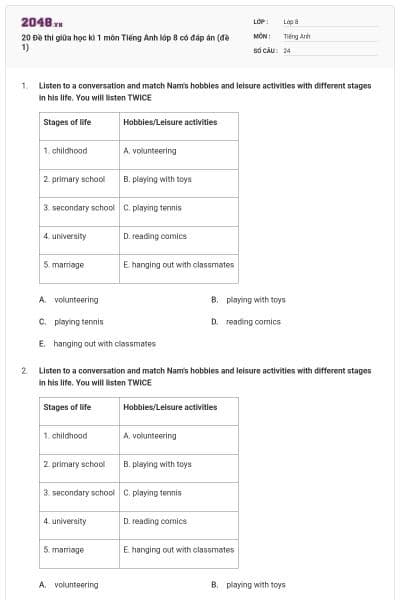
Listen to a conversation and match Nam's hobbies and leisure activities with different stages in his life. You will listen TWICE
Stages of life | Hobbies/Leisure activities |
1. childhood | A. volunteering |
2. primary school | B. playing with toys |
3. secondary school | C. playing tennis |
4. university | D. reading comics |
5. marriage | E. hanging out with classmates |
volunteering
playing with toys
playing tennis
reading comics
hanging out with classmates
Listen to a conversation and match Nam's hobbies and leisure activities with different stages in his life. You will listen TWICE
Stages of life | Hobbies/Leisure activities |
1. childhood | A. volunteering |
2. primary school | B. playing with toys |
3. secondary school | C. playing tennis |
4. university | D. reading comics |
5. marriage | E. hanging out with classmates |
volunteering
playing with toys
playing tennis
reading comics
hanging out with classmates
Listen to a conversation and match Nam's hobbies and leisure activities with different stages in his life. You will listen TWICE
Stages of life | Hobbies/Leisure activities |
1. childhood | A. volunteering |
2. primary school | B. playing with toys |
3. secondary school | C. playing tennis |
4. university | D. reading comics |
5. marriage | E. hanging out with classmates |
volunteering
playing with toys
playing tennis
reading comics
hanging out with classmates
Listen to a conversation and match Nam's hobbies and leisure activities with
different stages in his life. You will listen TWICE.
Stages of life | Hobbies/Leisure activities |
1. childhood | A. volunteering |
2. primary school | B. playing with toys |
3. secondary school | C. playing tennis |
4. university | D. reading comics |
5. marriage | E. hanging out with classmates |
volunteering
playing with toys
playing tennis
reading comics
hanging out with classmates
Listen to a conversation and match Nam's hobbies and leisure activities with different
stages in his life. You will listen TWICE.
Stages of life | Hobbies/Leisure activities |
1. childhood | A. volunteering |
2. primary school | B. playing with toys |
3. secondary school | C. playing tennis |
4. university | D. reading comics |
5. marriage | E. hanging out with classmates |
volunteering
playing with toys
playing tennis
reading comics
hanging out with classmates
1. Five-coloured sticky rice is important to northern .............................. region.
2. Five- coloured sticky rice has .................. colours: red, yellow, green, purple and white.
3. It is made using natural roots and ......................... leaves.
4. Purple or black symbolises ...................
5. Five-coloured sticky rice is usually made and enjoyed at ..................
Harvesting the rice is much ……………………. than drying the rice.
more harder
more hardly
hardlier
harder
Look! Some children are ………………the buffaloes.
picking
Playing
Driving
herding
Among the ethnic minorities,................... Tay have the largest population.
a
An
The
Ө
...................... DIY brings you a lot of amazing benefits.
Doing
reading
Playing
Going
The 54 ethnic peoples of Viet Nam are _________, but they live peacefully
diverse
similar
unlike
the same
‘Children in my village often fly their kites in dry rice fields.’ ‘_______’
It’s right up my street!
That’s awesome.
Exactly what I want.
How interesting!
____________ month is the Hoa Ban Festival of the Thai people held in?
When
Which
How many
How often
Choose the word whose underlined part is pronounced differently from the others.
princess
president
present
broccoli
1. He doesn't fancy ............ beach volleyball because he hates sand. (play)
2. The .................... have a very hard life. They cannot live permanently in one
place. (nomadic)
Many people no longer enjoy (1)__________in outdoor activities after school.
participate
to participate
participating
participates
In stead, they__________playing computer games or surfing the web in their free time.
fancy
don’t mind
dislike
hate
For example, they prefer______ messages to having a face-to-face conversation with friends.
send
to send
to sending
sends
Even when people ________out with their friends, they rarely talk but they use their phones to surf web.
play
rely
meet
hang
However, many people dislike the Internet and the________world.
virtual
real
fake
new
Gong culture in the Central Highlands of Viet Nam has been recognized by UNESCO as a Masterpiece of the Intangible Heritage of Humanity. Gong culture covers five provinces of the Central Highlands: Kon Tum, Gia Lai, Dak Lak, Dak Nong and Lam Dong. The masters of gong culture are the ethnic groups of Bahnar, Sedang, Mnong, Coho… The Gong Festival is held annually in the Central Highlands. In the festival, artists from these provinces give gong performances, highlighting the gong culture of their own province. For the ethnic groups of the Central Highlands, gongs are musical instruments of special power. It is believed that every gong is the symbol of a god who grows more powerful as the gong gets older. Therefore, gongs are associated with special occasions in people’s lives, such as the building of new houses, funerals, crop praying ceremonies… The gong sound is a way to communicate with the gods.
1.Where does Gong culture exist?
2.How often is the Gong Festival held?
3.What do artists do in the Gong Festival?
4.Are Gongs pieces of folk music?
5. Is the gong sound a way to communicate with the ancestors?
Rewrite the second sentence so that it has a similar meaning to the first one
1. My house is smaller than your house.
àYour house .……….……….……….……….……….………………….……………
2. Jenny finds reading poetry boring.
àJenny dislikes___________________________________________
Write questions for the underlined parts.
1. Ethnic people often hold festivals in spring. ………………………………………………………………………?
2. They often gather together at the communal house in special occasions.
.................................................................................................................................?
Write a passage of (120-150 words ) about the change of Vietnamese countryside or your village , hometown.
You may write it with your own ideas or answer the questions below as some clues for your passage.
· Has the countryside changed positively or negatively or both of them ?
· How about positive changes to the countryside ?
· What about negative ones ?