
20 câu trắc nghiệm Tiếng Anh 8 Unit 7. Environmental protection - Reading - Global Success có đáp án
21 câu hỏi
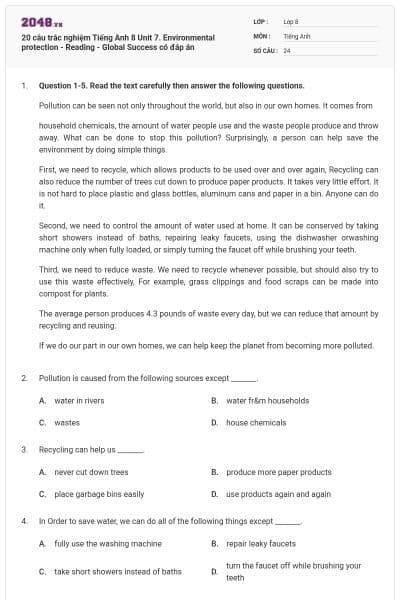
Question 1-5. Read the text carefully then answer the following questions.
Pollution can be seen not only throughout the world, but also in our own homes. It comes from
household chemicals, the amount of water people use and the waste people produce and throw away. What can be done to stop this pollution? Surprisingly, a person can help save the environment by doing simple things.
First, we need to recycle, which allows products to be used over and over again, Recycling can also reduce the number of trees cut down to produce paper products. It takes very little effort. It is not hard to place plastic and glass bottles, aluminum cans and paper in a bin. Anyone can do it.
Second, we need to control the amount of water used at home. It can be conserved by taking short showers instead of baths, repairing leaky faucets, using the dishwasher orwashing machine only when fully loaded, or simply turning the faucet off while brushing your teeth.
Third, we need to reduce waste. We need to recycle whenever possible, but should also try to use this waste effectively, For example, grass clippings and food scraps can be made into compost for plants.
The average person produces 4.3 pounds of waste every day, but we can reduce that amount by recycling and reusing.
If we do our part in our own homes, we can help keep the planet from becoming more polluted.
Pollution is caused from the following sources except _______.
water in rivers
water fr&m households
wastes
house chemicals
Recycling can help us _______.
never cut down trees
produce more paper products
place garbage bins easily
use products again and again
In Order to save water, we can do all of the following things except _______.
fully use the washing machine
repair leaky faucets
take short showers instead of baths
turn the faucet off while brushing your teeth
Recycling helps to reduce waste because _______.
plants need to develop
waste can be recycled and reused
a person can do it in his home
an average man produces compost for plants
The word "It" in paragraph 2 refers to _______.
cutting down
the number
recycling
effort
Question 6-13. Read the passage, then choose True (T) or False (F).
Air pollution is serious problem in many cities. Motor vehicles, factories and other sources
create so much air pollution that it may hang in the air like dirty fog. Air pollution threatens the health of the people who live in cities. City wastes cause water pollution when they are poured into the waterways. These wastes kill fish and make some areas unfit for swimming. In addition, many large cities have difficulties in disposing of their garbage. The amount of garbage grows each year, but places to put it are quickly filling up. Citizens, governments, industries, scientists, and business people must work together in different ways to gradually reduce pollution. For example, most cities have introduced recycling programmes.
Motor vehicles and factories are among some sources of air pollution.
True
False
Air pollution doesn't endanger people's health in some cities.
True
False
Air pollution is the only problem of the environment mentioned in this passage.
True
False
Garbage disposal is a problem in many large cities.
True
False
Everyone must cooperate to reduce pollution.
True
False
Air pollution only comes from factories and motor vehicles.
True
False
City wastes can pollute water and kill fish.
True
False
Only governments can solve the pollution problem.
True
False
Question 14-20. Read the text carefully then answer the following questions.
Like many countries, Britain has serious environmental problems. In 1952, more than 4,000 people died in London because of the smog. The government introduced new laws to stop smog from coal fires and factories and the situation improved a lot.
Today, London is much cleaner but there is a new problem: smog from cars. In December 1991, there was very little wind in London and pollution increased. As a result, about 160 people died from pollution in just four days.
Part of the problem is the new "out of town" shopping centres. In the past, people often walked to shops near their homes or went by bus. Now, many people drive to the new shopping centres. The small shops have disappeared and more people have to travel to do their shopping.
Many people are trying to reduce the use of cars in Britain. Some cities now have special bicycle lanes, so people cycle to work. Some people also travel to work together in one car to reduce pollution and costs.
Recycling can help reduce the number of trees cut down to produce paper products.
True
False
Which of the following statements is TRUE according to the passage?
The government once introduced a law against smog from cars and factories.
London is much cleaner than before, so nobody dies from pollution any longer.
Now smog in London mainly comes from cars.
People in cities now go to work by bicycle only.
Why do people drive to go shopping?
They prefer shops in big shopping centres outside of town.
Small shops near their homes have disappeared.
Many new shopping centres have appeared inside of town.
It has become popular to do shopping in large shopping centres.
How many examples are there in the passage of people reducing car use?
Two.
Three.
Four.
Five.
The word "improved" in the first paragraph probably means
got worse
reduced
became better
maintained
What is the best title for this passage?
Reducing the Use of Cars in Britain
The Disadvantages of Cars
How People are Reducing Smog in Britain
Smog in Britain: Past and Present
What was the main cause of the serious pollution in London in 1952?
Car exhaust fumes
Coal fires and factories
Garbage disposal issues
Wastewater from factories
How are people in Britain trying to reduce pollution from cars?
By using more public transport
By driving in large groups
By building more roads
By cycling to work and carpooling