
20 câu trắc nghiệm Tiếng Anh 8 Unit 4. Ethnic groups of Viet Nam -Reading- Global Success có đáp án
20 câu hỏi
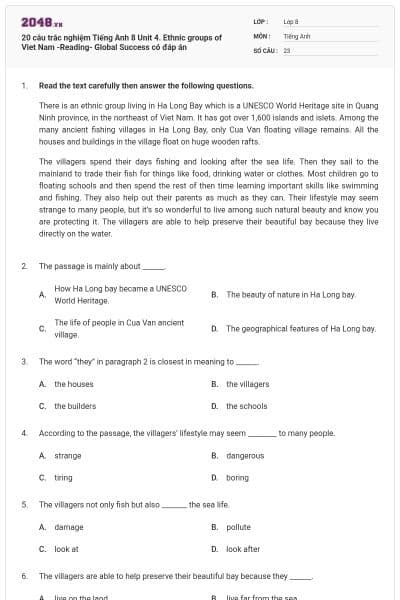
Read the text carefully then answer the following questions.
There is an ethnic group living in Ha Long Bay which is a UNESCO World Heritage site in Quang Ninh province, in the northeast of Viet Nam. It has got over 1,600 islands and islets. Among the many ancient fishing villages in Ha Long Bay, only Cua Van floating village remains. All the houses and buildings in the village float on huge wooden rafts.
The villagers spend their days fishing and looking after the sea life. Then they sail to the mainland to trade their fish for things like food, drinking water or clothes. Most children go to floating schools and then spend the rest of then time learning important skills like swimming and fishing. They also help out their parents as much as they can. Their lifestyle may seem strange to many people, but it’s so wonderful to live among such natural beauty and know you are protecting it. The villagers are able to help preserve their beautiful bay because they live directly on the water.
The passage is mainly about ______.
How Ha Long bay became a UNESCO World Heritage.
The beauty of nature in Ha Long bay.
The life of people in Cua Van ancient village.
The geographical features of Ha Long bay.
The word “they” in paragraph 2 is closest in meaning to ______.
the houses
the villagers
the builders
the schools
According to the passage, the villagers’ lifestyle may seem ________ to many people.
strange
dangerous
tiring
boring
The villagers not only fish but also _______ the sea life.
damage
pollute
look at
look after
The villagers are able to help preserve their beautiful bay because they ______.
live on the land
live far from the sea
don’t live on the water
live directly on the water
According to the passage, which statement is NOT true?
Ha Long bay has above 1,600 islands and islets.
Because of floating life, children in Cua Van floating village don’t go to school.
The children try to help their parents.
The villagers have preserved their beautiful bay.
Read the text carefully then answer the following questions.
Mount Everest is the highest mountain in the world. It is also the highest trash pile in the world. About 400 people try to reach the top every year. This many climbers means a lot of trash. It is very dangerous to climb Mt. Everest. The air is very thin and cold. Most people carry oxygen bottles; they could die without it. When the oxygen bottles are empty, people throw them on the ground. When strong winds rip their tents, people leave them behind. They don’t have enough energy to go down the mountain safely. Trash is a terrible problem. Since people first began to climb Mt. Everest, they have left 50,000kilos of trash on the mountain. Several groups have climbed the mountain just to pick up the trash. When people plan to climb the mountain, they have to plan to take away their trash.
What is the main topic of the passage?
Wind on the mountain
A problem with trash
A dangerous mountain
Climbing safely
Where do climbers put their empty oxygen bottles?
On the ground
In trash can
On their back
In their tent
The climbers didn’t leave anything on the mountain, but one is NOT TRUE.
Special groups will pick the rubbish up.
They will recycle the rubbish there.
They don’t have the energy to take the rubbish away.
Other climbers will use the rubbish later.
Why do climbers on Mt. Everest carry bottles of oxygen?
The weather is cold.
Climbing makes them tired.
The air is very thin.
They are thirsty.
In line 5, “people leave them behind,” what does the word “them” refer to?
Tents
Oxygen bottles
Strong winds
Other climbers
How much trash have climbers left on Mount Everest so far?
5,000 kilos
500 kilos
50,000 kilos
15,000 kilos
Read the text carefully then decide whether the following statements are true (T) or false (F).
The Muong are among the ethnic minority groups that have big populations in Vietnam. The Muong share an estimate of 1.3 million people from their six sub-groups, such as Mol, Mual, Moi, Moi Bi, Au Ta and Ao Ta. They are largely concentrated in the provinces of Hoa Binh and Thanh Hoa particularly in mountainous districts. Their language belongs to the Viet-Muong group and they hold many ceremonies year round.
The Muong have practiced farming for a long time and wet rice is their main food staple. Most of their family’s other income is generated through the exploitation of forest products including mushrooms, dried fungus, ammonium, and sticklac. The men are known for basketry as women are skilled in silk spinning and loom weaving.
The Muong have diverse folk arts including folk songs and poems, sorcerer’s worshiping songs, tales, proverbs, lullabies, and riddle songs. The gong is the most popular musical instrument along with the flute, the two-string violin, the drum, and the panpipe.
The Muong is one of the largest ethnic minorities in Vietnam.
True
False
The Muong are also called Mol, Mual, Moi, Moi Bi, Au Ta and Ao Ta.
True
False
The Muong don’t have their own language, so they speak Vietnamese.
True
False
The Muong live mainly on forest products, such as mushrooms and dried fungus.
True
False
Muong women are very good at making baskets and loom weaving.
True
False
The Muong have a rich treasure of folk arts.
True
False
The Muong use several musical instruments, but the gong is the most popular.
True
False
The Muong men are good at silk spinning and weaving.
True
False