
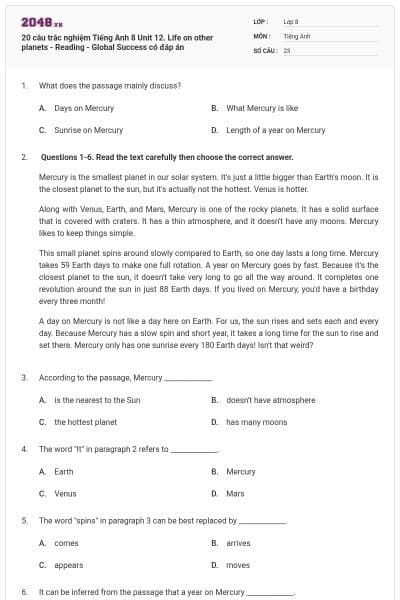
20 câu trắc nghiệm Tiếng Anh 8 Unit 12. Life on other planets - Reading - Global Success có đáp án
20 câu hỏi
Questions 1-6. Read the text carefully then choose the correct answer.
Mercury is the smallest planet in our solar system. It's just a little bigger than Earth's moon. It is the closest planet to the sun, but it's actually not the hottest. Venus is hotter.
Along with Venus, Earth, and Mars, Mercury is one of the rocky planets. It has a solid surface that is covered with craters. It has a thin atmosphere, and it doesn't have any moons. Mercury likes to keep things simple.
This small planet spins around slowly compared to Earth, so one day lasts a long time. Mercury takes 59 Earth days to make one full rotation. A year on Mercury goes by fast. Because it's the closest planet to the sun, it doesn't take very long to go all the way around. It completes one revolution around the sun in just 88 Earth days. If you lived on Mercury, you'd have a birthday every three month!
A day on Mercury is not like a day here on Earth. For us, the sun rises and sets each and every day. Because Mercury has a slow spin and short year, it takes a long time for the sun to rise and set there. Mercury only has one sunrise every 180 Earth days! Isn't that weird?
What does the passage mainly discuss?
Days on Mercury
What Mercury is like
Sunrise on Mercury
Length of a year on Mercury
According to the passage, Mercury _____________.
is the nearest to the Sun
doesn't have atmosphere
the hottest planet
has many moons
The word "It" in paragraph 2 refers to _____________.
Earth
Mercury
Venus
Mars
The word "spins" in paragraph 3 can be best replaced by _____________.
comes
arrives
appears
moves
It can be inferred from the passage that a year on Mercury _____________.
has 59 days
much longer than that on Earth
has 88 days
has only 180 days
How often does the sun rise on Mercury?
The same as on Earth.
Every 3 months.
Every 180 days.
Sun never sets.
Questions 7-15. Read the passage about UFOs and choose True or False for each sentence.
An unidentified flying object (UFO) is any light or object seen in the sky that can't be explained. Hundreds of UFO sightings are reported every year. More than nine-tenths of them are later identified as ordinary objects. They turn out to be planes, satellites, or planets. Others are later identified as balloons, kites, clouds, or birds. But some are deliberate fakes.
UFOs have been reported since ancient times. Modern reports of UFO sightings began in 1947. Some observers reported seeing saucer-like shapes in the sky. Since then, UFOs of any shape are often called flying saucers.
The United States Air Force took these reports seriously. Air Force officials did not necessarily believe in visitors from outer space. They wanted to be sure that UFOs were not a threat to America. A UFO might, for example, be an enemy airplane.
Project Blue Book was the Air Force's program for investigating UFOs. It ran from 1947 through 1969. The Air Force investigated 12,618 UFO sightings. All but 701 were identified.
The Air Force concluded that UFOs were no threat. All sightings could be explained by science. There was no evidence that UFOs came from other planets.
All of the UFO sightings were later identified as ordinary objects like planes, satellites, etc.
True
False
People also call UFOs of any shape flying saucers.
True
False
The Air Force took the reports of UFO sightings seriously because they believed in visitors from outer space.
True
False
Project Blue Book was one of the Air Force's programs.
True
False
The Air Force concluded that UFOs were not a threat to the US.
True
False
UFOs are always proven to be alien spaceships.
True
False
Modern UFO sightings started in the mid-20th century.
True
False
Flying saucers only refer to round-shaped UFOs.
True
False
The Air Force created Project Blue Book to study UFOs.
True
False
Questions 16-20. Read the passage and choose True or False for each sentence.
Astronomers and other scientists constantly research and explore space. One of the most intriguing questions they hope to answer one day is whether life exists on other planets. Despite a lot of research in outer space, scientists have not yet been able to find evidence of life forms on any other planet other than Earth.
Earth is very hospitable, which makes living here easy. Earth has water, which living creatures need to survive. Earth also has an atmosphere that is neither too hot, nor too cold. Its distance from the sun provides Earth's inhabitants with the proper amount of warmth, sunlight and energy. Although there may be other planets that have some of Earth's hospitable features, so far scientists have not found any with all of the features they believe necessary to sustain life. Earth remains one of a kind!
Scientists haven't done much research to find life forms on other planets.
True
False
Earth's temperate atmosphere makes it accommodative to life forms.
True
False
Earth's distance from the Sun allows it to receive just enough heat.
True
False
No other planets have any of Earth's life-sustaining features.
True
False
Earth is still the only planet with all necessary conditions for life.
True
False