
20 câu trắc nghiệm Tiếng Anh 11 Unit 8. Becoming independent - Reading - Global Success có đáp án
20 câu hỏi
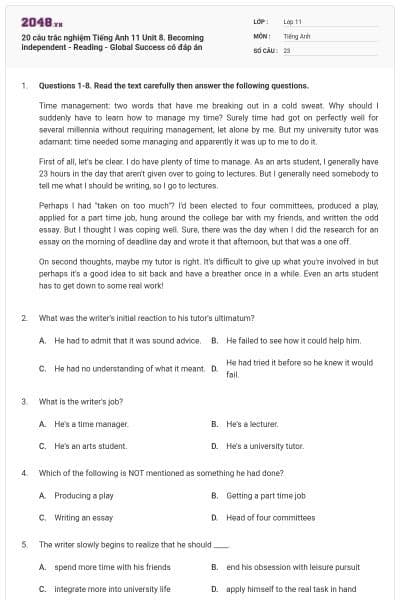
Questions 1-8. Read the text carefully then answer the following questions.
Time management: two words that have me breaking out in a cold sweat. Why should I suddenly have to learn how to manage my time? Surely time had got on perfectly well for several millennia without requiring management, let alone by me. But my university tutor was adamant: time needed some managing and apparently it was up to me to do it.
First of all, let's be clear. I do have plenty of time to manage. As an arts student, I generally have 23 hours in the day that aren't given over to going to lectures. But I generally need somebody to tell me what I should be writing, so I go to lectures.
Perhaps I had "taken on too much"? I'd been elected to four committees, produced a play, applied for a part time job, hung around the college bar with my friends, and written the odd essay. But I thought I was coping well. Sure, there was the day when I did the research for an essay on the morning of deadline day and wrote it that afternoon, but that was a one off.
On second thoughts, maybe my tutor is right. It's difficult to give up what you're involved in but perhaps it's a good idea to sit back and have a breather once in a while. Even an arts student has to get down to some real work!
What was the writer's initial reaction to his tutor's ultimatum?
He had to admit that it was sound advice.
He failed to see how it could help him.
He had no understanding of what it meant.
He had tried it before so he knew it would fail.
What is the writer's job?
He's a time manager.
He's a lecturer.
He's an arts student.
He's a university tutor.
Which of the following is NOT mentioned as something he had done?
Producing a play
Getting a part time job
Writing an essay
Head of four committees
The writer slowly begins to realize that he should ____.
spend more time with his friends
end his obsession with leisure pursuit
integrate more into university life
apply himself to the real task in hand
The word "breather" in the passage mostly means ____.
an assignment
a machine
a rest
a passion
Why does the writer mention doing research and writing an essay on the same day?
To show that he works efficiently under pressure.
To prove that he is not good at research.
To illustrate that he sometimes leaves things until the last minute.
To demonstrate how much time he spends on studying.
What does the phrase “taken on too much” in paragraph 3 imply?
He had too many responsibilities and commitments.
He didn’t have enough activities to fill his time.
He refused to participate in social events.
He only focused on academic work.
What is the main purpose of the passage?
To criticize the writer’s tutor for giving too much advice.
To show how difficult university life can be for art students.
To describe the writer’s realization about the need for time management.
To explain how to organize university studies effectively.
Questions 9-15. Read the text carefully then answer the following questions.
Teenage years are filled with all kinds of problems-lack of self-confidence, nagging parents, peer pressure, doing well in the exams and getting into university. Some of their problems result from the emotional and physical changes teenagers are going through.
Teenagers are extremely concerned about their appearance. So, it's no wonder they spend so much time in front of the mirror! They notice every single thing about themselves - their body changing shape,
hair appearing in unlikely places, annoying spots breaking out. Teenagers are rarely happy about these changes which can affect how they feel about themselves.
Sometimes, parents hurt their teenage children's feelings by making jokes about their appearance. They also tend to pay little attention to teenage worries and think of them as being silly. Your daughter may be convinced that her nose looks awful and that plastic surgery is the only solution even though everybody else fails to notice the problem. By trying to explain that other people do not normally pay as much attention to our physical features as we do ourselves, we can help teenagers feel better about themselves and become more confident.
Teenagers also tend to avoid doing things they don't like, especially helping around the house. They are likely to try to get out of doing household chores - and certainly don't respond well to orders. The more you discuss the type of household chore your teenage son or a daughter might not mind doing, the better. He or she, for example, may be happy to go to the supermarket, but hate the idea of washing dishes.
It also works better if your children can, at least to some degree, do things in their own way and time. This might seem annoying, but if all you do is order them around, you can be sure that next time they will not do a thing. Always thank your children for their effort. And if they do something that's more than just a simple chore - decorating, perhaps you might want to pay them.
Teenagers spend a lot of time looking in the mirror because they _______.
like admiring their bodies.
are worried about the changes happening to their bodies.
are thinking how they can improve their appearance.
have nothing better to do.
When teenagers express their concern about their appearance, their parents ______.
get upset with them.
show no interest in their worries.
don't take their concerns very seriously.
don't believe them.
The writer advises the parents to ______.
support their children if they decide to have plastic surgery.
give them tips on how to improve their appearance.
ignore their concerns.
tell them that they actually look better than they think they do.
When it comes to housework, most teenagers ______.
help a lot with housework.
usually prefer going to the supermarket.
expect something in return for helping around the house.
find ways not to take part in it.
Which of the following is NOT good advice to parents?
They should thank their children for their effort.
They should give their children some money for any chore they do.
They should let their children do things the way they want to.
They should be willing to take their children's preferences into account.
According to the passage, what can help teenagers become more confident about themselves?
Encouraging them to change their looks frequently.
Explaining that other people don’t notice their flaws as much as they do.
Letting them decide to have plastic surgery if they want.
Telling them to ignore what others think about their appearance.
What is the overall tone of the passage?
Critical and judgmental
Supportive and understanding
Humorous and informal
Sad and emotional
Questions 16-20. Read the text carefully then answer the following questions.
It is important that you develop effective strategies for managing your time to balance the conflicting demands of time for study, leisure, and work. Time-management skills are valuable not only in job-hunting, but also in many other aspects of life: from revising for examinations to working in a vacation job.
Sometimes it may seem that there isn't enough time to do everything that you need to. This can lead to a build-up of stress. When revising for examinations, or during your final year when you have to combine the pressures of intensive study with finding time to apply for jobs, good management of your time can be particularly important. Once we have identified ways in which we can improve the management of our time, we can begin to adjust our routines and patterns of behaviour to reduce any time-related stress in our lives.
Some of these skills include setting clear goals, breaking your goals down into several steps, and reviewing your progress towards your goals.
Other skills involved include prioritising - focusing on urgent and important tasks rather than those that are trivial or don't move you towards your goals; organising your work schedule; list making to remind you of what you need to do.
What is the main idea of the passage?
Time-management skills are essential for reducing stress and achieving your goals in life.
Time-management skills are useful for job-hunting and exam preparation.
Time-management skills are different for students and workers.
Time-management skills are easy to learn and apply.
The word “build-up" is closest in meaning to ____.
increase
explain
accumulation
management
Which of the following is NOT mentioned as a benefit of time-management skills in the passage?
Balancing the conflicting demands of time for study, leisure, and work.
Improving your performance in examinations and job applications.
Enhancing your creativity and problem-solving skills.
Reducing any time-related stress in your lives.
Which of the following is an example of setting clear goals?
I want to get a good grade in this course.
I want to finish reading this chapter by tomorrow.
I want to learn something new every day.
I want to be successful in life.
Which of the following is an example of organising your work schedule?
Making a to-do list for the day.
Allocating a specific amount of time for each task.
Checking your progress and adjusting your plan as needed.
All of the above.