
20 câu trắc nghiệm Tiếng Anh 11 Unit 7. Education options for school-leavers - Reading - Global Success có đáp án
20 câu hỏi
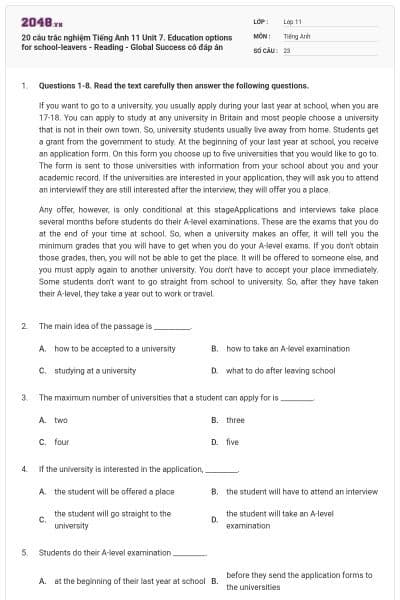
Questions 1-8. Read the text carefully then answer the following questions.
If you want to go to a university, you usually apply during your last year at school, when you are 17-18. You can apply to study at any university in Britain and most people choose a university that is not in their own town. So, university students usually live away from home. Students get a grant from the government to study. At the beginning of your last year at school, you receive an application form. On this form you choose up to five universities that you would like to go to. The form is sent to those universities with information from your school about you and your academic record. If the universities are interested in your application, they will ask you to attend an interviewIf they are still interested after the interview, they will offer you a place.
Any offer, however, is only conditional at this stageApplications and interviews take place several months before students do their A-level examinations. These are the exams that you do at the end of your time at school. So, when a university makes an offer, it will tell you the minimum grades that you will have to get when you do your A-level exams. If you don't obtain those grades, then, you will not be able to get the place. It will be offered to someone else, and you must apply again to another university. You don't have to accept your place immediately. Some students don't want to go straight from school to university. So, after they have taken their A-level, they take a year out to work or travel.
The main idea of the passage is __________.
how to be accepted to a university
how to take an A-level examination
studying at a university
what to do after leaving school
The maximum number of universities that a student can apply for is _________.
two
three
four
five
If the university is interested in the application, _________.
the student will be offered a place
the student will have to attend an interview
the student will go straight to the university
the student will take an A-level examination
Students do their A-level examination _________.
at the beginning of their last year at school
before they send the application forms to the universities
at the end of their time at school
right after they receive an application form
If the student's score is below the minimum grades announced by the university, _________.
the place will be offered to someone else
he must take a year out
he mustn't apply to any other university
he will be able to get the place
What does the word “conditional” in paragraph 2 mean?
depending on something else happening
fixed and final
not necessary
without any requirements
According to the passage, what do some students do after taking their A-level exams?
They apply to another university immediately.
They start studying at the university right away.
They take a year off to work or travel.
They stop studying permanently.
Which of the following statements is TRUE according to the passage?
Students must study at a university in their own town.
Universities in Britain never hold interviews for applicants.
Students can choose up to five universities on their application form.
All offers from universities are final and unconditional.
Questions 9-15. Read the text carefully then answer the following questions.
The difference between higher and further education can be a common cause of confusion. Further education is used to describe the education that occurs following compulsory post-16 secondary education, which is usually distinct from that offered in universities (higher education). It includes a few different levels such as A-Levels and Higher National Diplomas. Foundation Degrees are also a type of further education and take 2 years to complete compared with the 3-4 years of most bachelor's degrees which are offered by both universities and colleges. Sometimes it is possible to extend a Foundation Degree to a bachelor's degree, with one year or more of extra study.
Further education is usually taught in the sixth-form college part of a school or in independent further education colleges, as well as in other work-based, adult and community learning institutions in the United States, further education is sometimes referred to as continuing education.
Higher education primarily describes post-18 learning that takes place at universities, as well as other colleges and institutions that award academic degrees, and professional qualifications. While higher education is the common name in the UK and Ireland, it is also known as post-secondary, tertiary and third level education.
What is the main idea of the passage?
The passage compares and contrasts the different types of education that are available after secondary school.
The passage explains the benefits and drawbacks of further and higher education in different countries.
The passage describes the different levels and qualifications that are included in further and higher education.
The passage provides some examples and statistics of further and higher education in the UK and the US.
The word “It” in line 3 of paragraph 1 refers to ________.
higher education
further education
compulsory post-16 secondary education
education
The word “distinct” in paragraph 1 is closest in meaning to ________.
different
separate
clear
special
Which of the following is NOT a type of further education mentioned in the passage?
A-Levels
Higher National Diplomas
Foundation Degrees
Professional Qualifications
What is another name for higher education in the United States?
continuing education
post-secondary education
tertiary education
third level education
Which of the following statements is TRUE according to the passage?
Further education and higher education are exactly the same in the UK.
Foundation Degrees take more time to complete than bachelor’s degrees.
Further education usually takes place before students enter universities.
Higher education is only provided by independent colleges.
What can be inferred about Foundation Degrees from the passage?
They are shorter than most bachelor’s degrees.
They cannot be extended to a bachelor’s degree.
They are only offered at universities.
They are a form of professional qualification.
Questions 16-20. Read the text carefully then answer the following questions.
British further education qualifications are respected by employers and academics worldwide. There are two main types: academic courses, and vocational and professional courses. Academic courses help you prepare for higher education at a university or college. They aim to develop your analytical skills, critical thinking and knowledge. Vocational and professional courses give you the skills and qualifications you need to enter and succeed in your chosen career. They offer technical training and skills for the workplace.
British further education providers invest heavily in facilities from libraries, computer centres and science laboratories to sports centres, theatres and arts studios. Class sizes are to ensure that you have access to equipment and enough time to talk to your tutors and lecturers
British qualifications are a great boots to your CV and to your earnings. Employers are increasingly looking for graduates with multicultural experience. Moreover, British colleges and universities have strong links with industry - many courses are designed in partnership with, and taught by, industry professionals. Many include the option of a year in industry or a work placement, giving you real professional experience. English is widely regarded as the language of business. Studying in the UK helps you learn the language quickly, through your studies, friends and everyday life. If you need any additional support, there are lots of English language classes across the UK.
The UK is a truly multicultural society, with a wonderful mix of people from many different backgrounds. As a student, you'll get to know people from all over the world and be inspired by many cultures. Many colleges have international offices and advisers to ensure you feel welcome and are supported throughout your time in British further education.
Higher education in the UK requires _________.
technical training and working skills
analytical skills, critical thinking and knowledge
vocational and professional courses
academic courses at a university or college
British further education offers facilities in several fields EXCEPT ___________
sports training
entertainment
information technology
engineering workshop
British further education can give you advantages of getting a job because __________.
you are taught by industrial professors
you know how to boost your CV and earn high salaries
you can get real multicultural and professional experience
you can follow both academic courses and vocational courses
Following further education in the UK helps you improve your English quickly because _________.
it is used in several life aspects
it is used in the business of languages
you can speak it at lots of English language classes
you need much additional support
As a foreign student, you can get involved in social activities quickly because _________.
you can get support about British further education
Britain is a multicultural society with much support from colleges
the UK has a wonderful mix of different peoples from all over the world
you can enjoy your time in British further education