
20 câu trắc nghiệm Tiếng Anh 11 Unit 3: Cities of the future -Reading- Global Success có đáp án
20 câu hỏi
Read the text carefully then answer the following questions.
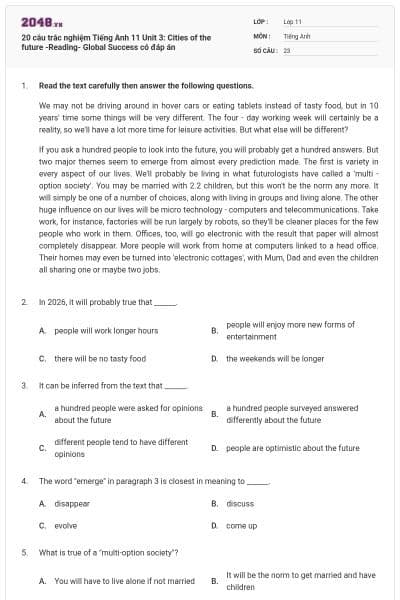
We may not be driving around in hover cars or eating tablets instead of tasty food, but in 10 years' time some things will be very different. The four - day working week will certainly be a reality, so we'll have a lot more time for leisure activities. But what else will be different?
If you ask a hundred people to look into the future, you will probably get a hundred answers. But two major themes seem to emerge from almost every prediction made. The first is variety in every aspect of our lives. We'll probably be living in what futurologists have called a 'multi - option society'. You may be married with 2.2 children, but this won't be the norm any more. It will simply be one of a number of choices, along with living in groups and living alone. The other huge influence on our lives will be micro technology - computers and telecommunications. Take work, for instance, factories will be run largely by robots, so they'll be cleaner places for the few people who work in them. Offices, too, will go electronic with the result that paper will almost completely disappear. More people will work from home at computers linked to a head office. Their homes may even be turned into 'electronic cottages', with Mum, Dad and even the children all sharing one or maybe two jobs.
In 2026, it will probably true that ______.
people will work longer hours
people will enjoy more new forms of entertainment
there will be no tasty food
the weekends will be longer
It can be inferred from the text that ______.
a hundred people were asked for opinions about the future
a hundred people surveyed answered differently about the future
different people tend to have different opinions
people are optimistic about the future
The word "emerge" in paragraph 3 is closest in meaning to ______.
disappear
discuss
evolve
come up
What is true of a "multi-option society"?
You will have to live alone if not married
It will be the norm to get married and have children
You may choose to live with other people in groups
You will be allowed to have no more than 2.2 children
What can be inferred about changes in the workplace?
More people will work from home instead of traveling to the workplace
Robots will replace all human beings in factories
People's homes will go electronic and be turned into offices
Paper will no longer exist in offices
What is one predicted benefit of robots running factories?
They will make factories larger.
Factories will be cleaner with fewer workers.
They will increase paper use in offices.
All people will lose their jobs.
According to the passage, what will happen to paper in offices?
Paper will almost completely disappear.
People will use more paper than before.
Paper will only be used at home.
Paper will be replaced by robots.
Read the text carefully then answer the following questions.
The cities of the future will see a lar e number of intelligent homes that can interact with their owners. In fact, things that were earlier considered science fiction are already coming to lie in smart cities such as Masdar in the United Arab Emirates, where an automated underground transport network fully fueled by solar power is already running circuits. With smart technology, the possibility of having huge savings on electricity and power is within our reach. Sensors are being developed so that street lights of the future will switch on only when you are close by. The smart technology in self-driven cars will enable you to save on gas and other non-renewable energy sources. In fact, smart cities will ai m to neutralize the use of fossil fuels completely. The cities of the future will have to adapt quickly to rapid technological advancements in IT and engineering. The gap between technological leaps is going to decrease over time. Technology will help bridge the current gap between the government and public in the cities of the future, given that IT and digitization will make these cities more open and social. Another thing that we can all agree on is that the cost of building in these smart cities is going to be considerable. An estimate can be derived based on the latest smart city developments in India. With the booming population, the Indian Prime Minister Narendra Modi is pushing to attract investments to fuel rapid development projects in the country.
Intelligent homes can have effect on their owners.
True
False
Some predictions made about smart cities have been put in practice.
True
False
The transport network in Masdar has run on a renewable source of energy.
True
False
Street lights won’t switch on after sensors are developed.
True
False
We can’t save energy with driverless cars.
True
False
Smart cities in the future will aim to make fossil fuels completely neutral.
True
False
New technological advancements make the cities in the future change so rapidly in order to become more open and social.
True
False
Building a smart city costs a lot of money, so a country like India has to call for investment to supply fuel for the project of smart cities.
True
False
Read the text carefully then answer the following questions.
What makes a city green? Factors such as recycling, renewable energy, transportation options, building construction, air quality and emissions make green cities great. Here are some cities that are doing their part to lead us on the global path to a greener future.
Working towards the goal of being the first carbon neutral capital before 2025, Copenhagen has made a lot of necessary changes. Lots of electric and manual bikes organic food, clean water, sustainable buildings and hotels, lots of green space and fewer cars are just a few of the ways that help Copenhagen stand at the top of the green cities list.
As the UK's 8th biggest city, and with a steadily growing economy, Bristol is set on making its mark, not only in the UK, but in Europe as well. The next five years will see a huge focus on transportation and renewable energy in the city, as well as a goal of doubling the number of cyclists in that time as well. Bristol is becoming a hub for jobs in low carbon sectors.
Vancouver is pleasant for so many reasons- it's mild and it leads the way for forward thinking and environmental awareness in North America. Residents are very fond of walking and cycling, and government laws have been designed with greenness in mind. It's often considered to be one of the most livable cities in the world, and that isn't enough, it's working towards being powered entirely by renewable energy by the year 2050.
What factor is NOT mentioned in the passage as making a city green?
Recycling
Renewable energy
Population size
Transportation options
What is Copenhagen’s goal before 2025?
To reduce the number of hotels
To become the first carbon-neutral capital
To double the number of cyclists
To eliminate all cars from the city
What will Bristol mainly focus on in the next five years?
Transportation and renewable energy
Air quality improvement
Building more hotels and offices
Expanding green spaces
According to the passage, what is Vancouver often considered?
The most industrialized city in North America
One of the most livable cities in the world
The largest hub for green jobs
The first carbon-neutral capital
What is Vancouver’s environmental goal by 2050?
To ban cars from the city
To build more cycling paths
To be powered entirely by renewable energy
To double its population