
20 câu trắc nghiệm Tiếng Anh 10 Unit 1. Feelings - Reading and Writing - Friends Global có đáp án
20 câu hỏi
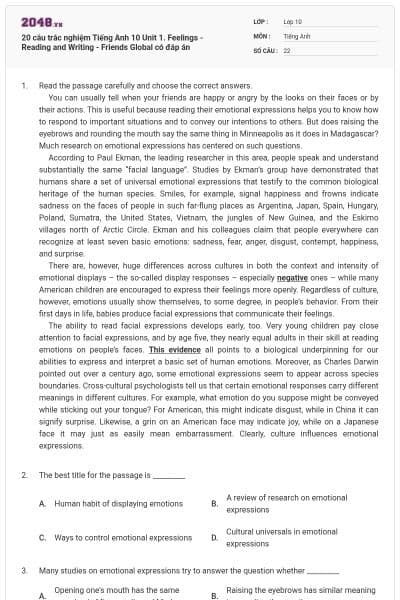
Read the passage carefully and choose the correct answers.
You can usually tell when your friends are happy or angry by the looks on their faces or by their actions. This is useful because reading their emotional expressions helps you to know how to respond to important situations and to convey our intentions to others. But does raising the eyebrows and rounding the mouth say the same thing in Minneapolis as it does in Madagascar? Much research on emotional expressions has centered on such questions.
According to Paul Ekman, the leading researcher in this area, people speak and understand substantially the same “facial language”. Studies by Ekman’s group have demonstrated that humans share a set of universal emotional expressions that testify to the common biological heritage of the human species. Smiles, for example, signal happiness and frowns indicate sadness on the faces of people in such far-flung places as Argentina, Japan, Spain, Hungary, Poland, Sumatra, the United States, Vietnam, the jungles of New Guinea, and the Eskimo villages north of Arctic Circle. Ekman and his colleagues claim that people everywhere can recognize at least seven basic emotions: sadness, fear, anger, disgust, contempt, happiness, and surprise.
There are, however, huge differences across cultures in both the context and intensity of emotional displays – the so-called display responses – especially negative ones – while many American children are encouraged to express their feelings more openly. Regardless of culture, however, emotions usually show themselves, to some degree, in people’s behavior. From their first days in life, babies produce facial expressions that communicate their feelings.
The ability to read facial expressions develops early, too. Very young children pay close attention to facial expressions, and by age five, they nearly equal adults in their skill at reading emotions on people’s faces. This evidence all points to a biological underpinning for our abilities to express and interpret a basic set of human emotions. Moreover, as Charles Darwin pointed out over a century ago, some emotional expressions seem to appear across species boundaries. Cross-cultural psychologists tell us that certain emotional responses carry different meanings in different cultures. For example, what emotion do you suppose might be conveyed while sticking out your tongue? For American, this might indicate disgust, while in China it can signify surprise. Likewise, a grin on an American face may indicate joy, while on a Japanese face it may just as easily mean embarrassment. Clearly, culture influences emotional expressions.
Human habit of displaying emotions
A review of research on emotional expressions
Ways to control emotional expressions
Cultural universals in emotional expressions
Hướng dẫn giải
Đáp án đúng: D
Tiêu đề chính của đoạn văn là:
A. Thói quen của con người về biểu lộ xúc cảm
B. Bình luận về các nghiên cứu về biểu lộ xúc cảm
C. Cách kiểm soát biểu lộ xúc cảm
D. Sự phổ biến trong sự biểu lộ xúc cảm
Thông tin: “You can usually tell when your friends are happy or angry by the looks on their faces or by their actions.”
Dịch nghĩa: Bạn thường có thể nói được khi bạn mình hạnh phúc hay tức giận qua vẻ nhìn trên khuôn mặt họ hoặc qua hành động của họ.
Many studies on emotional expressions try to answer the question whether _________
Opening one's mouth has the same meaning in Minneapolis and Madagascar.
Raising the eyebrows has similar meaning to rounding the mouth
Different cultures have similar emotional expressions
Eyebrow raising means the same in Minneapolis and Madagascar
Hướng dẫn giải
Đáp án đúng: C
Nhiều nghiên cứu về mặt diễn đạt cảm xúc cố gắng tìm câu trả lời cho câu hỏi:
A. Mở tròn miệng có cùng ý nghĩa ở Minneapolis và Madagascar.
B. Nhướn lông mày có ý nghĩa tương tự như mở tròn miệng
C. Các vùng văn hóa khác nhau có cách diễn đạt cảm xúc tương tự nhau
D. Nhướn lông mày có ý nghĩa giống nhau ở Minneapolis và Madagascar.
Thông tin: “Studies by Ekman’s group have demonstrated that humans share a set of universal emotional expressions that testify to the common biological heritage of the human species. Smiles, for example, signal happiness and frowns indicate sadness on the faces of people in such far-flung places as Argentina, Japan, Spain, Hungary, Poland, Sumatra, the United States, Vietnam, the jungles of New Guinea, and the Eskimo villages north of Arctic Circle. Ekman and his colleagues claim that people everywhere can recognize at least seven basic emotions: sadness, fear, anger, disgust, contempt, happiness, and surprise.”
Dịch nghĩa: Nghiên cứu bởi nhóm của Ekman đã chứng minh rằng con người chia sẻ một hệ thống biểu cảm phổ quát phản ánh di sản sinh học chung của loài người. Ví dụ, cười, biểu hiện của hạnh phúc và cau mày, biểu lộ sự buồn bã trên khuôn mặt ở những nơi như Argentina, Nhật, Tây Ban Nha, Hungary, Poland, Sumatra, Mỹ, Việt Nam, khu rừng rậm của New Guinea, và làng người Eskimo ở bắc cực. Ekman và đồng sự cho rằng con người khắp mọi nơi có thể nhận ra ít nhất 7 cảm xúc cơ bản: buồn, lo, giận, ghê tởm, khinh miệt, hạnh phúc, và ngạc nhiên.
The word “negative” in the second paragraph is closest in meaning to__________
positive
enthusiastic
undesirable
affirmative
Hướng dẫn giải
Đáp án đúng: C
Dịch nghĩa: Từ “negative” (tiêu cực) ở đoạn số 2 gần nghĩa nhất với từ nào_____
A. tích cực
B. nhiệt tình
C. không mong muốn
D. khẳng định, đồng ý
→ Negative = undesirable
The phrase “This evidence” in paragraph 3 refers to ________
The fact that children can control their feelings
Human facial expressions
A biological underpinning for humans to express emotions
The fact that children are good at recognizing others’ emotions
Hướng dẫn giải
Đáp án đúng: D
Cụm từ “This evidence” (Dẫn chứng này) trong đoạn số 3 ám chỉ đến_____
A. Sự thật rằng những đứa trẻ có thể kiểm soát xúc cảm
B. Biểu cảm khuôn mặt con người
C. Một nền tảng sinh học cho xúc cảm con người
D. Sự thật rằng những đứa trẻ giỏi về việc nhận ra xúc cảm người khác
Dẫn chứng: “The ability to read facial expressions develops early, too. Very young children pay close attention to facial expressions, and by age five, they nearly equal adults in their skill at reading emotions on people’s faces. This evidence all points to a biological underpinning for our abilities to express and interpret a basic set of human emotions.”
Dịch nghĩa: Khả năng đọc biểu cảm khuôn mặt phát triển cũng rất nhanh chóng. Nhiều trẻ chú ý nhiều đến biểu cảm khuôn mặt, và khi ở 5 tuổi, chúng gần như bằng với người lớn về kĩ năng đọc biểu cảm trên khuôn mặt người. Chứng cứ này dẫn đến nền móng sinh học cho khả năng biểu lộ và thông dịch 1 bộ biểu cảm người cơ bản
Have different meaning in different cultures.
Are universal expressions across cultures.
Do not convey the same emotions in various cultures.
Are not popular everywhere.
Hướng dẫn giải
Đáp án đúng: B
Những nụ cười và những cái nhăn trán _____
A. Có ý nghĩa khác nhau trong các nền văn hóa khác nhau
B. Có sự thể hiện phổ biến qua các nền văn hóa
C. không truyền đạt những cảm xúc giống nhau trong các nền văn hóa khác nhau
D. không phổ biến ở mọi nơi.
Thông tin: “According to Paul Ekman, the leading researcher in this area, people speak and understand substantially the same “facial language”. ”
Dịch nghĩa: Theo Paul Ekman, nhà nghiên cứu hàng đầu trong lĩnh vực này, người ta nói và hiểu chủ yếu cùng 1 “ngôn ngữ khuôn mặt”.
Dịch bài đọc:
Bạn thường có thể nói được khi bạn mình hạnh phúc hay tức giận qua vẻ nhìn trên khuôn mặt họ hoặc qua hành động của họ. Điều này thật hữu ích vì đọc được biểu cảm giúp bạn biết cách để phản ứng lại với những tình huống quan trọng và để truyền đạt ý định của chúng ta cho người khác. Nhưng việc nhướn mày và tròn môi có cùng nghĩa ở Minneapolis và Madagascar ? Nhiều nghiên cứu về biểu cảm đã đặt trọng tâm vào những câu hỏi như thế.
Theo Paul Ekman, nhà nghiên cứu hàng đầu trong lĩnh vực này, người ta nói và hiểu chủ yếu cùng 1 “ngôn ngữ khuôn mặt”. Nghiên cứu bởi nhóm của Ekman đã chứng minh rằng con người chia sẻ một hệ thống biểu cảm phổ quát phản ánh di sản sinh học chung của loài người. Ví dụ, cười, biểu hiện của hạnh phúc và cau mày, biểu lộ sự buồn bã trên khuôn mặt ở những nơi như Argentina, Nhật, Tây Ban Nha, Hungary, Poland, Sumatra, Mỹ, Việt Nam, khu rừng rậm của New Guinea, và làng người Eskimo ở bắc cực. Ekman và đồng sự cho rằng con người khắp mọi nơi có thể nhận ra ít nhất 7 cảm xúc cơ bản : buồn, lo, giận, ghê tởm, khinh miệt, hạnh phúc, và ngạc nhiên. Tuy vậy, có 1 sự khác biệt lớn giữa các văn hoá khác nhau về cả nội dung và chủ ý biểu đạt cảm xúc – cái gọi là phản hồi xúc cảm. Ở những quốc gia Châu Á, trẻ em được dạy kiểm soát biểu đạt cảm xúc - đặc biệt là những xúc cảm tiêu cực – trong khi nhiều trẻ em Mỹ được khuyến khích biểu lộ xúc cảm tự do hơn. Dẫu khác biệt văn hoá, xúc cảm thường biểu lộ chính bản thân chúng, với một mức độ nào đó, trong cách hành xử của con người. Từ những ngày đầu tiên trong cuộc đời, trẻ sơ sinh đã sản sinh những biểu lộ khuôn mặt thể hiện xúc cảm của chúng.
Khả năng đọc biểu cảm khuôn mặt phát triển cũng rất nhanh chóng. Nhiều trẻ chú ý nhiều đến biểu cảm khuôn mặt, và khi ở 5 tuổi, chúng gần như bằng với người lớn về kĩ năng đọc biểu cảm trên khuôn mặt người. Chứng cứ này dẫn đến nền móng sinh học cho khả năng biểu lộ và thông dịch 1 bộ biểu cảm người cơ bản. Hơn nữa, như Charles Darwin đã chỉ ra hơn 100 năm trước, vài biểu cảm có vẻ vượt qua giới hạn chủng loài. Các nhà tâm lý học ở các nền văn hoá khác nhau cho ta biết rằng những phản hồi xúc cảm nhất định có những ý nghĩa khác nhau ở các nền văn hoá khác nhau. Ví dụ, biểu cảm nào bạn cho là được biểu thị khi người ta thè lưỡi? Đối với người Mỹ, điều này biểu lộ sự ghê tởm, trong khi ở Trung Quốc, có thể hiện sự ngạc nhiên. Tương tự, một nụ cười toe toétở khuôn mặt người Mỹ có thể thể hiện sự thích thú, trong khi ở Nhật có thểchỉ đơn giản nghĩa là thẹn thùng. Rõ ràng, văn hoá tác động đến biểu cảm cảm xúc.
Read the passage carefully and choose the correct answers.
A number of factors related to the voice reveal the personality of the speaker. The first is the broad area of communication, which includes imparting information by use of language, communicating with a group or an individual and specialized communication through performance. A person conveys thoughts and ideas through choice of words, by a tone of voice that is pleasant or unpleasant, gentle or harsh, by the rhythm that is inherent within the language itself, and by speech rhythms that are flowing and regular or uneven and hesitant, and finally, by the pitch and melody of the utterance. When speaking before a group, a person's tone may indicate uncertainty or fright, confidence or calm. At interpersonal levels, the tone may reflect ideas and feelings over and above the words chosen, or may belie them. Here the participant’s tone can consciously or unconsciously reflect intuitive sympathy or antipathy, lack of concern or interest, fatigue, anxiety, enthusiasm or excitement, all of which are usually discernible by the acute listener. Public performance is a manner of communication that is highly specialized with its own techniques for obtaining effects by voice and /or gesture. The motivation derived from the text, and in the case of singing, the music, in combination with the performer's skills, personality, and ability to create empathy will determine the success of artistic, political, or pedagogic communication.
Second, the voice gives psychological clues to a person's self-image, perception of others, and emotional health. Self-image can be indicated by a tone of voice that is confident, pretentious, shy, aggressive, outgoing, or exuberant, to name only a few personality traits. Also the sound may give a clue to the facade or mask of that person, for example, a shy person hiding behind an overconfident front. How a speaker perceives the listener's receptiveness, interest, or sympathy in any given conversation can drastically alter the tone of presentation, by encouraging or discouraging the speaker. Emotional health is evidenced in the voice by free and melodic sounds of the happy, by constricted and harsh sound of the angry, and by dull and lethargic qualities of the depressed.
Communication styles.
The function of the voice in performance.
The production of speech.
The connection between voice and personality
Hướng dẫn giải
Đáp án đúng: D
Bài đọc thảo luận về nội dung gì?
A. Phong cách giao tiếp
B. Chức năng của giọng nói trong phần trình bày
C. Việc tạo ra một bài phát biểu
D. Sự liên hệ giữa giọng nói và tính cách
Dẫn chứng: Dựa vào nội dung câu đầu tiên của đoạn bài đọc “A number of factors related to the voice reveal the personality of the speaker” (rất nhiều yếu tố liên quan đến giọng nói bộc lộ tính cách của người nói).
→ Đáp án: D (Sự liên hệ giữa giọng nói và tính cách)
The word "evidenced" in the last paragraph is closest in meaning to________.
indicated
questioned
exaggerated
repeated
Hướng dẫn giải
Đáp án đúng: A
Từ “evidenced” ở đoạn cuối cùng gần nghĩa nhất với từ nào
A. indicated (v) được chỉ ra
B. questioned (v) được hỏi
C. exaggerated (v) được phóng đại
D. repeated (v) được lặp lại
→ “evidenced”: được chứng minh = indicated: được chỉ ra
Self-image
personality
tone of voice
psychological
Hướng dẫn giải
Đáp án đúng: C
Từ “that” ở đoạn số 2 ám chỉ_______
A. Sự nhận thức của bản thân
B. Tính cách
C. Giọng điệu
D. Thuộc tâm lý
Thông tin: Self-image can be indicated by a tone of voice that is confident, pretentious, shy, aggressive, outgoing, or exuberant, to name only a few personality traits. (That là đại từ quan hệ thay thế cho danh từ đứng trước nó)
Dịch nghĩa: Sự tự nhận thức về bản thân có thể chỉ ra được bởi giọng nói tự tin, kiêu căng, nhút nhát, hung hăng, thân mật hoặc hồ hởi, ví dụ một vài nét tính cách đặc trưng.
What does the author mean by stating that, "At interpersonal levels, tone may reflect ideas and feelings over and above the words chosen"?
Feelings are expressed with different words than ideas are.
The tone of voice can carry information beyond the meaning of words.
A high tone of voice reflects an emotional communication.
Feelings are more difficult to express than ideas.
Hướng dẫn giải
Đáp án đúng: B
Tác giả có ngụ ý gì khi nói rằng “Ở mức độ tương tác giữa người với người, giọng nói có thể phản ánh ý kiến và cảm xúc vượt xa từ ngữ được chọn”.
A. Cảm xúc khó thể hiện hơn ý tưởng.
B. Giọng nói truyền tải thông tin nhiều hơn cả nghĩa của những từ đó.
C. Một giọng điệu cao của giọng nói phản ánh cuộc giao tiếp có nhiều cảm xúc
D. Cảm xúc được thể hiện bằng những từ ngữ khác nhau hơn là ý tưởng.
→ Đáp án B phù hợp nhất
The word "derived" in paragraph one is closest in meaning to _____ .
obtained
discussed
registered
prepared
Hướng dẫn giải
Đáp án đúng: A
Từ “derived” ở đoạn một gần nghĩa nhất với từ nào
A. obtain (v) đạt được, nhận được
B. discuss (v) thảo luận
C. register (v) đăng kí
D. prepare (v) chuẩn bị
→ “derived”: có nguồn gốc từ, nhận được từ ~ obtained: nhận được
Dịch bài đọc:
Rất nhiều yếu tố liên quan đến giọng nói bộc lộ tính cách của người nói. Đầu tiên là phạm vi rộng lớn của sự giao tiếp, bao gồm việc truyền đạt thông tin bằng cách sử dụng ngôn ngữ, giao tiếp với nhóm hay một người, và giao tiếp chuyên dụng qua sự trình bày. Một người sẽ truyền đạt những suy nghĩ và ý tưởng thông qua sự lựa chọn từ ngữ, bằng giọng điệu của lời nói dễ chịu hoặc khó chịu, nhẹ nhàng hoặc gay gắt, bằng sự nhịp nhàng vốn có trong bản thân ngôn ngữ, và bằng nhịp điệu của bài phát biểu trôi chảy và bình thường hoặc gồ ghề và do dự, và sau cùng là, bằng cường độ và giai điệu của cách nói. Khi đang nói trước một nhóm, giọng của một người có thể chỉ ra sự bất ổn hoặc sợ hãi, tự tin hoặc bình tĩnh. Ở mức độ giữa các cá nhân, giọng nói có thể phản ánh ý tưởng và cảm xúc bên cạnh những từ ngữ được chọn, hoặc có thể trái ngược với chúng. Ở đây, giọng nói của người tham gia có thể cố ý hoặc vô ý phản ánh sự đồng cảm trực giác hoặc ác cảm, thiếu quan tâm hoặc quan tâm, mệt mỏi, lo lắng, hăng hái hay phấn khích, tất cả đều có thể được người nghe tinh ý nhận ra. Việc trình diễn nơi công cộng là một cách thức giao tiếp được chuyên môn hóa cao với các kĩ thuật riêng của nó để đạt được hiệu quả bằng giọng nói và/ hoặc cử chỉ. Động lực có nguồn gốc từ văn bản, và trong trường hợp ca hát, âm nhạc, trong sự kết hợp với kỹ năng, tính cách và khả năng tạo sự đồng cảm của người trình bày sẽ xác định sự thành công của việc giao tiếp về nghệ thuật, chính trị hay giáo dục.
Thứ hai, giọng nói đem đến những manh mối tâm lý cho sự tự nhận thức về bản thân, nhận thức của người khác, và tình trạng cảm xúc. Sự tự nhận thức về bản thân có thể được chỉ ra bởi giọng nói tự tin, kiêu căng, nhút nhát, hung hăng, thân mật hoặc hồ hởi, ví dụ một vài nét tính cách đặc trưng. Ngoài ra âm thanh cũng có thể cho thấy manh mối về vẻ bề ngoài và mặt nạ của một người, ví dụ, một người nhút nhát thường ẩn giấu đằng sau vẻ ngoài quá tự tin. Làm thế nào người nói nắm được sự cảm thụ, sự quan tâm, hoặc sự đồng cảm của người nghe ở bất kỳ mọi cuộc trò chuyện có thể làm thay đổi mạnh mẽ giọng điệu của bài trình bày, bằng cách khuyến khích hoặc không khuyến khích người nói. Tình trạng cảm xúc được chỉ ra trong giọng nói bằng âm thanh mềm mại và du dương của sự hạnh phúc, bằng âm thanh thô và cọc cằn của sự tức giận, bằng sự buồn tẻ và lờ phờ của sự chán nản.
Choose the sentence that is CLOSEST in meaning to the given one.
He is anxious about leaving for home soon. He has had no news of his family for two weeks.
He is anxious about leaving for home soon to have some news of his family for two weeks.
Being anxious about leaving for home soon, he has had no news of his family for two weeks.
He is anxious about leaving for home soon because he has had no news of his family for two weeks.
He is anxious about leaving for home two weeks earlier so that he has some news of his family.
Hướng dẫn giải
Đáp án đúng: C
Dịch nghĩa: Anh ấy đang lo lắng vì sắp phải về nhà. Anh ấy đã không nhận được tin tức gì về gia đình trong hai tuần qua.
= C. Anh ấy lo lắng vì sắp phải về nhà do đã hai tuần nay không nhận được tin tức gì từ gia đình.
A. Sai: "to have some news ... for two weeks" → sai logic và cấu trúc (nghĩa thành "để có tin tức trong 2 tuần" – ngược lại).
B. Sai: Dùng phân từ hiện tại "Being anxious..." nhưng hai mệnh đề không có quan hệ nguyên nhân – kết quả rõ ràng, chỉ ghép lỏng lẻo.
C. Đúng: "because" thể hiện rõ nguyên nhân → Anh ấy nôn nóng về việc về nhà sớm vì đã 2 tuần không có tin tức gia đình.
D. Sai: "leaving for home two weeks earlier" + "so that he has some news" → thay đổi nghĩa, thêm "earlier" không có trong gốc, và "has" sai thì.
Chọn C.
Choose the sentence that best combines the following pair of sentences.
We arrived at theairport. We realized our passports were still at home.
It was until we arrived at the airport that we realize our passports were still at home.
We arrived at the airport and realized our passports are still at home.
Not until had we arrived at the airport, we realized our passports were still at home.
Not until we arrived at the airport did we realize our passports were still at home.
Hướng dẫn giải
Đáp án đúng: D
Dịch nghĩa: Chúng tôi đến sân bay. Chúng tôi nhận ra hộ chiếu của mình vẫn còn ở nhà.
= D. Chúng tôi đến sân bay thì mới nhận ra hộ chiếu còn ở nhà.
Đây là cấu trúc nhấn mạnh "chỉ khi... mới..." → dùng Not until.
A. Sai: "It was until..." → sai cấu trúc (phải là "It was not until... that...").
B. Sai: "and realized... are still" → thì hiện tại "are" sai (phải quá khứ "were"), và không nhấn mạnh "chỉ khi... mới".
C. Sai: "Not until had we arrived..." → đảo ngữ sai (phải là "Not until + mệnh đề thường + trợ động từ + S + V").
D. Đúng: Not until we arrived at the airport did we realize... → đảo ngữ đúng, nhấn mạnh "chỉ khi đến nơi chúng tôi mới nhận ra".
Chọn D.
Choose the sentence that best combines the following pair of sentences.
She has won the scholarship. This surprises everyone in the class.
Having won the scholarship surprising everyone in the class.
She has won the scholarship surprises everyone in the class.
That she has won the scholarship surprises everyone in the class.
What she has won the scholarship surprises everyone in the class.
Hướng dẫn giải
Đáp án đúng: C
Dịch nghĩa: Cô ấy đã giành được học bổng. Điều này khiến mọi người trong lớp ngạc nhiên.
= C. Việc cô ấy giành được học bổng khiến mọi người trong lớp đều ngạc nhiên.
Xét các đáp án:
A. Vừa giành được học bổng khiến mọi người trong lớp ngạc nhiên. → Sai cấu trúc (thiếu chủ ngữ chính xác, gerund phrase không phù hợp làm chủ ngữ ở đây).
B. Cô ấy đã giành được học bổng khiến mọi người trong lớp ngạc nhiên. → Sai vì thiếu liên kết, hai mệnh đề độc lập bị ghép sai (run-on sentence).
C. Việc cô ấy đã giành được học bổng khiến mọi người trong lớp ngạc nhiên. → Đúng nghĩa và đúng cấu trúc mệnh đề danh từ: That + S + V (chia theo chủ ngữ số ít) làm chủ ngữ của động từ chính surprises (số ít).
D. Điều cô ấy đã giành được học bổng khiến mọi người trong lớp ngạc nhiên. → Sai vì "What" ở đây không phù hợp (What thường dùng cho mệnh đề danh từ mang nghĩa "cái gì mà…", không dùng thay "That" trong trường hợp này).
→ Đáp án C đúng vì sử dụng mệnh đề danh từ "That clause" làm chủ ngữ của câu, phù hợp ngữ pháp và ý nghĩa.
Choose the sentence that is CLOSEST in meaning to the given one.
He was such a wet blanket at the party tonight!
He brought a wet blanket to the party.
He was wet through when going home from the party.
He made people at the party wet through.
He spoiled other people’s pleasure at the party.
Hướng dẫn giải
Đáp án đúng: D
Dịch nghĩa: He was such a wet blanket at the party tonight!
= D. Anh ta đã làm hỏng niềm vui của những người khác tại bữa tiệc.
→ "Wet blanket" là thành ngữ nghĩa là kẻ phá đám, người làm mất hứng thú, làm mọi người không vui được (dập tắt niềm vui như chăn ướt dập lửa).
A. Sai: Nghĩa đen – mang chăn ướt thật.
B. Sai: Nghĩa đen – bị ướt khi về.
C. Sai: Làm mọi người ướt thật.
D. Đúng: Phá hỏng niềm vui của người khác → sát nghĩa thành ngữ nhất.
Choose the sentence that best combines the following pair of sentences.
You have just passed your final examination. This makes your parents happy
Having just passed your final examination making your parents happy.
You have just passed your final examination makes your parents happy.
That you have just passed your final examination makes your parents happy.
What you have just passed your final examination makes your parents happy.
Hướng dẫn giải
Đáp án đúng: C
Dịch nghĩa:Bạn vừa mới vượt qua kỳ thi cuối cấp của mình. Điều này khiến cho bố mẹ bạn thấy thật vui.
= C. Việc bạn vừa vượt qua kỳ thi cuối kỳ khiến bố mẹ bạn rất vui.
Xét các đáp án:
A. Vừa mới vượt qua kỳ thi cuối cấp khiến bố mẹ bạn rất vui.
B. Bạn vừa trải qua kỳ thi cuối cấp khiến bố mẹ bạn rất vui.
C. Việc bạn vừa trải qua kỳ thi cuối cấp khiến bố mẹ bạn rất vui.
D. Điều bạn vừa trải qua kỳ thi cuối cấp khiến bố mẹ bạn rất vui.
→ Đáp án C đúng nghĩa và cấu trúc mệnh đề danh từ:
That + S + V(chia theo S)+ V(chính, số ít) + ....: việc mà....
Choose the sentence that best combines the following pair of sentences.
Mike became a father. He felt a strong sense of responsibility towards his parents.
Were Mike to become a father himself, he would feel a strong sense of responsibility towards his parents.
Only after Mike had become a father himself did he feel a strong sense of responsibility towards his parents.
Had Mike become a father himself, he would have felt a strong sense of responsibility towards his parents.
Not until he felt a strong sense of responsibility towards his parents did Mike become a father himself.
Hướng dẫn giải
Đáp án đúng: B
Dịch nghĩa: Mike đã trở thành một người cha. Anh cảm thấy trách nhiệm nặng nề đối với cha mẹ mình.
= B. Chỉ sau khi trở thành bố, Mike mới cảm thấy trách nhiệm mạnh mẽ với cha mẹ mình.
A. Sai: Câu điều kiện loại 2 (giả định hiện tại) – không phù hợp.
B. Đúng: Only after + had + PII, did + S + V → nhấn mạnh "chỉ sau khi... mới..." (thời gian quá khứ).
C. Sai: Câu điều kiện loại 3 (giả định quá khứ) – không hợp.
D. Sai: Đảo ngược logic (nghĩa thành chỉ sau khi có trách nhiệm thì mới làm bố).
Chọn B.
Choose the sentence that is CLOSEST in meaning to the given one.
“I haven’t been very open-minded,” said the manager.
The manager admitted not having been very open-minded.
The manager denied having been very open-minded.
The manager promised to be very open-minded.
The manager refused to have been very open-minded.
Hướng dẫn giải
Đáp án đúng: A
Dịch nghĩa: "Tôi chưa thực sự cởi mở," người quản lý nói.
= A. Người quản lý thừa nhận mình không thực sự cởi mở.
A. Đúng: admitted + not having been... (thừa nhận việc đã không cởi mở trong quá khứ).
B. Sai: denied = phủ nhận → ngược nghĩa.
C. Sai: promised = hứa → không phải.
D. Sai: refused = từ chối → không hợp.
Choose the sentence that best combines the following pair of sentences.
Nam was so rude to them last night. Now he feels regretful.
Nam regrets to have been so rudeto them last night.
Nam regrets having so rude to them last night.
Nam wishes he hadn’t been so rude to them last night.
Nam wishes he weren’t so rude to them last night.
Hướng dẫn giải
Đáp án đúng: C
Dịch nghĩa:Nam cư xử rất thô lỗ với họ tối hôm qua. Bây giờ cậu ấy cảm thấy hối hận.
= C. Nam ước gì mình đã không cư xử thô lỗ với họ tối qua.
A. Sai: "regrets to have been" → "regret + to V" thường dùng cho việc tiếc sắp phải làm (thông báo xấu), không hợp ở đây.
B. Sai: "having so rude" → sai ngữ pháp (phải là "having been so rude").
C. Đúng: wish + had + PII → ước điều ngược với quá khứ (ước đã không thô lỗ).
D. Sai: wish + were → dùng cho hiện tại/ tương lai, không hợp việc đã xảy ra.
Chọn C.
Choose the sentence that is CLOSEST in meaning to the given one.
It would have been better if he had told us his new address.
He might have told us his new address.
He should have told us his new address.
He shouldn’t have told us his new address.
It doesn’t matter that he didn’t tell us his new address.
Hướng dẫn giải
Đáp án đúng: B
Dịch nghĩa:Sẽ tốt hơn nếu anh ấy nói cho chúng tôi biết địa chỉ mới của anh ấy.
= B. Lẽ ra anh ấy nên cho chúng tôi biết địa chỉ mới của anh ấy.
should have V-ed/V3: nên làm gì trong quá khứ nhưng không làm
Câu gốc là câu điều kiện loại 3 (ngược với quá khứ): lẽ ra anh ấy nên nói địa chỉ mới cho chúng ta (nhưng không nói).
A. Sai: might have = có lẽ đã (không mang nghĩa khuyên nhủ).
B. Đúng: should have + PII = lẽ ra nên làm (nhưng không làm) → sát nghĩa nhất.
C. Sai: shouldn't have = không nên làm (ngược lại).
D. Sai: Không quan trọng → trái ngược.
Chọn B.
Choose the sentence that is CLOSEST in meaning to the given one.
She knows more about it than I do
I know as much about it as she does.
She know as much about it as I do.
I don’t know as much about it as she does.
She doesn’t know as much about it as I do.
Hướng dẫn giải
Đáp án đúng: C
Dịch nghĩa:Cô ấy biết nhiều về nó hơn tôi
A. Tôi biết nhiều về nó như cô ấy
B. Cô ấy biết nhiều về nó như tôi
C. Tôi không biết nhiều về nó như cô ấy
D.Cô ấy không biết nhiều về nó như tôi
Phân tích:
A. Sai: as much as = bằng → ngược.
B. Sai: She knows as much as I do → bằng nhau.
C. Đúng: I don’t know as much about it as she does → Tôi không biết nhiều bằng cô ấy (tức cô ấy biết nhiều hơn).
D. Sai: ngược lại.
Chọn C.