15000 bài tập tách từ đề thi thử môn Tiếng Anh có đáp án (Phần 70)
75 câu hỏi
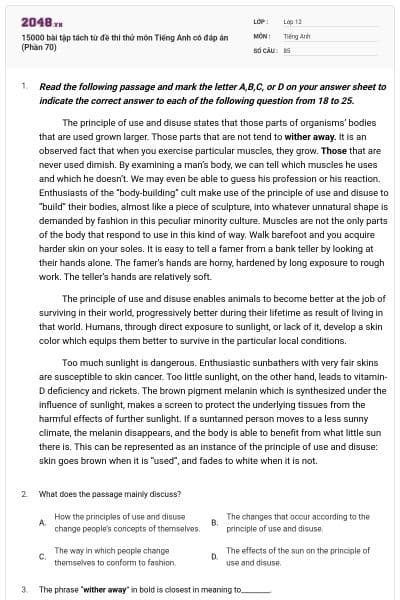
Read the following passage and mark the letter A,B,C, or D on your answer sheet to indicate the correct answer to each of the following question from 18 to 25.
The principle of use and disuse states that those parts of organisms’ bodies that are used grown larger. Those parts that are not tend to wither away. It is an observed fact that when you exercise particular muscles, they grow. Those that are never used dimish. By examining a man’s body, we can tell which muscles he uses and which he doesn’t. We may even be able to guess his profession or his reaction. Enthusiasts of the “body-building” cult make use of the principle of use and disuse to “build” their bodies, almost like a piece of sculpture, into whatever unnatural shape is demanded by fashion in this peculiar minority culture. Muscles are not the only parts of the body that respond to use in this kind of way. Walk barefoot and you acquire harder skin on your soles. It is easy to tell a famer from a bank teller by looking at their hands alone. The famer’s hands are horny, hardened by long exposure to rough work. The teller’s hands are relatively soft.
The principle of use and disuse enables animals to become better at the job of surviving in their world, progressively better during their lifetime as result of living in that world. Humans, through direct exposure to sunlight, or lack of it, develop a skin color which equips them better to survive in the particular local conditions.
Too much sunlight is dangerous. Enthusiastic sunbathers with very fair skins are susceptible to skin cancer. Too little sunlight, on the other hand, leads to vitamin-D deficiency and rickets. The brown pigment melanin which is synthesized under the influence of sunlight, makes a screen to protect the underlying tissues from the harmful effects of further sunlight. If a suntanned person moves to a less sunny climate, the melanin disappears, and the body is able to benefit from what little sun there is. This can be represented as an instance of the principle of use and disuse: skin goes brown when it is “used”, and fades to white when it is not.
What does the passage mainly discuss?
How the principles of use and disuse change people’s concepts of themselves.
The changes that occur according to the principle of use and disuse.
The way in which people change themselves to conform to fashion.
The effects of the sun on the principle of use and disuse.
Đáp án B
Key word: the passage, mainly discuss.
Phân tích đáp án:
A. How the principle of use and disuse change people’s concepts of themselves: Cách nhưng quy luật về dung và không dung làm thay đổi khái niệm của con người về chính họ.
B. The changes that occur according to the principle of use and disuse: Những thay đổi tuỳ theo quy luật dung và không dung - Nội dung xuyên suốt bài (những thay đổi của người tập thể hình/ của da người tuỳ theo điều kiện nắng…)
C. The way in which people change themselves to conform to fashion: Cách mà người ta thay đổi để chạy theo thời trang - Chỉ là một nội dung nhỏ.
D. The effects of the sun on the principle of use and disuse: những ảnh hưởng của ánh nắng lên quy luật dung và không dùng - Hoàn toàn sai.
Đáp án chính xác là B.
The phrase “wither away” in bold is closest in meaning to________.
split
rot
perish
shrink
Đáp án D.
Key word: wither away.
Clue: “those parts of organisms’ bodies that are used grow larger. Those parts that are not tend to wither away”: những phần của cơ thể sinh vật sống đang được sử dụng sẽ phát triển lớn hơn. Những phần không được sử dụng có khuynh hướng________.
Phân tích đáp án:
A. split: phân chia
B. rot: mục rữa
C. perish: chết, tàn lụi
D. shrink: co vào, bé đi
Ta thấy rằng dựa vào clue thì ý của câu 2 phải ngược lại ý của câu 1. Ở câu 1 là “grow larger” thì ở cảu hai sẽ mang nghĩa là bé đi. Đáp an chính xác là D.
The word “Those” in bold refers to________.
organisms
bodies
parts
muscles
Đáp án D.
Key word: those.
Clue: “It is an observed fact that when you exercise particular muscles, they grow. Those that are never used dimish”: Theo quan satd thì khi bạn tập luyện những nhóm cơ nhất định, chúng sẽ lớn lên. Những nhóm không bao giờ được sử dụng sẽ rất nhỏ.
Phân tích đáp án:
A. organisms
B. bodies
C. parts
D. muscles
Do câu trước đang nói đến nhóm cơ nên câu sau chắc chắn vẫn sẽ nói về danh từ đó. Đáp án chính xác là D.
According to the passage, men who body build________
appear like sculptures
change their appearance
belong to strange cults
are very fashionable
Đáp án B.
Key word: men who body build.
Clue: “Enthusiasts of the “body-building” cult make use of the principle of use and disuse to “build” their bodies, almost like a piece of sculpture, into whatever unnatural shape is demanded by fashion in this peculiar minority culture”: Những người ủng hộ trường phái “tập thể hình” sủ dụng nguyên tắc dùng và không dùng để xây dựng cơ thể, gần giống như một tác phẩm điêu khắc, họ biến đổi thành những hình thù không tự nhiên tuỳ theo xu hướng thời trang trong cái xã hội nhỏ khác lạ đó.
Phân tích đáp án:
A. appear like sculpture: trông như một bức tượng điêu khắc
B. change their appearance: thay đổi ngoại hình của họ
C. belong to strange cults: thuộc về những trường phái lạ
D. are very fashionable: rất hợp thời trang
Dựa vào clue ta thấy rằng những người này thuộc về trường phái thể hình (the “body-building” cults) và họ thay đổi cơ thể để hợp mốt thời trang nên do đó đáp án C và D sai. Tác giả dùng tác phẩm điêu khắc để nói về cách những người này thay đổi cơ thể của họ chứ không phải là nhìn họ như những tấm điêu khắc (cứng đơ, bất động). Do đó đáp án chính xác là B.
From the passage, it can be inferred that author views body building________.
with enthusiasm
as an artistic from
with scientific interest
of doubtful benefic
Đáp án D.
Key word: author views bodybuilding as.
Clue: Enthusiasts of the “body-building” cult make use of the principle of use and disuse to “build” their bodies, almost like a piece of sculpture, into whatever unnatural shaple is demanded bu fashion in this peculiar minority: Dùng và không dùng để xây dựng cơ thể, gần giống như một tác phẩm điêu khắc, họ biến đổi thành những hình thù không tự nhiên tuỳ theo xu hướng thời trang trong cái xã hội nhỏ khác lạ đó.
Phân tích đáp án:
A. with enthusiasm: với sự hào hứng
B. as an artistic: như một dạng nghệ thuật
C. with scientific interest: với một niềm yêu thích khoa học
D. of doubtful: như một lợi ích đáng nghi ngờ
Đây là câu hỏi không đơn giản, đòi hỏi ta phải hiểu sắc thái từ ngữ mà tác giả sử dụng. Các từ mang ý nghĩa tương đối không hài lòng, không có cảm tình lắm như: unnatural (không tự nhiên), peculiar (dị biệt, lập dị), minority (thiểu số).
Do đó đáp án chính xác là D.
It can be inferred from the passage that the principle of use and disuse enables organisms to________.
change their existence
automatically benefit
survive in any condition
improve their lifetime
Đáp án C.
Key word: inferred, principle of use and disuse anables organisms to.
Clue: “The principle of use and disuse anables animals to become better at the job of surviving in their world…which equips them better to survive in the particular local conditions”: Nguyên tắc dùng và không dùng giúp cho động vật có thể thích nghi tốt hơn trong viêc tồn tại ở thế giới của chúng… trang bị cho chúng để tồn tại trong những điều kiện cụ thể.
Phân tích đáp án:
A. change their existence: thay đổi sự tồn tại của chúng
B. automatically: có lợi một cách tự nhiên
C. survive in any condition: tồn tại ở bất kỳ tình trạng nào
D. improve their lifetime: cải thiện tuổi thọ
Dựa vào clue ta thấy đáp án chính xác là C.
The author suggests that melanin________.
is necessary for the production of vitamin D
is beneficial in sunless climates
helps protect fair-skinned people
is a synthetic product
Đáp án C.
Key word: melanin.
Clue: “The brown pigment melanin which is synthesized under the influence of sunlight, makes asreen to protect the underlying tissues from the harmful effects of further sunlight”: Melanin có sắc tố nâu được tổng hợp dưới tác động của ánh nắng, tạo nên một lớp bảo vệ những tế bào nằm dưới da khỏi tác động có hại của ánh nắng mặt trời.
Phân tích đáp án:
A. Is necessary for the production of vitamin-D
B. Is beneficial in sunless climates
C. Helps protect fair-skinned people
D. Is a synthetic product
Dựa vào clue ta thấy rằng đáp án chính xác là C.
In the second paragraph, the author mentions sun tanning as an example of________.
humans improving their local condition
humans surviving in adverse conditions
humans using the principle of use and disuse
humans running the risk of skin cancer.
Đáp án C.
Key word: sun tanning, example of.
Clue: “The principle of use disuse anables animals better at the job of surviving in their world, progressively better during their lifetime as a result of living in that world. Humans, through direct exposure to sunlight, or lack of it, develop a skin color which equips them better to survive in the particular local conditions. Too much sunlight is dangerous”: Nguyên lí của việc dùng hay không dùng cho phép động vật trở nên tốt hơn trong việc tồn tại trong môi trường chúng sống, càng ngày càng tốt lên trong suốt cuộc đời của chúng như một kết quả của việc sống đó. Con người tiếp xúc trực tiếp với ánh nắng mặt trời hay thiếu ánh nắng đều phát triển một màu da để tồn tại tốt hơn trong môi trường địa phương đặc biệt.
Phân tích đáp án:
A. Humans improving their local condition: Con người cải thiện điều kiện ở địa phương của họ.
B. Humans surviving in adverse conditions: Con người sống sót trong điều kiện bất lợi
C. Humans using the principle of use and disuse: Con người sử dụng nguyên tắc sử dụng và không sử dụng.
D. Humans running the risk of skin cancer: Con người có nguy cơ ung thư da.
Trong clue ta thấy câu trước nói về quy luật sử dụng hay không sử dụng “ánh nắng” của con người nên câu sau phải là ví dụ cho việc này. Đáp án chính xác là C.
Read the following passage and mark the letter A,B,C, or D on your answer sheet to indicate the correct answer to each of the questions.
ENGLISH SEVENTH MEETING “SAN ANDREAS FAULT”
The San Andreas Fault line is a fracture at the congruence of two major plates of the Earth’s crust, one of which support most of the North American continent, and the other of which underlies the coast of California and part of the ocean floor or the Pacific Ocean. The fault originates about six hundred miles south of the Gulf of California, runs north in an irregular line along the western coast to San Francisco, and continues north for about two hundred more miles before angling off into the ocean. In places, the trace of the fault is marked by a trench, or, in geological terms, a rift, and a small ponds dot the landscape. Its western side always move north in relation to its eastern side. The total net slip along the San Andreas Fault and the length of time it has active are matters of conjecture, but it has been estimated that, during the past fifteen million years, coastal California along the San Andreas Fault has moved about 190 miles in a northwesterly direction with respect to the North American plate. Although the movement along the fault averages only a few inches a year, it is intermittent and variable. Some segments of the fault do not have move at all for long periods of time, building up tremendous pressure that must be released. For this reason, tremors are not unusual along the San Andreas Fault, some of which are classified as major earthquakes. Also for this reason, small tremors are interpreted as safe, since they are understood to be pressure that releases without causing much damage.
It is worth nothing that the San Andreas Fault passes uncomfortable close to several major metropolitan areas, including Los Angeles and San Francisco, in addition, the San Andreas Fault has created smaller fault systems, many of which underlie the smaller towns and cities along the California coast. For this reason, Californians have long anticipated the recurrence of what they refer to as “the Big One”, a chain reaction of destructive earthquakes that would measure near 8 on the Richter scale, similar in intensity to those that occurred in 1857 and 1906. Such a quake world wreak devastating effects on the life and property in the region. Unfortunately, as pressure continues to build along the fault, the likelihood of such an earthquake increases substantially.
What is the author’s main purpose in the passage?
To describe the San Andreas Fault.
To give a definition of a fault.
To explain the reason for tremors and earthquakes.
To classify different kinds of faults.
Đáp án A.
Tạm dịch câu hỏi: Mục đích chính của tác giả trong đoạn văn là gì?
Ta thấy toàn bài tập trung nói về các đặc điểm của khe nứt San Andreas. Vậy đáp án đúng là A. to describe the San Andreas Fault: để miêu tả khe nứt San Andreas.
Các đáp án còn lại là sai:
B. to give a definition of a fault: để đưa ra một định nghĩa cho (khái niệm) khe nứt.
C. to explain the reason for tremors and earthquakes: để giải thích lí do cho những đợt rung chuyển và động đất.
D. to classify different kinds of faults: để phân loại những loại khe nứt khác nhau.
How does the author define the San Andreas Fault?
A plate that underlies the North American continent.
A crack in the Earth’s crust between two plates.
Occasional tremors and earthquakes.
Intense pressure that builds up.
Đáp án B.
Key word: San Andreas Fault, define.
Clue: “The San Andreas Fault line is a fracture at the congruence of two major plates of the Earth’s crust”: Vệt nứt San Andreas là một khe nứt giữa hai mảng của vỏ trái đất.
Ta thấy câu đầu tiên qua bài văn chính là định nghĩa về San Andreas nên đáp án chính xác là B. A crack in the Earth’s crust between two plates: Một vết nức trên vỏ trái đất giữa hai mảng.
Các đáp án còn lại là sai:
A. A plate that underlies the North American continent: một mảng nằm dưới lục địa Bắc Mỹ.
C. Occasional tremors and earthquakes: Những chấn động và động đất theo từng thời kỳ.
D. Intense pressure that builds up: Một áp lực lớn đã tạo ra.
The word originates in paragraph 1 could best be replaced by________.
gets wider
changes direction
begins
disappears
Đáp án C.
Key word: orginates, paragraph 1.
Clue: “The fault originates about six hundred miles south of the Gulf of California, runs north in an irregular line slong the western coast to San Francisco, and continues north for about two hundred more miles before angling off into the ocean”: Khe nứt…ở khoảng 600 dặm Nam vịnh California, chạy hướng bắc theo một đường dài không thẳng tắp dọc theo bờ biển phía Tây đến San Francisco, và tiếp tục kéo lên phía bắc khoảng hơn 200 dặm trước khi gấp khúc hướng về phía đại dương.
A. gets wider: trở nên lớn hơn
B. changes direction: thay đổi hướng
C. begins: bắt đầu
D. disappears: biến mất
Dựa vào clue ta thấy đây là câu văn miêu tả hướng đi của khe nứt nên đáp án chính xác và phù hợp nhất là C vì “originates” là động từ xuất hiện đầu tiên và nó xác định địa điểm đầu tiên của khe nứt.
In which direction does the western side of the fault move?
West
East
North
South
Đáp án C.
Key word: which direction, western side, fault, move.
Dựa vào clue câu 37, ta có đáp án chính xác là C. north: Vùng phía đông của khe nứt tiếp tục chạy lên phía Bắc.
The word its in the paragraph 1 refer to ________.
San Francisco
ocean
coast
fault
Đáp án D.
Key word: its, paragraph 1, refers.
Clue: “In places, the trace of the fault is marked by a trench, or, in geological terms, a rift, and small ponds dot the landscape. Its western side always move north in relation to its eartern side”: Ở một vài nơi, dấu vết của khe nứt được đánh dấu bởi một cái rãnh, hoặc nói theo thuật ngữ địa lý, một kẽ nứt, và những ao nước nhỏ chấm điểm trên vùng đất. Khi phía tây của nó luôn di chuyển theo hướng bắc so với khu phía đông.
Dựa vào clue ta thấy từ Its liên kết với từ “fault” ở câu trên và đáp án chính xác là D. fault.
Along the San Andreas Fault, tremors are________.
small and insignificant
rare, but disastrous
frequent events
very unpredictable
Đáp án C
Key word: tremors.
Clue: “For this reason, tremors are not unusual along the San Andreas Fault, some of which are classified as major earthquakes”: Với lý do này, các chấn động thường diễn ra không phài là không thường xuyên dọc theo khe nứt San Andreas, một vài chấn động được phân loại là những trận động đất lớn.
Phân tích đáp án:
A. small and insignificant: nhỏ và không quan trọng
B. rare, but disastrous: hiếm khi xảy ra nhưng rất thảm khốc
C. frequent events: những sự kiện diễn ra thường xuyên
D. very unpredictable: rất khó dự đoán trước
Dựa vào clue ta thấy đáp án đúng là C. frequent = not unusual
The phrase “the Big One” refers to which of the following?
A serious earthquake
The San Andreas Fault
The river scale
California
Đáp án A.
Key word: the Big One, refers.
Clue: the recurrence of what they refer to as the “Big One”, a chain reaction of destructive earthquakes: sự trở lại của thứ mà họ xem như “vật khổng lồ”, một chuỗi những trận động đất mang tính chất phá huỷ.
Dựa vào clue ta thấy đáp án chính xác là A. a serious earthquake.
Read the following passage and mark the letter A, B, C or D on your answer sheet to indicate the correct answer to each of the questions.
Animals have an intuitive awareness of quantities. They know without analysis the difference between a number of objects and a smaller number. In his book "The Natural History of Selboure" (1786), the naturalist Gilbert White tells how he surreptitiously removed one egg a day from a plover's nest, and how the mother laid another egg each day to make up for the missing one. He noted that other species of birds ignore the absence of a single egg but abandon their nest if more than one egg has been removed. It has also been noted by naturalists that a certain type of wasp always provides five - never four, never six - caterpillars for each of their eggs so that their young have something to eat when the eggs hatch. Research has also shown that both mice and pigeons can be taught to distinguish between odd and even numbers of food pieces.
These and similar accounts have led some people to infer that creatures other than humans can actually count. They also point to dogs that have been taught to respond to numerical questions with the correct number of banks, or to horses that seem to solve arithmetic problems by stomping their hooves the proper number of times.
Animals respond to quantities only when they are connected to survival as a species - as in the case of the eggs - or survival as individuals - as in the case of food. There is no transfer to other situations of from concrete reality to the abstract notion of numbers. Animals can "count" only when the objects are present and only when the numbers involved are small - not more than seven or eight. In lab experiments, animals trained to "count" one kind of object were unable to count any other type. The object, not the numbers, are what interest them. Animals' admittedly remarkable achievements simply do not amount to evidence of counting, nor do they reveal more than innate instincts, refined by the genes of successive generations, or the results of clever, careful conditioning by trainers.
The word "they" refer to ________.
numbers
animals
achievements
genes
Đáp án C.
Clue: …Animal's admittedly remarkable achievements simply do not amount to evidence of counting, nor do they reveal more than innate instinct: …Những thành tựu đáng ghi nhận của động vật đơn giản không phải là tổng số những bằng chứng mà ta đếm được, và chúng cũng không hé lộ ra nhiều hơn bản năng bẩm sinh.
Dễ thấy they là từ để chỉ animal's admittedly remarkable achievements.
Vậy đáp án chính xác là đáp án C. achievements.
According to information in the passage, which of the following is LEAST likely to occur as a result of animals' intuitive awareness of quantities?
When asked by its trainer how old it is, a monkey holds up five fingers.
A lion follows one antelope instead of the herd of antelopes because it is easier to hunt a single prey.
When one of its four kittens crawls away, a mother cat misses it and searches for the kitten.
A pigeon is more attracted by a box containing two pieces of food than by a box containing one piece.
Đáp án D.
Key words: least, result, animals' intuitive awareness of quantities
Clue: Research has also shown that both mice and pigeons can be taught to distinguish between odd and even numbers of food pieces: Nghiên cứu chỉ ra rằng cả chuột và bồ câu đều có thể được dạy phân biệt giữa các số lượng chẵn và lẻ của các miếng thức ăn.
A. When asked by its trainer how old it is, a monkey holds up five fingers: Một con khỉ giơ năm ngón tay lên khi được hỏi nó bao nhiêu tuổi.
B. A lion follows one antelope instead of the herd of antelopes because it is easier to hunt a single prey: Một con sư tử sẽ chỉ đi theo 1 con linh dương thay vì đi theo một đàn linh dương bởi vì sẽ dễ dàng săn được con mồi khi nó đi một mình.
C. When one of its four kittens crawls away, a mother cat misses it and searches for the kitten: Khi một con mèo trong đàn mèo bốn con đi mất, mèo mẹ sẽ nhớ nó và tìm kiếm con của mình.
D. A pigeon is more attracted by a box containing two pieces of food than by a box containing one pieces: Một con chim bồ câu bị thu hút bởi một cái hộp chứa hai miếng thức ăn hơn là một cái hộp chứa một miếng.
Ta thấy bồ câu có thể được dạy để phân biệt số lượng chẵn lẻ của các miếng thức ăn, có thể không phải là trực giác sẵn có của chúng do đó đáp án chính xác là đáp án D.
The word "surreptitiously" is closest in meaning to ________.
stubbornly
secretly
quickly
occasionally
Đáp án B.
Key words: surreptitiously, closest in meaning.
A. stubbornly: cứng đầu
B. secretly: bí mật, kín đáo, giấu giếm
C. quickly: nhanh chóng
D. occasionally: thỉnh thoảng
- surreptitiously: lén lút, gian lận, lừa dối.
Vậy đáp án chính xác là đáp án B.
What is the main idea of this passage?
Of all animals, dogs and horses can count best.
Careful training is required to teach animals to perform tricks involving numbers.
Although animals may be aware of quantities, they cannot actually count.
Animals cannot "count" more than one kind of object.
Đáp án C.
Key words: main idea, passage.
Clue: Animals respond to quantities only when they are connected to survival as a species - as in the case of the eggs - or survival as individuals- as in the case of food […] Animals can "Count" only when the objects are present and only when the numbers involved are small- not more than seven or eight: Động vật có phản xạ với số lượng chỉ khi chúng được gắn với sự sống như một loài - như trong trường hợp quả trứng - hoặc với sự sống như những cá thể - như trong trường hợp thức ăn […] Động vật có thể "đếm" chỉ khi những vật thể hiện diện và chỉ với những con số nhỏ - không lớn hơn 7 hoặc 8.
Vậy đáp án chính xác là đáp án C. Although animals may be aware of quantities, they cannot actually count: Mặc dù động vật có thể nhận thức được số lượng nhưng chúng không thể đếm thực sự
Các đáp án còn lại không đúng:
A. Of all animals, dogs and horses can count best: Trong các loài động vật, chó và ngựa có thể đếm tốt nhất
B. Careful training is required to teach animals to perform tricks involving numbers: Việc dạy động vật thể hiện những trò mẹo liên quan đến số đòi hỏi sự huấn luyện cẩn thận
D. Animals cannot "count" more than one kind of object: Động vật không thể đếm nhiều hơn một loại vật thể.
Where in the passage does the author mention research that support his own view of animals' inability to count?
Line 2-4
Line 8-9
Line 10-11
Line 17-18
Đáp án D.
Key words: where, research, support, animals' inability to count.
Clue: In lab experiments, animals trained to "count" one kind of object were unable to count any other type: Trong phòng thí nghiệm, động vật được dạy để "đếm" một loại vật thể không thể đếm được bất kỳ loại vật thể nào khác.
Động vật chỉ có thể đếm được loại vật thể mà chúng được dạy nghĩa là thực sự thì chúng không biết đếm.
Vậy đáp án chính xác là D. Line 17-18. Trong hai dòng này tác giả đề cập đến nghiên cứu giúp ủng hộ quan điểm của ông về việc động vật không có khả năng đếm.
Why does the author refer to Gilbert White's book in line 2?
To contradict the idea that animals can count.
To provide evidence that some birds are aware of quantities.
To show how attitudes have changed since 1786.
To indicate that more research is needed in this field.
Đáp án B.
Key words: Gilbert White's book.
Clue: In his book "The Natural History of Selboure" (1786), the naturalist Gilbert White tells how he surreptitiously removed one egg a day from a plover's nest, and how the mother laid another egg each day to make up for the missing one: Trong cuốn sách "Lịch sử Tự nhiên của Selboure" (1786), nhà tự nhiên học Gilber White kể rằng ông đã lén lấy đi một quả trứng trong tổ chim choi choi và mỗi ngày chim mẹ đều đặt một quả trứng khác vào để bù cho quả trứng đã mất.
A. To contradict the idea that animals can count: để phản bác lại ý kiến rằng động vật có thể đếm.
B. To provide evidence that some birds are aware of quantities: để cung cấp bằng chứng rằng một số loài chim nhận thức được số lượng.
C. To show how attitudes have changed since 1786: để chỉ ra thái độ đã thay đổi như thế nào kể từ năm 1786.
D. To indicate that more research is needed in this field: để chỉ ra rằng lĩnh vực này cần nhiều nghiên cứu hơn.
Dễ thấy đáp án chính xác là đáp án B.
The author mentions that all of the following are aware of quantities in some ways EXCEPT ________.
caterpillars
mice
plovers
wasps
Đáp án A.
Lưu ý đề bài yêu cầu tìm đáp án sai và cụm từ aware of quantities in some ways: nhận thức được số lượng theo cách nào đó (không nhất thiết phải là do trực giác).
Đáp án B. mice đúng vì ở dòng 7 có "both mice and pigeons can be taught to distinguish between odd and even numbers of foodpieces": cả chuột và bồ câu đều có thể được dạy phân biệt giữa các số lượng chẵn và lẻ của các miếng thức ăn.
Đáp án C. plovers đúng vì ở dòng 3 có "he surreptitiously removed one egg a day from a plover's nest, and how the mother laid another egg each day to make up for the missing one": ông đã lén lấy đi một quả trứng trong tổ chim choi choi và mỗi ngày chim mẹ đều đặt một quả trứng khác vào để bù cho quả trứng đã mất như thế nào.
Đáp án D. wasps đúng vì ở dòng 6 có "a certain type wasp always provides five never four, never six - caterpillars for each of their eggs": một loài ong bắp cày nào đó luôn cho 5 - không bao giờ là 4 hoặc 6 - con sâu bướm cho mỗi quả trứng của chúng.
Vậy đáp án chính xác là A. caterpillars loài này không nhận biết được về số lượng.
Read the following passage and mark the letter A, B, C or D on your answer sheet to indicate the correct answer to each of the questions.
American music, in most of its various forms, can be traced back to the music of the earliest African-Americans. Even though these Americans came here under the worst of circumstances, they still brought with them traditions, and developed new traditions of their own, that have grown into what is recognized around the world today as American music.
Musicians, like other artists, are usually quick to give credit where credit is due. Just as a writer quotes his sources, a musician credits those musicians who inspired him. In the case of the early African-Americans, that is not always easy. Many of the slaves who brought musical traditions from Africa will never be known by name. No one wrote their history. Many of the slaves who sang work songs in the fields will never be known by name. No one wrote their history either.
However, there is a lot that we do know.
The first well-recognized form of African-American music was spirituals. Spirituals are religious songs. They are songs that tell a story or express emotions. Spirituals have a strong rhythm. They are often sung by a group, sometimes with a leader who sings a line or two alone and a chorus that sings the refrain. Spirituals originated in the Southern United States. Spirituals sung by slaves often expressed the hope for freedom that was so important in their lives. Well know spirituals include "Go Down Moses", "Deep River" and "Swing Low Sweet Chariot".
After slavery ended, spirituals began to spread to other parts of the United States. Harry Thacker Burleigh was one of the first singers to perform spirituals on stage in a concert. Marian Anderson, well known for her classical singing, helped spirituals to gain a wider audience too. Spirituals influenced the development of another well-known form of American music - the blues.
The blues were a more individual style of music than spirituals. Blues were often sung solo, and sometimes they were accompanied by guitar music. As the name suggests, the blues were often about sadness and facing troubles. However, the blues could also be funny, positive, and even defiant. One blues singer, loved for her strong, beautiful voice, was Bessie Smith. Another early blues musician was W.C.Handy. Handy was not only a musician, he also wrote music, promoted concerts, and published blues songs.
During the time that the blues were spreading across the country, another style of music was also quickly gaining in popularity. Ragtime was energetic music with a complicated, syncopated beat. Often played on the piano, ragtime was the latest and most sophisticated in American popular music. The best-known ragtime musician was probably Scott Joplin, who wrote many hit ragtime pieces for the piano including "Maple Leaf Rag".
Eventually, elements from all of these forms of music and more came back together. In their own kind of melting pot, African rhythms, slave work songs, spirituals, blues, ragtime, and other influences recombined to form the beginnings of that truly American art form - jazz. In the late 1800's jazz was just beginning, but not long after the turn of the century, it would be the most popular American music. It would go on from there to worldwide popularity. Jazz would branch out into many forms, and it would influence future styles of American music.
Many musicians today credit earlier musicians such as Scott Joplin or Bessie Smith with inspiring their music. It's a shame that they can't also name the earliest African-Americans who really began the traditions that led to the American music of today.
According to the passage, who introduced the early form of American music?
American natives
Harry Thacker Burleigh
Slaves from Africa
People from the South of the United States.
Đáp án C.
Key words: who introduced, early form, American music.
Clue: "Many of the slaves who brought musical traditions from Africa": Rất nhiều những nô lệ mang truyền thống âm nhạc từ Châu Phi tới…" và "American music, in most of its various forms, can be traced back to the music of the earliest African-Americans": Hầu hết các thể loại âm nhạc ở Mĩ đều có nguồn gốc từ âm nhạc của những người Mĩ gốc Phi xa xưa.
Đáp án đúng là C. Slaves from Africa: Những người nô lệ da đen bị mang từ châu Phi tới Mĩ.
Which type of music is often involved with piano accompaniment?
spirituals
ragtime
blues
jazz
Đáp án B.
Key words: type of music, involved, piano accompaniment.
Clue: "Often played on the piano, ragtime was the latest and most sophisticated…": ragtime thường được chơi trên piano và nó là thể loại nhạc tân thời và phức tạp nhất…
Do đó, đáp án đúng nhất phải là B. ragtime.
What is NOT true when talking about blues?
They could be amusing and optimistic.
A well-known blues musicians was Scott Joplin
They gained popularity near the time ragtime became popular.
They were a more individual style of music than spirituals.
Đáp án B.
Key words: NOT true, blues.
Clue: "The best-known ragtime musician was probably Scott Joplin": Nghệ sĩ ragtime nổi tiếng nhất có lẽ là Scott Joplin.
Vậy đáp án đúng phải là B. a well-known blues musician was Scott Joplin vì Joplin không phải là nghệ sĩ nhạc blues, ông là nhạc sĩ dòng nhạc ragtime.
When did jazz become the most popular American music?
Sometime in the early 20th century.
When elements from other American music combined.
After the hit "Maple Leaf Rag" was written.
In the late 1800s.
Đáp án A.
Key words: When, jazz, most popular.
Clue: "In the late 1800's jazz was just beginning, but not long after the turn of the cenury, it would be the most popular American music": Jazz mới chỉ ra đời cuối những năm 1800, nhưng không lâu sau thời điểm chuyển giao thế kỷ, nó đã trở thành thứ âm nhạc Mĩ phổ biến nhất. "The turn of the century" là cách nói để chỉ những năm cuối thế kỷ cũ hoặc đầu thế kỷ mới. Nhưng trong tình huống này ta hiểu thời điểm chuyển giao này là của thế kỷ 20 tức là đầu những năm 1900. Vậy đáp án đúng là A. sometime in the early 20th century.
Scott Joplin and Bessie Smith were ________.
famous ragtime musicians
people who really began the American musical traditions
artists who inspired many musicians today
songwriters who wrote blues songs
Đáp án C.
Key words: Scott Joplin, Bessie Smith.
Clue: "Many musicians today credit earlier musicians such as Scott Joplin or Bessie Smith with inspiring their music": Nhiều nhạc sĩ ngày nay ghi nhận những cái tên đi trước như Scott Joplin hay Bessi Smith vì những nghệ sĩ này đã truyền cảm hứng sáng tác cho họ.
Vậy đáp án đúng phải là C. artists who inspired many musicians today.
What is the closet meaning to the word "chorus" used in the passage?
A group of singers that sing together.
The main part of a song.
An accompanying singer.
None of the above.
Đáp án A.
Key words: chorus, closest meaning.
Clue: "often sung by a group, sometimes with a leader who sings a line or two alone and a chorus that sings the refrain": thường được hát theo nhóm, đôi khi một nhạc trưởng sẽ hát một hai câu và một đoạn điệp khúc.
Ta thấy sau đại từ quan hệ that là động từ sings chia ở số ít à that là đại từ thay thế cho danh từ chỉ người. Từ chorus có nghĩa là một nhóm người hát đồng ca hoặc đoạn điệp khúc trong một bài hát à trong trường hợp này chorus gần nghĩa nhất với a group of singers that sing together. Đáp án đúng phải là A.
The word "they" in the last paragraph refers to ________.
today's musicians
Scott Joplin and Bessie Smith
the musicians' music
the names of the earliest African-American singers
Đáp án A.
Key words: they, last paragraph, refers.
Clue: "Many musicians today credit earlier musicians such as Scott Joplin or Bessie Smith with inspiring their music. It's a shame that they can't also name the earliest African-Americans who really began the traditions that led to the American music of today": Nhiều nhạc sĩ ngày nay ghi nhận những cái tên đi trước như Scott Joplin hay Bessie Smith vì những nghệ sĩ này đã truyền cảm hứng sáng tác cho họ. Đáng tiếc là họ không thể biết được tên tuổi của những người Mĩ gốc Phi xa xưa- những người đã thật sự tạo ra những truyền thống bắt nguồn cho nền âm nhạc nước Mĩ ngày nay.
Đáp án đúng là A. today's musicians. "Họ" ở đây là những nhạc sĩ ngày nay.
What is the main idea of the passage?
Today's style of American music is mostly influenced by African-rooted songs.
It is hard to exactly recognize the people who started the American musical tradition.
Spirituals, blues and ragtime are the major components that formed jazz.
American's music history was built by several famous musicians.
Đáp án B.
Key words: main idea of the passage.
Trong đoạn 1, 2 tác giả nêu ra rằng âm nhạc Mĩ khởi nguồn từ những người Mĩ gốc Phi; nhưng không ai bận tâm ghi chép về những người đã mang âm nhạc từ quê hương họ tới Mĩ.
Đoạn cuối nói rằng người ta thật khó biết tên của những người đã khơi nguồn cho truyền thống âm nhạc này ở Mĩ. Do đó, đáp án đúng phải là B. It is hard to exactly recognize the people who started the American musical tradition: Thật khó để xác chính xác những con người khởi đầu cho truyền thống âm nhạc ở Mĩ.
Read the following passage and mark the letter A, B, C or D on your answer sheet to indicate the correct answer to each of the questions.
Accustomed though we are to speaking of the films made before 1927 as “silent”, the film has never been, in the full sense of the word,silent. From the very beginning, music was regarded as an indispensable accompaniment; when the Lumiere films were shown at the first public film exhibition in the United States in February 1896, they were accompanied by piano improvisations on popular tunes. At first, the music played bore no special relationship to the films; an accompaniment of any kind was sufficient. Within a very short time, however, the incongruity of playing lively music to a solemn film became apparent, and film pianists began to take some care in matching their pieces to the mood of the film.
As movie theaters grew in number and importance, a violinist, and perhaps a cellist, would be added to the pianist in certain cases, and in the larger movie theaters small orchestras were formed. For a number of years the selection of music for each film program rested entirely in the hands of the conductor or leader of the orchestra, and very often the principal qualification for holding such a position was not skill or taste so much as the ownership of a large personal library of musical pieces. Since the conductor seldom saw the films until the night before they were to be shown (if, indeed, the conductor was lucky enough to see them then), the musical arrangement was normally improvised in the greatest hurry.
To help meet this difficulty, film distributing companies started the practice of publishing suggestions for musical accompaniments. In 1909, for example, the Edison Company began issuing with their films such indications of mood as “pleasant”, “sad”, “lively”. The suggestions became more explicit, and so emerged the musical cue sheet containing indications of mood, the titles of suitable pieces of music, and precise directions to show where one piece led into the next.
Certain films had music especially composed for them. The most famous of these early special scores was that composed and arranged for D.W. Griffith’s film Birth of a Nation, which was released in 1915.
The passage mainly discusses music that was ________.
performed before the showing of a film
played during silent films
recorded during film exhibitions
specifically composed for certain movie theaters
Đáp án B.
Keywords: mainly, discuss, music.
Clue: “Accustomed though we are to speaking of the films made before 1927 as “silent”, the film has never been, in the full sense of the word,silent. From the very beginning, music was regarded as an indispensable accompaniment…”: Mặc dù chúng ta đã quen thuộc khi nhắc tới những bộ phim được sản xuất trước năm 1927 là “phim câm” thì những phim này chưa bao giờ thực sự là phim câm cả. Ngay từ khi mới bắt đầu, âm nhạc đã được xem là thứ đồng hành không thể thiếu…à Đáp án đúng là B. played during silent films: được chơi trong suốt các bộ phim câm.
Các đáp án còn lại không phù hợp: A. performed before the showing of a film: được chơi trước khi trình chiếu một bộ phim.
C. recorded during film exhibitions: được thu lại trong khi triển lãm phim.
D. specifically composed for certain movie: được soạn đặc biệt cho một bộ phim nhất định.
What can be inferred that the passage about the majority of films made after 1927?
They were truly “silent”.
They were accompanied by symphonic orchestras.
They incorporated the sound of the actors’ voices.
They corresponded to specific musical compositions.
Đáp án C.
Keywords: inferred (suy luận), the majority of films, after 1927.
Clue: “Accustomed though we are to speaking of the films made before 1927 as “silent”, the film has never been, in the full sense of the word,silent. From the very beginning, music was regarded as an indispensable accompaniment…”: Mặc dù chúng ta đã quen thuộc khi nhắc tới những bộ phim được sản xuất trước năm 1927 là “phim câm” thì những phim này chưa bao giờ thực sự là phim câm cả. Ngay từ khi mới bắt đầu, âm nhạc đã được xem là thứ đồng hành không thể thiếu…
Phân tích:
A. They were truly “silent”: Chúng thực sự im lặng.
B. They were accompanied by symphonic orchestras: Chúng được chơi cùng dàn nhạc giao hưởng.
C. They incorporated the sound of the actors’ voices: Chúng được kết hợp chặt chẽ với âm thanh từ giọng của diễn viên.
D. They corresponded to specific musical compositions: Chúng tương ứng với một tác phẩm âm nhạc cụ thể.
Những bộ phim câm trước năm 1927 trên thực tế không hoàn toàn im lặng bởi luôn có âm nhạc đồng hành. Dù cho diễn viên không nói nhưng âm nhạc lại được kết hợp với phần diễn của diễn viên để miêu tả được phần diễn đó. Do đó, sau năm 1927 chắc chắn là film đã được lồng tiếng nên đáp án đúng là C.
It can be inferred that orchestras conductors who worked in movie theaters needed to ________.
be able to play many instruments
have pleasant voices
be familiar with a wide variety of music
be able to compose original music
Đáp án C.
Keywords: inferred, orchestra conductor, needed to.
Clue: “For a number of years the selection of music for each film program rested entirely in the hands of the conductor or leader of the orchestra, and very often the principal qualification for holding such a position was not skill or taste so much as the ownership of a large personal library of musical pieces.”: Trong một vài năm việc lựa chọn âm nhạc cho từng chương trình phim hoàn toàn nằm trong quyết định của người chỉ huy hoặc người chỉ đạo dàn nhạc, và rất thường xuyên thì tiêu chuẩn chính để được nắm giữ vị trí này không phải nằm ở kỹ năng hay thẩm âm mà là ở việc sở hữu một kho tang các bản nhạc đồ sộ riêng.
Phân tích:
Ta ngầm hiểu “the ownership of a large personal library of musical pieces” trong bối cảnh này nghĩa là người chỉ huy dàn nhạc phải biết tới nhiều loại nhạc đa dạng phong phú khác nhau. Do đó, chọn đáp án C. be familiar with a wide variety of music: quen thuộc với các loại nhạc đa dạng khác nhau.
Các đáp án khác không phải là những suy luận đúng:
A. be able to play many instruments: có khả năng chơi nhiều nhạc cụ
B. have pleasant voices: có giọng hay.
D. be able to compose original music: có khả năng soạn nhạc nguyên bản.
The word “them” in paragraph 2 refers to ________
years
hands
pieces
films
Đáp án D.
Keywords: them, paragraph 2.
Clue: Since the conductor seldom saw the films until the night before they were to be shown (if, indeed, the conductor was lucky enough to see them then), the musical arrangement was normally improvised in the greatest hurry: Bởi người chỉ đạo dàn nhạc hiếm khi được xem những bộ phim và phải tới đêm trước khi những bộ phim được trình chiếu (đó là trong trường hợp người chỉ đạo dàn nhạc may mắn mới được xem bộ phim vào thời điểm đó), việc sắp xếp âm nhạc thông thường được ứng biến trong khoảng thời gian rất ngắn.
Phân tích:
Ta chiếu lên phía trước xem “them” ở đây thay thế cho danh từ nào. Vì “see them” do đó danh từ này phải xem được. Vậy ta chọn đáp án D. films.
Các đáp án khác không phù hợp:
A. years: các năm
B. hands: những bàn tay
C. pieces: những bản nhạc
According to the passage, what kind of business was the Edison Company?
It produced electricity.
It distributed films.
It published musical arrangements.
It made musical instruments
Đáp án B.
Keywords: kind of business, the Edison Company.
Clue: “In 1909, for example, the Edison ComTapany began issuing with their films…”: Vào năm 1909, ví dụ, công ty Edison bắt đầu phát hành những bộ phim của họ…
Phân tích: Ta có từ “issue” là phát hành. Trong bối cảnh này tương đương với từ “distribute”: phân phối. Do đó, chọn đáp án B. It distributed films: Công ty này phân phối những bộ phim.
Các đáp án khác không phù hợp:
A. It produced electricity: Công ty này sản xuất điện.
C. It published musical arrangements: Công ty này xuất bản các bản nhạc.
D. It made musical instruments: Công ty này chế tạo các nhạc cụ.
It may be inferred from the passage that the first musical cue sheets appeared around ________.
1896
1909
1915
1927
Đáp án B.
Keywords: inferred, the first musical cue sheets.
Clue: “In 1909, for example, the Edison Company began issuing with their films such indications of mood as “pleasant”, “sad”, “lively”. The suggestions became more explicit, and so emerged the musical cue sheet containing indications of mood…”: Ví dụ vào năm 1909, Công ty Edison đã bắt đầu phát hành những bộ phim của họ với những biểu thị tâm trạng ẩn trong đó như “vui”, “buồn”, “sống động”. Những gợi ý này dần trở nên rõ ràng hơn và vì thế đã xuất hiện những bản sắp xếp trình tự xuất hiện của bản nhạc bao gồm cả những biểu thị tâm trạng…
Phân tích: Con số được đưa ra trong manh mối này là 1909. Do đó ta chọn đáp án B. 1909.
Which of the following notations is most likely to have been included on a musical cue sheet of the early 1900’s?
“Calm, peaceful”
“Piano, violin”
“Key of C major”
“Directed by D.W. Griffith’s”
Đáp án A.
Keywords: notations, included on a musical cue sheet.
Clue: “so emerged the musical cue sheet containing indications of mood, the titles of suitable pieces of music, and precise directions to show where one piece led into the next”:… vì thế đã xuất hiện những bản sắp xếp trình tự xuất hiện của bản nhạc bao gồm cả những biểu thị tâm trạng, tiêu đề của loại nhạc phù hợp, và các chỉ dẫn chính xác để thể hiện lúc nào sẽ chơi một bản nhạc khác.
Phân tích: Ta xét các đáp án:
A. “Calm, peaceful”: “Bình tĩnh, yên ả”: Đây là biểu thị tâm trạng: Có được thể hiện trên “musical cue sheet”.
B. “Piano, violin”: Đây là nhạc cụ: Không được thể hiện trên musical cue sheet.
C. “Key of C major”: “khóa Đô trưởng”: Đây là khóa nhạc: Không được thể hiện trên “musical cue sheet”.
D. “Directed by D.W. Griffith’s”: “Đạo diễn bởi D.W. Griffith’s”: Đây là tên đạo diễn: Không được thể hiện trên “musical cue sheet”.
Vậy đáp án đúng phải là A. “Calm, peaceful”.
The word “scores” in paragraph 4 most likely means ________.
totals
successes
groups of musicians
musical compositions
Đáp án D.
Keywords: “scores”, paragraph 4.
Clue: “Certain films had music especially composed for them. The most famous of these early special scores was that composed and arranged for D.W. Griffith’s film Birth of a Nation, which was released in 1915”: Những bộ phim nhất định có âm nhạc được đặc biệt sáng tác cho chúng. Nổi tiếng nhất trong những… đặc biệt này là cái được soạn và sắp xếp cho bộ phim Birth of a Nation của D.W. Griffith’s, bộ phim ra mắt năm 1915.
Phân tích: Ta xét nghĩa của các đáp án:
A. totals: tổng cộng
B. successes: chuỗi thành công
C. groups of musicians: nhóm các nhà soạn nhạc
D. musical compositions: tác phẩm âm nhạc
Trong các đáp án trên thì đáp án D là thể hiện rõ nhất nghĩa của từ “scores” trong bối cảnh này.
Read the following passage and mark the letter A, B, C, or D on your answer sheet to indicat the correct answer to each of the following questions.
According to airline industry statistics, almost 90 percent of airline accidents are survivable or partially survivable. But passengers can increase their chaneces of survival by learning and following certain tips. Experts say that you should rad and listen to safety instrucstion before take-off and ask questions if you have uncertainties. You should fasten your seat belt low on your hips and as tightly as possible. Of course, you should also know how the release mechanism of your blet operates. During takeoffs and landings, you are advised to keep your feet flat on the floor. Before take-off, you should locate the nearest exit and an alternative exit and count the row of seats beween you and the exits so that you can reach them in the dark if necessary. In the event that you are forewarned of a possible accident, you should put your hands on your ankles and keep your head down until the plane comes to a complete stop. If smoke is present in the cabin, you should keep your head low and cover your face whit napkins, towels, or clothing. If possible, wet these for added protection against smoke inhalation. To evacuate as quickly as possible, follow crew commands and do not take personal belongings with you. Do not jump on escape slides before they are fully infated , and when you jump, do so with your arms and legs extended in front of you. When you get to the ground, you should move away from the plane as quickly as possible, and smoke near the wreckage.
What is the main topic of the passage?
Procedures for evacuation aircraft.
Guidelines for increasing aircraft passenger survival.
Airline industry accident statistics.
Safety instrucstions in air travel.
Đáp án B
Key word: main topic.
Clue: According to airline industry statistics, almost 90 percent of airline accidents are survivable or partially survivable. But passengers can increase their chaneces of survival by learning and following certain tips: Theo số liệu thống kê của ngành công nghiệp hàng không, gần 90% số vụ tai nạn hàng không là có toàn bộ người sống sót hoặc chỉ có một phần bị thiệt mạng. Tuy nhiên, hành khách có thể tăng cơ hội sống sót bằng cách học hỏi và làm theo những lời khuyên.
Vậy chủ đề chính của đoạn văn là B. Guidelines for increasing aircraft passenger survival: Những hướng dẫn để tăng khả năng sống sót của các hành khách đi máy bay.
Travelers are urged by experts to read and listen to safety instruction ________.
if smoke is in the cabin
in an emergency
before locating the exits
before take-off
Đáp án D.
Key word: experts, safety instruction
Clue: Experts say that you should rad and listen to safety instrucstion before take-off”: Chuyên gia nói rằng bạn nên đọc và nghe hướng dẫn an toàn trước khi cất cánh.
Phân tích đáp án:
A. if smoke is in the cabin: nếu có khói ở phòng buồng
B. in an emergency: trong trường hợp khẩn cấp
C. before locating the exits: trước khi định vị chỗ thoát hiểm
D. before take-off: trước khi cất cánh
Dựa vào clue ta thấy rằng đáp án chính xác là D. before take-off. Question 108: Đáp án D.
Key word: airline travelers, keep, feet flat.
Clue: “During takeoffs and landings, you are advised to keep your feet flat on the floor”: Trong lúc cất cánh và hạ cánh, bạn được khuyên là nên để bàn chân sát vào nền sàn.
Phân tích đáp án:
A. especially during landings: đặc biệt trong lúc hạ cánh.
B. throughout the flight: trong suốt chuyến bay
C. only if an accident is possible: chỉ nếu khi có khả năng xảy ra tai nạn
D. During takeoffs and landings: trong lúc cất cánh và hạ cánh
According to the passage, airline travelers should keep their feet flat on the floor ________.
especially during landings
throughout the flight.
only if an accident is possible
during take-offs and landings
Đáp án C.
Key word: which exits, locate before take-off.
Clue: Before take-off, you should locate the nearest exit and an alternative exit and count the row of seats beween you and the exits so that you can reach (them) in the dark if necessary”: Trước khi máy bay cất cánh, bạn nên định vị chỗ thoát hiểm gần nhất và chỗ thoát hiểm thay thế, và đếm số hàng ghế giữa chỗ của bạn và chỗ thoát hiểm để bạn có thể tiến tới chúng trong bóng tối nếu cần thiết.
Phân tích đáp án:
A. The one with counted rows of seats between them: những cái với những hàng ghế ngồi giữa họ.
B. The nearest one: cái gần nhất
C. The two closest to the passenger’s seat: hai cái gần nhất với chỗ ngồi của hành khách
D. The ones that can found in the dark: cái mà có thể tìm thấy trong bóng tối
Theo clue chúng ta nên chọn một cửa gần nhất cùng với một cửa khác để thay thế.
Vậy đáp án chính xác là C. The two closest to the passenger’s seat
According to the passage, which exits should an airline passenger locate before take-off?
The ones with counted rows of seats between them
The nearest one.
The two closest to the passenger’s seat
The ones that can be found in the dark
Đáp án C
Key word: them.
Clue: “Before take-off, you should locate the nearest exit and an alternative exit and count the row of seats beween you and the exits so that you can reach (them) in the dark if necessary”: Trước khi máy bay cất cánh, bạn nên định vị chỗ thoát hiểm gần nhất và chỗ thoát hiểm thay thế, và đếm số hàng ghế giữa chỗ của bạn và chỗ thoát hiểm để bạn có thể tiến tới chúng trong bóng tối nếu cần thiết.
Phân tích đáp án:
A. seats: chỗ ngồi
B. rows: hàng ghế
C. exits: cửa thoát hiểm
D. feet: bàn chân
Vậy đáp án chính xác là C. exits
The word “them” in bold refers to ________.
seats
row
exits
feet
Đáp án D.
Key word: survive fires.
Clue: “In the event that you are forewarned of a possible accident, you should put your hands on your ankles and keep your head down until the plane comes to a complete stop”: Trong trường hợp bạn đã được thông báo trước về tai nạn có thể xảy ra, bạn nên để tay lên mắt cá chân và cúi đầu xuống cho đến khi máy bay đỗ lại hoàn toàn.
Phân tích đáp án:
A. don’t smoke in or near a plance: đừng hút thuốc trong hoặc gần máy bay
B. read airline safety statistics: đọc số liệu về an toàn hàng không
C. wear a safety belt: thắt dây an toàn.
D. keep their heads low: giữ cho đầu cúi xuống
Dựa vào clue ta thấy đáp án chính xác là D. keep their heads low.
It can be inferred from the passage that peole are more likely to survive fires in aircrafts if they ________.
don’t smoke in or near a plance
read airline safety statistics
wear a safety belt
keep their heads low
Đáp án D
Key word: advised, EXCEPT.
Clue:
1. “Experts say that you should rad and listen to safety instrucstion before take-off and ask questions if you have uncertainties”: chuyeengia nói rằng bạn nênđọc và nghe hướng dẫn về an oàn trước khi máy bay cất cánh và đặt câu hỏi nếu bạn có gì không chắc chắn.
2. “You should fasten your seat belt low on your hips and as tightly as possible”: bạn nên thắt dây an toàn dưới hông và càng chặt càng tốt.
3. “Before take off, you should locate the nearest exit and an alternative exit and count the row of seats beween you and the exits so that you can reach them in the dark if necessary”: trước khi máy bay cất cánh, bạn nên định vị chỗ thoát hiểm gần nhất và chỗ thoát hiểm thay thế, và đếm số hàng ghế giữa chỗ của bạn và chỗ thoát hiểm để bạn có thể tiến tới chúng trong bóng tối nếu cần thiết.
4. “follow crew commands and do not take personal belongings with you”: làm theo yêu cầu của đội cứu hộ và không mang đồ đạc của bạn theo.
Phân tích đáp án:
A. ask questions about safety: đặt câu hỏi về an toàn – Đúng theo clue 1.
B. locate the nearest exit: định vị lối thoát hiểm gần nhất – Đúng theo clue 3.
C. fasten their seat belts before take-off: thắt dây an toàn trước khi cất cánh -Đúng theo clue 2.
D. carry personal belongings in an emergency: mang hành lý cá nhân theo trong trường hợp khẩn cấp – Sai vì nó trái ngược với thông tin trong clue 4.
Do đó đáp án chính xác là D.
Airline passengers are advised to do all of the following EXCEPT ________
ask questions about safety
locate the nearest exit
fasten their seat belts before take-off
carry personal belongings in an emergency
Đáp án A.
Key word: inflated
Clue: Do not fump on escape slides before they are fully (inflated).
Slide là cửa trượt bằng hơi trên máy bay
Phân tích đáp án:
A. expanded: được mở rộng, làm cho lớn lên
B. lifted: được nâng lên
C. assembled: được lắp ráp
D. increased: được tăng lên
Dựa vào clue ta biết rằng thang hơi phải được bơm lên nên đáp án phù hợp nhất là A. expanded (được mở rộng, làm cho lớn lên) vì nó giúp ta liên tưởng đến việc nó được bơm đầy hơi.
The word “inflated” in bold is closest in meaning to ________.
expanded
lifted
assembled
increased
Đáp án C.
Key word: mainly concerned.
Clue: ta chú ý đến những từ hay xuất hiện trong bài và những chi tiết đưa ra nhằm hướng tới một nội dung chính nào đó.
1. “There are two very differcent types of flatfish and they have evolved in very separate ways”: Có hai loài cá dẹt và chúng tiến hóa theo các con đường khác nhau.
2. “In evolution this problem was soleved…”: Trong quá trình tiến hóa, vấn đề này đã được giải quyết.
Ngoài từ “flatfish” cũng xuất hiện nhiều lần trong bài và bài khóa đề cập đến những vấn đề thích nghi của loài cá này trong quá trình tiến hóa. Vậy đáp án là C. evolution of flatfish: sự tiến hóa của cá dẹt
Các đáp án không phù hợp:
A. symmetrical flatfish
B. bony flatfish
D. different types of flatfish
Read the following passage and mark the letter A, B, C, or D on your answer sheet to indicate the correct answer to each of the following questions.
Fish that live on the sea bottom benefit by being flat and hugging the contours. There are two very differcent types of flatfish and they have evolved in very separate ways. The skates ad rays, relatives of the rharks, have become flat in what might be called the obivious way. Their bodies have grown out sideways to form grat “wings”. They look as though they have been flattened but have remained symmetrical and “the right way up”. Conversely, fish such sas plaice, sole, and halibut have become flat in a different way. There are bony fish which have a marked tendency to be flattened in a vertical direction; they are much “taller” than they are wide. They use their whole, vertically flattened bodies as swimming surfaces, which undulat through the water as they move. Therefore, when their ancestors migrate to the seabed, they lay on one side than on their bellies. However, this raises the problem that one eye was always looking down into the sand and was effectively useless – In evolution this problem was soleved by the lower eye “moving” around the other side. We see this process off moving around enacted in the development of every young bony flatfish. It starts life swimming near the surface, and is symmetrical and vertically flattened, but then the skull starts to grow in a strange asymmetrical twisted fashion,, so that one eye, for instance the left, moves over the top of the head upwards, an old Picasso – like vision. Incidentally, some species of 20 flatfish settle on the right side, others on left, and others on either side.
The passage is mainly concerned with ________.
symmetrical flatfish
bony flatfish
evolution of flatfish
different types of flatfish
Đáp án C
Key word: skates and rays, example
Clue: The skates ad rays, relatives of the rharks, have become flat in what might be called the obivious way. Their bodies have grown out sideways to form grat “wings”. They look as though they have been flattened but have remained symmetrical: Những chiếc giày trượt và cá voi, những người họ hàng của cá mập, đã trở nên dẹt (có thể được gọi một cách rõ ràng. Cơ thể của chúng đã phát triển sang hai bên để tạo thành những bộ “cánh” tuyệt vời. Chúng trông như thể chúng đã được làm phẳng nhưng vẫn giữ được đối xứng
Phân tích:
A. become asymmetrical: trở nên xoắn đối –Sai vì loài cá này đối xứng kép
B. appear to fly : có thể bay - Sai vì những chiếc cánh ở đây để trong ngoặc kép, không phải giống cánh thật
C. have spread hrizontally: trải rộng sang ngang – Đúng. “Spread” là trải rộng dài, bài khóa đề cập đến những chiếc cánh lớn.
D. resemble sharks: trông giống cá mập – Sai vì loài cá đuối này chỉ có họ hàng với cá mập, ngoại hình của chúng không giống cá mập.
Vậy câu trả lời đúng là C. have spread hrizontally.
The author mentions skates and rays as examples of fish that ________.
become asymmetrical
appear to fly
have spread hrizontally
resemble sharks
Đáp án C
Key word: plaice.
Phân tích:
A. have difficulties in swimming: gặp khó khăn trong bơi lội – Sai vì ngay ở câu đầu tiên ta đã biết đây là một loài được hưởng lợi nhờ việc thân nó trở nên dẹt (benefit by being flat) à nó bơi rất giỏi nhờ được hưởng lợi thế tiến hóa. B. live near the surface: sống ở gần mặt nước - Sai vì ngay ở câu đầu tiên ta đã biết đây là một loài sống ở đáy biển (live on the sea botton).
C. have distorted heads: có đầu méo mó - Đúng vì bài có đề cập đến việc hộp sọ của chúng bắt đầu phát triển theo một kiểu thời trang xoắn bất đối xứng. (the skull starts to grow in a strange asymmetrical twisted fashion)
D. have poor eyesight: có mắt kém – Sai vì trong bài chỉ nói nó hay nằm nghiêng, một con mắt lúc nào cũng nhìn xuống cát và bởi vậy cái mắt đó là vô dụng (one eyes was always looking down into the sand and was effectively useless) à không phải là do mắt kém
Vậy đáp án là C. have distorted heads.
According to the passage, fish such as plaice ________.
have difficulties in swimming
live near the surface
have distorted heads
have poor eyesight
Đáp án C
Key word: plaice.
Phân tích:
A. have difficulties in swimming: gặp khó khăn trong bơi lội – Sai vì ngay ở câu đầu tiên ta đã biết đây là một loài được hưởng lợi nhờ việc thân nó trở nên dẹt (benefit by being flat) à nó bơi rất giỏi nhờ được hưởng lợi thế tiến hóa. B. live near the surface: sống ở gần mặt nước - Sai vì ngay ở câu đầu tiên ta đã biết đây là một loài sống ở đáy biển (live on the sea botton).
C. have distorted heads: có đầu méo mó - Đúng vì bài có đề cập đến việc hộp sọ của chúng bắt đầu phát triển theo một kiểu thời trang xoắn bất đối xứng. (the skull starts to grow in a strange asymmetrical twisted fashion)
D. have poor eyesight: có mắt kém – Sai vì trong bài chỉ nói nó hay nằm nghiêng, một con mắt lúc nào cũng nhìn xuống cát và bởi vậy cái mắt đó là vô dụng (one eyes was always looking down into the sand and was effectively useless) à không phải là do mắt kém
Vậy đáp án là C. have distorted heads.
The word “conversely” is closest in meaning to ________.
similarly
alternatively
inversely
contrarily
Đáp án D.
Key words: conversely
Clue: “They look as though they have been flattened but have remained symmetrical and “the right way up”. Conversely, fish such sas plaice, sole, and halibut have become flat in a different way” : Trông chúng như thể đã bị dẹt nhưng vẫn đối xứng và giữ được thăng bằng. Ngược lại, những loài cá như cá chim, cá bơn, và cá chim lớn bị dẹt theo một phương thức khác”.
Vì thông tin hai câu là trái ngược nhau và được nối bằng “conversely” nên “conversely” là ngược lại hoặc trái lại.
Đáp án D. contrarily là đáp án đúng. Các đáp án còn lại không phù hợp:
A. similarly: tương tự
B. alternatively: hoặc
C. inversely: đổi ngược về vị trí hoặc số lượng (không dùng để nối hai câu)
Ex: Bond yields move inversely to market price: Lợi tức trái phiếu đi ngược lại với giá thị trường.
The word “this” refers to________
the migration of the ancestors
the practice of lying on one side
the problem of the one eye looking downwards
the difficulty of the only one eye being useful
Đáp án B.
Key words: this.
Clue: “…when their ancestors migrate to the seabed, they lay on one side than on their bellies. However, this raises the problem that one eye was always looking down into the sand and was effectively useless”: …khi tổ tiên của chúng di cư đến thềm lục địa đã nằm ngả về một phía thay vì nằm bằng bụng. Tuy nhiên, điều này làm dấy lên vấn đề khiến một mắt của chúng luôn nhìn xuống dưới cát và gần như là vô dụng.
“Điều này” ở đây là việc loài cá này nằm ngả về một bên.
A. the migration of the ancestors: Sự di cư của tổ tiên của chúng: Sai
B. the practice of lying on one side: Việc tập nghiêng về một phía: Đúng
C. the problem of the one eye looking downwards: Vấn đề mắt nhìn xuống dưới: Sai.
D. the difficulty of the only one eye being useful: Khó khăn trong việc chỉ có một mắt nhìn được: Sai
According to the passage, the ability of a bony flatfish to move its eyes around is ________.
average
weak
excellent
variable
Đáp án C.
Keywords: bony flatfish, move eyes around.
Clue: “In evolution this problem was soleved by the lower eye “moving” around the other side. We see this process off moving around enacted in the development of every young bony flatfish”: Khi tiến hóa, vấn đề này được giải quyết bằng cách mắt dưới di chuyển xung quanh. Chúng ta nhìn thấy quá trình di chuyển này xuất hiện trong sự phát triển của mỗi cá con dẹt có xương.
Do vậy, cá dẹt có xương khi phát triển đã có khả năng đảo một bên mắt xung quanh. Vì thế, “the ability of a bony flatfish to move its eyes around excellent: à Đáp án đúng là C. excellent.
It can be inferred from the passage that the early life of a flatfish is ________.
often confusing
pretty normal
very difficult
full of danger
Đáp án C.
Câu hỏi bắt ta suy đoán về giai đoạn đầu đời của loài cá dẹt: “the early life of a flatfish”.
Quá trình tiến hóa đã hoàn thành do vậy khi cá con sinh ra và lớn lên vẫn theo quá trình tương tự như bố mẹ chúng. Do vậy, giai đoạn đầu đời của cá dẹt được xem là bình thường. Chọn đáp án C. pretty normal. Các đáp án khác không phù hợp.
Read the following passage and mark the letter A, B, C or D on your answer sheet to indicate the correct answer to each of the questions.
In the last third of the nineteenth century a new housing form was quietly being developed. In 1869 the Stuyvesant, considered New York’s first apartment house was built on East Eighteenth Street. The building was financed by the developer Rutherfurd Stuyvesant and designed by Richard Morris Hunt, the first American architect to graduate from the Ecole des Beaux Arts in Paris. Each man had lived in Paris, and each understood the economics and social potential of this Parisian housing form. But the Stuyvesant was at best a limited success. In spite of Hunt’s inviting façade, the living space was awkwardly arranged. Those who could afford them were quite content to remain in the more sumptuous, single-family homes, leaving the Stuyvesant to newly married couples and bachelors.
The fundamental problem with the Stuyvesant and the other early apartment buildings that quickly followed, in the 1870’s and early 1880’s was that they were confined to the typical New York building lot. That lot was a rectangular area 25 feet wide by 100 feet deep – a shape perfectly suited for a row house. The lot could also accommodate a rectangular tenement, though it could not yield the square, well-lighted, and logically arranged rooms that great apartment buildings require. But even with th awkward interior configurations of the early apartment buildings, the idea caught on. It met the needs of a large and growing population that wanted something better than tenements but could not afford or did not want row house.
So while the city’s newly emerging social leadership commissioned their mansions, apartment houses and hotels began to sprout in multiple lots, thus breaking the initial space constraints. In the closing decades of the nineteenth century, large apartment houses began dotting the developed portions of New York City, and by the opening decades of the twentieth century, spacious buildings, such as the Dakota and the Ansonia finally transcended the tight confinement of row house building lots. From there it was only a small step to building luxury apartment houses on the newly created Park Avenue, right next to the fashionable Fifth Avenue shopping area.
The new housing form discussed in the passage refers to ________.
single-family homes
apartment buildings
row houses
hotels
Đáp án B.
Đọc đoạn văn ta có thể dễ dàng nhận thấy tác giả chủ yếu đề cập tới hình thức nhà ở mới: đó là sự xuất hiện của những căn hộ cao cấp.
Do đó đáp án đúng là B. apartment buildings.
Dịch bài đọc
Vào cuối thế kỷ 19, một hình thức nhà ở mới đã âm thầm được phát triển. Năm 1869, Stuyvesant, được coi là căn hộ đầu tiên của New York, được xây dựng trên Phố East Eighteenth. Tòa nhà được tài trợ bởi nhà phát triển Rutherfurd Stuyvesant và được thiết kế bởi Richard Morris Hunt, kiến trúc sư người Mỹ đầu tiên tốt nghiệp trường École des Beaux Arts ở Paris. Mỗi người đều đã từng sống ở Paris và đều hiểu được tiềm năng kinh tế và xã hội của hình thức nhà ở Paris này. Nhưng Stuyvesant chỉ thành công ở mức hạn chế. Mặc dù mặt tiền hấp dẫn của Hunt, không gian sống được bố trí một cách vụng về. Những người đủ khả năng chi trả khá hài lòng khi ở trong những ngôi nhà gia đình đơn lẻ xa hoa hơn, để lại Stuyvesant cho các cặp đôi mới cưới và những người độc thân.
Vấn đề cơ bản của Stuyvesant và các tòa nhà chung cư đầu tiên khác ra đời sau đó vào những năm 1870 và đầu những năm 1880 là chúng bị giới hạn trong lô đất xây dựng điển hình của New York. Khu đất đó là một khu vực hình chữ nhật rộng 25 feet và sâu 100 feet – một hình dạng hoàn hảo cho một ngôi nhà liên kế. Khu đất cũng có thể chứa một khu nhà chung cư hình chữ nhật, mặc dù nó không thể tạo ra những căn phòng vuông vắn, đủ ánh sáng và được sắp xếp hợp lý mà các tòa nhà chung cư lớn yêu cầu. Nhưng ngay cả với cấu hình nội thất vụng về của các tòa nhà chung cư ban đầu, ý tưởng này vẫn được đón nhận. Nó đáp ứng nhu cầu của một bộ phận dân số đông đảo và ngày càng tăng, những người muốn có thứ gì đó tốt hơn khu nhà chung cư nhưng không đủ khả năng chi trả hoặc không muốn có nhà liên kế.
Vì vậy, trong khi giới lãnh đạo xã hội mới nổi của thành phố đưa vào sử dụng các dinh thự của họ, các căn hộ và khách sạn bắt đầu mọc lên trên nhiều lô đất, do đó phá vỡ những hạn chế về không gian ban đầu. Vào những thập kỷ cuối của thế kỷ XIX, những căn hộ lớn bắt đầu rải rác ở các khu vực phát triển của Thành phố New York, và đến những thập kỷ đầu của thế kỷ XX, các tòa nhà rộng rãi, chẳng hạn như Dakota và Ansonia cuối cùng đã vượt qua sự hạn chế chặt chẽ của các lô đất xây dựng nhà liên kế. Từ đó, chỉ cần một bước nhỏ để xây dựng những căn hộ sang trọng trên Đại lộ Park mới được xây dựng, ngay cạnh khu mua sắm thời thượng Fifth Avenue.
The word “inviting” in bold is closet in meaning to ________ .
open
encouraging
attractive
asking
Đáp án C.
Ta có: inviting (adj): thu hút, mời gọi, hấp dẫn = attractive (adj)
Why was the Stuyvesant a limited success?
The arrangement of the rooms was not convenient.
Most people could not afford to live there.
There were no shopping areas nearby.
It was in a crowded neighborhood.
Đáp án A.
Keywords: Stuyvesant, a limited success.
Clue: “In spite of Hunt’s inviting façade, the living space was awkwardly arranged”:Mặc dù mặt tiền của Hunt hấp dẫn, không gian sống lại được bố trí rất vụng về.
Như vậy có thể thấy những phòng ở Stuyvesant bố trí không hợp lí, không thuận tiện.
Chọn A. The arrangements of the rooms was not convenient.
It can be inferred that the majority of people who lived in New York’s first apartments were
highly educated
unemployed
wealthy
young
Đáp án D.
Keywords: inferred, majority, lived, New York’s first apartments.
Clue: “… leaving the Stuyvesant to newly married couples and bachelors”:… bỏ lại Stuyvesant cho những cặp đôi mới cưới và những người độc thân.
Như vậy những người sống trong khu chung cư đầu tiên của New York (Stuyvesant) chủ yếu là những người trẻ. Do đó đáp án đúng phải là D. young.
It can be inferred that a New York apartment building in the 1870’s and 1880’s had all of the following characteristics EXCEPT ________ .
Its room arrangement was not logical.
It was rectangular.
It was spacious.
It had limited light.
Đáp án C.
Keywords: inferred, New York apartment building, 1870’s, 1880’s, characteristics EXCEPT.
Clue: “… though it could not yield the square, well-lighted, and logically arranged rooms that great apartment buildings require”
… mặc dù nó không thể mang lại những căn phòng vuông vức, ánh sáng đầy đủ và sự bố trí hợp lí mà một căn hộ cao cấp yêu cầu.
Như vậy chỉ có đáp án C. It was spacious inside là không được đề cập. Các đáp án còn lại đúng theo clue:
A. Its room arrangement was not logical: Sắp xếp phòng của nó không hợp lí.
B. It was rectangular: Nó là hình chữ nhật.
D. It had limited light: Nó có ánh sáng giới hạn.
The word “yield” in bold is closet in meaning to ________ .
harvest
surrender
amount
provide
Đáp án D.
Ta có: yield (v): mang lại = provide (v)
- surrender: từ bỏ điều gì khi bạn bị ép buộc, đầu hàng.
Ex: The rebel soldiers were forced to surrender.
Why did the idea of living in an apartment become popular in the late 1800’s?
Large families needed housing with sufficient space.
Apartments were preferable to tenements and cheaper than row houses.
The city officials of New York wanted housing that was centrally located.
The shape of early apartments could accommodate a variety of interior designs.
Đáp án B.
Keywords: living in an apartment, popular, late 1800’s.
Clue: “But even with the awkward interior configurations of the early apartment builidings, the idea caught on. It met the needs of a large and growing population that wanted something better than tenements but could not afford or did not want row houses.”: Nhưng ngay cả với cách bày trí nội thất vụng về của những căn hộ cao cấp ban đầu, ý tưởng sống ở đó vẫn phổ biến. Nó đáp ứng nhu cầu của một số lượng lớn và ngày càng gia tăng số người dân muốn ở nơi tốt hơn nhà tập thể nhưng lại không có điều kiện hoặc không muốn nhà lô.
Như vậy lí do sống ở căn hộ trở nên phổ biến ở cuối những năm 1800 là B.
Apartments were preferable to tenements and cheaper than row houses: Căn hộ thì thích hợp hơn là nhà tập thể và rẻ hơn nhà lô.
The author mentions the Dakota and the Ansonia in bold because ________ .
they are examples of large, well-designed apartment buildings
their design is similar to that of row houses
they were built on a single building lot
they are famous hotels
Đáp án A.
Keywords: Dakota and the Ansonia.
Clue: “…spacious buildings, such as the Dakota and the Ansonia finally … only a small step to building luxury apartment houses,:
… những tòa nhà rộng rãi, như là “Dakota and the Ansonia” cuối cùng cũng vượt qua khỏi sự kìm hãm của những tòa nhà liên kết… từ đây thì chỉ một bước nhỏ nữa thôi là có thể xây dựng nhưng căn hộ lộng lẫy.
Như vậy “Dakota and the Ansonia” là ví dụ của những căn hộ cao cấp rộng lớn, thiết kế đẹp nên đáp án là A. they are examples of large, well-designed apartment buildings.
Read the following passage and mark the letter A, B, C or D on your answer sheet to indicate the correct answer to each of the questions.
Are organically grown foods the best food choices? The advantages claimed for such foods over conventionally grown and marketed food products are now being debated. Avocates of organic foods – a term whose meaning varies greatly – frequently proclaim that such products are safer and more nutritious then others.
The growing interest of comsumers in the safety and more nutritional quality of the typical North American diet is a welcome development. However, much of this interst has been spraked by sweeping claims that the food supply is unsafe or inadequate in meeting nutritional needs. Although most of these claims are not supported by scientific evidence, the preponderance of written material advancing such claims makes it difficult for the general public to separate fact from fiction. As a result, claims that eating a diet consisting entirely of organically grown food prevents or cures disease or provides other benefits to health have become widely publicized and form the basis for folklore.
Almost daily the public is besieged by claims for “no-aging” diets, new vitamins, and other wonder foods. There are numerous unsubstantiated reports that natural vitamins are superior to synthetic ones, that fertilized eggs are nutritionally superior to unfertilized eggs, that untreated grains are better than fumigated grains an the like.
One thing that most organically grown food products seem to have in common is that they cost more than conventionally grown foods. But in many cases consumers are misled if the believe organic foods can maintain health and provide better nutritional quality than conventionally grown foods. So there is real cause for concern if consumers, particularly those with limited incomes, distrust the regular food and buy only expensive organic foods instead.
The word “Advocates” is closet in meaning to which of the following?
Proponents
Merchants
Inspectors
Consumers
Đáp án A.
Keywords: advocates, closet meaning.
Câu hỏi: Từ “Advocates” gần nghĩa nhất với từ nào dưới đây?
Clue: “Advocates of organic foods – a term whose meaning varies greatly – frequently proclaim that such products are safer and more nutritious than others”:
Những người ủng hộ thực phẩm hữu cơ, một thuật ngữ với nghĩa vô cùng đa dạng, thường xuyên tuyên bố rằng các thực phẩm này an toàn hơn và có nhiều dinh dưỡng hơn các sản phẩm khác.
Phân tích: Vì những người “advocates” nghĩ sản phẩm thức ăn hữu cơ an toàn và nhiều dinh dưỡng, đều là những từ tích cực dành cho loại sản phẩm này, nên có thể suy luận đây là những người ưa chuộng sản phẩm này. “Advocates” là những người tán thành, ủng hộ một ý tưởng hoặc quan điểm nào đó.
Xét các đáp án:
A. Proponents: người đề xướng – một người đề xướng ra một ý tưởng nghĩa là người đó tán thành ý tưởng đó – hợp lý.
B. Merchants: Thương gia, người mua bán hàng hóa – không hợp lý.
C. Inspectors: Thanh tra, người điều tra – không hợp lý.
D. Consumers: Người tiêu dùng – không hợp lý vì không thể hiện được thái độ tán thành hay không.
Vậy đáp án A là hợp lý nhất.
The word “others” refers to ________ .
advantages
advocates
organic foods
products
Đáp án D.
Keywords: others, refer to.
Câu hỏi: Từ “others” trong bài văn được hiểu là gì?
Clue: “… such products are safer and more nutritions than others”
… các thực phẩm này an toàn hơn và nhiều dinh dưỡng hơn các sản phẩm khác.
Phân tích: Tác giả đưa ra so sánh giữa hai vật, một là “such products” và hai là “others”. “Others” ở đây phải tương ứng với chủ ngữ đầu tiên, nên đầy đủ phải là “other products”. Vì vậy đáp án đúng phải là D. products: sản phẩm.
Các đáp án khác không phù hợp:
A. advantages: những điểm mạnh
B. advocates: những người tán thành
C. organic foods: thực phẩm hữu cơ
The “welcome development” is an increase in ________ .
interest in food safety and nutritional quality of the typical North American diet
the nutritional quality of the typical North American diet
the amount of healthy food grown in North America
the number of consumers in North America
Đáp án A.
Keywords: welcome development, increase.
Câu hỏi: Cụm “welcome development” là chỉ sự tăng của cái gì?
Clue: “The growing interest of consumers in the safety and more nutritional quality of the typical North America diet is a welcome development”: Sự ưa chuộng đang gia tăng của người tiêu dùng về thực phẩm an toàn và chất lượng dinh dưỡng của thực đơn điển hình vùng Bắc Mỹ là sự phát triển đáng hoan nghênh.
Phân tích: Xét các đáp án:
A. Interest in food safety and nutritional quality of the typical North American diet: sự ưa chuộng thực phẩm an toàn và chất lượng dinh dưỡng của thực đơn điển hình vùng Bắc Mỹ - Đúng, khớp với Clue.
B. The nutritional quality of the typical North American diet: chất lượng dinh dưỡng của thực đơn điển hình vùng Bắc Mỹ - Sai, chưa đầy đủ thông tin ở Clue.
C. The amout of healthy food grown in North America: lượng thức ăn an toàn được trồng ở Bắc Mỹ - Không có thông tin
D. The number of consumers in North America: lượng người tiêu dùng ở Bắc Mỹ - Không có thông tin.
According to the first paragraph, which of the following is true about the term “organic food”?
It is accepted by most nutritionists
It has been used only in recent years.
It has no fixed meaning.
It is seldom used by consumers.
Đáp án C.
Keywords: first paragraph, true, organic foods.
Clue: “Advocates of organic foods – a term whose meaning varies greatly – frequently proclaim that …”: Những người ủng hộ thực phẩm hữu cơ – một thuật ngữ có ý nghĩa rất khác nhau – thường tuyên bố rằng … Vậy đáp án đúng là C. It has no fixed meaning. Nó không có một nghĩa cố định.
Các đáp án khác không đúng.
A. It is accepted by most nutritionists: Hầu hết các nhà nghiên cứu dinh dưỡng chấp nhận nó.
B. It has been used only in recent years: Nó mới được dùng gần đây.
D. It is seldom used by consumers: Nó ít khi được người tiêu dùng sử dụng.
The author implies that there is cause for concern if consumers with limited incomes buy organic foods instead of conventionally grown food because ________ .
organic foods can be more expensive but are often no better than conventionally grown foods
many organic foods are actually less nutritious than similar conventionally grown foods
conventionally grown foods are more readily avaiable than organic foods
too many farmers will stop using conventional methods to grow food crops
Đáp án A.
Keywords: implies, cause for concern, limited incomes.
Câu hỏi: Tác giả ngụ ý là nếu những người tiêu dùng với thu nhập có hạn mua thực phẩm hữu cơ thay vì thực phẩm được trồng truyền thống thì nguyên nhân cần quan tâm là gì?
Clue: “So there is real cause for concern if consumers, particularly those with limited incomes, distrust the regular food and buy only expensive organic foods instead”: Vì vậy sẽ là một mối bận tâm thực sự nếu các khách hàng, đặc biệt những người với thu nhập hạn chế, không tin tưởng thực phẩm thông thường mà thay vào đó chỉ mua thực phẩm hữu cơ đắt tiền.
Phân tích: Thức ăn hữu cơ đắt tiền hơn thức ăn thông thường, khi người tiêu dùng với thu nhập có hạn tiêu tốn nhiều hơn với loại thực phẩm này vì họ lầm tưởng thức ăn hữu cơ tốt hơn thì gây ra mối quan ngại. Do đó, chọn đáp án
A. organic foods can be more expensive but are often no better than conventionally grown foods: thực phẩm hữu cơ có thể đắt tiền hơn nhưng thường không tốt hơn thực phẩm trồng truyền thống.
Các đáp án khác không có thông tin.
B. Many organic foods are actually less nutritious than similar conventionally grown foods: rất nhiều thực phẩm hữu cơ thực tế ít dinh dưỡng hơn những thực phẩm được trồng truyền thống tương đương – Không có thông tin.
C. Conventionally grown foods are more readily available than organic foods: thực phẩm được trồng truyền thống sẵn có hơn thực phẩm hữu cơ – Không có thông tin.
D. Too many farmers will stop using conventional methods to grow food crops: quá nhiều nông dân sẽ ngừng sử dụng phương pháp trồng trọt truyền thống – Không có thông tin.
According to the last paragraph, consumers who believe that organic foods are better than conventionally grown foods are often ________ .
careless
mistaken
thrifty
wealthy
Đáp án B.
Keyword: last paragraph, organic food, better than.
Câu hỏi: Theo thông tin đoạn cuối, người tiêu dùng thường như thế nào nếu họ tin rằng thực phẩm hữu cơ tốt hơn thực phẩm được trồng truyền thống?
Clue: “But in many cases consumers are misled if they believe organic foods can maintain health and provide better nutritional quality than conventionally grown foods”: Nhưng trong nhiều trường hợp người tiêu dùng bị lầm tưởng nếu họ tin thực phẩm hữu có thể duy trì sức khỏe và cung cấp chất lượng dinh dưỡng tốt hơn là thực phẩm được trồng truyền thống.
Ta chọn đáp án B. mistaken: lầm tưởng, nhầm lẫn.
Các đáp án khác không phù hợp:
A. careless: bất cẩn
B. thrifty: tiết kiệm
D. wealthy: giàu có
What is the one thing in common that most organic food seem to have?
They cost more than conventionally grown food.
They are healthier than conventionally grown food.
They come from an unknown source.
They are home – made.
Đáp án A.
Keywords: one thing in common, most organic food.
Câu hỏi: Điều mà hầu hết những thực phẩm hữu cơ có điểm chung là gì?
Clue: “One thing that most organically grown food products seem to have in common is that they cost more than conventionally grown foods”: Một điều mà hầu hết các thực phẩm hữu cơ có điểm chung là chúng đắt hơn thực phẩm được trồng truyền thống.
Vậy chọn đáp án A. They cost more than conventionally grown food.
Các đáp án khác không phù hợp.
Read the following passage and mark the letter A, B, C, or D on your answer sheet to indicate the correct answer to each of the questions.
Of all modern instruments, the violin is apparently one of the simplest. It consists in essence of a hollow, varnished wooden sound box, or resonator, and a long neck covered with a fingerboard, along which four strings are stretched at high tension. The beauty of design, shape, and decoration is no accident. The proportions of the instrument are determined almost entirely by acoustical; considerations. Its simplicity of appearance is deceptive. About 70 parts are involved in the construction of a violin. Its tone and its outstanding range of expressiveness make it an ideal solo instrument. No less important, however, is its role as an orchestral and chamber instrument. In combination with the larger and deeper-sounding members of the same family, the violins form the nucleus of the modern symphony orchestra.
The violin has been in existence since about 1550. Its importance as an instrument in its own right dates from the early 1600’s, when it first became standard in Italian opera orchestras. Its stature as an orchestral instrument was raised further when in 1626 Louis XIII of France established at his court the orchestra known as Les vinq-quatre violons du Roy (The King’s 24 Violins), which was to become widely famous later in the century.
In its early history, the violin had a dull and rather quiet tone resulting from the fact that the strings were thick and were attached to the body of the instrument very loosely. During the eighteenth and nineteenth century, exciting technical changes were inspired by such composer-violinists as Vivaldi and Tartini. Their instrumental compositions demanded a fuller, clearer, and more brilliant tone that was produced by using thinner strings and a far higher string tension. Small changes had to be made to the violin’s internal structure and to the fingerboard so that they could withstand the extra strain. Accordingly, a higher standard of performance was achieved, in terms of both facility and interpretation. Left-hand technique was considerably elaborated, and new fingering patterns on the fingerboard were developed for very high notes.
The word “standard” in paragraph 2 is closest in meaning to ________.
practical
customary
possible
unusual
Đáp án B.
Key words: standard, paragraph 2, closest in meaning
Clues: The violin has been in existence since about 1550. Its importance as an instrument in its own right dates from the early 1600’s, when it first became standard in Italian opera orchestras: Violin đã tồn tại từ khoảng năm 1550. Nó được coi là một nhạc cụ quan trọng bắt đầu từ đầu những năm 1600, khi nó lần đầu tiên trở thành tiêu chuẩn trong các dàn nhạc opera của Ý.
A. practical (adj): thiết thực
B. customary (adj): thông thường
C. possible (adj): hợp lí, có thể thực hiện được
D. (unusual (adj): khác thường
Như vậy chỉ có đáp án B gần nghĩa nhất với standard (adj): tiêu chuẩn, thông thường.
“The King’s 24 Violins” is mentioned to illustrate ________.
the competition in the 1600’s French and Italian orchestras
how the violin became a renowned instrument
the superiority of French violins
why the violin was considered the only instrument suitable to be played by royalty
Đáp án B.
Key words: The King’s 24 Violins, illustrate.
Clues: “Its stature as an orchestral instrument was raised further when in 1626 Louis XIII of France established at his court the orchestra known as Les vinq-quatre violons du Roy (The King’s 24 Violins), which was to become widely famous later in the century”: Vị thế của violon với tư cách là một nhạc cụ trong dàn nhạc được nâng cao hơn vào năm 1626 khi vua Louis XIII của nước Pháp thành lập một dàn nhạc tại cung điện của mình gọi là Les vinq-quatre violons du Roy, mà về sau trở nên nổi tiếng rộng rãi.
Như vậy The King’s 24 Violins được đề cập mục đích để minh họa cho việc violion trở thành một nhạc cụ nổi tiếng như thế nào → đáp án đúng là B. how the violin became a renowned instrument.
What is the main idea presented in paragraph 3?
The violin is probably the best known and most widely distributed musical instrument in the world.
The violin has been modified to fit its evolving musical functions.
The violin had reached the height of its popularity by the middle of the eighteenth century.
The technique of playing the violin has remained essentially the same since the 1600’s.
Đáp án B.
Key words: main idea, paragraph 3.
Đoạn văn nói về quá trình thay đổi của violin. Những từ để nhận biết: “In its early history”, “During the eighteenth and nineteenth century”, “Small changes”…
Ta chọn đáp án B. The violin has been modified to fit its evolving musical functions: Violin đã được sửa đổi đề phù hợp với chức năng âm nhạc ngày càng phát triển của nó.
The word “they” in paragraph 3 refers to ________.
Vivaldi and Tartini
internal structure and fingerboard
thinner strings and a higher string tension
small changes
Đáp án B.
Key words: they, paragraph 3.
Clue: “Small changes had to be made to the violin’s internal structure and to the fingerboard so that they…” (Cần thực hiện vài thay đổi nhỏ tới cấu trúc bên trong và bàn phím của violin để chúng…)
→ Đáp án đúng là B. internal structure and fingerboard.
According to the passage, early violins were different from modern violins in that early violins ________.
were heavier
produced softer tones
were easier to play
broke down more easily
Đáp án B.
Key words: early violin, different from modern violins.
Clue: “In its early history, the violin had a dull and rather quiet tone resulting from the fact that the strings were thick”: Trong lịch sử ban đầu của nó, violin có một giai điệu buồn tẻ và khá yên tĩnh, bởi thực tế dây đàn rất mỏng.
Đây chính là điểm khác biệt giữa violin ban đầu và violin hiện đại. Violin ban đầu cho ra những giai điệu êm và dịu hơn. Đáp án đúng phải là B. produced softer tones.
According to the passage which of the following contributes to a dull sound being produced by a violin?
A long fingerboard
A small body
High string tension
Thick strings
Đáp án D.
Key words: contributes to a dull sound, produced by, violin.
Clue: “Their instrumental compositions demanded a fuller, clearer, and more brilliant tone that was produced by using thinner strings and a far higher string tension”: Tổ hợp nhạc cụ của họ đòi hỏi một tông âm đầy đặc hơn, rõ rang hơn và nổi bật hơn được tạo ra bằng cách sử dụng những dây thanh mỏng hơn và căng hơn nhiều.
Như vậy “dull sound” (âm thanh khô khốc) trước đây một phần là do dây thanh không đủ mỏng và căng. Vậy đáp án đúng là D. Thick strings.
All of the following are mentioned in the passage as contributing to the ability to play modern violin music EXCEPT________.
use of rare wood for the fingerboard and neck
different ways to use the fingers to play very high notes
more complicated techniques for the left hand
minor alterations to the structure of the instrument
Đáp án A.
Key words: contributing, ability, play modern violin music EXCEPT.
Clue:
+ “Small changes had to be made to the violin’s internal structure…” – Đáp án D đúng theo clue này.
+ “Left-hand technique was considerably elaborated, and new fingering patterns on the fingerboard were developed for very high notes.” – Đáp án B, C đúng theo clue này.
Như vậy chi tiết sử dụng gỗ quý làm đàn không được nhắc đến trong bài → đáp án đúng phải là A. use of rare wood for the fingerboard and neck.
Bạn có thích hoạt động này không?