15000 bài tập tách từ đề thi thử môn Tiếng Anh có đáp án (Phần 34)
54 câu hỏi
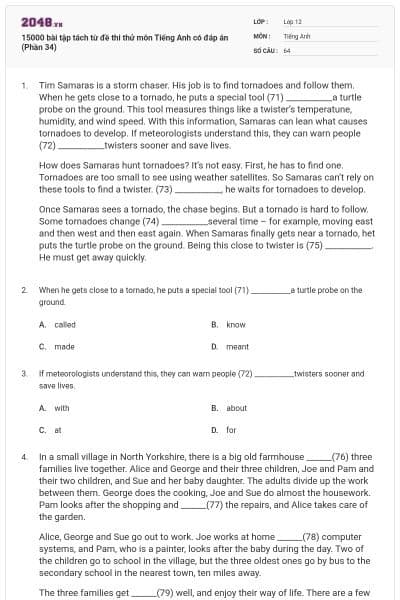
Tim Samaras is a storm chaser. His job is to find tornadoes and follow them. When he gets close to a tornado, he puts a special tool (71) ___________a turtle probe on the ground. This tool measures things like a twister’s temperatune, humidity, and wind speed. With this information, Samaras can lean what causes tornadoes to develop. If meteorologists understand this, they can warn people (72) ___________twisters sooner and save lives.
How does Samaras hunt tornadoes? It’s not easy. First, he has to find one. Tornadoes are too small to see using weather satellites. So Samaras can’t rely on these tools to find a twister. (73) ___________, he waits for tornadoes to develop.
Once Samaras sees a tornado, the chase begins. But a tornado is hard to follow. Some tornadoes change (74) ___________several time – for example, moving east and then west and then east again. When Samaras finally gets near a tornado, het puts the turtle probe on the ground. Being this close to twister is (75) ___________. He must get away quickly.
called
know
made
meant
Đáp án A
Called: được gọi là Known: được biết rằng
Made: được làm Meant: có nghĩa là
Câu này dịch như sau: Tim Samaras is a storm chaser. His job is to find tornadoes and follow them. When he gets close to a tornado, he puts a special tool (36)____a turtle probe on the ground.
=> Tim Samaras là người theo đuổi những cơn bão. Công việc của anh là tìm kiếm những cơn lốc xoáy và theo dõi chúng. Khi anh ấy đến gần một cơn lôc xoáy, anh ấy đặt một công cụ đặc biệt được gọi là con rùa thăm dò trên mặt đất.
If meteorologists understand this, they can warn people (72) ___________twisters sooner and save lives.
with
about
at
for
Đáp án B
Cụm động từ warn someone about something : cảnh báo ai về việc gì
Câu này dịch như sau: This tool measures things like a twister’s temperatune, humidity, and wind speed. With this information, Samaras can lean what causes tornadoes to develop. If meteorologists understand this, they can warn people (37)____twisters sooner and save lives.
=> Công cụ này đo những thứ như là nhiệt độ của lốc xoáy, độ ẩm và tốc độ gió. Với thông tin này Samaras có thể hiểu nguyên nhân gây ra lốc xoáy để phát triển. Nếu các nahf chiêm tinh học hiểu được nó , họ có thể cảnh báo mọi người về cơn lốc sớm hơn và cứu sống được nhiều người.
73) ___________, he waits for tornadoes to develop.
Rather
Still
Instead
Yet
Đáp án C
Rather: hơn Still: vẫn Instead: thay vì Yet: nhưng, rồi
Câu này dịch như sau: How does Samaras hunt tornadoes? It’s not easy. First, he has to find one. Tornadoes are too small to see using weather satellites. So Samaras can’t rely on these tools to find a twister. (73)____, he waits for tornadoes to develop.
=> Samaras săn lung những cơn bão như thế nào? Không hề dễ chút nào. Trước tiên anh ấy phải tìm. Các cơn lốc xoáy quá nhỏ để có thể sử dụng vệ tinh thời tiết. Vì vậy Samaras không thể dựa vào công cụ này để tìm lốc xoáy. Thay vào đó, anh ấy chờ cơn lốc xoáy phát triển.
progression
movement
dimension
direction
Đáp án D
Progression: sự phát triển Movement: sự di chuyển
Dimension: chiều / dạng Direction: phương hướng
Câu này dịch như sau:
Once Samaras sees a tornado, the chase begins. But a tornado is hard to follow. Some tornadoes change (74)________several time – for example, moving east and then west and then east again.
=> Khi Samaras nhìn thấy một cơn lốc xoáy cuộc truy đuổi bắt đầu. Nhưng lốc xoáy rất khó bám theo. Một vài lốc xoáy thay đổi phương hướng nhiều lần – ví dụ di chuyển về hướng đông sau đó về hướng tây sau đó lại về hướng đông.
Being this close to twister is (75) ___________. He must get away quickly.
terrifly
terrifying
terrified
terrifies
Đáp án B
Terrify (v) : kinh khủng
Terrifying(adj): đáng sợ ( tính từ chủ động dùng để tả tính chất của người/ vật)
Terrified (adj): hoáng sợ ( tính từ bị động thường dùng cho chủ ngữ chỉ người)
Sau động từ be (is) cần dùng tính từ => loại A và D
Câu này dịch như sau: When Samaras finally gets near a tornado, het puts the turtle probe on the ground. Being this close to twister is (75)____. He must get away quickly.
=> Khi Samaras cuối cùng đế gần được lốc xoáy anh ấy đặt con rùa thăm dò trên mặt đất. Việc đến gần lốc xoáy rất đáng sợ. Anh ấy phải chạy đi rất nhanh.
=> Mô tả bản chất công việc đến gần lốc xoáy rất đáng sợ => dùng tính từ chủ động
In a small village in North Yorkshire, there is a big old farmhouse ______(76) three families live together. Alice and George and their three children, Joe and Pam and their two children, and Sue and her baby daughter. The adults divide up the work between them. George does the cooking, Joe and Sue do almost the housework. Pam looks after the shopping and ______(77) the repairs, and Alice takes care of the garden.
Alice, George and Sue go out to work. Joe works at home ______(78) computer systems, and Pam, who is a painter, looks after the baby during the day. Two of the children go to school in the village, but the three oldest ones go by bus to the secondary school in the nearest town, ten miles away.
The three families get ______(79) well, and enjoy their way of life. There are a few difficulties, of course. Their biggest worry at the moment is money- one of the cars needs replacing, and the roof needs some expensive repairs. But this isn't too serious- the bank has agreed to a loan, which they expect to be able to pay back in three years. And they all say they would much rather go on living in their old farmhouse ______(80) move to a luxury flat in a big city.
that
where
in where
which
Đáp án B
– đại từ where = giới từ + which thay thế cho chủ ngữ là địa điểm.
Pam looks after the shopping and ______(77) the repairs, and Alice takes care of the garden.
does
makes
prepares
fulfils
Đáp án B
– make repair : sửa chữa đồ đạc.
designs
and design
designing
who designs
Đáp án C
– hai động từ nối liền nhau có dạng V + V-ing hoặc to V diễn tả 2 hoạt động bổ sung nghĩa cho nhau.
on
off
with
in
Đáp án A
– get on well : hòa hợp với nhau.
And they all say they would much rather go on living in their old farmhouse ______(80) move to a luxury flat in a big city.
then
than
to
therefore
Đáp án B
– would rather / than : thích cái gì hơn cái gì
When you wave to a friend, you are using sign language. When you smile at someone, you mean to be (81) ______. When you put one finger in front of your (82)______, you mean, "Be quiet." Yet, people in different countries may use different sign languages. Once an Englishman was in Italy he could speak a little Italian. One day while he was walking in the street, he felt (83) ______ and went into a restaurant. When the waiter came, the Englishman opened his mouth, put his fingers into it and took them out again and moved his lips. In this way, he meant to say, "Bring me something to eat." But the waiter brought him a lot of things to (84) ______: first tea, then coffee, then milk, but no food. The Englishman was sorry that he was not able to tell the waiter he was hungry. He was eardy to leave the restaurant. When another man came in and put his hands on his stomach. And this sign was (13) ______ enough for the waiter. In a few minutes, the waiter brought him a large plate of bread and meat. At last, the Englishman had his meal in the same way.
well
friendly
fine
careful
Đáp án B
When you smile at someone, you mean to be friendly: Khi bạn mỉm cười với ai đó, điều đó có nghĩa là bạn rất thân thiện
Question 82: Đáp án C
eyes
legs
mouth
head
Đáp án C
When you put one finger in front of your mouth, you mean, "Be quiet.": Khi bạn đặt một ngón tay trước miệng, ý bạn là, “Yên lặng.”
hungry
tired
cold
ill
Đáp án A
He went into a restaurant (Anh ta bước vào 1 nhà hàng) => Anh ta cảm thấy đói (He felt hungry)
eat
watch
drink
read
Đáp án C
Phía sau có đề cập đến hàng loạt các loại đồ uống: first tea, then coffee, then milk => động từ phù hợp ở đây là “drink” (uống)
Every child in Great Britain between the age of five and fifteen must (85) ______ school. There (86) ______ three main types of educational institutions: primary (elementary) schools, secondary schools and universities.
State schools are free, and attendance is compulsory. Morning school begins at nine o’clock and lasts until half past four. School is open five days a week.
(87) ______ Saturdays and Sundays there are no lessons. There are holidays at Christmas, Easter and in summer. In London as in all cities there are two grades of state schools for those (88) ______ will go to work at fifteen: primary schools for boys and girls between the ages of five and eleven, and secondary schools for children from eleven to fifteen years.
The lessons are reading, writing, the English language, English literature, English history, geography, (89) ______, nature study, drawing, painting, singing, woodwork and drill.
attend
come
arrive
go
Đáp án A
“attend”: tham dự, tham gia
Mỗi đứa trẻ ở Anh trong độ tuổi từ năm đến mười lăm phải đi học
There (86) ______ three main types of educational institutions: primary (elementary) schools, secondary schools and universities.
have
has
are
is
Đáp án C
Danh từ phía sau là types (số nhiều) nên ở đây dùng there are
There are three main types of educational institutions : Có ba loại cơ sở giáo dục chính
On
At
For
In
Đáp án A
Giới từ phía trước ngày là on
Vào thứ Bảy và Chủ Nhật không có tiết học.
In London as in all cities there are two grades of state schools for those (88) ______ will go to work at fifteen: primary schools for boys and girls between the ages of five and eleven, and secondary schools for children from eleven to fifteen years.
when
where
which
who
Đáp án D
Ở đây mệnh đề quan hệ cần dùng là who (thay thế cho those – người)
The lessons are reading, writing, the English language, English literature, English history, geography, (89) ______, nature study, drawing, painting, singing, woodwork and drill.
scientist
scientifically
science
scientific
Đáp án C
Science: môn Khoa học
Ở đây liệt kê hàng loạt các môn học, cho nên ở chỗ trống cũng phải là một môn học
The latest addiction to trap thousands of people is Internet, which has been (90)________ for broken relationships, job losses, financial ruin and even one suicide. Psychologists now recognize Internet Addiction Syndrome (IAS) as a new illness that could (91)________ serious problems and ruin many lives. Special help groups have been set up to (92)________ sufferers help and support.
IAS is similar to (93)________ problems like gambling, smoking and drinking: addicts have dreams about Internet; they need to use it first thing in the morning; they (94)________ to their partners about how much time they spend online; they (95)_______ they could cut down, but are unable to do so. A recent study found that many users spend up to 40 hours a week on the Internet; (96)______ they felt guilty, they became depressed if they were (97)______ to stop using it.
Almost anyone can be at risk. Some of the addicts are teenagers who are already hooked on computer games and who (98)________ it very difficult to resist the games on the Internet. Surprisingly, however, psychologists (99)________ that most victims are middle-aged housewives who have never used a computer before.
accused
mistaken
blamed
faulted
Đáp án C
Blamed for st: đổ lỗi, chê trách vì cái gì
Dịch: Cơn nghiện mới nhất bẫy hàng ngàn người là Internet, cái mà đã bị đổ lỗi cho việc các mối quan hệ bị phá vỡ, mất việc làm, hủy hoại tài chính và thậm chí tự tử.
Accuse: buộc tội (đi với giới từ of)
Mistaken: nhầm lẫn
Faulted: tìm thấy thiếu sót (ở điểm gì)
take
cause
affect
lead
Đáp án B
Cause: gây ra
Dịch: Các nhà tâm lý hiện nay nhận định Internet Addiction Syndrome (IAS) là một căn bệnh mới mà có thể gây ra vấn đề nghiêm trọng và hủy hoại nhiều cuộc đời
Take: lấy đi Affect: ảnh hưởng Lead: dẫn đến
Special help groups have been set up to (92)________ sufferers help and support.
recommend
offer
suggest
advise
Đáp án B
Offer: đề nghị, cung cấp, tặng, hiến,…
Dịch: nhóm giúp đỡ đặc biệt đã được thiết lập để cung cấp cho người bệnh sự giúp đỡ và hỗ trợ
Recommend: đề cử, gợi ý Suggest: gợi ý Advise: khuyên
others
another
the other
other
Đáp án D
Others ( = other + N số nhiều) ở sau others không có danh từ đi kèm nữa
Another + danh từ số ít
The other được sử dụng khi trong câu đã đề cập đến 1 danh từ nào đó rồi, và the other là cái khác, cái còn lại
Other + danh từ số nhiều: những cái khác
Đáp án là D
lie
cheat
deceive
betray
Đáp án A
To lie to sb: nói dối ai
Dịch: Họ nói dối bạn bè về khoảng thời gian họ dành ra để online
Cheat: lừa, gian lật (cheat on sb)
Deceive: lừa dối (deceive sb – không có giới từ)
Betray: phản bội (betray sb – không có giới từ)
rather
want
prefer
wish
Đáp án D
“wish”: mong rằng, mong ước
Sau wish, động từ khuyết thiếu can được chuyển thành could
Dịch: họ ước có thể cắt giảm (thời gian online), nhưng họ không thể làm được.
unless
without
although
despite
Đáp án C
Ở đây có sự đối lập về nghĩa giữa 2 vế, do đó cần sử dụng liên từ mang nghĩa đối lập
Although (mặc dù) + một mệnh đề
Dịch: Mặc dù cảm thấy tội lỗi, họ cảm thấy chán nản nếu như phải buộc ngừng sử dụng nó
they became depressed if they were (97)______ to stop using it.
made
allowed
let
had
Đáp án A
To be made to do st: buộc phải làm gì (mang tính bắt buộc)
Dịch: Mặc dù cảm thấy tội lỗi, họ cảm thấy chán nản nếu như phải buộc ngừng sử dụng nó
Allow, let: cho phép
Had trong câu này không đúng về ngữ pháp và về nghĩa
Đáp án là A
have
find
feel
say
Đáp án B
Cụm “find it difficult to do st”: cảm thấy khó khăn trong việc làm gì
Dịch:
Một trong số những người nghiện là thanh thiếu niên, những người đã bị cuốn vào trò chơi điện tử và cảm thấy khó để cưỡng lại trò chơi trên Internet
Surprisingly, however, psychologists (99)________ that most victims are middle-aged housewives who have never used a computer before.
say
tell
object
promise
Đáp án A
Say that: nói rằng
Tell: kể (sau đó phải có một tân ngữ, ví dụ tell me, tell us…)
Object: phản đối
Promise: hứa hẹn
Dịch: tuy nhiên, đáng ngạc nhiên là, các nhà tâm lý nói rằng hầu hết các nạn nhân là các bà nội trợ trung niên - người chưa bao giờ sử dụng một máy tính trước đây.
INTELLIGENCE TEST
Schools exams are, generally speaking, the first kind of tests we take. They find out how much knowledge we have (1) ____. But do they really show how intelligent we are? After all, isn’t it a fact that some people who are very successful academically don’t have any (2)____ sense? Intelligence is the speed at which we can understand and (3)____ to new situations and it is usually tested by logic puzzles. Although scientists are now preparing advanced computer technology that will be able to “read” our brains, for the present tests are still the most popular ways of measuring intelligence. A person’s IQ is their intelligence as it is measured by a special test. The most common IQ tests are run by Mensa, an organization that was founded in England in 1946. By 1976 it had 1300 members in Britain. Today there are 44000 in Britain and 100000 worldwide, largely in the US. People taking the tests are judged in relation to an average score of 100, and those score over 148 are entitled to join Mensa. This (4)___ at 2% of the population. Anyone from the age of six can take the tests. All the questions are straightforward and most people can answer them if (5)____ enough time. But that’s the problems – the whole point of the tests is that they’re against the clock
fetched
gained
attached
caught
Ta có: Từ “gain” (v) đạt được, thu được, giành được
“. They find out how much knowledge we have (41) ____”
Tạm dịch: Họ khám phá ra bao nhiêu kiến thức chúng ta đã____________
Các đáp án khác
A – tìm về, đem về
C – gắn, dán, trói buộc
D – bắt, nắm lấynatural
bright
sharp
common
accord
react
answer
alter
adds up
turns to
comes up
works out
“This (44) ___ at 2% of the population.”
Tạm dịch: Điều này______________2% tổng dân số
Chúng ta có đáp án D – work out (phr.v) – dùng cho các phép tính toán cái gì
Theo oxford ta có: work out (at something) - if something works out at something, you calculate that it will be a particular amount
Các đáp án khác đều k thích hợp về nghĩa
A – add up – có ý nghĩa
B – turn to sb/sth: kiếm sự ủng hộ, động viên, an ủi từ ai
C – come up = appear : xuất hiệnallowed
spared
let
provided
“All the questions are straightforward and most people can answer them if (45) ____ enough time.”
Tạm dịch: Tất cả các câu hỏi là dễ hiểu và hầu hết mọi người có thể trả lời chúng nếu (45) ____ đủ thời gian.
Đáp án a – được cho phép
Các đáp án khác
B – tiết kiệm
C – cho phép
D – được cung cấpHow men first learnt to (6) __________words is unknown; in other words, the origin of language is a mystery. All we really know is that men, unlike animals, (7) __________invented certain sounds to express thoughts and feelings, actions and things so that they could communicate with each other; and that later they agreed (8) __________certain signs, called letters, which could be combined to represent those sounds, and which could be written down. These sounds, whetherspoken or written in letters, are called words.
Great writers are those who not only have great thoughts but also express these thoughts in words that (9) __________ powerfully to our minds and emotions. This charming and telling use of words is what we call literary style. Above all, the real poet is a master of words. He can convey his meaning in words which sing like music, and which by their position and association can (10) __________ men to tears. We should, therefore, learn to choose our words carefully, or they will make our speech silly and vulgar.
invent
create
make
discover
Giải thích: Câu hỏi này yêu cầu phân biệt nghĩa và cách dùng của những động từ có nghĩa tương tự nhau.
Invent (v) = phát minh ra, là sự sáng tạo có giá trị và đã tạo nên một thành phẩm
Create (v) = sáng tạo, là khả năng tưởng tượng ra nhiều trường hợp, ý kiến mới nhiều nhất có thể, dù có giá trị hay không
Make (v) = làm ra, là sự tạo thành sản phẩm từ các nguyên liệu, công thức đã có sẵn, không mang tính sáng tạo
Discover (v) = phát hiện, là tìm ra, khám phá ra một thứ, một điều vốn đã tồn tại từ trước nhưng chưa được biết đến
Ngôn ngữ là một phát minh có giá trị bậc nhất của loài người. Do đó, sử dụng từ “invent” là chính xác nhất.
Dịch nghĩa: How men first learnt to invent words is unknown; in other words, the origin of language is a mystery. = Làm thế nào con người lần đầu tiên phát minh ra các từ ngữ vẫn chưa được biết rõ; nói cách khác, nguồn gốc của ngôn ngữ là một điều bí ẩn.whatever
however
somewhat
somehow
Giải thích: somehow = bằng cách nào đó
Dịch nghĩa: All we really know is that men, unlike animals, somehow invented certain sounds to express thoughts and feelings, actions and things = Tất cả những gì ta biết là con người, không giống các loài động vật, bằng cách nào đó phát minh ra các âm thanh nhất định để thể hiện suy nghĩ và cảm xúc, hành động và sự vật.
A. whatever = bất cứ cái gì
B. however = tuy nhiên
C. somewhat = hơi hơi, khá làat
upon
for
in
Giải thích: Cấu trúc
Agree on / upon sth = đồng ý về cái gì, việc gì
Dịch nghĩa: later they agreed upon certain signs, called letters, which could be combined to represent those sounds, and which could be written down = sau này họ đồng ý về những kí hiệu nhất định, được gọi là chữ cái, thứ có thể được kết hợp để đại diện cho những âm thanh kia, và thứ mà có để được viết xuống.interest
appeal
attract
lure
Giải thích: Cấu trúc
Appeal to sb = gây ấn tượng, thu hút ai
Dịch nghĩa: Great writers are those who not only have great thoughts but also express these thoughts in words that appeal powerfully to our minds and emotions = Những nhà văn lớn là những người không chỉ có tư tưởng vĩ đại mà còn thể hiện những suy nghĩ trong lời văn gây ấn tượng mạnh mẽ đến tâm trí và cảm xúc của chúng ta.
A interest (v) in sth = có hứng thú, yêu thích cái gì
C. attract (v) sb / sth = hấp dẫn, thu hút ai
D. lure (v) = quyến rũ, lôi cuốn ai đi đâu hay làm gì (nghĩa tiêu cực)
take
send
break
move
Giải thích: move (v) sb to tears = làm ai cảm động đến khóc
Dịch nghĩa: He can convey his meaning in words which sing like music, and which by their position and association can move men to tears. = Anh ta có thể truyền đạt ý nghĩa của ngôn từ thứ mà ngân nga như âm nhạc, và thứ bằng vị trí và sự kết nối của chúng có thể làm nguwoif khác cảm động đến rơi nước mắt..
A. take (v) = lấy, cầm, chiếm, nhận, đạt giải thưởng
B. send (v) = gửi đi
C. break (v) = làm đổ vỡHealth is something we tend to (11) _______ when we have it. When our body is doing well, we are hardly aware of it. But illness can come, even (12) _______ we are young. In fact, childhood has been a very susceptible time. Many diseases attack children in particular, and people know very little how to cure them once they struck. The result was that many children died. About a century ago,(13) _________, scientists found out about germs, and then everything changed. The cause of many diseases was found, and cures were developed. As this medical discovery spread, the world became____ (14) _____ safer for children. The result is that whereas a hundred years ago, the average man lived for 35 years, nowadays, in many areas of the world, people can expect to live for 75 years. And what do we expect by the year 2020? Undoubtedly, medical science will continue to (15) ________. Some people will be able to avoid medical problems that are unavoidable today.
forget
ignore
give up
throw away
Giải thích: Câu sau là "When our body is doing well, we are hardly aware of it.” = Khi cơ thể chúng ta đang khỏe mạnh, chúng ta hiếm khi nhận thức được nó. Do đó, xu hướng mà con người thường có khi có sức khỏe là phớt lờ, bỏ qua nó.
Phương án B. ignore (v) = phớt lờ, bỏ qua là phương án chính xác nhất.
Dịch nghĩa: Health is something we tend to ignore when we have it.= Sức khỏe là thứ chúng ta có khuynh hướng xao lãng khi chúng ta có nó.
A. forget (v) = quên
C. give up (v) = từ bỏ
D. throw away (v) = ném điDịch bài đọc:
Sức khỏe là thứ chúng ta có xu hướng bỏ qua khi chúng ta có nó. Khi cơ thể chúng ta khỏe mạnh, chúng ta hầu như không nhận ra điều đó. Nhưng bệnh tật có thể đến, ngay cả khi chúng ta còn trẻ. Trên thực tế, thời thơ ấu là thời kỳ rất dễ mắc bệnh. Nhiều căn bệnh tấn công trẻ em nói riêng và mọi người biết rất ít cách chữa trị khi chúng đã mắc phải. Kết quả là nhiều trẻ em đã tử vong. Tuy nhiên, khoảng một thế kỷ trước, các nhà khoa học đã phát hiện ra vi khuẩn, và sau đó mọi thứ đã thay đổi. Nguyên nhân gây ra nhiều căn bệnh đã được tìm ra và các phương pháp chữa trị đã được phát triển. Khi khám phá y học này lan rộng, thế giới trở nên an toàn hơn nhiều đối với trẻ em. Kết quả là trong khi một trăm năm trước, một người đàn ông trung bình sống được 35 năm, thì ngày nay, ở nhiều khu vực trên thế giới, mọi người có thể sống tới 75 năm. Và chúng ta mong đợi điều gì vào năm 2020? Không nghi ngờ gì nữa, khoa học y tế sẽ tiếp tục tiến bộ. Một số người sẽ có thể tránh được các vấn đề y tế không thể tránh khỏi ngày nay.
if
so
when
while
Giải thích: Đây là một mệnh đề nhấn mạnh về thời gian, sử dụng cụm từ "even when" = kể cả khi
Dịch nghĩa: But illness can come, even when we are young = Nhưng bệnh tật có thể đến bất cứ khi nào, thậm chí khi chúng ta còn trẻ.
A. even if = kể cả nếu, dùng trong cấu trúc câu điều kiện
B. even so = kể cả thế (=but), dùng để nối hai vế có mối quan hệ nhượng bộ
D. even while = kể cả trong khi, nhấn mạnh vào quá trình hơn là về thời điểmtherefore
however
although
moreover
Giải thích: Giữa câu có chỗ trống cần điền và câu trước nó có ý nghĩa nhượng bộ, trái ngược nhau. Do đó từ nối However = tuy nhiên là từ phù hợp nhất.
Dịch nghĩa: The result was that many children died. About a century ago; however, scientists found out about germs, and then everything changed. = Kết quả là nhiều trẻ đã tử vong. Tuy nhiên, khoảng một thế kỷ trước, các nhà khoa học đã tìm ra vi trùng và sau đó mọi thứ đã thay đổi.
A. therefore = bởi vậy, do đó; dùng để nối hai vế có quan hệ nguyên nhân – kết quả.
C. although = mặc dù; theo sau là một mệnh đề, thường đứng đầu câu, dùng để nối hai vế có quan hệ nhượng bộ.
D. moreover = thêm vào đó, dùng để bổ sung thêm ý kiếnmore
much
very
quite
Giải thích: Much/far + hình thức so sánh hơn được dùng để nhấn mạnh thêm phép so sánh đó
Dịch nghĩa: As this medical discovery spread, the world became much safer for children = Khi phát minh về y học này được lan rộng, thế giới trở nên an toàn hơn nhiều cho trẻ em.
A. more = hơn, more + tính từ dài / danh từ tạo thành phép so sánh hơn kém
C. very = rất, theo sau là một tính từ hoặc trạng từ
D. quite = khá là, theo sau là một tính từ hoặc trạng từUndoubtedly, medical science will continue to (15) ________. Some people will be able to avoid medical problems that are unavoidable today.
speed up
run
accelerate
advance
Giải thích: Đây là câu hỏi yêu cầu phân biệt nghĩa của từ. Chỉ có từ advance (v) = tiến bộ là phù hợp với ngữ cảnh của câu.
Dịch nghĩa: And what do we expect by the year 2020? Undoubtedly, medical science will continue to advance. Some people will be able to avoid medical problems that are unavoidable today. = Và đến năm 2020 chúng ta mong đợi điều gì? Rõ ràng là ngành y học sẽ tiếp tục tiến bộ. Nhiều người sẽ có thể tránh được các vấn đề về y học mà ngày nay vẫn chưa tránh được.
A. speed up (v) = tăng tốc độ
B. run (v) = chạy
C. accelerate (v) = đẩy nhanh tiến độOne of the most beautiful parts of Britain is the Lake District. The Lake District is situated in the north-west of England and consists of high hills, mountains and, of course, lakes. In all, there are 16 lakes, of (16)_____ the largest is Lake Windermere. Over the years many writers have been (17)_____ with this region but there can be no (18)_____ that the most famous of all was William Wordsworth (1770-1850), who was born and lived almost the whole of his life there. He had close connections with the village of Grasmere, where he lived for some thirteen years. He loved this particular part of England and many of his poems of the joy he felt when surrounded by beautiful countryside
Every year more than 14 million people from Britain and abroad visit the Lake District to enjoy the fresh air and the scenery. Some go to walk in the mountains while others sail boats on the lakes or simply sit admiring the (19)_____ views. Unfortunately, the region is becoming a victim of its own success in attracting visitors. (20)____ come to the Lake District that they threaten to destroy the peace and quite which many are searching for there
all
them
which
those
Ta có: giới từ + which/ whom
Which – thay thế cho “16 lakes”associated
connected
bound
linked
Ta có: tobe associated with sth: Kết giao, kết hợp, liên hợp, liên kết (+ với)
[t.v] Liên tưởng (những ý nghĩ)
[it.v] Kết giao, kết bạn với , giao thiệp với, giao du với ; Hợp sức lại, liên hợp lại
Các đáp án khác
B - connected (with somebody/something) có liên quan đến
C – tobe bound to do sth: chắc chắn có thể xảy ra điều gì
D – link (n) sự liên kếtthought
evidence
supposition
doubt
Ta có: no doubt: Không còn nghi ngờ gì nữa
Các đáp án khác
A – suy nghĩ
B – bằng chứng
C – sự giả định, sự giả thiếtprincipal
magnificent
effective
significant
Tạm dịch: Một số người đi dạo ở vùng núi, trong khi những người khác chèo thuyền trên hồ hoặc chỉ đơn giản là ngồi ngưỡng mộ (44) _____ quang cảnh.
Đáp án B – magnificent (a) nguy nga, tráng lệ, lộng lẫy, đẹp
Các đáp án khác
A – nguyên lí, nguyên tắc
B – hiệu quả
D – có ý nghĩa, đáng kểSuch many people
So few people
So many people
Such people
Ta có: S + V + so + many/few + plural / countable noun + that + S + V
Còn Such….that..: S + V + such + (a/an) + adj + noun + that + S + V
- Ta có cách dung: SO MUCH/ MANY – để nhấn mạnh vào số lượng đối lượng – danh từ trong mệnh đề chỉ nguyên nhân.English has without a (21) ____ become the second language of Europe and the world. European countries which have most (22) ____ assimilated English into daily life are England's neighbors in Northern Europe: Ireland, the Netherlands, Sweden, Norway, and the rest of Scandinavia.
The situation is so (23) ____ that any visitor to the Netherlands will soon be aware of the pressure of English on daily life: television, radio and print bring it into every home and the schoolyard conversation of children; advertisers use it to (24) ____ up their message, journalists take refuge in it when their home-bred skills fail them. Increasingly one hears the (25) ____ that Dutch will give way to English as the national tongue within two or three generations.
question
doubt
problem
thought
Giải thích: Thành ngữ without a doubt = không hề nghi ngờ gì. Đây là cụm từ cố định, không thể kết hợp cùng với những từ khác.
Dịch nghĩa: English has without a doubt become the second language of Europe and the world = Tiếng Anh không hề nghi ngờ gì đã trở thành ngôn ngữ thứ hai của Châu Âu và thế giới.
A. question (n) = câu hỏi
C. problem (n) = vấn đề
D. thought (n) = suy nghĩEuropean countries which have most (22) ____ assimilated English into daily life are England's neighbors in Northern Europe: Ireland, the Netherlands, Sweden, Norway, and the rest of Scandinavia.
successfully
victorious
successful
lucrative
Giải thích: Sau chỗ trống là động từ "assimilate” (hòa nhập, kết hợp) nên trước đó cần một trạng từ bổ nghĩa cho động từ đó.
Successfully (adv) = một cách thành công
Dịch nghĩa: European countries which have most successfully assimilated English into daily life are England's neighbors in Northern Europe: … = Những quốc gia châu Âu mà đã hòa nhập thành công Tiếng Anh vào cuộc sống thường ngày mà những láng giềng của nước Anh ở Bắc Âu: …
B. victorious (adj) = chiến thắng, thành công
C. successful (adj) = thành công
D. lucrative (adj) = thịnh vượng, sinh lãi nhiềuplain
open
blatant
marked
Giải thích: Câu sử dụng cấu trúc
S + tobe + so + adj + that + S + V = như thế nào quá đến nỗi mà
Sau "that" là mệnh đề “any visitor to the Netherlands will soon be aware of the pressure of English on daily life” = bất cứ khách du lịch nào đến với Hà Lan cũng sẽ sớm nhận ra sức ép của Tiếng Anh trong đời sống hàng ngày.
Để một người từ nơi khác đến có thể nhanh chóng nhận ra thì chứng tỏ biểu hiện của sức ép ấy là rất rõ ràng. Do đó, phương án D. marked (adj) = nổi bật, rõ ràng là phương án phù hợp nhất.
A. plain (adj) = bằng phẳng; dơn giản, dễ hiểu
B. open (adj) = công khai; mở; chưa giải quyết
C. blatant (adj) = huyên náo, om sòmlife
energy
pep
enthusiasm
Giải thích: Chỗ trống sử dụng cấu trúc :
Use sth to do sth = sử dụng cái gì để làm gì
Chỗ trống nằm ở sau từ "to" và trước giới từ "up" nên đó là một động từ tạo thành một cụm động từ.
Pep up (v) = làm sống động, làm cho có sức hấp dẫn hơn
Dịch nghĩa: advertisers use it to pep up their message = những nhà quảng cáo sử dụng nó để làm sống động thông điệp của họ hơn.
A. life (n) = cuộc sống
B. energy (n) = năng lượng
D. enthusiasm (n) = sự nhiệt huyếtIncreasingly one hears the (25) ____ that Dutch will give way to English as the national tongue within two or three generations.
feeling
posture
judgment
view
Giải thích: Sau "that" là mệnh đề “Dutch will give way to English as the national tongue within two or three generations” = Tiếng Hà Lan sẽ nhường đường cho tiếng Anh như ngôn ngữ quốc gia trong hai hay ba thế hệ tới.
Trong hai hay ba thế hệ tới là một sự dự đoán về tương lai. Sự việc đó mới chỉ là viễn cảnh, tầm nhìn, do đó phương án D. view (n) = cảnh tượng là phương án phù hợp nhất.
A. feeling (n) = cảm xúc
B. posture (n) = tư thế, điệu bộ
C. judgment (n) = lời phán xét, nhận xétBạn có thích hoạt động này không?