10 câu trắc nghiệm Tiếng Anh 11 Global Success Reading đọc hiểu: Cities of the future có đáp án
10 câu hỏi
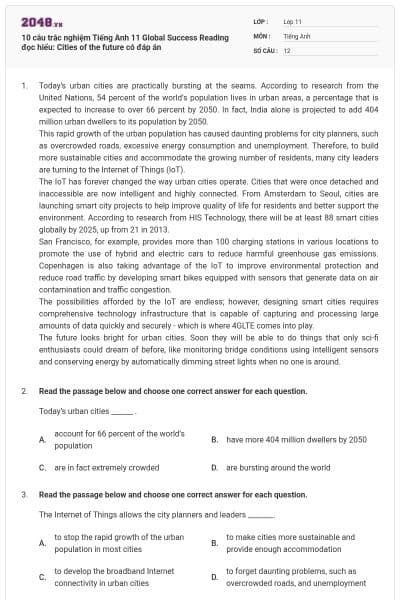
Today’s urban cities are practically bursting at the seams. According to research from the United Nations, 54 percent of the world’s population lives in urban areas, a percentage that is expected to increase to over 66 percent by 2050. In fact, India alone is projected to add 404 million urban dwellers to its population by 2050.
This rapid growth of the urban population has caused daunting problems for city planners, such as overcrowded roads, excessive energy consumption and unemployment. Therefore, to build more sustainable cities and accommodate the growing number of residents, many city leaders are turning to the Internet of Things (loT).
The IoT has forever changed the way urban cities operate. Cities that were once detached and inaccessible are now intelligent and highly connected. From Amsterdam to Seoul, cities are launching smart city projects to help improve quality of life for residents and better support the environment. According to research from HIS Technology, there will be at least 88 smart cities globally by 2025, up from 21 in 2013.
San Francisco, for example, provides more than 100 charging stations in various locations to promote the use of hybrid and electric cars to reduce harmful greenhouse gas emissions. Copenhagen is also taking advantage of the IoT to improve environmental protection and reduce road traffic by developing smart bikes equipped with sensors that generate data on air contamination and traffic congestion.
The possibilities afforded by the IoT are endless; however, designing smart cities requires comprehensive technology infrastructure that is capable of capturing and processing large amounts of data quickly and securely - which is where 4GLTE comes into play.
The future looks bright for urban cities. Soon they will be able to do things that only sci-fi enthusiasts could dream of before, like monitoring bridge conditions using intelligent sensors and conserving energy by automatically dimming street lights when no one is around.
Read the passage below and choose one correct answer for each question.
Today’s urban cities ______ .
account for 66 percent of the world’s population
have more 404 million dwellers by 2050
are in fact extremely crowded
are bursting around the world
Các thành phố đô thị ngày nay ______.
A. chiếm 66% dân số thế giới
B. có hơn 404 triệu cư dân vào năm 2050
C. thực tế rất đông đúc
D. đang bùng nổ trên toàn thế giới
Thông tin: Today’s urban cities are practically bursting at the seams.
Tạm dịch: Các thành phố đô thị ngày nay đang thực sự rất đông đúc.
=> Today’s urban cities are in fact extremely crowded.
Đáp án cần chọn là: c
Read the passage below and choose one correct answer for each question.
The Internet of Things allows the city planners and leaders _______.
to stop the rapid growth of the urban population in most cities
to make cities more sustainable and provide enough accommodation
to develop the broadband Internet connectivity in urban cities
to forget daunting problems, such as overcrowded roads, and unemployment
Internet of Things cho phép các nhà quy hoạch thành phố và các nhà lãnh đạo _______.
A. để ngăn chặn sự tăng trưởng nhanh chóng của dân số đô thị ở hầu hết các thành phố
B. để làm cho các thành phố bền vững hơn và cung cấp đủ chỗ ở
C. để phát triển khả năng kết nối Internet thông rộng ở các thành phố đô thị
D. để quên các vấn đề khó khăn, chẳng hạn như con đường đông đúc và thất nghiệp
Thông tin: Therefore, to build more sustainable cities and accommodate the growing number of residents, many city leaders are turning to the Internet of Things (loT).
Tạm dịch: Vì vậy, để xây dựng các thành phố bền vững hơn và phù hợp với số lượng ngày càng tăng của cư dân, nhiều nhà lãnh đạo thành phố đang chuyển sang Internet of Things (loT).
=> The Internet of Things allows the city planners and leaders to make cities more sustainable and provide enough accommodation.
Đáp án cần chọn là: b
Read the passage below and choose one correct answer for each question.
All of the following are the advantages of the IoT EXCEPT that ______ .
cities around the world become more intelligent and connected
we may improve quality of life and better support the environment
the Internet of Things will be applied in several cities around the world.
the number of smart cities decreases but the quality is much better
Tất cả những điều sau đây là những lợi thế của IoT ngoại trừ mà ______.
A. các thành phố trên khắp thế giới trở nên thông minh hơn và được kết nối
B. chúng tôi có thể cải thiện chất lượng cuộc sống và hỗ trợ tốt hơn cho môi trường
C. Internet of Things sẽ được áp dụng ở một số thành phố quanh WorlD.
D. số lượng thành phố thông minh giảm nhưng chất lượng tốt hơn nhiều
Thông tin: Cities that were once detached and inaccessible are now intelligent and highly connected. From Amsterdam to Seoul, cities are launching smart city projects to help improve quality of life for residents and better support the environment. According to research from HIS Technology, there will be at least 88 smart cities globally by 2025, up from 21 in 2013.
Tạm dịch: Các thành phố đã từng bị tách ra và không thể tiếp cận bây giờ trở thành những thành phố thông minh và được kết nối cao. Từ Amsterdam đến Seoul, các thành phố đang tung ra các dự án thành phố thông minh để giúp cải thiện chất lượng cuộc sống cho người dân và hỗ trợ tốt hơn cho môi trường. Theo nghiên cứu từ HIS Technology, sẽ có ít nhất 88 thành phố thông minh trên toàn cầu vào năm 2025, tăng từ 21 vào năm 2013.
=> All of the following are the advantages of the IoT EXCEPT that the number of smart cities decreases but the quality is much better.
Đáp án cần chọn là: d
Read the passage below and choose one correct answer for each question.
Some cities which follow this trend of the new technology _______ .
make transportation more eco-friendly and more convenient
only allow the use of hybrid and electric cars to reduce pollution
introduce smart bikes to escape air contamination and traffic congestion
provide charging stations in various locations for cars and bikes
Một số thành phố theo xu hướng này của công nghệ mới _______.
A. làm cho giao thông vận tải thân thiện với môi trường và thuận tiện hơn
B. chỉ cho phép sử dụng xe lai và xe điện để giảm ô nhiễm
C. giới thiệu xe đạp thông minh để tránh ô nhiễm không khí và tắc nghẽn giao thông
D. cung cấp trạm sạc ở các địa điểm khác nhau cho xe ô tô và xe đạp
Thông tin: San Francisco, for example, provides more than 100 charging stations in various locations to promote the use of hybrid and electric cars to reduce harmful greenhouse gas emissions. Copenhagen is also taking advantage of the IoT to improve environmental protection and reduce road traffic by developing smart bikes equipped with sensors that generate data on air contamination and traffic congestion.
Tạm dịch: San Francisco, ví dụ, cung cấp hơn 100 trạm thu phí ở các địa điểm khác nhau để thúc đẩy việc sử dụng xe hybrid và xe điện để giảm phát thải khí nhà kính độc hại. Copenhagen cũng đang tận dụng IoT để cải thiện bảo vệ môi trường và giảm lưu lượng giao thông bằng cách phát triển xe đạp thông minh được trang bị cảm biến tạo ra dữ liệu về ô nhiễm không khí và tắc nghẽn giao thông.
=> Some cities which follow this trend of the new technology make transportation more eco-friendly and more convenient.
Đáp án cần chọn là: a
Read the passage below and choose one correct answer for each question.
The potential of the IoT includes all of the following EXCEPT that _______ .
things that only sci-fi enthusiasts could dream of before come true
comprehensive technology infrastructure to support the IoT is endless
intelligent sensors can help watch and check bridge conditions carefully
energy conservation can be done by automatically controlling street lights
Tiềm năng của IoT bao gồm tất cả sau đây ngoại trừ _______.
A. những điều mà chỉ những người đam mê khoa học viễn tưởng mới có thể mơ ước trước khi trở thành sự thật
B. cơ sở hạ tầng công nghệ toàn diện để hỗ trợ IoT là vô tận
C. cảm biến thông minh có thể giúp xem và kiểm tra điều kiện cầu cẩn thận
D. bảo tồn năng lượng có thể được thực hiện bằng cách tự động kiểm soát đèn đường
Thông tin: Soon they will be able to do things that only sci-fi enthusiasts could dream of before, like monitoring bridge conditions using intelligent sensors and conserving energy by automatically dimming street lights when no one is around.
Tạm dịch: Chẳng mấy chốc họ sẽ có thể làm những điều mà những người đam mê khoa học viễn tưởng chỉ có thể mơ ước trước đây, như theo dõi tình hình các cây cầu bằng cảm biến thông minh và bảo tồn năng lượng bằng cách tự động làm mờ đèn đường khi không có ai xung quanh.
=> The potential of the IoT includes all of the following EXCEPT that comprehensive technology infrastructure to support the IoT is endless.
Bài dịch
Các thành phố đô thị ngày nay đang thực sự bùng nổ tại các đường nối. Theo nghiên cứu của Liên Hợp Quốc, 54% dân số thế giới sống ở khu vực đô thị, tỷ lệ phần trăm dự kiến sẽ tăng lên hơn 66% vào năm 2050. Thực tế, chỉ riêng Ấn Độ dự kiến sẽ thêm 404 triệu cư dân đô thị vào dân số 2050.
Sự tăng trưởng nhanh chóng của dân số đô thị đã gây ra những vấn đề khó khăn cho các nhà quy hoạch thành phố, chẳng hạn như con đường đông đúc, tiêu thụ năng lượng quá mức và thất nghiệp. Vì vậy, để xây dựng các thành phố bền vững hơn và phù hợp với số lượng ngày càng tăng của cư dân, nhiều nhà lãnh đạo thành phố đang chuyển sang Internet of Things (loT).
IoT đã thay đổi mãi mãi cách thức các thành phố đô thị hoạt động. Các thành phố đã từng tách ra và không thể tiếp cận bây giờ thông minh và được kết nối cao. Từ Amsterdam đến Seoul, các thành phố đang tung ra các dự án thành phố thông minh để giúp cải thiện chất lượng cuộc sống cho người dân và hỗ trợ tốt hơn cho môi trường. Theo nghiên cứu từ HIS Technology, sẽ có ít nhất 88 thành phố thông minh trên toàn cầu vào năm 2025, tăng từ 21 vào năm 2013.
San Francisco, ví dụ, cung cấp hơn 100 trạm thu phí ở các địa điểm khác nhau để thúc đẩy việc sử dụng xe hybrid và xe điện để giảm phát thải khí nhà kính độc hại. Copenhagen cũng đang tận dụng IoT để cải thiện bảo vệ môi trường và giảm lưu lượng giao thông bằng cách phát triển xe đạp thông minh được trang bị cảm biến tạo ra dữ liệu về ô nhiễm không khí và tắc nghẽn giao thông.
Các khả năng của IoT là vô tận; tuy nhiên, việc thiết kế các thành phố thông minh đòi hỏi cơ sở hạ tầng công nghệ toàn diện có khả năng thu và xử lý một lượng lớn dữ liệu nhanh chóng và an toàn - đó là nơi 4GLTE đi vào hoạt động.
Tương lai tươi sáng cho các thành phố đô thị. Chẳng mấy chốc họ sẽ có thể làm những điều mà những người đam mê khoa học viễn tưởng có thể mơ ước trước đây, như theo dõi điều kiện cầu bằng cảm biến thông minh và bảo tồn năng lượng bằng cách tự động làm mờ đèn đường khi không có ai xung quanh.
Đáp án cần chọn là: b
Predictions about the Cities of the Future
Cities are built to survive and prosper. Over the years, we have learned to transform our surroundings according to our needs. We have cut through mountains to make more land and created artificial islands to make skyscrapers. City planning, as an organized profession, has existed for less than a century. However, a considerable amount of evidence (both archaeological and historical) proves the existence of fully planned cities in ancient times. Over the years, humans have made some mistakes in terms of using an excessive amount of resources for cities. This gives rise to the question of how sustainable the cities of the future would be.
We might be looking at smart cities in which street lights would only switch on when you are close by and traffic light would be eliminated by smart driving. The cities of the future would try to save our resources rather than deplete them. An example of an advanced city is Kansas. Plans are in place to make Kansas a smart futuristic city in the future. Planners are considering introducing sensors to monitor the water mains. Warning would be issued to city officials when the infrastructure requires repair or replacement. In this way, the city would never be at risk of having broken pipes. While the idea sounds fantastic, a large amount of rational critique has called this plan an oversold dream. Amy Glasmier is an urban planning professor at MIT. She is a smart city skeptic who believes that all the research and talk is great but gravely oversold.
Read the following passage and choose the best answer to each question.
City planning is thought _______.
to have become a profession for about a hundred years
to have existed professionally since ancient times
to have come into existence to transform nature
to make more land and created artificial islands to make skyscrapers
Quy hoạch thành phố được cho là _______.
A. đã trở thành nghề nghiệp trong khoảng một trăm năm
B. đã tồn tại một cách chuyên nghiệp từ thời cổ đại
C. đã đi vào sự tồn tại để biến đổi thiên nhiên
D. để tạo thêm đất đai và tạo ra những hòn đảo nhân tạo để làm cho tòa nhà chọc trời
Thông tin: City planning, as an organized profession, has existed for less than a century.
Tạm dịch: Quy hoạch thành phố, như một nghề có tổ chức, đã tồn tại chưa đầy một thế kỷ.
=> City planning is thought to have become a profession for about a hundred years.
Đáp án cần chọn là: a
Read the following passage and choose the best answer to each question.
The most important task in building is _______.
to use an excessive amount of resources for cities
to raise the question about the future
to make cities in the future sustainable
to make future cities more organized
Nhiệm vụ quan trọng nhất trong xây dựng là _______.
A. để sử dụng quá nhiều tài nguyên cho các thành phố
B. để nêu lên câu hỏi về tương lai
C. để làm cho các thành phố trong tương lai bền vững
D. để làm cho các thành phố trong tương lai được tổ chức tốt hơn
Thông tin: This gives rise to the question of how sustainable the cities of the future would be.
Tạm dịch: Điều này dẫn đến câu hỏi về sự bền vững của các thành phố trong tương lai.
=> The most important task in building is to make cities in the future sustainable.
Đáp án cần chọn là: c
Read the following passage and choose the best answer to each question.
All of the following statements may be true about smart cities EXCEPT that ______.
street lights automatically switch on when necessary
traffic light would be controlled by smart driving
smart driving wouldn’t need traffic light
cities in the future would conserve energy
Tất cả các câu sau đây có thể đúng về các thành phố thông minh NGOẠI TRỪ ______.
A. đèn đường tự động bật khi cần thiết
B. đèn giao thông sẽ được kiểm soát bởi lái xe thông minh
C. lái xe thông minh sẽ không cần đèn giao thông
D. các thành phố trong tương lai sẽ bảo tồn năng lượng
Thông tin: We might be looking at smart cities in which street lights would only switch on when you are close by and traffic light would be eliminated by smart driving.
eliminate: loại bỏ
Tạm dịch: Chúng tôi có thể nhìn vào các thành phố thông minh, trong đó đèn đường sẽ chỉ bật khi bạn ở gần và đèn giao thông sẽ bị loại bỏ nhờ việc lái xe thông minh.
=> All of the following statements may be true about smart cities EXCEPT that traffic light would be controlled by smart driving.
Đáp án cần chọn là: b
Read the following passage and choose the best answer to each question.
The residents in Kansas would not be worried about water in the future because ______.
the infrastructure requires no repair or replacement
the city will never have broken water pipes
city officials often repair or replace the water mains
there may be no disruption to water supply
Cư dân ở Kansas sẽ không lo lắng về nước trong tương lai vì ______.
A. cơ sở hạ tầng không yêu cầu sửa chữa hoặc thay thế
B. thành phố sẽ không bao giờ có ống nước bị hỏng
C. cán bộ thành phố thường sửa chữa hoặc thay thế đường ống dẫn nước
D. có thể không có sự gián đoạn đối với cấp nước
Thông tin: Warning would be issued to city officials when the infrastructure requires repair or replacement. In this way, the city would never be at risk of having broken pipes.
Tạm dịch: Cảnh báo sẽ được đưa ra với cán bộ thành phố khi cơ sở hạ tầng yêu cầu sửa chữa hoặc thay thế. Bằng cách này, thành phố sẽ không bao giờ có nguy cơ bị vỡ đường ống.
=> The residents in Kansas would not be worried about water in the future because there may be no disruption to water supply.
Đáp án cần chọn là: d
Read the following passage and choose the best answer to each question.
The attitude of Amy Glasmier towards smart cities is ______.
supportive
doubtful
indifferent
disgusting
Thái độ của Amy Glasmier đối với các thành phố thông minh là ______.
A. hỗ trợ
B. nghi ngờ
C. thờ ơ
D. kinh tởm
Thông tin: She is a smart city skeptic who believes that all the research and talk is great but gravely oversold.
Tạm dịch: Cô là một người thành phố thông minh nhưng hay hoài nghi, người tin rằng tất cả các nghiên cứu và các câu chuyện là điều tuyệt vời nhưng đã được đề cao quá.
=> The attitude of Amy Glasmier towards smart cities is doubtful.
Bài dịch
Dự đoán về các thành phố của tương lai
Các thành phố được xây dựng để tồn tại và phát triển thịnh vượng. Trong những năm qua, chúng tôi đã học cách biến đổi môi trường xung quanh theo nhu cầu của chúng tôi. Chúng tôi đã vượt qua những ngọn núi để tạo thêm đất đai và tạo ra những hòn đảo nhân tạo để tạo nên những tòa nhà chọc trời. Quy hoạch thành phố, như một nghề có tổ chức, đã tồn tại chưa đầy một thế kỷ. Tuy nhiên, một số lượng đáng kể các bằng chứng (cả khảo cổ và lịch sử) chứng minh sự tồn tại của các thành phố được quy hoạch đầy đủ trong thời cổ đại. Trong những năm qua, con người đã phạm một số sai lầm về việc sử dụng quá nhiều tài nguyên cho các thành phố. Điều này dẫn đến câu hỏi về sự bền vững của các thành phố trong tương lai.
Chúng tôi có thể nhìn vào các thành phố thông minh, trong đó đèn đường sẽ chỉ bật khi bạn ở gần và đèn giao thông sẽ bị loại bỏ bằng lái xe thông minh. Các thành phố của tương lai sẽ cố gắng tiết kiệm tài nguyên của chúng ta hơn là làm cạn kiệt chúng. Một ví dụ về một thành phố tiên tiến là Kansas. Các kế hoạch được đưa ra để biến Kansas trở thành một thành phố tương lai thông minh trong tương lai. Các nhà quy hoạch đang xem xét việc giới thiệu các cảm biến để giám sát các đường ống dẫn nước. Cảnh báo sẽ được cấp cho cán bộ thành phố khi cơ sở hạ tầng yêu cầu sửa chữa hoặc thay thế. Bằng cách này, thành phố sẽ không bao giờ có nguy cơ bị vỡ đường ống. Trong khi ý tưởng nghe có vẻ tuyệt vời, một số lượng lớn các phê phán hợp lý đã gọi kế hoạch này là một giấc mơ quá bán. Amy Glasmier là giáo sư hoạch định đô thị tại MIT. Cô là một người hoài nghi thành phố thông minh, người tin rằng tất cả các nghiên cứu và nói chuyện là tuyệt vời nhưng đã được đánh giá cao quá.
Đáp án cần chọn là: b