Trong hình vẽ dưới đây, các đường cong ( C1 ) : y = a x , ( C2 ) : y = b x cắt các đường thẳng y = 4 , y = 8 tại các điểm M , N , P , Q . Biết hình thang có các đỉnh là M , N , P , Q (
80/91
Trong hình vẽ dưới đây, các đường cong \(\left( {{C_1}} \right):y = {a^x},\left( {{C_2}} \right):y = {b^x}\) cắt các đường thẳng \(y = 4,y = 8\) tại các điểm \(M,N,P,Q\). Biết hình thang có các đỉnh là \(M,N,P,Q\left( {MN//PQ} \right)\) có diện tích bằng 30 .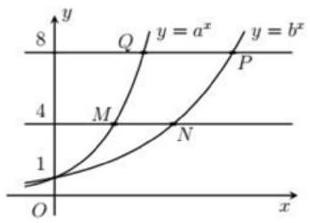
\(a + b > 2\)
\(MN = \frac{2}{{{\rm{lo}}{{\rm{g}}_2}b}} - \frac{2}{{{\rm{lo}}{{\rm{g}}_2}a}}\)
Giá trị nhỏ nhất của biểu thức \(P = {\rm{lo}}{{\rm{g}}_2}a - 4{\rm{lo}}{{\rm{g}}_2}b\) bằng \( - \frac{1}{3}\).
Giải chi tiết
1) Từ đồ thị ta có \(a > 1,b > 1 \Rightarrow a + b > 2\). Vậy 1 đúng
2) Xét các phương trình hoành độ giao điểm: \(\left\{ {\begin{array}{*{20}{l}}{{a^x} = 4 \Leftrightarrow x = {\rm{lo}}{{\rm{g}}_a}4 \Rightarrow {x_M} = {\rm{lo}}{{\rm{g}}_a}4}\\{{b^x} = 4 \Leftrightarrow x = {\rm{lo}}{{\rm{g}}_b}4 \Rightarrow {x_N} = {\rm{lo}}{{\rm{g}}_b}4}\end{array}} \right.\)
do đó: \(MN = {x_N} - {x_M} = {\rm{lo}}{{\rm{g}}_b}4 - {\rm{lo}}{{\rm{g}}_a}4 = \frac{1}{{{\rm{lo}}{{\rm{g}}_4}b}} - \frac{1}{{{\rm{lo}}{{\rm{g}}_4}a}} = \frac{2}{{{\rm{lo}}{{\rm{g}}_2}b}} - \frac{2}{{{\rm{lo}}{{\rm{g}}_2}a}}\).
Vậy 2) đúng
3) Ta có: \(\left\{ {\begin{array}{*{20}{l}}{{a^x} = 8 \Leftrightarrow x = {\rm{lo}}{{\rm{g}}_a}8 \Rightarrow {x_Q} = {\rm{lo}}{{\rm{g}}_a}8}\\{{b^x} = 8 \Leftrightarrow x = {\rm{lo}}{{\rm{g}}_b}8 \Rightarrow {x_P} = {\rm{lo}}{{\rm{g}}_b}8}\end{array}} \right.\)
do đó: \(PQ = {x_P} - {x_Q} = {\rm{lo}}{{\rm{g}}_b}8 - {\rm{lo}}{{\rm{g}}_a}8 = \frac{1}{{{\rm{lo}}{{\rm{g}}_8}b}} - \frac{1}{{{\rm{lo}}{{\rm{g}}_8}a}} = \frac{3}{{{\rm{lo}}{{\rm{g}}_2}b}} - \frac{3}{{{\rm{lo}}{{\rm{g}}_2}a}}\).
Vìvậy
\({S_{MNPQ}} = 30 \Leftrightarrow \frac{{MN + PQ}}{2}.4 = 30 \Leftrightarrow 10\left( {\frac{1}{{{\rm{lo}}{{\rm{g}}_2}b}} - \frac{1}{{{\rm{lo}}{{\rm{g}}_2}a}}} \right) = 30 \Leftrightarrow \frac{1}{{{\rm{lo}}{{\rm{g}}_2}b}} - \frac{1}{{{\rm{lo}}{{\rm{g}}_2}a}} = 3\).
Đặt \(x = {\rm{lo}}{{\rm{g}}_2}a,y = {\rm{lo}}{{\rm{g}}_2}b,(x,y > 0) \Rightarrow \frac{1}{y} - \frac{1}{x} = 3 \Leftrightarrow y = \frac{x}{{3x + 1}}\) và
\(P = x - 4y = g\left( x \right) = x - \frac{{4x}}{{3x + 1}} = \frac{{3{x^2} - 3x}}{{3x + 1}}\).
Ta có \(P + \frac{1}{3} = \frac{{3{x^2} - 3x}}{{3x + 1}} + \frac{1}{3} = \frac{{{{(3x - 1)}^2}}}{{3\left( {3x + 1} \right)}} \ge 0,\forall x > 0\).
Hay \(P \ge - \frac{1}{3}\). Dấu bằng xảy ra khi \(x = \frac{1}{3}\). Vậy giá trị nhỏ nhất của \(P\) bằng \( - \frac{1}{3}\).
Vậy 3) đúng.
Đáp án cần chọn là: Đ; Đ; Đ