Tìm k.
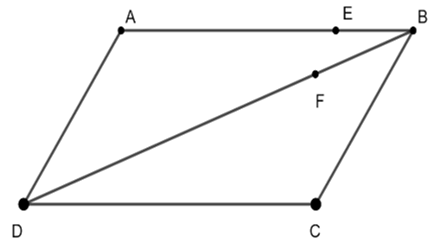
Gọi \(\overrightarrow {AB} = \overrightarrow b \); \(\overrightarrow {AD} = \overrightarrow d \)
Ta có \(\overrightarrow {BC} = \overrightarrow {AD} = \overrightarrow d \) và \(\overrightarrow {BD} = \overrightarrow {BA} + \overrightarrow {AD} = - \overrightarrow b + \overrightarrow d \)
Theo đề bài, ta có: \(\overrightarrow {BE} = \frac{1}{3}\overrightarrow {BC} = \frac{1}{3}\overrightarrow d \)
Suy ra \(\overrightarrow {AE} = \overrightarrow {AB} + \overrightarrow {BE} = \overrightarrow b + \frac{1}{3}\overrightarrow d \)
Ta có \(\overrightarrow {BF} = \frac{1}{4}\overrightarrow {BD} = \frac{1}{4}\left( { - \overrightarrow b + \overrightarrow d } \right)\)
Nên \(\overrightarrow {AF} = \overrightarrow {AB} + \overrightarrow {BE} = \overrightarrow b + \frac{1}{4}\left( { - \overrightarrow b + \overrightarrow d } \right) = \frac{3}{4}\overrightarrow b + \frac{1}{4}\overrightarrow d \)
Giả sử \(\overrightarrow {AE} = k\overrightarrow {AF} \), tức là:
\(\overrightarrow b + \frac{1}{3}\overrightarrow d = k\left( {\frac{3}{4}\overrightarrow b + \frac{1}{4}\overrightarrow d } \right) = \frac{{3k}}{4}\overrightarrow b + \frac{k}{4}\overrightarrow d \)
Do đó k = \(\frac{3}{4}\)