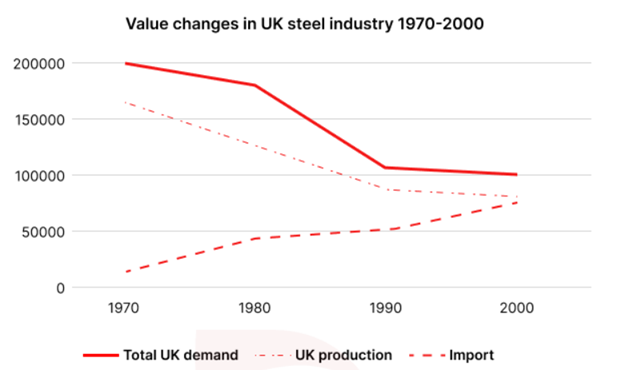
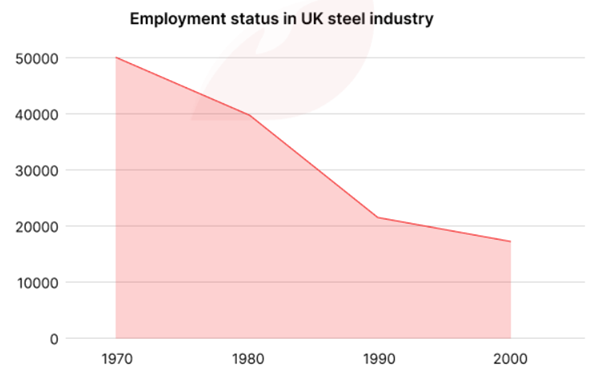
The line graph shows value changes in the UK steel industry between 1970’and 2000 while the second line chart shows employment status in the same industry.
23/24
The line graph shows value changes in the UK steel industry between 1970’and 2000 while the second line chart shows employment status in the same industry.
Hướng dẫn giải:
Gợi ý 1:
The two line graphs illustrate changes in employment and value trends in the UK steel industry between 1970 and 2000. Overall, both employment and domestic steel production declined sharply, while imports increased steadily over the period.
In 1970, around 50,000 people were employed in the steel industry. This figure fell to 40,000 by 1980 and then dropped dramatically to just over 20,000 in 1990. By 2000, employment had decreased further to approximately 15,000, representing a reduction of nearly 70% over three decades.
Regarding value changes, total UK demand for steel started at about 200,000 units in 1970 and declined consistently to just above 100,000 by 2000. Domestic production followed a similar downward trend, falling from roughly 160,000 to below 100,000. In contrast, imports rose significantly, beginning at a low level in 1970 and reaching nearly 75,000 by 2000.
In summary, the UK steel industry experienced a major contraction in both employment and production, while reliance on imported steel increased considerably during the same period.
(Hai biểu đồ đường minh họa sự thay đổi về việc làm và giá trị trong ngành công nghiệp thép của Vương quốc Anh từ năm 1970 đến năm 2000. Nhìn chung, cả số lượng lao động và sản lượng thép trong nước đều giảm mạnh, trong khi lượng thép nhập khẩu tăng đều trong giai đoạn này.
Năm 1970, khoảng 50.000 người làm việc trong ngành thép. Con số này giảm xuống 40.000 vào năm 1980 và giảm mạnh còn hơn 20.000 vào năm 1990. Đến năm 2000, số lao động tiếp tục giảm xuống khoảng 15.000, tức giảm gần 70% trong ba thập kỷ.
Về giá trị, tổng nhu cầu thép của Anh bắt đầu ở mức khoảng 200.000 đơn vị vào năm 1970 và giảm liên tục xuống hơn 100.000 vào năm 2000. Sản xuất trong nước cũng giảm tương tự, từ khoảng 160.000 xuống dưới 100.000. Ngược lại, lượng thép nhập khẩu tăng đáng kể, từ mức thấp năm 1970 lên gần 75.000 vào năm 2000.
Tóm lại, ngành thép của Anh đã chứng kiến sự suy giảm mạnh về việc làm và sản xuất, trong khi sự phụ thuộc vào thép nhập khẩu tăng đáng kể trong cùng thời kỳ.)
Gợi ý 2:
The two charts show how employment and value indicators in the UK steel industry changed from 1970 to 2000. It is clear that the number of workers and domestic production declined sharply, whereas steel imports grew steadily.
In 1970, the industry employed around 50,000 people. This number fell to 40,000 in 1980 and then dropped by almost half to 20,000 in 1990. By 2000, employment had reached its lowest point, at roughly 15,000 workers.
As for value changes, total UK demand for steel decreased from about 200,000 in 1970 to just over 100,000 in 2000. UK production also fell, from around 160,000 to slightly below 100,000. Meanwhile, imports rose continuously throughout the period, starting from a minimal level and climbing to approximately 75,000 by 2000.
Overall, the data indicate a significant decline in the UK steel industry’s workforce and domestic output, accompanied by a growing dependence on imported steel to meet national demand.
(Hai biểu đồ cho thấy sự thay đổi về việc làm và giá trị trong ngành thép của Vương quốc Anh từ năm 1970 đến năm 2000. Rõ ràng rằng số lượng lao động và sản xuất trong nước giảm mạnh, trong khi lượng thép nhập khẩu tăng đều.
Năm 1970, ngành công nghiệp này có khoảng 50.000 lao động. Con số giảm xuống 40.000 vào năm 1980 và giảm gần một nửa còn 20.000 vào năm 1990. Đến năm 2000, số lao động đạt mức thấp nhất, khoảng 15.000 người.
Về giá trị, tổng nhu cầu thép của Anh giảm từ khoảng 200.000 năm 1970 xuống hơn 100.000 năm 2000. Sản xuất trong nước cũng giảm từ khoảng 160.000 xuống dưới 100.000. Trong khi đó, lượng thép nhập khẩu tăng liên tục, từ mức rất thấp ban đầu lên khoảng 75.000 vào năm 2000.
Nhìn chung, dữ liệu cho thấy ngành thép của Anh suy giảm mạnh về lực lượng lao động và sản lượng trong nước, đồng thời ngày càng phụ thuộc vào thép nhập khẩu để đáp ứng nhu cầu quốc gia.)