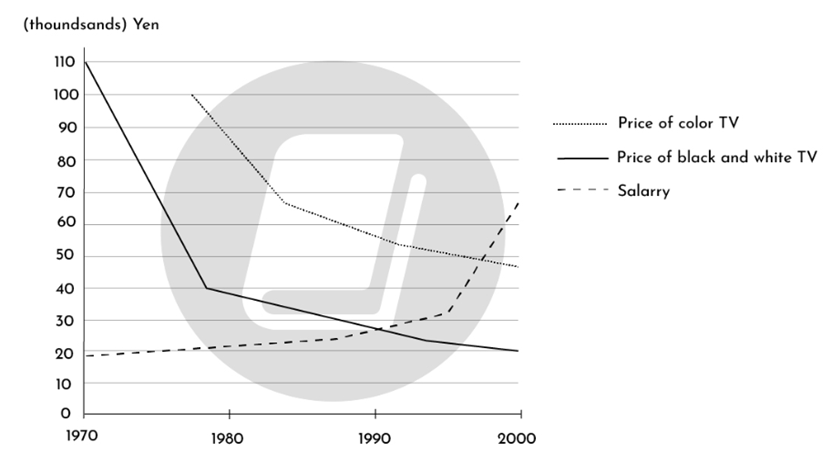
The graph shows the average Japanese month salary (Yen) from 1970 to 2000, and the prices of black and white televisions and color televisions during the same period.
44/49
The graph shows the average Japanese month salary (Yen) from 1970 to 2000, and the prices of black and white televisions and color televisions during the same period.
Hướng dẫn giải:
Gợi ý 1:
The line graph illustrates changes in the average Japanese monthly salary alongside the prices of black and white televisions and color televisions between 1970 and 2000, measured in thousands of Yen.
Overall, while the average monthly salary experienced a continuous upward trend over the thirty-year period, the prices of both black and white televisions and color televisions witnessed substantial declines, reflecting a significant increase in purchasing power and technological affordability.
In 1970, the average Japanese monthly salary stood at just under 20,000 Yen, whereas a black and white television was significantly more expensive, costing 110,000 Yen. Data for color televisions was not recorded until 1978, at which point they were priced at 100,000 Yen. Over the subsequent decades, salaries grew steadily, crossing the 30,000 Yen mark by 1995 before surging sharply to reach approximately 67,000 Yen in 2000.
Conversely, the costs of both television types dropped dramatically. The price of black and white televisions fell steeply to 40,000 Yen by 1978 and continued a gradual downward trend to finish at around 20,000 Yen in 2000, closely aligning with salary levels. Similarly, color television prices declined rapidly from their 1978 peak, dropping below 50,000 Yen by 2000 and ending slightly below the average monthly salary.
(Biểu đồ đường minh họa những thay đổi về mức lương trung bình hàng tháng của người Nhật bên cạnh giá của TV trắng đen và TV màu trong khoảng thời gian từ năm 1970 đến năm 2000, được đo bằng nghìn Yên. Nhìn chung, trong khi mức lương trung bình hàng tháng có xu hướng tăng liên tục trong giai đoạn 30 năm, giá của cả TV trắng đen và TV màu đều chứng kiến sự sụt giảm đáng kể, phản ánh sự gia tăng đáng kể về sức mua và khả năng chi trả công nghệ. Vào năm 1970, mức lương trung bình hàng tháng của người Nhật ở mức dưới 20.000 Yên, trong khi TV trắng đen đắt hơn đáng kể, có giá 110.000 Yên. Dữ liệu về TV màu không được ghi lại cho đến năm 1978, thời điểm đó chúng có giá 100.000 Yên. Trong những thập kỷ tiếp theo, tiền lương tăng trưởng đều đặn, vượt qua mốc 30.000 Yên vào năm 1995 trước khi tăng mạnh để đạt khoảng 67.000 Yên vào năm 2000. Ngược lại, chi phí của cả hai loại TV đều giảm mạnh. Giá TV trắng đen giảm mạnh xuống 40.000 Yên vào năm 1978 và tiếp tục xu hướng giảm dần để kết thúc ở mức khoảng 20.000 Yên vào năm 2000, bám sát mức lương. Tương tự, giá TV màu giảm nhanh chóng kể từ mức đỉnh năm 1978, giảm xuống dưới 50.000 Yên vào năm 2000 và kết thúc thấp hơn một chút so với mức lương trung bình hàng tháng.)
Gợi ý 2:
The provided line graph compares the average monthly income in Japan with retail prices for black and white and color television sets from 1970 to 2000.
A striking feature of the data is the inverse relationship between personal earnings and electronic appliance prices, demonstrating how televisions transitioned from luxury luxury goods to highly affordable household items over three decades.
At the beginning of the period in 1970, a black and white television cost 110,000 Yen—over five times higher than the average monthly salary of nearly 20,000 Yen. As time progressed, earnings experienced a slow climb through the 1970s and 1980s, reaching roughly 25,000 Yen by 1990, before accelerating sharply to peak at approximately 67,000 Yen in the year 2000.
In contrast, consumer electronics prices plunged. Black and white television prices plummeted to 40,000 Yen by 1978 and leveled off to around 20,000 Yen by the end of the period. Color televisions followed a similar downward trajectory after entering the market in 1978 at 100,000 Yen, halving in price by 1990 (approx. 55,000 Yen) and dropping further to roughly 47,000 Yen in 2000, making them cheaper than the average monthly wage for the first time.
In conclusion, Japanese workers saw their incomes more than triple while television prices fell drastically, shifting the economic accessibility of these consumer electronics entirely.
(Biểu đồ đường được cung cấp so sánh thu nhập trung bình hàng tháng ở Nhật Bản với giá bán lẻ cho các bộ TV trắng đen và TV màu từ năm 1970 đến năm 2000. Một đặc điểm nổi bật của dữ liệu là mối quan hệ nghịch đảo giữa thu nhập cá nhân và giá thiết bị điện tử, chứng minh cách TV chuyển đổi từ hàng xa xỉ thành các vật dụng gia đình có giá trị phải chăng trong suốt ba thập kỷ. Vào đầu giai đoạn năm 1970, một chiếc TV trắng đen có giá 110.000 Yên—cao hơn gấp năm lần mức lương trung bình hàng tháng gần 20.000 Yên. Khi thời gian trôi qua, thu nhập trải qua một sự leo dốc chậm trong suốt những năm 1970 và 1980, đạt khoảng 25.000 Yên vào năm 1990, trước khi tăng tốc mạnh mẽ để đạt đỉnh ở mức khoảng 67.000 Yên vào năm 2000. Ngược lại, giá đồ điện tử tiêu dùng lao dốc. Giá TV trắng đen giảm xuống 40.000 Yên vào năm 1978 và chững lại ở mức khoảng 20.000 Yên vào cuối giai đoạn. TV màu tuân theo quỹ đạo giảm tương tự sau khi gia nhập thị trường vào năm 1978 ở mức 100.000 Yên, giảm một nửa giá vào năm 1990 (khoảng 55.000 Yên) và giảm sâu hơn nữa xuống khoảng 47.000 Yên vào năm 2000, khiến chúng rẻ hơn mức lương trung bình hàng tháng lần đầu tiên. Tóm lại, người lao động Nhật Bản thấy thu nhập của họ tăng gấp hơn ba lần trong khi giá TV giảm mạnh, làm thay đổi hoàn toàn khả năng tiếp cận kinh tế của các thiết bị điện tử tiêu dùng này.)